EP1071219A2 - Method of representing data packages in compact form and of storing or transmitting them - Google Patents
Method of representing data packages in compact form and of storing or transmitting them Download PDFInfo
- Publication number
- EP1071219A2 EP1071219A2 EP00113216A EP00113216A EP1071219A2 EP 1071219 A2 EP1071219 A2 EP 1071219A2 EP 00113216 A EP00113216 A EP 00113216A EP 00113216 A EP00113216 A EP 00113216A EP 1071219 A2 EP1071219 A2 EP 1071219A2
- Authority
- EP
- European Patent Office
- Prior art keywords
- data
- identifications
- application
- meta
- dependent
- Prior art date
- Legal status (The legal status is an assumption and is not a legal conclusion. Google has not performed a legal analysis and makes no representation as to the accuracy of the status listed.)
- Withdrawn
Links
- 238000000034 method Methods 0.000 title claims abstract description 56
- 230000001419 dependent effect Effects 0.000 claims abstract description 22
- 238000007906 compression Methods 0.000 claims description 24
- 230000006835 compression Effects 0.000 claims description 24
- 238000004422 calculation algorithm Methods 0.000 claims description 13
- 230000005540 biological transmission Effects 0.000 claims description 4
- 229940005022 metadate Drugs 0.000 claims 1
- JUMYIBMBTDDLNG-UHFFFAOYSA-N methylphenidate hydrochloride Chemical compound [Cl-].C=1C=CC=CC=1C(C(=O)OC)C1CCCC[NH2+]1 JUMYIBMBTDDLNG-UHFFFAOYSA-N 0.000 claims 1
- 230000008901 benefit Effects 0.000 description 3
- 238000011156 evaluation Methods 0.000 description 2
- 238000013515 script Methods 0.000 description 2
- 238000013144 data compression Methods 0.000 description 1
- 230000000694 effects Effects 0.000 description 1
Images
Classifications
-
- H—ELECTRICITY
- H03—ELECTRONIC CIRCUITRY
- H03M—CODING; DECODING; CODE CONVERSION IN GENERAL
- H03M7/00—Conversion of a code where information is represented by a given sequence or number of digits to a code where the same, similar or subset of information is represented by a different sequence or number of digits
- H03M7/30—Compression; Expansion; Suppression of unnecessary data, e.g. redundancy reduction
- H03M7/3084—Compression; Expansion; Suppression of unnecessary data, e.g. redundancy reduction using adaptive string matching, e.g. the Lempel-Ziv method
-
- Y—GENERAL TAGGING OF NEW TECHNOLOGICAL DEVELOPMENTS; GENERAL TAGGING OF CROSS-SECTIONAL TECHNOLOGIES SPANNING OVER SEVERAL SECTIONS OF THE IPC; TECHNICAL SUBJECTS COVERED BY FORMER USPC CROSS-REFERENCE ART COLLECTIONS [XRACs] AND DIGESTS
- Y10—TECHNICAL SUBJECTS COVERED BY FORMER USPC
- Y10S—TECHNICAL SUBJECTS COVERED BY FORMER USPC CROSS-REFERENCE ART COLLECTIONS [XRACs] AND DIGESTS
- Y10S707/00—Data processing: database and file management or data structures
- Y10S707/99931—Database or file accessing
Definitions
- An object is a software unit which is closed off from the exterior and whose attributes are fixed internally by a series of local variables. The content of these local variables defines the state of the object but outside the object neither the local variables nor their content can be seen. The state of an object can only be changed by running one of its local subroutines. These subroutines are also known as methods. An object is requested to run a method by another object as a result of the object making the request sending a message to this effect. The object addressed will, assuming it understands the message, cause the appropriate method (local subroutine) to be run. Storing objects consists of storing both the attributes and the state in which methods/algorithms are, so that the latter can be continued seamlessly when the object is restored. Persistance, CORBA and ORB are jargon terms currently used to describe this.
- object serializing A widely used Java method of storing object states is known as object serializing. What object serializing means is that any desired object is converted into a sequence of bytes which represent the object and its present state. For this purpose all the attributes and their names and all the other objects to which the object makes reference are stored. Given this information, the object can be restored unchanged. The restoration is performed in a similar way: the object, and all the other objects to which it makes reference, is instanced and, using the data read from the chip card, initialized.
- the byte array which represents the object can be stored without any problems both on JavaCards and on conventional file-orientated cards.
- Meta-data is data which is required to define the data elements (e.g. the name and type of a data element).
- Data elements are the actual useful data.
- Storage media for the purposes of the present invention are, for example:
- Method steps 3-4 constitute special embodiments of the method according to the invention to allow the compression factor to be increased.
- serializing means 1) that the meta-data and data elements are combined to form a unit of data (data package) or 2) that only the data elements are represented, in a sequence, with the recipient performing the correlation between meta-data and data elements. In what follows it will be assumed that the serializing process is as in 1).
- Java object serialization is replaced by a serializing process using TLV (tag length value) structures. If objects are stored on a chip card by means of TLV structures, this saves storage space due to the fact that the tags are preprocessed.
- TLV tag length value
- An object is represented on the chip card as follows:
- the correlation between an "identifier" (substitute) and a tag is stored in a table which is part of the compression algorithm according to the invention.
- the tags are preferably determined in accordance with BER-TLV.
- the identifiers which are defined as tags are preferably the ones which are application-dependent. An example of a correlation is shown in the table below.
- tag and identifier must be known to the recipient or must be transmitted at the same time (e.g. a tupel of the form ⁇ tag,class,ID,constructed,type,class ⁇ )
- the main aim of the method is to minimise the meta-data in an object representation. What this means is that the shorter the data length of the individual attributes in an object, the more the compression factor rises. Where the data content per attribute is very high, the benefit is slightly less.
Landscapes
- Engineering & Computer Science (AREA)
- Theoretical Computer Science (AREA)
- Information Retrieval, Db Structures And Fs Structures Therefor (AREA)
- Stored Programmes (AREA)
- Devices For Executing Special Programs (AREA)
- Credit Cards Or The Like (AREA)
Abstract
Description
- The present invention relates to a method for the representation in compact form of packages of data, and particularly Java objects, for storing them on a storage medium, and particularly a chip card (smart card), having limited storage space, or for transmitting them on a channel of limited band-width.
- The storage of objects is a primary concern in the development of object-orientated software. An object is a software unit which is closed off from the exterior and whose attributes are fixed internally by a series of local variables. The content of these local variables defines the state of the object but outside the object neither the local variables nor their content can be seen.
The state of an object can only be changed by running one of its local subroutines. These subroutines are also known as methods. An object is requested to run a method by another object as a result of the object making the request sending a message to this effect. The object addressed will, assuming it understands the message, cause the appropriate method (local subroutine) to be run. Storing objects consists of storing both the attributes and the state in which methods/algorithms are, so that the latter can be continued seamlessly when the object is restored. Persistance, CORBA and ORB are jargon terms currently used to describe this. - For chip cards, there is no way of achieving this. Data is usually stored on them in conventional file structures. For the application data relating to the host application, there are various simple file types and file directories available on the card. Data is exchanged between host and card by means of individual command sequences (APDU's) to which the data is attached in the form of bytes. It is file-orientated cards of this kind which are most widely used today.
- A widely used Java method of storing object states is known as object serializing. What object serializing means is that any desired object is converted into a sequence of bytes which represent the object and its present state. For this purpose all the attributes and their names and all the other objects to which the object makes reference are stored. Given this information, the object can be restored unchanged. The restoration is performed in a similar way: the object, and all the other objects to which it makes reference, is instanced and, using the data read from the chip card, initialized. The byte array which represents the object can be stored without any problems both on JavaCards and on conventional file-orientated cards.
- The methods known hitherto for serializing and storing objects were designed for powerful computers. However, because they require too much storage space they are not suitable for storing objects on chip cards or storage media on which there is little storage space or else the only objects which can be stored in serialized form on chip cards are very small ones. For example, in Java object serialization several hundred bytes are required even for small objects with only a few attributes.
- The object of the invention is therefore to provide a method whereby data packages can be easy and quickly stored in a very compact form on a storage medium having only limited storage space or can be transmitted over a transmission channel of narrow band-width, in such a way that the data package can be restored at the receiving end.
- This object is achieved by means of the features detailed in claim 1 or claim 2. Other advantageous embodiments are described in the subclaims.
- The method according to the invention allows complex data packages (such as objects as understood in object-orientated programming) to be represented in a compact form, without the packages having to be broken down into individual components (such as attributes) and individually optimized.
The data package is represented as a whole (in a "black box") in a manner optimized with respect to storage space so that it can be stored on storage media such as chip cards and can be restored unchanged at any desired time on any desired system.
The restoration takes place by applying the algorithm in a similar way but in reverse, once again in a black box. - There is no need for the data package to be analyzed in a way specific to the application and context or for it to be broken down into individual items of data.
- The algorithm is applied to the data package as a whole and is non-application-dependent (if stage 3 below is employed, all that this stage requires is the dictionary that needs to be used).
In itself the compact representation contains all the data needed to allow the data package to be restored unchanged at some other point. - As far as the restoration of the data package is concerned, no other information apart from the compact data package itself is needed to restore it (apart from the dictionary if stage 3 below is employed where appropriate).
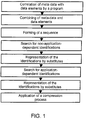
- The present invention will now be described in detail by reference to a preferred embodiment and in relation to Fig.1.
- Data packages for the purposes of the present invention are, for example:
- 1) objects as understood in object-orientated programming (e.g.
in the object-orientated programming languages Java, C++)
e.g. in a Java program
public Object Ticket {
public String departure = "Stuttgart";
public string destination = "Frankfurt";
public Ticket(); /*Constructor*/
}; - 2) Data structures (e.g. in the classic programming language C)
e.g. in a C program
Structure Ticket {
String departure = "Stuttgart";
String destination = "Frankfurt";
} - 3) Semantic definitions of data (e.g. HTML, XML, scripts) e.g.,
in an imaginary (!) script language:
〈TICKET〉〈STRING〉〈DEPARTURE〉"Stuttgart"〈STRING〉
〈DESTINATION〉"Frankfurt" -
- The data packages consist of meta-data and data elements. Meta-data is data which is required to define the data elements (e.g. the name and type of a data element). Data elements are the actual useful data.
- Storage media for the purposes of the present invention are, for example:
- hard disks, chip cards (smart cards), diskettes and the like. Media which are used for the temporary storage of the data package in question in its current state so that the same package can be recovered in this unchanged state at some other time and in some other system.
- The method according to the present invention for representing data packages in compact form will be described with reference to the following inventive method steps 1-4 in relation to Fig.1. Method steps 3-4 constitute special embodiments of the method according to the invention to allow the compression factor to be increased.
- For the purposes of the invention described below, serializing means 1) that the meta-data and data elements are combined to form a unit of data (data package) or 2) that only the data elements are represented, in a sequence, with the recipient performing the correlation between meta-data and data elements. In what follows it will be assumed that the serializing process is as in 1).
- 1. Meta-data is combined with data elements to form a data
package in a representation which contains all the details
required for restoring the data. The meta-data may for
example be the object name, object version, object type,
attributes, attribute types and current attribute values.
What have to be stored for the Java object "Ticket" are
- Object: This is an object of the type "java.lang.Object" with the
name "Ticket" (with a version stated where appropriate).
The attributes the object has are as follows: - Attribute1: an attribute "departure" of the type "java.lang.String" with a current value of "Stuttgart"
- Attribute2: an attribute "destination" of the type "java.lang.String" with a current value of "Frankfurt"
- 2. In the representation of the data packages, the
identifications used in them (name and type
identifications), such as java.lang.String,
java.lang.Object, etc. are shown as special predefined
identifiers or substitutes (e.g. tags from a TLV coding
conforming to ISO 8825 BER-TLV). This produces a
representation which, when processed to be read by humans,
can be depicted thus:
The meanings of the components in this case are as follows:
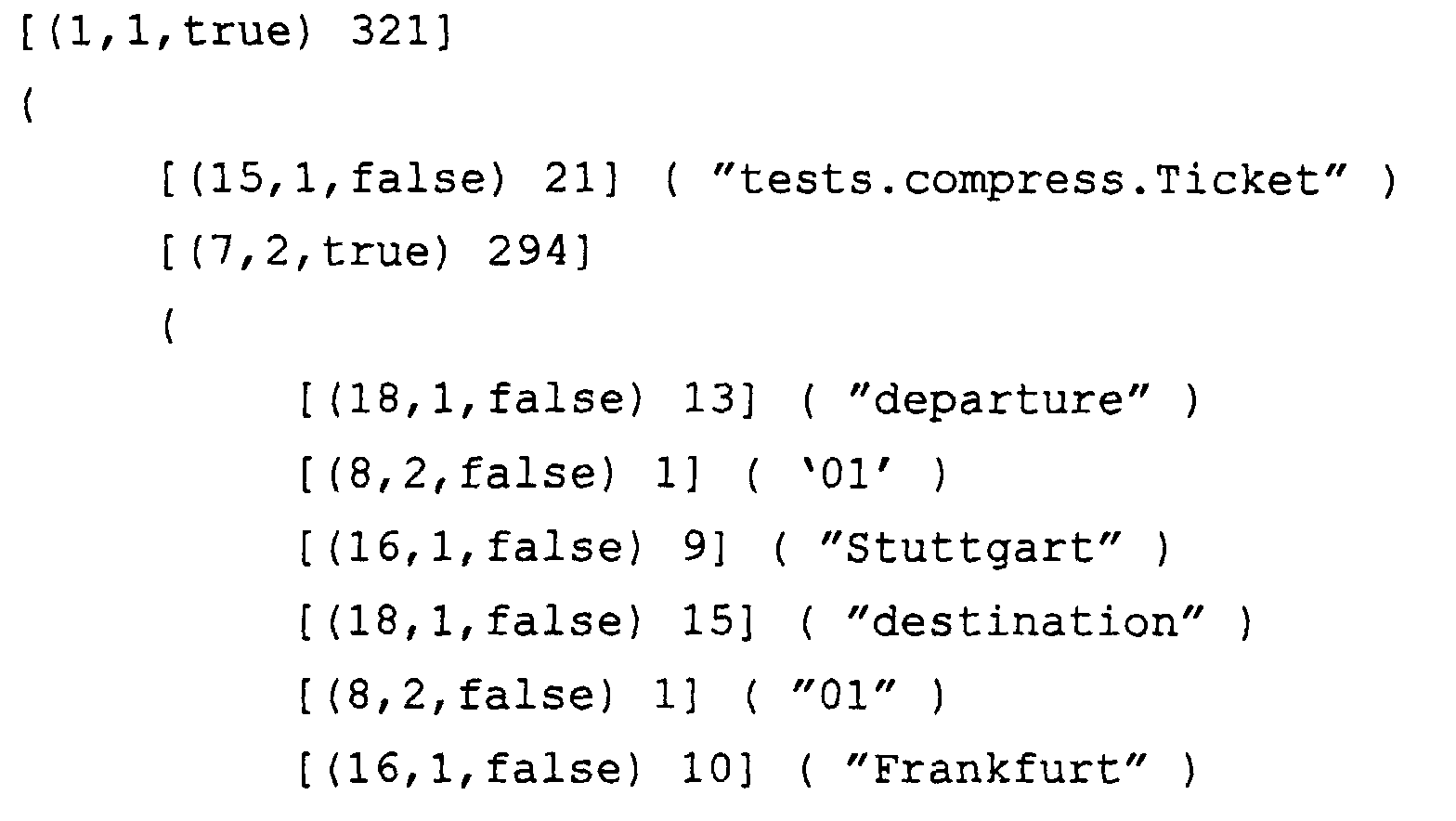
- [(tag identifier,class,constructed flag) length) (content) The purpose of the tag identifier is to distinguish between different tags, that of class is to distinguish between different classes of tag, and the constructed flag indicates whether the tag is followed simply by useful data or again whether it is followed by further tags with associated useful data. Length gives the number of bytes of useful data which follow and content means either associated useful data or further tags.
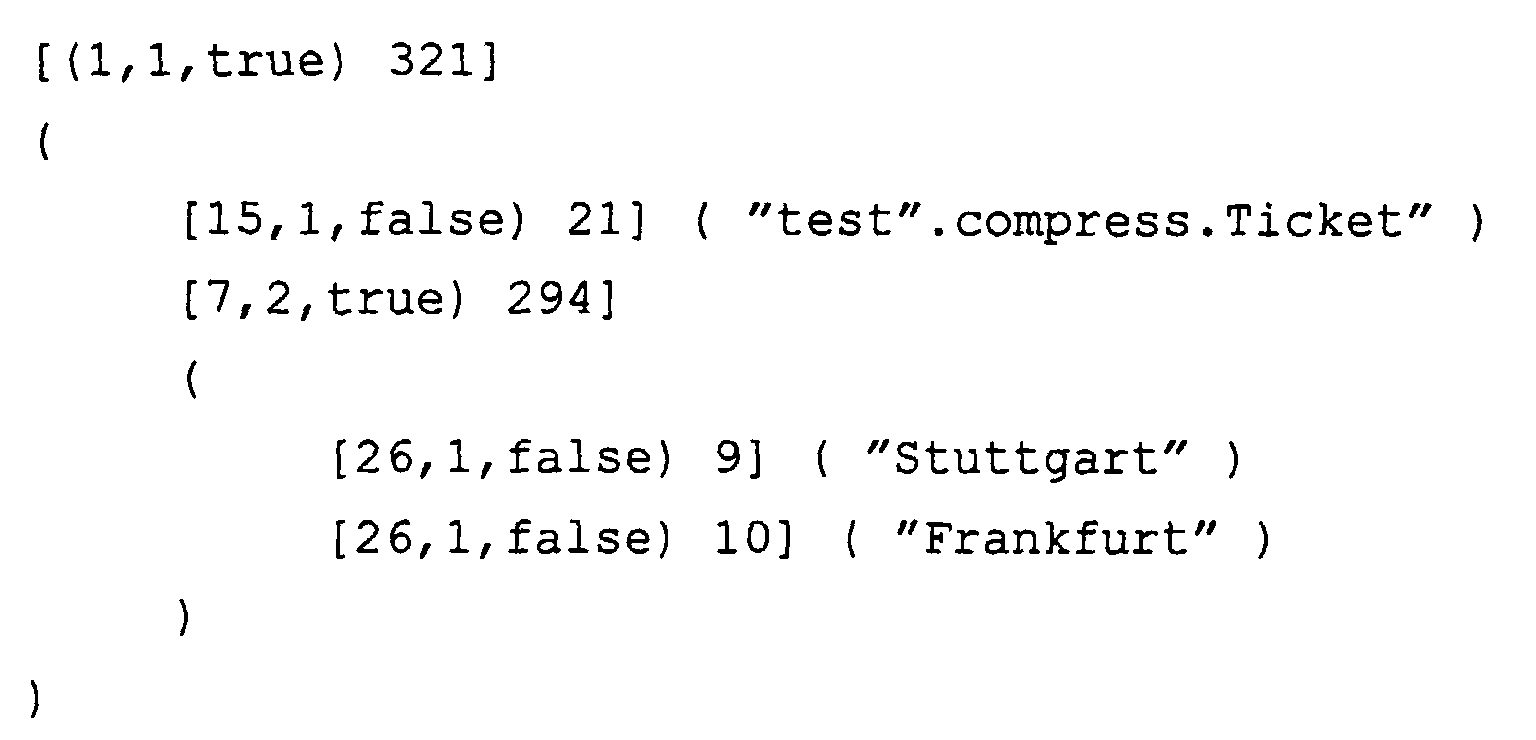
- 3. In a particular embodiment of the present invention, use is
made of the following additional method step:
The foregoing step 2 is repeated but it is not non-application-dependent
identifications which are represented by identifiers
(substitutes) but application-dependent ones. Preferably a
dictionary is needed, this dictionary specifying specific
identifiers for a specific application context (e.g. in travel
applications tag xy could stand for "departure" and tag yz for
"destination"). In this way a further reduction can be achieved
in the storage space needed for representing the data package.
This produces a representation which may for example look like
this:
- 4. In a further special embodiment, use is made of the following additional method step: The representation obtained is again compressed, with the help of current compression algorithms, e.g. ZLIB.What is obtained overall by steps 1-4 is a compact representation of data packages which takes up approximately 30% less storage space than a serialization of the usual kind by compression algorithms such as ZLIB set for best possible compression.Despite the compression of the data package it contains all the information needed to allow it to be restored unchanged at some other time and some other place.The method according to the present invention will now be described by reference to Java objects.
-
- Illustrative application:
In the following illustrative embodiment, Java object serialization is replaced by a serializing process using TLV (tag length value) structures. If objects are stored on a chip card by means of TLV structures, this saves storage space due to the fact that the tags are preprocessed. - The saving of storage space takes place in four steps:
- 1. Generation of the object representation (combining of meta-data and data elements, forming of a sequence).
- 2. Encoding of the non-application-dependent identifications into tags, e.g. for objects, attributes, names, classes, etc.
- 3. Encoding of the application-dependent identifications into tags.
- 4. Additional compression.
-
- An object is represented on the chip card as follows:
- name of object
- type of object (string, integer, object)
- version
- attributes of object (attributes and the values of the attributes may themselves be objects).
- In the following example all the words shown in capitals can be represented by tags. Associated with each tag there is a value and the length of this value.


- The correlation between an "identifier" (substitute) and a tag is stored in a table which is part of the compression algorithm according to the invention. The tags are preferably determined in accordance with BER-TLV. The identifiers which are defined as tags are preferably the ones which are application-dependent. An example of a correlation is shown in the table below.
Tags Class ID Constructed Encoding (hex) OBJECT 2 0 true A0 CLASS 2 1 false 81 VERSION 2 2 false 82 ATTRIBUTE 2 3 true A3 NAME 2 4 false 84 TYPE 2 5 false 85 VALUE 2 6 false 86 Type ID INTEGER 0 STRING 1 OBJECT 2 ... - In the example:

- To increase the compression even further, the following second phase of compression can be used:
- The result achieved by the method described above is then searched for defined, application-dependent name and type identifications for objects. For this method step there are special tags available which can be used to represent such identifications in a space-saving manner. This produces further compression.
- The correlation between these application-dependent identifications and the tags by which the identifications can be represented must of course be known to everybody involved who wishes to read or write data. It is conceivable for different correlation tables to be defined for different application contexts. Structures and types which are quite often needed in a given context could be defined to prevent the storage of redundant information. Where the application context was "Travel" for example, tags such as seat, destination, departure time, etc. could be defined.
- The makeup, definition and length of tags are laid down in standards ISO/IEC 7816 and 8825. For the present new application of TLV structures it may be necessary for the maximum length of the tags to be increased. The following example will elucidate the second stage of compression:
- The name "com.ibm.businesscard.BusinessCard" is defined in the application context and it can be represented in abbreviated form as follows:


- The correlation between tag and identifier must be known to the recipient or must be transmitted at the same time (e.g. a tupel of the form 〈tag,class,ID,constructed,type,class〉)
- To assess the potential of the inventive method which has been described, various objects were compressed by this method and values found for the compression thereby achieved. What were taken as a standard of comparison in this case were in particular the results which were achieved with other, known compression algorithms.
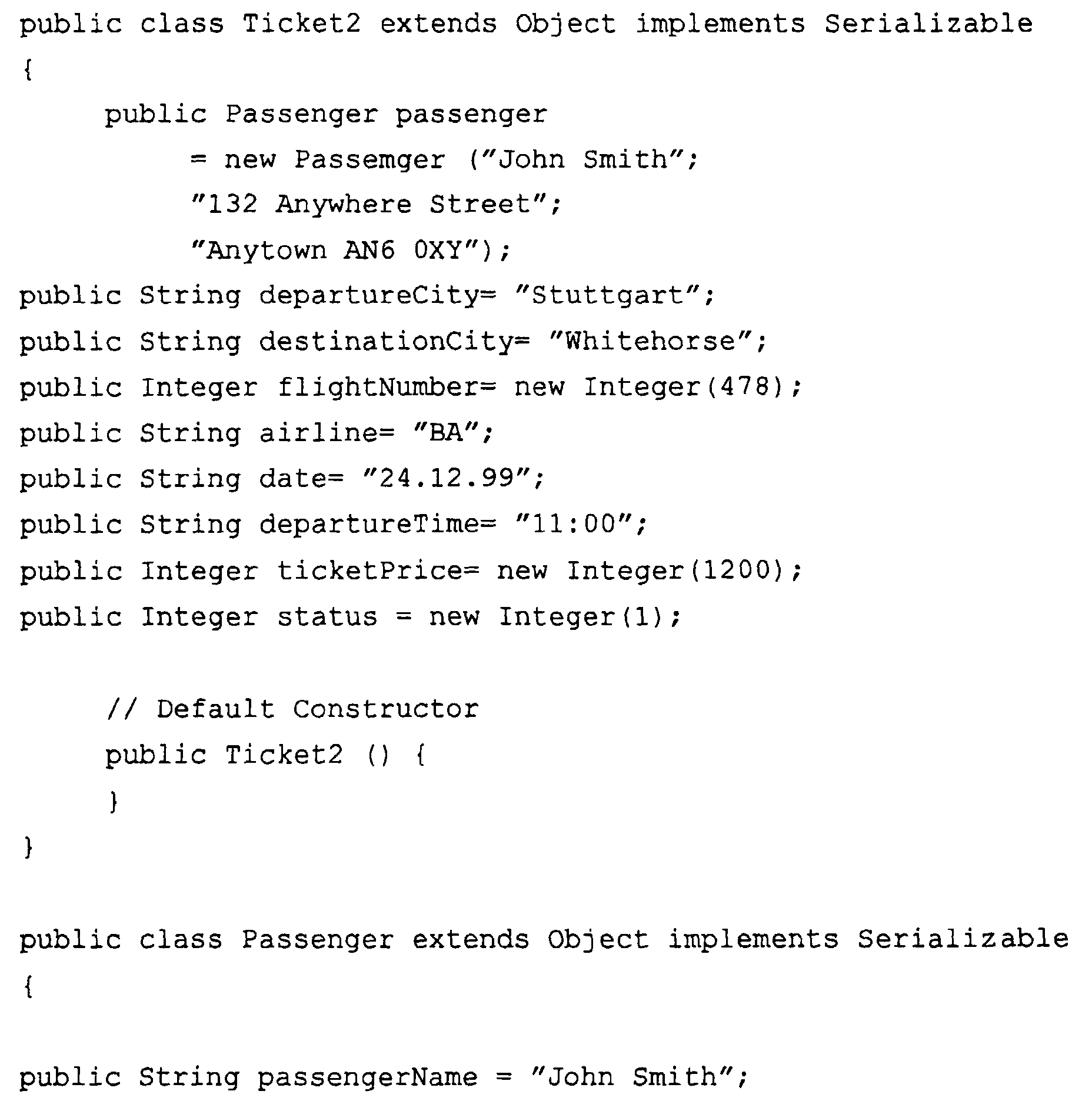
- The following object describes an airline ticket:


- In this case the airline ticket contains the passenger information in a separate object. Hence the method must be used on nested objects and this calls for recursion.
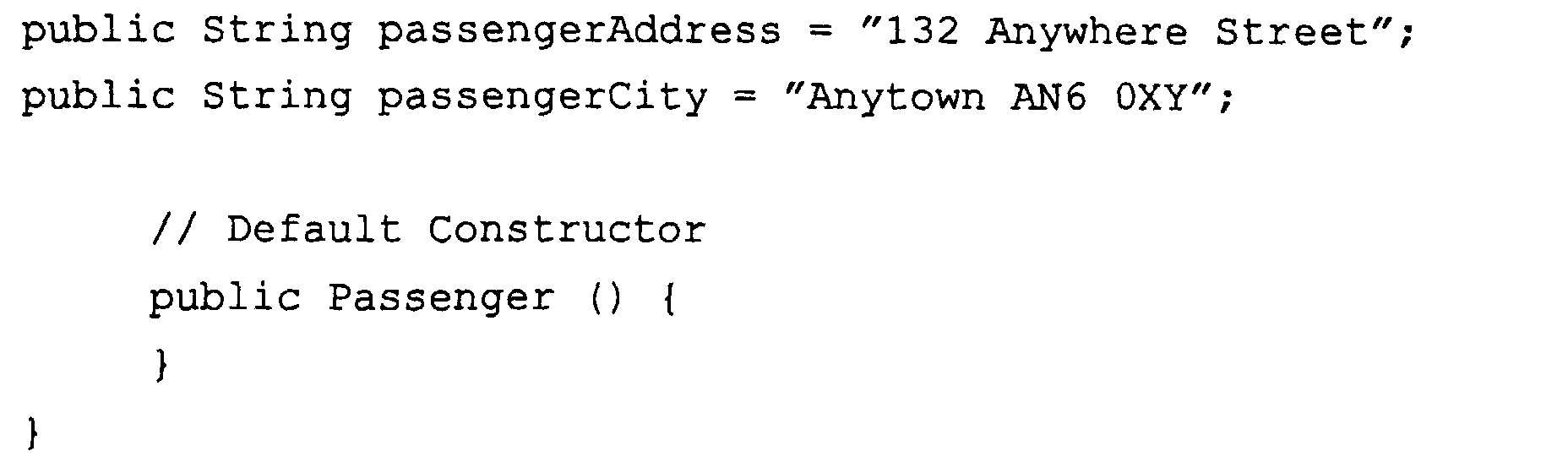
- The table below shows the storage space required for representing the objects taken as examples with conventional serialization and when using the first stage of the compact form of representation described above. An additional improvement in the result was obtained in each case by employing the "ZLib Data Compression Algorithm" set for "Best Compression".
- Application of the second stage of the method described above would produce a further improvement but this was not covered in the present evaluation.
Conventional object serialization in Java Conventional object serializatio n in Java with additional compression (Zlib Data Compr. Algorithm Compact representation of objects (1st stage) Compact representatio n of objects (1st stage) with additional compression (Zlib Data Compr. Algorithm Example 1 642 bytes 353 bytes 325 bytes 245 Example 2 725 bytes 392 bytes 374 bytes 268 - In the case of example 1, 31% greater compression was achieved than with a serialized object compressed with Zlib. In the case of example 2 the compression was 32% better. Various other objects which were looked at gave figures of between 16% and 40%.
- The main aim of the method is to minimise the meta-data in an object representation. What this means is that the shorter the data length of the individual attributes in an object, the more the compression factor rises. Where the data content per attribute is very high, the benefit is slightly less.
- By replacing Java object serialization with the method described, objects can be stored on chip cards compactly and with a saving in space. On the one hand this simplifies the programming work needed for storing object data on a chip card and reading it, and on the other, the use of this method produces object representations which are very small. There has been found to be a reduction in storage space of 25-50% compared with conventional object serialization.
The second stage of the method described produces additional compression. However, it requires a standardised definition of application attributes specific to a given sector or industry. - For their context, applications for the tourist industry for example could replace a range of attributes such as airfare, departure date, passenger name, etc. by standardised tags.
- Another advantage of this solution is the bridge it builds between object serialization methodology and the use of the TLV process.
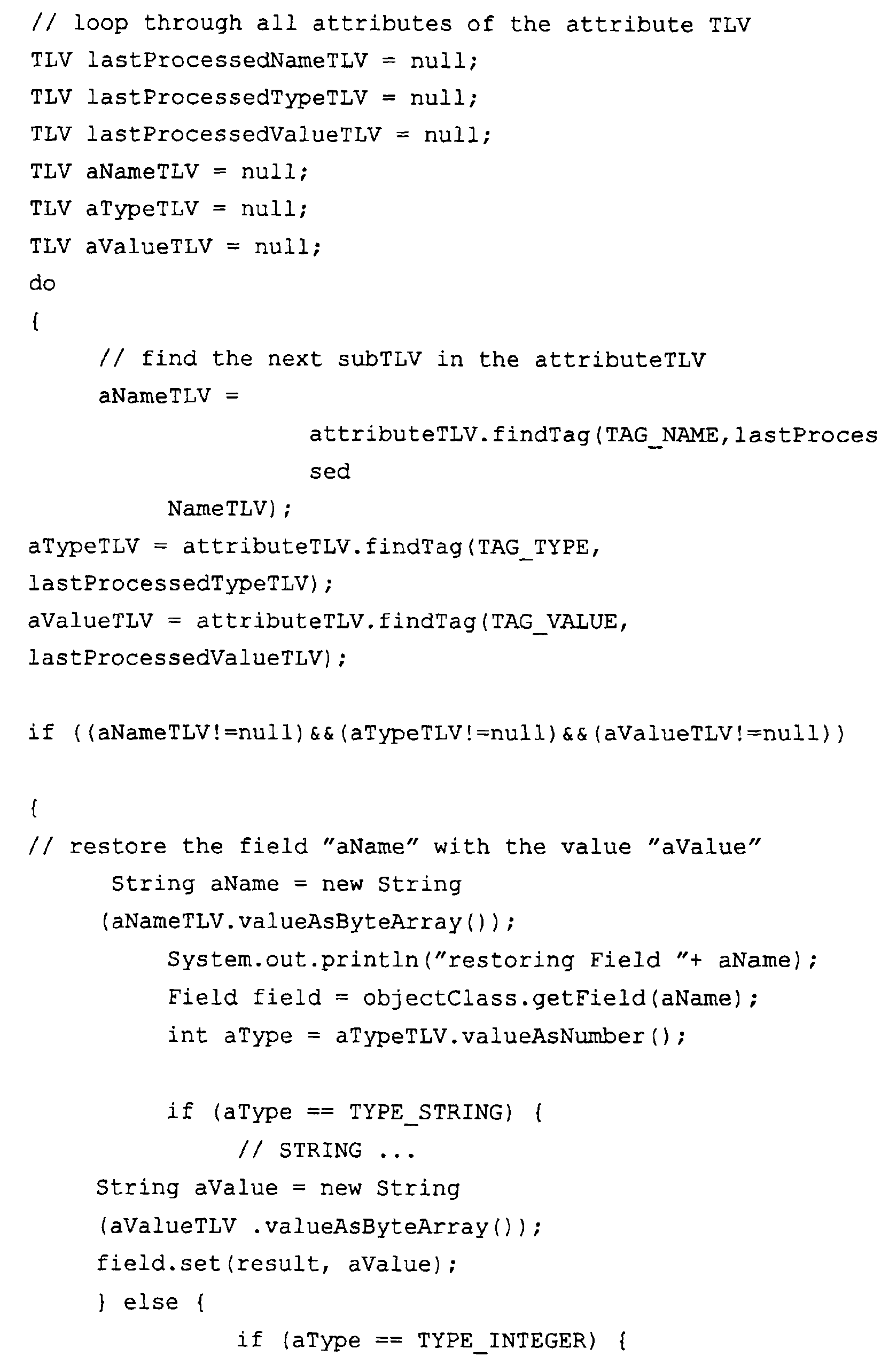
- In what follows an actual implementation of the present invention will be shown.
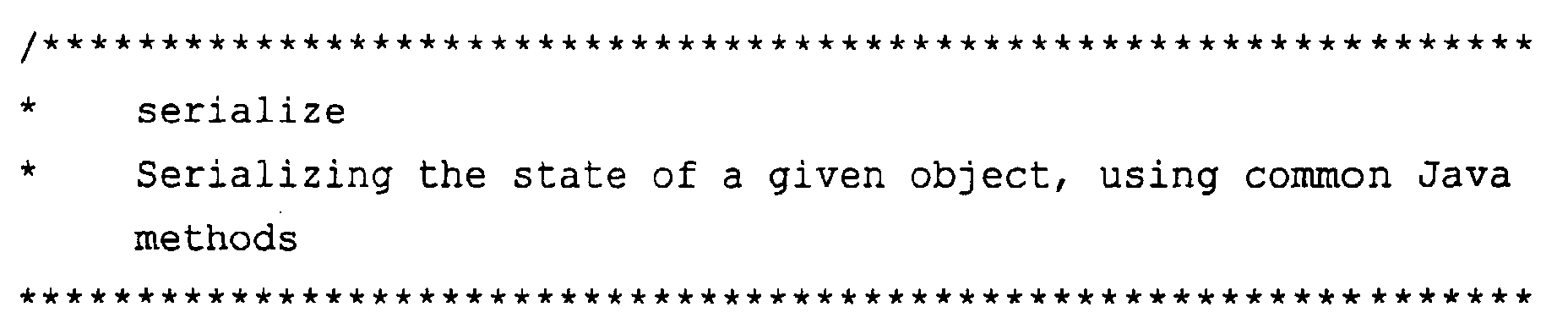


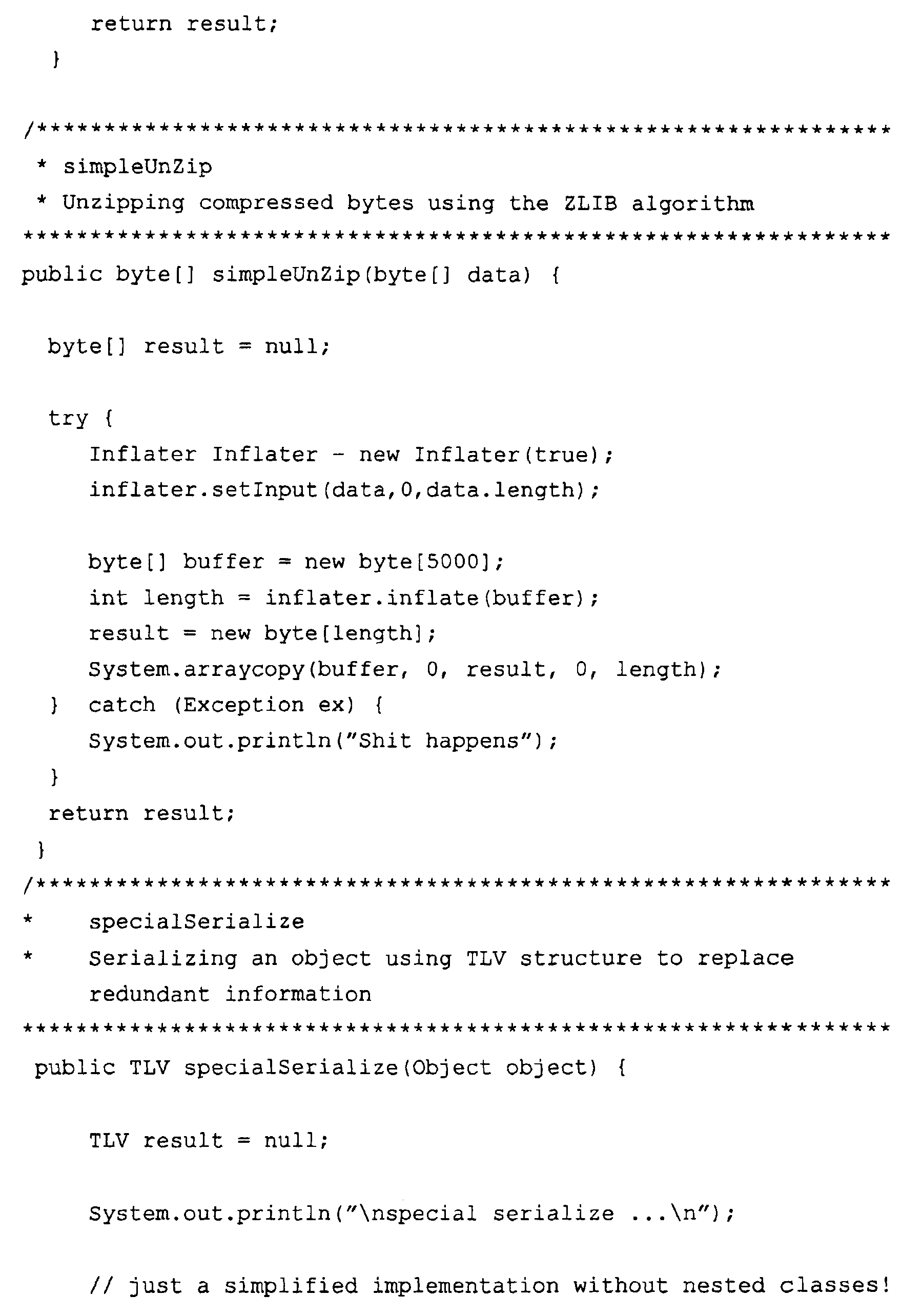


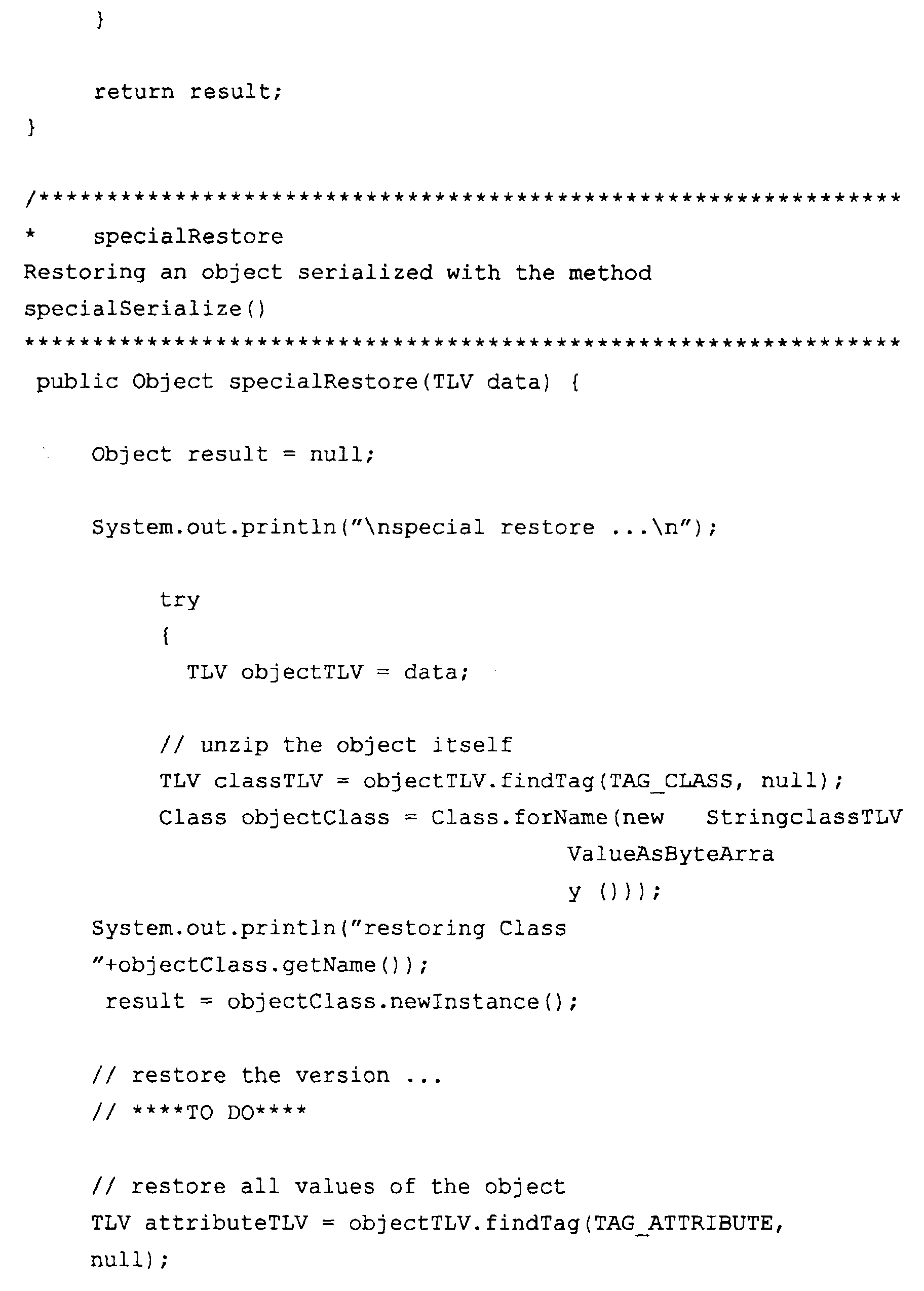

Claims (21)
- Method of producing a compact representation of a data package, the data package comprising at least meta-data and associated data elements and/or meta-data and associated data packages and the meta-data comprising at least name and type identifications for the data element or name and type identifications for the data package, characterised by the following steps:a) arranging of the data packages in a sequenceb) searching of the meta-data for defined, non-application-dependent name and type identifications (identifications)c) representation of the identifications found in step b) by defined substitutes which require little storage space.
- Method of producing a compact representation of a structure of meta-data and data elements, with the correlation of meta-date with data elements or meta-data with a sub-structure of a structure being performed by a program and with the meta-data comprising at least name and type identifications (identifications)for the data element or an identification for the sub-structure of the structure, characterised by the following steps:a) combining of meta-data and associated data elements or meta-data with the associated sub-structure to form a data packageb) arranging of the data packages in a sequencec) searching of the meta-data for defined, non-application-dependent identificationsd) representation of the identifications found in step C) by defined substitutes which require little storage space.
- Method according to claim 1 or 2, characterised by the following further step:e) storage of the result of steps a-d on a storage medium.
- Method according to claim 1 or 2, characterised by the following further step:f) transmission of the result of steps a-d to a data-processing device.
- Method according to claim 1, characterised in that the meta-data according to claim 3 or 4 is not transmitted at the same time but the correlation is performed by a program at the time of restoration.
- Method according to claim 1, characterised in that the data package is an object which contains at least the following data elements with the following non-application-dependent identifications:object name, object type and object attributes.
- Method according to claim 1, characterised in that the data package is an object which contains the following data elements with the following non-application-dependent identifications:object name, object type, object version and object attributes.
- Method according to claim 4, characterised in that the data package is a Java object.
- Method according to claim 1, characterised in that the data package is an XML (extendable markup language).
- Method according to claim 1 or 2, characterised in that the non-application-dependent identifications object name, object type, object version and object attributes are represented by defined substitutes in a TLV coding.
- Method according to claim 1 or 2, characterised in that the non-application-dependent identifications object name, object type, object version and object attributes are represented by defined substitutes in the TLV coding laid down by ISO 8825 Basic Encoding Rules.
- Method according to claim 1 or 2, characterised in that the data package is a data structure which contains data elements with the following non-application-dependent identifications:name, type, version and attributes of the data element.
- Method according to claim 1 or 2, characterised in that steps a)-d) are performed by a program, with a table to correlate non-application-dependent identifications with their associated substitutes being contained in the program.
- Method according to claim 1 or, characterised by the following further steps:aa) searching of the meta-data for defined, application-dependent identificationsbb) representation of the application-dependent identifications found in step aa) by defined substitutes which require little storage spacecc) storage of the result of steps aa)-bb) on a storage medium or transmission of the result of steps aa)-bb) to a data-processing device.
- Method according to claim 14, characterised in that for each application a dedicated table containing defined application-dependent identifications and associated substitutes is loaded.
- Method according to claim 1 or 2, characterised in that the makeup, definition and length of the substitutes are laid down by standard ISO/IEC 7816 or 8825.
- Method according to claim 16, characterised in that the substitute occupies a maximum of 2 bytes of storage space.
- Method according to claim 16, characterised in that the substitute is make up of class, constructed flag and ID.
- Method according to claim 14, characterised by the following further step:aaa) application of a current compression algorithm to the result of steps aa)-bb) in claim 14bbb) storage of the result of step aaa) on a storage medium or transmission of the result of step aaa) to an data-processing device.
- Method according to claim 19, characterised in that the compression algorithm is the ZLIB compression algorithm.
- Method according to claim 1 or claim 2, characterised in
Applications Claiming Priority (2)
| Application Number | Priority Date | Filing Date | Title |
|---|---|---|---|
| DE19933584A DE19933584A1 (en) | 1999-07-17 | 1999-07-17 | Process for the compact presentation of information packets and their storage or transmission |
| DE19933584 | 1999-07-17 |
Publications (2)
| Publication Number | Publication Date |
|---|---|
| EP1071219A2 true EP1071219A2 (en) | 2001-01-24 |
| EP1071219A3 EP1071219A3 (en) | 2004-05-19 |
Family
ID=7915142
Family Applications (1)
| Application Number | Title | Priority Date | Filing Date |
|---|---|---|---|
| EP00113216A Withdrawn EP1071219A3 (en) | 1999-07-17 | 2000-06-21 | Method of representing data packages in compact form and of storing or transmitting them |
Country Status (3)
| Country | Link |
|---|---|
| US (1) | US7039624B1 (en) |
| EP (1) | EP1071219A3 (en) |
| DE (1) | DE19933584A1 (en) |
Cited By (2)
| Publication number | Priority date | Publication date | Assignee | Title |
|---|---|---|---|---|
| FR2836568A1 (en) * | 2002-02-28 | 2003-08-29 | Bull Sa | Data conversion method for smart cards, involves conversion of structured software object from software agent in embedded platform to data set arranged in linear data sequence by serialization agent |
| US8751681B1 (en) | 2000-06-30 | 2014-06-10 | Intel Corporation | Delivering content by encapsulating into packages with associated meta-data |
Families Citing this family (11)
| Publication number | Priority date | Publication date | Assignee | Title |
|---|---|---|---|---|
| US7240067B2 (en) * | 2000-02-08 | 2007-07-03 | Sybase, Inc. | System and methodology for extraction and aggregation of data from dynamic content |
| DE10123357A1 (en) * | 2001-05-14 | 2002-11-28 | Belenus Gmbh | Method for processing of data e.g. data packets, involves separating input data into two data groups |
| WO2003071444A1 (en) * | 2002-02-15 | 2003-08-28 | Tridium, Inc. | Component model for real time system control |
| JP4459504B2 (en) * | 2002-03-11 | 2010-04-28 | 三菱電機株式会社 | Data server |
| US8359298B2 (en) | 2006-04-03 | 2013-01-22 | International Business Machines Corporation | Method, system, and program product for managing adapter association for a data graph of data objects |
| US20070260638A1 (en) * | 2006-05-02 | 2007-11-08 | Nokia Corporation | Commands for the handling of large files |
| US20070282863A1 (en) * | 2006-05-30 | 2007-12-06 | Schacher Ritchard L | Method, system, and program product for providing proxies for data objects |
| US20070283034A1 (en) * | 2006-05-31 | 2007-12-06 | Clarke Adam R | Method to support data streaming in service data objects graphs |
| US20090082880A1 (en) * | 2007-09-20 | 2009-03-26 | Tridium Inc. | Wireless device for a building control system |
| US20160286013A1 (en) * | 2015-03-24 | 2016-09-29 | General Electric Company | Management of stream metadata during high volume real-time data streams |
| US10437564B1 (en) | 2016-09-16 | 2019-10-08 | Software Tree, LLC | Object mapping and conversion system |
Family Cites Families (8)
| Publication number | Priority date | Publication date | Assignee | Title |
|---|---|---|---|---|
| US6362836B1 (en) * | 1998-04-06 | 2002-03-26 | The Santa Cruz Operation, Inc. | Universal application server for providing applications on a variety of client devices in a client/server network |
| US6101477A (en) * | 1998-01-23 | 2000-08-08 | American Express Travel Related Services Company, Inc. | Methods and apparatus for a travel-related multi-function smartcard |
| US6356946B1 (en) * | 1998-09-02 | 2002-03-12 | Sybase Inc. | System and method for serializing Java objects in a tubular data stream |
| US6111660A (en) * | 1998-09-30 | 2000-08-29 | N*Able Technologies, Inc. | Efficient digital data encoding in a data processing system |
| US6298353B1 (en) * | 1998-11-19 | 2001-10-02 | International Business Machines Corporation | Checking serialization compatibility between versions of java classes |
| US6301585B1 (en) * | 1999-03-17 | 2001-10-09 | Sun Microsystems, Inc. | Redundancy elimination in the persistence of object graphs |
| US6438559B1 (en) * | 1999-04-02 | 2002-08-20 | Sybase, Inc. | System and method for improved serialization of Java objects |
| US6343287B1 (en) * | 1999-05-19 | 2002-01-29 | Sun Microsystems, Inc. | External data store link for a profile service |
-
1999
- 1999-07-17 DE DE19933584A patent/DE19933584A1/en not_active Withdrawn
-
2000
- 2000-06-21 EP EP00113216A patent/EP1071219A3/en not_active Withdrawn
- 2000-07-14 US US09/616,232 patent/US7039624B1/en not_active Expired - Fee Related
Non-Patent Citations (7)
| Title |
|---|
| "Java Object Serialization Specification" SUN MICROSYSTEMS, INC., 30 November 1998 (1998-11-30), XP002242372 Retrieved from the Internet: <URL:http://www.dei.estg.iplei.pt/P3/N/mat erial/extra/serial-spec-JDK1_2.pdf> [retrieved on 2003-05-23] * |
| INTERNATIONAL BUSINESS MACHINES CORPORATION: "Saving essential object information through Java object serialization and Java compression, storing the Java object essentials on a non-Java system" RESEARCH DISCLOSURE, KENNETH MASON PUBLICATIONS, HAMPSHIRE, GB, vol. 422, no. 122, June 1999 (1999-06), XP007124525 ISSN: 0374-4353 * |
| ISO/IEC: "ISO/IEC 7816-4: Interindustry command for interchange" ONLINE, 1 September 1995 (1995-09-01), XP002258173 Retrieved from the Internet: <URL:www.ttfn.net/techno/smartcards/iso781 6_html> [retrieved on 2003-10-16] * |
| JAMES GOSLING, BILL JOY, AND GUY STEELE: "The Java Language Specification (First Edition)" 1996 , ADDISON-WESLEY XP002274403 * page 127 - page 130 * * |
| LUKASZ OPYRCHAL, ATUL PRAKASH: "Efficient Object Serialization in Java" ONLINE FROM WWW.EECS.UMICH.EDU/ ~APRAKASH/PAPERS/OPYRCHAL-PRAKASH-ICDCSWOR KSHOP99.PDF, 21 May 1999 (1999-05-21), XP002274402 * |
| NELSON M R: "THE ZLIB COMPRESSION LIBRARY A COMPRESSION ENGINE FOR EVERYONE" DR. DOBB'S JOURNAL, M&T PUBL., REDWOOD CITY, CA,, US, vol. 22, no. 1, January 1997 (1997-01), pages 36,38,40-41, XP001004599 ISSN: 1044-789X * |
| NORMAN WALSH: "What do XML documents look like?" ONLINE: WWW.XML.COM/PUB/A/98/10/GUIDE2.HTML, 3 October 1998 (1998-10-03), XP002274464 * |
Cited By (4)
| Publication number | Priority date | Publication date | Assignee | Title |
|---|---|---|---|---|
| US8751681B1 (en) | 2000-06-30 | 2014-06-10 | Intel Corporation | Delivering content by encapsulating into packages with associated meta-data |
| FR2836568A1 (en) * | 2002-02-28 | 2003-08-29 | Bull Sa | Data conversion method for smart cards, involves conversion of structured software object from software agent in embedded platform to data set arranged in linear data sequence by serialization agent |
| WO2003073390A3 (en) * | 2002-02-28 | 2003-12-31 | Schlumberger Systems & Service | Iterative serialisation procedure for structured software objects |
| CN1301462C (en) * | 2002-02-28 | 2007-02-21 | 艾斯奥托公司 | Repeated serialization process for structured software objects |
Also Published As
| Publication number | Publication date |
|---|---|
| DE19933584A1 (en) | 2001-01-18 |
| EP1071219A3 (en) | 2004-05-19 |
| US7039624B1 (en) | 2006-05-02 |
Similar Documents
| Publication | Publication Date | Title |
|---|---|---|
| EP1071219A2 (en) | Method of representing data packages in compact form and of storing or transmitting them | |
| EP0451384B1 (en) | Hypertext data processing system and method | |
| EP0949566B1 (en) | Method and system for performing static initialization | |
| US5931935A (en) | File system primitive allowing reprocessing of I/O requests by multiple drivers in a layered driver I/O system | |
| DE60031370T2 (en) | TOKEN-BASED LINKAGE | |
| US20050193372A1 (en) | System and process for object rendering on thin client platforms | |
| US20070106876A1 (en) | Keymap order compression | |
| US6145119A (en) | Programming development environment for intranet and internet applications employing unique project data structure | |
| US20090037386A1 (en) | Computer file processing | |
| US20040215674A1 (en) | Method and apparatus for sharing data files among runtime environment applets in an integrated circuit card | |
| CA2582994A1 (en) | Content transformation system | |
| US6205580B1 (en) | Method for loading a program | |
| EP0720107B1 (en) | Word retrieval apparatus for a dictionnary | |
| US7774387B2 (en) | Data compressor, data decompressor, and data management system | |
| US5832507A (en) | Method and apparatus for converting ASCII path names to parsed path name structures | |
| US20050108628A1 (en) | System and method for generating optimized binary representation of an object tree | |
| JP2003515802A (en) | System and method for extracting an index key data field | |
| US7028251B2 (en) | System and method for reducing the size of data difference representations | |
| US20040167937A1 (en) | Version-insensitive serialization and deserialization of program objects | |
| US20040098712A1 (en) | System and apparatus for dynamically upgrading concentrated executable computer software code | |
| JP5789236B2 (en) | Structured document analysis method, structured document analysis program, and structured document analysis system | |
| EP2420945A1 (en) | Foldering by stable query | |
| CN113282814A (en) | Characteristic data processing method, device, server and storage medium | |
| EP1008045B1 (en) | File system primitive allowing reprocessing of i/o requests by multiple drivers in a layered driver i/o system | |
| JP2002279371A (en) | IC card application start control system |
Legal Events
| Date | Code | Title | Description |
|---|---|---|---|
| PUAI | Public reference made under article 153(3) epc to a published international application that has entered the european phase |
Free format text: ORIGINAL CODE: 0009012 |
|
| AK | Designated contracting states |
Kind code of ref document: A2 Designated state(s): AT BE CH CY DE DK ES FI FR GB GR IE IT LI LU MC NL PT SE |
|
| AX | Request for extension of the european patent |
Free format text: AL;LT;LV;MK;RO;SI |
|
| PUAL | Search report despatched |
Free format text: ORIGINAL CODE: 0009013 |
|
| RIC1 | Information provided on ipc code assigned before grant |
Ipc: 7G 06F 9/46 B Ipc: 7G 06F 9/44 B Ipc: 7H 03M 7/30 A |
|
| AK | Designated contracting states |
Kind code of ref document: A3 Designated state(s): AT BE CH CY DE DK ES FI FR GB GR IE IT LI LU MC NL PT SE |
|
| AX | Request for extension of the european patent |
Extension state: AL LT LV MK RO SI |
|
| 17P | Request for examination filed |
Effective date: 20041022 |
|
| AKX | Designation fees paid |
Designated state(s): AT BE CH CY DE DK ES FI FR GB GR IE IT LI LU MC NL PT SE |
|
| 17Q | First examination report despatched |
Effective date: 20050404 |
|
| STAA | Information on the status of an ep patent application or granted ep patent |
Free format text: STATUS: THE APPLICATION IS DEEMED TO BE WITHDRAWN |
|
| 18D | Application deemed to be withdrawn |
Effective date: 20051015 |