EP1070954A1 - Procédé et dispositif pour la numérisation, l'archivage, la caractérisation et l'analyse d'un échantillon liquide. - Google Patents
Procédé et dispositif pour la numérisation, l'archivage, la caractérisation et l'analyse d'un échantillon liquide. Download PDFInfo
- Publication number
- EP1070954A1 EP1070954A1 EP00402038A EP00402038A EP1070954A1 EP 1070954 A1 EP1070954 A1 EP 1070954A1 EP 00402038 A EP00402038 A EP 00402038A EP 00402038 A EP00402038 A EP 00402038A EP 1070954 A1 EP1070954 A1 EP 1070954A1
- Authority
- EP
- European Patent Office
- Prior art keywords
- sample
- spectrum
- spectra
- samples
- analyzed
- Prior art date
- Legal status (The legal status is an assumption and is not a legal conclusion. Google has not performed a legal analysis and makes no representation as to the accuracy of the status listed.)
- Granted
Links
- 238000000034 method Methods 0.000 title claims abstract description 31
- 239000007788 liquid Substances 0.000 title claims abstract description 27
- 238000004458 analytical method Methods 0.000 title claims description 11
- 238000012512 characterization method Methods 0.000 title description 3
- 238000001228 spectrum Methods 0.000 claims abstract description 153
- 238000000862 absorption spectrum Methods 0.000 claims abstract description 19
- 238000004364 calculation method Methods 0.000 claims abstract description 18
- 238000007539 photo-oxidation reaction Methods 0.000 claims abstract description 9
- 238000002798 spectrophotometry method Methods 0.000 claims abstract description 8
- 150000002823 nitrates Chemical class 0.000 claims abstract description 7
- 238000005259 measurement Methods 0.000 claims abstract description 4
- 238000012795 verification Methods 0.000 claims abstract description 4
- 239000003295 industrial effluent Substances 0.000 claims abstract description 3
- -1 nitrate ions Chemical class 0.000 claims abstract description 3
- 230000006870 function Effects 0.000 claims description 7
- 239000011159 matrix material Substances 0.000 claims description 6
- 239000000203 mixture Substances 0.000 claims description 6
- 238000011002 quantification Methods 0.000 claims description 6
- 238000005070 sampling Methods 0.000 claims description 5
- 238000000605 extraction Methods 0.000 claims description 4
- 230000005855 radiation Effects 0.000 claims description 3
- 238000010200 validation analysis Methods 0.000 claims description 3
- 238000007430 reference method Methods 0.000 claims description 2
- 238000004519 manufacturing process Methods 0.000 claims 1
- 239000000126 substance Substances 0.000 abstract description 8
- 229910002651 NO3 Inorganic materials 0.000 abstract 1
- OKTJSMMVPCPJKN-UHFFFAOYSA-N Carbon Chemical compound [C] OKTJSMMVPCPJKN-UHFFFAOYSA-N 0.000 description 12
- 229910052799 carbon Inorganic materials 0.000 description 12
- 230000003595 spectral effect Effects 0.000 description 10
- 238000010521 absorption reaction Methods 0.000 description 6
- 238000002835 absorbance Methods 0.000 description 5
- 238000001514 detection method Methods 0.000 description 5
- VYPSYNLAJGMNEJ-UHFFFAOYSA-N Silicium dioxide Chemical compound O=[Si]=O VYPSYNLAJGMNEJ-UHFFFAOYSA-N 0.000 description 4
- IJGRMHOSHXDMSA-UHFFFAOYSA-N Atomic nitrogen Chemical compound N#N IJGRMHOSHXDMSA-UHFFFAOYSA-N 0.000 description 2
- 239000000463 material Substances 0.000 description 2
- 239000005416 organic matter Substances 0.000 description 2
- 239000010453 quartz Substances 0.000 description 2
- 239000000725 suspension Substances 0.000 description 2
- XLYOFNOQVPJJNP-UHFFFAOYSA-N water Substances O XLYOFNOQVPJJNP-UHFFFAOYSA-N 0.000 description 2
- YZCKVEUIGOORGS-OUBTZVSYSA-N Deuterium Chemical compound [2H] YZCKVEUIGOORGS-OUBTZVSYSA-N 0.000 description 1
- 241000861223 Issus Species 0.000 description 1
- 229910019142 PO4 Inorganic materials 0.000 description 1
- 230000002745 absorbent Effects 0.000 description 1
- 239000002250 absorbent Substances 0.000 description 1
- 239000000654 additive Substances 0.000 description 1
- 230000000996 additive effect Effects 0.000 description 1
- QVGXLLKOCUKJST-UHFFFAOYSA-N atomic oxygen Chemical compound [O] QVGXLLKOCUKJST-UHFFFAOYSA-N 0.000 description 1
- 230000005540 biological transmission Effects 0.000 description 1
- 150000001875 compounds Chemical class 0.000 description 1
- 239000000470 constituent Substances 0.000 description 1
- 239000003599 detergent Substances 0.000 description 1
- 229910052805 deuterium Inorganic materials 0.000 description 1
- 238000010586 diagram Methods 0.000 description 1
- 230000000694 effects Effects 0.000 description 1
- 238000000265 homogenisation Methods 0.000 description 1
- 238000012544 monitoring process Methods 0.000 description 1
- 229910052757 nitrogen Inorganic materials 0.000 description 1
- QJGQUHMNIGDVPM-UHFFFAOYSA-N nitrogen group Chemical group [N] QJGQUHMNIGDVPM-UHFFFAOYSA-N 0.000 description 1
- GQPLMRYTRLFLPF-UHFFFAOYSA-N nitrous oxide Inorganic materials [O-][N+]#N GQPLMRYTRLFLPF-UHFFFAOYSA-N 0.000 description 1
- 230000003287 optical effect Effects 0.000 description 1
- 238000005457 optimization Methods 0.000 description 1
- 230000003647 oxidation Effects 0.000 description 1
- 238000007254 oxidation reaction Methods 0.000 description 1
- 229910052760 oxygen Inorganic materials 0.000 description 1
- 239000001301 oxygen Substances 0.000 description 1
- 230000000737 periodic effect Effects 0.000 description 1
- 235000021317 phosphate Nutrition 0.000 description 1
- 150000003013 phosphoric acid derivatives Chemical class 0.000 description 1
- 238000012545 processing Methods 0.000 description 1
- 238000003908 quality control method Methods 0.000 description 1
- 238000013102 re-test Methods 0.000 description 1
- 238000007670 refining Methods 0.000 description 1
- 230000025600 response to UV Effects 0.000 description 1
- 230000006641 stabilisation Effects 0.000 description 1
- 238000011105 stabilization Methods 0.000 description 1
- 238000002211 ultraviolet spectrum Methods 0.000 description 1
Images


Classifications
-
- G—PHYSICS
- G01—MEASURING; TESTING
- G01N—INVESTIGATING OR ANALYSING MATERIALS BY DETERMINING THEIR CHEMICAL OR PHYSICAL PROPERTIES
- G01N21/00—Investigating or analysing materials by the use of optical means, i.e. using sub-millimetre waves, infrared, visible or ultraviolet light
- G01N21/17—Systems in which incident light is modified in accordance with the properties of the material investigated
- G01N21/25—Colour; Spectral properties, i.e. comparison of effect of material on the light at two or more different wavelengths or wavelength bands
- G01N21/31—Investigating relative effect of material at wavelengths characteristic of specific elements or molecules, e.g. atomic absorption spectrometry
- G01N21/33—Investigating relative effect of material at wavelengths characteristic of specific elements or molecules, e.g. atomic absorption spectrometry using ultraviolet light
-
- G—PHYSICS
- G01—MEASURING; TESTING
- G01N—INVESTIGATING OR ANALYSING MATERIALS BY DETERMINING THEIR CHEMICAL OR PHYSICAL PROPERTIES
- G01N33/00—Investigating or analysing materials by specific methods not covered by groups G01N1/00 - G01N31/00
- G01N33/18—Water
- G01N33/1826—Organic contamination in water
- G01N33/1846—Total carbon analysis
-
- G—PHYSICS
- G01—MEASURING; TESTING
- G01N—INVESTIGATING OR ANALYSING MATERIALS BY DETERMINING THEIR CHEMICAL OR PHYSICAL PROPERTIES
- G01N21/00—Investigating or analysing materials by the use of optical means, i.e. using sub-millimetre waves, infrared, visible or ultraviolet light
- G01N21/17—Systems in which incident light is modified in accordance with the properties of the material investigated
- G01N21/25—Colour; Spectral properties, i.e. comparison of effect of material on the light at two or more different wavelengths or wavelength bands
- G01N21/31—Investigating relative effect of material at wavelengths characteristic of specific elements or molecules, e.g. atomic absorption spectrometry
- G01N2021/3196—Correlating located peaks in spectrum with reference data, e.g. fingerprint data
Definitions
- the present invention relates to a method for scanning, archiving, characterization and / or analysis of a liquid sample.
- the invention proposes to exercise a monitoring over time of the effluent so that it can be able to, when pollution has been detected, to determine the precise moment when this pollution pollution has started to manifest and to study evolution over time of this pollution until the moment of its detection and even beyond.
- the objective is then to have as much information as possible to find the cause of the pollution and possibly discover its responsible.
- the invention proposes to implement a method and device for characterizing dissolved materials or suspension in a liquid of the type described in the patent application European No 0 682 250.
- the relationship between the UV signal and molecules containing organic carbon is based on the Berr Lambert relation whose property additivity makes it possible to say that the absorbance measured, in the case of a mixture in dilute solution, is equal to the sum of the absorbances of each constituent in the solution.
- absorbances are a function of the concentration in organic carbon since the latter is linked to the concentration of component.
- This method therefore allows, using a processor programmed in a way to ensure a deconvolution of the spectra with taking into account the interference, to determine the organic charge of a water from the contribution brought by each of the weighted spectra, for each sample.
- the preponderant molecules are generally known to the user. Their choice is either fixed in advance or extracted from a following library criteria such as for example those defined in the requests for patent FR No 98 11583 and FR No 98 15246 in the name of the Company Naphtachimia.
- This method therefore makes it possible, in particular, to determine, from the information relating to the spectra detected by a detector, the content of organic carbon, nitrous and nitric nitrogen, suspended matter of a liquid, for example an effluent, subjected to a phenomenon of photooxidation to reveal substances not directly detectable at from UV spectrum.
- the processor can also perform a calculation of oxidizable and total nitrogenous forms, phosphates as well as oxidizability in measuring, for example, the stabilization time of the measurements of a sample circulating in the closed loop photooxidation circuit.
- the object of the invention is therefore more particularly to improve the process previously defined by performing spectrum modeling both at from spectra of identified pure products previously memorized and from samples of the liquid to be measured taken under conditions different.
- the library of data for known absorption spectra may include spectra of many "standard" products likely to be present in the liquid to be analyzed.
- these standard products may be pure products such as nitrates, nocylene, tributhylcathechol TBC, nitrite ions, ethylpropylacrolenia EPA, etc ... as well as overall absorption spectra UV of normal qualified effluents.
- the process can understand a refining sequence including a recalculation of the spectra standards previously introduced into the database using each time spectra present in the base, other than that which is recalculated.
- the calculation of the organic pollution parameters of the sample that we wants to measure includes a calculation by deconvolution of the coefficient of weighting to apply to each of the spectra of the modeling base for obtain the spectrum of this sample, and the value of the parameters of each of these spectra, taken separately.
- the values of the parameters PX of the sample to be analyzed are obtained from the following relationships: relations in which AX 1 ?? AX N are the values of parameter 1 in the spectra SP 1 ?? SP N of the modeling base, and ZX 1 ?? ZX N are the values of the parameter P in the spectra SP 1 ?? SP N of the modeling base.
- the invention also relates to a device for implementing the previously described method, this device comprising means allowing photooxidation of the sample to reveal substances whose spectrum does not appear directly to UV, a spectrophotometer for UV spectrophotometric analysis of the sample photooxidized and a processor programmed to perform a spectrum sampling obtained by spectrophotometer, digitization samples thus obtained and storage, with time stamp, of the values spectrum.
- the apparatus first comprises a UV 1 spectrophotometric device using a light source 2 which emits a radiating beam in the ultraviolet range (180 to 350 nm) towards a sample tank 3 with two sides transparent parallels 4, 5 which delimit a liquid sample slide.
- a special feature of this device is that it includes only one single light source 2 to carry out both the photooxidation of the sample and to obtain its spectral response to UV. Indeed, in the existing devices, these two functions involve two sources distinct lights arranged in two different locations of a circuit circulation, in closed or semi-closed loop of the sample. This circuit seemed until now essential to obtain a homogeneous photooxidation and uniform sample to the desired level.
- the invention achieves a similar result thanks to to the fact that it only has to photooxidize a reduced volume of liquid sample and that it uses the convection currents generated by the elevation of temperature of the region crossed by the beam to ensure the homogenization of the oxidation of the sample.
- Figure 2 shows the convection currents that form around the light beam and which perform a function similar to that of the forced circulation of the sample, under the effect of a pump, used in previous devices.
- the light source 2 consists of a deuterium lamp with supra sil quartz window allowing good transmission of far ultraviolet radiation.
- the tank 3 also made of supra-sil quartz, has an optical path of 2 mm containing the sample. Given the absorbance of air at far UV ( ⁇ 200 nm) a minimum of air will be left between the lamp and the tank Sample 3. In practice, the lamp will be attached to one of the 4 sides of the tank 3.
- the information delivered by the photodiodes of the strip 7 are transmitted to an electronic circuit 8 controlled by a processor 9 shown schematically in Figure 1 which performs a sampling (block 10) of spectra detected by strip 7, digitizes the samples (block 11) and then stores in memory either as part of an archiving process or in the part of an analysis treatment.
- the digital data relating to a spectrum are associated with identification data of the sample that produced the spectrum and provided timestamp data by a parking meter (block 12).
- the memory space also comprises a program space 18 including a characterization program including the organizational chart general is illustrated in figure 3.
Landscapes
- Physics & Mathematics (AREA)
- Life Sciences & Earth Sciences (AREA)
- Chemical & Material Sciences (AREA)
- Health & Medical Sciences (AREA)
- General Health & Medical Sciences (AREA)
- Analytical Chemistry (AREA)
- Biochemistry (AREA)
- General Physics & Mathematics (AREA)
- Immunology (AREA)
- Pathology (AREA)
- Spectroscopy & Molecular Physics (AREA)
- Medicinal Chemistry (AREA)
- Food Science & Technology (AREA)
- Engineering & Computer Science (AREA)
- Investigating Or Analysing Materials By Optical Means (AREA)
Abstract
Description
- le prélèvement de l'effluent liquide que l'on veut surveiller,
- une analyse spectrophotométrique permettant de relever un spectre de fréquence caractéristique de ce prélèvement,
- un échantillonnage du spectre obtenu par cette analyse, de manière à obtenir une série d'échantillons à des fréquences successives,
- la numérisation de la valeur de ces échantillons,
- le stockage en mémoire, avec identification et horodatage, des données numériques relatives à chacun de ces échantillons et des données correspondant à la fréquence de ces échantillons.
- des produits prépondérants dans la solution et absorbant dans l'Ultra Violet (par exemple les nitrates),
- composant la matrice organique générale et souvent composée de centaines de molécules différentes.
- la mesure du spectre d'absorption, dans le domaine des UV, d'une pluralité d'échantillons du liquide à analyser dont on veut déterminer des paramètres, par exemple des paramètres de pollution, ces échantillons étant prélevés dans des conditions différentes et présentant, de ce fait, des formes différentes, et dont les paramètres ont été déterminés en laboratoire par des méthodes de référence,
- la constitution d'une première bibliothèque incluant les données relatives à ces spectres échantillon,
- l'acquisition et le stockage dans une seconde bibliothèque des données relatives à des spectres d'absorption UV de produits purs connus rentrant dans la composition du liquide à analyser,
- la constitution d'une 〈〈 base 〉〉 de modélisation contenant les données relatives à un nombre minimum N de spectres dont la combinaison linéaire permet d'obtenir un spectre modélisé représentatif du spectre de l'échantillon à analyser, ces données comprenant, d'une part, un petit nombre M (M < N) de spectres sélectionnés de produits purs connus dont les données ont été précédemment acquises et un nombre N - M de spectres calculés à partir des spectres sélectionnés et des spectres échantillon; (cette base pouvant être ensuite utilisée pour l'analyse d'échantillons issus de la même source ou de sources similaires),
- la comparaison du spectre modélisé obtenu par combinaison linéaire des spectres de la base de modélisation et du spectre d'absorption de l'échantillon à analyser de manière à vérifier la pertinence du modèle,
- la détermination, par un calcul de déconvolution, des coefficients de pondération des spectres de la base de modélisation dans la quantification du spectre d'absorption de l'échantillon à analyser,
- la calibration du modèle par le calcul des susdits paramètres en fonction de la valeur des susdits coefficients de contribution,
- la validation de cette calibration par l'établissement de la droite de régression rapprochant les résultats mesurés de ceux estimés par le calcul.
- la sélection et l'introduction dans la base de modélisation des données relatives aux M spectres de produits purs connus provenant de la deuxième bibliothèque,
- la sélection d'un spectre échantillon 〈〈 remarquable 〉〉 contenu dans la première bibliothèque en effectuant une déconvolution de chaque spectre échantillon pour connaítre la contribution des produits purs connus dans ce spectre échantillon et pour déterminer la fraction résiduelle de ce spectre échantillon par rapport aux spectres connus en choisissant le spectre échantillon 〈〈 remarquable 〉〉 dont la fraction résiduelle est la plus importante,
- l'extraction de la partie du spectre sélectionné qui n'est pas présente dans les spectres déjà rentrés en retranchant au spectre sélectionné une fraction (par exemple 45 %) de la somme des spectres déjà rentrés de manière à obtenir un nouveau spectre étalon représentatif de nouveaux produits,
- l'introduction dans la base de modélisation du nouveau spectre étalon,
- le début d'un nouveau cycle de sélection, d'extraction et d'introduction et ce, jusqu'à ce que la base de modélisation soit pleine.
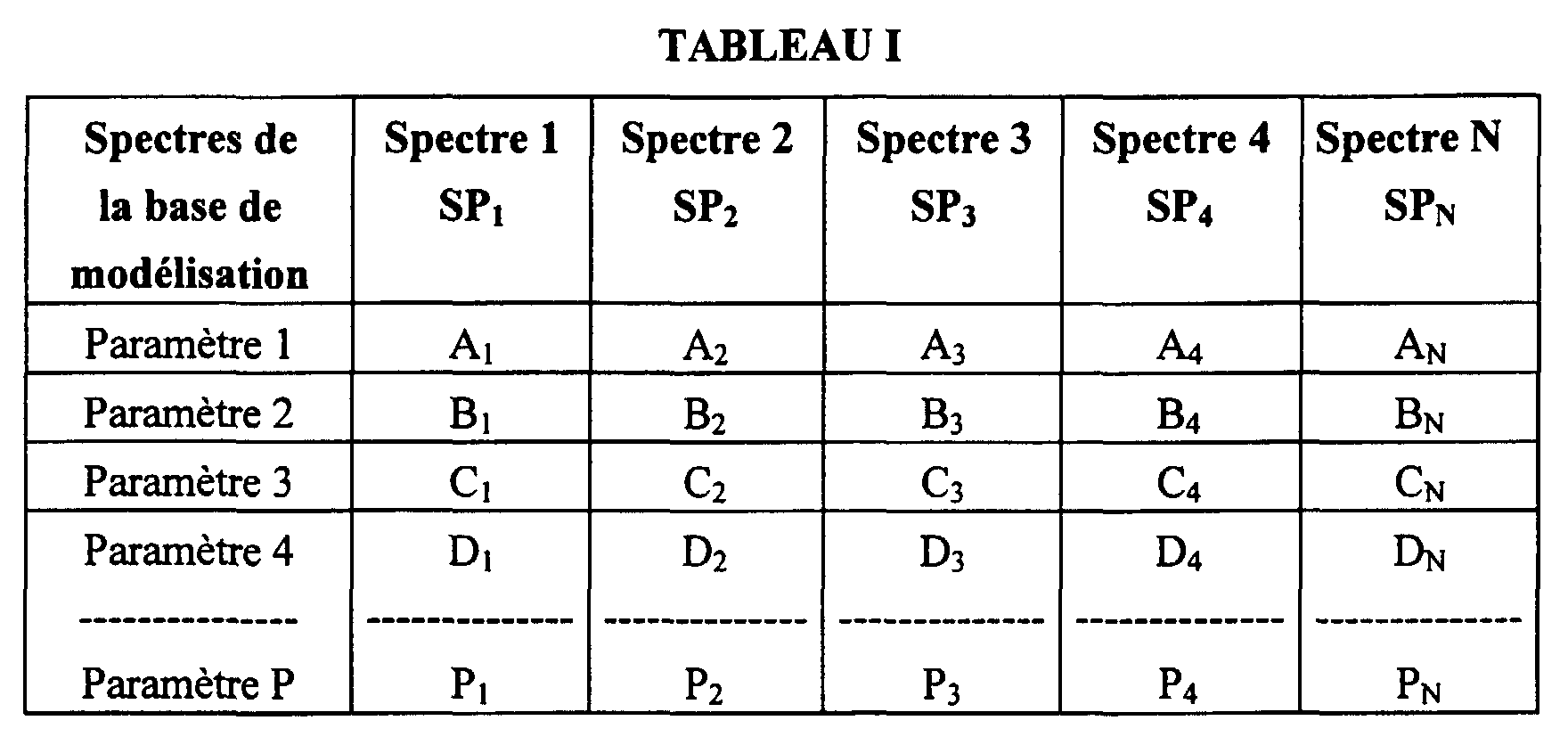

ZX1 ..... ZXN sont les valeurs du paramètre P dans les spectres SP1 ..... SPN de la base de modélisation.
- recevoir et stocker en mémoire les données relatives à une pluralité de spectres de produits purs et à une pluralité de spectres échantillon du liquide à analyser,
- constituer une base de modélisation apte à contenir les données numériques d'un nombre N de spectres dont la combinaison linéaire permet d'obtenir un spectre modélisé représentatif du spectre de l'échantillon à analyser,
- comparer le spectre modélisé au spectre d'absorption de l'échantillon de manière à vérifier la pertinence du modèle,
- déterminer, par un calcul de déconvolution, le coefficient de pondération des spectres de la base de modélisation dans la quantification du spectre d'absorption de l'échantillon à analyser,
- calculer les paramètres de pollution en fonction de la valeur des coefficients de contribution (calibration),
- valider cette calibration par l'établissement d'une droite de régression rapprochant les résultats mesurés de ceux obtenus par le calcul.
- une zone 13 destinée à assurer un archivage des données spectrales identifiées et horodatées,
- une zone bibliothèque 14 (première bibliothèque) destinée à contenir les données spectrales d'échantillons de l'effluent à surveiller et/ou à analyser et dont on connaít les principaux paramètres (également stockés en mémoire),
- une zone 15 (deuxième bibliothèque) destinée à contenir les données spectrales de produits purs susceptibles de rentrer dans la composition de l'effluent,
- une zone 16 attribuée à la base de modélisation, cette base étant destinée à contenir les données spectrales d'un nombre limité de spectres, ici huit,
- une zone 17 destinée à contenir la matrice de pondération des spectres de la base de modélisation 16.
- l'initialisation de la base de modélisation avec des spectres connus (bloc 20),
- l'incrémentation de l'ordre de la base de modélisation (bloc 21) qui correspond au nombre de spectres déjà entrés dans la base de modélisation,
- une détection (bloc 22) pour savoir si la base est remplie et/ou si la base est pertinente,
- un rebouclage sur l'incrémentation de l'ordre de la base (bloc 21) si le résultat de la détection est négatif,
- la fin du programme (bloc 23) si ce résultat est positif.
- une étape de recherche d'un spectre supplémentaire implémentée (bloc 25) par un sous-programme 26 qui recherche le spectre échantillon le plus éloigné de la base (bloc 27) de modélisation et qui ajoute (bloc 28) à cette base de modélisation un spectre déduit du spectre i (spectre i auquel on a retranché une portion du spectre calculé par la base précédente),
- une étape d'optimisation (bloc 29) des spectres précédemment calculés en tenant compte des informations données par le nouveau spectre (pour enlever aux premiers spectres la contribution due au nouveau spectre); en fait, lance un sous-programme 29' qui reteste ici la base de modélisation en supprimant à chaque itération un spectre recalculé (à l'exception des spectres connus de la base de modélisation) et en recherchant un spectre supplémentaire 31 (sous-programme 26) pour remplacer le spectre supprimé 30, avec une incrémentation du spectre recalculé 31 et détection de la condition i > N (bloc 32), c'est-à-dire du moment où tous les spectres recalculés ont été remplacés.
- Les matières en suspension
- MES
- La demande en carbone organique
- DCO
- La demande biologique en oxygène
- DBO
- Le carbone organique total
- COT
- Les détergents
- DBS
- Les nitrates
- NO3
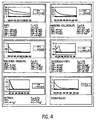
| DCO = 40 + 40,5 + 1 + 37,5 | = 119 mg/l |
| DBO = 13 + 25,2 + 0,8 + 17,5 | = 56,5 mg/l |
| COT = 10 + 9 + 1,3 + 20 | = 40,3 mg/l |
| MES | = 50 mg/l |
| DBS | = 25 mg/l |
| NO3 | = 12 mg/l |
Claims (15)
- Procédé pour la numérisation, l'archivage, la caractérisation et/ou l'analyse d'un échantillon liquide,
caractérisé en qu'il comporte une succession de cycles opératoires comprenant les étapes suivantes :le prélèvement de l'effluent liquide que l'on veut surveiller,une analyse spectrophotométrique permettant de relever un spectre de fréquence caractéristique de ce prélèvement,un échantillonnage du spectre obtenu par cette analyse, de manière à obtenir une série d'échantillons à des fréquences successives,la numérisation de la valeur de ces échantillons,le stockage en mémoire, avec horodatage, des données numériques relatives à chacun de ces échantillons et des données correspondant à la fréquence de ces échantillons. - Procédé selon la revendication 1,
caractérisé en ce que la susdite analyse spectrophotométrique comprend une photooxydation d'un échantillon liquide et le relevé du spectre d'absorption UV du prélèvement de l'échantillon liquide photooxydé. - Procédé selon l'une des revendications 1 et 2,
caractérisé en ce que, pour effectuer l'analyse de l'échantillon liquide, il comprend:la mesure du spectre d'absorption, dans le domaine des UV, d'une pluralité d'échantillons du liquide à analyser dont on veut déterminer des paramètres, par exemple des paramètres de pollution, ces échantillons étant prélevés dans des conditions différentes et présentant, de ce fait, des formes différentes et dont les paramètres ont été déterminés en laboratoire par des méthodes de référence,la constitution d'une première bibliothèque incluant les données relatives à ces spectres échantillon,l'acquisition et le stockage dans une seconde bibliothèque des données relatives à des spectres d'absorption UV de produits purs connus rentrant dans la composition du liquide à analyser,la constitution d'une 〈〈 base 〉〉 de modélisation contenant les données relatives à un nombre minimum N de spectres dont la combinaison linéaire permet d'obtenir un spectre modélisé représentatif du spectre de l'échantillon à analyser, ces données comprenant, d'une part, un petit nombre M (M < N) de spectres sélectionnés de produits purs connus dont les données ont été précédemment acquises et un nombre N - M de spectres calculés à partir des spectres sélectionnés et des spectres échantillon,la comparaison du spectre modélisé obtenu par combinaison linéaire des spectres de la base de modélisation et du spectre d'absorption de l'échantillon à analyser de manière à vérifier la pertinence du modèle,la détermination, par un calcul de déconvolution, des coefficients de pondération des spectres de la base de modélisation dans la quantification du spectre d'absorption de l'échantillon à analyser,la calibration du modèle par le calcul des susdits paramètres en fonction de la valeur des susdits coefficients de contribution. - Procédé selon la revendication 3,
caractérisé en ce qu'il comprend en outre la validation de la susdite calibration par l'établissement d'une droite de régression rapprochant les résultats mesurés de ceux estimés par le calcul. - Procédé selon l'une des revendications précédentes,
caractérisé en ce que la susdite base de modélisation est réutilisée pour l'analyse d'échantillons issus de la même source ou de sources similaires. - Procédé selon la revendication 3,
caractérisé en ce que, dans le cas où le liquide à analyser est un effluent industriel, les produits étalon sont des produits purs tels que les nitrates, le nocylène, le tributhylcathechol TBC, des ions nitrites, de l'éthylpropylacrolénie EPA, etc... ainsi que des spectres globaux d'absorption UV d'effluents qualifiés normaux. - Procédé selon l'une des revendications 3 à 6,
caractérisé en ce que la constitution de la base de modélisation est obtenue à l'issue d'un processus incrémental comprenant les phases suivantes:la sélection et l'introduction dans la base de modélisation des données relatives aux M spectres de produits purs connus,la sélection d'un spectre échantillon 〈〈 remarquable 〉〉 contenu dans la première bibliothèque en effectuant une déconvolution de chaque spectre échantillon pour connaítre la contribution des produits purs connus dans ce spectre échantillon et pour déterminer la fraction résiduelle de ce spectre échantillon par rapport aux spectres connus en choisissant le spectre échantillon «remarquable» dont la fraction résiduelle est la plus importante,l'extraction de la partie du spectre sélectionné qui n'est pas présente dans les spectres déjà rentrés en retranchant au spectre sélectionné une fraction (par exemple 45 %) de la somme des spectres déjà rentrés de manière à obtenir un nouveau spectre étalon représentatif de nouveaux produits,l'introduction dans la base de modélisation du nouveau spectre étalon,le début d'un nouveau cycle de sélection, d'extraction et d'introduction et ce, jusqu'à ce que la base de modélisation soit pleine. - Procédé selon la revendication 7,
caractérisé en ce qu'il comprend une phase de vérification de la pertinence du modèle présent dans la base de modélisation, cette vérification consistant à s'assurer que l'écart maximum entre le spectre modélisé et les spectres échantillon demeure inférieur à un seuil prédéterminé. - Procédé selon l'une des revendications précédentes,
caractérisé en ce que le calcul des paramètres de la pollution organique de l'échantillon que l'on veut mesurer comprend un calcul par déconvolution du coefficient de pondération à appliquer à chacun des spectres de la base de modélisation pour obtenir le spectre de cet échantillon et la valeur des paramètres de chacun de ces spectres, puis séparément déterminée à l'aide de valeurs vraies des paramètres de pollution des spectres échantillon. - Procédé selon la revendication 9,
caractérisé en ce que le susdit calcul comprend la réalisation d'une matrice donnant la valeur des paramètres de pollution pour chacun des spectres de la base de modélisation, par un processus de déconvolution, à partir d'au moins une partie des spectres échantillon contenus dans la susdite bibliothèque. - Dispositif pour la mise en oeuvre du procédé selon l'une des revendications précédentes,
caractérisé en ce qu'il comprend des moyens permettant d'effectuer une photooxydation de l'échantillon, un spectrophotomètre pour l'analyse spectrophotométrique UV de l'échantillon photooxydé et un processeur programmé de manière à effectuer un échantillonnage du spectre obtenu par le spectrophotomètre, la numérisation des échantillons ainsi obtenus et la numérisation, avec horodatage, des valeurs numériques du spectre. - Dispositif selon la revendication 11,
caractérisé en ce que le processeur est en outre programmé pour:recevoir et stocker en mémoire les données relatives à une pluralité de spectres de produits purs et à une pluralité de spectres échantillon du liquide à analyser,constituer une base de modélisation apte à contenir les données numériques d'un nombre N de spectres dont la combinaison linéaire permet d'obtenir un spectre modélisé représentatif du spectre de l'échantillon à analyser,comparer le spectre modélisé au spectre d'absorption de l'échantillon de manière à vérifier la pertinence du modèle,déterminer, par un calcul de déconvolution, le coefficient de pondération des spectres de la base de modélisation dans la quantification du spectre d'absorption de l'échantillon à analyser,calculer les paramètres de pollution en fonction de la valeur des coefficients de contribution (calibration),valider cette calibration par l'établissement d'une droite de régression rapprochant les résultats mesurés de ceux obtenus par le calcul. - Dispositif selon l'une des revendications 11 à 12,
caractérisé en ce que le dispositif spectrophotométrique comprend une seule source de rayonnement UV permettant à la fois de réaliser un processus de photooxydation et d'assurer la mesure spectrophotométrique. - Dispositif selon la revendication 13,
caractérisé en ce qu'il comporte une cuve d'échantillon comportant deux faces parallèles transparentes traversées par le faisceau de rayonnement UV qui pénètre dans la fente d'un spectrophotomètre UV. - Dispositif selon la revendication 14,
caractérisé en ce que la source lumineuse est accolée à l'une desdites faces.
Applications Claiming Priority (2)
| Application Number | Priority Date | Filing Date | Title |
|---|---|---|---|
| FR9909573A FR2796722B1 (fr) | 1999-07-20 | 1999-07-20 | Procede et dispositif pour la numerisation, l'archivage, la caracterisation et l'analyse d'un echantillon liquide |
| FR9909573 | 1999-07-20 |
Publications (2)
| Publication Number | Publication Date |
|---|---|
| EP1070954A1 true EP1070954A1 (fr) | 2001-01-24 |
| EP1070954B1 EP1070954B1 (fr) | 2008-11-05 |
Family
ID=9548444
Family Applications (1)
| Application Number | Title | Priority Date | Filing Date |
|---|---|---|---|
| EP20000402038 Expired - Lifetime EP1070954B1 (fr) | 1999-07-20 | 2000-07-17 | Procédé et dispositif pour l'analyse d'un échantillon liquide. |
Country Status (3)
| Country | Link |
|---|---|
| EP (1) | EP1070954B1 (fr) |
| DE (1) | DE60040710D1 (fr) |
| FR (1) | FR2796722B1 (fr) |
Cited By (4)
| Publication number | Priority date | Publication date | Assignee | Title |
|---|---|---|---|---|
| US8249818B2 (en) | 2007-01-25 | 2012-08-21 | Veolia Eau—Compagnie Generale des Eaux | Method for qualifying the variability of an effluent composition |
| CN114659996A (zh) * | 2022-05-19 | 2022-06-24 | 联桥网云信息科技(长沙)有限公司 | 一种基于反射光的高光谱油液检测方法 |
| CN114894781A (zh) * | 2022-05-25 | 2022-08-12 | 中国海洋大学 | 基于外部信号的水下libs光谱标准化泛化方法及系统 |
| CN115112581A (zh) * | 2022-05-12 | 2022-09-27 | 深圳市恒天伟焱科技股份有限公司 | 基于光谱的组分识别方法、装置、电子设备及存储介质 |
Families Citing this family (2)
| Publication number | Priority date | Publication date | Assignee | Title |
|---|---|---|---|---|
| DE102009056849B4 (de) * | 2009-12-03 | 2013-03-07 | Siemens Aktiengesellschaft | Verfahren zur Bestimmung eines BSB-Wertes |
| EP2577270A1 (fr) | 2010-05-27 | 2013-04-10 | Tallinn University Of Technology | Procédé et dispositif de mesure et de surveillance des concentrations de substances dans un liquide biologique |
Citations (6)
| Publication number | Priority date | Publication date | Assignee | Title |
|---|---|---|---|---|
| US4304996A (en) * | 1980-04-09 | 1981-12-08 | Pure Cycle Corporation | Water sterilizer and organic matter measurement instrument |
| US4660151A (en) * | 1983-09-19 | 1987-04-21 | Beckman Instruments, Inc. | Multicomponent quantitative analytical method and apparatus |
| EP0682250A1 (fr) * | 1994-05-13 | 1995-11-15 | Secomam S.A. | Procédé et dispositif pour la caractérisation des matières organiques, azotées et en suspension dans un liquide |
| US5528368A (en) * | 1992-03-06 | 1996-06-18 | The United States Of America As Represented By The Department Of Health And Human Services | Spectroscopic imaging device employing imaging quality spectral filters |
| EP0838676A1 (fr) * | 1996-10-23 | 1998-04-29 | Elf Antar France | Procédé de suivi et de surveillance d'une unité de fabrication et/ou d'un spectrometre proche infrarouge au moyen d'au moins un indicateur |
| US5886347A (en) * | 1994-07-13 | 1999-03-23 | Horiba, Ltd. | Analytical method for multi-component aqueous solutions and apparatus for the same |
-
1999
- 1999-07-20 FR FR9909573A patent/FR2796722B1/fr not_active Expired - Lifetime
-
2000
- 2000-07-17 DE DE60040710T patent/DE60040710D1/de not_active Expired - Lifetime
- 2000-07-17 EP EP20000402038 patent/EP1070954B1/fr not_active Expired - Lifetime
Patent Citations (6)
| Publication number | Priority date | Publication date | Assignee | Title |
|---|---|---|---|---|
| US4304996A (en) * | 1980-04-09 | 1981-12-08 | Pure Cycle Corporation | Water sterilizer and organic matter measurement instrument |
| US4660151A (en) * | 1983-09-19 | 1987-04-21 | Beckman Instruments, Inc. | Multicomponent quantitative analytical method and apparatus |
| US5528368A (en) * | 1992-03-06 | 1996-06-18 | The United States Of America As Represented By The Department Of Health And Human Services | Spectroscopic imaging device employing imaging quality spectral filters |
| EP0682250A1 (fr) * | 1994-05-13 | 1995-11-15 | Secomam S.A. | Procédé et dispositif pour la caractérisation des matières organiques, azotées et en suspension dans un liquide |
| US5886347A (en) * | 1994-07-13 | 1999-03-23 | Horiba, Ltd. | Analytical method for multi-component aqueous solutions and apparatus for the same |
| EP0838676A1 (fr) * | 1996-10-23 | 1998-04-29 | Elf Antar France | Procédé de suivi et de surveillance d'une unité de fabrication et/ou d'un spectrometre proche infrarouge au moyen d'au moins un indicateur |
Non-Patent Citations (2)
| Title |
|---|
| O.THOMAS ET AL: "Advanced uv examintaion of wastewater", ENVIRONMENTAL TECHNOLOGY, vol. 17, 1996, pages 251 - 261, XP000856285 * |
| THOMAS O ET AL: "UV SPECTRAL DECONVOLUTION: A VALUABLE TOOL FOR WASTE WATER QUALITY DETERMINATION", ENVIRONMENTAL TECHNOLOGY, vol. 14, September 1993 (1993-09-01), pages 1187 - 1192, XP000856278 * |
Cited By (5)
| Publication number | Priority date | Publication date | Assignee | Title |
|---|---|---|---|---|
| US8249818B2 (en) | 2007-01-25 | 2012-08-21 | Veolia Eau—Compagnie Generale des Eaux | Method for qualifying the variability of an effluent composition |
| CN115112581A (zh) * | 2022-05-12 | 2022-09-27 | 深圳市恒天伟焱科技股份有限公司 | 基于光谱的组分识别方法、装置、电子设备及存储介质 |
| CN114659996A (zh) * | 2022-05-19 | 2022-06-24 | 联桥网云信息科技(长沙)有限公司 | 一种基于反射光的高光谱油液检测方法 |
| CN114659996B (zh) * | 2022-05-19 | 2022-08-19 | 联桥网云信息科技(长沙)有限公司 | 一种基于反射光的高光谱油液检测方法 |
| CN114894781A (zh) * | 2022-05-25 | 2022-08-12 | 中国海洋大学 | 基于外部信号的水下libs光谱标准化泛化方法及系统 |
Also Published As
| Publication number | Publication date |
|---|---|
| FR2796722A1 (fr) | 2001-01-26 |
| FR2796722B1 (fr) | 2001-09-14 |
| EP1070954B1 (fr) | 2008-11-05 |
| DE60040710D1 (de) | 2008-12-18 |
Similar Documents
| Publication | Publication Date | Title |
|---|---|---|
| Rinnan et al. | Handling of first-order Rayleigh scatter in PARAFAC modelling of fluorescence excitation–emission data | |
| Palacký et al. | SVD‐based method for intensity normalization, background correction and solvent subtraction in Raman spectroscopy exploiting the properties of water stretching vibrations | |
| Ball et al. | Broadband cavity ringdown spectroscopy of the NO3 radical | |
| Reigue et al. | CW measurements of resonance Raman profiles, line‐widths, and cross‐sections of fluorescent dyes: application to Nile Blue A in water and ethanol | |
| EP1070954B1 (fr) | Procédé et dispositif pour l'analyse d'un échantillon liquide. | |
| Hutchings et al. | Optimization of a Picarro L2140-i cavity ring-down spectrometer for routine measurement of triple oxygen isotope ratios in meteoric waters | |
| Goicoechea et al. | Four-Way Data Coupled to Parallel Factor Model Applied to Environmental Analysis: Determination of 2, 3, 7, 8-Tetrachloro-dibenzo-para-dioxin in Highly Contaminated Waters by Solid− Liquid Extraction Laser-Excited Time-Resolved Shpol'skii Spectroscopy | |
| Ferrer et al. | Multivariate calibration applied to synchronous fluorescence spectrometry. Simultaneous determination of polycyclic aromatic hydrocarbons in water samples | |
| EP3948229A1 (fr) | Procede pour configurer un dispositif de spectrometrie | |
| Huang et al. | In-situ analysis of trace components in proportioning distilled spirits using Raman integrating sphere spectroscopy | |
| EP0155891B1 (fr) | Procédé de dosage de traces d'uranium en solution par spectrofluorimétrie à résolution temporelle | |
| Efremov et al. | Strong overtones and combination bands in ultraviolet resonance Raman spectroscopy | |
| Collette et al. | The role of Raman spectroscopy in the analytical chemistry of potable water | |
| EP0985920A1 (fr) | Procédé et dispositif de contrôle de qualité d'effluents | |
| Van den Broeke | On-line and in-situ UV/vis spectroscopy | |
| Isolabella et al. | A new software toolkit for optical apportionment of carbonaceous aerosol | |
| EP1938062B1 (fr) | Procede d'analyse qualitative et quantitative par spectroscope d'emission optique | |
| EP0682250B1 (fr) | Procédé et dispositif pour la caractérisation des matières organiques, azotées et en suspension dans un liquide | |
| Peer et al. | To analyze or to throw away? On the stability of excitation-emission matrices for different water systems | |
| EP1697740A1 (fr) | PROCEDE ET DISPOSITIF DE SUIVI DE LA DILUTION DE L&rsquo;HUILE LUBRIFIANTE PAR LE CARBURANT DANS UN MOTEUR A COMBUSTION INTERNE | |
| Panigrahi et al. | Total Emission Time Resolved Decay: a Method for Measurement and Resolution of Broad-Band Emission | |
| De Luca et al. | Improvement of multivariate calibration techniques applied to 1-to-N component mixtures through an optimized experimental design | |
| Volodin et al. | Quantitative and qualitative analysis of fluorescent substances and binary mixtures by use of shifted excitation Raman difference spectroscopy | |
| Panigrahi et al. | Identification of pyrene in complex sample matrix using time-resolved fluorescence measurement coupled with PARAFAC analysis | |
| Gold et al. | Quantitative analysis for polycyclic aromatic hydrocarbons by spectral decomposition of molecular fluorescence |
Legal Events
| Date | Code | Title | Description |
|---|---|---|---|
| PUAI | Public reference made under article 153(3) epc to a published international application that has entered the european phase |
Free format text: ORIGINAL CODE: 0009012 |
|
| AK | Designated contracting states |
Kind code of ref document: A1 Designated state(s): BE CH DE GB LI |
|
| AX | Request for extension of the european patent |
Free format text: AL;LT;LV;MK;RO;SI |
|
| 17P | Request for examination filed |
Effective date: 20010619 |
|
| AKX | Designation fees paid |
Free format text: BE CH DE GB LI |
|
| RTI1 | Title (correction) |
Free format text: METHOD AND DEVICE FOR ANALYSIS OF A LIQUID SAMPLE |
|
| GRAP | Despatch of communication of intention to grant a patent |
Free format text: ORIGINAL CODE: EPIDOSNIGR1 |
|
| GRAS | Grant fee paid |
Free format text: ORIGINAL CODE: EPIDOSNIGR3 |
|
| GRAA | (expected) grant |
Free format text: ORIGINAL CODE: 0009210 |
|
| AK | Designated contracting states |
Kind code of ref document: B1 Designated state(s): BE CH DE GB LI |
|
| REG | Reference to a national code |
Ref country code: GB Ref legal event code: FG4D Free format text: NOT ENGLISH |
|
| REG | Reference to a national code |
Ref country code: CH Ref legal event code: EP |
|
| REF | Corresponds to: |
Ref document number: 60040710 Country of ref document: DE Date of ref document: 20081218 Kind code of ref document: P |
|
| REG | Reference to a national code |
Ref country code: CH Ref legal event code: NV Representative=s name: BUGNION S.A. Ref country code: CH Ref legal event code: PFA Owner name: SOCIETE D'ETUDES ET DE CONSTRUCTION DE MATERIEL M Free format text: SECOMAM#4, RUE DES CHARPENTIERS#95334 DOMONT CEDEX (FR) -TRANSFER TO- SOCIETE D'ETUDES ET DE CONSTRUCTION DE MATERIEL MEDICAL#91, AVENUE DES PINS D'ALEP#30100 ALES (FR) |
|
| REG | Reference to a national code |
Ref country code: GB Ref legal event code: S117 Free format text: REQUEST FILED; REQUEST FOR CORRECTION UNDER SECTION 117 FILED ON 30 JANUARY 2009 |
|
| REG | Reference to a national code |
Ref country code: CH Ref legal event code: NV Representative=s name: CABINET MOUTARD |
|
| PLBE | No opposition filed within time limit |
Free format text: ORIGINAL CODE: 0009261 |
|
| STAA | Information on the status of an ep patent application or granted ep patent |
Free format text: STATUS: NO OPPOSITION FILED WITHIN TIME LIMIT |
|
| 26N | No opposition filed |
Effective date: 20090806 |
|
| REG | Reference to a national code |
Ref country code: GB Ref legal event code: S117 Free format text: CORRECTIONS ALLOWED; REQUEST FOR CORRECTION UNDER SECTION 117 FILED ON 30 JANUARY 2009 ALLOWED ON 26 OCTOBER 2009 |
|
| PGFP | Annual fee paid to national office [announced via postgrant information from national office to epo] |
Ref country code: DE Payment date: 20190729 Year of fee payment: 20 |
|
| PGFP | Annual fee paid to national office [announced via postgrant information from national office to epo] |
Ref country code: BE Payment date: 20190729 Year of fee payment: 20 |
|
| PGFP | Annual fee paid to national office [announced via postgrant information from national office to epo] |
Ref country code: GB Payment date: 20190729 Year of fee payment: 20 |
|
| PGFP | Annual fee paid to national office [announced via postgrant information from national office to epo] |
Ref country code: CH Payment date: 20190801 Year of fee payment: 20 |
|
| REG | Reference to a national code |
Ref country code: DE Ref legal event code: R071 Ref document number: 60040710 Country of ref document: DE |
|
| REG | Reference to a national code |
Ref country code: CH Ref legal event code: PL |
|
| REG | Reference to a national code |
Ref country code: GB Ref legal event code: PE20 Expiry date: 20200716 |
|
| REG | Reference to a national code |
Ref country code: BE Ref legal event code: MK Effective date: 20200717 |
|
| PG25 | Lapsed in a contracting state [announced via postgrant information from national office to epo] |
Ref country code: GB Free format text: LAPSE BECAUSE OF EXPIRATION OF PROTECTION Effective date: 20200716 |