EP1070703A1 - Cyclobutene derivatives - Google Patents
Cyclobutene derivatives Download PDFInfo
- Publication number
- EP1070703A1 EP1070703A1 EP00306202A EP00306202A EP1070703A1 EP 1070703 A1 EP1070703 A1 EP 1070703A1 EP 00306202 A EP00306202 A EP 00306202A EP 00306202 A EP00306202 A EP 00306202A EP 1070703 A1 EP1070703 A1 EP 1070703A1
- Authority
- EP
- European Patent Office
- Prior art keywords
- group
- groups
- hydroxy
- substituents
- substituted
- Prior art date
- Legal status (The legal status is an assumption and is not a legal conclusion. Google has not performed a legal analysis and makes no representation as to the accuracy of the status listed.)
- Withdrawn
Links
- 125000001047 cyclobutenyl group Chemical class C1(=CCC1)* 0.000 title description 5
- 150000001875 compounds Chemical class 0.000 claims abstract description 537
- 125000000217 alkyl group Chemical group 0.000 claims abstract description 117
- 125000002887 hydroxy group Chemical group [H]O* 0.000 claims abstract description 83
- 125000004432 carbon atom Chemical group C* 0.000 claims abstract description 74
- 125000003545 alkoxy group Chemical group 0.000 claims abstract description 68
- 125000001997 phenyl group Chemical group [H]C1=C([H])C([H])=C(*)C([H])=C1[H] 0.000 claims abstract description 68
- 150000003839 salts Chemical class 0.000 claims abstract description 62
- 150000002148 esters Chemical class 0.000 claims abstract description 37
- 125000004435 hydrogen atom Chemical group [H]* 0.000 claims abstract description 37
- 125000002947 alkylene group Chemical group 0.000 claims abstract description 32
- 125000004433 nitrogen atom Chemical group N* 0.000 claims abstract description 31
- 229910052757 nitrogen Inorganic materials 0.000 claims abstract description 26
- 125000004430 oxygen atom Chemical group O* 0.000 claims abstract description 21
- NINIDFKCEFEMDL-UHFFFAOYSA-N Sulfur Chemical compound [S] NINIDFKCEFEMDL-UHFFFAOYSA-N 0.000 claims abstract description 20
- 150000001412 amines Chemical group 0.000 claims abstract description 17
- 229910052799 carbon Inorganic materials 0.000 claims abstract description 11
- 125000004414 alkyl thio group Chemical group 0.000 claims abstract description 9
- 229910052760 oxygen Inorganic materials 0.000 claims abstract description 9
- QVGXLLKOCUKJST-UHFFFAOYSA-N atomic oxygen Chemical compound [O] QVGXLLKOCUKJST-UHFFFAOYSA-N 0.000 claims abstract description 8
- 239000001301 oxygen Substances 0.000 claims abstract description 8
- 239000005864 Sulphur Substances 0.000 claims abstract description 6
- 208000035150 Hypercholesterolemia Diseases 0.000 claims abstract 2
- -1 methylene, methylmethylene Chemical group 0.000 claims description 709
- 125000001424 substituent group Chemical group 0.000 claims description 208
- 125000003118 aryl group Chemical group 0.000 claims description 140
- 125000002496 methyl group Chemical group [H]C([H])([H])* 0.000 claims description 107
- 125000000031 ethylamino group Chemical group [H]C([H])([H])C([H])([H])N([H])[*] 0.000 claims description 97
- 125000003277 amino group Chemical group 0.000 claims description 53
- 125000000753 cycloalkyl group Chemical group 0.000 claims description 48
- 125000005843 halogen group Chemical group 0.000 claims description 43
- 125000003178 carboxy group Chemical group [H]OC(*)=O 0.000 claims description 39
- 125000000623 heterocyclic group Chemical group 0.000 claims description 38
- 125000001188 haloalkyl group Chemical group 0.000 claims description 35
- VEXZGXHMUGYJMC-UHFFFAOYSA-N Hydrochloric acid Chemical compound Cl VEXZGXHMUGYJMC-UHFFFAOYSA-N 0.000 claims description 29
- 125000006615 aromatic heterocyclic group Chemical group 0.000 claims description 28
- 125000000449 nitro group Chemical group [O-][N+](*)=O 0.000 claims description 24
- 125000004453 alkoxycarbonyl group Chemical group 0.000 claims description 23
- 125000004076 pyridyl group Chemical group 0.000 claims description 19
- 125000001544 thienyl group Chemical group 0.000 claims description 19
- 125000005110 aryl thio group Chemical group 0.000 claims description 16
- 125000004104 aryloxy group Chemical group 0.000 claims description 16
- 125000002541 furyl group Chemical group 0.000 claims description 15
- 125000002883 imidazolyl group Chemical group 0.000 claims description 15
- 125000002971 oxazolyl group Chemical group 0.000 claims description 15
- 125000000168 pyrrolyl group Chemical group 0.000 claims description 15
- 125000000335 thiazolyl group Chemical group 0.000 claims description 15
- 125000002102 aryl alkyloxo group Chemical group 0.000 claims description 14
- 125000001797 benzyl group Chemical group [H]C1=C([H])C([H])=C(C([H])=C1[H])C([H])([H])* 0.000 claims description 14
- 125000004211 3,5-difluorophenyl group Chemical group [H]C1=C(F)C([H])=C(*)C([H])=C1F 0.000 claims description 10
- 125000001255 4-fluorophenyl group Chemical group [H]C1=C([H])C(*)=C([H])C([H])=C1F 0.000 claims description 10
- 125000004172 4-methoxyphenyl group Chemical group [H]C1=C([H])C(OC([H])([H])[H])=C([H])C([H])=C1* 0.000 claims description 10
- 125000003854 p-chlorophenyl group Chemical group [H]C1=C([H])C(*)=C([H])C([H])=C1Cl 0.000 claims description 10
- 125000001037 p-tolyl group Chemical group [H]C1=C([H])C(=C([H])C([H])=C1*)C([H])([H])[H] 0.000 claims description 10
- 125000004189 3,4-dichlorophenyl group Chemical group [H]C1=C([H])C(Cl)=C(Cl)C([H])=C1* 0.000 claims description 9
- 125000004179 3-chlorophenyl group Chemical group [H]C1=C([H])C(*)=C([H])C(Cl)=C1[H] 0.000 claims description 9
- 125000004180 3-fluorophenyl group Chemical group [H]C1=C([H])C(*)=C([H])C(F)=C1[H] 0.000 claims description 9
- 108091022863 bile acid binding Proteins 0.000 claims description 9
- 102000030904 bile acid binding Human genes 0.000 claims description 9
- 125000004043 oxo group Chemical group O=* 0.000 claims description 9
- 125000003917 carbamoyl group Chemical group [H]N([H])C(*)=O 0.000 claims description 8
- 125000001637 1-naphthyl group Chemical group [H]C1=C([H])C([H])=C2C(*)=C([H])C([H])=C([H])C2=C1[H] 0.000 claims description 7
- 125000000175 2-thienyl group Chemical group S1C([*])=C([H])C([H])=C1[H] 0.000 claims description 7
- 125000000339 4-pyridyl group Chemical group N1=C([H])C([H])=C([*])C([H])=C1[H] 0.000 claims description 7
- 125000002349 hydroxyamino group Chemical group [H]ON([H])[*] 0.000 claims description 7
- 238000004519 manufacturing process Methods 0.000 claims description 7
- 125000001570 methylene group Chemical group [H]C([H])([*:1])[*:2] 0.000 claims description 7
- 239000003814 drug Substances 0.000 claims description 6
- 125000000040 m-tolyl group Chemical group [H]C1=C([H])C(*)=C([H])C(=C1[H])C([H])([H])[H] 0.000 claims description 6
- 125000004361 3,4,5-trifluorophenyl group Chemical group [H]C1=C(F)C(F)=C(F)C([H])=C1* 0.000 claims description 5
- 125000005809 3,4,5-trimethoxyphenyl group Chemical group [H]C1=C(OC([H])([H])[H])C(OC([H])([H])[H])=C(OC([H])([H])[H])C([H])=C1* 0.000 claims description 5
- 125000003762 3,4-dimethoxyphenyl group Chemical group [H]C1=C([H])C(OC([H])([H])[H])=C(OC([H])([H])[H])C([H])=C1* 0.000 claims description 5
- 125000004208 3-hydroxyphenyl group Chemical group [H]OC1=C([H])C([H])=C([H])C(*)=C1[H] 0.000 claims description 5
- 125000004203 4-hydroxyphenyl group Chemical group [H]OC1=C([H])C([H])=C(*)C([H])=C1[H] 0.000 claims description 5
- 125000004093 cyano group Chemical group *C#N 0.000 claims description 5
- 125000004207 3-methoxyphenyl group Chemical group [H]C1=C([H])C(*)=C([H])C(OC([H])([H])[H])=C1[H] 0.000 claims description 4
- 125000001622 2-naphthyl group Chemical group [H]C1=C([H])C([H])=C2C([H])=C(*)C([H])=C([H])C2=C1[H] 0.000 claims description 3
- BMYGPAQMMYBSBN-UHFFFAOYSA-N 3-amino-4-[3-[(1-phenylethylamino)-pyridin-4-ylmethyl]anilino]cyclobut-3-ene-1,2-dione Chemical compound C=1C=CC=CC=1C(C)NC(C=1C=C(NC=2C(C(=O)C=2N)=O)C=CC=1)C1=CC=NC=C1 BMYGPAQMMYBSBN-UHFFFAOYSA-N 0.000 claims description 3
- QBWXZQPZBQRGCB-UHFFFAOYSA-N 3-amino-4-[3-[(4-fluorophenyl)-(1-phenylethylamino)methyl]anilino]cyclobut-3-ene-1,2-dione Chemical compound C=1C=CC=CC=1C(C)NC(C=1C=C(NC=2C(C(=O)C=2N)=O)C=CC=1)C1=CC=C(F)C=C1 QBWXZQPZBQRGCB-UHFFFAOYSA-N 0.000 claims description 3
- UJPNWKLPWYDSIE-UHFFFAOYSA-N 3-amino-4-[3-[(4-methoxyphenyl)-(1-phenylethylamino)methyl]anilino]cyclobut-3-ene-1,2-dione Chemical compound C1=CC(OC)=CC=C1C(C=1C=C(NC=2C(C(=O)C=2N)=O)C=CC=1)NC(C)C1=CC=CC=C1 UJPNWKLPWYDSIE-UHFFFAOYSA-N 0.000 claims description 3
- 125000002490 anilino group Chemical group [H]N(*)C1=C([H])C([H])=C([H])C([H])=C1[H] 0.000 claims description 3
- 230000005764 inhibitory process Effects 0.000 claims description 3
- 125000006413 ring segment Chemical group 0.000 claims description 3
- 125000002837 carbocyclic group Chemical group 0.000 claims description 2
- 230000002265 prevention Effects 0.000 claims description 2
- 210000000941 bile Anatomy 0.000 abstract description 2
- 239000001257 hydrogen Substances 0.000 abstract 2
- 229910052739 hydrogen Inorganic materials 0.000 abstract 2
- 125000000962 organic group Chemical group 0.000 abstract 2
- UFHFLCQGNIYNRP-UHFFFAOYSA-N Hydrogen Chemical compound [H][H] UFHFLCQGNIYNRP-UHFFFAOYSA-N 0.000 abstract 1
- 238000006243 chemical reaction Methods 0.000 description 353
- XEKOWRVHYACXOJ-UHFFFAOYSA-N Ethyl acetate Chemical compound CCOC(C)=O XEKOWRVHYACXOJ-UHFFFAOYSA-N 0.000 description 201
- 239000002904 solvent Substances 0.000 description 181
- RTZKZFJDLAIYFH-UHFFFAOYSA-N Diethyl ether Chemical compound CCOCC RTZKZFJDLAIYFH-UHFFFAOYSA-N 0.000 description 130
- LFQSCWFLJHTTHZ-UHFFFAOYSA-N Ethanol Chemical compound CCO LFQSCWFLJHTTHZ-UHFFFAOYSA-N 0.000 description 130
- 238000000034 method Methods 0.000 description 120
- 239000003153 chemical reaction reagent Substances 0.000 description 117
- YMWUJEATGCHHMB-UHFFFAOYSA-N Dichloromethane Chemical compound ClCCl YMWUJEATGCHHMB-UHFFFAOYSA-N 0.000 description 111
- OKKJLVBELUTLKV-UHFFFAOYSA-N Methanol Chemical compound OC OKKJLVBELUTLKV-UHFFFAOYSA-N 0.000 description 102
- WYURNTSHIVDZCO-UHFFFAOYSA-N Tetrahydrofuran Chemical compound C1CCOC1 WYURNTSHIVDZCO-UHFFFAOYSA-N 0.000 description 78
- 239000002253 acid Substances 0.000 description 78
- ZMXDDKWLCZADIW-UHFFFAOYSA-N N,N-Dimethylformamide Chemical compound CN(C)C=O ZMXDDKWLCZADIW-UHFFFAOYSA-N 0.000 description 75
- UHOVQNZJYSORNB-UHFFFAOYSA-N Benzene Chemical compound C1=CC=CC=C1 UHOVQNZJYSORNB-UHFFFAOYSA-N 0.000 description 72
- 235000019441 ethanol Nutrition 0.000 description 70
- YXFVVABEGXRONW-UHFFFAOYSA-N Toluene Chemical compound CC1=CC=CC=C1 YXFVVABEGXRONW-UHFFFAOYSA-N 0.000 description 69
- QTBSBXVTEAMEQO-UHFFFAOYSA-N Acetic acid Chemical compound CC(O)=O QTBSBXVTEAMEQO-UHFFFAOYSA-N 0.000 description 63
- VLKZOEOYAKHREP-UHFFFAOYSA-N n-Hexane Chemical compound CCCCCC VLKZOEOYAKHREP-UHFFFAOYSA-N 0.000 description 60
- 239000012442 inert solvent Substances 0.000 description 59
- 239000000243 solution Substances 0.000 description 57
- UIIMBOGNXHQVGW-UHFFFAOYSA-M Sodium bicarbonate Chemical compound [Na+].OC([O-])=O UIIMBOGNXHQVGW-UHFFFAOYSA-M 0.000 description 56
- PMZURENOXWZQFD-UHFFFAOYSA-L Sodium Sulfate Chemical compound [Na+].[Na+].[O-]S([O-])(=O)=O PMZURENOXWZQFD-UHFFFAOYSA-L 0.000 description 54
- HEDRZPFGACZZDS-MICDWDOJSA-N Trichloro(2H)methane Chemical compound [2H]C(Cl)(Cl)Cl HEDRZPFGACZZDS-MICDWDOJSA-N 0.000 description 54
- XLYOFNOQVPJJNP-UHFFFAOYSA-N water Substances O XLYOFNOQVPJJNP-UHFFFAOYSA-N 0.000 description 52
- 125000006239 protecting group Chemical group 0.000 description 51
- 239000000203 mixture Substances 0.000 description 49
- 239000011541 reaction mixture Substances 0.000 description 47
- MTHSVFCYNBDYFN-UHFFFAOYSA-N diethylene glycol Chemical compound OCCOCCO MTHSVFCYNBDYFN-UHFFFAOYSA-N 0.000 description 45
- ZMANZCXQSJIPKH-UHFFFAOYSA-N Triethylamine Chemical class CCN(CC)CC ZMANZCXQSJIPKH-UHFFFAOYSA-N 0.000 description 43
- 150000002170 ethers Chemical class 0.000 description 40
- YLQBMQCUIZJEEH-UHFFFAOYSA-N tetrahydrofuran Natural products C=1C=COC=1 YLQBMQCUIZJEEH-UHFFFAOYSA-N 0.000 description 39
- IMNFDUFMRHMDMM-UHFFFAOYSA-N N-Heptane Chemical compound CCCCCCC IMNFDUFMRHMDMM-UHFFFAOYSA-N 0.000 description 38
- 239000002585 base Substances 0.000 description 38
- 238000000655 nuclear magnetic resonance spectrum Methods 0.000 description 36
- ZHNUHDYFZUAESO-UHFFFAOYSA-N Formamide Chemical compound NC=O ZHNUHDYFZUAESO-UHFFFAOYSA-N 0.000 description 34
- VZGDMQKNWNREIO-UHFFFAOYSA-N tetrachloromethane Chemical compound ClC(Cl)(Cl)Cl VZGDMQKNWNREIO-UHFFFAOYSA-N 0.000 description 34
- 239000007858 starting material Substances 0.000 description 33
- RYHBNJHYFVUHQT-UHFFFAOYSA-N 1,4-Dioxane Chemical compound C1COCCO1 RYHBNJHYFVUHQT-UHFFFAOYSA-N 0.000 description 32
- KBPLFHHGFOOTCA-UHFFFAOYSA-N 1-Octanol Chemical compound CCCCCCCCO KBPLFHHGFOOTCA-UHFFFAOYSA-N 0.000 description 30
- CSCPPACGZOOCGX-UHFFFAOYSA-N Acetone Chemical compound CC(C)=O CSCPPACGZOOCGX-UHFFFAOYSA-N 0.000 description 30
- PEDCQBHIVMGVHV-UHFFFAOYSA-N Glycerine Chemical compound OCC(O)CO PEDCQBHIVMGVHV-UHFFFAOYSA-N 0.000 description 30
- KFZMGEQAYNKOFK-UHFFFAOYSA-N Isopropanol Chemical compound CC(C)O KFZMGEQAYNKOFK-UHFFFAOYSA-N 0.000 description 30
- LRHPLDYGYMQRHN-UHFFFAOYSA-N N-Butanol Chemical compound CCCCO LRHPLDYGYMQRHN-UHFFFAOYSA-N 0.000 description 30
- DKGAVHZHDRPRBM-UHFFFAOYSA-N Tert-Butanol Chemical compound CC(C)(C)O DKGAVHZHDRPRBM-UHFFFAOYSA-N 0.000 description 30
- PHTQWCKDNZKARW-UHFFFAOYSA-N isoamylol Chemical compound CC(C)CCO PHTQWCKDNZKARW-UHFFFAOYSA-N 0.000 description 30
- ZXEKIIBDNHEJCQ-UHFFFAOYSA-N isobutanol Chemical compound CC(C)CO ZXEKIIBDNHEJCQ-UHFFFAOYSA-N 0.000 description 30
- 150000001408 amides Chemical class 0.000 description 28
- 231100000989 no adverse effect Toxicity 0.000 description 28
- 229910000030 sodium bicarbonate Inorganic materials 0.000 description 28
- 235000017557 sodium bicarbonate Nutrition 0.000 description 28
- 239000003921 oil Substances 0.000 description 27
- 235000019198 oils Nutrition 0.000 description 27
- 229910052938 sodium sulfate Inorganic materials 0.000 description 27
- 235000011152 sodium sulphate Nutrition 0.000 description 27
- HEDRZPFGACZZDS-UHFFFAOYSA-N Chloroform Chemical compound ClC(Cl)Cl HEDRZPFGACZZDS-UHFFFAOYSA-N 0.000 description 26
- XTHFKEDIFFGKHM-UHFFFAOYSA-N Dimethoxyethane Chemical compound COCCOC XTHFKEDIFFGKHM-UHFFFAOYSA-N 0.000 description 26
- ZAFNJMIOTHYJRJ-UHFFFAOYSA-N Diisopropyl ether Chemical compound CC(C)OC(C)C ZAFNJMIOTHYJRJ-UHFFFAOYSA-N 0.000 description 25
- SBZXBUIDTXKZTM-UHFFFAOYSA-N diglyme Chemical compound COCCOCCOC SBZXBUIDTXKZTM-UHFFFAOYSA-N 0.000 description 25
- 239000010410 layer Substances 0.000 description 25
- 150000001298 alcohols Chemical class 0.000 description 24
- 239000012044 organic layer Substances 0.000 description 24
- QGZKDVFQNNGYKY-UHFFFAOYSA-N Ammonia Chemical compound N QGZKDVFQNNGYKY-UHFFFAOYSA-N 0.000 description 23
- CTQNGGLPUBDAKN-UHFFFAOYSA-N O-Xylene Chemical compound CC1=CC=CC=C1C CTQNGGLPUBDAKN-UHFFFAOYSA-N 0.000 description 23
- 125000002252 acyl group Chemical group 0.000 description 23
- 150000008282 halocarbons Chemical class 0.000 description 23
- 239000008096 xylene Substances 0.000 description 23
- WEVYAHXRMPXWCK-UHFFFAOYSA-N Acetonitrile Chemical compound CC#N WEVYAHXRMPXWCK-UHFFFAOYSA-N 0.000 description 21
- IAZDPXIOMUYVGZ-WFGJKAKNSA-N Dimethyl sulfoxide Chemical compound [2H]C([2H])([2H])S(=O)C([2H])([2H])[2H] IAZDPXIOMUYVGZ-WFGJKAKNSA-N 0.000 description 21
- 235000011054 acetic acid Nutrition 0.000 description 21
- 150000004945 aromatic hydrocarbons Chemical class 0.000 description 21
- 239000003054 catalyst Substances 0.000 description 21
- FAPWRFPIFSIZLT-UHFFFAOYSA-M Sodium chloride Chemical compound [Na+].[Cl-] FAPWRFPIFSIZLT-UHFFFAOYSA-M 0.000 description 20
- 150000001338 aliphatic hydrocarbons Chemical class 0.000 description 20
- 239000007864 aqueous solution Substances 0.000 description 20
- 239000003960 organic solvent Substances 0.000 description 20
- FXHOOIRPVKKKFG-UHFFFAOYSA-N N,N-Dimethylacetamide Chemical compound CN(C)C(C)=O FXHOOIRPVKKKFG-UHFFFAOYSA-N 0.000 description 19
- KDLHZDBZIXYQEI-UHFFFAOYSA-N Palladium Chemical compound [Pd] KDLHZDBZIXYQEI-UHFFFAOYSA-N 0.000 description 19
- 238000004587 chromatography analysis Methods 0.000 description 19
- 229940113088 dimethylacetamide Drugs 0.000 description 19
- 239000003208 petroleum Substances 0.000 description 19
- 239000007787 solid Substances 0.000 description 17
- CSNNHWWHGAXBCP-UHFFFAOYSA-L Magnesium sulfate Chemical compound [Mg+2].[O-][S+2]([O-])([O-])[O-] CSNNHWWHGAXBCP-UHFFFAOYSA-L 0.000 description 16
- 238000001035 drying Methods 0.000 description 16
- 238000001914 filtration Methods 0.000 description 16
- 230000003472 neutralizing effect Effects 0.000 description 16
- 150000002894 organic compounds Chemical class 0.000 description 16
- 238000000746 purification Methods 0.000 description 16
- 238000001953 recrystallisation Methods 0.000 description 16
- 238000001226 reprecipitation Methods 0.000 description 16
- 238000000926 separation method Methods 0.000 description 16
- 238000005406 washing Methods 0.000 description 16
- XNWFRZJHXBZDAG-UHFFFAOYSA-N 2-METHOXYETHANOL Chemical compound COCCO XNWFRZJHXBZDAG-UHFFFAOYSA-N 0.000 description 15
- HPXRVTGHNJAIIH-UHFFFAOYSA-N cyclohexanol Chemical compound OC1CCCCC1 HPXRVTGHNJAIIH-UHFFFAOYSA-N 0.000 description 15
- 235000011187 glycerol Nutrition 0.000 description 15
- BDERNNFJNOPAEC-UHFFFAOYSA-N propan-1-ol Chemical compound CCCO BDERNNFJNOPAEC-UHFFFAOYSA-N 0.000 description 15
- 230000002829 reductive effect Effects 0.000 description 15
- WSLDOOZREJYCGB-UHFFFAOYSA-N 1,2-Dichloroethane Chemical compound ClCCCl WSLDOOZREJYCGB-UHFFFAOYSA-N 0.000 description 14
- VYPSYNLAJGMNEJ-UHFFFAOYSA-N Silicium dioxide Chemical compound O=[Si]=O VYPSYNLAJGMNEJ-UHFFFAOYSA-N 0.000 description 14
- HVYWMOMLDIMFJA-DPAQBDIFSA-N cholesterol Chemical compound C1C=C2C[C@@H](O)CC[C@]2(C)[C@@H]2[C@@H]1[C@@H]1CC[C@H]([C@H](C)CCCC(C)C)[C@@]1(C)CC2 HVYWMOMLDIMFJA-DPAQBDIFSA-N 0.000 description 14
- 239000002841 Lewis acid Substances 0.000 description 13
- 239000003795 chemical substances by application Substances 0.000 description 13
- GKIRPKYJQBWNGO-OCEACIFDSA-N clomifene Chemical compound C1=CC(OCCN(CC)CC)=CC=C1C(\C=1C=CC=CC=1)=C(\Cl)C1=CC=CC=C1 GKIRPKYJQBWNGO-OCEACIFDSA-N 0.000 description 13
- 150000007517 lewis acids Chemical class 0.000 description 13
- 150000007524 organic acids Chemical class 0.000 description 13
- WMFOQBRAJBCJND-UHFFFAOYSA-M Lithium hydroxide Chemical compound [Li+].[OH-] WMFOQBRAJBCJND-UHFFFAOYSA-M 0.000 description 12
- KWYUFKZDYYNOTN-UHFFFAOYSA-M Potassium hydroxide Chemical compound [OH-].[K+] KWYUFKZDYYNOTN-UHFFFAOYSA-M 0.000 description 12
- HEMHJVSKTPXQMS-UHFFFAOYSA-M Sodium hydroxide Chemical compound [OH-].[Na+] HEMHJVSKTPXQMS-UHFFFAOYSA-M 0.000 description 12
- 229910052783 alkali metal Inorganic materials 0.000 description 12
- 238000001704 evaporation Methods 0.000 description 12
- 230000008020 evaporation Effects 0.000 description 12
- XJDNKRIXUMDJCW-UHFFFAOYSA-J titanium tetrachloride Chemical compound Cl[Ti](Cl)(Cl)Cl XJDNKRIXUMDJCW-UHFFFAOYSA-J 0.000 description 12
- 229940093915 gynecological organic acid Drugs 0.000 description 11
- 238000002844 melting Methods 0.000 description 11
- 230000008018 melting Effects 0.000 description 11
- 235000005985 organic acids Nutrition 0.000 description 11
- 229920006395 saturated elastomer Polymers 0.000 description 11
- 239000012279 sodium borohydride Substances 0.000 description 11
- 229910000033 sodium borohydride Inorganic materials 0.000 description 11
- BEOOHQFXGBMRKU-UHFFFAOYSA-N sodium cyanoborohydride Chemical compound [Na+].[B-]C#N BEOOHQFXGBMRKU-UHFFFAOYSA-N 0.000 description 11
- IAZDPXIOMUYVGZ-UHFFFAOYSA-N Dimethylsulphoxide Chemical compound CS(C)=O IAZDPXIOMUYVGZ-UHFFFAOYSA-N 0.000 description 10
- JUJWROOIHBZHMG-UHFFFAOYSA-N Pyridine Chemical group C1=CC=NC=C1 JUJWROOIHBZHMG-UHFFFAOYSA-N 0.000 description 10
- 125000001931 aliphatic group Chemical group 0.000 description 10
- 229910021529 ammonia Inorganic materials 0.000 description 10
- 229960001760 dimethyl sulfoxide Drugs 0.000 description 10
- 229910052500 inorganic mineral Inorganic materials 0.000 description 10
- 229910052751 metal Chemical class 0.000 description 10
- 239000002184 metal Chemical class 0.000 description 10
- 235000010755 mineral Nutrition 0.000 description 10
- 239000011707 mineral Substances 0.000 description 10
- YKYONYBAUNKHLG-UHFFFAOYSA-N n-Propyl acetate Natural products CCCOC(C)=O YKYONYBAUNKHLG-UHFFFAOYSA-N 0.000 description 10
- 229940090181 propyl acetate Drugs 0.000 description 10
- 125000003808 silyl group Chemical group [H][Si]([H])([H])[*] 0.000 description 10
- 239000011780 sodium chloride Substances 0.000 description 10
- RIOQSEWOXXDEQQ-UHFFFAOYSA-N triphenylphosphine Chemical compound C1=CC=CC=C1P(C=1C=CC=CC=1)C1=CC=CC=C1 RIOQSEWOXXDEQQ-UHFFFAOYSA-N 0.000 description 10
- NQPDZGIKBAWPEJ-UHFFFAOYSA-N valeric acid Chemical compound CCCCC(O)=O NQPDZGIKBAWPEJ-UHFFFAOYSA-N 0.000 description 10
- SZBNZTGCAMLMJY-UHFFFAOYSA-N 3,4-dimethoxycyclobut-3-ene-1,2-dione Chemical compound COC1=C(OC)C(=O)C1=O SZBNZTGCAMLMJY-UHFFFAOYSA-N 0.000 description 9
- DKPFZGUDAPQIHT-UHFFFAOYSA-N Butyl acetate Natural products CCCCOC(C)=O DKPFZGUDAPQIHT-UHFFFAOYSA-N 0.000 description 9
- OIFBSDVPJOWBCH-UHFFFAOYSA-N Diethyl carbonate Chemical compound CCOC(=O)OCC OIFBSDVPJOWBCH-UHFFFAOYSA-N 0.000 description 9
- 150000004820 halides Chemical class 0.000 description 9
- FUZZWVXGSFPDMH-UHFFFAOYSA-M hexanoate Chemical compound CCCCCC([O-])=O FUZZWVXGSFPDMH-UHFFFAOYSA-M 0.000 description 9
- 150000002576 ketones Chemical class 0.000 description 9
- LAIZPRYFQUWUBN-UHFFFAOYSA-L nickel chloride hexahydrate Chemical compound O.O.O.O.O.O.[Cl-].[Cl-].[Ni+2] LAIZPRYFQUWUBN-UHFFFAOYSA-L 0.000 description 9
- HZNVUJQVZSTENZ-UHFFFAOYSA-N 2,3-dichloro-5,6-dicyano-1,4-benzoquinone Chemical compound ClC1=C(Cl)C(=O)C(C#N)=C(C#N)C1=O HZNVUJQVZSTENZ-UHFFFAOYSA-N 0.000 description 8
- 229910002651 NO3 Inorganic materials 0.000 description 8
- NHNBFGGVMKEFGY-UHFFFAOYSA-N Nitrate Chemical compound [O-][N+]([O-])=O NHNBFGGVMKEFGY-UHFFFAOYSA-N 0.000 description 8
- XBDQKXXYIPTUBI-UHFFFAOYSA-M Propionate Chemical compound CCC([O-])=O XBDQKXXYIPTUBI-UHFFFAOYSA-M 0.000 description 8
- QAOWNCQODCNURD-UHFFFAOYSA-L Sulfate Chemical compound [O-]S([O-])(=O)=O QAOWNCQODCNURD-UHFFFAOYSA-L 0.000 description 8
- DTQVDTLACAAQTR-UHFFFAOYSA-N Trifluoroacetic acid Chemical compound OC(=O)C(F)(F)F DTQVDTLACAAQTR-UHFFFAOYSA-N 0.000 description 8
- KXKVLQRXCPHEJC-UHFFFAOYSA-N acetic acid trimethyl ester Natural products COC(C)=O KXKVLQRXCPHEJC-UHFFFAOYSA-N 0.000 description 8
- 125000003710 aryl alkyl group Chemical group 0.000 description 8
- 238000010531 catalytic reduction reaction Methods 0.000 description 8
- 239000003638 chemical reducing agent Substances 0.000 description 8
- 238000009833 condensation Methods 0.000 description 8
- 230000005494 condensation Effects 0.000 description 8
- 125000001495 ethyl group Chemical group [H]C([H])([H])C([H])([H])* 0.000 description 8
- 239000000284 extract Substances 0.000 description 8
- 239000000706 filtrate Substances 0.000 description 8
- 238000006460 hydrolysis reaction Methods 0.000 description 8
- 150000002466 imines Chemical class 0.000 description 8
- 239000002198 insoluble material Substances 0.000 description 8
- BDAGIHXWWSANSR-UHFFFAOYSA-N methanoic acid Natural products OC=O BDAGIHXWWSANSR-UHFFFAOYSA-N 0.000 description 8
- 150000002825 nitriles Chemical class 0.000 description 8
- HXJUTPCZVOIRIF-UHFFFAOYSA-N sulfolane Chemical compound O=S1(=O)CCCC1 HXJUTPCZVOIRIF-UHFFFAOYSA-N 0.000 description 8
- 229910021653 sulphate ion Inorganic materials 0.000 description 8
- JIAARYAFYJHUJI-UHFFFAOYSA-L zinc dichloride Chemical compound [Cl-].[Cl-].[Zn+2] JIAARYAFYJHUJI-UHFFFAOYSA-L 0.000 description 8
- PJFAYZAQZJOLKX-UHFFFAOYSA-N (4-methoxyphenyl)-(3-nitrophenyl)methanone Chemical compound C1=CC(OC)=CC=C1C(=O)C1=CC=CC([N+]([O-])=O)=C1 PJFAYZAQZJOLKX-UHFFFAOYSA-N 0.000 description 7
- XDTMQSROBMDMFD-UHFFFAOYSA-N Cyclohexane Chemical compound C1CCCCC1 XDTMQSROBMDMFD-UHFFFAOYSA-N 0.000 description 7
- MUBZPKHOEPUJKR-UHFFFAOYSA-N Oxalic acid Chemical class OC(=O)C(O)=O MUBZPKHOEPUJKR-UHFFFAOYSA-N 0.000 description 7
- 125000005129 aryl carbonyl group Chemical group 0.000 description 7
- WTEOIRVLGSZEPR-UHFFFAOYSA-N boron trifluoride Chemical compound FB(F)F WTEOIRVLGSZEPR-UHFFFAOYSA-N 0.000 description 7
- VLTRZXGMWDSKGL-UHFFFAOYSA-N perchloric acid Chemical class OCl(=O)(=O)=O VLTRZXGMWDSKGL-UHFFFAOYSA-N 0.000 description 7
- JOXIMZWYDAKGHI-UHFFFAOYSA-N toluene-4-sulfonic acid Chemical compound CC1=CC=C(S(O)(=O)=O)C=C1 JOXIMZWYDAKGHI-UHFFFAOYSA-N 0.000 description 7
- PXHVJJICTQNCMI-UHFFFAOYSA-N Nickel Chemical compound [Ni] PXHVJJICTQNCMI-UHFFFAOYSA-N 0.000 description 6
- 235000019502 Orange oil Nutrition 0.000 description 6
- NBIIXXVUZAFLBC-UHFFFAOYSA-N Phosphoric acid Chemical compound OP(O)(O)=O NBIIXXVUZAFLBC-UHFFFAOYSA-N 0.000 description 6
- CDBYLPFSWZWCQE-UHFFFAOYSA-L Sodium Carbonate Chemical compound [Na+].[Na+].[O-]C([O-])=O CDBYLPFSWZWCQE-UHFFFAOYSA-L 0.000 description 6
- WQDUMFSSJAZKTM-UHFFFAOYSA-N Sodium methoxide Chemical compound [Na+].[O-]C WQDUMFSSJAZKTM-UHFFFAOYSA-N 0.000 description 6
- QAOWNCQODCNURD-UHFFFAOYSA-N Sulfuric acid Chemical class OS(O)(=O)=O QAOWNCQODCNURD-UHFFFAOYSA-N 0.000 description 6
- 238000010521 absorption reaction Methods 0.000 description 6
- 150000007513 acids Chemical class 0.000 description 6
- 150000008044 alkali metal hydroxides Chemical class 0.000 description 6
- 150000001721 carbon Chemical group 0.000 description 6
- 125000000113 cyclohexyl group Chemical group [H]C1([H])C([H])([H])C([H])([H])C([H])(*)C([H])([H])C1([H])[H] 0.000 description 6
- 230000007062 hydrolysis Effects 0.000 description 6
- 230000002401 inhibitory effect Effects 0.000 description 6
- 239000010502 orange oil Substances 0.000 description 6
- 239000007800 oxidant agent Substances 0.000 description 6
- BWHMMNNQKKPAPP-UHFFFAOYSA-L potassium carbonate Chemical compound [K+].[K+].[O-]C([O-])=O BWHMMNNQKKPAPP-UHFFFAOYSA-L 0.000 description 6
- 125000002924 primary amino group Chemical group [H]N([H])* 0.000 description 6
- HSINOMROUCMIEA-FGVHQWLLSA-N (2s,4r)-4-[(3r,5s,6r,7r,8s,9s,10s,13r,14s,17r)-6-ethyl-3,7-dihydroxy-10,13-dimethyl-2,3,4,5,6,7,8,9,11,12,14,15,16,17-tetradecahydro-1h-cyclopenta[a]phenanthren-17-yl]-2-methylpentanoic acid Chemical compound C([C@@]12C)C[C@@H](O)C[C@H]1[C@@H](CC)[C@@H](O)[C@@H]1[C@@H]2CC[C@]2(C)[C@@H]([C@H](C)C[C@H](C)C(O)=O)CC[C@H]21 HSINOMROUCMIEA-FGVHQWLLSA-N 0.000 description 5
- 125000003161 (C1-C6) alkylene group Chemical group 0.000 description 5
- KRHYYFGTRYWZRS-UHFFFAOYSA-N Fluorane Chemical class F KRHYYFGTRYWZRS-UHFFFAOYSA-N 0.000 description 5
- 150000008065 acid anhydrides Chemical class 0.000 description 5
- 150000004703 alkoxides Chemical class 0.000 description 5
- 239000003613 bile acid Substances 0.000 description 5
- 238000010511 deprotection reaction Methods 0.000 description 5
- 125000002485 formyl group Chemical group [H]C(*)=O 0.000 description 5
- 230000002140 halogenating effect Effects 0.000 description 5
- 238000001727 in vivo Methods 0.000 description 5
- 150000007522 mineralic acids Chemical class 0.000 description 5
- CTSLXHKWHWQRSH-UHFFFAOYSA-N oxalyl chloride Chemical compound ClC(=O)C(Cl)=O CTSLXHKWHWQRSH-UHFFFAOYSA-N 0.000 description 5
- BDHFUVZGWQCTTF-UHFFFAOYSA-N sulfonic acid Chemical compound OS(=O)=O BDHFUVZGWQCTTF-UHFFFAOYSA-N 0.000 description 5
- 239000001117 sulphuric acid Substances 0.000 description 5
- 235000011149 sulphuric acid Nutrition 0.000 description 5
- OSWFIVFLDKOXQC-UHFFFAOYSA-N 4-(3-methoxyphenyl)aniline Chemical compound COC1=CC=CC(C=2C=CC(N)=CC=2)=C1 OSWFIVFLDKOXQC-UHFFFAOYSA-N 0.000 description 4
- 229910015900 BF3 Inorganic materials 0.000 description 4
- 208000031226 Hyperlipidaemia Diseases 0.000 description 4
- AFVFQIVMOAPDHO-UHFFFAOYSA-N Methanesulfonic acid Chemical class CS(O)(=O)=O AFVFQIVMOAPDHO-UHFFFAOYSA-N 0.000 description 4
- GRYLNZFGIOXLOG-UHFFFAOYSA-N Nitric acid Chemical class O[N+]([O-])=O GRYLNZFGIOXLOG-UHFFFAOYSA-N 0.000 description 4
- 239000007868 Raney catalyst Substances 0.000 description 4
- 229910000564 Raney nickel Inorganic materials 0.000 description 4
- PXIPVTKHYLBLMZ-UHFFFAOYSA-N Sodium azide Chemical compound [Na+].[N-]=[N+]=[N-] PXIPVTKHYLBLMZ-UHFFFAOYSA-N 0.000 description 4
- YTPLMLYBLZKORZ-UHFFFAOYSA-N Thiophene Chemical group C=1C=CSC=1 YTPLMLYBLZKORZ-UHFFFAOYSA-N 0.000 description 4
- 125000002777 acetyl group Chemical group [H]C([H])([H])C(*)=O 0.000 description 4
- 230000002378 acidificating effect Effects 0.000 description 4
- 125000005092 alkenyloxycarbonyl group Chemical group 0.000 description 4
- 125000004849 alkoxymethyl group Chemical group 0.000 description 4
- VSCWAEJMTAWNJL-UHFFFAOYSA-K aluminium trichloride Chemical compound Cl[Al](Cl)Cl VSCWAEJMTAWNJL-UHFFFAOYSA-K 0.000 description 4
- 235000001014 amino acid Nutrition 0.000 description 4
- 125000005098 aryl alkoxy carbonyl group Chemical group 0.000 description 4
- 125000001691 aryl alkyl amino group Chemical group 0.000 description 4
- 210000004369 blood Anatomy 0.000 description 4
- 239000008280 blood Substances 0.000 description 4
- ILAHWRKJUDSMFH-UHFFFAOYSA-N boron tribromide Chemical compound BrB(Br)Br ILAHWRKJUDSMFH-UHFFFAOYSA-N 0.000 description 4
- 229920002678 cellulose Polymers 0.000 description 4
- 235000010980 cellulose Nutrition 0.000 description 4
- 235000012000 cholesterol Nutrition 0.000 description 4
- XBDQKXXYIPTUBI-UHFFFAOYSA-N dimethylselenoniopropionate Natural products CCC(O)=O XBDQKXXYIPTUBI-UHFFFAOYSA-N 0.000 description 4
- 235000019253 formic acid Nutrition 0.000 description 4
- 229930195733 hydrocarbon Natural products 0.000 description 4
- 150000002430 hydrocarbons Chemical class 0.000 description 4
- 230000003287 optical effect Effects 0.000 description 4
- 229910052763 palladium Inorganic materials 0.000 description 4
- XHXFXVLFKHQFAL-UHFFFAOYSA-N phosphoryl trichloride Chemical compound ClP(Cl)(Cl)=O XHXFXVLFKHQFAL-UHFFFAOYSA-N 0.000 description 4
- NROKBHXJSPEDAR-UHFFFAOYSA-M potassium fluoride Chemical compound [F-].[K+] NROKBHXJSPEDAR-UHFFFAOYSA-M 0.000 description 4
- UMJSCPRVCHMLSP-UHFFFAOYSA-N pyridine Natural products COC1=CC=CN=C1 UMJSCPRVCHMLSP-UHFFFAOYSA-N 0.000 description 4
- 238000007086 side reaction Methods 0.000 description 4
- FPGGTKZVZWFYPV-UHFFFAOYSA-M tetrabutylammonium fluoride Chemical compound [F-].CCCC[N+](CCCC)(CCCC)CCCC FPGGTKZVZWFYPV-UHFFFAOYSA-M 0.000 description 4
- FYSNRJHAOHDILO-UHFFFAOYSA-N thionyl chloride Chemical compound ClS(Cl)=O FYSNRJHAOHDILO-UHFFFAOYSA-N 0.000 description 4
- 239000011592 zinc chloride Substances 0.000 description 4
- 235000005074 zinc chloride Nutrition 0.000 description 4
- UAYWVJHJZHQCIE-UHFFFAOYSA-L zinc iodide Chemical compound I[Zn]I UAYWVJHJZHQCIE-UHFFFAOYSA-L 0.000 description 4
- GQHTUMJGOHRCHB-UHFFFAOYSA-N 2,3,4,6,7,8,9,10-octahydropyrimido[1,2-a]azepine Chemical compound C1CCCCN2CCCN=C21 GQHTUMJGOHRCHB-UHFFFAOYSA-N 0.000 description 3
- ZWEHNKRNPOVVGH-UHFFFAOYSA-N 2-Butanone Chemical compound CCC(C)=O ZWEHNKRNPOVVGH-UHFFFAOYSA-N 0.000 description 3
- BMYNFMYTOJXKLE-UHFFFAOYSA-N 3-azaniumyl-2-hydroxypropanoate Chemical compound NCC(O)C(O)=O BMYNFMYTOJXKLE-UHFFFAOYSA-N 0.000 description 3
- VHUUQVKOLVNVRT-UHFFFAOYSA-N Ammonium hydroxide Chemical compound [NH4+].[OH-] VHUUQVKOLVNVRT-UHFFFAOYSA-N 0.000 description 3
- WVDDGKGOMKODPV-UHFFFAOYSA-N Benzyl alcohol Chemical compound OCC1=CC=CC=C1 WVDDGKGOMKODPV-UHFFFAOYSA-N 0.000 description 3
- 239000004215 Carbon black (E152) Substances 0.000 description 3
- 229920001268 Cholestyramine Polymers 0.000 description 3
- LYCAIKOWRPUZTN-UHFFFAOYSA-N Ethylene glycol Chemical compound OCCO LYCAIKOWRPUZTN-UHFFFAOYSA-N 0.000 description 3
- VZCYOOQTPOCHFL-OWOJBTEDSA-N Fumaric acid Chemical class OC(=O)\C=C\C(O)=O VZCYOOQTPOCHFL-OWOJBTEDSA-N 0.000 description 3
- WHXSMMKQMYFTQS-UHFFFAOYSA-N Lithium Chemical compound [Li] WHXSMMKQMYFTQS-UHFFFAOYSA-N 0.000 description 3
- 229920000881 Modified starch Polymers 0.000 description 3
- SJRJJKPEHAURKC-UHFFFAOYSA-N N-Methylmorpholine Chemical compound CN1CCOCC1 SJRJJKPEHAURKC-UHFFFAOYSA-N 0.000 description 3
- 229920002472 Starch Polymers 0.000 description 3
- 239000003513 alkali Substances 0.000 description 3
- 229910000288 alkali metal carbonate Inorganic materials 0.000 description 3
- 150000008041 alkali metal carbonates Chemical class 0.000 description 3
- 150000001340 alkali metals Chemical class 0.000 description 3
- 229910000147 aluminium phosphate Inorganic materials 0.000 description 3
- VOZYXUHNEBULJT-UHFFFAOYSA-N aluminum oxygen(2-) rhodium(3+) Chemical compound [O--].[O--].[O--].[Al+3].[Rh+3] VOZYXUHNEBULJT-UHFFFAOYSA-N 0.000 description 3
- 239000003957 anion exchange resin Substances 0.000 description 3
- HKVFISRIUUGTIB-UHFFFAOYSA-O azanium;cerium;nitrate Chemical compound [NH4+].[Ce].[O-][N+]([O-])=O HKVFISRIUUGTIB-UHFFFAOYSA-O 0.000 description 3
- 150000001540 azides Chemical class 0.000 description 3
- TZCXTZWJZNENPQ-UHFFFAOYSA-L barium sulfate Inorganic materials [Ba+2].[O-]S([O-])(=O)=O TZCXTZWJZNENPQ-UHFFFAOYSA-L 0.000 description 3
- 238000010170 biological method Methods 0.000 description 3
- GDTBXPJZTBHREO-UHFFFAOYSA-N bromine Chemical compound BrBr GDTBXPJZTBHREO-UHFFFAOYSA-N 0.000 description 3
- 125000002915 carbonyl group Chemical group [*:2]C([*:1])=O 0.000 description 3
- 125000004181 carboxyalkyl group Chemical group 0.000 description 3
- 125000002057 carboxymethyl group Chemical group [H]OC(=O)C([H])([H])[*] 0.000 description 3
- 239000001913 cellulose Substances 0.000 description 3
- 230000032050 esterification Effects 0.000 description 3
- 238000005886 esterification reaction Methods 0.000 description 3
- 229910052731 fluorine Inorganic materials 0.000 description 3
- 239000003456 ion exchange resin Substances 0.000 description 3
- 229920003303 ion-exchange polymer Polymers 0.000 description 3
- 125000001449 isopropyl group Chemical group [H]C([H])([H])C([H])(*)C([H])([H])[H] 0.000 description 3
- XGZVUEUWXADBQD-UHFFFAOYSA-L lithium carbonate Chemical compound [Li+].[Li+].[O-]C([O-])=O XGZVUEUWXADBQD-UHFFFAOYSA-L 0.000 description 3
- 229910052808 lithium carbonate Inorganic materials 0.000 description 3
- JILPJDVXYVTZDQ-UHFFFAOYSA-N lithium methoxide Chemical compound [Li+].[O-]C JILPJDVXYVTZDQ-UHFFFAOYSA-N 0.000 description 3
- 125000001160 methoxycarbonyl group Chemical group [H]C([H])([H])OC(*)=O 0.000 description 3
- 235000019426 modified starch Nutrition 0.000 description 3
- 125000001624 naphthyl group Chemical group 0.000 description 3
- 229910017604 nitric acid Inorganic materials 0.000 description 3
- MUMZUERVLWJKNR-UHFFFAOYSA-N oxoplatinum Chemical compound [Pt]=O MUMZUERVLWJKNR-UHFFFAOYSA-N 0.000 description 3
- UQPUONNXJVWHRM-UHFFFAOYSA-N palladium;triphenylphosphane Chemical compound [Pd].C1=CC=CC=C1P(C=1C=CC=CC=1)C1=CC=CC=C1 UQPUONNXJVWHRM-UHFFFAOYSA-N 0.000 description 3
- 239000000546 pharmaceutical excipient Substances 0.000 description 3
- 125000005633 phthalidyl group Chemical group 0.000 description 3
- BASFCYQUMIYNBI-UHFFFAOYSA-N platinum Chemical compound [Pt] BASFCYQUMIYNBI-UHFFFAOYSA-N 0.000 description 3
- 229910003446 platinum oxide Inorganic materials 0.000 description 3
- 229910000027 potassium carbonate Inorganic materials 0.000 description 3
- 235000011181 potassium carbonates Nutrition 0.000 description 3
- LPNYRYFBWFDTMA-UHFFFAOYSA-N potassium tert-butoxide Chemical compound [K+].CC(C)(C)[O-] LPNYRYFBWFDTMA-UHFFFAOYSA-N 0.000 description 3
- 239000000741 silica gel Substances 0.000 description 3
- 229910002027 silica gel Inorganic materials 0.000 description 3
- 229910000029 sodium carbonate Inorganic materials 0.000 description 3
- QDRKDTQENPPHOJ-UHFFFAOYSA-N sodium ethoxide Chemical compound [Na+].CC[O-] QDRKDTQENPPHOJ-UHFFFAOYSA-N 0.000 description 3
- 239000008107 starch Substances 0.000 description 3
- KDYFGRWQOYBRFD-UHFFFAOYSA-N succinic acid Chemical class OC(=O)CCC(O)=O KDYFGRWQOYBRFD-UHFFFAOYSA-N 0.000 description 3
- FEQPHYCEZKWPNE-UHFFFAOYSA-K trichlororhodium;triphenylphosphane Chemical compound Cl[Rh](Cl)Cl.C1=CC=CC=C1P(C=1C=CC=CC=1)C1=CC=CC=C1 FEQPHYCEZKWPNE-UHFFFAOYSA-K 0.000 description 3
- ITMCEJHCFYSIIV-UHFFFAOYSA-N triflic acid Chemical class OS(=O)(=O)C(F)(F)F ITMCEJHCFYSIIV-UHFFFAOYSA-N 0.000 description 3
- 125000003774 valeryl group Chemical group O=C([*])C([H])([H])C([H])([H])C([H])([H])C([H])([H])[H] 0.000 description 3
- 229910052725 zinc Inorganic materials 0.000 description 3
- 239000011701 zinc Substances 0.000 description 3
- LJWCQEBMJYVNOW-UJONTBEJSA-N (1r)-n-[(3-nitrophenyl)-phenylmethyl]-1-phenylethanamine Chemical compound N([C@H](C)C=1C=CC=CC=1)C(C=1C=C(C=CC=1)[N+]([O-])=O)C1=CC=CC=C1 LJWCQEBMJYVNOW-UJONTBEJSA-N 0.000 description 2
- MFYLRNKOXORIPK-UHFFFAOYSA-N (3-nitrophenyl)-phenylmethanone Chemical compound [O-][N+](=O)C1=CC=CC(C(=O)C=2C=CC=CC=2)=C1 MFYLRNKOXORIPK-UHFFFAOYSA-N 0.000 description 2
- NWUYHJFMYQTDRP-UHFFFAOYSA-N 1,2-bis(ethenyl)benzene;1-ethenyl-2-ethylbenzene;styrene Chemical compound C=CC1=CC=CC=C1.CCC1=CC=CC=C1C=C.C=CC1=CC=CC=C1C=C NWUYHJFMYQTDRP-UHFFFAOYSA-N 0.000 description 2
- UTQNKKSJPHTPBS-UHFFFAOYSA-N 2,2,2-trichloroethanone Chemical group ClC(Cl)(Cl)[C]=O UTQNKKSJPHTPBS-UHFFFAOYSA-N 0.000 description 2
- 125000000453 2,2,2-trichloroethyl group Chemical group [H]C([H])(*)C(Cl)(Cl)Cl 0.000 description 2
- YQTCQNIPQMJNTI-UHFFFAOYSA-N 2,2-dimethylpropan-1-one Chemical group CC(C)(C)[C]=O YQTCQNIPQMJNTI-UHFFFAOYSA-N 0.000 description 2
- WRMNZCZEMHIOCP-UHFFFAOYSA-N 2-phenylethanol Chemical compound OCCC1=CC=CC=C1 WRMNZCZEMHIOCP-UHFFFAOYSA-N 0.000 description 2
- KXBWJEVNJSPYLE-UHFFFAOYSA-N 3-[(2,2-diphenylethylamino)-(4-methoxyphenyl)methyl]aniline Chemical compound C1=CC(OC)=CC=C1C(C=1C=C(N)C=CC=1)NCC(C=1C=CC=CC=1)C1=CC=CC=C1 KXBWJEVNJSPYLE-UHFFFAOYSA-N 0.000 description 2
- FGEAYWDDAOHJDL-UHFFFAOYSA-N 3-[(3,3-diphenylpropylamino)-(4-methoxyphenyl)methyl]aniline Chemical compound C1=CC(OC)=CC=C1C(C=1C=C(N)C=CC=1)NCCC(C=1C=CC=CC=1)C1=CC=CC=C1 FGEAYWDDAOHJDL-UHFFFAOYSA-N 0.000 description 2
- ASVZXXSOQKIHTP-UHFFFAOYSA-N 3-[(4-methoxyphenyl)-(2-phenylethylamino)methyl]aniline Chemical compound C1=CC(OC)=CC=C1C(C=1C=C(N)C=CC=1)NCCC1=CC=CC=C1 ASVZXXSOQKIHTP-UHFFFAOYSA-N 0.000 description 2
- OSNFQRDJLVSMOA-UHFFFAOYSA-N 3-[(4-methoxyphenyl)-(2-phenylpropylamino)methyl]aniline Chemical compound C1=CC(OC)=CC=C1C(C=1C=C(N)C=CC=1)NCC(C)C1=CC=CC=C1 OSNFQRDJLVSMOA-UHFFFAOYSA-N 0.000 description 2
- YIEYHPMTGAPCGE-UHFFFAOYSA-N 3-[(4-methoxyphenyl)-(3-phenylpropylamino)methyl]aniline Chemical compound C1=CC(OC)=CC=C1C(C=1C=C(N)C=CC=1)NCCCC1=CC=CC=C1 YIEYHPMTGAPCGE-UHFFFAOYSA-N 0.000 description 2
- FBPMHVNOBMJYJW-UHFFFAOYSA-N 3-[3-[(2,2-diphenylethylamino)-(4-methoxyphenyl)methyl]anilino]-4-methoxycyclobut-3-ene-1,2-dione Chemical compound O=C1C(=O)C(OC)=C1NC1=CC=CC(C(NCC(C=2C=CC=CC=2)C=2C=CC=CC=2)C=2C=CC(OC)=CC=2)=C1 FBPMHVNOBMJYJW-UHFFFAOYSA-N 0.000 description 2
- DVVSUIBCTRFMOV-UHFFFAOYSA-N 3-[3-[(3,3-diphenylpropylamino)-(4-methoxyphenyl)methyl]anilino]-4-methoxycyclobut-3-ene-1,2-dione Chemical compound O=C1C(=O)C(OC)=C1NC1=CC=CC(C(NCCC(C=2C=CC=CC=2)C=2C=CC=CC=2)C=2C=CC(OC)=CC=2)=C1 DVVSUIBCTRFMOV-UHFFFAOYSA-N 0.000 description 2
- VEDSSTXDFHBEQP-UHFFFAOYSA-N 3-[[1-(3,5-difluorophenyl)ethylamino]-(4-methoxyphenyl)methyl]aniline Chemical compound C1=CC(OC)=CC=C1C(C=1C=C(N)C=CC=1)NC(C)C1=CC(F)=CC(F)=C1 VEDSSTXDFHBEQP-UHFFFAOYSA-N 0.000 description 2
- MIARCVQJNPAAGL-UHFFFAOYSA-N 3-[[2-(3-fluorophenyl)ethylamino]-(4-methoxyphenyl)methyl]aniline Chemical compound C1=CC(OC)=CC=C1C(C=1C=C(N)C=CC=1)NCCC1=CC=CC(F)=C1 MIARCVQJNPAAGL-UHFFFAOYSA-N 0.000 description 2
- QNSZPBXUQOUMSO-UJONTBEJSA-N 3-[phenyl-[[(1r)-1-phenylethyl]amino]methyl]aniline Chemical compound N([C@H](C)C=1C=CC=CC=1)C(C=1C=C(N)C=CC=1)C1=CC=CC=C1 QNSZPBXUQOUMSO-UJONTBEJSA-N 0.000 description 2
- OEGHCFCDQUNCLR-UHFFFAOYSA-N 3-amino-4-[3-[(2,2-diphenylethylamino)-(4-methoxyphenyl)methyl]anilino]cyclobut-3-ene-1,2-dione Chemical compound C1=CC(OC)=CC=C1C(C=1C=C(NC=2C(C(=O)C=2N)=O)C=CC=1)NCC(C=1C=CC=CC=1)C1=CC=CC=C1 OEGHCFCDQUNCLR-UHFFFAOYSA-N 0.000 description 2
- HLMZAVCNCIMYAM-UHFFFAOYSA-N 3-amino-4-[3-[(3,3-diphenylpropylamino)-(4-methoxyphenyl)methyl]anilino]cyclobut-3-ene-1,2-dione Chemical compound C1=CC(OC)=CC=C1C(C=1C=C(NC=2C(C(=O)C=2N)=O)C=CC=1)NCCC(C=1C=CC=CC=1)C1=CC=CC=C1 HLMZAVCNCIMYAM-UHFFFAOYSA-N 0.000 description 2
- NCXWMZZDKPOLLS-UHFFFAOYSA-N 3-amino-4-[3-[(4-methoxyphenyl)-(2-phenylethylamino)methyl]anilino]cyclobut-3-ene-1,2-dione Chemical compound C1=CC(OC)=CC=C1C(C=1C=C(NC=2C(C(=O)C=2N)=O)C=CC=1)NCCC1=CC=CC=C1 NCXWMZZDKPOLLS-UHFFFAOYSA-N 0.000 description 2
- NKFNFPHFDOUASQ-UHFFFAOYSA-N 3-amino-4-[3-[(4-methoxyphenyl)-(2-phenylpropylamino)methyl]anilino]cyclobut-3-ene-1,2-dione Chemical compound C1=CC(OC)=CC=C1C(C=1C=C(NC=2C(C(=O)C=2N)=O)C=CC=1)NCC(C)C1=CC=CC=C1 NKFNFPHFDOUASQ-UHFFFAOYSA-N 0.000 description 2
- JFGQNEOLUYCJGZ-UHFFFAOYSA-N 3-amino-4-[3-[(4-methoxyphenyl)-(3-phenylpropylamino)methyl]anilino]cyclobut-3-ene-1,2-dione Chemical compound C1=CC(OC)=CC=C1C(C=1C=C(NC=2C(C(=O)C=2N)=O)C=CC=1)NCCCC1=CC=CC=C1 JFGQNEOLUYCJGZ-UHFFFAOYSA-N 0.000 description 2
- YKBJYNFBJSARPP-UHFFFAOYSA-N 3-methoxy-4-[3-[(4-methoxyphenyl)-(2-phenylethylamino)methyl]anilino]cyclobut-3-ene-1,2-dione Chemical compound O=C1C(=O)C(OC)=C1NC1=CC=CC(C(NCCC=2C=CC=CC=2)C=2C=CC(OC)=CC=2)=C1 YKBJYNFBJSARPP-UHFFFAOYSA-N 0.000 description 2
- DSJYXTPZEAWJEJ-UHFFFAOYSA-N 3-methoxy-4-[3-[(4-methoxyphenyl)-(2-phenylpropylamino)methyl]anilino]cyclobut-3-ene-1,2-dione Chemical compound O=C1C(=O)C(OC)=C1NC1=CC=CC(C(NCC(C)C=2C=CC=CC=2)C=2C=CC(OC)=CC=2)=C1 DSJYXTPZEAWJEJ-UHFFFAOYSA-N 0.000 description 2
- VYUGKFUESKCBGX-UHFFFAOYSA-N 3-methoxy-4-[3-[(4-methoxyphenyl)-(3-phenylpropylamino)methyl]anilino]cyclobut-3-ene-1,2-dione Chemical compound O=C1C(=O)C(OC)=C1NC1=CC=CC(C(NCCCC=2C=CC=CC=2)C=2C=CC(OC)=CC=2)=C1 VYUGKFUESKCBGX-UHFFFAOYSA-N 0.000 description 2
- 125000006281 4-bromobenzyl group Chemical group [H]C1=C([H])C(=C([H])C([H])=C1Br)C([H])([H])* 0.000 description 2
- 125000006283 4-chlorobenzyl group Chemical group [H]C1=C([H])C(=C([H])C([H])=C1Cl)C([H])([H])* 0.000 description 2
- 125000004217 4-methoxybenzyl group Chemical group [H]C1=C([H])C(=C([H])C([H])=C1OC([H])([H])[H])C([H])([H])* 0.000 description 2
- 125000006181 4-methyl benzyl group Chemical group [H]C1=C([H])C(=C([H])C([H])=C1C([H])([H])[H])C([H])([H])* 0.000 description 2
- ZCYVEMRRCGMTRW-UHFFFAOYSA-N 7553-56-2 Chemical group [I] ZCYVEMRRCGMTRW-UHFFFAOYSA-N 0.000 description 2
- 125000000041 C6-C10 aryl group Chemical group 0.000 description 2
- VTYYLEPIZMXCLO-UHFFFAOYSA-L Calcium carbonate Chemical compound [Ca+2].[O-]C([O-])=O VTYYLEPIZMXCLO-UHFFFAOYSA-L 0.000 description 2
- XVZXOLOFWKSDSR-UHFFFAOYSA-N Cc1cc(C)c([C]=O)c(C)c1 Chemical group Cc1cc(C)c([C]=O)c(C)c1 XVZXOLOFWKSDSR-UHFFFAOYSA-N 0.000 description 2
- PXGOKWXKJXAPGV-UHFFFAOYSA-N Fluorine Chemical compound FF PXGOKWXKJXAPGV-UHFFFAOYSA-N 0.000 description 2
- 229940121710 HMGCoA reductase inhibitor Drugs 0.000 description 2
- 229920002153 Hydroxypropyl cellulose Polymers 0.000 description 2
- DGAQECJNVWCQMB-PUAWFVPOSA-M Ilexoside XXIX Chemical compound C[C@@H]1CC[C@@]2(CC[C@@]3(C(=CC[C@H]4[C@]3(CC[C@@H]5[C@@]4(CC[C@@H](C5(C)C)OS(=O)(=O)[O-])C)C)[C@@H]2[C@]1(C)O)C)C(=O)O[C@H]6[C@@H]([C@H]([C@@H]([C@H](O6)CO)O)O)O.[Na+] DGAQECJNVWCQMB-PUAWFVPOSA-M 0.000 description 2
- AHLPHDHHMVZTML-BYPYZUCNSA-N L-Ornithine Chemical class NCCC[C@H](N)C(O)=O AHLPHDHHMVZTML-BYPYZUCNSA-N 0.000 description 2
- WHUUTDBJXJRKMK-VKHMYHEASA-N L-glutamic acid Chemical class OC(=O)[C@@H](N)CCC(O)=O WHUUTDBJXJRKMK-VKHMYHEASA-N 0.000 description 2
- KDXKERNSBIXSRK-YFKPBYRVSA-N L-lysine Chemical class NCCCC[C@H](N)C(O)=O KDXKERNSBIXSRK-YFKPBYRVSA-N 0.000 description 2
- 102000007330 LDL Lipoproteins Human genes 0.000 description 2
- 108010007622 LDL Lipoproteins Proteins 0.000 description 2
- JGFZNNIVVJXRND-UHFFFAOYSA-N N,N-Diisopropylethylamine (DIPEA) Chemical compound CCN(C(C)C)C(C)C JGFZNNIVVJXRND-UHFFFAOYSA-N 0.000 description 2
- JLTDJTHDQAWBAV-UHFFFAOYSA-N N,N-dimethylaniline Chemical compound CN(C)C1=CC=CC=C1 JLTDJTHDQAWBAV-UHFFFAOYSA-N 0.000 description 2
- MZRVEZGGRBJDDB-UHFFFAOYSA-N N-Butyllithium Chemical compound [Li]CCCC MZRVEZGGRBJDDB-UHFFFAOYSA-N 0.000 description 2
- SECXISVLQFMRJM-UHFFFAOYSA-N N-Methylpyrrolidone Chemical compound CN1CCCC1=O SECXISVLQFMRJM-UHFFFAOYSA-N 0.000 description 2
- BHHGXPLMPWCGHP-UHFFFAOYSA-N Phenethylamine Chemical compound NCCC1=CC=CC=C1 BHHGXPLMPWCGHP-UHFFFAOYSA-N 0.000 description 2
- ISWSIDIOOBJBQZ-UHFFFAOYSA-N Phenol Chemical compound OC1=CC=CC=C1 ISWSIDIOOBJBQZ-UHFFFAOYSA-N 0.000 description 2
- OAICVXFJPJFONN-UHFFFAOYSA-N Phosphorus Chemical compound [P] OAICVXFJPJFONN-UHFFFAOYSA-N 0.000 description 2
- 239000004159 Potassium persulphate Substances 0.000 description 2
- 239000002262 Schiff base Substances 0.000 description 2
- 150000004753 Schiff bases Chemical class 0.000 description 2
- KEAYESYHFKHZAL-UHFFFAOYSA-N Sodium Chemical compound [Na] KEAYESYHFKHZAL-UHFFFAOYSA-N 0.000 description 2
- 235000021355 Stearic acid Nutrition 0.000 description 2
- 229910021627 Tin(IV) chloride Inorganic materials 0.000 description 2
- 125000003647 acryloyl group Chemical group O=C([*])C([H])=C([H])[H] 0.000 description 2
- 239000000654 additive Substances 0.000 description 2
- WNLRTRBMVRJNCN-UHFFFAOYSA-N adipic acid Chemical compound OC(=O)CCCCC(O)=O WNLRTRBMVRJNCN-UHFFFAOYSA-N 0.000 description 2
- 229910000102 alkali metal hydride Inorganic materials 0.000 description 2
- 150000008046 alkali metal hydrides Chemical class 0.000 description 2
- 125000004448 alkyl carbonyl group Chemical group 0.000 description 2
- 150000001413 amino acids Chemical class 0.000 description 2
- 125000000637 arginyl group Chemical class N[C@@H](CCCNC(N)=N)C(=O)* 0.000 description 2
- 125000005161 aryl oxy carbonyl group Chemical group 0.000 description 2
- 235000003704 aspartic acid Nutrition 0.000 description 2
- CBHOOMGKXCMKIR-UHFFFAOYSA-N azane;methanol Chemical compound N.OC CBHOOMGKXCMKIR-UHFFFAOYSA-N 0.000 description 2
- 125000003236 benzoyl group Chemical group [H]C1=C([H])C([H])=C(C([H])=C1[H])C(*)=O 0.000 description 2
- 125000000051 benzyloxy group Chemical group [H]C1=C([H])C([H])=C(C([H])=C1[H])C([H])([H])O* 0.000 description 2
- 125000001584 benzyloxycarbonyl group Chemical group C(=O)(OCC1=CC=CC=C1)* 0.000 description 2
- OQFSQFPPLPISGP-UHFFFAOYSA-N beta-carboxyaspartic acid Natural products OC(=O)C(N)C(C(O)=O)C(O)=O OQFSQFPPLPISGP-UHFFFAOYSA-N 0.000 description 2
- 229910052796 boron Inorganic materials 0.000 description 2
- 229910052794 bromium Inorganic materials 0.000 description 2
- 125000004744 butyloxycarbonyl group Chemical group 0.000 description 2
- 125000004063 butyryl group Chemical group O=C([*])C([H])([H])C([H])([H])C([H])([H])[H] 0.000 description 2
- OSGAYBCDTDRGGQ-UHFFFAOYSA-L calcium sulfate Chemical compound [Ca+2].[O-]S([O-])(=O)=O OSGAYBCDTDRGGQ-UHFFFAOYSA-L 0.000 description 2
- 235000011132 calcium sulphate Nutrition 0.000 description 2
- MIOPJNTWMNEORI-UHFFFAOYSA-N camphorsulfonic acid Chemical compound C1CC2(CS(O)(=O)=O)C(=O)CC1C2(C)C MIOPJNTWMNEORI-UHFFFAOYSA-N 0.000 description 2
- 239000000460 chlorine Substances 0.000 description 2
- 229910052801 chlorine Inorganic materials 0.000 description 2
- 125000002668 chloroacetyl group Chemical group ClCC(=O)* 0.000 description 2
- MVPPADPHJFYWMZ-UHFFFAOYSA-N chlorobenzene Chemical compound ClC1=CC=CC=C1 MVPPADPHJFYWMZ-UHFFFAOYSA-N 0.000 description 2
- OSASVXMJTNOKOY-UHFFFAOYSA-N chlorobutanol Chemical compound CC(C)(O)C(Cl)(Cl)Cl OSASVXMJTNOKOY-UHFFFAOYSA-N 0.000 description 2
- 125000000392 cycloalkenyl group Chemical group 0.000 description 2
- JHIVVAPYMSGYDF-UHFFFAOYSA-N cyclohexanone Chemical compound O=C1CCCCC1 JHIVVAPYMSGYDF-UHFFFAOYSA-N 0.000 description 2
- 125000001511 cyclopentyl group Chemical group [H]C1([H])C([H])([H])C([H])([H])C([H])(*)C1([H])[H] 0.000 description 2
- 125000004663 dialkyl amino group Chemical group 0.000 description 2
- 125000005117 dialkylcarbamoyl group Chemical group 0.000 description 2
- ZWWWLCMDTZFSOO-UHFFFAOYSA-N diethoxyphosphorylformonitrile Chemical compound CCOP(=O)(C#N)OCC ZWWWLCMDTZFSOO-UHFFFAOYSA-N 0.000 description 2
- GGSUCNLOZRCGPQ-UHFFFAOYSA-N diethylaniline Chemical compound CCN(CC)C1=CC=CC=C1 GGSUCNLOZRCGPQ-UHFFFAOYSA-N 0.000 description 2
- 239000003085 diluting agent Substances 0.000 description 2
- 125000005982 diphenylmethyl group Chemical group [H]C1=C([H])C([H])=C(C([H])=C1[H])C([H])(*)C1=C([H])C([H])=C([H])C([H])=C1[H] 0.000 description 2
- 229940079593 drug Drugs 0.000 description 2
- 125000003754 ethoxycarbonyl group Chemical group C(=O)(OCC)* 0.000 description 2
- 125000005745 ethoxymethyl group Chemical group [H]C([H])([H])C([H])([H])OC([H])([H])* 0.000 description 2
- 239000002024 ethyl acetate extract Substances 0.000 description 2
- 239000011737 fluorine Substances 0.000 description 2
- 150000002332 glycine derivatives Chemical class 0.000 description 2
- 229910052736 halogen Inorganic materials 0.000 description 2
- 150000002367 halogens Chemical class 0.000 description 2
- 125000005241 heteroarylamino group Chemical group 0.000 description 2
- 125000005842 heteroatom Chemical group 0.000 description 2
- 230000003301 hydrolyzing effect Effects 0.000 description 2
- 239000002471 hydroxymethylglutaryl coenzyme A reductase inhibitor Substances 0.000 description 2
- 239000001863 hydroxypropyl cellulose Substances 0.000 description 2
- 235000010977 hydroxypropyl cellulose Nutrition 0.000 description 2
- 125000001841 imino group Chemical group [H]N=* 0.000 description 2
- 239000003112 inhibitor Substances 0.000 description 2
- 125000005929 isobutyloxycarbonyl group Chemical group [H]C([H])([H])C([H])(C([H])([H])[H])C([H])([H])OC(*)=O 0.000 description 2
- LRDFRRGEGBBSRN-UHFFFAOYSA-N isobutyronitrile Chemical compound CC(C)C#N LRDFRRGEGBBSRN-UHFFFAOYSA-N 0.000 description 2
- 125000004491 isohexyl group Chemical group C(CCC(C)C)* 0.000 description 2
- HJOVHMDZYOCNQW-UHFFFAOYSA-N isophorone Chemical compound CC1=CC(=O)CC(C)(C)C1 HJOVHMDZYOCNQW-UHFFFAOYSA-N 0.000 description 2
- 229910052744 lithium Inorganic materials 0.000 description 2
- 239000012280 lithium aluminium hydride Substances 0.000 description 2
- 229910000032 lithium hydrogen carbonate Inorganic materials 0.000 description 2
- HQRPHMAXFVUBJX-UHFFFAOYSA-M lithium;hydrogen carbonate Chemical compound [Li+].OC([O-])=O HQRPHMAXFVUBJX-UHFFFAOYSA-M 0.000 description 2
- HQKMJHAJHXVSDF-UHFFFAOYSA-L magnesium stearate Chemical compound [Mg+2].CCCCCCCCCCCCCCCCCC([O-])=O.CCCCCCCCCCCCCCCCCC([O-])=O HQKMJHAJHXVSDF-UHFFFAOYSA-L 0.000 description 2
- 125000000956 methoxy group Chemical group [H]C([H])([H])O* 0.000 description 2
- 125000004184 methoxymethyl group Chemical group [H]C([H])([H])OC([H])([H])* 0.000 description 2
- TZIHFWKZFHZASV-UHFFFAOYSA-N methyl formate Chemical compound COC=O TZIHFWKZFHZASV-UHFFFAOYSA-N 0.000 description 2
- LXCFILQKKLGQFO-UHFFFAOYSA-N methylparaben Chemical compound COC(=O)C1=CC=C(O)C=C1 LXCFILQKKLGQFO-UHFFFAOYSA-N 0.000 description 2
- 208000031225 myocardial ischemia Diseases 0.000 description 2
- DDBRVWZWMIWBMW-UHFFFAOYSA-N n-[(4-methoxyphenyl)-(3-nitrophenyl)methyl]-2,2-diphenylethanamine Chemical compound C1=CC(OC)=CC=C1C(C=1C=C(C=CC=1)[N+]([O-])=O)NCC(C=1C=CC=CC=1)C1=CC=CC=C1 DDBRVWZWMIWBMW-UHFFFAOYSA-N 0.000 description 2
- CKFJAQHSRTYYEV-UHFFFAOYSA-N n-[(4-methoxyphenyl)-(3-nitrophenyl)methyl]-2-phenylethanamine Chemical compound C1=CC(OC)=CC=C1C(C=1C=C(C=CC=1)[N+]([O-])=O)NCCC1=CC=CC=C1 CKFJAQHSRTYYEV-UHFFFAOYSA-N 0.000 description 2
- BSKDUBQNUHBVFQ-UHFFFAOYSA-N n-[(4-methoxyphenyl)-(3-nitrophenyl)methyl]-2-phenylpropan-1-amine Chemical compound C1=CC(OC)=CC=C1C(C=1C=C(C=CC=1)[N+]([O-])=O)NCC(C)C1=CC=CC=C1 BSKDUBQNUHBVFQ-UHFFFAOYSA-N 0.000 description 2
- BOWJFMHLFOYPOK-UHFFFAOYSA-N n-[(4-methoxyphenyl)-(3-nitrophenyl)methyl]-3,3-diphenylpropan-1-amine Chemical compound C1=CC(OC)=CC=C1C(C=1C=C(C=CC=1)[N+]([O-])=O)NCCC(C=1C=CC=CC=1)C1=CC=CC=C1 BOWJFMHLFOYPOK-UHFFFAOYSA-N 0.000 description 2
- ZMOCXPIXSSTREQ-UHFFFAOYSA-N n-[(4-methoxyphenyl)-(3-nitrophenyl)methyl]-3-phenylpropan-1-amine Chemical compound C1=CC(OC)=CC=C1C(C=1C=C(C=CC=1)[N+]([O-])=O)NCCCC1=CC=CC=C1 ZMOCXPIXSSTREQ-UHFFFAOYSA-N 0.000 description 2
- 125000003261 o-tolyl group Chemical group [H]C1=C([H])C(*)=C(C([H])=C1[H])C([H])([H])[H] 0.000 description 2
- QIQXTHQIDYTFRH-UHFFFAOYSA-N octadecanoic acid Chemical class CCCCCCCCCCCCCCCCCC(O)=O QIQXTHQIDYTFRH-UHFFFAOYSA-N 0.000 description 2
- OQCDKBAXFALNLD-UHFFFAOYSA-N octadecanoic acid Natural products CCCCCCCC(C)CCCCCCCCC(O)=O OQCDKBAXFALNLD-UHFFFAOYSA-N 0.000 description 2
- 150000007530 organic bases Chemical class 0.000 description 2
- 235000006408 oxalic acid Nutrition 0.000 description 2
- 230000001590 oxidative effect Effects 0.000 description 2
- 125000006505 p-cyanobenzyl group Chemical group [H]C1=C([H])C(=C([H])C([H])=C1C#N)C([H])([H])* 0.000 description 2
- 125000003232 p-nitrobenzoyl group Chemical group [N+](=O)([O-])C1=CC=C(C(=O)*)C=C1 0.000 description 2
- 125000006503 p-nitrobenzyl group Chemical group [H]C1=C([H])C(=C([H])C([H])=C1[N+]([O-])=O)C([H])([H])* 0.000 description 2
- UYWQUFXKFGHYNT-UHFFFAOYSA-N phenylmethyl ester of formic acid Natural products O=COCC1=CC=CC=C1 UYWQUFXKFGHYNT-UHFFFAOYSA-N 0.000 description 2
- 229910052698 phosphorus Inorganic materials 0.000 description 2
- 239000011574 phosphorus Substances 0.000 description 2
- UHZYTMXLRWXGPK-UHFFFAOYSA-N phosphorus pentachloride Chemical compound ClP(Cl)(Cl)(Cl)Cl UHZYTMXLRWXGPK-UHFFFAOYSA-N 0.000 description 2
- FAIAAWCVCHQXDN-UHFFFAOYSA-N phosphorus trichloride Chemical compound ClP(Cl)Cl FAIAAWCVCHQXDN-UHFFFAOYSA-N 0.000 description 2
- 229940096701 plain lipid modifying drug hmg coa reductase inhibitors Drugs 0.000 description 2
- 239000001267 polyvinylpyrrolidone Substances 0.000 description 2
- 229920000036 polyvinylpyrrolidone Polymers 0.000 description 2
- 235000013855 polyvinylpyrrolidone Nutrition 0.000 description 2
- 229910000028 potassium bicarbonate Inorganic materials 0.000 description 2
- 235000015497 potassium bicarbonate Nutrition 0.000 description 2
- 239000011736 potassium bicarbonate Substances 0.000 description 2
- 239000011698 potassium fluoride Substances 0.000 description 2
- 235000003270 potassium fluoride Nutrition 0.000 description 2
- TYJJADVDDVDEDZ-UHFFFAOYSA-M potassium hydrogencarbonate Chemical compound [K+].OC([O-])=O TYJJADVDDVDEDZ-UHFFFAOYSA-M 0.000 description 2
- 229940086066 potassium hydrogencarbonate Drugs 0.000 description 2
- USHAGKDGDHPEEY-UHFFFAOYSA-L potassium persulfate Chemical compound [K+].[K+].[O-]S(=O)(=O)OOS([O-])(=O)=O USHAGKDGDHPEEY-UHFFFAOYSA-L 0.000 description 2
- 235000019394 potassium persulphate Nutrition 0.000 description 2
- 238000002360 preparation method Methods 0.000 description 2
- 235000019260 propionic acid Nutrition 0.000 description 2
- 125000001501 propionyl group Chemical group O=C([*])C([H])([H])C([H])([H])[H] 0.000 description 2
- 125000005767 propoxymethyl group Chemical group [H]C([H])([H])C([H])([H])C([H])([H])[#8]C([H])([H])* 0.000 description 2
- 125000001436 propyl group Chemical group [H]C([*])([H])C([H])([H])C([H])([H])[H] 0.000 description 2
- 125000004742 propyloxycarbonyl group Chemical group 0.000 description 2
- QELSKZZBTMNZEB-UHFFFAOYSA-N propylparaben Chemical compound CCCOC(=O)C1=CC=C(O)C=C1 QELSKZZBTMNZEB-UHFFFAOYSA-N 0.000 description 2
- GRJJQCWNZGRKAU-UHFFFAOYSA-N pyridin-1-ium;fluoride Chemical compound F.C1=CC=NC=C1 GRJJQCWNZGRKAU-UHFFFAOYSA-N 0.000 description 2
- IUVKMZGDUIUOCP-BTNSXGMBSA-N quinbolone Chemical compound O([C@H]1CC[C@H]2[C@H]3[C@@H]([C@]4(C=CC(=O)C=C4CC3)C)CC[C@@]21C)C1=CCCC1 IUVKMZGDUIUOCP-BTNSXGMBSA-N 0.000 description 2
- 229910052702 rhenium Inorganic materials 0.000 description 2
- WUAPFZMCVAUBPE-UHFFFAOYSA-N rhenium atom Chemical compound [Re] WUAPFZMCVAUBPE-UHFFFAOYSA-N 0.000 description 2
- 125000005930 sec-butyloxycarbonyl group Chemical group [H]C([H])([H])C([H])([H])C([H])(OC(*)=O)C([H])([H])[H] 0.000 description 2
- 239000011734 sodium Substances 0.000 description 2
- 229910052708 sodium Inorganic materials 0.000 description 2
- 239000012312 sodium hydride Substances 0.000 description 2
- 229910000104 sodium hydride Inorganic materials 0.000 description 2
- CHQMHPLRPQMAMX-UHFFFAOYSA-L sodium persulfate Chemical compound [Na+].[Na+].[O-]S(=O)(=O)OOS([O-])(=O)=O CHQMHPLRPQMAMX-UHFFFAOYSA-L 0.000 description 2
- UOSKWYONTYQYHE-UHFFFAOYSA-J sodium trichloroalumane iodide Chemical compound [Na+].[I-].Cl[Al](Cl)Cl UOSKWYONTYQYHE-UHFFFAOYSA-J 0.000 description 2
- 235000019698 starch Nutrition 0.000 description 2
- 239000008117 stearic acid Substances 0.000 description 2
- 150000003467 sulfuric acid derivatives Chemical class 0.000 description 2
- 208000024891 symptom Diseases 0.000 description 2
- 238000003786 synthesis reaction Methods 0.000 description 2
- ILMRJRBKQSSXGY-UHFFFAOYSA-N tert-butyl(dimethyl)silicon Chemical group C[Si](C)C(C)(C)C ILMRJRBKQSSXGY-UHFFFAOYSA-N 0.000 description 2
- 125000003718 tetrahydrofuranyl group Chemical group 0.000 description 2
- 125000001412 tetrahydropyranyl group Chemical group 0.000 description 2
- 125000004632 tetrahydrothiopyranyl group Chemical group S1C(CCCC1)* 0.000 description 2
- 125000003831 tetrazolyl group Chemical group 0.000 description 2
- HFRXJVQOXRXOPP-UHFFFAOYSA-N thionyl bromide Chemical compound BrS(Br)=O HFRXJVQOXRXOPP-UHFFFAOYSA-N 0.000 description 2
- 229930192474 thiophene Natural products 0.000 description 2
- 125000000464 thioxo group Chemical group S=* 0.000 description 2
- 229910052718 tin Inorganic materials 0.000 description 2
- HPGGPRDJHPYFRM-UHFFFAOYSA-J tin(iv) chloride Chemical compound Cl[Sn](Cl)(Cl)Cl HPGGPRDJHPYFRM-UHFFFAOYSA-J 0.000 description 2
- 231100000331 toxic Toxicity 0.000 description 2
- 230000002588 toxic effect Effects 0.000 description 2
- FAQYAMRNWDIXMY-UHFFFAOYSA-N trichloroborane Chemical compound ClB(Cl)Cl FAQYAMRNWDIXMY-UHFFFAOYSA-N 0.000 description 2
- 125000004044 trifluoroacetyl group Chemical group FC(C(=O)*)(F)F 0.000 description 2
- 125000002023 trifluoromethyl group Chemical group FC(F)(F)* 0.000 description 2
- 125000000025 triisopropylsilyl group Chemical group C(C)(C)[Si](C(C)C)(C(C)C)* 0.000 description 2
- 125000000026 trimethylsilyl group Chemical group [H]C([H])([H])[Si]([*])(C([H])([H])[H])C([H])([H])[H] 0.000 description 2
- CSRZQMIRAZTJOY-UHFFFAOYSA-N trimethylsilyl iodide Chemical compound C[Si](C)(C)I CSRZQMIRAZTJOY-UHFFFAOYSA-N 0.000 description 2
- 125000002221 trityl group Chemical group [H]C1=C([H])C([H])=C([H])C([H])=C1C([*])(C1=C(C(=C(C(=C1[H])[H])[H])[H])[H])C1=C([H])C([H])=C([H])C([H])=C1[H] 0.000 description 2
- RQEUFEKYXDPUSK-SSDOTTSWSA-N (1R)-1-phenylethanamine Chemical compound C[C@@H](N)C1=CC=CC=C1 RQEUFEKYXDPUSK-SSDOTTSWSA-N 0.000 description 1
- RQEUFEKYXDPUSK-ZETCQYMHSA-N (1S)-1-phenylethanamine Chemical compound C[C@H](N)C1=CC=CC=C1 RQEUFEKYXDPUSK-ZETCQYMHSA-N 0.000 description 1
- SCYULBFZEHDVBN-UHFFFAOYSA-N 1,1-Dichloroethane Chemical compound CC(Cl)Cl SCYULBFZEHDVBN-UHFFFAOYSA-N 0.000 description 1
- 125000004502 1,2,3-oxadiazolyl group Chemical group 0.000 description 1
- 125000005918 1,2-dimethylbutyl group Chemical group 0.000 description 1
- OCJBOOLMMGQPQU-UHFFFAOYSA-N 1,4-dichlorobenzene Chemical compound ClC1=CC=C(Cl)C=C1 OCJBOOLMMGQPQU-UHFFFAOYSA-N 0.000 description 1
- VYXHVRARDIDEHS-UHFFFAOYSA-N 1,5-cyclooctadiene Chemical compound C1CC=CCCC=C1 VYXHVRARDIDEHS-UHFFFAOYSA-N 0.000 description 1
- 239000004912 1,5-cyclooctadiene Substances 0.000 description 1
- SGUVLZREKBPKCE-UHFFFAOYSA-N 1,5-diazabicyclo[4.3.0]-non-5-ene Chemical compound C1CCN=C2CCCN21 SGUVLZREKBPKCE-UHFFFAOYSA-N 0.000 description 1
- OGFAWKRXZLGJSK-UHFFFAOYSA-N 1-(2,4-dihydroxyphenyl)-2-(4-nitrophenyl)ethanone Chemical compound OC1=CC(O)=CC=C1C(=O)CC1=CC=C([N+]([O-])=O)C=C1 OGFAWKRXZLGJSK-UHFFFAOYSA-N 0.000 description 1
- UYUZQZATFDVMSA-UHFFFAOYSA-N 1-(3,5-difluorophenyl)-n-[(4-methoxyphenyl)-(3-nitrophenyl)methyl]ethanamine Chemical compound C1=CC(OC)=CC=C1C(C=1C=C(C=CC=1)[N+]([O-])=O)NC(C)C1=CC(F)=CC(F)=C1 UYUZQZATFDVMSA-UHFFFAOYSA-N 0.000 description 1
- YSKNBJOMVKILCE-UHFFFAOYSA-N 1-(3,5-difluorophenyl)ethanamine;hydrochloride Chemical compound Cl.CC(N)C1=CC(F)=CC(F)=C1 YSKNBJOMVKILCE-UHFFFAOYSA-N 0.000 description 1
- ASOKPJOREAFHNY-UHFFFAOYSA-N 1-Hydroxybenzotriazole Chemical compound C1=CC=C2N(O)N=NC2=C1 ASOKPJOREAFHNY-UHFFFAOYSA-N 0.000 description 1
- 125000004973 1-butenyl group Chemical group C(=CCC)* 0.000 description 1
- 125000006074 1-ethyl-2-butenyl group Chemical group 0.000 description 1
- 125000006075 1-ethyl-3-butenyl group Chemical group 0.000 description 1
- 125000006039 1-hexenyl group Chemical group 0.000 description 1
- 125000006025 1-methyl-1-butenyl group Chemical group 0.000 description 1
- 125000006019 1-methyl-1-propenyl group Chemical group 0.000 description 1
- 125000006028 1-methyl-2-butenyl group Chemical group 0.000 description 1
- 125000006048 1-methyl-2-pentenyl group Chemical group 0.000 description 1
- 125000006021 1-methyl-2-propenyl group Chemical group 0.000 description 1
- 125000006030 1-methyl-3-butenyl group Chemical group 0.000 description 1
- 125000006052 1-methyl-3-pentenyl group Chemical group 0.000 description 1
- 125000006055 1-methyl-4-pentenyl group Chemical group 0.000 description 1
- 125000006023 1-pentenyl group Chemical group 0.000 description 1
- 125000006017 1-propenyl group Chemical group 0.000 description 1
- YBYIRNPNPLQARY-UHFFFAOYSA-N 1H-indene Natural products C1=CC=C2CC=CC2=C1 YBYIRNPNPLQARY-UHFFFAOYSA-N 0.000 description 1
- 125000004206 2,2,2-trifluoroethyl group Chemical group [H]C([H])(*)C(F)(F)F 0.000 description 1
- JVSFQJZRHXAUGT-UHFFFAOYSA-N 2,2-dimethylpropanoyl chloride Chemical compound CC(C)(C)C(Cl)=O JVSFQJZRHXAUGT-UHFFFAOYSA-N 0.000 description 1
- RXMTUVIKZRXSSM-UHFFFAOYSA-N 2,2-diphenylethanamine Chemical compound C=1C=CC=CC=1C(CN)C1=CC=CC=C1 RXMTUVIKZRXSSM-UHFFFAOYSA-N 0.000 description 1
- 125000001617 2,3-dimethoxy phenyl group Chemical group [H]C1=C([H])C(*)=C(OC([H])([H])[H])C(OC([H])([H])[H])=C1[H] 0.000 description 1
- 125000004729 2,3-dimethylbutylthio group Chemical group CC(CS*)C(C)C 0.000 description 1
- QIJIUJYANDSEKG-UHFFFAOYSA-N 2,4,4-trimethylpentan-2-amine Chemical class CC(C)(C)CC(C)(C)N QIJIUJYANDSEKG-UHFFFAOYSA-N 0.000 description 1
- CFZZRAGXLOAWAG-UHFFFAOYSA-N 2-(3-fluorophenyl)-n-[(4-methoxyphenyl)-(3-nitrophenyl)methyl]ethanamine Chemical compound C1=CC(OC)=CC=C1C(C=1C=C(C=CC=1)[N+]([O-])=O)NCCC1=CC=CC(F)=C1 CFZZRAGXLOAWAG-UHFFFAOYSA-N 0.000 description 1
- AUCVZEYHEFAWHO-UHFFFAOYSA-N 2-(3-fluorophenyl)ethanamine Chemical compound NCCC1=CC=CC(F)=C1 AUCVZEYHEFAWHO-UHFFFAOYSA-N 0.000 description 1
- ZYHQGITXIJDDKC-UHFFFAOYSA-N 2-[2-(2-aminophenyl)ethyl]aniline Chemical compound NC1=CC=CC=C1CCC1=CC=CC=C1N ZYHQGITXIJDDKC-UHFFFAOYSA-N 0.000 description 1
- 125000005999 2-bromoethyl group Chemical group 0.000 description 1
- 125000006276 2-bromophenyl group Chemical group [H]C1=C([H])C(Br)=C(*)C([H])=C1[H] 0.000 description 1
- 125000004974 2-butenyl group Chemical group C(C=CC)* 0.000 description 1
- 125000000069 2-butynyl group Chemical group [H]C([H])([H])C#CC([H])([H])* 0.000 description 1
- 125000001340 2-chloroethyl group Chemical group [H]C([H])(Cl)C([H])([H])* 0.000 description 1
- 125000004182 2-chlorophenyl group Chemical group [H]C1=C([H])C(Cl)=C(*)C([H])=C1[H] 0.000 description 1
- 125000001731 2-cyanoethyl group Chemical group [H]C([H])(*)C([H])([H])C#N 0.000 description 1
- 125000006176 2-ethylbutyl group Chemical group [H]C([H])([H])C([H])([H])C([H])(C([H])([H])*)C([H])([H])C([H])([H])[H] 0.000 description 1
- 125000004913 2-ethylbutylamino group Chemical group C(C)C(CN*)CC 0.000 description 1
- 125000004777 2-fluoroethyl group Chemical group [H]C([H])(F)C([H])([H])* 0.000 description 1
- 125000004198 2-fluorophenyl group Chemical group [H]C1=C([H])C(F)=C(*)C([H])=C1[H] 0.000 description 1
- 125000006040 2-hexenyl group Chemical group 0.000 description 1
- 125000000954 2-hydroxyethyl group Chemical group [H]C([*])([H])C([H])([H])O[H] 0.000 description 1
- 125000006304 2-iodophenyl group Chemical group [H]C1=C([H])C(I)=C(*)C([H])=C1[H] 0.000 description 1
- 125000004200 2-methoxyethyl group Chemical group [H]C([H])([H])OC([H])([H])C([H])([H])* 0.000 description 1
- 125000004204 2-methoxyphenyl group Chemical group [H]C1=C([H])C(*)=C(OC([H])([H])[H])C([H])=C1[H] 0.000 description 1
- 125000006020 2-methyl-1-propenyl group Chemical group 0.000 description 1
- 125000006049 2-methyl-2-pentenyl group Chemical group 0.000 description 1
- 125000006022 2-methyl-2-propenyl group Chemical group 0.000 description 1
- 125000006031 2-methyl-3-butenyl group Chemical group 0.000 description 1
- 125000006053 2-methyl-3-pentenyl group Chemical group 0.000 description 1
- 125000006056 2-methyl-4-pentenyl group Chemical group 0.000 description 1
- 125000004493 2-methylbut-1-yl group Chemical group CC(C*)CC 0.000 description 1
- 125000005916 2-methylpentyl group Chemical group 0.000 description 1
- QTWJRLJHJPIABL-UHFFFAOYSA-N 2-methylphenol;3-methylphenol;4-methylphenol Chemical compound CC1=CC=C(O)C=C1.CC1=CC=CC(O)=C1.CC1=CC=CC=C1O QTWJRLJHJPIABL-UHFFFAOYSA-N 0.000 description 1
- YOETUEMZNOLGDB-UHFFFAOYSA-N 2-methylpropyl carbonochloridate Chemical compound CC(C)COC(Cl)=O YOETUEMZNOLGDB-UHFFFAOYSA-N 0.000 description 1
- 125000005979 2-naphthyloxy group Chemical group 0.000 description 1
- 125000006024 2-pentenyl group Chemical group 0.000 description 1
- 125000001847 2-phenylcyclopropyl group Chemical group [H]C1=C([H])C([H])=C(C([H])=C1[H])C1([H])C([H])([H])C1([H])* 0.000 description 1
- 125000000094 2-phenylethyl group Chemical group [H]C1=C([H])C([H])=C(C([H])=C1[H])C([H])([H])C([H])([H])* 0.000 description 1
- 125000003903 2-propenyl group Chemical group [H]C([*])([H])C([H])=C([H])[H] 0.000 description 1
- 125000001494 2-propynyl group Chemical group [H]C#CC([H])([H])* 0.000 description 1
- KISZTEOELCMZPY-UHFFFAOYSA-N 3,3-diphenylpropylamine Chemical compound C=1C=CC=CC=1C(CCN)C1=CC=CC=C1 KISZTEOELCMZPY-UHFFFAOYSA-N 0.000 description 1
- 125000004362 3,4,5-trichlorophenyl group Chemical group [H]C1=C(Cl)C(Cl)=C(Cl)C([H])=C1* 0.000 description 1
- LJGHYPLBDBRCRZ-UHFFFAOYSA-N 3-(3-aminophenyl)sulfonylaniline Chemical compound NC1=CC=CC(S(=O)(=O)C=2C=C(N)C=CC=2)=C1 LJGHYPLBDBRCRZ-UHFFFAOYSA-N 0.000 description 1
- DTGUVFXZSQYVIV-UHFFFAOYSA-N 3-amino-4-[3-[[1-(3,4-difluorophenyl)ethylamino]-(4-methoxyphenyl)methyl]anilino]cyclobut-3-ene-1,2-dione Chemical compound C1=CC(OC)=CC=C1C(C=1C=C(NC=2C(C(=O)C=2N)=O)C=CC=1)NC(C)C1=CC=C(F)C(F)=C1 DTGUVFXZSQYVIV-UHFFFAOYSA-N 0.000 description 1
- 125000006275 3-bromophenyl group Chemical group [H]C1=C([H])C(Br)=C([H])C(*)=C1[H] 0.000 description 1
- 125000004975 3-butenyl group Chemical group C(CC=C)* 0.000 description 1
- 125000000474 3-butynyl group Chemical group [H]C#CC([H])([H])C([H])([H])* 0.000 description 1
- 125000006041 3-hexenyl group Chemical group 0.000 description 1
- QOXOZONBQWIKDA-UHFFFAOYSA-N 3-hydroxypropyl Chemical group [CH2]CCO QOXOZONBQWIKDA-UHFFFAOYSA-N 0.000 description 1
- 125000006305 3-iodophenyl group Chemical group [H]C1=C([H])C(I)=C([H])C(*)=C1[H] 0.000 description 1
- ZRXHLJNBNWVNIM-UHFFFAOYSA-N 3-methyl-1-benzofuran Chemical compound C1=CC=C2C(C)=COC2=C1 ZRXHLJNBNWVNIM-UHFFFAOYSA-N 0.000 description 1
- 125000005917 3-methylpentyl group Chemical group 0.000 description 1
- 125000006201 3-phenylpropyl group Chemical group [H]C1=C([H])C([H])=C(C([H])=C1[H])C([H])([H])C([H])([H])C([H])([H])* 0.000 description 1
- LYUQWQRTDLVQGA-UHFFFAOYSA-N 3-phenylpropylamine Chemical compound NCCCC1=CC=CC=C1 LYUQWQRTDLVQGA-UHFFFAOYSA-N 0.000 description 1
- VHYFNPMBLIVWCW-UHFFFAOYSA-N 4-Dimethylaminopyridine Chemical compound CN(C)C1=CC=NC=C1 VHYFNPMBLIVWCW-UHFFFAOYSA-N 0.000 description 1
- 125000004800 4-bromophenyl group Chemical group [H]C1=C([H])C(*)=C([H])C([H])=C1Br 0.000 description 1
- 125000000242 4-chlorobenzoyl group Chemical group ClC1=CC=C(C(=O)*)C=C1 0.000 description 1
- 125000004860 4-ethylphenyl group Chemical group [H]C1=C([H])C(=C([H])C([H])=C1*)C([H])([H])C([H])([H])[H] 0.000 description 1
- 125000006042 4-hexenyl group Chemical group 0.000 description 1
- 125000006306 4-iodophenyl group Chemical group [H]C1=C([H])C(*)=C([H])C([H])=C1I 0.000 description 1
- YYROPELSRYBVMQ-UHFFFAOYSA-N 4-toluenesulfonyl chloride Chemical compound CC1=CC=C(S(Cl)(=O)=O)C=C1 YYROPELSRYBVMQ-UHFFFAOYSA-N 0.000 description 1
- 125000004199 4-trifluoromethylphenyl group Chemical group [H]C1=C([H])C(=C([H])C([H])=C1*)C(F)(F)F 0.000 description 1
- 125000006043 5-hexenyl group Chemical group 0.000 description 1
- 244000215068 Acacia senegal Species 0.000 description 1
- GUBGYTABKSRVRQ-XLOQQCSPSA-N Alpha-Lactose Chemical compound O[C@@H]1[C@@H](O)[C@@H](O)[C@@H](CO)O[C@H]1O[C@@H]1[C@@H](CO)O[C@H](O)[C@H](O)[C@H]1O GUBGYTABKSRVRQ-XLOQQCSPSA-N 0.000 description 1
- 239000005995 Aluminium silicate Substances 0.000 description 1
- 206010003210 Arteriosclerosis Diseases 0.000 description 1
- ZOXJGFHDIHLPTG-UHFFFAOYSA-N Boron Chemical compound [B] ZOXJGFHDIHLPTG-UHFFFAOYSA-N 0.000 description 1
- WKBOTKDWSSQWDR-UHFFFAOYSA-N Bromine atom Chemical compound [Br] WKBOTKDWSSQWDR-UHFFFAOYSA-N 0.000 description 1
- 239000007848 Bronsted acid Substances 0.000 description 1
- 108090000312 Calcium Channels Proteins 0.000 description 1
- 102000003922 Calcium Channels Human genes 0.000 description 1
- OKTJSMMVPCPJKN-UHFFFAOYSA-N Carbon Chemical compound [C] OKTJSMMVPCPJKN-UHFFFAOYSA-N 0.000 description 1
- 229920002134 Carboxymethyl cellulose Polymers 0.000 description 1
- 229910052684 Cerium Inorganic materials 0.000 description 1
- KZBUYRJDOAKODT-UHFFFAOYSA-N Chlorine Chemical compound ClCl KZBUYRJDOAKODT-UHFFFAOYSA-N 0.000 description 1
- ZAMOUSCENKQFHK-UHFFFAOYSA-N Chlorine atom Chemical compound [Cl] ZAMOUSCENKQFHK-UHFFFAOYSA-N 0.000 description 1
- 229920002261 Corn starch Polymers 0.000 description 1
- 229920002785 Croscarmellose sodium Polymers 0.000 description 1
- FBPFZTCFMRRESA-FSIIMWSLSA-N D-Glucitol Natural products OC[C@H](O)[C@H](O)[C@@H](O)[C@H](O)CO FBPFZTCFMRRESA-FSIIMWSLSA-N 0.000 description 1
- FBPFZTCFMRRESA-KVTDHHQDSA-N D-Mannitol Chemical compound OC[C@@H](O)[C@@H](O)[C@H](O)[C@H](O)CO FBPFZTCFMRRESA-KVTDHHQDSA-N 0.000 description 1
- FBPFZTCFMRRESA-JGWLITMVSA-N D-glucitol Chemical compound OC[C@H](O)[C@@H](O)[C@H](O)[C@H](O)CO FBPFZTCFMRRESA-JGWLITMVSA-N 0.000 description 1
- 239000004287 Dehydroacetic acid Substances 0.000 description 1
- 229920002307 Dextran Polymers 0.000 description 1
- 229920001353 Dextrin Polymers 0.000 description 1
- 239000004375 Dextrin Substances 0.000 description 1
- BWLUMTFWVZZZND-UHFFFAOYSA-N Dibenzylamine Chemical class C=1C=CC=CC=1CNCC1=CC=CC=C1 BWLUMTFWVZZZND-UHFFFAOYSA-N 0.000 description 1
- XBPCUCUWBYBCDP-UHFFFAOYSA-N Dicyclohexylamine Chemical class C1CCCCC1NC1CCCCC1 XBPCUCUWBYBCDP-UHFFFAOYSA-N 0.000 description 1
- QOSSAOTZNIDXMA-UHFFFAOYSA-N Dicylcohexylcarbodiimide Chemical compound C1CCCCC1N=C=NC1CCCCC1 QOSSAOTZNIDXMA-UHFFFAOYSA-N 0.000 description 1
- 239000004129 EU approved improving agent Substances 0.000 description 1
- KRHYYFGTRYWZRS-UHFFFAOYSA-M Fluoride anion Chemical compound [F-] KRHYYFGTRYWZRS-UHFFFAOYSA-M 0.000 description 1
- WQZGKKKJIJFFOK-GASJEMHNSA-N Glucose Natural products OC[C@H]1OC(O)[C@H](O)[C@@H](O)[C@@H]1O WQZGKKKJIJFFOK-GASJEMHNSA-N 0.000 description 1
- 229920000084 Gum arabic Polymers 0.000 description 1
- CPELXLSAUQHCOX-UHFFFAOYSA-N Hydrogen bromide Chemical class Br CPELXLSAUQHCOX-UHFFFAOYSA-N 0.000 description 1
- VIZQREHVDDPWOK-UHFFFAOYSA-N IP(I)(I)=O Chemical compound IP(I)(I)=O VIZQREHVDDPWOK-UHFFFAOYSA-N 0.000 description 1
- COLNVLDHVKWLRT-QMMMGPOBSA-N L-phenylalanine Chemical compound OC(=O)[C@@H](N)CC1=CC=CC=C1 COLNVLDHVKWLRT-QMMMGPOBSA-N 0.000 description 1
- GUBGYTABKSRVRQ-QKKXKWKRSA-N Lactose Natural products OC[C@H]1O[C@@H](O[C@H]2[C@H](O)[C@@H](O)C(O)O[C@@H]2CO)[C@H](O)[C@@H](O)[C@H]1O GUBGYTABKSRVRQ-QKKXKWKRSA-N 0.000 description 1
- ROHFNLRQFUQHCH-UHFFFAOYSA-N Leucine Natural products CC(C)CC(N)C(O)=O ROHFNLRQFUQHCH-UHFFFAOYSA-N 0.000 description 1
- 239000012448 Lithium borohydride Substances 0.000 description 1
- FYYHWMGAXLPEAU-UHFFFAOYSA-N Magnesium Chemical compound [Mg] FYYHWMGAXLPEAU-UHFFFAOYSA-N 0.000 description 1
- 229930195725 Mannitol Natural products 0.000 description 1
- 241001465754 Metazoa Species 0.000 description 1
- NTIZESTWPVYFNL-UHFFFAOYSA-N Methyl isobutyl ketone Chemical compound CC(C)CC(C)=O NTIZESTWPVYFNL-UHFFFAOYSA-N 0.000 description 1
- UIHCLUNTQKBZGK-UHFFFAOYSA-N Methyl isobutyl ketone Natural products CCC(C)C(C)=O UIHCLUNTQKBZGK-UHFFFAOYSA-N 0.000 description 1
- KWYHDKDOAIKMQN-UHFFFAOYSA-N N,N,N',N'-tetramethylethylenediamine Chemical compound CN(C)CCN(C)C KWYHDKDOAIKMQN-UHFFFAOYSA-N 0.000 description 1
- NQTADLQHYWFPDB-UHFFFAOYSA-N N-Hydroxysuccinimide Chemical compound ON1C(=O)CCC1=O NQTADLQHYWFPDB-UHFFFAOYSA-N 0.000 description 1
- PHSPJQZRQAJPPF-UHFFFAOYSA-N N-alpha-Methylhistamine Chemical compound CNCCC1=CN=CN1 PHSPJQZRQAJPPF-UHFFFAOYSA-N 0.000 description 1
- MBBZMMPHUWSWHV-BDVNFPICSA-N N-methylglucamine Chemical class CNC[C@H](O)[C@@H](O)[C@H](O)[C@H](O)CO MBBZMMPHUWSWHV-BDVNFPICSA-N 0.000 description 1
- 229910019142 PO4 Inorganic materials 0.000 description 1
- 229940123932 Phosphodiesterase 4 inhibitor Drugs 0.000 description 1
- ATTZFSUZZUNHBP-UHFFFAOYSA-N Piperonyl sulfoxide Chemical compound CCCCCCCCS(=O)C(C)CC1=CC=C2OCOC2=C1 ATTZFSUZZUNHBP-UHFFFAOYSA-N 0.000 description 1
- 229920001218 Pullulan Polymers 0.000 description 1
- 239000004373 Pullulan Substances 0.000 description 1
- DBMJMQXJHONAFJ-UHFFFAOYSA-M Sodium laurylsulphate Chemical compound [Na+].CCCCCCCCCCCCOS([O-])(=O)=O DBMJMQXJHONAFJ-UHFFFAOYSA-M 0.000 description 1
- 239000004141 Sodium laurylsulphate Substances 0.000 description 1
- CZMRCDWAGMRECN-UGDNZRGBSA-N Sucrose Chemical compound O[C@H]1[C@H](O)[C@@H](CO)O[C@@]1(CO)O[C@@H]1[C@H](O)[C@@H](O)[C@H](O)[C@@H](CO)O1 CZMRCDWAGMRECN-UGDNZRGBSA-N 0.000 description 1
- 229930006000 Sucrose Natural products 0.000 description 1
- ATJFFYVFTNAWJD-UHFFFAOYSA-N Tin Chemical compound [Sn] ATJFFYVFTNAWJD-UHFFFAOYSA-N 0.000 description 1
- HCHKCACWOHOZIP-UHFFFAOYSA-N Zinc Chemical compound [Zn] HCHKCACWOHOZIP-UHFFFAOYSA-N 0.000 description 1
- YKTSYUJCYHOUJP-UHFFFAOYSA-N [O--].[Al+3].[Al+3].[O-][Si]([O-])([O-])[O-] Chemical compound [O--].[Al+3].[Al+3].[O-][Si]([O-])([O-])[O-] YKTSYUJCYHOUJP-UHFFFAOYSA-N 0.000 description 1
- SORGEQQSQGNZFI-UHFFFAOYSA-N [azido(phenoxy)phosphoryl]oxybenzene Chemical compound C=1C=CC=CC=1OP(=O)(N=[N+]=[N-])OC1=CC=CC=C1 SORGEQQSQGNZFI-UHFFFAOYSA-N 0.000 description 1
- 239000000205 acacia gum Substances 0.000 description 1
- 235000010489 acacia gum Nutrition 0.000 description 1
- 150000001242 acetic acid derivatives Chemical class 0.000 description 1
- DPXJVFZANSGRMM-UHFFFAOYSA-N acetic acid;2,3,4,5,6-pentahydroxyhexanal;sodium Chemical compound [Na].CC(O)=O.OCC(O)C(O)C(O)C(O)C=O DPXJVFZANSGRMM-UHFFFAOYSA-N 0.000 description 1
- DBJUEJCZPKMDPA-UHFFFAOYSA-N acetic acid;zinc Chemical compound [Zn].CC(O)=O DBJUEJCZPKMDPA-UHFFFAOYSA-N 0.000 description 1
- 239000002535 acidifier Substances 0.000 description 1
- 229940095602 acidifiers Drugs 0.000 description 1
- 125000000641 acridinyl group Chemical group C1(=CC=CC2=NC3=CC=CC=C3C=C12)* 0.000 description 1
- 125000005073 adamantyl group Chemical group C12(CC3CC(CC(C1)C3)C2)* 0.000 description 1
- 239000001361 adipic acid Substances 0.000 description 1
- 235000011037 adipic acid Nutrition 0.000 description 1
- 230000002411 adverse Effects 0.000 description 1
- HAXFWIACAGNFHA-UHFFFAOYSA-N aldrithiol Chemical compound C=1C=CC=NC=1SSC1=CC=CC=N1 HAXFWIACAGNFHA-UHFFFAOYSA-N 0.000 description 1
- 229910052784 alkaline earth metal Inorganic materials 0.000 description 1
- 229910001860 alkaline earth metal hydroxide Inorganic materials 0.000 description 1
- 125000003342 alkenyl group Chemical group 0.000 description 1
- 125000004702 alkoxy alkyl carbonyl group Chemical group 0.000 description 1
- 125000004183 alkoxy alkyl group Chemical group 0.000 description 1
- 125000005194 alkoxycarbonyloxy group Chemical group 0.000 description 1
- 125000000304 alkynyl group Chemical group 0.000 description 1
- HSFWRNGVRCDJHI-UHFFFAOYSA-N alpha-acetylene Natural products C#C HSFWRNGVRCDJHI-UHFFFAOYSA-N 0.000 description 1
- AZDRQVAHHNSJOQ-UHFFFAOYSA-N alumane Chemical class [AlH3] AZDRQVAHHNSJOQ-UHFFFAOYSA-N 0.000 description 1
- 229910000091 aluminium hydride Inorganic materials 0.000 description 1
- 159000000013 aluminium salts Chemical class 0.000 description 1
- 235000012211 aluminium silicate Nutrition 0.000 description 1
- 229910000323 aluminium silicate Inorganic materials 0.000 description 1
- WMGSQTMJHBYJMQ-UHFFFAOYSA-N aluminum;magnesium;silicate Chemical compound [Mg+2].[Al+3].[O-][Si]([O-])([O-])[O-] WMGSQTMJHBYJMQ-UHFFFAOYSA-N 0.000 description 1
- 150000003863 ammonium salts Chemical class 0.000 description 1
- 150000008064 anhydrides Chemical class 0.000 description 1
- 238000010171 animal model Methods 0.000 description 1
- 239000003125 aqueous solvent Substances 0.000 description 1
- 125000001124 arachidoyl group Chemical group O=C([*])C([H])([H])C([H])([H])C([H])([H])C([H])([H])C([H])([H])C([H])([H])C([H])([H])C([H])([H])C([H])([H])C([H])([H])C([H])([H])C([H])([H])C([H])([H])C([H])([H])C([H])([H])C([H])([H])C([H])([H])C([H])([H])C([H])([H])[H] 0.000 description 1
- 125000002029 aromatic hydrocarbon group Chemical group 0.000 description 1
- 208000011775 arteriosclerosis disease Diseases 0.000 description 1
- 125000005279 aryl sulfonyloxy group Chemical group 0.000 description 1
- 125000003289 ascorbyl group Chemical class [H]O[C@@]([H])(C([H])([H])O*)[C@@]1([H])OC(=O)C(O*)=C1O* 0.000 description 1
- 125000004429 atom Chemical group 0.000 description 1
- 125000002785 azepinyl group Chemical group 0.000 description 1
- MEGROZMJHSAQKL-UHFFFAOYSA-N azido(triethyl)silane Chemical compound CC[Si](CC)(CC)N=[N+]=[N-] MEGROZMJHSAQKL-UHFFFAOYSA-N 0.000 description 1
- RQPZNWPYLFFXCP-UHFFFAOYSA-L barium dihydroxide Chemical compound [OH-].[OH-].[Ba+2] RQPZNWPYLFFXCP-UHFFFAOYSA-L 0.000 description 1
- 229910001863 barium hydroxide Inorganic materials 0.000 description 1
- UPABQMWFWCMOFV-UHFFFAOYSA-N benethamine Chemical class C=1C=CC=CC=1CNCCC1=CC=CC=C1 UPABQMWFWCMOFV-UHFFFAOYSA-N 0.000 description 1
- 229960000686 benzalkonium chloride Drugs 0.000 description 1
- JUHORIMYRDESRB-UHFFFAOYSA-N benzathine Chemical class C=1C=CC=CC=1CNCCNCC1=CC=CC=C1 JUHORIMYRDESRB-UHFFFAOYSA-N 0.000 description 1
- SRSXLGNVWSONIS-UHFFFAOYSA-N benzenesulfonic acid Chemical class OS(=O)(=O)C1=CC=CC=C1 SRSXLGNVWSONIS-UHFFFAOYSA-N 0.000 description 1
- 125000005872 benzooxazolyl group Chemical group 0.000 description 1
- 125000001164 benzothiazolyl group Chemical group S1C(=NC2=C1C=CC=C2)* 0.000 description 1
- 125000004196 benzothienyl group Chemical group S1C(=CC2=C1C=CC=C2)* 0.000 description 1
- 235000019445 benzyl alcohol Nutrition 0.000 description 1
- 229960004217 benzyl alcohol Drugs 0.000 description 1
- CADWTSSKOVRVJC-UHFFFAOYSA-N benzyl(dimethyl)azanium;chloride Chemical compound [Cl-].C[NH+](C)CC1=CC=CC=C1 CADWTSSKOVRVJC-UHFFFAOYSA-N 0.000 description 1
- WQZGKKKJIJFFOK-VFUOTHLCSA-N beta-D-glucose Chemical compound OC[C@H]1O[C@@H](O)[C@H](O)[C@@H](O)[C@@H]1O WQZGKKKJIJFFOK-VFUOTHLCSA-N 0.000 description 1
- 239000011230 binding agent Substances 0.000 description 1
- 230000015572 biosynthetic process Effects 0.000 description 1
- 239000004305 biphenyl Substances 0.000 description 1
- SIPUZPBQZHNSDW-UHFFFAOYSA-N bis(2-methylpropyl)aluminum Chemical compound CC(C)C[Al]CC(C)C SIPUZPBQZHNSDW-UHFFFAOYSA-N 0.000 description 1
- 210000001124 body fluid Anatomy 0.000 description 1
- 239000010839 body fluid Substances 0.000 description 1
- 230000037396 body weight Effects 0.000 description 1
- 238000009835 boiling Methods 0.000 description 1
- KGBXLFKZBHKPEV-UHFFFAOYSA-N boric acid Chemical compound OB(O)O KGBXLFKZBHKPEV-UHFFFAOYSA-N 0.000 description 1
- 239000004327 boric acid Substances 0.000 description 1
- 125000000484 butyl group Chemical group [H]C([*])([H])C([H])([H])C([H])([H])C([H])([H])[H] 0.000 description 1
- 229910052793 cadmium Inorganic materials 0.000 description 1
- BDOSMKKIYDKNTQ-UHFFFAOYSA-N cadmium atom Chemical compound [Cd] BDOSMKKIYDKNTQ-UHFFFAOYSA-N 0.000 description 1
- 235000012215 calcium aluminium silicate Nutrition 0.000 description 1
- 229910000019 calcium carbonate Inorganic materials 0.000 description 1
- AXCZMVOFGPJBDE-UHFFFAOYSA-L calcium dihydroxide Chemical compound [OH-].[OH-].[Ca+2] AXCZMVOFGPJBDE-UHFFFAOYSA-L 0.000 description 1
- FUFJGUQYACFECW-UHFFFAOYSA-L calcium hydrogenphosphate Chemical compound [Ca+2].OP([O-])([O-])=O FUFJGUQYACFECW-UHFFFAOYSA-L 0.000 description 1
- 239000000920 calcium hydroxide Substances 0.000 description 1
- 229910001861 calcium hydroxide Inorganic materials 0.000 description 1
- 159000000007 calcium salts Chemical class 0.000 description 1
- 239000000378 calcium silicate Substances 0.000 description 1
- 229910052918 calcium silicate Inorganic materials 0.000 description 1
- CJZGTCYPCWQAJB-UHFFFAOYSA-L calcium stearate Chemical compound [Ca+2].CCCCCCCCCCCCCCCCCC([O-])=O.CCCCCCCCCCCCCCCCCC([O-])=O CJZGTCYPCWQAJB-UHFFFAOYSA-L 0.000 description 1
- 235000013539 calcium stearate Nutrition 0.000 description 1
- 239000008116 calcium stearate Substances 0.000 description 1
- 239000001175 calcium sulphate Substances 0.000 description 1
- OYACROKNLOSFPA-UHFFFAOYSA-N calcium;dioxido(oxo)silane Chemical compound [Ca+2].[O-][Si]([O-])=O OYACROKNLOSFPA-UHFFFAOYSA-N 0.000 description 1
- 239000002775 capsule Substances 0.000 description 1
- VZSXFJPZOCRDPW-UHFFFAOYSA-N carbanide;trioxorhenium Chemical compound [CH3-].O=[Re](=O)=O VZSXFJPZOCRDPW-UHFFFAOYSA-N 0.000 description 1
- 125000000609 carbazolyl group Chemical group C1(=CC=CC=2C3=CC=CC=C3NC12)* 0.000 description 1
- 150000001718 carbodiimides Chemical class 0.000 description 1
- 125000004623 carbolinyl group Chemical group 0.000 description 1
- 150000004649 carbonic acid derivatives Chemical class 0.000 description 1
- PFKFTWBEEFSNDU-UHFFFAOYSA-N carbonyldiimidazole Chemical compound C1=CN=CN1C(=O)N1C=CN=C1 PFKFTWBEEFSNDU-UHFFFAOYSA-N 0.000 description 1
- 239000001768 carboxy methyl cellulose Substances 0.000 description 1
- 235000010948 carboxy methyl cellulose Nutrition 0.000 description 1
- 239000008112 carboxymethyl-cellulose Substances 0.000 description 1
- 229940105329 carboxymethylcellulose Drugs 0.000 description 1
- 229940084030 carboxymethylcellulose calcium Drugs 0.000 description 1
- 229940063834 carboxymethylcellulose sodium Drugs 0.000 description 1
- 230000003197 catalytic effect Effects 0.000 description 1
- ZMIGMASIKSOYAM-UHFFFAOYSA-N cerium Chemical compound [Ce][Ce][Ce][Ce][Ce][Ce][Ce][Ce][Ce][Ce][Ce][Ce][Ce][Ce][Ce][Ce][Ce][Ce][Ce][Ce][Ce][Ce][Ce][Ce][Ce][Ce][Ce][Ce][Ce][Ce][Ce][Ce][Ce][Ce][Ce][Ce][Ce][Ce] ZMIGMASIKSOYAM-UHFFFAOYSA-N 0.000 description 1
- KXZJHVJKXJLBKO-UHFFFAOYSA-N chembl1408157 Chemical compound N=1C2=CC=CC=C2C(C(=O)O)=CC=1C1=CC=C(O)C=C1 KXZJHVJKXJLBKO-UHFFFAOYSA-N 0.000 description 1
- 125000001309 chloro group Chemical group Cl* 0.000 description 1
- 229960004926 chlorobutanol Drugs 0.000 description 1
- VDANGULDQQJODZ-UHFFFAOYSA-N chloroprocaine Chemical class CCN(CC)CCOC(=O)C1=CC=C(N)C=C1Cl VDANGULDQQJODZ-UHFFFAOYSA-N 0.000 description 1
- 125000004230 chromenyl group Chemical group O1C(C=CC2=CC=CC=C12)* 0.000 description 1
- KRKNYBCHXYNGOX-UHFFFAOYSA-N citric acid Chemical class OC(=O)CC(O)(C(O)=O)CC(O)=O KRKNYBCHXYNGOX-UHFFFAOYSA-N 0.000 description 1
- 239000008119 colloidal silica Substances 0.000 description 1
- 239000008120 corn starch Substances 0.000 description 1
- 229930003836 cresol Natural products 0.000 description 1
- 229940013361 cresol Drugs 0.000 description 1
- 125000004966 cyanoalkyl group Chemical group 0.000 description 1
- 125000004122 cyclic group Chemical group 0.000 description 1
- 125000001995 cyclobutyl group Chemical group [H]C1([H])C([H])([H])C([H])(*)C1([H])[H] 0.000 description 1
- 125000000582 cycloheptyl group Chemical group [H]C1([H])C([H])([H])C([H])([H])C([H])([H])C([H])(*)C([H])([H])C1([H])[H] 0.000 description 1
- UKJLNMAFNRKWGR-UHFFFAOYSA-N cyclohexatrienamine Chemical group NC1=CC=C=C[CH]1 UKJLNMAFNRKWGR-UHFFFAOYSA-N 0.000 description 1
- 125000001559 cyclopropyl group Chemical group [H]C1([H])C([H])([H])C1([H])* 0.000 description 1
- 125000003074 decanoyl group Chemical group [H]C([H])([H])C([H])([H])C([H])([H])C([H])([H])C([H])([H])C([H])([H])C([H])([H])C([H])([H])C([H])([H])C(*)=O 0.000 description 1
- 235000019258 dehydroacetic acid Nutrition 0.000 description 1
- JEQRBTDTEKWZBW-UHFFFAOYSA-N dehydroacetic acid Chemical compound CC(=O)C1=C(O)OC(C)=CC1=O JEQRBTDTEKWZBW-UHFFFAOYSA-N 0.000 description 1
- 229940061632 dehydroacetic acid Drugs 0.000 description 1
- PGRHXDWITVMQBC-UHFFFAOYSA-N dehydroacetic acid Natural products CC(=O)C1C(=O)OC(C)=CC1=O PGRHXDWITVMQBC-UHFFFAOYSA-N 0.000 description 1
- 235000019425 dextrin Nutrition 0.000 description 1
- 239000008121 dextrose Substances 0.000 description 1
- 235000019700 dicalcium phosphate Nutrition 0.000 description 1
- 229940117389 dichlorobenzene Drugs 0.000 description 1
- 125000004772 dichloromethyl group Chemical group [H]C(Cl)(Cl)* 0.000 description 1
- 235000014113 dietary fatty acids Nutrition 0.000 description 1
- ZBCBWPMODOFKDW-UHFFFAOYSA-N diethanolamine Chemical class OCCNCCO ZBCBWPMODOFKDW-UHFFFAOYSA-N 0.000 description 1
- 150000005332 diethylamines Chemical class 0.000 description 1
- 125000001028 difluoromethyl group Chemical group [H]C(F)(F)* 0.000 description 1
- 125000002147 dimethylamino group Chemical group [H]C([H])([H])N(*)C([H])([H])[H] 0.000 description 1
- PDIOPTPBTWLDDG-UHFFFAOYSA-N diphenoxyphosphorylformonitrile Chemical compound C=1C=CC=CC=1OP(C#N)(=O)OC1=CC=CC=C1 PDIOPTPBTWLDDG-UHFFFAOYSA-N 0.000 description 1
- MOTZDAYCYVMXPC-UHFFFAOYSA-N dodecyl hydrogen sulfate Chemical class CCCCCCCCCCCCOS(O)(=O)=O MOTZDAYCYVMXPC-UHFFFAOYSA-N 0.000 description 1
- 230000000694 effects Effects 0.000 description 1
- 238000005868 electrolysis reaction Methods 0.000 description 1
- BEFDCLMNVWHSGT-UHFFFAOYSA-N ethenylcyclopentane Chemical compound C=CC1CCCC1 BEFDCLMNVWHSGT-UHFFFAOYSA-N 0.000 description 1
- 125000001301 ethoxy group Chemical group [H]C([H])([H])C([H])([H])O* 0.000 description 1
- RIFGWPKJUGCATF-UHFFFAOYSA-N ethyl chloroformate Chemical compound CCOC(Cl)=O RIFGWPKJUGCATF-UHFFFAOYSA-N 0.000 description 1
- 125000003916 ethylene diamine group Chemical class 0.000 description 1
- 125000000816 ethylene group Chemical class [H]C([H])([*:1])C([H])([H])[*:2] 0.000 description 1
- 125000006351 ethylthiomethyl group Chemical group [H]C([H])([H])C([H])([H])SC([H])([H])* 0.000 description 1
- 125000002534 ethynyl group Chemical group [H]C#C* 0.000 description 1
- 230000029142 excretion Effects 0.000 description 1
- 239000000194 fatty acid Substances 0.000 description 1
- 229930195729 fatty acid Natural products 0.000 description 1
- 125000001153 fluoro group Chemical group F* 0.000 description 1
- 125000004216 fluoromethyl group Chemical group [H]C([H])(F)* 0.000 description 1
- 239000006260 foam Substances 0.000 description 1
- 235000003599 food sweetener Nutrition 0.000 description 1
- 238000009472 formulation Methods 0.000 description 1
- 239000001530 fumaric acid Substances 0.000 description 1
- 210000001035 gastrointestinal tract Anatomy 0.000 description 1
- 150000002301 glucosamine derivatives Chemical class 0.000 description 1
- 239000008187 granular material Substances 0.000 description 1
- 150000002357 guanidines Chemical class 0.000 description 1
- 125000004692 haloalkylcarbonyl group Chemical group 0.000 description 1
- 238000010438 heat treatment Methods 0.000 description 1
- 125000001072 heteroaryl group Chemical group 0.000 description 1
- 125000003104 hexanoyl group Chemical group O=C([*])C([H])([H])C([H])([H])C([H])([H])C([H])([H])C([H])([H])[H] 0.000 description 1
- 125000004051 hexyl group Chemical group [H]C([H])([H])C([H])([H])C([H])([H])C([H])([H])C([H])([H])C([H])([H])* 0.000 description 1
- 125000005935 hexyloxycarbonyl group Chemical group 0.000 description 1
- 150000004677 hydrates Chemical class 0.000 description 1
- BHEPBYXIRTUNPN-UHFFFAOYSA-N hydridophosphorus(.) (triplet) Chemical compound [PH] BHEPBYXIRTUNPN-UHFFFAOYSA-N 0.000 description 1
- IXCSERBJSXMMFS-UHFFFAOYSA-N hydrogen chloride Substances Cl.Cl IXCSERBJSXMMFS-UHFFFAOYSA-N 0.000 description 1
- 229910000041 hydrogen chloride Inorganic materials 0.000 description 1
- 238000007327 hydrogenolysis reaction Methods 0.000 description 1
- 229940071870 hydroiodic acid Drugs 0.000 description 1
- WGCNASOHLSPBMP-UHFFFAOYSA-N hydroxyacetaldehyde Natural products OCC=O WGCNASOHLSPBMP-UHFFFAOYSA-N 0.000 description 1
- 125000002768 hydroxyalkyl group Chemical group 0.000 description 1
- 239000001866 hydroxypropyl methyl cellulose Substances 0.000 description 1
- 235000010979 hydroxypropyl methyl cellulose Nutrition 0.000 description 1
- 229920003088 hydroxypropyl methyl cellulose Polymers 0.000 description 1
- UFVKGYZPFZQRLF-UHFFFAOYSA-N hydroxypropyl methyl cellulose Chemical compound OC1C(O)C(OC)OC(CO)C1OC1C(O)C(O)C(OC2C(C(O)C(OC3C(C(O)C(O)C(CO)O3)O)C(CO)O2)O)C(CO)O1 UFVKGYZPFZQRLF-UHFFFAOYSA-N 0.000 description 1
- 229940071676 hydroxypropylcellulose Drugs 0.000 description 1
- 229940121380 ileal bile acid transporter inhibitor Drugs 0.000 description 1
- 210000003405 ileum Anatomy 0.000 description 1
- 125000002632 imidazolidinyl group Chemical group 0.000 description 1
- 125000002636 imidazolinyl group Chemical group 0.000 description 1
- 125000003392 indanyl group Chemical group C1(CCC2=CC=CC=C12)* 0.000 description 1
- 125000003453 indazolyl group Chemical group N1N=C(C2=C1C=CC=C2)* 0.000 description 1
- 125000003454 indenyl group Chemical group C1(C=CC2=CC=CC=C12)* 0.000 description 1
- 125000003406 indolizinyl group Chemical group C=1(C=CN2C=CC=CC12)* 0.000 description 1
- 125000001041 indolyl group Chemical group 0.000 description 1
- 238000002347 injection Methods 0.000 description 1
- 239000007924 injection Substances 0.000 description 1
- 239000008011 inorganic excipient Substances 0.000 description 1
- 210000000936 intestine Anatomy 0.000 description 1
- 238000001990 intravenous administration Methods 0.000 description 1
- 238000010253 intravenous injection Methods 0.000 description 1
- 229910052740 iodine Inorganic materials 0.000 description 1
- 229910052741 iridium Inorganic materials 0.000 description 1
- GKOZUEZYRPOHIO-UHFFFAOYSA-N iridium atom Chemical compound [Ir] GKOZUEZYRPOHIO-UHFFFAOYSA-N 0.000 description 1
- 159000000014 iron salts Chemical class 0.000 description 1
- 125000001977 isobenzofuranyl group Chemical group C=1(OC=C2C=CC=CC12)* 0.000 description 1
- 125000000959 isobutyl group Chemical group [H]C([H])([H])C([H])(C([H])([H])[H])C([H])([H])* 0.000 description 1
- 125000004594 isoindolinyl group Chemical group C1(NCC2=CC=CC=C12)* 0.000 description 1
- 125000000904 isoindolyl group Chemical group C=1(NC=C2C=CC=CC12)* 0.000 description 1
- 125000001972 isopentyl group Chemical group [H]C([H])([H])C([H])(C([H])([H])[H])C([H])([H])C([H])([H])* 0.000 description 1
- 125000005932 isopentyloxycarbonyl group Chemical group 0.000 description 1
- 125000005928 isopropyloxycarbonyl group Chemical group [H]C([H])([H])C([H])(OC(*)=O)C([H])([H])[H] 0.000 description 1
- 125000005956 isoquinolyl group Chemical group 0.000 description 1
- 125000001786 isothiazolyl group Chemical group 0.000 description 1
- 125000000842 isoxazolyl group Chemical group 0.000 description 1
- 239000008101 lactose Substances 0.000 description 1
- 125000000400 lauroyl group Chemical group O=C([*])C([H])([H])C([H])([H])C([H])([H])C([H])([H])C([H])([H])C([H])([H])C([H])([H])C([H])([H])C([H])([H])C([H])([H])C([H])([H])[H] 0.000 description 1
- 230000000670 limiting effect Effects 0.000 description 1
- 229910000103 lithium hydride Inorganic materials 0.000 description 1
- 229910003002 lithium salt Inorganic materials 0.000 description 1
- 159000000002 lithium salts Chemical class 0.000 description 1
- UBJFKNSINUCEAL-UHFFFAOYSA-N lithium;2-methylpropane Chemical compound [Li+].C[C-](C)C UBJFKNSINUCEAL-UHFFFAOYSA-N 0.000 description 1
- 210000004185 liver Anatomy 0.000 description 1
- 239000000314 lubricant Substances 0.000 description 1
- 229960003511 macrogol Drugs 0.000 description 1
- 239000011777 magnesium Substances 0.000 description 1
- 229910052749 magnesium Inorganic materials 0.000 description 1
- 159000000003 magnesium salts Chemical class 0.000 description 1
- 235000019359 magnesium stearate Nutrition 0.000 description 1
- HBNDBUATLJAUQM-UHFFFAOYSA-L magnesium;dodecyl sulfate Chemical compound [Mg+2].CCCCCCCCCCCCOS([O-])(=O)=O.CCCCCCCCCCCCOS([O-])(=O)=O HBNDBUATLJAUQM-UHFFFAOYSA-L 0.000 description 1
- 150000002688 maleic acid derivatives Chemical class 0.000 description 1
- 150000004701 malic acid derivatives Chemical class 0.000 description 1
- 239000000594 mannitol Substances 0.000 description 1
- 235000010355 mannitol Nutrition 0.000 description 1
- 125000000628 margaroyl group Chemical group O=C([*])C([H])([H])C([H])([H])C([H])([H])C([H])([H])C([H])([H])C([H])([H])C([H])([H])C([H])([H])C([H])([H])C([H])([H])C([H])([H])C([H])([H])C([H])([H])C([H])([H])C([H])([H])C([H])([H])[H] 0.000 description 1
- QARBMVPHQWIHKH-UHFFFAOYSA-N methanesulfonyl chloride Chemical compound CS(Cl)(=O)=O QARBMVPHQWIHKH-UHFFFAOYSA-N 0.000 description 1
- JIQNWFBLYKVZFY-UHFFFAOYSA-N methoxycyclohexatriene Chemical compound COC1=C[C]=CC=C1 JIQNWFBLYKVZFY-UHFFFAOYSA-N 0.000 description 1
- 239000004292 methyl p-hydroxybenzoate Substances 0.000 description 1
- 235000010270 methyl p-hydroxybenzoate Nutrition 0.000 description 1
- UJNZOIKQAUQOCN-UHFFFAOYSA-N methyl(diphenyl)phosphane Chemical compound C=1C=CC=CC=1P(C)C1=CC=CC=C1 UJNZOIKQAUQOCN-UHFFFAOYSA-N 0.000 description 1
- 125000000250 methylamino group Chemical group [H]N(*)C([H])([H])[H] 0.000 description 1
- 125000000325 methylidene group Chemical class [H]C([H])=* 0.000 description 1
- 229960002216 methylparaben Drugs 0.000 description 1
- 125000002816 methylsulfanyl group Chemical group [H]C([H])([H])S[*] 0.000 description 1
- 125000004092 methylthiomethyl group Chemical group [H]C([H])([H])SC([H])([H])* 0.000 description 1
- 239000012046 mixed solvent Substances 0.000 description 1
- 125000004573 morpholin-4-yl group Chemical group N1(CCOCC1)* 0.000 description 1
- 150000002780 morpholines Chemical class 0.000 description 1
- 125000002757 morpholinyl group Chemical group 0.000 description 1
- 125000001419 myristoyl group Chemical group O=C([*])C([H])([H])C([H])([H])C([H])([H])C([H])([H])C([H])([H])C([H])([H])C([H])([H])C([H])([H])C([H])([H])C([H])([H])C([H])([H])C([H])([H])C([H])([H])[H] 0.000 description 1
- AOMVHPUZHKLZAP-UHFFFAOYSA-N n-[(4-methoxyphenyl)-(3-nitrophenyl)methyl]-1-pyridin-4-ylethanamine Chemical compound C1=CC(OC)=CC=C1C(C=1C=C(C=CC=1)[N+]([O-])=O)NC(C)C1=CC=NC=C1 AOMVHPUZHKLZAP-UHFFFAOYSA-N 0.000 description 1
- 125000004593 naphthyridinyl group Chemical group N1=C(C=CC2=CC=CN=C12)* 0.000 description 1
- 125000001971 neopentyl group Chemical group [H]C([*])([H])C(C([H])([H])[H])(C([H])([H])[H])C([H])([H])[H] 0.000 description 1
- 125000005933 neopentyloxycarbonyl group Chemical group 0.000 description 1
- 230000004770 neurodegeneration Effects 0.000 description 1
- 229910052759 nickel Inorganic materials 0.000 description 1
- QJGQUHMNIGDVPM-UHFFFAOYSA-N nitrogen group Chemical group [N] QJGQUHMNIGDVPM-UHFFFAOYSA-N 0.000 description 1
- 125000001402 nonanoyl group Chemical group O=C([*])C([H])([H])C([H])([H])C([H])([H])C([H])([H])C([H])([H])C([H])([H])C([H])([H])C([H])([H])[H] 0.000 description 1
- 125000002868 norbornyl group Chemical group C12(CCC(CC1)C2)* 0.000 description 1
- 238000007344 nucleophilic reaction Methods 0.000 description 1
- 125000002801 octanoyl group Chemical group C(CCCCCCC)(=O)* 0.000 description 1
- 239000008012 organic excipient Substances 0.000 description 1
- 238000006053 organic reaction Methods 0.000 description 1
- 125000001979 organolithium group Chemical group 0.000 description 1
- 230000003647 oxidation Effects 0.000 description 1
- 238000007254 oxidation reaction Methods 0.000 description 1
- 125000000636 p-nitrophenyl group Chemical group [H]C1=C([H])C(=C([H])C([H])=C1*)[N+]([O-])=O 0.000 description 1
- 125000001312 palmitoyl group Chemical group O=C([*])C([H])([H])C([H])([H])C([H])([H])C([H])([H])C([H])([H])C([H])([H])C([H])([H])C([H])([H])C([H])([H])C([H])([H])C([H])([H])C([H])([H])C([H])([H])C([H])([H])C([H])([H])[H] 0.000 description 1
- NCCBCEHAGCSKEA-UHFFFAOYSA-N pentaiodo-$l^{5}-phosphane Chemical compound IP(I)(I)(I)I NCCBCEHAGCSKEA-UHFFFAOYSA-N 0.000 description 1
- 125000003538 pentan-3-yl group Chemical group [H]C([H])([H])C([H])([H])C([H])(*)C([H])([H])C([H])([H])[H] 0.000 description 1
- 125000001147 pentyl group Chemical group C(CCCC)* 0.000 description 1
- 125000001148 pentyloxycarbonyl group Chemical group 0.000 description 1
- 239000002304 perfume Substances 0.000 description 1
- 230000000144 pharmacologic effect Effects 0.000 description 1
- 229960003742 phenol Drugs 0.000 description 1
- 150000002989 phenols Chemical class 0.000 description 1
- 125000000951 phenoxy group Chemical group [H]C1=C([H])C([H])=C(O*)C([H])=C1[H] 0.000 description 1
- COLNVLDHVKWLRT-UHFFFAOYSA-N phenylalanine Natural products OC(=O)C(N)CC1=CC=CC=C1 COLNVLDHVKWLRT-UHFFFAOYSA-N 0.000 description 1
- 229940067107 phenylethyl alcohol Drugs 0.000 description 1
- NHKJPPKXDNZFBJ-UHFFFAOYSA-N phenyllithium Chemical compound [Li]C1=CC=CC=C1 NHKJPPKXDNZFBJ-UHFFFAOYSA-N 0.000 description 1
- 125000001639 phenylmethylene group Chemical group [H]C(=*)C1=C([H])C([H])=C([H])C([H])=C1[H] 0.000 description 1
- 125000003356 phenylsulfanyl group Chemical group [*]SC1=C([H])C([H])=C([H])C([H])=C1[H] 0.000 description 1
- 235000021317 phosphate Nutrition 0.000 description 1
- 239000002587 phosphodiesterase IV inhibitor Substances 0.000 description 1
- 150000003013 phosphoric acid derivatives Chemical class 0.000 description 1
- 150000003016 phosphoric acids Chemical class 0.000 description 1
- UXCDUFKZSUBXGM-UHFFFAOYSA-N phosphoric tribromide Chemical compound BrP(Br)(Br)=O UXCDUFKZSUBXGM-UHFFFAOYSA-N 0.000 description 1
- PZHNNJXWQYFUTD-UHFFFAOYSA-N phosphorus triiodide Chemical compound IP(I)I PZHNNJXWQYFUTD-UHFFFAOYSA-N 0.000 description 1
- 238000006303 photolysis reaction Methods 0.000 description 1
- 230000015843 photosynthesis, light reaction Effects 0.000 description 1
- 125000004592 phthalazinyl group Chemical group C1(=NN=CC2=CC=CC=C12)* 0.000 description 1
- 150000004885 piperazines Chemical class 0.000 description 1
- 125000004193 piperazinyl group Chemical group 0.000 description 1
- 125000005936 piperidyl group Chemical group 0.000 description 1
- 125000004591 piperonyl group Chemical group C(C1=CC=2OCOC2C=C1)* 0.000 description 1
- 229920001467 poly(styrenesulfonates) Polymers 0.000 description 1
- TZLVRPLSVNESQC-UHFFFAOYSA-N potassium azide Chemical compound [K+].[N-]=[N+]=[N-] TZLVRPLSVNESQC-UHFFFAOYSA-N 0.000 description 1
- NNFCIKHAZHQZJG-UHFFFAOYSA-N potassium cyanide Chemical compound [K+].N#[C-] NNFCIKHAZHQZJG-UHFFFAOYSA-N 0.000 description 1
- NTTOTNSKUYCDAV-UHFFFAOYSA-N potassium hydride Chemical compound [KH] NTTOTNSKUYCDAV-UHFFFAOYSA-N 0.000 description 1
- 229910000105 potassium hydride Inorganic materials 0.000 description 1
- 159000000001 potassium salts Chemical class 0.000 description 1
- 229920001592 potato starch Polymers 0.000 description 1
- 239000000843 powder Substances 0.000 description 1
- 125000001844 prenyl group Chemical group [H]C([*])([H])C([H])=C(C([H])([H])[H])C([H])([H])[H] 0.000 description 1
- 230000003449 preventive effect Effects 0.000 description 1
- MFDFERRIHVXMIY-UHFFFAOYSA-N procaine Chemical class CCN(CC)CCOC(=O)C1=CC=C(N)C=C1 MFDFERRIHVXMIY-UHFFFAOYSA-N 0.000 description 1
- 230000001737 promoting effect Effects 0.000 description 1
- 239000004405 propyl p-hydroxybenzoate Substances 0.000 description 1
- 235000010232 propyl p-hydroxybenzoate Nutrition 0.000 description 1
- 229960003415 propylparaben Drugs 0.000 description 1
- 235000018102 proteins Nutrition 0.000 description 1
- 108090000623 proteins and genes Proteins 0.000 description 1
- 102000004169 proteins and genes Human genes 0.000 description 1
- 235000019423 pullulan Nutrition 0.000 description 1
- 125000000561 purinyl group Chemical group N1=C(N=C2N=CNC2=C1)* 0.000 description 1
- 125000004309 pyranyl group Chemical group O1C(C=CC=C1)* 0.000 description 1
- 125000003373 pyrazinyl group Chemical group 0.000 description 1
- 125000003072 pyrazolidinyl group Chemical group 0.000 description 1
- 125000002755 pyrazolinyl group Chemical group 0.000 description 1
- 125000003226 pyrazolyl group Chemical group 0.000 description 1
- 125000002098 pyridazinyl group Chemical group 0.000 description 1
- 125000000714 pyrimidinyl group Chemical group 0.000 description 1
- 125000000719 pyrrolidinyl group Chemical group 0.000 description 1
- 125000001422 pyrrolinyl group Chemical group 0.000 description 1
- 125000002294 quinazolinyl group Chemical group N1=C(N=CC2=CC=CC=C12)* 0.000 description 1
- 125000005493 quinolyl group Chemical group 0.000 description 1
- 125000001567 quinoxalinyl group Chemical group N1=C(C=NC2=CC=CC=C12)* 0.000 description 1
- 239000012429 reaction media Substances 0.000 description 1
- 238000006722 reduction reaction Methods 0.000 description 1
- 238000010992 reflux Methods 0.000 description 1
- 239000011347 resin Substances 0.000 description 1
- 229920005989 resin Polymers 0.000 description 1
- 125000002914 sec-butyl group Chemical group [H]C([H])([H])C([H])([H])C([H])(*)C([H])([H])[H] 0.000 description 1
- 150000004760 silicates Chemical class 0.000 description 1
- 125000005624 silicic acid group Chemical class 0.000 description 1
- 235000012239 silicon dioxide Nutrition 0.000 description 1
- WXMKPNITSTVMEF-UHFFFAOYSA-M sodium benzoate Chemical compound [Na+].[O-]C(=O)C1=CC=CC=C1 WXMKPNITSTVMEF-UHFFFAOYSA-M 0.000 description 1
- 239000004299 sodium benzoate Substances 0.000 description 1
- 235000010234 sodium benzoate Nutrition 0.000 description 1
- 235000019333 sodium laurylsulphate Nutrition 0.000 description 1
- 159000000000 sodium salts Chemical class 0.000 description 1
- 239000004334 sorbic acid Substances 0.000 description 1
- 235000010199 sorbic acid Nutrition 0.000 description 1
- 229940075582 sorbic acid Drugs 0.000 description 1
- 239000000600 sorbitol Substances 0.000 description 1
- 235000010356 sorbitol Nutrition 0.000 description 1
- 239000012177 spermaceti Substances 0.000 description 1
- 229940084106 spermaceti Drugs 0.000 description 1
- 239000003381 stabilizer Substances 0.000 description 1
- 125000003696 stearoyl group Chemical group O=C([*])C([H])([H])C([H])([H])C([H])([H])C([H])([H])C([H])([H])C([H])([H])C([H])([H])C([H])([H])C([H])([H])C([H])([H])C([H])([H])C([H])([H])C([H])([H])C([H])([H])C([H])([H])C([H])([H])C([H])([H])[H] 0.000 description 1
- 238000003756 stirring Methods 0.000 description 1
- 239000000126 substance Substances 0.000 description 1
- 125000005156 substituted alkylene group Chemical group 0.000 description 1
- 125000003107 substituted aryl group Chemical group 0.000 description 1
- 125000005346 substituted cycloalkyl group Chemical group 0.000 description 1
- 238000006467 substitution reaction Methods 0.000 description 1
- 239000000758 substrate Substances 0.000 description 1
- 239000001384 succinic acid Substances 0.000 description 1
- 239000005720 sucrose Substances 0.000 description 1
- 229910052717 sulfur Inorganic materials 0.000 description 1
- NBNBICNWNFQDDD-UHFFFAOYSA-N sulfuryl dibromide Chemical compound BrS(Br)(=O)=O NBNBICNWNFQDDD-UHFFFAOYSA-N 0.000 description 1
- YBBRCQOCSYXUOC-UHFFFAOYSA-N sulfuryl dichloride Chemical compound ClS(Cl)(=O)=O YBBRCQOCSYXUOC-UHFFFAOYSA-N 0.000 description 1
- TWPVZKPFIMFABN-UHFFFAOYSA-N sulfuryl diiodide Chemical compound IS(I)(=O)=O TWPVZKPFIMFABN-UHFFFAOYSA-N 0.000 description 1
- 239000000829 suppository Substances 0.000 description 1
- 239000003765 sweetening agent Substances 0.000 description 1
- 239000006188 syrup Substances 0.000 description 1
- 235000020357 syrup Nutrition 0.000 description 1
- 239000003826 tablet Substances 0.000 description 1
- 239000000454 talc Substances 0.000 description 1
- 229910052623 talc Inorganic materials 0.000 description 1
- 235000012222 talc Nutrition 0.000 description 1
- 150000003892 tartrate salts Chemical class 0.000 description 1
- 125000000999 tert-butyl group Chemical group [H]C([H])([H])C(*)(C([H])([H])[H])C([H])([H])[H] 0.000 description 1
- 125000004192 tetrahydrofuran-2-yl group Chemical group [H]C1([H])OC([H])(*)C([H])([H])C1([H])[H] 0.000 description 1
- 125000004187 tetrahydropyran-2-yl group Chemical group [H]C1([H])OC([H])(*)C([H])([H])C([H])([H])C1([H])[H] 0.000 description 1
- QEMXHQIAXOOASZ-UHFFFAOYSA-N tetramethylammonium Chemical class C[N+](C)(C)C QEMXHQIAXOOASZ-UHFFFAOYSA-N 0.000 description 1
- 125000001113 thiadiazolyl group Chemical group 0.000 description 1
- RTKIYNMVFMVABJ-UHFFFAOYSA-L thimerosal Chemical compound [Na+].CC[Hg]SC1=CC=CC=C1C([O-])=O RTKIYNMVFMVABJ-UHFFFAOYSA-L 0.000 description 1
- 229940033663 thimerosal Drugs 0.000 description 1
- 125000005505 thiomorpholino group Chemical group 0.000 description 1
- 125000004568 thiomorpholinyl group Chemical group 0.000 description 1
- RKIDPTUGNXTOMU-UHFFFAOYSA-N thionyl iodide Chemical compound IS(I)=O RKIDPTUGNXTOMU-UHFFFAOYSA-N 0.000 description 1
- JOQGJRQKCIJIDB-UHFFFAOYSA-N tin;hydrochloride Chemical compound Cl.[Sn] JOQGJRQKCIJIDB-UHFFFAOYSA-N 0.000 description 1
- VZCYOOQTPOCHFL-UHFFFAOYSA-N trans-butenedioic acid Natural products OC(=O)C=CC(O)=O VZCYOOQTPOCHFL-UHFFFAOYSA-N 0.000 description 1
- 125000001425 triazolyl group Chemical group 0.000 description 1
- IMFACGCPASFAPR-UHFFFAOYSA-N tributylamine Chemical compound CCCCN(CCCC)CCCC IMFACGCPASFAPR-UHFFFAOYSA-N 0.000 description 1
- 125000004784 trichloromethoxy group Chemical group ClC(O*)(Cl)Cl 0.000 description 1
- 125000003866 trichloromethyl group Chemical group ClC(Cl)(Cl)* 0.000 description 1
- IMNIMPAHZVJRPE-UHFFFAOYSA-N triethylenediamine Chemical compound C1CN2CCN1CC2 IMNIMPAHZVJRPE-UHFFFAOYSA-N 0.000 description 1
- STMPXDBGVJZCEX-UHFFFAOYSA-N triethylsilyl trifluoromethanesulfonate Chemical compound CC[Si](CC)(CC)OS(=O)(=O)C(F)(F)F STMPXDBGVJZCEX-UHFFFAOYSA-N 0.000 description 1
- 125000004951 trihalomethoxy group Chemical group 0.000 description 1
- SEDZOYHHAIAQIW-UHFFFAOYSA-N trimethylsilyl azide Chemical compound C[Si](C)(C)N=[N+]=[N-] SEDZOYHHAIAQIW-UHFFFAOYSA-N 0.000 description 1
- FTVLMFQEYACZNP-UHFFFAOYSA-N trimethylsilyl trifluoromethanesulfonate Chemical compound C[Si](C)(C)OS(=O)(=O)C(F)(F)F FTVLMFQEYACZNP-UHFFFAOYSA-N 0.000 description 1
- 125000000297 undecanoyl group Chemical group O=C([*])C([H])([H])C([H])([H])C([H])([H])C([H])([H])C([H])([H])C([H])([H])C([H])([H])C([H])([H])C([H])([H])C([H])([H])[H] 0.000 description 1
- 125000000391 vinyl group Chemical group [H]C([*])=C([H])[H] 0.000 description 1
- 229920002554 vinyl polymer Polymers 0.000 description 1
- 235000013343 vitamin Nutrition 0.000 description 1
- 239000011782 vitamin Substances 0.000 description 1
- 229940088594 vitamin Drugs 0.000 description 1
- 229930003231 vitamin Natural products 0.000 description 1
- 239000001993 wax Substances 0.000 description 1
- 125000001834 xanthenyl group Chemical group C1=CC=CC=2OC3=CC=CC=C3C(C12)* 0.000 description 1
- AXORVIZLPOGIRG-UHFFFAOYSA-N β-methylphenethylamine Chemical compound NCC(C)C1=CC=CC=C1 AXORVIZLPOGIRG-UHFFFAOYSA-N 0.000 description 1
Classifications
-
- C—CHEMISTRY; METALLURGY
- C07—ORGANIC CHEMISTRY
- C07C—ACYCLIC OR CARBOCYCLIC COMPOUNDS
- C07C211/00—Compounds containing amino groups bound to a carbon skeleton
- C07C211/43—Compounds containing amino groups bound to a carbon skeleton having amino groups bound to carbon atoms of six-membered aromatic rings of the carbon skeleton
- C07C211/44—Compounds containing amino groups bound to a carbon skeleton having amino groups bound to carbon atoms of six-membered aromatic rings of the carbon skeleton having amino groups bound to only one six-membered aromatic ring
- C07C211/49—Compounds containing amino groups bound to a carbon skeleton having amino groups bound to carbon atoms of six-membered aromatic rings of the carbon skeleton having amino groups bound to only one six-membered aromatic ring having at least two amino groups bound to the carbon skeleton
- C07C211/50—Compounds containing amino groups bound to a carbon skeleton having amino groups bound to carbon atoms of six-membered aromatic rings of the carbon skeleton having amino groups bound to only one six-membered aromatic ring having at least two amino groups bound to the carbon skeleton with at least two amino groups bound to carbon atoms of six-membered aromatic rings of the carbon skeleton
-
- C—CHEMISTRY; METALLURGY
- C07—ORGANIC CHEMISTRY
- C07C—ACYCLIC OR CARBOCYCLIC COMPOUNDS
- C07C309/00—Sulfonic acids; Halides, esters, or anhydrides thereof
- C07C309/01—Sulfonic acids
- C07C309/02—Sulfonic acids having sulfo groups bound to acyclic carbon atoms
- C07C309/03—Sulfonic acids having sulfo groups bound to acyclic carbon atoms of an acyclic saturated carbon skeleton
- C07C309/13—Sulfonic acids having sulfo groups bound to acyclic carbon atoms of an acyclic saturated carbon skeleton containing nitrogen atoms, not being part of nitro or nitroso groups, bound to the carbon skeleton
- C07C309/14—Sulfonic acids having sulfo groups bound to acyclic carbon atoms of an acyclic saturated carbon skeleton containing nitrogen atoms, not being part of nitro or nitroso groups, bound to the carbon skeleton containing amino groups bound to the carbon skeleton
-
- A—HUMAN NECESSITIES
- A61—MEDICAL OR VETERINARY SCIENCE; HYGIENE
- A61P—SPECIFIC THERAPEUTIC ACTIVITY OF CHEMICAL COMPOUNDS OR MEDICINAL PREPARATIONS
- A61P1/00—Drugs for disorders of the alimentary tract or the digestive system
- A61P1/16—Drugs for disorders of the alimentary tract or the digestive system for liver or gallbladder disorders, e.g. hepatoprotective agents, cholagogues, litholytics
-
- A—HUMAN NECESSITIES
- A61—MEDICAL OR VETERINARY SCIENCE; HYGIENE
- A61P—SPECIFIC THERAPEUTIC ACTIVITY OF CHEMICAL COMPOUNDS OR MEDICINAL PREPARATIONS
- A61P3/00—Drugs for disorders of the metabolism
-
- A—HUMAN NECESSITIES
- A61—MEDICAL OR VETERINARY SCIENCE; HYGIENE
- A61P—SPECIFIC THERAPEUTIC ACTIVITY OF CHEMICAL COMPOUNDS OR MEDICINAL PREPARATIONS
- A61P3/00—Drugs for disorders of the metabolism
- A61P3/06—Antihyperlipidemics
-
- A—HUMAN NECESSITIES
- A61—MEDICAL OR VETERINARY SCIENCE; HYGIENE
- A61P—SPECIFIC THERAPEUTIC ACTIVITY OF CHEMICAL COMPOUNDS OR MEDICINAL PREPARATIONS
- A61P35/00—Antineoplastic agents
-
- A—HUMAN NECESSITIES
- A61—MEDICAL OR VETERINARY SCIENCE; HYGIENE
- A61P—SPECIFIC THERAPEUTIC ACTIVITY OF CHEMICAL COMPOUNDS OR MEDICINAL PREPARATIONS
- A61P7/00—Drugs for disorders of the blood or the extracellular fluid
-
- A—HUMAN NECESSITIES
- A61—MEDICAL OR VETERINARY SCIENCE; HYGIENE
- A61P—SPECIFIC THERAPEUTIC ACTIVITY OF CHEMICAL COMPOUNDS OR MEDICINAL PREPARATIONS
- A61P9/00—Drugs for disorders of the cardiovascular system
-
- A—HUMAN NECESSITIES
- A61—MEDICAL OR VETERINARY SCIENCE; HYGIENE
- A61P—SPECIFIC THERAPEUTIC ACTIVITY OF CHEMICAL COMPOUNDS OR MEDICINAL PREPARATIONS
- A61P9/00—Drugs for disorders of the cardiovascular system
- A61P9/10—Drugs for disorders of the cardiovascular system for treating ischaemic or atherosclerotic diseases, e.g. antianginal drugs, coronary vasodilators, drugs for myocardial infarction, retinopathy, cerebrovascula insufficiency, renal arteriosclerosis
-
- C—CHEMISTRY; METALLURGY
- C07—ORGANIC CHEMISTRY
- C07C—ACYCLIC OR CARBOCYCLIC COMPOUNDS
- C07C225/00—Compounds containing amino groups and doubly—bound oxygen atoms bound to the same carbon skeleton, at least one of the doubly—bound oxygen atoms not being part of a —CHO group, e.g. amino ketones
- C07C225/20—Compounds containing amino groups and doubly—bound oxygen atoms bound to the same carbon skeleton, at least one of the doubly—bound oxygen atoms not being part of a —CHO group, e.g. amino ketones having amino groups bound to carbon atoms of rings other than six-membered aromatic rings of the carbon skeleton
-
- C—CHEMISTRY; METALLURGY
- C07—ORGANIC CHEMISTRY
- C07C—ACYCLIC OR CARBOCYCLIC COMPOUNDS
- C07C229/00—Compounds containing amino and carboxyl groups bound to the same carbon skeleton
- C07C229/02—Compounds containing amino and carboxyl groups bound to the same carbon skeleton having amino and carboxyl groups bound to acyclic carbon atoms of the same carbon skeleton
- C07C229/04—Compounds containing amino and carboxyl groups bound to the same carbon skeleton having amino and carboxyl groups bound to acyclic carbon atoms of the same carbon skeleton the carbon skeleton being acyclic and saturated
- C07C229/06—Compounds containing amino and carboxyl groups bound to the same carbon skeleton having amino and carboxyl groups bound to acyclic carbon atoms of the same carbon skeleton the carbon skeleton being acyclic and saturated having only one amino and one carboxyl group bound to the carbon skeleton
- C07C229/10—Compounds containing amino and carboxyl groups bound to the same carbon skeleton having amino and carboxyl groups bound to acyclic carbon atoms of the same carbon skeleton the carbon skeleton being acyclic and saturated having only one amino and one carboxyl group bound to the carbon skeleton the nitrogen atom of the amino group being further bound to acyclic carbon atoms or to carbon atoms of rings other than six-membered aromatic rings
- C07C229/16—Compounds containing amino and carboxyl groups bound to the same carbon skeleton having amino and carboxyl groups bound to acyclic carbon atoms of the same carbon skeleton the carbon skeleton being acyclic and saturated having only one amino and one carboxyl group bound to the carbon skeleton the nitrogen atom of the amino group being further bound to acyclic carbon atoms or to carbon atoms of rings other than six-membered aromatic rings to carbon atoms of hydrocarbon radicals substituted by amino or carboxyl groups, e.g. ethylenediamine-tetra-acetic acid, iminodiacetic acids
-
- C—CHEMISTRY; METALLURGY
- C07—ORGANIC CHEMISTRY
- C07C—ACYCLIC OR CARBOCYCLIC COMPOUNDS
- C07C233/00—Carboxylic acid amides
- C07C233/01—Carboxylic acid amides having carbon atoms of carboxamide groups bound to hydrogen atoms or to acyclic carbon atoms
- C07C233/34—Carboxylic acid amides having carbon atoms of carboxamide groups bound to hydrogen atoms or to acyclic carbon atoms having the nitrogen atom of at least one of the carboxamide groups bound to a carbon atom of a hydrocarbon radical substituted by amino groups
- C07C233/35—Carboxylic acid amides having carbon atoms of carboxamide groups bound to hydrogen atoms or to acyclic carbon atoms having the nitrogen atom of at least one of the carboxamide groups bound to a carbon atom of a hydrocarbon radical substituted by amino groups with the substituted hydrocarbon radical bound to the nitrogen atom of the carboxamide group by an acyclic carbon atom
- C07C233/40—Carboxylic acid amides having carbon atoms of carboxamide groups bound to hydrogen atoms or to acyclic carbon atoms having the nitrogen atom of at least one of the carboxamide groups bound to a carbon atom of a hydrocarbon radical substituted by amino groups with the substituted hydrocarbon radical bound to the nitrogen atom of the carboxamide group by an acyclic carbon atom having the carbon atom of the carboxamide group bound to an acyclic carbon atom of a carbon skeleton containing six-membered aromatic rings
-
- C—CHEMISTRY; METALLURGY
- C07—ORGANIC CHEMISTRY
- C07C—ACYCLIC OR CARBOCYCLIC COMPOUNDS
- C07C233/00—Carboxylic acid amides
- C07C233/01—Carboxylic acid amides having carbon atoms of carboxamide groups bound to hydrogen atoms or to acyclic carbon atoms
- C07C233/34—Carboxylic acid amides having carbon atoms of carboxamide groups bound to hydrogen atoms or to acyclic carbon atoms having the nitrogen atom of at least one of the carboxamide groups bound to a carbon atom of a hydrocarbon radical substituted by amino groups
- C07C233/42—Carboxylic acid amides having carbon atoms of carboxamide groups bound to hydrogen atoms or to acyclic carbon atoms having the nitrogen atom of at least one of the carboxamide groups bound to a carbon atom of a hydrocarbon radical substituted by amino groups with the substituted hydrocarbon radical bound to the nitrogen atom of the carboxamide group by a carbon atom of a six-membered aromatic ring
- C07C233/44—Carboxylic acid amides having carbon atoms of carboxamide groups bound to hydrogen atoms or to acyclic carbon atoms having the nitrogen atom of at least one of the carboxamide groups bound to a carbon atom of a hydrocarbon radical substituted by amino groups with the substituted hydrocarbon radical bound to the nitrogen atom of the carboxamide group by a carbon atom of a six-membered aromatic ring having the carbon atom of the carboxamide group bound to a carbon atom of an unsaturated carbon skeleton
-
- C—CHEMISTRY; METALLURGY
- C07—ORGANIC CHEMISTRY
- C07C—ACYCLIC OR CARBOCYCLIC COMPOUNDS
- C07C233/00—Carboxylic acid amides
- C07C233/64—Carboxylic acid amides having carbon atoms of carboxamide groups bound to carbon atoms of six-membered aromatic rings
- C07C233/77—Carboxylic acid amides having carbon atoms of carboxamide groups bound to carbon atoms of six-membered aromatic rings having the nitrogen atom of at least one of the carboxamide groups bound to a carbon atom of a hydrocarbon radical substituted by amino groups
- C07C233/78—Carboxylic acid amides having carbon atoms of carboxamide groups bound to carbon atoms of six-membered aromatic rings having the nitrogen atom of at least one of the carboxamide groups bound to a carbon atom of a hydrocarbon radical substituted by amino groups with the substituted hydrocarbon radical bound to the nitrogen atom of the carboxamide group by an acyclic carbon atom
-
- C—CHEMISTRY; METALLURGY
- C07—ORGANIC CHEMISTRY
- C07C—ACYCLIC OR CARBOCYCLIC COMPOUNDS
- C07C239/00—Compounds containing nitrogen-to-halogen bonds; Hydroxylamino compounds or ethers or esters thereof
- C07C239/08—Hydroxylamino compounds or their ethers or esters
- C07C239/16—Hydroxylamino compounds or their ethers or esters having nitrogen atoms of hydroxylamino groups further bound to carbon atoms of hydrocarbon radicals substituted by nitrogen atoms not being part of nitro or nitroso groups
-
- C—CHEMISTRY; METALLURGY
- C07—ORGANIC CHEMISTRY
- C07C—ACYCLIC OR CARBOCYCLIC COMPOUNDS
- C07C251/00—Compounds containing nitrogen atoms doubly-bound to a carbon skeleton
- C07C251/32—Oximes
- C07C251/34—Oximes with oxygen atoms of oxyimino groups bound to hydrogen atoms or to carbon atoms of unsubstituted hydrocarbon radicals
- C07C251/48—Oximes with oxygen atoms of oxyimino groups bound to hydrogen atoms or to carbon atoms of unsubstituted hydrocarbon radicals with the carbon atom of at least one of the oxyimino groups bound to a carbon atom of a six-membered aromatic ring
-
- C—CHEMISTRY; METALLURGY
- C07—ORGANIC CHEMISTRY
- C07C—ACYCLIC OR CARBOCYCLIC COMPOUNDS
- C07C323/00—Thiols, sulfides, hydropolysulfides or polysulfides substituted by halogen, oxygen or nitrogen atoms, or by sulfur atoms not being part of thio groups
- C07C323/23—Thiols, sulfides, hydropolysulfides or polysulfides substituted by halogen, oxygen or nitrogen atoms, or by sulfur atoms not being part of thio groups containing thio groups and nitrogen atoms, not being part of nitro or nitroso groups, bound to the same carbon skeleton
- C07C323/31—Thiols, sulfides, hydropolysulfides or polysulfides substituted by halogen, oxygen or nitrogen atoms, or by sulfur atoms not being part of thio groups containing thio groups and nitrogen atoms, not being part of nitro or nitroso groups, bound to the same carbon skeleton having the sulfur atom of at least one of the thio groups bound to a carbon atom of a six-membered aromatic ring of the carbon skeleton
- C07C323/32—Thiols, sulfides, hydropolysulfides or polysulfides substituted by halogen, oxygen or nitrogen atoms, or by sulfur atoms not being part of thio groups containing thio groups and nitrogen atoms, not being part of nitro or nitroso groups, bound to the same carbon skeleton having the sulfur atom of at least one of the thio groups bound to a carbon atom of a six-membered aromatic ring of the carbon skeleton having at least one of the nitrogen atoms bound to an acyclic carbon atom of the carbon skeleton
-
- C—CHEMISTRY; METALLURGY
- C07—ORGANIC CHEMISTRY
- C07D—HETEROCYCLIC COMPOUNDS
- C07D209/00—Heterocyclic compounds containing five-membered rings, condensed with other rings, with one nitrogen atom as the only ring hetero atom
- C07D209/02—Heterocyclic compounds containing five-membered rings, condensed with other rings, with one nitrogen atom as the only ring hetero atom condensed with one carbocyclic ring
- C07D209/04—Indoles; Hydrogenated indoles
- C07D209/10—Indoles; Hydrogenated indoles with substituted hydrocarbon radicals attached to carbon atoms of the hetero ring
- C07D209/14—Radicals substituted by nitrogen atoms, not forming part of a nitro radical
-
- C—CHEMISTRY; METALLURGY
- C07—ORGANIC CHEMISTRY
- C07D—HETEROCYCLIC COMPOUNDS
- C07D213/00—Heterocyclic compounds containing six-membered rings, not condensed with other rings, with one nitrogen atom as the only ring hetero atom and three or more double bonds between ring members or between ring members and non-ring members
- C07D213/02—Heterocyclic compounds containing six-membered rings, not condensed with other rings, with one nitrogen atom as the only ring hetero atom and three or more double bonds between ring members or between ring members and non-ring members having three double bonds between ring members or between ring members and non-ring members
- C07D213/04—Heterocyclic compounds containing six-membered rings, not condensed with other rings, with one nitrogen atom as the only ring hetero atom and three or more double bonds between ring members or between ring members and non-ring members having three double bonds between ring members or between ring members and non-ring members having no bond between the ring nitrogen atom and a non-ring member or having only hydrogen or carbon atoms directly attached to the ring nitrogen atom
- C07D213/24—Heterocyclic compounds containing six-membered rings, not condensed with other rings, with one nitrogen atom as the only ring hetero atom and three or more double bonds between ring members or between ring members and non-ring members having three double bonds between ring members or between ring members and non-ring members having no bond between the ring nitrogen atom and a non-ring member or having only hydrogen or carbon atoms directly attached to the ring nitrogen atom with substituted hydrocarbon radicals attached to ring carbon atoms
- C07D213/36—Radicals substituted by singly-bound nitrogen atoms
- C07D213/38—Radicals substituted by singly-bound nitrogen atoms having only hydrogen or hydrocarbon radicals attached to the substituent nitrogen atom
-
- C—CHEMISTRY; METALLURGY
- C07—ORGANIC CHEMISTRY
- C07D—HETEROCYCLIC COMPOUNDS
- C07D333/00—Heterocyclic compounds containing five-membered rings having one sulfur atom as the only ring hetero atom
- C07D333/02—Heterocyclic compounds containing five-membered rings having one sulfur atom as the only ring hetero atom not condensed with other rings
- C07D333/04—Heterocyclic compounds containing five-membered rings having one sulfur atom as the only ring hetero atom not condensed with other rings not substituted on the ring sulphur atom
- C07D333/06—Heterocyclic compounds containing five-membered rings having one sulfur atom as the only ring hetero atom not condensed with other rings not substituted on the ring sulphur atom with only hydrogen atoms, hydrocarbon or substituted hydrocarbon radicals, directly attached to the ring carbon atoms
- C07D333/14—Radicals substituted by singly bound hetero atoms other than halogen
- C07D333/20—Radicals substituted by singly bound hetero atoms other than halogen by nitrogen atoms
-
- C—CHEMISTRY; METALLURGY
- C07—ORGANIC CHEMISTRY
- C07B—GENERAL METHODS OF ORGANIC CHEMISTRY; APPARATUS THEREFOR
- C07B2200/00—Indexing scheme relating to specific properties of organic compounds
- C07B2200/07—Optical isomers
-
- C—CHEMISTRY; METALLURGY
- C07—ORGANIC CHEMISTRY
- C07C—ACYCLIC OR CARBOCYCLIC COMPOUNDS
- C07C2601/00—Systems containing only non-condensed rings
- C07C2601/04—Systems containing only non-condensed rings with a four-membered ring
-
- C—CHEMISTRY; METALLURGY
- C07—ORGANIC CHEMISTRY
- C07C—ACYCLIC OR CARBOCYCLIC COMPOUNDS
- C07C2601/00—Systems containing only non-condensed rings
- C07C2601/12—Systems containing only non-condensed rings with a six-membered ring
- C07C2601/14—The ring being saturated
Definitions
- Such heterocyclic groups may, if desired, be fused to an aryl group, as defined below, such as a benzene ring.
- fused ring groups include the benzothienyl, benzothiazolyl, benzooxazolyl, isobenzofuranyl, chromenyl, xanthenyl, phenoxathienyl, indolizinyl, isoindolyl, indolyl, indazolyl, purinyl, quinolizinyl, isoquinolyl, quinolyl, phthalazinyl, naphthyridinyl, quinoxalinyl, quinazolinyl, carbazolyl, carbolinyl, acridinyl and isoindolinyl groups.
- Examples include the methylthio, ethylthio, propylthio, isopropylthio, butylthio, isobutylthio, sec-butylthio, t-butylthio, pentylthio, isopentylthio, 2-methylbutylthio, neopentylthio, hexylthio, 4-methylpentylthio, 3-methylpentylthio, 2-methylpentylthio, 3,3-dimethylbutylthio, 2,2-dimethylbutylthio, 1,1-dimethylbutylthio, 1,2-dimethylbutylthio, 1,3-dimethylbutylthio and 2,3-dimethylbutylthio groups, of which the alkylthio groups having from 1 to 4 carbon atoms are preferred, the alkylthio groups having 1 or 2 carbon atoms are more preferred and the methylthio group is most preferred.
- heterocyclic groups substituted by from 1 to 3 of substituents ⁇ in the definition of R 2 include the 3-, 4- or 5-fluorofuran-2-yl, 2-, 4- or 5-fluorofuran-3-yl, 3-, 4- or 5-hydroxyfuran-2-yl, 2-, 4- or 5-hydroxyfuran-3-yl, 3-, 4- or 5-methylfuran-2-yl, 2-, 4- or 5-methylfuran-3-yl, 3-, 4- or 5-methoxyfuran-2-yl, 2-, 4- or 5-methoxyfuran-3-yl, 3-, 4- or 5-methylthiofuran-2-yl, 2-, 4- or 5-methylthiofuran-3-yl, 4- or 5-acetoxyfuran-2-yl, 2-, 4- or 5-acetoxyfuran-3-yl, 4- or 5-formyloxyfuran-2-yl, 2-, 4- or 5-formyloxyfuran-3-yl, 4- or 5-benzoyloxyfuran-2-yl, 2-, 4- or 5-benzoyloxyfuran-2-
- Preferred examples of such protecting groups which can be cleaved in vivo and which can form esters with carboxy groups include:
- Br ⁇ nsted acid or Lewis acid there is no particular limitation on the nature of the acid used in this reaction, and any acid commonly used in reactions of this type may equally be used here.
- a Br ⁇ nsted acid or Lewis acid is used.
- Preferred examples include Br ⁇ nsted acids, for example, hydrogen chloride, inorganic acids, such as hydrochloric acid, sulphuric acid and nitric acid, and organic acids, such as acetic acid, trifluoroacetic acid, methanesulphonic acid and p -toluenesulphonic acid; and Lewis acids, such as boron trifluoride.
- a strong acid ion exchange resin such as Dowex 50W can also be used.
- the reaction is normally and preferably effected in the presence of a solvent.
- a solvent there is no particular restriction on the nature of the solvent to be employed, provided that it has no adverse effect on the reaction or on the reagents involved and that it can dissolve the reagents, at least to some extent.
- suitable solvents include: aliphatic hydrocarbons, such as hexane, heptane, ligroin and petroleum ether; aromatic hydrocarbons, such as benzene, toluene and xylene, halogenated hydrocarbons, such as chloroform, dichloromethane, 1,2-dichloroethane and carbon tetrachloride; acetic acid, esters, such as methyl acetate, ethyl acetate, propyl acetate, butyl acetate and diethyl carbonate; ethers, such as diethyl ether, diisopropyl ether, tetrahydrofuran, dioxane, dimethoxyethane and diethylene glycol dimethyl ether; alcohols, such as methanol, ethanol, propanol, isopropanol, butanol, isobutanol, t-butanol, isoamyl alcohol, diethylene glycol
- the compound of formula (Id) is prepared by an alternative route is prepared by converting the -XH- containing group of the compound of formula (X) into an leaving group Q in the presence or absence of a Lewis acid in an inert solvent, reacting with the compound of formula (IX) and optionally removing the protecting group of the amino, hydroxy and/or carboxy group in R 1a , R 2a , R 3a , R 4a and A'.
- Examples of the reagent for forming the leaving group Q include: halogenating agents, for example, sulphonyl halides, such as methanesulphonyl chloride and p -toluenesulphonyl chloride, thionyl halides, such as thionyl chloride, thionyl bromide and thionyl iodide, sulphuryl halides, such as sulphuryl chloride, sulphuryl bromide and sulphuryl iodide, phosphorous trihalides, such as phosphorous trichloride, phosphorus tribromide and phosphorus triiodide, phosphorus pentahalides, such as phosphorus pentachloride, phosphorus pentabromide and phosphorus pentaiodide, phosphorus oxyhalides, such as phosphorus oxychloride, phosphorus oxybromide and phosphorus oxyiodide;
- the resulting compound of formula (Id) of the present reaction may be collected from the reaction mixture in a known manner. For example, it may be recovered by neutralising the reaction mixture as desired, removing any insoluble matter by filtration, adding a water-immiscible organic solvent such as ethyl acetate to separate an organic layer containing the compound, washing with water or the like, drying over anhydrous magnesium sulphate, anhydrous sodium sulphate or anhydrous sodium hydrogencarbonate and distilling off the solvent.
- a water-immiscible organic solvent such as ethyl acetate
- a compound of formula (XII) is prepared by reducing a compound of formula (XI) using a reducing agent such as triphenylphosphine in an inert solvent.
- the resulting compound of formula (XII) of the present reaction may be collected from the reaction mixture in a known manner. For example, it may be recovered by neutralising the reaction mixture as desired, removing any insoluble matter by filtration, adding a water-immiscible organic solvent such as ethyl acetate to separate an organic layer containing the compound, washing with water or the like, drying over anhydrous magnesium sulphate, anhydrous sodium sulphate or anhydrous sodium hydrogencarbonate and distilling off the solvent.
- a water-immiscible organic solvent such as ethyl acetate
- the mixed acid anhydride method is effected by reacting the compound of formula (XIV) with a mixed-acid-anhydride forming agent in an inert solvent in the presence or absence of a base (preferably in the presence) and then reacting the resulting mixed acid anhydride with the compound of formula (XII) or acid addition salt thereof in an inert solvent.
- reaction of the compound of formula (XII) or acid addition salt thereof with the compound of formula (XIV) is normally and preferably effected in the presence of a solvent.
- a solvent there is no particular restriction on the nature of the solvent to be employed, provided that it has no adverse effect on the reaction or on the reagents involved and that it can dissolve the reagents, at least to some extent.
- suitable solvents include: aliphatic hydrocarbons, such as hexane, heptane, ligroin and petroleum ether; aromatic hydrocarbons, such as benzene, toluene and xylene; ethers, such as diethyl ether, diisopropyl ether, tetrahydrofuran, dioxane, dimethoxyethane and diethylene glycol dimethyl ether; alcohols, such as methanol, ethanol, propanol, isopropanol, butanol, isobutanol, t-butanol, isoamyl alcohol, diethylene glycol, glycerin, octanol, cyclohexanol and methyl cellosolve; amides, such as formamide, dimethylformamide, dimethylacetamide and hexamethylphosphoryl triamide; and mixtures of any two or more of these solvents.
- reaction of the compound of formula (V) with the compound of formula (XV) may be carried out in a similar manner to Step B1 of Process B, while the deprotection from the protected amino, hydroxy and/or carboxy group in R 1a , R 2a , R 3a , R 4a and A' may be carried out in a similar manner to that of Step A1 of Process A.
- the compound thus obtained can be separated and purified by known methods by using commonly employed methods for the separation and purification of an organic compound, such as recrystallisation and reprecipitation, in combination, making use of chromatography and eluting with a proper eluant.
- the compound thus obtained can be separated and purified by known methods by using commonly employed methods for the separation and purification of an organic compound, such as recrystallisation and reprecipitation, in combination, making use of chromatography and eluting with a proper eluant.
- the compound of formula (Ija) is prepared by reacting the compound of formula (XXV) with a reducing agent and then optionally removing the protecting group of the amino, hydroxy and/or carboxy group in R 1a , R 2a , R 3a , R 4a and A'.
- This step may be carried out in a similar manner to Step B2 of Process B.
- the catalytic reduction reaction is normally and preferably effected in the presence of a solvent.
- a solvent there is no particular restriction on the nature of the solvent to be employed, provided that it has no adverse effect on the reaction or on the reagents involved and that it can dissolve the reagents, at least to some extent.
- Each of the starting material compounds of formula (II), (III), (IV), (V), (VI), (VIII), (IX), (X), (XI), (XIII), (XIV), (XV), (XIX), (XX), (XXI), (XXII), (XXIII), (XXIV), (XXIVa) and (XXVI) is known, or may be prepared easily by known processes or by processes similar thereto [for example, J. Org. Chem., 56 , 1445-1453 (1991), Organic Reaction, 5, 301-330 (1949), etc.].
- Triethylamine (4.33 ml) was added to a solution of 3-nitro-4'-methoxybenzophenone (2.0 g) and 2-(3-fluorophenyl)ethylamine (2.04 ml) in anhydrous dichloromethane (20 ml).
Landscapes
- Chemical & Material Sciences (AREA)
- Organic Chemistry (AREA)
- Health & Medical Sciences (AREA)
- General Health & Medical Sciences (AREA)
- Veterinary Medicine (AREA)
- Public Health (AREA)
- Chemical Kinetics & Catalysis (AREA)
- General Chemical & Material Sciences (AREA)
- Medicinal Chemistry (AREA)
- Nuclear Medicine, Radiotherapy & Molecular Imaging (AREA)
- Bioinformatics & Cheminformatics (AREA)
- Pharmacology & Pharmacy (AREA)
- Life Sciences & Earth Sciences (AREA)
- Animal Behavior & Ethology (AREA)
- Engineering & Computer Science (AREA)
- Hematology (AREA)
- Diabetes (AREA)
- Heart & Thoracic Surgery (AREA)
- Obesity (AREA)
- Cardiology (AREA)
- Vascular Medicine (AREA)
- Urology & Nephrology (AREA)
- Gastroenterology & Hepatology (AREA)
- Acyclic And Carbocyclic Compounds In Medicinal Compositions (AREA)
- Pharmaceuticals Containing Other Organic And Inorganic Compounds (AREA)
- Organic Low-Molecular-Weight Compounds And Preparation Thereof (AREA)
- Steroid Compounds (AREA)
- Nitrogen- Or Sulfur-Containing Heterocyclic Ring Compounds With Rings Of Six Or More Members (AREA)
Abstract
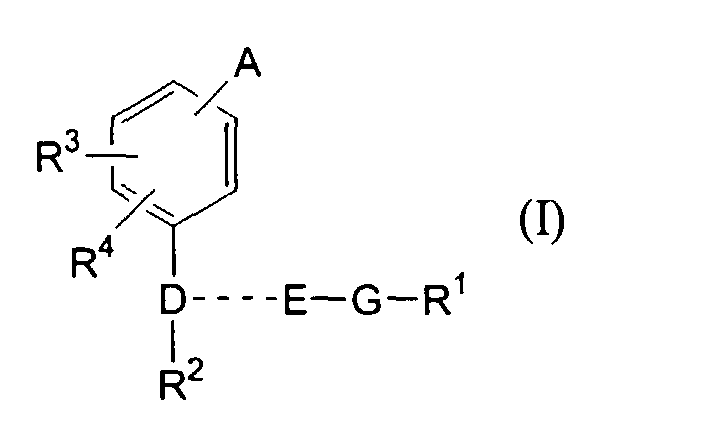
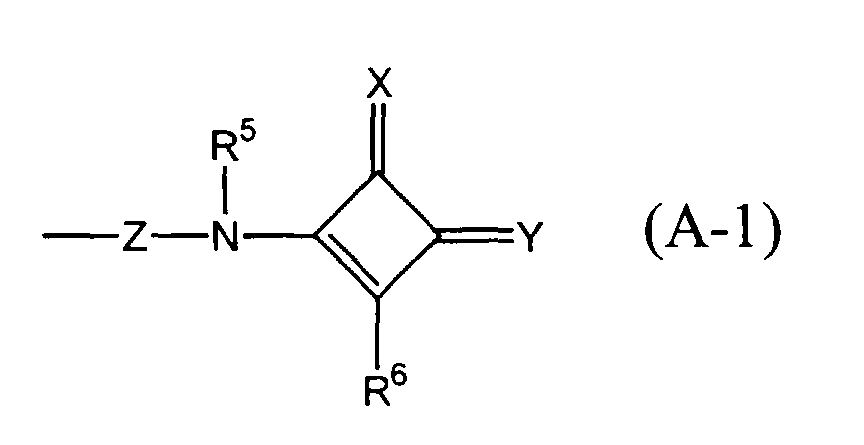
Description
- The present invention relates to a series of novel cyclobutene derivatives having excellent inhibitory activity against an ileal bile acid transporter.
- Hyperlipaemia is one of three major risk factors in the causation of ischaemic heart disease. It is widely accepted that reducing high blood cholesterol levels is particularly useful for the treatment or prevention of ischaemic heart disease. Commercially available remedies for hyperlipaemia at present include HMG-CoA reductase inhibitors and anion exchange resins, and these are used for treating or preventing hyperlipaemia or arteriosclerosis [Am. J. Cardiol., 76, 899-905 (1995)].
- HMG-CoA reductase inhibitors not only inhibit cholesterol synthesis but also increase LDL (low density lipoprotein) receptors in the liver, which increases the uptake of blood cholesterol and accelerates its excretion into bile [Science, 232, 34 (1986)]. Because these compounds are widely recognised to be both useful and safe, they have been used for a large number of patients.
- Anion exchange resins, on the other hand, adsorb bile acid and disturb the re-absorption of bile acid in the intestines, thereby promoting the intrahepatic conversion of cholesterol to bile acid, which is a mechanism by which cholesterol may be removed from the blood. As a result, they are effective for reducing blood cholesterol levels [N. Engl. J. Med., 302, 1210-1222 (1980)]. Cholestyramine is such an anion exchange resin and has already been used in practice for this purpose. Because this compound is not readily absorbed by the body, it is the treatment of choice for infantile hyperlipaemia where higher standards of safety are required. However, a large quantity of cholestyramine must be administered in one dose and moreover, being a resin, it has an unpleasant mouthfeel, which often discourages patients from using it regularly. Furthermore, it interferes with the absorption of fat from the gastro-intestinal tract and results in a reduced absorption of fat-soluble vitamins, and may inhibit or reduce the absorption of minerals. It may also delay or reduce the absorption of other drugs, particularly acidic ones, which are administered concurrently. Thus, although it is effective, a drug having a similar activity but without these disadvantages would be desirable.
- In recent years, a protein which acts on the first step of the re-absorption of bile acid into the ileum, that is an ileal bile acid transporter, has been cloned [Wong M. H. et al., J. Biol. Chem., 269, 1340-1347 (1994)]. It has been suggested that similar pharmacological effects to those of cholestyramine could be achieved by the inhibition of this ileal bile acid transporter, and attempts have been made to find such an inhibitor [Wess G. et al, J. Med. Chem., 37, 873-875 (1994)].
- The following prior art is thought relevant to the present invention:
- This discloses compounds having the following formula (Z-1):in which: Z represents a group of formula -N(R3)CO-, where R3 represents an aryl group; X represents a group of formula -N(R5)-, where R5 represents a hydrogen atom or an alkyl group; R2 represents a cycloalkyl or cycloalkenyl group which may optionally be substituted, and R4 represents an aryl or heteroaryl group.
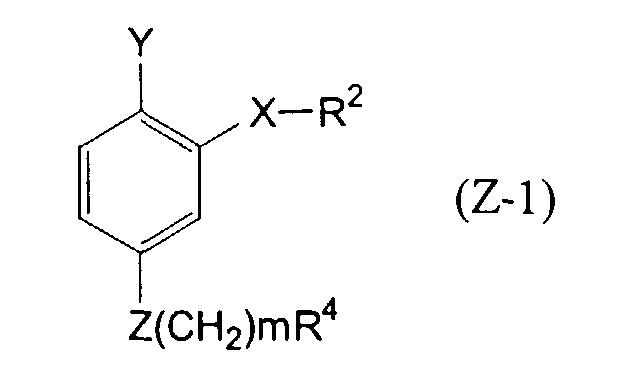
- Of the compounds of formula (I) according to the present invention, those in which D represents a nitrogen atom and in which E represents a -CO- group have a similar structure to the compounds of formula (Z-1), but they differ in that the cyclobutenyl portion of A in the compound of formula (I) has two oxo or thioxo groups as essential substituents, while the cycloalkenyl group defined in R2 of the compound of formula (Z-1) contains neither an oxo nor a thioxo group.
- Moreover, this prior art does not specifically disclose any compound having an analogous structure to the compounds of formula (I) of the present invention and, of the compounds disclosed, the closest to the compounds the present invention is only the following compound:

- Finally, the compounds of formula (Z-1) are disclosed as selective phosphodiesterase IV inhibitors. There is no suggestion that they may have ileal bile acid transporter inhibitory action.
- These publications disclose compounds of formula (Z-2):[in which, Ring A and Ring B each represents a benzene ring which may be substituted further, and Q represents a group of formula -OQ1 (in which, Q1 represents an aliphatic hydrocarbon group which may be substituted)].
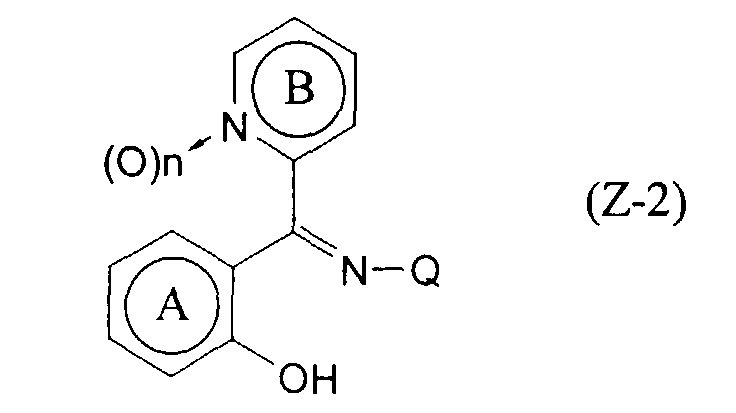
- Of the compounds of formula (I) of the present invention, the closest structurally to the compounds of formula (Z-2) are those in which, in the compounds of the present invention, the broken line represents a double bond, D represents a carbon atom and E represents a group of formula =N-O-. The compounds of the present invention and those of the prior art differ in that the former contains an oxo- or thioxo-substituted cyclobutenylamino group as a substituent A of the benzene ring, while there is no disclosure of a cyclobutenylamino group as a substituent of the benzene ring in the prior compounds.
- Moreover, this prior art does not specifically disclose any compound having an analogous structure to the compounds of formula (I) of the present invention and, of the compounds disclosed, the closest to the compounds the present invention is only the following compound:
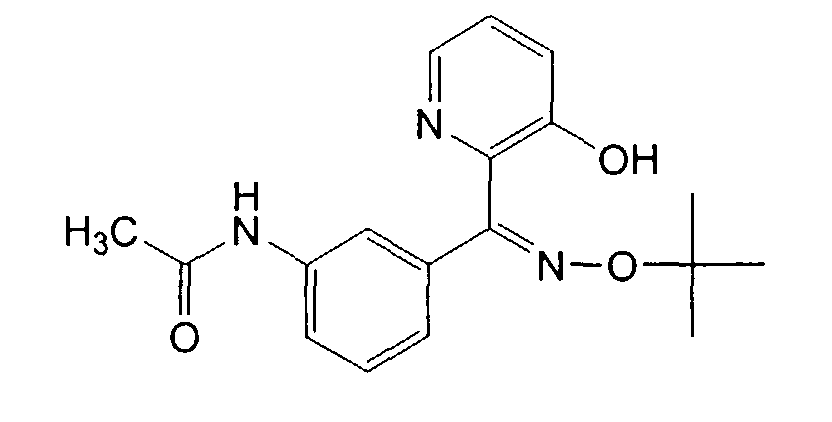
- Finally, in these publications, the compounds of formula (Z-2) are disclosed as calcium channel opening agents and lipometabolism-improving agents, respectively. There is no suggestion that they may have ileal bile acid transporter inhibitory action.
- This discloses compounds having the following formula (Z-3) as ileal bile acid transporter inhibitor:in which: R1 represents an C6-C10 aryl group which be substituted by from one to three of substituents α or a tetrazolyl group which may optionally be substituted by from one to three of substituents β; R2, R3 and R4 represents a hydrogen group; R5 represents an C6-C10 aryl group which may optionally be substituted by from one to three of substituents β; and R6 represents C7-C10 aralkyl group which may optionally be substituted by from one to three of substituents γ.

- Of the compounds of formula (I) according to the present invention, the closest structurally to the compounds of formula (Z-3) are those in which, in the compounds of the present invention, D represents a carbon atom, in which in which E represents a -NH- group and the broken line represents a single bond have a similar structure to the compounds of formula (Z-3), but they differ in that the former contains an oxo- or thioxo-substituted cyclobutenylamino group as a substituent A of the benzene ring, while there is no disclosure of a cyclobutenylamino group as a substituent of the benzene ring in the prior compounds.
- Moreover, this prior art does not specifically disclose any compound having an analogous structure to the compounds of formula (I) of the present invention and, of the compounds disclosed, the closest to the compounds the present invention is only the following compound:

- This publication discloses compounds of formula (Z-4):[in which, Ar1 and Ar2 each represents an aromatic group which may optionally be substituted further, and Q represents a chain aliphatic hydrocarbon bivalent group which may be interposed with a bivalent group selected from O, S and a imino group; X represents a hydrogen group; and Ring A represents a nitrogenous 5 to 7-membered cyclic group which may optionally be substituted further.].
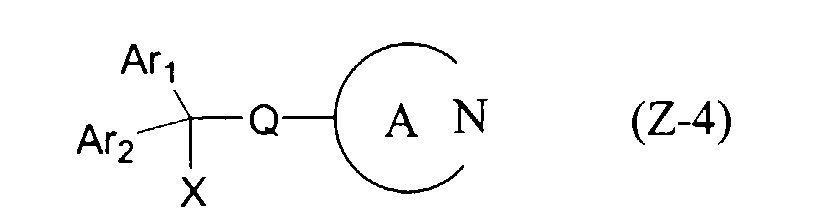
- Of the compounds of formula (I) of the present invention, the closest structurally to the compounds of formula (Z-4) are those in which, in the compounds of the present invention, the broken line represents a single bond, D represents a carbon atom and E represents a -NH- group. The compounds of the present invention and those of the prior art differ in that the former contains an oxo- or thioxo-substituted cyclobutenylamino group as a substituent A of the benzene ring, while there is no disclosure of a cyclobutenylamino group as a substituent of Ar1 or Ar2 in the prior compounds.
- Moreover, this prior art does not specifically disclose any compound having an analogous structure to the compounds of formula (I) of the present invention.
- Finally, the compounds of formula (Z-4) are disclosed as neurodegeneration inhibitor. There is no suggestion that they may have ileal bile acid transporter inhibitory action.
- We have now discovered a series of novel cyclobutene derivatives that have excellent inhibitory action against the ileal bile acid transporter and can thus be used to reduce or maintain the level of cholesterol in the mammalian body.
- Thus, the present invention consists in cyclobutenyl derivatives of formula (I):in which:

- R1 represents a cycloalkyl group, an aryl group, a heterocyclic group, a cycloalkyl group substituted by at least one of substituents α and β, defined below, an aryl group substituted by at least one of substituents α and β, defined below, or a heterocyclic group substituted by at least one of substituents α and β,defined below;
- R2 represents a cycloalkyl group, an aryl group, a heterocyclic group, a cycloalkyl group substituted by at least one of substituents α, defined below, an aryl group substituted by at least one of substituents α, defined below, or a heterocyclic group substituted by at least one of substituents α, defined below;
- R3 and R4 are the same as or different from each other and each represents a hydrogen atom or one of substituents α, defined below;
- A represents a group of formula (A-1):
in which:
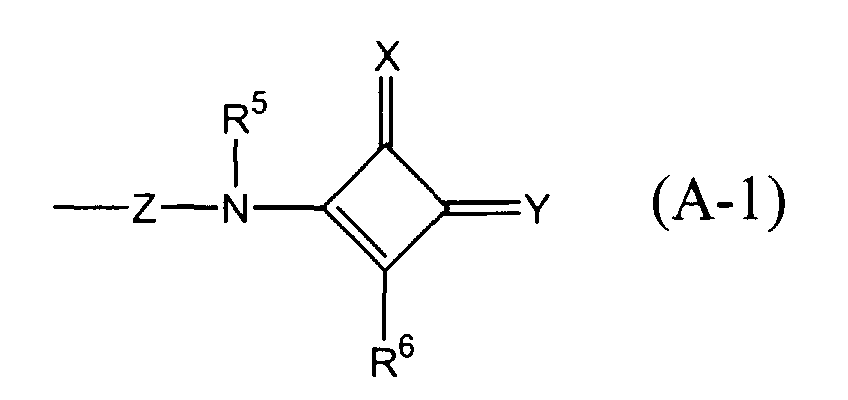
- R5 represents a hydrogen atom, a hydroxy group or a lower alkyl group,
- R6 represents a hydroxy group, a lower alkoxy group, a lower alkylthio group or an amine residue,
- X and Y are the same as or different from each other and each represents an oxygen atom or a sulphur atom, and
- Z represents a direct single bond between the nitrogen atom shown and the benzene ring shown in formula (I), or an alkylene group having from 1 to 6 carbon atoms,
- G represents a single bond, an alkylene group having from 1 to 6 carbon atoms or an alkylene group having from 1 to 6 carbon atoms and substituted by at least one of substituents γ, defined below; the broken line represents a single or double bond;
- D represents a carbon atom; and
- E represents an =N-O- group;
- D represents a CH group or a nitrogen atom, and
- E represents an oxygen atom, a sulphur atom, an -NH- group or a -CO- group;
- said substituents α are selected from halogen atoms, hydroxy groups, cyano groups, nitro groups, lower alkyl groups, lower haloalkyl groups, lower alkoxy groups, lower alkylthio groups, amino groups, lower monoalkylamino groups and di(lower alkyl)amino groups.
- said substituents β are selected from carboxy groups, lower alkoxycarbonyl groups, carbamoyl groups, lower monoalkylcarbamoyl groups, di(lower alkyl)carbamoyl groups, nitro groups, cycloalkyl groups, aryl groups, aryloxy groups, aralkyloxy groups, arylthio groups and cycloalkyl, aryl, aryloxy, aralkyloxy and arylthio groups each substituted by at least one of substituents α, defined above;
- said substituents γ are selected from hydroxy groups, oxo groups, cycloalkyl groups, aryl groups, heterocyclic groups, cycloalkyl groups substituted by at least one of substituents α and β, defined above, aryl groups substituted by at least one of substituents α and β, defined above, and heterocyclic groups substituted by at least one of substituents α and β, defined above;
- said cycloalkyl groups preferably have from 3 to 10 ring carbon atoms and are optionally fused to an aryl group, as defined below;
- said aryl groups are preferably aromatic carbocyclic groups having from 6 to 10 ring carbon atoms;
- said heterocyclic groups preferably have from 5 to 7 ring atoms, of which from 1 to 3 are sulphur and/or oxygen and/or nitrogen atoms, and are optionally fused to an aryl group, as defined above;
-
- The invention also provides the use of compounds of formula (I) and pharmaceutically acceptable salts, esters or other derivatives thereof for the manufacture of a medicament for the inhibition of an ileal bile acid trasporter.
- Where R1, R2, substituent β or substituent γ represents a cycloalkyl group or a substituted cycloalkyl group, this may be any saturated cycloalkyl group having from 3 to 10 carbon atoms. Such cycloalkyl groups may, if desired, be fused to an aryl group, as defined below, such as a benzene ring. Examples of such groups include the cyclopropyl, cyclobutyl, cyclopentyl, cyclohexyl, cycloheptyl, norbornyl, adamantyl and indanyl groups. Of these, we prefer the cycloalkyl groups having 5 or 6 carbon atoms, of which the cyclohexyl group is most preferred. Where R1 or substituent y represents such a cycloalkyl group, it may be unsubstituted or it may have one or more, preferably from 1 to 5, of substituents α or β, defined above. Where R2 or substituent β represents such a cycloalkyl group, it may be unsubstituted or it may have one or more, preferably from 1 to 3, of substituents α, defined above.
- Where R1, R2, substituent β or substituent γ represents an aryl group, this may be a substituted or unsubstituted aromatic hydrocarbon group having from 6 to 10 ring carbon atoms, and examples include the phenyl, indenyl and naphthyl groups. In the case of R1, the phenyl and naphthyl groups are preferred, and the phenyl and 1-naphthyl groups are most preferred. In the case of R2, the phenyl and naphthyl groups are preferred and the phenyl group is most preferred. Where R1 or substituent γ represents such an aryl group, it may be unsubstituted or it may have one or more, preferably from 1 to 5, of substituents α or β, defined above. Where R2 or substituent β represents such an aryl group, it may be unsubstituted or it may have one or more, preferably from 1 to 3, of substituents α, defined above.
- Where R1, R2 or substituent γ represents a heterocyclic group, this has from 5 to 7 ring atoms, of which from 1 to 3 are sulphur and/or oxygen and/or nitrogen atoms. Where there are 3 hetero-atoms, we prefer that 1, 2, or 3 of these are nitrogen atoms, and that, correspondingly, 2, 1, or 0 of these are sulphur and/or oxygen atoms. Where there are 2 hetero-atoms, we prefer that 1 or 2 of these are nitrogen atoms, and that, correspondingly, 1 or 0 of these are sulphur and/or oxygen atoms. Examples of such groups include the aromatic heterocyclic groups, such as the furyl, thienyl, pyrrolyl, azepinyl, pyrazolyl, imidazolyl, oxazolyl, isoxazolyl, thiazolyl, isothiazolyl, 1,2,3-oxadiazolyl, triazolyl, tetrazolyl, thiadiazolyl, pyranyl, pyridyl, pyridazinyl, pyrimidinyl and pyrazinyl groups. Alternatively, the heterocyclic group may be a partially or wholly saturated analogue of these groups, such as the morpholinyl, thiomorpholinyl, pyrrolidinyl, pyrrolinyl, imidazolidinyl, imidazolinyl, pyrazolidinyl, pyrazolinyl, piperidyl and piperazinyl groups.
- Such heterocyclic groups may, if desired, be fused to an aryl group, as defined below, such as a benzene ring. Examples of such fused ring groups include the benzothienyl, benzothiazolyl, benzooxazolyl, isobenzofuranyl, chromenyl, xanthenyl, phenoxathienyl, indolizinyl, isoindolyl, indolyl, indazolyl, purinyl, quinolizinyl, isoquinolyl, quinolyl, phthalazinyl, naphthyridinyl, quinoxalinyl, quinazolinyl, carbazolyl, carbolinyl, acridinyl and isoindolinyl groups. Of these, the 5- or 6-membered aromatic heterocyclic groups and 5- or 6-membered aromatic heterocyclic groups fused with a benzene ring are preferred, the thienyl, furyl, pyrrolyl, thiazolyl, oxazolyl, imidazolyl and pyridyl groups and the thienyl, furyl, pyrrolyl, thiazolyl, oxazolyl, imidazolyl and pyridyl groups each fused with a benzene ring being more preferred, the thienyl and pyridyl groups being still more preferred and the 2-thienyl and 4-pyridyl groups being most preferred.
- Where R1 or substituent γ represents such a heterocyclic group, it may be unsubstituted or it may have one or more, preferably from 1 to 5, of substituents α or β, defined above. Where R2 represents such a heterocyclic group, it may be unsubstituted or it may have one or more, preferably from 1 to 3, of substituents α, defined above.
- Where R5 or substituent a represents a lower alkyl group, this may be a straight or branched alkyl group preferably having from 1 to 6 carbon atoms, and examples include the methyl, ethyl, propyl, isopropyl, butyl, isobutyl, sec-butyl, t-butyl, pentyl, isopentyl, 2-methylbutyl, neopentyl, 1-ethylpropyl, hexyl, isohexyl, 4-methylpentyl, 3-methylpentyl, 2-methylpentyl, 1-methylpentyl, 3,3-dimethylbutyl, 2,2-dimethylbutyl, 1,1-dimethylbutyl, 1,2-dimethylbutyl, 1,3-dimethylbutyl, 2,3-dimethylbutyl and 2-ethylbutyl groups, of which the alkyl groups having from 1 to 4 carbon atoms are preferred, the alkyl groups having 1 or 2 carbon atoms are more preferred and the methyl group is most preferred.
- Where R6 or substituent α represents a lower alkoxy group, this may be a straight or branched alkoxy group preferably having from 1 to 6 carbon atoms, and the alkyl part of this group may be any of the alkyl groups exemplified above. Examples include the methoxy, ethoxy, propoxy, isopropoxy, butoxy, isobutoxy, sec-butoxy, t-butoxy, pentyloxy, isopentyloxy, 2-methylbutoxy, neopentyloxy, hexyloxy, 4-methylpentyloxy, 3-methylpentyloxy, 2-methylpentyloxy, 3,3-dimethylbutoxy, 2,2-dimethylbutoxy, 1,1-dimethylbutoxy, 1,2-dimethylbutoxy, 1,3-dimethylbutoxy and 2,3-dimethylbutoxy groups, of which the alkoxy groups having from 1 to 4 carbon atoms are preferred, the alkoxy groups having 1 or 2 carbon atoms groups are more preferred and the methoxy group is most preferred.
- Where R6 or substituent α represents a lower alkylthio group, this may be a straight or branched alkylthio group preferably having from 1 to 6 carbon atoms, and the alkyl part of this group may be any of the alkyl groups exemplified above. Examples include the methylthio, ethylthio, propylthio, isopropylthio, butylthio, isobutylthio, sec-butylthio, t-butylthio, pentylthio, isopentylthio, 2-methylbutylthio, neopentylthio, hexylthio, 4-methylpentylthio, 3-methylpentylthio, 2-methylpentylthio, 3,3-dimethylbutylthio, 2,2-dimethylbutylthio, 1,1-dimethylbutylthio, 1,2-dimethylbutylthio, 1,3-dimethylbutylthio and 2,3-dimethylbutylthio groups, of which the alkylthio groups having from 1 to 4 carbon atoms are preferred, the alkylthio groups having 1 or 2 carbon atoms are more preferred and the methylthio group is most preferred.
- Where R6 represents an amine residue, this is a substituted or unsubstituted amino group or a cyclic amino (nitrogen-containing heterocyclic) group. Examples include amino groups, hydroxyamino groups, lower monoalkylamino groups, di(lower alkyl)amino groups, amino groups substituted by 1 or 2 lower alkoxy groups, amino groups substituted by 1 or 2 of the cycloalkyl groups described above, amino groups substituted by 1 or 2 lower sulphoalkyl groups, amino groups substituted by 1 or 2 carboxy- or lower-alkoxycarbonyl-substituted lower alkyl groups, saturated cyclic amine residues having a nitrogen atom in the ring, aryl- or aralkyl- amino groups in which the nitrogen atom may be further substituted by a lower alkyl group, and heteroarylamino groups in which the nitrogen atom may be further substituted by a lower alkyl group. Of these, the amino groups, hydroxyamino groups, lower monoalkylamino groups, di(lower alkyl)amino groups, amino groups substituted by 1 or 2 lower sulphoalkyl groups and amino groups substituted by 1 or 2 carboxy- or lower-alkoxycarbonyl- substituted lower alkyl groups are preferred, the amino groups, hydroxyamino groups, lower monoalkylamino groups and di(lower alkyl)amino groups are more preferred, and the amino groups and hydroxyamino groups are most preferred.
- Examples of such lower monoalkylamino groups include any in which an alkyl group, as defined and exemplified above, is a substituent on an amino group, for example the methylamino, ethylamino, propylamino, isopropylamino, butylamino, isobutylamino, sec-butylamino, t-butylamino, pentylamino, isopentylamino, 2-methylbutylamino, neopentylamino, 1-ethylpropylamino, hexylamino, isohexylamino, 4-methylpentylamino, 3-methylpentylamino, 2-methylpentylamino, 1-methylpentylamino, 3,3-dimethylbutylamino, 2,2-dimethylbutylamino, 1,1-dimethylbutylamino, 1,2-dimethylbutylamino, 1,3-dimethylbutylamino, 2,3-dimethylbutylamino and 2-ethylbutylamino groups.
- Examples of such di(lower alkyl)amino groups include any in which two alkyl groups, as defined and exemplified above, are substituents on an amino group, for example the dimethylamino, diethylamino, N-ethyl-N-methylamino, dipropylamino, dibutylamino, dipentylamino and dihexylamino groups.
- Examples of such amino group substituted by 1 or 2 lower alkoxy groups include those in which an amino group is substituted by one or two alkoxy groups, as defined and exemplified above, for example, the methoxyamino, ethoxyamino, propoxyamino, isopropoxyamino, butoxyamino, isobutoxyamino, sec-butoxyamino, t-butoxyamino, pentyloxyamino, isopentyloxyamino, 2-methylbutoxyamino, neopentyloxyamino, hexyloxyamino, dimethoxyamino and diethoxyamino groups.
- Examples of such amino groups substituted by 1 or 2 cycloalkyl groups include those in which an amino group is substituted by one or two of the cycloalkyl groups defined and exemplified above, for example the cyclopentylamino, cyclohexylamino, dicyclopentylamino and dicyclohexylamino groups.
- Examples of such amino groups substituted by 1 or 2 lower sulphoalkyl groups include groups in which the alkyl part is any of the alkyl groups defined and exemplified above, for example the sulphomethylamino, 2-sulphoethylamino, 3-sulphopropylamino, 4-sulphobutylamino, 5-sulphopentylamino and 6-sulphohexylamino groups.
- Examples of such amino groups substituted by 1 or 2 carboxy- or lower-alkoxycarbonyl-substituted lower alkyl groups include those in which the alkyl and alkoxy parts are as defined and exemplified above, and examples include the carboxymethylamino, 2-carboxyethylamino, 3-carboxypropylamino, 4-carboxybutylamino, 5-carboxypentylamino, 6-carboxyhexylamino, methoxycarboxymethylamino, ethoxycarboxymethylamino, 2-methoxycarboxyethylamino, 2-ethoxycarboxyethylamino, 3-methoxycarboxypropylamino, 3-ethoxycarboxypropylamino, 4-methoxycarboxybutylamino, 5-methoxycarboxypentylamino and 6-methoxycarboxyhexylamino groups;
- Examples of such saturated cyclic amine residues having a nitrogen atom in the ring include the pyrrolidino, piperidino, piperazino, N-methylpiperazino, morpholino and thiomorpholino groups.
- Examples of such aryl- or aralkyl- amino groups in which the nitrogen atom may be further substituted by a lower alkyl group include those in which the aryl, aralkyl and alkyl parts are as defined and exemplified above, for example the anilino, benzylamino, N-methylanilino and N-methylbenzylamino groups.
- Examples of such heteroarylamino groups in which the nitrogen atom may be further substituted by a lower alkyl group (the alkyl part being as defined and exemplified above) include the pyridylamino, N-methylpyridylamino and N-ethylpyridylamino groups.
- Where Z or G represents an alkylene group having from 1 to 6 carbon atoms, this may be a straight or branched chain group, and, in the case of G, may be substituted or unsubstituted. Examples of such groups include the substituted and unsubstituted methylene, methylmethylene, ethylene, ethylmethylene, dimethylmethylene, propylene, trimethylene, 1-methylethylene, tetramethylene, 1-methyltrimethylene, 2-methyltrimethylene, 3-methyltrimethylene, 1-methylpropylene, 1,1-dimethylethylene, pentamethylene, 1-methyltetramethylene, 2-methyltetramethylene, 3-methyltetramethylene, 4-methyltetramethylene, 1,1-dimethyltrimethylene, 2,2-dimethyltrimethylene, 3,3-dimethyltrimethylene, hexamethylene, 1-methylpentamethylene, 2-methylpentamethylene, 3-methylpentamethylene, 4-methylpentamethylene, 5-methylpentamethylene, 1,1-dimethyltetramethylene, 2,2-dimethyltetramethylene, 3,3-dimethyltetramethylene and 4,4-dimethyltetramethylene groups. In the case of Z, those alkylene groups having from 1 to 4 carbon atoms are preferred, of which the alkylene groups having 1 or 2 carbon atoms are more preferred and the methylene group is most preferred. In the case of G, those alkylene groups having from 1 to 4 carbon atoms are preferred, the methylene, methylmethylene and ethylmethylene groups being more preferred and the methylmethylene group being most preferred.
- Where substituent α is a halogen atom, this may be, for example, a fluorine, chlorine, bromine or iodine atom, of which the fluorine and chlorine atoms are preferred and the fluorine atom is most preferred.
- Where substituent α is a lower haloalkyl group, this is a lower alkyl group, as defined and exemplified above, substituted by a halogen atom. Examples include the trifluoromethyl, trichloromethyl, difluoromethyl, dichloromethyl, dibromomethyl, fluoromethyl, 2,2,2-trifluoroethyl, 2,2,2-trichloroethyl, 2-bromoethyl, 2-chloroethyl, 2-fluoroethyl, 2-iodoethyl, 3-chloropropyl, 4-fluorobutyl, 6-iodohexyl and 2,2-dibromoethyl groups, of which those haloalkyl groups having from 1 to 4 carbon atoms are preferred, the haloalkyl groups having 1 or 2 carbon atoms being more preferred and the trifluoromethyl group being most preferred.
- Where substituent α is a lower monoalkylamino group, this may be as defined and exemplified above in relation to the groups which may be represented by R6. Of these, the monoalkylamino groups having from 1 to 4 carbon atoms are preferred, the monoalkylamino groups having 1 or 2 carbon atoms are more preferred and the methylamino group is most preferred.
- Where substituent α is a di(lower alkyl)amino group, this may be as defined and exemplified above in relation to the groups which may be represented by R6. Of these, the dialkylamino groups having from 1 to 4 carbon atoms in each alkyl group are preferred, the dialkylamino groups having 1 or 2 carbon atoms in each alkyl group are more preferred and the dimethylamino group is most preferred.
- Where substituent β is a lower alkoxycarbonyl group, this may be any of the lower alkoxy groups defined and exemplified above bound to a carbonyl group. Examples include straight or branched chain alkoxycarbonyl groups having from 1 to 6 carbon atoms, such as the methoxycarbonyl, ethoxycarbonyl, propoxycarbonyl, isopropoxycarbonyl, butoxycarbonyl, isobutoxycarbonyl, sec-butoxycarbonyl, t-butoxycarbonyl, pentyloxycarbonyl, isopentyloxycarbonyl, 2-methylbutoxycarbonyl, neopentyloxycarbonyl, hexyloxycarbonyl, 4-methylpentyloxycarbonyl, 3-methylpentyloxycarbonyl, 2-methylpentyloxycarbonyl, 3,3-dimethylbutoxycarbonyl, 2,2-dimethylbutoxycarbonyl, 1,1-dimethylbutoxycarbonyl, 1,2-dimethylbutoxycarbonyl, 1,3-dimethylbutoxycarbonyl and 2,3-dimethylbutoxycarbonyl groups, of which the alkoxycarbonyl groups having from 1 to 4 carbon atoms in the alkoxy part are preferred, the alkoxycarbonyl groups having 1 or 2 carbon atoms in the alkoxy part are more preferred and the methoxycarbonyl group is most preferred.
- Where substituent β is a lower monoalkylcarbamoyl group, this may be any of the lower alkyl groups defined and exemplified above bound to a carbamoyl group. Examples include the methylcarbamoyl, ethylcarbamoyl, propylcarbamoyl, isopropylcarbamoyl, butylcarbamoyl, isobutylcarbamoyl, sec-butylcarbamoyl, t-butylcarbamoyl, pentylcarbamoyl, isopentylcarbamoyl, 2-methylbutylcarbamoyl, neopentylcarbamoyl, 1-ethylpropylcarbamoyl and hexylcarbamoyl groups, of which the monoalkylcarbamoyl groups having from 1 to 4 carbon atoms in the alkyl part are preferred, the methylcarbamoyl and ethylcarbamoyl groups are more preferred, and the methylcarbamoyl group is most preferred.
- Where substituent β is a di(lower alkyl)carbamoyl group, each alkyl group preferably has from 1 to 6 carbon atoms, and these may be straight or branched chain groups, as defined and exemplified above. The two alkyl groups may be the same as or different from each other. Examples include the dimethylcarbamoyl, diethylcarbamoyl, N-ethyl-N-methylcarbamoyl, dipropylcarbamoyl, dibutylcarbamoyl, dipentylcarbamoyl and dihexylcarbamoyl groups, of which the dialkylcarbamoyl groups having from 1 to 4 carbon atoms are preferred, the dialkylcarbamoyl groups having 1 or 2 carbon atoms are more preferred, and the dimethylcarbamoyl group is most preferred.
- Where substituent β is an aryloxy group, this may be unsubstituted or it may be substituted by from 1 to 3 of substituents α, as defined and exemplified above. Examples include phenoxy, 1-indenyloxy, 2-indenyloxy, 1-naphthyloxy and 2-naphthyloxy groups, of which the phenoxy group is preferred.
- Where substituent β is an aralkyloxy group, the aryl part of this may be any of the aryl groups defined and exemplified above, and the alkoxy part may likewise be as defined and exemplified above. Examples include aralkyloxy groups having from 7 to 16 carbon atoms, such as the benzyloxy, α-naphthylmethoxy, β-naphthylmethoxy, indenylmethoxy, diphenylmethoxy, triphenylmethoxy, 1-phenethyloxy, 2-phenethyloxy, 1-naphthylethoxy, 2-naphthylethoxy, 1-phenylpropoxy, 2-phenylpropoxy, 3-phenylpropoxy, 1-naphthylpropoxy, 2-naphthylpropoxy, 3-naphthylpropoxy, 1-phenylbutoxy, 2-phenylbutoxy, 3-phenylbutoxy, 4-phenylbutoxy, 1-naphthylbutoxy, 2-naphthylbutoxy, 3-naphthylbutoxy, 4-naphthylbutoxy, 1-phenylpentyloxy, 2-phenylpentyloxy, 3-phenylpentyloxy, 4-phenylpentyloxy, 5-phenylpentyloxy, 1-naphthylpentyloxy, 2-naphthylpentyloxy, 3-naphthylpentyloxy, 4-naphthylpentyloxy, 5-naphthylpentyloxy, 1-phenylhexyloxy, 2-phenylhexyloxy, 3-phenylhexyloxy, 4-phenylhexyloxy, 5-phenylhexyloxy, 6-phenylhexyloxy, 1-naphthylhexyloxy, 2-naphthylhexyloxy, 3-naphthylhexyloxy, 4-naphthylhexyloxy, 5-naphthylhexyloxy and 6-naphthylhexyloxy groups, of which the benzyloxy group is preferred.
- Where substituent β is an arylthio group, the aryl part may be as defined and exemplified above, and may be unsubstituted or may have from 1 to 3 of substituents α. Examples include the phenylthio, 1-indenylthio, 2-indenylthio, 3-indenylthio, 1-naphthylthio and 2-naphthylthio groups, of which the phenylthio group is preferred.
- Specific examples of cycloalkyl groups substituted by from 1 to 3 of substituents a in the definition of R2 include the 2-fluorocyclopropyl, 2-chlorocyclopropyl, 2- or 3-fluorocyclopentyl, 2- or 3-chlorocyclopentyl, 2-, 3- or 4-fluorocyclohexyl, 2-, 3- or 4-chlorocyclohexyl, 2-, 3- or 4-bromocyclohexyl, 2-, 3- or 4-iodocyclohexyl, 2-hydroxycyclopropyl, 2- or 3-hydroxycyclopentyl, 2-, 3- or 4-hydroxycyclohexyl, 2-methylcyclopropyl, 2-ethylcyclopropyl, 2- or 3-methylcyclopentyl, 2- or 3-ethylcyclopentyl, 2-, 3- or 4-methylcyclohexyl, 2-, 3- or 4-ethylcyclohexyl, 2-trifluoromethylcyclopropyl, 2- or 3-trifluoromethylcyclopentyl, 2-, 3- or 4-trifluoromethylcyclohexyl, 2-methoxycyclopropyl, 2- or 3-methoxycyclopentyl, 2-, 3- or 4-methoxycyclohexyl, 2-, 3- or 4-ethoxycyclohexyl, 2-methylthiocyclopropyl, 2- or 3-methylthiocyclopentyl, 2-, 3- or 4-methylthiocyclohexyl, 2-, 3- or 4-ethylthiocyclohexyl, 2-, 3- or 4-formyloxycyclohexyl, 2-, 3- or 4-acetoxycyclohexyl, 2-, 3- or 4-propionyloxycyclohexyl, 2-, 3- or 4-benzoyloxycyclohexyl, 2-aminocyclopropyl, 2- or 3-aminocyclopentyl, 2-, 3- or 4-aminocyclohexyl, 2-methylaminocyclopropyl, 2- or 3-methylaminocyclopentyl, 2-, 3- or 4-methylaminocyclohexyl, 2-dimethylaminocyclopropyl, 2- or 3-dimethylaminocyclopentyl, 2-, 3- or 4-dimethylaminocyclohexyl, 3,4-difluorocyclohexyl, 3,4-dichlorocyclohexyl, 2,3-dimethoxycyclohexyl, 3,4-dimethoxycyclohexyl, 3,5-dimethoxycyclohexyl and 3,4,5-trimethoxycyclohexyl groups. Of these, we prefer cyclopentyl and cyclohexyl groups having from 1 to 3 substituents (the substituent preferably being selected from halogen atoms, hydroxy groups, lower alkyl groups, lower haloalkyl groups and lower alkoxy groups) are preferred and the cyclohexyl group substituted by one substituent (the substituent preferably being selected from halogen atoms, hydroxy groups, lower alkyl groups, lower haloalkyl groups and lower alkoxy groups) is most preferred.
- Specific examples of aryl groups substituted by from 1 to 3 of substituents α in the definition of R2 include the 2-, 3- or 4-fluorophenyl, 2-, 3- or 4-chlorophenyl, 2-, 3- or 4-bromophenyl, 2-, 3- or 4-iodophenyl, 2-, 3- or 4-hydroxyphenyl, 2-, 3- or 4-methylphenyl, 2-, 3- or 4-ethylphenyl, 2-, 3- or 4-trifluoromethylphenyl, 2-, 3- or 4-methoxyphenyl, 2-, 3- or 4-ethoxyphenyl, 2-, 3- or 4-propoxyphenyl, 2-, 3- or 4-isopropoxyphenyl, 2-, 3- or 4-methylthiophenyl, 2-, 3- or 4-ethylthiophenyl, 2-, 3- or 4-formyloxyphenyl, 2-, 3- or 4-acetoxyphenyl, 2-, 3- or 4-propionyloxyphenyl, 2-, 3- or 4-benzoyloxyphenyl, 2-, 3- or 4-aminophenyl, 2-, 3- or 4-methylaminophenyl, 2-, 3- or 4-dimethylaminophenyl, 3,4-difluorophenyl, 3,4-dichlorophenyl, 3,4-dibromophenyl, 3,5-difluorophenyl, 3,5-dichlorophenyl, 3,5-dibromophenyl, 2,3,4-trifluorophenyl, 2,3,4-trichlorophenyl, 3,4,5-trifluorophenyl, 3,4,5-trichlorophenyl, 2,3-dimethylphenyl, 3,4-dimethylphenyl, 3,5-dimethylphenyl, 2,3-dimethoxyphenyl, 3,4-dimethoxyphenyl, 3,5-dimethoxyphenyl, 3,4,5-trimethoxyphenyl, 3-fluoro-4-methoxyphenyl, 4-methyl-2-methoxyphenyl, 6-fluoro-4-methyl-2-methoxyphenyl, 5-fluoroinden-3-yl, 5-fluoroinden-3-yl, 5-methylinden-3-yl, 5-methoxyinden-3-yl, 5-fluoroinden-2-yl, 5-chloroinden-2-yl, 5-methylinden-2-yl, 5-methoxyinden-2-yl, 5-fluoronaphthalen-2-yl, 5-chloronaphthalen-2-yl, 5-methylnaphthalen-2-yl, 5-methoxynaphthalen-2-yl, 5-fluoronaphthalen-1-yl, 5-chloronaphthalen-1-yl, 5-methylnaphthalen-1-yl and 5-methoxynaphthalen-1-yl groups. Of these, we prefer those aryl groups substituted by from 1 to 3 of the following substituents: halogen atoms, hydroxy groups, lower alkyl groups, lower haloalkyl groups and lower alkoxy groups. More preferred are the aryl groups substituted by one of the following substituents: halogen atoms, hydroxy groups, lower alkyl groups, lower haloalkyl groups and lower alkoxy groups. The 4-fluorophenyl, 4-chlorophenyl, 4-methylphenyl and 4-methoxyphenyl groups are most preferred.
- Specific examples of heterocyclic groups substituted by from 1 to 3 of substituents α in the definition of R2 include the 3-, 4- or 5-fluorofuran-2-yl, 2-, 4- or 5-fluorofuran-3-yl, 3-, 4- or 5-hydroxyfuran-2-yl, 2-, 4- or 5-hydroxyfuran-3-yl, 3-, 4- or 5-methylfuran-2-yl, 2-, 4- or 5-methylfuran-3-yl, 3-, 4- or 5-methoxyfuran-2-yl, 2-, 4- or 5-methoxyfuran-3-yl, 3-, 4- or 5-methylthiofuran-2-yl, 2-, 4- or 5-methylthiofuran-3-yl, 4- or 5-acetoxyfuran-2-yl, 2-, 4- or 5-acetoxyfuran-3-yl, 4- or 5-formyloxyfuran-2-yl, 2-, 4- or 5-formyloxyfuran-3-yl, 4- or 5-benzoyloxyfuran-2-yl, 2-, 4- or 5-benzoyloxyfuran-3-yl, 3-, 4- or 5-fluorothiophen-2-yl, 3-, 4- or 5-bromothiophen-2-yl, 3-, 4- or 5-hydroxythiophen-2-yl, 3-, 4- or 5-methylthiophen-2-yl, 2-, 4- or 5-methylthiophen-3-yl, 3-, 4- or 5-ethylthiophen-2-yl, 2-, 4- or 5-ethylthiophen-3-yl, 3-, 4- or 5-methoxythiophen-2-yl, 2-, 4- or 5-methoxythiophen-3-yl, 3-, 4- or 5-methylthiothiophen-2-yl, 2-, 4- or 5-methylthiothiophen-3-yl, 3-, 4- or 5-acetoxythiophen-2-yl, 2-, 4- or 5-acetoxythiophen-3-yl, 3-, 4- or 5-formyloxythiophen-2-yl, 2-, 4- or 5-formyloxythiophen-3-yl, 3-, 4- or 5-benzoyloxythiophen-2-yl, 2-, 4- or 5-benzoyloxythiophen-3-yl, 3- or 4-fluorothiazol-5-yl, 3- or 4-hydroxythiazol-5-yl, 3- or 4-methylthiazol-5-yl, 3-, 4- or 5-fluorobenzothiophen-2-yl, 2-, 4- or 5-fluorobenzothiophen-3-yl, 3-, 4- or 5-bromobenzothiophen-2-yl, 2-, 4- or 5-bromobenzothiophen-3-yl, 3-, 4- or 5-hydroxybenzothiophen-2-yl, 2-, 4- or 5-hydroxybenzothiophen-3-yl, 3-, 4- or 5-methylbenzothiophen-2-yl, 2-, 4- or 5-methylbenzothiophen-3-yl, 3-, 4- or 5-methoxybenzothiophen-2-yl, 2-, 4- or 5-methoxybenzothiophen-3-yl, 4-, 5-, 6- or 7-methylbenzothiazol-2-yl, 2- or 4-fluoropyridin-3-yl, 2- or 3-fluoropyridin-4-yl, 2- or 4-hydroxypyridin-3-yl, 2- or 3-hydroxypyridin-4-yl, 2- or 4-methylpyridin-3-yl, 2- or 3-methylpyridin-4-yl, 2- or 4-methoxypyridin-4-yl, 2- or 3-methoxypyridin-4-yl, 2- or 4-methylthiopyridin-3-yl, 2- or 3-methylthiopyridin-4-yl, 2-or 4-acetoxypyridin-3-yl, 2- or 3-acetoxypyridin-4-yl, 2- or 4-formyloxypyridin-3-yl, 2-or 3-formyloxypyridin-4-yl, 2- or 4-benzoyloxypyridin-3-yl, and 2- or 3-benzoyloxypyridin-4-yl groups. Of these, we prefer the heterocyclic groups substituted by from 1 to 3 of the following substituents: halogen atoms, hydroxy groups, lower alkyl groups, lower haloalkyl groups and lower alkoxy groups. The heterocyclic groups substituted by one of the following substituents: halogen atoms, hydroxy groups, lower alkyl groups, lower haloalkyl groups and lower alkoxy groups are more preferred. Still more preferred are the 5- or 6-membered aromatic heterocyclic groups substituted by one of the following substituents: halogen atoms, hydroxy groups, lower alkyl groups, lower haloalkyl groups and lower alkoxy groups. The most preferred such groups are the thiophene and pyridine groups substituted by one of the following substituents: halogen atoms, hydroxy groups, lower alkyl groups and lower alkoxy groups.
- Specific examples of the cycloalkyl groups substituted by from 1 to 5 of substituents α and β in the definition of R1 include those defined and exemplified above in relation to R2, and additionally the following: 2-carboxycyclopropyl, 2- or 3-carboxycyclopentyl, 2-, 3- or 4-carboxycyclohexyl, 2-methoxycarbonylcyclopropyl, 2- or 3-methoxycarbonylcyclopentyl, 2-, 3- or 4-methoxycarbonylcyclohexyl, 2-, 3- or 4-carbamoylcyclohexyl, 2-, 3- or 4-dimethylcarbamoylcyclohexyl, 2-nitrocyclopropyl, 2- or 3-nitrocyclopentyl, 2-, 3- or 4-nitrocyclohexyl, 2- or 3-cyclohexylcyclopentyl, 2-, 3- or 4-cyclohexylcyclohexyl, 2-phenylcyclopropyl, 2- or 3-phenylcyclopentyl, 2-, 3- or 4-phenylcyclohexyl, 2-phenoxycyclopropyl, 2- or 3-phenoxycyclopentyl, 2-, 3- or 4-phenoxycyclohexyl, 2-benzyloxycyclopropyl, 2- or 3-benzyloxycyclopentyl, 2-, 3- or 4-benzyloxycyclohexyl, 2-phenylthiocyclopropyl, 2- or 3-phenylthiocyclopentyl, and 2-, 3-or 4-phenylthiocyclohexyl groups. Of these, the cycloalkyl groups substituted by from 1 to 3 substituents are preferred and cyclohexyl groups substituted by one substituent are more preferred.
- Specific examples of the aryl groups substituted by from 1 to 5 of substituents α and β in the definition of R1 include those groups substituted by from 1 to 3 of substituents α defined and exemplified above in relation to R2, and additionally 2-, 3- or 4-carboxyphenyl, 2-, 3- or 4-methoxycarbonylphenyl, 2-, 3- or 4-ethoxycarbonylphenyl, 2-, 3- or 4-carbamoylphenyl, 2-, 3- or 4-methylcarbamoylphenyl, 2-, 3- or 4-dimethylcarbamoylphenyl, 2-, 3- or 4-nitrophenyl, 2-, 3- or 4-cyclopentylphenyl, 2-, 3- or 4-cyclohexylphenyl, 2-, 3- or 4-phenoxyphenyl, 2-, 3- or 4-diphenyl, 2-, 3- or 4-benzyloxyphenyl, 3,4-dibenzyloxyphenyl, 3,5-dibenzyloxyphenyl, 2-, 3- or 4-phenylthiophenyl, 5-nitroinden-3-yl, 5-cyclohexylinden-3-yl, 5-phenylinden-3-yl, 5-phenoxyinden-3-yl, 5-benzyloxyinden-3-yl, 5-phenylthioinden-3-yl, 5-nitroinden-2-yl, 5-cyclohexylinden-2-yl, 5-phenylinden-2-yl, 5-phenoxyinden-2-yl, 5-benzyloxyinden-2-yl, 5-phenylthioinden-2-yl, 5-nitronaphthalen-2-yl, 5-cyclohexylnaphthalen-2-yl, 5-phenylnaphthalen-2-yl, 5-phenoxynaphthalen-2-yl, 5-benzyloxynaphthalen-2-yl, 5-phenylthionaphthalen-2-yl, 5-nitronaphthalen-1-yl, 5-cyclohexylnaphthalen-1-yl, 5-phenylnaphthalen-1-yl, 5-phenoxynaphthalen-1-yl, 5-benzyloxynaphthalen-1-yl and 5-phenylthionaphthalen-1-yl groups. Of these, we prefer those aryl groups substituted by from 1 to 3 of substituents α and β. More preferred are the aryl groups substituted by from 1 to 3 of the following substituents: substituents α, nitro groups, cycloalkyl groups, aryl groups, aryloxy groups, aralkyloxy groups, arylthio groups and cycloalkyl, aryl, aryloxy, aralkyloxy and arylthio groups each substituted by from 1 to 3 of substituents α. Still more preferred are the aryl groups substituted by from 1 to 3 of the following substituents: halogen atoms, hydroxy groups, lower alkyl groups, lower haloalkyl groups, lower alkoxy groups and nitro groups. Even more preferred are the 3-fluorophenyl, 4-fluorophenyl, 3-chlorophenyl, 4-chlorophenyl, 3,4-difluorophenyl, 3,5-difluorophenyl, 3,4-dichlorophenyl, 3,5-dichlorophenyl, 3-hydroxyphenyl, 4-hydroxyphenyl, 3-methylphenyl, 4-methylphenyl, 3,4-dimethylphenyl, 3-methoxyphenyl, 4-methoxyphenyl, 3,4-dimethoxyphenyl, 3,4,5-trimethoxyphenyl and 3,4,5-trifluorophenyl groups. The most preferred are the 3-fluorophenyl, 3-chlorophenyl, 3,4-difluorophenyl, 3,5-difluorophenyl, 3,4-dichlorophenyl and 3,5-difluorophenyl groups.
- Specific examples of the heterocyclic groups substituted by from 1 to 5 of substituents α and β in the definition of R1 include the heterocyclic groups substituted by from 1 to 3 of substituents α defined and exemplified above in relation to R2, and additionally the 3-, 4- or 5-nitrothiophen-2-yl, 3-, 4- or 5-phenylthiophen-2-yl, 2-, 4- or 5-nitrothiophen-3-yl, 2-, 4- or 5-phenylthiophen-3-yl, 1-, 2- or 3-hydroxypyridin-4-yl, 1-, 2-or 3-nitropyridin-4-yl, 1-, 2- or 3-phenylpyridin-4-yl groups. Of these, we prefer the heterocyclic groups substituted by from 1 to 3 of the following substituents: halogen atoms, hydroxy groups, lower alkyl groups, lower haloalkyl groups, lower alkoxy groups and nitro groups. More preferred are the heterocyclic groups substituted by one of the following substituents: halogen atoms, hydroxy groups, lower alkyl groups, lower haloalkyl groups, lower alkoxy groups and nitro groups. Still more preferred are the thiophene and pyridine groups substituted by one of the following substituents: halogen atoms, hydroxy groups, lower alkyl groups, lower haloalkyl groups, lower alkoxy groups and nitro groups.
- Where G represents a substituted alkylene group having from 1 to 6 carbon atoms, examples include the hydroxymethylene, oxomethylene, cyclopentylmethylene, cyclohexylmethylene, phenylmethylene, 1-naphthylmethylene, 2-naphthylmethylene, 4-fluorophenylmethylene, 4-chlorophenylmethylene, 4-hydroxyphenylmethylene, 4-methylphenylmethylene, 1-naphthylmethylene, 2-naphthylmethylene, 2-thienylmethylene, 4-pyridylmethylene, 1-hydroxyethylene, 1-oxoethylene, 1-cyclopentylethylene, 1-cyclohexylethylene, 1-phenylethylene, 1-(1-naphthyl)ethylene, 1-(2-naphthyl)ethylene, 1-(4-fluorophenyl)ethylene, 1-(4-chlorophenyl)ethylene, 1-(4-hydroxyphenyl)ethylene, 1-(4-methylphenyl)ethylene, 1-(1-naphthyl)ethylene, 1-(2-naphthyl)ethylene, 1-(2-thienyl)ethylene, 1-(4-pyridyl)ethylene, 2-hydroxyethylene, 2-oxoethylene, 2-cyclopentylethylene, 2-cyclohexylethylene, 2-phenylethylene, 2-(1-naphthyl)ethylene, 2-(2-naphthyl)ethylene, 2-(4-fluorophenyl)ethylene, 2-(4-chlorophenyl)ethylene, 2-(4-hydroxyphenyl)ethylene, 2-(4-methylphenyl)ethylene, 2-(1-naphthyl)ethylene, 2-(2-naphthyl)ethylene, 2-(2-thienyl)ethylene, 2-(4-pyridyl)ethylene, 1-hydroxy-2-methylethylene, 2-methyl-1-oxoethylene, 1-cyclopentyl-2-methylethylene, 1 -cyclohexyl-2-methylethylene, 2-methyl-1-phenylethylene, 2-methyl-1-(1-naphthyl)ethylene, 2-methyl-1-(2-naphthyl)ethylene, 1-(4-fluorophenyl)-2-methylethylene, 1-(4-chlorophenyl)-2-methylethylene, 1-(4-hydroxyphenyl)-2-methylethylene, 1-(4-methylphenyl)-2-methylethylene, 2-methyl-1-(1-naphthyl)ethylene, 2-methyl-1-(2-naphthyl)ethylene, 2-methyl-1-(2-thienyl)ethylene, 2-methyl-1-(4-pyridyl)ethylene, 1-hydroxytrimethylene, 1-oxotrimethylene, 1-cyclopentyltrimethylene, 1-cyclohexyltrimethylene, 1-phenyltrimethylene, 1-(1-naphthyl)trimethylene, 1-(2-naphthyl)trimethylene, 1-(4-fluorophenyl)trimethylene, 1-(4-chlorophenyl)trimethylene, 1-(4-hydroxyphenyl)trimethylene, 1-(4-methylphenyl)trimethylene, 1-(1-naphthyl)trimethylene, 1-(2-naphthyl)trimethylene, 1-(2-thienyl)trimethylene, 1-(4-pyridyl)trimethylene, 3-hydroxytrimethylene, 3-oxotrimethylene, 3-cyclopentyltrimethylene, 3-cyclohexyltrimethylene, 3-phenyltrimethylene, 3-(1-naphthyl)trimethylene, 3-(2-naphthyl)trimethylene, 3-(4-fluorophenyl)trimethylene, 3-(4-chlorophenyl)trimethylene, 3-(4-hydroxyphenyl)trimethylene, 3-(4-methylphenyl)trimethylene, 3-(1-naphthyl)trimethylene, 3-(2-naphthyl)trimethylene, 3-(2-thienyl)trimethylene and 3-(4-pyridyl)trimethylene groups, of which the those alkylene groups having from 1 to 6 carbon atoms and having a hydroxy, oxo or aryl substituent are preferred. More preferred are those alkylene groups having from 1 to 4 carbon atoms and having a hydroxy, oxo or aryl substituent. The most preferred are the hydroxy-, oxo- and aryl-substituted methylene and ethylene groups.
- Of these, the following classes of compounds of the present invention are preferred:
- (A) compounds of formula (Ia) or (Ib):
in which R1, R2, R3, R4, A, D, E and G are as defined above, especially compounds of formula (Ia).

- (B) compounds in which Z represents a single bond or an alkylene group having 1 or 2 carbon atoms.
- (C) compounds in which R5 represents a hydrogen atom or a lower alkyl group.
- (D) compounds in which R6 represents a hydroxy group or an amine residue.
- (E) compounds in which X and Y each represents an oxygen atom.
- (F) compounds in which D represents a CH group or a nitrogen atom.
- (G) compounds in which E represents an oxygen atom, a sulphur atom or an -NH- group.
- (H) compounds in which G represents a substituted or unsubstituted alkylene group having from 1 to 6 carbon atoms.
- (I) compounds in which R1 represents a cycloalkyl group, an aryl group, a heterocyclic group, an aryl group substituted by from 1 to 3 substituents selected from substituents α and β, defined above, or a heterocyclic group substituted by from 1 to 3 substituents selected from substituents α and β, defined above.
- (J) compounds in which R2 represents a cycloalkyl group, an aryl group, a heterocyclic group, an aryl group substituted by from 1 to 3 substituents selected from substituents α, defined above, or a heterocyclic group substituted by from 1 to 3 substituents selected from substituents α, defined above.
- (K) compounds in which R3 and R4 are the same as or different from each other and each represents a hydrogen atom, a hydroxy group, a halogen atom, a lower alkoxy group, an amino group or a di(lower alkyl)amino group.
-
- Especially preferred are those compounds in which Z is as defined in (B) above, R5 is as defined in (C) above, R6 is as defined in (D) above, X and Y are as defined in (E) above, D is as defined in (F) above, E is as defined in (G) above, G is as defined in (H) above, R1 is as defined in (I) above, R2 is as defined in (J) above, and R3 and R4 are as defined in (K) above, and more especially those compounds of formula (Ia) or (Ib) and most especially those compounds of formula (Ia).
- (L) compounds in which Z represents a single bond or a methylene group.
- (M) compounds in which R5 represents a hydrogen atom or a methyl group.
- (N) compounds in which R6 represents a hydroxy group, an amino group or a hydroxyamino group.
- (O) compounds in which D represents a CH group.
- (P) compounds in which E represents an -NH- group.
- (Q) compounds in which G represents a substituted or unsubstituted alkylene group having from 1 to 6 carbon atoms, said substituent being a hydroxy group, an oxo group, an aryl group or an aryl group substituted by from 1 to 3 substituents selected from substituents α, defined above.
- (R) compounds in which R1 represents an aryl group, a 5- or 6-membered aromatic heterocyclic group which may be fused with a benzene ring, an aryl group substituted by from 1 to 3 substituents selected from substituents α and β, defined above, or a 5- or 6-membered aromatic heterocyclic group which is substituted by from 1 to 3 substituents selected from substituents α and β, defined above, and which may be fused with a benzene ring,
- (S) compounds in which R2 represents an aryl group, a 5- or 6-membered aromatic heterocyclic group which may be fused with a benzene ring, or a 5- or 6-membered aromatic heterocyclic group which may be fused with an aryl group substituted by from 1 to 3 substituents or a benzene ring (said substituent being a halogen atom, a hydroxy group, a lower alkyl group, a lower haloalkyl group or a lower alkoxy group).
- (T) compounds in which R3 and R4 are the same as or different from each other and each represents a hydrogen atom, a hydroxy group or a lower alkoxy group.
-
- Especially preferred are those compounds in which Z is as defined in (L) above, R5 is as defined in (M) above, R6 is as defined in (N) above, X and Y are as defined in (E) above, D is as defined in (O) above, E is as defined in (P) above, G is as defined in (Q) above, R1 is as defined in (R) above, R2 is as defined in (S) above, and R3 and R4 are as defined in (T) above, and more especially those compounds of formula (Ia) or (Ib) and most especially those compounds of formula (Ia).
- (U) compounds in which Z represents a single bond.
- (V) compounds in which R5 represents a hydrogen atom.
- (W) compounds in which R6 represents a hydroxy group.
- (X) compounds in which G represents an alkylene group having from 1 to 6 carbon atoms.
- (Y) compounds in which R1 represents an aryl group, a 5- or 6-membered aromatic heterocyclic group which may be fused with a benzene ring, or a 5- or 6-membered aromatic heterocyclic group which has been substituted by an aryl group substituted by from 1 to 3 substituents and which may be fused with a benzene ring (the substituent being selected from substituents α, defined above, nitro groups, cycloalkyl groups, aryl groups, aryloxy groups, aralkyloxy groups, arylthio groups and cycloalkyl, aryl, aryloxy, aralkyloxy and arylthio groups each substituted by from 1 to 3 substituents selected from substituents α, defined above).
- (Z) compounds in which R2 represents an aryl group, a thienyl group, a furyl group, a pyrrolyl group, a thiazolyl group, an oxazolyl group, an imidazolyl group, a pyridyl group, a thienyl, furyl, pyrrolyl, thiazolyl, oxazolyl, imidazolyl or pyridyl group fused with a benzene ring or an aryl group substituted by a substituent (said substituent being a halogen atom, a hydroxy group, a lower alkyl group, a lower haloalkyl group or a lower alkoxy group).
- (AA) compounds in which R3 and R4 each represents a hydrogen atom.
-
- Especially preferred are those compounds in which Z is as defined in (U) above, R5 is as defined in (V) above, R6 is as defined in (W) above, X and Y are as defined in (E) above, D is as defined in (O) above, E is as defined in (P) above, G is as defined in (X) above, R1 is as defined in (Y) above, R2 is as defined in (Z) above, and R3 and R4 are as defined in (AA) above, and more especially those compounds of formula (Ia) or (Ib) and most especially those compounds of formula (Ia).
- (AB) compounds in which R6 represents a hydroxy group.
- (AC) compounds in which G represents an alkylene group having from 1 to 4 carbon atoms.
- (AD) compounds in which R1 represents an aryl group, a 5- or 6-membered aromatic heterocyclic group which may be fused with a benzene ring, or a 5- or 6-membered aromatic heterocyclic group which has been substituted by an aryl group substituted by from 1 to 3 substituents and which may be fused with a benzene ring (the substituent being selected from halogen atoms, hydroxy groups, lower alkyl groups, lower haloalkyl groups, lower alkoxy groups, nitro groups, cycloalkyl groups, aryl groups, aryloxy groups and arylthio groups),
- (AE) compounds in which R2 represents an aryl group having from 6 to 10 carbon atoms, a 2-thienyl group, a 4-pyridyl group or an aryl group having from 6 to 10 carbon atoms substituted by a substituent (said substituent being a halogen atom, a hydroxy group, a lower alkyl group, a lower haloalkyl group or a lower alkoxy group,
-
- Especially preferred are those compounds in which Z is as defined in (U) above, R5 is as defined in (V) above, R6 is as defined in (AB) above, X and Y are as defined in (E) above, D is as defined in (O) above, E is as defined in (P) above, G is as defined in (AC) above, R1 is as defined in (AD) above, R2 is as defined in (AE) above, and R3 and R4 are as defined in (AA) above, and more especially those compounds of formula (Ia) or (Ib) and most especially those compounds of formula (Ia).
- (AF) compounds in which G represents a methylene, methylmethylene or ethylmethylene group.
- (AG) compounds in which R1 represents an aryl group having from 6 to 10 carbon atoms, a thienyl group, a furyl group, a pyrrolyl group, a thiazolyl group, an oxazolyl group, an imidazolyl group, a pyridyl group, a thienyl, furyl, pyrrolyl, thiazolyl, oxazolyl, imidazolyl or pyridyl group fused with a benzene ring, or an aryl group having from 6 to 10 carbon atoms substituted by from 1 to 3 substituents (the substituent being selected from halogen atoms, hydroxy groups, lower alkyl groups, lower haloalkyl groups, lower alkoxy groups and nitro groups).
- (AH) compounds in which R2 represents a phenyl group or a phenyl group substituted by a substituent (said substituent being a halogen atom, a hydroxy group, a lower alkyl group, a lower haloalkyl group or a lower alkoxy group).
-
- Especially preferred are those compounds in which Z is as defined in (U) above, R5 is as defined in (V) above, R6 is as defined in (AB) above, X and Y are as defined in (E) above, D is as defined in (O) above, E is as defined in (P) above, G is as defined in (AF) above, R1 is as defined in (AG) above, R2 is as defined in (AH) above, and R3 and R4 are as defined in (AA) above, and more especially those compounds of formula (Ia) or (Ib) and most especially those compounds of formula (Ia).
- (AI) compounds in which G represents a methylmethylene group,
- (AJ) compounds in which R1 represents a phenyl, 1-naphthyl, 2-naphthyl, 3-fluorophenyl, 4-fluorophenyl, 3-chlorophenyl, 4-chlorophenyl, 3,4-difluorophenyl, 3,5-difluorophenyl, 3,4-dichlorophenyl, 3,5-dichlorophenyl, 3-hydroxyphenyl, 4-hydroxyphenyl, 3-methylphenyl, 4-methylphenyl, 3,4-dimethylphenyl, 3-methoxyphenyl, 4-methoxyphenyl, 3,4-dimethoxyphenyl, 3,4,5-trimethoxyphenyl, 3,4,5-trifluorophenyl, thienyl or pyridyl group.
- (AK) compounds in which R2 represents a phenyl, 4-fluorophenyl, 4-chlorophenyl, 4-methylphenyl or 4-methoxyphenyl group.
-
- Especially preferred are those compounds in which Z is as defined in (U) above, R5 is as defined in (V) above, R6 is as defined in (AB) above, X and Y are as defined in (E) above, D is as defined in (O) above, E is as defined in (P) above, G is as defined in (AI) above, R1 is as defined in (AJ) above, R2 is as defined in (AK) above, and R3 and R4 are as defined in (AA) above, and more especially those compounds of formula (Ia) or (Ib) and most especially those compounds of formula (Ia).
- (AL) compounds in which R1 represents a phenyl, 3-fluorophenyl, 3-chlorophenyl, 3,4-difluorophenyl, 3,5-difluorophenyl, 3,4-dichlorophenyl, 3,5-dichlorophenyl, 1-naphthyl, 2-thienyl or 4-pyridyl group.
- Especially preferred are those compounds in which Z is as defined in (U) above, R5 is as defined in (V) above, R6 is as defined in (AB) above, X and Y are as defined in (E) above, D is as defined in (O) above, E is as defined in (P) above, G is as defined in (AF) above, R1 is as defined in (AL) above, R2 is as defined in (AH) above, and R3 and R4 are as defined in (AA) above, and more especially those compounds of formula (Ia) or (Ib) and most especially those compounds of formula (Ia).
- Particularly preferred compounds are:
- 3-amino-4-(3-{(4-methoxyphenyl)-[1-(3,4-difluorophenyl)ethylamino]methyl}phenylamino)-3-cyclobutene-1,2-dione,
- 3-amino-4-{3-[(4-fluorophenyl)-(1-phenylethylamino)methyl]phenylamino}-3-cyclobutene-1,2-dione,
- 3-amino-4-{3-[(4-methoxyphenyl)-(1-phenylethylamino)methyl]phenylamino}-3-cyclobutene-1,2-dione,
- 3-amino-4-{3-[4-pyridyl-(1-phenylethylamino)methyl]phenylamino}-3-cyclobutene-1,2-dione,
- 3-amino-4-〈3- {(4-methoxyphenyl)-[1-(3-fluorophenyl)ethylamino]methyl}phenylamino〉-3-cyclobutene-1,2-dione,
- 3-amino-4-〈3-{(4-fluorophenyl)-[1-(3,4-difluorophenyl)ethylamino]methyl}phenylamino〉-3-cyclobutene-1,2-dione,
- 3-amino-4-〈3-{(4-methoxyphenyl)-[1-(3,4-difluorophenyl)ethylamino]methyl}phenylamino〉-3-cyclobutene-1,2-dione,
- 3-amino-4-〈3-{4-pyridyl-[1-(3,4-difluorophenyl)ethylamino]methyl}phenylamino〉-3-cyclobutene-1,2-dione,
- 3-amino-4-〈3-(phenyl-[1-(3,5-difluorophenyl)ethylamino]methyl}phenylamino〉-3-cyclobutene-1,2-dione,
- 3-amino-4-〈3-{(4-fluorophenyl)-[1-(3,5-difluorophenyl)ethylamino]methyl}phenylamino〉-3-cyclobutene-1,2-dione,
- 3-amino-4-〈3-{(4-methoxyphenyl)-[1-(3,5-difluorophenyl)ethylamino]methyl}phenylamino〉-3-cyclobutene-1,2-dione,
- 3-amino-4-〈3-{(4-methoxyphenyl)-[1-(4-pyridyl)ethylamino]methyl}phenylamino〉-3-cyclobutene-1,2-dione,
- 3-amino-4-〈3-{(4-methoxyphenyl)-[1-(3,4-difluorophenyl)ethylamino]methyl}phenylamino〉-3-cyclobutene-1,2-dione,
- 4-〈3-{[1-(3,4-difluorophenyl)ethylamino]-(4-methoxyphenyl)methyl}phenylamino〉-3-hydroxy-3-cyclobutene-1,2-dione,
- 4-〈3-{[1-(3,5-difluorophenyl)ethylamino]-(4-methoxyphenyl)methyl}phenylamino〉-3-hydroxy-3-cyclobutene-1,2-dione,
- 4-〈3-{[1-(3,5-difluorophenyl)ethylamino]-(4-fluorophenyl)methyl}phenylamino〉-3-hydroxy-3-cyclobutene-1,2-dione,
- 3-〈3-{[1-(3,4-difluorophenyl)ethylamino]-(4-fluorophenyl)methyl}phenylamino〉-4-hydroxy-3-cyclobutene-1,2-dione,
- 3-〈3-{[1-(3-fluorophenyl)ethylamino]-(4-methoxyphenyl)methyl}phenylamino〉-4-hydroxy-3-cyclobutene-1,2-dione,
- 3-〈3-{(4-fluorophenyl)-[1-(3-fluorophenyl)ethylamino]methyl}phenylamino〉-4-hydroxy-3-cyclobutene-1,2-dione,
- 4-〈3-{(4-chlorophenyl)-[1-(3-fluorophenyl)ethylamino]methylphenylamino〉-3-hydroxy-3-cyclobutene-1,2-dione,
- 4-〈3-{(4-chlorophenyl)-[1-(3,5-difluorophenyl)ethylamino]methyl}phenylamino〉-3-hydroxy-3-cyclobutene-1,2-dione,
- 4-〈3-{(4-chlorophenyl)-[1-(3,4-difluorophenyl)ethylamino]methyl}phenylamino〉-3-hydroxy-3-cyclobutene-1,2-dione,
- 3-〈3-{[1-(3,4-difluorophenylamino)ethylamino]-(p-tolyl)methyl}phenylamino〉-4-hydroxy-3-cyclobutene-1,2-dione,
- 4-〈3-{[1-(3,5-difluorophenyl)ethylamino]-(4-methylphenyl)methyl}phenylamino〉-3-hydroxy-3-cyclobutene-1,2-dione,
- 3-hydroxy-4-〈3-{(4-methoxyphenyl)-[1-(naphthalen-1-yl)ethylamino]methyl}phenylamino〉-cycylobut-3-ene-1,2-dione,
- 3-〈3-{(4-chlorophenyl)-[1-phenylethylamino]methylphenylamino〉-4-hydroxy-3-cyclobutene-1,2-dione,
- 3-〈3-{[4-(p-tolyl)-[1(3-fluorophenyl)ethylamino]methyl}phenylamino〉-4-hydroxy-3-cyclobutene-1,2-dione hydrochloride,
- 3-hydroxy-4-〈3-{[1-(3-fluorophenyl)ethylamino]phenylmethyl}phenylamino〉-3-cyclobutene-1,2-dione,
- 3-hydroxy-4-〈3-{[1-(3,4-difluorophenyl)ethylamino]phenylmethyl]phenylamino〉-3-cyclobutene-1,2-dione,
- 3-hydroxy-4-〈3-{[1-(3,5-difluorophenyl)ethylamino]phenylmethyl}phenylamino〉-3-cyclobutene-1,2-dione,
- 3-〈3-{(4-fluorophenyl)-[1-(naphthalen-1-yl)ethylamino]methyl}phenylamino〉-4-hydroxy-3-cyclobutene-1,2-dione,
- 3-〈3-{(4-chlorophenyl)-[1-(naphthalen-1-yl)ethylamino]methyl}phenylamino〉-4-hydroxy-3-cyclobutene-1,2-dione,
- 3-〈3-{(4-fluorophenyl)-[1-phenylethylamino]methyl}phenylamino〉-4-hydroxy-3-cyclobutene-1,2-dione,
- 3-hydroxy-4-〈3-{[-(1-naphthyl)ethylamino]phenylmethyl}phenylamino〉-3-cyclobutene-1,2-dione,
- 3-hydroxy-4-〈3-{[1-(1-naphthyl)ethylamino]-p-tolylmethyl}phenylamino)-3-cyclobutene-1,2-dione; and
- 3-hydroxy-4-〈3-{[1-phenylethylamino]-(4-methoxyphenyl)methyl}phenylamino〉-3-cyclobutene-1,2-dione.
-
- Where the compounds of formula (I) contain a basic group, such as amino group, they can form salts with acids; where they contain an acidic group, they can form salts with bases. There is no particular restriction on the nature of the acid or base used to form such salts, provided that, where the compounds are intended for use as pharmaceuticals, the resulting salt is pharmaceutically acceptable, which, as is well understood in the art, means that the compound is not significantly less active or unacceptably less active and is not significantly more toxic or unacceptably more toxic than the original compound of formula (I). Where the compound of the invention is intended for non-pharmaceutical purposes, for example as an intermediate in the preparation of other, and possibly more active, compounds, even this restriction need not apply.
- Examples of salts which may be formed with a basic group include: inorganic acid salts, for example, hydrohalic acid salts (such as hydrofluoric acid salts, hydrochloric acid salts, hydrobromic acid salts and hydroiodic acid salts), nitric acid salts, perchloric acid salts, sulphuric acid salts and phosphoric acid salts; organic acid salts, for example, lower alkanesulphonic acid salts (such as methanesulphonic acid salts, trifluoromethanesulphonic acid salts and ethanesulphonic acid salts), arylsulphonic acid salts (such as benzenesulphonic acid salts and p-toluenesulphonic acid salts), acetic acid salts, malic acid salts, fumaric acid salts, succinic acid salts, citric acid salts, ascorbic acid salts, tartaric acid salts, oxalic acid salts and maleic acid salts; and amino acid salts (such as glycine salts, lysine salts, arginine salts, ornithine salts, glutamic acid salts and aspartic acid salts). Of these, the hydrohalic acid salts are most preferred.
- Examples of salts which may be formed with an acidic group include: alkali metal salts (such as sodium salts, potassium salts and lithium salts), alkaline earth metal salts (such as calcium salts and magnesium salts), other metal salts (such as aluminium salts and iron salts); amine salts, for example, inorganic salts such as ammonium salts and organic salts [such as t-octylamine salts, dibenzylamine salts, morpholine salts, glucosamine salts, phenylglycine alkyl ester salts, ethylene diamine salts, N-methylglucamine salts, guanidine salts, diethylamine salts, triethylamine salts, dicyclohexylamine salts, N,N'-dibenzylethylenediamine salts, chloroprocaine salts, procaine salts, diethanolamine salts, N-benzylphenethylamine salts, piperazine salts, tetramethylammonium salts and tris(hydroxymethyl)aminomethane salts]; and amino acid salts (such as glycine salts, lysine salts, arginine salts, ornithine salts, glutamic acid salts and aspartic acid salts).
- Since the compounds of formula (I) contain in their molecules asymmetric carbon atoms, they may exist in the form of various isomers. In the present invention, all of these isomers and mixtures thereof are represented by the same formula, that is, formula (I), and these isomers and mixtures of these isomers at any ratio are all embraced by the present invention.
- Where the part of the molecule of the compound of formula (I) of formula ―G-R1 has the formula:this contains an asymmetric carbon atom to which the groups R0 and R1 are attached. Where R0 represents a methyl group and R1 represents an optionally substituted phenyl group, we prefer those compounds in the R-configuration.
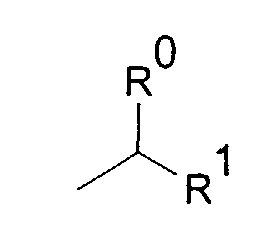
- When the compound of formula (I) is allowed to stand in the air or is recrystallised, it may absorb water or may have adsorbed water attached thereto, thereby forming a hydrate. Such hydrates are also embraced by the present invention.
- Where the compounds of formula (I) contain an acidic group or certain basic groups, they may form esters. Examples of such esters include esters with a hydroxy group and esters with a carboxy group. The ester residue may be an ordinary protecting group or a protecting group which can be cleaved in vivo by a biological method such as hydrolysis.
- The term "ordinary protecting group" means a protecting group which can be cleaved by a chemical method such as hydrogenolysis, hydrolysis, electrolysis or photolysis.
- Preferred examples of such ordinary protecting groups for an ester of a hydroxy group include:
- lower aliphatic acyl groups, for example:
- alkanoyl groups, such as the formyl, acetyl, propionyl, butyryl, isobutyryl, pentanoyl, pivaloyl, valeryl, isovaleryl, octanoyl, nonanoyl, decanoyl, 3-methylnonanoyl, 8-methylnonanoyl, 3-ethyloctanoyl, 3,7-dimethyloctanoyl, undecanoyl, dodecanoyl, tridecanoyl, tetradecanoyl, pentadecanoyl, hexadecanoyl, 1-methylpentadecanoyl, 14-methylpentadecanoyl, 13,13-dimethyltetradecanoyl, heptadecanoyl, 15-methylhexadecanoyl, octadecanoyl, 1-methylheptadecanoyl, nonadecanoyl, icosanoyl and henicosanoyl groups;
- halogenated alkylcarbonyl groups, such as the chloroacetyl, dichloroacetyl, trichloroacetyl, and trifluoroacetyl groups;
- alkoxyalkylcarbonyl groups, such as the methoxyacetyl group; and
- unsaturated alkylcarbonyl groups, such as the acryloyl, propioloyl, methacryloyl, crotonoyl, isocrotonoyl and (E)-2-methyl-2-butenoyl groups;
- more preferably, the lower aliphatic acyl groups having from 1 to 6 carbon atoms;
- aromatic acyl groups, for example:
- arylcarbonyl groups, such as the benzoyl, α-naphthoyl and β-naphthoyl groups;
- halogenated arylcarbonyl groups, such as the 2-bromobenzoyl and 4-chlorobenzoyol groups;
- lower alkylated arylcarbonyl groups, such as the 2,4,6-trimethylbenzoyl and 4-toluoyl groups;
- lower alkoxylated arylcarbonyl groups, such as the 4-anisoyl group;
- nitrated arylcarbonyl groups, such as the 4-nitrobenzoyl and 2-nitrobenzoyl groups;
- lower alkoxycarbonylated arylcarbonyl groups, such as the 2-(methoxycarbonyl)benzoyl group; and
- arylated arylcarbonyl groups, such as the 4-phenylbenzoyl group;
- alkoxycarbonyl groups, for example:
- lower alkoxycarbonyl groups, such as the methoxycarbonyl, ethoxycarbonyl, propoxycarbonyl, butoxycarbonyl, sec-butoxycarbonyl, t-butoxycarbonyl and isobutoxycarbonyl groups; and
- halogen- or tri(lower alkyl)silyl-substituted lower alkoxycarbonyl groups, such as the 2,2,2-trichloroethoxycarbonyl and 2-trimethylsilylethoxycarbonyl groups;
- tetrahydropyranyl or tetrahydrothiopyranyl groups, such as:
tetrahydropyran-2-yl, 3-bromotetrahydropyran-2-yl, 4-methoxytetrahydropyran-4-yl, tetrahydrothiopyran-2-yl, and 4-methoxytetrahydrothiopyran-4-yl groups; - tetrahydrofuranyl or tetrahydrothiofuranyl groups, such as:
tetrahydrofuran-2-yl and tetrahydrothiofuran-2-yl groups; - silyl groups, for example:
- tri(lower alkyl)silyl groups, such as the trimethylsilyl, triethylsilyl, isopropyldimethylsilyl, t-butyldimethylsilyl, methyldiisopropylsilyl, methyldi-t-butylsilyl and triisopropylsilyl groups; and
- tri(lower alkyl)silyl groups substituted by 1 or 2 aryl groups, such as the diphenylmethylsilyl, diphenylbutylsilyl, diphenylisopropylsilyl and phenyldiisopropylsilyl groups;
- alkoxymethyl groups, for example:
- lower alkoxymethyl groups, such as the methoxymethyl, 1,1-dimethyl-1-methoxymethyl, ethoxymethyl, propoxymethyl, isopropoxymethyl, butoxymethyl and t-butoxymethyl groups;
- lower alkoxylated lower alkoxymethyl groups, such as the 2-methoxyethoxymethyl group; and
- halo(lower alkoxy)methyl groups, such as the 2,2,2-trichloroethoxymethyl and bis(2-chloroethoxy)methyl groups;
- substituted ethyl groups, for example:
- lower alkoxylated ethyl groups, such as the 1-ethoxyethyl and 1-(isopropoxy)ethyl groups; and
- halogenated ethyl groups, such as the 2,2,2-trichloroethyl group;
- aralkyl groups, for example:
- lower alkyl groups substituted by from 1 to 3 aryl groups, such as the benzyl, α-naphthylmethyl, β-naphthylmethyl, diphenylmethyl, triphenylmethyl, α-naphthyldiphenylmethyl and 9-anthrylmethyl groups; and
- lower alkyl groups substituted by from 1 to 3 substituted aryl groups, where one or more of the aryl groups is substituted by one or more lower alkyl, lower alkoxy, nitro, halogen or cyano substituents, such as the 4-methylbenzyl, 2,4,6-trimethylbenzyl, 3,4,5-trimethylbenzyl, 4-methoxybenzyl, 4-methoxyphenyldiphenylmethyl, 2-nitrobenzyl, 4-nitrobenzyl, 4-chlorobenzyl, 4-bromobenzyl and 4-cyanobenzyl groups;
- alkenyloxycarbonyl groups:
such as the vinyloxycarbonyl and aryloxycarbonyl groups; and - aralkyloxycarbonyl groups in which the aryl ring may be substituted by 1 or 2
lower alkoxy or nitro groups:
such as the benzyloxycarbonyl, 4-methoxybenzyloxycarbonyl, 3,4-dimethoxybenzyloxycarbonyl, 2-nitrobenzyloxycarbonyl and 4-nitrobenzyloxycarbonyl groups. -
- Preferred examples of such ordinary protecting groups for an ester of a carboxy group include:
- lower alkyl groups, such as those defined and exemplified above;
- lower alkenyl groups, such as the vinyl, 1-propenyl, 2-propenyl, 1-methyl-2-propenyl, 1-methyl-1-propenyl, 2-methyl-1-propenyl, 2-methyl-2-propenyl, 2-ethyl-2-propenyl, 1-butenyl, 2-butenyl, 1-methyl-2-butenyl, 1-methyl-1-butenyl, 3-methyl-2-butenyl, 1-ethyl-2-butenyl, 3-butenyl, 1-methyl-3-butenyl, 2-methyl-3-butenyl, 1-ethyl-3-butenyl, 1-pentenyl, 2-pentenyl, 1-methyl-2-pentenyl, 2-methyl-2-pentenyl, 3-pentenyl, 1-methyl-3-pentenyl, 2-methyl-3-pentenyl, 4-pentenyl, 1-methyl-4-pentenyl, 2-methyl-4-pentenyl, 1-hexenyl, 2-hexenyl, 3-hexenyl, 4-hexenyl and 5-hexenyl groups;
- lower alkynyl groups, such as the ethynyl, 2-propynyl, 1-methyl-2-propynyl, 2-methyl-2-propynyl, 2-ethyl-2-propynyl, 2-butynyl, 1-methyl-2-butynyl, 2-methyl-2-butynyl, 1-ethyl-2-butynyl, 3-butynyl, 1-methyl-3-butynyl, 2-methyl-3-butynyl, 1-ethyl-3-butynyl, 2-pentynyl, 1-methyl-2-pentynyl, 2-methyl-2-pentynyl, 3-pentynyl, 1-methyl-3-pentynyl, 2-methyl-3-pentynyl, 4-pentynyl, 1-methyl-4-pentynyl, 2-methyl-4-pentynyl, 2-hexynyl, 3-hexynyl, 4-hexynyl and 5-hexynyl groups;
- lower haloalkyl groups, such as those defined and exemplified above;
- lower hydroxyalkyl groups, such as the 2-hydroxyethyl, 2,3-dihydroxypropyl, 3-hydroxypropyl, 3,4-dihydroxybutyl and 4-hydroxybutyl groups;
- lower aliphatic acyl-lower alkyl groups, such as the acetylmethyl group;
- aralkyl groups, such as those defined and exemplified above; and
- silyl groups, such as those defined and exemplified above.
-
- The term "protecting group which can be cleaved in vivo by a biological method such as hydrolysis" means a protecting group which is cleaved in vivo by a biological method such as hydrolysis and forms a free acid or salt thereof. Whether a compound is such a derivative or not can be determined by administering it by intravenous injection to an experimental animal, such as a rat or mouse, and then studying the body fluids of the animal to determine whether or not the compound or a pharmaceutically acceptable salt thereof can be detected.
- Preferred examples of such protecting groups which can be cleaved in vivo and which can form esters with hydroxy groups include:
- lower carbonyloxyalkyl groups, for example:
- 1-(acyloxy)-lower alkyl groups, e.g.:
- 1-(lower aliphatic acyloxy)-lower alkyl groups, such as the formyloxymethyl, acetoxymethyl, dimethylaminoacetoxymethyl, propionyloxymethyl, butyryloxymethyl, pivaloyloxymethyl, valeryloxymethyl, isovaleryloxymethyl, hexanoyloxymethyl, 1-formyloxyethyl, 1-acetoxyethyl, 1-propionyloxyethyl, 1-butyryloxyethyl, 1-pivaloyloxyethyl, 1-valeryloxyethyl, 1-isovaleryloxyethyl, 1-hexanoyloxyethyl, 1-formyloxypropyl, 1-acetoxypropyl, 1-propionyloxypropyl, 1-butyryloxypropyl, 1-pivaloyloxypropyl, 1-valeryloxypropyl, 1-isovaleryloxypropyl, 1-hexanoyloxypropyl, 1-acetoxybutyl, 1-propionyloxybutyl, 1-butyryloxybutyl, 1-pivaloyloxybutyl, 1-acetoxypentyl, 1-propionyloxypentyl, 1-butyryloxypentyl, 1-pivaloyloxypentyl and 1-pivaloyloxyhexyl groups;
- 1-(cycloalkylcarbonyloxy)-lower alkyl groups, such as the cyclopentylcarbonyloxymethyl, cyclohexylcarbonyloxymethyl, 1-cyclopentylcarbonyloxyethyl, 1-cyclohexylcarbonyloxyethyl, 1-cyclopentylcarbonyloxypropyl, 1-cyclohexylcarbonyloxypropyl, 1-cyclopentylcarbonyloxybutyl and 1-cyclohexylcarbonyloxybutyl groups; and
- 1-(aromatic acyloxy)-lower alkyl groups, such as the benzoyloxymethyl group;
- (lower alkoxycarbonyloxy)alkyl groups, such as the methoxycarbonyloxymethyl, ethoxycarbonyloxymethyl, propoxycarbonyloxymethyl, isopropoxycarbonyloxymethyl, butoxycarbonyloxymethyl, isobutoxycarbonyloxymethyl, pentyloxycarbonyloxymethyl, hexyloxycarbonyloxymethyl, cyclohexyloxycarbonyloxymethyl, cyclohexyloxycarbonyloxy(cyclohexyl)methyl, 1-(methoxycarbonyloxy)ethyl, 1-(ethoxycarbonyloxy)ethyl, 1-(propoxycarbonyloxy)ethyl, 1-(isopropoxycarbonyloxy)ethyl, 1-(butoxycarbonyloxy)ethyl, 1-(isobutoxycarbonyloxy)ethyl, 1-(t-butoxycarbonyloxy)ethyl, 1-(pentyloxycarbonyloxy)ethyl, 1-(hexyloxycarbonyloxy)ethyl, 1-(cyclopentyloxycarbonyloxy)ethyl, 1-(cyclopentyloxycarbonyloxy)propyl, 1-(cyclohexyloxycarbonyloxy)propyl, 1-(cyclopentyloxycarbonyloxy)butyl, 1-(cyclohexyloxycarbonyloxy)butyl, 1-(cyclohexyloxycarbonyloxy)ethyl, 1-(ethoxycarbonyloxy)propyl, 1-(methoxycarbonyloxy)propyl, 1-(ethoxycarbonyloxy)propyl, 1-(propoxycarbonyloxy)propyl, 1-(isopropoxycarbonyloxy)propyl, 1-(butoxycarbonyloxy)propyl, 1-(isobutoxycarbonyloxy)propyl, 1-(pentyloxycarbonyloxy)propyl, 1-(hexyloxycarbonyloxy)propyl, 1-(methoxycarbonyloxy)butyl, 1-(ethoxycarbonyloxy)butyl, 1-(propoxycarbonyloxy)butyl, 1-(isopropoxycarbonyloxy)butyl, 1-(butoxycarbonyloxy)butyl, 1-(isobutoxycarbonyloxy)butyl, 1-(methoxycarbonyloxy)pentyl, 1-(ethoxycarbonyloxy)pentyl, 1-(methoxycarbonyloxy)hexyl and 1-(ethoxycarbonyloxy)hexyl groups;
- oxodioxolenylmethyl groups, such as the (5-phenyl-2-oxo-1,3-dioxolen-4-yl)methyl, [5-(4-methylphenyl)-2-oxo-1,3-dioxolen-4-yl]methyl, [5-(4-methoxylphenyl)-2-oxo-1,3-dioxolen-4-yl]methyl, [5-(4-fluorophenyl)-2-oxo-1,3-dioxolen-4-yl]methyl, [5-(4-chlorophenyl)-2-oxo-1,3-dioxolen-4-yl]methyl, (2-oxo-1,3-dioxolen-4-yl)methyl, (5-methyl-2-oxo-1,3-dioxolen-4-yl)methyl, (5-ethyl-2-oxo-1,3-dioxolen-4-yl)methyl, (5-propyl-2-oxo-1,3-dioxolen-4-yl)methyl, (5-isopropyl-2-oxo-1,3-dioxolen-4-yl)methyl, and (5-butyl-2-oxo-1,3-dioxolen-4-yl)methyl groups;
- phthalidyl groups, such as the phthalidyl, dimethylphthalidyl and dimethoxyphthalidyl groups;
- lower aliphatic acyl groups, such as those defined and exemplified above;
- aromatic acyl groups, such as those defined and exemplified above;
- half ester salt residues of succinic acid;
- phosphoric acid ester salt residues;
- ester forming residues such as amino acid;
- carbamoyl groups;
- carbamoyl groups substituted by 1 or 2 lower alkyl groups; and
- 1-(acyloxy)alkoxycarbonyl groups, such as the pivaloyloxymethoxycarbonyl group;
- of these, the carbonyloxyalkyl groups are preferred.
-
- Preferred examples of such protecting groups which can be cleaved in vivo and which can form esters with carboxy groups include:
- alkoxyalkyl groups, for example:
- lower alkoxy(lower alkyl) groups, such as the methoxyethyl, 1-ethoxyethyl, 1-methyl-1-methoxyethyl, 1-(isopropoxy)ethyl, 2-methoxyethyl, 2-ethoxyethyl, 1,1-dimethyl-1-methoxyethyl, ethoxymethyl, propoxymethyl, isopropoxymethyl, butoxymethyl and t-butoxymethyl groups; and
- (lower alkoxylated)-(lower alkoxy)(lower alkyl) groups, such as the 2-methoxyethoxymethyl group;
- aryloxy-lower alkyl groups, such as the phenoxymethyl group; and
- halogenated (lower alkoxy)(lower alkyl) groups, such as the 2,2,2-trichloroethoxymethyl and bis(2-chloroethoxy)methyl groups;
- lower alkoxycarbonyl-lower alkyl groups, such as the methoxycarbonylmethyl group;
- lower cyanoalkyl groups, such as the cyanomethyl and 2-cyanoethyl groups;
- lower alkyl-thiomethyl groups, such as the methylthiomethyl and ethylthiomethyl groups;
- arylthiomethyl groups, such as the phenylthiomethyl and naphthylthiomethyl groups;
- lower alkylsulphonyl-lower alkyl groups which may be substituted by a halogen atom, such as the 2-methanesulphonylethyl and 2-trifluoromethanesulphonylethyl groups;
- arylsulphonyl-lower alkyl groups, such as the 2-benzenesulphonylethyl and 2-toluenesulphonylethyl groups;
- 1-(acyloxy)-lower alkyl groups; phthalidyl groups, aryl groups, and lower alkyl groups as defined and exemplified above;
- carboxyalkyl groups, such as the carboxymethyl group; and
- amide forming residues of an amino acid, such as phenylalanine.
-
- When the compound of formula (I) of the present invention contains an amino and/or carboxy group, it can be converted into derivatives other than the above-described pharmaceutically acceptable salts or the above-described esters. Examples of such other derivatives include amide derivatives.
- Specific examples of the compounds of the present invention represented by the formula (I) include the compounds described in the following Tables 1 to 6. It should however be borne in mind that the present invention is not limited to or by these compounds. The compounds shown in Tables 1 to 6 have the structural formulae (I-1) to (1-6), respectively.
- In Tables 1 to 6, the substituents of R1, R2 and A are the following groups.
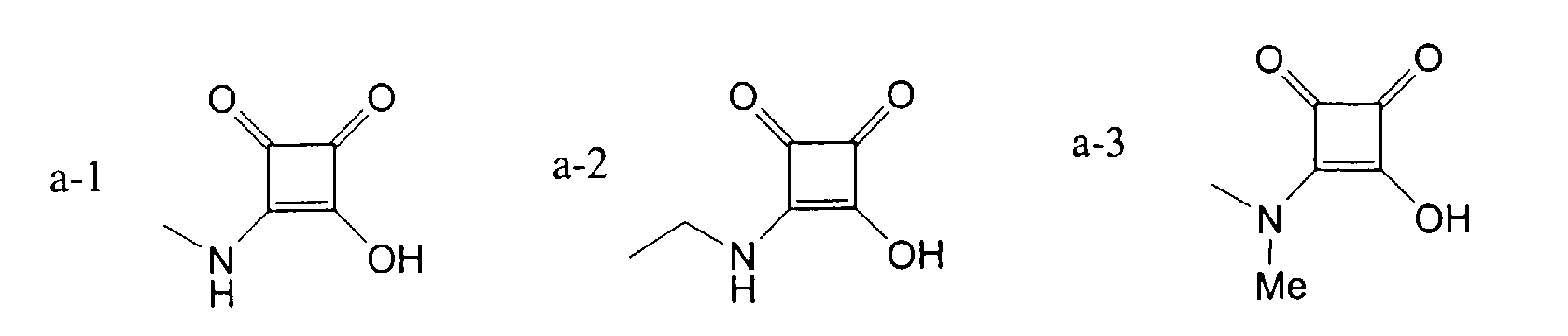
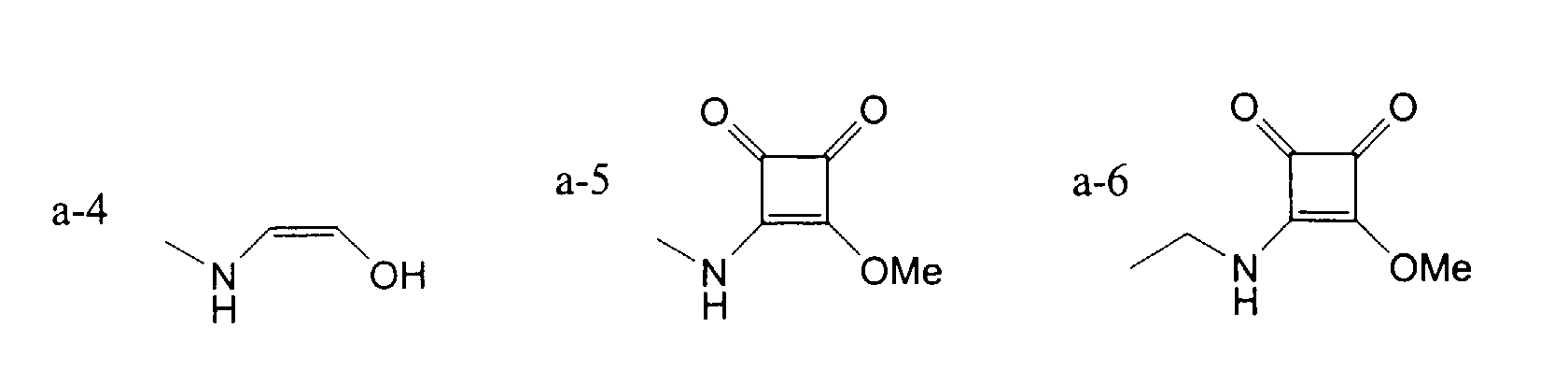
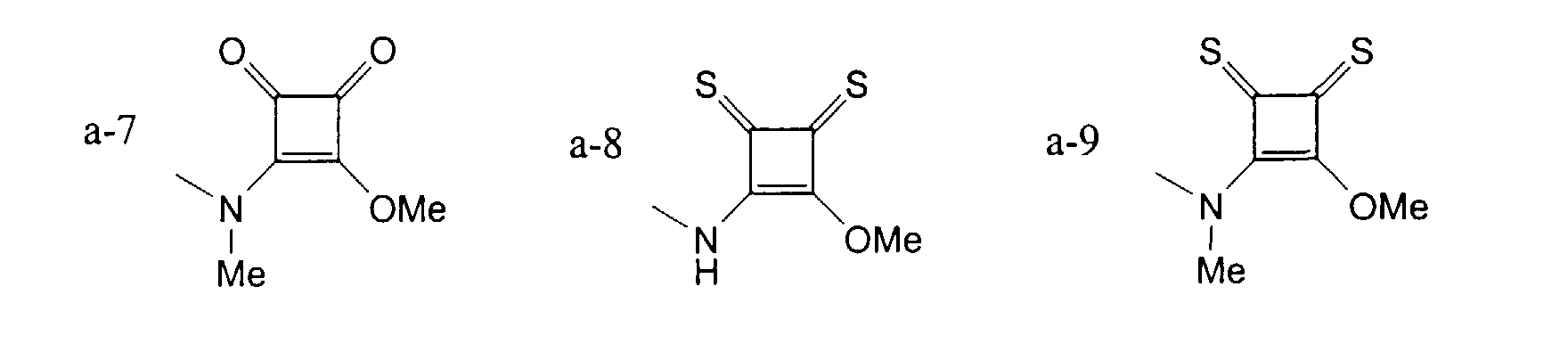


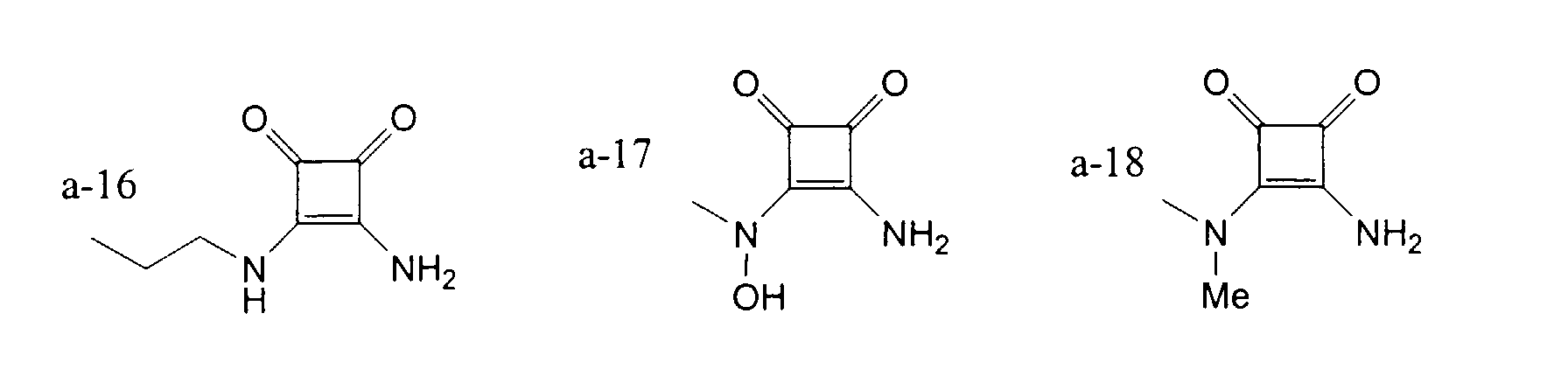


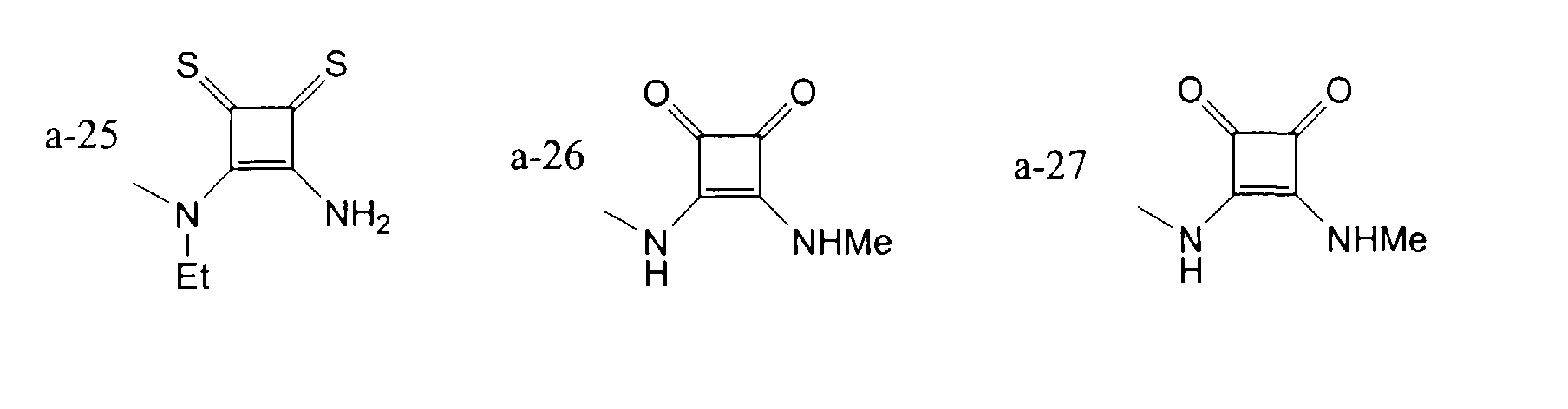

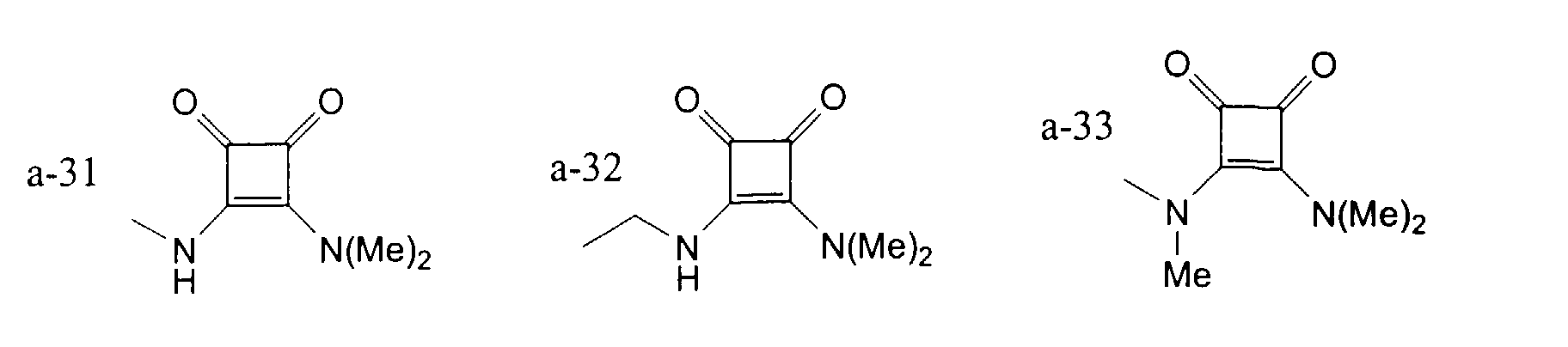
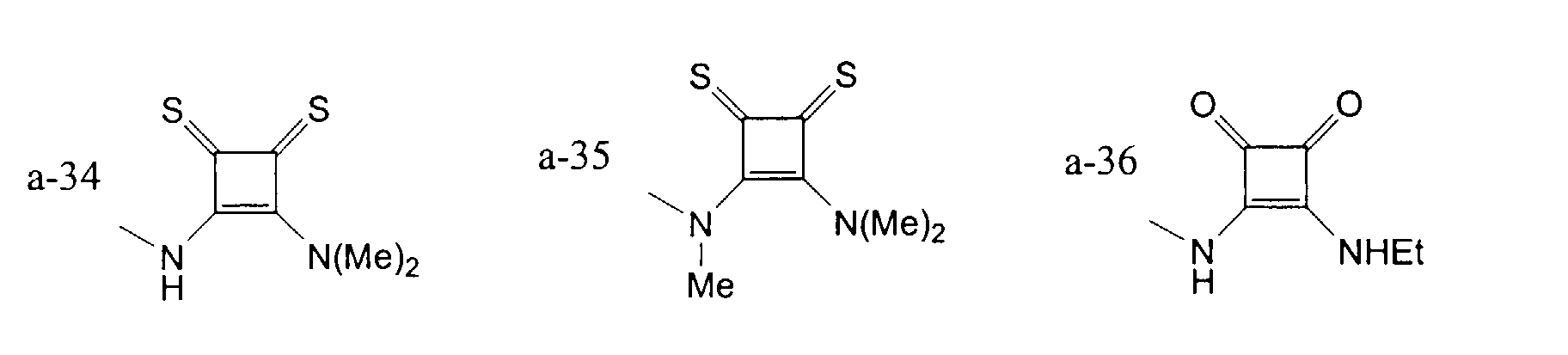
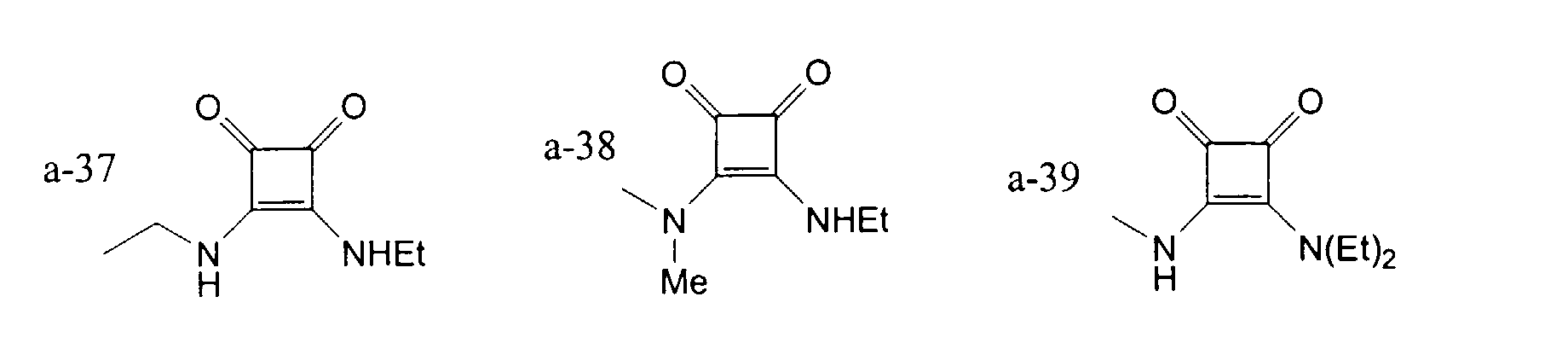


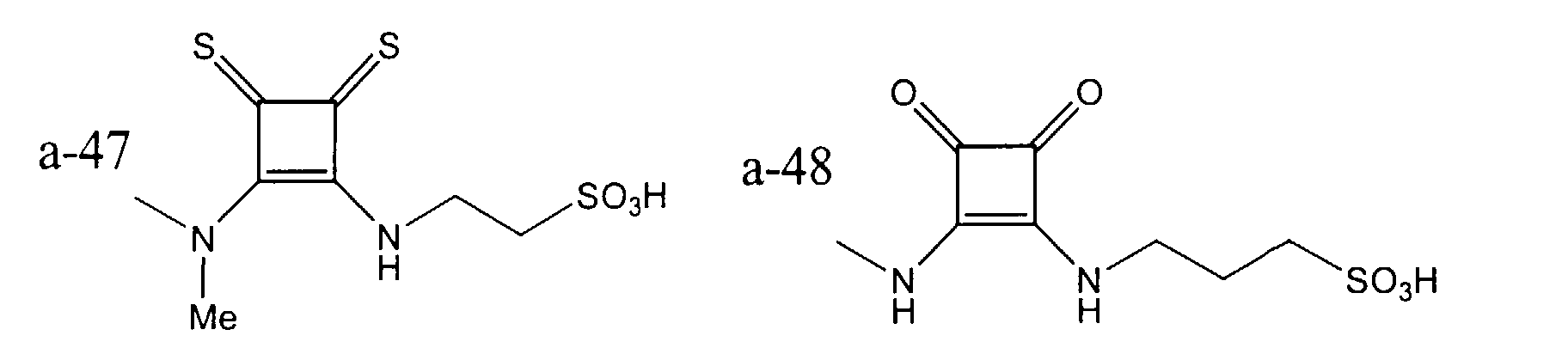
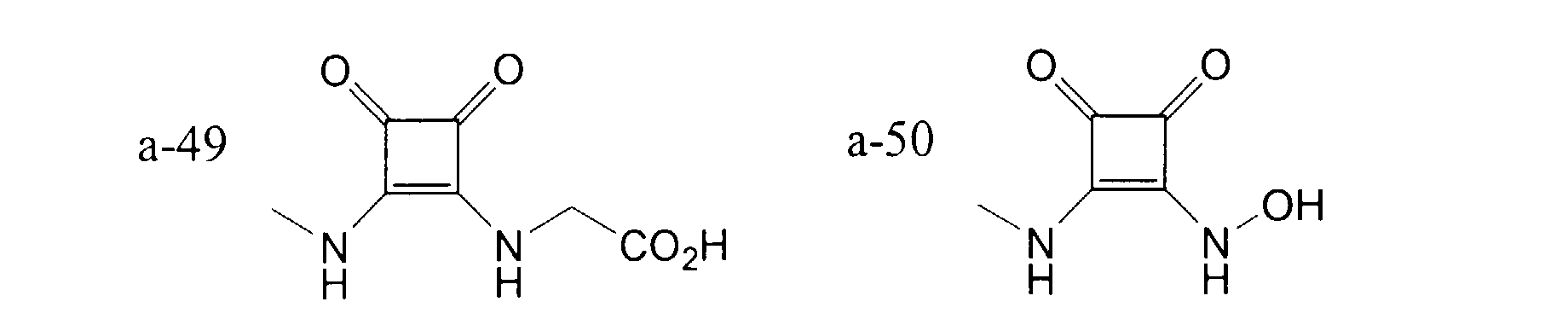


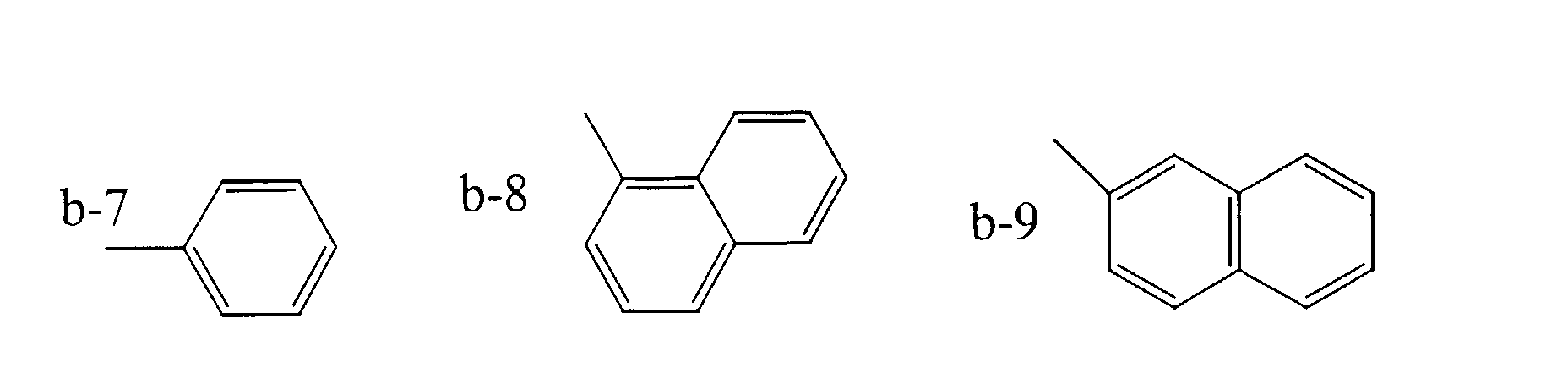
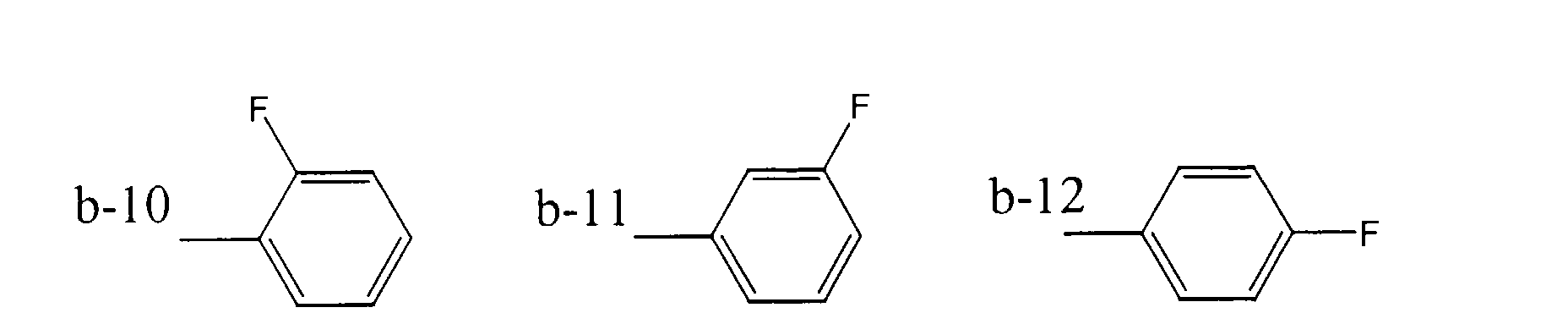
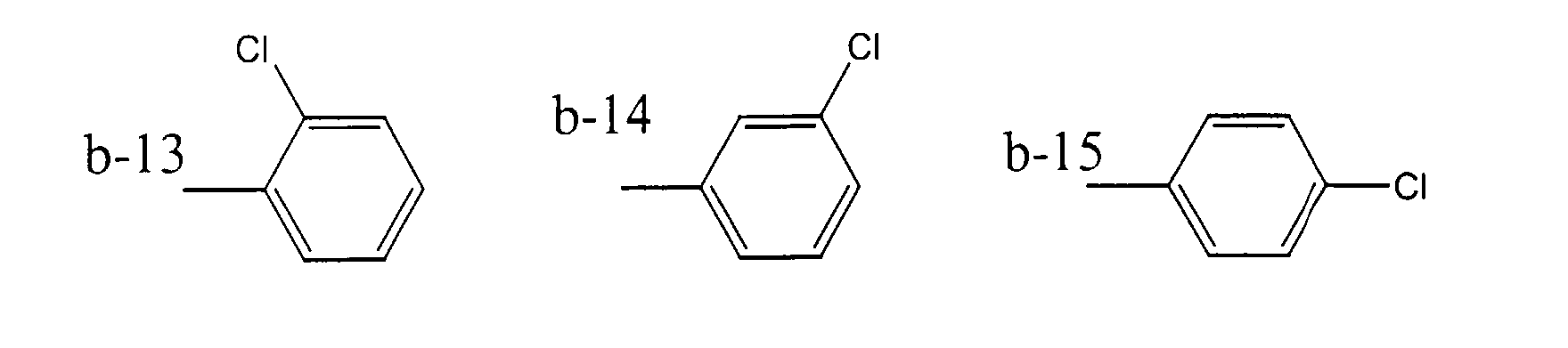
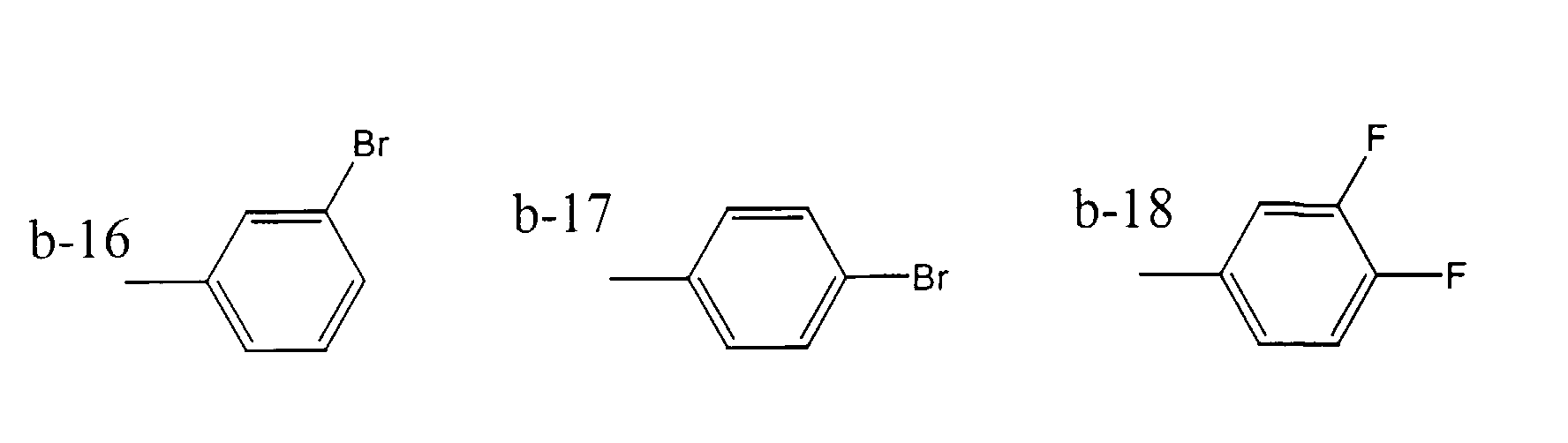
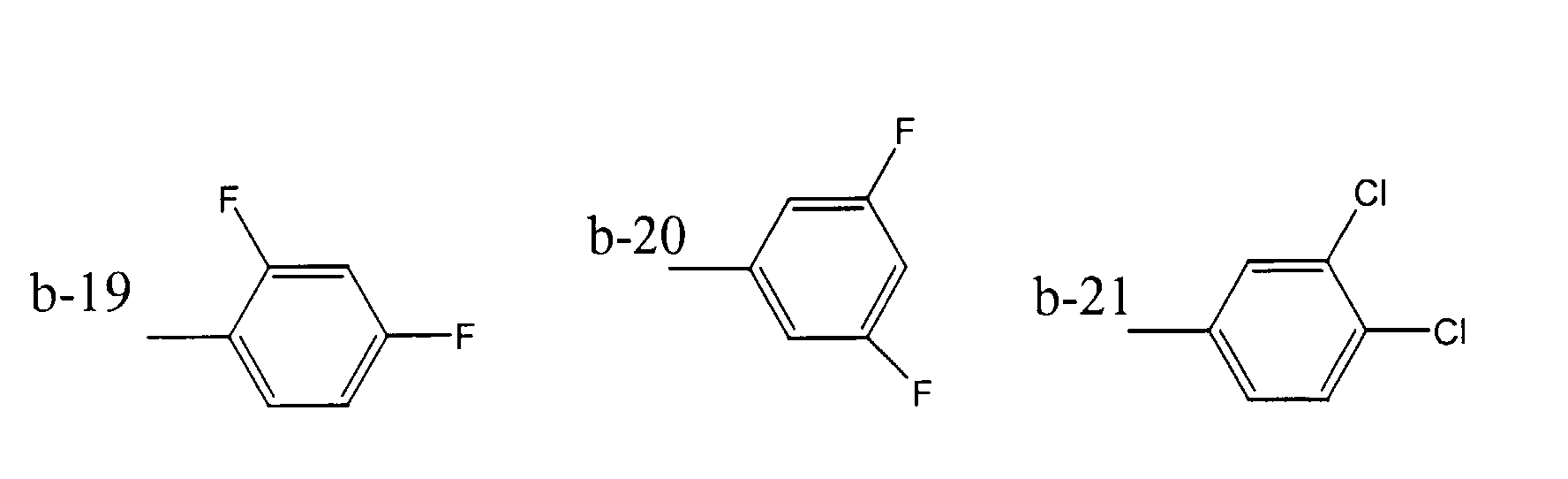
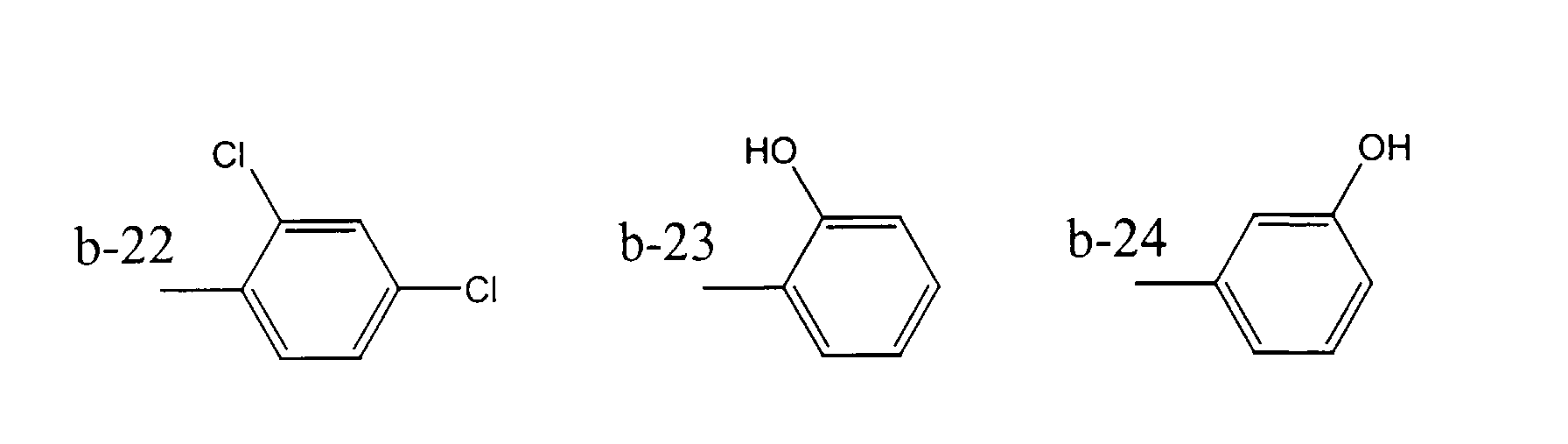
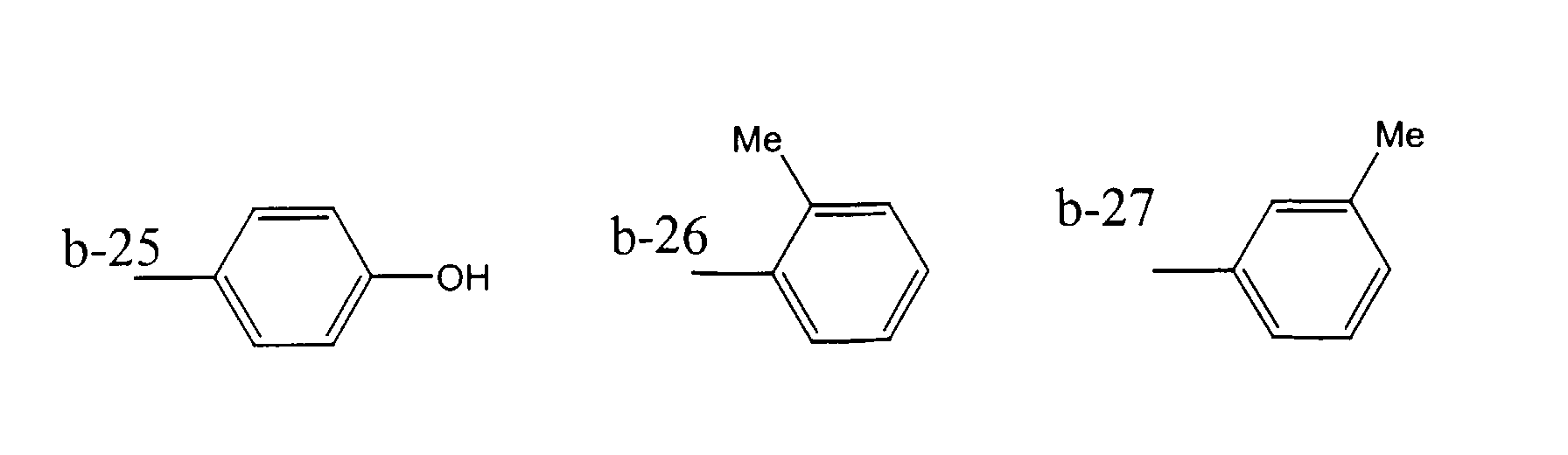

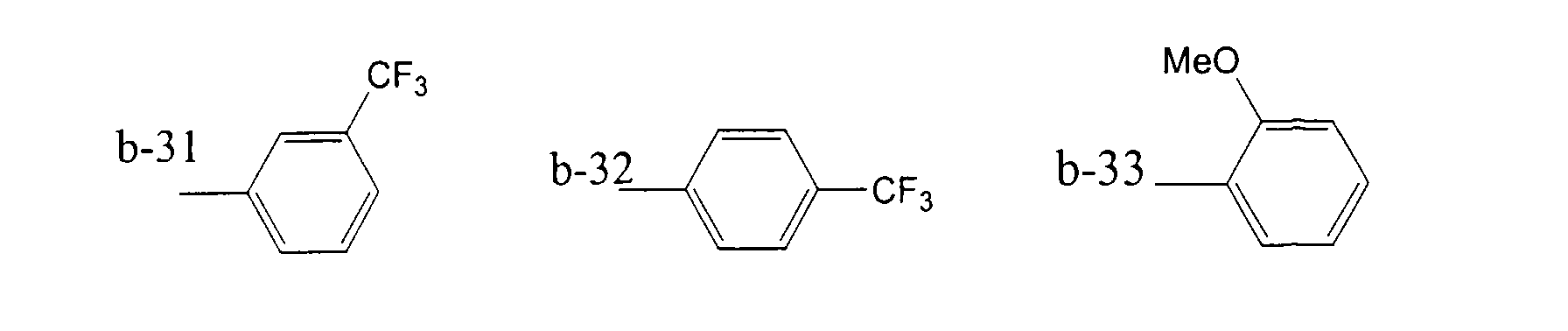
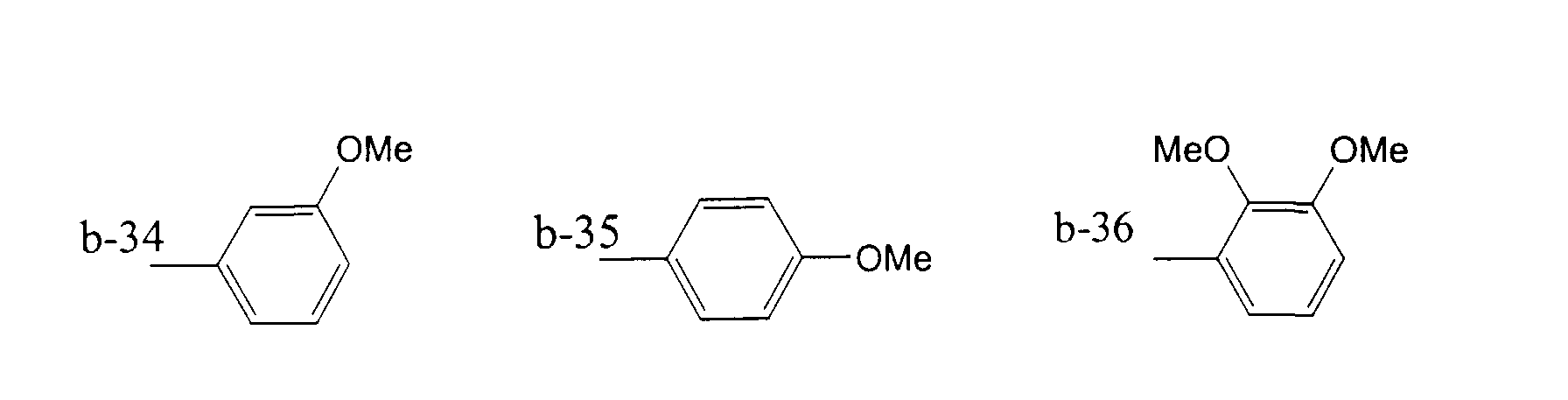
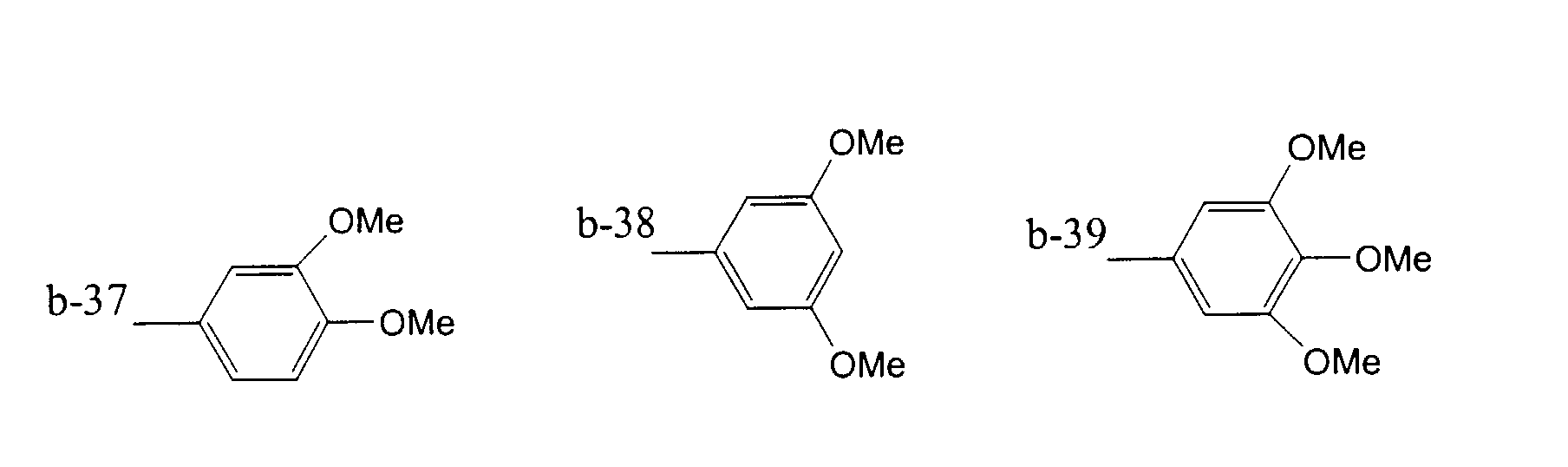
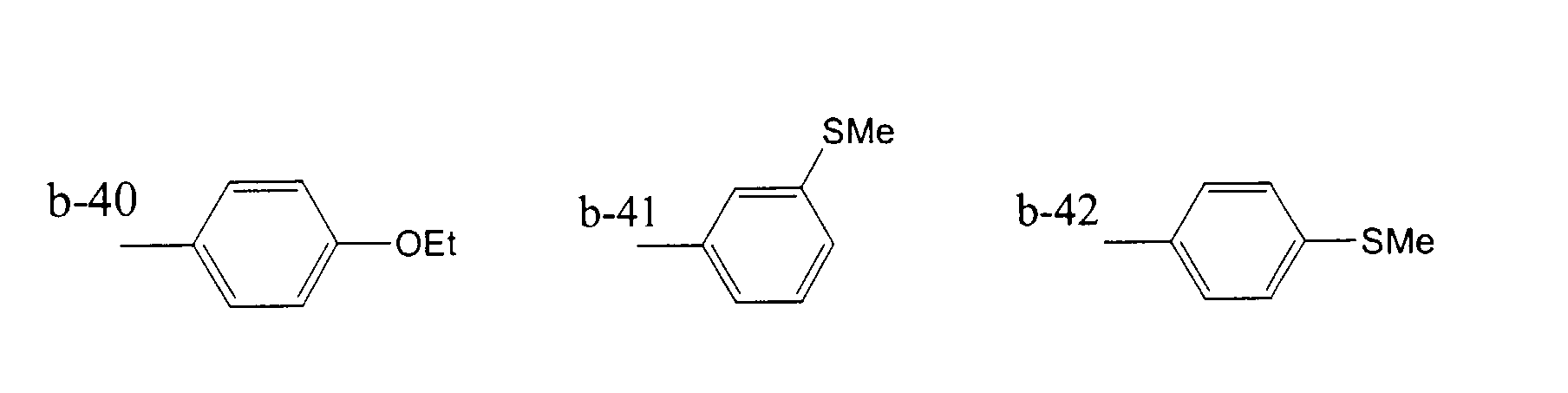
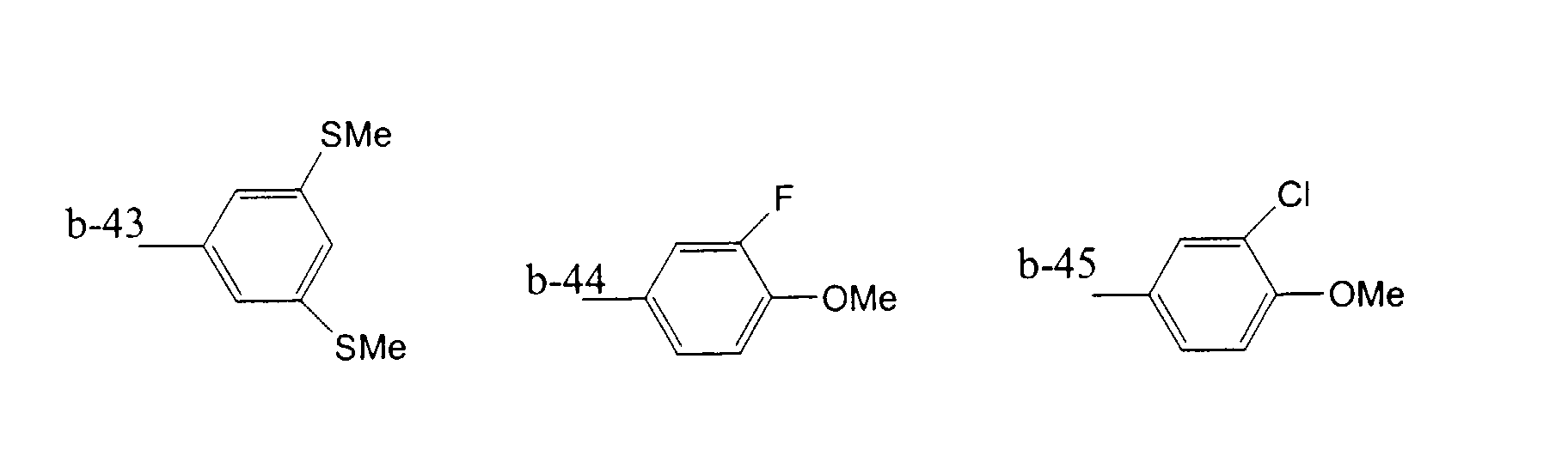


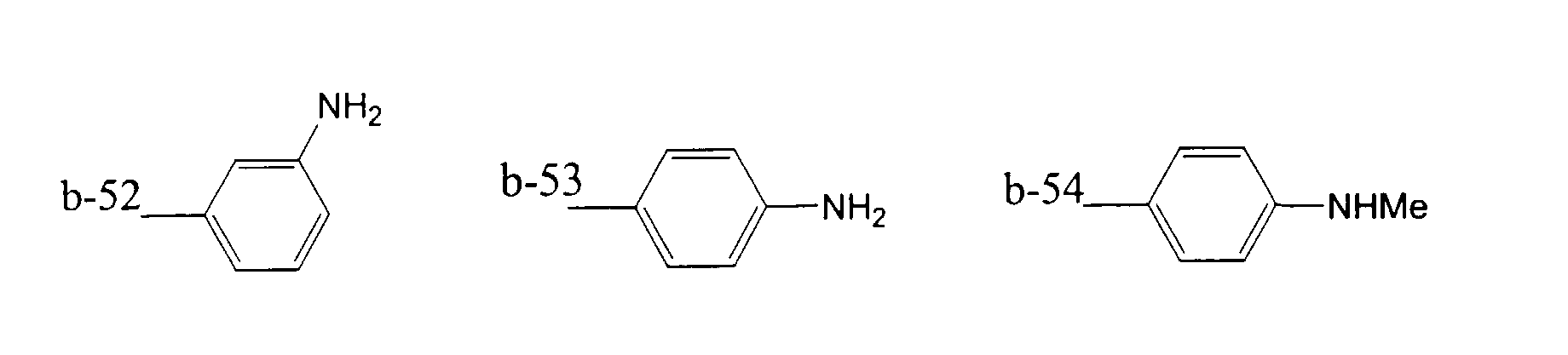
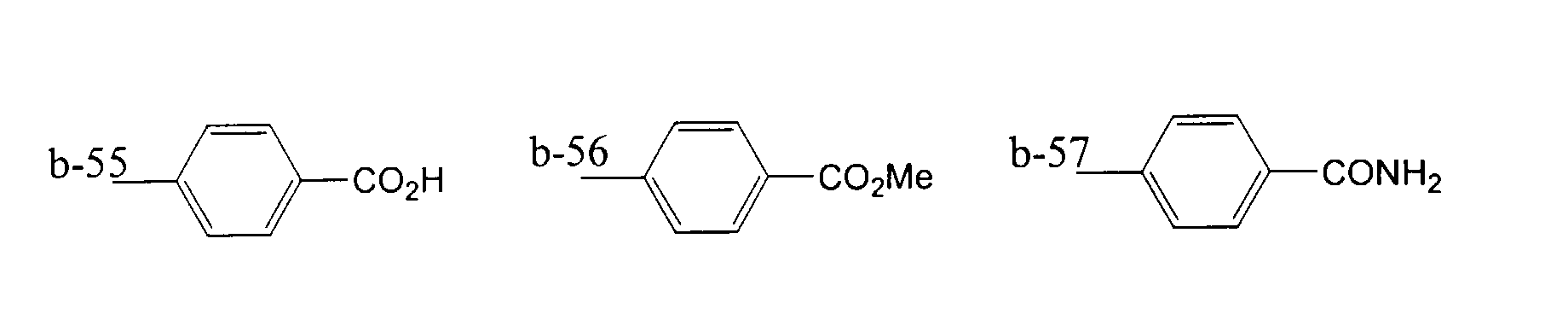
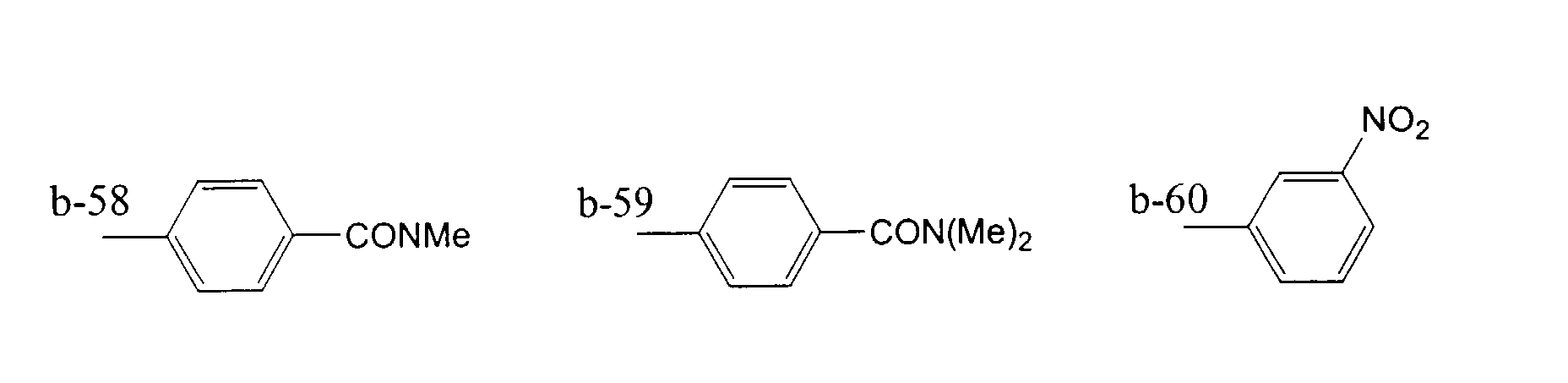
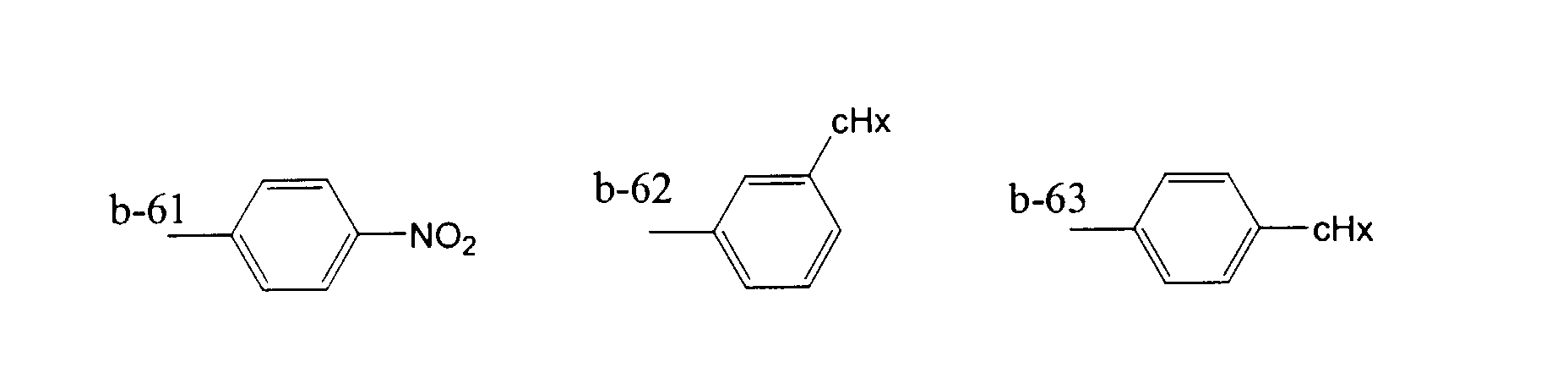
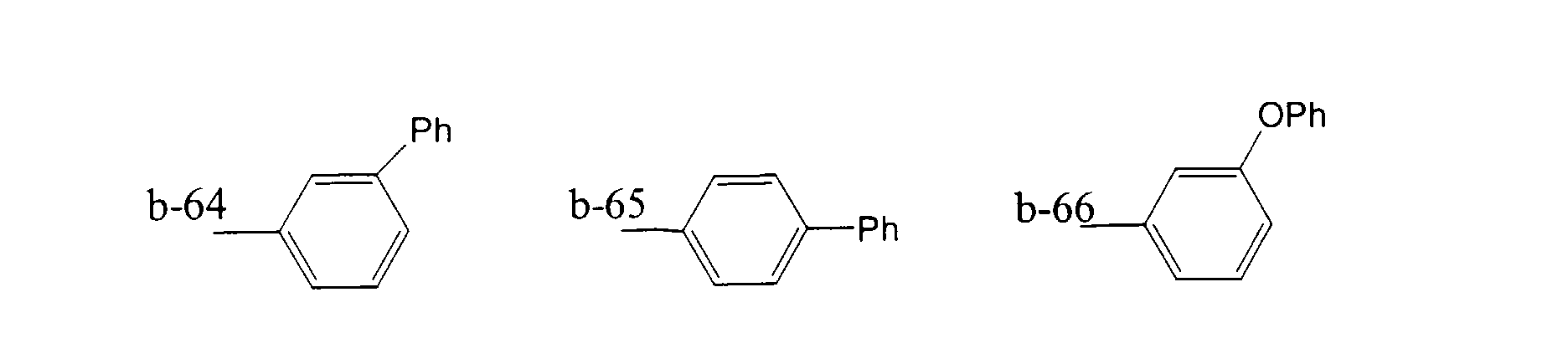
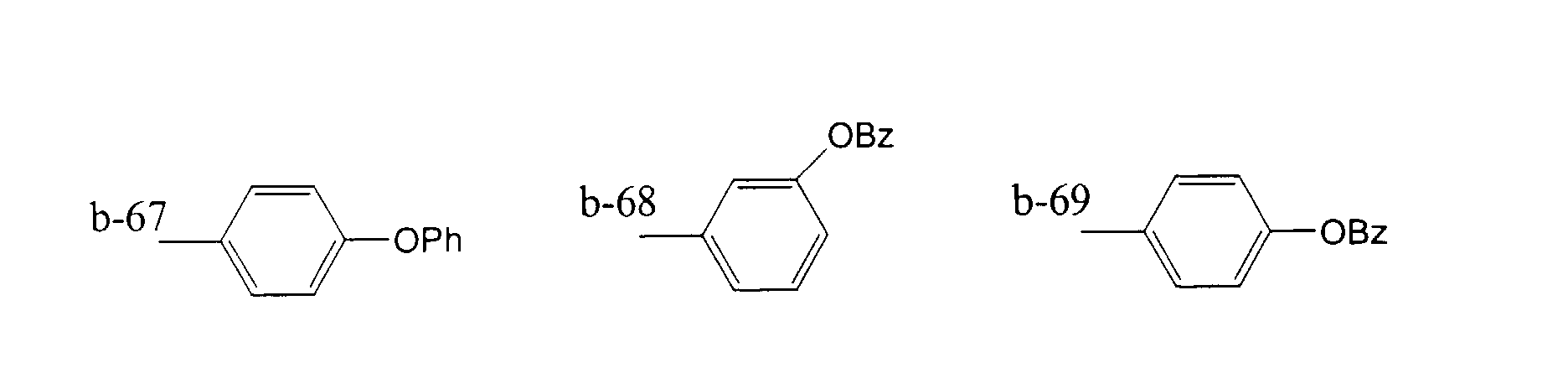
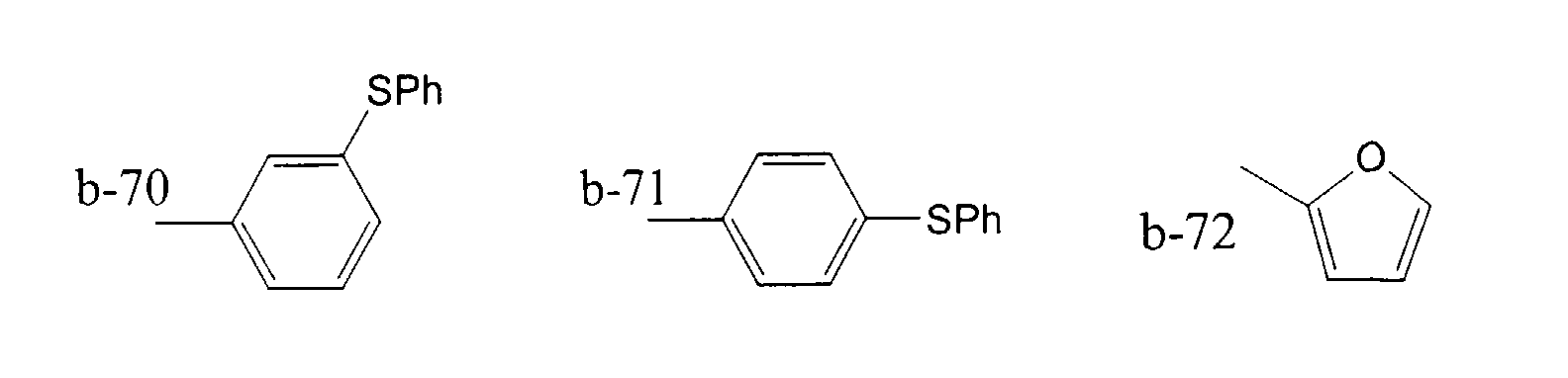
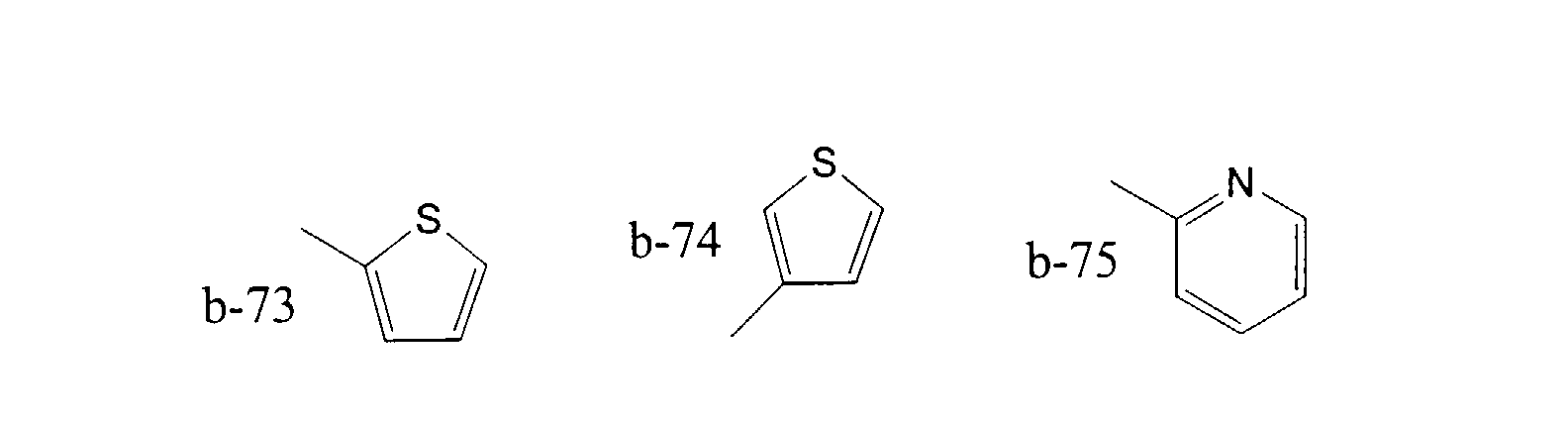
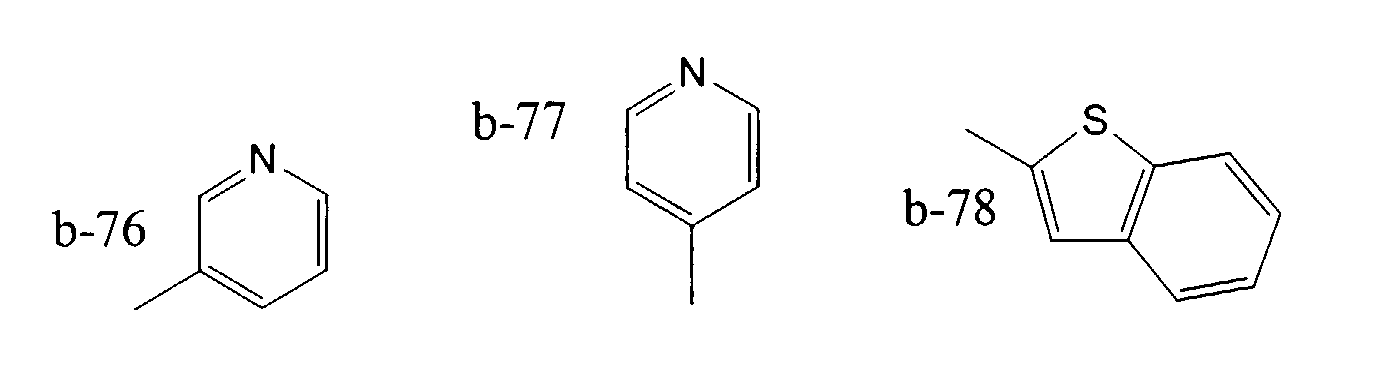
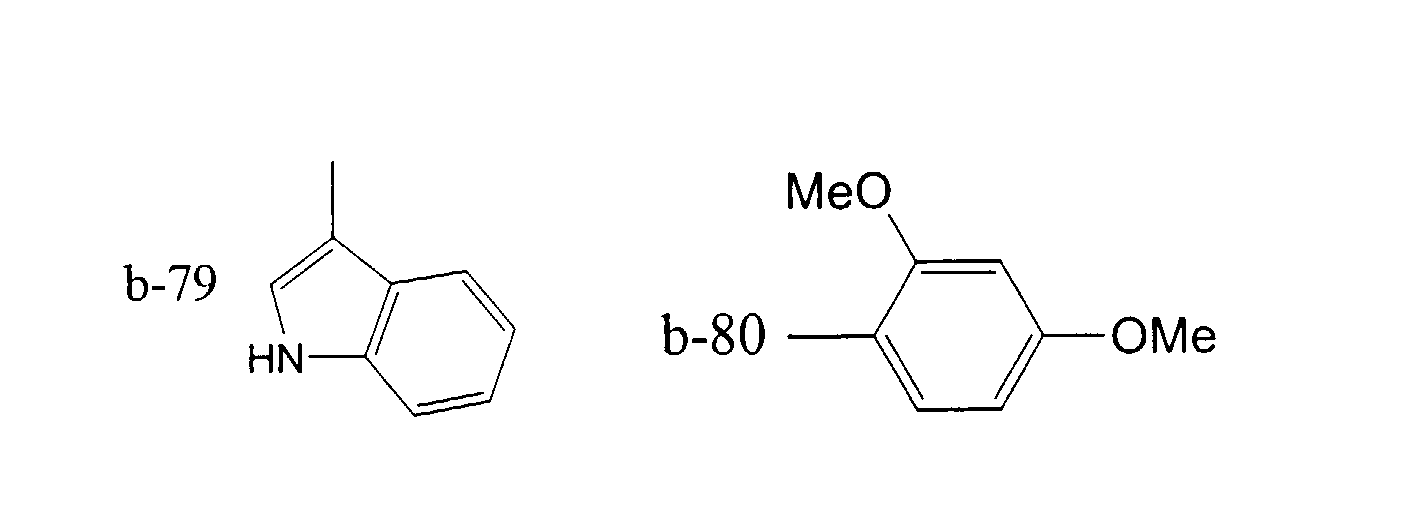

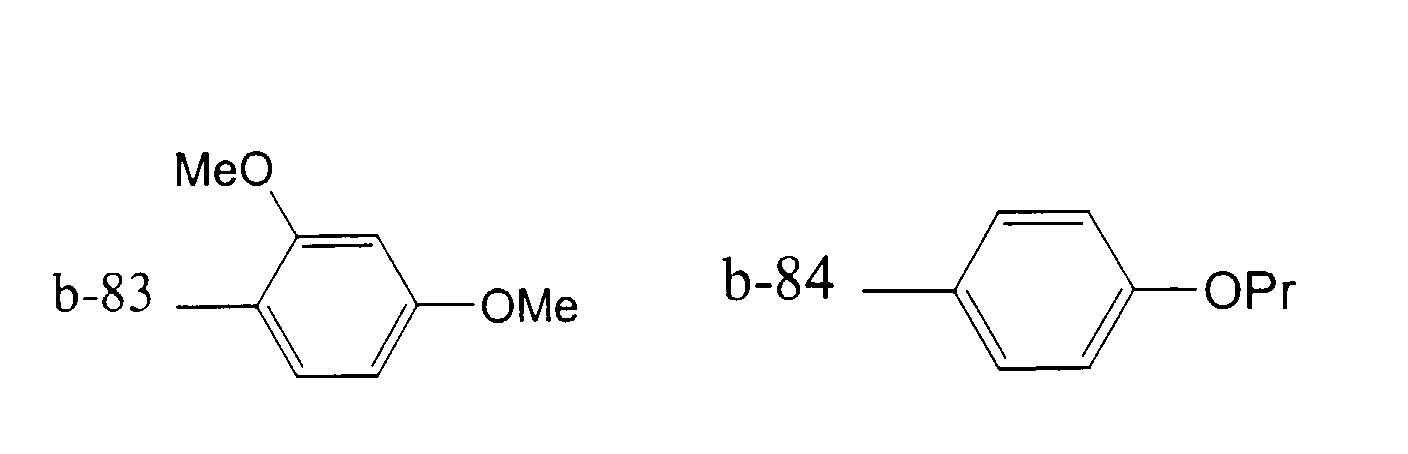
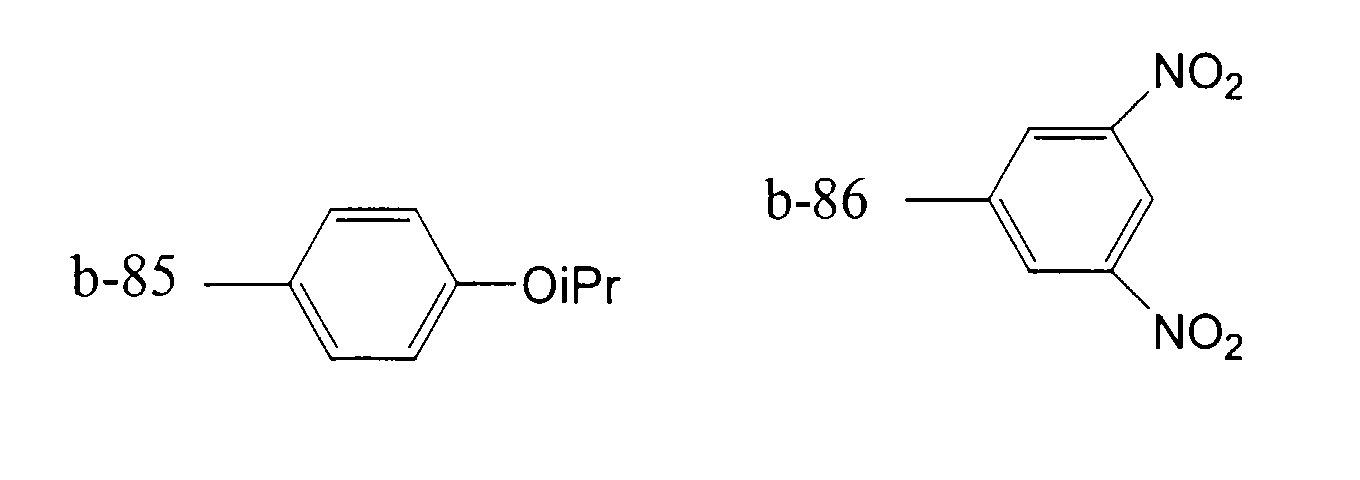
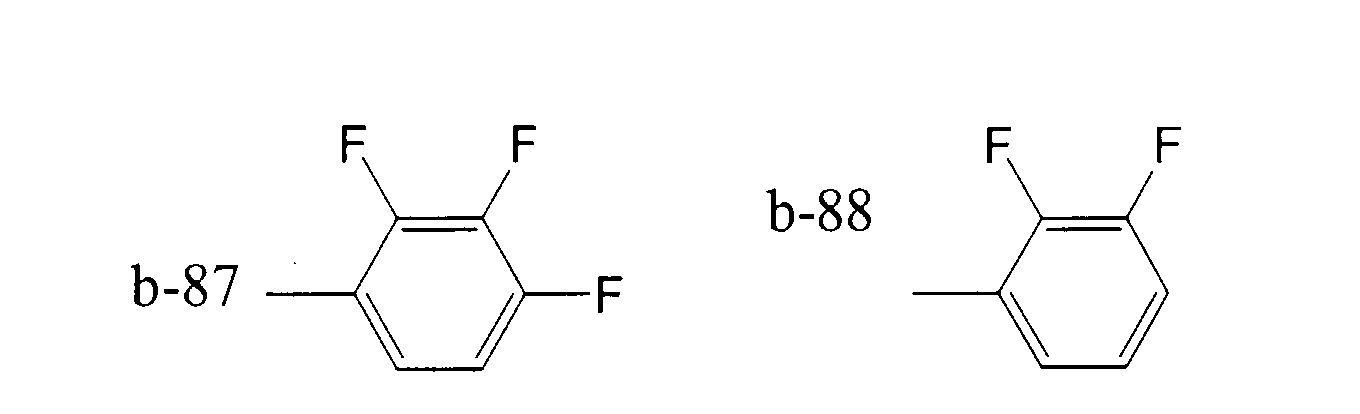
- The following abbreviations are used in the Tables and in the above groups:
Ac acetyl group Bz benzyl group cHx cyclohexyl group Et ethyl group Me methyl group Ph phenyl group Pr propyl group iPr isopropyl group Sub.No. substituent number 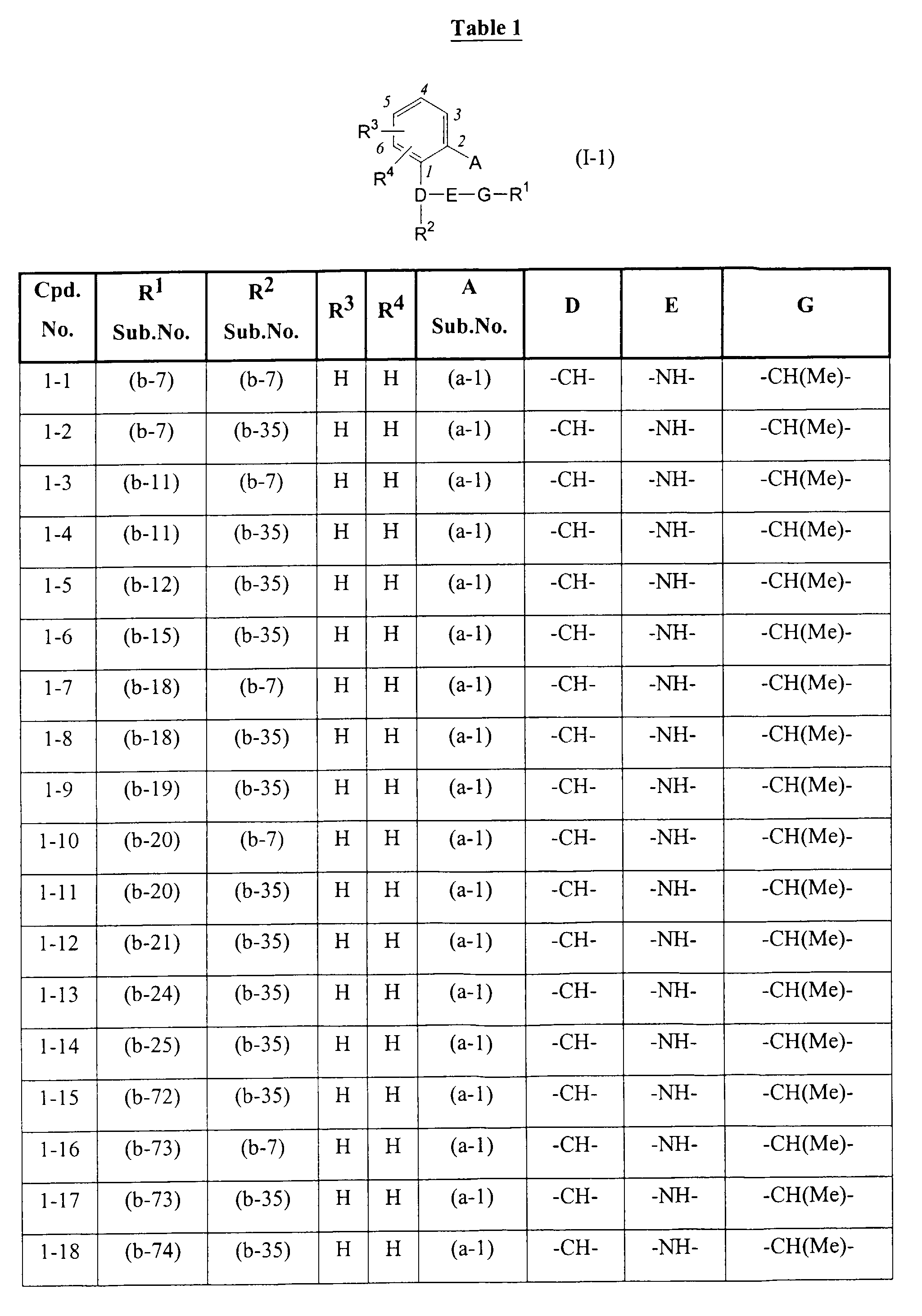
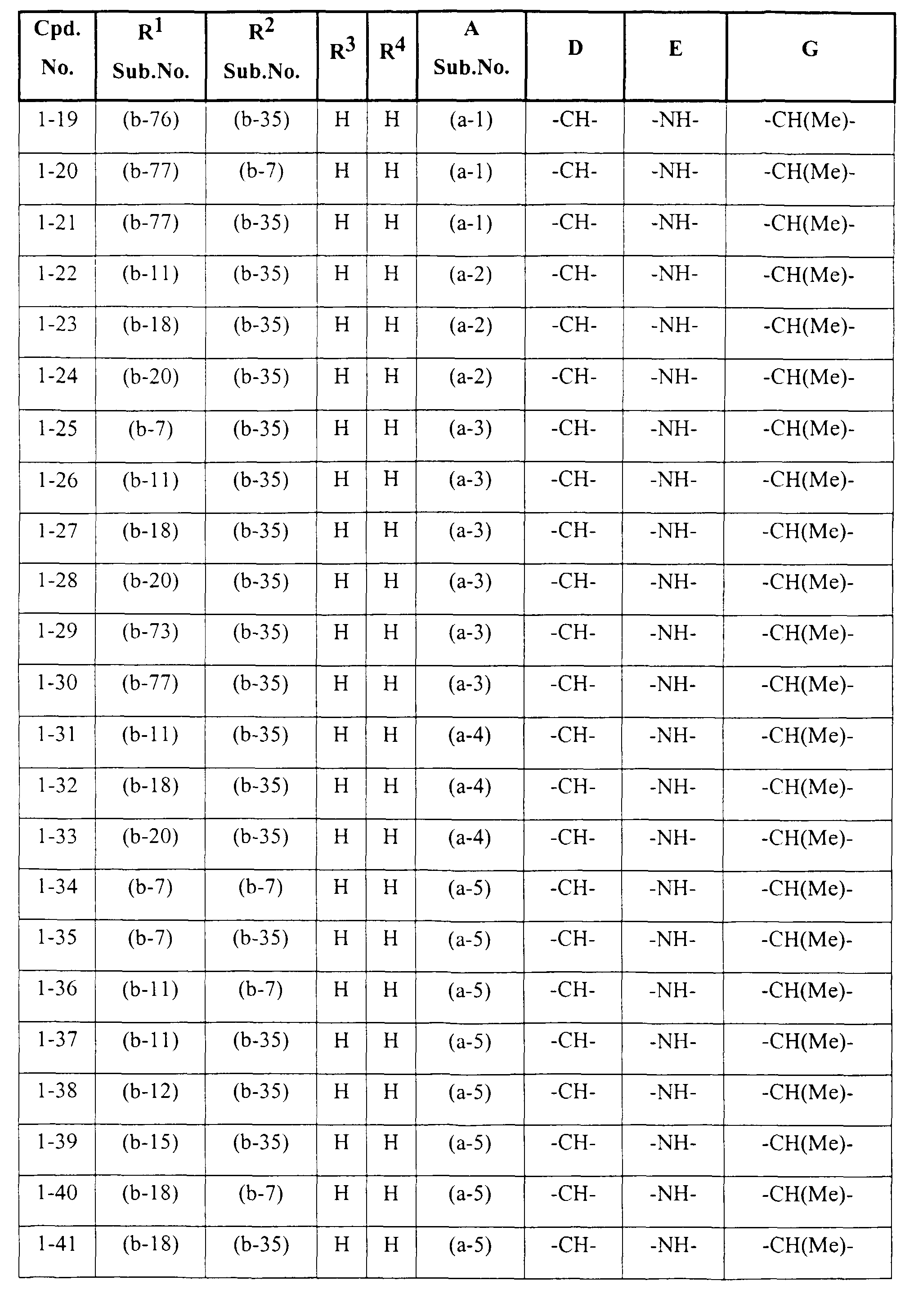
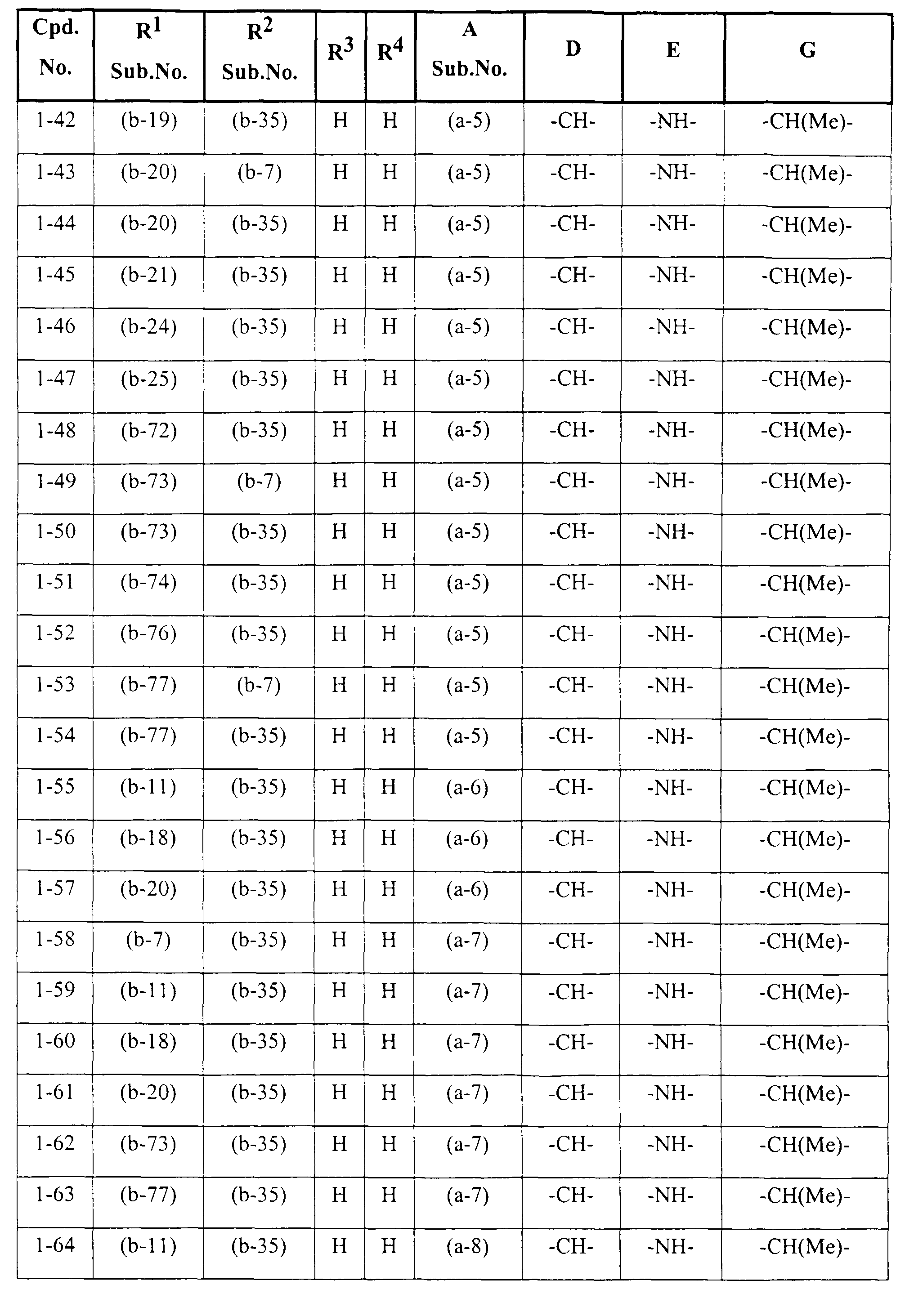

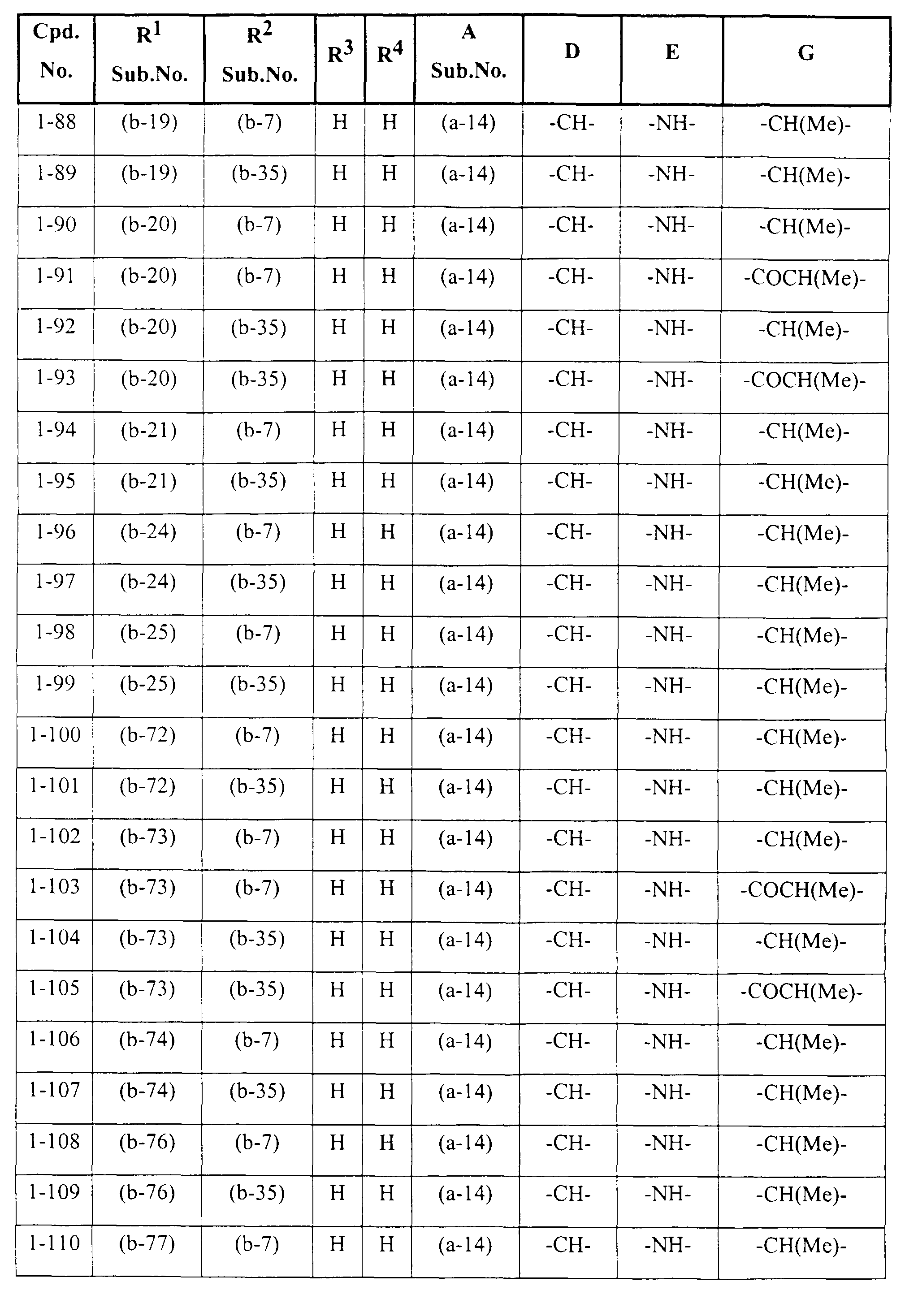
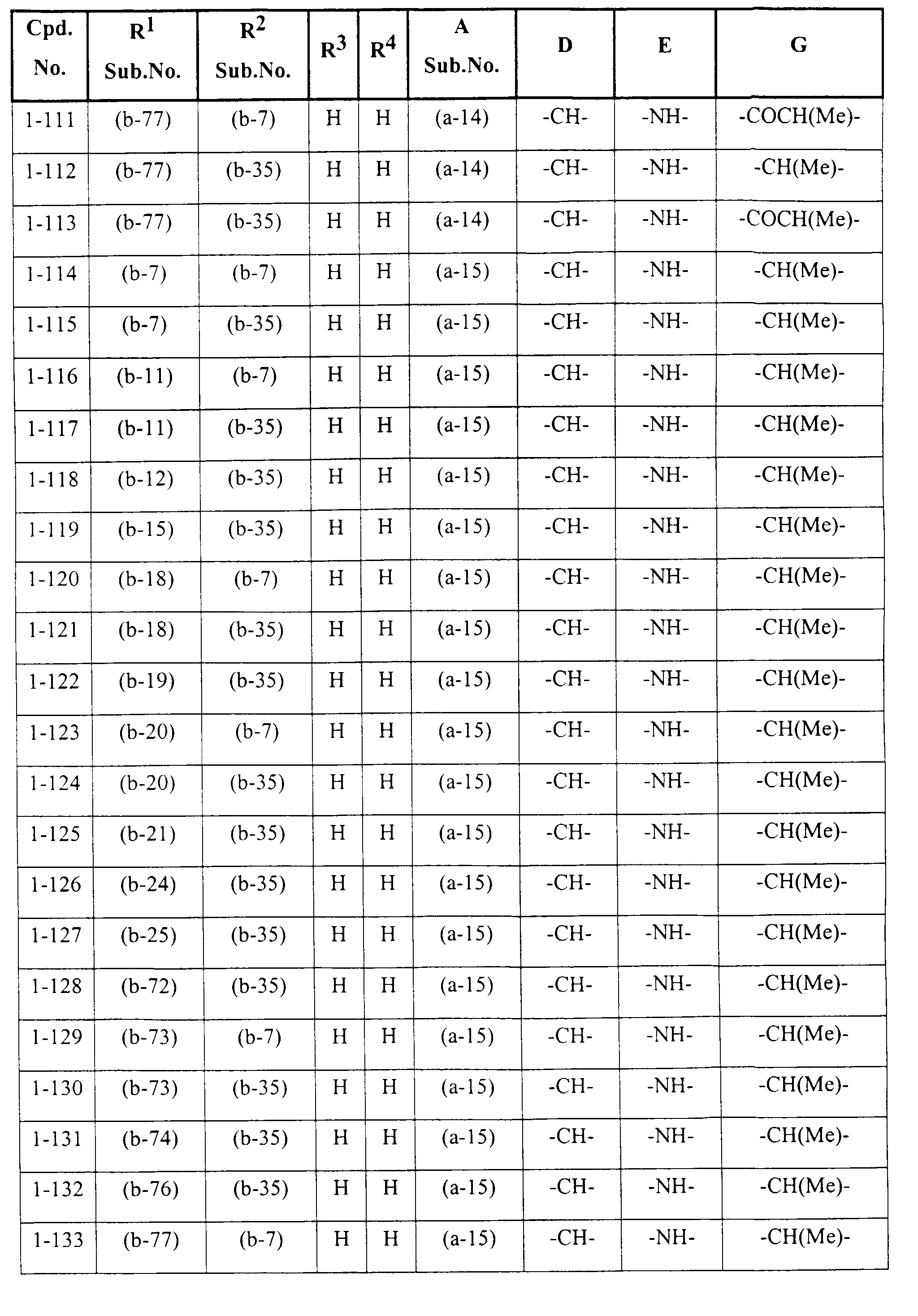
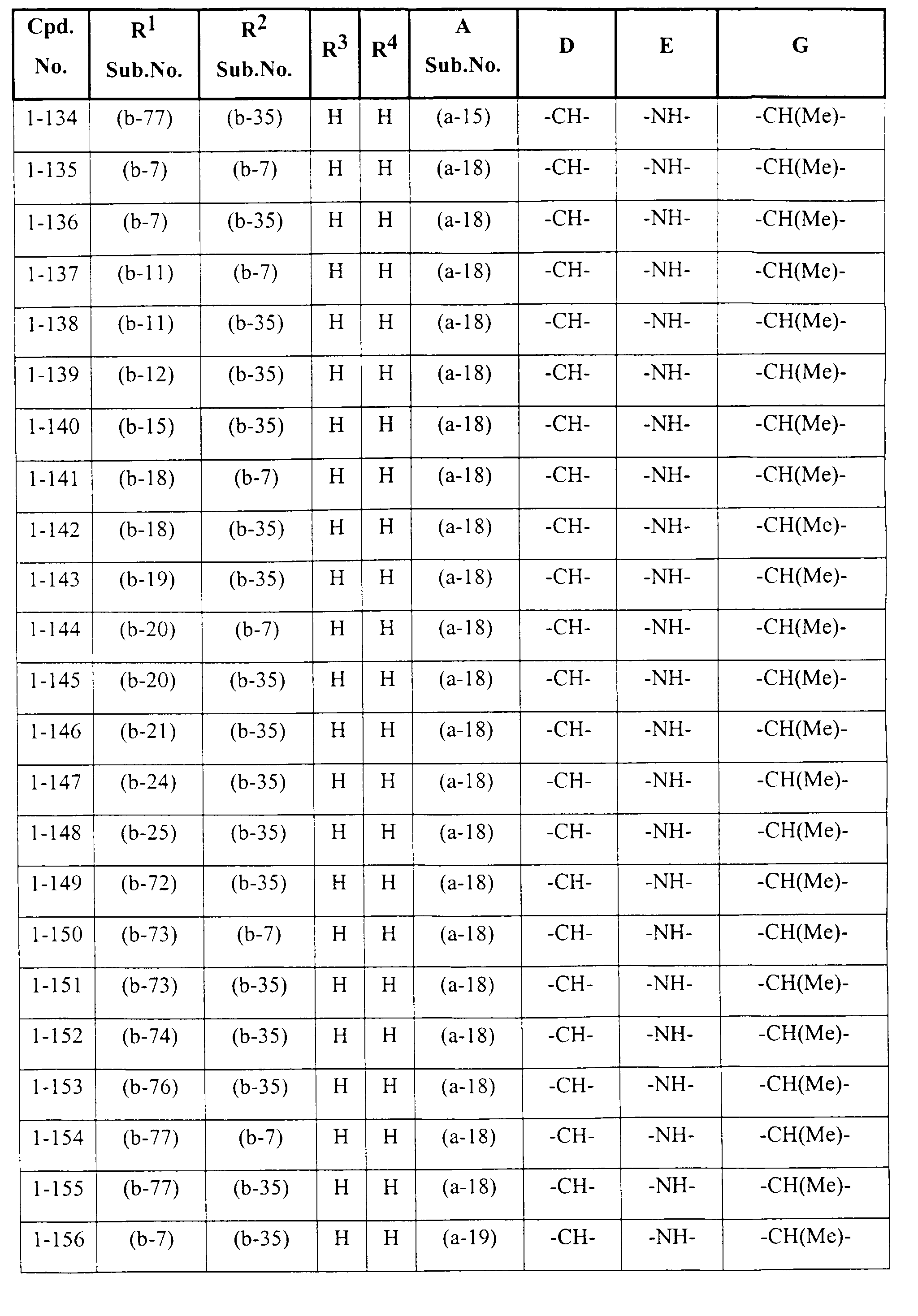
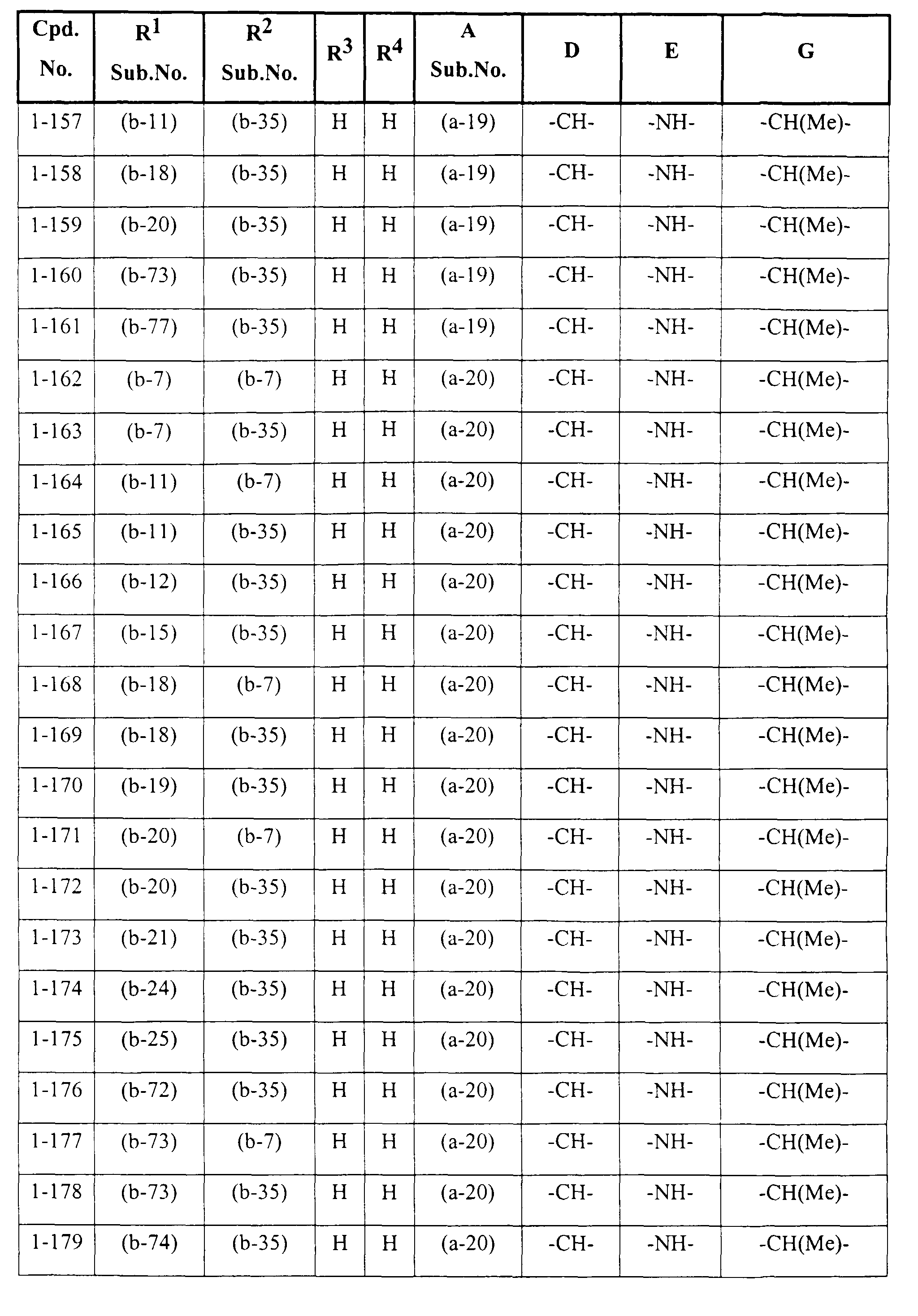


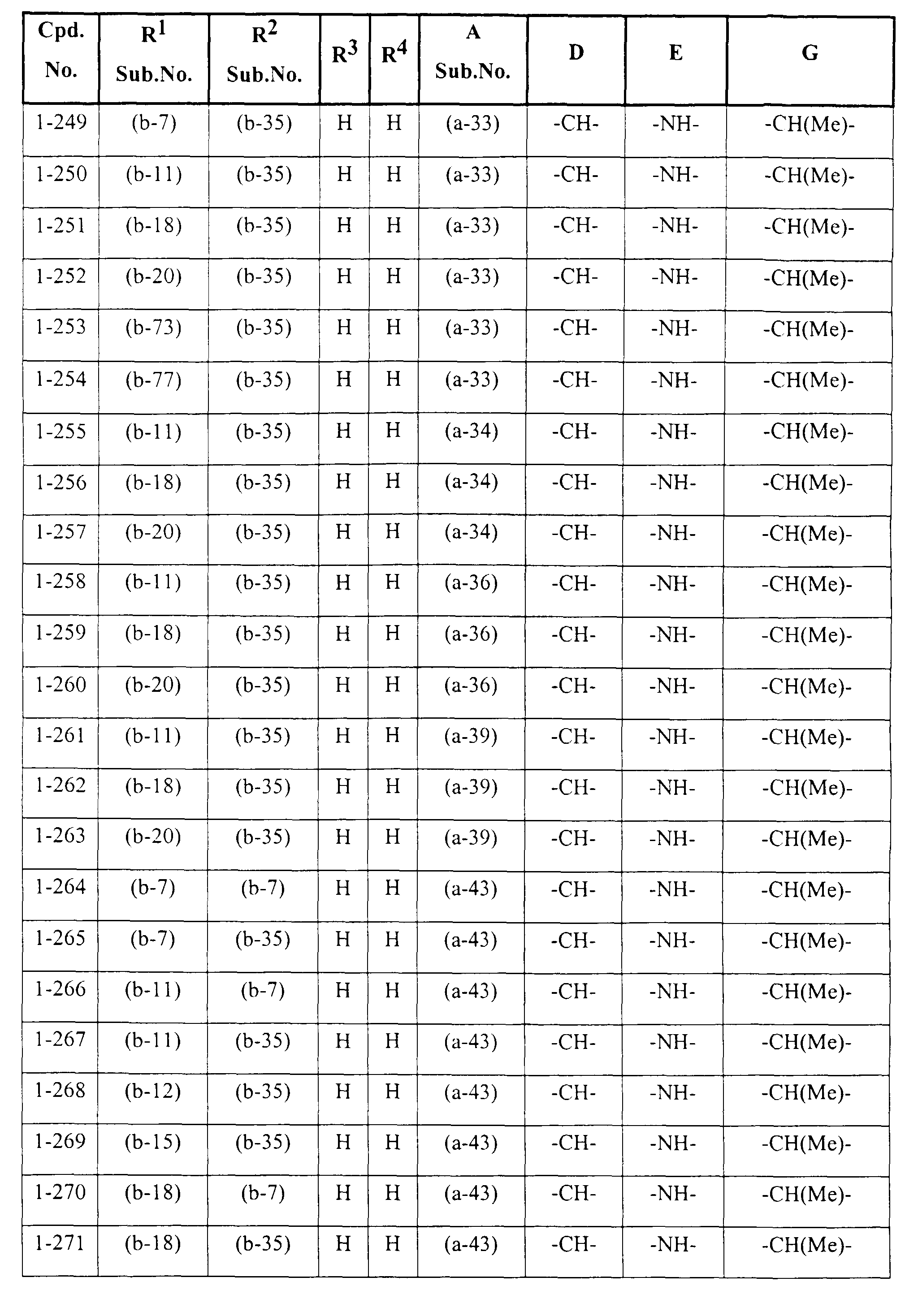
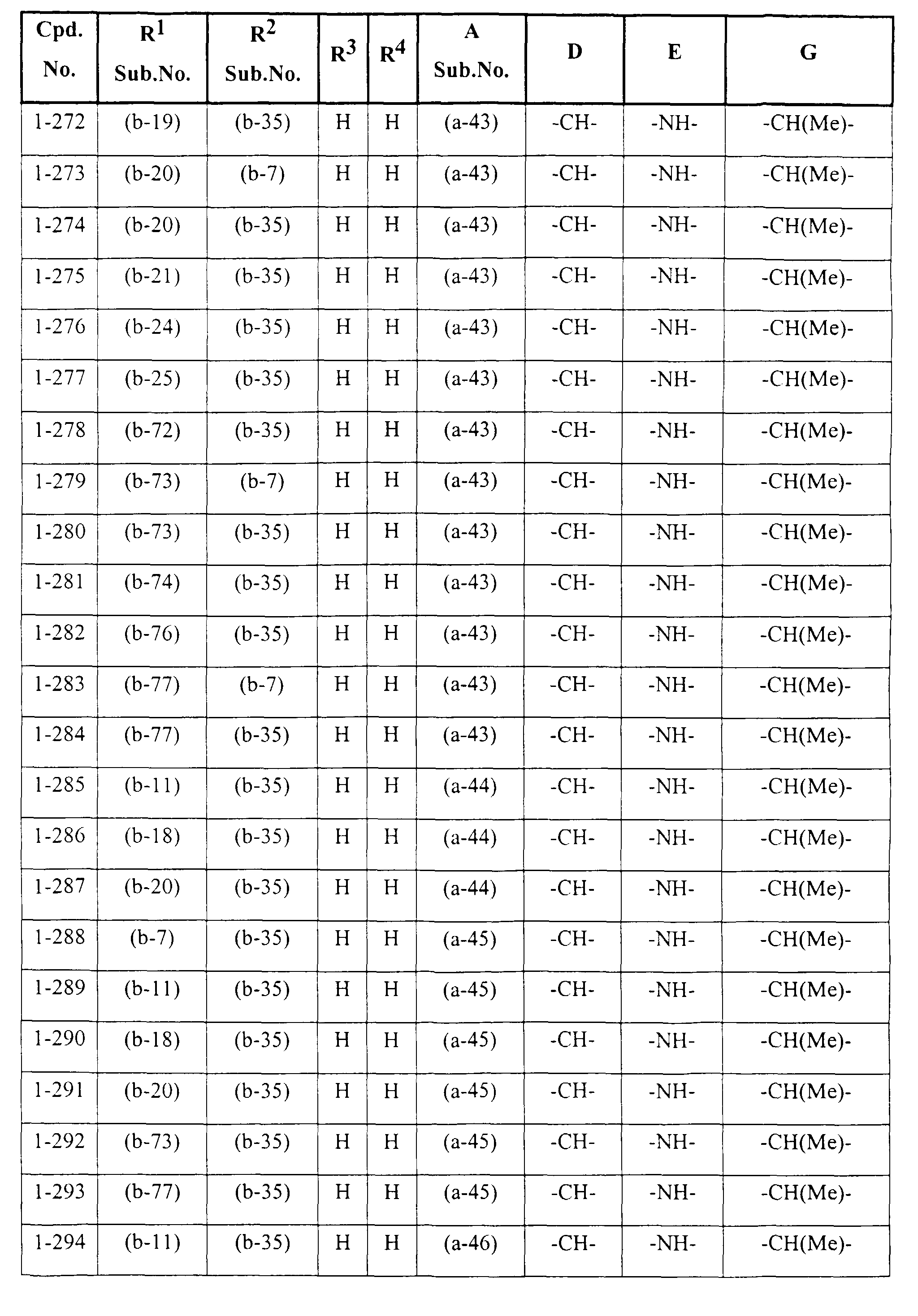
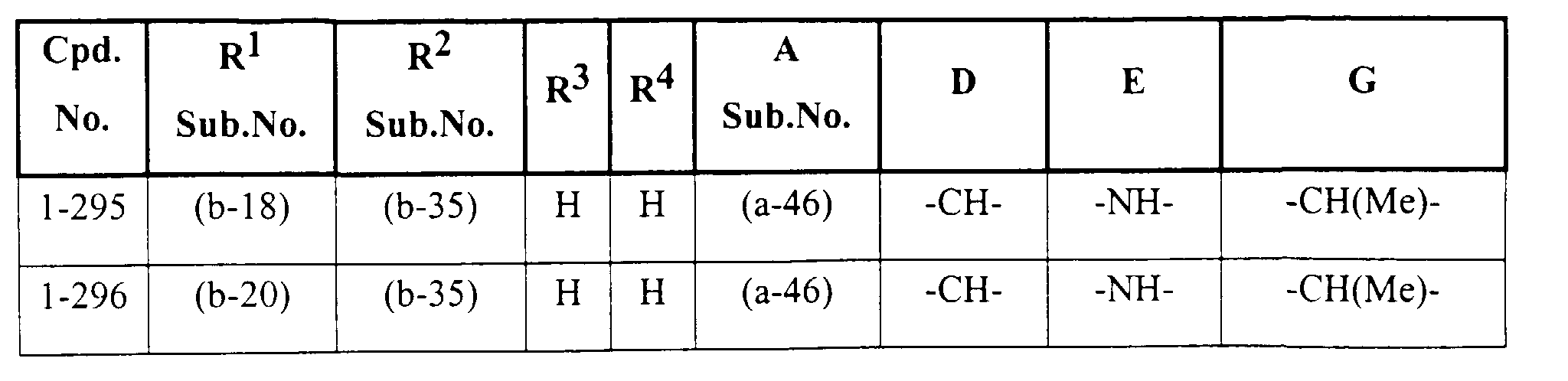

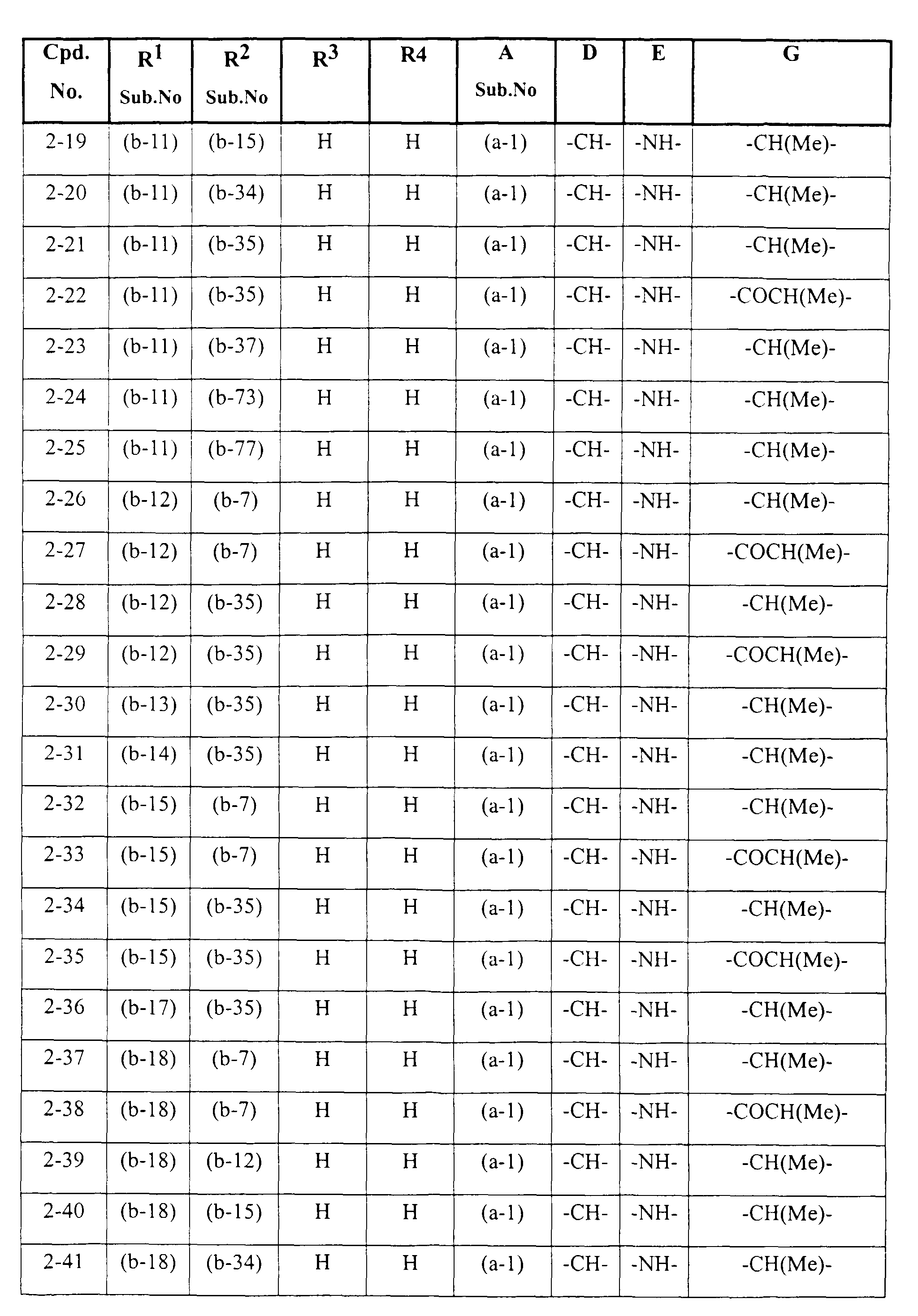
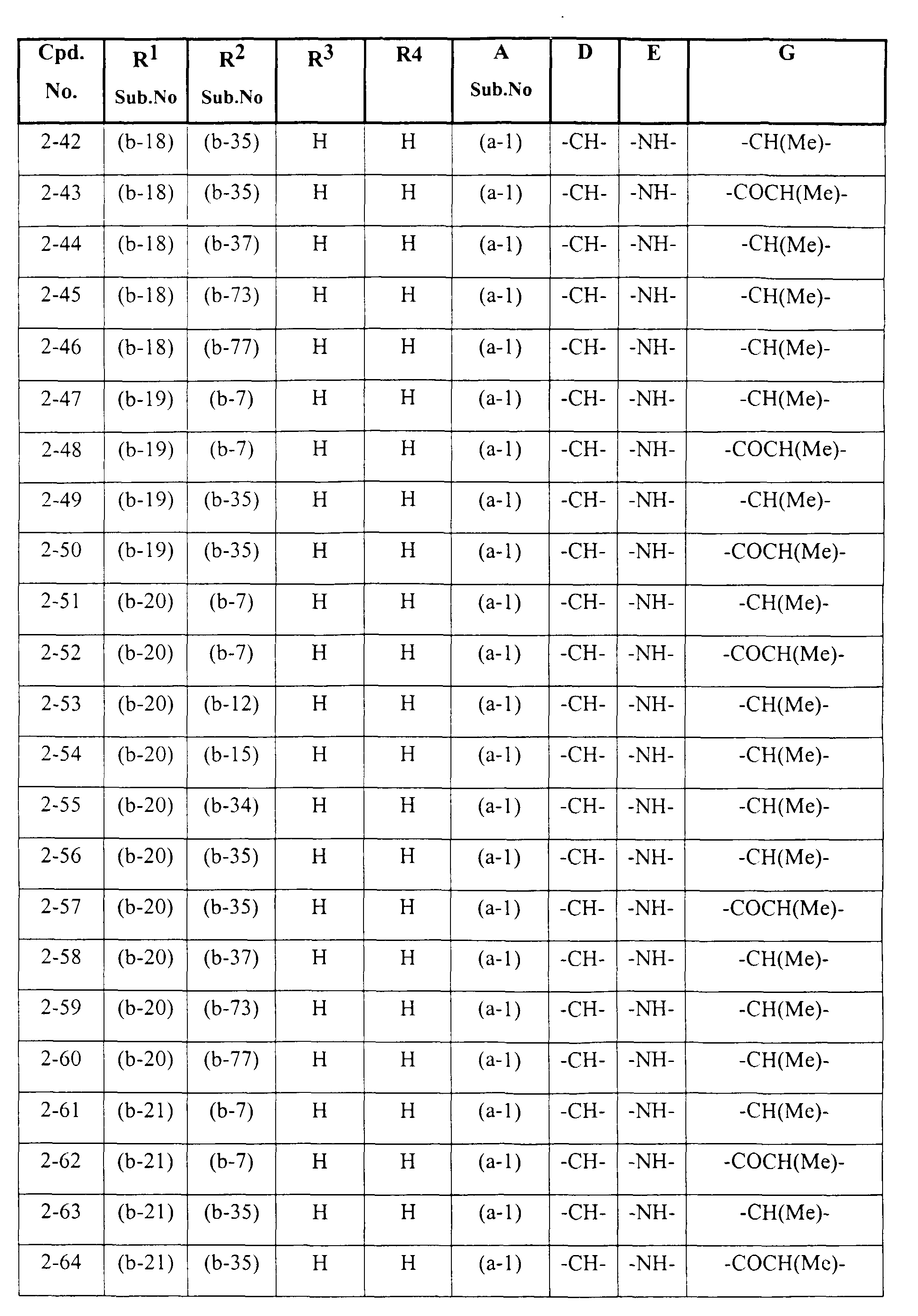

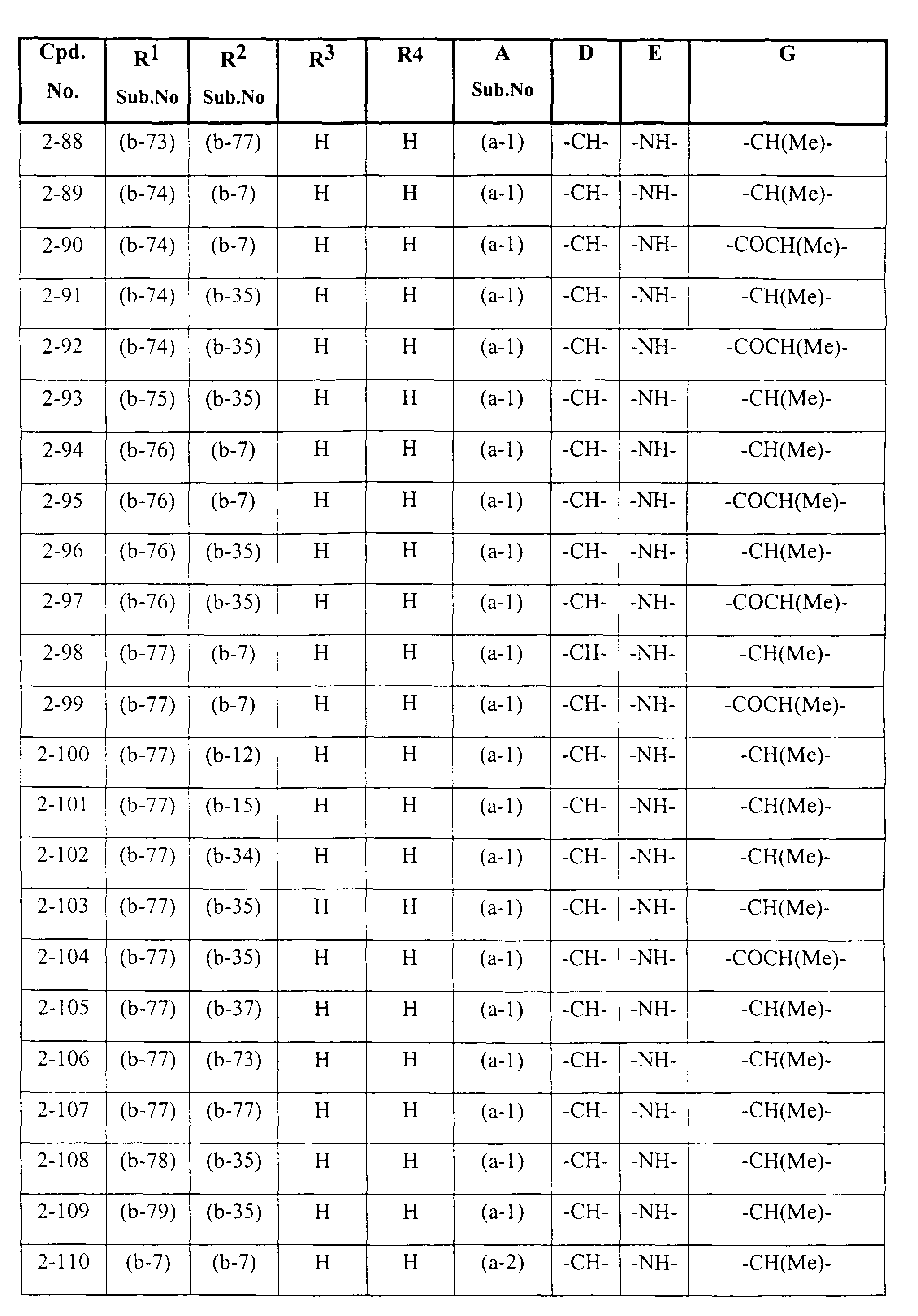

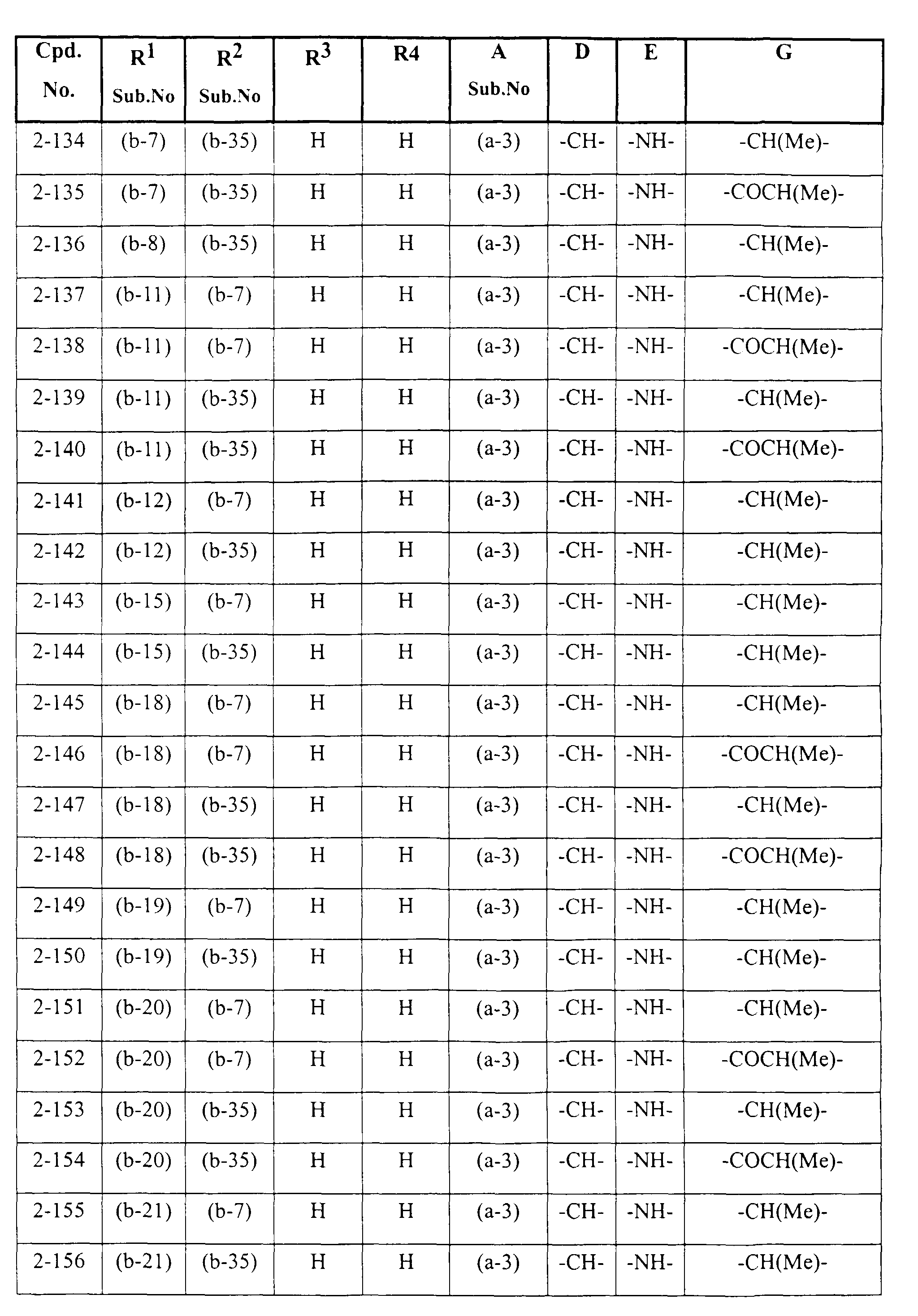

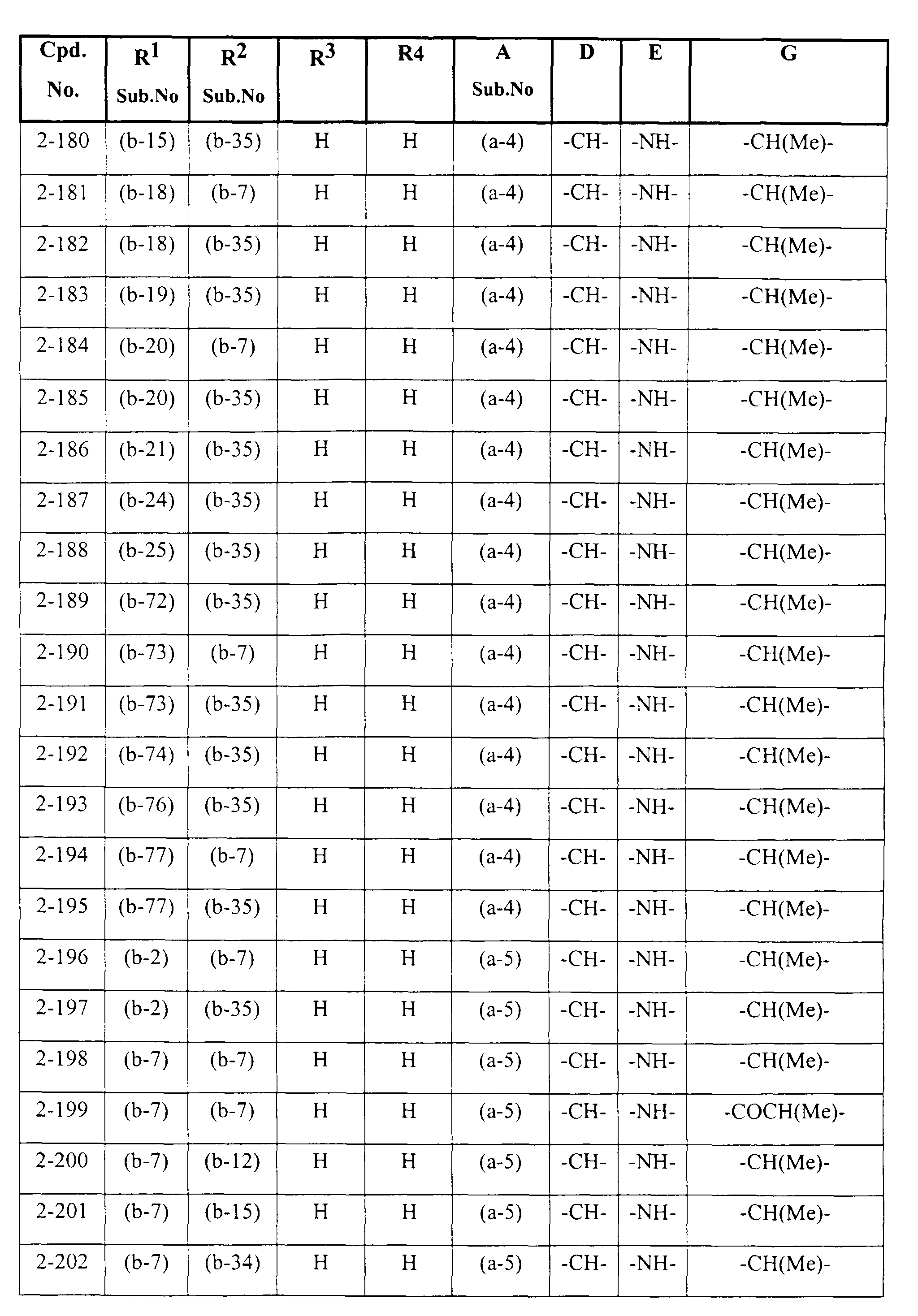

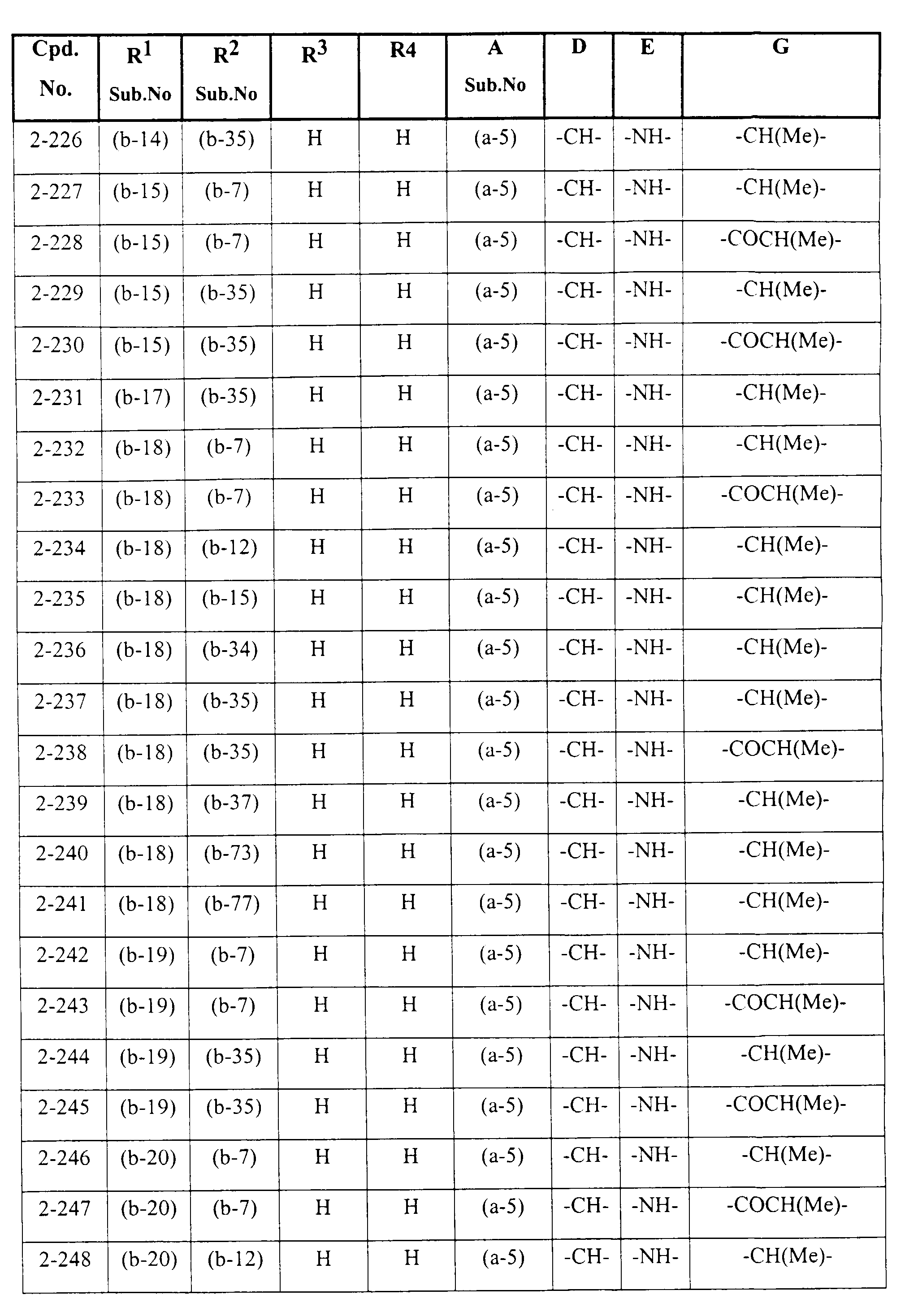
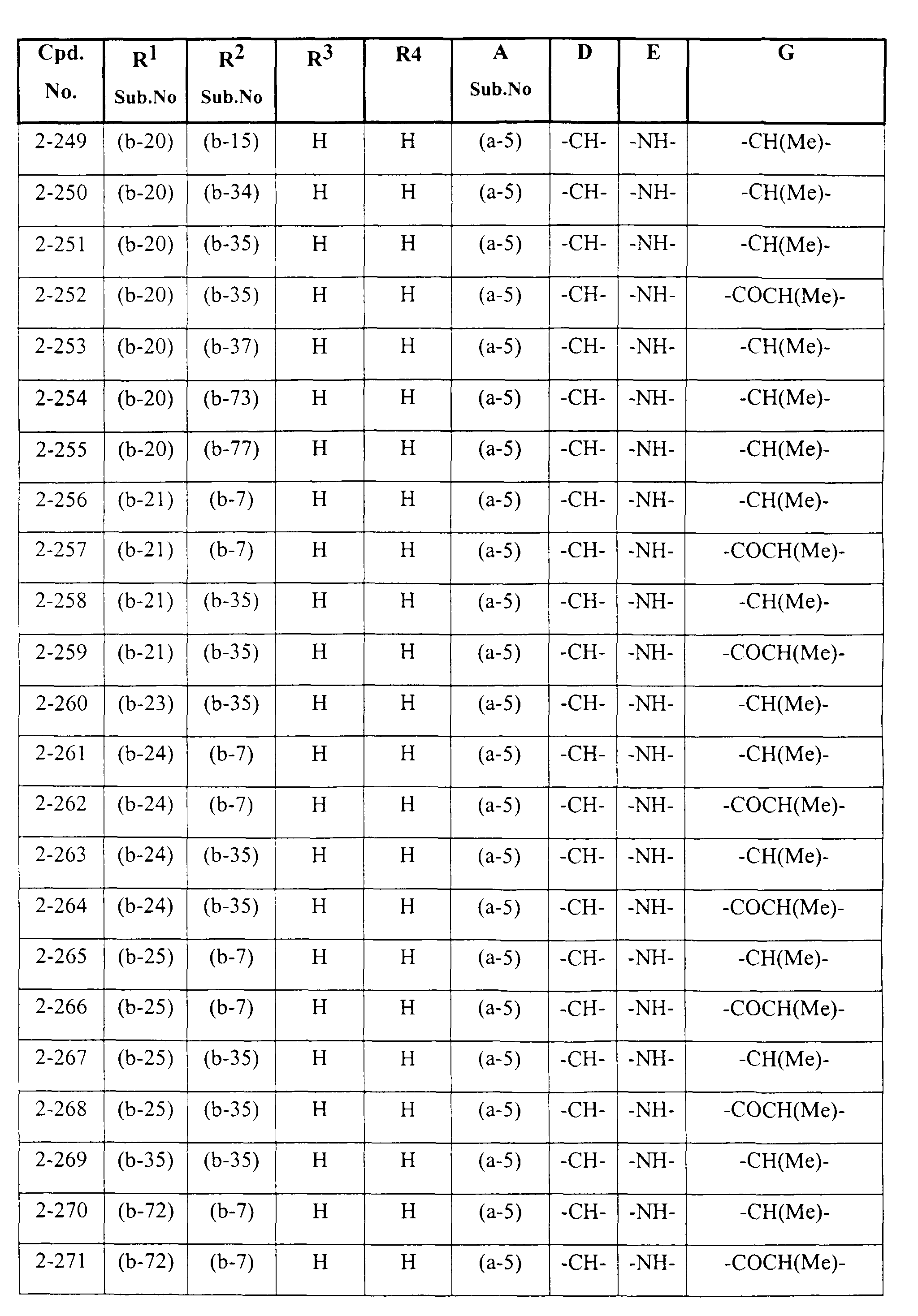
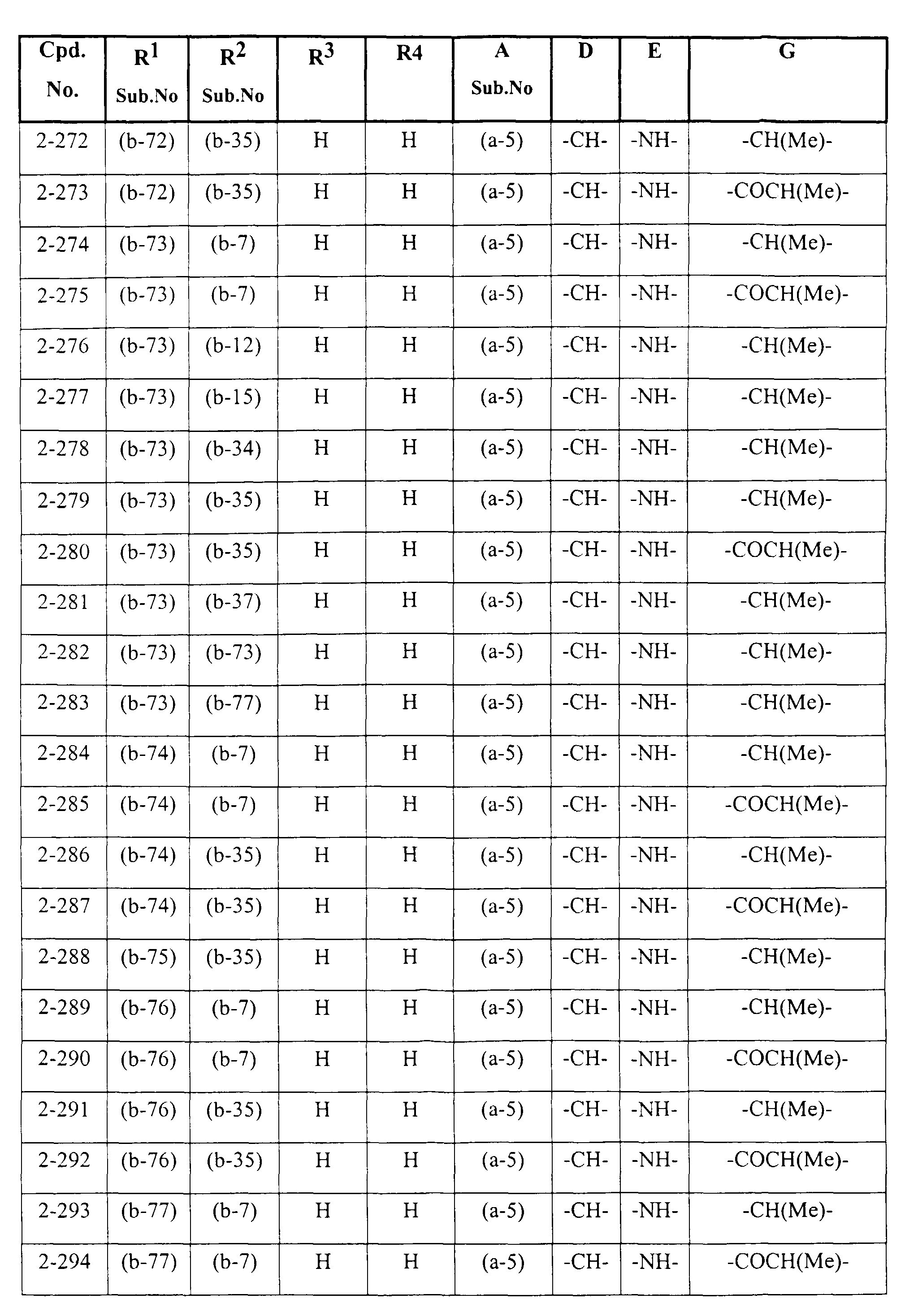
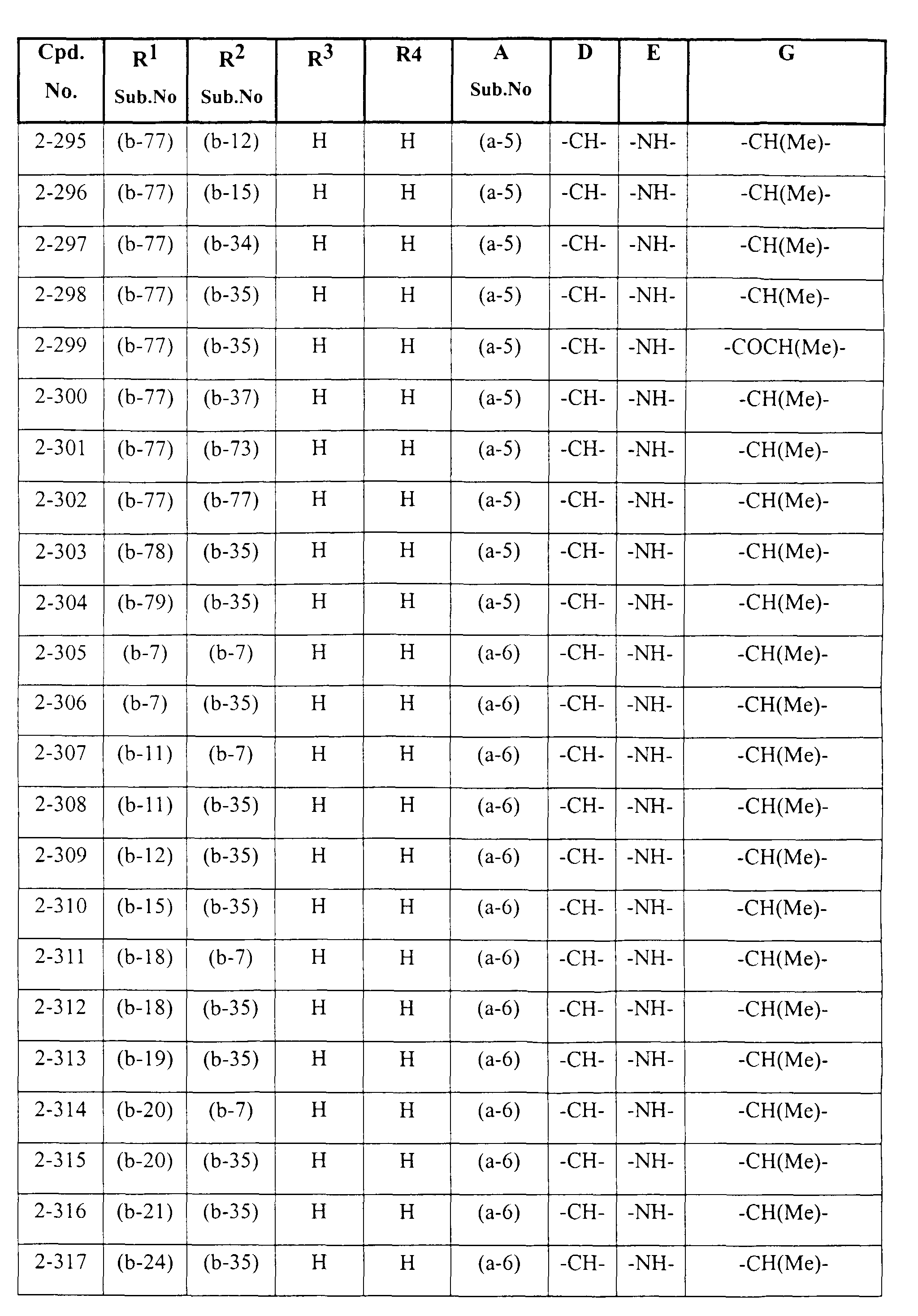

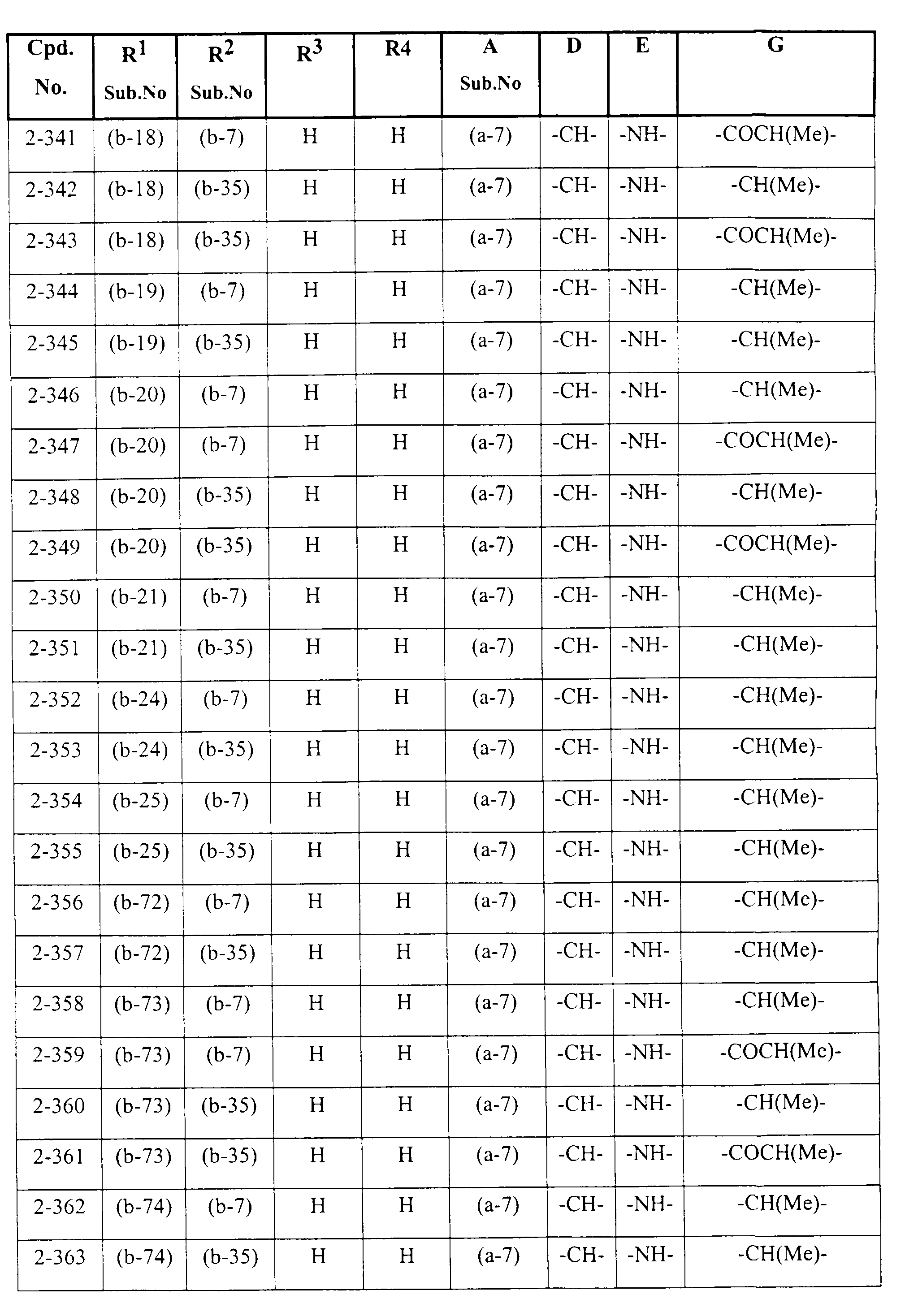
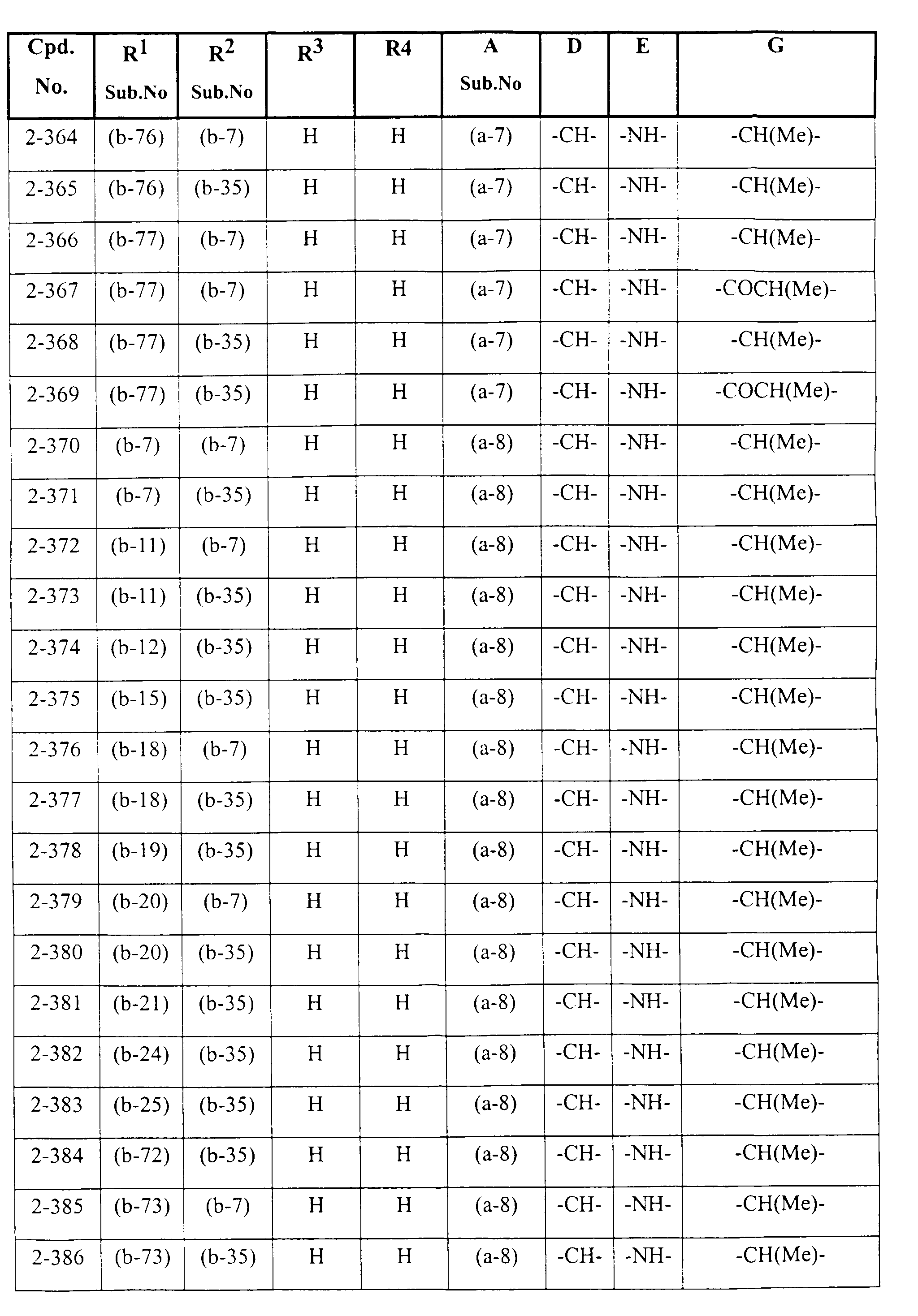
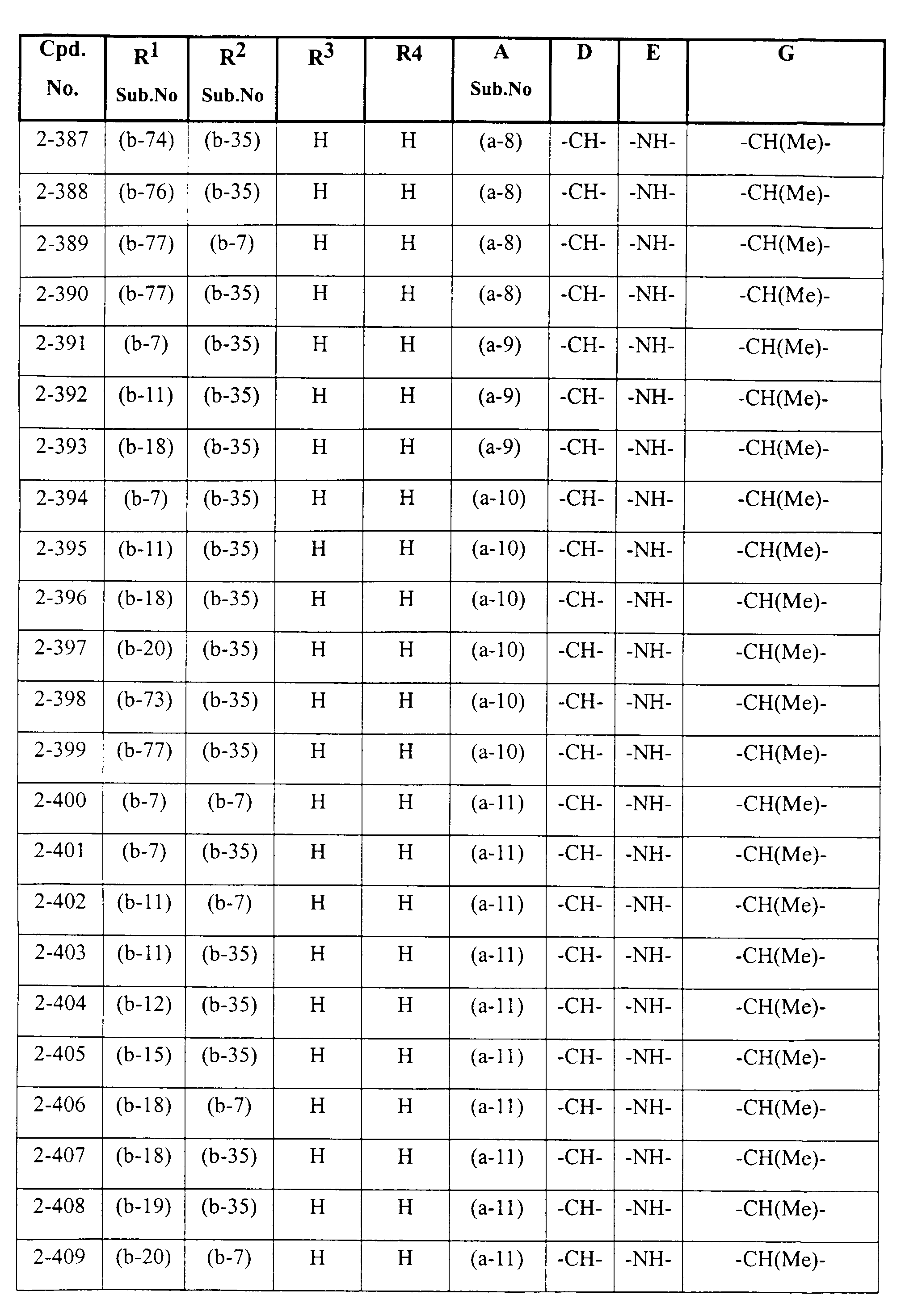
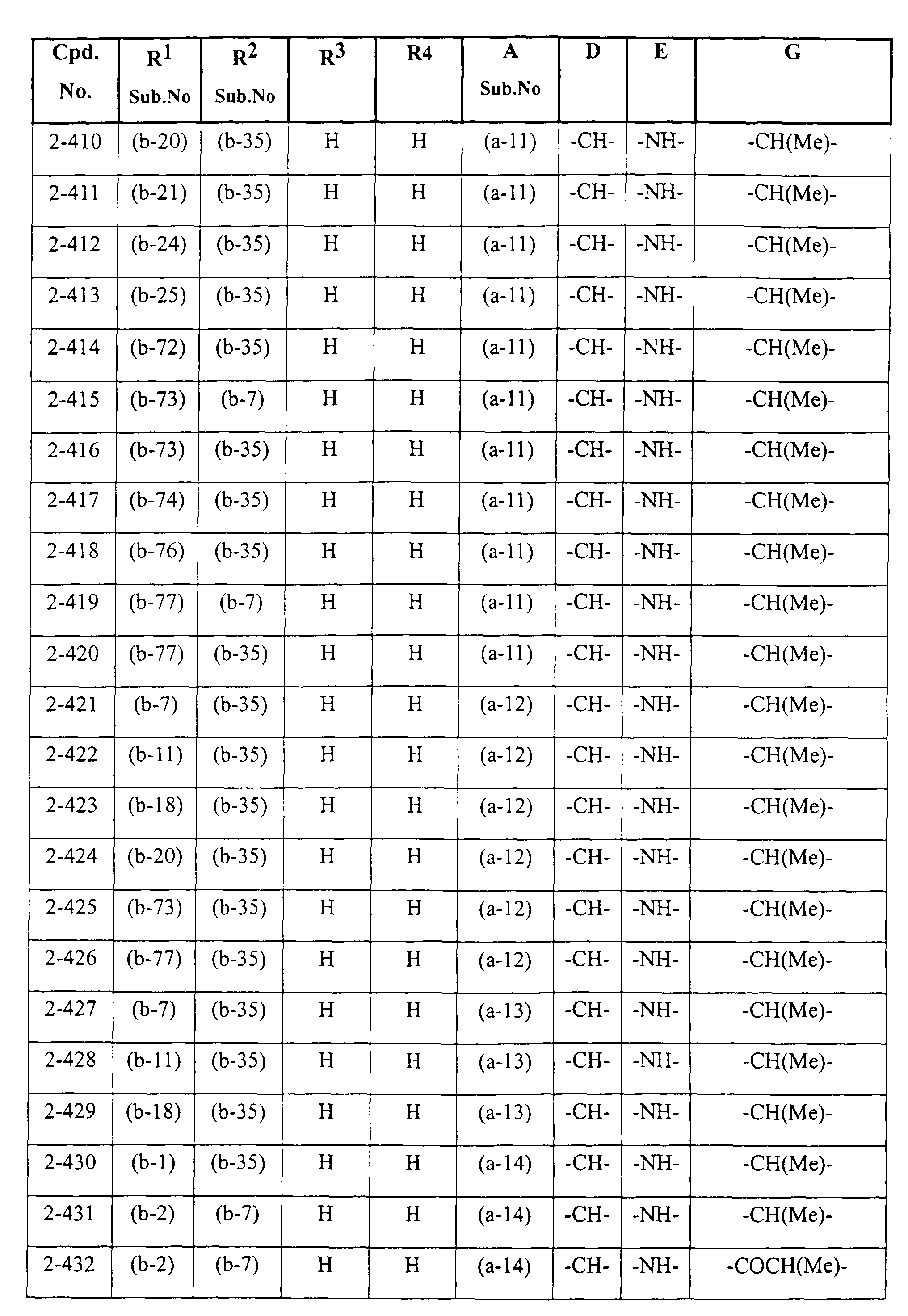
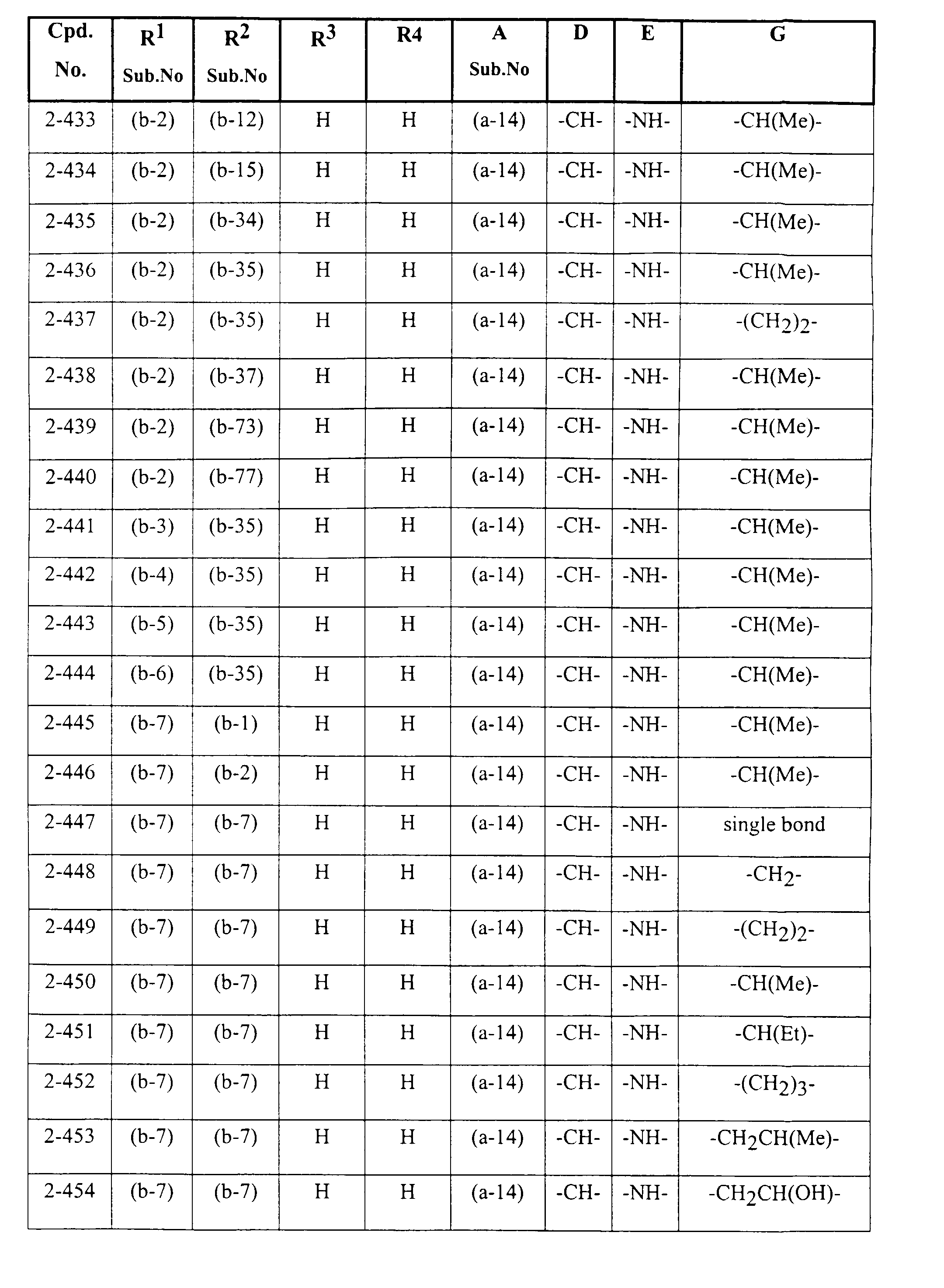
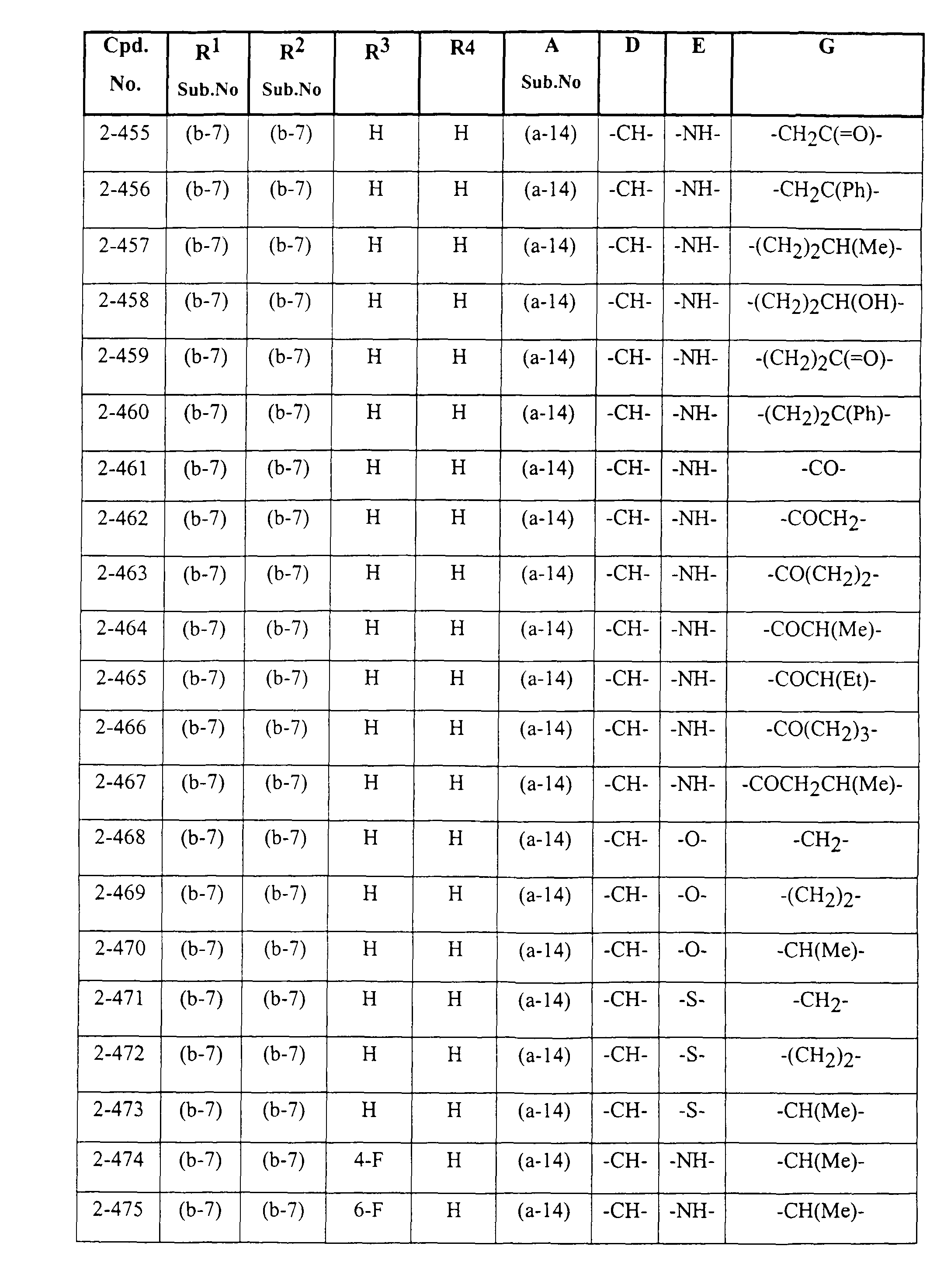
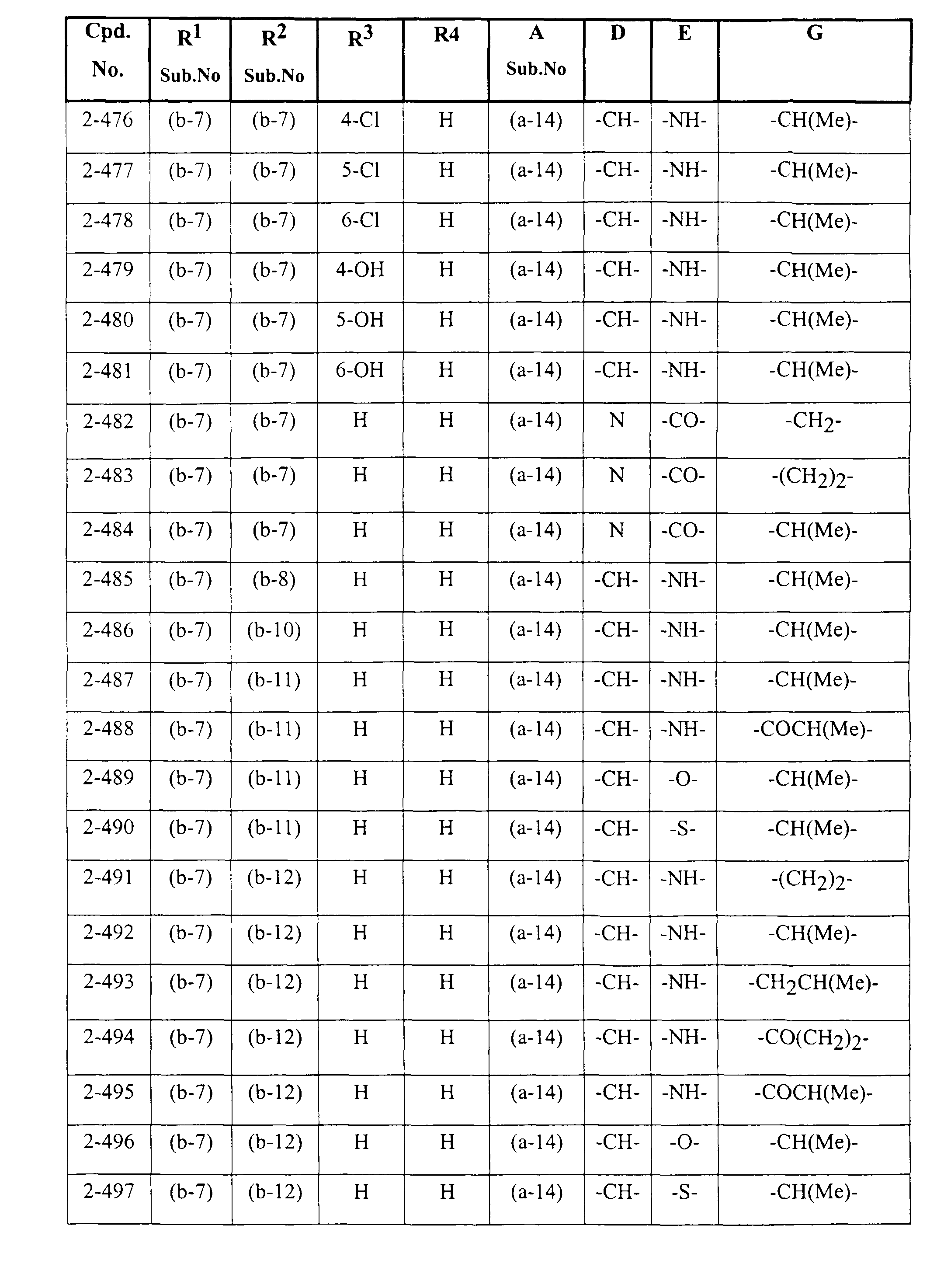
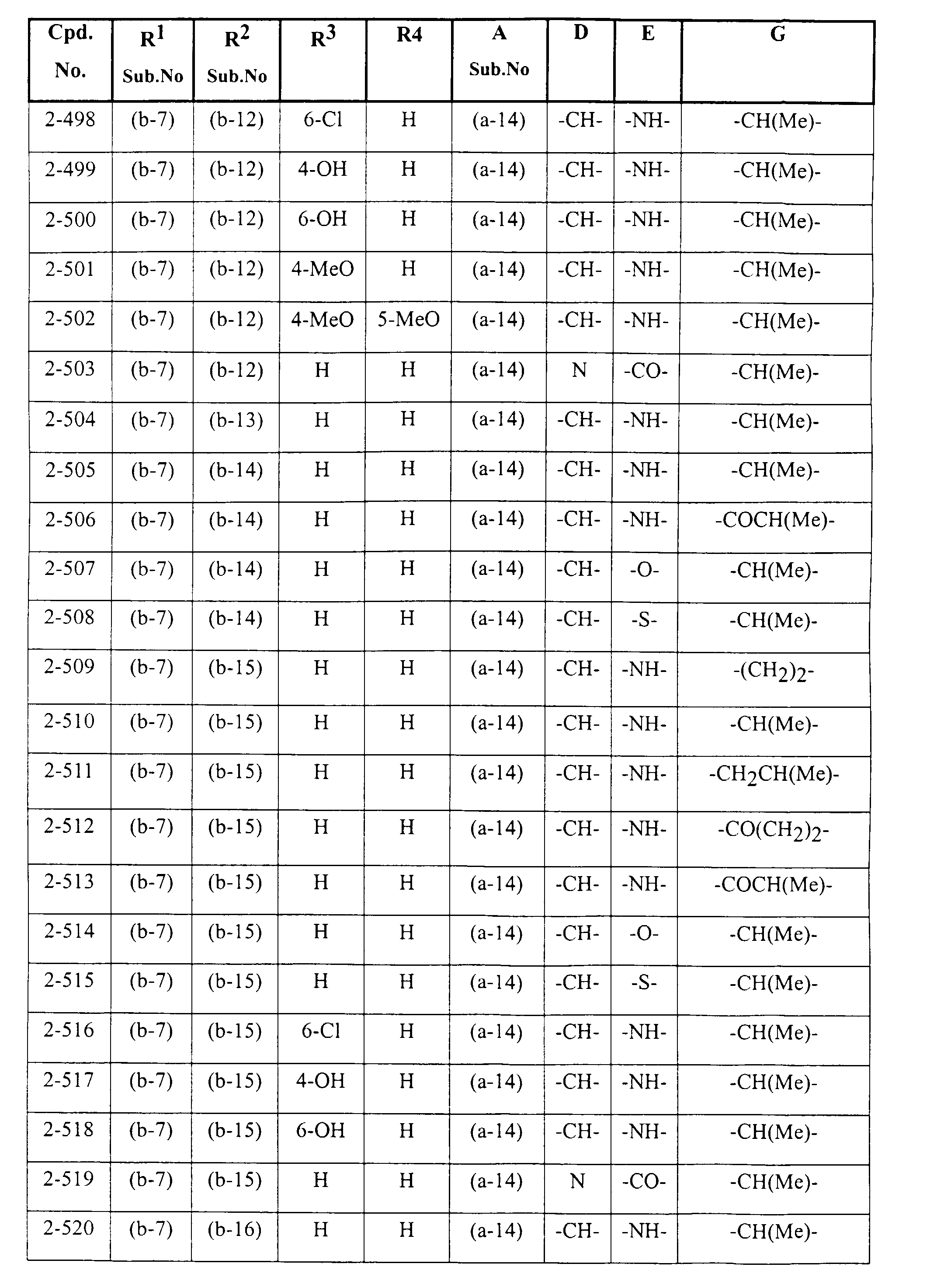

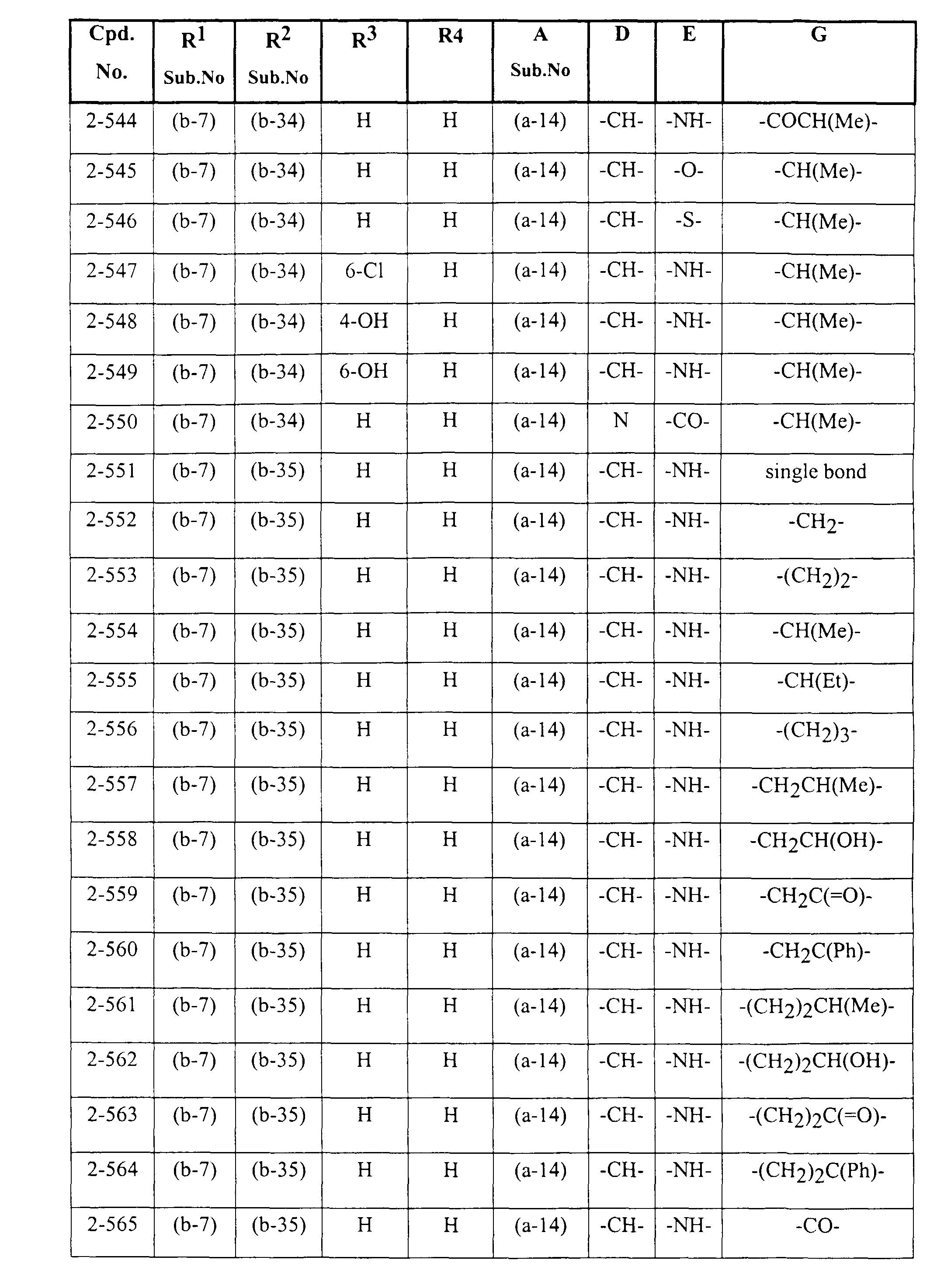
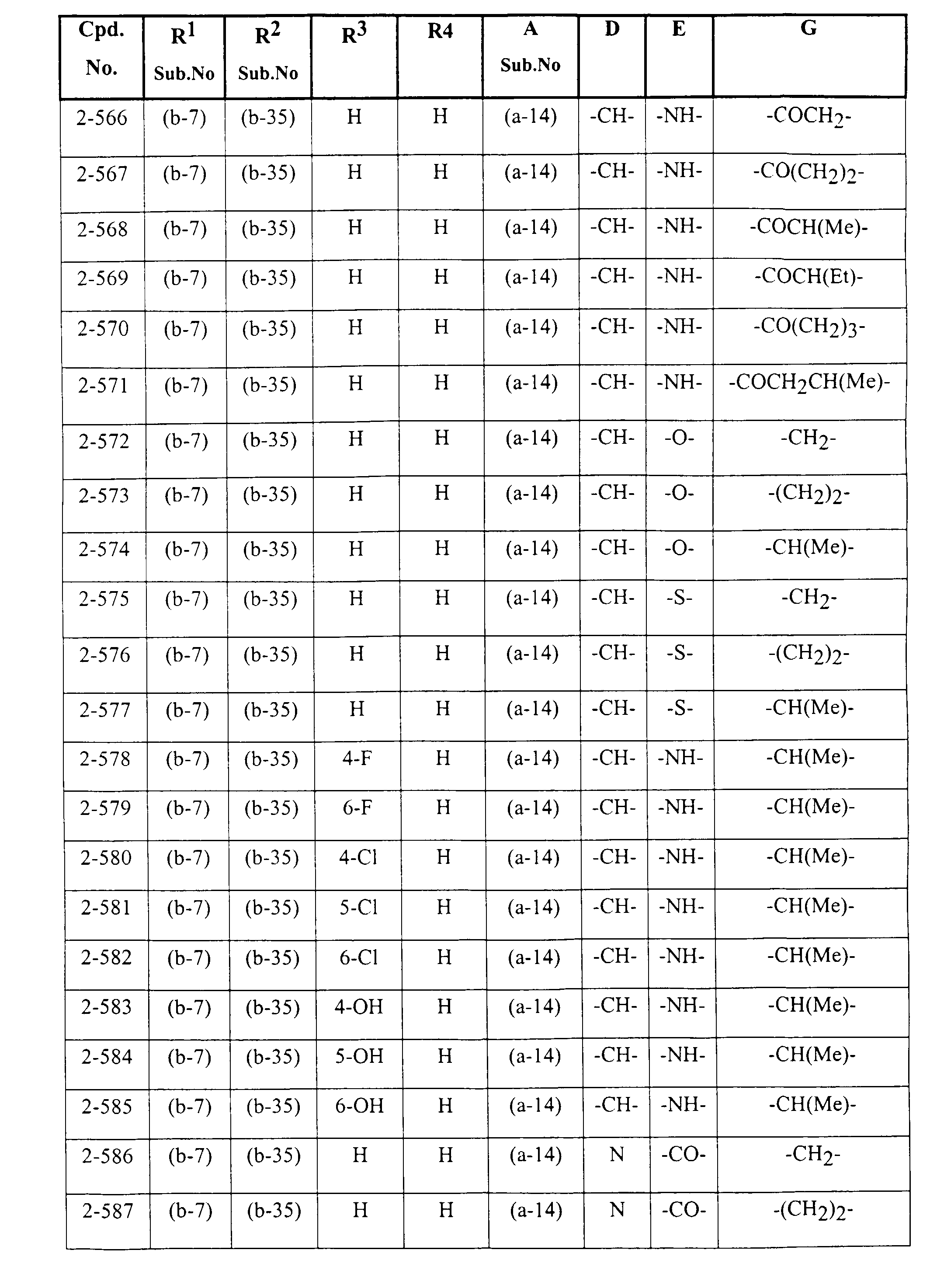
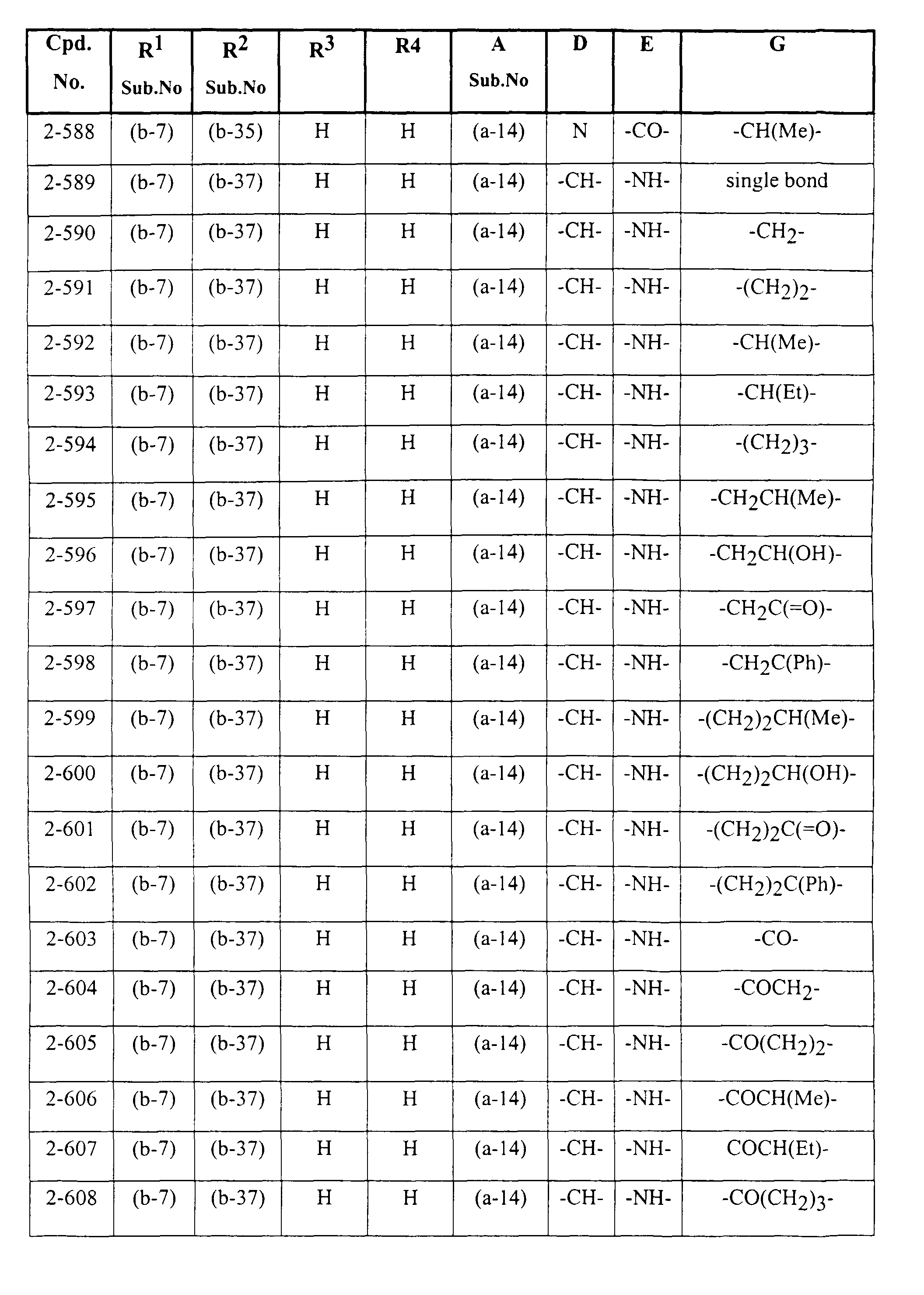
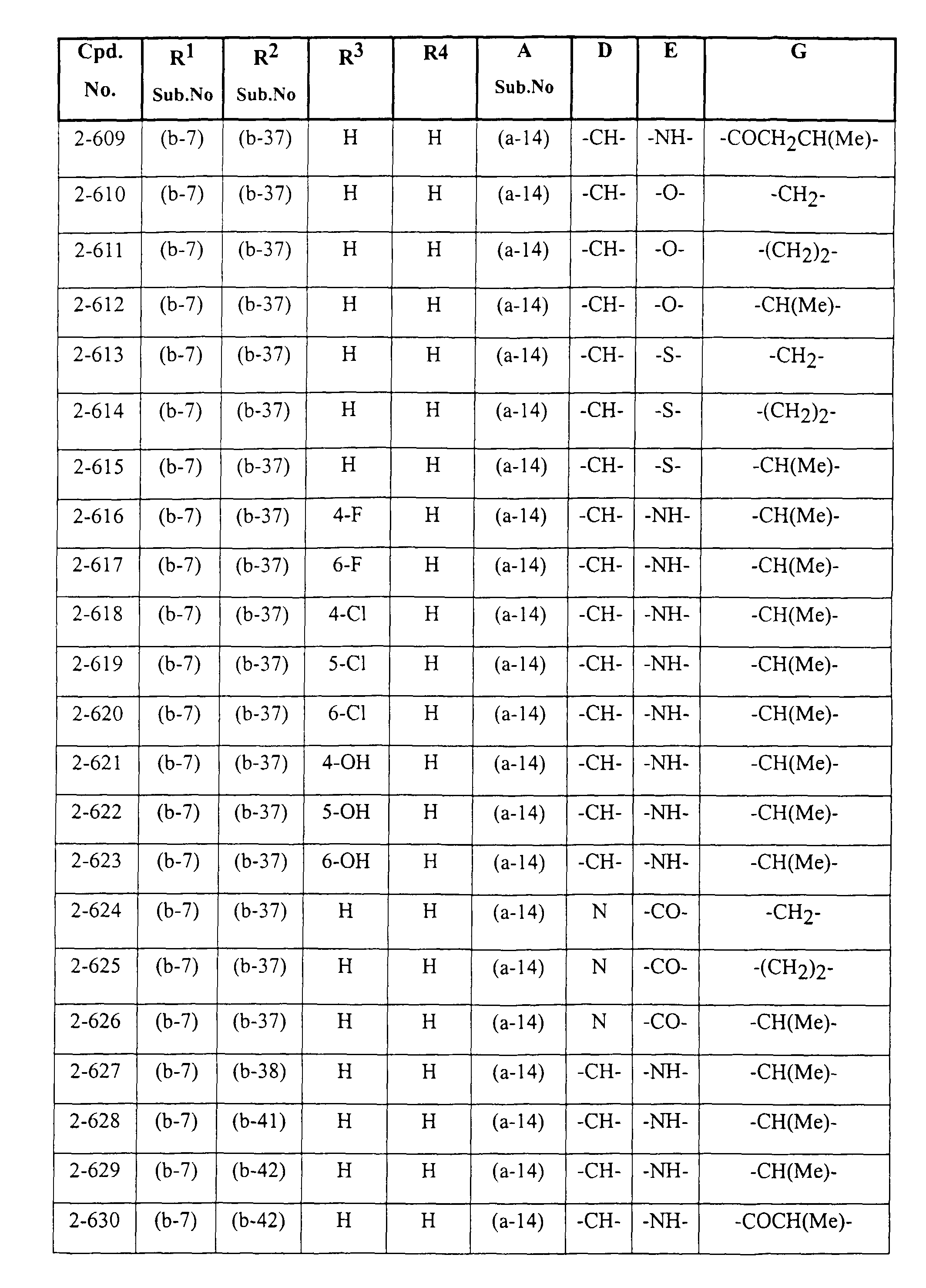
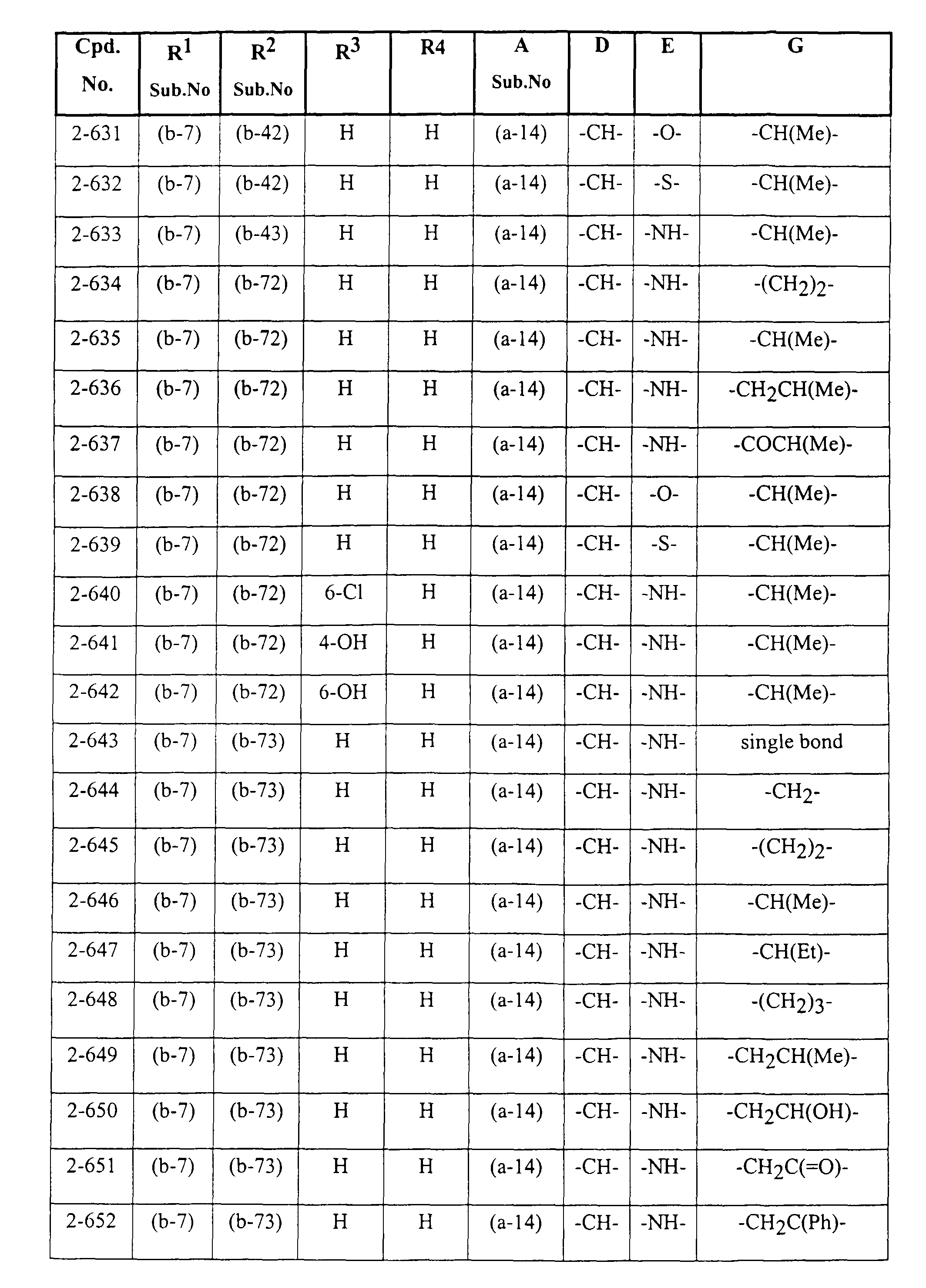


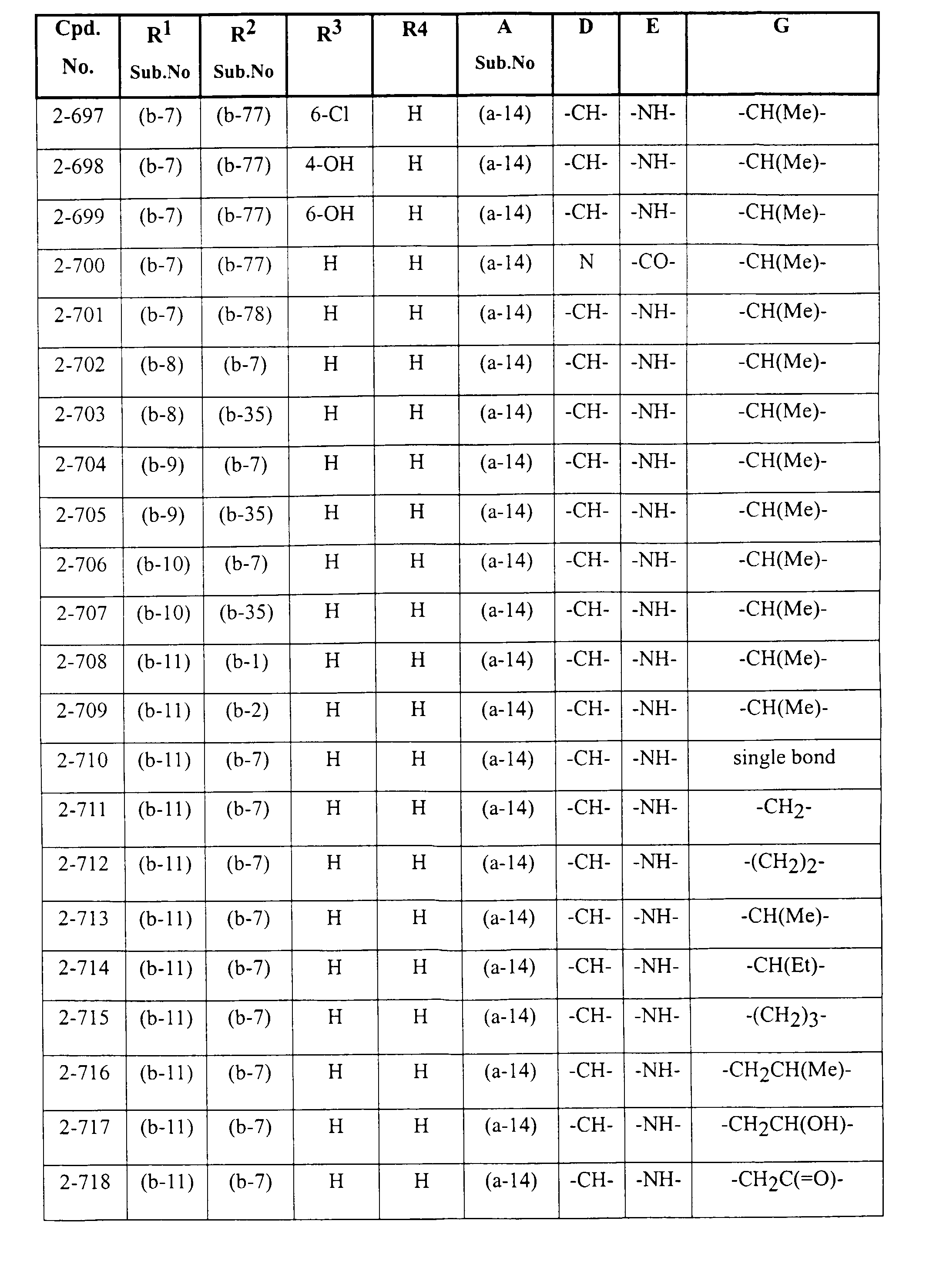
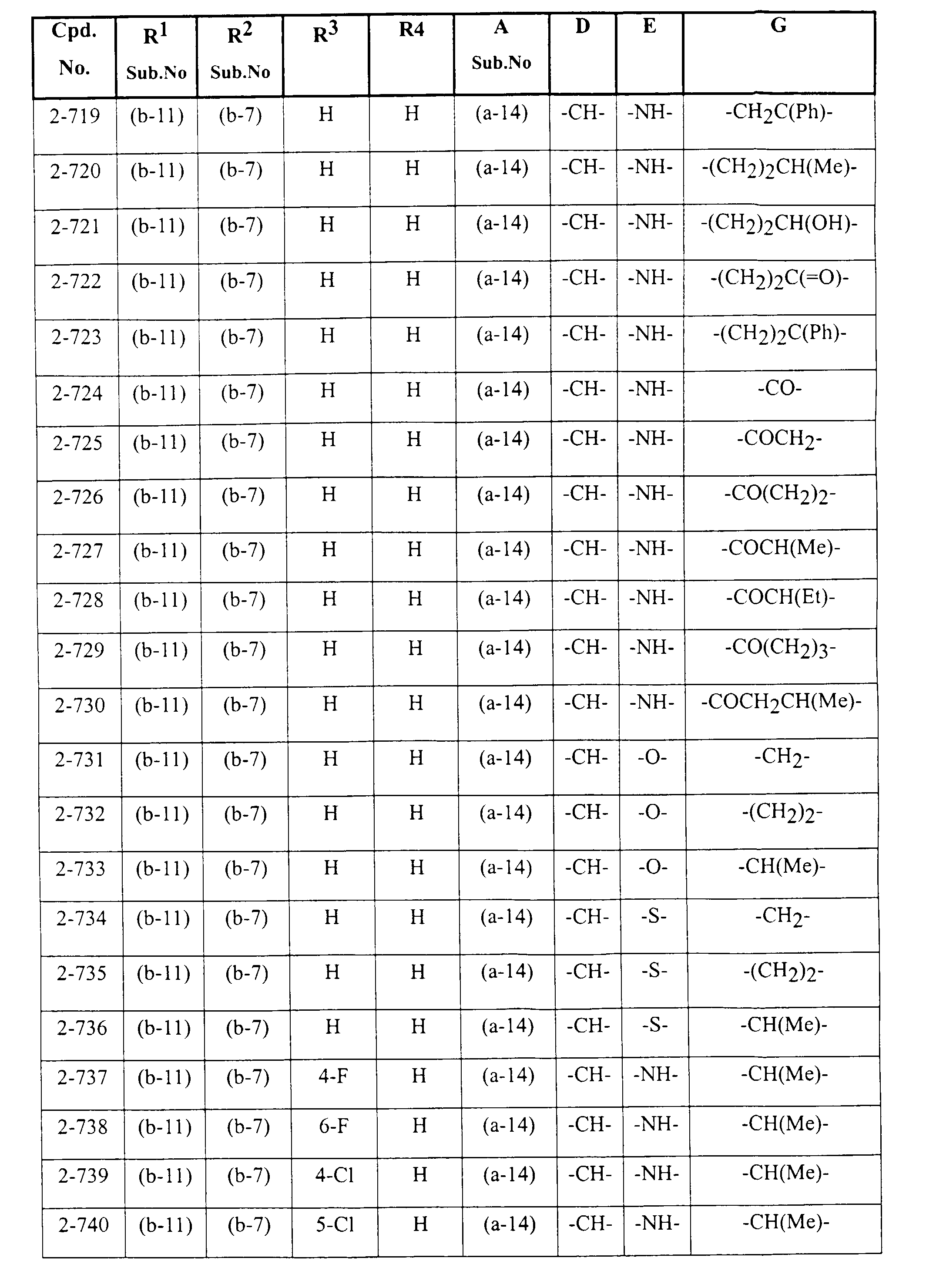
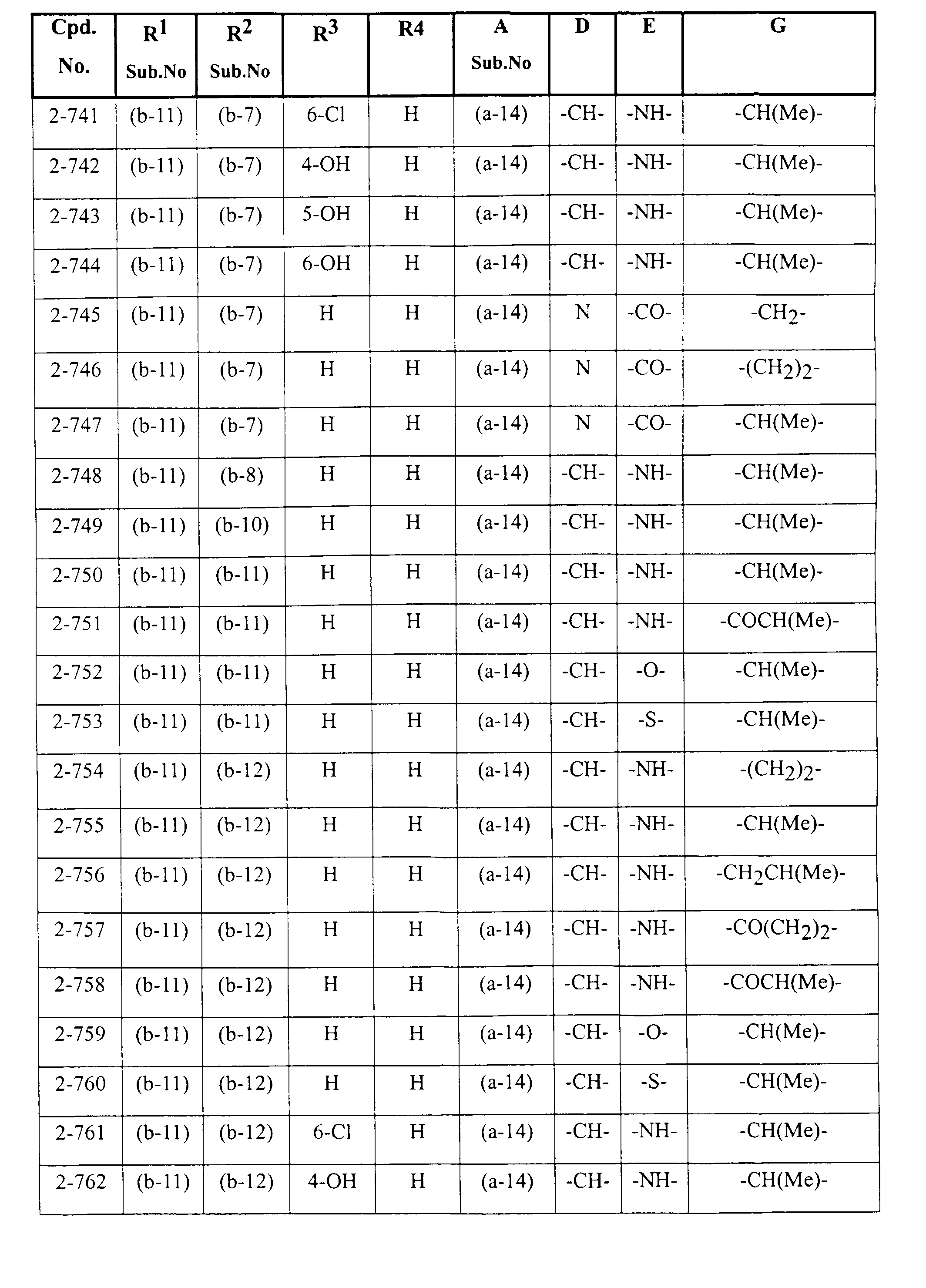

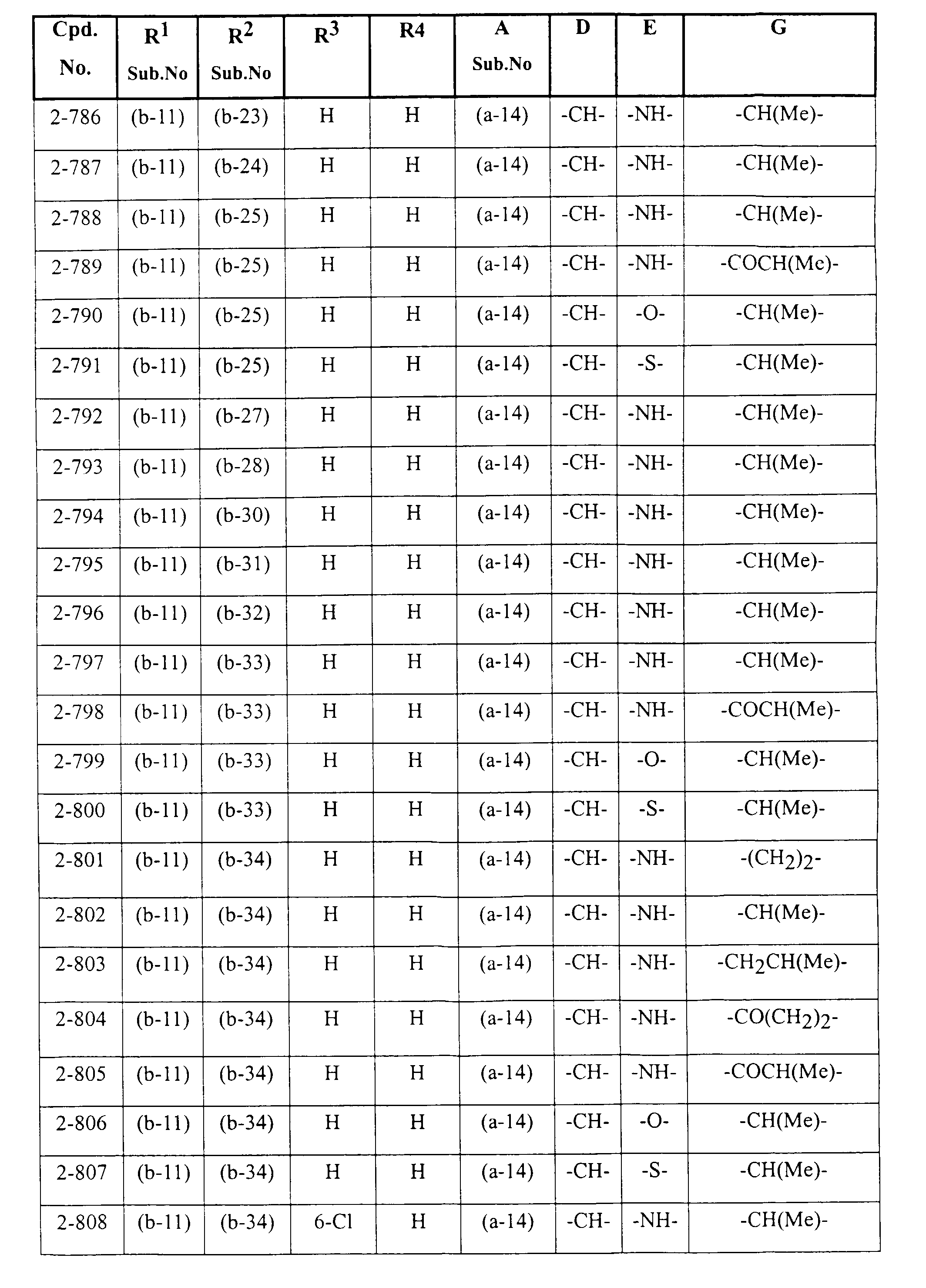
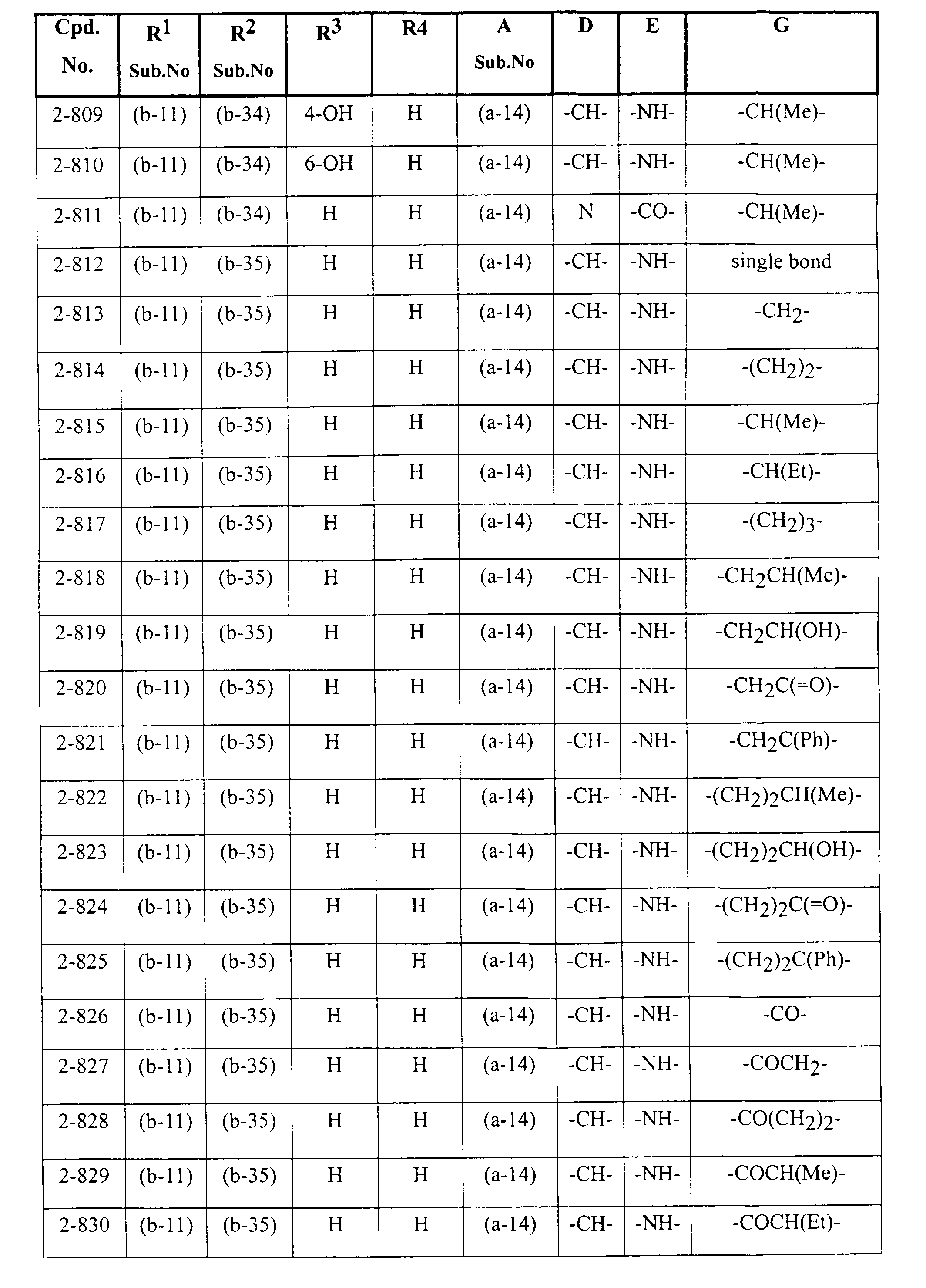
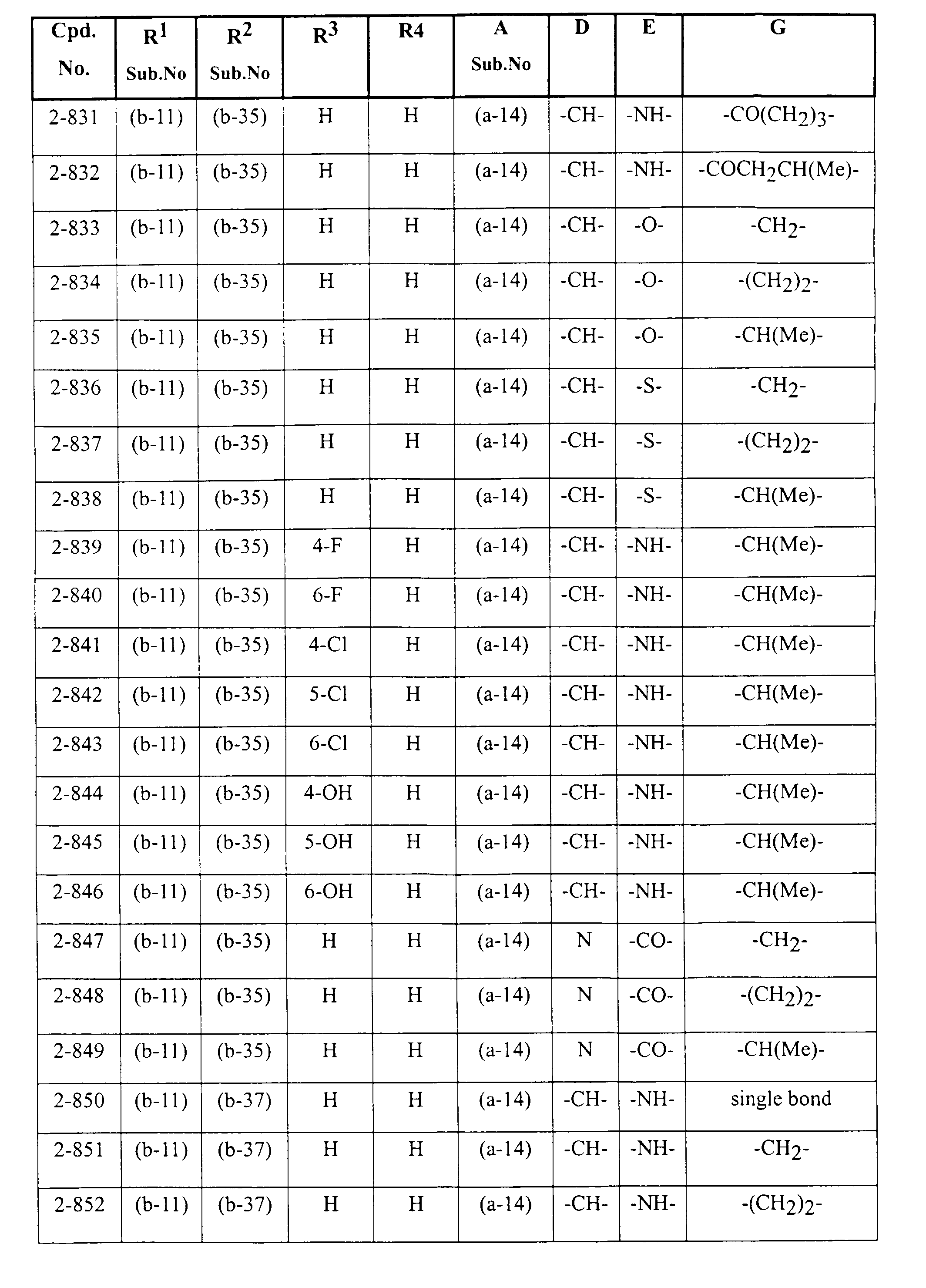

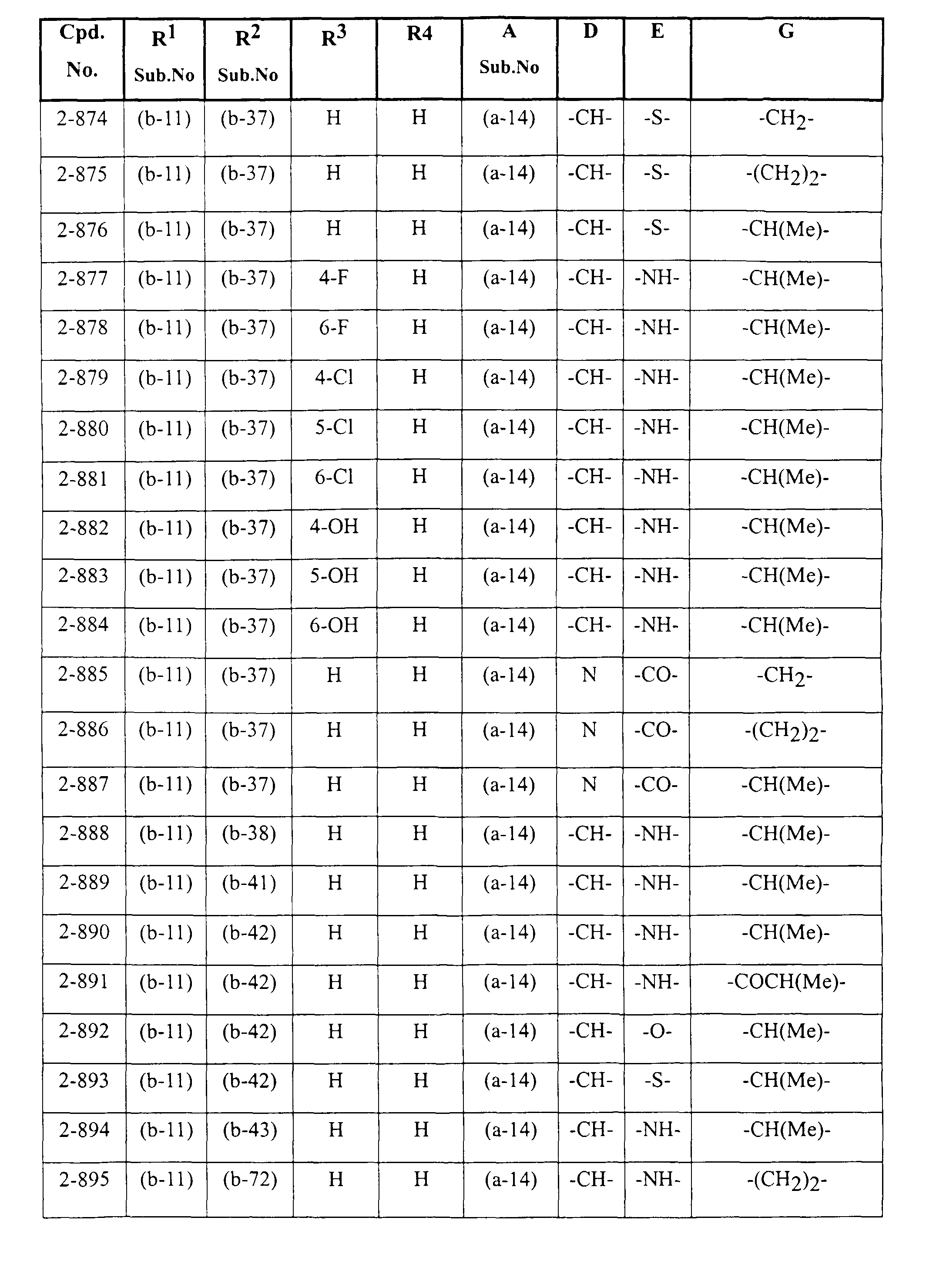
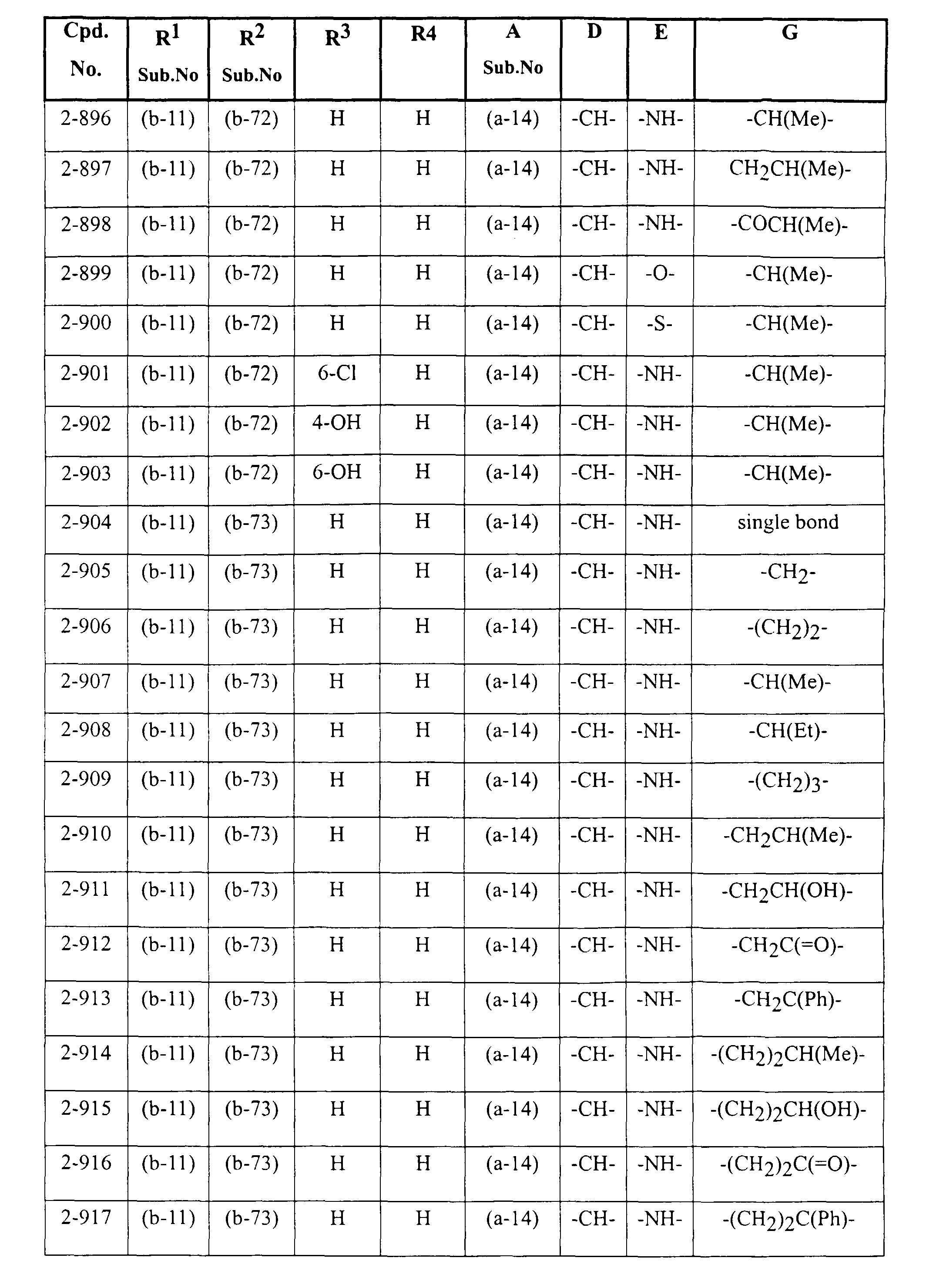
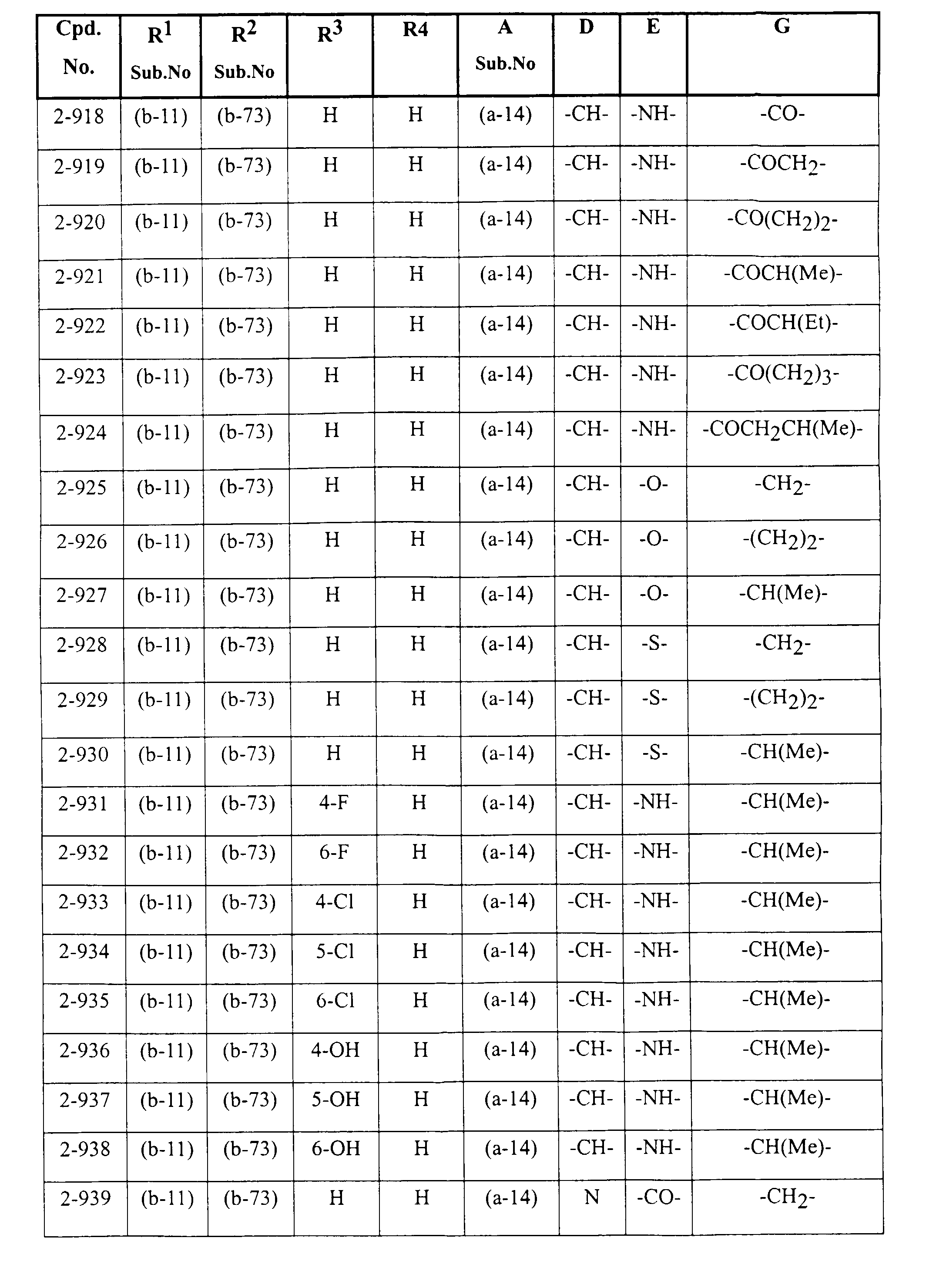
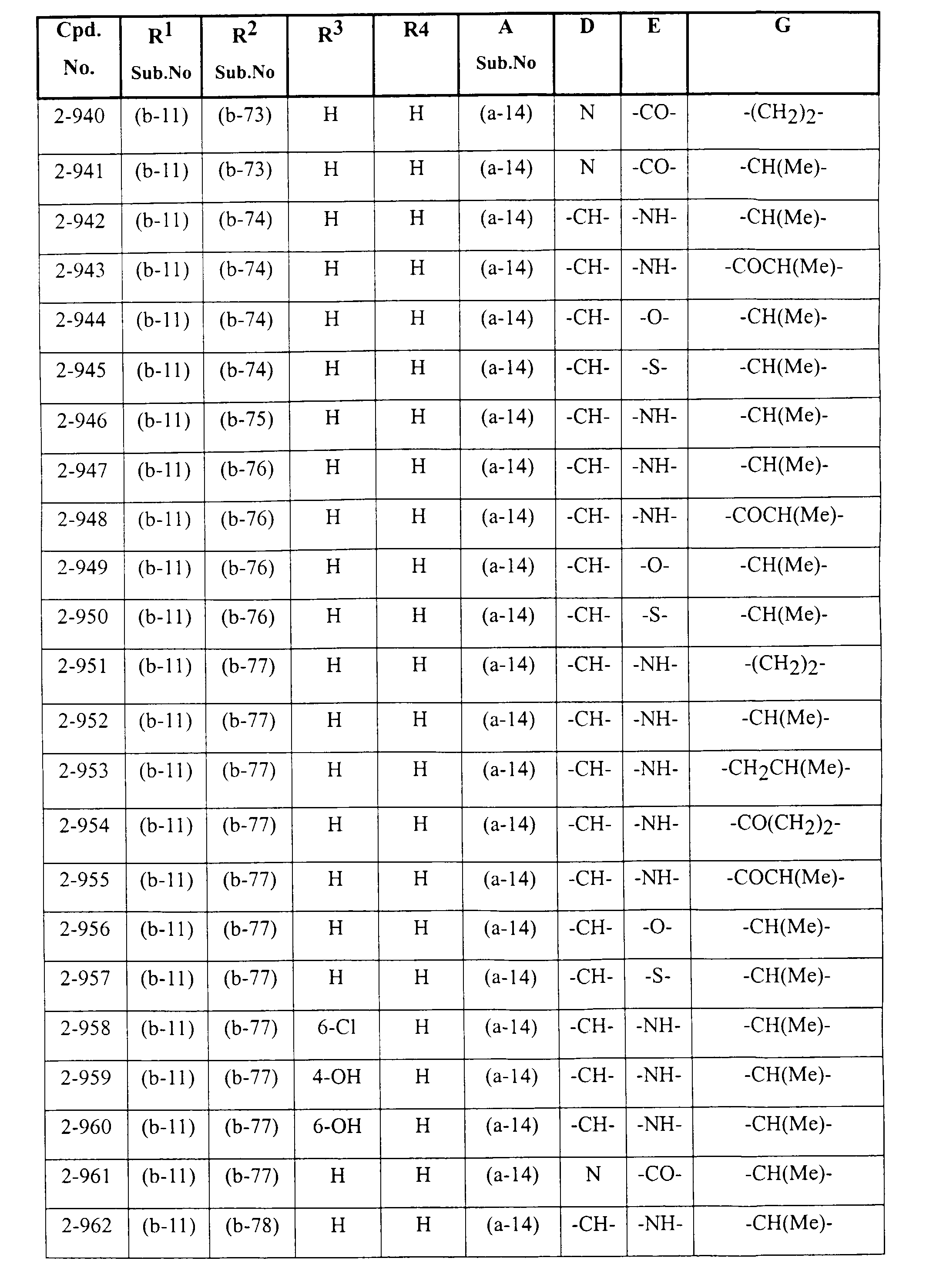
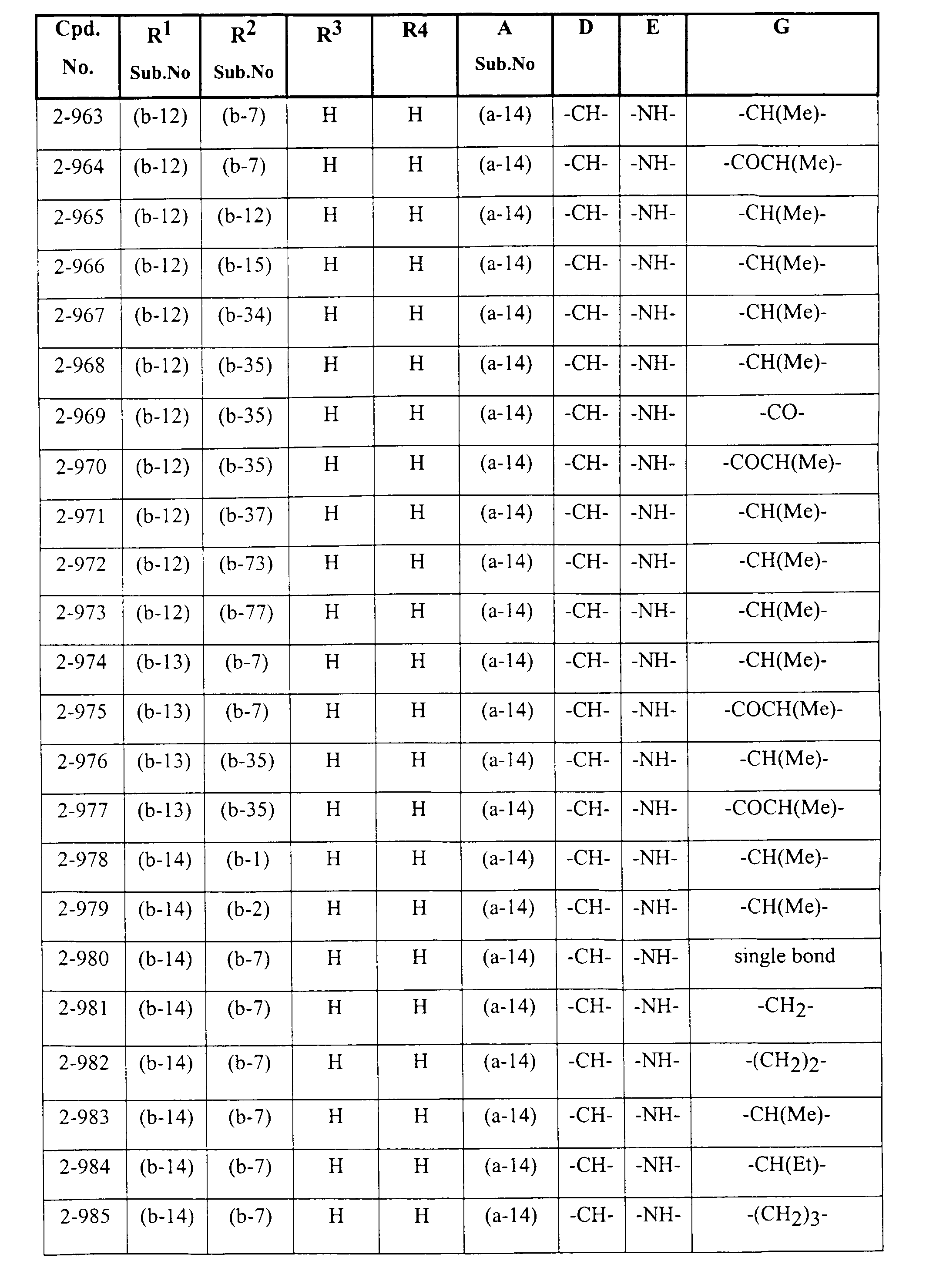
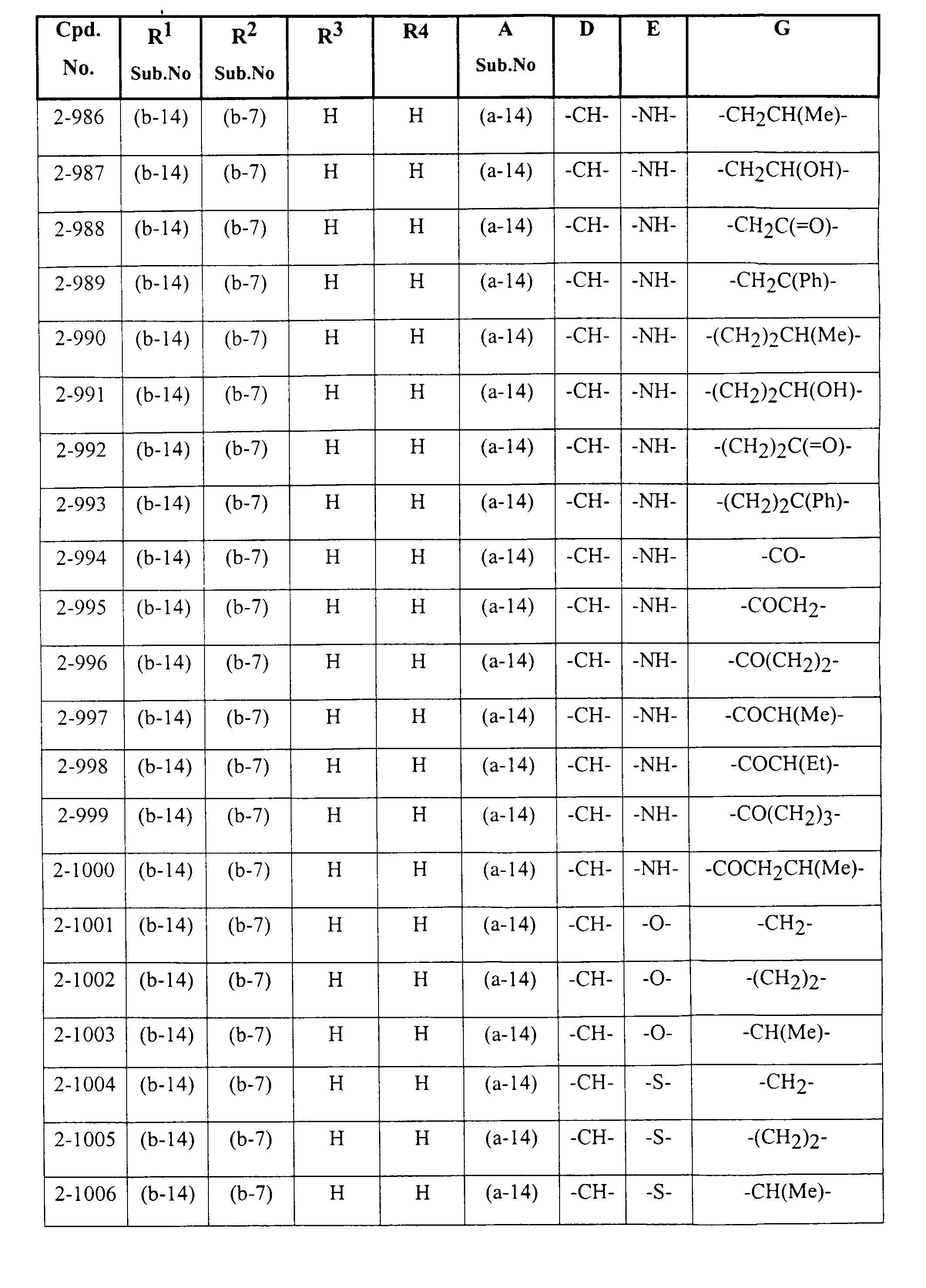


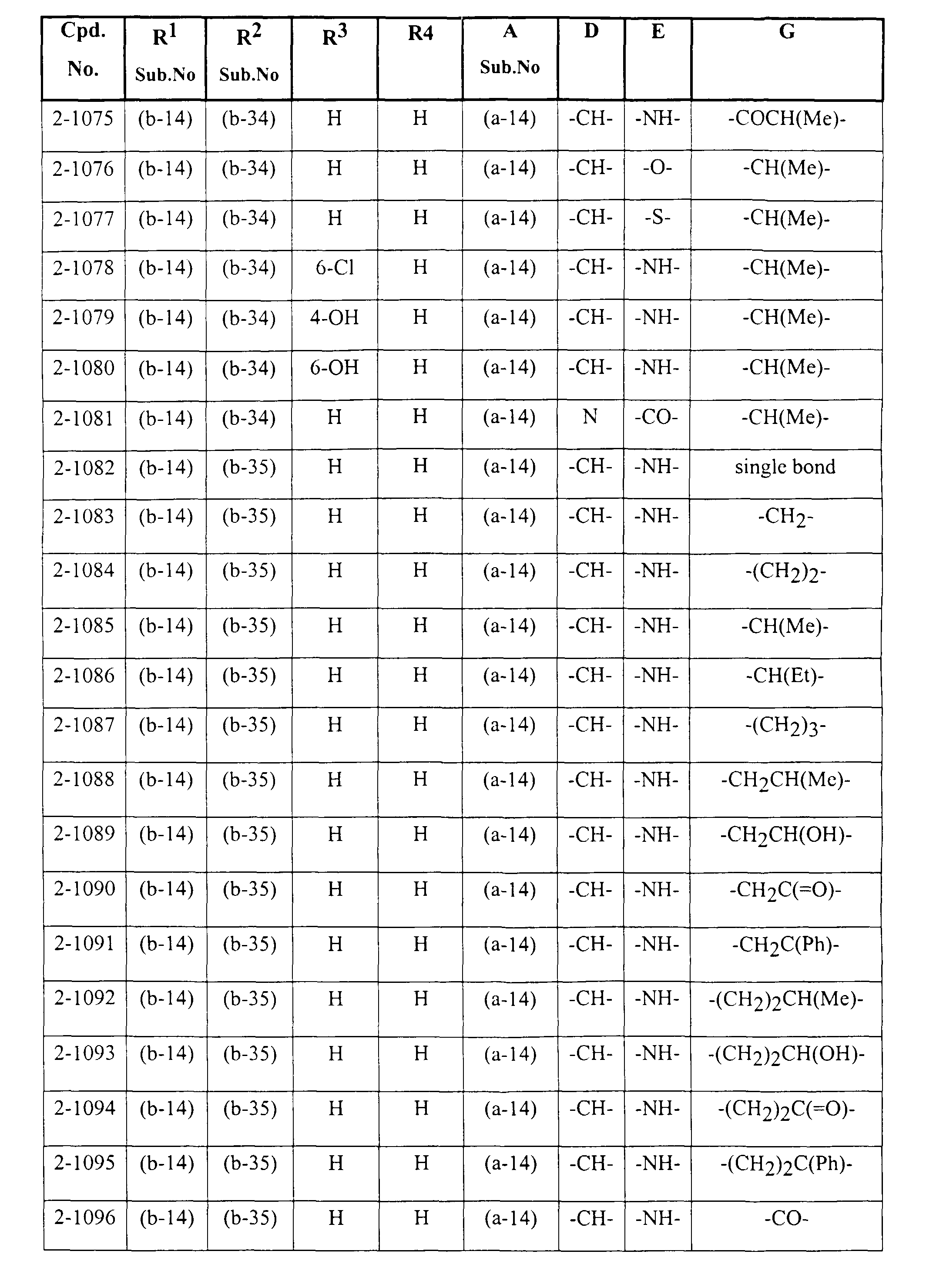


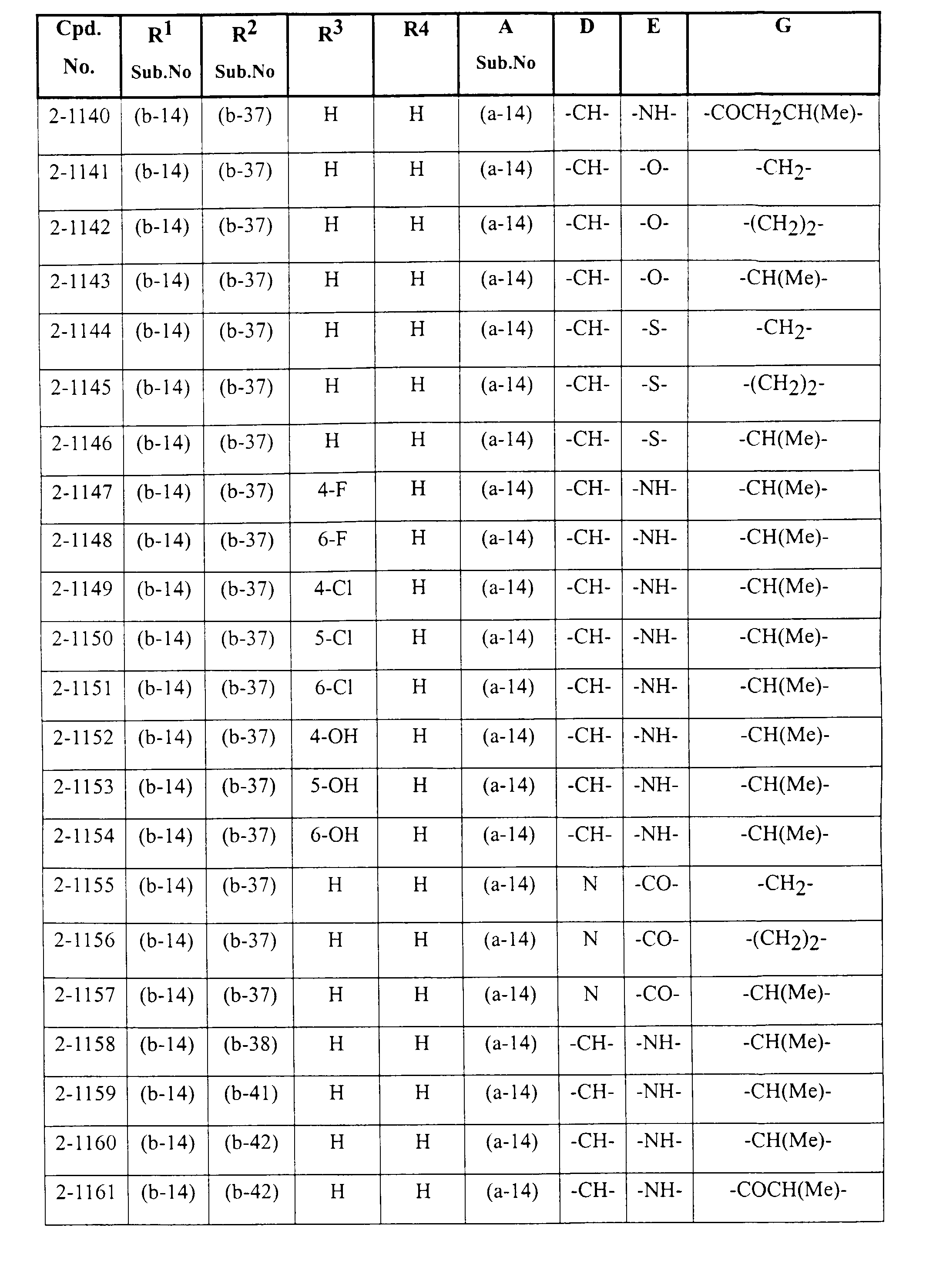

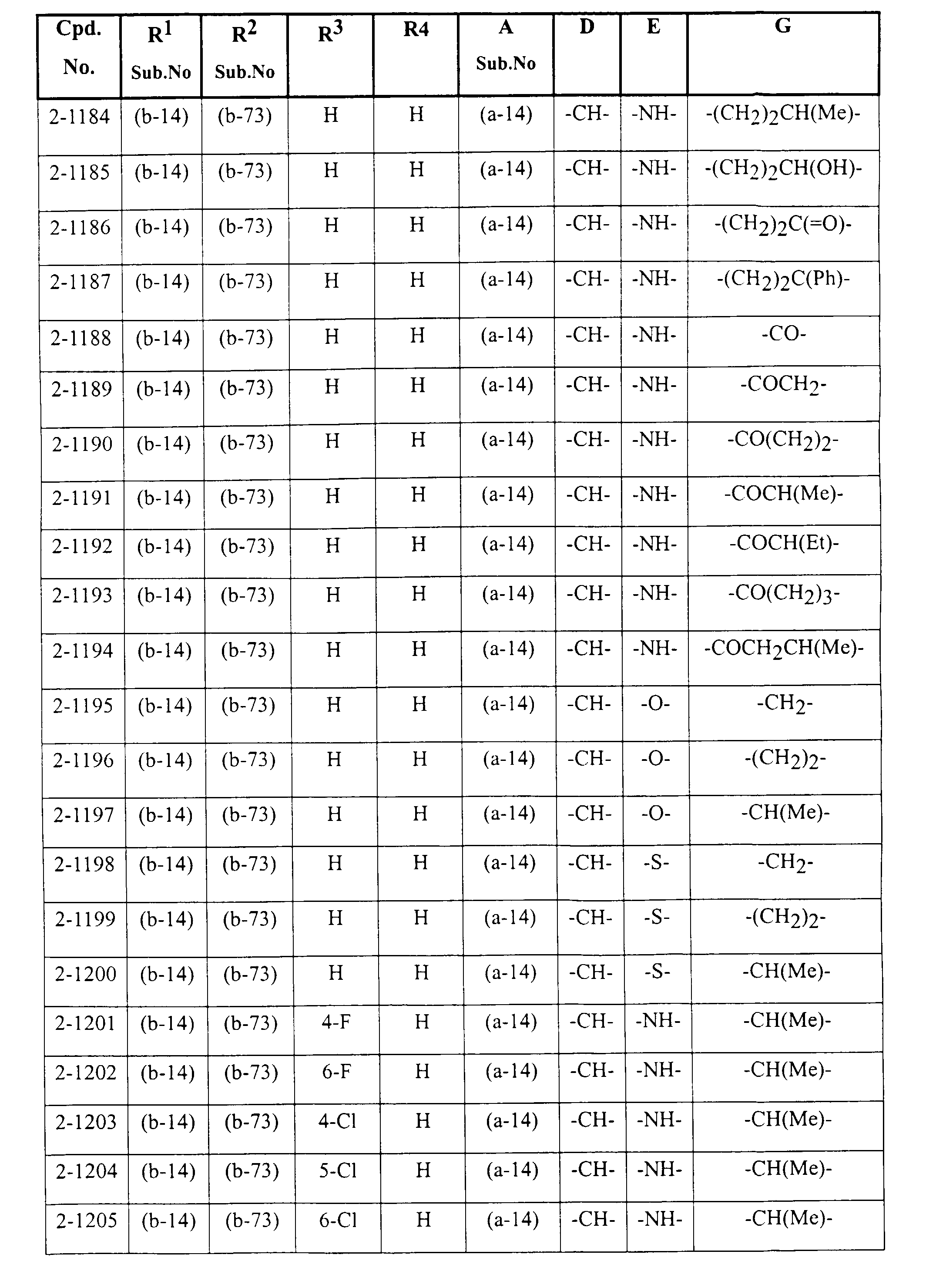
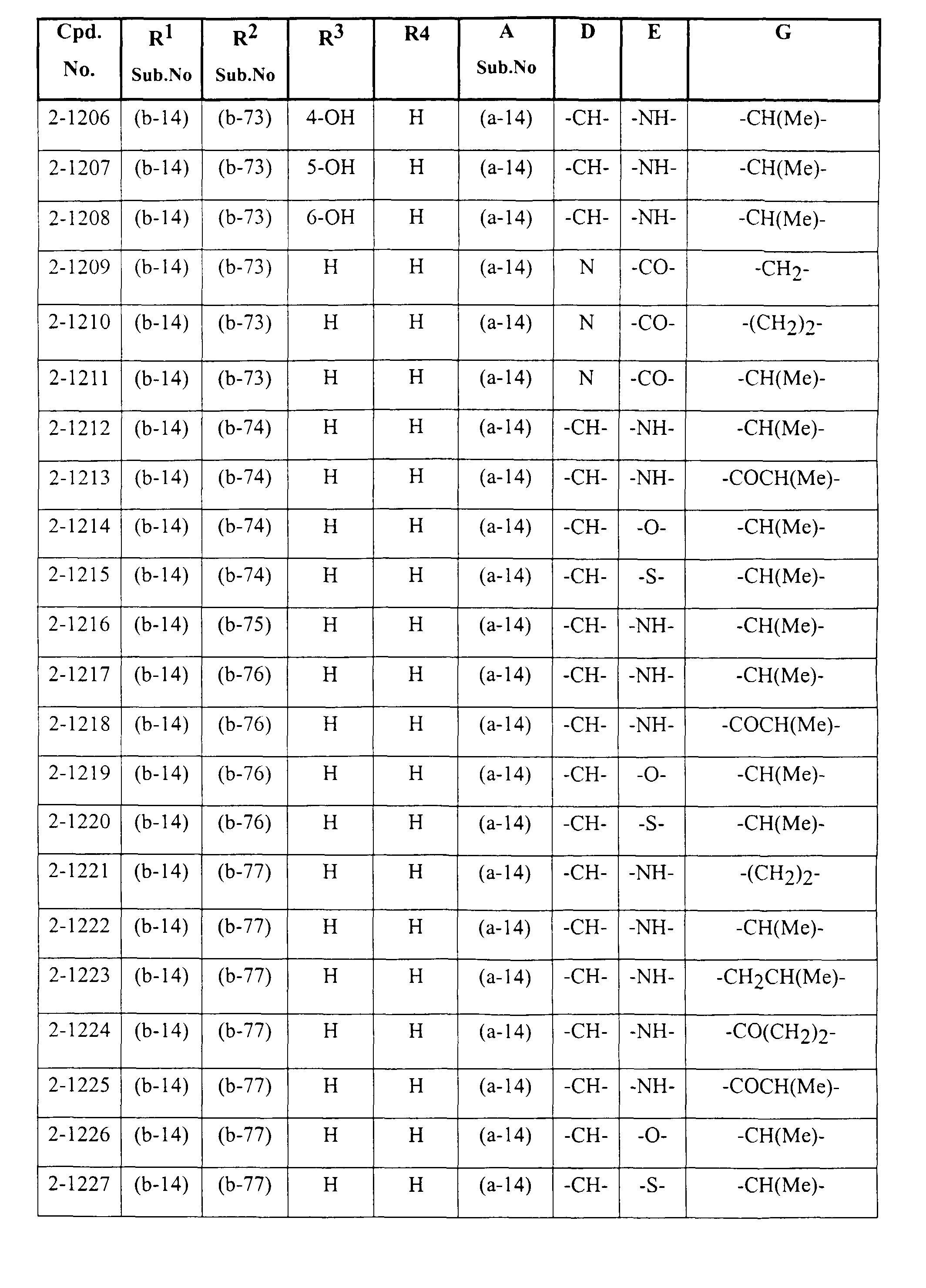
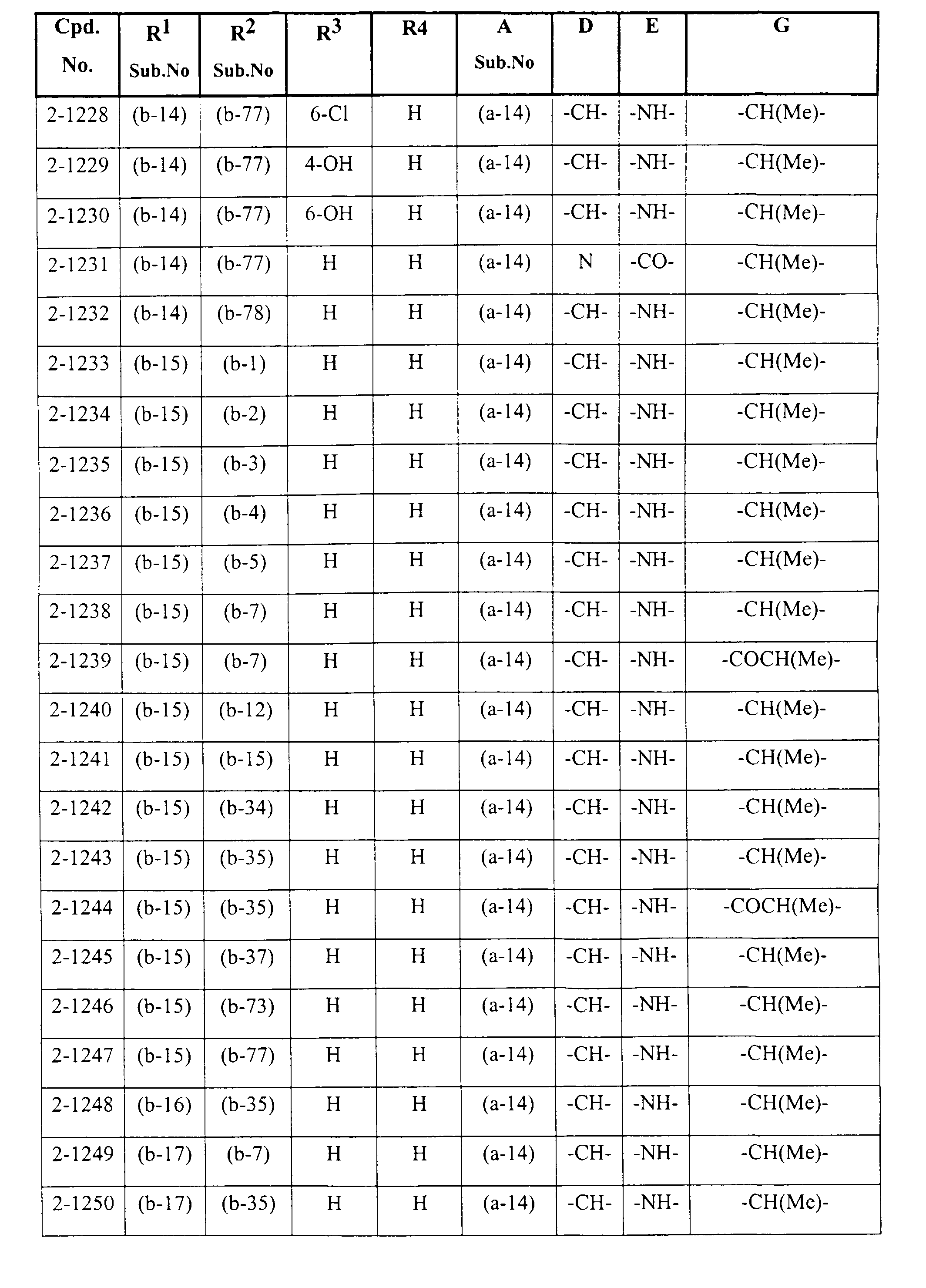


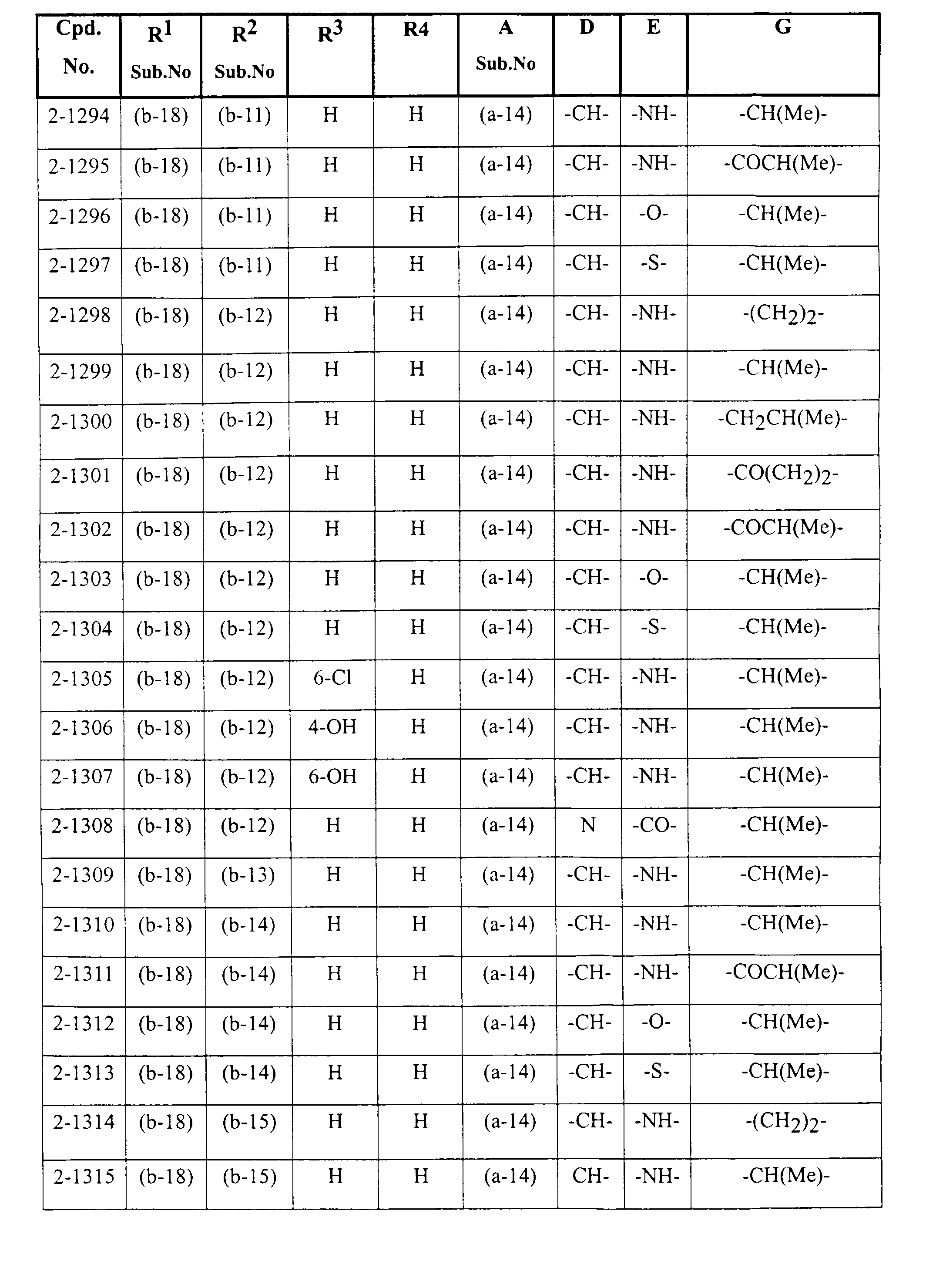
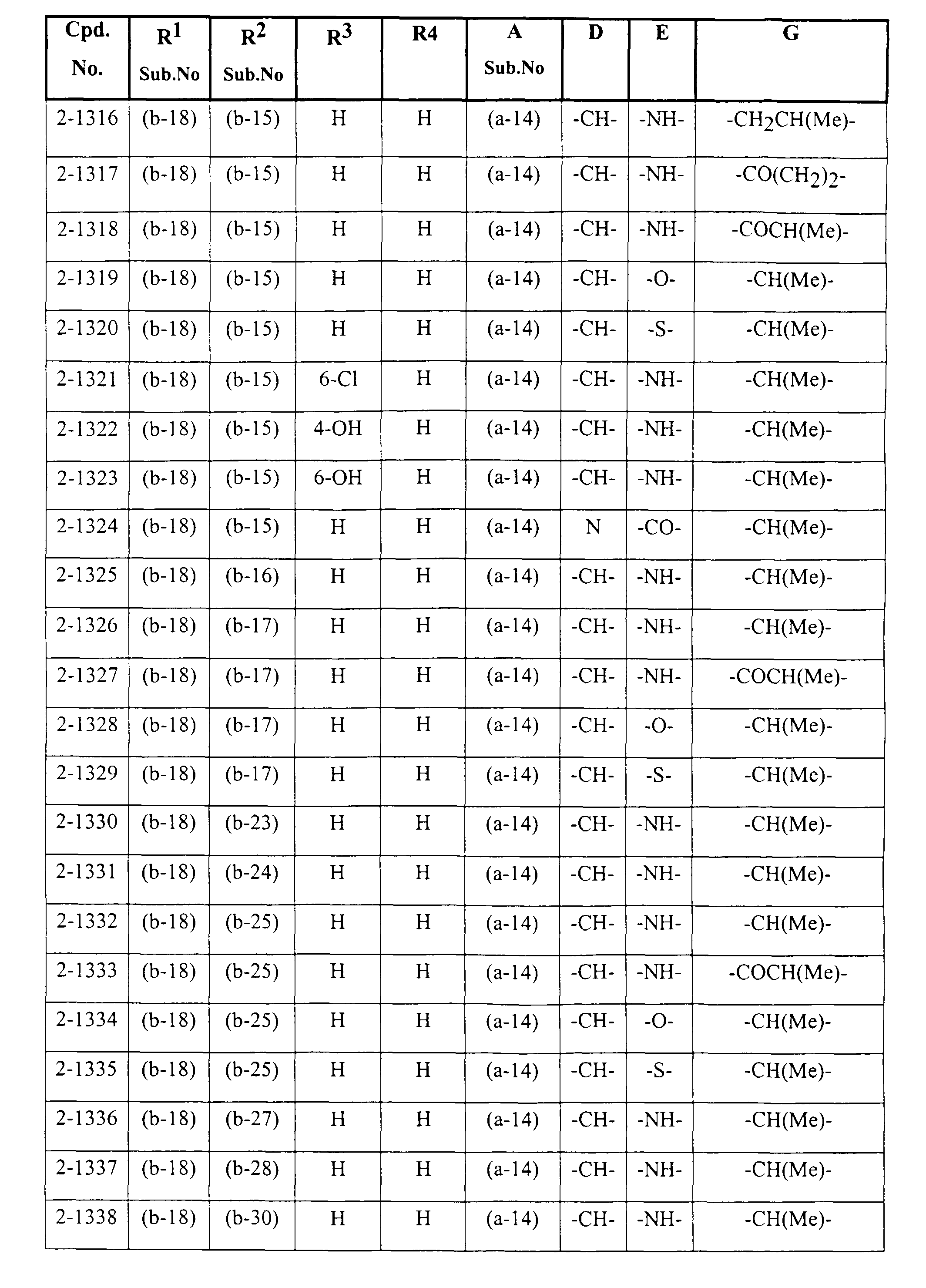
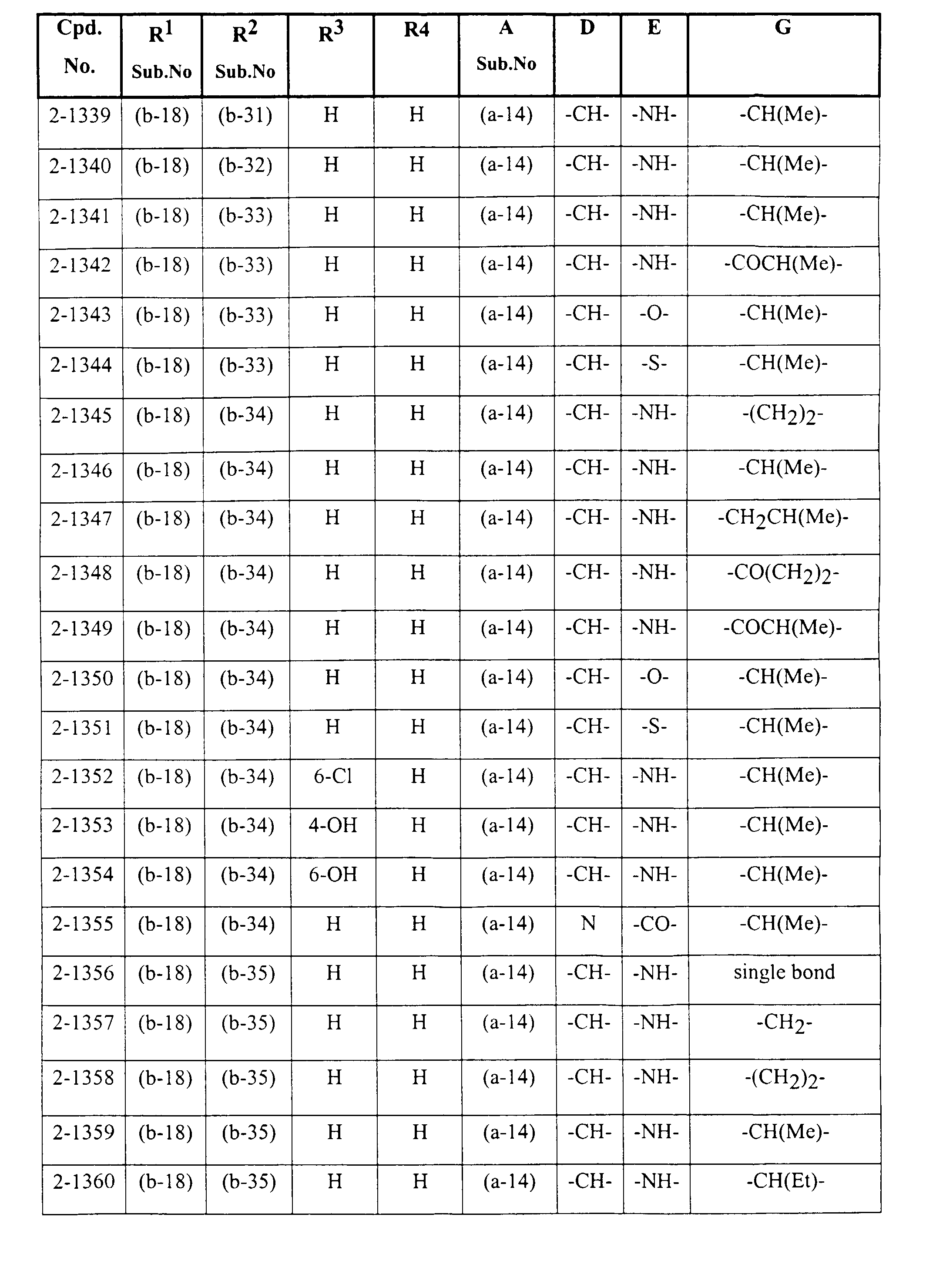
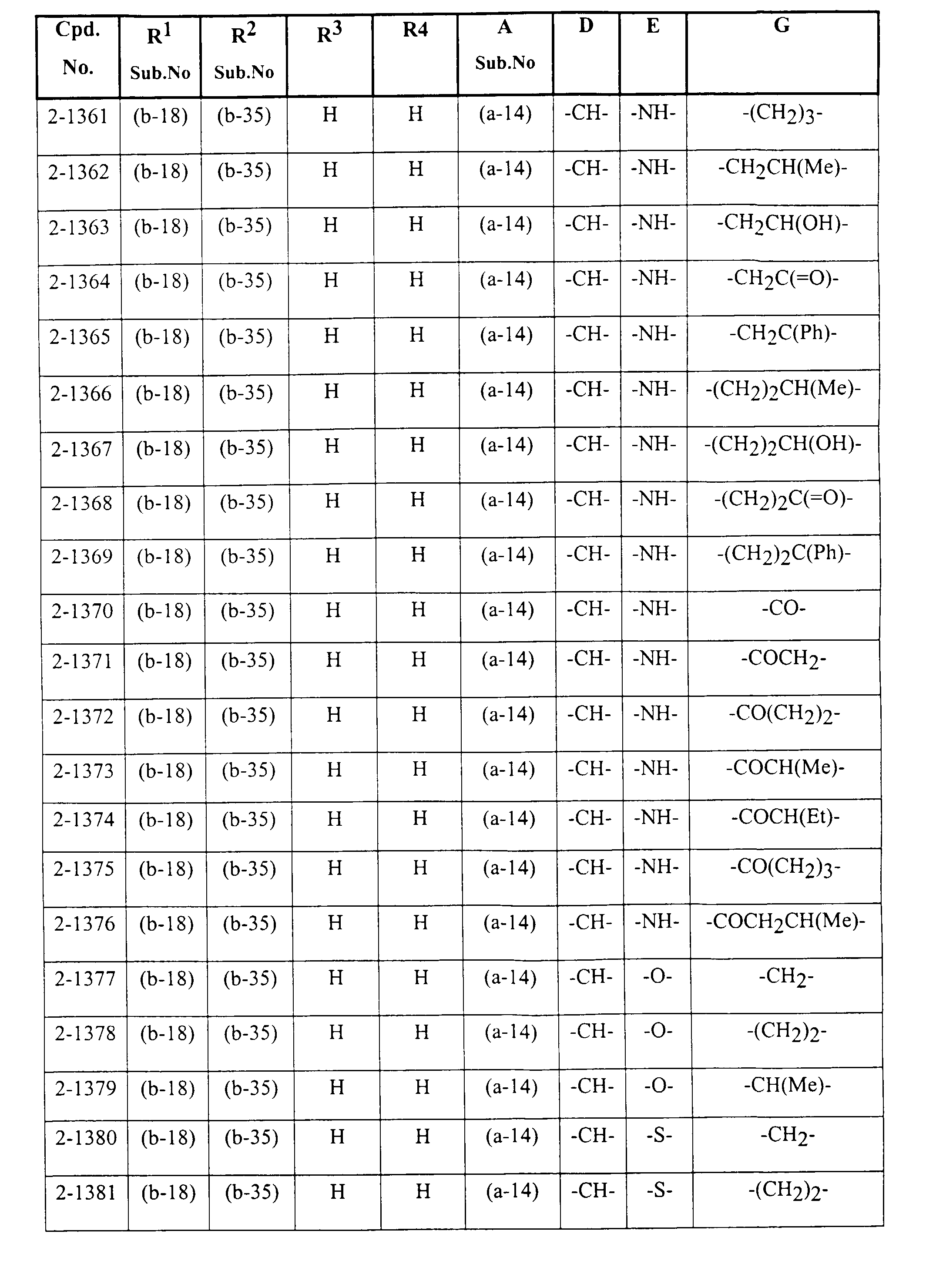
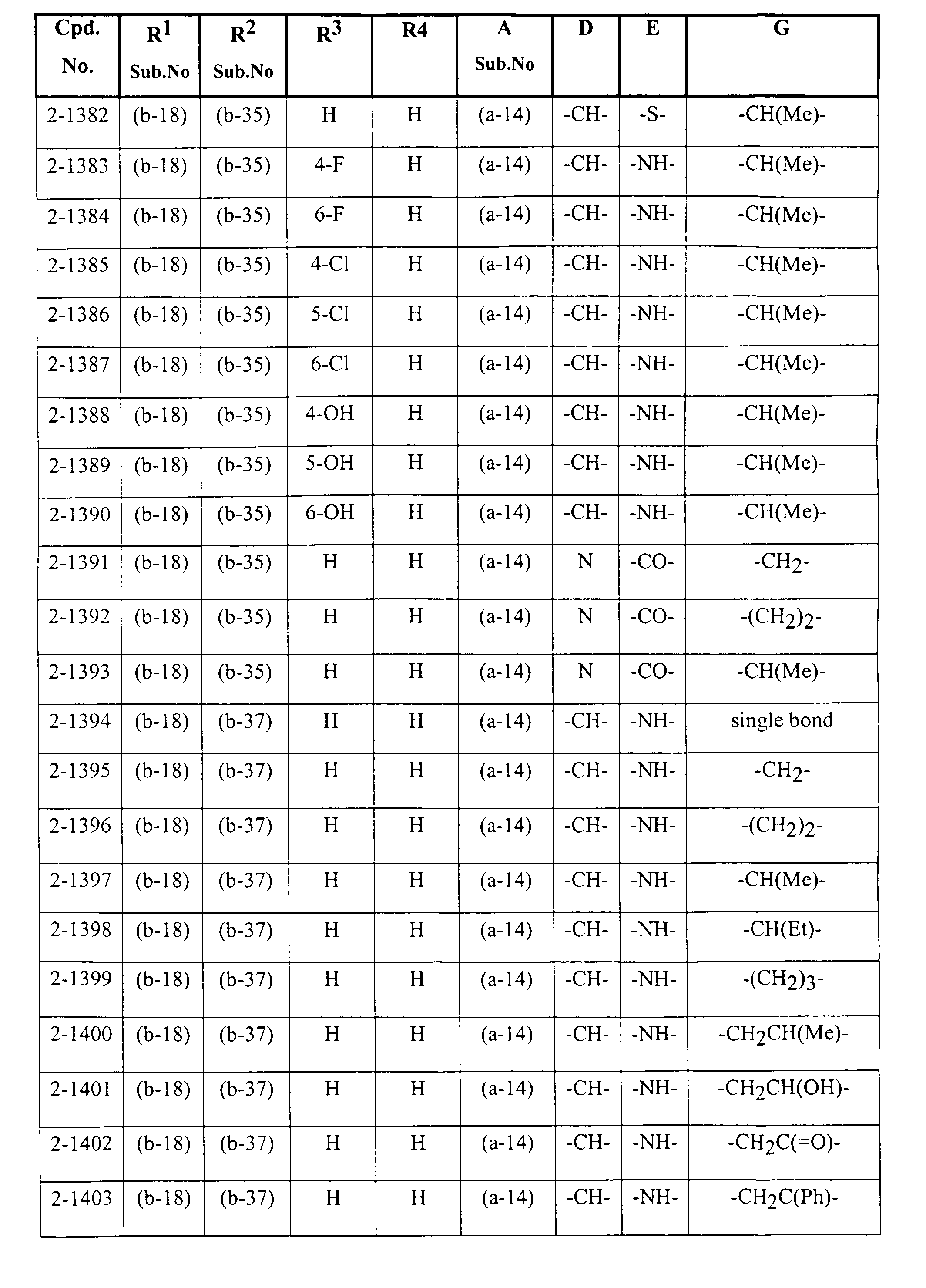
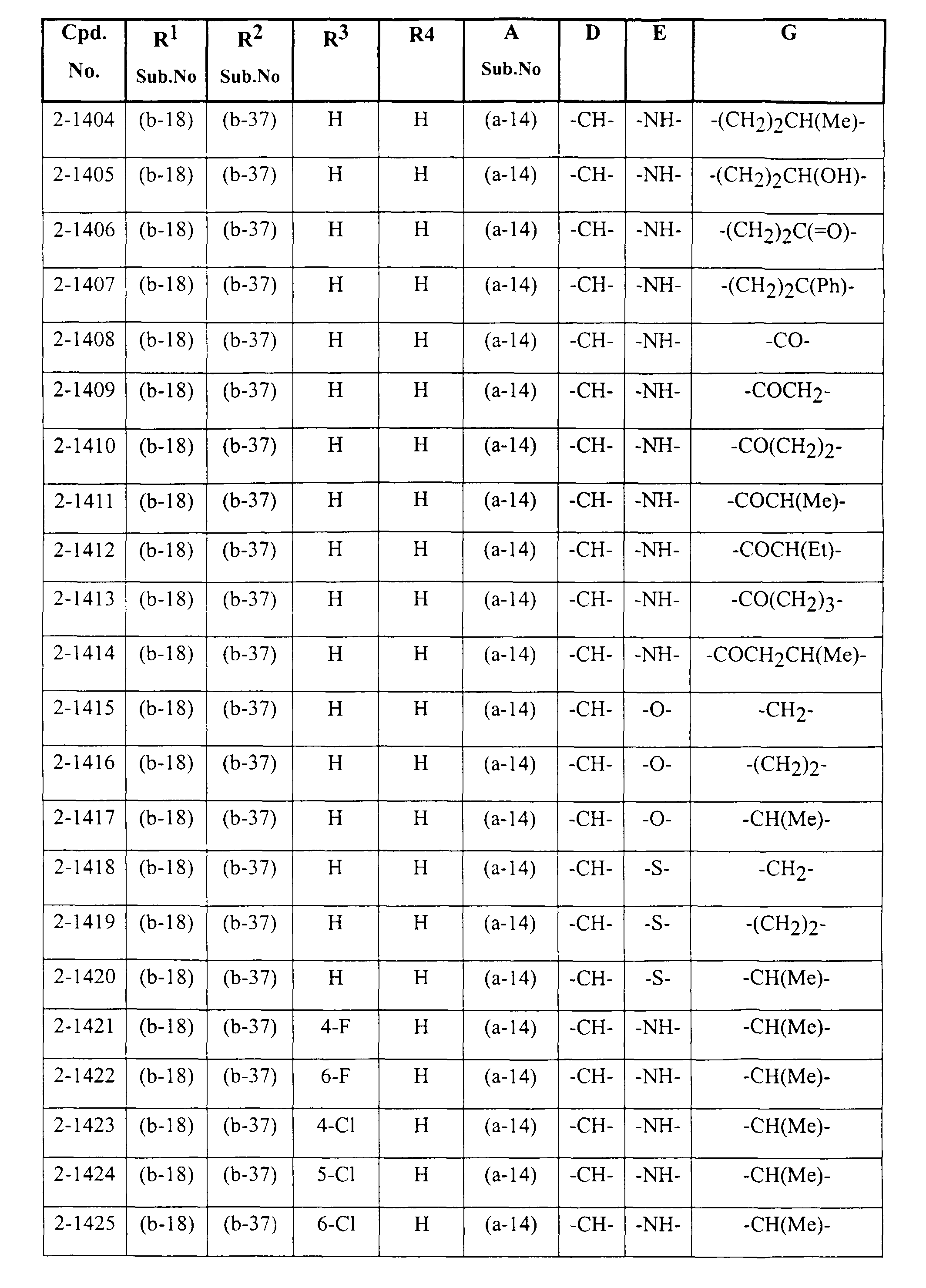
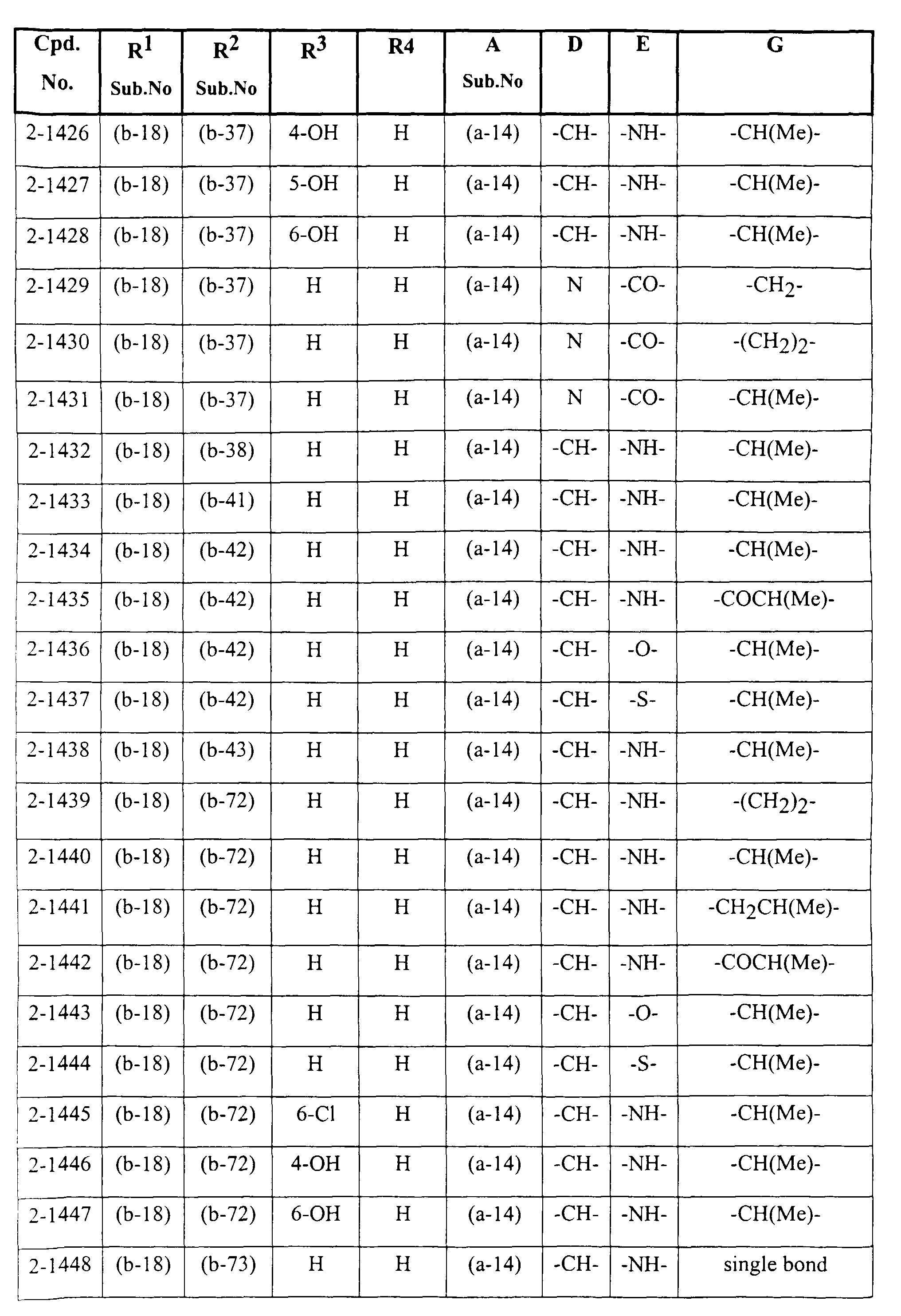
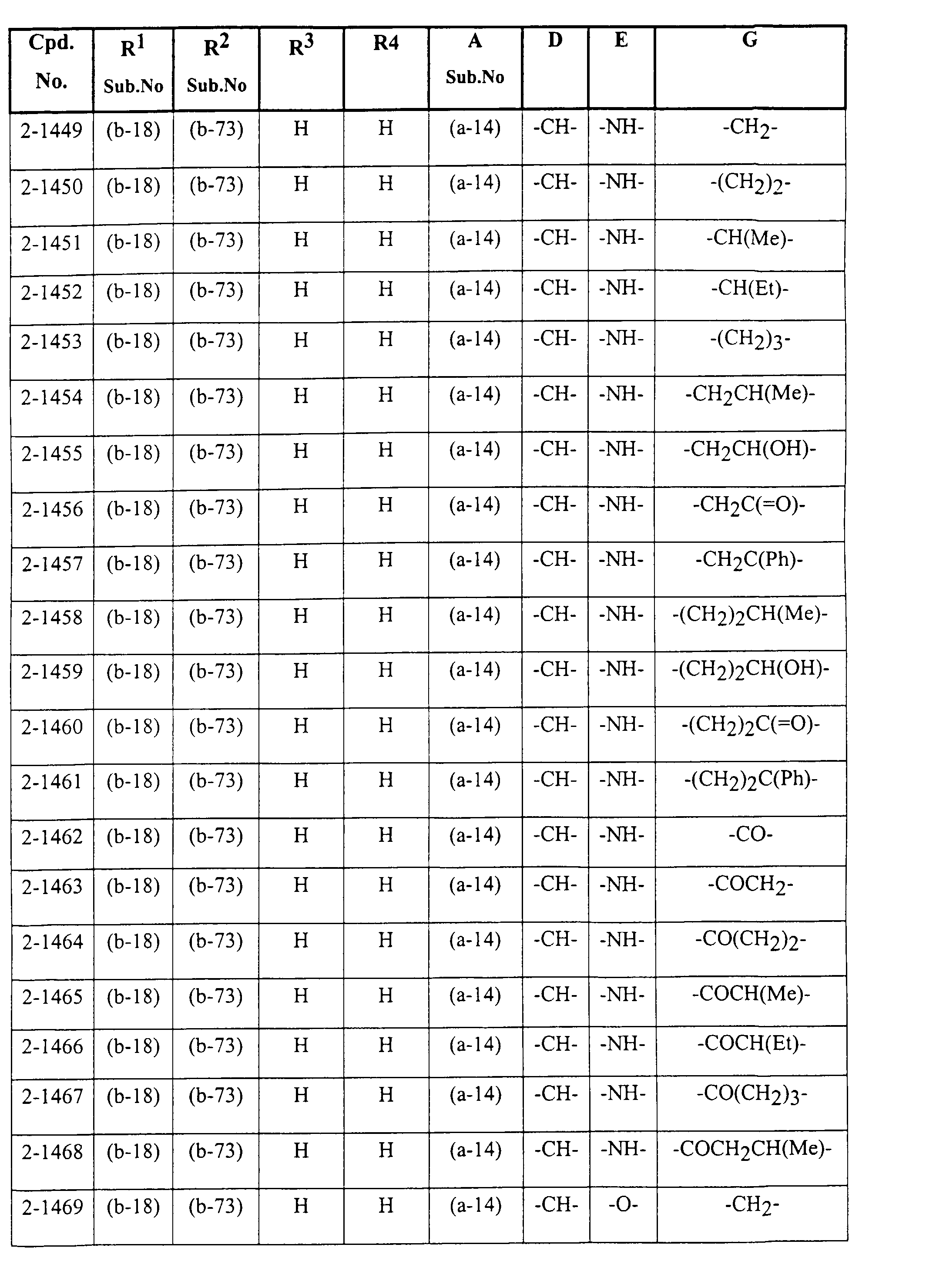


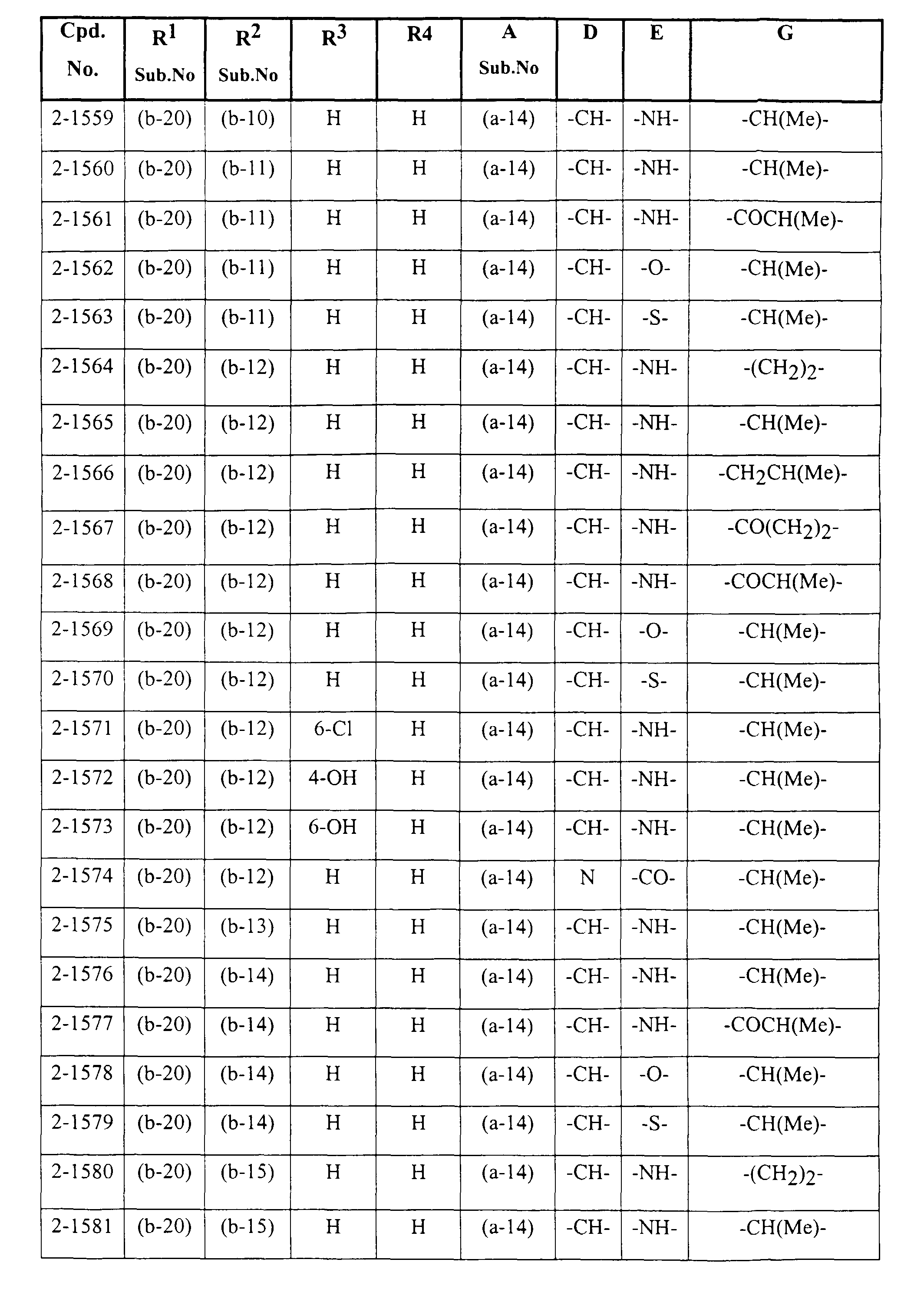

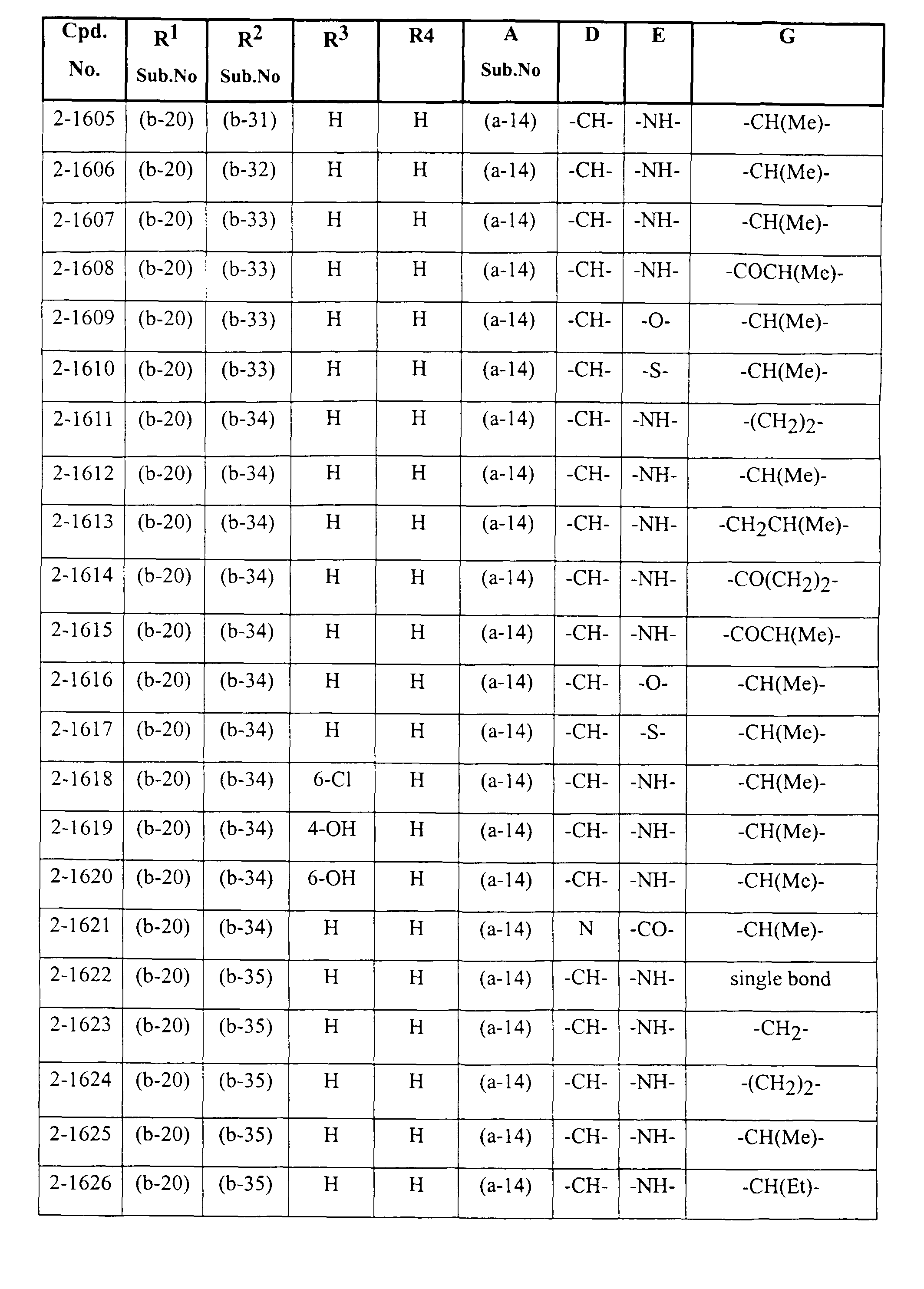
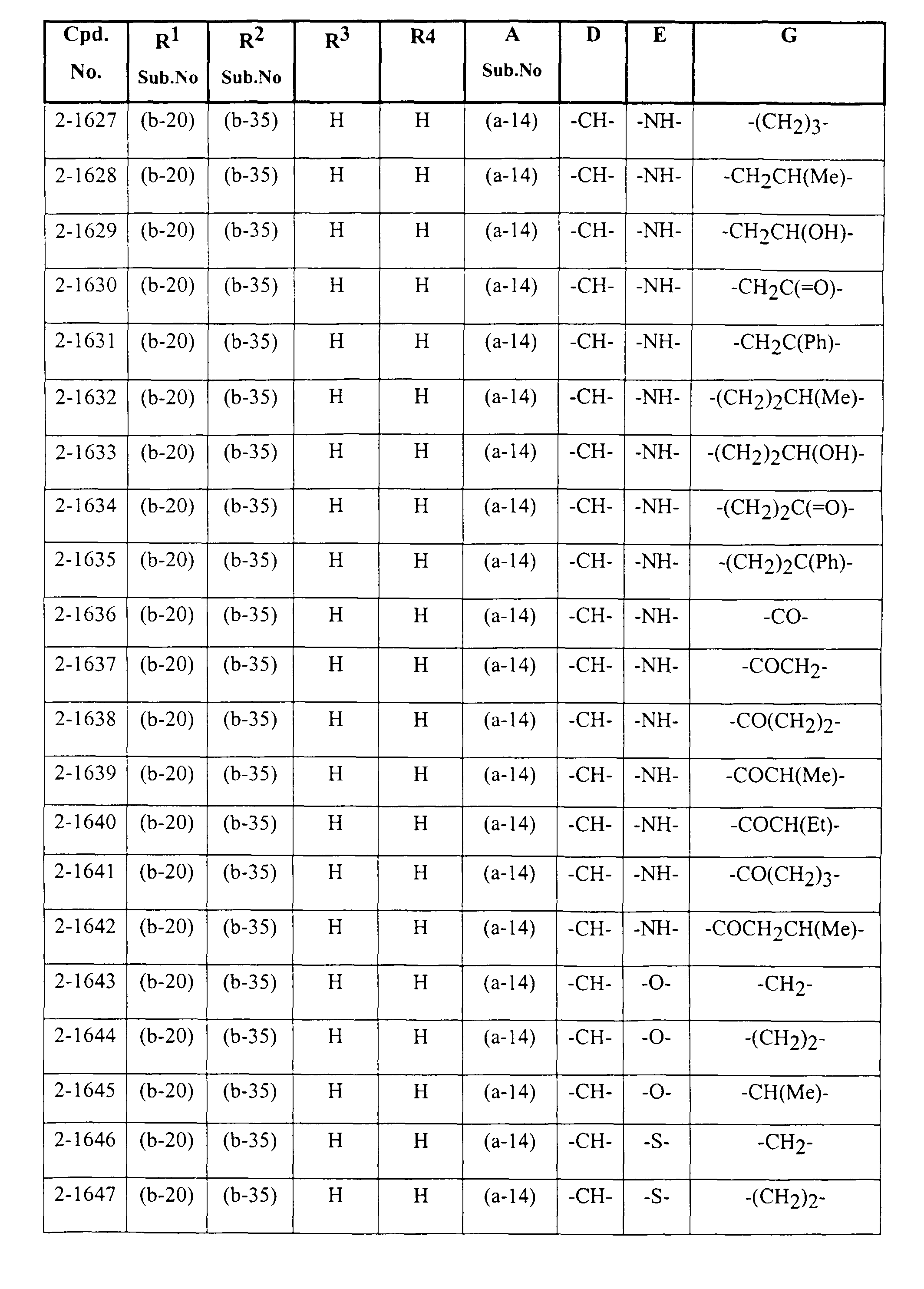
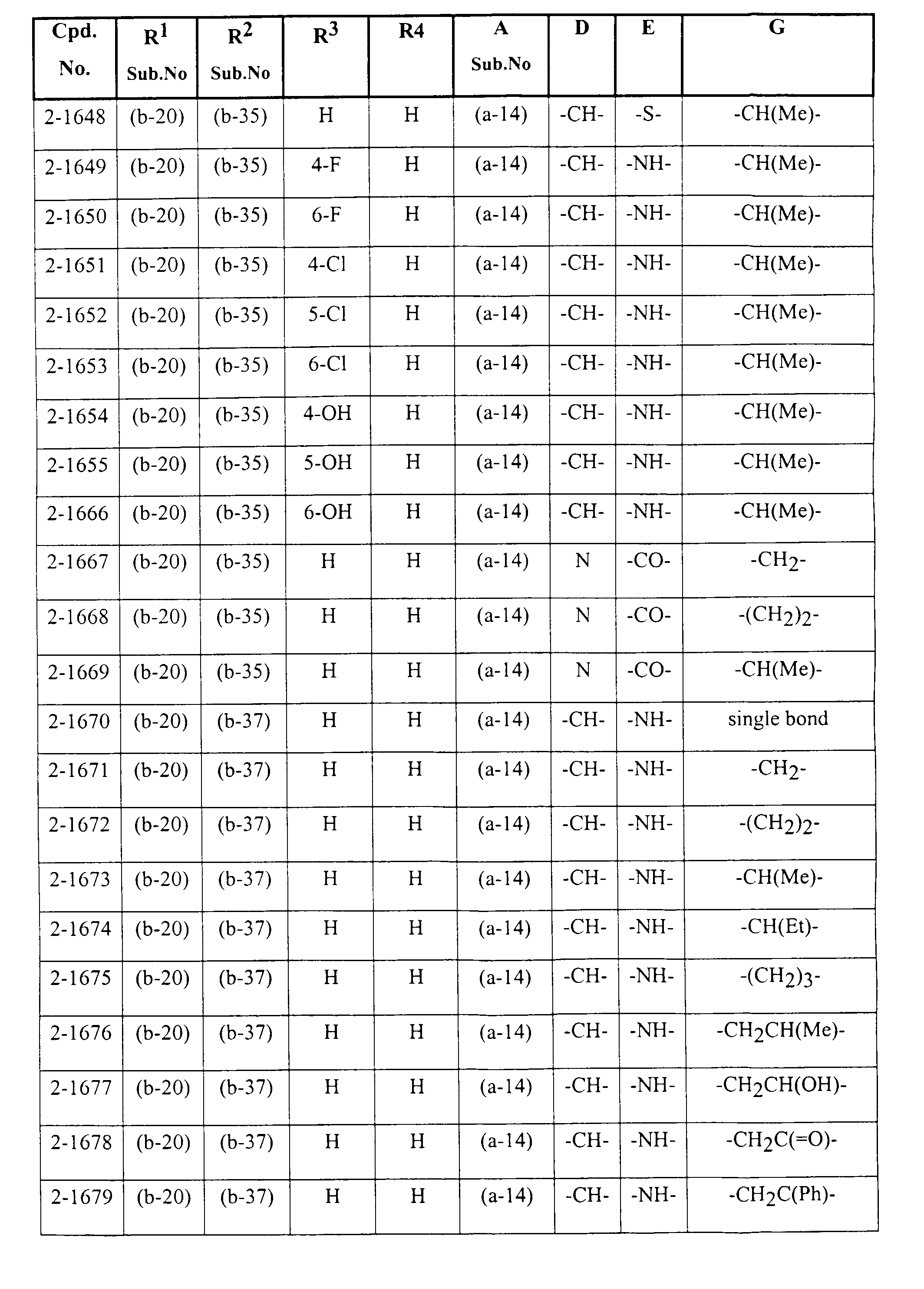
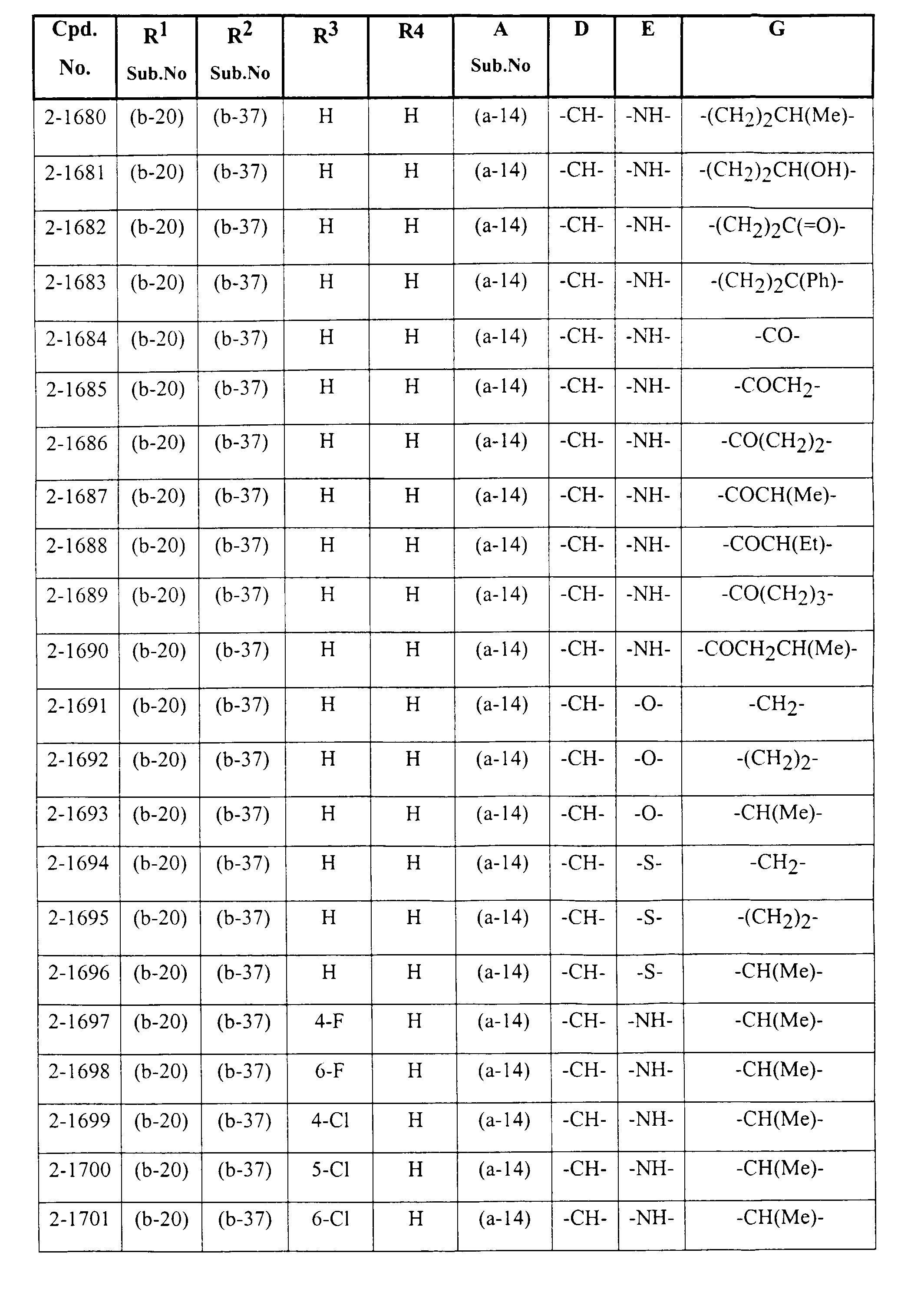
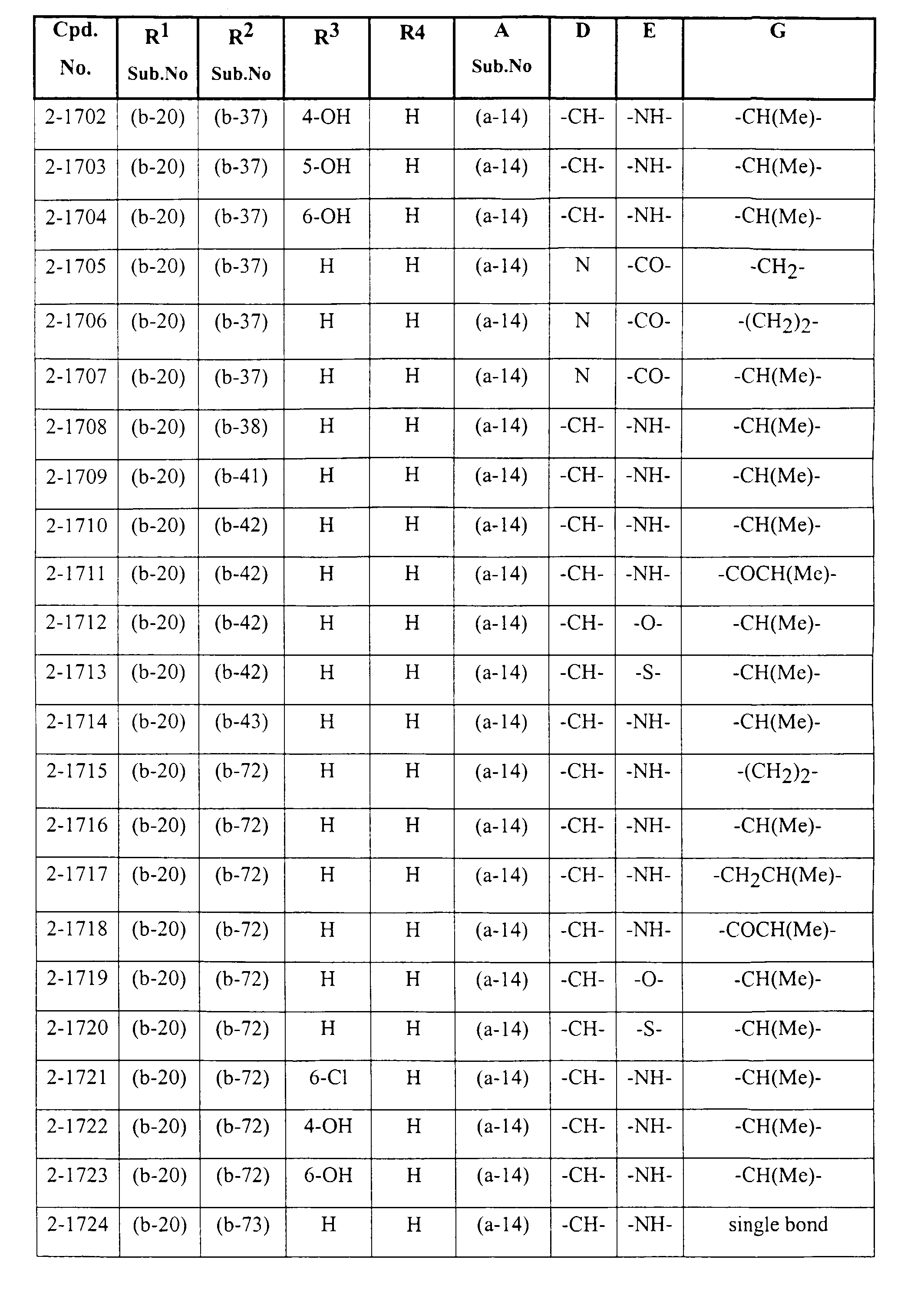
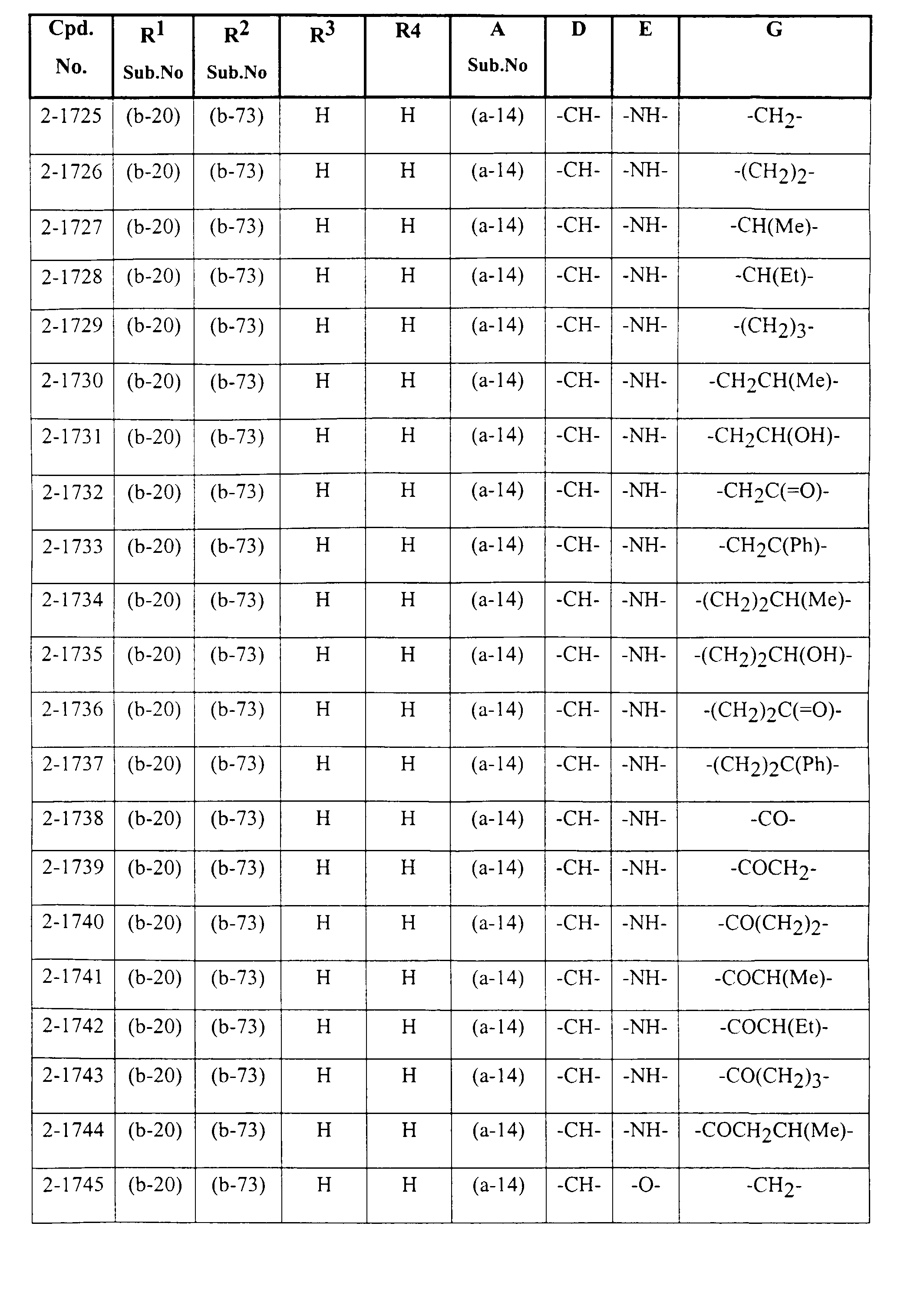
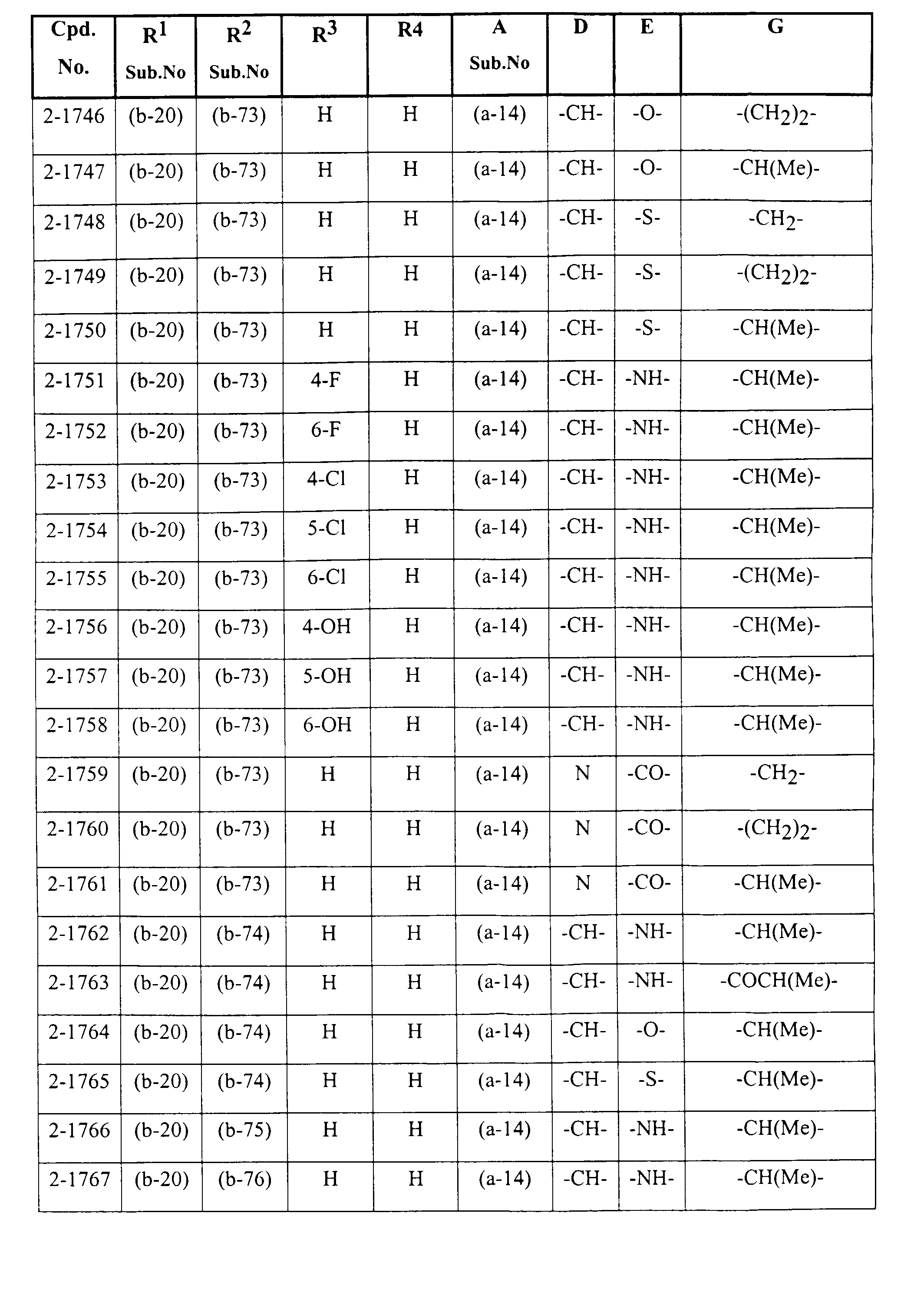
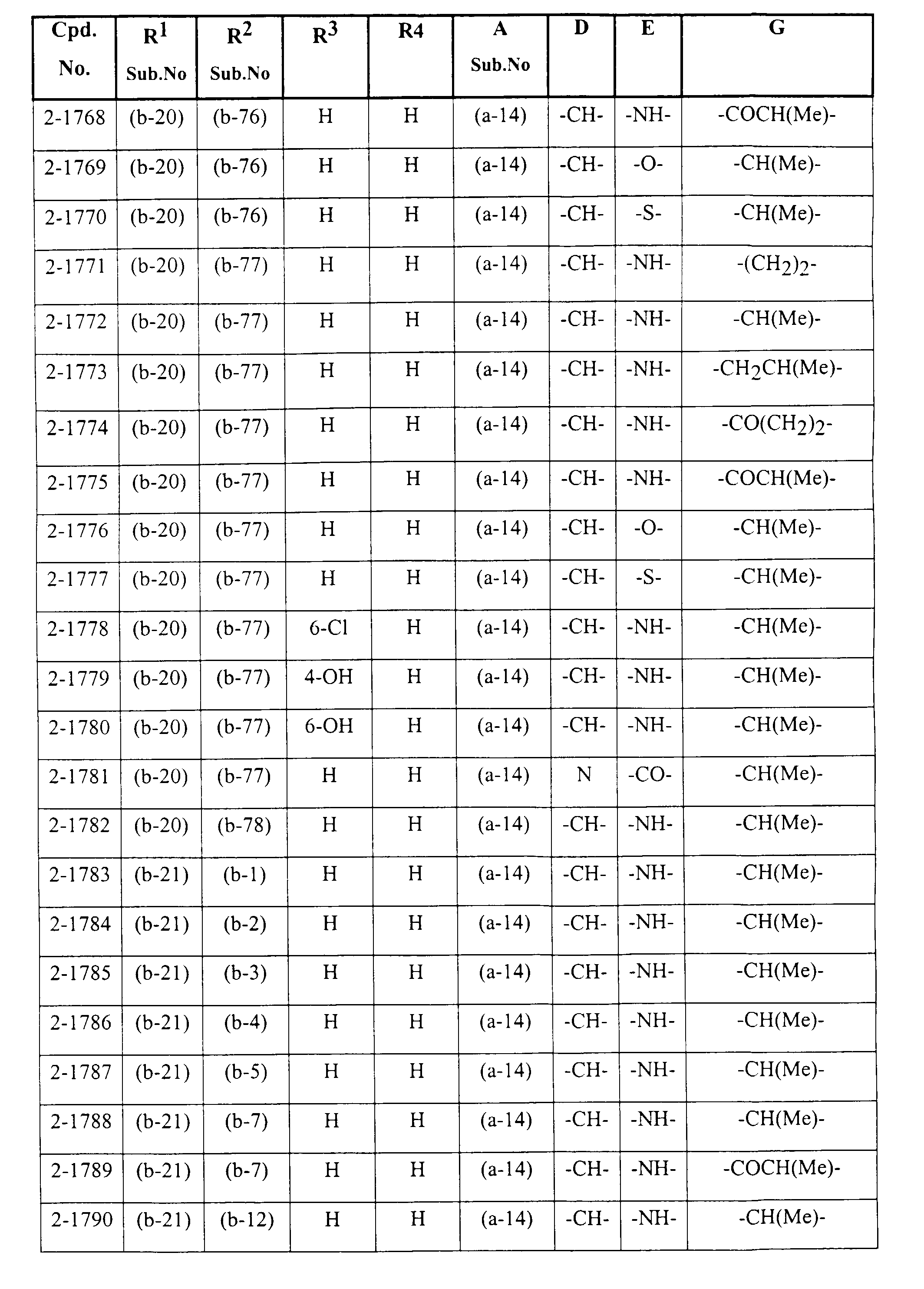


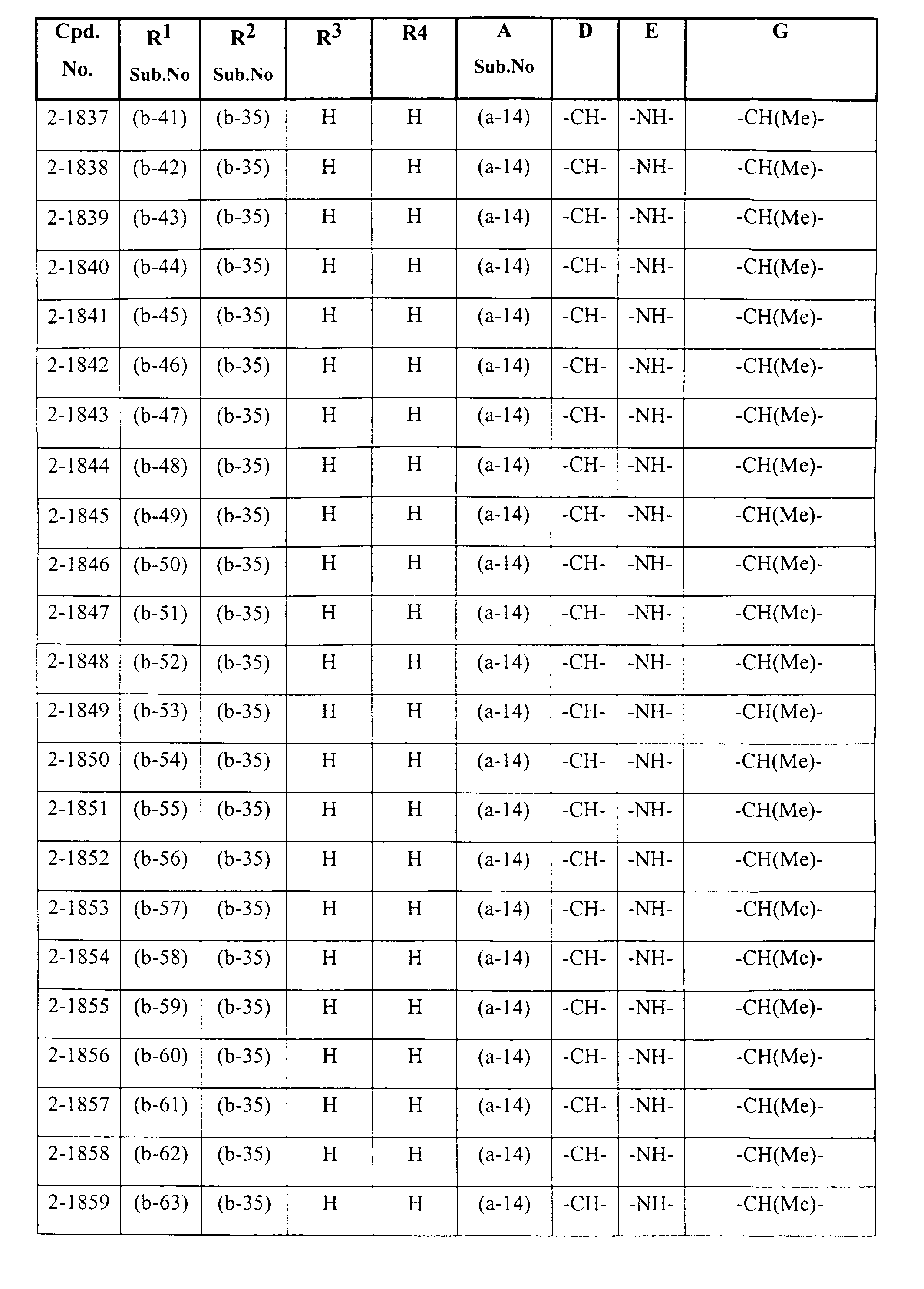

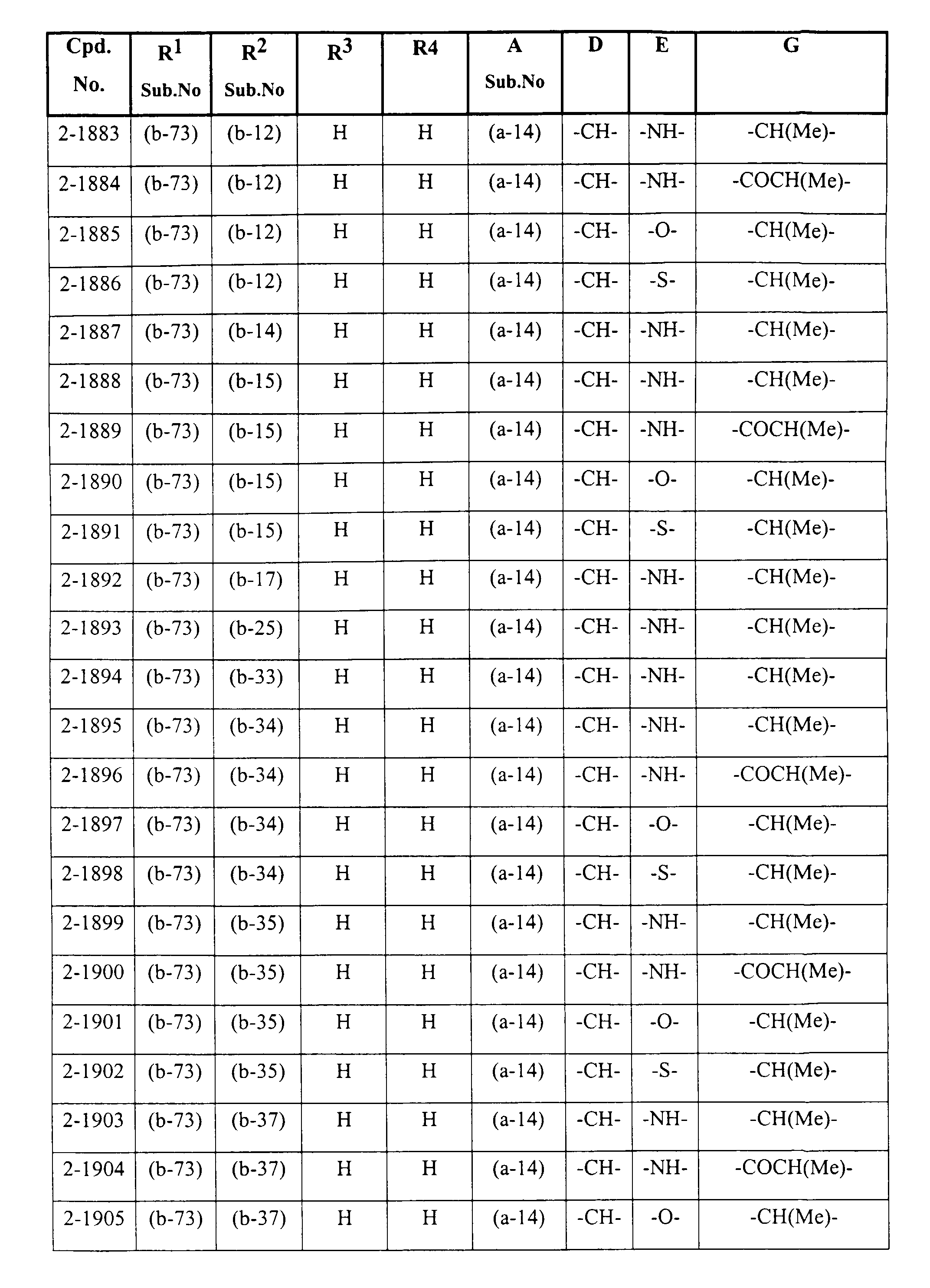


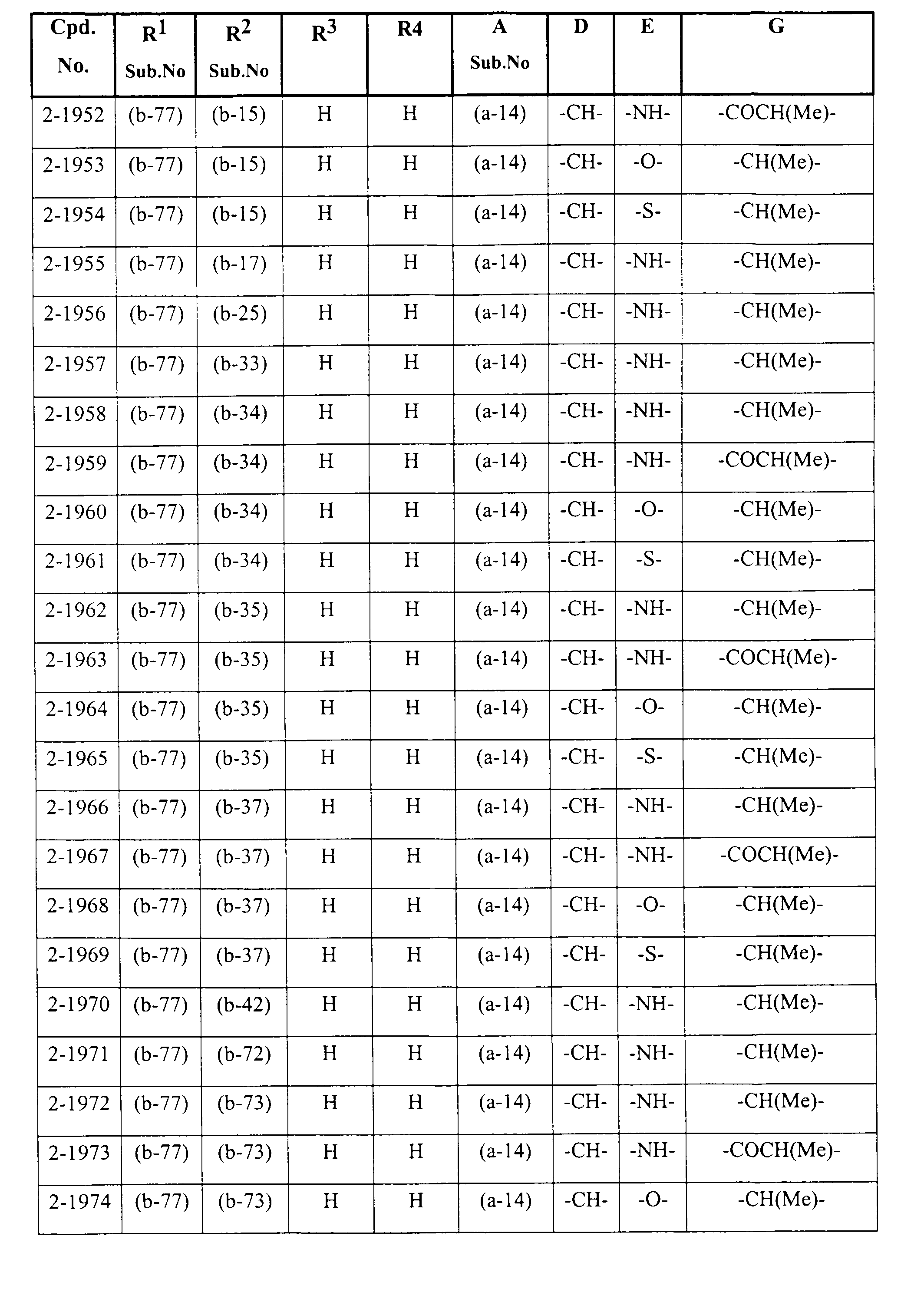
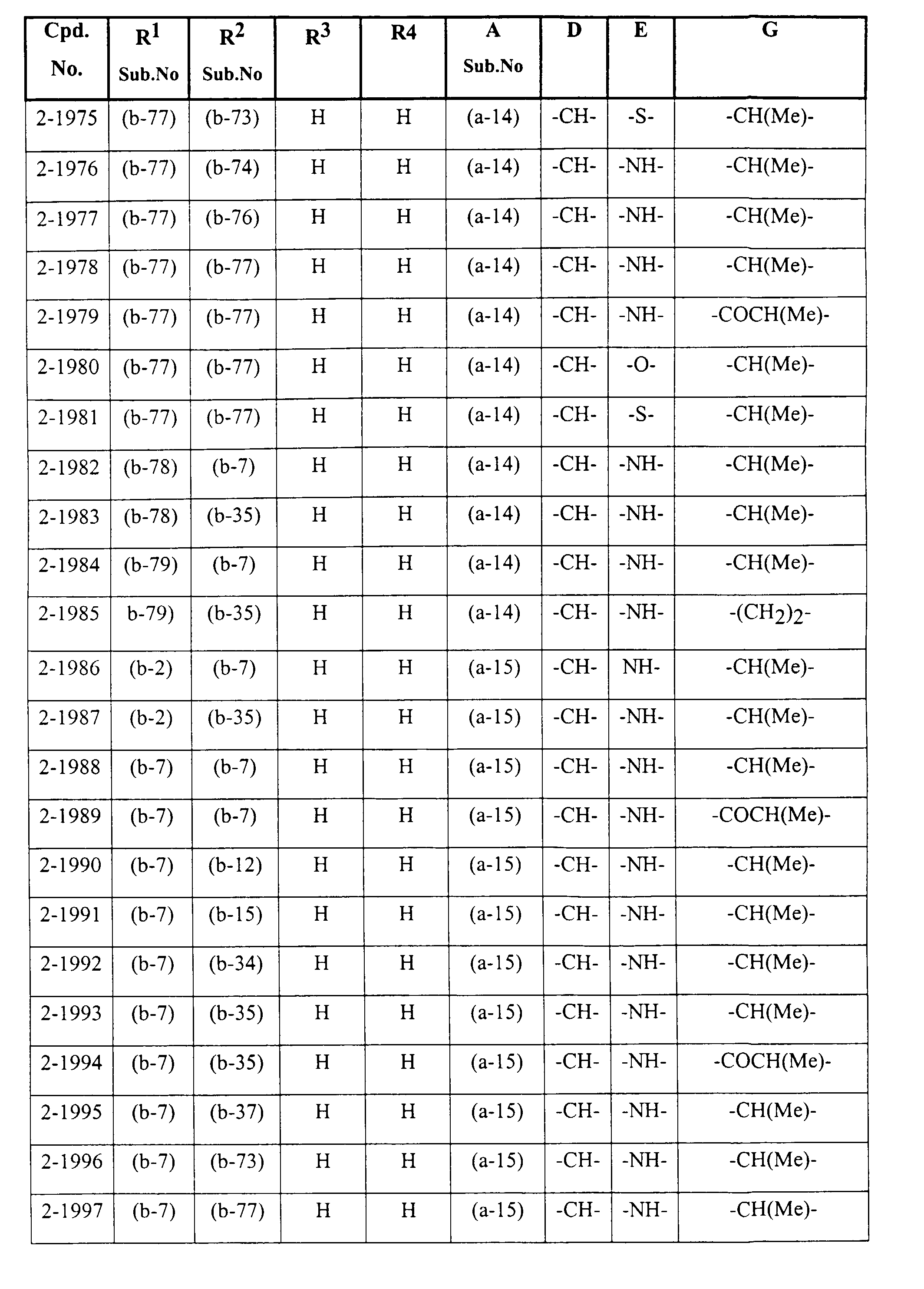


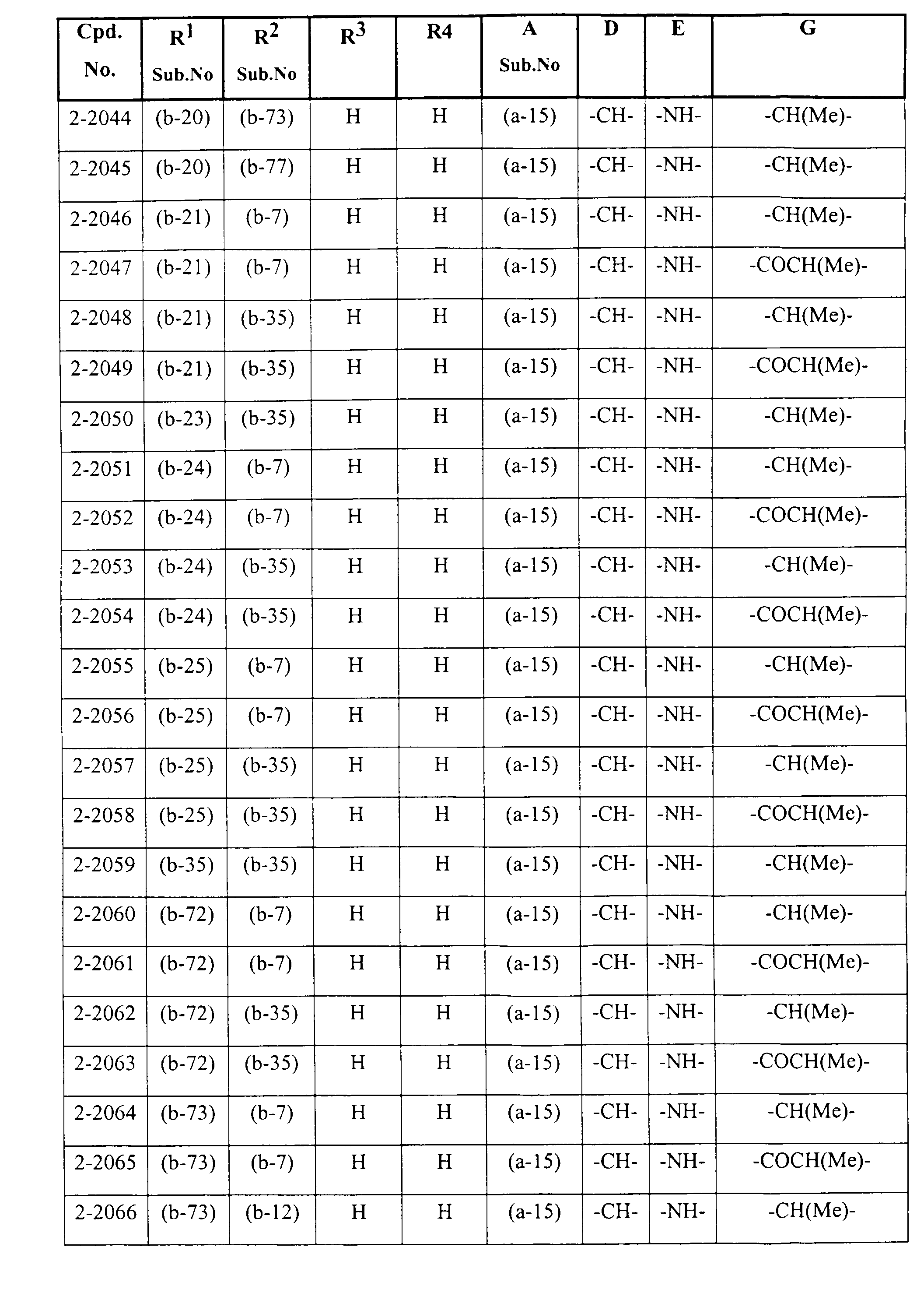
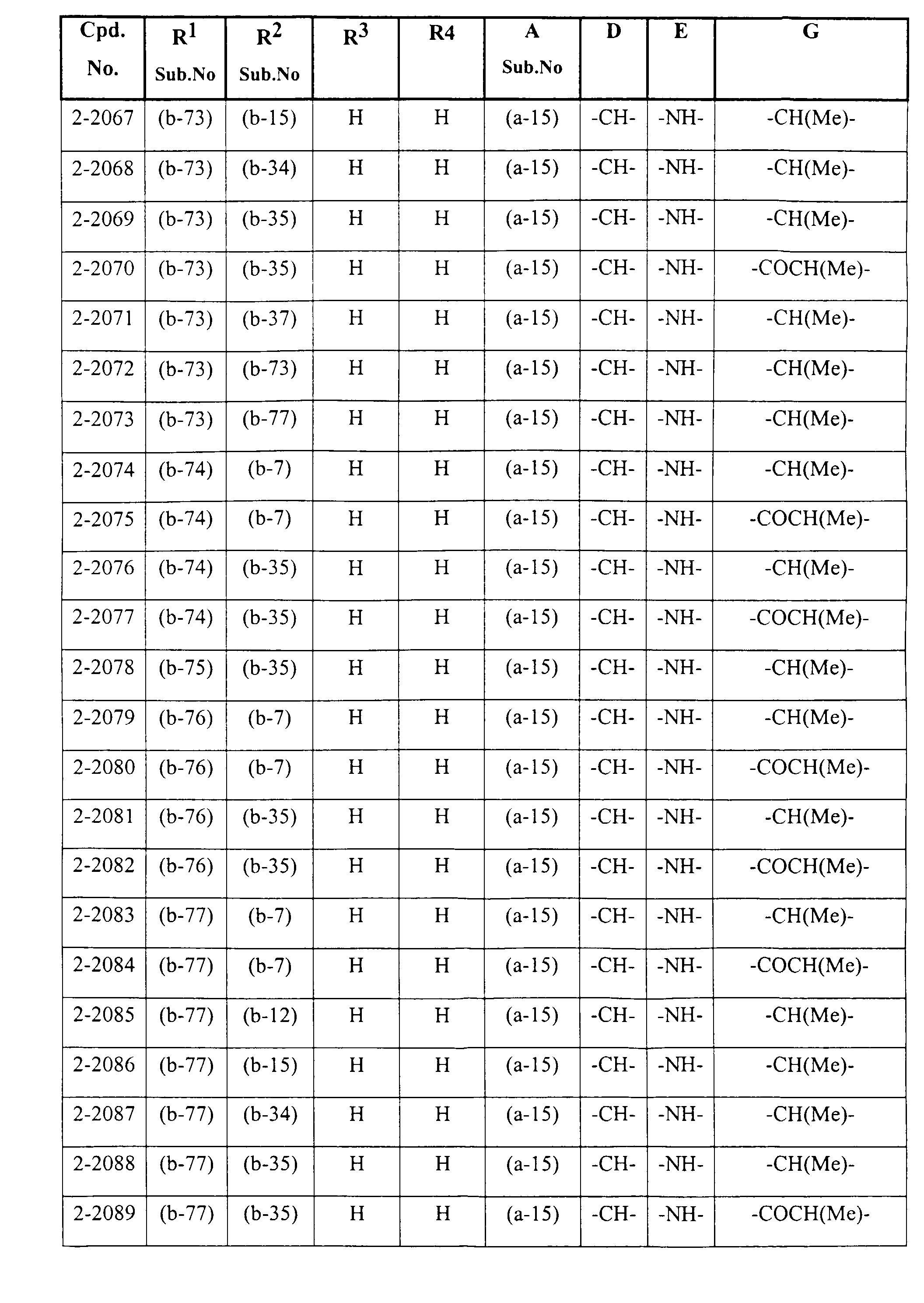


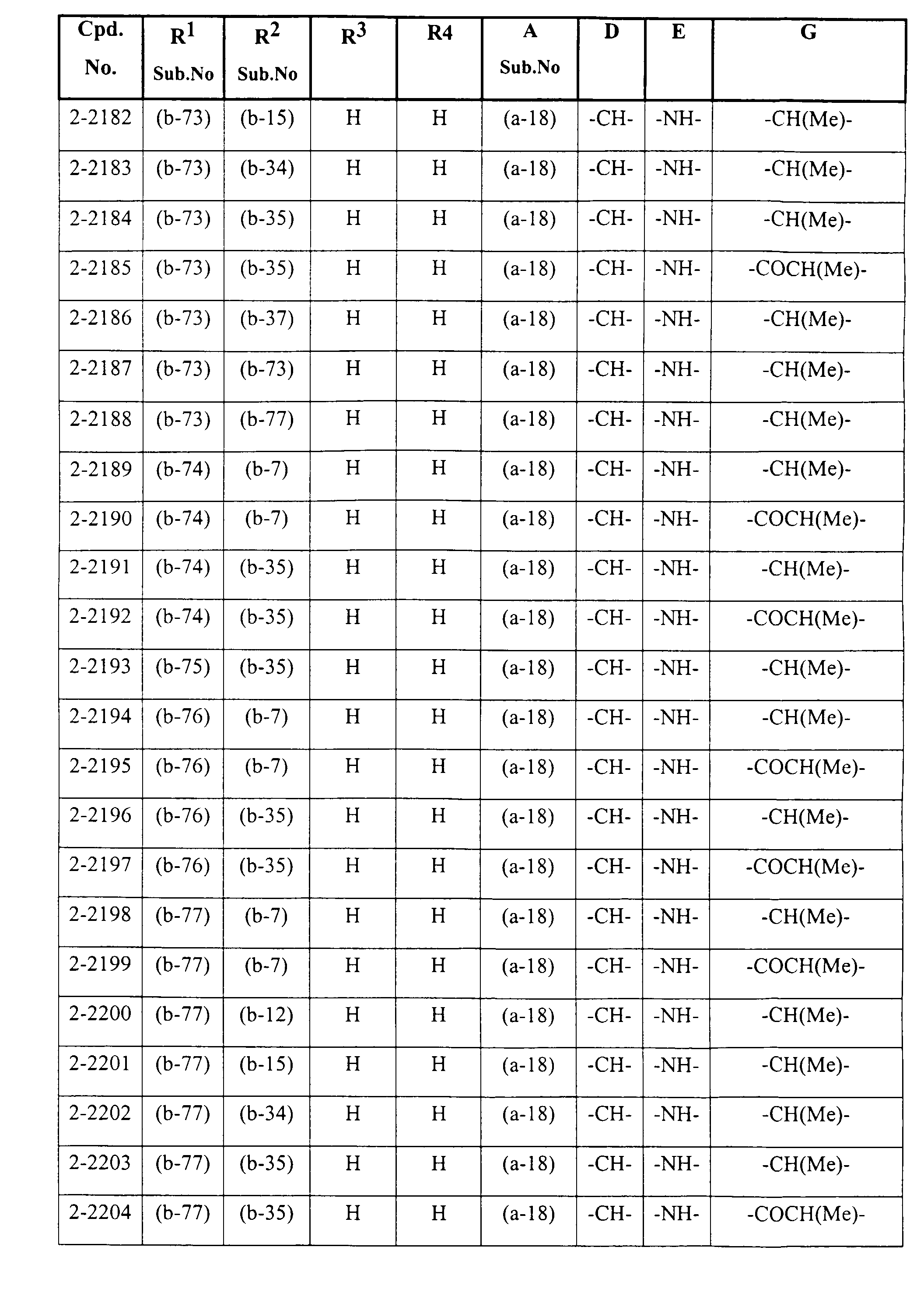
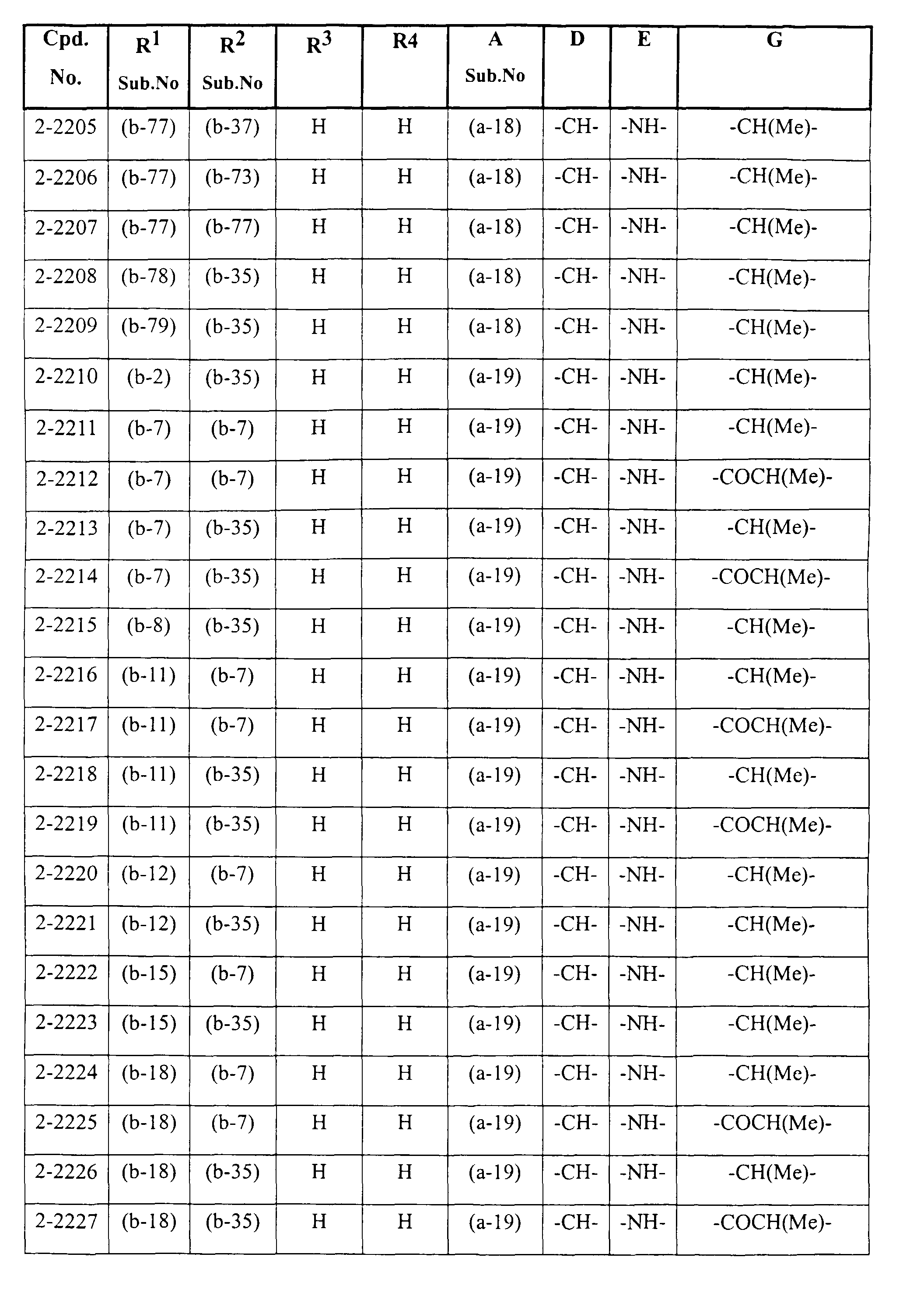

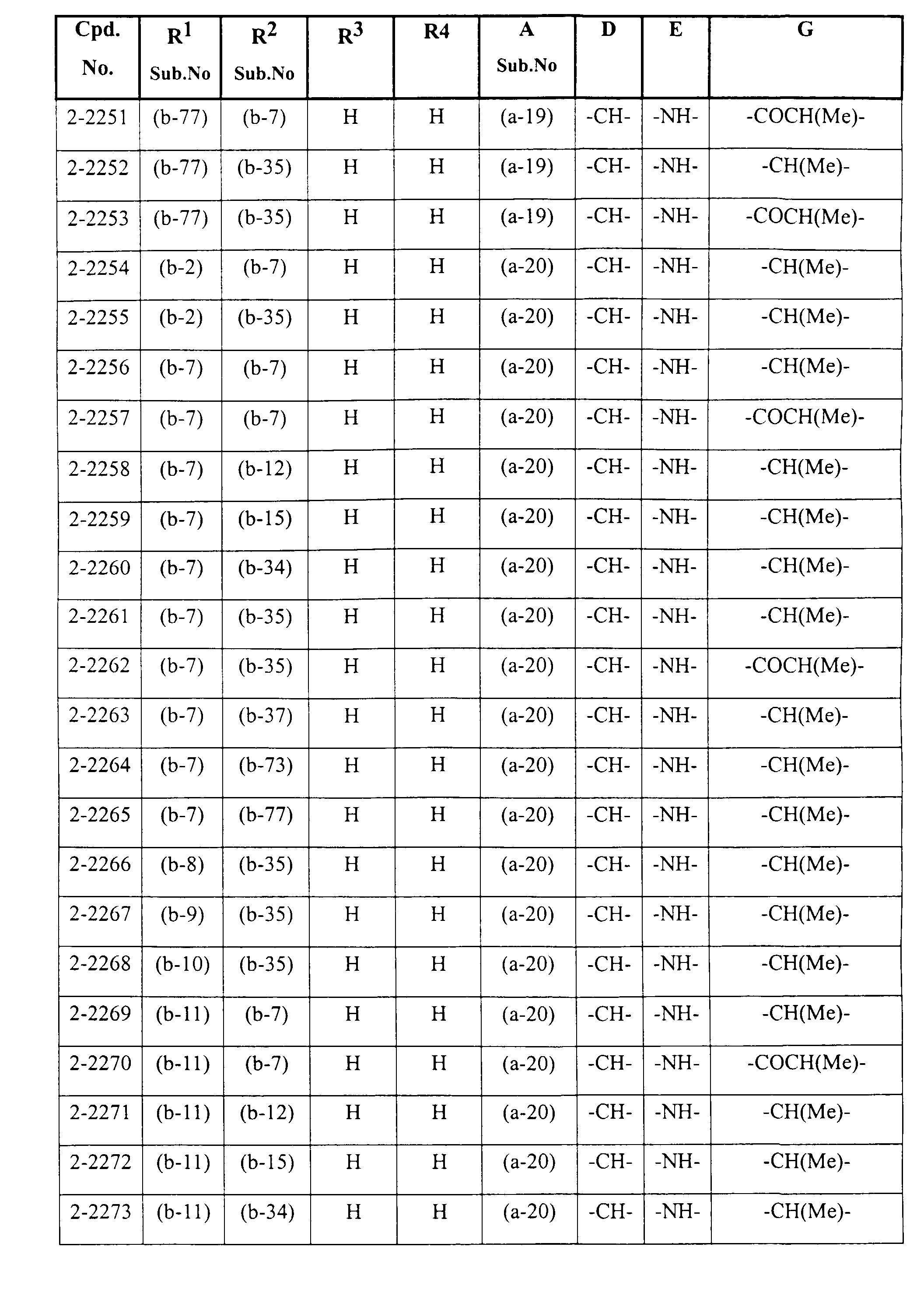


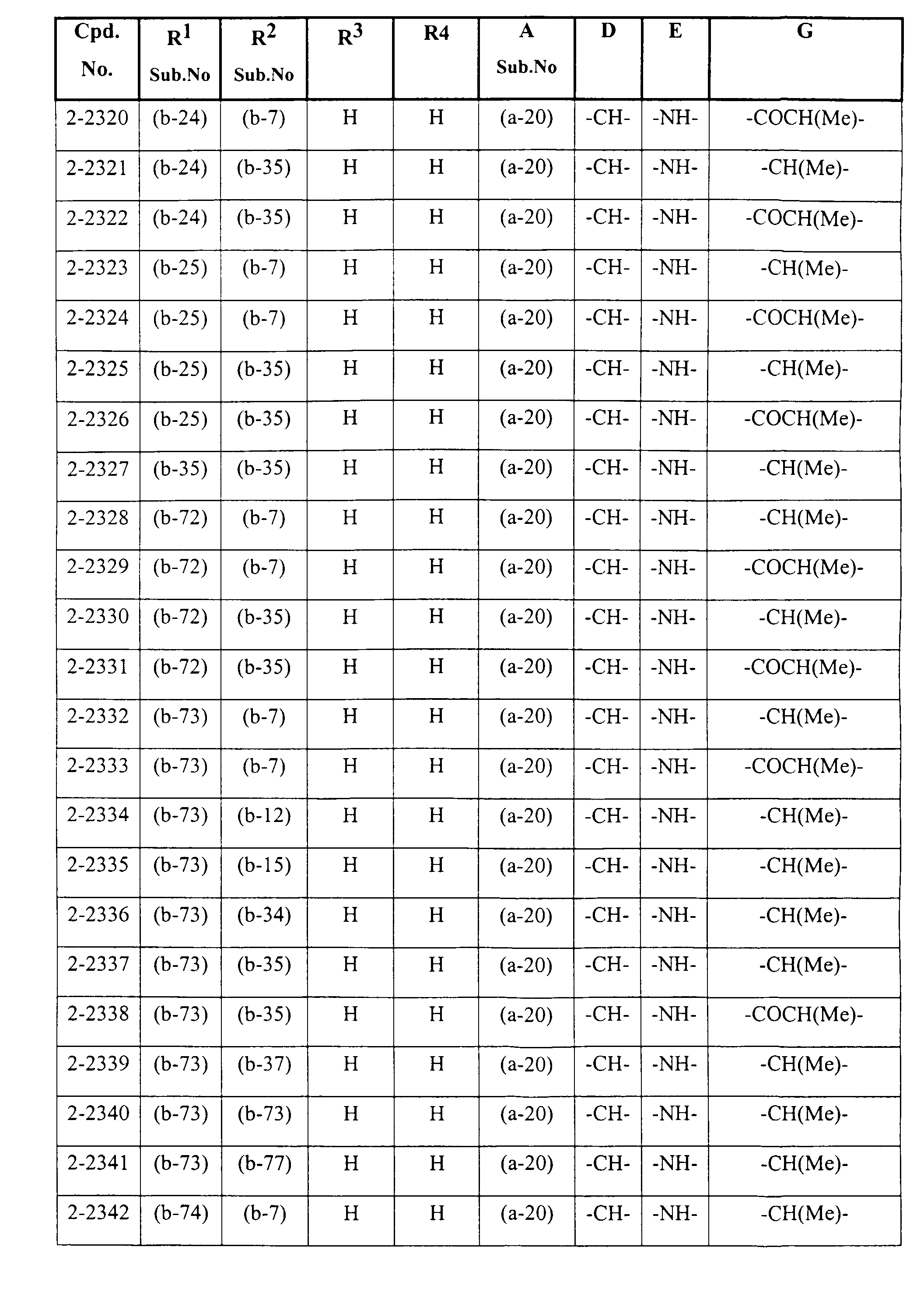
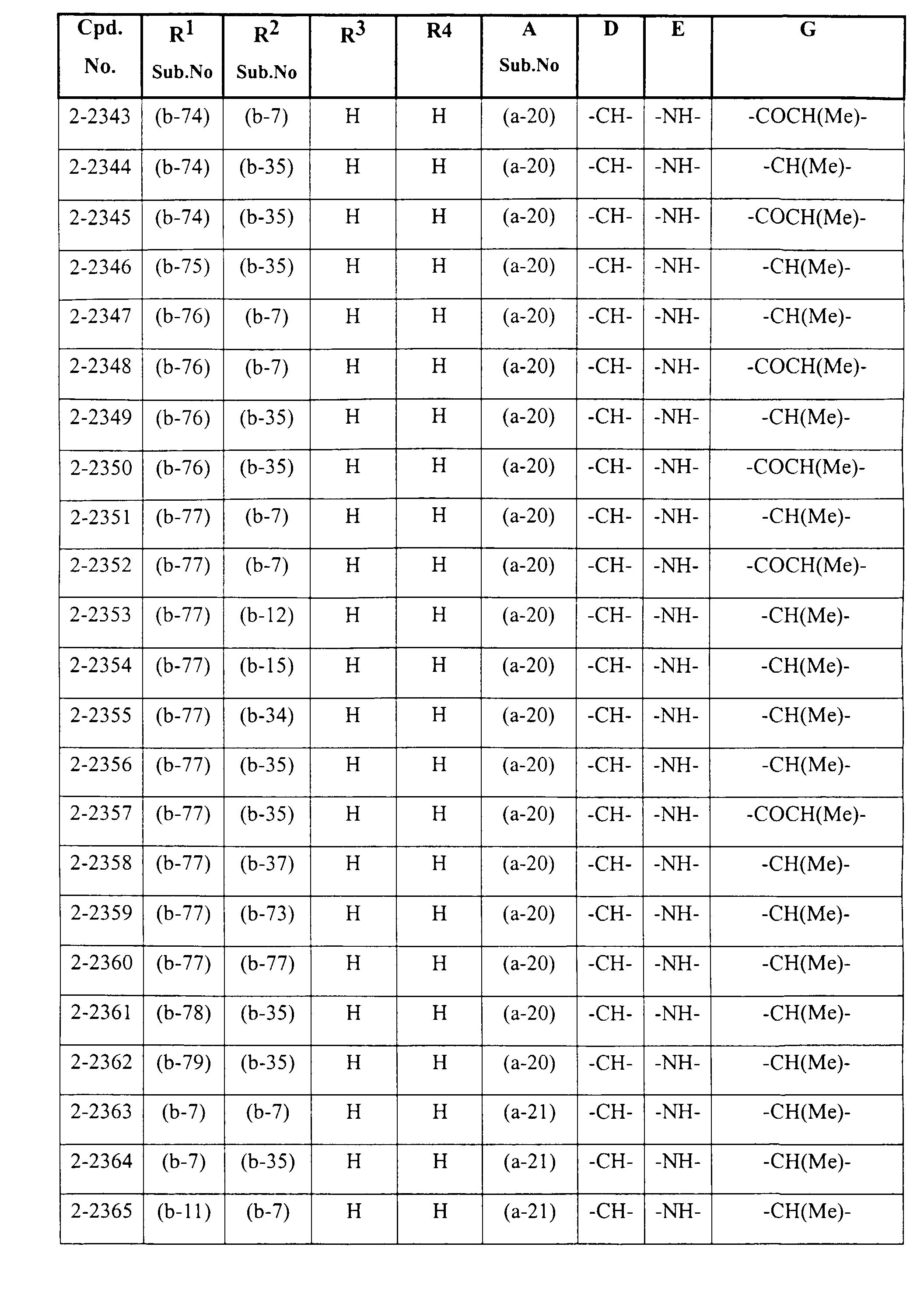
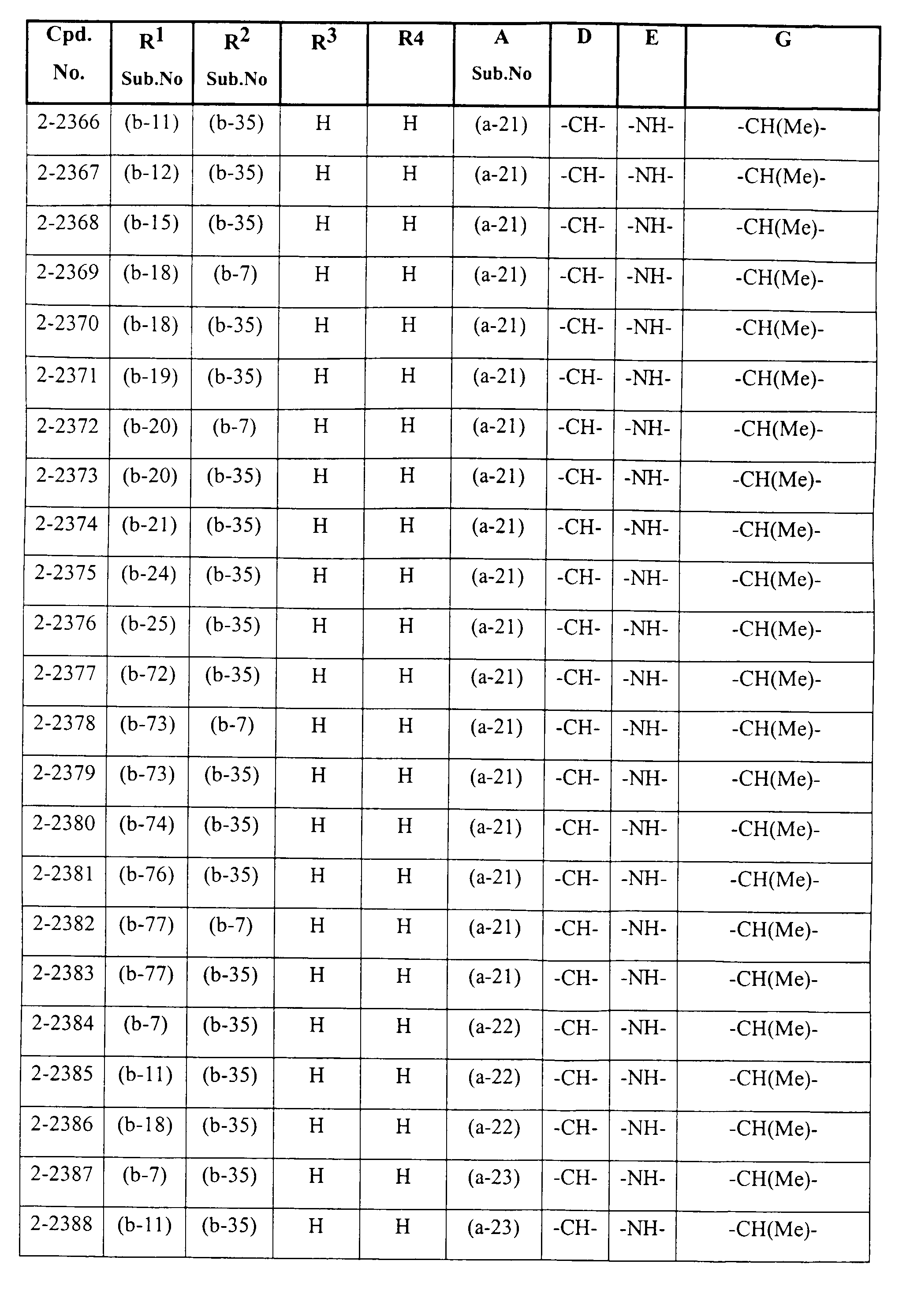
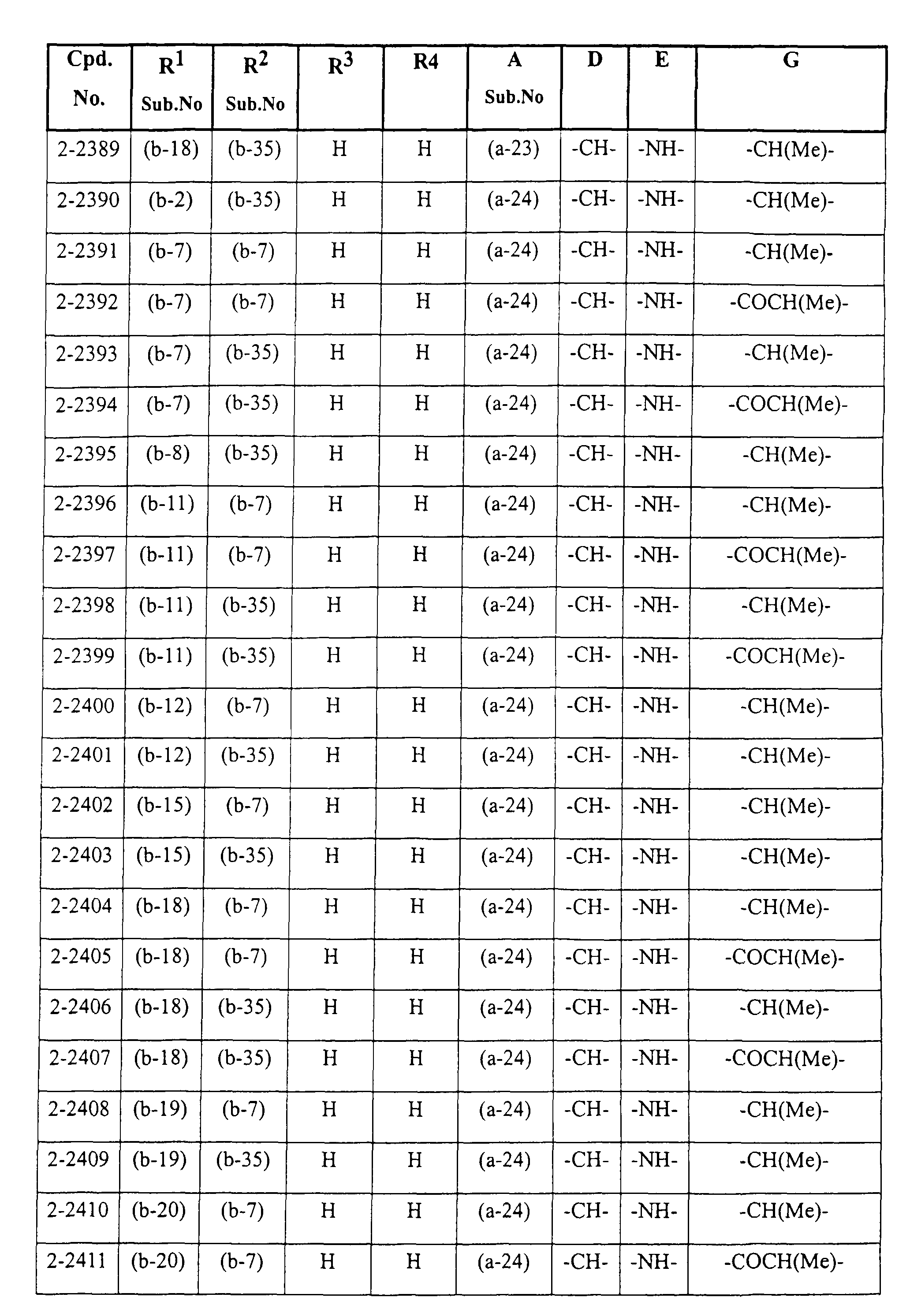
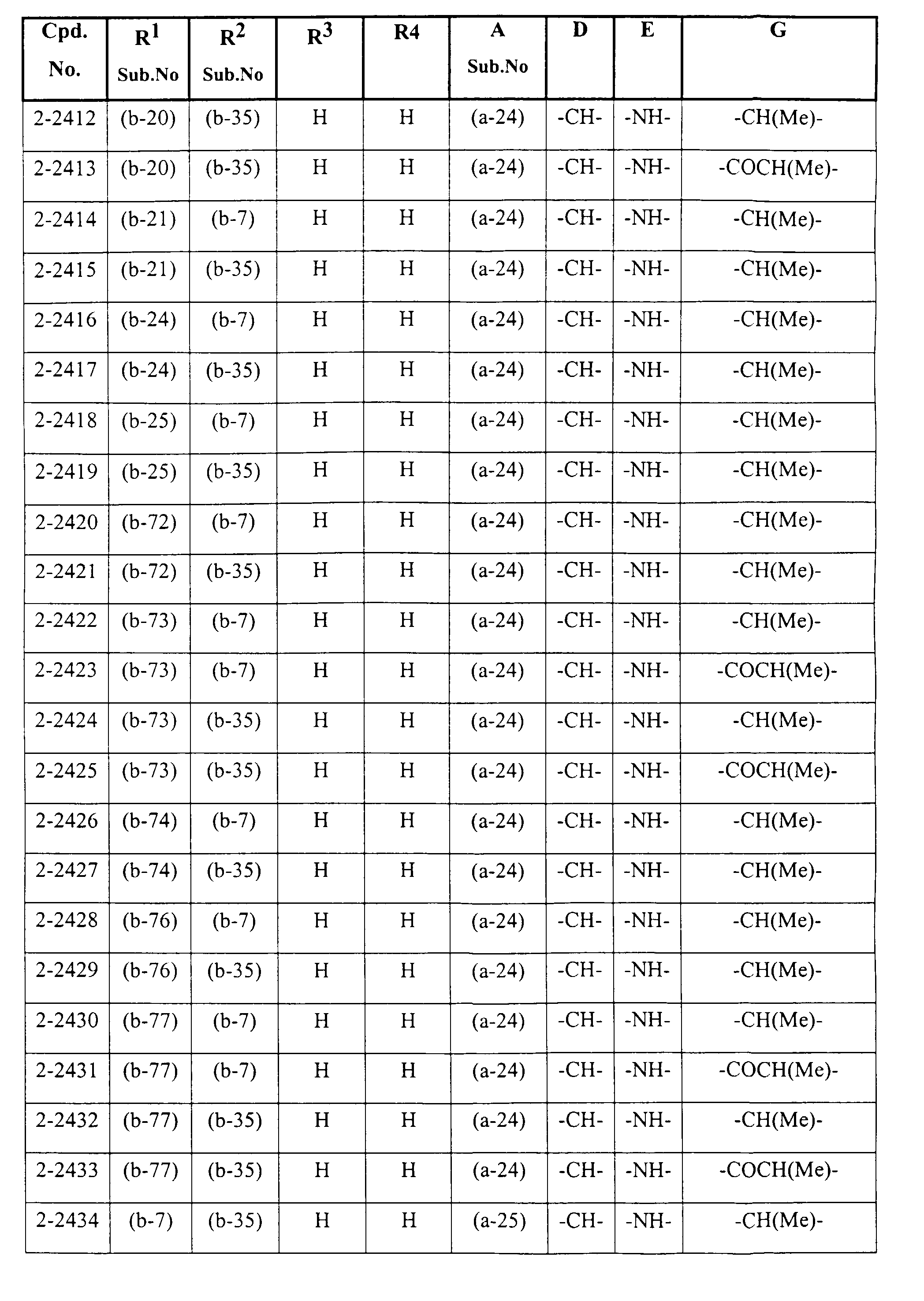
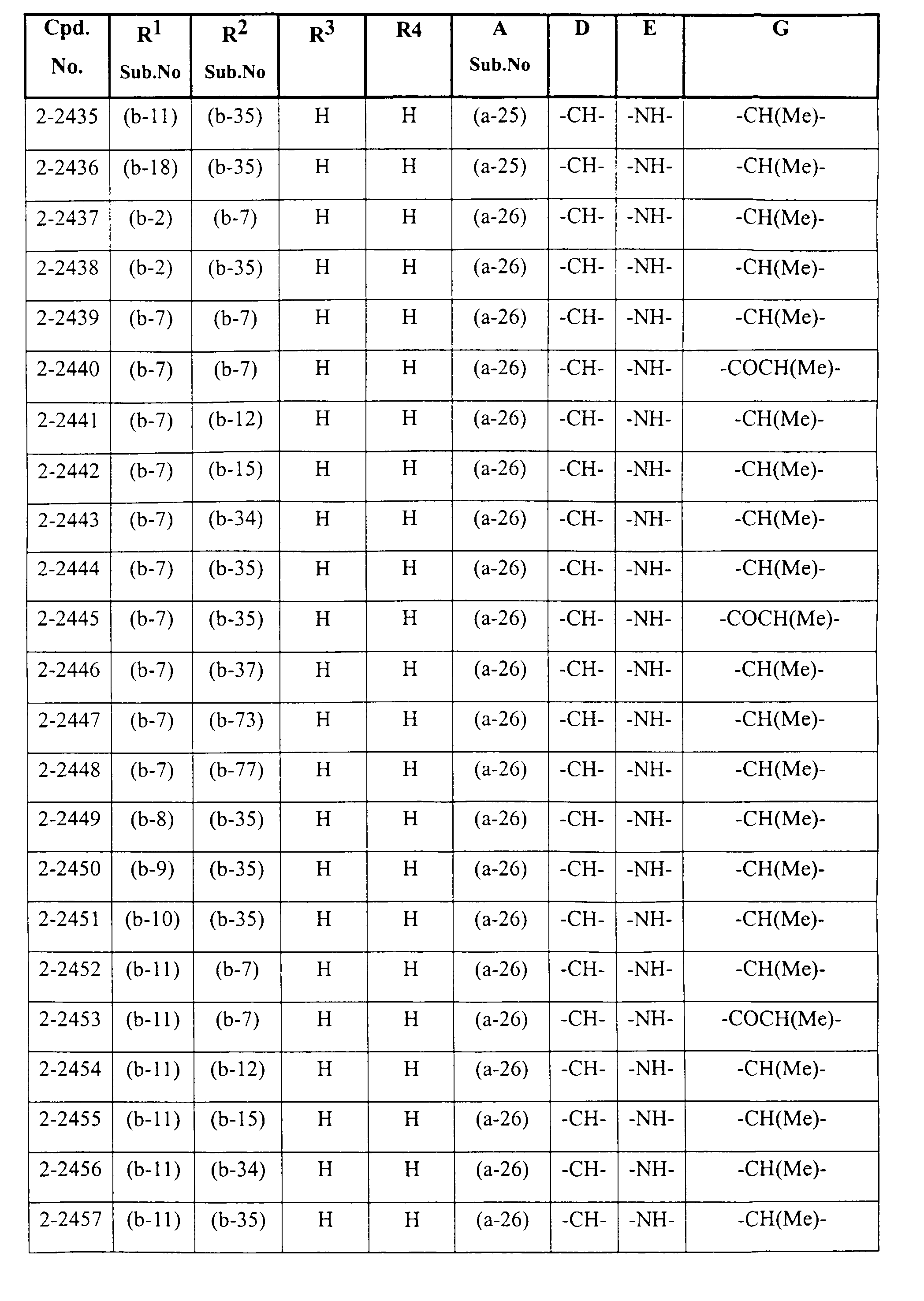
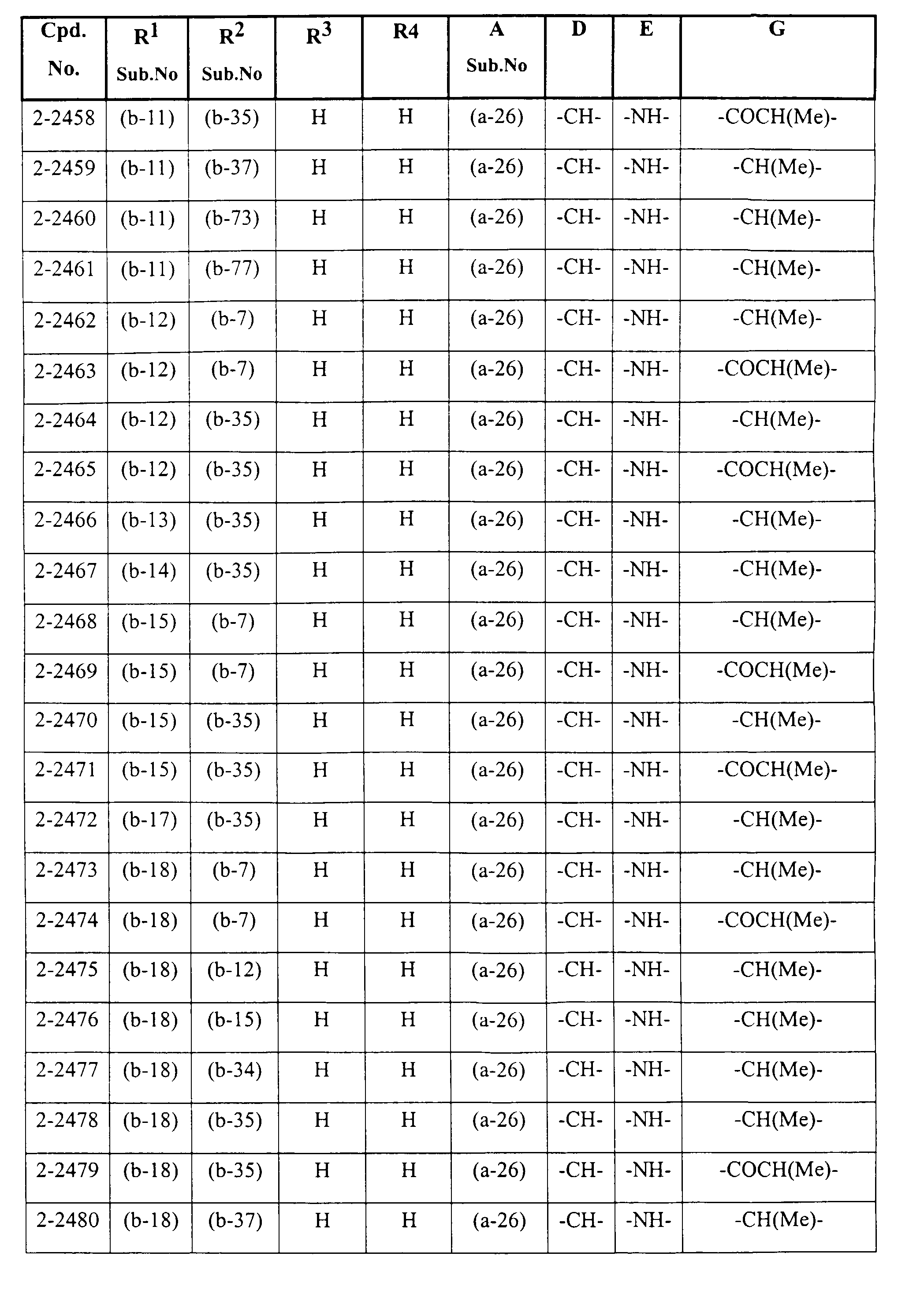
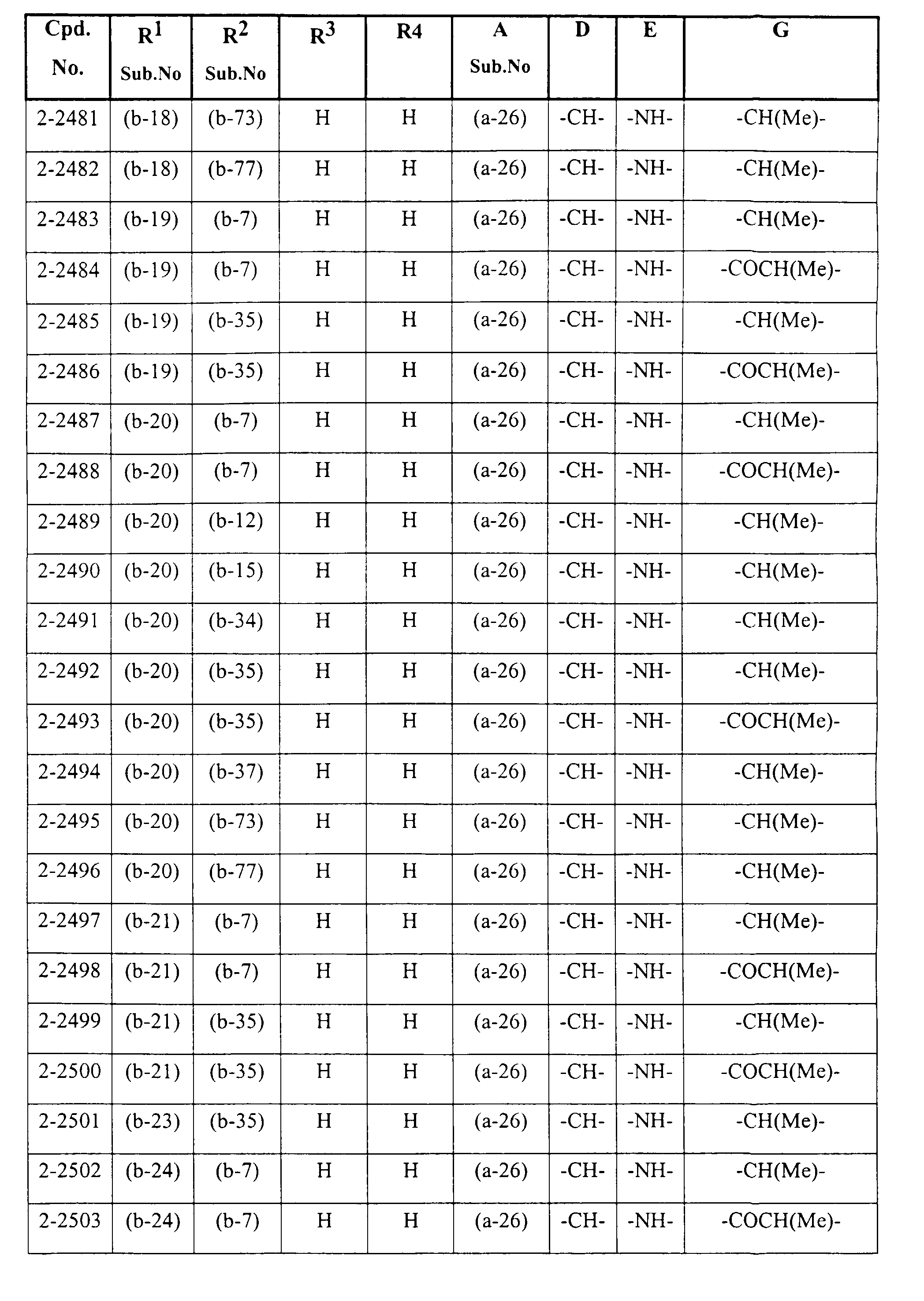
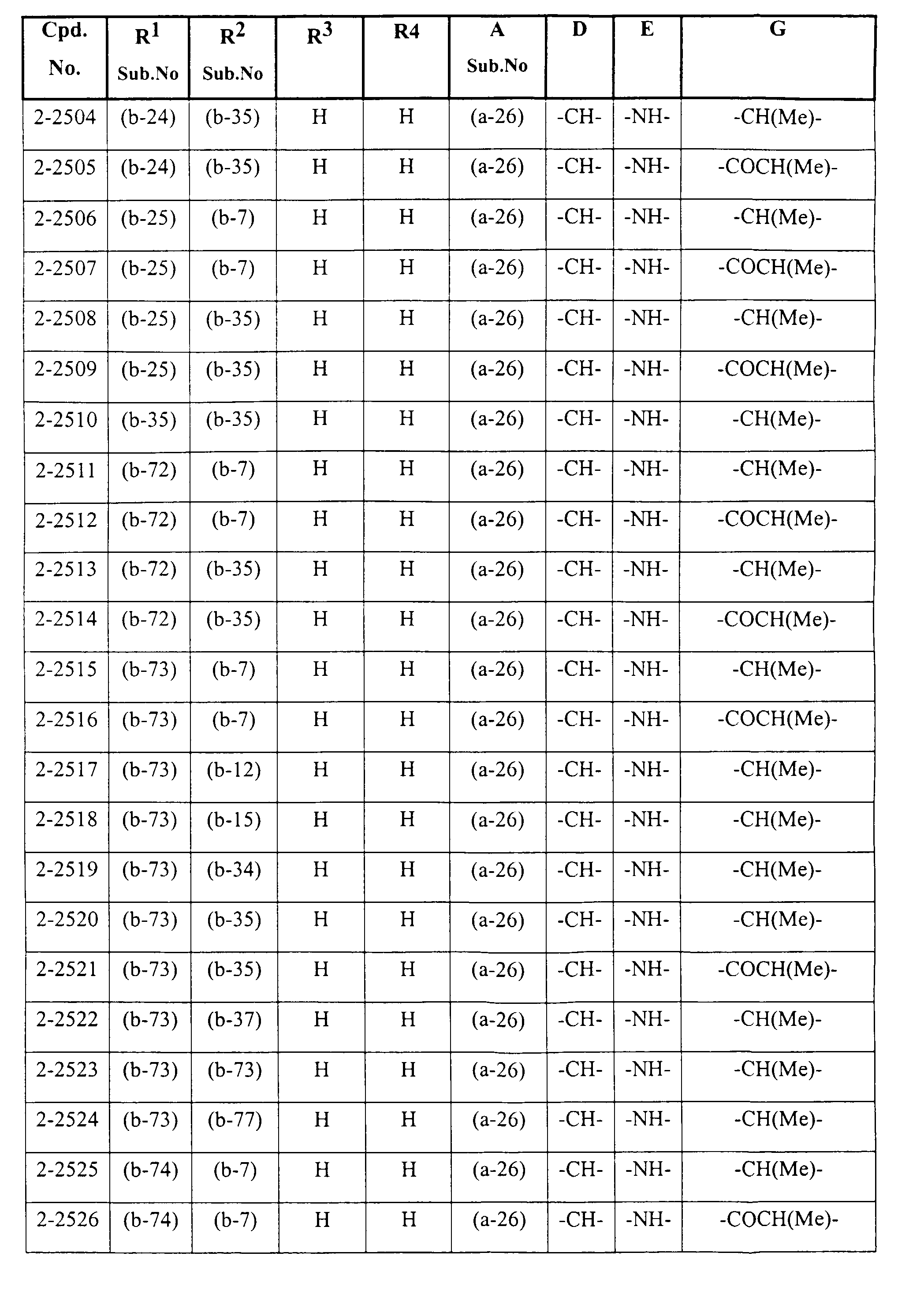


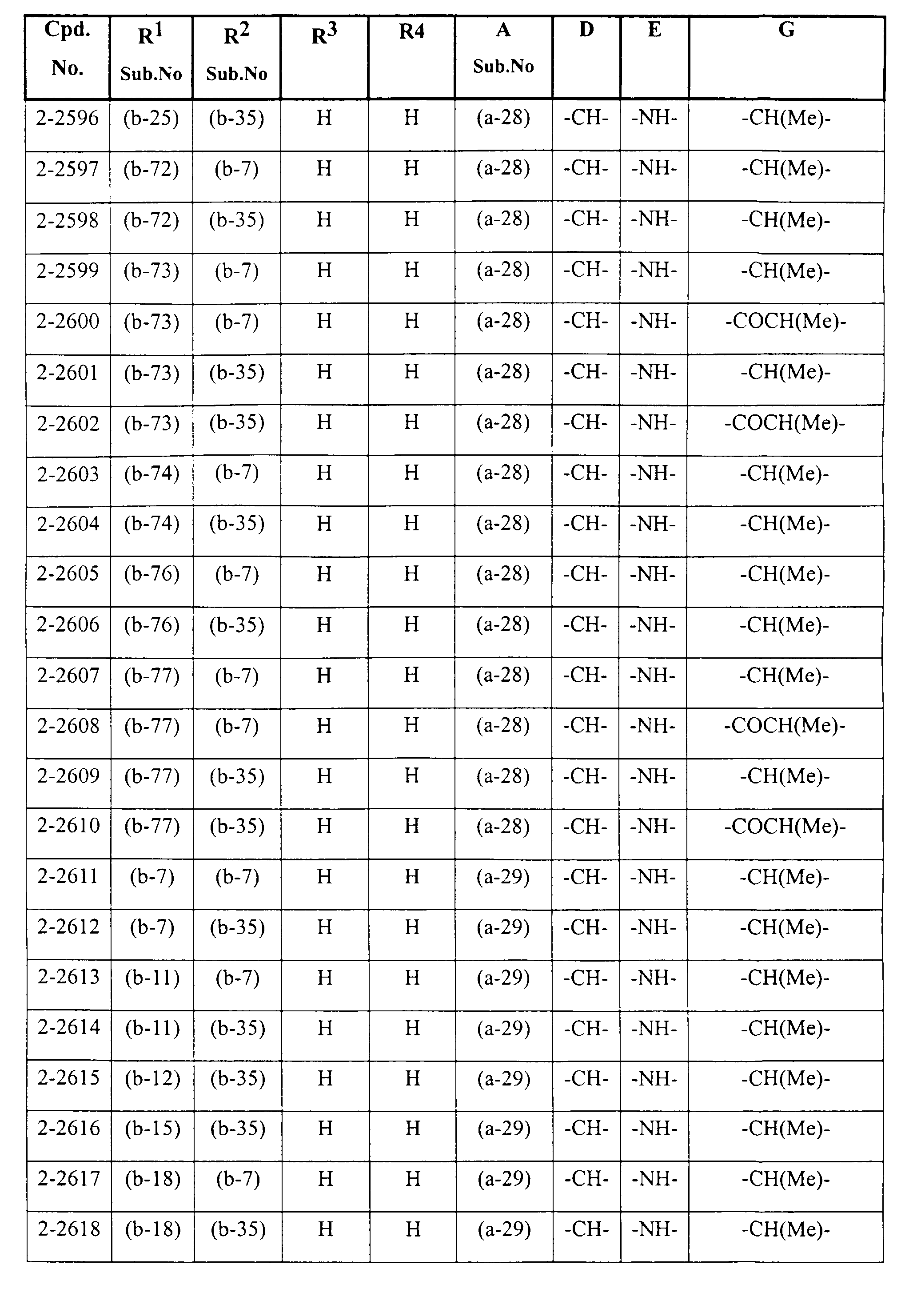
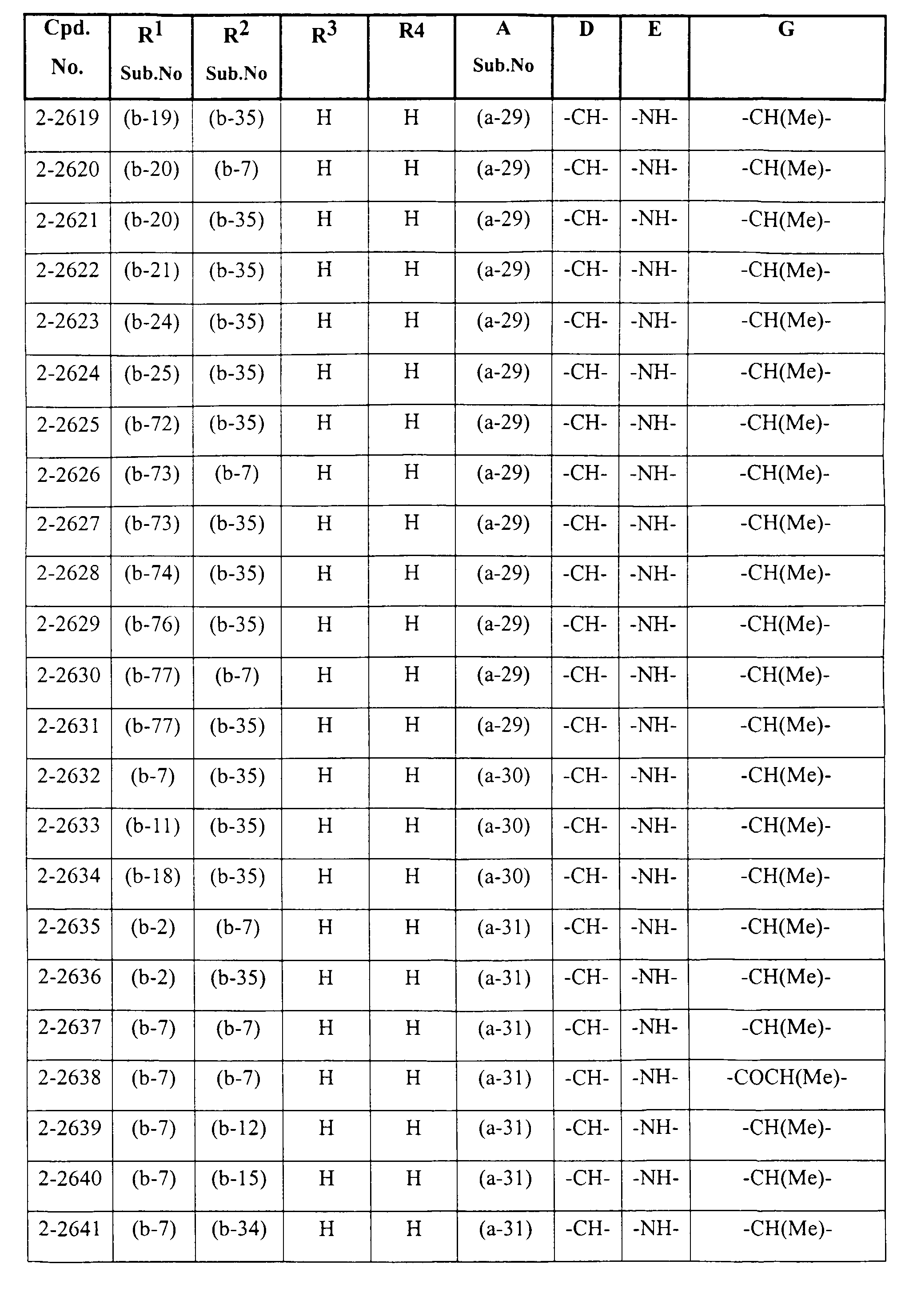

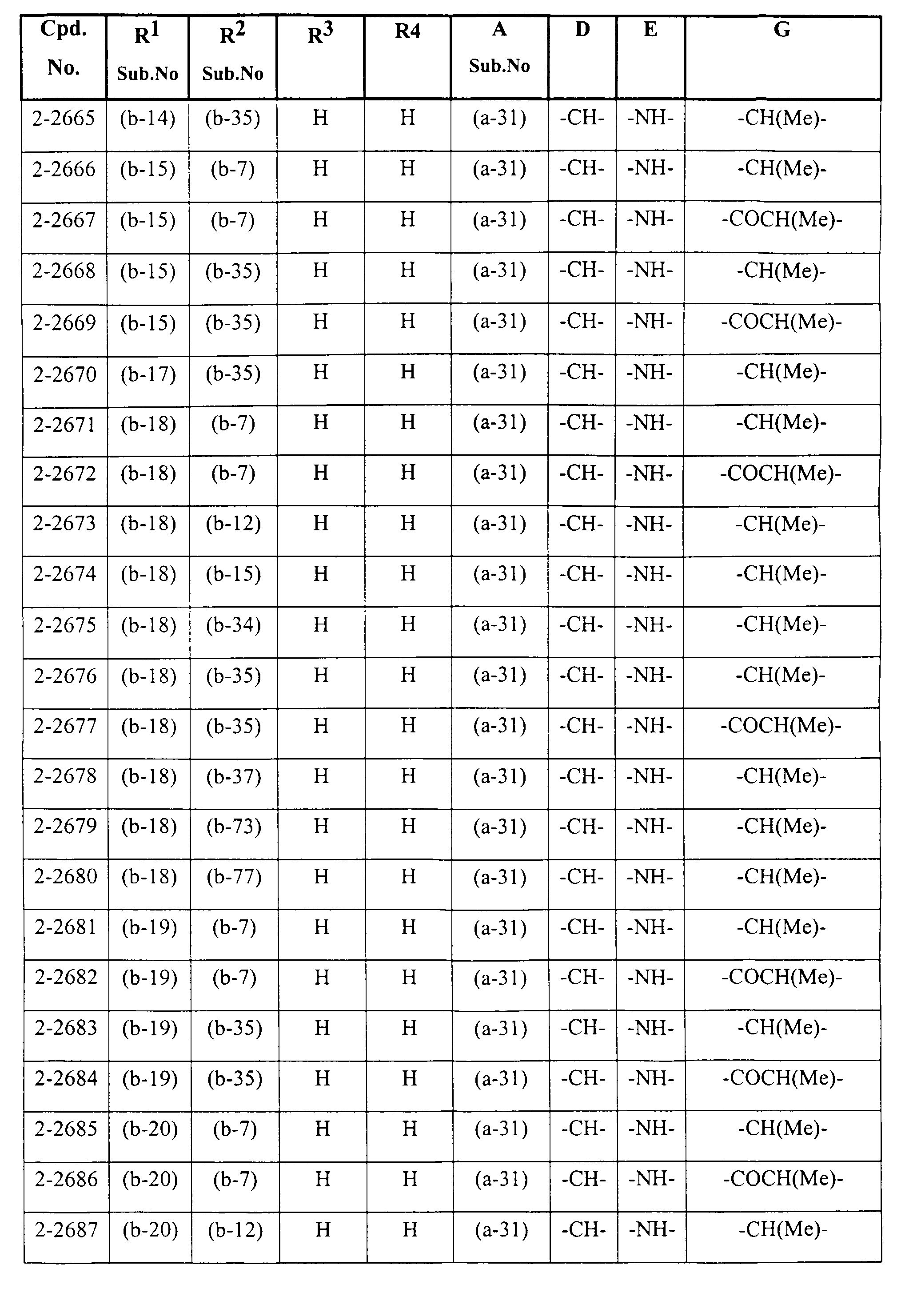
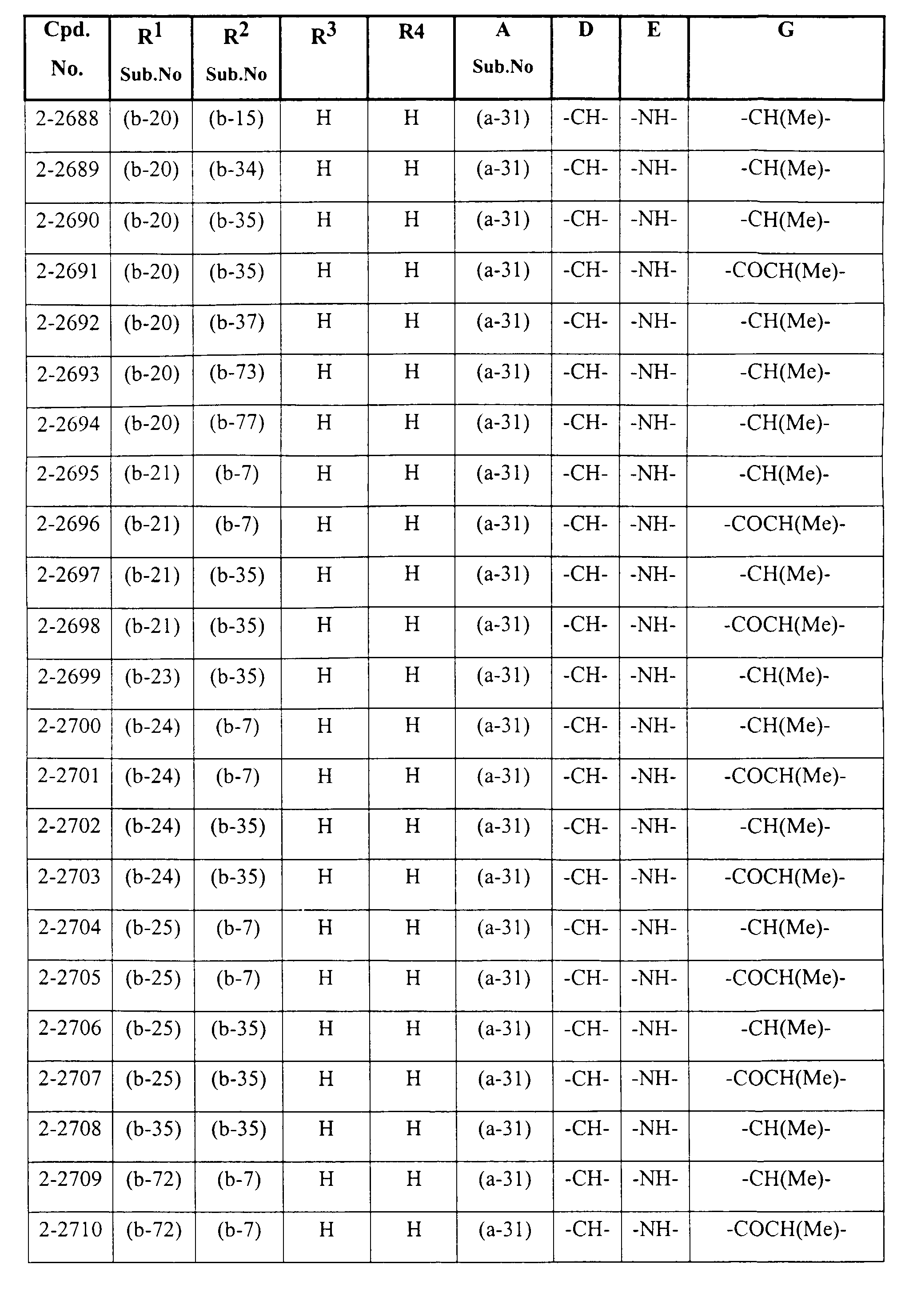
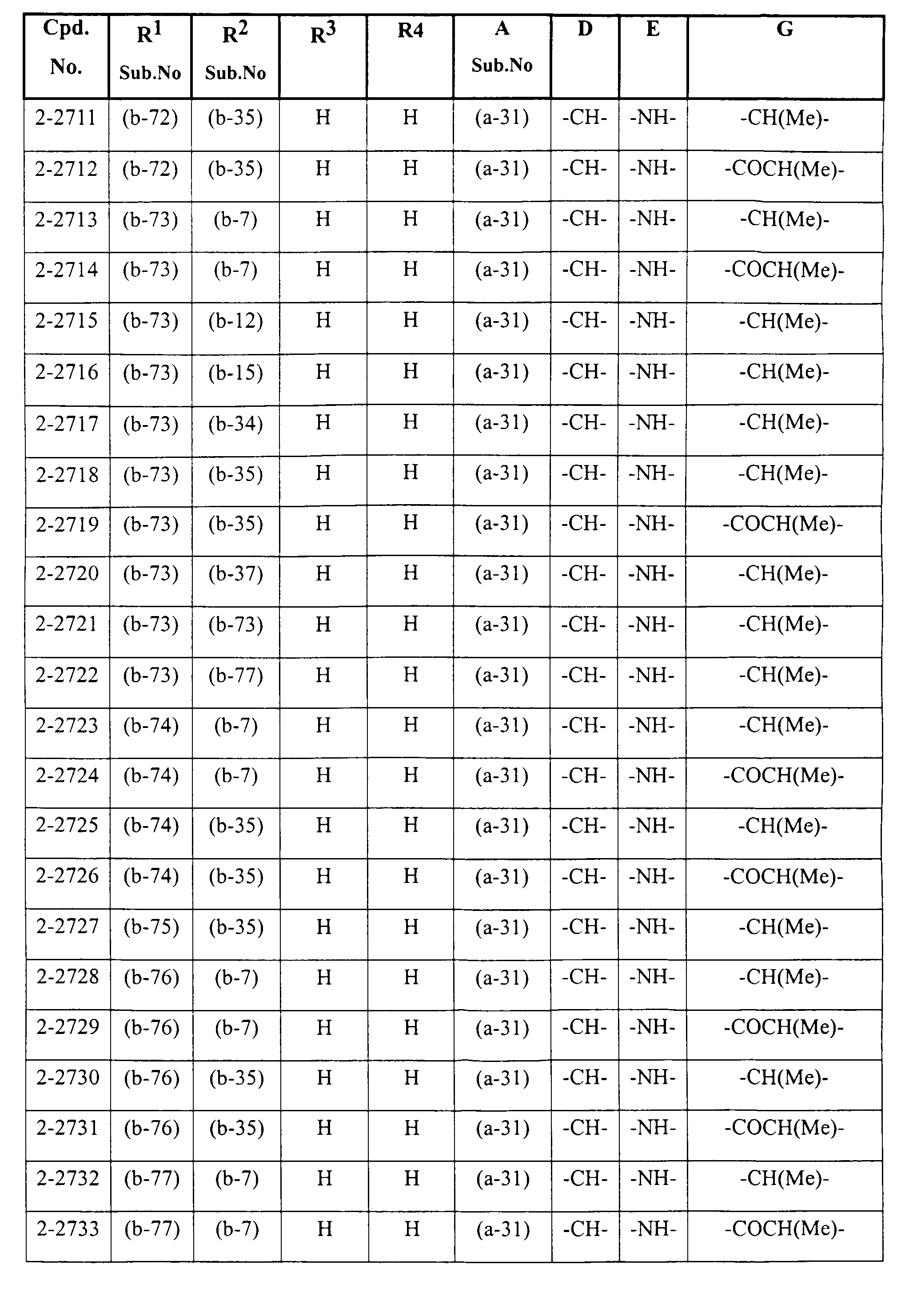
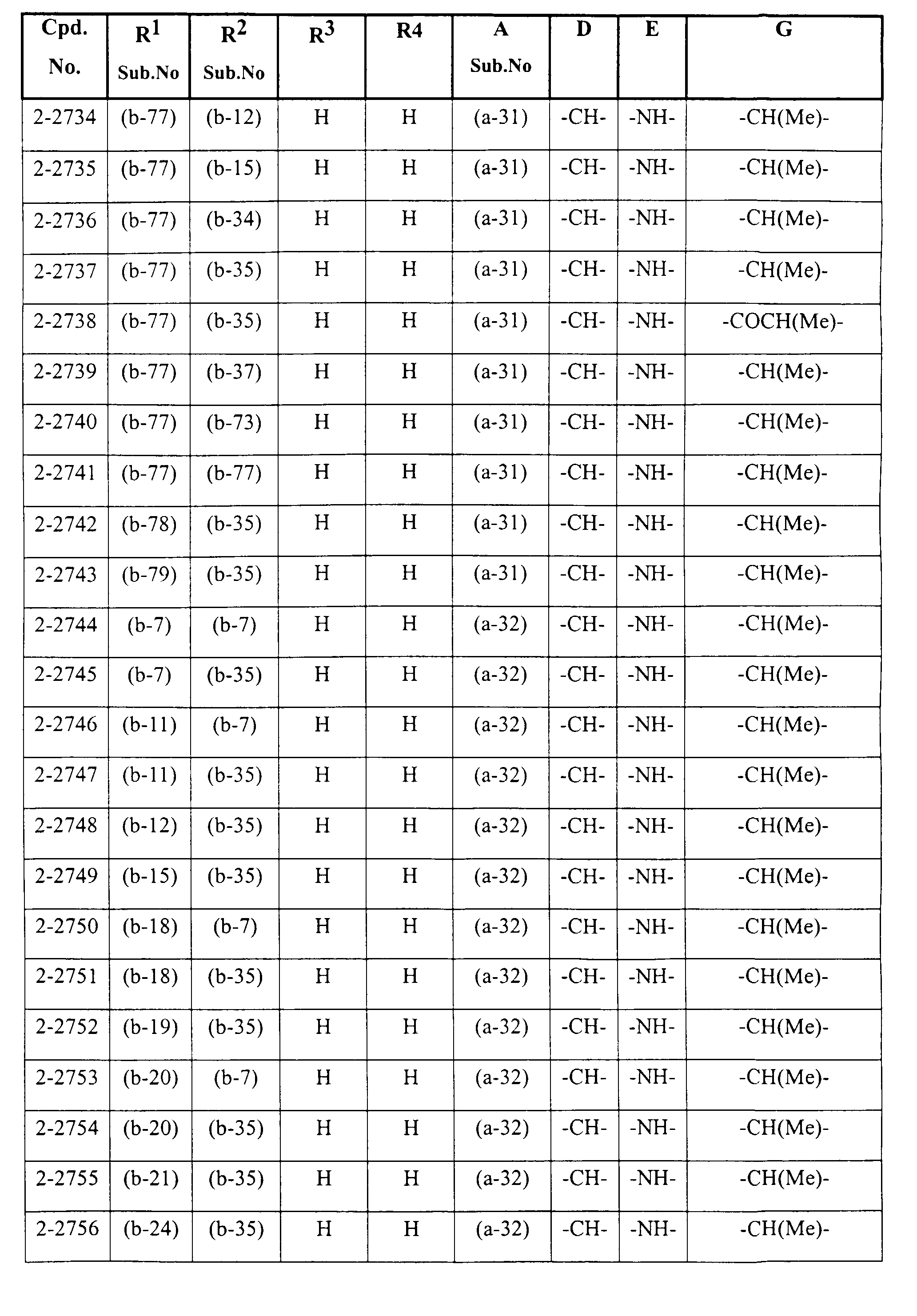
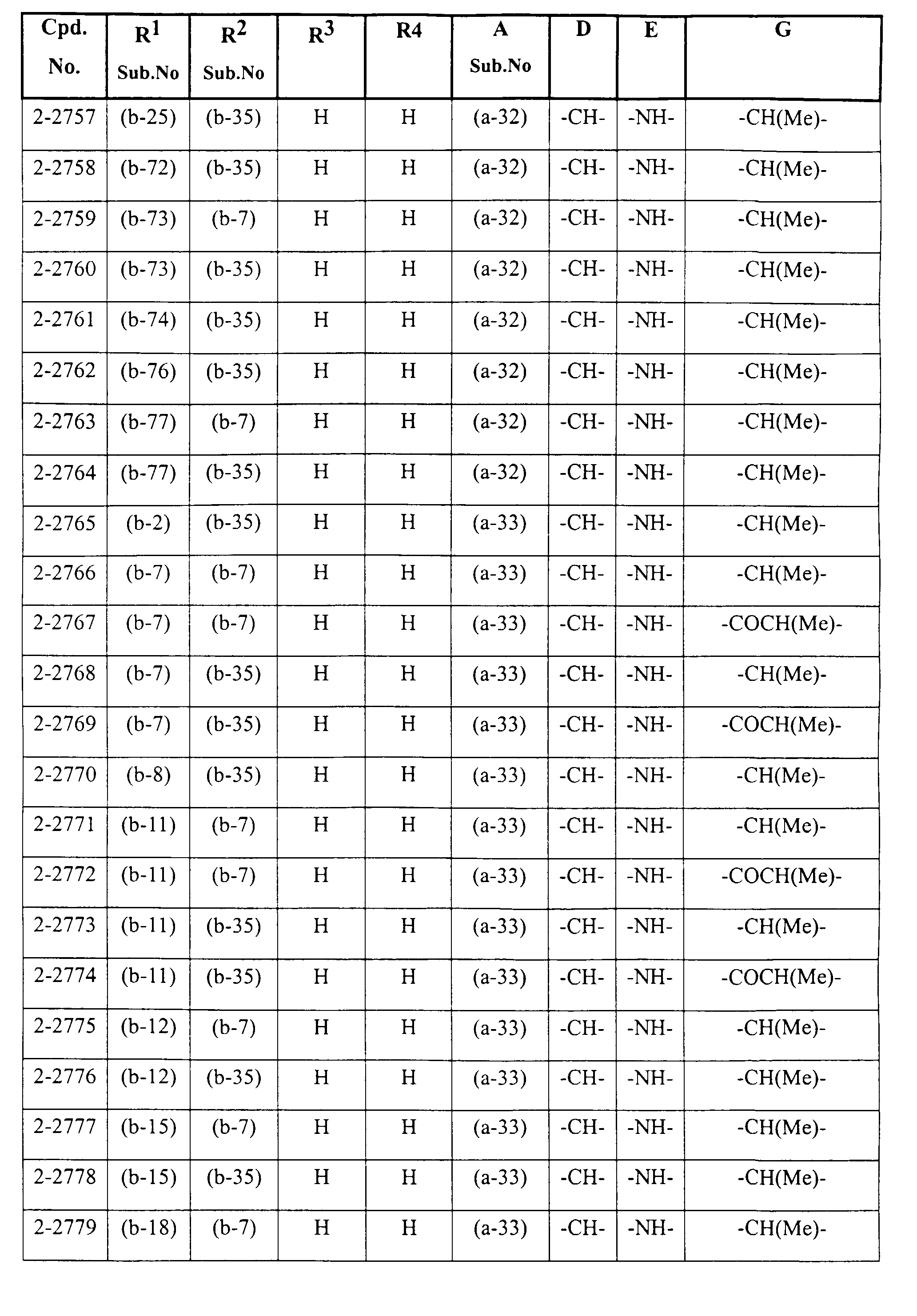

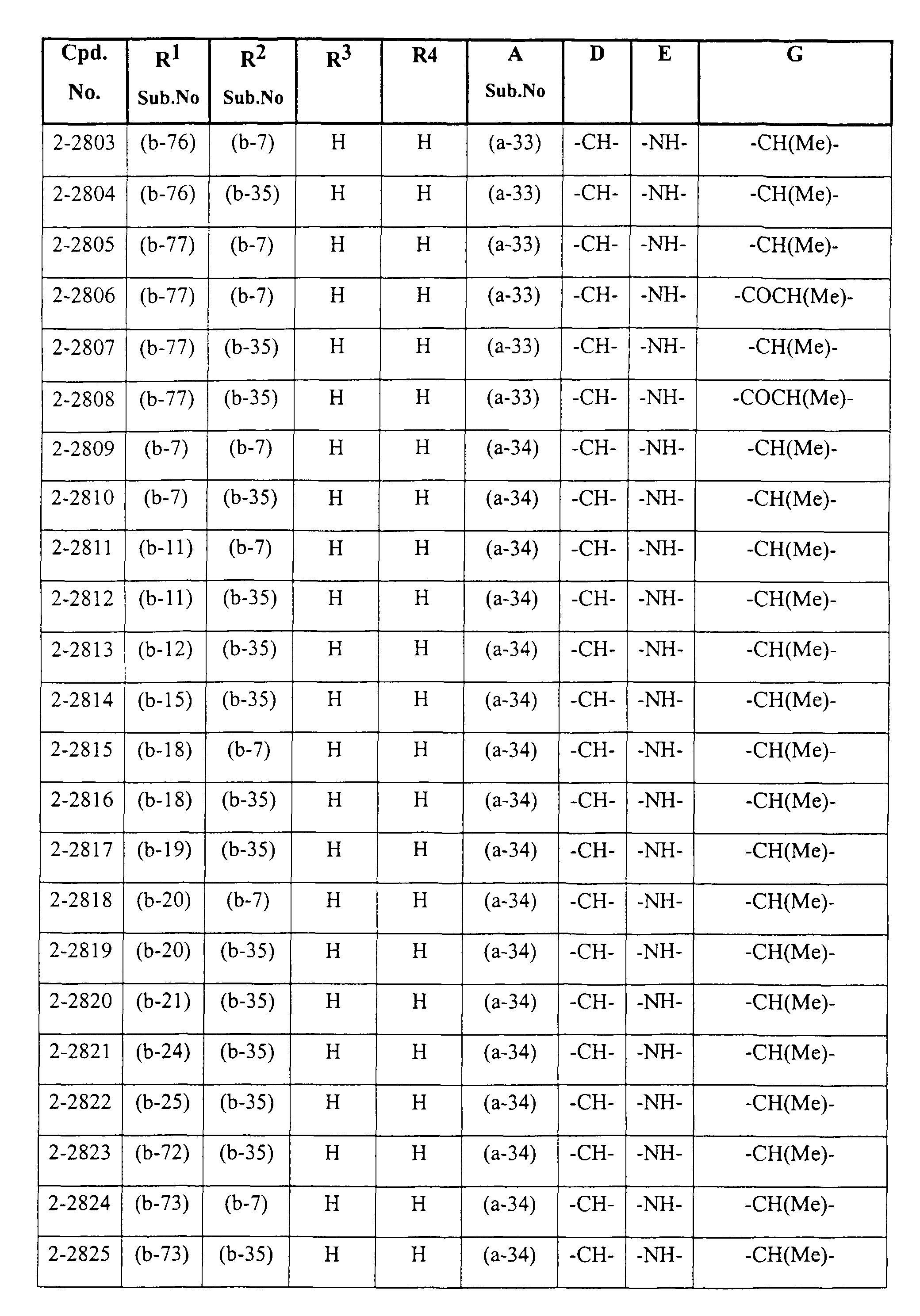

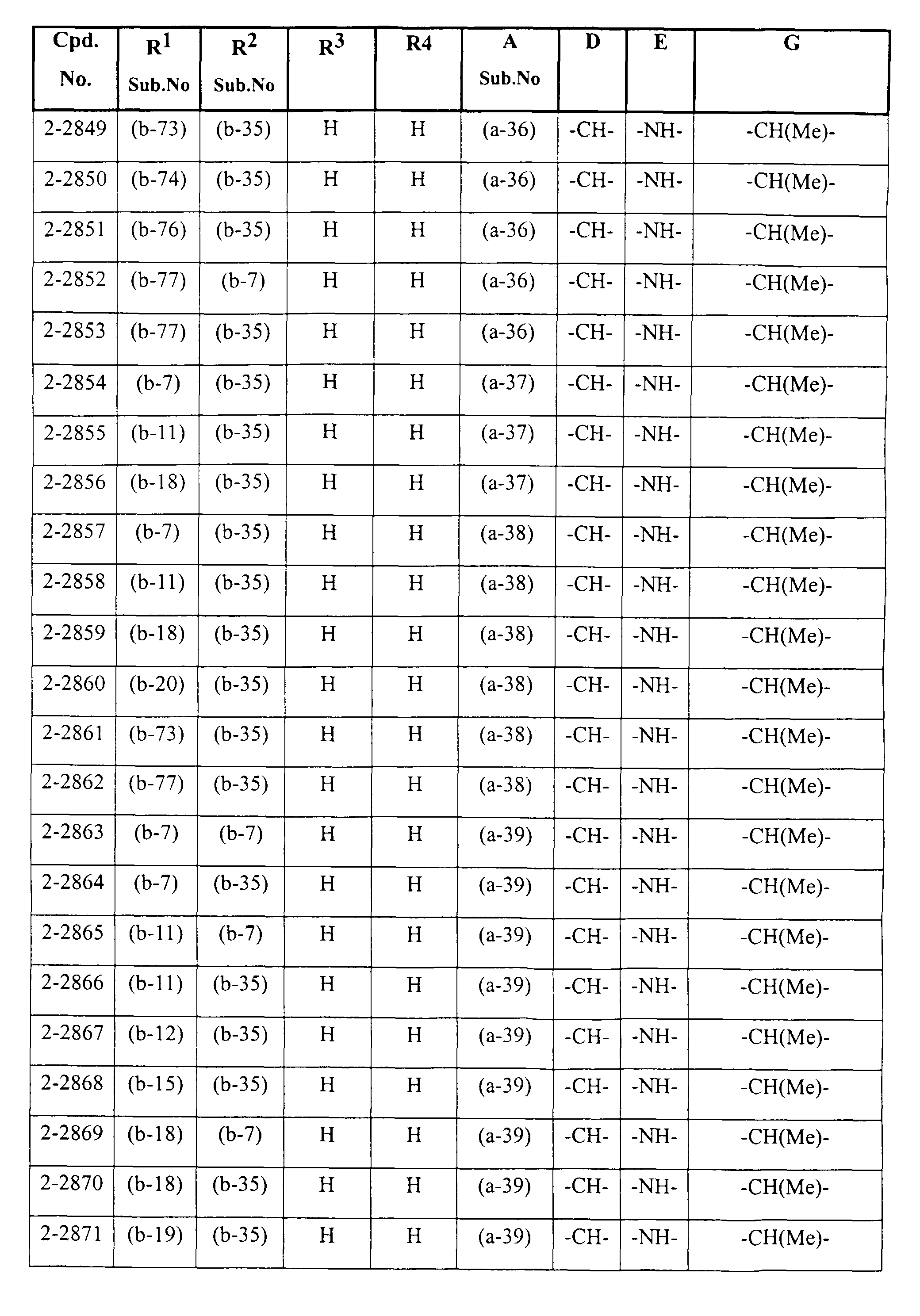
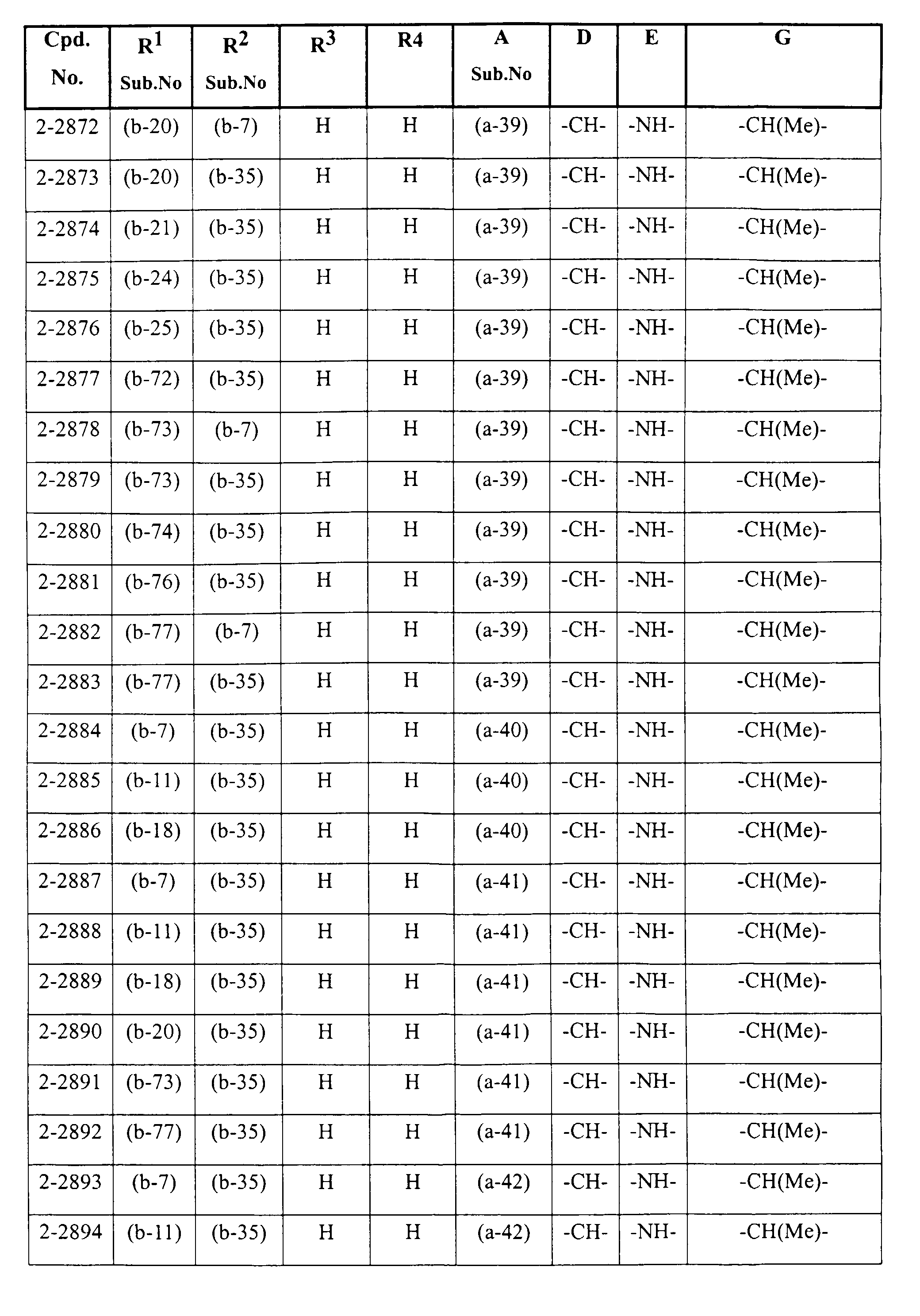


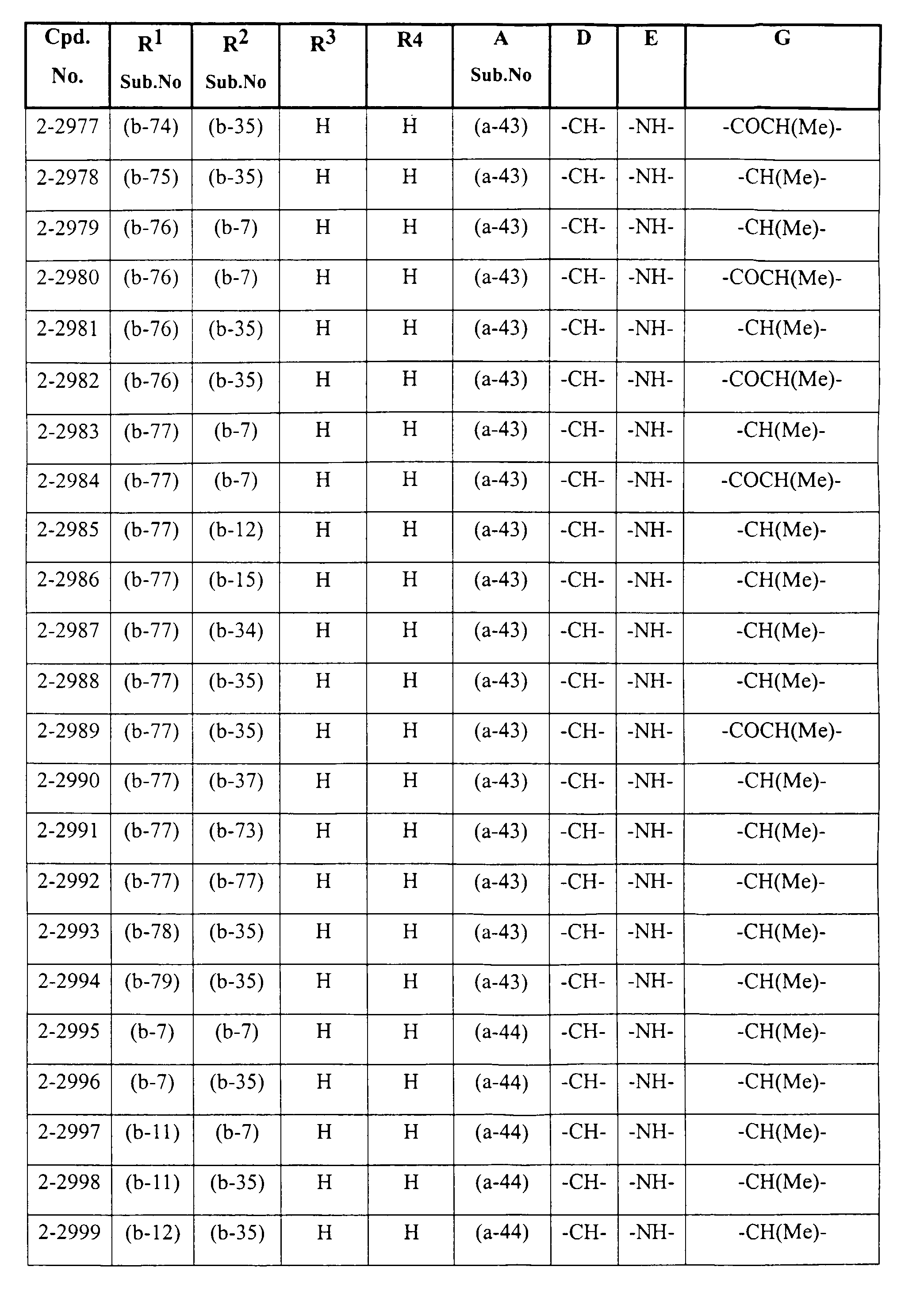
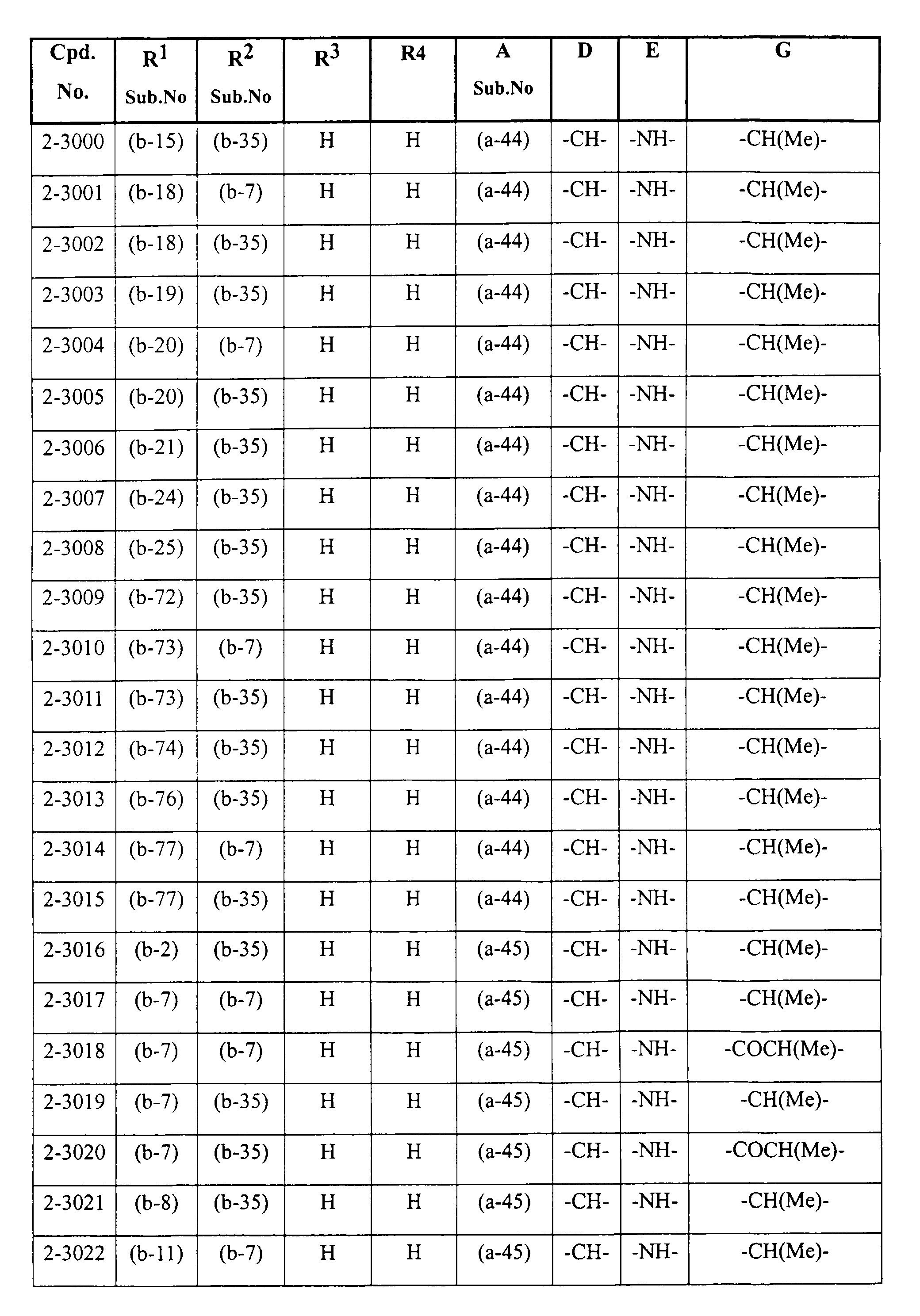
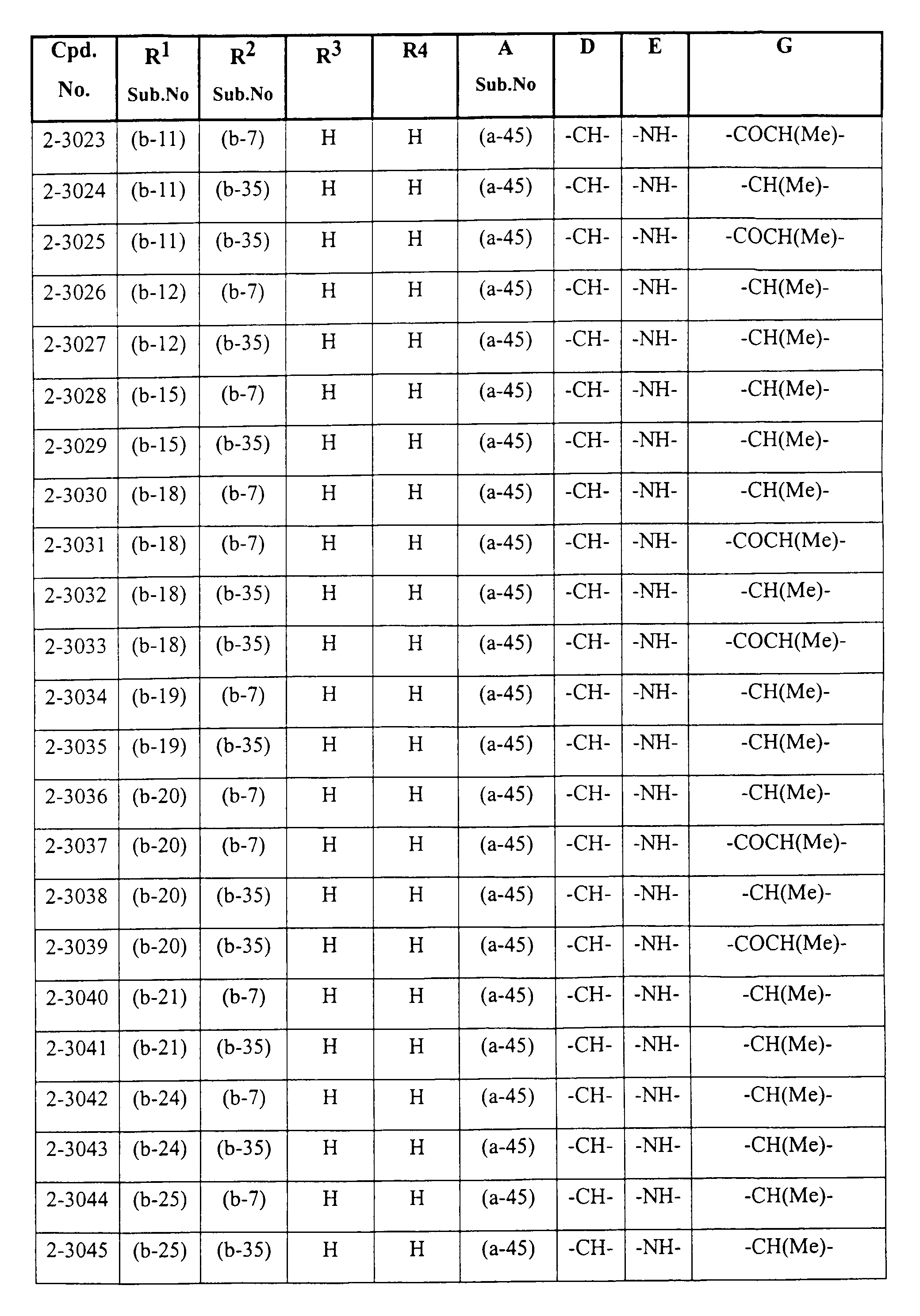

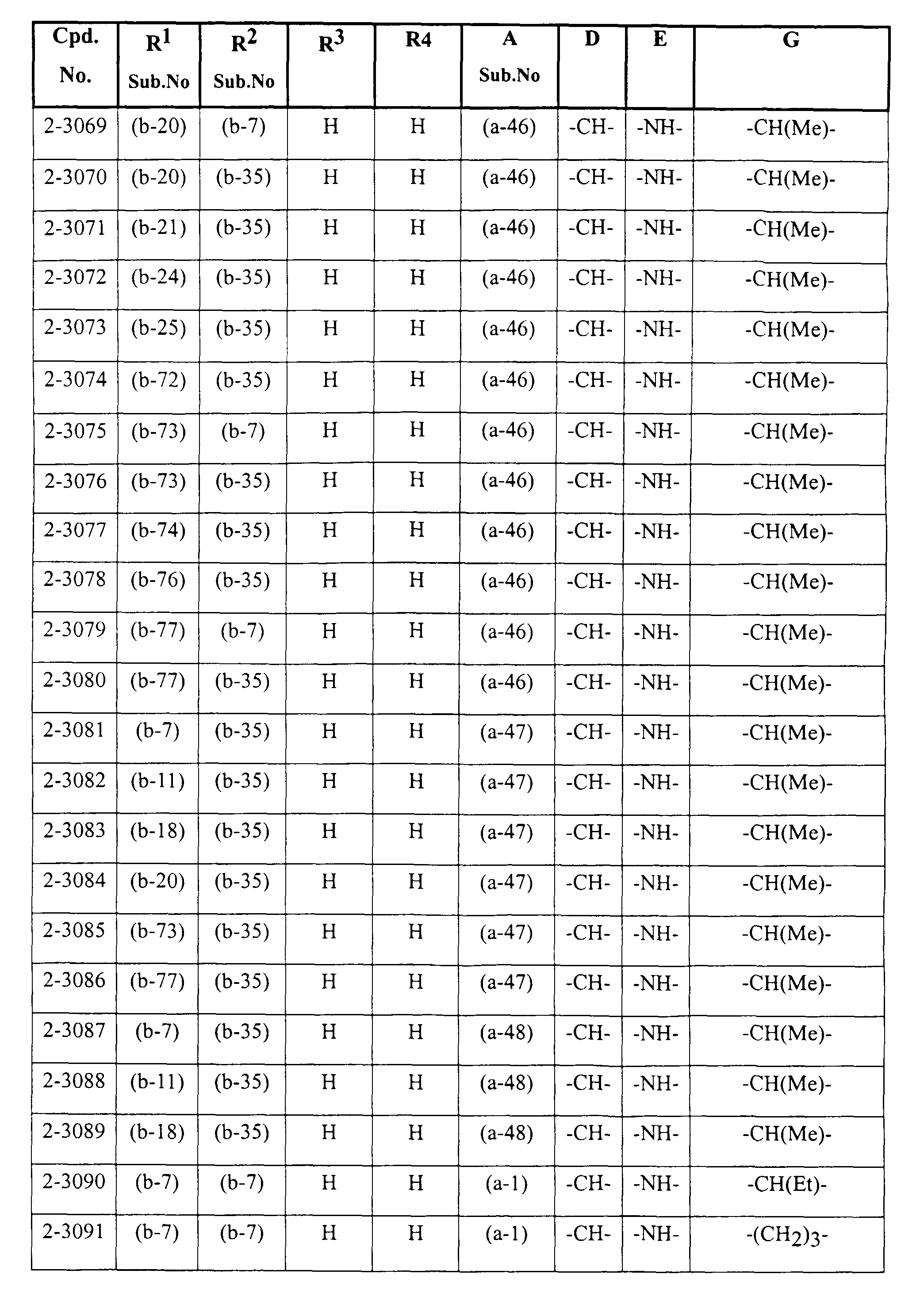
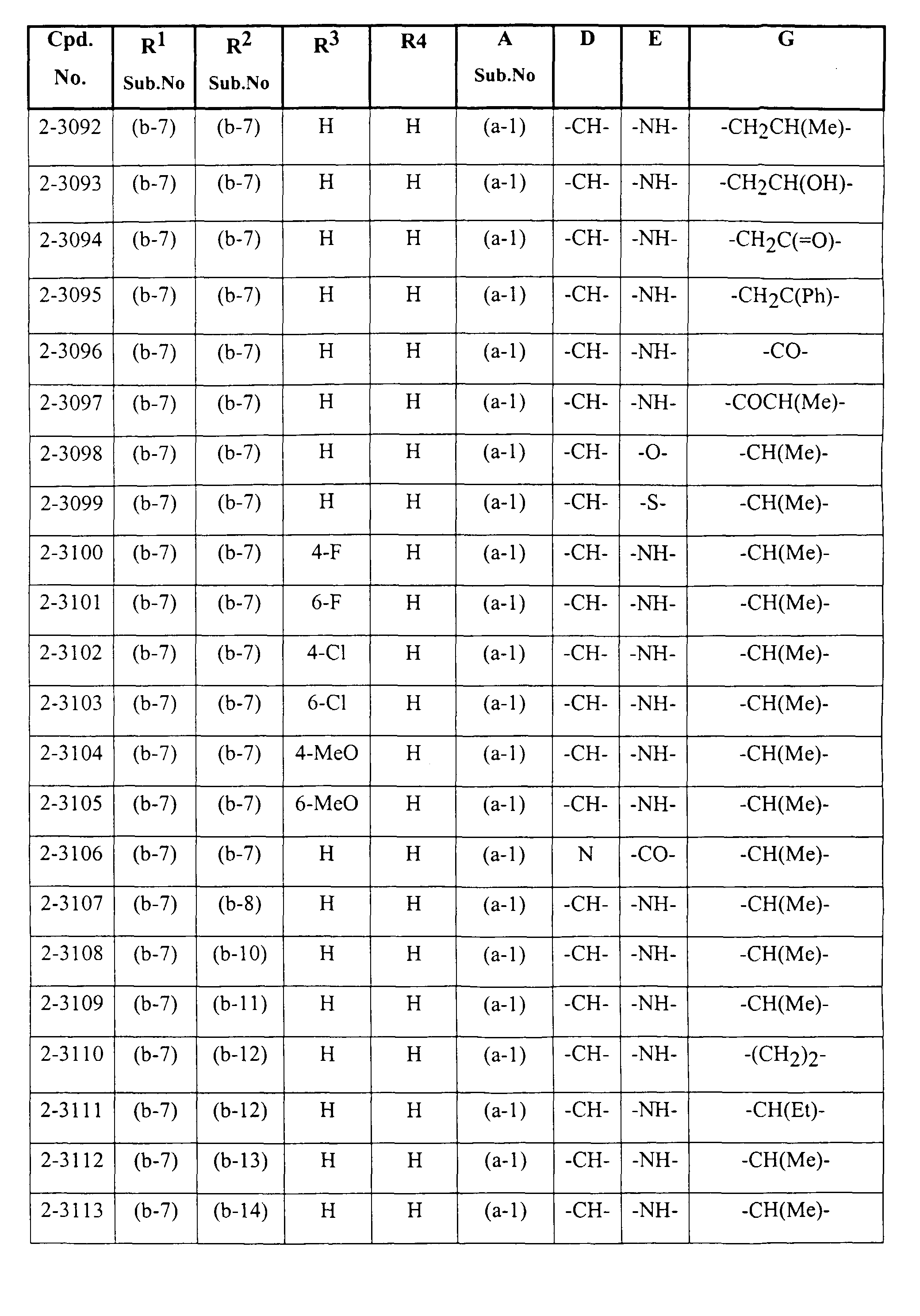

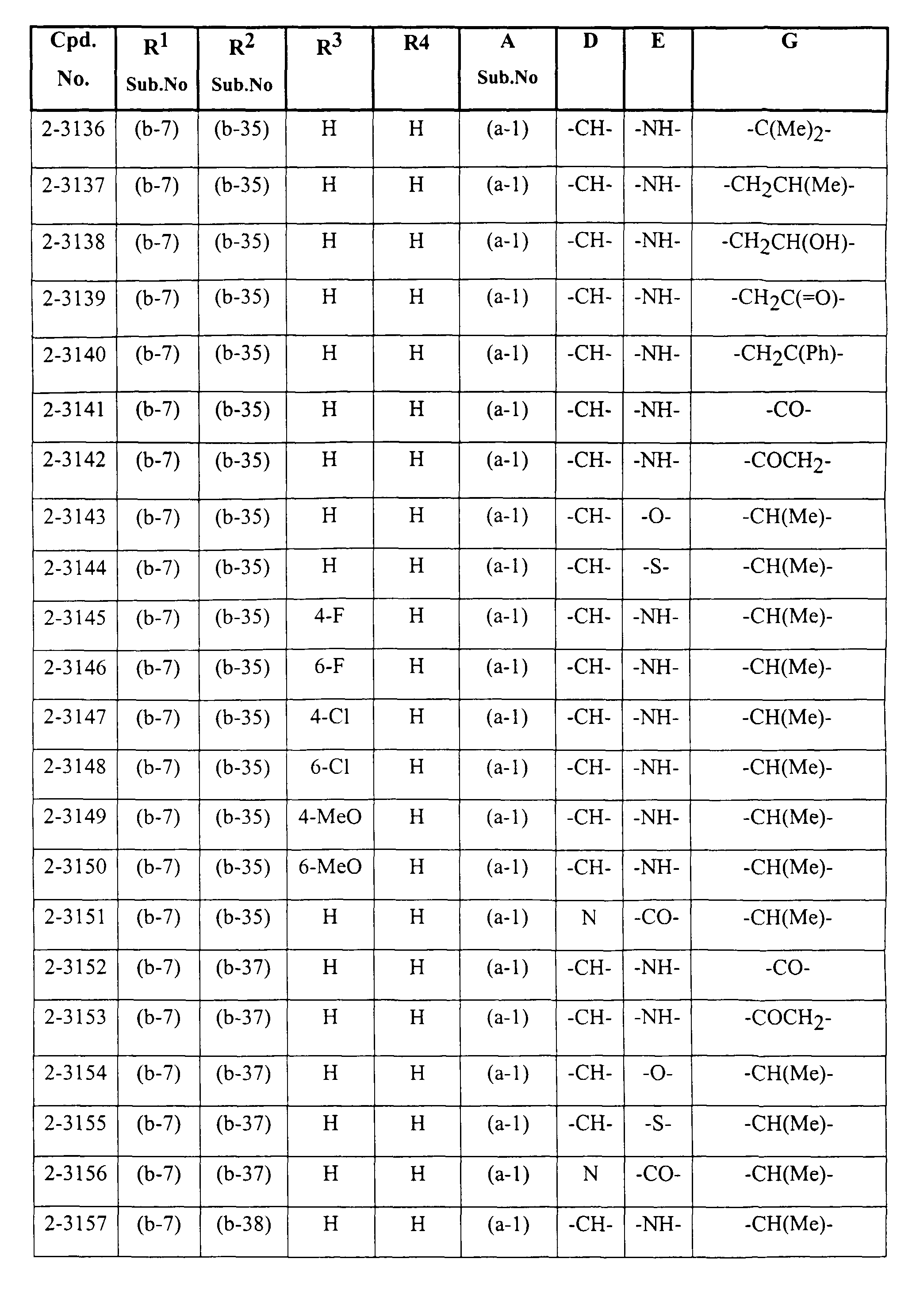


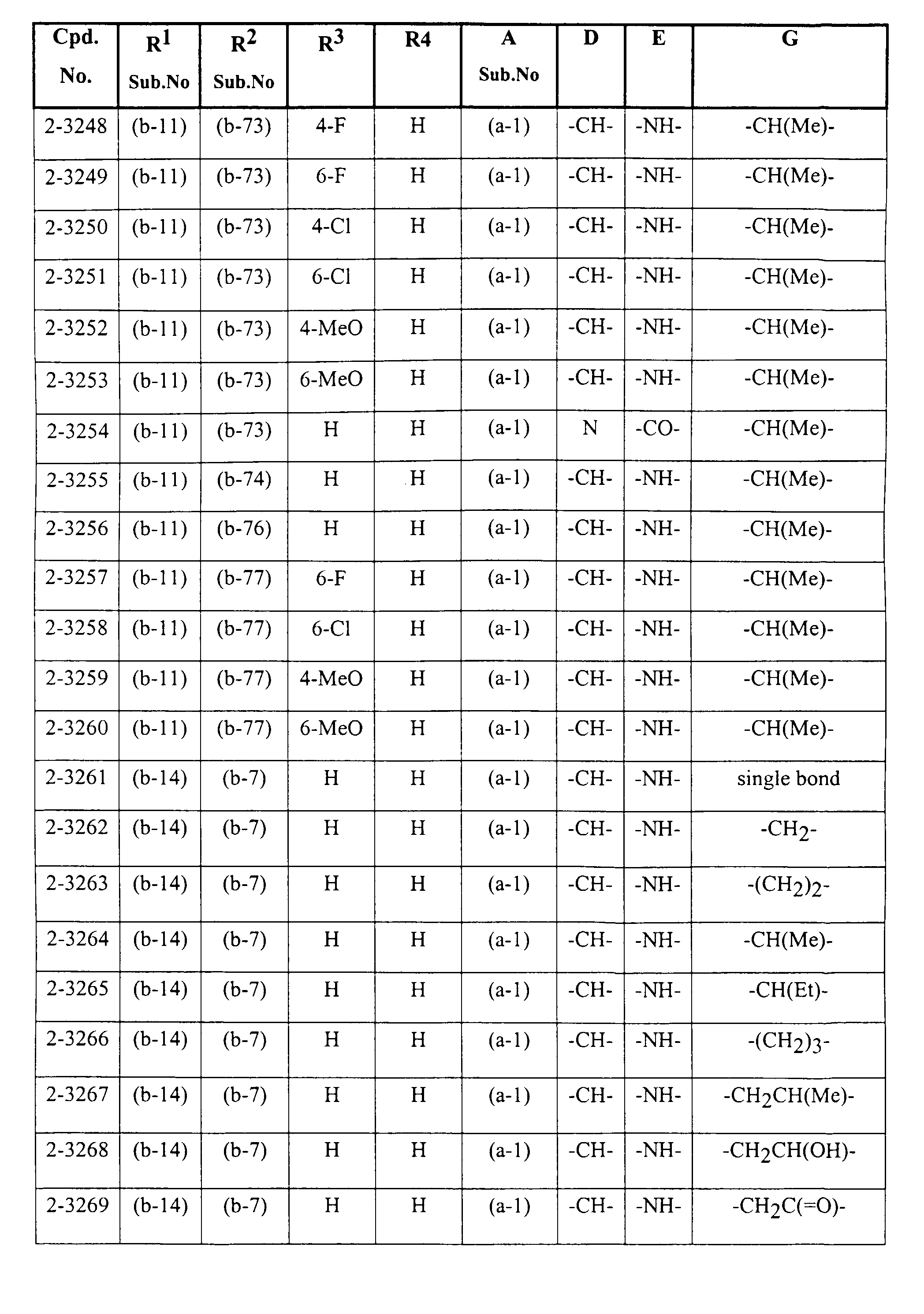

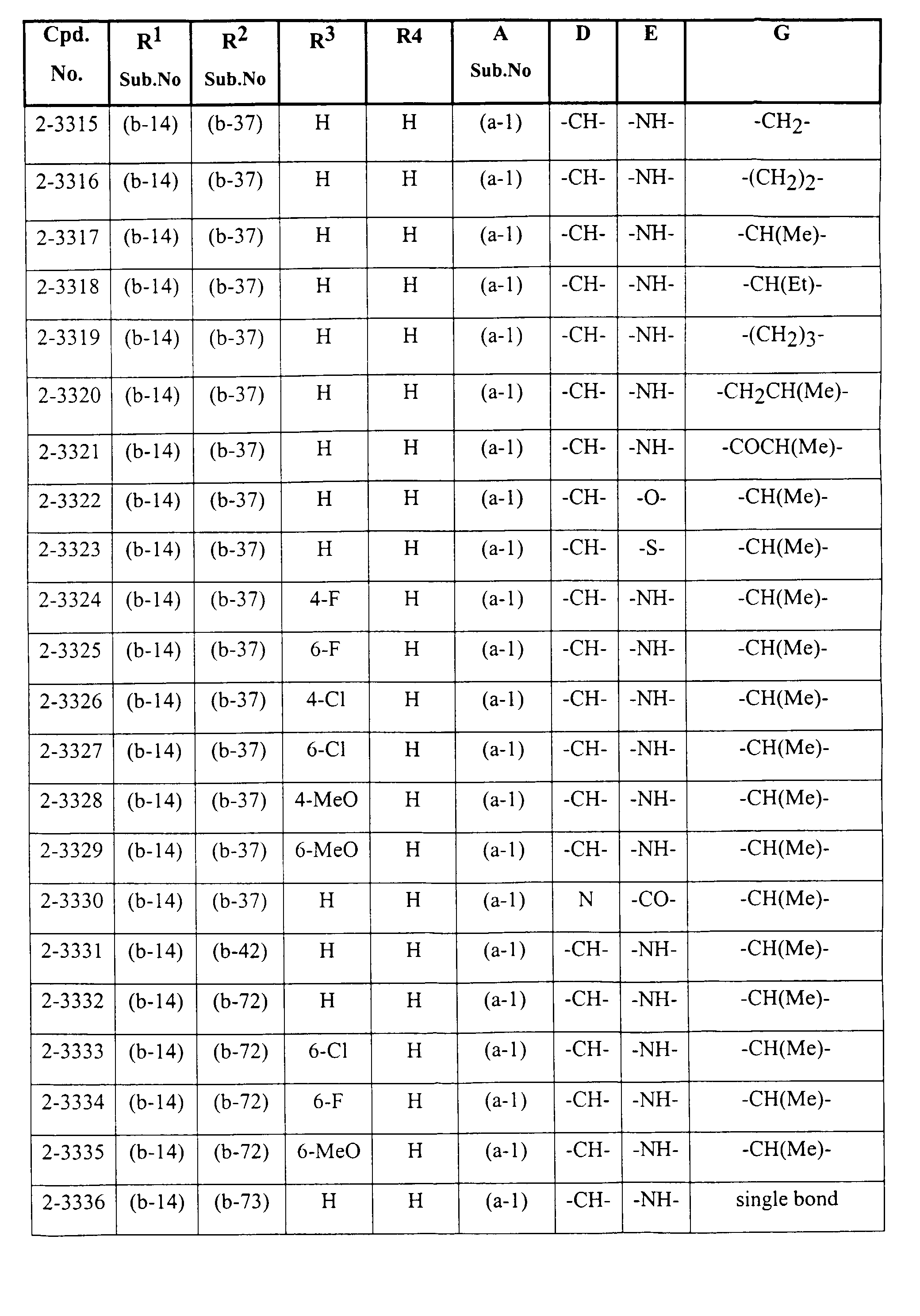
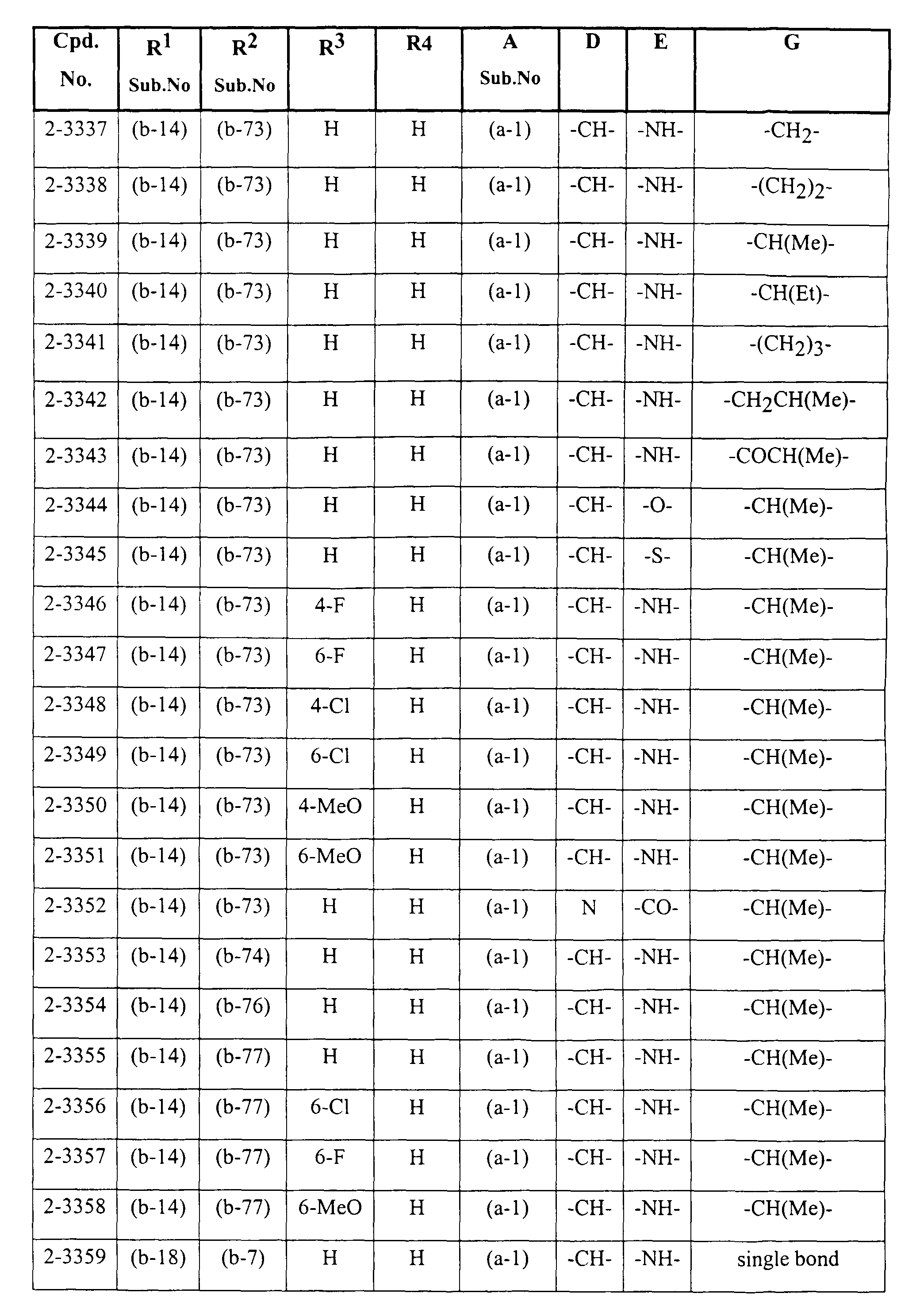

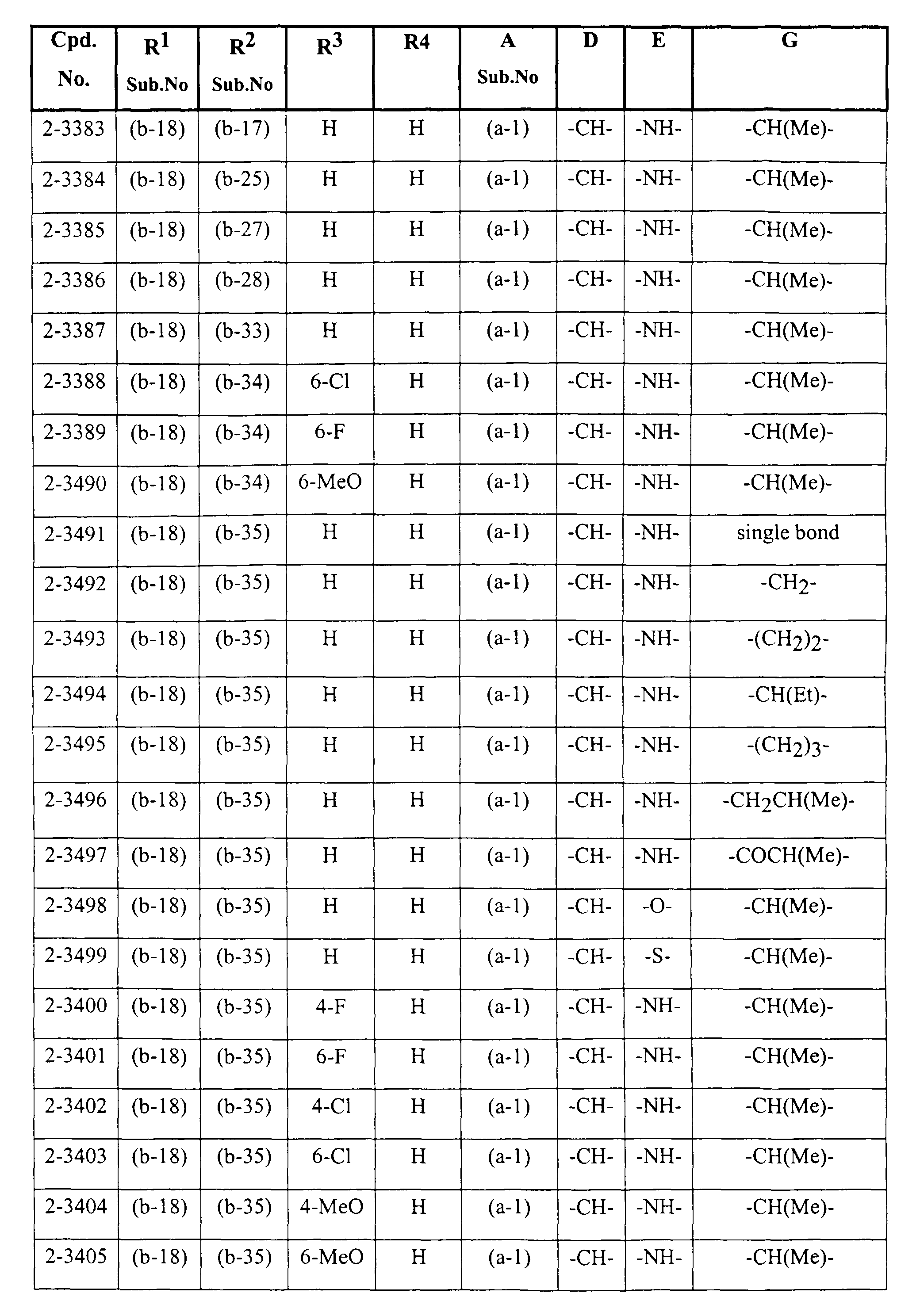
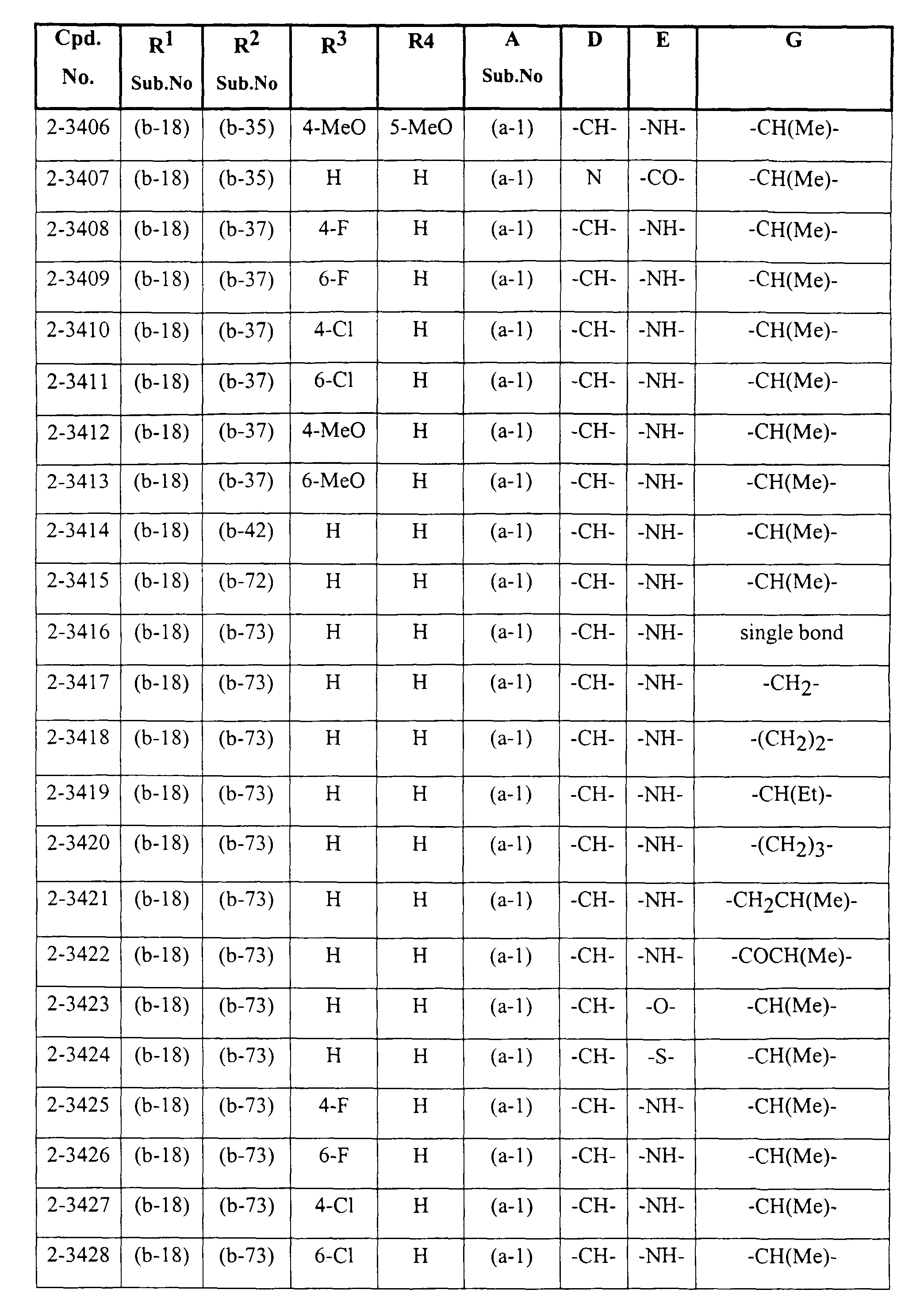
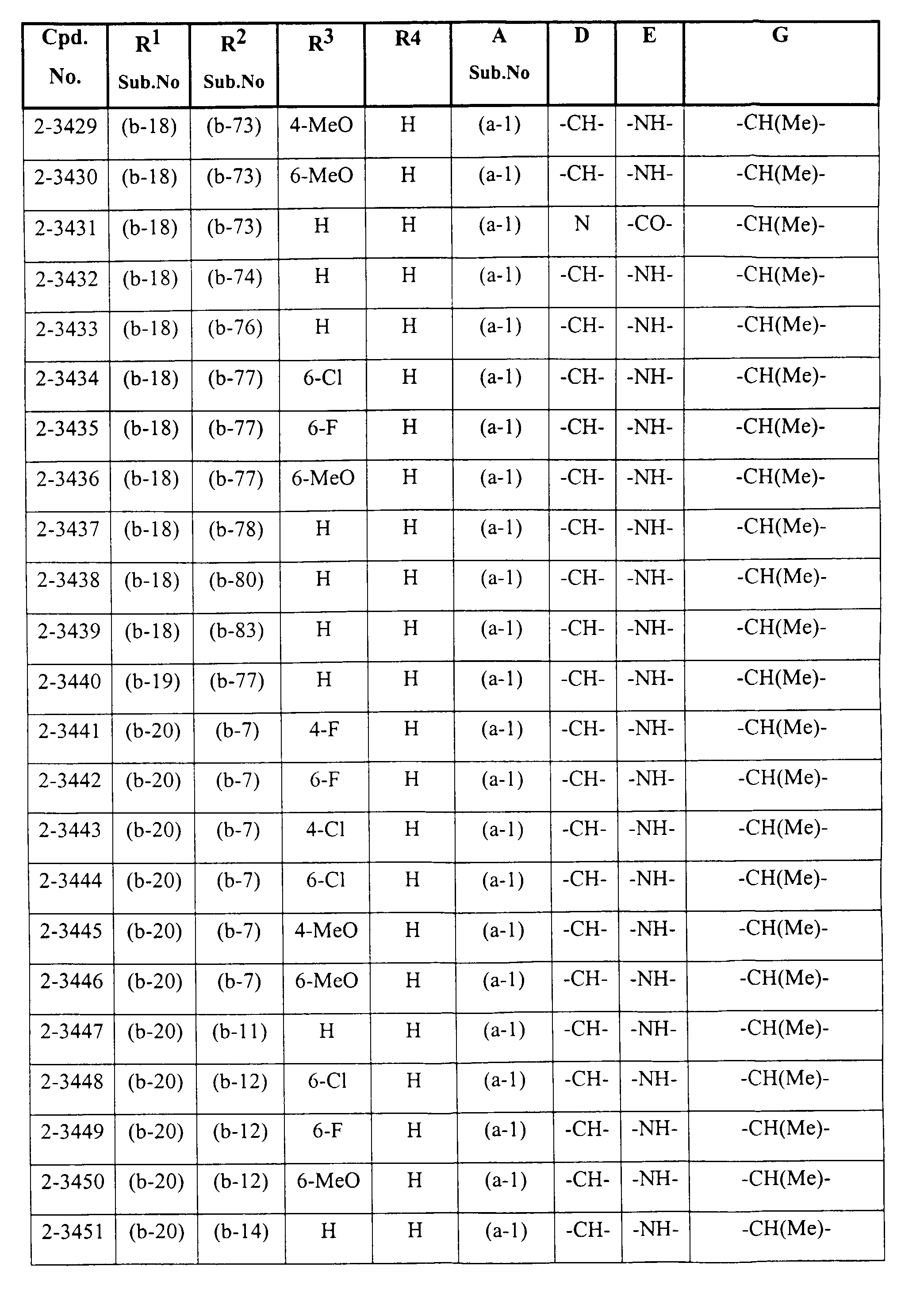


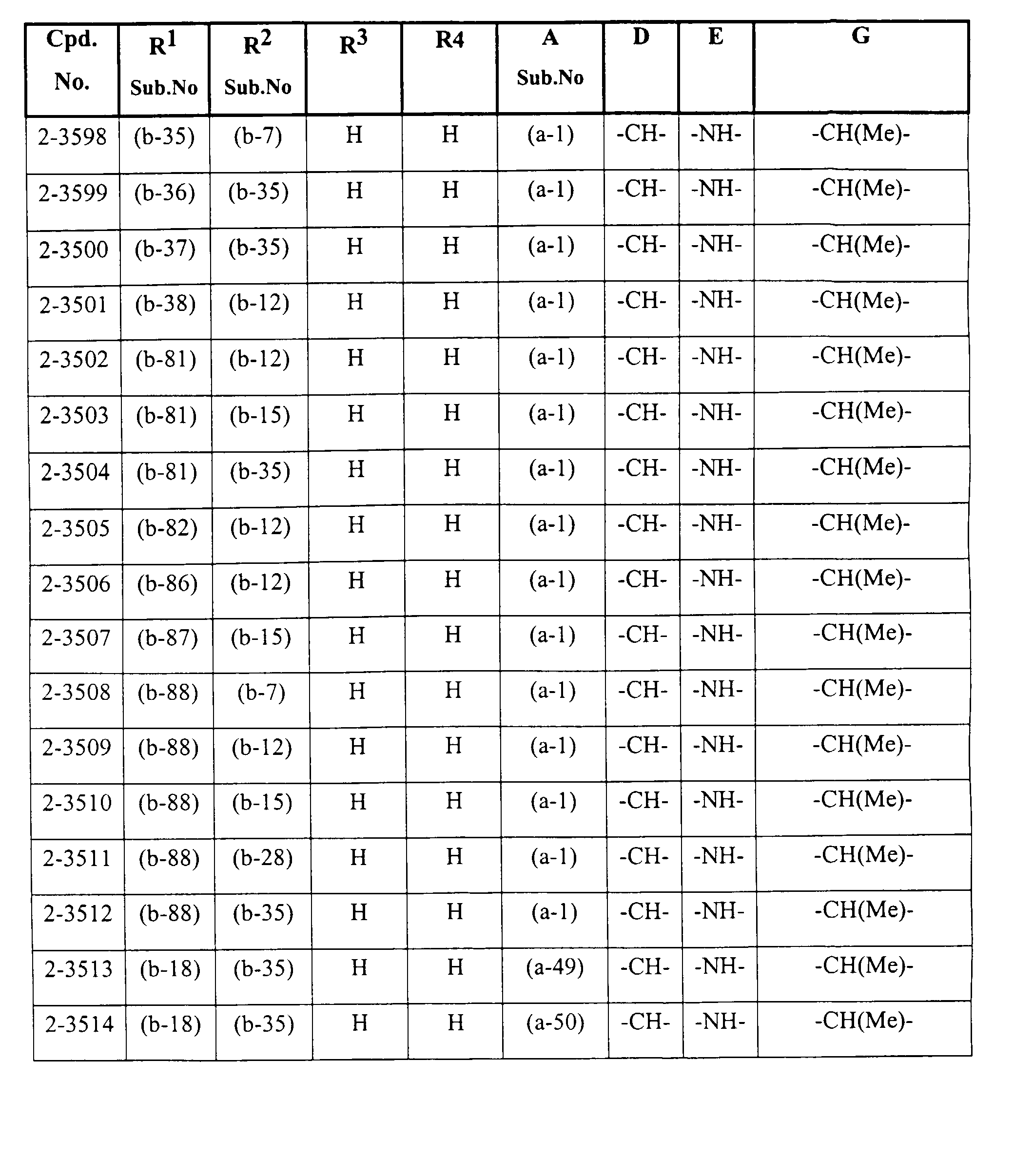

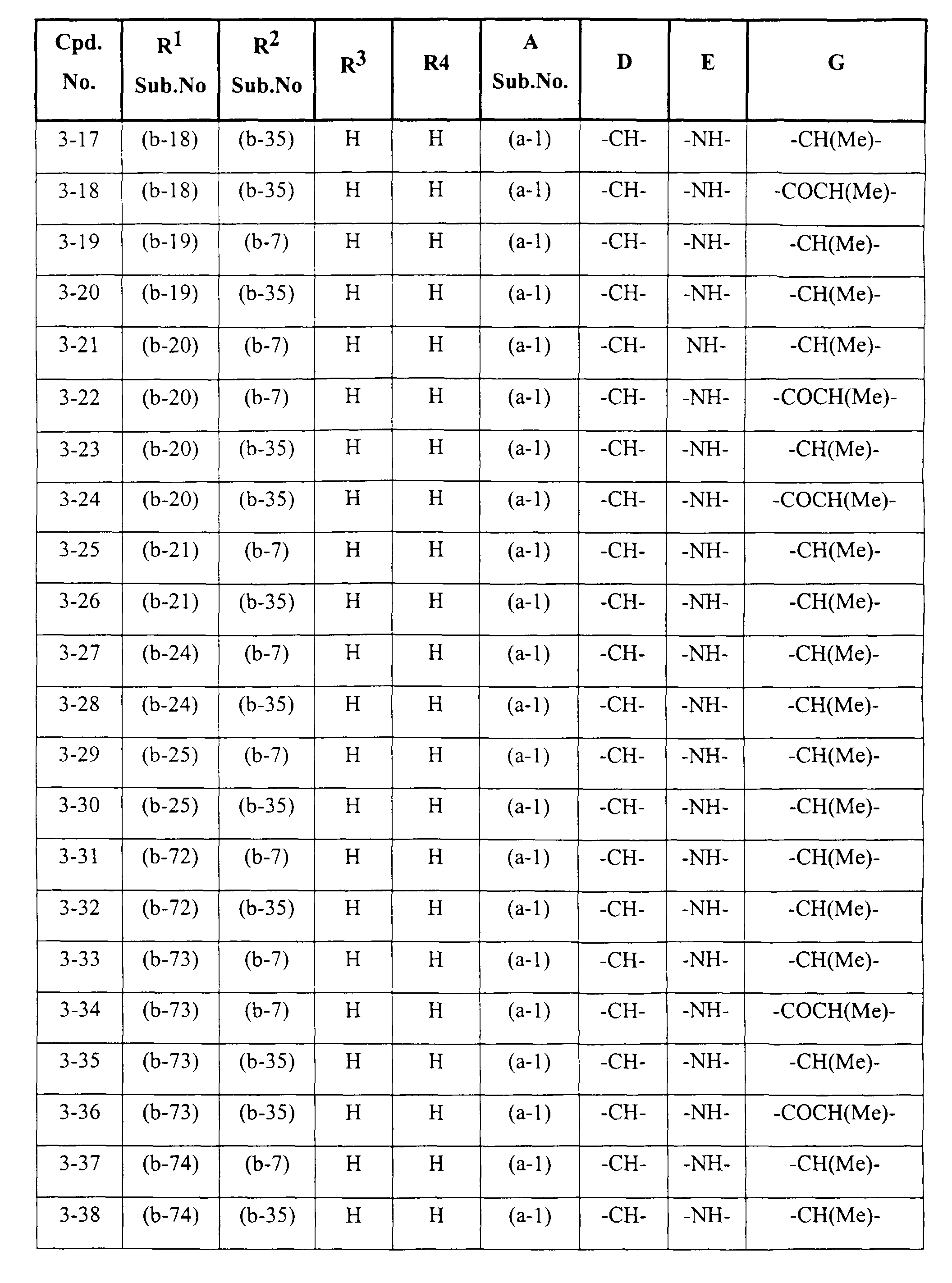
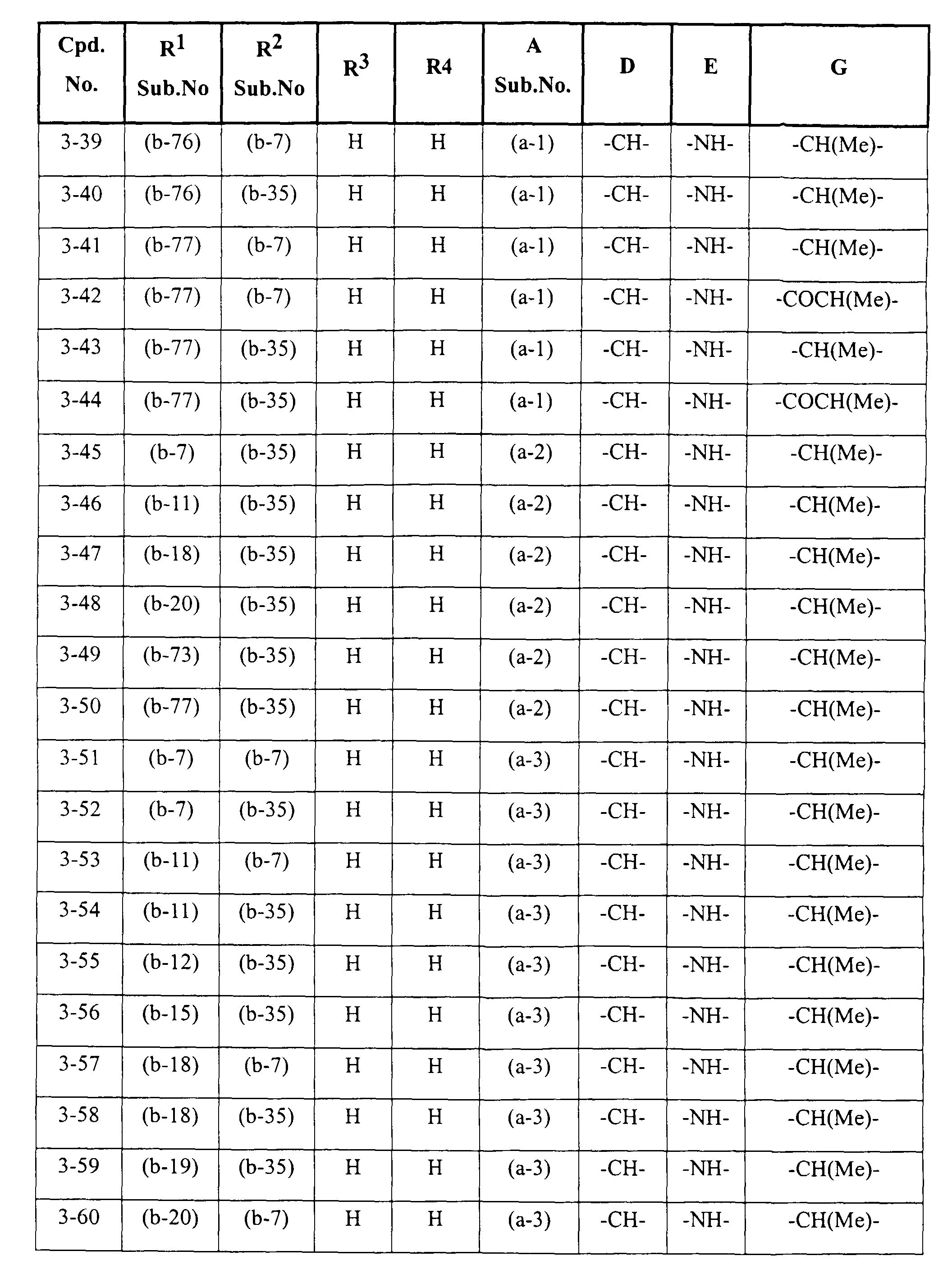
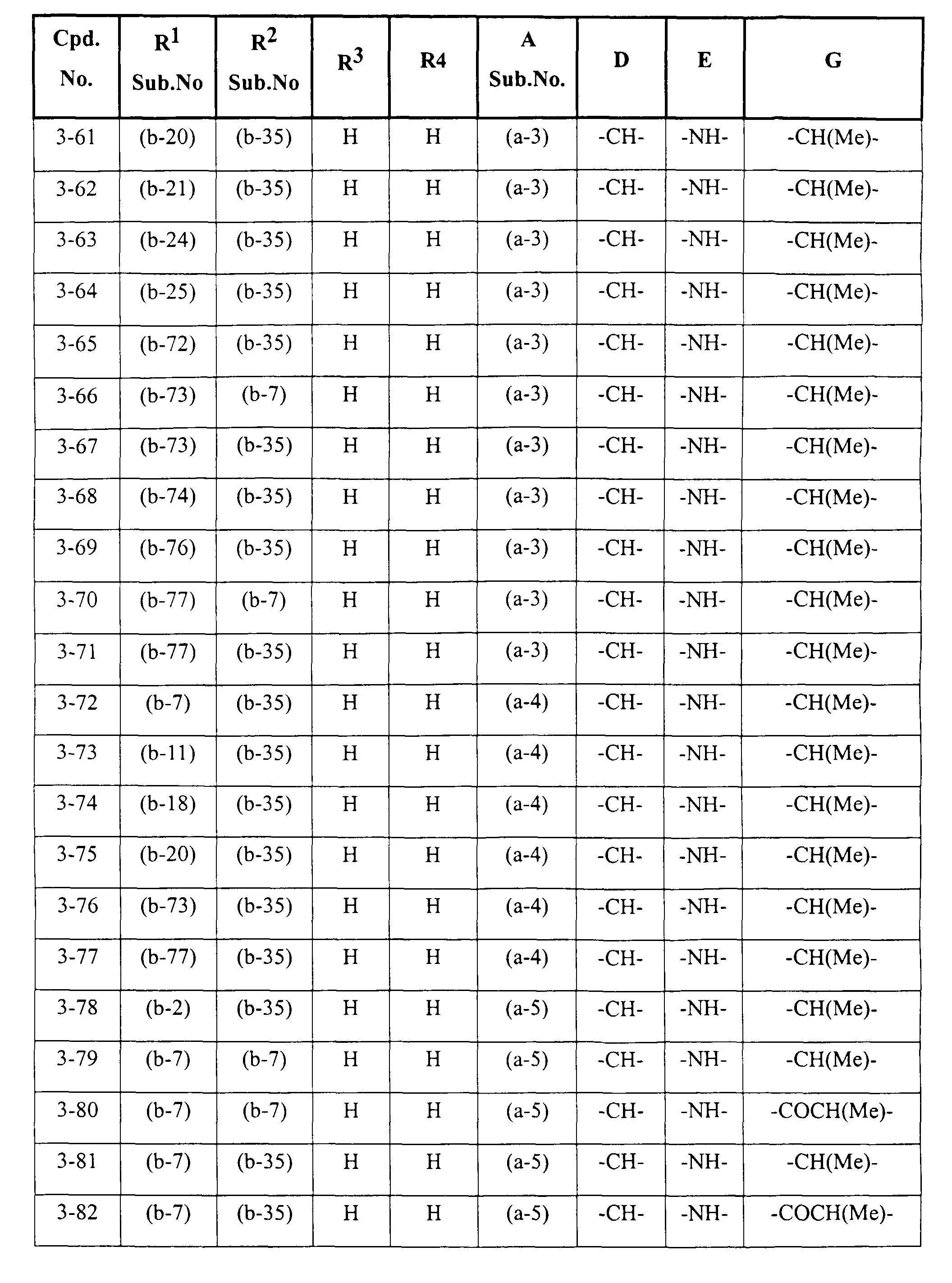
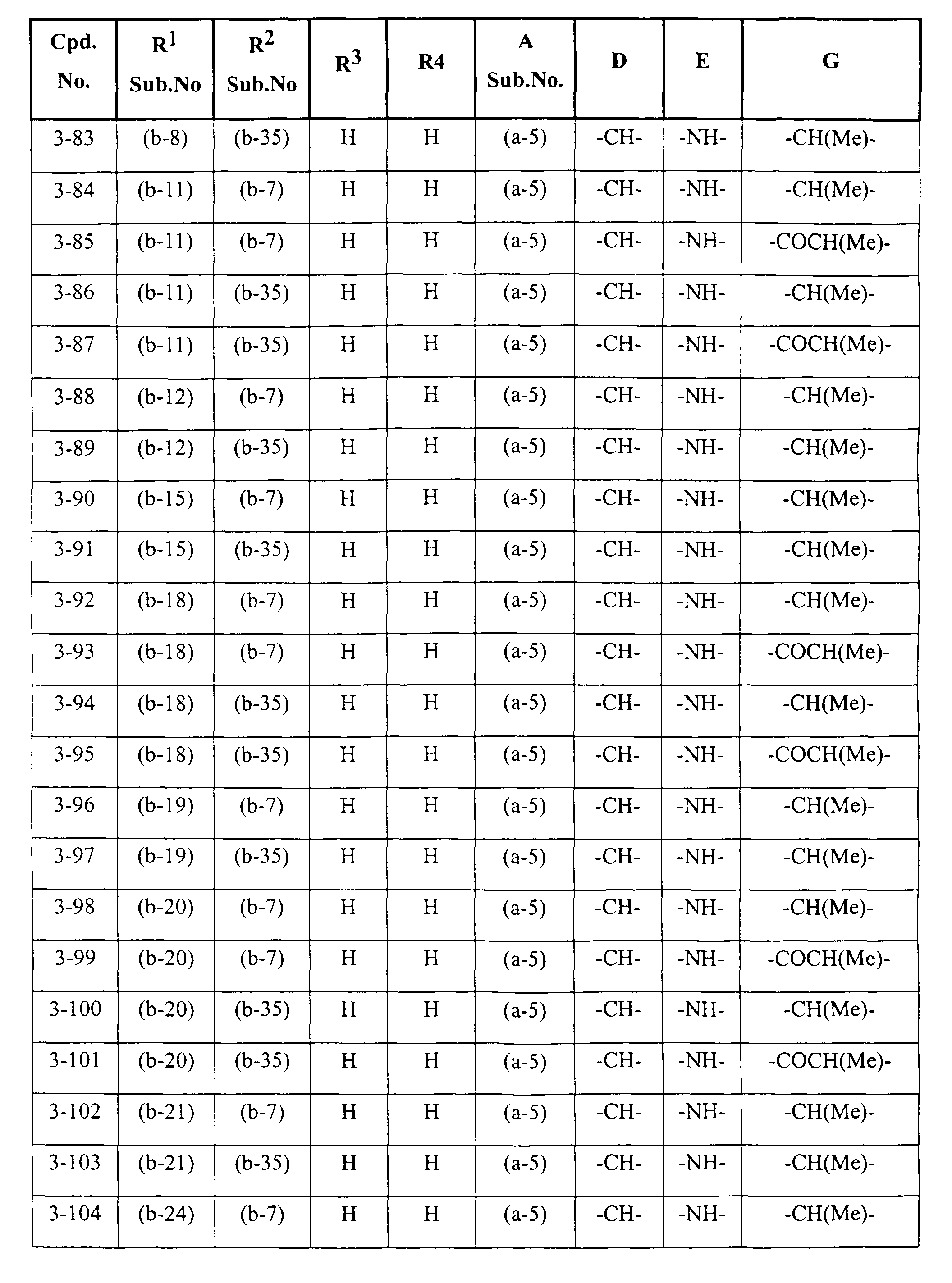
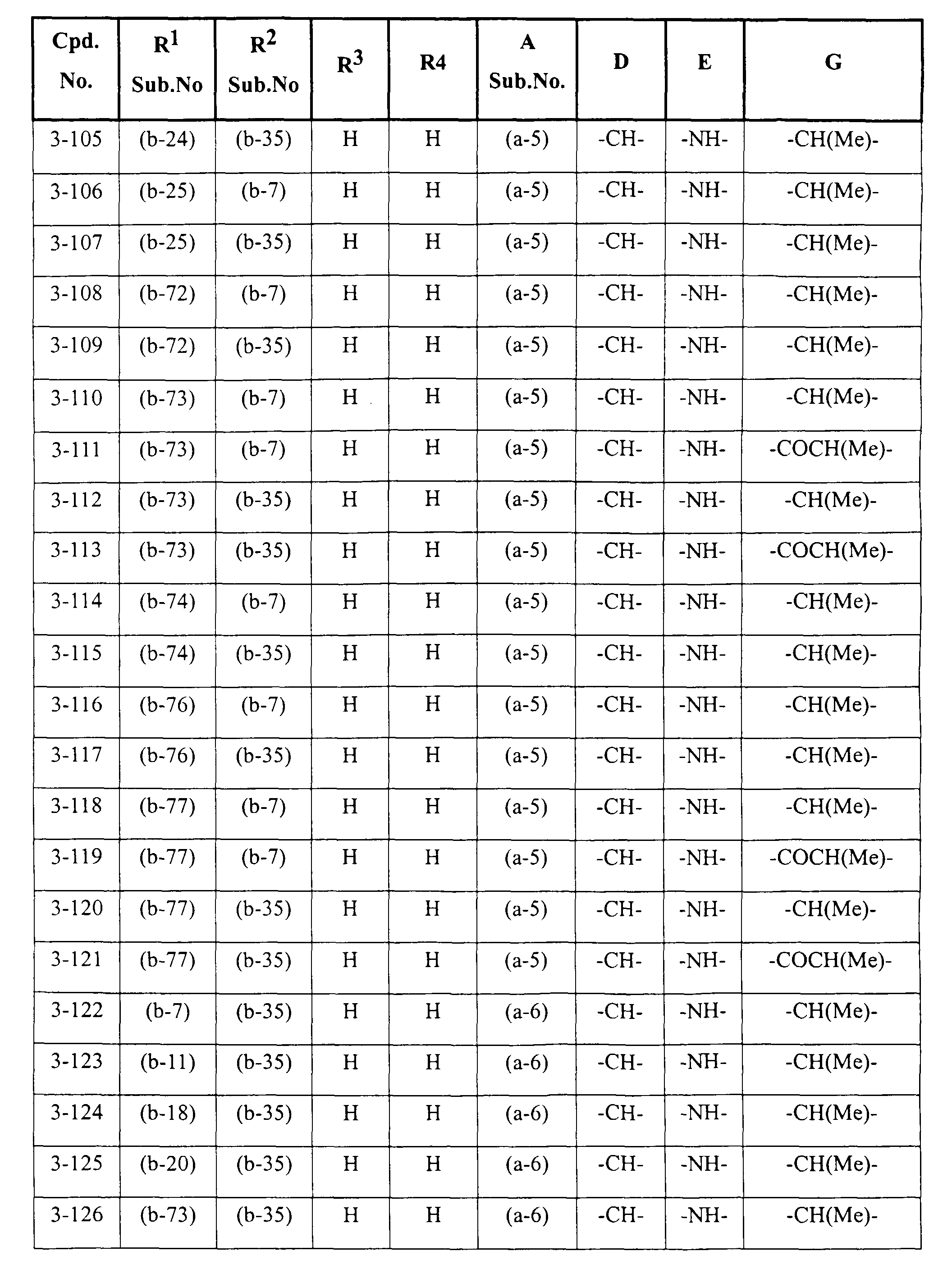
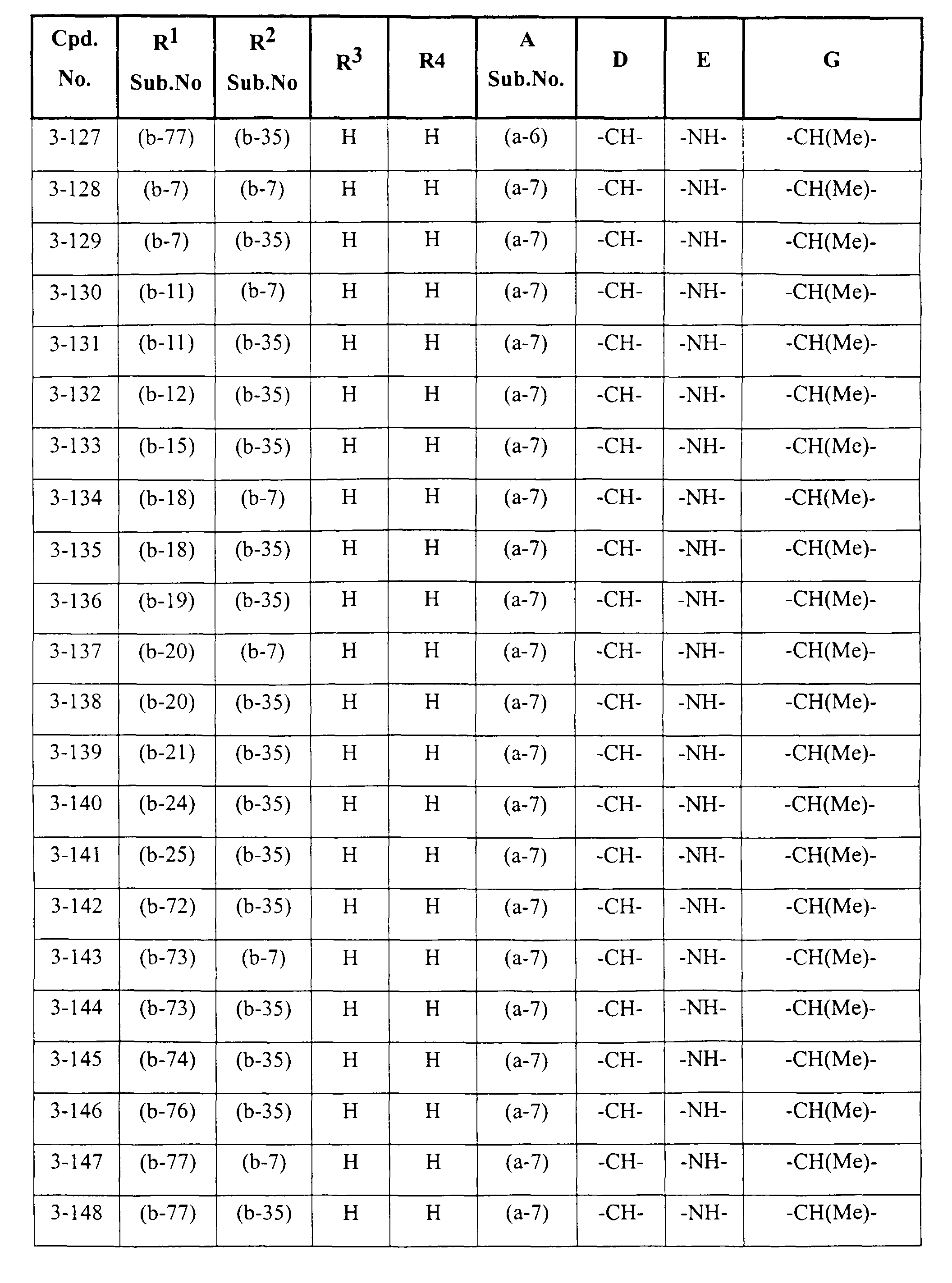


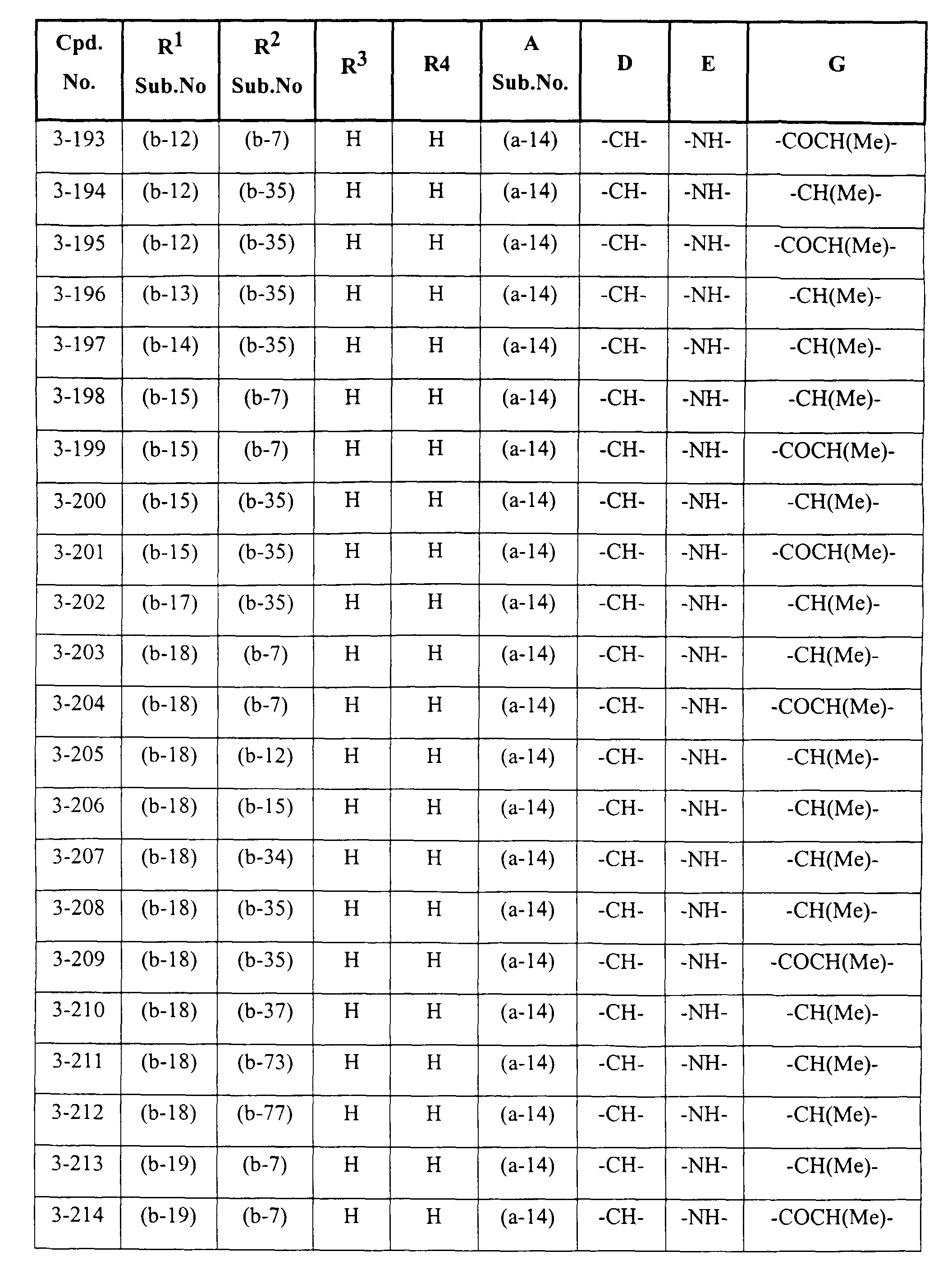

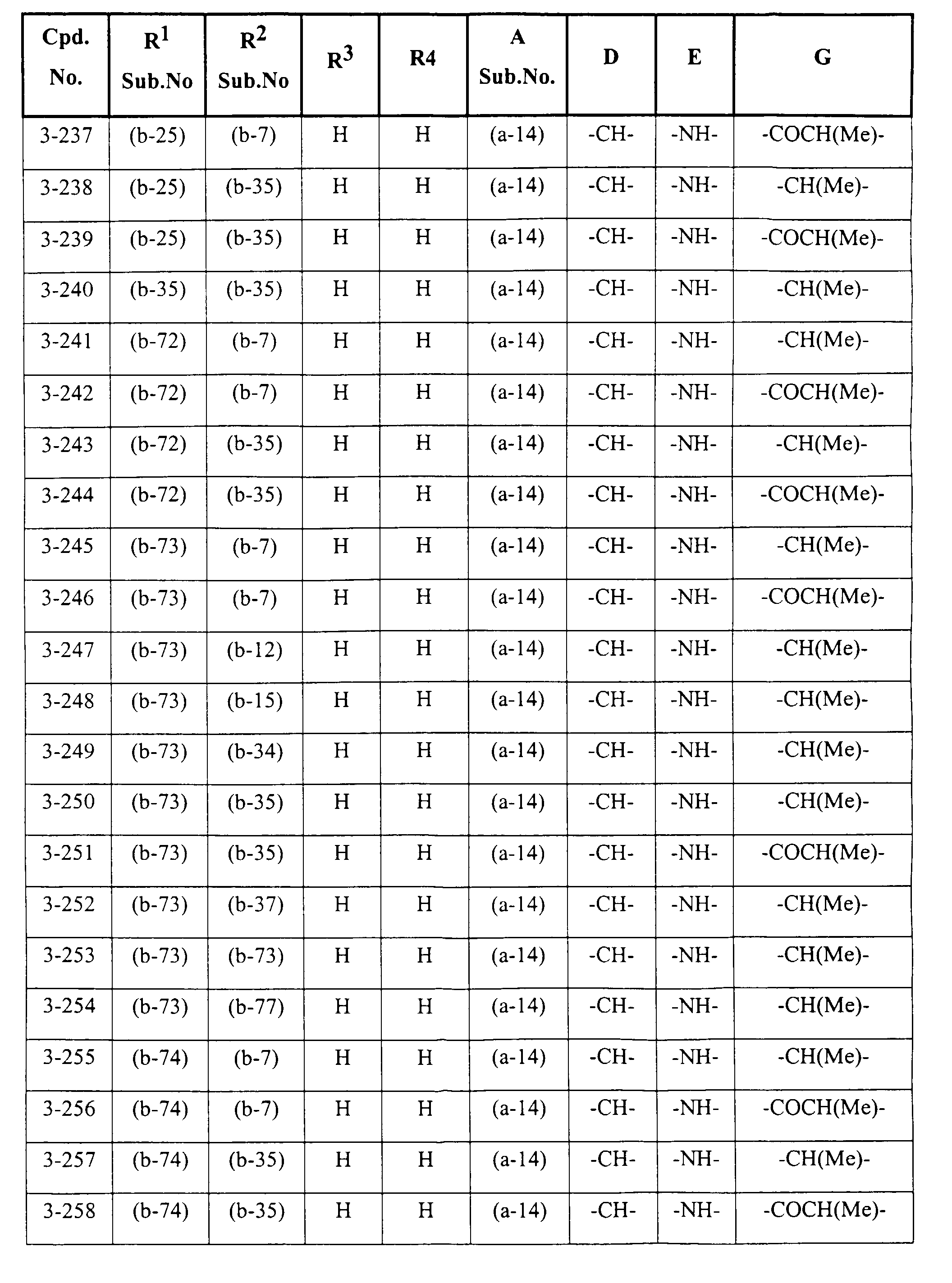
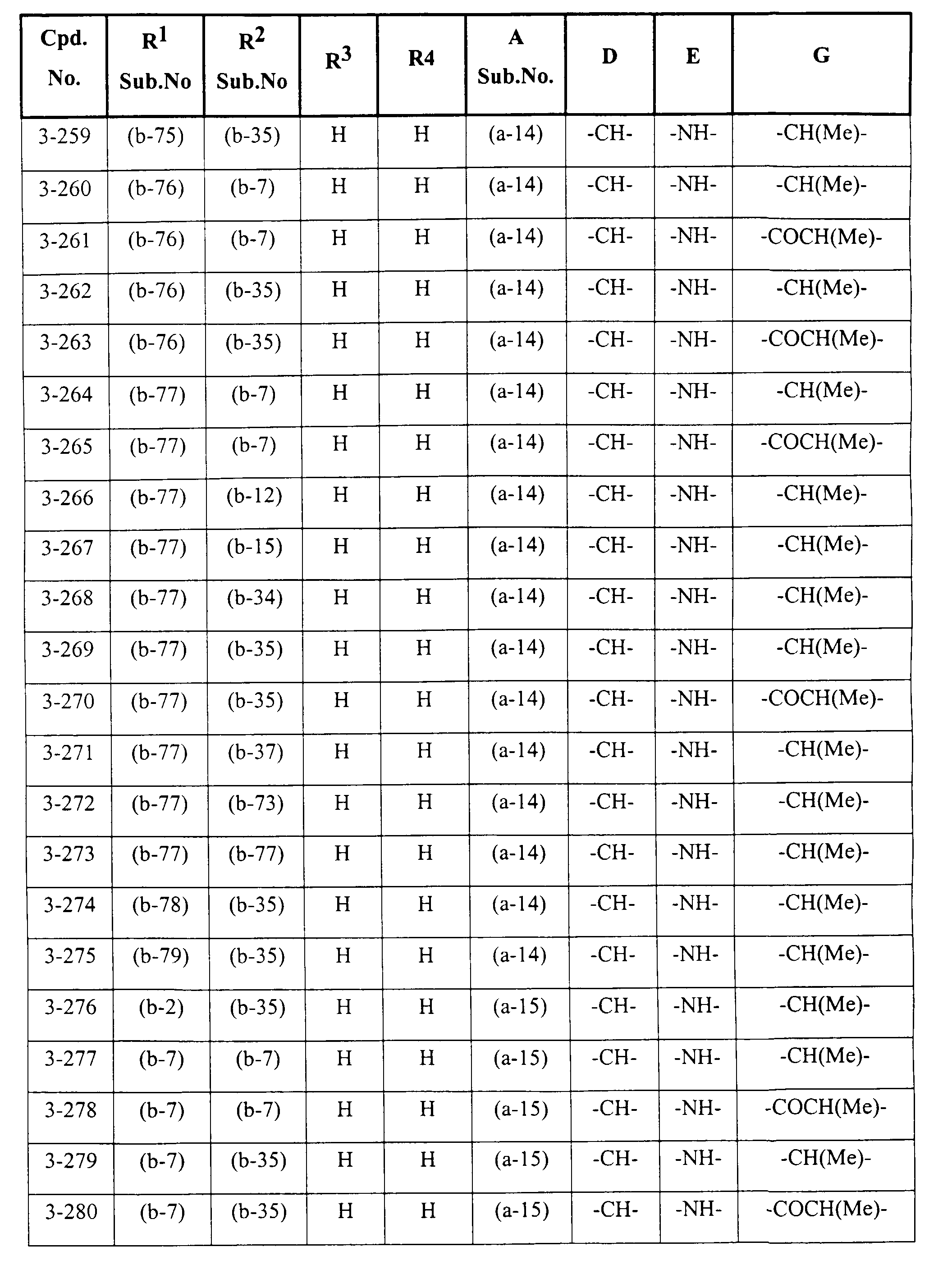

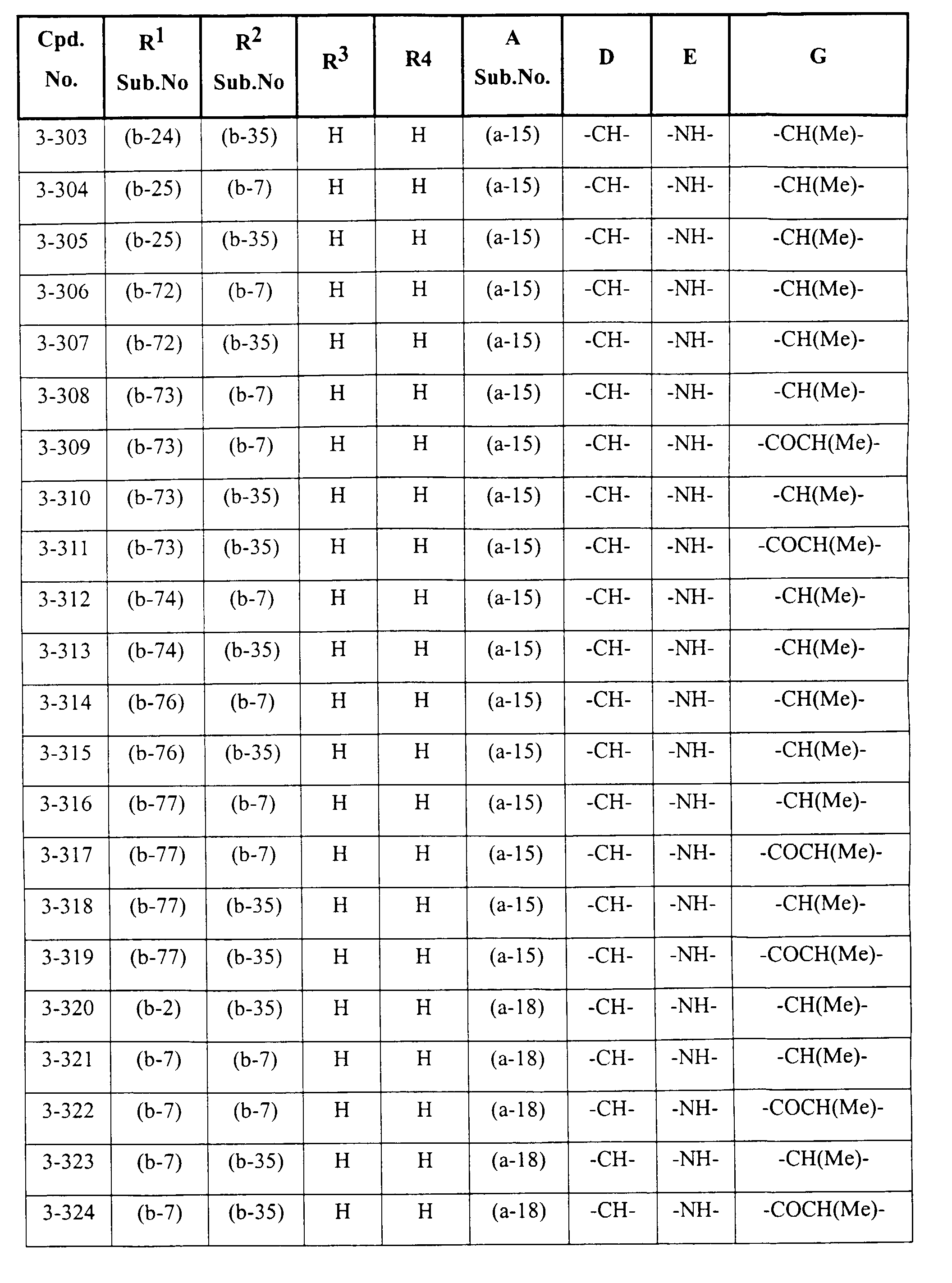


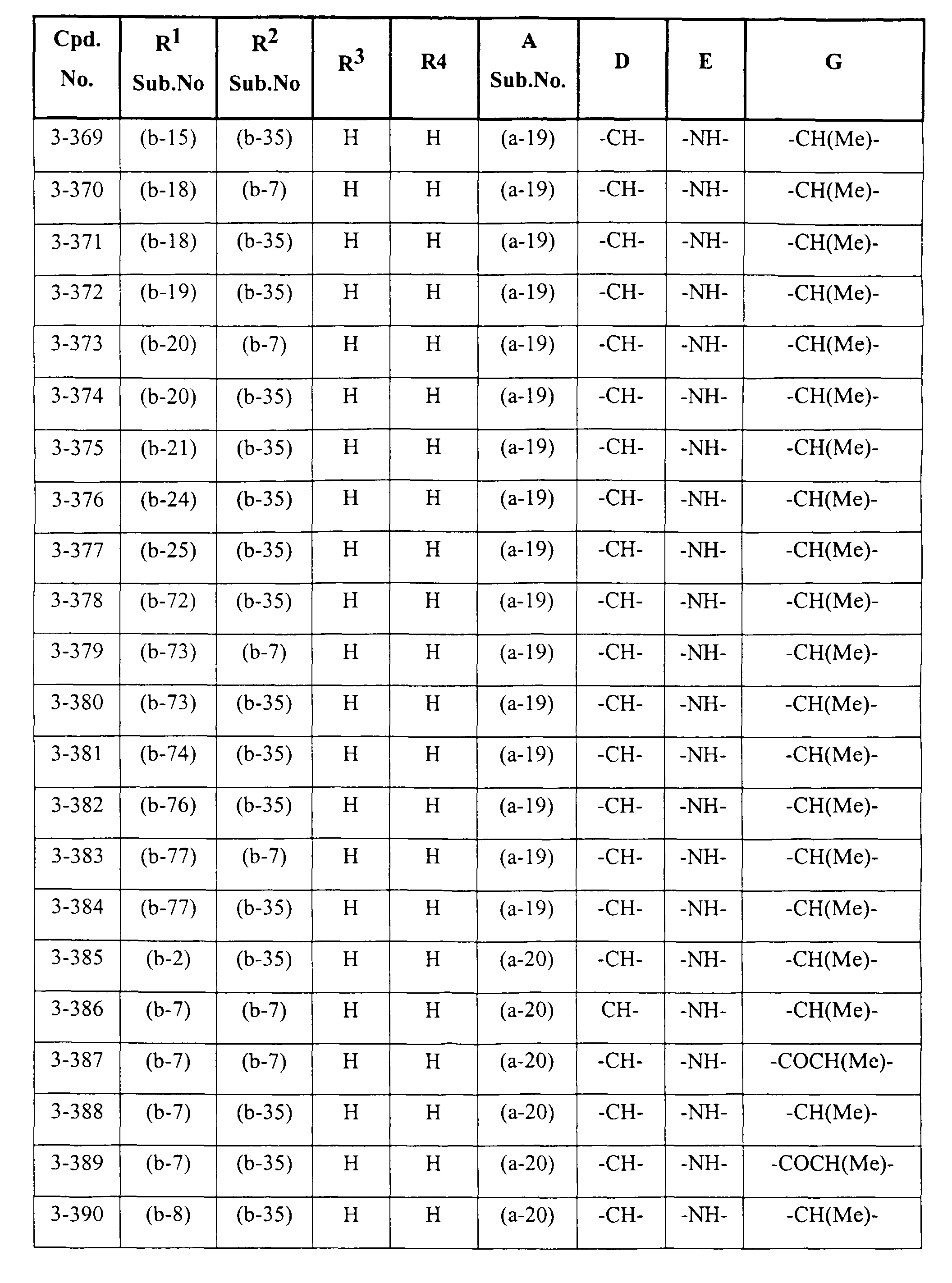
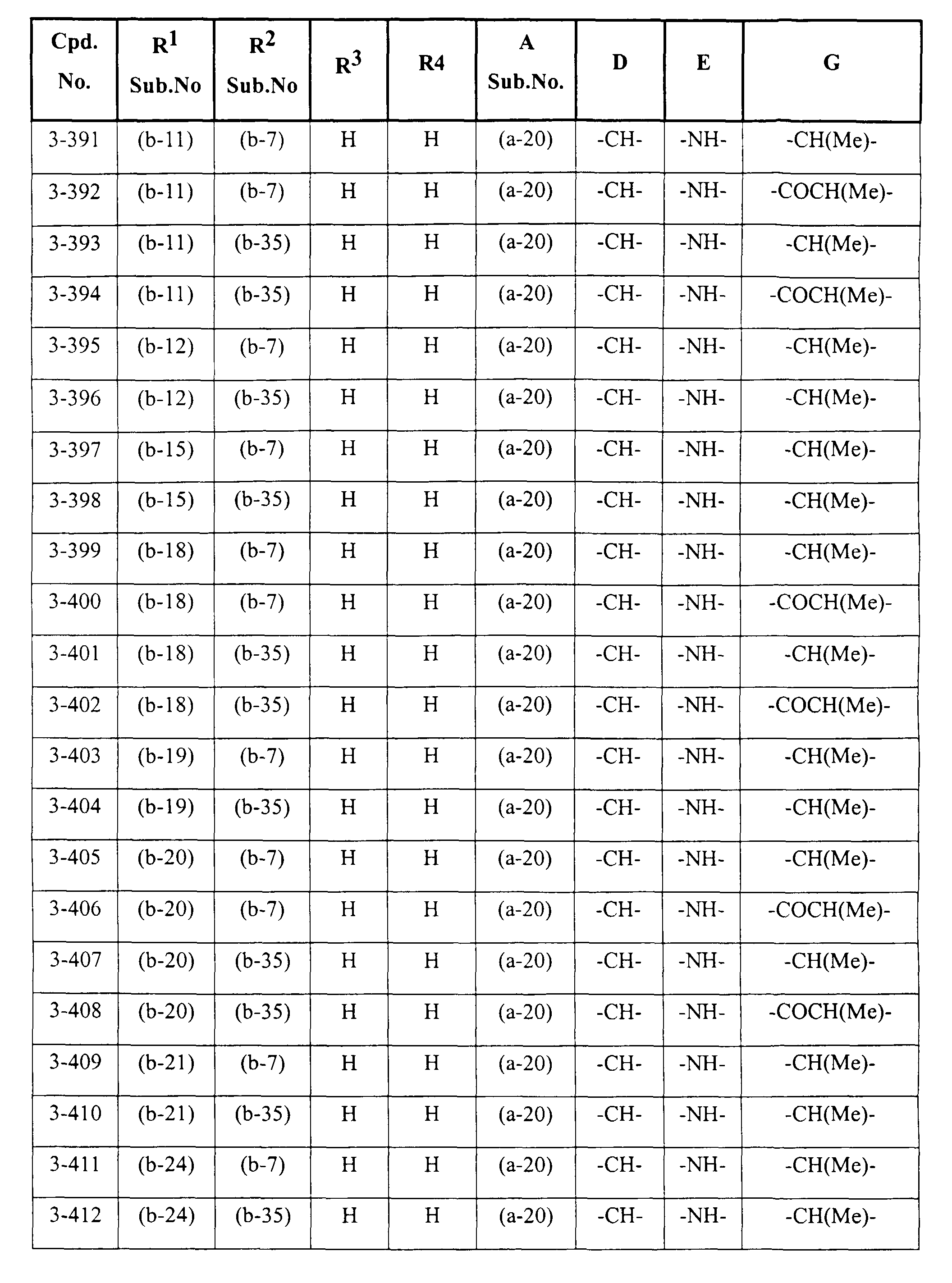

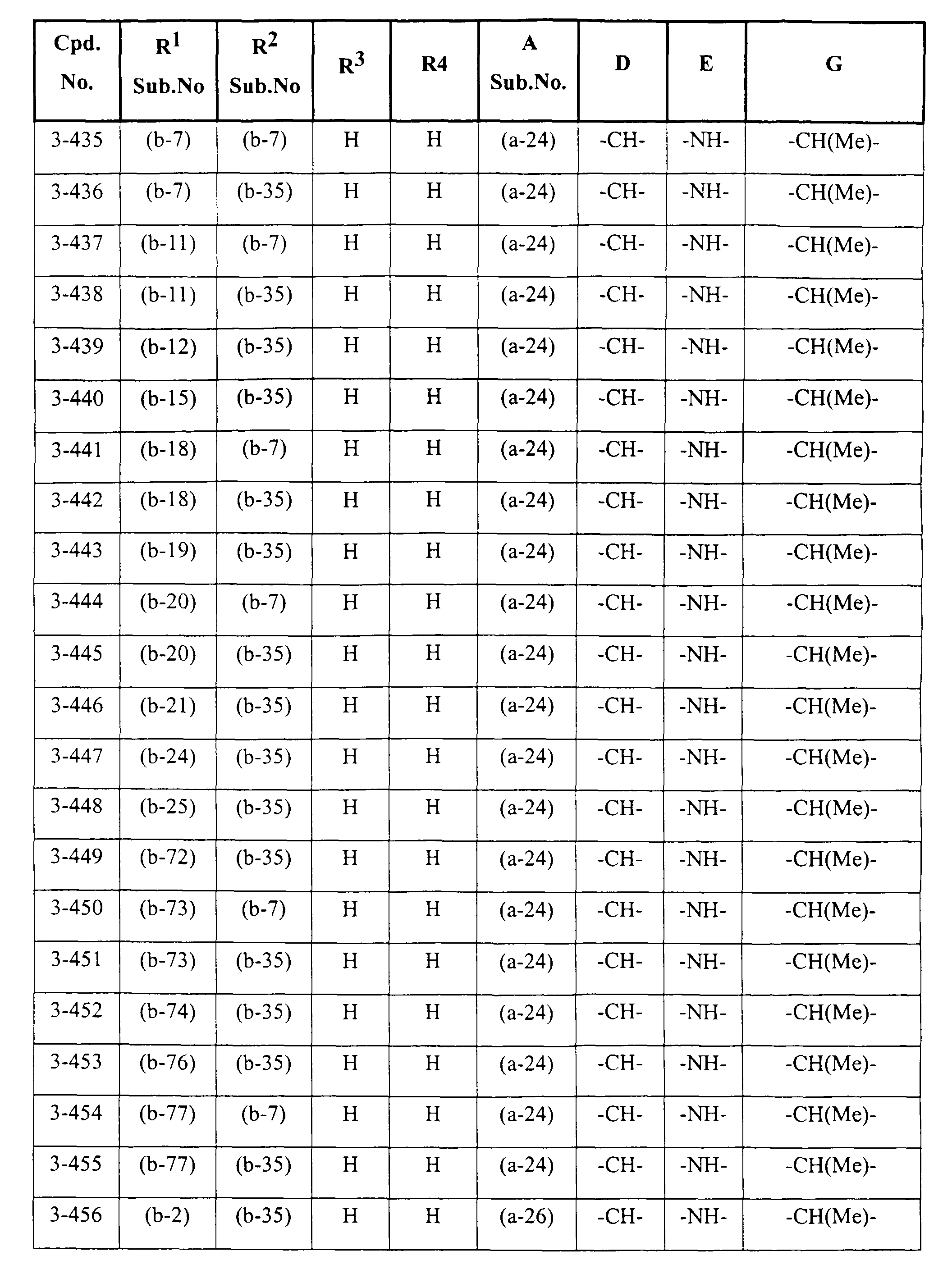
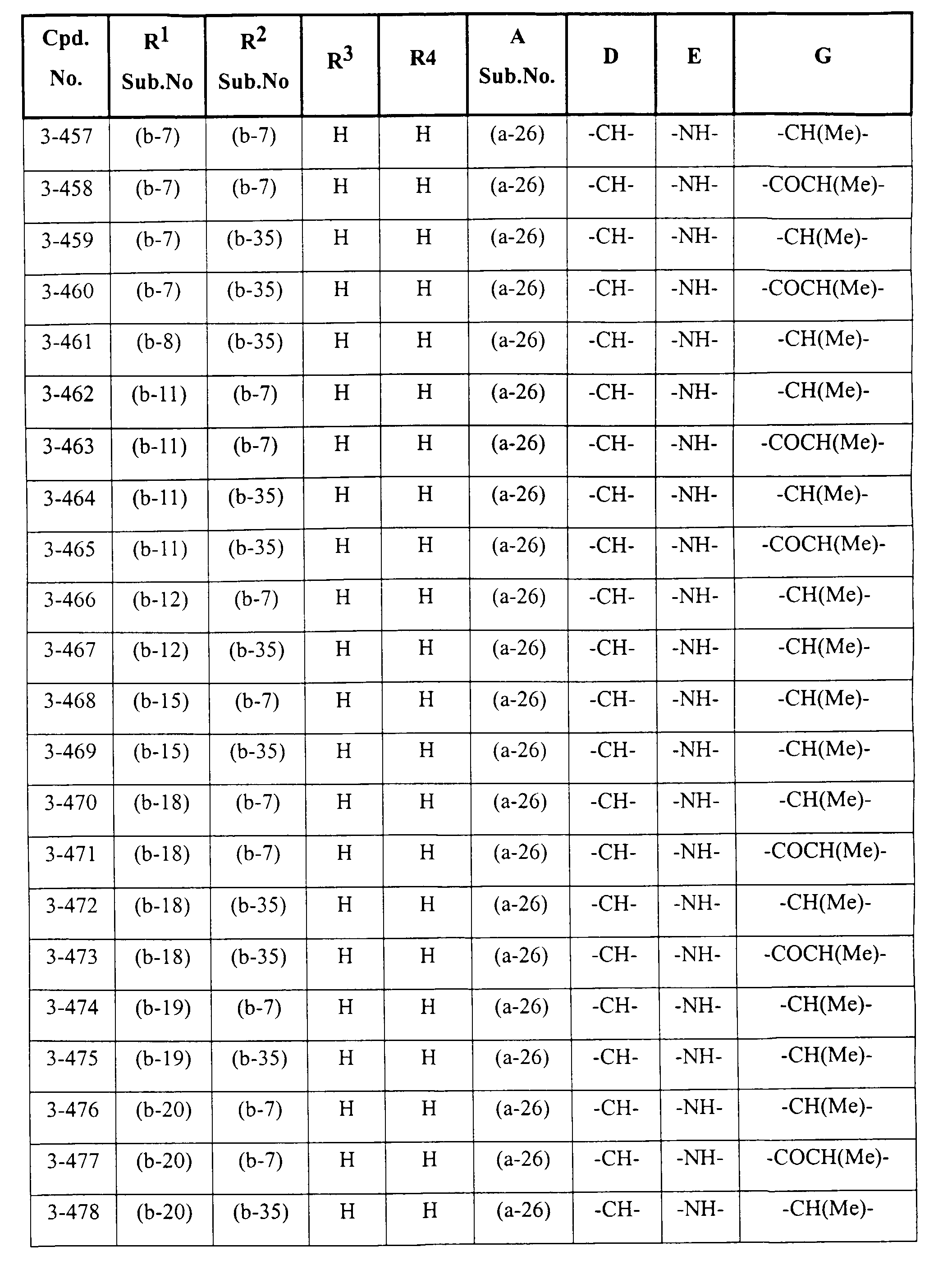
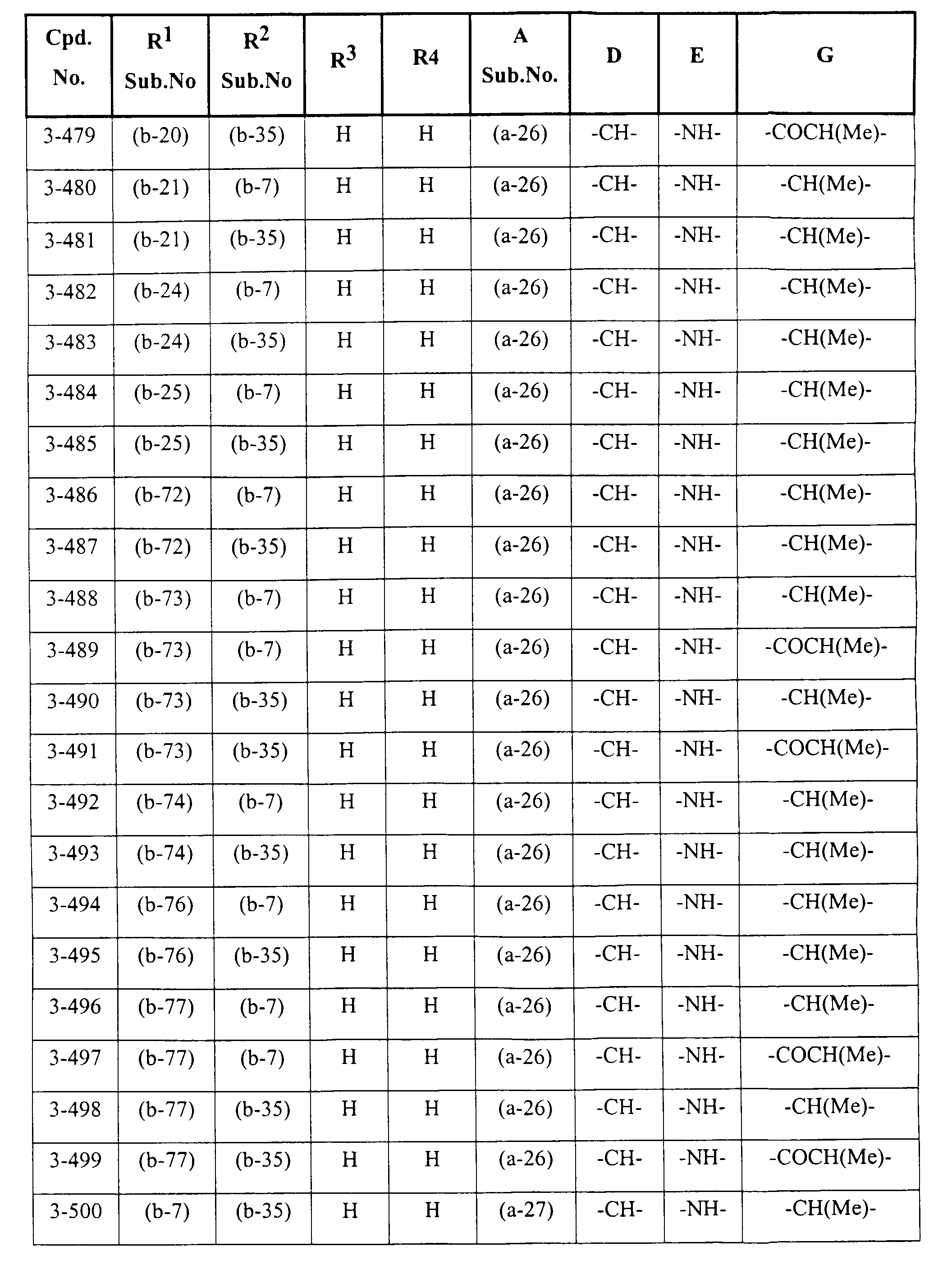
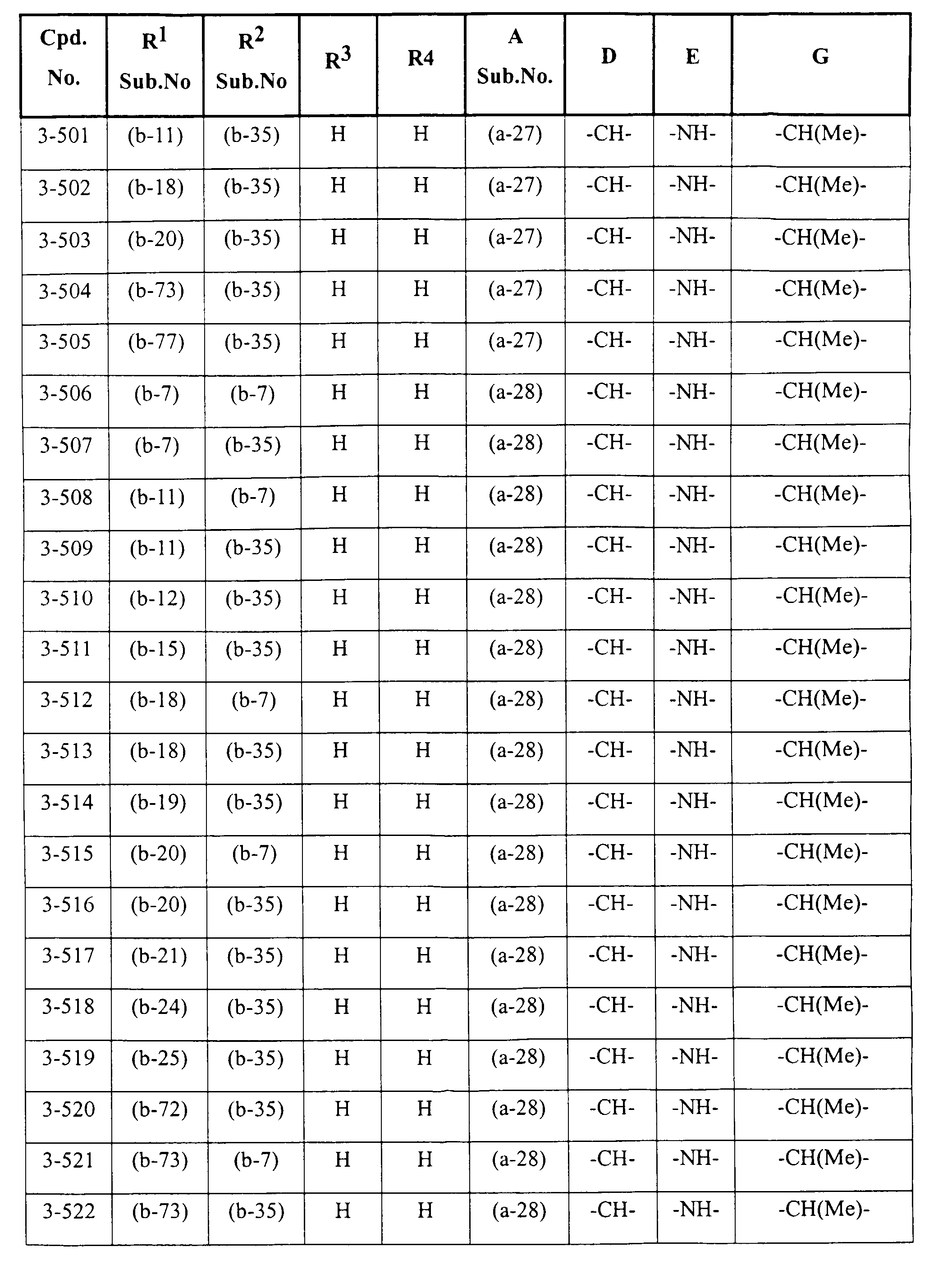
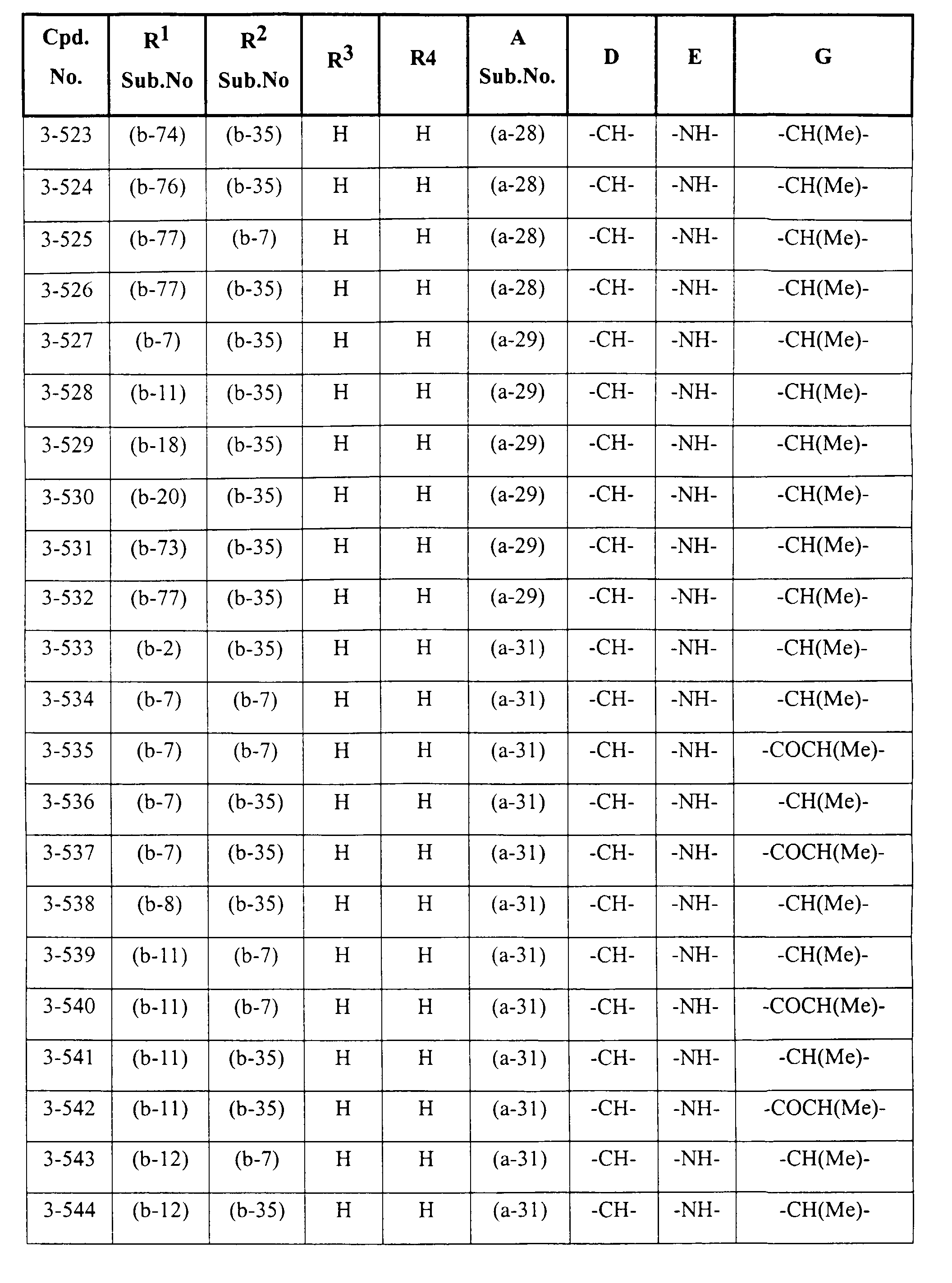

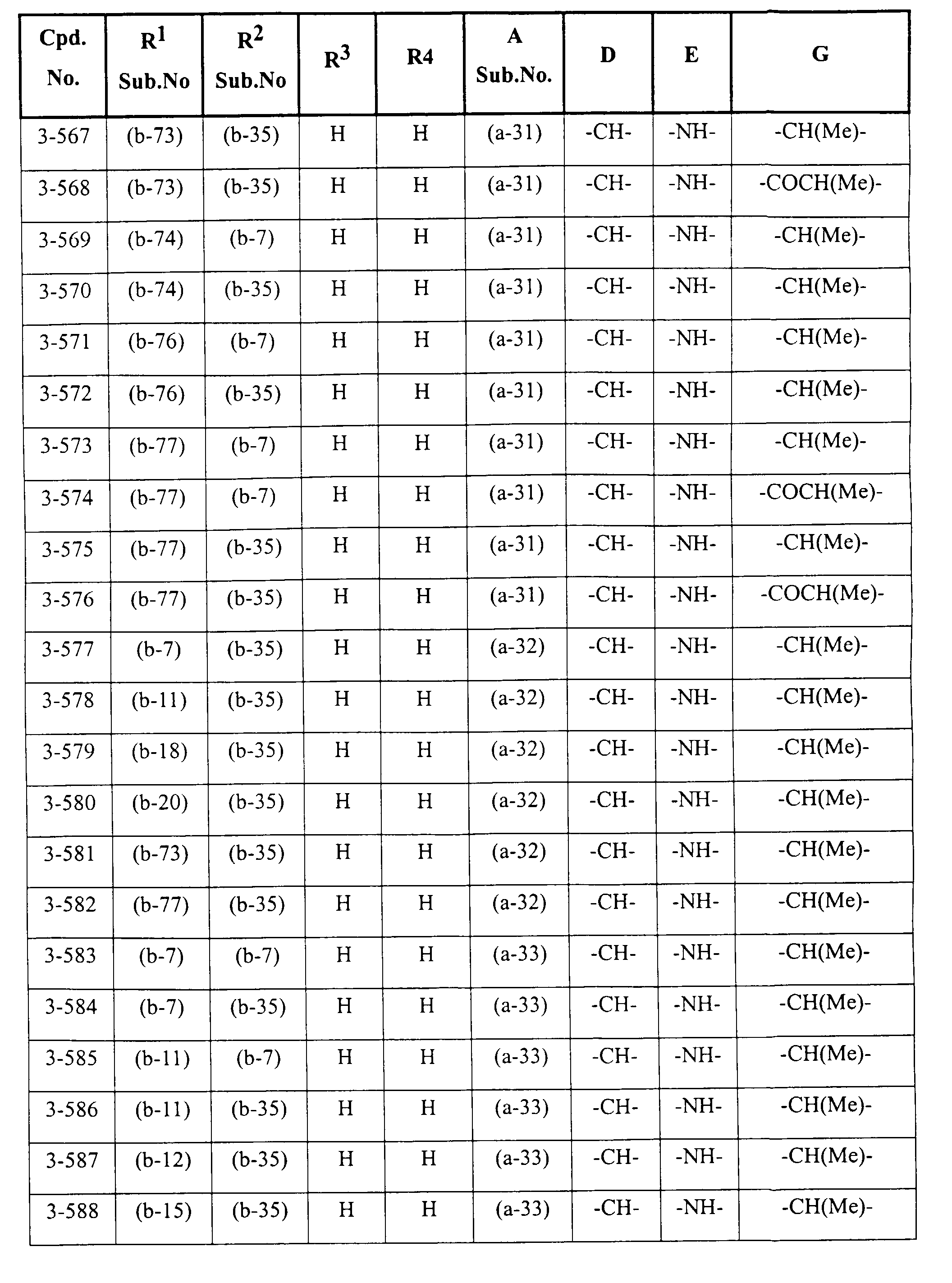
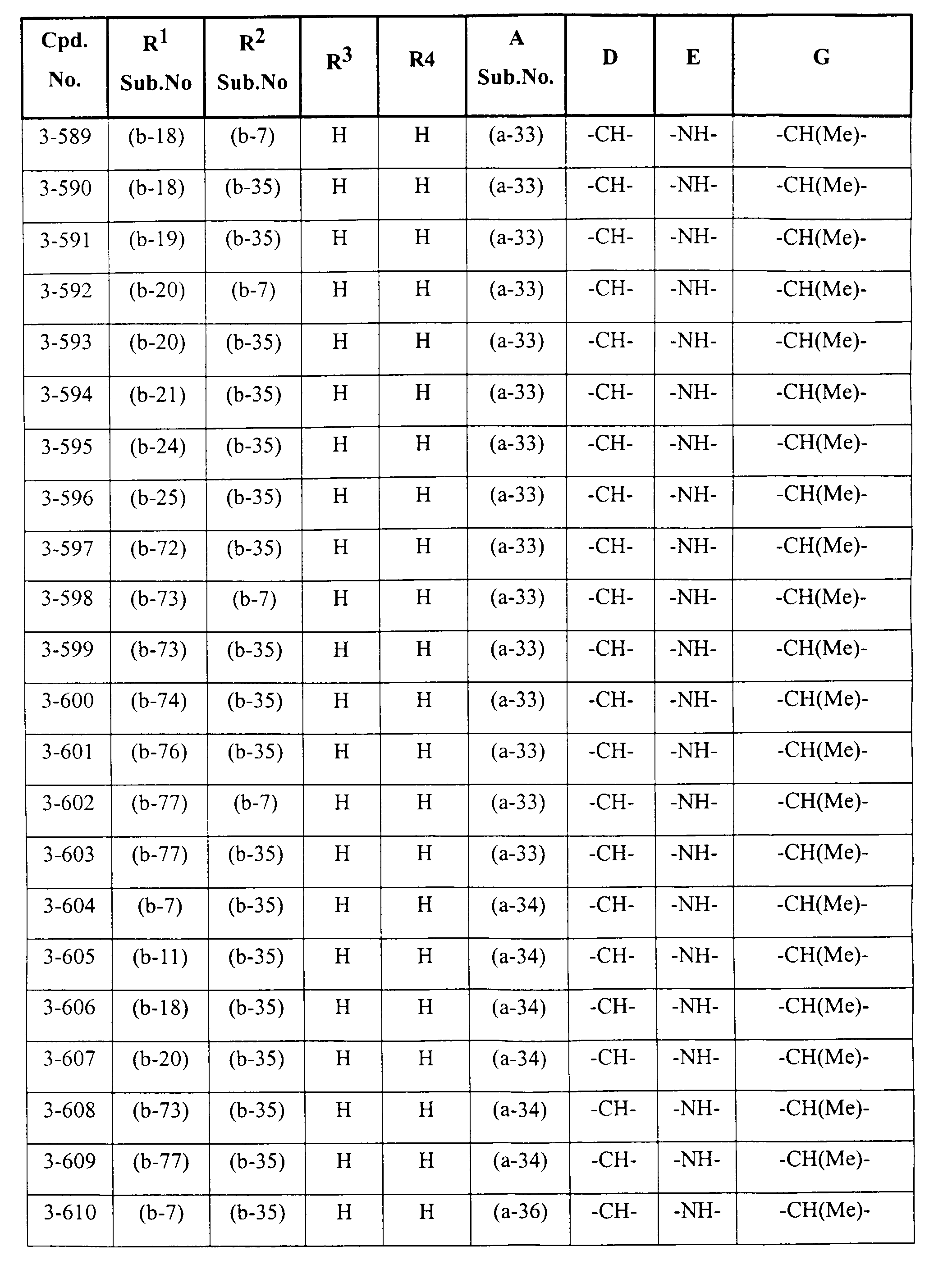
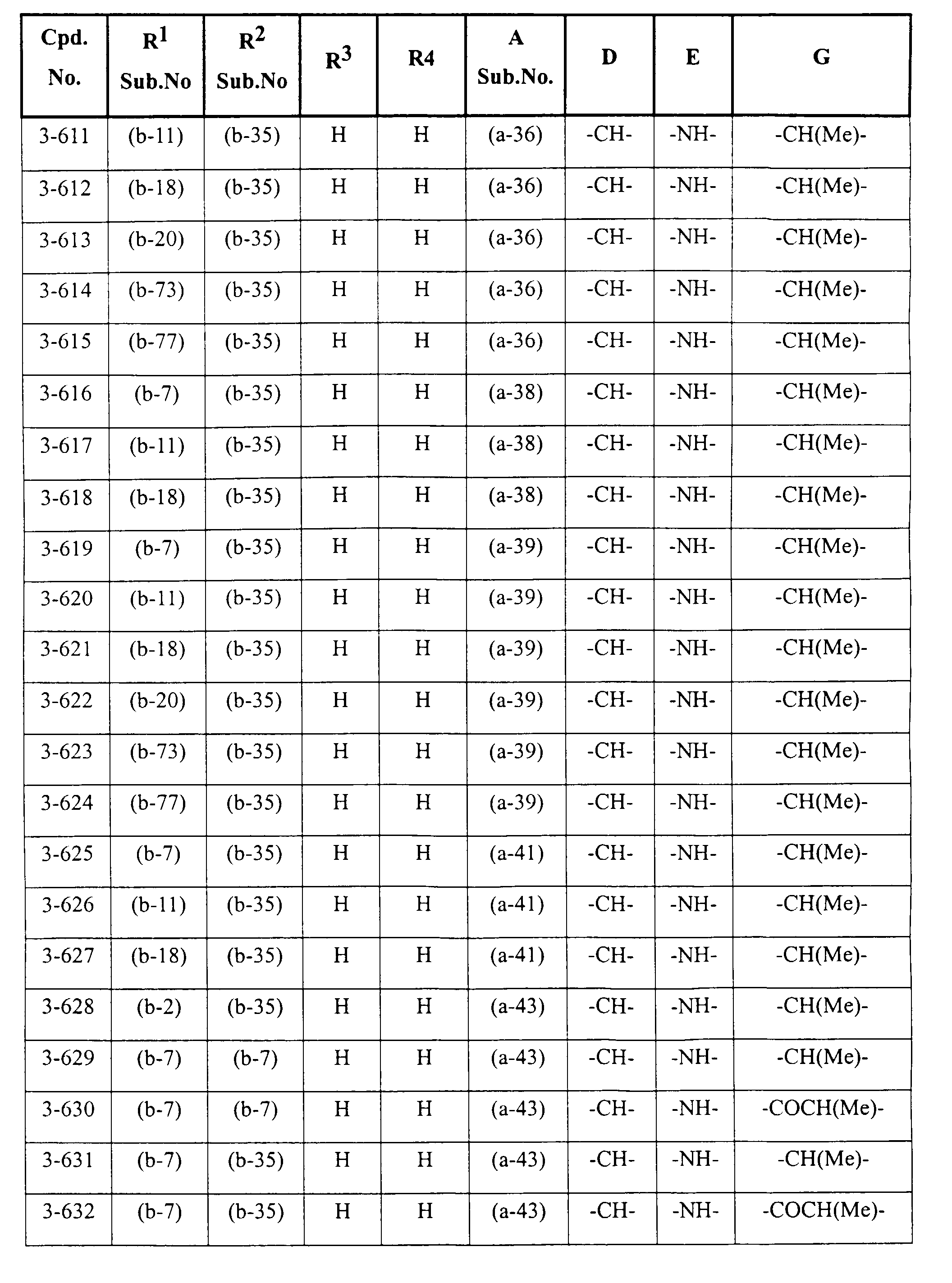
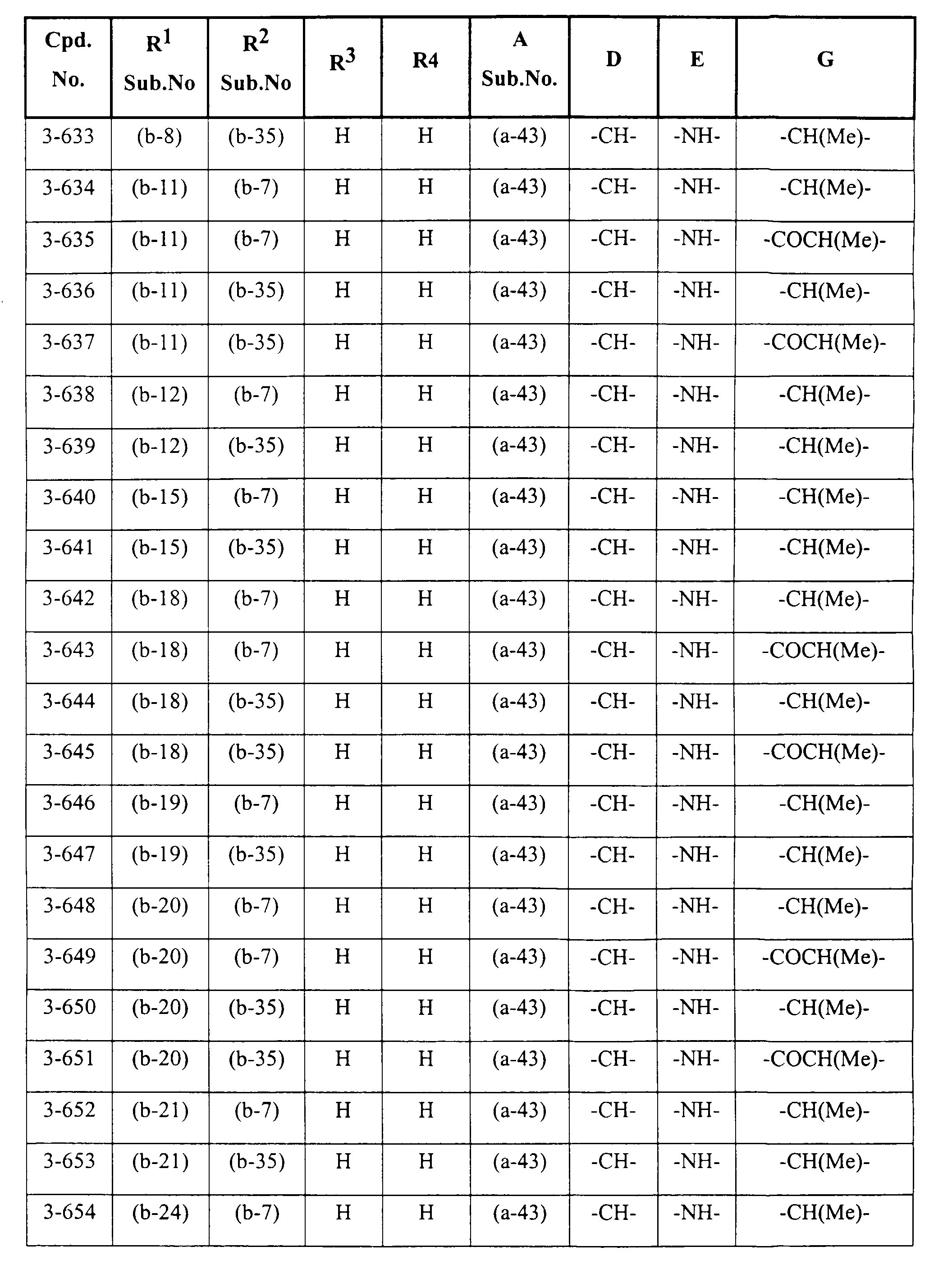
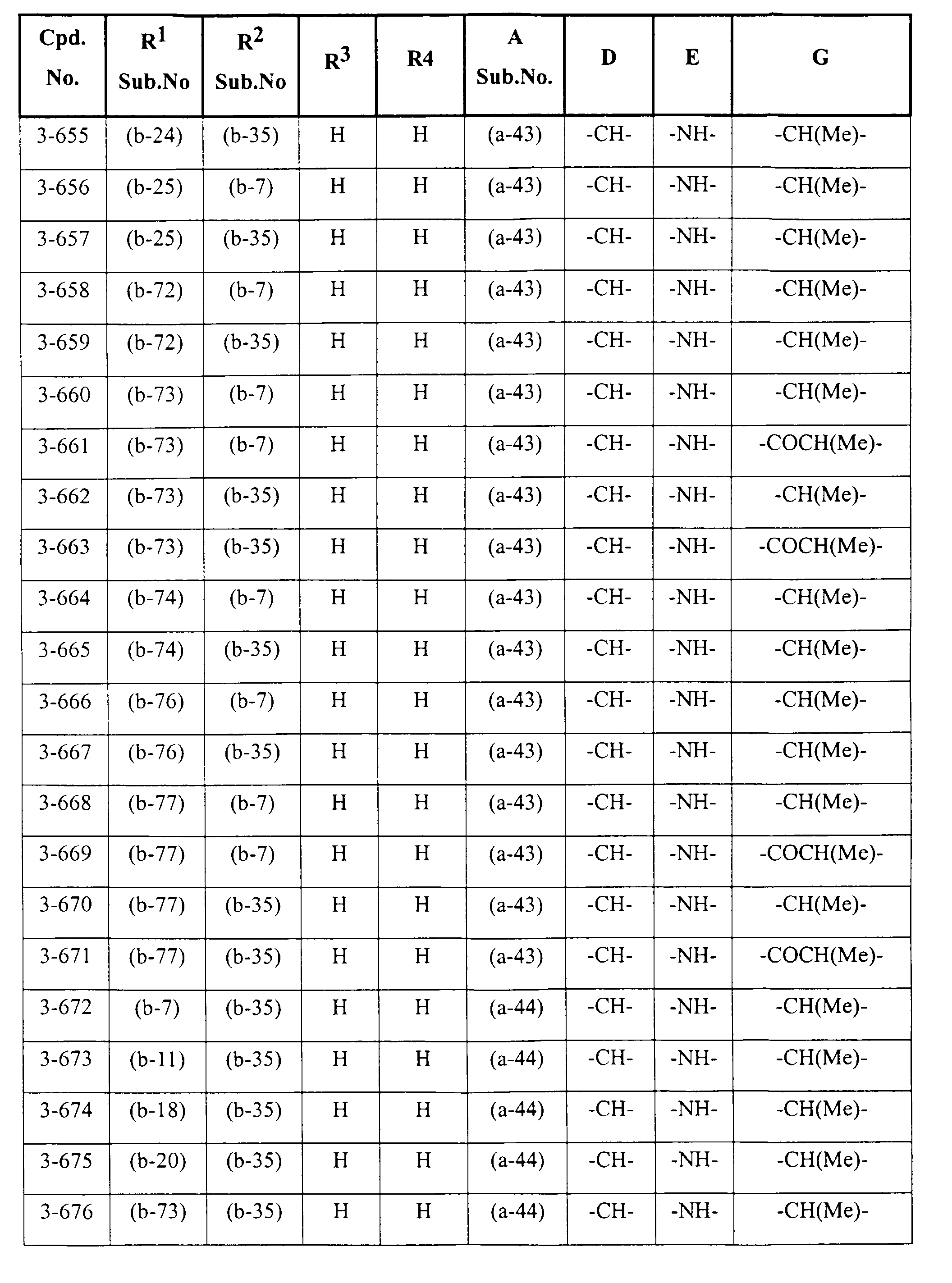
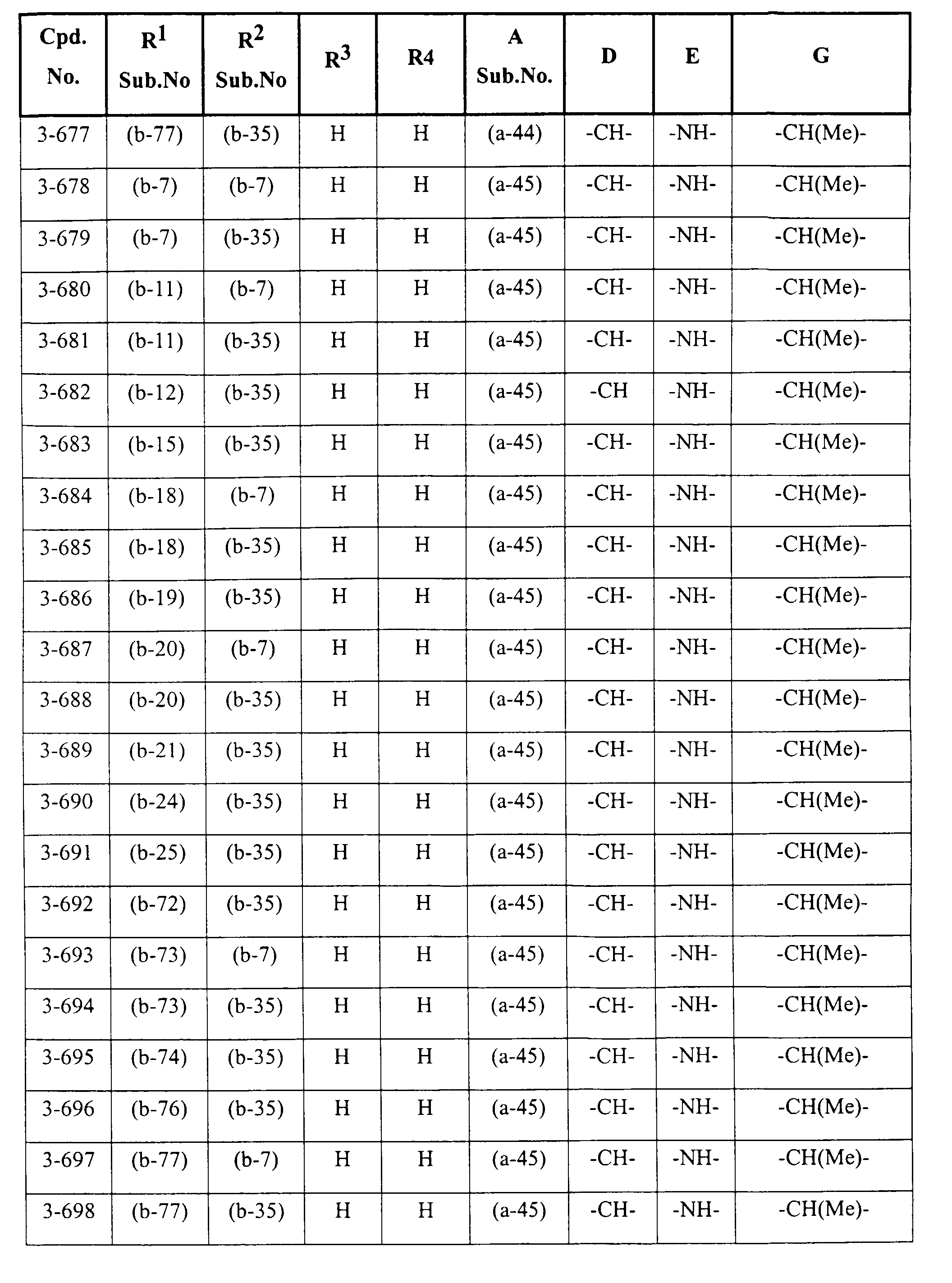
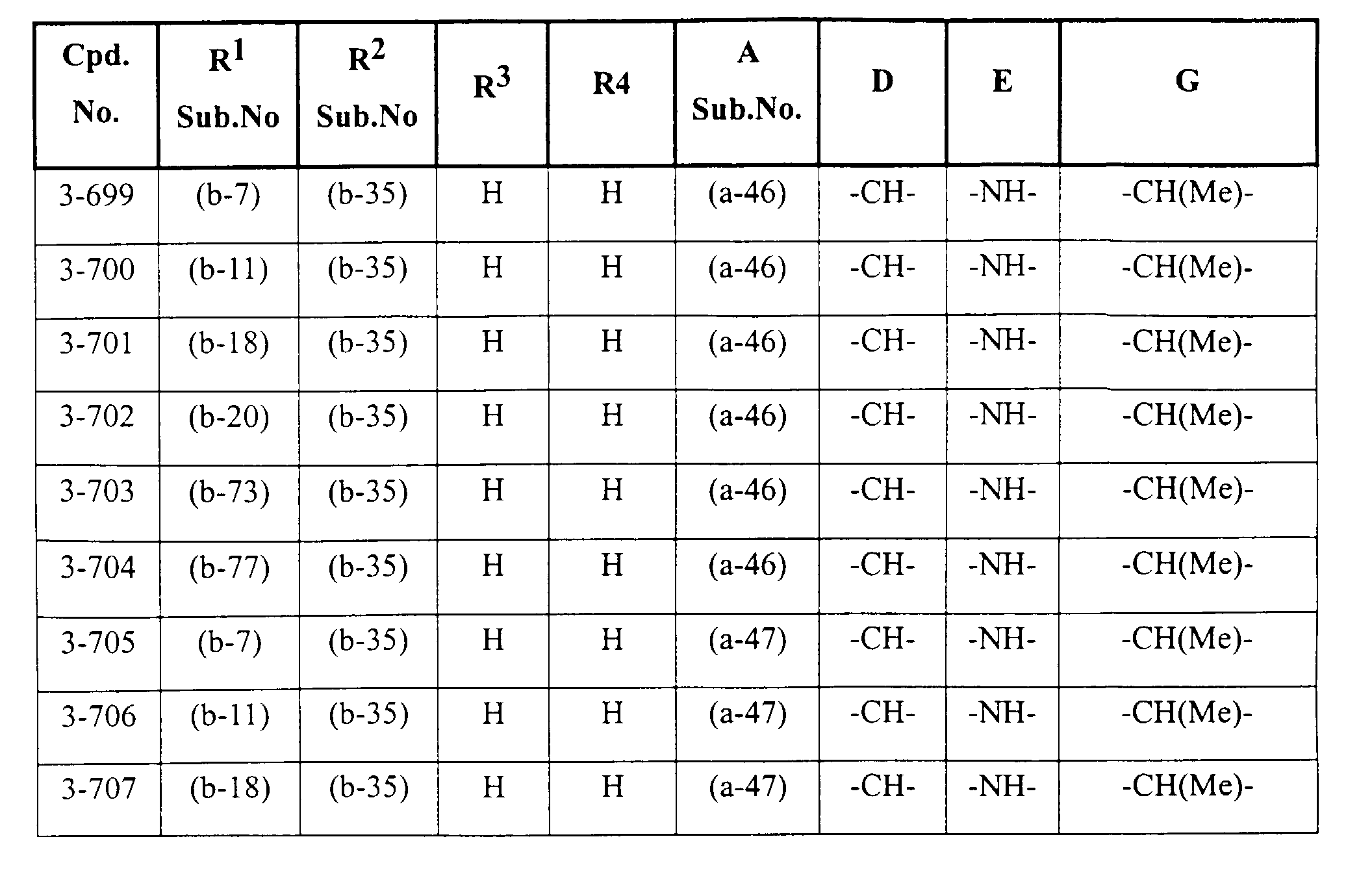
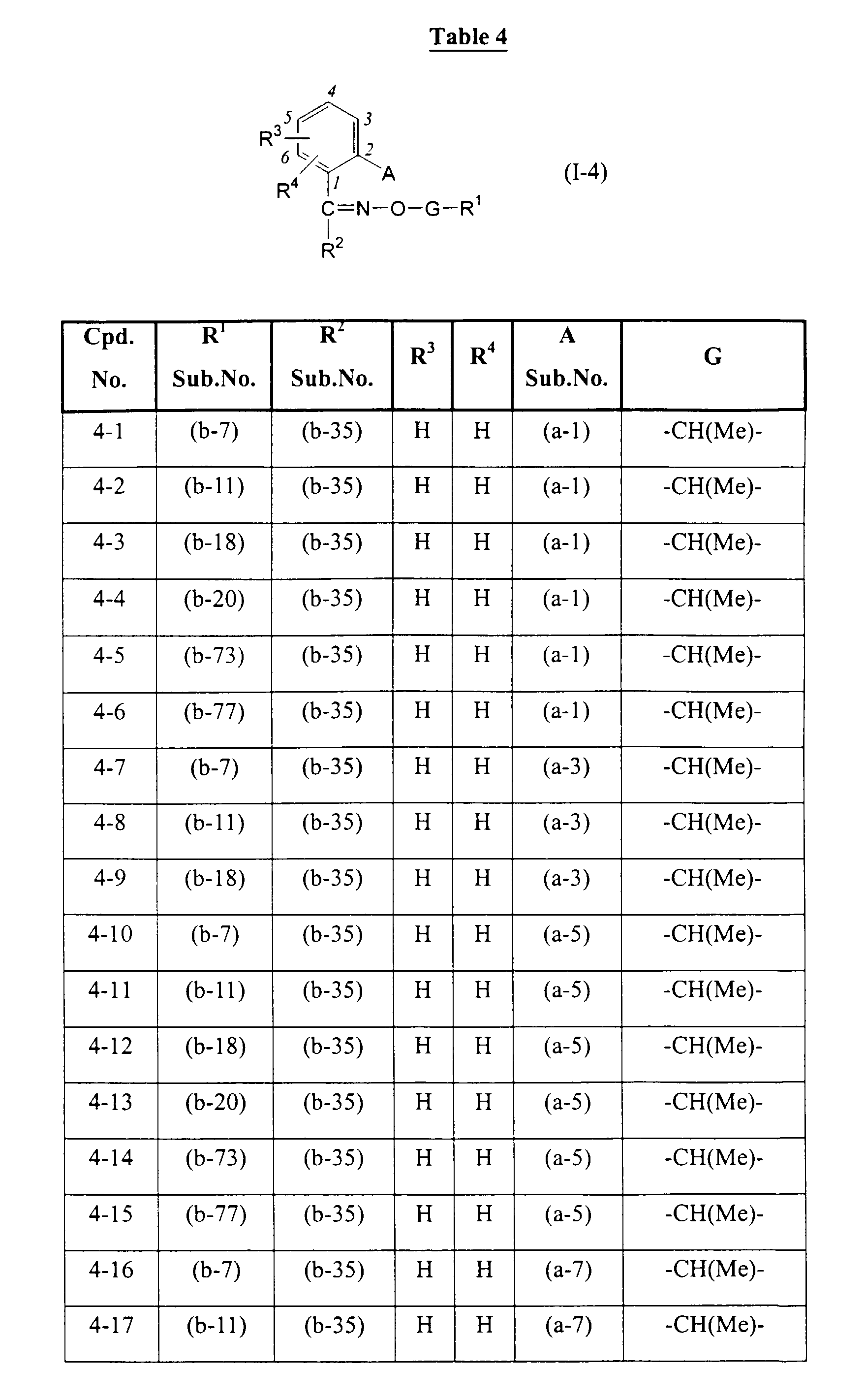
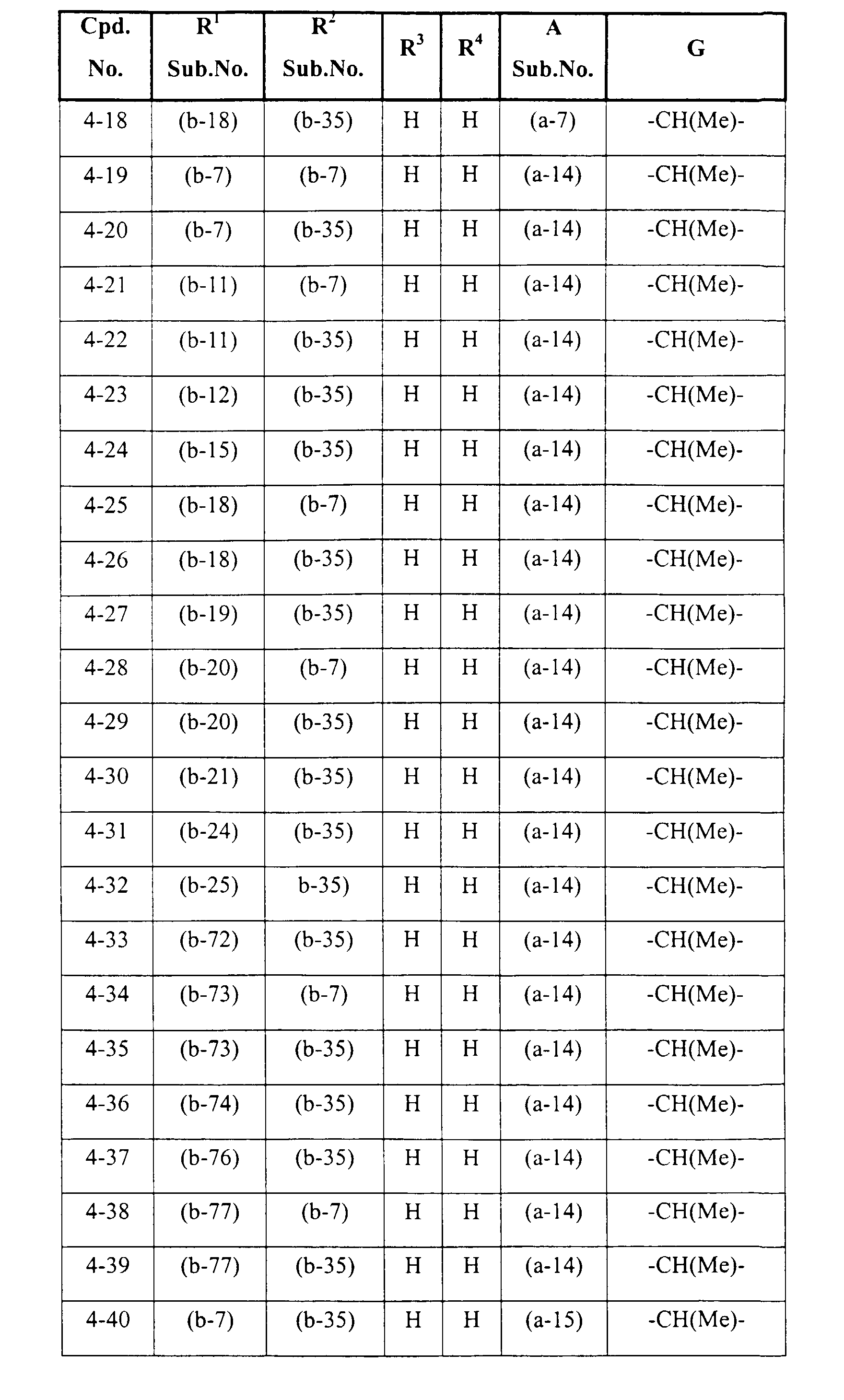

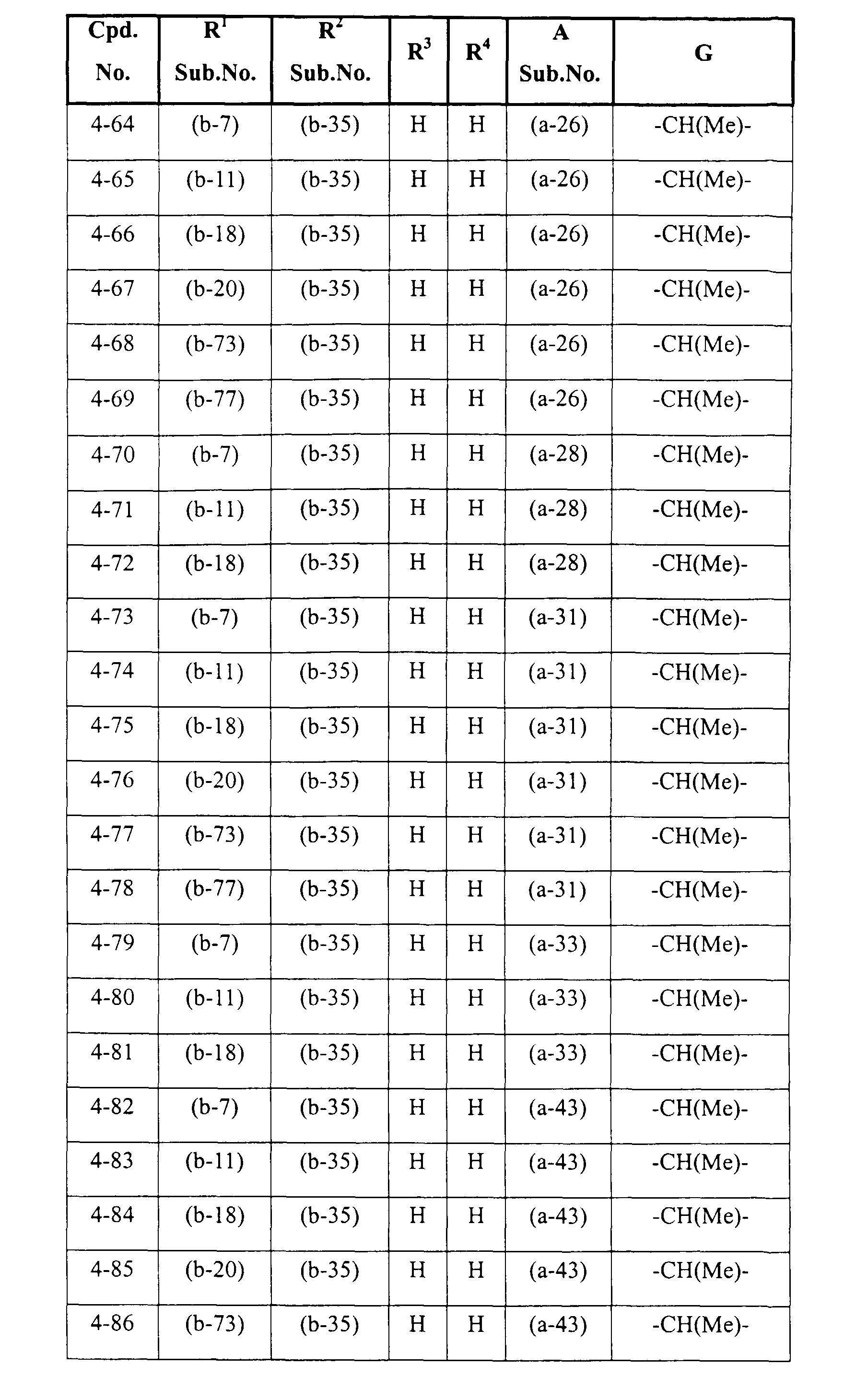
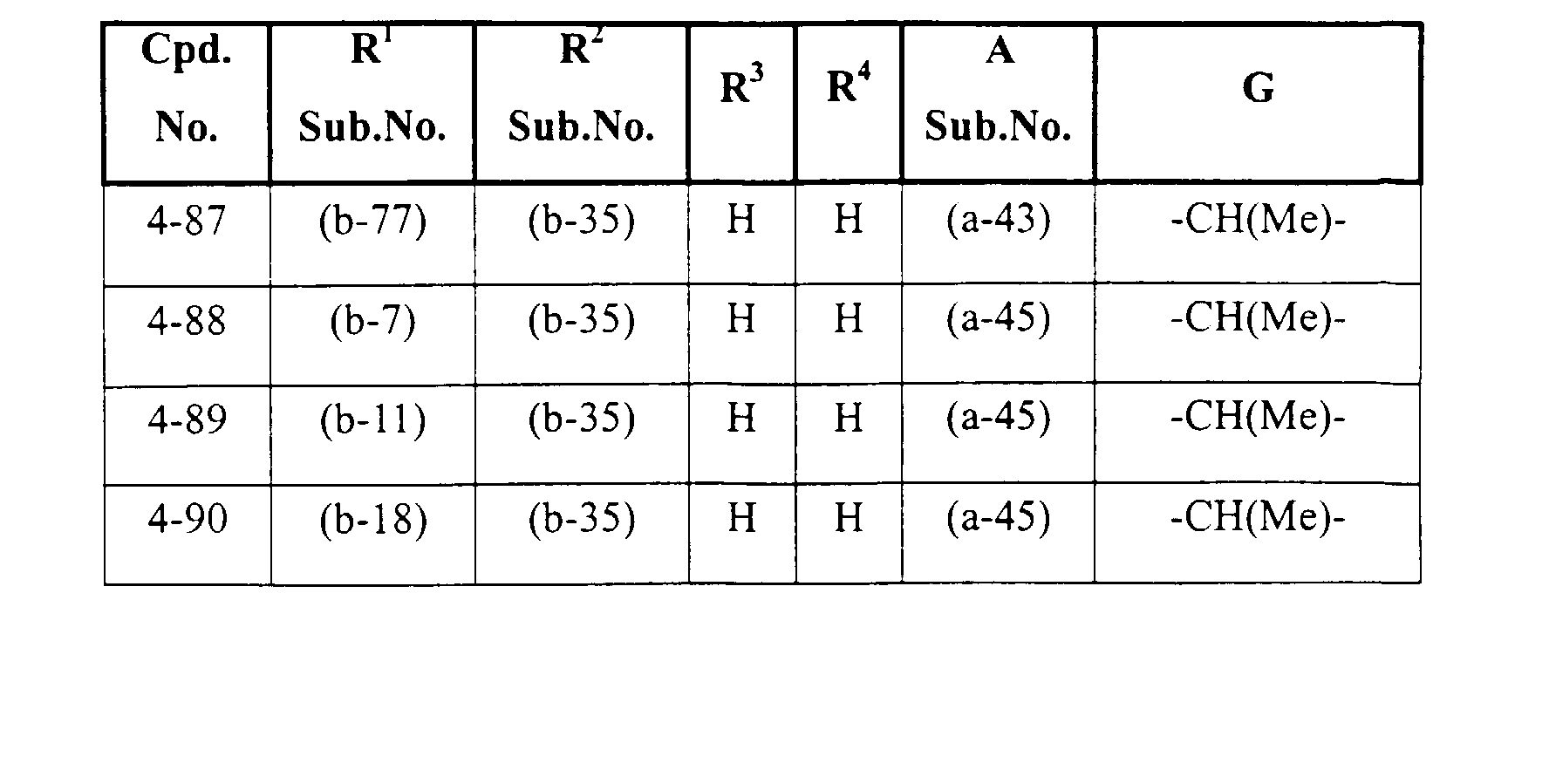
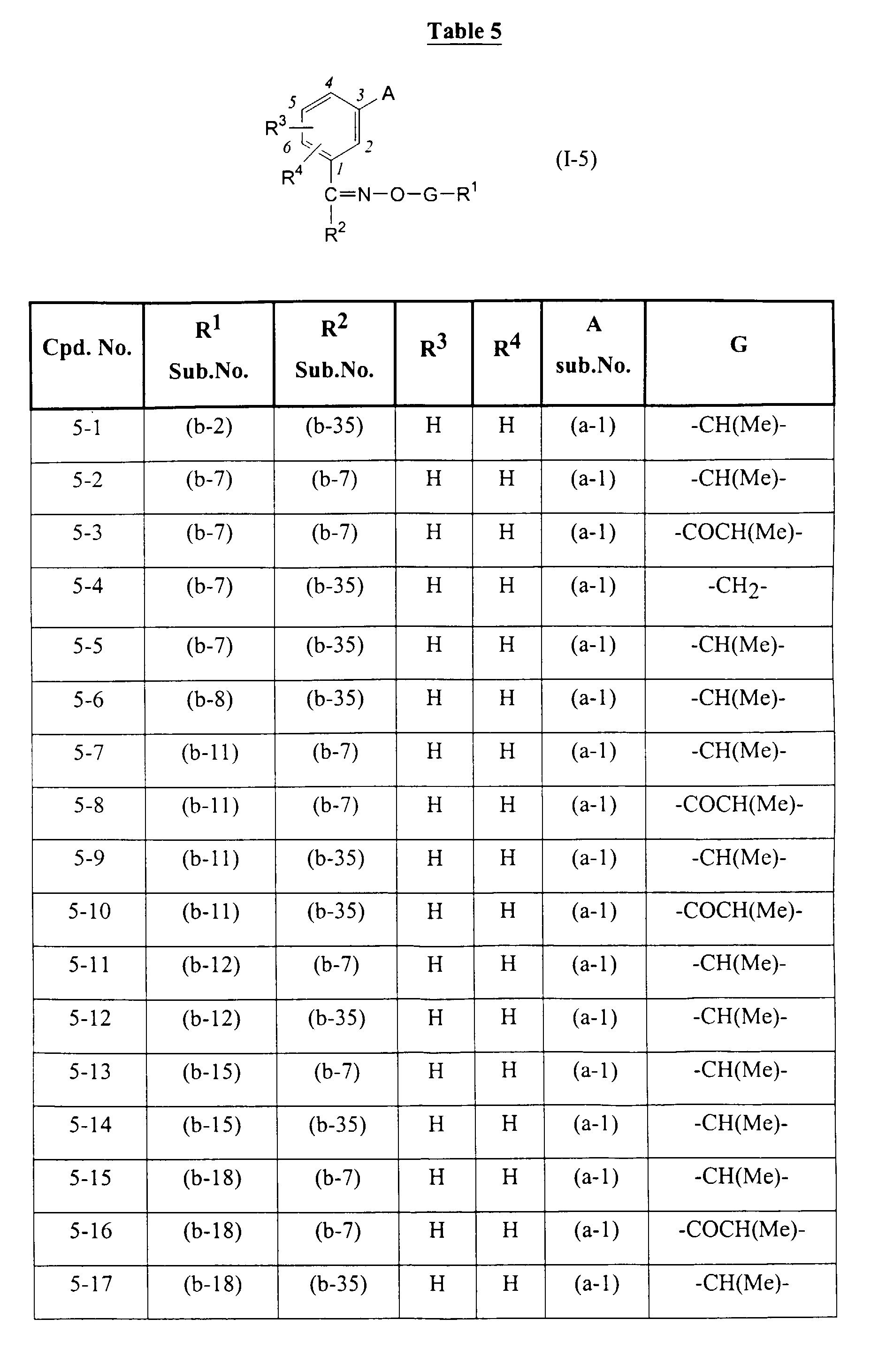

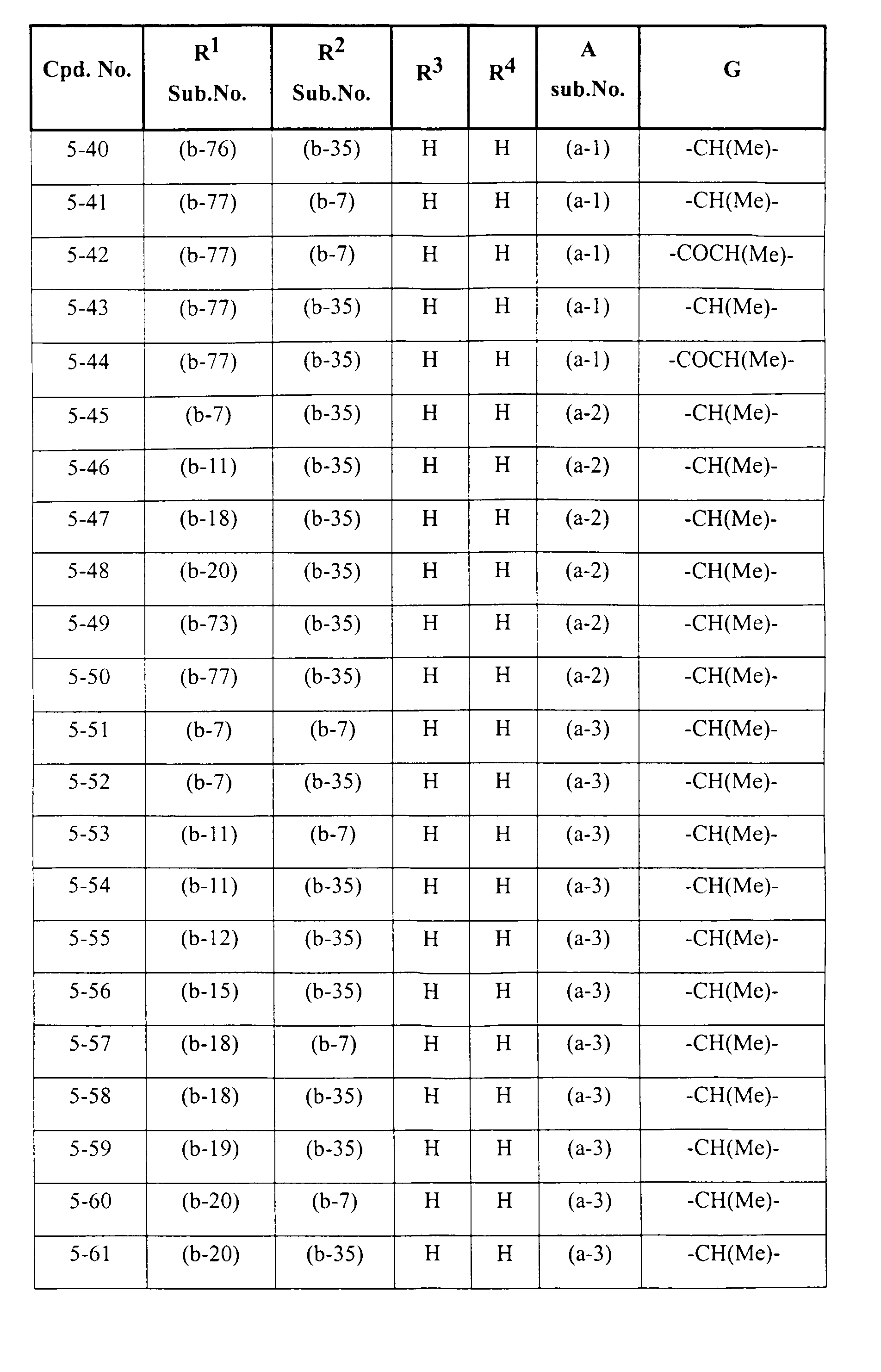

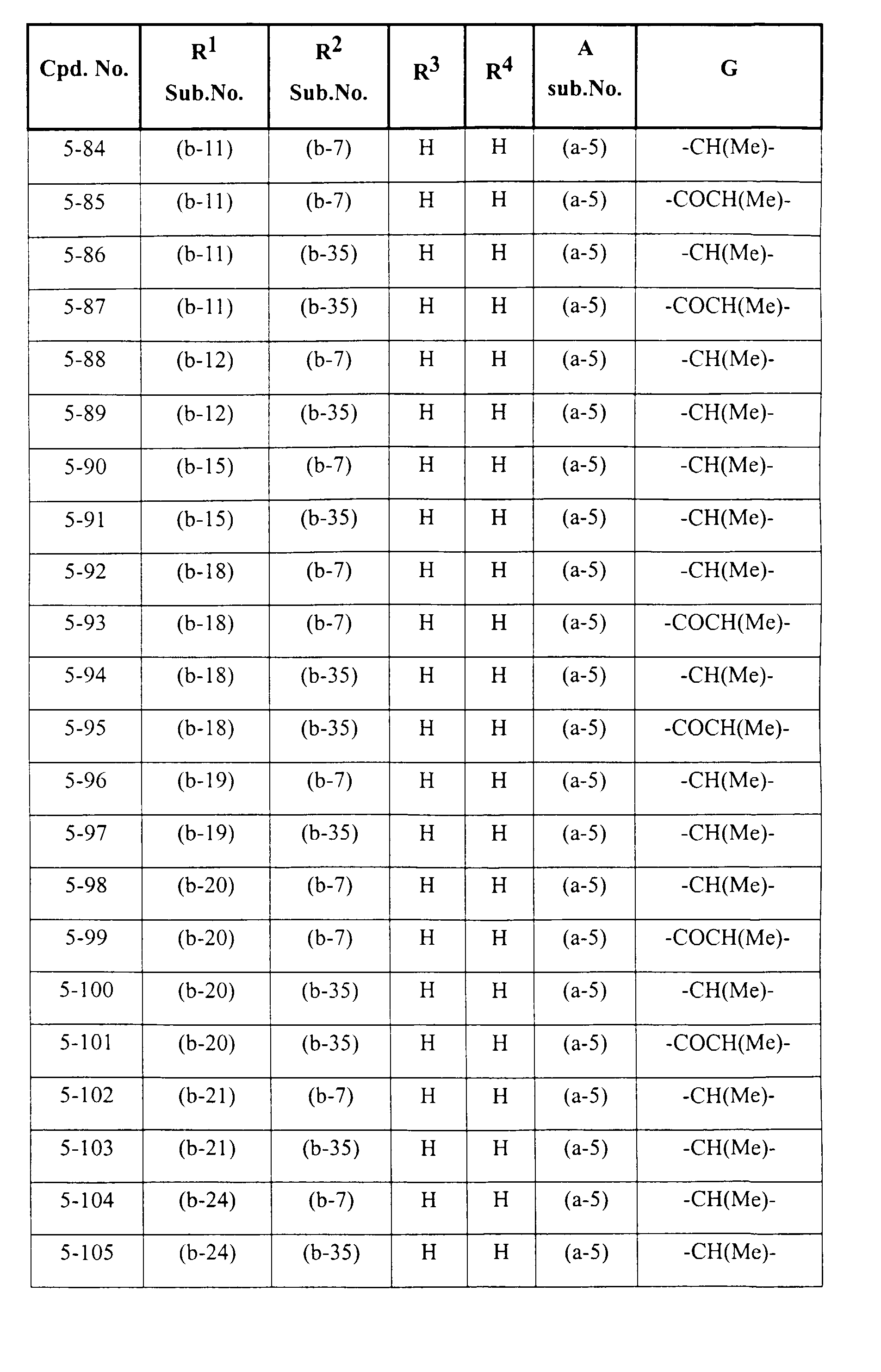
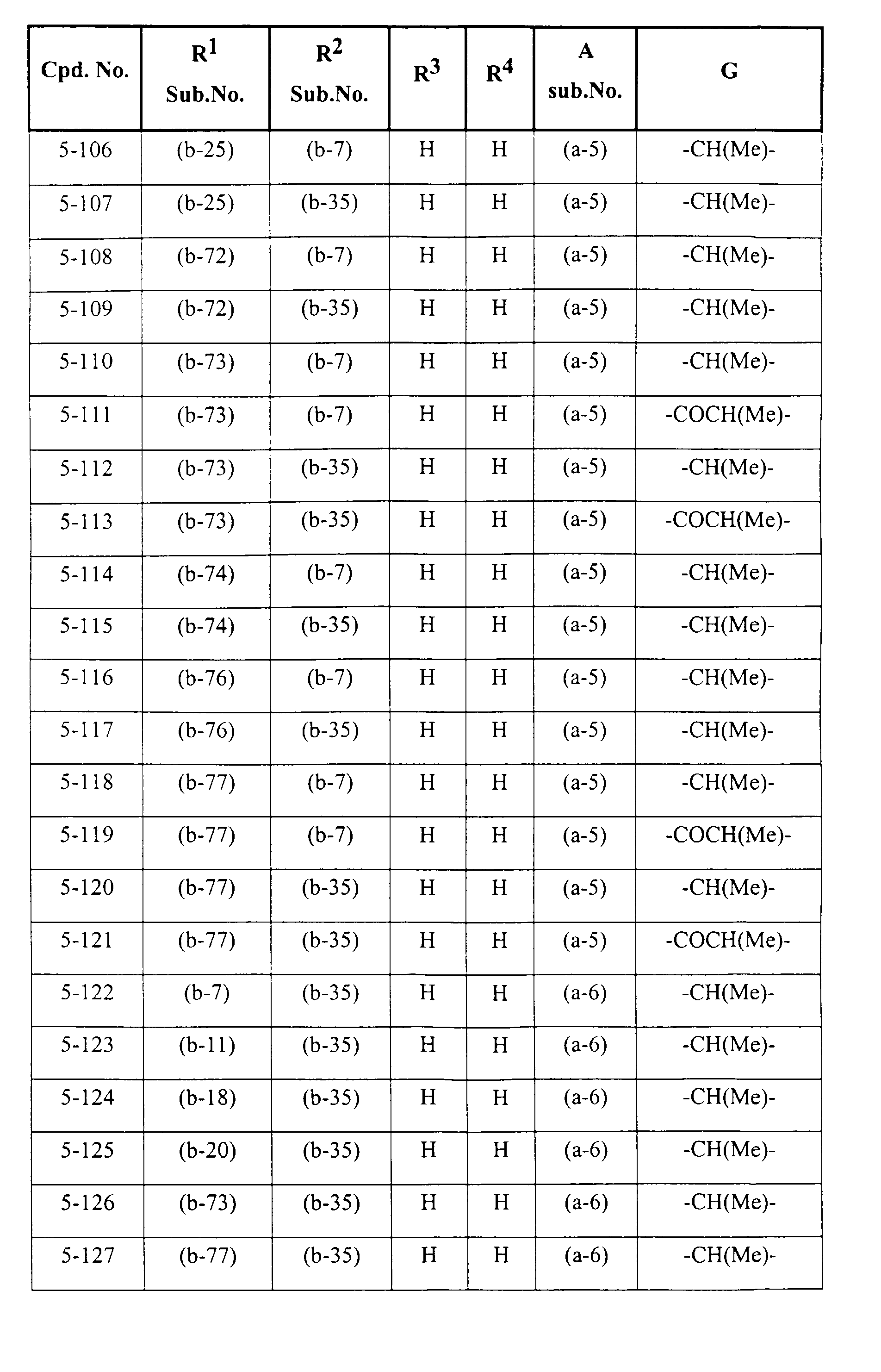
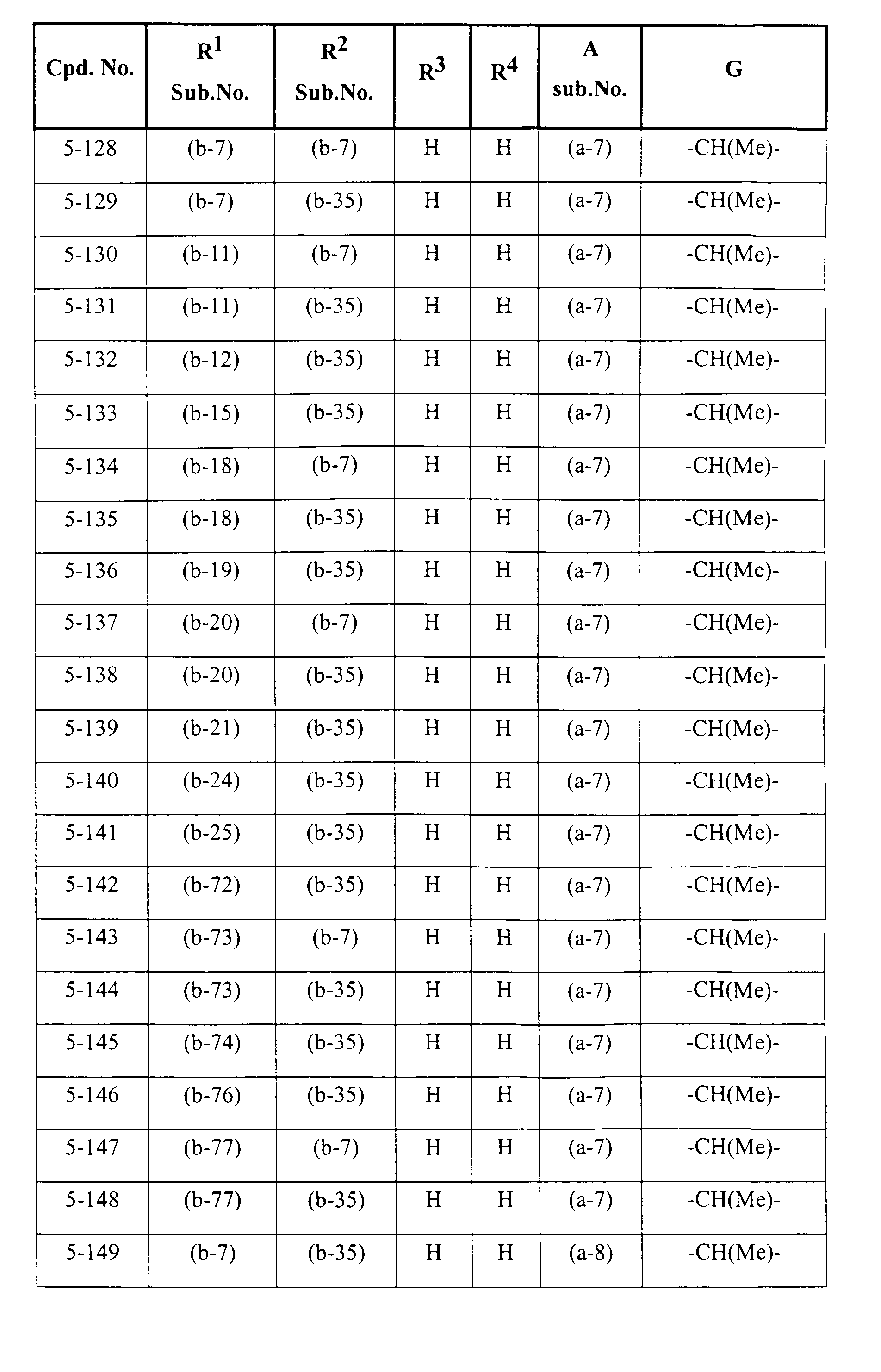
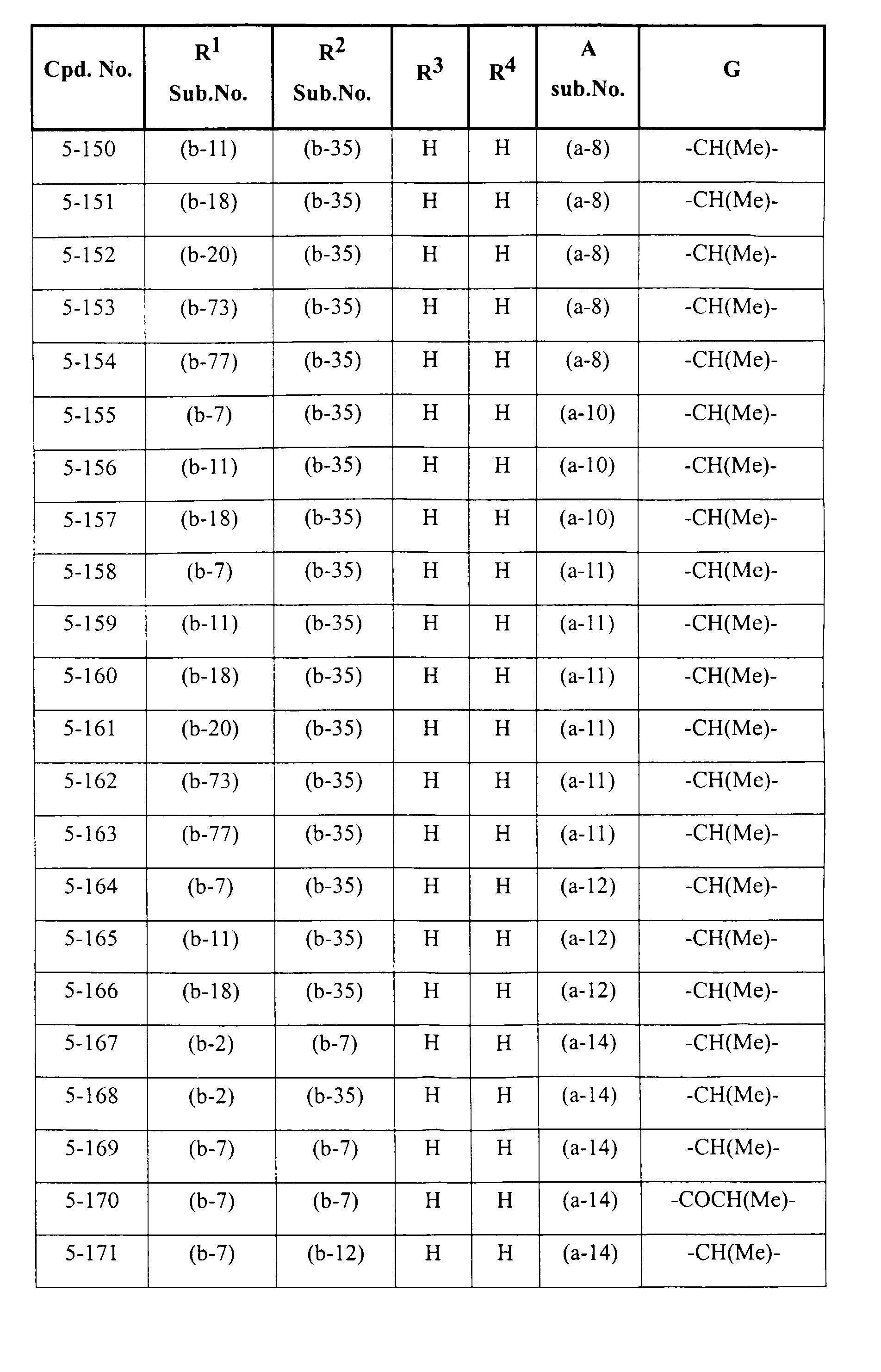

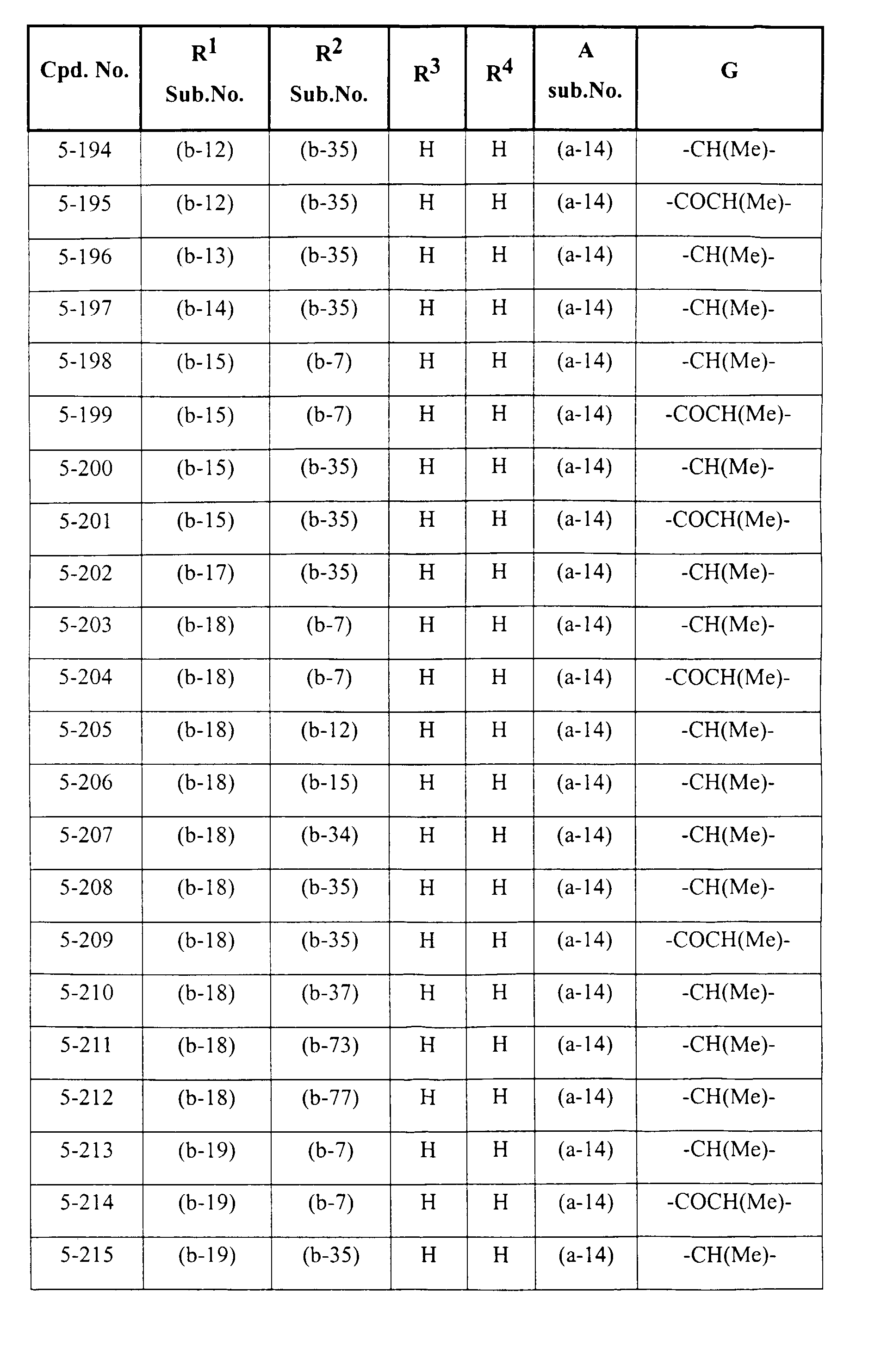
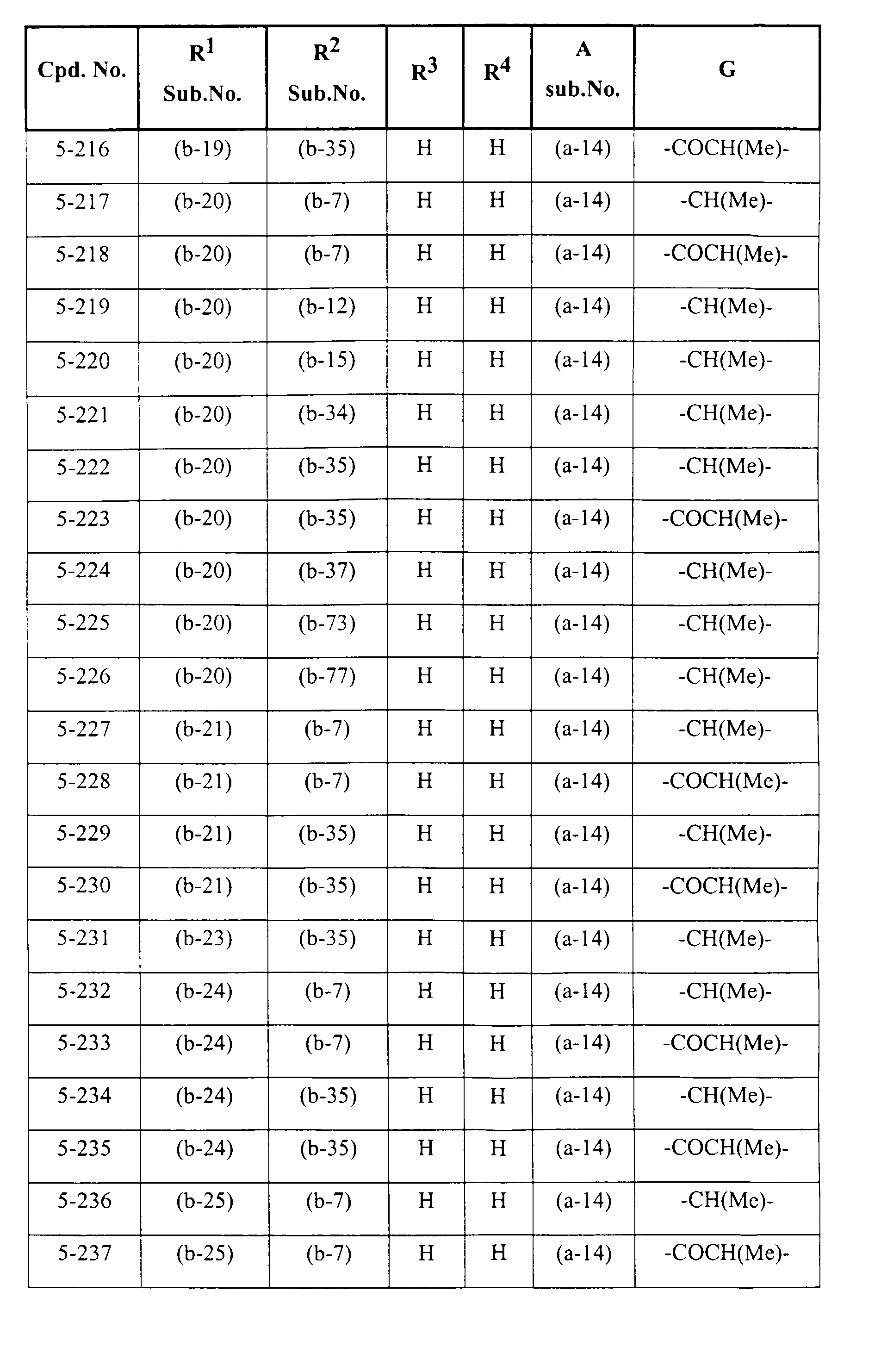

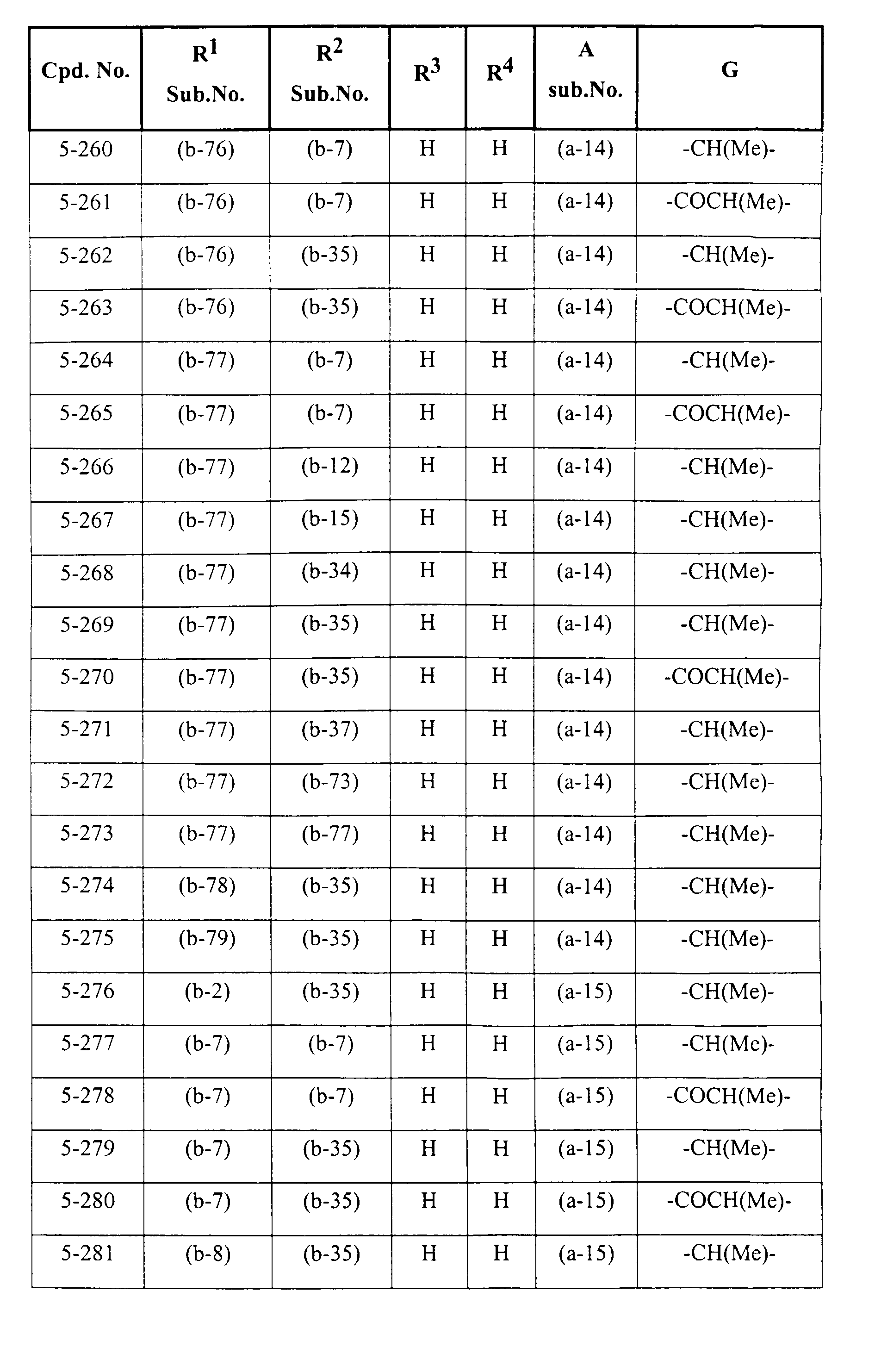
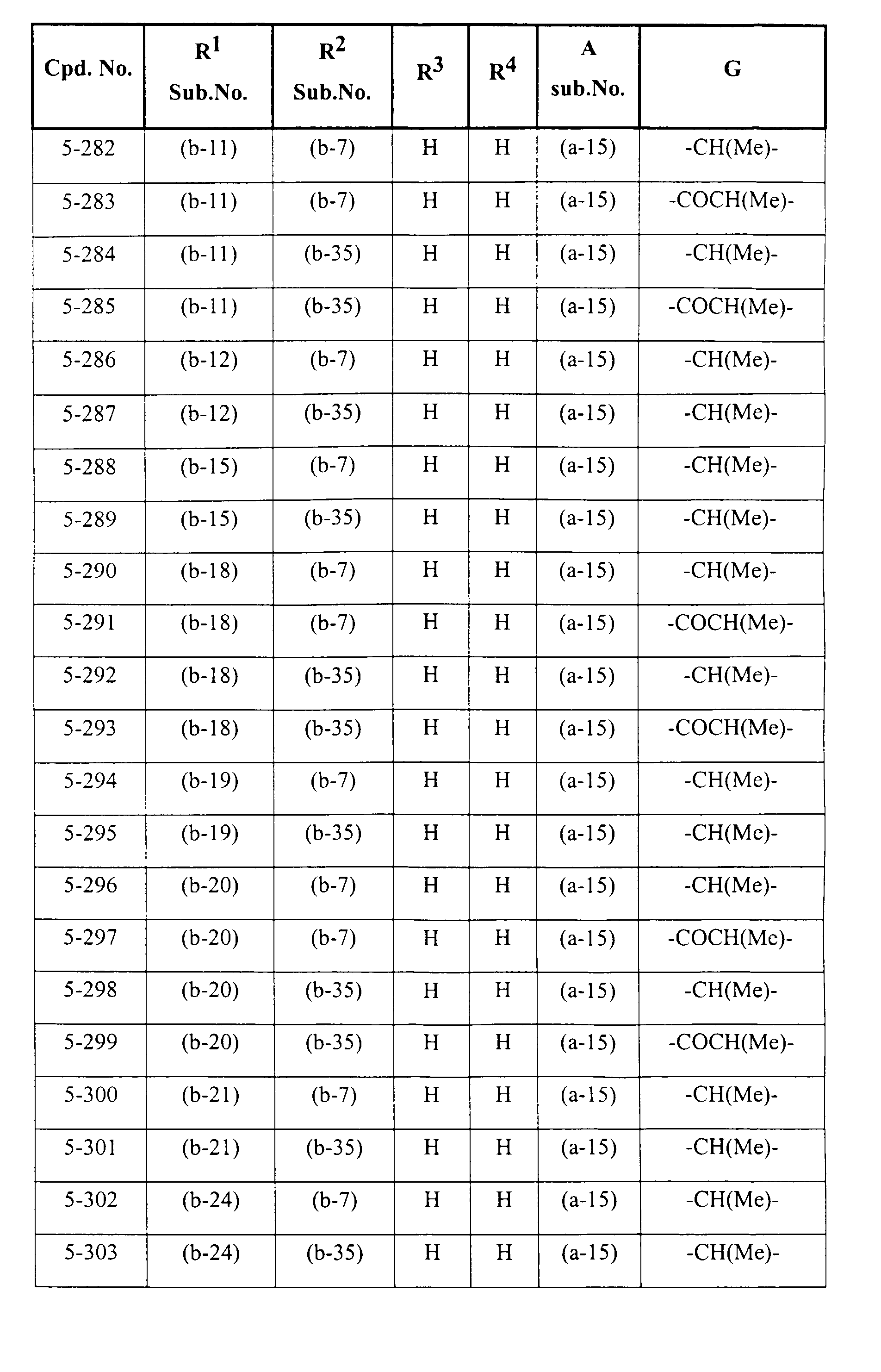
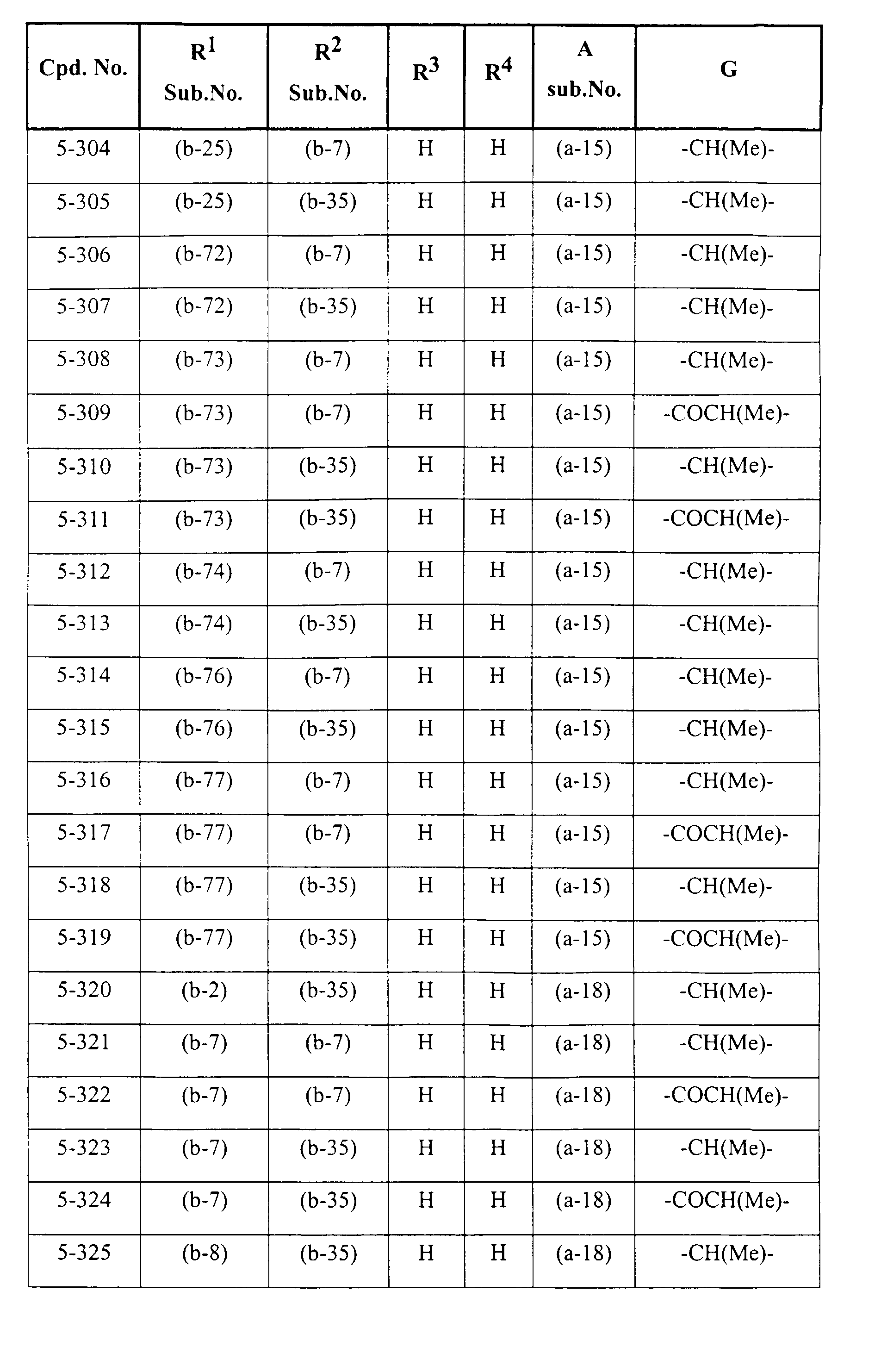

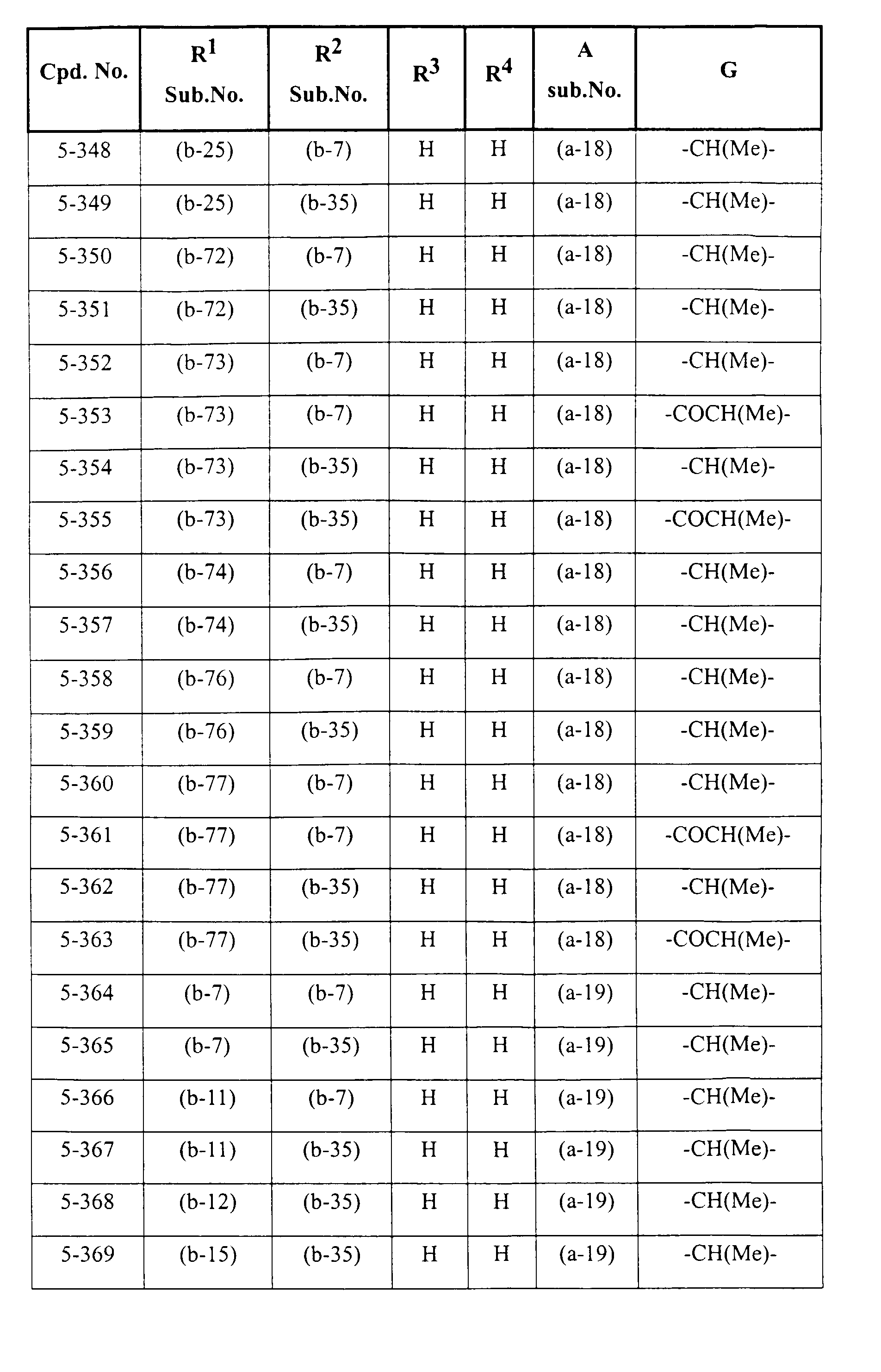

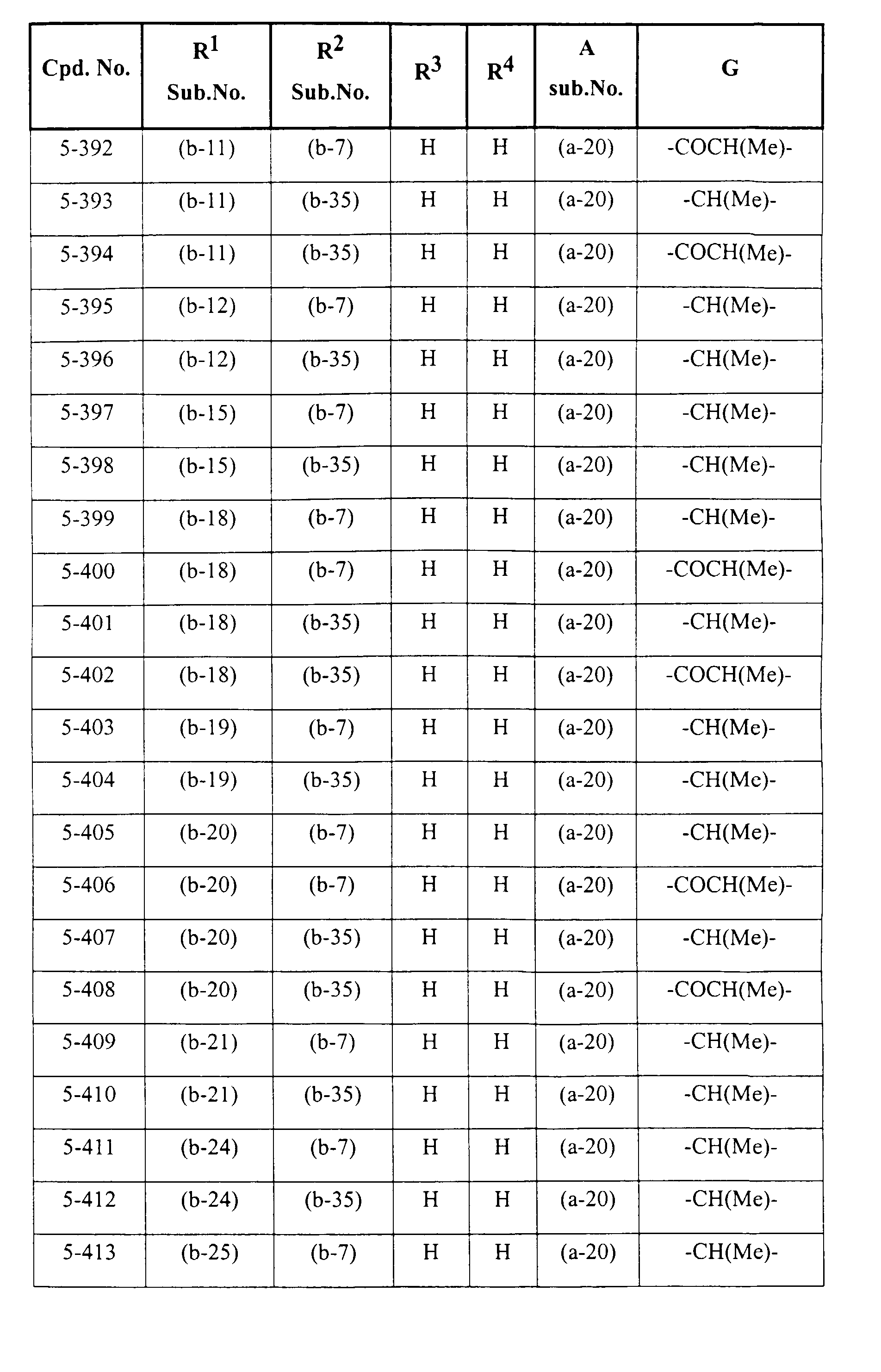
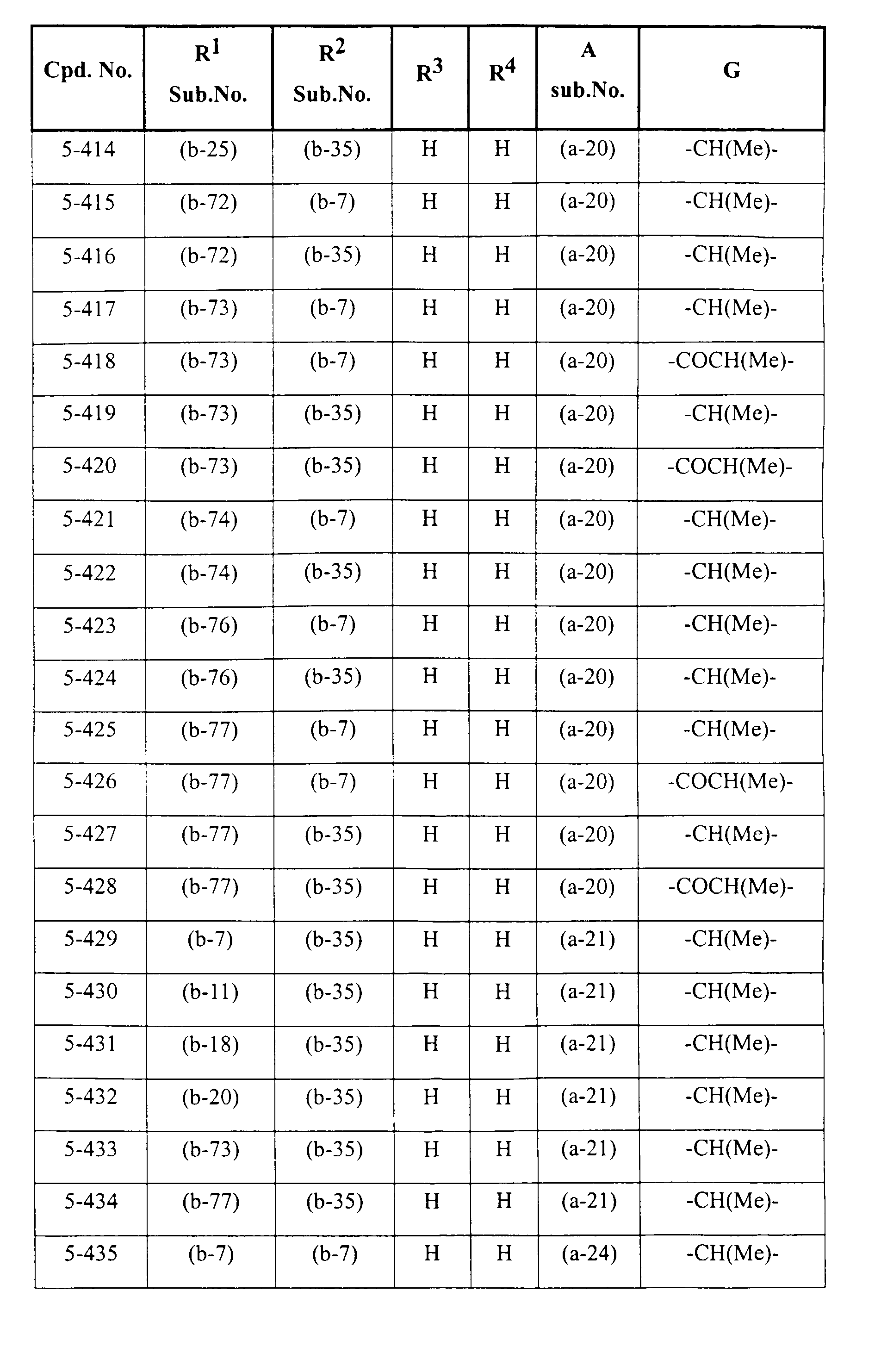

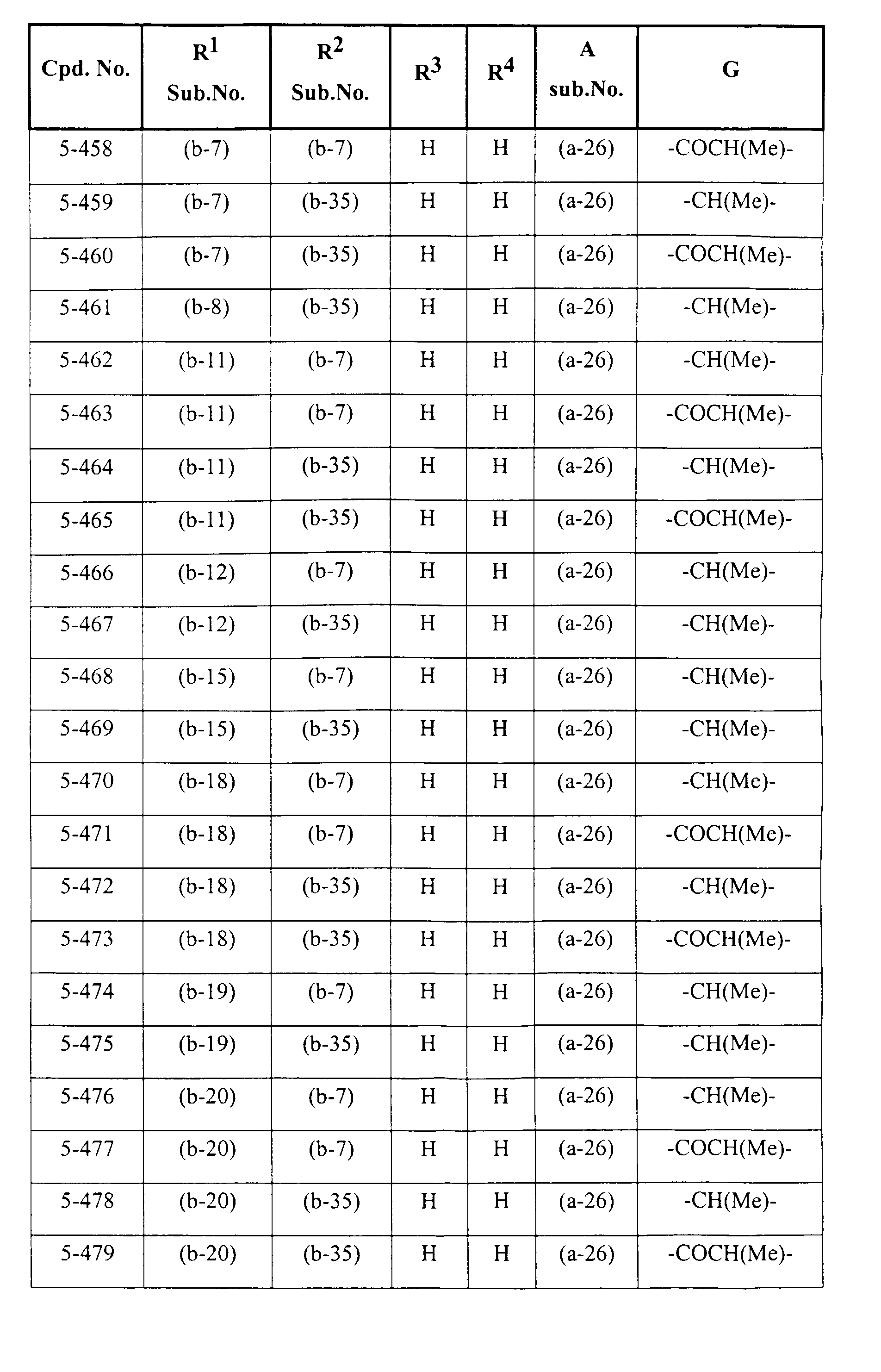
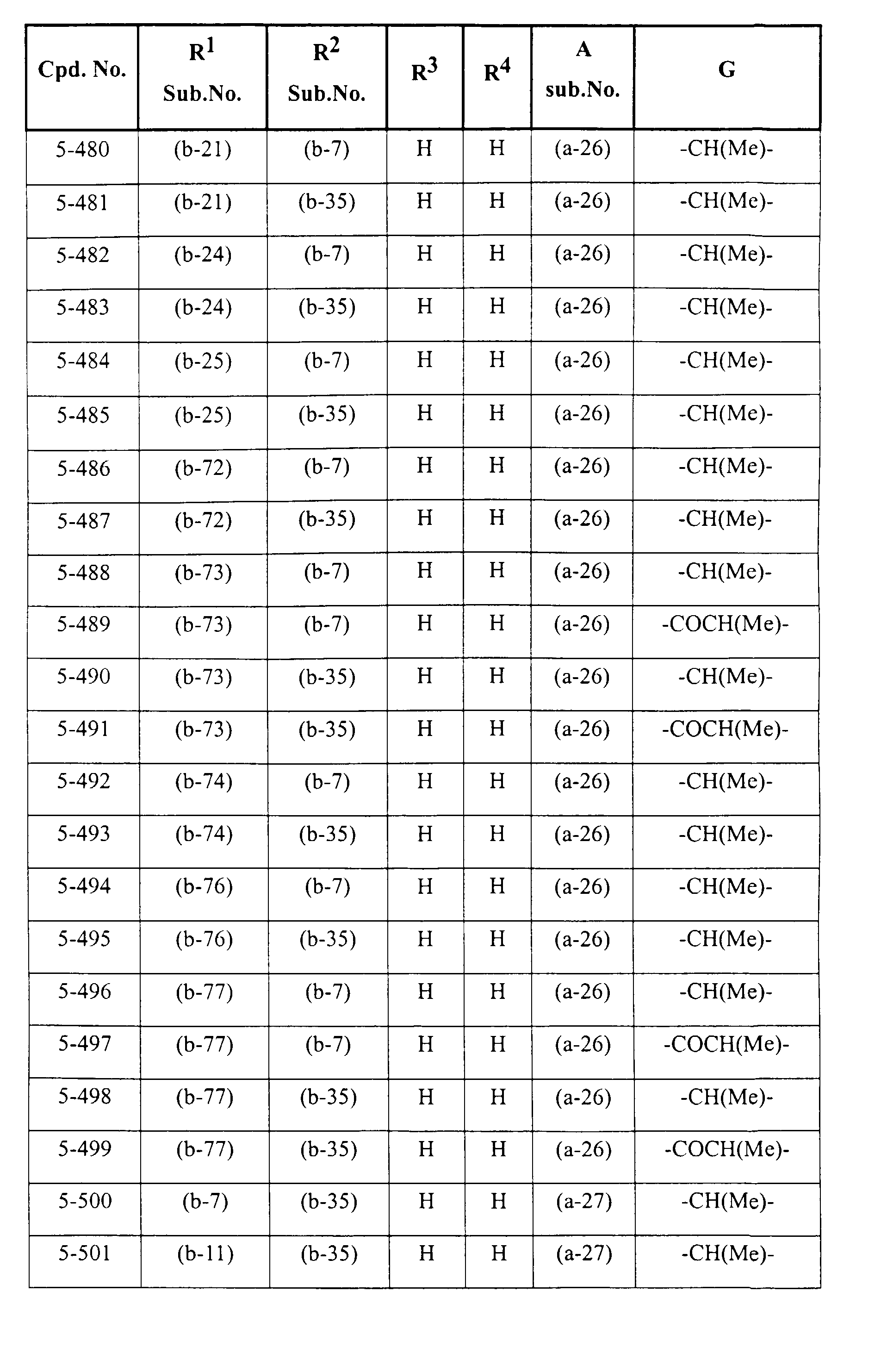


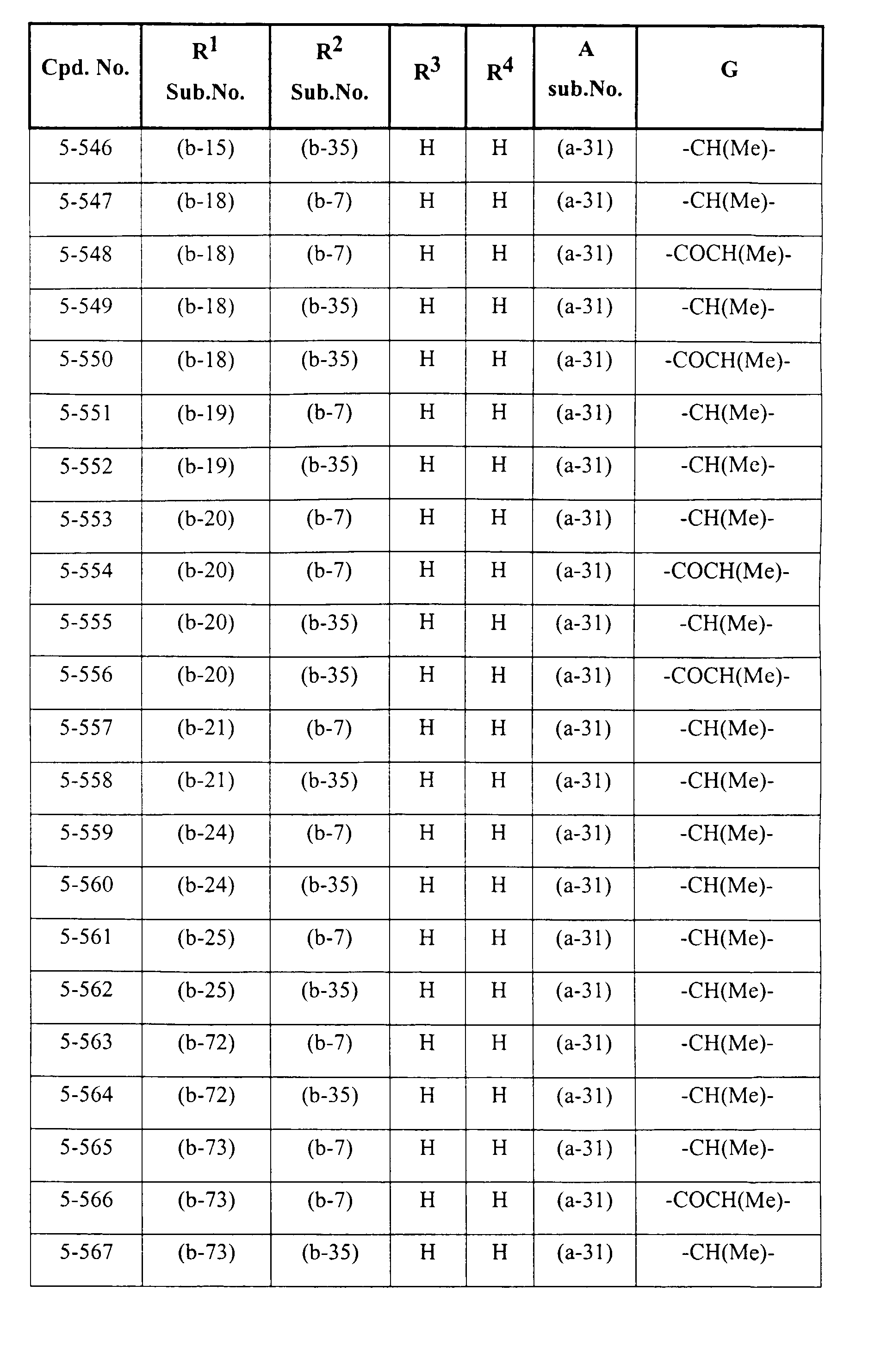
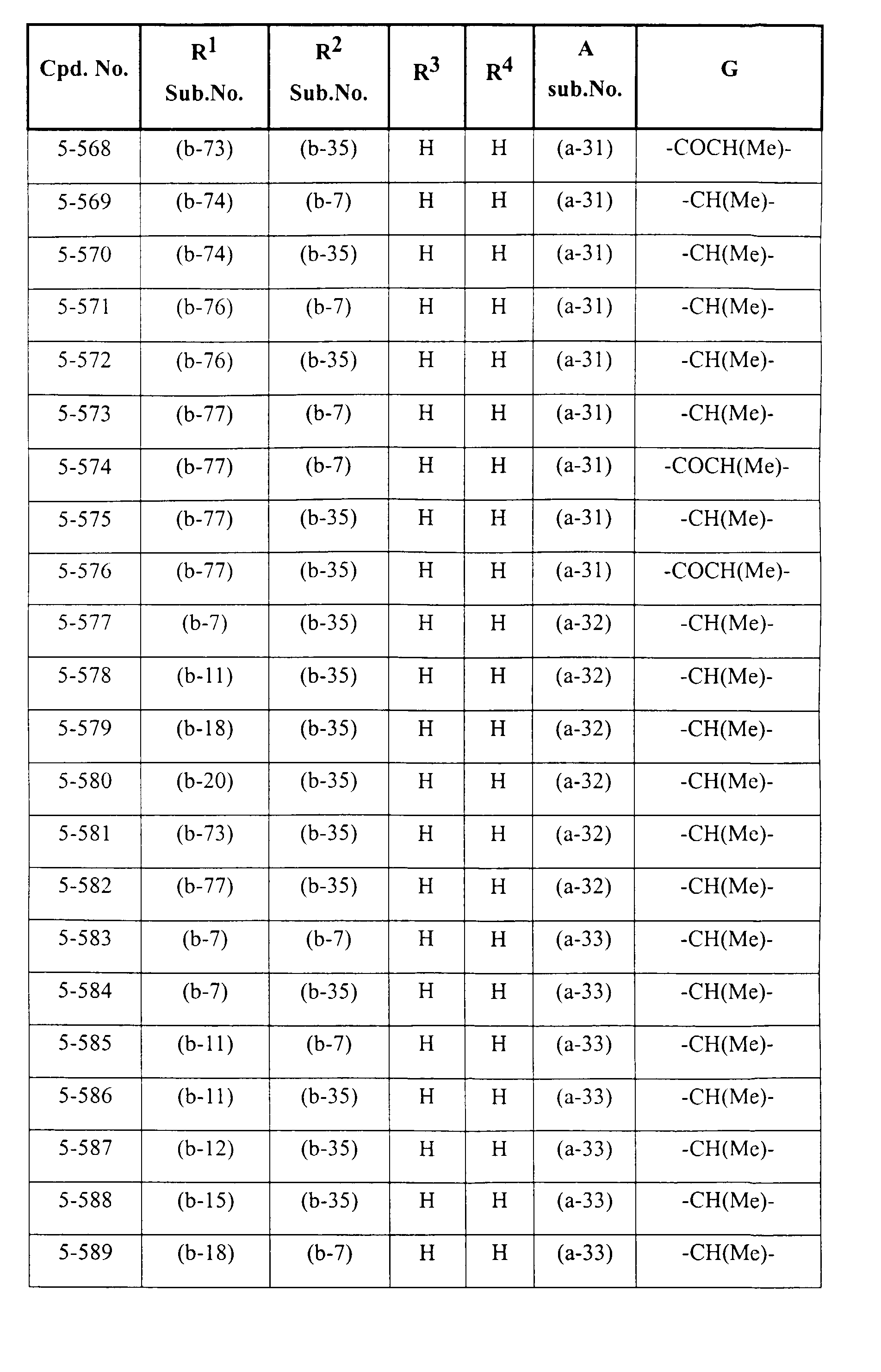

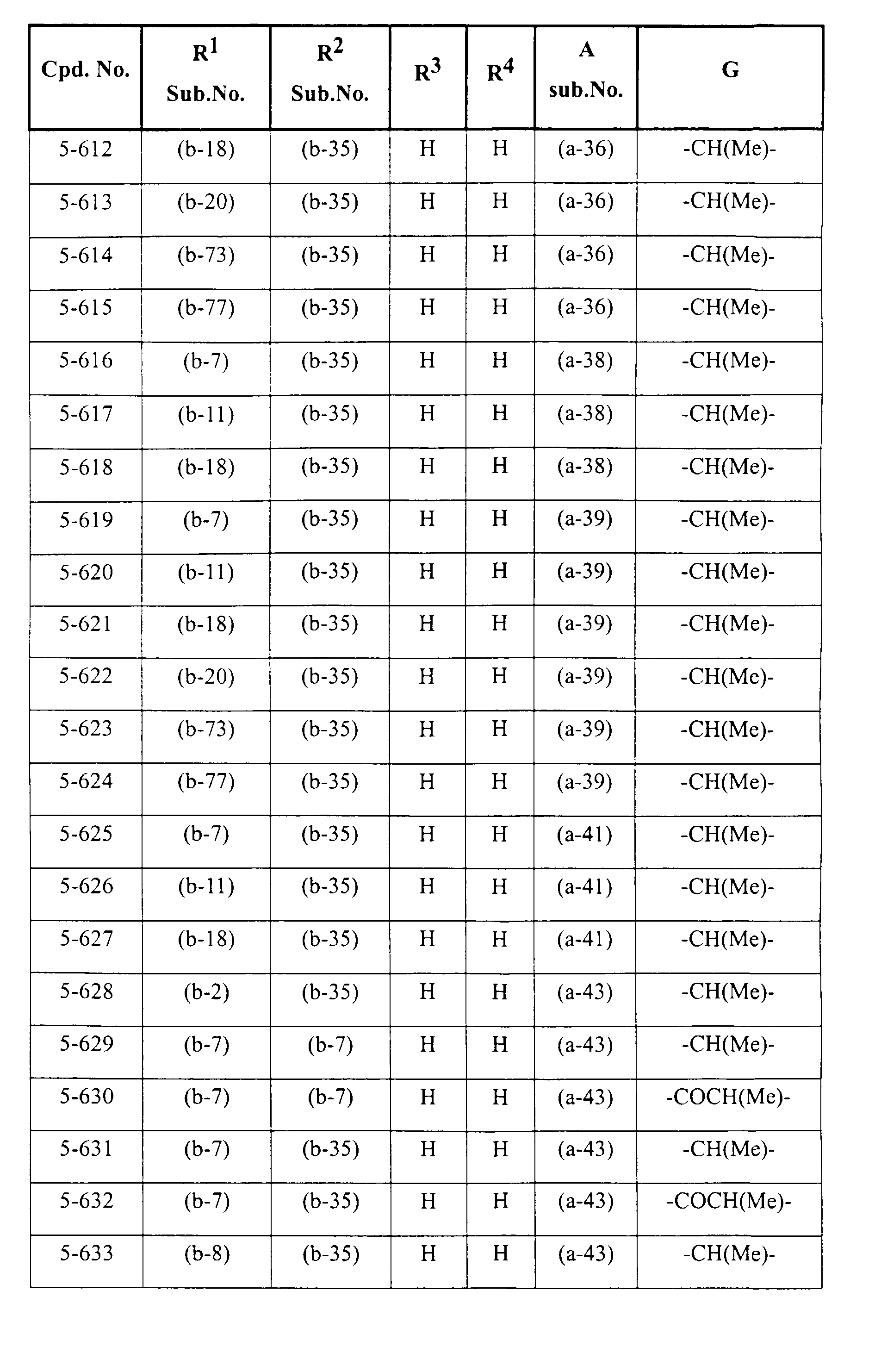
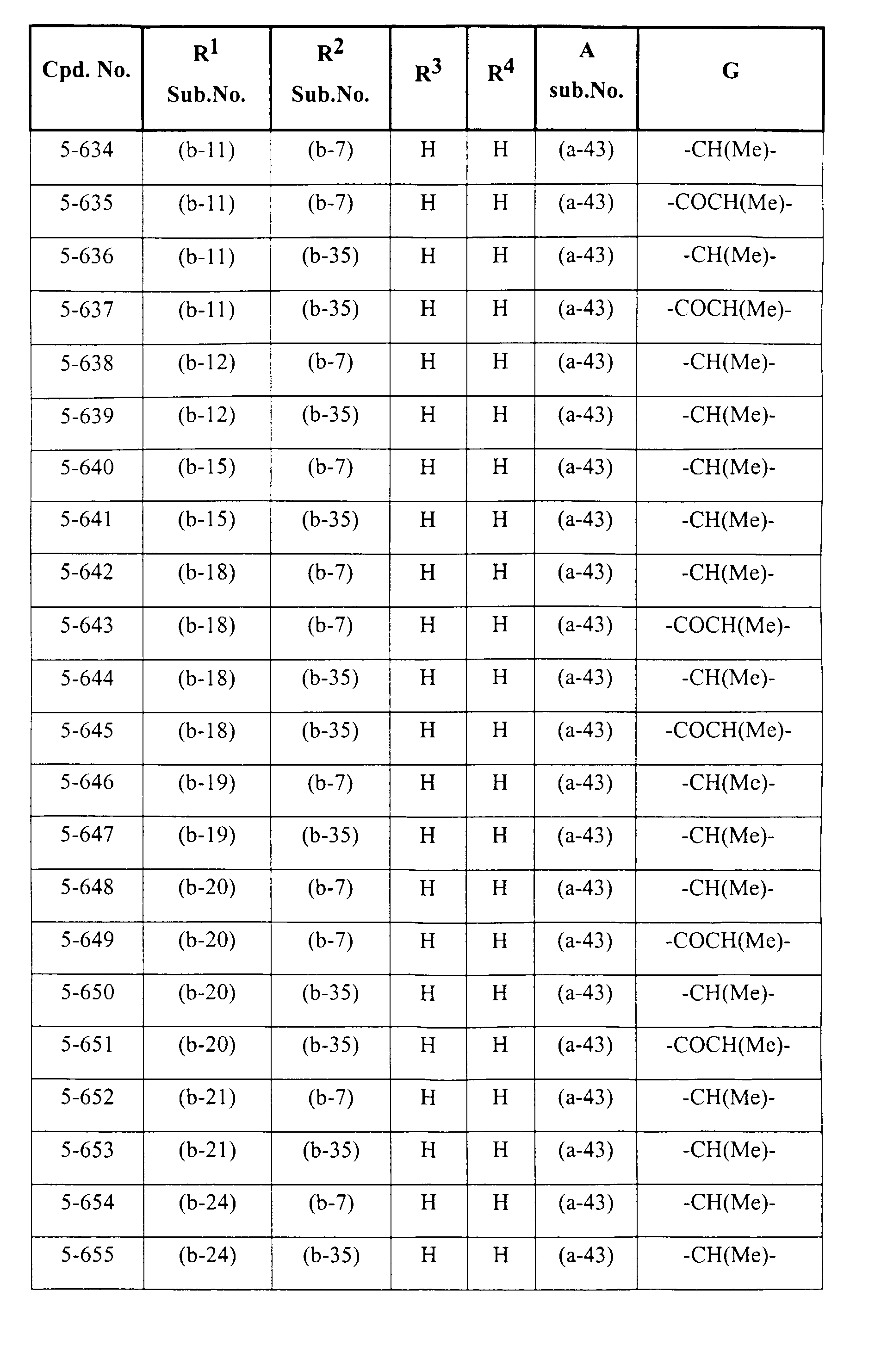

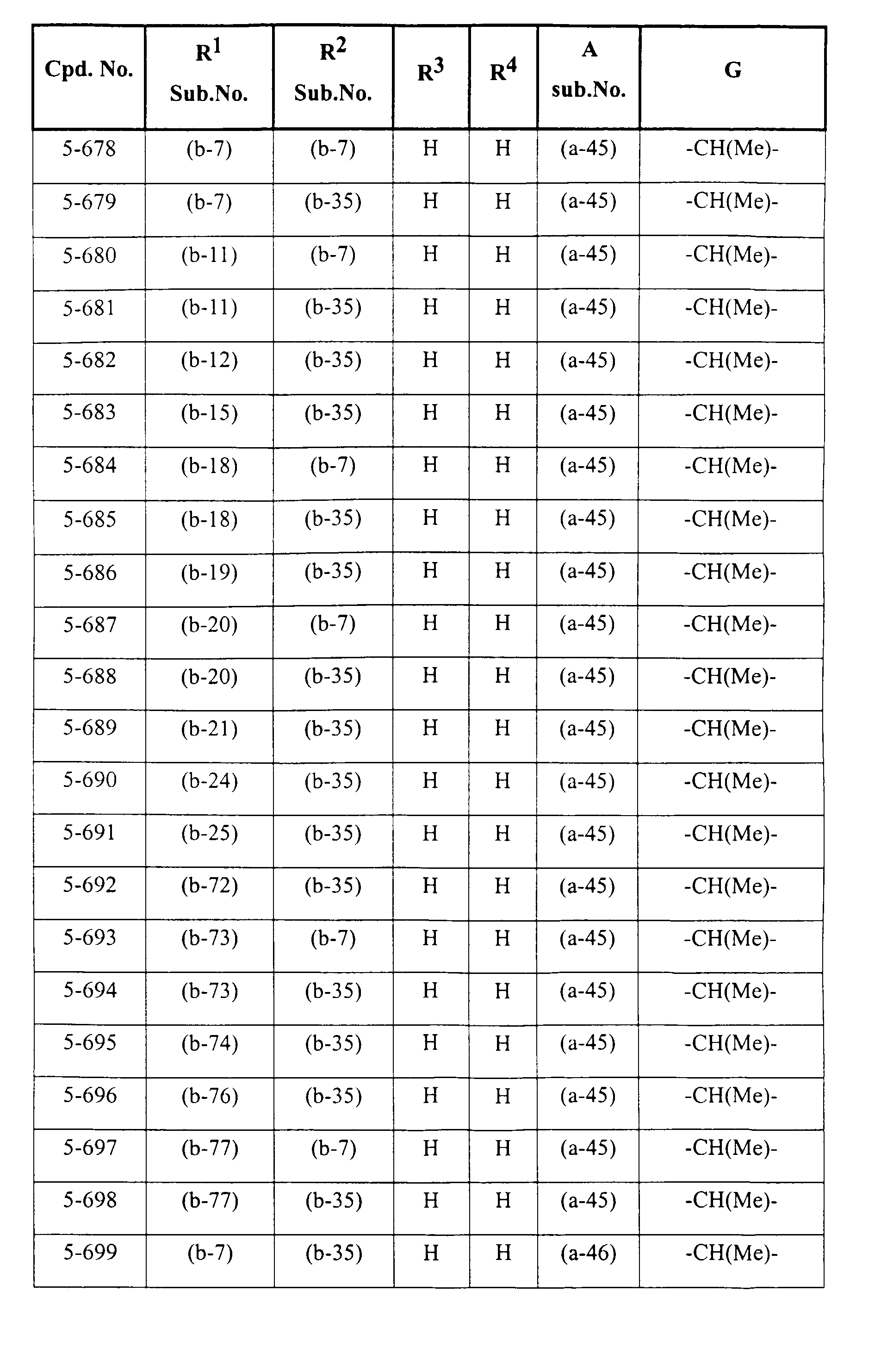

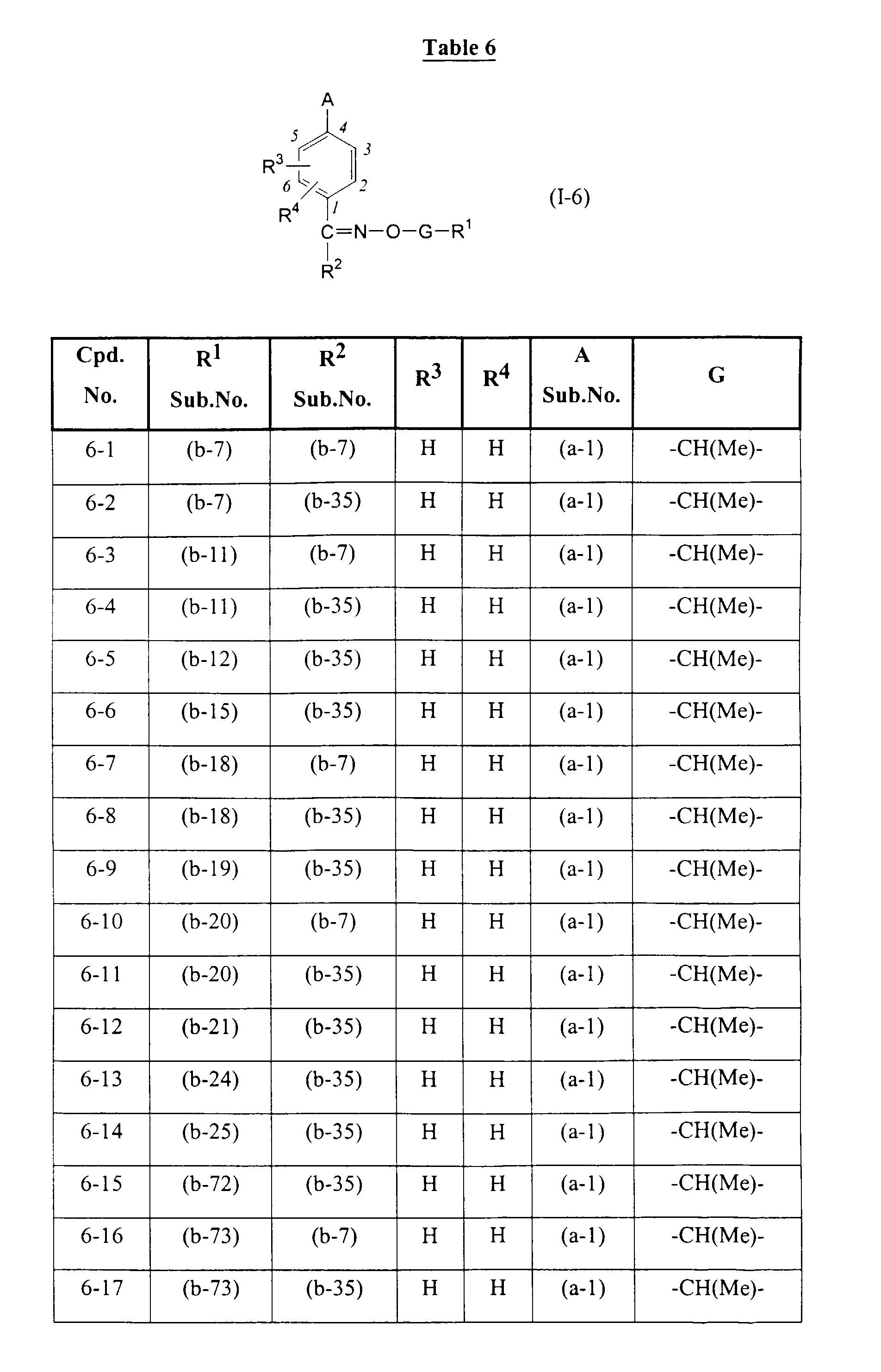


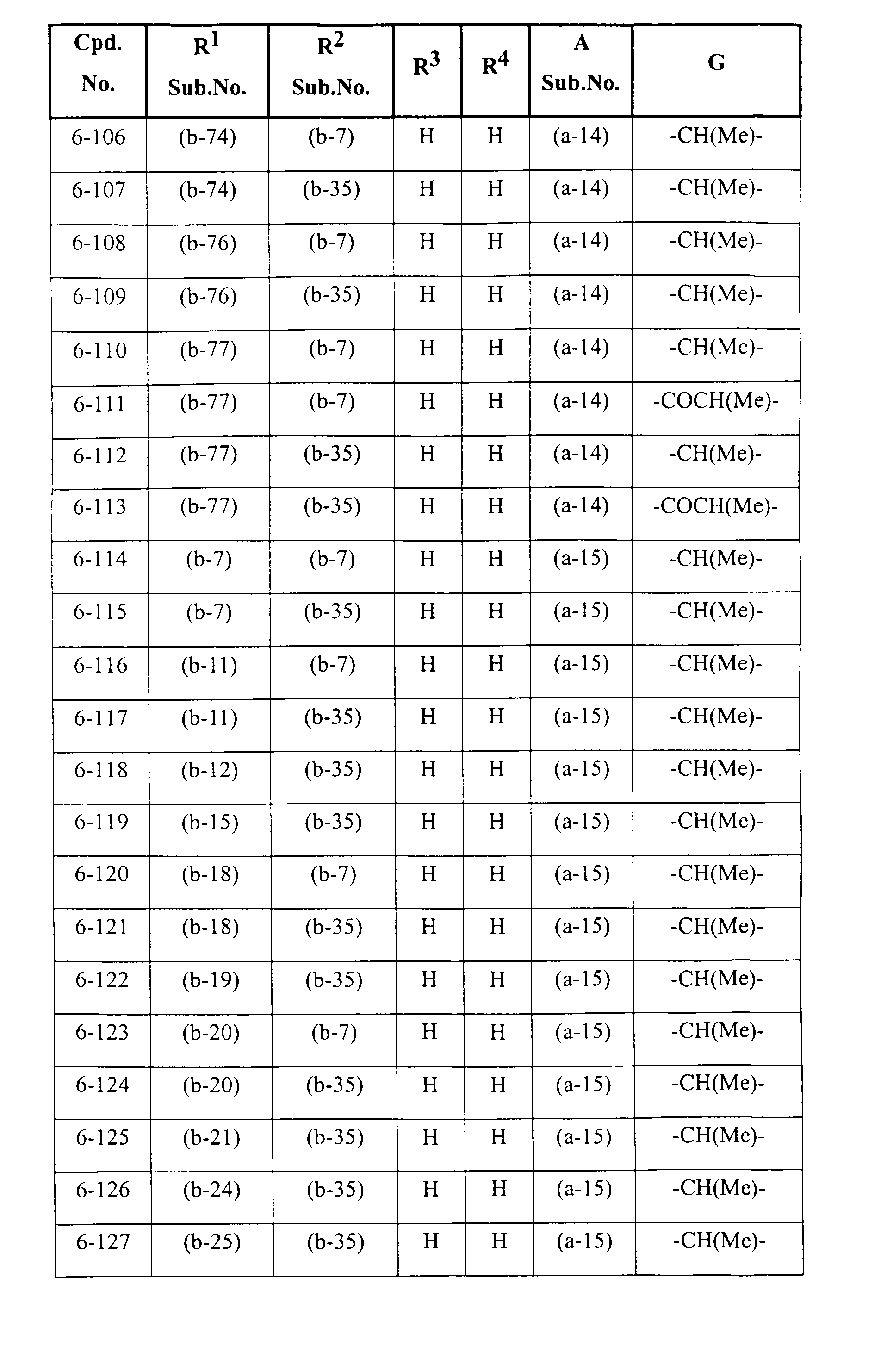


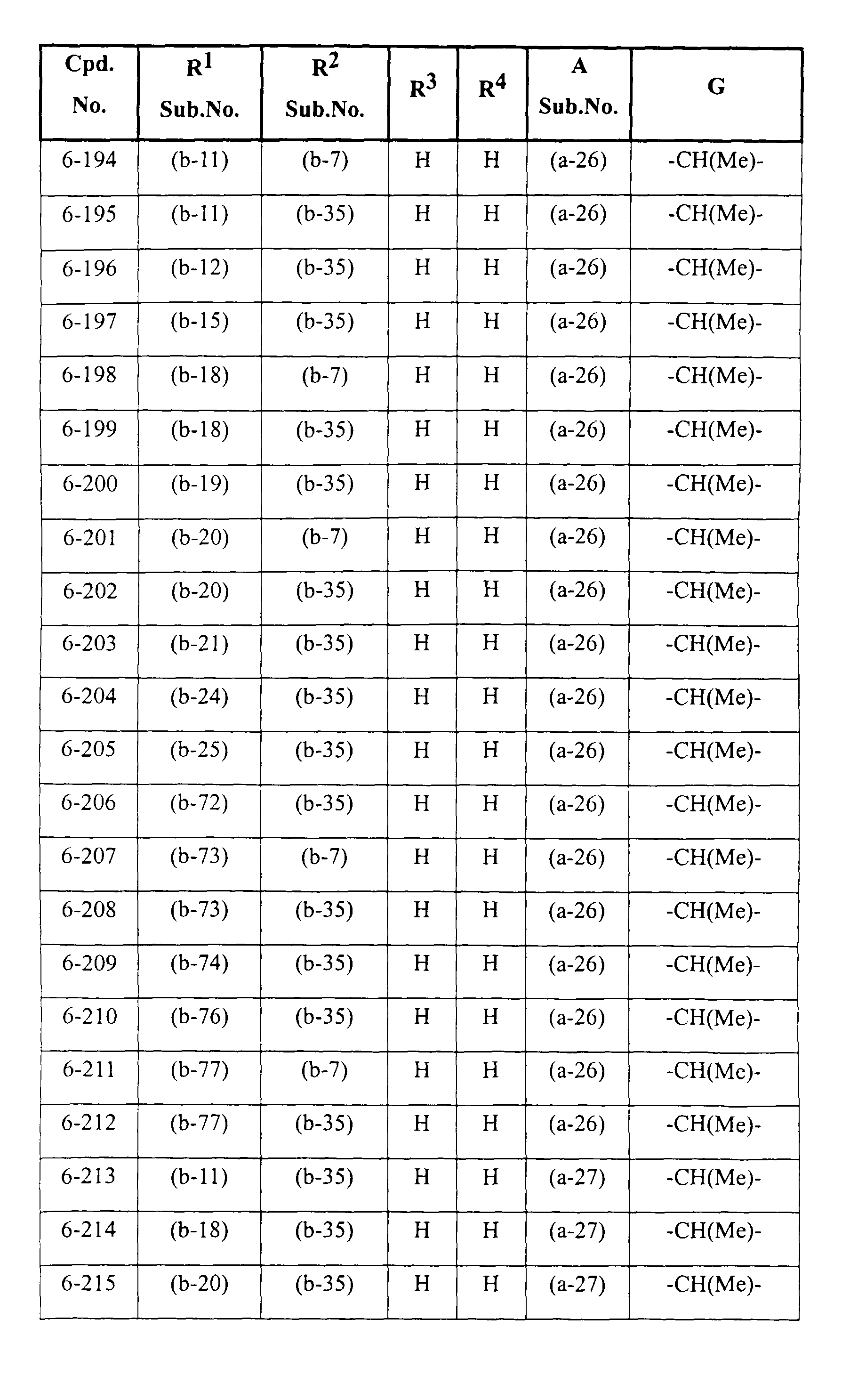
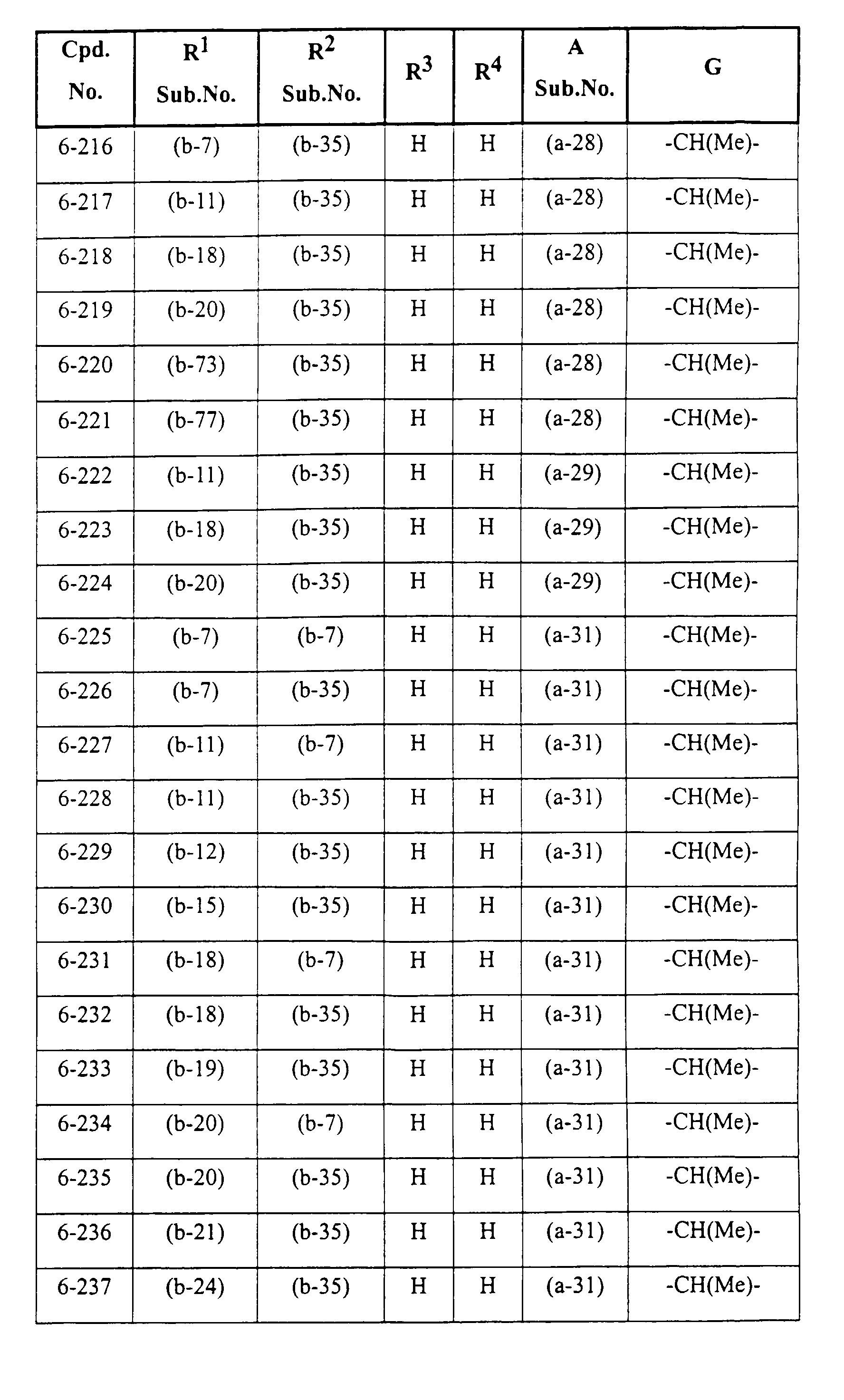
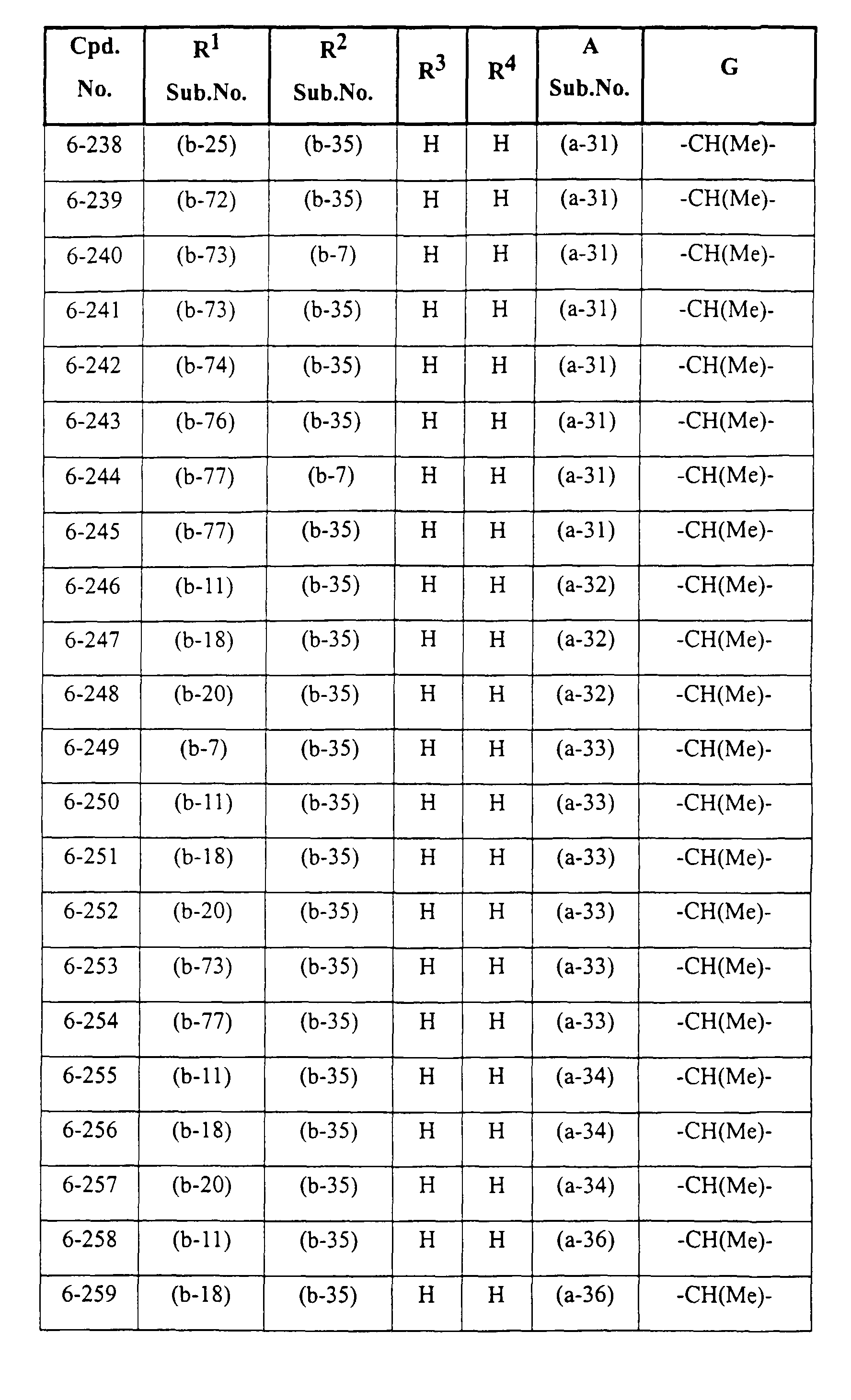
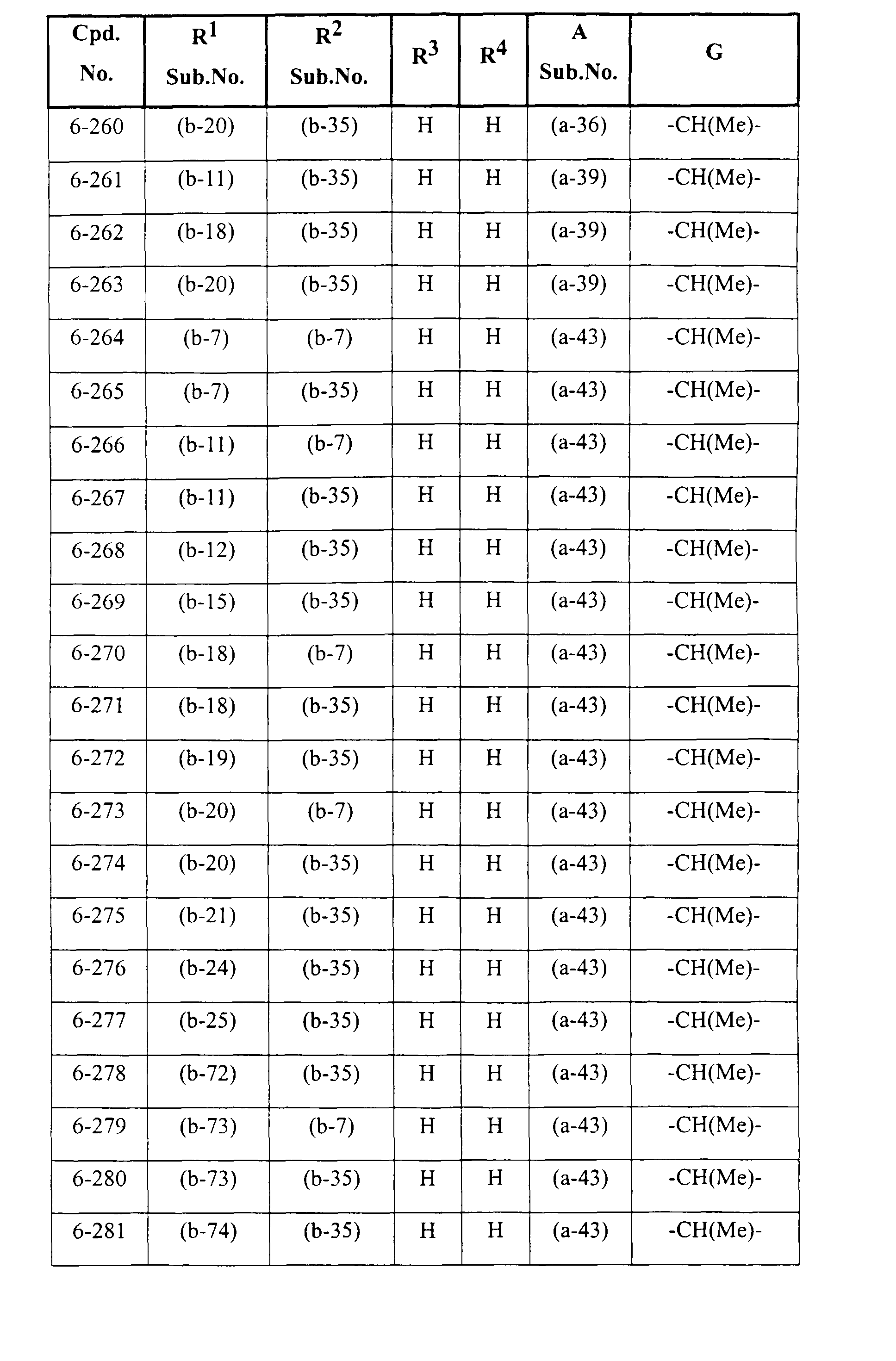

- Of the compounds listed above, the following are preferred, that is to say, Compounds No.:
1-41, 1-78, 1-86, 1-92, 2-1 - 2-64, 2-74 - 2-86, 2-89 - 2-106, 2-116, 2-117, 2-237, 2-377, 2-403, 2-407, 2-450, 2-479, 2-480, 2-481, 2-492, 2-499, 2-500, 2-554, 2-574, 2-577, 2-583, 2-584, 2-585, 2-592, 2-691, 2-698, 2-699, 2-713, 2-755, 2-762, 2-763, 2-835, 2-838, 2-844, 2-845, 2-846, 2-815, 2-952, 2-1085, 2-1256, 2-1286, 2-1287, 2-1288, 2-1299, 2-1306, 2-1307, 2-1359, 2-1360, 2-1379, 2-1382, 2-1388, 2-1389, 2-1390, 2-1496, 2-1523, 2-1565, 2-1625, 2-1627, 2-1628, 2-1654, 2-1655, 2-1666, 2-1772, 2-1831, 2-1941, 2-1946, 2-1962, 2-2256, 2-2274, 2-2295, 2-2309, 2-3090 - 2-3514, 3-79, 3-94, 3-100, 3-169, 3-187, 3-208, 3-401, 5-94, 5-208 and 5-401; - More preferred compounds are Compounds No.:
2-2 - 2-58, 2-74, 2-81, 2-237, 2-450, 2-479, 2-480, 2-481, 2-492, 2-499, 2-500, 2-554, 2-583, 2-584, 2-585, 2-691, 2-713, 2-755, 2-762, 2-763, 2-835, 2-838, 2-844, 2-845, 2-846, 2-815, 2-952, 2-1085, 2-1256, 2-1286, 2-1287, 2-1288, 2-1299, 2-1306, 2-1307, 2-1359, 2-1360, 2-1379, 2-1382, 2-1388, 2-1389, 2-1390, 2-1496, 2-1523, 2-1565, 2-1625, 2-1627, 2-1628, 2-1654, 2-1655, 2-1666, 2-1772, 2-1831, 2-1941, 2-1962, 2-2274, 2-2295, 2-2309, 2-3108- 2-3118, 2-3136, 2-3157- 2-3165, 2-3178- 2-3180, 2-3185, 2-3186, 2-3191 - 2-3201, 2-3217 - 2-3222, 2-3376 - 2-3390, 2-3400 - 2-3406, 2-3414, 2-3438 - 2-3461, 2-3471 - 2-3477, 2-3479 - 2-3514, 3-79, 3-94, 3-100, 3-169, 3-187 and 3-208; - Still more preferred compounds are Compounds No.:
2-5, 2-6, 2-8, 2-13, 2-16, 2-18, 2-19, 2-21, 2-37, 2-39, 2-40, 2-42, 2-51, 2-53, 2-54, 2-56, 2-237, 2-450, 2-479, 2-480, 2-481, 2-492, 2-554, 2-583, 2-584, 2-585, 2-691, 2-713, 2-755, 2-815, 2-844, 2-845, 2-846, 2-1085, 2-1256, 2-1299, 2-1359, 2-1388, 2-1389, 2-1390, 2-1496, 2-1523, 2-1565, 2-1625, 2-1772, 2-1831, 2-1962, 2-2274, 2-2295, 2-2309, 2-3136, 2-3161, 2-3162, 2-3164, 2-3197, 2-3377, 2-3386, 2-3400, 2-3457, 2-3485, 2-3497, 2-3502, 2-3504, 3-94 and 3-208. - The most preferred compounds are Compounds No.:
- 2-5: 3-〈3-{(4-Fluorophenyl)-[1-phenylethylamino]methyl}phenylamino〉-4-hydroxy-3-cyclobutene-1,2-dione,
- 2-6: 3-〈3-{(4-Chlorophenyl)-[1-phenylethylamino]methyl}phenylamino〉-4-hydroxy-3-cyclobutene-1,2-dione,
- 2-8: 3-Hydroxy-4-〈3-{[(R)-1-phenylethylamino]-(4-methoxyphenyl)methyl}phenylamino〉-3-cyclobutene-1,2-dione,
- 2-13: 3-Hydroxy-4-〈3-{(4-methoxyphenyl)-[1-(naphthalen-1-yl)ethylamino]methyl}phenylamino〉-cycylobut-3-ene-1,2-dione,
- 2-16: 3-Hydroxy-4-〈3-{[1-(3-fluorophenyl)ethylamino]phenylmethyl}phenylamino〉-3-cyclobutene-1,2-dione,
- 2-18: 3-〈3-{(4-Fluorophenyl)-[1-(3-fluorophenyl)ethylamino]methyl}phenylamino〉-4-hydroxy-3-cyclobutene-1,2-dione,
- 2-19: 4-〈3-{(4-Chlorophenyl)-[1-(3-fluorophenyl)ethylamino]methyl}phenylamino〉-3-hydroxy-3-cyclobutene-1,2-dione,
- 2-21: 3-〈3-{[1-(3-Fluorophenyl)ethylamino]-(4-methoxyphenyl)methyl}phenylamino〉-4-hydroxy-3-cyclobutene-1,2-dione,
- 2-37: 3-Hydroxy-4-〈3-{[1-(3,4-difluorophenyl)ethylamino]-phenylmethyl]phenylamino〉-3-cyclobutene-1,2-dione,
- 2-39: 3-〈3-{[1-(3,4-Difluorophenyl)ethylamino]-(4-fluorophenyl)methyl}}phenylamino〉-4-hydroxy-3-cyclobutene-1,2-dione,
- 2-40: 4-〈3-{(4-Chlorophenyl)-[1-(3,4-difluorophenyl)ethylamino]methyl}phenylamino〉-3-hydroxy-3-cyclobutene-1,2-dione,
- 2-42: 4-〈3-{[1-(3,4-Difluorophenyl)ethylamino]-(4-methoxyphenyl)methyl}phenylamino〉-3-hydroxy-3-cyclobutene-1,2-dione,
- 2-51: 3-Hydroxy-4-〈3-{[1-(3,5-difluorophenyl)ethylamino]-phenylmethyl}phenylamino〉-3-cyclobutene-1,2-dione,
- 2-53: 4-〈3-{[1-(3,5-Difluorophenyl)ethylamino]-(4-fluorophenyl)methyl}phenylamino〉-3-hydroxy-3-cyclobutene-1,2-dione,
- 2-54: 4-〈3-{(4-Chlorophenyl)-[1-(3,5-difluorophenyl)ethylamino]methyl}phenylamino〉-3-hydroxy-3-cyclobutene-1,2-dione,
- 2-56: 4-〈3-{[1-(3,5-Difluorophenyl)ethylamino]-(4-methoxyphenyl)methyl}phenylamino〉-3-hydroxy-3-cyclobutene-1,2-dione,
- 2-237: 3-Amino-4-〈3-{(4-methoxyphenyl)-[1-(3,4-difluorophenyl)ethylamino]methyl}phenylamino〉-3-cyclobuten-1,2-dione,
- 2-492: 3-Amino-4-{3-[(4-fluorophenyl)-(1-phenylethylamino)methyl]phenylamino}-3-cyclobutene-1,2-dione,
- 2-554: 3-Amino-4-{3-[(4-methoxyphenyl)-(1-phenylethylamino)methyl]phenylamino}-3-cyclobutene-1,2-dione,
- 2-691: 3-Amino-4-{3-[4-pyridyl-(1-phenylethylamino)methyl]phenylamino}-3-cyclobutene-1,2-dione,
- 2-815: 3-Amino-4-〈3-{(4-methoxyphenyl)-[1-(3-fluorophenyl)ethylamino]methyl}phenylamino〉-3-cyclobutene-1,2-dione,
- 2-1299: 3-Amino-4-〈3-{(4-fluorophenyl)-[1-(3,4-difluorophenyl)ethylamino]methyl}phenylamino〉-3-cyclobutene-1,2-dione,
- 2-1359: 3-Amino-4-〈3-{(4-methoxyphenyl)-[1-(3,4-difluorophenyl)ethylamino]methyl}phenylamino〉-3-cyclobutene-1,2-dione,
- 2-1496: 3-Amino-4-〈3-{(4-pyridyl)-[1-(3,4-difluorophenyl)ethylamino]methyl}phenylamino〉-3-cyclobutene-1,2-dione,
- 2-1523: 3-Amino-4-〈3-{phenyl-[1-(3,5-difluorophenyl)ethylamino]methyl}phenylamino〉-3-cyclobutene-1,2-dione,
- 2-1565: 3-Amino-4-〈3-{(4-fluorophenyl)-[1-(3,5-difluorophenyl)ethylamino]methyl}phenylamino〉-3-cyclobutene-1,2-dione,
- 2-1625: 3-Amino-4-〈3-{(4-methoxyphenyl)-[1-(3,5-difluorophenyl)ethylamino]methyl}phenylamino〉-3-cyclobutene-1,2-dione,
- 2-1962: 3-Amino-4-〈3-{(4-methoxyphenyl)-[1-(4-pyridyl)ethylamino]methyl}phenylamino〉-3-cyclobutene-1,2-dione,
- 2-2295: 3-Amino-4-〈3-{(4-methoxyphenyl)-[1-(3,4-difluorophenyl)ethylamino]methyl}phenylamino〉-3-cyclobutene-1,2-dione,
- 2-3136: 3-〈3-{(4-Chlorophenyl)-[1-(naphthalen-1-yl)ethylamino]methyl}phenylamino〉-4-hydroxy-3-cyclobutene-1,2-dione,
- 2-3161: 3-Hydroxy-4-〈3-{[1-(1-naphthyl)ethylamino]-phenylmethyl}phenylamino〉-3-cyclobutene-1,2-dione,
- 2-3162: 3-〈3-{(4-Fluorophenyl)-[1-(naphthalen-1-yl)ethylamino]methyl}phenylamino〉-4-hydroxy-3-cyclobutene-1,2-dione,
- 2-3164: 3-Hydroxy-4-〈3-{[1-(1-naphthyl)ethylamino]-p-tolylmethyl}phenylamino〉-3-cyclobutene-1,2-dione,
- 2-3197: 3-〈3-{[4-(p-Tolyl)-[1-(3-fluorophenyl)ethylamino]methyl}phenylamino〉-4-hydroxy-3-cyclobutene-1,2-dione hydrochloride,
- 2-3386: 3-〈3-{[1-(3,4-Difluorophenylamino)ethylamino]-(p-toluyl)methyl}phenylamino〉-4-hydroxy-3-cyclobutene-1,2-dione, and
- 2-3457: 4-〈3-([1-(3,5-Difluorophenyl)ethylamino]-(4-methylphenyl)methyl}phenylamino〉-3-hydroxy-3-cyclobutene-1,2-dione.
-
- The compounds of the present invention may be prepared by a variety of methods, well known in themselves. For example, they may be prepared by the following Processes A to G.
- Process A is a process for the preparation of Compound (I), as shown in the following Reaction Scheme:
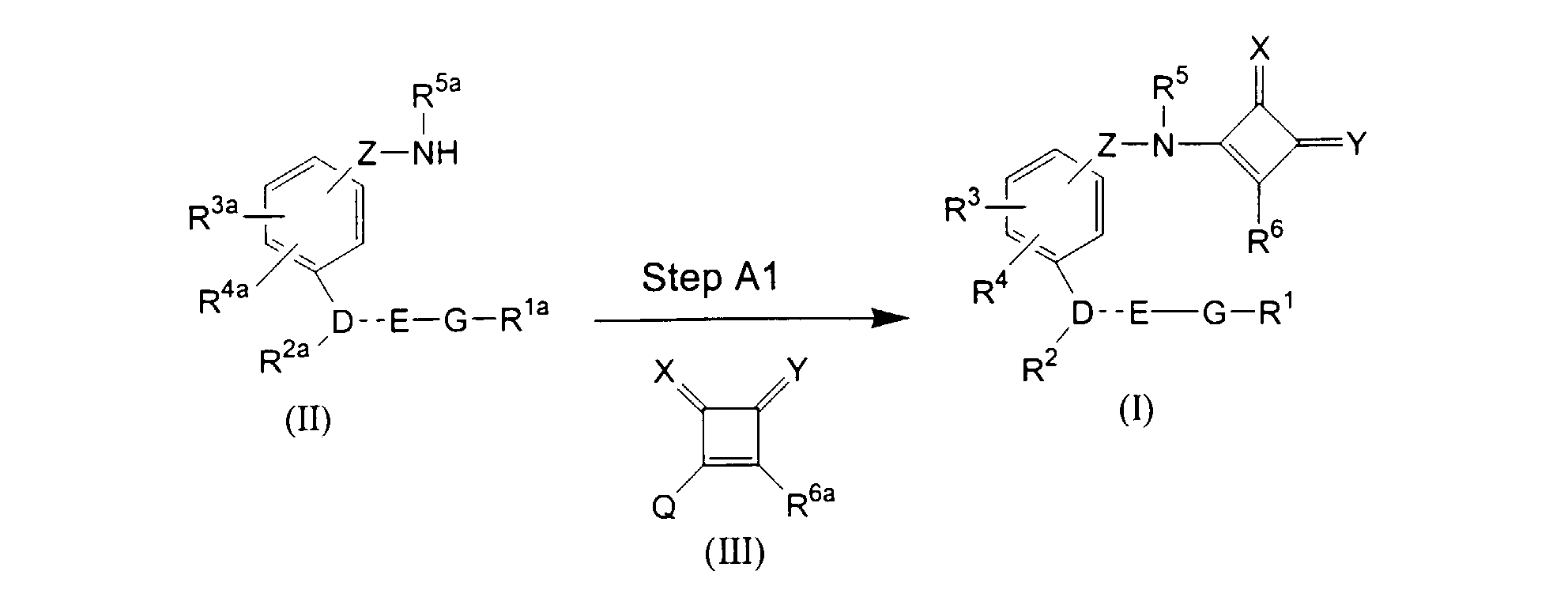
- In the above reaction scheme:
- R1, R2, R3, R4, R5, R6, D, E, G, X, Y, Z and the broken line have the same meanings as described above;
- R1a has the same meanings as described above for R1, with the proviso any amino, hydroxy and/or carboxy group contained as a substituent in R1 may be protected;
- R2a, R3a, R4a and R6a have the same meanings as described above for R2, R3, R4 and R6 with the proviso that the amino and/or hydroxy group contained as a substituent in R2, R3, R4 and R6 may be protected;
- R5a has the same meaning as described above for R5 with the proviso that the hydroxy group contained as a substituent in R5 may be protected; and
- Q is any one group which can be eliminated in a nucleophilic reaction, and
preferred examples include:
- halogen atoms, such as the chlorine, bromine and iodine atoms;
- lower alkoxy groups, such as the methoxy and ethoxy groups;
- trihalomethoxy groups, such as the trichloromethoxy group;
- lower alkanesulphonyloxy groups, such as the methanesulphonyloxy and ethanesulphonyloxy groups;
- lower haloalkanesulphonyloxy groups, such as the trifluoromethanesulphonyloxy and pentafluoroethanesulphonyloxy groups; and
- arylsulphonyloxy groups, such as the benzenesulphonyloxy, p-toluenesulphonyloxy and p-nitrobenzenesulphonyloxy groups;
- of which the halogen atoms and lower alkoxy groups are most preferred.
-
- There is no particular limitation on the nature of the protecting group for the amino group which may be protected in the definition of R1a, R2a, R3a, R4a or R6a, and any protecting group commonly used for amino or imino groups in organic synthetic chemistry may equally be used here. Preferred examples include:
- aliphatic acyl groups, for example, lower aliphatic acyl groups (such as the formyl, acetyl, propionyl, butyryl, isobutyryl, valeryl, isovaleryl, pivaloyl, hexanoyl, acryloyl, methacryloyl and crotonoyl groups), lower haloalkylcarbonyl groups (such as the chloroacetyl, dichloroacetyl, trichloroacetyl and trifluoroacetyl groups), and lower-alkoxy-substituted (lower alkyl)carbonyl groups (such as the methoxyacetyl group);
- aromatic acyl groups, for example, C7-11 aromatic acyl groups (i.e. a group in which a carbonyl group is bound to an aryl group such as those defined and exemplified above), C7-11 haloaromatic acyl groups (such as the 2-bromobenzoyl and 4-chlorobenzoyl groups), lower-alkyl-substituted C7-11 aromatic acyl groups (such as the 2,4,6-trimethylbenzoyl and 4-toluoyl groups), lower-alkoxy-substituted C7-11 aromatic acyl groups (such as the 4-anisoyl group), nitro-substituted C7-11 aromatic acyl groups (such as the 4-nitrobenzoyl and 2-nitrobenzoyl groups), lower-alkoxycarbonyl-substituted C7-11 aromatic acyl groups [such as the 2-(methoxycarbonyl)benzoyl group], and aryl-substituted C7-11 aromatic acyl groups (such as the 4-phenylbenzoyl group);
- alkoxycarbonyl groups, for example, those defined and exemplified above, and halogen- or tri(lower alkyl)silyl-substituted lower alkoxycarbonyl groups (such as the 2,2,2-trichloroethoxycarbonyl and 2-trimethylsilylethoxycarbonyl groups);
- alkenyloxycarbonyl groups (such as the vinyloxycarbonyl and allyloxycarbonyl groups);
- aralkyloxycarbonyl groups having an aryl ring which may be substituted by 1 or 2 lower alkoxy or nitro groups (such as the benzyloxycarbonyl, 4-methoxybenzyloxycarboyl, 3,4-dimethoxybenzyloxycarbonyl, 2-nitrobenzyloxycarbonyl and 4-nitrobenzyloxycarbonyl groups);
- silyl groups, for example, tri(lower alkyl)silyl groups (such as the trimethylsilyl, triethylsilyl, isopropyldimethylsilyl, t-butyldimethylsilyl, methyldiisopropylsilyl, methyl-di-t-butylsilyl and triisopropylsilyl groups) and silyl groups each substituted by 3 substituents selected from aryl and lower alkyl groups (such as the diphenylmethylsilyl, diphenylbutylsilyl, diphenylisopropylsilyl and phenyldiisopropylsilyl groups);
- aralkyl groups, for example, lower alkyl groups each substituted by from 1 to 3 aryl groups (such as the benzyl, phenethyl, 3-phenylpropyl, α-naphthylmethyl, β-naphthylmethyl, diphenylmethyl, triphenylmethyl, α-naphthyldiphenylmethyl and 9-anthrylmethyl groups), and lower alkyl groups each substituted by from 1 to 3 aryl groups having a lower-alkyl-, lower-alkoxy-, nitro-, halogen- or cyano-substituted aryl ring (such as the 4-methylbenzyl, 2,4,6-trimethylbenzyl, 3,4,5-trimethylbenzyl, 4-methoxybenzyl, 4-methoxyphenyldiphenylmethyl, 2-nitrobenzyl, 4-nitrobenzyl, 4-chlorobenzyl, 4-bromobenzyl, 4-cyanobenzyl, 4-cyanobenzyldiphenylmethyl, bis(2-nitrophenyl)methyl, and piperonyl groups); and
- substituted methylene groups forming a Schiffbase [such as N,N-dimethylaminomethylene, benzylidene, 4-methoxybenzylidene, 4-nitrobenzylidene, salicylidene, 5-chlorosalicylidene, diphenylmethylene and (5-chloro-2-hydroxyphenyl)phenylmethylene];
- of which the lower aliphatic acyl groups, C7-11 aromatic acyl groups and alkoxycarbonyl groups are preferred, the lower alkoxycarbonyl groups and the lower alkoxycarbonyl groups are more preferred and the acetyl group and the t-butoxycarbonyl group is most preferred.
-
- There is no particular limitation on the nature of the protecting group for the hydroxy group which may be protected in the definitions of R1a, R2a, R3a, R4a, R5a and R6a, and any protecting group for a hydroxy group commonly used in organic synthetic chemistry may equally be used here. The hydroxy-protecting groups defined and exemplified above in relation to esters of the compounds of the present invention may also be used in this reaction. Of these, the lower aliphatic acyl groups, C7-11 aromatic acyl groups, lower alkoxycarbonyl groups and (lower alkoxy)methyl groups are preferred, the C7-11 aromatic acyl groups and (lower alkoxy)methyl groups are more preferred and the benzoyl and methoxymethyl groups are most preferred.
- There is no particular limitation on the nature of the protecting group for the carboxy group which may be protected in the definition of R1a, and any carboxy-protecting group commonly used in the field of organic synthetic chemistry may equally be used here. The carboxy-protecting groups defined and exemplified above in relation to esters of the compounds of the present invention may also be used in this reaction. Of these, the lower alkyl and benzyl groups are preferred.
- In step A1, the compound of formula (I) is prepared by reacting a compound of formula (II) with a compound of formula (III) in an inert solvent and then optionally removing the protecting group from any protected amino, hydroxy and/or carboxy group in R1a, R2a, R3a, R4a, R5a and R6a.
- The reaction is normally and preferably effected in the presence of a solvent. There is no particular restriction on the nature of the solvent to be employed, provided that it has no adverse effect on the reaction or on the reagents involved and that it can dissolve the reagents, at least to some extent. Examples of suitable solvents include: aliphatic hydrocarbons, such as hexane, heptane, ligroin and petroleum ether; aromatic hydrocarbons, such as benzene, toluene and xylene; halogenated hydrocarbons, such as chloroform, dichloromethane, 1,2-dichloroethane and carbon tetrachloride; esters, such as methyl acetate, ethyl acetate, propyl acetate, butyl acetate and diethyl carbonate; ethers, such as diethyl ether, diisopropyl ether, tetrahydrofuran, dioxane, dimethoxyethane, and diethylene glycol dimethyl ether; alcohols, such as methanol, ethanol, propanol, isopropanol, butanol, isobutanol, t-butanol, isoamyl alcohol, diethylene glycol, glycerin, octanol, cyclohexanol and methyl cellosolve; nitriles, such as acetonitrile and isobutyronitrile; amides, such as formamide, dimethylformamide, dimethylacetamide and hexamethylphosphoryl triamide; and water; and mixtures of any two or more of these solvents. Preferred are the alcohols (methanol is most preferred).
- The reaction can take place over a wide range of temperatures, and the precise reaction temperature is not critical to the invention. The preferred reaction temperature will depend upon such factors as the nature of the solvent, and the catalyst, solvent, starting material or reagent used. However, in general, we find it convenient to carry out the reaction at a temperature of from -20°C to 150°C more preferably from 0 to 50°C. The time required for the reaction may also vary widely, depending on many factors, notably the reaction temperature and the nature of the catalyst, reagents and solvent employed. However, provided that the reaction is effected under the preferred conditions outlined above, a period of from 5 minutes to 24 hours, more preferably from 15 minutes to 12 hours, will usually suffice.
- If desired, the compound of formula (I) in which R6 represents a lower alkoxy group may be reacted with ammonia or a compound of formula HR' (in which R' represents an amine residue) in an inert solvent (preferably an alcohol or an ether) at a temperature from -20 to 150°C (preferably from 0 to 50°C) for a period of from 5 minutes to 24 hours (preferably from 15 minutes to 12 hours), to give a corresponding compound in which R6 represents an amine residue.
- If desired, the compound of formula (I) in which R6 represents a lower alkoxy group may be reacted with a compound of formula (IV):
- If desired, the compound of formula (I) in which R6 represents a lower alkoxy group may be reacted with an acid in an inert solvent (preferably an alcohol or a halogenated hydrocarbon) at a temperature of from -20 to 150°C (preferably from 0 to 50°C) for a period of from 5 minutes to 24 hours (preferably from 15 minutes to 12 hours), to give the corresponding compound in which R6 represents a hydroxy group.
- The method employed to remove the protecting group from the amino, hydroxy or carboxy group will vary, depending on the nature of the protecting group, as is well known in the art. However, all of the protecting groups referred to herein may be removed by techniques well known in the field of organic synthetic chemistry, for example, as described by T.W. Green, "Protective Groups in Organic Synthesis", John Wiley & Sons: or J. F. W. McOmis, "Protective Groups in Organic Chemistry", Plenum Press.
- When the protecting group for the amino group is a silyl group, it can usually be removed by treatment with a fluorine-anion-forming compound such as tetrabutyl ammonium fluoride, hydrofluoric acid, hydrofluoric acid-pyridine or potassium fluoride.
- The reaction is normally and preferably effected in the presence of a solvent. There is no particular restriction on the nature of the solvent to be employed, provided that it has no adverse effect on the reaction or on the reagents involved and that it can dissolve the reagents, at least to some extent. Examples of suitable solvents include: ethers, such as diethyl ether, diisopropyl ether, tetrahydrofuran, dioxane, dimethoxyethane and diethylene glycol dimethyl ether.
- The reaction can take place over a wide range of temperatures, and the precise reaction temperature is not critical to the invention. The preferred reaction temperature will depend upon such factors as the nature of the solvent, and the starting material or reagent used. However, in general, we find it convenient to carry out the reaction at a temperature of from 0 to 50°C. The time required for the reaction may also vary widely, depending on many factors, notably the reaction temperature and the nature of the reagents and solvent employed. However, provided that the reaction is effected under the preferred conditions outlined above, a period of from 10 minutes to 18 hours, will usually suffice.
- When the protecting group for an amino group is an aliphatic acyl, aromatic acyl, alkoxycarbonyl or Schiff-base-forming substituted methylene group, it can be removed by treatment with an acid or base in the presence of an aqueous solvent.
- There is no particular limitation on the nature of the acid to be used for this reaction, and any acid commonly employed in reactions of this type may equally be employed here. Examples of suitable acids include: inorganic acids, such as hydrobromic acid, hydrochloric acid, sulphuric acid, perchloric acid, phosphoric acid and nitric acid, of which hydrochloric acid is preferred.
- There is no particular limitation on the nature of the base to be used for this reaction, and any base commonly employed in reactions of this type may equally be employed here, provided that it does not adversely affect another part of the molecule. Preferred examples include: alkali metal carbonates, such as lithium carbonate, sodium carbonate and potassium carbonate; alkali metal hydroxides, such as lithium hydroxide, sodium hydroxide and potassium hydroxide; metal alkoxides, such as lithium methoxide, sodium methoxide, sodium ethoxide and potassium-t-butoxide; and ammonias, such as aqueous ammonia and concentrated ammonia-methanol.
- The reaction is normally and preferably effected in the presence of a solvent. There is no particular restriction on the nature of the solvent to be employed, provided that it has no adverse effect on the reaction or on the reagents involved and that it can dissolve the reagents, at least to some extent, and any such solvent commonly used in hydrolysis reactions may equally be employed here. Examples of suitable solvents include: alcohols, such as methanol, ethanol, propanol, isopropanol, butanol, isobutanol, t-butanol, isoamyl alcohol, diethylene glycol, glycerin, octanol, cyclohexanol and methyl cellosolve; ethers, such as diethyl ether, diisopropyl ether, tetrahydrofuran, dioxane, dimethoxyethane and diethylene glycol dimethyl ether; and water; and mixtures of any two or more of these solvents. Preferred are the ethers, dioxane being most preferred.
- The reaction can take place over a wide range of temperatures, and the precise reaction temperature is not critical to the invention. The preferred reaction temperature will depend upon such factors as the nature of the solvent, and the starting material or reagent used. However, in general, in order to suppress side reactions, we find it convenient to carry out the reaction at a temperature of from 0 to 150°C. The time required for the reaction may also vary widely, depending on many factors, notably the reaction temperature and the nature of the reagents and solvent employed. However, provided that the reaction is effected under the preferred conditions outlined above, a period of from 1 to 10 hours, will usually suffice.
- When an aralkyl or aralkyloxycarbonyl group is the protecting group for the amino group, it is usually preferably removed by bringing it into contact with a reducing agent in an inert solvent (preferably by catalytic reduction at standard temperature in the presence of a catalyst) or by using an oxidising agent.
- The reaction is normally and preferably effected in the presence of a solvent. There is no particular restriction on the nature of the solvent to be employed for the catalytic removal, provided that it has no adverse effect on the reaction or on the reagents involved and that it can dissolve the reagents, at least to some extent. Examples of suitable solvents include: aliphatic hydrocarbons, such as hexane, heptane, ligroin and petroleum ether; aromatic hydrocarbons, such as toluene, benzene and xylene; esters, such as methyl acetate, ethyl acetate, propyl acetate, butyl acetate and diethyl carbonate; ethers, such as diethyl ether, diisopropyl ether, tetrahydrofuran, dioxane, dimethoxyethane and diethylene glycol dimethyl ether; alcohols, such as methanol, ethanol, propanol, isopropanol, butanol, isobutanol, t-butanol, isoamyl alcohol, diethylene glycol, glycerin, octanol, cyclohexanol and methyl cellosolve; organic acids, such as acetic acid; and water; and mixtures of the above-described solvent with water. Preferred are the alcohols, ethers, organic acids and water, the alcohols and organic acids being most preferred.
- There is no particular limitation on the nature of the catalyst to be used for the removal by catalytic reduction, and any such catalyst commonly used in reactions of this type may equally be employed here. Preferred examples include palladium on carbon, Raney-nickel, platinum oxide, platinum black, rhodium-aluminium oxide, triphenylphosphine-rhodium chloride and palladium-barium sulphate.
- Although there is no particular limitation on the pressure, the reaction is usually carried out at from 1 to 10 atmospheric pressure.
- The reaction can take place over a wide range of temperatures, and the precise reaction temperature is not critical to the invention. The preferred reaction temperature will depend upon such factors as the nature of the solvent, and the starting material, catalyst or reagent used. However, in general, we find it convenient to carry out the reaction at a temperature of from 0 to 100°C. The time required for the reaction may also vary widely, depending on many factors, notably the reaction temperature and the nature of the reagents and solvent employed. However, provided that the reaction is effected under the preferred conditions outlined above, a period of from 5 minutes to 24 hours, will usually suffice.
- The oxidative removal reaction is normally and preferably effected in the presence of a solvent. There is no particular restriction on the nature of the solvent to be employed, provided that it has no adverse effect on the reaction or on the reagents involved and that it can dissolve the reagents, at least to some extent. Examples of suitable solvents include: water-containing organic solvents.
- Examples of such organic solvents include: halogenated hydrocarbons, such as chloroform, dichloromethane, 1,2-dichloroethane and carbon tetrachloride; nitriles, such as acetonitrile; ethers, such as diethyl ether, diisopropyl ether, tetrahydrofuran, dioxane, dimethoxyethane and diethylene glycol dimethyl ether; ketones, such as acetone; amides, such as formamide, dimethylformamide, dimethylacetamide and hexamethylphosphoryl triamide; sulphoxides, such as dimethyl sulphoxide; and sulpholane. Preferred are the halogenated hydrocarbons, ethers and sulphoxides, the halogenated hydrocarbons and sulphoxides being most preferred.
- There is likewise no particular limitation on the nature of the oxidising agent to be employed in this reaction, and any oxidising agent commonly used in oxidative removal reactions may equally be employed here. Preferred examples include potassium persulphate, sodium persulphate, ammonium cerium nitrate (CAN), and 2,3-dichloro-5,6-dicyano-p-benzoquinone (DDQ).
- The reaction can take place over a wide range of temperatures, and the precise reaction temperature is not critical to the invention. The preferred reaction temperature will depend upon such factors as the nature of the solvent, and the starting material, catalyst or reagent used. However, in general, we find it convenient to carry out the reaction at a temperature of from 0 to 150°C. The time required for the reaction may also vary widely, depending on many factors, notably the reaction temperature and the nature of the reagents and solvent employed. However, provided that the reaction is effected under the preferred conditions outlined above, a period of from 10 minutes to 24 hours, will usually suffice.
- When the amino group is protected with an aralkyl group, it can be removed using an acid.
- There is no particular limitation on the nature of the acid to be used for this reaction, and any acid commonly used in reactions of this type may equally be employed here. Examples include:
- Brønsted acids, for example: inorganic acids, such as hydrochloric acid, hydrobromic acid, sulphuric acid, perchloric acid and phosphoric acid; and
- organic acids, such as acetic acid, formic acid, oxalic acid, methanesulphonic acid, p-toluenesulphonic acid, camphorsulphonic acid, trifluoroacetic acid and trifluoromethanesulphonic acid;
- Lewis acids, such as zinc chloride, tin tetrachloride, boron trichloride, boron trifluoride and boron tribromide; and
- acid ion exchange resins,
- of which the inorganic or organic acids are preferred, hydrochloric acid, acetic acid or trifluoroacetic acid being most preferred.
-
- The first stage of this reaction is normally and preferably effected in the presence of a solvent. There is no particular restriction on the nature of the solvent to be employed, provided that it has no adverse effect on the reaction or on the reagents involved and that it can dissolve the reagents, at least to some extent. Examples of suitable solvents include: aliphatic hydrocarbons, such as hexane, heptane, ligroin and petroleum ether; aromatic hydrocarbons, such as benzene, toluene and xylene, halogenated hydrocarbons, such as chloroform, dichloromethane, 1,2-dichloroethane and carbon tetrachloride; esters, such as methyl acetate, ethyl acetate, propyl acetate, butyl acetate and diethyl carbonate; ethers, such as diethyl ether, diisopropyl ether, tetrahydrofuran, dioxane, dimethoxyethane and diethylene glycol dimethyl ether; alcohols, such as methanol, ethanol, propanol, isopropanol, butanol, isobutanol, t-butanol, isoamyl alcohol, diethylene glycol, glycerin, octanol, cyclohexanol and methyl cellosolve; amides, such as formamide, dimethylformamide, dimethylacetamide and hexamethylphosphoryl triamide; and water; and mixtures of any two or more of these solvents. Preferred are the ethers, alcohols and water, dioxane, tetrahydrofuran, ethanol and water being most preferred.
- The reaction can take place over a wide range of temperatures, and the precise reaction temperature is not critical to the invention. The preferred reaction temperature will depend upon such factors as the nature of the solvent, and the starting material or reagent used. However, in general, we find it convenient to carry out the reaction at a temperature of from -20°C to the boiling point of the reaction medium, preferably from 0 to 100°C. The time required for the reaction may also vary widely, depending on many factors, notably the reaction temperature and the nature of the reagents and solvent employed. However, provided that the reaction is effected under the preferred conditions outlined above, a period of from 15 minutes to 48 hours more preferably from 30 minutes to 20 hours, will usually suffice.
- When the amino group is protected with an alkenyloxycarbonyl group, the protecting group may be removed by treatment with a base under similar conditions to those employed when the amino group is protected with the above-described aliphatic acyl group, aromatic acyl group, alkoxycarbonyl group or a Schiff-base forming substituted methylene group.
- The aryloxycarbonyl group can be removed easily and with fewer side reactions by using palladium and triphenylphosphine or nickel tetracarbonyl.
- When the hydroxy group is protected with a silyl group, the silyl group can usually be removed by treating the protected compound with a fluorine-anion-forming compound, such as tetrabutyl ammonium fluoride, hydrofluoric acid, hydrofluoric acid-pyridine or potassium fluoride; or by treating it with an inorganic acid, such as hydrochloric acid, hydrobromic acid, sulphuric acid, perchloric acid or phosphoric acid, or an organic acid, such as acetic acid, formic acid, oxalic acid, methanesulphonic acid, p-toluenesulphonic acid, camphor sulphonic acid, trifluoroacetic acid or trifluoromethanesulphonic acid.
- Reaction using a fluorine anion may be accelerated by the addition of an organic acid such as formic acid, acetic acid or propionic acid.
- The reaction is normally and preferably effected in the presence of a solvent. There is no particular restriction on the nature of the solvent to be employed, provided that it has no adverse effect on the reaction or on the reagents involved and that it can dissolve the reagents, at least to some extent. Examples of suitable solvents include: include ethers, such as diethyl ether, diisopropyl ether, tetrahydrofuran, dioxane, dimethoxyethane and diethylene glycol dimethyl ether; nitriles, such as acetonitrile and isobutyronitrile; organic acids, such as acetic acid; water; and mixtures of any two or more of these solvents.
- The reaction can take place over a wide range of temperatures, and the precise reaction temperature is not critical to the invention. The preferred reaction temperature will depend upon such factors as the nature of the solvent, and the starting material, catalyst or reagent used. However, in general, we find it convenient to carry out the reaction at a temperature of from 0 to 100°C, more preferably from 10 to 50°C. The time required for the reaction may also vary widely, depending on many factors, notably the reaction temperature and the nature of the reagents and solvent employed. However, provided that the reaction is effected under the preferred conditions outlined above, a period of from 1 hour to 24 hours, will usually suffice.
- When the hydroxy group is protected with an aralkyl or aralkyloxycarbonyl group, the protecting group can usually preferably be removed by bringing it into contact with a reducing agent in an inert solvent (preferably by catalytic reduction at standard temperature in the presence of a catalyst) or by oxidation with an oxidising agent.
- The reaction is normally and preferably effected in the presence of a solvent. There is no particular restriction on the nature of the solvent to be employed, provided that it has no adverse effect on the reaction or on the reagents involved and that it can dissolve the reagents, at least to some extent. Examples of suitable solvents include: aliphatic hydrocarbons, such as hexane, heptane, ligroin and petroleum ether; aromatic hydrocarbons, such as toluene, benzene and xylene; esters, such as ethyl acetate and propyl acetate; ethers, such as diethyl ether, diisopropyl ether, tetrahydrofuran, dioxane, dimethoxyethane and diethylene glycol dimethyl ether; alcohols, such as methanol, ethanol, propanol, isopropanol, butanol, isobutanol, t-butanol, isoamyl alcohol, diethylene glycol, glycerin, octanol, cyclohexanol and methyl cellosolve; amides, such as formamide, dimethylformamide, dimethylacetamide, N-methyl-2-pyrrolidone and hexamethylphosphoryl triamide; organic acids, such as formic acid and acetic acid; and water; and mixtures of any two or more of these solvents. Preferred are the alcohols, methanol being most preferred.
- There is no particular limitation imposed on the nature of the catalyst to be used for the removal by catalytic reduction, and any catalyst commonly used in reactions of this type may equally be employed here. Examples of suitable catalysts include palladium on carbon, palladium-black, Raney-nickel, platinum oxide, platinum black, rhodium-aluminium oxide, triphenylphosphine-rhodium chloride and palladium-barium sulphate, of which the palladium on carbon is preferred.
- Although there is no particular limitation imposed on the pressure, the reaction is usually carried out at from 1 to 10 times atmospheric pressure.
- The reaction can take place over a wide range of temperatures, and the precise reaction temperature is not critical to the invention. The preferred reaction temperature will depend upon such factors as the nature of the solvent, and the starting material or reagent used. However, in general, we find it convenient to carry out the reaction at a temperature of from 0 to 100°C, more preferably from 20 to 70°C. The time required for the reaction may also vary widely, depending on many factors, notably the reaction temperature and the nature of the reagents and solvent employed. However, provided that the reaction is effected under the preferred conditions outlined above, a period of from 5 minutes to 28 hours, more preferably from 1 to 24 hours, will usually suffice.
- The reaction is normally and preferably effected in the presence of a solvent. There is no particular restriction on the nature of the solvent to be employed, provided that it has no adverse effect on the reaction or on the reagents involved and that it can dissolve the reagents, at least to some extent. Examples of suitable solvents include: water-containing organic solvents.
- Preferred examples of such organic solvents include: ketones, such as acetone, halogenated hydrocarbons, such as methylene chloride, chloroform and carbon tetrachloride; nitriles, such as acetonitrile; ethers, such as diethyl ether, tetrahydrofuran and dioxane; amides, such as dimethyl formamide, dimethyl acetamide and hexamethylphosphoryl triamide; and sulphoxides, such as dimethyl sulphoxide.
- There is no particular limitation on the nature of the oxidising agent to be used for the above-described reaction, and any oxidising agent commonly used in reactions of this type may equally be employed here. Preferred examples include potassium persulphate, sodium persulphate, ammonium cerium nitrate (CAN) and 2,3-dichloro-5,6-dicyano-p-benzoquinone (DDQ).
- The reaction can take place over a wide range of temperatures, and the precise reaction temperature is not critical to the invention. The preferred reaction temperature will depend upon such factors as the nature of the solvent, and the starting material, catalyst or reagent used. However, in general, we find it convenient to carry out the reaction at a temperature of from 0 to 150°C. The time required for the reaction may also vary widely, depending on many factors, notably the reaction temperature and the nature of the reagents and solvent employed. However, provided that the reaction is effected under the preferred conditions outlined above, a period of from 10 minutes to 24 hours, will usually suffice.
- Deprotection can also be carried out by reaction with an alkali metal, such as metal lithium or metal sodium at a relatively low temperature, for example from -78 to 0°C in aqueous ammonia or in an alcohol, such as methanol, ethanol, propanol, isopropanol, butanol, isobutanol, t-butanol, isoamyl alcohol, diethylene glycol, glycerin, octanol, cyclohexanol or methyl cellosolve.
- The protecting group can also be removed using aluminium chloride-sodium iodide or an alkyl silyl halide, such as trimethylsilyl iodide, in a solvent.
- The reaction is normally and preferably effected in the presence of a solvent. There is no particular restriction on the nature of the solvent to be employed, provided that it has no adverse effect on the reaction or on the reagents involved and that it can dissolve the reagents, at least to some extent. Examples of suitable solvents include: halogenated hydrocarbons, such as methylene chloride, chloroform or carbon tetrachloride; nitriles, such as acetonitrile; and mixtures of any two or more of these solvents.
- The reaction can take place over a wide range of temperatures, and the precise reaction temperature is not critical to the invention. The preferred reaction temperature will depend upon such factors as the nature of the solvent, and the starting material or reagent used. However, in general, we find it convenient to carry out the reaction at a temperature of from 0 to 50°C. The time required for the reaction may also vary widely, depending on many factors, notably the reaction temperature and the nature of the reagents and solvent employed. However, provided that the reaction is effected under the preferred conditions outlined above, a period of from 5 minutes to 72 hours, will usually suffice.
- When the reaction substrate contains a sulphur atom, aluminium chloride-sodium iodide is preferably employed.
- When the hydroxy group is protected with an aliphatic acyl, aromatic acyl or alkoxycarbonyl group, the protecting group can be removed by treatment with a base in a solvent.
- There is no particular limitation is imposed on the nature of the base to be used in this reaction, and any base commonly used in reactions of this type may equally be employed here. Preferred examples include: alkali metal carbonates, such as lithium carbonate, sodium carbonate and potassium carbonate; alkali metal hydrogencarbonates, such as lithium hydrogencarbonate, sodium hydrogencarbonate or potassium hydrogencarbonate; alkali metal hydroxides, such as lithium hydroxide, sodium hydroxide and potassium hydroxide; metal alkoxides, such as lithium methoxide, sodium methoxide, sodium ethoxide and potassium-t-butoxide; and ammonias, such as aqueous ammonia and concentrated ammonia-methanol, of which the alkali metal hydroxides, metal alkoxides and ammonias are preferred, the alkali metal hydroxides and metal alkoxides being most preferred.
- The reaction is normally and preferably effected in the presence of a solvent. There is no particular restriction on the nature of the solvent to be employed, provided that it has no adverse effect on the reaction or on the reagents involved and that it can dissolve the reagents, at least to some extent, and any solvent commonly used in hydrolysis reactions may equally be employed here. Examples of suitable solvents include: ethers, such as diethyl ether, diisopropyl ether, tetrahydrofuran, dioxane, dimethoxyethane and diethylene glycol dimethyl ether; alcohols, such as methanol, ethanol, propanol, isopropanol, butanol, isobutanol, t-butanol, isoamyl alcohol, diethylene glycol, glycerin, octanol, cyclohexanol and methyl cellosolve; and water; and mixtures of any two or more of these solvents.
- The reaction can take place over a wide range of temperatures, and the precise reaction temperature is not critical to the invention. The preferred reaction temperature will depend upon such factors as the nature of the solvent, and the starting material or reagent used. However, in general, in order to suppress side reactions, we find it convenient to carry out the reaction at a temperature of from -20 to 150°C. The time required for the reaction may also vary widely, depending on many factors, notably the reaction temperature and the nature of the reagents and solvent employed. However, provided that the reaction is effected under the preferred conditions outlined above, a period of from for 1 hour to 10 hours, will usually suffice.
- When the hydroxy group is protected with an alkoxymethyl, tetrahydropyranyl, tetrahydrothiopyranyl, tetrahydrofuranyl, tetrahydrothiofuranyl or substituted ethyl group, deprotection is usually carried out by treatment with an acid in a solvent.
- There is no particular limitation on the nature of the acid used in this reaction, and any acid commonly used in reactions of this type may equally be used here. Normally, a Brønsted acid or Lewis acid is used. Preferred examples include Brønsted acids, for example, hydrogen chloride, inorganic acids, such as hydrochloric acid, sulphuric acid and nitric acid, and organic acids, such as acetic acid, trifluoroacetic acid, methanesulphonic acid and p-toluenesulphonic acid; and Lewis acids, such as boron trifluoride. A strong acid ion exchange resin such as Dowex 50W can also be used.
- The reaction is normally and preferably effected in the presence of a solvent. There is no particular restriction on the nature of the solvent to be employed, provided that it has no adverse effect on the reaction or on the reagents involved and that it can dissolve the reagents, at least to some extent. Examples of suitable solvents include: aliphatic hydrocarbons, such as hexane, heptane, ligroin and petroleum ether; aromatic hydrocarbons, such as benzene, toluene and xylene, halogenated hydrocarbons, such as methylene chloride, chloroform, carbon tetrachloride, dichloroethane, chlorobenzene and dichlorobenzene; esters, such as methyl formate, ethyl acetate, ethyl acetate, propyl acetate, butyl acetate and diethyl carbonate; ethers, such as diethyl ether, diisopropyl ether, tetrahydrofuran, dioxane, dimethoxyethane and diethylene glycol dimethyl ether; alcohols, such as methanol, ethanol, propanol, isopropanol, butanol, isobutanol, t-butanol, isoamyl alcohol, diethylene glycol, glycerin, octanol, cyclohexanol and methyl cellosolve; ketones, such as acetone, methyl ethyl ketone, methyl isobutyl ketone, isophorone and cyclohexanone; and water; and mixtures of any two or more of these solvents. Preferred are the ethers, of which tetrahydrofuran is most preferred, or the alcohols, of which methanol is most preferred.
- The reaction can take place over a wide range of temperatures, and the precise reaction temperature is not critical to the invention. The preferred reaction temperature will depend upon such factors as the nature of the solvent, and the starting material or reagent used. However, in general, we find it convenient to carry out the reaction at a temperature of from -10 to 200°C, more preferably from 0 to 150°C. The time required for the reaction may also vary widely, depending on many factors, notably the reaction temperature and the nature of the reagents and solvent employed. However, provided that the reaction is effected under the preferred conditions outlined above, a period of from 5 minutes to 48 hours, more preferably from 30 minutes to 10 hours, will usually suffice.
- When the hydroxy group is protected with an alkenyloxycarbonyl group, deprotection may be carried out by treatment with a base under similar conditions to those employed when the hydroxy group is protected with an aliphatic acyl, aromatic acyl or alkoxycarbonyl group.
- Particularly when the protecting group is an allyloxycarbonyl group, removal can be carried out more easily with fewer side reactions by using palladium, and triphenylphosphine, or bis(methyldiphenylphosphine)(1,5-cyclooctadiene)iridium (I)·hexafluorophosphate.
- When the carboxy group is protected with a lower alkyl group or a lower alkyl group substituted by 1 to 3 aryl groups which may be substituted by a lower alkyl, lower alkoxy, nitro, halogen or cyano group, deprotection can be carried out by treatment with a base under similar conditions to those employed when the hydroxy group is protected with an aliphatic acyl, aromatic acyl or alkoxycarbonyl group.
- The removal of the protecting group of the amino, hydroxy and/or carboxy groups can be carried out in any desired order.
- After completion of the reaction, the resulting compound of formula (I) may be collected from the reaction mixture in conventional manner. It may be recovered, for example, by neutralising the reaction mixture as desired, removing any insoluble matter by filtration, adding a water-immiscible organic solvent such as ethyl acetate to separate an organic layer containing the compound, washing with water or the like, drying over anhydrous magnesium sulphate, anhydrous sodium sulphate or anhydrous sodium hydrogencarbonate and then distilling off the solvent. The resulting compound thus obtained can be separated and purified in a conventional manner by using commonly employed methods for the separation and purification of an organic compound, such as recrystallisation or reprecipitation, in combination, making use of chromatography and eluting with a proper eluant.
- In this process, a compound of formula (Ic), that is, a compound of formula (I) in which D represents a -CH- group and E represents an -NH- group, a compound of formula (Id), that is, a compound of formula (I) in which D represents a -CH- group and E represents an oxygen atom or sulphur atom; a compound of formula (Ie), that is, a compound of formula (I) in which D represents a -CH- group, E represents -NH-, and G represents a -CO-Ga- group (in which, Ga represents a single bond or a C1-5 alkylene group), a compound of formula (If), that is, a compound of formula (I) in which D represents a carbon-containing group and E represents a =N-O- group and a compound of formula (Ig), that is, a compound of formula (I) in which D represents a -CH- group and E represents a -CO- group, may be prepared.
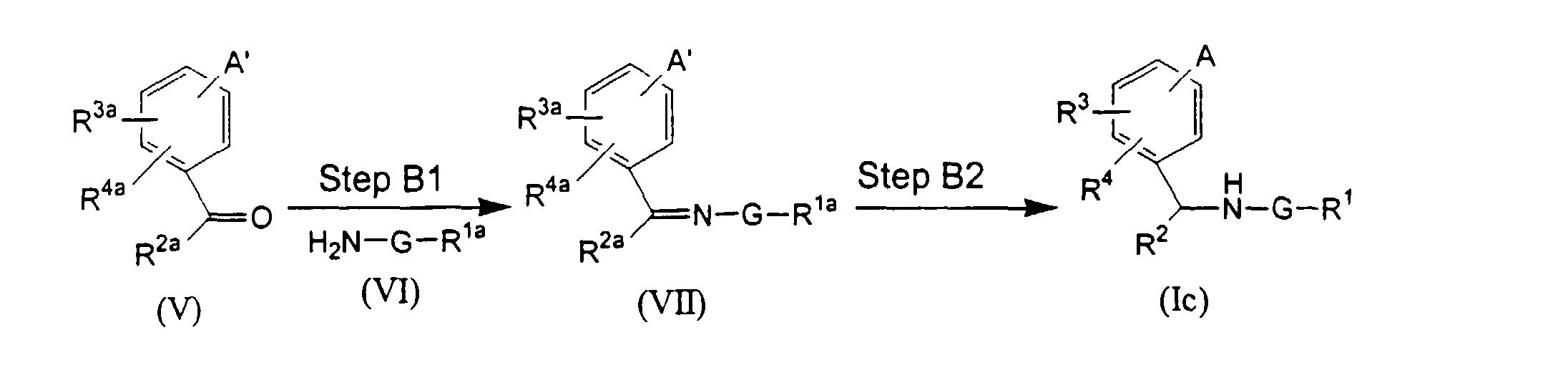
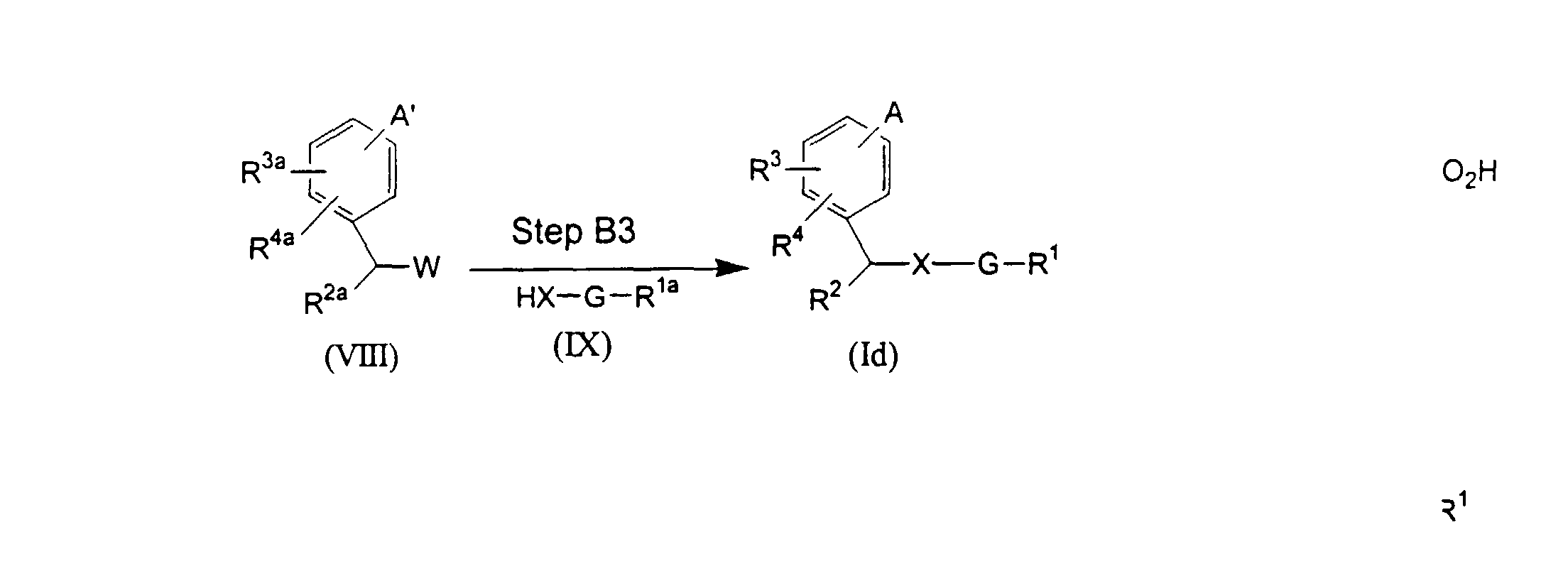
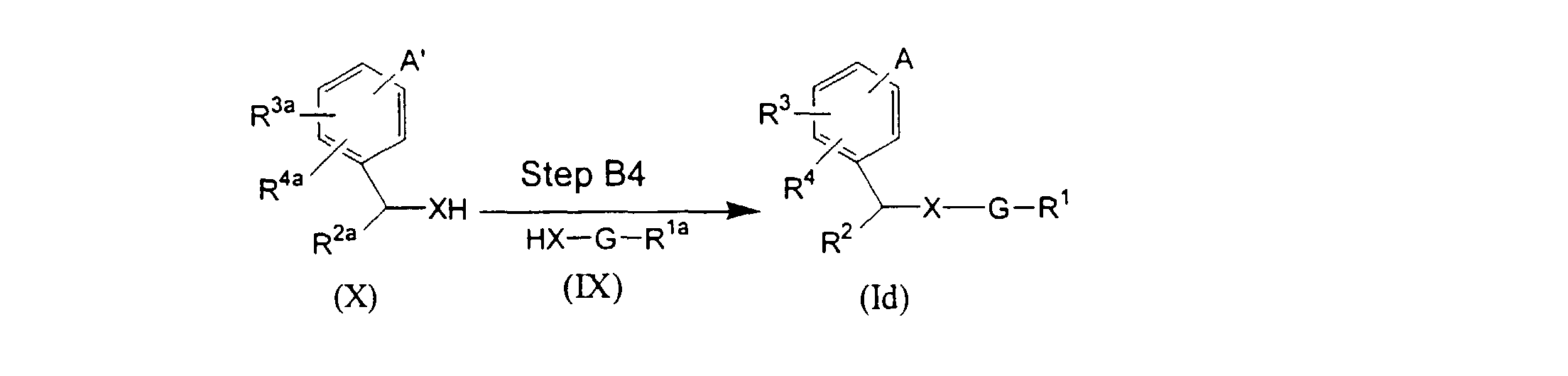
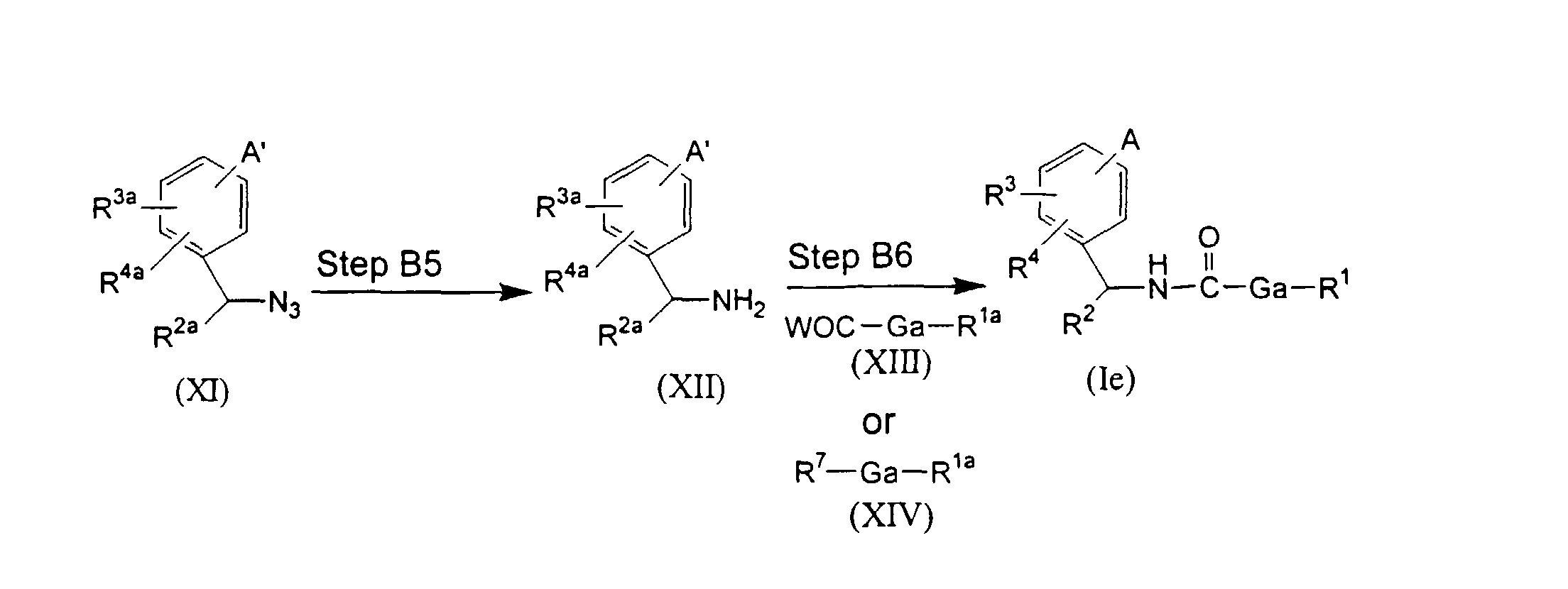
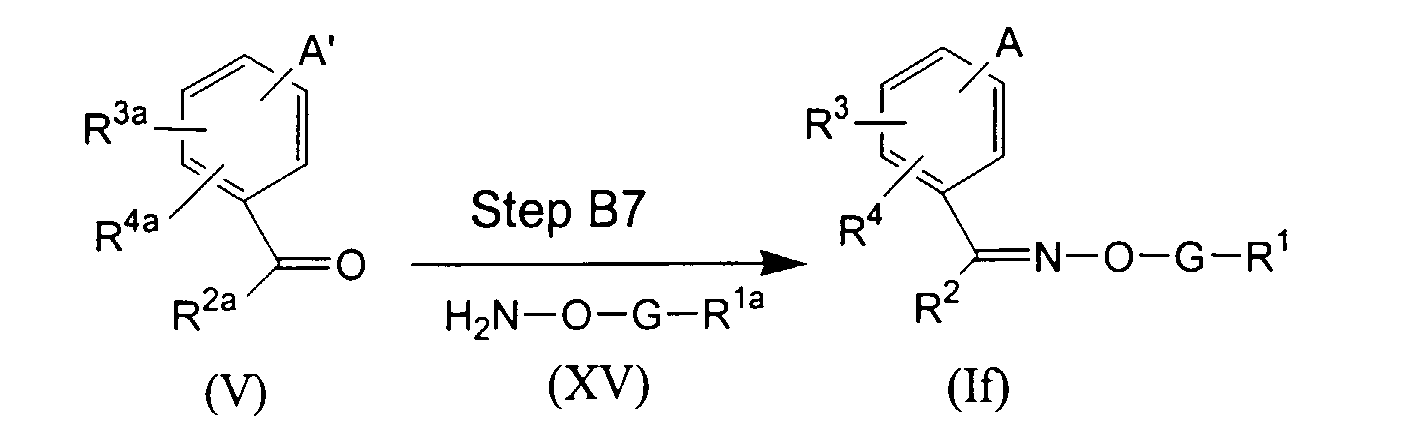
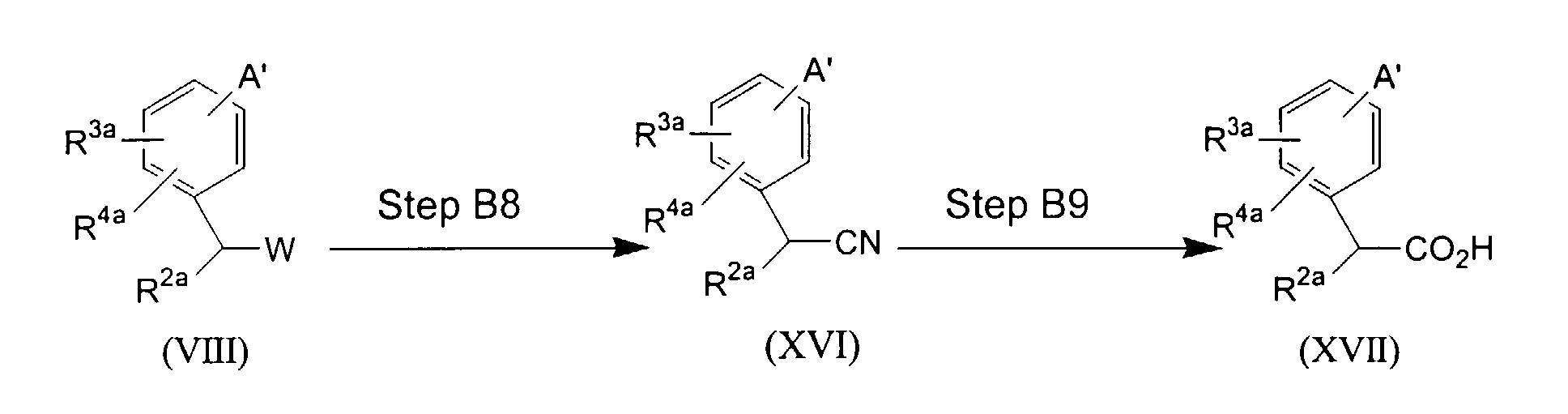
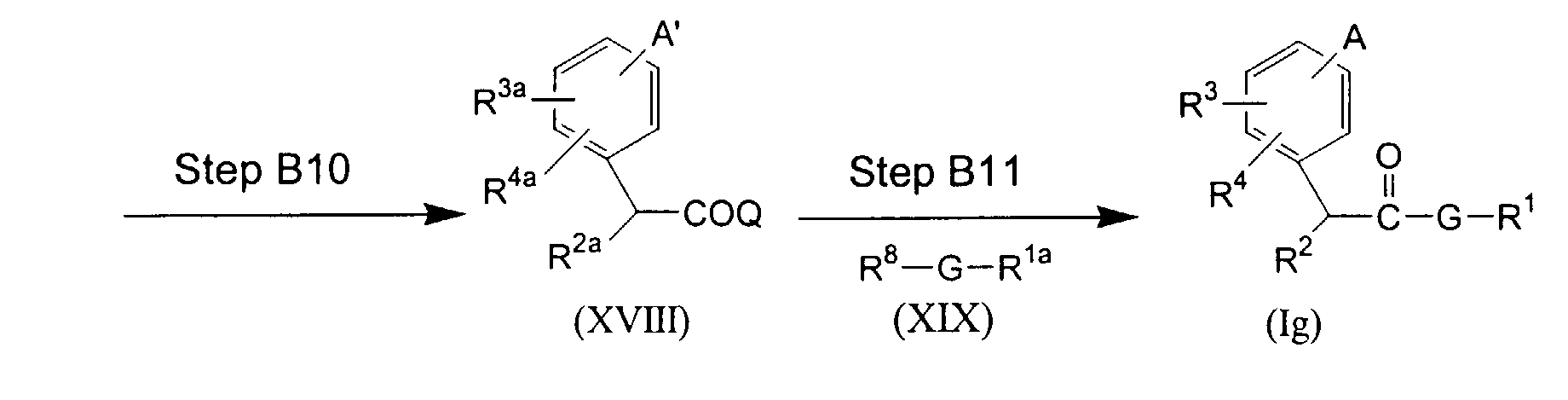
- In the above formulae:
- R1, R1a, R2, R2a, R3, R3a, R4, R4a, A, G, Ga and Q have the same meanings as described above;
- R7 represents a formyl, carboxy or lower alkoxycarbonyl group;
- R8 represents a metal atom, such as lithium, magnesium, zinc, cadmium, tin or cerium;
- A' has the same meaning as defined in A except that the amino and/or hydroxy group contained as a substituent in the definition of A may be protected;
- X represents an oxygen or sulphur atom; and
- W represents a halogen atom.
-
- In this step, a compound of formula (VII) is prepared by reacting a compound of formula (V) with a compound of formula (VI) or with an acid addition salt thereof (for example a mineral acid salt such as a hydrochloride, nitrate or sulphate) in an inert solvent. It may, for example, be carried out by condensing the compounds with heating in the presence of an organic sulphonic acid, such as p-toluenesulphonic acid, or by condensing the compounds in the presence of a Lewis acid, such as titanium tetrachloride, or of an acid ion exchange resin.
- The reaction is normally and preferably effected in the presence of a solvent. There is no particular restriction on the nature of the solvent to be employed, provided that it has no adverse effect on the reaction or on the reagents involved and that it can dissolve the reagents, at least to some extent. Examples of suitable solvents include: aliphatic hydrocarbons, such as hexane, heptane, ligroin and petroleum ether; aromatic hydrocarbons, such as benzene, toluene and xylene, halogenated hydrocarbons, such as chloroform, dichloromethane, 1,2-dichloroethane and carbon tetrachloride; esters, such as methyl acetate, ethyl acetate, propyl acetate, butyl acetate and diethyl carbonate; ethers, such as diethyl ether, diisopropyl ether, tetrahydrofuran, dioxane, dimethoxyethane and diethylene glycol dimethyl ether; alcohols, such as methanol, ethanol, propanol, isopropanol, butanol, isobutanol, t-butanol, isoamyl alcohol, diethylene glycol, glycerin, octanol, cyclohexanol and methyl cellosolve; amides, such as formamide, dimethylformamide, dimethylacetamide and hexamethylphosphoryl triamide; and water; and mixtures of any two or more of these solvents. Preferred are the hydrogenated hydrocarbons, dichloromethane being most preferred.
- In the above-described reaction, when the compound (VI) is an acid addition salt, reaction can be effected by a base.
- Examples of such bases include: alkali metal carbonates, such as lithium carbonate, sodium carbonate and potassium carbonate; alkali metal hydrogencarbonates, such as lithium hydrogencarbonate, sodium hydrogencarbonate and potassium hydrogencarbonate; alkali metal hydrides, such as lithium hydride, sodium hydride and potassium hydride; alkali metal hydroxides, such as lithium hydroxide, sodium hydroxide, and potassium hydroxide; metal alkoxides, such as lithium methoxide, sodium methoxide, sodium ethoxide and potassium t-butoxide; and organic amines, such as triethylamine, tributylamine, diisopropylethylamine, N-methylmorpholine, pyridine, 4-(N,N-dimethylamino)pyridine, N,N-dimethylaniline, N,N-diethylaniline, 1,5-diazabicyclo[4.3.0]nona-5-en, 1,4-diazabicyclo[2.2.2]octane (DABCO), 1,8-diazabicyclo[5.4.0]-7-undecene (DBU), of which the organic amines are preferred, triethylamine being most preferred.
- The reaction is normally and preferably effected in the presence of a solvent. There is no particular restriction on the nature of the solvent to be employed, provided that it has no adverse effect on the reaction or on the reagents involved and that it can dissolve the reagents, at least to some extent. Examples of suitable solvents include: aliphatic hydrocarbons, such as hexane, heptane, ligroin and petroleum ether; aromatic hydrocarbons, such as benzene, toluene and xylene, halogenated hydrocarbons, such as chloroform, dichloromethane, 1,2-dichloroethane and carbon tetrachloride; acetic acid; esters, such as methyl acetate, ethyl acetate, propyl acetate, butyl acetate and diethyl carbonate; ethers, such as diethyl ether, diisopropyl ether, tetrahydrofuran, dioxane, dimethoxyethane and diethylene glycol dimethyl ether; alcohols, such as methanol, ethanol, propanol, isopropanol, butanol, isobutanol, t-butanol, isoamyl alcohol, diethylene glycol, glycerin, octanol, cyclohexanol and methyl cellosolve; amides, such as formamide, dimethylformamide, dimethylacetamide and hexamethylphosphoryl triamide; and water; and mixtures of any two or more of these solvents. Preferred are the halogenated hydrocarbons, dichloromethane being most preferred.
- The reaction can take place over a wide range of temperatures, and the precise reaction temperature is not critical to the invention. The preferred reaction temperature will depend upon such factors as the nature of the solvent, and the starting material or reagent used. However, in general, we find it convenient to carry out the reaction at a temperature of from -20°C to 200°C. The time required for the reaction may also vary widely, depending on many factors, notably the reaction temperature and the nature of the reagents and solvent employed. However, provided that the reaction is effected under the preferred conditions outlined above, a period of from 15 minutes to 48 hours, more preferably from 1 to 30 hours, will usually suffice. Condensation in the presence of a Lewis acid is preferably conducted at from 10°C to 40°C, while condensation under heat in the presence of an organic sulphonic acid is effected preferably at from 50 to 150°C.
- After completion of the reaction, the resulting compound (VII) of the present reaction may be collected from the reaction mixture in a known manner. More specifically, the resulting compound can be obtained by neutralising the reaction mixture if necessary, removing any insoluble matter by filtration, adding a water-immiscible organic solvent such as ethyl acetate to separate an organic layer containing the compound, washing with water or the like, drying over anhydrous magnesium sulphate, anhydrous sodium sulphate or anhydrous sodium hydrogencarbonate and then distilling off the solvent. If necessary, the compound thus obtained can be separated and purified in a known manner by using commonly employed methods for the separation and purification of an organic compound, such as recrystallisation and reprecipitation, in combination, making use of chromatography and eluting with a proper eluant.
- In this step a compound of formula (Ic) is prepared by reducing the compound of formula (VII) in an inert solvent and optionally removing the protecting group of the amino, hydroxy and/or carboxy group in R1a, R2a, R3a, R4a and A'.
- The reaction is normally and preferably effected in the presence of a solvent. There is no particular restriction on the nature of the solvent to be employed, provided that it has no adverse effect on the reaction or on the reagents involved and that it can dissolve the reagents, at least to some extent. Examples of suitable solvents include: aliphatic hydrocarbons, such as hexane, heptane, ligroin and petroleum ether; aromatic hydrocarbons, such as benzene, toluene and xylene, halogenated hydrocarbons, such as chloroform, dichloromethane, 1,2-dichloroethane and carbon tetrachloride; acetic acid, esters, such as methyl acetate, ethyl acetate, propyl acetate, butyl acetate and diethyl carbonate; ethers, such as diethyl ether, diisopropyl ether, tetrahydrofuran, dioxane, dimethoxyethane and diethylene glycol dimethyl ether; alcohols, such as methanol, ethanol, propanol, isopropanol, butanol, isobutanol, t-butanol, isoamyl alcohol, diethylene glycol, glycerin, octanol, cyclohexanol and methyl cellosolve; amides, such as formamide, dimethylformamide, dimethylacetamide and hexamethylphosphoryl triamide; and water; and mixtures of any two or more of these solvents. Preferred are the esters, alcohols and ethers, acetic acid, ethanol and tetrahydrofuran being most preferred.
- Examples of the reducing agents which may be used in this reaction include: alkali metal borohydrides, such as sodium borohydride, lithium borohydride and sodium cyanoborohydride; aluminium hydride compounds, such as diisobutylaluminum hydride, lithium aluminium hydride and lithium triethoxyaluminum hydride; Raney nickel; and boron. Of these, the alkali metal borohydrides are preferred, sodium cyanoborohydride being most preferred.
- The reaction can take place over a wide range of temperatures, and the precise reaction temperature is not critical to the invention. The preferred reaction temperature will depend upon such factors as the nature of the solvent, and the starting material or reagent used. However, in general, we find it convenient to carry out the reaction at a temperature of from -20 to 150°C, more preferably from 10 to 80°C. The time required for the reaction may also vary widely, depending on many factors, notably the reaction temperature and the nature of the reagents and solvent employed. However, provided that the reaction is effected under the preferred conditions outlined above, a period of from 15 minutes to 24 hours, more preferably from 30 minutes to 16 hours, will usually suffice.
- The optional removal of the protecting group of the amino, hydroxy and/or carboxy group in R1a, R2a, R3a, R4a and A' may be carried out in a similar manner to that described above for removing the protecting group of the amino, hydroxy and/or carboxy group in Step Al of Process A.
- After completion of the reaction, the resulting compound of formula (Ic) of the present reaction may be collected from the reaction mixture in a known manner. For example, it may be recovered by neutralising the reaction mixture as desired, removing any insoluble matter by filtration, adding a water-immiscible organic solvent such as ethyl acetate to separate an organic layer containing the compound, washing with water or the like, drying over anhydrous magnesium sulphate, anhydrous sodium sulphate or anhydrous sodium hydrogencarbonate and distilling off the solvent. If necessary, the compound thus obtained can be separated and purified in a known manner by using commonly employed methods for the separation and purification of an organic compound, such as recrystallisation and reprecipitation, in combination, making use of chromatography and eluting with a proper eluant.
- In this step a compound of formula (Id) is prepared by reacting a compound of formula (VIII) with a base in the presence or absence (preferably in the presence) of an inert solvent, reacting the reaction mixture with a compound of formula (IX) and then optionally removing the protecting group from the amino, hydroxy and/or carboxy group in R1a, R2a, R3a, R4a and A'.
- Examples of the base which may be used in this reaction include those employed in Step B 1 of Process B, of which the alkali metal hydrides are preferred, sodium hydride being most preferred.
- The reaction is normally and preferably effected in the presence of a solvent. There is no particular restriction on the nature of the solvent to be employed, provided that it has no adverse effect on the reaction or on the reagents involved and that it can dissolve the reagents, at least to some extent. Examples of suitable solvents include: aliphatic hydrocarbons, such as hexane, heptane, ligroin and petroleum ether; aromatic hydrocarbons, such as benzene, toluene and xylene; ethers, such as diethyl ether, diisopropyl ether, tetrahydrofuran, dioxane, dimethoxyethane and diethylene glycol dimethyl ether; amides, such as dimethylformamide, dimethylacetamide and hexamethylphosphoryl triamide; and mixtures of any two or more of these solvents. Preferred are the amides, dimethylformamide being most preferred.
- The reaction can take place over a wide range of temperatures, and the precise reaction temperature is not critical to the invention. The preferred reaction temperature will depend upon such factors as the nature of the solvent, and the starting material or reagent used. However, in general, we find it convenient to carry out the reaction with the compound of formula (VIII) at a temperature of from -50 to 200°C more preferably from 0 to 120°C. The time required for the reaction may also vary widely, depending on many factors, notably the reaction temperature and the nature of the reagents and solvent employed. However, provided that the reaction with the compound of formula (VIII) is effected under the preferred conditions outlined above, a period of from 15 minutes to 24 hours more preferably from 1 hour to 10 hours, will usually suffice.
- The temperature upon the subsequent reaction with the compound (IX) usually ranges from -20 to 200°C, more preferably from 0 to 150°C. The time for the subsequent reaction with the compound (IX) usually ranges from 15 minutes to 48 hours, more preferably from 30 minutes to 24 hours.
- The optional removal of the protecting group from the amino, hydroxy and/or carboxy group in R1a, R2a, R3a, R4a and A' may be carried out in a similar manner to that employed for the above-described removal of the amino, hydroxy and/or carboxy group in Step A1 of Process A.
- After completion of the reaction, the resulting compound of formula (Id) of the present reaction may be collected from the reaction mixture in a conventional manner. For example, it may be recovered by neutralising the reaction mixture as desired, removing any insoluble matter by filtration, adding a water-immiscible organic solvent such as ethyl acetate to separate an organic layer containing the compound, washing with water or the like, drying over anhydrous magnesium sulphate, anhydrous sodium sulphate or anhydrous sodium hydrogencarbonate and distilling off the solvent. If necessary, the compound thus obtained can be separated and purified in a conventional manner by using commonly employed methods for the separation and purification of an organic compound, such as recrystallisation or reprecipitation, in combination, making use of chromatography and eluting with a proper eluant.
- In this step the compound of formula (Id) is prepared by an alternative route is prepared by converting the -XH- containing group of the compound of formula (X) into an leaving group Q in the presence or absence of a Lewis acid in an inert solvent, reacting with the compound of formula (IX) and optionally removing the protecting group of the amino, hydroxy and/or carboxy group in R1a, R2a, R3a, R4a and A'.
- Examples of the reagent for forming the leaving group Q include: halogenating agents, for example, sulphonyl halides, such as methanesulphonyl chloride and p-toluenesulphonyl chloride, thionyl halides, such as thionyl chloride, thionyl bromide and thionyl iodide, sulphuryl halides, such as sulphuryl chloride, sulphuryl bromide and sulphuryl iodide, phosphorous trihalides, such as phosphorous trichloride, phosphorus tribromide and phosphorus triiodide, phosphorus pentahalides, such as phosphorus pentachloride, phosphorus pentabromide and phosphorus pentaiodide, phosphorus oxyhalides, such as phosphorus oxychloride, phosphorus oxybromide and phosphorus oxyiodide; and rhenium reagents, such as methyltrioxorhenium (VII), of which the rhenium reagents are preferred.
- Examples of the Lewis acid which may be used in this reaction include: zinc halides, such as zinc iodide and zinc chloride, tin halides, such as tin tetrachloride, boron halides, such as boron trichloride, boron trifluoride and boron tribromide, of which the zinc halides (particularly, zinc iodide) are preferred.
- The reaction is normally and preferably effected in the presence of a solvent. There is no particular restriction on the nature of the solvent to be employed, provided that it has no adverse effect on the reaction or on the reagents involved and that it can dissolve the reagents, at least to some extent. Examples of suitable solvents include: aliphatic hydrocarbons, such as hexane, heptane, ligroin and petroleum ether; aromatic hydrocarbons, such as benzene, toluene and xylene, halogenated hydrocarbons, such as dichloromethane, 1,2-dichloroethane and carbon tetrachloride; ethers, such as diethyl ether, diisopropyl ether, tetrahydrofuran, dioxane, dimethoxyethane and diethylene glycol dimethyl ether; ketones, such as acetone; amides, such as formamide, dimethylformamide, dimethylacetamide and hexamethylphosphoryl triamide; sulphoxides, such as dimethyl sulphoxide; and sulpholane. Preferred are the aromatic hydrocarbons (particularly benzene).
- The reaction can take place over a wide range of temperatures, and the precise reaction temperature is not critical to the invention. The preferred reaction temperature will depend upon such factors as the nature of the solvent, and the starting material or reagent used. However, in general, we find it convenient to carry out the reaction at a temperature of from -20 to 100°C more preferably from 0 to 50°C. The time required for the reaction may also vary widely, depending on many factors, notably the reaction temperature and the nature of the reagents and solvent employed. However, provided that the reaction is effected under the preferred conditions outlined above, a period of from 15 minutes to 150 hours more preferably from 30 minutes to 100 hours, will usually suffice.
- The optional removal of the protecting group of the amino, hydroxy and/or carboxy group in R1a, R2a, R3a, R4a and A' may be carried out in a similar manner to the method described above for the removal of a protecting group of the amino, hydroxy and/or carboxy group in Step Al of Process A.
- After completion of the reaction, the resulting compound of formula (Id) of the present reaction may be collected from the reaction mixture in a known manner. For example, it may be recovered by neutralising the reaction mixture as desired, removing any insoluble matter by filtration, adding a water-immiscible organic solvent such as ethyl acetate to separate an organic layer containing the compound, washing with water or the like, drying over anhydrous magnesium sulphate, anhydrous sodium sulphate or anhydrous sodium hydrogencarbonate and distilling off the solvent. If necessary, the compound thus obtained can be separated and purified in a known manner by using commonly employed methods for the separation and purification of an organic compound, such as recrystallisation and reprecipitation, in combination, making use of chromatography and eluting with a proper eluant.
- In this step a compound of formula (XII) is prepared by reducing a compound of formula (XI) using a reducing agent such as triphenylphosphine in an inert solvent.
- The reaction is normally and preferably effected in the presence of a solvent. There is no particular restriction on the nature of the solvent to be employed, provided that it has no adverse effect on the reaction or on the reagents involved and that it can dissolve the reagents, at least to some extent. Examples of suitable solvents include inert solvents similar to those employed in Step B1 of Process B. Of these, the mixtures of water and an ether are preferred, a mixture of tetrahydrofuran and water being most preferred.
- The reaction can take place over a wide range of temperatures, and the precise reaction temperature is not critical to the invention. The preferred reaction temperature will depend upon such factors as the nature of the solvent, and the starting material or reagent used. However, in general, we find it convenient to carry out the reaction at a temperature of from 20 to 150°C, more preferably from 50 to 100°C. The time required for the reaction may also vary widely, depending on many factors, notably the reaction temperature and the nature of the reagents and solvent employed. However, provided that the reaction is effected under the preferred conditions outlined above, a period of from 15 minutes to 24 hours, more preferably from 1 hour to 12 hours, will usually suffice.
- After completion of the reaction, the resulting compound of formula (XII) of the present reaction may be collected from the reaction mixture in a known manner. For example, it may be recovered by neutralising the reaction mixture as desired, removing any insoluble matter by filtration, adding a water-immiscible organic solvent such as ethyl acetate to separate an organic layer containing the compound, washing with water or the like, drying over anhydrous magnesium sulphate, anhydrous sodium sulphate or anhydrous sodium hydrogencarbonate and distilling off the solvent. If necessary, the compound thus obtained can be separated and purified in a known manner by using commonly employed methods for the separation and purification of an organic compound, such as recrystallisation and reprecipitation, in combination, making use of chromatography and eluting with a proper eluant.
- In this step a compound of formula (Ie) is prepared by reacting the compound of formula (XII) or acid addition salt thereof with a compound of formula (XIII) in an inert solvent in the presence or absence (preferably in the presence) of a base and optionally removing the protecting group of the amino, hydroxy and/or carboxy group in R1a, R2a, R3a, R4a and A'.
- The reaction with the compound of formula (XIII) is normally and preferably effected in the presence of a solvent. There is no particular restriction on the nature of the solvent to be employed, provided that it has no adverse effect on the reaction or on the reagents involved and that it can dissolve the reagents, at least to some extent. Examples of suitable solvents include: aliphatic hydrocarbons, such as hexane, heptane, ligroin and petroleum ether; aromatic hydrocarbons, such as benzene, toluene and xylene, halogenated hydrocarbons, such as chloroform, dichloromethane, 1,2-dichloroethane and carbon tetrachloride; esters, such as methyl acetate, ethyl acetate, propyl acetate, butyl acetate and diethyl carbonate; ethers, such as diethyl ether, diisopropyl ether, tetrahydrofuran, dioxane, dimethoxyethane and diethylene glycol dimethyl ether; alcohols, such as methanol, ethanol, propanol, isopropanol, butanol, isobutanol, t-butanol, isoamyl alcohol, diethylene glycol, glycerin, octanol, cyclohexanol and methyl cellosolve; amides, such as formamide, dimethylformamide, dimethylacetamide and hexamethylphosphoryl triamide; nitriles, such as acetonitrile; and water; and mixtures of any two or more of these solvents. Preferred are the nitriles.
- Bases similar to those employed in Step B1 of Process B can be used for this reaction, of which the organic amines are preferred, triethylamine being most preferred.
- The reaction with the compound of formula (XIII) can take place over a wide range of temperatures, and the precise reaction temperature is not critical to the invention. The preferred reaction temperature will depend upon such factors as the nature of the solvent, and the starting material or reagent used. However, in general, we find it convenient to carry out the reaction at a temperature of from -20 to 150°C, more preferably from 0 to 100°C. The time required for the reaction may also vary widely, depending on many factors, notably the reaction temperature and the nature of the reagents and solvent employed. However, provided that the reaction is effected under the preferred conditions outlined above, a period of from 15 minutes to 24 hours, more preferably from 30 minutes to 16 hours, will usually suffice.
- The compound of formula (Ie) can be prepared by alternative reaction by reacting the compound of formula (XII) or acid addition salt thereof with a compound of formula (XIV).
- When R7, in the compound of formula (XIV), represents a formyl group, the compound of formula (XIV) may be reacted with the compound of formula (XII) or acid addition salt thereof in an inert solvent.
- The reaction is normally and preferably effected in the presence of a solvent. There is no particular restriction on the nature of the solvent to be employed, provided that it has no adverse effect on the reaction or on the reagents involved and that it can dissolve the reagents, at least to some extent. Examples of suitable solvents include: aliphatic hydrocarbons, such as hexane, heptane, ligroin and petroleum ether; aromatic hydrocarbons, such as benzene, toluene and xylene; ethers, such as diethyl ether, diisopropyl ether, tetrahydrofuran, dioxane, dimethoxyethane and diethylene glycol dimethyl ether; alcohols, such as methanol, ethanol, propanol, isopropanol, butanol, isobutanol, t-butanol, isoamyl alcohol, diethylene glycol, glycerin, octanol, cyclohexanol and methyl cellosolve; amides, such as formamide, dimethylformamide, dimethylacetamide and hexamethylphosphoryl triamide; acids, such as acetic acid and propionic acid; sulphoxides, such as dimethyl sulphoxide; sulpholane; and mixtures of any two or more of these solvents. Preferred are the ethers, tetrahydrofuran being most preferred.
- The reaction can take place over a wide range of temperatures, and the precise reaction temperature is not critical to the invention. The preferred reaction temperature will depend upon such factors as the nature of the solvent, and the starting material or reagent used. However, in general, we find it convenient to carry out the reaction at a temperature of from 0 to 200°C, more preferably from 10 to 120°C. The time required for the reaction may also vary widely, depending on many factors, notably the reaction temperature and the nature of the reagents and solvent employed. However, provided that the reaction is effected under the preferred conditions outlined above, a period of from 1 hour to 50 hours, more preferably from 5 hours to 24 hours, will usually suffice.
- When R7, in the compound of formula (XIV), represents a carboxy group, the compound of formula (IXV) or reactive derivative thereof (acid halide, active ester or anhydride of mixed acids) may be reacted with the compound of formula (XII) or acid addition salt thereof.
- The acid halide method is effected by reacting the compound of formula (XIV) with a halogenating agent (for example, oxalyl chloride, thionyl chloride, thionyl bromide, oxalic chloride, oxalic dichloride, phosphorus oxychloride, phosphorus trichloride, phosphorus pentachloride) to prepare its acid halide and then reacting the acid halide with the compound of formula (XII) or acid addition salt thereof in an inert solvent in the presence or absence (preferably in the presence) of a base.
- Bases similar to those employed in Step B1 of Process B can be used in this reaction, of which the organic amines are preferred, pyridine being most preferred.
- The reaction is normally and preferably effected in the presence of a solvent. There is no particular restriction on the nature of the solvent to be employed, provided that it has no adverse effect on the reaction or on the reagents involved and that it can dissolve the reagents, at least to some extent. Examples of suitable solvents include: aliphatic hydrocarbons, such as hexane, heptane, ligroin and petroleum ether; aromatic hydrocarbons, such as benzene, toluene and xylene, halogenated hydrocarbons, such as chloroform, dichloromethane, 1,2-dichloroethane and carbon tetrachloride; ethers, such as diethyl ether, diisopropyl ether, tetrahydrofuran, dioxane, dimethoxyethane and diethylene glycol dimethyl ether; ketones, such as acetone; amides, such as formamide, dimethylformamide, dimethylacetamide and hexamethylphosphoryl triamide; sulphoxides, such as dimethyl sulphoxide; and sulpholane. Preferred are the halogenated hydrocarbons, ethers and amides, dichloromethane, chloroform, tetrahydrofuran and dimethylformamide being most preferred.
- The reaction can take place over a wide range of temperatures, and the precise reaction temperature is not critical to the invention. The preferred reaction temperature will depend upon such factors as the nature of the solvent, and the starting material or reagent used. However, in general, we find it convenient to carry out the reaction at a temperature of from -20 to 150°C in each of the reaction of the halogenating agent with the compound of formula (XIV) and the reaction of the resulting acid halide with the compound of formula (XII) or acid addition salt thereof, or from -10 to 100°C in the reaction of the halogenating agent with the compound of formula (XIV), or from -20 to 100°C in the reaction of the resulting acid halide with the compound of formula (XII) or acid addition salt thereof. The time required for the reaction may also vary widely, depending on many factors, notably the reaction temperature and the nature of the reagents and solvent employed. However, provided that the reaction is effected under the preferred conditions outlined above, a period of from 30 minutes to 80 hours, more preferably from 1 hour to 48 hours, in each of the reaction of the halogenating agent with the compound of formula (XIV) and the reaction of the resulting acid halide with the compound of formula (XII) or acid addition salt thereof, will usually suffice.
- The active ester method may be carried out by reacting the compound of formula (XIV) with an active esterifying agent in an inert solvent to prepare its active ester and then reacting it with the compound of formula (XII) or acid addition salt thereof in an inert solvent in the presence or absence (preferably in the presence) of a base.
- Examples of the active esterifying agent to be used in this reaction include N-hydroxy compounds, such as N-hydroxysuccinimide, 1-hydroxybenzotriazole and N-hydroxy-5-norbornene-2,3-dicarboxyimide; disulphide compounds, such as dipyridyl disulphide; carbodiimides, such as dicyclohexylcarbodiimide; carbonyldiimidazole; and triphenylphosphine. Active esterification is preferably conducted in the presence of such a condensing agent.
- The reaction is normally and preferably effected in the presence of a solvent. There is no particular restriction on the nature of the solvent to be employed, provided that it has no adverse effect on the reaction or on the reagents involved and that it can dissolve the reagents, at least to some extent. Examples of suitable solvents include: aliphatic hydrocarbons, such as hexane, heptane, ligroin and petroleum ether; aromatic hydrocarbons, such as benzene, toluene and xylene; halogenated hydrocarbons, such as dichloromethane, 1,2-dichloroethane and carbon tetrachloride; ethers, such as diethyl ether, diisopropyl ether, tetrahydrofuran, dioxane, dimethoxyethane and diethylene glycol dimethyl ether; ketones, such as acetone; amides, such as formamide, dimethylformamide, dimethylacetamide and hexamethylphosphoryl triamide; sulphoxides, such as dimethyl sulphoxide; and sulpholane. Preferred are the ethers and amides, dioxane, tetrahydrofuran and dimethylformamide being most preferred.
- Bases similar to those employed in the above-described acid halide method can be used, for example, in this reaction.
- The reaction can take place over a wide range of temperatures, and the precise reaction temperature is not critical to the invention. The preferred reaction temperature will depend upon such factors as the nature of the solvent, and the starting material or reagent used. However, in general, we find it convenient to carry out the reaction at a temperature of from -70 to 150°C, more preferably from -10°C to 100°C, in the active esterification, and from -20 to 100°C, more preferably from 0 to 50°C, in the reaction of the active ester with the compound of formula (XII) or acid addition salt thereof. The time required for the reaction may also vary widely, depending on many factors, notably the reaction temperature and the nature of the reagents and solvent employed. However, provided that the reaction is effected under the preferred conditions outlined above, a period of from 30 minutes to 80 hours, more preferably from 1 hour to 48 hours, in each of the active esterification and the reaction of the active ester with the compound of formula (XII) or acid addition salt thereof, will usually suffice.
- The mixed acid anhydride method is effected by reacting the compound of formula (XIV) with a mixed-acid-anhydride forming agent in an inert solvent in the presence or absence of a base (preferably in the presence) and then reacting the resulting mixed acid anhydride with the compound of formula (XII) or acid addition salt thereof in an inert solvent.
- Bases similar to those employed in the above-described acid halide method can be used in this reaction, of which the organic amines are preferred, pyridine being most preferred.
- Examples of the mixed-acid-anhydride forming agent which may be used in this reaction include: lower alkyl halocarbonates, such as ethyl chlorocarbonate and isobutyl chlorocarbonate, lower alkanoyl halides, such as pivaloyl chloride, and di(lower alkyl)- or diaryl-cyanophosphates, such as diethyl cyanophosphonate and diphenyl cyanophosphonate, of which the di(lower alkyl)- or diaryl-cyanophosphates are preferred, diethyl cyanophosphonate being most preferred.
- The reaction is normally and preferably effected in the presence of a solvent. There is no particular restriction on the nature of the solvent to be employed, provided that it has no adverse effect on the reaction or on the reagents involved and that it can dissolve the reagents, at least to some extent. Examples of suitable solvents include: aliphatic hydrocarbons, such as hexane, heptane, ligroin and petroleum ether; aromatic hydrocarbons, such as benzene, toluene and xylene; halogenated hydrocarbons, such as dichloromethane, 1,2-dichloroethane and carbon tetrachloride; ethers, such as diethyl ether, diisopropyl ether, tetrahydrofuran, dioxane, dimethoxyethane and diethylene glycol dimethyl ether; ketones, such as acetone; amides, such as formamide, dimethylformamide, dimethylacetamide and hexamethylphosphoryl triamide; sulphoxides, such as dimethyl sulphoxide; and sulpholane. Preferred are the ethers and amides, tetrahydrofuran and dimethylformamide being most preferred.
- The reaction can take place over a wide range of temperatures, and the precise reaction temperature is not critical to the invention. The preferred reaction temperature will depend upon such factors as the nature of the solvent, and the starting material or reagent used. However, in general, we find it convenient to carry out the reaction at a temperature of from -50 to 100°C, more preferably from 0 to 60°C. The time required for the reaction may also vary widely, depending on many factors, notably the reaction temperature and the nature of the reagents and solvent employed. However, provided that the reaction is effected under the preferred conditions outlined above, a period of from 30 minutes to 72 hours, more preferably from 1 hour to 24 hours, will usually suffice.
- The reaction of the mixed acid anhydride with the compound of formula (XII) or acid addition salt thereof may be carried out in an inert solvent in the presence or absence (preferably in the presence) of a base. Bases and inert solvents similar to those used in this reaction for preparing a mixed acid anhydride are used in this reaction.
- The reaction of the mixed acid anhydride with the compound of formula (XII) or acid addition salt thereof can take place over a wide range of temperatures, and the precise reaction temperature is not critical to the invention. The preferred reaction temperature will depend upon such factors as the nature of the solvent, and the starting material or reagent used. However, in general, we find it convenient to carry out the reaction at a temperature of from -30 to 100°C, more preferably from 0 to 80°C. The time required for the reaction may also vary widely, depending on many factors, notably the reaction temperature and the nature of the reagents and solvent employed. However, provided that the reaction is effected under the preferred conditions outlined above, a period of from 5 minutes to 24 hours, more preferably from 30 minutes to 16 hours, will usually suffice.
- In the present reaction, when a di(lower alkyl)cyanophosphoric acid or diarylcyanophosphoric acid is used, the compound of formula (XII) can also be reacted directly with the compound of formula (XIV) in the presence of a base.
- When R7, in the compound of formula (XIV), represents a lower alkoxycarbonyl group, the compound of formula (XIV) may be reacted with the compound of formula (XII) or acid addition salt thereof in the presence or absence (preferably in the absence) of an inert solvent, in the presence or absence (preferably in the absence) of a base.
- Bases similar to those employed in Step B1 of Process B can be used for the reaction of the compound of formula (XII) or acid addition salt thereof with the compound of formula (XIV), of which the organic amines are preferred, pyridine being most preferred.
- The reaction of the compound of formula (XII) or acid addition salt thereof with the compound of formula (XIV) is normally and preferably effected in the presence of a solvent. There is no particular restriction on the nature of the solvent to be employed, provided that it has no adverse effect on the reaction or on the reagents involved and that it can dissolve the reagents, at least to some extent. Examples of suitable solvents include: aliphatic hydrocarbons, such as hexane, heptane, ligroin and petroleum ether; aromatic hydrocarbons, such as benzene, toluene and xylene; ethers, such as diethyl ether, diisopropyl ether, tetrahydrofuran, dioxane, dimethoxyethane and diethylene glycol dimethyl ether; alcohols, such as methanol, ethanol, propanol, isopropanol, butanol, isobutanol, t-butanol, isoamyl alcohol, diethylene glycol, glycerin, octanol, cyclohexanol and methyl cellosolve; amides, such as formamide, dimethylformamide, dimethylacetamide and hexamethylphosphoryl triamide; and mixtures of any two or more of these solvents. Preferred are the ethers and amides, tetrahydrofuran, dioxane and dimethylformamide being most preferred.
- The reaction can take place over a wide range of temperatures, and the precise reaction temperature is not critical to the invention. The preferred reaction temperature will depend upon such factors as the nature of the solvent, and the starting material or reagent used. However, in general, we find it convenient to carry out the reaction at a temperature of from 0 to 200°C, more preferably from 50 to 150°C. The time required for the reaction may also vary widely, depending on many factors, notably the reaction temperature and the nature of the reagents and solvent employed. However, provided that the reaction is effected under the preferred conditions outlined above, a period of from 1 hour to 50 hours, more preferably from 5 hours to 24 hours, will usually suffice.
- The optional removal of the protecting group of the amino, hydroxy and/or carboxy group in R1a, R2a, R3a, R4a and A' may be carried out in a similar manner to that in Step A1 of Process A.
- After completion of the reaction, the resulting compound of formula (Ie) of the present reaction may be collected from the reaction mixture by known methods, for example, by neutralising the reaction mixture as desired, removing any insoluble matter by filtration, adding a water-immiscible organic solvent such as ethyl acetate to separate an organic layer containing the compound, washing with water or the like, drying over anhydrous magnesium sulphate, anhydrous sodium sulphate or anhydrous sodium hydrogencarbonate and distilling off the solvent. If necessary, the compound thus obtained can be separated and purified by known methods by using commonly employed methods for the separation and purification of an organic compound, such as recrystallisation and reprecipitation, in combination, making use of chromatography and eluting with a proper eluant.
- In this step the compound of formula (If) is prepared by reacting the compound of formula (V) with a compound of formula (XV) or acid addition salt thereof (for example, a mineral acid salt such as hydrochloride, nitrate or sulphate) in an inert solvent and then optionally removing the protecting group of the amino, hydroxy and/or carboxy group in R1a, R2a, R3a, R4a and A'. The reaction of the compound of formula (V) with the compound of formula (XV) is effected, for example, by condensation under heat by using, as a catalyst, an organic sulphonic acid such as p-toluenesulphonic acid or by condensation using a Lewis acid such as titanium tetrachloride. The reaction of the compound of formula (V) with the compound of formula (XV) may be carried out in a similar manner to Step B1 of Process B, while the deprotection from the protected amino, hydroxy and/or carboxy group in R1a, R2a, R3a, R4a and A' may be carried out in a similar manner to that of Step A1 of Process A.
- After completion of the reaction, the resulting compound of formula (If) of the present reaction may be collected from the reaction mixture by known methods, for example, by neutralising the reaction mixture as desired, removing any insoluble matter by filtration, adding a water-immiscible organic solvent such as ethyl acetate to separate an organic layer containing the compound, washing with water or the like, drying over anhydrous magnesium sulphate, anhydrous sodium sulphate or anhydrous sodium hydrogencarbonate and distilling off the solvent. If necessary, the compound thus obtained can be separated and purified by known methods by using commonly employed methods for the separation and purification of an organic compound, such as recrystallisation and reprecipitation, in combination, making use of chromatography and eluting with a proper eluant.
- In this step a compound of formula (XVI) is prepared by reacting the compound of formula (VIII) with an alkali metal cyanide in an inert solvent.
- Examples of the alkali metal cyanide to be used for this reaction include lithium cyanide, sodium cyanide and potassium cyanide.
- The reaction is normally and preferably effected in the presence of a solvent. There is no particular restriction on the nature of the solvent to be employed, provided that it has no adverse effect on the reaction or on the reagents involved and that it can dissolve the reagents, at least to some extent. Examples of suitable solvents include: aliphatic hydrocarbons, such as heptane, ligroin and petroleum ether; aromatic hydrocarbons, such as benzene, toluene and xylene; halogenated hydrocarbons, such as dichloromethane, 1,2-dichloroethane and carbon tetrachloride; ethers, such as diethyl ether, diisopropyl ether, tetrahydrofuran, dioxane, dimethoxyethane and diethylene glycol dimethyl ether; ketones, such as acetone; amides, such as formamide, dimethylformamide, dimethylacetamide and hexamethylphosphoryl triamide; sulphoxides, such as dimethyl sulphoxide; and sulpholane, of which the ethers are preferred (with the tetrahydrofuran being particularly preferred).
- The reaction can take place over a wide range of temperatures, and the precise reaction temperature is not critical to the invention. The preferred reaction temperature will depend upon such factors as the nature of the solvent, and the starting material or reagent used. However, in general, we find it convenient to carry out the reaction at a temperature of from 0 to 200°C, more preferably from 10 to 50°C. The time required for the reaction may also vary widely, depending on many factors, notably the reaction temperature and the nature of the reagents and solvent employed. However, provided that the reaction is effected under the preferred conditions outlined above, a period of from 15 minutes to 24 hours, more preferably from 30 minutes to 16 hours, will usually suffice.).
- After completion of the reaction, the resulting compound of formula (XVI) of the present reaction may be collected from the reaction mixture by known methods, for example, by neutralising the reaction mixture as desired, removing any insoluble matter by filtration, adding a water-immiscible organic solvent such as ethyl acetate to separate an organic layer containing the compound, washing with water or the like, drying over anhydrous magnesium sulphate, anhydrous sodium sulphate or anhydrous sodium hydrogencarbonate and distilling off the solvent. If necessary, the compound thus obtained can be separated and purified by known methods by using commonly employed methods for the separation and purification of an organic compound, such as recrystallisation and reprecipitation, in combination, making use of chromatography and eluting with a proper eluant.
- In this step a compound of formula (XVII) is prepared by hydrolysing the compound of formula (XVI) with an acid or alkali in an inert solvent.
- Hydrolysis with an acid may be carried out by treatment with a aqueous mineral acid solution such as hydrochloric acid, aqueous sulphuric acid solution or aqueous nitric acid solution for 1 hour to 10 hours (preferably for from 3 hours to 7 hours) at room temperature to 100°C (preferably from 50 to 100°C).
- Hydrolysis with an alkali may be carried out by treatment with from 1 to 10 equivalents (preferably from 1 to 5 equivalents) of an alkali metal hydroxide such as lithium hydroxide, sodium hydroxide or potassium hydroxide or an alkaline earth metal hydroxide such as calcium hydroxide or barium hydroxide in an inert solvent (preferably water, an alcohol such as methanol or ethanol, an ether such as tetrahydrofuran or dioxane or a mixture thereof) at a temperature of from 0 to 120°C (preferably at from 20 to 100°C) for a period of from 30 minutes to 48 hours (preferably for from 1 hour to 24 hours).
- After completion of the reaction, the resulting compound of formula (XVII) of the present reaction may be collected from the reaction mixture by known methods, for example, by neutralising the reaction mixture as desired, removing any insoluble matter by filtration, adding a water-immiscible organic solvent such as ethyl acetate to separate an organic layer containing the compound, washing with water or the like, drying over anhydrous magnesium sulphate, anhydrous sodium sulphate or anhydrous sodium hydrogencarbonate and distilling off the solvent. If necessary, the compound thus obtained can be separated and purified by known methods by using commonly employed methods for the separation and purification of an organic compound, such as recrystallisation and reprecipitation, in combination, making use of chromatography and eluting with a proper eluant.
- In this step a compound of formula (XVIII) is prepared by converting the carboxy group of the compound of formula (XVII) into a group of formula -COQ in an inert solvent. This step may be conducted in a similar manner to that employed for the above-described conversion of the -XH- containing group of the compound of formula (X) into an leaving group Q in Step B4 of Process B.
- In this step a compound of formula (Ig) is prepared by reacting the compound of formula (XVIII) with a compound of formula (XIX) in an inert solvent in the presence or absence of a palladium catalyst and then optionally removing the protecting group of the amino, hydroxy and/or carboxy group in R1a, R2a, R3a, R4a, A'.
- The reaction is normally and preferably effected in the presence of a solvent. There is no particular restriction on the nature of the solvent to be employed, provided that it has no adverse effect on the reaction or on the reagents involved and that it can dissolve the reagents, at least to some extent. Examples of suitable solvents include: aliphatic hydrocarbons, such as heptane, ligroin and petroleum ether; aromatic hydrocarbons, such as benzene, toluene and xylene; halogenated hydrocarbons, such as dichloromethane, 1,2-dichloroethane and carbon tetrachloride; ethers, such as diethyl ether, diisopropyl ether, tetrahydrofuran, dioxane, dimethoxyethane and diethylene glycol dimethyl ether; ketones, such as acetone; amides, such as formamide, dimethylformamide, dimethylacetamide and hexamethylphosphoryl triamide; sulphoxides, such as dimethyl sulphoxide; and sulpholane, of which the ethers (particularly tetrahydrofuran) are preferred.
- The reaction can take place over a wide range of temperatures, and the precise reaction temperature is not critical to the invention. The preferred reaction temperature will depend upon such factors as the nature of the solvent, and the starting material or reagent used. However, in general, we find it convenient to carry out the reaction at a temperature of from -80 to 50°C, more preferably from -50 to 0°C. The time required for the reaction may also vary widely, depending on many factors, notably the reaction temperature and the nature of the reagents and solvent employed. However, provided that the reaction is effected under the preferred conditions outlined above, a period of from 15 minutes to 24 hours, more preferably from 30 minutes to 12 hours, will usually suffice..
- After completion of the reaction, the resulting compound of formula (Ig) of the present reaction may be collected from the reaction mixture by known methods, for example, by neutralising the reaction mixture as desired, removing any insoluble matter by filtration, adding a water-immiscible organic solvent such as ethyl acetate to separate an organic layer containing the compound, washing with water or the like, drying over anhydrous magnesium sulphate, anhydrous sodium sulphate or anhydrous sodium hydrogencarbonate and distilling off the solvent. If necessary, the compound thus obtained can be separated and purified by known methods by using commonly employed methods for the separation and purification of an organic compound, such as recrystallisation and reprecipitation, in combination, making use of chromatography and eluting with a proper eluant.
- This is a process for preparing a compound of formula (Ih), that is, a compound of formula (I) in which D represents a nitrogen atom, E represents an -NH- group and G represents a -CO-Ga- group, a compound of formula (Ii), that is, a compound of formula (I) in which D represents a nitrogen atom, and E represents an oxygen or sulphur atom, a compound of formula (Ij), that is, a compound of formula (I) in which D represents a nitrogen atom and E represents an -NH- group, a compound of formula (Ija), that is, a compound of formula (I) in which D represents a nitrogen atom, E represents an -NH- group and G represents a C1-6 alkylene group, and a compound of formula (Ik), that is, a compound of formula (I) in which D represents a nitrogen atom, and E represents a -CO- group.
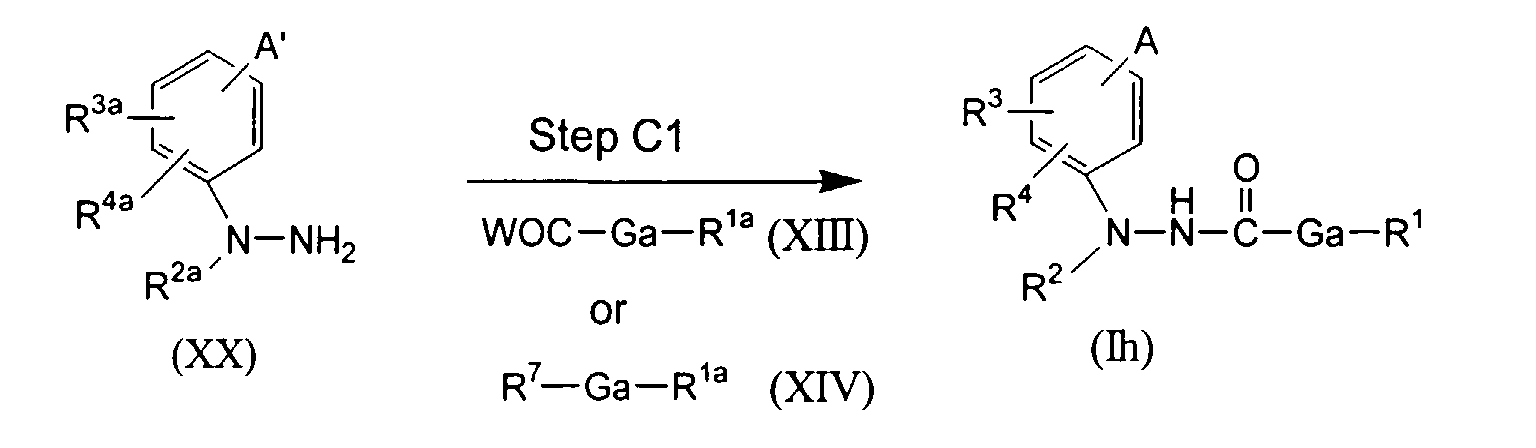
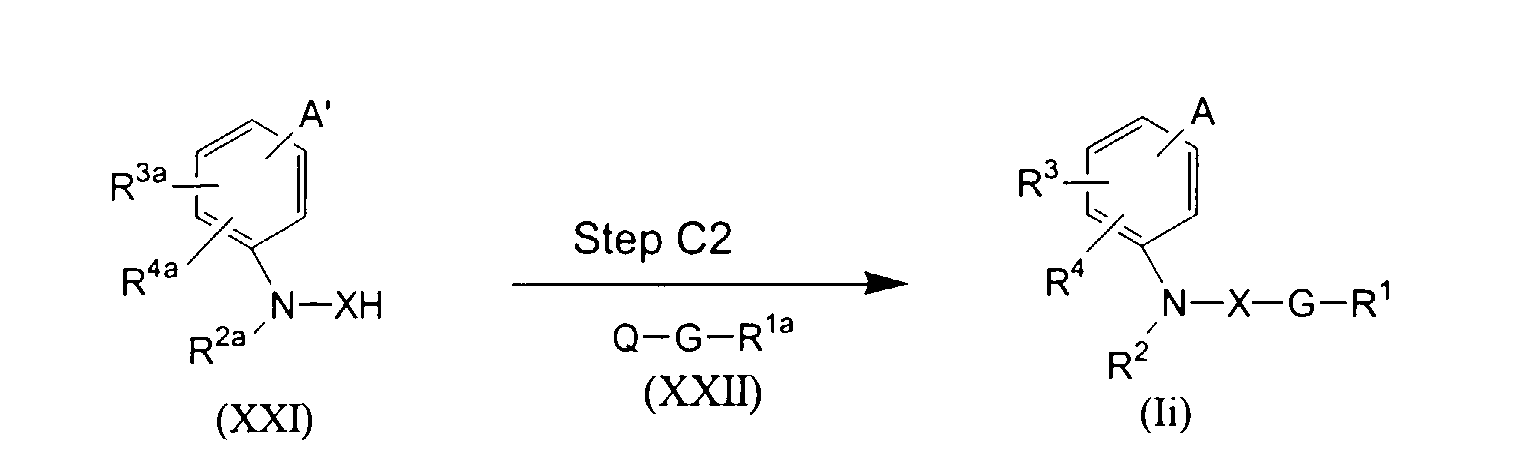
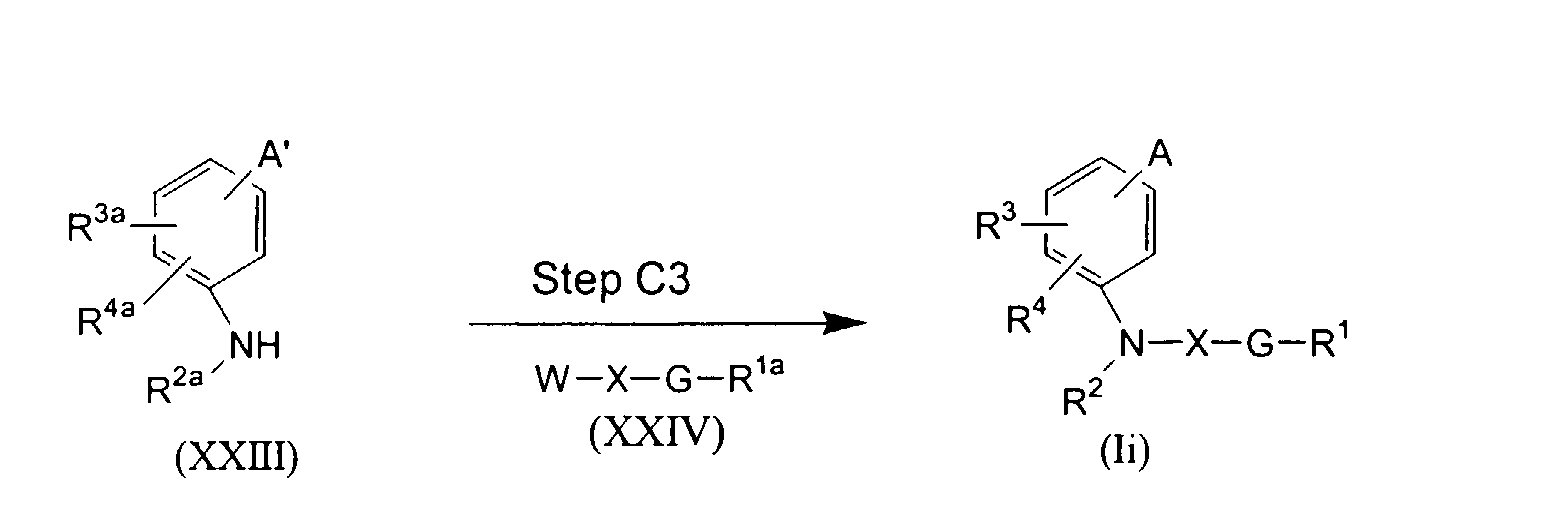
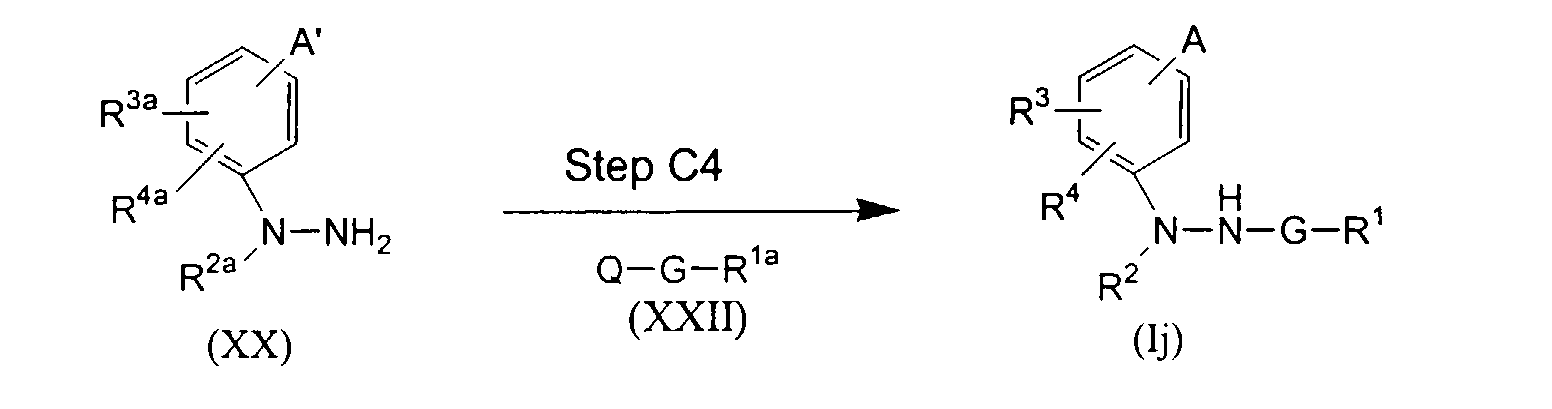
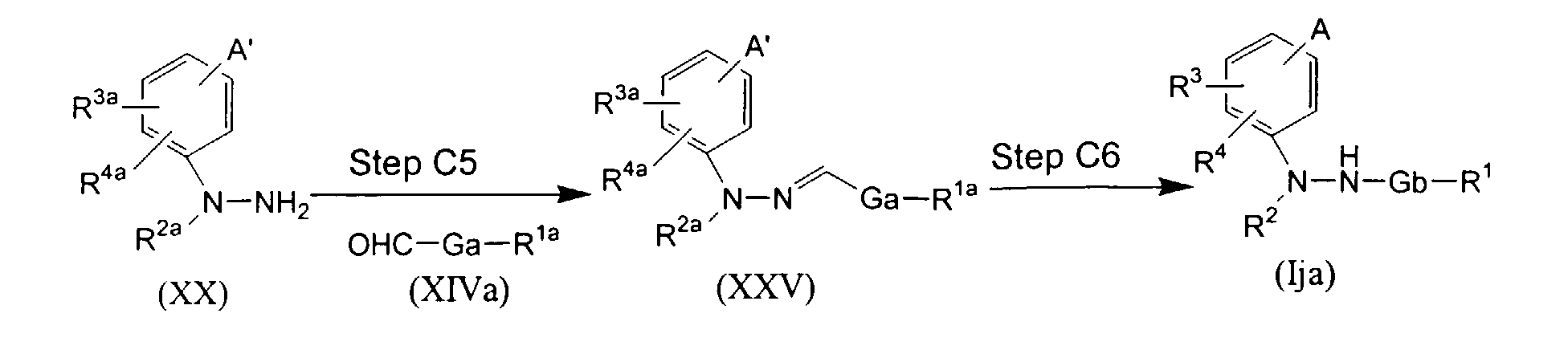
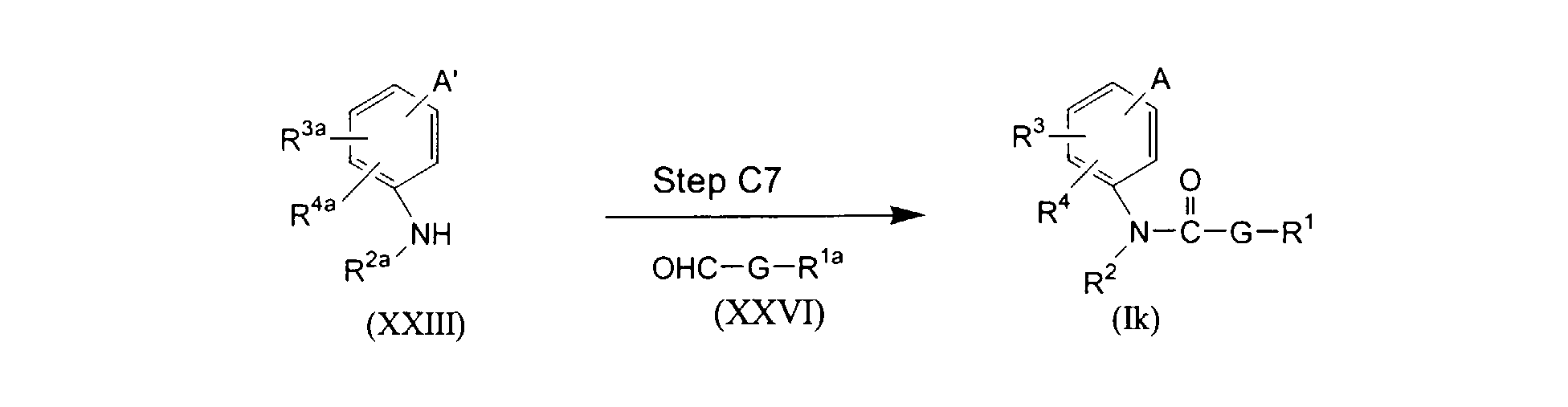
- In the above reaction scheme:
- R1, R1a, R2, R2a, R3, R3a, R4, R4a, R7, A, A', G, Ga, Q, X and W have the same meanings as described above; and
- Gb represents a C1-6 alkylene group.
-
- In this step the compound of formula (Ih) is prepared by reacting the compound of formula (XX) or acid addition salt (preferably hydrochloride) thereof with the compound of formula (XIII) or (XIV) in an inert solvent and then optionally removing the protecting group of the amino, hydroxy and/or carboxy group in R1a, R2a, R3a, R4a and A'. This step may be carried out in a similar manner to that described in Step B6 of Process B.
- In this step the compound of formula (Ii) is prepare by reacting a compound of formula (XXI) with a compound of formula (XXII) in an inert solvent in the presence or absence (preferably in the presence) of a base and then optionally removing the protecting group of the amino, hydroxy and/or carboxy group in R1a, R2a, R3a, R4a and A'. This step may be carried out in a similar manner to Step B4 of Process B.
- In this step there is provided an alternative method for preparing the compound of formula (Ii), which comprises reacting a compound of formula (XXIII) with a compound of formula (XXIV) in an inert solvent in the presence of an organic base (preferably triethylamine) and then optionally removing the protecting group of the amino, hydroxy and/or carboxy group in R1a, R2a, R3a, R4a and A'. This step may be carried out in a similar manner to Step B3 of Process B.
- In this step the compound of formula (Ij) is prepared by reacting the compound of formula (XX) with the compound of formula (XXII) in an inert solvent in the presence or absence (preferably in the presence) of a base and then optionally removing the protecting group of the amino, hydroxy and/or carboxy group in R1a, R2a, R3a, R4a and A'. This step may be carried out in a similar manner to Step A1 of Process A.
- In this step a compound of formula (XXV) is prepared by reacting a compound of formula (XIVa) with the compound of formula (XX) or acid addition salt thereof (for example, a mineral acid salt such as hydrochloride, nitrate or sulphate) in an inert solvent. This reaction may be effected, for example, by condensation under heat by using, as a catalyst, an organic sulphonic acid such as p-toluenesulphonic acid or condensation using a Lewis acid such as titanium tetrachloride. This step may be carried out in a similar manner to Step B1 of Process B.
- In this step the compound of formula (Ija) is prepared by reacting the compound of formula (XXV) with a reducing agent and then optionally removing the protecting group of the amino, hydroxy and/or carboxy group in R1a, R2a, R3a, R4a and A'. This step may be carried out in a similar manner to Step B2 of Process B.
- The compound of formula (Ija) can also be prepared by subjecting the compound of formula (XXV) to catalytic reduction and then optionally removing the protecting group or the amino, hydroxy and/or carboxy group in R1a, R2a, R3a, R4a and A'.
- The catalytic reduction reaction is normally and preferably effected in the presence of a solvent. There is no particular restriction on the nature of the solvent to be employed, provided that it has no adverse effect on the reaction or on the reagents involved and that it can dissolve the reagents, at least to some extent. Examples of suitable solvents include: aliphatic hydrocarbons, such as hexane, heptane, ligroin and petroleum ether; aromatic hydrocarbons, such as toluene, benzene and xylene; esters, such as methyl acetate, ethyl acetate, propyl acetate, butyl acetate and diethyl carbonate; ethers, such as diethyl ether, diisopropyl ether, tetrahydrofuran, dioxane, dimethoxyethane and diethylene glycol dimethyl ether; alcohols, such as methanol, ethanol, propanol, isopropanol, butanol, isobutanol, t-butanol, isoamyl alcohol, diethylene glycol, glycerin, octanol, cyclohexanol and methyl cellosolve; organic acids, such as acetic acid; and water; and mixed solvents of the above-described solvent and water, of which the alcohols, ethers, organic acids and water are preferred, the alcohols and organic acids being most preferred.
- There is no particular limitation on the nature of the catalyst to be used for the catalytic reduction, and any such catalyst commonly used in reactions of this type may equally be employed here. Preferred examples include palladium on carbon, Raney nickel, platinum oxide, platinum black, rhodium-aluminium oxide, triphenylphosphine-rhodium chloride, and palladium-barium sulphate, of which palladium on carbon is preferred.
- Although no particular limitation is imposed on the pressure, it usually ranges from 1 to 10 times atmospheric pressures.
- The reaction can take place over a wide range of temperatures, and the precise reaction temperature is not critical to the invention. The preferred reaction temperature will depend upon such factors as the nature of the solvent, and the starting material or reagent used. However, in general, we find it convenient to carry out the reaction at a temperature of from -20 to 150°C, more preferably from 0 to 100°C. The time required for the reaction may also vary widely, depending on many factors, notably the reaction temperature and the nature of the reagents and solvent employed. However, provided that the reaction is effected under the preferred conditions outlined above, a period of from 15 minutes to 24 hours, more preferably from 30 minutes to 16 hours, will usually suffice.
- The optional removal of the protecting group of the amino, hydroxy and/or carboxy group in R1a, R2a, R3a, R4a and A' may be carried out in a similar manner to that employed in Step A1 of Process A.
- After completion of the reaction, the resulting compound of formula (Ija) of the present reaction may be collected from the reaction mixture by known methods, for example, by neutralising the reaction mixture as desired, removing any insoluble matter by filtration, adding a water-immiscible organic solvent such as ethyl acetate to separate an organic layer containing the compound, washing with water or the like, drying over anhydrous magnesium sulphate, anhydrous sodium sulphate or anhydrous sodium hydrogencarbonate and distilling off the solvent. If necessary, the compound thus obtained can be separated and purified by known methods by using commonly employed methods for the separation and purification of an organic compound, such as recrystallisation and reprecipitation, in combination, making use of chromatography and eluting with a proper eluant.
- In this step the compound of formula (Ik) is prepared by reacting the compound of formula (XXVI) with the compound of formula (XXIII) or acid addition salt thereof (for example, a mineral acid salt such as hydrochloride, nitrate or sulphate) in an inert solvent and then optionally removing the protecting group of the amino, hydroxy and/or carboxy group in R1a, R2a, R3a, R4a and A'. The reaction of the compound of formula (XXVI) with the compound of formula (XXIII) or acid addition salt thereof may be carried out in a similar manner to the reaction of the step B6 of Process B in the case where R7 of the compound of formula (IXV) represents a formyl group. The optional removal of the protecting group of the amino, hydroxy and/or carboxy group in R1a, R2a, R3a, R4a and A' may be carried out in a similar manner to that employed in Step A1 of Process A.
- Each of the starting material compounds of formula (II), (III), (IV), (V), (VI), (VIII), (IX), (X), (XI), (XIII), (XIV), (XV), (XIX), (XX), (XXI), (XXII), (XXIII), (XXIV), (XXIVa) and (XXVI) is known, or may be prepared easily by known processes or by processes similar thereto [for example, J. Org. Chem., 56, 1445-1453 (1991), Organic Reaction, 5, 301-330 (1949), etc.].
- Each of the starting material compounds of formula (II), (V), (VIII), (X), (XI), (XX), (XXI) and (XXIII) can also be prepared by the process described below.
- In this process the compound of formula (II), the compound of formula (IIa), that is, a compound of formula (II) in which R5a represents a hydrogen atom, and the compound of formula (IIb), that is, a compound of formula (II) in which Z represents a C1-6 alkylene group and R5a represents a hydrogen atom, are prepared.
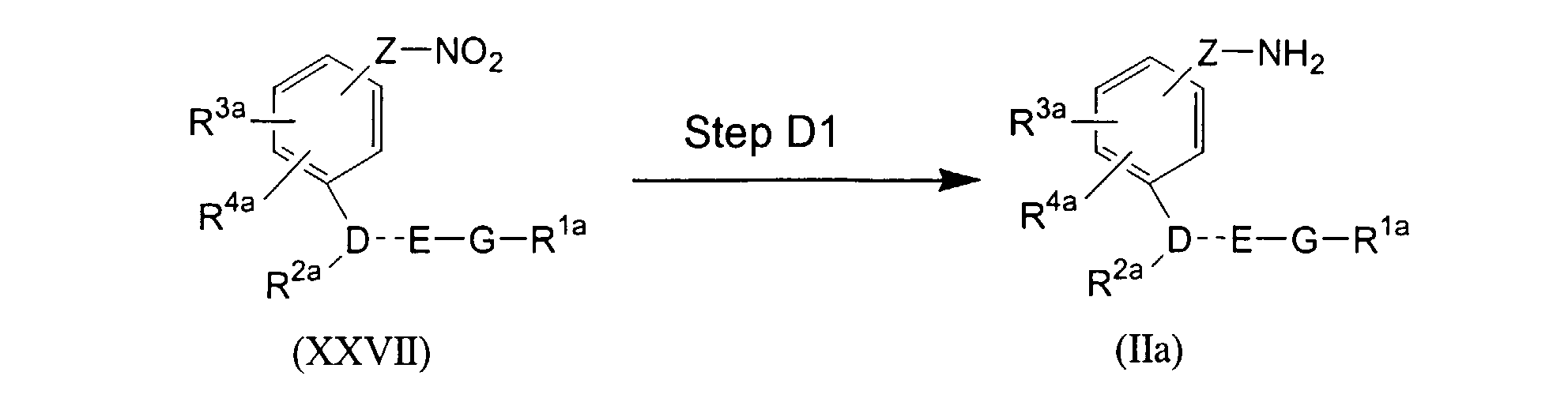
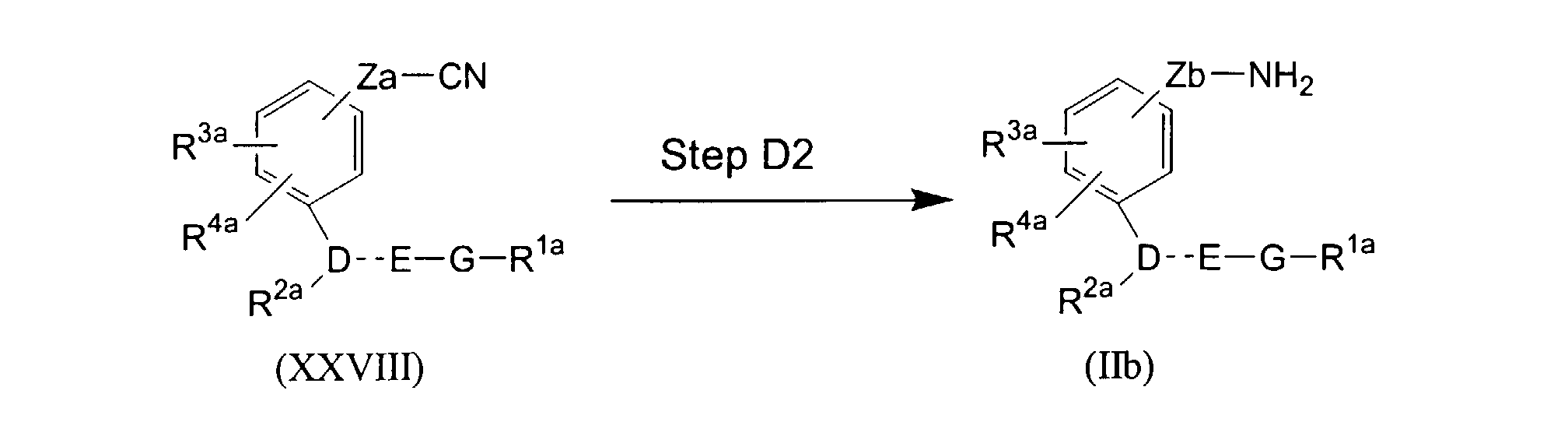
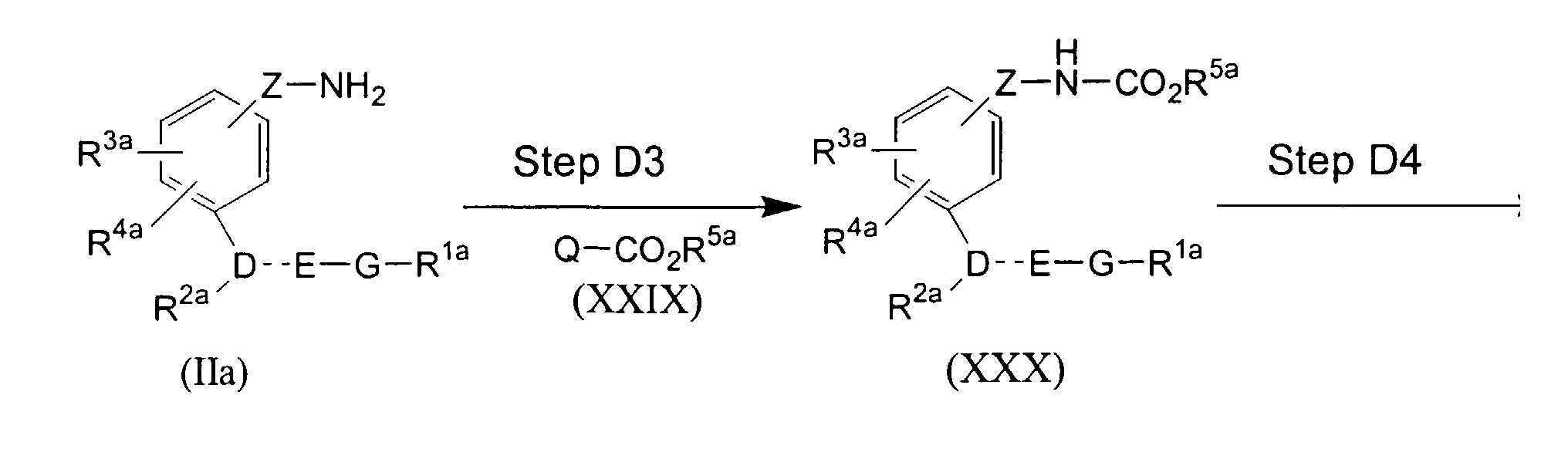

- In the above reaction scheme:
- R1a, R2a, R3a, R4a, R5a, D, E, G, Z and Q have the same meanings as described above;
- Za represents a single bond or a C1-5 alkylene group; and
- Zb represents a C1-6 alkylene group.
-
- In this step the compound of formula (IIa) is prepared by reacting a compound of formula (XXVII) with a reducing agent (preferably sodium borohydride, sodium cyanoborohydride or lithium aluminium hydride) in an inert solvent (preferably an alcohol or an ether) at a temperature of from -20 to 150°C, preferably from 10 to 80°C, for a period of from 5 minutes to 24 hours, preferably for from 10 minutes to 16 hours.
- This step can also be effected using a catalytic reduction method, a zinc-acetic acid method, which is a general reduction method of a nitro group, a tin-alcohol method or a tin-hydrochloric acid method.
- In this step the compound of formula (IIb) is prepared by reacting a compound of formula (XXVIII) with a reducing agent (preferably an aluminium hydride compound) in an inert solvent (preferably an alcohol or ether). This step may be carried out in a similar manner to Step D1 of Process D.
- In this step a compound of formula (XXX) is prepared by reacting the compound of formula (IIa) with a compound of formula (XXIX) in an inert solvent (preferably an amide) in the presence of a base (preferably an alkali metal hydrogencarbonate or organic amine). This step may be carried out in a similar manner to Step A1 of Process A.
- In this step the compound of formula (II) is prepared by reducing the compound of formula (XXX) in an inert solvent. This step may be carried out in a similar manner to Step D1 of Process D.
- After completion of the reaction, the resulting compound of each of the reactions may be collected from the reaction mixture by known methods, for example, by neutralising the reaction mixture as desired, removing any insoluble matter by filtration, adding a water-immiscible organic solvent such as ethyl acetate to separate an organic layer containing the compound, washing with water or the like, drying over anhydrous magnesium sulphate, anhydrous sodium sulphate or anhydrous sodium hydrogencarbonate and distilling off the solvent. If necessary, the compound thus obtained can be separated and purified by known methods by using commonly employed methods for the separation and purification of an organic compound, such as recrystallisation and reprecipitation, in combination, making use of chromatography and eluting with a proper eluant.
- This a process for preparing a compound of formula (XXXI):[in which R1a, R2a, R3a, R4a, D, E, G and Z have the same meanings as described above; and R9 represents an amino, cyano or nitro group which may be protected], including the compounds of formula (XXVII), (XXVIII) and (IIa).
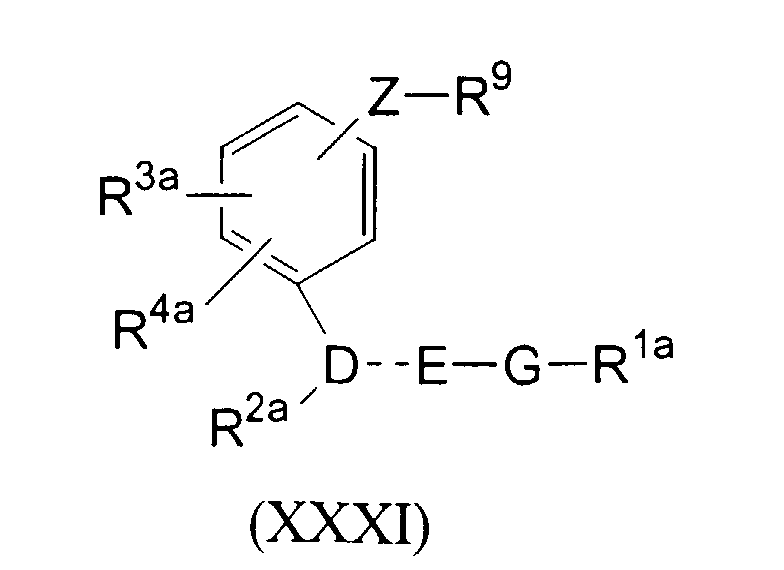
- More specifically, in this process a compound of formula (XXXIa), that is, a compound of formula (XXXI) in which D represents a -CH- group and E represents an-NH- group, a compound of formula (XXXIb), that is, a compound of formula (XXXI) in which D represents a -CH- group and E represents an oxygen or sulphur atom, a compound of formula (XXXIc), that is, a compound of formula (XXXI) in which D represents a -CH- group, E represents an -NH- group and G represents a -CO-Ga- group, a compound of formula (XXXId), that is, a compound of formula (XXXI) in which D represents a carbon atom, E represents an =N-O- group, and a compound of formula (XXXIe), that is, a compound of formula (XXXI) in which D represents a -CH- group and E represents a -CO- group, is prepared.
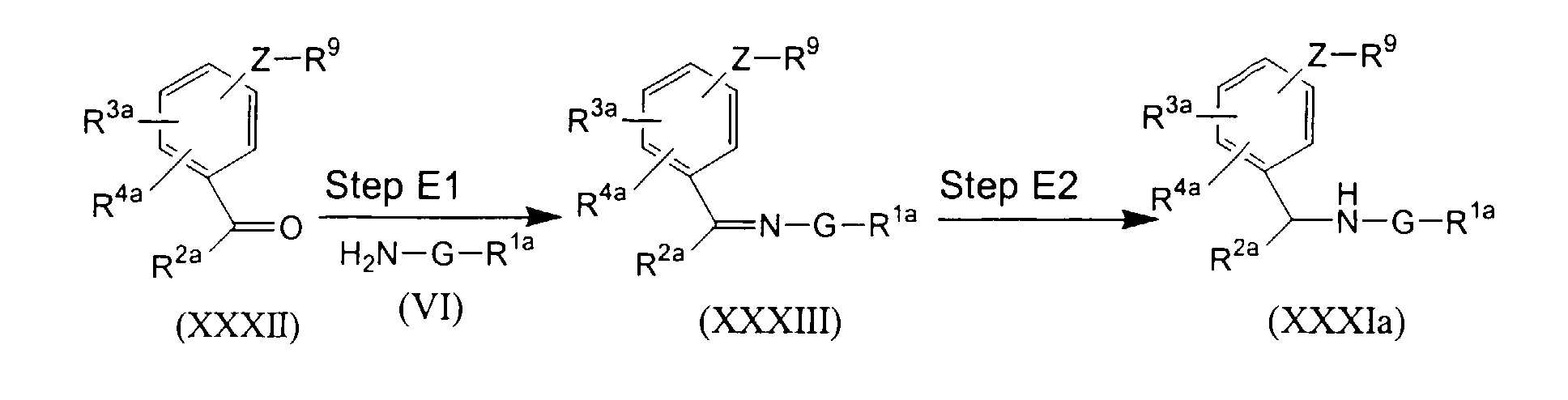
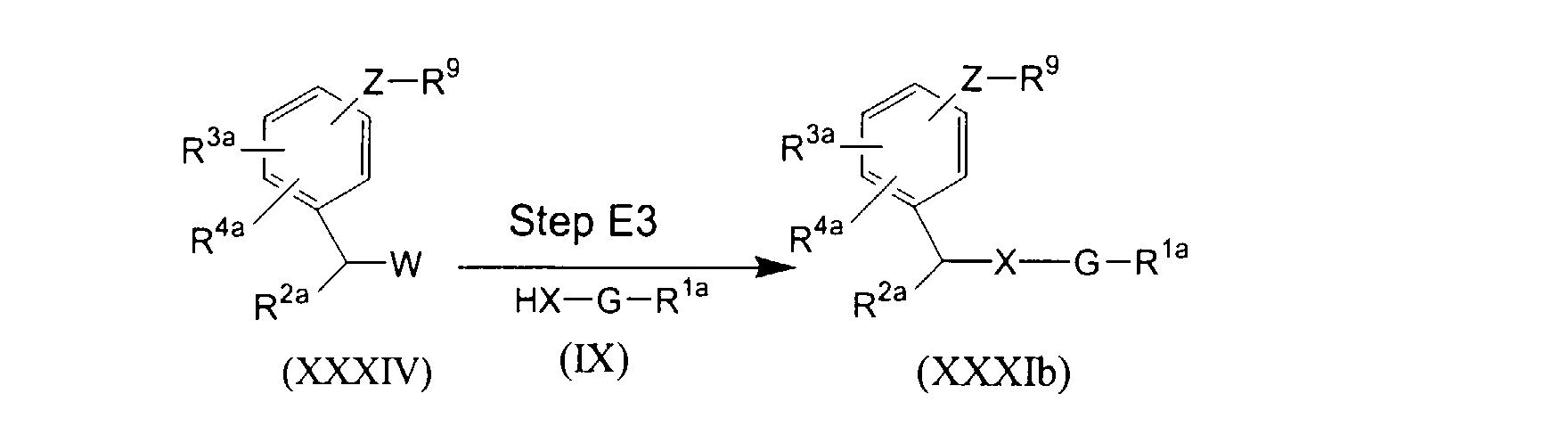
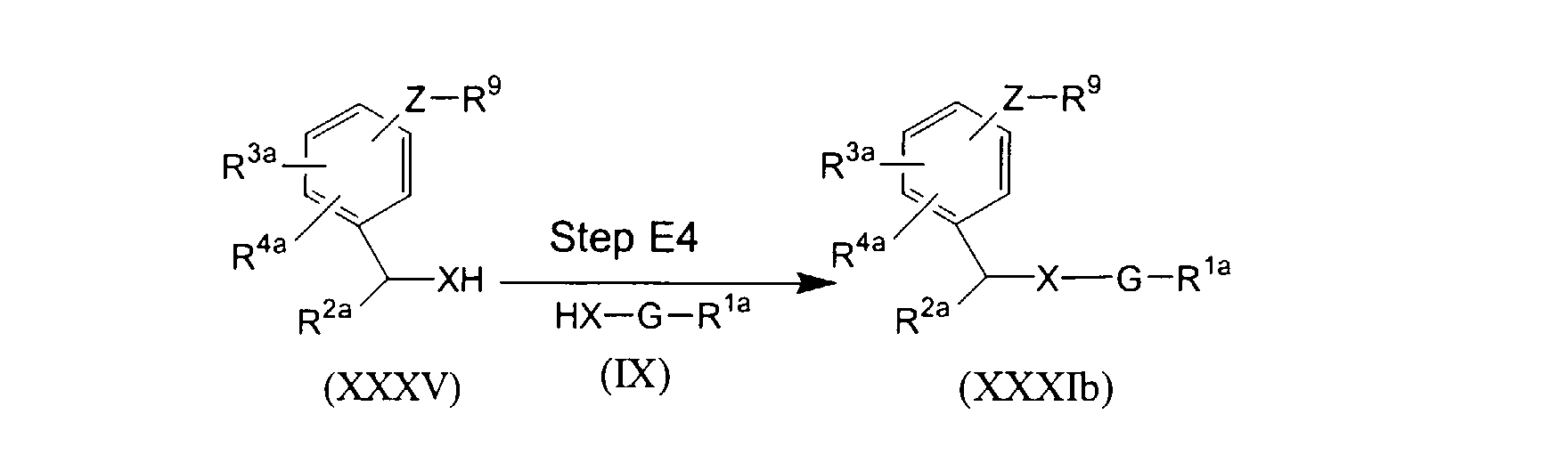
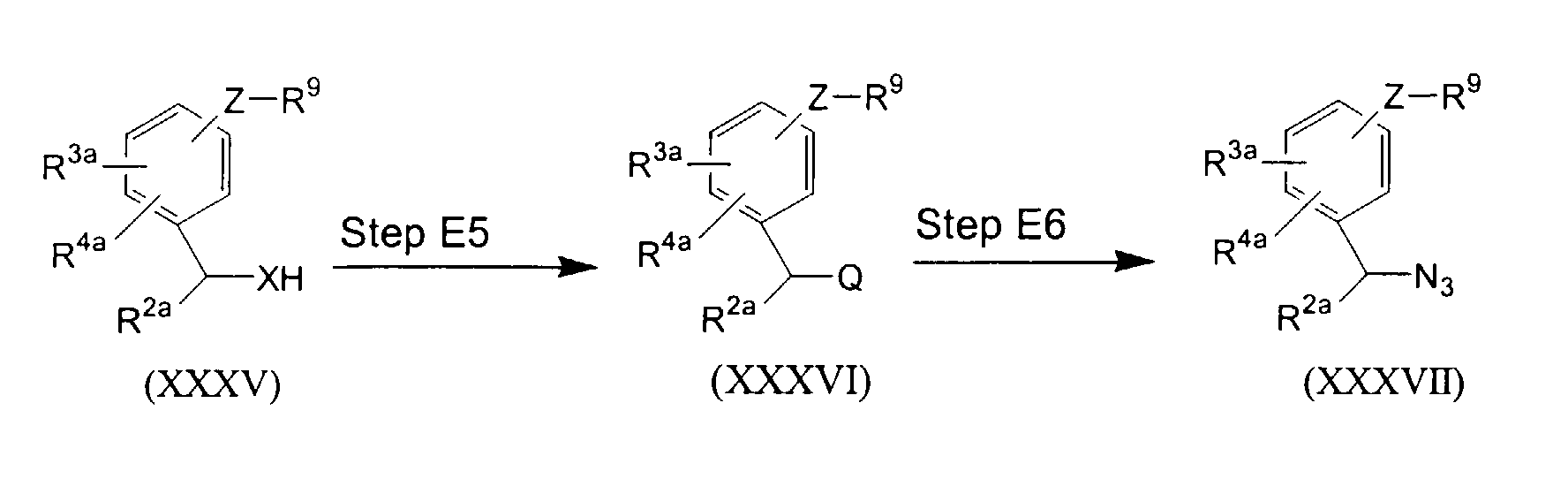
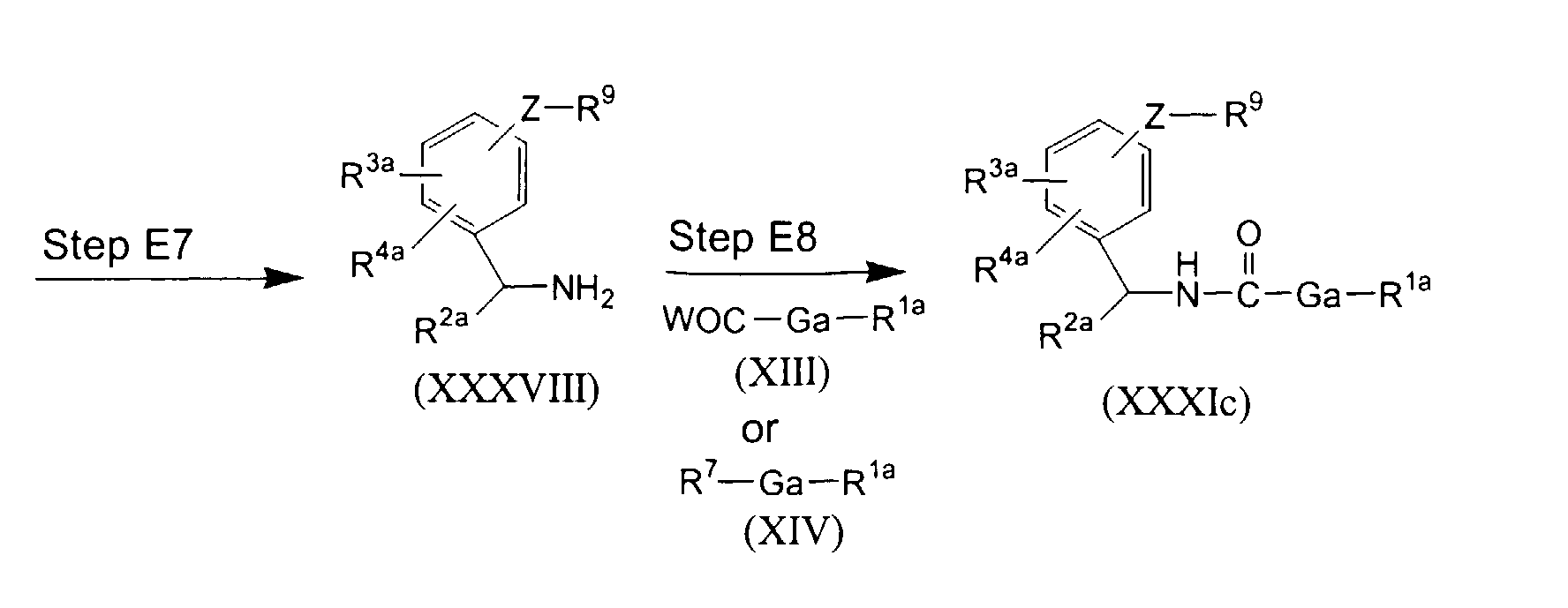
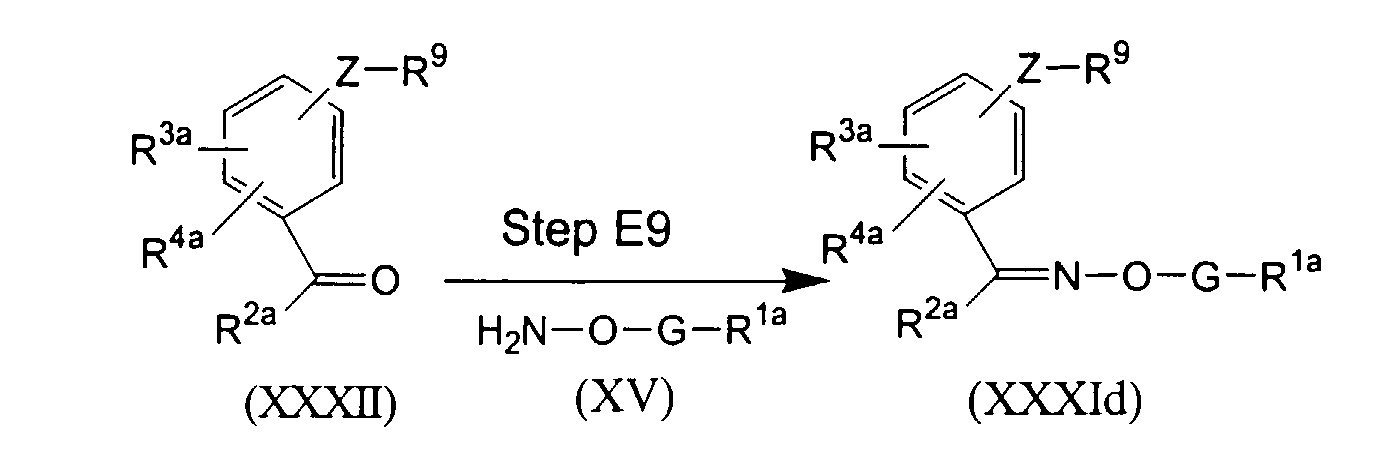
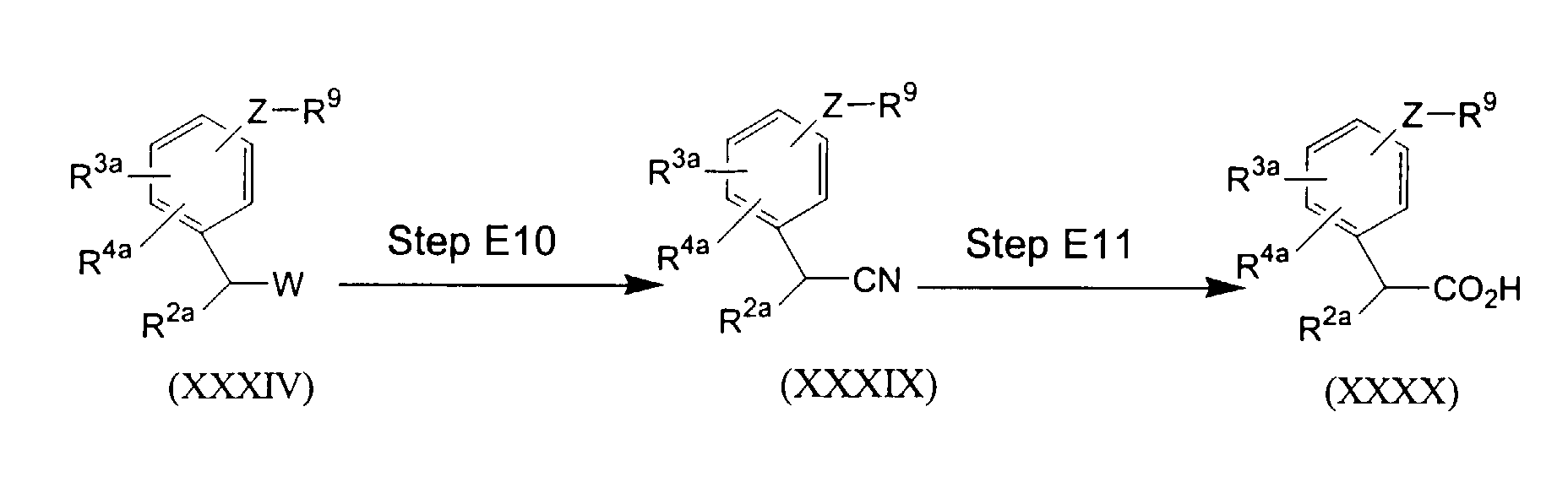
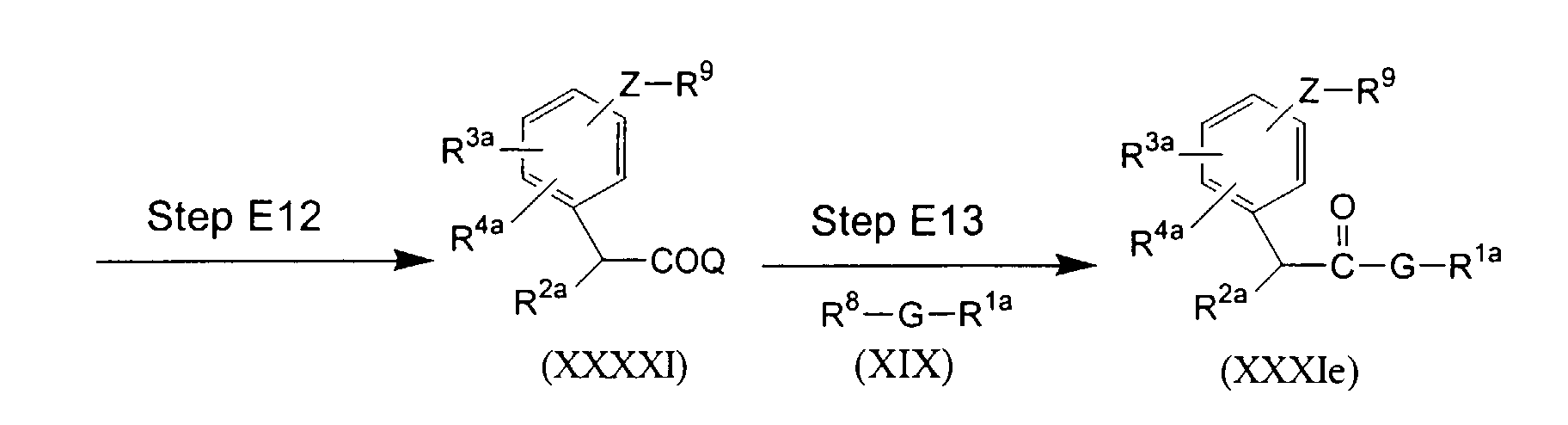
- In this reaction scheme:
R1a, R2a, R3a, R4a, R7, R8, R9, G, Ga, Q, X, W and Z have the same meanings as described above. - In this step a compound of formula (XXXIII) is prepared by reacting a compound of formula (XXXII) with the compound of formula (VI) or acid addition salt thereof (for example, a mineral acid salt such as hydrochloride, nitrate or sulphate) in an inert solvent. This step may be carried out in a similar manner to Step B1 of Process B.
- In this step the compound of formula (XXXIa) is prepared by reducing the compound of formula (XXXIII) in an inert solvent. This step may be carried out in a similar manner to Step B2 of Process B.
- In this step the compound of formula (XXXIb) is prepared by reacting a compound of formula (XXXIV) with a base in the presence or absence (preferably in the presence) of an inert solvent and then reacting the reaction mixture with the compound of formula (IX). This step may be carried out in a similar manner to Step B3 of Process B.
- In this step there is provided an alternative method for preparing the compound of formula (XXXIb) is prepared by converting the -XH- containing group of a compound of formula (XXXV) into an leaving group Q in an inert solvent in the presence or absence of a Lewis acid and then reacting with the compound of formula (IX). This step may be carried out in a similar manner to Step B4 of Process B.
- In this step a compound of formula (XXXVI) is prepared by converting the -XH- containing group of a compound of formula (XXXV) into an leaving group Q in an inert solvent in the presence or absence of a base. This step may be carried out in a similar manner to Step B4 of Process B for the conversion of the -XH- containing group of the compound of formula (X) into an leaving group Q.
- In this step a compound of formula (XXXVII) is prepared by converting the compound of formula (XXXVI) into the corresponding azide in an inert solvent. The reaction is normally and preferably effected in the presence of a solvent. There is no particular restriction on the nature of the solvent to be employed, provided that it has no adverse effect on the reaction or on the reagents involved and that it can dissolve the reagents, at least to some extent. Examples of suitable solvents include: aromatic hydrocarbons, such as benzene, toluene and xylene, halogenated hydrocarbons, such as methylene chloride and chloroform; ethers, such as ether, tetrahydrofuran, dioxane and dimethoxyethane; amides, such as formamide, dimethylformamide, dimethylacetamide and hexamethylphosphoryl triamide; and nitriles, such as acetonitrile. Preferred are the amides, dimethylformamide being most preferred.
- There is no particular limitation imposed on the reagent used in this reaction to form the azide, and any reagent commonly used for this purpose may equally be employed here.. Examples include diaryl phosphoric azide derivatives, such as diphenylphosphoric azide, trialkylsilyl azides, such as trimethylsilyl azide and triethylsilyl azide, and alkali metal azide salts, such as sodium azide and potassium azide, of which the alkali metal azide salts are preferred, sodium azide being most preferred.
- In this reaction, a catalyst may be used. Examples include trialkylsilyl triflates, such as trimethylsilyl triflate and triethylsilyl triflate and Lewis acids, such as trifluoroborane etherate, aluminium chloride and zinc chloride.
- The reaction can take place over a wide range of temperatures, and the precise reaction temperature is not critical to the invention. The preferred reaction temperature will depend upon such factors as the nature of the solvent, and the starting material or reagent used. However, in general, we find it convenient to carry out the reaction at a temperature of from -20 to 100°C, more preferably from 0 to 50°C. The time required for the reaction may also vary widely, depending on many factors, notably the reaction temperature and the nature of the reagents and solvent employed. However, provided that the reaction is effected under the preferred conditions outlined above, a period of from 15 minutes to 50 hours, more preferably from 30 minutes to 12 hours, will usually suffice.
- In this step a compound of formula (XXXVIII) is prepared by reducing the compound of formula (XXXVII) with a reducing agent such as triphenylphosphine in an inert solvent. This step may be carried out in a similar manner to Step B5 of Process B.
- In this step the compound of formula (XXXIc) is prepared by reacting the compound of formula (XXXVIII) with the compound of formula (XIII) or (XIV). This step may be carried out in a similar manner to Step B6 of Process B.
- In this step the compound of formula (XXXId) is prepared by reacting the compound of formula (XXXII) with the compound of formula (XV) or acid addition salt thereof (for example, a mineral acid salt such as hydrochloride, nitrate or sulphate). This step may be carried out in a similar manner to Step B7 of Process B.
- In this step a compound of formula (XXXIX) is prepared by reacting the compound of formula (XXXIV) with an alkali metal cyanide in an inert solvent. This step may be carried out in a similar manner to Step B8 of Process B.
- In this step a compound of formula (XXXX), which comprises hydrolysing the compound of formula (XXXIX) with an acid or alkali in an inert solvent. This step may be carried out in a similar manner to Step B9 of Process B.
- In this step a compound of formula (XXXXI) is prepared by converting the carboxy group of the compound of formula (XXXX) into a -COQ group in an inert solvent. This step may be carried out in a similar manner to Step B10 of Process B.
- In this step a compound of formula (XXXIe) is prepared by reacting the compound of formula (XXXXI) with the compound of formula (XIX) in an inert solvent in the presence or absence of a palladium catalyst. This step may be carried out in a similar manner to Step B11 of Process B.
- After completion of the reaction, the resulting compound of each of these reactions may be collected from the reaction mixture by known methods, for example, by neutralising the reaction mixture as desired, removing any insoluble matter by filtration, adding a water-immiscible organic solvent such as ethyl acetate to separate an organic layer containing the compound, washing with water or the like, drying over anhydrous magnesium sulphate, anhydrous sodium sulphate or anhydrous sodium hydrogencarbonate and distilling off the solvent. If necessary, the compound thus obtained can be separated and purified by known methods by using commonly employed methods for the separation and purification of an organic compound, such as recrystallisation and reprecipitation, in combination, making use of chromatography and eluting with a proper eluant.
- This is a process for preparing a compound of formula (XXXIf), that is, a compound of formula (XXXI) in which D represents a nitrogen atom, E represents an-NH- group and G represents a -CO-Ga- group, a compound of formula (XXXIg), that is, a compound of formula (XXXI) in which D represents a nitrogen atom and E represents an oxygen or sulphur atom, a compound of formula (XXXIh), that is, a compound of formula (XXXI) in which D represents a nitrogen atom and E represents an -NH- group, a compound of formula (XXXIha), that is, a compound of formula (XXXI) in which D represents a nitrogen atom, E represents an -NH- group and G represents a C1-6 alkylene group, and a compound of formula (XXXIi), that is, a compound of formula (XXXI) in which D represents a nitrogen atom and E represents a -CO- group.


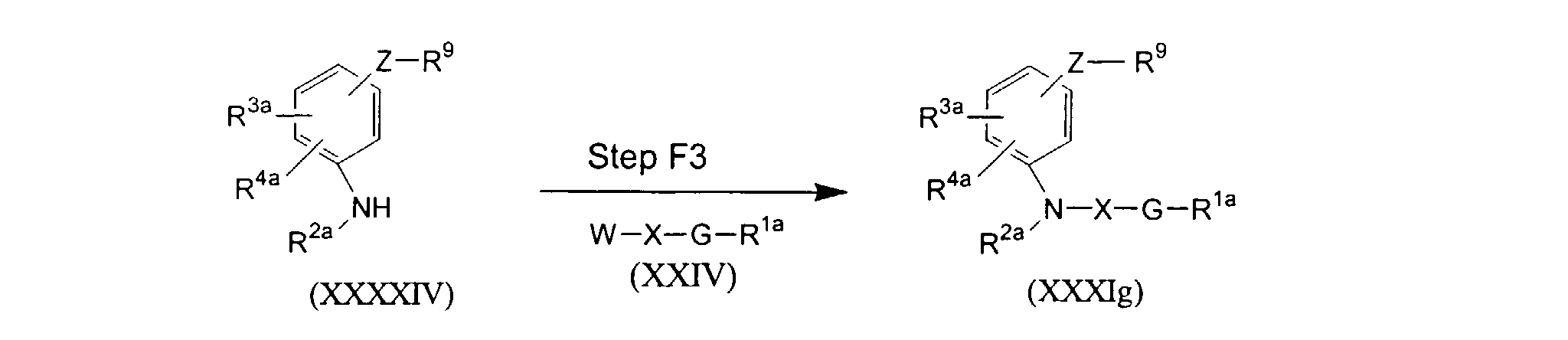
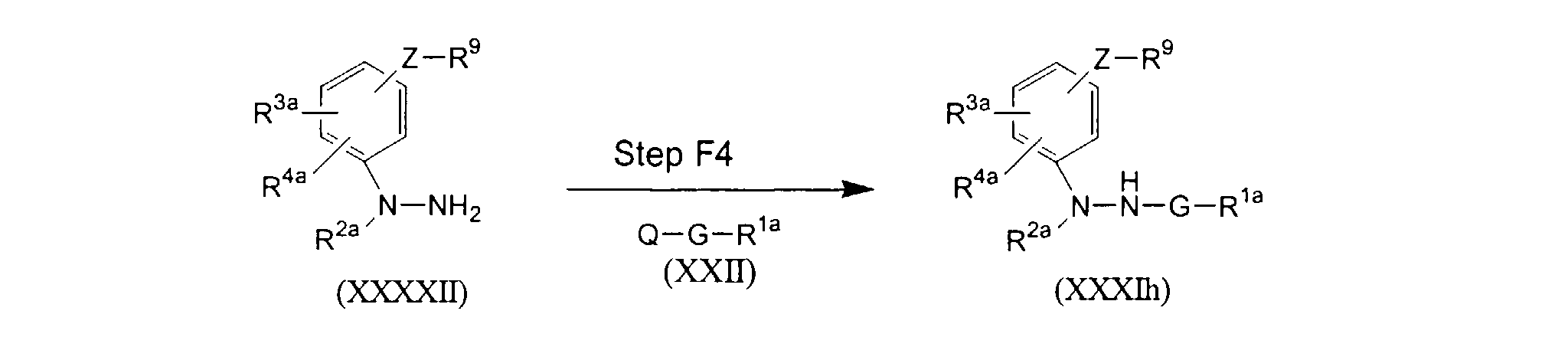
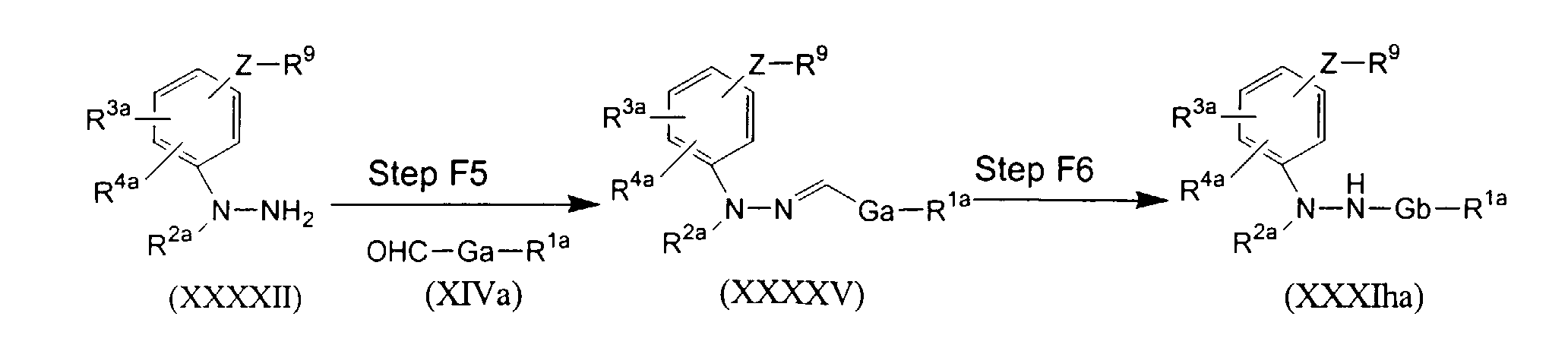
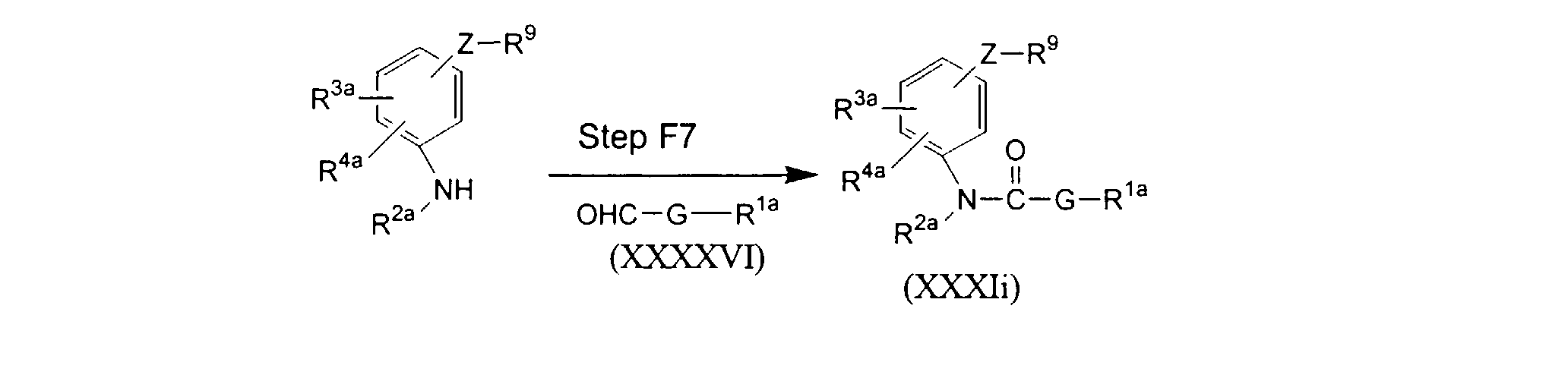
- In this reaction scheme:
R1a, R2a, R3a, R4a, R7, R9, G, Ga, Gb, Q, X, W and Z have the same meanings as described above. - In this step the compound of formula (XXXIf) is prepared by reacting the compound of formula (XXXXII) or acid addition salt thereof (preferably hydrochloride) with the compound of formula (XIII) or (XIV) in an inert solvent in the presence or absence (preferably in the presence) of a base. This step may be carried out in a similar manner to Step B6 of Process B.
- In this step the compound of formula (XXXIg) is prepared by reacting a compound of formula (XXXXIII) with the compound of formula (XXII) in an inert solvent in the presence or absence (preferably in the presence) of a base. This step may be carried out in a similar manner to Step B4 of Process B.
- In this there is provided an alternative method for preparing the compound of formula (XXXIg) by reacting a compound of formula (XXXXIV) with the compound of formula (XXIV) in an inert solvent in the presence of an organic base (preferably triethylamine). This step may be carried out in a similar manner to Step B3 of Process B.
- In this step the compound of formula (XXXIh) is prepared by reacting the compound of formula (XXXXII) with the compound of formula (XXII) in an inert solvent in the presence or absence (preferably in the presence) of a base. This step may be carried out in a similar manner to Step A1 of Process A.
- In this step a compound of formula (XXXXV) is prepared by reacting the compound of formula (XIVa) with the compound of formula (XXXXII) or acid addition salt thereof (for example, a mineral acid salt such as hydrochloride, nitrate or sulphate) in an inert solvent. This step may be carried out in a similar manner to Step B1 of Process B, for example, by condensation under heat by using, as a catalyst, an organic sulphonic acid such as p-toluenesulphonic acid, or condensation using a Lewis acid such as titanium tetrachloride.
- In this step the compound of formula (XXXIha) is prepared by reducing the compound of formula (XXXXV). This step may be carried out in a similar manner to Step C6 of Process C.
- In this step the compound of formula (XXXIi) is prepared by reacting a compound of formula (XXXXVI) with the compound of formula (XXXXIV) or acid addition salt thereof (for example, a mineral acid salt such as hydrochloride, nitrate or sulphate) in an inert solvent. This step may be carried out in a similar manner to Step B1 of Process B.
- After completion of the reaction, the resulting compound of each of these reactions may be collected from the reaction mixture by known methods, for example, by neutralising the reaction mixture as desired, removing any insoluble matter by filtration, adding a water-immiscible organic solvent such as ethyl acetate to separate an organic layer containing the compound, washing with water or the like, drying over anhydrous magnesium sulphate, anhydrous sodium sulphate or anhydrous sodium hydrogencarbonate and distilling off the solvent. If necessary, the compound thus obtained can be separated and purified by known methods by using commonly employed methods for the separation and purification of an organic compound, such as recrystallisation and reprecipitation, in combination, making use of chromatography and eluting with a proper eluant.
- The starting material compounds of formula (V), (VIII), (X) and (XI) can be prepared by reacting, instead of the compound of formula (II), a compound of formula (XXXXVII):[in which:
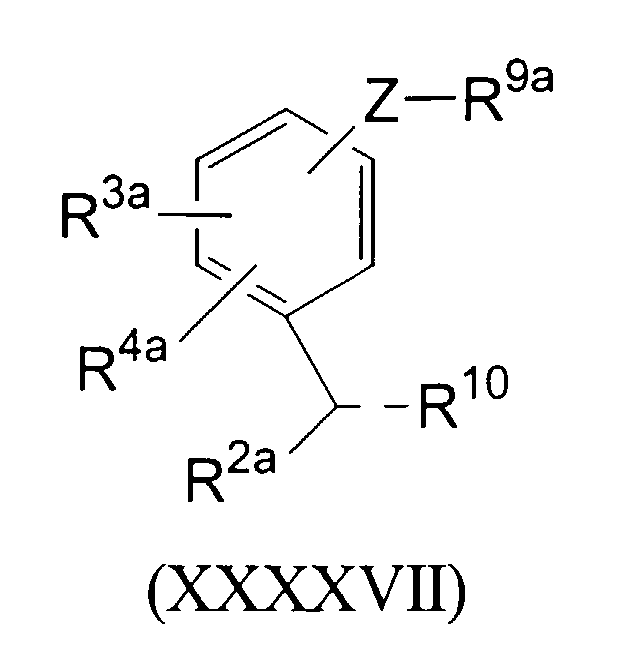
- R3a, R2a, R4a and Z have the same meanings as described above;
- R9a has the same meaning as described above in R9 except that the amino group which may be protected is an amino group; and
- R10 represents a halogen atom, azide or -XH-containing group (in which, X has the same meaning as described above) when the broken line means a single bond, while it represents an oxygen atom when a broken line means a double bond.] with the compound of formula (III) in a similar manner to the process as described in Process A.
-
- The starting material compounds of formula (XX), (XXI) and (XXIII) can be prepared by reacting, instead of the compound of formula (II), a compound of formula (XXXXVIII):[in which:
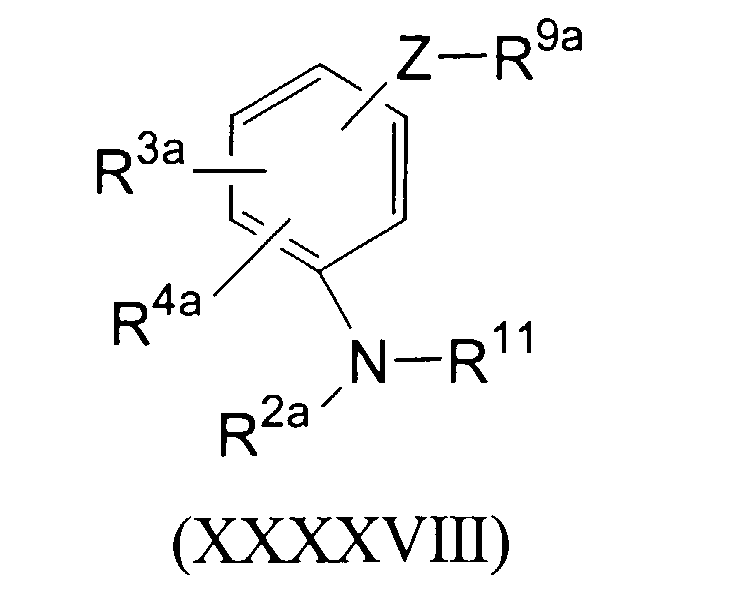
- R3a, R2a, R4a, R9a and Z have the same meanings as described above, and
- R11 represents a hydrogen atom, an amino group or an -XH-containing group (in which, X has the same meaning as described above)] with the compound of formula (III) in a similar manner to the method described in Process A.
-
- This is a process for preparing the compound of formula (XXXII).
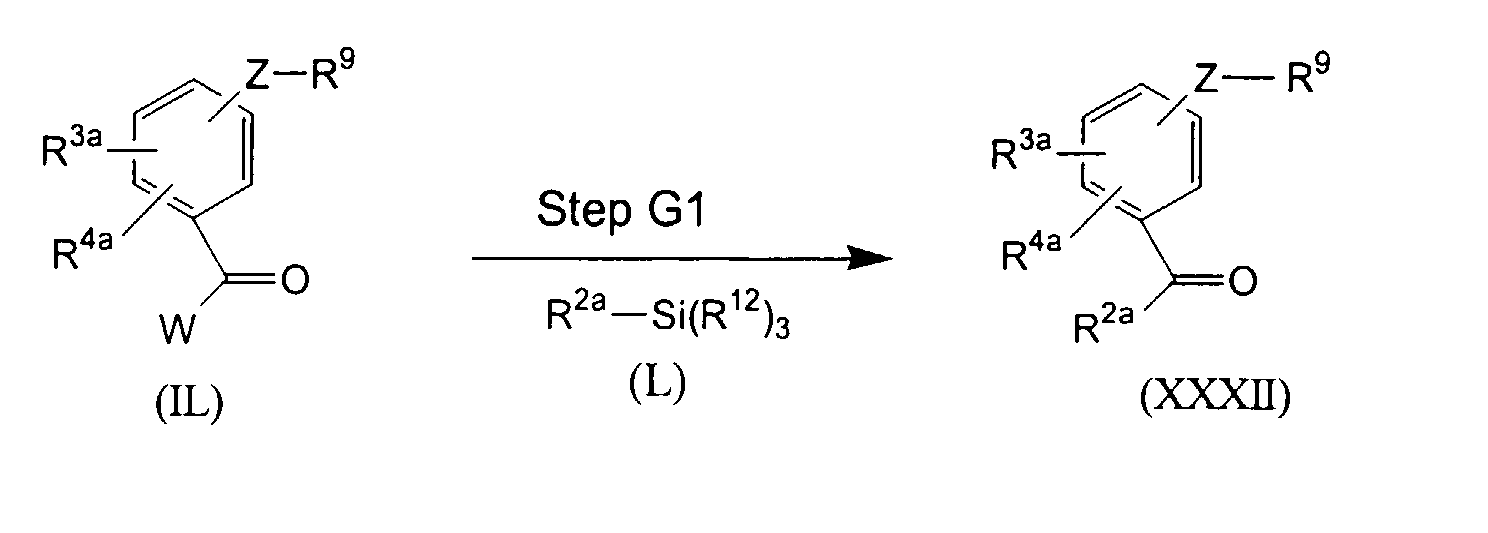
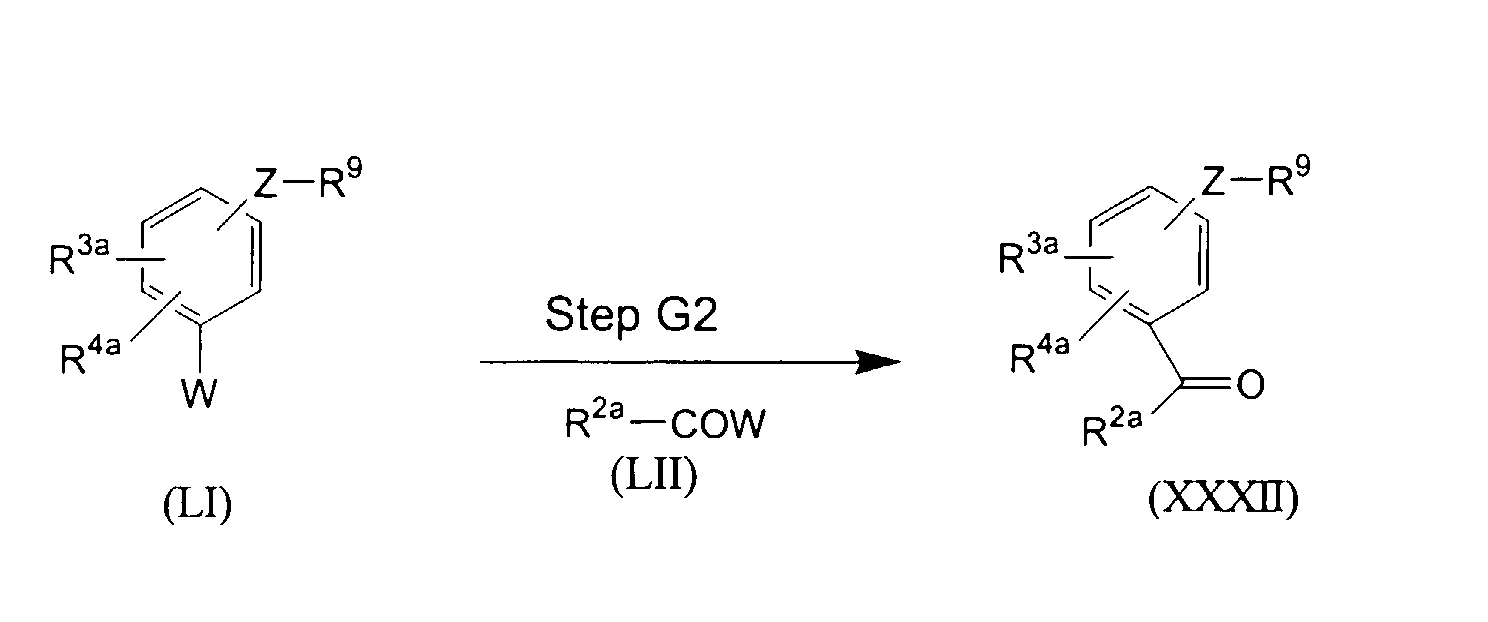
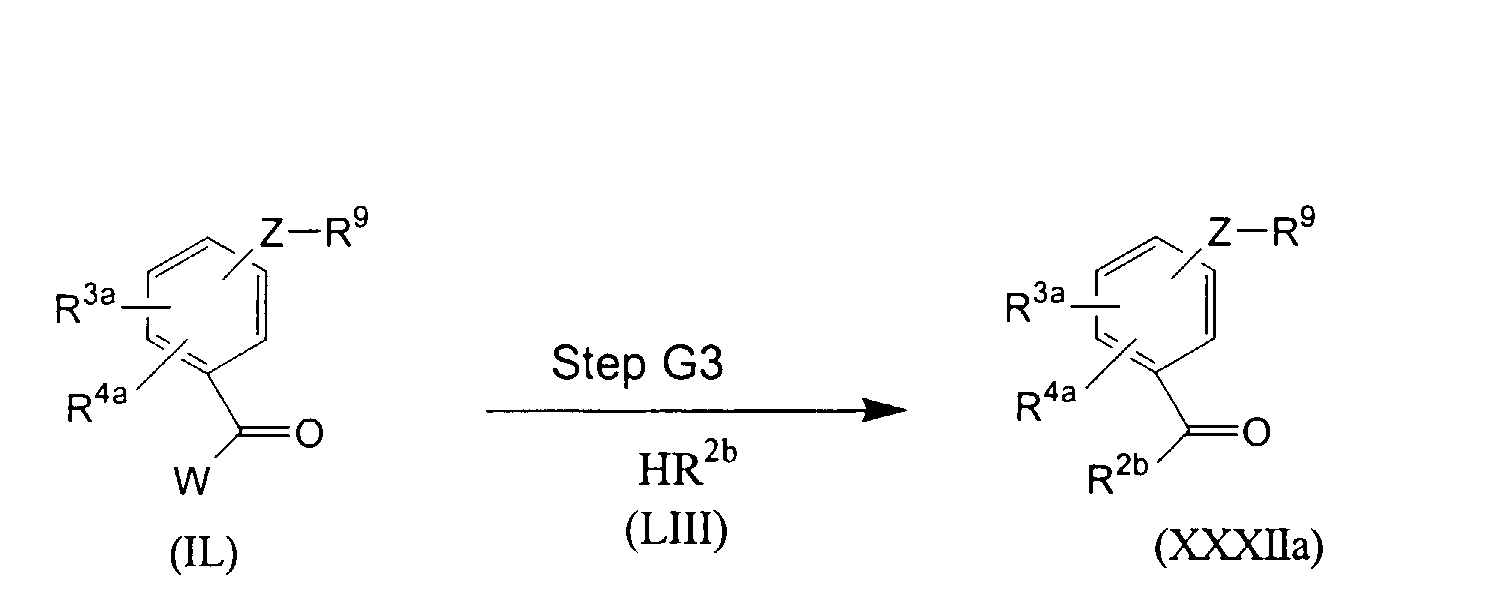
- In this reaction scheme:
- R2a, R3a, R4a, R9, W and Z have the same meanings as described above;
- R2b represents a phenyl group or a phenyl group substituted by at least one of substituents α' (substituents α' has the same meaning as substituents α except that the amino and/or hydroxy group may be protected); and
- R12 represents a lower alkyl group.
-
- In this step the compound of formula (XXXII) is prepared by reacting a compound of formula (IL) with a compound of formula (L) in an inert solvent (preferably a hydrocarbon such as hexane, cyclohexane, benzene, toluene or xylene) at a temperature of from -20 to 200°C (preferably from 0 to 150°C) for a period of from 15 minutes to 24 hours (preferably from 30 minutes to 16 hours).
- In this step there is provided an alternative method of preparing the compound of formula (XXXII) by reacting a compound of formula (LI) with a compound of formula (LII) in an inert solvent (preferably a hydrocarbon such as hexane, cyclohexane, benzene, toluene or xylene, or an ether such as diethyl ether, diisopropyl ether, tetrahydrofuran, dioxane, dimethoxyethane or diethylene glycol dimethyl ether) in the presence of a base (preferably an organolithium such as n-butyl lithium, t-butyl lithium or phenyl lithium) at a temperature of from -150 to 50°C (preferably from -100 to 0°C) for a period of from 15 minutes to 24 hours (preferably from 30 minutes to 16 hours). In order to remove the acid which is generated with the passage of the reaction, the reaction can also be carried out in the presence of an organic amine (preferably N,N,N',N'-tetramethylethylenediamine).
- In this step a compound of formula (XXXIIa) is prepared by reacting the compound of formula (IL) with a compound of formula (LIII) in an inert solvent (preferably a hydrocarbon such as hexane, cyclohexane, benzene, toluene or xylene) at a temperature of from -20 to 200°C (preferably from 0 to 150°C) for a period of from 15 minutes to 24 hours (preferably from 30 minutes to 20 hours).
- Alternatively, this step may be carried out by condensing the compound of formula (IL) with the compound of formula (LIII) by using a Lewis acid (preferably aluminium chloride or zinc chloride) in an inert solvent (preferably a halogenated hydrocarbon such as dichloromethane, 1,2-dichloroethane or carbon tetrachloride, or a sulphoxide such as dimethyl sulphoxide) at a temperature of from 20°C to 200°C (preferably from 50 to 150°C) for a period of from 15 minutes to 24 hours (preferably from 30 minutes to 16 hours).
- After completion of the reaction, the resulting compound of each of these reactions may be collected from the reaction mixture by known methods, for example, by neutralising the reaction mixture as desired, removing any insoluble matter by filtration, adding a water-immiscible organic solvent such as ethyl acetate to separate an organic layer containing the compound, washing with water or the like, drying over anhydrous magnesium sulphate, anhydrous sodium sulphate or anhydrous sodium hydrogencarbonate and distilling off the solvent. If necessary, the compound thus obtained can be separated and purified by known methods by using commonly employed methods for the separation and purification of an organic compound, such as recrystallisation and reprecipitation, in combination, making use of chromatography and eluting with a proper eluant.
- The starting material compounds of formula (XXIX), (XXXIV), (XXXV), (XXXXII), (XXXXIII), (XXXXIV), (XXXXVI), (IL), (L), (LI), (LII) and (LIII) are known compounds or prepared easily by known methods or a method similar thereto [for example, Acta. Chim. Acad. Humg., 34, 75-76(1962), Chem. Ber., 28, 1625(1895), Chem. Abstr., 71, 123951j(1969), etc.]
- Compounds of formula (I), pharmacologically acceptable salts and esters thereof according to the present invention have excellent inhibitory action against an ileal bile acid transporter.
- When each of the compounds of the formula (I) and pharmacologically acceptable salts and esters thereof is employed as a remedy or preventive having the above-described action, it can be administered, as is or after mixed with a pharmacologically acceptable excipient or diluent, in an orally administrable form such as tablets, capsules, granules, powders or syrups or in a parenteral form such as injection or suppository.
- These formulations can be prepared in a known manner by using additives. Examples of such additives include excipients (for example, organic excipients, such as sugar derivatives, e.g. lactose, sucrose, dextrose, mannitol and sorbitol, starch derivatives, such as corn starch, potato starch, α-starch and dextrin, cellulose derivatives, such as crystalline cellulose, gum arabic, dextran, and pullulan; and inorganic excipients, for example, silicate derivatives, such as light silicic anhydride, synthetic aluminium silicate, calcium silicate and magnesium aluminate metasilicate, phosphates, such as calcium hydrogenphosphate, carbonates, such as calcium carbonate, and sulphates, such as calcium sulphate), lubricants (for example, stearic acid, metal salts of stearic acid such as calcium stearate and magnesium stearate, talc, colloidal silica, waxes, such as bee gum and spermaceti, boric acid, adipic acid, sulphates, such as sodium sulphate, glycol, fumaric acid, sodium benzoate, DL leucine, fatty acid sodium salts, lauryl sulphates, such as sodium lauryl sulphate and magnesium lauryl sulphate, silicic acids, such as silicic anhydride and silicic hydrate and the above-exemplified starch derivatives), binders (for example, hydroxypropyl cellulose, hydroxypropylmethyl cellulose, polyvinyl pyrrolidone, macrogol and compounds similar to those exemplified above as excipients), disintegrators (for example, cellulose derivatives, such as low-substitution degree hydroxypropyl cellulose, carboxymethyl cellulose, carboxymethyl cellulose calcium and internally crosslinked carboxymethyl cellulose sodium and chemically modified starches·celluloses, such as carboxymethyl starch, carboxymethyl starch sodium and crosslinked polyvinyl pyrrolidone), stabilisers (paraoxybenzoates, such as methyl paraben and propyl paraben, alcohols, such as chlorobutanol, benzyl alcohol and phenyl ethyl alcohol, benzalkonium chloride, phenols, such as phenol and cresol, thimerosal, dehydroacetic acid, and sorbic acid), corrigents (ordinarily-used sweeteners, acidifiers and perfumes), and diluents.
- The daily dose may vary depending upon the symptoms, age, body weight or the like of the patient, but is, per adult, 1 mg/once (preferably 10 mg/once) as the lower limit and 2000 mg/once (preferably 400 mg/once) as the upper limit in the case of oral administration, while it is 0.1 mg/once (preferably 1 mg/once) as the lower limit and 500 mg/once (preferably 300 mg/once) as the upper limit in the case of intravenous administration. The dose is desirably administered in 1 to 6 portions a day depending on the symptoms.
- The invention is further illustrated by the following non-limiting Examples. In the Examples, DMSO-d6 is hexadeuterated dimethyl sulphoxide.
- Triethylamine (7.3 ml) was added to a solution of 3-nitrobenzophenone (3 g) and (R)-1-phenylethylamine (3.4 ml) in anhydrous dichloromethane (60 ml). A solution of titanium tetrachloride (1.74 ml) in anhydrous dichloromethane (17 ml) was slowly added dropwise to the mixture in an ice bath. This mixture was stirred at ambient temperature for 2 hours. At the end of this time, ethyl acetate and an aqueous solution of sodium hydrogencarbonate were added to the reaction mixture. The mixture was then filtered through a Celite (trade mark) filter aid to remove the insoluble material, and the ethyl acetate layer was separated from the filtrate. The aqueous layer was extracted with ethyl acetate. The ethyl acetate layer and the extract were combined and washed with a saturated aqueous solution of sodium chloride. The organic layer was dried over anhydrous sodium sulphate and concentrated by evaporation under reduced pressure to afford the imine derivative (5.41 g) as a dark brown oil.
- Sodium cyanoborohydride (3.3 g) and acetic acid (1.1 ml) were added to a solution of this oil in ethanol (100 ml). The reaction mixture was heated under reflux for 1 hour, after which it was concentrated by evaporation under reduced pressure. The residue was neutralised with an aqueous solution of sodium hydrogencarbonate and extracted with ethyl acetate three times. The combined ethyl acetate extracts were washed with a saturated aqueous solution of sodium chloride and dried over anhydrous sodium sulphate. The resulting solution was then concentrated by evaporation under reduced pressure. The residue was purified by chromatography through a silica gel column using a 19: 1 by volume mixture of cyclohexane and ethyl acetate as eluant and on a Lobar column using a 19: 1 by volume mixture of cyclohexane and ethyl acetate as eluant under medium pressure to afford isomer A of the title compound (1.43 g) as a yellow oil and isomer B of the title compound (1.12 g) as a yellow oil.
- Nuclear Magnetic Resonance Spectrum (CDCl3) δ ppm:
- 1.40 (3H, doublet, J=6.8 Hz);
- 3.62 (1H, quartet, J=6.8 Hz);
- 4.72 (1H, singlet);
- 7.18-7.40 (10H, multiplet);
- 7.48 (1H, triplet, J=8.0 Hz);
- 7.69 (1H, doublet, J=7.6 Hz);
- 8.10 (1H, doublet of doublets, J=2.0, 8.0 Hz);
- 8.27 (1H, doublet, J=2.0Hz).
-
- Nuclear Magnetic Resonance Spectrum (CDCl3) δ ppm:
- 1.40 (3H, doublet, J=6.6 Hz);
- 3.69 (1H, quartet, J=6.6 Hz);
- 4.69 (1H, singlet);
- 7.24-7.40 (11H, multiplet);
- 7.59 (1H, doublet, J=8.0 Hz);
- 8.02 (1H, doublet of doublets, J=2.0, 8.0 Hz);
- 8.24 (1H, doublet, J=1.7Hz).
-
- Nickel chloride hexahydrate (2.04 g) was added to a solution of 1.43 g of isomer A of N-[(3-nitrophenyl)-phenylmethyl]-N-[(R)-1-phenylethyl]amine [prepared as described in step (a) above] in methanol (30 ml). Sodium borohydride (650 mg) was added in several portions to the mixture in an ice bath, and the mixture was then stirred for 30 minutes. Acetone was added to the reaction mixture, and this mixture was stirred for 20 minutes. The solvent was evaporated from the mixture under reduced pressure. The residue was then partitioned between ethyl acetate and an aqueous solution of sodium hydrogencarbonate, and the aqueous layer was extracted with ethyl acetate two times. The ethyl acetate extracts were combined and washed with a saturated aqueous solution of sodium chloride. It was then dried over anhydrous sodium sulphate and concentrated by evaporation under reduced pressure. The residue was purified by chromatography through a silica gel column using a 3: 1 by volume mixture of cyclohexane and ethyl acetate as the eluant, to afford isomer A of the title compound (1.24 g) as a pale yellow oil.
- Nuclear Magnetic Resonance Spectrum (CDCl3) δ ppm:
- 1.36 (3H, doublet, J=6.6 Hz);
- 3.72 (1H, quartet, J=6.6 Hz);
- 4.53 (1H, singlet);
- 6.57 (1H, doublet of doublets, J=2.5, 8.1 Hz);
- 6.67 (1H, doublet, J=2.0 Hz);
- 6.71 (1H, doublet, J=7.7 Hz);
- 7.10 (1H, triplet, J=7.7 Hz);
- 7.13-7.35 (10H, multiplet).
-
- In a similar manner to that described in relation to isomer A of Example (1b), a solution of N-[(3-nitrophenyl)-phenylmethyl]-N-[(R)-1-phenylethyl]amine (isomer B, 1.71 g) in methanol (30 ml), nickel chloride hexahydrate (2.42 g) and sodium borohydride (772 mg) were reacted, to afford isomer B of the title compound (1.41 g) as a yellow oil.
- Nuclear Magnetic Resonance Spectrum (CDCl3) δ ppm:
- 1.35 (3H, doublet, J=6.7 Hz);
- 3.65 (1H, quartet, J=6.7 Hz);
- 4.53 (1H, singlet);
- 6.50 (1H, doublet of doublets, J=2.0, 8.0 Hz);
- 6.62 (1H, doublet, J=1.7 Hz);
- 6.66 (1H, doublet, J=7.7 Hz);
- 7.03 (1H, triplet, J=8.4 Hz);
- 7.21-7.35 (10H, multiplet).
-
- 3,4-Dimethoxy-3-cyclobutene-1,2-dione (1.17 g) was added a solution of 3-{phenyl-[(R)-phenylethylamino]methyl}phenylamine (isomer A, 1.24 g) [prepared as described in step (b) above] at ambient temperature. After stirring for 1 hour, the reaction mixture was concentrated by evaporation under reduced pressure. The residue was purified by chromatography through a silica gel column using a 1: 1 by volume mixture of cyclohexane and ethyl acetate as the eluant, to afford isomer A of the title compound (1.21 g) as white foamy solid.
- Nuclear Magnetic Resonance Spectrum (CDCl3) δ ppm:
- 1.39 (3H, doublet, J=6.6 Hz);
- 3.67 (1H, quartet, J=6.6 Hz);
- 4.41 (3H, singlet);
- 4.63 (1H, singlet);
- 7.13-7.36 (14H, multiplet).
-
- In a similar manner to that described in relation to isomer A in Example (1c), a solution of 3-{phenyl-[(R)-1-phenylethylamino]methyl}phenylamine (isomer B, 1.41 g) and 3,4-dimethoxy-3-cyclobutene-1,2-dione (796 mg) were reacted, to afford isomer B of the title compound (1.21 g) as white foams.
- Nuclear Magnetic Resonance Spectrum (CDCl3) δ ppm:
- 1.37 (3H, doublet, J=6.6 Hz);
- 3.66 (1H, quartet, J=6.6 Hz);
- 4.41 (3H, singlet);
- 4.61 (1H, singlet);
- 7.08 (1H, doublet, J=7.6 Hz);
- 7.22-7.37 (13H, multiplet).
-
- A solution of ammonia in ethanol (2N, 12 ml) was added to a solution of 3-methoxy-4-〈3-{phenyl-[(R)-1-phenylethylamino]methyl}phenylamino〉-3-cyclobutene-1,2-dione (isomer A, 1.21 g) [prepared as described in step (c) above] in ethanol (25 ml). The mixture was stirred at ambient temperature for 2 hours. At the end of this time, the solvent was evaporated from the reaction mixture under reduced pressure. The residue was suspended in ethyl acetate and filtered to afford isomer A of the title compound (574 mg) as a yellow solid.
- Nuclear Magnetic Resonance Spectrum (DMSO-d6) δ ppm:
- 1.31 (3H, doublet, J=6.6 Hz);
- 3.57 (1H, quartet, J=6.5 Hz);
- 4.49 (1H, singlet);
- 6.98 (1H, doublet, J=7.5 Hz);
- 7.15-7.43 (13H, multiplet). melting point: 189 - 191 °C.
-
- In a similar manner to that described in relation to isomer A in Example (1d), a solution of 3-methoxy-4-〈3-{phenyl-[(R)-1-phenylethylamino]methyl}phenylamino〉-3-cyclobutene-1,2-dione (isomer B, 1.43 g) in ethanol (30 ml)and a solution of ammonia in ethanol (2N, 15 ml) were reacted, to afford isomer B of the title compound (546 mg) as a yellow solid.
- Nuclear Magnetic Resonance Spectrum (DMSO-d6) δ ppm:
- 1.29 (3H, doublet, J=6.7 Hz);
- 3.51 (1H, quartet, J=6.5 Hz);
- 4.46 (1H, singlet);
- 6.91 (1H, doublet, J=7.8 Hz);
- 7.18-7.35 (13H, multiplet). melting point: 196 - 198°C
-
- In a similar manner to that described in Example 1, 3-nitrobenzophenone and (S)-1-phenylethyl amine were reacted, and the reaction mixture was purified to give isomer A (461 mg) and isomer B (431 mg) of the title compound.
-
- melting point: 177°C (dec)
- optical rotation [α]D = +1.0 (c = 1.0, EtOH)
-
-
- melting point: 165°C (dec)
- optical rotation [α]D = -9.9 (c = 1.0, EtOH)
-
- Triethylamine (4.33 ml) was added to a solution of 3-nitro-4'-methoxybenzophenone (2 g) and 3-phenylpropylamine (2.22 ml) in anhydrous dichloromethane (20 ml). A solution of titanium tetrachloride (1.03 ml) in anhydrous dichloromethane (10 ml) was then slowly added dropwise to the mixture in an ice bath. This mixture was stirred at ambient temperature for 1 hour. Ethyl acetate and an aqueous solution of sodium hydrogencarbonate were added to the reaction mixture. This was filtered through a Celite (trade mark) filter aid to remove the insoluble material, and the ethyl acetate layer was separated from the filtrate. The aqueous layer was extracted with ethyl acetate. The ethyl acetate layer and extract were combined and washed with a saturated aqueous solution of sodium chloride. The organic layer was dried over anhydrous sodium sulphate and concentrated by evaporation under reduced pressure, to afford the imine derivative (3.26 g) as a dark brown oil.
- In a similar manner to that described in Example (1a), a solution of this oil in ethanol (60 ml), sodium cyanoborohydride (1.96 g) and acetic acid (0.67 ml) were reacted, to give the title compound (2.79 g) as a yellow oil.
- Nuclear Magnetic Resonance Spectrum (CDCl3) δ ppm:
- 1.82-1.89 (2H, multiplet);
- 2.53-2.70 (4H, multiplet);
- 3.78 (3H, singlet);
- 4.84 (1H, singlet);
- 6.83-6.86 (2H, multiplet);
- 7.15-7.18 (3H, multiplet);
- 7.24-7.28 (4H, multiplet);
- 7.44 (1H, triplet, J=8.0 Hz);
- 7.72 (1H, doublet, J=7.5 Hz);
- 8.05 (1H, doublet, J=7.9 Hz);
- 8.29 (1H, doublet, J=1.9Hz).
-
- In a similar manner to that described in Example (1b), a solution of N-[(4-methoxyphenyl)-(3-nitrophenyl)methyl]-N-(3-phenylpropyl)amine (2.79 g) [prepared as described in step (a) above] in methanol (60 ml), nickel chloride hexahydrate (3.52 g) and sodium borohydride (1.12 g) were reacted, to afford the title compound (2.02 g) as a pale yellow oil.
- Nuclear Magnetic Resonance Spectrum (CDCl3) δ ppm:
- 1.79-1.87 (2H, multiplet);
- 2.57-2.71 (4H, multiplet);
- 3.77 (3H, singlet);
- 4.66 (1H, singlet);
- 6.52 (1H, doublet, J=8.1 Hz);
- 6.71 (1H, doublet, J=7.8 Hz);
- 6.76 (1H, doublet, J=7.8 Hz);
- 6.80-6.84 (2H, multiplet);
- 7.07 (1H, triplet, J=7.7 Hz);
- 7.15-7.18 (3H, multiplet);
- 7.24-7.30 (4H, multiplet).
-
- In a similar manner to that described in Example (1c), a solution of 3-[(4-methoxyphenyl)-(3-phenylpropylamino)methyl]phenylamine (2.02 g) [prepared as described in step (b) above] in methanol (40 ml) and 3,4-dimethoxy-3-cyclobutene-1,2-dione were reacted, to afford the title compound (1.82 g) as yellow foamy solid.
- Nuclear Magnetic Resonance Spectrum (CDCl3) δ ppm:
- 1.84-1.89 (2H, multiplet);
- 2.58-2.68 (4H, multiplet);
- 3.77 (3H, singlet);
- 4.44 (3H, singlet);
- 4.77 (1H, broad singlet);
- 6.84 (2H, doublet, J=8.5 Hz);
- 7.09-7.29 (11H, multiplet).
-
- In a similar manner to that described in Example (1d), 3-methoxy-4-{3-[(4-methoxyphenyl)-(3-phenylpropylamino)methyl]phenylamino}-3-cyclobutene-1,2-dione [prepared as described in step (c) above] and a solution of ammonia in ethanol (2N, 8 ml) were reacted, to afford the title compound (1.58 g) as a yellow solid.
- Nuclear Magnetic Resonance Spectrum (DMSO-d6) δ ppm:
- 1.72-1.79 (2H, multiplet);
- 2.50-2.51 (2H, multiplet);
- 2.61 (2H, triplet, J=7.7 Hz);
- 3.70 (3H, singlet);
- 4.70 (1H, broad singlet);
- 6.84 (2H, doublet, J=8.6 Hz);
- 7.03 (1H, doublet, J=7.6 Hz);
- 7.12-7.40 (10H, multiplet). melting point: 178 - 180°C
-
- Triethylamine (4.33 ml) was added to a solution of 3-nitro-4'-methoxybenzophenone (2 g) and 2-phenylethylamine (1.97 ml) in anhydrous dichloromethane (20 ml). A solution of titanium tetrachloride (1.03 ml) in anhydrous dichloromethane (10 ml) was then slowly added dropwise to the mixture in an ice bath. This mixture was stirred at ambient temperature for 1 hour. Ethyl acetate and an aqueous solution of sodium hydrogencarbonate were added to the reaction mixture, which was then filtered through a Celite (trade mark) filter aid to remove the insoluble material. The ethyl acetate layer was separated from the filtrate. The aqueous layer was extracted with ethyl acetate. The ethyl acetate layer and extract were combined and washed with a saturated aqueous solution of sodium chloride. The organic layer was dried over anhydrous sodium sulphate and concentrated by evaporation under reduced pressure, to afford the imine derivative (2.91 g) as an orange oil.
- In a similar manner to that described in Example (1a), a solution of this oil in ethanol (60 ml), sodium cyanoborohydride (1.96 g) and acetic acid (0.67 ml) were reacted, to afford the title compound (2.70 g) as a yellow oil.
- Nuclear Magnetic Resonance Spectrum (CDCl3) δ ppm:
- 2.75-2.90 (4H, multiplet);
- 3.77 (3H, singlet);
- 4.86 (1H, singlet);
- 5.82 (2H, doublet, J=8.7 Hz);
- 7.15-7.45 (8H, multiplet);
- 7.68 (1H, doublet, J=7.7 Hz);
- 8.04 (1H, doublet of doublets, J=2.0, 8.0 Hz);
- 8.26 (1H, triplet, J=2.0Hz).
-
- In a similar manner to that described in Example (1b), a solution of N-[(4-methoxyphenyl)-(3-nitrophenyl)methyl]-N-(2-phenylethyl)amine (2.70 g) [prepared as described in step (a) above] in methanol (60 ml), nickel chloride hexahydrate (3.52 g) and sodium borohydride (1.12 g) were reacted, to afford the title compound (1.74 g) as a clear colourless oil.
- Nuclear Magnetic Resonance Spectrum (CDCl3) δ ppm:
- 2.80-2.86 (4H, multiplet);
- 3.76 (3H, singlet);
- 4.68 (1H, singlet);
- 6.51 (1H, doublet of doublets, J=3.1, 8.1 Hz);
- 6.65 (1H, singlet);
- 6.71 (1H, doublet, J=7.9 Hz);
- 6.80 (2H, doublet, J=8.7 Hz);
- 7.05 (1H, triplet, J=7.6 Hz);
- 7.15-7.40 (7H, multiplet).
-
- In a similar manner to that described in Example (1c), a solution of 3-[(4-methoxyphenyl)-(2-phenylethylamino)methyl]phenylamine (1.74 g) [prepared as described in step (b) above] in methanol (40 ml) and 3,4-dimethoxy-3-cyclobutene-1,2-dione (776 mg) were reacted, to afford the title compound (1.88 g) as yellow foamy solid.
- Nuclear Magnetic Resonance Spectrum (CDCl3) δ ppm:
- 2.70-3.00 (4H, multiplet);
- 3.75 (3H, singlet);
- 4.42 (3H, singlet);
- 4.46 (1H, singlet);
- 6.70-7.35 (13H, multiplet).
-
- In a similar manner to that described in Example (1d), 3-methoxy-4-{3-[(4-methoxyphenyl)-(2-phenylethylamino)methyl]phenylamino}-3-cyclobutene-1,2-dione (1.88 g) [prepared as described in step (c) above] and a solution of ammonia in ethanol (2N, 8.4 ml) were reacted, to give the title compound (1.66 g) as a yellow solid.
- Nuclear Magnetic Resonance Spectrum (DMSO-d6) δ ppm:
- 2.60-2.85 (4H, multiplet);
- 3.70 (3H, singlet);
- 4.78 (1H, singlet);
- 6.84 (2H, doublet, J=8.6 Hz);
- 7.00-7.45 (11H, multiplet). melting point: 174 - 176°C
-
- Triethylamine (4.33 ml) was added to a solution of 3-nitro-4'-methoxybenzophenone (2 g) and 2-phenylpropylamine (2.27 ml) in anhydrous dichloromethane (20 ml). A solution of titanium tetrachloride (1.03 ml) in anhydrous dichloromethane (10 ml) was slowly added dropwise to the mixture in an ice bath. This mixture was stirred at ambient temperature for 1 hour. At the end of this time, ethyl acetate and an aqueous solution of sodium hydrogencarbonate were added to the reaction mixture. This was filtered through a Celite (trade mark) filter aid to remove the insoluble material, and the ethyl acetate layer was separated from the filtrate. The aqueous layer was extracted with ethyl acetate. The ethyl acetate layer and extract were combined and washed with a saturated aqueous solution of sodium chloride. The organic layer was dried over anhydrous sodium sulphate and concentrated by evaporation under reduced pressure, to afford the imine derivative.
- In a similar manner to that described in Example (1a), a solution of this oil in ethanol (60 ml), sodium cyanoborohydride (1.96 g) and acetic acid (0.67 ml) were reacted, to afford the title compound (3.17 g) as a yellow oil.
Nuclear Magnetic Resonance Spectrum (CDCl3) δ ppm: - 1.25-1.27 (3H, multiplet);
- 2.66-2.79 (2H, multiplet);
- 2.93-2.98 (1H, multiplet);
- 3.76 (3H, singlet);
- 4.78 and 4.80 (total 1H, each singlet);
- 6.78-6.83 (2H, multiplet);
- 7.14-7.44 (8H, multiplet);
- 7.61 and 7.67 (total 1H, each doublet, J=7.9 Hz);
- 8.01-8.05 (1H, multiplet);
- 8.18 and 8.24 (total 1H, each doublet, J=1.8, 1.9Hz).
-
- In a similar manner to that described in Example (1b), a solution of N-[(4-methoxyphenyl)-(3-nitrophenyl)methyl]-N-(2-phenylpropyl)amine (3.17 g) [prepared as described in step (a) above] in methanol (60 ml), nickel chloride hexahydrate (3.7 g) and sodium borohydride (1.18 g) were reacted, to afford the title compound (2.52 g) as a clear purple oil.
Nuclear Magnetic Resonance Spectrum (CDCl3) δ ppm: - 1.24 (3H, doublet, J=7.2 Hz);
- 2.71-2.74 (2H, multiplet);
- 2.92-2.97 (1H, multiplet);
- 3.75 (3H, singlet);
- 4.62 (1H, singlet);
- 6.48-6.81 (5H, multiplet);
- 7.00-7.05 (1H, multiplet);
- 7.15-7.31 (7H, multiplet).
-
- In a similar manner to that described in Example (1c), a solution of 3-[(4-methoxyphenyl)-(2-phenylpropylamino)methyl]phenylamine (2.52 g) [prepared as described in step (b) above] in methanol (25 ml) and 3,4-dimethoxy-3-cyclobutene-1,2-dione (1.09 g) were reacted, to afford the title compound (2.35 g) as a pink foamy solid.
Nuclear Magnetic Resonance Spectrum (CDCl3) δ ppm: - 1.25 (3H, doublet, J=7.3 Hz);
- 2.69-2.79 (2H, broad);
- 2.94-3.02 (1H, broad);
- 3.75 (3H, singlet);
- 4.42 (3H, singlet);
- 4.73 (1H, broad singlet);
- 6.78-6.82 (2H, multiplet);
- 7.00-7.34 (11H, multiplet).
-
- In a similar manner to that described in Example (1d), 3-methoxy-4-{3-[(4-methoxyphenyl)-(2-phenylpropylamino)methyl]phenylamino}-3-cyclobutene-1,2-dione (2.35 g) [prepared as described in step (c) above] and a solution of ammonia in ethanol (2N, 10.2 ml) were reacted, to give the title compound (1.87 g) as a yellow solid.
Nuclear Magnetic Resonance Spectrum (DMSO-d6) δ ppm: - 1.21 (3H, doublet, J=6.9 Hz);
- 2.54-2.65 (2H, multiplet);
- 2.88-2.95 (1H, multiplet);
- 3.686 and 3.694 (total 3H, each singlet);
- 4.69 and 4.70 (total 1H, each singlet);
- 6.82 (2H, triplet, J=8.5 Hz);
- 6.95-7.01 (1H, multiplet);
- 7.14-7.39 (10H, multiplet). melting point: 192 - 194°C
-
- Triethylamine (4.33 ml) was added to a solution of 3-nitro-4'-methoxybenzophenone (2 g) and 3,3-diphenylpropylamine (2.09 ml) in anhydrous dichloromethane (20 ml). A solution of titanium tetrachloride (1.03 ml) in anhydrous dichloromethane (10 ml) was slowly added dropwise to the mixture in an ice bath. This mixture was then stirred at ambient temperature for 1 hour. At the end of this time, ethyl acetate and an aqueous solution of sodium hydrogencarbonate were added to the reaction mixture. This was filtered through a Celite (trade mark) filter aid to remove the insoluble material, and the ethyl acetate layer was separated from the filtrate. The aqueous layer was extracted with ethyl acetate. The ethyl acetate layer and extract were combined and washed with a saturated aqueous solution of sodium chloride. The organic layer was dried over anhydrous sodium sulphate and concentrated by evaporation under reduced pressure, to afford the imine derivative (3.62 g) as a brown oil.
- In a similar manner to that described in Example (1a), a solution of this oil in ethanol (60 ml), sodium cyanoborohydride (1.96 g) and acetic acid (0.67 ml) were reacted, to afford the title compound (3.53 g) as an orange oil.
Nuclear Magnetic Resonance Spectrum (CDCl3) δ ppm: - 2.27 (2H, quartet, J=7.5 Hz);
- 2.45-2.65 (2H, multiplet);
- 3.77 (3H, singlet);
- 4.06 (1H, triplet, J=7.5 Hz);
- 4.76 (1H, singlet);
- 6.82 (2H, doublet, J=8.6 Hz);
- 7.10-7.35 (12H, multiplet);
- 7.39 (1H, triplet, J=8.0 Hz);
- 7.63 (1H, doublet, J=7.5 Hz);
- 8.00-8.05 (1H, multiplet);
- 8.23 (1H, triplet, J=1.6Hz).
-
- In a similar manner to that described in Example (1b), a solution of N-[(4-methoxyphenyl)-(3-nitrophenyl)methyl]-N-(3,3-diphenylpropyl)amine (3.53 g) [prepared as described in step (a) above] in ethanol (70 ml), nickel chloride hexahydrate (3.71 g) and sodium borohydride (1.18 g) were reacted, to afford the title compound (2.67 g) as a yellow oil.
Nuclear Magnetic Resonance Spectrum (CDCl3) δ ppm: - 2.25 (2H, quartet, J=7.5 Hz);
- 2.50-2.60 (2H, multiplet);
- 3.76 (3H, singlet);
- 4.05 (1H, triplet, J=7.5 Hz);
- 4.59 (1H, singlet);
- 6.62 (1H, triplet, J=1.5 Hz);
- 6.48-6.51 (1H, multiplet);
- 6.68 (1H, doublet, J=7.7 Hz);
- 6.79 (2H, doublet, J=8.7 Hz);
- 7.03 (1H, triplet, J=7.8 Hz);
- 7.10-7.35 (12H, multiplet).
-
- In a similar manner to that described in Example (1c), a solution of 3-[(4-methoxyphenyl)-(3,3-diphenylpropylamino)methyl]phenylamine (1.99 g) [prepared as described in step (b) above] in methanol (40 ml) and 3,4-dimethoxy-3-cyclobutene-1,2-dione (701 mg) were reacted, to afford the title compound (1.86 g) as a pale yellow foamy solid.
Nuclear Magnetic Resonance Spectrum (CDCl3) δ ppm: - 2.35-2.45 (2H, multiplet);
- 2.60-2.70 (2H, multiplet);
- 3.76 (3H, singlet);
- 4.02 (1H, triplet, J=7.7 Hz);
- 4.41 (3H, singlet);
- 4.80 (1H, singlet);
- 6.82 (2H, doublet, J=8.6 Hz);
- 7.00-7.40 (16H, multiplet).
-
- In a similar manner to that described in Example (1d), 3-methoxy-4-{3-[(4-methoxyphenyl)-(3,3-diphenylpropylamino)methyl]phenylamino}-3-cyclobutene-1,2-dione (1.86 g) [prepared as described in step (c) above] and a solution of ammonia in ethanol (2N, 7 ml) were reacted, to give the title compound (1.36 g) as a pale yellow solid.
Nuclear Magnetic Resonance Spectrum (DMSO-d6) δ ppm: - 2.10-2.70 (4H, multiplet);
- 3.70 (3H, singlet);
- 4.09 (1H, triplet, J=7.6 Hz);
- 4.70 (1H, broad);
- 6.70-7.50 (18H, multiplet). melting point: 132 - 134°C
-
- Triethylamine (3.22 ml) was added to a solution of 3-nitro-4'-methoxybenzophenone (1.5 g) and 2,2-diphenylethylamine (2.29 g) in anhydrous dichloromethane (15 ml). A solution of titanium tetrachloride (0.77 ml) in anhydrous dichloromethane (10 ml) was slowly added dropwise to the mixture in an ice bath. This mixture was stirred at ambient temperature for 1 hour. At the end of this time, ethyl acetate and an aqueous solution of sodium hydrogencarbonate were added to the reaction mixture. This was filtered through a Celite (trade mark) filter aid to remove the insoluble material, and the ethyl acetate layer was separated from the filtrate. The aqueous layer was extracted with ethyl acetate. The ethyl acetate layer and extract were combined and washed with a saturated aqueous solution of sodium chloride. The organic layer was dried over anhydrous sodium sulphate and concentrated by evaporation under reduced pressure, to afford the imine derivative (3.82 g) as an orange oil.
- In a similar manner to that described in Example (1a), a solution of this oil in ethanol (60 ml), sodium cyanoborohydride (1.46 g) and acetic acid (0.5 ml) were reacted, to afford the title compound (2.54 g) as a yellow oil.
Nuclear Magnetic Resonance Spectrum (CDCl3) δ ppm: - 3.19-3.24 (2H, multiplet);
- 3.76 (3H, singlet);
- 4.22 (1H, triplet, J=7.5 Hz);
- 4.87 (1H, singlet);
- 6.81 (2H, doublet, J=8.7 Hz);
- 7.17-7.30 (12H, multiplet);
- 7.41 (1H, triplet, J=8.0 Hz);
- 7.64 (1H, doublet, J=7.5 Hz);
- 8.03 (1H, doublet, J=7.9 Hz);
- 8.22 (1H, doublet, J=1.9Hz).
-
- In a similar manner to that described in Example (1b), a solution of [(4-methoxyphenyl)-(3-nitrophenyl)methyl]-(2,2-diphenylethyl)amine (2.54 g) [prepared as described in step (a) above] in methanol (50 ml), nickel chloride hexahydrate (2.76 g) and sodium borohydride (878 mg) were reacted, to afford the title compound (2.02 g) as a clear colourless oil.
Nuclear Magnetic Resonance Spectrum (CDCl3) δ ppm: - 3.18 (2H, doublet, J=7.8 Hz);
- 3.75 (3H, singlet);
- 4.21 (1H, triplet, J=7.8 Hz);
- 4.69 (1H, singlet);
- 6.50 (1H, doublet, J=7.0 Hz);
- 6.58-6.59 (1H, multiplet);
- 6.67 (1H, doublet, J=7.5 Hz);
- 6.78 (2H, doublet, J=8.7 Hz);
- 7.03 (1H, triplet, J=7.7 Hz);
- 7.15-7.29 (12H, multiplet).
-
- In a similar manner to that described in Example (1c), a solution of 3-[(4-methoxyphenyl)-(2,2-diphenylethylamino)methyl]phenylamine (2.02 g) [prepared as described in step (b) above] in methanol (40 ml) and 3,4-dimethoxy-3-cyclobutene-1,2-dione (731 mg) were reacted, to afford the title compound (1.35 g) as a white foamy solid.
Nuclear Magnetic Resonance Spectrum (CDCl3) δ ppm: - 3.12-3.17 (1H, multiplet);
- 3.21-3.26 (1H, multiplet);
- 3.76 (3H, singlet);
- 4.19 (1H, triplet, J=7.5 Hz);
- 4.38 (3H, singlet);
- 4.79 (1H, singlet);
- 6.80 (2H, doublet, J=8.7 Hz);
- 7.07-7.29 (16H, multiplet).
-
- In a similar manner to that described in Example (1d), 3-methoxy-4-{3-[(4-methoxyphenyl)-(2,2-diphenylethylamino)methyl]phenylamino}-3-cyclobutene-1,2-dione (1.35 g) [prepared as described in step (c) above] and a solution of ammonia in ethanol (2N, 5.2 ml) were reacted, to give the title compound (1.36 g) as a pale yellow solid.
Nuclear Magnetic Resonance Spectrum (DMSO-d6) δ ppm: - 3.07 (2H, doublet, J=6.9 Hz);
- 3.69 (3H, singlet);
- 4.22 (1H, triplet, J=6.9 Hz);
- 4.79 (1H, broad singlet);
- 6.82 (2H, doublet, J=8.5 Hz);
- 6.98 (1H, doublet, J=7.7 Hz);
- 7.14-7.28 (14H, multiplet);
- 7.36 (1H, doublet, J=7.9Hz). melting point: 193 - 194°C
-
- Triethylamine (4.33 ml) was added to a solution of 3-nitro-4'-methoxybenzophenone (2.0 g) and 2-(3-fluorophenyl)ethylamine (2.04 ml) in anhydrous dichloromethane (20 ml). A solution of titanium tetrachloride (1.03 ml) in anhydrous dichloromethane (10 ml) was slowly added dropwise to the mixture in an ice bath. This mixture was stirred at ambient temperature for 1 hour. At the end of this time, ethyl acetate and an aqueous solution of sodium hydrogencarbonate were added to the reaction mixture. This was filtered through a Celite (trade mark) filter aid to remove the insoluble material, and the ethyl acetate layer was separated from the filtrate. The aqueous layer was extracted with ethyl acetate. The ethyl acetate layer and extract were combined and washed with a saturated aqueous solution of sodium chloride. The organic layer was dried over anhydrous sodium sulphate and concentrated by evaporation under reduced pressure, to afford the imine derivative (2.76 g) as an orange oil.
- In a similar manner to that described in Example (1a), a solution of this oil in ethanol (60 ml), sodium cyanoborohydride (1.96 g) and acetic acid (0.67 ml) were reacted, to afford the title compound (2.51 g) as a yellow oil.
Nuclear Magnetic Resonance Spectrum (CDCl3) δ ppm: - 2.78-2.88 (4H, multiplet);
- 3.77 (3H, singlet);
- 4.85 (1H, singlet);
- 6.82-6.97 (5H, multiplet);
- 7.21-7.26 (3H, multiplet);
- 7.43 (1H, triplet, J=7.8 Hz);
- 7.68 (1H, doublet, J=7.8 Hz);
- 8.05 (1H, doublet, J=8.0 Hz);
- 8.25-8.26 (1H, multiplet).
-
- In a similar manner to that described in Example (1b), a solution of N-[(4-methoxyphenyl)-(3-nitrophenyl)methyl]-N-[2-(3-fluorophenyl)ethyl]amine (2.51 g) [prepared as described in step (a) above] in methanol (50 ml), nickel chloride hexahydrate (3.14 g) and sodium borohydride (1.0 g) were reacted, to afford the title compound (1.94 g) as a yellow oil.
Nuclear Magnetic Resonance Spectrum (CDCl3) δ ppm: - 2.79-2.85 (4H, multiplet);
- 3.77 (3H, singlet);
- 4.67 (1H, singlet);
- 6.51 (1H, doublet, J=8.2 Hz);
- 6.66 (1H, doublet, J=1.9 Hz);
- 6.72 (1H, doublet, J=7.4 Hz);
- 6.81 (2H, doublet, J=8.7 Hz);
- 6.89 (2H, doublet, J=8.9 Hz);
- 6.96 (1H, doublet, J=7.8 Hz);
- 7.05 (1H, triplet, J=7.7 Hz);
- 7.19-7.26 (3H, multiplet).
-
- In a similar manner to that described in Example (1c), a solution of 3-{(4-methoxyphenyl)-[2-(3-fluorophenyl)ethylamino]methyl}phenylamine (1.94 g) [prepared as described in step (b) above] in methanol (40 ml) and 3,4-dimethoxy-3-cyclobutene-1,2-dione (824 mg) were reacted, to afford the title compound (2.07 g) as a white foamy solid.
Nuclear Magnetic Resonance Spectrum (CDCl3) δ ppm: - 2.77-2.88 (4H, multiplet);
- 3.76 (3H, singlet);
- 4.44 (3H, singlet);
- 4.78 (1H, broad singlet);
- 6.79-6.97 (5H, multiplet);
- 7.03-7.28 (7H, multiplet).
-
- In a similar manner to that described in Example (1d), 3-methoxy-4-〈3-{(4-methoxyphenyl)-[2-(3-fluorophenyl)ethylamino]methyl}phenylamino〉-3-cyclobutene-1,2-dione (2.07 g) [prepared as described in step (c) above] and a solution of ammonia in ethanol (2N, 9 ml) were reacted, to give the title compound (1.73 g) as a yellow solid.
Nuclear Magnetic Resonance Spectrum (DMSO-d6) δ ppm: - 2.67 (2H, broad singlet);
- 2.77-2.80 (2H, multiplet);
- 3.70 (3H, singlet);
- 4.76 (1H, broad singlet);
- 6.84 (2H, doublet, J=8.5 Hz);
- 6.96-7.03 (4H, multiplet);
- 7.21-7.39 (6H, multiplet). melting point: 139 - 141 °C
-
- Triethylamine (4.8 ml) was added to a solution of 3-nitro-4'-methoxybenzophenone (1.5 g) and 1-(3,5-difluorophenyl)ethylamine hydrochloride (2.26 g) in anhydrous dichloromethane (30 ml). A solution of titanium tetrachloride (0.77 ml) in anhydrous dichloromethane (10 ml) was slowly added dropwise to the mixture in an ice bath. This mixture was stirred at ambient temperature for 1 hour. At the end of this time, ethyl acetate and an aqueous solution of sodium hydrogencarbonate were added to the reaction mixture. This was filtered through a Celite (trade mark) filter aid to remove the insoluble material, and the ethyl acetate layer was separated from the filtrate. The aqueous layer was extracted with ethyl acetate. The ethyl acetate layer and extract were combined and washed with a saturated aqueous solution of sodium chloride. The organic layer was dried over anhydrous sodium sulphate and concentrated by evaporation under reduced pressure, to afford the imine derivative (3.12 g) as an orange oil.
- In a similar manner to that described in Example (1a), a solution of this oil in ethanol (60 ml), sodium cyanoborohydride (1.46 g) and acetic acid (0.5 ml) were reacted, to afford the title compound (2.65 g) as a yellow oil.
Nuclear Magnetic Resonance Spectrum (CDCl3) δ ppm: - 1.34-1.38 (3H, multiplet);
- 3.58-3.70 (1H, multiplet);
- 3.76 and 3.82 (total 3H, each singlet);
- 4.63 and 4.69 (total 1H, each singlet);
- 6.65-7.93 (5H, multiplet);
- 7.15-7.20 (2H, multiplet);
- 7.38-7.68 (2H, multiplet);
- 8.02-8.28 (2H, multiplet).
-
- In a similar manner to that described in Example (1b), a solution of N-[(4-methoxyphenyl)-(3-nitrophenyl)methyl]-N-[1-(3,5-difluorophenyl)ethyl]amine (2.65 g) [prepared as described in step (a) above] in methanol (50 ml), nickel chloride hexahydrate (3.16 g) and sodium borohydride (1.0 g) were reacted, to afford the title compound (2.24 g) as a pale orange oil.
Nuclear Magnetic Resonance Spectrum (CDCl3) δ ppm: - 1.31 (3H, doublet, J=6.6 Hz);
- 3.55-3.73 (1H, multiplet);
- 3.76 and 3.80 (total 3H, each singlet);
- 4.47 (1H, singlet);
- 6.50-7.26 (11H, multiplet).
-
- In a similar manner to that described in Example (1c), a solution of 3-{(4-methoxyphenyl)-[1-(3,5-difluorophenyl)ethylamino]methyl}phenylamine (2.24 g) [prepared as described in step (b) above] in methanol (20 ml) and 3,4-dimethoxy-3-cyclobutene-1,2-dione (950 mg) were reacted, to afford the title compound (2.2 g) as a white foamy solid.
Nuclear Magnetic Resonance Spectrum (CDCl3) δ ppm: - 1.32-1.37 (3H, multiplet);
- 3.65 (1H, quartet, J=6.6 Hz);
- 3.76 and 3.81 (total 3H, each singlet);
- 4.44 (3H, singlet);
- 4.55 and 4.58 (total 1H, each singlet);
- 6.63-7.35 (11H, multiplet).
-
- In a similar manner to that described in Example (1d), 3-methoxy-4-〈3-{(4-methoxyphenyl)-[1-(3,5-difluorophenyl)ethylamino]methyl}phenylamino〉>-3-cyclobutene-1,2-dione (2.2 g) [prepared as described in step (c) above] and a solution of ammonia in ethanol (2N, 9.2 ml) were reacted, to give the title compound (1.86 g) as a yellow solid.
Nuclear Magnetic Resonance Spectrum (DMSO-d6) δ ppm: - 1.26-1.31 (3H, multiplet);
- 3.50-3.65 (1H, multiplet);
- 3.69 and 3.73 (total 3H, each singlet);
- 4.43 and 4.46 (total 1H, each singlet);
- 6.80-7.50 (11H, multiplet). melting point: 177 - 181°C
-
- Triethylamine (4.33ml) was added to a solution of 3-nitro-4'-methoxybenzophenone (2 g) and 1-(4-pyridyl)ethylamine (1.91 g) in anhydrous dichloromethane (40 ml). A solution of titanium tetrachloride (1.03 ml) in anhydrous dichloromethane (10 ml) was slowly added dropwise to the mixture in an ice bath. This mixture was stirred at ambient temperature for 1 hour. At the end of this time, ethyl acetate and an aqueous solution of sodium hydrogencarbonate were added to the reaction mixture. This was filtered through a Celite (trade mark) filter aid to remove the insoluble material, and the ethyl acetate layer was separated from the filtrate. The aqueous layer was extracted with ethyl acetate. The ethyl acetate layer and extract were combined and washed with a saturated aqueous solution of sodium chloride. The organic layer was dried over anhydrous sodium sulphate and concentrated by evaporation under reduced pressure, to afford the imine derivative (3.13 g) as an orange oil.
- In a similar manner to that described in Example (1a), a solution of this oil in ethanol (60 ml), sodium cyanoborohydride (1.96 g) and acetic acid (0.7 ml) were reacted, to afford the title compound (2.41 g) as a yellow oil.
Nuclear Magnetic Resonance Spectrum (CDCl3) δ ppm: - 1.36-1.41 (3H, multiplet);
- 3.58-3.72 (1H, multiplet);
- 3.76 and 3.81 (total 3H, each singlet);
- 4.61 and 4.66 (total 1H, each singlet);
- 6.79-6.92 (2H, multiplet);
- 7.10-7.23 (4H, multiplet);
- 7.40 and 7.48 (total 1H, each triplet, J=7.9 Hz);
- 7.58 and 7.64 (total 1H, each doublet, J=7.9 Hz);
- 8.02-8.13 (1H, multiplet);
- 8.23-8.28 (1H, multiplet);
- 8.52-8.62 (2H, multiplet).
-
- In a similar manner to that described in Example (1b), a solution of N-[(4-methoxyphenyl)-(3-nitrophenyl)methyl]-N-[1-(4-pyridyl)ethyl]amine (2.41 g) [prepared as described in step (a) above] in ethanol (40 ml), nickel chloride hexahydrate (3.14 g) and sodium borohydride (1.0 g) were reacted, to afford the title compound (1.09 g) as a yellow oil.
Nuclear Magnetic Resonance Spectrum (CDCl3) δ ppm: - 1.34 (3H, doublet, J=6.6 Hz);
- 3.55-3.75 (1H, multiplet);
- 3.76 and 3.80 (total 3H, each singlet);
- 4.44 (1H, singlet);
- 6.50-7.25 (10H, multiplet);
- 8.52-8.60 (2H, multiplet).
-
- In a similar manner to that described in Example (1c), a solution of 3-{(4-methoxyphenyl)-[1-(4-pyridyl)ethylamino]methyl}phenylamine (1.09 g) [prepared as described in step (b) above] in methanol (20 ml) and 3,4-dimethoxy-3-cyclobutene-1,2-dione (511 mg) were reacted, to afford the title compound (1.21 g) as a yellow foamy solid.
Nuclear Magnetic Resonance Spectrum (CDCl3) δ ppm: - 1.25-1.40 (3H, multiplet);
- 3.60-3.75 (1H, multiplet);
- 3.75 and 3.80 (total 3H, each singlet);
- 4.50-4.60 (1H, multiplet);
- 6.65-8.65 (12H, multiplet).
-
- In a similar manner to that described in Example (1d), a solution of 3-methoxy-4-〈3-{(4-methoxyphenyl)-[1-(4-pyridyl)ethylamino]methyl}phenylamino〉-3-cyclobutene-1,2-dione (1.21 g) [prepared as described in step (c) above] in ethanol (10 ml) and a solution of ammonia in ethanol (2N, 6 ml) were reacted, to give the title compound (1.0 g) as a yellow solid.
Nuclear Magnetic Resonance Spectrum (DMSO-d6) δ ppm: - 1.20-1.35 (3H, multiplet);
- 3.50-3.62 (1H, multiplet);
- 3.69 and 3.73 (total 3H, each singlet);
- 4.41 and 4.45 (total 1H, each singlet);
- 7.15-7.45 (7H, multiplet);
- 7.80-8.00 (3H, multiplet);
- 8.48-8.52 (2H, multiplet). melting point: 125°C (dec)
-
- Triethylamine (4.6ml) was added to a solution of 3-nitro-4'-methoxybenzophenone (1.41 g) and 1-(2-thienyl)ethylamine hydrochloride (1.78 g) in anhydrous dichloromethane (20 ml). A solution of titanium tetrachloride (0.73 ml) in anhydrous dichloromethane (10 ml) was slowly added dropwise to the mixture in an ice bath. This mixture was stirred at ambient temperature for 1 hour. At the end of this time, ethyl acetate and an aqueous solution of sodium hydrogencarbonate were added to the reaction mixture. This was filtered through a Celite (trade mark) filter aid to remove the insoluble material, and the ethyl acetate layer was separated from the filtrate. The aqueous layer was extracted with ethyl acetate. The ethyl acetate layer and extract were combined and washed with a saturated aqueous solution of sodium chloride. The organic layer was dried over anhydrous sodium sulphate and concentrated by evaporation under reduced pressure, to afford the imine derivative (2.35 g) as a red oil.
- In a similar manner to that described in Example (1a), a solution of this oil in ethanol (40 ml), sodium cyanoborohydride (1.38 g) and acetic acid (0.48 ml) were reacted, to afford the title compound (2.11 g) as a yellow oil.
Nuclear Magnetic Resonance Spectrum (CDCl3) δ ppm: - 1.45-1.52 (3H, multiplet);
- 3.76 and 3.81 (total 3H, each singlet);
- 3.87-4.01 (1H, multiplet);
- 4.84 and 4.86 (total 1H, each singlet);
- 6.75-7.00 (4H, multiplet);
- 7.15-7.30 (3H, multiplet);
- 7.41 and 7.49 (total 1H, triplet, J=8.0 Hz);
- 7.65 and 7.74 (total 1H, each doublet, J=7.4 Hz);
- 8.00-8.12 (1H, multiplet);
- 8.22-8.33 (1H, multiplet).
-
- In a similar manner to that described in Example (1b), a solution of N-[(4-methoxyphenyl)-(3-nitrophenyl)methyl]-N-[1-(2-thienyl)ethyl]amine (2.11 g) [prepared as described in step (a) above] in ethanol (40 ml), nickel chloride hexahydrate (2.71 g) and sodium borohydride (863 mg) were reacted, to afford the title compound (1.66 g) as a dark brown oil.
Nuclear Magnetic Resonance Spectrum (CDCl3) δ ppm: - 1.46 (3H, doublet, J=6.6 Hz);
- 3.75 and 3.80 (total 3H, each singlet);
- 3.90-4.02 (1H, multiplet);
- 4.68 (1H, singlet);
- 6.47-7.30 (11H, multiplet).
-
- In a similar manner to that described in Example (1c), a solution of 3-{(4-methoxyphenyl)-[1-(2-thienyl)ethylamino]methyl}phenylamine (1.66 g) [prepared as described in step (b) above] in methanol (30 ml) and 3,4-dimethoxy-3-cyclobutene-1,2-dione (767 mg) were reacted, to afford the title compound (1.97 g) as a white foamy solid.
Nuclear Magnetic Resonance Spectrum (CDCl3) δ ppm: - 1.45-1.51 (3H, multiplet);
- 3.76 and 3.81 (total 3H, each singlet);
- 3.90-4.00 (1H, multiplet);
- 4.44 (3H, singlet);
- 4.76 and 4.78 (total 1H, each singlet);
- 6.78-7.35 (11H, multiplet).
-
- In a similar manner to that described in Example (1d), a solution 3-methoxy-4-〈3-{(4-methoxyphenyl)-[1-(2-thienyl)ethylamino]methyl}phenylamino〉-3-cyclobutene-1,2-dione (1.97 g) [prepared as described in step (c) above] in ethanol (40 ml) and a solution of ammonia in ethanol (2N, 10 ml) were reacted, to give the title compound (1.59 g) as a yellow solid.
Nuclear Magnetic Resonance Spectrum (DMSO-d6) δ ppm: - 1.35-1.45 (3H, multiplet);
- 3.69 and 3.73 (total 3H, each singlet);
- 3.75-3.90 (1H, multiplet);
- 4.63 and 4.66 (total 1H, each singlet);
- 6.80-7.50 (11H, multiplet). melting point: 178 - 180°C
-
- Triethylamine (7.3ml) was added to a solution of 3-nitrobenzophenone (2.0 g) and 1-(3,5-difluorophenyl)ethylamine hydrochloride (3.41 g) in anhydrous dichloromethane (40 ml). A solution of titanium tetrachloride (1.16 ml) in anhydrous dichloromethane (11 ml) was slowly added dropwise to the mixture in an ice bath. This mixture was stirred at ambient temperature for 1 hour. At the end of this time, ethyl acetate and an aqueous solution of sodium hydrogencarbonate were added to the reaction mixture. This was filtered through a Celite (trade mark) filter aid to remove the insoluble material, and the ethyl acetate layer was separated from the filtrate. The aqueous layer was extracted with ethyl acetate. The ethyl acetate layer and extract were combined and washed with a saturated aqueous solution of sodium chloride. The organic layer was dried over anhydrous sodium sulphate and concentrated by evaporation under reduced pressure, to afford the imine derivative.
- In a similar manner to that described in Example (1a), a solution of this oil in ethanol (60 ml), sodium cyanoborohydride (2.21 g) and acetic acid (0.76 ml) were reacted, and the reaction mixture was purified to afford isomer A (904 mg, as a colourless oil)and isomer B (897 mg, as a white solid) of the title compound.
- Nuclear Magnetic Resonance Spectrum (CDCl3) δ ppm:
- 1.37 (3H, doublet, J=6.6 Hz);
- 3.63 (1H, quartet, J=6.6 Hz);
- 4.73 (1H, singlet);
- 6.65-6.80 (3H, multiplet);
- 7.20-7.35 (5H, multiplet);
- 7.50 (1H, triplet, J=7.8 Hz);
- 7.66 (1H, doublet, J=7.4 Hz);
- 8.10-8.13 (1H, multiplet);
- 8.26-8.28 (1H, multiplet).
-
- Nuclear Magnetic Resonance Spectrum (CDCl3) δ ppm:
- 1.36 (3H, doublet, J=6.6 Hz);
- 3.67 (1H, quartet, J=6.6 Hz);
- 4.68 (1H, singlet);
- 6.65-6.85 (3H, multiplet);
- 7.20-7.45 (6H, multiplet);
- 7.61 (1H, doublet, J=7.4 Hz);
- 8.04 (1H, doublet of doublets, J=1.8, 7.8 Hz);
- 8.24 (1H, broad singlet). melting point: 119 - 121 °C
-
- In a similar manner to that described in Example (1b), a solution of isomer A of [(3-nitrophenyl)phenylmethyl]-[1-(3,5-difluorophenyl)ethyl]amine (900 mg) [prepared as described in step (a) above] in methanol (20 ml), nickel chloride hexahydrate (1.14 g) and sodium borohydride (363 mg) were reacted, to afford isomer A of the title compound (739 mg) as a pale yellow oil.
- Nuclear Magnetic Resonance Spectrum (CDCl3) δ ppm:
- 1.32 (3H, doublet, J=6.6 Hz);
- 3.70 (1H, quartet, J=6.6 Hz);
- 4.51 (1H, singlet);
- 6.55-6.87 (6H, multiplet);
- 7.07-7.40 (6H, multiplet).
-
- In a similar manner to that described in Example (1b), a solution of isomer B of [(3-nitrophenyl)-phenylmethyl]-[1-(3,5-difluorophenyl)ethyl]amine (890 mg) in methanol (20 ml), nickel chloride hexahydrate (1.14 g) and sodium borohydride (363 mg) were reacted, to afford isomer B of the title compound (791 mg) as a colourless oil.
- Nuclear Magnetic Resonance Spectrum (CDCl3) δ ppm:
- 1.32 (3H, doublet, J=6.7 Hz);
- 3.64 (1H, quartet, J=6.7 Hz);
- 4.52 (1H, singlet);
- 6.50-7.35 (12H, multiplet).
-
- In a similar manner to that described in Example (1c), a solution of isomer A of 3-{phenyl-[1-(3,5-difluorophenyl)ethylamino]methyl}phenylamine (733 mg) [prepared as described in step (b) above] in methanol (10 ml) and 3,4-dimethoxy-3-cyclobutene-1,2-dione (341 mg) were reacted, to afford isomer A of the title compound (814 mg) as a white solid.
- Nuclear Magnetic Resonance Spectrum (CDCl3) δ ppm:
- 1.36 (3H, doublet, J=6.6 Hz);
- 3.66 (1H, quartet, J=6.6 Hz);
- 4.43 (3H, singlet);
- 4.62 (1H, singlet);
- 6.65-6.85 (3H, multiplet);
- 7.10-7.40 (9H, multiplet). melting point: 155 - 157°C
-
- In a similar manner to that described in Example (1c), a solution of isomer B of 3-{phenyl-[1-(3,5-difluorophenyl)ethylamino]methyl}phenylamine (785 mg) in methanol (10 ml) and 3,4-dimethoxy-3-cyclobutene-1,2-dione (355 mg) were reacted, to afford isomer B of the title compound (888 mg) as a white foamy solid.
- Nuclear Magnetic Resonance Spectrum (CDCl3) δ ppm:
- 1.34 (3H, doublet, J=6.6 Hz);
- 3.65 (1H, doublet, J=6.6 Hz);
- 4.43 (3H, singlet);
- 4.60 (1H, singlet);
- 6.65-7.40 (12H, multiplet).
-
- In a similar manner to that described in Example (1d), a solution of isomer A of 3-methoxy-4-〈3-{phenyl)-[1-(3,5-difluorophenyl)ethylamino]methyl}phenylamino〉-3-cyclobutene-1,2-dione (810 mg) [prepared as described in step (c) above] in tetrahydrofuran (5 ml) and a solution of ammonia in ethanol (2N, 3.6 ml) were reacted, to give isomer A of the title compound (733 mg) as a yellow solid.
- Nuclear Magnetic Resonance Spectrum (DMSO-d6) δ ppm:
- 1.30 (3H, doublet, J=6.6 Hz);
- 3.61 (1H, quartet, J=6.6 Hz);
- 4.50 (1H, singlet);
- 6.95-7.45 (12H, multiplet). melting point: 184°C (dec)
-
- In a similar manner to that described in Example (1d), a solution of isomer B of 3-methoxy-4-〈3-{phenyl-[1-(3,5-difluorophenyl)ethylamino]methylphenylamino〉-3-cyclobutene-1,2-dione (880 mg) in ethanol(5 ml) and a solution of ammonia in ethanol (2N, 4.0 ml) were reacted, to give isomer B of the title compound (708 mg) as a pale yellow solid.
- Nuclear Magnetic Resonance Spectrum (DMSO-d6) δ ppm:
- 1.28 (3H, doublet, J=6.6 Hz);
- 3.55 (1H, quartet, J=6.6 Hz);
- 4.49 (1H, singlet);
- 6.80-7.45 (12H, multiplet). melting point: 197°C (dec)
-
- Triethylamine (4.33ml) was added to a solution of 3-nitro-3',4'-dimethylbenzophenone (2.0 g) and (S)-1-phenylethylamine (1.99 ml) in anhydrous dichloromethane (20 ml). A solution of titanium tetrachloride (1.03 ml) in anhydrous dichloromethane (10 ml) was slowly added dropwise to the mixture in an ice bath. This mixture was stirred at ambient temperature for 1 hour. At the end of this time, ethyl acetate and an aqueous solution of sodium hydrogencarbonate were added to the reaction mixture. This was filtered through a Celite (trade mark) filter aid to remove the insoluble material, and the ethyl acetate layer was separated from the filtrate. The aqueous layer was extracted with ethyl acetate. The ethyl acetate layer and extract were combined and washed with a saturated aqueous solution of sodium chloride. The organic layer was dried over anhydrous sodium sulphate and concentrated by evaporation under reduced pressure, to afford the imine derivative (2.92 g) as a yellow oil.
- In a similar manner to that described in Example (1a), a solution of this oil in ethanol (60 ml), sodium cyanoborohydride (2.21 g) and acetic acid (0.76 ml) were reacted, and the reaction mixture was purified to afford isomer A (1.10 g) as a colourless oil and isomer B (1.19 g) as a pale yellow oil of the title compound.
- Nuclear Magnetic Resonance Spectrum (CDCl3) δ ppm:
- 1.39 (3H, doublet, J=6.7 Hz);
- 2.20 (6H, singlet);
- 3.60 (1H, quartet, J=6.7 Hz);
- 4.65 (1H, singlet);
- 6.97-7.37 (8H, multiplet);
- 7.46 (1H, triplet, J=7.9 Hz);
- 7.69 (1H, doublet, J=7.5 Hz);
- 8.08 (1H, doublet, J=8.0 Hz);
- 8.26-8.28 (1H, multiplet).
-
- Nuclear Magnetic Resonance Spectrum (CDCl3) δ ppm:
- 1.38 (3H, doublet, J=6.7 Hz);
- 2.25 (6H, singlet);
- 3.70 (1H, quartet, J=6.7 Hz);
- 4.63 (1H, singlet);
- 7.01-7.02 (2H, multiplet);
- 7.11 (1H, doublet, J=8.2 Hz);
- 7.22-7.38 (6H, multiplet);
- 7.59 (1H, doublet, J=7.4 Hz);
- 8.01 (1H, doublet, J=8.0 Hz);
- 8.23-8.24 (1H, multiplet).
-
- In a similar manner to that described in Example (1b), a solution of isomer A of N-[(3-nitrophenyl)-(3,4-dimethylphenyl)methyl]-N-[(S)-1-phenylethyl]amine (1.10 g) [prepared as described in step (a) above] in methanol (20 ml), nickel chloride hexahydrate (1.45 g) and sodium borohydride (469 mg) were reacted, to afford isomer A of the title compound (954 mg) as a yellow oil.
- Nuclear Magnetic Resonance Spectrum (CDCl3) δ ppm:
- 1.35 (3H, doublet, J=6.6 Hz);
- 2.19 (6H, singlet);
- 3.70 (1H, quartet, J=6.6 Hz);
- 4.47 (1H, singlet);
- 6.55 (1H, doublet, J=8.2 Hz);
- 6.68-6.69 (1H, multiplet);
- 6.71 (1H, doublet, J=7.7 Hz);
- 7.03 (1H, singlet);
- 7.09 (1H, triplet, J=7.7 Hz);
- 7.22-7.34 (7H, multiplet).
-
- In a similar manner to that described in Example (1b), a solution of isomer B of N-[(3-nitrophenyl)-(3,4-dimethylphenyl)methyl]-N-[(S)-1-phenylethyl]amine (1.19 g) in methanol (20 ml), nickel chloride hexahydrate (1.57 g) and sodium borohydride (500 mg) were reacted, to afford isomer B of the title compound (849 mg) as a colourless oil.
- Nuclear Magnetic Resonance Spectrum (CDCl3) δ ppm:
- 1.35 (3H, doublet, J=6.9 Hz);
- 2.23 (6H, singlet);
- 3.67 (1H, quartet, J=6.9 Hz);
- 4.47 (1H, singlet);
- 6.49 (1H, doublet, J=8.1 Hz);
- 6.62-6.63 (1H, multiplet);
- 6.66 (1H, doublet, J=7.6 Hz);
- 7.00-7.09 (4H, multiplet);
- 7.24-7.35 (5H, multiplet).
-
- In a similar manner to that described in Example (1c), a solution of isomer A of 3-{(3,4-dimethylphenyl)-[(S)-1-phenylethylamino]methyl}phenylamine (950 mg) [prepared as described in step (b) above] in methanol (15 ml) and 3,4-dimethoxy-3-cyclobutene-1,2-dione (430 mg) were reacted, to afford isomer A of the title compound (976 mg) as a white foamy solid.
- Nuclear Magnetic Resonance Spectrum (CDCl3) δ ppm:
- 1.38 (3H, doublet, J=6.6 Hz);
- 2.20 (6H, singlet);
- 3.65 (1H, quartet, J=6.6 Hz);
- 4.42 (3H, singlet);
- 4.56 (1H, singlet);
- 6.98-7.04 (3H, multiplet);
- 7.13-7.36 (9H, multiplet).
-
- In a similar manner to that described in Example (1c), a solution of isomer B of 3-{(3,4-dimethylphenyl)-[(S)-1-phenylethylamino]methyl}phenylamine (845 mg) in methanol (15 ml) and 3,4-dimethoxy-3-cyclobutene-1,2-dione (382 mg) were reacted, to afford isomer B of the title compound (1.04 g) as a white foamy solid.
- Nuclear Magnetic Resonance Spectrum (CDCl3) δ ppm:
- 1.36 (3H, doublet, J=6.6 Hz);
- 2.25 (6H, singlet);
- 3.68 (1H, quartet, J=6.6 Hz);
- 4.42 (3H, singlet);
- 4.55 (1H, singlet);
- 7.03-7.12 (5H, multiplet);
- 7.20-7.35 (7H, multiplet).
-
- In a similar manner to that described in Example (1d), a solution of isomer A of 3-methoxy-4-〈3-{(3,4-dimethylphenyl)-[(S)-1-phenylethylamino]methyl}phenylamino〉-3-cyclobutene-1,2-dione (970 mg) [prepared as described in step (c) above] in ethanol (10 ml) and a solution of ammonia in ethanol (2N, 4.4 ml) were reacted, to give isomer A of the title compound (604 mg) as a yellow solid.
- Nuclear Magnetic Resonance Spectrum (DMSO-d6) δ ppm:
- 1.30 (3H, doublet, J=6.6 Hz);
- 2.13 (3H, singlet);
- 2.14 ( 3H, singlet);
- 3.55 (1H, quartet, J=6.6 Hz);
- 4.42 (1H, singlet);
- 6.96 (1H, doublet, J=7.6 Hz);
- 6.99-7.03 (2H, multiplet);
- 7.08 (1H, singlet);
- 7.21-7.33 (7H, multiplet);
- 7.41 (1H, doublet, J=7.9Hz). melting point: 182 - 185°C
-
- In a similar manner to that described in Example (1d), a solution of isomer B of 3-methoxy-4-〈3-{(3,4-dimethylphenyl)-[(S)-1-phenylethylamino]methyl}phenylamino〉-3-cyclobutene-1,2-dione (1.04 g) in ethanol (10 ml) and a solution of ammonia in ethanol (2N, 4.8 ml) were reacted, to give isomer B of the title compound (899 mg) as a yellow solid.
- Nuclear Magnetic Resonance Spectrum (DMSO-d6) δ ppm:
- 1.27 (3H, doublet, J=6.6 Hz);
- 2.18 (3H, singlet);
- 2.19 (3H, singlet);
- 3.52 (1H, quartet, J=6.6 Hz);
- 4.39 (1H, singlet);
- 6.90 (1H, doublet, J=7.6 Hz);
- 7.03-7.08 (3H, multiplet);
- 7.17-7.33 (7H, multiplet);
- 7.43 (1H, doublet, J=8.0Hz). melting point: 222 - 225°C
-
- In a similar manner to that described in Example (1a), 4-chloro-3-nitro-benzophenone (2.0 g), (S)-1-phenylethylamine (1.94 ml), triethylamine (4.2 ml) and titanium tetrachloride (1.16 ml) were reacted, to afford the imine derivative.
- In a similar manner to that described in Example (1a), the imine derivative, sodium cyanoborohydride (1.91 g) and acetic acid (0.65 ml) were reacted, to afford the title compound (2.89 g) as a yellow oil.
- Nuclear Magnetic Resonance Spectrum (CDCl3) δ ppm:
- 1.35-1.43 (3H, multiplet);
- 3.55-3.70 (1H, multiplet);
- 4.61 and 4.64 (total 1H, each singlet);
- 7.15-7.53 (12H, multiplet);
- 7.88-7.95 (1H, multiplet).
-
- In a similar manner to that described in Example (1b), N-[(4-chloro-3-nitrophenyl)phenylmethyl]-[(S)-1-phenylethyl]amine (2.89 g) [prepared as described in step (a) above], nickel chloride hexahydrate (3.76 g) and sodium borohydride (1.2 g) were reacted, to afford the title compound (2.36 g) as a pale yellow oil.
- Nuclear Magnetic Resonance Spectrum (CDCl3) δ ppm:
- 1.32-1.40 (3H, multiplet);
- 3.60-3.72 (1H, multiplet);
- 4.49 and 4.50 (total 1H, each singlet);
- 6.58-6.77 (2H, multiplet);
- 7.08-7.40 (11H, multiplet).
-
- In a similar manner to that described in Example (1c), 2-chloro-3-{phenyl-[(S)-1-phenylethylamino]methyl}phenylamine (2.36 g) [prepared as described in step (b) above] and 3,4-dimethoxy-3-cyclobutene-1,2-dione (1.05 g) were reacted, to afford the title compound (2.42 g) as a white foamy solid.
- Nuclear Magnetic Resonance Spectrum (CDCl3) δ ppm:
- 1.35-1.45 (3H, multiplet);
- 3.65 (1H, quartet, J=6.6 Hz);
- 4.36 and 4.39 (total 3H, each singlet);
- 4.60 and 4.61 (total 1H, each singlet);
- 7.00-7.40 (13H, multiplet).
-
- In a similar manner to that described in Example (1d), a solution of 3-methoxy-4-〈2-chloro-5-{phenyl-[(S)-1-phenylethylamino]methyl}phenylamino〉-3-cyclobutene-1,2-dione (2.42 g) [prepared as described in step (c) above] in ethanol (25 ml) and a solution of ammonia in ethanol (2N, 10.8 ml) were reacted. The reaction mixture was concentrated by evaporation under reduced pressure, and the crude product was dissolved in ethyl acetate (20 ml). A solution of hydrogen chloride in ethyl acetate (4N, 5.4 ml) was added to the solution, and the precipitate was suspended in diethyl ether and filtered, to give the title compound (2.32 g) as a pale yellow solid.
- Nuclear Magnetic Resonance Spectrum (DMSO-d6) δ ppm:
- 1.68 (3H, doublet, J=6.3 Hz);
- 4.23 and 4.40 (total 1H, each broad);
- 5.00 and 5.30 (total 1H, each broad);
- 7.15-7.80 (13H, multiplet). melting point: 187 - 194°C
-
- In a similar manner to that described in Example (1a), 2-chloro-5-nitro-benzophenone (2.0 g), (S)-1-phenylethylamine (1.94 ml) triethylamine (4.2 ml) and titanium tetrachloride (1.0 ml) were reacted, to afford the imine derivative.
- In a similar manner to that described in Example (1a), this imine derivative, sodium cyanoborohydride (1.91 g) and acetic acid (0.65 ml) were reacted, to afford the title compound (2.58 g) as an orange oil.
- Nuclear Magnetic Resonance Spectrum (CDCl3) δ ppm:
- 1.40-1.44 (3H, multiplet);
- 3.59 and 3.75 (total 1H, each quartet, J=6.6 Hz);
- 5.07 and 5.20 (total 1H, each singlet);
- 7.15-7.50 (11H, multiplet);
- 7.90-7.95 and 8.04-8.09 (total 1H, each multiplet);
- 8.57 and 8.83 (total 1H, each doublet, J=2.8Hz).
-
- In a similar manner to that described in Example (1b), N-[(2-chloro-5-nitrophenyl)phenylmethyl]-N-[(S)-1-phenylethyl]amine (2.58 g) [prepared as described in step (a) above], nickel chloride hexahydrate (3.33 g) and sodium borohydride (1.06 g) were reacted. The crude product was separated and purified by chromatography through a silica gel column using a 1 : 10 by volume mixture of ethyl acetate and toluene as the eluant, to afford isomer A (771 mg) as a colourless oil and isomer B (659 mg) as a pale yellow oil of the title compound.
- Nuclear Magnetic Resonance Spectrum (CDCl3) δ ppm:
- 1.38 (3H, doublet, J=6.7 Hz);
- 3.65-3.75 (1H, multiplet);
- 4.98 (1H, singlet);
- 6.53 (1H, doublet of doublets, J=2.8, 8.2 Hz);
- 7.02 (1H, doublet, J=2.9 Hz);
- 7.06 (1H, doublet, J=8.2 Hz);
- 7.15-7.37 (10H, multiplet).
-
- Nuclear Magnetic Resonance Spectrum (CDCl3) δ ppm:
- 1.39 (3H, doublet, J=6.6 Hz);
- 3.70 (1H, quartet, J=6.6 Hz);
- 5.13 (1H, singlet);
- 6.45 (1H, doublet of doublets, J=2.8, 8.2 Hz);
- 6.82 (1H, doublet, J=2.8 Hz);
- 7.02 (1H, doublet, J=8.2 Hz);
- 7.20-7.45 (10H, multiplet).
-
- In a similar manner to that described in Example (1c), isomer A of 2-chloro-3-{phenyl-[(S)-1-phenylethylamino]methyl}phenylamine (765 mg) [prepared as described in step (b) above] and 3,4-dimethoxy-3-cyclobutene-1,2-dione (339 mg) were reacted, to afford isomer A of the title compound (800 mg) as a white foamy solid.
- Nuclear Magnetic Resonance Spectrum (CDCl3) δ ppm:
- 1.41 (3H, doublet, J=6.6 Hz);
- 3.63 (1H, quartet, J=6.6 Hz);
- 4.47 (3H, singlet);
- 5.07 (1H, singlet);
- 7.10-7.40 (12H, multiplet);
- 7.76 (1H, doublet, J=2.7Hz).
-
- In a similar manner to that described in Example (1c), isomer B of 2-chloro-3-{phenyl-[(S)-1-phenylethylamino]methyl}phenylamine (654 mg) and 3,4-dimethoxy-3-cyclobutene-1,2-dione (290 mg) were reacted, to afford isomer B of the title compound (246 mg) as a white foamy solid.
- Nuclear Magnetic Resonance Spectrum (CDCl3) δ ppm:
- 1.41 (3H, doublet, J=6.6 Hz);
- 3.69 (1H, quartet, J=6.6 Hz);
- 4.42 (3H, singlet);
- 5.19 (1H, singlet);
- 7.00-7.42 (12H, multiplet);
- 7.50 (1H, doublet, J=2.8Hz).
-
- In a similar manner to that described in Example (1d), isomer A of 3-methoxy-4-〈4-chloro-5-{phenyl-[(S)-1-phenylethylamino]methyl}phenylamino〉-3-cyclobutene-1,2-dione (800 mg) [prepared as described in step (c) above] and a solution of ammonia in ethanol (2N, 3.6 ml) were reacted, to give isomer A of the title compound (620 mg) as a pale yellow solid.
- Nuclear Magnetic Resonance Spectrum (DMSO-d6) δ ppm:
- 1.33 (3H, doublet, J=6.6 Hz);
- 3.55 (1H, quartet, J=6.6 Hz);
- 4.88 (1H, singlet);
- 7.15-7.35 (11H, multiplet);
- 7.45-7.55 (1H, multiplet);
- 7.85 (1H, doublet, J=2.5Hz). melting point: 177 - 179°C
-
- In a similar manner to that described in Example (1d), isomer B of 3-methoxy-4-〈4-chloro-5-{phenyl-[(S)-1-phenylethylamino]methyl)}phenylamino〉-3-cyclobutene-1,2-dione (246 mg) and a solution of ammonia in ethanol (2N, 1.2 ml) were reacted, to give isomer B of the title compound (133 mg) as a pale yellow solid.
- Nuclear Magnetic Resonance Spectrum (DMSO-d6) δ ppm:
- 1.29 (3H, doublet, J=6.6 Hz);
- 3.52 (1H, quartet, J=6.6 Hz);
- 4.91 (1H, singlet);
- 7.20-7.40 (11H, multiplet);
- 7.48-7.55 (1H, multiplet);
- 7.66 (1H, doublet, J=2.7Hz). melting point: 210 - 212°C
-
- In a similar manner to that described in Example (1a), 4-methoxy-3-nitro-4'-fluorobenzophenone (2.0 g), (S)-1-phenylethylamine (1.98 ml) triethylamine (4.3 ml) and titanium tetrachloride (1.03 ml) were reacted, to afford the imine derivative (2.96 g) as a yellow oil .
- In a similar manner to that described in Example (1a), this imine derivative, sodium cyanoborohydride (1.96 g) and acetic acid (0.67 ml) were reacted, to afford isomer A (678 mg) as a yellow oil and isomer B (1.31 g) as a white solid of the title compound.
- Nuclear Magnetic Resonance Spectrum (CDCl3) δ ppm:
- 1.38 (3H, doublet, J=6.6 Hz);
- 3.62 (1H, quartet, J=6.6 Hz);
- 3.75 (3H, multiplet);
- 4.93 (1H, singlet);
- 6.85-6.96 (3H, multiplet);
- 7.15-7.37 (7H, multiplet);
- 8.18 (1H, doublet of doublets, J=2.9, 8.9 Hz);
- 8.54 (1H, doublet, J=2.9Hz).
-
- Nuclear Magnetic Resonance Spectrum (CDCl3) δ ppm:
- 1.38 (3H, doublet, J=6.6 Hz);
- 3.63 (1H, quartet, J=6.6 Hz);
- 3.77 (3H, multiplet);
- 4.97 (1H, singlet);
- 6.79 (1H, doublet, J=9.1 Hz);
- 7.00 (2H, triplet, J=8.6 Hz);
- 7.17-7.35 (7H, multiplet);
- 8.09 (1H, doublet of doublets, J=2.9, 9.3 Hz);
- 8.36 (1H, doublet, J=2.9Hz).
-
- In a similar manner to that described in Example (1b), isomer A of N-[(4-methoxy-3-nitrophenyl)-(4-fluorophenyl)methyl]-N-[(S)-1-phenylethyl]amine (670 mg) [prepared as described in step (a) above], nickel chloride hexahydrate (856 mg) and sodium borohydride (272 mg) were reacted, to afford isomer A (584 mg) of the title compound as a yellow oil.
- Nuclear Magnetic Resonance Spectrum (CDCI3) δ ppm:
- 1.34 (3H, doublet, J=6.6 Hz);
- 3.56 (3H, singlet);
- 3.69 (1H, quartet, J=6.6 Hz);
- 4.78 (1H, singlet);
- 6.58 (1H, doublet of doublets, J=2.9, 8.6 Hz);
- 6.69-6.73 (2H, multiplet);
- 6.89 (2H, triplet, J=8.7 Hz);
- 7.20-7.35 (7H, multiplet).
-
- In a similar manner to that described in Example (1b), isomer B of N-[(4-methoxy-3-nitrophenyl)-(4-fluorophenyl)methyl]-N-[(S)-1-phenylethyl]amine (1.4 g), nickel chloride hexahydrate (1.76 g) and sodium borohydride (560 mg) were reacted, to afford isomer B (844 mg) of the title compound as a colourless oil.
- Nuclear Magnetic Resonance Spectrum (CDCl3) δ ppm:
- 1.35 (3H, doublet, J=6.6 Hz);
- 3.58 (3H, singlet);
- 3.63 (1H, quartet, J=6.6 Hz);
- 4.94 (1H, singlet);
- 6.49-6.65 (3H, multiplet);
- 6.95-7.01 (2H, multiplet);
- 7.20-7.40 (7H, multiplet).
-
- In a similar manner to that described in Example (1c), isomer A of 2-methoxy-5-{(4-fluorophenyl-[(S)-1-phenylethylamino]methyl}phenylamine (635 mg) [prepared as described in step (b) above] and 3,4-dimethoxy-3-cyclobutene-1,2-dione (254 mg) were reacted, to afford isomer A (635 mg) of the title compound as a white foamy solid.
- Nuclear Magnetic Resonance Spectrum (CDCl3) δ ppm:
- 1.37 (3H, doublet, J=6.6 Hz);
- 3.60-3.70 (1H, multiplet);
- 3.66 (3H, singlet);
- 4.42 (3H, singlet);
- 4.94 (1H, singlet);
- 6.83 (1H, doublet, J=8.7 Hz);
- 6.91 (2H, triplet, J=8.7 Hz);
- 7.10-7.45 (9H, multiplet).
-
- In a similar manner to that described in Example (1c), isomer B of 2-methoxy-5-{(4-fluorophenyl)-[(S)-1-phenylethylamino]methyl}phenylamine (840 mg) and 3,4-dimethoxy-3-cyclobutene-1,2-dione (358 mg) were reacted, to afford isomer B (811 mg) of the title compound as a pale yellow foamy solid.
- Nuclear Magnetic Resonance Spectrum (CDCl3) δ ppm:
- 1.37 (3H, doublet, J=6.6 Hz);
- 3.62 (1H, quartet, J=6.6 Hz);
- 3.68 (3H, singlet);
- 4.39 (3H, singlet);
- 4.99 (1H, singlet);
- 6.76 (1H, doublet, J=8.7 Hz);
- 6.97-7.40 (11H, multiplet).
-
- In a similar manner to that described in Example (1d), isomer A of 3-methoxy-4-〈2-methoxy-5-{(4-fluorophenyl)-[(S)-1-phenylethylamino]methyl}phenylamino〉-3-cyclobutene-1,2-dione (630 mg) [prepared as described in step (c) above] and a solution of ammonia in ethanol (2N, 2.8 ml) were reacted, to give isomer A of the title compound (491 mg) as a yellow solid.
- Nuclear Magnetic Resonance Spectrum (DMSO-d6) δ ppm:
- 1.26 (3H, doublet, J=6.3 Hz);
- 3.42-3.52 (1H, multiplet);
- 3.59 (3H, singlet);
- 4.83 (1H, singlet);
- 6.87 (1H, doublet, J=8.6 Hz);
- 7.05-7.45 (11H, multiplet). melting point: 189-192°C
-
- In a similar manner to that described in Example (1d), isomer B of 3-methoxy-4-〈2-methoxy-5-{(4-fluorophenyl)-[(S)-1-phenylethylamino]methyl}phenylamino〉-3-cyclobutene-1,2-dione (805 mg) and a solution of ammonia in ethanol (2N, 3.4 ml) were reacted, to give isomer A of the title compound (700 mg) as a yellow solid.
- Nuclear Magnetic Resonance Spectrum (DMSO-d6) δ ppm:
- 1.29 (3H, doublet, J=6.5 Hz);
- 3.55-3.65 (1H, multiplet);
- 3.58 (3H, singlet);
- 4.85 (1H, singlet);
- 6.94 (1H, doublet, J=8.8 Hz);
- 7.05 (2H, triplet, J=8.8 Hz);
- 7.20-7.42 (8H, multiplet);
- 7.53 (1H, doublet, J=2.6Hz). melting point: 196 - 198°C
-
- In a similar manner to that described in Example (1a), 3,4-dimethoxy-5-nitro-4'-fluorobenzophenone (2.0 g), (S)-1-phenylethylamine (1.68 ml) triethylamine (3.66 ml) and titanium tetrachloride (0.87 ml) were reacted, to afford the imine derivative.
- In a similar manner to that described in Example (1a), this imine derivative, sodium cyanoborohydride (1.67 g) and acetic acid (0.57 ml) were reacted, to afford the title compound (2.73 g) as an orange oil.
- Nuclear Magnetic Resonance Spectrum (CDCl3) δ ppm:
- 1.35-1.40 (3H, multiplet);
- 3.58-3.65 (1H, multiplet);
- 3.80 and 3.88 (total 3H, each singlet);
- 3.91 and 3.97 (total 3H, each singlet);
- 4.56 (1H, singlet);
- 6.93-7.40 (11H, multiplet).
-
- In a similar manner to that described in Example (15b), N-[(3,4-dimethoxy-5-nitrophenyl)-(4-fluorophenyl)methyl]-N-[(S)-1-phenylethyl]amine (2.73 g) [prepared as described in step (a) above], nickel chloride hexahydrate (3.19 g) and sodium borohydride (1.01 g) were reacted, and the reaction mixture was purified, to afford isomer A (895 mg) as a yellow oil and isomer B (319 mg) as a pale yellow oil of the title compound.
- Nuclear Magnetic Resonance Spectrum (CDCl3) δ ppm:
- 1.36 (3H, doublet, J=6.6 Hz);
- 3.71 (1H, quartet, J=6.6 Hz);
- 3.80 (3H, singlet);
- 3.82 (3H, singlet);
- 4.42 (1H, singlet);
- 6.27 (1H, doublet, J=1.9 Hz);
- 6.34 (1H, doublet, J=1.9 Hz);
- 6.92 (2H, triplet, J=8.7 Hz);
- 7.20-7.42 (7H, multiplet).
-
- Nuclear Magnetic Resonance Spectrum (CDCl3) δ ppm:
- 1.35 (3H, doublet, J=6.6 Hz);
- 3.60 (1H, quartet, J=6.6 Hz);
- 3.75 (6H, singlet);
- 4.44 (1H, singlet);
- 6.22 (1H, doublet, J=1.7 Hz);
- 6.28 (1H, doublet, J=1.7 Hz);
- 7.00 (2H, triplet, J=8.7 Hz);
- 7.18-7.38 (7H, multiplet).
-
- In a similar manner to that described in Example (1c), isomer A of 2,3-dimethoxy-5-{(4-fluorophenyl-[(S)-1-phenylethylamino]methyl}phenylamine (890 mg) [prepared as described in step (b) above] and 3,4-dimethoxy-3-cyclobutene-1,2-dione (343 mg) were reacted, to afford isomer A of the title compound (762 mg) as a white solid.
- Nuclear Magnetic Resonance Spectrum (CDCl3) δ ppm:
- 1.39 (3H, doublet, J=6.6 Hz);
- 3.60-3.70 (1H, multiplet);
- 3.83 (3H, singlet);
- 3.90 (3H, singlet);
- 4.41 (3H, singlet);
- 4.53 (1H, singlet);
- 6.63 (1H, singlet);
- 6.95 (2H, triplet, J=8.7 Hz);
- 7.20-7.40 (8H, multiplet).
-
- In a similar manner to that described in Example (1c), isomer B of 2,3-dimethoxy-5-{(4-fluorophenyl)-[(S)-1-phenylethylamino]methyl}phenylamine (1.15 g) and 3,4-dimethoxy-3-cyclobutene-1,2-dione (455 mg) were reacted, to afford isomer B of the title compound (789 mg) as a white foamy solid.
- Nuclear Magnetic Resonance Spectrum (CDCl3) δ ppm:
- 1.38 (3H, doublet, J=6.6 Hz);
- 3.62 (1H, quartet, J=6.6 Hz);
- 3.78 (3H, singlet);
- 3.85 (3H, singlet);
- 4.42 (3H, singlet);
- 4.54 (1H, singlet);
- 6.58 (1H, singlet);
- 7.04 (2H, triplet, J=8.5 Hz);
- 7.20-7.40 (8H, multiplet).
-
- In a similar manner to that described in Example (1d), isomer A of 3-methoxy-4-〈2,3-dimethoxy-5-{(4-fluorophenyl)-[(S)-1-phenylethylamino]methyl}phenylamino〉-3-cyclobutene-1,2-dione (755 mg) [prepared as described in step (c) above] and a solution of ammonia in ethanol (2N, 3.0 ml) were reacted, to give isomer A of the title compound (638 mg) as a yellow solid.
- Nuclear Magnetic Resonance Spectrum (DMSO-d6) δ ppm:
- 1.30 (3H, doublet, J=6.6 Hz);
- 3.55-3.65 (1H, multiplet);
- 3.75 (3H, singlet);
- 3.78 (3H, singlet);
- 4.41 (1H, singlet);
- 6.76 (1H, singlet);
- 7.05 (2H, triplet, J=6.9 Hz);
- 7.15-7.40 (7H, multiplet);
- 7.57 (1H, singlet). melting point: 120 - 122°C
-
- In a similar manner to that described in Example (1d), isomer B of 3-methoxy4-〈2,3-dimethoxy-5-{(4-fluorophenyl)-[(S)-1-phenylethylamino]methyl}phenylamino〉-3-cyclobutene-1,2-dione (785 mg) and a solution of ammonia in ethanol (2N, 3.2 ml) were reacted, to give isomer B of the title compound (680 mg) as a yellow solid.
- Nuclear Magnetic Resonance Spectrum (DMSO-d6) δ ppm:
- 1.29 (3H, doublet, J=6.6 Hz);
- 3.45-3.55 (1H, multiplet);
- 3.70 (3H, singlet);
- 3.74 (3H, singlet);
- 4.46 (1H, singlet);
- 6.72 (1H, singlet);
- 7.05-7.45 (9H, multiplet);
- 7.54 (1H, singlet). melting point: 132 - 132°C
-
- In a similar manner to that described in Example (1a), 4-methoxy-3'-nitro-benzophenone (3 g), the mandelic acid salt of (R)-1-(3,4-difluorophenyl)ethylamine (3.96 g) triethylamine (9.75 ml), titanium tetrachloride (1.54 ml), sodium cyanoborohydride (3.26 g) and acetic acid (1.0 ml) were reacted, to afford the title compound (1.27 g) as an orange oil.
- Nuclear Magnetic Resonance Spectrum (CDCl3) δ ppm:
- 1.35 and 1.36 (total 3H, each doublet, J=6.4, 6.5 Hz);
- 3.57-3.69 (1H, multiplet);
- 3.77 and 3.82 (total 3H, each singlet);
- 4.60 and 4.66 (total 1H, each singlet);
- 6.82 and 6.89 (total 2H, each doublet, J=8.7, 8.7 Hz);
- 6.94-7.12 (5H, multiplet);
- 7.40 and 7.45 (total 1H, each triplet, J=8.0, 8.0 Hz);
- 7.59 and 7.65 (total 1H, each doublet, J=7.8, 7.6 Hz);
- 8.03 and 8.10 (total 1H, doublet of doublets, J=2.0, 8.0 and 1.8, 8.0 Hz);
- 8.23 (1H, doublet, J=8.0Hz).
-
- In a similar manner to that described in Example (1b), a solution of N-[(3-nitrophenyl)-(4-methoxyphenyl)methyl]-[(R)-1-(3,4-difluorophenyl)ethyl]amine (1.27 g) [prepared as described in step (a) above] in methanol (50 ml), nickel chloride hexahydrate (1.52 g) and sodium borohydride (510 mg) were reacted, and the reaction mixture was purified by chromatography through a silica gel column using a 1 : 8 by volume mixture of ethyl acetate and toluene as the eluant, to afford isomer A (235 mg) as a yellow oil and isomer B (240 mg) as a pale yellow oil of the title compound.
- Nuclear Magnetic Resonance Spectrum (CDCl3) δ ppm:
- 1.31 (3H, doublet, J=6.6 Hz);
- 3.60-3.70 (1H, multiplet);
- 3.76 (3H, singlet);
- 4.44 (1H, singlet);
- 6.56-6.77 (3H, multiplet);
- 6.79 (2H, doublet, J=8.7 Hz);
- 6.94-6.97 (1H, multiplet);
- 7.05-7.20 (5H, multiplet).
-
- Nuclear Magnetic Resonance Spectrum (CDCl3) δ ppm:
- 1.31 (3H, doublet, J=6.6 Hz);
- 3.60-3.64 (1H, multiplet);
- 3.80 (3H, singlet);
- 4.44 (1H, singlet);
- 6.49-6.52 (1H, multiplet);
- 6.61 (1H, doublet, J=1.9 Hz);
- 6.65 (1H, doublet, J=7.3 Hz);
- 6.86 (2H, doublet, J=8.7 Hz);
- 6.92-6.95 (1H, multiplet);
- 7.02-7.20 (5H, multiplet).
-
- In a similar manner to that described in Example (1c), a solution of isomer A of 3-{(4-methoxyphenyl)-[(R)-1-(3,4-difluorophenyl)ethylamino]methyl}phenylamine (225 mg) [prepared as described in step (b) above] in methanol (5 ml) and 3,4-dimethoxy-3-cyclobutene-1,2-dione (174 mg) were reacted, to afford isomer A of the title compound (293 mg) as a pale yellow oil.
- Nuclear Magnetic Resonance Spectrum (CDCl3) δ ppm:
- 1.35 (3H, doublet, J=6.6 Hz);
- 3.64 (1H, quartet, J=6.6 Hz);
- 3.76 (3H, singlet);
- 4.44 (3H, singlet);
- 4.55 (1H, singlet);
- 6.81 (2H, doublet, J=8.7 Hz);
- 6.92-6.95 (1H, multiplet);
- 7.06-7.34 (8H, multiplet).
-
- In a similar manner to that described in Example (1c), a solution of isomer B of 3-{(4-methoxyphenyl)-[(R)-1-(3,4-difluorophenyl)ethylamino]methyl}phenylamine (230 mg) in methanol (5 ml) and 3,4-dimethoxy-3-cyclobutene-1,2-dione (177 mg) were reacted, to afford isomer B of the title compound (320 mg) as a yellow oil.
- Nuclear Magnetic Resonance Spectrum (CDCl3) δ ppm:
- 1.33 (3H, doublet, J=6.6 Hz);
- 3.64 (1H, quartet, J=6.6 Hz);
- 3.81 (3H, singlet);
- 4.44 (3H, singlet);
- 4.52 (1H, singlet);
- 6.89 (2H, doublet, J=8.7 Hz);
- 6.91-6.96 (1H, multiplet);
- 7.06-7.24 (8H, multiplet).
-
- In a similar manner to that described in Example (1d), a solution of isomer A of 3-methoxy-4-〈3-{(4-methoxyphenyl)-[(R)-1-(3,4-difluorophenyl)ethylamino]methyl}phenylamino〉-3-cyclbutene-1,2-dione (280 mg) [prepared as described in step (c) above] in ethanol (5 ml) and a solution of ammonia in ethanol (2N, 1.0 ml) were reacted, to give isomer A of the title compound (190 mg) as a yellow solid.
- Nuclear Magnetic Resonance Spectrum (DMSO-d6) δ ppm:
- 1.29 (3H, doublet, J=6.7 Hz);
- 3.56 (1H, quartet, J=6.7 Hz);
- 3.69 (3H, singlet);
- 4.42 (1H, singlet);
- 6.81 (2H, doublet, J=8.7 Hz);
- 6.97 (1H, doublet, J=4.7 Hz);
- 7.06-7.09 (1H, multiplet);
- 7.21-7.27 (3H, multiplet);
- 7.30-7.42 (4H, multiplet). melting point: 171 - 173°C
-
- In a similar manner to that described in Example (1d), a solution of isomer B of 3-methoxy-4-〈3-{(4-methoxyphenyl)-[(R)-1-(3,4-difluorophenyl)ethylamino]methyl}phenylamino〉-3-cyclobutene-1,2-dione (280 mg) in ethanol (5 ml) and a solution of ammonia in ethanol (2N, 1.0 ml) were reacted, to give isomer B of the title compound (180 mg) as a yellow solid.
- Nuclear Magnetic Resonance Spectrum (DMSO-d6) δ ppm:
- 1.26 (3H, doublet, J=6.6 Hz);
- 3.52 (1H, quartet, J=6.6 Hz);
- 3.73 (3H, singlet);
- 4.40 (1H, singlet);
- 6.88 (2H, doublet, J=8.5 Hz);
- 6.91 (1H, doublet, J=7.8 Hz);
- 7.06-7.07 (1H, multiplet);
- 7.18-7.42 (7H, multiplet). melting point: 191 - 194°C
-
- In a similar manner to that described in Example (1a), 4-methoxy-3'-nitro-benzophenone (3 g), the mandelic acid salt of (S)-1-(3,4-difluorophenyl)-ethylamine (5.41 g), triethylamine (9.75 ml), titanium tetrachloride (1.54 ml), sodium cyanoborohydride (3.26 g) and acetic acid (1.0 ml) were reacted, to afford the title compound (1.60 g) as an orange oil.
- Nuclear Magnetic Resonance Spectrum (CDCI3) δ ppm:
- 1.35 and 1.36 (total 3H, each doublet, J=6.4, 6.5 Hz);
- 3.57-3.69 (1H, multiplet);
- 3.77 and 3.82 (total 3H, each singlet);
- 4.60 and 4.66 (total 1H, each singlet);
- 6.82 and 6.89 (total 2H, each doublet, J=8.7, 8.7 Hz);
- 6.94-7.12 (5H, multiplet);
- 7.40 and 7.45 (total 1H, each triplet, J=8.0, 8.0 Hz);
- 7.59 and 7.65 (total 1H, each doublet, J=7.8, 7.6 Hz);
- 8.03 and 8.10 (total 1H, doublet of doublets, J=2.0, 8.0 and 1.8, 8.0 Hz);
- 8.23 (1H, doublet, J=8.0Hz).
-
- In a similar manner to that described in Example (1b), a solution N-[(3-nitrophenyl)-(4-methoxyphenyl)methyl]-[(S)-1-(3,4-difluorophenyl)ethyl]amine (1.50 g) [prepared as described in step (a) above] in methanol (50 ml), nickel chloride hexahydrate (1.79 g) and sodium borohydride (600 mg) were reacted, and the reaction mixture was purified by chromatography through a silica gel column using a 1 : 8 by volume mixture of ethyl acetate and toluene as the eluant, to afford isomer A (199 mg) as a yellow oil and isomer B (290 mg) as a yellow oil of the title compound.
- Nuclear Magnetic Resonance Spectrum (CDCl3) δ ppm:
- 1.31 (3H, doublet, J=6.6 Hz);
- 3.60-3.70 (1H, multiplet);
- 3.76 (3H, singlet);
- 4.43 (1H, singlet);
- 6.56-6.61 (2H, multiplet);
- 6.67 (1H, doublet, J=7.6 Hz);
- 6.74 (2H, doublet, J=8.7 Hz);
- 6.92-6.97 (1H, multiplet);
- 7.05-7.19 (5H, multiplet).
-
- Nuclear Magnetic Resonance Spectrum (CDCl3) δ ppm:
- 1.31 (3H, doublet, J=6.7 Hz);
- 3.55-3.65 (1H, multiplet);
- 3.80 (3H, singlet);
- 4.44 (1H, singlet);
- 6.50-6.66 (3H, multiplet);
- 6.86 (2H, doublet, J=8.6 Hz);
- 6.92-6.95 (1H, multiplet);
- 7.02-7.20 (5H, multiplet).
-
- In a similar manner to that described in Example (1c), a solution of isomer A of 3- {(4-methoxyphenyl)-[(S)-1-(3,4-difluorophenyl)ethylamino]methyl}phenylamine (180 mg) [prepared as described in step (b) above] in methanol (10 ml) and 3,4-dimethoxy-3-cyclobutene-1,2-dione (139 mg) were reacted, to afford isomer A of the title compound (220 mg) as a yellow oil.
- Nuclear Magnetic Resonance Spectrum (CDCl3) δ ppm:
- 1.35 (3H, doublet, J=6.7 Hz);
- 3.64 (1H, quartet, J=6.6 Hz);
- 3.76 (3H, singlet);
- 4.44 (3H, singlet);
- 4.55 (1H, singlet);
- 6.81 (2H, doublet, J=8.7 Hz);
- 6.92-6.95 (1H, multiplet);
- 7.06-7.19 (6H, multiplet);
- 7.28-7.34 (2H, multiplet).
-
- In a similar manner to that described in Example (1c), a solution of isomer B of 3-{(4-methoxyphenyl)-[(S)-1-(3,4-difluorophenyl)ethylamino]methyl}phenylamine (270 mg) in methanol (10 ml) and 3,4-dimethoxy-3-cyclobutene-1,2-dione (208 mg) were reacted, to afford isomer B of the title compound (160 mg) as a pale yellow oil.
- Nuclear Magnetic Resonance Spectrum (CDCl3) δ ppm:
- 1.33 (3H, doublet, J=6.6 Hz);
- 3.64 (1H, quartet, J=6.6 Hz);
- 3.81 (3H, singlet);
- 4.44 (3H, singlet);
- 4.52 (1H, singlet);
- 6.89 (2H, doublet, J=8.5 Hz);
- 6.91-6.96 (1H, multiplet);
- 7.06-7.24 (8H, multiplet).
-
- In a similar manner to that described in Example (1d), a solution of isomer A of 3-methoxy-4-〈3-{(4-methoxyphenyl)-[(S)-1-(3,4-difluorophenyl)ethylamino]methyl}phenylamino〉-3-cyclobutene-1,2-dione (220 mg) [prepared as described in step (c) above] in ethanol (5 ml) and a solution of ammonia in ethanol (2N, 1.0 ml) were reacted, to give isomer A of the title compound (210 mg) as a yellow solid.
- Nuclear Magnetic Resonance Spectrum (DMSO-d6) δ ppm:
- 1.29 (3H, doublet, J=6.6 Hz);
- 3.56 (1H, quartet, J=6.5 Hz);
- 3.69 (3H, singlet);
- 4.43 (1H, singlet);
- 6.81 (2H, doublet, J=8.7 Hz);
- 6.97 (1H, doublet, J=7.6 Hz);
- 7.07-7.09 (1H, multiplet);
- 7.21-7.27 (3H, multiplet);
- 7.31-7.43 (4H, multiplet). melting point: 171 - 173°C
-
- In a similar manner to that described in Example (1d), a solution of isomer B of 3-methoxy-4-〈3-{(4-methoxyphenyl)-[(S)-1-(3,4-difluorophenyl)ethylamino]methyl}phenylamino〉-3-cyclobutene-1,2-dione (150 mg) in ethanol (5 ml) and a solution of ammonia in ethanol (2N, 1.0 ml) were reacted, to give isomer B of the title compound (130 mg) as a yellow solid.
- Nuclear Magnetic Resonance Spectrum (DMSO-d6) δ ppm:
- 1.26 (3H, doublet, J=6.6 Hz);
- 3.52 (1H, quartet, J=6.8 Hz);
- 3.73 (3H, singlet);
- 4.40 (1H, singlet);
- 6.88 (2H, doublet, J=8.5 Hz);
- 6.91 (1H, doublet, J=7.7 Hz);
- 7.66 (1H, multiplet);
- 7.18-7.42 (7H, multiplet). melting point: 195 - 197°C
-
- In a similar manner to that described in Example (1a), 4-methoxy-3'-nitro-benzophenone (2.0 g), (S)-1-(3-fluorophenyl)ethylamine hydrochloride(2.73 g), triethylamine (6.50 ml), titanium tetrachloride (1.03 ml), sodium cyanoborohydride (2.15 g) and acetic acid (0.67 ml) were reacted, to afford the title compound (2.77 g) as a yellow oil.
- Nuclear Magnetic Resonance Spectrum (CDCl3) δ ppm:
- 1.37 and 1.38 (total 3H, each doublet, J=6.5, 6.6 Hz);
- 3.59-3.69 (1H, multiplet);
- 3.76 and 3.81 (total 3H, each singlet);
- 4.63 and 4.68 (total 1H, each singlet);
- 6.81 and 6.89 (total 2H, each doublet, J=8.6, 8.7 Hz);
- 6.91-7.03 (3H, multiplet);
- 7.17 (2H, doublet of doublets, J=8.3, 8.5 Hz);
- 7.27-7.33 (1H, multiplet);
- 7.37-7.50 (1H, multiplet);
- 7.60 and 7.67 (total 1H, each doublet, J=7.9, 7.9 Hz);
- 8.01-8.11 (1H, multiplet);
- 8.22 and 8.26 (total 1H, each singlet).
-
- In a similar manner to that described in Example (1b), a solution N-[(3-nitrophenyl)-(4-methoxyphenyl)methyl]-N-[(S)-1-(3-fluorophenyl)ethyl)amine (2.70 g) [prepared as described in step (a) above] in methanol (100 ml), nickel chloride hexahydrate (3.37 g) and sodium borohydride (1.13 g) were reacted, to afford the title compound (2.32 g) as a yellow oil.
- Nuclear Magnetic Resonance Spectrum (CDCl3) δ ppm:
- 1.33 (3H, doublet, J=6.7 Hz);
- 3.59-3.71 (1H, multiplet);
- 3.75 and 3.80 (total 3H, each singlet);
- 4.47 (1H, singlet);
- 6.49-6.70 (3H, multiplet);
- 6.78 and 6.86 (total 2H, each doublet, J=8.6, 8.7 Hz);
- 6.91-7.30 (7H, multiplet).
-
- In a similar manner to that described in Example (1c), a solution of 3-{(4-methoxyphenyl)-[(S)-1-(3-fluorophenyl)ethylamino]methyl}phenylamine (2.27 g) [prepared as described in step (b) above] in methanol (50 ml) and 3,4-dimethoxy-3-cyclobutene-1,2-dione (1.84 g) were reacted, and the crude product was purified by reverse phase chromatography using a 40 : 60 by volume mixture of acetonitrile and an acetic acid buffer solution (water/acetic acid/triethylamine = 1000 : 2 : 2) as the eluant, to afford isomer A of the title compound (145 mg) as a pale yellow foamy solid and isomer B of the title compound (350 mg) as a yellow foamy solid.
- Nuclear Magnetic Resonance Spectrum (CDCl3) δ ppm:
- 1.37 (3H, doublet, J=6.6 Hz);
- 3.66 (1H, quartet, J=6.6 Hz);
- 3.76 (3H, singlet);
- 4.43 (3H, singlet);
- 4.58 (1H, singlet);
- 6.80 (2H, doublet, J=8.7 Hz);
- 6.93-7.04 (3H, multiplet);
- 7.10-7.19 (4H, multiplet);
- 7.29-7.36 (3H, multiplet).
-
- Nuclear Magnetic Resonance Spectrum (CDCI3) δ ppm:
- 1.35 (3H, doublet, J=6.7 Hz);
- 3.66 (1H, quartet, J=6.6 Hz);
- 3.81 (3H, singlet);
- 4.43 (3H, singlet);
- 4.55 (1H, singlet);
- 6.88 (2H, doublet, J=8.5 Hz);
- 6.90-7.31 (10H, multiplet).
-
- In a similar manner to that described in Example (1d), a solution of isomer A of 3-methoxy-4-〈3-{(4-methoxyphenyl)-[(S)-1-(3-fluorophenyl)ethylamino]methyl}phenylamino〉-3-cyclobutene-1,2-dione (130 mg) [prepared as described in step (c) above] in ethanol (5 ml) and a solution of ammonia in ethanol (2N, 1.0 ml) were reacted, to give isomer A of the title compound (110 mg) as a yellow solid.
- Nuclear Magnetic Resonance Spectrum (DMSO-d6) δ ppm:
- 1.30 (3H, doublet, J=6.6 Hz);
- 3.58 (1H, multiplet);
- 3.69 (3H, singlet);
- 4.45 (1H, doublet, J=4.9 Hz);
- 6.82 (2H, doublet, J=8.7 Hz);
- 6.96 (1H, doublet, 7.7 Hz);
- 7.03-7.09 (2H, multiplet);
- 7.16-7.41 (7H, multiplet). melting point: 170 - 172°C
-
- In a similar manner to that described in Example (1d), a solution of isomer B of 3-methoxy-4-〈3-{(4-methoxyphenyl)-[(S)-1(3-fluorophenyl)ethylamino]methyl}phenylamino〉-3-cyclobutene-1,2-dione (330 mg) in ethanol (5 ml) and a solution of ammonia in ethanol (2N, 2 ml) were reacted, to give isomer B of the title compound (282 mg) as a yellow solid.
- Nuclear Magnetic Resonance Spectrum (DMSO-d6) δ ppm:
- 1.28 (3H, doublet, J=6.6 Hz);
- 3.57 (1H, multiplet);
- 3.73 (3H, singlet);
- 4.42 (1H, doublet, J=4.7 Hz);
- 6.88 (2H, doublet, J=8.6 Hz);
- 6.91 (1H, doublet, J=7.7 Hz);
- 7.01-7.07 (2H, multiplet);
- 7.14-7.27 (5H, multiplet);
- 7.32-7.37 (1H, multiplet);
- 7.42 (1H, doublet of doublets, J=1.9, 8.0Hz). melting point: 178 - 181°C
-
- In a similar manner to that described in Example (1a), (3-nitrophenyl)-2-thienylketone (2.0 g), (S)-1-phenylethylamine (1.94 ml), triethylamine (4.2 ml), and titanium tetrachloride (1.0 ml) were reacted, to afford the imine derivative.
- In a similar manner to that described in Example (1a), this imine derivative, sodium cyanoborohydride (1.91 g) and acetic acid (0.65 ml) were reacted, to afford the title compound (2.58 g) as an orange oil.
- Nuclear Magnetic Resonance Spectrum (CDCl3) δ ppm:
- 1.37 and 1.40 (total 3H, each doublet, J=6.6 Hz);
- 3.59 and 3.83 (total 1H, each quartet, J=6.6 Hz);
- 4.91 and 4.98 (total 1H, each singlet);
- 6.65-7.00 (2H, multiplet);
- 7.18-7.70 (8H, multiplet);
- 8.05-8.27 (2H, multiplet).
-
- In a similar manner to that described in Example (15b), N-[(3-nitrophenyl)-2-thienylmethyl]-N-[(S)-1-phenylethyl]amine (4.56 g) [prepared as described in step (a) above], nickel chloride hexahydrate (6.42 g) and sodium borohydride (2.04 g) were reacted and purified, to afford isomer A of the title compound (936 mg) as a pale yellow oil and isomer B of the title compound (380 mg) as a pale yellow oil.
- Nuclear Magnetic Resonance Spectrum (CDCl3) δ ppm:
- 1.33 (3H, doublet, J=6.6 Hz);
- 3.70 (1H, quartet, J=6.6 Hz);
- 4.65 (1H, singlet);
- 6.60-6.72 (4H, multiplet);
- 6.83-6.88 (1H, multiplet);
- 7.10-7.43 (7H, multiplet).
-
- Nuclear Magnetic Resonance Spectrum (CDCl3) δ ppm:
- 1.37 (3H, doublet, J=6.6 Hz);
- 3.80 (1H, quartet, J=6.6 Hz);
- 4.80 (1H, singlet);
- 6.54 (1H, doublet of doublets, J=2.0, 8.2 Hz);
- 6.65-6.72 (2H, multiplet);
- 6.82 (1H, doublet, J=3.4 Hz);
- 6.91-6.95 (1H, multiplet);
- 7.06 (1H, triplet, J=7.7 Hz);
- 7.20-7.37 (6H, multiplet).
-
- In a similar manner to that described in Example (1c), isomer A of 3-{[(S)-1-phenylethylamino]-2-thienylmethyl}phenylamine (930 mg) [prepared as described in step (b) above] and 3,4-dimethoxy-3-cyclobutene-1,2-dione (466 mg) were reacted, to afford isomer A of the title compound (932 mg) as a white foamy solid.
- Nuclear Magnetic Resonance Spectrum (CDCl3) δ ppm:
- 1.36 (3H, doublet, J=6.6 Hz);
- 3.65 (1H, quartet, J=6.6 Hz);
- 4.42 (3H, singlet);
- 4.79 (1H, singlet);
- 6.67 (1H, doublet, J=3.3 Hz);
- 6.85-6.90 (1H, multiplet);
- 7.05-7.40 (10H, multiplet).
-
- In a similar manner to that described in Example (1c), isomer B of 3-{[(S)-1-phenylethylamino]-2-thienylmethyl}phenylamine (375 mg) and 3,4-dimethoxy-3-cyclobutene-1,2-dione (185 mg) were reacted, to afford isomer B of the title compound (471 mg) as a white foamy solid.
- Nuclear Magnetic Resonance Spectrum (CDCl3) δ ppm:
- 1.39 (3H, doublet, J=6.6 Hz);
- 3.81 (1H, quartet, J=6.6 Hz);
- 4.42 (3H, singlet);
- 4.90 (1H, singlet);
- 6.83-6.87 (1H, multiplet);
- 6.95-6.98 (1H, multiplet);
- 7.05-7.40 (10H, multiplet).
-
- In a similar manner to that described in Example (1d), isomer A of 3-methoxy-4-<3-{2-thienyl-[(S)-1-phenylethylamino]methyl}phenylamino>-3-cyclobutene-1,2-dione (927 mg) [prepared as described in step (c) above] and a solution of ammonia in ethanol (2N, 4.4 ml) were reacted, to give isomer A of the title compound (654 mg) as a yellow solid.
- Nuclear Magnetic Resonance Spectrum (DMSO-d6) δ ppm:
- 1.29 (3H, doublet, J=6.6 Hz);
- 3.52-3.62 (1H, multiplet);
- 4.64 (1H, singlet);
- 6.69 (1H, doublet, J=3.3 Hz);
- 6.85-6.90 (1H, multiplet);
- 6.99 (1H, doublet, J=7.6 Hz);
- 7.20-7.40 (8H, multiplet);
- 7.51 (1H, doublet, J=7.9Hz). melting point: 180 - 182°C
-
- In a similar manner to that described in Example (1d), isomer B of 3-methoxy-4-〈3-{2-thienyl-[(S)-1-phenylethylamino]methyl}phenylamino〉-3-cyclobutene-1,2-dione (465 mg) and a solution of ammonia in ethanol (2N, 2.2 ml) were reacted, to give isomer B of the title compound (391 mg) as a yellow solid.
- Nuclear Magnetic Resonance Spectrum (DMSO-d6) δ ppm:
- 1.30 (3H, doublet, J=6.6 Hz);
- 3.62-3.72 (1H, multiplet);
- 4.76 (1H, singlet);
- 6.85-7.00 (3H, multiplet);
- 7.20-7.55 (9H, multiplet).
- melting point: 188 - 190°C
- optical rotation [α]D: +23.4 (c = 1.00, EtOH)
-
- In a similar manner to that described in Example 21, (3-nitrophenyl)-2-thienylketone (2.0 g) and (R)-1-phenylethylamine (1.94 ml) were reacted, to give isomer A of the title compound (1.25 g) and isomer B of the title compound (762 mg).
-
- melting point: 162°C (dec.)
- optical rotation [α]D: +32.4 (c = 1.00, EtOH)
-
-
- melting point: 190 - 192°C
- optical rotation [α]D: -18.7 (c = 1.00, EtOH)
-
- In a similar manner to that described in Example (1a), (3-nitrophenyl)-4-pyridylketone (2.0 g), (S)-1-phenylethylamine (2.24 ml), triethylamine (4.89 ml), and titanium tetrachloride (1.16 ml) were reacted, to afford the imine derivative.
- In a similar manner to that described in Example (1a), this imine derivative, sodium cyanoborohydride (2.21 g) and acetic acid (0.76 ml) were reacted, to afford isomer A of the title compound (1.09 g) as a pale yellow oil and isomer B of the title compound (1.02 g) as a pale yellow oil.
- Nuclear Magnetic Resonance Spectrum (CDCl3) δ ppm:
- 1.41 (3H, doublet, J=6.6 Hz);
- 3.64 (1H, quartet, J=6.6 Hz);
- 4.67 (1H, singlet);
- 7.19-7.37 (7H, multiplet);
- 7.42 (1H, triplet, J=8.0 Hz);
- 7.55 (1H, doublet, J=7.4 Hz);
- 8.08 (1H, doublet of doublets, J=1.9, 7.9 Hz);
- 8.19 (1H, doublet, J=1.9 Hz);
- 8.60-8.61 (2H, multiplet).
-
- Nuclear Magnetic Resonance Spectrum (CDCl3) δ ppm:
- 1.40 (3H, doublet, J=6.6 Hz);
- 3.60 (1H, quartet, J=6.6 Hz);
- 4.69 (1H, singlet);
- 7.19-7.38 (7H, multiplet);
- 7.53 (1H, triplet, J=7.8 Hz);
- 7.63 (1H, doublet, J=7.5 Hz);
- 8.14-8.17 (1H, multiplet);
- 8.20-8.21 (1H, multiplet);
- 8.50-8.52 (2H, multiplet).
-
- In a similar manner to that described in Example (1b), isomer A of N-[(3-nitrophenyl)-4-pyridylmethyl]-N-[(S)-1-phenylethyl]amine (1.09 g) [prepared as described in step (a) above], nickel chloride hexahydrate (1.57 g) and sodium borohydride (500 mg) were reacted, to afford isomer A of the title compound (752 mg) as a pale yellow oil.
- Nuclear Magnetic Resonance Spectrum (CDCl3) δ ppm:
- 1.37 (3H, doublet, J=6.8 Hz);
- 3.61 (1H, quartet, J=6.8 Hz);
- 4.49 (1H, singlet);
- 6.52-6.56 (2H, multiplet);
- 6.60 (1H, doublet, J=7.9 Hz);
- 7.04 (1H, triplet, J=7.7 Hz);
- 7.19-7.36 (7H, multiplet);
- 8.53-8.54 (2H, multiplet).
-
- In a similar manner to that described in Example (1b), isomer B of N-[(3-nitrophenyl)-4-pyridylmethyl]-[(S)-1-phenylethyl]amine (1.02 g), nickel chloride hexahydrate (1.47 g) and sodium borohydride (470 mg) were reacted, to afford isomer B of the title compound (694 mg) as a pale yellow oil.
- Nuclear Magnetic Resonance Spectrum (CDCl3) 6 ppm:
- 1.36 (3H, doublet, J=6.6 Hz);
- 3.72 (1H, quartet, J=6.6 Hz);
- 4.47 (1H, singlet);
- 6.57-6.64 (3H, multiplet);
- 7.12 (1H, triplet, J=7.7 Hz);
- 7.22-7.35 (7H, multiplet);
- 8.45-8.46 (2H, multiplet).
-
- In a similar manner to that described in Example (1c), isomer A of 3-{[(S)-1-phenylethylamine]-4-pyridylmethyl}phenylamine (745 mg) [prepared as described in step (b) above] and 3,4-dimethoxy-3-cyclobutene-1,2-dione (373 mg) were reacted, to afford isomer A of the title compound (805 mg) as a pale yellow solid.
- Nuclear Magnetic Resonance Spectrum (CDCl3) δ ppm:
- 1.40 (3H, doublet, J=6.7 Hz);
- 3.63 (1H, quartet, J=6.7 Hz);
- 4.42 (3H, singlet);
- 4.59 (1H, singlet);
- 7.03 (1H, doublet, J=7.7 Hz);
- 7.14-7.37 (10H, multiplet);
- 8.56-8.57 (2H, multiplet).
-
- In a similar manner to that described in Example (1c), isomer B of 3-{[(S)-1-phenylethylamine]-4-pyridylmethyl}phenylamine (690 mg) and 3,4-dimethoxy-3-cyclobutene-1,2-dione (355 mg) were reacted, to afford isomer B of the title compound (604 mg) as a pale yellow solid.
- Nuclear Magnetic Resonance Spectrum (CDCl3) δ ppm:
- 1.40 (3H, doublet, J=6.6 Hz);
- 3.69 (1H, quartet, J=6.6 Hz);
- 4.41 (3H, singlet);
- 4.60 (1H, singlet);
- 7.05 (1H, doublet, J=7.5 Hz);
- 7.21-7.36 (10H, multiplet);
- 8.47-8.48 (2H, multiplet).
-
- In a similar manner to that described in Example (1d), isomer A of 3-methoxy-4-〈3-{2-pyridyl-[(S)-1-phenylethylamino]methyl}phenylamino〉-3-cyclobutene-1,2-dione (800 mg) [prepared as described in step (c) above] and a solution of ammonia in ethanol (2N, 3.8 ml) were reacted, to give isomer A of the title compound (625 mg) as an orange solid.
- Nuclear Magnetic Resonance Spectrum (DMSO-d6) δ ppm:
- 1.30 (3H, doublet, J=6.6 Hz);
- 3.49 (1H, quartet, J=6.6 Hz);
- 4.49 (1H, singlet);
- 6.93 (1H, doublet, J=7.8 Hz);
- 7.21-7.44 (10H, multiplet);
- 8.50 (2H, doublet, J=5.3Hz). melting point: 152 - 154°C
-
- In a similar manner to that described in Example (1d), isomer B of 3-methoxy-4-〈3-{4-pyridyl-[(S)-1-phenylethylamino]methyl}phenylamino〉-3-cyclobutene-1,2-dione (600 mg) and a solution of ammonia in ethanol (2N, 3.0 ml) were reacted, to give isomer B of the title compound (412 mg) as a pale yellow solid.
- Nuclear Magnetic Resonance Spectrum (DMSO-d6) δ ppm:
- 1.31 (3H, doublet, J=6.6 Hz);
- 3.57 (1H, quartet, J=6.6 Hz);
- 4.49 (1H, singlet);
- 6.99 (1H, doublet, J=7.5 Hz);
- 7.20-7.35 (9H, multiplet);
- 7.42 (1H, doublet, J=8.0 Hz);
- 8.43 (2H, doublet, J=5.7Hz). melting point: 168 - 171°C
-
- In a similar manner to that described in Example 23, (3-nitrophenyl)-4-pyridylketone (2.0 g) and (R)-1-phenylethylamine were reacted, to give isomer A of the title compound and isomer B of the title compound.
-
- melting point: 109°C (dec)
- optical rotation [α]D: -16.1 (c = 1.0, EtOH)
-
-
- melting point: 141 - 143°C
- optical rotation [α]D: -3.87 (c = 0.1, EtOH)
-
- Triethylamine (5.82 ml) was added to a suspension of 3,4-dimethoxy-3'-nitro-benzophenone (2.0 g) and 1-(3,4-difluorophenyl)ethylamine hydrochloride (2.48 g) in anhydrous dichloromethane (60 ml). In an ice bath, a solution of titanium tetrachloride (0.92 ml) in anhydrous dichloromethane (10 ml) was slowly added dropwise to the mixture. This mixture was stirred at ambient temperature for 2 hours. At the end of this time, ethyl acetate and an aqueous solution of sodium hydrogencarbonate were added to the reaction mixture, and the insoluble material was removed by filtration. The filtrate was separated and the aqueous layer was extracted with ethyl acetate. The ethyl acetate layer and extract were combined and washed with a saturated aqueous solution of sodium chloride and dried over anhydrous sodium sulphate. The residue was then concentrated by evaporation under reduced pressure, to afford the imine derivative as an oil.
- Nickel chloride hexahydrate (3.31 g) was added to a solution of this oil in methanol (100 ml). In an ice bath sodium borohydride (1.11 g) was added in several portions to the mixture, and this mixture was stirred at ambient temperature for 3 hours. Water and ethyl acetate were added to the reaction mixture, and the insoluble material was removed by filtration. The filtrate was separated and the aqueous layer was extracted with ethyl acetate. The ethyl acetate layer and extract were combined, washed with a saturated aqueous solution of sodium chloride and dried over anhydrous sodium sulphate. It was then concentrated by evaporation under reduced pressure. The residue was purified by chromatography through a silica gel column using a 5 : 1 by volume mixture of cyclohexane and ethyl acetate as the eluant, to afford the title compound (1.45 g) as a yellow oil.
- Nuclear Magnetic Resonance Spectrum (CDCl3) δ ppm:
- 1.317 and 1.325 (total, 3H, each doublet, J=6.6, 6.6 Hz);
- 3.59-3.69 (1H, multiplet);
- 3.81, 3.83, 3.85 and 3.88 (total 6H, each singlet);
- 4.42 and 4.44 (total 1H, each singlet);
- 6.50-7.17 (10H, multiplet).
-
- In a similar manner to that described in Example (1c), a solution A of 3-{(3,4-dimethoxyphenyl-[1-(3,4-difluorophenyl)ethylamino]methyl}phenylamine (500 mg) [prepared as described in step (a) above] in methanol (10 ml) and 3,4-dimethoxy-3-cyclobutene-1,2-dione (357 mg) were reacted, to afford the title compound (450 mg) as a brown foamy solid.
- Nuclear Magnetic Resonance Spectrum (CDCl3) δ ppm:
- 1.33-1.37 (3H, multiplet);
- 3.63-3.66 (1H, multiplet);
- 3.82, 3.83, 3.85 and 3.89 (total 6H, each singlet);
- 4.45 (3H, singlet);
- 4.50 and 4.55 (total 1H, each singlet);
- 6.75-7.34 (10H, multiplet).
-
- In a similar manner to that described in Example (1d), a solution of 3-methoxy-4-〈3-{(3,4-dimethoxyphenyl)-[1-(3,4-difluorophenyl)ethylamino]methyl}phenylamino〉-3-cyclobutene-1,2-dione (450 mg) [prepared as described in step (b) above] in ethanol (5 ml) and a solution of ammonia in ethanol (2N, 1 ml) were reacted, to give the title compound (298 mg) as a yellow solid.
- Nuclear Magnetic Resonance Spectrum (DMSO-d6) δ ppm:
- 1.27-1.30 (3H, multiplet);
- 3.50-3.60 (1H, multiplet);
- 3.68, 3.70, 3.72 and 3.73 (total 6H, each singlet);
- 4.38 and 4.45 (total 1H, each singlet);
- 6.82-7.01 (4H, multiplet);
- 7.07-7.10 (1H, multiplet);
- 7.18-7.43 (5H, multiplet). melting point: 134 - 136°C
-
- Hydrogen chloride in ethyl acetate (4N, 1 ml) was added to a solution of 3-amino-4-〈3-{(3,4-dimethoxyphenyl)-[1-(3,4-difluorophenyl)ethylamino]methyl}phenylamino〉-3-cyclobutene-1,2-dione (145 mg) [prepared as described in step (c) above] in ethyl acetate (5 ml). The mixture was stirred for 15 minutes. At the end of this time, the precipitate was filtered and washed with diethyl ether to give the title compound (155 mg) as a pale yellow solid.
- Nuclear Magnetic Resonance Spectrum (DMSO-d6) δ ppm:
- 1.65-1.66 (3H, multiplet);
- 3.73, 3.76, 3.80 and 3.81 (total 6H, each singlet);
- 4.21-4.30 (1H, multiplet);
- 5.06-5.21 (1H, multiplet);
- 6.95-7.00 (total 1H, doublet, J=6.95, 7.00 Hz);
- 7.07-7.12 (1H, multiplet);
- 7.23-7.58 (8H, multiplet). melting point: 160 - 162°C
-
- In a similar manner to that described in Example (1a), 4-fluoro-3'-nitro-benzophenone (2.0 g), 1-(3,4-difluorophenyl)ethylamine hydrochloride (3.16 g), triethylamine (6.82 ml), titanium tetrachloride (1.08 ml), sodium cyanoborohydride (2.28 g) and acetic acid (0.7 ml) were reacted, to afford the title compound (3.03 g) as a yellow oil.
- Nuclear Magnetic Resonance Spectrum (CDCl3) δ ppm:
- 1.36 and 1.37 (total 3H, each doublet, J=6.6, 6.6 Hz);
- 3.59 and 3.63 (total 1H, each quartet, J=6.7, 6.8 Hz);
- 4.65 and 4.69 (total 1H, each singlet);
- 6.87-7.00 (2H, multiplet);
- 7.03-7.16 (3H, multiplet);
- 7.19-7.26 (2H, multiplet);
- 7.41 and 7.51 (total 1H, each doublet, J=8.0, 8.0 Hz);
- 7.57 and 7.63 (total 1H, each doublet, J=7.9, 7.9 Hz);
- 8.04-8.14 (1H, multiplet);
- 8.20-8.23 (1H, multiplet).
-
- In a similar manner to that described in Example (15b), a solution of N-[(3-nitrophenyl)-(4-fluorophenyl)methyl]-N-[1-(3,4-difluorophenyl)ethyl]amine (3.0 g) [prepared as described in step (a) above] in methanol (10 ml), nickel chloride hexahydrate (3.69 g) and sodium borohydride (1.24 g) were reacted, and the reaction mixture was purified to afford isomer A of the title compound (630 mg) as a pale yellow oil and isomer B of the title compound (580 mg) as a pale yellow oil.
- Nuclear Magnetic Resonance Spectrum (CDCl3) δ ppm:
- 1.31 (3H, doublet, J=6.6 Hz);
- 3.67 (1H, quartet, J=6.6 Hz);
- 4.45 (1H, singlet);
- 6.56-6.59 (2H, multiplet);
- 6.64 (1H, doublet, J=7.4 Hz);
- 6.90-6.97 (3H, multiplet);
- 7.06-7.14 (3H, multiplet);
- 7.23 (2H, doublet of doublets, J=3.0, 5.5Hz).
-
- Nuclear Magnetic Resonance Spectrum (CDCl3) δ ppm:
- 1.32 (3H, doublet, J=6.6 Hz);
- 3.63 (1H, quartet, J=6.6 Hz);
- 4.47 (1H, singlet);
- 6.52 (1H, doublet, J=10.0 Hz);
- 6.58 (1H, singlet);
- 6.63 (1H, doublet, J=7.9 Hz);
- 6.89-6.93 (1H, multiplet);
- 6.98-7.13 (5H, multiplet);
- 7.22-7.28 (2H, multiplet).
-
- In a similar manner to that described in Example (1c), a solution of isomer A of 3-{(4-fluorophenyl)-[1-(3,4-difluorophenyl)ethylamino]methyl}phenylamine (520 mg) [prepared as described in step (b) above] in methanol (20 ml) and 3,4-dimethoxy-3-cyclobutene-1,2-dione (174 mg) were reacted, to afford isomer A of the title compound (650 mg) as a colourless foamy solid.
- Nuclear Magnetic Resonance Spectrum (CDCl3) δ ppm:
- 1.35 (3H, doublet, J=6.7 Hz);
- 3.64 (1H, quartet, J=6.6 Hz);
- 4.44 (3H, singlet);
- 4.57 (1H, singlet);
- 6.92-6.98 (3H, multiplet);
- 7.06-7.15 (3H, multiplet);
- 7.18-7.35 (5H, multiplet).
-
- In a similar manner to that described in Example (1c), a solution of isomer B of 3-{(4-fluorophenyl)-[1-(3,4-difluorophenyl)ethylamino]methyl}phenylamine (550 mg) in methanol (20 ml)and 3,4-dimethoxy-3-cyclobutene-1,2-dione (439 mg) were reacted, to afford isomer B of the title compound (670 mg) as a colourless foamy solid.
- Nuclear Magnetic Resonance Spectrum (CDCl3) δ ppm:
- 1.34 (3H, doublet, J=6.6 Hz);
- 3.61 (1H, quartet, J=6.6 Hz);
- 4.45 (3H, singlet);
- 4.56 (1H, singlet);
- 6.91-6.95 (1H, multiplet);
- 7.02-7.14 (6H, multiplet);
- 7.24-7.27 (4H, multiplet).
-
- In a similar manner to that described in Example (1d), a solution of isomer A of 3-methoxy-4-〈3-{(4-fluorophenyl)-[1-(3,4-difluorophenyl)ethylamino]ethyl}phenylamino〉-3-cyclobutene-1,2-dione (630 mg) [prepared as described in step (c) above] in ethanol (20 ml) and a solution of ammonia in ethanol (2N, 5 ml) were reacted, to give isomer A of the title compound (366 mg) as a pale yellow solid.
- Nuclear Magnetic Resonance Spectrum (DMSO-d6) δ ppm:
- 1.29 (3H, doublet, J=6.6 Hz);
- 3.58 (1H, quartet, J=6.5 Hz);
- 4.49 (1H, singlet);
- 6.99 (1H, doublet, J=7.6 Hz);
- 7.05-7.10 (3H, multiplet);
- 7.27 (1H, doublet of doublets, J=7.7, 7.9 Hz);
- 7.30-7.42 (6H, multiplet). melting point: 204 -206°C
-
- In a similar manner to that described in Example (1d), a solution of isomer B of 3-methoxy-4-〈3-{(4-fluorophenyl)-[1-(3,4-difluorophenyl)ethylamino]methyl}phenylamino〉-3-cyclobutene-1,2-dione (630 mg) in ethanol (20 ml) and a solution of ammonia in ethanol (2N, 5 ml) were reacted, to give isomer B of the title compound (362 mg) as a pale yellow solid.
- Nuclear Magnetic Resonance Spectrum (DMSO-d6) δ ppm:
- 1.27 (3H, doublet, J=6.6 Hz);
- 3.48-3.52 (1H, multiplet);
- 4.48 (1H, singlet);
- 6.93 (1H, doublet, J=7.7 Hz);
- 7.05-7.08 (1H, multiplet);
- 7.14 (2H, triplet, J=8.8 Hz);
- 7.21 (1H, doublet of doublets, J=7.7, 7.9 Hz);
- 7.30 (1H, singlet);
- 7.33-7.41 (5H, multiplet). melting point: 210 - 212°C
-
- In a similar manner to that described in Example (1a), 3-methoxy-3'-nitro-benzophenone (2.0 g), (S)-1-(3-fluorophenyl)ethylamine hydrochloride (2.73 g), triethylamine (6.50 ml), titanium tetrachloride (1.03 ml), sodium cyanoborohydride (2.15 g) and acetic acid (0.67 ml) were reacted, to afford the title compound (2.93 g) as a yellow oil.
- Nuclear Magnetic Resonance Spectrum (CDCl3) δ ppm:
- 1.37 and 1.39 (total 3H, each doublet, J=6.6, 6.7 Hz);
- 3.62 and 3.71 (total 1H, each quartet, J=6.6, 6.6 Hz);
- 3.76 and 3.80 (total 3H, each singlet);
- 4.64 and 4.69 (total 1H, each singlet);
- 6.75-6.86 (3H, multiplet);
- 6.91-7.04 (3H, multiplet);
- 7.20-7.33 (2H, multiplet);
- 7.39 and 7.48 (total 1H, each triplet, J=7.8, 7.9 Hz);
- 7.61 and 7.68 (total 1H, each triplet, J=7.9, 8.1 Hz);
- 8.02-8.12 (1H, multiplet);
- 8.23 and 8.26 (total 1H, each doublet of doublets, J=1.8 and 1.9Hz).
-
- In a similar manner to that described in Example (1b), a solution of N-[(3-nitrophenyl)-(4-methoxyphenyl)methyl]-N-[(S)-1-(3-fluorophenyl)ethyl]amine (2.79 g) [prepared as described in step (a) above] in methanol (50 ml), nickel chloride hexahydrate (3.49 g) and sodium borohydride (1.17 g) were reacted, and the residue was purified by chromatography through a silica gel column, using mixtures of toluene and ethyl acetate ranging from 8 : 1 to 5 : 1 by volume as the eluant, and reverse phase chromatography through a Lobar column under medium pressure using a 35 : 65 by volume mixture of acetonitrile and an acetic acid buffer solution (water/acetic acid/triethylamine = 1000 : 2 : 2) as the eluant, to afford isomer A of the title compound (700 mg) as a yellow oil and isomer B of the title compound (220 mg) as a yellow oil.
- Nuclear Magnetic Resonance Spectrum (CDCl3) δ ppm:
- 1.34 (3H, doublet, J=6.6 Hz);
- 3.71 (1H, quartet, J=6.6 Hz);
- 3.75 (3H, singlet);
- 4.49 (1H, singlet);
- 6.57 (1H, doublet of doublets, J=1.9, 8.2 Hz);
- 6.64 (1H, doublet, J=2.0 Hz);
- 6.69-6.73 (2H, multiplet);
- 6.85-6.95 (3H, multiplet);
- 7.00-7.04 (2H, multiplet);
- 7.06-7.18 (2H, multiplet);
- 7.24-7.30 (1H, multiplet).
-
- Nuclear Magnetic Resonance Spectrum (CDCl3) δ ppm:
- 1.34 (3H, doublet, J=6.7 Hz);
- 3.68 (1H, quartet, J=6.7 Hz);
- 3.79 (3H, singlet);
- 4.48 (1H, singlet);
- 6.51 (1H, doublet of doublets, J=2.2, 7.8 Hz);
- 6.62 (1H, doublet, J=1.9 Hz);
- 6.67 (1H, doublet, J=7.7 Hz);
- 6.78 (1H, doublet of doublets, J=2.1, 8.0 Hz);
- 6.88-7.05 (6H, multiplet);
- 7.21-7.30 (2H, multiplet).
-
- In a similar manner to that described in Example (1c), a solution of isomer A of 3-{(3-methoxyphenyl)-[(S)-1-(3-fluorophenyl)ethylamino]methyl}phenylamine (640 mg) [prepared as described in step (b) above] in methanol (20 ml) and 3,4-dimethoxy-3-cyclobutene-1,2-dione (519 mg) were reacted, to afford isomer A of the title compound (800 mg) as a pale yellow foamy solid.
- Nuclear Magnetic Resonance Spectrum (CDCl3) δ ppm:
- 1.37 (3H, doublet, J=6.6 Hz);
- 3.67 (1H, quartet, J=6.6 Hz);
- 3.75 (3H, singlet);
- 4.43 (3H, singlet);
- 4.60 (1H, singlet);
- 6.73-6.76 (1H, multiplet);
- 6.84-6.86 (2H, multiplet);
- 6.92-7.01 (3H, multiplet);
- 7.11-7.33 (6H, multiplet).
-
- In a similar manner to that described in Example (1c), a solution of isomer B of 3-{(3-methoxyphenyl)-[(S)-1-(3-fluorophenyl)ethylamino]methyl}phenylamine (210 mg) in methanol (10 ml)and 3,4-dimethoxy-3-cyclobutene-1,2-dione (170 mg) were reacted, to afford isomer B of the title compound (267 mg) as a pale yellow foamy solid.
- Nuclear Magnetic Resonance Spectrum (CDCl3) δ ppm:
- 1.36 (3H, doublet, J=6.6 Hz);
- 3.69 (1H, quartet, J=6.6 Hz);
- 3.80 (3H, singlet);
- 4.44 (3H, singlet);
- 4.56 (1H, singlet);
- 6.80-7.10 (8H, multiplet);
- 7.22-7.31 (4H, multiplet).
-
- In a similar manner to that described in Example (1d), a solution of isomer A of 3-methoxy-4-〈3-{(3-methoxyphenyl)-[(S)-1-(3-fluorophenyl)ethylamino]methyl}phenylamino〉-3-cyclobutene-1,2-dione (200 mg) [prepared as described in step (c) above] in ethanol (10 ml) and a solution of ammonia in ethanol (2N, 1 ml) were reacted, to give isomer A of the title compound (147 mg) as a yellow solid.
- Nuclear Magnetic Resonance Spectrum (DMSO-d6) δ ppm:
- 1.31 (3H, doublet, J=6.6 Hz);
- 3.59 (1H, quartet, J=6.5 Hz);
- 3.70 (3H, singlet);
- 4.48 (1H, singlet);
- 6.73-6.75 (1H, multiplet);
- 6.87-7.43 (11H, multiplet). melting point: 155 - 156°C
-
- In a similar manner to that described in Example (1d), a solution of isomer B of 3-methoxy-4-〈3-{(3-methoxyphenyl)-[(S)-1-(3-fluorophenyl)ethylamino]methyl}phenylamino〉-3-cyclobutene-1,2-dione (200 mg) in ethanol (10 ml) and a solution of ammonia in ethanol (2N, 1 ml) to give isomer B of the title compound (158 mg) as a yellow solid.
- Nuclear Magnetic Resonance Spectrum (DMSO-d6) δ ppm:
- 1.29 (3H, doublet, J=6.6 Hz);
- 3.56 (1H, quartet, J=6.6 Hz);
- 3.73 (3H, singlet);
- 4.44 (1H, singlet);
- 6.78-6.80 (1H, multiplet);
- 6.87-7.43 (11H, multiplet). melting point: 171 - 173°C
-
- A solution of isomer A of 3-methoxy-4-〈3-{(3-methoxyphenyl)-[(S)-1-(3-fluorophenyl)ethylamino]methyl}phenylamino〉-3-cyclobutene-1,2-dione (200 mg) [prepared as described in Example 27(c)], 2-aminoethanesulphonic acid (109 mg) and triethylamine (0.12 ml) in a mixture of ethanol (5 ml) and water (2 ml) was stirred at ambient temperature for 1 hour. The reaction mixture was then diluted with ethyl acetate and washed with a saturated aqueous solution of sodium hydrogencarbonate and a saturated aqueous solution of sodium chloride. The organic layer was separated, dried over anhydrous sodium sulphate and concentrated by evaporation under reduced pressure. The residue was powdered with diethyl ether and dried to afford the sodium salt (40%) of the title compound (130 mg) as a pale yellow solid.
- Nuclear Magnetic Resonance Spectrum (DMSO-d6) δ ppm:
- 1.30 (3H, doublet, J=6.6 Hz);
- 2.72 (2H, triplet, J=6.0 Hz);
- 3.59 (1H, quartet, J=6.5 Hz);
- 3.70 (3H, singlet);
- 3.89 (2H, broad);
- 4.46 (1H, singlet);
- 6.37 (1H, doublet of doublets, J=2.1, 8.1 Hz);
- 6.86-7.42 (11H, multiplet). melting point: 240 - 244°C
-
- In a similar manner to that described in Example (1a), 2-methoxy-3'-nitro-benzophenone (2.0 g), (S)-1-(3-fluorophenyl)ethylamine hydrochloride (2.73 g), triethylamine (6.50 ml), titanium tetrachloride (1.03 ml), sodium cyanoborohydride (2.15 g) and acetic acid (0.67 ml) were reacted, to afford the title compound (3.10 g) as a yellow oil.
- Nuclear Magnetic Resonance Spectrum (CDCl3) δ ppm:
- 1.35 and 1.37 (total 3H, each doublet, J=6.6, 6.6 Hz);
- 3.53-3.70 (1H, multiplet);
- 3.70 and 3.72 (total 3H, each singlet);
- 4.87 and 5.12 (total 1H, each singlet);
- 6.81-7.08 (5H, multiplet);
- 7.20-7.47 (4H, multiplet);
- 7.60 and 7.70 (total 1H, each doublet, J=8.0, 7.4 Hz);
- 8.00 and 8.07 (total 1H, each doublet of doublets, J=1.9, 8.2 and 1.8, 7.8 Hz);
- 8.26 and 8.28 (total 1H, each doublet, J=2.1, 1.9Hz).
-
- In a similar manner to that described in Example (1b), a solution of N-[(3-nitrophenyl)-(2-methoxyphenyl)methyl]-N-[(S)-1-(3-fluorophenyl)ethyl]amine (2.96 g) [prepared as described in step (a) above] in methanol (50 ml), nickel chloride hexahydrate (3.70 g) and sodium borohydride (1.24 g) were reacted, and the crude product was purified by reverse phase HPLC using a 40 : 60 by volume mixture of acetonitrile and an acetic acid buffer solution (water/acetic acid/triethylamine = 1000 : 2 : 2) as the eluant, to afford isomer A of the title compound (540 mg) as a yellow oil and isomer B of the title compound (800 mg) as a yellow oil.
- Nuclear Magnetic Resonance Spectrum (CDCl3) δ ppm:
- 1.33 (3H, doublet, J=6.7 Hz);
- 3.65 (1H, quartet, J=6.7 Hz);
- 3.67 (3H, singlet);
- 4.85 (1H, singlet);
- 6.48-6.50 (1H, multiplet);
- 6.68-6.70 (2H, multiplet);
- 6.85-7.06 (6H, multiplet);
- 7.16-7.35 (3H, multiplet).
-
- Nuclear Magnetic Resonance Spectrum (CDCl3) δ ppm:
- 1.34 (3H, doublet, J=6.7 Hz);
- 3.71-3.76 (1H, multiplet);
- 3.73 (3H, singlet);
- 4.95 (1H, singlet);
- 6.55-6.58 (1H, multiplet);
- 6.73-7.28 (11H, multiplet).
-
- In a similar manner to that described in Example (1c), a solution of isomer A of 3-{(2-methoxyphenyl)-[(S)-1-(3-fluorophenyl)ethylamino]methyl}phenylamine (400 mg) [prepared as described in step (b) above] in methanol (10 ml) and 3,4-dimethoxy-3-cyclobutene-1,2-dione (324 mg) were reacted, to afford isomer A of the title compound (470 mg) as a pale yellow oil.
- Nuclear Magnetic Resonance Spectrum (CDCl3) δ ppm:
- 1.33 (3H, doublet, J=6.6 Hz);
- 3.66 (1H, quartet, J=6.6 Hz);
- 3.68 (3H, singlet);
- 4.42 (3H, singlet);
- 4.85 (1H, singlet);
- 6.89-7.12 (7H, multiplet);
- 7.18-7.31 (5H, multiplet).
-
- In a similar manner to that described in Example (1c), a solution of isomer B of 3-{(2-methoxyphenyl)-[(S)-1-(3-fluorophenyl)ethylamino]methyl}phenylamine (730 mg) in methanol (10 ml)and 3,4-dimethoxy-3-cyclobutene-1,2-dione (592 mg) were reacted, to afford isomer B of the title compound (850 mg) as a pale yellow foamy solid.
- Nuclear Magnetic Resonance Spectrum (CDCl3) δ ppm:
- 1.37 (3H, doublet, J=6.7 Hz);
- 3.69 (1H, quartet, J=6.7 Hz);
- 3.72 (3H, singlet);
- 4.40 (3H, singlet);
- 5.05 (1H, singlet);
- 6.82 (1H, doublet, J=8.1 Hz);
- 6.86-7.04 (4H, multiplet);
- 7.15-7.32 (7H, multiplet).
-
- In a similar manner to that described in Example (1d), a solution of isomer A of 3-methoxy-4-〈3-{(2-methoxyphenyl)-[(S)-1-(3-fluorophenyl)ethylamino]methyl}phenylamino〉-3-cyclobutene-1,2-dione (390 mg) [prepared as described in step (c) above] in ethanol (10 ml) and a solution of ammonia in ethanol (2N, 2 ml) were reacted, to give isomer A of the title compound (323 mg) as a yellow solid.
- Nuclear Magnetic Resonance Spectrum (DMSO-d6) δ ppm:
- 1.27 (3H, doublet, J=6.5 Hz);
- 3.53 (1H, quartet, J=6.5 Hz);
- 3.62 (3H, singlet);
- 4.86 (1H, singlet);
- 6.87 (1H, doublet, J=7.7 Hz);
- 6.94-7.25 (8H, multiplet);
- 7.31-7.37 (1H, multiplet);
- 7.46 (1H, doublet, J=7.9 Hz);
- 7.55 (1H, doublet, J=7.2Hz). melting point: 187 - 189°C
-
- In a similar manner to that described in Example (1d), a solution of isomer B of 3-methoxy-4-〈3-{(2-methoxyphenyl)-[(S)-1-(3-fluorophenyl)ethylamino]methyl}phenylamino〉-3-cyclobutene-1,2-dione (300 mg) in ethanol (10 ml) and a solution of ammonia in ethanol (2N, 2 ml) were reacted, to give isomer B of the title compound (235 mg) as a yellow solid.
- Nuclear Magnetic Resonance Spectrum (DMSO-d6) δ ppm:
- 1.28 (3H, doublet, J=6.6 Hz);
- 3.58-3.62 (1H, multiplet);
- 3.67 (3H, singlet);
- 4.90 (1H, singlet);
- 6.88-6.95 (3H, multiplet);
- 7.04 (2H, doublet, J=8.1 Hz);
- 7.15-7.36 (5H, multiplet);
- 7.40-7.45 (2H, multiplet). melting point: 190 - 193°C
-
- In a similar manner to that described in Example (1a), 4-methoxy-3'-nitro-benzophenone (2.0 g), (R)-1-cyclohexyl-ethylamine (2.36 ml), triethylamine (4.33 ml), titanium tetrachloride (1.03 ml), sodium cyanoborohydride (2.15 g) and acetic acid (0.67 ml) were reacted, to afford the title compound (2.68 g) as a yellow oil.
- Nuclear Magnetic Resonance Spectrum (CDCl3) δ ppm:
- 0.97-1.82 (14H, multiplet);
- 2.30-2.42 (1H, multiplet);
- 3.77 and 3.78 (total 3H, each singlet);
- 5.00 and 5.02 (total 1H, each singlet);
- 6.83-6.87 (2H, multiplet);
- 7.26-7.29 (2H, multiplet);
- 7.41-7.46 (1H, multiplet);
- 7.76 (1H, doublet of doublets, J=8.0, 8.2 Hz);
- 8.05 (1H, doublet, J=8.0 Hz);
- 8.30-8.34 (1H, multiplet).
-
- In a similar manner to that described in Example (1b), a solution of N-[(3-nitrophenyl)-(4-methoxyphenyl)methyl]-N-[(R)-1-cyclohexylethyl]amine (2.60 g) [prepared as described in step (a) above] in methanol (50 ml), nickel chloride hexahydrate (3.35 g) and sodium borohydride (1.12 g) were reacted, to afford the title compound (1.83 g) as a colourless oil.
- Nuclear Magnetic Resonance Spectrum (CDCl3) δ ppm:
- 0.95-1.74 (14H, multiplet);
- 2.34-2.44 (1H, multiplet);
- 3.76 and 3.77 (total 3H, each singlet);
- 4.82 (1H, singlet);
- 6.50-6.53 (1H, multiplet);
- 6.73 (1H, singlet);
- 6.76-6.84 (3H, multiplet);
- 7.03-7.09 (1H, multiplet);
- 7.29-7.31 (2H, multiplet).
-
- In a similar manner to that described in Example (1c), a solution of 3-{(4-methoxyphenyl)-[(R)-1-cyclohexylethylamino]methyl}phenylamine (1.65 g) [prepared as described in step (b) above] in methanol (50 ml) and 3,4-dimethoxy-3-cyclobutene-1,2-dione (1.39 g) were reacted, to afford the title compound (1.77 g) as a colourless foamy solid.
- Nuclear Magnetic Resonance Spectrum (CDCl3) δ ppm:
- 0.96-1.36 (9H, multiplet);
- 1.64-1.75 (5H, multiplet);
- 2.38 (1H, quartet, J=5.9 Hz);
- 3.77 and 3.78 (total 3H, each singlet);
- 4.46 (3H, singlet);
- 4.91 (1H, singlet);
- 6.82-6.86 (2H, multiplet);
- 7.11-7.33 (6H, multiplet).
-
- In a similar manner to that described in Example (1d), a solution of 3-methoxy-4-〈3-{(4-methoxyphenyl)-[(R)-1-cyclohexylethylamino]methyl}phenylamino〉-3-cyclobutene-1,2-dione (500 mg) [prepared as described in step (c) above] in ethanol (20 ml) and a solution of ammonia in ethanol (2N, 5 ml) were reacted, to give the title compound (412 mg) as a yellow solid.
- Nuclear Magnetic Resonance Spectrum (DMSO-d6) δ ppm:
- 0.94-1.37 (9H, multiplet);
- 1.60-1.77 (5H, multiplet);
- 2.24-2.25 (1H, multiplet);
- 3.71 (3H, singlet);
- 4.87 (1H, singlet);
- 6.85 (2H, doublet, J=7.5 Hz);
- 7.02-7.39 (6H, multiplet). melting point: 194 - 196°C
-
- In a similar manner to that described in Example (1a), 4-methoxy-3'-nitro-benzophenone (2.0 g), (S)-1-cyclohexylethylamine (2.44 g), triethylamine (4.33 ml), titanium tetrachloride (1.03 ml), sodium cyanoborohydride (2.15 g) and acetic acid (0.67 ml) were reacted, to afford the title compound (2.73 g) as a yellow oil.
- Nuclear Magnetic Resonance Spectrum (CDCl3) δ ppm:
- 0.97-1.82 (14H, multiplet);
- 2.30-2.42 (1H, multiplet);
- 3.77 and 3.78 (total 3H, each singlet);
- 5.00 and 5.02 (total 1H, each singlet);
- 6.82-6.87 (2H, multiplet);
- 7.27-7.29 (2H, multiplet);
- 7.41-7.46 (1H, multiplet);
- 7.76 (1H, doublet of doublets, J=7.9, 8.2 Hz);
- 8.03-8.06 (1H, multiplet);
- 8.30-8.34 (1H, multiplet).
-
- In a similar manner to that described in Example (1b), a solution of N-[(3-nitrophenyl)-(4-methoxyphenyl)methyl]-N-[(S)-1-cyclohexylethyl]amine (2.63 g) [prepared as described in step (a) above] in methanol (50 ml), nickel chloride hexahydrate (3.39 g) and sodium borohydride (1.14 g) were reacted, to afford the title compound (2.42 g) as a yellow oil.
- Nuclear Magnetic Resonance Spectrum (CDCl3) δ ppm:
- 0.93-1.38 (9H, multiplet);
- 1.64-1.74 (5H, multiplet);
- 2.34-2.45 (1H, multiplet);
- 3.76 and 3.77 (total 3H, each singlet);
- 4.82 (1H, singlet);
- 6.50-6.53 (1H, multiplet);
- 6.73 (1H, singlet);
- 6.76-6.83 (3H, multiplet);
- 7.04-7.10 (1H, multiplet);
- 7.30 (2H, doublet of doublets, J=1.3, 8.6Hz).
-
- In a similar manner to that described in Example (1c), a solution of 3-{(4-methoxyphenyl)-[(S)-1-cyclohexylethylamino]methyl}phenylamine (1.35 g) [prepared as described in step (b) above] in methanol (50 ml) and 3,4-dimethoxy-3-cyclobutene-1,2-dione (1.13 g) were reacted, to afford the title compound (1.01 g) as a yellow foamy solid.
- Nuclear Magnetic Resonance Spectrum (CDCl3) δ ppm:
- 0.96-1.36 (9H, multiplet);
- 1.64-1.75 (5H, multiplet);
- 2.38 (1H, quartet, J=5.6 Hz);
- 3.77 and 3.78 (total 3H, each singlet);
- 4.46 (3H, singlet);
- 4.91 (1H, singlet);
- 6.82-6.86 (2H, multiplet);
- 7.18-7.33 (6H, multiplet).
-
- In a similar manner to that described in Example (1d), a solution of 3-methoxy-4-〈3-{(4-methoxyphenyl)-[(S)-1-cyclohexylethylamino]methyl}phenylamino〉-3-cyclobutene-1,2-dione (960 mg) [prepared as described in step (c) above] in ethanol (20 ml) and a solution of ammonia in ethanol (2N, 5 ml) were reacted, to give the title compound (780 mg) as a yellow solid.
- Nuclear Magnetic Resonance Spectrum (DMSO-d6) δ ppm:
- 0.89-1.37 (9H, multiplet);
- 1.60-1.77 (5H, multiplet);
- 2.22-2.29 (1H, multiplet);
- 3.70 (3H, singlet);
- 4.87 (1H, singlet);
- 6.85 (2H, doublet, J=8.2 Hz);
- 7.01-7.39 (6H, multiplet). melting point: 191 - 193°C
-
- In a similar manner to that described in Example (25a), cyclohexyl-3-nitrophenylketone (3.0 g), 1-(3,4-difluorophenyl)ethylamine hydrochloride (4.98 g), triethylamine (10.8 ml), titanium tetrachloride (1.70 ml), nickel chloride hexahydrate (6.11 g), and sodium borohydride (2.05 g) were reacted, to afford the title compound (1.59 g) as a yellow oil.
- Nuclear Magnetic Resonance Spectrum (CDCl3) δ ppm:
- 0.81-1.69 (12H, multiplet);
- 1.72-1.76 (1H, multiplet);
- 2.03 (1H, doublet, J=12.7 Hz);
- 3.31 (1H, doublet, J=7.4 Hz);
- 3.56 (1H, quartet, J=6.4 Hz);
- 6.49 (1H, doublet, J=1.9 Hz);
- 6.55 (2H, doublet of doublets, J=2.5, 7.3 Hz);
- 6.90-6.93 (1H, multiplet);
- 6.97-7.12 (3H, multiplet).
-
- In a similar manner to that described in Example (1c), a solution of 3-{cyclohexyl-[1-(3,4-difluorophenyl)ethylamino]methyl}phenylamine (500 mg) [prepared as described in step (a) above] in methanol (50 ml) and 3,4-dimethoxy-3-cyclobutene-1,2-dione (413 mg) were reacted, to afford the title compound (650 mg) as a yellow foamy solid.
- Nuclear Magnetic Resonance Spectrum (CDCl3) δ ppm:
- 0.80-1.65 (12H, multiplet);
- 1.75-1.78 (1H, multiplet);
- 1.95 (1H, doublet, J=6.5 Hz);
- 3.43 (1H, doublet, J=7.3 Hz);
- 3.54 (1H, quartet, J=6.4 Hz);
- 4.46 (3H, singlet);
- 6.87-7.14 (6H, multiplet);
- 7.23-7.26 (1H, multiplet).
-
- In a similar manner to that described in Example (1d), a solution of 3-methoxy-4-〈3-{cyclohexyl-[1-(3,4-difluorophenyl)ethylamino]methyl}phenylamino〉-3-cyclobutene-1,2-dione (300 mg) [prepared as described in step (b) above] in ethanol (10 ml) and a solution of ammonia in ethanol (2N, 2 ml) were reacted, to give the title compound (230 mg) as a yellow solid.
- Nuclear Magnetic Resonance Spectrum (DMSO-d6) δ ppm:
- 0.76-1.58 (12H, multiplet);
- 1.70 (1H, doublet, J=12.4 Hz);
- 2.02 (1H, doublet, J=11.6 Hz);
- 3.37 (1H, doublet, J=7.3 Hz);
- 3.52 (1H, quartet, J=6.4 Hz);
- 6.86 (1H, doublet, J=7.6 Hz);
- 7.05-7.08 (1H, multiplet);
- 7.19-7.37 (5H, multiplet). melting point: 202 - 205°C
-
- In a similar manner to that described in Example (1a), 4-methoxy-3'-nitrobenzophenone (500 mg), 4-(1-aminoethyl)phenyl acetate hydrochloride (1.0 g), triethylamine (1.63 ml), titanium tetrachloride (0.26 ml), sodium cyanoborohydride (543 mg) and acetic acid (0.17 ml) were reacted, to afford the title compound (215 mg) as a yellow oil.
- Nuclear Magnetic Resonance Spectrum (CDCl3) δ ppm:
- 1.36 and 1.37 (total 3H, each doublet, J=6.6, 6.6 Hz);
- 2.30 and 2.32 (total 3H, each singlet);
- 3.60-3.72 (1H, multiplet);
- 3.76 and 3.81 (total 3H, each singlet);
- 4.64 and 4.69 (total 1H, each singlet);
- 6.81 and 6.89 (total 2H, each doublet, J=8.7, 8.7 Hz);
- 7.04 and 7.07 (total 2H, each doublet, J=8.6, 8.6 Hz);
- 7.14-7.27 (4H, multiplet);
- 7.38 and 7.47 (total 1H, each triplet, J=8.0 and 8.0 Hz);
- 7.57 and 7.66 (total 1H, each doublet, J=7.6, 7.9 Hz);
- 8.01-8.10 (1H, multiplet);
- 8.23-8.27 (1H, multiplet).
-
- Tin (II) chloride (451 mg) was added to a solution of N-[(3-nitrophenyl)-(4-methoxyphenyl)methyl]-N-[1-(4-acetoxyphenyl)ethyl]amine (200 mg) [prepared as described in step (a) above] in ethanol (10 ml). The mixture was heated under reflux for 1 hour. At the end of this time, ethyl acetate and a saturated aqueous solution of sodium hydrogencarbonate were added to the reaction mixture. The insoluble material was removed by filtration. The filtrate was separated and the aqueous layer was extracted with ethyl acetate. The ethyl acetate layer and extract were combined, washed with a saturated aqueous solution of sodium chloride and dried over magnesium sulphate. It was then concentrated by evaporation under reduced pressure, to afford the title compound (170 mg) as a yellow oil.
- Nuclear Magnetic Resonance Spectrum (CDCl3) δ ppm:
- 1.33 (3H, doublet, J=6.6 Hz);
- 2.30 (3H, singlet);
- 3.53-3.73 (1H, multiplet);
- 3.75 and 3.79 (total 3H, each singlet);
- 4.47 and, 4.49 (total 1H, each singlet);
- 6.48-6.87 (6H, multiplet);
- 7.01-7.28 (6H, multiplet).
-
- In a similar manner to that described in Example (1c), a solution of 3-{(4-methoxyphenyl)-[1-(4-acetoxyphenyl)ethylamino]methyl}phenylamine (160 mg) in methanol (5 ml) and 3,4-dimethoxy-3-cyclobutene-1,2-dione (116 mg) were reacted, to afford the title compound (172 mg) as a yellow oil.
- Nuclear Magnetic Resonance Spectrum (CDCl3) δ ppm:
- 1.35 and 1.36 (total 3H, each doublet, J=6.6, 6.7 Hz);
- 2.31 (3H, singlet);
- 3.65-3.70 (1H, multiplet);
- 3.76 and 3.81 (total 3H, each singlet);
- 4.419 and 4.422 (total 3H, each singlet);
- 4.58 and 4.59 (total 1H, each singlet);
- 6.80 and 6.88 (total 2H, each doublet, J=8.5, 8.7 Hz);
- 7.00-7.33 (10H, multiplet).
-
- A mixture of a solution of 3-methoxy-4-〈3-{(4-methoxyphenyl)-[1-(4-acetoxyphenyl)ethylamino]methyl}phenylamino〉-3-cyclobutene-1,2-dione (160 mg) [prepared as described in step (c) above] in ethanol (5 ml) and a solution of ammonia in ethanol (2N, 2 ml) was stirred at ambient temperature overnight. The reaction mixture was concentrated by evaporation under reduced pressure. The residue was powdered with a mixture of diethyl ether and ethyl acetate and filtered, to give the title compound (115 mg) as a yellow solid.
- Nuclear Magnetic Resonance Spectrum (DMSO-d6) δ ppm:
- 1.23-1.26 (3H, multiplet);
- 3.36-3.45 (1H, multiplet);
- 3.69 and 3.73 (total 3H, each singlet);
- 4.40 and 4.44 (total 1H, each singlet);
- 6.70 (2H, doublet, J=8.0 Hz);
- 6.80-7.45 (10H, multiplet). melting point: 127 - 129°C
-
- Methyltrioxorhenium (VII) (29 mg) was added to a solution of a mixture of 1-(3,4-difluorophenyl)ethanol (920 mg) and 4-methoxy-3'-nitro-diphenylmethanol (151 mg) in anhydrous benzene (50 ml). The mixture was stirred at ambient temperature for 3 days and then heated under reflux for 4 hours. At the end of this time, the solvent was evaporated under reduced pressure. The residue was purified by chromatography through a silica gel column using mixtures of cyclohexane and ethyl acetate ranging from 10 : 1 to 8 : 1 by volume as the eluant, to afford the title compound (160 mg) as a yellow oil.
- Nuclear Magnetic Resonance Spectrum (CDCl3) δ ppm:
- 1.45 and 1.48 (total 3H, each doublet, J=6.5, 6.5 Hz);
- 3.77 and 3.82 (total 3H, each singlet);
- 4.40 (1H, quartet, J=6.5 Hz);
- 5.18 and 5.33 (total 1H, each singlet);
- 6.83 and, 6.92 (total 2H, each doublet, J=8.7, 8.7 Hz);
- 6.96-7.01 (1H, multiplet);
- 7.09-7.22 (4H, multiplet);
- 7.41-7.68 (2H, multiplet);
- 8.06-8.22 (2H, multiplet).
-
- In a similar manner to that described in Example (1b), a solution of [(3-nitrophenyl)-(4-methoxyphenyl)methyl] [1-(3,4-difluorophenyl)ethyl] ether (150 mg) [prepared as described in step (a) above] in methanol (10 ml), nickel chloride hexahydrate (179 mg) and sodium borohydride (60 mg) were reacted, to afford the title compound (125 mg) as a yellow oil.
- Nuclear Magnetic Resonance Spectrum (CDCl3) δ ppm:
- 1.42 and 1.43 (total 3H, each doublet, J=6.4, 6.5 Hz);
- 3.76 and 3.81 (total 3H, each singlet);
- 4.36-4.46 (1H, multiplet);
- 5.08 and 5.09 (total 1H, each singlet);
- 6.52-6.73 (3H, multiplet);
- 6.80 and 6.88 (total 2H, each doublet, J=8.5, 8.7 Hz);
- 6.99-7.23 (6H, multiplet).
-
- In a similar manner to that described in Example (1c), a solution of 3-{(4-methoxyphenyl)-[1-(3,4-difluorophenyl)ethoxy]methyl}phenylamine (115 mg) [prepared as described in step (b) above] in methanol (10 ml) and 3,4-dimethoxy-3-cyclobutene-1,2-dione (88.5 mg) were reacted, to afford the title compound (135 mg) as a yellow foamy solid.
- Nuclear Magnetic Resonance Spectrum (CDCl3) δ ppm:
- 1.44 and 1.46 (total 3H, each doublet, J=6.5, 6.5 Hz);
- 3.77 and 3.82 (total 3H, each singlet);
- 4.38-4.42 (1H, multiplet);
- 4.436 and 4.441 (total 3H, each singlet);
- 5.13 and 5.21 (total 1H, each singlet);
- 6.82 and 6.91 (total 2H, each doublet, J=8.7, 8.7 Hz);
- 6.98-7.38 (9H, multiplet).
-
- In a similar manner to that described in Example (1d), a solution of 3-methoxy-4-〈3-{(4-methoxyphenyl)-[1-(3,4-difluorophenyl)ethoxy]methyl}phenylamino〉-3-cyclobutene-1,2-dione (130 mg) [prepared as described in step (c) above] in ethanol (5 ml) and a solution of ammonia in ethanol (2N, 1 ml) were reacted, to give the title compound (104 mg) as a yellow solid.
- Nuclear Magnetic Resonance Spectrum (DMSO-d6) δ ppm:
- 1.37 and 1.41 (total 3H, each doublet, J=6.4, 6.5 Hz);
- 3.70 and 3.74 (total 3H, each singlet);
- 4.42-4.51 (1H, multiplet);
- 5.21 and 5.25 (total 1H, each singlet);
- 6.83-6.99 (3H, multiplet);
- 7.17-7.46 (8H, multiplet). melting point: 170 - 172°C
-
- Triethylamine (17.3 ml) was added to a solution of 3-nitro-4'-methoxybenzophenone (6.40 g) and 1-(3,4-difluorophenyl)ethylamine hydrochloride (8.71 g) in anhydrous dichloromethane (120 ml). A solution of titanium tetrachloride (3.0 ml) in anhydrous dichloromethane (30 ml) was slowly added dropwise to the mixture in an ice bath. This mixture was then stirred at ambient temperature for 1 hour. At the end of this time, ethyl acetate and an aqueous solution of sodium hydrogencarbonate were added to the reaction mixture. This was filtered through a Celite (trade mark) filter aid to remove the insoluble material, and the ethyl acetate layer was separated from the filtrate. The aqueous layer was extracted with ethyl acetate. The ethyl acetate layer and extract were combined and washed with a saturated aqueous solution of sodium chloride. The organic layer was dried over anhydrous sodium sulphate and concentrated by evaporation under reduced pressure, to afford the imine derivative (10.7 g) as a dark brown oil.
- Sodium cyanoborohydride (6.28 g) and acetic acid (2.1 ml) were added to a solution of this oil in methanol (80 ml). The mixture was heated under reflux for 1 hour. The reaction mixture was then concentrated by evaporation under reduced pressure. The residue was neutralised with an aqueous solution of sodium hydrogencarbonate and extracted with ethyl acetate three times. The combined ethyl acetate extracts were washed with a saturated aqueous solution of sodium chloride and dried over anhydrous sodium sulphate and concentrated by evaporation under reduced pressure. The residue was purified by chromatography through a silica gel column using an 8 : 1 by volume mixture of hexane and ethyl acetate as eluant, to afford a mixture of diastereomers of the title compound (7.17 g) as a yellow oil.
- Nuclear Magnetic Resonance Spectrum (CDCl3) δ ppm:
- 1.35 and 1.36 (3H, each doublet, J=6.6 Hz);
- 3.54-3.67 (1H, multiplet);
- .3.77 and 3.82 (total 3H, each singlet);
- 4.60 and 4.66 (total 1H, each singlet);
- 6.82 and 6.90 (total 2H, each doublet, J=8.7 Hz);
- 6.80-7.17 (3H, multiplet);
- 7.15 (2H, each doublet, J=8.7 Hz);
- 7.40 and 7.49 (total 1H, each triplet, J=8.0 Hz);
- 7.59 and 7.65 (total 1H, each doublet, J=8.0 Hz);
- 8.02 and 8.10 (total 1H, each doublet of doublets, J=1.9, 8.0 Hz);
- 8.22 and 8.24 (total 1H, each doublet, J=1.9Hz).
-
- In a similar manner to that described in Example (15b), a solution of N-[(3-nitrophenyl)-(4-methoxyphenyl)methyl]-N-[1-(3,4-difluorophenyl)ethyl]amine (6.84 g) [prepared as described in step (a) above] in methanol (140 ml), nickel chloride hexahydrate (8.26 g) and sodium borohydride (2.60 g) were reacted and purified, to afford the less polar isomer A (2.35 g) as a yellow oil and the more polar isomer B (3.16 g) as a yellow oil of the title compound.
- Nuclear Magnetic Resonance Spectrum (CDCl3) δ ppm:
- 1.31 (3H, doublet, J=6.6 Hz);
- 3.67 (1H, quartet, J=6.6 Hz);
- 3.76 (3H, singlet);
- 4.44 (1H, singlet);
- 6.58 (1H, doublet, J=8.0 Hz);
- 6.61 (1H, singlet);
- 6.67 (1H, doublet, J=7.7 Hz);
- 6.79 (2H, doublet, J=8.6 Hz);
- 6.79-7.21 (4H, multiplet);
- 7.18 (2H, doublet, J=8.6Hz).
-
- Nuclear Magnetic Resonance Spectrum (CDCl3) δ ppm:
- 1.31 (3H, doublet, J=6.7 Hz);
- 3.62 (1H, quartet, J=6.7 Hz);
- 3.80 (3H, singlet);
- 4.44 (1H, singlet);
- 6.51 (1H, doublet of doublets, J=1.7,7.3 Hz);
- 6.61 (1H, doublet, J=1.7 Hz);
- 6.65 (1H, doublet, J=7.3 Hz);
- 6.86 (2H, doublet, J=8.8 Hz);
- 6.91-7.23 (4H, multiplet);
- 7.19 (2H, doublet, J=8.8Hz).
-
- In a similar manner to that described in Example (1c), a solution of isomer A of 3- {(4-methoxyphenyl)-[1-(3,4-difluorophenyl)ethylamino]methyl}phenylamine (252 mg) [prepared as described in step (b) above] in methanol (8 ml) and 3,4-dimethoxy-3-cyclobutene-1,2-dione (194 mg) were reacted, to afford isomer A of the title compound (301 mg) as a white foamy solid.
- Nuclear Magnetic Resonance Spectrum (CDCl3) δ ppm:
- 1.35 (3H, doublet, J=6.7 Hz);
- 3.63 (1H, quartet, J=6.7 Hz);
- 3.76 (3H, singlet);
- 4.44 (3H, singlet);
- 4.55 (1H, singlet);
- 6.81 (2H, doublet, J=8.7 Hz);
- 6.90-7.34 (7H, multiplet);
- 7.17 (2H, doublet, J=8.7Hz).
-
- In a similar manner to that described in Example (1c), a solution of isomer B of 3-{(4-methoxyphenyl)-[1-(3,4-difluorophenyl)ethylamino]methyl}phenylamine (247 mg) in methanol (10 ml) and 3,4-dimethoxy-3-cyclobutene-1,2-dione (190 mg) were reacted, to afford isomer B of the title compound (259 mg) as a white foamy solid.
- Nuclear Magnetic Resonance Spectrum (CDCl3) δ ppm:
- 1.33 (3H, doublet, J=6.6 Hz);
- 3.64 (1H, quartet, J=6.6 Hz);
- 3.81 (3H, singlet);
- 4.44 (3H, singlet);
- 4.52 (1H, singlet);
- 6.89 (2H, doublet, J=8.7 Hz);
- 6.89-7.52 (7H, multiplet);
- 7.17 (2H, doublet, J=8.7Hz).
-
- In a similar manner to that described in Example (1d), a solution of isomer B of 3-methoxy-4-〈3-{(4-methoxyphenyl)-[1-(3,4-difluorophenyl)ethylamino]methyl}phenylamino〉-3-cyclobutene-1,2-dione (178 mg) [prepared as described in Example 35(c)] in ethanol (7.5 ml) and a solution of methylamine in ethanol (2N, 2.5 ml) were reacted, to give the title compound (130 mg) as a white foamy solid.
- Nuclear Magnetic Resonance Spectrum (DMSO-d6) δ ppm:
- 1.26 (3H, doublet, J=6.5 Hz);
- 3.21 (3H, singlet);
- 3.51 (1H, quartet, J=6.5 Hz);
- 3.73 (3H, singlet);
- 4.39 (1H, singlet);
- 6.87 (2H, doublet, J=8.4 Hz);
- 6.91 (1H, doublet, J=7.8 Hz);
- 6.94-7.57 (6H, multiplet);
- 7.25 (2H, doublet, J=8.4Hz).
-
- In a similar manner to that described in Example (1d), a solution of isomer B of 3-methoxy-4-〈3-{(4-methoxyphenyl)-[1-(3,4-difluorophenyl)ethylamino]methyl}phenylamino]-3-cyclobutene-1,2-dione (181 mg) [prepared as described in Example 35(c)] in ethanol (5 ml) and a solution of dimethylamine in methanol (2N, 2.5 ml) were reacted, to give the title compound (143 mg) as a white solid.
- Nuclear Magnetic Resonance Spectrum (DMSO-d6) δ ppm:
- 1.26 (3H, doublet, J=6.5 Hz);
- 3.21 (6H, singlet);
- 3.51 (1H, quartet, J=6.5 Hz);
- 3.72 (3H, singlet);
- 4.38 (1H, singlet);
- 6.87 (2H, doublet, J=8.5 Hz);
- 6.95 (1H, doublet, J=7.4 Hz);
- 6.98-7.54 (6H, multiplet);
- 7.25 (2H, doublet, J=8.5Hz).
-
- Methyl chloroformate (1.1 ml) was added dropwise to a solution of 3-{(4-methoxyphenyl)-[1-(3,4-difluorophenyl)ethylamino]methyl}phenylamine [prepared as described in Example 35(b)] in N,N-dimethylacetamide (10 ml) in an ice bath. The mixture was stirred for 1 hour. At the end of this time, an aqueous solution of sodium hydrogencarbonate was added to the reaction mixture and the aqueous layer was extracted with ethyl acetate three times. The combined ethyl acetate extracts were washed with water and with a saturated aqueous solution of sodium chloride, dried over anhydrous sodium sulphate and then concentrated by evaporation under reduced pressure. The residue was purified by chromatography through a silica gel column using a 4 : 1 by volume mixture of hexane and ethyl acetate as the eluant, to afford the title compound (563 mg) as a colourless oil.
- Nuclear Magnetic Resonance Spectrum (CDCl3) δ ppm:
- 1.36 (3H, doublet, J=6.3 Hz);
- 3.62 (1H, quartet, J=6.3 Hz);
- 3.80 (3H, singlet);
- 3.85 (3H, singlet);
- 4.56 (1H, singlet);
- 6.91 (2H, doublet, J=8.7 Hz);
- 6.78-7.30 (9H, multiplet).
-
- A mixture of a solution of 〈3-{(4-methoxyphenyl)-[1-(3,4-difluorophenyl)ethylamino]methyl}phenyl〉carbamic acid methyl ester (560 mg) [prepared as described in step (a) above] in tetrahydrofuran (15 ml) and lithium aluminium hydride (250 mg) was heated under reflux for 4 hours. After addition of sodium sulphate decahydrate (4.0 g)in an ice bath, the reaction mixture was filtered using a Celite (trade mark) filter aid. The filtrate was dried over anhydrous sodium sulphate and concentrated by evaporation under reduced pressure. The residue was purified by chromatography through a silica gel column using a 4 : 1 by volume mixture of hexane and ethyl acetate as the eluant, to afford the title compound (215 mg) as a yellow oil.
- Nuclear Magnetic Resonance Spectrum (CDCl3) δ ppm:
- 1.31 (3H, doublet, J=6.6 Hz);
- 2.78 (3H, singlet);
- 3.64 (1H, quartet, J=6.6 Hz);
- 3.80 (3H, singlet);
- 4.47 (1H, singlet);
- 6.85 (2H, doublet, J=8.7 Hz);
- 6.80-7.26 (7H, multiplet);
- 7.21 (2H, doublet, J=8.7Hz).
-
- In a similar manner to that described in Example (1c), a solution of N-〈3-{(4-methoxyphenyl)-[1-(3,4-difluorophenyl)ethylamino]methyl}phenyl〉-N-methylamine (210 mg) [prepared as described in step (b) above] in methanol (12 ml) and 3,4-dimethoxy-3-cyclobutene-1,2-dione (117 mg) were reacted, to afford the title compound (192 mg) as a white foamy solid.
- Nuclear Magnetic Resonance Spectrum (CDCl3) δ ppm:
- 1.33 (3H, doublet, J=6.6 Hz);
- 3.68-3.72 (1H, multiplet);
- 3.81 (3H, singlet);
- 4.18-4.32 (3H, broad);
- 4.53 (1H, singlet);
- 6.88 (2H, doublet, J=8.6 Hz);
- 6.90-7.28 (7H, multiplet);
- 7.18 (2H, doublet, J=8.6Hz).
-
- In a similar manner to that described in Example (1d), a solution of 3-methoxy-4-{N-methyl-N-〈3-{(4-methoxyphenyl)-[1-(3,4-difluorophenyl)ethylamino]methyl}phenyl〉amino}-3-cyclobutene-1,2-dione (188 mg) [prepared as described in step (c) above] in ethanol (6 ml) and a solution of ammonia in ethanol (2N, 2 ml) were reacted, to give the title compound (140 mg) as a yellow solid.
- Nuclear Magnetic Resonance Spectrum (DMSO-d6) δ ppm:
- 1.26 (3H, doublet, J=6.5 Hz);
- 3.53 (1H, quartet, J=6.5 Hz);
- 3.61 (3H, singlet);
- 3.72 (3H, singlet);
- 4.44 (1H, singlet);
- 6.87 (2H, doublet, J=8.5 Hz);
- 6.98 (1H, doublet, J=8.0 Hz);
- 7.05-7.48 (6H, multiplet);
- 7.27 (2H, doublet, J=8.0Hz). melting point: 164 - 167°C
-
- In a similar manner to that described in Example (1a), 4-nitro-4'-methoxybenzophenone (2.13 g), 1-(3,4-difluorophenyl)ethylamine hydrochloride (2.90 g), triethylamine (5.8 ml), titanium tetrachloride (1.0 ml), sodium cyanoborohydride (2.09 g) and acetic acid (0.7 ml) were reacted, to afford the title compound (3.21 g) as a pale yellow oil.
- Nuclear Magnetic Resonance Spectrum (CDCl3) δ ppm:
- 1.34 and 1.35 (total 3H, each doublet, J=6.6 Hz);
- 3.58 and 3.66 (total 1H, each quartet, J=6.6 Hz);
- 3.76 and 3.81 (total 3H, each singlet);
- 4.61 and 4.64 (total 1H, each singlet);
- 6.82 and 6.88 (total 2H, each doublet, J=7.9 Hz);
- 6.85-7.18 (5H, multiplet);
- 7.54 and 7.56 (total 2H, each doublet, J=7.8 Hz);
- 8.09 and 8.19 (total 2H, each doublet, J=7.80Hz).
-
- In a similar manner to that described in Example (1b), a solution of N-[(4-nitrophenyl)-(4-methoxyphenyl)methyl]-N-[1-(3,4-difluorophenyl)ethyl]amine (3.20 g) [prepared as described in step (a) above] in methanol (60 ml), nickel chloride hexahydrate (3.82 g) and sodium borohydride (1.21 g) were reacted and purified, to afford the less polar isomer A (720 mg) as a pale yellow oil and the more polar isomer B (805 mg) as a pale yellow oil of the title compound.
- Nuclear Magnetic Resonance Spectrum (CDCl3) δ ppm:
- 1.33 (3H, doublet, J=6.6 Hz);
- 3.61 (1H, quartet, J=6.6 Hz);
- 3.76 (3H, singlet);
- 4.51 (3H, singlet);
- 4.54 (1H, singlet);
- 6.80 (2H, doublet, J=8.6 Hz);
- 6.89-7.32 (7H, multiplet);
- 7.16 (2H, doublet, J=8.6Hz).
-
- Nuclear Magnetic Resonance Spectrum (CDCl3) δ ppm:
- 1.30 (3H, doublet, J=6.6 Hz);
- 3.61 (1H, quartet, J=6.6 Hz);
- 3.80 (3H, singlet);
- 4.44 (1H, singlet);
- 6.58 (2H, doublet, J=8.4 Hz);
- 6.86 (2H, doublet, J=8.6 Hz);
- 7.02-7.20 (3H, multiplet);
- 7.03 (2H, doublet, J=8.4 Hz);
- 7.18 (2H, doublet, J=8.6Hz).
-
- In a similar manner to that described in Example (1c), a solution of isomer A of 4-{(4-methoxyphenyl)-[1-(3,4-difluorophenyl)ethylamino]methyl}phenylamine (710 mg) [prepared as described in step (b) above] in methanol (15 ml) and 3,4-dimethoxy-3-cyclobutene-1,2-dione (410 mg) were reacted, to afford isomer A of the title compound (597 mg) as a colourless oil.
- Nuclear Magnetic Resonance Spectrum (CDCl3) δ ppm:
- 1.33 (3H, doublet, J=6.6 Hz);
- 3.61 (1H, quartet, J=6.6 Hz);
- 3.76 (3H, singlet);
- 4.51 (3H, singlet);
- 4.54 (1H, singlet);
- 6.80 (2H, doublet, J=8.6 Hz);
- 6.89-7.32 (7H, multiplet);
- 7.16 (2H, doublet, J=8.6Hz).
-
- In a similar manner to that described in Example (1c), a solution of isomer B of 4-{(4-methoxyphenyl)-[1-(3,4-difluorophenyl)ethylamino]methyl}phenylamine (790 mg) in methanol (15 ml) and 3,4-dimethoxy-3-cyclobutene-1,2-dione (456 mg) were reacted, to afford isomer B of the title compound (480 mg) as a white solid.
- Nuclear Magnetic Resonance Spectrum (CDCl3) δ ppm:
- 1.32 (3H, doublet, J=6.7 Hz);
- 3.63 (1H, quartet, J=6.7 Hz);
- 3.81 (3H, singlet);
- 4.49 (3H, singlet);
- 4.51 (1H, singlet);
- 6.88 (2H, doublet, J=8.5 Hz);
- 6.85-7.28 (7H, multiplet);
- 7.17 (2H, doublet, J=8.5Hz).
-
- In a similar manner to that described in Example (1d), a solution of isomer A of 3-methoxy-4-〈4-{(4-methoxyphenyl)-[1-(3,4-difluorophenyl)ethylamino]methyl}phenylamino〉-3-cyclobutene-1,2-dione (570 mg) [prepared as described in step (c) above] in ethanol (5 ml) and a solution of ammonia in ethanol (2N, 1.5 ml) were reacted, to give isomer A of the title compound (246 mg) as a pale yellow solid.
- Nuclear Magnetic Resonance Spectrum (DMSO-d6) δ ppm:
- 1.27 (3H, doublet, J=6.6 Hz);
- 3.52 (1H, quartet, J=6.6 Hz);
- 3.67 (3H, singlet);
- 4.40 (1H, singlet);
- 6.81 (2H, doublet, J=8.6 Hz);
- 7.02-7.42 (7H, multiplet);
- 7.20 (2H, doublet, J=8.6Hz). melting point: 146°C (dec)
-
- In a similar manner to that described in Example (1d), a solution of isomer B of 3-methoxy-4-〈4-{(4-methoxyphenyl)-[1-(3,4-difluorophenyl)ethylamino]methyl}phenylamino〉-3-cyclobutene-1,2-dione (390 mg) in ethanol (5 ml) and a solution of ammonia in ethanol (2N, 5 ml) were reacted, to give isomer B of the title compound (298 mg) as a white solid.
- Nuclear Magnetic Resonance Spectrum (DMSO-d6) δ ppm:
- 1.26 (3H, doublet, J=6.6 Hz);
- 3.51 (1H, quartet, J=6.6 Hz);
- 3.73 (3H, singlet);
- 4.39 (1H, singlet);
- 6.87 (2H, doublet, J=8.6 Hz);
- 7.03-7.42 (7H, multiplet);
- 7.23 (2H, doublet, J=8.6Hz). melting point: 205°C (dec)
-
- In a similar manner to that described in Example (1a), 2-amino-4'-methoxybenzophenone (2.12 g), 1-(3,4-difluorophenyl)-ethylamine hydrochloride (2.60 g), triethylamine (7.8 ml), titanium tetrachloride (1.1 ml), sodium cyanoborohydride (2.34 g) and acetic acid (0.8 ml) were reacted, to afford a mixture of diastereomers of the title compound (2.05 g) as a colourless oil.
- Nuclear Magnetic Resonance Spectrum (CDCl3) δ ppm:
- 1.34 and 1.36 (total 3H, each doublet, J=6.6 Hz);
- 3.61-3.74 (1H, multiplet);
- 3.78 and 3.83 (total 3H, each singlet);
- 4.11 and 4.14 (total 1H, each singlet);
- 6.59-7.24 (9H, multiplet);
- 6.84 and 6.92 (total 2H, doublet, J=8.6Hz).
-
- In a similar manner to that described in Example (1c), a solution of 2-{(4-methoxyphenyl)-[1-(3,4-difluorophenyl)ethylamino]methyl}phenylamine (1.30 g) [prepared as described in step (a) above] in methanol (20 ml) and 3,4-dimethoxy-3-cyclobutene-1,2-dione (1.05 g) were reacted, to afford a mixture of diastereoisomers of the title compound (952 mg) as a white solid.
- Nuclear Magnetic Resonance Spectrum (CDCl3) δ ppm:
- 1.51 and 1.53 (total 3H, each doublet, J=6.5 Hz);
- 3.61-3.73 (1H, multiplet);
- 3.84 and 3.91 (total 3H, each singlet);
- 4.55 and 4.57 (total 3H, singlet);
- 4.73 and 4.84 (total 1H, each singlet);
- 6.64-7.37 (11H, multiplet).
-
- In a similar manner to that described in Example (1d), a solution of 3-methoxy-4-〈2-{(4-methoxyphenyl)-[1-(3,4-difluorophenyl)ethylamino]methyl}phenylamino〉-3-cyclobutene-1,2-dione (305 mg) [prepared as described in step (b) above] in methylene chloride (6 ml) and a solution of ammonia in ethanol (2N, 3 ml) were reacted, to give a mixture of diastereoisomers of the title compound (204 mg) as a yellow solid.
- Nuclear Magnetic Resonance Spectrum (DMSO-d6) δ ppm:
- 1.29 and 1.32 (total 3H, each doublet, J=6.5 Hz);
- 3.45 and 3.59 (total 1H, each quartet, J=6.5 Hz);
- 3.69 and 3.74 (total 3H, singlet);
- 4.77 (1H, singlet);
- 6.84 and 6.91 (total 2H, each doublet, J=8.6 Hz);
- 6.97-7.34 (9H, multiplet). melting point: 106 - 111°C (dec)
-
- In a similar manner to that described in Example (1a), 3-cyano-4'-methoxybenzophenone (1.40 g), 1-(3,4-difluorophenyl)ethylamine hydrochloride (1.83 g), triethylamine (4.1 ml), titanium tetrachloride (0.7 ml), sodium cyanoborohydride (1.49 g) and acetic acid (0.5 ml) were reacted, to afford a mixture of diastereoisomers of the title compound (2.16 g) as a pale yellow oil.
- Nuclear Magnetic Resonance Spectrum (CDCI3) δ ppm:
- 1.33 and 1.35 (total 3H, each doublet, J=6.6 Hz);
- 3.57 and 3.63 (total 1H, each quartet, J=6.6 Hz);
- 3.77 and 3.82 (total 3H, each singlet);
- 4.52 and 4.58 (total 1H, each singlet);
- 6.81 and 6.89 (total 2H, each doublet, J=8.7 Hz);
- 6.87-7.52 (8H, multiplet);
- 7.63 and 7.68 (total 1H, each singlet).
-
- A solution of lithium aluminium hydride in tetrahydrofuran (1N, 15 ml) was added to a solution of N-[(3-cyanophenyl)-(4-methoxyphenyl)methyl]-N-[1-(3,4-difluorophenyl)ethyl]amine (1.65 g) [prepared as described in step (a) above] in anhydrous tetrahydrofuran (20 ml) in an ice bath. The mixture was stirred at ambient temperature for 4 hours. Sodium sulphate decahydrate (15 g) was added to the reaction mixture and the insoluble material was removed by filtration using a Celite (trade mark) filter aid. The filtrate was concentrated by evaporation under reduced pressure. The residue was purified by chromatography through a silica gel column using 20 : 1 by volume mixture of methylene chloride and methanol as the eluant, to afford a mixture of diastereoisomers of the title compound (1.59 g) as a yellow oil.
- Nuclear Magnetic Resonance Spectrum (CDCl3) δ ppm:
- 1.32 (3H, doublet, J=6.7 Hz);
- 3.63 (1H, quartet, J=6.7 Hz);
- 3.76 and 3.81 (total 3H, each singlet);
- 3.80 and 3.85 (total 2H, singlet);
- 4.53 and 4.56 (total 1H, each singlet);
- 6.79 and 6.86 (total 2H, each doublet, J=8.5 Hz);
- 6.89-7.32 (9H, multiplet).
-
- In a similar manner to that described in Example (1c), a solution of N-[(3-aminomethylphenyl)-(4-methoxyphenyl)methyl]-N-[1-(3,4-difluorophenyl)ethyl]amine (290 mg) [prepared as described in step (b) above] in methanol (80 ml) and 3,4-dimethoxy-3-cyclobutene-1,2-dione (216 mg) were reacted, to afford a mixture of diastereoisomers of the title compound (272 mg) as a colourless oil.
- Nuclear Magnetic Resonance Spectrum (CDCl3) δ ppm:
- 1.33 (3H, doublet, J=6.6 Hz);
- 3.57-3.68 (1H, multiplet);
- 3.76 and 3.81 (total 3H, each singlet);
- 4.37 and 4.38 (total 3H, each singlet);
- 4.47-4.60 (2H, broad);
- 4.53 and 4.57 (total 1H, each singlet);
- 6.80 and 6.88 (total 2H, each doublet, J=8.5 Hz);
- 6.88-7.35 (9H, multiplet).
-
- In a similar manner to that described in Example (1d), a solution of 3-methoxy-4-〈3-{(4-methoxyphenyl)-[1-(3,4-difluorophenyl)ethylamino]methyl}benzylamino〉-3-cyclobutene-1,2-dione (268 mg) [prepared as described in step (c) above] in ethanol (4 ml) and a solution of ammonia in ethanol (2N, 4 ml) were reacted, to give a mixture of diastereoisomers of the title compound (160 mg) as a white solid.
- Nuclear Magnetic Resonance Spectrum (DMSO-d6) δ ppm:
- 1.26 (3H, doublet, J=6.0 Hz);
- 3.38-3.51 (1H, multiplet);
- 3.68 and 3.72 (total 3H, each singlet);
- 4.41 and 4.42 (total 1H, each singlet);
- 4.55-4.72 (2H, broad singlet);
- 6.80 and 6.85 (total 2H, each doublet, J=8.5 Hz);
- 6.94-7.38 (9H, multiplet). melting point: 191 - 194°C
-
- In a similar manner to that described in Example (1d), a solution of 3-methoxy-4-〈3-{(4-methoxyphenyl)-[1-(3,4-difluorophenyl)ethylamino]methyl}benzylamino〉-3-cyclobutene-1,2-dione (300 mg) [prepared as described in Example 41(c)] in methanol (5 ml) and a solution of methylamine in methanol (2N, 5 ml) were reacted, to give a mixture of diastereoisomer of the title compound (190 mg) as a white solid.
- Nuclear Magnetic Resonance Spectrum (DMSO-d6) δ ppm:
- 1.26 (3H, doublet, J=6.0 Hz);
- 3.11 (3H, singlet);
- 3.42-3.53 (1H, multiplet);
- 3.68 and 3.72 (total 3H, each singlet);
- 4.41 and 4.43 (total 1H, each singlet);
- 4.63 and 4.66 (total 2H, each singlet);
- 6.80 and 6.85 (total 2H, each doublet, J=8.6 Hz);
- 6.98-7.38 (9H, multiplet). mp 101 - 103°C
-
- In a similar manner to that described in Example (1a), 4-cyano-4'-methoxybenzophenone (1.18 g), 1-(3,4-difluorophenyl)ethylamine hydrochloride (1.54 g), triethylamine (3.6 ml), titanium tetrachloride (0.4 ml), sodium cyanoborohydride (1.25 g) and acetic acid (0.4 ml) were reacted, to afford a mixture of diastereoisomers of the title compound (1.76 g) as a colourless oil.
- Nuclear Magnetic Resonance Spectrum (CDCl3) δ ppm:
- 1.33 and 1.34 (total 3H, each doublet, J=6.5 Hz);
- 3.51-3.67 (1H, multiplet);
- 3.76 and 3.81 (total 3H, each singlet);
- 4.55 and 4.59 (total 1H, each singlet);
- 6.80 and 6.88 (total 2H, each doublet, J=8.5 Hz);
- 6.80-7.18 (3H, multiplet);
- 7.12 and 7.13 (total 2H, each doublet, J=7.9 Hz);
- 7.41 and 7.44 (total 2H, each doublet, J=7.9 Hz);
- 7.54 and 7.62 (total 2H, doublet, J=7.9Hz).
-
- Lithium aluminium hydride (700 mg) was added to a solution of N-[(4-cyanophenyl)-(4-methoxyphenyl)methyl]-N-[1-(3,4-difluorophenyl)ethyl]amine (1.74 g) [prepared as described in step (a) above] in anhydrous tetrahydrofuran (40 ml) in an ice bath. The mixture was stirred at ambient temperature for 2 hours. At the end of this time, sodium sulphate decahydrate (10 g) was added to the reaction mixture and the insoluble material was removed by filtration using a Celite (trade mark) filter aid. The filtrate was concentrated by evaporation under reduced pressure. The residue was dissolved in small amount of diethyl ether, and a solution of hydrochloric acid in ethyl acetate (4N, 3 ml) was added to the solution. The precipitate was filtered, washed with diethyl ether and dried, to afford a mixture of diastereoisomers of the title compound (2.01 g) as a white solid.
- Nuclear Magnetic Resonance Spectrum (DMSO-d6) δ ppm:
- 1.71 (3H, doublet, J=6.3 Hz);
- 3.73 and 3.75 (total 3H, each singlet);
- 3.91-4.06 (2H, multiplet);
- 4.09-4.22 (1H, multiplet);
- 5.02-5.18 (1H, multiplet);
- 6.92 and 6.96 (total 2H, each doublet, J=8.2 Hz);
- 7.09-7.21 (1H, multiplet);
- 7.45-7.81 (2H, multiplet);
- 7.47 and 7.52 (total 2H, each doublet, J=8.2 Hz);
- 7.58 and 7.62 (total 2H, each doublet, J=8.2 Hz);
- 7.74 and 7.75 (total 2H, each doublet, J=8.2Hz).
-
- Aqueous solution of sodium hydroxide (1N, 5 ml) was added to N-[(4-aminomethylphenyl)-(4-methoxyphenyl)methyl]-N-[1-(3,4-difluorophenyl)ethyl]amine dihydrochloride (790 mg) [prepared as described in step (b) above]. The mixture was extracted with ethyl acetate. The ethyl acetate extract was washed with a saturated aqueous solution of sodium chloride, dried over anhydrous sodium sulphate and concentrated by evaporation under reduced pressure to afford a yellow oil (670 mg).
- In a similar manner to that described in Example (1c), a solution of this oil in methanol (15 ml) and 3,4-dimethoxy-3-cyclobutene-1,2-dione (332 mg) were reacted, to afford a mixture of diastereoisomers of the title compound (615 mg) as a white foamy solid.
- Nuclear Magnetic Resonance Spectrum (CDCl3) δ ppm:
- 1.32 (3H, doublet, J=6.6 Hz);
- 3.54-3.63 (1H, multiplet);
- 3.76 and 3.80 (total 3H, each singlet);
- 4.40 and 4.42 (total 3H, each singlet);
- 4.41-4.60 (2H, broad);
- 4.54 (1H, singlet);
- 6.79 and 6.87 (total 2H, doublet, J=8.7 Hz);
- 6.85-7.35 (9H, multiplet).
-
- In a similar manner to that described in Example (1d), a solution of 3-methoxy-4-〈4-{(4-methoxyphenyl)-[1-(3,4-difluorophenyl)ethylamino]methyl}benzylamino〉-3-cyclobutene-1,2-dione (608 mg) [prepared as described in step (c) above] in ethanol (6 ml) and a solution of ammonia in ethanol (2N, 4 ml) were reacted, to give a mixture of diastereoisomers of the title compound (450 mg) as a pale yellow solid.
- Nuclear Magnetic Resonance Spectrum (DMSO-d6) δ ppm:
- 1.26 (3H, doublet, J=6.4 Hz);
- 3.51 (1H, quartet, J=6.4 Hz);
- 3.68 and 3.71 (total 3H, each singlet);
- 4.43 (1H, singlet);
- 4.62 and 4.64 (total 2H, each singlet);
- 7.19 and 7.23 (total 2H, each doublet, J=8.1 Hz);
- 6.93-7.82 (9H, multiplet). melting point: 220 - 225°C
-
- 3,4-Dimethoxy-3-cyclobutene-1,2-dione (531 mg ) was added to a solution of 3-amino-4'-methoxybiphenylamine (508 mg) in methanol (12 ml) at ambient temperature. The mixture was stirred at 50°C for 1 hour. The solvent was removed from the reaction mixture by evaporation under reduced pressure. The residue was purified by chromatography through a silica gel column using a 1 : 1 by volume mixture of methylene chloride and ethyl acetate as the eluant, to afford the title compound (589 mg) as a yellow solid.
- Nuclear Magnetic Resonance Spectrum (DMSO-d6) δ ppm:
- 3.72 (3H, singlet);
- 4.35 (3H, singlet);
- 6.62 (1H, doublet, J=8.1 Hz);
- 6.65-6.80 (1H, multiplet);
- 6.85-7.18 (2H, multiplet);
- 6.88 (2H, doublet, J=8.7 Hz);
- 7.07 (2H, doublet, J=8.7Hz).
-
- Oxalyl chloride (0.8 ml) and N,N-dimethylformamide (1 drop) were added to a solution of 2-phenylpropionic acid (900 mg) in methylene chloride (10 ml). This mixture was stirred at ambient temperature for 2 hours. The reaction mixture was then concentrated by evaporation under reduced pressure to afford a yellow oil. A solution of 3-methoxy-4-[3-(4-methoxyphenylamino)phenyl]amino-3-cyclobutene-1,2-dione (576 mg) [prepared as described in step (a) above] in N,N-dimethylacetamide (4 ml) was added to a solution of the oil in N,N-dimethylacetamide (4 ml) in an ice bath. The mixture was stirred at ambient temperature for 3 hours. At the end of this time, the reaction mixture was partitioned between a saturated aqueous solution of sodium hydrogencarbonate and ethyl acetate. The ethyl acetate layer was washed with a saturated aqueous solution of sodium chloride, dried over anhydrous sodium sulphate and concentrated by evaporation under reduced pressure. The residue was purified by chromatography through a silica gel column using a 2 : 1 by volume mixture of methylene chloride and ethyl acetate as the eluant, to afford the title compound (603 mg) as a purple foamy solid.
- Nuclear Magnetic Resonance Spectrum (CDCl3) δ ppm:
- 1.37 (3H, doublet, J=6.6 Hz);
- 3.66 (1H, quartet, J=6.6 Hz);
- 4.41 (3H, singlet);
- 4.61 (3H, singlet);
- 7.08 (1H, doublet, J=7.6 Hz);
- 7.22-7.37 (13H, multiplet).
-
- In a similar manner to that described in Example (1d), a solution of N-[3-(2-methoxy-3,4-dioxo-1-cyclobutenylamino)phenyl]-N-(4-methoxyphenyl)-2-phenylpropionamide (600 mg) [prepared as described in step (b) above] in ethanol (4 ml) and a solution of ammonia in ethanol (2N, 6 ml) were reacted, to afford the title compound (521 mg) as a yellow solid.
- Nuclear Magnetic Resonance Spectrum (CDCl3) δ ppm:
- 1.31 (3H, doublet, J=6.6 Hz);
- 3.57 (1H, quartet, J=6.2 Hz);
- 4.49 (3H, singlet);
- 6.98 (1H, doublet, J=7.5 Hz);
- 7.15-7.43 (13H, multiplet). mp 168 - 170°C
-
- In a similar manner to that described in Example (1a), 3-nitro-4'-methoxy-benzophenone (2.57 g), 3-fluorobenzylamine (2.35 g) were reacted, to afford the title compound (3.29 g) as a yellow oil.
- Nuclear Magnetic Resonance Spectrum (CDCl3) δ ppm:
- 3.73 (2H, singlet);
- 3.78 (3H, singlet);
- 4.89 (1H, singlet);
- 6.83-7.12 (5H, multiplet);
- 7.28-7.34 (3H, multiplet);
- 7.47 (1H, triplet, J=7.9 Hz);
- 7.77 (1H, doublet, J=7.9 Hz);
- 8.06-8.09 (1H, multiplet);
- 8.33 (1H, triplet, J=1.7Hz).
-
- In a similar manner to that described in Example (1b), N-(3-fluorobenzyl)-N-[(4-methoxyphenyl)-3-(nitrophenyl)methyl]amine (3.27 g) were reacted, to afford the title compound (2.74 g) as a pale yellow oil.
- Nuclear Magnetic Resonance Spectrum (CDCl3) δ ppm:
- 3.73 (2H, singlet);
- 3.77 (3H, singlet);
- 4.71 (1H, singlet);
- 6.54 (1H, doublet of doublets, J=8.2, 1.9 Hz);
- 6.74-6.96 (5H, multiplet);
- 7.06-7.13 (2H, multiplet);
- 7.23-7.34 (4H, multiplet).
-
- In a similar manner to that described in Example (1c), 3-[(3-fluorobenzylamino)-(4-methoxyphenyl)methyl]phenylamine (409 mg) [prepared as described in step (b) above] and 3,4-dimethoxy-3-cyclobutene-1,2-dione (173 mg) were reacted, to afford the title compound (490 mg) as a pale yellow oil.
- Nuclear Magnetic Resonance Spectrum (CDCl3) δ ppm:
- 3.73 (2H, singlet);
- 3.79 (3H, singlet);
- 4.42 (3H, singlet);
- 4.80 (1H, singlet);
- 6.86 (1H, doublet of triplets, J=8.7, 2.3 Hz);
- 6.94 (1H, doublet of triplets, J=8.6, 2.4 Hz);
- 7.05-7.33 (8H, multiplet);
- 7.38 (1H, singlet).
-
- In a similar manner to that described in Example (1d), 3-{3-[(3-fluorobenzylamino)-(4-methoxyphenyl)methyl]phenylamino}-4-methoxy-3-cyclobutene-1,2-dione (423 mg) [prepared as described in step (c) above] was reacted, to give the title compound (327 mg) as a pale yellow solid.
mp 209 - 212°C - Nuclear Magnetic Resonance Spectrum (DMSO-d6) δ ppm:
- 3.63 (2H, singlet);
- 3.71 (3H, singlet);
- 4.69 (1H, singlet);
- 6.87 (2H, doublet, J=8.5 Hz);
- 7.00-7.45 (10H, multiplet).
-
- Sodium azide (26.1 g) was added to a solution of α-(4-methoxyphenyl)-3-nitrobenzyl bromide(25.8 g) in dimethylformamide (200 ml) in an ice bath. The mixture was stirred on the ice bath for 1 hour and then at ambient temperature for 1 hour. The dimethylformamide was then removed by evaporation under reduced pressure. The residue was partitioned between ethyl acetate and water two times. The ethyl acetate layers were combined and washed with a saturated aqueous solution of sodium chloride, dried over anhydrous magnesium sulphate and concentrated by evaporation under reduced pressure. The residue was purified by chromatography through a silica gel column using a 6 : 1 by volume mixture of hexane and ethyl acetate as the eluant, to afford the title compound (18.6 g) as a yellow oil.
- Nuclear Magnetic Resonance Spectrum (CDCl3) δ ppm:
- 3.82 (3H, singlet);
- 5.77 (1H, singlet);
- 6.90-6.94 (2H, multiplet);
- 7.21 (2H, doublet, J=8.7 Hz);
- 7.53 (1H, triplet, J=8.0 Hz);
- 7.65 (1H, doublet, J=7.1 Hz);
- 8.15 (1H, doublet of doublets, J=8.0, 1.9 Hz);
- 8.21 (1H, singlet).
-
- Triphenylphosphine (20.5 g) was added in small portions to a solution of α-(4-methoxyphenyl)-3-nitrobenzyl azide (18.5 g) [prepared as described in step (a) above] in anhydrous tetrahydrofuran (100 ml). When the triphenylphosphine was dissolved and the evolution of nitrogen had ceased, water (20 ml) was added to the reaction mixture and this mixture was heated under reflux for 6 hours. At the end of this time, the tetrahydrofuran of the reaction mixture was removed by evaporation under reduced pressure. The residue was extracted with ethyl acetate. The organic layer was washed with a saturated aqueous solution of sodium chloride, dried over magnesium sulphate and concentrated by evaporation under reduced pressure. The residue was purified by chromatography through a silica gel column using a 2 : 1 by volume mixture of hexane and ethyl acetate as the eluant, to afford a colourless oil. This oil was dissolved in a solution of hydrogen chloride in ethyl acetate (4N). The ethyl acetate was evaporated to dryness. The residue was suspended in diisopropyl ether and filtered to afford the title compound (13.8 g) as a white solid.
- Nuclear Magnetic Resonance Spectrum (CDCl3) δ ppm:
- 3.75 (3H, singlet);
- 5.84 (1H, singlet);
- 7.00 (2H, doublet, J=8.7 Hz);
- 7.51 (2H, doublet, J=8.8 Hz);
- 7.74 (1H, triplet, J=8.0 Hz);
- 8.03 (1H, doublet, J=7.8 Hz);
- 8.22 (1H, doublet of doublets, J=8.3, 1.8 Hz);
- 8.47 (1H, triplet, J=1.7Hz).
-
- Triethylamine (2.95 ml) was added to a suspension of α-(4-methoxyphenyl)-3-nitrobenzylamine hydrochloride (3.12 g) [prepared as described in step (b) above] in acetonitrile (20 ml). The mixture was stirred at ambient temperature for 20 minutes. A solution of benzoyl chloride (1.49 g) in acetonitrile (20 ml) was then added dropwise to the reaction mixture in an ice bath. This mixture was stirred at ambient temperature for 30 minutes. The reaction mixture was partitioned between ethyl acetate and a saturated aqueous sodium hydrogencarbonate solution. The organic layer was washed with a saturated aqueous solution of sodium chloride, dried over anhydrous magnesium sulphate and concentrated by evaporation under reduced pressure. The residual pale brown solid was suspended in methanol, filtered and washed with diethyl ether, to afford the title compound (3.29 g) as a white solid.
- Nuclear Magnetic Resonance Spectrum (CDCl3) δ ppm:
- 3.81 (3H, singlet);
- 6.43 (1H, doublet, J=7.0 Hz);
- 6.66 (1H, doublet, J=6.8 Hz);
- 6.91 (2H, doublet, J=8.7 Hz);
- 7.18 (1H, doublet, J=8.7 Hz);
- 7.44-7.56 (4H, multiplet);
- 7.67 (1H, doublet, J=7.7 Hz);
- 7.82 (1H, doublet, J=7.3 Hz);
- 8.19 (1H, singlet).
-
- N-[(4-methoxyphenyl)-(3-nitrophenyl)methyl]benzamide (3.24 g) [prepared as described in step (c) above] was added in small portions to a 1 : 1 by volume mixture of ethanol and concentrated hydrochloric acid at ambient temperature. Tin (II) chloride (6.78 g) was then added in small portions to the mixture in an ice bath. The mixture was stirred at ambient temperature for 20 minutes and then heated under reflux for 2 hours. After cooling, the reaction mixture was neutralised with aqueous solution of sodium hydroxide and the insoluble material was removed by filtration using a Celite (trade mark) filter aid. The filtrate was extracted with ethyl acetate and the organic layer was washed with a saturated aqueous solution of sodium chloride, dried over anhydrous magnesium sulphate and concentrated by evaporation under reduced pressure. The residue was purified by chromatography through a silica gel column using a 2 : 1 by volume mixture of hexane and ethyl acetate as the eluant, to afford a colourless oil. This oil was dissolved in a solution of hydrogen chloride in ethyl acetate (4N) and the solvent was evaporated to dryness. The residual solid was suspended in diethyl ether and filtered, to afford the title compound (2.68 g) as a white solid.
- Nuclear Magnetic Resonance Spectrum (DMSO-d6) δ ppm:
- 3.74 (3H, singlet);
- 6.37 (1H, doublet, J=8.5 Hz);
- 6.93 (2H, doublet, J=8.7 Hz);
- 7.19-7.57 (9H, multiplet);
- 7.93 (2H, doublet, J=8.2Hz).
-
- 3,4-dimethoxy-3-cyclobutene-1,2-dione (428 mg) was added to a solution of N-[(3-aminophenyl)-(4-methoxyphenyl)methyl]benzamide hydrochloride (555 mg) [prepared as described in step (d) above] in methanol (15 ml) at ambient temperature. After stirring for 10 minutes, a solution of triethylamine (153 mg) in methanol (10 ml) was added dropwise to the mixture. This mixture was stirred at ambient temperature for 1 hour. The reaction mixture was then slightly acidified with hydrochloric acid (0.5N) and extracted with ethyl acetate. The organic extract was washed with a saturated aqueous solution of sodium chloride, dried over anhydrous magnesium sulphate and concentrated by evaporation under reduced pressure. The residue was purified by chromatography through a silica gel column using a 1 : 1 by volume mixture of hexane and ethyl acetate as the eluant, to afford the title compound (505 mg) as a white foamy solid.
- Nuclear Magnetic Resonance Spectrum (CDCl3) δ ppm:
- 3.74 (3H, singlet);
- 4.31 (3H, singlet);
- 6.35 (1H, doublet, J=7.3 Hz);
- 6.75-7.62 (11H, multiplet);
- 7.86 (2H, doublet, J=7.5Hz).
-
- In a similar manner to that described in Example (1d), N-{[3-(2-methoxy-3,4-dioxocyclobut-1-enylamino)phenyl]-4-(methoxyphenyl)methyl}benzamide (489 mg) [prepared as described in step (e) above] was reacted, to give the title compound (301 mg) as a yellow solid.
- Nuclear Magnetic Resonance Spectrum (DMSO-d6) δ ppm:
- 3.74 (3H, singlet);
- 6.32 (1H, doublet, J=8.5 Hz);
- 6.92 (2H, doublet, J=8.7 Hz);
- 6.98 (1H, doublet, J=7.7 Hz);
- 7.21 (1H, singlet);
- 7.27-7.56 (7H, multiplet);
- 7.94 (2H, doublet, J=7.4Hz).
-
- In a similar manner to that described in Example (46c) α-(4-methoxyphenyl)-3-nitrobenzylamine hydrochloride (1.50 g) [prepared as described in Example 46(b) above] and 3-fluorobenzoyl chloride (811 mg) were reacted, to afford the title compound (1.73 g) as a white solid.
- Nuclear Magnetic Resonance Spectrum (CDCl3) δ ppm:
- 3.81 (3H, singlet);
- 6.41 (1H, doublet, J=7.0 Hz);
- 6.64 (1H, doublet, J=6.9 Hz);
- 6.89-6.98 (2H, multiplet);
- 7.15-7.63 (7H, multiplet);
- 7.66 (1H, doublet, J=8.0 Hz);
- 8.18 (1H, singlet).
-
- Tin (II) chloride (1.54 g) was added in small portions to a solution of N-[(4-methoxyphenyl)-(3-nitrophenyl)methyl]-3-fluorobenzamide (617 mg) [prepared as described in step (a) above] in ethanol (20 ml) at ambient temperature. The mixture was heated under reflux for 1 hour. After cooling, a saturated aqueous solution of sodium hydrogencarbonate was added to the reaction mixture. The insoluble material was removed by filtration using a Celite (trade mark) filter aid. The filtrate was extracted with ethyl acetate. The organic layer was washed with a saturated aqueous solution of sodium chloride, dried over anhydrous magnesium sulphate and then concentrated by evaporation under reduced pressure. A solution of hydrogen chloride in ethyl acetate (4N) was added to the residue, and the precipitate was filtered to afford the title compound (468 mg) as a white solid.
- Nuclear Magnetic Resonance Spectrum (DMSO-d6) δ ppm:
- 3.74 (3H, singlet);
- 6.34 (1H, doublet, J=8.2 Hz);
- 6.93 (2H, doublet, J=8.6 Hz);
- 7.10-7.35 (5H, multiplet);
- 7.38-7.43 (2H, multiplet);
- 7.51-7.57 (1H, multiplet);
- 7.74-7.80 (2H, multiplet).
-
- In a similar manner to that described in Example (46e) N-[(3-aminophenyl)-(4-methoxyphenyl)methyl]-3-fluorobenzamide hydrochloride (244 mg) [prepared as described in step (b) above] and 3,4-dimethoxy-3-cyclobutene-1,2-dione (107 mg) were reacted, to afford the title compound (285 mg) as a white solid.
- Nuclear Magnetic Resonance Spectrum (CDCl3) δ ppm:
- 3.78 (3H, singlet);
- 4.31 (3H, singlet);
- 6.31 (1H, doublet, J=7.3 Hz);
- 6.85-7.66 (12H, multiplet).
-
- In a similar manner to that described in Example (1d), N-{[3-(2-methoxy-3,4-dioxocyclobut-1-enylamino)phenyl]-(4-methoxyphenyl)methyl}-3-fluorobenzamide (269 mg) [prepared as described in step (c) above] was reacted, to give the title compound (230 mg) as a yellow solid.
- Nuclear Magnetic Resonance Spectrum (DMSO-d6) δ ppm:
- 3.74 (3H, singlet);
- 6.31 (1H, doublet, J=8.4 Hz);
- 6.97 (2H, doublet, J=7.7 Hz);
- 6.93 (1H, doublet, J=8.7 Hz);
- 7.20-7.39 (5H, multiplet);
- 7.50-7.54 (2H, multiplet);
- 7.75-7.81 (2H, multiplet).
-
- In a similar manner to that described in Example (46c) α-(4-methoxyphenyl)-3-nitrobenzylamine hydrochloride (1.51 g) [prepared as described in Example 46(b) above] and 4-fluorobenzoyl chloride (813 mg) were reacted, to afford the title compound (1.72 g) as a white solid.
- Nuclear Magnetic Resonance Spectrum (CDCl3) δ ppm:
- 3.81 (3H, singlet);
- 6.41 (1H, doublet, J=7.0 Hz);
- 6.60 (1H, doublet, J=7.0 Hz);
- 6.89-6.93 (2H, multiplet);
- 7.10-7.25 (4H, multiplet);
- 7.53 (1H, triplet, J=8.0 Hz);
- 7.66 (1H, doublet, J=8.0 Hz);
- 7.81-7.86 (2H, multiplet);
- 8.14 (1H, singlet).
-
- In a similar manner to that described in Example (47b), N-[(4-methoxyphenyl)(3-nitrophenyl)methyl]-4-fluorobenzamide (1.72 g) [prepared as described in step (a) above] and tin (II) chloride (4.30 g) were reacted, to afford the title compound (706 mg) as a white solid.
- Nuclear Magnetic Resonance Spectrum (CDCl3) δ ppm:
- 3.73 (3H, singlet);
- 6.17 (1H, doublet, J=8.7 Hz);
- 6.60 (1H, doublet, J=7.0 Hz);
- 6.89-6.92 (2H, multiplet);
- 7.10-7.25 (4H, multiplet);
- 7.53 (1H, triplet, J=7.9 Hz);
- 7.66 (1H, doublet, J=8.0 Hz);
- 7.81-7.86 (2H, multiplet);
- 8.14 (1H, singlet).
-
- In a similar manner to that described in Example (46e) N-[(3-aminophenyl)-(4-methoxyphenyl)methyl]-4-fluorobenzamide hydrochloride (674 mg) [prepared as described in step (b) above] and 3,4-dimethoxy-3-cyclobutene-1,2-dione (250 mg) were reacted, to afford the title compound (399 mg) as a yellow solid.
mp 115 - 116°C - Nuclear Magnetic Resonance Spectrum (DMSO-d6) δ ppm:
- 3.74 (3H, singlet);
- 4.28 (3H, singlet);
- 6.30 (1H, doublet, J=8.4 Hz);
- 6.93 (2H, doublet, J=8.7 Hz);
- 7.06 (1H, doublet, J=7.7 Hz);
- 7.26-7.34 (7H, multiplet);
- 8.00-8.04 (2H, multiplet).
-
- In a similar manner to that described in Example (1d), N-{[3-(2-methoxy-3,4-dioxocyclobut-1-enylamino)phenyl]-(4-methoxyphenyl)methyl}-4-fluorobenzamide (346 mg) [prepared as described in step (c) above] was reacted, to give the title compound (223 mg) as a yellow solid.
mp 212 - 213°C (dec) - Nuclear Magnetic Resonance Spectrum (DMSO-d6) δ ppm:
- 3.74 (3H, singlet);
- 6.31 (1H, doublet, J=8.5 Hz);
- 6.92 (2H, doublet, J=8.7 Hz);
- 6.97 (1H, doublet, J=7.7 Hz);
- 7.20 (1H, singlet);
- 7.23-7.48 (5H, multiplet);
- 7.50-7.53 (1H, multiplet);
- 7.96-8.04 (2H, multiplet).
-
- O-Benzylhydroxylamine (3.02 g) and triethylamine (7.9 ml) were added to a solution of 4-methoxyphenyl 3-nitrophenyl ketone (2.44 g) in anhydrous dichloromethane (40 ml). The mixture was stirred in an ice bath for 15 minutes. A solution of titanium tetrachloride (1.51 ml) in anhydrous dichloromethane (30 ml) was then slowly added dropwise to the reaction mixture. This mixture was stirred at ambient temperature for 1 hour. At the end of this time, ethyl acetate and a saturated aqueous solution of sodium hydrogencarbonate were added to the reaction mixture and the insoluble material was removed by filtration using a Celite (trade mark) filter aid. The organic layer was separated from the filtrate and the aqueous layer was extracted with ethyl acetate. The ethyl acetate layer and extract were combined, washed with a saturated aqueous solution of sodium chloride and dried over anhydrous magnesium sulphate. It was then concentrated by evaporation under reduced pressure. The residue was purified by chromatography through a silica gel column using a 9 : 1 by volume mixture of hexane and ethyl acetate as the eluant, to afford a pale yellow oil (1.81 g). Ethanol was added to the oil and the precipitate was filtered off, to afford isomer A of the title compound (1.54 g) as a white solid. The filtrate was concentrated by evaporation to afford a mixture of isomer A/isomer B = 1/2 of the title compound (764 mg) as a pale yellow oil.
- mp 100-101°C
- Nuclear Magnetic Resonance Spectrum (CDCl3) δ ppm:
- 3.82 (3H, singlet);
- 5.21 (2H, singlet);
- 6.86 (2H, doublet, J=8.9Hz);
- 7.27-7.38 (7H, multiplet);
- 7.59 (1H, triplet, J=7.9Hz);
- 7.63-7.66 (1H, multiplet);
- 8.22-8.27 (2H, multiplet).
-
- Nuclear Magnetic Resonance Spectrum (CDCl3) δ ppm:
- 3.82 (1H, singlet);
- 3.86 (2H, singlet);
- 5.21 (2/3H, singlet);
- 5.26 (4/3H, singlet);
- 6.86 (2/3H, doublet, J=8.9 Hz);
- 6.96 (4/3H, doublet, J=8.7 Hz);
- 7.27-7.39 (7H, multiplet);
- 7.49 (2/3H, triplet, J=8.0 Hz);
- 7.59 (1/3H, triplet, J=7.9 Hz);
- 7.63-7.66 (1/3H, multiplet);
- 7.73-7.88 (2/3H, multiplet);
- 8.22-8.35 (2H, multiplet).
-
- A mixture of isomer A of 4-methoxyphenyl 3-nitrophenyl ketone O-benzyloxime (974 mg) [prepared as described in step (a) above] and tin (II) chloride (2.55 g) in ethanol (30 ml) was heated under reflux for 1 hour. After removal of the ethanol by evaporation, the residue was diluted with ethyl acetate. The ethyl acetate was washed with a 5N aqueous solution of sodium hydroxide, with water and then with a saturated aqueous solution of sodium chloride. It was then dried over anhydrous magnesium sulphate and evaporated under reduced pressure, to afford isomer A of the title compound (893 mg) as a yellow oil.
- Nuclear Magnetic Resonance Spectrum (CDCl3) δ ppm:
- 3.80 (3H, singlet);
- 5.20 (2H, singlet);
- 6.57-6.86 (5H, multiplet);
- 7.20 (1H, triplet, J=7.87 Hz);
- 7.22-7.45 (7H, multiplet).
-
- In a similar manner to that described in Example (1b), the mixture (752 mg) of isomer A and B of 4-methoxyphenyl 3-nitrophenyl ketone O-benzyloxime and tin (II) chloride (1.97 g) were reacted, to afford a mixture of isomer A/isomer B = 1/2 of the title compound as a yellow oil.
- Nuclear Magnetic Resonance Spectrum (CDCl3) δ ppm:
- 3.80 (1H, singlet);
- 3.81 (2H, singlet);
- 5.20 (2/3H, singlet);
- 5.23 (4/3H, singlet);
- 6.55-7.45 (13H, multiplet).
-
- In a similar manner to that described in Example (1c), isomer A of 3-aminophenyl 4-methoxyphenyl ketone O-benzyloxime (886 mg) and 3,4-dimethoxy-3-cyclobutene-1,2-dione (757 mg) were reacted, to afford isomer A of the title compound (1.09 g) as a yellow foamy solid.
- mp 70 - 71°C
- Nuclear Magnetic Resonance Spectrum (CDCl3) δ ppm:
- 3.81 (3H, singlet);
- 4.35 (3H, singlet);
- 5.21 (2H, singlet);
- 6.82-6.86 (2H, multiplet);
- 7.12-7.15 (2H, multiplet);
- 7.22-7.45 (9H, multiplet).
-
- In a similar manner to that described in Example (1c), the mixture (593 mg) of isomer A and B of 3-aminophenyl 4-methoxyphenyl ketone O-benzyloxime and 3,4-dimethoxy-3-cyclobutene-1,2-dione (507 mg) were reacted, to afford a mixture (690 mg) of isomer A/isomer B = 1/2 of the title compound as a yellow foamy solid.
- mp 71 - 72°C
- Nuclear Magnetic Resonance Spectrum (CDCl3) δ ppm:
- 3.81 (1H, singlet);
- 3.85 (2H, singlet);
- 4.34 (2H, singlet);
- 4.35 (1H, singlet);
- 5.21 (2/3H, singlet);
- 5.25 (4/3H, singlet);
- 6.82-6.86 (2/3H, multiplet);
- 6.93-6.97 (4/3H, multiplet);
- 7.12-7.15 (2/3H, multiplet);
- 7.22-7.45 (31/3H, multiplet).
-
- In a similar manner to that described in Example (1d), isomer A (780 mg) of 3-{3-[benzyloxyimino-(4-methoxyphenyl)methyl]phenylamino}-4-methoxy-3-cyclobutene-1,2-dione [prepared as described in step (c) above] was reacted, to give isomer A (869 mg) of the title compound as a yellow solid.
- mp 245 - 248°C (dec)
- Nuclear Magnetic Resonance Spectrum (DMSO-d6) δ ppm:
- 3.76 (3H, singlet);
- 5.15 (2H, singlet);
- 6.90-6.95 (3H, multiplet);
- 7.22-7.58 (10H, multiplet).
-
- In a similar manner to that described in Example (1d), the mixture (442 mg) of isomer A and B of 3-{3-[benzyloxyimino-(4-methoxyphenyl)methyl]phenylamino}-4-methoxy-3-cyclobutene-1,2-dione to give a mixture (190 mg) of isomer A/isomer B = 1/2 of the title compound as a yellow foamy solid.
- mp 218 - 220°C (dec)
- Nuclear Magnetic Resonance Spectrum (DMSO-d6) δ ppm:
- 3.76 (1H, singlet);
- 3.80 (2H, singlet);
- 5.15 (2/3H, singlet);
- 5.18 (4/3H, singlet);
- 6.90-6.95 (1H, multiplet);
- 7.00-7.03 (2H, multiplet);
- 7.22-7.75 (10H, multiplet).
-
- A mixture of a solution of α-(4-methoxyphenyl)-3-nitrobenzylamine hydrochloride (2.58 g) in anhydrous dichloromethane (50 ml) and triethylamine (1.77 ml) was stirred in an ice bath. A solution of 2-phenylpropionic acid (1.32 g) in dichloromethane (20 ml) and anhydrous dimethylformamide (10 ml) was added to the mixture. A suspension of 1-ethyl-3-(3-dimethylaminopropyl)carbodiimide hydrochloride (2.40 g)in dichloromethane (30 ml) was added dropwise, and the mixture was stirred at ambient temperature for 2 hours. The reaction mixture was then partitioned between ethyl acetate and a saturated aqueous solution of sodium chloride. The organic layer was washed with a saturated aqueous solution of sodium chloride, dried over anhydrous magnesium sulphate and then concentrated by evaporation under reduced pressure. The residue was purified by chromatography through a silica gel column using a 2 : 1 by volume mixture of hexane and ethyl acetate as the eluant, to afford the title compound (2.41 g) as a colourless oil
- Nuclear Magnetic Resonance Spectrum (CDCl3) δ ppm:
- 1.53 and 1.56 (total 3H, each doublet, J=7.1 Hz);
- 3.63 and 3.68 (total 1H, each quartet, J=7.1 Hz);
- 3.77 and 3.78 (total 3H, each singlet);
- 5.85 and 5.87 (total 1H, each doublet, J=7.7 Hz);
- 6.17 and 6.19 (total 1H, each doublet, J=7.3 Hz);
- 6.69-7.00 (4H, multiplet);
- 7.25-7.50 (7H, multiplet);
- 7.87 and 8.02 (total 3H, each singlet).
-
- In a similar manner to that described in Example (47b), N-[(4-methoxyphenyl)-(3-nitrophenyl)methyl]-2-phenylpropionamide (2.37 g) [prepared as described in step (a) above] and tin (II) chloride (5.76 g) were reacted, to afford the title compound (1.96 g) as a white solid.
- Nuclear Magnetic Resonance Spectrum (DMSO-d6) δ ppm:
- 1.34 and 1.35 (total 3H, each doublet, J=6.9 Hz);
- 3.35-3.55 (1H, multiplet);
- 3.70 and 3.74 (total 3H, each singlet);
- 6.01-6.06 (1H, multiplet);
- 6.83 (1H, doublet, J=8.7 Hz);
- 6.92 (1H, doublet, J=8.7 Hz);
- 7.06-7.55 (11H, multiplet).
-
- In a similar manner to that described in Example (46e) N-[(3-aminophenyl)-(4-methoxyphenyl)methyl]-2-phenylpropionamide hydrochloride (555 mg) [prepared as described in step (b) above] and 3,4-dimethoxy-3-cyclobutene-1,2-dione (398 mg) were reacted, to afford the title compound (425 mg) as a yellow solid.
- Nuclear Magnetic Resonance Spectrum (CDCl3) δ ppm:
- 1.25 and 1.27 (total 3H, each doublet, J=7.3 Hz);
- 3.63 and 3.71 (total 1H, each quartet, J=7.1 Hz);
- 3.75 and 3.77 (total 3H, each singlet);
- 4.39 and 4.38 (total 3H, each singlet);
- 6.08 and 6.09 (total 1H, each doublet, J=7.5 Hz);
- 6.72-7.42 (13H, multiplet).
-
- In a similar manner to that described in Example (1d), N-{[3-(2-methoxy-3,4-dioxocyclobut-1-enylamino)phenyl]-(4-methoxyphenyl)methyl}-2-phenyl-propionamide (380 mg) [prepared as described in step (c) above] was reacted, to give the title compound (262 mg) as a yellow solid.
mp 206 - 209°C - Nuclear Magnetic Resonance Spectrum (DMSO-d6) δ ppm:
- 1.34 and 1.36 (total 3H, each doublet, J=7.4 Hz);
- 3.69 and 3.74 (total 3H, each singlet);
- 3.818 and 3.824 (total 1H, each quartet, J=7.1 Hz);
- 5.98 (1H, doublet, J=8.2 Hz);
- 6.74-7.50 (13H, multiplet).
-
- In a similar manner to that described in Example (1d), a solution of isomer A (294 mg) of 3-methoxy-4-〈3-{(4-methoxyphenyl)-[1-(3,4-difluorophenyl)ethylamino]methyl}phenylammo〉-3-cyclobutene-2-1,2-dione [prepared as described in Example 35] in ethanol (8 ml) and a solution of ammonia in ethanol (2N, 1.5 ml) were reacted, to give isomer A (202 mg) of the title compound as a yellow solid.
- melting point: 163 - 165°C
- Nuclear Magnetic Resonance Spectrum (DMSO-d6) δ ppm:
- 1.29 (3H, doublet, J=6.6 Hz);
- 3.57 (1H, quartet, J=6.6 Hz);
- 3.69 (3H, singlet);
- 4.43 (1H, singlet);
- 6.82 (2H, doublet, J=8.7 Hz);
- 6.97 (1H, doublet, J=7.5 Hz);
- 7.02-7.40 (6H, multiplet);
- 7.22 (2H, doublet, J=8.7Hz).
-
- In a similar manner to that described in Example (1d), a solution of isomer B (254 mg) of 3-methoxy-4-〈3-{(4-methoxyphenyl)-[1-(3,4-difluorophenyl)ethylamino]methyl}phenylamino)-3-cyclobutene-1,2-dione [prepared as described in Example 35] in ethanol (6 ml) and a solution of ammonia in ethanol (2N, 1 ml) were reacted, to give isomer B (169 mg) of the title compound as a yellow solid.
- melting point: 172 - 174°C
- Nuclear Magnetic Resonance Spectrum (DMSO-d6) δ ppm:
- 1.26 (3H, doublet, J=6.6 Hz);
- 3.52 (1H, quartet, J=6.6 Hz);
- 3.73 (3H, singlet);
- 4.40 (1H, singlet);
- 6.88 (2H, doublet, J=8.6 Hz);
- 6.91 (1H, doublet, J=7.7 Hz);
- 7.00-7.42 (6H, multiplet);
- 7.25 (2H, doublet, J=8.6Hz).
-
- A solution of hydrogen chloride in ethyl acetate (4N, 1 ml) was added to a solution of isomer B (163 mg) of 3-amino-4-〈3-{(4-methoxyphenyl)-[1-(3,4-difluorophenyl)ethylamino]methyl}phenylamino〉-3-cyclobutene-1,2-dione [prepared as described in step (a) above] in methanol (5 ml). The mixture was concentrated by evaporation under reduced pressure, and methanol and diethyl ether were added to the residue to give a white solid (158 mg).
melting point: 172 - 175°C - Nuclear Magnetic Resonance Spectrum (DMSO-d6) δ ppm:
- 1.64 (3H, doublet, J=6.6 Hz);
- 3.77 (3H, singlet);
- 4.23 (1H, quartet, J=6.6 Hz);
- 5.16 (1H, singlet);
- 7.00 (2H, doublet, J=8.6 Hz);
- 7.18-7.62 (7H, multiplet);
- 7.54 (2H, doublet, J=8.6Hz).
-
- Triethylamine (5.1 ml) was added to a solution of 3-nitro-4'-methoxybenzophenone (2.38 g) and 2-(t-butyl-dimethylsilyloxy)-2-phenylethylamine (4.64 g) in anhydrous dichloromethane (40 ml). A solution of titanium tetrachloride (1.2 ml) in anhydrous dichloromethane (12 ml) was slowly added dropwise to the mixture in an ice bath. This mixture was then stirred at ambient temperature for 1 hour. At the end of this time, ethyl acetate and an aqueous solution of sodium hydrogencarbonate were added to the reaction mixture. This was filtered through a Celite (trade mark) filter aid to remove the insoluble material, and the ethyl acetate layer was separated from the filtrate. The aqueous layer was extracted with ethyl acetate. The ethyl acetate layer and extract were combined and washed with a saturated aqueous solution of sodium chloride. The organic layer was dried over anhydrous sodium sulphate and concentrated by evaporation under reduced pressure, to afford the imine derivative (6.88 g) as a yellow oil.
- In a similar manner to that described in Example (1a), a solution of this oil in ethanol (70 ml), sodium cyanoborohydride (2.33 g) and acetic acid (0.8 ml) were reacted, to afford the title compound (4.95 g) as a yellow oil
- Nuclear Magnetic Resonance Spectrum (CDCl3) δ ppm:
- -0.12 (3H, singlet);
- 0.03 and 0.04 (total 3H, each singlet);
- 0.859 and 0.864 (total 9H, each singlet);
- 2.68-2.77 (2H, multiplet);
- 3.76 and 3.78 (total 3H, each singlet);
- 4.83-4.87 (2H, multiplet);
- 6.82 and 6.84 (2H, each doublet, J=6.6 Hz);
- 7.23-7.31 (7H, multiplet);
- 7.38-7.44 (1H, multiplet);
- 7.66-7.69 (1H, multiplet);
- 8.02-8.06 (1H, multiplet);
- 8.27 (1H, doublet, J=7.9Hz).
-
- A mixture of N-[2-(t-butyl-dimethylsilyloxy)-2-phenylethyl]-N-[(4-methoxyphenyl)-(3-nitrophenyl)methyl]amine (4.95 g) [prepared as described in step (a) above] and a solution of tetrabutylammonium fluoride in tetrahydrofuran (1M, 20 ml) was stirred at ambient temperature for 1 hour. The reaction mixture was diluted with ethyl acetate, and the ethyl acetate was washed with water and with an aqueous solution of sodium chloride, dried over anhydrous magnesium sulphate and then evaporated under reduced pressure. The residue was purified by chromatography through a silica gel column using a 3 : 1 by volume mixture of cyclohexane and ethyl acetate as the eluant, to afford the title compound (3.26 g) as a pale yellow oil.
- Nuclear Magnetic Resonance Spectrum (CDCl3) δ ppm:
- 2.80-2.90 (2H, multiplet);
- 3.777 and 3.780 (total 3H, each singlet);
- 4.76-4.83 (1H, multiplet);
- 4.91 (1H, singlet);
- 6.86 (2H, doublet, J=8.6 Hz);
- 7.24-7.45 (7H, multiplet);
- 7.46-7.48 (1H, multiplet);
- 7.71 (1H, doublet, J=7.5 Hz);
- 8.07 (1H, doublet, J=7.9 Hz);
- 8.26 (1H, doublet, J=9.2Hz).
-
- In a similar manner to that described in Example (1b), a solution of 2-{[(4-methoxyphenyl)-(3-nitrophenyl)methyl]amino}-1-phenylethanol (3.26 g) [prepared as described in step (b) above] in methanol (60 m), nickel chloride hexahydrate (4.09 g) and sodium borohydride (1.3 g) were reacted, to afford the title compound (2.2 g) as a yellow oil.
- Nuclear Magnetic Resonance Spectrum (CDCl3) δ ppm:
- 2.66-2.75 (1H, multiplet);
- 2.85-2.90 (1H, multiplet);
- 3.77 (3H,s), 4.70-4.74 (1H, multiplet);
- 4.71 (1H, singlet);
- 6.53 (1H, doublet of doublets, J=2.0, 8.3 Hz);
- 6.65-6.67 (1H, multiplet);
- 6.70-6.74 (1H, multiplet);
- 6.83 (2H, doublet, J=8.4 Hz);
- 7.08 (1H, triplet, J=5.2 Hz);
- 7.20-7.36 (7H, multiplet).
-
- In a similar manner to that described in Example (1c), a solution of 2-{[(3-aminophenyl)-(4-methoxyphenyl)methyl]amino}-1-phenylethanol (2.2 g) [prepared as described in step (c) above] in methanol (40 ml) and 3,4-dimethoxy-3-cyclobutene-1,2-dione (940 mg) were reacted, to afford the title compound (1.32 g) as a white foamy solid.
- Nuclear Magnetic Resonance Spectrum (CDCl3) δ ppm:
- 2.67-2.80 (1H, multiplet);
- 2.85-2.93 (1H, multiplet);
- 3.77 (3H, singlet);
- 4.44 (3H, singlet);
- 4.74-4.83 (2H, multiplet);
- 6.84 (2H, doublet, J=8.6 Hz);
- 7.10-7.12 (2H, multiplet);
- 7.24-7.37 (9H, multiplet).
-
- In a similar manner to that described in Example (1d), 3-{3-[(2-hydroxy-2-phenylethylamino)-(4-methoxyphenyl)methyl]phenylamino}-4-methoxy-3-cyclobutene-1,2-dione (1.35 g) [prepared as described in step (d) above] and a solution of ammonia in ethanol (2N, 19 ml) were reacted, to give the title compound (1.36 g) as a yellow solid.
melting point: 117°C (dec) - Nuclear Magnetic Resonance Spectrum (DMSO-d6) δ ppm:
- 2.57 (2H, doublet, J=6.6 Hz);
- 3.695 and 3.704 (total 3H, each singlet);
- 4.76-4.84 (2H, multiplet);
- 6.84 and 6.86 (total 2H, each doublet, J=8.4 Hz);
- 7.04 (1H, triplet, J=7.1 Hz);
- 7.17-7.42 (10H, multiplet).
-
- Triethylamine (3.22 ml) was added to a solution of 3-nitro-4'-methoxybenzophenone (1.5 g) and tryptamine (1.86 g) in anhydrous dichloromethane (15 ml). A solution of titanium tetrachloride (0.77 ml) in anhydrous dichloromethane (8 ml) was slowly added dropwise to the mixture in an ice bath. This mixture was stirred at ambient temperature for 2 hours. At the end of this time, ethyl acetate and an aqueous solution of sodium hydrogencarbonate were added to the reaction mixture. This was filtered through a Celite (trade mark) filter aid to remove the insoluble material, and the ethyl acetate layer was separated from the filtrate. The aqueous layer was extracted with ethyl acetate. The ethyl acetate layer and extract were combined and washed with a saturated aqueous solution of sodium chloride. The organic layer was dried over anhydrous sodium sulphate and concentrated by evaporation under reduced pressure, to afford the imine derivative (2.63 g) as a yellow oil.
- In a similar manner to that described in Example (1a), a solution of this oil in ethanol (30 ml), sodium cyanoborohydride (1.46 g) and acetic acid (0.5 ml) were reacted, to afford the title compound (2.33 g) as a yellow oil
- Nuclear Magnetic Resonance Spectrum (CDCl3) δ ppm:
- 2.84-3.04 (4H, multiplet);
- 3.76 (3H, singlet);
- 4.86 (1H, singlet);
- 6.81 (2H, doublet, J=8.7 Hz);
- 7.03 (1H, doublet, J=2.1 Hz);
- 7.10 (1H, triplet, J=7.2 Hz);
- 7.17-7.24 (3H, multiplet);
- 7.34-7.42 (2H, multiplet);
- 7.55 (1H, doublet, J=7.6 Hz);
- 7.68 (1H, doublet, J=7.8 Hz);
- 8.02 (1H, doublet, J=8.0 Hz);
- 8.27 (1H, triplet, J=1.9Hz).
-
- In a similar manner to that described in Example (1b), a solution of N-[2-(1H-indol-3-yl)ethyl]-N-[(4-methoxyphenyl)-(3-nitrophenyl)methyl]amine (2.33 g) [prepared as described in step (a) above] in ethanol (50 ml), nickel chloride hexahydrate (2.76 g) and sodium borohydride (878 mg) were reacted, to afford the title compound (484 mg) as a pale yellow oil.
- Nuclear Magnetic Resonance Spectrum (CDCl3) δ ppm:
- 2.86-3.03 (4H, multiplet);
- 3.75 (3H, singlet);
- 4.69 (1H, singlet);
- 6.49 (1H, doublet, J=8.1 Hz);
- 6.62 (1H, doublet, J=1.9 Hz);
- 6.71 (1H, doublet, J=7.6 Hz);
- 6.79 (2H, doublet, J=8.7 Hz);
- 7.00-7.25 (6H, multiplet);
- 7.35 (1H, doublet, J=8.1 Hz);
- 7.58 (1H, doublet, J=7.7Hz).
-
- In a similar manner to that described in Example (1c), a solution of 3-{[2-(1H-indol-3-yl)ethylamino]-(4-methoxyphenyl)methyl}phenylamine (480 mg) [prepared as described in step (b) above] in methanol (5 ml) and 3,4-dimethoxy-3-cyclobutene-1,2-dione (193 mg) were reacted, to afford the title compound (342 mg) as a pale yellow foamy solid.
- Nuclear Magnetic Resonance Spectrum (CDCl3) δ ppm:
- 2.28-3.05 (4H, multiplet);
- 3.75 (3H, singlet);
- 4.37 (3H, singlet);
- 4.78 (1H, singlet);
- 6.79 (2H, doublet, J=8.6 Hz);
- 7.03-7.24 (9H, multiplet);
- 7.36 (1H, doublet, J=8.1 Hz);
- 7.54 (1H, doublet, J=7.8Hz).
-
- In a similar manner to that described in Example (1d), 3-〈3-{[2-(1H-indol-3-yl)ethylamino]-(4-methoxyphenyl)methyl}phenylamino〉-4-methoxy-3-cyclobutene-1,2-dione (340 mg) [prepared as described in step (c) above] and a solution of ammonia in ethanol (2N, 1.4 ml) were reacted, to give the title compound (257 mg) as a yellow solid.
melting point: 184°C (dec) - Nuclear Magnetic Resonance Spectrum (DMSO-d6) δ ppm:
- 2.73-2.76 (2H, multiplet);
- 2.86-2.91 (2H, multiplet);
- 3.70 (3H, singlet);
- 6.82 and 6.85 (total 1H, each singlet);
- 6.84 (2H, doublet, J=8.6 Hz);
- 6.92 (1H, triplet, J=7.3 Hz);
- 7.00-7.46 (10H, multiplet).
-
- Triethylamine (4.33 ml) was added to a solution of 3-nitro-4'-methoxybenzophenone (2 g) and 2-(cyclohexen-1-yl)ethylamine (2.17 ml) in anhydrous dichloromethane (20 ml). A solution of titanium tetrachloride (1.03 ml) in anhydrous dichloromethane (10 ml) was slowly added dropwise to the mixture in an ice bath. This mixture was stirred at ambient temperature for 1 hour. At the end of this time, ethyl acetate and an aqueous solution of sodium hydrogencarbonate were added to the reaction mixture. This was filtered through a Celite (trade mark) filter aid to remove the insoluble material, and the ethyl acetate layer was separated from the filtrate. The aqueous layer was extracted with ethyl acetate. The ethyl acetate layer and extract were combined and washed with a saturated aqueous solution of sodium chloride. The organic layer was dried over anhydrous sodium sulphate and concentrated by evaporation under reduced pressure, to afford the imine derivative (2.70 g) as a brown oil.
- In a similar manner to that described in Example (1a), a solution of this oil in ethanol (60 ml), sodium cyanoborohydride (1.96 g) and acetic acid (0.67 ml) were reacted, to afford the title compound (2.80 g) as a yellow oil
- Nuclear Magnetic Resonance Spectrum (CDCl3) δ ppm:
- 1.50-1.63 (4H, multiplet);
- 1.86-1.87 (2H, multiplet);
- 2.16 (2H, triplet, J=6.8 Hz);
- 2.56-2.67 (2H, multiplet);
- 3.78 (3H, singlet);
- 4.86 (1H, singlet);
- 5.45 (1H, broad singlet);
- 6.85 (2H, doublet, J=8.7 Hz);
- 7.25-7.28 (2H, multiplet);
- 7.45 (1H, triplet, J=7.8 Hz);
- 7.73 (1H, doublet, J=8.0 Hz);
- 8.06 (1H, doublet, J=7.8 Hz);
- 8.28-8.29 (1H, multiplet).
-
- In a similar manner to that described in Example (1b), a solution of N-[(4-methoxyphenyl)-(3-nitrophenyl)methyl]-N-[2-(cyclohexen-1-yl)ethyl]amine (2.80 g) [prepared as described in step (a) above] in methanol (60 m), nickel chloride hexahydrate (3.61 g) and sodium borohydride (1.15 g) were reacted, to afford a mixture (2.15 g) of the title compound and the reduction product of the title compound, that is 3-[(4-methoxyphenyl)-(2-cyclohexylethylamino)methyl]phenylamine, as a yellow oil.
- Nuclear Magnetic Resonance Spectrum (CDCI3) δ ppm:
- 1.37-1.42 (2H, multiplet);
- 1.50-1.66 (2H, multiplet);
- 1.87-1.97 (4H, multiplet);
- 2.13-2.17 (2H, multiplet);
- 2.54-2.65 (2H, multiplet);
- 3.77 (3H, singlet);
- 4.66 (1H, singlet);
- 5.44-5.47 (1H, multiplet);
- 6.51-6.53 (1H, multiplet);
- 6.70-6.84 (4H, multiplet);
- 7.06 (1H, triplet, J=7.7 Hz);
- 7.26-7.31 (2H, multiplet).
-
- In a similar manner to that described in Example (1c), a solution of the mixture (2.15 g) of 3-{(4-methoxyphenyl)-[2-(cyclohexen-1-yl)ethylamino]methyl}phenylamine and 3-[(4-methoxyphenyl)-(2-cyclohexylethylamino)methyl]phenylamine [prepared as described in step (b) above] in methanol (40 ml) and 3,4-dimethoxy-3-cyclobutene-1,2-dione (953 mg) were reacted, to afford a crude product, which was purified by reverse phase medium pressure chromatography using a 50 : 50 by volume mixture of acetonitrile and an aqueous acetic acid buffer solution (water/acetic acid/triethylamine = 1000/2/2) as the eluant, to afford the title compound (815 mg) as a pale orange foamy solid.
- Nuclear Magnetic Resonance Spectrum (CDCl3) δ ppm:
- 1.48-2.70 (12H, multiplet);
- 3.77 (3H, singlet);
- 4.44 (3H, singlet);
- 4.82 (1H, broad);
- 5.44 (1H, broad singlet);
- 6.81-7.30 (8H, multiplet).
-
- Following the same procedure, 3-methoxy-4-{3-[(4-methoxyphenyl)-(2-cyclohexylethylamino)methyl]phenylamino}-3-cyclobutene-1,2-dione (632 mg) was obtained from 3-[(4-methoxyphenyl)-(2-cyclohexylethylamino)methyl]phenylamine as a white foamy solid.
- Nuclear Magnetic Resonance Spectrum (CDCl3) δ ppm:
- 0.81-2.63 (15H, multiplet);
- 3.77 (3H, singlet);
- 4.45 (3H, singlet);
- 4.82 (1H, broad);
- 6.82-7.38 (8H, multiplet).
-
- In a similar manner to that described in Example (1d), 3-methoxy-4-{3-[(4-methoxyphenyl)-(2-cyclohexylethylamino)methyl]phenylamino}-3-cyclobutene-1,2-dione (630 mg) [prepared as described in step (c) above] and a solution of ammonia in ethanol (2N, 2.8 ml) were reacted, to give the title compound (536 mg) as a yellow solid.
melting point: 168 - 171 °C - Nuclear Magnetic Resonance Spectrum (DMSO-d6) δ ppm:
- 0.77-1.38 (3H, multiplet);
- 2.43-2.49 (2H, multiplet);
- 3.70 (3H, singlet);
- 4.70 (1H, broad singlet);
- 6.84 (2H, doublet, J=8.6 Hz);
- 7.03 (1H, doublet, J=7.6 Hz);
- 7.23 (1H, triplet, J=7.7 Hz);
- 7.31-7.40 (4H, multiplet).
-
- Following a similar procedure to that described in Example (1c), 1.9 g of isomer A of 3-{phenyl-[(R)-1-phenylethylamino]methyl}phenylamine and 1.25 g of 4-t-butoxy-3-methoxy-3-cyclobutene-1,2-dione were reacted, to obtain 2.3 g of isomer A of the title compound as a white solid.
- Nuclear Magnetic Resonance Spectrum (CDCl3) δ ppm:
- 1.39 (3H, doublet, J=6.6 Hz);
- 1.62 (9H, singlet);
- 3.62-3.71 (1H, multiplet);
- 4.62 (1H, singlet);
- 7.10-7.36 (14H, multiplet). mp: 129-131°C
-
- Following a similar procedure to that described in Example (1c), 2.3 g of isomer B of 3-{phenyl-[(R)-1-phenylethylamino]methyl}phenylamine and 1.54 g of 4-t-butoxy-3-methoxy-3-cyclobutene-1,2-dione were reacted, to obtain 2.53 g of isomer B of the title compound as a white solid.
- Nuclear Magnetic Resonance Spectrum (CDCl3) δ ppm:
- 1.37 (3H, doublet, J=6.7 Hz);
- 1.62 (9H, singlet);
- 3.66 (1H, quartet, J=6.7 Hz);
- 4.61 (1H, singlet);
- 7.00-7.36 (14H, multiplet). mp: 137-139°C
-
- 1.0 g of isomer A of 3-t-butoxy-4-〈3-{phenyl-[(R)-1-phenylethylamino]methyl}phenylamino〉-3-cyclobutene-1,2-dione [prepared as described in step (a) above] was dissolved in 5 ml of dichloromethane, and then 1.5 ml of trifluoroacetic acid were added. The resulting mixture was stirred at room temperature for 3 hours. At the end of this time, the pH was adjusted to a value of 4.5 by the addition of dilute aqueous hydrochloric acid and an aqueous solution of sodium hydroxide. The reaction mixture was then extracted with methylene chloride. The organic extract was washed with a saturated aqueous solution of sodium chloride, dried over anhydrous magnesium sulphate, filtered and then concentrated by evaporation under reduced pressure. The solid thus obtained was suspended in ethyl acetate, and then collected by filtration, to obtain 469 mg of isomer A of the title compound as a grey solid.
- Nuclear Magnetic Resonance Spectrum (DMSO-d6) δ ppm:
- 1.63 (3H, doublet, J=6.5 Hz);
- 4.27 (1H, broad);
- 4.97 (1H, broad singlet);
- 6.90 (1H, doublet, J=7.7 Hz);
- 7.22-7.67 (13H, multiplet). mp: 205°C(dec)
-
- Following a procedure similar to that described in relation to isomer A in Example (55b), 1.0 g of isomer B of 3-t-butoxy-4-〈3-{phenyl-[(R)-1-phenylethylamino]methyl}phenylamino〉-3-cyclobutene-1,2-dione and 1.5 ml of trifluoroacetic acid were reacted, to obtain 855 mg of isomer B of the title compound as a white solid.
- Nuclear Magnetic Resonance Spectrum (DMSO-d6) δ ppm:
- 1.59 (3H, broad);
- 4.10-4.17 (1H, broad);
- 4.98-5.03 (1H, broad);
- 6.89-6.99 (1H, broad);
- 7.18-7.59 (12H, multiplet);
- 7.72 (1H, singlet). mp: 202°C(dec)
-
- Following a similar procedure to that described in Example 1 (c), 1.9 g of isomer A of 3-{phenyl-[(S)-1-phenylethylamino]methyl}phenylamine and 1.25 g of 4-t-butoxy-3-methoxy-3-cyclobutene-1,2-dione were reacted, to give 2.3 g of isomer A of the title compound as a white solid.
- Following a similar procedure to that described in Example 1 (c), 2.3 g of isomer B of 3-{phenyl-[(S)-1-phenylethylamino]methyl}phenylamine and 1.54 g of 4-t-butoxy-3-methoxy-3-cyclobutene-1,2-dione were reacted, to give 2.53 g of isomer B of the title compound as a white solid.
- Following a similar procedure to that described in Example (55b), 1.0 g of isomer A of 3-t-butoxy-4-〈3-{phenyl-[(S)-1-phenylethylamino]methyl}phenylamino〉-3-cyclobutene-1,2-dione [prepared as described in step (a) above] and 1.5 ml of trifluoroacetic acid were reacted, to obtain 855 mg of isomer A of the title compound as a white solid.
- optical rotation [α]D=+359.4 (c=1.00, AcOH)
- Following a similar procedure to that described in Example (55b), 1.0 g of isomer B of 3-t-butoxy-4-〈3-{phenyl-[(S)-1-phenylethylamino]methyl}phenylamino〉-3-cyclobutene-1,2-dione [prepared as described in step (a) above] and 1.5 ml of trifluoroacetic acid were reacted, to obtain 855 mg of isomer B of the title compound as a white solid.
- optical rotation [α]D=-56.4 (c=1.00, AcOH)
- Following a similar procedure to that described in Example (1a), 600 mg of 2-methoxy-5-nitrophenyl 3-methoxyphenyl ketone, 809 mg of 1-(3,4-difluorophenyl)ethylamine hydrochloride, 1.75 ml of triethylamine, 0.28 ml of titanium tetrachloride, 583 mg of sodium cyanoborohydride and 0.18 ml of acetic acid were reacted, to obtain 830 mg of the title compound as a yellow foamy solid.
- Nuclear Magnetic Resonance Spectrum (CDCl3) δ ppm:
- 1.31 and 1.35 (total 3H, each doublet, J=6.6 and 6.6 Hz);
- 3.60 and 3.69 (total 1H, each quartet, J=6.6 and 6.6 Hz);
- 3.76 and 3.82 (total 3H, each singlet);
- 3.80 (3H, singlet);
- 4.91 and 4.92 (total 1H, each singlet);
- 6.73-6.94 (5H, multiplet);
- 7.04-7.27 (3H, multiplet);
- 8.10 and 8.18 (total 1H, each doublet of doublets, J=2.9, 8.9 and 2.9, 9.2 Hz);
- 8.29 and 8.46 (total 1H, each doublet, J=2.8 and 2.8Hz).
-
- 810 mg of N-[1-(3,4-difluorophenyl)ethyl]-N-[(2-methoxy-5-nitrophenyl)-(3-methoxyphenyl)methyl]amine [prepared as described in step (a) above] and 1.43 g of tin (II) chloride were added to 20 ml of a 1 : 1 by volume mixture of concentrated hydrochloric acid and ethanol, and then the mixture was heated under reflux for 2 hours. The reaction mixture was adjusted to a weakly alkaline pH by the addition of excess sodium hydroxide, after which it was extracted with ethyl acetate. The extract was washed with a saturated aqueous solution of sodium chloride, dried over magnesium sulphate and then distilled under reduced pressure to remove the solvent. The residue was separated and purified by reverse phase HPLC [acetonitrile: acetate buffer (water: acetic acid: triethylamine = 1000:2:2) = 50: 50], to obtain 235 mg of isomer A of the title compound as a yellow oil. The isomer mixture was purified further by chromatography through a silica gel column using a 1 : 1 by volume mixture of cyclohexane and ethyl acetate as the eluant, to obtain 187 mg of isomer B as a yellow oil.
- Nuclear Magnetic Resonance Spectrum (CDCl3) δ ppm:
- 1.32 (3H, doublet, J=6.8 Hz);
- 3.61-3.69 (1H, multiplet);
- 3.65 (3H, singlet);
- 3.80 (3H, singlet);
- 4.88 (1H, singlet);
- 6.50-6.51 (2H, multiplet);
- 6.65 (1H, doublet, J=9.2 Hz);
- 6.78 (1H, doublet of doublets, J=3.0, 7.9 Hz);
- 6.88-6.94 (3H, multiplet);
- 7.03-7.10 (1H, multiplet);
- 7.12-7.18 (1H, multiplet);
- 7.22 (1H, triplet, J=7.9Hz).
-
- Nuclear Magnetic Resonance Spectrum (CDCl3) δ ppm:
- 1.30 (3H, doublet, J=6.6 Hz);
- 3.60 (3H, singlet);
- 3.67 (1H, quartet, J=6.6 Hz);
- 3.76 (3H, singlet);
- 4.77 (1H, singlet);
- 6.57-6.59 (1H, multiplet);
- 6.64 (1H, doublet, J=2.7 Hz);
- 6.71 (2H, doublet, J=8.6 Hz);
- 6.87 (1H, doublet, J=8.0 Hz);
- 6.93 (1H, doublet, J=1.7 Hz);
- 6.98-7.19 (4H, multiplet).
-
- Following a similar procedure to that described in Example (1c), 220 mg of isomer A of 3-{[1-(3,4-difluorophenyl)ethylamino]-(3-methoxyphenyl)methyl}-4-methoxyphenylamine [prepared as described in step (b) above] and 203 mg of 4-t-butoxy-3-methoxy-3-cyclobutene-1,2-dione were reacted, to obtain 305 mg of isomer A of the title compound as a yellow foamy solid.
- Nuclear Magnetic Resonance Spectrum (CDCl3) δ ppm:
- 1.33 (3H, doublet, J=6.6 Hz);
- 1.63 (9H, singlet);
- 3.68 (1H, quartet, J=6.7 Hz);
- 3.73 (3H, singlet);
- 3.81 (3H, singlet);
- 4.92 (1H, singlet);
- 6.78-6.81 (2H, multiplet);
- 6.88-6.94 (3H, multiplet);
- 7.03-7.31 (5H, multiplet).
-
- Following a similar procedure to that described in Example (1c), 180 mg of isomer B of 3-{[1-(3,4-difluorophenyl)ethylamino]-(3-methoxyphenyl)methyl}-4-methoxyphenylamine [prepared as described in step (b) above] and 166 mg of 4-t-butoxy-3-methoxy-3-cyclobutene-1,2-dione were reacted, to obtain 210 mg of isomer B of the title compound as a yellow foamy solid.
- Nuclear Magnetic Resonance Spectrum (CDCl3) δ ppm:
- 1.34 (3H, doublet, J=6.6 Hz);
- 1.63 (9H, singlet);
- 3.64 (1H, quartet, J=6.6 Hz);
- 3.69 (3H, singlet);
- 3.76 (3H, singlet);
- 4.90 (1H, singlet);
- 6.71-6.73 (1H, multiplet);
- 6.84-6.87 (2H, multiplet);
- 6.90 (1H, singlet);
- 6.96-7.00 (1H, multiplet);
- 7.05-7.18 (3H, multiplet);
- 7.29-7.37 (2H, multiplet).
-
- 300 mg of isomer A of 3-t-butoxy-4-〈3-{[1-(3,4-difluorophenyl)ethylamino](3-methoxyphenyl)methyl}-4-methoxyphenylamino〉-3-cyclobutene-1,2-dione [prepared as described in step (c) above] were dissolved in 5 ml of t-butanol, and then 3 ml of 1N aqueous hydrochloric acid were added. The resulting mixture was stirred at room temperature for 30 minutes and then at 100°C for 30 minutes. At the end of this time, the reaction mixture was neutralised with 3 ml of a 1N aqueous solution of sodium hydroxide and then diluted with water. The insoluble matter precipitated upon dilution was collected by filtration, washed successively with water, diethyl ether and acetone and then dried, to obtain 206 mg of isomer A of the title compound as a pale yellow solid.
- Nuclear Magnetic Resonance Spectrum (DMSO-d6) δ ppm:
- 1.55 (3H, doublet, J=6.7 Hz);
- 3.72 (3H, singlet);
- 3.82 (3H, singlet);
- 4.22 (1H, broad);
- 5.27 (1H, broad singlet);
- 6.93-7.00 (3H, multiplet);
- 7.21-7.24 (2H, multiplet);
- 7.34 (1H, triplet, J=8.0 Hz);
- 7.49-7.57 (3H, multiplet);
- 7.65-7.68 (1H, multiplet). mp: 238-241°C
-
- 200 mg of isomer B of 3-t-butoxy-4-〈3-{[1-(3,4-difluorophenyl)ethylamino](3-methoxyphenyl)methyl}-4-methoxyphenylamino〉-3-cyclobutene-1,2-dione [prepared as described in step (c) above] were dissolved in 5 ml of t-butanol. 2 ml of 1N aqueous hydrochloric acid were added to the resulting solution, which was then stirred at 100°C for 1 hour. At the end of this time, the reaction mixture was neutralised with 2 ml of a 1N aqueous solution of sodium hydroxide, and then concentrated by evaporation under reduced pressure. The residue was purified by chromatography through a silica gel column using a 10 : 1 by volume mixture of methylene chloride and methanol as eluant, to obtain 88 mg of isomer B of the title compound as a pale yellow solid.
- Nuclear Magnetic Resonance Spectrum (DMSO-d6) δ ppm:
- 1.31 (3H, broad);
- 3.24-3.70 (1H, broad);
- 3.57 (3H, singlet);
- 3.70 (3H, singlet);
- 4.78 (1H, broad singlet);
- 6.74-6.84 (4H, multiplet);
- 7.10-7.15 (2H, multiplet);
- 7.33-7.40 (2H, multiplet);
- 7.48 (1H, doublet, J=8.1 Hz);
- 7.84 (1H, broad). mp: 235°C(dec)
-
- Following a similar procedure to that described in Example (1a), 2.02 g of 2-methoxy-5-nitrophenyl 4-methoxyphenyl ketone, 2.02 g of 1-(3,4-difluorophenyl)ethylamine hydrochloride, 4,37 ml of triethylamine, 0.69 ml of titanium tetrachloride, 1.46 g of sodium cyanoborohydride and 0.45 ml of acetic acid were reacted, to obtain 2.10 g of the title compound as a yellow oil.
- Nuclear Magnetic Resonance Spectrum (CDCl3) δ ppm:
- 1.34 and 1.35 (total 3H, each doublet, J=6.6 and 6.5 Hz);
- 3.59 and 3.65 (total 1H, each quartet, J=6.6 and 6.6 Hz);
- 3.76, 3.79, 3.80 and 3.82 (total 6H, each singlet);
- 4.88 and 4.90 (total 1H, each singlet);
- 6.78-6.93 (4H, multiplet);
- 7.04-7.22 (4H, multiplet);
- 8.10 and 8.17 (total 1H, each doublet of doublets, J=2.8, 8.9 and 2.9, 9.3 Hz);
- 8.30 and 8.49 (total 1H, each doublet, J=2.8 and 2.8Hz).
-
- Following a reaction and purification procedure similar to those described in Example (57b), 2.0 g of N-[1-(3,4-difluorophenyl)ethyl]-N-[(2-methoxy-5-nitrophenyl)-(4-methoxyphenyl)methyl]amine [prepared as described in step (a) above], 3.54 g of tin (II) chloride and 40 ml of a 1 : 1 mixture of concentrated aqueous hydrochloric acid and ethanol were reacted, to obtain 370 mg of isomer A and 591 mg of isomer B of the title compound as yellow oils, respectively.
- Nuclear Magnetic Resonance Spectrum (CDCl3) δ ppm:
- 1.30 (3H, doublet, J=6.6 Hz);
- 3.59 (3H, singlet);
- 3.65 (1H, quartet, J=6.6 Hz);
- 3.76 (3H, multiplet);
- 4.74 (1H, singlet);
- 6.58 (1H, doublet of doublets, J=2.8, 8.5 Hz);
- 6.64-6.72 (2H, multiplet);
- 6.74-6.83 (3H, multiplet);
- 6.97-7.00 (1H, multiplet);
- 7.06-7.22 (4H, multiplet).
-
- Nuclear Magnetic Resonance Spectrum (CDCl3) δ ppm:
- 1.31 (3H, doublet, J=6.7 Hz);
- 3.61-3.65 (1H, multiplet);
- 3.65 (3H, singlet);
- 3.80 (3H, singlet);
- 4.85 (1H, singlet);
- 6.49-6.52 (2H, singlet);
- 6.65 (1H, doublet of doublets, J=1.3, 7.5 Hz);
- 6.84-6.90 (3H, multiplet);
- 7.05-7.16 (2H, multiplet);
- 7.23-7.27 (3H, multiplet).
-
- Following a similar procedure to that described in Example (1c), 360 mg of isomer A of 3-{[1-(3,4-difluorophenyl)ethylamino]-(4-methoxyphenyl)methyl}-4-methoxyphenylamine [prepared as described in step (b) above] and 333 mg of 4-t-butoxy-3-methoxy-3-cyclobutene-1,2-dione were reacted, to obtain 260 mg of isomer A of the title compound as a yellow foamy solid.
- Nuclear Magnetic Resonance Spectrum (CDCl3) δ ppm:
- 1.34 (3H, doublet, J=6.6 Hz);
- 1.63 (9H, singlet);
- 3.63 (1H, quartet, J=6.6 Hz);
- 3.68 (3H, singlet);
- 3.76 (3H, singlet);
- 4.87 (1H, singlet);
- 6.78 (2H, doublet, J=8.7 Hz);
- 6.84 (1H, doublet, J=8.8 Hz);
- 6.95-7.00 (1H, multiplet);
- 7.05-7.15 (2H, singlet);
- 7.20 (2H, doublet, J=8.6 Hz);
- 7.26-7.40 (2H, multiplet).
-
- Following a similar procedure to that described in Example (1c), 360 mg of isomer B of 3-{[1-(3,4-difluorophenyl)ethylamino]-(4-methoxyphenyl)methyl}-4-methoxyphenylamine [prepared as described in step (b) above] and 333 mg of 4-t-butoxy-3-methoxy-3-cyclobutene-1,2-dione were reacted, to obtain 512 mg of isomer B of the title compound as a yellow foamy solid.
- Nuclear Magnetic Resonance Spectrum (CDCl3) δ ppm:
- 1.32 (3H, doublet, J=6.6 Hz);
- 1.63 (9H, singlet);
- 3.64 (1H, quartet, J=6.6 Hz);
- 3.72 (3H, singlet);
- 3.81 (3H, singlet);
- 4.89 (1H, singlet);
- 6.78 (1H, doublet, J=8.8 Hz);
- 6.86-6.90 (3H, multiplet);
- 7.03-7.26 (6H, multiplet).
-
- Following a reaction and purification procedure similar to those described in Example (57d), 250 mg of isomer A of 3-t-butoxy-4-〈3-{[1-(3,4-difluorophenyl)ethylamino]-(4-methoxyphenyl)methyl}-4-methoxyphenylamino〉-3-cyclobutene-1,2-dione [prepared as described in step (c) above] were reacted, to obtain 115 mg of isomer A of the title compound as a pale yellow solid.
- Nuclear Magnetic Resonance Spectrum (DMSO-d6) δ ppm:
- 1.62 (3H, doublet, J=6.6 Hz);
- 3.57 (3H, singlet);
- 3.73 (3H, singlet);
- 4.50 (1H, broad);
- 5.05 (1H, broad singlet);
- 6.91-6.95 (3H, multiplet);
- 7.03-7.05 (1H, multiplet);
- 7.32-7.40 (4H, multiplet);
- 7.45-7.52 (1H, multiplet);
- 7.65 (1H, doublet, J=2.3Hz). mp: 252-255°C
-
- Following a reaction and purification procedure similar to those described in Example (57d), 400 mg of isomer B of 3-t-butoxy-4-〈3-{[1-(3,4-difluorophenyl)ethylamino]-(4-methoxyphenyl)methyl}-4-methoxyphenylamino〉-3-cyclobutene-1,2-dione [prepared as described in step (c) above] was reacted, to obtain 230 mg of isomer B of the title compound as a pale yellow solid.
- Nuclear Magnetic Resonance Spectrum (DMSO-d6) δ ppm:
- 1.53 (3H, doublet, J=6.6 Hz);
- 3.71 (3H, singlet);
- 3.77 (3H, singlet);
- 4.11-4.24 (1H, broad);
- 5.24 (1H, broad singlet);
- 6.93 (1H, doublet, J=9.0 Hz);
- 6.99 (2H, doublet, J=8.7 Hz);
- 7.23-7.25 (1H, multiplet);
- 7.47 (2H, doublet, J=8.6 Hz);
- 7.50-7.65 (4H, multiplet). mp: 245-249°C
-
- Following a similar procedure to that described in Example (1a), 700 mg of 3,4-dimethoxy-5-nitrophenyl 4-methoxyphenyl ketone, 854 mg of 1-(3,4-difluorophenyl)ethylamine hydrochloride, 1.84 ml of triethylamine, 0.29 ml of titanium tetrachloride, 616 mg of sodium cyanoborohydride and 0.19 ml of acetic acid were reacted, to obtain 950 mg of the title compound as a yellow oil.
- Nuclear Magnetic Resonance Spectrum (CDCl3) δ ppm:
- 1.34 and 1.35 (total 3H, each doublet, J=6.4 and 6.4 Hz);
- 3.59-3.65 (1H, multiplet);
- 3.77, 3.81, 3.82, 3.73, 3.91 and 3.96 (total 9H, each singlet);
- 4.49 and 4.52 (total 1H, each singlet);
- 6.81-6.95 (3H, multiplet);
- 7.00-7.17 (5H, multiplet);
- 7.03 and 7.31 (total 1H, each singlet).
-
- Following a reaction and purification procedure similar to those described in Example (1b), 950 mg of N-[1-(3,4-difluorophenyl)ethyl]-N-[(3,4-dimethoxy-5-nitrophenyl)-(4-methoxyphenyl)methyl]amine [prepared as described in step (a) above], 985 mg of nickel chloride hexahydrate and 330 mg of sodium borohydride were reacted. The crude product was purified by chromatography through a silica gel column using a 10 : 1 by volume mixture of toluene and ethyl acetate as eluant, to afford isomer A of the title compound (215 mg) as a yellow oil and isomer B of the title compound (370 mg) as a yellow oil, respectively.
- Nuclear Magnetic Resonance Spectrum (CDCl3) δ ppm:
- 1.32 (3H, doublet, J=6.7 Hz);
- 3.68 (1H, quartet, J=6.6 Hz);
- 3.76 (3H, singlet);
- 3.80 (3H, singlet);
- 3.81 (3H, singlet);
- 4.36 (1H, singlet);
- 6.25 (1H, doublet, J=1.9 Hz);
- 6.33 (1H, doublet, J=1.8 Hz);
- 6.79 (2H, doublet, J=8.7 Hz);
- 6.94-6.98 (1H, multiplet);
- 7.09-7.21 (4H, multiplet).
-
- Nuclear Magnetic Resonance Spectrum (CDCl3) δ ppm:
- 1.31 (3H, doublet, J=6.8 Hz);
- 3.61 (1H, quartet, J=6.6 Hz);
- 3.758 (3H, singlet);
- 3.764 (3H, singlet);
- 3.81 (3H, singlet);
- 4.38 (1H, singlet);
- 6.25 (1H, doublet, J=1.8 Hz);
- 6.30 (1H, doublet, J=1.8 Hz);
- 6.86 (2H, doublet, J=8.7 Hz);
- 6.88-6.94 (1H, multiplet);
- 7.06-7.26 (4H, multiplet).
-
- Following a similar procedure to that described in Example (1c), 360 mg of isomer B of 5-{[1-(3,4-difluorophenyl)ethylamino]-(4-methoxyphenyl)methyl}-2,3-dimethoxyphenylamine [prepared as described in step (b) above] and 310 mg of 4-t-butoxy-3-methoxy-3-cyclobutene-1,2-dione were reacted, to obtain 150 mg of isomer B of the title compound as a yellow foamy solid.
- Nuclear Magnetic Resonance Spectrum (CDCl3) δ ppm:
- 1.35 (3H, doublet, J=6.7 Hz);
- 1.65 (9H, singlet);
- 3.64 (1H, quartet, J=6.6 Hz);
- 3.78 (3H, singlet);
- 3.80 (3H, singlet);
- 3.86 (3H, singlet);
- 4.49 (1H, singlet);
- 6.55 (1H, broad);
- 6.88 (2H, doublet, J=8.7 Hz);
- 6.97-7.00 (1H, multiplet);
- 7.05-7.12 (2H, multiplet);
- 7.25-7.31 (2H, multiplet);
- 7.52-7.70 (1H, broad).
-
- Following a reaction and purification procedure similar to those described in Example (57d), 147 mg of isomer B of 3-t-butoxy-4-〈5-{[1-(3,4-difluorophenyl)ethylamino]-(4-methoxyphenyl)methyl}-2,3-dimethoxyphenylamino〉-3-cyclobutene-1,2-dione [prepared as described in step (c) above] was reacted, to obtain 82 mg of isomer B of the title compound as a yellow solid.
- Nuclear Magnetic Resonance Spectrum (DMSO-d6) δ ppm:
- 1.20-1.45 (3H, broad);
- 3.35-3.90 (10H, multiplet);
- 4.25-4.50 (1H, broad);
- 6.50-6.70 (1H, multiplet);
- 6.80-7.70 (7H, multiplet);
- 7.80-8.00 (1H, multiplet). mp: 200-205°C
-
- Following a similar procedure to that described in Example (1a), 750 mg of 3,4-dimethoxy-5-nitrophenyl 4-methoxyphenyl ketone, 915 mg of 1-(3,5-difluorophenyl)ethylamine hydrochloride, 1.98 ml of triethylamine, 0.31 ml of titanium tetrachloride, 660 mg of sodium cyanoborohydride and 0.20 ml of acetic acid were reacted, to obtain 990 mg of the title compound as a yellow oil.
- Nuclear Magnetic Resonance Spectrum (CDCl3) δ ppm:
- 1.34 and 1.36 (total 3H, each doublet, J=6.5 and 6.5 Hz);
- 3.61-3.66 (1H, multiplet);
- 3.77, 3.818, 3.82, 3.88, 3.91 and 3.96 (total 9H, each singlet);
- 4.52 and 4.55 (total 1H, each singlet);
- 6.66-6.91 (5H, multiplet);
- 7.03-7.06 (1H, multiplet);
- 7.14-7.17 (2H, multiplet);
- 7.30 and 7.37 (total 1H, each doublet, J=2.0 and 1.9Hz).
-
- Following a similar procedure to that described in Example (1b), 870 mg of N-[1-(3,5-difluorophenyl)ethyl]-N-[(3,4-dimethoxy-5-nitrophenyl)-(4-methoxyphenyl)methyl]amine [prepared as described in step (a) above], 1.04 g of nickel chloride hexahydrate and 302 mg of sodium borohydride were reacted, to obtain 550 mg of the title compound as a colourless oil.
- Nuclear Magnetic Resonance Spectrum (CDCl3) δ ppm:
- 1.32 (3H, doublet, J=6.6 Hz);
- 3.62 and 3.69 (total 1H, each quartet, J=6.7 and 6.6 Hz);
- 3.76, 3.765, 3.768, 3.80, 3.807 and 3.814 (total 9H, each singlet);
- 4.39 and 4.41 (total 1H, each singlet);
- 6.25-6.27 (1H, multiplet);
- 6.31-6.35 (1H, multiplet);
- 6.65-6.71 (1H, multiplet);
- 6.77-6.89 (4H, multiplet);
- 7.19-7.22 (2H, multiplet).
-
- Following a similar procedure to that described in Example (1c), 540 mg of 5-{[1-(3,5-difluorophenyl)ethylamino]-(4-methoxyphenyl)methyl}-2,3-dimethoxyphenylamine [prepared as described in step (b) above] and 348 mg of 4-t-butoxy-3-methoxy-3-cyclobutene-1,2-dione were reacted, to obtain 260 mg of the title compound as a colourless foamy solid.
- Nuclear Magnetic Resonance Spectrum (CDCl3) δ ppm:
- 1.35-1.38 (3H, multiplet);
- 1.63 and 1.65 (total 9H, each singlet);
- 3.63-3.70 (1H, multiplet);
- 3.76, 3.79, 3.80, 3.84, 3.87 and 3.93 (total 9H, each singlet);
- 4.49 and 4.53 (total 1H, each singlet);
- 6.59-6.71 (2H, multiplet);
- 6.80-6.90 (4H, multiplet);
- 7.21-7.28 (2H, multiplet);
- 7.52-7.71 (1H, broad).
-
- Following a reaction and purification procedure similar to those described in Example (57d), 247 mg of 3-t-butoxy-4-〈5-{[1-(3,5-difluorophenyl)ethylamino]-(4-methoxyphenyl)methyl}-2,3-dimethoxyphenylamino〉-3-cyclobutene-1,2-dione [prepared as described in step (c) above] were reacted, to obtain 137 mg of the isomer mixture of the title compound as a yellow solid.
- Nuclear Magnetic Resonance Spectrum (DMSO-d6) δ ppm:
- 1.48 (3H, doublet, J=6.8 Hz);
- 3.70-3.77 (9H, multiplet);
- 4.10-4.50 (1H, broad);
- 4.80-5.20 (1H, broad);
- 6.69-7.90 (9H, multiplet). mp: 167-171°C
-
- Following a similar procedure to that described in Example (1a), 1.29 g of 2-methoxy-5-nitrophenyl 4-methoxyphenyl ketone, 1.74 g of 1-(3,5-difluorophenyl)ethylamine hydrochloride, 3.76 ml of triethylamine, 0.59 ml of titanium tetrachloride, 1.25 g of sodium cyanoborohydride and 0.39 ml of acetic acid were reacted, to obtain 1.78 g of the title compound as a yellow oil.
- Nuclear Magnetic Resonance Spectrum (CDCl3) δ ppm:
- 1.33-1.37 (3H, multiplet);
- 3.60 and 3.66 (total 1H, each quartet, J=6.6, 6.7 Hz);
- 3.76, 3.79, 3.81 and 3.83 (total 6H, each singlet);
- 4.91 and 4.93 (total 1H, each singlet);
- 6.65-6.90 (6H, multiplet);
- 7.17 and 7.22 (total 2H, each doublet, J=8.6 and 8.6 Hz);
- 8.10 and 8.17 (total 1H, each doublet of doublets, J=2.9, 8.6 and 2.9, 8.8 Hz);
- 8.27 and 8.50 (total 1H, each doublet, J=2.8 and 2.9Hz).
-
- Following a reaction and purification procedure similar to those described in Example (59b), 1.75 g of N-[1-(3,5-difluorophenyl)ethyl]-N-[(2-methoxy-5-nitrophenyl)-(4-methoxyphenyl)methyl]amine [prepared as described in step (a) above], 2.24 g of nickel chloride hexahydrate and 651 mg of sodium borohydride were reacted, to obtain 471 mg of isomer A and 650 mg of isomer B of the title compound were obtained as a yellow oil and an orange solid, respectively.
- Nuclear Magnetic Resonance Spectrum (CDCl3) δ ppm:
- 1.30 (3H, doublet, J=6.6 Hz);
- 3.59 (3H, singlet);
- 3.67 (1H, quartet, J=6.6 Hz);
- 3.76 (3H, singlet);
- 4.77 (1H, singlet);
- 6.58 (1H, J=2.9, 8.6 Hz);
- 6.63-6.72 (3H, multiplet);
- 6.78 (2H, doublet, J=8.7 Hz);
- 6.85 (2H, doublet of doublets, J=2.1, 8.6 Hz);
- 7.16-7.23 (2H, multiplet).
-
- Nuclear Magnetic Resonance Spectrum (CDCl3) δ ppm:
- 1.32 (3H, doublet, J=6.7 Hz);
- 3.64 (1H, quartet, J=6.7 Hz);
- 3.67 (3H, singlet);
- 3.81 (3H, singlet);
- 4.88 (1H, singlet);
- 6.49-6.52 (2H, multiplet);
- 6.64-6.70 (2H, multiplet);
- 6.80 (2H, doublet of doublets, J=2.1, 8.6 Hz);
- 6.86 (2H, doublet, J=8.7 Hz);
- 7.26 (2H, doublet, J=8.6Hz). mp: 105-106°C
-
- Following a similar procedure to that described in Example (1c), 450 mg of isomer A of 3-{[1-(3,5-difluorophenyl)ethylamino]-(4-methoxyphenyl)methyl}-4-methoxyphenylamine [prepared as described in step (b) above] and 416 mg of 4-t-butoxy-3-methoxy-3-cyclobutene-1,2-dione were reacted, to obtain 570 mg of isomer A of the title compound as a yellow foamy solid.
- Nuclear Magnetic Resonance Spectrum (CDCI3) δ ppm:
- 1.35 (3H, doublet, J=6.6 Hz);
- 1.63 (9H, singlet);
- 3.65 (1H, quartet, J=6.6 Hz);
- 3.68 (3H, singlet);
- 3.76 (3H, singlet);
- 4.90 (1H, singlet);
- 6.64-6.70 (1H, multiplet);
- 6.77-6.86 (5H, multiplet);
- 7.21 (2H, doublet, J=8.7 Hz);
- 7.26-7.31 (1H, broad);
- 7.40 (1H, broad singlet).
-
- Following a similar procedure to that described in Example (1c), 630 mg of isomer B of 3-{[1-(3,5-difluorophenyl)ethylamino]-(4-methoxyphenyl)methyl}-4-methoxyphenylamine [prepared as described in step (b) above] and 582 mg of 4-t-butoxy-3-methoxy-3-cyclobutene-1,2-dione were reacted, to obtain 880 mg of isomer B of the title compound as a yellow foamy solid.
- Nuclear Magnetic Resonance Spectrum CDCl3) δ ppm:
- 1.33 (3H, doublet, J=6.8 Hz);
- 1.62 (9H, singlet);
- 3.65 (1H, quartet, J=6.7 Hz);
- 3.74 (3H, singlet);
- 3.81 (3H, singlet);
- 4.92 (1H, singlet);
- 6.64-6.70 (1H, multiplet);
- 6.76-6.80 (3H, multiplet);
- 6.86-6.89 (2H, multiplet);
- 7.11 (1H, broad);
- 7.16-7.28 (3H, multiplet).
-
- Following a reaction and purification procedure similar to those described in Example (57d), 200 mg of isomer A of 3-t-butoxy-4-〈3-{[1-(3,5-difluorophenyl)ethylamino]-(4-methoxyphenyl)methyl}-4-methoxyphenylamino〉-3-cyclobutene-1,2-dione [prepared as described in step (c) above] were reacted, to obtain 118 mg of isomer A of the title compound as a pale green solid.
- Nuclear Magnetic Resonance Spectrum (DMSO-d6) δ ppm:
- 1.59 (3H, doublet, J=6.4 Hz);
- 3.56 (3H, singlet);
- 3.72 (3H, singlet);
- 4.47 (1H, broad);
- 5.07 (1H, broad singlet);
- 6.90-6.99 (5H, multiplet);
- 7.27-7.42 (4H, multiplet);
- 7.69 (1H, singlet). mp: 258-263°C
-
- Following a reaction and purification procedure similar to those described in Example (57d), 200 mg of isomer B of 3-t-butoxy-4-〈3-{[1-(3,5-difluorophenyl)ethylamino]-(4-methoxyphenyl)methyl}-4-methoxyphenylamino〉-3-cyclobutene-1,2-dione [prepared as described in step (c) above] were reacted, to obtain 122 mg of isomer B of the title compound as a pale yellow solid.
- Nuclear Magnetic Resonance Spectrum (DMSO-d6) δ ppm:
- 1.52 (3H, doublet, J=6.6 Hz);
- 3.71 (3H, singlet);
- 3.77 (3H, singlet);
- 4.21 (1H, broad);
- 5.27 (1H, broad singlet);
- 6.94 (1H, doublet, J=8.9 Hz);
- 7.00 (2H, doublet, J=8.7 Hz);
- 7.17-7.39 (3H, multiplet);
- 7.47 (2H, doublet, J=8.5 Hz);
- 7.55 (1H, doublet, J=2.0 Hz);
- 7.60-7.64 (1H, multiplet). mp: 200-204°C
-
- Following a similar procedure to that described in Example (1c), 500 mg of isomer B of 3-{[(S)-1-(3,4-difluorophenyl)ethylamino]-(4-methoxyphenyl)methyl}phenylamine and 500 mg of 4-t-butoxy-3-methoxy-3-cyclobutene-1,2-dione were reacted, to obtain 605 mg of isomer B of the title compound as a colourless foamy solid.
- Nuclear Magnetic Resonance Spectrum (CDCl3) δ ppm:
- 1.33 (3H, doublet, J=6.6 Hz);
- 1.63 (9H, singlet);
- 3.64 (1H, quartet, J=6.6 Hz);
- 3.81 (3H, singlet);
- 4.52 (1H, singlet);
- 6.88 (2H, doublet, J=8.5 Hz);
- 6.94-7.31 (9H, multiplet).
-
- 3 ml of a 4N solution of hydrogen chloride in ethyl acetate were added to a solution of 570 mg of isomer B of 3-t-butoxy-4-〈3-{[(S)-1-(3,4-difluorophenyl)ethylamino]-(4-methoxyphenyl)methyl}phenylamino〉-3-cyclobutene-1,2-dione [prepared as described in step (a) above] in 5 ml of ethyl acetate. The mixture was then stirred at room temperature for 1 hour. At the end of this time, the reaction mixture was diluted with diethyl ether. The solid thus precipitated was collected by filtration and then dried, to obtain 472 mg of the hydrochloride of isomer B of the title compound as a pale yellow solid.
- Nuclear Magnetic Resonance Spectrum (DMSO-d6) δ ppm:
- 1.64 (3H, doublet, J=6.8 Hz);
- 3.77 (3H, singlet);
- 4.21 (1H, quartet, J=6.7 Hz);
- 5.10 (1H, singlet);
- 7.00 (2H, doublet, J=8.7 Hz);
- 7.20-7.21 (1H, multiplet);
- 7.30-7.59 (8H, multiplet). mp: 192-195°C
-
- Following a similar procedure to that described in Example (1c), 500 mg of isomer B of 3-{[(R)-1-(3,4-difluorophenyl)ethylamino]-(4-methoxyphenyl)methyl}phenylamine and 410 mg of 4-t-butoxy-3-methoxy-3-cyclobutene-1,2-dione were reacted, to obtain 450 mg of isomer B of the title compound as a colourless foamy solid.
- Nuclear Magnetic Resonance Spectrum (CDCI3) δ ppm:
- 1.34 (3H, doublet, J=6.6 Hz);
- 1.63 (9H, singlet);
- 3.64 (1H, quartet, J=6.5 Hz);
- 3.81 (3H, singlet);
- 4.52 (1H, singlet);
- 6.88 (2H, doublet, J=8.6 Hz);
- 6.97-7.38 (9H, multiplet).
-
- 2 ml of trifluoroacetic acid were added to a solution of 300 mg of isomer B of 3-t-butoxy-4-〈3-([(R)-1-(3,4-difluorophenyl)ethylamino]-(4-methoxyphenyl)methyl}phenylamino〉-3-cyclobutene-1,2-dione [prepared as described in step (a) above] in 5 ml of anhydrous methylene chloride. The resulting mixture was then stirred at room temperature for 1 hour. At the end of this time, the solvent and excess trifluoroacetic acid were removed by distillation under reduced pressure. The resulting residue was dissolved again in 10 ml of ethyl acetate, and 2 ml of a 4N solution of hydrogen chloride in ethyl acetate were added. The resulting mixture was stirred at room temperature for 15 minutes. The reaction mixture was then diluted with diethyl ether. The solid thus precipitated was collected by filtration and dried, to obtain 260 mg of the hydrochloride of isomer B of the title compound as a pale yellow solid.
- Nuclear Magnetic Resonance Spectrum (DMSO-d6) δ ppm:
- 1.64 (3H, doublet, J=6.7 Hz);
- 3.77 (3H, singlet);
- 4.21 (1H, quartet, J=6.6 Hz);
- 5.09 (1H, singlet);
- 6.99 (2H, doublet, J=8.7 Hz);
- 7.20-7.22 (1H, multiplet);
- 7.34-7.41 (3H, multiplet);
- 7.47-7.60 (5H, multiplet). mp: 192-196°C
-
- Following a reaction and purification procedure similar to those described in Example (55b), 175 mg of isomer B of 3-t-butoxy-4-〈3-{[(R)-1-(3,4-difluorophenyl)ethylamino]-(4-methoxyphenyl)methyl}phenylamino〉-3-cyclobutene-1,2-dione [prepared as described in step (b) above] was reacted, to obtain 129 mg of isomer B of the title compound as a yellow solid.
- Nuclear Magnetic Resonance Spectrum (DMSO-d6) δ ppm:
- 1.56 (3H, broad);
- 3.76 (3H, singlet);
- 4.19 (1H, broad);
- 5.00 (1H, broad);
- 6.91-7.00 (3H, multiplet);
- 7.20-7.24 (2H, multiplet);
- 7.45-7.56 (5H, multiplet);
- 7.69 (1H, singlet). mp: 193-200°C
-
- Following a reaction and purification procedure similar to those described in Example (1a), 4.42 g of 4-methoxyphenyl 3-nitrophenyl ketone, 4.42 g of (R)-1-(3,5-difluorophenyl)ethylamine hydrochloride, 11.7 ml of triethylamine, 2.01 ml of titanium tetrachloride, 4.25 g of sodium cyanoborohydride and 1.31 ml of acetic acid were reacted, to obtain 860 mg of the more polar isomer B of the title compound as a yellow oil.
- Nuclear Magnetic Resonance Spectrum (CDCl3) δ ppm:
- 1.35 (3H, doublet, J=6.6 Hz);
- 3.67 (1H, quartet, J=6.6 Hz);
- 3.82 (3H, singlet);
- 4.63 (1H, singlet);
- 6.66-6.72 (1H, multiplet);
- 6.76-6.85 (2H, multiplet);
- 6.90 (2H, doublet, J=8.6 Hz);
- 7.17 (2H, doublet, J=8.6 Hz);
- 7.41 (1H, triplet, J=8.0 Hz);
- 7.61 (1H, doublet, J=7.3 Hz);
- 8.04 (1H, doublet of doublets, J=2.0, 8.0 Hz);
- 8.22 (1H, doublet, J=1.9Hz).
-
- Following a similar procedure to that described in Example (1b), 820 mg of isomer B of N-[(R)-1-(3,5-difluorophenyl)ethyl]-N-[(4-methoxyphenyl)-(3-nitrophenyl)methyl]amine [prepared as described in step (a) above], 1.13 g of nickel chloride hexahydrate and 328 mg of sodium borohydride were reacted, to obtain 480 mg of isomer B of the title compound as a yellow oil.
- Nuclear Magnetic Resonance Spectrum (CDCl3) δ ppm:
- 1.31 (3H, doublet, J=6.6 Hz);
- 3.64 (1H, quartet, J=6.6 Hz);
- 3.80 (3H, singlet);
- 4.47 (1H, singlet);
- 6.51 (1H, doublet of doublets, J=2.0, 8.2 Hz);
- 6.62 (1H, doublet, J=1.6 Hz);
- 6.62-6.71 (2H, multiplet);
- 6.80 (2H, doublet of doublets, J=2.1, 8.3 Hz);
- 6.86 (2H, doublet, J=8.6 Hz);
- 7.04 (1H, triplet, J=7.9 Hz);
- 7.20 (2H, doublet, J=8.7Hz).
-
- Following a similar procedure to that described in Example (1c), 450 mg of isomer B of 3-{[(R)-1-(3,5-difluorophenyl)ethylamino]-(4-methoxyphenyl)methyl}phenylamine [prepared as described in step (b) above] and 450 mg of 4-t-butoxy-3-methoxy-3-cyclobutene-1,2-dione were reacted, to obtain 610 mg of isomer B of the title compound as a yellow foamy solid.
- Nuclear Magnetic Resonance Spectrum (CDCl3) δ ppm:
- 1.34 (3H, doublet, J=6.7 Hz);
- 1.63 (9H, singlet);
- 3.65 (1H, quartet, J=6.6 Hz);
- 3.81 (3H, singlet);
- 4.55 (1H, singlet);
- 6.66-6.70 (1H, multiplet);
- 6.80 (2H, doublet of doublets, J=1.9, 8.1 Hz);
- 6.88 (2H, doublet, J=8.7 Hz);
- 7.19-7.31 (6H, multiplet).
-
- Following a reaction and purification procedure similar to those described in Example (63b), 200 mg of isomer B of 3-t-butoxy-4-〈3-{[(R)-1-(3,5-difluorophenyl)ethylamino]-(4-methoxyphenyl)methyl}phenylamino〉-3-cyclobutene-1,2-dione [prepared as described in step (c) above] were reacted, to obtain 175 mg of isomer B of the title compound as a brown solid.
- Nuclear Magnetic Resonance Spectrum (DMSO-d6) δ ppm:
- 1.65 (3H, doublet, J=6.8 Hz);
- 3.77 (3H, singlet);
- 4.24 (1H, multiplet);
- 5.13 (1H, singlet);
- 6.99 (2H, doublet, J=8.8 Hz);
- 7.19-7.22 (2H, multiplet);
- 7.23-7.42 (4H, multiplet);
- 7.52-7.57 (3H, multiplet). mp: 180-185°C
-
- Following a reaction and purification procedure similar to those described in Example (55b), 340 mg of isomer B of 3-t-butoxy-4-〈3-{[(R)-1-(3,5-difluorophenyl)ethylamino]-(4-methoxyphenyl)methyl}phenylamino〉-3-cyclobutene-1,2-dione [prepared as described in step (d) above] were reacted, to obtain 202 mg of isomer B of the title compound as a yellow solid.
- Nuclear Magnetic Resonance Spectrum (DMSO-d6) δ ppm:
- 1.55 (3H, broad);
- 3.76 (3H, singlet);
- 4.20 (1H, broad);
- 5.04 (1H, broad);
- 6.93-7.00 (3H, multiplet);
- 7.17-7.30 (4H, multiplet);
- 7.46 (2H, doublet, J=8.2 Hz);
- 7.55 (1H, doublet, J=8.1 Hz);
- 7.69 (1H, doublet, J=0.5Hz). mp: 195-200°C
-
- Following a similar procedure to that described in Example (1a), 1.0 g of 4-ethoxyphenyl 3-nitrophenyl ketone, 1.16 g of 1-(3,5-difluorophenyl)ethylamine, 2.01 ml of triethylamine, 0.49 ml of titanium tetrachloride, 975 mg of sodium cyanoborohydride and 0.32 ml of acetic acid were reacted, to obtain 1.41 g of the title compound as a yellow oil.
- Nuclear Magnetic Resonance Spectrum (CDCl3) δ ppm:
- 1.34-1.44 (6H, multiplet);
- 3.61 and 3.67 (total 1H, each quartet, J=6.6 and 6.7 Hz);
- 3.98 and 4.21 (total 2H, each quartet, J=6.9 and 6.9 Hz);
- 4.42 and 4.68 (total 1H, each singlet);
- 6.66-6.89 (5H, multiplet);
- 7.13-7.16 (2H, multiplet);
- 7.40 and 7.49 (total 1H, each triplet, J=7.9 and 7.8 Hz);
- 7.60-7.66 (1H, multiplet);
- 8.03-8.12 (1H, multiplet);
- 8.22-8.26 (1H, multiplet).
-
- Following a reaction and purification procedure similar to those described in Example (59b), 1.39 g of N-[1-(3,5-difluorophenyl)ethyl]-N-[(4-ethoxyphenyl)-(3-nitrophenyl)methyl]amine [prepared as described in step (a) above], 1.84 g of nickel chloride hexahydrate and 537 mg of sodium borohydride were reacted, to obtain 316 mg of isomer A and 531 mg of isomer B of the title compound as yellow oils, respectively.
- Nuclear Magnetic Resonance Spectrum (CDCl3) δ ppm:
- 1.31 (3H, doublet, J=6.8 Hz);
- 1.38 (3H, triplet, J=6.8 Hz);
- 3.68 (1H, quartet, J=6.7 Hz);
- 3.98 (2H, quartet, J=6.9 Hz);
- 4.46 (1H, singlet);
- 6.56-6.70 (4H, multiplet);
- 6.76-6.85 (4H, multiplet);
- 7.11 (1H, triplet, J=7.6 Hz);
- 7.18 (2H, doublet, J=8.7Hz).
-
- Nuclear Magnetic Resonance Spectrum (CDCl3) δ ppm:
- 1.31 (3H, doublet, J=6.7Hz).
- 1.41 (3H, triplet, J=6.7 Hz);
- 3.63 (1H, quartet, J=6.6 Hz);
- 4.02 (2H, quartet, J=6.9 Hz);
- 4.46 (1H, singlet);
- 6.51 (1H, doublet of doublets, J=2.0, 8.1 Hz);
- 6.62 (1H, singlet);
- 6.62-6.70 (2H, multiplet);
- 6.77-6.87 (4H, multiplet);
- 7.04 (1H, triplet, J=7.7 Hz);
- 7.18 (2H, doublet, J=8.6Hz).
-
- Following a similar procedure to that described in Example (1c), 288 mg of isomer A of 3-{[1-(3,5-difluorophenyl)ethylamino]-(4-ethoxyphenyl)methyl}phenylamine [prepared as described in step (b) above] and 277 mg of 4-t-butoxy-3-methoxy-3-cyclobutene-1,2-dione were reacted, to obtain 393 mg of isomer A of the title compound as a yellow oil.
- Nuclear Magnetic Resonance Spectrum (CDCl3) δ ppm:
- 1.35-1.40 (6H, multiplet);
- 1.63 (9H, multiplet);
- 3.66 (1H, quartet, J=6.6 Hz);
- 3.98 (2H, quartet, J=6.9 Hz);
- 4.56 (1H, singlet);
- 6.66-6.72 (1H, multiplet);
- 6.79 (4H, doublet of doublets, J=2.0, 8.6 Hz);
- 7.07-7.08 (1H, multiplet);
- 7.17 (2H, doublet, J=8.6 Hz);
- 7.24-7.39 (3H, multiplet).
-
- Following a similar procedure to that described in Example (1c), 438 mg of isomer B of 3-{[1-(3,5-difluorophenyl)ethylamino]-(4-ethoxyphenyl)methyl}phenylamine [prepared as described in step (b) above] and 422 mg of 4-t-butoxy-3-methoxy-3-cyclobutene-1,2-dione were reacted, to obtain 494 mg of isomer B of the title compound as a yellow foamy solid.
- Nuclear Magnetic Resonance Spectrum (CDCl3) δ ppm:
- 1.33 (3H, doublet, J=6.6 Hz);
- 1.41 (3H, triplet, J=7.0 Hz);
- 1.63 (9H, singlet);
- 3.65 (1H, quartet, J=6.9 Hz);
- 4.03 (2H, quartet, J=6.9 Hz);
- 4.54 (1H, singlet);
- 6.65-6.70 (1H, multiplet);
- 6.80 (2H, doublet of doublets, J=2.0, 8.4 Hz);
- 6.87 (2H, doublet, J=8.6 Hz);
- 7.04-7.41 (6H, multiplet).
-
- Following a reaction and purification procedure similar to those described in Example (63b), 352 mg of isomer A of 3-t-butoxy-4-〈3-{[1-(3,5-difluorophenyl)ethylamino]-(4-ethoxyphenyl)methyl}phenylamino〉-3-cyclobutene-1,2-dione [prepared as described in step (c) above] was reacted, to obtain 299 mg of isomer A of the title compound as a pale brown solid.
- Nuclear Magnetic Resonance Spectrum (DMSO-d6) δ ppm:
- 1.30 (3H, triplet, J=6.8 Hz);
- 1.65 (3H, doublet, J=6.7 Hz);
- 4.01 (2H, quartet, J=6.9 Hz);
- 4.29 (1H, broad);
- 5.13 (1H, singlet);
- 6.93 (2H, doublet, J=8.7 Hz);
- 7.16 (2H, doublet of doublets, J=1.6, 7.9 Hz);
- 7.26-7.54 (7H, multiplet). mp: 185-190°C
-
- Following a reaction and purification procedure similar to those described in Example (63b), 468 mg of isomer B of 3-t-butoxy-4-〈3-{[1-(3,5-difluorophenyl)ethylamino]-(4-ethoxyphenyl)methyl}phenylamino〉-3-cyclobutene-1,2-dione [prepared as described in step (c) above] were reacted, to obtain 338 mg of isomer B of the title compound as a yellow solid.
- Nuclear Magnetic Resonance Spectrum (DMSO-d6) δ ppm:
- 1.32 (3H, triplet, J=7.1 Hz);
- 1.65 (3H, doublet, J=6.8 Hz);
- 4.03 (2H, quartet, J=7.1 Hz);
- 4.23 (1H, broad);
- 5.13 (1H, singlet);
- 6.97 (2H, doublet, J=8.7 Hz);
- 7.20-7.22 (2H, multiplet);
- 7.28-7.42 (4H, multiplet);
- 7.51-7.55 (3H, multiplet). mp: 178-182°C
-
- Following a similar procedure to that described in Example (1a), 790 mg of 3-nitrophenyl 4-propoxyphenyl ketone, 870 mg of 1-(3,5-difluorophenyl)ethylamine, 1.54 ml of triethylamine, 0.37 ml of titanium tetrachloride, 733 mg of sodium cyanoborohydride and 0.24 ml of acetic acid were reacted, to obtain 1.16 g of the title compound as a yellow oil.
- Nuclear Magnetic Resonance Spectrum (CDCl3) δ ppm:
- 1.01 and 1.04 (total 3H, each triplet, J=7.5 and 7.4 Hz);
- 1.35 and 1.36 (total 3H, each doublet, J=6.5 and 6.5 Hz);
- 1.73-1.86 (2H, multiplet);
- 3.61 and 3.67 (total 1H, each quartet, J=6.6 and 6.6 Hz);
- 3.87 and 3.92 (total 2H, each triplet, J=6.5 and 6.6 Hz);
- 4.62 and 4.68 (total 1H, each singlet);
- 6.66-6.91 (5H, multiplet);
- 7.14 (2H, doublet, J=8.6 Hz);
- 7.40 and 7.49 (total 1H, each triplet, J=8.0 and 7.8 Hz);
- 7.61 and 7.66 (total 1H, each doublet, J=8.0 and 7.9 Hz);
- 8.04 and 8.10 (total 1H, each doublet of doublets, J=1.8, 8.0 and 1.8, 8.0 Hz);
- 8.23-8.26 (1H, multiplet).
-
- Following a similar procedure to that described in Example (1b), 1.10 g of N-[1-(3,5-difluorophenyl)ethyl]-N-[(3-nitrophenyl)-(4-propoxyphenyl)methyl]amine [prepared as described in step (a) above], 1.41 g of nickel chloride hexahydrate and 411 mg of sodium borohydride were reacted, to obtain 915 mg of the title compound as a yellow oil.
- Nuclear Magnetic Resonance Spectrum (CDCl3) δ ppm:
- 1.00 and 1.03 (total 3H, each triplet, J=7.4 and 7.4 Hz);
- 1.31 (3H, doublet, J=6.7 Hz);
- 1.73-1.85 (2H, multiplet);
- 3.64 and 3.69 (total 1H, each quartet, J=6.6 and 6.7 Hz);
- 3.87 and 3.91 (total 2H, each triplet, J=6.6 and 6.5 Hz);
- 4.46 (1H, singlet);
- 6.50-6.70 (4H, multiplet);
- 6.77-6.87 (4H, multiplet);
- 7.04 and 7.11 (total 1H, each doublet of doublets, J=7.7, 7.9 and 7.6, 7.9 Hz);
- 7.18 (2H, doublet, J=8.6Hz).
-
- Following a reaction and purification procedure similar to those described in Example (1c), 860 mg of 3-{[1-(3,5-difluorophenyl)ethylamino]-(4-propoxyphenyl)methyl}phenylamine [prepared as described in step (b) above] and 599 mg of 4-t-butoxy-3-methoxy-3-cyclobutene-1,2-dione were reacted. The crude product was purified by chromatography through a silica gel column using a 10 : 1 by volume mixture of toluene and ethyl acetate as eluant, to afford isomer A of the title compound (457 mg) and isomer B of the title compound (206 mg) as pale yellow foamy solids, respectively.
- Nuclear Magnetic Resonance Spectrum (CDCl3) δ ppm:
- 1.00 (3H, triplet, J=7.5 Hz);
- 1.35 (3H, doublet, J=6.7 Hz);
- 1.63 (9H, singlet);
- 1.77 (2H, multiplet);
- 3.66 (1H, quartet, J=6.6 Hz);
- 3.87 (2H, triplet, J=6.6 Hz);
- 4.56 (1H, singlet);
- 6.66-6.71 (1H, multiplet);
- 6.80 (4H, doublet, J=8.7 Hz);
- 7.07-7.36 (6H, multiplet).
-
- Nuclear Magnetic Resonance Spectrum (CDCl3) δ ppm:
- 1.04 (3H, triplet, J=7.5 Hz);
- 1.33 (3H, doublet, J=6.6 Hz);
- 1.63 (9H, singlet);
- 1.81 (2H, multiplet);
- 3.65 (1H, quartet, J=6.6 Hz);
- 3.91 (2H, triplet, J=6.5 Hz);
- 4.54 (1H, singlet);
- 6.65-6.70 (1H, multiplet);
- 6.81 (2H, doublet of doublets, J=2.0, 8.4 Hz);
- 6.88 (2H, doublet, J=8.5 Hz);
- 7.05-7.29 (6H, multiplet).
-
- Following a reaction and purification procedure similar to those described in Example (63b), 440 mg of isomer A of 3-t-butoxy-4-〈3-{[1-(3,5-difluorophenyl)ethylamino]-(4-propoxyphenyl)methyl}phenylamino〉-3-cyclobutene-1,2-dione [prepared as described in step (c) above] was reacted, to obtain 381 mg of isomer A of the title compound as a pale yellow solid.
- Nuclear Magnetic Resonance Spectrum (DMSO-d6) δ ppm:
- 0.95 (3H, triplet, J=7.4 Hz);
- 1.63 (3H, doublet, J=6.8 Hz);
- 1.70 (2H, multiplet);
- 3.91 (2H, triplet, J=6.6 Hz);
- 4.30 (1H, broad);
- 5.13 (1H, singlet);
- 6.94 (2H, doublet, J=8.8 Hz);
- 7.14-7.19 (3H, multiplet);
- 7.27-7.36 (2H, multiplet);
- 7.45 (1H, doublet, J=8.1 Hz);
- 7.51 (2H, doublet, J=8.7 Hz);
- 7.56 (1H, singlet). mp: 176-180°C
-
- Following a reaction and purification procedure similar to those described in Example (63b), 195 mg of isomer B of 3-t-butoxy-4-〈3-{[1-(3,5-difluorophenyl)ethylamino]-(4-propoxyphenyl)methyl}}phenylamino〉-3-cyclobutene-1,2-dione [prepared as described in step (c) above] was reacted, to obtain 170 mg of isomer B of the title compound as a white solid.
- Nuclear Magnetic Resonance Spectrum (DMSO-d6) δ ppm:
- 0.97 (3H, triplet, J=7.5 Hz);
- 1.64 (3H, doublet, J=6.8 Hz);
- 1.72 (2H, multiplet);
- 3.93 (2H, triplet, J=6.6 Hz);
- 4.24 (1H, broad);
- 5.14 (1H, singlet);
- 6.98 (2H, doublet, J=8.7 Hz);
- 7.19-7.21 (2H, multiplet);
- 7.29-7.42 (4H, multiplet);
- 7.52-7.54 (3H, multiplet). mp: 167-172°C
-
- Following a similar procedure to that described in Example (1a), 850 mg of 3-nitrophenyl 4-isopropoxyphenyl ketone, 936 mg of 1-(3,5-difluorophenyl)ethylamine, 1.66 ml of triethylamine, 0.39 ml of titanium tetrachloride, 788 mg of sodium cyanoborohydride and 0.26 ml of acetic acid were reacted, to obtain 1.20 g of the title compound as a yellow oil.
- Nuclear Magnetic Resonance Spectrum (CDCl3) δ ppm:
- 1.29-1.37 (9H, multiplet);
- 3.61 and 3.68 (total 1H, each quartet, J=6.6 and 6.6 Hz);
- 4.46-4.57 (1H, multiplet);
- 4.62 and 4.67 (total 1H, each singlet);
- 6.66-6.83 (4H, multiplet);
- 6.87 (1H, doublet, J=8.5 Hz);
- 7.11-7.15 (2H, multiplet);
- 7.40 and 7.49 (total 1H, each triplet, J=8.0 and 8.0 Hz);
- 7.62 and 7.66 (total 1H, each doublet, J=8.0 and 7.5 Hz);
- 8.03-8.12 (1H, multiplet);
- 8.23-8.26 (1H, multiplet).
-
- Following a similar procedure to that described in Example (1b), 1.17 g of N-[1-(3,5-difluorophenyl)ethyl]-N-[(3-nitrophenyl)-(4-isopropoxyphenyl)methyl]amine [prepared as described in step (a) above], 1.50 g of nickel chloride hexahydrate and 437 mg of sodium borohydride were reacted, to obtain 1.0 g of the title compound as a yellow oil.
- Nuclear Magnetic Resonance Spectrum (CDCl3) δ ppm:
- 1.29-1.34 (9H, multiplet);
- 3.64 and 3.68 (total 1H, each quartet, J=6.6 and 6.7 Hz);
- 4.45-4.55 (1H, multiplet);
- 4.45 and 4.46 (total 1H, each singlet);
- 6.50-6.70 (4H, multiplet);
- 6.75-6.85 (4H, multiplet);
- 7.02-7.18 (3H, multiplet).
-
- Following a reaction and purification procedure similar to those described in Example (66c), 930 mg of 3-{[1-(3,5-difluorophenyl)ethylamino]-(4-isopropoxyphenyl)methyl}phenylamine [prepared as described in step (b) above] and 648 mg of 4-t-butoxy-3-methoxy-3-cyclobutene-1,2-dione were reacted, to obtain 463 mg of isomer A and 407 mg of isomer B of the title compound as pale yellow foamy solids, respectively.
- Nuclear Magnetic Resonance Spectrum (CDCl3) δ ppm:
- 1.30 (6H, doublet, J=6.1 Hz);
- 1.35 (3H, doublet, J=6.7 Hz);
- 1.63 (9H, singlet);
- 3.66 (1H, quartet, J=6.6 Hz);
- 4.48 (1H, multiplet);
- 4.55 (1H, singlet);
- 6.66-6.71 (1H, multiplet);
- 6.76-6.82 (4H, multiplet);
- 7.08-7.37 (6H, multiplet).
-
- Nuclear Magnetic Resonance Spectrum (CDCl3) δ ppm:
- 1.33-1.35 (9H, multiplet);
- 1.63 (9H, singlet);
- 3.66 (1H, quartet, J=6.6 Hz);
- 4.53 (2H, multiplet);
- 6.64-6.70 (1H, multiplet);
- 6.79-6.87 (4H, multiplet);
- 7.05-7.40 (6H, multiplet).
-
- Following a reaction and purification procedure similar to those described in Example (63b), 450 mg of isomer A of 3-t-butoxy-4-〈3-{[1-(3,5-difluorophenyl)ethylamino]-(4-isopropoxyphenyl)methyl}phenylamino〉-3-cyclobutene-1,2-dione [prepared as described in step (c) above] was reacted, to obtain 369 mg of isomer A of the title compound as a pale brown solid.
- Nuclear Magnetic Resonance Spectrum (DMSO-d6) δ ppm:
- 1.24 (6H, doublet, J=5.9 Hz);
- 1.64 (3H, doublet, J=6.7 Hz);
- 4.25-4.38 (1H, broad);
- 4.60 (1H, multiplet);
- 5.11 (1H, singlet);
- 6.91 (2H, doublet, J=8.7 Hz);
- 7.14-7.37 (5H, multiplet);
- 7.45 (1H, doublet, J=8.0 Hz);
- 7.50 (2H, doublet, J=8.7 Hz);
- 7.55 (1H, singlet). mp: 194-198°C
-
- Following a reaction and purification procedure similar to those described in Example (63b), 386 mg of isomer B of 3-t-butoxy-4-〈3-{[1-(3,5-difluorophenyl)ethylamino]-(4-isopropoxyphenyl)methyl}phenylamino〉-3-cyclobutene-1,2-dione [prepared as described in step (c) above] was reacted, to obtain 302 mg of isomer B of the title compound as a white solid.
- Nuclear Magnetic Resonance Spectrum (DMSO-d6) δ ppm:
- 1.26 (6H, doublet of doublets, J=1.9, 6.0 Hz);
- 1.65 (3H, doublet, J=6.7 Hz);
- 4.24 (1H, broad);
- 4.63 (1H, multiplet);
- 5.13 (1H, singlet);
- 6.96 (2H, doublet, J=8.7 Hz);
- 7.21 (2H, doublet of doublets, J=1.7, 8.0 Hz);
- 7.23-7.43 (4H, multiplet);
- 7.52-7.54 (3H, multiplet). mp: 176-179°C
-
- Following a similar procedure to that described in Example (1c), 300 mg of isomer B of 3-{[1-(3,4-difluorophenyl)ethylamino]-(4-fluorophenyl)methyl}phenylamine and 310 mg of 4-t-butoxy-3-methoxy-3-cyclobutene-1,2-dione were reacted, to obtain 267 mg of isomer B of the title compound as a colourless foamy solid.
- Nuclear Magnetic Resonance Spectrum (CDCl3) δ ppm:
- 1.34 (3H, doublet, J=6.6 Hz);
- 1.64 (9H, singlet);
- 3.61 (1H, quartet, J=6.7 Hz);
- 4.56 (1H, singlet);
- 6.92-7.14 (6H, multiplet);
- 7.23-7.40 (5H, multiplet).
-
- Following a reaction and purification procedure similar to those described in Example (63b), 250 mg of isomer B of 3-t-butoxy-4-〈3-{[1-(3,4-difluorophenyl)ethylamino]-(4-fluorophenyl)methyl}phenylamino〉-3-cyclobutene-1,2-dione [prepared as described in step (a) above] were reacted, to obtain 158 mg of isomer B of the title compound as a white solid.
- Nuclear Magnetic Resonance Spectrum (DMSO-d6) δ ppm:
- 1.64 (3H, doublet, J=6.7 Hz);
- 4.24 (1H, quartet, J=6.7 Hz);
- 5.20 (1H, singlet);
- 7.20-7.35 (5H, multiplet);
- 7.39-7.60 (4H, multiplet);
- 7.69 (2H, doublet of doublets, J=5.3, 8.6Hz). mp: 180-182°C
-
- Following a similar procedure to that described in Example (1a), 3.0 g of 4-fluorophenyl 3-nitrophenyl ketone, 3.55 g of (R)-1-(3,5-difluorophenyl)ethylamine hydrochloride, 9.38 ml of triethylamine, 1.61 ml of titanium tetrachloride, 3.08 g of sodium cyanoborohydride and 1.05 ml of acetic acid were reacted, to obtain 4.48 g of the title compound as a yellow oil.
- Nuclear Magnetic Resonance Spectrum (CDCl3) δ ppm:
- 1.37 and 1.38 (total 3H, each doublet, J=6.7 and 6.6 Hz);
- 3.59-3.67 (1H, multiplet);
- 4.68 and 4.72 (total 1H, each, singlet);
- 6.67-6.81 (3H, multiplet);
- 6.96-7.08 (2H, multiplet);
- 7.21-7.27 (2H, multiplet);
- 7.43 and 7.51 (total 1H, each triplet, J=8.0 and 7.8 Hz);
- 7.60 and 7.64 (total 1H, each doublet, J=8.0 and 7.8 Hz);
- 8.06 and 8.13 (total 1H, each doublet of doublets, J=1.8, 7.9 and 1.8, 7.9 Hz);
- 8.21-8.25 (1H, multiplet).
-
- Following a reaction and purification procedure similar to those described in Example (59b), 4.40 g of N-[(R)-1-(3,5-difluorophenyl)ethyl]-N-[(4-fluorophenyl)-(3-nitrophenyl)methyl]amine [prepared as described in step (a) above], 6.54 g of nickel chloride hexahydrate and 1.81 g of sodium borohydride were reacted, to obtain 1.24 g of isomer A and 1.66 g of isomer B of the title compound as yellow oils, respectively.
- Nuclear Magnetic Resonance Spectrum (CDCl3) δ ppm:
- 1.32 (3H, doublet, J=6.6 Hz);
- 3.69 (1H, quartet, J=6.7 Hz);
- 4.47 (1H, singlet);
- 6.59 (2H, doublet of doublets, J=1.9, 4.0 Hz);
- 6.64-6.71 (2H, multiplet);
- 6.82 (2H, doublet of doublets, J=2.1, 6.6 Hz);
- 6.93 (2H, triplet, J=8.6 Hz);
- 7.12 (1H, doublet of doublets, J=7.7, 8.4 Hz);
- 7.23-7.52 (2H, multiplet).
-
- Nuclear Magnetic Resonance Spectrum (CDCl3) δ ppm:
- 1.32 (3H, doublet, J=6.7 Hz);
- 3.58-3.66 (1H, multiplet);
- 4.50 (1H, singlet);
- 6.51-6.83 (6H, multiplet);
- 6.91-7.10 (3H, multiplet);
- 7.23-7.29 (2H, multiplet).
-
- Following a similar procedure to that described in Example (1c), 500 mg of isomer A of 3-{[(R)-1-(3,5-difluorophenyl)ethylamino]-(4-fluorophenyl)methyl}phenylamine [prepared as described in step (b) above] and 517 mg of 4-t-butoxy-3-methoxy-3-cyclobutene-1,2-dione were reacted, to obtain 681 mg of isomer A of the title compound as a pale yellow foamy solid.
- Nuclear Magnetic Resonance Spectrum (CDCl3) δ ppm:
- 1.36 (3H, doublet, J=6.7 Hz);
- 1.63 (9H, singlet);
- 3.67 (1H, quartet, J=6.6 Hz);
- 4.59 (1H, singlet);
- 6.66-6.72 (1H, multiplet);
- 6.77-6.82 (2H, multiplet);
- 6.95 (2H, triplet, J=8.7 Hz);
- 7.04-7.07 (1H, multiplet);
- 7.16-7.41 (5H, multiplet).
-
- Following a similar procedure to that described in Example (1c), 500 mg of isomer B of 3-{[(R)-1-(3,5-difluorophenyl)ethylamino]-(4-fluorophenyl)methyl}phenylamine [prepared as described in step (b) above] and 517 mg of 4-t-butoxy-3-methoxy-3-cyclobutene-1,2-dione were reacted, to obtain 580 mg of isomer B of the title compound as a pale yellow foamy solid.
- Nuclear Magnetic Resonance Spectrum (CDCl3) δ ppm:
- 1.35 (3H, doublet, J=6.6 Hz);
- 1.64 (9H, singlet);
- 3.63 (1H, quartet, J=6.6 Hz);
- 4.59 (1H, singlet);
- 6.66-6.71 (1H, multiplet);
- 6.76-6.81 (2H, multiplet);
- 7.01-7.07 (3H, multiplet);
- 7.16-7.36 (5H, multiplet).
-
- Following a reaction and purification procedure similar to those described in Example (63b), 627 mg of isomer A of 3-t-butoxy-4-〈3-{[(R)-1-(3,5-difluorophenyl)ethylamino]-(4-fluorophenyl)methyl }phenylamino〉-3-cyclobutene-1,2-dione [prepared as described in step (c) above] was reacted, to obtain 542 mg of isomer A of the title compound as a white solid.
- Nuclear Magnetic Resonance Spectrum (DMSO-d6) δ ppm:
- 1.66 (3H, doublet, J=6.7 Hz);
- 4.32 (1H, quartet, J=6.6 Hz);
- 5.27 (1H, singlet);
- 7.17-7.32 (6H, multiplet);
- 7.34-7.43 (2H, multiplet);
- 7.56 (1H, singlet);
- 7.71 (2H, doublet of doublets, J=5.4, 8.7Hz). mp: 183-187°C
-
- Following a reaction and purification procedure similar to those described in Example (63b), 551 mg of isomer B of 3-t-butoxy-4-〈3-{[(R)-1-(3,5-difluorophenyl)ethylamino]-(4-fluorophenyl)methyl}phenylamino〉-3-cyclobutene-1,2-dione [prepared as described in step (c) above] was reacted, to obtain 501 mg of isomer B of the title compound as a yellow solid.
- Nuclear Magnetic Resonance Spectrum (DMSO-d6) δ ppm:
- 1.66 (3H, doublet, J=6.7 Hz);
- 4.26 (1H, quartet, J=6.7 Hz);
- 5.28 (1H, singlet);
- 7.19-7.43 (8H, multiplet);
- 7.54 (1H, singlet);
- 7.72 (2H, doublet of doublets, J=5.5, 8.6Hz). mp: 187-190°C
-
- 300 mg of isomer B of 4-〈3-{[(R)-1-(3,5-difluorophenyl)ethylamino]-(4-fluorophenyl)methyl}phenylamino〉-3-hydroxy-3-cyclobutene-1,2-dione hydrochloride [prepared as described in step (d) above] were dissolved in 5 ml of methanol. The resulting solution was adjusted to a pH value of 4 by the addition of 1N aqueous hydrochloric acid and an aqueous 1N sodium hydroxide solution. It was then diluted with water. The solid thus precipitated was collected by filtration, washed with water and with diethyl ether and then dried, to obtain 164 mg of isomer B of the title compound as a white solid.
- Nuclear Magnetic Resonance Spectrum (DMSO-d6) δ ppm:
- 1.57 (3H, doublet, J=6.7 Hz);
- 4.23 (1H, broad);
- 5.20 (1H, broad singlet);
- 6.98 (1H, doublet, J=7.6 Hz);
- 7.17-7.30 (6H, multiplet);
- 7.51-7.53 (1H, multiplet);
- 7.62 (2H, doublet of doublets, J=5.5, 8.5 Hz);
- 7.68 (1H, singlet). mp: 188-192°C
-
- Following a similar procedure to that described in Example (1a), 2.0 g of 4-fluorophenyl 3-nitrophenyl ketone, 2.11 g of (R)-1-phenylpropylamine, 4.55 ml of triethylamine, 1.08 ml of titanium tetrachloride, 2.16 g of sodium cyanoborohydride and 0.70 ml of acetic acid were reacted, to obtain 2.85 g of the title compound as a yellow oil.
- Nuclear Magnetic Resonance Spectrum (CDCl3) δ ppm:
- 0.83 and 0.87 (total 3H, each triplet, J=7.4 and 7.4 Hz);
- 1.62-1.86 (2H, multiplet);
- 3.31 and 3.36 (total 1H, each quartet, J=6.9 and 7.0 Hz);
- 4.65 and 4.70 (total 1H, each, singlet);
- 6.94 and 7.05 (total 2H, each triplet, J=8.7 and 8.7 Hz);
- 7.12-7.67 (8H, multiplet);
- 8.01-8.13 (2H, multiplet);
- 8.18-8.26 (1H, multiplet).
-
- Following a reaction and purification procedure similar to those described in Example (59b), 2.70 g of N-[(4-fluorophenyl)-(3-nitrophenyl)methyl]-N-[(R)-1-phenylpropyl]amine [prepared as described in step (a) above], 4.06 g of nickel chloride hexahydrate and 1.18 g of sodium borohydride were reacted, to obtain 778 mg of isomer A and 615 mg of isomer B of the title compound as yellow oils, respectively.
- Nuclear Magnetic Resonance Spectrum (CDCl3) δ ppm:
- 0.81 (3H, triplet, J=7.4 Hz);
- 1.58-1.80 (2H, multiplet);
- 3.43 (1H, triplet, J=7.0 Hz);
- 4.46 (1H, singlet);
- 6.56-6.59 (1H, multiplet);
- 6.63 (1H, singlet);
- 6.69 (1H, doublet, J=7.5 Hz);
- 6.90 (2H, triplet, J=8.7 Hz);
- 7.09-7.34 (8H, multiplet).
-
- Nuclear Magnetic Resonance Spectrum (CDCl3) δ ppm:
- 0.83 (3H, triplet, J=7.5 Hz);
- 1.57-1.81 (2H, multiplet);
- 3.32 (1H, triplet, J=7.0 Hz);
- 4.47 (1H, singlet);
- 6.50 (1H, doublet of doublets, J=2.1, 8.1 Hz);
- 6.57-6.63 (2H, multiplet);
- 6.97-7.04 (3H, multiplet);
- 7.15-7.35 (7H, multiplet).
-
- Following a similar procedure to that described in Example (1c), 625 mg of isomer A of 3-{(4-fluorophenyl)-[(R)-1-phenylpropylamino]methyl}phenylamine [prepared as described in step (b) above] and 691 ml of 4-t-butoxy-3-methoxy-3-cyclobutene-1,2-dione were reacted, to obtain 710 mg of isomer A of the title compound as a colourless foamy solid.
- Nuclear Magnetic Resonance Spectrum (CDCl3) δ ppm:
- 0.81 (3H, triplet, J=7.5 Hz);
- 1.62 (9H, singlet);
- 1.57-1.88 (2H, multiplet);
- 3.38 (1H, triplet, J=6.9 Hz);
- 4.56 (1H, singlet);
- 6.92 (2H, triplet, J=8.6 Hz);
- 7.09-7.35 (11H, multiplet).
-
- Following a similar procedure to that described in Example (1c), 534 mg of isomer B of 3-{(4-fluorophenyl)-[(R)-1-phenylpropylamino]methyl}phenylamine [prepared as described in step (b) above] and 588 mg of 4-t-butoxy-3-methoxy-3-cyclobutene-1,2-dione were reacted, to obtain 760 mg of isomer B of the title compound as a pale yellow foamy solid.
- Nuclear Magnetic Resonance Spectrum (CDCl3) δ ppm:
- 0.83 (3H, triplet, J=7.4 Hz);
- 1.62 (9H, singlet);
- 1.62-1.81 (2H, multiplet);
- 3.34 (1H, triplet, J=7.0 Hz);
- 4.56 (1H, singlet);
- 6.99-7.35 (13H, multiplet).
-
- Following a reaction and purification procedure similar to those described in Example (63b), 500 mg of isomer A of 3-t-butoxy-4-〈3-{(4-fluorophenyl)-[(R)-1-phenylpropylamino]methyl}phenylamino〉-3-cyclobutene-1,2-dione [prepared as described in step (c) above] was reacted, to obtain 436 mg of isomer A of the title compound as a pale yellow solid.
- Nuclear Magnetic Resonance Spectrum (DMSO-d6) δ ppm:
- 0.58 (3H, triplet, J=7.4 Hz);
- 1.90-2.02 (1H, multiplet);
- 2.39-2.50 (1H, multiplet);
- 3.99 (1H, broad);
- 5.01 (1H, singlet);
- 7.18-7.25 (3H, multiplet);
- 7.32-7.37 (3H, multiplet);
- 7.43-7.45 (4H, multiplet);
- 7.53 (1H, singlet);
- 7.61 (2H, doublet of doublets, J=5.3, 8.7Hz). mp: 190-194°C
-
- Following a reaction and purification procedure similar to those described in Example (63b), 500 mg of isomer B of 3-t-butoxy-4-〈3-{(4-fluorophenyl)-[(R)-1-phenylpropylamino]methyl}phenylamino〉-3-cyclobutene-1,2-dione [prepared as described in step (c) above] was reacted, to obtain 427 mg of isomer B of the title compound as a pale brown solid.
- Nuclear Magnetic Resonance Spectrum (DMSO-d6) δ ppm:
- 0.56 (3H, triplet, J=7.5 Hz);
- 1.91-2.01 (1H, multiplet);
- 2.43-2.51 (1H, multiplet);
- 3.83 (1H, broad);
- 5.01 (1H, singlet);
- 7.26-7.49 (11H, multiplet);
- 7.65 (2H, doublet of doublets, J=5.3, 8.7Hz). mp: 180-185°C
-
- Following a similar procedure to that described in Example (1a), 2.0 g of 4-chlorophenyl 3-nitrophenyl ketone, 2.40 g of 1-(3,5-difluorophenyl)ethylamine, 4.26 ml of triethylamine, 1.01 ml of titanium tetrachloride, 3.02 g of sodium cyanoborohydride and 0.66 ml of acetic acid were reacted, to obtain 2.92 g of the title compound as a yellow oil.
- Nuclear Magnetic Resonance Spectrum (CDCl3) δ ppm:
- 1.37 and 1.38 (total 3H, each doublet, J=6.6 and 6.6 Hz);
- 3.61-3.67 (1H, multiplet);
- 4.66 and 4.71 (total 1H, each singlet);
- 6.67-6.80 (3H, multiplet);
- 7.19-7.28 (3H, multiplet);
- 7.34 and 7.36 (total 1H, each singlet);
- 7.43 and 7.51 (total 1H, each triplet, J=8.0 and 8.0 Hz);
- 7.57-7.64 (1H, multiplet);
- 8.05-8.14 (1H, multiplet);
- 8.20-8.23 (1H, multiplet).
-
- Following a reaction and purification procedure similar to those described in Example (59b), 2.79 g of N-[(4-chlorophenyl)-(3-nitrophenyl)methyl]-N-[1-(3,5-difluorophenyl)ethyl]amine [prepared as described in step (a) above], 3.79 g of nickel chloride hexahydrate and 1.10 g of sodium borohydride were reacted, to obtain 808 mg of isomer A and 572 mg of isomer B of the title compound as colourless oils, respectively.
- Nuclear Magnetic Resonance Spectrum (CDCl3) δ ppm:
- 1.32 (3H, doublet, J=6.6 Hz);
- 3.69 (1H, quartet, J=6.7 Hz);
- 4.47 (1H, singlet);
- 6.57-6.71 (4H, multiplet);
- 6.78-6.84 (2H, multiplet);
- 7.10-7.52 (5H, multiplet).
-
- Nuclear Magnetic Resonance Spectrum (CDCl3) δ ppm:
- 1.32 (3H, doublet, J=6.6 Hz);
- 3.58-3.63 (1H, multiplet);
- 4.48 (1H, singlet);
- 6.51-6.54 (1H, multiplet);
- 6.57-6.58 (1H, multiplet);
- 6.62-6.71 (2H, multiplet);
- 6.74-6.80 (2H, multiplet);
- 7.05 (1H, doublet of doublets, J=7.6, 7.9 Hz);
- 7.24-7.30 (4H, multiplet).
-
- Following a similar procedure to that described in Example (1c), 562 mg of isomer A of 3-{(4-chlorophenyl)-[1-(3,5-difluorophenyl)ethylamino]methyl}phenylamine [prepared as described in step (b) above] and 555 mg of 4-t-butoxy-3-methoxy-3-cyclobutene-1,2-dione were reacted, to obtain 731 mg of isomer A of the title compound as a colourless foamy solid.
- Nuclear Magnetic Resonance Spectrum (CDCl3) δ ppm:
- 1.36 (3H, doublet, J=6.6 Hz);
- 1.63 (9H, singlet);
- 3.67 (1H, quartet, J=6.6 Hz);
- 4.58 (1H, singlet);
- 6.66-6.72 (1H, multiplet);
- 6.79 (2H, doublet of doublets, J=2.1, 8.4 Hz);
- 7.03 (1H, doublet, J=6.8 Hz);
- 7.23-7.40 (7H, multiplet).
-
- Following a similar procedure to that described in Example (1c), 479 mg of isomer B of 3-{(4-chlorophenyl)-[1-(3,5-difluorophenyl)ethylamino]methyl}phenylamine [prepared as described in step (b) above] and 473 mg of 4-t-butoxy-3-methoxy-3-cyclobutene-1,2-dione were reacted, to obtain 644 mg of isomer B of the title compound as a colourless foamy solid.
- Nuclear Magnetic Resonance Spectrum (CDCl3) δ ppm:
- 1.35 (3H, doublet, J=6.8 Hz);
- 1.63 (9H, singlet);
- 3.62 (1H, quartet, J=6.6 Hz);
- 4.57 (1H, singlet);
- 6.66-6.71 (1H, multiplet);
- 6.76-6.80 (2H, multiplet);
- 7.00-7.02 (1H, multiplet);
- 7.25-7.35 (7H, multiplet).
-
- Following a reaction and purification procedure similar to those described in Example (63b), 300 mg of isomer A of 3-t-butoxy-4-〈3-{(4-chlorophenyl)-[1-(3,5-difluorophenyl)ethylamino]methyl}phenylamino〉-3-cyclobutene-1,2-dione [prepared as described in step (c) above] was reacted, to obtain 245 mg of isomer A of the title compound as a white solid.
- Nuclear Magnetic Resonance Spectrum (DMSO-d6) δ ppm:
- 1.64 (3H, doublet, J=6.7 Hz);
- 4.32 (1H, broad);
- 5.25 (1H, singlet);
- 7.16-7.19 (3H, multiplet);
- 7.26-7.36 (2H, multiplet);
- 7.44-7.47 (3H, multiplet);
- 7.58 (1H, singlet);
- 7.66 (2H, doublet, J=8.6Hz). mp: 182-185°C
-
- Following a reaction and purification procedure similar to those described in Example (63b), 300 mg of isomer B of 3-t-butoxy-4-〈3-{(4-chlorophenyl)-[1-(3,5-difluorophenyl)ethylamino]methyl}phenylamino〉-3-cyclobutene-1,2-dione [prepared as described in step (c) above] was reacted, to obtain 255 mg of isomer B of the title compound as a brown solid.
- Nuclear Magnetic Resonance Spectrum (DMSO-d6) δ ppm:
- 1.66 (3H, doublet, J=6.7 Hz);
- 4.27 (1H, broad);
- 5.26 (1H, singlet);
- 7.22 (2H, doublet of doublets, J=1.9, 8.2 Hz);
- 7.28-7.45 (4H, multiplet);
- 7.51-7.54 (3H, multiplet);
- 7.69 (2H, doublet, J=8.6Hz). mp: 180-185°C
-
- Following a similar procedure to that described in Example (1a), 2.0 g of 4-fluoro-3-nitrophenyl 4-methoxyphenyl ketone, 2.81 g of 1-(3,4-difluorophenyl)ethylamine hydrochloride, 6.08 ml of triethylamine, 0.96 ml of titanium tetrachloride, 2.03 g of sodium cyanoborohydride and 0.62 ml of acetic acid were reacted, to obtain 2.63 g of the title compound as a yellow oil.
- Nuclear Magnetic Resonance Spectrum (CDCl3) δ ppm:
- 1.33 and 1.36 (total 3H, each doublet, J=6.6 and 6.7 Hz);
- 3.58 and 3.64 (total 1H, each quartet, J=6.7 and 6.6 Hz);
- 3.77 and 3.82 (total 3H, each singlet);
- 4.53 and 4.60 (total 1H, each singlet);
- 6.77-6.97 (3H, multiplet);
- 7.02-7.26 (5H, multiplet);
- 7.49-7.60 (1H, multiplet);
- 8.04-8.09 (1H, multiplet).
-
- Following a similar procedure to that described in Example (1b), 2.5 g of N-[1-(3,4-difluorophenyl)ethyl]-N-[(4-fluoro-3-nitrophenyl)-(4-methoxyphenyl)methyl}amine [prepared as described in step (a) above], 3.29 g of nickel chloride hexahydrate and 957 mg of sodium borohydride were reacted, to obtain 1.82 g of the title compound as a yellow oil.
- Nuclear Magnetic Resonance Spectrum (CDCl3) δ ppm:
- 1.30 and 1.31 (total 3H, each doublet, J=6.6 and 6.6 Hz);
- 3.58-3.66 (1H, multiplet);
- 3.76 and 3.80 (total 3H, each singlet);
- 4.41 (1H, singlet);
- 6.56-6.61 (1H, multiplet);
- 6.68-6.72 (1H, multiplet);
- 6.77-6.94 (4H, multiplet);
- 7.06-7.18 (4H, multiplet).
-
- Following a similar procedure to that described in Example (66c), 500 mg of 5-{[1-(3,4-difluorophenyl)ethylamino]-(4-methoxyphenyl)methyl}-2-fluorophenylamine [prepared as described in step (b) above] and 477 mg of 4-t-butoxy-3-methoxy-3-cyclobutene-1,2-dione were reacted and purified, to obtain 225 mg of isomer A and 256 mg of isomer B of the title compound as a yellow oil and a yellow solid, respectively.
- Nuclear Magnetic Resonance Spectrum (CDCl3) δ ppm:
- 1.36 (3H, doublet, J=6.6 Hz);
- 1.63 (9H, singlet);
- 3.65 (1H, quartet, J=6.6 Hz);
- 3.75 (3H, singlet);
- 4.53 (1H, singlet);
- 6.80 (2H, doublet, J=8.7 Hz);
- 6.94-7.28 (8H, multiplet).
-
- Nuclear Magnetic Resonance Spectrum (CDCl3) δ ppm:
- 1.34 (3H, doublet, J=6.7 Hz);
- 1.64 (9H, singlet);
- 3.63 (1H, quartet, J=6.6 Hz);
- 3.80 (3H, singlet);
- 4.51 (1H, singlet);
- 6.87-7.00 (5H, multiplet);
- 7.06-7.27 (5H, multiplet). mp: 142-145°C
-
- Following a reaction and purification procedure similar to those described in Example (63b), 200 mg of isomer A of 3-t-butoxy-4-〈5-{[1-(3,4-difluorophenyl)ethylamino]-(4-methoxyphenyl)methyl}-2-fluorophenylamino〉-3-cyclobutene-1,2-dione [prepared as described in step (c) above] was reacted, to obtain 175 mg of isomer A of the title compound as a pale grey solid.
- Nuclear Magnetic Resonance Spectrum (DMSO-d6) δ ppm:
- 1.65 (3H, doublet, J=6.7 Hz);
- 3.74 (3H, singlet);
- 4.33 (1H, broad);
- 5.10 (1H, singlet);
- 6.94 (2H, doublet, J=8.7 Hz);
- 7.13-7.15 (1H, multiplet);
- 7.26-7.32 (2H, multiplet);
- 7.44-7.57 (4H, multiplet);
- 7.80 (1H, doublet of doublets, J=1.6, 7.7Hz). mp: 175-177°C
-
- Following a reaction and purification procedure similar to those described in Example (63b), 225 mg of isomer B of 3-t-butoxy-4-〈5-{[1-(3,4-difluorophenyl)ethylamino]-(4-methoxyphenyl)methyl}-2-fluorophenylamino〉-3-cyclobutene-1,2-dione [prepared as described in step (c) above] was reacted, to obtain 190 mg of isomer B of the title compound as a white solid.
- Nuclear Magnetic Resonance Spectrum (DMSO-d6) δ ppm:
- 1.64 (3H, doublet, J=6.7 Hz);
- 3.76 (3H, singlet);
- 4.23 (1H, broad);
- 5.19 (1H, singlet);
- 6.98 (2H, doublet, J=8.7 Hz);
- 7.21-7.23 (1H, multiplet);
- 7.27-7.32 (1H, multiplet);
- 7.44-7.61 (5H, multiplet);
- 7.76 (1H, doublet of doublets, J=2.0, 7.9Hz). mp: 175-178°C
-
- Following a similar procedure to that described in Example (1a), 828 mg of 2-fluoro-5-nitrophenyl 4-methoxyphenyl ketone, 1.16 g of 1-(3,4-difluorophenyl)ethylamine hydrochloride, 2.52 ml of triethylamine, 0.40 ml of titanium tetrachloride, 840 mg of sodium cyanoborohydride and 0.62 ml of acetic acid were reacted, to obtain 860 mg of the title compound as a yellow oil.
- Nuclear Magnetic Resonance Spectrum (CDCl3) δ ppm:
- 1.36 and 1.37 (total 3H, each doublet, J=6.6 and 6.7 Hz);
- 3.61 and 3.69 (total 1H, each quartet, J=6.6 and 6.6 Hz);
- 3.77 and 3.80 (total 3H, each singlet);
- 4.89 and 4.90 (total 1H, each singlet);
- 6.80-6.95 (3H, multiplet);
- 7.02-7.23 (5H, multiplet);
- 8.05-8.17 (1H, multiplet);
- 8.45 and 8.59 (total 1H, each doublet of doublets, J=2.9, 6.3 and 2.9, 6.3Hz).
-
- Following a reaction and purification procedure similar to those described in Example (59b), 800 mg of N-[1-(3,4-difluorophenyl)ethyl]-N-[(2-fluoro-5-nitrophenyl)-(4-methoxyphenyl)methyl]amine [prepared as described in step (a) above], 1.05 g of nickel chloride hexahydrate and 306 mg of sodium borohydride were reacted, to obtain 330 mg of isomer A and 350 mg of isomer B of the title compound as yellow oils, respectively.
- Nuclear Magnetic Resonance Spectrum (CDCl3) δ ppm:
- 1.32 (3H, doublet, J=6.7 Hz);
- 3.68 (1H, quartet, J=6.6 Hz);
- 3.76 (3H, singlet);
- 4.73 (1H, singlet);
- 6.50-6.54 (1H, multiplet);
- 6.70 (1H, doublet of doublets, J=2.9, 6.0 Hz);
- 6.78-6.83 (3H, multiplet);
- 6.95-6.99 (1H, multiplet);
- 7.05-7.27 (4H, multiplet).
-
- Nuclear Magnetic Resonance Spectrum (CDCl3) δ ppm:
- 1.33 (3H, doublet, J=6.7 Hz);
- 3.66 (1H, quartet, J=6.6 Hz);
- 3.80 (3H, singlet);
- 4.83 (1H, singlet);
- 6.43-6.47 (1H, multiplet);
- 6.64 (1H, doublet of doublets, J=2.9, 6.1 Hz);
- 6.70-7.26 (8H, multiplet).
-
- Following a similar procedure to that described in Example (1c), 268 mg of isomer A of 3-{[1-(3,4-difluorophenyl)ethylamino]-(4-methoxyphenyl)methyl}-4-fluorophenylamine [prepared as described in step (b) above] and 255 mg of 4-t-butoxy-3-methoxy-3-cyclobutene-1,2-dione were reacted, to obtain 348 mg of isomer A of the title compound as a yellow oil.
- Nuclear Magnetic Resonance Spectrum (CDCl3) δ ppm:
- 1.36 (3H, doublet, J=6.6 Hz);
- 1.64 (9H, singlet);
- 3.66 (1H, quartet, J=6.6 Hz);
- 3.76 (3H, singlet);
- 4.85 (1H, singlet);
- 6.81 (2H, doublet, J=8.7 Hz);
- 6.95-7.57 (7H, multiplet);
- 7.57 (1H, broad).
-
- Following a similar procedure to that described in Example (1c), 316 mg of isomer B of 3-{[1-(3,4-difluorophenyl)ethylamino]-(4-methoxyphenyl)methyl}-4-fluorophenylamine [prepared as described in step (b) above] and 301 mg of 4-t-butoxy-3-methoxy-3-cyclobutene-1,2-dione were reacted, to obtain 476 mg of isomer B of the title compound as a yellow oil.
- Nuclear Magnetic Resonance Spectrum (CDCl3) δ ppm:
- 1.34 (3H, doublet, J=6.6 Hz);
- 1.64 (9H, singlet);
- 3.67 (1H, quartet, J=6.6 Hz);
- 3.80 (3H, singlet);
- 4.87 (1H, singlet);
- 6.86-7.27 (9H, multiplet);
- 7.44 (1H, broad).
-
- Following a reaction and purification procedure similar to those described in Example (63b), 318 mg of isomer A of 3-t-butoxy-4-〈3-{[1-(3,4-difluorophenyl)ethylamino]-(4-methoxyphenyl)methyl}-4-fluorophenylamino}-3-cyclobutene-1,2-dione [prepared as described in step (c) above] was reacted, to obtain 258 mg of isomer A of the title compound as a white solid.
- Nuclear Magnetic Resonance Spectrum (DMSO-d6) δ ppm:
- 1.66 (3H, doublet, J=6.7 Hz);
- 3.74 (3H, singlet);
- 4.48 (1H, broad);
- 5.10 (1H, singlet);
- 6.94 (2H, doublet, J=8.8 Hz);
- 7.14-7.19 (2H, multiplet);
- 7.37-7.52 (5H, multiplet);
- 7.85 (1H, doublet of doublets, J=2.6, 6.3Hz). mp: 190-193°C
-
- Following a reaction and purification procedure similar to those described in Example (63b), 444 mg of isomer B of 3-{[1-(3,4-difluorophenyl)ethylamino]-(4-methoxyphenyl)methyl}-4-fluorophenylamine [prepared as described in step (b) above] was reacted, to obtain 325 mg of isomer B of the title compound as a pale yellow solid.
- Nuclear Magnetic Resonance Spectrum (DMSO-d6) δ ppm:
- 1.62 (3H, doublet, J=6.8 Hz);
- 3.78 (3H, singlet);
- 4.29 (1H, broad);
- 5.24 (1H, singlet);
- 7.01 (2H, doublet, J=8.9 Hz);
- 7.18-7.27 (2H, multiplet);
- 7.39-7.63 (5H, multiplet);
- 7.72-7.74 (1H, multiplet). mp: 185-190°C
-
- Following a similar procedure to that described in Example (1c), 1.63 g of 3-{[(S)-1-cyclohexylethylamino]-(4-methoxyphenyl)methyl}phenylamine [prepared as described in Example 31(b) above] and 1.33 g of 4-t-butoxy-3-methoxy-3-cyclobutene-1,2-dione were reacted, to obtain 1.89 g of the title compound as a pale yellow foamy solid.
- Nuclear Magnetic Resonance Spectrum (CDCl3) δ ppm:
- 0.97-1.41 (9H, multiplet);
- 1.52-1.80 (14H, multiplet);
- 2.35-2.42 (1H, multiplet);
- 3.77 and 3.78 (total 3H, each singlet);
- 4.91 (1H, singlet);
- 6.82-6.85 (2H, multiplet);
- 7.16-7.36 (6H, multiplet).
-
- Following a reaction and purification procedure similar to those described in Example (63b), 482 mg of 3-t-butoxy-4-〈3-{[(S)-1-cyclohexylethylamino]-(4-methoxyphenyl)methyl}phenylamino〉-3-cyclobutene-1,2-dione [prepared as described in step (a) above] was reacted, to obtain 415 mg of the title compound as a white solid.
- Nuclear Magnetic Resonance Spectrum (DMSO-d6) δ ppm:
- 0.95-1.37 (9H, multiplet);
- 1.60-1.76 (4H, multiplet);
- 1.82-1.92 (1H, multiplet);
- 2.88 (1H, broad);
- 3.75 and 3.76 (total 3H, each singlet);
- 5.53 (1H, broad);
- 6.98-7.01 (2H, multiplet);
- 7.36-7.47 (3H, multiplet);
- 7.60 (1H, doublet, J=7.5 Hz);
- 7.68 (2H, doublet of doublets, J=5.5, 8.6Hz). mp: 192-195°C
-
- Following a similar procedure to that described in Example (1a), 2.0 g of 4-methoxyphenyl 3-nitrophenyl ketone, 3.01 g of 1-(2,4-difluorophenyl)ethylamine hydrochloride, 6.5 ml of triethylamine, 1.03 ml of titanium tetrachloride, 2.06 g of sodium cyanoborohydride and 0.67 ml of acetic acid were reacted, to obtain 2.90 g of the title compound as a yellow oil.
- Nuclear Magnetic Resonance Spectrum (CDCl3) δ ppm:
- 1.39-1.43 (3H, multiplet);
- 3.76 and 3.80 (total 3H, each singlet);
- 3.87 and 3.95 (total 1H, each quartet, J=6.8 and 6.7 Hz);
- 4.65 (1H, singlet);
- 6.75-6.90 (4H, multiplet);
- 7.14-7.28 (3H, multiplet);
- 7.39 and 7.48 (total 1H, each triplet, J=8.0 and 8.0 Hz);
- 7.61 and 7.69 (total 1H, each doublet, J=7.5 and 7.7 Hz);
- 8.03 and 8.09 (total 1H, each doublet of doublets, J=2.0, 8.0 and 1.8, 7.8 Hz);
- 8.23-8.27 (1H, multiplet).
-
- Following a similar procedure to that described in Example (1b), 2.80 g of N-[1-(2,4-difluorophenyl)ethyl]-N-[(4-methoxyphenyl)-(3-nitrophenyl)methyl]amine [prepared as described in step (a) above], 3.34 g of nickel chloride hexahydrate and 1.12 g of sodium borohydride were reacted, to obtain 2.23 g of the title compound as a yellow oil.
- Nuclear Magnetic Resonance Spectrum (CDCl3) δ ppm:
- 1.37 (3H, doublet, J=6.8 Hz);
- 3.75 and 3.79 (total 3H, each singlet);
- 3.91 and 3.96 (total 1H, each quartet, J=6.8 and 6.6 Hz);
- 4.46 and 4.64 (total 1H, each singlet);
- 6.50 and 6.56 (total 1H, each doublet of doublets, J=2.0, 8.1 and 2.0, 8.1 Hz);
- 6.62-6.86 (6H, multiplet);
- 7.01 and 7.09 (total 1H, each triplet, J=7.8 and 7.9 Hz);
- 7.18-7.31 (3H, multiplet).
-
- Following a reaction and purification procedure similar to those described in Example (66c), 2.18 g of 3-{[1-(2,4-difluorophenyl)ethylamino]-(4-methoxyphenyl)methyl}phenylamine [prepared as described in step (b) above] and 1.63 g of 4-t-butoxy-3-methoxy-3-cyclobutene-1,2-dione were reacted, to obtain 812 mg of isomer A and 754 mg of isomer B of the title compound as a yellow oil and a pale yellow foamy solid, respectively.
- Nuclear Magnetic Resonance Spectrum (CDCl3) δ ppm:
- 1.40 (3H, doublet, J=6.7 Hz);
- 1.63 (9H, singlet);
- 3.75 (3H, singlet);
- 3.93 (1H, quartet, J=6.8 Hz);
- 4.56 (1H, singlet);
- 6.74-6.88 (4H, multiplet);
- 7.07-7.45 (7H, multiplet).
-
- Nuclear Magnetic Resonance Spectrum (CDCl3) δ ppm:
- 1.38 (3H, doublet, J=6.8 Hz);
- 1.63 (9H, singlet);
- 3.80 (3H, singlet);
- 3.93 (1H, quartet, J=6.8 Hz);
- 4.55 (1H, singlet);
- 6.73-6.88 (4H, multiplet);
- 7.04-7.38 (7H, multiplet).
-
- Following a reaction and purification procedure similar to those described in Example (63b), 395 mg of isomer A of 3-t-butoxy-4-〈3-{[1-(2,4-difluorophenyl)ethylamino]-(4-methoxyphenyl)methyl}phenylamino〉-3-cyclobutene-1,2-dione [prepared as described in step (c) above] was reacted, to obtain 336 mg of isomer A of the title compound as a pale red solid.
- Nuclear Magnetic Resonance Spectrum (DMSO-d6) δ ppm:
- 1.69 (3H, doublet, J=6.7 Hz);
- 3.75 (3H, singlet);
- 4.45 (1H, broad);
- 5.23 (1H, broad singlet);
- 6.97 (2H, doublet, J=8.7 Hz);
- 7.23-7.41 (5H, multiplet);
- 7.52 (1H, singlet);
- 7.59 (2H, doublet, J=8.7 Hz);
- 7.84-7.90 (1H, multiplet). mp: 182-187°C
-
- Following a reaction and purification procedure similar to those described in Example (63b), 455 mg of isomer B of 3-t-butoxy-4-〈3-{[1-(2,4-difluorophenyl)ethylamino]-(4-methoxyphenyl)methyl}phenylamino〉-3-cyclobutene-1,2-dione [prepared as described in step (c) above] was reacted, to obtain 314 mg of isomer B of the title compound as a pale red solid.
- Nuclear Magnetic Resonance Spectrum (DMSO-d6) δ ppm:
- 1.69 (3H, doublet, J=6.8 Hz);
- 3.76 (3H, singlet);
- 4.39 (1H, broad);
- 5.19 (1H, broad singlet);
- 6.97 (2H, doublet, J=8.7 Hz);
- 7.23-7.43 (5H, multiplet);
- 7.55-7.60 (3H, multiplet);
- 7.86-7.92 (1H, multiplet). mp: 178-185°C
-
- Following a similar procedure to that described in Example (1a), 2.0 g of 4-methoxyphenyl 3-nitrophenyl ketone, 2.99 g of 1-(3-chlorophenyl)ethylamine hydrochloride, 6.5 ml of triethylamine, 1.03 ml of titanium tetrachloride, 2.06 g of sodium cyanoborohydride and 0.67 ml of acetic acid were reacted, to obtain 2.69 g of the title compound as a yellow oil.
- Nuclear Magnetic Resonance Spectrum (CDCl3) δ ppm:
- 1.37 and 1.38 (total 3H, each doublet, J=6.6 and 6.6 Hz);
- 3.60 and 3.67 (total 1H, each quartet, J=6.6 and 6.6 Hz);
- 3.76 and 3.81 (total 3H, each singlet);
- 4.63 and 4.67 (total 1H, each singlet);
- 6.81 and 6.89 (total 2H, each doublet, J=8.7 and 8.7 Hz);
- 7.05-7.30 (6H, multiplet);
- 7.39 and 7.48 (total 1H, each triplet, J=8.0 and 7.9 Hz);
- 7.60 and 7.67 (total 1H, each doublet, J=7.8 and 7.9 Hz);
- 8.01-8.11 (1H, multiplet);
- 8.22-8.26 (1H, multiplet).
-
- Following a similar procedure to that described in Example (1b), 2.60 g of N-[1-(3-chlorophenyl)ethyl]-N-[(4-methoxyphenyl)-(3-nitrophenyl)methyl]amine [prepared as described in step (a) above], 3.11 g of nickel chloride hexahydrate and 1.04 g of sodium borohydride were reacted, to obtain 2.15 g of the title compound as a yellow oil.
- Nuclear Magnetic Resonance Spectrum (CDCl3) δ ppm:
- 1.33 (3H, doublet, J=6.7 Hz);
- 3.63 and 3.68 (total 1H, each quartet, J=6.7 and 6.6 Hz);
- 3.76 and 3.80 (total 3H, each singlet);
- 4.47 (1H, singlet);
- 6.49-6.70 (3H, multiplet);
- 6.79 and 6.86 (total 2H, each doublet, J=8.7 and 8.5 Hz);
- 7.02-7.35 (7H, multiplet).
-
- Following a reaction and purification procedure similar to those described in Example (66c), 2.09 g of 3-{[1-(3-chlorophenyl)ethylamino]-(4-methoxyphenyl)methyl}phenylamine [prepared as described in step (b) above] and 1.57 g of 4-t-butoxy-3-methoxy-3-cyclobutene-1,2-dione were reacted, to obtain 481 mg of isomer A and 504 mg of isomer B of the title compound as yellow oils, respectively.
- Nuclear Magnetic Resonance Spectrum (CDCl3) δ ppm:
- 1.37 (3H, doublet, J=6.6 Hz);
- 1.63 (9H, singlet);
- 3.65 (1H, quartet, J=6.7 Hz);
- 3.76 (3H, singlet);
- 4.56 (1H, singlet);
- 6.80 (2H, doublet, J=8.6 Hz);
- 7.09-7.36 (10H, multiplet).
-
- Nuclear Magnetic Resonance Spectrum (CDCl3) δ ppm:
- 1.35 (3H, doublet, J=6.6 Hz);
- 1.63 (9H, singlet);
- 3.65 (1H, quartet, J=6.6 Hz);
- 3.81 (3H, singlet);
- 4.55 (1H, singlet);
- 6.88 (2H, doublet, J=8.7 Hz);
- 7.03-7.34 (10H, multiplet).
-
- Following a reaction and purification procedure similar to those described in Example (63b), 441 mg of isomer A of 3-t-butoxy-4-〈3-{[1-(3-chlorophenyl)ethylamino]-(4-methoxyphenyl)methyl}phenylamino〉-3-cyclobutene-1,2-dione [prepared as described in step (c) above] was reacted, to obtain 250 mg of isomer A of the title compound as a yellow foamy solid.
- Nuclear Magnetic Resonance Spectrum (DMSO-d6) δ ppm:
- 1.65 (3H, doublet, J=6.7 Hz);
- 3.74 (3H, singlet);
- 4.24 (1H, broad);
- 5.09 (1H, broad singlet);
- 6.96 (2H, doublet, J=8.7 Hz);
- 7.22 (1H, doublet, J=7.6 Hz);
- 7.33-7.37 (2H, multiplet);
- 7.43-7.54 (7H, multiplet). Infrared Absorption Spectrum νmax (cm-1): 1800.2, 1703.8, 1582.3, 1516.7, 1440.6, 1257.4
-
- Following a reaction and purification procedure similar to those described in Example (63b), 474 mg of isomer B of 3-t-butoxy-4-〈3-{[1-(3-chlorophenyl)ethylamino]-(4-methoxyphenyl)methyl}phenylamino〉-3-cyclobutene-1,2-dione [prepared as described in step (c) above] was reacted, to obtain 333 mg of isomer B of the title compound as a pale yellow solid.
- Nuclear Magnetic Resonance Spectrum (DMSO-d6) δ ppm:
- 1.67 (3H, doublet, J=6.7 Hz);
- 3.77 (3H, singlet);
- 4.18 (1H, broad);
- 5.07 (1H, broad singlet);
- 6.99 (2H, doublet, J=8.7 Hz);
- 7.35-7.56 (10H, multiplet). mp: 170-173°C
-
- Following a similar procedure to that described in Example (1a), 2.0 g of 4-methoxyphenyl 3-nitrophenyl ketone, 3.51 g of 1-(3-trifluoromethylphenyl)ethylamine hydrochloride, 6.5 ml of triethylamine, 1.03 ml of titanium tetrachloride, 2.06 g of sodium cyanoborohydride and 0.67 ml of acetic acid were reacted, to obtain 2.92 g of the title compound as a yellow oil.
- Nuclear Magnetic Resonance Spectrum (CDCl3) δ ppm:
- 1.40 and 1.41 (total 3H, each doublet, J=6.7 and 6.7 Hz);
- 3.71 and 3.77 (total 1H, each quartet, J=6.7 and 6.7 Hz);
- 3.76 and 3.82 (total 3H, each singlet);
- 4.60 and 4.65 (total 1H, each singlet);
- 6.81 and 6.90 (total 2H, each doublet, J=8.7 and 8.7 Hz);
- 7.14 and 7.17 (total 2H, each doublet, J=8.7 and 8.7 Hz);
- 7.36-7.66 (6H, multiplet);
- 8.00-8.12 (1H, multiplet);
- 8.20-8.26 (1H, multiplet).
-
- Following a similar procedure to that described in Example (1b), 2.85 g of N-[(4-methoxyphenyl)-(3-nitrophenyl)methyl]-N-[1-(3-trifluoromethylphenyl)ethyl]amine [prepared as described in step (a) above], 3.15 g of nickel chloride hexahydrate and 1.05 g of sodium borohydride were reacted, to obtain 2.60 g of the title compound as a yellow oil.
- Nuclear Magnetic Resonance Spectrum (CDCl3) δ ppm:
- 1.36 (3H, doublet, J=6.8 Hz);
- 3.71-3.84 (1H, multiplet);
- 3.75 and 3.80 (total 3H, each singlet);
- 4.43 and 4.44 (total 1H, each singlet);
- 6.49-6.69 (3H, multiplet);
- 6.78 and 6.86 (total 2H, each doublet, J=8.7 and 8.7 Hz);
- 7.03 and 7.11 (total 1H, each triplet, J=7.8 and 7.7 Hz);
- 7.17-7.21 (2H, multiplet);
- 7.41-7.53 (4H, multiplet).
-
- Following a reaction and purification procedure similar to those described in Example (66c), 2.16 g of 3-{(4-methoxyphenyl)-[1-(3-trifluoromethylphenyl)ethylamino]methyl}phenylamine [prepared as described in step (b) above] and 1.49 g of 4-t-butoxy-3-methoxy-3-cyclobutene-1,2-dione were reacted, to obtain 620 mg of isomer A and 650 mg of isomer B of the title compound as pale yellow foamy solids, respectively.
- Nuclear Magnetic Resonance Spectrum (CDCI3) δ ppm:
- 1.40 (3H, doublet, J=6.6 Hz);
- 1.62 (9H, singlet);
- 3.75 (3H, singlet);
- 3.76 (1H, quartet, J=6.7 Hz);
- 4.54 (1H, singlet);
- 6.79 (2H, doublet, J=8.7 Hz);
- 7.07 (1H, multiplet);
- 7.17 (2H, doublet, J=8.6 Hz);
- 7.24-7.53 (7H, multiplet).
-
- Nuclear Magnetic Resonance Spectrum (CDCl3) δ ppm:
- 1.39 (3H, doublet, J=6.6 Hz);
- 1.63 (9H, singlet);
- 3.75 (1H, quartet, J=6.6 Hz);
- 3.81 (3H, singlet);
- 4.52 (1H, singlet);
- 6.89 (2H, doublet, J=8.7 Hz);
- 7.02 (1H, multiplet);
- 7.16-7.28 (5H, multiplet);
- 7.41 (4H, multiplet).
-
- Following a reaction and purification procedure similar to those described in Example (63b), 610 mg of isomer A of 3-t-butoxy-4-〈3-{(4-methoxyphenyl)-[1-(3-trifluoromethylphenyl)ethylamino]methyl}phenylamino〉-3-cyclobutene-1,2-dione [prepared as described in step (c) above] was reacted, to obtain 522 mg of isomer A of the title compound as a brown solid.
- Nuclear Magnetic Resonance Spectrum (DMSO-d6) δ ppm:
- 1.69 (3H, doublet, J=6.7 Hz);
- 3.73 (3H, singlet);
- 4.37 (1H, broad);
- 5.09 (1H, broad singlet);
- 6.94 (2H, doublet, J=8.7 Hz);
- 7.28 (1H, doublet, J=7.6 Hz);
- 7.36 (1H, doublet of doublets, J=7.8, 8.0 Hz);
- 7.43 (1H, doublet, J=8.4 Hz);
- 7.52-7.54 (3H, multiplet);
- 7.64-7.68 (1H, multiplet);
- 7.73-7.77 (3H, multiplet). mp: 183-188°C
-
- Following a reaction and purification procedure similar to those described in Example (63b), 630 mg of isomer B of 3-t-butoxy-4-〈3-{(4-methoxyphenyl)-[1-(3-trifluoromethylphenyl)ethylamino]methyl}phenylamino〉-3-cyclobutene-1,2-dione [prepared as described in step (c) above] was reacted, to obtain 457 mg of isomer B of the title compound as a pale yellow solid.
- Nuclear Magnetic Resonance Spectrum (DMSO-d6) δ ppm:
- 1.68 (3H, doublet, J=6.7 Hz);
- 3.76 (3H, singlet);
- 4.32 (1H, broad);
- 5.11 (1H, broad singlet);
- 6.99 (2H, doublet, J=8.4 Hz);
- 7.33-7.41 (3H, multiplet);
- 7.51-7.54 (3H, multiplet);
- 7.66-7.70 (1H, multiplet);
- 7.74-7.79 (3H, multiplet). mp: 180-185°C
-
- Following a similar procedure to that described in Example (1a), 1.0 g of 4-methoxyphenyl 3-nitrophenyl ketone, 1.44 g of 1-(3,4-dimethylphenyl)ethylamine hydrochloride, 3.25 ml of triethylamine, 0.51 ml of titanium tetrachloride, 1.03 g of sodium cyanoborohydride and 0.33 ml of acetic acid were reacted, to obtain 1.45 g of the title compound as a yellow oil.
- Nuclear Magnetic Resonance Spectrum (CDCl3) δ ppm:
- 1.359 and 1.364 (total 3H, each doublet, J=6.8 and 6.6 Hz);
- 2.25, 2.26 and 2.27 (total 6H, each singlet);
- 3.53 and 3.62 (total 1H, each quartet, J=6.7 and 6.7 Hz);
- 3.76 and 3.81 (total 3H, each singlet);
- 4.66 and 4.68 (total 1H, each singlet);
- 6.80-7.22 (7H, multiplet);
- 7.37 and 7.49 (total 1H, each triplet, J=7.8 and 7.9 Hz);
- 7.59 and 7.70 (total 1H, each doublet, J=7.8 and 7.5 Hz);
- 8.00-8.10 (1H, multiplet);
- 8.21-8.26 (1H, multiplet).
-
- Following a similar procedure to that described in Example (1b), 1.32 g of N-[1-(3,4-dimethylphenyl)ethyl]-N-[(4-methoxyphenyl)-(3-nitrophenyl)methyl]amine [prepared as described in step (a) above], 1.61 g of nickel chloride hexahydrate and 539 mg of sodium borohydride were reacted, to obtain 1.10 g of the title compound as a yellow oil.
- Nuclear Magnetic Resonance Spectrum (CDCl3) δ ppm:
- 1.33 (3H, doublet, J=6.7 Hz);
- 2.26 (6H, singlet);
- 3.59 and 3.64 (total 1H, each quartet, J=6.7 and 6.7 Hz);
- 3.75 and 3.80 (total 3H, each singlet);
- 4.51 (1H, singlet);
- 6.48-6.57 (1H, multiplet);
- 6.62-6.72 (2H, multiplet);
- 6.78 and 6.85 (total 2H, each doublet, J=8.7 and 8.6 Hz);
- 6.96-7.11 (4H, multiplet);
- 7.19 and 7.24 (total 2H, each doublet, J=8.6 and 8.7Hz).
-
- Following a similar procedure to that described in Example (66c), 1.06 g of 3-{[1-(3,4-dimethylphenyl)ethylamino]-(4-methoxyphenyl)methyl}phenylamine [prepared as described in step (b) above] and 812 mg of 4-t-butoxy-3-methoxy-3-cyclobutene-1,2-dione were reacted and purified, to obtain 456 mg of isomer A and 428 mg of isomer B of the title compound as a yellow foamy solid and a pale yellow foamy solid, respectively.
- Nuclear Magnetic Resonance Spectrum (CDCl3) δ ppm:
- 1.35 (3H, doublet, J=6.6 Hz);
- 1.62 (9H, singlet);
- 2.31 (6H, singlet);
- 3.60 (1H, quartet, J=6.7 Hz);
- 3.75 (3H, singlet);
- 4.60 (1H, singlet);
- 6.79 (2H, doublet, J=8.7 Hz);
- 6.81-6.99 (1H, multiplet);
- 7.09-7.34 (8H, multiplet).
-
- Nuclear Magnetic Resonance Spectrum (CDCl3) δ ppm:
- 1.35 (3H, doublet, J=6.7 Hz);
- 1.62 (9H, singlet);
- 2.25 (6H, singlet);
- 3.59 (1H, quartet, J=6.7 Hz);
- 3.80 (3H, singlet);
- 4.58 (1H, singlet);
- 6.87 (2H, doublet, J=8.7 Hz);
- 6.96-7.10 (2H, multiplet);
- 7.14-7.27 (7H, multiplet).
-
- Following a similar procedure to that described in Example (63b), 360 mg of isomer A of 3-t-butoxy-4-〈3-{[1-(3,4-dimethylphenyl)ethylamino]-(4-methoxyphenyl)methyl}phenylamino}-3-cyclobutene-1,2-dione [prepared as described in step (c) above] was reacted and purified, to obtain 289 mg of isomer A of the title compound as a white solid.
- Nuclear Magnetic Resonance Spectrum (DMSO-d6) δ ppm:
- 1.64 (3H, doublet, J=6.7 Hz);
- 2.19 (3H, singlet);
- 2.23 (3H, singlet);
- 3.74 (3H, singlet);
- 4.08 (1H, broad);
- 4.99 (1H, broad);
- 6.96 (2H, doublet, J=8.8 Hz);
- 7.05 (1H, singlet);
- 7.09 (1H, doublet, J=7.9 Hz);
- 7.19 (1H, doublet, J=7.9 Hz);
- 7.29 (1H, doublet, J=7.1 Hz);
- 7.35-7.42 (2H, multiplet);
- 7.50-7.52 (3H, multiplet). mp: 200-206°C
-
- Following a similar procedure to that described in Example (63b), 350 mg of isomer B of 3-t-butoxy-4-〈3-{[1-(3,4-dimethylphenyl)ethylamino]-(4-methoxyphenyl)methyl}phenylamino}-3-cyclobutene-1,2-dione [prepared as described in step (c) above] was reacted and purified, to obtain 305 mg of isomer B of the title compound as a white solid.
- Nuclear Magnetic Resonance Spectrum (DMSO-d6) δ ppm:
- 1.63 (3H, doublet, J=6.8 Hz);
- 2.22 (3H, singlet);
- 2.25 (3H, singlet);
- 3.78 (3H, singlet);
- 4.00-4.06 (1H, broad);
- 4.96 (1H, broad);
- 6.99 (2H, doublet, J=8.7 Hz);
- 7.08-7.10 (2H, multiplet);
- 7.20 (1H, doublet, J=8.0 Hz);
- 7.35-7.42 (3H, multiplet);
- 7.47 (1H, singlet);
- 7.51 (2H, doublet, J=8.7Hz). mp: 198-203°C
-
- Isomer B (500 mg) of 4-〈3-{[(S)-1-(3,4-difluorophenyl)ethylamino]-(4-methoxyphenyl)methyl}phenylamino〉-3-methoxy-3-cyclobutene-1,2-dione [prepared as described in Example 62(b)] and a solution of 0.064 ml of a 50 wt.% aqueous hydroxylamine solution in 5 ml of methanol were stirred at room temperature for 1 hour. At the end of this time, the reaction mixture was concentrated by evaporation under reduced pressure. The residue was purified by chromatography through a silica gel column using mixtures of methylene chloride and methanol ranging from 50 : 1 to 20 : 1 by volume as eluant, to obtain 346 mg of isomer B of the title compound as a brown solid.
- Nuclear Magnetic Resonance Spectrum (DMSO-d6) δ ppm:
- 1.28 (3H, broad);
- 3.54 (1H, broad);
- 3.72 (3H, singlet);
- 4.40 (1H, broad);
- 6.86-7.46 (11H, multiplet). mp: 115-118°C
-
- Following a similar procedure to that described in Example (79), 300 mg of isomer B of 4-〈3-{[(R)-1-(3,4-difluorophenyl)ethylamino]-(4-methoxyphenyl)methyl}phenylamino〉-3-methoxy-3-cyclobutene-1,2-dione [prepared as described in Example 18(c) above] and 0.038 ml of a 50 wt.% aqueous hydroxylamine solution were reacted, to obtain 270 mg of isomer B as a brown solid.
- Nuclear Magnetic Resonance Spectrum (DMSO-d6) δ ppm:
- 1.27 (3H, doublet, J=6.4 Hz);
- 3.54 (1H, broad);
- 3.72 (3H, singlet);
- 4.40 (1H, broad);
- 6.87 (2H, doublet, J=8.6 Hz);
- 6.94 (1H, doublet, J=7.5 Hz);
- 7.06-7.08 (1H, multiplet);
- 7.15-7.42 (7H, multiplet). mp: 90°C (dec.)
-
- 0.13 ml of triethylamine was added to a suspension of 300 mg of isomer B of 4-〈3-([(R)-1-(3,4-difluorophenyl)ethylamino]-(4-methoxyphenyl)methyl}phenylamino〉-3-methoxy-3-cyclobutene-1,2-dione [prepared as described in Example 18(c) above] and 116 mg of glycine t-butyl ester hydrochloride in 5 ml of t-butanol, and then the mixture was allowed to react at room temperature for 3 hours. At the end of this time, the reaction mixture was diluted with ethyl acetate, washed with a saturated aqueous solution of sodium chloride, dried over anhydrous magnesium sulphate and concentrated by evaporation. The residue was purified by chromatography through a silica gel column using a 1 : 1 by volume mixture of cyclohexane and ethyl acetate as eluant, to obtain 380 mg of isomer B of the title compound as a pale yellow foamy solid.
- Nuclear Magnetic Resonance Spectrum (CDCl3) δ ppm:
- 1.32 (3H, doublet, J=6.6 Hz);
- 1.45 (9H, singlet);
- 3.63 (1H, quartet, J=6.6 Hz);
- 3.79 (3H, singlet);
- 4.33-4.45 (2H, multiplet);
- 4.54 (1H, singlet);
- 6.86 (2H, doublet, J=8.5 Hz);
- 6.95-7.28 (9H, multiplet).
-
- Following a similar procedure to that described in Example (63b), 280 mg of isomer B of t-butyl 〈2-{3-[(R)-1-(3,4-difluorophenyl)ethylamino]-(4-methoxyphenyl)methyl]phenylamino}-3,4-dioxo-1-cyclobutene-1-ylamino〉acetate [prepared as described in step (a) above] was reacted, to obtain 250 mg of isomer B of the title compound as a white solid.
- Nuclear Magnetic Resonance Spectrum (DMSO-d6) δ ppm:
- 1.64 (3H, broad);
- 3.76 (3H, singlet);
- 4.22-4.24 (1H, broad);
- 4.35 (2H, broad);
- 5.14 (1H, broad);
- 6.99 (2H, doublet, J=8.4 Hz);
- 7.20-7.56 (8H, multiplet);
- 8.28 (1H, broad). mp: 168-171°C
-
- Isomer B (300 mg) of 4-〈3-{[(R)-1-(3,4-difluorophenyl)ethylamino]-(4-methoxyphenyl)methyl}phenylamino〉-3-methoxy-3-cyclobutene-1,2-dione [prepared as described in Example 18(c) above], and a solution of 0.26 ml of triethylamine and 157 mg of taurine in 5 ml of methanol were stirred at room temperature for 4 hours. The reaction mixture was neutralised with aqueous hydrochloric acid and then diluted with water and ethyl acetate. The solid thus precipitated was collected by filtration and purified by chromatography through a silica gel column using a 10 : 1 by volume mixture of methylene chloride and methanol as eluant, to obtain 205 mg of isomer B of the title compound as a white solid.
- Nuclear Magnetic Resonance Spectrum (DMSO-d6) δ ppm:
- 1.64 (3H, broad);
- 2.79 (2H, broad);
- 3.77 (3H, singlet);
- 3.95 (2H, broad);
- 4.26 (1H, broad);
- 5.19 (1H, broad);
- 6.86-7.58 (11H, multiplet). mp: 212-214°C
-
- Following a similar procedure to that described in Example (1a), 1.80 g of 4-fluoro-3'-nitrobenzophenone, 2.05 g of 1-(thiophen-2-yl)ethylamine hydrochloride, 6.1 ml of triethylamine and 0.9 ml of titanium tetrachloride were reacted, to obtain the corresponding imine compound.
- Following a similar procedure to that described in Example (1a), the resulting imine compound, 1.84 g of sodium cyanoborohydride and 0.6 ml of acetic acid were reacted, to obtain 2.43 g of the title compound as a yellow oil.
- Nuclear Magnetic Resonance Spectrum (CDCl3) δ ppm:
- 1.50 and 1.51 (total 3H, each doublet, J=6.6 Hz);
- 3.90 and 3.94 (total 1H, each quartet, J=6.6 Hz);
- 4.87 and 4.89 (total 1H, each singlet);
- 6.78 and 6.80 (total 1H, each doublet, J=3.3 Hz);
- 6.93-7.09 (3H, multiplet);
- 7.23-7.34 (3H, multiplet);
- 7.42 and 7.51 (total 1H, each triplet, J=7.9 Hz);
- 7.65 and 7.72 (total 1H, each doublet, J=7.7 Hz);
- 8.05 and 8.13 (total 1H, each doublet of doublets, J=2.2, 8.1 Hz);
- 8.23 and 8.28 (total 1H, each triplet, J=1.9Hz).
-
- Following a similar reaction, separation and purification procedure to that described in Example (59b), 2.41 g of N-[(4-fluorophenyl)-(3-nitrophenyl)methyl]-N-[1-(thiophen-2-yl)ethyl]amine [prepared as described in step (a) above], 3.22 g of nickel chloride hexahydrate and 1.03 g of sodium borohydride were reacted, to obtain 687 mg of isomer A and 552 mg of isomer B of the title compound as pale yellow oils, respectively.
- Nuclear Magnetic Resonance Spectrum (CDCl3) δ ppm:
- 1.46 (3H, doublet, J=6.6 Hz);
- 3.99 (1H, quartet, J=6.6 Hz);
- 4.69 (1H, singlet);
- 6.58 (1H, doublet of doublets, J=1.8, 7.5 Hz);
- 6.68 (1H, triplet, J=1.8 Hz);
- 6.73 (1H, doublet of doublets, J=1.8, 7.5 Hz);
- 6.83 (1H, doublet, J=3.4 Hz);
- 6.90-6.96 (3H, multiplet);
- 7.12 (1H, triplet, J=7.7 Hz);
- 7.21 (1H, doublet of doublets, J=1.1, 5.1 Hz);
- 7.29 (2H, doublet of doublets, J=5.5, 8.6Hz).
-
- Nuclear Magnetic Resonance Spectrum (CDCl3) δ ppm:
- 1.47 (3H, doublet, J=6.6 Hz);
- 3.92 (1H, quartet, J=6.6 Hz);
- 4.70 (1H, singlet);
- 6.51 (1H, doublet of doublets, J=2.0, 7.9 Hz);
- 6.64 (1H, triplet, J=1.7 Hz);
- 6.68 (1H, doublet, J=7.7 Hz);
- 6.79 (1H, doublet, J=3.4 Hz);
- 6.90-7.06 (4H, multiplet);
- 7.22 (1H, doublet of doublets, J=1.1, 5.1 Hz);
- 7.34 (2H, doublet of doublets, J=5.5, 8.6Hz).
-
- Following a similar procedure to that described in Example (1c), 320 mg of isomer A of 3-{(4-fluorophenyl)-[1-(thiophen-2-yl)ethylamino]methyl}phenylamine [prepared as described in step (b) above] and 431 mg of 4-t-butoxy-3-methoxy-3-cyclobutene-1,2-dione were reacted, to obtain 431 mg of isomer A of the title compound as a white foamy solid.
- Nuclear Magnetic Resonance Spectrum (CDCl3) δ ppm:
- 1.50 (3H, doublet, J=6.6 Hz);
- 1.64 (9H, singlet);
- 3.96 (1H, quartet, J=6.6 Hz);
- 4.79 (1H, singlet);
- 6.81 (1H, doublet, J=3.2 Hz);
- 6.91-6.96 (1H, multiplet);
- 6.95 (2H, triplet, J=8.3 Hz);
- 7.12-7.53 (7H, multiplet).
-
- Following a similar procedure to that described in Example (1c), 280 mg of isomer B of 3-{(4-fluorophenyl)-[1-(thiophen-2-yl)ethylamino]methyl}phenylamine [prepared as described in step (b) above] and 190 mg of 4-t-butoxy-3-methoxy-3-cyclobutene-1,2-dione were reacted, to obtain 317 mg of isomer B of the title compound as a white foamy solid.
- Nuclear Magnetic Resonance Spectrum (CDCl3) δ ppm:
- 1.49 (3H, doublet, J=6.6 Hz);
- 1.63 (9H, singlet);
- 3.93 (1H, quartet, J=6.6 Hz);
- 4.79 (1H, singlet);
- 6.81 (1H, doublet, J=3.3 Hz);
- 6.95 (1H, doublet of doublets, J=3.4, 5.0 Hz);
- 7.03 (2H, triplet, J=6.5 Hz);
- 7.02-7.48 (7H, multiplet).
-
- Following a similar procedure to that described in Example (63b), 351 mg of isomer A of 3-t-butoxy-4-〈3-{(4-fluorophenyl)-[1-(thiophen-2-yl)ethylamino]methyl}phenylamino〉-3-cyclobutene-1,2-dione [prepared as described in step (c) above] and 1.5 ml of trifluoroacetic acid were reacted, to obtain 282 mg of isomer A of the title compound as a white solid.
- Nuclear Magnetic Resonance Spectrum (DMSO-d6) δ ppm:
- 1.74 (3H, doublet, J=6.7 Hz);
- 4.59 (1H, quartet, J=6.7 Hz);
- 5.15 (1H, singlet);
- 7.10 (1H, doublet of doublets, J=3.7, 5.0 Hz);
- 7.15 (1H, doublet, J=3.5 Hz);
- 7.23-7.29 (3H, multiplet);
- 7.37 (1H, triplet, J=8.0 Hz);
- 7.45 (1H, doublet, J=8.0 Hz);
- 7.60-7.66 (2H, multiplet);
- 7.64 (2H, doublet of doublets, J=5.2, 8.8Hz). mp: 183-190°C (dec)
-
- Following a similar procedure to that described in Example (63b), 285 mg of isomer B of 3-t-butoxy-4-〈3-{(4-fluorophenyl)-[1-(thiophen-2-yl)ethylamino]methyl}phenylamino〉-3-cyclobutene-1,2-dione [prepared as described in step (c) above] and 1.5 ml of trifluoroacetic acid were reacted, to obtain 225 mg of isomer B of the title compound as a white solid.
- Nuclear Magnetic Resonance Spectrum (DMSO-d6) δ ppm:
- 1.72 (3H, doublet, J=6.7 Hz);
- 4.50 (1H, quartet, J=6.7 Hz);
- 5,19 (1H, singlet);
- 7.10-7.16 (2H, multiplet);
- 7.23-7.43 (4H, multiplet);
- 7.46 (1H, doublet, J=7.5 Hz);
- 7.56 (1H, singlet);
- 7.67 (1H, doublet, J=5.2 Hz);
- 7.71 (2H, doublet of doublets, J=5.5, 8.7Hz). mp: 195-200°C (dec)
-
- Following a similar procedure to that described in Example (1a), 1.72 g of 4-fluoro-3'-nitrobenzophenone, 2.73 g of 1-(3,5-dimethoxyphenyl)ethylamine hydrochloride, 5.8 ml of triethylamine and 0.9 ml of titanium tetrachloride were reacted, to obtain the corresponding imine compound.
- Following a similar procedure to that described in Example (1a), the resulting imine compound, 1.76 g of sodium cyanoborohydride and 0.6 ml of acetic acid were reacted, to obtain 2.71 g of the title compound as a yellow oil.
- Nuclear Magnetic Resonance Spectrum (CDCl3) δ ppm:
- 1.37 and 1.38 (total 3H, each doublet, J=6.7 Hz);
- 3.52 and 3.59 (total 1H, each quartet, J=6.7 Hz);
- 3.78 (6H, singlet);
- 4.71 and 4.74 (total 1H, each singlet);
- 6.33 and 6.37 (total 1H, each doublet, J=2.3 Hz);
- 6.39 (2H, doublet, J=2.2 Hz);
- 6.96 and 7.04 (total 2H, each triplet, J=8.6 Hz);
- 7.22-7.33 (2H, multiplet);
- 7.40 and 7.49 (total 1H, each triplet, J=7.9 Hz);
- 7.56 and 7.67 (total 1H, each doublet, J=7.7 Hz);
- 8.10 and 8.12 (total 1H, each doublet, J=7.0 Hz);
- 8.25 and 8.26 (total 1H, each singlet).
-
- Following a similar reaction, separation and purification procedure to that described in Example (59b), 2.70 g of N-[1-(3,5-dimethoxyphenyl)ethyl]-N-[(4-fluorophenyl)-(3-nitrophenyl)methyl]amine [prepared as described in step (a) above], 3.13 g of nickel chloride hexahydrate and 1.00 g of sodium borohydride were reacted, to obtain 892 mg of isomer A and 546 mg of isomer B of the title compound as pale yellow oils, respectively.
- Nuclear Magnetic Resonance Spectrum (CDCl3) δ ppm:
- 1.33 (3H, doublet, J=6.6 Hz);
- 3.64 (1H, quartet, J=6.6 Hz);
- 3.77 (6H, singlet);
- 4.53 (1H, singlet);
- 6.36 (1H, triplet, J=2.2 Hz);
- 6.43 (2H, doublet, J=2.2 Hz);
- 6.57 (1H, doublet, J=8.0 Hz);
- 6.64 (1H, singlet);
- 6.69 (1H, doublet, J=7.5 Hz);
- 6.92 (2H, triplet, J=8.7 Hz);
- 7.10 (1H, triplet, J=7.7 Hz);
- 7.24-7.28 (2H, multiplet).
-
- Nuclear Magnetic Resonance Spectrum (CDCl3) δ ppm:
- 1.34 (3H, doublet, J=6.7 Hz);
- 3.55 (1H, quartet, J=6.6 Hz);
- 3.77 (6H, singlet);
- 4.54 (1H, singlet);
- 6.36 (1H, triplet, J=1.5 Hz);
- 6.37 (2H, doublet, J=2.1 Hz);
- 6.50 (1H, doublet, J=7.5 Hz);
- 6.59 (1H, singlet);
- 6.65 (1H, doublet, J=7.7 Hz);
- 6.96-7.06 (3H, multiplet);
- 7.28-7.32 (2H, multiplet).
-
- Following a similar procedure to that described in Example (1c), 708 mg of isomer A of 3-{[1-(3,5-dimethoxyphenyl)ethylamino]-(4-fluorophenyl)methyl}phenylamine [prepared as described in step (b) above] and 411 mg of 4-t-butoxy-3-methoxy-3-cyclobutene-1,2-dione were reacted, to obtain 953 mg of isomer A of the title compound as a white foamy solid.
- Nuclear Magnetic Resonance Spectrum (CDCl3) δ ppm:
- 1.36 (3H, doublet, J=6.7 Hz);
- 1.63 (9H, singlet);
- 3.60 (1H, quartet, J=6.5 Hz);
- 3.78 (6H, singlet);
- 4.63 (1H, singlet);
- 6.37 (1H, triplet, J=2.2 Hz);
- 6.40 (2H, doublet, J=2.2 Hz);
- 6.94 (2H, triplet, J=8.7 Hz);
- 7.05-7.11 (1H, multiplet);
- 7.22-7.49 (5H, multiplet).
-
- Following a similar procedure to that described in Example (1c), 526 mg of isomer B of 3-{[1-(3,5-dimethoxyphenyl)ethylamino]-(4-fluorophenyl)methyl}phenylamine [prepared as described in step (b) above] and 306 mg of 4-t-butoxy-3-methoxy-3-cyclobutene-1,2-dione were reacted, to obtain 673 mg of isomer B of the title compound as a white foamy solid.
- Nuclear Magnetic Resonance Spectrum (CDCl3) δ ppm:
- 1.36 (3H, doublet, J=6.6 Hz);
- 1.63 (9H, singlet);
- 3.56 (1H, quartet, J=6.6 Hz);
- 3.77 (6H, singlet);
- 4.63 (1H, singlet);
- 6.36 (1H, triplet, J=2.3 Hz);
- 6.38 (2H, doublet, J=2.2 Hz);
- 7.00-7.05 (3H, multiplet);
- 7.22-7.49 (5H, multiplet).
-
- Following a similar procedure to that described in Example (63b), 426 mg of isomer A of 3-t-butoxy-4-〈3-{[1-(3,5-dimethoxyphenyl)ethylamino]-(4-fluorophenyl)methyl}phenylamino}-3-cyclobutene-1,2-dione [prepared as described in step (c) above] and 2 ml of trifluoroacetic acid were reacted, to obtain 371 mg of isomer A of the title compound as a white solid.
- Nuclear Magnetic Resonance Spectrum (DMSO-d6) δ ppm:
- 1.63 (3H, doublet, J=6.7 Hz);
- 3.72 (6H, singlet);
- 4.13-4.18 (1H, multiplet);
- 5.11 (1H, singlet);
- 6.51 (1H, doublet, J=2.0 Hz);
- 6.55 (2H, doublet, J=2.0 Hz);
- 7.17 (1H, doublet, J=7.7 Hz);
- 7.24 (2H,t, J=8.8 Hz);
- 7.34 (1H, triplet, J=7.8 Hz);
- 7.46 (1H, doublet, J=7.8 Hz);
- 7.58 (1H, singlet);
- 7.64 (2H, doublet of doublets, J=5.6, 8.7Hz). mp: 191-194°C
-
- Following a similar procedure to that described in Example (63b), 338 mg of isomer B of 3-t-butoxy-4-〈3-{[1-(3,5-dimethoxyphenyl)ethylamino]-(4-fluorophenyl)methyl}phenylamino}-3-cyclobutene-1,2-dione [prepared as described in step (c) above] and 1.5 ml of trifluoroacetic acid were reacted, to obtain 241 mg of isomer B of the title compound as a white solid.
- Nuclear Magnetic Resonance Spectrum (DMSO-d6) δ ppm:
- 1.64 (3H, doublet, J=6.7 Hz);
- 3.74 (6H, singlet);
- 4.05 (1H, quartet, J=6.7 Hz);
- 5.13 (1H, singlet);
- 6.53 (1H, doublet, J=2.0 Hz);
- 6.57 (2H, doublet, J=2.1 Hz);
- 7.29 (2H, triplet, J=8.8 Hz);
- 7.29-7.40 (2H, multiplet);
- 7.41-7.44 (1H, multiplet);
- 7.52 (1H, singlet);
- 7.69 (2H, doublet of doublets, J=5.4, 8.6Hz). mp: 189-192°C
-
- Following a similar procedure to that described in Example (1a), 2.14 g of 4-fluoro-3'-nitrobenzophenone, 3.33 g of 1-(3,4,5-trifluorophenyl)ethylamine hydrochloride, 7.2 ml of triethylamine and 1.1 ml of titanium tetrachloride were reacted, to obtain the corresponding imine compound.
- Following a similar reaction, separation and purification procedure to that described in Example (1a), the resulting imine compound, 2.19 g of sodium cyanoborohydride and 0.7 ml of acetic acid were reacted, to obtain 3.35 g of the title compound as a yellow oil.
- Nuclear Magnetic Resonance Spectrum (CDCl3) δppm:
- 1.34 and 1.36 (total 3H, each doublet, J=6.8 Hz);
- 3.56-3.64 (1H, multiplet);
- 4.65 and 4.70 (total 1H, each singlet);
- 6.83-6.91 (2H, multiplet);
- 6.98 and 7.07 (total 2H, each triplet, J=8.7 Hz);
- 7.20-7.27 (2H, multiplet);
- 7.43 and 7.52 (total 1H, each triplet, J=7.9 Hz);
- 7.56 and 7.62 (total 1H, each doublet, J=7.7 Hz);
- 8.08 and 8.14 (total 1H, each doublet, J=7.7 Hz);
- 8.21 and 8.23 (total 1H, each singlet).
-
- Following a similar reaction, separation and purification procedure to that described in Example (59b), 3.30 g of N-[(4-fluorophenyl)-(3-nitrophenyl)methyl]-N-[1-(3,4,5-trifluorophenyl)ethyl]amine [prepared as described in step (a) above], 3.96 g of nickel chloride hexahydrate and 1.25 g of sodium borohydride were reacted, to obtain 1.25 g of isomer A and 975 mg of isomer B of the title compound as pale yellow oils, respectively.
- Nuclear Magnetic Resonance Spectrum (CDCl3) δ ppm:
- 1.30 (3H, doublet, J=6.7 Hz);
- 3.65 (1H, quartet, J=6.7 Hz);
- 4.44 (1H, singlet);
- 6.65-6.64 (3H, multiplet);
- 6.90-7.00 (4H, multiplet);
- 7.13 (1H, triplet, J=7.8 Hz);
- 7.21-7.42 (2H, multiplet).
-
- Nuclear Magnetic Resonance Spectrum (CDCl3) δ ppm:
- 1.30 (3H, doublet, J=6.7 Hz);
- 3.57 (1H, quartet, J=6.7 Hz);
- 4.47 (1H, singlet);
- 6.53 (1H, doublet of doublets, J=1.4, 7.9 Hz);
- 6.58 (1H, doublet, J=1.8 Hz);
- 6.63 (1H, doublet, J=7.7 Hz);
- 6.88 (2H, triplet, J=7.5 Hz);
- 6.98-7.08 (3H, multiplet);
- 7.22-7.31 (2H, multiplet).
-
- Following a similar procedure to that described in Example (1c), 450 mg of isomer A of 3-{(4-fluorophenyl)-[1-(3,4,5-trifluorophenyl)ethylamino]methyl}phenylamine [prepared as described in step (b) above] and 266 mg of 4-t-butoxy-3-methoxy-3-cyclobutene-1,2-dione were reacted, to obtain 953 mg of isomer A of the title compound as a white foamy solid.
- Nuclear Magnetic Resonance Spectrum (CDCl3) δ ppm:
- 1.34 (3H, doublet, J=6.6 Hz);
- 1.64 (9H, singlet);
- 3.63 (1H, quartet, J=6.6 Hz);
- 4.56 (1H, singlet);
- 6.91-7.04 (4H, multiplet);
- 7.22-7.46 (6H, multiplet).
-
- Following a similar procedure to that described in Example (1c), 928 mg of isomer B of 3-{(4-fluorophenyl)-[1-(3,4,5-trifluorophenyl)ethylamino]methyl}phenylamine [prepared as described in step (b) above] and 548 mg of 4-t-butoxy-3-methoxy-3-cyclobutene-1,2-dione were reacted, to obtain 1.25 g of isomer B of the title compound as a white foamy solid.
- Nuclear Magnetic Resonance Spectrum (CDCl3) δ ppm:
- 1.33 (3H, doublet, J=6.6 Hz);
- 1.64 (9H, singlet);
- 3.59 (1H, quartet, J=6.6 Hz);
- 4.56 (1H, singlet);
- 6.90 (2H, doublet of doublets, J=6.6, 8.3 Hz);
- 7.04 (2H, triplet, J=8.7 Hz);
- 7.22-7.48 (6H, multiplet).
-
- Following a similar procedure to that described in Example (63b), 473 mg of isomer A of 3-t-butoxy-4-〈3-{(4-fluorophenyl)-[1-(3,4,5-trifluorophenyl)ethylamino]methyl}phenylamino}-3-cyclobutene-1,2-dione [prepared as described in step (c) above] and 1 ml of trifluoroacetic acid were reacted, to obtain 350 mg of isomer A of the title compound as a white solid.
- Nuclear Magnetic Resonance Spectrum (DMSO-d6) δ ppm:
- 1.65 (3H, doublet, J=6.7 Hz);
- 4.32 (1H, quartet, J=6.5 Hz);
- 5.20 (1H, singlet);
- 7.20-7.26 (3H, multiplet);
- 7.34-7.46 (4H, multiplet);
- 7.56 (1H, singlet);
- 7.70 (2H, doublet of doublets, J=5.4, 8.5Hz). mp: 189-193°C
-
- Following a similar procedure to that described in Example (63b), 509 mg of isomer B of 3-t-butoxy-4-〈3-{(4-fluorophenyl)-[1-(3,4,5-trifluorophenyl)ethylamino]methyl}phenylamino}-3-cyclobutene-1,2-dione [prepared as described in step (c) above] and 1 ml of trifluoroacetic acid, 310 mg of isomer B of the title compound as a white solid.
- Nuclear Magnetic Resonance Spectrum (DMSO-d6) δ ppm:
- 1.64 (3H, doublet, J=6.7 Hz);
- 4.26 (1H, quartet, J=6.7 Hz);
- 5.26 (1H, singlet);
- 7.24 (2H, triplet, J=8.8 Hz);
- 7.32-7.46 (5H, multiplet);
- 7.53 (1H, singlet);
- 7.71 (2H, doublet of doublets, J=5.3, 8.6Hz). mp: 192-197°C
-
- Following a similar procedure to that described in Example (1a), 3.00 g of 4-fluoro-3'-nitrobenzophenone, 3.00 g of (1-(3,5-dichlorophenyl)ethylamine hydrochloride, 6.8 ml of triethylamine and 1.0 ml of titanium tetrachloride were reacted, to obtain the corresponding imine compound.
- Following a similar reaction, separation and purification procedure to that described in Example (1a), the resulting imine compound, 2.07 g of sodium cyanoborohydride and 0.7 ml of acetic acid were reacted, to obtain 3.40 g of the title compound as a yellow oil.
- Nuclear Magnetic Resonance Spectrum (CDCl3) δ ppm:
- 1.37 and 1.38 (total 3H, each doublet, J=6.7 Hz);
- 3.50-3.66 (1H, multiplet);
- 4.67 and 4.71 (total 1H, each singlet);
- 6.96-7.17 (5H, multiplet);
- 7.21-7.42 (2H, multiplet);
- 7.42 and 7.52 (total 1H, each triplet, J=7.9 Hz);
- 7.58 and 7.64 (total 1H, each doublet, J=7.7 Hz);
- 8.06 and 8.13 (total 1H, each doublet, J=8.3 Hz);
- 8.20 and 8.24 (total 1H, each singlet).
-
- Following a similar reaction, separation and purification procedure to that described in Example (59b), 3.39 g of N-[1-(3,5-dichlorophenyl)ethyl]-N-[(4-fluorophenyl)-(3-nitrophenyl)methyl]amine [prepared as described in step (a) above], 3.86 g of nickel chloride hexahydrate and 1.23 g of sodium borohydride were reacted, to obtain 970 mg of isomer A and 567 mg of isomer B of the title compound as a pale yellow oil and a white solid, respectively.
- Nuclear Magnetic Resonance Spectrum (CDCl3) δ ppm:
- 1.33 (3H, doublet, J=6.6 Hz);
- 3.66 (1H, quartet, J=6.5 Hz);
- 4.47 (1H, singlet);
- 6.58-6.60 (2H, multiplet);
- 6.66 (1H, doublet, J=7.6 Hz);
- 6.93 (2H, triplet, J=8.7 Hz);
- 7.10-7.15 (2H, multiplet);
- 7.16 (2H, doublet, J=1.8 Hz);
- 7.22-7.39 (2H, multiplet).
-
- Nuclear Magnetic Resonance Spectrum (CDCl3) δ ppm:
- 1.32 (3H, doublet, J=6.7 Hz);
- 3.58 (1H, quartet, J=6.7 Hz);
- 4.49 (1H, singlet);
- 6.52 (1H, doublet of doublets, J=2.4, 8.0 Hz);
- 6.59 (1H, doublet, J=2.0 Hz);
- 6.64 (1H, doublet, J=7.6 Hz);
- 6.90-7.14 (3H, multiplet);
- 7.21 (2H, doublet, J=1.9 Hz);
- 7.23-7.31 (3H, multiplet).
-
- Following a similar procedure to that described in Example (1c), 491 mg of isomer A of 3-{[1-(3,5-dichlorophenyl)ethylamino]-(4-fluorophenyl)methyl}phenylamine [prepared as described in step (b) above] and 279 mg of 4-t-butoxy-3-methoxy-3-cyclobutene-1,2-dione were reacted, to obtain 400 mg of isomer A of the title compound as a white solid.
- Nuclear Magnetic Resonance Spectrum (CDCl3) δ ppm:
- 1.36 (3H, doublet, J=6.6 Hz);
- 1.64 (9H, singlet);
- 3.64 (1H, quartet, J=6.8 Hz);
- 4.58 (1H, singlet);
- 6.95 (2H, triplet, J=8.6 Hz);
- 7.04 (1H, doublet, J=7.3 Hz);
- 7.13 (2H, doublet, J=1.9 Hz);
- 7.22-7.44 (6H, multiplet).
-
- Following a similar procedure to that described in Example (1c), 535 mg of isomer B of 3-{[1-(3,5-dichlorophenyl)ethylamino]-(4-fluorophenyl)methyl}phenylamine [prepared as described in step (b) above] and 304 mg of 4-t-butoxy-3-methoxy-3-cyclobutene-1,2-dione were reacted, to obtain 646 mg of isomer B of the title compound as a white foamy solid.
- Nuclear Magnetic Resonance Spectrum (CDCl3) δ ppm:
- 1.35 (3H, doublet, J=6.7 Hz);
- 1.64 (9H, singlet);
- 3.61 (1H, quartet, J=6.7 Hz);
- 4.59 (1H, singlet);
- 7.00-7.06 (1H, multiplet);
- 7.04 (2H, triplet, J=8.7 Hz);
- 7.12 (2H, doublet, J=1.8 Hz);
- 7.21-7.38 (6H, multiplet).
-
- Following a similar procedure to that described in Example (63b), 391 mg of isomer A of 3-t-butoxy-4-〈3-{[1-(3,5-dichlorophenyl)ethylamino]-(4-fluorophenyl)methyl}phenylamino〉-3-cyclobutene-1,2-dione [prepared as described in step (c) above] and 1 ml of trifluoroacetic acid were reacted, to obtain 326 mg of isomer A of the title compound as a white solid.
- Nuclear Magnetic Resonance Spectrum (DMSO-d6) δ ppm:
- 1.63 (3H, doublet, J=6.7 Hz);
- 4.32 (1H, quartet, J=6.8 Hz);
- 5.31 (1H, singlet);
- 7.21-7.25 (3H, multiplet);
- 7.35 (1H, doublet, J=7.8 Hz);
- 7.42-7.45 (1H, multiplet);
- 7.47 (2H, doublet, J=1.5 Hz);
- 7.58-7.70 (4H, multiplet). mp: 189-192°C
-
- Following a similar procedure to that described in Example (63b), 605 mg of isomer B of 3-t-butoxy-4-〈3-{[1-(3,5-dichlorophenyl)ethylamino]-(4-fluorophenyl)methyl}phenylamino〉-3-cyclobutene-1,2-dione [prepared as described in step (c) above] and 1.5 ml of trifluoroacetic acid were reacted, to obtain 498 mg of isomer B of the title compound as a white solid.
- Nuclear Magnetic Resonance Spectrum (DMSO-d6) δ ppm:
- 1.64 (3H, doublet, J=6.7 Hz);
- 4.28 (1H, quartet, J=6.7 Hz);
- 5.34 (1H, singlet);
- 7.27-7.42 (5H, multiplet);
- 7.48-7.56 (3H, multiplet);
- 7.64 (1H, triplet, J=1.9 Hz);
- 7.70 (2H, doublet of doublets, J=5.3, 8.7Hz). mp: 193-198°C
-
- Following a similar procedure to that described in Example (1a), 2.00 g of 4-methoxy-3'-nitrobenzophenone, 2.75 g of 1-(3,4-difluorophenyl)propylamine hydrochloride, 6.5 ml of triethylamine and 1.0 ml of titanium tetrachloride were reacted, to obtain the corresponding imine compound.
- Following a similar reaction, separation and purification procedure to that described in Example (1a), the resulting imine compound, 1.97 g of sodium cyanoborohydride and 0.7 ml of acetic acid were reacted, to obtain 3.18 g of the title compound as a yellow oil.
- Nuclear Magnetic Resonance Spectrum (CDCl3) δ ppm:
- 0.80 and 0.86 (total 3H, each triplet, J=7.4 Hz);
- 1.55-1.82 (2H, multiplet);
- 3.31 and 3.38 (total 1H, each triplet, J=6.9 Hz);
- 3.76 and 3.82 (total 3H, each singlet);
- 4.57 and 4.62 (total 1H, each singlet);
- 6.80 and 6.90 (total 2H, each doublet, J=8.7 Hz);
- 6.82-7.17 (5H, multiplet);
- 7.38 and 7.48 (total 1H, each triplet, J=7.9 Hz);
- 7.57 and 7.64 (total 1H, each doublet, J=7.8 Hz);
- 8.03 and 8.09 (total 1H, each doublet, J=8.3 Hz);
- 8.20 and 8.25 (total 1H, each singlet).
-
- Following a similar procedure to that described in Example (1b), 3.17 g of N-[1-(3,4-difluorophenyl)propyl]-N-[(4-methoxyphenyl)-(3-nitrophenyl)methyl]amine [prepared as described in step (a) above], 3.66 g of nickel chloride hexahydrate and 1.17 g of sodium borohydride were reacted, to obtain 2.76 g of the title compound as a pale yellow oil.
- Nuclear Magnetic Resonance Spectrum (CDCl3) δ ppm:
- 0.89 (3H, triplet, J=6.6 Hz);
- 1.51-1.76 (2H, multiplet);
- 3.34 and 3.41 (total 1H, each triplet, J=6.6 Hz);
- 3.75 and 3.80 (total 3H, each singlet);
- 4.40 (1H, singlet);
- 6.48-6.68 (3H, multiplet);
- 6.77 and 6.86 (total 2H, each doublet, J=8.8 Hz);
- 6.83-6.94 (1H, multiplet);
- 7.00-7.19 (5H, multiplet).
-
- Following a similar reaction, separation and purification procedure to that described in Example (66c), 2.70 g of 3-{[1-(3,4-difluorophenyl)propylamino]-(4-methoxyphenyl)methyl}phenylamine [prepared as described in step (b) above] and 1.56 g of 4-t-butoxy-3-methoxy-3-cyclobutene-1,2-dione were reacted, to obtain 652 mg of isomer A and 657 mg of isomer B of the title compound, respectively, each as a white foamy solid.
- Nuclear Magnetic Resonance Spectrum (CDCl3) δ ppm:
- 0.88 (3H, triplet, J=6.8 Hz);
- 1.51-1.90 (2H, multiplet);
- 1.63 (9H, singlet);
- 3.38 (1H, triplet, J=6.7 Hz);
- 3.75 (3H, singlet);
- 4.50 (1H, singlet);
- 6.79 (2H, doublet, J=8.4 Hz);
- 6.85-7.03 (1H, multiplet);
- 7.16 (2H, doublet, J=8.5 Hz);
- 7.03-7.36 (6H, multiplet).
-
- Nuclear Magnetic Resonance Spectrum (CDCl3) δ ppm:
- 0.86 (3H, triplet, J=7.5 Hz);
- 1.51-1.83 (2H, multiplet);
- 1.68 (9H, singlet);
- 3.41 (1H, triplet, J=6.8 Hz);
- 3.86 (3H, singlet);
- 4.53 (1H, singlet);
- 6.93 (2H, doublet, J=8.7 Hz);
- 6.90-6.98 (1H, multiplet);
- 7.24 (2H, doublet, J=8.6 Hz);
- 7.04-7.37 (6H, multiplet).
-
- Following a similar procedure to that described in Example (63b), 622 mg of isomer A of 3-t-butoxy-4-〈3-{[1-(3,4-difluorophenyl)propylamino]-(4-methoxyphenyl)methyl}phenylamino〉-3-cyclobutene-1,2-dione [prepared as described in step (c) above] and 1.5 ml of trifluoroacetic acid were reacted, to obtain 482 mg of isomer A of the title compound as a white solid.
- Nuclear Magnetic Resonance Spectrum (DMSO-d6) δ ppm:
- 0.60 (3H, triplet, J=7.4 Hz);
- 1.87-1.99 (1H, multiplet);
- 2.32-2.38 (1H, multiplet);
- 3.73 (3H, singlet);
- 4.03-4.13 (1H, multiplet);
- 4.98 (1H, singlet);
- 6.93 (2H, doublet, J=8.7 Hz);
- 7.07-7.09 (2H, multiplet);
- 7.31 (1H, triplet, J=7.9 Hz);
- 7.43-7.54 (4H, multiplet);
- 7.46 (2H, doublet, J=8.6Hz). mp: 185-188°C (dec)
-
- Following a similar procedure to that described in Example (63b), 626 mg of isomer B of 3-t-butoxy-4-〈3-{[1-(3,4-difluorophenyl)propylamino]-(4-methoxyphenyl)methyl}phenylamino〉-3-cyclobutene-1,2-dione [prepared as described in step (c) above] and 1.5 ml of trifluoroacetic acid were reacted, to obtain 498 mg of isomer B of the title compound as a white solid.
- Nuclear Magnetic Resonance Spectrum (DMSO-d6) δ ppm:
- 0.57 (3H, triplet, J=7.4 Hz);
- 1.88-1.98 (1H, multiplet);
- 2.34-2.42 (1H, multiplet);
- 3.77 (3H, singlet);
- 3.92 (1H, doublet, J=10.5 Hz);
- 5.00 (1H, singlet);
- 6.99 (2H, doublet, J=8.7 Hz);
- 7.14-7.16 (1H, multiplet);
- 7.32-7.56 (6H, multiplet);
- 7.52 (2H, doublet, J=8.9Hz). mp: 188-192°C (dec)
-
- Following a similar procedure to that described in Example (1a), 3.11 g of 4-fluoro-2'-methoxy-5'-nitrobenzophenone, 2.73 g of 1-(3,4-difluorophenyl)ethylamine hydrochloride, 5.8 ml of triethylamine and 0.9 ml of titanium tetrachloride were reacted, to obtain the corresponding imine compound.
- Following a similar reaction, separation and purification procedure to that described in Example (1a), the resulting imine compound, 1.76 g of sodium cyanoborohydride and 0.6 ml of acetic acid were reacted, to obtain 1.62 g of isomer A and 2.19 g of isomer B of the title compound as white solids, respectively.
- Nuclear Magnetic Resonance Spectrum (CDCl3) δ ppm:
- 1.36 (3H, doublet, J=6.7 Hz);
- 3.60 (1H, quartet, J=6.6 Hz);
- 3.79 (3H, singlet);
- 4.89 (1H, singlet);
- 6.90-6.95 (3H, multiplet);
- 7.05-7.15 (2H, multiplet);
- 7.20-7.33 (3H, multiplet);
- 8.20 (1H, doublet of doublets, J=2.9, 7.8 Hz);
- 8.48 (1H, doublet, J=2.8Hz).
-
- Nuclear Magnetic Resonance Spectrum (CDCl3) δ ppm:
- 1.34 (3H, doublet, J=6.7 Hz);
- 3.63 (1H, quartet, J=6.6 Hz);
- 3.81 (3H, singlet);
- 4.91 (1H, singlet);
- 6.83 (1H, doublet, J=9.0 Hz);
- 6.87-6.92 (1H, multiplet);
- 6.98-7.11 (4H, multiplet);
- 7.24-7.28 (2H, multiplet);
- 8.12 (1H, doublet of doublets, J=2.9, 9.1 Hz);
- 8.30 (1H, doublet, J=2.8Hz).
-
- Following a similar procedure to that described in Example (1b), 700 mg of isomer A of N-[1-(3,4-difluorophenyl)ethyl]-N-[(4-fluorophenyl)-(2-methoxy-5-nitrophenyl)methyl]amine [prepared as described in step (a) above], 800 mg of nickel chloride hexahydrate and 258 mg of sodium borohydride were reacted, to obtain 532 mg of isomer A of the title compound as a pale yellow oil.
- Nuclear Magnetic Resonance Spectrum (CDCl3) δ ppm:
- 1.30 (3H, doublet, J=6.6 Hz);
- 3.58 (3H, singlet);
- 3.66 (1H, quartet, J=6.6 Hz);
- 4.72 (1H, singlet);
- 6.59-6.68 (2H, multiplet);
- 6.72 (1H, doublet, J=8.4 Hz);
- 6.91 (2H, triplet, J=8.7 Hz);
- 6.96-7.18 (3H, multiplet);
- 7.24-7.38 (2H, multiplet).
-
- Following a similar procedure to that described in Example (1b), 660 mg of isomer B of N-[1-(3,4-difluorophenyl)ethyl]-N-[(4-fluorophenyl)-(2-methoxy-5-nitrophenyl)methyl]amine [prepared as described in step (a) above], 762 mg of nickel chloride hexahydrate and 243 mg of sodium borohydride were reacted, to obtain 332 mg of isomer B of the title compound as a pale yellow oil.
- Nuclear Magnetic Resonance Spectrum (CDCl3) δ ppm:
- 1.32 (3H, doublet, J=6.7 Hz);
- 3.60-3.71 (1H, multiplet);
- 3.64 (3H, singlet);
- 4.88 (1H, singlet);
- 6.50-6.67 (2H, multiplet);
- 6.65 (1H, doublet, J=8.0 Hz);
- 6.85-6.92 (1H, multiplet);
- 6.95-7.18 (4H, multiplet);
- 7.28-7.35 (2H, multiplet).
-
- Following a similar procedure to that described in Example (1c), 526 mg of isomer A of 3-{[1-(3,4-difluorophenyl)ethylamino]-(4-fluorophenyl)methyl}-4-methoxyphenylamine [prepared as described in step (b) above] and 351 mg of 4-t-butoxy-3-methoxy-3-cyclobutene-1,2-dione were reacted, to obtain 588 mg of isomer A of the title compound as a white foamy solid.
- Nuclear Magnetic Resonance Spectrum (CDCl3) δ ppm:
- 1.34 (3H, doublet, J=6.6 Hz);
- 1.63 (9H, singlet);
- 3.64 (1H, quartet, J=6.5 Hz);
- 3.68 (3H, singlet);
- 4.86 (1H, singlet);
- 6.85 (1H, doublet, J=8.7 Hz);
- 6.92 (2H, triplet, J=8.8 Hz);
- 6.93-6.99 (1H, multiplet);
- 7.08-7.42 (6H, multiplet).
-
- Following a similar procedure to that described in Example (1c), 324 mg of isomer B of 3-{[1-(3,4-difluorophenyl)ethylamino]-(4-fluorophenyl)methyl}-4-methoxyphenylamine [prepared as described in step (b) above] and 232 mg of 4-t-butoxy-3-methoxy-3-cyclobutene-1,2-dione were reacted, to obtain 407 mg of isomer B of the title compound as a white foamy solid.
- Nuclear Magnetic Resonance Spectrum (CDCl3) δ ppm:
- 1.33 (3H, doublet, J=6.6 Hz);
- 1.63 (9H, singlet);
- 3.62 (1H, quartet, J=6.0 Hz);
- 3.72 (3H, singlet);
- 4.92 (1H, singlet);
- 6.79 (1H, doublet, J=8.6 Hz);
- 6.86-6.93 (1H, multiplet);
- 7.01 (2H, triplet, J=8.4 Hz);
- 7.01-7.37 (6H, multiplet).
-
- Following a similar procedure to that described in Example (55b), 560 mg of isomer A of 3-t-butoxy-4-〈3-{[1-(3,4-difluorophenyl)ethylamino]-(4-fluorophenyl)methyl}-4-methoxyphenylamino〉-3-cyclobutene-1,2-dione [prepared as described in step (c) above] and 1.5 ml of trifluoroacetic acid were reacted, to obtain 425 mg of isomer A of the title compound as a white solid.
- Nuclear Magnetic Resonance Spectrum (DMSO-d6) δ ppm:
- 1.35 (3H, broad);
- 3.34-3.75 (1H, multiplet);
- 3.55 (3H, singlet);
- 4.80 (1H, broad);
- 6.84 (1H, doublet, J=8.8 Hz);
- 7.05-7.15 (3H, multiplet);
- 7.25-7.41 (4H, multiplet);
- 7.47 (1H, doublet, J=8.8 Hz);
- 7.83 (1H, singlet). mp: 191°C (dec)
-
- Following a similar procedure to that described in Example (55b), 402 mg of isomer B of 3-t-butoxy-4-〈3-{[1-(3,4-difluorophenyl)ethylamino]-(4-fluorophenyl)methyl}-4-methoxyphenylamino〉-3-cyclobutene-1,2-dione [prepared as described in step (c) above] and 1 ml of trifluoroacetic acid were reacted, to obtain 153 mg of isomer B of the title compound as a white solid.
- Nuclear Magnetic Resonance Spectrum (DMSO-d6) δ ppm:
- 1.31 (3H, broad);
- 3.34-3.64 (1H, multiplet);
- 3.62 (3H, singlet);
- 4.89 (1H, broad);
- 6.78-6.80 (1H, multiplet);
- 7.05-7.18 (3H, multiplet);
- 7.31-7.58 (5H, multiplet);
- 7.63 (1H, singlet). mp: 230°C (dec)
-
- Following a similar procedure to that described in Example (1a), 2.47 g of 4-fluoro-3',4'-dimethoxy-5'-nitrobenzophenone, 2.83 g of 1-(3,4-difluorophenyl)ethylamine hydrochloride, 5.6 ml of triethylamine and 1.0 ml of titanium tetrachloride were reacted, to obtain the corresponding imine compound.
- Following a similar reaction, separation and purification procedure to that described in Example (1a), the resulting imine compound, 2.04 g of sodium cyanoborohydride and 0.7 ml of acetic acid, were reacted, to obtain 3.42 g of the title compound as a yellow oil.
- Nuclear Magnetic Resonance Spectrum (CDCl3) δ ppm:
- 1.34 and 1.36 (total 3H, each doublet, J=6.7 Hz);
- 3.58-3.67 (1H, multiplet);
- 3.82,3.88,3.92 and 3.97 (total 6H, each singlet);
- 4.54 (1H, singlet);
- 6.85-7.39 (9H, multiplet).
-
- Following a similar reaction, separation and purification procedure to that described in Example (59b), 3.42 g of N-[1-(3,4-difluorophenyl)ethyl]-N-[(4-fluorophenyl)-(3,4-dimethoxy-5-nitrophenyl)methyl]amine [prepared as described in step (a) above], 3.65 g of nickel chloride hexahydrate and 1.17 g of sodium borohydride were reacted, to obtain 1.10 g of isomer A and 1.39 g of isomer B of the title compound as pale yellow oils, respectively.
- Nuclear Magnetic Resonance Spectrum (CDCl3) δ ppm:
- 1.32 (3H, doublet, J=6.7 Hz);
- 3.68 (1H, quartet, J=6.6 Hz);
- 3.80 (3H, singlet);
- 3.82 (3H, singlet);
- 4.38 (1H, singlet);
- 6.22 (1H, doublet, J=1.8 Hz);
- 6.30 (1H, doublet, J=1.9 Hz);
- 6.93 (2H, triplet, J=8.8 Hz);
- 6.90-6.97 (1H, multiplet);
- 7.07-7.18 (2H, multiplet);
- 7.22-7.28 (2H, multiplet).
-
- Nuclear Magnetic Resonance Spectrum (CDCl3) δ ppm:
- 1.32 (3H, doublet, J=6.7 Hz);
- 3.58 (1H, quartet, J=6.7 Hz);
- 3.76 (6H, singlet);
- 4.41 (1H, singlet);
- 6.22 (1H, doublet, J=1.4 Hz);
- 6.28 (1H, doublet, J=1.4 Hz);
- 6.88-6.92 (1H, multiplet);
- 7.01 (2H, triplet, J=8.7 Hz);
- 7.05-7.11 (2H, multiplet);
- 7.24-7.28 (2H, multiplet).
-
- Following a similar procedure to that described in Example (1c), 637 mg of isomer A of 5-{[1-(3,4-difluorophenyl)ethylamino]-(4-fluorophenyl)methyl}-2,3-dimethoxyphenylamine [prepared as described in step (b) above] and 338 mg of 4-t-butoxy-3-methoxy-3-cyclobutene-1,2-dione were reacted, to obtain 690 mg of isomer A of the title compound as a white foamy solid.
- Nuclear Magnetic Resonance Spectrum (CDCl3) δ ppm:
- 1.37 (3H, doublet, J=4.7 Hz);
- 1.63 (9H, singlet);
- 3.65-3.74 (1H, multiplet);
- 3.84 (3H, singlet);
- 3.94 (3H, singlet);
- 4.49 (1H, singlet);
- 6.73-6.78 (1H, multiplet);
- 6.92-7.01 (3H, multiplet);
- 7.08-7.16 (2H, multiplet);
- 7.21-7.39 (3H, multiplet).
-
- Following a similar procedure to that described in Example (1c), 660 mg of isomer B of 5-{[1-(3,4-difluorophenyl)ethylamino]-(4-fluorophenyl)methyl}-2,3-dimethoxyphenylamine [prepared as described in step (b) above] and 350 mg of 4-t-butoxy-3-methoxy-3-cyclobutene-1,2-dione were reacted, to obtain 602 mg of isomer B of the title compound as a white foamy solid.
- Nuclear Magnetic Resonance Spectrum (CDCl3) δ ppm:
- 1.38 (3H, doublet, J=6.7 Hz);
- 1.68 (9H, singlet);
- 3.64 (1H, quartet, J=6.8 Hz);
- 3.81 (3H, singlet);
- 3.90 (3H, singlet);
- 4.55 (1H, singlet);
- 6.53 (1H, broad);
- 6.94-7.00 (1H, multiplet);
- 7.03-7.13 (2H, multiplet);
- 7.05 (2H, triplet, J=8.7 Hz);
- 7.31-7.38 (2H, multiplet);
- 7.60-7.71 (1H, multiplet).
-
- Following a similar procedure to that described in Example (55b), 688 mg of isomer A of 3-t-butoxy-4-〈5-{[1-(3,4-difluorophenyl)ethylamino]-(4-fluorophenyl)methyl}-2,3-dimethoxyphenylamino〉-3-cyclobutene-1,2-dione [prepared as described in step (c) above] and 1 ml of trifluoroacetic acid were reacted, to obtain 350 mg of isomer A of the title compound as a white solid.
- Nuclear Magnetic Resonance Spectrum (DMSO-d6) δ ppm:
- 1.30 (3H, broad);
- 3.33 (1H, broad);
- 3.76 (6H, singlet);
- 4.38 (1H, broad);
- 6.63 (1H, singlet);
- 7.02-7.13 (3H, multiplet);
- 7.31-7.51 (4H, multiplet);
- 7.94 (1H, singlet). mp: 188°C (dec)
-
- Following a similar procedure to that described in Example (55b), 595 mg of isomer B of 3-t-butoxy-4-〈5-{[1-(3,4-difluorophenyl)ethylamino]-(4-fluorophenyl)methyl}-2,3-dimethoxyphenylamino〉-3-cyclobutene-1,2-dione [prepared as described in step (c) above] and 1 ml of trifluoroacetic acid were reacted, to obtain 360 mg of isomer B of the title compound as a white solid.
- Nuclear Magnetic Resonance Spectrum (DMSO-d6) δ ppm:
- 1.30 (3H, broad);
- 3.33 (1H, broad);
- 3.71 (6H, singlet);
- 4.44 (1H, broad);
- 6.57 (1H, singlet);
- 7.06-7.18 (3H, multiplet);
- 7.28-7.51 (4H, multiplet);
- 7.93 (1H, singlet). mp: 195°C (dec)
-
- 684 mg of 4-t-butoxy-3-methoxy-3-cyclobutene-1,2-dione were added to 1.47 g of N-[(3-aminomethylphenyl)-(4-methoxyphenyl)methyl]-N-[1-(3,4-difluorophenyl)ethyl]amine dihydrochloride [prepared as described in Example 41(b)], 0.8 ml of triethylamine and 30 ml of methanol were added, and then the mixture was stirred for 2 hours at ambient temperature. After neutralisation with hydrochloric acid, the reaction mixture was concentrated by evaporation under reduced pressure. The residue was extracted with ethyl acetate. The organic extract was washed with water and with a saturated aqueous solution of sodium chloride, dried over sodium sulphate and concentrated by evaporation under reduced pressure. The residue was purified by chromatography through a silica gel column using a 2 : 1 by volume mixture of hexane and ethyl acetate as eluant, to obtain 1.09 g of the title compound as a white foamy solid.
- Nuclear Magnetic Resonance Spectrum (CDCl3) δ ppm:
- 1.32 (3H, doublet, J=6.7 Hz);
- 1.59 (9H, singlet);
- 3.54-3.67 (1H, multiplet);
- 3.76 and 3.81 (total 3H, each singlet);
- 4.52 and 4.56 (total 1H, each singlet);
- 4.58, 4.74 and 4.81 (total 2H, each broad);
- 6.79 and 6.87 (total 2H, each doublet, J=8.7 Hz);
- 6.85-6.93 (1H, multiplet);
- 7.05-7.38 (8H, multiplet).
-
- Following a similar procedure to that described in Example (55d), 1.08 g of 3-t-butoxy-4-〈3-{[1-(3,4-difluorophenyl)ethylamino]-(4-methoxyphenyl)methyl〉benzylamino〉-3-cyclobutene-1,2-dione [prepared as described in step (a) above] were reacted, to obtain 889 mg of the title compound as a white solid.
- Nuclear Magnetic Resonance Spectrum (DMSO-d6) δ ppm:
- 1.49 (3H, broad);
- 3.70-4.08 (1H, multiplet);
- 3.72 and 3.74 (total 3H, each singlet);
- 4.59 and 4.61 (total 1H, each singlet);
- 4.71 and 5.00 (total 2H, each broad);
- 6.90 and 6.94 (total 2H, each doublet, J=8.7 Hz);
- 7.04-7.16 (1H, multiplet);
- 7.23-7.82 (6H, multiplet);
- 7.41 and 7.45 (total 2H, each doublet, J=8.8Hz). mp: 180-184°C
-
- Following a similar reaction, separation and purification procedure to that described in Example (90a), 1.88 g of N-[(4-aminomethylphenyl)-(4-methoxyphenyl)methyl]-N-[1-(3,4-difluorophenyl)ethyl]amine dihydrochloride [prepared as described in Example 43(b)], 3.3 ml of triethylamine and 883 mg of 4-t-butoxy-3-methoxy-3-cyclobutene-1,2-dione were reacted, to obtain 645 mg of isomer A and 712 mg of isomer B of the title compound as white foamy solids, respectively.
- Nuclear Magnetic Resonance Spectrum (CDCl3) δ ppm:
- 1.32 (3H, doublet, J=6.7 Hz);
- 1.59 (9H, singlet);
- 3.60 (1H, quartet, J=6.7 Hz);
- 3.75 (3H, singlet);
- 4.55 (1H, singlet);
- 4.62 (1H, broad);
- 4.82 (1H, broad);
- 6.79 (2H, doublet, J=8.6 Hz);
- 6.90-6.97 (1H, multiplet);
- 7.08-7.36 (8H, multiplet).
-
- Nuclear Magnetic Resonance Spectrum (CDCl3) δ ppm:
- 1.32 (3H, doublet, J=6.7 Hz);
- 1.57 (9H, singlet);
- 3.64 (1H, quartet, J=6.6 Hz);
- 3.80 (3H, singlet);
- 4.54 (1H, singlet);
- 4.65 (1H, broad);
- 4.76 (1H, broad);
- 6.87 (2H, doublet, J=8.6 Hz);
- 6.92-6.98 (1H, multiplet);
- 7.08-7.42 (8H, multiplet).
-
- Following a similar procedure to that described in Example (55b), 622 mg of isomer A of 3-t-butoxy-4-〈4-{[1-(3,4-difluorophenyl)ethylamino]-(4-methoxyphenyl)methyl}benzylamino〉-3-cyclobutene-1,2-dione [prepared as described in step (a) above] was reacted, to obtain 168 mg of the title compound as a white solid.
- Nuclear Magnetic Resonance Spectrum (DMSO-d6) δ ppm:
- 1.43 (3H, broad);
- 3.53-3.70 (1H, multiplet);
- 3.80 (3H, singlet);
- 4.42-4.58 (2H, broad);
- 4.55 (1H, singlet);
- 6.82 (2H, doublet, J=7.0 Hz);
- 7.00-7.08 (1H, multiplet);
- 7.18-7.48 (8H, multiplet). mp: 188°C (dec)
-
- Following a similar procedure to that described in Example (55b), 705 mg of isomer B of 3-t-butoxy-4-〈4-{[1-(3,4-difluorophenyl)ethylamino]-(4-methoxyphenyl)methyl}benzylamino〉-3-cyclobutene-1,2-dione [prepared as described in step (a) above] was reacted, to obtain 266 mg of the title compound as a white solid.
- Nuclear Magnetic Resonance Spectrum (DMSO-d6) δ ppm:
- 1.46 (3H, broad);
- 3.73 (3H, singlet);
- 3.75-4.03 (1H, multiplet);
- 4.52 (1H, singlet);
- 4.60-5.08 (2H, broad);
- 6.92 (2H, doublet, J=8.3 Hz);
- 7.08-7.16 (1H, multiplet);
- 7.21-7.60 (8H, multiplet). mp: 193°C (dec)
-
- Following a similar procedure to that described in Example (1c), 396 mg of isomer A of 3-{[1-(3,4-difluorophenyl)ethylamino]-(4-methoxyphenyl)methyl}phenylamine [prepared as described in Example 35(b) above] and 237 mg of 4-t-butoxy-3-methoxy-3-cyclobutene-1,2-dione were reacted, to obtain 525 mg of isomer A of the title compound as a white foamy solid.
- Nuclear Magnetic Resonance Spectrum (CDCl3) δ ppm:
- 1.35 (3H, triplet, J=6.6 Hz);
- 1.63 (9H, singlet);
- 3.65 (1H, quartet, J=6.6 Hz);
- 3.76 (3H, singlet);
- 4.54 (1H, singlet);
- 6.80 (2H, doublet, J=8.8 Hz);
- 6.92-6.97 (1H, multiplet);
- 7.05-7.14 (3H, multiplet);
- 7.17 (2H, doublet, J=8.7 Hz);
- 7.31-7.40 (3H, multiplet).
-
- Following a similar procedure to that described in Example (1c), 340 mg of isomer B of 3-{[1-(3,4-difluorophenyl)ethylamino]-(4-methoxyphenyl)methyl}phenylamine [prepared as described in Example 35(b) above] and 339 mg of 4-t-butoxy-3-methoxy-3-cyclobutene-1,2-dione were reacted, to obtain 464 mg of isomer B of the title compound as a white foamy solid.
- Nuclear Magnetic Resonance Spectrum (CDCl3) δ ppm:
- 1.33 (3H, triplet, J=6.6 Hz);
- 1.63 (9H, singlet);
- 3.64 (1H, quartet, J=6.7 Hz);
- 3.81 (3H, singlet);
- 4.52 (1H, singlet);
- 6.88 (2H, doublet, J=8.6 Hz);
- 6.92-6.97 (1H, multiplet);
- 7.06-7.17 (3H, multiplet);
- 7.19 (2H, doublet, J=8.7 Hz);
- 7.17-7.32 (3H, multiplet).
-
- Following a similar procedure to that described in Example (55b), 511 mg of isomer A of 3-t-butoxy-4-〈3-{[1-(3,4-difluorophenyl)ethylamino]-(4-methoxyphenyl)methyl}phenylamino〉-3-cyclobutene-1,2-dione [prepared as described in step (a) above] was reacted, to obtain 257 mg of isomer A of the title compound as a white solid.
- Nuclear Magnetic Resonance Spectrum (DMSO-d6) δ ppm:
- 1.29 (3H, broad);
- 3.58 (1H, broad);
- 3.70 (3H, singlet);
- 4.35 (1H, broad);
- 6.74-6.93 (3H, multiplet);
- 7.10-7.55 (7H, multiplet);
- 7.64 (1H, singlet). mp: 198°C (dec)
-
- Following a similar procedure to that described in Example (55b), 774 mg of isomer B of 3-t-butoxy-4-〈3-{[1-(3,4-difluorophenyl)ethylamino]-(4-methoxyphenyl)methyl}phenylamino〉-3-cyclobutene-1,2-dione [prepared as described in step (a) above] and 4 ml of trifluoroacetic acid were reacted, to obtain 642 mg of isomer B of the title compound as a white solid.
- Nuclear Magnetic Resonance Spectrum (DMSO-d6) δ ppm:
- 1.29 (3H, broad);
- 3.30-3.61 (1H, multiplet);
- 3.73 (3H, singlet);
- 4.35 (1H, broad);
- 6.63-7.48 (8H, multiplet);
- 7.51 (2H, doublet, J=7.4 Hz);
- 7.64 (1H, singlet). mp: 183°C (dec)
-
- 2 ml of a 4N solution of hydrogen chloride in ethyl acetate were added to 462 mg of isomer B of 3-t-butoxy-4-〈3-{[1-(3,4-difluorophenyl)ethylamino]-(4-methoxyphenyl)methyl}phenylamino〉-3-cyclobutene-1,2-dione [prepared as described in step (b) above] and 2 ml of ethyl acetate, and then the mixture was stirred for 1.5 hours. The solid thus precipitated was collected and washed with a mixture of ethyl acetate and diethyl ether, to obtain 120 mg of isomer B of the title compound as a white solid.
- Nuclear Magnetic Resonance Spectrum (DMSO-d6) δ ppm:
- 1.63 (3H, doublet, J=6.7 Hz);
- 3.76 (3H, singlet);
- 4.23 (1H, quartet, J=6.8Hz);
- 5.03 (1H, singlet);
- 6.98 (2H, doublet, J=8.7 Hz);
- 7.18 (1H, doublet, J=7.6 Hz);
- 7.21-7.24 (1H, multiplet);
- 7.28 (1H, triplet, J=7.7 Hz);
- 7.48-7.58 (5H, multiplet);
- 7.61 (1H, doublet, J=1.4Hz). mp: 193-195°C
-
- Following a similar reaction, separation and purification procedure to that described in Example (59b), 7.59 g of N-[1-(3,5-difluorophenyl)ethyl]-N-[(4-methoxyphenyl)-(3-nitrophenyl)methyl]amine [prepared as described in Example 9(a) above], 9.05 g of nickel chloride hexahydrate and 2.89 g of sodium borohydride were reacted, to obtain 1.18 g of isomer A and 1.17 g of isomer B of the title compound as pale yellow oils, respectively.
- Nuclear Magnetic Resonance Spectrum (CDCl3) δ ppm:
- 1.34 (3H, doublet, J=6.7 Hz);
- 3.71 (1H, quartet, J=6.7 Hz);
- 3.79 (3H, singlet);
- 4.49 (1H, singlet);
- 6.60 (1H, doublet, J=7.9 Hz);
- 6.64 (1H, singlet);
- 6.57-6.68 (2H, multiplet);
- 6.75-6.86 (2H, multiplet);
- 6.82 (2H, doublet, J=8.7 Hz);
- 7.14 (1H, triplet, J=7.7 Hz);
- 7.22 (2H, doublet, J=8.7Hz).
-
- Nuclear Magnetic Resonance Spectrum (CDCl3) δ ppm:
- 1.31 (3H, doublet, J=6.6 Hz);
- 3.63 (1H, quartet, J=6.6 Hz);
- 3.80 (3H, singlet);
- 4.47 (1H, singlet);
- 6.51 (1H, doublet of doublets, J=2.3, 8.0 Hz);
- 6.62 (1H, doublet, J=1.9 Hz);
- 6.65-6.71 (2H, multiplet);
- 6.79 (2H, doublet of doublets, J=2.0, 8.4 Hz);
- 6.86 (2H, doublet, J=8.7 Hz);
- 7.04 (1H, triplet, J=7.8 Hz);
- 7.20 (2H, doublet, J=8.6Hz).
-
- Following a similar procedure to that described in Example (1c), 552 mg of isomer A of 3-{[(1-(3,5-difluorophenyl)ethylamino]-(4-methoxyphenyl)methyl}phenylamine [prepared as described in step (a) above] and 331 mg of 4-t-butoxy-3-methoxy-3-cyclobutene-1,2-dione were reacted, to obtain 740 mg of isomer A of the title compound as a white foamy solid.
- Nuclear Magnetic Resonance Spectrum (CDCl3) δ ppm:
- 1.37 (3H, doublet, J=6.7 Hz);
- 1.64 (9H, singlet);
- 3.67 (1H, quartet, J=6.5 Hz);
- 3.77 (3H, singlet);
- 4.58 (1H, singlet);
- 6.67-6.73 (1H, multiplet);
- 6.79-6.84 (2H, multiplet);
- 6.82 (2H, doublet, J=8.8 Hz);
- 6.96-7.01 (1H, multiplet);
- 7.20 (2H, doublet, J=8.6 Hz);
- 7.29-7.40 (3H, multiplet).
-
- Following a similar procedure to that described in Example (1c), 570 mg of isomer B of 3-{[(1-(3,5-difluorophenyl)ethylamino]-(4-methoxyphenyl)methyl}phenylamine [prepared as described in step (a) above] and 342 mg of 4-t-butoxy-3-methoxy-3-cyclobutene-1,2-dione were reacted, to obtain 808 mg of isomer B of the title compound as a white foamy solid.
- Nuclear Magnetic Resonance Spectrum (CDCl3) δ ppm:
- 1.34 (3H, doublet, J=6.8 Hz);
- 1.64 (9H, singlet);
- 3.65 (1H, quartet, J=6.7 Hz);
- 3.81 (3H, singlet);
- 4.54 (1H, singlet);
- 6.66-6.71 (1H, multiplet);
- 6.80 (2H, doublet, J=7.1 Hz);
- 6.88 (2H, doublet, J=8.6 Hz);
- 7.01-7.08 (1H, multiplet);
- 7.20 (2H, doublet, J=8.7 Hz);
- 7.23-7.33 (3H, multiplet).
-
- Following a similar procedure to that described in Example (55b), 738 mg of isomer A of 3-t-butoxy-4-〈3-{[1-(3,5-difluorophenyl)ethylamino]-(4-methoxyphenyl)methyl}phenylamino〉-3-cyclobutene-1,2-dione [prepared as described in step (b) above] was reacted, to obtain 489 mg of isomer A of the title compound as a white solid.
- Nuclear Magnetic Resonance Spectrum (DMSO-d6) δ ppm:
- 1.48 (3H, broad);
- 3.33-3.70 (1H, broad);
- 3.70 (3H, singlet);
- 4.40 (1H, broad);
- 6.82-7.35 (8H, multiplet);
- 7.53 (2H, doublet, J=8.0 Hz);
- 7.65 (1H, singlet). mp: 183°C (dec)
-
- Following a similar procedure to that described in Example (55b), 807 mg of isomer B of 3-t-butoxy-4-〈3-{[1-(3,5-difluorophenyl)ethylamino]-(4-methoxyphenyl)methyl}phenylamino〉-3-cyclobutene-1,2-dione [prepared as described in step (b) above] was reacted, to obtain 510 mg of isomer B of the title compound as a white solid.
- Nuclear Magnetic Resonance Spectrum (DMSO-d6) δ ppm:
- 1.53 (3H, broad);
- 3.76 (3H, singlet);
- 4.17 (1H, broad);
- 5.01 (1H, broad);
- 6.91 (1H, doublet, J=7.3 Hz);
- 6.98 (2H, doublet, J=8.3 Hz);
- 7.12-7.32 (4H, multiplet);
- 7.44 (2H, doublet, J=8.0 Hz);
- 7.55 (1H, doublet, J=8.1 Hz);
- 7.68 (1H, singlet). mp: 195°C (dec)
-
- Following a similar procedure to that described in Example (1a), 10.79 g of 4-methoxyphenyl 3-nitrophenyl ketone and 5.67 g of (R)-1-(p-tolyl)ethylamine were reacted, to obtain 7.78 g of the title compound as a pale yellow oil.
- Nuclear Magnetic Resonance Spectrum (CDCl3) δ ppm:
- 1.38 (3H, doublet, J=6.7 Hz);
- 2.35 and 2.37 (total 3H, each singlet);
- 3.58 and 3.66 (total 1H, each quartet, J=6.7 and 6.8 Hz);
- 3.76 and 3.81 (total 3H, each singlet);
- 4.64 and 4.67 (total 1H, each singlet);
- 6.80 and 6.89 (total 2H, each doublet, J=8.7 and 8.6 Hz);
- 7.06-7.21 (6H, multiplet);
- 7.38 and 7.47 (total 1H, each triplet, J=7.9 and 8.0 Hz);
- 7.61 and 7.70 (total 1H, each doublet, J=7.7 and 7.8 Hz);
- 8.00-8.10 (1H, multiplet);
- 8.21 and 8.25 (total 1H, each singlet).
-
- 7.72 g of N-[(4-methoxyphenyl)-(3-nitrophenyl)methyl]-N-[(R)-1-p-tolylethyl]amine [prepared as described in step (a) above] were dissolved in 150 ml of ethanol. Tin (II) chloride (15.6 g) was added to the resulting solution, which was then heated under reflux for 3 hours. The reaction mixture was allowed to cool, and the ethanol was distilled off. The residue was dissolved in ethyl acetate. The organic solution was washed with a 1N aqueous solution of sodium hydroxide and a saturated aqueous solution of sodium chloride, dried over anhydrous magnesium sulphate and then distilled under reduced pressure to remove the solvent. The yellow oil thus obtained was purified by chromatography through a silica gel column using an 8 : 1 by volume mixture of toluene and tetrahydrofuran as eluant, to obtain 1.43 g and 0.78 g of isomer A and isomer B of the title compound, respectively, each as a pale yellow oil.
- Nuclear Magnetic Resonance Spectrum (CDCl3) δ ppm:
- 1.33 (3H, doublet, J=6.7 Hz);
- 2.35 (3H, singlet);
- 3.66 (1H, quartet, J=6.7 Hz);
- 3.74 (3H, singlet);
- 4.48 (1H, singlet);
- 6.56 (1H, doublet of doublets, J=2.0, 8.2 Hz);
- 6.65-6.88 (4H, multiplet);
- 7.07-7.30 (7H, multiplet).
-
- Nuclear Magnetic Resonance Spectrum (CDCl3) δ ppm:
- 1.33 (3H, doublet, J=6.8 Hz);
- 2.35 (3H, singlet);
- 3.61 (1H, quartet, J=6.8 Hz);
- 3.80 (3H, singlet);
- 4.48 (1H, singlet);
- 6.49 (1H, doublet of triplets, J=1.1, 7.0 Hz);
- 6.61-6.62 (1H, multiplet);
- 6.65 (1H, doublet, J=7.6 Hz);
- 6.85 (2H, doublet, J=8.7 Hz);
- 7.02 (1H, triplet, J=7.8 Hz);
- 7.10-7.30 (6H, multiplet).
-
- 1.41 g of isomer A of 3-{(4-methoxyphenyl)-[(R)-1-p-tolylethylamino]methyl}phenylamine [prepared as described in step (b) above] was dissolved in 25 ml of methanol. 1.12 g of 3-t-butoxy-4-methoxy-3-cyclobutene-1,2-dione was added to the resulting solution, which was then stirred at room temperature for 1 hour. At the end of this time, the solvent was removed by distillation under reduced pressure. The resulting pale yellow foamy solid was purified by chromatography through a silica gel column using a 10 : 1 by volume mixture of toluene and tetrahydrofuran as eluant, to obtain 780 mg of isomer A of the title compound as a pale yellow foamy solid.
- Nuclear Magnetic Resonance Spectrum (CDCl3) δ ppm:
- 1.36 (3H, doublet, J=6.6 Hz);
- 1.61 (9H, singlet);
- 2.35 (3H, singlet);
- 3.63 (1H, quartet, J=6.7 Hz);
- 3.74 (3H, singlet);
- 4.57 (1H, singlet);
- 6.58 (2H, doublet, J=8.7 Hz);
- 7.05-7.40 (10H, multiplet).
-
- Following a similar procedure to that described in the preparation of isomer A of the title compound, 750 mg of isomer B of 3-{(4-methoxyphenyl)-[(R)-1-p-tolylethylamino]methyl}phenylamine [prepared as described in step (b) above], 598 mg of 3-t-butoxy-4-methoxy-3-cyclobutene-1,2-dione and 10 ml of methanol were reacted, to obtain 990 mg of isomer B of the title compound as a pale yellow oil.
- Nuclear Magnetic Resonance Spectrum (CDCl3) δ ppm:
- 1.36 (3H, doublet, J=6.7 Hz);
- 1.61 (9H, singlet);
- 2.35 (3H, singlet);
- 3.63 (1H, quartet, J=6.7 Hz);
- 3.74 (3H, singlet);
- 4.57 (1H, singlet);
- 6.78 (2H, doublet, J=8.7 Hz);
- 7.05-7.40 (10H, multiplet).
-
- Following a similar procedure to that described in Example (63b), 768 mg of isomer A of 3-t-butoxy-4-〈3-{(4-methoxyphenyl)-[(R)-1-p-tolylethylamino]methyl}phenylamino〉-3-cyclobutene-1,2-dione [prepared as described in step (c) above] was reacted, to obtain 584 mg of isomer A of the title compound as a pale yellowish white solid.
- Nuclear Magnetic Resonance Spectrum (DMSO-d6) δ ppm:
- 1.67 (3H, broad);
- 2.33 (3H, broad);
- 3.74 (3H, broad);
- 4.14 (1H, broad);
- 4.95 (1H, broad singlet);
- 6.95 (2H, doublet, J=8.8 Hz);
- 7.19-7.29 (4H, broad);
- 7.34-7.42 (3H, broad);
- 7.48 (1H, broad);
- 7.51-7.54 (2H, broad). mp: 196-202°C (dec.)
-
- Following a similar procedure to that described in Example (63b), 970 mg of isomer B of 3-t-butoxy-4-〈3-{(4-methoxyphenyl)-[(R)-1-p-tolylethylamino]methyl}phenylamino〉-3-cyclobutene-1,2-dione [prepared as described in step (c) above] was reacted, to obtain 652 mg of isomer B of the title compound as a pale yellowish white solid.
- Nuclear Magnetic Resonance Spectrum (DMSO-d6) δ ppm:
- 1.65 (3H, doublet, J=6.6 Hz);
- 2.34 (3H, singlet);
- 3.77 (3H, singlet);
- 4.06 (1H, broad);
- 4.92 (1H, broad singlet);
- 6.99 (2H, doublet, J=8.8 Hz);
- 7.08-7.26 (4H, broad);
- 7.30-7.41 (4H, multiplet);
- 7.47 (1H, broad);
- 7.53 (1H, doublet, J=8.1Hz). mp: 199-203°C (dec.)
-
- Following a similar procedure to that described in Example (1a), 6.00 g of 4-methoxyphenyl 3-nitrophenyl ketone and 5.32 g of (R)-1-(4-methoxyphenyl)ethylamine were reacted, to obtain 8.83 g of the title compound as a pale yellow oil.
- Nuclear Magnetic Resonance Spectrum (CDCl3) δ ppm:
- 1.36 and 1.37 (total 3H, each doublet, J=6.61 and 6.62 Hz);
- 3.55 and 3.64 (total 1H, each quartet, J=6.61 and 6.63 Hz);
- 3.76, 3.81 and 3.83 (total 6H, each singlet);
- 4.63 and 4.66 (total 1H, each singlet);
- 6.77-6.93 (4H, multiplet);
- 7.09-7.24 (4H, multiplet);
- 7.37 and 7.47 (total 1H, each triplet, J=7.90 and 7.91 Hz);
- 7.58 and 7.68 (total 1H, each doublet, J=7.93 and 7.94 Hz);
- 8.01 and 8.08 (total 1H, each doublet of doublets, J=2.0, 7.9 and 2.0, 8.0 Hz);
- 8.22 and 8.27 (total 1H, each doublet, J=1.86 and 1.91Hz).
-
- Following a similar procedure to that described in Example (94b), 8.83 g of N-[(R)-1-(4-methoxyphenyl)ethyl]-N-[(4-methoxyphenyl)-(3-nitrophenyl)methyl]amine [prepared as described in step (a) above], 17.6 g of anhydrous (II) tin chloride and 50 ml of ethanol were reacted, to obtain 1.02 g and 1.06 g of isomer A and isomer B of the title compound, respectively, each as a pale yellow oil.
- Nuclear Magnetic Resonance Spectrum (CDCl3) δ ppm:
- 1.33 (3H, doublet, J=6.6 Hz);
- 3.61 (1H, quartet, J=6.6 Hz);
- 3.75 (3H, singlet);
- 3.81 (3H, singlet);
- 4.47 (1H, singlet);
- 6.51 (1H, doublet of doublets, J=2.0, 7.1 Hz);
- 6.66 (1H, doublet, J=2.0 Hz);
- 6.70 (1H, doublet, J=7.5 Hz);
- 6.78 (2H, doublet, J=8.7 Hz);
- 6.87 (2H, doublet, J=8.7 Hz);
- 7.10 (1H, triplet, J=7.9 Hz);
- 7.13-7.20 (4H, multiplet).
-
- Nuclear Magnetic Resonance Spectrum (CDCl3) δ ppm:
- 1.32 (3H, doublet, J=6.6 Hz);
- 3.60 (1H, quartet, J=6.6 Hz);
- 3.80 (3H, singlet);
- 3.81 (3H, singlet);
- 4.47 (1H, singlet);
- 6.49 (1H, doublet of doublets, J=2.0, 8.1 Hz);
- 6.61 (1H, doublet, J=2.0 Hz);
- 6.65 (1H, doublet, J=2.0 Hz);
- 6.82-6.88 (4H, multiplet);
- 7.02 (1H, triplet, J=7.8 Hz);
- 7.15-7.35 (4H, multiplet).
-
- Following a similar procedure to that described in Example (1c), 990 mg of isomer A of 3-{(4-methoxyphenyl)-[(R)-1-(4-methoxyphenyl)ethylamino]methyl}phenylamine [prepared as described in step (b) above], 655 mg of 3-t-butoxy-4-methoxy-3-cyclobutene-1,2-dione and 25 ml of methanol were reacted, to obtain 1.29 g of isomer A of the title compound as a pale yellow foamy solid.
- Nuclear Magnetic Resonance Spectrum (CDCl3) δ ppm:
- 1.36 (3H, doublet, J=6.6 Hz);
- 1.62 (9H, singlet);
- 3.62 (1H, quartet, J=6.6 Hz);
- 3.75 (3H, singlet);
- 3.82 (3H, singlet);
- 4.57 (1H, singlet);
- 6.79 (2H, doublet, J=8.7 Hz);
- 6.88 (2H, doublet, J=8.4 Hz);
- 7.05-7.20 (4H, multiplet);
- 7.25-7.40 (4H, multiplet).
-
- Following a similar procedure to that described in Example (1c), 1.03 g of isomer B of 3-{(4-methoxyphenyl)-[(R)-1-(4-methoxyphenyl)ethylamino]methyl}phenylamine [prepared as described in step (b) above], 787 mg of 3-t-butoxy-4-methoxy-3-cyclobutene-1,2-dione and 25 ml of methanol were reacted, to obtain 1.17 g of isomer B of the title compound as a pale yellow foamy solid.
- Nuclear Magnetic Resonance Spectrum (CDCl3) δ ppm:
- 1.34 (3H, doublet, J=6.6 Hz);
- 1.62 (9H, singlet);
- 3.61 (1H, quartet, J=6.6 Hz);
- 3.80 (3H, singlet);
- 3.81 (3H, singlet);
- 4.55 (1H, singlet);
- 6.86-6.89 (4H, multiplet);
- 7.03 (1H, doublet, J=7.5 Hz);
- 7.10-7.35 (7H, multiplet).
-
- Following a similar procedure to that described in Example (63b), 1.25 g of isomer A of 3-t-butoxy-4-〈3-{(4-methoxyphenyl)-[(R)-1-(4-methoxyphenyl)ethylamino]methyl}phenylamino〉-3-cyclobutene-1,2-dione [prepared as described in step (c) above] was reacted, to obtain 831 mg of isomer A of the title compound as a pale yellowish white solid.
- Nuclear Magnetic Resonance Spectrum (DMSO-d6) δ ppm:
- 1.65 (3H, doublet, J=6.6 Hz);
- 3.74 (3H, singlet);
- 3.78 (3H, singlet);
- 4.14 (1H, broad);
- 4.94 (1H, broad singlet);
- 6.94-6.99 (4H, doublet, J=8.8 Hz);
- 7.20-7.30 (3H, multiplet);
- 7.36 (1H, triplet, J=8.1 Hz);
- 7.43 (1H, doublet, J=8.1 Hz);
- 7.49-7.51 (3H, multiplet). mp: 191-195 (dec.)
-
- Following a similar procedure to that described in Example (63b), 1.11 g of isomer B of 3-t-butoxy-4-〈3-{(4-methoxyphenyl)-[(R)-1-(4-methoxyphenyl)ethylamino]methyl}phenylamino〉-3-cyclobutene-1,2-dione [prepared as described in step (c) above] was reacted, to obtain 911 mg of isomer B of the title compound as a pale yellowish white solid.
- Nuclear Magnetic Resonance Spectrum (DMSO-d6) δ ppm:
- 1.65 (3H, doublet, J=6.6 Hz);
- 3.77 (3H, singlet);
- 3.79 (3H, singlet);
- 4.06 (1H, broad);
- 4.92 (1H, broad singlet);
- 6.99 (4H, doublet of doublets, J=2.9, 8.8 Hz);
- 7.39 (2H, doublet, J=8.8 Hz);
- 7.34-7.42 (3H, multiplet);
- 7.47 (1H, singlet);
- 7.58 (1H, doublet, J=8.8Hz). mp: 194-198°C (dec.)
-
- Following a similar procedure to that described in Example (1a), 12.91 g of 4-fluorophenyl 3-nitrophenyl ketone and 10.19 g of (R)-1-(3,4-difluorophenyl)ethylamine hydrochloride were reacted, to obtain 18.47 g of the title compound as a pale yellow oil.
- Nuclear Magnetic Resonance Spectrum (CDCl3) δ ppm:
- 1.36 and 1.37 (total 3H, each doublet, J=6.60 and 6.64 Hz);
- 3.60 and 3.64 (total 1H, each quartet, J=6.69 and 6.60 Hz);
- 4.65 and 4.69 (total 1H, each singlet);
- 6.85-7.30 (7H, multiplet);
- 7.41 and 7.51 (total 1H, each triplet, J=7.99 and 7.94 Hz);
- 7.57 and 7.63 (total 1H, each doublet, J=7.82 and 7.84 Hz);
- 8.05 and 8.12 (total 1H, each doublet of doublets, J=1.6, 8.0 and 1.8, 8.0 Hz);
- 8.21 and 8.23 (total 1H, each triplet, J=1.87 and 1.90Hz)
-
- Following a similar reaction, separation and purification procedure to that described in Example (59b), 18.44 g of N-[(R)-1-(3,4-difluorophenyl)ethyl]-N-[(4-fluorophenyl)-(3-nitrophenyl)methyl]amine, 22.69 g of nickel chloride hexahydrate, 7.22 g of sodium borohydride and 150 ml of methanol were reacted, to obtain 1.27 g of isomer A and 2.79 g of isomer B of the title compound, respectively, each as a pale yellow oil.
- Nuclear Magnetic Resonance Spectrum (CDCl3) δ ppm:
- 1.31 (3H, doublet, J=6.6 Hz);
- 3.67 (1H, quartet, J=6.6 Hz);
- 4.45 (1H, singlet);
- 6.57-6.65 (3H, multiplet);
- 6.89-6.97 (3H, multiplet);
- 7.00-7.27 (5H, multiplet).
-
- Nuclear Magnetic Resonance Spectrum (CDCl3) δ ppm:
- 1.32 (3H, doublet, J=6.7 Hz);
- 3.68 (1H, quartet, J=6.6 Hz);
- 4.47 (1H, singlet);
- 6.50-6.53 (1H, multiplet);
- 6.57 (1H, doublet of doublets, J=1.6, 1.9 Hz);
- 6.63 (1H, doublet, J=7.3Hz);
- 6.87-6.95 (1H, multiplet);
- 6.97-7.15 (5H, multiplet);
- 7.23-7.30 (2H, multiplet).
-
- Following a similar procedure to that described in Example (94c), 1.24 g of isomer A of 3-{[(R)-1-(3,4-difluorophenyl)ethylamino]-(4-fluorophenyl)methyl}phenylamine [prepared as described in step (b) above], 963 mg of 3-t-butoxy-4-methoxy-3-cyclobutene-1,2-dione and 15 ml of methanol were reacted, to obtain 597 mg of isomer A of the title compound as a white foamy solid.
- Nuclear Magnetic Resonance Spectrum (CDCl3) δ ppm:
- 1.36 (3H, doublet, J=6.6 Hz);
- 1.63 (9H, singlet);
- 3.66 (1H, quartet, J=6.6 Hz);
- 4.56 (1H, singlet);
- 6.91-6.96 (3H, multiplet);
- 6.98-7.14 (3H, multiplet);
- 7.20-7.41 (5H, multiplet).
-
- Following a similar procedure to that described in Example (1c), 1.31 g of isomer B of 3-{[(R)-1-(3,4-difluorophenyl)ethylamino]-(4-fluorophenyl)methyl}phenylamine [prepared as described in step (b) above], 1.01 g of 3-t-butoxy-4-methoxy-3-cyclobutene-1,2-dione and 16 ml of methanol were reacted, to obtain 997 mg of isomer B of the title compound as a white foamy solid.
- Nuclear Magnetic Resonance Spectrum (CDCl3) δ ppm:
- 1.34 (3H, doublet, J=6.7 Hz);
- 1.63 (9H, singlet);
- 3.61 (1H, quartet, J=6.6 Hz);
- 4.56 (1H, singlet);
- 6.90-7.15 (6H, multiplet);
- 7.20-7.45 (5H, multiplet).
-
- Following a similar procedure to that described in Example (55b), 585 mg of isomer A of 3-t-butoxy-4-〈3-{[(R)-1-(3,4-difluorophenyl)ethylamino]-(4-fluorophenyl)methyl}phenylamino〉-3-cyclobutene-1,2-dione [prepared as described in step (c) above] was reacted, to obtain 516 mg of isomer A of the title compound as a pale yellowish white solid.
- Nuclear Magnetic Resonance Spectrum (DMSO-d6) δ ppm:
- 1.59 (3H, doublet, J=5.7 Hz);
- 4.30 (1H, broad);
- 5.05 (1H, broad singlet);
- 6.98-7.00 (3H, doublet, J=7.5 Hz);
- 7.25-7.35 (2H, multiplet);
- 7.42-7.65 (5H, multiplet);
- 7.77 (1H, doublet, J=1.7Hz). mp: 195-198°C (dec.)
-
- Following a similar procedure to that described in Example (55b), 979 mg of isomer B of 3-t-butoxy-4-〈3-{[(R)-1-(3,4-difluorophenyl)ethylamino]-(4-fluorophenyl)methyl}phenylamino〉-3-cyclobutene-1,2-dione [prepared as described in step (c) above] was reacted, to obtain 868 mg of isomer B of the title compound as a pale yellowish white solid.
- Nuclear Magnetic Resonance Spectrum (DMSO-d6) δ ppm:
- 1.38 (3H, doublet, J=6.7 Hz);
- 3.50 (1H, broad);
- 4.41 (1H, broad singlet);
- 6.71 (1H, doublet, J=7.48 Hz);
- 7.03-7.14 (4H, multiplet);
- 7.28-7.43 (4H, multiplet);
- 7.51 (1H, doublet, J=1.8 Hz);
- 7.63 (1H, singlet). mp: 130-132°C (dec.)
-
- 337 mg of isomer A of 3-〈3-{[(R)-1-(3,4-difluorophenyl)ethylamino]-(4-fluorophenyl)methyl}phenylamino〉-4-hydroxy-3-cyclobutene-1,2-dione [prepared as described in step (d) above] were suspended in 5 ml of methanol. 3 ml of a 4N solution of hydrogen chloride in ethyl acetate were added to the resulting suspension to dissolve the suspension. The solvent was then distilled off under reduced pressure. The pale yellowish foamy solid thus obtained was suspended in diethyl ether, and the resulting precipitate was collected by filtration, to obtain 337 mg of isomer A of the title compound as a pale yellowish white solid.
- Nuclear Magnetic Resonance Spectrum (DMSO-d6) δ ppm:
- 1.70 (3H, doublet, J=6.8 Hz);
- 4.31 (1H, quartet, J=6.4 Hz);
- 5.07 (1H, singlet);
- 7.10-7.25 (3H, multiplet);
- 7.34 (1H, doublet of doublets, J=7.9, 8.1 Hz);
- 7.42 (2H, doublet, J=7.3 Hz);
- 7.46-7.55 (2H, multiplet);
- 7.57-7.66 (1H, multiplet);
- 7.72 (2H, doublet of doublets, J=5.4, 8.4Hz). mp: 195-200°C (dec.)
-
- Following a similar procedure to that employed in the preparation of isomer A of the title compound, but using 404 mg of isomer B of 3-〈3-{[(R)-1-(3,4-difluorophenyl)ethylamino]-(4-fluorophenyl)methyl}phenylamino〉-4-hydroxy-3-cyclobutene-1,2-dione [prepared as described in step (d) above], 4 ml of methanol and 3 ml of a 4N solution of hydrogen chloride in ethyl acetate, to obtain 338 mg of isomer B of the title compound as a pale yellowish white solid.
- Nuclear Magnetic Resonance Spectrum (DMSO-d6) δ ppm:
- 1.71 (3H, doublet, J=6.7 Hz);
- 4.03 (1H, broad);
- 5.12 (1H, singlet);
- 7.18-7.30 (3H, multiplet);
- 7.32-7.51 (4H, multiplet);
- 7.56 (1H, doublet, J=7.5 Hz);
- 7.63-7.68 (1H, multiplet);
- 7.76 (2H, doublet of doublets, J=5.3, 8.7Hz). mp: 172-180°C (dec.)
-
- Following a similar procedure to that described in Example (1a), 11.16 g of 4-methoxyphenyl 3-nitrophenyl ketone and 7.62 g of (R)-1-(3-fluorophenyl)ethylamine hydrochloride were reacted, to obtain 15.11 g of the title compound as a pale yellow oil.
- Nuclear Magnetic Resonance Spectrum (CDCl3) δ ppm:
- 1.36 and 1.38 (total 3H, each doublet, J=6.7 and 6.6 Hz);
- 3.61 and 3.69 (total 1H, each quartet, J=6.6 and 6.7 Hz);
- 3.76 and 3.81 (total 3H, each singlet);
- 4.63 and 4.68 (total 1H, each singlet);
- 6.78-7.05 (5H, multiplet);
- 7.13-7.33 (3H, multiplet);
- 7.39 and 7.48 (total 1H, each triplet, J=8.0 and 7.8 Hz);
- 7.60-7.67 (total 1H, each doublet, J=7.3, 7.9 Hz);
- 8.07-8.11 (1H, multiplet);
- 8.22-8.26 (1H, multiplet).
-
- Following a similar procedure to that described in Example (59b), 15.08 g of N-[(R)-1-(3-fluorophenyl)ethyl]-N-[(4-methoxyphenyl)-(3-nitrophenyl)methyl]amine [prepared as described in step (a) above], 18.84 g of nickel chloride hexahydrate, 6.0 g of sodium borohydride and 150 ml of methanol were reacted, to obtain 787 mg and 605 mg of isomer A and isomer B of the title compound, respectively, each as a pale yellowish oil.
- Nuclear Magnetic Resonance Spectrum (CDCl3) δ ppm:
- 1.33 (3H, doublet, J=6.6 Hz);
- 3.70 (1H, quartet, J=6.6 Hz);
- 3.75 (3H, singlet);
- 4.47 (1H, singlet);
- 6.55-6.58 (1H, multiplet);
- 6.63-6.64 (1H, multiplet);
- 6.69 (1H, doublet, J=7.5 Hz);
- 6.78 (2H, doublet, J=8.7 Hz);
- 6.91-6.98 (1H, multiplet);
- 6.97-7.30 (6H, multiplet).
-
- Nuclear Magnetic Resonance Spectrum (CDCl3) δ ppm:
- 1.33 (3H, doublet, J=6.6 Hz);
- 3.65 (1H, quartet, J=6.6 Hz);
- 3.80 (3H, singlet);
- 4.47 (1H, singlet);
- 6.50 (1H, doublet of doublets, J=2.1, 8.1 Hz);
- 6.61-6.62 (1H, multiplet);
- 6.66 (1H, doublet, J=7.5 Hz);
- 6.86 (2H, doublet, J=8.7 Hz);
- 6.94-7.05 (3H, multiplet);
- 7.15-7.30 (4H, multiplet).
-
- Following a similar procedure to that described in Example (94c), 765 mg of isomer A of 3-{[(R)-1-(3-fluorophenyl)ethylamino]-(4-methoxyphenyl)methyl}phenylamine [prepared as described in step (b) above], 603 mg of 3-t-butoxy-4-methoxy-3-cyclobutene-1,2-dione and 10 ml of methanol were reacted, to obtain 767 mg of isomer A of the title compound as a white foamy solid.
- Nuclear Magnetic Resonance Spectrum (CDCl3) δ ppm:
- 1.37 (3H, doublet, J=6.7 Hz);
- 1.63 (9H, singlet);
- 3.67 (1H, quartet, J=6.7 Hz);
- 3.76 (3H, singlet);
- 4.57 (1H, singlet);
- 6.80 (2H, doublet, J=8.7 Hz);
- 6.92-7.04 (2H, multiplet);
- 7.06-7.40 (8H, multiplet).
-
- Following a similar procedure to that described in Example (94c), 582 mg of isomer B of 3-{[(R)-1-(3-fluorophenyl)ethylamino]-(4-methoxyphenyl)methyl}phenylamine [prepared as described in step (b) above], 459 mg of 3-t-butoxy-4-methoxy-3-cyclobutene-1,2-dione and 8 ml of methanol were reacted, to obtain 792 mg of isomer B of the title compound as a pale yellowish foamy solid.
- Nuclear Magnetic Resonance Spectrum (CDCl3) δ ppm:
- 1.35 (3H, doublet, J=6.6 Hz);
- 1.63 (9H, singlet);
- 3.66 (1H, quartet, J=6.6 Hz);
- 3.81 (3H, singlet);
- 4.55 (1H, singlet);
- 6.75-7.10 (4H, multiplet);
- 7.13-7.40 (8H, multiplet).
-
- Following a similar procedure to that described in Example (55b), 476 mg of isomer B of 3-t-butoxy-4-〈3-{[(R)-1-(3-fluorophenyl)ethylamino]-(4-methoxyphenyl)methyl}phenylamino〉-3-cyclobutene-1,2-dione [prepared as described in step (c) above], 3 ml of trifluoroacetic acid and 10 ml of dichloromethane were reacted, to obtain 232 mg of isomer B of the title compound as a white solid.
- Nuclear Magnetic Resonance Spectrum (DMSO-d6) δ ppm:
- 1.30 (3H, broad);
- 3.74 (3H, singlet);
- 3.74 (1H, quartet, J=6.7 Hz);
- 3.60-3.80 (1H, broad);
- 4.00-4.20 (1H, broad);
- 6.80-7.75 (12H, multiplet). mp: 114-117°C (dec.)
-
- Following a similar procedure to that described in Example (55b), 772 mg of isomer A of 3-t-butoxy-4-〈3-{[(R)-1-(3-fluorophenyl)ethylamino]-(4-methoxyphenyl)methyl}phenylamino〉-3-cyclobutene-1,2-dione [prepared as described in step (c) above], 3 ml of trifluoroacetic acid and 10 ml of dichloromethane were reacted, to obtain 635 mg of isomer A of the title compound as a white solid.
- Nuclear Magnetic Resonance Spectrum (DMSO-d6) δ ppm:
- 1.29 (3H, doublet, J=6.6 Hz);
- 3.57-3.62 (1H, broad);
- 3.68 (3H, singlet);
- 4.35 (1H, broad singlet);
- 6.75-6.81 (3H, multiplet);
- 7.02 (1H, doublet of triplets, J=2.5, 8.5 Hz);
- 7.08-7.23 (5H, multiplet);
- 7.30-7.38 (1H, multiplet);
- 7.54 (1H, doublet, J=8.0 Hz);
- 7.63 (1H, singlet). mp: 114-117°C (dec.)
-
- Following a similar procedure to that described in Example (96e), 133 mg of isomer A of 3-〈3-{[(R)-1-(3-fluorophenyl)ethylamino]-(4-methoxyphenyl)methyl}phenylamino〉-4-hydroxy-3-cyclobutene-1,2-dione [prepared as described in step (d) above], 3 ml of methanol and 3 ml of a 4N solution of hydrogen chloride in ethyl acetate were reacted, to obtain 122 mg of isomer A of the title compound as a pale yellow solid.
- Nuclear Magnetic Resonance Spectrum (DMSO-d6) δ ppm:
- 1.67 (3H, doublet, J=6.8 Hz);
- 3.74 (3H, singlet);
- 4.15-4.30 (1H, broad);
- 5.03 (1H, broad singlet);
- 6.94-6.96 (2H, multiplet);
- 7.12-7.60 (10H, multiplet). mp: 175-180 (dec.)
-
- Following a similar procedure to that described in Example (96e), 404 mg of isomer B of 3-〈3-{[(R)-1-〈3-fluorophenyl)ethylamino]-(4-methoxyphenyl)methyl}phenylamino〉-4-hydroxy-3-cyclobutene-1,2-dione [prepared as described in step (d) above], 4 ml of methanol and 2 ml of a 4N solution of hydrogen chloride in ethyl acetate were reacted, to obtain 146 mg of isomer B of the title compound as a pale yellowish white solid.
- Nuclear Magnetic Resonance Spectrum (DMSO-d6) δ ppm:
- 1.70 (3H, doublet, J=6.9 Hz);
- 3.73 (3H, singlet);
- 4.16-4.25 (1H, broad);
- 4.96 (1H, broad);
- 6.92 (2H, doublet, J=7.6 Hz);
- 7.13-7.26 (3H, multiplet);
- 7.31-7.47 (5H, multiplet);
- 7.56-7.62 (2H, multiplet). mp: 164-168°C (dec.)
-
- Following a similar procedure to that described in Example (1a), 8.03 g of 4-fluorophenyl 3-nitrophenyl ketone and 5.75 g of (R)-1-(3-difluorophenyl)ethylamine hydrochloride were reacted, to obtain 2.85 g of isomer A and 1.67 g of isomer B of the title compound as pale yellow oils, respectively.
- Nuclear Magnetic Resonance Spectrum (CDCl3) δ ppm:
- 1.39 (3H, doublet, J=6.8 Hz);
- 3.61 (1H, quartet, J=6.7 Hz);
- 4.70 (1H, singlet);
- 6.91-7.00 (5H, multiplet);
- 7.19-7.33 (3H, multiplet);
- 7.51 (1H, triplet, J=7.9 Hz);
- 7.65 (1H, doublet, J=7.5 Hz);
- 8.12 (1H, doublet of doublets, J=1.9, 8.0 Hz);
- 8.24 (1H, doublet of doublets, J=1.3, 1.9Hz)
-
- Nuclear Magnetic Resonance Spectrum (CDCl3) δ ppm:
- 1.37 (3H, doublet, J=6.6 Hz);
- 3.66 (1H, quartet, J=6.7 Hz);
- 4.68 (1H, singlet);
- 6.90-7.09 (5H, multiplet);
- 7.18-7.32 (3H, multiplet);
- 7.41 (1H, triplet, J=8.0 Hz);
- 7.58 (1H, doublet, J=8.0 Hz);
- 8.03-8.06 (1H, multiplet);
- 8.24 (1H, doublet of doublets, J=1.6, 1.9Hz)
-
- Following a similar procedure to that described in Example (1b), 2.82 g of isomer A of N-[(R)-1-(3-fluorophenyl)ethyl]-N-[(4-fluorophenyl)-(3-nitrophenyl)methyl]amine [prepared as described in step (a) above], 3.64 g of nickel chloride hexahydrate, 1.16 g of sodium borohydride and 30 ml of methanol were reacted, to obtain 2.52 g of isomer A of the title compound as a colourless oil.
- Nuclear Magnetic Resonance Spectrum (CDCl3) δ ppm:
- 1.34 (3H, doublet, J=6.7 Hz);
- 3.70 (1H, quartet, J=6.6 Hz);
- 4.48 (1H, singlet);
- 6.59-6.61 (2H, multiplet);
- 6.67 (1H, doublet, J=7.4 Hz);
- 6.89-6.96 (3H, multiplet);
- 7.00-7.03 (2H, multiplet);
- 7.14 (1H, triplet, J=7.7 Hz);
- 7.23-7.30 (3H, multiplet).
-
- Following a similar procedure to that described in Example (1b), 1.63 g of isomer B of N-[(R)-1-(3-fluorophenyl)ethyl]-N-[(4-fluorophenyl)-(3-nitrophenyl)methyl]amine [prepared as described in step (a) above], 2.11 g of nickel chloride hexahydrate, 6.74 g of sodium borohydride and 20 ml of methanol were reacted, to obtain 1.45 g of isomer B of the title compound as a colourless oil.
- Nuclear Magnetic Resonance Spectrum (CDCl3) δ ppm:
- 1.34 (3H, doublet, J=6.6 Hz);
- 3.62 (1H, quartet, J=6.7 Hz);
- 4.50 (1H, singlet);
- 6.50-6.53 (1H, multiplet);
- 6.59 (1H, doublet of doublets, J=1.5, 1.9 Hz);
- 6.64 (1H, doublet, J=8.0 Hz);
- 6.90-7.06 (6H, multiplet);
- 7.26-7.33 (3H, multiplet).
-
- Following a similar procedure to that described in Example (94c), 2.48 g of isomer A of 3-{(4-fluorophenyl)-[(R)1-(3-fluorophenyl)ethylamino]methyl}phenylamine [prepared as described in step (b) above], 2.02 g of 3-t-butoxy-4-methoxy-3-cyclobutene-1,2-dione and 35 ml of methanol were reacted, to obtain 3.49 g of isomer A of the title compound as a white foamy solid.
- Nuclear Magnetic Resonance Spectrum (CDCl3) δ ppm:
- 1.37 (3H, doublet, J=6.6 Hz);
- 1.63 (9H, singlet);
- 3.68 (1H, quartet, J=6.6 Hz);
- 4.59 (1H, singlet);
- 6.91-7.10 (6H, multiplet);
- 7.22-7.39 (6H, multiplet).
-
- Following a similar procedure to that described in Example (94c), 1.46 g of isomer B of 3-{(4-fluorophenyl)-[(R)1-(3-fluorophenyl)ethylamino]methyl}phenylamine [prepared as described in step (b) above], 1.19 g of 3-t-butoxy-4-methoxy-3-cyclobutene-1,2-dione and 30 ml of methanol were reacted, to obtain 2.04 g of isomer B of the title compound as a white foamy solid.
- Nuclear Magnetic Resonance Spectrum (CDCl3) δ ppm:
- 1.36 (3H, doublet, J=6.6 Hz);
- 1.63 (9H, singlet);
- 3.64 (1H, quartet, J=6.6 Hz);
- 4.59 (1H, singlet);
- 6.92-7.06 (6H, multiplet);
- 7.21-7.32 (6H, multiplet).
-
- 1.29 g of isomer A of 3-t-butoxy-4-〈3-{(4-fluorophenyl)-[(R)-1-(3-fluorophenyl)ethylamino]methyl}phenylamino〉-3-cyclobutene-1,2-dione [prepared as described in step (c) above] was dissolved in 13 ml of dichloromethane, and then 1 ml of trifluoroacetic acid was added. The mixture was stirred at room temperature for 30 minutes, after which the solvent was distilled off under reduced pressure. Toluene was added to the residue, followed by azeotropic removal of the solvent twice. The resulting white solid was mixed with diethyl ether and collected by filtration, to obtain 1.34 g of the title compound as a white solid.
- Nuclear Magnetic Resonance Spectrum (DMSO-d6) δ ppm:
- 1.62 (3H, doublet, J=6.7 Hz);
- 4.31 (1H, quartet, J=6.7 Hz);
- 5.25 (1H, singlet);
- 7.05 (1H, doublet, J=7.7 Hz);
- 7.17 (1H, doublet, J=7.6 Hz);
- 7.24-7.28 (4H, multiplet);
- 7.34 (1H, triplet, J=7.9 Hz);
- 7.44-7.48 (2H, multiplet);
- 7.60-7.65 (3H, multiplet). mp: 190-194°C (dec.)
-
- Following a similar procedure to that employed in the preparation of isomer A, 2.00 g of isomer B of 3-t-butoxy-4-〈3-{(4-fluorophenyl)-[(R)-1-(3-fluorophenyl)ethylamino]methyl}phenylamino〉-3-cyclobutene-1,2-dione [prepared as described in step (c) above], 4 ml of trifluoroacetic acid and 8 ml of dichloromethane were reacted, to obtain 1.68 g of isomer B of the title compound as a pale yellowish solid.
- Nuclear Magnetic Resonance Spectrum (DMSO-d6) δ ppm:
- 1.62 (3H, doublet, J=6.7 Hz);
- 4.24 (1H, quartet, J=6.7 Hz);
- 5.25 (1H, singlet);
- 7.06 (1H, doublet, J=7.7 Hz);
- 7.21 (1H, doublet, J=7.8 Hz);
- 7.25-7.33 (5H, multiplet);
- 7.45-7.54 (2H, multiplet);
- 7.61-7.66 (3H, multiplet). mp: 187-189°C (dec.)
-
- 513 mg of isomer B of 3-〈3-{(4-fluorophenyl)-[(R)-1-(3-fluorophenyl)ethylamino]methyl}phenylamino〉-4-hydroxy-3-cyclobutene-1,2-dione trifluoroacetate [prepared as described in step (d) above] were dissolved in 5 ml of methanol, after which 80 ml of a phthalic acid standard solution (pH 4.01) was added. The white precipitate thus obtained was collected by filtration and washed sufficiently with water, to obtain 453 mg of the title compound as a white solid.
- Nuclear Magnetic Resonance Spectrum (CDCl3) δ ppm:
- 1.59 (3H, doublet, J=6.6 Hz);
- 4.10-4.30 (1H, broad);
- 5.16 (1H, singlet);
- 6.97 (1H, doublet, J=7.7 Hz);
- 7.20-7.31 (6H, multiplet);
- 7.44-7.66 (4H, multiplet);
- 7.70 (1H, singlet). mp: 186°C(dec.)
-
- Following a similar procedure to that described in Example (63b), 500 mg of 3-〈3-{(4-fluorophenyl)-[(R)-1-(3-fluorophenyl)ethylamino]methyl}phenylamino〉-4-hydroxy-3-cyclobutene-1,2-dione trifluoroacetate [prepared as described in step (d) above] was reacted, to obtain 410 mg of the title compound as a pale yellow solid.
- Nuclear Magnetic Resonance Spectrum (CDCl3) δ ppm:
- 1.68 (3H, doublet, J=6.6 Hz);
- 4.13-4.28 (1H, broad);
- 5.17 (1H, singlet);
- 7.20 (1H, doublet, J=7.5 Hz);
- 7.24-7.51 (8H, multiplet);
- 7.53 (1H, singlet);
- 7.71 (2H, doublet of doublets, J=5.3, 8.5Hz). mp: 180°C(dec.)
-
- Following a similar procedure to that described in Example (1a), 3.03 g of 3-nitrophenyl thiophen-2-yl ketone and 2.52 g of 1-(3,4-difluorophenyl)ethylamine were reacted, to obtain 4.62 g of the title compound as a reddish orange oil.
- Nuclear Magnetic Resonance Spectrum (CDCl3) δ ppm:
- 1.34 and 1.37 (total 3H, each doublet, J=6.61 and 6.63 Hz);
- 3.59 and 3.81 (total 1H, each quartet, J=6.58 and 6.60 Hz);
- 4.88 and 4.95 (total 1H, each singlet);
- 6.63-7.03 (3H, multiplet);
- 7.05-7.33 (3H, multiplet);
- 7.44 and 7.54 (total 1H, each triplet, J=7.97 and 7.93 Hz);
- 7.64-7.97 (1H, multiplet);
- 8.07-8.19 (1H, multiplet);
- 8.21-8.27 (1H, multiplet).
-
- Following a similar reaction, separation and purification procedure to that described in Example (59b), 4.60 g of N-[1-(3,4-difluorophenyl)ethyl]-N-[(3-nitrophenyl)-(thiophen-2-yl)methyl]amine [prepared as described in step (a) above], 5.84 g of nickel chloride hexahydrate, 1.86 g of sodium borohydride and 100 ml of methanol were reacted, to obtain 1.025 g and 495 mg of isomer A and isomer B of the title compound, respectively, each as a pale yellowish oil.
- Nuclear Magnetic Resonance Spectrum (CDCl3) δ ppm:
- 1.29 (3H, doublet, J=6.6 Hz);
- 3.67 (1H, quartet, J=6.5 Hz);
- 4.59 (1H, singlet);
- 6.60-6.66 (4H, multiplet);
- 6.89 (1H, doublet of doublets, J=3.7, 5.1 Hz);
- 7.02-7.26 (5H, multiplet).
-
- Nuclear Magnetic Resonance Spectrum (CDCl3) δ ppm:
- 1.33 (3H, doublet, J=6.6 Hz);
- 3.77 (1H, quartet, J=6.6 Hz);
- 4.77 (1H, singlet);
- 6.54-6.56 (1H, multiplet);
- 6.60 (1H, triplet, J=2.0 Hz);
- 6.70 (1H, doublet, J=7.5 Hz);
- 6.82 (1H, doublet, J=3.7 Hz);
- 6.87-6.99 (2H, multiplet);
- 7.05-7.16 (3H, multiplet);
- 7.23 (1H, doublet of doublets, J=1.2, 5.1Hz)
-
- Following a similar procedure to that described in Example (94c), 1.03 g of isomer A of 3-{[1-(3,4-difluorophenyl)ethylamino]-(thiophen-2-yl)methyl}phenylamine [prepared as described in step (b) above], 809 mg of 3-t-butoxy-4-methoxy-3-cyclobutene-1,2-dione and 15 ml of methanol were reacted, to obtain 932 mg of isomer A of the title compound as a white foamy solid.
- Nuclear Magnetic Resonance Spectrum (CDCl3) δ ppm:
- 1.33 (3H, doublet, J=6.6 Hz);
- 1.63 (9H, singlet);
- 3.65 (1H, quartet, J=6.6 Hz);
- 4.72 (1H, singlet);
- 6.63 (1H, doublet, J=3.6 Hz);
- 6.87 (1H, doublet of doublets, J=3.4, 5.0 Hz);
- 7.01-7.27 (5H, multiplet);
- 7.34-7.37 (3H, multiplet).
-
- Following a similar procedure to that described in Example (94c), 495 mg of isomer B of 3-{[1-(3,4-difluorophenyl)ethylamino]-(thiophen-2-yl)methyl}phenylamine [prepared as described in step (b) above], 391 mg of 3-t-butoxy-4-methoxy-3-cyclobutene-1,2-dione and 10 ml of methanol were reacted, to obtain 709 mg of isomer B of the title compound as a white foamy solid.
- Nuclear Magnetic Resonance Spectrum (CDCl3) δ ppm:
- 1.36 (3H, doublet, J=6.6 Hz);
- 1.63 (9H, singlet);
- 3.79 (1H, quartet, J=6.6 Hz);
- 4.86 (1H, singlet);
- 6.87 (1H, doublet, J=3.3 Hz);
- 6.97 (1H, doublet of doublets, J=3.5, 5.0 Hz);
- 6.99-7.01 (1H, multiplet);
- 7.07-7.16 (3H, multiplet);
- 7.25-7.35 (4H, multiplet).
-
- Following a similar procedure to that described in Example (98d), 906 mg of isomer A of 3-t-butoxy-4-〈3-{[1-(3,4-difluorophenyl)ethylamino]-(thiophen-2-yl)methyl}phenylamino〉-3-cyclobutene-1,2-dione [prepared as described in step (c) above], 3 ml of trifluoroacetic acid and 10 ml of dichloromethane were reacted, to obtain 851 mg of isomer A of the title compound as a white solid.
- Nuclear Magnetic Resonance Spectrum (DMSO-d6) δ ppm:
- 1.59 (3H, doublet, J=6.6 Hz);
- 4.27 (1H, broad);
- 5.37 (1H, broad singlet);
- 7.05-7.18 (3H, multiplet);
- 7.32-7.38 (2H, multiplet);
- 7.43-7.52 (2H, multiplet);
- 7.55-7.60 (3H, multiplet). mp: 177-181°C (dec.)
-
- Following a similar procedure to that described in Example (98d), 699 mg of isomer B of 3-t-butoxy-4-〈3-{[1-(3,4-difluorophenyl)ethylamino]-(thiophen-2-yl)methyl}phenylamino〉-3-cyclobutene-1,2-dione [prepared as described in step (c) above], 3 ml of trifluoroacetic acid and 10 ml of dichloromethane were reacted, to obtain 666 mg of isomer B of the title compound as a white solid.
- Nuclear Magnetic Resonance Spectrum (DMSO-d6) δ ppm:
- 1.57 (3H, doublet, J=6.7 Hz);
- 4.27 (1H, quartet, J=4.2 Hz);
- 5.49 (1H, singlet);
- 7.12 (1H, doublet of doublets, J=3.7, 5.0 Hz);
- 7.16 (1H, doublet, J=7.7 Hz);
- 7.26-7.36 (2H, multiplet);
- 7.44 (1H, doublet, J=3.0 Hz);
- 7.48-7.87 (5H, multiplet). mp: 181-182°C (dec.)
-
- Following a similar procedure to that described in Example (1a), 2.53 g of 4-fluoro-3-nitrophenyl 4-methoxyphenyl ketone and 1.78 g of (R)-1-(3,5-difluorophenyl)ethylamine hydrochloride were reacted, to obtain 3.62 g of the title compound as a yellow oil.
- Nuclear Magnetic Resonance Spectrum (CDCl3) δ ppm:
- 1.34 and 1.37 (total 3H, each doublet, J=6.64 and 6.65 Hz);
- 3.65 and 3.66 (total 1H, each quartet, J=6.6 and 6.5 Hz);
- 3.77 and 3.82 (total 3H, each singlet);
- 4.55 and 4.63 (total 1H, each singlet);
- 6.66-6.92 (5H, multiplet);
- 7.11-7.24 (3H, multiplet);
- 7.53 and 7.59 (total 1H, each doubled doublet of doublets, J=2.4, 4.2, 8.5 and 2.3, 4.3, 8.6 Hz);
- 8.05 and 8.19 (total 1H, each doublet of doublets, J=2.3, 7.1 and 2.2, 7.2Hz).
-
- Following a similar procedure to that described in Example (1b), 3.60 g of N-[(R)-1-(3,5-difluorophenyl)ethyl]-N-[(4-fluoro-3-nitrophenyl)-(4-methoxyphenyl)methyl}amine [prepared as described in step (a) above], 4.11 g of nickel chloride hexahydrate, 1.30 g of sodium borohydride and 50 ml of methanol were reacted, to obtain 3.27 g of the title compound as a yellow oil.
- Nuclear Magnetic Resonance Spectrum (CDCl3) δ ppm:
- 1.31 and 1.32 (total 3H, each doublet, J=6.67 and 6.62 Hz);
- 3.55-3.75 (1H, multiplet);
- 3.76 and 3.81 (total 3H, each singlet);
- 4.44 (1H, singlet);
- 6.55-6.97 (8H, multiplet);
- 7.17 (2H, doublet, J=8.6Hz)
-
- Following a similar reaction, separation and purification procedure to that described in Example (66c), 3.24 g of 5-{[(R)-1-(3,5-difluorophenyl)ethylamino]-(4-methoxyphenyl)methyl}-2-fluorophenylamine [prepared as described in step (b) above], 2.32 g of 3-t-butoxy-4-methoxy-3-cyclobutene-1,2-dione and 30 ml of methanol were reacted, to obtain 1.01 g of isomer A and 817 mg of isomer B of the title compound as pale yellow foamy solids, respectively.
- Nuclear Magnetic Resonance Spectrum (CDCl3) δ ppm:
- 1.37 (3H, doublet, J=6.7 Hz);
- 1.63 (9H, singlet);
- 3.66 (1H, quartet, J=6.6 Hz);
- 3.76 (3H, singlet);
- 4.56 (1H, singlet);
- 6.66-6.71 (1H, multiplet);
- 6.78-6.82 (4H, multiplet);
- 7.00 (1H, broad);
- 7.04-7.09 (1H, multiplet);
- 7.15-7.30 (3H, multiplet).
-
- Nuclear Magnetic Resonance Spectrum (CDCl3) δ ppm:
- 1.35 (3H, doublet, J=6.7 Hz);
- 1.64 (9H, singlet);
- 3.65 (1H, quartet, J=6.7 Hz);
- 3.80 (3H, singlet);
- 4.54 (1H, singlet);
- 6.64-6.69 (1H, multiplet);
- 6.81 (2H, doublet of doublets, J=2.0, 8.1 Hz);
- 6.88 (2H, doublet, J=8.5 Hz);
- 6.92-7.02 (2H, multiplet);
- 7.10-7.30 (3H, multiplet).
-
- Following a similar procedure to that described in Example (98d), 539 mg of isomer A of 3-t-butoxy-4-〈5-{[(R)-1-(3,5-difluorophenyl)ethylamino]-(4-methoxyphenyl)methyl}-2-fluorophenylamino〉-3-cyclobutene-1,2-dione [prepared as described in step (c) above], 3 ml of trifluoroacetic acid and 10 ml of dichloromethane were reacted, to obtain 358 mg of isomer A of the title compound as a white solid.
- Nuclear Magnetic Resonance Spectrum (DMSO-d6) δ ppm:
- 1.60 (3H, doublet, J=6.7 Hz);
- 3.76 (3H, singlet);
- 4.39-4.47 (1H, broad);
- 5.15 (1H, broad singlet);
- 6.94-6.99 (3H, multiplet);
- 7.11 (2H, doublet, J=6.3 Hz);
- 7.21-7.35 (2H, multiplet);
- 7.54 (2H, doublet, J=7.6 Hz);
- 7.57-7.85 (1H, multiplet). mp: 184-186°C (dec.)
-
- Following a similar procedure to that described in Example (98d), 360 mg of isomer B of 3-t-butoxy-4-〈5-{[(R)-1-(3,5-difluorophenyl)ethylamino]-(4-methoxyphenyl)methyl}-2-fluorophenylamino〉-3-cyclobutene-1,2-dione [prepared as described in step (c) above], 3 ml of trifluoroacetic acid and 10 ml of dichloromethane were reacted, to obtain 320 mg of isomer B of the title compound as a white solid.
- Nuclear Magnetic Resonance Spectrum (DMSO-d6) δ ppm:
- 1.59 (3H, doublet, J=6.7 Hz);
- 3.78 (3H, singlet);
- 4.37 (1H, quartet, J=6.6 Hz);
- 5.30 (1H, singlet);
- 6.99 (2H, doublet, J=8.8 Hz);
- 7.10-7.33 (5H, multiplet);
- 7.54 (2H, doublet, J=8.7 Hz);
- 7.85 (1H, doublet of doublets, J=2.0, 8.0Hz). mp: 180-182°C (dec.)
-
- Following a similar procedure to that described in Example (1a), 2.73 g of 4-methylthiophenyl 3-nitrophenyl ketone and 1.94 g of 1-(3,4-difluorophenyl)ethylamine hydrochloride were reacted, to obtain 3.77 g of the title compound as a yellow oil.
- Nuclear Magnetic Resonance Spectrum (CDCl3) δ ppm:
- 1.32 and 1.36 (total 3H, each doublet, J=6.4 and 6.0 Hz);
- 2.44 and 2.49 (total 3H, each singlet);
- 3.60 and 3.66 (total 1H, each quartet, J=6.63 and 6.60 Hz);
- 4.61 and 4.67 (total 1H, each singlet);
- 6.88-6.91 (1H, multiplet);
- 7.03-7.18 (5H, multiplet);
- 7.23-7.26 (1H, multiplet);
- 7.40 and 7.48 (total 1H, each triplet, J=8.01 and 7.98 Hz);
- 7.58 and 7.64 (total 1H, each doublet, J=8.2 and 7.7 Hz);
- 8.04 and 8.11 (total 1H, each doublet of doublets, J=1.9, 7.9 and 2.0, 8.0 Hz); 8.22-8.24 (1H, multiplet).
-
- Following a similar reaction, separation and purification procedure to that described in Example (59b), 3.74 g of N-[1-(3,4-difluorophenyl)ethyl]-N-[(4-methylthiophenyl)-(3-nitrophenyl)methyl]amine [prepared as described in step (a) above], 4.29 g of nickel chloride hexahydrate, 1.37 g of sodium borohydride and 80 ml of methanol were reacted, to obtain 796 mg of isomer A and 400 mg of isomer B of the title compound as colourless oils, respectively.
- Nuclear Magnetic Resonance Spectrum (CDCl3) δ ppm:
- 1.31 (3H, doublet, J=6.6 Hz);
- 2.43 (3H, singlet);
- 3.68 (1H, quartet, J=6.5 Hz);
- 4.48 (1H, singlet);
- 6.56-6.59 (2H, multiplet);
- 6.65 (1H, doublet, J=7.5 Hz);
- 6.94-6.97 (1H, multiplet);
- 7.05-7.29 (7H, multiplet).
-
- Nuclear Magnetic Resonance Spectrum (CDCl3) δ ppm:
- 1.31 (3H, doublet, J=6.7 Hz);
- 2.48 (3H, singlet);
- 3.62 (1H, quartet, J=6.7 Hz);
- 4.44 (1H, singlet);
- 6.51 (1H, doublet of doublets, J=2.1, 8.1 Hz);
- 6.59 (1H, doublet of doublets, J=1.6, 1.8 Hz);
- 6.65 (1H, doublet, J=7.4 Hz);
- 6.91-6.95 (1H, multiplet);
- 7.00-7.13 (3H, multiplet);
- 7.19-7.34 (4H, multiplet).
-
- Following a similar procedure to that described in Example (94c), 775 mg of isomer A of 3-{[1-(3,4-difluorophenyl)ethylamino]-(4-methylthiophenyl)methyl}phenylamine [prepared as described in step (b) above], 549 mg of 3-t-butoxy-4-methoxy-3-cyclobutene-1,2-dione and 20 ml of methanol were reacted, to obtain 1.04 g of isomer A of the title compound as a white foamy solid.
- Nuclear Magnetic Resonance Spectrum (CDCl3) δ ppm:
- 1.36 (3H, doublet, J=6.6 Hz);
- 1.64 (9H, singlet);
- 2.43 (3H, singlet);
- 3.67 (1H, quartet, J=6.6 Hz);
- 4.56 (1H, singlet);
- 6.92-6.98 (1H, multiplet);
- 7.03-7.43 (10H, multiplet).
-
- Following a similar procedure to that described in Example (94c), 387 mg of isomer B of 3-{[1-(3,4-difluorophenyl)ethylamino]-(4-methylthiophenyl)methyl}phenylamine [prepared as described in step (b) above], 272 mg of 3-t-butoxy-4-methoxy-3-cyclobutene-1,2-dione and 15 ml of methanol were reacted, to obtain 516 mg of isomer B of the title compound as a white foamy solid.
- Nuclear Magnetic Resonance Spectrum (CDCl3) δ ppm:
- 1.33 (3H, doublet, J=6.6 Hz);
- 1.63 (9H, singlet);
- 2.49 (3H, singlet);
- 3.64 (1H, quartet, J=6.6 Hz);
- 4.52 (1H, singlet);
- 6.93-7.14 (4H, multiplet);
- 7.16-7.37 (7H, multiplet).
-
- Following a similar procedure to that described in Example (98d), 614 mg of isomer A of 3-t-butoxy-4-〈3-{[1-(3,4-difluorophenyl)ethylamino]-(4-methylthiophenyl)methyl}phenylamino〉-3-cyclobutene-1,2-dione [prepared as described in step (c) above], 3 ml of trifluoroacetic acid and 15 ml of dichloromethane were reacted, to obtain 543 mg of isomer A of the title compound as a white solid.
- Nuclear Magnetic Resonance Spectrum (DMSO-d6) δ ppm:
- 1.61 (3H, doublet, J=6.7 Hz);
- 2.46 (3H, singlet);
- 4.34 (1H, quartet, J=6.6 Hz);
- 5.10 (1H, singlet);
- 6.99 (1H, doublet, J=7.5 Hz);
- 7.17-7.19 (1H, multiplet);
- 7.24-7.62 (9H, multiplet). mp: 191-192°C (dec.)
-
- Following a similar procedure to that described in Example (98d), 472 mg of isomer B of 3-t-butoxy-4-〈3-{[1-(3,4-difluorophenyl)ethylamino]-(4-methylthiophenyl)methyl}phenylamino〉-3-cyclobutene-1,2-dione [prepared as described in step (c) above], 3 ml of trifluoroacetic acid and 12 ml of dichloromethane were reacted, to obtain 435 mg of isomer B of the title compound as a white solid.
- Nuclear Magnetic Resonance Spectrum (DMSO-d6) δ ppm:
- 1.60 (3H, doublet, J=6.6 Hz);
- 2.48 (3H, singlet);
- 4.26 (1H, quartet, J=6.6 Hz);
- 5.12 (1H, singlet);
- 7.06 ( 1H, doublet, J=7.9 Hz);
- 7.21-7.37 (4H, multiplet);
- 7.40-7.62 (5H, multiplet);
- 7.64 (1H, singlet). mp: 194-196°C (dec.)
-
- Following a similar reaction, separation and purification procedure to that described in Example (1a), 3.32 g of 2,4-dimethoxyphenyl 3-nitrophenyl ketone and 2.24 g of 1-(3,4-difluorophenyl)ethylamine were reacted, to obtain 940 mg of isomer A and 740 mg of isomer B of the title compound as yellow oils, respectively.
- Nuclear Magnetic Resonance Spectrum (CDCl3) δ ppm:
- 1.32 (3H, doublet, J=6.6 Hz);
- 3.62-6.72 (4H, multiplet);
- 3.83 (3H, singlet);
- 4.75 (1H, singlet);
- 6.48-6.54 (2H, multiplet);
- 6.95-7.23 (4H, multiplet);
- 7.36 (1H, triplet, J=8.0 Hz);
- 7.59 (1H, doublet, J=7.4 Hz);
- 8.00 (1H, doublet, J=8.3 Hz);
- 8.24 (1H, singlet).
-
- Nuclear Magnetic Resonance Spectrum (CDCl3) δ ppm:
- 1.34 (3H, doublet, J=6.6 Hz);
- 3.61 (1H, quartet, J=6.6 Hz);
- 3.71 (3H, singlet);
- 3.77 (3H, singlet);
- 5.01 (1H, singlet);
- 6.40-6.43 (2H, multiplet);
- 6.86-6.89 (1H, multiplet);
- 7.03-7.14 (3H, multiplet);
- 7.45 (1H, doublet of doublets, J=7.3, 8.1 Hz);
- 7.67 (1H, doublet, J=7.3 Hz);
- 8.07 (1H, doublet of doublets, J=1.5, 8.1 Hz);
- 8.26 (1H, singlet).
-
- Following a similar procedure to that described in Example (1b), 920 mg of isomer A of N-[1-(3,4-difluorophenyl)ethyl]-N-[(2,4-dimethoxyphenyl)-(3-nitrophenyl)methyl]amine [prepared as described in step (a) above], 1.02 g of nickel chloride hexahydrate, 325 mg of sodium borohydride and 50 ml of methanol were reacted, to obtain 543 mg of isomer A of the title compound as a colourless oil.
- Nuclear Magnetic Resonance Spectrum (CDCl3) δ ppm:
- 1.29 (3H, doublet, J=6.6 Hz);
- 3.61 (1H, quartet, J=6.6 Hz);
- 3.66 (3H, singlet);
- 3.81 (3H, singlet);
- 4.72 (1H, singlet);
- 6.45 (1H, doublet, J=2.3 Hz);
- 6.47-6.50 (2H, multiplet);
- 6.60-6.69 (2H, multiplet);
- 6.96-7.20 (5H, multiplet).
-
- Following a similar procedure to that described in Example (1b), 720 mg of isomer B of N-[1-(3,4-difluorophenyl)ethyl]-N-[(2,4-dimethoxyphenyl)-(3-nitrophenyl)methyl]amine [prepared as described in step (a) above], 799 mg of nickel chloride hexahydrate, 254 mg of sodium borohydride and 80 ml of methanol were reacted, to obtain 580 mg of isomer B of the title compound as a colourless oil.
- Nuclear Magnetic Resonance Spectrum (CDCl3) δ ppm:
- 1.31 (3H, doublet, J=6.6 Hz);
- 3.68 (1H, quartet, J=6.6 Hz);
- 3.72 (3H, singlet);
- 3.75 (3H, singlet);
- 4.82 (1H, singlet);
- 6.35-6.40 (2H, multiplet);
- 6.56 (1H, doublet of doublets, J=2.0, 8.1 Hz);
- 6.68 (1H, triplet, J=1.7 Hz);
- 6.71 (1H, doublet, J=7.9 Hz);
- 6.89-6.92 (1H, multiplet);
- 7.00 (1H, doublet, J=8.3, 8.1 Hz);
- 7.03-7.20 (3H, multiplet).
-
- Following a similar procedure to that described in Example (94c), 522 mg of isomer A of 3-{[1-(3,4-difluorophenyl)ethylamino]-(2,4-dimethoxyphenyl)methyl}phenylamine [prepared as described in step (b) above], 362 mg of 3-t-butoxy-4-methoxy-3-cyclobutene-1,2-dione and 25 ml of methanol were reacted, to obtain 727 mg of isomer A of the title compound as a white foamy solid.
- Nuclear Magnetic Resonance Spectrum (CDCl3) δ ppm:
- 1.31 (3H, doublet, J=6.6 Hz);
- 1.63 (9H, singlet);
- 3.63 (1H, quartet, J=6.6 Hz);
- 3.67 (3H, singlet);
- 3.82 (3H, singlet);
- 4.75 (1H, singlet);
- 6.46 (1H, doublet, J=2.3 Hz);
- 6.51 (1H, doublet of doublets, J= 2.4, 8.5 Hz);
- 6.98-7.37Hz(8H, multiplet).
-
- Following a similar procedure to that described in Example (94c), 549 mg of isomer B of 3-{[1-(3,4-difluorophenyl)ethylamino]-(2,4-dimethoxyphenyl)methyl}phenylamine [prepared as described in step (b) above], 380 mg of 3-t-butoxy-4-methoxy-3-cyclobutene-1,2-dione and 25 ml of methanol were reacted, to obtain 682 mg of isomer B of the title compound as a white foamy solid.
- Nuclear Magnetic Resonance Spectrum (CDCl3) δ ppm:
- 1.33 (3H, doublet, J=6.6 Hz);
- 1.62 (9H, singlet);
- 3.67 (1H, quartet, J=6.7 Hz);
- 3.72 (3H, singlet);
- 3.76 (3H, singlet);
- 4.93 (1H, singlet);
- 6.37-6.40 (2H, multiplet);
- 6.89-6.92 (1H, multiplet);
- 7.00-7.18 (4H, multiplet);
- 7.21-7.35 (3H, multiplet).
-
- Following a similar procedure to that described in Example (55b), 707 mg of isomer A of 3-t-butoxy-4-〈3-{[1-(3,4-difluorophenyl)ethylamino]-(2,4-dimethoxyphenyl)methyl}phenylamino〉-3-cyclobutene-1,2-dione [prepared as described in step (c) above], 4 ml of trifluoroacetic acid and 12 ml of dichloromethane were reacted, to obtain 543 mg of isomer A of the title compound as a white solid.
- Nuclear Magnetic Resonance Spectrum (DMSO-d6) δ ppm:
- 1.05-1.70 (3H, broad);
- 3.65 (3H, singlet);
- 3.77 (3H, singlet);
- 4.22 (1H, broad);
- 4.60-5.25 (1H, broad);
- 6.30-7.20 (5H, broad);
- 7.30-7.75 (5H, broad). mp: 195-215°C (dec.)
-
- Following a similar procedure to that described in Example (55b), 659 mg of isomer B of 3-t-butoxy-4-〈3-{[1-(3,4-difluorophenyl)ethylamino]-(2,4-dimethoxyphenyl)methyl}phenylamino〉-3-cyclobutene-1,2-dione [prepared as described in step (c) above], 4 ml of trifluoroacetic acid and 12 ml of dichloromethane were reacted, to obtain 276 mg of isomer A of the title compound as a white solid.
- Nuclear Magnetic Resonance Spectrum (DMSO-d6) δ ppm:
- 1.10-1.75 (3H, broad);
- 3.45-4.45 (7H, broad);
- 4.60-5.30 (1H, broad);
- 6.35-7.70 (10H, multiplet). mp: 200-220°C (dec.)
-
- Following a similar procedure to that described in Example (1a), 880 mg of 4-chlorophenyl 3-nitrophenyl ketone, 886 mg of (R)-1-(3-fluorophenyl)ethylamine hydrochloride, 2.58 ml of triethylamine, 0.44 ml of titanium tetrachloride, 890 mg of sodium cyanoborohydride and 0.29 ml of acetic acid were reacted, to obtain 1.25 g of the title compound as a yellow oil.
- Nuclear Magnetic Resonance Spectrum (CDCl3) δ ppm:
- 1.38 and 1.39 (total 3H, each doublet, J=6.6 and 6.8 Hz);
- 3.61 and 3.65 (total 1H, each quartet, J=6.9 and 6.7 Hz);
- 4.66 and 4.69 (total 1H, each singlet);
- 6.91-7.00 (3H, multiplet);
- 7.18-7.35 (5H, multiplet);
- 7.41 and 7.50 (total 1H, each triplet, J=8.0 and 7.9 Hz);
- 7.58 and 7.64 (total 1H, each doublet, J=8.0 and 7.6 Hz);
- 8.04-8.14 (1H, multiplet);
- 8.20-8.23 (1H, multiplet).
-
- Following a similar procedure to that described in Example (1b), 1.23 g of N-[(4-chlorophenyl)-(3-nitrophenyl)methyl]-N-[(R)-1-(3-fluorophenyl)ethyl]amine [prepared as described in step (a) above], 1.52 g of nickel chloride hexahydrate and 509 mg of sodium borohydride were reacted, to obtain 1.12 g of the title compound as a pale yellow oil.
- Nuclear Magnetic Resonance Spectrum (CDCl3) δ ppm:
- 1.34 (3H, doublet, J=6.7 Hz);
- 3.62 and 3.70 (total 1H, each quartet, J=6.7 and 6.6 Hz);
- 4.47 and 4.48 (total 1H, each singlet);
- 6.50-6.66 (3H, multiplet);
- 6.91-7.06 (4H, multiplet);
- 7.09-7.32 (5H, multiplet).
-
- Following a reaction and purification procedure similar to those described in Example (66c), 1.0 g of 3-{(4-chlorophenyl)-[(R)-1-(3-fluorophenyl)ethylamino]methyl}phenylamine [prepared as described in step (b) above] and 779 mg of 4-t-butoxy-3-methoxy-3-cyclobutene-1,2-dione were reacted, to obtain 566 mg of isomer A and 732 mg of isomer B of the title compound, each as a pale yellow foamy solid.
- Nuclear Magnetic Resonance Spectrum (CDCl3) δ ppm:
- 1.37 (3H, doublet, J=6.6 Hz);
- 1.63 (9H, singlet);
- 3.68 (1H, quartet, J=6.6 Hz);
- 4.58 (1H, singlet);
- 6.93-7.06 (4H, multiplet);
- 7.10-7.46 (8H, multiplet).
-
- Nuclear Magnetic Resonance Spectrum (CDCl3) δ ppm:
- 1.36 (3H, doublet, J=6.6 Hz);
- 1.63 (9H, singlet);
- 3.63 (1H, quartet, J=6.7 Hz);
- 4.57 (1H, singlet);
- 6.92-7.00 (4H, multiplet);
- 7.14-7.39 (8H, multiplet).
-
- Following a reaction and purification procedure similar to those described in Example (63b), 410 mg of isomer A of 3-t-butoxy-4-〈3-{(4-chlorophenyl)-[(R)-1-(3-fluorophenyl)ethylamino]methyl}phenylamino〉-3-cyclobutene-1,2-dione [prepared as described in step (c) above] was reacted and purified, to obtain 166 mg of isomer A of the title compound as a white solid.
- Nuclear Magnetic Resonance Spectrum (DMSO-d6) δ ppm:
- 1.65 (3H, doublet, J=6.7 Hz);
- 4.30 (1H, broad);
- 5.18 (1H, singlet);
- 7.17-7.36 (5H, multiplet);
- 7.43-7.48 (4H, multiplet);
- 7.57 (1H, singlet);
- 7.64 (2H, doublet, J=8.5Hz). mp: 191-196°C
-
- Following a reaction and purification procedure similar to those described in Example (63b), 470 mg of isomer B of 3-t-butoxy-4-〈3-{(4-chlorophenyl)-[(R)-1-(3-fluorophenyl)ethylamino]methyl}phenylamino〉-3-cyclobutene-1,2-dione [prepared as described in step (c) above] was reacted, to obtain 362 mg of isomer B of the title compound as a pale yellow solid.
- Nuclear Magnetic Resonance Spectrum (DMSO-d6) δ ppm:
- 1.67 (3H, doublet, J=6.7 Hz);
- 4.22 (1H, broad);
- 5.19 (1H, singlet);
- 7.20 (1H, doublet, J=7.7 Hz);
- 7.24-7.29 (1H, multiplet);
- 7.33-7.54 (8H, multiplet);
- 7.66 (2H, doublet, J=8.5Hz). mp: 169°C (dec.)
-
- Following a similar procedure to that described in Example (1a), 1.0 g of 4-chlorophenyl 3-nitrophenyl ketone, 1.11 g of (R)-1-(3,5-difluorophenyl)ethylamine hydrochloride, 2.93 ml of triethylamine, 0.50 ml of titanium tetrachloride, 1.01 g of sodium cyanoborohydride and 0.33 ml of acetic acid were reacted, to obtain 1.45 g of the title compound as a yellow oil.
- Nuclear Magnetic Resonance Spectrum (CDCl3) δ ppm:
- 1.36 and 1.37 (total 3H, each doublet, J=6.7 and 6.6 Hz);
- 3.60-3.66 (1H, multiplet);
- 4.66 and 4.71 (total 1H, each singlet);
- 6.67-6.81 (3H, multiplet);
- 7.19-7.28 (3H, multiplet);
- 7.34 and 7.36 (total 1H, each, singlet);
- 7.43 and 7.51 (total 1H, each triplet, J=7.9 and 7.9 Hz);
- 7.59 and 7.63 (total 1H, each doublet, J=7.6 and 7.9 Hz);
- 8.05-8.14 (1H, multiplet);
- 8.20-8.23 (1H, multiplet).
-
- Following a similar procedure to that described in Example (1b), 1.41 g of N-[(4-chlorophenyl)-(3-nitrophenyl)methyl]-N-[(R)-1-(3,5-difluorophenyl)ethyl]amine [prepared as described in step (a) above], 1.66 g of nickel chloride hexahydrate and 558 mg of sodium borohydride were reacted, to obtain 1.29 g of the title compound as a pale yellow oil.
- Nuclear Magnetic Resonance Spectrum (CDCl3) δ ppm:
- 1.32 (3H, doublet, J=6.6 Hz);
- 3.60 and 3.69 (total 1H, each quartet, J=6.6 and 6.6 Hz);
- 4.47 and 4.48 (total 1H, each singlet);
- 6.51-6.84 (6H, multiplet);
- 7.05 and 7.12 (total 1H, each triplet, J=7.8 and 7.7 Hz);
- 7.20-7.31 (4H, multiplet).
-
- Following a reaction and purification procedure similar to those described in Example (66c), 1.17 g of 3-{(4-chlorophenyl)-[(R)-1-(3,5-difluorophenyl)ethylamino]methyl}phenylamine [prepared as described in step (b) above] and 867 mg of 4-t-butoxy-3-methoxy-3-cyclobutene-1,2-dione were reacted, to obtain 241 mg of isomer A and 365 mg of isomer B of the title compound were obtained, each as a pale yellow oil.
- Nuclear Magnetic Resonance Spectrum (CDCl3) δ ppm:
- 1.36 (3H, doublet, J=6.6 Hz);
- 1.63 (9H, singlet);
- 3.67 (1H, quartet, J=6.6 Hz);
- 4.58 (1H, singlet);
- 6.67-6.72 (1H, multiplet);
- 6.79 (2H, doublet of doublets, J=2.1, 8.5 Hz);
- 7.03 (1H, doublet, J=6.9 Hz);
- 7.14-7.40 (7H, multiplet).
-
- Nuclear Magnetic Resonance Spectrum (CDCl3) δ ppm:
- 1.35 (3H, doublet, J=6.7 Hz);
- 1.64 (9H, singlet);
- 3.61 (1H, quartet, J=6.7 Hz);
- 4.57 (1H, singlet);
- 6.66-6.72 (1H, multiplet);
- 6.76-6.81 (2H, multiplet);
- 7.00-7.02 (1H, multiplet);
- 7.14-7.35 (7H, multiplet).
-
- Following a reaction and purification procedure similar to those described in Example (63b), 230 mg of isomer A of 3-t-butoxy-4-〈3-{(4-chlorophenyl)-[(R)-1-(3,5-difluorophenyl)ethylamino]methyl}phenylamino〉-3-cyclobutene-1,2-dione [prepared as described in step (c) above] was reacted, to obtain 176 mg of isomer A of the title compound as a pale brown solid.
- Nuclear Magnetic Resonance Spectrum (DMSO-d6) δ ppm:
- 1.64 (3H, doublet, J=6.7 Hz);
- 4.32 (1H, broad);
- 5.25 (1H, singlet);
- 7.17-7.21 (3H, multiplet);
- 7.26-7.37 (2H, multiplet);
- 7.43-7.47 (3H, multiplet);
- 7.58 (1H, singlet);
- 7.66 (2H, doublet, J=8.6Hz). mp: 184-187°C
-
- Following a reaction and purification procedure similar to those described in Example (63b), 351 mg of isomer B of 3-t-butoxy-4-〈3-{(4-chlorophenyl)-[(R)-1-〈3,5-difluorophenyl)ethylamino]methyl}phenylamino〉-3-cyclobutene-1,2-dione [prepared as described in step (c) above] was reacted, to obtain 262 mg of isomer B of the title compound as a pale yellow solid.
- Nuclear Magnetic Resonance Spectrum (DMSO-d6) δ ppm:
- 1.65 (3H, doublet, J=6.7 Hz);
- 4.27 (1H, broad);
- 5.26 (1H, singlet);
- 7.22 (2H, doublet of doublets, J=1.7, 8.0 Hz);
- 7.28-7.42 (4H, multiplet);
- 7.51-7.55 (3H, multiplet);
- 7.68 (2H, doublet, J=8.4Hz). mp: 182-189°C
-
- Following a similar procedure to that described in Example (1a), 1.0 g of 4-chlorophenyl 3-nitrophenyl ketone, 1.11 g of (R)-1-(3,4-difluorophenyl)ethylamine hydrochloride, 2.93 ml of triethylamine, 0.50 ml of titanium tetrachloride, 1.01 g of sodium cyanoborohydride and 0.33 ml of acetic acid were reacted, to obtain 1.42 g of the title compound as a yellow oil.
- Nuclear Magnetic Resonance Spectrum (CDCl3) δ ppm:
- 1.36 and 1.37 (total 3H, each doublet, J=6.8 and 6.8 Hz);
- 3.59 and 3.63 (total 1H, each quartet, J=6.6 and 6.7 Hz);
- 4.63 and 4.68 (total 1H, each singlet);
- 6.87-6.95 (1H, multiplet);
- 7.03-7.22 (4H, multiplet);
- 7.24-7.27 (1H, multiplet);
- 7.33 and 7.35 (total 1H, each, singlet);
- 7.42 and 7.51 (total 1H, each triplet, J=8.0 and 8.0 Hz);
- 7.56 and 7.62 (total 1H, each doublet, J=8.0 and 7.9 Hz);
- 8.05-8.14 (1H, multiplet);
- 8.20-8.22 (1H, multiplet).
-
- Following a similar procedure to that described in Example (1b), 1.30 g of N-[(4-chlorophenyl)-(3-nitrophenyl)methyl]-N-[(R)-1-(3,4-difluorophenyl)ethyl]amine [prepared as described in step (a) above], 1.53 g of nickel chloride hexahydrate and 514 mg of sodium borohydride were reacted, to obtain 1.20 g of the title compound as a yellow oil.
- Nuclear Magnetic Resonance Spectrum (CDCl3) δ ppm:
- 1.31 (3H, doublet, J=6.7 Hz);
- 3.59 and 3.67 (total 1H, each quartet, J=6.6 and 6.7 Hz);
- 4.44 and 4.45 (total 1H, each singlet);
- 6.51-6.67 (3H, multiplet);
- 6.89-6.97 (1H, multiplet);
- 7.02-7.15 (3H, multiplet);
- 7.19-7.32 (4H, multiplet).
-
- Following a similar procedure to that described in Example (66c), 1.15 g 3-{(4-chlorophenyl)-[(R)-1-(3,4-difluorophenyl)ethylamino]methyl}phenylamine[prepared as described in step (b) above] and 852 mg of 4-t-butoxy-3-methoxy-3-cyclobutene-1,2-dione were reacted, to obtain 308 mg of isomer A and 800 mg of isomer B of the title compound, each as a pale yellow oil.
- Nuclear Magnetic Resonance Spectrum (CDCl3) δ ppm:
- 1.35 (3H, doublet, J=6.6 Hz);
- 1.63 (9H, singlet);
- 3.65 (1H, quartet, J=6.6 Hz);
- 4.55 (1H, singlet);
- 6.93-6.96 (1H, multiplet);
- 7.02 (1H, doublet, J=6.8 Hz);
- 7.07-7.40 (9H, multiplet).
-
- Nuclear Magnetic Resonance Spectrum (CDCl3) δ ppm:
- 1.34 (3H, doublet, J=6.6 Hz);
- 1.64 (9H, singlet);
- 3.61 (1H, quartet, J=6.6 Hz);
- 4.54 (1H, singlet);
- 6.92-7.00 (2H, multiplet);
- 7.06-7.35 (9H, multiplet).
-
- Following a reaction and purification procedure similar to those described in Example (63b), 280 mg of isomer A of 3-t-butoxy-4-〈3-{(4-chlorophenyl)-[(R)-1-(3,4-difluorophenyl)ethylamino]methyl}phenylamino〉-3-cyclobutene-1,2-dione [prepared as described in step (c) above] was reacted, to obtain 229 mg of isomer A of the title compound as a white solid.
- Nuclear Magnetic Resonance Spectrum (DMSO-d6) δ ppm:
- 1.65 (3H, doublet, J=6.7 Hz);
- 4.31 (1H, broad);
- 5,19 (1H, singlet);
- 7.18-7.25 (2H, multiplet);
- 7.34-7.59 (7H, multiplet);
- 7.65 (2H, doublet, J=8.6Hz). mp: 190-196°C
-
- Following a reaction and purification procedure similar to those described in Example (63b), 340 mg of isomer B of 3-t-butoxy-4-〈3-{(4-chlorophenyl)-[(R)-1-(3,4-difluorophenyl)ethylamino]methyl}phenylamino〉-3-cyclobutene-1,2-dione [prepared as described in step (c) above] was reacted, to obtain 258 mg of isomer B of the title compound as a pale yellow solid.
- Nuclear Magnetic Resonance Spectrum (DMSO-d6) δ ppm:
- 1.66 (3H, doublet, J=6.8 Hz);
- 4.24 (1H, broad);
- 5.20 (1H, singlet);
- 7.20-7.22 (1H, multiplet);
- 7.30-7.63 (8H, multiplet);
- 7.68 (2H, doublet, J=8.5Hz). mp: 190°C(dec.)
-
- Following a similar procedure to that described in Example (1a), 830 mg of N-[3-(4-fluorobenzoyl)phenyl]acetamide, 1.19 g of 1-(3,5-dinitrophenyl)ethylamine hydrochloride, 2.7 ml of triethylamine and 0.4 ml of titanium tetrachloride were reacted, to obtain the corresponding imine compound.
- Following a similar reaction and purification procedure to that described in Example (1a), the resulting imine compound, 806 mg of sodium cyanoborohydride and 0.3 ml of acetic acid were reacted, to obtain 1.16 g of the title compound as a pale brown foamy solid.
- Nuclear Magnetic Resonance Spectrum (CDCl3) δ ppm:
- 1.46 and 1.47 (total 3H, each doublet, J=6.7 Hz);
- 2.14 and 2.18 (total 3H, each singlet);
- 3.95-4.01 (1H, multiplet);
- 4.59 and 4.68 (total 1H, each singlet);
- 6.90-7.35 (7H, multiplet);
- 7.51 and 7.56 (total 1H, each singlet);
- 8.44 and 8.48 (total 2H, each doublet, J=2.1 Hz);
- 8.84 and 8.91 (total 1H, each triplet, J=2.1Hz).
-
- 1.15 g of N-〈3-{[1-(3,5-dinitrophenyl)ethylamino]-(4-fluorophenyl)methyl}phenyl〉acetamide [prepared as described in step (a) above] was dissolved in 16 ml of methanol, and then 4 ml of concentrated hydrochloric acid was added to the resulting solution. The resulting mixture was stirred at 70°C for 3 hours. At the end of this time, a saturated aqueous solution of sodium hydrogencarbonate was added, and the mixture was concentrated by evaporation under reduced pressure. The residue was extracted with ethyl acetate. The extract was washed with water and with a saturated aqueous solution of sodium chloride, dried over anhydrous sodium sulphate and concentrated by evaporation under reduced pressure. The residue was separated and purified by chromatography through a silica gel column using a 2 : 1 by volume mixture of hexane and ethyl acetate as eluant, to obtain 442 mg of isomer A and 235 mg of isomer B of the title compound as red crystals and a yellow foamy solid, respectively.
- Nuclear Magnetic Resonance Spectrum (CDCl3) δ ppm:
- 1.45 (3H, doublet, J=6.7 Hz);
- 3.96 (1H, quartet, J=6.7 Hz);
- 4.57 (1H, singlet);
- 6.43 (1H, doublet of doublets, J=2.4, 8.0 Hz);
- 6.52 (1H, triplet, J=2.0 Hz);
- 6.58 (1H, doublet, J=7.6 Hz);
- 6.97 (1H, triplet, J=7.8 Hz);
- 7.04 (2H, triplet, J=8.6 Hz);
- 7.30 (2H, doublet of doublets, J=5.4, 8.7 Hz);
- 8.45 (2H, doublet, J=2.1 Hz);
- 8.87 (1H, triplet, J=2.1Hz).
-
- Nuclear Magnetic Resonance Spectrum (CDCl3) δ ppm:
- 1.44 (3H, doublet, J=6.7 Hz);
- 3.99 (1H, quartet, J=6.6 Hz);
- 4.48 (1H, singlet);
- 6.56 (1H, triplet, J=2.0 Hz);
- 6.60-6.65 (2H, multiplet);
- 6.91 (2H, triplet, J=8.7 Hz);
- 7.15 (1H, triplet, J=7.7 Hz);
- 7.24 (2H, doublet of doublets, J=5.6, 8.5 Hz);
- 8.50 (2H, doublet, J=2.1 Hz);
- 8.90 (1H, triplet, J=2.1Hz).
-
- Following a similar procedure to that described in Example (1c), 414 mg of isomer A of 3-{[1-(3,5-dinitrophenyl)ethylamino]-(4-fluorophenyl)methyl}phenylamine [prepared as described in step (b) above] and 221 mg of 4-t-butoxy-3-methoxy-3-cyclobutene-1,2-dione were reacted, to obtain 394 mg of isomer A of the title compound as a yellow foamy solid.
- Nuclear Magnetic Resonance Spectrum (CDCl3) δ ppm:
- 1.48 (3H, doublet, J=6.7 Hz);
- 1.66 (9H, singlet);
- 4.01 (1H, quartet, J=6.6 Hz);
- 4.67 (1H, singlet);
- 6.90 (1H, doublet, J=7.2 Hz);
- 7.04-7.10 (3H, multiplet);
- 7.14 (1H, triplet, J=7.8 Hz);
- 7.33 (2H, doublet of doublets, J=5.4, 8.6 Hz);
- 7.48-7.60 (1H, broad);
- 8.46 (2H, doublet, J=2.1 Hz);
- 8.84 (1H, triplet, J=2.0Hz).
-
- Following a similar procedure to that described in Example (1c), 230 mg of isomer B of 3-{[1-(3,5-dinitrophenyl)ethylamino]-(4-fluorophenyl)methyl}phenylamine [prepared as described in step (b) above] and 124 mg of 4-t-butoxy-3-methoxy-3-cyclobutene-1,2-dione were reacted, to obtain 284 mg of isomer B of the title compound as a yellow foamy solid.
- Nuclear Magnetic Resonance Spectrum (CDCl3) δ ppm:
- 1.49 (3H, doublet, J=6.6 Hz);
- 1.65 (9H, singlet);
- 3.99 (1H, quartet, J=6.6 Hz);
- 4.61 (1H, singlet);
- 6.93 (2H, triplet, J=8.7 Hz);
- 7.00 (1H, doublet, J=7.8 Hz);
- 7.21-7.26 (3H, multiplet);
- 7.35 (1H, triplet, J=7.7 Hz);
- 7.50-7.60 (1H, broad);
- 8.49 (2H, doublet, J=2.0 Hz);
- 8.91 (1H, triplet, J=2.0Hz).
-
- Following a similar procedure to that described in Example (63b), 378 mg of isomer A of 3-t-butoxy-4-〈3-{[1-(3,5-dinitrophenyl)ethylamino]-(4-fluorophenyl)methyl}phenylamino〉-3-cyclobutene-1,2-dione [prepared as described in step (c) above] and 2 ml of trifluoroacetic acid were reacted, to obtain 338 mg of isomer A of the title compound as a pale yellow solid.
- Nuclear Magnetic Resonance Spectrum (DMSO-d6) δ ppm:
- 1.70 (3H, doublet, J=6.6 Hz);
- 4.66 (1H, quartet, J=6.6 Hz);
- 5.36 (1H, singlet);
- 7.26-7.31 (5H, multiplet);
- 7.47 (1H, singlet);
- 7.67 (2H, doublet of doublets, J=5.3, 8.6 Hz);
- 8.73 (2H, doublet, J=2.0 Hz);
- 8.80 (1H, triplet, J=2.0Hz). mp: 188°C(dec)
-
- Following a similar procedure to that described in Example (63b), 277 mg of isomer B of 3-t-butoxy-4-〈3-{[1-(3,5-dinitrophenyl)ethylamino]-(4-fluorophenyl)methyl}phenylamino〉-3-cyclobutene-1,2-dione [prepared as described in step (c) above] and 2 ml of trifluoroacetic acid were reacted, to obtain 220 mg of isomer B of the title compound as a light yellow solid.
- Nuclear Magnetic Resonance Spectrum (DMSO-d6) δ ppm:
- 1.76 (3H, doublet, J=6.6 Hz);
- 4.65 (1H, broad);
- 5.21 (1H, singlet);
- 7.18-7.26 (1H, multiplet);
- 7.21 (2H, triplet, J=8.8 Hz);
- 7.36 (1H, triplet, J=8.9 Hz);
- 7.44 (1H, doublet, J=8.3 Hz);
- 7.50 (1H, singlet);
- 7.66 (2H, doublet of doublets, J=5.5, 8.2 Hz);
- 8.69 (2H, doublet, J=1.9 Hz);
- 8.83 (1H, triplet, J=1.9Hz). mp: 190°C(dec)
-
- Following a similar procedure to that described in Example (1a), 2.19 g of 4-methoxy-3'-nitrobenzophenone, 3.25 g of 1-(3,4,5-trifluorophenyl)ethylamine hydrochloride, 7.1 ml of triethylamine and 1.0 ml of titanium tetrachloride were reacted, to obtain the corresponding imine compound.
- Following a similar reaction and purification procedure to that described in Example (1a), the resulting imine compound, 2.14 g of sodium cyanoborohydride and 0.7 ml of acetic acid were reacted, to obtain 3.35 g of the title compound as a yellow oil.
- Nuclear Magnetic Resonance Spectrum (CDCl3) δ ppm:
- 1.33 and 1.35 (total 3H, each doublet, J=6.5 Hz);
- 3.58 and 3.63 (total 1H, each quartet, J=6.6 Hz);
- 3.77 and 3.82 (total 3H, each singlet);
- 4.59 and 4.67 (total 1H, each singlet);
- 6.81-6.95 (2H, multiplet);
- 6.82 and 6.90 (total 2H, each doublet, J=8.8 Hz);
- 7.14 and 7.15 (total 2H, each doublet, J=8.7 Hz);
- 7.41 and 7.50 (total 1H, each triplet, J=7.9 Hz);
- 7.59 and 7.63 (total 1H, each doublet of doublets, J=1.8, 7.8 Hz);
- 8.05 and 8.11 (total 1H, each doublet of doublets, J=1.8, 7.7 Hz);
- 8.23 and 8.24 (total 1H, each triplet, J=1.8Hz).
-
- Following a similar procedure to that described in Example (1b), 3.34 g of N-[(4-methoxyphenyl)-(3-nitrophenyl)methyl]-N-[1-(3,4,5-trifluorophenyl)ethyl]amine [prepared as described in step (a) above], 3.81 g of nickel chloride hexahydrate and 1.22 g of sodium borohydride were reacted, to obtain 2.83 g of the title compound as a pale yellow oil.
- Nuclear Magnetic Resonance Spectrum (CDCl3) δ ppm:
- 1.29 (3H, doublet, J=6.6 Hz);
- 3.60 and 3.64 (total 1H, each quartet, J=6.6 Hz);
- 3.76 and 3.80 (total 3H, each singlet);
- 4.43 and 4.44 (total 1H, each singlet);
- 6.50-6.67 (3H, multiplet);
- 6.79 and 6.86 (total 2H, each doublet, J=8.8 Hz);
- 6.83-6.95 (2H, multiplet);
- 7.04 and 7.11 (total 1H, each triplet, J=7.6 Hz);
- 7.18 and 7.19 (total 2H, each doublet, J=8.7Hz).
-
- Following a similar reaction, separation and purification procedure to that described in Example (66c), 2.81 g of 3-{(4-methoxyphenyl)-[1-(3,4,5-trifluorophenyl)ethylamino]methyl}phenylamine [prepared as described in step (b) above] and 1.61 g of 4-t-butoxy-3-methoxy-3-cyclobutene-1,2-dione were reacted, to obtain 913 mg of isomer A and 403 mg of isomer B of the title compound, each as a white foamy solid.
- Nuclear Magnetic Resonance Spectrum (CDCl3) δ ppm:
- 1.34 (3H, doublet, J=6.6 Hz);
- 1.64 (9H, singlet);
- 3.63 (1H, quartet, J=6.5 Hz);
- 3.76 (3H, singlet);
- 4.54 (1H, singlet);
- 6.81 (2H, doublet, J=8.6 Hz);
- 6.90 (2H, doublet of doublets, J=6.7,8.3 Hz);
- 7.04 (1H, doublet, J=7.0 Hz);
- 7.18 (2H, doublet, J=8.6 Hz);
- 7.23-7.42 (3H, multiplet).
-
- Nuclear Magnetic Resonance Spectrum (CDCl3) δ ppm:
- 1.33 (3H, doublet, J=6.6 Hz);
- 1.65 (9H, singlet);
- 3.63 (1H, quartet, J=6.7 Hz);
- 3.82 (3H, singlet);
- 4.52 (1H, singlet);
- 6.88-6.96 (2H, multiplet);
- 6.90 (2H, doublet, J=8.6 Hz);
- 7.02-7.08 (1H, broad);
- 7.20 (2H, doublet, J=8.7 Hz);
- 7.17-7.42 (3H, multiplet).
-
- Following a similar procedure to that described in Example (63b), 828 mg of isomer A of 3-t-butoxy-4-〈3-{(4-methoxyphenyl)-[1-(3,4,5-trifluorophenyl)ethylamino]methyl}phenylamino〉-3-cyclobutene-1,2-dione [prepared as described in step (c) above] and 2 ml of trifluoroacetic acid were reacted, to obtain 699 mg of isomer A of the title compound as a white solid.
- Nuclear Magnetic Resonance Spectrum (DMSO-d6) δ ppm:
- 1.62 (3H, doublet, J=6.7 Hz);
- 3.74 (3H, singlet);
- 4.31 (1H, quartet, J=6.2 Hz);
- 5.12 (1H, singlet);
- 6.94 (2H, doublet, J=8.9 Hz);
- 7.15 (1H, doublet, J=7.5 Hz);
- 7.32-7.40 (3H, multiplet);
- 7.44 (1H, doublet, J=8.0 Hz);
- 7.52 (2H, doublet, J=8.8 Hz);
- 7.56 (1H, singlet). mp: 185°C(dec)
-
- Following a similar procedure to that described in Example (63b), 392 mg of isomer B of 3-t-butoxy-4-〈3-{(4-methoxyphenyl)-[1-(3,4,5-trifluorophenyl)ethylamino]methyl}phenylamino〉-3-cyclobutene-1,2-dione [prepared as described in step (c) above] and 1.5 ml of trifluoroacetic acid were reacted, to obtain 265 mg of isomer B of the title compound as a white solid.
- Nuclear Magnetic Resonance Spectrum (DMSO-d6) δ ppm:
- 1.63 (3H, doublet, J=6.7 Hz);
- 3.77 (3H, singlet);
- 4.24 (1H, quartet, J=6.7 Hz);
- 5.15 (1H, singlet);
- 7.00 (2H, doublet, J=8.9 Hz);
- 7.33 (1H, doublet, J=7.0 Hz);
- 7.36-7.44 (4H, multiplet);
- 7.52 (1H, singlet);
- 7.55 (2H, doublet, J=8.7Hz). mp: 188°C(dec)
-
- Following a similar procedure to that described in Example (1a), 1.82 g of 4-chloro-3'-nitrobenzophenone, 2.65 g of 1-(3,4,5-trifluorophenyl)ethylamine hydrochloride, 5.7 ml of triethylamine and 0.9 ml of titanium tetrachloride were reacted, to obtain the corresponding imine compound.
- Following a similar reaction and purification procedure to that described in Example (1a), the resulting imine compound, 1.74 g of sodium cyanoborohydride and 0.7 ml of acetic acid were reacted, to obtain 2.74 g of the title compound as a yellow oil.
- Nuclear Magnetic Resonance Spectrum (CDCl3) δ ppm:
- 1.35 and 1.36 (total 3H, each doublet, J=6.6 Hz);
- 3.56-3.63 (1H, multiplet);
- 4.63 and 4.69 (total 1H, each singlet);
- 6.82-6.91 (2H, multiplet);
- 7.20 (2H, doublet, J=7.4 Hz);
- 7.27 and 7.35 (total 2H, each doublet, J=8.4 Hz);
- 7.43 and 7.52 (total 1H, each triplet, J=7.9 Hz);
- 7.57 and 7.61 (total 1H, each doublet, J=7.7 Hz);
- 8.07 and 8.14 (total 1H, each doublet, J=8.1 Hz);
- 8.21 (1H, singlet).
-
- Following a similar reaction, separation and purification procedure to that described in Example (59b), 2.71 g of N-[(4-chlorophenyl)-(3-nitrophenyl)methyl]-N-[1-(3,4,5-trifluorophenyl)ethyl]amine [prepared as described in step (a) above], 3.06 g of nickel chloride hexahydrate and 973 mg of sodium borohydride were reacted, to obtain 946 mg of isomer A and 691 mg of isomer B of the title compound as a colourless oil and white solid, respectively.
- Nuclear Magnetic Resonance Spectrum (CDCl3) δ ppm:
- 1.30 (3H, doublet, J=6.6 Hz);
- 3.65 (1H, quartet, J=6.6 Hz);
- 4.43 (1H, singlet);
- 6.58 (1H, triplet, J=1.5 Hz);
- 6.59-6.64 (2H, multiplet);
- 6.89-6.95 (2H, multiplet);
- 7.12 (1H, triplet, J=7.7 Hz);
- 7.22 (4H, singlet).
-
- Nuclear Magnetic Resonance Spectrum CDCl3) δ ppm:
- 1.30 (3H, doublet, J=6.6 Hz);
- 3.59 (1H, quartet, J=6.7 Hz);
- 4.45 (1H, singlet);
- 6.52-6.56 (2H, multiplet);
- 6.62 (1H, doublet, J=7.9 Hz);
- 6.85-6.92 (2H, multiplet);
- 7.05 (1H, triplet, J=7.8 Hz);
- 7.23 (2H, doublet, J=8.4 Hz);
- 7.30 (2H, doublet, J=8.4Hz).
-
- Following a similar procedure to that described in Example (1c), 923 mg of isomer A of 3-{(4-chlorophenyl)-[1-(3,4,5-trifluorophenyl)ethylamino]methyl}phenylamine [prepared as described in step (b) above] and 521 mg of 4-t-butoxy-3-methoxy-3-cyclobutene-1,2-dione were reacted, to obtain 834 mg of isomer A of the title compound as a white foamy solid.
- Nuclear Magnetic Resonance Spectrum (CDCl3) δ ppm:
- 1.34 (3H, doublet, J=6.6 Hz);
- 1.64 (9H, singlet);
- 3.63 (1H, quartet, J=6.5 Hz);
- 4.55 (1H, singlet);
- 6.89-6.94 (2H, multiplet);
- 7.00 (1H, doublet, J=7.3 Hz);
- 7.20-7.44 (7H, multiplet).
-
- Following a similar procedure to that described in Example (1c), 595 mg of isomer B of 3-{(4-chlorophenyl)-[1-(3,4,5-trifluorophenyl)ethylamino]methyl}phenylamine [prepared as described in step (b) above] and 336 mg of 4-t-butoxy-3-methoxy-3-cyclobutene-1,2-dione were reacted, to obtain 583 mg of isomer B of the title compound as a white foamy solid.
- Nuclear Magnetic Resonance Spectrum (CDCl3) δ ppm:
- 1.33 (3H, doublet, J=6.6 Hz);
- 1.64 (9H, singlet);
- 3.59 (1H, quartet, J=6.6 Hz);
- 4.55 (1H, singlet);
- 6.87-6.92 (2H, multiplet);
- 6.98 (1H, doublet, J=6.9 Hz);
- 7.16-7.42 (3H, multiplet);
- 7.24 (2H, doublet, J=8.6 Hz);
- 7.33 (2H, doublet, J=8.5Hz).
-
- Following a similar procedure to that described in Example (63b), 774 mg of isomer A of 3-t-butoxy-4-〈3-{(4-chlorophenyl)-[1-(3,4,5-trifluorophenyl)ethylamino]methyl}phenylamino〉-3-cyclobutene-1,2-dione [prepared as described in step (c) above] and 1.5 ml of trifluoroacetic acid were reacted, to obtain 637 mg of isomer A of the title compound as a white solid.
- Nuclear Magnetic Resonance Spectrum (DMSO-d6) δ ppm:
- 1.61 (3H, doublet, J=6.6 Hz);
- 4.31 (1H, quartet, J=5.4 Hz);
- 5.19 (1H, singlet);
- 7.11 (1H, doublet, J=7.6 Hz);
- 7.30-7.39 (3H, multiplet);
- 7.43-7.47 (1H, multiplet);
- 7.46 (2H, doublet, J=8.4 Hz);
- 7.59 (1H, singlet);
- 7.62 (2H, doublet, J=8.8Hz). mp: 187°C(dec)
-
- Following a similar procedure to that described in Example (63b), 510 mg of isomer B of 3-t-butoxy-4-〈3-{(4-chlorophenyl)-[1-(3,4,5-trifluorophenyl)ethylamino]methyl}phenylamino〉-3-cyclobutene-1,2-dione [prepared as described in step (c) above] and 1.5 ml of trifluoroacetic acid were reacted, to obtain 354 mg of isomer B of the title compound as a white solid.
- Nuclear Magnetic Resonance Spectrum (DMSO-d6) δ ppm:
- 1.64 (3H, doublet, J=6.7 Hz);
- 4.26 (1H, quartet, J=6.6 Hz);
- 5.25 (1H, singlet);
- 7.33-7.53 (6H, multiplet);
- 7.52 (2H, doublet, J=8.5 Hz);
- 7.69 (2H, doublet, J=8.6Hz). mp: 190°C(dec)
-
- 2.57 g of 4-methoxyphenyl 3-nitrophenyl ketone, 1.35 g of cumyl amine and 1.35 g of triethylamine were dissolved in 50 ml of dichloromethane, and then 30 ml of a solution of 1.65 ml of titanium tetrachloride in dichloromethane was added dropwise whilst ice cooling. The reaction mixture was stirred at room temperature for 2 hours and was then heated under reflux for 3 hours. The reaction mixture was allowed to cool, after which it was diluted with 150 ml of ethyl acetate. The insoluble matter was then filtered off. The filtrate was washed with a saturated solution of sodium hydrogencarbonate and with a saturated aqueous solution of sodium chloride, dried over anhydrous magnesium sulphate and distilled under reduced pressure to remove the solvent. Following a similar reaction, separation and purification procedure to that described in Example (1a), the resulting brown oil, 100 ml of ethanol, 2.51 g of sodium cyanoborohydride and 2.58 ml of acetic acid were reacted, to obtain 1.43 g of the title compound as a yellow oil.
- Nuclear Magnetic Resonance Spectrum (CDCl3) δ ppm:
- 1.34 (3H, singlet);
- 1.40 (3H, singlet);
- 3.75 (3H, singlet);
- 4.64 (1H, singlet);
- 6.77 (2H, doublet, J=8.8 Hz);
- 7.03 (2H, doublet, J=8.8 Hz);
- 7.21-7.40 (6H, multiplet);
- 7.66 (1H, doublet, J=7.3 Hz);
- 7.99 (1H, doublet of doublets, J=1.5, 8.1 Hz);
- 8.27 (1H, singlet).
-
- Following a similar procedure to that described in Example (94b), 1.39 g of N-[(4-methoxyphenyl)-(3-nitrophenyl)methyl]-N-(1-methyl-1-phenylethyl)amine [prepared as described in step (a) above], 1.76 g of nickel chloride hexahydrate, 559 mg of sodium borohydride and 100 ml of methanol were reacted, to obtain 1.21 g of the title compound as a yellow oil.
- Nuclear Magnetic Resonance Spectrum (CDCl3) δ ppm:
- 1.34 (3H, singlet);
- 1.35 (3H, singlet);
- 3.80 (3H, singlet);
- 4.46 (1H, singlet);
- 6.65 (1H, doublet, J=2.2, 7.3 Hz);
- 6.60 (1H, singlet);
- 6.65 (1H, doublet, J=8.1 Hz);
- 6.76 (2H, doublet, J=8.8 Hz);
- 7.00 (1H, doublet of doublets, J=7.3, 8.1 Hz);
- 7.17 (2H, doublet, J=8.8 Hz);
- 7.21-7.26 (1H, multiplet);
- 7.33 (1H, doublet of doublets, J=7.3, 8.1 Hz);
- 7.41 (2H, doublet, J=7.4Hz).
-
- Following a similar procedure to that described in Example (94c), 1.19 g of 3-[(4-methoxyphenyl)-(1-methyl-1-phenylethylamino)methyl]phenylamine [prepared as described in step (b) above], 886 mg of 3-t-butoxy-4-methoxy-3-cyclobutene-1,2-dione and 40 ml of methanol were reacted, to obtain 1.42 g of the title compound as a white foamy solid.
- Nuclear Magnetic Resonance Spectrum (CDCl3) δ ppm:
- 1.35 (3H, singlet);
- 1.37 (3H, singlet);
- 1.63 (9H, singlet);
- 3.75 (3H, singlet);
- 4.56 (1H, singlet);
- 6.77 (2H, doubled doublet of doublets, J=2.2, 2.9, 8.8 Hz);
- 7.07-7.12 (3H, multiplet);
- 7.20-7.34 (6H, multiplet);
- 7.40 (2H, doublet, J=7.3Hz).
-
- Following a similar procedure to that described in Example (55b), 1.40 g of 3-t-butoxy-4-{3-[(4-methoxyphenyl)-(1-methyl-1-phenylethylamino)methyl]phenylamino}-3-cyclobutene-1,2-dione [prepared as described in step (c) above], 10 ml of trifluoroacetic acid and 35 ml of dichloromethane were reacted, to obtain 1.24 g of the title compound as a white solid.
- Nuclear Magnetic Resonance Spectrum (DMSO-d6) δ ppm:
- 1.61 (3H, singlet);
- 1.67 (3H, singlet);
- 3.76 (3H, singlet);
- 4.78 (1H, singlet);
- 6.81 (1H, doublet, J=8.1 Hz);
- 6.86 (2H, doublet, J=8.8 Hz);
- 7.15 (1H, triplet, J=8.1 Hz);
- 7.32-7.46 (6H, multiplet);
- 7.49-7.54 (2H, multiplet);
- 7.65-7.68 (1H, multiplet). mp: 197°C(dec.)
-
- Following a similar procedure to that described in Example (1a), 2.62 g of 4-chlorophenyl 3-nitrophenyl ketone, 2.12 g of 1-(2,3,4-trifluorophenyl)ethylamine hydrochloride, 6.97 ml of triethylamine and 1.6 ml of titanium tetrachloride were reacted, to obtain the corresponding imine compound.
- Following a similar reaction and purification procedure to that described in Example (1a), the resulting imine compound, 2.51 g of sodium cyanoborohydride and 2.6 ml of acetic acid were reacted, to obtain 4.06 g of the title compound as a yellow oil.
- Nuclear Magnetic Resonance Spectrum (CDCl3) δ ppm:
- 1.43 and 1.44 (total 3H, each doublet, J=6.6 Hz);
- 3.90 and 3.94 (total 1H, each quartet, J=6.6 Hz);
- 4.67 and 4.69 (total 1H, each singlet);
- 6.91-7.05 (2H, multiplet);
- 7.19-7.26 (3H, multiplet);
- 7.32 and 7.34 (total 1H, each triplet, J=2.2 Hz);
- 7.41 and 7.49 (total 1H, each doublet, J=8.1 Hz);
- 8.06 and 8.21 (total 1H, each doublet of doublets, J=2.2, 8.1 Hz);
- 8.21-8.28 (1H, multiplet).
-
- Following a similar reaction, separation and purification procedure to that described in Example (59b), 3.96 g of N-[(4-chlorophenyl)-(3-nitrophenyl)methyl]-N-[1-(2,3,4-trifluorophenyl)ethyl]amine [prepared as described in step (a) above], 4.47 g of nickel chloride hexahydrate and 1.42g of sodium borohydride were reacted, to obtain 1.05 g of isomer A and 720 mg of isomer B of the title compound, each as a pale yellow oil.
- Nuclear Magnetic Resonance Spectrum (CDCl3) δ ppm:
- 1.38 (3H, doublet, J=6.6 Hz);
- 3.99 (1H, quartet, J=6.6 Hz);
- 4.47 (1H, singlet);
- 6.56-6.60 (2H, multiplet);
- 6.65 (1H, doublet, J=8.1 Hz);
- 6.89-6.95 (1H, multiplet);
- 7.01-7.29 (6H, multiplet).
-
- Nuclear Magnetic Resonance Spectrum (CDCl3) δ ppm:
- 1.38 (3H, doublet, J=6.6 Hz);
- 3.90 (1H, quartet, J=6.6 Hz);
- 4.46 (1H, singlet);
- 6.51 (1H, doublet of doublets, J=1.5, 7.3 Hz);
- 6.57 (1H, singlet);
- 6.63 (1H, doublet, J=7.3 Hz);
- 6.90-7.18 (3H, multiplet);
- 7.20-7.34 (4H, multiplet).
-
- Following a similar procedure to that described in Example (1c), 1.01 g of isomer A of 3-{(4-chlorophenyl)-[1-(2,3,4-trifluorophenyl)ethylamino]methyl}phenylamine [prepared as described in step (b) above] and 668 mg of 4-t-butoxy-3-methoxy-3-cyclobutene-1,2-dione were reacted, to obtain 560 mg of isomer A of the title compound as a white foamy solid.
- Nuclear Magnetic Resonance Spectrum (CDCl3) δ ppm:
- 1.42 (3H, doublet, J=6.6 Hz);
- 1.63 (9H, singlet);
- 3.97 (1H, quartet, J=6.6 Hz);
- 4.58 (1H, singlet);
- 6.91-7.09 (3H, multiplet);
- 7.12-7.47 (7H, multiplet).
-
- Following a similar procedure to that described in Example (1c), 700 mg of isomer B of 3-{(4-chlorophenyl)-[1-(2,3,4-trifluorophenyl)ethylamino]methyl}phenylamine [prepared as described in step (b) above] and 462 mg of 4-t-butoxy-3-methoxy-3-cyclobutene-1,2-dione were reacted, to obtain 500 mg of isomer B of the title compound as a white foamy solid.
- Nuclear Magnetic Resonance Spectrum (CDCl3) δ ppm:
- 1.41 (3H, doublet, J=6.6 Hz);
- 1.64 (9H, singlet);
- 3.90-3.98 (1H, multiplet);
- 4.57 (1H, singlet);
- 6.90-7.08 (3H, multiplet);
- 7.20-7.42 (7H, multiplet).
-
- Following a similar procedure to that described in Example (63b), 520 mg of isomer A of 3-t-butoxy-4-〈3-{(4-chlorophenyl)-[1-(2,3,4-trifluorophenyl)ethylamino]methyl}phenylamino〉-3-cyclobutene-1,2-dione [prepared as described in step (c) above] and 6 ml of trifluoroacetic acid were reacted, to obtain 225 mg of isomer A of the title compound as a white solid.
- Nuclear Magnetic Resonance Spectrum (DMSO-d6) δ ppm:
- 1.68 (3H, doublet, J=6.6 Hz);
- 4.49 (1H, quartet, J=6.6 Hz);
- 5.31 (1H, singlet);
- 7.24 (1H, doublet, J=7.3 Hz);
- 7.34 (1H, triplet, J=8.1 Hz);
- 7.41 (1H, doublet, J=8.1 Hz);
- 7.43-7.52 (3H, multiplet);
- 7.56-7.59 (1H, multiplet);
- 7.60-7.69 (3H, multiplet). mp: 176°C(dec)
-
- Following a similar procedure to that described in Example (63b), 460 mg of isomer B of 3-t-butoxy-4-〈3-{(4-chlorophenyl)-[1-(2,3,4-trifluorophenyl)ethylamino]methyl}phenylamino〉-3-cyclobutene-1,2-dione [prepared as described in step (c) above] and 5 ml of trifluoroacetic acid were reacted, to obtain 337 mg of isomer B of the title compound as a white solid.
- Nuclear Magnetic Resonance Spectrum (DMSO-d6) δ ppm:
- 1.62-1.75 (3H, broad);
- 4.41 (1H, quartet, J=6.6 Hz);
- 5.36 (1H, singlet);
- 7.25-7.74 (10H, multiplet). mp: 191°C(dec)
-
- Following a similar procedure to that described in Example (1a), 5.14 g of 4-methoxyphenyl 3-nitrophenyl ketone, 4.24 g of (R)-1-(4-fluorophenyl)ethylamine hydrochloride, 13.9 ml of triethylamine and 3.3 ml of titanium tetrachloride were reacted, to obtain the corresponding imine compound. Following a similar reaction, separation and purification procedure to that described in Example (1a), the resulting imine compound, 5.03 g of sodium cyanoborohydride and 5.15 ml of acetic acid were then reacted, to obtain 7.60 g of the title compound as a yellow oil.
- Nuclear Magnetic Resonance Spectrum (CDCl3) δ ppm:
- 1.36 and 1.39 (total 3H, each doublet, J=6.6 Hz);
- 3.56-3.72 (1H, multiplet);
- 3.76 and 3.81 (total 3H, each singlet);
- 4.60 and 4.64 (total 1H, each singlet);
- 6.81 and 6.89 (total 2H, each doublet, J=8.7 Hz);
- 7.00 and 7.04 (total 2H, each doublet, J=8.7 Hz);
- 7.12-7.25 (4H, multiplet);
- 7.38 and 7.48 (total 1H, each triplet, J=8.0 Hz);
- 7.57 and 7.66 (total 1H, each doublet, J=7.6 Hz);
- 8.02-8.10 (total 1H, multiplet);
- 8.22-8.28 (total 1H, multiplet).
-
- Following a similar reaction, separation and purification procedure to that described in Example (59b), 7.60 g of N-[(R)-1-(4-fluorophenyl)ethyl]-N-[(4-methoxyphenyl)-(3-nitrophenyl)methyl]amine [prepared as described in step (a) above], 9.51 g of nickel chloride hexahydrate and 3.03 g of sodium borohydride were reacted, to obtain 1.52 g of isomer A and 1.39 g of isomer B of the title compound, each as a pale yellow oil.
- Nuclear Magnetic Resonance Spectrum (CDCl3) δ ppm:
- 1.33 (3H, doublet, J=6.6 Hz);
- 3.69 (1H, quartet, J=6.6 Hz);
- 3.75 (3H, singlet);
- 4.44 (1H, singlet);
- 6.57 (1H, doublet of doublets, J=2.2, 8.1 Hz);
- 6.63 (1H, singlet);
- 6.68 (1H, doublet, J=7.3 Hz);
- 6.77-6.80 (2H, multiplet);
- 6.98-7.02 (2H, multiplet);
- 7.08-7.12 (1H, multiplet);
- 7.17-7.29 (4H, multiplet).
-
- Nuclear Magnetic Resonance Spectrum (CDCl3) δ ppm:
- 1.32 (3H, doublet, J=6.6 Hz);
- 3.65 (1H, quartet, J=6.6 Hz);
- 3.80 (3H, singlet);
- 4.44 (1H, singlet);
- 6.49-6.51 (1H, multiplet);
- 6.61 (1H, singlet);
- 6.65 (1H, doublet, J=7.3 Hz);
- 6.86 (2H, doublet, J=8.8 Hz);
- 6.98-7.05 (3H, multiplet);
- 7.19-7.22 (4H, multiplet).
-
- Following a similar procedure to that described in Example (1c), 1.50 g of isomer A of 3-{[(R)-1-(4-fluorophenyl)ethylamino]-(4-methoxyphenyl)methyl}phenylamine [prepared as described in step (b) above] and 1.10 g of 4-t-butoxy-3-methoxy-3-cyclobutene-1,2-dione were reacted, to obtain 1.95 g of isomer A of the title compound as a white foamy solid.
- Nuclear Magnetic Resonance Spectrum (CDCl3) δ ppm:
- 1.36 (3H, doublet, J=6.6 Hz);
- 1.63 (9H, singlet);
- 3.67 (1H, quartet, J=6.6 Hz);
- 3.75 (3H, singlet);
- 4.54 (1H, singlet);
- 6.77-6.81 (2H, multiplet);
- 6.99-7.08 (3H, multiplet);
- 7.15-7.23 (4H, multiplet);
- 7.29-7.36 (3H, multiplet).
-
- Following a similar procedure to that described in Example (1c), 1.35 g of isomer B of 3-{[(R)-1-(4-fluorophenyl)ethylamino]-(4-methoxyphenyl)methyl}phenylamine [prepared as described in step (b) above] and 993 mg of 4-t-butoxy-3-methoxy-3-cyclobutene-1,2-dione were reacted, to obtain 2.14 g of isomer B of the title compound as a white foamy solid.
- Nuclear Magnetic Resonance Spectrum (CDCl3) δ ppm:
- 1.35 (3H, doublet, J=6.6 Hz);
- 1.64 (9H, singlet);
- 3.66 (1H, quartet, J=6.6 Hz);
- 3.81 (3H, singlet);
- 4.53 (1H, singlet);
- 6.89 (2H, doublet, J=8.1 Hz);
- 6.99-7.04 (3H, multiplet);
- 7.20-7.27 (7H, multiplet).
-
- Following a similar procedure to that described in Example (63b), 1.92 g of isomer A of 3-t-butoxy-4-〈3-{[(R)-1-(4-fluorophenyl)ethylamino]-(4-methoxyphenyl)methyl}phenylamino〉-3-cyclobutene-1,2-dione [prepared as described in step (c) above] and 8 ml of trifluoroacetic acid were reacted, to obtain 1.85 g of isomer A of the title compound as a white solid.
- Nuclear Magnetic Resonance Spectrum (DMSO-d6) δ ppm:
- 1.65-1.68 (3H, multiplet);
- 3.74 (3H, singlet);
- 4.15-4.33 (1H, broad);
- 5.00 (1H, singlet);
- 6.95-6.98 (2H, multiplet);
- 7.25-7.57 (10H, multiplet). mp: 176°C(dec)
-
- Following a similar procedure to that described in Example (63b), 2.12 g of isomer B of 3-t-butoxy-4-〈3-{[(R)-1-(4-fluorophenyl)ethylamino]-(4-methoxyphenyl)methyl}phenylamino〉-3-cyclobutene-1,2-dione [prepared as described in step (c) above] and 10 ml of trifluoroacetic acid were reacted, to obtain 1.81 g of isomer B of the title compound as a white solid.
- Nuclear Magnetic Resonance Spectrum (DMSO-d6) δ ppm:
- 1.65-1.69 (3H, multiplet);
- 3.77 (3H, singlet);
- 4.10-4.22 (1H, broad);
- 4.90-5.05 (1H, broad);
- 6.97-7.00 (2H, multiplet);
- 7.26-7.56 (10H, multiplet). mp: 173°C(dec)
-
- Following a similar procedure to that described in Example (1a), 4.23 g of 3-nitrophenyl p-tolyl ketone, 3.39 g of (R)-1-(3,4-difluorophenyl)ethylamine hydrochloride, 12.2 ml of triethylamine and 2.8 ml of titanium tetrachloride were reacted, to obtain the corresponding imine compound.
- Following a similar reaction and purification procedure to that described in Example (1a), the resulting imine compound, 4.41 g of sodium cyanoborohydride and 4.52 ml of acetic acid were reacted, to obtain 5.92 g of the title compound as a yellow oil.
- Nuclear Magnetic Resonance Spectrum (CDCl3) δ ppm:
- 1.34 and 1.36 (total 3H, each doublet, J=6.6 Hz);
- 2.23 and 2.35 (total 3H, each singlet);
- 3.60 and 3.66 (total 1H, each quartet, J=6.6 Hz);
- 4.11 and 4.13 (total 1H, each singlet);
- 6.87-6.90 (1H, multiplet);
- 7.02-7.20 (7H, multiplet);
- 7.39 and 7.48 (total 1H, each doublet of doublets, J=7.3, 8.1 Hz);
- 7.58 and 7.65 (total 1H, each doublet, J=7.3 and 8.1 Hz);
- 8.02-8.04 (total 1H, multiplet);
- 8.21-8.27 (total 1H, multiplet).
-
- Following a similar reaction, separation and purification procedure to that described in Example (59b), 5.88 g of N-[(R)-1-(3,4-difluorophenyl)ethyl]-N-[(3-nitrophenyl)-(p-tolyl)methyl]amine [prepared as described in step (a) above], 7.31 g of nickel chloride hexahydrate and 2.33 g of sodium borohydride were reacted, to obtain 0.91 g of isomer A and 335 mg of isomer B of the title compound, each as a colourless oil.
- Nuclear Magnetic Resonance Spectrum (CDCl3) δ ppm:
- 1.31 (3H, doublet, J=7.3 Hz);
- 2.29 (3H, singlet);
- 3.65-3.80 (1H, multiplet);
- 4.45 (1H, singlet);
- 6.55-6.72 (3H, multiplet);
- 6.93-7.00 (1H, singlet);
- 7.04-7.20 (7H, multiplet).
-
- Nuclear Magnetic Resonance Spectrum (CDCl3) δ ppm:
- 1.31 (3H, doublet, J=6.6 Hz);
- 2.34 (3H, singlet);
- 3.63 (1H, quartet, J=6.6 Hz);
- 4.45 (1H, singlet);
- 6.50 (1H, doublet of doublets, J=2.2, 8.1 Hz);
- 6.61 (1H, singlet);
- 6.66 (1H, doublet, J=8.1 Hz);
- 6.91-6.97 (1H, multiplet);
- 6.98-7.22 (7H, multiplet).
-
- Following a similar procedure to that described in Example (1c), 0.90 g of isomer A of 3-{[(R)-1-(3,4-difluorophenyl)ethylamino]-(p-tolyl)methyl}phenylamine[prepared as described in step (b) above] and 658 mg of 4-t-butoxy-3-methoxy-3-cyclobutene-1,2-dione were reacted, to obtain 230 mg of isomer A of the title compound as a white foamy solid.
- Nuclear Magnetic Resonance Spectrum (CDCl3) δ ppm:
- 1.35 (3H, doublet, J=6.6 Hz);
- 1.63 (9H, singlet);
- 2.29 (3H, singlet);
- 3.66 (1H, quartet, J=6.6 Hz);
- 4.56 (1H, singlet);
- 6.92-6.98 (1H, multiplet);
- 7.03-7.18 (7H, multiplet);
- 7.28-7.40 (3H, multiplet).
-
- Following a similar procedure to that described in Example (1c), 305 mg of isomer B of 3-{[(R)-1-(3,4-difluorophenyl)ethylamino]-(p-tolyl)methyl}phenylamine[prepared as described in step (b) above] and 224 mg of 4-t-butoxy-3-methoxy-3-cyclobutene-1,2-dione were reacted, to obtain 460 mg of isomer B of the title compound as a white foamy solid.
- Nuclear Magnetic Resonance Spectrum (CDCl3) δ ppm:
- 1.33 (3H, doublet, J=6.6 Hz);
- 1.63 (9H, singlet);
- 2.34 (3H, singlet);
- 3.64 (1H, quartet, J=6.6 Hz);
- 4.53 (1H, singlet);
- 6.92-6.99 (1H, multiplet);
- 7.00-7.38 (10H, multiplet).
-
- Following a similar procedure to that described in Example (63b), 220 mg of isomer A of 3-t-butoxy-4-〈3-{[(R)-1-(3,4-difluorophenylamino)ethylamino]-(p-tolyl)methyl}phenylamino〉-3-cyclobutene-1,2-dione [prepared as described in step (c) above] and 3 ml of trifluoroacetic acid were reacted, to obtain 207 mg of isomer A of the title compound as a white solid.
- Nuclear Magnetic Resonance Spectrum (DMSO-d6) δ ppm:
- 1.64 (3H, doublet, J=6.6 Hz);
- 2.28 (3H, singlet);
- 4.25-4.35 (1H, broad);
- 5.09 (1H, singlet);
- 7.12-7.24 (4H, multiplet);
- 7.31-7.38 (1H, multiplet);
- 7.41-7.57 (6H, multiplet). mp: 187°C(dec)
-
- Following a similar procedure to that described in Example (63b), 509 mg of isomer B of 3-t-butoxy-4-〈3-{[(R)-1-(3,4-difluorophenylamino)ethylamino]-(p-tolyl)methyl}phenylamino〉-3-cyclobutene-1,2-dione [prepared as described in step (c) above] and 3 ml of trifluoroacetic acid were reacted, to obtain 402 mg of isomer B of the title compound as a white solid.
- Nuclear Magnetic Resonance Spectrum (DMSO-d6) δ ppm:
- 1.64 (3H, doublet, J=6.6 Hz);
- 2.31 (3H, singlet);
- 4.15-4.24 (1H, broad);
- 5.08 (1H, singlet);
- 7.16-7.23 (1H, multiplet);
- 7.25 (2H,d, J=8.1 Hz);
- 7.28-7.62 (8H, multiplet). mp: 185°C(dec)
-
- Following a similar procedure to that described in Example (1a), 1.73 g of 4-methoxy-3'-nitrobenzophenone, 2.28 g of (R)-1-(3,4,5-trifluorophenyl)ethylamine hydrochloride, 5.6 ml of triethylamine and 0.8 ml of titanium tetrachloride were reacted, to obtain the corresponding imine compound.
- Following a similar reaction and purification procedure to that described in Example (1a), the resulting imine compound, 1.69 g of sodium cyanoborohydride and 0.6 ml of acetic acid were reacted, to obtain 2.63 g of the title compound as a yellow oil.
- Nuclear Magnetic Resonance Spectrum (CDCl3) δ ppm:
- 1.33 and 1.35 (total 3H, each doublet, J=6.6 Hz);
- 3.58 and 3.63 (total 1H, each quartet, J=6.6 Hz);
- 3.77 and 3.82 (total 3H, each singlet);
- 4.59 and 4.67 (total 1H, each singlet);
- 6.81-6.94 (2H, multiplet);
- 6.82 and 6.90 (total 2H, each doublet, J=8.8 Hz);
- 7.14 and 7.15 (total 2H, each doublet, J=8.7 Hz);
- 7.41 and 7.56 (total 1H, each triplet, J=7.8 Hz);
- 7.59 and 7.63 (total 1H, each doublet, J=7.7 Hz);
- 8.05 and 8.11 (total 1H, each doublet of doublets, J=1.2, 7.4 Hz);
- 8.23 and 8.24 (total 1H, each triplet, J=1.9Hz).
-
- Following a similar procedure to that described in Example (1b), 2.61 g of N-[(4-methoxyphenyl)-(3-nitrophenyl)methyl]-N-[(R)-1-(3,4,5-trifluorophenyl)ethyl]amine [prepared as described in step (a) above], 3.00 g of nickel chloride hexahydrate and 958 mg of sodium borohydride were reacted, to obtain 2.33 g of the title compound as a colourless oil.
- Nuclear Magnetic Resonance Spectrum (CDCl3) δ ppm:
- 1.29 (3H, doublet, J=6.6 Hz);
- 3.60 and 3.65 (total 1H, each quartet, J=6.6 Hz);
- 3.76 and 3.80 (total 3H, each singlet);
- 4.43 and 4.44 (total 1H, each singlet);
- 6.50-6.61 (2H, multiplet);
- 6.66 (1H, doublet, J=7.5 Hz);
- 6.79 and 6.86 (total 2H, each doublet, J=8.7 Hz);
- 6.89-6.96 (2H, multiplet);
- 7.04 and 7.11 (total 1H, each triplet, J=7.8 Hz);
- 7.18 and 7.19 (total 2H, each doublet, J=8.8Hz).
-
- Following a similar reaction, separation and purification procedure to that described in Example (66c), 2.31 g of 3-{(4-methoxyphenyl)-[(R)-1-(3,4,5-trifluorophenyl)ethylamino]methyl}phenylamine [prepared as described in step (b) above] and 1.32 g of 4-t-butoxy-3-methoxy-3-cyclobutene-1,2-dione were reacted, to obtain 950 mg of isomer A and 793 mg of isomer B of the title compound, each as a white foamy solid.
- Nuclear Magnetic Resonance Spectrum (CDCl3) δ ppm:
- 1.34 (3H, doublet, J=6.6 Hz);
- 1.63 (9H, singlet);
- 3.64 (1H, quartet, J=6.6 Hz);
- 3.76 (3H, singlet);
- 4.54 (1H, singlet);
- 6.81 (2H, doublet, J=8.7 Hz);
- 6.90 (2H, doublet of doublets, J=6.7, 8.3 Hz);
- 7.04 (1H, doublet, J=6.9 Hz);
- 7.18 (2H, doublet, J=8.7 Hz);
- 7.23-7.40 (3H, multiplet).
-
- Nuclear Magnetic Resonance Spectrum (CDCl3) δ ppm:
- 1.32 (3H, doublet, J=6.6 Hz);
- 1.64 (9H, singlet);
- 3.62 (1H, quartet, J=6.7 Hz);
- 3.81 (3H, singlet);
- 4.51 (1H, singlet);
- 6.88-6.94 (2H, multiplet);
- 6.89 (2H, doublet, J=8.7 Hz);
- 7.00-7.06 (1H, broad);
- 7.19 (2H, doublet, J=8.6 Hz);
- 7.20-7.40 (3H, multiplet).
-
- Following a similar procedure to that described in Example (63b), 916 mg of isomer A of 3-t-butoxy-4-〈3-{(4-methoxyphenyl)-[(R)-1-(3,4,5-trifluorophenyl)ethylamino]methyl}phenylamino〉-3-cyclobutene-1,2-dione [prepared as described in step (c) above] and 2 ml of trifluoroacetic acid were reacted, to obtain 628 mg of isomer A of the title compound as a white solid.
- Nuclear Magnetic Resonance Spectrum (DMSO-d6) δ ppm:
- 1.64 (3H, doublet, J=6.7 Hz);
- 3.73 (3H, singlet);
- 4.30 (1H, quartet, J=5.8 Hz);
- 5.12 (1H, singlet);
- 6.94 (2H, doublet, J=8.7 Hz);
- 7.24 (1H, doublet, J=7.5 Hz);
- 7.34-7.43 (4H, multiplet);
- 7.53 (1H, singlet);
- 7.54 (2H, doublet, J=8.6Hz). mp: 188°C (dec)
-
- Following a similar procedure to that described in Example (63b), 689 mg of isomer B of 3-t-butoxy-4-〈3-{(4-methoxyphenyl)-[(R)-1-(3,4,5-trifluorophenyl)ethylamino]methyl}phenylamino〉-3-cyclobutene-1,2-dione [prepared as described in step (c) above] and 2 ml of trifluoroacetic acid were reacted, to obtain 616 mg of isomer B of the title compound as a white solid.
- Nuclear Magnetic Resonance Spectrum (DMSO-d6) δ ppm:
- 1.63 (3H, doublet, J=6.8 Hz);
- 3.77 (3H, singlet);
- 4.25 (1H, quartet, J=6.8 Hz);
- 5.15 (1H, singlet);
- 7.00 (2H, doublet, J=8.8 Hz);
- 7.33 (1H, doublet, J=7.0 Hz);
- 7.36-7.44 (4H, multiplet);
- 7.52 (1H, singlet);
- 7.55 (2H, doublet, J=8.8Hz). mp: 183°C (dec)
-
- Following a similar procedure to that described in Example (1a), 1.68 g of 4-chloro-3'-nitrobenzophenone, 2.21 g of (R)-1-(3,4,5-trifluorophenyl)ethylamine hydrochloride, 5.3 ml of triethylamine and 0.8 ml of titanium tetrachloride were reacted, to obtain the corresponding imine compound.
- Following a similar reaction and purification procedure to that described in Example (1a), the resulting imine compound, 1.61 g of sodium cyanoborohydride and 0.5 ml of acetic acid were reacted, to obtain 2.44 g of the title compound as a yellow oil.
- Nuclear Magnetic Resonance Spectrum CDCl3) δ ppm:
- 1.35 and 1.36 (total 3H, each doublet, J=6.6 Hz);
- 3.56-3.64 (1H, multiplet);
- 4.63 and 4.69 (total 1H, each singlet);
- 6.83-6.91 (2H, multiplet);
- 7.20 (2H, doublet, J=8.3 Hz);
- 7.27 and 7.35 (total 2H, each doublet, J=7.7 Hz);
- 7.43 and 7.52 (total 1H, each triplet, J=8.0 Hz);
- 7.57 and 7.61 (total 1H, each doublet, J=7.8 Hz);
- 8.07 and 8.14 (total 1H, each doubled doublet of doublets, J=1.0, 2.2, 8.1 Hz);
- 8.21 (1H, triplet, J=1.8Hz).
-
- Following a similar reaction, separation and purification procedure to that described in Example (59b), 2.38 g of N-[(4-chlorophenyl)-(3-nitrophenyl)methyl]-N-[(R)-1-(3,4,5-trifluorophenyl)ethyl]amine [prepared as described in step (a) above], 2.69 g of nickel chloride hexahydrate and 866 mg of sodium borohydride were reacted, to obtain 942 mg of isomer A and 663 mg of isomer B of the title compound, each as a colourless oil.
- Nuclear Magnetic Resonance Spectrum (CDCl3) δ ppm:
- 1.30 (3H, doublet, J=6.6 Hz);
- 3.65 (1H, quartet, J=6.6 Hz);
- 4.43 (1H, singlet);
- 6.54 (1H, triplet, J=1.9 Hz);
- 6.58-6.63 (2H, multiplet);
- 6.92 (2H, doublet, J=6.6, 8.5 Hz);
- 7.12 (1H, triplet, J=7.7 Hz);
- 7.22 (4H, singlet).
-
- Nuclear Magnetic Resonance Spectrum (CDCl3) δ ppm:
- 1.30 (3H, doublet, J=6.6 Hz);
- 3.57 (1H, quartet, J=6.6 Hz);
- 4.45 (1H, singlet);
- 6.52-6.60 (2H, multiplet);
- 6.62 (1H, doublet, J=7.9 Hz);
- 6.87 (2H, doublet of doublets, J=6.8, 8.1 Hz);
- 7.05 (1H, triplet, J=7.8 Hz);
- 7.23 (2H, doublet, J=8.4 Hz);
- 7.30 (2H, doublet, J=8.4Hz).
-
- Following a similar procedure to that described in Example (1c), 865 mg of isomer A of 3-{(4-chlorophenyl)-[(R)-1-(3,4,5-trifluorophenyl)ethylamino]methyl}phenylamine [prepared as described in step (b) above] and 488 mg of 4-t-butoxy-3-methoxy-3- cyclobutene-1,2-dione were reacted, to obtain 947 mg of isomer A of the title compound as a white foamy solid.
- Nuclear Magnetic Resonance Spectrum (CDCl3) δ ppm:
- 1.34 (3H, doublet, J=6.6 Hz);
- 1.64 (9H, singlet);
- 3.63 (1H, quartet, J=6.5 Hz);
- 4.55 (1H, singlet);
- 6.90 (2H, doublet of doublets, J=6.7, 8.1 Hz);
- 7.00 (1H, doublet, J=7.2 Hz);
- 7.21-7.42 (7H, multiplet).
-
- Following a similar procedure to that described in Example (1c), 624 mg of isomer B of 3-{(4-chlorophenyl)-[(R)-1-(3,4,5-trifluorophenyl)ethylamino]methyl}phenylamine [prepared as described in step (b) above] and 353 mg of 4-t-butoxy-3-methoxy-3-cyclobutene-1,2-dione were reacted, to obtain 797 mg of isomer B of the title compound as a white foamy solid.
- Nuclear Magnetic Resonance Spectrum (CDCl3) δ ppm:
- 1.33 (3H, doublet, J=6.6 Hz);
- 1.64 (9H, singlet);
- 3.59 (1H, quartet, J=6.6 Hz);
- 4.55 (1H, singlet);
- 6.89 (2H, doublet of doublets, J=6.7, 8.1 Hz);
- 6.98 (1H, doublet, J=6.9 Hz);
- 7.16-7.42 (3H, multiplet);
- 7.24 (2H, doublet, J=8.3 Hz);
- 7.33 (2H, doublet, J=8.4Hz).
-
- Following a similar procedure to that described in Example (63b), 840 mg of isomer A of 3-t-butoxy-4-〈3-{(4-chlorophenyl)-[(R)-1-(3,4,5-trifluorophenyl)ethyl-amino]methyl}phenylamino〉-3-cyclobutene-1,2-dione [prepared as described in step (c) above] and 2 ml of trifluoroacetic acid were reacted, to obtain 744 mg of isomer A of the title compound as a white solid.
- Nuclear Magnetic Resonance Spectrum (DMSO-d6) δ ppm:
- 1.64 (3H, doublet, J=6.6 Hz);
- 4.32 (1H, quartet, J=6.5 Hz);
- 5.23 (1H, singlet);
- 7.25 (1H, doublet, J=7.2 Hz);
- 7.26-7.44 (4H, multiplet);
- 7.46 (2H, doublet, J=8.6 Hz);
- 7.55 (1H, singlet);
- 7.67 (2H, doublet, J=8.4Hz). mp: 188°C (dec)
-
- Following a similar procedure to that described in Example (63b), 757 mg of isomer B of 3-t-butoxy-4-〈3-{(4-chlorophenyl)-[(R)-1-(3,4,5-trifluorophenyl)ethylamino]methyl}phenylamino〉-3-cyclobutene-1,2-dione [prepared as described in step (c) above] and 2 ml of trifluoroacetic acid were reacted, to obtain 662 mg of isomer B of the title compound as a white solid.
- Nuclear Magnetic Resonance Spectrum (DMSO-d6) δ ppm:
- 1.63 (3H, doublet, J=6.7 Hz);
- 4.26 (1H, quartet, J=6.7 Hz);
- 5.24 (1H, singlet);
- 7.33-7.53 (5H, multiplet);
- 7.52 (2H, doublet, J=8.5 Hz);
- 7.54 (1H, singlet);
- 7.68 (2H, doublet, J=8.5Hz). mp: 190°C (dec)
-
- Following a similar procedure to that described in Example (1a), 1.59 g of 4-fluoro-3'-nitrobenzophenone, 2.20 g of (R)-1-(3,4,5-trifluorophenyl)ethylamine hydrochloride, 5.4 ml of triethylamine and 0.8 ml of titanium tetrachloride were reacted, to obtain the corresponding imine compound.
- Following a similar reaction and purification procedure to that described in Example (1a), the resulting imine compound, 1.64 g of sodium cyanoborohydride and 0.6 ml of acetic acid were reacted, to obtain 2.50 g of the title compound as a yellow oil.
- Nuclear Magnetic Resonance Spectrum (CDCl3) δ ppm:
- 1.35 and 1.36 (total 3H, each doublet, J=6.6 Hz);
- 3.56-3.63 (1H, multiplet);
- 4.65 and 4.70 (total 1H, each singlet);
- 6.83-6.91 (2H, multiplet);
- 6.98 and 7.07 (total 2H, each triplet, J=8.6 Hz);
- 7.20-7.26 (2H, multiplet);
- 7.43 and 7.52 (total 1H, each triplet, J=7.8 Hz);
- 7.58 and 7.62 (total 1H, each doublet, J=7.7 Hz);
- 8.07 and 8.14 (total 1H, each doublet of doublets, J=2.0, 8.0 Hz);
- 8.21 and 8.23 (total 1H, each doublet, J=1.9Hz).
-
- Following a similar reaction, separation and purification procedure to that described in Example (59b), 2.46 g of N-[(4-fluorophenyl)-(3-nitrophenyl)methyl]-N-[(R)-1-(3,4,5-trifluorophenyl)ethyl]amine [prepared as described in step (a) above], 2.90 g of nickel chloride hexahydrate and 927 mg of sodium borohydride were reacted, to obtain 760 mg of isomer A and 716 mg of isomer B of the title compound, each as a colourless oil.
- Nuclear Magnetic Resonance Spectrum (CDCl3) δ ppm:
- 1.30 (3H, doublet, J=6.6 Hz);
- 3.65 (1H, quartet, J=6.6 Hz);
- 4.44 (1H, singlet);
- 6.56 (1H, doublet, J=1.8 Hz);
- 6.58-6.64 (2H, multiplet);
- 6.89-6.98 (4H, multiplet);
- 7.12 (1H, triplet, J=7.8 Hz);
- 7.21-7.26 (2H, multiplet).
-
- Nuclear Magnetic Resonance Spectrum (CDCl3) δ ppm:
- 1.30 (3H, doublet, J=6.6 Hz);
- 3.58 (1H, quartet, J=6.6 Hz);
- 4.47 (1H, singlet);
- 6.53 (1H, doublet of doublets, J=1.6, 8.0 Hz);
- 6.58 (1H, singlet);
- 6.63 (1H, doublet of doublets, J=0.6, 7.7 Hz);
- 6.86-6.89 (2H, multiplet);
- 7.01 (2H, triplet, J=8.6 Hz);
- 7.05 (1H, triplet, J=7.8 Hz);
- 7.24-7.27 (2H, multiplet).
-
- Following a similar procedure to that described in Example (1c), 738 mg of isomer A of 3-{(4-fluorophenyl)-[(R)-1-(3,4,5-trifluorophenyl)ethylamino]methyl}phenylamine [prepared as described in step (b) above] and 434 g of 4-t-butoxy-3-methoxy-3-cyclobutene-1,2-dione were reacted, to obtain 800 mg of isomer A of the title compound as a white foamy solid.
- Nuclear Magnetic Resonance Spectrum (CDCl3) δ ppm:
- 1.34 (3H, doublet, J=6.6 Hz);
- 1.63 (9H, singlet);
- 3.64 (1H, quartet, J=6.6 Hz);
- 4.56 (1H, singlet);
- 6.90 (2H, doublet of doublets, J=6.7, 8.2 Hz);
- 6.95 (2H, triplet, J=8.7 Hz);
- 7.22-7.36 (5H, multiplet);
- 7.43 (1H, broad).
-
- Following a similar procedure to that described in Example (1c), 677 mg of isomer B of 3-{(4-fluorophenyl)-[(R)-1-(3,4,5-trifluorophenyl)ethylamino]methyl}phenylamine [prepared as described in step (b) above] and 400 mg of 4-t-butoxy-3-methoxy-3-cyclobutene-1,2-dione were reacted, to obtain 824 mg of isomer B of the title compound as a white foamy solid.
- Nuclear Magnetic Resonance Spectrum (CDCl3) δ ppm:
- 1.33 (3H, doublet, J=6.7 Hz);
- 1.64 (9H, singlet);
- 3.60 (1H, quartet, J=6.6 Hz);
- 4.56 (1H, singlet);
- 6.89 (2H, doublet of doublets, J=6.6, 8.4 Hz);
- 7.04 (2H, triplet, J=8.6 Hz);
- 7.21-7.35 (5H, multiplet);
- 7.40 (1H, broad).
-
- Following a similar procedure to that described in Example (63b), 759 mg of isomer A of 3-t-butoxy-4-〈3-{(4-fluorophenyl)-[(R)-1-(3,4,5-trifluorophenyl)ethylamino]methyl}phenylamino〉-3-cyclobutene-1,2-dione [prepared as described in step (c) above] and 3 ml of trifluoroacetic acid were reacted, to obtain 635 mg of isomer A of the title compound as a white solid.
- Nuclear Magnetic Resonance Spectrum (DMSO-d6) δ ppm:
- 1.64 (3H, doublet, J=6.7 Hz);
- 4.32 (1H, quartet, J=6.7 Hz);
- 5.22 (1H, singlet);
- 7.21-7.25 (1H, multiplet);
- 7.23 (2H, triplet, J=8.7 Hz);
- 7.34-7.44 (4H, multiplet);
- 7.56 (1H, singlet);
- 7.68 (2H, doublet of doublets, J=5.3, 8.6Hz). mp: 186°C (dec)
-
- Following a similar procedure to that described in Example (63b), 740 mg of isomer B of 3-t-butoxy-4-〈3-{(4-fluorophenyl)-[(R)-1-(3,4,5-trifluorophenyl)ethylamino]methyl}phenylamino〉-3-cyclobutene-1,2-dione [prepared as described in step (c) above] and 3 ml of trifluoroacetic acid were reacted, to obtain 590 mg of isomer B of the title compound as a white solid.
- Nuclear Magnetic Resonance Spectrum (DMSO-d6) δ ppm:
- 1.64 (3H, doublet, J=6.7 Hz);
- 4.26 (1H, quartet, J=6.7 Hz);
- 5.26 (1H, singlet);
- 7.29 (2H, triplet, J=8.8 Hz);
- 7.34-7.46 (5H, multiplet);
- 7.53 (1H, singlet);
- 7.71 (2H, doublet of doublets, J=5.3, 8.6Hz). mp: 191°C (dec)
-
- Following a similar procedure to that described in Example (1a), 1.69 g of 4-methyl-3'-nitrobenzophenone, 2.19 g of (R)-1-(3,5-difluorophenyl)ethylamine hydrochloride, 5.9 ml of triethylamine and 0.9 ml of titanium tetrachloride were reacted, to obtain the corresponding imine compound.
- Following a similar reaction and purification procedure to that described in Example (1a), the resulting imine compound, 1.79 g of sodium cyanoborohydride and 0.6 ml of acetic acid were reacted, to obtain 2.62 g of the title compound as a yellow oil.
- Nuclear Magnetic Resonance Spectrum (CDCl3) δ ppm:
- 1.35 and 1.37 (total 3H, each doublet, J=6.7 Hz);
- 2.30 and 2.35 (total 3H, each singlet);
- 3.62 and 3.68 (total 1H, each quartet, J=6.7 Hz);
- 4.64 and 4.70 (total 1H, each singlet);
- 6.66-6.81 (3H, multiplet);
- 7.09-7.19 (4H, multiplet);
- 7.40 and 7.49 (total 1H, each triplet, J=8.0 Hz);
- 7.61 and 7.66 (total 1H, each doublet, J=7.7 Hz);
- 8.04 and 8.10 (total 1H, each doublet, J=8.1 Hz);
- 8.23 and 8.26 (total 1H, each singlet).
-
- Following a similar reaction, separation and purification procedure to that described in Example (59b), 2.59 g of N-[(R)-1-(3,5-difluorophenyl)ethyl]-N-[(4-methylphenyl)-(3-nitrophenyl)methyl]amine [prepared as described in step (a) above], 3.23 g of nickel chloride hexahydrate and 1.03 g of sodium borohydride were reacted, to obtain 1.02 g of isomer A and 1.08 g of isomer B of the title compound, each as a colourless oil.
- Nuclear Magnetic Resonance Spectrum (CDCl3) δ ppm:
- 1.32 (3H, doublet, J=6.7 Hz);
- 2.29 (3H, singlet);
- 3.69 (1H, quartet, J=6.6 Hz);
- 4.48 (1H, singlet);
- 6.57 (1H, doubled doublet of doublets, J=0.9, 2.4, 7.9 Hz);
- 6.62 (1H, triplet, J=2.0 Hz);
- 6.64-6.70 (2H, multiplet);
- 6.82 (2H, doublet of doublets, J=2.2, 8.5 Hz);
- 7.06 (2H, doublet, J=8.0 Hz);
- 7.10 (1H, triplet, J=7.7 Hz);
- 7.17 (2H, doublet, J=8.1Hz).
-
- Nuclear Magnetic Resonance Spectrum (CDCl3) δ ppm:
- 1.32 (3H, doublet, J=6.7 Hz);
- 2.34 (3H, singlet);
- 3.64 (1H, quartet, J=6.6 Hz);
- 4.48 (1H, singlet);
- 6.51 (1H, doubled doublet of doublets, J=0.9, 2.4, 8.0 Hz);
- 6.62 (1H, triplet, J=2.0 Hz);
- 6.65-6.70 (2H, multiplet);
- 6.80 (2H, doublet of doublets, J=2.2, 8.5 Hz);
- 7.04 (1H, triplet, J=7.8 Hz);
- 7.13 (2H, doublet, J=8.0 Hz);
- 7.17 (2H, doublet, J=8.2Hz).
-
- Following a similar procedure to that described in Example (1c), 940 mg of isomer A of 3-{[(R)-1-(3,5-difluorophenyl)ethylamino]-(4-methylphenyl)methyl}phenylamine [prepared as described in step (b) above] and 590 mg of 4-t-butoxy-3-methoxy-3-cyclobutene-1,2-dione were reacted, to obtain 1.20 g of isomer A of the title compound as a white foamy solid.
- Nuclear Magnetic Resonance Spectrum (CDCl3) δ ppm:
- 1.36 (3H, doublet, J=6.6 Hz);
- 1.63 (9H, singlet);
- 2.29 (3H, singlet);
- 3.67 (1H, quartet, J=6.6 Hz);
- 4.58 (1H, singlet);
- 6.66-6.72 (1H, multiplet);
- 6.79 (2H, doublet of doublets, J=2.0, 8.5 Hz);
- 7.06-7.12 (1H, multiplet);
- 7.08 (2H, doublet, J=8.0 Hz);
- 7.16 (2H, doublet, J=8.0 Hz);
- 7.26-7.38 (3H, multiplet).
-
- Following a similar procedure to that described in Example (1c), 990 mg of isomer B of 3-{[(R)-1-(3,5-difluorophenyl)ethylamino]-(4-methylphenyl)methyl}phenylamine [prepared as described in step (b) above] and 618 mg of 4-t-butoxy-3-methoxy-3-cyclobutene-1,2-dione were reacted, to obtain 1.09 g of isomer B of the title compound as a white foamy solid.
- Nuclear Magnetic Resonance Spectrum (CDCl3) δ ppm:
- 1.34 (3H, doublet, J=6.7 Hz);
- 1.63 (9H, singlet);
- 2.35 (3H, singlet);
- 3.66 (1H, quartet, J=6.6 Hz);
- 4.55 (1H, singlet);
- 6.65-6.70 (1H, multiplet);
- 6.81 (2H, doublet of doublets, J=1.9, 8.0 Hz);
- 7.04-7.07 (1H, multiplet);
- 7.15 (2H, doublet, J=8.9 Hz);
- 7.17 (2H, doublet, J=8.8 Hz);
- 7.22-7.36 (3H, multiplet).
-
- Following a similar procedure to that described in Example (63b), 1.10 g of isomer A of 3-t-butoxy-4-〈3-[(R)-1-(3,5-difluorophenyl)ethylamino]-(4-methylphenyl)methyl}phenylamino〉-3-cyclobutene-1,2-dione [prepared as described in step (c) above] and 3 ml of trifluoroacetic acid were reacted, to obtain 712 mg of isomer A of the title compound as a white solid.
- Nuclear Magnetic Resonance Spectrum (DMSO-d6) δ ppm:
- 1.65 (3H, doublet, J=6.7 Hz);
- 2.28 (3H, singlet);
- 4.30 (1H, broad);
- 5.15 (1H, singlet);
- 7.17 (2H, doublet of doublets, J=1.8, 8.0 Hz);
- 7.21 (2H, doublet, J=8.1 Hz);
- 7.27-7.43 (4H, multiplet);
- 7.51 (2H, doublet, J=8.2 Hz);
- 7.53 (1H, singlet). mp: 193°C (dec)
-
- Following a similar procedure to that described in Example (63b), 990 mg of isomer B of 3-t-butoxy-4-〈3-[(R)-1-(3,5-difluorophenyl)ethylamino]-(4-methylphenyl)methyl}phenylamino〉-3-cyclobutene-1,2-dione [prepared as described in step (c) above] and 3 ml of trifluoroacetic acid were reacted, to obtain 708 mg of isomer B of the title compound as a white solid.
- Nuclear Magnetic Resonance Spectrum (DMSO-d6) δ ppm:
- 1.64 (3H, doublet, J=6.7 Hz);
- 2.31 (3H, singlet);
- 4.25 (1H, quartet, J=6.7 Hz);
- 5.14 (1H, singlet);
- 7.19 (2H, doublet of doublets, J=1.9, 8.3 Hz);
- 7.25 (2H, doublet, J=8.0 Hz);
- 7.28-7.37 (3H, multiplet);
- 7.40-7.42 (1H, multiplet);
- 7.51 (2H, doublet, J=8.1 Hz);
- 7.54 (1H, singlet). mp: 190°C (dec)
-
- Following a similar procedure to that described in Example (1a), 6.02 g of 3-nitrophenyl p-tolyl ketone, 3.92 g of 1-(3,4-difluorophenyl)ethylamine, 13.9 ml of triethylamine and 4.0 ml of titanium tetrachloride were reacted, to obtain the corresponding imine compound. Following a similar reaction and purification procedure to that described in Example (1a), the resulting imine compound, 6.27 g of sodium cyanoborohydride and 6.5 ml of acetic acid were reacted, to obtain 7.79 g of the title compound as a yellow oil.
- Nuclear Magnetic Resonance Spectrum (CDCl3) δ ppm:
- 1.34 and 1.36 (total 3H, each doublet, J=6.6 Hz);
- 2.23 and 2.35 (total 3H, each singlet);
- 3.60 and 3.66 (total 1H, each quartet, J=6.6 Hz);
- 4.11 and 4.13 (total 1H, each singlet);
- 6.87-6.90 (1H, multiplet);
- 7.02-7.20 (7H, multiplet);
- 7.39 and 7.48 (total 1H, each doublet of doublets, J=7.3, 8.1 Hz);
- 7.58 and 7.65 (total 1H, each doublet, J=7.3 and 8.1 Hz);
- 8.02-8.04 (total 1H, multiplet);
- 8.21-8.27 (total 1H, multiplet).
-
- Following a similar reaction, separation and purification procedure to that described in Example (59b), 7.76 g of N-[1-(3,4-difluorophenyl)ethyl]-N-[(3-nitrophenyl)-(p-tolyl)methyl]amine [prepared as described in step (a) above], 9.65 g of nickel chloride hexahydrate and 3.07 g of sodium borohydride were reacted, to obtain 1.67 g of isomer A and 2.37 g of isomer B of the title compound, each as a pale yellow oil.
- Nuclear Magnetic Resonance Spectrum (CDCI3) δ ppm:
- 1.31 (3H, doublet, J=7.3 Hz);
- 2.29 (3H, singlet);
- 3.65-3.80 (1H, multiplet);
- 4.45 (1H, singlet);
- 6.55-6.72 (3H, multiplet);
- 6.93-7.00 (1H, multiplet);
- 7.04-7.20 (7H, multiplet).
-
- Nuclear Magnetic Resonance Spectrum (CDCl3) δ ppm:
- 1.31 (3H, doublet, J=6.6 Hz);
- 2.34 (3H, singlet);
- 3.63 (1H, quartet, J=6.6 Hz);
- 4.45 (1H, singlet);
- 6.50 (1H, doublet of doublets, J=2.2, 8.1 Hz);
- 6.61 (1H, singlet);
- 6.66 (1H, doublet, J=8.1 Hz);
- 6.91-6.97 (1H, multiplet);
- 6.98-7.22 (7H, multiplet).
-
- Following a similar procedure to that described in Example (1c), 1.64 g of isomer A of 3-{[1-(3,4-difluorophenyl)ethylamino]-(p-tolyl)methyl}phenylamine [prepared as described in step (b) above] and 1.29 g of 4-t-butoxy-3-methoxy-3-cyclobutene-1,2-dione were reacted, to obtain 1.98 g of isomer A of the title compound as a white foamy solid.
- Nuclear Magnetic Resonance Spectrum (CDCl3) δ ppm:
- 1.35 (3H, doublet, J=6.6 Hz);
- 1.63 (9H, singlet);
- 2.29 (3H, singlet);
- 3.66 (1H, quartet, J=6.6 Hz);
- 4.56 (1H, singlet);
- 6.92-6.98 (1H, multiplet);
- 7.03-7.18 (7H, multiplet);
- 7.28-7.40 (3H, multiplet).
-
- Following a similar procedure to that described in Example (1c), 2.34 g of isomer B of 3-{[1-(3,4-difluorophenyl)ethylamino]-(p-tolyl)methyl}phenylamine [prepared as described in step (b) above] and 1.83 g of 4-t-butoxy-3-methoxy-3-cyclobutene-1,2-dione were reacted, to obtain 1.98 g of isomer B of the title compound as a white foamy solid.
- Nuclear Magnetic Resonance Spectrum (CDCl3) δ ppm:
- 1.33 (3H, doublet, J=6.6 Hz);
- 1.63 (9H, singlet);
- 2.34 (3H, singlet);
- 3.64 (1H, quartet, J=6.6 Hz);
- 4.53 (1H, singlet);
- 6.92-6.99 (1H, multiplet);
- 7.00-7.38 (10H, multiplet).
-
- Following a similar procedure to that described in Example (55b), 1.95 g of isomer A of 3-t-butoxy-4-〈3-{[1-(3,4-difluorophenyl)ethylamino]-(p-tolyl)methyl}phenylamino〉-3-cyclobutene-1,2-dione [prepared as described in step (c) above] and 4 ml of trifluoroacetic acid were reacted, to obtain 1.50 g of isomer A of the title compound as a white solid.
- Nuclear Magnetic Resonance Spectrum (DMSO-d6) δ ppm:
- 1.60 (3H, doublet, J=6.6 Hz);
- 2.28 (3H, singlet);
- 4.27-4.40 (1H, broad);
- 5.02 (1H, singlet);
- 6.91 (1H, doublet, J=7.7 Hz);
- 7.16-7.26 (4H, multiplet);
- 7.41-7.57 (5H, multiplet);
- 7.65 (1H, singlet). mp: 240°C(dec)
-
- Following a similar procedure to that described in Example (55b), 1.96 g of isomer B of 3-t-butoxy-4-〈3-{[1-(3,4-difluorophenyl)ethylamino]-(p-tolyl)methyl}phenylamino〉-3-cyclobutene-1,2-dione [prepared as described in step (c) above] and 4 ml of trifluoroacetic acid were reacted, to obtain 402 mg of isomer B of the title compound as a white solid.
- Nuclear Magnetic Resonance Spectrum (DMSO-d6) δ ppm:
- 1.58 (3H, doublet, J=6.7 Hz);
- 2.31 (3H, singlet);
- 4.15-4.30 (1H, broad);
- 5.05 (1H, singlet);
- 6.95 (1H, doublet, J=7.7 Hz);
- 7.20-7.26 (4H, multiplet);
- 7.43 (1H, doublet, J=8.1 Hz);
- 7.45-7.57 (3H, multiplet);
- 7.70 (1H, singlet). mp: 216°C(dec)
-
- 418 mg of isomer B of 3-hydroxy-4-〈3-{[1-(3,4-difluorophenyl)ethylamino]-(p-tolyl)methyl}phenylamino〉-3-cyclobutene-1,2-dione [prepared as described in step (d) above] were suspended in 5 ml of acetone. Sufficient triethylamine to thoroughly dissolve the solids was added to the resulting suspension. The solvent and excess triethylamine were distilled off under reduced pressure. The resulting white solid was suspended in diisopropyl ether, collected by filtration and dried, to obtain 463 mg of isomer B of the title compound as a white solid.
- Nuclear Magnetic Resonance Spectrum (DMSO-d6) δ ppm:
- 1.19 (9H, triplet, J=7.2 Hz);
- 1.33 (3H, doublet, J=6.6 Hz);
- 2.27 (3H, singlet);
- 3.11 (6H, quartet, J=7.3 Hz);
- 3.60-3.75 (1H, broad);
- 4.52 (1H, singlet);
- 6.72 (1H, doublet, J=7.6 Hz);
- 7.03-7.13 (4H, multiplet);
- 7.25 (2H, doublet, J=7.9 Hz);
- 7.30-7.39 (2H, multiplet);
- 7.48 (1H, doublet of doublets, J=1.8, 8.0 Hz);
- 7.65 (1H, singlet). mp: 106°C(dec)
-
- 888 mg of isomer B of 3-hydroxy-4-〈3-{[1-(3,4-difluorophenyl)ethylamino]-(p-tolyl)methyl}phenylamino〉-3-cyclobutene-1,2-dione [prepared as described in step (d) above] were suspended in 5 ml of acetone. 185 mg of sodium hydrogencarbonate and 3 ml of distilled water were added to the resulting suspension. The solvent was distilled off under reduced pressure. Ethyl acetate was added to the residue to dissolve it. Insoluble matter was filtered off. The filtrate was distilled off under reduced pressure. The resulting white powder was dissolved in ethyl acetate, and then the insoluble matter was removed by filtration. This procedure was repeated three times. The resulting white powder was suspended in hexane, and then collected by filtration, to obtain 652 mg of the title compound.
- Nuclear Magnetic Resonance Spectrum (DMSO-d6) δ ppm:
- 1.26 (3H, doublet, J=6.6 Hz);
- 2.26 (3H, singlet);
- 3.51 (1H, quartet, 6.6 Hz);
- 4.34.(1H, doublet, J=5.9 Hz);
- 6.70 (1H, doublet, J=7.3 Hz);
- 7.01-7.11 (4H, multiplet);
- 7.21 (2H, doublet, J=8.1 Hz);
- 7.30-7.41 (2H, multiplet);
- 7.50 (1H, doublet of doublets, J=2.2, 8.1 Hz);
- 7.62 (1H, singlet). mp: 156°C(dec)
-
- Following a similar procedure to that described in Example (1a), 5.32 g of 4-methoxyphenyl 3-nitrophenyl ketone, 3.54 g of (R)-1-(1-naphthyl)ethylamine, 11.5 ml of triethylamine and 3.4 ml of titanium tetrachloride were reacted, to obtain the corresponding imine compound. Following a similar reaction and purification procedure to that described in Example (1a), the resulting imine compound, 5.20 g of sodium cyanoborohydride and 5.53 ml of acetic acid were reacted, to obtain 8.34 g of the title compound as a yellow oil.
- Nuclear Magnetic Resonance Spectrum (CDCl3) δ ppm:
- 1.526 and 1.534 (total 3H, each doublet, J=6.6 Hz);
- 3.77 and 3.81 (total 3H, each singlet);
- 4.53 and 4.58 (total 1H, each quartet, J=6.6 Hz);
- 4.74 and 4.78 (total 1H, each singlet);
- 6.82 and 6.85 (total 2H, each doublet, J=8.8 Hz);
- 7.12 and 7.20 (total 2H , each doublet, J=8.8 Hz);
- 7.32-7.85 (9H, multiplet);
- 8.01 and 8.08 (total 1H, each doublet of doublets, J=2.2 and 8.1 Hz);
- 8.22 and 8.28 (total 1H, each singlet).
-
- Following a similar reaction, separation and purification procedure to that described in Example (59b), 8.32 g of N-[(4-methoxyphenyl)-(3-nitrophenyl)methyl]-N-[(R)-1-(naphthalen-1-yl)ethyl]amine [prepared as described in step (a) above], 9.51 g of nickel chloride hexahydrate and 3.03 g of sodium borohydride were reacted, to obtain 1.15 g of isomer A and 462 mg of isomer B of the title compound, each as a colourless oil.
- Nuclear Magnetic Resonance Spectrum (CDCl3) δ ppm:
- 1.47 (3H, doublet, J=6.6 Hz);
- 3.76 (3H, singlet);
- 4.57-4.60 (2H, multiplet);
- 6.54-6.66 (2H, multiplet);
- 6.65 (1H, doublet, J=7.6 Hz);
- 6.80 (2H, doublet, J=8.7 Hz);
- 7.05-7.30 (3H, multiplet);
- 7.36-7.55 (3H, multiplet);
- 7.69 (1H, doublet, J=7.0 Hz);
- 7.76 (1H, doublet, J=8.1 Hz);
- 7.86 (1H, doublet, J=7.9 Hz);
- 7.94 (1H, doublet, J=8.4Hz).
-
- Nuclear Magnetic Resonance Spectrum (CDCl3) δ ppm:
- 1.47 (3H, doublet, J=6.6 Hz);
- 3.80 (3H, singlet);
- 4.54 (1H, quartet, J=6.6 Hz);
- 4.60 (1H, singlet);
- 6.52-6.54 (1H, multiplet);
- 6.70 (1H, doublet, J=1.5 Hz);
- 6.71 (1H, doublet, J=7.3 Hz);
- 6.82 (2H, doublet, J=8.8 Hz);
- 7.05 (1H, triplet, J=8.1 Hz);
- 7.17 (2H, doublet, J=8.8 Hz);
- 7.37-7.52 (3H, multiplet);
- 7.67 (1H, doublet, J=7.3 Hz);
- 7.76 (1H, doublet, J=8.1 Hz);
- 7.87 (1H, doublet, J=8.1 Hz);
- 7.90 (1H, doublet, J=8.8Hz).
-
- Following a similar procedure to that described in Example (1c), 1.11 g of isomer A of 3- {(4-methoxyphenyl)-[(R)-1-(naphthalen-1-yl)ethylamino]methyl}phenylamine [prepared as described in step (b) above] and 748 mg of 4-t-butoxy-3-methoxy-3-cyclobutene-1,2-dione were reacted, to obtain 1.30 g of isomer A of the title compound as a white foamy solid.
- Nuclear Magnetic Resonance Spectrum (CDCl3) δ ppm:
- 1.51 (3H, doublet, J=6.6 Hz);
- 1.58 (9H, singlet);
- 3.78 (3H, singlet);
- 4.56 (1H, quartet, J=6.6 Hz);
- 4.68 (1H, singlet);
- 6.83 (2H, doublet, J=8.8 Hz);
- 7.01-7.10 (1H, multiplet);
- 7.20-7.54 (8H, multiplet);
- 7.66 (1H, doublet, J=7.3 Hz);
- 7.78 (1H, doublet, J=7.8 Hz);
- 7.84-7.90 (2H, multiplet).
-
- Following a similar procedure to that described in Example (1c), 449 mg of isomer B of 3-{(4-methoxyphenyl)-[(R)-1-(naphthalen-1-yl)ethylamino]methyl}phenylamine [prepared as described in step (b) above] and 324 mg of 4-t-butoxy-3-methoxy-3-cyclobutene-1,2-dione were reacted, to obtain 452 mg of isomer B of the title compound as a white foamy solid.
- Nuclear Magnetic Resonance Spectrum (CDCl3) δ ppm:
- 1.49 (3H, doublet, J=6.6 Hz);
- 1.59 (9H, singlet);
- 3.79 (3H, singlet);
- 4.55 (1H, quartet, J=6.6 Hz);
- 4.67 (1H, singlet);
- 6.85 (2H, doublet, J=8.8 Hz);
- 7.07-7.52 (9H, multiplet);
- 7.67 (1H, doublet, J=7.7 Hz);
- 7.76 (1H, doublet, J=8.1 Hz);
- 7.87 (1H, doublet, J=8.1Hz);
- 7.91 (1H, doublet, J=8.1Hz).
-
- Following a similar procedure to that described in Example (55b), 1.24 g of isomer A of 3-t-butoxy-4-〈3-{(4-methoxyphenyl)-[(R)-1-(naphthalen-1-yl)ethylamino]methyl}phenylamino〉-3-cyclobutene-1,2-dione [prepared as described in step (c) above] and 5 ml of trifluoroacetic acid were reacted, to obtain 1.07 g of isomer A of the title compound as a white solid.
- Nuclear Magnetic Resonance Spectrum (DMSO-d6) δ ppm:
- 1.76 (3H, doublet, J=6.6 Hz);
- 3.77 (3H, singlet);
- 5.23 (1H, singlet);
- 5.25-5.38 (1H, broad);
- 6.71 (1H, doublet, J=7.3 Hz);
- 7.00 (2H, doublet, J=8.8 Hz);
- 7.08-7.12 (1H, multiplet);
- 7.32-7.56 (6H, multiplet);
- 7.60-7.72 (2H, multiplet);
- 7.90-8.05 (3H, multiplet). optical rotation [α]D=-311.5 (c=1.07, AcOH)
-
- Following a similar procedure to that described in Example (63b), 434 mg of isomer B of 3-t-butoxy-4-〈3-{(4-methoxyphenyl)-[(R)-1-(naphthalen-1-yl)ethylamino]methyl}phenylamino〉-3-cyclobutene-1,2-dione [prepared as described in step (c) above] and 3 ml of trifluoroacetic acid were reacted, to obtain 317 mg of the hydrochloride of isomer B of the title compound as a white solid.
- Nuclear Magnetic Resonance Spectrum (DMSO-d6) δ ppm:
- 1.80 (3H, doublet, J=6.6 Hz);
- 3.74 (3H, singlet);
- 4.95-5.10 (1H, broad);
- 5.30 (1H, singlet);
- 6.89 (2H, doublet, J=8.8 Hz);
- 7.28-7.48 (7H, multiplet);
- 7.50-7.55 (1H, multiplet);
- 7.59 (1H, singlet);
- 7.65-7.69 (1H, multiplet);
- 7.90-8.17 (3H, multiplet). mp: 179°C(dec)
-
- Following a similar procedure to that described in Example (1a), 4.45 g of 4-methoxyphenyl 3-nitrophenyl ketone, 2.96 g of (R)-1-(2-naphthyl)ethylamine, 9.6 ml of triethylamine and 2.9 ml of titanium tetrachloride were reacted, to obtain the corresponding imine compound. Following a similar reaction and purification procedure to that described in Example (1a), the resulting imine compound, 4.34 g of sodium cyanoborohydride and 4.45 ml of acetic acid were reacted, to obtain 6.15 g of the title compound as a yellow oil.
- Nuclear Magnetic Resonance Spectrum (CDCl3) δ ppm:
- 1.52 and 1.53 (total 3H, each doublet, J=6.6 Hz);
- 3.77 and 3.79 (total 3H, each singlet);
- 4.52-4.60 (2H, multiplet);
- 6.51-6.72 (3H, multiplet);
- 6.79-6.87 (2H, multiplet);
- 7.03-7.09 (1H, multiplet);
- 7.16-7.19 (1H, multiplet);
- 7.23-7.29 (1H, multiplet);
- 7.35-7.53 (3H, multiplet);
- 7.66-7.70 (1H, multiplet);
- 7.74 and 7.68 (total 1H, each singlet);
- 7.85-7.95 (2H, multiplet).
-
- Following a similar procedure to that described in Example (1b), 6.13 g of N-[(4-methoxyphenyl)-(3-nitrophenyl)methyl]-N-[(R)-1-(naphthalen-2-yl)ethyl]amine [prepared as described in step (a) above], 7.06 g of nickel chloride hexahydrate and 2.25 g of sodium borohydride were reacted, to obtain 5.23 g of the title compound as a pale yellow oil.
- Nuclear Magnetic Resonance Spectrum (CDCl3) δ ppm:
- 1.46 and 1.48 (total 3H, each doublet, J=6.6 Hz);
- 3.77 and 3.81 (total 3H, each singlet);
- 4.51 and 4.56 (total 1H, each quartet, J=6.6 Hz);
- 4.73 and 4.77 (total 1H, each singlet);
- 6.83 and 6.86 (total 2H, each doublet, J=8.8 Hz);
- 7.12 and 7.20 (total 2H, each doublet, J=8.6 Hz);
- 7.33-8.09 (10H, multiplet);
- 8.02 and 8.28 (total 1H, each singlet).
-
- Following a similar reaction, separation and purification procedure to that described in Example (66c), 5.21 g of 3-{(4-methoxyphenyl)-[(R)-1-(naphthalen-2-yl)ethylamino]methyl}phenylamine [prepared as described in step (b) above] and 3.53 g of 4-t-butoxy-3-methoxy-3-cyclobutene-1,2-dione were reacted, to obtain 170 mg of isomer A and 176 mg of isomer B of the title compound, each as a white foamy solid.
- Nuclear Magnetic Resonance Spectrum (CDCl3) δ ppm:
- 1.495 (3H, doublet, J=6.6 Hz);
- 1.58 (9H, singlet);
- 3.77 (3H, singlet);
- 4.55 (1H, quartet, J=6.6 Hz);
- 4.67 (1H, singlet);
- 6.79 (2H, doublet, J=1.5, 7.3 Hz);
- 7.02-7.06 (1H, multiplet);
- 7.17-7.31 (5H, multiplet);
- 7.35-7.52 (3H, multiplet);
- 7.65 (1H, doublet, J=6.6 Hz);
- 7.77 (1H, doublet, J=8.1 Hz);
- 7.84-7.88 (2H, multiplet).
-
- Nuclear Magnetic Resonance Spectrum (CDCl3) δ ppm:
- 1.502 (3H, doublet, J=6.6 Hz);
- 1.61 (9H, singlet);
- 3.81 (3H, singlet);
- 4.55 (1H, quartet, J=6.6 Hz);
- 4.68 (1H, singlet);
- 6.85 (2H, doublet of doublets, J=1.5, 7.3 Hz);
- 7.08 (1H, doublet, J=7.3 Hz);
- 7.17 (2H, doublet, J=7.3 Hz);
- 7.23-7.30 (3H, multiplet);
- 7.36-7.51 (3H, multiplet);
- 7.67 (1H, doublet, J=6.6 Hz);
- 7.76 (1H, doublet, J=8.1 Hz);
- 7.87 (1H, doublet, J=8.1 Hz);
- 7.91 (1H, doublet, J=8.8Hz).
-
- Following a similar procedure to that described in Example (55b), 155 mg of isomer A of 3-t-butoxy-4-〈3-{(4-methoxyphenyl)-[(R)-1-(naphthalen-2-yl)ethylamino]methyl}phenylamino〉-3-cyclobutene-1,2-dione [prepared as described in step (c) above] and 2.5 ml of trifluoroacetic acid were reacted, to obtain 113 mg of isomer A of the title compound as a white solid.
- Nuclear Magnetic Resonance Spectrum (DMSO-d6) δ ppm:
- 1.75 (3H, doublet, J=5.9 Hz);
- 3.77 (3H, singlet);
- 5.20 (1H, broad singlet);
- 5.32 (1H, singlet);
- 6.67 (1H, doublet, J=7.3 Hz);
- 6.99 (2H, doublet, J=8.8 Hz);
- 7.08 (1H, doublet of doublets, J=7.3, 8.1 Hz);
- 7.33-7.68 (8H, multiplet);
- 7.95-7.80 (3H, multiplet). mp: 194°C(dec)
-
- Following a similar procedure to that described in Example (55b), 170 mg of isomer B of 3-t-butoxy-4-〈3-{(4-methoxyphenyl)-[(R)-1-(naphthalen-2-yl)ethylamino]methyl}phenylamino〉-3-cyclobutene-1,2-dione [prepared as described in step (c) above] and 2.5 ml of trifluoroacetic acid were reacted, to obtain 141 mg of isomer B of the title compound as a white solid.
- Nuclear Magnetic Resonance Spectrum (DMSO-d6) δ ppm:
- 1.77 (3H, doublet, J=5.9 Hz);
- 3.75 (3H, singlet);
- 5.00-5.12 (1H, multiplet);
- 5.28 (1H, broad singlet);
- 6.99 (2H, doublet, J=7.3 Hz);
- 7.01 (1H, doublet, J=7.3 Hz);
- 7.29 (1H, doublet of doublets, J=7.3, 8.8 Hz);
- 7.36-7.46 (4H, multiplet);
- 7.50-7.71 (3H, multiplet);
- 7.82 (1H, singlet);
- 7.93 (1H, doublet, J=7.3 Hz);
- 7.99-8.01 (2H, multiplet). mp: 195°C(dec)
-
- Following a similar procedure to that described in Example (1a), 2.81 g of 3-nitrophenyl pyridin-4-yl ketone, 1.94 g of 1-(3,4-difluorophenyl)ethylamine, 6.9 ml of triethylamine and 2.0 ml of titanium tetrachloride were reacted, to obtain the corresponding imine compound. Following a similar reaction and purification procedure to that described in Example (1a), the resulting imine compound, 3.19 g of sodium cyanoborohydride and 3.2 ml of acetic acid were reacted, to obtain 2.10 g of the title compound as a yellow oil.
- Nuclear Magnetic Resonance Spectrum (CDCl3) δ ppm:
- 1.376 and 1.382 (total 3H, each doublet, J=6.6 Hz);
- 3.60 and 3.63 (total 1H, each quartet, J=6.6 Hz);
- 4.65 and 4.68 (total 1H, each singlet);
- 6.88-6.95 (1H, multiplet);
- 7.04-7.17 (2H, multiplet);
- 7.19 and 7.25 (2H, multiplet);
- 7.42 and 7.62 (2H, multiplet);
- 8.07-8.21 (2H, multiplet);
- 8.52-8.62 (2H, multiplet).
-
- Following a similar reaction, separation and purification procedure to that described in Example (1b), 2.07 g of N-[1-(3,4-difluorophenyl)ethyl]-N-[(3-nitrophenyl)(pyridin-4-yl)methyl]amine [prepared as described in step (a) above], 2.66 g of nickel chloride hexahydrate and 848 mg of sodium borohydride were reacted, to obtain 684 mg of the title compound as a colourless oil.
- Nuclear Magnetic Resonance Spectrum (CDCl3) δ ppm:
- 1.32 and 1.34 (total 3H, each doublet, J=6.6 Hz);
- 3.59-3.69 (total 1H, multiplet);
- 4.42 and 4.46 (total 1H, each singlet);
- 6.51-6.63 (3H, multiplet);
- 6.88-7.00 (1H, multiplet);
- 7.04-7.17 (3H, multiplet);
- 7.21-7.27 (2H, multiplet);
- 8.47 and 8.55 (total 2H, each doublet of doublets, J=1.5, 4.4Hz).
-
- Following a similar procedure to that described in Example (1c), 280 mg of 3-{[1-(3,4-difluorophenyl)ethylamino]-(pyridin-4-yl)methyl}phenylamine [prepared as described in step (b) above] and 213 mg of 4-t-butoxy-3-methoxy-3-cyclobutene-1,2-dione were reacted, to obtain 292 mg of the title compound as a white foamy solid.
- Nuclear Magnetic Resonance Spectrum (CDCl3) δ ppm:
- 1.37 (3H, doublet, J=6.6 Hz);
- 1.63 (9H, singlet);
- 3.61 and 3.67 (total 1H, each quartet, J=6.6 Hz);
- 4.54 and 4.56 (total 1H, each singlet);
- 6.90-7.02 (2H, multiplet);
- 7.05-7.16 (2H, multiplet);
- 7.22-7.46 (5H, multiplet);
- 8.48 and 8.57 (total 2H, each doublet of doublets, J=2.2, 4.4Hz).
-
- Following a similar procedure to that described in Example (63b), 270 mg of 3-t-butoxy-4-〈3-{[1-(3,4-difluorophenyl)ethylamino]-(pyridin-4-yl)methyl}phenylamino〉-3-cyclobutene-1,2-dione [prepared as described in step (c) above] and 3 ml of trifluoroacetic acid were reacted, to obtain 143 mg of the title compound as a pale yellow solid.
- Nuclear Magnetic Resonance Spectrum (DMSO-d6) δ ppm:
- 1.65 (3H, multiplet);
- 4.10-4.35 (1H, broad);
- 5.32 (1H, singlet);
- 7.24-7.74 (7H, multiplet);
- 8.04 and 8.08 (total 2H, each singlet);
- 8.75 and 8.83 (total 2H, each doublet, J=5.1Hz). mp: 182°C(dec)
-
- Following a similar procedure to that described in Example (1a), 8.91 g of 4-methoxyphenyl 3-nitrophenyl ketone and 4.96 g of 3,4-difluorobenzylamine were reacted, to obtain 12.72 g of the title compound as a pale yellow oil.
- Nuclear Magnetic Resonance Spectrum (CDCl3) δ ppm:
- 3.69 (2H, doublet, J=3.8 Hz);
- 3.79 (3H, singlet);
- 4.88 (1H, singlet);
- 6.87 (2H, doublet, J=8.6 Hz);
- 6.96-7.32 (5H, multiplet);
- 7.47 (1H, triplet, J=7.9 Hz);
- 7.76 (1H, doublet, J=8.7 Hz);
- 8.07-8.09 (1H, multiplet);
- 8.32 (1H, doublet of doublets, J=1.6, 1.9Hz).
-
- Following a similar procedure to that described in Example (94b), 12.68 g of N-(3,4-difluorobenzyl)-N-[(4-methoxyphenyl)-(3-nitrophenyl)methyl]amine [prepared as described in step (a) above], 25.03 g of tin (II) chloride and 120 ml of ethanol were reacted, to obtain 13.32 g of the title compound as a pale yellow oil.
- Nuclear Magnetic Resonance Spectrum (CDCl3) δ ppm:
- 3.67 (2H, singlet);
- 3.88 (3H, singlet);
- 4.67 (1H, singlet);
- 6.52-6.55 (1H, multiplet);
- 6.715-6.724 (1H, multiplet);
- 6.77-6.79 (1H, multiplet);
- 6.82-6.87 (2H, multiplet);
- 6.93-7.11 (3H, multiplet);
- 7.15-7.22 (2H, multiplet);
- 7.30 (2H, doublet, J=8.1Hz).
-
- Following a similar procedure to that described in Example (1c), 1.32 g of 3-[(3,4-difluorobenzylamino)-(4-methoxyphenyl)methyl]phenylamine [prepared as described in step (b) above], 1.11 g of 3-t-butoxy-4-methoxy-3-cyclobutene-1,2-dione and 30 ml of methanol were reacted, to obtain 1.11 g of the title compound as a pale yellow foamy solid.
- Nuclear Magnetic Resonance Spectrum (CDCl3) δ ppm:
- 1.63 (9H, singlet);
- 3.69 (2H, singlet);
- 3.78 (3H, singlet);
- 4.78 (1H, singlet);
- 6.85 (2H, doublet, J=8.6 Hz);
- 7.00-7.55 (10H, multiplet).
-
- 1.09 g of 3-t-butoxy-4-{3-[(3,4-difluorobenzylamino)-(4-methoxyphenyl)methyl]phenylamino}-3-cyclobutene-1,2-dione [prepared as described in step (c) above] was dissolved in 30 ml of dichloromethane. 2 ml of trifluoroacetic acid were added to the resulting solution. The mixture was stirred at room temperature for 30 minutes, and then the solvent was distilled off under reduced pressure. Toluene was added to the residue, followed by azeotropic distillation twice. The resulting white solid was suspended in diethyl ether and collected by filtration, to obtain 830 mg of the title compound as a white solid.
- Nuclear Magnetic Resonance Spectrum (DMSO-d6) δ ppm:
- 3.75 (3H, singlet);
- 4.02-4.23 (2H, multiplet);
- 5.42 (1H, singlet);
- 6.99 (2H, doublet, J=8.8 Hz);
- 7.13-7.30 (4H, multiplet);
- 7.40-7.70 (6H, multiplet). mp: 206-208°C
-
- Following a similar procedure to that described in Example (1a), 9.91 g of 4-methoxyphenyl 3-nitrophenyl ketone, 5.83 g of (R)-1-(3-methoxyphenyl)ethylamine, 21.5 ml of triethylamine and 6.15 ml of titanium tetrachloride were reacted, to obtain the corresponding imine compound. Following a similar reaction and purification procedure to that described in Example (1a), the resulting imine compound, 9.68 g of sodium cyanoborohydride and 10 ml of acetic acid were reacted, to obtain 9.07 g of the title compound as a yellow oil.
- Nuclear Magnetic Resonance Spectrum (CDCl3) δ ppm:
- 1.37 and 1.38 (total 3H, each doublet, J=6.6 Hz);
- 3.57 and 3.66 (total 1H, each quartet, J=6.7 and 6.6 Hz);
- 3.76, 3.80 and 3.81 (total 6H, each singlet);
- 4.66 and 4.69 (total 1H, each singlet);
- 6.72-6.79 (5H, multiplet);
- 7.25-7.32 (3H, multiplet);
- 7.38 and 7.47 (1H, each triplet, J=7.9 Hz);
- 7.59 and 7.62 (1H, each doublet, J=7.6 and 7.5 Hz);
- 8.00-8.10 (1H, multiplet);
- 8.23-8.27 (1H, multiplet).
-
- Following a similar reaction, separation and purification procedure to that described in Example (94b), 9.04 g of N-[(R)-1-(3-methoxyphenyl)ethyl]-N-[(4-methoxyphenyl)-(3-nitrophenyl)methyl]amine [prepared as described in step (a) above], 17.5 g of anhydrous tin chloride and 150 ml of ethanol were reacted, to obtain 1.48 g of isomer A and 1.28 g of isomer B of the title compound as a pale yellow oil.
- Nuclear Magnetic Resonance Spectrum (CDCl3) δ ppm:
- 1.34 (3H, doublet, J=6.6 Hz);
- 3.68 (1H, quartet, J=6.6 Hz);
- 3.75 (3H, singlet);
- 3.80 (3H, singlet);
- 4.50 (1H, singlet);
- 6.55-6.57 (1H, multiplet);
- 6.67-6.86 (6H, multiplet);
- 7.07-7.14 (1H, multiplet);
- 7.16-7.28 (4H, multiplet).
-
- Nuclear Magnetic Resonance Spectrum (CDCl3) δ ppm:
- 1.34 (3H, doublet, J=6.7 Hz);
- 3.62 (1H, quartet, J=6.7 Hz);
- 3.80 (6H, singlet);
- 4.50 (1H, singlet);
- 6.50-6.51 (1H, multiplet);
- 6.62 (1H, singlet);
- 6.67 (1H, doublet, J=7.6 Hz);
- 6.75-6.89 (5H, multiplet);
- 7.03 (1H, triplet, J=7.9 Hz);
- 7.15-7.28 (3H, multiplet).
-
- Following a similar procedure to that described in Example (1c), 180 mg of isomer B of 3-{[(R)-1-(3-methoxyphenyl)ethylamino]-(4-methoxyphenyl)methyl}phenylamine [prepared as described in step (b) above] and 183 mg of 4-t-butoxy-3-methoxy-3-cyclobutene-1,2-dione were reacted, to obtain 185 mg of isomer B of the title compound as a colourless foamy solid.
- Nuclear Magnetic Resonance Spectrum (CDCl3) δ ppm:
- 1.37 (3H, doublet, J=6.7 Hz);
- 1.63 (9H, singlet);
- 3.64 (1H, quartet, J=6.5 Hz);
- 3.80 (3H, singlet);
- 3.81 (3H, singlet);
- 4.58 (1H, singlet);
- 6.78-6.89 (6H, multiplet);
- 7.05 (1H, doublet, J=7.7 Hz);
- 7.17-7.36 (5H, multiplet).
-
- Following a reaction and purification procedure similar to those described in Example (63b), 180 mg of isomer B of 3-t-butoxy-4-〈3-{[(R)-1-(3-methoxyphenyl)ethylamino]-(4-methoxyphenyl)methyl}phenylamino〉-3-cyclobutene-1,2-dione [prepared as described in step (c) above] was reacted, to obtain 149 mg of isomer B of the title compound as a pale brown solid.
- Nuclear Magnetic Resonance Spectrum (DMSO-d6) δ ppm:
- 1.64 (3H, doublet, J=6.7 Hz);
- 3.76 (3H, singlet);
- 3.77 (3H, singlet);
- 4.09 (1H, broad);
- 5.01 (1H, singlet);
- 6.90-7.02 (5H, multiplet);
- 7.31-7.44 (4H, multiplet);
- 7.50-7.52 (3H, multiplet). mp: 180-183°C
-
- Following a procedure similar to that described in Example (1a), 2.00 g of 3-nitrophenyl 4-chlorophenyl ketone, 1.16 ml of (R)-1-phenylethylamine, 4.24 ml of triethylamine and 1.26 ml of titanium tetrachloride were reacted, to obtain the corresponding imine compound. Then following a procedure similar to that described in Example (1a), the resulting imine compound, 1.92 g of sodium cyanoborohydride and 0.66 ml of acetic acid were reacted, to obtain 760 mg of isomer A and 720 mg of isomer B of the title compound, each as a yellow oil.
- Nuclear Magnetic Resonance Spectrum (CDCl3) δ ppm:
- 1.38 (3H, doublet, J=6.7Hz);
- 3.65 (1H, quartet, J=6.6Hz);
- 4.66 (1H, singlet);
- 7.20-7.41 (10H, multiplet);
- 7.56 (1H, doublet, J=7.49Hz);
- 8.02-8.05 (1H, multiplet);
- 8.19-8.21 (1H, multiplet).
-
- Nuclear Magnetic Resonance Spectrum (CDCl3) δ ppm:
- 1.40 (3H, doublet, J=6.6Hz);
- 3.60 (1H, quartet, J=6.7Hz);
- 4.69 (1H, singlet);
- 7.15-7.39 (9H, multiplet);
- 7.49 (1H, triplet, J=8.0Hz);
- 7.65 (1H, doublet, J=7.8Hz);
- 8.05-8.13 (1H, multiplet);
- 8.22-8.24 (1H, multiplet).
-
- Following a procedure similar to that described in Example (1b), 750 mg of isomer A of N-[(4-chlorophenyl)-(3-nitrophenyl)methyl]-N-[(R)-1-phenylethyl]amine [prepared as described in step (a) above], 972 mg of nickel chloride hexahydrate and 309 mg of sodium borohydride were reacted and purified, to obtain 640 mg of isomer A of the title compound as a colourless oil.
- Nuclear Magnetic Resonance Spectrum (CDCl3) δ ppm:
- 1.35 (3H, doublet, J=6.6Hz);
- 3.69 (1H, quartet, J=6.7Hz);
- 4.48 (1H, singlet);
- 6.50-6.70 (3H, multiplet);
- 7.11 (1H, triplet, J=7.7Hz);
- 7.13-7.40 (9H, multiplet).
-
- Following a procedure similar to that described in Example (1b), 710 mg of isomer B of N-[(4-chlorophenyl)-(3-nitrophenyl)methyl]-N-[(R)-1-phenylethyl]amine [prepared as described in step (a) above], 920 mg of nickel chloride hexahydrate and 293 mg of sodium borohydride were reacted and purified, to obtain 620 mg of isomer B of the title compound as a colourless oil.
- Nuclear Magnetic Resonance Spectrum (CDCl3) δ ppm:
- 1.35 (3H, doublet, J=6.6Hz);
- 3.61 (1H, quartet, J=6.7Hz);
- 4.48 (1H, singlet);
- 6.45-6.65 (3H, multiplet);
- 7.03 (1H, triplet, J=7.7Hz);
- 7.16-7.40 (9H, multiplet).
-
- Following a procedure similar to that described in Example (1c), 630 mg of isomer A of 3-{(4-chlorophenyl)-[(R)-1-phenylethylamino]methyl}phenylamine [prepared as described in step (b) above] and 689 mg of 4-t-butoxy-3-methoxy-3-cyclobutene-1,2-dione were reacted, to obtain 430 mg of isomer A as a white foamy solid.
- Nuclear Magnetic Resonance Spectrum (CDCl3) δ ppm:
- 1.39 (3H, doublet, J=6.6Hz);
- 1.62 (9H, singlet);
- 3.67 (1H, quartet, J=6.6Hz);
- 4.59 (1H, singlet);
- 7.03-7.07 (1H, multiplet);
- 7.20-7.37 (12H, multiplet).
-
- Following a procedure similar to that described in Example (1c), 610 mg of isomer B of 3-{(4-chlorophenyl)-[(R)-1-phenylethylamino]methyl}phenylamine [prepared as described in step (b) above] and 667 mg of 4-t-butoxy-3-methoxy-3-cyclobutene-1,2-dione were reacted, to obtain 794 mg of isomer B as a white foamy solid.
- Nuclear Magnetic Resonance Spectrum (CDCl3) δ ppm:
- 1.37 (3H, doublet, J=6.7Hz);
- 1.63 (9H, singlet);
- 3.62 (1H, quartet, J=6.7Hz);
- 4.57 (1H, singlet);
- 6.98-7.03 (1H, multiplet);
- 7.15-7.38 (12H, multiplet).
-
- Following a procedure similar to that described in Example (55b), 430 mg of isomer A of 3-t-butoxy-4-〈3-{(4-chlorophenyl)-[(R)-1-phenylethylamino]methyl}phenylamino〉-3-cyclobutene-1,2-dione [prepared as described in step (c) above] and 2 ml of trifluoroacetic acid were reacted, to obtain 292 mg of isomer A of the title compound as a white solid.
- Nuclear Magnetic Resonance Spectrum (DMSO-d6) δ ppm:
- 1.63 (3H, doublet, J=6.7Hz);
- 4.27 (1H, quartet, J=6.7Hz);
- 5.13 (1H, singlet);
- 6.94 (1H, doublet, J=7.7Hz);
- 7.28 (1H, triplet, J=8.1Hz);
- 7.35-7.68 (11H, multiplet). mp: 205°C(dec)
-
- Following a procedure similar to that described in Example (55b), 324 mg of isomer B of 3-t-butoxy-4-〈3-{(4-chlorophenyl)-[(R)-1-phenylethylamino]methyl}phenylamino〉-3-cyclobutene-1,2-dione [prepared as described in step (c) above] and 2 ml of trifluoroacetic acid were reacted, to obtain 210 mg of isomer B of the title compound as a white solid.
- Nuclear Magnetic Resonance Spectrum (DMSO-d6) δ ppm:
- 1.62 (3H, doublet, J=6.7Hz);
- 4.18 (1H, quartet, J=6.7Hz);
- 5.14 (1H, singlet);
- 7.02 (1H, doublet, J=7.7Hz);
- 7.30 (1H, triplet, J=7.9Hz);
- 7.32-7.65 (10H, multiplet);
- 7.67 (1H, singlet). mp: 208°C(dec)
-
- Following a procedure similar to that described in Example (1a), 2.00 g of 3-nitrophenyl 4-methoxyphenyl ketone, 1.18 ml of (R)-1-phenylethylamine, 4.31 ml of triethylamine and 1.28 ml of titanium tetrachloride were reacted, to obtain the corresponding imine compound. Then following a procedure similar to that described in Example (1a), the resulting imine compound, 1.95 g of sodium cyanoborohydride and 0.67 ml of acetic acid were reacted, to obtain 2.08 g of the title compound as a yellow oil.
- Nuclear Magnetic Resonance Spectrum (CDCl3) δ ppm:
- 1.38 and 1.39 (total 3H, each doublet, J=6.6Hz);
- 3.60 and 3.68 (total 1H, each quartet, J=6.7Hz);
- 3.76 and 3.81 (total 3H, each singlet);
- 4.64 and 4.67 (total 1H, each singlet);
- 6.80 and 6.89 (total 2H, each doublet, J=8.7Hz);
- 7.10-7.50 (8H, multiplet);
- 7.59 and 7.68 (total 1H, each doublet, J=7.8Hz);
- 7.95-8.13 (1H, multiplet);
- 8.20-8.30 (1H, multiplet).
-
- Following a procedure similar to that described in Example (59b), 2.06 g of N-[(4-methoxyphenyl)-(3-nitrophenyl)methyl]-N-[(R)-1-phenylethyl]amine [prepared as described in step (a) above], 2.70 g of nickel chloride hexahydrate and 860 mg of sodium borohydride were reacted, separated and purified, to obtain 510 mg of isomer A and 672 mg of isomer B of the title compound, each as a yellow oil.
- Nuclear Magnetic Resonance Spectrum (CDCl3) δ ppm:
- 1.35 (3H, doublet, J=6.7Hz);
- 3.70 (1H, quartet, J=6.6Hz);
- 3.75 (3H, singlet);
- 4.48 (1H, singlet);
- 6.53-6.60 (1H, multiplet);
- 6.65-6.70 (1H, multiplet);
- 6.70 (1H, doublet, J=7.4Hz);
- 6.75-6.80 (2H, multiplet);
- 7.10 (1H, triplet, J=7.7Hz);
- 7.15-7.38 (7H, multiplet).
-
- Nuclear Magnetic Resonance Spectrum (CDCl3) δ ppm:
- 1.35 (3H, doublet, J=6.6Hz);
- 3.65 (1H, quartet, J=6.6Hz);
- 3.80 (3H, singlet);
- 4.48 (1H, singlet);
- 6.45-6.51 (1H, multiplet);
- 6.52-6.62 (1H, multiplet);
- 6.66 (1H, doublet, J=7.9Hz);
- 6.82-6.87 (2H, multiplet);
- 7.03 (1H, triplet, J=7.8Hz);
- 7.15-7.36 (7H, multiplet).
-
- Following a procedure similar to that described in Example (1c), 500 mg of isomer A of 3-{(4-methoxyphenyl)-[(R)-1-phenylethylamino]methyl}phenylamine [prepared as described in step (b) above] and 554 mg of 4-t-butoxy-3-methoxy-3-cyclobutene-1,2-dione were reacted, to obtain 633 mg of isomer A of the title compound as a white foamy solid.
- Nuclear Magnetic Resonance Spectrum (CDCl3) δ ppm:
- 1.41 (3H, doublet, J=6.3Hz);
- 1.62 (9H, singlet);
- 3.71 (4H, broad);
- 4.60 (1H, singlet);
- 6.77 (2H, doublet, J=8.7Hz);
- 7.05-7.56 (11H, multiplet).
-
- Following a procedure similar to that described in Example (1c), 660 mg of isomer B of 3-{(4-methoxyphenyl)-[(R)-1-phenylethylamino]methyl}phenylamine [prepared as described in step (b) above] and 731 mg of 4-t-butoxy-3-methoxy-3-cyclobutene-1,2-dione were reacted, to obtain 389 mg of isomer B of the title compound as a white foamy solid.
- Nuclear Magnetic Resonance Spectrum (CDCl3) δ ppm:
- 1.45 (3H, broad);
- 1.61 (9H, singlet);
- 3.65-3.80 (1H, multiplet);
- 3.81 (3H, singlet);
- 4.59 (1H, singlet);
- 6.90 (2H, doublet, J=8.5Hz);
- 7.00 (1H, doublet, J=6.4Hz);
- 7.13-7.50 (10H, multiplet).
-
- Following a procedure similar to that described in Example (55b), 620 mg of isomer A of 3-t-butoxy-4-〈3-{(4-methoxyphenyl)-[(R)-1-phenylethylamino]methyl}phenylamino〉-3-cyclobutene-1,2-dione [prepared as described in step (c) above] and 3 ml of trifluoroacetic acid were reacted, to obtain 181 mg of isomer A of the title compound as a pale green solid.
- Nuclear Magnetic Resonance Spectrum (DMSO-d6) δ ppm:
- 1.64 (3H, doublet, J=6.7Hz);
- 3.74 (3H, singlet);
- 4.24 (1H, quartet, J=6.7Hz);
- 4.97 (1H, singlet);
- 6.97 (2H, doublet, J=8.7Hz);
- 7.00 (1H, doublet, J=8.2Hz);
- 7.27 (1H, triplet, J=7.9Hz);
- 7.33-7.52 (7H, multiplet);
- 7.53 (1H, doublet, J=8.1Hz);
- 7.59 (1H, singlet). mp: 195°C(dec)
-
- Following a procedure similar to that described in Example (55b), 324 mg of isomer B of 3-t-butoxy-4-〈3-{(4-methoxyphenyl)-[(R)-1-phenylethylamino]methyl}phenylamino〉-3-cyclobutene-1,2-dione [prepared as described in step (c) above] and 2 ml of trifluoroacetic acid were reacted, to obtain 164 mg of isomer B of the title compound as a pale yellow solid.
- Nuclear Magnetic Resonance Spectrum (DMSO-d6) δ ppm:
- 1.62 (3H, doublet, J=6.8Hz);
- 3.77 (3H, singlet);
- 4.13 (1H, quartet, J=6.6Hz);
- 4.96 (1H, singlet);
- 6.95-7.05 (3H, multiplet);
- 7.27 (1H, triplet, J=7.9Hz);
- 7.35-7.50 (7H, multiplet);
- 7.57 (1H, doublet of doublets, J=1.6Hz, 8.1Hz);
- 7.67 (1H, singlet). mp: 195°C(dec)
-
- Following a procedure similar to that described in Example (1a), 3.00 g of 3-nitrophenyl p-tolyl ketone, 2.62 g of (R)-1-(3-fluorophenyl)ethylamine, 8.6 ml of triethylamine and 2.1 ml of titanium tetrachloride were reacted, to obtain the corresponding imine compound. Then following a procedure similar to that described in Example (1a), the resulting imine compound, 3.13 g of sodium cyanoborohydride and 1.1 ml of acetic acid were reacted, to obtain 3.59 g of the title compound as a brown oil. Nuclear Magnetic Resonance Spectrum (CDCl3) δ ppm:
- 1.36 and 1.38 (total 3H, each doublet, J=6.7Hz);
- 2.29 and 2.36 (total 3H, each singlet);
- 3.60-3.77 (1H, multiplet);
- 4.66 and 4.70 (total 1H, each singlet);
- 6.90-7.75 (10H, multiplet);
- 8.00-8.13 (1H, multiplet);
- 8.22 and 8.26 (total 1H, each singlet).
-
- Following a procedure similar to that described in Example (59b), 3.59 g of N-[(p-tolyl)-(3-nitrophenyl)methyl]-N-[(R)-1-(3-fluorophenyl)ethyl]amine [prepared as described in step (a) above], 4.68 g of nickel chloride hexahydrate and 1.49 g of sodium borohydride were reacted, separated and purified, to obtain 955 mg of isomer A and 649 mg of isomer B of the title compound, each as a yellow oil.
- Nuclear Magnetic Resonance Spectrum (CDCl3) δ ppm:
- 1.33 (3H, doublet, J=6.7Hz);
- 2.28 (3H, singlet);
- 3.71 (1H, quartet, J=6.7Hz);
- 4.49 (1H, singlet);
- 6.56 (1H, doublet of doublets, J=2.0, 8.1Hz);
- 6.64 (1H, doublet, J=2.0Hz);
- 6.69 (1H, doublet, J=7.5Hz);
- 6.88-6.98 (1H, multiplet);
- 7.00-7.30 (8H, multiplet).
-
- Nuclear Magnetic Resonance Spectrum (CDCl3) δ ppm:
- 1.33 (3H, doublet, J=6.6Hz);
- 2.33 (3H, singlet);
- 3.66 (1H, quartet, J=6.7Hz);
- 4.48 (1H, singlet);
- 6.50 (1H, doublet of doublets, J=2.0, 8.2Hz);
- 6.62 (1H, doublet, J=1.9Hz);
- 6.66 (1H, doublet, J=7.5Hz);
- 6.90-7.35 (9H, multiplet).
-
- Following a procedure similar to that described in Example (1c), 500 mg of isomer A of 3-{(p-tolyl)-[(R)-1-(3-fluorophenyl)ethylamino]methyl}phenylamine [prepared as described in step (b) above] and 554 mg of 4-t-butoxy-3-methoxy-3-cyclobutene-1,2-dione were reacted, to obtain 633 mg of isomer A of the title compound as a white foamy solid.
- Nuclear Magnetic Resonance Spectrum (CDCl3) δ ppm:
- 1.37 (3H, doublet, J=6.6Hz);
- 1.62 (9H, singlet);
- 2.29 (3H, singlet);
- 3.68 (1H, quartet, J=6.6Hz);
- 4.59 (1H, singlet);
- 6.90-7.40 (12H, multiplet).
-
- Following a procedure similar to that described in Example (1c), 660 mg of isomer B of 3-{(p-tolyl)-[(R)-1-(3-fluorophenyl)ethylamino]methyl}phenylamine [prepared as described in step (b) above] and 731 mg of 4-t-butoxy-3-methoxy-3-cyclobutene-1,2-dione were reacted, to obtain 389 mg of isomer B of the title compound as a white foamy solid.
- Nuclear Magnetic Resonance Spectrum (CDCl3) δ ppm:
- 1.35 (3H, doublet, J=6.6Hz);
- 1.62 (9H, singlet);
- 2.34 (3H, singlet);
- 3.67 (1H, quartet, J=6.6Hz);
- 4.56 (1H, singlet);
- 6.90-7.35 (12H, multiplet).
-
- Following a procedure similar to that described in Example (55b), 620 mg of isomer A of 3-t-butoxy-4-〈3-{(p-tolyl)-[(R)-1-(3-fluorophenyl)ethylamino]methyl}phenylamino〉-3-cyclobutene-1,2-dione [prepared as described in step (c) above] and 3 ml of trifluoroacetic acid were reacted, to obtain 181 mg of isomer A of the title compound as a pale green solid.
- Nuclear Magnetic Resonance Spectrum (DMSO-d6) δ ppm:
- 1.62 (3H, doublet, J=6.7Hz);
- 2.28 (3H, singlet);
- 4.31 (1H, quartet, J=6.6Hz);
- 5.04 (1H, singlet);
- 6.93 (1H, doublet, J=7.7Hz);
- 7.17 (1H, doublet, J=7.8Hz);
- 7.18-7.30 (8H, multiplet);
- 7.55 (1H, doublet of doublets, J=1.5, 8.1Hz);
- 7.65 (1H, singlet). mp: 200°C(dec)
-
- Following a procedure similar to that described in Example (55b), 324 mg of isomer B of 3-t-butoxy-4-〈3-{(p-tolyl)-[(R)-1-(3-fluorophenyl)ethylamino]methyl}phenylamino〉-3-cyclobutene-1,2-dione [prepared as described in step (c) above] and 2 ml of trifluoroacetic acid were reacted, to obtain 164 mg of isomer B of the title compound as a pale yellow solid.
- Nuclear Magnetic Resonance Spectrum (DMSO-d6) δ ppm:
- 1.61 (3H, doublet, J=6.8Hz);
- 2.31 (3H, singlet);
- 4.22 (1H, quartet, J=6.7Hz);
- 5.04 (1H, singlet);
- 6.99 (1H, doublet, J=7.7Hz);
- 7.20 (1H, doublet, J=7.6Hz);
- 7.23-7.35 (5H, multiplet);
- 7.42 (1H, singlet);
- 7.44 (1H, singlet);
- 7.45-7.55 (1H, multiplet);
- 7.56 (1H, doublet of doublets, J=1.7, 8.1Hz);
- 7.69 (1H, singlet). mp: 198°C(dec)
-
- Following a procedure similar to that described in Example (1a), 1.0 g of 3-nitrophenyl phenyl ketone, 1.12 g of (R)-1-(3-fluorophenyl)ethylamine, 3.27 ml of triethylamine, 0.56 ml of titanium tetrachloride, 1.13 g of sodium cyanoborohydride and 0.37 ml of acetic acid were reacted, to obtain 1.45 g of the title compound as a yellow oil.
- Nuclear Magnetic Resonance Spectrum (CDCl3) δ ppm:
- 1.37 and 1.39 (total 3H, each doublet, J=6.5 and 6.5Hz);
- 3.63 and 3.69 (total 1H, each quartet, J=6.7 and 6.6Hz);
- 4.68 and 4.72 (total 1H, each singlet);
- 6.92-7.03 (3H, multiplet);
- 7.20-7.51 (7H, multiplet);
- 7.60 and 7.68 (total 1H, each doublet, J=8.0 and 8.0Hz);
- 8.02-8.12 (1H, multiplet);
- 8.23-8.28 (1H, multiplet).
-
- Following a procedure similar to that described in Example (1b), 1.37 g of N-[phenyl-(3-nitrophenyl)methyl]-N-[(R)-1-(3-fluorophenyl)ethyl)amine [prepared as described in step (a) above], 2.14 g of nickel chloride hexahydrate and 623 mg of sodium borohydride were reacted, to obtain 1.16 g of the title compound as a yellow oil.
- Nuclear Magnetic Resonance Spectrum (CDCl3) δ ppm:
- 1.34 and 1.34 (total 3H, each doublet, J=6.6 and 6.6Hz);
- 3.66 and 3.72 (total 1H, each quartet, J=6.7 and 6.7Hz);
- 4.52 (1H, singlet);
- 6.51 and 6.57 (total 1H, each doublet of doublets, J=2.0, 8.1 and 2.0, 8.2Hz);
- 6.63-6.71 (2H, multiplet);
- 6.91-7.34 (10H, multiplet).
-
- Following a procedure similar to that described in Example (66c), 1.14 g of 3-{phenyl-[(R)-1-(3-fluorophenyl)ethylamino]methyl}phenylamine [prepared as described in step (b) above] and 983 mg of 4-t-butoxy-3-methoxy-3-cyclobutene-1,2-dione were reacted, to obtain 591 mg of isomer A and 660 mg of isomer B of the title compound, each as a yellow foamy solid.
- Nuclear Magnetic Resonance Spectrum (CDCl3) δ ppm:
- 1.38 (3H, doublet, J=6.6Hz);
- 1.62 (9H, singlet);
- 3.69 (1H, quartet, J=6.7Hz);
- 4.62 (1H, singlet);
- 6.92-7.02 (3H, multiplet);
- 7.06-7.37 (10H, multiplet).
-
- Nuclear Magnetic Resonance Spectrum (CDCl3) δ ppm:
- 1.36 (3H, doublet, J=6.7Hz);
- 1.63 (9H, singlet);
- 3.67 (1H, quartet, J=6.6Hz);
- 4.60 (1H, singlet);
- 6.91-7.06 (4H, multiplet);
- 7.14-7.37 (9H, multiplet).
-
- Following a reaction and purification procedure similar to that described in Example (63b), 360 mg of isomer A of 3-t-butoxy-4-〈3-{phenyl-[(R)-1-(3-fluorophenyl)ethylamino]methyl}phenylamino〉-3-cyclobutene-1,2-dione [prepared as described in step (c) above] was reacted, to obtain 301 mg of isomer A of the title compound as a pale brown solid.
- Nuclear Magnetic Resonance Spectrum (DMSO-d6) δ ppm:
- 1.68 (3H, doublet, J=6.7Hz);
- 4.28 (1H, broad);
- 5.09 (1H, singlet);
- 7.18 (1H, doublet, J=7.8Hz);
- 7.24-7.50 (9H, multiplet);
- 7.53 (1H, singlet);
- 7.63-7.65 (2H, multiplet). mp: 255°C(dec)
-
- Following a reaction and purification procedure similar to that described in Example (63b), 340 mg of isomer B of 3-t-butoxy-4-〈3-{phenyl-[(R)-1-(3-fluorophenyl)ethylamino]methyl}phenylamino〉-3-cyclobutene-1,2-dione [prepared as described in step (c) above] were reacted, to obtain 301 mg of isomer B of the title compound as a pale yellow solid.
- Nuclear Magnetic Resonance Spectrum (DMSO-d6) δ ppm:
- 1.68 (3H, doublet, J=6.7Hz);
- 4.21 (1H, broad);
- 5.14 (1H, singlet);
- 7.18 (1H, doublet, J=7.8Hz);
- 7.24-7.51 (9H, multiplet);
- 7.55 (1H, singlet);
- 7.63 (2H, doublet, J=7.0Hz). mp: 177-182°C(dec)
-
- Following a procedure similar to that described in Example (1a), 1.0 g of 3-nitrophenyl phenyl ketone, 1.24 g of (R)-1-(3,4-difluorophenyl)ethylamine hydrochloride, 3.27 ml of triethylamine, 0.56 ml of titanium tetrachloride, 1.13 g of sodium cyanoborohydride and 0.37 ml of acetic acid were reacted, to obtain 1.41 g of the title compound as a yellow oil.
- Nuclear Magnetic Resonance Spectrum (CDCl3) δ ppm:
- 1.35 and 1.37 (total 3H, each doublet, J=6.5 and 6.5Hz);
- 3.61 and 3.67 (total 1H, each quartet, J=6.6 and 6.9Hz);
- 4.65 and 4.71 (total 1H, each singlet);
- 6.88-6.98 (1H, multiplet);
- 7.04-7.16 (2H, multiplet);
- 7.21-7.52 (6H, multiplet);
- 7.59 and 7.66 (total 1H, each, doublet, J=7.4 and 7.9Hz);
- 8.03-8.13 (1H, multiplet);
- 8.24 and 8.26 (total 1H, each triplet, J=1.7 and 1.8Hz).
-
- Following a procedure similar to that described in Example (1b), 1.36 g of N-[phenyl-(3-nitrophenyl)methyl]-N-[(R)-1-(3,4-difluorophenyl)ethyl]amine [prepared as described in step (a) above], 2.02 g of nickel chloride hexahydrate and 588 mg of sodium borohydride were reacted, to obtain 1.17 g of the title compound as a orange oil.
- Nuclear Magnetic Resonance Spectrum (CDCl3) δ ppm:
- 1.31 (3H, doublet, J=6.6Hz);
- 3.63 and 3.69 (total 1H, each quartet, J=6.6 and 6.6Hz);
- 4.48 and 4.49 (total 1H, each singlet);
- 6.50-6.69 (3H, multiplet);
- 6.92-7.34 (9H, multiplet).
-
- Following a procedure similar to that described in Example (66c), 1.15 g of 3-{phenyl-[(R)-1-(3,4-difluorophenyl)ethylamino]methyl}phenylamine [prepared as described in step (b) above] and 939 mg of 4-t-butoxy-3-methoxy-3-cyclobutene-1,2- dione were reacted, to obtain 442 mg of isomer A and 207 mg of isomer B of the title compound, each as a yellow oil.
- Nuclear Magnetic Resonance Spectrum (CDCl3) δ ppm:
- 1.36 (3H, doublet, J=6.6Hz);
- 1.63 (9H, singlet);
- 3.67 (1H, quartet, J=6.6Hz);
- 4.59 (1H, singlet);
- 6.94-6.97 (1H, multiplet);
- 7.07-7.38 (11H, multiplet).
-
- Nuclear Magnetic Resonance Spectrum (CDCl3) δ ppm:
- 1.34 (3H, doublet, J=6.6Hz);
- 1.63 (9H, singlet);
- 3.64 (1H, quartet, J=6.6Hz);
- 4.57 (1H, singlet);
- 6.94-6.97 (1H, multiplet);
- 7.02-7.37 (11H, multiplet).
-
- Following a reaction and purification procedure similar to that described in Example (63b), 300 mg of isomer A of 3-t-butoxy-4-〈3-{phenyl-[(R)-1-(3,4-difluorophenyl)ethylamino]methyl}phenylamino〉-3-cyclobutene-1,2-dione [prepared as described in step (c) above] was reacted, to obtain 174 mg of isomer A of the title compound as a pale yellow solid.
- Nuclear Magnetic Resonance Spectrum (DMSO-d6) δ ppm:
- 1.66 (3H, doublet, J=6.8Hz);
- 4.32 (1H, broad);
- 5.10 (1H, singlet);
- 7.17-7.19 (1H, multiplet);
- 7.27 (1H, doublet, J=7.6Hz);
- 7.33-7.56 (8H, multiplet);
- 7.62 (2H, doublet, J=7.0Hz). mp: 184-187°C
-
- Following a reaction and purification procedure similar to that described in Example (63b), 195 mg of isomer B of 3-t-butoxy-4-〈3-{phenyl-[(R)-1-(3,4-difluorophenyl)ethylamino]methyl}phenylamino〉-3-cyclobutene-1,2-dione [prepared as described in step (c) above] was reacted, to obtain 152 mg of isomer B of the title compound as a pale yellow solid.
- Nuclear Magnetic Resonance Spectrum (DMSO-d6) δ ppm:
- 1.66 (3H, doublet, J=6.7Hz);
- 4.24 (1H, broad);
- 5.16 (1H, singlet);
- 7.18-7.20 (1H, multiplet);
- 7.32-7.57 (9H, multiplet);
- 7.64 (2H, doublet, J=7.4Hz). mp: 180°C(dec)
-
- Following a procedure similar to that described in Example (1a), 1.0 g of 3-nitrophenyl phenyl ketone, 1.24 g of (R)-1-(3,4-difluorophenyl)ethylamine hydrochloride, 3.27 ml of triethylamine, 0.56 ml of titanium tetrachloride, 1.13 g of sodium cyanoborohydride and 0.37 ml of acetic acid were reacted, to obtain 1.51 g of the title compound as a yellow oil.
- Nuclear Magnetic Resonance Spectrum (CDCl3) δ ppm:
- 1.36 and 1.38 (total 3H, each doublet, J=6.6 and 6.7Hz);
- 3.63 and 3.68 (total 1H, each quartet, J=6.6 and 6.6Hz);
- 4.68 and 4.74 (total 1H, each singlet);
- 6.66-6.83 (3H, multiplet);
- 7.22-7.52 (6H, multiplet);
- 7.61 and 7.67 (total 1H, each doublet, J=7.3 and 7.8Hz);
- 8.03-8.13 (1H, multiplet);
- 8.24 and 8.27 (total 1H, each triplet, J=1.9 and 1.8Hz).
-
- Following a procedure similar to that described in Example (1b), 1.36 g of N-[phenyl-(3-nitrophenyl)methyl]-N-[(R)-1-(3,5-difluorophenyl)ethyl]amine [prepared as described in step (a) above], 2.02 g of nickel chloride hexahydrate and 588 mg of sodium borohydride were reacted, to obtain 1.25 g of the title compound as a colourless oil.
- Nuclear Magnetic Resonance Spectrum (CDCl3) δ ppm:
- 1.322 and 1.325 (total 3H, each doublet, J=6.6 and 6.6Hz);
- 3.64 and 3.71 (total 1H, each quartet, J=6.7 and 6.7Hz);
- 4.51 and 4.52 (total 1H, each singlet);
- 6.52 and 6.58 (total 1H, each doublet of doublets, J=2.0, 8.0 and 2.1, 7.2Hz);
- 6.63 (1H, singlet);
- 6.65-6.71 (2H, multiplet);
- 6.76-7.85 (2H, multiplet);
- 7.05 and 7.12 (total 1H, each triplet, J=7.8 and 7.8Hz);
- 7.17-7.35 (5H, multiplet).
-
- Following a procedure similar to that described in Example (66c), 1.25 g of 3-{phenyl-[(R)-1-(3,5-difluorophenyl)ethylamino]methyl}phenylamine [prepared as described in step (b) above] and 1.02 g of 4-t-butoxy-3-methoxy-3-cyclobutene-1,2-dione were reacted, to obtain 733 mg of isomer A and 715 mg of isomer B of the title compound, each as a pale yellow foamy solid.
- Nuclear Magnetic Resonance Spectrum (CDCl3) δ ppm:
- 1.36 (3H, doublet, J=6.7Hz);
- 1.63 (9H, singlet);
- 3.69 (1H, quartet, J=6.6Hz);
- 4.62 (1H, singlet);
- 6.66-6.72 (1H, multiplet);
- 6.80 (2H, doublet of doublets, J=2.0, 8.1Hz);
- 7.07-7.39 (9H, multiplet).
-
- Nuclear Magnetic Resonance Spectrum (CDCl3) δ ppm:
- 1.35 (3H, doublet, J=6.6Hz);
- 1.63 (9H, singlet);
- 3.66 (1H, quartet, J=6.6Hz);
- 4.60 (1H, singlet);
- 6.65-6.71 (1H, multiplet);
- 6.80 (2H, doublet of doublets, J=2.1, 8.4Hz);
- 7.05-7.38 (9H, multiplet).
-
- Following a reaction and purification procedure similar to that described in Example (63b), 325 mg of isomer A of 3-t-butoxy-4-〈3-{phenyl-[(R)-1-(3,5-difluorophenyl)ethylamino]methyl)phenylamino〉-3-cyclobutene-1,2-dione [prepared as described in step (c) above] was reacted, to obtain 251 mg of isomer A of the title compound as a pale yellow solid.
- Nuclear Magnetic Resonance Spectrum (DMSO-d6) δ ppm:
- 1.66 (3H, doublet, J=6.7Hz);
- 4.32 (1H, broad);
- 5.18 (1H, singlet);
- 7.17 (2H, doublet of doublets, J=1.8, 8.0Hz);
- 7.26-7.43 (7H, multiplet);
- 7.56 (1H, singlet);
- 7.65 (2H, doublet, J=7.1Hz). mp: 184-187°C(dec)
-
- Following a reaction and purification procedure similar to that described in Example (63b), 353 mg of isomer B of 3-t-butoxy-4-〈3-{phenyl-[(R)-1-(3,5-difluorophenyl)ethylamino]methyl}phenylamino〉-3-cyclobutene-1,2-dione [prepared as described in step (c) above] was reacted, to obtain 158 mg of isomer B of the title compound as a white solid.
- Nuclear Magnetic Resonance Spectrum (DMSO-d6) δ ppm:
- 1.66 (3H, doublet, J=6.7Hz);
- 4.27 (1H, broad);
- 5.22 (1H, singlet);
- 7.17-7.19 (2H, multiplet);
- 7.28-7.47 (7H, multiplet);
- 7.57 (1H, singlet);
- 7.65 (2H, doublet, J=7.3Hz). mp: 180-185°C(dec)
-
- Following a procedure similar to that described in Example (1a), 3.68 g of 3-nitrophenyl 4- fluorophenyl ketone, 2.57 g of (R)-1-(1-naphthyl)ethylamine, 8.36 ml of triethylamine and 2.47 ml of titanium tetrachloride were reacted, to obtain the corresponding imine compound. Then following a procedure similar to that described in Example (1a), the resulting imine compound, 3.77 g of sodium cyanoborohydride and 3.86 ml of acetic acid were reacted, to obtain 5.41 g of the title compound as a yellow oil.
- Nuclear Magnetic Resonance Spectrum (CDCl3) δ ppm:
- 1.52 and 1.53 (total 3H, each doublet, J=6.6Hz);
- 4.51 and 4.54 (total 1H, each quartet, J=6.6Hz);
- 4.76 and 4.79 (total 1H, each singlet);
- 6.95-7.04 (2H, multiplet);
- 7.16-7.27 (2H, multiplet);
- 7.36-7.64 (6H, multiplet);
- 7.75-7.93 (3H, multiplet);
- 8.03 and 8.10 (total 1H, each doublet of doublets, J=2.2 and 8.1 Hz);
- 8.21 and 8.26 (total 1H, each singlet).
-
- Following a procedure similar to that described in Example (1b), 5.38 g of N-[(4-fluorophenyl)-(3-nitrophenyl)methyl]-N-[(R)-1-(naphthalen-1-yl)ethyl]amine [prepared as described in step (a) above], 6.39 g of nickel chloride hexahydrate and 2.03 g of sodium borohydride were reacted and purified, to obtain 4.46 g of the title compound as a pale yellow oil.
- Nuclear Magnetic Resonance Spectrum (CDCl3) δ ppm:
- 1.48 (3H, doublet, J=6.6Hz);
- 4.52 and 4.58 (total 1H, each quartet, J=6.6Hz);
- 4.59 and 4.62 (total 1H, each singlet);
- 6.52-6.69 (3H, multiplet);
- 6.91-7.10 (3H, multiplet);
- 7.22-7.31 (2H, multiplet);
- 7.37-7.51 (3H, multiplet);
- 7.62-7.69 (1H, multiplet);
- 7.75 and 7.77 (total 1H, each singlet);
- 7.83-7.95 (2H, multiplet).
-
- Following a reaction and purification procedure similar to that described in Example (66c), 2.43 g of 3-{(4-fluorophenyl)-[(R)-1-(naphthalen-1-yl)ethylamino]methyl}phenylamine [prepared as described in step (b) above] and 1.64 g of 4-t-butoxy-3-methoxy-3-cyclobutene-1,2-dione were reacted, to obtain 0.62 g of isomer A and 0.20 g of isomer B of the title compound, each as a white foamy solid.
- Nuclear Magnetic Resonance Spectrum (CDCl3) δ ppm:
- 1.51 (3H, doublet, J=6.6Hz);
- 1.58 (9H, singlet);
- 4.55 (1H, quartet, J=6.6Hz);
- 4.68 (1H, singlet);
- 6.92-7.03 (3H, multiplet);
- 7.13-7.22 (3H, multiplet);
- 7.23-7.42 (3H, multiplet);
- 7.42-7.53 (2H, multiplet);
- 7.65 (1H, doublet, J=7.3Hz);
- 7.77 (1H, doublet, J=8.1Hz);
- 7.84-7.88 (2H, multiplet).
-
- Nuclear Magnetic Resonance Spectrum (CDCl3) δ ppm:
- 1.51 (3H, doublet, J=6.6Hz);
- 1.62 (9H, singlet);
- 4.53 (1H, quartet, J=6.6Hz);
- 4.71 (1H, singlet);
- 6.96-7.08 (3H, multiplet);
- 7.13-7.35 (5H, multiplet);
- 7.37-7.54 (3H, multiplet);
- 7.65 (1H, doublet, J=8.1Hz);
- 7.77 (1H, doublet, J=8.1Hz);
- 7.84-7.90 (2H, doublet, J=8.1Hz).
-
- Following a procedure similar to that described in Example (63b), 0.61 g of isomer A of 3-t-butoxy-4-〈3-{(4-fluorophenyl)-[(R)-1-(naphthalen-1-yl)ethylamino]methyl}phenylamino}-3-cyclobutene-1,2-dione [prepared as described in step (c) above] and 4 ml of trifluoroacetic acid were reacted, to obtain 285 mg of isomer A of the title compound as a white solid.
- Nuclear Magnetic Resonance Spectrum (DMSO-d6) δ ppm:
- 1.81 (3H, doublet, J=6.6Hz);
- 5.10-5.30 (2H, broad);
- 7.09 (1H, doublet, J=8.1Hz);
- 7.17-7.43 (7H, multiplet);
- 7.47 (1H, doublet of doublets, J=7.3, 8.1Hz);
- 7.66 (1H, doublet of doublets, J=7.3, 8.1Hz);
- 7.70 (1H, doublet, J=5.1Hz);
- 7.72 (1H, doublet, J=5.9Hz);
- 7.95 (1H, doublet, J=8.8Hz);
- 7.98 (1H, doublet, J=8.1Hz);
- 8.05-8.18 (1H, broad). mp: 173°C(dec)
-
- Following a procedure similar to that described in Example (63b), 0.19 g of isomer B of 3-t-butoxy-4-〈3-{(4-fluorophenyl)-[(R)-1-(naphthalen-1-yl)ethylamino]methyl}phenylamino}-3-cyclobutene-1,2-dione [prepared as described in step (c) above] and 2 ml of trifluoroacetic acid were reacted, to obtain 147 mg of isomer B of the title compound as a white solid.
- Nuclear Magnetic Resonance Spectrum (DMSO-d6) δ ppm:
- 1.81 (3H, doublet, J=6.6Hz);
- 5.00-5.10 (1H, broad);
- 5.45 (1H, singlet);
- 7.16-7.24 (2H, multiplet);
- 7.29-7.71 (10H, multiplet);
- 7.97-8.04 (3H, multiplet). mp: 178°C(dec)
-
- Following a procedure similar to that described in Example (1a), 3.93 g of 3-nitrophenyl 4-chlorophenyl ketone, 2.57 g of (R)-1-(1-naphthyl)ethylamine, 8.36 ml of triethylamine and 2.47 ml of titanium tetrachloride were reacted, to obtain the corresponding imine compound. Then following a procedure similar to that described in Example (1a), the resulting imine compound, 3.77 g of sodium cyanoborohydride and 3.86 ml of acetic acid were reacted, to obtain 5.42 g of the title compound as a yellow oil.
- Nuclear Magnetic Resonance Spectrum (CDCl3) δ ppm:
- 1.52 and 1.53 (total 3H, each doublet, J=6.6Hz);
- 4.48-4.56 (1H, multiplet);
- 4.75 and 4.78 (total 1H, each singlet);
- 7.15-7.31 (4H, multiplet);
- 7.36-7.63 (6H, multiplet);
- 7.75-7.94 (3H, multiplet);
- 8.02-8.12 (1H, multiplet);
- 8.20 and 8.26 (total 1H, each singlet).
-
- Following a procedure similar to that described in Example (1b), 5.38 g of N-[(4-chlorophenyl)-(3-nitrophenyl)methyl]-N-[(R)-1-(naphthalen-1-yl)ethyl]amine [prepared as described in step (a) above], 6.15 g of nickel chloride hexahydrate and 1.98 g of sodium borohydride were reacted, separated and purified, to obtain 4.30 g of the title compound as a pale yellow oil.
- Nuclear Magnetic Resonance Spectrum (CDCl3) δ ppm:
- 1.48 (3H, doublet, J=6.6Hz);
- 4.49-4.60 (2H, multiplet);
- 6.52-6.70 (3H, multiplet);
- 7.03-7.10 (1H, multiplet);
- 7.20-7.29 (4H, multiplet);
- 7.37-7.51 (3H, multiplet);
- 7.62-7.68 (1H, multiplet);
- 7.76 and 7.77 (total 1H, each singlet);
- 7.84-7.96 (2H, multiplet).
-
- Following a reaction and purification procedure similar to that described in Example (66c), 4.29 g of 3-{(4-chlorophenyl)-[(R)-1-(naphthalen-1-yl)ethylamino}methyl}phenylamine [prepared as described in step (b) above] and 2.45 g of 4-t-butoxy-3-methoxy-3-cyclobutene-1,2-dione were reacted, to obtain 1.49 g of isomer A and 1.81 g of isomer B of the title compound, each as a white foamy solid.
- Nuclear Magnetic Resonance Spectrum (CDCl3) δ ppm:
- 1.52 (3H, doublet, J=6.6Hz);
- 1.58 (9H, singlet);
- 4.55 (1H, quartet, J=6.6Hz);
- 4.68 (1H, singlet);
- 6.99 (1H, doublet, J=6.6Hz);
- 7.13-7.20 (2H, multiplet);
- 7.22-7.42 (6H, multiplet);
- 7.43-7.53 (2H, multiplet);
- 7.65 (1H, doublet, J=7,3Hz);
- 7.78 (1H, doublet, J=8.8Hz);
- 7.87 (2H, doublet, J=8.1Hz).
-
- Nuclear Magnetic Resonance Spectrum (CDCl3) δ ppm:
- 1.50 (3H, doublet, J=6.6Hz);
- 1.77 (9H, singlet);
- 4.52 (1H, quartet, J=6.6Hz);
- 4.67 (1H, singlet);
- 7.03 (1H, doublet, J=7.3Hz);
- 7.13-7.34 (7H, multiplet);
- 7.37-7.51 (3H, multiplet);
- 7.64 (1H, doublet, J=6.6Hz);
- 7.77 (1H, doublet, J=8.1Hz);
- 7.87 (2H, doublet, J=8.1Hz).
-
- Following a procedure similar to that described in Example (63b), 0.80 g of isomer A of 3-t-butoxy-4-〈3-{(4-chlorophenyl)-[(R)-1-(naphthalen-1-yl)ethylamino]methyl}phenylamino〉-3-cyclobutene-1,2-dione [prepared as described in step (c) above] and 5 ml of trifluoroacetic acid were reacted, to obtain 470 mg of isomer A of the title compound as a white solid.
- Nuclear Magnetic Resonance Spectrum (DMSO-d6) δ ppm:
- 1.79 (3H, doublet, J=5.9Hz);
- 5.18-5.24 (1H, broad);
- 5.33 (1H, singlet);
- 6.98 (1H, doublet, J=7.3Hz);
- 7.21 (1H, triplet, J=8.1Hz);
- 7.28-7.44 (3H, multiplet);
- 7.45-7.55 (4H, multiplet);
- 7.59-7.70 (3H, multiplet);
- 7.92-8.04 (3H, multiplet). mp: 167°C(dec)
-
- Following a procedure similar to that described in Example (63b), 0.68 g of isomer B of 3-t-butoxy-4-〈3-{(4-chlorophenyl)-[(R)-1-(naphthalen-1-yl)ethylamino]methyl}phenylamino〉-3-cyclobutene-1,2-dione [prepared as described in step (c) above] and 5 ml of trifluoroacetic acid were reacted, to obtain 477 mg of isomer B of the title compound as a white solid.
- Nuclear Magnetic Resonance Spectrum (DMSO-d6) δ ppm:
- 1.82 (3H, doublet, J=6.6Hz);
- 5.00-5.12 (1H, broad);
- 5.43 (1H, singlet);
- 7.26-7.61 (10H, multiplet);
- 7.63-7.71 (2H, multiplet);
- 7.97-8.09 (3H, multiplet). mp: 176°C(dec)
-
- Following a procedure similar to that described in Example (1a), 3.00 g of 3-nitrophenyl 4- fluorophenyl ketone, 1.85 ml of (R)-1-phenylethylamine, 6.78 ml of triethylamine and 2.02 ml of titanium tetrachloride were reacted, to obtain the corresponding imine compound. Then following a procedure similar to that described in Example (1a), the resulting imine compound, 3.08 g of sodium cyanoborohydride and 1.05 ml of acetic acid were reacted, to obtain 3.93 g of the title compound as a yellow oil.
- Nuclear Magnetic Resonance Spectrum (CDCl3) δ ppm:
- 1.39 and 1.40 (total 3H, each doublet, J=6.6Hz);
- 3.60 and 3.65 (total 1H, each quartet, J=6.6Hz);
- 4.67 and 4.69 (total 1H, each singlet);
- 6.96 and 7.04 (total 2H, each triplet, J=8.7Hz);
- 7.10-7.41 (7H, multiplet);
- 7.39 and 7.49 (total 1H, each triplet, J=7.8Hz);
- 7.57 and 7.67 (total 1H, each doublet, J=7.8Hz);
- 8.00-8.15 (1H, multiplet);
- 8.20 and 8.24 (total 1H, each triplet, J=1.9Hz).
-
- Following a procedure similar to that described in Example (59b), 3.90 g of N-[(4-fluorophenyl)-(3-nitrophenyl)methyl]-N-[(R)-1-phenylethyl]amine [prepared as described in step (a) above], 5.29 g of nickel chloride hexahydrate and 1.68 g of sodium borohydride were reacted, separated and purified, to obtain 1.24 g of isomer A and 848 mg of isomer B of the title compound, each as a colourless oil.
- Nuclear Magnetic Resonance Spectrum (CDCl3) δ ppm:
- 1.35 (3H, doublet, J=6.6Hz);
- 3.70 (1H, quartet, J=6.7Hz);
- 4.49 (1H, singlet);
- 6.57 (1H, doublet of doublets, J=2.0Hz, 7.8Hz);
- 6.63 (1H, triplet, J=1.8Hz);
- 6.68 (1H, doublet, J=7.8Hz);
- 6.91 (2H, triplet, J=8.7Hz);
- 7.11 (1H, triplet, J=7.8Hz);
- 7.20-7.30 (5H, multiplet);
- 7.33 (2H, triplet, J=7.8Hz).
-
- Nuclear Magnetic Resonance Spectrum (CDCl3) δ ppm:
- 1.35 (3H, doublet, J=6.6Hz);
- 3.61 (1H, quartet, J=6.7Hz);
- 4.50 (1H, singlet);
- 6.50 (1H, doublet of doublets, J=2.0Hz, 8.0Hz);
- 6.59 (1H, triplet, J=1.7Hz);
- 6.63 (1H, doublet, J=7.9Hz);
- 6.95-7.07 (3H, multiplet);
- 7.15-7.40 (7H, multiplet).
-
- Following a procedure similar to that described in Example (1c), 1.24 g of isomer A of 3-{(4-fluorophenyl)-[(R)-1-phenylethylamino]methyl}phenylamine [prepared as described in step (b) above] and 1.43 g of 4-t-butoxy-3-methoxy-3-cyclobutene-1,2-dione were reacted, to obtain 1.22 g of isomer A of the title compound as a white foamy solid.
- Nuclear Magnetic Resonance Spectrum (CDCl3) δ ppm:
- 1.39 (3H, doublet, J=6.6Hz);
- 1.62 (9H, singlet);
- 3.67 (1H, quartet, J=6.6Hz);
- 4.60 (1H, singlet);
- 6.93 (2H, triplet, J=8.8Hz);
- 7.04-7.40 (11H, multiplet).
-
- Following a procedure similar to that described in Example (1c), 848 mg of isomer B of 3- {(4-fluorophenyl)-[(R)-1-phenylethylamino]methyl}phenylamine [prepared as described in step (b) above] and 975 mg of 4-t-butoxy-3-methoxy-3-cyclobutene-1,2-dione were reacted, to obtain 1.03 g of isomer B of the title compound as a white foamy solid.
- Nuclear Magnetic Resonance Spectrum (CDCl3) δ ppm:
- 1.37 (3H, doublet, J=6.6Hz);
- 1.62 (9H, singlet);
- 3.63 (1H, quartet, J=6.6Hz);
- 4.59 (1H, singlet);
- 7.02 (3H, triplet, J=8.8Hz);
- 7.12-7.37 (10H, multiplet).
-
- Following a procedure similar to that described in Example (63b), 830 mg of isomer A of 3-t-butoxy-4-〈3-{(4-fluorophenyl)-[(R)-1-phenylethylamino]methyl}phenylamino〉-3-cyclobutene-1,2-dione [prepared as described in step (c) above] and 4 ml of trifluoroacetic acid were reacted, to obtain 610 mg of isomer A of the title compound as a pale green solid.
- Nuclear Magnetic Resonance Spectrum (DMSO-d6) δ ppm:
- 1.63 (3H, doublet, J=6.8Hz);
- 4.28 (1H, broad);
- 5.10 (1H, singlet);
- 6.91 (1H, doublet, J=7.8Hz);
- 7.22-7.46 (8H, multiplet);
- 7.53 (1H, doublet, J=7.8Hz);
- 7.56-7.62 (2H, multiplet);
- 7.65 (1H, singlet). mp: 198°C(dec)
-
- Following a procedure similar to that described in Example (63b), 618 mg of isomer B of 3-t-butoxy-4-〈3-{(4-fluorophenyl)-[(R)-1-phenylethylamino]methyl}phenylamino〉-3-cyclobutene-1,2-dione [prepared as described in step (c) above] and 3 ml of trifluoroacetic acid were reacted, to obtain 484 mg of isomer B of the title compound as a white solid.
- Nuclear Magnetic Resonance Spectrum (DMSO-d6) δ ppm:
- 1.60 (3H, doublet, J=5.9Hz);
- 4.14 (1H, broad);
- 5.09 (1H, singlet);
- 6.95 (1H, doublet, J=7.8Hz);
- 7.23-7.63 (11H, multiplet);
- 7.70 (1H, singlet). mp: 209°C(dec)
-
- Following a reaction and purification procedure similar to that described in Example 117, 4.23 g of 3-nitrophenyl p-tolyl ketone and 3.39 mg of (R)-1-(3,4-difluorophenyl)ethylamine were reacted, to obtain 207 mg of isomer A and 403 mg of isomer B of the title compound.
- optical rotation [α]D=-93.5 (c=1.01, AcOH)
- optical rotation [α]D=-12.5 (c=1.01, AcOH)
- Following a procedure similar to that described in Example (1a), 1.09 g of 3-nitrophenyl phenyl ketone, 1.09 g of (R)-1-(1-naphthyl)ethylamine, 2.68 ml of triethylamine and 0.56 ml of titanium tetrachloride were reacted, to obtain the corresponding imine compound. Then following a procedure similar to that described in Example (1a), the resulting imine compound, 1.13 g of sodium cyanoborohydride and 0.37 ml of acetic acid were reacted, to obtain 1.63 g of the title compound as a yellow oil.
- Nuclear Magnetic Resonance Spectrum (CDCl3) δ ppm:
- 1.52 and 1.53 (total 3H, each doublet, J=6.6 and 6.8Hz);
- 4.50-4.59 (1H, multiplet);
- 4.78 and 4.82 (total 1H, each singlet);
- 7.21-7.97 (14H, multiplet);
- 8.00-8.10 (1H, multiplet);
- 8.25-8.30 (1H, multiplet).
-
- Following a procedure similar to that described in Example (1b), 1.56 g of N-[phenyl-(3-nitrophenyl)methyl]-N-[(R)-1-(naphthalen-1-yl)ethyl]amine [prepared as described in step (a) above], 2.23 g of nickel chloride hexahydrate and 650 mg of sodium borohydride were reacted, to obtain 1.35 g of the title compound as a yellow oil.
- Nuclear Magnetic Resonance Spectrum (CDCl3) δ ppm:
- 1.479 and 1.482 (total 3H, each doublet, J=6.6 and 6.6Hz);
- 4.55 and 4.60 (total 1H, each quartet, J=6.7 and 6.6Hz);
- 4.63 and 4.65 (total 1H, each singlet);
- 6.51-6.73 (3H, multiplet);
- 7.04-7.09 (1H, multiplet);
- 7.17-7.51 (8H, multiplet);
- 7.69 (1H, triplet, J=7.5Hz);
- 7.75-7.95 (3H, multiplet).
-
- Following a reaction and purification procedure similar to that described in Example (66c), 1.28 g of 3-{phenyl-[(R)-1-(naphthalen-1-yl)ethylamino]methyl}phenylamine [prepared as described in step (b) above] and 1.0 g of 4-t-butoxy-3-methoxy-3-cyclobutene-1,2-dione were reacted, to obtain 680 mg of isomer A as a yellow foamy solid and 670 mg of isomer B as a pale yellow foamy solid of the title compound.
- Nuclear Magnetic Resonance Spectrum (CDCl3) δ ppm:
- 1.51 (3H, doublet, J=6.6Hz);
- 1.57 (9H, singlet);
- 4.57 (1H, quartet, J=6.6Hz);
- 4.72 (1H, singlet);
- 6.99-7.08 (1H, multiplet);
- 7.14-7.53 (11H, multiplet);
- 7.67 (1H, doublet, J=7.0Hz);
- 7.77 (1H, doublet, J=8.1Hz);
- 7.82-7.88 (2H, multiplet).
-
- Nuclear Magnetic Resonance Spectrum (CDCl3) δ ppm:
- 1.50 (3H, doublet, J=6.6Hz);
- 1.61 (9H, singlet);
- 4.55 (1H, quartet, J=6.6Hz);
- 4.73 (1H, singlet);
- 7.08 (1H, doublet, J=7.4Hz);
- 7.12-7.51 (11H, multiplet);
- 7.68 (1H, doublet, J=7.1Hz);
- 7.76 (1H, doublet, J=8.2Hz);
- 7.86-7.90 (2H, multiplet).
-
- Following a reaction and purification procedure similar to that described in Example (63b), 400 mg of isomer A of 3-t-butoxy-4-〈3-{phenyl-[(R)-1-(naphthalen-1-yl)ethylamino]methyl}phenylamino〉-3-cyclobutene-1,2-dione [prepared as described in step (c) above] was reacted, to obtain 315 mg of isomer A of the title compound as a pale yellow solid.
- Nuclear Magnetic Resonance Spectrum (DMSO-d6) δ ppm:
- 1.81 (3H, doublet, J=6.6Hz);
- 5.19 (1H, broad);
- 5.25 (1H, broad);
- 7.09 (1H, doublet, J=7.7Hz);
- 7.21-7.25 (1H, multiplet);
- 7.32-7.50 (8H, multiplet);
- 7.65-7.69 (3H, multiplet);
- 7.95-8.05 (3H, multiplet). mp: 202-206°C
-
- Following a reaction and purification procedure similar to that described in Example (63b), 240 mg of isomer B of 3-t-butoxy-4-〈3-{phenyl-[(R)-1-(naphthalen-1-yl)ethylamino]methyl}phenylamino〉-3-cyclobutene-1,2-dione [prepared as described in step (c) above] was reacted, to obtain 195 mg of isomer B of the title compound as a yellow solid.
- Nuclear Magnetic Resonance Spectrum (DMSO-d6) δ ppm:
- 1.83 (3H, doublet, J=6.7Hz);
- 5.06 (1H, broad);
- 5.36 (1H, singlet);
- 7.22-7.46 (8H, multiplet);
- 7.49-7.55 (3H, multiplet);
- 7.62 (1H, singlet);
- 7.67 (1H, doublet of doublets, J=7.7, 7.8Hz);
- 7.97-8.04 (3H, multiplet). mp: 206°C
-
- Following a procedure similar to that described in Example (1a), 1.0 g of 3-nitrophenyl p-tolyl ketone, 1.06 g of (R)-1-(1-naphthyl)ethylamine, 2.60 ml of triethylamine, 0.55 ml of titanium tetrachloride, 1.10 g of sodium cyanoborohydride and 0.36 ml of acetic acid were reacted, to obtain 1.60 g of the title compound as a yellow oil.
- Nuclear Magnetic Resonance Spectrum (CDCl3) δ ppm:
- 1.51 and 1.52 (total 3H, each doublet, J=6.6 and 6.8Hz);
- 2.31 and 2.35 (total 3H, each singlet);
- 4.52 and 4.57 (total 1H, each quartet, J=6.7 and 6.6Hz);
- 4.74 and 4.79 (total 1H, each singlet);
- 7.09-7.19 (4H, multiplet);
- 7.33-8.09 (10H, multiplet);
- 8.25 and 8.30 (1H, multiplet).
-
- Following a procedure similar to that described in Example (1b), 1.51 g of N-[p-tolyl-(3-nitrophenyl)methyl]-N-[(R)-1-(naphthalen-1-yl)ethyl]amine [prepared as described in step (a) above], 2.08 g of nickel chloride hexahydrate and 607 mg of sodium borohydride were reacted, separated and purified, to obtain 1.40 g of the title compound as a yellow oil.
- Nuclear Magnetic Resonance Spectrum (CDCl3) δ ppm:
- 1.47 (3H, doublet, J=6.6Hz);
- 2.30 and 2.33 (total 3H, each singlet);
- 4.53 and 4.61 (1H, multiplet);
- 4.60 and 4.61 (total 1H, each singlet);
- 6.50-6.72 (3H, multiplet);
- 7.03-7.10 (3H, multiplet);
- 7.15 (1H, doublet, J=8.0Hz);
- 7.22 (1H, doublet, J=8.0Hz);
- 7.35-7.51 (3H, multiplet);
- 7.69 (1H, doublet of doublets, J=4.3, 6.2Hz);
- 7.76 (1H, doublet, J=8.2Hz);
- 7.86 (1H, doublet, J=8.0Hz);
- 7.90-7.95 (1H, multiplet).
-
- Following a reaction and purification procedure similar to that described in Example (66c), 1.40 g of 3-{p-tolyl-[(R)-1-(naphthalen-1-yl)ethylamino]methyl}phenylamine [prepared as described in step (b) above] and 1.06 g of 4-t-butoxy-3-methoxy-3-cyclobutene-1,2-dione were reacted, to obtain 780 mg of isomer A and 790 mg of isomer B of the title compound, each as a yellow foamy solid.
- Nuclear Magnetic Resonance Spectrum (CDCl3) δ ppm:
- 1.50 (3H, doublet, J=6.6Hz);
- 1.57 (9H, singlet);
- 2.31 (3H, singlet);
- 4.56 (1H, quartet, J=6.6Hz);
- 4.68 (1H, singlet);
- 7.00-7.52 (11H, multiplet);
- 7.66 (1H, doublet, J=7.1Hz);
- 7.77 (1H, doublet, J=8.4Hz);
- 7.82-7.88 (2H, multiplet).
-
- Nuclear Magnetic Resonance Spectrum (CDCl3) δ ppm:
- 1.49 (3H, doublet, J=6.7Hz);
- 1.60 (9H, singlet);
- 2.34 (3H, singlet);
- 4.55 (1H, quartet, J=6.6Hz);
- 4.69 (1H, singlet);
- 7.07-7.27 (8H, multiplet);
- 7.37-7.50 (3H, multiplet);
- 7.68 (1H, doublet, J=7.1Hz);
- 7.75 (1H, doublet, J=8.1Hz);
- 7.86 (1H, doublet, J=8.0Hz);
- 7.92 (1H, doublet, J=8.5Hz).
-
- Following a reaction and purification procedure similar to that described in Example (63b), 400 mg of isomer A of 3-t-butoxy-4-〈3-{p-tolyl-[(R)-1-(naphthalen-1-yl)ethylamino]methyl}phenylamino〉-3-cyclobutene-1,2-dione [prepared as described in step (c) above] was reacted, to obtain 343 mg of isomer A of the title compound as a pale yellow solid.
- Nuclear Magnetic Resonance Spectrum (DMSO-d6) δ ppm:
- 1.80 (3H, doublet, J=6.6Hz);
- 2.31 (3H, singlet);
- 5.16 (1H, broad);
- 5.23 (1H, broad);
- 7.08 (1H, doublet, J=7.7Hz);
- 7.22-7.35 (6H, multiplet);
- 7.40 (1H, singlet);
- 7.46-7.53 (3H, multiplet);
- 7.67 (1H, triplet, J=7.7Hz);
- 7.95-8.03 (3H, multiplet). mp: 203°C(dec)
-
- Following a reaction and purification procedure similar to that described in Example (63b), 300 mg of isomer B of 3-t-butoxy-4-〈3-{p-tolyl-[(R)-1-(naphthalen-1-yl)ethylamino]methyl}phenylamino〉-3-cyclobutene-1,2-dione [prepared as described in step (c) above] was reacted, to obtain 218 mg of isomer B of the title compound as a yellow solid.
- Nuclear Magnetic Resonance Spectrum (DMSO-d6) δ ppm:
- 1.81 (3H, doublet, J=6.6Hz);
- 2.28 (3H, singlet);
- 5.05 (1H, broad);
- 5.31 (1H, singlet);
- 7.15 (2H, doublet, J=8.1Hz);
- 7.29-7.47 (7H, multiplet);
- 7.52 (1H, doublet of doublets, J=7.7, 7.9Hz);
- 7.61 (1H, singlet);
- 7.67 (1H, doublet of doublets, J=7.7, 7.8Hz);
- 7.98-8.02 (3H, multiplet). mp: 210-215°C
-
- By carrying out reaction and purification procedures in a similar manner to that described in Example 55, 3-nitrobenzophenone and (R)-1-(2,3-difluorophenyl)ethylamine may be reacted, to obtain the title compound.
- By carrying out reaction and purification procedures in a similar manner to that described in Example 55, 3-nitrophenyl p-tolyl ketone and (R)-1-(2,3-difluorophenyl)ethylamine may be reacted, to obtain the title compound.
- By carrying out reaction and purification procedures in a similar manner to that described in Example 55, 3-nitrophenyl 4-fluorophenyl ketone and (R)-1-(2,3-difluorophenyl)ethylamine may be reacted, to obtain the title compound.
- By carrying out reaction and purification procedures in a similar manner to that described in Example 55, 3-nitrophenyl 4-chlorophenyl ketone and (R)-1-(2,3-difluorophenyl)ethylamine may be reacted, to obtain the title compound.
- By carrying out reaction and purification procedures in a similar manner to that described in Example 55, 3-nitrophenyl 4-methoxyphenyl ketone and (R)-1-(2,3-difluorophenyl)ethylamine may be reacted, to obtain the title compound.
- Human ileal bile acid transporter cDNA (GenBank accession number U10417, hereinafter abbreviated as "hIBAT") was amplified by PCR using a human kidney cDNA library ("Marathon-Ready"™, Clontech Laboratories) as a template. The sense oligonucleotide primer used was 5'-AACGTTGCTTAACTCAACCAGC-3' (corresponding to residues 512-533 of hIBAT cDNA: Sequence ID No. 1) while the antisense oligonucleotide primer used was 5'-CTCGTCTGTTTTGTCCACTTGA-3' (corresponding to residues 1649-1670 of hIBAT cDNA: Sequence ID NO. 2).
- The PCR reaction product was subjected to agarose gel electrophoresis, and the target cDNA was collected from a single band of the resulting gel corresponding to 1159 bases. This cDNA was inserted into a mammalian expression vector using the "Eukaryotic TA Cloning Kit" (trade name; product of Invitrogen Corp).
- The hIBAT expression vector obtained in 1) carries a G418 resistance marker. Vectors obtained in 1) were transfected into Caco-2 cells (ATCC accession no. HTB-37, a cell line derived from human bowel cancer) using a lipid reagent ("LIPOFECTAMINE PLUS", trade name; Gibco BRL). Resulting cells were cultured in the presence of the antibiotic G418 ("Geneticin", trade name; Gibco, BRL) in order to select cells having G418 resistance and which, therefore, stably expressed the target vector.
- The hIBAT-expressing Caco-2 cells obtained in 2) were cultured for seven days in a collagen-coated, 96-well microtiter plate ("Viewplate", trade name; product of Packard Instrument Company), each well containing 200 µl of a 4 x 10⁴ cell/ml culture of the hIBAT-expressing Caco-2 cells. After this time, either nothing (control) or a selected amount of the test sample (the compound of Example 2) was added to each well of the plate, and then 0.1 µCi of radioactive taurocholic acid ([3H]-taurocholic acid: NEN Corp) was added to each well. The plate was then further incubated at 37°C for 1 hour under 5% CO2, in order to allow uptake of the radioactive taurocholic acid into cells via ileal bile acid transporter.
- After incubation, the cells were washed 5 times with ice cooled PBS (phosphate buffered saline) containing 0.2% bovine serum albumin and 1 mM non-radioactive taurocholic acid. The plate was then allowed to stand overnight for drying, after which time, 250 µl of a liquid scintillation cocktail ("Microscint 20", trade name; product of Packard Instrument Company) were added to each well. Radioactivity was measured using a "Top Count" (Packard) liquid scintillation counter.
- By measuring the radioactivity of the control (no test compound) and comparing this with the radioactivity obtained from the cells exposed to test compound at various, predetermined concentrations, it was possible to determine a percentage inhibition (%) and to obtain an IC50 for the test compound against the ileal bile acid transporter activity. The results are shown in Table 7.
Example Compound No. IC50 (µg/ml) 2 (isomer B) 5.5 - It can be seen, from the above results, that the compound of the present invention exhibits excellent ileal bile acid transporter inhibitory activity.
- Male Syrian golden hamsters were used. The hamsters were reared in cages and fed food and water ad libitum. Test compound was orally administered by gavage (100 mg/10 ml/kg) as a suspension in 0.5% w/v carboxymethyl cellulose aqueous solution. Each hamster was given orally 1 µCi of [3H]-taurocholic acid (2 µCi/mol) in physiological saline 1.5 hours after administration of the test compound. Twenty four hours after the oral administration of [3H]-taurocholic acid, each of the hamsters was sacrificed and the gall bladder bile was collected. The total radioactivity in the bladder bile was determined and compared to a vehicle-treated group.
- Percentage inhibition (%) was determined by the following formula:
- The result is shown in Table 8.
Example Compound No. Percentage inhibition (%) 2 (isomer B) 61.87 64(e) 80.0 - From the result shown above, it can be seen that the compound of the present invention exhibits potent inhibitory activity against the ileal bile acid transporter in hamsters.
when the broken line represents a double bond,
optical rotation [α]D = -0.61 (c = 1.0, EtOH).
optical rotation [α]D = +10.3 (c = 1.0, EtOH)
optical rotation [α]D: -33.8 (c = 1.0, EtOH)
optical rotation [α]D: +38.2 (c = 1.0, EtOH)
optical rotation [α]D: +32.5 (c = 1.0, EtOH)
optical rotation [α]D: -41.6 (c = 1.0, EtOH)
optical rotation [α]D: +48.1 (c = 0.5, EtOH)
optical rotation [α]D: -106.8 (c = 0.5, EtOH)
optical rotation [α]D: -31.7 (c = 1.00, EtOH)
optical rotation [α]D: +16.8 (c = 1.00, EtOH)
optical rotation [α]D: +23.5 (c = 1.00, EtOH)
optical rotation [α]D: +13.2 (c = 0.5, EtOH)
optical rotation [α]D: -60.3 (c = 0.5, EtOH)
optical rotation [α]D: -32.8 (c = 0.5, EtOH)
optical rotation [α]D: +69.7 (c = 0.5, EtOH)
optical rotation [α]D: -49.5 (c = 0.5, EtOH)
optical rotation [α]D: +58.9 (c = 0.55, EtOH)
optical rotation [α]D=-359.9 (c=1.00, AcOH)
optical rotation [α]D=+67.5 (c=1.00, AcOH)
optical rotation [α]D=-0.1° (c=1.00, AcOH)
optical rotation [α]D=+11.1° (c=1.00, AcOH)
optical rotation [α]D=+102.6° (c=0.76,AcOH)
optical rotation [α]D=+14.7° (c=0.90, AcOH)
optical rotation [α]D=+117.3° (c=1.03, AcOH)
optical rotation [α]D=-68.0° (c=0.89, AcOH)
optical rotation [α]D=-12.8° (c=1.00, AcOH)
optical rotation [α]D=+38.2° (c=1.09, AcOH)
optical rotation [α]D=-131.5 (c=1.13, AcOH)
optical rotation [α]D=-38.5 (c=0.50, AcOH)
optical rotation [α]D=-32.0° (c=0.505, EtOH)
optical rotation [α]D=+42.8° (c=0.535, EtOH)
optical rotation [α]D=+33.8° (c=1.02, AcOH)
optical rotation [α]D=+28.5° (c=1.04, AcOH)
optical rotation [α]D=-42.4 (c=1.00, AcOH)
optical rotation [α]D=-16.9 (c=1.00, AcOH)
optical rotation [α]D=-82.6 (c=1.00, AcOH)
optical rotation [α]D=-1.79 (c=1.01,AcOH)
optical rotation [α]D=-398.8 (c=1.00□AcOH)
optical rotation [α]D=-33.8 (c=0.10, DMSO)
optical rotation [α]D=-50.6 (c=1.00, AcOH)
optical rotation [α]D=-17.2 (c=1.00, AcOH)
optical rotation [α]D=+44.7 (c=1.01, AcOH)
optical rotation [α]D=-196 (c=1.00, AcOH)
optical rotation [α]D=-112 (c=0.46, AcOH)
optical rotation [α]D=-3.8 (c=0.42,AcOH)
optical rotation [α]D=-56.2 (c=1.07,AcOH)
optical rotation [α]D=+37. (c=1.01, AcOH)
optical rotation: [α]D=+39.4 (c=1.01, AcOH)
optical rotation: [α]D=-22.3 (c=0.99, AcOH)
optical rotation [α]D=-373 (c=1.00, AcOH)
optical rotation [α]D=+56.0 (c=1.04, DMSO)
optical rotation [α]D=+154.0° (c=0.50, AcOH)
optical rotation [α]D=-0.7° (c=0.50, AcOH)
optical rotation [α]D=-130.7° (c=0.56, AcOH)
optical rotation [α]D=+11.1°(c=0.52, AcOH)
optical rotation [α]D=-58.6° (c=0.575, AcOH)
optical rotation [α]D=-4.6° (c=0.49, AcOH)
optical rotation [α]D=-44.5 (c=1.00, AcOH)
optical rotation [α]D=-16.0 (c=1.00, AcOH)
optical rotation [α]D=-93.5 (c=1.01, AcOH)
optical rotation [α]D=-12.5 (c=1.01, AcOH)
optical rotation [α]D=-154 (c=0.91, AcOH)
optical rotation [α]D=+23.6 (c=0.82, AcOH)
optical rotation [α]D=-I17 (c=0.82, AcOH)
optical rotation [α]D=+17.6 (c=0.92, AcOH)
optical rotation [α]D=-66.5 (c=0.90, AcOH)
optical rotation [α]D=+19.1 (c=0.36, AcOH)
optical rotation [α]D=-25.9 (c=0.55, AcOH)
optical rotation [α]D=+2. (c=0.65, AcOH)
optical rotation [α]D=-83. (c=1.01, AcOH)
optical rotation [α]D=-324.5 (c=0.57, AcOH)
optical rotation [α]D=+85.3 (c=1.03, AcOH)
optical rotation [α]D= +16.0 (c=0.60, AcOH)
optical rotation [α]D=-275 (c=1.00, AcOH)
optical rotation [α]D=-27.0 (c=1.00, DMSO)
optical rotation [α]D=-52.0 (c=1.00, DMSO)
optical rotation [α]D=-40.3 (c=1.00, DMSO)
optical rotation [α]D=-392.2 (c=1.00, AcOH)
optical rotation [α]D=+74.9 (c=1.00, DMSO)
optical rotation [α]D=-51.0 (c=0.53, AcOH)
optical rotation [α]D=-31.7 (c=0.59, AcOH)
optical rotation [α]D=-70.9 (c=0.59, AcOH)
optical rotation [α]D=-22.7 (c=0.49, AcOH)
optical rotation [α]D=-47.2 (c=0.475, AcOH)
optical rotation [α]D=-10.2 (c=0.59, AcOH)
optical rotation [α]D=-48.0 (c=1.04, DMSO)
optical rotation [α]D=-92.9 (c=1.01, DMSO)
optical rotation [α]D=-71.9 (c=1.02, DMSO)
optical rotation [α]D=-93.7 (c=1.01, DMSO)
optical rotation [α]D=-62.6 (c=1.00, DMSO)
optical rotation [α]D=-20.5 (c=1.00, DMSO)
optical rotation [α]D=-122.9 (c=0.5, AcOH)
optical rotation [α]D=-117.6 (c=0.5, AcOH)
optical rotation [α]D=-84.2 (c=0.5, AcOH)
optical rotation [α]D=-96.0 (c=0.54, AcOH)
Claims (51)
- Compounds of formula (I):in which:
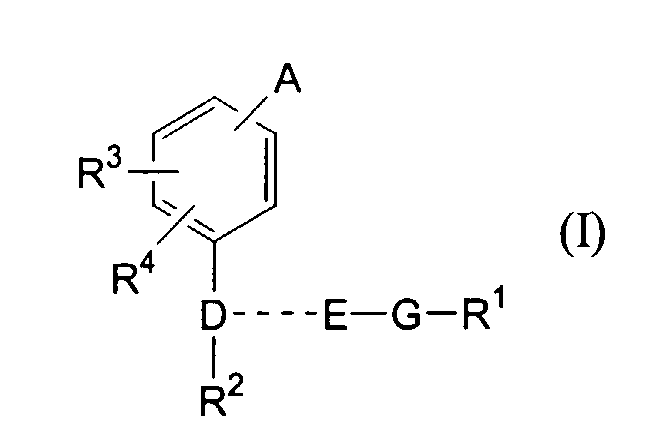 the broken line represents a single or double bond;R1 represents a cycloalkyl group, an aryl group, a heterocyclic group, a cycloalkyl group substituted by at least one of substituents α and β, defined below, an aryl group substituted by at least one of substituents α and β, defined below, or a heterocyclic group substituted by at least one of substituents α and β,defined below;R2 represents a cycloalkyl group, an aryl group, a heterocyclic group, a cycloalkyl group substituted by at least one of substituents α, defined below, an aryl group substituted by at least one of substituents α, defined below, or a heterocyclic group substituted by at least one of substituents α, defined below;R3 and R4 are the same as or different from each other and each represents a hydrogen atom or one of substituents α, defined below;A represents a group of formula (A-1):in which:
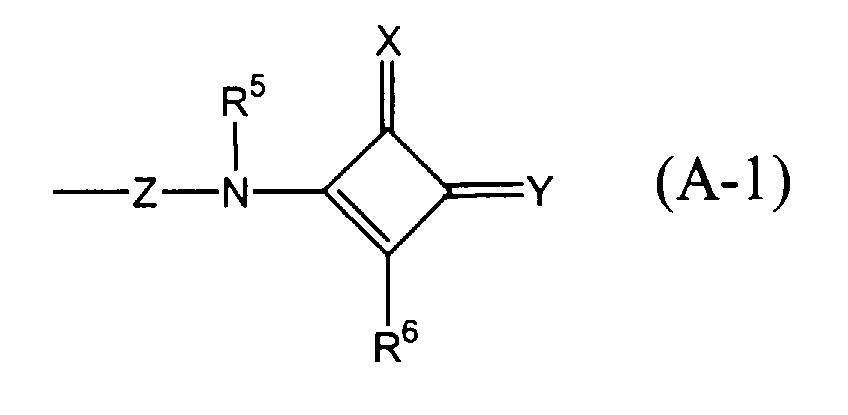 R5 represents a hydrogen atom, a hydroxy group or a lower alkyl group,R6 represents a hydroxy group, a lower alkoxy group, a lower alkylthio group or an amine residue,X and Y are the same as or different from each other and each represents an oxygen atom or a sulphur atom, andZ represents a direct single bond between the nitrogen atom shown and the benzene ring shown in formula (I), or an alkylene group having from 1 to 6 carbon atoms,G represents a single bond, an alkylene group having from 1 to 6 carbon atoms or an alkylene group having from 1 to 6 carbon atoms and substituted by at least one of substituents γ, defined below;
when the broken line represents a double bond,when the broken line represents a single bond,D represents a carbon atom; andE represents an =N-O- group;D represents a CH group or a nitrogen atom, andE represents an oxygen atom, a sulphur atom, an -NH- group or a -CO- group;said substituents α are preferably selected from halogen atoms, hydroxy groups, cyano groups, nitro groups, lower alkyl groups, lower haloalkyl groups, lower alkoxy groups, lower alkylthio groups, amino groups, lower monoalkylamino groups and di(lower alkyl)amino groups.said substituents β are preferably selected from carboxy groups, lower alkoxycarbonyl groups, carbamoyl groups, lower monoalkylcarbamoyl groups, di(lower alkyl)carbamoyl groups, nitro groups, cycloalkyl groups, aryl groups, aryloxy groups, aralkyloxy groups, arylthio groups and cycloalkyl, aryl, aryloxy, aralkyloxy and arylthio groups each substituted by at least one of substituents α, defined above;said substituents γ are preferably selected from hydroxy groups, oxo groups, cycloalkyl groups, aryl groups, heterocyclic groups, cycloalkyl groups substituted by at least one of substituents α and β, defined above, aryl groups substituted by at least one of substituents α and β, defined above, and heterocyclic groups substituted by at least one of substituents α and β, defined above;said cycloalkyl groups preferably have from 3 to 10 ring carbon atoms and are optionally fused to an aryl group, as defined below;said aryl groups are preferably aromatic carbocyclic groups having from 6 to 10 ring carbon atoms;said heterocyclic groups preferably have from 5 to 7 ring atoms, of which from 1 to 3 are sulphur and/or oxygen and/or nitrogen atoms, and are optionally fused to an aryl group, as defined above;and pharmaceutically acceptable salts, esters or other derivatives thereof. - Compounds according to Claim 1, having the formula (Ia):in which R1, R2, R3, R4, A, D, E and G are as defined in Claim 1.
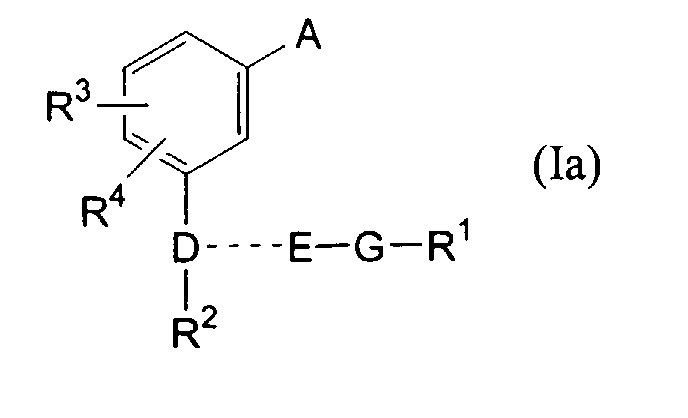
- Compounds according to Claim 1, having the formula (Ib):in which R1, R2, R3, R4, A, D, E and G are as defined in Claim 1.

- Compounds according to any one of Claims 1 to 3, in which Z represents a single bond or an alkylene group having 1 or 2 carbon atoms.
- Compounds according to any one of Claims 1 to 4, in which R5 represents a hydrogen atom or a lower alkyl group.
- Compounds according to any one of Claims 1 to 5, in which R6 represents a hydroxy group or an amine residue.
- Compounds according to any one of Claims 1 to 6, in which X and Y each represents an oxygen atom.
- Compounds according to any one of Claims 1 to 7, in which D represents a CH group or a nitrogen atom.
- Compounds according to any one of Claims 1 to 8, in which E represents an oxygen atom, a sulphur atom or an -NH- group.
- Compounds according to any one of Claims 1 to 9, in which G represents a substituted or unsubstituted alkylene group having from 1 to 6 carbon atoms.
- Compounds according to any one of Claims 1 to 10, in which R1 represents a cycloalkyl group, an aryl group, a heterocyclic group, an aryl group substituted by from 1 to 3 substituents selected from substituents α and β, defined in Claim 1, or a heterocyclic group substituted by from 1 to 3 substituents selected from substituents α and β,defined in Claim 1.
- Compounds according to any one of Claims 1 to 11, in which R2 represents a cycloalkyl group, an aryl group, a heterocyclic group, an aryl group substituted by from 1 to 3 substituents selected from substituents α, defined in Claim 1, or a heterocyclic group substituted by from 1 to 3 substituents selected from substituents α, defined in Claim 1.
- Compounds according to any one of Claims 1 to 12, in which R3 and R4 are the same as or different from each other and each represents a hydrogen atom, a hydroxy group, a halogen atom, a lower alkoxy group, an amino group or a di(lower alkyl)amino group.
- Compounds according to Claim 1, in which:Z represents a single bond or an alkylene group having 1 or 2 carbon atoms;R5 represents a hydrogen atom or a lower alkyl group;R6 represents a hydroxy group or an amine residue;X and Y each represents an oxygen atom;D represents a CH group or a nitrogen atom;E represents an oxygen atom, a sulphur atom or an -NH- group;G represents a substituted or unsubstituted alkylene group having from 1 to 6 carbon atoms;R1 represents a cycloalkyl group, an aryl group, a heterocyclic group, an aryl group substituted by from 1 to 3 substituents selected from substituents α and β, defined in Claim 1, or a heterocyclic group substituted by from 1 to 3 substituents selected from substituents α and β,defined in Claim 1;R2 represents a cycloalkyl group, an aryl group, a heterocyclic group, an aryl group substituted by from 1 to 3 substituents selected from substituents α, defined in Claim 1, or a heterocyclic group substituted by from 1 to 3 substituents selected from substituents α, defined in Claim 1; andR3 and R4 are the same as or different from each other and each represents a hydrogen atom, a hydroxy group, a halogen atom, a lower alkoxy group, an amino group or a di(lower alkyl)amino group.
- Compounds according to any one of Claims 1 to 3, in which Z represents a single bond or a methylene group.
- Compounds according to any one of Claims 1 to 3 and 15, in which R5 represents a hydrogen atom or a methyl group.
- Compounds according to any one of Claims 1 to 3, 15 and 16, in which R6 represents a hydroxy group, an amino group or a hydroxyamino group.
- Compounds according to any one of Claims 1 to 3 and 15 to 17, in which D represents a CH group.
- Compounds according to any one of Claims 1 to 3 and 15 to 18, in which E represents an -NH- group.
- Compounds according to any one of Claims 1 to 3 and 15 to 19, in which G represents a substituted or unsubstituted alkylene group having from 1 to 6 carbon atoms, said substituent being a hydroxy group, an oxo group, an aryl group or an aryl group substituted by from 1 to 3 substituents selected from substituents α, defined in Claim 1.
- Compounds according to any one of Claims 1 to 3 and 15 to 20, in which R1 represents an aryl group, a 5- or 6-membered aromatic heterocyclic group which may be fused with a benzene ring, an aryl group substituted by from 1 to 3 substituents selected from substituents α and β, defined in Claim 1, or a 5- or 6-membered aromatic heterocyclic group which is substituted by from 1 to 3 substituents selected from substituents α and β, defined in Claim 1, and which may be fused with a benzene ring,
- Compounds according to any one of Claims 1 to 3 and 15 to 21, in which R2 represents an aryl group, a 5- or 6-membered aromatic heterocyclic group which may be fused with a benzene ring, or a 5- or 6-membered aromatic heterocyclic group which may be fused with an aryl group substituted by from 1 to 3 substituents or a benzene ring, said substituent being a halogen atom, a hydroxy group, a lower alkyl group, a lower haloalkyl group or a lower alkoxy group.
- Compounds according to any one of Claims 1 to 3 and 15 to 22, in which R3 and R4 are the same as or different from each other and each represents a hydrogen atom, a hydroxy group or a lower alkoxy group.
- Compounds according to Claim 1, in which:Z represents a single bond or a methylene group;R5 represents a hydrogen atom or a methyl group;R6 represents a hydroxy group, an amino group or a hydroxyamino group;X and Y each represents an oxygen atom;D represents a CH group;E represents an -NH- group;G represents a substituted or unsubstituted alkylene group having from 1 to 6 carbon atoms, said substituent being a hydroxy group, an oxo group, an aryl group or an aryl group substituted by from 1 to 3 substituents selected from substituents α, defined in Claim 1;R1 represents an aryl group, a 5- or 6-membered aromatic heterocyclic group which may be fused with a benzene ring, an aryl group substituted by from 1 to 3 substituents selected from substituents α and β, defined in Claim 1, or a 5- or 6-membered aromatic heterocyclic group which is substituted by from 1 to 3 substituents selected from substituents α and β, defined in Claim 1, and which may be fused with a benzene ring;R2 represents an aryl group, a 5- or 6-membered aromatic heterocyclic group which may be fused with a benzene ring, or a 5- or 6-membered aromatic heterocyclic group which may be fused with an aryl group substituted by from 1 to 3 substituents or a benzene ring said substituent being a halogen atom, a hydroxy group, a lower alkyl group, a lower haloalkyl group or a lower alkoxy group; andR3 and R4 are the same as or different from each other and each represents a hydrogen atom, a hydroxy group or a lower alkoxy group.
- Compounds according to any one of Claims 1 to 3, in which Z represents a single bond.
- Compounds according to any one of Claims 1 to 3 and 25, in which R5 represents a hydrogen atom.
- Compounds according to any one of Claims 1 to 3, 25 and 26, in which R6 represents a hydroxy group.
- Compounds according to any one of Claims 1 to 3 and 25 to 27, in which G represents an alkylene group having from 1 to 6 carbon atoms.
- Compounds according to any one of Claims 1 to 3 and 25 to 28, in which R1 represents an aryl group, a 5- or 6-membered aromatic heterocyclic group which may be fused with a benzene ring, or a 5- or 6-membered aromatic heterocyclic group which has been substituted by an aryl group substituted by from 1 to 3 substituents and which may be fused with a benzene ring, the substituent being selected from substituents α, defined in Claim 1, nitro groups, cycloalkyl groups, aryl groups, aryloxy groups, aralkyloxy groups, arylthio groups and cycloalkyl, aryl, aryloxy, aralkyloxy and arylthio groups each substituted by from 1 to 3 substituents selected from substituents α, defined in Claim 1.
- Compounds according to any one of Claims 1 to 3 and 25 to 29, in which R2 represents an aryl group, a thienyl group, a furyl group, a pyrrolyl group, a thiazolyl group, an oxazolyl group, an imidazolyl group, a pyridyl group, a thienyl, furyl, pyrrolyl, thiazolyl, oxazolyl, imidazolyl or pyridyl group fused with a benzene ring or an aryl group substituted by a substituent, said substituent being a halogen atom, a hydroxy group, a lower alkyl group, a lower haloalkyl group or a lower alkoxy group.
- Compounds according to any one of Claims 1 to 3 and 25 to 30, in which R3 and R4 each represents a hydrogen atom.
- Compounds according to Claim 1, in which:Z represents a single bond;R5 represents a hydrogen atom;R6 represents a hydroxy group;X and Y each represents an oxygen atom;D represents a CH group;E represents an -NH- group;G represents an alkylene group having from 1 to 6 carbon atoms;R1 represents an aryl group, a 5- or 6-membered aromatic heterocyclic group which may be fused with a benzene ring, or a 5- or 6-membered aromatic heterocyclic group which has been substituted by an aryl group substituted by from 1 to 3 substituents and which may be fused with a benzene ring, the substituent being selected from substituents α, defined in Claim 1, nitro groups, cycloalkyl groups, aryl groups, aryloxy groups, aralkyloxy groups, arylthio groups and cycloalkyl, aryl, aryloxy, aralkyloxy and arylthio groups each substituted by from 1 to 3 substituents selected from substituents α, defined in Claim 1;R2 represents an aryl group, a thienyl group, a furyl group, a pyrrolyl group, a thiazolyl group, an oxazolyl group, an imidazolyl group, a pyridyl group, a thienyl, furyl, pyrrolyl, thiazolyl, oxazolyl, imidazolyl or pyridyl group fused with a benzene ring or an aryl group substituted by a substituent, said substituent being a halogen atom, a hydroxy group, a lower alkyl group, a lower haloalkyl group or a lower alkoxy group; andR3 and R4 each represents a hydrogen atom.
- Compounds according to any one of Claims 1 to 3, in which R6 represents a hydroxy group.
- Compounds according to any one of Claims 1 to 3 and 33, in which G represents an alkylene group having from 1 to 4 carbon atoms.
- Compounds according to any one of Claims 1 to 3, 33 and 34, in which R1 represents an aryl group, a 5- or 6-membered aromatic heterocyclic group which may be fused with a benzene ring, or a 5- or 6-membered aromatic heterocyclic group which has been substituted by an aryl group substituted by from 1 to 3 substituents and which may be fused with a benzene ring, the substituent being selected from halogen atoms, hydroxy groups, lower alkyl groups, lower haloalkyl groups, lower alkoxy groups, nitro groups, cycloalkyl groups, aryl groups, aryloxy groups and arylthio groups.
- Compounds according to any one of Claims 1 to 3 and 33 to 35, in which R2 represents an aryl group having from 6 to 10 carbon atoms, a 2-thienyl group, a 4-pyridyl group or an aryl group having from 6 to 10 carbon atoms substituted by a substituent, said substituent being a halogen atom, a hydroxy group, a lower alkyl group, a lower haloalkyl group or a lower alkoxy group.
- Compounds according to Claim 1, in which:Z represents a single bond;R5 represents a hydrogen atom;R6 represents a hydroxy group;X and Y each represents an oxygen atom;D represents a CH group;E represents an -NH- group;G represents an alkylene group having from 1 to 4 carbon atoms;R1 represents an aryl group, a 5- or 6-membered aromatic heterocyclic group which may be fused with a benzene ring, or a 5- or 6-membered aromatic heterocyclic group which has been substituted by an aryl group substituted by from 1 to 3 substituents and which may be fused with a benzene ring, the substituent being selected from halogen atoms, hydroxy groups, lower alkyl groups, lower haloalkyl groups, lower alkoxy groups, nitro groups, cycloalkyl groups, aryl groups, aryloxy groups and arylthio groups;R2 represents an aryl group having from 6 to 10 carbon atoms, a 2-thienyl group, a 4-pyridyl group or an aryl group having from 6 to 10 carbon atoms substituted by a substituent, said substituent being a halogen atom, a hydroxy group, a lower alkyl group, a lower haloalkyl group or a lower alkoxy group; andR3 and R4 each represents a hydrogen atom.
- Compounds according to any one of Claims 1 to 3, in which G represents a methylene, methylmethylene or ethylmethylene group.
- Compounds according to any one of Claims 1 to 3 and 38, in which R1 represents an aryl group having from 6 to 10 carbon atoms, a thienyl group, a furyl group, a pyrrolyl group, a thiazolyl group, an oxazolyl group, an imidazolyl group, a pyridyl group, a thienyl, furyl, pyrrolyl, thiazolyl, oxazolyl, imidazolyl or pyridyl group fused with a benzene ring, or an aryl group having from 6 to 10 carbon atoms substituted by from 1 to 3 substituents, the substituent being selected from halogen atoms, hydroxy groups, lower alkyl groups, lower haloalkyl groups, lower alkoxy groups and nitro groups.
- Compounds according to any one of Claims 1 to 3, 38 and 39, in which R2 represents a phenyl group or a phenyl group substituted by a substituent, said substituent being a halogen atom, a hydroxy group, a lower alkyl group, a lower haloalkyl group or a lower alkoxy group.
- Compounds according to Claim 1, in which:Z represents a single bond;R5 represents a hydrogen atom;R6 represents a hydroxy group;X and Y each represents an oxygen atom;D represents a CH group;E represents an -NH- group;G represents a methylene, methylmethylene or ethylmethylene group;R1 represents an aryl group having from 6 to 10 carbon atoms, a thienyl group, a furyl group, a pyrrolyl group, a thiazolyl group, an oxazolyl group, an imidazolyl group, a pyridyl group, a thienyl, furyl, pyrrolyl, thiazolyl, oxazolyl, imidazolyl or pyridyl group fused with a benzene ring, or an aryl group having from 6 to 10 carbon atoms substituted by from 1 to 3 substituents, the substituent being selected from halogen atoms, hydroxy groups, lower alkyl groups, lower haloalkyl groups, lower alkoxy groups and nitro groups;R2 represents a phenyl group or a phenyl group substituted by a substituent, said substituent being a halogen atom, a hydroxy group, a lower alkyl group, a lower haloalkyl group or a lower alkoxy group; andR3 and R4 each represents a hydrogen atom.
- Compounds according to any one of Claims 1 to 3, in which G represents a methylmethylene group,
- Compounds according to any one of the preceding Claims, in which R1 represents a phenyl, 1-naphthyl, 2-naphthyl, 3-fluorophenyl, 4-fluorophenyl, 3-chlorophenyl, 4-chlorophenyl, 3,4-difluorophenyl, 3,5-difluorophenyl, 3,4-dichlorophenyl, 3,5-dichlorophenyl, 3-hydroxyphenyl, 4-hydroxyphenyl, 3-methylphenyl, 4-methylphenyl, 3,4-dimethylphenyl, 3-methoxyphenyl, 4-methoxyphenyl, 3,4-dimethoxyphenyl, 3,4,5-trimethoxyphenyl, 3,4,5-trifluorophenyl, thienyl or pyridyl group.
- Compounds according to any one of the preceding Claims, in which R2 represents a phenyl, 4-fluorophenyl, 4-chlorophenyl, 4-methylphenyl or 4-methoxyphenyl group.
- Compounds according to Claim 1, in which:Z represents a single bond;R5 represents a hydrogen atom;R6 represents a hydroxy group;X and Y each represents an oxygen atom;D represents a CH group;E represents an -NH- group;G represents a methylmethylene group;R1 represents a phenyl, 1-naphthyl, 2-naphthyl, 3-fluorophenyl, 4-fluorophenyl, 3-chlorophenyl, 4-chlorophenyl, 3,4-difluorophenyl, 3,5-difluorophenyl, 3,4-dichlorophenyl, 3,5-dichlorophenyl, 3-hydroxyphenyl, 4-hydroxyphenyl, 3-methylphenyl, 4-methylphenyl, 3,4-dimethylphenyl, 3-methoxyphenyl, 4-methoxyphenyl, 3,4-dimethoxyphenyl, 3,4,5-trimethoxyphenyl, 3,4,5-trifluorophenyl, thienyl or pyridyl group;R2 represents a phenyl, 4-fluorophenyl, 4-chlorophenyl, 4-methylphenyl or 4-methoxyphenyl group; andR3 and R4 each represents a hydrogen atom.
- Compounds according to any one of the preceding Claims, in which R1 represents a phenyl, 3-fluorophenyl, 3-chlorophenyl, 3,4-difluorophenyl, 3,5-difluorophenyl, 3,4-dichlorophenyl, 3,5-dichlorophenyl, 1-naphthyl, 2-thienyl or 4-pyridyl group.
- Compounds according to Claim 1, in which:Z represents a single bond;R5 represents a hydrogen atom;R6 represents a hydroxy group;X and Y each represents an oxygen atom;D represents a CH group;E represents an -NH- group;G represents a methylmethylene group;R1 represents a phenyl, 3-fluorophenyl, 3-chlorophenyl, 3,4-difluorophenyl, 3,5-difluorophenyl, 3,4-dichlorophenyl, 3,5-dichlorophenyl, 1-naphthyl, 2-thienyl or 4-pyridyl group;R2 represents a phenyl, 4-fluorophenyl, 4-chlorophenyl, 4-methylphenyl or 4-methoxyphenyl group; andR3 and R4 each represents a hydrogen atom.
- Compounds according to Claim 1, selected from:and pharmaceutically acceptable salts, esters or other derivatives thereof.3-amino-4-〈3-{(4-methoxyphenyl)-[1-(3,4-difluorophenyl)ethylamino]methyl}phenylamino〉-3-cyclobutene-1,2-dione,3-amino-4-{3-[(4-fluorophenyl)-(1-phenylethylamino)methyl]phenylamino}-3-cyclobutene-1,2-dione,3-amino-4-{3-[(4-methoxyphenyl)-(1-phenylethylamino)methyl]phenylamino}-3-cyclobutene-1,2-dione,3-amino-4-{3-[4-pyridyl-(1-phenylethylamino)methyl]phenylamino}-3-cyclobutene-1,2-dione,3-amino-4-〈3-{(4-methoxyphenyl)-[1-(3-fluorophenyl)ethylamino]methyl}phenylamino〉-3-cyclobutene-1,2-dione,3-amino-4-〈3-{(4-fluorophenyl)-[1-(3,4-difluorophenyl)ethylamino]methyl}phenylamino〉-3-cyclobutene-1,2-dione,3-amino-4-〈3-{(4-methoxyphenyl)-[1-(3,4-difluorophenyl)ethylamino]methyl}phenylamino〉-3-cyclobutene-1,2-dione,3-amino-4-〈3-{4-pyridyl-[1-(3,4-difluorophenyl)ethylamino]methyl}phenylamino〉-3-cyclobutene-1,2-dione,3-amino-4-〈3-{phenyl-[1-(3,5-difluorophenyl)ethylamino]methyl}phenylamino〉-3-cyclobutene-1,2-dione,3-amino-4-〈3-{(4-fluorophenyl)-[1-(3,5-difluorophenyl)ethylamino]methyl}phenylamino〉-3-cyclobutene-1,2-dione,3-amino-4-〈3-{(4-methoxyphenyl)-[1-(3,5-difluorophenyl)ethylamino]methyl}phenylamino〉-3-cyclobutene-1,2-dione,3-amino-4-〈3-{(4-methoxyphenyl)-[1-(4-pyridyl)ethylamino]methyl}phenylamino〉-3-cyclobutene-1,2-dione,3-amino-4-〈3-{(4-methoxyphenyl)-[1-(3,4-difluorophenyl)ethylamino]methyl}phenylamino〉-3-cyclobutene-1,2-dione,
- Compounds according to Claim 1, selected from:and pharmaceutically acceptable salts, esters or other derivatives thereof.4-〈3-{[1-(3,4-difluorophenyl)ethylamino]-(4-methoxyphenyl)methyl}phenylamino〉-3-hydroxy-3-cyclobutene-1,2-dione,4-〈3-{[1-(3,5-difluorophenyl)ethylamino]-(4-methoxyphenyl)methyl}phenylamino〉-3-hydroxy-3-cyclobutene-1,2-dione,4-〈3-{[1-(3,5-difluorophenyl)ethylamino]-(4-fluorophenyl)methyl}phenylamino〉-3-hydroxy-3-cyclobutene-1,2-dione,3-〈3-{[1(3,4-difluorophenyl)ethylamino]-(4-fluorophenyl)methyl}phenylamino〉-4-hydroxy-3-cyclobutene-1,2-dione,3-〈3-{[1-(3-fluorophenyl)ethylamino]-(4-methoxyphenyl)methyl}phenylamino〉-4-hydroxy-3-cyclobutene-1,2-dione,3-〈3-{(4-fluorophenyl)-[1-(3-fluorophenyl)ethylamino]methyl}phenylamino〉-4-hydroxy-3-cyclobutene-1,2-dione,4-〈3-{(4-chlorophenyl)-[1-(3-fluorophenyl)ethylamino]methyl}phenylamino〉-3-hydroxy-3-cyclobutene-1,2-dione,4-〈3-{(4-chlorophenyl)-[1-(3,5-difluorophenyl)ethylamino]methyl}phenylamino〉-3-hydroxy-3-cyclobutene-1,2-dione,4-〈3-{(4-chlorophenyl)-[1-(3,4-difluorophenyl)ethylamino]methyl}phenylamino〉-3-hydroxy-3-cyclobutene-1,2-dione,3-〈3-{[1-(3,4-difluorophenylamino)ethylamino]-(p-tolyl)methyl}phenylamino〉-4-hydroxy-3-cyclobutene-1,2-dione,4-〈3-{[1-(3,5-difluorophenyl)ethylamino]-(4-methylphenyl)methyl}phenylamino〉-3-hydroxy-3-cyclobutene-1,2-dione,3-hydroxy-4-〈3-{(4-methoxyphenyl)-[1-(naphthalen-1-yl)ethylamino]methyl}phenylamino〉-cycylobut-3-ene-1,2-dione,3-〈3-{(4-chlorophenyl)-[1-phenylethylamino]methylphenylamino〉-4-hydroxy-3-cyclobutene-1,2-dione,3-〈3-{[4-(p-tolyl)-[1-(3-fluorophenyl)ethylamino]methyl}phenylamino〉-4-hydroxy-3-cyclobutene-1,2-dione hydrochloride,3-hydroxy-4-〈3-{[1-(3-fluorophenyl)ethylamino]phenylmethyl}phenylamino〉-3-cyclobutene-1,2-dione,3-hydroxy-4-〈3-{[1-(3,4-difluorophenyl)ethylamino]phenylmethyl]phenylamino〉-3-cyclobutene-1,2-dione,3-hydroxy-4-〈3-{[1-(3,5-difluorophenyl)ethylamino]phenylmethyl}phenylamino〉-3-cyclobutene-1,2-dione,3-〈3-{(4-fluorophenyl)-[1-(naphthalen-1-yl)ethylamino]methyl}phenylamino〉-4-hydroxy-3-cyclobutene-1,2-dione,3-〈3-{(4-chlorophenyl)-[1-(naphthalen-1-yl)ethylamino]methyl}phenylamino〉-4-hydroxy-3-cyclobutene-1,2-dione,3-〈3-{(4-fluorophenyl)-[1-phenylethylamino]methyl}phenylamino〉-4-hydroxy-3-cyclobutene-1,2-dione,3-hydroxy-4-〈3-{[1-(1-naphthyl)ethylamino]phenylmethyl}phenylamino〉-3-cyclobutene-1,2-dione,3-hydroxy-4-〈3-{[1-(1-naphthyl)ethylamino]-p-tolylmethyl}phenylamino〉-3-cyclobutene-1,2-dione;3-hydroxy-4-〈3-{[1-phenylethylamino]-(4-methoxyphenyl)methyl}phenylamino〉-3-cyclobutene-1,2-dione;
- The use of a compound according to any one of the preceding Claims for the manufacture of a medicament for the inhibition of an ileal bile acid transporter.
- The use according to Claim 50 for the manufacture of a medicament for the treatment or prevention of hypercholesterolaemia.
Applications Claiming Priority (2)
| Application Number | Priority Date | Filing Date | Title |
|---|---|---|---|
| JP20716999 | 1999-07-22 | ||
| JP20716999 | 1999-07-22 |
Publications (1)
| Publication Number | Publication Date |
|---|---|
| EP1070703A1 true EP1070703A1 (en) | 2001-01-24 |
Family
ID=16535383
Family Applications (1)
| Application Number | Title | Priority Date | Filing Date |
|---|---|---|---|
| EP00306202A Withdrawn EP1070703A1 (en) | 1999-07-22 | 2000-07-20 | Cyclobutene derivatives |
Country Status (18)
| Country | Link |
|---|---|
| US (1) | US6329405B1 (en) |
| EP (1) | EP1070703A1 (en) |
| KR (1) | KR20020095598A (en) |
| CN (1) | CN1287117A (en) |
| AR (1) | AR024918A1 (en) |
| AU (1) | AU4875600A (en) |
| BR (1) | BR0004535A (en) |
| CA (1) | CA2312203A1 (en) |
| CZ (1) | CZ290178B6 (en) |
| HU (1) | HUP0002848A2 (en) |
| ID (1) | ID26612A (en) |
| IL (1) | IL137415A0 (en) |
| NO (1) | NO20003773L (en) |
| NZ (1) | NZ505927A (en) |
| PL (1) | PL341619A1 (en) |
| RU (1) | RU2192410C2 (en) |
| TR (1) | TR200002099A2 (en) |
| ZA (1) | ZA200003706B (en) |
Cited By (12)
| Publication number | Priority date | Publication date | Assignee | Title |
|---|---|---|---|---|
| WO2002051396A1 (en) * | 2000-12-26 | 2002-07-04 | Sankyo Company, Limited | Pharmaceutical compositions containing cyclobutene derivatives |
| WO2002072147A1 (en) * | 2001-03-14 | 2002-09-19 | Sankyo Company, Limited | Medicinal compositions containing bile acid transporter inhibitor |
| WO2001068637A3 (en) * | 2000-03-10 | 2003-01-09 | Pharmacia Corp | Method for the preparation of tetrahydrobenzothiepines |
| EP1894564A2 (en) | 2003-04-05 | 2008-03-05 | AstraZeneca AB | Use of an ibat inhibitor for the treatment of prophylaxis of constipation |
| WO2013063526A1 (en) | 2011-10-28 | 2013-05-02 | Lumena Pharmaceuticals, Inc. | Bile acid recycling inhibitors for treatment of hypercholemia and cholestatic liver disease |
| WO2014144485A1 (en) | 2013-03-15 | 2014-09-18 | Lumena Pharmaceuticals, Inc. | Bile acid recycling inhibitors for treatment of barrett's esophagus and gastroesophageal reflux disease |
| WO2014144650A2 (en) | 2013-03-15 | 2014-09-18 | Lumena Pharmaceuticals, Inc. | Bile acid recycling inhibitors for treatment of primary sclerosing cholangitis and inflammatory bowel disease |
| EP2995317A1 (en) | 2010-05-26 | 2016-03-16 | Satiogen Pharmaceuticals, Inc. | Bile acid recycling inhibitors and satiogens for treatment of diabetes, obesity, and inflammatory gastrointestinal conditions |
| EP3266457A1 (en) | 2011-10-28 | 2018-01-10 | Lumena Pharmaceuticals LLC | Bile acid recycling inhibitors for treatment of pediatric cholestatic liver diseases |
| WO2021037750A1 (en) | 2019-08-28 | 2021-03-04 | Unilever Global Ip Limited | Novel compounds for skin lightening |
| WO2021037759A1 (en) | 2019-08-28 | 2021-03-04 | Unilever Global Ip Limited | Novel compounds for skin lightening |
| EP4241840A2 (en) | 2019-02-12 | 2023-09-13 | Mirum Pharmaceuticals, Inc. | Methods for treating cholestasis |
Families Citing this family (7)
| Publication number | Priority date | Publication date | Assignee | Title |
|---|---|---|---|---|
| US6805603B2 (en) * | 2001-08-09 | 2004-10-19 | Matsushita Electric Industrial Co., Ltd. | Electrode, manufacturing method thereof, and metal vapor discharge lamp |
| TW200507841A (en) * | 2003-03-27 | 2005-03-01 | Glaxo Group Ltd | Antibacterial agents |
| JP2008528604A (en) * | 2005-01-25 | 2008-07-31 | グラクソ グループ リミテッド | Antibacterial agent |
| EP2367554A4 (en) * | 2008-11-26 | 2020-03-25 | Satiogen Pharmaceuticals, Inc. | BILIARY ACID RECYCLING INHIBITORS FOR THE TREATMENT OF OBESITY AND DIABETES |
| AP2013007331A0 (en) | 2011-06-24 | 2013-12-31 | Amgen Inc | TRPM8 antagonists and their use in treatments |
| EP2723718A1 (en) | 2011-06-24 | 2014-04-30 | Amgen Inc. | Trpm8 antagonists and their use in treatments |
| US8952009B2 (en) | 2012-08-06 | 2015-02-10 | Amgen Inc. | Chroman derivatives as TRPM8 inhibitors |
Citations (1)
| Publication number | Priority date | Publication date | Assignee | Title |
|---|---|---|---|---|
| WO1998056757A1 (en) * | 1997-06-11 | 1998-12-17 | Sankyo Company, Limited | Benzylamine derivatives |
Family Cites Families (8)
| Publication number | Priority date | Publication date | Assignee | Title |
|---|---|---|---|---|
| US4526973A (en) | 1981-05-18 | 1985-07-02 | Bristol-Myers Company | Chemical compounds |
| US4876269A (en) * | 1986-09-10 | 1989-10-24 | E. I. Du Pont De Nemours And Company | Benoz-fused cycloalkane trans-1,2-diamine derivatives |
| FR2638453B1 (en) * | 1988-10-28 | 1991-06-07 | Oreal | 5-SUBSTITUTED ORTHO-AMINOPHENOLS, PROCESS FOR THEIR PREPARATION AND THEIR USE FOR OXIDATION DYEING OF KERATINIC FIBERS |
| WO1992020645A1 (en) * | 1991-05-20 | 1992-11-26 | Tsumura & Co. | Phellodendrine analogs and allergy type iv suppressor containing the same as active ingredient |
| CA2114114C (en) | 1992-06-15 | 2005-05-03 | Nigel Robert Arnold Beeley | Trisubstituted phenyl derivatives as selective phosphodiesterase iv inhibitors |
| TW266206B (en) | 1993-04-28 | 1995-12-21 | Takeda Pharm Industry Co Ltd | |
| DE69717841T2 (en) | 1996-07-17 | 2003-05-28 | Wyeth, Madison | SUBSTITUTED N-ARYLMETHYLAMINO CYCLOBUTEN-3,4-DION DERIVATIVES |
| JPH11199570A (en) | 1997-06-13 | 1999-07-27 | Takeda Chem Ind Ltd | Heterocyclic compounds and agents |
-
2000
- 2000-07-19 TR TR2000/02099A patent/TR200002099A2/en unknown
- 2000-07-19 CZ CZ20002657A patent/CZ290178B6/en not_active IP Right Cessation
- 2000-07-20 IL IL13741500A patent/IL137415A0/en unknown
- 2000-07-20 US US09/620,741 patent/US6329405B1/en not_active Expired - Fee Related
- 2000-07-20 EP EP00306202A patent/EP1070703A1/en not_active Withdrawn
- 2000-07-21 ID IDP20000613D patent/ID26612A/en unknown
- 2000-07-21 RU RU2000119652/04A patent/RU2192410C2/en not_active IP Right Cessation
- 2000-07-21 NO NO20003773A patent/NO20003773L/en not_active Application Discontinuation
- 2000-07-21 NZ NZ505927A patent/NZ505927A/en unknown
- 2000-07-21 HU HU0002848A patent/HUP0002848A2/en unknown
- 2000-07-21 AU AU48756/00A patent/AU4875600A/en not_active Abandoned
- 2000-07-21 CA CA002312203A patent/CA2312203A1/en not_active Abandoned
- 2000-07-21 BR BR0004535-7A patent/BR0004535A/en not_active Application Discontinuation
- 2000-07-21 ZA ZA200003706A patent/ZA200003706B/en unknown
- 2000-07-21 PL PL00341619A patent/PL341619A1/en not_active Application Discontinuation
- 2000-07-21 AR ARP000103802A patent/AR024918A1/en not_active Application Discontinuation
- 2000-07-22 KR KR1020000042192A patent/KR20020095598A/en not_active Withdrawn
- 2000-07-22 CN CN00128830A patent/CN1287117A/en active Pending
Patent Citations (1)
| Publication number | Priority date | Publication date | Assignee | Title |
|---|---|---|---|---|
| WO1998056757A1 (en) * | 1997-06-11 | 1998-12-17 | Sankyo Company, Limited | Benzylamine derivatives |
Non-Patent Citations (1)
| Title |
|---|
| DATABASE WPI Section Ch Week 199906, Derwent World Patents Index; Class B05, AN 1999-070307, XP002147975 * |
Cited By (24)
| Publication number | Priority date | Publication date | Assignee | Title |
|---|---|---|---|---|
| WO2001068637A3 (en) * | 2000-03-10 | 2003-01-09 | Pharmacia Corp | Method for the preparation of tetrahydrobenzothiepines |
| US6794544B2 (en) | 2000-03-10 | 2004-09-21 | Pharmacia Corporation | Method for the preparation of tetrahydrobenzothiepines |
| WO2002051396A1 (en) * | 2000-12-26 | 2002-07-04 | Sankyo Company, Limited | Pharmaceutical compositions containing cyclobutene derivatives |
| WO2002072147A1 (en) * | 2001-03-14 | 2002-09-19 | Sankyo Company, Limited | Medicinal compositions containing bile acid transporter inhibitor |
| EP1894564A2 (en) | 2003-04-05 | 2008-03-05 | AstraZeneca AB | Use of an ibat inhibitor for the treatment of prophylaxis of constipation |
| EP2995317A1 (en) | 2010-05-26 | 2016-03-16 | Satiogen Pharmaceuticals, Inc. | Bile acid recycling inhibitors and satiogens for treatment of diabetes, obesity, and inflammatory gastrointestinal conditions |
| EP3593802A2 (en) | 2010-05-26 | 2020-01-15 | Satiogen Pharmaceuticals, Inc. | Bile acid recycling inhibitors and satiogens for treatment of diabetes, obesity, and inflammatory gastrointestinal conditions |
| EP4137137A1 (en) | 2010-05-26 | 2023-02-22 | Satiogen Pharmaceuticals, Inc. | Bile acid recycling inhibitors and satiogens for treatment of diabetes, obesity, and inflammatory gastrointestinal conditions |
| WO2013063526A1 (en) | 2011-10-28 | 2013-05-02 | Lumena Pharmaceuticals, Inc. | Bile acid recycling inhibitors for treatment of hypercholemia and cholestatic liver disease |
| US12350267B2 (en) | 2011-10-28 | 2025-07-08 | Shire Human Genetic Therapies, Inc. | Bile acid recycling inhibitors for treatment of pediatric cholestatic liver diseases |
| US11376251B2 (en) | 2011-10-28 | 2022-07-05 | Shire Human Genetic Therapies, Inc. | Bile acid recycling inhibitors for treatment of pediatric cholestatic liver diseases |
| EP3266457A1 (en) | 2011-10-28 | 2018-01-10 | Lumena Pharmaceuticals LLC | Bile acid recycling inhibitors for treatment of pediatric cholestatic liver diseases |
| EP3278796A1 (en) | 2011-10-28 | 2018-02-07 | Lumena Pharmaceuticals LLC | Bile acid recycling inhibitors for treatment of hypercholemia and cholestatic liver disease |
| US10512657B2 (en) | 2011-10-28 | 2019-12-24 | Lumena Pharmaceutials Llc | Bile acid recycling inhibitors for treatment of pediatric cholestatic liver diseases |
| US12145959B2 (en) | 2011-10-28 | 2024-11-19 | Shire Human Genetic Therapies, Inc. | Bile acid recycling inhibitors for treatment of hypercholemia and cholestatic liver disease |
| US11229661B2 (en) | 2011-10-28 | 2022-01-25 | Shire Human Genetic Therapies, Inc. | Bile acid recycling inhibitors for treatment of pediatric cholestatic liver diseases |
| WO2014144485A1 (en) | 2013-03-15 | 2014-09-18 | Lumena Pharmaceuticals, Inc. | Bile acid recycling inhibitors for treatment of barrett's esophagus and gastroesophageal reflux disease |
| WO2014144650A2 (en) | 2013-03-15 | 2014-09-18 | Lumena Pharmaceuticals, Inc. | Bile acid recycling inhibitors for treatment of primary sclerosing cholangitis and inflammatory bowel disease |
| EP4241840A2 (en) | 2019-02-12 | 2023-09-13 | Mirum Pharmaceuticals, Inc. | Methods for treating cholestasis |
| EP4245367A2 (en) | 2019-02-12 | 2023-09-20 | Mirum Pharmaceuticals, Inc. | Methods for treating cholestasis |
| EP4424363A2 (en) | 2019-02-12 | 2024-09-04 | Mirum Pharmaceuticals, Inc. | Methods for increasing growth in pediatric subjects having cholestatic liver disease |
| EP4464376A2 (en) | 2019-02-12 | 2024-11-20 | Mirum Pharmaceuticals, Inc. | Genotype and dose-dependent response to an asbti in patients with bile salt export pump deficiency |
| WO2021037759A1 (en) | 2019-08-28 | 2021-03-04 | Unilever Global Ip Limited | Novel compounds for skin lightening |
| WO2021037750A1 (en) | 2019-08-28 | 2021-03-04 | Unilever Global Ip Limited | Novel compounds for skin lightening |
Also Published As
| Publication number | Publication date |
|---|---|
| HUP0002848A2 (en) | 2001-08-28 |
| NO20003773D0 (en) | 2000-07-21 |
| ID26612A (en) | 2001-01-25 |
| AR024918A1 (en) | 2002-10-30 |
| CA2312203A1 (en) | 2001-01-22 |
| PL341619A1 (en) | 2001-01-29 |
| NO20003773L (en) | 2001-01-23 |
| CN1287117A (en) | 2001-03-14 |
| BR0004535A (en) | 2001-02-28 |
| US6329405B1 (en) | 2001-12-11 |
| ZA200003706B (en) | 2001-02-02 |
| AU4875600A (en) | 2001-02-01 |
| TR200002099A3 (en) | 2001-06-21 |
| RU2192410C2 (en) | 2002-11-10 |
| CZ290178B6 (en) | 2002-06-12 |
| CZ20002657A3 (en) | 2001-03-14 |
| KR20020095598A (en) | 2002-12-28 |
| IL137415A0 (en) | 2001-07-24 |
| NZ505927A (en) | 2001-05-25 |
| HU0002848D0 (en) | 2000-10-28 |
| TR200002099A2 (en) | 2001-06-21 |
Similar Documents
| Publication | Publication Date | Title |
|---|---|---|
| US6953858B2 (en) | HIV protease inhibitors, compositions containing the same, their pharmaceutical uses and materials for their synthesis | |
| AU4875600A (en) | Cyclobutene derivatives, their preparation and their therapeutic uses | |
| ES2221203T3 (en) | SUBSTITUTED FUSIONED HETEROCICLIC COMPOUND. | |
| EP0779281A1 (en) | Isoxazoles | |
| JP2001354563A (en) | Medicine comprising substituted benzylamines | |
| ES2299561T3 (en) | BENCILAMINE ANALOG. | |
| WO2000035889A1 (en) | Substituted benzylamines | |
| CA2802615A1 (en) | Process for the preparation of glycopyrronium chloride | |
| CN101300226B (en) | Alkylcarbamoylnaphthyloxyoctenoyl hydroxyamide derivatives having inhibitory activity against histone deacetylase and preparation method thereof | |
| EP0774460A1 (en) | Benzoic acid compound and use thereof as medicine | |
| MXPA00007210A (en) | Cyclobutene derivatives, their preparation and theirtherapeutic uses | |
| HK1038733A (en) | Cyclobutene derivatives | |
| US8268884B2 (en) | Derivatives of substituted tartaric acid and usage for preparing beta-secretase inhibitors | |
| JP2003503476A (en) | Cyclic amide derivative | |
| AU2006270914B2 (en) | Substituted propanamide derivative and pharmaceutical composition containing the same | |
| JP2004339159A (en) | Medicinal composition containing 4-oxoquinoline derivative | |
| US12410137B2 (en) | Fatty acid amide hydrolase modulators, compositions comprising the same and uses thereof | |
| US6897233B2 (en) | Peptide deformylase inhibitors | |
| JP2000229958A (en) | Substituted bezylamines | |
| WO2002051396A1 (en) | Pharmaceutical compositions containing cyclobutene derivatives | |
| JP2002212152A (en) | Phenylmaine derivative | |
| EP1539731B1 (en) | Novel compounds | |
| JPH09291075A (en) | Thiazolidine compounds | |
| JP2002302439A (en) | Ileum-type bile acid transporter inhibitor containing cyclobutene derivative | |
| US20170144998A1 (en) | Elastase inhibitors |
Legal Events
| Date | Code | Title | Description |
|---|---|---|---|
| PUAI | Public reference made under article 153(3) epc to a published international application that has entered the european phase |
Free format text: ORIGINAL CODE: 0009012 |
|
| AK | Designated contracting states |
Kind code of ref document: A1 Designated state(s): AT BE CH CY DE DK ES FI FR GB GR IE IT LI LU MC NL PT SE |
|
| AX | Request for extension of the european patent |
Free format text: AL;LT;LV;MK;RO;SI |
|
| RIN1 | Information on inventor provided before grant (corrected) |
Inventor name: KURATA, HITOSHI Inventor name: KITAYAMA, KEN Inventor name: KONO, KEITA Inventor name: KOHAMA, TAKAFUMI |
|
| 17P | Request for examination filed |
Effective date: 20010802 |
|
| AKX | Designation fees paid |
Free format text: AT BE CH CY DE DK ES FI FR GB GR IE IT LI LU MC NL PT SE |
|
| 17Q | First examination report despatched |
Effective date: 20020429 |
|
| STAA | Information on the status of an ep patent application or granted ep patent |
Free format text: STATUS: THE APPLICATION IS DEEMED TO BE WITHDRAWN |
|
| 18D | Application deemed to be withdrawn |
Effective date: 20030509 |
|
| REG | Reference to a national code |
Ref country code: HK Ref legal event code: WD Ref document number: 1038733 Country of ref document: HK |