EP1070402B1 - Improvements with regard to security in data conferences - Google Patents
Improvements with regard to security in data conferences Download PDFInfo
- Publication number
- EP1070402B1 EP1070402B1 EP99918413A EP99918413A EP1070402B1 EP 1070402 B1 EP1070402 B1 EP 1070402B1 EP 99918413 A EP99918413 A EP 99918413A EP 99918413 A EP99918413 A EP 99918413A EP 1070402 B1 EP1070402 B1 EP 1070402B1
- Authority
- EP
- European Patent Office
- Prior art keywords
- conference
- control
- computer
- conference server
- server
- Prior art date
- Legal status (The legal status is an assumption and is not a legal conclusion. Google has not performed a legal analysis and makes no representation as to the accuracy of the status listed.)
- Expired - Lifetime
Links
- 238000000034 method Methods 0.000 claims description 21
- 238000012545 processing Methods 0.000 claims description 10
- 230000000306 recurrent effect Effects 0.000 claims description 8
- 238000004891 communication Methods 0.000 claims description 6
- 230000005540 biological transmission Effects 0.000 claims description 5
- 238000004088 simulation Methods 0.000 claims description 5
- 238000013474 audit trail Methods 0.000 claims description 4
- 238000004364 calculation method Methods 0.000 claims description 4
- 230000008901 benefit Effects 0.000 description 4
- 230000006399 behavior Effects 0.000 description 3
- 230000000694 effects Effects 0.000 description 3
- 230000006870 function Effects 0.000 description 3
- 230000004044 response Effects 0.000 description 3
- 238000012356 Product development Methods 0.000 description 1
- 241000950638 Symphysodon discus Species 0.000 description 1
- 230000009471 action Effects 0.000 description 1
- 230000004888 barrier function Effects 0.000 description 1
- 238000010276 construction Methods 0.000 description 1
- 238000005516 engineering process Methods 0.000 description 1
- 238000012423 maintenance Methods 0.000 description 1
- 230000008520 organization Effects 0.000 description 1
- 230000000149 penetrating effect Effects 0.000 description 1
- 230000035899 viability Effects 0.000 description 1
Images

Classifications
-
- H—ELECTRICITY
- H04—ELECTRIC COMMUNICATION TECHNIQUE
- H04L—TRANSMISSION OF DIGITAL INFORMATION, e.g. TELEGRAPHIC COMMUNICATION
- H04L12/00—Data switching networks
- H04L12/02—Details
- H04L12/16—Arrangements for providing special services to substations
- H04L12/18—Arrangements for providing special services to substations for broadcast or conference, e.g. multicast
- H04L12/1813—Arrangements for providing special services to substations for broadcast or conference, e.g. multicast for computer conferences, e.g. chat rooms
Definitions
- the present invention relates to a telecommunications system adapted to support data conferences in which a plurality of participant computers are cooperatively linked, methods of providing data conferences in which a plurality of participant computers are cooperatively linked and a control unit for controlling a data conference in which a plurality of participant computers are cooperatively linked.
- a serious problem, in relation to cooperative interworking requiring the exchange of data, is ensuring the safety and security of data. More specifically, the problem is to effect adequate supervision and control over the security of data and, at the same time, provide the necessary flexibility for effective conference working where two, or more, computers are connected over a data network and cooperate on a common data, or working, server.
- the patent document WO-A1-97/37484 relates to a multimedia conference system, having a data communication network coupled to which are a plurality of client stations, a meeting server and a presentation server.
- the system is embodied by a client-serer based collaborative application that allows users to share multimedia documents on any of PC, MAC or UNIX based hardware platforms.
- the client-server architecture allows centralised billing, secure document storage, secure document transmission and centralised administration. Multiple clients may interface with the server or servers via a telecommunications network and the data communications network which preferably is the Internet, whereby users at geographically dispersed locations are able to participate in a meeting session.
- the patent document US-5.673.080 discuses a method of establishing multimedia conferences between a multimedia server and a plurality of endpoint devices.
- One or more of these endpoint devices are enhanced in that they include a memory adapted to store one or more telephone numbers, each telephone number corresponding to a respective endpoint device, and a user interface coupled to the memory of selecting a telephone number stored in the memory.
- the methods are performed in a substantially continuous manner, signifying that a third endpoint device is added to a pre-existing conference. Therefore, a seamless multimedia conference is provided between the first and second enhanced endpoint devices even when a third endpoint device is added to the conference.
- JETS et al, 3 June 1997, IEEE, US, (XP10239230 ), relates to a generic, multiuser/collaborative system which enables the real-time sharing of Java applets through the Internet.
- JETS was designed to be highly multi-threaded.
- For each application there is a server running which in turn consists of smaller servers that run as separate threads and handle clients' requests with a small delay. This means that clients can independently interact with the application and get immediate response. Depending on the nature of the application, that response could be acceptance or rejection of the client's action.
- the server always keeps track of the latest state of the application. When a new user joins, the server sends the latest state to the new user.
- a firewall or using encryption for documents in order to protect the participants.
- the present invention addresses and solves this problem.
- the metaphor for the present invention is based on the fundamentals of a real world conference, operated without the benefits of IT, and the way in which security is provided in such a conference.
- the normal routine, in a company, or an organization, which is hosting a conference, is to bring the participants together in a conference room on the organising entity's premises.
- the conference room has all the means (conference tables, OH-projector, whiteboard, video recorder) that are needed to support the meeting.
- External visitors, who are going to attend the conference arrive at a reception facility, sign into a visitors' register, are given visitor badges and are accompanied into the conference room.
- the visiting participants are escorted off the premises and their departure is noted down in the visitors' register.
- the present invention is based on the same functionality. This is achieved by means of an arrangement of computers and safety functions, which give a chairperson, hosting the meeting, the ability to "meet and fetch” visitors to a computerized conference room, “supervise and control” the activities of the participants during the meeting and, at the end of the conference, “accompany the participants out” and “close and lock the conference room”.
- the system of the present invention does not limit the conferencing tools which can be deployed in the "conference room". This further strengthens the metaphor that the system is a conference room.
- the present invention resides in the realisation of a real world conference system in cyberspace by the use of an appropriate computer architecture.
- a telecommunications system adapted to provide a platform for tele-conferencing in which data can be exchanged between participants and in which conference proceedings are conducted on a conference server located within an internal data network, characterised in that participants' computers are connected to said conference server via an external data network and reception computer and in that said conference is controlled via a control and supervision computer.
- a method of data conferencing using a telecommunications system in which data can be exchanged between participants and in which conference proceedings are conducted on a conference server located in an internal data network, characterrised by connecting participants' computers to said conference server via an external data network and reception computer and controlling access to, and participant behaviour on, said conference server via a control and supervision computer.
- a data conference unit for use with a telecommunications system in which data can be exchanged between participants, said data conference unit adapted to operate in an internal data network protected by a firewall, characterised in that said data conference unit includes a conference server on which conference proceeding may be conducted, a reception computer, connected to said conference server, said reception computer adapted for connection to conference participants' computers, via an external data network, and a control and supervision computer connected to said conference server and said reception computer and adapted to control access to, and participant behaviour on, said conference server.
- Said conference server, said reception computer and said control and supervision computer may be a single data processing machine having functionally distinct modules for providing data conference facilities, reception control and conference control.
- said conference server, said reception computer and said control and supervision computer may be separate and distinct data processing machines linked by data connections which are distinct from, and not directly connected to, said internal data network.
- Data transmission between said participants' computers and said conference server may empioy IP.
- Said control and supervision computer may be adapted to provide a conference leader with dynamic control over participants' access and use of said conference server.
- Said reception computer may provide a firewall preventing access by conference participants to said internal data network.
- Said control and supervision computer may enable a conference leader to control said reception computer and thence to control admission to a conference being run on said conference server.
- Admission to said conference server may be controlled by non-recurrent passwords issued to participants.
- An audio conference facility may operate in conjunction with said conference server.
- Said non-recurrent passwords may be issued to participants by a conference leader in a voice communication over said audio conference facility.
- Admission to said conference server may be controlled by non-recurrent passwords issued by a conference leader to participants in a voice communication over said audio conference facility.
- Said control and supervision computer may enable a conference leader to activate applications software resident on said conference server and to control computer files accessed by said conference server, including files containing documents, drawings, calculations, simulations and video film.
- Said control and supervision computer may report all attempts to access said conference server to a conference leader.
- Said control and supervision computer may maintain a log and audit trail of a conference conducted on said conference server.
- Said conference server may have a number of software applications resident thereon, including: word processing, a database, a spreadsheet, a graphics package, a video streamer and a video conference package.
- Said participants to said conference may, via participant's computers and subject to control and supervision by said conference leader, access and manipulate software and data resident on said conference server, and thereby cooperatively interact with each other and said conference leader.
- the present invention comprises an arrangement of intercommunicating computers.
- a specially configured computer A controls, checks and supervises all data traffic between a number of computers B1, B2, B3,...., belonging to conference participants and a third computer C, on which is held a central data store used by all conferees.
- Computer A corresponds to the reception unit of Figure 2 and computer C is the conference server, i.e. the conference room of Figure 2 .
- a fourth computer D belongs to the conference chairperson and is connected, with special privileges, to the computers A and C.
- the computer D which corresponds to the control and supervision module of Figure 2 .
- This architecture creates a situation where the leader of a tele-ccnfsrence meeting can, in a manner which is similar to the operation of a normal meeting in a conference room, control and check who participates in the meeting and what the different participants do.
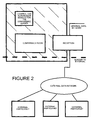
- FIG. 2 The conference metaphor, for the present invention, is illustrated in Figure 2 .
- a reception unit corresponding to computer A of Figure 1 , which links the main data server, controlled by computer C, of Figure 1 , to an external data network and external participants, i.e. the remote computers B1, B2, B3, of Figure 1 .
- Computer D, of Figure 1 corresponds to the control and supervision module for the conference leader.
- the main data server, or conference server is located in the conference leader's internal data network, which may be protected by a firewall.
- the reception unit provides a point of controlled ingress through the firewall. This ensures that all conference links to the outside world and eternal data networks are securely controlled and monitored.
- the computers A, C and D of Figure 1 i.e. the reception unit, the conference room and, the control and supervision module may be realised on a single data processing machine.
- the computers A, C and D of Figure 1 i.e. the reception unit, the conference room and, the control and supervision module may be realised on a single data processing machine.
- the present invention assumes that the majority of communicating business systems will, technically, be based on IP-architectures.
- the invention facilitates the provision of a safe and flexible dynamic conference environment in an intranet/extranet/internet architecture.
- the present invention meets the following requirements:
- the conference server is a comparatively ordinary computer.
- the administration server is an especially configured firewall/access server, which encapsulates the conference.
- a basic concept underlying the present invention, particularly the conference server, is that all participants to the conference have access to a conference program of the type MS Netmeeting. This is resident on the conference server.
- the participants via various functional components, such as, "connected application”, “whiteboard” etc, participate in the work and/or see ordinary applications which are run on the conference server. Operation of the conference server is, of course, controlled by the chairperson.
- Software applications resident on the conference server should, for example, include MS Office, AutoCAD, a video streamer and a video conference program.
- MS Office a MS Office
- AutoCAD AutoCAD
- video streamer a video conference program
- Standard software is used to the fullest possible extent. Bespoke software development of system components is to be avoided, as far as possible.
- the control module and its user interface has to be bespoke software.
Landscapes
- Engineering & Computer Science (AREA)
- General Engineering & Computer Science (AREA)
- Multimedia (AREA)
- Computer Networks & Wireless Communication (AREA)
- Signal Processing (AREA)
- Data Exchanges In Wide-Area Networks (AREA)
- Telephonic Communication Services (AREA)
- Two-Way Televisions, Distribution Of Moving Picture Or The Like (AREA)
Description
- The present invention relates to a telecommunications system adapted to support data conferences in which a plurality of participant computers are cooperatively linked, methods of providing data conferences in which a plurality of participant computers are cooperatively linked and a control unit for controlling a data conference in which a plurality of participant computers are cooperatively linked.
- There is a need, in many spheres of activity, to improve the efficiency of cooperation between geographically distributed organizations. A serious problem, in relation to cooperative interworking requiring the exchange of data, is ensuring the safety and security of data. More specifically, the problem is to effect adequate supervision and control over the security of data and, at the same time, provide the necessary flexibility for effective conference working where two, or more, computers are connected over a data network and cooperate on a common data, or working, server.
- It is an object of the present invention to provide a telecommunications system for the safe and secure support of data conferences.
- So far as we know, there is no product currently in existence that provides the functionality of the present invention. Furthermore, so far as we currently know, no attempts have been made to resolve the conflict inherent in data conferencing between flexibility and data security/safety.
- The patent document
WO-A1-97/37484 - The patent document
US-5.673.080 discuses a method of establishing multimedia conferences between a multimedia server and a plurality of endpoint devices. One or more of these endpoint devices are enhanced in that they include a memory adapted to store one or more telephone numbers, each telephone number corresponding to a respective endpoint device, and a user interface coupled to the memory of selecting a telephone number stored in the memory. The methods are performed in a substantially continuous manner, signifying that a third endpoint device is added to a pre-existing conference. Therefore, a seamless multimedia conference is provided between the first and second enhanced endpoint devices even when a third endpoint device is added to the conference.
The document "JETS: a Java-Enabled TeleCollaboration System". Shirmohammadi S. et al, 3 June 1997, IEEE, US, (XP10239230), relates to a generic, multiuser/collaborative system which enables the real-time sharing of Java applets through the Internet. In order to have a small response time, JETS was designed to be highly multi-threaded. For each application, there is a server running which in turn consists of smaller servers that run as separate threads and handle clients' requests with a small delay. This means that clients can independently interact with the application and get immediate response. Depending on the nature of the application, that response could be acceptance or rejection of the client's action. The server always keeps track of the latest state of the application. When a new user joins, the server sends the latest state to the new user. There is also mentioned the use of a firewall or using encryption for documents in order to protect the participants. - The documents "LAN Based Real Time Audio-Graphics Conferencing System", Soares L.F.G. et al, 23 April 1989, IEEE, US, (XP10015416), relates to an audio-graphics teleconferencing system. LANBRETA-GCS. The specification presented is not a specification of a particular system implementation. The objective of this document was to present the basic functions of the system, a macro system specification and an example of a system implementation, demonstrating its viability under a local area network environment. The present invention can be used in a variety of electronic conferences and provides a secure and safe environment for data exchange while, at the same time, allowing for flexible operation. Situations where electronic conferencing can be used with great advantage include:
- product development projects in the engineering industry;
- budgetary planning and revision;
- marketing meetings in marketing organisations which are geographically dispersed;
- construction meetings in big building projects;
- technical maintenance work;
- technical support;
- administration of complaints; and
- in connection with education.
- Throughout the whole of society, there are big advantages to be gained by employing information technology to provide cooperation and conferencing at a distance. Such arrangements are analogous to multi-party telephone calls, or audio conferencing. However, the IT techniques available today mean that it should be possible, not simply to have audio conferences, but to provide, in addition, multimedia links enabling a conference group to look at pictures, models, make common drawings in a document etc..
- There are a whole range of products currently on the market, e.g. video conference equipments, collaborative software, etc., which facilitate different aspects of tele-conferencing.
- However, a real problem with all the products and services currently available is the data security risks associated with tele-based advanced conferences. The present invention addresses and solves this problem.
- The metaphor for the present invention, is based on the fundamentals of a real world conference, operated without the benefits of IT, and the way in which security is provided in such a conference.
- The normal routine, in a company, or an organization, which is hosting a conference, is to bring the participants together in a conference room on the organising entity's premises. The conference room has all the means (conference tables, OH-projector, whiteboard, video recorder) that are needed to support the meeting. External visitors, who are going to attend the conference, arrive at a reception facility, sign into a visitors' register, are given visitor badges and are accompanied into the conference room. At the end of the meeting, the visiting participants are escorted off the premises and their departure is noted down in the visitors' register.
- The present invention is based on the same functionality. This is achieved by means of an arrangement of computers and safety functions, which give a chairperson, hosting the meeting, the ability to "meet and fetch" visitors to a computerized conference room, "supervise and control" the activities of the participants during the meeting and, at the end of the conference, "accompany the participants out" and "close and lock the conference room".
- The system of the present invention does not limit the conferencing tools which can be deployed in the "conference room". This further strengthens the metaphor that the system is a conference room.
- The present invention resides in the realisation of a real world conference system in cyberspace by the use of an appropriate computer architecture.
- According to a first aspect of the present invention, there is provided a telecommunications system, adapted to provide a platform for tele-conferencing in which data can be exchanged between participants and in which conference proceedings are conducted on a conference server located within an internal data network, characterised in that participants' computers are connected to said conference server via an external data network and reception computer and in that said conference is controlled via a control and supervision computer.
- According to a second aspect of the present invention, there is provided a method of data conferencing using a telecommunications system in which data can be exchanged between participants and in which conference proceedings are conducted on a conference server located in an internal data network, characterrised by connecting participants' computers to said conference server via an external data network and reception computer and controlling access to, and participant behaviour on, said conference server via a control and supervision computer.
- According to a third aspect of the present invention, there is provided a data conference unit, for use with a telecommunications system in which data can be exchanged between participants, said data conference unit adapted to operate in an internal data network protected by a firewall, characterised in that said data conference unit includes a conference server on which conference proceeding may be conducted, a reception computer, connected to said conference server, said reception computer adapted for connection to conference participants' computers, via an external data network, and a control and supervision computer connected to said conference server and said reception computer and adapted to control access to, and participant behaviour on, said conference server.
- Said conference server, said reception computer and said control and supervision computer may be a single data processing machine having functionally distinct modules for providing data conference facilities, reception control and conference control.
- Alternatively, said conference server, said reception computer and said control and supervision computer may be separate and distinct data processing machines linked by data connections which are distinct from, and not directly connected to, said internal data network.
- Data transmission between said participants' computers and said conference server may empioy IP.
- Said control and supervision computer may be adapted to provide a conference leader with dynamic control over participants' access and use of said conference server.
- Said reception computer may provide a firewall preventing access by conference participants to said internal data network.
- Said control and supervision computer may enable a conference leader to control said reception computer and thence to control admission to a conference being run on said conference server.
- Admission to said conference server may be controlled by non-recurrent passwords issued to participants.
- An audio conference facility may operate in conjunction with said conference server.
- Said non-recurrent passwords may be issued to participants by a conference leader in a voice communication over said audio conference facility.
- Admission to said conference server may be controlled by non-recurrent passwords issued by a conference leader to participants in a voice communication over said audio conference facility.
- Said control and supervision computer may enable a conference leader to activate applications software resident on said conference server and to control computer files accessed by said conference server, including files containing documents, drawings, calculations, simulations and video film.
- Said control and supervision computer may report all attempts to access said conference server to a conference leader.
- Said control and supervision computer may maintain a log and audit trail of a conference conducted on said conference server.
- Said conference server may have a number of software applications resident thereon, including: word processing, a database, a spreadsheet, a graphics package, a video streamer and a video conference package.
- Said participants to said conference may, via participant's computers and subject to control and supervision by said conference leader, access and manipulate software and data resident on said conference server, and thereby cooperatively interact with each other and said conference leader.
- Embodiments of the invention will now be described, by way of example, with reference to the accompanying drawings, in which:
-
Figure 1 illustrates, in schematic form, a computer architecture on which the present invention is based. -
Figure 2 illustrates the conference metaphor underlying the present invention. - Referring to
Figure 1 , the present invention comprises an arrangement of intercommunicating computers. A specially configured computer A, controls, checks and supervises all data traffic between a number of computers B1, B2, B3,...., belonging to conference participants and a third computer C, on which is held a central data store used by all conferees. Computer A corresponds to the reception unit ofFigure 2 and computer C is the conference server, i.e. the conference room ofFigure 2 . A fourth computer D, belongs to the conference chairperson and is connected, with special privileges, to the computers A and C. The computer D, which corresponds to the control and supervision module ofFigure 2 . is programmed so that the operator can, dynamically and with full oversight, selectively instruct the computer A to permit, or deny, the operators of the computers B1, B2, B3, ... to exchange data traffic with the computer C. This architecture creates a situation where the leader of a tele-ccnfsrence meeting can, in a manner which is similar to the operation of a normal meeting in a conference room, control and check who participates in the meeting and what the different participants do. - The conference metaphor, for the present invention, is illustrated in
Figure 2 . Within the borders of an internal data network, there is provided a reception unit, corresponding to computer A ofFigure 1 , which links the main data server, controlled by computer C, ofFigure 1 , to an external data network and external participants, i.e. the remote computers B1, B2, B3, ofFigure 1 . Computer D, ofFigure 1 , corresponds to the control and supervision module for the conference leader. The main data server, or conference server, is located in the conference leader's internal data network, which may be protected by a firewall. The reception unit provides a point of controlled ingress through the firewall. This ensures that all conference links to the outside world and eternal data networks are securely controlled and monitored. - The computers A, C and D of
Figure 1 , i.e. the reception unit, the conference room and, the control and supervision module may be realised on a single data processing machine. However, for reasons of maintaining maximum data security, there is a considerable advantage in using stand alone machines for these functions and linking the machines through appropriate data links which operate independently of, and are not directly connected to, the conference leaders internal data network. - The present invention assumes that the majority of communicating business systems will, technically, be based on IP-architectures.
- The invention facilitates the provision of a safe and flexible dynamic conference environment in an intranet/extranet/internet architecture.
- The present invention meets the following requirements:
- (a) Electronic simulation of an ordinary conference environment, or conference room, by an IP-environment.
- (b) Provides the conference leader, or chairperson, with dynamic control over the persons participating in the conference, in particular the ability to permit, or deny, participation in the conference.
- (c) An effective barrier, or firewall, is provided to prevent participants in penetrating the data network of the conference chairperson, beyond the conference facility.
- (d) The conference chairperson has the ability to control the establishment of the conference and the method by which the conference is established. In particular, the chairperson has control over admissions to the conference. Initially the conference starts with "an empty conference room".
- (e) The conference can include both data and voice transmission, so that delegates to the conference can speak to each other. Techniques for audio conferencing are well known in the art and will not be further described in this specification.
- (f) The conference may be set up, or be initiated, by the chairperson placing telephone calls to the other participants. During this step, each participant is given a non-recurrent password to enable access to the conference. The password acts as an "entry badge" for conference participants.
- (g) The conference is realised on a conference server, the chairperson's working machine, to which access, and participant behaviour on, is controlled by an administration computer, which may, in turn be controlled, or operated, by the chairperson.
- (h) It is by operation of the administration computer that the chairperson accepts, rejects, or excludes participants. It is the administration computer alone that enables the chairman to fetch documents (drawings, calculations, simulations, video films etc) which are to be shown, or manipulated, via the conference server. This means that the applications software required to open all the documents used in the conference must be resident on the conference server.
- (i) Applications software, which is an intuitive and easy to use application enabling the chairperson see and control the status of the conference, is resident on the administration server. Producing such software is a routine matter for those skilled in the art. This software will enable the chairperson to readily see who is connected to the conference server. When somebody makes an attempt to access the server, the access attempt is flagged up to the chairperson for acceptance, or rejection. The applications software produces a log and audit trail for the whole conference.
- (j) Network security normally requires the use of encryption, or private networks. This does not happen in the conference environment, In the conference system of the present invention, data security is maintained by permitting only controlled access to the conference server, via a reception unit.
- Key elements in the present invention are the conference server and the administration server. From a technical view point, the conference server is a comparatively ordinary computer. However, the administration server is an especially configured firewall/access server, which encapsulates the conference.
- A basic concept underlying the present invention, particularly the conference server, is that all participants to the conference have access to a conference program of the type MS Netmeeting. This is resident on the conference server. The participants, via various functional components, such as, "connected application", "whiteboard" etc, participate in the work and/or see ordinary applications which are run on the conference server. Operation of the conference server is, of course, controlled by the chairperson.
- Software applications resident on the conference server should, for example, include MS Office, AutoCAD, a video streamer and a video conference program. In constructing the full operational architecture of the conference server applications it is important that priority be given to simplicity, modularity and low cost. Standard software is used to the fullest possible extent. Bespoke software development of system components is to be avoided, as far as possible. However, the control module and its user interface has to be bespoke software.
Claims (26)
- A telecommunications system for teleconferencing comprising: a conference server (C) being located within an internal data network, and being adapted to realise conference proceedings involving a number of remote computers (B1, B2, B3), a reception computer (A), said reception computer (A) being located within said internal data network, cheracterized in that said reception computer (A) being adapted to provide a firewall preventing access for said remote computers (B1, B2, B3) to said internal network, and said conference server (C), via an external data network; a control and supervision computer (D), said control and supervision computer (D) being located within said internal network, and being connected to said reception computer (A) and said conference server (C), and being adapted to instruct said reception computer (A) to permit, or deny, said computers (B1, B2, B3) to exchange data traffic with said conference server (C) by making use of non-recurrent passwords, and also being adapted to control the operation of said conference server (C).
- A telecommunications system, as claimed in claim 1, characterised in that said conference server (C), said reception computer (A) and said control and supervision computer (D) are a single data processing machine having functionally distinct modules for providing data conference facilities, reception control and conference control.
- A telecommunications system, as claimed in claim 1, characterised in that said conference server (C), said reception computer (A) and said control and supervision computer (D) are separate and distinct data processing machines linked by data connections which are distinct from, and not directly connected to, said internal data network.
- A telecommunication system, as claimed in any previous claim, characterised in that data transmission between said computers (B1, B2, B3) and said conference server (C) employs IP.
- A telecommunications system, as claimed in any previous claim, characterised in that said control and supervision computer (D) enables a conference leader to control said reception computer (A) and thence to control admission to a conference being run on said conference server (C).
- A telecommunications system, as claimed in any previous claim, characterised in that there is provided an audio conference facility operating in conjunction with said conference server (C).
- A telecommunications system, as claimed in claim 6, characterised in that said non-recurrent passwords are issued to participants by said conference leader in a voice communication over said audio conference facility.
- A telecommunications system, as claimed in any previous claim, characterised in that said control and supervision computer (D) enables a conference leader to activate applications software resident on said conference server (C) and to control computer files accessed by said conference server (C), including files containing documents, drawings, calculations, simulations and video film.
- A telecommunications system, as claimed in any previous claim, characterised in that said control and supervision computer (D) reports all attempts to access said conference server (C) to a conference leader.
- A telecommunications system, as claimed in any previous claim, characterised in that said control and supervision computer (D) maintains a log and audit trail of a conference conducted on said conference server (C).
- A telecommunications system, as claimed in any previous claim, characterised in that said conference server (C) includes the following functional components: "connected application" and "whiteboard".
- A telecommunications system, as claimed in any previous claim, characterised in that said conference server (C) has a number of software applications resident thereon, including: word processing, a database, a spreadsheet, a graphics package, a video streamer and a video conference package.
- A telecommunications system, as claimed in any previous claim, characterised in that said participants to said conference can, via computers (B1, B2, B3) and subject to control and supervision by said conference leader, access and manipulate software and data resident on said conference server (C), and thereby cooperatively interact with each other and said conference leader.
- A method for teleconferencing, with the aid of a telecommunications system comprising an internal data network comprising a conference server (C) a reception computer (A), and a control and supervision computer (D) connected to said conference server (C), and said reception computer (A), said method comprising the steps:- to connect a number of remote computers (B1. 82, B3) to said internal network, and said conference server (C) via an external data network;- with the aid of said conference server (C) to realise conference proceedings.characterized by the steps:- with the aid of said reception computer (A), to provide a firewall preventing access for said remote computers (B1, B2, B3);- with the aid of said control and supervision computer (D), to instruct said reception computer (A) to permit, or deny, said computers (B1, B2, B3) to exchange data traffic with said conference server (C) by making use of non-recurrent passwords, and to control the operation of said conference server (C).
- A method, as claimed in claim 14, characterised by conference server (C), said reception computer (A) and said control and supervision computer (D) being a single data processing machine having functionally distinct modules for providing data conference facilities, reception control and conference control.
- A method, as claimed in claim 14, characterised by said conference server (C), said reception computer (A) and said control and supervision computer (D) being separate and distinct data processing machines linked by data connections which are distinct from, and not directly connected to, said internal data network.
- A method, as claimed in any of claims 14 - 16, characterised by employing IP for data transmission between said computers (B1, B2, B3) and said conference server (C).
- A method, as claimed in any of claims 14 - 17, characterised by said control and supervision computer (D) enabling a conference leader to control said reception computer (A) and thence to control admission to a conference being run on said conference server(C).
- A method, as claimed in any previous claim, characterised in that there is provided an audio conference facility operating in conjunction with said conference server (C).
- A method, as claimed in claim 19, characterised in that said non-recurrent passwords are issued to participants by said conference leader in a voice communication over said audio conference facility.
- A method, as claimed in any of claims 14 - 20, characterised by a conference leader using said control and supervision computer (D) to activate applications software resident on said conference server (C) and to control computer files accessed by said conference server (C), including files containing documents, drawings, calculations, simulations and video film.
- A method, as claimed in any of claims 14 - 20, characterised by said control and supervision computer (D) reporting all attempts to access said conference server (C) to a conference leader.
- A method, as claimed in any of claims 14 - 21, characterised by said control and supervision computer (D) maintaining a log and audit trail of a conference conducted on said conference server (C).
- A method, as claimed in any of claims 14 - 23, characterised by said conference server (C) having the following functional components: "connected application" and "whiteboard".
- A method, as claimed in any of claims 14 - 24, characterised by said conference server (C) having a number of software applications resident thereon including: word processing, a database, a spreadsheet, a graphics package, a video streamer and a video conference package.
- A method, as claimed in any of claims 14 - 25, characterised by said participants to said conference accessing and manipulating software and data resident on said conference server (C), thereby cooperatively interacting with each other and said conference leader, via said computers (B1, B2, B3) and subject to control and supervision by said conference leader.
Applications Claiming Priority (3)
| Application Number | Priority Date | Filing Date | Title |
|---|---|---|---|
| SE9801152A SE520979C3 (en) | 1998-04-01 | 1998-04-01 | Improvements at or regarding data conferencing |
| SE9801152 | 1998-04-01 | ||
| PCT/SE1999/000517 WO1999050994A2 (en) | 1998-04-01 | 1999-03-30 | Improvements in, or relating to, data conferences |
Publications (2)
| Publication Number | Publication Date |
|---|---|
| EP1070402A2 EP1070402A2 (en) | 2001-01-24 |
| EP1070402B1 true EP1070402B1 (en) | 2008-11-19 |
Family
ID=20410827
Family Applications (1)
| Application Number | Title | Priority Date | Filing Date |
|---|---|---|---|
| EP99918413A Expired - Lifetime EP1070402B1 (en) | 1998-04-01 | 1999-03-30 | Improvements with regard to security in data conferences |
Country Status (7)
| Country | Link |
|---|---|
| EP (1) | EP1070402B1 (en) |
| DE (1) | DE69939932D1 (en) |
| DK (1) | DK1070402T3 (en) |
| ES (1) | ES2317692T3 (en) |
| NO (1) | NO329852B1 (en) |
| SE (1) | SE520979C3 (en) |
| WO (1) | WO1999050994A2 (en) |
Cited By (1)
| Publication number | Priority date | Publication date | Assignee | Title |
|---|---|---|---|---|
| CN108121588A (en) * | 2016-11-30 | 2018-06-05 | 北京视联动力国际信息技术有限公司 | It is a kind of access external resource method and its regarding networking access server |
Families Citing this family (11)
| Publication number | Priority date | Publication date | Assignee | Title |
|---|---|---|---|---|
| US7587467B2 (en) | 1999-12-02 | 2009-09-08 | Western Digital Technologies, Inc. | Managed peer-to-peer applications, systems and methods for distributed data access and storage |
| US9191443B2 (en) | 1999-12-02 | 2015-11-17 | Western Digital Technologies, Inc. | Managed peer-to-peer applications, systems and methods for distributed data access and storage |
| US7120692B2 (en) * | 1999-12-02 | 2006-10-10 | Senvid, Inc. | Access and control system for network-enabled devices |
| US7546353B2 (en) | 1999-12-02 | 2009-06-09 | Western Digital Technologies, Inc. | Managed peer-to-peer applications, systems and methods for distributed data access and storage |
| US7917628B2 (en) | 1999-12-02 | 2011-03-29 | Western Digital Technologies, Inc. | Managed peer-to-peer applications, systems and methods for distributed data access and storage |
| US7934251B2 (en) | 1999-12-02 | 2011-04-26 | Western Digital Technologies, Inc. | Managed peer-to-peer applications, systems and methods for distributed data access and storage |
| AU2056401A (en) | 1999-12-02 | 2001-06-12 | Senvid, Inc. | Method, system and service model for remote recording of television programs |
| TW527833B (en) * | 2000-05-19 | 2003-04-11 | Sony Corp | Network conferencing system, participation authorization method and presenting method |
| JP2001331614A (en) * | 2000-05-19 | 2001-11-30 | Sony Corp | Network conference system and minutes creating method, meeting management server and minutes creating method |
| WO2001089144A2 (en) * | 2000-05-19 | 2001-11-22 | Sony Corporation | Network conferencing system |
| CN1794219A (en) * | 2006-01-09 | 2006-06-28 | 无锡永中科技有限公司 | Integrated playing method of demonstration manuscript |
Family Cites Families (5)
| Publication number | Priority date | Publication date | Assignee | Title |
|---|---|---|---|---|
| CA2150060C (en) * | 1994-07-08 | 2000-01-11 | John T. Biggs | Seamless multimedia conferencing system using enhanced endpoint devices |
| JPH0955843A (en) * | 1995-08-10 | 1997-02-25 | Nec Corp | Image data transmission / reception system |
| EP0779732A3 (en) * | 1995-12-12 | 2000-05-10 | OnLive! Technologies, Inc. | Multi-point voice conferencing system over a wide area network |
| WO1997037484A1 (en) | 1996-03-29 | 1997-10-09 | Northern Telecom Limited | Multimedia document conferencing system |
| CA2205703A1 (en) * | 1996-06-27 | 1997-12-27 | At&T Corp. | Network-based on-demand multiparty multimedia call set up and directory service |
-
1998
- 1998-04-01 SE SE9801152A patent/SE520979C3/en not_active IP Right Cessation
-
1999
- 1999-03-30 EP EP99918413A patent/EP1070402B1/en not_active Expired - Lifetime
- 1999-03-30 ES ES99918413T patent/ES2317692T3/en not_active Expired - Lifetime
- 1999-03-30 DK DK99918413T patent/DK1070402T3/en active
- 1999-03-30 DE DE69939932T patent/DE69939932D1/en not_active Expired - Lifetime
- 1999-03-30 WO PCT/SE1999/000517 patent/WO1999050994A2/en not_active Ceased
-
2000
- 2000-09-22 NO NO20004734A patent/NO329852B1/en not_active IP Right Cessation
Cited By (2)
| Publication number | Priority date | Publication date | Assignee | Title |
|---|---|---|---|---|
| CN108121588A (en) * | 2016-11-30 | 2018-06-05 | 北京视联动力国际信息技术有限公司 | It is a kind of access external resource method and its regarding networking access server |
| CN108121588B (en) * | 2016-11-30 | 2019-02-05 | 视联动力信息技术股份有限公司 | A kind of method and its view networking access server of access external resource |
Also Published As
| Publication number | Publication date |
|---|---|
| DK1070402T3 (en) | 2009-04-14 |
| WO1999050994A3 (en) | 2000-01-27 |
| DE69939932D1 (en) | 2009-01-02 |
| NO20004734L (en) | 2000-11-28 |
| WO1999050994A2 (en) | 1999-10-07 |
| SE520979C2 (en) | 2003-09-16 |
| EP1070402A2 (en) | 2001-01-24 |
| ES2317692T3 (en) | 2009-04-16 |
| NO20004734D0 (en) | 2000-09-22 |
| SE9801152D0 (en) | 1998-04-01 |
| SE9801152L (en) | 1999-10-02 |
| NO329852B1 (en) | 2011-01-10 |
| SE520979C3 (en) | 2003-10-22 |
Similar Documents
| Publication | Publication Date | Title |
|---|---|---|
| Root | Design of a multi-media vehicle for social browsing | |
| US7814559B2 (en) | Teleconference system, on-site server, management server, teleconference management method and progam | |
| CN109547733A (en) | A kind of Web conference management method and device | |
| Adeosun et al. | Strategic application of information and communication technology for effective service delivery in banking industry | |
| US20080112336A1 (en) | Software bridge for multi-point multi-media teleconferencing and telecollaboration | |
| WO1999050994A2 (en) | Improvements in, or relating to, data conferences | |
| US7257090B2 (en) | Multi-site teleconferencing system | |
| US7975073B2 (en) | Middleware server for interfacing communications, multimedia, and management systems | |
| JP2004152189A (en) | Terminal conference system | |
| CN116318814B (en) | Audio and video safety control method applied to collaborative office platform | |
| Ishida | Bridging humans via agent networks | |
| KR20020065091A (en) | System of multipoint conference | |
| US20030195994A1 (en) | Online collaboration method and system | |
| CN116455923A (en) | Weather Modification Fusion Communication Command and Management System | |
| Erik et al. | Challenges in work procedures in distributed crisis management | |
| CN114500919A (en) | Enterprise remote conference management system | |
| Islam et al. | Developing a Model of E-governance for Urban and Rural Areas of Bangladesh | |
| Calefato et al. | Peer-to-peer remote conferencing | |
| KR100233825B1 (en) | Method and apparatus of user event control | |
| Cascio | 1. How technology facilitates virtual work arrangements | |
| How et al. | The technical infrastructure for remote participation in the European Fusion Programme | |
| Almasi et al. | Functional specifications for collaboration services | |
| Li | The Design and Application of Cloud Video Conference System | |
| Baldwin et al. | CONFERENCING SYSTEMS WITHIN CONSTRUCTION ORGANISATIONS. | |
| Slavina et al. | BIM technology and environment management conditions |
Legal Events
| Date | Code | Title | Description |
|---|---|---|---|
| PUAI | Public reference made under article 153(3) epc to a published international application that has entered the european phase |
Free format text: ORIGINAL CODE: 0009012 |
|
| 17P | Request for examination filed |
Effective date: 20001102 |
|
| AK | Designated contracting states |
Kind code of ref document: A2 Designated state(s): DE DK ES FI FR GB IT SE |
|
| AX | Request for extension of the european patent |
Free format text: LT PAYMENT 20001102;LV PAYMENT 20001102 |
|
| 17Q | First examination report despatched |
Effective date: 20061229 |
|
| RAP1 | Party data changed (applicant data changed or rights of an application transferred) |
Owner name: TELIASONERA AB |
|
| GRAP | Despatch of communication of intention to grant a patent |
Free format text: ORIGINAL CODE: EPIDOSNIGR1 |
|
| RTI1 | Title (correction) |
Free format text: IMPROVEMENTS WITH REGARD TO SECURITY IN DATA CONFERENCES |
|
| RTI1 | Title (correction) |
Free format text: IMPROVEMENTS WITH REGARD TO SECURITY IN DATA CONFERENCES |
|
| GRAS | Grant fee paid |
Free format text: ORIGINAL CODE: EPIDOSNIGR3 |
|
| GRAA | (expected) grant |
Free format text: ORIGINAL CODE: 0009210 |
|
| AK | Designated contracting states |
Kind code of ref document: B1 Designated state(s): DE DK ES FI FR GB IT SE |
|
| AX | Request for extension of the european patent |
Extension state: LT LV |
|
| REG | Reference to a national code |
Ref country code: GB Ref legal event code: FG4D |
|
| REF | Corresponds to: |
Ref document number: 69939932 Country of ref document: DE Date of ref document: 20090102 Kind code of ref document: P |
|
| REG | Reference to a national code |
Ref country code: DK Ref legal event code: T3 |
|
| REG | Reference to a national code |
Ref country code: ES Ref legal event code: FG2A Ref document number: 2317692 Country of ref document: ES Kind code of ref document: T3 |
|
| PG25 | Lapsed in a contracting state [announced via postgrant information from national office to epo] |
Ref country code: SE Free format text: LAPSE BECAUSE OF FAILURE TO SUBMIT A TRANSLATION OF THE DESCRIPTION OR TO PAY THE FEE WITHIN THE PRESCRIBED TIME-LIMIT Effective date: 20090219 |
|
| PLBE | No opposition filed within time limit |
Free format text: ORIGINAL CODE: 0009261 |
|
| STAA | Information on the status of an ep patent application or granted ep patent |
Free format text: STATUS: NO OPPOSITION FILED WITHIN TIME LIMIT |
|
| 26N | No opposition filed |
Effective date: 20090820 |
|
| REG | Reference to a national code |
Ref country code: DE Ref legal event code: R082 Ref document number: 69939932 Country of ref document: DE Representative=s name: DTS MUENCHEN PATENT- UND RECHTSANWAELTE, DE |
|
| REG | Reference to a national code |
Ref country code: DE Ref legal event code: R082 Ref document number: 69939932 Country of ref document: DE Representative=s name: DTS MUENCHEN PATENT- UND RECHTSANWAELTE, DE |
|
| REG | Reference to a national code |
Ref country code: GB Ref legal event code: 732E Free format text: REGISTERED BETWEEN 20131128 AND 20131204 |
|
| REG | Reference to a national code |
Ref country code: FR Ref legal event code: TP Owner name: SIROCCO MGMT., L.L.C., US Effective date: 20131206 Ref country code: FR Ref legal event code: CA Effective date: 20131206 |
|
| REG | Reference to a national code |
Ref country code: DE Ref legal event code: R082 Ref document number: 69939932 Country of ref document: DE Representative=s name: DTS PATENT- UND RECHTSANWAELTE SCHNEKENBUEHL U, DE Effective date: 20131213 Ref country code: DE Ref legal event code: R082 Ref document number: 69939932 Country of ref document: DE Representative=s name: DTS PATENT- UND RECHTSANWAELTE SCHNEKENBUEHL U, DE Effective date: 20131204 Ref country code: DE Ref legal event code: R082 Ref document number: 69939932 Country of ref document: DE Representative=s name: DTS MUENCHEN PATENT- UND RECHTSANWAELTE, DE Effective date: 20131213 Ref country code: DE Ref legal event code: R082 Ref document number: 69939932 Country of ref document: DE Representative=s name: DTS MUENCHEN PATENT- UND RECHTSANWAELTE, DE Effective date: 20131204 Ref country code: DE Ref legal event code: R081 Ref document number: 69939932 Country of ref document: DE Owner name: SIROCCO MGMT., L.L.C., WILMINGTON, US Free format text: FORMER OWNER: TELIASONERA AB, STOCKHOLM, SE Effective date: 20131213 Ref country code: DE Ref legal event code: R081 Ref document number: 69939932 Country of ref document: DE Owner name: SIROCCO MGMT., L.L.C., US Free format text: FORMER OWNER: TELIASONERA AB, STOCKHOLM, SE Effective date: 20131213 |
|
| REG | Reference to a national code |
Ref country code: ES Ref legal event code: PC2A Owner name: SIROCCO MGMT,LLC Effective date: 20140708 |
|
| REG | Reference to a national code |
Ref country code: FR Ref legal event code: PLFP Year of fee payment: 18 |
|
| PGFP | Annual fee paid to national office [announced via postgrant information from national office to epo] |
Ref country code: DK Payment date: 20160223 Year of fee payment: 18 Ref country code: ES Payment date: 20160315 Year of fee payment: 18 Ref country code: IT Payment date: 20160314 Year of fee payment: 18 |
|
| PGFP | Annual fee paid to national office [announced via postgrant information from national office to epo] |
Ref country code: FI Payment date: 20160311 Year of fee payment: 18 |
|
| REG | Reference to a national code |
Ref country code: FR Ref legal event code: PLFP Year of fee payment: 19 |
|
| PGFP | Annual fee paid to national office [announced via postgrant information from national office to epo] |
Ref country code: FR Payment date: 20170222 Year of fee payment: 19 |
|
| PGFP | Annual fee paid to national office [announced via postgrant information from national office to epo] |
Ref country code: GB Payment date: 20170223 Year of fee payment: 19 |
|
| PGFP | Annual fee paid to national office [announced via postgrant information from national office to epo] |
Ref country code: DE Payment date: 20170331 Year of fee payment: 19 |
|
| REG | Reference to a national code |
Ref country code: DK Ref legal event code: EBP Effective date: 20170331 |
|
| PG25 | Lapsed in a contracting state [announced via postgrant information from national office to epo] |
Ref country code: FI Free format text: LAPSE BECAUSE OF NON-PAYMENT OF DUE FEES Effective date: 20170330 |
|
| PG25 | Lapsed in a contracting state [announced via postgrant information from national office to epo] |
Ref country code: IT Free format text: LAPSE BECAUSE OF NON-PAYMENT OF DUE FEES Effective date: 20170330 |
|
| PG25 | Lapsed in a contracting state [announced via postgrant information from national office to epo] |
Ref country code: DK Free format text: LAPSE BECAUSE OF NON-PAYMENT OF DUE FEES Effective date: 20170331 |
|
| REG | Reference to a national code |
Ref country code: ES Ref legal event code: FD2A Effective date: 20180507 |
|
| PG25 | Lapsed in a contracting state [announced via postgrant information from national office to epo] |
Ref country code: ES Free format text: LAPSE BECAUSE OF NON-PAYMENT OF DUE FEES Effective date: 20170331 |
|
| REG | Reference to a national code |
Ref country code: DE Ref legal event code: R119 Ref document number: 69939932 Country of ref document: DE |
|
| GBPC | Gb: european patent ceased through non-payment of renewal fee |
Effective date: 20180330 |
|
| PG25 | Lapsed in a contracting state [announced via postgrant information from national office to epo] |
Ref country code: DE Free format text: LAPSE BECAUSE OF NON-PAYMENT OF DUE FEES Effective date: 20181002 |
|
| PG25 | Lapsed in a contracting state [announced via postgrant information from national office to epo] |
Ref country code: GB Free format text: LAPSE BECAUSE OF NON-PAYMENT OF DUE FEES Effective date: 20180330 |
|
| PG25 | Lapsed in a contracting state [announced via postgrant information from national office to epo] |
Ref country code: FR Free format text: LAPSE BECAUSE OF NON-PAYMENT OF DUE FEES Effective date: 20180331 |