EP1069819B2 - Method for selective increase of the anticarcinogenic glucosinolates in brassica species - Google Patents
Method for selective increase of the anticarcinogenic glucosinolates in brassica species Download PDFInfo
- Publication number
- EP1069819B2 EP1069819B2 EP99915886.8A EP99915886A EP1069819B2 EP 1069819 B2 EP1069819 B2 EP 1069819B2 EP 99915886 A EP99915886 A EP 99915886A EP 1069819 B2 EP1069819 B2 EP 1069819B2
- Authority
- EP
- European Patent Office
- Prior art keywords
- glucosinolates
- methylsulfinylbutyl
- methylsulfinylpropyl
- broccoli
- brassica
- Prior art date
- Legal status (The legal status is an assumption and is not a legal conclusion. Google has not performed a legal analysis and makes no representation as to the accuracy of the status listed.)
- Expired - Lifetime
Links
- 241000219198 Brassica Species 0.000 title claims abstract description 20
- 238000000034 method Methods 0.000 title claims description 27
- 125000004383 glucosinolate group Chemical group 0.000 title abstract description 104
- 230000003217 anti-cancerogenic effect Effects 0.000 title abstract description 42
- 240000003259 Brassica oleracea var. botrytis Species 0.000 claims abstract description 95
- -1 4 -methylsulfinylbutyl Chemical group 0.000 claims abstract description 61
- 240000007124 Brassica oleracea Species 0.000 claims abstract description 35
- 241000196324 Embryophyta Species 0.000 claims abstract description 34
- 238000004519 manufacturing process Methods 0.000 claims abstract description 34
- 238000009395 breeding Methods 0.000 claims abstract description 31
- 230000001488 breeding effect Effects 0.000 claims abstract description 31
- 235000011302 Brassica oleracea Nutrition 0.000 claims abstract description 14
- 235000011303 Brassica alboglabra Nutrition 0.000 claims abstract description 13
- 235000011299 Brassica oleracea var botrytis Nutrition 0.000 claims description 87
- 235000017647 Brassica oleracea var italica Nutrition 0.000 claims description 87
- 230000006698 induction Effects 0.000 claims description 48
- 230000002068 genetic effect Effects 0.000 claims description 44
- 108090000790 Enzymes Proteins 0.000 claims description 37
- 102000004190 Enzymes Human genes 0.000 claims description 37
- 241000079281 Brassica drepanensis Species 0.000 claims description 29
- 241000982103 Brassica villosa Species 0.000 claims description 28
- 235000004622 Brassica drepanensis Nutrition 0.000 claims description 10
- 235000003345 Brassica villosa Nutrition 0.000 claims description 10
- SUVMJBTUFCVSAD-UHFFFAOYSA-N Sulforathane Natural products CS(=O)CCCCN=C=S SUVMJBTUFCVSAD-UHFFFAOYSA-N 0.000 description 41
- 150000002540 isothiocyanates Chemical class 0.000 description 39
- 230000000694 effects Effects 0.000 description 38
- 235000013311 vegetables Nutrition 0.000 description 37
- 108700028369 Alleles Proteins 0.000 description 36
- 239000000284 extract Substances 0.000 description 32
- 239000012071 phase Substances 0.000 description 30
- SUVMJBTUFCVSAD-JTQLQIEISA-N 4-Methylsulfinylbutyl isothiocyanate Natural products C[S@](=O)CCCCN=C=S SUVMJBTUFCVSAD-JTQLQIEISA-N 0.000 description 28
- LELAOEBVZLPXAZ-UHFFFAOYSA-N iberin Chemical compound CS(=O)CCCN=C=S LELAOEBVZLPXAZ-UHFFFAOYSA-N 0.000 description 18
- RUQCCAGSFPUGSZ-OBWQKADXSA-N Glucoraphanin Natural products C[S@](=O)CCCCC(=NS(=O)(=O)O)S[C@@H]1O[C@H](CO)[C@@H](O)[C@H](O)[C@H]1O RUQCCAGSFPUGSZ-OBWQKADXSA-N 0.000 description 17
- GMMLNKINDDUDCF-JRWRFYLSSA-N [(2s,3r,4s,5s,6r)-3,4,5-trihydroxy-6-(hydroxymethyl)oxan-2-yl] (1e)-5-[(r)-methylsulfinyl]-n-sulfooxypentanimidothioate Chemical compound C[S@@](=O)CCCC\C(=N/OS(O)(=O)=O)S[C@@H]1O[C@H](CO)[C@@H](O)[C@H](O)[C@H]1O GMMLNKINDDUDCF-JRWRFYLSSA-N 0.000 description 17
- 210000004027 cell Anatomy 0.000 description 15
- SUVMJBTUFCVSAD-SNVBAGLBSA-N (R)-sulforaphane Chemical compound C[S@@](=O)CCCCN=C=S SUVMJBTUFCVSAD-SNVBAGLBSA-N 0.000 description 14
- 206010028980 Neoplasm Diseases 0.000 description 14
- 201000011510 cancer Diseases 0.000 description 14
- 230000005849 recognition of pollen Effects 0.000 description 14
- 241000894007 species Species 0.000 description 14
- 229960005559 sulforaphane Drugs 0.000 description 14
- 235000015487 sulforaphane Nutrition 0.000 description 14
- 241000982107 Brassica insularis Species 0.000 description 13
- 238000004458 analytical method Methods 0.000 description 11
- 238000012216 screening Methods 0.000 description 11
- 241001529936 Murinae Species 0.000 description 10
- 125000003342 alkenyl group Chemical group 0.000 description 10
- 239000000203 mixture Substances 0.000 description 10
- 235000011331 Brassica Nutrition 0.000 description 9
- 235000005911 diet Nutrition 0.000 description 9
- 206010073071 hepatocellular carcinoma Diseases 0.000 description 9
- 239000000411 inducer Substances 0.000 description 9
- 238000007894 restriction fragment length polymorphism technique Methods 0.000 description 9
- PHYYADMVYQURSX-GBDQSWGGSA-N Glucoiberin Natural products C[S@@](=O)CCC\C(S[C@H]1O[C@@H](CO)[C@H](O)[C@@H](O)[C@H]1O)=N/OS(O)(=O)=O PHYYADMVYQURSX-GBDQSWGGSA-N 0.000 description 8
- PHYYADMVYQURSX-GEINXPCQSA-N [(2s,3r,4s,5s,6r)-3,4,5-trihydroxy-6-(hydroxymethyl)oxan-2-yl] 4-methylsulfinyl-n-sulfooxybutanimidothioate Chemical compound CS(=O)CCCC(=NOS(O)(=O)=O)S[C@@H]1O[C@H](CO)[C@@H](O)[C@H](O)[C@H]1O PHYYADMVYQURSX-GEINXPCQSA-N 0.000 description 8
- 239000000796 flavoring agent Substances 0.000 description 8
- 239000000047 product Substances 0.000 description 8
- 239000000523 sample Substances 0.000 description 8
- LDKSCZJUIURGMW-UHFFFAOYSA-N 1-isothiocyanato-3-methylsulfanylpropane Chemical group CSCCCN=C=S LDKSCZJUIURGMW-UHFFFAOYSA-N 0.000 description 7
- 235000019634 flavors Nutrition 0.000 description 7
- 230000003389 potentiating effect Effects 0.000 description 7
- YMWUJEATGCHHMB-UHFFFAOYSA-N Dichloromethane Chemical compound ClCCl YMWUJEATGCHHMB-UHFFFAOYSA-N 0.000 description 6
- 230000015572 biosynthetic process Effects 0.000 description 6
- 238000006243 chemical reaction Methods 0.000 description 6
- 210000000349 chromosome Anatomy 0.000 description 6
- 239000000463 material Substances 0.000 description 6
- 108010058651 thioglucosidase Proteins 0.000 description 6
- 230000037213 diet Effects 0.000 description 5
- 230000009471 action Effects 0.000 description 4
- 238000003556 assay Methods 0.000 description 4
- 150000001875 compounds Chemical class 0.000 description 4
- 230000000378 dietary effect Effects 0.000 description 4
- 230000003301 hydrolyzing effect Effects 0.000 description 4
- 108090000623 proteins and genes Proteins 0.000 description 4
- 229930000044 secondary metabolite Natural products 0.000 description 4
- 125000003903 2-propenyl group Chemical group [H]C([*])([H])C([H])=C([H])[H] 0.000 description 3
- 235000003899 Brassica oleracea var acephala Nutrition 0.000 description 3
- 235000011301 Brassica oleracea var capitata Nutrition 0.000 description 3
- 208000005623 Carcinogenesis Diseases 0.000 description 3
- 239000003298 DNA probe Substances 0.000 description 3
- NCWFGOSXGPNCHQ-KAMPLNKDSA-N Gluconapin Natural products OC[C@H]1O[C@H](SC=NCCC=C)[C@H](O)[C@@H](O)[C@@H]1O NCWFGOSXGPNCHQ-KAMPLNKDSA-N 0.000 description 3
- OKKJLVBELUTLKV-UHFFFAOYSA-N Methanol Chemical compound OC OKKJLVBELUTLKV-UHFFFAOYSA-N 0.000 description 3
- 230000009286 beneficial effect Effects 0.000 description 3
- 230000036952 cancer formation Effects 0.000 description 3
- 231100000504 carcinogenesis Toxicity 0.000 description 3
- 230000000875 corresponding effect Effects 0.000 description 3
- 238000001784 detoxification Methods 0.000 description 3
- 235000013305 food Nutrition 0.000 description 3
- PLYQBXHVYUJNQB-IIPHORNXSA-N gluconapin Chemical compound OC[C@H]1O[C@@H](S\C(CCC=C)=N/OS(O)(=O)=O)[C@H](O)[C@@H](O)[C@@H]1O PLYQBXHVYUJNQB-IIPHORNXSA-N 0.000 description 3
- 150000002825 nitriles Chemical class 0.000 description 3
- 239000002243 precursor Substances 0.000 description 3
- 230000009467 reduction Effects 0.000 description 3
- XLYOFNOQVPJJNP-UHFFFAOYSA-N water Substances O XLYOFNOQVPJJNP-UHFFFAOYSA-N 0.000 description 3
- 125000004975 3-butenyl group Chemical group C(CC=C)* 0.000 description 2
- 101100449734 Arabidopsis thaliana GSL-OH gene Proteins 0.000 description 2
- IJGRMHOSHXDMSA-UHFFFAOYSA-N Atomic nitrogen Chemical compound N#N IJGRMHOSHXDMSA-UHFFFAOYSA-N 0.000 description 2
- 240000002791 Brassica napus Species 0.000 description 2
- 235000001169 Brassica oleracea var oleracea Nutrition 0.000 description 2
- 244000308180 Brassica oleracea var. italica Species 0.000 description 2
- SFSJZXMDTNDWIX-YFKPBYRVSA-N L-homomethionine Chemical compound CSCCC[C@H](N)C(O)=O SFSJZXMDTNDWIX-YFKPBYRVSA-N 0.000 description 2
- 240000008415 Lactuca sativa Species 0.000 description 2
- 102000004960 NAD(P)H dehydrogenase (quinone) Human genes 0.000 description 2
- 108020000284 NAD(P)H dehydrogenase (quinone) Proteins 0.000 description 2
- 235000017879 Nasturtium officinale Nutrition 0.000 description 2
- 240000005407 Nasturtium officinale Species 0.000 description 2
- ZMZDMBWJUHKJPS-UHFFFAOYSA-M Thiocyanate anion Chemical compound [S-]C#N ZMZDMBWJUHKJPS-UHFFFAOYSA-M 0.000 description 2
- 230000001851 biosynthetic effect Effects 0.000 description 2
- 231100000357 carcinogen Toxicity 0.000 description 2
- 239000003183 carcinogenic agent Substances 0.000 description 2
- 230000015556 catabolic process Effects 0.000 description 2
- 230000003247 decreasing effect Effects 0.000 description 2
- FBWIRBFZWNIGJC-UHFFFAOYSA-N dihomomethionine Chemical compound CSCCCCC([NH3+])C([O-])=O FBWIRBFZWNIGJC-UHFFFAOYSA-N 0.000 description 2
- 230000002708 enhancing effect Effects 0.000 description 2
- 239000007789 gas Substances 0.000 description 2
- GKUMMDFLKGFCKH-AHMUMSBHSA-N glucoerucin Chemical compound CSCCCC\C(=N\OS(O)(=O)=O)S[C@@H]1O[C@H](CO)[C@@H](O)[C@H](O)[C@H]1O GKUMMDFLKGFCKH-AHMUMSBHSA-N 0.000 description 2
- DJOJPSRRKWYLCC-URYVQPGZSA-N glucoerucin Natural products CSCCCCC(=N/S(=O)(=O)O)S[C@@H]1O[C@H](CO)[C@@H](O)[C@H](O)[C@H]1O DJOJPSRRKWYLCC-URYVQPGZSA-N 0.000 description 2
- SFSJZXMDTNDWIX-UHFFFAOYSA-N homomethionine Natural products CSCCCC(N)C(O)=O SFSJZXMDTNDWIX-UHFFFAOYSA-N 0.000 description 2
- 235000006486 human diet Nutrition 0.000 description 2
- ZMZDMBWJUHKJPS-UHFFFAOYSA-N hydrogen thiocyanate Natural products SC#N ZMZDMBWJUHKJPS-UHFFFAOYSA-N 0.000 description 2
- 230000007062 hydrolysis Effects 0.000 description 2
- 238000006460 hydrolysis reaction Methods 0.000 description 2
- 210000004962 mammalian cell Anatomy 0.000 description 2
- 238000005259 measurement Methods 0.000 description 2
- 239000003068 molecular probe Substances 0.000 description 2
- 230000001613 neoplastic effect Effects 0.000 description 2
- 235000019629 palatability Nutrition 0.000 description 2
- 230000037361 pathway Effects 0.000 description 2
- 239000013641 positive control Substances 0.000 description 2
- 230000002265 prevention Effects 0.000 description 2
- 235000012045 salad Nutrition 0.000 description 2
- 239000000126 substance Substances 0.000 description 2
- 238000012360 testing method Methods 0.000 description 2
- 210000001519 tissue Anatomy 0.000 description 2
- MYHSVHWQEVDFQT-KBHNZSCUSA-N (2R)-2-Hydroxybut-3-enylglucosinolate Chemical compound OC[C@H]1O[C@@H](S\C(C[C@H](O)C=C)=N/OS(O)(=O)=O)[C@H](O)[C@@H](O)[C@@H]1O MYHSVHWQEVDFQT-KBHNZSCUSA-N 0.000 description 1
- PHZOWSSBXJXFOR-UHFFFAOYSA-N 2-Propenyl glucosinolate Natural products OCC1OC(SC(CC=C)=NOS(O)(=O)=O)C(O)C(O)C1O PHZOWSSBXJXFOR-UHFFFAOYSA-N 0.000 description 1
- RMZNXRYIFGTWPF-UHFFFAOYSA-N 2-nitrosoacetic acid Chemical group OC(=O)CN=O RMZNXRYIFGTWPF-UHFFFAOYSA-N 0.000 description 1
- ARSRBNBHOADGJU-UHFFFAOYSA-N 7,12-dimethyltetraphene Chemical compound C1=CC2=CC=CC=C2C2=C1C(C)=C(C=CC=C1)C1=C2C ARSRBNBHOADGJU-UHFFFAOYSA-N 0.000 description 1
- TWCMVXMQHSVIOJ-UHFFFAOYSA-N Aglycone of yadanzioside D Natural products COC(=O)C12OCC34C(CC5C(=CC(O)C(O)C5(C)C3C(O)C1O)C)OC(=O)C(OC(=O)C)C24 TWCMVXMQHSVIOJ-UHFFFAOYSA-N 0.000 description 1
- PLMKQQMDOMTZGG-UHFFFAOYSA-N Astrantiagenin E-methylester Natural products CC12CCC(O)C(C)(CO)C1CCC1(C)C2CC=C2C3CC(C)(C)CCC3(C(=O)OC)CCC21C PLMKQQMDOMTZGG-UHFFFAOYSA-N 0.000 description 1
- 241000894006 Bacteria Species 0.000 description 1
- 244000178924 Brassica napobrassica Species 0.000 description 1
- 235000011297 Brassica napobrassica Nutrition 0.000 description 1
- 235000011293 Brassica napus Nutrition 0.000 description 1
- 235000004221 Brassica oleracea var gemmifera Nutrition 0.000 description 1
- 235000012905 Brassica oleracea var viridis Nutrition 0.000 description 1
- 244000178937 Brassica oleracea var. capitata Species 0.000 description 1
- 244000308368 Brassica oleracea var. gemmifera Species 0.000 description 1
- 244000304217 Brassica oleracea var. gongylodes Species 0.000 description 1
- 240000008100 Brassica rapa Species 0.000 description 1
- 235000000540 Brassica rapa subsp rapa Nutrition 0.000 description 1
- 241000220243 Brassica sp. Species 0.000 description 1
- 206010006187 Breast cancer Diseases 0.000 description 1
- OKTJSMMVPCPJKN-UHFFFAOYSA-N Carbon Chemical group [C] OKTJSMMVPCPJKN-UHFFFAOYSA-N 0.000 description 1
- 101100186820 Drosophila melanogaster sicily gene Proteins 0.000 description 1
- 244000024675 Eruca sativa Species 0.000 description 1
- 235000014755 Eruca sativa Nutrition 0.000 description 1
- FFEARJCKVFRZRR-BYPYZUCNSA-N L-methionine Chemical compound CSCC[C@H](N)C(O)=O FFEARJCKVFRZRR-BYPYZUCNSA-N 0.000 description 1
- 241000124008 Mammalia Species 0.000 description 1
- XJLXINKUBYWONI-NNYOXOHSSA-O NADP(+) Chemical compound NC(=O)C1=CC=C[N+]([C@H]2[C@@H]([C@H](O)[C@@H](COP(O)(=O)OP(O)(=O)OC[C@@H]3[C@H]([C@@H](OP(O)(O)=O)[C@@H](O3)N3C4=NC=NC(N)=C4N=C3)O)O2)O)=C1 XJLXINKUBYWONI-NNYOXOHSSA-O 0.000 description 1
- 102000004316 Oxidoreductases Human genes 0.000 description 1
- 108090000854 Oxidoreductases Proteins 0.000 description 1
- 241000283984 Rodentia Species 0.000 description 1
- 230000009418 agronomic effect Effects 0.000 description 1
- ZOJBYZNEUISWFT-UHFFFAOYSA-N allyl isothiocyanate Chemical class C=CCN=C=S ZOJBYZNEUISWFT-UHFFFAOYSA-N 0.000 description 1
- QQGLQYQXUKHWPX-SUYBVFMFSA-N benzyl glucosinolate Natural products S(=O)(=O)(O/N=C(/S[C@@H]1[C@@H](O)[C@H](O)[C@@H](O)[C@H](CO)O1)\Cc1ccccc1)O QQGLQYQXUKHWPX-SUYBVFMFSA-N 0.000 description 1
- 238000004113 cell culture Methods 0.000 description 1
- 230000008859 change Effects 0.000 description 1
- 230000002759 chromosomal effect Effects 0.000 description 1
- 230000000295 complement effect Effects 0.000 description 1
- 239000012141 concentrate Substances 0.000 description 1
- 230000002596 correlated effect Effects 0.000 description 1
- 238000009795 derivation Methods 0.000 description 1
- 238000011161 development Methods 0.000 description 1
- 229940079593 drug Drugs 0.000 description 1
- 239000003814 drug Substances 0.000 description 1
- MYHSVHWQEVDFQT-QQRMYPQYSA-N epi-progoitrin Natural products S(=O)(=O)(O/N=C(\S[C@@H]1[C@H](O)[C@@H](O)[C@@H](O)[C@@H](CO)O1)/C[C@H](O)C=C)O MYHSVHWQEVDFQT-QQRMYPQYSA-N 0.000 description 1
- 238000011156 evaluation Methods 0.000 description 1
- 238000000605 extraction Methods 0.000 description 1
- 238000002290 gas chromatography-mass spectrometry Methods 0.000 description 1
- 239000011521 glass Substances 0.000 description 1
- ZCZCVJVUJGULMO-IIPHORNXSA-N glucoiberverin Chemical compound CSCCC\C(=N\OS(O)(=O)=O)S[C@@H]1O[C@H](CO)[C@@H](O)[C@H](O)[C@H]1O ZCZCVJVUJGULMO-IIPHORNXSA-N 0.000 description 1
- ZCZCVJVUJGULMO-MOPFWBRRSA-N glucoiberverin Natural products S(=O)(=O)(O/N=C(\S[C@@H]1[C@H](O)[C@@H](O)[C@@H](O)[C@H](CO)O1)/CCCSC)O ZCZCVJVUJGULMO-MOPFWBRRSA-N 0.000 description 1
- CKIJIGYDFNXSET-LFHLZQBKSA-N gluconasturtiin Chemical compound O[C@@H]1[C@@H](O)[C@H](O)[C@@H](CO)O[C@H]1SC(=NOS(O)(=O)=O)CCC1=CC=CC=C1 CKIJIGYDFNXSET-LFHLZQBKSA-N 0.000 description 1
- QQGLQYQXUKHWPX-RFEZBLSLSA-N glucotropeolin Chemical compound O[C@@H]1[C@@H](O)[C@H](O)[C@@H](CO)O[C@H]1S\C(=N/OS(O)(=O)=O)CC1=CC=CC=C1 QQGLQYQXUKHWPX-RFEZBLSLSA-N 0.000 description 1
- 230000000273 goitrogenic effect Effects 0.000 description 1
- 239000001963 growth medium Substances 0.000 description 1
- 238000004128 high performance liquid chromatography Methods 0.000 description 1
- PFOARMALXZGCHY-UHFFFAOYSA-N homoegonol Natural products C1=C(OC)C(OC)=CC=C1C1=CC2=CC(CCCO)=CC(OC)=C2O1 PFOARMALXZGCHY-UHFFFAOYSA-N 0.000 description 1
- 230000036571 hydration Effects 0.000 description 1
- 238000006703 hydration reaction Methods 0.000 description 1
- 238000011534 incubation Methods 0.000 description 1
- 239000003112 inhibitor Substances 0.000 description 1
- 230000002401 inhibitory effect Effects 0.000 description 1
- 239000007788 liquid Substances 0.000 description 1
- 230000007774 longterm Effects 0.000 description 1
- 238000004949 mass spectrometry Methods 0.000 description 1
- 238000001819 mass spectrum Methods 0.000 description 1
- 239000011159 matrix material Substances 0.000 description 1
- 230000007246 mechanism Effects 0.000 description 1
- 239000002207 metabolite Substances 0.000 description 1
- 229930182817 methionine Natural products 0.000 description 1
- UIUXUFNYAYAMOE-UHFFFAOYSA-N methylsilane Chemical compound [SiH3]C UIUXUFNYAYAMOE-UHFFFAOYSA-N 0.000 description 1
- 238000012986 modification Methods 0.000 description 1
- 230000004048 modification Effects 0.000 description 1
- 229910052757 nitrogen Inorganic materials 0.000 description 1
- 231100001083 no cytotoxicity Toxicity 0.000 description 1
- 239000000419 plant extract Substances 0.000 description 1
- IUBVMJHASFBYGW-YEIBXKIESA-M potassium;[(z)-1-[(2s,3r,4s,5s,6r)-3,4,5-trihydroxy-6-(hydroxymethyl)oxan-2-yl]sulfanylbut-3-enylideneamino] sulfate;hydrate Chemical compound O.[K+].OC[C@H]1O[C@@H](S\C(CC=C)=N/OS([O-])(=O)=O)[C@H](O)[C@@H](O)[C@@H]1O IUBVMJHASFBYGW-YEIBXKIESA-M 0.000 description 1
- MYHSVHWQEVDFQT-CJVJHIQOSA-N progoitrin Natural products S(=O)(=O)(O/N=C(/S[C@@H]1[C@H](O)[C@@H](O)[C@@H](O)[C@H](CO)O1)\C[C@@H](O)C=C)O MYHSVHWQEVDFQT-CJVJHIQOSA-N 0.000 description 1
- 102000004169 proteins and genes Human genes 0.000 description 1
- 230000001698 pyrogenic effect Effects 0.000 description 1
- 239000007790 solid phase Substances 0.000 description 1
- 238000012453 sprague-dawley rat model Methods 0.000 description 1
- 239000006228 supernatant Substances 0.000 description 1
- 230000002195 synergetic effect Effects 0.000 description 1
- 230000000451 tissue damage Effects 0.000 description 1
- 231100000827 tissue damage Toxicity 0.000 description 1
- 231100000331 toxic Toxicity 0.000 description 1
- 230000002588 toxic effect Effects 0.000 description 1
- 238000010396 two-hybrid screening Methods 0.000 description 1
Images


Classifications
-
- A—HUMAN NECESSITIES
- A01—AGRICULTURE; FORESTRY; ANIMAL HUSBANDRY; HUNTING; TRAPPING; FISHING
- A01H—NEW PLANTS OR NON-TRANSGENIC PROCESSES FOR OBTAINING THEM; PLANT REPRODUCTION BY TISSUE CULTURE TECHNIQUES
- A01H1/00—Processes for modifying genotypes ; Plants characterised by associated natural traits
-
- A—HUMAN NECESSITIES
- A01—AGRICULTURE; FORESTRY; ANIMAL HUSBANDRY; HUNTING; TRAPPING; FISHING
- A01H—NEW PLANTS OR NON-TRANSGENIC PROCESSES FOR OBTAINING THEM; PLANT REPRODUCTION BY TISSUE CULTURE TECHNIQUES
- A01H6/00—Angiosperms, i.e. flowering plants, characterised by their botanic taxonomy
- A01H6/20—Brassicaceae, e.g. canola, broccoli or rucola
- A01H6/203—Brassica oleraceae, e.g. broccoli or kohlrabi
Definitions
- the present invention relates to Brassica species with enhanced levels of anticarcinogenic glucosinolate derivatives and in particular edible Brassica vegetables with elevated levels of the anticarcinogenic glucosinolate derivatives 4-methylsulfinylbutyl isothiocyanate and/or 3-methylsulfinylpropyl isothiocyanate.
- the present invention provides Brassica vegetables with elevated levels of specific glucosinolates and derivatives thereof.
- the invention provides Brassica vegetables with elevated levels of 3-methylsulfinylpropyl and/or 4-methylsulfinylbutyl glucosinolates. These glucosinolates are converted by the activity of the enzyme myrosinase into isothiocyanate derivatives which have been demonstrated to be potent inducers of phase II detoxification enzymes, elevated activity of which is associated with reduced susceptibility to the neoplastic effects of carcinogens.
- the invention provides plants with genetic combinations which 1.) exhibit elevated levels of 4-methylsulfinylbutyl glucosinolate and/or 3-methylsulfinylpropyl glucosinolate and 2.) exhibit low activity of the GSL-ALK allele which encodes an activity capable of converting these glucosinolates into the alkenyl derivatives, which do not posses the anti-carcinogenic properties of the isothiocyanate derivatives of these glucosinolates and 3.) suitable myrosinase activity capable of producing isothiocyanate derivatives of said glucosinolates. Accordingly these genetic combinations provide elevated levels of specific glucosinolates, reduced production of alkenyl derivatives of these glucosinolates and favoured production of isothiocyanate derivatives of said glucosinolates.
- Methylsulfinylalkyl isothiocyanates are known to be potent inducers of phase II detoxification enzymes in murine hepatoma Hepa 1c1c7 cells in culture ( Zhang, Y., Talalay, P., Cho, C.-G., & Posner, G. H. (1992) Proc. Natl. Acad. Sci. USA 89,2399-2403 and Tawfiq, N., Heaney, R. K., Plumb, J.A., Fenwick, G.
- Sulforaphane (4-methylsulfinylbutyl isothiocyanate) blocks the formation of mammary tumors in Sprague-Dawley rats treated with 9,10-dimethyl-1,2-benzanthracene ( Zhang, Y., Kensler, T. W., Cho, C.-G., Posner, G. H., & Talalay, P. (1994) Proc. Natl. Acad. Sci.
- glucosinolates There are numerous individual glucosinolates in cruciferous plants. Carlson et al (1987) (J. Amer. Soc. Hort. Sci. 112, 173-178 ) determined the relative concentrations of 13 glucosinolates in the edible parts of 30 cultivars. Glucosinolates have a common glycone moiety and a variable aglycone side chain. The structure of the glucosinolate side chain varies in length and chemical composition.
- Glucosinolates are formed by the action of a number of enzymes, encoded by a small number of glucosinolate biosynthetic alleles (GSL alleles).
- GSL alleles glucosinolate biosynthetic alleles
- methionine is converted to homo-methionine and dihomomethionine by the activity of the GSL-ELONG allele.
- Homomethionine is eventually converted to 3-methylthiopropyl glucosinolate followed by conversion to 3-methylsulfinylpropyl glucosinolate by the activity of GSL-OXID allele and finally 2-propenyl glucosinolate by the activity of GSL-ALK allele.
- Dihomo-methionine is converted to 4-methylthiobutyl glucosinolate, then to 4 methylsulfinylbutyl glucosinolate by the activity of GSL-OXID allele, then to 3-butenyl glucosinolate by the activity of GSL-ALK allele and finally converted to 2-hydroxy-3-butenyl glucosinolate by the activity of GSL-OH allele.
- the 3-methylsulfinylpropyl glucosinolates and 4-methylthiobutyl glucosinolates produce non-volatile isothiocyanates and hence these particular glucosinolates contribute little to flavour.
- the volatile alkenyl derivatives can contribute to flavour, both positively and negatively, dependant on the plant species and particular glucosinolate derivative.
- glucosinolates In B. oleracea vegetables, glucosinolates have either a three or four carbon side chain. Glucosinolates can be hydrolysed by the action of myrosinase which is often induced upon tissue damage. Many vegetables have alkenyl (2-propenyl and 3-butenyl) glucosinolates which result in the production of volatile products upon hydrolysis through the action of myrosinase. Some vegetables contain a 2-hydroxy-3-butenyl glucosinolate called progoitrin. This glucosinolate produces an unstable isothiocyanate that spontaneously cyclizes to produce oxazolidone-2-thiones, which are undesirable in diets due to their goitrogenic properties. Isothiocyanates derived from alkenyl and hydroxyalkenyl glucosinolates can have both positive and negative effects on flavour.
- Broccoli accumulates low levels of glucosinolates with 4-metylsulfinylbutyl and 3-methylsulfinylpropyl side chains since broccoli has a greatly reduced activity of the GSL-ALK allele, responsible for the conversion of glucosinolates into alkenyl derivatives. It is believed that the popularity of broccoli as a vegetable is due in part to the relatively modest contribution to taste made by 4-metylsulfinylbutyl and 3-methylsulfinylpropyl glucosinolate derivatives in contrast to the strong flavour imparted by other glucosinolates, particularly the volatile derivatives of glucosinolates.
- methods to increase the dietary amount of specific isothiocyanate derivatives of certain glucosinolates may provide vegetables with enhanced anticarcinogenic properties without altering the taste and/or palatability of the vegetable.
- the art does not provide a means to conveniently increase the levels of the specific glucosinolates in cruciferous vegetables.
- the art does not provide a convenient means to assure that these glucosinolates are not converted to the alkenyl .derivatives, but rather the isothiocyanate derivatives which have anticarcinogenic properties.
- glucosinolates that may be produced by Brassica vegetables
- 4-methylsulfinylbutyl glucosinolate and 3-methylsulfinylpropyl glucosinolate have been identified as being the precursors to the most potent anticarcinogenic isothiocyanate derivatives.
- the art does not provide a convenient means to increase these specific glucosinolates in a specific fashion while preventing the formation of other glucosinolate or glucosinolate derivatives that may have undesirable flavour characteristics.
- glucosinolates in. commercially grown broccoli are relatively low compared to those found in salad crops such as rocket (Eruca sativa), which accumulates 4-methylthiobutyl glucosinolate, and watercress (Rorippa nasturtium-aquaticum), which accumulates phenethyl glucosinolate ( Fenwick, G. R., Heaney, R. K., & Mullin, W. J. (1983) Crit. Rev. Food Sci. Nutr. 18, 123-201 ).
- rocket Eruca sativa
- watercress Rappa nasturtium-aquaticum
- 4-Methylsulfinylbutyl isothiocyanate (also referred to as sulforaphane), derived from the corresponding glucosinolate found in some Brassica species, has previously been identified as a potent inducer of phase II detoxification enzymes (e.g. QR; quinone reductase [NADP(H):quinone-acceptor] oxidoreductase) in murine hepatoma Hepa 1c1c7 cells.
- phase II detoxification enzymes e.g. QR; quinone reductase [NADP(H):quinone-acceptor] oxidoreductase
- 3-methylsulfinylpropyl isothiocyanate is a strong inducer of phase II enzymes.
- This assay has been used to determine the relationship between the ability to induce QR activity (anticarcinogenic potential) and the glucosinolate content of three wild members of the B. oleracea complex, which have high levels of 3-methylthiopropyl (B. drepanensis) 3-methylsulfinylpropyl (B. villosa) and 2-propenyl (B. atlantica) glucosinolates respectively, when combined with commercial broccoli cultivars through conventional crosses and hybrids between the wild accessions and a commercial double haploid broccoli breeding lines. Accordingly methods and compositions have been derived which identify the genetic compositions required for the stable production of specific glucosinolates (e.g.
- Tissue from these hybrids exhibited a 100-fold increase in the ability to induce quinone reductase in Hepa 1c1c7 cells over commercially grown broccoli cultivars due to both an increase in 4-methylsulfinylbutyl and/or 3-methylsulfinylpropyl glucosinolates and the increased conversion of 4-methylsulfinylbutyl glucosinolate to sulforaphane.
- the invention provides commercially valuable cruciferous vegetables containing high levels of anticarcinogenic secondary metabolites.
- the invention further contemplates the development of broccoli breeding lines with enhanced anticarcinogenic activity.
- breeding lines with high levels of anticarcinogenic compounds is further facilitated by the use of molecular markers to establish the chromosomal location of the glucosinolate biosynthetic genes and to assist in selection of backcross lines which contain the genetic composition of greatest utility for the purposes of enhancing the levels of anticarcinogenic compounds in broccoli.
- the present invention provides an edible Brassica plant produced according to a method for the production of Brassica oleracea with elevated levels of 4- methylsulfinylbutyl glucosinolates, or 3-methylsulfinylpropyl glucosinolates, or both, which comprises:
- the present invention further provides an edible portion of a broccoli plant produced according to a method for the production of Brassica oleracea with elevated levels of 4- methylsulfinylbutyl glucosinolates, or 3-methylsulfinylpropyl glucosinolates, or both, which comprises:
- the present invention also provides seed of a broccoli plant produced according to a method for the production of Brassica oleracea with elevated levels of 4- methylsulfinylbutyl glucosinolates, or 3-methylsulfinylpropyl glucosinolates, or both, which comprises:
- the invention provides a broccoli plant having elevated levels of 3-methylsulfinylpropyl glucosinolates, or 4-methylsulfinylbutyl glucosinolates, or both, wherein the broccoli plant is a hybrid plant following crossing of broccoli double haploid breeding lines with wild Brassica oleracea species selected from the group consisting of Brassica villosa and Brassica drepanensis and the levels of 3-methylsulfinylpropyl glucosinolates, or 4-methylsulfinylbutyl glucosinolates, or both, are between 10 and 100 ⁇ moles per gram of dry weight of said plant.
- the invention provides a broccoli inflorescence having elevated levels of 3-methylsulfinylpropyl glucosinolates, or 4-methylsulfinylbutyl glucosinolates, or both, wherein the broccoli inflorescence is obtained from a hybrid plant following crossing of broccoli double haploid breeding lines with wild Brassica oleracea species selected from the group consisting of Brassica villosa and Brassica drepanensis and the levels of 3- methylsulfinylpropyl glucosinolates, or 4-methylsulfinylbutyl glucosinolates, or both, are between 10 and 100 ⁇ moles per gram of dry weight of the inflorescence.
- These plants are obtained using methods for the selective increase of anticarcinogenic glucosinolate derivatives in Brassica species, which provide Brassica species with enhanced levels of anticarcinogenic glucosinolate derivatives and in particular edible Brassica vegetables with elevated levels of the anticarcinogenic glucosinolate derivatives 4-methylsulfinylbutyl isothiocyanate and/or 3-methylsulfinylpropyl isothiocyanate.
- the genetic markers facilitate the selection of lines which contain the desired genetic combination.
- the use of RFLP markers, or DNA probes which segregate with specific traits Is well known in the art, however the specific DNA probes that have been shown to be useful for the selection of genetic combinations that lead to elevated levels of 4-methylsulfinylbutyl and/or 3-methylsulfinylpropyl glucosinolates in Brassica oleracea were not known.
- RFLP analysis provides a useful means to assess the portion of the genome of a hybrid plant which is derived from broccoli or wild species.
- the use of RFLP or DNA probes finds utility in the rapid selection of plants which contain the desired proportion of wild species and broccoli genomes.
- a method which can be used to select broccoli lines with elevated levels of specific glucosinolates comprises:
- the method allows for the selection of broccoli lines with elevated levels of 4-methylsulfinylbutyl and/or 3-methylsulfinylpropyl glucosinolates.
- the elevated levels of these specific glucosinolates is correlated with the anti-carcinogenic property by evaluation of the induction of phase II enzymes.
- backcrossing genetic combinations are derived which comprise the anticarcinogenic trait in a genetic background found in commercial broccoli. Accordingly the production of 4-methylsulfinylbutyl and/or 3-methylsulfinylpropyl glucosinolates in commercial cultivars of broccoli is accomplished, giving rise to a new and valuable broccoli composition.
- the anticarcinogenic capability of the lines is further combined with specific alleles for self incompatibility which is useful in seed production strategies. It is known that certain cruciferous species carry various alleles for self-incompatibility and these alleles are often employed for hybrid seed production. Thus hybrid broccoli may be produced which carries the genetic combination that produces elevated levels of 4-methylsulfinylbutyl and/or 3-methylsulfinylpropyl glucosinolates.
- SI self-incompatibility
- a method which can be used to select broccoli lines with high levels of specific glucosinolates and SI alleles comprises:
- broccoli lines are derived which carry specific SI alleles useful for crossing in a hybrid seed production scheme. Accordingly hybrid broccoli seed that carries the genetic combination for elevated levels of 4-methylsulfinyl-butyl and/or 3-methylsulfinylpropyl glucosinolates can be produced by crossing with the appropriate parent. Said seed is valuable since hybrid broccoli also carries many genetic combinations important for agronomic performance.
- Another method employs the use of DNA markers that segregate with specific glucosinolate profiles.
- the use of DNA markers, or more specifically markers known as QTLs (quantitative trait loci) are used to select the genetic combination in broccoli that leads to elevated levels of 4-methylsulfinylbutyl and/or 3-methylsulfinylpropyl glucosinolates.
- QTLs quantitative trait loci
- the markers known as pW176, pW207 and pW141 located on chromosome 2 and the markers known as pW224, pW114, pW145, pW123, pW138, pW197, pW228, pW106 located on chromosome 5 is described (available from Dr.
- the QTL located on chromosome 5 specifically regulates the levels of 3-methysulfinylpropyl glucosinolate and has little effect on the levels of 4-methylsulfinylbutyl glucosinolate.
- the QTL located on chromosome 5 specifically regulates the levels of 3-methysulfinylpropyl glucosinolate and has little effect on the levels of 4-methylsulfinylbutyl glucosinolate.
- a method to produce broccoli with elevated levels of 4-methylsulfinylbutyl and/or 3-methylsulfinylpropyl glucosinolates comprises:
- RFLP probes for identifying specific regions of the wild Brassica oleracea genome e.g. so-called QTLs
- QTLs 4-methylsulfinylbutyl and/or 3-methylsulfinylpropyl glucosinolates
- the foregoing embodiments allow for the selection of broccoli lines with elevated levels of 4-methylsulfinylbutyl and/or 3-methylsulfinylpropyl glucosinolates, preferably broccoli with a composition comprising concentrations of 4-methylsulfinylbutyl and/or 3-methylsulfinylpropyl glucosinolates between 10 and 100 ⁇ moles/g dry weight.
- the foregoing embodiments allow for the selection of broccoli lines with elevated levels of 4-methylsulfinylbutyl and/or 3-methylsulfinylpropyl glucosinolates capable of causing a 10 - 100 fold increase in the induction of phase II enzymes when compared to broccoli cultivars commonly found in commerce.
- cruciferous B. oleracea vegetables other than broccoli including cabbage such as white cabbage, green cabbage such as Savoy, cauliflower, Brussels sprouts, kale, kohlrabi and the like. It is further contemplated that rutabaga (B. napus) and turnip (B. rapa) may also be manipulated according to the method and genetic combinations of the present invention.
- Example 1 Methods for the measurement of glucosinolate content in wild and commercial Brassica species and hybrids thereof.
- a double haploid broccoli breeding line derived from the cultivar Green Duke (referred to as GD DH, Bouhuon, E. J. R., Keith, D. J., Parkin, I. A. P., Sharpe, A. G., & Lydiate, D. J. (1996) Theor. Appl. Genet. 93, 833-839 .), three commercial cultivars (Trixie, Green Comet and Marathon) and three wild Brassica species: B. drepanensis Caruel (syn. B. villosa Biv. subsp drepanensis), B. villosa Biv. and B. atlantica (Coss.) O. E.
- Glucosinolates were extracted from the freeze-dried material, converted to desulfoglucosinolates and analysed by HPLC as previously described ( Magrath, R., Herron, C., Giamoustaris, A., & Mithen, R. (1993) Plant Breed. 111, 55-72 ) using benzyl glucosinolate as an internal standard.
- Extracts from the freeze-dried material were assessed for their induction activity in murine hepatoma Hepa 1c1c7 cells.
- Approximately 0.1 g of milled freeze-dried material was moistened by addition of water (2 ml), homogenised and left at room temperature for 1 hr with occasional mixing.
- Hot 70% (v/v) methanol (3 ml) was added and mixed thoroughly prior to incubation for 15 min at +70°C.
- the homogenates were cooled to room temperature and centrifuged for 5 min at 3000 r.p.m. Supernatants were removed and the volume decreased in a vacuum centrifuge to approximately one fifth of the initial volume.
- the resulting concentrates were filtered through sterile non-pyrogenic filters (0.22 mm) and stored at -70°C priorto testing.
- the concentrations of each extract were expressed as dry weight of original material to each ml of culture medium.
- b-Napthoflavone was used as a positive control at a concentration of 0.2 mM. This typically produced a three-fold induction (CD; 0.02 mM) and was comparable to previous determinations. Each cultivar/hybrid was extracted on three occasions and analysed separately.
- Non-volatile and volatile components of the hydrolytic breakdown products of the cultivars, wild species and the hybrids were analysed byGC-MS using a HP Chemstation GP800A equipped with a 30m x 0.25mm HP1 crosslinked methylsilane column (Hewlett Packard Co. Palo Alto, CA. USA). Typically, the column was heated from +60°C to +250°C at 20°C/min and mass spectra scanned from 35 to 250 m/z. Approximately 0.1 g of freeze-dried material was moistened with water, mixed thoroughly and incubated for 1 hr with occasional mixing. Non-volatile hydrolytic products were extracted from the samples with methylene chloride and filtered prior to analysis.
- freeze-dried material 0.1 g was moistened with water (0.5 ml), the glass vial sealed immediately and volatile products collected from the vial headspace with a solid phase matrix extraction (SPME) probe (Supelco Inc., Bellefonte, PA, USA).
- SPME solid phase matrix extraction
- Table 1 shows the glucosinolate content of commercial broccoli cultivars Green Comet, Marathon and Trixie, wild B.oleracea species and hybrids between a doubled haploid line of the commercial cultivar Green Duke and wild Brassica species. TABLE 1 Individual and total aliphatic glucosinolate content ( ⁇ moles/g dry weight ⁇ 1 standard error) of broccoli cultivars, wild Brassica species and hybrids produced from crosses between GD DH and the wild Brasssica species.
- Synthetic sulforaphane was used as a positive control to quantify induction of QR in Hepa 1c1c7 cells. It was a potent inducer and produced a three-fold induction at 1.6 mM (CD; 0.4 mM), comparable to previous determinations. No cytotoxicity was observed for any sample at any of the concentrations tested. Extracts from all the cultivars were poor inducers over the concentration range 0.001 mg/ml to 0.125 mg/ml. However, the induction was less than expected if 100% of the glucosinolates had been converted to isothiocyanates, and not to other products such as thiocyanate or nitrile derivatives ( Fenwick, G. R., Heaney, R. K., & Mullin, W. J. (1983) Crit. Rev. Food Sci. Nutr. 18, 123-201 ).
- Marathon contained 5.4 mmoles of 4-methylsulfinylbutyl glucosinolate/g dry weight (Table 1). Therefore, an extract containing 75 mg/ml of Marathon would be expected to have a 4-methylsulfinylbutyl isothiocyanate concentration of 0.4 mM which would result in a two-fold induction. However, no significant induction was observed at this concentration. Indeed, 2.5 mg/ml of Marathon extract was required for a two-fold induction, which if 100% of the glucosinolate is converted to isothiocyanate, is equivalent to 13.5 mM 4-methylsulfinylbutyl isothiocyanate. Thus, either a small proportion of the glucosinolate had been converted to 4-methylsulfinylbutyl isothiocyanate, or the induction of QR activity was reduced by other components in the vegetable extract.
- the estimated isothiocyanate concentration of the Marathon extract has been based on an assumption that 100% of the parent glucosinolate is converted to the isothiocyanate.
- Marathon extract (1 mg/ml) is equivalent to 5.4 uM 4-methylsulfinylbutyl isothiocyanate.
- Results for Marathon (0.125 mg/ml) with added sulforaphane have been plotted with respect to the added synthetic sulforaphane concentration only, as the Marathon extract alone has no significant effect on induction activity. Therefore, it is possible in Marathon (and also other cultivars) that only a proportion of the glucosinolate had been converted to the isothiocyanate.
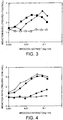
- Extracts of B. villosa and B. drepanensis were potent inducers of QR activity.
- extracts of B . atlantica did not induce QR activity, despite the high glucosinolate content ( Fig. 3 ).
- FIG. 3 the effects of the extracts of: B. drepanensis ( ⁇ ); B. villosa ( ⁇ ); and B. atlantica ( ⁇ ) on the induction of QR in murine hepatoma Hepa 1c1c7 cells is shown.
- Table 2 below illustrates the induction of QR activity (phase II enzymes) in Hepa 1c1c7 cells by vegetable extracts. TABLE 2 Potency of induction of QR in murine Hepa 1c1c7 cells by vegetable extracts.
- Predominant Isothiocyanate Apparent CD value* ( ⁇ M) CD value for Synthetic isothiocyanate ( ⁇ M)(See Zhang (2))
- Extracts from both [GD DH x B. villosa] and [GD DH x B. drepanensis] were potent inducers of QR activity ( Fig. 4 ).
- Figure 4 the effect of extracts of the cultivar GD DH ( ⁇ ); and the hybrid crosses [GD DH x B. drepanensis] ( ⁇ ); [GD DH x B. villosa] ( ⁇ ); and [GD DH x B. atlantica ] ( ⁇ ); on the induction of QR in murine hepatoma Hepa 1c1c7 cells is shown.
Landscapes
- Life Sciences & Earth Sciences (AREA)
- Health & Medical Sciences (AREA)
- Developmental Biology & Embryology (AREA)
- Environmental Sciences (AREA)
- Botany (AREA)
- Genetics & Genomics (AREA)
- Physiology (AREA)
- General Health & Medical Sciences (AREA)
- Natural Medicines & Medicinal Plants (AREA)
- Breeding Of Plants And Reproduction By Means Of Culturing (AREA)
- Measuring Or Testing Involving Enzymes Or Micro-Organisms (AREA)
- Medicines Containing Plant Substances (AREA)
- Pharmaceuticals Containing Other Organic And Inorganic Compounds (AREA)
- Saccharide Compounds (AREA)
- Steroid Compounds (AREA)
- Acyclic And Carbocyclic Compounds In Medicinal Compositions (AREA)
Abstract
Description
- The present invention relates to Brassica species with enhanced levels of anticarcinogenic glucosinolate derivatives and in particular edible Brassica vegetables with elevated levels of the anticarcinogenic glucosinolate derivatives 4-methylsulfinylbutyl isothiocyanate and/or 3-methylsulfinylpropyl isothiocyanate.
- The present invention provides Brassica vegetables with elevated levels of specific glucosinolates and derivatives thereof. In particular the invention provides Brassica vegetables with elevated levels of 3-methylsulfinylpropyl and/or 4-methylsulfinylbutyl glucosinolates. These glucosinolates are converted by the activity of the enzyme myrosinase into isothiocyanate derivatives which have been demonstrated to be potent inducers of phase II detoxification enzymes, elevated activity of which is associated with reduced susceptibility to the neoplastic effects of carcinogens. The invention provides plants with genetic combinations which 1.) exhibit elevated levels of 4-methylsulfinylbutyl glucosinolate and/or 3-methylsulfinylpropyl glucosinolate and 2.) exhibit low activity of the GSL-ALK allele which encodes an activity capable of converting these glucosinolates into the alkenyl derivatives, which do not posses the anti-carcinogenic properties of the isothiocyanate derivatives of these glucosinolates and 3.) suitable myrosinase activity capable of producing isothiocyanate derivatives of said glucosinolates. Accordingly these genetic combinations provide elevated levels of specific glucosinolates, reduced production of alkenyl derivatives of these glucosinolates and favoured production of isothiocyanate derivatives of said glucosinolates.
- It is known that a diet high in vegetables is associated with a reduction in the risk of certain types of cancer and hence it is desirable to include a significant amount of vegetables in the human diet. The anticarcinogenic activity of vegetables has been associated with the presence of several classes of secondary metabolites. Evidence is growing that some of these secondary metabolites are involved in lowering the risk of certain types of cancer and hence are considered anticarcinogenic. Accordingly, enhancing the level of anticarcinogenic metabolites provides a useful strategy for the reduction of cancer risk, in complementation with dietary advice to increase the consumption of vegetables.
- The precise mechanism by which vegetables provide a decreased risk of many types of cancer is not known with certainty, but there are many lines of evidence which support the involvement of vegetables in the prevention of cancer. In particular, the role of cruciferous vegetables in the prevention of cancer is widely supported through epidemiological studies and more recently biochemical studies. One class of secondary metabolites that is implicated in the beneficial effects of cruciferous vegetables is the isothiocyanate derivatives of certain glucosinolates. Four complementary pieces of evidence suggest that isothiocyanates derived from the hydrolysis of methylsulfinylalkyl glucosinolates found in crucifers may be important in the human diet in reducing the risk of cancer. (1.) Dietary provision of cruciferous vegetables protects rodents against chemically induced cancer (Wattenberg, L. W. (1985) Cancer Res. 45, 1-8.). (2.) Methylsulfinylalkyl isothiocyanates are known to be potent inducers of phase II detoxification enzymes in murine hepatoma Hepa 1c1c7 cells in culture (Zhang, Y., Talalay, P., Cho, C.-G., & Posner, G. H. (1992) Proc. Natl. Acad. Sci. USA 89,2399-2403and Tawfiq, N., Heaney, R. K., Plumb, J.A., Fenwick, G. R., Musk, S. R. R., &Williamson, G. (1995) Carcinogenesis 16, 1191-1194.), which are associated with reduced susceptibility of mammals and mammalian cell cultures to the toxic and neoplastic effects of carcinogens. (3.) Sulforaphane (4-methylsulfinylbutyl isothiocyanate) blocks the formation of mammary tumors in Sprague-Dawley rats treated with 9,10-dimethyl-1,2-benzanthracene (Zhang, Y., Kensler, T. W., Cho, C.-G., Posner, G. H., & Talalay, P. (1994) Proc. Natl. Acad. Sci. USA 91, 3147-3150.). (4.) Epidemiological studies show that people with high levels of vegetables in their diet are less susceptible to cancer (Block, G., Patterson, B., & Suber, A. (1992) Nutr. and Cancer 18, 1-19.). Thus the beneficial effects of a diet high in certain glucosinolates may include a reduction in the risk of cancer. However, it appears that only certain glucosinolates and more accurately, certain derivatives of specific glucosinolates may be primarily responsible for the beneficial effect.
- There are numerous individual glucosinolates in cruciferous plants. Carlson et al (1987) (J. Amer. Soc. Hort. Sci. 112, 173-178) determined the relative concentrations of 13 glucosinolates in the edible parts of 30 cultivars. Glucosinolates have a common glycone moiety and a variable aglycone side chain. The structure of the glucosinolate side chain varies in length and chemical composition.
- Glucosinolates are formed by the action of a number of enzymes, encoded by a small number of glucosinolate biosynthetic alleles (GSL alleles). In the glucosinolate pathway, methionine is converted to homo-methionine and dihomomethionine by the activity of the GSL-ELONG allele. Homomethionine is eventually converted to 3-methylthiopropyl glucosinolate followed by conversion to 3-methylsulfinylpropyl glucosinolate by the activity of GSL-OXID allele and finally 2-propenyl glucosinolate by the activity of GSL-ALK allele. Dihomo-methionine is converted to 4-methylthiobutyl glucosinolate, then to 4 methylsulfinylbutyl glucosinolate by the activity of GSL-OXID allele, then to 3-butenyl glucosinolate by the activity of GSL-ALK allele and finally converted to 2-hydroxy-3-butenyl glucosinolate by the activity of GSL-OH allele.
- In general, the 3-methylsulfinylpropyl glucosinolates and 4-methylthiobutyl glucosinolates produce non-volatile isothiocyanates and hence these particular glucosinolates contribute little to flavour. In contrast, the volatile alkenyl derivatives can contribute to flavour, both positively and negatively, dependant on the plant species and particular glucosinolate derivative.
- In B. oleracea vegetables, glucosinolates have either a three or four carbon side chain. Glucosinolates can be hydrolysed by the action of myrosinase which is often induced upon tissue damage. Many vegetables have alkenyl (2-propenyl and 3-butenyl) glucosinolates which result in the production of volatile products upon hydrolysis through the action of myrosinase. Some vegetables contain a 2-hydroxy-3-butenyl glucosinolate called progoitrin. This glucosinolate produces an unstable isothiocyanate that spontaneously cyclizes to produce oxazolidone-2-thiones, which are undesirable in diets due to their goitrogenic properties. Isothiocyanates derived from alkenyl and hydroxyalkenyl glucosinolates can have both positive and negative effects on flavour.
- Broccoli accumulates low levels of glucosinolates with 4-metylsulfinylbutyl and 3-methylsulfinylpropyl side chains since broccoli has a greatly reduced activity of the GSL-ALK allele, responsible for the conversion of glucosinolates into alkenyl derivatives. It is believed that the popularity of broccoli as a vegetable is due in part to the relatively modest contribution to taste made by 4-metylsulfinylbutyl and 3-methylsulfinylpropyl glucosinolate derivatives in contrast to the strong flavour imparted by other glucosinolates, particularly the volatile derivatives of glucosinolates.
- Thus, methods to increase the dietary amount of specific isothiocyanate derivatives of certain glucosinolates may provide vegetables with enhanced anticarcinogenic properties without altering the taste and/or palatability of the vegetable. However, the art does not provide a means to conveniently increase the levels of the specific glucosinolates in cruciferous vegetables. Moreover, the art does not provide a convenient means to assure that these glucosinolates are not converted to the alkenyl .derivatives, but rather the isothiocyanate derivatives which have anticarcinogenic properties. Of the numerous glucosinolates that may be produced by Brassica vegetables, 4-methylsulfinylbutyl glucosinolate and 3-methylsulfinylpropyl glucosinolate have been identified as being the precursors to the most potent anticarcinogenic isothiocyanate derivatives. The art does not provide a convenient means to increase these specific glucosinolates in a specific fashion while preventing the formation of other glucosinolate or glucosinolate derivatives that may have undesirable flavour characteristics.
- 4-Methylsulfinylbutyl glucosinolate and 3-methylsulfinylpropyl glucosinolate glucosinolates are found in several cruciferous vegetables, but are most abundant in broccoli varieties (syn. calabrese: Brassica oleracea L. var. italica) which lack a functional allele at the GSL-ALK locus. The presence of a functional GSL-ALK allele converts these glucosinolates to their alkenyl homologues, which are poor inducers of phase II enzymes (Tawfiq, N., Heaney, R. K., Plumb, J. A., Fenwick, G. R., Musk, S. R. R., & Williamson, G. (1995) Carcinogenesis 16, 1191-1194.). Therefore the presence of a functional GSL-ALK allele precludes the possibility of producing a variety with high levels of these anti-carcinogenic isothiocyanates since the glucosinolates will be converted to alkenyl derivatives. Additionally the production of isothiocyanates from glucosinolates requires the activity of the enzyme myrosinase. Hence enhanced production of these specific isothiocyanates depends on both the levels of glucosinolate precursors (which are influenced by the activity encoded by the GSL-ALK allele) and the levels or activity of myrosinase which produces the isothiocyanate derivatives of glucosinolates.
- Accordingly a genetic combination which specifies the production of high levels of 4-methylsulfinylbutyl glucosinolate and/or 3-methylsulfinylpropyl glucosinolates is desirable, but the production of the anticarcinogenic isothiocyanate derivatives of these glucosinolates requires additional genetic combinations. Thus methods to achieve these genetic compositions provides novel compositions of matter not presently found in commercially grown cruciferous vegetables.
- The levels of glucosinolates in. commercially grown broccoli are relatively low compared to those found in salad crops such as rocket (Eruca sativa), which accumulates 4-methylthiobutyl glucosinolate, and watercress (Rorippa nasturtium-aquaticum), which accumulates phenethyl glucosinolate (Fenwick, G. R., Heaney, R. K., & Mullin, W. J. (1983) Crit. Rev. Food Sci. Nutr. 18, 123-201). Exposure to enhanced levels of 4-methylsulfinylbutyl glucosinolate and/ or 3-methylsulfinylpropyl glucosinolate in broccoli would be expected to enhance the potency of induction of phase II enzymes when ingested. Thus broccoli with increased levels of the anticarcinogenic 4-methylsulfinylbutyl isothiocyanate and/or 3-methylsulfinylpropyl isothiocyanate would be a valuable addition to a diet that is designed to lower the risk of cancer. Additionally, such changes would be unlikely to lead to reduced palatability as methylsulfinylalkyl glucosinolates are non-volatile and have a relatively small contribution to flavour, in contrast to the majority of other isothiocyanates found in vegetables and salad crops (Fenwick, G. R., Heaney, R. K., & Mullin, W. J. (1983) Crit. Rev. Food Sci. Nutr. 18, 123-201). Thus altering the levels of these specific glucosinolates would not change the taste of the cruciferous vegetables which carry the genetic combinations encoding the trait.
- Many wild members of the Brassica oleracea species complex (chromosome number, n = 9) have high levels of individual aliphatic glucosinolates (Mithen, R., Lewis, B. G., & Fenwick, G. R. (1987) Phytochemistry 26, 1969-1973. and Giamoustaris, A. & Mithen, R. (1996) Theor. Appl. Genet. 93,1006-1010.). Studies on the genetics of glucosinolates in these taxa has been instrumental in elucidating the genetic pathway for glucosinolate biosynthesis. It is evident that certain species in this taxa could be valuable in Brassica breeding programs designed to specifically enhance 4-methylsulfinylbutyl glucosinolate and/or 3-methylsulfinylpropyl glucosinolate and, by so doing, the anticarcinogenic potential of the plant. However, the art does not provide methods to increase the concentration of 4-methylsulfinylbutyl glucosinolate and/or 3-methylsulfinylpropyl glucosinolate through genetic combinations nor does it provide a convenient means by which the anticarcinogenic properties of the vegetables containing said genetic combinations can be assessed. The present invention provides plants with these genetic combinations.
- Foremost amongst these are genetic combinations which incorporate the genes from members of the B. villosa-rupestris complex from Sicily, which possess a non-functional GSL-ALK allele, and may be the wild progenitors of cultivated broccoli. Thus wild relatives and progenitors of commercial broccoli were utilized as a source of the genes needed to derive a genetic combination capable of producing high levels of 4-methylsulfinylbutyl and/or 3-methylsulfinylpropyl glucosinolates and the genetic combination that favours the production of isothiocyanate derivatives of these glucosinolates rather than alkenyl derivatives.
- 4-Methylsulfinylbutyl isothiocyanate (also referred to as sulforaphane), derived from the corresponding glucosinolate found in some Brassica species, has previously been identified as a potent inducer of phase II detoxification enzymes (e.g. QR; quinone reductase [NADP(H):quinone-acceptor] oxidoreductase) in murine hepatoma Hepa 1c1c7 cells. Similarly, 3-methylsulfinylpropyl isothiocyanate is a strong inducer of phase II enzymes. Measurement of the induction of QR in murine hepatoma Hepa 1c1c7 cells provides a rapid and reliable indicator of the ability of vegetable extracts to induce phase II enzymes in mammalian cells (Prochaska, H. J., Santamaria, A. B., & Talalay, P. (1992) Proc. Natl. Acad. Sci. USA 89, 2394-2398.), and hence of putative anticarcinogenic activity. This assay has been used to assess the potential of synthetic isothiocyanates (Zhang, Y., Talalay, P., Cho, C.-G., & Posner, G. H. (1992) Proc. Natl. Acad. Sci. USA 89, 2399-2403 and Talalay, P., De Long, M. J., & Prochaska, H. J. (1988) Proc. Natl. .), extracts from cruciferous vegetables (Tawfiq, N., Wanigatunga, S., Heaney, R. K., Musk, S. R. R., Williamson, G., & Fenwick, G. R. (1994) Exp. J. Cancer Prev. 3, 285-292.) and myrosinase-treated glucosinolates (Tawfiq, N., Heaney, R. K., Plumb, J. A., Fenwick, G. R., Musk, S. R. R., & Williamson, G. (1995) Carcinogenesis 16, 1191-1194). However, the glucosinolate/isothiocyanate content of the vegetable extracts has generally not been reported nor has the relative anticarcinogenic potential of various cruciferous vegetables been reported.
- This assay has been used to determine the relationship between the ability to induce QR activity (anticarcinogenic potential) and the glucosinolate content of three wild members of the B. oleracea complex, which have high levels of 3-methylthiopropyl (B. drepanensis) 3-methylsulfinylpropyl (B. villosa) and 2-propenyl (B. atlantica) glucosinolates respectively, when combined with commercial broccoli cultivars through conventional crosses and hybrids between the wild accessions and a commercial double haploid broccoli breeding lines. Accordingly methods and compositions have been derived which identify the genetic compositions required for the stable production of specific glucosinolates (e.g. of 4-methylsulfinylbutyl and/or 3-methylsulfinylpropyl glucosinolates) and the production of the corresponding isothiocyanate derivatives. These genetic combinations provide useful breeding lines for the production of commercial varieties of broccoli and other cruciferous vegetables that have 10 -100 times the levels of these anticarcinogenic compounds than currently found in commercially grown varieties.
- It has been found for example, that a ten-fold increase in the level of 4-methylsulfinylbutyl glucosinolate is obtained by crossing broccoli cultivars with selected wild taxa of the Brassica oleracea (chromosome number, n = 9) complex. Similarly increases in levels of 3-methylsulfinylpropyl glucosinolate is observed. Tissue from these hybrids exhibited a 100-fold increase in the ability to induce quinone reductase in Hepa 1c1c7 cells over commercially grown broccoli cultivars due to both an increase in 4-methylsulfinylbutyl and/or 3-methylsulfinylpropyl glucosinolates and the increased conversion of 4-methylsulfinylbutyl glucosinolate to sulforaphane. Accordingly the invention provides commercially valuable cruciferous vegetables containing high levels of anticarcinogenic secondary metabolites. The invention further contemplates the development of broccoli breeding lines with enhanced anticarcinogenic activity.
- The selection of breeding lines with high levels of anticarcinogenic compounds is further facilitated by the use of molecular markers to establish the chromosomal location of the glucosinolate biosynthetic genes and to assist in selection of backcross lines which contain the genetic composition of greatest utility for the purposes of enhancing the levels of anticarcinogenic compounds in broccoli.
- The present invention provides an edible Brassica plant produced according to a method for the production of Brassica oleracea with elevated levels of 4- methylsulfinylbutyl glucosinolates, or 3-methylsulfinylpropyl glucosinolates, or both, which comprises:
- a) crossing wild Brassica oleracea species selected from the group consisting of Brassica villosa and Brassica drepanensis with broccoli double haploid breeding lines;
- b) selecting hybrids with levels of 4-methylsulfinylbutyl glucosinolates, or 3-methylsulfinylpropyl glucosinolates, or both, elevated above that initially found in broccoli double haploid breeding lines;
- c) backcrossing and selecting plants with the genetic combination encoding the expression of elevated levels of 4-methylsulfinylbutyl glucosinolates, or 3-methylsulfinylpropyl glucosinolates, or both; and
- d) selecting a broccoli line with elevated levels of 4-methylsulfinylbutyl glucosinolates, or 3-methylsulfinylpropyl glucosinlates, or both, capable of causing a strong induction of phase II enzymes,
- The present invention further provides an edible portion of a broccoli plant produced according to a method for the production of Brassica oleracea with elevated levels of 4- methylsulfinylbutyl glucosinolates, or 3-methylsulfinylpropyl glucosinolates, or both, which comprises:
- a) crossing wild Brassica oleracea species selected from the group consisting of Brassica villosa and Brassica drepanensis with broccoli double haploid breeding lines;
- b) selecting hybrids with levels of 4-methylsulfinylbutyl glucosinolates, or 3-methylsulfinylpropyl glucosinolates, or both, elevated above that initially found in broccoli double haploid breeding lines;
- c) backcrossing and selecting plants with the genetic combination encoding the expression of elevated levels of 4-methylsulfinylbutyl glucosinolates, or 3-methylsulfinylpropyl glucosinolates, or both; and
- d) selecting a broccoli line with elevated levels of 4-methylsulfinylbutyl glucosinolates, or 3-methylsulfinylpropyl glucosinlates, or both, capable of causing a strong induction of phase II enzymes,
- The present invention also provides seed of a broccoli plant produced according to a method for the production of Brassica oleracea with elevated levels of 4- methylsulfinylbutyl glucosinolates, or 3-methylsulfinylpropyl glucosinolates, or both, which comprises:
- a) crossing wild Brassica oleracea species selected from the group consisting of Brassica villosa and Brassica drepanensis with broccoli double haploid breeding lines;
- b) selecting hybrids with levels of 4-methylsulfinylbutyl glucosinolates, or 3-methylsulfinylpropyl glucosinolates, or both, elevated above that initially found in broccoli double haploid breeding lines;
- c) backcrossing and selecting plants with the genetic combination encoding the expression of elevated levels of 4-methylsulfinylbutyl glucosinolates, or 3-methylsulfinylpropyl glucosinolates, or both; and
- d) selecting a broccoli line with elevated levels of 4-methylsulfinylbutyl glucosinolates, or 3-methylsulfinylpropyl glucosinlates, or both, capable of causing a strong induction of phase II enzymes,
- In a further embodiment, the invention provides a broccoli plant having elevated levels of 3-methylsulfinylpropyl glucosinolates, or 4-methylsulfinylbutyl glucosinolates, or both, wherein the broccoli plant is a hybrid plant following crossing of broccoli double haploid breeding lines with wild Brassica oleracea species selected from the group consisting of Brassica villosa and Brassica drepanensis and the levels of 3-methylsulfinylpropyl glucosinolates, or 4-methylsulfinylbutyl glucosinolates, or both, are between 10 and 100 µmoles per gram of dry weight of said plant.
- Alternatively, the invention provides a broccoli inflorescence having elevated levels of 3-methylsulfinylpropyl glucosinolates, or 4-methylsulfinylbutyl glucosinolates, or both, wherein the broccoli inflorescence is obtained from a hybrid plant following crossing of broccoli double haploid breeding lines with wild Brassica oleracea species selected from the group consisting of Brassica villosa and Brassica drepanensis and the levels of 3- methylsulfinylpropyl glucosinolates, or 4-methylsulfinylbutyl glucosinolates, or both, are between 10 and 100 µmoles per gram of dry weight of the inflorescence.
-
-
Fig. 1 . Genetic model of aliphatic glucosinolate biosynthesis in Brassica. -
Fig. 2 . Induction of QR activity (phase II enzymes) in murine hepatoma Hepa 1c1c7 cells using extracts from the cultivar Marathon and synthetic sulforaphane (4-methylsulfinylbutyl isothiocyanate). -
Fig. 3 . Effect of extracts of B. drepanensis ; B. villosa; and B. atlantica on induction of QR (phase II enzymes) in murine hepatoma Hepa 1c1c7 cells. -
Fig. 4 . The effect of extracts of the cultivar GD DH and the hybrids recovered from crosses with wild species [GD DH x B. drepanensis]; [GD DH x B. villosa]; and [GD DH x B. atlantica]; on the induction of QR (phase II enzymes) in murine hepatoma Hepa 1c1c7 cells. -
Fig. 5 . Gas chromatograph profile of the glucosinolates from an extract from a hybrid [GD DH x B. drepanensis]. - It is an object of the present invention to provide an edible cruciferous vegetable with high levels of anticarcinogenic compounds, namely 4-methylsulfinylbutyl isothiocyanate and/or 3-methylsulfinylpropyl isothiocyanate.
- These plants are obtained using methods for the selective increase of anticarcinogenic glucosinolate derivatives in Brassica species, which provide Brassica species with enhanced levels of anticarcinogenic glucosinolate derivatives and in particular edible Brassica vegetables with elevated levels of the anticarcinogenic glucosinolate derivatives 4-methylsulfinylbutyl isothiocyanate and/or 3-methylsulfinylpropyl isothiocyanate.
- The selection of broccoli with elevated levels of anticarcinogenic glucosinolates is not possible in the present commercial genetic background used to develop commercial broccoli cultivars. Based on the genetic model of glucosinolate biosynthesis shown in
Figure 1 , the production of 4-methylsulfinylbutyl and/or 3-methylsulfinylpropyl glucosinolates is dependant on a number of genetic factors. These include low activity of the GSL-ALK allele and proper levels of activity encoded by the GSL-OXID alleles and other alleles responsible for the production of glucosinolate precursors. It is believed that the relatively mild taste of broccoli is associated with relatively low levels of glucosinolates in general and low levels of volatile glucosinolates in particular. This is evident when the total glucosinolate profiles of commercial broccoli and wild relatives are compared. - Thus methods to derive broccoli with desirable flavour characteristics and elevated levels of anticarcinogenic glucosinolates must encompass selection of lines with the proper genetic combination which do not produce strong flavoured alkenyl glucosinolates. It is also desirable to maintain low levels of other glucosinolates in order to avoid off-flavour production. Thus methods to achieve the specific elevation of 4-methylsulfinylbutyl and/or 3-methylsulfinylpropyl glucosinolates must not lead to an overall production of glucosinolates or production of aikeynl glucosinolates.
- Under normal field conditions, it is believed that wild type B. oleracea would not likely cross-fertilize with cultivated B. oleracea. It is thought that compatibility traits are turned off when the cultivars flowers.
- The genetic markers facilitate the selection of lines which contain the desired genetic combination. The use of RFLP markers, or DNA probes which segregate with specific traits Is well known in the art, however the specific DNA probes that have been shown to be useful for the selection of genetic combinations that lead to elevated levels of 4-methylsulfinylbutyl and/or 3-methylsulfinylpropyl glucosinolates in Brassica oleracea were not known. Furthermore, RFLP analysis provides a useful means to assess the portion of the genome of a hybrid plant which is derived from broccoli or wild species. Thus the use of RFLP or DNA probes finds utility in the rapid selection of plants which contain the desired proportion of wild species and broccoli genomes. Thus selection of broccoli with elevated levels of 4-methylsulfinylbutyl and/or 3-methylsulfinylpropyl glucosinolates comprising a high percentage of the desired commercial genome is greatly facilitated by the use of DNA markers to analyse hybrid plants following crossing of broccoli with wild species.
- Methods for the assessment of the anticarcinogenic properties of broccoli containing elevated levels of 4-methylsulfinylbutyl and/or 3-methylsulfinylpropyl glucosinolates through assays for the induction of phase II enzymes are described. Although the long-term anticarcinogenic effects of specific derivatives of 4-methylsulfinylbutyl and/or 3-methylsulfinylpropyl glucosinolates can not be precisely determined and will be further dependant on many additional factors, dietary and otherwise, the use of the induction assay provides compelling evidence for the anticarcinogenic effects of the isothiocyanate derivatives of the specific glucosinolates.
- Methods that permit the selection of Brassica sp. with elevated levels of 4-methylsulfinylbutyl and/or 3-methylsulfinylpropyl glucosinolates, methods to evaluate the anticarcinogenic effects of said plant species, and methods and compositions that permit the derivation of broccoli lines with anti-carcinogenic properties are described.
- A method which can be used to select broccoli lines with elevated levels of specific glucosinolates comprises:
- I.) Crossing wild species with broccoli double haploid breeding lines;
- II.) Analyzing F1 hybrids, selecting the hybrids with the highest level of 4-methylsulfinylbutyl and/or 3-methylsulfinylpropyl glucosinolates and backcrossing to broccoli breeding lines;
- III.) Analysis of glucosinolates in individual plants of the B1 (Backcross 1) generation;
- IV.) One or two further rounds of backcrossing (B2, B3) with selection of plants with the highest level of 4-methyl-sulfinylbutyl and/or 3-methylsulfinylpropyl glucosinolates, anticarcinogenesis screening of selected individuals by induction of phase II enzymes;
- V.) Analysis of B3 (Backcross 3) population with selection of plants with the highest level of 4-methylsulfinylbutyl and/or 3-methylsulfinylpropyl glucosinolates, anticarcinogenesis screening of selected individuals by induction of phase II enzymes;
- VI.) Selection of a broccoli line with elevated levels of 4-methylsulfinylbutyl and/or 3-methylsulfinylpropyl glucosinolates which carries the anticarcinogenic trait capable of causing a strong induction of phase II enzymes.
- Thus the method allows for the selection of broccoli lines with elevated levels of 4-methylsulfinylbutyl and/or 3-methylsulfinylpropyl glucosinolates. The elevated levels of these specific glucosinolates is correlated with the anti-carcinogenic property by evaluation of the induction of phase II enzymes. By employing backcrossing, genetic combinations are derived which comprise the anticarcinogenic trait in a genetic background found in commercial broccoli. Accordingly the production of 4-methylsulfinylbutyl and/or 3-methylsulfinylpropyl glucosinolates in commercial cultivars of broccoli is accomplished, giving rise to a new and valuable broccoli composition.
- In another embodiment of the present invention, the anticarcinogenic capability of the lines is further combined with specific alleles for self incompatibility which is useful in seed production strategies. It is known that certain cruciferous species carry various alleles for self-incompatibility and these alleles are often employed for hybrid seed production. Thus hybrid broccoli may be produced which carries the genetic combination that produces elevated levels of 4-methylsulfinylbutyl and/or 3-methylsulfinylpropyl glucosinolates. It is another object of the present invention to provide broccoli lines with high levels of 4-methylsulfinylbutyl and/or 3-methylsulfinylpropyl glucosinolates and a specific combination of self-incompatibility (SI) alleles. In some instances, it may be possible to use a molecular probe for identification of SI alleles, such as the probe pW150 (available from Dr. Tom Osborne, Department of Agronomy, University of Wisconson, Madison, WI, 53706 and described in Toroser et al., Theoretical and Applied Genetics, 91: 802-808.1995), or analysis of the actual SI protein can provide selection of the desired SI allele.
- A method which can be used to select broccoli lines with high levels of specific glucosinolates and SI alleles comprises:
- I.) Crossing wild species with broccoli double haploid breeding lines containing specific SI alleles;
- II.) Analyzing F1 hybrids, selecting the hybrids with the highest level of 4-methylsulfinylbutyl and/or 3-methylsulfinylpropyl glucosinolates and backcrossing to broccoli breeding lines, screening for SI alleles with RFLP markers, selection of individuals with desired combination of contrasting SI alleles;
- III.) Analysis of glucosinolates in individual plants of the B1 (Backcross 1) generation;
- IV.) One or two further rounds of backcrossing with selection of plants with the highest level of 4-methylsulfinylbutyl and/or 3-methylsulfinylpropyl glucosinolates, screening for proper SI alleles with RFLP markers, anticarcinogenesis screening of selected individuals by induction of phase II enzymes;
- V.) Analysis of B3 (Backcross 3) population with selection of plants with the highest level of 4-methylsulfinylbutyl and/or 3-methylsulfinylpropyl glucosinolates, anticarcinogenesis screening of selected individuals by induction of phase II enzymes;
- VI.) Selection of a broccoli line with elevated levels of 4-methylsulfinylbutyl and/or 3-methylsulfinylpropyl glucosinolates and proper SI alleles which carries the anticarcinogenic trait capable of causing a strong induction of phase II enzymes.
- Thus broccoli lines are derived which carry specific SI alleles useful for crossing in a hybrid seed production scheme. Accordingly hybrid broccoli seed that carries the genetic combination for elevated levels of 4-methylsulfinyl-butyl and/or 3-methylsulfinylpropyl glucosinolates can be produced by crossing with the appropriate parent. Said seed is valuable since hybrid broccoli also carries many genetic combinations important for agronomic performance.
- Another method is described which employs the use of DNA markers that segregate with specific glucosinolate profiles. In this method, the use of DNA markers, or more specifically markers known as QTLs (quantitative trait loci) are used to select the genetic combination in broccoli that leads to elevated levels of 4-methylsulfinylbutyl and/or 3-methylsulfinylpropyl glucosinolates. In particular the use of the markers known as pW176, pW207 and pW141 located on
chromosome 2 and the markers known as pW224, pW114, pW145, pW123, pW138, pW197, pW228, pW106 located on chromosome 5 is described (available from Dr. Tom Osborne, Department of Agronomy, University of Wisconson, Madison, WI, 53706 and described in Toroser et al., Theoretical and Applied Genetics, 91:802-808,1995 and described in Ferreira et al., Theoretical and Applied Genetics 89:615-621, 1994.) - It has been found that two regions of the genome (found on
chromosome 2 and 5) of wild Brassica oleracea are required for the expression of elevated levels of 4-methylsulfinylbutyl and/or 3-methylsulfinylpropyl glucosinolates. The use of the markers greatly facilitates the selection of lines from hybrids and backcrosses between broccoli and wild species which contain the genetic combination responsible for the production of elevated levels of 4-methylsulfinylbutyl and/or 3-methylsulfinylpropyl glucosinolates. Furthermore, it has been found that the QTL located on chromosome 5 specifically regulates the levels of 3-methysulfinylpropyl glucosinolate and has little effect on the levels of 4-methylsulfinylbutyl glucosinolate. Thus it is possible to manipulate the levels of 3-methysulfinylpropyl glucosinolate and 4-methylsulfinylbutyl glucosinolate. independently by the use of molecular probes in addition to simple selection of lines. - Accordingly a method to produce broccoli with elevated levels of 4-methylsulfinylbutyl and/or 3-methylsulfinylpropyl glucosinolates comprises:
- I.) Crossing wild species with broccoli double haploid breeding lines;
- II.) Analyzing F1 hybrids and selecting the hybrids with the highest level of 4-methylsulfinylbutyl and/or 3-methylsulfinylpropyl glucosinolates by screening with RFLP probes associated with the production of 4-methylsulfinylbutyl and/or 3-methylsulfinylpropyl glucosinolates and backcrossing selected lines to broccoli breeding lines;
- III.) Analysis of glucosinolates in individual plants of the B1 (Backcross 1) generation;
- IV.) One or two further rounds of backcrossing with selection of plants with the highest level of 4-methylsulfinylbutyl and/or 3-methylsulfinylpropyl glucosinolates by screening with RFLP probes associated with the production of 4-methylsulfinylbutyl and/or 3-methylsulfinylpropyl glucosinolates, anticarcinogenesis screening of selected individuals by Induction of phase II enzymes;
- V.) Analysis of B3 (Backcross 3) population with selection of plants with the highest level of 4-methylsulfinylbutyl and/or 3-methylsulfinylpropyl glucosinolates by screening with RFLP probes associated with the production of 4-methylsulfinylbutyl and/or 3-methylsulfinylpropyl glucosinolates and analysis of glucosinolate profiles, anticarcinogenesis screening of selected individuals by induction of phase II enzymes;
- VI.) Selection of a broccoli line with elevated levels of 4-methylsulfinylbutyl and/or 3-methylsulfinylpropyl glucosinolates which carries the anticarcinogenic trait capable of causing a strong induction of phase II enzymes.
- Thus the use of RFLP probes for identifying specific regions of the wild Brassica oleracea genome (e.g. so-called QTLs) responsible for the production of elevated levels of 4-methylsulfinylbutyl and/or 3-methylsulfinylpropyl glucosinolates greatly facilitates the production of edible broccoli with anticarcinogenic properties.
- The foregoing embodiments allow for the selection of broccoli lines with elevated levels of 4-methylsulfinylbutyl and/or 3-methylsulfinylpropyl glucosinolates, preferably broccoli with a composition comprising concentrations of 4-methylsulfinylbutyl and/or 3-methylsulfinylpropyl glucosinolates between 10 and 100 µmoles/g dry weight. Furthermore, the foregoing embodiments allow for the selection of broccoli lines with elevated levels of 4-methylsulfinylbutyl and/or 3-methylsulfinylpropyl glucosinolates capable of causing a 10 - 100 fold increase in the induction of phase II enzymes when compared to broccoli cultivars commonly found in commerce.
- The skilled artisan would contemplate that the methods described herein may also be applied to obtain cruciferous B. oleracea vegetables other than broccoli, including cabbage such as white cabbage, green cabbage such as Savoy, cauliflower, Brussels sprouts, kale, kohlrabi and the like. It is further contemplated that rutabaga (B. napus) and turnip (B. rapa) may also be manipulated according to the method and genetic combinations of the present invention.
- A double haploid broccoli breeding line derived from the cultivar Green Duke (referred to as GD DH, Bouhuon, E. J. R., Keith, D. J., Parkin, I. A. P., Sharpe, A. G., & Lydiate, D. J. (1996) Theor. Appl. Genet. 93, 833-839.), three commercial cultivars (Trixie, Green Comet and Marathon) and three wild Brassica species: B. drepanensis Caruel (syn. B. villosa Biv. subsp drepanensis), B. villosa Biv. and B. atlantica (Coss.) O. E. Schultz, were grown in a glasshouse under standard conditions as previously described (Magrath, R., Herron, C., Giamoustaris, A., & Mithen, R. (1993) Plant Breed. 111, 55-72). Each of the wild species was crossed to the GD DH breeding line, F1 seeds were obtained and grown under standard conditions. A deposit of seeds of the cultivar derivative GD DH was made on February 11, 1999 with the National Collection of Industrial and Marine Bacteria Limited (NCIMB) in Aberdeen, Scotland, and was assigned the deposit No. NCIMB 41008. Inflorescences were harvested from the cultivars after 8-12 weeks and from the hybrids after 12-16 weeks, immediately frozen in liquid nitrogen and freeze-dried. Synthetic sulforaphane was kindly supplied by Professor P. Talalay, The John Hopkins University School of Medicine, Baltimore, MD.
- Glucosinolates were extracted from the freeze-dried material, converted to desulfoglucosinolates and analysed by HPLC as previously described (Magrath, R., Herron, C., Giamoustaris, A., & Mithen, R. (1993) Plant Breed. 111, 55-72) using benzyl glucosinolate as an internal standard.
- Extracts from the freeze-dried material were assessed for their induction activity in murine hepatoma Hepa 1c1c7 cells. Approximately 0.1 g of milled freeze-dried material was moistened by addition of water (2 ml), homogenised and left at room temperature for 1 hr with occasional mixing. Hot 70% (v/v) methanol (3 ml) was added and mixed thoroughly prior to incubation for 15 min at +70°C. The homogenates were cooled to room temperature and centrifuged for 5 min at 3000 r.p.m. Supernatants were removed and the volume decreased in a vacuum centrifuge to approximately one fifth of the initial volume. The resulting concentrates were filtered through sterile non-pyrogenic filters (0.22 mm) and stored at -70°C priorto testing. The concentrations of each extract were expressed as dry weight of original material to each ml of culture medium.
- Induction was measured according to published methods (Tawfiq, N., Heaney, R. K., Plumb, J. A., Fenwick, G. R., Musk, S. R. R., & Williamson, G. (1995) Carcinogenesis 16, 1191-1194., Prochaska, H. J., & Santamaria, A. B. (1988) Anal. Biochem. 169, 328-336., Williamson, G., Plumb, G. W., Uda, Y., Price, K. R., & Rhodes, M. J. C. (1996) Carcinogenesis 17, 2385-2387.) with the following modifications. Each sample was analysed at eight concentrations using four replicates for each concentration. b-Napthoflavone was used as a positive control at a concentration of 0.2 mM. This typically produced a three-fold induction (CD; 0.02 mM) and was comparable to previous determinations. Each cultivar/hybrid was extracted on three occasions and analysed separately.
- Non-volatile and volatile components of the hydrolytic breakdown products of the cultivars, wild species and the hybrids were analysed byGC-MS using a HP Chemstation GP800A equipped with a 30m x 0.25mm HP1 crosslinked methylsilane column (Hewlett Packard Co. Palo Alto, CA. USA). Typically, the column was heated from +60°C to +250°C at 20°C/min and mass spectra scanned from 35 to 250 m/z. Approximately 0.1 g of freeze-dried material was moistened with water, mixed thoroughly and incubated for 1 hr with occasional mixing. Non-volatile hydrolytic products were extracted from the samples with methylene chloride and filtered prior to analysis. In order to analyse volatile products, freeze-dried material (0.1 g) was moistened with water (0.5 ml), the glass vial sealed immediately and volatile products collected from the vial headspace with a solid phase matrix extraction (SPME) probe (Supelco Inc., Bellefonte, PA, USA).
- Table 1 below shows the glucosinolate content of commercial broccoli cultivars Green Comet, Marathon and Trixie, wild B.oleracea species and hybrids between a doubled haploid line of the commercial cultivar Green Duke and wild Brassica species.
TABLE 1 Individual and total aliphatic glucosinolate content (µmoles/g dry weight ± 1 standard error) of broccoli cultivars, wild Brassica species and hybrids produced from crosses between GD DH and the wild Brasssica species. MSP* MSB PROP BUT MTP OH-BUT TOTAL Green Comet 0.1±0.1 0.8±0.5 0.2±0.1 0.0 2.7±0.5 0.5±0.3 4.3±0.5 GD DH 0.2±0.2 4.6±1.1 0.0 0.0 2.3±0.6 0.0 7.1±1.1 Marathon 1.0±0.3 5.4±1.1 0.2±0.1 0.0 4.1±0.7 0.0 10.7±1.8 Trixie 0.4±0.2 11.1±2.1 0.2±0.1 0.0 4.9±1.2 0.0 16.6±2.6 B. atlantica 0.9±0.7 0.0 92.8±25.4 0.5±0.3 1.1±1.0 0.0 95.3±26.6 B. drepanensis 11.0±1.7 0.0 0.0 0.0 51.6±9.3 0.0 62.6±10.9 B. villosa 119±18 1.4±0.2 0.0 0.1±0.1 3.4±0.9 0.1±0.1 124±19 GD † x B.atlantica 2.2±0.8 5.3±1.4 76.9±20.8 23.6±6.3 2.0±0.7 43.7±6.7 154±30 GD x B. drepanensis 26.2±2.9 76.5±8.9 0.0 0.0 1.9±0.4 0.0 105±12 GD x B. villosa 26.4+2.7 81.8+5.0 0.0 0.0 1.0+0.3 0.0 109±7 *MSP:3-methylsulfinylpropyl, MSB: 4-methylsufinylbutyl, PROP: 2-propenyl, BUT: 3-butenyl, MTP: 3-methylthiopropyl, OH-BUT: 2-hydroxy-3-butenyl. † GD:GD DH. - The level of 4-methylsulfinylbutyl glucosinolate in the broccoli cultivars were similar to those previously reported (Carlson, D. G., Daxenbichler, M. E., van Etten, C. H., Kwolek, W. F., & Williams, P. H. (1987) J. Amer. Soc. Hort. Sci. 112, 173-178.). Wild species had approximately a ten-fold greater level of total aliphatic glucosinolates than the cultivars. B. villosa, B. drepanensis and B. atlantica had predominantly 3-methylsulfinylpropyl, 3-methylthiopropyl and 2-propenyl glucosinolates. The differences in the glucosinolate profiles were attributed to differences in alleles at the GSL-OXID and GSL-ALK loci (Giamoustaris, A. & Mithen, R. (1996) Theor. Appl. Genet. 93, 1006-1010.). In the hybrids of [GD DH x B. drepanensis] and [GD DH x B. villosa] 4-methylsulfinylbutyl was the most abundant glucosinolate due to the dominant nature of the GSL-ELONG and GSL-OXID alleles found in GD DH and to the null GSL-ALK alleles in both parents. In the [GD DH x B. atlantica] hybrid, 3-butenyl glucosinolate was the predominant glucosinolate. 2-Hydroxy-3-butenyl glucosinolate was also present due to the action of a functional GSL-OH allele in the GD DH line (unpublished), which is not usually evident due to the null GSL-ALK allele preventing the biosynthesis of 3-butenyl glucosinolate.
- Synthetic sulforaphane was used as a positive control to quantify induction of QR in Hepa 1c1c7 cells. It was a potent inducer and produced a three-fold induction at 1.6 mM (CD; 0.4 mM), comparable to previous determinations. No cytotoxicity was observed for any sample at any of the concentrations tested. Extracts from all the cultivars were poor inducers over the concentration range 0.001 mg/ml to 0.125 mg/ml. However, the induction was less than expected if 100% of the glucosinolates had been converted to isothiocyanates, and not to other products such as thiocyanate or nitrile derivatives (Fenwick, G. R., Heaney, R. K., & Mullin, W. J. (1983) Crit. Rev. Food Sci. Nutr. 18, 123-201).
- For example, Marathon contained 5.4 mmoles of 4-methylsulfinylbutyl glucosinolate/g dry weight (Table 1). Therefore, an extract containing 75 mg/ml of Marathon would be expected to have a 4-methylsulfinylbutyl isothiocyanate concentration of 0.4 mM which would result in a two-fold induction. However, no significant induction was observed at this concentration. Indeed, 2.5 mg/ml of Marathon extract was required for a two-fold induction, which if 100% of the glucosinolate is converted to isothiocyanate, is equivalent to 13.5 mM 4-methylsulfinylbutyl isothiocyanate. Thus, either a small proportion of the glucosinolate had been converted to 4-methylsulfinylbutyl isothiocyanate, or the induction of QR activity was reduced by other components in the vegetable extract.
- To test for the presence of an inhibitor, Marathon extract (0.125 mg/ml) was spiked with synthetic sulforaphane prior to application to the Hepa 1c1c7 cells. The induction observed was similar to that of pure sulforaphane alone (
Fig. 2 ), which demonstrated that there had been no inhibitory effect by other components in the extracts. InFigure 2 , the induction of QR in Hepa 1c1c7 cells using Sulforaphane (Δ); Marathon extract (0.125 mg/ml) with added sulforaphane (■) or Marathon extract (0.001 mg/ml to 0.125 mg/ml), (○), is shown. The estimated isothiocyanate concentration of the Marathon extract has been based on an assumption that 100% of the parent glucosinolate is converted to the isothiocyanate. Thus, Marathon extract (1 mg/ml) is equivalent to 5.4 uM 4-methylsulfinylbutyl isothiocyanate. Results for Marathon (0.125 mg/ml) with added sulforaphane have been plotted with respect to the added synthetic sulforaphane concentration only, as the Marathon extract alone has no significant effect on induction activity. Therefore, it is possible in Marathon (and also other cultivars) that only a proportion of the glucosinolate had been converted to the isothiocyanate. - Extracts of B. villosa and B. drepanensis were potent inducers of QR activity. In contrast, extracts of B. atlantica did not induce QR activity, despite the high glucosinolate content (
Fig. 3 ). Infigure 3 , the effects of the extracts of: B. drepanensis (■); B. villosa (◆); and B. atlantica (□) on the induction of QR in murine hepatoma Hepa 1c1c7 cells is shown. If it is assumed that 100% of the glucosinolate in these taxa had been converted to the isothiocyanate and not to other possible hydrolytic breakdown products (thiocyanate and nitrile derivatives), the apparent CD values for 3-methylthiopropyl isothiocyanate and 3-methylsulfinylpropyl isothiocyanate are 1.6 mM and 0.5 mM respectively. These values are both lower than those reported for synthetic isothiocyanates of 3.5 mM and 2.4 mM, as illustrated in Table 2. Indeed, if less of the glucosinolates had been converted to isothiocyanates the apparent CD values would be even lower. Table 2 below illustrates the induction of QR activity (phase II enzymes) in Hepa 1c1c7 cells by vegetable extracts.TABLE 2 Potency of induction of QR in murine Hepa 1c1c7 cells by vegetable extracts. Predominant Isothiocyanate Apparent CD value* (µM) CD value for Synthetic isothiocyanate (µM)(See Zhang (2)) B. drepanensis 3-methylthiopropyl 1.6† 3.5 B. villosa 3-methylsulfinylpropyl 0.5† 2.4 GD↕ x B. drepanensis 4-methylsulfinylbutyl 0.3† 0.4-0.8 GD x B. villosa 4-methylsulfinylbutyl 0.3† 0.4-0.8 Synthetic sulforaphane 4-methylsulfinylbutyl 0.3 0.4-0.8§ *CD value: Concentration of parent glucosinolate required to double the induction activity of QR.
†Values quoted were calculated assuming 100% conversion of the parent glucosinolates to the corresponding isothiocyanate. ↕GD: GD DH. §Other studies have quoted a CD value of 0.2 µM. See Prochaska (10). - Extracts from both [GD DH x B. villosa] and [GD DH x B. drepanensis] were potent inducers of QR activity (
Fig. 4 ). InFigure 4 , the effect of extracts of the cultivar GD DH (●); and the hybrid crosses [GD DH x B. drepanensis] (■); [GD DH x B. villosa] (◊); and [GD DH x B. atlantica] (Δ); on the induction of QR in murine hepatoma Hepa 1c1c7 cells is shown. Based on 100% conversion of the glucosinolates to isothiocyanates, the apparent CD values of both extracts were 0.3 mM (4-methylsulfinylbutyl glucosinolate equivalent), which is similar to that of pure sulforaphane (above) and to that reported in previous studies. Thus, while there was an approximate ten-fold increase in the levels of 4-methylsulfinylbutyl glucosinolate in [GD DH x B. villosa] and [GD DH x B. drepanensis] compared to Marathon and GD DH, there was more than a 100-fold difference in ability to induce QR activity (i.e. it requires at least one hundred times the amount of Marathon tissue to induce equivalent QR activity compared to the GD DH hybrids). - In order to examine the composition and nature of the hydrolytic products, extracts were analysed by GC-MS (
Fig. 5 ). InFigure 5 , gas chromatograph profile of an extract from [GD DH x B. Drepanensis] is shown. Mass spectrometry confirmed the peaks as (1), 3-methylsulfinylpropyl nitrile; (2), 4-methylsulfinylbutyl nitrile; (3), 3-methylsulfinylpropyl isothiocyanate; (4), 4-methylsulfinylbutyl isothiocyanate. Hydration of freeze-dried leaves of B. drepanensis and B. atlantica led to the production of large amounts of volatile 3-methylthiopropyl and 2-propenyl isothiocyanates. 3-Methylsulfinylpropyl isothiocyanate was detected in methylene chloride extracts from B. villosa, which was consistent with the glucosinolate profiles. In extracts of [GD DH x B. villosa] and [GD DH x B. drepanensis], the dominant isothiocyanate was 4-methylsulfinylbutyl isothiocyanate as expected. Relatively low levels of 3-methylsulfinylpropyl isothiocyanate and nitrile derivatives were also detected. In contrast, only trace amounts of 4-methylsulfinylbutyl isothiocyanate were detected in the cultivars. This indicated that the 100-fold difference in ability to induce QR activity between the two hybrids and the cultivars is due to both the increase in 4-methylsulfinylbutyl glucosinolate and to a greater conversion to the isothiocyanate.
Claims (5)
- An edible Brassica plant produced according to a method for the production of Brassica oleracea with elevated levels of 4- methylsulfinylbutyl glucosinolates, or 3-methylsulfinylpropyl glucosinolates, or both, which comprises:a) crossing wild Brassica oleracea species selected from the group consisting of Brassica villosa and Brassica drepanensis with broccoli double haploid breeding lines;b) selecting hybrids with levels of 4-methylsulfinylbutyl glucosinolates, or 3-methylsulfinylpropyl glucosinolates, or both, elevated above that initially found in broccoli double haploid breeding lines;c) backcrossing and selecting plants with the genetic combination encoding the expression of elevated levels of 4-methylsulfinylbutyl glucosinolates, or 3-methylsulfinylpropyl glucosinolates, or both; andd) selecting a broccoli line with elevated levels of 4-methylsulfinylbutyl glucosinolates, or 3-methylsulfinylpropyl glucosinlates, or both, capable of causing a strong induction of phase II enzymes,wherein molecular markers are used in steps (b) and (c) to select hybrids with genetic combination encoding expression of elevated levels of 4-methylsulfinylbutyl glucosinolates, or 3-methylsulfinylpropyl glucosinolates, or both, capable of causing a strong induction of phase II enzymes.
- An edible portion of a broccoli plant produced according to
a method for the production of Brassica oleracea with elevated levels of 4- methylsulfinylbutyl glucosinolates, or 3-methylsulfinylpropyl glucosinolates, or both, which comprises:a) crossing wild Brassica oleracea species selected from the group consisting of Brassica villosa and Brassica drepanensis with broccoli double haploid breeding lines;b) selecting hybrids with levels of 4-methylsulfinylbutyl glucosinolates, or 3-methylsulfinylpropyl glucosinolates, or both, elevated above that initially found in broccoli double haploid breeding lines;c) backcrossing and selecting plants with the genetic combination encoding the expression of elevated levels of 4-methylsulfinylbutyl glucosinolates, or 3-methylsulfinylpropyl glucosinolates, or both; andd) selecting a broccoli line with elevated levels of 4-methylsulfinylbutyl glucosinolates, or 3-methylsulfinylpropyl glucosinlates, or both, capable of causing a strong induction of phase II enzymes,wherein molecular markers are used in steps (b) and (c) to select hybrids with genetic combination encoding expression of elevated levels of 4-methylsulfinylbutyl glucosinolates, or 3-methylsulfinylpropyl glucosinolates, or both, capable of causing a strong induction of phase II enzymes. - Seed of a broccoli plant produced according to a method for the production of Brassica oleracea with elevated levels of 4- methylsulfinylbutyl glucosinolates, or 3-methylsulfinylpropyl glucosinolates, or both, which comprises:a) crossing wild Brassica oleracea species selected from the group consisting of Brassica villosa and Brassica drepanensis with broccoli double haploid breeding lines;b) selecting hybrids with levels of 4-methylsulfinylbutyl glucosinolates, or 3-methylsulfinylpropyl glucosinolates, or both, elevated above that initially found in broccoli double haploid breeding lines;c) backcrossing and selecting plants with the genetic combination encoding the expression of elevated levels of 4-methylsulfinylbutyl glucosinolates, or 3-methylsulfinylpropyl glucosinolates, or both; andd) selecting a broccoli line with elevated levels of 4-methylsulfinylbutyl glucosinolates, or 3-methylsulfinylpropyl glucosinlates, or both, capable of causing a strong induction of phase II enzymes,wherein molecular markers are used in steps (b) and (c) to select hybrids with genetic combination encoding expression of elevated levels of 4-methylsulfinylbutyl glucosinolates, or 3-methylsulfinylpropyl glucosinolates, or both, capable of causing a strong induction of phase II enzymes.
- A broccoli plant having elevated levels of 3-methylsulfinylpropyl glucosinolates, or 4-methylsulfinylbutyl glucosinolates, or both, wherein the broccoli plant is a hybrid plant following crossing of broccoli double haploid breeding lines with wild Brassica oleracea species selected from the group consisting of Brassica villosa and Brassica drepanensis and the levels of 3-methylsulfinylpropyl glucosinolates, or 4-methylsulfinylbutyl glucosinolates, or both, are between 10 and 100 µmoles per gram of dry weight of said plant.
- A broccoli inflorescence having elevated levels of 3-methylsulfinylpropyl glucosinolates, or 4-methylsulfinylbutyl glucosinolates, or both, wherein the broccoli inflorescence is obtained from a hybrid plant following crossing of broccoli double haploid breeding lines with wild Brassica oleracea species selected from the group consisting of Brassica villosa and Brassica drepanensis and the levels of 3- methylsulfinylpropyl glucosinolates, or 4-methylsulfinylbutyl glucosinolates, or both, are between 10 and 100 µmoles per gram of dry weight of the inflorescence.
Priority Applications (1)
| Application Number | Priority Date | Filing Date | Title |
|---|---|---|---|
| DE69902246.0T DE69902246T3 (en) | 1998-04-09 | 1999-04-08 | METHOD FOR THE SELECTIVE INCREASE OF ANTICARCINOGENIC GLUCOSOLOLATE IN BRASSICA VARIETIES |
Applications Claiming Priority (3)
| Application Number | Priority Date | Filing Date | Title |
|---|---|---|---|
| US8116998P | 1998-04-09 | 1998-04-09 | |
| US81169P | 1998-04-09 | ||
| PCT/GB1999/001079 WO1999052345A1 (en) | 1998-04-09 | 1999-04-08 | METHOD FOR SELECTIVE INCREASE OF THE ANTICARCINOGENIC GLUCOSINOLATES IN $i(BRASSICA SP.) |
Publications (3)
| Publication Number | Publication Date |
|---|---|
| EP1069819A1 EP1069819A1 (en) | 2001-01-24 |
| EP1069819B1 EP1069819B1 (en) | 2002-07-24 |
| EP1069819B2 true EP1069819B2 (en) | 2017-01-18 |
Family
ID=22162524
Family Applications (1)
| Application Number | Title | Priority Date | Filing Date |
|---|---|---|---|
| EP99915886.8A Expired - Lifetime EP1069819B2 (en) | 1998-04-09 | 1999-04-08 | Method for selective increase of the anticarcinogenic glucosinolates in brassica species |
Country Status (11)
| Country | Link |
|---|---|
| US (1) | US6340784B1 (en) |
| EP (1) | EP1069819B2 (en) |
| JP (2) | JP4448615B2 (en) |
| AT (1) | ATE220852T2 (en) |
| AU (1) | AU3431099A (en) |
| CA (1) | CA2327703C (en) |
| DE (1) | DE69902246T3 (en) |
| ES (1) | ES2179640T5 (en) |
| FR (1) | FR2778312B1 (en) |
| IT (1) | ITMI990732A1 (en) |
| WO (1) | WO1999052345A1 (en) |
Families Citing this family (33)
| Publication number | Priority date | Publication date | Assignee | Title |
|---|---|---|---|---|
| JP5132865B2 (en) * | 2000-08-21 | 2013-01-30 | ジェド ダブリュ. ファーヒー | Treatment of Helicobacter with isothiocyanate |
| WO2002066972A2 (en) * | 2001-02-19 | 2002-08-29 | Bayer Bioscience N.V. | Methods and means for determining fitness in plants |
| NL1023179C2 (en) | 2003-04-14 | 2004-10-18 | Bejo Zaden Bv | Brassica variants with high levels of anti-carcinogenic glucosinolates. |
| US20050193448A1 (en) * | 2004-02-09 | 2005-09-01 | Regents Of The University Of Minnesota | Methods for increasing one or more glucosinolates in a plant |
| US8030549B2 (en) | 2004-05-19 | 2011-10-04 | Seminis Vegetable Seeds, Inc. | Broccoli type adapted for ease of harvest |
| WO2010080530A2 (en) * | 2008-12-18 | 2010-07-15 | Exelixis Plant Sciences, Inc. | Plant cell culture for production of natural products with reduced glucosinolate contamination |
| US8492616B2 (en) | 2009-08-31 | 2013-07-23 | Seminis Vegetable Seeds, Inc. | Broccoli hybrid PS05151639 |
| GB0922505D0 (en) * | 2009-12-23 | 2010-02-10 | Plant Bioscience Ltd | Use |
| US11407713B2 (en) | 2011-01-03 | 2022-08-09 | The William M. Yarbrough Foundation | Isothiocyanate functional surfactants, formulations incorporating the same, and associated methods of use |
| US10273205B2 (en) | 2011-01-03 | 2019-04-30 | The William M. Yarbrough Foundation | Isothiocyanate functional surfactants, formulations incorporating isothiocyanate functional surfactants and associated methods for treating biofilms |
| US10308599B2 (en) | 2011-01-03 | 2019-06-04 | The William M. Yarbrough Foundation | Isothiocyanate functional surfactants, formulations incorporating the same, and associated methods of use |
| US10640464B2 (en) | 2011-01-03 | 2020-05-05 | The William M. Yarbrough Foundation | Use of isothiocyanate functional surfactants as Nrf2 inducers to treat epidermolysis bullosa simplex and related diseases |
| US9962361B2 (en) | 2011-01-03 | 2018-05-08 | The William M. Yarbrough Foundation | Isothiocyanate functional surfactants, formulations incorporating the same, and associated methods of use |
| US10647668B2 (en) | 2011-01-03 | 2020-05-12 | The William M. Yarbrough Foundation | Isothiocyanate functional surfactant and associated method of use |
| US11279674B2 (en) | 2011-01-03 | 2022-03-22 | The William M. Yarbrough Foundation | Isothiocyanate functional surfactant and associated method of use |
| US8933119B2 (en) | 2011-01-03 | 2015-01-13 | The William M. Yarbrough Foundation | Method for treating phytophotodermatitis |
| US8865765B2 (en) | 2011-01-12 | 2014-10-21 | The William M. Yarbrough Foundation | Method for treating eczema |
| US9532969B2 (en) | 2011-02-08 | 2017-01-03 | The William M. Yarbrough Foundation | Method for treating psoriasis |
| US8835721B2 (en) | 2011-06-15 | 2014-09-16 | Seminis Vegetable Seeds, Inc. | Broccoli hybrid PX 05181808 and parents thereof |
| US9949943B2 (en) | 2012-07-26 | 2018-04-24 | The William M. Yarbrough Foundation | Method for treating neurodegenerative diseases |
| US10434081B2 (en) | 2012-07-26 | 2019-10-08 | The William M. Yarbrough Foundation | Inhibitors of macrophage migration inhibitory factor |
| US10434082B2 (en) | 2012-07-26 | 2019-10-08 | The William M. Yarbrough Foundation | Isothiocyanate functional compounds augmented with secondary antineoplastic medicaments and associated methods for treating neoplasms |
| US10441561B2 (en) | 2012-07-26 | 2019-10-15 | The William M. Yanbrough Foundation | Method for treating benign prostatic hyperplasia (BPH), prostatitis, and prostate cancer |
| WO2014018874A1 (en) | 2012-07-26 | 2014-01-30 | The William M. Yarbrough Foundation | Method for treating skin cancer |
| US10335387B2 (en) | 2012-07-26 | 2019-07-02 | The William M. Yarbrough Foundation | Method for treating infectious diseases with isothiocyanate functional compounds |
| US9839621B2 (en) | 2012-07-26 | 2017-12-12 | The William M. Yarbrough Foundation | Method for treating bladder cancer |
| US10080734B2 (en) | 2012-07-26 | 2018-09-25 | The William M. Yarbrough Foundation | Method for treating autism and other neurodevelopmental disorders |
| AU2013224677B2 (en) | 2012-09-13 | 2017-05-11 | Plant Bioscience Limited | Brassica oleracea plants with improved nutritional value |
| AU2013224684B2 (en) | 2012-09-13 | 2017-07-06 | Plant Bioscience Limited | GENETIC MARKERS FOR Myb28 |
| US11147825B2 (en) | 2015-06-26 | 2021-10-19 | Plant Bioscience Limited | Glucoraphnin for use in the treatment and/or prevention of diabetes mellitus |
| CN107926700A (en) * | 2017-11-22 | 2018-04-20 | 西北农林科技大学 | A kind of method using DH plants of root regeneration plant of wild cabbage |
| CN112400484B (en) * | 2020-11-27 | 2022-04-19 | 广西壮族自治区农业科学院 | Cassava pollen collecting and storing method |
| JP7740665B2 (en) | 2021-04-01 | 2025-09-17 | 国立研究開発法人農業・食品産業技術総合研究機構 | Intergeneric hybrid plants of the Brassicaceae family with high glucoraphanin content and method for producing the same |
-
1999
- 1999-04-08 FR FR9904415A patent/FR2778312B1/en not_active Expired - Lifetime
- 1999-04-08 AT AT99915886T patent/ATE220852T2/en active
- 1999-04-08 JP JP2000542970A patent/JP4448615B2/en not_active Expired - Lifetime
- 1999-04-08 EP EP99915886.8A patent/EP1069819B2/en not_active Expired - Lifetime
- 1999-04-08 AU AU34310/99A patent/AU3431099A/en not_active Abandoned
- 1999-04-08 WO PCT/GB1999/001079 patent/WO1999052345A1/en not_active Ceased
- 1999-04-08 ES ES99915886.8T patent/ES2179640T5/en not_active Expired - Lifetime
- 1999-04-08 US US09/288,026 patent/US6340784B1/en not_active Expired - Lifetime
- 1999-04-08 DE DE69902246.0T patent/DE69902246T3/en not_active Expired - Lifetime
- 1999-04-08 CA CA2327703A patent/CA2327703C/en not_active Expired - Lifetime
- 1999-04-09 IT IT1999MI000732A patent/ITMI990732A1/en unknown
-
2008
- 2008-04-11 JP JP2008103447A patent/JP2008200048A/en active Pending
Also Published As
| Publication number | Publication date |
|---|---|
| WO1999052345A1 (en) | 1999-10-21 |
| FR2778312B1 (en) | 2004-04-02 |
| ATE220852T2 (en) | 2002-08-15 |
| DE69902246T3 (en) | 2017-06-01 |
| JP4448615B2 (en) | 2010-04-14 |
| EP1069819B1 (en) | 2002-07-24 |
| EP1069819A1 (en) | 2001-01-24 |
| CA2327703A1 (en) | 1999-10-21 |
| JP2008200048A (en) | 2008-09-04 |
| DE69902246T2 (en) | 2003-02-27 |
| FR2778312A1 (en) | 1999-11-12 |
| DE69902246D1 (en) | 2002-08-29 |
| AU3431099A (en) | 1999-11-01 |
| ITMI990732A1 (en) | 2000-10-09 |
| ES2179640T3 (en) | 2003-01-16 |
| CA2327703C (en) | 2015-08-11 |
| JP2002511235A (en) | 2002-04-16 |
| US6340784B1 (en) | 2002-01-22 |
| ES2179640T5 (en) | 2017-07-06 |
Similar Documents
| Publication | Publication Date | Title |
|---|---|---|
| EP1069819B1 (en) | Method for selective increase of the anticarcinogenic glucosinolates in brassica species | |
| Faulkner et al. | Selective increase of the potential anticarcinogen 4-methylsulphinylbutyl glucosinolate in broccoli. | |
| Giamoustaris et al. | Genetics of aliphatic glucosinolates. IV. Side-chain modification in Brassica oleracea | |
| AU772481B2 (en) | Development of novel, highly chemoprotectant crucifer germplasm | |
| Cuevas et al. | Inheritance of beta-carotene-associated flesh color in cucumber (Cucumis sativus L.) fruit | |
| Bradshaw et al. | Transfer of resistance to clubroot (Plasmodiophora brassicae) to swedes {Brassica napus L. var. napobrassica peterm) from B. rapa | |
| Li et al. | Inheritance of three major genes involved in the synthesis of aliphatic glucosinolates in Brassica oleracea | |
| Steiger et al. | Evaluation of lines derived from wild emmer chromosome substitutions: I. Quality traits | |
| Buzzell et al. | Inheritance and linkage of a magenta flower gene in soybeans | |
| WO1999065292A1 (en) | Methods for generating and identifying mutant polyploid plants, and uses therefor | |
| US20250146011A1 (en) | Herbicide-resistant camelina sativa plants, and variant camelina acetohydroxyacid synthase polypeptides | |
| Green | Genetic modification of seed fatty acid composition in Linum usitatissimum L | |
| Marveldani et al. | Genetic study of rock melon (Cucumis melo L. var. Cantalupensis): fruit variability in segregating populations and after selfing performance | |
| Ahmed et al. | Genetic dissection of protein and gluten contents in wheat (Triticum aestivum L.) under normal and drought conditions. | |
| McVetty | Homoeologous GSL-ELONG gene replacement for manipulation of aliphatic glucosinolates in Brassica rapa L. by marker assisted selection | |
| Holzenkamp | Genetic variation and inheritance of seed fiber components in oilseed rape (Brassica napus L.) | |
| Alemaw | Inheritance of erucic acid in brassica carinata a braun and development of low glucosinolate lines | |
| Vaino W. Poysa et al. | Agronomic performance of soybean with seed lipoxygenase nulls and low linolenic acid content | |
| FR2819376A1 (en) | New Brassica plants having elevated levels of anticarcinogenic 4-methylsulfinylbutyl glucosinolates (4MSBG), or 3-methylsulfinylpropyl glucosinolates (3MSPG) | |
| CHOLIN | Jfeter of Science (Agriculture) | |
| Brown | Development of a genetic linkage map of broccoli and identification of QTL associated with glucosinolate variability | |
| GROUNDNUT | GENETIC IMPROVEMENT FOR OIL QUALITY THROUGH INDUCED MUTAGENESIS IN GROUNDNUT (Arachis hypogaea L.) | |
| Stansell | Conserved collard landraces are abundant and diverse sources of aliphatic glucosinolates | |
| Brewer et al. | Breeding for Red Skin Colour in Interspecific Pears |
Legal Events
| Date | Code | Title | Description |
|---|---|---|---|
| PUAI | Public reference made under article 153(3) epc to a published international application that has entered the european phase |
Free format text: ORIGINAL CODE: 0009012 |
|
| 17P | Request for examination filed |
Effective date: 20001009 |
|
| AK | Designated contracting states |
Kind code of ref document: A1 Designated state(s): AT BE CH CY DE DK ES FI GB GR IE LI LU MC NL PT SE |
|
| AX | Request for extension of the european patent |
Free format text: AL PAYMENT 20001009;LT PAYMENT 20001009;LV PAYMENT 20001009;MK PAYMENT 20001009;RO PAYMENT 20001009;SI PAYMENT 20001009 |
|
| 17Q | First examination report despatched |
Effective date: 20010313 |
|
| GRAG | Despatch of communication of intention to grant |
Free format text: ORIGINAL CODE: EPIDOS AGRA |
|
| RTI1 | Title (correction) |
Free format text: METHOD FOR SELECTIVE INCREASE OF THE ANTICARCINOGENIC GLUCOSINOLATES IN BRASSICA SPECIES |
|
| GRAG | Despatch of communication of intention to grant |
Free format text: ORIGINAL CODE: EPIDOS AGRA |
|
| GRAH | Despatch of communication of intention to grant a patent |
Free format text: ORIGINAL CODE: EPIDOS IGRA |
|
| GRAH | Despatch of communication of intention to grant a patent |
Free format text: ORIGINAL CODE: EPIDOS IGRA |
|
| GRAA | (expected) grant |
Free format text: ORIGINAL CODE: 0009210 |
|
| AK | Designated contracting states |
Kind code of ref document: B1 Designated state(s): AT BE CH CY DE DK ES FI GB GR IE LI LU MC NL PT SE |
|
| AX | Request for extension of the european patent |
Free format text: AL PAYMENT 20001009;LT PAYMENT 20001009;LV PAYMENT 20001009;MK PAYMENT 20001009;RO PAYMENT 20001009;SI PAYMENT 20001009 |
|
| PG25 | Lapsed in a contracting state [announced via postgrant information from national office to epo] |
Ref country code: LI Free format text: LAPSE BECAUSE OF FAILURE TO SUBMIT A TRANSLATION OF THE DESCRIPTION OR TO PAY THE FEE WITHIN THE PRESCRIBED TIME-LIMIT Effective date: 20020724 Ref country code: GR Free format text: LAPSE BECAUSE OF FAILURE TO SUBMIT A TRANSLATION OF THE DESCRIPTION OR TO PAY THE FEE WITHIN THE PRESCRIBED TIME-LIMIT Effective date: 20020724 Ref country code: FI Free format text: LAPSE BECAUSE OF FAILURE TO SUBMIT A TRANSLATION OF THE DESCRIPTION OR TO PAY THE FEE WITHIN THE PRESCRIBED TIME-LIMIT Effective date: 20020724 Ref country code: CH Free format text: LAPSE BECAUSE OF FAILURE TO SUBMIT A TRANSLATION OF THE DESCRIPTION OR TO PAY THE FEE WITHIN THE PRESCRIBED TIME-LIMIT Effective date: 20020724 |
|
| REF | Corresponds to: |
Ref document number: 220852 Country of ref document: AT Date of ref document: 20020815 Kind code of ref document: T |
|
| REG | Reference to a national code |
Ref country code: GB Ref legal event code: FG4D |
|
| REG | Reference to a national code |
Ref country code: CH Ref legal event code: EP |
|
| REG | Reference to a national code |
Ref country code: IE Ref legal event code: FG4D |
|
| REF | Corresponds to: |
Ref document number: 69902246 Country of ref document: DE Date of ref document: 20020829 |
|
| PG25 | Lapsed in a contracting state [announced via postgrant information from national office to epo] |
Ref country code: SE Free format text: LAPSE BECAUSE OF FAILURE TO SUBMIT A TRANSLATION OF THE DESCRIPTION OR TO PAY THE FEE WITHIN THE PRESCRIBED TIME-LIMIT Effective date: 20021024 Ref country code: DK Free format text: LAPSE BECAUSE OF FAILURE TO SUBMIT A TRANSLATION OF THE DESCRIPTION OR TO PAY THE FEE WITHIN THE PRESCRIBED TIME-LIMIT Effective date: 20021024 |
|
| PG25 | Lapsed in a contracting state [announced via postgrant information from national office to epo] |
Ref country code: PT Free format text: LAPSE BECAUSE OF FAILURE TO SUBMIT A TRANSLATION OF THE DESCRIPTION OR TO PAY THE FEE WITHIN THE PRESCRIBED TIME-LIMIT Effective date: 20021025 |
|
| LTIE | Lt: invalidation of european patent or patent extension |
Effective date: 20020724 |
|
| REG | Reference to a national code |
Ref country code: ES Ref legal event code: FG2A Ref document number: 2179640 Country of ref document: ES Kind code of ref document: T3 |
|
| REG | Reference to a national code |
Ref country code: CH Ref legal event code: PL |
|
| PG25 | Lapsed in a contracting state [announced via postgrant information from national office to epo] |
Ref country code: LU Free format text: LAPSE BECAUSE OF NON-PAYMENT OF DUE FEES Effective date: 20030408 Ref country code: CY Free format text: LAPSE BECAUSE OF FAILURE TO SUBMIT A TRANSLATION OF THE DESCRIPTION OR TO PAY THE FEE WITHIN THE PRESCRIBED TIME-LIMIT Effective date: 20030408 |
|
| PLBI | Opposition filed |
Free format text: ORIGINAL CODE: 0009260 |
|
| PLBQ | Unpublished change to opponent data |
Free format text: ORIGINAL CODE: EPIDOS OPPO |
|
| PG25 | Lapsed in a contracting state [announced via postgrant information from national office to epo] |
Ref country code: MC Free format text: LAPSE BECAUSE OF NON-PAYMENT OF DUE FEES Effective date: 20030430 |
|
| PLBQ | Unpublished change to opponent data |
Free format text: ORIGINAL CODE: EPIDOS OPPO |
|
| PLAB | Opposition data, opponent's data or that of the opponent's representative modified |
Free format text: ORIGINAL CODE: 0009299OPPO |
|
| PLBI | Opposition filed |
Free format text: ORIGINAL CODE: 0009260 |
|
| PLBF | Reply of patent proprietor to notice(s) of opposition |
Free format text: ORIGINAL CODE: EPIDOS OBSO |
|
| 26 | Opposition filed |
Opponent name: SYNGENTA PARTICIPATIONS AG Effective date: 20030422 |
|
| 26 | Opposition filed |
Opponent name: GROUPE LIMAGRAIN HOLDING Effective date: 20030424 Opponent name: SYNGENTA PARTICIPATIONS AG Effective date: 20030422 |
|
| NLR1 | Nl: opposition has been filed with the epo |
Opponent name: GROUPE LIMAGRAIN HOLDING Opponent name: SYNGENTA PARTICIPATIONS AG |
|
| PLAX | Notice of opposition and request to file observation + time limit sent |
Free format text: ORIGINAL CODE: EPIDOSNOBS2 |
|
| PLBB | Reply of patent proprietor to notice(s) of opposition received |
Free format text: ORIGINAL CODE: EPIDOSNOBS3 |
|
| PLBQ | Unpublished change to opponent data |
Free format text: ORIGINAL CODE: EPIDOS OPPO |
|
| PLAB | Opposition data, opponent's data or that of the opponent's representative modified |
Free format text: ORIGINAL CODE: 0009299OPPO |
|
| R26 | Opposition filed (corrected) |
Opponent name: GROUPE LIMAGRAIN HOLDING Effective date: 20030424 Opponent name: SYNGENTA PARTICIPATIONS AG Effective date: 20030422 |
|
| PLAY | Examination report in opposition despatched + time limit |
Free format text: ORIGINAL CODE: EPIDOSNORE2 |
|
| PLBC | Reply to examination report in opposition received |
Free format text: ORIGINAL CODE: EPIDOSNORE3 |
|
| NLR1 | Nl: opposition has been filed with the epo |
Opponent name: GROUPE LIMAGRAIN HOLDING Opponent name: SYNGENTA PARTICIPATIONS AG |
|
| PLBQ | Unpublished change to opponent data |
Free format text: ORIGINAL CODE: EPIDOS OPPO |
|
| APBP | Date of receipt of notice of appeal recorded |
Free format text: ORIGINAL CODE: EPIDOSNNOA2O |
|
| PLAB | Opposition data, opponent's data or that of the opponent's representative modified |
Free format text: ORIGINAL CODE: 0009299OPPO |
|
| APBP | Date of receipt of notice of appeal recorded |
Free format text: ORIGINAL CODE: EPIDOSNNOA2O |
|
| PLAB | Opposition data, opponent's data or that of the opponent's representative modified |
Free format text: ORIGINAL CODE: 0009299OPPO |
|
| PLAQ | Examination of admissibility of opposition: information related to despatch of communication + time limit deleted |
Free format text: ORIGINAL CODE: EPIDOSDOPE2 |
|
| PLAR | Examination of admissibility of opposition: information related to receipt of reply deleted |
Free format text: ORIGINAL CODE: EPIDOSDOPE4 |
|
| PLBQ | Unpublished change to opponent data |
Free format text: ORIGINAL CODE: EPIDOS OPPO |
|
| R26 | Opposition filed (corrected) |
Opponent name: GROUPE LIMAGRAIN HOLDING Effective date: 20030424 Opponent name: SYNGENTA PARTICIPATIONS AG Effective date: 20030422 |
|
| APBQ | Date of receipt of statement of grounds of appeal recorded |
Free format text: ORIGINAL CODE: EPIDOSNNOA3O |
|
| APBQ | Date of receipt of statement of grounds of appeal recorded |
Free format text: ORIGINAL CODE: EPIDOSNNOA3O |
|
| R26 | Opposition filed (corrected) |
Opponent name: GROUPE LIMAGRAIN HOLDING Effective date: 20030424 Opponent name: SYNGENTA PARTICIPATIONS AG Effective date: 20030422 |
|
| NLR1 | Nl: opposition has been filed with the epo |
Opponent name: GROUPE LIMAGRAIN HOLDING Opponent name: SYNGENTA PARTICIPATIONS AG |
|
| NLR1 | Nl: opposition has been filed with the epo |
Opponent name: GROUPE LIMAGRAIN HOLDING Opponent name: SYNGENTA PARTICIPATIONS AG |
|
| APAH | Appeal reference modified |
Free format text: ORIGINAL CODE: EPIDOSCREFNO |
|
| PLAB | Opposition data, opponent's data or that of the opponent's representative modified |
Free format text: ORIGINAL CODE: 0009299OPPO |
|
| R26 | Opposition filed (corrected) |
Opponent name: GROUPE LIMAGRAIN HOLDING Effective date: 20030424 Opponent name: SYNGENTA PARTICIPATIONS AG Effective date: 20030422 |
|
| NLR1 | Nl: opposition has been filed with the epo |
Opponent name: GROUPE LIMAGRAIN HOLDING Opponent name: SYNGENTA PARTICIPATIONS AG |
|
| PLAB | Opposition data, opponent's data or that of the opponent's representative modified |
Free format text: ORIGINAL CODE: 0009299OPPO |
|
| R26 | Opposition filed (corrected) |
Opponent name: GROUPE LIMAGRAIN HOLDING Effective date: 20030424 Opponent name: SYNGENTA PARTICIPATIONS AG Effective date: 20030422 |
|
| NLR1 | Nl: opposition has been filed with the epo |
Opponent name: GROUPE LIMAGRAIN HOLDING Opponent name: SYNGENTA PARTICIPATIONS AG |
|
| PLAB | Opposition data, opponent's data or that of the opponent's representative modified |
Free format text: ORIGINAL CODE: 0009299OPPO |
|
| APAR | Information on invitation to file observation in appeal modified |
Free format text: ORIGINAL CODE: EPIDOSCOBA2O |
|
| APBY | Invitation to file observations in appeal sent |
Free format text: ORIGINAL CODE: EPIDOSNOBA2O |
|
| APBU | Appeal procedure closed |
Free format text: ORIGINAL CODE: EPIDOSNNOA9O |
|
| APBC | Information on closure of appeal procedure deleted |
Free format text: ORIGINAL CODE: EPIDOSDNOA9O |
|
| PLAB | Opposition data, opponent's data or that of the opponent's representative modified |
Free format text: ORIGINAL CODE: 0009299OPPO |
|
| R26 | Opposition filed (corrected) |
Opponent name: GROUPE LIMAGRAIN HOLDING Effective date: 20030424 Opponent name: SYNGENTA PARTICIPATIONS AG Effective date: 20030422 |
|
| APAR | Information on invitation to file observation in appeal modified |
Free format text: ORIGINAL CODE: EPIDOSCOBA2O |
|
| PLAB | Opposition data, opponent's data or that of the opponent's representative modified |
Free format text: ORIGINAL CODE: 0009299OPPO |
|
| R26 | Opposition filed (corrected) |
Opponent name: SYNGENTA PARTICIPATIONS AG Effective date: 20030422 |
|
| APBU | Appeal procedure closed |
Free format text: ORIGINAL CODE: EPIDOSNNOA9O |
|
| PLAY | Examination report in opposition despatched + time limit |
Free format text: ORIGINAL CODE: EPIDOSNORE2 |
|
| PLBC | Reply to examination report in opposition received |
Free format text: ORIGINAL CODE: EPIDOSNORE3 |
|
| PLAY | Examination report in opposition despatched + time limit |
Free format text: ORIGINAL CODE: EPIDOSNORE2 |
|
| PUAH | Patent maintained in amended form |
Free format text: ORIGINAL CODE: 0009272 |
|
| STAA | Information on the status of an ep patent application or granted ep patent |
Free format text: STATUS: PATENT MAINTAINED AS AMENDED |
|
| 27A | Patent maintained in amended form |
Effective date: 20170118 |
|
| AK | Designated contracting states |
Kind code of ref document: B2 Designated state(s): AT BE CH CY DE DK ES FI GB GR IE LI LU MC NL PT SE |
|
| AX | Request for extension of the european patent |
Extension state: AL LT LV MK RO SI |
|
| REG | Reference to a national code |
Ref country code: DE Ref legal event code: R102 Ref document number: 69902246 Country of ref document: DE |
|
| REG | Reference to a national code |
Ref country code: NL Ref legal event code: FP |
|
| REG | Reference to a national code |
Ref country code: ES Ref legal event code: DC2A Ref document number: 2179640 Country of ref document: ES Kind code of ref document: T5 Effective date: 20170706 |
|
| PGFP | Annual fee paid to national office [announced via postgrant information from national office to epo] |
Ref country code: NL Payment date: 20180427 Year of fee payment: 20 |
|
| PGFP | Annual fee paid to national office [announced via postgrant information from national office to epo] |
Ref country code: IE Payment date: 20180426 Year of fee payment: 20 Ref country code: DE Payment date: 20180427 Year of fee payment: 20 Ref country code: ES Payment date: 20180523 Year of fee payment: 20 |
|
| PGFP | Annual fee paid to national office [announced via postgrant information from national office to epo] |
Ref country code: AT Payment date: 20180420 Year of fee payment: 20 Ref country code: BE Payment date: 20180426 Year of fee payment: 20 |
|
| PGFP | Annual fee paid to national office [announced via postgrant information from national office to epo] |
Ref country code: GB Payment date: 20180427 Year of fee payment: 20 |
|
| REG | Reference to a national code |
Ref country code: DE Ref legal event code: R071 Ref document number: 69902246 Country of ref document: DE |
|
| REG | Reference to a national code |
Ref country code: NL Ref legal event code: MK Effective date: 20190407 |
|
| REG | Reference to a national code |
Ref country code: GB Ref legal event code: PE20 Expiry date: 20190407 |
|
| REG | Reference to a national code |
Ref country code: AT Ref legal event code: MK07 Ref document number: 220852 Country of ref document: AT Kind code of ref document: T Effective date: 20190408 |
|
| REG | Reference to a national code |
Ref country code: BE Ref legal event code: MK Effective date: 20190408 |
|
| REG | Reference to a national code |
Ref country code: IE Ref legal event code: MK9A |
|
| PG25 | Lapsed in a contracting state [announced via postgrant information from national office to epo] |
Ref country code: IE Free format text: LAPSE BECAUSE OF EXPIRATION OF PROTECTION Effective date: 20190408 |
|
| PG25 | Lapsed in a contracting state [announced via postgrant information from national office to epo] |
Ref country code: GB Free format text: LAPSE BECAUSE OF EXPIRATION OF PROTECTION Effective date: 20190407 |
|
| REG | Reference to a national code |
Ref country code: AT Ref legal event code: UEP Ref document number: 220852 Country of ref document: AT Kind code of ref document: T Effective date: 20170118 |
|
| REG | Reference to a national code |
Ref country code: ES Ref legal event code: FD2A Effective date: 20201202 |
|
| PG25 | Lapsed in a contracting state [announced via postgrant information from national office to epo] |
Ref country code: ES Free format text: LAPSE BECAUSE OF EXPIRATION OF PROTECTION Effective date: 20190409 |