EP1069163A1 - Photocurable coating composition for road markings - Google Patents
Photocurable coating composition for road markings Download PDFInfo
- Publication number
- EP1069163A1 EP1069163A1 EP00114858A EP00114858A EP1069163A1 EP 1069163 A1 EP1069163 A1 EP 1069163A1 EP 00114858 A EP00114858 A EP 00114858A EP 00114858 A EP00114858 A EP 00114858A EP 1069163 A1 EP1069163 A1 EP 1069163A1
- Authority
- EP
- European Patent Office
- Prior art keywords
- group
- coating composition
- compound
- road markings
- weight
- Prior art date
- Legal status (The legal status is an assumption and is not a legal conclusion. Google has not performed a legal analysis and makes no representation as to the accuracy of the status listed.)
- Withdrawn
Links
- 239000008199 coating composition Substances 0.000 title claims abstract description 75
- 150000001875 compounds Chemical class 0.000 claims abstract description 98
- 239000003999 initiator Substances 0.000 claims abstract description 23
- 239000000049 pigment Substances 0.000 claims abstract description 23
- 239000004606 Fillers/Extenders Substances 0.000 claims abstract description 11
- 238000009835 boiling Methods 0.000 claims abstract description 10
- -1 bisphenol compound Chemical class 0.000 claims description 70
- NIXOWILDQLNWCW-UHFFFAOYSA-M Acrylate Chemical compound [O-]C(=O)C=C NIXOWILDQLNWCW-UHFFFAOYSA-M 0.000 claims description 63
- 238000000576 coating method Methods 0.000 claims description 41
- 239000011248 coating agent Substances 0.000 claims description 38
- 239000000654 additive Substances 0.000 claims description 23
- 230000000996 additive effect Effects 0.000 claims description 21
- 239000000203 mixture Substances 0.000 claims description 21
- 125000001424 substituent group Chemical group 0.000 claims description 16
- 125000002091 cationic group Chemical group 0.000 claims description 14
- 238000001723 curing Methods 0.000 claims description 14
- 125000002723 alicyclic group Chemical group 0.000 claims description 13
- 229930185605 Bisphenol Natural products 0.000 claims description 10
- 125000002947 alkylene group Chemical group 0.000 claims description 10
- 125000003118 aryl group Chemical group 0.000 claims description 10
- 238000005507 spraying Methods 0.000 claims description 10
- 125000000217 alkyl group Chemical group 0.000 claims description 9
- 125000001797 benzyl group Chemical group [H]C1=C([H])C([H])=C(C([H])=C1[H])C([H])([H])* 0.000 claims description 7
- 238000000016 photochemical curing Methods 0.000 claims description 7
- 238000010521 absorption reaction Methods 0.000 claims description 6
- 125000003236 benzoyl group Chemical group [H]C1=C([H])C([H])=C(C([H])=C1[H])C(*)=O 0.000 claims description 6
- 150000001768 cations Chemical class 0.000 claims description 4
- 125000005843 halogen group Chemical group 0.000 claims description 4
- 125000003808 silyl group Chemical group [H][Si]([H])([H])[*] 0.000 claims description 4
- 125000003342 alkenyl group Chemical group 0.000 claims description 3
- 125000003545 alkoxy group Chemical group 0.000 claims description 3
- 125000000304 alkynyl group Chemical group 0.000 claims description 3
- 150000001450 anions Chemical class 0.000 claims description 3
- 125000003710 aryl alkyl group Chemical group 0.000 claims description 3
- 125000004432 carbon atom Chemical group C* 0.000 claims description 3
- 125000000623 heterocyclic group Chemical group 0.000 claims description 3
- JWYVGKFDLWWQJX-UHFFFAOYSA-N 1-ethenylazepan-2-one Chemical compound C=CN1CCCCCC1=O JWYVGKFDLWWQJX-UHFFFAOYSA-N 0.000 claims description 2
- WHNWPMSKXPGLAX-UHFFFAOYSA-N N-Vinyl-2-pyrrolidone Chemical compound C=CN1CCCC1=O WHNWPMSKXPGLAX-UHFFFAOYSA-N 0.000 claims description 2
- 125000004453 alkoxycarbonyl group Chemical group 0.000 claims description 2
- 125000004435 hydrogen atom Chemical group [H]* 0.000 claims description 2
- PNLUGRYDUHRLOF-UHFFFAOYSA-N n-ethenyl-n-methylacetamide Chemical compound C=CN(C)C(C)=O PNLUGRYDUHRLOF-UHFFFAOYSA-N 0.000 claims description 2
- RQAKESSLMFZVMC-UHFFFAOYSA-N n-ethenylacetamide Chemical compound CC(=O)NC=C RQAKESSLMFZVMC-UHFFFAOYSA-N 0.000 claims description 2
- ZQXSMRAEXCEDJD-UHFFFAOYSA-N n-ethenylformamide Chemical compound C=CNC=O ZQXSMRAEXCEDJD-UHFFFAOYSA-N 0.000 claims description 2
- OKTJSMMVPCPJKN-UHFFFAOYSA-N Carbon Chemical compound [C] OKTJSMMVPCPJKN-UHFFFAOYSA-N 0.000 claims 1
- 229910052799 carbon Inorganic materials 0.000 claims 1
- 238000001035 drying Methods 0.000 abstract description 10
- 239000000463 material Substances 0.000 description 30
- BTBUEUYNUDRHOZ-UHFFFAOYSA-N Borate Chemical compound [O-]B([O-])[O-] BTBUEUYNUDRHOZ-UHFFFAOYSA-N 0.000 description 24
- IISBACLAFKSPIT-UHFFFAOYSA-N bisphenol A Chemical compound C=1C=C(O)C=CC=1C(C)(C)C1=CC=C(O)C=C1 IISBACLAFKSPIT-UHFFFAOYSA-N 0.000 description 16
- 239000000178 monomer Substances 0.000 description 16
- 238000005299 abrasion Methods 0.000 description 15
- 239000011521 glass Substances 0.000 description 14
- 239000011324 bead Substances 0.000 description 13
- 239000000975 dye Substances 0.000 description 13
- UYMKPFRHYYNDTL-UHFFFAOYSA-N ethenamine Chemical compound NC=C UYMKPFRHYYNDTL-UHFFFAOYSA-N 0.000 description 12
- 239000000047 product Substances 0.000 description 11
- PXKLMJQFEQBVLD-UHFFFAOYSA-N bisphenol F Chemical compound C1=CC(O)=CC=C1CC1=CC=C(O)C=C1 PXKLMJQFEQBVLD-UHFFFAOYSA-N 0.000 description 10
- 238000006116 polymerization reaction Methods 0.000 description 10
- 239000004925 Acrylic resin Substances 0.000 description 8
- 230000000052 comparative effect Effects 0.000 description 8
- 239000002245 particle Substances 0.000 description 7
- 239000002904 solvent Substances 0.000 description 7
- ZWEHNKRNPOVVGH-UHFFFAOYSA-N 2-Butanone Chemical compound CCC(C)=O ZWEHNKRNPOVVGH-UHFFFAOYSA-N 0.000 description 6
- LFQSCWFLJHTTHZ-UHFFFAOYSA-N Ethanol Chemical compound CCO LFQSCWFLJHTTHZ-UHFFFAOYSA-N 0.000 description 6
- XEKOWRVHYACXOJ-UHFFFAOYSA-N Ethyl acetate Chemical compound CCOC(C)=O XEKOWRVHYACXOJ-UHFFFAOYSA-N 0.000 description 6
- YXFVVABEGXRONW-UHFFFAOYSA-N Toluene Chemical compound CC1=CC=CC=C1 YXFVVABEGXRONW-UHFFFAOYSA-N 0.000 description 6
- 239000011347 resin Substances 0.000 description 6
- 229920005989 resin Polymers 0.000 description 6
- 239000003963 antioxidant agent Substances 0.000 description 5
- 239000010426 asphalt Substances 0.000 description 5
- 125000000113 cyclohexyl group Chemical group [H]C1([H])C([H])([H])C([H])([H])C([H])(*)C([H])([H])C1([H])[H] 0.000 description 5
- 239000003112 inhibitor Substances 0.000 description 5
- 238000002844 melting Methods 0.000 description 5
- 238000002156 mixing Methods 0.000 description 5
- 229920000620 organic polymer Polymers 0.000 description 5
- 125000001997 phenyl group Chemical group [H]C1=C([H])C([H])=C(*)C([H])=C1[H] 0.000 description 5
- XLYOFNOQVPJJNP-UHFFFAOYSA-N water Substances O XLYOFNOQVPJJNP-UHFFFAOYSA-N 0.000 description 5
- 125000000094 2-phenylethyl group Chemical group [H]C1=C([H])C([H])=C(C([H])=C1[H])C([H])([H])C([H])([H])* 0.000 description 4
- VTYYLEPIZMXCLO-UHFFFAOYSA-L Calcium carbonate Chemical compound [Ca+2].[O-]C([O-])=O VTYYLEPIZMXCLO-UHFFFAOYSA-L 0.000 description 4
- 239000002253 acid Substances 0.000 description 4
- 125000003647 acryloyl group Chemical group O=C([*])C([H])=C([H])[H] 0.000 description 4
- 238000003915 air pollution Methods 0.000 description 4
- 238000006243 chemical reaction Methods 0.000 description 4
- 125000001495 ethyl group Chemical group [H]C([H])([H])C([H])([H])* 0.000 description 4
- 229920001519 homopolymer Polymers 0.000 description 4
- 125000002887 hydroxy group Chemical group [H]O* 0.000 description 4
- 125000000959 isobutyl group Chemical group [H]C([H])([H])C([H])(C([H])([H])[H])C([H])([H])* 0.000 description 4
- 125000001449 isopropyl group Chemical group [H]C([H])([H])C([H])(*)C([H])([H])[H] 0.000 description 4
- 230000008018 melting Effects 0.000 description 4
- 125000002496 methyl group Chemical group [H]C([H])([H])* 0.000 description 4
- 125000004108 n-butyl group Chemical group [H]C([H])([H])C([H])([H])C([H])([H])C([H])([H])* 0.000 description 4
- 125000004123 n-propyl group Chemical group [H]C([H])([H])C([H])([H])C([H])([H])* 0.000 description 4
- 230000000704 physical effect Effects 0.000 description 4
- 125000002914 sec-butyl group Chemical group [H]C([H])([H])C([H])([H])C([H])(*)C([H])([H])[H] 0.000 description 4
- 125000000999 tert-butyl group Chemical group [H]C([H])([H])C(*)(C([H])([H])[H])C([H])([H])[H] 0.000 description 4
- 125000003944 tolyl group Chemical group 0.000 description 4
- 125000004105 2-pyridyl group Chemical group N1=C([*])C([H])=C([H])C([H])=C1[H] 0.000 description 3
- 125000000175 2-thienyl group Chemical group S1C([*])=C([H])C([H])=C1[H] 0.000 description 3
- CSCPPACGZOOCGX-UHFFFAOYSA-N Acetone Chemical compound CC(C)=O CSCPPACGZOOCGX-UHFFFAOYSA-N 0.000 description 3
- WEVYAHXRMPXWCK-UHFFFAOYSA-N Acetonitrile Chemical compound CC#N WEVYAHXRMPXWCK-UHFFFAOYSA-N 0.000 description 3
- IJGRMHOSHXDMSA-UHFFFAOYSA-N Atomic nitrogen Chemical compound N#N IJGRMHOSHXDMSA-UHFFFAOYSA-N 0.000 description 3
- YMWUJEATGCHHMB-UHFFFAOYSA-N Dichloromethane Chemical compound ClCCl YMWUJEATGCHHMB-UHFFFAOYSA-N 0.000 description 3
- LYCAIKOWRPUZTN-UHFFFAOYSA-N Ethylene glycol Chemical compound OCCO LYCAIKOWRPUZTN-UHFFFAOYSA-N 0.000 description 3
- QIGBRXMKCJKVMJ-UHFFFAOYSA-N Hydroquinone Chemical compound OC1=CC=C(O)C=C1 QIGBRXMKCJKVMJ-UHFFFAOYSA-N 0.000 description 3
- KFZMGEQAYNKOFK-UHFFFAOYSA-N Isopropanol Chemical compound CC(C)O KFZMGEQAYNKOFK-UHFFFAOYSA-N 0.000 description 3
- CERQOIWHTDAKMF-UHFFFAOYSA-N Methacrylic acid Chemical compound CC(=C)C(O)=O CERQOIWHTDAKMF-UHFFFAOYSA-N 0.000 description 3
- OKKJLVBELUTLKV-UHFFFAOYSA-N Methanol Chemical compound OC OKKJLVBELUTLKV-UHFFFAOYSA-N 0.000 description 3
- ZMXDDKWLCZADIW-UHFFFAOYSA-N N,N-Dimethylformamide Chemical compound CN(C)C=O ZMXDDKWLCZADIW-UHFFFAOYSA-N 0.000 description 3
- LRHPLDYGYMQRHN-UHFFFAOYSA-N N-Butanol Chemical compound CCCCO LRHPLDYGYMQRHN-UHFFFAOYSA-N 0.000 description 3
- GWEVSGVZZGPLCZ-UHFFFAOYSA-N Titan oxide Chemical compound O=[Ti]=O GWEVSGVZZGPLCZ-UHFFFAOYSA-N 0.000 description 3
- 125000000051 benzyloxy group Chemical group [H]C1=C([H])C([H])=C(C([H])=C1[H])C([H])([H])O* 0.000 description 3
- 150000001639 boron compounds Chemical class 0.000 description 3
- DKPFZGUDAPQIHT-UHFFFAOYSA-N butyl acetate Chemical compound CCCCOC(C)=O DKPFZGUDAPQIHT-UHFFFAOYSA-N 0.000 description 3
- 229920001577 copolymer Polymers 0.000 description 3
- 238000004042 decolorization Methods 0.000 description 3
- MTHSVFCYNBDYFN-UHFFFAOYSA-N diethylene glycol Chemical compound OCCOCCO MTHSVFCYNBDYFN-UHFFFAOYSA-N 0.000 description 3
- 229920001971 elastomer Polymers 0.000 description 3
- 125000001301 ethoxy group Chemical group [H]C([H])([H])C([H])([H])O* 0.000 description 3
- 125000001153 fluoro group Chemical group F* 0.000 description 3
- 125000003253 isopropoxy group Chemical group [H]C([H])([H])C([H])(O*)C([H])([H])[H] 0.000 description 3
- 229910001507 metal halide Inorganic materials 0.000 description 3
- 150000005309 metal halides Chemical class 0.000 description 3
- 125000000956 methoxy group Chemical group [H]C([H])([H])O* 0.000 description 3
- 125000002816 methylsulfanyl group Chemical group [H]C([H])([H])S[*] 0.000 description 3
- 125000006606 n-butoxy group Chemical group 0.000 description 3
- 125000003506 n-propoxy group Chemical group [H]C([H])([H])C([H])([H])C([H])([H])O* 0.000 description 3
- 125000001038 naphthoyl group Chemical group C1(=CC=CC2=CC=CC=C12)C(=O)* 0.000 description 3
- 125000001624 naphthyl group Chemical group 0.000 description 3
- 150000001451 organic peroxides Chemical class 0.000 description 3
- 125000000951 phenoxy group Chemical group [H]C1=C([H])C([H])=C(O*)C([H])=C1[H] 0.000 description 3
- 125000003356 phenylsulfanyl group Chemical group [*]SC1=C([H])C([H])=C([H])C([H])=C1[H] 0.000 description 3
- 229920000728 polyester Polymers 0.000 description 3
- 238000010526 radical polymerization reaction Methods 0.000 description 3
- 125000005920 sec-butoxy group Chemical group 0.000 description 3
- 125000004213 tert-butoxy group Chemical group [H]C([H])([H])C(O*)(C([H])([H])[H])C([H])([H])[H] 0.000 description 3
- PUPZLCDOIYMWBV-UHFFFAOYSA-N (+/-)-1,3-Butanediol Chemical compound CC(O)CCO PUPZLCDOIYMWBV-UHFFFAOYSA-N 0.000 description 2
- ODIGIKRIUKFKHP-UHFFFAOYSA-N (n-propan-2-yloxycarbonylanilino) acetate Chemical compound CC(C)OC(=O)N(OC(C)=O)C1=CC=CC=C1 ODIGIKRIUKFKHP-UHFFFAOYSA-N 0.000 description 2
- SOGAXMICEFXMKE-UHFFFAOYSA-N Butylmethacrylate Chemical compound CCCCOC(=O)C(C)=C SOGAXMICEFXMKE-UHFFFAOYSA-N 0.000 description 2
- HEDRZPFGACZZDS-UHFFFAOYSA-N Chloroform Chemical compound ClC(Cl)Cl HEDRZPFGACZZDS-UHFFFAOYSA-N 0.000 description 2
- IAZDPXIOMUYVGZ-UHFFFAOYSA-N Dimethylsulphoxide Chemical compound CS(C)=O IAZDPXIOMUYVGZ-UHFFFAOYSA-N 0.000 description 2
- IAYPIBMASNFSPL-UHFFFAOYSA-N Ethylene oxide Chemical compound C1CO1 IAYPIBMASNFSPL-UHFFFAOYSA-N 0.000 description 2
- UFHFLCQGNIYNRP-UHFFFAOYSA-N Hydrogen Chemical compound [H][H] UFHFLCQGNIYNRP-UHFFFAOYSA-N 0.000 description 2
- VVQNEPGJFQJSBK-UHFFFAOYSA-N Methyl methacrylate Chemical compound COC(=O)C(C)=C VVQNEPGJFQJSBK-UHFFFAOYSA-N 0.000 description 2
- SECXISVLQFMRJM-UHFFFAOYSA-N N-Methylpyrrolidone Chemical compound CN1CCCC1=O SECXISVLQFMRJM-UHFFFAOYSA-N 0.000 description 2
- CTQNGGLPUBDAKN-UHFFFAOYSA-N O-Xylene Chemical compound CC1=CC=CC=C1C CTQNGGLPUBDAKN-UHFFFAOYSA-N 0.000 description 2
- 239000005062 Polybutadiene Substances 0.000 description 2
- 239000004721 Polyphenylene oxide Substances 0.000 description 2
- ATUOYWHBWRKTHZ-UHFFFAOYSA-N Propane Chemical compound CCC ATUOYWHBWRKTHZ-UHFFFAOYSA-N 0.000 description 2
- GOOHAUXETOMSMM-UHFFFAOYSA-N Propylene oxide Chemical compound CC1CO1 GOOHAUXETOMSMM-UHFFFAOYSA-N 0.000 description 2
- VYPSYNLAJGMNEJ-UHFFFAOYSA-N Silicium dioxide Chemical compound O=[Si]=O VYPSYNLAJGMNEJ-UHFFFAOYSA-N 0.000 description 2
- 239000002250 absorbent Substances 0.000 description 2
- 230000002745 absorbent Effects 0.000 description 2
- 125000002777 acetyl group Chemical group [H]C([H])([H])C(*)=O 0.000 description 2
- 125000003668 acetyloxy group Chemical group [H]C([H])([H])C(=O)O[*] 0.000 description 2
- 229910052782 aluminium Inorganic materials 0.000 description 2
- XAGFODPZIPBFFR-UHFFFAOYSA-N aluminium Chemical compound [Al] XAGFODPZIPBFFR-UHFFFAOYSA-N 0.000 description 2
- 150000001412 amines Chemical class 0.000 description 2
- 230000003078 antioxidant effect Effects 0.000 description 2
- TZCXTZWJZNENPQ-UHFFFAOYSA-L barium sulfate Chemical compound [Ba+2].[O-]S([O-])(=O)=O TZCXTZWJZNENPQ-UHFFFAOYSA-L 0.000 description 2
- 125000001231 benzoyloxy group Chemical group C(C1=CC=CC=C1)(=O)O* 0.000 description 2
- 239000004305 biphenyl Substances 0.000 description 2
- 125000001246 bromo group Chemical group Br* 0.000 description 2
- WERYXYBDKMZEQL-UHFFFAOYSA-N butane-1,4-diol Chemical compound OCCCCO WERYXYBDKMZEQL-UHFFFAOYSA-N 0.000 description 2
- 229910000019 calcium carbonate Inorganic materials 0.000 description 2
- OSGAYBCDTDRGGQ-UHFFFAOYSA-L calcium sulfate Chemical compound [Ca+2].[O-]S([O-])(=O)=O OSGAYBCDTDRGGQ-UHFFFAOYSA-L 0.000 description 2
- 125000003178 carboxy group Chemical group [H]OC(*)=O 0.000 description 2
- YCIMNLLNPGFGHC-UHFFFAOYSA-N catechol Chemical class OC1=CC=CC=C1O YCIMNLLNPGFGHC-UHFFFAOYSA-N 0.000 description 2
- 230000008859 change Effects 0.000 description 2
- 125000001309 chloro group Chemical group Cl* 0.000 description 2
- DOIRQSBPFJWKBE-UHFFFAOYSA-N dibutyl phthalate Chemical compound CCCCOC(=O)C1=CC=CC=C1C(=O)OCCCC DOIRQSBPFJWKBE-UHFFFAOYSA-N 0.000 description 2
- 125000001664 diethylamino group Chemical group [H]C([H])([H])C([H])([H])N(*)C([H])([H])C([H])([H])[H] 0.000 description 2
- 125000002147 dimethylamino group Chemical group [H]C([H])([H])N(*)C([H])([H])[H] 0.000 description 2
- 238000007598 dipping method Methods 0.000 description 2
- 239000002270 dispersing agent Substances 0.000 description 2
- 125000003754 ethoxycarbonyl group Chemical group C(=O)(OCC)* 0.000 description 2
- 238000001704 evaporation Methods 0.000 description 2
- 230000008020 evaporation Effects 0.000 description 2
- 239000001257 hydrogen Substances 0.000 description 2
- 229910052739 hydrogen Inorganic materials 0.000 description 2
- 230000000977 initiatory effect Effects 0.000 description 2
- QSHDDOUJBYECFT-UHFFFAOYSA-N mercury Chemical compound [Hg] QSHDDOUJBYECFT-UHFFFAOYSA-N 0.000 description 2
- 229910052753 mercury Inorganic materials 0.000 description 2
- 238000000034 method Methods 0.000 description 2
- 125000001160 methoxycarbonyl group Chemical group [H]C([H])([H])OC(*)=O 0.000 description 2
- 125000004573 morpholin-4-yl group Chemical group N1(CCOCC1)* 0.000 description 2
- 229910052757 nitrogen Inorganic materials 0.000 description 2
- 239000003973 paint Substances 0.000 description 2
- WXZMFSXDPGVJKK-UHFFFAOYSA-N pentaerythritol Chemical compound OCC(CO)(CO)CO WXZMFSXDPGVJKK-UHFFFAOYSA-N 0.000 description 2
- 239000003208 petroleum Substances 0.000 description 2
- 229920002857 polybutadiene Polymers 0.000 description 2
- 229920001225 polyester resin Polymers 0.000 description 2
- 239000004645 polyester resin Substances 0.000 description 2
- 229920000570 polyether Polymers 0.000 description 2
- 239000003505 polymerization initiator Substances 0.000 description 2
- 229920000098 polyolefin Polymers 0.000 description 2
- 238000001556 precipitation Methods 0.000 description 2
- 125000001501 propionyl group Chemical group O=C([*])C([H])([H])C([H])([H])[H] 0.000 description 2
- 239000005060 rubber Substances 0.000 description 2
- 229920006395 saturated elastomer Polymers 0.000 description 2
- 239000000243 solution Substances 0.000 description 2
- 125000006850 spacer group Chemical group 0.000 description 2
- 239000007921 spray Substances 0.000 description 2
- 239000000758 substrate Substances 0.000 description 2
- 239000002344 surface layer Substances 0.000 description 2
- CIHOLLKRGTVIJN-UHFFFAOYSA-N tert‐butyl hydroperoxide Chemical compound CC(C)(C)OO CIHOLLKRGTVIJN-UHFFFAOYSA-N 0.000 description 2
- 238000012719 thermal polymerization Methods 0.000 description 2
- HVLLSGMXQDNUAL-UHFFFAOYSA-N triphenyl phosphite Chemical compound C=1C=CC=CC=1OP(OC=1C=CC=CC=1)OC1=CC=CC=C1 HVLLSGMXQDNUAL-UHFFFAOYSA-N 0.000 description 2
- 239000008096 xylene Substances 0.000 description 2
- DTGKSKDOIYIVQL-WEDXCCLWSA-N (+)-borneol Chemical group C1C[C@@]2(C)[C@@H](O)C[C@@H]1C2(C)C DTGKSKDOIYIVQL-WEDXCCLWSA-N 0.000 description 1
- YEYCMBWKTZNPDH-UHFFFAOYSA-N (2,2,6,6-tetramethylpiperidin-4-yl) benzoate Chemical compound C1C(C)(C)NC(C)(C)CC1OC(=O)C1=CC=CC=C1 YEYCMBWKTZNPDH-UHFFFAOYSA-N 0.000 description 1
- KJYSXRBJOSZLEL-UHFFFAOYSA-N (2,4-ditert-butylphenyl) 3,5-ditert-butyl-4-hydroxybenzoate Chemical compound CC(C)(C)C1=CC(C(C)(C)C)=CC=C1OC(=O)C1=CC(C(C)(C)C)=C(O)C(C(C)(C)C)=C1 KJYSXRBJOSZLEL-UHFFFAOYSA-N 0.000 description 1
- HJIAMFHSAAEUKR-UHFFFAOYSA-N (2-hydroxyphenyl)-phenylmethanone Chemical compound OC1=CC=CC=C1C(=O)C1=CC=CC=C1 HJIAMFHSAAEUKR-UHFFFAOYSA-N 0.000 description 1
- ARVUDIQYNJVQIW-UHFFFAOYSA-N (4-dodecoxy-2-hydroxyphenyl)-phenylmethanone Chemical compound OC1=CC(OCCCCCCCCCCCC)=CC=C1C(=O)C1=CC=CC=C1 ARVUDIQYNJVQIW-UHFFFAOYSA-N 0.000 description 1
- MSAHTMIQULFMRG-UHFFFAOYSA-N 1,2-diphenyl-2-propan-2-yloxyethanone Chemical compound C=1C=CC=CC=1C(OC(C)C)C(=O)C1=CC=CC=C1 MSAHTMIQULFMRG-UHFFFAOYSA-N 0.000 description 1
- VNQNXQYZMPJLQX-UHFFFAOYSA-N 1,3,5-tris[(3,5-ditert-butyl-4-hydroxyphenyl)methyl]-1,3,5-triazinane-2,4,6-trione Chemical compound CC(C)(C)C1=C(O)C(C(C)(C)C)=CC(CN2C(N(CC=3C=C(C(O)=C(C=3)C(C)(C)C)C(C)(C)C)C(=O)N(CC=3C=C(C(O)=C(C=3)C(C)(C)C)C(C)(C)C)C2=O)=O)=C1 VNQNXQYZMPJLQX-UHFFFAOYSA-N 0.000 description 1
- 150000005208 1,4-dihydroxybenzenes Chemical class 0.000 description 1
- DKEGCUDAFWNSSO-UHFFFAOYSA-N 1,8-dibromooctane Chemical compound BrCCCCCCCCBr DKEGCUDAFWNSSO-UHFFFAOYSA-N 0.000 description 1
- ALVZNPYWJMLXKV-UHFFFAOYSA-N 1,9-Nonanediol Chemical compound OCCCCCCCCCO ALVZNPYWJMLXKV-UHFFFAOYSA-N 0.000 description 1
- WGYZMNBUZFHYRX-UHFFFAOYSA-N 1-(1-methoxypropan-2-yloxy)propan-2-ol Chemical compound COCC(C)OCC(C)O WGYZMNBUZFHYRX-UHFFFAOYSA-N 0.000 description 1
- VKQJCUYEEABXNK-UHFFFAOYSA-N 1-chloro-4-propoxythioxanthen-9-one Chemical compound S1C2=CC=CC=C2C(=O)C2=C1C(OCCC)=CC=C2Cl VKQJCUYEEABXNK-UHFFFAOYSA-N 0.000 description 1
- SDXHBDVTZNMBEW-UHFFFAOYSA-N 1-ethoxy-2-(2-hydroxyethoxy)ethanol Chemical compound CCOC(O)COCCO SDXHBDVTZNMBEW-UHFFFAOYSA-N 0.000 description 1
- OIDIRWZVUWCCCO-UHFFFAOYSA-N 1-ethylpyridin-1-ium Chemical compound CC[N+]1=CC=CC=C1 OIDIRWZVUWCCCO-UHFFFAOYSA-N 0.000 description 1
- CBMDQVNFHVUOIB-UHFFFAOYSA-N 1-ethylquinolin-1-ium Chemical compound C1=CC=C2[N+](CC)=CC=CC2=C1 CBMDQVNFHVUOIB-UHFFFAOYSA-N 0.000 description 1
- 239000012956 1-hydroxycyclohexylphenyl-ketone Substances 0.000 description 1
- RTQPKEOYPPMVGQ-UHFFFAOYSA-N 1-methylquinolin-1-ium Chemical compound C1=CC=C2[N+](C)=CC=CC2=C1 RTQPKEOYPPMVGQ-UHFFFAOYSA-N 0.000 description 1
- XLPJNCYCZORXHG-UHFFFAOYSA-N 1-morpholin-4-ylprop-2-en-1-one Chemical compound C=CC(=O)N1CCOCC1 XLPJNCYCZORXHG-UHFFFAOYSA-N 0.000 description 1
- 125000001637 1-naphthyl group Chemical group [H]C1=C([H])C([H])=C2C(*)=C([H])C([H])=C([H])C2=C1[H] 0.000 description 1
- YIKSHDNOAYSSPX-UHFFFAOYSA-N 1-propan-2-ylthioxanthen-9-one Chemical compound S1C2=CC=CC=C2C(=O)C2=C1C=CC=C2C(C)C YIKSHDNOAYSSPX-UHFFFAOYSA-N 0.000 description 1
- WJFKNYWRSNBZNX-UHFFFAOYSA-N 10H-phenothiazine Chemical class C1=CC=C2NC3=CC=CC=C3SC2=C1 WJFKNYWRSNBZNX-UHFFFAOYSA-N 0.000 description 1
- PIZHFBODNLEQBL-UHFFFAOYSA-N 2,2-diethoxy-1-phenylethanone Chemical compound CCOC(OCC)C(=O)C1=CC=CC=C1 PIZHFBODNLEQBL-UHFFFAOYSA-N 0.000 description 1
- PFEFOYRSMXVNEL-UHFFFAOYSA-N 2,4,6-tritert-butylphenol Chemical compound CC(C)(C)C1=CC(C(C)(C)C)=C(O)C(C(C)(C)C)=C1 PFEFOYRSMXVNEL-UHFFFAOYSA-N 0.000 description 1
- BTJPUDCSZVCXFQ-UHFFFAOYSA-N 2,4-diethylthioxanthen-9-one Chemical compound C1=CC=C2C(=O)C3=CC(CC)=CC(CC)=C3SC2=C1 BTJPUDCSZVCXFQ-UHFFFAOYSA-N 0.000 description 1
- 125000004098 2,6-dichlorobenzoyl group Chemical group O=C([*])C1=C(Cl)C([H])=C([H])C([H])=C1Cl 0.000 description 1
- GJDRKHHGPHLVNI-UHFFFAOYSA-N 2,6-ditert-butyl-4-(diethoxyphosphorylmethyl)phenol Chemical compound CCOP(=O)(OCC)CC1=CC(C(C)(C)C)=C(O)C(C(C)(C)C)=C1 GJDRKHHGPHLVNI-UHFFFAOYSA-N 0.000 description 1
- OZAIFHULBGXAKX-UHFFFAOYSA-N 2-(2-cyanopropan-2-yldiazenyl)-2-methylpropanenitrile Chemical compound N#CC(C)(C)N=NC(C)(C)C#N OZAIFHULBGXAKX-UHFFFAOYSA-N 0.000 description 1
- HLIQLHSBZXDKLV-UHFFFAOYSA-N 2-(2-hydroxyethoxy)-1-phenoxyethanol Chemical compound OCCOCC(O)OC1=CC=CC=C1 HLIQLHSBZXDKLV-UHFFFAOYSA-N 0.000 description 1
- SMZOUWXMTYCWNB-UHFFFAOYSA-N 2-(2-methoxy-5-methylphenyl)ethanamine Chemical compound COC1=CC=C(C)C=C1CCN SMZOUWXMTYCWNB-UHFFFAOYSA-N 0.000 description 1
- XMNIXWIUMCBBBL-UHFFFAOYSA-N 2-(2-phenylpropan-2-ylperoxy)propan-2-ylbenzene Chemical compound C=1C=CC=CC=1C(C)(C)OOC(C)(C)C1=CC=CC=C1 XMNIXWIUMCBBBL-UHFFFAOYSA-N 0.000 description 1
- ZMWRRFHBXARRRT-UHFFFAOYSA-N 2-(benzotriazol-2-yl)-4,6-bis(2-methylbutan-2-yl)phenol Chemical compound CCC(C)(C)C1=CC(C(C)(C)CC)=CC(N2N=C3C=CC=CC3=N2)=C1O ZMWRRFHBXARRRT-UHFFFAOYSA-N 0.000 description 1
- LHPPDQUVECZQSW-UHFFFAOYSA-N 2-(benzotriazol-2-yl)-4,6-ditert-butylphenol Chemical compound CC(C)(C)C1=CC(C(C)(C)C)=CC(N2N=C3C=CC=CC3=N2)=C1O LHPPDQUVECZQSW-UHFFFAOYSA-N 0.000 description 1
- AQROEYPMNFCJCK-UHFFFAOYSA-N 2-(benzotriazol-2-yl)-6-tert-butyl-4-methylphenol Chemical compound CC(C)(C)C1=CC(C)=CC(N2N=C3C=CC=CC3=N2)=C1O AQROEYPMNFCJCK-UHFFFAOYSA-N 0.000 description 1
- XNWFRZJHXBZDAG-UHFFFAOYSA-N 2-METHOXYETHANOL Chemical compound COCCO XNWFRZJHXBZDAG-UHFFFAOYSA-N 0.000 description 1
- NIXOWILDQLNWCW-UHFFFAOYSA-N 2-Propenoic acid Natural products OC(=O)C=C NIXOWILDQLNWCW-UHFFFAOYSA-N 0.000 description 1
- LCZVSXRMYJUNFX-UHFFFAOYSA-N 2-[2-(2-hydroxypropoxy)propoxy]propan-1-ol Chemical compound CC(O)COC(C)COC(C)CO LCZVSXRMYJUNFX-UHFFFAOYSA-N 0.000 description 1
- NBBXSWKUFZWAMU-UHFFFAOYSA-N 2-[2-(dimethylamino)ethyl]benzoic acid Chemical compound CN(C)CCC1=CC=CC=C1C(O)=O NBBXSWKUFZWAMU-UHFFFAOYSA-N 0.000 description 1
- UHFFVFAKEGKNAQ-UHFFFAOYSA-N 2-benzyl-2-(dimethylamino)-1-(4-morpholin-4-ylphenyl)butan-1-one Chemical compound C=1C=C(N2CCOCC2)C=CC=1C(=O)C(CC)(N(C)C)CC1=CC=CC=C1 UHFFVFAKEGKNAQ-UHFFFAOYSA-N 0.000 description 1
- KMNCBSZOIQAUFX-UHFFFAOYSA-N 2-ethoxy-1,2-diphenylethanone Chemical compound C=1C=CC=CC=1C(OCC)C(=O)C1=CC=CC=C1 KMNCBSZOIQAUFX-UHFFFAOYSA-N 0.000 description 1
- ZNQVEEAIQZEUHB-UHFFFAOYSA-N 2-ethoxyethanol Chemical compound CCOCCO ZNQVEEAIQZEUHB-UHFFFAOYSA-N 0.000 description 1
- 125000002941 2-furyl group Chemical group O1C([*])=C([H])C([H])=C1[H] 0.000 description 1
- QPXVRLXJHPTCPW-UHFFFAOYSA-N 2-hydroxy-2-methyl-1-(4-propan-2-ylphenyl)propan-1-one Chemical compound CC(C)C1=CC=C(C(=O)C(C)(C)O)C=C1 QPXVRLXJHPTCPW-UHFFFAOYSA-N 0.000 description 1
- XMLYCEVDHLAQEL-UHFFFAOYSA-N 2-hydroxy-2-methyl-1-phenylpropan-1-one Chemical compound CC(C)(O)C(=O)C1=CC=CC=C1 XMLYCEVDHLAQEL-UHFFFAOYSA-N 0.000 description 1
- 125000000954 2-hydroxyethyl group Chemical group [H]C([*])([H])C([H])([H])O[H] 0.000 description 1
- KBTOENPMTZEJRU-UHFFFAOYSA-N 2-methylpropyl 4-(dimethylamino)benzoate Chemical compound CC(C)COC(=O)C1=CC=C(N(C)C)C=C1 KBTOENPMTZEJRU-UHFFFAOYSA-N 0.000 description 1
- WPIYAXQPRQYXCN-UHFFFAOYSA-N 3,3,5-trimethylhexanoyl 3,3,5-trimethylhexaneperoxoate Chemical compound CC(C)CC(C)(C)CC(=O)OOC(=O)CC(C)(C)CC(C)C WPIYAXQPRQYXCN-UHFFFAOYSA-N 0.000 description 1
- PZRWFKGUFWPFID-UHFFFAOYSA-N 3,9-dioctadecoxy-2,4,8,10-tetraoxa-3,9-diphosphaspiro[5.5]undecane Chemical compound C1OP(OCCCCCCCCCCCCCCCCCC)OCC21COP(OCCCCCCCCCCCCCCCCCC)OC2 PZRWFKGUFWPFID-UHFFFAOYSA-N 0.000 description 1
- JIGUICYYOYEXFS-UHFFFAOYSA-N 3-tert-butylbenzene-1,2-diol Chemical class CC(C)(C)C1=CC=CC(O)=C1O JIGUICYYOYEXFS-UHFFFAOYSA-N 0.000 description 1
- XDLMVUHYZWKMMD-UHFFFAOYSA-N 3-trimethoxysilylpropyl 2-methylprop-2-enoate Chemical compound CO[Si](OC)(OC)CCCOC(=O)C(C)=C XDLMVUHYZWKMMD-UHFFFAOYSA-N 0.000 description 1
- VPWNQTHUCYMVMZ-UHFFFAOYSA-N 4,4'-sulfonyldiphenol Chemical compound C1=CC(O)=CC=C1S(=O)(=O)C1=CC=C(O)C=C1 VPWNQTHUCYMVMZ-UHFFFAOYSA-N 0.000 description 1
- 125000001255 4-fluorophenyl group Chemical group [H]C1=C([H])C(*)=C([H])C([H])=C1F 0.000 description 1
- CTYFNFVTLJWRDC-UHFFFAOYSA-N 4-octyl-2-phenoxybenzoic acid Chemical compound CCCCCCCCC1=CC=C(C(O)=O)C(OC=2C=CC=CC=2)=C1 CTYFNFVTLJWRDC-UHFFFAOYSA-N 0.000 description 1
- DBOSBRHMHBENLP-UHFFFAOYSA-N 4-tert-Butylphenyl Salicylate Chemical compound C1=CC(C(C)(C)C)=CC=C1OC(=O)C1=CC=CC=C1O DBOSBRHMHBENLP-UHFFFAOYSA-N 0.000 description 1
- NBPOOCGXISZKSX-UHFFFAOYSA-N 6-methylheptyl 3-(3,5-ditert-butyl-4-hydroxyphenyl)propanoate Chemical compound CC(C)CCCCCOC(=O)CCC1=CC(C(C)(C)C)=C(O)C(C(C)(C)C)=C1 NBPOOCGXISZKSX-UHFFFAOYSA-N 0.000 description 1
- ADRNSOYXKABLGT-UHFFFAOYSA-N 8-methylnonyl diphenyl phosphite Chemical compound C=1C=CC=CC=1OP(OCCCCCCCC(C)C)OC1=CC=CC=C1 ADRNSOYXKABLGT-UHFFFAOYSA-N 0.000 description 1
- HRPVXLWXLXDGHG-UHFFFAOYSA-N Acrylamide Chemical compound NC(=O)C=C HRPVXLWXLXDGHG-UHFFFAOYSA-N 0.000 description 1
- 229920000178 Acrylic resin Polymers 0.000 description 1
- 239000004342 Benzoyl peroxide Substances 0.000 description 1
- OMPJBNCRMGITSC-UHFFFAOYSA-N Benzoylperoxide Chemical compound C=1C=CC=CC=1C(=O)OOC(=O)C1=CC=CC=C1 OMPJBNCRMGITSC-UHFFFAOYSA-N 0.000 description 1
- NLZUEZXRPGMBCV-UHFFFAOYSA-N Butylhydroxytoluene Chemical compound CC1=CC(C(C)(C)C)=C(O)C(C(C)(C)C)=C1 NLZUEZXRPGMBCV-UHFFFAOYSA-N 0.000 description 1
- MQIUGAXCHLFZKX-UHFFFAOYSA-N Di-n-octyl phthalate Natural products CCCCCCCCOC(=O)C1=CC=CC=C1C(=O)OCCCCCCCC MQIUGAXCHLFZKX-UHFFFAOYSA-N 0.000 description 1
- GHKOFFNLGXMVNJ-UHFFFAOYSA-N Didodecyl thiobispropanoate Chemical compound CCCCCCCCCCCCOC(=O)CCSCCC(=O)OCCCCCCCCCCCC GHKOFFNLGXMVNJ-UHFFFAOYSA-N 0.000 description 1
- 239000004593 Epoxy Substances 0.000 description 1
- 241000283070 Equus zebra Species 0.000 description 1
- JOYRKODLDBILNP-UHFFFAOYSA-N Ethyl urethane Chemical compound CCOC(N)=O JOYRKODLDBILNP-UHFFFAOYSA-N 0.000 description 1
- OKOBUGCCXMIKDM-UHFFFAOYSA-N Irganox 1098 Chemical compound CC(C)(C)C1=C(O)C(C(C)(C)C)=CC(CCC(=O)NCCCCCCNC(=O)CCC=2C=C(C(O)=C(C=2)C(C)(C)C)C(C)(C)C)=C1 OKOBUGCCXMIKDM-UHFFFAOYSA-N 0.000 description 1
- HBBGRARXTFLTSG-UHFFFAOYSA-N Lithium ion Chemical compound [Li+] HBBGRARXTFLTSG-UHFFFAOYSA-N 0.000 description 1
- CERQOIWHTDAKMF-UHFFFAOYSA-M Methacrylate Chemical compound CC(=C)C([O-])=O CERQOIWHTDAKMF-UHFFFAOYSA-M 0.000 description 1
- AFVFQIVMOAPDHO-UHFFFAOYSA-M Methanesulfonate Chemical compound CS([O-])(=O)=O AFVFQIVMOAPDHO-UHFFFAOYSA-M 0.000 description 1
- NQSMEZJWJJVYOI-UHFFFAOYSA-N Methyl 2-benzoylbenzoate Chemical compound COC(=O)C1=CC=CC=C1C(=O)C1=CC=CC=C1 NQSMEZJWJJVYOI-UHFFFAOYSA-N 0.000 description 1
- NTIZESTWPVYFNL-UHFFFAOYSA-N Methyl isobutyl ketone Chemical compound CC(C)CC(C)=O NTIZESTWPVYFNL-UHFFFAOYSA-N 0.000 description 1
- UIHCLUNTQKBZGK-UHFFFAOYSA-N Methyl isobutyl ketone Natural products CCC(C)C(C)=O UIHCLUNTQKBZGK-UHFFFAOYSA-N 0.000 description 1
- JLTDJTHDQAWBAV-UHFFFAOYSA-N N,N-dimethylaniline Chemical compound CN(C)C1=CC=CC=C1 JLTDJTHDQAWBAV-UHFFFAOYSA-N 0.000 description 1
- PQBAWAQIRZIWIV-UHFFFAOYSA-N N-methylpyridinium Chemical compound C[N+]1=CC=CC=C1 PQBAWAQIRZIWIV-UHFFFAOYSA-N 0.000 description 1
- 229920000459 Nitrile rubber Polymers 0.000 description 1
- 229910019142 PO4 Inorganic materials 0.000 description 1
- JKIJEFPNVSHHEI-UHFFFAOYSA-N Phenol, 2,4-bis(1,1-dimethylethyl)-, phosphite (3:1) Chemical compound CC(C)(C)C1=CC(C(C)(C)C)=CC=C1OP(OC=1C(=CC(=CC=1)C(C)(C)C)C(C)(C)C)OC1=CC=C(C(C)(C)C)C=C1C(C)(C)C JKIJEFPNVSHHEI-UHFFFAOYSA-N 0.000 description 1
- 239000004793 Polystyrene Substances 0.000 description 1
- 239000004372 Polyvinyl alcohol Substances 0.000 description 1
- FKNQFGJONOIPTF-UHFFFAOYSA-N Sodium cation Chemical compound [Na+] FKNQFGJONOIPTF-UHFFFAOYSA-N 0.000 description 1
- GSEJCLTVZPLZKY-UHFFFAOYSA-N Triethanolamine Chemical compound OCCN(CCO)CCO GSEJCLTVZPLZKY-UHFFFAOYSA-N 0.000 description 1
- PRRGXULZOZTZDK-UHFFFAOYSA-N [(2,6-dichlorobenzoyl)-(2,5-dimethylphenyl)phosphoryl]-(2,6-dichlorophenyl)methanone Chemical compound CC1=CC=C(C)C(P(=O)(C(=O)C=2C(=CC=CC=2Cl)Cl)C(=O)C=2C(=CC=CC=2Cl)Cl)=C1 PRRGXULZOZTZDK-UHFFFAOYSA-N 0.000 description 1
- DNRISHWSPBDRTH-UHFFFAOYSA-N [(2,6-dichlorobenzoyl)-phenylphosphoryl]-(2,6-dichlorophenyl)methanone Chemical compound ClC1=CC=CC(Cl)=C1C(=O)P(=O)(C=1C=CC=CC=1)C(=O)C1=C(Cl)C=CC=C1Cl DNRISHWSPBDRTH-UHFFFAOYSA-N 0.000 description 1
- LFOXEOLGJPJZAA-UHFFFAOYSA-N [(2,6-dimethoxybenzoyl)-(2,4,4-trimethylpentyl)phosphoryl]-(2,6-dimethoxyphenyl)methanone Chemical compound COC1=CC=CC(OC)=C1C(=O)P(=O)(CC(C)CC(C)(C)C)C(=O)C1=C(OC)C=CC=C1OC LFOXEOLGJPJZAA-UHFFFAOYSA-N 0.000 description 1
- UGLYZYWXVZIHEC-UHFFFAOYSA-N [4,4-bis(methylamino)cyclohexa-1,5-dien-1-yl]-phenylmethanone Chemical compound C1=CC(NC)(NC)CC=C1C(=O)C1=CC=CC=C1 UGLYZYWXVZIHEC-UHFFFAOYSA-N 0.000 description 1
- GUCYFKSBFREPBC-UHFFFAOYSA-N [phenyl-(2,4,6-trimethylbenzoyl)phosphoryl]-(2,4,6-trimethylphenyl)methanone Chemical compound CC1=CC(C)=CC(C)=C1C(=O)P(=O)(C=1C=CC=CC=1)C(=O)C1=C(C)C=C(C)C=C1C GUCYFKSBFREPBC-UHFFFAOYSA-N 0.000 description 1
- 238000000862 absorption spectrum Methods 0.000 description 1
- 230000002378 acidificating effect Effects 0.000 description 1
- 239000000853 adhesive Substances 0.000 description 1
- 230000001070 adhesive effect Effects 0.000 description 1
- 150000001298 alcohols Chemical class 0.000 description 1
- 125000001931 aliphatic group Chemical group 0.000 description 1
- 239000003513 alkali Substances 0.000 description 1
- WNROFYMDJYEPJX-UHFFFAOYSA-K aluminium hydroxide Chemical compound [OH-].[OH-].[OH-].[Al+3] WNROFYMDJYEPJX-UHFFFAOYSA-K 0.000 description 1
- PNEYBMLMFCGWSK-UHFFFAOYSA-N aluminium oxide Inorganic materials [O-2].[O-2].[O-2].[Al+3].[Al+3] PNEYBMLMFCGWSK-UHFFFAOYSA-N 0.000 description 1
- 125000003368 amide group Chemical group 0.000 description 1
- 125000003277 amino group Chemical group 0.000 description 1
- 239000002518 antifoaming agent Substances 0.000 description 1
- 150000004982 aromatic amines Chemical class 0.000 description 1
- 150000004945 aromatic hydrocarbons Chemical class 0.000 description 1
- 239000003849 aromatic solvent Substances 0.000 description 1
- QVGXLLKOCUKJST-UHFFFAOYSA-N atomic oxygen Chemical compound [O] QVGXLLKOCUKJST-UHFFFAOYSA-N 0.000 description 1
- 229940077388 benzenesulfonate Drugs 0.000 description 1
- RWCCWEUUXYIKHB-UHFFFAOYSA-N benzophenone Chemical compound C=1C=CC=CC=1C(=O)C1=CC=CC=C1 RWCCWEUUXYIKHB-UHFFFAOYSA-N 0.000 description 1
- 239000012965 benzophenone Substances 0.000 description 1
- 235000019400 benzoyl peroxide Nutrition 0.000 description 1
- 239000011230 binding agent Substances 0.000 description 1
- 230000015572 biosynthetic process Effects 0.000 description 1
- 125000006267 biphenyl group Chemical group 0.000 description 1
- FLPKSBDJMLUTEX-UHFFFAOYSA-N bis(1,2,2,6,6-pentamethylpiperidin-4-yl) 2-butyl-2-[(3,5-ditert-butyl-4-hydroxyphenyl)methyl]propanedioate Chemical compound C1C(C)(C)N(C)C(C)(C)CC1OC(=O)C(C(=O)OC1CC(C)(C)N(C)C(C)(C)C1)(CCCC)CC1=CC(C(C)(C)C)=C(O)C(C(C)(C)C)=C1 FLPKSBDJMLUTEX-UHFFFAOYSA-N 0.000 description 1
- RSOILICUEWXSLA-UHFFFAOYSA-N bis(1,2,2,6,6-pentamethylpiperidin-4-yl) decanedioate Chemical compound C1C(C)(C)N(C)C(C)(C)CC1OC(=O)CCCCCCCCC(=O)OC1CC(C)(C)N(C)C(C)(C)C1 RSOILICUEWXSLA-UHFFFAOYSA-N 0.000 description 1
- XITRBUPOXXBIJN-UHFFFAOYSA-N bis(2,2,6,6-tetramethylpiperidin-4-yl) decanedioate Chemical compound C1C(C)(C)NC(C)(C)CC1OC(=O)CCCCCCCCC(=O)OC1CC(C)(C)NC(C)(C)C1 XITRBUPOXXBIJN-UHFFFAOYSA-N 0.000 description 1
- BJQHLKABXJIVAM-UHFFFAOYSA-N bis(2-ethylhexyl) phthalate Chemical compound CCCCC(CC)COC(=O)C1=CC=CC=C1C(=O)OCC(CC)CCCC BJQHLKABXJIVAM-UHFFFAOYSA-N 0.000 description 1
- DNFSNYQTQMVTOK-UHFFFAOYSA-N bis(4-tert-butylphenyl)iodanium Chemical compound C1=CC(C(C)(C)C)=CC=C1[I+]C1=CC=C(C(C)(C)C)C=C1 DNFSNYQTQMVTOK-UHFFFAOYSA-N 0.000 description 1
- MQDJYUACMFCOFT-UHFFFAOYSA-N bis[2-(1-hydroxycyclohexyl)phenyl]methanone Chemical compound C=1C=CC=C(C(=O)C=2C(=CC=CC=2)C2(O)CCCCC2)C=1C1(O)CCCCC1 MQDJYUACMFCOFT-UHFFFAOYSA-N 0.000 description 1
- 230000000740 bleeding effect Effects 0.000 description 1
- CQEYYJKEWSMYFG-UHFFFAOYSA-N butyl acrylate Chemical compound CCCCOC(=O)C=C CQEYYJKEWSMYFG-UHFFFAOYSA-N 0.000 description 1
- 235000010354 butylated hydroxytoluene Nutrition 0.000 description 1
- AXCZMVOFGPJBDE-UHFFFAOYSA-L calcium dihydroxide Chemical compound [OH-].[OH-].[Ca+2] AXCZMVOFGPJBDE-UHFFFAOYSA-L 0.000 description 1
- 239000000920 calcium hydroxide Substances 0.000 description 1
- 229910001861 calcium hydroxide Inorganic materials 0.000 description 1
- 125000002915 carbonyl group Chemical group [*:2]C([*:1])=O 0.000 description 1
- 150000001767 cationic compounds Chemical class 0.000 description 1
- 239000007795 chemical reaction product Substances 0.000 description 1
- 239000003795 chemical substances by application Substances 0.000 description 1
- 229910001914 chlorine tetroxide Inorganic materials 0.000 description 1
- 150000001868 cobalt Chemical class 0.000 description 1
- 229910017052 cobalt Inorganic materials 0.000 description 1
- 239000010941 cobalt Substances 0.000 description 1
- GUTLYIVDDKVIGB-UHFFFAOYSA-N cobalt atom Chemical compound [Co] GUTLYIVDDKVIGB-UHFFFAOYSA-N 0.000 description 1
- 238000007334 copolymerization reaction Methods 0.000 description 1
- 125000002592 cumenyl group Chemical group C1(=C(C=CC=C1)*)C(C)C 0.000 description 1
- 125000001511 cyclopentyl group Chemical group [H]C1([H])C([H])([H])C([H])([H])C([H])(*)C1([H])[H] 0.000 description 1
- 238000000354 decomposition reaction Methods 0.000 description 1
- 230000003247 decreasing effect Effects 0.000 description 1
- LSXWFXONGKSEMY-UHFFFAOYSA-N di-tert-butyl peroxide Chemical compound CC(C)(C)OOC(C)(C)C LSXWFXONGKSEMY-UHFFFAOYSA-N 0.000 description 1
- SBZXBUIDTXKZTM-UHFFFAOYSA-N diglyme Chemical compound COCCOCCOC SBZXBUIDTXKZTM-UHFFFAOYSA-N 0.000 description 1
- 238000007865 diluting Methods 0.000 description 1
- 229910001873 dinitrogen Inorganic materials 0.000 description 1
- OZLBDYMWFAHSOQ-UHFFFAOYSA-N diphenyliodanium Chemical compound C=1C=CC=CC=1[I+]C1=CC=CC=C1 OZLBDYMWFAHSOQ-UHFFFAOYSA-N 0.000 description 1
- 125000005982 diphenylmethyl group Chemical group [H]C1=C([H])C([H])=C(C([H])=C1[H])C([H])(*)C1=C([H])C([H])=C([H])C([H])=C1[H] 0.000 description 1
- VFHVQBAGLAREND-UHFFFAOYSA-N diphenylphosphoryl-(2,4,6-trimethylphenyl)methanone Chemical compound CC1=CC(C)=CC(C)=C1C(=O)P(=O)(C=1C=CC=CC=1)C1=CC=CC=C1 VFHVQBAGLAREND-UHFFFAOYSA-N 0.000 description 1
- 230000000694 effects Effects 0.000 description 1
- 238000001227 electron beam curing Methods 0.000 description 1
- 238000005516 engineering process Methods 0.000 description 1
- 150000002148 esters Chemical class 0.000 description 1
- FWDBOZPQNFPOLF-UHFFFAOYSA-N ethenyl(triethoxy)silane Chemical compound CCO[Si](OCC)(OCC)C=C FWDBOZPQNFPOLF-UHFFFAOYSA-N 0.000 description 1
- 150000002170 ethers Chemical class 0.000 description 1
- 230000009477 glass transition Effects 0.000 description 1
- 230000036541 health Effects 0.000 description 1
- 238000010438 heat treatment Methods 0.000 description 1
- XXMIOPMDWAUFGU-UHFFFAOYSA-N hexane-1,6-diol Chemical compound OCCCCCCO XXMIOPMDWAUFGU-UHFFFAOYSA-N 0.000 description 1
- FUZZWVXGSFPDMH-UHFFFAOYSA-N hexanoic acid Chemical compound CCCCCC(O)=O FUZZWVXGSFPDMH-UHFFFAOYSA-N 0.000 description 1
- 230000002401 inhibitory effect Effects 0.000 description 1
- 230000005764 inhibitory process Effects 0.000 description 1
- 238000005342 ion exchange Methods 0.000 description 1
- 150000002576 ketones Chemical class 0.000 description 1
- 208000037805 labour Diseases 0.000 description 1
- MOUPNEIJQCETIW-UHFFFAOYSA-N lead chromate Chemical compound [Pb+2].[O-][Cr]([O-])(=O)=O MOUPNEIJQCETIW-UHFFFAOYSA-N 0.000 description 1
- 239000007788 liquid Substances 0.000 description 1
- 229940006487 lithium cation Drugs 0.000 description 1
- 238000004519 manufacturing process Methods 0.000 description 1
- 239000003550 marker Substances 0.000 description 1
- 238000005259 measurement Methods 0.000 description 1
- CRVGTESFCCXCTH-UHFFFAOYSA-N methyl diethanolamine Chemical compound OCCN(C)CCO CRVGTESFCCXCTH-UHFFFAOYSA-N 0.000 description 1
- YLHXLHGIAMFFBU-UHFFFAOYSA-N methyl phenylglyoxalate Chemical compound COC(=O)C(=O)C1=CC=CC=C1 YLHXLHGIAMFFBU-UHFFFAOYSA-N 0.000 description 1
- GEMHFKXPOCTAIP-UHFFFAOYSA-N n,n-dimethyl-n'-phenylcarbamimidoyl chloride Chemical compound CN(C)C(Cl)=NC1=CC=CC=C1 GEMHFKXPOCTAIP-UHFFFAOYSA-N 0.000 description 1
- SLCVBVWXLSEKPL-UHFFFAOYSA-N neopentyl glycol Chemical compound OCC(C)(C)CO SLCVBVWXLSEKPL-UHFFFAOYSA-N 0.000 description 1
- TXIYCNRKHPXJMW-UHFFFAOYSA-N nickel;1-octyl-2-(2-octylphenyl)sulfanylbenzene Chemical compound [Ni].CCCCCCCCC1=CC=CC=C1SC1=CC=CC=C1CCCCCCCC TXIYCNRKHPXJMW-UHFFFAOYSA-N 0.000 description 1
- 125000004433 nitrogen atom Chemical group N* 0.000 description 1
- 125000003261 o-tolyl group Chemical group [H]C1=C([H])C(*)=C(C([H])=C1[H])C([H])([H])[H] 0.000 description 1
- QUAMTGJKVDWJEQ-UHFFFAOYSA-N octabenzone Chemical compound OC1=CC(OCCCCCCCC)=CC=C1C(=O)C1=CC=CC=C1 QUAMTGJKVDWJEQ-UHFFFAOYSA-N 0.000 description 1
- SSDSCDGVMJFTEQ-UHFFFAOYSA-N octadecyl 3-(3,5-ditert-butyl-4-hydroxyphenyl)propanoate Chemical compound CCCCCCCCCCCCCCCCCCOC(=O)CCC1=CC(C(C)(C)C)=C(O)C(C(C)(C)C)=C1 SSDSCDGVMJFTEQ-UHFFFAOYSA-N 0.000 description 1
- WWZKQHOCKIZLMA-UHFFFAOYSA-N octanoic acid Chemical compound CCCCCCCC(O)=O WWZKQHOCKIZLMA-UHFFFAOYSA-N 0.000 description 1
- 239000013307 optical fiber Substances 0.000 description 1
- 238000001579 optical reflectometry Methods 0.000 description 1
- 239000003960 organic solvent Substances 0.000 description 1
- 239000001301 oxygen Substances 0.000 description 1
- 229910052760 oxygen Inorganic materials 0.000 description 1
- NWVVVBRKAWDGAB-UHFFFAOYSA-N p-methoxyphenol Chemical compound COC1=CC=C(O)C=C1 NWVVVBRKAWDGAB-UHFFFAOYSA-N 0.000 description 1
- 125000001037 p-tolyl group Chemical group [H]C1=C([H])C(=C([H])C([H])=C1*)C([H])([H])[H] 0.000 description 1
- 238000010422 painting Methods 0.000 description 1
- NFHFRUOZVGFOOS-UHFFFAOYSA-N palladium;triphenylphosphane Chemical compound [Pd].C1=CC=CC=C1P(C=1C=CC=CC=1)C1=CC=CC=C1.C1=CC=CC=C1P(C=1C=CC=CC=1)C1=CC=CC=C1.C1=CC=CC=C1P(C=1C=CC=CC=1)C1=CC=CC=C1.C1=CC=CC=C1P(C=1C=CC=CC=1)C1=CC=CC=C1 NFHFRUOZVGFOOS-UHFFFAOYSA-N 0.000 description 1
- FZUGPQWGEGAKET-UHFFFAOYSA-N parbenate Chemical compound CCOC(=O)C1=CC=C(N(C)C)C=C1 FZUGPQWGEGAKET-UHFFFAOYSA-N 0.000 description 1
- LGOPTUPXVVNJFH-UHFFFAOYSA-N pentadecanethioic s-acid Chemical compound CCCCCCCCCCCCCCC(O)=S LGOPTUPXVVNJFH-UHFFFAOYSA-N 0.000 description 1
- VLTRZXGMWDSKGL-UHFFFAOYSA-M perchlorate Chemical compound [O-]Cl(=O)(=O)=O VLTRZXGMWDSKGL-UHFFFAOYSA-M 0.000 description 1
- ISWSIDIOOBJBQZ-UHFFFAOYSA-N phenol group Chemical group C1(=CC=CC=C1)O ISWSIDIOOBJBQZ-UHFFFAOYSA-N 0.000 description 1
- 229950000688 phenothiazine Drugs 0.000 description 1
- LYXOWKPVTCPORE-UHFFFAOYSA-N phenyl-(4-phenylphenyl)methanone Chemical compound C=1C=C(C=2C=CC=CC=2)C=CC=1C(=O)C1=CC=CC=C1 LYXOWKPVTCPORE-UHFFFAOYSA-N 0.000 description 1
- NBIIXXVUZAFLBC-UHFFFAOYSA-K phosphate Chemical compound [O-]P([O-])([O-])=O NBIIXXVUZAFLBC-UHFFFAOYSA-K 0.000 description 1
- 239000010452 phosphate Substances 0.000 description 1
- 229920003023 plastic Polymers 0.000 description 1
- 239000004033 plastic Substances 0.000 description 1
- 239000004014 plasticizer Substances 0.000 description 1
- 229920001490 poly(butyl methacrylate) polymer Polymers 0.000 description 1
- 229920001483 poly(ethyl methacrylate) polymer Polymers 0.000 description 1
- 229920002037 poly(vinyl butyral) polymer Polymers 0.000 description 1
- 229920000642 polymer Polymers 0.000 description 1
- 229920001296 polysiloxane Polymers 0.000 description 1
- 229920002223 polystyrene Polymers 0.000 description 1
- 229920005990 polystyrene resin Polymers 0.000 description 1
- 229920002635 polyurethane Polymers 0.000 description 1
- 239000004814 polyurethane Substances 0.000 description 1
- 229920005749 polyurethane resin Polymers 0.000 description 1
- 229920002451 polyvinyl alcohol Polymers 0.000 description 1
- 239000000843 powder Substances 0.000 description 1
- 238000002360 preparation method Methods 0.000 description 1
- BWJUFXUULUEGMA-UHFFFAOYSA-N propan-2-yl propan-2-yloxycarbonyloxy carbonate Chemical compound CC(C)OC(=O)OOC(=O)OC(C)C BWJUFXUULUEGMA-UHFFFAOYSA-N 0.000 description 1
- 239000001294 propane Substances 0.000 description 1
- 239000007870 radical polymerization initiator Substances 0.000 description 1
- 238000010992 reflux Methods 0.000 description 1
- 239000011342 resin composition Substances 0.000 description 1
- 239000004576 sand Substances 0.000 description 1
- 229910052814 silicon oxide Inorganic materials 0.000 description 1
- 230000007480 spreading Effects 0.000 description 1
- 238000003892 spreading Methods 0.000 description 1
- 238000010186 staining Methods 0.000 description 1
- 238000003860 storage Methods 0.000 description 1
- 229920003048 styrene butadiene rubber Polymers 0.000 description 1
- 238000003786 synthesis reaction Methods 0.000 description 1
- 239000000454 talc Substances 0.000 description 1
- 229910052623 talc Inorganic materials 0.000 description 1
- WYKYCHHWIJXDAO-UHFFFAOYSA-N tert-butyl 2-ethylhexaneperoxoate Chemical compound CCCCC(CC)C(=O)OOC(C)(C)C WYKYCHHWIJXDAO-UHFFFAOYSA-N 0.000 description 1
- GJBRNHKUVLOCEB-UHFFFAOYSA-N tert-butyl benzenecarboperoxoate Chemical compound CC(C)(C)OOC(=O)C1=CC=CC=C1 GJBRNHKUVLOCEB-UHFFFAOYSA-N 0.000 description 1
- JZFHXRUVMKEOFG-UHFFFAOYSA-N tert-butyl dodecaneperoxoate Chemical compound CCCCCCCCCCCC(=O)OOC(C)(C)C JZFHXRUVMKEOFG-UHFFFAOYSA-N 0.000 description 1
- DZLFLBLQUQXARW-UHFFFAOYSA-N tetrabutylammonium Chemical compound CCCC[N+](CCCC)(CCCC)CCCC DZLFLBLQUQXARW-UHFFFAOYSA-N 0.000 description 1
- BJQWBACJIAKDTJ-UHFFFAOYSA-N tetrabutylphosphanium Chemical compound CCCC[P+](CCCC)(CCCC)CCCC BJQWBACJIAKDTJ-UHFFFAOYSA-N 0.000 description 1
- CBXCPBUEXACCNR-UHFFFAOYSA-N tetraethylammonium Chemical compound CC[N+](CC)(CC)CC CBXCPBUEXACCNR-UHFFFAOYSA-N 0.000 description 1
- QEMXHQIAXOOASZ-UHFFFAOYSA-N tetramethylammonium Chemical compound C[N+](C)(C)C QEMXHQIAXOOASZ-UHFFFAOYSA-N 0.000 description 1
- BXYHVFRRNNWPMB-UHFFFAOYSA-N tetramethylphosphanium Chemical compound C[P+](C)(C)C BXYHVFRRNNWPMB-UHFFFAOYSA-N 0.000 description 1
- CHYBTAZWINMGHA-UHFFFAOYSA-N tetraoctylazanium Chemical compound CCCCCCCC[N+](CCCCCCCC)(CCCCCCCC)CCCCCCCC CHYBTAZWINMGHA-UHFFFAOYSA-N 0.000 description 1
- 229920002725 thermoplastic elastomer Polymers 0.000 description 1
- 239000004408 titanium dioxide Substances 0.000 description 1
- OGIDPMRJRNCKJF-UHFFFAOYSA-N titanium oxide Inorganic materials [Ti]=O OGIDPMRJRNCKJF-UHFFFAOYSA-N 0.000 description 1
- ZIBGPFATKBEMQZ-UHFFFAOYSA-N triethylene glycol Chemical compound OCCOCCOCCO ZIBGPFATKBEMQZ-UHFFFAOYSA-N 0.000 description 1
- JLGLQAWTXXGVEM-UHFFFAOYSA-N triethylene glycol monomethyl ether Chemical compound COCCOCCOCCO JLGLQAWTXXGVEM-UHFFFAOYSA-N 0.000 description 1
- YFNKIDBQEZZDLK-UHFFFAOYSA-N triglyme Chemical compound COCCOCCOCCOC YFNKIDBQEZZDLK-UHFFFAOYSA-N 0.000 description 1
- SUXIKHBBPQWLHO-UHFFFAOYSA-N trihydroxy-(8-methylnonyl)-(8-methyl-1-phenylnonyl)-lambda5-phosphane Chemical compound CC(C)CCCCCCCP(O)(O)(O)C(CCCCCCC(C)C)C1=CC=CC=C1 SUXIKHBBPQWLHO-UHFFFAOYSA-N 0.000 description 1
- NRZWQKGABZFFKE-UHFFFAOYSA-N trimethylsulfonium Chemical compound C[S+](C)C NRZWQKGABZFFKE-UHFFFAOYSA-N 0.000 description 1
- YRYSAWZMIRQUBO-UHFFFAOYSA-N trimethylsulfoxonium Chemical compound C[S+](C)(C)=O YRYSAWZMIRQUBO-UHFFFAOYSA-N 0.000 description 1
- WLOQLWBIJZDHET-UHFFFAOYSA-N triphenylsulfonium Chemical compound C1=CC=CC=C1[S+](C=1C=CC=CC=1)C1=CC=CC=C1 WLOQLWBIJZDHET-UHFFFAOYSA-N 0.000 description 1
- 239000012953 triphenylsulfonium Substances 0.000 description 1
- WGKLOLBTFWFKOD-UHFFFAOYSA-N tris(2-nonylphenyl) phosphite Chemical compound CCCCCCCCCC1=CC=CC=C1OP(OC=1C(=CC=CC=1)CCCCCCCCC)OC1=CC=CC=C1CCCCCCCCC WGKLOLBTFWFKOD-UHFFFAOYSA-N 0.000 description 1
- 229920006337 unsaturated polyester resin Polymers 0.000 description 1
- 125000000391 vinyl group Chemical group [H]C([*])=C([H])[H] 0.000 description 1
- 239000002023 wood Substances 0.000 description 1
- 229910052724 xenon Inorganic materials 0.000 description 1
- FHNFHKCVQCLJFQ-UHFFFAOYSA-N xenon atom Chemical compound [Xe] FHNFHKCVQCLJFQ-UHFFFAOYSA-N 0.000 description 1
- 125000005023 xylyl group Chemical group 0.000 description 1
- BOXSVZNGTQTENJ-UHFFFAOYSA-L zinc dibutyldithiocarbamate Chemical compound [Zn+2].CCCCN(C([S-])=S)CCCC.CCCCN(C([S-])=S)CCCC BOXSVZNGTQTENJ-UHFFFAOYSA-L 0.000 description 1
Classifications
-
- C—CHEMISTRY; METALLURGY
- C09—DYES; PAINTS; POLISHES; NATURAL RESINS; ADHESIVES; COMPOSITIONS NOT OTHERWISE PROVIDED FOR; APPLICATIONS OF MATERIALS NOT OTHERWISE PROVIDED FOR
- C09D—COATING COMPOSITIONS, e.g. PAINTS, VARNISHES OR LACQUERS; FILLING PASTES; CHEMICAL PAINT OR INK REMOVERS; INKS; CORRECTING FLUIDS; WOODSTAINS; PASTES OR SOLIDS FOR COLOURING OR PRINTING; USE OF MATERIALS THEREFOR
- C09D4/00—Coating compositions, e.g. paints, varnishes or lacquers, based on organic non-macromolecular compounds having at least one polymerisable carbon-to-carbon unsaturated bond ; Coating compositions, based on monomers of macromolecular compounds of groups C09D183/00 - C09D183/16
- C09D4/06—Organic non-macromolecular compounds having at least one polymerisable carbon-to-carbon unsaturated bond in combination with a macromolecular compound other than an unsaturated polymer of groups C09D159/00 - C09D187/00
-
- E—FIXED CONSTRUCTIONS
- E01—CONSTRUCTION OF ROADS, RAILWAYS, OR BRIDGES
- E01F—ADDITIONAL WORK, SUCH AS EQUIPPING ROADS OR THE CONSTRUCTION OF PLATFORMS, HELICOPTER LANDING STAGES, SIGNS, SNOW FENCES, OR THE LIKE
- E01F9/00—Arrangement of road signs or traffic signals; Arrangements for enforcing caution
- E01F9/50—Road surface markings; Kerbs or road edgings, specially adapted for alerting road users
- E01F9/506—Road surface markings; Kerbs or road edgings, specially adapted for alerting road users characterised by the road surface marking material, e.g. comprising additives for improving friction or reflectivity; Methods of forming, installing or applying markings in, on or to road surfaces
Definitions
- the present invention relates to a coating composition for road markings which can be photocured by the light energy within a short time, has improved coatability and workability due to a reduced viscosity, and excellent abrasion resistance.
- the coating material for road markings is used for marking boundary lines or road signs (hereinafter simply referred to as "road markings") and mainly required to have good drying property, adhesive strength to the road surface, abrasion resistance, staining resistance and the like.
- the coating materials of Class 1 and Class 2 are predominantly used for marking outer lines and lane boundaries. These coating materials use a ketone-type, ester-type, aliphatic or aromatic solvent having a high evaporation rate and since the coated film is formed by volatilizing the solvent, there are serious problems in view of safety and air pollution.
- the coating material of Class 3 is predominantly used for marking zebra zones and center lines.
- This is a melting-type coating material which is used after melting at from 180 to 220°C, and therefore, this coating material has super-quick drying property and is free of the problem of air pollution.
- the melting-type coating material due to its properties, it is extremely difficult to adopt simple coating methods such as spraying.
- a petroleum resin is generally used as a binder component and since the petroleum resin itself is poor in the abrasion resistance, this coating material is disadvantageously high in the rate of abrasion due to abrading by tires of running cars.
- the coated film In order to maintain the function as a road marking for a necessary time period, the coated film must be formed to have a fairly large thickness of 1 mm or more. For forming a film to have a large thickness, a huge amount of coating material is consumed, the transportation cost of the coating material increases, and the coating work and the like require great labors. Furthermore, a heat source for heat-melting the coating material must be carried into the field and working in a high-temperature environment is unavoidable. Thus, improvements have been demanded from the standpoint of safety and health of workers.
- photoradical polymerization material and photocationic polymerization material are drawing attention in view of the quick drying property, ordinary temperature curability, availability of a solvent-free system and energy savings, and these are practically used in various fields such as printed board fabrication, resist or photomask, wood painting, optical fiber coating, hard coating on plastics and can coating.
- Applications of photocured material to a coating composition for road markings are disclosed in JP-A-8-209058 and JP-A-10-183020.
- JP-A-8-209058 uses a large amount of monofunctional (meth)acrylate having a low boiling point such as methyl methacrylate; therefore, malodors and air pollution are very likely caused.
- JP-A-10-183020 a photocurable coating composition for road markings used in a spray gun is suggested in JP-A-10-183020.
- the coating composition has disadvantage of inferior photocurability, similar to the composition disclosed in JP-A-8-209058.
- An object of the present invention to provide a coating composition for road markings having improved workability due to a reduced viscosity and a quick drying property.
- the photocurable coating composition for road markings of the present invention is photocured with a practicable curing rate.
- the coating composition does not contain solventless monomer having a low boiling temperature, generation of odor and the load of air pollution can be remarkably reduced.
- the coating composition of the present invention is not necessary to be melted at a high temperature in the field and thereby working in the safe and comfortable environment is ensured.
- the coating composition of the present invention is advantageous in that due to its abrasion resistance superior to that of melting-type coatings, the film thickness can be greatly reduced.
- the present invention provide the photocurable coating composition for road markings comprising:
- (Meth)acrylic acid means acrylic acid and methacrylic acid in the present specification.
- (Meth)acylate means acylate and methacrylate in the present specification.
- (meth)acryloyl means acryloyl and methacryloyl.
- the photocurable coating composition for road markings of the present invention comprises (A) 100 parts by weights of a compound haying an ethylenically unsaturated group, which has a boiling temperature at normal pressure of 120°C or greater; (B) 0.1 to 15 parts by weights of a photopolymerization initiator; (C) 3 to 50 parts by weights of a color pigment; (D) 30 to 200 parts by weights of an extender pigment.
- the viscosity of the coating composition must be lowered.
- the viscosity of the coating composition of the present invention at 25°C is preferably in a range of from 50 to 4000 mP ⁇ s, more preferably in a range of from 100 to 3000 mP ⁇ s, and most preferably in a range of from 200 to 2000 mP ⁇ s.
- the viscosity of the coating composition at 25°C is more than 4000 mP ⁇ s, spray coat of the coating composition is difficult to be performed at normal temperature.
- the viscosity of the coating composition at 25°C is less than 50 mP ⁇ s, dispersibility and stability of the extender pigment, etc. sometimes worsen.
- the viscosity of the compound having an ethylenically unsaturated group at 25°C is preferably in a range of from 30 to 500 mP ⁇ s. and more preferably in a range of from 50 to 300 mP ⁇ s.
- the rotation type viscometers capable of measuring the viscosity of resin compositions at liquid state such as B type viscometer and E type viscometer (marketed by Toki Industry Co. Ltd., for example) can be used.
- B type viscometer and E type viscometer marketed by Toki Industry Co. Ltd., for example
- the viscometer used in the present invention cannot be limited to these rotation type viscometers.
- the compound having an ethylenically unsaturated group for use in the present invention is preferably a compound having a boiling temperature at normal pressure of 120°C or greater, in order to prevent the generation of odor of the compound having an ethylenically unsaturated group while the composition is coated and cured.
- the boiling temperature at normal pressure of the compound having an ethylenically unsaturated group is more preferably 150°C or greater.
- di(meth)acrylate of alkylene oxide additive of bisphenol compound is used as the compound having an ethylenically unsaturated group.
- Di(meth)acrylate of alkylene oxide additive of bisphenol compound is obtained by adding alkylene oxide such as ethylene oxide, propylene oxide, etc. to phenolic hydroxyl group of bisphenol compound such as bisphenol A, bisphenol F, bisphenol S, etc. and further reacting with (meth)acylic acid.
- Di(meth)acrylate of alkylene oxide additive of bisphenol compound is contained in the composition, in order to obtain abrasion resistance and durability.
- di(meth)acrylate of alkylene oxide additive of bisphenol compound for use in the present invention include di(meth)acrylate of 2 mol-ethylene oxide additive of bisphenol A, di(meth)acrylate of 4 mol-ethylene oxide additive of bisphenol A, di(meth)acrylate of 6 mol-ethylene oxide additive of bisphenol A, di(meth)acrylate of 10 mol-ethylene oxide additive of bisphenol A, di(meth)acrylate of 2 mol-propylene oxide additive of bisphenol A, di(meth)acrylate of 4 mol-propylene oxide additive of bisphenol A, di(meth)acrylate of 10 mol-propylene oxide additive of bisphenol A, di(meth)acrylate of 2 mol-ethylene oxide additive of bisphenol F, di(meth)acrylate of 4 mol-ethylene oxide additive of bisphenol F, di(meth)acrylate of 2 mol-propylene oxide additive of bisphenol F, di(meth)acrylate of 4 mol-propylene oxide additive of bisphenol F,
- Di(meth)acrylate of alkylene oxide additive of bisphenol compound for use in the present invention is contained in the compound having an ethylenically unsaturated group preferably in a range of from 20 to 80 weight %, more preferably in a range of from 30 to 70 weight %.
- the compound having an ethylenically unsaturated group contains di(meth)acrylate of alkylene oxide additive of bisphenol compound of less than 20 weight %, abrasion resistance and durability of the cured coating film are insufficient.
- the viscosity of the photocurable coating composition for road markings is high, and thereby spray coating of the composition is sometimes difficult.
- (meth)acrylate having an alicyclic group is used as another useful compound having an ethylenically unsaturated group.
- (Meth)acrylate having an alicyclic group is a compound having an alicyclic group and (meth)acryloyl group within the same molecule.
- (Meth)acrylate having an alicyclic group is contained in the composition, in order to improve an adhesion to the road surface.
- (meth)acrylate having an alicyclic group for use in the present invention include cyclohexyl(meth)acrylate, 4-tert-butylcyclohexyl(meth)acrylate, dicyclopentanyl(meth)acrylate, dicyclopentenyl(meth)acrylate, dicyclopentanyloxyethyl(meth)acrylate, dicyclopentenyloxyethyl(meth)acrylate, isobornyl(meth)acrylate, etc.
- (Meth)acrylate having an alicyclic group for use in the present invention is contained in the compound having an ethylenically unsaturated group preferably in a range of from 5 to 40 weight %, more preferably in a range of from 10 to 35 weight %.
- the compound having an ethylenically unsaturated group contains less than 5 weight % of (meth)acrylate having an alicyclic group, adhesion to the road surface is insufficient.
- the viscosity of the photocurable coating composition is low, and thereby dispersibility and stability of the pigment and curability of the composition sometimes worsen.
- N-vinyl amide is used as another useful compound having an ethylenically unsaturated group.
- N-vinyl amide is the compound in which nitrogen atom forming amide group is connected directly a vinyl group.
- N-vinyl amide has a large copolymerization rate with a (meth)acryloyl group.
- N-vinyl amide can improve the photocuring rate, because a polymerization inhibition due to oxygen, which is characteristic problem of radical polymerization of an ethylenically unsaturated connection, does not relatively cause by N-vinyl amide. Therefore, N-vinyl amide is preferably useful to the coating composition for road markings of the present invention.
- N-vinyl amide for use in the present invention is contained in the compound having an ethylenically unsaturated group preferably in a range of from 3 to 30 weight %, more preferably in a range of from 5 to 25 weight %.
- N-vinyl amide is contained in the compound in the above range, improved photocuring rate can be obtained.
- the compound having an ethylenically unsaturated group contains less than 3 weight % of N-vinyl amide, sufficient photocuring rate sometimes cannot be obtained.
- the compound having an ethylenically unsaturated group contains more than 30 weight % of N-vinyl amide, water resistance and adhesion to the road surface of the cured coating film sometimes decrease.
- the compounds having an ethylenically unsaturated group beside di(meth)acrylate of alkylene oxide additive of bisphenol compound, (meth)acrylate having an alicyclic group, and N-vinyl amide can be furthermore contained in the photocurable coating composition for road markings, as far as the viscosity of the compounds having an ethylenically unsaturated group is preferably within the aforementioned range.
- the compounds having an ethylenically unsaturated group may be oligomer and monomer.
- the monomer is further classified into a monofunctional monomer having one unsaturated group and a polyfunctional monomer having two or more unsaturated groups within the molecule.
- the oligomer is a compound having two or more ethylenically unsaturated groups within one molecule and governing various properties of the cured film obtained by the radical polymerization, such as abrasion resistance, durability, weatherability and elongation.
- the monofunctional monomer is blended for the purpose of reducing the viscosity of the composition of the present invention and thereby improving coatability and workability, and at the same time for increasing adhesion to the road surface.
- the polyfunctional monomer is blended for the purpose of reducing the viscosity of the composition, thereby improving coatability and workability, and for increasing the curability.
- the monofunctional monomer for use in the present invention include hydroxy group-containing monomers such as ethoxydiethylene glycol (meth)acrylate, methoxytriethylene glycol (meth)acrylate, methoxydipropylene glycol (meth)acrylate, phenoxyethyl (meth)acrylate, phenoxydiethylene glycol (meth)acrylate, N-acryloyl morpholine, tetrahydrofurfuryl (meth)acrylate, 2-hydroxyethyl (meth)acrylate, 2-hydroxypropyl (meth)acrylate, and 2-hydroxy-3-phenoxypropyl (meth)acrylate; amino group-containing monomers such as N,N-dimethylaminoethyl (meth)acrylate and N,N-dimethylaminopropyl(meth)acrylamide; acidic group-containing monomers such as (meth)acrylic acid, 2-(meth)acryloyloxyethylsuccinic acid
- polyfunctional monomer for use in the present invention include diethylene glycol di(meth)acrylate, triethylene glycol di(meth)acrylate, tripropylene glycol di(meth)acrylate, 1,3-butanediol di(meth)acrylate, 1,4-butanediol di(meth)acrylate, neopentyl glycol di(meth)acrylate, 1,6-hexanediol di(meth)acrylate, 1,9-nonanediol di(meth)acrylate, trimethyolpropane tri(meth)acrylate, ethylene oxide modified trimethyolpropane tri(meth)acrylate, propylene oxide modified trimethyol propane tri(meth)acrylate, pentaerythritol tri(meth)acrylate, pentaerythritol tetra(meth)acrylate, etc.. More specific examples thereof include those described in UV ⁇ EB
- photopolymerization initiator contained in the photocurable coating composition for road markings of the present invention will be explained.
- the photopolymerization initiator is preferably at least one selected from the group consisting of a compound comprising the cationic dye represented by formula (1) and the quaternary organic borate-type sensitizer represented by formula (2), and compounds represented by formulas (3) and (4).
- D + represents a cation having an absorption maximum wavelength in the wavelength region of from 400 to 1,200 nm, and A 1 - represents an optional anion
- R 1 , R 2 , R 3 and R 4 each independently represents an alkyl group, an aryl group, an aralkyl group, an alkenyl group, an alkynyl group, a silyl group, a heterocyclic group or a halogen atom, which may have a substituent
- Z + represents an optional cation
- Ar represents an aryl group which may have a substituent
- X represents an alkyl group, an alicyclic group, a benzyl group, an alkoxycarbonyl group, a benzoyl group, an aryl group, which may have a substituent or a phosphinoyl group having a substituent,);
- the curability inside of the coated film comprising the photocurable coating composition for road markings can be improved.
- the cationic dye represented by formula (1) and the quaternary organic borate-type sensitizer represented by formula (2) are used in combination, decomposition takes place by the light at a wavelength of from 400 to 1,200 nm, as a result, the color of the cationic dye disappears and at the same time, radical polymerization is initiated.
- the decolorization reaction of the cationic dye may not proceed satisfactorily or the polymerization reaction is difficult to occur.
- the decolorization reaction of the cationic dye perfectly proceeds and the polymerization initiating reaction efficiently takes place.
- D + in formula (1) for use in the present invention is a cationic compound having an absorption maximum wavelength in the wavelength region of from 400 to 1,200 nm.
- the absorption maximum wavelength can be determined by dissolving a cationic dye in a general solvent such as water, methanol, ethanol, toluene, xylene, acetone, methyl ethyl ketone, ethyl acetate, n-butyl acetate, N,N-dimethylformamide, N-methyl-2-pyrrolidone, chloroform, methylene chloride, acetonitrile and dimethyl sulfoxide, and measuring the absorption spectrum of the compound in the region of from ultraviolet ray to near infrared ray using a commonly used spectrophotometer having a capability to this effect (for example, Ubest V-570 manufactured by Japan Spectroscopic Co., ltd.
- D + is preferably a polymethine-type compound, a xanthene-type compound, a triarylmethane-type compound, a diarylmethane-type compound, an acridine-type compound, an azine-type compound, an oxazine-type compound or a thiazine-type compound.
- polymethine-type and triarylmethane-type compounds are superior in the polymerization initiating ability and the decolorizing ability and accordingly, suitably used in the present invention.
- a 1 - in formula (1) include halide anions such as Cl - , Br - and I - ; sulfonate anions such as benzene sulfonate anion, p-toluene sulfonate anion, methane sulfonate anion and 1-naphthalene sulfonate anion; borate anions such as tetraphenyl borate, tetraanisyl borate, n-butyltriphenyl borate, tetrabenzyl borate and tetrafluoro borate; and various anions such as ClO 4 - , PF 6 - and SbF 6 - , however, the present invention is by no means limited thereto.
- cationic dyes are shown in Table 1 below, however, the present invention is not limited thereto by any means. These cationic dyes may be used, if desired, in combination of two or more thereof and the mixing ratio may be freely selected.
- the absorption maximum wavelengths shown in Table 1 were determined using an ultraviolet-visible-near infrared spectrophotometer, Ubest V-570, manufactured by Japan Spectroscopic Co., Ltd.
- the quaternary organic borate-type sensitizer for use in the present invention consists of a quaternary organic boron compound and Z + as shown in formula (2).
- the alkyl group, the aryl group, the aralkyl group, the alkenyl group, the alkynyl group, the silyl group and the heterocyclic group represented by R 1 , R 2 , R 3 or R 4 each may have any substituent.
- substituents include a methyl group, an ethyl group, a n-propyl group, an isopropyl group, a n-butyl group, a sec-butyl group, an isobutyl group, a tert-butyl group, a n-octyl group, a n-dodecyl group, a cyclopentyl group, a cyclohexyl group, a phenyl group, a tolyl group, a xylyl group, an anisyl group, a biphenyl group, a naphthyl group, a benzyl group, a phenethyl group, a diphenylmethyl group, a methoxy group, an ethoxy group, a n-propoxy group, an isopropoxy group, a n-butoxy group, a sec-butoxy group, a tert-butoxy group,
- quaternary boron compound represented by formula (2) examples include n-butyltriphenyl borate, n-octyltriphenyl borate, n-dodecyltriphenyl borate, sec-butyltriphenyl borate, tert-butyltriphenyl borate, benzyltriphenyl borate, n-butyltri(p-anisyl) borate, n-octyltri(p-anisyl) borate, n-dodecyltri(p-anisyl) borate, n-butyltri(p-tolyl) borate, n-butyltri(o-tolyl) borate, n-butyltri(4-tert-butylphenyl) borate, n-butyltri(4-fluoro-2-methylphenyl) borate, n-butyltri(4-fluorophenyl) borate,
- Z + in formula (2) include tetramethylammonium, tetraethylammonium, tetra-n-butylammonium, tetraoctylammonium, N-methylquinolinium, N-ethylquinolinium, N-methylpyridinium, N-ethylpyridinium, tetramethylphosphonium, tetra-n-butylphosphonium, trimethylsulfonium, triphenylsulfonium, trimethylsulfoxonium, diphenyliodonium, di(4-tert-butylphenyl)iodonium, lithium cation, sodium cation, etc..
- any combination of the quaternary organic boron compound and Z + may be used in the present invention.
- the present invention is, however, not limited to those examples by any means.
- the quaternary organic borate-type sensitizers may be used in combination of two or more thereof.
- the compound represented by formula (3) improves mainly curability of the surface layer of the coated film comprising the photocurable coating composition for road markings.
- the compound represented by formula (3) is a polymerization initiator used is a normal photopolymerization initiator which is excited by the irradiation of ultraviolet ray at 400 nm or less and generates a radical.
- the aryl group represented by Ar may have any substituent.
- the substituent include a methyl group, an ethyl group, a n-propyl group, an isopropyl group, a n-butyl group, a sec-butyl group, an isobutyl group, a tert-butyl group, a n-octyl group, a n-dodecyl group, a cyclohexyl group, a phenyl group, a tolyl group, an anisyl group, a naphthyl group, a benzyl group, a phenethyl group, a methoxy group, an ethoxy group, a n-propoxy group, an isopropoxy group, a n-butoxy group, a sec-butoxy group, a tert-butoxy group, a 2-hydroxyethoxy group, a phenoxy group, a
- the alkyl group, the alicyclic group, the benzyl group, the alkoxy group, the carbonyl group, the benzoyl group and the aryl group represented by X each may have a substituent.
- the substituent include a methyl group, an ethyl group, a n-propyl group, an isopropyl group, a n-butyl group, a sec-butyl group, an isobutyl group, a tert-butyl group, a n-octyl group, a n-dodecyl group, a cyclohexyl group, a phenyl group, a tolyl group, an anisyl group, a naphthyl group, a benzyl group, a phenethyl group, a methoxy group, an ethoxy group, a n-propoxy group, an isopropoxy group, a
- substituent of the phosphinoyl group having a substituent represented by X in formula (3) include a methyl group, an ethyl group, a 2-ethylhexyl group, a n-propyl group, an isopropyl group, a n-butyl group, a sec-butyl group, an isobutyl group, a tert-butyl group, a n-octyl group, a 2,4,4-trimethylpentyl group, a cyclohexyl group, a phenyl group, a tolyl group, a 2,5-dimethylphenyl group, a mesityl group, a cumenyl group, a benzyl group, a phenethyl group, a benzoyl group, a 2,6-dichlorobenzoyl group, a 2,4,6-trimethylbenzoyl group, a 2,6-dime
- the compound represented by formula (3) include benzoyl-type compounds such as benzoin isobutyl ether, benzoin isopropyl ether, benzoin ethyl ether and benzyl dimethyl ketal; acetophenone-type compounds such as diethoxyacetophenone, 2-hydroxy-2-methyl-1-phenylpropan-1-one, 1-(4-isopropylphenyl)-2-hydroxy-2-methylpropan-1-one, 1-hydroxycyclohexyl phenyl ketone, 4-tert-butyl-trichloroacetophenone, 2-methyl-1-[4-(methylthio)phenyl]-2-morpholinopropanone-1 and 2-benzyl-2-dimethylamino-1-(4-morpholinophenyl)-butanone-1; glyoxy ester-type compounds such as methylphenylglyoxylate; benzophenone-type compounds such as benzopbenone, methyl benzoylbenzo
- the compound represented by formula (4) improves mainly curability of the surface layer of the coated film comprising the photocurable coating composition for road markings.
- Specific examples of the compound represented by formula (4) include 2,4-diethylthioxanthone, isopropylthioxanthone, 2,4-diisopropylthioxantone and 1-chloro-4-propoxythioxanthone.
- the hydrogen-donating compound is a compound capable of donating hydrogen to the initiator excited by light.
- examples thereof include aliphatic amines such as triethanolamine and methyldiethanolamine, and aromatic amines such as 2-dimethylaminoethylbenzoic acid, ethyl 4- dimethylaminobenzoate, isobutyl 4-dimethylaminobenzoate and 4,4-dimethylaminobenzophenone.
- the photopolymerization initiator for use in the present invention is contained in the photocurable coating composition for road markings in a range of from 0.1 to 15 parts by weight per 100 parts by weight of the compound having an ethylenically unsaturated group, more preferably in a range of from 0.5 to 10 parts by weight.
- the amount added is less than 0.1 part by weight, photocuring rate sometimes does not proceed satisfactorily.
- it exceeds 15 parts by weight the cured product is deteriorated in the physical properties due to the residual photopolymerization initiator.
- each photopolymerization initiator added in the photocurable coating composition for road markings are as follows.
- the cationic dye represented by formula (1) is used preferably in a range of from 0.001 to 2 parts by weight with respect to 100 parts by weight of the compound having an ethylenically unsaturated group, more preferably in a range of from 0.01 to 1 part by weight.
- amount added is less than 0.001 part by weight, polymerization inside of the photocurable coating composition does not proceed satisfactorily. In contrast, when it exceeds 2 parts by weight, the cured product is sometimes colored.
- the quaternary organic borate-type sensitizer represented by formula (2) is preferably used in a range of from 0.005 to 5 parts by weight with respect to 100 parts by weight of the compound having an ethylenically unsaturated group, more preferably in a range of from 0.05 to 3 parts by weight.
- amount added is less than 0.005 part by weight, polymerization inside of the photocurable coating composition does not proceed satisfactorily, and the cured product may be colored due to insufficient proceeding of the decolorization reaction of the cationic dye. In contrast, when it exceeds 5 parts by weight, the cured product is easily deteriorated.
- Each of the compounds represented by formulas (3) and (4) is preferably used in a range of from 0.1 to 10 parts by weight with respect to 100 parts by weight of the compound having an ethylenically unsaturated group, more preferably in a range of from 0.5 to 8 parts by weight.
- the amount added is less than 0.1 part by weight, curing at the surface of the photocurable coating composition sometimes cannot be carried out in air.
- it exceeds 10 parts by weight the cured product is easily deteriorated in the physical properties, the cured product is deteriorated by the residual ultraviolet radical polymerization initiator and disadvantageously colored yellow.
- the photopolymerization initiator for use in the present invention which is at least one selected from the group consisting of a compound comprising the cationic dye represented by formula (1) and the quaternary organic borate-type sensitizer represented by formula (2), and compounds represented by formulas (3) and (4), may be used either individually or in combination of two or more thereof.
- the photopolymerization initiator comprising the cationic dye represented by formula (1) and the quaternary organic borate-type sensitizer represented by formula (2) and the photopolymerization initiator represented by formulas (3) are preferable, because these photopolymerization initiators can sufficiently cure the both the surface and inside of the photocurable coating composition of the present invention.
- the color pigment for use in the present invention is added for the purpose of increasing weatherability, visibility, covering power of the photocurable coating material for road markings.
- Specific examples of the color pigment include titanium oxide, chrome yellow, etc. More specifically, the color pigments described in Kaitei Shinpan, Ganryo Binran (Revised and New Edition, Pigment Handbook), compiled by Nippon Ganryo Gijutsu Kyokai (1989) may also be used.
- the color pigment is blended preferably in a range of from 3 to 50 parts by weight with respect to 100 parts by weight of the compound having an ethylenically unsaturated group, and more preferably in a range of from 5 to 30 parts by weight.
- amount blended is less than 3 parts by weight, the visibility and hiding power are reduced, and the functions for road markings are deteriorated.
- viscosity of the photocurable coating composition excessively increases, and thereby the spraying the photocurable coating composition is difficult.
- the extender pigment for use in the present invention is added for the purpose of increasing abrasion resistance and adhesion to the road surface of the photocurable coating composition for road markings.
- the extender pigment include inorganic extender pigments such as calcium carbonate, aluminum hydroxide, calcium sulfate, barium sulfate, talc, alumina, silicon oxide and glass powder.
- the extender pigment is blended preferably in a range of from 30 to 200 parts by weight with respect to 100 parts by weight of the compound having an ethylenically unsaturated group, and more preferably in a range of from 50 to 150 parts by weight. When the amount blended is less than 30 parts by weight, abrasion resistance and adhesion to the road surface are reduced. Whereas when it exceeds 200 parts by weight, the viscosity of the photocurable coating composition excessively increases, and thereby the spraying the coating composition becomes difficult.
- the glass bead may be added in the photocurable coating composition for road markings for the purpose of increasing the light reflectivity of the coated film to thereby increase the visibility at night and at the same time for improving the photocurability inside the film.
- the particle size of glass bead is preferably in a range of from 0.01 to 2.0 mm, more preferably in a range of from 0.05 to 1.0 mm.
- the glass bead having a particle size (No. 1: about 480 ⁇ m; No.
- Glass bead for coating composition for road markings is most preferable.
- the amount of glass beads mixed is small, the reflective ability is deteriorated when the glass beads interspersed are decreased due to abrasion by tires. Whereas when it is too large, the film is reduced in the strength.
- the glass beads are suitably added in a range of from 30 to 400 parts by weight, preferably from 60 to 300 parts by weight, with respect to 100 parts by weight of the compound having an ethylenically unsaturated group.
- the photocurable coating composition for road markings of the present invention may contain an organic polymer compound for the purpose of imparting appropriate elongation to the cured product and allowing the cured product to follow expansion of the asphalt due to change in the temperature, thereby inhibiting generation of cracks.
- a known method of, for example, blending a low molecular weight plasticizer such as di-n-butyl phthalate and dioctyl phthalate, or a compound having an ethylenically unsaturated group and capable of forming a homopolymer having a glass transition temperature lower than the temperature on use is also very effective but by blending an organic polymer compound, the cured product can have appropriate elongation and higher abrasion resistance at the same time.
- the organic polymer compound as used herein is a homopolymer or copolymer of an organic monomer and a compound having a number average molecular weight of 1,000 or more.
- organic polymer compound examples include polystyrene resin, polyurethane resin, polyvinylacetal resin, polyvinylbutyral resin, saturated polyester resin, chlorinated polyolefin; rubber components such as butadiene rubber, styrene-butadiene rubber, nitrile rubber and acryl rubber; various types of thermoplastic elastomers such as polystyrene type, polyolefin type, polydiolefin type, polyurethane type and polyester type; and homopolymers or copolymers of (meth)acrylic acid alkyl ester such as polyethyl (meth)acrylate and polybutyl (meth)acrylate.
- saturated polyester resin and homopolymers or copolymers of a ⁇ -alkyl(meth)acrylate are preferred in the present invention.
- the amount of the organic polymer compound blended is from 3 to 30 parts by weight with respect to 100 parts by weight of the compound having an ethylenically unsaturated group, so that the object of the present invention can be achieved. If the amount blended is less than 3 parts by weight, the photocured product has no elongation and cannot follow the extension of asphalt due to change in the temperature, whereas if it exceeds 30 parts by weight, the photocurability is extremely reduced.
- the amount blended is preferably in a range of from 5 to 25 parts by weight.
- the photocurable coating composition for road markings of the present invention is in the form of a solvent-free coating material but may also be used by diluting it with a solvent as conventionally employed.
- the solvent used may be a solvent commonly used in conventional coatinging materials and examples thereof include aromatic hydrocarbons such as toluene and xylene; alcohols such as ethanol, 2-propanol and 1-butanol; ketones such as methyl ethyl ketone and methyl isobutyl ketone; ethers such as diethylene glycol dimethyl ether and triethylene glycol dimethyl ether; esters such as ethyl acetate and butyl acetate; and monoethers of ethylene glycol such as methyl cellosolve and ethyl cellosolve. These solvents may be used individually or in combination of two or more thereof.
- the organic solvent is used so as to reduce the viscosity of the composition and improve the workability, adhesion to asphalt and the like.
- the photocurable coating composition for road markings of the present invention may contain a thermal polymerization inhibitor for the purpose of preventing polymerization during the storage.
- a thermal polymerization inhibitor for the purpose of preventing polymerization during the storage.
- Specific examples of the thermal polymerization inhibitor which can be added to the photocurable coating composition of the present invention include p-methoxyphenol, hydroquinone, alkyl-substituted hydroquinone, catechol, tert-butyl catechol and phenothiazine.
- the photocurable coating composition for road markings of the present invention may of course contain an organic peroxide as a thermoplymerization initiator for the purpose of accelerating curing.
- organic peroxide include benzoyl peroxide, dicumyl peroxide, di-tert-butyl peroxide, tert-butyl peroxybenzoate, tert-butyl peroxy-2-ethylhexanoate, tert-butyl peroxylaurate, tert-butyl hydroperoxide, dicumyl hydroperoxide, 3,3,5-trimethylhexanoyl peroxide, diisopropyl peroxydicarbonate.
- a cobalt salt such as cobalt naphthenate and cobalt octylate, or an amine compound such as dimethylaniline, may be used in combination with the above-described organic peroxide.
- the photocurable coating composition for road markings of the present invention may further contain general additives for coating materials so as to improve workability, physical properties of the coating material or physical properties of the coated film.
- the additive for coating materials include a dispersant, a precipitation inhibitor, a defoaming agent, a leveling agent, a running inhibitor and a wax.
- the photocurable coating composition for road markings of the present invention may contain an antioxidant, a photostabilizer or an ultraviolet absorbent for the purpose of preventing photodeterioration caused after coatinging and curing of the composition on the road surface.
- the antioxidant include hindered phenol-type antioxidants such as 2,4,6-tri-tert-butylphenol, 2,6-di-tert-butyl-p-cresol, N,N'-hexamethylene bis(3,5-di-tert-butyl-4-hydroxy-hydrocinnamide), octadecyl-3-(3,5-di-tert-butyl-4-hydroxyphenyl)propionate, 3,5-di-tert-butyl-4-hydroxy-benzylphosphonate-diethyl ester, isooctyl-3-(3,5-di-tert-butyl-4-hydroxyphenyl)propionate and tris(3,5-di-tert-butyl-4-hydroxybenzy
- photostabilizer examples include hindered amine-type photostabilizers such as bis(2,2,6,6-tetramethyl-4-piperidyl)sebacate, bis(1,2,2,6,6-pentamethyl-4-piperidyl)sebacate, bis(1,2,2,6,6-pentamethyl-4-piperidyl) 2-(3,5-di-tert-butyl-4-hydroxybenzyl)-2-n-butylmalonate and 4-benzoyloxy-2,2,6,6-tetramethylpiperidine.
- hindered amine-type photostabilizers such as bis(2,2,6,6-tetramethyl-4-piperidyl)sebacate, bis(1,2,2,6,6-pentamethyl-4-piperidyl)sebacate, bis(1,2,2,6,6-pentamethyl-4-piperidyl) 2-(3,5-di-tert-butyl-4-hydroxybenzyl)-2-n-butylmalonate and 4-benzoyl
- ultraviolet absorbent examples include benzotriazole-type compounds such as 2-(3,5-di-tert-butyl-2-hydroxyphenyl)benzotriazole, 2-(3-tert-butyl-5-methyl-2-hydroxyphenyl)benzotriazole and 2-(3,5-di-tert-amyl-2-hydroxyphenyl)benzotriazole; benzoate-type compounds such as 2,4-di-tert-butylphenyl-3,5-di-tert-butyl-4-hydroxy-benzoate; salicylate-type compounds such as p-tert-butylphenylsalicylate and p-octylphenylsalicylate; benzophenone-type compounds such as 2-hydroxy-4-octoxybenzophenone and 2-hydroxy-4-dodecyloxybenzophenone; cyanoacrylate-type compounds such as ethyl-2-cyano-3,3'-diphenyl acrylate and 2-ethoxy
- the light source which emits ray absorbed by photopolymerization initiator, can be used to cure the photocurable coating composition for road markings of the present invention.
- the light source include a high-pressure mercury lamp, an extra-high pressure mercury lamp, a metal halide lamp, a short arc metal halide lamp, a xenon lamp, and sunlight.
- the expose energy needed for curing the photocurable coating composition for road markings of the present invention is in a range of from 0.05 to 1.5 J/cm 2 , preferably in a range of from 0.1 to 1.0 J/cm 2 .
- the expose energy is less than 0.05 J/cm 2 , the polymerization at the surface and inside of the cured coatings sometimes does not proceed satisfactorily. Whereas when it exceeds 1.5 J/cm 2 , the practical curing rate sometimes cannot be obtained.
- the expose energy is measured using a radiometer (marketed by Ushio inc.; trade name: UIT-102; detector: UVD-365PD).
- Photopolymerization Initiator Solutions PI-1, PI-2, PI-3 and PI-4 were prepared each to have a composition shown in Table 2 and used in the Examples.
- ion exchange water 200 parts by weight of ion exchange water were introduced into a separable flask provided with a reflux pipe, a nitrogen introduction pipe, and an agitator. Then, 2 parts by weight of polyvinyl alcohol were added and dissolved. 3 parts by weight of azobisisobutylonitrile were added to a monomer mixture comprising 60 parts by weight of methyl methacrylate, 20 parts by weight of butyl acrylate and 20 parts by weight of n-butyl methacrylate, and then the obtained mixture was added into the flask. After that, the temperature of the mixture was raised to 80°C and maintained for 3 hours while introducing nitrogen gas and mixing. The temperature of the mixture was further raised to 100°C, and maintained for 1 hour. The residual monomer was removed. The acrylic resin -1 was marketed by recovering polymer particles from the obtained reaction product, then dehydrating and drying them.
- Coating compositions for road markings which have compositions shown in Table 3, were prepared by blending a photocurable resin, a color pigment (titanium dioxide), an extender pigment (calcium carbonate), additives (dispersant and precipitation inhibitor) and a photopolymerization initiator solution, and photocurability, spray coating property, and coating film capability of the compositions obtained were examined.
- the photocurability test, spray coating test, and capabilities of coated film test were performed as follows.
- Spacers having a thickness of 390 ⁇ m were prepared by superposing and attaching 3 paper tapes in a size of 150 mm (length) ⁇ 13 mm (width) ⁇ 130 ⁇ m (thickness) to both ends of an aluminum plate in a size of 150 mm (length) ⁇ 75 mm (width) ⁇ 1 mm (thickness) in the width direction thereof.
- the photocurable coating compositions for road markings shown in Table 3 were coated along the spacer using a bar coater #4, and coated compositions having a thickness in a range of from 300 to 400 ⁇ m were produced.
- each paint composition for road markings was photocured using an ultraviolet curing system machine (Model UVC-5033, marketed by Ushio Inc.) under conditions such that the input electric power was 120 W/cm, the light source was a metal halide lamp UVL-6000M2-N1, the irradiation distance was 25 cm, the conveyer speed was 7 m/min, and the number of irradiation was in a range of from 1 to 4.
- an ultraviolet curing system machine Model UVC-5033, marketed by Ushio Inc.
- the expose energy measured by a radiometer (marketed by Ushio Inc.; trade name: UIT-102; detector: UVD-365PD) was 0.32 J/cm 2 when the number of irradiation was 1.
- the expose energy was 0.64 J/cm 2 .
- the expose energy was 0.96 J/cm 2
- the expose energy was 1.28 J/cm 2 .
- the curing conditions of the surface and the back side surface of coating film obtained by peeling from the aluminum plate were evaluated in accordance with JIS K-5400 (universal coating composition test, 6.5 Drying Periods). The results obtained are shown in Table 4.
- the photocurable coating composition for road markings shown in Table 3 were coated on the surface of asphalt of a parking lot using a hand marker for a cold paint super HM-6 (trade name; marketed by Atomix Co., Ltd.) under conditions such that the coating width was 15 cm, the coating speed was 30 m/min, and the discharge amount of the coating composition was 0.9 L/min.
- the results obtained are shown in Table 4.
- Example 7 The coating composition for road markings of Example 3 was coated using a 10-mil (0.25 mm) applicator (except for the tire adhesion test). Glass beads No. 3 (particle diameter: 150 ⁇ m) according to JIS R 3301 were further dispersed on the surface of each coated material to have a coverage of 170 g/m 2 . Then the coating composition was photocured under conditions of the photocurability test in which the number of irradiation was 4. The capabilities of the obtained coated film were evaluated (Example 7).
- the photocurable coating composition for road markings of Example 3 was coated using a 10- mil applicator, and photocured under the conditions of the photocurability test in which the number of irradiation was 1.
- the substrate coated with the coating composition for road markings was the substrate specified in respective tests of JIS K 5665.
- a Class 1 coating material for road markings (ordinary temperature type) under the trade name of HARD-LINE C-1200 WHITE (marketed by Atomix Co., Ltd., Comparative Example 3) or a Class 3 coating material (melting type) under the trade name of ATOM-LINE #15 WHITE (marketed by Atomix Co., Ltd.; Comparative Example 4) was used.
- the test was performed according to JIS K 5665 except for durability.
- the durability was tested using ABSTER Unit No. 2 manufactured by Atomix Co., Ltd. by imposing a load of 30 kg on a tire (SUPERBAN 356 RADIAL TIRE 135/95R10, trade name, marketed by Yokohama Rubber Co., Ltd.) and spreading quarts sand No. 6(5 kg) for accelerating abrasion.
- the results of the test on capabilities of the coated film are shown in Table 5.
- the photocurable coating composition for road markings of the present invention can be photocured in a short time, and has a low viscosity suitable for spraying. Furthermore, the coated film was accepted with respect to all items of JIS standard and moreover, revealed to be by far superior in the abrasion resistance and the durability to the ordinary type (Comparative Example 3) and the melting type (Comparative Example 4).
Landscapes
- Chemical & Material Sciences (AREA)
- Engineering & Computer Science (AREA)
- Life Sciences & Earth Sciences (AREA)
- Materials Engineering (AREA)
- Wood Science & Technology (AREA)
- Organic Chemistry (AREA)
- Architecture (AREA)
- Civil Engineering (AREA)
- Structural Engineering (AREA)
- Paints Or Removers (AREA)
Abstract
Description


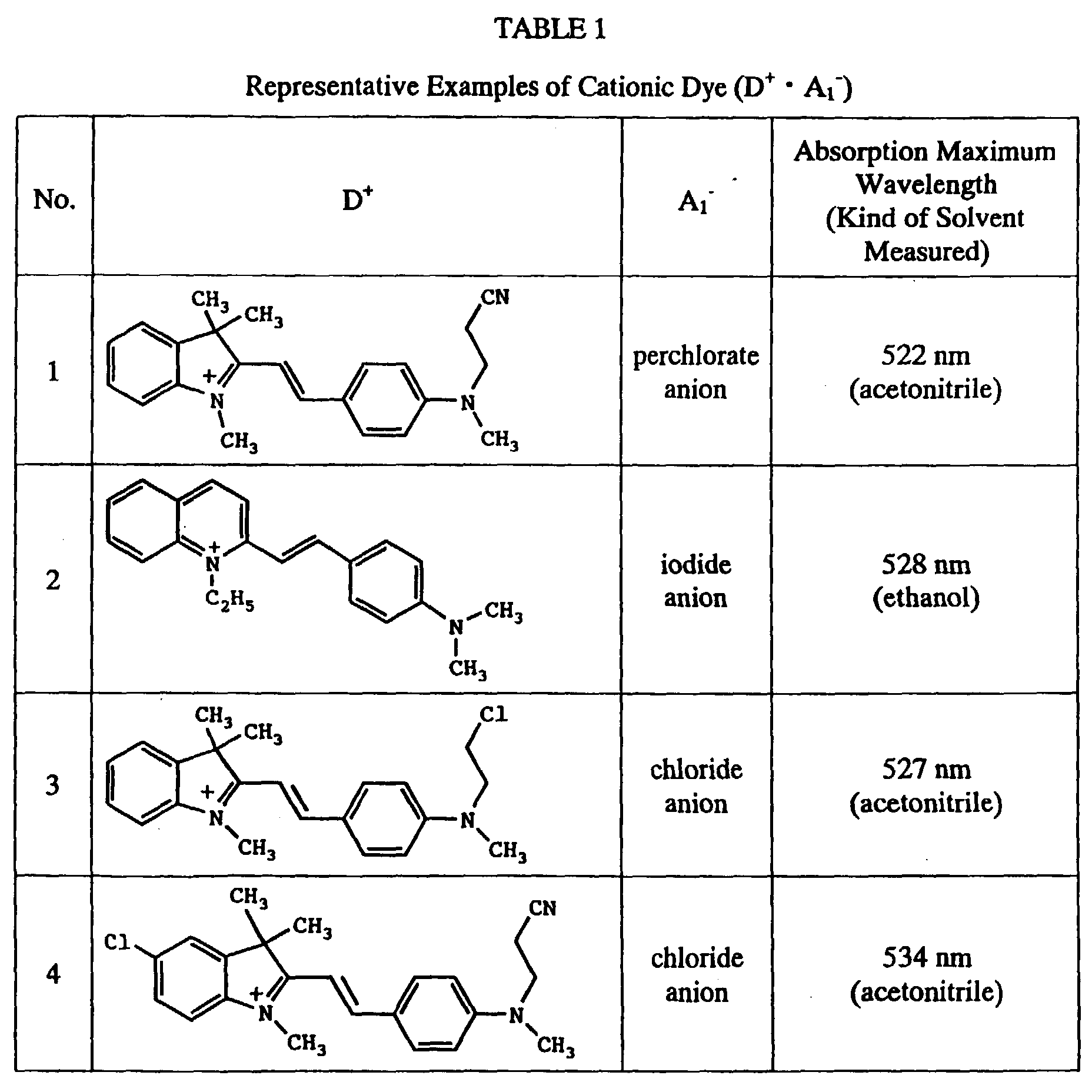
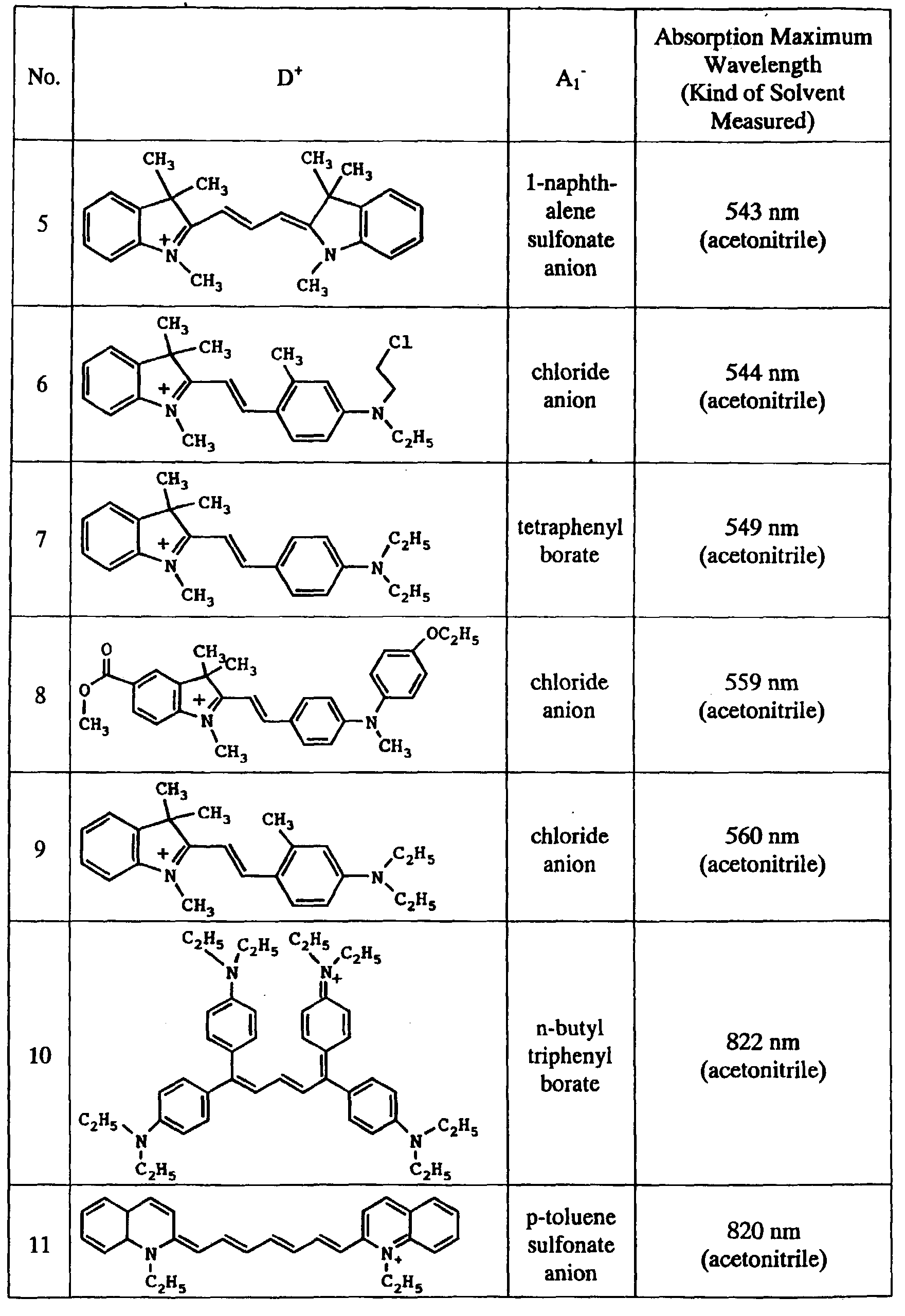

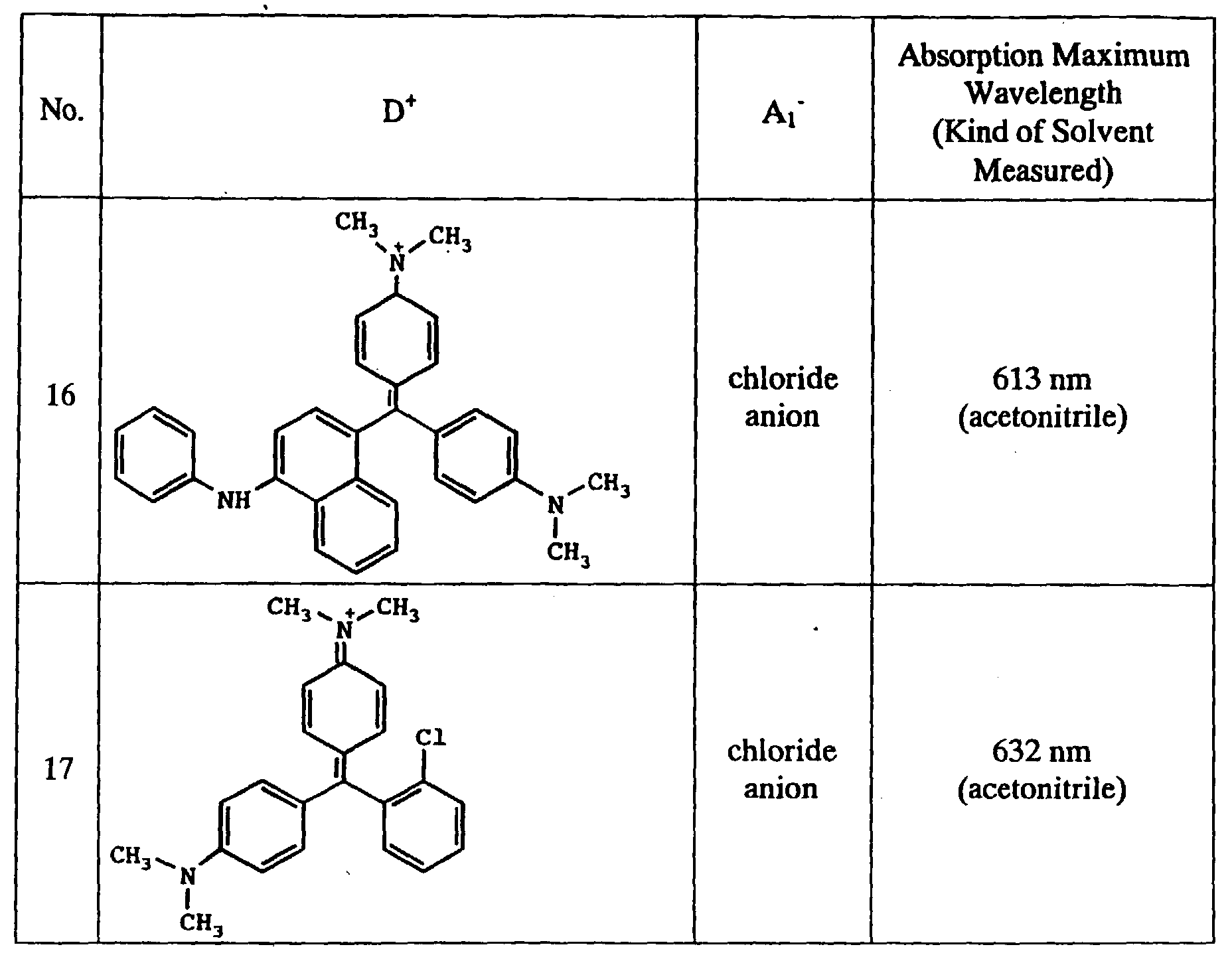
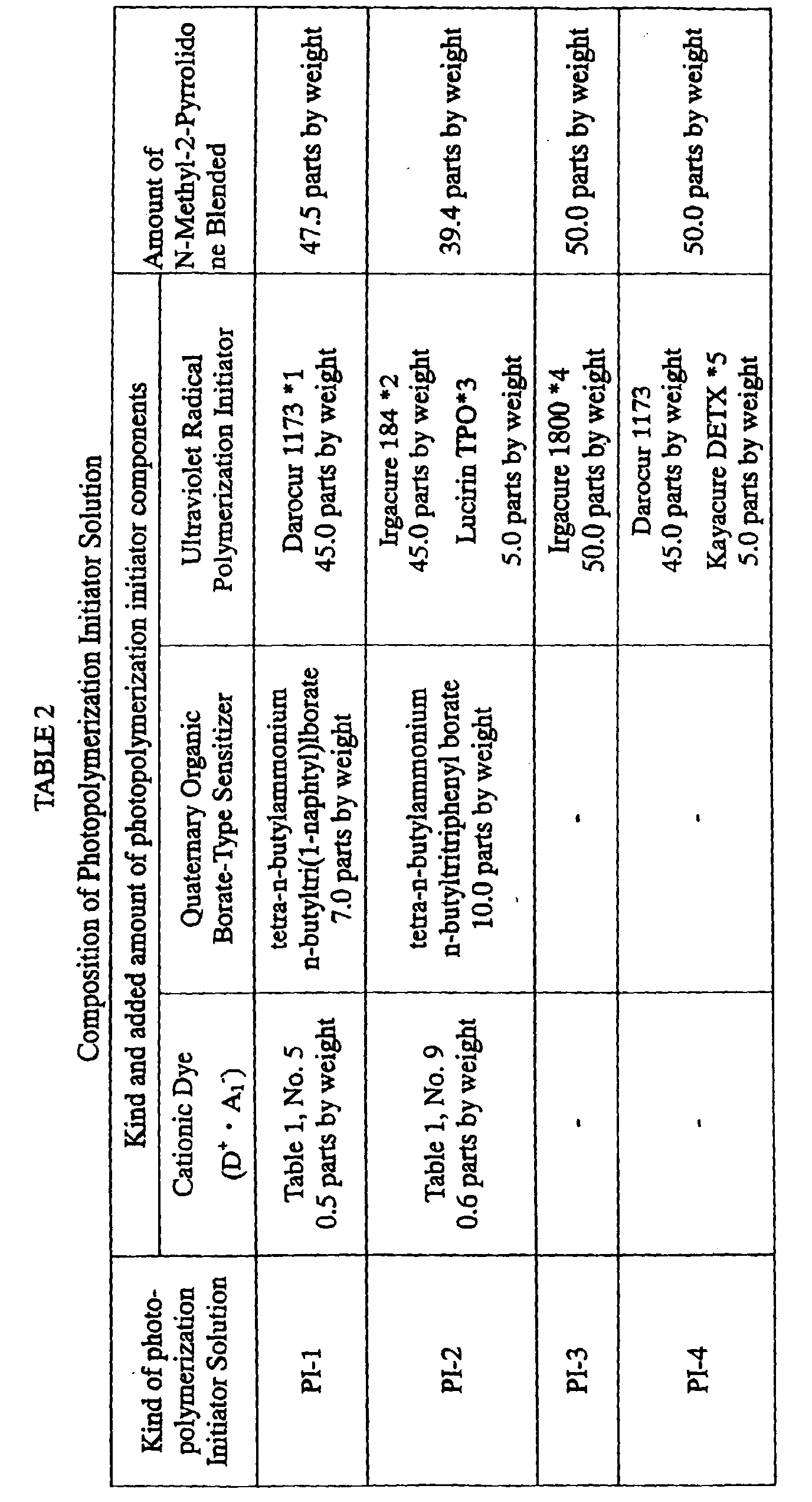
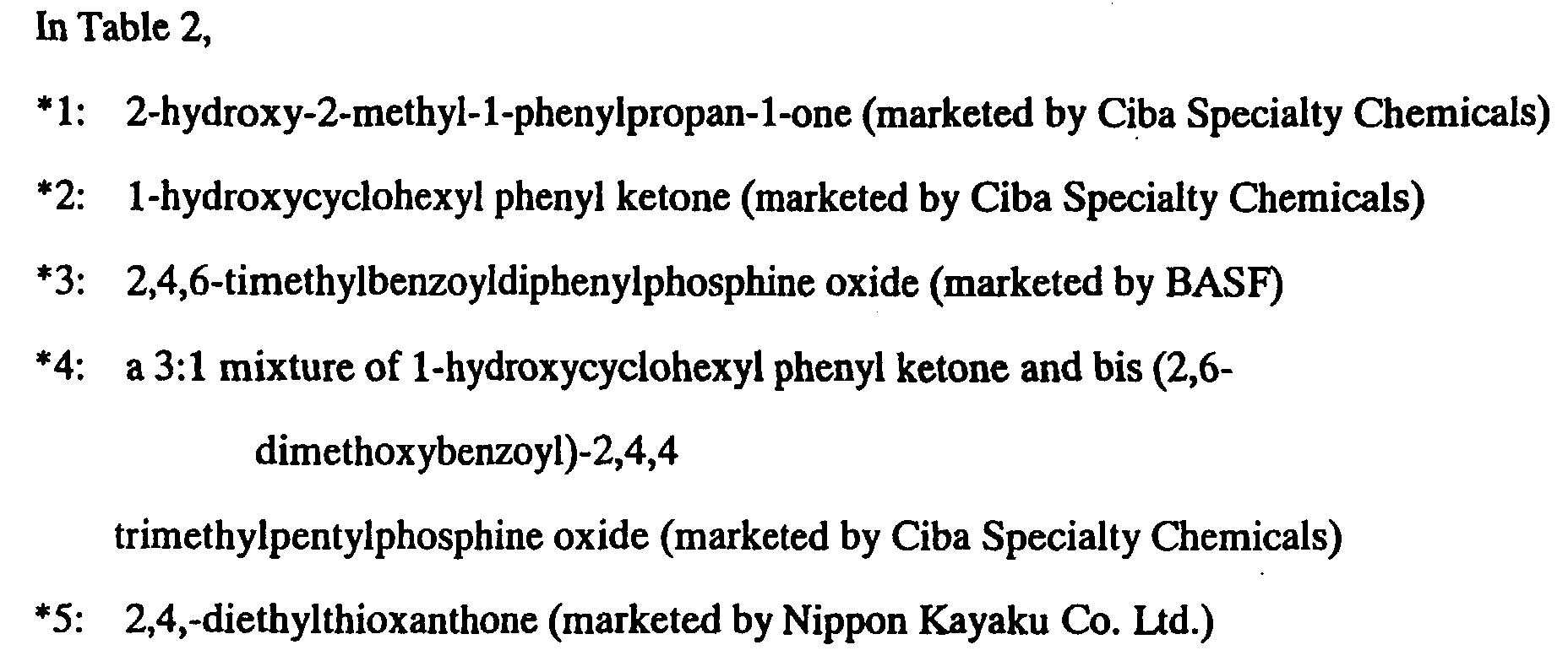

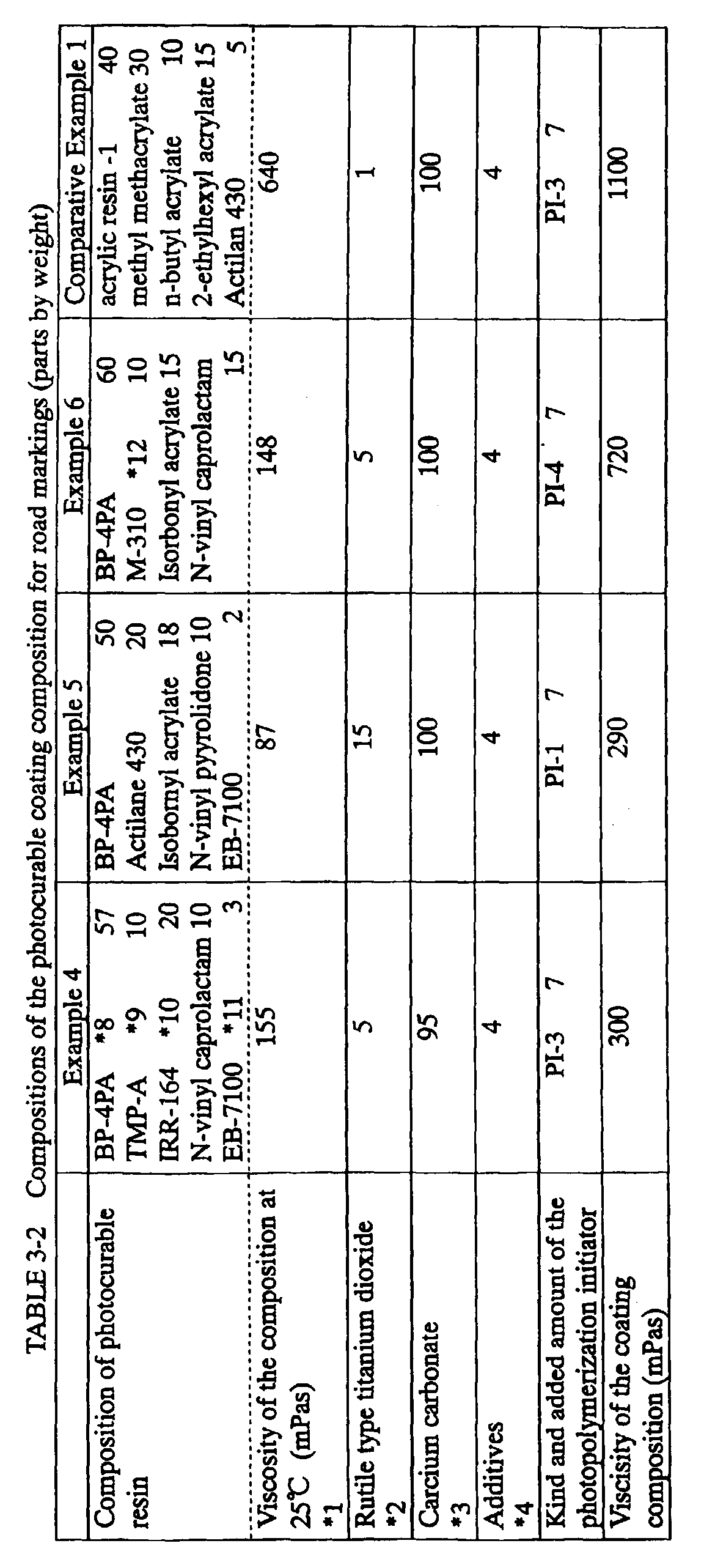


| Results of Capabilities of Coated Film Test | ||||
| Tested Items | Measurement Results | |||
| Example 7 | Comparative Example 3 (Class 1) | Comparative Example 4 (Class 3) | ||
| Luminous reflectance | 81.4 | 84.0 | 80 | 75 or more (Class 3) |
| Contrast ratio | 0.99 | 0.98 | - | 0.97 or more |
| Bleeding | 79.5 | 83.2 | - | on asphalt felt: 70 or more |
| 0.99 | 0.98 | - | luminous reflectance ratio: 0.90 or more | |
| Tire adhesion | 0.2 mm coating, 1 pass acceptance | acceptance | acceptance | within 15 minutes (Class 1) within 3 minutes (Class 3) |
| Abrasion resistance | 80 | 188 | 104 | 500 mg or less (Class 1) |
| Water resistance | acceptance | acceptance | acceptance | dipping for 24 hours |
| Alkali resistance | acceptance | acceptance | acceptance | dipping in calcium hydroxide for 18 hours |
| Glass bead fixing ratio (%) | 100 | 100 | - | 90% or more |
| Durability (after execution of 9 hours) | 0.8 | 2.1 | 3.5 | 10 g or less (*company test) |
Claims (12)
- A photocurable coating composition for road markings, comprising:(A) 100 parts by weight of a compound having an ethylenically unsaturated group, of which the boiling temperature is 120°C or greater at normal pressure;(B) 0.1 to 15 parts by weight of a photopolymerization initiator;(C) 3 to 50 parts by weight of a color pigment; and(D) 30 to 200 parts by weights of an extender pigment.
- A photocurable coating composition for road markings as claimed in claim 1, the viscosity of the composition at 25°C is in a range of from 50 to 4000 mP·s.
- A photocurable coating composition for road markings as claimed in claim 1, the viscosity of the compound having an ethylenically unsaturated group at 25°C is in a range of from 30 to 500 mP·s.
- A photocurable coating composition for road markings as claimed in claim 1, the compound having an ethylenically unsaturated group contains a di(meth)acrylate of alkylene oxide additive of bisphenol compound in a range of from 20 to 80 weight %.
- A photocurable coating composition for road markings as claimed in claim 1, the compound having an ethylenically unsaturated group contains a (meth)acrylate having an alicyclic group in a range of from 5 to 40 weight %.
- A photocurable coating composition for road markings as claimed in claim 1, the compound having an ethylenically unsaturated group contains a N-vinyl amide compound in a range of from 3 to 30 weight %.
- A photocurable coating composition for road markings as claimed in claim 6, the N-vinyl amide compound is at least one compound selected from the group consisting of N-vinyl formamide, N-vinyl acetamide, N-vinyl-N-methyl acetamide, N-vinyl pyrrolidone, and N-vinyl caprolactam.
- A photocurable coating composition for road markings as claimed in claim 1, the photopolymerization initiator is at least one photopolymerization initiator selected from the group consisting of compounds comprising the cationic dye represented by formula (1) and the quaternary organic borate-type compound represented by formula (2), and compounds represented by formulas (3) and (4).(wherein R1, R2, R3 and R4 each independently represents an alkyl group, an aryl group, an aralkyl group, an alkenyl group, an alkynyl group, a silyl group, a heterocyclic group or a halogen atom, which may have a substituent, and Z+ represents an optional cation)
 (wherein Ar represents an aryl group which may have a substituent, X represents an alkyl group, an alicyclic group, a benzyl group, an alkoxycarbonyl group, a benzoyl group, an aryl group, which may have a substituent or a phosphinoyl group having a substituent,);
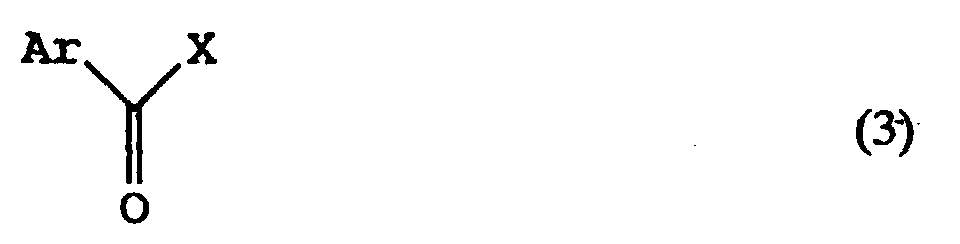 (wherein R5, R6, R7, R8, R9, R10, R11 and R12 each independently represents a hydrogen atom, an alkyl group having 1 to 8 carbon atoms, an alkoxy group having 1 to 8 carbon or halogen atom.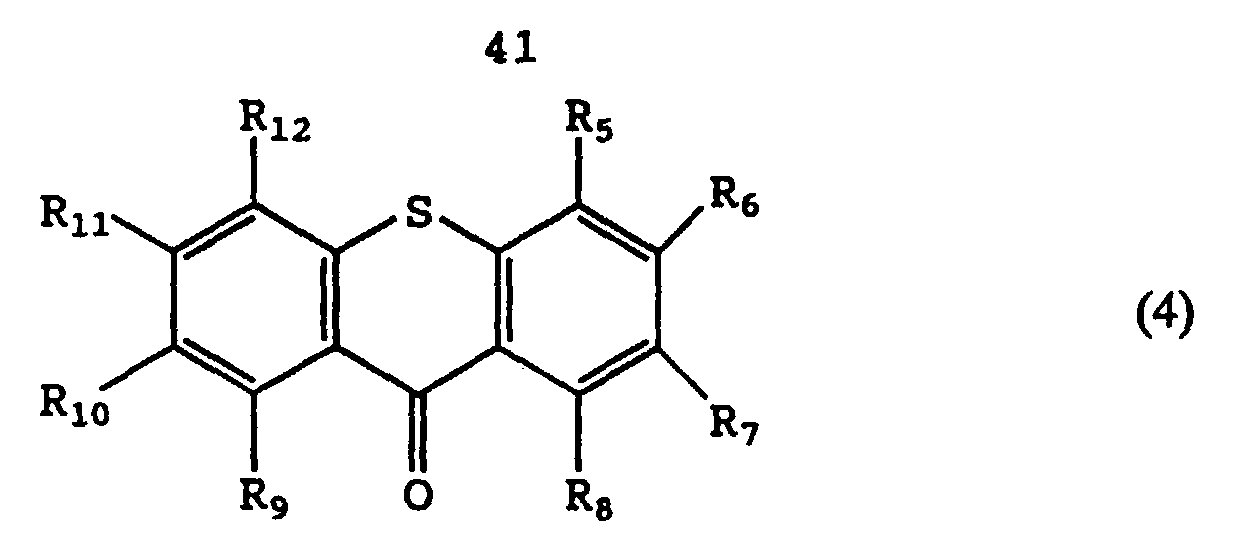
- A photocurable coating composition for road markings as claimed in claim 1, wherein the expose energy needed for curing is in a range of from 0.05 to 1.5 J/cm2.
- A curing method of a photocurable coating composition for road markings comprising the steps of;coating and photocuring a photocurable coating composition for road markings comprising (A) 100 parts by weight of a compound having an ethylenically unsaturated group, of which the boiling temperature is 120°C or greater at normal pressure; (B) 0.1 to 15 parts by weight of a photopolymerization initiator; (C) 3 to 50 parts by weight of a color pigment; and (D) 30 to 200 parts by weights of extender pigment.
- A curing method of a photocurable coating composition for road markings as claimed in claim 10, wherein the expose energy needed for curing is in a range of from 0.05 to 1.5 J/cm2.
- A curing method of a photocurable coating composition for road markings as claimed in claim 10, wherein the coating is carried out by spraying.
Applications Claiming Priority (2)
| Application Number | Priority Date | Filing Date | Title |
|---|---|---|---|
| JP19922299 | 1999-07-13 | ||
| JP11199222A JP2001026728A (en) | 1999-07-13 | 1999-07-13 | Photocurable road marking paint composition |
Publications (1)
| Publication Number | Publication Date |
|---|---|
| EP1069163A1 true EP1069163A1 (en) | 2001-01-17 |
Family
ID=16404186
Family Applications (1)
| Application Number | Title | Priority Date | Filing Date |
|---|---|---|---|
| EP00114858A Withdrawn EP1069163A1 (en) | 1999-07-13 | 2000-07-11 | Photocurable coating composition for road markings |
Country Status (2)
| Country | Link |
|---|---|
| EP (1) | EP1069163A1 (en) |
| JP (1) | JP2001026728A (en) |
Cited By (3)
| Publication number | Priority date | Publication date | Assignee | Title |
|---|---|---|---|---|
| WO2010055050A1 (en) * | 2008-11-12 | 2010-05-20 | Basf Se | Radiation curable coating materials |
| US20150329735A1 (en) * | 2013-02-28 | 2015-11-19 | Fujifilm Corporation | Composition for forming transparent resin layer, transparent resin layer, solid imaging element and optoelectronics device |
| CN106634464A (en) * | 2016-12-29 | 2017-05-10 | 山西长达交通材料科技股份有限公司 | Road marking primer based on high bio-based content and preparation method thereof |
Families Citing this family (2)
| Publication number | Priority date | Publication date | Assignee | Title |
|---|---|---|---|---|
| PT4004124T (en) * | 2019-07-30 | 2025-07-25 | Damar Industries Ltd | Rapid cure paint technology |
| KR102547161B1 (en) * | 2023-03-24 | 2023-06-23 | 주식회사 국지건설 | Paint coating agent for load surface sign of pavement and method using the same |
Citations (1)
| Publication number | Priority date | Publication date | Assignee | Title |
|---|---|---|---|---|
| EP0915136A1 (en) * | 1997-11-05 | 1999-05-12 | Showa Denko Kabushiki Kaisha | Photocurable paint composition for road markings |
-
1999
- 1999-07-13 JP JP11199222A patent/JP2001026728A/en active Pending
-
2000
- 2000-07-11 EP EP00114858A patent/EP1069163A1/en not_active Withdrawn
Patent Citations (1)
| Publication number | Priority date | Publication date | Assignee | Title |
|---|---|---|---|---|
| EP0915136A1 (en) * | 1997-11-05 | 1999-05-12 | Showa Denko Kabushiki Kaisha | Photocurable paint composition for road markings |
Cited By (6)
| Publication number | Priority date | Publication date | Assignee | Title |
|---|---|---|---|---|
| WO2010055050A1 (en) * | 2008-11-12 | 2010-05-20 | Basf Se | Radiation curable coating materials |
| CN102216400A (en) * | 2008-11-12 | 2011-10-12 | 巴斯夫欧洲公司 | Radiation curable coating materials |
| CN102216400B (en) * | 2008-11-12 | 2013-12-18 | 巴斯夫欧洲公司 | Radiation curable coating materials |
| US20150329735A1 (en) * | 2013-02-28 | 2015-11-19 | Fujifilm Corporation | Composition for forming transparent resin layer, transparent resin layer, solid imaging element and optoelectronics device |
| CN106634464A (en) * | 2016-12-29 | 2017-05-10 | 山西长达交通材料科技股份有限公司 | Road marking primer based on high bio-based content and preparation method thereof |
| CN106634464B (en) * | 2016-12-29 | 2019-02-19 | 山西中涂交通科技股份有限公司 | Roadmarking priming paint and preparation method thereof based on high Bio-based content |
Also Published As
| Publication number | Publication date |
|---|---|
| JP2001026728A (en) | 2001-01-30 |
Similar Documents
| Publication | Publication Date | Title |
|---|---|---|
| US6211260B1 (en) | Photocurable paint composition for road markings | |
| US10150835B2 (en) | Dual curable composition | |
| KR0130205B1 (en) | Ultraviolet radiation curable vehicle | |
| AU726387B2 (en) | Curable ink composition | |
| KR100901094B1 (en) | Curable composition, cured coating film and coated substrate | |
| EP2351799B1 (en) | Energy beam-curing inkjet ink composition | |
| EP1002817B1 (en) | Photocurable composition | |
| RU2499811C2 (en) | Radiation curable compositions | |
| JPH11236517A (en) | Photocurable road marking paint composition | |
| EP2148905A1 (en) | Photocurable compositions for road marking paint | |
| CN111349359A (en) | Ultraviolet-cured silk-screen printing metal ink and preparation method thereof | |
| JP2000212234A (en) | Photocurable composition | |
| JP2007016191A (en) | Coating composition, protective film forming method and laminate | |
| JP2001064578A (en) | Photocurable putty composition | |
| JP2001026728A (en) | Photocurable road marking paint composition | |
| HK1033331A (en) | Photocurable coating composition for road markings | |
| JPH08209058A (en) | Curable composition and road marking composition using the same | |
| JP2001240620A (en) | Raw material composition for high solid acrylic resin composition, high solid acrylic resin composition, coating material including high solid acrylic resin composition and method for producing high solid acrylic resin composition | |
| KR100929278B1 (en) | Irradiation curable putty composition and refinishing method of the substrate using the composition | |
| JPH10316708A (en) | Photocurable composition and method for preventing color reversion | |
| US6165686A (en) | Photocurable composition and color reversion preventing method | |
| HK1018793B (en) | Photocurable paint composition for road markings | |
| JP2620715B2 (en) | How to form multicolored paint film | |
| JP2008120870A (en) | Active energy ray-curable composition and laminate | |
| JPH11158419A (en) | Water-based coating composition |
Legal Events
| Date | Code | Title | Description |
|---|---|---|---|
| PUAI | Public reference made under article 153(3) epc to a published international application that has entered the european phase |
Free format text: ORIGINAL CODE: 0009012 |
|
| AK | Designated contracting states |
Kind code of ref document: A1 Designated state(s): DE FR GB IT |
|
| AX | Request for extension of the european patent |
Free format text: AL;LT;LV;MK;RO;SI |
|
| 17P | Request for examination filed |
Effective date: 20010716 |
|
| AKX | Designation fees paid |
Free format text: DE FR GB IT |
|
| 17Q | First examination report despatched |
Effective date: 20011227 |
|
| STAA | Information on the status of an ep patent application or granted ep patent |
Free format text: STATUS: THE APPLICATION IS DEEMED TO BE WITHDRAWN |
|
| 18D | Application deemed to be withdrawn |
Effective date: 20050621 |
|
| REG | Reference to a national code |
Ref country code: HK Ref legal event code: WD Ref document number: 1033331 Country of ref document: HK |