EP1067213A1 - Conversion coatings on aluminium from KF solutions for flux-less brazing - Google Patents
Conversion coatings on aluminium from KF solutions for flux-less brazing Download PDFInfo
- Publication number
- EP1067213A1 EP1067213A1 EP00305679A EP00305679A EP1067213A1 EP 1067213 A1 EP1067213 A1 EP 1067213A1 EP 00305679 A EP00305679 A EP 00305679A EP 00305679 A EP00305679 A EP 00305679A EP 1067213 A1 EP1067213 A1 EP 1067213A1
- Authority
- EP
- European Patent Office
- Prior art keywords
- aluminium
- flux
- conversion coating
- treated
- degreasing
- Prior art date
- Legal status (The legal status is an assumption and is not a legal conclusion. Google has not performed a legal analysis and makes no representation as to the accuracy of the status listed.)
- Granted
Links
Images

Classifications
-
- B—PERFORMING OPERATIONS; TRANSPORTING
- B23—MACHINE TOOLS; METAL-WORKING NOT OTHERWISE PROVIDED FOR
- B23K—SOLDERING OR UNSOLDERING; WELDING; CLADDING OR PLATING BY SOLDERING OR WELDING; CUTTING BY APPLYING HEAT LOCALLY, e.g. FLAME CUTTING; WORKING BY LASER BEAM
- B23K1/00—Soldering, e.g. brazing, or unsoldering
- B23K1/20—Preliminary treatment of work or areas to be soldered, e.g. in respect of a galvanic coating
-
- B—PERFORMING OPERATIONS; TRANSPORTING
- B23—MACHINE TOOLS; METAL-WORKING NOT OTHERWISE PROVIDED FOR
- B23K—SOLDERING OR UNSOLDERING; WELDING; CLADDING OR PLATING BY SOLDERING OR WELDING; CUTTING BY APPLYING HEAT LOCALLY, e.g. FLAME CUTTING; WORKING BY LASER BEAM
- B23K35/00—Rods, electrodes, materials, or media, for use in soldering, welding, or cutting
- B23K35/22—Rods, electrodes, materials, or media, for use in soldering, welding, or cutting characterised by the composition or nature of the material
- B23K35/36—Selection of non-metallic compositions, e.g. coatings or fluxes; Selection of soldering or welding materials, conjoint with selection of non-metallic compositions, both selections being of interest
- B23K35/3601—Selection of non-metallic compositions, e.g. coatings or fluxes; Selection of soldering or welding materials, conjoint with selection of non-metallic compositions, both selections being of interest with inorganic compounds as principal constituents
- B23K35/3603—Halide salts
- B23K35/3605—Fluorides
-
- C—CHEMISTRY; METALLURGY
- C23—COATING METALLIC MATERIAL; COATING MATERIAL WITH METALLIC MATERIAL; CHEMICAL SURFACE TREATMENT; DIFFUSION TREATMENT OF METALLIC MATERIAL; COATING BY VACUUM EVAPORATION, BY SPUTTERING, BY ION IMPLANTATION OR BY CHEMICAL VAPOUR DEPOSITION, IN GENERAL; INHIBITING CORROSION OF METALLIC MATERIAL OR INCRUSTATION IN GENERAL
- C23C—COATING METALLIC MATERIAL; COATING MATERIAL WITH METALLIC MATERIAL; SURFACE TREATMENT OF METALLIC MATERIAL BY DIFFUSION INTO THE SURFACE, BY CHEMICAL CONVERSION OR SUBSTITUTION; COATING BY VACUUM EVAPORATION, BY SPUTTERING, BY ION IMPLANTATION OR BY CHEMICAL VAPOUR DEPOSITION, IN GENERAL
- C23C22/00—Chemical surface treatment of metallic material by reaction of the surface with a reactive liquid, leaving reaction products of surface material in the coating, e.g. conversion coatings, passivation of metals
- C23C22/05—Chemical surface treatment of metallic material by reaction of the surface with a reactive liquid, leaving reaction products of surface material in the coating, e.g. conversion coatings, passivation of metals using aqueous solutions
- C23C22/68—Chemical surface treatment of metallic material by reaction of the surface with a reactive liquid, leaving reaction products of surface material in the coating, e.g. conversion coatings, passivation of metals using aqueous solutions using aqueous solutions with pH between 6 and 8
Definitions
- This invention relates to replacing the native aluminium surface oxides with stable conversion coatings which aid in brazing. More particularly, the conversion coating is formed by first treating the aluminium by thermal degreasing or aqueous alkaline degreasing and then exposing the treated aluminium to an aqueous KF solution.
- brazing is the preferred method for joining aluminium heat exchanger assemblies.
- Aluminium and aluminium alloys are generally very reactive and rapidly form a surface oxide film (5-100 nanometres thick) when exposed to the atmosphere at ambient temperatures.
- oxide film inhibits forming a strong, high quality, defect-free bond between the articles to be joined.
- it is considered necessary to remove, dissolve or disrupt such oxide film.
- the oxide layer may be removed by chemical etching using a KF etchant as discussed in US patent 5,820,015.
- a flux layer is deposited by chemical conversion on the surface of the aluminium to be brazed.
- the layer formed is composed of potassium pentafluoroaluminate (K 2 AlF 5 ).
- the brazing step includes heating the flux layer below the melting point of the aluminium but higher than the melting point of a brazing alloy to join the aluminium to a counterpart material with the brazing alloy. Providing a completely leak free joint as necessary in applications like heat exchanges is difficult with this process.
- a flux-less brazeable aluminium or aluminium alloy surface can be prepared which overcomes the deficiencies of prior art processes. It particularly involves an aluminium or aluminium alloy surface which has been treated with thermally degreasing or an alkaline aqueous degreasing. This step was unexpectedly found, in combination with the conversion coating step, to be critical to providing sound braze joints.
- the invention is a method for providing a brazeable conversion coating on an aluminium (meaning also aluminium alloy) surface.
- the method requires providing an aluminium surface which has been treated by thermal degreasing or aqueous alkaline degreasing, such that the treated surface is substantially devoid of grease and oils. It is critical to the method that one of these two particular treatments are used.
- the treated surface is contacted with an aqueous solution of 2.0-25.0 wt.% KF at a temperature of 90 °F-212°F for at least 5 seconds to provide a brazeable conversion coating consisting essentially of at least K 3 AlF 6 and, optionally, KAlF 4 on the treated surface.
- This method advantageously allows the conversion coated aluminium surface to be brazed without the use of a flux.
- the invention generally involves contacting a treated aluminium (meaning herein also "aluminium alloy") surface with an aqueous solution of 2.0 to 25.0 wt. % KF to form a brazeable conversion coating consisting essentially of at least K 3 AlF 6 and optionally KAlF 4 on the aluminium surface.
- the aluminium is used to grow particular crystals in a surface layer while removing the oxide coating. That is, this process forms an in-situ layer consisting of at least K 3 AlF 6 and optionally KAlF 4 . It is believed that the formation of this conversion coating layer dissolves the oxide layer and simultaneously protects the aluminium surface from further oxidation when it is heated during the brazing process, e.g., during temperatures between 585 and 600°C.
- the invention conversion coating composition behaves significantly different than conventional flux. That is, while not wishing to be bound to the following theory, it is believed that if, the aluminium carries a clad layer as is often the case in brazing, the brazeable conversion coating, unlike NOCOLOKTM does not melt before the clad layer.
- the conversion coating serves to replace the aluminium oxide and, since it is not as tenacious, allows the clad layer to flow when it reaches its melting temperature. It is believed that this significant difference provides superior brazed aluminium joints over those made with conventional potassium aluminate flux between the aluminium surfaces to be joined by brazing.
- the aluminium surface first be treated by thermal degreasing, e.g., with evaporative oils, or by aqueous alkaline degreasing, e.g., with mild alkaline solutions like potassium hydroxide or sodium hydroxide.
- thermal degreasing e.g., with evaporative oils
- aqueous alkaline degreasing e.g., with mild alkaline solutions like potassium hydroxide or sodium hydroxide.
- the particular thermal degreasing or aqueous alkaline surface degreasing treatment step can vary in material, time, and temperature as long the result it that the surface is degreased.
- the use of an alkaline solution is preferred.
- One useful example for degreasing is a 1% KOH solution (pH 11.0) which is allowed to clean the aluminium surface for 45 seconds at 140°F. After exposure to the cleaner, the treated surface is usually rinsed.
- degreasing is a 1% KOH solution (pH 11.0) which is allowed to clean the aluminium surface for 45 seconds at 140°F. After exposure to the cleaner, the treated surface is usually rinsed.
- use of these particular manners of degreasing is critical to the invention. We unexpectedly found that, when this particular treatment step was not used, and other conventional degreasing treatment such as with acetone was used instead, extremely poor fillet formation (not of commercial usefulness) resulted as described in Examples 6 and 7.
- the aluminium surface, on which is applied the conversion coating of the present invention may be carried on another material like steel or constitute an entire aluminium article.
- the aluminium may be in the shape of a sheet or be a three-dimensional article.
- the brazeable conversion coating provided by the present invention may be applied on a surface of an aluminium sheet which is later clad to a core material as by cold milling, in such situations either one or both sides of the cladding may be conversion coating treated according to the present invention.
- a method of making a braze sheet by applying a flux to the sheet and then mechanically embedding the flux into a surface of the sheet is disclosed in commonly owned US patent application Serial No. 09/193,364 filed November 17, 1998 which disclosure is hereby expressly incorporated herein.
- the aluminium material on which is provide the invention brazeable conversion coating means an aluminium or aluminium alloy material.
- the aluminium alloy material include alloys containing mostly aluminium and at least one of such metal as silicon, copper, manganese, zinc, titanium, iron, chromium, zirconium, magnesium, etc. Specific examples thereof are aluminium alloy materials such as Aluminium Association 1XXX, 3XXX, 4XXX, 5XXX, and 6XXX series aluminium alloys.
- the aluminium for applications of making heat exchangers would be either pure aluminium or an aluminium alloy such as 3003 or 3003 clad with 4045, 4047, or 4343.
- the aluminium surface which as discussed above may be a clad layer provided initially on a core, is first treated as described above to be essentially free of oils and grease. Then it is exposed to a dilute KF aqueous solution which is required to have a concentration of 2.0 - 25.0 wt.% KF in water.
- This solution as optimally intended for this invention consists essentially of KF in water.
- the KF solution can be made, e.g., by dissolving potassium fluoride (KF) in water or diluting down a commercially available solution, e.g., a 40% solution, to avoid bringing powders into the manufacturing facility. More preferably, the KF of the conversion coating bath is 2.5% to 4.0%, most preferably being 2.5% to 3.5%. Optimally, in the preferred ranges, a high quality braze can be obtained in a low cost and environmentally friendly way.
- Figs. 1 and 2 show etched surfaces resulting from immersing 3003 clad with 4045 aluminium with KF solutions of 0.5 and 1.5 wt. % concentrations, respectively.
- rod like shapes are present on the aluminium surface shown in Figs. 1 and 2, crystalline K 3 AlF 6 does not form and produce a commercially useful brazeable surface. We believe this is due to the low KF concentration.
- Figs. 1 and 2 show etched surfaces resulting from immersing 3003 clad with 4045 aluminium with KF solutions of 0.5 and 1.5 wt. % concentrations, respectively.
- rod like shapes are present on the aluminium surface shown in Figs. 1 and 2
- crystalline K 3 AlF 6 does not form and produce a commercially useful brazeable surface. We believe this is due to the low KF concentration.
- Figs. 1 and 2 show etched surfaces resulting from immersing 3003 clad with 4045 aluminium with KF solutions of 0.5 and 1.5 wt. % concentrations
- the invention conversion coating was found to be firmly adherent to the aluminium and consisted essentially of either all K 3 AlF 6 or a mixture thereof with a minor amount of KAlF 4 .
- This coating is similar in composition to flux materials but believed to be different in the following way. If, the aluminium carries a clad layer as is often the case in brazing, the conversion coating, unlike NOCOLOKTM does not melt before the clad layer.
- the conversion coating serves to replace the aluminium oxide and, since it is not as tenacious, allows the clad layer to flow when it reaches its melting temperature. It is believed that this significant difference provides superior brazed articles over that with conventional potassium aluminate flux.
- the cleaned aluminium may be contacted by the aqueous KF by immersion, coating, spraying, etc, to form the coating layer.
- Immersion is particularly commercially useful.
- the KF solution contain potassium and fluorine which when they contact the aluminium chemically react therewith forming the coating described above firmly bond to the aluminium surface.
- the dilute KF solution is used at a temperature of 90°F to 212°F, preferably being 120° to 150°C, more preferably being 130° to less than 150°F. This may be 149° - 130°C, optimally being 130o-145°C.
- the aluminium is contacted for at least 5 seconds and optimally up to about 4 minutes, preferably being 15 to 60 seconds, and most preferably being 30 to 60 seconds. Selection of the optimal parameters for providing the conversion coating would be apparent to one skilled in the art in view of the present disclosure. As would be apparent, as the aluminium contact time with the conversion coating bath solution lengthens, the brazeable conversion coating thickness increases. Similarly, as the temperature increases, the time necessary for forming a given thickness conversion coating shortens. We have found that this coating is extremely stable and the conversion coated aluminium can be stored for at least two weeks before brazing without any loss of properties.
- One use of the invention process may be for assembling a heat exchanger assembly like a condenser for an air conditioning system, as used in an automotive vehicle.
- Such heat exchanger assembly generally includes at least one, preferably a plurality of tubes made of aluminium alloy material like those disclosed above.
- the core material includes magnesium at a level at or below 0.20%.
- Each tube has an internal surface and an external surface.
- the internal tube surface and external tube surface each generally have an aluminium alloy cladding.
- One such cladding for a heat exchanger assembly is disclosed in US patent 5,771,962 which is hereby expressly incorporated by reference for such teachings.
- the cladding comprises, based on weight percent, 0.01 - 0.3 wt.
- the aluminium cladding has a melting point of 10-100°C lower than the aluminium on which it is clad, e.g., an Al-Si eutectic alloy containing 7-12% by weight of Si on the surface.
- the conversion coating of the invention can be applied to an aluminium surface at any of a number of stages before brazing. For example, it can be applied to the assembled or unassembled article like a heat exchanger at the manufacturing facility. Alternatively, the coating can be applied to an aluminium braze sheet either before or after a stamping operation. Further, as discussed above, the conversion coating can be applied to a substrate during a cold rolling operation to provide a brazeable layer either before (according to the '364 application mentioned above) or after a final rolling operation using evaporative forming oils and thermal degreasing. All of these aspects and others within the concept of the invention disclosed herein for providing a brazeable conversion coating on aluminium are included within the present invention.
- the table results indicate that outside the optimum parameter range, the braze quality dramatically drops in a manner that makes production usage unacceptable. Furthermore, the table indicates that the use of KF for creating a brazeable coating without a precise pre-cleaning step using an alkaline cleaner does not provide a production quality braze process.
- a 3cm x 3cm 3003 aluminium alloy clad with 4045 was prepared.
- the alloy was coated with evaporative oil and then thermal degreased at 350°F.
- the alloy was then immersed in 3 wt. % KF and at 140°F for 30 seconds and rinsed with R.O. water, dried and X-ray diffraction showed the presence of K 3 AlF 6 .
- a minicore heater core was assembled as in Example 2 and treated according to Example 3 and good quality complete braze joints were achieved.
- Example 5 demonstrates that the conversion coating also provides a brazeable surface on aluminium if applied before stamping or forming.
- a minicore assembly as in Example 2 was degreased with acetone for 20 seconds, dried in air, and then immersed in 5% KF aqueous solution at 200°F for 15 seconds. Acetone is not within the thermal degreasing or aqueous alkaline degreasing treatment required in the present invention. Afterwards the assembly was rinsed in R.O. water and dried. The assembly was then placed in a transparent laboratory CAB furnace and brought up to the braze temperature 600-605°C for 3 minutes. Post-braze observation showed 50% fillet formation at most and most of the clad pooled to the bottom of the part. We observed that K 3 AlF 6 crystals formed on the surface as in a conversion coating, however, this coating resulted in poor brazing quality not useful in commercial applications.
- a minicore assembly as in Example 2 was dipped in acetone for 20 seconds, dried in air, dipped in 1,1,1-trichloroethane for 20 seconds, dried in air and immersed in a 3% KF solution for 30 seconds at 140°F.
- This treatment with acetone and trichloroethane is not within the treatment required in the present invention.
- Post-braze observations showed 50% fillet formation at most and that most of the clad had pooled to the bottom of the part. Hence, this is not useful in commercial applications.
- a minicore assembly as in Example 2 was cleaned in a dilute solution of KOH according to a degreasing embodiment of the present invention, rinsed, and then immersed in a 1.5% KF aqueous solution (lower than the minimum required in the present invention) at 140°F for 60 seconds. After rinsing with R.O. water and drying at 120°F, brazing was attempted. Post-braze observation showed 20% fillet formation at most and most of the clad pooled to the bottom of the part.
- a minicore assembly as in Example 2 was cleaned in a dilute solution of KOH according to an embodiment of the present invention, rinsed, and then immersed in a 0.5% KF aqueous solution (less than that required in the present invention) at 140°F for 30 seconds. After rinsing with R.O. water and drying at 120°F, brazing was attempted. Post-braze observation showed 20% fillet formation at most and that most of the clad pooled to the bottom of the part.
- X-ray diffraction of an unbrazed sample treated as above did not show the presence of K 3 AlF 6 .
- the surface morphology is shown in Fig. 2. As can be seen, the bare aluminium is exposed and no crystalline K 3 AlF 6 is present.
Landscapes
- Chemical & Material Sciences (AREA)
- Engineering & Computer Science (AREA)
- Mechanical Engineering (AREA)
- Inorganic Chemistry (AREA)
- General Chemical & Material Sciences (AREA)
- Chemical Kinetics & Catalysis (AREA)
- Materials Engineering (AREA)
- Metallurgy (AREA)
- Organic Chemistry (AREA)
- Chemical Treatment Of Metals (AREA)
- Cleaning And De-Greasing Of Metallic Materials By Chemical Methods (AREA)
Abstract
Description
- This invention relates to replacing the native aluminium surface oxides with stable conversion coatings which aid in brazing. More particularly, the conversion coating is formed by first treating the aluminium by thermal degreasing or aqueous alkaline degreasing and then exposing the treated aluminium to an aqueous KF solution.
- Reference is made to related U.S. application Serial No. 09/130,014 filed August 6, 1998, and entitled" Method of Simultaneous Cleaning and Fluxing of Aluminium Cylinder Block Bore Surfaces For Thermal Spray Coating Adhesion".
- Workers in the field often use brazing to join aluminium alloy components and in particular, brazing is the preferred method for joining aluminium heat exchanger assemblies. Aluminium and aluminium alloys, however, are generally very reactive and rapidly form a surface oxide film (5-100 nanometres thick) when exposed to the atmosphere at ambient temperatures. Such oxide film inhibits forming a strong, high quality, defect-free bond between the articles to be joined. Thus, to effect a metallurgical, chemical or intermetallic bond between the aluminium or aluminium alloys, it is considered necessary to remove, dissolve or disrupt such oxide film. For example, the oxide layer may be removed by chemical etching using a KF etchant as discussed in US patent 5,820,015. It teaches particularly that the fillet-forming capability of brazeable aluminium alloy can be improved by such etching. Another common way to disrupt the oxide layer is with a flux like NOCOLOK™ applied to the joining surface. It is an aqueous suspension of KAlF4 + K3AlF6 solution which can sprayed onto degreased aluminium parts, and after drying, the parts can be brazed in a furnace. The flux melts at 565-575°C and reacts with the surface aluminium oxide. This causes the surface to be both dissolved and simultaneously protected from further oxidation, as it reaches braze temperature between 585-600°C. One disadvantage of this method of using a flux, however, is the inefficiency of applying the flux. That is, the flux powder needs to be suspended in a liquid vehicle, the surface sprayed before and after assembly, and then dried. The powder flux can also cause housekeeping problems at the manufacturing facility. To overcome problems associated with fluxes, fluxless brazing has been developed.
- In one type of fluxless brazing, a flux layer is deposited by chemical conversion on the surface of the aluminium to be brazed. On such method is disclosed in EPO 0140 267 B1 where it is taught that the layer formed is composed of potassium pentafluoroaluminate (K2AlF5). In the '267 method, the brazing step includes heating the flux layer below the melting point of the aluminium but higher than the melting point of a brazing alloy to join the aluminium to a counterpart material with the brazing alloy. Providing a completely leak free joint as necessary in applications like heat exchanges is difficult with this process.
- We have now unexpectedly found that a flux-less brazeable aluminium or aluminium alloy surface can be prepared which overcomes the deficiencies of prior art processes. It particularly involves an aluminium or aluminium alloy surface which has been treated with thermally degreasing or an alkaline aqueous degreasing. This step was unexpectedly found, in combination with the conversion coating step, to be critical to providing sound braze joints. These and other aspects of the invention will be discussed in detail below.
- The invention is a method for providing a brazeable conversion coating on an aluminium (meaning also aluminium alloy) surface. The method requires providing an aluminium surface which has been treated by thermal degreasing or aqueous alkaline degreasing, such that the treated surface is substantially devoid of grease and oils. It is critical to the method that one of these two particular treatments are used. Subsequently the treated surface is contacted with an aqueous solution of 2.0-25.0 wt.% KF at a temperature of 90 °F-212°F for at least 5 seconds to provide a brazeable conversion coating consisting essentially of at least K3AlF6 and, optionally, KAlF4 on the treated surface. This method advantageously allows the conversion coated aluminium surface to be brazed without the use of a flux.
- The present invention will now be described further, by way of example, with reference to the accompanying drawings, in which:
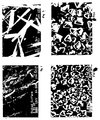
- FIG. 1 is a 1cm x 1cm 3003/4045 alloy treated at 0.5% KF/140F/45 seconds, the KF concentration being outside the present invention;
- FIG. 2 is a 1cm x 1cm 3003/4045 alloy treated at 1.5% KF/140F/45 seconds, the KF concentration being outside the present invention;
- FIG. 3 is a 1cm x 1cm 3003/4045 alloy treated at 3.0%KF/140°F/45 seconds according to an embodiment of the present invention;
- FIG. 4 is a 1cm x 1cm 3003/4045 alloy treated at 4.0%/140°F/45 seconds according to an embodiment of the present invention;
- FIG. 5 is an X-ray diffraction pattern for the FIG. 3 coating, as compared to a standard K3AlF6 diffraction pattern; and
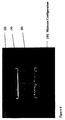
- FIG. 6 is a schematic of a minicore heater core assembly fabricated in Example 2.
-
- The invention generally involves contacting a treated aluminium (meaning herein also "aluminium alloy") surface with an aqueous solution of 2.0 to 25.0 wt. % KF to form a brazeable conversion coating consisting essentially of at least K3AlF6 and optionally KAlF4 on the aluminium surface. Advantageously, the aluminium is used to grow particular crystals in a surface layer while removing the oxide coating. That is, this process forms an in-situ layer consisting of at least K3AlF6 and optionally KAlF4. It is believed that the formation of this conversion coating layer dissolves the oxide layer and simultaneously protects the aluminium surface from further oxidation when it is heated during the brazing process, e.g., during temperatures between 585 and 600°C. While the current invention is believed to deposit a coating on the aluminium similar in composition to fluoride fluxes, the invention conversion coating composition behaves significantly different than conventional flux. That is, while not wishing to be bound to the following theory, it is believed that if, the aluminium carries a clad layer as is often the case in brazing, the brazeable conversion coating, unlike NOCOLOK™ does not melt before the clad layer. The conversion coating serves to replace the aluminium oxide and, since it is not as tenacious, allows the clad layer to flow when it reaches its melting temperature. It is believed that this significant difference provides superior brazed aluminium joints over those made with conventional potassium aluminate flux between the aluminium surfaces to be joined by brazing.
- We have found, however, that merely exposing an aluminium surface to the KF solution does not provide a commercially useful brazeable surface. Rather we have found that it is critical to the present invention that the aluminium surface first be treated by thermal degreasing, e.g., with evaporative oils, or by aqueous alkaline degreasing, e.g., with mild alkaline solutions like potassium hydroxide or sodium hydroxide. Such degreasing techniques are well known to those skilled in the art. Still other materials and treatment conditions within those described above would be apparent to those skilled in the art in view of the present disclosure. The particular thermal degreasing or aqueous alkaline surface degreasing treatment step can vary in material, time, and temperature as long the result it that the surface is degreased. The use of an alkaline solution is preferred. One useful example for degreasing is a 1% KOH solution (pH 11.0) which is allowed to clean the aluminium surface for 45 seconds at 140°F. After exposure to the cleaner, the treated surface is usually rinsed. As discussed above, use of these particular manners of degreasing is critical to the invention. We unexpectedly found that, when this particular treatment step was not used, and other conventional degreasing treatment such as with acetone was used instead, extremely poor fillet formation (not of commercial usefulness) resulted as described in Examples 6 and 7.
- In this invention, the aluminium surface, on which is applied the conversion coating of the present invention, may be carried on another material like steel or constitute an entire aluminium article. And the aluminium may be in the shape of a sheet or be a three-dimensional article. For example, the brazeable conversion coating provided by the present invention may be applied on a surface of an aluminium sheet which is later clad to a core material as by cold milling, in such situations either one or both sides of the cladding may be conversion coating treated according to the present invention. A method of making a braze sheet by applying a flux to the sheet and then mechanically embedding the flux into a surface of the sheet is disclosed in commonly owned US patent application Serial No. 09/193,364 filed November 17, 1998 which disclosure is hereby expressly incorporated herein. The technique of mechanically embedding the flux could be used in the present invention with the modification that a present invention conversion coated aluminium sheet replaces the flux sheet of the noted '364 application. As disclosed above, herein the aluminium material on which is provide the invention brazeable conversion coating means an aluminium or aluminium alloy material. Examples of the aluminium alloy material include alloys containing mostly aluminium and at least one of such metal as silicon, copper, manganese, zinc, titanium, iron, chromium, zirconium, magnesium, etc. Specific examples thereof are aluminium alloy materials such as Aluminium Association 1XXX, 3XXX, 4XXX, 5XXX, and 6XXX series aluminium alloys. Optimally the aluminium for applications of making heat exchangers would be either pure aluminium or an aluminium alloy such as 3003 or 3003 clad with 4045, 4047, or 4343.
- The aluminium surface, which as discussed above may be a clad layer provided initially on a core, is first treated as described above to be essentially free of oils and grease. Then it is exposed to a dilute KF aqueous solution which is required to have a concentration of 2.0 - 25.0 wt.% KF in water. This solution as optimally intended for this invention consists essentially of KF in water. The KF solution can be made, e.g., by dissolving potassium fluoride (KF) in water or diluting down a commercially available solution, e.g., a 40% solution, to avoid bringing powders into the manufacturing facility. More preferably, the KF of the conversion coating bath is 2.5% to 4.0%, most preferably being 2.5% to 3.5%. Optimally, in the preferred ranges, a high quality braze can be obtained in a low cost and environmentally friendly way.
- We have surprisingly found that when the KF bath concentration is less than the 2.0 wt. % KF minimum required in the present invention method, the brazeable conversion coating described herein is not formed. Rather the aluminium is merely etched as disclosed in the '015 patent discussed above. For example, Figs. 1 and 2 show etched surfaces resulting from immersing 3003 clad with 4045 aluminium with KF solutions of 0.5 and 1.5 wt. % concentrations, respectively. Although, rod like shapes are present on the aluminium surface shown in Figs. 1 and 2, crystalline K3AlF6 does not form and produce a commercially useful brazeable surface. We believe this is due to the low KF concentration. In contrast, Figs. 3 and 4 show conversion coatings formed when instead aqueous KF solutions of 3.0 and 4.0 wt. %, respectively, according to the present invention were used. The difference is the formed surfaces is readily apparent. The degreasing treatment of the aluminium surface was the same for all of the above. We believe the invention embodiment aluminium conversion coated surfaces (3.0 and 4.0 wt. % KF) allow brazing without flux while the merely etched surfaces where the KF concentration is not sufficient to form a surface conversion coating of K3AlF6 (0.5 and 1.5 wt. % KF) simply provide an aluminium surface where oxide has been diminished. The invention conversion coating was found to be firmly adherent to the aluminium and consisted essentially of either all K3AlF6 or a mixture thereof with a minor amount of KAlF4. This coating is similar in composition to flux materials but believed to be different in the following way. If, the aluminium carries a clad layer as is often the case in brazing, the conversion coating, unlike NOCOLOK™ does not melt before the clad layer. The conversion coating serves to replace the aluminium oxide and, since it is not as tenacious, allows the clad layer to flow when it reaches its melting temperature. It is believed that this significant difference provides superior brazed articles over that with conventional potassium aluminate flux.
- In the method of providing the conversion coating, the cleaned aluminium may be contacted by the aqueous KF by immersion, coating, spraying, etc, to form the coating layer. Immersion is particularly commercially useful. The KF solution contain potassium and fluorine which when they contact the aluminium chemically react therewith forming the coating described above firmly bond to the aluminium surface. The dilute KF solution is used at a temperature of 90°F to 212°F, preferably being 120° to 150°C, more preferably being 130° to less than 150°F. This may be 149° - 130°C, optimally being 130o-145°C. To develop the coating the aluminium is contacted for at least 5 seconds and optimally up to about 4 minutes, preferably being 15 to 60 seconds, and most preferably being 30 to 60 seconds. Selection of the optimal parameters for providing the conversion coating would be apparent to one skilled in the art in view of the present disclosure. As would be apparent, as the aluminium contact time with the conversion coating bath solution lengthens, the brazeable conversion coating thickness increases. Similarly, as the temperature increases, the time necessary for forming a given thickness conversion coating shortens. We have found that this coating is extremely stable and the conversion coated aluminium can be stored for at least two weeks before brazing without any loss of properties.
- One use of the invention process may be for assembling a heat exchanger assembly like a condenser for an air conditioning system, as used in an automotive vehicle. Such heat exchanger assembly generally includes at least one, preferably a plurality of tubes made of aluminium alloy material like those disclosed above. Preferably, to provide an optimal quality brazeable surface the core material includes magnesium at a level at or below 0.20%. Each tube has an internal surface and an external surface. The internal tube surface and external tube surface each generally have an aluminium alloy cladding. One such cladding for a heat exchanger assembly is disclosed in US patent 5,771,962 which is hereby expressly incorporated by reference for such teachings. As is disclosed therein, the cladding comprises, based on weight percent, 0.01 - 0.3 wt. % lithium; 0.2 to 0.7 wt. % magnesium, 0.01 - 0.1 sodium, 4 - 13 wt. % silicon; 0 - 1 wt. % manganese, 0.01 to 0.1 copper, 0 - 0.3 wt. % zinc; 0.01 - 0.7 wt. % beryllium, and impurities not exceeding a total of 1%, the balance being aluminium. Generally, the aluminium cladding has a melting point of 10-100°C lower than the aluminium on which it is clad, e.g., an Al-Si eutectic alloy containing 7-12% by weight of Si on the surface.
- The conversion coating of the invention can be applied to an aluminium surface at any of a number of stages before brazing. For example, it can be applied to the assembled or unassembled article like a heat exchanger at the manufacturing facility. Alternatively, the coating can be applied to an aluminium braze sheet either before or after a stamping operation. Further, as discussed above, the conversion coating can be applied to a substrate during a cold rolling operation to provide a brazeable layer either before (according to the '364 application mentioned above) or after a final rolling operation using evaporative forming oils and thermal degreasing. All of these aspects and others within the concept of the invention disclosed herein for providing a brazeable conversion coating on aluminium are included within the present invention.
- As aluminium sheets, (10) 3003 clad with 4045 sheets of a size 3cm x 3cm were prepared as well as (10) 3003 2.0 cm wide tubes for ten sample runs of tube/sheet braze evaluations. Nine sample pairs of these sheets and tubes were first individually treated by cleaning in a dilute solution of KOH as according to an embodiment of the present invention. All ten pairs were then immersed in treating solutions containing potassium and fluorine in an attempt to provide a chemical conversion coating step. The KF conditions are given in Table 1. The samples were rinsed with R.O. water after the cleaner and the KF immersions. The samples were then dried at 120°F and brazing attempted.
Sample 10 is the only sample not according to embodiments of the present invention since it was not alkaline cleaned. The evaluation of the Tube/Sheet Joints of these ten samples based on a scale of 1-5, with 1 being the highest rating, is listed in Table 1. It can be seen from this table that Runs 8 was not as good as some other invention runs and run 10 (non-invention) had poor tube/sheet joints. While run 8 is according to the present invention, the treating conditions are slightly outside the optimum range. And run 10 is not prepared according to an embodiment of the present invention since no cleaning treatment was carried out. - Further the X-ray diffraction pattern was obtained for the surface of each material to confirm that K3AlF6 has been formed. It was found to be formed in all of the samples, including No. 10. However, in spite of K3AlF6 being present in
run 10 not according to the invention, the conversion coated material did not braze well. The X-ray diffraction pattern obtained from the aluminium material of sample run No. 1 is shown in Fig. 5. Further the surface morphology of sample run No. 1 is shown in Fig. 3.Run No Al material Alkaline Cleaning wt%KF Treating Conditions (temp & time) Tube/Sheet Joint Eval. Mini- CoreJoint Eval. 1 3003/4005 1%/140F/45 sec 3.0% 140F, 60 sec 1 1 2 3003/4005 1%/140F/45 sec 2.5% 140F, 60 sec 1 1 3 3003/4005 1%/140F/45 sec 3.5% 140F, 30 sec 1 1 4 3003/4005 1%/140F/45 sec 3.0% 150F, 30 sec 1 1 5 3003/4005 1%/140F/45 sec 3.0% 140F, 90 sec 1 1 6 3003/4005 1%/140F/45 sec 3.0% 140F, 30 sec 1 1 7 3003/4005 1%/140F/45 sec 3.0% 130F, 30 sec 1 1 8 3003/4005 1%/140F/45 sec 3.0% 90F, 60 sec 2 2 9 3003/4005 1%/140F/45 sec 3.0% 110F, 120 sec 1 1 10 No No 3.0% 140F, 60 sec 4 4 - Ten sample mini-heater cores (10) were assembled as in Figure 6. (4)1.5 x 4.0 cm aluminium (2) tubes made of 3003 aluminium clad with 4045; (2)5.0 x 2.0 cm heater core (4) header made of the 3003 aluminium clad with 4045; and a 11 cm length of 3003 (6) fin material was assembled according to Fig. 6. Ten minicores were treated as in Example 1 according to runs 1-10 and then subjected to brazing. The mini-core joint evaluation is given in the last column of Table 1 above. From this table it can be seen that the optimum braze results for a production process occur with the use of an alkaline cleaner at 1% concentration, maintained at 140 Degrees F. for a time period of 45 seconds and the use of KF at a concentration level ranging from 2.5-3.5%, maintained at a temperature range between 130-150 Degrees F. for a time period between 30-60 seconds. In addition, the table results indicate that outside the optimum parameter range, the braze quality dramatically drops in a manner that makes production usage unacceptable. Furthermore, the table indicates that the use of KF for creating a brazeable coating without a precise pre-cleaning step using an alkaline cleaner does not provide a production quality braze process.
- A 3cm x 3cm 3003 aluminium alloy clad with 4045 was prepared. The alloy was coated with evaporative oil and then thermal degreased at 350°F. The alloy was then immersed in 3 wt. % KF and at 140°F for 30 seconds and rinsed with R.O. water, dried and X-ray diffraction showed the presence of K3AlF6.
- A minicore heater core was assembled as in Example 2 and treated according to Example 3 and good quality complete braze joints were achieved.
- Two 3cm x 3cm 3003 aluminium alloys clad with 4045 were aqueous degreased (1% KOH, 140°F, 45sec) and rinsed. The sample was then immersed in 3 wt% KF solution for 30 seconds at 140°F. After coating with evaporative oil, in preparation for stamping, the sample was stamped into (2) 2.0 cm x 2.0 cm cups, assembled and brazed. The evaporative oil was burned off during the braze cycle. A good quality complete braze joint was achieved.
- Example 5 demonstrates that the conversion coating also provides a brazeable surface on aluminium if applied before stamping or forming.
- This is a comparative example not made according to an embodiment of the present invention. A minicore assembly as in Example 2 was degreased with acetone for 20 seconds, dried in air, and then immersed in 5% KF aqueous solution at 200°F for 15 seconds. Acetone is not within the thermal degreasing or aqueous alkaline degreasing treatment required in the present invention. Afterwards the assembly was rinsed in R.O. water and dried. The assembly was then placed in a transparent laboratory CAB furnace and brought up to the braze temperature 600-605°C for 3 minutes. Post-braze observation showed 50% fillet formation at most and most of the clad pooled to the bottom of the part. We observed that K3AlF6 crystals formed on the surface as in a conversion coating, however, this coating resulted in poor brazing quality not useful in commercial applications.
- This is a comparative example not made according to an embodiment of the present invention. A minicore assembly as in Example 2 was dipped in acetone for 20 seconds, dried in air, dipped in 1,1,1-trichloroethane for 20 seconds, dried in air and immersed in a 3% KF solution for 30 seconds at 140°F. This treatment with acetone and trichloroethane is not within the treatment required in the present invention. Post-braze observations showed 50% fillet formation at most and that most of the clad had pooled to the bottom of the part. Hence, this is not useful in commercial applications.
- This is a comparative example at a concentration range lower than that specified in the present invention. A minicore assembly as in Example 2 was cleaned in a dilute solution of KOH according to a degreasing embodiment of the present invention, rinsed, and then immersed in a 1.5% KF aqueous solution (lower than the minimum required in the present invention) at 140°F for 60 seconds. After rinsing with R.O. water and drying at 120°F, brazing was attempted. Post-braze observation showed 20% fillet formation at most and most of the clad pooled to the bottom of the part.
- X-ray diffraction of an unbrazed sample treated as above did not show the presence of K3AlF6. The surface morphology is shown in Fig. 1. The KF concentration is insufficient to producing crystalline K3AlF6 by immersion.
- This is a comparative example at a concentration range lower than that specified in the present invention. A minicore assembly as in Example 2 was cleaned in a dilute solution of KOH according to an embodiment of the present invention, rinsed, and then immersed in a 0.5% KF aqueous solution (less than that required in the present invention) at 140°F for 30 seconds. After rinsing with R.O. water and drying at 120°F, brazing was attempted. Post-braze observation showed 20% fillet formation at most and that most of the clad pooled to the bottom of the part.
- X-ray diffraction of an unbrazed sample treated as above did not show the presence of K3AlF6. The surface morphology is shown in Fig. 2. As can be seen, the bare aluminium is exposed and no crystalline K3AlF6 is present.
Claims (10)
- A method for providing a conversion coating on an aluminium surface to allow flux-less brazing thereof, comprising the steps of:(a) providing an aluminium surface treated by thermal degreasing or aqueous alkaline degreasing to be substantially devoid of grease and oils;(b) contacting the treated surface with an aqueous solution of 2.0 - 25.0 wt.% KF at a temperature of 90°F-212°F for at least 5 seconds to provide a brazeable conversion coating consisting essentially of at least K3AlF6 and, optionally, KAlF4 on said treated surface.
- A method according to claim 1, wherein said surface aqueous alkaline degreasing comprises exposing said surface to an aqueous solution of sodium hydroxide or potassium hydroxide.
- A method according to claim 1, wherein said thermal degreasing comprises exposing said surface to a vaporised evaporative oil.
- A method according to claim 1, wherein said KF bath concentration is 2.5-4%.
- A method according to claim 1, wherein said KF bath concentration is 2.5-3.5%.
- A method according to claim 1, wherein said bath temperature is 49-66°C (120-150°F).
- A method according to claim 1, wherein said bath temperature is 54-63°C (130-145°F).
- A method according to claim 1, wherein said aluminium comprises an aluminium alloy vacuum brazing sheet.
- A method according to claim 1, wherein the aluminium comprises a radiator.
- A method according to claim 1, wherein the aluminium comprises a component of an aluminium alloy heat exchanger.
Applications Claiming Priority (2)
| Application Number | Priority Date | Filing Date | Title |
|---|---|---|---|
| US34788499A | 1999-07-06 | 1999-07-06 | |
| US347884 | 1999-07-06 |
Publications (2)
| Publication Number | Publication Date |
|---|---|
| EP1067213A1 true EP1067213A1 (en) | 2001-01-10 |
| EP1067213B1 EP1067213B1 (en) | 2003-09-17 |
Family
ID=23365700
Family Applications (1)
| Application Number | Title | Priority Date | Filing Date |
|---|---|---|---|
| EP00305679A Expired - Lifetime EP1067213B1 (en) | 1999-07-06 | 2000-07-05 | Conversion coatings on aluminium from KF solutions for flux-less brazing |
Country Status (5)
| Country | Link |
|---|---|
| US (1) | US6475301B1 (en) |
| EP (1) | EP1067213B1 (en) |
| JP (1) | JP2001059183A (en) |
| KR (1) | KR20010015185A (en) |
| DE (1) | DE60005258T2 (en) |
Cited By (7)
| Publication number | Priority date | Publication date | Assignee | Title |
|---|---|---|---|---|
| EP1154041A1 (en) * | 2000-05-08 | 2001-11-14 | Ford Global Technologies, Inc. | Conversion coatings on aluminium from sprayed KF solutions |
| US6493920B1 (en) | 2000-09-07 | 2002-12-17 | Ford Global Technologies, Inc. | Method of assembling a vehicle from preassembled modular components |
| WO2003076113A1 (en) * | 2002-03-08 | 2003-09-18 | Behr Gmbh & Co. | Method for soldering aluminum |
| AU2004201998B2 (en) * | 2003-05-13 | 2005-06-02 | Denso Corporation | Method of surface treating aluminum alloy base body of heat exchanger and heat exchanger produced by the method |
| CN102310241A (en) * | 2010-07-01 | 2012-01-11 | 广东万和新电气股份有限公司 | Method for manufacturing aluminium heat exchanger of gas water heater |
| RU2645172C1 (en) * | 2016-12-09 | 2018-02-16 | Юрий Леонидович Евтодеев | Method of unification of the gearbox with one or two clutches |
| EP2660043B1 (en) | 2012-05-04 | 2021-03-03 | Hydro Aluminium Rolled Products GmbH | Use of an aluminium clad sheet for fluxless brazing |
Families Citing this family (19)
| Publication number | Priority date | Publication date | Assignee | Title |
|---|---|---|---|---|
| US6461451B1 (en) * | 2000-12-13 | 2002-10-08 | Alcoa Inc. | Treatment of ingots or spacer blocks in stacked aluminum ingots |
| DE10314700A1 (en) * | 2003-03-31 | 2004-10-14 | Behr Gmbh & Co. Kg | Method for producing surface-modified workpieces |
| US20040251008A1 (en) * | 2003-05-30 | 2004-12-16 | O'neill Patrick S. | Method for making brazed heat exchanger and apparatus |
| FR2873718B1 (en) * | 2004-07-28 | 2007-02-02 | Pechiney Rhenalu Sa | PROCESS FOR FORMING A CONVERSION LAYER ON AN ALUMINUM ALLOY PRODUCT FOR BREATHING |
| US20090014165A1 (en) * | 2006-01-19 | 2009-01-15 | Werner Zobel | Flat tube, flat tube heat exchanger, and method of manufacturing same |
| US8438728B2 (en) * | 2006-01-19 | 2013-05-14 | Modine Manufacturing Company | Flat tube, flat tube heat exchanger, and method of manufacturing same |
| US20090019696A1 (en) * | 2006-01-19 | 2009-01-22 | Werner Zobel | Flat tube, flat tube heat exchanger, and method of manufacturing same |
| EP1979698A2 (en) * | 2006-01-19 | 2008-10-15 | Modine Manufacturing Company | Flat tube, flat tube heat exchanger, and method of manufacturing same |
| US7921559B2 (en) * | 2006-01-19 | 2011-04-12 | Modine Manufacturing Company | Flat tube, flat tube heat exchanger, and method of manufacturing same |
| US8683690B2 (en) * | 2006-01-19 | 2014-04-01 | Modine Manufacturing Company | Flat tube, flat tube heat exchanger, and method of manufacturing same |
| US8434227B2 (en) | 2006-01-19 | 2013-05-07 | Modine Manufacturing Company | Method of forming heat exchanger tubes |
| US8191258B2 (en) * | 2006-01-19 | 2012-06-05 | Modine Manufacturing Company | Flat tube, flat tube heat exchanger, and method of manufacturing same |
| US8281489B2 (en) * | 2006-01-19 | 2012-10-09 | Modine Manufacturing Company | Flat tube, flat tube heat exchanger, and method of manufacturing same |
| US8091621B2 (en) * | 2006-01-19 | 2012-01-10 | Modine Manufacturing Company | Flat tube, flat tube heat exchanger, and method of manufacturing same |
| WO2008011115A2 (en) * | 2006-07-20 | 2008-01-24 | Modine Manufacturing Company | Flat tube for heat exchanger |
| US8440264B2 (en) * | 2006-12-15 | 2013-05-14 | Ford Global Technologies, Llc | Method for preparing a brazed surface for receiving a coating |
| DE102007004993A1 (en) * | 2007-02-01 | 2008-08-07 | Modine Manufacturing Co., Racine | Production process for flat tubes and roller mill |
| DE102010023384B4 (en) | 2010-06-10 | 2014-08-28 | Modine Manufacturing Co. | Manufacturing process, in particular for pipes and tear-off device |
| WO2019023273A1 (en) * | 2017-07-26 | 2019-01-31 | Arconic Inc. | Roll coating-based preparation methods for adhesive bonding of aluminum alloys, and products relating to the same |
Citations (8)
| Publication number | Priority date | Publication date | Assignee | Title |
|---|---|---|---|---|
| US3951328A (en) * | 1972-08-02 | 1976-04-20 | Alcan Research And Development Limited | Joining of metal surfaces |
| US4655385A (en) * | 1985-01-22 | 1987-04-07 | Kabushiki Kaisha Toyota Chuo Kenkyusho | Method of brazing an aluminum material |
| EP0140267B1 (en) * | 1983-10-13 | 1987-07-29 | Kabushiki Kaisha Toyota Chuo Kenkyusho | Method of brazing an aluminum material |
| JPH07157880A (en) * | 1993-12-06 | 1995-06-20 | Mitsubishi Alum Co Ltd | Production of heat exchanger |
| EP0814173A2 (en) * | 1996-06-21 | 1997-12-29 | Ford Motor Company Limited | Method of bonding thermally sprayed coatings to non-roughened light metal-based surfaces |
| US5820015A (en) * | 1996-04-02 | 1998-10-13 | Kaiser Aluminum & Chemical Corporation | Process for improving the fillet-forming capability of brazeable aluminum articles |
| GB2340133A (en) * | 1998-08-06 | 2000-02-16 | Ford Global Tech Inc | Bonding a thermally sprayed coating by pre-treating with fluoride |
| EP1004390A1 (en) * | 1998-11-17 | 2000-05-31 | Ford Global Technologies, Inc. | Method of making a braze sheet |
Family Cites Families (13)
| Publication number | Priority date | Publication date | Assignee | Title |
|---|---|---|---|---|
| US2032897A (en) | 1934-10-31 | 1936-03-03 | Metal Finishing Res Corp | Coated aluminum article and method of producing the same |
| JPS4918536B1 (en) | 1970-07-25 | 1974-05-10 | ||
| US3971501A (en) | 1975-04-09 | 1976-07-27 | Alcan Research And Development Limited | Method of brazing aluminum |
| JPS58167097A (en) | 1982-03-29 | 1983-10-03 | Nikkei Giken:Kk | Flux for brazing |
| JPS6083771A (en) * | 1983-10-13 | 1985-05-13 | Toyota Central Res & Dev Lab Inc | Brazing method for aluminum-based materials |
| JPS6149771A (en) * | 1984-08-15 | 1986-03-11 | Nippon Radiator Co Ltd | Heat exchanger |
| GB8808613D0 (en) | 1988-04-12 | 1988-05-11 | Renishaw Plc | Signal transmission system for machine tools inspection machines &c |
| US5016809A (en) * | 1989-09-05 | 1991-05-21 | Ford Motor Company | Thermal degreasing in reactive atmospheres and subsequent brazing of aluminum-based sheets or parts |
| US5100048A (en) | 1991-01-25 | 1992-03-31 | Alcan International Limited | Method of brazing aluminum |
| JPH07185795A (en) * | 1993-12-27 | 1995-07-25 | Sky Alum Co Ltd | Method of manufacturing aluminum material for brazing, and brazing method |
| US5554020A (en) * | 1994-10-07 | 1996-09-10 | Ford Motor Company | Solid lubricant coating for fluid pump or compressor |
| US5771962A (en) | 1996-04-03 | 1998-06-30 | Ford Motor Company | Manufacture of heat exchanger assembly by cab brazing |
| US5958378A (en) | 1996-07-03 | 1999-09-28 | Research Development Foundation | High dose liposomal aerosol formulations containing cyclosporin A or budesonide |
-
2000
- 2000-05-08 US US09/565,749 patent/US6475301B1/en not_active Expired - Lifetime
- 2000-07-05 EP EP00305679A patent/EP1067213B1/en not_active Expired - Lifetime
- 2000-07-05 DE DE60005258T patent/DE60005258T2/en not_active Expired - Lifetime
- 2000-07-06 KR KR1020000038437A patent/KR20010015185A/en not_active Withdrawn
- 2000-07-06 JP JP2000204897A patent/JP2001059183A/en active Pending
Patent Citations (8)
| Publication number | Priority date | Publication date | Assignee | Title |
|---|---|---|---|---|
| US3951328A (en) * | 1972-08-02 | 1976-04-20 | Alcan Research And Development Limited | Joining of metal surfaces |
| EP0140267B1 (en) * | 1983-10-13 | 1987-07-29 | Kabushiki Kaisha Toyota Chuo Kenkyusho | Method of brazing an aluminum material |
| US4655385A (en) * | 1985-01-22 | 1987-04-07 | Kabushiki Kaisha Toyota Chuo Kenkyusho | Method of brazing an aluminum material |
| JPH07157880A (en) * | 1993-12-06 | 1995-06-20 | Mitsubishi Alum Co Ltd | Production of heat exchanger |
| US5820015A (en) * | 1996-04-02 | 1998-10-13 | Kaiser Aluminum & Chemical Corporation | Process for improving the fillet-forming capability of brazeable aluminum articles |
| EP0814173A2 (en) * | 1996-06-21 | 1997-12-29 | Ford Motor Company Limited | Method of bonding thermally sprayed coatings to non-roughened light metal-based surfaces |
| GB2340133A (en) * | 1998-08-06 | 2000-02-16 | Ford Global Tech Inc | Bonding a thermally sprayed coating by pre-treating with fluoride |
| EP1004390A1 (en) * | 1998-11-17 | 2000-05-31 | Ford Global Technologies, Inc. | Method of making a braze sheet |
Non-Patent Citations (1)
| Title |
|---|
| PATENT ABSTRACTS OF JAPAN vol. 1995, no. 09 31 October 1995 (1995-10-31) * |
Cited By (8)
| Publication number | Priority date | Publication date | Assignee | Title |
|---|---|---|---|---|
| EP1154041A1 (en) * | 2000-05-08 | 2001-11-14 | Ford Global Technologies, Inc. | Conversion coatings on aluminium from sprayed KF solutions |
| US6493920B1 (en) | 2000-09-07 | 2002-12-17 | Ford Global Technologies, Inc. | Method of assembling a vehicle from preassembled modular components |
| WO2003076113A1 (en) * | 2002-03-08 | 2003-09-18 | Behr Gmbh & Co. | Method for soldering aluminum |
| AU2004201998B2 (en) * | 2003-05-13 | 2005-06-02 | Denso Corporation | Method of surface treating aluminum alloy base body of heat exchanger and heat exchanger produced by the method |
| CN102310241A (en) * | 2010-07-01 | 2012-01-11 | 广东万和新电气股份有限公司 | Method for manufacturing aluminium heat exchanger of gas water heater |
| EP2660043B1 (en) | 2012-05-04 | 2021-03-03 | Hydro Aluminium Rolled Products GmbH | Use of an aluminium clad sheet for fluxless brazing |
| EP2844466B2 (en) † | 2012-05-04 | 2021-10-20 | Speira GmbH | Flux free brazing of aluminium |
| RU2645172C1 (en) * | 2016-12-09 | 2018-02-16 | Юрий Леонидович Евтодеев | Method of unification of the gearbox with one or two clutches |
Also Published As
| Publication number | Publication date |
|---|---|
| EP1067213B1 (en) | 2003-09-17 |
| US6475301B1 (en) | 2002-11-05 |
| JP2001059183A (en) | 2001-03-06 |
| DE60005258D1 (en) | 2003-10-23 |
| DE60005258T2 (en) | 2004-07-01 |
| KR20010015185A (en) | 2001-02-26 |
Similar Documents
| Publication | Publication Date | Title |
|---|---|---|
| EP1067213B1 (en) | Conversion coatings on aluminium from KF solutions for flux-less brazing | |
| JP5976200B2 (en) | Aluminum composite for fluxless brazing | |
| US5806752A (en) | Manufacture of aluminum assemblies by open-air flame brazing | |
| US5190596A (en) | Method of brazing metal surfaces | |
| CA2111331C (en) | Method of joining zinc coated aluminium members | |
| US20160325367A1 (en) | Flux-free Joining of Aluminium Composite Materials | |
| US5771962A (en) | Manufacture of heat exchanger assembly by cab brazing | |
| JPH09500422A (en) | Aluminum / lithium filler alloy for brazing | |
| KR20030007520A (en) | Method of manufacturing an aluminium product | |
| JP2020015095A (en) | Aluminium composite material for use in thermal flux-free joining methods and method for producing same | |
| US6120848A (en) | Method of making a braze sheet | |
| EP0973629A1 (en) | Brazing filler alloy containing calcium | |
| US5820015A (en) | Process for improving the fillet-forming capability of brazeable aluminum articles | |
| EP1004386A1 (en) | Brazed assembly and method of making same | |
| EP1154041B1 (en) | Conversion coatings on aluminium from sprayed KF solutions | |
| JP2006509635A (en) | Brazed sheet product having a clad layer and a coating layer of an iron alloy and method for producing the same | |
| JP2018535100A (en) | Aluminum composite material used in flux-free thermal bonding method and method for producing aluminum composite material | |
| US20070204935A1 (en) | Method for forming a conversion layer on an aluminium alloy product prior to fluxless brazing | |
| US8440264B2 (en) | Method for preparing a brazed surface for receiving a coating | |
| JPS6174771A (en) | Production of aluminum heat exchanger | |
| JPH02284766A (en) | Vapor phase soldering method of al or al alloy | |
| JPS61246354A (en) | Aluminum tube having many holes for heat exchanger and its manufacture | |
| JPH0218189B2 (en) | ||
| JPS6149770A (en) | Brazing method for aluminum-based materials | |
| JPS6037293A (en) | Brazing method of aluminum and alloy thereof |
Legal Events
| Date | Code | Title | Description |
|---|---|---|---|
| PUAI | Public reference made under article 153(3) epc to a published international application that has entered the european phase |
Free format text: ORIGINAL CODE: 0009012 |
|
| AK | Designated contracting states |
Kind code of ref document: A1 Designated state(s): DE FR GB |
|
| AX | Request for extension of the european patent |
Free format text: AL;LT;LV;MK;RO;SI |
|
| 17P | Request for examination filed |
Effective date: 20010618 |
|
| AKX | Designation fees paid |
Free format text: DE FR GB |
|
| 17Q | First examination report despatched |
Effective date: 20020910 |
|
| GRAH | Despatch of communication of intention to grant a patent |
Free format text: ORIGINAL CODE: EPIDOS IGRA |
|
| GRAS | Grant fee paid |
Free format text: ORIGINAL CODE: EPIDOSNIGR3 |
|
| GRAA | (expected) grant |
Free format text: ORIGINAL CODE: 0009210 |
|
| AK | Designated contracting states |
Kind code of ref document: B1 Designated state(s): DE FR GB |
|
| REG | Reference to a national code |
Ref country code: GB Ref legal event code: FG4D |
|
| REG | Reference to a national code |
Ref country code: GB Ref legal event code: 732E |
|
| REF | Corresponds to: |
Ref document number: 60005258 Country of ref document: DE Date of ref document: 20031023 Kind code of ref document: P |
|
| ET | Fr: translation filed | ||
| PLBE | No opposition filed within time limit |
Free format text: ORIGINAL CODE: 0009261 |
|
| STAA | Information on the status of an ep patent application or granted ep patent |
Free format text: STATUS: NO OPPOSITION FILED WITHIN TIME LIMIT |
|
| 26N | No opposition filed |
Effective date: 20040618 |
|
| REG | Reference to a national code |
Ref country code: FR Ref legal event code: TP |
|
| PGFP | Annual fee paid to national office [announced via postgrant information from national office to epo] |
Ref country code: FR Payment date: 20060714 Year of fee payment: 7 |
|
| PGFP | Annual fee paid to national office [announced via postgrant information from national office to epo] |
Ref country code: GB Payment date: 20060720 Year of fee payment: 7 |
|
| GBPC | Gb: european patent ceased through non-payment of renewal fee |
Effective date: 20070705 |
|
| PG25 | Lapsed in a contracting state [announced via postgrant information from national office to epo] |
Ref country code: GB Free format text: LAPSE BECAUSE OF NON-PAYMENT OF DUE FEES Effective date: 20070705 |
|
| REG | Reference to a national code |
Ref country code: FR Ref legal event code: ST Effective date: 20080331 |
|
| PG25 | Lapsed in a contracting state [announced via postgrant information from national office to epo] |
Ref country code: FR Free format text: LAPSE BECAUSE OF NON-PAYMENT OF DUE FEES Effective date: 20070731 |
|
| PGFP | Annual fee paid to national office [announced via postgrant information from national office to epo] |
Ref country code: DE Payment date: 20130731 Year of fee payment: 14 |
|
| REG | Reference to a national code |
Ref country code: DE Ref legal event code: R119 Ref document number: 60005258 Country of ref document: DE |
|
| PG25 | Lapsed in a contracting state [announced via postgrant information from national office to epo] |
Ref country code: DE Free format text: LAPSE BECAUSE OF NON-PAYMENT OF DUE FEES Effective date: 20150203 |
|
| REG | Reference to a national code |
Ref country code: DE Ref legal event code: R119 Ref document number: 60005258 Country of ref document: DE Effective date: 20150203 |