EP1067150A2 - Emulsion polymerization using a cocyclic silicone - Google Patents
Emulsion polymerization using a cocyclic silicone Download PDFInfo
- Publication number
- EP1067150A2 EP1067150A2 EP00114476A EP00114476A EP1067150A2 EP 1067150 A2 EP1067150 A2 EP 1067150A2 EP 00114476 A EP00114476 A EP 00114476A EP 00114476 A EP00114476 A EP 00114476A EP 1067150 A2 EP1067150 A2 EP 1067150A2
- Authority
- EP
- European Patent Office
- Prior art keywords
- silicone
- formula
- emulsion
- cocyclic
- group
- Prior art date
- Legal status (The legal status is an assumption and is not a legal conclusion. Google has not performed a legal analysis and makes no representation as to the accuracy of the status listed.)
- Withdrawn
Links
- 229920001296 polysiloxane Polymers 0.000 title claims abstract description 56
- 238000007720 emulsion polymerization reaction Methods 0.000 title claims abstract description 9
- 238000000034 method Methods 0.000 claims abstract description 29
- 239000002243 precursor Substances 0.000 claims abstract description 25
- 238000006243 chemical reaction Methods 0.000 claims abstract description 22
- 125000004432 carbon atom Chemical group C* 0.000 claims abstract description 19
- 125000000217 alkyl group Chemical group 0.000 claims abstract description 16
- 125000002496 methyl group Chemical group [H]C([H])([H])* 0.000 claims abstract description 8
- 239000000839 emulsion Substances 0.000 claims description 38
- -1 polysiloxanes Polymers 0.000 claims description 33
- XLYOFNOQVPJJNP-UHFFFAOYSA-N water Substances O XLYOFNOQVPJJNP-UHFFFAOYSA-N 0.000 claims description 29
- 239000003054 catalyst Substances 0.000 claims description 24
- 239000004094 surface-active agent Substances 0.000 claims description 16
- 239000000203 mixture Substances 0.000 claims description 15
- 229920000642 polymer Polymers 0.000 claims description 11
- 125000004122 cyclic group Chemical group 0.000 claims description 9
- 229910052739 hydrogen Inorganic materials 0.000 claims description 8
- 239000001257 hydrogen Substances 0.000 claims description 8
- 125000002347 octyl group Chemical group [H]C([*])([H])C([H])([H])C([H])([H])C([H])([H])C([H])([H])C([H])([H])C([H])([H])C([H])([H])[H] 0.000 claims description 8
- 125000004103 aminoalkyl group Chemical group 0.000 claims description 7
- 125000000118 dimethyl group Chemical group [H]C([H])([H])* 0.000 claims description 6
- 229910052799 carbon Inorganic materials 0.000 claims description 5
- UFHFLCQGNIYNRP-UHFFFAOYSA-N Hydrogen Chemical compound [H][H] UFHFLCQGNIYNRP-UHFFFAOYSA-N 0.000 claims description 4
- 229920001519 homopolymer Polymers 0.000 claims description 4
- 125000004435 hydrogen atom Chemical group [H]* 0.000 claims description 4
- 229920005573 silicon-containing polymer Polymers 0.000 claims description 4
- 125000002887 hydroxy group Chemical group [H]O* 0.000 claims description 3
- 230000000379 polymerizing effect Effects 0.000 claims description 3
- 229910052710 silicon Inorganic materials 0.000 claims description 3
- 239000010703 silicon Substances 0.000 claims description 3
- XUIMIQQOPSSXEZ-UHFFFAOYSA-N Silicon Chemical compound [Si] XUIMIQQOPSSXEZ-UHFFFAOYSA-N 0.000 claims 2
- 239000002736 nonionic surfactant Substances 0.000 description 29
- 239000004615 ingredient Substances 0.000 description 24
- QTBSBXVTEAMEQO-UHFFFAOYSA-N Acetic acid Chemical compound CC(O)=O QTBSBXVTEAMEQO-UHFFFAOYSA-N 0.000 description 15
- ZMANZCXQSJIPKH-UHFFFAOYSA-N Triethylamine Chemical compound CCN(CC)CC ZMANZCXQSJIPKH-UHFFFAOYSA-N 0.000 description 15
- HEMHJVSKTPXQMS-UHFFFAOYSA-M Sodium hydroxide Chemical compound [OH-].[Na+] HEMHJVSKTPXQMS-UHFFFAOYSA-M 0.000 description 14
- 239000003093 cationic surfactant Substances 0.000 description 13
- 239000003945 anionic surfactant Substances 0.000 description 12
- 239000002245 particle Substances 0.000 description 12
- 229920001897 terpolymer Polymers 0.000 description 12
- 125000000129 anionic group Chemical group 0.000 description 11
- 229940060296 dodecylbenzenesulfonic acid Drugs 0.000 description 11
- WBIQQQGBSDOWNP-UHFFFAOYSA-N 2-dodecylbenzenesulfonic acid Chemical compound CCCCCCCCCCCCC1=CC=CC=C1S(O)(=O)=O WBIQQQGBSDOWNP-UHFFFAOYSA-N 0.000 description 10
- 239000004907 Macro-emulsion Substances 0.000 description 9
- 239000002585 base Substances 0.000 description 9
- 239000002563 ionic surfactant Substances 0.000 description 9
- 238000002360 preparation method Methods 0.000 description 9
- LFQSCWFLJHTTHZ-UHFFFAOYSA-N Ethanol Chemical compound CCO LFQSCWFLJHTTHZ-UHFFFAOYSA-N 0.000 description 8
- 239000002253 acid Substances 0.000 description 8
- 125000002091 cationic group Chemical group 0.000 description 8
- HMMGMWAXVFQUOA-UHFFFAOYSA-N octamethylcyclotetrasiloxane Chemical compound C[Si]1(C)O[Si](C)(C)O[Si](C)(C)O[Si](C)(C)O1 HMMGMWAXVFQUOA-UHFFFAOYSA-N 0.000 description 8
- 238000006116 polymerization reaction Methods 0.000 description 8
- 239000003755 preservative agent Substances 0.000 description 7
- 230000002335 preservative effect Effects 0.000 description 7
- 239000003377 acid catalyst Substances 0.000 description 6
- FVEFRICMTUKAML-UHFFFAOYSA-M sodium tetradecyl sulfate Chemical compound [Na+].CCCCC(CC)CCC(CC(C)C)OS([O-])(=O)=O FVEFRICMTUKAML-UHFFFAOYSA-M 0.000 description 6
- 238000009835 boiling Methods 0.000 description 5
- 235000014113 dietary fatty acids Nutrition 0.000 description 5
- 239000000194 fatty acid Substances 0.000 description 5
- 229930195729 fatty acid Natural products 0.000 description 5
- 239000004530 micro-emulsion Substances 0.000 description 5
- 239000011541 reaction mixture Substances 0.000 description 5
- VEXZGXHMUGYJMC-UHFFFAOYSA-N Hydrochloric acid Chemical class Cl VEXZGXHMUGYJMC-UHFFFAOYSA-N 0.000 description 4
- QAOWNCQODCNURD-UHFFFAOYSA-N Sulfuric acid Chemical class OS(O)(=O)=O QAOWNCQODCNURD-UHFFFAOYSA-N 0.000 description 4
- 150000007513 acids Chemical class 0.000 description 4
- 150000001408 amides Chemical class 0.000 description 4
- 150000001412 amines Chemical class 0.000 description 4
- LPTWEDZIPSKWDG-UHFFFAOYSA-N benzenesulfonic acid;dodecane Chemical compound OS(=O)(=O)C1=CC=CC=C1.CCCCCCCCCCCC LPTWEDZIPSKWDG-UHFFFAOYSA-N 0.000 description 4
- 239000012429 reaction media Substances 0.000 description 4
- DGAQECJNVWCQMB-PUAWFVPOSA-M Ilexoside XXIX Chemical compound C[C@@H]1CC[C@@]2(CC[C@@]3(C(=CC[C@H]4[C@]3(CC[C@@H]5[C@@]4(CC[C@@H](C5(C)C)OS(=O)(=O)[O-])C)C)[C@@H]2[C@]1(C)O)C)C(=O)O[C@H]6[C@@H]([C@H]([C@@H]([C@H](O6)CO)O)O)O.[Na+] DGAQECJNVWCQMB-PUAWFVPOSA-M 0.000 description 3
- OKKJLVBELUTLKV-UHFFFAOYSA-N Methanol Chemical compound OC OKKJLVBELUTLKV-UHFFFAOYSA-N 0.000 description 3
- 229920003171 Poly (ethylene oxide) Polymers 0.000 description 3
- 239000004698 Polyethylene Substances 0.000 description 3
- KWYUFKZDYYNOTN-UHFFFAOYSA-M Potassium hydroxide Chemical compound [OH-].[K+] KWYUFKZDYYNOTN-UHFFFAOYSA-M 0.000 description 3
- GSEJCLTVZPLZKY-UHFFFAOYSA-N Triethanolamine Chemical compound OCCN(CCO)CCO GSEJCLTVZPLZKY-UHFFFAOYSA-N 0.000 description 3
- 229920004896 Triton X-405 Polymers 0.000 description 3
- WOWHHFRSBJGXCM-UHFFFAOYSA-M cetyltrimethylammonium chloride Chemical compound [Cl-].CCCCCCCCCCCCCCCC[N+](C)(C)C WOWHHFRSBJGXCM-UHFFFAOYSA-M 0.000 description 3
- 150000002193 fatty amides Chemical class 0.000 description 3
- 229920000573 polyethylene Polymers 0.000 description 3
- 239000000047 product Substances 0.000 description 3
- 125000001453 quaternary ammonium group Chemical group 0.000 description 3
- 150000003839 salts Chemical class 0.000 description 3
- 229910052708 sodium Inorganic materials 0.000 description 3
- 239000011734 sodium Substances 0.000 description 3
- 239000004299 sodium benzoate Substances 0.000 description 3
- 235000010234 sodium benzoate Nutrition 0.000 description 3
- 239000000126 substance Substances 0.000 description 3
- 239000003760 tallow Substances 0.000 description 3
- MPNXSZJPSVBLHP-UHFFFAOYSA-N 2-chloro-n-phenylpyridine-3-carboxamide Chemical class ClC1=NC=CC=C1C(=O)NC1=CC=CC=C1 MPNXSZJPSVBLHP-UHFFFAOYSA-N 0.000 description 2
- SJECZPVISLOESU-UHFFFAOYSA-N 3-trimethoxysilylpropan-1-amine Chemical compound CO[Si](OC)(OC)CCCN SJECZPVISLOESU-UHFFFAOYSA-N 0.000 description 2
- XMSXQFUHVRWGNA-UHFFFAOYSA-N Decamethylcyclopentasiloxane Chemical compound C[Si]1(C)O[Si](C)(C)O[Si](C)(C)O[Si](C)(C)O[Si](C)(C)O1 XMSXQFUHVRWGNA-UHFFFAOYSA-N 0.000 description 2
- IUMSDRXLFWAGNT-UHFFFAOYSA-N Dodecamethylcyclohexasiloxane Chemical compound C[Si]1(C)O[Si](C)(C)O[Si](C)(C)O[Si](C)(C)O[Si](C)(C)O[Si](C)(C)O1 IUMSDRXLFWAGNT-UHFFFAOYSA-N 0.000 description 2
- PIICEJLVQHRZGT-UHFFFAOYSA-N Ethylenediamine Chemical class NCCN PIICEJLVQHRZGT-UHFFFAOYSA-N 0.000 description 2
- KWIUHFFTVRNATP-UHFFFAOYSA-O N,N,N-trimethylglycinium Chemical compound C[N+](C)(C)CC(O)=O KWIUHFFTVRNATP-UHFFFAOYSA-O 0.000 description 2
- OFBQJSOFQDEBGM-UHFFFAOYSA-N Pentane Chemical compound CCCCC OFBQJSOFQDEBGM-UHFFFAOYSA-N 0.000 description 2
- 229910052783 alkali metal Inorganic materials 0.000 description 2
- 235000011114 ammonium hydroxide Nutrition 0.000 description 2
- 229940027983 antiseptic and disinfectant quaternary ammonium compound Drugs 0.000 description 2
- 150000007514 bases Chemical class 0.000 description 2
- 239000011248 coating agent Substances 0.000 description 2
- 238000000576 coating method Methods 0.000 description 2
- 150000001875 compounds Chemical class 0.000 description 2
- 239000007859 condensation product Substances 0.000 description 2
- 229920001577 copolymer Polymers 0.000 description 2
- 150000004985 diamines Chemical class 0.000 description 2
- 150000004665 fatty acids Chemical class 0.000 description 2
- HTDJPCNNEPUOOQ-UHFFFAOYSA-N hexamethylcyclotrisiloxane Chemical compound C[Si]1(C)O[Si](C)(C)O[Si](C)(C)O1 HTDJPCNNEPUOOQ-UHFFFAOYSA-N 0.000 description 2
- 238000005259 measurement Methods 0.000 description 2
- LXCFILQKKLGQFO-UHFFFAOYSA-N methylparaben Chemical compound COC(=O)C1=CC=C(O)C=C1 LXCFILQKKLGQFO-UHFFFAOYSA-N 0.000 description 2
- 238000002156 mixing Methods 0.000 description 2
- PHQOGHDTIVQXHL-UHFFFAOYSA-N n'-(3-trimethoxysilylpropyl)ethane-1,2-diamine Chemical compound CO[Si](OC)(OC)CCCNCCN PHQOGHDTIVQXHL-UHFFFAOYSA-N 0.000 description 2
- PSZYNBSKGUBXEH-UHFFFAOYSA-N naphthalene-1-sulfonic acid Chemical compound C1=CC=C2C(S(=O)(=O)O)=CC=CC2=C1 PSZYNBSKGUBXEH-UHFFFAOYSA-N 0.000 description 2
- JPMIIZHYYWMHDT-UHFFFAOYSA-N octhilinone Chemical compound CCCCCCCCN1SC=CC1=O JPMIIZHYYWMHDT-UHFFFAOYSA-N 0.000 description 2
- 239000002685 polymerization catalyst Substances 0.000 description 2
- QELSKZZBTMNZEB-UHFFFAOYSA-N propylparaben Chemical compound CCCOC(=O)C1=CC=C(O)C=C1 QELSKZZBTMNZEB-UHFFFAOYSA-N 0.000 description 2
- 150000003856 quaternary ammonium compounds Chemical class 0.000 description 2
- 239000000376 reactant Substances 0.000 description 2
- 238000007142 ring opening reaction Methods 0.000 description 2
- 150000003333 secondary alcohols Chemical class 0.000 description 2
- 229910000077 silane Inorganic materials 0.000 description 2
- WXMKPNITSTVMEF-UHFFFAOYSA-M sodium benzoate Chemical compound [Na+].[O-]C(=O)C1=CC=CC=C1 WXMKPNITSTVMEF-UHFFFAOYSA-M 0.000 description 2
- 159000000000 sodium salts Chemical class 0.000 description 2
- 241000894007 species Species 0.000 description 2
- BDHFUVZGWQCTTF-UHFFFAOYSA-M sulfonate Chemical compound [O-]S(=O)=O BDHFUVZGWQCTTF-UHFFFAOYSA-M 0.000 description 2
- FBWNMEQMRUMQSO-UHFFFAOYSA-N tergitol NP-9 Chemical compound CCCCCCCCCC1=CC=C(OCCOCCOCCOCCOCCOCCOCCOCCOCCO)C=C1 FBWNMEQMRUMQSO-UHFFFAOYSA-N 0.000 description 2
- VDZOOKBUILJEDG-UHFFFAOYSA-M tetrabutylammonium hydroxide Chemical compound [OH-].CCCC[N+](CCCC)(CCCC)CCCC VDZOOKBUILJEDG-UHFFFAOYSA-M 0.000 description 2
- 238000005303 weighing Methods 0.000 description 2
- WYTZZXDRDKSJID-UHFFFAOYSA-N (3-aminopropyl)triethoxysilane Chemical compound CCO[Si](OCC)(OCC)CCCN WYTZZXDRDKSJID-UHFFFAOYSA-N 0.000 description 1
- JIFNXMILTTYGDR-UHFFFAOYSA-N 1-chloro-1-(1-chlorononadecoxy)nonadecane Chemical compound CCCCCCCCCCCCCCCCCCC(Cl)OC(Cl)CCCCCCCCCCCCCCCCCC JIFNXMILTTYGDR-UHFFFAOYSA-N 0.000 description 1
- CMCBDXRRFKYBDG-UHFFFAOYSA-N 1-dodecoxydodecane Chemical compound CCCCCCCCCCCCOCCCCCCCCCCCC CMCBDXRRFKYBDG-UHFFFAOYSA-N 0.000 description 1
- RDBONSWKYPUHCS-UHFFFAOYSA-N 1-undecyl-4,5-dihydroimidazole Chemical compound CCCCCCCCCCCN1CCN=C1 RDBONSWKYPUHCS-UHFFFAOYSA-N 0.000 description 1
- HYZJCKYKOHLVJF-UHFFFAOYSA-N 1H-benzimidazole Chemical class C1=CC=C2NC=NC2=C1 HYZJCKYKOHLVJF-UHFFFAOYSA-N 0.000 description 1
- YGCMLNDQGHTAPC-UHFFFAOYSA-N 2-(octadecylamino)ethanol Chemical compound CCCCCCCCCCCCCCCCCCNCCO YGCMLNDQGHTAPC-UHFFFAOYSA-N 0.000 description 1
- POAOYUHQDCAZBD-UHFFFAOYSA-N 2-butoxyethanol Chemical compound CCCCOCCO POAOYUHQDCAZBD-UHFFFAOYSA-N 0.000 description 1
- SOANRMMGFPUDDF-UHFFFAOYSA-N 2-dodecylaniline Chemical compound CCCCCCCCCCCCC1=CC=CC=C1N SOANRMMGFPUDDF-UHFFFAOYSA-N 0.000 description 1
- UFMGVCSHAJJXRF-UHFFFAOYSA-N 2-heptadecyl-4-methyl-1h-benzimidazole;hydrobromide Chemical compound Br.C1=CC=C2NC(CCCCCCCCCCCCCCCCC)=NC2=C1C UFMGVCSHAJJXRF-UHFFFAOYSA-N 0.000 description 1
- SWDDLRSGGCWDPH-UHFFFAOYSA-N 4-triethoxysilylbutan-1-amine Chemical compound CCO[Si](OCC)(OCC)CCCCN SWDDLRSGGCWDPH-UHFFFAOYSA-N 0.000 description 1
- 229940046305 5-bromo-5-nitro-1,3-dioxane Drugs 0.000 description 1
- QYYMDNHUJFIDDQ-UHFFFAOYSA-N 5-chloro-2-methyl-1,2-thiazol-3-one;2-methyl-1,2-thiazol-3-one Chemical compound CN1SC=CC1=O.CN1SC(Cl)=CC1=O QYYMDNHUJFIDDQ-UHFFFAOYSA-N 0.000 description 1
- 229940100484 5-chloro-2-methyl-4-isothiazolin-3-one Drugs 0.000 description 1
- QTBSBXVTEAMEQO-UHFFFAOYSA-M Acetate Chemical compound CC([O-])=O QTBSBXVTEAMEQO-UHFFFAOYSA-M 0.000 description 1
- VHUUQVKOLVNVRT-UHFFFAOYSA-N Ammonium hydroxide Chemical compound [NH4+].[OH-] VHUUQVKOLVNVRT-UHFFFAOYSA-N 0.000 description 1
- KWIUHFFTVRNATP-UHFFFAOYSA-N Betaine Natural products C[N+](C)(C)CC([O-])=O KWIUHFFTVRNATP-UHFFFAOYSA-N 0.000 description 1
- UXVMQQNJUSDDNG-UHFFFAOYSA-L Calcium chloride Chemical compound [Cl-].[Cl-].[Ca+2] UXVMQQNJUSDDNG-UHFFFAOYSA-L 0.000 description 1
- RPNUMPOLZDHAAY-UHFFFAOYSA-N Diethylenetriamine Chemical compound NCCNCCN RPNUMPOLZDHAAY-UHFFFAOYSA-N 0.000 description 1
- RWSOTUBLDIXVET-UHFFFAOYSA-N Dihydrogen sulfide Chemical class S RWSOTUBLDIXVET-UHFFFAOYSA-N 0.000 description 1
- SGXDXUYKISDCAZ-UHFFFAOYSA-N N,N-diethylglycine Chemical compound CCN(CC)CC(O)=O SGXDXUYKISDCAZ-UHFFFAOYSA-N 0.000 description 1
- BLRPTPMANUNPDV-UHFFFAOYSA-N Silane Chemical compound [SiH4] BLRPTPMANUNPDV-UHFFFAOYSA-N 0.000 description 1
- 235000021355 Stearic acid Nutrition 0.000 description 1
- 239000004809 Teflon Substances 0.000 description 1
- 229920006362 Teflon® Polymers 0.000 description 1
- 150000001242 acetic acid derivatives Chemical class 0.000 description 1
- 230000002378 acidificating effect Effects 0.000 description 1
- 238000013019 agitation Methods 0.000 description 1
- 150000001298 alcohols Chemical class 0.000 description 1
- 125000001931 aliphatic group Chemical group 0.000 description 1
- 150000008055 alkyl aryl sulfonates Chemical class 0.000 description 1
- 125000005529 alkyleneoxy group Chemical group 0.000 description 1
- 229910052782 aluminium Inorganic materials 0.000 description 1
- XAGFODPZIPBFFR-UHFFFAOYSA-N aluminium Chemical compound [Al] XAGFODPZIPBFFR-UHFFFAOYSA-N 0.000 description 1
- 150000001414 amino alcohols Chemical class 0.000 description 1
- 239000000908 ammonium hydroxide Substances 0.000 description 1
- 150000001450 anions Chemical class 0.000 description 1
- MWPLVEDNUUSJAV-UHFFFAOYSA-N anthracene Natural products C1=CC=CC2=CC3=CC=CC=C3C=C21 MWPLVEDNUUSJAV-UHFFFAOYSA-N 0.000 description 1
- 150000004982 aromatic amines Chemical class 0.000 description 1
- 150000004945 aromatic hydrocarbons Chemical class 0.000 description 1
- 229910052728 basic metal Inorganic materials 0.000 description 1
- 150000003818 basic metals Chemical class 0.000 description 1
- OGBUMNBNEWYMNJ-UHFFFAOYSA-N batilol Chemical class CCCCCCCCCCCCCCCCCCOCC(O)CO OGBUMNBNEWYMNJ-UHFFFAOYSA-N 0.000 description 1
- 150000008107 benzenesulfonic acids Chemical class 0.000 description 1
- 229960003237 betaine Drugs 0.000 description 1
- 230000015572 biosynthetic process Effects 0.000 description 1
- XVBRCOKDZVQYAY-UHFFFAOYSA-N bronidox Chemical compound [O-][N+](=O)C1(Br)COCOC1 XVBRCOKDZVQYAY-UHFFFAOYSA-N 0.000 description 1
- 239000001110 calcium chloride Substances 0.000 description 1
- 229910001628 calcium chloride Inorganic materials 0.000 description 1
- 230000003197 catalytic effect Effects 0.000 description 1
- 239000011951 cationic catalyst Substances 0.000 description 1
- 150000001768 cations Chemical class 0.000 description 1
- 229960001927 cetylpyridinium chloride Drugs 0.000 description 1
- YMKDRGPMQRFJGP-UHFFFAOYSA-M cetylpyridinium chloride Chemical compound [Cl-].CCCCCCCCCCCCCCCC[N+]1=CC=CC=C1 YMKDRGPMQRFJGP-UHFFFAOYSA-M 0.000 description 1
- 239000003795 chemical substances by application Substances 0.000 description 1
- UHZZMRAGKVHANO-UHFFFAOYSA-M chlormequat chloride Chemical compound [Cl-].C[N+](C)(C)CCCl UHZZMRAGKVHANO-UHFFFAOYSA-M 0.000 description 1
- DHNRXBZYEKSXIM-UHFFFAOYSA-N chloromethylisothiazolinone Chemical compound CN1SC(Cl)=CC1=O DHNRXBZYEKSXIM-UHFFFAOYSA-N 0.000 description 1
- 235000019864 coconut oil Nutrition 0.000 description 1
- 239000003240 coconut oil Substances 0.000 description 1
- 238000006482 condensation reaction Methods 0.000 description 1
- 230000003750 conditioning effect Effects 0.000 description 1
- WLCFKPHMRNPAFZ-UHFFFAOYSA-M didodecyl(dimethyl)azanium;chloride Chemical class [Cl-].CCCCCCCCCCCC[N+](C)(C)CCCCCCCCCCCC WLCFKPHMRNPAFZ-UHFFFAOYSA-M 0.000 description 1
- HPNMFZURTQLUMO-UHFFFAOYSA-N diethylamine Chemical compound CCNCC HPNMFZURTQLUMO-UHFFFAOYSA-N 0.000 description 1
- ZCPCLAPUXMZUCD-UHFFFAOYSA-M dihexadecyl(dimethyl)azanium;chloride Chemical class [Cl-].CCCCCCCCCCCCCCCC[N+](C)(C)CCCCCCCCCCCCCCCC ZCPCLAPUXMZUCD-UHFFFAOYSA-M 0.000 description 1
- SPCNPOWOBZQWJK-UHFFFAOYSA-N dimethoxy-(2-propan-2-ylsulfanylethylsulfanyl)-sulfanylidene-$l^{5}-phosphane Chemical compound COP(=S)(OC)SCCSC(C)C SPCNPOWOBZQWJK-UHFFFAOYSA-N 0.000 description 1
- REZZEXDLIUJMMS-UHFFFAOYSA-M dimethyldioctadecylammonium chloride Chemical class [Cl-].CCCCCCCCCCCCCCCCCC[N+](C)(C)CCCCCCCCCCCCCCCCCC REZZEXDLIUJMMS-UHFFFAOYSA-M 0.000 description 1
- USIUVYZYUHIAEV-UHFFFAOYSA-N diphenyl ether Chemical compound C=1C=CC=CC=1OC1=CC=CC=C1 USIUVYZYUHIAEV-UHFFFAOYSA-N 0.000 description 1
- KPUWHANPEXNPJT-UHFFFAOYSA-N disiloxane Chemical class [SiH3]O[SiH3] KPUWHANPEXNPJT-UHFFFAOYSA-N 0.000 description 1
- WSDISUOETYTPRL-UHFFFAOYSA-N dmdm hydantoin Chemical compound CC1(C)N(CO)C(=O)N(CO)C1=O WSDISUOETYTPRL-UHFFFAOYSA-N 0.000 description 1
- GVGUFUZHNYFZLC-UHFFFAOYSA-N dodecyl benzenesulfonate;sodium Chemical compound [Na].CCCCCCCCCCCCOS(=O)(=O)C1=CC=CC=C1 GVGUFUZHNYFZLC-UHFFFAOYSA-N 0.000 description 1
- HBRNMIYLJIXXEE-UHFFFAOYSA-N dodecylazanium;acetate Chemical compound CC(O)=O.CCCCCCCCCCCCN HBRNMIYLJIXXEE-UHFFFAOYSA-N 0.000 description 1
- WJBWKJJJURRXEV-UHFFFAOYSA-N ethene N-ethylethanamine hydrochloride Chemical compound Cl.C(C)NCC.C=C WJBWKJJJURRXEV-UHFFFAOYSA-N 0.000 description 1
- BEFDCLMNVWHSGT-UHFFFAOYSA-N ethenylcyclopentane Chemical compound C=CC1CCCC1 BEFDCLMNVWHSGT-UHFFFAOYSA-N 0.000 description 1
- RTZKZFJDLAIYFH-UHFFFAOYSA-N ether Substances CCOCC RTZKZFJDLAIYFH-UHFFFAOYSA-N 0.000 description 1
- SFNALCNOMXIBKG-UHFFFAOYSA-N ethylene glycol monododecyl ether Chemical compound CCCCCCCCCCCCOCCO SFNALCNOMXIBKG-UHFFFAOYSA-N 0.000 description 1
- ISXSFOPKZQZDAO-UHFFFAOYSA-N formaldehyde;sodium Chemical compound [Na].O=C ISXSFOPKZQZDAO-UHFFFAOYSA-N 0.000 description 1
- 238000007710 freezing Methods 0.000 description 1
- 230000008014 freezing Effects 0.000 description 1
- 239000011521 glass Substances 0.000 description 1
- 125000005908 glyceryl ester group Chemical group 0.000 description 1
- 238000010438 heat treatment Methods 0.000 description 1
- WGXGAUQEMYSVJM-UHFFFAOYSA-N hexadecanenitrile Chemical compound CCCCCCCCCCCCCCCC#N WGXGAUQEMYSVJM-UHFFFAOYSA-N 0.000 description 1
- RNYJXPUAFDFIQJ-UHFFFAOYSA-N hydron;octadecan-1-amine;chloride Chemical compound [Cl-].CCCCCCCCCCCCCCCCCC[NH3+] RNYJXPUAFDFIQJ-UHFFFAOYSA-N 0.000 description 1
- ZCTXEAQXZGPWFG-UHFFFAOYSA-N imidurea Chemical compound O=C1NC(=O)N(CO)C1NC(=O)NCNC(=O)NC1C(=O)NC(=O)N1CO ZCTXEAQXZGPWFG-UHFFFAOYSA-N 0.000 description 1
- 238000011065 in-situ storage Methods 0.000 description 1
- 239000003112 inhibitor Substances 0.000 description 1
- 239000003456 ion exchange resin Substances 0.000 description 1
- 229920003303 ion-exchange polymer Polymers 0.000 description 1
- JEIPFZHSYJVQDO-UHFFFAOYSA-N iron(III) oxide Inorganic materials O=[Fe]O[Fe]=O JEIPFZHSYJVQDO-UHFFFAOYSA-N 0.000 description 1
- JJWLVOIRVHMVIS-UHFFFAOYSA-N isopropylamine Chemical compound CC(C)N JJWLVOIRVHMVIS-UHFFFAOYSA-N 0.000 description 1
- 229940100556 laureth-23 Drugs 0.000 description 1
- 150000004668 long chain fatty acids Chemical class 0.000 description 1
- 229910000000 metal hydroxide Inorganic materials 0.000 description 1
- 150000004692 metal hydroxides Chemical class 0.000 description 1
- WSFSSNUMVMOOMR-NJFSPNSNSA-N methanone Chemical compound O=[14CH2] WSFSSNUMVMOOMR-NJFSPNSNSA-N 0.000 description 1
- 239000004292 methyl p-hydroxybenzoate Substances 0.000 description 1
- 235000010270 methyl p-hydroxybenzoate Nutrition 0.000 description 1
- WTVDFNHBCFXARO-UHFFFAOYSA-N methyl sulfate;octadecylsulfanium Chemical compound COS([O-])(=O)=O.CCCCCCCCCCCCCCCCCC[SH2+] WTVDFNHBCFXARO-UHFFFAOYSA-N 0.000 description 1
- 229960002216 methylparaben Drugs 0.000 description 1
- 238000011169 microbiological contamination Methods 0.000 description 1
- NHBRUUFBSBSTHM-UHFFFAOYSA-N n'-[2-(3-trimethoxysilylpropylamino)ethyl]ethane-1,2-diamine Chemical compound CO[Si](OC)(OC)CCCNCCNCCN NHBRUUFBSBSTHM-UHFFFAOYSA-N 0.000 description 1
- 238000006386 neutralization reaction Methods 0.000 description 1
- 230000003472 neutralizing effect Effects 0.000 description 1
- 239000007764 o/w emulsion Substances 0.000 description 1
- QIQXTHQIDYTFRH-UHFFFAOYSA-N octadecanoic acid Chemical compound CCCCCCCCCCCCCCCCCC(O)=O QIQXTHQIDYTFRH-UHFFFAOYSA-N 0.000 description 1
- OQCDKBAXFALNLD-UHFFFAOYSA-N octadecanoic acid Natural products CCCCCCCC(C)CCCCCCCCC(O)=O OQCDKBAXFALNLD-UHFFFAOYSA-N 0.000 description 1
- UPHWVVKYDQHTCF-UHFFFAOYSA-N octadecylazanium;acetate Chemical compound CC(O)=O.CCCCCCCCCCCCCCCCCCN UPHWVVKYDQHTCF-UHFFFAOYSA-N 0.000 description 1
- UYDLBVPAAFVANX-UHFFFAOYSA-N octylphenoxy polyethoxyethanol Chemical compound CC(C)(C)CC(C)(C)C1=CC=C(OCCOCCOCCOCCO)C=C1 UYDLBVPAAFVANX-UHFFFAOYSA-N 0.000 description 1
- 125000001117 oleyl group Chemical group [H]C([*])([H])C([H])([H])C([H])([H])C([H])([H])C([H])([H])C([H])([H])C([H])([H])C([H])([H])/C([H])=C([H])\C([H])([H])C([H])([H])C([H])([H])C([H])([H])C([H])([H])C([H])([H])C([H])([H])C([H])([H])[H] 0.000 description 1
- 230000002572 peristaltic effect Effects 0.000 description 1
- 239000003444 phase transfer catalyst Substances 0.000 description 1
- 238000012643 polycondensation polymerization Methods 0.000 description 1
- 229940051841 polyoxyethylene ether Drugs 0.000 description 1
- 229920000056 polyoxyethylene ether Polymers 0.000 description 1
- 239000004405 propyl p-hydroxybenzoate Substances 0.000 description 1
- 235000010232 propyl p-hydroxybenzoate Nutrition 0.000 description 1
- 229960003415 propylparaben Drugs 0.000 description 1
- JUJWROOIHBZHMG-UHFFFAOYSA-O pyridinium Chemical compound C1=CC=[NH+]C=C1 JUJWROOIHBZHMG-UHFFFAOYSA-O 0.000 description 1
- 230000035484 reaction time Effects 0.000 description 1
- 238000010992 reflux Methods 0.000 description 1
- 239000002453 shampoo Substances 0.000 description 1
- 229940080264 sodium dodecylbenzenesulfonate Drugs 0.000 description 1
- 239000007787 solid Substances 0.000 description 1
- 239000002904 solvent Substances 0.000 description 1
- 239000004334 sorbic acid Substances 0.000 description 1
- 235000010199 sorbic acid Nutrition 0.000 description 1
- 229940075582 sorbic acid Drugs 0.000 description 1
- 238000010561 standard procedure Methods 0.000 description 1
- 239000008117 stearic acid Substances 0.000 description 1
- 239000000758 substrate Substances 0.000 description 1
- IIACRCGMVDHOTQ-UHFFFAOYSA-N sulfamic acid Chemical class NS(O)(=O)=O IIACRCGMVDHOTQ-UHFFFAOYSA-N 0.000 description 1
- 150000003460 sulfonic acids Chemical class 0.000 description 1
- 239000004753 textile Substances 0.000 description 1
- 150000003673 urethanes Chemical class 0.000 description 1
Classifications
-
- C—CHEMISTRY; METALLURGY
- C08—ORGANIC MACROMOLECULAR COMPOUNDS; THEIR PREPARATION OR CHEMICAL WORKING-UP; COMPOSITIONS BASED THEREON
- C08G—MACROMOLECULAR COMPOUNDS OBTAINED OTHERWISE THAN BY REACTIONS ONLY INVOLVING UNSATURATED CARBON-TO-CARBON BONDS
- C08G77/00—Macromolecular compounds obtained by reactions forming a linkage containing silicon with or without sulfur, nitrogen, oxygen or carbon in the main chain of the macromolecule
- C08G77/04—Polysiloxanes
- C08G77/22—Polysiloxanes containing silicon bound to organic groups containing atoms other than carbon, hydrogen and oxygen
- C08G77/26—Polysiloxanes containing silicon bound to organic groups containing atoms other than carbon, hydrogen and oxygen nitrogen-containing groups
-
- C—CHEMISTRY; METALLURGY
- C08—ORGANIC MACROMOLECULAR COMPOUNDS; THEIR PREPARATION OR CHEMICAL WORKING-UP; COMPOSITIONS BASED THEREON
- C08G—MACROMOLECULAR COMPOUNDS OBTAINED OTHERWISE THAN BY REACTIONS ONLY INVOLVING UNSATURATED CARBON-TO-CARBON BONDS
- C08G77/00—Macromolecular compounds obtained by reactions forming a linkage containing silicon with or without sulfur, nitrogen, oxygen or carbon in the main chain of the macromolecule
- C08G77/04—Polysiloxanes
-
- C—CHEMISTRY; METALLURGY
- C08—ORGANIC MACROMOLECULAR COMPOUNDS; THEIR PREPARATION OR CHEMICAL WORKING-UP; COMPOSITIONS BASED THEREON
- C08G—MACROMOLECULAR COMPOUNDS OBTAINED OTHERWISE THAN BY REACTIONS ONLY INVOLVING UNSATURATED CARBON-TO-CARBON BONDS
- C08G77/00—Macromolecular compounds obtained by reactions forming a linkage containing silicon with or without sulfur, nitrogen, oxygen or carbon in the main chain of the macromolecule
- C08G77/04—Polysiloxanes
- C08G77/06—Preparatory processes
-
- C—CHEMISTRY; METALLURGY
- C08—ORGANIC MACROMOLECULAR COMPOUNDS; THEIR PREPARATION OR CHEMICAL WORKING-UP; COMPOSITIONS BASED THEREON
- C08G—MACROMOLECULAR COMPOUNDS OBTAINED OTHERWISE THAN BY REACTIONS ONLY INVOLVING UNSATURATED CARBON-TO-CARBON BONDS
- C08G77/00—Macromolecular compounds obtained by reactions forming a linkage containing silicon with or without sulfur, nitrogen, oxygen or carbon in the main chain of the macromolecule
- C08G77/42—Block-or graft-polymers containing polysiloxane sequences
- C08G77/44—Block-or graft-polymers containing polysiloxane sequences containing only polysiloxane sequences
Definitions
- This invention is directed to emulsion polymerization in which the improvement in the process resides in the use of a cocyclic silicone.
- Emulsion polymerization is a known technique for making emulsions containing silicone polymers, and is explained in detail in numerous references in the prior art, the most notable of which are US Patents 2,891,920, 3,294,725, 4,999,398 and European Patent 0 459 500.
- the polymerization reaction involves the opening of cyclic polysiloxane rings using an anionic or a cationic catalyst in the presence of water.
- the anions and the cations act as a polymerization catalyst for such reactions by functioning to open the ring of the cyclic polysiloxane, and allowing it to form linear siloxane oligomers having terminal hydroxy groups.
- These oligomers then react with other oligomers by means of a condensation reaction, with the result that higher molecular weight polysiloxanes are formed.
- a surfactant(s) is generally used to stabilize the polysiloxane in the emulsion in the form of small sized droplets.
- the cyclic polysiloxane used in these ring opening reactions has a structure generally corresponding to the formula: where n generally has a value of 3-6 and R1 and R2 represent alkyl groups containing 1-6 carbon atoms.
- Some examples of these cyclic polysiloxanes are hexamethylcyclotrisiloxane (D 3 ), octamethylcyclotetrasiloxane (D 4 ), decamethylcyclopentasiloxane (D 5 ) and dodecamethylcyclohexasiloxane (D 6 ).
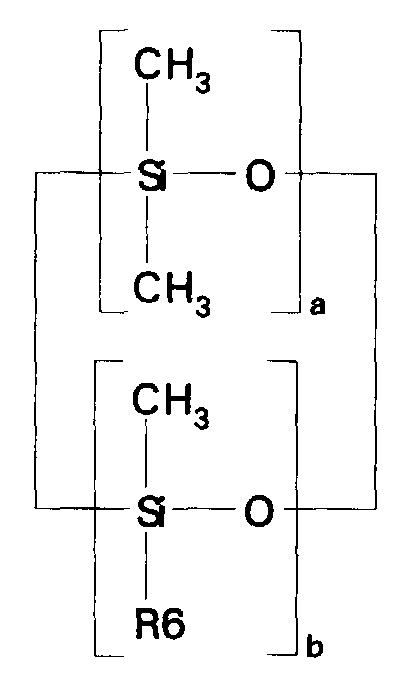
- the cyclic polysiloxane used in the reaction according to this invention is a cocyclic silicone having a structure corresponding to the formula: where a and b each represent an integer having a value of 1-10; R3, R4 and R5 each represent an alkyl group containing 1-6 carbon atoms; and R6 represents a higher carbon atom containing alkyl group, i.e.., C 8 or higher, such as -(CH 2 ) 7 CH 3 , -(CH 2 ) 11 CH 3 or -(CH 2 ) 15 CH 3 .
- R6 it is noted may contain more than sixteen carbon atoms, if desired. For example, R6 could contain as many as thirty or more carbon atoms.
- the reason the present invention is unique, therefore, is that by using such a cocyclic silicone one can prepare silicone polymers containing two or more dissimilar repeating units, without the necessity of adding other types of precursors to the reaction mixture, as in the case of prior art processes.
- emulsions containing silicone copolymers and silicone terpolymers generally of the structure corresponding to the formula: where x has a value of 1-2000; y has a value of 1-100; z has a value of 0-100; R3 to R6 are as previously defined, R' is hydroxy or an alkyl group containing preferably 1-6 carbon atoms ; R'' is an aminoalkyl group represented by where R''' and R'''' are hydrogen or a methyl group; R V is hydrogen or the group in which c is 2 or 3; R V' is hydrogen or a methyl group and R V'' is hydrogen.
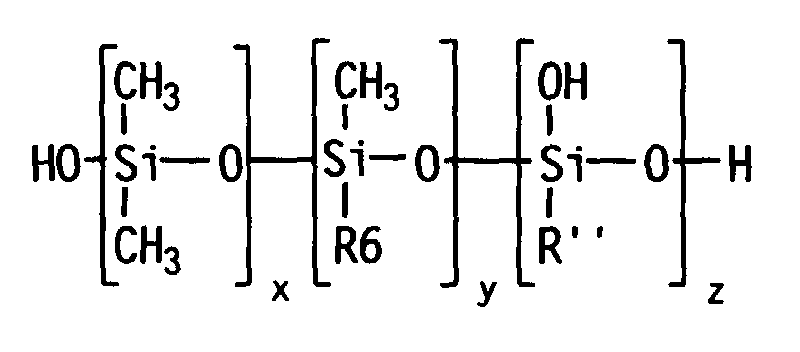
- the silicon copolymer or terpolymer correspond to the formula, wherein R6, R'', x, y and z are as previously defined.
- Our invention provides new silicone copolymers and new silicone terpolymers prepared in the form of oil-in-water emulsions by emulsion polymerization.
- These new copolymers and terpolymers are made by (i) combining and mixing together certain organosilicon precursors, one or more surfactants and water; (ii) optionally subjecting the mixture prepared in Step (i) to high shear; (iii) polymerizing this mixture in presence of a catalyst.
- the reaction mixture is preferably heated to initiate polymerization of the precursors; after completion of the reaction cooled and neutralized; and finally an oil-in-water emulsion containing the silicone copolymer or the silicone terpolymer is recovered.
- the emulsion containing the silicone can be used as obtained by this process, or the silicone can be recovered and isolated from the emulsion by using a standard emulsion breaking technique.
- the organosilicon precursors which are used in the process include as an essential ingredient, the (i) C 8 or higher carbon atom containing alkylmethyl, dimethyl cocyclic silicone.
- the reaction mixture may also contain organosilicon precursors such as (ii) an aminioalkylsiloxane homopolymer or an aminoalkylsilane, as well as (iii) a dimethyl cyclosiloxane.
- Silicone copolymers according to the invention can be prepared using only organosilicon precursor (i), while the silicone terpolymers require the presence of at least organosilicon precursors (i) and (ii). However, the silicone copolymers can also be prepared using organosilicon precursors (i) and (iii), if desired.
- a catalyst and a surfactant(s) are required for the reaction to proceed and for forming an emulsion.
- Certain acid catalysts such as dodecylbenzene sulfonic acid (DBSA) are capable of functioning as the acid catalyst as well as an anionic surfactant.
- DBSA dodecylbenzene sulfonic acid
- anionic surfactant i.e., sodium dodecylbenzene sulfonate
- R6 represents the C 8 alkyl group -(CH 2 ) 7 CH 3 or the C 16 alkyl group -(CH 2 ) 15 CH 3 , a has an average value of five, and b has an average value of one.
- cocyclic silicones are known in the art, and methods for their preparation are described in detail, for example, in US Patent 5,160,494.
- the reaction mixture must also include as one of the organosilicon precursors, an aminoalkylsiloxane homopolymer or an aminoalkylsilane.
- an aminoalkylsilane is most preferred, however.
- the aminoalkylsiloxane homopolymer to be copolymerized typically consists of a mixture of linear and cyclic species.
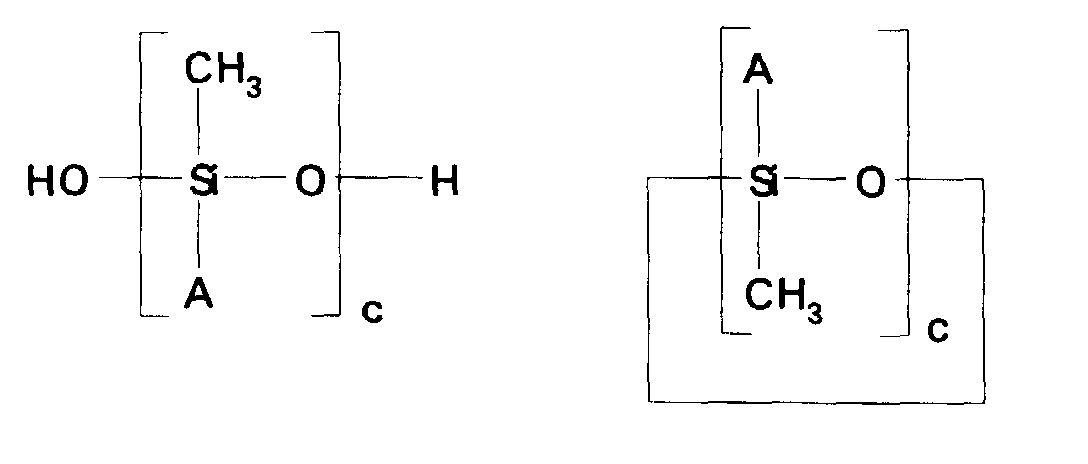
- the species have a structure generally corresponding to the formulas: wherein c represents an integer having a value of 1-20, and A represents an aminoalkyl group of the same type defined above for R''. Examples of two aminoalkyl groups most preferred are the group -CH 2 CH 2 CH 2 NHCH 2 CH 2 NH 2 or the group -CH 2 CH(CH 3 )CH 2 NHCH 2 CH 2 NH 2 .
- the aminoalkylsilane is most preferred, however, and comprises a trialkoxysilane generally corresponding to the formula R a Si(OR b ) 3 where R a represents the aminoalkyl group, and R b is an alkyl group containing 1-6 carbon atoms.
- aminoalkyltrialkoxysilanes which can be used are compounds such as 4-aminobutyltriethoxysilane H 2 NCH 2 CH 2 CH 2 CH 2 Si(OC 2 H 5 ) 3 , 3-[2-(2-aminoethylamino)-ethylamino]propyltrimethoxysilane, H 2 NCH 2 CH 2 NHCH 2 CH 2 NHCH 2 CH 2 CH 2 Si(OCH 3 ) 3 , N-(2-amino-ethyl)-3-aminopropyltrimethoxysilane H 2 NCH 2 CH 2 NHCH 2 CH 2 CH 2 Si(OCH 3 ) 3 , N-(6-aminohexyl)aminopropyltrimethoxysilane H 2 N(CH 2 ) 6 NHCH 2 CH 2 CH 2 Si(OCH 3 ) 3 , 3-aminopropyltriethoxysilane H 2 NCH 2 CH 2 CH 2 Si(OCH
- Another organosilicon precursor which may be included as an optional ingredient in the reaction is a dimethyl cyclosiloxane.
- Volatile cyclic methyl siloxanes are especially suited as this optional ingredient, among which are hexamethylcyclotrisiloxane (D 3 ) a solid with a boiling point of 134°C.
- the emulsions prepared according to this invention contain a silicone concentration of 10-70% by weight of the total emulsion solution, preferably 25-60%. While emulsions with less than 10% silicone content can be made, such emulsions hold little or no economic value.
- the reaction to polymerize the organosilicon precursors reactants and form emulsions is carried out in a reactor containing a reaction medium of water, at least one cationic or anionic (ionic) surfactant, preferably at least one nonionic surfactant and a catalyst.
- a reaction medium of water at least one cationic or anionic (ionic) surfactant, preferably at least one nonionic surfactant and a catalyst.
- Catalysts include condensation polymerization catalysts capable of cleaving siloxane bonds, exemplified by strong acids such as substituted benzene sulfonic acids, aliphatic sulfonic acids, hydrochloric acid and sulfuric acid; and strong bases such as quaternary ammonium hydroxides and metal hydroxides.
- strong acids such as substituted benzene sulfonic acids, aliphatic sulfonic acids, hydrochloric acid and sulfuric acid
- strong bases such as quaternary ammonium hydroxides and metal hydroxides.
- some acids such as dodecylbenzene sulfonic acid can function not only as the acid catalyst, but additionally are capable of functioning as a surfactant once it is neutralized.
- Other useful catalytic systems include phase transfer catalysts such as tetrabutyl ammonium hydroxide or ion exchange resins where a catalyst is formed in situ.
- the catalyst is present in the reaction medium at levels of 0.01-30% by weight of total silicone. Strong acids and basic metal hydroxides can be used within the lower end of this range, while acid catalysts which also function as surfactants will be present at concentrations on the higher end of the range.
- the reaction medium contain both an ionic and nonionic surfactant to stabilize the polysiloxane in the emulsion.
- the ionic surfactants can be an anionic or a cationic surfactant known in the art as being useful in emulsion polymerization.
- Suitable anionic surfactants include but are not limited to sulfonic acids and their salt derivatives.
- Useful anionic surfactants are alkali metal sulfosuccinates; sulfonated glyceryl esters of fatty acids such as sulfonated monoglycerides of coconut oil acids; salts of sulfonated monovalent alcohol esters such as sodium oleyl isothionate; amides of amino sulfonic acids such as the sodium salt of oleyl methyl tauride; sulfonated products of fatty acid nitriles such as palmitonitrile sulfonate; sulfonated aromatic hydrocarbons such as sodium alpha-naphthalene monosulfonate; condensation products of naphthalene sulfonic acids with formaldehyde; sodium octahydro anthracene sulfonate; alkali metal alkyl sulfates; ether
- anionic surfactants useful in this invention include dodecylbenzene sulfonic acid sold under the tradename BIOSOFT S-100 by Stepan Company, Northfield, Illinois; the sodium salt of dodecylbenzene sulfonic acid sold under the tradename SIPONATE DS-10 by Alcolac Inc., Baltimore, Maryland; and sodium n-hexadecyl diphenyloxide disulfonate sold under the tradename DOWFAX 8390 by The Dow Chemical Company, Midland, Michigan.
- Useful cationic surfactants are the fatty acid amines, amides and derivatives, and salts of fatty acid amines and amides.
- Cationic surfactants can be exemplified by aliphatic fatty amines and derivatives such as dodecyl amine acetate, octadecyl amine acetate, and acetates of amines of tallow fatty acids; homologues of aromatic amines having fatty chains such as dodecyl aniline; fatty amides derived from aliphatic diamines such as undecyl imidazoline; fatty amides derived from di-substituted amines such as oleylamino diethylamine; derivatives of ethylene diamine; quaternary ammonium compounds such as tallow (mixtures of C 16 & C 18 ) trimethylammonium chloride, dioctadecyldimethyl ammonium chloride, didode
- cationic surfactants include products sold under the tradenames ARQUAD T-27W, 16-29, C-33, T-50; and ETHOQUAD T/13 and T/13 ACETATE; by Akzo Chemicals Inc., Chicago, Illinois.
- the anionic or cationic surfactant is present at 0.05-30% by weight of total emulsion, preferably 0.5-20%.
- Useful nonionic surfactants preferably have a hydrophilic-lipophilic balance (HLB) of 10-20.
- HLB hydrophilic-lipophilic balance
- Nonionic surfactants with HLB of less than 10 may be used, but hazy solutions may result due to limited solubility of the nonionic surfactant in water.
- a nonionic surfactant with HLB less than 10 should be added during or after polymerization.
- nonionic surfactants can be exemplified by 2,6,8-trimethyl-4-nonyloxy polyethylene oxyethanols (6EO) and (10EO) sold under the trademarks TERGITOL® TMN-6 and TERGITOL® TMN-10; alkyleneoxy polyethylene oxyethanol (C 11-15 secondary alcohol ethoxylates 7EO, 9EO, and 15EO) sold under the trademarks TERGITOL® 15-S-7, TERGITOL® 15-S-9, TERGITOL® 15-S-15; other C 11-15 secondary alcohol ethoxylates sold under the trademarks TERGITOL® 15-S-12, 15-S-20, 15-S-30, 15-S-40; and octylphenoxy polyethoxy ethanol (40EO) sold under the trademark TRITON® X-405. All of these surfactants are sold by Union Carbide Corporation, Danbury, Connecticut.
- nonionic surfactants are nonylphenoxy polyethoxy ethanol (10EO) sold under the tradename MAKON 10 by Stepan Company, Northfield, Illinois; and a polyoxyethylene ether alcohol with an HLB of 14.5 sold under the tradename RENEX 30 by ICI Surfactants, Wilmington, Delaware.
- One especially useful nonionic surfactant is polyoxyethylene 23 lauryl ether (Laureth-23) sold commercially under the tradename BRIJ 35L by ICI Surfactants, Wilmington, Delaware.
- the level of nonionic surfactant should be 0.1-40% by weight based on total weight of emulsion, preferably 0.5-30%.
- ionic surfactants have characteristics of both ionic and nonionic surfactants combined and this type of surfactant is useful in the invention.
- a surfactant is methyl polyoxyethylene (15) octadecyl ammonium chloride sold under the tradename ETHOQUAD 18/25 by Akzo Chemicals Inc., Chicago, Illinois. This composition is a cationic quaternary ammonium salt with polyethylene oxide tails.
- ionic surfactant does not have characteristics of both ionic and nonionic surfactants, it is preferred to use both types of surfactants in the method of this invention. Otherwise, surfactants such as ETHOQUAD 18/25 are typically used at levels equal to the level of the ionic surfactant(s) used.
- the method is carried out by creating a mixture of the ingredients containing the organosilicon precursors, ionic (cationic or anionic) surfactant, nonionic surfactant, water and catalyst.
- the mixture is heated with agitation at a polymerization reaction temperature until essentially all of the organosilicon precursors have reacted, and a stable, oil-free emulsion of polymer is formed.
- the time required for formation of the stable, oil-free emulsion will vary depending on the reactants and the reaction conditions.
- Polymerization reaction temperatures are typically above the freezing point, but below the boiling point of water. Pressures above or below atmospheric pressure allow operation outside of this range. At lower temperatures below room temperature, the polymerization reaction may proceed more slowly.
- the preferred temperature range is 50-95°C.
- the polymerization reaction can be stopped when the desired level of (i) conversion of organosilicon precursors, (ii) particle size, or (iii) molecular weight has been achieved, by using known methods. Reaction times of less than 24 hours, typically less than 5 hours, are sufficient to achieve the desired particle size, molecular weight and/or level of conversion.
- the methods for stopping the reaction encompass neutralization of the catalyst by addition of equal or slightly greater stoichiometric amounts of an acid or a base depending upon the type of catalyst. Care must be taken not to over neutralize, as it is possible to re-catalyze the reaction. It is preferred to neutralize with sufficient quantities of acid or base such that the resulting emulsion has a pH of less than 7 when a cationic surfactant is present, and a pH of greater than 7 when an anionic surfactant is present.
- neutralizing agents include sodium hydroxide, ammonium hydroxide, potassium hydroxide, hydrochloric acid, sulfuric acid, acetic acid, triethanolamine (TEA), triethylamine and isopropyl amine.
- a preservative may also be included, and some representative compositions which may be employed include sodium benzoate, formaldehyde, DMDM hydantoin, 5-bromo-5-nitro-1,3-dioxane, methyl paraben, propyl paraben, sorbic acid, imidazolidinyl urea, and 5-chloro-2-methyl-4-isothiazolin-3-one, the latter of which is a product sold under the tradenames KATHON CG and KATHON LX by the Rohm & Haas Company, Philadelphia, Pennsylvania.
- the emulsions including macroemulsions and microemulsions, were prepared using as the reactor, a three-neck round bottomed flask equipped with a glass rod having Teflon paddle stirrers, a reflux condenser, and a heating mantle having a thermocouple attached to a temperature controller. Flask sizes of 500, 1000 and 2000 mL, enabled the preparation of emulsions in batch sizes of 300, 700 and 1400 gram, respectively. Microemulsions were prepared generally in batch sizes of 700 or 1,400 gram. A peristaltic pump was used for any procedure requiring the controlled feed of a cyclic organosilicon precursor, whereas the aminoalkylsilanes were fed using a syringe pump.
- the polymer particle size measurements were carried out using a Nicomp 270 particle sizer operated in its volume weighing mode. Some polymer samples were measured using a Microtrac UPA particle sizer in both its volume and intensity mode.
- Emulsions containing the polymer were broken, and the polymer phase of the emulsion was extracted by adding to a 1.18 x 10 -4 m 3 (four ounce) bottle, 10.0 g of the emulsion, 1.5 g CaCl 2 , 20 mL methanol and 25 mL pentane. The contents of the bottle was then shaken thoroughly. The mixture was placed in a 50 mL centrifuge tube and centrifuged at 3000 rpm (314 rad/s) for 15 minutes. The polymer layer, i.e., the top fraction, was pipetted off and added to an aluminum weighing dish. The dish was placed in a solvent hood and allowed to dry overnight. It was then dried in a vacuum dessicator for 20 minutes at 10 mm Hg. The polymer viscosity measurements were made using a Model HBDV-III Brookfield cone and plate viscometer having a CP-52 spindle.
- the values determined for x, y, and z were the average and approximate values for the silicone copolymers and terpolymers.
- the first three of the ingredients were added to a flask and mixed at 300 rpm (31 rad/s) until the nonionic surfactant had been dissolved.
- the contents of the flask was heated to 95°C.
- the organosilicon precursors were mixed together and added to the flask when the temperature had stabilized.
- the catalyst was added along with the second portion of water which was used to rinse all of the catalyst from its container.
- the flask was maintained at 95°C. for four hours.
- the contents of the flask was then neutralized with the acid, and the third portion of water was added to the flask.
- a silicone was extracted from the emulsion and determined to have a structure generally corresponding to the formula
- Example 1 was repeated and the ingredients and amounts are shown below.
- an aminoalkylsilane was included as one of the organosilicon precursors and it was added to the flask following the addition of the catalyst.
- a silicone terpolymer was extracted from the emulsion having the following characteristics: Characteristic Value Particle Size (nanometer) 171 Viscosity (mm 2 /s) 1,070 Percent Nonvolatile Content 33.1 X 305.8 Y 13.5 Z 2.1 R6 C 8 H 17 R'' CH 2 CH 2 CH 2 NHCH 2 CH 2 NH 2
- Example 1 was repeated and the ingredients and their amounts are shown below.
- the contents of the flask was heated to 65°C., and the flask was maintained at 65°C. for eight hours. The flask was allowed to cool to room temperature.
- the first three of the ingredients were added to a flask and mixed at 300 rpm (31 rad/s) until the nonionic surfactant had been dissolved.
- the contents of the flask was heated to 95°C.
- the organosilicon precursors were mixed together and added to the flask over a period of 30 minutes when the temperature had stabilized.
- the flask was maintained at 95°C. for six hours.
- the contents of the flask was cooled to 42°C., then neutralized with the base, i.e., triethylamine and the second portion of water was added to the flask.
- the first three of the ingredients were added to a flask and mixed at 300 rpm (31 rad/s) until the nonionic surfactant had been dissolved.
- the contents of the flask was heated to 75°C.
- the organosilicon precursors were mixed together and added to the flask over a period of 30 minutes when the temperature had stabilized.
- the flask was maintained at 75°C. for four hours.
- the contents of the flask was cooled to 42°C., and the flask was maintained at that temperature for two more hours.
- Triethylamine was fed into the flask over a period of 20 minutes, and then the second portions of water and nonionic surfactant, along with a preservative, were added to the flask.
- Examples 6-11 are set forth in order to illustrate another aspect of the invention, in which several anionic and cationic macroemulsions were prepared by a process similar to the process used in Examples 1-5, except that the process in the following examples includes a step in which the ingredients are subjected to high shear mixing in an homogenizer.
- the cationic surfactant used in Examples 6-9 was tallow (C 16 & C 18 ) trimethylammonium chloride.
- the aminoalkylsilane was the same as the silane used in Examples 1-5, i.e., H 2 NCH 2 CH 2 NHCH 2 CH 2 CH 2 Si(OCH 3 ) 3
- the nonionic surfactant was Makon 10, a nonylphenoxy polyethoxy ethanol (10EO), sold by Stepan Company, Northfield, Illinois.
- the preservative was sodium benzoate C 6 H 5 COONa.
- the value of a and b in the C 8 and C 16 cocyclic silicone was 5 and 1, respectively.
- Example 10 (Weight %)
- Example 11 (Weight %) Water 51.7 51.1 Biosoft S-100, i.e., DBSA @ 1.5% (catalyst & anionic surfactant) 3.0 3.0 Octamethylcyclotetrasiloxane, D 4 29.4 27.6
- C 8 Cocyclic Silicone 9.8 None C 16 Cocyclic Silicone None 11.2
- Triethanolamine - neutralizer 2.5 3.0
- Nonionic Surfactant - TRITON® X-405 3.3 3.8
- the silicone copolymer extracted from the emulsions prepared in Examples 10 and 11 had the characteristics as shown below: Characteristics Example 10 Example 11 Particle Size (nanometer) 152.4 223.9 Viscosity (mm 2 /s) 54,000 10,380 Percent Nonvolatile Content 38.9 38.9 X 971.0 642.7 Y 42.8 34.6 Z 0 0 R6 C 8 H 17 C 16 H 33 R'' None None
- the emulsions according to this invention are capable of functioning as a means of delivering polymers of tailored rheological properties to the human body, i.e., as in a shampoo base to provide styling and conditioning benefits to human hair. They are also useful in paper coating, textile coating and home care applications, and for the delivery of polymers with non-transferable tack properties to various types of surfaces and substrates.
Landscapes
- Chemical & Material Sciences (AREA)
- Health & Medical Sciences (AREA)
- Chemical Kinetics & Catalysis (AREA)
- Medicinal Chemistry (AREA)
- Polymers & Plastics (AREA)
- Organic Chemistry (AREA)
- Silicon Polymers (AREA)
Abstract
Emulsion polymerization techniques are disclosed using in the
reaction, a precursor which is a cocyclic silicone which has a structure
generally corresponding to the formula:
 where a and b have a value of 1-10; R3, R4, and R5 are alkyl groups
containing 1-6 carbon atoms; and R6 is a C8 or higher alkyl group such
as -(CH2)7CH3, -(CH2)11CH3 or -(CH2)15CH3. R3, R4 and R5 are preferably
methyl groups.
where a and b have a value of 1-10; R3, R4, and R5 are alkyl groups
containing 1-6 carbon atoms; and R6 is a C8 or higher alkyl group such
as -(CH2)7CH3, -(CH2)11CH3 or -(CH2)15CH3. R3, R4 and R5 are preferably
methyl groups.
Description
This invention is directed to emulsion polymerization in which the
improvement in the process resides in the use of a cocyclic silicone.
Emulsion polymerization is a known technique for making emulsions
containing silicone polymers, and is explained in detail in numerous
references in the prior art, the most notable of which are US Patents
2,891,920, 3,294,725, 4,999,398 and European Patent 0 459 500.
According to the standard technique, the polymerization reaction
involves the opening of cyclic polysiloxane rings using an anionic or a
cationic catalyst in the presence of water. The anions and the cations
act as a polymerization catalyst for such reactions by functioning to
open the ring of the cyclic polysiloxane, and allowing it to form linear
siloxane oligomers having terminal hydroxy groups. These oligomers then
react with other oligomers by means of a condensation reaction, with the
result that higher molecular weight polysiloxanes are formed. A
surfactant(s) is generally used to stabilize the polysiloxane in the
emulsion in the form of small sized droplets.
Typically, the cyclic polysiloxane used in these ring opening
reactions has a structure generally corresponding to the formula:
 where n generally has a value of 3-6 and R1 and R2 represent alkyl
groups containing 1-6 carbon atoms. Some examples of these cyclic
polysiloxanes are hexamethylcyclotrisiloxane (D3), octamethylcyclotetrasiloxane
(D4), decamethylcyclopentasiloxane (D5) and
dodecamethylcyclohexasiloxane (D6).
where n generally has a value of 3-6 and R1 and R2 represent alkyl
groups containing 1-6 carbon atoms. Some examples of these cyclic
polysiloxanes are hexamethylcyclotrisiloxane (D3), octamethylcyclotetrasiloxane
(D4), decamethylcyclopentasiloxane (D5) and
dodecamethylcyclohexasiloxane (D6).
In contrast, the cyclic polysiloxane used in the reaction
according to this invention is a cocyclic silicone having a structure
corresponding to the formula:
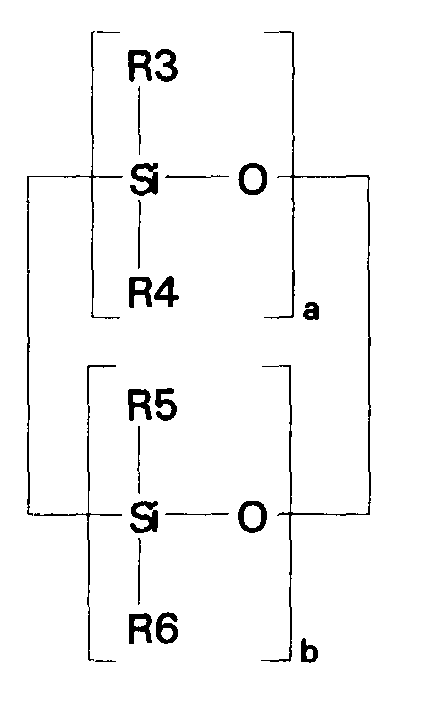 where a and b each represent an integer having a value of 1-10; R3, R4
and R5 each represent an alkyl group containing 1-6 carbon atoms; and R6
represents a higher carbon atom containing alkyl group, i.e.., C8 or
higher, such as -(CH2)7CH3, -(CH2)11CH3 or -(CH2)15CH3. R6 it is noted
may contain more than sixteen carbon atoms, if desired. For example, R6
could contain as many as thirty or more carbon atoms.
where a and b each represent an integer having a value of 1-10; R3, R4
and R5 each represent an alkyl group containing 1-6 carbon atoms; and R6
represents a higher carbon atom containing alkyl group, i.e.., C8 or
higher, such as -(CH2)7CH3, -(CH2)11CH3 or -(CH2)15CH3. R6 it is noted
may contain more than sixteen carbon atoms, if desired. For example, R6
could contain as many as thirty or more carbon atoms.
The reason the present invention is unique, therefore, is that by
using such a cocyclic silicone one can prepare silicone polymers
containing two or more dissimilar repeating units, without the necessity
of adding other types of precursors to the reaction mixture, as in the
case of prior art processes.
It is the object of this invention to prepare emulsions containing
silicone copolymers and silicone terpolymers generally of the structure
corresponding to the formula:
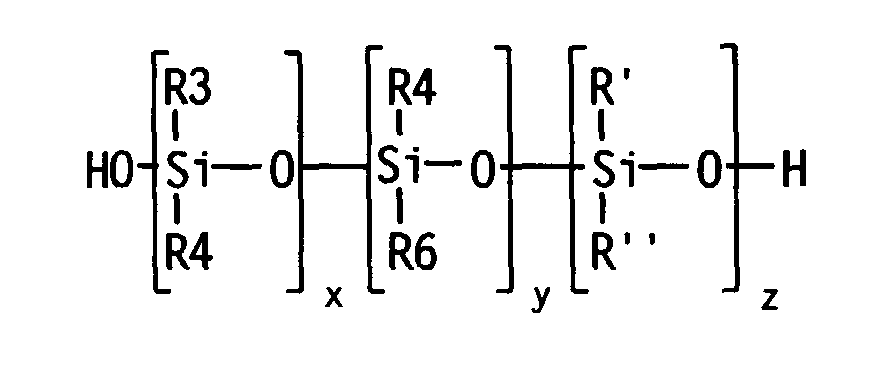 where x has a value of 1-2000; y has a value of 1-100; z has a value of
0-100; R3 to R6 are as previously defined, R' is hydroxy or an alkyl
group containing preferably 1-6 carbon atoms ; R'' is an aminoalkyl
group represented by
where x has a value of 1-2000; y has a value of 1-100; z has a value of
0-100; R3 to R6 are as previously defined, R' is hydroxy or an alkyl
group containing preferably 1-6 carbon atoms ; R'' is an aminoalkyl
group represented by
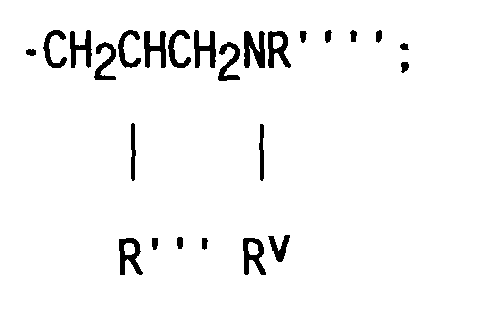 where R''' and R'''' are hydrogen or a methyl group; RV is hydrogen or
the group
where R''' and R'''' are hydrogen or a methyl group; RV is hydrogen or
the group
 in which c is 2 or 3; RV' is hydrogen or a methyl group and RV'' is
hydrogen.
in which c is 2 or 3; RV' is hydrogen or a methyl group and RV'' is
hydrogen.
Preferably the silicon copolymer or terpolymer correspond to the
formula, wherein R6, R'', x, y and z are as previously defined.
Our invention provides new silicone copolymers and new silicone
terpolymers prepared in the form of oil-in-water emulsions by emulsion
polymerization. These new copolymers and terpolymers are made by (i)
combining and mixing together certain organosilicon precursors, one or
more surfactants and water; (ii) optionally subjecting the mixture
prepared in Step (i) to high shear; (iii) polymerizing this mixture in
presence of a catalyst. The reaction mixture is preferably heated to
initiate polymerization of the precursors; after completion of the
reaction cooled and neutralized; and finally an oil-in-water emulsion
containing the silicone copolymer or the silicone terpolymer is
recovered.
The emulsion containing the silicone can be used as obtained by
this process, or the silicone can be recovered and isolated from the
emulsion by using a standard emulsion breaking technique.
The organosilicon precursors which are used in the process include
as an essential ingredient, the (i) C8 or higher carbon atom containing
alkylmethyl, dimethyl cocyclic silicone. Optionally, the reaction
mixture may also contain organosilicon precursors such as (ii) an
aminioalkylsiloxane homopolymer or an aminoalkylsilane, as well as (iii)
a dimethyl cyclosiloxane.
Silicone copolymers according to the invention can be prepared
using only organosilicon precursor (i), while the silicone terpolymers
require the presence of at least organosilicon precursors (i) and (ii).
However, the silicone copolymers can also be prepared using
organosilicon precursors (i) and (iii), if desired.
A catalyst and a surfactant(s) are required for the reaction to
proceed and for forming an emulsion. Certain acid catalysts such as
dodecylbenzene sulfonic acid (DBSA) are capable of functioning as the
acid catalyst as well as an anionic surfactant. When DBSA is used,
therefore, it eliminates the need for using a separate acid catalyst and
a separate anionic surfactant. Thus, DBSA will function as acid catalyst
in the ring opening reaction and then when the reaction is stopped and
DBSA is neutralized, it will take on the characteristics of an anionic
surfactant, i.e., sodium dodecylbenzene sulfonate, for purposes of
forming the desired emulsion.
The C8 or higher carbon atom containing alkylmethyl, dimethyl
cocyclic silicone used in the accompanying examples to prepare the
terpolymers is shown below
 In the formula, R6 represents the C8 alkyl group -(CH2)7CH3 or the C16
alkyl group -(CH2)15CH3, a has an average value of five, and b has an
average value of one. Such cocyclic silicones are known in the art, and
methods for their preparation are described in detail, for example, in
US Patent 5,160,494.
In the formula, R6 represents the C8 alkyl group -(CH2)7CH3 or the C16
alkyl group -(CH2)15CH3, a has an average value of five, and b has an
average value of one. Such cocyclic silicones are known in the art, and
methods for their preparation are described in detail, for example, in
US Patent 5,160,494.
When it is desired to prepare terpolymers according to the
invention, the reaction mixture must also include as one of the
organosilicon precursors, an aminoalkylsiloxane homopolymer or an
aminoalkylsilane. An aminoalkylsilane is most preferred, however.
The aminoalkylsiloxane homopolymer to be copolymerized typically
consists of a mixture of linear and cyclic species. The species have a
structure generally corresponding to the formulas:
 wherein c represents an integer having a value of 1-20, and A represents
an aminoalkyl group of the same type defined above for R''. Examples of
two aminoalkyl groups most preferred are the group -CH2CH2CH2NHCH2CH2NH2
or the group -CH2CH(CH3)CH2NHCH2CH2NH2.
wherein c represents an integer having a value of 1-20, and A represents
an aminoalkyl group of the same type defined above for R''. Examples of
two aminoalkyl groups most preferred are the group -CH2CH2CH2NHCH2CH2NH2
or the group -CH2CH(CH3)CH2NHCH2CH2NH2.
The aminoalkylsilane is most preferred, however, and comprises a
trialkoxysilane generally corresponding to the formula RaSi(ORb)3 where
Ra represents the aminoalkyl group, and Rb is an alkyl group containing
1-6 carbon atoms. Some examples of aminoalkyltrialkoxysilanes which can
be used are compounds such as 4-aminobutyltriethoxysilane
H2NCH2CH2CH2CH2Si(OC2H5)3, 3-[2-(2-aminoethylamino)-ethylamino]propyltrimethoxysilane,
H2NCH2CH2NHCH2CH2NHCH2CH2CH2Si(OCH3)3, N-(2-amino-ethyl)-3-aminopropyltrimethoxysilane
H2NCH2CH2NHCH2CH2CH2Si(OCH3)3,
N-(6-aminohexyl)aminopropyltrimethoxysilane
H2N(CH2)6NHCH2CH2CH2Si(OCH3)3, 3-aminopropyltriethoxysilane
H2NCH2CH2CH2Si(OC2H5)3 and 3-aminopropyltrimethoxysilane
H2NCH2CH2CH2Si(OCH3)3. Of these compounds, N-(2-aminoethyl)-3-aminopropyltrimethoxysilane
is the most preferred.
Another organosilicon precursor which may be included as an
optional ingredient in the reaction is a dimethyl cyclosiloxane.
Volatile cyclic methyl siloxanes are especially suited as this optional
ingredient, among which are hexamethylcyclotrisiloxane (D3) a solid with
a boiling point of 134°C. and formula {(Me2)SiO}3;
octamethylcyclotetrasiloxane (D4) with a boiling point of 176°C.,
viscosity of 2.3 mm2/s, and formula {(Me2)SiO}4;
decamethylcyclopentasiloxane (D5) with a boiling point of 210°C.,
viscosity of 3.87 mm2/s and formula {(Me2)SiO}5; and
dodecamethylcyclohexasiloxane (D6) with a boiling point of 245°C.,
viscosity of 6.62 mm2/s, and formula {(Me2)SiO}6. The presence of this
optional ingredient in the reaction mixture is a matter of economics, as
its presence reduces the amount of the C8 or higher carbon atom
containing alkylmethyl, dimethyl cocyclic silicone required to achieve
the desired results.
The emulsions prepared according to this invention contain a
silicone concentration of 10-70% by weight of the total emulsion
solution, preferably 25-60%. While emulsions with less than 10% silicone
content can be made, such emulsions hold little or no economic value.
The reaction to polymerize the organosilicon precursors reactants
and form emulsions is carried out in a reactor containing a reaction
medium of water, at least one cationic or anionic (ionic) surfactant,
preferably at least one nonionic surfactant and a catalyst.
Any catalyst capable of polymerizing cyclic siloxanes in the
presence of water is useful in the method. Catalysts include
condensation polymerization catalysts capable of cleaving siloxane
bonds, exemplified by strong acids such as substituted benzene sulfonic
acids, aliphatic sulfonic acids, hydrochloric acid and sulfuric acid;
and strong bases such as quaternary ammonium hydroxides and metal
hydroxides. As noted above, some acids such as dodecylbenzene sulfonic
acid can function not only as the acid catalyst, but additionally are
capable of functioning as a surfactant once it is neutralized. Other
useful catalytic systems include phase transfer catalysts such as
tetrabutyl ammonium hydroxide or ion exchange resins where a catalyst is
formed in situ.
The catalyst is present in the reaction medium at levels of 0.01-30%
by weight of total silicone. Strong acids and basic metal
hydroxides can be used within the lower end of this range, while acid
catalysts which also function as surfactants will be present at
concentrations on the higher end of the range.
Preferrably, the reaction medium contain both an ionic and
nonionic surfactant to stabilize the polysiloxane in the emulsion. The
ionic surfactants can be an anionic or a cationic surfactant known in
the art as being useful in emulsion polymerization.
Suitable anionic surfactants include but are not limited to
sulfonic acids and their salt derivatives. Useful anionic surfactants
are alkali metal sulfosuccinates; sulfonated glyceryl esters of fatty
acids such as sulfonated monoglycerides of coconut oil acids; salts of
sulfonated monovalent alcohol esters such as sodium oleyl isothionate;
amides of amino sulfonic acids such as the sodium salt of oleyl methyl
tauride; sulfonated products of fatty acid nitriles such as
palmitonitrile sulfonate; sulfonated aromatic hydrocarbons such as
sodium alpha-naphthalene monosulfonate; condensation products of
naphthalene sulfonic acids with formaldehyde; sodium octahydro
anthracene sulfonate; alkali metal alkyl sulfates; ether sulfates having
alkyl groups of eight or more carbon atoms; and alkylaryl sulfonates
having one or more alkyl groups of eight or more carbon atoms.
Commercial anionic surfactants useful in this invention include
dodecylbenzene sulfonic acid sold under the tradename BIOSOFT S-100 by
Stepan Company, Northfield, Illinois; the sodium salt of dodecylbenzene
sulfonic acid sold under the tradename SIPONATE DS-10 by Alcolac Inc.,
Baltimore, Maryland; and sodium n-hexadecyl diphenyloxide disulfonate
sold under the tradename DOWFAX 8390 by The Dow Chemical Company,
Midland, Michigan.
Useful cationic surfactants are the fatty acid amines, amides and
derivatives, and salts of fatty acid amines and amides. Cationic
surfactants can be exemplified by aliphatic fatty amines and derivatives
such as dodecyl amine acetate, octadecyl amine acetate, and acetates of
amines of tallow fatty acids; homologues of aromatic amines having fatty
chains such as dodecyl aniline; fatty amides derived from aliphatic
diamines such as undecyl imidazoline; fatty amides derived from
di-substituted amines such as oleylamino diethylamine; derivatives of
ethylene diamine; quaternary ammonium compounds such as tallow (mixtures
of C16 & C18) trimethylammonium chloride, dioctadecyldimethyl ammonium
chloride, didodecyldimethyl ammonium chloride, and dihexadecyldimethyl
ammonium chloride; amide derivatives of amino alcohols such as beta-hydroxyethyl
stearyl amide; amine salts of long chain fatty acids;
quaternary ammonium bases derived from fatty amides of di-substituted
diamines such as oleylbenzylamino ethylene diethylamine hydrochloride;
quaternary ammonium bases of benzimidazolines such as methylheptadecyl
benzimidazole hydrobromide; basic compounds of pyridinium and
derivatives such as cetylpyridinium chloride; sulfonium compounds such
as octadecyl sulfonium methyl sulfate; quaternary ammonium compounds of
betaine such as betaine compounds of diethylamino acetic acid, and
octadecylchloromethyl ether; urethanes of ethylene diamine such as
condensation products of stearic acid and diethylene triamine;
polyethylene diamines; and polypropanol polyethanol amines.
Commercial cationic surfactants include products sold under the
tradenames ARQUAD T-27W, 16-29, C-33, T-50; and ETHOQUAD T/13 and T/13
ACETATE; by Akzo Chemicals Inc., Chicago, Illinois.
The anionic or cationic surfactant is present at 0.05-30% by
weight of total emulsion, preferably 0.5-20%.
Useful nonionic surfactants preferably have a hydrophilic-lipophilic
balance (HLB) of 10-20. Nonionic surfactants with HLB of
less than 10 may be used, but hazy solutions may result due to limited
solubility of the nonionic surfactant in water. When using a nonionic
surfactant with HLB less than 10, a nonionic surfactant with HLB greater
than 10 should be added during or after polymerization.
Commercial types of nonionic surfactants can be exemplified by
2,6,8-trimethyl-4-nonyloxy polyethylene oxyethanols (6EO) and (10EO)
sold under the trademarks TERGITOL® TMN-6 and TERGITOL® TMN-10;
alkyleneoxy polyethylene oxyethanol (C11-15 secondary alcohol
ethoxylates 7EO, 9EO, and 15EO) sold under the trademarks TERGITOL® 15-S-7,
TERGITOL® 15-S-9, TERGITOL® 15-S-15; other C11-15 secondary alcohol
ethoxylates sold under the trademarks TERGITOL® 15-S-12, 15-S-20, 15-S-30,
15-S-40; and octylphenoxy polyethoxy ethanol (40EO) sold under the
trademark TRITON® X-405. All of these surfactants are sold by Union
Carbide Corporation, Danbury, Connecticut.
Other types of commercial nonionic surfactants are nonylphenoxy
polyethoxy ethanol (10EO) sold under the tradename MAKON 10 by Stepan
Company, Northfield, Illinois; and a polyoxyethylene ether alcohol with
an HLB of 14.5 sold under the tradename RENEX 30 by ICI Surfactants,
Wilmington, Delaware. One especially useful nonionic surfactant is
polyoxyethylene 23 lauryl ether (Laureth-23) sold commercially under the
tradename BRIJ 35L by ICI Surfactants, Wilmington, Delaware.
The level of nonionic surfactant should be 0.1-40% by weight based
on total weight of emulsion, preferably 0.5-30%.
Some commercially available ionic surfactants have characteristics
of both ionic and nonionic surfactants combined and this type of
surfactant is useful in the invention. One example of such a surfactant
is methyl polyoxyethylene (15) octadecyl ammonium chloride sold under
the tradename ETHOQUAD 18/25 by Akzo Chemicals Inc., Chicago, Illinois.
This composition is a cationic quaternary ammonium salt with
polyethylene oxide tails. When this type of surfactant is used, it is
not necessary to have both ionic and nonionic surfactants in the
reaction medium. Only the ionic surfactant having the nonionic
characteristics is needed. If the ionic surfactant does not have
characteristics of both ionic and nonionic surfactants, it is preferred
to use both types of surfactants in the method of this invention.
Otherwise, surfactants such as ETHOQUAD 18/25 are typically used at
levels equal to the level of the ionic surfactant(s) used.
The method is carried out by creating a mixture of the ingredients
containing the organosilicon precursors, ionic (cationic or anionic)
surfactant, nonionic surfactant, water and catalyst. The mixture is
heated with agitation at a polymerization reaction temperature until
essentially all of the organosilicon precursors have reacted, and a
stable, oil-free emulsion of polymer is formed. The time required for
formation of the stable, oil-free emulsion will vary depending on the
reactants and the reaction conditions.
It is not necessary to combine the ingredients in a given order,
but they should be agitated during and following their addition, and
heated to the polymerization temperature when all of them have been
combined. The application of high shear, however, is not a necessity.
Polymerization reaction temperatures are typically above the
freezing point, but below the boiling point of water. Pressures above
or below atmospheric pressure allow operation outside of this range. At
lower temperatures below room temperature, the polymerization reaction
may proceed more slowly. The preferred temperature range is 50-95°C.
The polymerization reaction can be stopped when the desired level
of (i) conversion of organosilicon precursors, (ii) particle size, or
(iii) molecular weight has been achieved, by using known methods.
Reaction times of less than 24 hours, typically less than 5 hours, are
sufficient to achieve the desired particle size, molecular weight and/or
level of conversion.
The methods for stopping the reaction encompass neutralization of
the catalyst by addition of equal or slightly greater stoichiometric
amounts of an acid or a base depending upon the type of catalyst. Care
must be taken not to over neutralize, as it is possible to re-catalyze
the reaction. It is preferred to neutralize with sufficient quantities
of acid or base such that the resulting emulsion has a pH of less than 7
when a cationic surfactant is present, and a pH of greater than 7 when
an anionic surfactant is present.
Some examples of neutralizing agents which may be employed include
sodium hydroxide, ammonium hydroxide, potassium hydroxide, hydrochloric
acid, sulfuric acid, acetic acid, triethanolamine (TEA), triethylamine
and isopropyl amine.
Since emulsions are susceptible to microbiological contamination,
a preservative may also be included, and some representative
compositions which may be employed include sodium benzoate,
formaldehyde, DMDM hydantoin, 5-bromo-5-nitro-1,3-dioxane, methyl
paraben, propyl paraben, sorbic acid, imidazolidinyl urea, and 5-chloro-2-methyl-4-isothiazolin-3-one,
the latter of which is a product sold
under the tradenames KATHON CG and KATHON LX by the Rohm & Haas Company,
Philadelphia, Pennsylvania.
The following examples are set forth in order to illustrate this
invention in more detail.
In these examples, the emulsions, including macroemulsions and
microemulsions, were prepared using as the reactor, a three-neck round
bottomed flask equipped with a glass rod having Teflon paddle stirrers,
a reflux condenser, and a heating mantle having a thermocouple attached
to a temperature controller. Flask sizes of 500, 1000 and 2000 mL,
enabled the preparation of emulsions in batch sizes of 300, 700 and 1400
gram, respectively. Microemulsions were prepared generally in batch
sizes of 700 or 1,400 gram. A peristaltic pump was used for any
procedure requiring the controlled feed of a cyclic organosilicon
precursor, whereas the aminoalkylsilanes were fed using a syringe pump.
The polymer particle size measurements were carried out using a
Nicomp 270 particle sizer operated in its volume weighing mode. Some
polymer samples were measured using a Microtrac UPA particle sizer in
both its volume and intensity mode.
Emulsions containing the polymer were broken, and the polymer
phase of the emulsion was extracted by adding to a 1.18 x 10⁻⁴ m3 (four
ounce) bottle, 10.0 g of the emulsion, 1.5 g CaCl2, 20 mL methanol and
25 mL pentane. The contents of the bottle was then shaken thoroughly.
The mixture was placed in a 50 mL centrifuge tube and centrifuged at
3000 rpm (314 rad/s) for 15 minutes. The polymer layer, i.e., the top
fraction, was pipetted off and added to an aluminum weighing dish. The
dish was placed in a solvent hood and allowed to dry overnight. It was
then dried in a vacuum dessicator for 20 minutes at 10 mm Hg. The
polymer viscosity measurements were made using a Model HBDV-III
Brookfield cone and plate viscometer having a CP-52 spindle.
In all examples, the values determined for x, y, and z, were the
average and approximate values for the silicone copolymers and
terpolymers.
The following ingredients in the amounts indicated were used to
prepare a cationic macroemulsion using the emulsion polymerization
technique according to this invention:
| Ingredients | Weight Percent |
| Water - 1st portion | 40.50 |
| ARQUAD 16-29 (cationic surfactant) | 1.83 |
| RENEX 30 (nonionic surfactant) | 2.80 |
| Octamethylcyclotetrasiloxane, i.e., D4 | 26.25 |
| C8 Cocyclic Silicone, a = 5, b = 1 | 8.75 |
| NaOH (50% solution) - catalyst | 0.40 |
| Water - 2nd portion | 0.50 |
| Acetic Acid (10% Solution) - neutralizer | 3.30 |
| Water - 3rd portion | 15.67 |
The first three of the ingredients were added to a flask and mixed
at 300 rpm (31 rad/s) until the nonionic surfactant had been dissolved.
The contents of the flask was heated to 95°C. The organosilicon
precursors were mixed together and added to the flask when the
temperature had stabilized. The catalyst was added along with the
second portion of water which was used to rinse all of the catalyst from
its container. The flask was maintained at 95°C. for four hours. The
contents of the flask was then neutralized with the acid, and the third
portion of water was added to the flask.
A silicone was extracted from the emulsion and determined to have
a structure generally corresponding to the formula

In this example, and in all of the remaining examples, the
structure of silicone copolymers and silicone terpolymers which were
prepared will be with reference to the structure shown in the above
formula.
The silicone in Example 1 had the following characteristics.
| Characteristic | Value |
| Particle Size (nanometer) | 154 |
| Viscosity (mm2/s) | 2,000 |
| Percent Nonvolatile Content | 33.2 |
| X | 404 |
| Y | 18 |
| Z | 0 |
| R6 | C8H17 |
| R'' | Not applicable, i.e., z = 0. |
Example 1 was repeated and the ingredients and amounts are shown
below. In this example, an aminoalkylsilane was included as one of the
organosilicon precursors and it was added to the flask following the
addition of the catalyst.
| Ingredients | Weight Percent |
| Water - 1st portion | 40.50 |
| ARQUAD 16-29 (cationic surfactant) | 1.83 |
| RENEX 30 (nonionic surfactant) | 2.80 |
| Octamethylcyclotetrasiloxane, i.e., D4 | 26.25 |
| C8 Cocyclic Silicone, a = 5, b = 1 | 8.75 |
| Aminoalkylsilane H2NCH2CH2NHCH2CH2CH2Si(OCH3)3 | 0.65 |
| NaOH (50% solution) - catalyst | 0.40 |
| Water - 2nd portion | 0.50 |
| Acetic Acid (10% Solution) - neutralizer | 3.30 |
| Water - 3rd portion | 15.67 |
A silicone terpolymer was extracted from the emulsion having the
following characteristics:
| Characteristic | Value |
| Particle Size (nanometer) | 171 |
| Viscosity (mm2/s) | 1,070 |
| Percent Nonvolatile Content | 33.1 |
| X | 305.8 |
| Y | 13.5 |
| Z | 2.1 |
| R6 | C8H17 |
| R'' | CH2CH2CH2NHCH2CH2NH2 |
Example 1 was repeated and the ingredients and their amounts are
shown below. In this example, the contents of the flask was heated to
65°C., and the flask was maintained at 65°C. for eight hours. The flask
was allowed to cool to room temperature.
| Ingredients | Weight Percent |
| Water - 1st portion | 37.00 |
| ARQUAD 16-29 (cationic surfactant) | 25.00 |
| RENEX 30 (nonionic surfactant) | 8.00 |
| Octamethylcyclotetrasiloxane, i.e., D4 | 18.75 |
| C8 Cocyclic Silicone, a = 5, b = 1 | 6.25 |
| NaOH (50% solution) - catalyst | 0.30 |
| Water - 2nd portion | 0.45 |
| Acetic Acid (20% Solution) - neutralizer | 2.43 |
| Water - 3rd portion | 1.82 |
The silicone copolymer extracted from the emulsion had the
characteristics shown below:
| Characteristic | Value |
| Particle Size (nanometer) | 40 |
| Viscosity (mm2/s) | 97,600 |
| Percent Nonvolatile Content | 36.6 |
| x | 1088.5 |
| y | 48 |
| z | 0 |
| R6 | C8H17 |
| R'' | Not applicable, i.e., z = 0. |
The following ingredients in the amounts indicated were used to
prepare an anionic macroemulsion using the emulsion polymerization
technique according to this invention:
| Ingredients | Weight Percent |
| Water - 1st portion | 40.00 |
| Biosoft S-100, i.e., DBSA (catalyst & anionic surfactant) | 3.00 |
| Triton® X-405 (nonionic surfactant) | 3.90 |
| Octamethylcyclotetrasiloxane, i.e., D4 | 30.00 |
| C8 Cocyclic Silicone, a = 5, b = 1 | 10.00 |
| Triethylamine (85% Solution) - neutralizer | 1.70 |
| Water - 2nd portion | 11.40 |
The first three of the ingredients were added to a flask and mixed
at 300 rpm (31 rad/s) until the nonionic surfactant had been dissolved.
The contents of the flask was heated to 95°C. The organosilicon
precursors were mixed together and added to the flask over a period of
30 minutes when the temperature had stabilized. The flask was
maintained at 95°C. for six hours. The contents of the flask was cooled
to 42°C., then neutralized with the base, i.e., triethylamine and the
second portion of water was added to the flask.
The silicone extracted from the emulsion had the characteristics
shown below:
| Characteristic | Value |
| Particle Size (nanometer) | 134 |
| Viscosity (mm2/s) | 17,500 |
| Percent Nonvolatile Content | 39.2 |
| x | 771 |
| Y | 34 |
| Z | 0 |
| R6 | C8H17 |
| R'' | Not applicable, i.e., z = 0. |
Example 4 was repeated, and the ingredients used to prepare an
anionic microemulsion are shown below:
| Ingredients | Weight Percent |
| Water - 1st portion | 41.00 |
| Biosoft S-100, i.e., DBSA (catalyst & anionic surfactant) | 9.40 |
| Brij 35L (nonionic surfactant) | 1.10 |
| Octamethylcyclotetrasiloxane, i.e., D4 | 18.75 |
| C8 Cocyclic Silicone, a = 5, b = 1 | 6.25 |
| Triethylamine (85% Solution) - neutralizer | 5.00 |
| Brij 35L (nonionic surfactant) | 4.90 |
| Water - 2nd portion | 13.50 |
| Kathon CG - preservative | 0.10 |
The first three of the ingredients were added to a flask and mixed
at 300 rpm (31 rad/s) until the nonionic surfactant had been dissolved.
The contents of the flask was heated to 75°C. The organosilicon
precursors were mixed together and added to the flask over a period of
30 minutes when the temperature had stabilized. The flask was
maintained at 75°C. for four hours. The contents of the flask was
cooled to 42°C., and the flask was maintained at that temperature for
two more hours. Triethylamine was fed into the flask over a period of
20 minutes, and then the second portions of water and nonionic
surfactant, along with a preservative, were added to the flask.
The silicone copolymer extracted from the emulsion had the
characteristics shown below:
| Characteristic | Value |
| Particle Size (nanometer) | 30.6 |
| Viscosity (mm2/s) | 9,320 |
| Percent Nonvolatile Content | 42.2 |
| x | 733.8 |
| y | 32.3 |
| z | 0 |
| R6 | C8H17 |
| R'' | Not applicable, i.e., z = 0. |
The following additional Examples 6-11 are set forth in order to
illustrate another aspect of the invention, in which several anionic and
cationic macroemulsions were prepared by a process similar to the
process used in Examples 1-5, except that the process in the following
examples includes a step in which the ingredients are subjected to high
shear mixing in an homogenizer.
Into a pre-mix tank were loaded and mixed together, water, the
organosilicon precursors and a cationic surfactant. The mixture was
subjected to high shear by twice passing it through a homogenizer. The
homogenized mixture was transferred to a reaction vessel where the base
catalyst and any aminoalkyl silane used in the process, were added. The
reaction vessel was heated to a temperature ranging from 70 to 100°C.,
for a period of time which varied between 4 to 24 hours; after which the
reaction vessel was allowed to cool to a temperature of less than 60°C.
The acid used to neutralize the base catalyst, a nonionic surfactant and
a preservative, were then added to the reaction vessel; and the contents
of the reaction vessel were mixed until uniform. The silicone copolymer
or terpolymer was extracted from the emulsion and its structure,
characteristics and properties were determined using the procedures
outlined previously.
The ingredients and their amounts for these examples is shown
below.
| Ingredients | Ex. 6 (Wt. % | Ex. 7 (Wt. %) | Ex. 8 (Wt. %) | Ex. 9 (Wt. %) |
| Water | 54.1 | 53.7 | 53.4 | 53.8 |
| Cationic Surfactant | 8.90 | 8.80 | 8.80 | 8.80 |
| D4 | 25.3 | 25.2 | 22.6 | 22.7 |
| C8 Cocyclic Silicone | 10.1 | 10.1 | None | None |
| C16 Cocyclic Silicone | None | None | 12.4 | 12.5 |
| Aminoalkylsilane | None | 0.70 | 0.70 | None |
| Catalyst - NaOH (50 %) | 0.13 | 0.12 | 0.10 | 0.10 |
| Acetic Acid (10 %) | 0.12 | 0.11 | 0.17 | 0.17 |
| Nonionic Surfactant | 1.10 | 1.10 | 1.70 | 1.70 |
| Preservative | 0.13 | 0.13 | 0.20 | 0.20 |
The cationic surfactant used in Examples 6-9 was tallow (C16 &
C18) trimethylammonium chloride. The aminoalkylsilane was the same as
the silane used in Examples 1-5, i.e., H2NCH2CH2NHCH2CH2CH2Si(OCH3)3
The nonionic surfactant was Makon 10, a nonylphenoxy polyethoxy ethanol
(10EO), sold by Stepan Company, Northfield, Illinois. The preservative
was sodium benzoate C6H5COONa. The value of a and b in the C8 and C16
cocyclic silicone was 5 and 1, respectively.
The silicone extracted from the emulsions prepared in Examples 6-9
had the characteristics shown below:
| Characteristics | Ex. 6 | Ex.7 | Ex. 8 | Ex.9 |
| Particle Size (nanometer) | 147.4 | 135.4 | 176.2 | 179.2 |
| Viscosity (mm2/s) | 1320 | 1740 | 585 | 1720 |
| Percent Nonvolatile Content | 29.7 | 29.3 | 31.5 | 32.2 |
| x | 306.0 | 386.5 | 199 | 279.5 |
| y | 13.5 | 17.0 | 10.7 | 15.0 |
| z | 0 | 2.7 | 1.4 | 0 |
| R6 | C8H17 | C8H17 | C16H33 | C16H33 |
| R'' = CH2CH2CH2NHCH2CH2NH2 | No | Yes | No | Yes |
The procedure used in Examples 6-9 was repeated, except that an
anionic surfactant was used instead of a cationic surfactant. Also,
after the reaction vessel was cooled to less than 60°C., it was held at
that temperature for a time sufficient to allow the molecular weight of
the silicone polymer to increase. A basic compound was used to
neutralize the acidic catalyst.
The ingredients and amounts for these examples appear below.
| Ingredients | Example 10 (Weight %) | Example 11 (Weight %) |
| Water | 51.7 | 51.1 |
| Biosoft S-100, i.e., DBSA @ 1.5% (catalyst & anionic surfactant) | 3.0 | 3.0 |
| Octamethylcyclotetrasiloxane, D4 | 29.4 | 27.6 |
| C8 Cocyclic Silicone | 9.8 | None |
| C16 Cocyclic Silicone | None | 11.2 |
| Triethanolamine - neutralizer | 2.5 | 3.0 |
| Nonionic Surfactant - TRITON® X-405 | 3.3 | 3.8 |
| Preservative - Kathon LX | 0.07 | 0.07 |
| Rust Inhibitor - Sodium Benzoate | 0.2 | 0.09 |
The silicone copolymer extracted from the emulsions prepared in
Examples 10 and 11 had the characteristics as shown below:
| Characteristics | Example 10 | Example 11 |
| Particle Size (nanometer) | 152.4 | 223.9 |
| Viscosity (mm2/s) | 54,000 | 10,380 |
| Percent Nonvolatile Content | 38.9 | 38.9 |
| X | 971.0 | 642.7 |
| Y | 42.8 | 34.6 |
| Z | 0 | 0 |
| R6 | C8H17 | C16H33 |
| R'' | None | None |
The emulsions according to this invention are capable of
functioning as a means of delivering polymers of tailored rheological
properties to the human body, i.e., as in a shampoo base to provide
styling and conditioning benefits to human hair. They are also useful
in paper coating, textile coating and home care applications, and for
the delivery of polymers with non-transferable tack properties to
various types of surfaces and substrates.
Claims (10)
- A process of emulsion polymerization byi) preparing a mixture comprising a cyclic organosilicon precursor, a surfactant and water;ii) optionally, subjecting this mixture to high shear; andiii) polymerizing this mixture in presence of an catalyst to form higher molecular weight polysiloxanes in the emulsion, characterized by using, as the cyclic organosilicon precursor in the reaction, a cocyclic silicone having the formula:where a and b each represent integers having values of 1-10; R3, R4, and R5 each represent alkyl groups containing 1-6 carbon atoms; and R6 represents an alkyl group containing at least eight or more carbon atoms.

- A process according to claim 1 in which the reaction includes another organosilicon precursor selected from the group consisting of (i) a cyclic siloxane having the formula:where n has a value of 3-6, and R1 and R2 each represent alkyl groups containing 1-6 carbon atoms; (ii) an aminoalkyltrialkoxysilane having the formula RaSi(ORb)3 where Ra represents an aminoalkyl group, and Rb is an alkyl group containing 1-6 carbon atoms; and (iii) mixtures thereof.
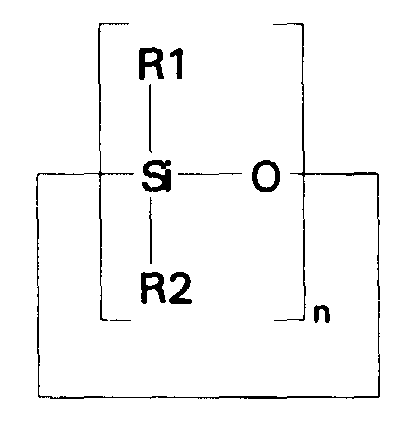
- A process according to claim 1 in which R3, R4 and R5 are each a methyl group.
- A process according to claim 2 in which R1 and R2 are each a methyl group.
- A process according to claim 1 in which the cocyclic silicone is a C8 or higher carbon atom containing alkylmethyl, dimethyl cocyclic silicone having the formula:in which R6 represents at least a C8 alkyl group, and a and b have the same value as defined in claim 1.
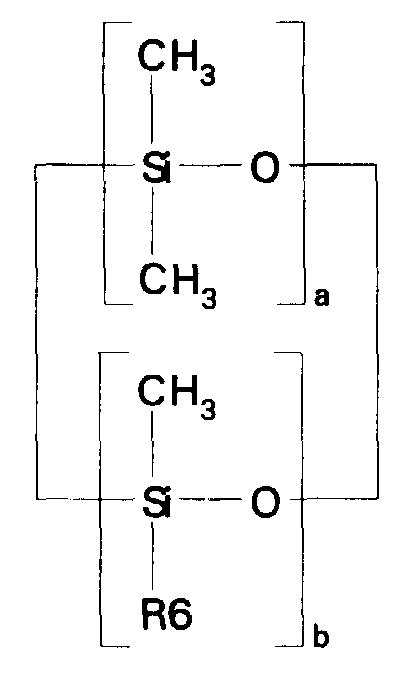
- A process according to claim 1 in which the reaction includes a further organosilicon precursor comprising an aminoalkylsiloxane homopolymer having a structure corresponding to one of the formulas:wherein c represents an integer having a value of 1-20, and A represents an aminoalkyl group.

- An emulsion obtainable by the process of any of claims 1-6.
- A silicone polymer having the formula:where x has a value of 1-2000; y has a value of 1-100; z has a value of 0-100; R6 is an alkyl group containing at least 8 carbon atoms; R' is hydroxy or an alkyl group; R'' is an aminoalkyl group represented by
 where R''' and R'''' are hydrogen or a methyl group; RV is hydrogen or the group
 where c is 2 or 3; RV' is hydrogen or a methyl group; and RV'' is hydrogen.
- The silicon polymer of claim 8 corresponding to the formula

- An emulsion containing the silicon polymer of any of claims 8 and 9.
Applications Claiming Priority (2)
| Application Number | Priority Date | Filing Date | Title |
|---|---|---|---|
| US349359 | 1989-05-08 | ||
| US09/349,359 US6201063B1 (en) | 1999-07-08 | 1999-07-08 | Emulsion polymerization using a cocylic silicone |
Publications (1)
| Publication Number | Publication Date |
|---|---|
| EP1067150A2 true EP1067150A2 (en) | 2001-01-10 |
Family
ID=23372064
Family Applications (1)
| Application Number | Title | Priority Date | Filing Date |
|---|---|---|---|
| EP00114476A Withdrawn EP1067150A2 (en) | 1999-07-08 | 2000-07-06 | Emulsion polymerization using a cocyclic silicone |
Country Status (3)
| Country | Link |
|---|---|
| US (2) | US6201063B1 (en) |
| EP (1) | EP1067150A2 (en) |
| JP (1) | JP2001031766A (en) |
Families Citing this family (8)
| Publication number | Priority date | Publication date | Assignee | Title |
|---|---|---|---|---|
| US6610782B1 (en) * | 2001-11-20 | 2003-08-26 | Lindley Laboratories, Inc. | Binary silane emulsions for rendering absorbent substrates water repellant |
| DE602004024913D1 (en) * | 2003-10-08 | 2010-02-11 | Dow Corning | EMULSIONS CONTAINING MQ SILICONE RESIN SILICONE ELASTOMER CONTAINING EMULSIONS |
| US8012544B2 (en) | 2003-10-08 | 2011-09-06 | Dow Corning Corporation | Silicone MQ resin reinforced silicone elastomer emulsions |
| DE102004023911A1 (en) * | 2004-05-13 | 2005-12-01 | Wacker-Chemie Gmbh | Process for the discontinuous production of silicone emulsions |
| JP4683203B2 (en) * | 2005-05-31 | 2011-05-18 | 信越化学工業株式会社 | Cationic emulsion composition of highly polymerized organosiloxane and process for producing the same |
| US20100029057A1 (en) * | 2006-09-21 | 2010-02-04 | Jsr Corporation | Silicone resin composition and method of forming a trench isolation |
| US7790801B2 (en) | 2007-07-24 | 2010-09-07 | Momentive Performance Materials Inc. | Organo-functional silicone in emulsion systems and process for preparing same |
| KR102273810B1 (en) | 2019-07-02 | 2021-07-06 | 주식회사 케이씨씨실리콘 | Amino silicone polymer, silicone emulsion comprising the same and manufacturing method thereof |
Family Cites Families (14)
| Publication number | Priority date | Publication date | Assignee | Title |
|---|---|---|---|---|
| US2891920A (en) | 1955-01-26 | 1959-06-23 | Dow Corning | Polymerization of organopolysiloxanes in aqueous emulsion |
| GB1024024A (en) | 1963-04-08 | 1966-03-30 | Dow Corning | Improvements in or relating to polymerising or co-polymerising organosilicon compounds |
| US4299923A (en) * | 1980-03-27 | 1981-11-10 | Union Carbide Corporation | Alkyl-modified siloxane copolymers useful as foam stabilizers in high resilience polyurethane foam |
| JPH064496B2 (en) * | 1984-06-20 | 1994-01-19 | 東芝シリコ−ン株式会社 | Scratch-shielding agent for transparent glass bottles |
| US4584125A (en) * | 1984-08-10 | 1986-04-22 | Sws Silicones Corporation | Antifoam compositions |
| US4559227A (en) | 1984-10-31 | 1985-12-17 | Dow Corning Corporation | Conditioning shampoo containing amine functional polydiorganosiloxane |
| US4999398A (en) | 1985-12-12 | 1991-03-12 | Dow Corning Corporation | Methods for making polydiorganosiloxane microemulsions |
| JPS63125530A (en) | 1986-11-13 | 1988-05-28 | Shin Etsu Chem Co Ltd | Production of organopolysiloxane emulsion |
| US4844888A (en) | 1987-11-13 | 1989-07-04 | The Gillette Company | Polysiloxane cosmetic composition |
| CA2041599A1 (en) | 1990-06-01 | 1991-12-02 | Michael Gee | Method for making polysiloxane emulsions |
| US5212048A (en) * | 1990-11-21 | 1993-05-18 | Presstek, Inc. | Silicone coating formulations and planographic printing plates made therewith |
| US5316692A (en) * | 1991-06-13 | 1994-05-31 | Dow Corning Limited | Silicone containing hard surface scouring cleansers |
| US5160494A (en) | 1992-04-14 | 1992-11-03 | Dow Corning Corporation | Alkylmethylsiloxane containing perfume compositions |
| JPH0741677A (en) * | 1993-07-26 | 1995-02-10 | Toray Dow Corning Silicone Co Ltd | Diorganopolysiloxane composition having excellent heat resistance |
-
1999
- 1999-07-08 US US09/349,359 patent/US6201063B1/en not_active Expired - Fee Related
-
2000
- 2000-07-06 EP EP00114476A patent/EP1067150A2/en not_active Withdrawn
- 2000-07-07 JP JP2000207253A patent/JP2001031766A/en not_active Withdrawn
- 2000-08-07 US US09/634,333 patent/US6297318B1/en not_active Expired - Fee Related
Also Published As
| Publication number | Publication date |
|---|---|
| US6297318B1 (en) | 2001-10-02 |
| US6201063B1 (en) | 2001-03-13 |
| JP2001031766A (en) | 2001-02-06 |
Similar Documents
| Publication | Publication Date | Title |
|---|---|---|
| US5998537A (en) | Emulsions containing ultrahigh viscosity silicone polymers | |
| KR100414420B1 (en) | Microemulsions of gel-free polymers | |
| JP3090281B2 (en) | Method for producing polysiloxane emulsion | |
| EP1432753B2 (en) | Polysiloxanes and their preparation | |
| US4999398A (en) | Methods for making polydiorganosiloxane microemulsions | |
| EP0228575B1 (en) | Methods for making polydiorganosiloxane microemulsions | |
| US20030143176A1 (en) | Compositions containing silicone oil-in-water emulsions, salts, alcohols and solvents | |
| MXPA96002922A (en) | Microemulsions of polymers exempt from | |
| US6475974B1 (en) | Mechanical microemulsions of blended silicones | |
| US6207781B1 (en) | Polymerization of an organofunctional cocyclic siloxane | |
| EP1069149B1 (en) | Emulsion containing silicone particles of large size | |
| US6239211B1 (en) | Emulsions containing silicone polymers | |
| US6201063B1 (en) | Emulsion polymerization using a cocylic silicone | |
| US20080027172A1 (en) | Emulsions of Organopolysiloxane Resins Produced by Emulsion Polymerization | |
| US6201091B1 (en) | Organofunctional cocyclic siloxanes and polymerization thereof | |
| US5684085A (en) | Microemulsions of gel-free polymers | |
| US5852110A (en) | Method for making amino functional polysiloxane emulsions | |
| US6245852B1 (en) | Preparation of organopolysiloxane emulsion | |
| EP1069129A2 (en) | Organofunctional cocyclic siloxanes |
Legal Events
| Date | Code | Title | Description |
|---|---|---|---|
| PUAI | Public reference made under article 153(3) epc to a published international application that has entered the european phase |
Free format text: ORIGINAL CODE: 0009012 |
|
| AK | Designated contracting states |
Kind code of ref document: A2 Designated state(s): AT BE CH CY DE DK ES FI FR GB GR IE IT LI LU MC NL PT SE |
|
| AX | Request for extension of the european patent |
Free format text: AL;LT;LV;MK;RO;SI |
|
| STAA | Information on the status of an ep patent application or granted ep patent |
Free format text: STATUS: THE APPLICATION HAS BEEN WITHDRAWN |
|
| 18W | Application withdrawn |
Withdrawal date: 20010830 |