EP1067115A1 - Zwitterionic monomer having aminomulticarboxylic acid functionality - Google Patents
Zwitterionic monomer having aminomulticarboxylic acid functionality Download PDFInfo
- Publication number
- EP1067115A1 EP1067115A1 EP00114009A EP00114009A EP1067115A1 EP 1067115 A1 EP1067115 A1 EP 1067115A1 EP 00114009 A EP00114009 A EP 00114009A EP 00114009 A EP00114009 A EP 00114009A EP 1067115 A1 EP1067115 A1 EP 1067115A1
- Authority
- EP
- European Patent Office
- Prior art keywords
- amino
- group
- independently
- multicarboxylic acid
- monomer
- Prior art date
- Legal status (The legal status is an assumption and is not a legal conclusion. Google has not performed a legal analysis and makes no representation as to the accuracy of the status listed.)
- Withdrawn
Links
- 239000000178 monomer Substances 0.000 title claims abstract description 67
- 239000002253 acid Substances 0.000 title claims abstract description 60
- 125000000217 alkyl group Chemical group 0.000 claims abstract description 42
- 229910052739 hydrogen Inorganic materials 0.000 claims abstract description 26
- 125000004432 carbon atom Chemical group C* 0.000 claims abstract description 24
- 150000001412 amines Chemical class 0.000 claims abstract description 21
- IJGRMHOSHXDMSA-UHFFFAOYSA-N Atomic nitrogen Chemical group N#N IJGRMHOSHXDMSA-UHFFFAOYSA-N 0.000 claims abstract description 16
- 239000007795 chemical reaction product Substances 0.000 claims abstract description 14
- 239000000203 mixture Substances 0.000 claims abstract description 12
- 229920000642 polymer Polymers 0.000 claims abstract description 11
- 150000004820 halides Chemical class 0.000 claims abstract description 10
- 239000004570 mortar (masonry) Substances 0.000 claims abstract description 9
- QVGXLLKOCUKJST-UHFFFAOYSA-N atomic oxygen Chemical group [O] QVGXLLKOCUKJST-UHFFFAOYSA-N 0.000 claims abstract description 8
- 150000001768 cations Chemical class 0.000 claims abstract description 8
- 229910052757 nitrogen Chemical group 0.000 claims abstract description 8
- 239000001301 oxygen Substances 0.000 claims abstract description 8
- 229910052760 oxygen Inorganic materials 0.000 claims abstract description 8
- 239000008199 coating composition Substances 0.000 claims abstract description 3
- BAPJBEWLBFYGME-UHFFFAOYSA-N Methyl acrylate Chemical compound COC(=O)C=C BAPJBEWLBFYGME-UHFFFAOYSA-N 0.000 claims description 12
- FYSNRJHAOHDILO-UHFFFAOYSA-N thionyl chloride Chemical compound ClS(Cl)=O FYSNRJHAOHDILO-UHFFFAOYSA-N 0.000 claims description 11
- 238000000034 method Methods 0.000 claims description 9
- 239000000047 product Substances 0.000 claims description 7
- HZAXFHJVJLSVMW-UHFFFAOYSA-N 2-Aminoethan-1-ol Chemical compound NCCO HZAXFHJVJLSVMW-UHFFFAOYSA-N 0.000 claims description 6
- 150000001336 alkenes Chemical class 0.000 claims description 6
- 150000002148 esters Chemical class 0.000 claims description 6
- JRZJOMJEPLMPRA-UHFFFAOYSA-N olefin Natural products CCCCCCCC=C JRZJOMJEPLMPRA-UHFFFAOYSA-N 0.000 claims description 6
- 238000005660 chlorination reaction Methods 0.000 claims description 5
- 239000012445 acidic reagent Substances 0.000 claims description 4
- QGZKDVFQNNGYKY-UHFFFAOYSA-O Ammonium Chemical compound [NH4+] QGZKDVFQNNGYKY-UHFFFAOYSA-O 0.000 claims description 3
- AVXURJPOCDRRFD-UHFFFAOYSA-N Hydroxylamine Chemical compound ON AVXURJPOCDRRFD-UHFFFAOYSA-N 0.000 claims description 3
- 238000006116 polymerization reaction Methods 0.000 claims description 3
- 238000006957 Michael reaction Methods 0.000 claims description 2
- 229910052783 alkali metal Inorganic materials 0.000 claims description 2
- 150000001340 alkali metals Chemical class 0.000 claims description 2
- 229910052784 alkaline earth metal Inorganic materials 0.000 claims description 2
- 150000001342 alkaline earth metals Chemical class 0.000 claims description 2
- 230000026030 halogenation Effects 0.000 claims description 2
- 238000005658 halogenation reaction Methods 0.000 claims description 2
- 230000007062 hydrolysis Effects 0.000 claims description 2
- 238000006460 hydrolysis reaction Methods 0.000 claims description 2
- 125000000896 monocarboxylic acid group Chemical group 0.000 claims 5
- 238000000576 coating method Methods 0.000 abstract description 4
- 239000011248 coating agent Substances 0.000 abstract description 2
- 239000000843 powder Substances 0.000 abstract description 2
- 239000002023 wood Substances 0.000 abstract description 2
- 229920001577 copolymer Polymers 0.000 description 30
- HEMHJVSKTPXQMS-UHFFFAOYSA-M Sodium hydroxide Chemical compound [OH-].[Na+] HEMHJVSKTPXQMS-UHFFFAOYSA-M 0.000 description 23
- 238000006243 chemical reaction Methods 0.000 description 14
- FLCAEMBIQVZWIF-UHFFFAOYSA-N 6-(dimethylamino)-2-methylhex-2-enamide Chemical compound CN(C)CCCC=C(C)C(N)=O FLCAEMBIQVZWIF-UHFFFAOYSA-N 0.000 description 11
- LFQSCWFLJHTTHZ-UHFFFAOYSA-N Ethanol Chemical compound CCO LFQSCWFLJHTTHZ-UHFFFAOYSA-N 0.000 description 11
- 239000000243 solution Substances 0.000 description 11
- 238000002360 preparation method Methods 0.000 description 8
- KWYUFKZDYYNOTN-UHFFFAOYSA-M Potassium hydroxide Chemical compound [OH-].[K+] KWYUFKZDYYNOTN-UHFFFAOYSA-M 0.000 description 6
- YXFVVABEGXRONW-UHFFFAOYSA-N Toluene Chemical compound CC1=CC=CC=C1 YXFVVABEGXRONW-UHFFFAOYSA-N 0.000 description 6
- 239000007864 aqueous solution Substances 0.000 description 6
- 239000008266 hair spray Substances 0.000 description 6
- 239000011541 reaction mixture Substances 0.000 description 6
- ZAMOUSCENKQFHK-UHFFFAOYSA-N Chlorine atom Chemical compound [Cl] ZAMOUSCENKQFHK-UHFFFAOYSA-N 0.000 description 5
- VVQNEPGJFQJSBK-UHFFFAOYSA-N Methyl methacrylate Chemical compound COC(=O)C(C)=C VVQNEPGJFQJSBK-UHFFFAOYSA-N 0.000 description 5
- CQEYYJKEWSMYFG-UHFFFAOYSA-N butyl acrylate Chemical compound CCCCOC(=O)C=C CQEYYJKEWSMYFG-UHFFFAOYSA-N 0.000 description 5
- 239000000460 chlorine Substances 0.000 description 5
- 229910052801 chlorine Inorganic materials 0.000 description 5
- XLYOFNOQVPJJNP-UHFFFAOYSA-N water Substances O XLYOFNOQVPJJNP-UHFFFAOYSA-N 0.000 description 5
- UDPGUMQDCGORJQ-UHFFFAOYSA-N (2-chloroethyl)phosphonic acid Chemical compound OP(O)(=O)CCCl UDPGUMQDCGORJQ-UHFFFAOYSA-N 0.000 description 4
- KFZMGEQAYNKOFK-UHFFFAOYSA-N Isopropanol Chemical compound CC(C)O KFZMGEQAYNKOFK-UHFFFAOYSA-N 0.000 description 4
- CERQOIWHTDAKMF-UHFFFAOYSA-N Methacrylic acid Chemical compound CC(=C)C(O)=O CERQOIWHTDAKMF-UHFFFAOYSA-N 0.000 description 4
- 125000003178 carboxy group Chemical group [H]OC(*)=O 0.000 description 4
- 239000003153 chemical reaction reagent Substances 0.000 description 4
- 238000004690 coupled electron pair approximation Methods 0.000 description 4
- 235000019441 ethanol Nutrition 0.000 description 4
- -1 hydroxyalkyl acrylates Chemical class 0.000 description 4
- 150000004702 methyl esters Chemical class 0.000 description 4
- 150000003839 salts Chemical class 0.000 description 4
- 238000003756 stirring Methods 0.000 description 4
- VZCYOOQTPOCHFL-UHFFFAOYSA-N trans-butenedioic acid Natural products OC(=O)C=CC(O)=O VZCYOOQTPOCHFL-UHFFFAOYSA-N 0.000 description 4
- QTBSBXVTEAMEQO-UHFFFAOYSA-N Acetic acid Chemical compound CC(O)=O QTBSBXVTEAMEQO-UHFFFAOYSA-N 0.000 description 3
- XEKOWRVHYACXOJ-UHFFFAOYSA-N Ethyl acetate Chemical compound CCOC(C)=O XEKOWRVHYACXOJ-UHFFFAOYSA-N 0.000 description 3
- 229920002472 Starch Polymers 0.000 description 3
- 239000002585 base Substances 0.000 description 3
- 239000005457 ice water Substances 0.000 description 3
- 150000002734 metacrylic acid derivatives Chemical class 0.000 description 3
- 239000003973 paint Substances 0.000 description 3
- 238000010992 reflux Methods 0.000 description 3
- 239000007787 solid Substances 0.000 description 3
- 238000010183 spectrum analysis Methods 0.000 description 3
- 239000008107 starch Substances 0.000 description 3
- 235000019698 starch Nutrition 0.000 description 3
- 125000001340 2-chloroethyl group Chemical group [H]C([H])(Cl)C([H])([H])* 0.000 description 2
- KWIUHFFTVRNATP-UHFFFAOYSA-N Betaine Natural products C[N+](C)(C)CC([O-])=O KWIUHFFTVRNATP-UHFFFAOYSA-N 0.000 description 2
- CPELXLSAUQHCOX-UHFFFAOYSA-M Bromide Chemical compound [Br-] CPELXLSAUQHCOX-UHFFFAOYSA-M 0.000 description 2
- VEXZGXHMUGYJMC-UHFFFAOYSA-M Chloride anion Chemical compound [Cl-] VEXZGXHMUGYJMC-UHFFFAOYSA-M 0.000 description 2
- VZCYOOQTPOCHFL-OWOJBTEDSA-N Fumaric acid Chemical compound OC(=O)\C=C\C(O)=O VZCYOOQTPOCHFL-OWOJBTEDSA-N 0.000 description 2
- VEXZGXHMUGYJMC-UHFFFAOYSA-N Hydrochloric acid Chemical compound Cl VEXZGXHMUGYJMC-UHFFFAOYSA-N 0.000 description 2
- KWIUHFFTVRNATP-UHFFFAOYSA-O N,N,N-trimethylglycinium Chemical compound C[N+](C)(C)CC(O)=O KWIUHFFTVRNATP-UHFFFAOYSA-O 0.000 description 2
- HOKKHZGPKSLGJE-UHFFFAOYSA-N N-Methyl-DL-aspartic acid Chemical compound CNC(C(O)=O)CC(O)=O HOKKHZGPKSLGJE-UHFFFAOYSA-N 0.000 description 2
- CDBYLPFSWZWCQE-UHFFFAOYSA-L Sodium Carbonate Chemical compound [Na+].[Na+].[O-]C([O-])=O CDBYLPFSWZWCQE-UHFFFAOYSA-L 0.000 description 2
- QAOWNCQODCNURD-UHFFFAOYSA-N Sulfuric acid Chemical compound OS(O)(=O)=O QAOWNCQODCNURD-UHFFFAOYSA-N 0.000 description 2
- 150000001252 acrylic acid derivatives Chemical class 0.000 description 2
- 229960003237 betaine Drugs 0.000 description 2
- 150000001875 compounds Chemical class 0.000 description 2
- 150000005690 diesters Chemical class 0.000 description 2
- 239000002270 dispersing agent Substances 0.000 description 2
- 229920001519 homopolymer Polymers 0.000 description 2
- 239000003999 initiator Substances 0.000 description 2
- VZCYOOQTPOCHFL-UPHRSURJSA-N maleic acid Chemical compound OC(=O)\C=C/C(O)=O VZCYOOQTPOCHFL-UPHRSURJSA-N 0.000 description 2
- XHXFXVLFKHQFAL-UHFFFAOYSA-N phosphoryl trichloride Chemical compound ClP(Cl)(Cl)=O XHXFXVLFKHQFAL-UHFFFAOYSA-N 0.000 description 2
- 229920002635 polyurethane Polymers 0.000 description 2
- 239000004814 polyurethane Substances 0.000 description 2
- 238000001556 precipitation Methods 0.000 description 2
- 230000035484 reaction time Effects 0.000 description 2
- 239000000126 substance Substances 0.000 description 2
- WGTYBPLFGIVFAS-UHFFFAOYSA-M tetramethylammonium hydroxide Chemical compound [OH-].C[N+](C)(C)C WGTYBPLFGIVFAS-UHFFFAOYSA-M 0.000 description 2
- UDVRROYKHLBOPZ-UHFFFAOYSA-N 3,3-dihydroxy-2-methylpropanoic acid Chemical compound OC(O)C(C)C(O)=O UDVRROYKHLBOPZ-UHFFFAOYSA-N 0.000 description 1
- BCAIDFOKQCVACE-UHFFFAOYSA-N 3-[dimethyl-[2-(2-methylprop-2-enoyloxy)ethyl]azaniumyl]propane-1-sulfonate Chemical compound CC(=C)C(=O)OCC[N+](C)(C)CCCS([O-])(=O)=O BCAIDFOKQCVACE-UHFFFAOYSA-N 0.000 description 1
- NLHHRLWOUZZQLW-UHFFFAOYSA-N Acrylonitrile Chemical compound C=CC#N NLHHRLWOUZZQLW-UHFFFAOYSA-N 0.000 description 1
- VHUUQVKOLVNVRT-UHFFFAOYSA-N Ammonium hydroxide Chemical compound [NH4+].[OH-] VHUUQVKOLVNVRT-UHFFFAOYSA-N 0.000 description 1
- JIGUQPWFLRLWPJ-UHFFFAOYSA-N Ethyl acrylate Chemical group CCOC(=O)C=C JIGUQPWFLRLWPJ-UHFFFAOYSA-N 0.000 description 1
- DGAQECJNVWCQMB-PUAWFVPOSA-M Ilexoside XXIX Chemical compound C[C@@H]1CC[C@@]2(CC[C@@]3(C(=CC[C@H]4[C@]3(CC[C@@H]5[C@@]4(CC[C@@H](C5(C)C)OS(=O)(=O)[O-])C)C)[C@@H]2[C@]1(C)O)C)C(=O)O[C@H]6[C@@H]([C@H]([C@@H]([C@H](O6)CO)O)O)O.[Na+] DGAQECJNVWCQMB-PUAWFVPOSA-M 0.000 description 1
- OPKOKAMJFNKNAS-UHFFFAOYSA-N N-methylethanolamine Chemical compound CNCCO OPKOKAMJFNKNAS-UHFFFAOYSA-N 0.000 description 1
- WUGQZFFCHPXWKQ-UHFFFAOYSA-N Propanolamine Chemical compound NCCCO WUGQZFFCHPXWKQ-UHFFFAOYSA-N 0.000 description 1
- 150000007513 acids Chemical class 0.000 description 1
- 238000013019 agitation Methods 0.000 description 1
- 125000005250 alkyl acrylate group Chemical group 0.000 description 1
- 150000001414 amino alcohols Chemical class 0.000 description 1
- 239000000908 ammonium hydroxide Substances 0.000 description 1
- 239000012736 aqueous medium Substances 0.000 description 1
- 230000015572 biosynthetic process Effects 0.000 description 1
- 230000031709 bromination Effects 0.000 description 1
- 238000005893 bromination reaction Methods 0.000 description 1
- AXCZMVOFGPJBDE-UHFFFAOYSA-L calcium dihydroxide Chemical compound [OH-].[OH-].[Ca+2] AXCZMVOFGPJBDE-UHFFFAOYSA-L 0.000 description 1
- 239000000920 calcium hydroxide Substances 0.000 description 1
- 229910001861 calcium hydroxide Inorganic materials 0.000 description 1
- 150000007942 carboxylates Chemical group 0.000 description 1
- 150000001732 carboxylic acid derivatives Chemical class 0.000 description 1
- 150000001805 chlorine compounds Chemical class 0.000 description 1
- 238000001816 cooling Methods 0.000 description 1
- LDCRTTXIJACKKU-ARJAWSKDSA-N dimethyl maleate Chemical compound COC(=O)\C=C/C(=O)OC LDCRTTXIJACKKU-ARJAWSKDSA-N 0.000 description 1
- 230000008034 disappearance Effects 0.000 description 1
- 238000004821 distillation Methods 0.000 description 1
- 239000000839 emulsion Substances 0.000 description 1
- 238000007720 emulsion polymerization reaction Methods 0.000 description 1
- 150000002170 ethers Chemical class 0.000 description 1
- 125000004494 ethyl ester group Chemical group 0.000 description 1
- 238000011049 filling Methods 0.000 description 1
- 239000001257 hydrogen Substances 0.000 description 1
- 125000004435 hydrogen atom Chemical group [H]* 0.000 description 1
- NIMLQBUJDJZYEJ-UHFFFAOYSA-N isophorone diisocyanate Chemical class CC1(C)CC(N=C=O)CC(C)(CN=C=O)C1 NIMLQBUJDJZYEJ-UHFFFAOYSA-N 0.000 description 1
- 230000014759 maintenance of location Effects 0.000 description 1
- 230000004048 modification Effects 0.000 description 1
- 238000012986 modification Methods 0.000 description 1
- PNJWIWWMYCMZRO-UHFFFAOYSA-N pent‐4‐en‐2‐one Natural products CC(=O)CC=C PNJWIWWMYCMZRO-UHFFFAOYSA-N 0.000 description 1
- 230000000737 periodic effect Effects 0.000 description 1
- 239000000049 pigment Substances 0.000 description 1
- 229920001515 polyalkylene glycol Polymers 0.000 description 1
- 229920000223 polyglycerol Polymers 0.000 description 1
- 229920001451 polypropylene glycol Polymers 0.000 description 1
- 150000003141 primary amines Chemical class 0.000 description 1
- 238000005086 pumping Methods 0.000 description 1
- 238000000746 purification Methods 0.000 description 1
- 230000009257 reactivity Effects 0.000 description 1
- 238000011084 recovery Methods 0.000 description 1
- 238000001953 recrystallisation Methods 0.000 description 1
- 229910000029 sodium carbonate Inorganic materials 0.000 description 1
- 239000002904 solvent Substances 0.000 description 1
- BWSZXUOMATYHHI-UHFFFAOYSA-N tert-butyl octaneperoxoate Chemical compound CCCCCCCC(=O)OOC(C)(C)C BWSZXUOMATYHHI-UHFFFAOYSA-N 0.000 description 1
- 239000003039 volatile agent Substances 0.000 description 1
Classifications
-
- C—CHEMISTRY; METALLURGY
- C08—ORGANIC MACROMOLECULAR COMPOUNDS; THEIR PREPARATION OR CHEMICAL WORKING-UP; COMPOSITIONS BASED THEREON
- C08F—MACROMOLECULAR COMPOUNDS OBTAINED BY REACTIONS ONLY INVOLVING CARBON-TO-CARBON UNSATURATED BONDS
- C08F20/00—Homopolymers and copolymers of compounds having one or more unsaturated aliphatic radicals, each having only one carbon-to-carbon double bond, and only one being terminated by only one carboxyl radical or a salt, anhydride, ester, amide, imide or nitrile thereof
- C08F20/02—Monocarboxylic acids having less than ten carbon atoms, Derivatives thereof
- C08F20/52—Amides or imides
- C08F20/54—Amides, e.g. N,N-dimethylacrylamide or N-isopropylacrylamide
- C08F20/60—Amides, e.g. N,N-dimethylacrylamide or N-isopropylacrylamide containing nitrogen in addition to the carbonamido nitrogen
-
- A—HUMAN NECESSITIES
- A61—MEDICAL OR VETERINARY SCIENCE; HYGIENE
- A61K—PREPARATIONS FOR MEDICAL, DENTAL OR TOILETRY PURPOSES
- A61K8/00—Cosmetics or similar toiletry preparations
- A61K8/18—Cosmetics or similar toiletry preparations characterised by the composition
- A61K8/72—Cosmetics or similar toiletry preparations characterised by the composition containing organic macromolecular compounds
- A61K8/81—Cosmetics or similar toiletry preparations characterised by the composition containing organic macromolecular compounds obtained by reactions involving only carbon-to-carbon unsaturated bonds
- A61K8/8141—Compositions of homopolymers or copolymers of compounds having one or more unsaturated aliphatic radicals, each having only one carbon-to-carbon double bond, and at least one being terminated by only one carboxyl radical, or of salts, anhydrides, esters, amides, imides or nitriles thereof; Compositions of derivatives of such polymers
- A61K8/8158—Homopolymers or copolymers of amides or imides, e.g. (meth) acrylamide; Compositions of derivatives of such polymers
-
- A—HUMAN NECESSITIES
- A61—MEDICAL OR VETERINARY SCIENCE; HYGIENE
- A61Q—SPECIFIC USE OF COSMETICS OR SIMILAR TOILETRY PREPARATIONS
- A61Q5/00—Preparations for care of the hair
- A61Q5/06—Preparations for styling the hair, e.g. by temporary shaping or colouring
-
- C—CHEMISTRY; METALLURGY
- C04—CEMENTS; CONCRETE; ARTIFICIAL STONE; CERAMICS; REFRACTORIES
- C04B—LIME, MAGNESIA; SLAG; CEMENTS; COMPOSITIONS THEREOF, e.g. MORTARS, CONCRETE OR LIKE BUILDING MATERIALS; ARTIFICIAL STONE; CERAMICS; REFRACTORIES; TREATMENT OF NATURAL STONE
- C04B24/00—Use of organic materials as active ingredients for mortars, concrete or artificial stone, e.g. plasticisers
- C04B24/12—Nitrogen containing compounds organic derivatives of hydrazine
- C04B24/123—Amino-carboxylic acids
-
- C—CHEMISTRY; METALLURGY
- C04—CEMENTS; CONCRETE; ARTIFICIAL STONE; CERAMICS; REFRACTORIES
- C04B—LIME, MAGNESIA; SLAG; CEMENTS; COMPOSITIONS THEREOF, e.g. MORTARS, CONCRETE OR LIKE BUILDING MATERIALS; ARTIFICIAL STONE; CERAMICS; REFRACTORIES; TREATMENT OF NATURAL STONE
- C04B24/00—Use of organic materials as active ingredients for mortars, concrete or artificial stone, e.g. plasticisers
- C04B24/24—Macromolecular compounds
- C04B24/26—Macromolecular compounds obtained by reactions only involving carbon-to-carbon unsaturated bonds
- C04B24/2652—Nitrogen containing polymers, e.g. polyacrylamides, polyacrylonitriles
-
- C—CHEMISTRY; METALLURGY
- C07—ORGANIC CHEMISTRY
- C07C—ACYCLIC OR CARBOCYCLIC COMPOUNDS
- C07C229/00—Compounds containing amino and carboxyl groups bound to the same carbon skeleton
- C07C229/02—Compounds containing amino and carboxyl groups bound to the same carbon skeleton having amino and carboxyl groups bound to acyclic carbon atoms of the same carbon skeleton
- C07C229/04—Compounds containing amino and carboxyl groups bound to the same carbon skeleton having amino and carboxyl groups bound to acyclic carbon atoms of the same carbon skeleton the carbon skeleton being acyclic and saturated
- C07C229/06—Compounds containing amino and carboxyl groups bound to the same carbon skeleton having amino and carboxyl groups bound to acyclic carbon atoms of the same carbon skeleton the carbon skeleton being acyclic and saturated having only one amino and one carboxyl group bound to the carbon skeleton
- C07C229/10—Compounds containing amino and carboxyl groups bound to the same carbon skeleton having amino and carboxyl groups bound to acyclic carbon atoms of the same carbon skeleton the carbon skeleton being acyclic and saturated having only one amino and one carboxyl group bound to the carbon skeleton the nitrogen atom of the amino group being further bound to acyclic carbon atoms or to carbon atoms of rings other than six-membered aromatic rings
- C07C229/16—Compounds containing amino and carboxyl groups bound to the same carbon skeleton having amino and carboxyl groups bound to acyclic carbon atoms of the same carbon skeleton the carbon skeleton being acyclic and saturated having only one amino and one carboxyl group bound to the carbon skeleton the nitrogen atom of the amino group being further bound to acyclic carbon atoms or to carbon atoms of rings other than six-membered aromatic rings to carbon atoms of hydrocarbon radicals substituted by amino or carboxyl groups, e.g. ethylenediamine-tetra-acetic acid, iminodiacetic acids
-
- C—CHEMISTRY; METALLURGY
- C07—ORGANIC CHEMISTRY
- C07C—ACYCLIC OR CARBOCYCLIC COMPOUNDS
- C07C233/00—Carboxylic acid amides
- C07C233/01—Carboxylic acid amides having carbon atoms of carboxamide groups bound to hydrogen atoms or to acyclic carbon atoms
- C07C233/34—Carboxylic acid amides having carbon atoms of carboxamide groups bound to hydrogen atoms or to acyclic carbon atoms having the nitrogen atom of at least one of the carboxamide groups bound to a carbon atom of a hydrocarbon radical substituted by amino groups
- C07C233/35—Carboxylic acid amides having carbon atoms of carboxamide groups bound to hydrogen atoms or to acyclic carbon atoms having the nitrogen atom of at least one of the carboxamide groups bound to a carbon atom of a hydrocarbon radical substituted by amino groups with the substituted hydrocarbon radical bound to the nitrogen atom of the carboxamide group by an acyclic carbon atom
- C07C233/38—Carboxylic acid amides having carbon atoms of carboxamide groups bound to hydrogen atoms or to acyclic carbon atoms having the nitrogen atom of at least one of the carboxamide groups bound to a carbon atom of a hydrocarbon radical substituted by amino groups with the substituted hydrocarbon radical bound to the nitrogen atom of the carboxamide group by an acyclic carbon atom having the carbon atom of the carboxamide group bound to a carbon atom of an acyclic unsaturated carbon skeleton
-
- C—CHEMISTRY; METALLURGY
- C08—ORGANIC MACROMOLECULAR COMPOUNDS; THEIR PREPARATION OR CHEMICAL WORKING-UP; COMPOSITIONS BASED THEREON
- C08F—MACROMOLECULAR COMPOUNDS OBTAINED BY REACTIONS ONLY INVOLVING CARBON-TO-CARBON UNSATURATED BONDS
- C08F20/00—Homopolymers and copolymers of compounds having one or more unsaturated aliphatic radicals, each having only one carbon-to-carbon double bond, and only one being terminated by only one carboxyl radical or a salt, anhydride, ester, amide, imide or nitrile thereof
- C08F20/02—Monocarboxylic acids having less than ten carbon atoms, Derivatives thereof
- C08F20/10—Esters
- C08F20/34—Esters containing nitrogen, e.g. N,N-dimethylaminoethyl (meth)acrylate
- C08F20/36—Esters containing nitrogen, e.g. N,N-dimethylaminoethyl (meth)acrylate containing oxygen in addition to the carboxy oxygen, e.g. 2-N-morpholinoethyl (meth)acrylate or 2-isocyanatoethyl (meth)acrylate
-
- A—HUMAN NECESSITIES
- A61—MEDICAL OR VETERINARY SCIENCE; HYGIENE
- A61K—PREPARATIONS FOR MEDICAL, DENTAL OR TOILETRY PURPOSES
- A61K2800/00—Properties of cosmetic compositions or active ingredients thereof or formulation aids used therein and process related aspects
- A61K2800/40—Chemical, physico-chemical or functional or structural properties of particular ingredients
- A61K2800/54—Polymers characterized by specific structures/properties
- A61K2800/542—Polymers characterized by specific structures/properties characterized by the charge
- A61K2800/5428—Polymers characterized by specific structures/properties characterized by the charge amphoteric or zwitterionic
-
- C—CHEMISTRY; METALLURGY
- C08—ORGANIC MACROMOLECULAR COMPOUNDS; THEIR PREPARATION OR CHEMICAL WORKING-UP; COMPOSITIONS BASED THEREON
- C08F—MACROMOLECULAR COMPOUNDS OBTAINED BY REACTIONS ONLY INVOLVING CARBON-TO-CARBON UNSATURATED BONDS
- C08F220/00—Copolymers of compounds having one or more unsaturated aliphatic radicals, each having only one carbon-to-carbon double bond, and only one being terminated by only one carboxyl radical or a salt, anhydride ester, amide, imide or nitrile thereof
- C08F220/02—Monocarboxylic acids having less than ten carbon atoms; Derivatives thereof
- C08F220/10—Esters
- C08F220/12—Esters of monohydric alcohols or phenols
- C08F220/16—Esters of monohydric alcohols or phenols of phenols or of alcohols containing two or more carbon atoms
- C08F220/18—Esters of monohydric alcohols or phenols of phenols or of alcohols containing two or more carbon atoms with acrylic or methacrylic acids
- C08F220/1804—C4-(meth)acrylate, e.g. butyl (meth)acrylate, isobutyl (meth)acrylate or tert-butyl (meth)acrylate
Definitions
- This invention relates to a zwitterionic monomer having amino-multicarboxylic acid functionality which is the reaction product of an amino-multicarboxylic acid and an amine containing monomer.
- 3,671,502 describes copolymers comprising units derived from carboxybetaines or sulfobetaines and units derived from hydroxyalkyl acrylates/methacrylates, polyalkylene glycol acrylates/methacrylates or polyglycerol acrylates/methacrylates.
- U.S. Patent No. 5,500,087 describes amino-multicarboxylate starch ether derivatives which are useful as retention and strength aids in papermaking.
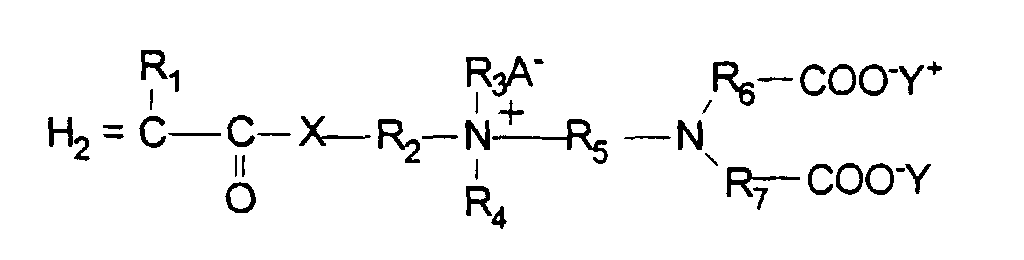
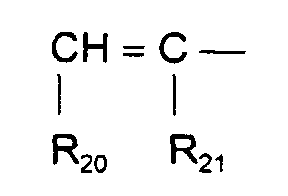
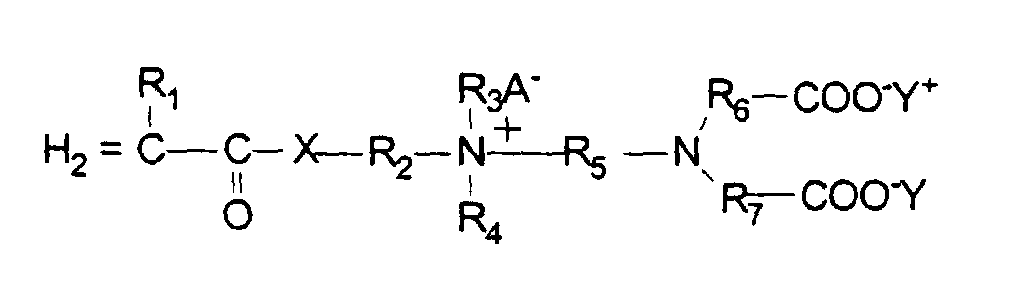
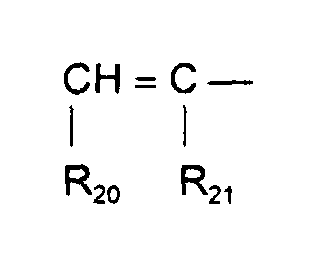
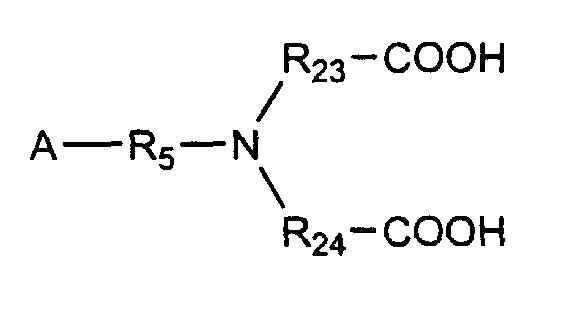
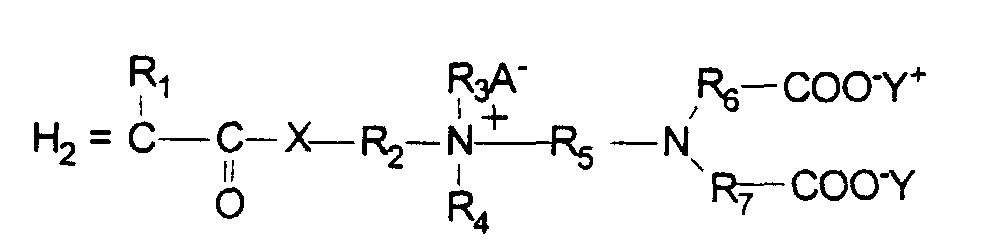
- the present invention provides a zwitterionic monomer having amino-multicarboxylic acid functionality having Structure (I) wherein R 1 is selected from the group consisting of H, an alkyl group having 1 to 6 carbon atoms; R 2 is (CH 2 ) n where n is 2 to 12; R 3 and R 4 are independently an alkyl group having 1 to 6 carbon atoms: R 5 is (CH 2 ) m where m is 2 or 3; R 6 and R 7 are independently selected from wherein R 20 is selected from the group consisting of H, CH 3 , and COOY; R 21 is selected from H or CH 3 ; X is oxygen or nitrogen; A is a halide; and Y is independently a cation; said zwitterionic monomer is the reaction product of an amino-multicarboxylic acid and an amine containing monomer, wherein the amino-multicarboxylic acid has Structure (II) and the amine containing monomer has Structure (III) wherein R 23 and R 24 are independently selected from
- the zwitterionic monomers of the invention have at least two carboxyl groups which are in close vicinity to each other in the monomer.
- the zwitterionic monomers may be polymerized alone or in combination with at least one other monomer to form a polymer having unique properties.
- Polymers prepared with the zwitterionic monomer are especially useful in hair treatment compositions to provide increased stiffness to hair, in coating formulations to increase the impact resistance, wet adhesion, and flexibility of the coating, especially wood coatings, and in mortar compositions to improve mortar compatibility, especially with redispersible powders.
- the zwitterionic monomer having amino-multicarboxylic acid functionality is prepared by reacting an amino-multicarboxylic acid with an amine containing monomer.
- the zwitterionic monomer having amino-multicarboxylic acid functionality having Structure (I) wherein R 1 is selected from the group consisting of H, an alkyl group having 1 to 6 carbon atoms; R 2 is (CH 2 ) n where n is 2 to 12; R 3 and R 4 are independently an alkyl group having 1 to 6 carbon atoms; R 5 is (CH 2 ) m where m is 2 or 3; R 6 and R 7 are independently selected from wherein R 20 is selected from the group consisting of H, CH 3 , and COOY; R 21 is selected from H or CH 3 ; A is a halide, preferably chloride or bromide; and Y is independently a cation, preferably H, alkali metal, alkaline earth metal, or ammonium.
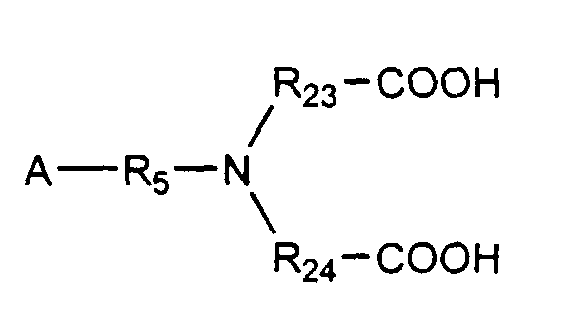
- the amino-multicarboxylic acid has Structure (II) wherein R 5 is (CH 2 ) m where m is 2 or 3; R 23 and R 24 are independently selected from wherein R 27 is selected from the group consisting of H, CH 3 , and COOH; R 28 is H or CH 3 , A is a halide, preferably chloride or bromide.
- the amino-multicarboxylic acid is preferably prepared by a Michael reaction between an amine of an aminoalcohol, preferably a primary amine, and an olefin containing ester followed by halogenation with any halide and preferably chlorination or bromination. More preferably chlorination is used.
- the chlorination may be carried out using chloride compounds such as thionyl chloride or phosphorus oxychloride. Purification such as by steam stripping or recrystallization from isopropanol or other suitable solvents may be employed.
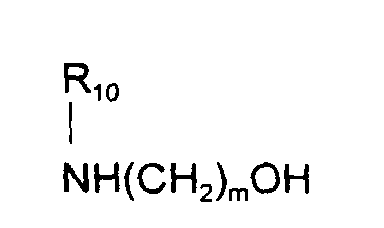
- the amino alcohol used in preparing the amino-multicarboxylic acid has structure (IV): wherein R 10 is H or an alkyl group having 1 to 18 carbon atoms, preferably 1 to 8 carbon atoms, m is 2 or 3.
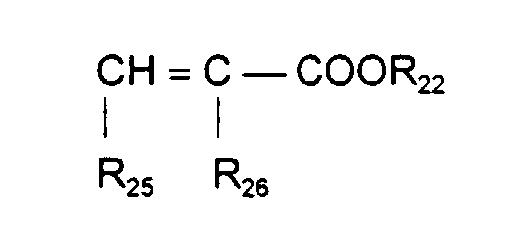
- the olefin containing ester has Structure (V): wherein R 25 is selected from H, CH 3 , or COOR 22 ; R 26 is selected from H or CH 3 ; and R 22 is an alkyl group having 1 to 6 carbon atoms, preferably 1 to 3 carbon atoms.
- the olefin containing ester is selected from alkyl acrylates, alkyl methacrylates, alkyl crotonates, dialkyl maleate, or dialkyl fumarate.
- any olefin containing ester is acceptable for the reaction. If R 10 is an alkyl group then the olefin containing ester must be a diester.
- Preferred diesters are dialkyl maleate and dialkyl fumarate, wherein the alkyl group has 1 to 6 carbon atoms.
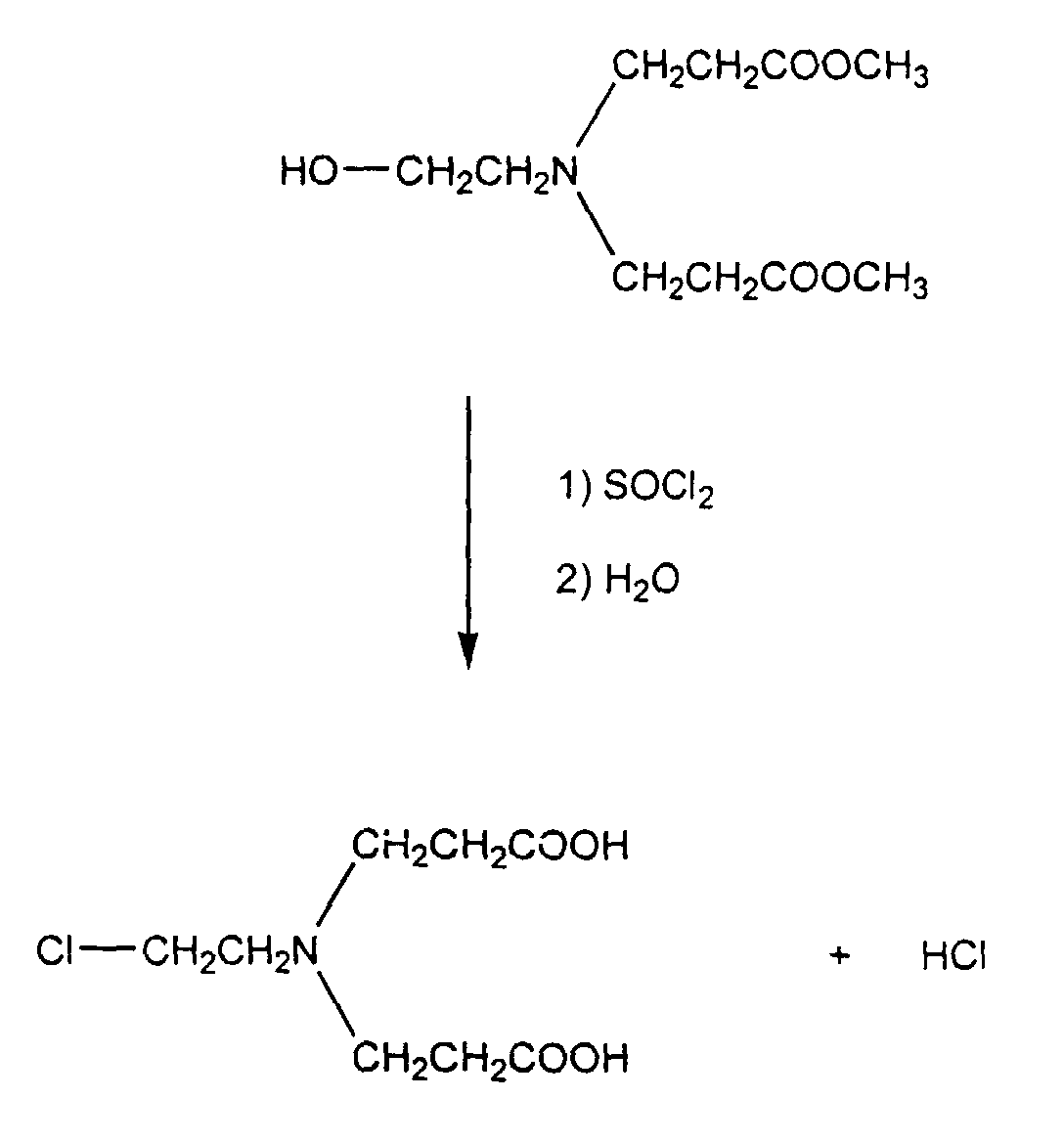
- the amino-multicarboxylic acid is prepared by reacting ethanolamine with methyl acrylate followed by chlorination with thionyl chloride and hydrolysis to provide the aminodicarboxyl containing reagent, 2-chloroethylaminodipropionic acid.
- a preferred reaction scheme is as follows:
- the amine containing monomer is reacted with the amino-multicarboxylic acid to form the zwitterionic monomer having amino-multicarboxylic acid functionality.
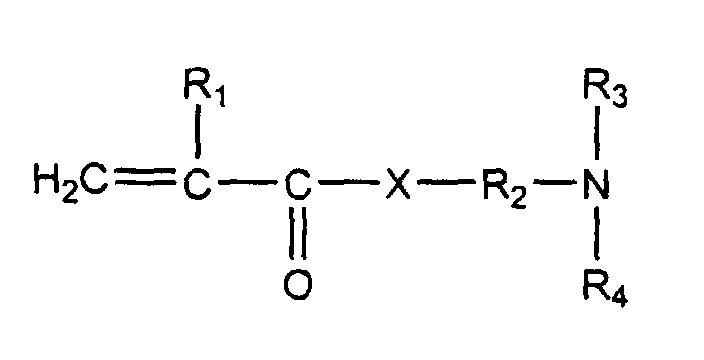
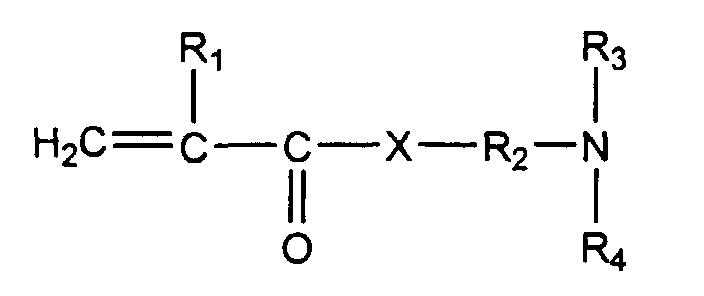
- the amine containing monomer has Structure (III): wherein R 1 is selected from the group consisting of H, an alkyl group having 1 to 6 carbon atoms; R 2 is (CH 2 ) n where n is 2 to 12; R 3 and R 4 are independently an alkyl group having 1 to 6 carbon atoms; and X is oxygen or nitrogen
- the formation of the zwitterionic monomer having amino-multicarboxylic acid functionality involves reacting the amine containing monomer with the amino-multicarboxylic acid in an aqueous medium at a temperature of from about 10°C to 95°C, preferably from about 20°C to 50°C.
- the reaction is carried out under alkaline conditions at a pH of from about 8.5 to 13, more particularly from about 9.5 to 12.5.
- the pH is conveniently controlled by the periodic addition of a dilute aqueous solution of sodium hydroxide or other common base including potassium hydroxide, calcium hydroxide, sodium carbonate, ammonium hydroxide, tetramethylammonium hydroxide, etc.
- the preferred bases are sodium and potassium hydroxide.
- the amino-multicarboxylic acid may be added to the reaction mixture as a solid or an aqueous solution.
- the preferred concentration of the solution is 20 to 50% by weight, based on the weight of the reagent.
- the amino-multicarboxylic acid solution is brought to the desired alkaline pH prior to its addition to the amine containing monomer.
- the reagent is in the form of a salt rather than an acid or partially neutralized acid when it is introduced to the reaction mixture.
- Reaction time will vary from about 0.2 to 24 hours depending on such factors as the stability and reactivity of the amino-multicarboxylic acid employed, the temperature, pH, the scale of the reaction. In general, the preferred range of reaction time is from about 1 to 16 hours.
- the pH of the reaction mixture is adjusted to from about 3 to 9 with any commercial acid such as hydrochloric acid, sulfuric acid, acetic acid, etc.
- any commercial acid such as hydrochloric acid, sulfuric acid, acetic acid, etc.
- Such acids may be conventionally added as a dilute aqueous solution.
- the carboxyl group can be present as either the carboxylic acid or the corresponding salt.
- Recovery of the zwitterionic monomer having amino-multicarboxylic acid functionality may be readily accomplished by methods known in the art such as precipitation.
- a 1L three neck round bottom flask fitted with a water cooled condenser, mechanical stirrer and addition funnel was charged with 30 g (0.49 mole) of ethanolamine.
- the flask was cooled to 10°C and 84.6 g (0.98 mole) of methyl acrylate was charged to the addition funnel.
- One half of the methyl acrylate was added slowly to the reaction at such a rate as to maintain the reaction temperature at or below 10°C.
- Ethyl acetate was added to help solubilize the forming solid.
- the second half of the methyl acrylate was added slowly to the reaction while keeping the temperature at or below 10°C.
- the reaction was slowly warmed to room temperature and then heated to 48°C and held for 18 hours to form an intermediate (hydroxyethylaminodipropionate methyl ester).
- the hydroxyethylaminodipropionate methyl ester was chlorinated according to the following procedure: An addition funnel was charged with 183.4 ml (2.50 mole) of thionyl chloride (SOCl 2 ) and added to the hydroxyethylaminodipropionate methyl ester with cooling, maintaining the temperature below 20°C. After the addition was completed, the reaction was heated to 80°C to 90°C and held for 2 hours. The reactor was cooled to less than 30°C, and approximately 75 ml of water was added to destroy any residual thionyl chloride and liberate the free acid. The water and other volatiles were removed under vacuum and the product was purified by precipitation into isopropanol.
- SOCl 2 thionyl chloride
- Example 2 The procedure according to Example 1 was used except that methyl acrylate was replaced with ethyl acrylate.
- the structures of the 2-chloroethylaminodipropionic acid and hydroxyethylaminodipropionate ethyl ester were confirmed by NMR. Chlorine analysis of the 2-chloroethylaminodipropionic acid was determined to be 13.61 (99% of theoretical) percent organic chlorine.
- a 50% solution of the 2-chloroethylaminodipropionic acid prepared in Example 1, 130 g, and 80 g of a 50% solution of NaOH was slowly added to a beaker containing 85.0 g of a 50% aqueous solution of dimethylaminopropylmethacrylamide (DMAPMA) while maintaining a pH of about 9.0 and a temperature of 10°C to 15°C using an ice water bath.
- DMAPMA dimethylaminopropylmethacrylamide
- a 50% solution of the 2-chloroethylaminodipropionic acid prepared in Example 1, 130 g, and 74 g of a 50% solution of NaOH was slowly added to a beaker containing 85.0 g of a 50% aqueous solution of dimethylaminopropylmethacrylamide (DMAPMA) while maintaining a pH of about 8.0 and a temperature of 10°C to 15°C using an ice water bath.
- DMAPMA dimethylaminopropylmethacrylamide
- NMR spectral analysis indicated 100% of the monomer was synthesized, as indicated by the disappearance of DMAPMA tertiary amine peak at 45 ppm, and the appearance of peak at 50 ppm due to quarternary ammonium peak. Some polymerization reaction was also observed.
- aminomulti-carboxylate acid reagent i.e., 2-chloroethyl, N-methylaminosuccinic acid.
- This reagent was reacted with DMAPMA in a similar procedure to the Example 3 to produce a zwitterionic monomer having amino-multicarboxylic acid functionality.
- Example 7 The polymerization procedure according to Example 7 was used except that N,N-dimethyl-N-methacryloxyethyl-N-(3-sulfopropyl)-ammonium betaine inner salt (SPE) replaced the zwitterionic monomer of the invention.
- SPE N,N-dimethyl-N-methacryloxyethyl-N-(3-sulfopropyl)-ammonium betaine inner salt
- BALANCE which is available from National Starch and Chemical Company is prepared from Butyl Acrylate/Methyl Methacrylate/Methacrylic Acid (44:43:13) according to a similar procedure as set forth in Example 7.
- Example 7 The zwitterionic polymer having aminodicarboxylic acid functionality prepared in Example 7 was evaluated in a 55% VOC hair spray application.
- the copolymer BALANCE available from National Starch and Chemical Company, was also evaluated in a 55%VOC hair spray application.
- Eight evaluators compared hair tresses which were independently treated with each of the hair sprays, and made a determination as to which hair tress exhibited more desirable performance properties. The test results are summarized in Table I. Polymer Gloss Stiffness Dry Comb Flake Example 7 (Copolymer of invention) 7/8 8/8 4/8 4/8 Example 9 (BALANCE)
- Table I show that seven out of the eight evaluators preferred the zwitterionic copolymer of Example 7 as compared to the commercially available copolymer BALANCE for gloss. Table I further shows that eight out of eight evaluators preferred the zwitterionic copolymer of Example 7 as compared to the commercially available copolymer BALANCE for stiffness properties. The evaluators determined that the dry-comb property and flake property were equal between the tresses. Thus, the results in Table I clearly show the superior stiffness properties of the copolymers of the invention as compared to commercially available copolymers.
- Example 7 The zwitterionic polymer having aminodicarboxylic acid functionality prepared in Example 7 was evaluated in a 55% VOC hair spray application.
- the copolymer prepared in Example 8 containing SPE was evaluated in a 55% hair spray application.
- Eight evaluators compared hair tresses which were independently treated with each of the hair sprays, and made a determination as to which hair tress exhibited more desirable performance properties. The test results are summarized in Table II. Polymer Gloss Stiffness Dry Comb Flake Example 7 (Copolymer of invention) 5/8 7/8 4/8 4/8 Example 8 (Copolymer with SPE)
- Table II show that five out of the eight evaluators preferred the zwitterionic copolymer of Example 7 as compared to the copolymer of Example 8 for gloss. Table II further shows that seven out of eight evaluators preferred the zwitterionic copolymer of Example 7 as compared to the copolymer of Example 8 for stiffness properties. The evaluators determined that the dry-comb property and flake property were equal between the tresses. Thus, the results in Table II clearly show the superior stiffness properties of the copolymers of the invention.
- a polyurethane dispersant was prepared by reacting polypropylene glycol, isophorone diisocyanates, and dihydroxymethyl propionic acid.
- the resulting copolymer was evaluated in a semi-gloss paint formula at 25% pigment volume concentration (PVC).
- the paint was evaluated for scrub resistance according to ASTM D 2486 using scrub resistance equipment Model #D10V available from Paul N. Gardner.
- the paint exhibited significantly higher wet adhesion (470 cycles) than a control containing no DMAPMA/CEPA monomer (270 cycles).
- a mortar composition was prepared which contained the copolymer prepared in Example 12.
- the mortar composition exhibited a creamy, smooth texture which indicated mortar compatibility.
- the mortar composition provided easier pumping and filling of forms.
Landscapes
- Chemical & Material Sciences (AREA)
- Organic Chemistry (AREA)
- Health & Medical Sciences (AREA)
- Ceramic Engineering (AREA)
- Engineering & Computer Science (AREA)
- Life Sciences & Earth Sciences (AREA)
- Chemical Kinetics & Catalysis (AREA)
- General Health & Medical Sciences (AREA)
- Medicinal Chemistry (AREA)
- Public Health (AREA)
- Animal Behavior & Ethology (AREA)
- Polymers & Plastics (AREA)
- Materials Engineering (AREA)
- Structural Engineering (AREA)
- Veterinary Medicine (AREA)
- Birds (AREA)
- Epidemiology (AREA)
- Addition Polymer Or Copolymer, Post-Treatments, Or Chemical Modifications (AREA)
- Cosmetics (AREA)
- Organic Low-Molecular-Weight Compounds And Preparation Thereof (AREA)
- Paints Or Removers (AREA)
Abstract
A zwitterionic monomer having amino-multicarboxylic acid
functionality having Structure (I)
 wherein R1 is selected from the group consisting of H, an alkyl group having 1
to 6 carbon atoms; R2 is (CH2)n where n is 2 to 12; R3 and R4 are
independently an alkyl group having 1 to 6 carbon atoms; R5 is (CH2)m where
m is 2 or 3; R6 and R7 are independently selected from
wherein R1 is selected from the group consisting of H, an alkyl group having 1
to 6 carbon atoms; R2 is (CH2)n where n is 2 to 12; R3 and R4 are
independently an alkyl group having 1 to 6 carbon atoms; R5 is (CH2)m where
m is 2 or 3; R6 and R7 are independently selected from
 wherein R20 is selected from the group consisting of H, CH3, and COOY; R21
is selected from H or CH3; X is oxygen or nitrogen; A is a halide; and Y is
independently a cation. The zwitterionic monomer is the reaction product of
an amino-multicarboxylic acid and an amine containing monomer. Polymers
prepared with the zwitterionic monomer are especially useful in hair treatment
compositions to provide increased stiffness to hair, in coating formulations to
increase the impact resistance, wet adhesion, and flexibility of the coating,
especially wood coatings, and in mortar compositions to improve mortar
compatibility, especially with redispersible powders.
wherein R20 is selected from the group consisting of H, CH3, and COOY; R21
is selected from H or CH3; X is oxygen or nitrogen; A is a halide; and Y is
independently a cation. The zwitterionic monomer is the reaction product of
an amino-multicarboxylic acid and an amine containing monomer. Polymers
prepared with the zwitterionic monomer are especially useful in hair treatment
compositions to provide increased stiffness to hair, in coating formulations to
increase the impact resistance, wet adhesion, and flexibility of the coating,
especially wood coatings, and in mortar compositions to improve mortar
compatibility, especially with redispersible powders.
Description
- This invention relates to a zwitterionic monomer having amino-multicarboxylic acid functionality which is the reaction product of an amino-multicarboxylic acid and an amine containing monomer.
- Various carboxybetaines, sulfobetaines, homopolymers and copolymers thereof have been described in the prior art. U.S. Patent Nos. 3,473,998 and 3,478,001 describe sulfobetaines and copolymers thereof with acrylonitrile. U.S. Patent No. 3,497,482 describes homopolymers of sulfobetaines and copolymers with certain ethylenically unsaturated monomers. U.S. Patent Nos. 2,777,872; 2,935,493; and 2,958,682 describe carboxybetaines and copolymers thereof with various ethylenically unsaturated compounds. U.S. Patent No. 3,671,502 describes copolymers comprising units derived from carboxybetaines or sulfobetaines and units derived from hydroxyalkyl acrylates/methacrylates, polyalkylene glycol acrylates/methacrylates or polyglycerol acrylates/methacrylates. U.S. Patent No. 5,500,087 describes amino-multicarboxylate starch ether derivatives which are useful as retention and strength aids in papermaking.
- However, the prior art does not describe multicarboxybetaine monomers or zwitterionic monomers having amino-multicarboxylic acid functionality. Moreover, the prior art does not describe preparing copolymers from such monomers.
- The present invention provides a zwitterionic monomer having amino-multicarboxylic acid functionality having Structure (I)wherein R1 is selected from the group consisting of H, an alkyl group having 1 to 6 carbon atoms; R2 is (CH2)n where n is 2 to 12; R3 and R4 are independently an alkyl group having 1 to 6 carbon atoms: R5 is (CH2)m where m is 2 or 3; R6 and R7 are independently selected from
 wherein R20 is selected from the group consisting of H, CH3, and COOY; R21 is selected from H or CH3; X is oxygen or nitrogen; A is a halide; and Y is independently a cation;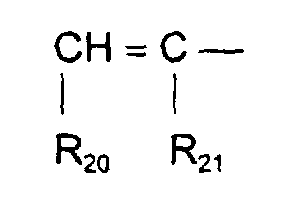
said zwitterionic monomer is the reaction product of an amino-multicarboxylic acid and an amine containing monomer, wherein the amino-multicarboxylic acid has Structure (II)and the amine containing monomer has Structure (III)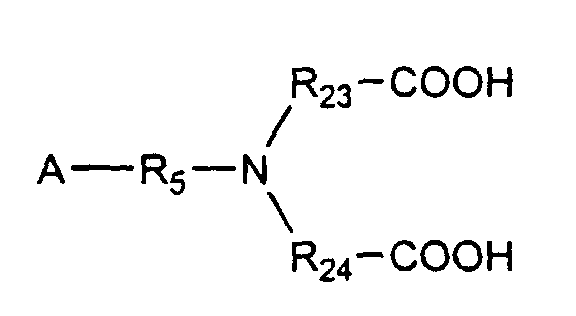 wherein R23 and R24 are independently selected from
 wherein R27 is selected from the group consisting of H, CH3, and COOH; and R28 is H or CH3.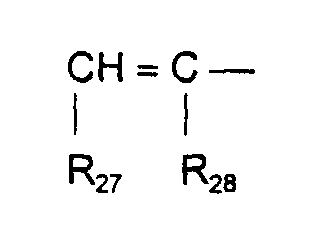
- The zwitterionic monomers of the invention have at least two carboxyl groups which are in close vicinity to each other in the monomer. The zwitterionic monomers may be polymerized alone or in combination with at least one other monomer to form a polymer having unique properties. Polymers prepared with the zwitterionic monomer are especially useful in hair treatment compositions to provide increased stiffness to hair, in coating formulations to increase the impact resistance, wet adhesion, and flexibility of the coating, especially wood coatings, and in mortar compositions to improve mortar compatibility, especially with redispersible powders.
- The zwitterionic monomer having amino-multicarboxylic acid functionality is prepared by reacting an amino-multicarboxylic acid with an amine containing monomer. The zwitterionic monomer having amino-multicarboxylic acid functionality having Structure (I)wherein R1 is selected from the group consisting of H, an alkyl group having 1 to 6 carbon atoms; R2 is (CH2)n where n is 2 to 12; R3 and R4 are independently an alkyl group having 1 to 6 carbon atoms; R5 is (CH2)m where m is 2 or 3; R6 and R7 are independently selected from
 wherein R20 is selected from the group consisting of H, CH3, and COOY; R21 is selected from H or CH3; A is a halide, preferably chloride or bromide; and Y is independently a cation, preferably H, alkali metal, alkaline earth metal, or ammonium.
- The amino-multicarboxylic acid has Structure (II)wherein R5 is (CH2)m where m is 2 or 3; R23 and R24 are independently selected from
 wherein R27 is selected from the group consisting of H, CH3, and COOH; R28 is H or CH3, A is a halide, preferably chloride or bromide.
- The amino-multicarboxylic acid is preferably prepared by a Michael reaction between an amine of an aminoalcohol, preferably a primary amine, and an olefin containing ester followed by halogenation with any halide and preferably chlorination or bromination. More preferably chlorination is used. The chlorination may be carried out using chloride compounds such as thionyl chloride or phosphorus oxychloride. Purification such as by steam stripping or recrystallization from isopropanol or other suitable solvents may be employed.
- The amino alcohol used in preparing the amino-multicarboxylic acid has structure (IV):wherein R10 is H or an alkyl group having 1 to 18 carbon atoms, preferably 1 to 8 carbon atoms, m is 2 or 3.

- The olefin containing ester has Structure (V):wherein R25 is selected from H, CH3, or COOR22; R26 is selected from H or CH3; and R22 is an alkyl group having 1 to 6 carbon atoms, preferably 1 to 3 carbon atoms. Preferably, the olefin containing ester is selected from alkyl acrylates, alkyl methacrylates, alkyl crotonates, dialkyl maleate, or dialkyl fumarate.
- In one embodiment of the invention where R10 is hydrogen then any olefin containing ester is acceptable for the reaction. If R10 is an alkyl group then the olefin containing ester must be a diester. Preferred diesters are dialkyl maleate and dialkyl fumarate, wherein the alkyl group has 1 to 6 carbon atoms.
- In one embodiment of the invention, the amino-multicarboxylic acid is prepared by reacting ethanolamine with methyl acrylate followed by chlorination with thionyl chloride and hydrolysis to provide the aminodicarboxyl containing reagent, 2-chloroethylaminodipropionic acid. A preferred reaction scheme is as follows:
- An amine containing monomer is reacted with the amino-multicarboxylic acid to form the zwitterionic monomer having amino-multicarboxylic acid functionality. The amine containing monomer has Structure (III):wherein R1 is selected from the group consisting of H, an alkyl group having 1 to 6 carbon atoms; R2 is (CH2)n where n is 2 to 12; R3 and R4 are independently an alkyl group having 1 to 6 carbon atoms; and X is oxygen or nitrogen
- The formation of the zwitterionic monomer having amino-multicarboxylic acid functionality involves reacting the amine containing monomer with the amino-multicarboxylic acid in an aqueous medium at a temperature of from about 10°C to 95°C, preferably from about 20°C to 50°C. The reaction is carried out under alkaline conditions at a pH of from about 8.5 to 13, more particularly from about 9.5 to 12.5. The pH is conveniently controlled by the periodic addition of a dilute aqueous solution of sodium hydroxide or other common base including potassium hydroxide, calcium hydroxide, sodium carbonate, ammonium hydroxide, tetramethylammonium hydroxide, etc. The preferred bases are sodium and potassium hydroxide.
- The amino-multicarboxylic acid may be added to the reaction mixture as a solid or an aqueous solution. The preferred concentration of the solution is 20 to 50% by weight, based on the weight of the reagent. In an alternative method, the amino-multicarboxylic acid solution is brought to the desired alkaline pH prior to its addition to the amine containing monomer. In this alternative method, the reagent is in the form of a salt rather than an acid or partially neutralized acid when it is introduced to the reaction mixture.
- Reaction time will vary from about 0.2 to 24 hours depending on such factors as the stability and reactivity of the amino-multicarboxylic acid employed, the temperature, pH, the scale of the reaction. In general, the preferred range of reaction time is from about 1 to 16 hours.
- After completion of the reaction, the pH of the reaction mixture is adjusted to from about 3 to 9 with any commercial acid such as hydrochloric acid, sulfuric acid, acetic acid, etc. Such acids may be conventionally added as a dilute aqueous solution. Depending on the final pH and the base used, the carboxyl group can be present as either the carboxylic acid or the corresponding salt.
- Recovery of the zwitterionic monomer having amino-multicarboxylic acid functionality may be readily accomplished by methods known in the art such as precipitation.
- The following nonlimiting examples illustrate further aspects of the invention.
- A 1L three neck round bottom flask fitted with a water cooled condenser, mechanical stirrer and addition funnel was charged with 30 g (0.49 mole) of ethanolamine. The flask was cooled to 10°C and 84.6 g (0.98 mole) of methyl acrylate was charged to the addition funnel. One half of the methyl acrylate was added slowly to the reaction at such a rate as to maintain the reaction temperature at or below 10°C. Ethyl acetate was added to help solubilize the forming solid.
- The second half of the methyl acrylate was added slowly to the reaction while keeping the temperature at or below 10°C. When the addition was completed, the reaction was slowly warmed to room temperature and then heated to 48°C and held for 18 hours to form an intermediate (hydroxyethylaminodipropionate methyl ester).
- The hydroxyethylaminodipropionate methyl ester was chlorinated according to the following procedure: An addition funnel was charged with 183.4 ml (2.50 mole) of thionyl chloride (SOCl2) and added to the hydroxyethylaminodipropionate methyl ester with cooling, maintaining the temperature below 20°C. After the addition was completed, the reaction was heated to 80°C to 90°C and held for 2 hours. The reactor was cooled to less than 30°C, and approximately 75 ml of water was added to destroy any residual thionyl chloride and liberate the free acid. The water and other volatiles were removed under vacuum and the product was purified by precipitation into isopropanol. The structures of the 2-chloroethylaminodipropionic acid and hydroxyethylaminodipropionate methyl ester were confirmed by NMR. Chlorine analysis of the 2-chloroethylaminodipropionic acid was determined to be 13.57 percent organic chlorine (98.7 percent of theoretical).
- The procedure according to Example 1 was used except that methyl acrylate was replaced with ethyl acrylate. The structures of the 2-chloroethylaminodipropionic acid and hydroxyethylaminodipropionate ethyl ester were confirmed by NMR. Chlorine analysis of the 2-chloroethylaminodipropionic acid was determined to be 13.61 (99% of theoretical) percent organic chlorine.
- A 25% solution of the 2-chloroethylaminodipropionic acid prepared in Example 1, 130 g, and 98.6 g of a 20.27% solution of NaOH (0.125 mole) was slowly added to a beaker containing 21.25 g of dimethylaminopropylmethacrylamide (DMAPMA) while maintaining a pH of 9.2 to 9.4 and a temperature of 10°C to 15°C using an ice water bath. After the addition of the NaOH was complete, the temperature of the reaction mixture was raised to 40°C and maintained with stirring for three hours. The reaction product was cooled to approximately 25°C and stirring was continued for 16 hours. The product appeared light yellow in color. NMR spectral analysis indicated 100% of the monomer was synthesized.
- A 50% solution of the 2-chloroethylaminodipropionic acid prepared in Example 1, 130 g, and 80 g of a 50% solution of NaOH was slowly added to a beaker containing 85.0 g of a 50% aqueous solution of dimethylaminopropylmethacrylamide (DMAPMA) while maintaining a pH of about 9.0 and a temperature of 10°C to 15°C using an ice water bath. After the addition of the NaOH was complete, the temperature of the reaction mixture was raised to 40°C and maintained with stirring for three hours. The reaction product was cooled to about 25°C and appeared brownish yellow in color. The product had a pH of 9. NMR spectral analysis indicated 75% of the monomer was synthesized.
- A 50% solution of the 2-chloroethylaminodipropionic acid prepared in Example 1, 130 g, and 74 g of a 50% solution of NaOH was slowly added to a beaker containing 85.0 g of a 50% aqueous solution of dimethylaminopropylmethacrylamide (DMAPMA) while maintaining a pH of about 8.0 and a temperature of 10°C to 15°C using an ice water bath. After the addition of the NaOH was complete, the temperature of the reaction mixture was raised to 40°C and maintained with stirring for six hours. The reaction product was cooled to about 25°C and appeared brownish yellow in color. The product had a pH of 8. NMR spectral analysis indicated 100% of the monomer was synthesized, as indicated by the disappearance of DMAPMA tertiary amine peak at 45 ppm, and the appearance of peak at 50 ppm due to quarternary ammonium peak. Some polymerization reaction was also observed.
- A 250 ml 3-neck round bottom flask fitted with a water cooled condenser, mechanical stirrer and addition funnel was charged with 60 g (0.80 mole) of N-methylaminoethanol. Dimethyl maleate (115.3 g, 0.80 mole) was added slowly over about 30 minutes with agitation. The reaction was warmed to 45°C and stirred for 18 hours. When the reaction was complete, the product was transferred with 75 ml of toluene to a 1,000 ml 4-neck round bottom flask equipped with addition funnel, mechanical stirrer, oil bath and distillation head. The addition funnel was charge with 110 ml of thionyl chloride and added to the reaction slowly to keep the temperature at or below 35°C. After addition, the reaction was heated to 80°C for 30 minutes. The toluene was steam distilled until the head temperature reached 98 to 100°C for three minutes. The product was cooled and filtered and then analyzed and gave acceptable chlorine and NMR values, indicating the desired compound, i.e., 2-chloroethyl, N-methylaminosuccinic acid, had been prepared.
- This reagent was reacted with DMAPMA in a similar procedure to the Example 3 to produce a zwitterionic monomer having amino-multicarboxylic acid functionality.
- A mixture of 38 g of butyl acrylate, 29 g of methyl methacrylate, 13 g of methacrylic acid, and 22 g of ethanol, was prepared. Thirty percent of the mixture was heated to reflux with 0.74 g (dissolved in 11 g of ethyl alcohol) of tert butyl peroctoate initiator. After 5 minutes, the remaining seventy percent of the mixture was added dropwise by means of an addition funnel to the reactor over three hours. Simultaneously, in a separate addition funnel, 40 g of a 50% aqueous solution of the zwitterionic monomer prepared in Example 3 was added dropwise to the reactor over three hours. Two hours after starting the monomer slow adds, 25 g of 1.5% solution of initiator solution in ethanol was added over a period of two hours. The contents were held at reflux for another 4.5 hours. The contents were cooled.
- Into 220 g of polymer solution at reflux, 12.1 g of 3-aminopropanol in 100 g of water was added to neutralize the carboxylate functionality of the copolymer. The contents were steam stripped to remove ethanol. The resulting copolymer emulsion was cooled, filtered, and diluted to 15% solids.
- The polymerization procedure according to Example 7 was used except that N,N-dimethyl-N-methacryloxyethyl-N-(3-sulfopropyl)-ammonium betaine inner salt (SPE) replaced the zwitterionic monomer of the invention.
- The zwitterionic polymer having aminodicarboxylic acid functionality prepared in Example 7 was evaluated in a 55% VOC hair spray application. The copolymer BALANCE, available from National Starch and Chemical Company, was also evaluated in a 55%VOC hair spray application. Eight evaluators compared hair tresses which were independently treated with each of the hair sprays, and made a determination as to which hair tress exhibited more desirable performance properties. The test results are summarized in Table I.
Polymer Gloss Stiffness Dry Comb Flake Example 7 (Copolymer of invention) 7/8 8/8 4/8 4/8 Example 9 (BALANCE) - The results in Table I show that seven out of the eight evaluators preferred the zwitterionic copolymer of Example 7 as compared to the commercially available copolymer BALANCE for gloss. Table I further shows that eight out of eight evaluators preferred the zwitterionic copolymer of Example 7 as compared to the commercially available copolymer BALANCE for stiffness properties. The evaluators determined that the dry-comb property and flake property were equal between the tresses. Thus, the results in Table I clearly show the superior stiffness properties of the copolymers of the invention as compared to commercially available copolymers.
- The zwitterionic polymer having aminodicarboxylic acid functionality prepared in Example 7 was evaluated in a 55% VOC hair spray application. In addition, the copolymer prepared in Example 8 containing SPE was evaluated in a 55% hair spray application. Eight evaluators compared hair tresses which were independently treated with each of the hair sprays, and made a determination as to which hair tress exhibited more desirable performance properties. The test results are summarized in Table II.
Polymer Gloss Stiffness Dry Comb Flake Example 7 (Copolymer of invention) 5/8 7/8 4/8 4/8 Example 8 (Copolymer with SPE) - The results in Table II show that five out of the eight evaluators preferred the zwitterionic copolymer of Example 7 as compared to the copolymer of Example 8 for gloss. Table II further shows that seven out of eight evaluators preferred the zwitterionic copolymer of Example 7 as compared to the copolymer of Example 8 for stiffness properties. The evaluators determined that the dry-comb property and flake property were equal between the tresses. Thus, the results in Table II clearly show the superior stiffness properties of the copolymers of the invention.
- A polyurethane dispersant was prepared by reacting polypropylene glycol, isophorone diisocyanates, and dihydroxymethyl propionic acid.
- An emulsion polymerization containing butyl acrylate, methyl methacrylate, and the DMAPMA/CEPA monomer prepared in Example 3 in a weight ratio of 30:70:0.7 was conducted in the presence of approximately 25 weight percent, based on the total weight of monomer, of the polyurethane dispersant.
- The resulting copolymer was evaluated in a semi-gloss paint formula at 25% pigment volume concentration (PVC). The paint was evaluated for scrub resistance according to ASTM D 2486 using scrub resistance equipment Model #D10V available from Paul N. Gardner. The paint exhibited significantly higher wet adhesion (470 cycles) than a control containing no DMAPMA/CEPA monomer (270 cycles).
- A mortar composition was prepared which contained the copolymer prepared in Example 12. The mortar composition exhibited a creamy, smooth texture which indicated mortar compatibility. In addition, the mortar composition provided easier pumping and filling of forms.
- Changes and modifications may be made by those of ordinary skill within the scope and spirit of the following claims.
Claims (9)
- A zwitterionic monomer having amino-multicarboxylic acid functionality having Structure (I)wherein R1 is selected from the group consisting of H, an alkyl group having 1 to 6 carbon atoms; R2 is (CH2)n where n is 2 to 12; R3 and R4 are independently an alkyl group having 1 to 6 carbon atoms; R5 is (CH2)m where m is 2 or 3; R6 and R7 are independently selected from
 wherein R20 is selected from the group consisting of H, CH3, and COOY; R21 is selected from H or CH3; X is oxygen or nitrogen; A is a halide; and Y is independently a cation; said zwitterionic monomer is the reaction product of an amino-multicarboxylic acid and an amine containing monomer, wherein the amino-multicarboxylic acid has Structure (II)
 and the amine containing monomer has Structure (III)
 wherein R23 and R24 are independently selected from
 wherein R27 is selected from the group consisting of H, CH3, and COOH; and R28 is H or CH3.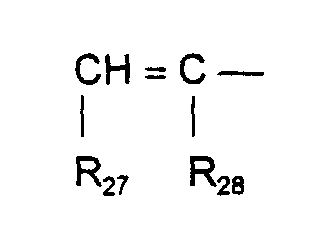
- The zwitterionic monomer according to Claim 1 wherein the amino-multicarboxylic acid reagent is prepared with an aminoalcohol having the Structure (IV)wherein R10 is H or an alkyl group having 1 to 18 carbon atoms; and m is 2 or 3.
- The zwitterionic monomer according to Claim 1 wherein Y is independently selected from the group consisting of H, alkali metal, alkaline earth metal, and ammonium.
- A method for preparing the zwitterionic monomer of Claim 1 wherein the amino-multicarboxylic acid is prepared by a Michael reaction between an amine of an aminoalcohol and an olefin containing ester followed by halogenation.
- The zwitterionic monomer according to Claim 1 wherein the amino-multicarboxylic acid is prepared by reacting ethanolamine with methyl acrylate followed by chlorination with thionyl chloride and hydrolysis to form 2-chloroethylaminodipropionic acid.
- A polymerization product of a zwitterionic monomer having amino-multicarboxylic acid functionality having Structure (I)wherein R1 is selected from the group consisting of H, an alkyl group having 1 to 6 carbon atoms; R2 is (CH2)n where n is 2 to 12; R3 and R4 are independently an alkyl group having 1 to 6 carbon atoms; R5 is (CH2)m where m is 2 or 3; R6 and R7 are independently selected from
 wherein R20 is selected from the group consisting of H, CH3, and COOY; R21 is selected from H or CH3; X is oxygen or nitrogen; A is a halide; and Y is independently a cation; said zwitterionic monomer is the reaction product of an amino-multicarboxylic acid and an amine containing monomer, wherein the amino-multicarboxylic acid has Structure (II)
 and the amine containing monomer has Structure (III)
 wherein R23 and R24 are independently selected from
 wherein R27 is selected from the group consisting of H, CH3, and COOH; and R28 is H or CH3.
- A hair treating composition comprising a polymer which comprises the reaction product of a zwitterionic monomer having amino-multicarboxylic acid functionality having Structure (I)wherein R1 is selected from the group consisting of H, an alkyl group having 1 to 6 carbon atoms; R2 is (CH2)n where n is 2 to 12; R3 and R4 are independently an alkyl group having 1 to 6 carbon atoms; R5 is (CH2)m where m is 2 or 3; R6 and R7 are independently selected from
 wherein R20 is selected from the group consisting of H, CH3, and COOY; R21 is selected from H or CH3; X is oxygen or nitrogen; A is a halide; and Y is independently a cation; said zwitterionic monomer is the reaction product of an amino-multicarboxylic acid and an amine containing monomer, wherein the amino-multicarboxylic acid has Structure (II)
 and the amine containing monomer has Structure (III)
 wherein R23 and R24 are independently selected from
 wherein R27 is selected from the group consisting of H, CH3, and COOH; and R28 is H or CH3.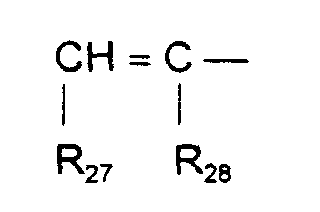
- A coating composition comprising a polymer which comprises the reaction product of a zwitterionic monomer having amino-multicarboxylic acid functionality having Structure (I)wherein R1 is selected from the group consisting of H, an alkyl group having 1 to 6 carbon atoms; R2 is (CH2)n where n is 2 to 12; R3 and R4 are independently an alkyl group having 1 to 6 carbon atoms; R5 is (CH2)m where m is 2 or 3; R6 and R7 are independently selected from
 wherein R20 is selected from the group consisting of H, CH3, and COOY; R21 is selected from H or CH3; X is oxygen or nitrogen; A is a halide; and Y is independently a cation; said zwitterionic monomer is the reaction product of an amino-multicarboxylic acid and an amine containing monomer, wherein the amino-multicarboxylic acid has Structure (II)
 and the amine containing monomer has Structure (III)
 wherein R23 and R24 are independently selected from
 wherein R27 is selected from the group consisting of H, CH3, and COOH; and R28 is H or CH3.
- A mortar composition comprising a polymer which comprises the reaction product of a zwitterionic monomer having amino-multicarboxylic acid functionality having Structure (I)wherein R1 is selected from the group consisting of H, an alkyl group having 1 to 6 carbon atoms; R2 is (CH2)n where n is 2 to 12; R3 and R4 are independently an alkyl group having 1 to 6 carbon atoms; R5 is (CH2)m where m is 2 or 3; R6 and R7 are independently selected from
 wherein R20 is selected from the group consisting of H, CH3, and COOY; R21 is selected from H or CH3; X is oxygen or nitrogen; A is a halide; and Y is independently a cation; said zwitterionic monomer is the reaction product of an amino-multicarboxylic acid and an amine containing monomer, wherein the amino-multicarboxylic acid has Structure (II)
 and the amine containing monomer has Structure (III)
 wherein R23 and R24 are independently selected from
 wherein R27 is selected from the group consisting of H, CH3, and COOH; and R28 is H or CH3.
Applications Claiming Priority (2)
| Application Number | Priority Date | Filing Date | Title |
|---|---|---|---|
| US348085 | 1999-07-06 | ||
| US09/348,085 US6262299B1 (en) | 1999-07-06 | 1999-07-06 | Zwitterionic monomer having amino-multicarboxylic acid functionality |
Publications (1)
| Publication Number | Publication Date |
|---|---|
| EP1067115A1 true EP1067115A1 (en) | 2001-01-10 |
Family
ID=23366585
Family Applications (1)
| Application Number | Title | Priority Date | Filing Date |
|---|---|---|---|
| EP00114009A Withdrawn EP1067115A1 (en) | 1999-07-06 | 2000-07-04 | Zwitterionic monomer having aminomulticarboxylic acid functionality |
Country Status (3)
| Country | Link |
|---|---|
| US (1) | US6262299B1 (en) |
| EP (1) | EP1067115A1 (en) |
| JP (1) | JP2001172330A (en) |
Cited By (1)
| Publication number | Priority date | Publication date | Assignee | Title |
|---|---|---|---|---|
| WO2018067491A1 (en) * | 2016-10-05 | 2018-04-12 | Rohm And Haas Company | Acrylic polymer neutralized with amino alcohols |
Families Citing this family (8)
| Publication number | Priority date | Publication date | Assignee | Title |
|---|---|---|---|---|
| JP3861623B2 (en) * | 2001-06-05 | 2006-12-20 | ソニー株式会社 | Digital watermark embedding processing apparatus, digital watermark embedding processing method, and program |
| AU2002349234A1 (en) * | 2001-11-30 | 2003-06-10 | Universite Laval | Milk protein biofilm and uses thereof |
| US7854925B2 (en) * | 2002-04-04 | 2010-12-21 | Akzo Nobel N.V. | Use of solubilized, anionic polyurethanes in skin care compositions |
| US20070025943A1 (en) * | 2005-08-01 | 2007-02-01 | L'oreal S.A. | Make-up compositions containing a film forming polyurethane and a film-forming (meth)acrylate copolymer |
| US20080251106A1 (en) * | 2007-04-12 | 2008-10-16 | Stefano Scialla | Process of cleaning a hard surface with zwitterionic copolymer |
| WO2014194268A1 (en) * | 2013-05-30 | 2014-12-04 | The University Of Akron | Switchable antimicrobial and antifouling carboxybetaine-based hydrogels |
| US10351648B2 (en) | 2014-07-25 | 2019-07-16 | Akzo Nobel Coatings International B.V. | Method of preparing a zwitterionic copolymer |
| EP3405530B1 (en) * | 2016-01-20 | 2019-10-30 | Akzo Nobel Coatings International B.V. | Coating composition for substrates immersed in water |
Citations (6)
| Publication number | Priority date | Publication date | Assignee | Title |
|---|---|---|---|---|
| US2777872A (en) * | 1953-11-02 | 1957-01-15 | Du Pont | Unsaturated organic compounds |
| US3671502A (en) * | 1970-11-12 | 1972-06-20 | Kendall & Co | Betaine copolymers with hydroxyalkylacrylates and hydroxyalkylmethacrylates |
| GB1403237A (en) * | 1971-07-01 | 1975-08-28 | Mitsubishi Petrochemical Co | Copolymers useful for the surface processing of synthetic paper |
| GB2069163A (en) * | 1980-01-23 | 1981-08-19 | Fuji Photo Film Co Ltd | Silver halide photographic light-sensitive material |
| EP0649834A1 (en) * | 1993-10-20 | 1995-04-26 | Kao Corporation | Carboxybetaine and sulfobetaine and detergent composition and cosmetic containing the same |
| EP0666272A1 (en) * | 1994-02-02 | 1995-08-09 | National Starch and Chemical Investment Holding Corporation | Starches modified with amino-multicarboxylates |
Family Cites Families (7)
| Publication number | Priority date | Publication date | Assignee | Title |
|---|---|---|---|---|
| US2935493A (en) | 1955-04-20 | 1960-05-03 | American Cyanamid Co | Composition comprising a reaction product of formaldehyde and a copolymer of acrylamide and an unsaturated betaine |
| US2958682A (en) | 1955-04-27 | 1960-11-01 | American Cyanamid Co | Method of preparing a polymeric betaine |
| US3473998A (en) | 1963-08-07 | 1969-10-21 | Du Pont | Sulfobetaine monomers,polymers thereof and composite filaments prepared from said polymers |
| US3497482A (en) | 1963-10-14 | 1970-02-24 | Rohm & Haas | Polymers of quaternary ammonium compounds |
| DE1221019B (en) | 1964-02-06 | 1966-07-14 | Bayer Ag | Process for the production of acrylonitrile copolymers |
| US4009201A (en) * | 1974-05-20 | 1977-02-22 | Alcolac Inc. | Polymerizable cationic monomers |
| US5482704A (en) * | 1994-06-28 | 1996-01-09 | National Starch And Chemical Investment Holding Corporation | Cosmetic compositions containing amino-multicarboxylate modified starch |
-
1999
- 1999-07-06 US US09/348,085 patent/US6262299B1/en not_active Expired - Lifetime
-
2000
- 2000-07-04 EP EP00114009A patent/EP1067115A1/en not_active Withdrawn
- 2000-07-05 JP JP2000208246A patent/JP2001172330A/en active Pending
Patent Citations (7)
| Publication number | Priority date | Publication date | Assignee | Title |
|---|---|---|---|---|
| US2777872A (en) * | 1953-11-02 | 1957-01-15 | Du Pont | Unsaturated organic compounds |
| US3671502A (en) * | 1970-11-12 | 1972-06-20 | Kendall & Co | Betaine copolymers with hydroxyalkylacrylates and hydroxyalkylmethacrylates |
| GB1403237A (en) * | 1971-07-01 | 1975-08-28 | Mitsubishi Petrochemical Co | Copolymers useful for the surface processing of synthetic paper |
| GB2069163A (en) * | 1980-01-23 | 1981-08-19 | Fuji Photo Film Co Ltd | Silver halide photographic light-sensitive material |
| EP0649834A1 (en) * | 1993-10-20 | 1995-04-26 | Kao Corporation | Carboxybetaine and sulfobetaine and detergent composition and cosmetic containing the same |
| EP0666272A1 (en) * | 1994-02-02 | 1995-08-09 | National Starch and Chemical Investment Holding Corporation | Starches modified with amino-multicarboxylates |
| US5500087A (en) * | 1994-02-02 | 1996-03-19 | National Starch And Chemical Investment Holding Corporation | Paper products using starches modified with amino-multicarboxylates |
Cited By (3)
| Publication number | Priority date | Publication date | Assignee | Title |
|---|---|---|---|---|
| WO2018067491A1 (en) * | 2016-10-05 | 2018-04-12 | Rohm And Haas Company | Acrylic polymer neutralized with amino alcohols |
| CN109689807A (en) * | 2016-10-05 | 2019-04-26 | 罗门哈斯公司 | The acrylic polymer neutralized with amino alcohol |
| US11639401B2 (en) | 2016-10-05 | 2023-05-02 | Dow Global Technologies Llc | Aqueous coating composition neutralized with amino alcohols |
Also Published As
| Publication number | Publication date |
|---|---|
| JP2001172330A (en) | 2001-06-26 |
| US6262299B1 (en) | 2001-07-17 |
Similar Documents
| Publication | Publication Date | Title |
|---|---|---|
| EP0182523B1 (en) | Oral hygiene composition and polymers active therein | |
| US2777872A (en) | Unsaturated organic compounds | |
| US5302192A (en) | Anti-fouling coating compositions | |
| US6262299B1 (en) | Zwitterionic monomer having amino-multicarboxylic acid functionality | |
| DE1768245A1 (en) | Anhydride interpolymers as thickeners and process for their preparation | |
| CA1222770A (en) | Method of making and using novel scale inhibiting terpolymer | |
| CA2230248A1 (en) | Ethylenically-unsaturated 1, 3-diketoamide functional compounds, polymers thereof and latex formulations containing the same | |
| CA1315465C (en) | Polymers of oxyalkylated unsaturated quaternary ammonium salts, their preparation and their use | |
| JP3188686B2 (en) | Unsaturated peroxy compound chain transfer agent | |
| CN103509419A (en) | Wood protection paints | |
| AU2014369826A1 (en) | Soluble aqueous compositions of selected polyitaconic acid polymers | |
| RU2000122439A (en) | AN OBSTACLE COATING | |
| JP2003527456A (en) | Methods for protecting metals from corrosion and non-fouling reactive preparations for their implementation | |
| US5260385A (en) | Biguanide group-containing polyallylamine and method of producing same | |
| DE19634399A1 (en) | Cosmetic with polymer-bound benzophenone chromophores | |
| DE3444573A1 (en) | Polymeric biocide | |
| EP1000094B1 (en) | Phosphonic acid reaction products and use in coating compositions | |
| US5798421A (en) | Water-soluble associative triblock copolymers | |
| EP0335624A2 (en) | Surface active polymers | |
| GB1266661A (en) | ||
| US5336728A (en) | Oral hygiene compositions and polymers active therein | |
| KR100515457B1 (en) | Process for manufacturing the chloride of 1,3-bis(dimethylbenzylammonium)isopropyl acrylate alone or mixed with other monomers, and corresponding (co)polymers | |
| US5859174A (en) | Amide functional monomers and acrylic polymers with amide functionality | |
| WO1993010160A1 (en) | New thermoplastic fluorocopolymers, and fluoromonomers for use in their manufacture | |
| JPH0995586A (en) | Water-soluble hair styling resin composition and method for producing the same |
Legal Events
| Date | Code | Title | Description |
|---|---|---|---|
| PUAI | Public reference made under article 153(3) epc to a published international application that has entered the european phase |
Free format text: ORIGINAL CODE: 0009012 |
|
| AK | Designated contracting states |
Kind code of ref document: A1 Designated state(s): AT BE CH CY DE DK ES FI FR GB GR IE IT LI LU MC NL PT SE |
|
| AX | Request for extension of the european patent |
Free format text: AL;LT;LV;MK;RO;SI |
|
| AKX | Designation fees paid | ||
| REG | Reference to a national code |
Ref country code: DE Ref legal event code: 8566 |
|
| STAA | Information on the status of an ep patent application or granted ep patent |
Free format text: STATUS: THE APPLICATION IS DEEMED TO BE WITHDRAWN |
|
| 18D | Application deemed to be withdrawn |
Effective date: 20010711 |