EP1067103A2 - Process for producing halogenated benzene compound - Google Patents
Process for producing halogenated benzene compound Download PDFInfo
- Publication number
- EP1067103A2 EP1067103A2 EP00305585A EP00305585A EP1067103A2 EP 1067103 A2 EP1067103 A2 EP 1067103A2 EP 00305585 A EP00305585 A EP 00305585A EP 00305585 A EP00305585 A EP 00305585A EP 1067103 A2 EP1067103 A2 EP 1067103A2
- Authority
- EP
- European Patent Office
- Prior art keywords
- group
- manufactured
- general formula
- ion
- oxide
- Prior art date
- Legal status (The legal status is an assumption and is not a legal conclusion. Google has not performed a legal analysis and makes no representation as to the accuracy of the status listed.)
- Granted
Links
Classifications
-
- C—CHEMISTRY; METALLURGY
- C07—ORGANIC CHEMISTRY
- C07D—HETEROCYCLIC COMPOUNDS
- C07D243/00—Heterocyclic compounds containing seven-membered rings having two nitrogen atoms as the only ring hetero atoms
- C07D243/06—Heterocyclic compounds containing seven-membered rings having two nitrogen atoms as the only ring hetero atoms having the nitrogen atoms in positions 1 and 4
- C07D243/10—Heterocyclic compounds containing seven-membered rings having two nitrogen atoms as the only ring hetero atoms having the nitrogen atoms in positions 1 and 4 condensed with carbocyclic rings or ring systems
- C07D243/14—1,4-Benzodiazepines; Hydrogenated 1,4-benzodiazepines
- C07D243/16—1,4-Benzodiazepines; Hydrogenated 1,4-benzodiazepines substituted in position 5 by aryl radicals
- C07D243/18—1,4-Benzodiazepines; Hydrogenated 1,4-benzodiazepines substituted in position 5 by aryl radicals substituted in position 2 by nitrogen, oxygen or sulfur atoms
- C07D243/24—Oxygen atoms
-
- C—CHEMISTRY; METALLURGY
- C07—ORGANIC CHEMISTRY
- C07B—GENERAL METHODS OF ORGANIC CHEMISTRY; APPARATUS THEREFOR
- C07B39/00—Halogenation
-
- C—CHEMISTRY; METALLURGY
- C07—ORGANIC CHEMISTRY
- C07B—GENERAL METHODS OF ORGANIC CHEMISTRY; APPARATUS THEREFOR
- C07B59/00—Introduction of isotopes of elements into organic compounds ; Labelled organic compounds per se
- C07B59/001—Acyclic or carbocyclic compounds
-
- C—CHEMISTRY; METALLURGY
- C07—ORGANIC CHEMISTRY
- C07B—GENERAL METHODS OF ORGANIC CHEMISTRY; APPARATUS THEREFOR
- C07B59/00—Introduction of isotopes of elements into organic compounds ; Labelled organic compounds per se
- C07B59/002—Heterocyclic compounds
-
- C—CHEMISTRY; METALLURGY
- C07—ORGANIC CHEMISTRY
- C07C—ACYCLIC OR CARBOCYCLIC COMPOUNDS
- C07C201/00—Preparation of esters of nitric or nitrous acid or of compounds containing nitro or nitroso groups bound to a carbon skeleton
- C07C201/06—Preparation of nitro compounds
- C07C201/12—Preparation of nitro compounds by reactions not involving the formation of nitro groups
-
- C—CHEMISTRY; METALLURGY
- C07—ORGANIC CHEMISTRY
- C07C—ACYCLIC OR CARBOCYCLIC COMPOUNDS
- C07C201/00—Preparation of esters of nitric or nitrous acid or of compounds containing nitro or nitroso groups bound to a carbon skeleton
- C07C201/06—Preparation of nitro compounds
- C07C201/16—Separation; Purification; Stabilisation; Use of additives
Definitions
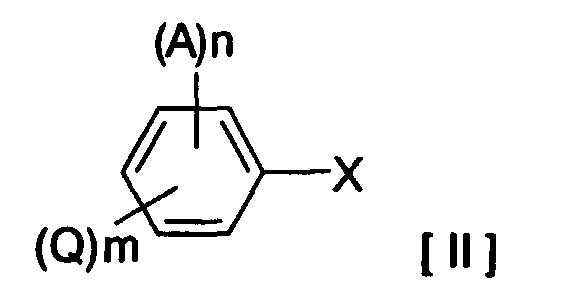
- the present invention relates to a process for producing a halogenated benzene compound, the process comprising the step of reacting in a solvent an organometallic compound with a halide ion (X - ), under light irradiation conditions in the presence of a semiconductor catalyst with a photocatalytic activity; particularly to a process useful for producing a halogenated benzene compound labeled with a radioactive halogen.
- Halogenated benzene compounds have an important role as various biologically active substances typified by drugs and agrochemicals and as intermediates for their synthesis. Further, compounds including a radioactive halogen in their molecules have extremely valuable as a radioactive tracer which is used for elucidating in-vivo behavior of drugs and the like in the course of their development, or as in-vivo or in-vitro diagnostic or therapeutic drugs for clinical diagnosis or therapy.
- N-isopropylamphetamine hydrochloride labeled with iodine-123 is used as an in-vivo diagnostic drug for brain functions
- 15-(p-iodophenyl)-3-(R,S)-methylpentadecanoic acid is used as that for heart diseases
- an iodohippuric acid sodium salt is used as that for kidney and urinary tract diseases, for example.
- the above method requires complicated operations, for example, of conducting the reaction in the presence of an oxidizing agent (sometimes, in large excess) such as hypochlorite, chloramine T (N-chloro-4-methylbenzenesulfonamide sodium salt), Iodo-Gen TM (1,3,4,6-tetrachloro-3 ⁇ ,6 ⁇ -diphenylglycoluril), Iodo-beads TM (N-chloro-benzenesulfonamide (sodium salt) derivatized, uniform, nonporous, polystyrene beads), hydrogen peroxide and NBS (1-Bromosuccinimide), and of removing the remaining oxidizing agent by, for example, adding a reducing agent at the completion of the reaction.
- an oxidizing agent sometimes, in large excess
- hypochlorite chloramine T (N-chloro-4-methylbenzenesulfonamide sodium salt)
- Iodo-Gen TM 1,3,4,6-te
- the compound to be labeled is exposed to oxidizing conditions. Therefore, it is difficult to apply the method when the compound to be labeled is unstable in such conditions.
- the object of the present invention is to provide a widely-applicable process for producing halogenated compounds, the process being useful for the production of compounds possessing a halogen, particularly a radioactive halogen, in their molecules.
- the reaction can be conducted under mild conditions without the whole reaction system being exposed to oxidative conditions. Since the process uses the halide ion as the source of the halogen atom to be introduced, it is suitable particularly for the production of labeled compounds which should be synthesized in high purities and in high specific radioactivities from small amounts of radioactive raw materials for the balogenation which have restricted chemical forms.
- the semiconductor catalysts with the photocatalytic activity to be used in the process of the present invention are semiconductor catalysts which are solid catalysts with the property that electrons in a valence band of the catalysts are excited by light.
- Most of the catalysts are metal oxides or metal sulfides. Specific examples of them include titanium oxide (TiO 2 ), strontium titanate (SrTiO 3 ), tungsten oxide (WO 3 ), bismuth oxide (Bi 2 O 3 ), zirconium oxide (ZrO 2 ), tin oxide (SnO 2 ), zinc oxide (ZnO) and zinc sulfide (ZnS).
- the semiconductor catalyst with the photocatalytic activity may have any form as long as its solid surface can receive light during its use. For example, powder, granule and ones supported on carriers by coating are available. Further, commercially available ones may also be employed.
- the amount, in molar ratio, of the semiconductor catalyst is preferably not less than that of the halide ion (X - ).
- the amount of the semiconductor catalyst is preferably excessive.
- the light to be used in the process of the present invention may be any one which has a wavelength at which the light can excite electrons of the semiconductor catalyst.
- TiO 2 titanium oxide
- strontium titanate (SrTiO 3 ) or tungsten oxide (WO 3 ) any light with wavelengths shorter than 388 nm may be applied.
- a black light, a mercury lamp, a xenon lamp and the like can be employed as a light source.
- halide ion (X - ) examples include an iodide ion (I - ), a bromide ion (Br - ) and a chloride ion (Cl - ).
- the halide ion is used in the form of its salt of a metal such as an alkali metal or of a quaternary ammonium such as tetrabutylammonium.
- salts include sodium iodide (NaI), potassium iodide (KI), sodium bromide (NaBr), potassium bromide (KBr), sodium chloride (NaCl) and potassium chloride (KCl).
- the halide ion also includes ions of isotopes of the halogen.
- the isotopes may be radioactive isotopes. Examples of such isotopes include iodines-123, 125, 128 and 131, bromines-75, 76, 77, 80 and 82, and chlorines-36 and 38.
- the reaction in the process of the present invention is conducted in a solvent.
- the solvent to be used may be any one in which the organometallic compound [I], which is one of the raw materials, can be dissolved with stability and a small amount of a salt of a halide can be dissolved.
- Preferred are a multipolar-non-proton solvent such as acetonitrile, DMF or DMSO and its solvent mixed with water.
- the reactor in which the reaction of the process of the present invention is conducted may be any one made of a material through which light with a desired wavelength can pass.
- a borosilicate glass reactor and the like may be used.
- the light source is mounted near the reactor and, as needed, is cooled for the purpose of prevention of temperature rise in the reactor caused by the heat from the light source.
- the reaction solution is stirred depending upon demand.
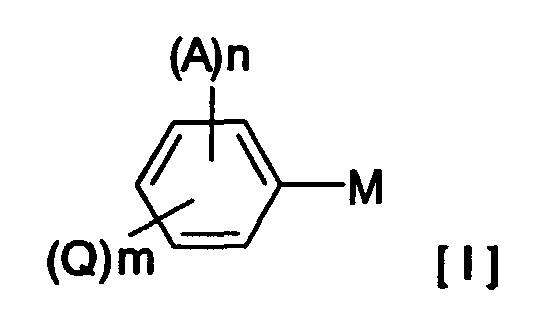
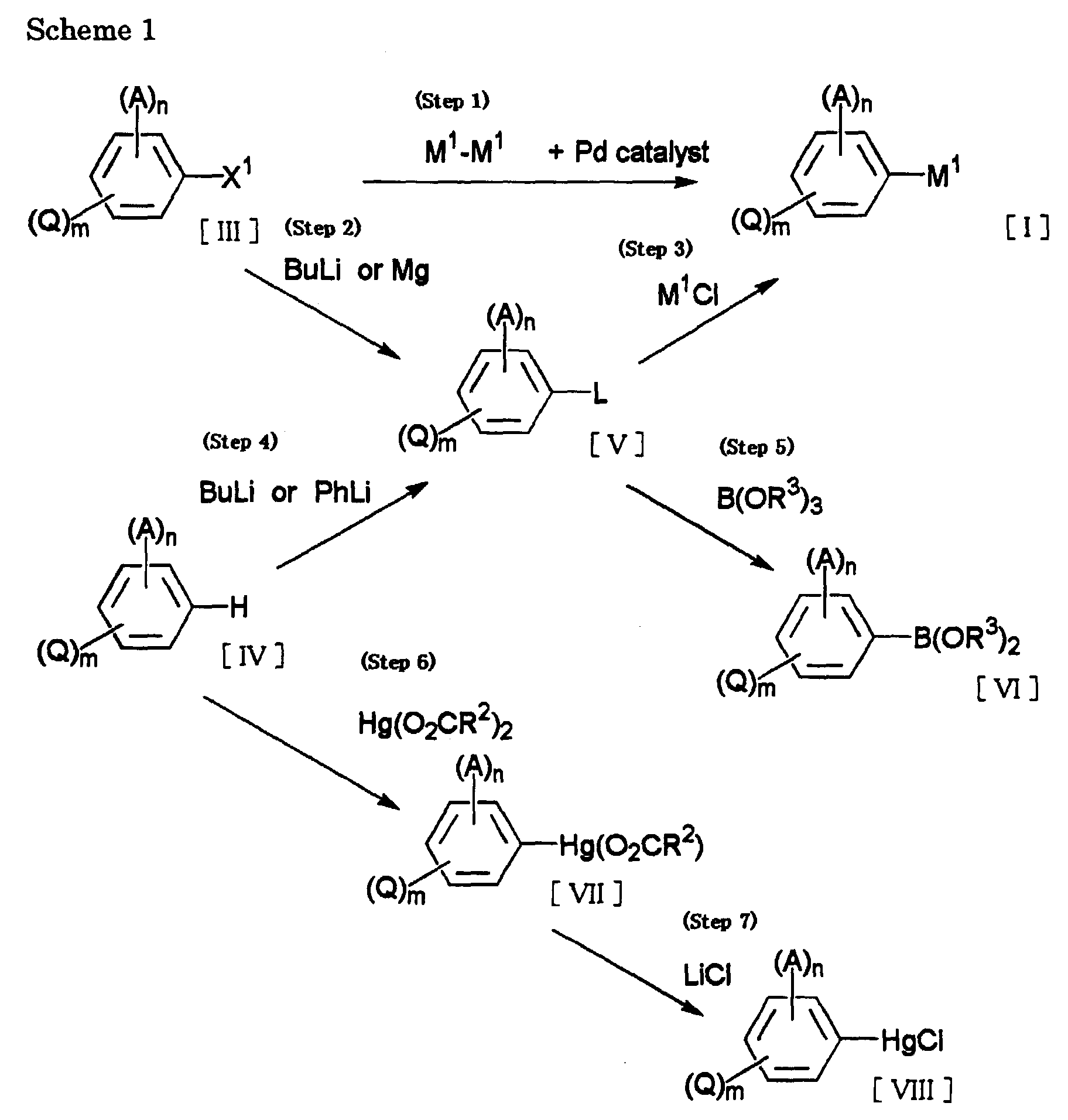
- the organometallic compound represented by the general formula [I], which is used in the process of the present invention, may be produced by the producing process shown in scheme 1, for example.
- X 1 represents a chlorine atom, a bromine atom or an iodine atom
- L represents Li or MgX 1
- M 1 represents an R 1 3 Sn group, an R 1 3 Si group or an R1 3 Ge group wherein each R 1 has the same meaning as that previously defined
- R 2 , R 3 , n, m, A and Q have the same meanings as those previously defined.
- Step 1 is carried out by reacting in a solvent the compound represented by the general formula [III] with the compound represented by the general formula M 1 ⁇ M 1 (for example, Bu 3 Sn ⁇ SnBu3 and Me 3 Si ⁇ SiMe 3 ) in a solvent in the presence of a palladium catalyst (for example, PdCl 2 and (Ph 3 P) 4 Pd).
- a palladium catalyst for example, PdCl 2 and (Ph 3 P) 4 Pd.
- Step 2 is carried out by reacting in a solvent the compound represented by the general formula [III] with BuLi or Mg.
- Step 3 is carried out by reacting in a solvent the compound represented by the general formula [V] with the compound represented by the general formula M 1 Cl (for example, Bu 3 SnCl, Me 3 SiCl and Me 3 GeCl).
- Step 4 is carried out by reacting in a solvent the compound represented by the general formula [IV], preferably having a substituent such as an alkoxy group at the ortho position of the reactive site, with BuLi or PhLi.
- Step 5 is carried out by reacting in a solvent the compound represented by the general formula [V] with the compound represented by the general formula B(OR 3 ) 3 (for example, B(OCH 3 ) 3 ).
- Step 6 is carried out by reacting in a solvent the compound represented by the general formula [IV] with the compound represented by the general formula Hg(O 2 CR 2 ) 2 (for example, Hg(O 2 CCH 3 ) 2 and Hg(O 2 CCF 3 ) 2 ).
- Step 7 is carried out by reacting in a solvent the compound represented by the general formula [VII] with LiCl.
- the organometallic compound represented by the general formula [I] may also be produced by constructing the moiety of the A group or the Q group after constructing the moiety of the M group.
- M in the general formula [I] represents an R 1 3 Sn group, an R 1 3 Si group, an R 1 3 Ge group, an (R 2 CO 2 )Hg group, a ClHg group or an (R 3 O) 2 B group.
- R 1 3 Sn group include a Me 3 Sn group, an Et 3 Sn group, a Pr 3 Sn group and a Bu 3 Sn group.
- R 1 3 Si group include a Me 3 Si group.
- Examples of the R 1 3 Ge group include a Me 3 Ge group.
- Examples of the (R 2 CO 2 )Hg group include a CH 3 CO 2 Hg group and a CF 3 CO 2 Hg group.
- Examples of the (R 3 O) 2 B group include a (MeO) 2 B group and a (HO) 2 B group.
- Each A in the general formula [I] independently represents a fluorine atom, a nitro group, a cyano group, a C1 - C8 alkyl group, a C1 - C8 alkoxy group or a C2 - C8 acyloxy group.
- Examples of the C1 - C8 alkyl group include a Me group, an Et group and a Pr group.
- Examples of the Cl - C8 alkoxy group include a MeO group, an EtO group and a PrO group.
- Examples of the C2 - C8 acyloxy group include an acetoxy group and a propionyloxy group.
- Q in the general formula [I] represents an organic residue.
- the organic residue include alkyl groups which may be optionally substituted such as a 2-(N,N-dimethylamino)ethyl group, a 2-(N-isopropylamino)propyl group and a 13-methyl-14-carboxyltetradecyl group, alkanoyl groups which may be optionally substituted, a carboxyl group, alkoxycarbonyl groups which may be optionally substituted, carbamoyl groups which may be optionally substituted such as an N-(carboxymethyl)carbamoyl group, alkoxy groups which may be optionally substituted such as a carboxymethoxy group, alkanoyloxy groups which may be optionally substituted, alkoxycarbonyloxy groups which may be optionally substituted, carbamoyloxy groups which may be optionally substituted, alkylamino groups which may be optionally substituted, alkanoylamino groups which may be optionally
- Me represents a methyl group
- Et represents an ethyl group
- Pr represents a propyl group
- Bu represents a butyl group.
- the reaction in the process of the present invention may also be conducted further in the presence of an electron acceptor other than the raw materials.
- Preferable electron acceptors are ions of metals whose ionization tendencies are greater than that of a hydrogen atom.
- a silver ion (Ag + ) is preferred.
- the silver ion is used as salts such as silver sulfate (Ag 2 SO 4 ).
- the metal ion as the electron acceptor is preferably used in an amount, in molar ratio, as much as twice or more that of the halide ion (X-).
- the reaction in the process of the present invention may be stopped only by quitting the light irradiation.
- the reaction rate also may be easily controlled by selecting the quantity of light.
- the wavelength also may be selected.
- the desired halogenated benzene compound may be obtained by subjecting the reaction solution to column chromatography or HPLC after, if necessary, separating (for example, filtering off) the semiconductor catalyst with a photocatalytic activity.
- halogenated benzene compounds can be produced under mild conditions.
- the present invention process is useful particularly in the field of the production of labeled compounds which should be synthesized in high purities and in high specific radioactivities from small amounts of radioactive raw materials for the halogenation which have restricted chemical forms.
- the qualitative and quantitative analysis of the target compounds were conducted based on the retention time measuring method and the areametric analysis by means of high performance liquid chromatography for the desired halogenated benzene compounds (commercially available products or products produced by other methods).
- a solution of tri-n-butyl(4-nitrophenyl) stannane (8.01 mg, 19.4 ⁇ mol) in acetonitrile (1.0 ml) was placed and then titanium oxide (TiO 2 , manufactured by Sakai Chemical Industry Co., Ltd.) (0.12 mg, 1.50 ⁇ mol), silver sulfate (0.23 mg, 738 nmol, manufactured by Wako Pure Chemical Industries Ltd.), sodium iodide (474 ng, 3.16 nmol, 3- ⁇ L aqueous solution, manufactured by Wako Pure Chemical Industries Ltd.) and [ 125 I] sodium iodide (6.14 MBq, 0.08 nmol, 2- ⁇ L aqueous solution, manufactured by Amersham) were added and a lid was put on the vessel.
- TiO 2 manufactured by Sakai Chemical Industry Co., Ltd.
- silver sulfate 0.23 mg, 738 nmol, manufactured by Wako Pure Chemical Industries Ltd.
- the system was irradiated for 20 minutes at room temperature with a xenon lamp (2 KW, manufactured by Ushio Inc.) obliquely from the upper side. After stopping the irradiation, water was added to the reaction solution, and the mixture was extracted with benzene. The extracted organic layer was analyzed by means of radio high performance liquid chromatography. The radiochemical purity of 4-[ 125 I]iodonitrobenene was not lower than 98% and the yield thereof was 85% on the basis of the amount of the [ 125 I] sodium iodide used.
- a borosilicate glass vessel (a 5-ml sample tube manufactured by Maruemu) a solution of tri-n-butyl(4-methoxyphenyl) stannane (7.62 mg, 19.2 ⁇ mol) in acetonitrile (1.0 ml) was placed and then a grain of glass bead coated with titanium oxide (TiO 2 ) (manufactured by Kato Manufacturing Co., Inc.), silver sulfate (4.90 ⁇ g, 15.7 nmol, 9.1 ⁇ L aqueous solution, manufactured by Wako Pure Chemical Industries Ltd.), sodium iodide (474 ng, 3.16 nmol, 3- ⁇ L aqueous solution, manufactured by Wako Pure Chemical Industries Ltd.) and [ 125 I] sodium iodide (2.30 MBq, 0.03 nmol, 1- ⁇ L aqueous solution, manufactured by Amersham) were added and a lid was put on the vessel.
- TiO 2 titanium oxide
- the system was irradiated for 210 minutes at room temperature with a black light (5 W, manufactured by NEC Corp.). After stopping the irradiation, water was added to the reaction solution, and the mixture was extracted with benzene. The organic layer extracted was analyzed by means of radio high performance liquid chromatography. The radiochemical purity of 4-[ 125 I]iodoanisole was not lower than 98% and the yield thereof was 69% on the basis of the amount of the [ 125 I] sodium iodide used.
- the system was irradiated for 20 minutes at room temperature with a xenon lamp (2 KW, manufactured by Ushio Inc.) obliquely from the upper side.
- a xenon lamp (2 KW, manufactured by Ushio Inc.) obliquely from the upper side.
- the reaction solution was filtered, and the filtrate was analyzed by means of radio high performance liquid chromatography.
- the radiochemical purity of 7-chloro-1-methyl-5-(2'-fluoro-4'-[ 125 I]iodo)phenyl-3H-1,4-benzodiazepin-2(1H)-one was 84% and the yield thereof was 89% on the basis of the amount of the [ 125 I] sodium iodide used.
- the system was irradiated for 5 hours at room temperature with a black light (5 W, manufactured by NEC Corp.) obliquely from the upper side. After stopping the irradiation, the supernatant of the reaction solution was analyzed by means of radio high performance liquid chromatography. The radiochemical purity of 4-[ 125 I]iodonitrobenene was 88%.
- a solution of tri-n-butyl(4-nitrophenyl) stannane (10.4 mg, 25.2 ⁇ mol) in acetonitrile (1.0 ml) was placed and then tungsten oxide (WO 3 , manufactured by Wako Pure Chemical Industries Ltd.) (0.52 mg, 2.24 ⁇ mol), silver sulfate (0.31 mg, 994 nmol, manufactured by Wako Pure Chemical Industries Ltd.), sodium iodide (468 ng, 3.12 nmol, 3- ⁇ L aqueous solution, manufactured by Wako Pure Chemical Industries Ltd.) and [ 125 I] sodium iodide (1.45 MBq, 0.019 nmol, 1- ⁇ L aqueous solution, manufactured by Amersham) were added and a lid was put on the vessel.
- tungsten oxide WO 3 , manufactured by Wako Pure Chemical Industries Ltd.
- silver sulfate 0.31 mg, 994 nmol, manufactured by Wako Pure Chemical Industries Ltd.
- the system was irradiated for 160 minutes at room temperature with a black light (5 W, manufactured by NEC Corp.) obliquely from the upper side. After stopping the irradiation, the supernatant of the reaction solution was analyzed by means of radio high performance liquid chromatography. The radiochemical purity of 4-[ 125 I]iodonitrobenene was 84%.
- the system was irradiated for 5 hours at room temperature with a black light (5 W, manufactured by NEC Corp.) obliquely from the upper side. After stopping the irradiation, the supernatant of the reaction solution was analyzed by means of radio high performance liquid chromatography. The radiochemical purity of 4-[ 125 I]iodonitrobenene was 97%.
- the system was irradiated for 50 hours at room temperature with a xenon lamp (2 KW, manufactured by Ushio Inc.) obliquely from the upper side. After stopping the irradiation, the supernatant of the reaction solution was analyzed by means of UV high performance liquid chromatography. The yield of 4-iodonitrobenzene on the basis of the amount of the sodium iodide used was 80%. Further, the yield of 4-iodonitrobenzene was determined with time in the reaction. The yield of the target compound increased almost in proportion to the reaction time.
- the system was irradiated for 8 hours at room temperature with a black light (5 W, manufactured by NEC Corp.) obliquely from the upper side. After stopping the irradiation, the supernatant of the reaction solution was analyzed by means of UV high performance liquid chromatography. The yield of 4-bromonitrobenzene on the basis of the amount of the sodium bromide used was 65%.
Landscapes
- Chemical & Material Sciences (AREA)
- Organic Chemistry (AREA)
- Chemical Kinetics & Catalysis (AREA)
- Organic Low-Molecular-Weight Compounds And Preparation Thereof (AREA)
- Catalysts (AREA)
Abstract
Description

Claims (5)
- A process for producing a halogenated benzene compound represented by the general formula [II]:wherein X, n, m, A and Q have the same meanings as those defined below, the process comprising the step of reacting in a solvent an organometallic compound represented by the general formula [I]:
 wherein M represents an R1 3Sn group, an R1 3Si group, an R1 3Ge group, an (R2CO2)Hg group, a ClHg group or an (R3O)2B group wherein each R1 independently represents a C1 - C8 alkyl group, R2 represents a C1 - C3 alkyl group or a C1 - C3 baloalkyl group, R3 represents a hydrogen atom or a C1 - C3 alkyl group, n represents an integer of from 0 to 4, m represents an integer of from 0 to 1, each A independently represents a fluorine atom, a nitro group, a cyano group, a C1 - C8 alkyl group, a C1 - C8 alkoxy group or a C2 - C8 acyloxy group, and Q represents an organic residue, with a halide ion represented by the general formula X- wherein X represents a halogen atom including each isotope thereof, under light irradiation conditions in the presence of a semiconductor catalyst with a photocatalytic activity.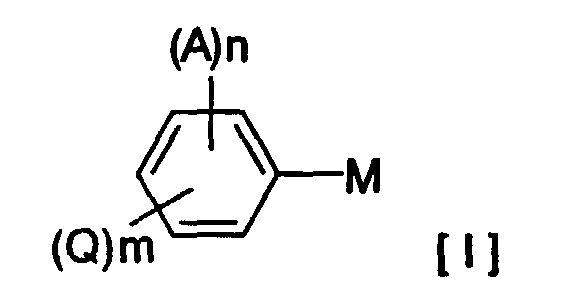
- The process according to claim 1, wherein the halide ion is a halide ion being a radioisotope.
- The process according to claim 1, wherein the halide ion is an iodide ion (I-), a bromide ion (Br-) or a chloride ion (Cl-).
- The process according to claim 1, wherein the semiconductor catalyst with a photocatalytic activity is at least one kind selected from the group consisting of titanium oxide (TiO2), strontium titanate (SrTiO3), tungsten oxide (WO3), bismuth oxide (Bi2O3), zirconium oxide (ZrO2), tin oxide (SnO2), zinc oxide (ZnO) and zinc sulfide (ZnS).
- The process according to claim 1, wherein the reaction is carried out further in the presence of a silver ion.
Applications Claiming Priority (2)
| Application Number | Priority Date | Filing Date | Title |
|---|---|---|---|
| JP19030699 | 1999-07-05 | ||
| JP19030699 | 1999-07-05 |
Publications (3)
| Publication Number | Publication Date |
|---|---|
| EP1067103A2 true EP1067103A2 (en) | 2001-01-10 |
| EP1067103A3 EP1067103A3 (en) | 2001-04-18 |
| EP1067103B1 EP1067103B1 (en) | 2003-03-12 |
Family
ID=16255975
Family Applications (1)
| Application Number | Title | Priority Date | Filing Date |
|---|---|---|---|
| EP00305585A Expired - Lifetime EP1067103B1 (en) | 1999-07-05 | 2000-07-03 | Process for producing halogenated benzene compound |
Country Status (3)
| Country | Link |
|---|---|
| US (1) | US6307045B1 (en) |
| EP (1) | EP1067103B1 (en) |
| DE (1) | DE60001602T2 (en) |
Cited By (1)
| Publication number | Priority date | Publication date | Assignee | Title |
|---|---|---|---|---|
| CN102698787A (en) * | 2012-06-06 | 2012-10-03 | 哈尔滨工业大学 | Synthesis method of CN/SrTiO3 composite photocatalysts |
Families Citing this family (1)
| Publication number | Priority date | Publication date | Assignee | Title |
|---|---|---|---|---|
| CN109438247B (en) * | 2018-11-27 | 2021-04-06 | 浙江工业大学上虞研究院有限公司 | Method for preparing dinitrobenzene by continuously nitrifying benzene |
Family Cites Families (6)
| Publication number | Priority date | Publication date | Assignee | Title |
|---|---|---|---|---|
| US4450149A (en) | 1981-06-15 | 1984-05-22 | Research Corporation | Radiohalogenation method |
| US4942231A (en) * | 1984-05-24 | 1990-07-17 | Mallinckrodt, Inc. | Method of preparing a chlorinated, brominated, radio-brominated, iodinated and/or radioiodinated aromatic or heteroaromatic compound |
| US5045303A (en) * | 1985-05-17 | 1991-09-03 | Neorx Corporation | Radiohalogenated small molecules for protein labeling |
| US4735792A (en) * | 1987-04-28 | 1988-04-05 | The United States Of America As Represented By The United States Department Of Energy | Radioiodinated maleimides and use as agents for radiolabeling antibodies |
| US5154913A (en) * | 1987-11-19 | 1992-10-13 | Vanderbilt University | Radioiodinated benzamines method of their use as radioimaging agents |
| AU5194798A (en) * | 1996-10-29 | 1998-05-22 | Guilford Pharmaceuticals Inc. | Process for the preparation of radiopharmaceuticals |
-
2000
- 2000-06-30 US US09/608,217 patent/US6307045B1/en not_active Expired - Lifetime
- 2000-07-03 DE DE60001602T patent/DE60001602T2/en not_active Expired - Lifetime
- 2000-07-03 EP EP00305585A patent/EP1067103B1/en not_active Expired - Lifetime
Cited By (1)
| Publication number | Priority date | Publication date | Assignee | Title |
|---|---|---|---|---|
| CN102698787A (en) * | 2012-06-06 | 2012-10-03 | 哈尔滨工业大学 | Synthesis method of CN/SrTiO3 composite photocatalysts |
Also Published As
| Publication number | Publication date |
|---|---|
| DE60001602D1 (en) | 2003-04-17 |
| EP1067103B1 (en) | 2003-03-12 |
| DE60001602T2 (en) | 2004-02-12 |
| EP1067103A3 (en) | 2001-04-18 |
| US6307045B1 (en) | 2001-10-23 |
Similar Documents
| Publication | Publication Date | Title |
|---|---|---|
| US4826672A (en) | Astatinated organic compounds | |
| EP0617043B1 (en) | Platinum compound and process of preparing same | |
| JP2013181028A (en) | Use of mixture obtained by irradiating halogenated hydrocarbon with light | |
| RU2412165C2 (en) | Isomerisation of pharmaceutical intermediates | |
| Keeffe et al. | Elimination reactions of N-[2-(p-nitrophenyl) ethyl] alkylammonium ions by an E1cB mechanism | |
| US5569782A (en) | Process for preparing polyfluorochlorocarbonyl chlorides and perfluorocarbonyl chlorides with addition of chlorine | |
| CA2629227C (en) | Precursor compound of radioactive halogen-labeled organic compound | |
| EP1067103B1 (en) | Process for producing halogenated benzene compound | |
| Farina et al. | A general route to 3-functionalized 3-norcephalosporins | |
| EP1308454B1 (en) | Process of preparing platinum compound | |
| Bordwell et al. | Steric and electrochemical effects on rates of electron transfer and SN2 reactions of 9-(dialkylamino) fluorenide ions with alkyl halides | |
| JP2002053582A (en) | Penicillin crystal and method for manufacturing the same | |
| Costanzo et al. | Photoreduction of cerium (IV) hexachloride in acetonitrile | |
| Taylor et al. | Coupling of aryl Grignard reagents by electron transfer to unsaturated 1, 4-dihalo compounds | |
| EP0801070A2 (en) | Process of preparing platinum compound | |
| Meyers et al. | Unexpected Differences in the α-Halogenation and Related Reactivity of Sulfones with Perhaloalkanes in KOH− t-BuOH | |
| JP2001072618A (en) | Method for producing halogenated benzene compound | |
| Horton et al. | Conversion of 2-Amino-2-deoxy-1-thio-D-glucose Derivatives into Glycosyl Halide Derivatives. A Tetra-O-acetylglycosylsulfenyl Bromide1 | |
| Ackerman et al. | Double-bond isomerization barrier in the 21Ag excited singlet state of cis, trans-1, 3, 5, 7-octatetraene | |
| US4739060A (en) | Radioactive and non-radioactive iodobutyrophenone derivative | |
| CN110804065B (en) | Method for preparing desoxytazobactam diphenylmethyl ester (M7) by using resin and new application of resin | |
| EP3782977A1 (en) | Cyclopropanation method and reagent | |
| JP3195959B2 (en) | Method for producing 3-hydroxycephem derivative | |
| Jarvis et al. | Reactions of. alpha.-azido sulfones with bases | |
| Wolfrom et al. | Glycosyl Halide Derivatives of 3-Amino-3-deoxy-D-mannose1 |
Legal Events
| Date | Code | Title | Description |
|---|---|---|---|
| PUAI | Public reference made under article 153(3) epc to a published international application that has entered the european phase |
Free format text: ORIGINAL CODE: 0009012 |
|
| AK | Designated contracting states |
Kind code of ref document: A2 Designated state(s): DE FR GB |
|
| AX | Request for extension of the european patent |
Free format text: AL;LT;LV;MK;RO;SI |
|
| PUAL | Search report despatched |
Free format text: ORIGINAL CODE: 0009013 |
|
| AK | Designated contracting states |
Kind code of ref document: A3 Designated state(s): AT BE CH CY DE DK ES FI FR GB GR IE IT LI LU MC NL PT SE |
|
| AX | Request for extension of the european patent |
Free format text: AL;LT;LV;MK;RO;SI |
|
| RIC1 | Information provided on ipc code assigned before grant |
Free format text: 7C 07B 39/00 A, 7C 07C 205/12 B, 7C 07C 41/22 B, 7C 07D 243/26 B, 7C 07B 59/00 B |
|
| 17P | Request for examination filed |
Effective date: 20010516 |
|
| AKX | Designation fees paid |
Free format text: DE FR GB |
|
| GRAG | Despatch of communication of intention to grant |
Free format text: ORIGINAL CODE: EPIDOS AGRA |
|
| 17Q | First examination report despatched |
Effective date: 20020516 |
|
| GRAG | Despatch of communication of intention to grant |
Free format text: ORIGINAL CODE: EPIDOS AGRA |
|
| GRAH | Despatch of communication of intention to grant a patent |
Free format text: ORIGINAL CODE: EPIDOS IGRA |
|
| GRAH | Despatch of communication of intention to grant a patent |
Free format text: ORIGINAL CODE: EPIDOS IGRA |
|
| GRAA | (expected) grant |
Free format text: ORIGINAL CODE: 0009210 |
|
| AK | Designated contracting states |
Designated state(s): DE FR GB |
|
| REG | Reference to a national code |
Ref country code: GB Ref legal event code: FG4D |
|
| REF | Corresponds to: |
Ref document number: 60001602 Country of ref document: DE Date of ref document: 20030417 Kind code of ref document: P |
|
| ET | Fr: translation filed | ||
| PLBE | No opposition filed within time limit |
Free format text: ORIGINAL CODE: 0009261 |
|
| STAA | Information on the status of an ep patent application or granted ep patent |
Free format text: STATUS: NO OPPOSITION FILED WITHIN TIME LIMIT |
|
| 26N | No opposition filed |
Effective date: 20031215 |
|
| PGFP | Annual fee paid to national office [announced via postgrant information from national office to epo] |
Ref country code: GB Payment date: 20120627 Year of fee payment: 13 |
|
| PGFP | Annual fee paid to national office [announced via postgrant information from national office to epo] |
Ref country code: FR Payment date: 20120719 Year of fee payment: 13 Ref country code: DE Payment date: 20120627 Year of fee payment: 13 |
|
| GBPC | Gb: european patent ceased through non-payment of renewal fee |
Effective date: 20130703 |
|
| REG | Reference to a national code |
Ref country code: DE Ref legal event code: R119 Ref document number: 60001602 Country of ref document: DE Effective date: 20140201 |
|
| REG | Reference to a national code |
Ref country code: FR Ref legal event code: ST Effective date: 20140331 |
|
| PG25 | Lapsed in a contracting state [announced via postgrant information from national office to epo] |
Ref country code: DE Free format text: LAPSE BECAUSE OF NON-PAYMENT OF DUE FEES Effective date: 20140201 Ref country code: GB Free format text: LAPSE BECAUSE OF NON-PAYMENT OF DUE FEES Effective date: 20130703 |
|
| PG25 | Lapsed in a contracting state [announced via postgrant information from national office to epo] |
Ref country code: FR Free format text: LAPSE BECAUSE OF NON-PAYMENT OF DUE FEES Effective date: 20130731 |