EP1065857A2 - Method for quick identification of special data packets - Google Patents
Method for quick identification of special data packets Download PDFInfo
- Publication number
- EP1065857A2 EP1065857A2 EP00304313A EP00304313A EP1065857A2 EP 1065857 A2 EP1065857 A2 EP 1065857A2 EP 00304313 A EP00304313 A EP 00304313A EP 00304313 A EP00304313 A EP 00304313A EP 1065857 A2 EP1065857 A2 EP 1065857A2
- Authority
- EP
- European Patent Office
- Prior art keywords
- data
- packet
- special
- data packet
- error detection
- Prior art date
- Legal status (The legal status is an assumption and is not a legal conclusion. Google has not performed a legal analysis and makes no representation as to the accuracy of the status listed.)
- Withdrawn
Links
Images


Classifications
-
- H—ELECTRICITY
- H04—ELECTRIC COMMUNICATION TECHNIQUE
- H04L—TRANSMISSION OF DIGITAL INFORMATION, e.g. TELEGRAPHIC COMMUNICATION
- H04L1/00—Arrangements for detecting or preventing errors in the information received
-
- H—ELECTRICITY
- H04—ELECTRIC COMMUNICATION TECHNIQUE
- H04L—TRANSMISSION OF DIGITAL INFORMATION, e.g. TELEGRAPHIC COMMUNICATION
- H04L9/00—Cryptographic mechanisms or cryptographic arrangements for secret or secure communications; Network security protocols
- H04L9/40—Network security protocols
-
- H—ELECTRICITY
- H04—ELECTRIC COMMUNICATION TECHNIQUE
- H04L—TRANSMISSION OF DIGITAL INFORMATION, e.g. TELEGRAPHIC COMMUNICATION
- H04L69/00—Network arrangements, protocols or services independent of the application payload and not provided for in the other groups of this subclass
- H04L69/22—Parsing or analysis of headers
-
- H—ELECTRICITY
- H04—ELECTRIC COMMUNICATION TECHNIQUE
- H04L—TRANSMISSION OF DIGITAL INFORMATION, e.g. TELEGRAPHIC COMMUNICATION
- H04L69/00—Network arrangements, protocols or services independent of the application payload and not provided for in the other groups of this subclass
- H04L69/30—Definitions, standards or architectural aspects of layered protocol stacks
- H04L69/32—Architecture of open systems interconnection [OSI] 7-layer type protocol stacks, e.g. the interfaces between the data link level and the physical level
- H04L69/322—Intralayer communication protocols among peer entities or protocol data unit [PDU] definitions
- H04L69/324—Intralayer communication protocols among peer entities or protocol data unit [PDU] definitions in the data link layer [OSI layer 2], e.g. HDLC
Definitions
- This invention relates to data transmission systems comprising a number of nodes connected by means of a communication medium which transmits packet-formatted, serial data among the nodes. More specifically, the invention relates to tagging, and then rapidly identifying, certain special data packets.
- a common method for transmitting serial data in such networks is to form data "packets".
- Each packet contains fields such as source address, destination address, size of the packet, error detection data, and the actual information to be carried.
- a packet is launched onto the network, and various routers and hubs insure that it is delivered to its destination(s).
- the form of a packet is determined by agreed-on rules called protocols.
- protocol stack usually a combination of hardware and software which transforms the data into the appropriate form.
- packet protocols require adding a checksum or similar data whose purpose is to allow the detection of errors which might occur during packet travel.
- a node which receives a packet, uses an inverse protocol stack to extract the data contained therein. The receiving process usually includes checking the packet for those possible errors.
- Serial data transmission networks commonly transport data packets formed according to the rules of a particular protocol.
- special packets such as event trigger signals
- the invention disclosed herein provides methods for creating and also rapidly identifying special packets.
- the invention can be implemented with relatively simple and, hence, small and inexpensive hardware.
- the methods make use of the fact that protocols for data packet communication almost always include a procedure for checking a received packet to determine whether it has suffered errors in transmission.
- a transmitting node When transmitting a special packet according to the invention, a transmitting node "tags" the packet by modifying the data content - such as by "bit stuffing" (adding data) - so that the error checking algorithm produces a specified sequence. A receiving node will then look for that sequence in order to identify the special, tagged packet. Because the error detection circuitry examines the incoming data almost without delay as it arrives, a special packet can be instantly identified by its error detection sequence. Since error detection circuitry is already in place in the receiver, only a small additional amount of circuitry is needed for identifying a special packet. This additional circuitry may be further simplified if the specified sequence consists of all zeros or all ones, as these sequences may be detected with simple gates without the need for storing a copy of an arbitrary special sequence.
- a subset of the packet may be selected for generating the desired sequence.
- An example of the usefulness of this alternative is the case in which a layer of the protocol might add field(s) to the packet which would not be visible to the error detection system.
- Fig. 1 is a simplified illustration of a typical distributed network for intercommunicating among 10 nodes.
- This network is organized in two groups of nodes: nodes 1-4 and nodes 5-10.
- Each group has a central hub with individual links L to each node.
- Hub 1 thus connects with nodes 1-4
- hub 2 connects with nodes 5-10
- L' interconnects the hubs themselves.
- These hubs are simply repeaters. That is, when a hub receives an incoming signal on any of the lines L or L', it sends out a replica of that signal on every other line connected with it. For instance, if a signal originates in node 8, it travels to hub 2, which repeats it to the other 5 nodes connected directly to it and also sends it across L' to hub 1. From hub 1, the signal reaches nodes 1-4 in the same manner. Thus a signal originated by any node is communicated to all nodes.
- Fig. 1 is intended to illustrate "packet" data communication. That is, in order for a node to be able to send data to any other node, the data to be transmitted between them is organized in a serial grouping called a packet.
- the serial grouping is defined by a set of rules called a protocol.
- a packet combines an origination address, a destination address, and the size of the data block, the data block itself, and information called a checksum. The checksum is included to provide a means for the receiving node to detect whether a packet suffered errors during transmission.
- each node Since all nodes are exposed to all traffic on the network, it is necessary for each node at least to examine the destination address of every packet. When a node discovers its own address in the destination field of a packet, the node completes the receiving protocol and extracts the data. Otherwise, it ignores the packet and continues monitoring the network.
- Such special packets include time synchronizing packets and trigger packets for initiating simultaneous response from a number of nodes. It is evident that processing such a packet with the full receiving protocol, in order to recognize the special nature of the packet from the data therein, could result in an unacceptable time delay. And, in general, this delay would be variable, because the protocol processing time is likely to be data dependent and to include other uncontrolled intervals such as microprocessor interrupt latencies.
- this time delay is avoided, and nearly instant recognition of special packets is achieved through manipulation of the error detection method defined by the protocol. This result is achieved without weakening or compromising the primary function of the error detection.
- a widely used protocol - IEEE Standard 802.3, also known as Ethernet - is used for organizing data packets.
- Fig. 2 illustrates the content of an Ethernet packet.
- the packet is transmitted serially, with the preamble bits arriving first.
- the PREAMBLE field - alternating ones and zeros - is for synchronizing the data clock at the receiving node, while the START-OF-FRAME defines precisely where information starts.
- the DATA PADDING field can be used if the amount of data to be sent is less than the specified minimum.
- the CHECKSUM field contains the results of an algorithmic process performed on the rest of the packet, and allows a receiver, by duplicating the process, to determine whether the data has been corrupted in transmission.
- the checksum is a "cyclic redundancy code" or CRC.
- a receiving node examines the destination address of an incoming packet to determine whether the address is valid: either its own or one of a (small) number of broadcast or multicast addresses. Fast hardware performs this comparison. If the address is valid, the hardware shifts the entire serial packet into the protocol stack for processing. While it is moving, additional hardware applies the Ethernet error-detection algorithm to the packet. The algorithm's computed checksum is compared with the checksum field. If there is a mismatch, an error-handling routine is invoked. Otherwise, the protocol stack begins processing the packet's contents.
- the disclosed invention tags the packet by adding bits to the data and/or data padding fields so that the modified packet causes the error-detection algorithm to generate a specific, predetermined checksum.
- the disclosed invention uses hardware to compare the predetermined value with the computed checksum (or, equivalently, with the incoming checksum field). When such comparison is made, appropriate action is taken immediately, such as logging the arrival time, sending a trigger signal, etc.
- any 32 bit pattern can be defined as the specific, predetermined checksum, in practice it is simpler to use 32 ones or zeros, as this eliminates the need to store an arbitrary pattern for comparison with the checksum. Such comparison can thus be made with gates alone.
- the CRC value is computed by dividing the packet bits by a specified 32 nd order (33-bit) word, and defining the remainder from the division to be the CRC.
- the computation does not use conventional binary arithmetic, but "binary arithmetic, modulo 2, with no carries". Details of this may be found in Tanenbaum, "Computer Networks", ISBN 0131646990, and particularly pages 128-132. In this arithmetic, both addition and subtraction are equivalent to the exclusive-OR (XOR) operation.
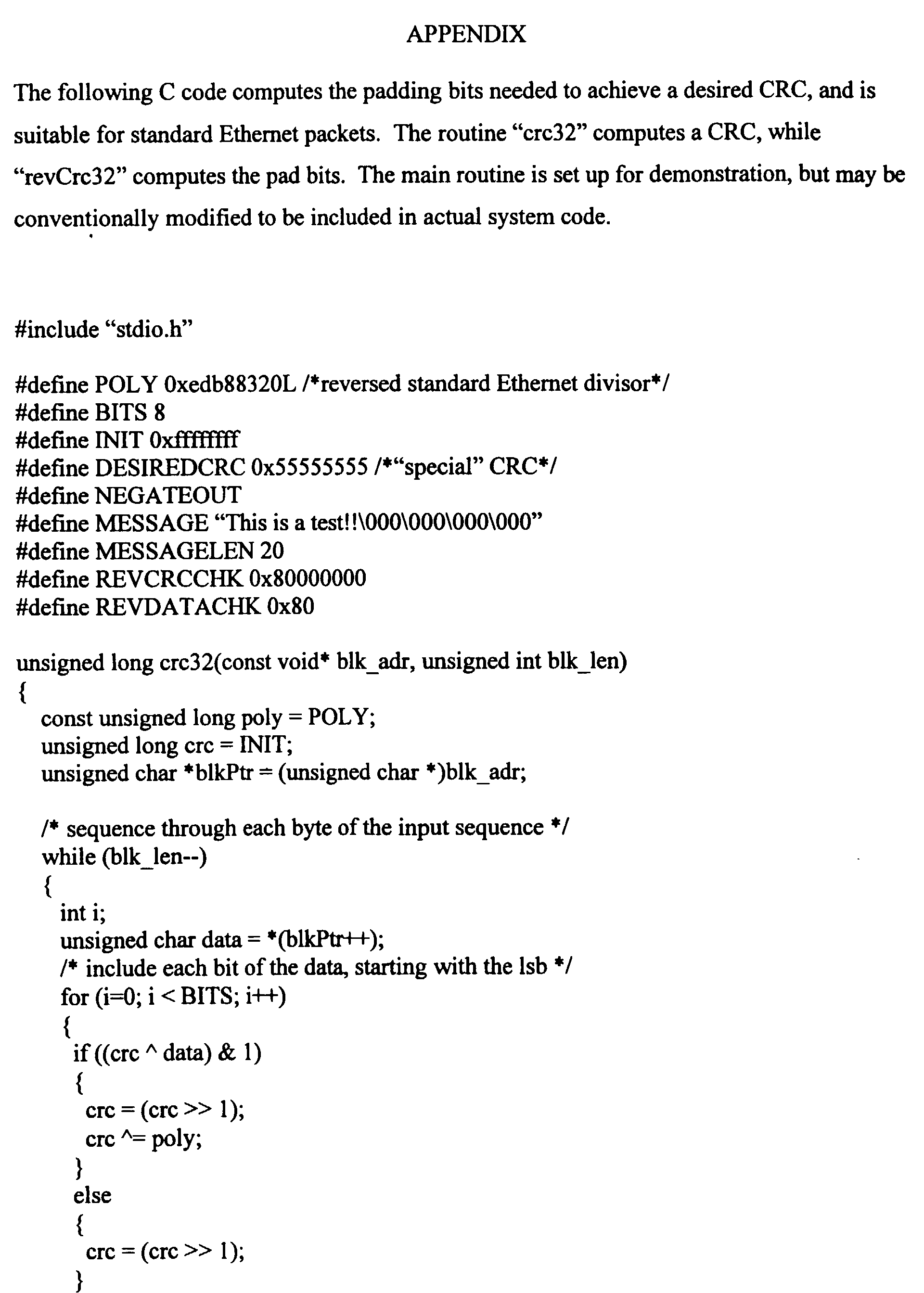
- An appendix to this disclosure contains C-language code which performs the operation of adding padding bits to a data stream in order to achieve a predetermined CRC.
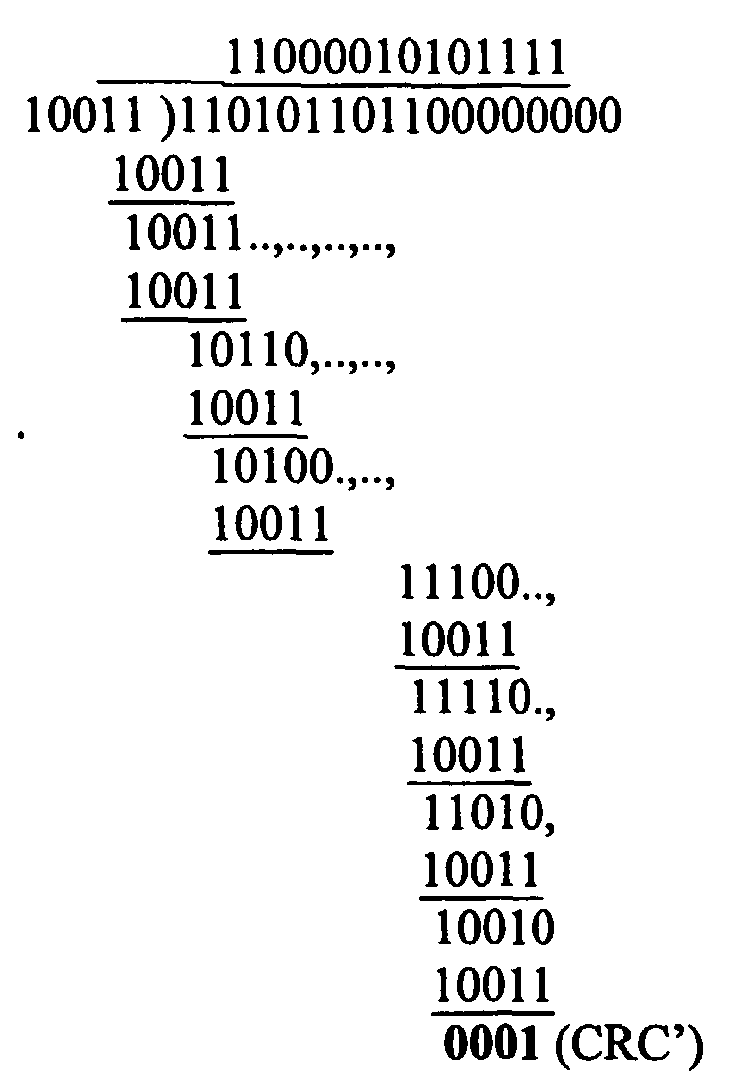
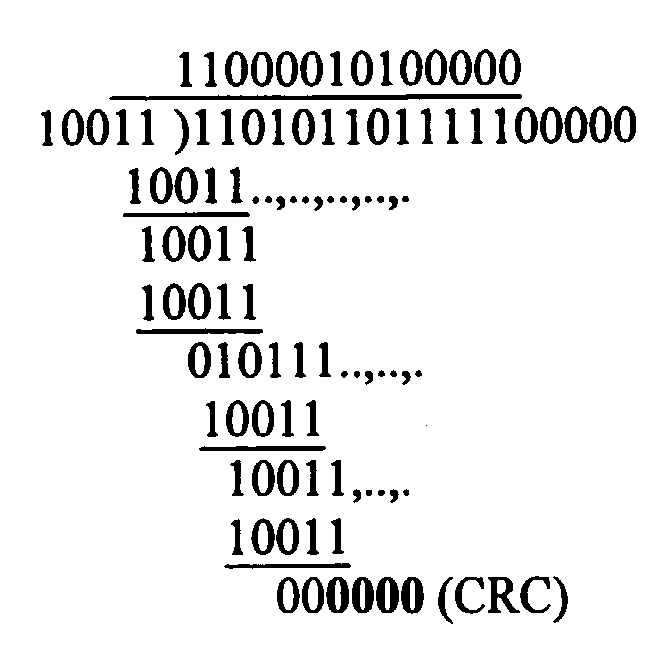
- the following example illustrates the CRC-modifying methods of the disclosed invention, but uses much smaller packet and divisor sequences than those of a typical Ethernet packet, in order for the illustration to be readable.
- the CRC value 1110 is appended to the packet and the transmitted sequence is 11010110111110.
- an intermediate CRC' is generated by adding 4 zeros to the original packet to allow space for the padding bits which will result from the modification.
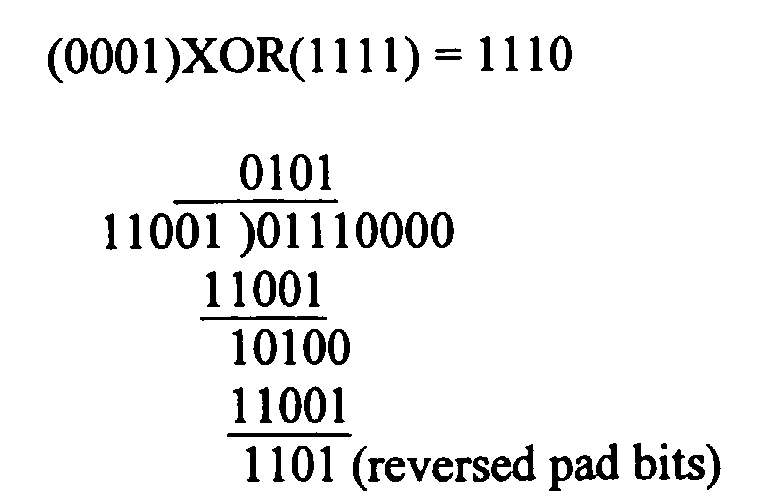
- the padding bits are computed by bit-reversing this sum, adding 4 zeros, and dividing by the bit-reversed divisor:
- bit-reversed result 1010 is then added to the original sequence, and the transmitted sequence is 110101101110101100.
- Ethernet network protocol is exemplified in the disclosed embodiment, it is clear that the principles of the invention will apply to any packet protocol. For instance, in a simple checksum consisting of the sum (or modulo sum) of blocks of bits, additional bits may be added to the data block in order to force the checksum to a desired value. Thus, the detailed description is intended to illustrate the invention, the scope of which is to be determined by the appended claims and equivalents.
Landscapes
- Engineering & Computer Science (AREA)
- Computer Security & Cryptography (AREA)
- Computer Networks & Wireless Communication (AREA)
- Signal Processing (AREA)
- Detection And Prevention Of Errors In Transmission (AREA)
- Communication Control (AREA)
- Data Exchanges In Wide-Area Networks (AREA)
- Small-Scale Networks (AREA)
- Synchronisation In Digital Transmission Systems (AREA)
Abstract
Description

(0001)XOR(1100) = 1101


(0001)XOR(0000) = 0001




Claims (8)
- In a data transmission system for transporting data packets created according to a defined data protocol for processing data, the protocol includinga method for tagging a special data packet, comprising the steps of:a) a process for computing an error detection code to be included in a packet transported by the system andb) a process for detecting possible errors in the packet by utilizing such error detection code,1) examining the special data packet without the error detection code;2) determining, from the examining step, additional data to be included with the special data packet in order to cause the error detection process to compute a predetermined sequence of error detection code; and3) modifying the special data packet by including the additional data determined by the determining step.
- A method for tagging a special data packet, as recited in claim 1, in which the predetermined sequence is composed of identical symbols.
- In a data transmission system for transporting data packets created according to a defined data protocol for processing data, the protocol includinga method for detecting a special data packet, comprising the steps of:a) a process for computing an error detection code to be included in a packet transported by the system andb) a process for detecting possible errors in the packet by utilizing such error detection code,1) identifying, by reference to the data protocol, error detection code associated with a data packet;2) comparing the error detection code with a predetermined sequence; and3) determining the data packet to be a special tagged data packet when the comparing step results in a match.
- A method for tagging a special data packet, as recited in claim 3, in which the predetermined sequence is composed of identical symbols.
- In a data transmission system for transporting data packets created according to a defined data protocol for processing data, a method for tagging a special data packet, comprising the steps of:1) defining a subset of data within the special data packet, excluding any error correcting code contained in the packet;2) by utilizing a suitable algorithm for generating a code sequence as a function of the data subset, determining what additional data which, when added to the subset, causes the algorithm to generate a predetermined code sequence; and3) adding the additional data to the data packet.
- A method for tagging a special data packet, as recited in claim 5, in which the predetermined sequence is composed of identical symbols.
- In a data transmission system for transporting data packets created according to a defined data protocol for processing data, a method for detecting a special data packet, comprising the steps of:1) identifying a predefined subset of data within a trial data packet;2) generating a code sequence as a function of the subset by utilizing a suitable algorithm;3) comparing the generated code sequence with a predetermined sequence; and4) identifying the trial data packet as a special data packet when the comparing step results in a match.
- A method for detecting a special data packet, as recited in claim 7, in which the predetermined sequence is composed of identical symbols.
Applications Claiming Priority (2)
| Application Number | Priority Date | Filing Date | Title |
|---|---|---|---|
| US320200 | 1989-03-07 | ||
| US09/320,200 US7180851B1 (en) | 1999-06-24 | 1999-06-24 | Method for quick identification of special data packets |
Publications (2)
| Publication Number | Publication Date |
|---|---|
| EP1065857A2 true EP1065857A2 (en) | 2001-01-03 |
| EP1065857A3 EP1065857A3 (en) | 2003-04-02 |
Family
ID=23245330
Family Applications (1)
| Application Number | Title | Priority Date | Filing Date |
|---|---|---|---|
| EP00304313A Withdrawn EP1065857A3 (en) | 1999-05-26 | 2000-05-22 | Method for quick identification of special data packets |
Country Status (3)
| Country | Link |
|---|---|
| US (1) | US7180851B1 (en) |
| EP (1) | EP1065857A3 (en) |
| JP (1) | JP3439722B2 (en) |
Cited By (2)
| Publication number | Priority date | Publication date | Assignee | Title |
|---|---|---|---|---|
| US8818815B2 (en) | 2004-07-27 | 2014-08-26 | British Telecommunications | Method and system for packetised content streaming optimisation |
| CN106899605A (en) * | 2017-03-15 | 2017-06-27 | 东软集团股份有限公司 | Communication means and device based on STOMP agreements |
Families Citing this family (5)
| Publication number | Priority date | Publication date | Assignee | Title |
|---|---|---|---|---|
| JP4074992B2 (en) * | 2003-03-26 | 2008-04-16 | 富士通株式会社 | Transmission control device |
| FI120175B (en) * | 2006-10-27 | 2009-07-15 | Tellabs Oy | Transmission of digital information in a data transmission network with frame transmission |
| JP2013029939A (en) * | 2011-07-27 | 2013-02-07 | Kyocera Document Solutions Inc | Control device |
| US20140075170A1 (en) * | 2012-09-12 | 2014-03-13 | International Business Machines Corporation | Automated firmware voting to enable multi-enclosure federated systems |
| DE102015209201A1 (en) * | 2014-09-03 | 2016-03-03 | Robert Bosch Gmbh | Method for the serial transmission of a frame via a bus system from a transmitter to at least one receiver and subscriber station for a bus system |
Family Cites Families (4)
| Publication number | Priority date | Publication date | Assignee | Title |
|---|---|---|---|---|
| JPS5866448A (en) * | 1981-10-16 | 1983-04-20 | Hitachi Ltd | Error detecting system for exchange of packet |
| US5479654A (en) * | 1990-04-26 | 1995-12-26 | Squibb Data Systems, Inc. | Apparatus and method for reconstructing a file from a difference signature and an original file |
| EP0602806B1 (en) * | 1992-12-18 | 2001-07-04 | Advanced Micro Devices, Inc. | High-level data link controller (HDLC) receiver |
| WO1995019003A1 (en) * | 1994-01-03 | 1995-07-13 | Norton-Lambert Corp. | File transfer method and apparatus using hash numbers |
-
1999
- 1999-06-24 US US09/320,200 patent/US7180851B1/en not_active Expired - Lifetime
-
2000
- 2000-05-22 EP EP00304313A patent/EP1065857A3/en not_active Withdrawn
- 2000-05-26 JP JP2000156300A patent/JP3439722B2/en not_active Expired - Lifetime
Cited By (3)
| Publication number | Priority date | Publication date | Assignee | Title |
|---|---|---|---|---|
| US8818815B2 (en) | 2004-07-27 | 2014-08-26 | British Telecommunications | Method and system for packetised content streaming optimisation |
| CN106899605A (en) * | 2017-03-15 | 2017-06-27 | 东软集团股份有限公司 | Communication means and device based on STOMP agreements |
| CN106899605B (en) * | 2017-03-15 | 2020-03-20 | 东软集团股份有限公司 | Communication method and device based on STOMP protocol |
Also Published As
| Publication number | Publication date |
|---|---|
| EP1065857A3 (en) | 2003-04-02 |
| JP3439722B2 (en) | 2003-08-25 |
| US7180851B1 (en) | 2007-02-20 |
| JP2001007860A (en) | 2001-01-12 |
Similar Documents
| Publication | Publication Date | Title |
|---|---|---|
| US6167515A (en) | Method and system for performing the transmission of private data over a public network | |
| US6542510B1 (en) | Network communication system | |
| US5128945A (en) | Packet framing using cyclic redundancy checking | |
| US6804257B1 (en) | System and method for framing and protecting variable-lenght packet streams | |
| US8443101B1 (en) | Method for identifying and blocking embedded communications | |
| US4566098A (en) | Control mechanism for a ring communication system | |
| US5003533A (en) | Node processing system | |
| WO2002035761A3 (en) | Method for superimposing a sequence number in an error detection code (crc) in a data network | |
| EP0823161B1 (en) | Method and apparatus for detection of errors in multiple-word communications | |
| US8391485B2 (en) | Stealth message transmission in a network | |
| US20040100964A1 (en) | System and method for detecting lost messages transmitted between modules in a communication device | |
| US6546025B1 (en) | Method and device for transmitting data frames | |
| US20040098655A1 (en) | Rolling CRC scheme for improved error detection | |
| CN104717105B (en) | A kind of industrial sensor network Data duplication detection method based on ISA100.11a standards | |
| WO2018059436A1 (en) | Error code detection method, device and system and computer-readable storage medium | |
| US20110173520A1 (en) | Systems and methods for routing data in a network device | |
| US6732317B1 (en) | Apparatus and method for applying multiple CRC generators to CRC calculation | |
| US7020809B2 (en) | System and method for utilizing spare bandwidth to provide data integrity over a bus | |
| US7180851B1 (en) | Method for quick identification of special data packets | |
| EP0360478B1 (en) | A packet switching architecture providing encryption across packets | |
| US7043022B1 (en) | Packet order determining method and apparatus | |
| KR20050086541A (en) | An improved communications protocol | |
| JP3270966B2 (en) | Error correction circuit | |
| CA1204189A (en) | Control mechanism for a ring communication system | |
| US4924460A (en) | Office control unit apparatus for use in a digital network |
Legal Events
| Date | Code | Title | Description |
|---|---|---|---|
| PUAI | Public reference made under article 153(3) epc to a published international application that has entered the european phase |
Free format text: ORIGINAL CODE: 0009012 |
|
| AK | Designated contracting states |
Kind code of ref document: A2 Designated state(s): AT BE CH CY DE DK ES FI FR GB GR IE IT LI LU MC NL PT SE |
|
| AX | Request for extension of the european patent |
Free format text: AL;LT;LV;MK;RO;SI |
|
| RAP1 | Party data changed (applicant data changed or rights of an application transferred) |
Owner name: HEWLETT-PACKARD COMPANY, A DELAWARE CORPORATION |
|
| RAP1 | Party data changed (applicant data changed or rights of an application transferred) |
Owner name: AGILENT TECHNOLOGIES, INC. (A DELAWARE CORPORATION |
|
| PUAL | Search report despatched |
Free format text: ORIGINAL CODE: 0009013 |
|
| AK | Designated contracting states |
Kind code of ref document: A3 Designated state(s): AT BE CH CY DE DK ES FI FR GB GR IE IT LI LU MC NL PT SE Designated state(s): AT BE CH CY DE DK ES FI FR GB GR IE IT LI LU MC NL PT SE |
|
| AX | Request for extension of the european patent |
Extension state: AL LT LV MK RO SI |
|
| RIC1 | Information provided on ipc code assigned before grant |
Ipc: 7H 04L 29/06 B Ipc: 7H 04L 1/00 B Ipc: 7H 04L 29/00 A |
|
| 17P | Request for examination filed |
Effective date: 20030603 |
|
| AKX | Designation fees paid |
Designated state(s): DE FR GB |
|
| RAP1 | Party data changed (applicant data changed or rights of an application transferred) |
Owner name: AGILENT TECHNOLOGIES, INC. |
|
| 17Q | First examination report despatched |
Effective date: 20070315 |
|
| STAA | Information on the status of an ep patent application or granted ep patent |
Free format text: STATUS: THE APPLICATION IS DEEMED TO BE WITHDRAWN |
|
| 18D | Application deemed to be withdrawn |
Effective date: 20090708 |