EP1065229A2 - Process for preparing urethane compound for medical instruments - Google Patents

Process for preparing urethane compound for medical instruments Download PDF

Info

Publication number
EP1065229A2
EP1065229A2 EP00113822A EP00113822A EP1065229A2 EP 1065229 A2 EP1065229 A2 EP 1065229A2 EP 00113822 A EP00113822 A EP 00113822A EP 00113822 A EP00113822 A EP 00113822A EP 1065229 A2 EP1065229 A2 EP 1065229A2
Authority
EP
European Patent Office
Prior art keywords
compound
urethane
hydroxyl
carbon atoms
group
Prior art date
Legal status (The legal status is an assumption and is not a legal conclusion. Google has not performed a legal analysis and makes no representation as to the accuracy of the status listed.)
Granted
Application number
EP00113822A
Other languages
German (de)
French (fr)
Other versions
EP1065229A3 (en
EP1065229B1 (en
Inventor
Tsuyoshi Watanabe
Eri Ito
Sadayasu Tanikawa
Shoji Ichinohe
Toshio Yamazaki
Current Assignee (The listed assignees may be inaccurate. Google has not performed a legal analysis and makes no representation or warranty as to the accuracy of the list.)
Menicon Co Ltd
Original Assignee
Menicon Co Ltd
Priority date (The priority date is an assumption and is not a legal conclusion. Google has not performed a legal analysis and makes no representation as to the accuracy of the date listed.)
Filing date
Publication date
Application filed by Menicon Co Ltd filed Critical Menicon Co Ltd
Publication of EP1065229A2 publication Critical patent/EP1065229A2/en
Publication of EP1065229A3 publication Critical patent/EP1065229A3/en
Application granted granted Critical
Publication of EP1065229B1 publication Critical patent/EP1065229B1/en
Anticipated expiration legal-status Critical
Expired - Lifetime legal-status Critical Current

Links

Classifications

    • CCHEMISTRY; METALLURGY
    • C08ORGANIC MACROMOLECULAR COMPOUNDS; THEIR PREPARATION OR CHEMICAL WORKING-UP; COMPOSITIONS BASED THEREON
    • C08GMACROMOLECULAR COMPOUNDS OBTAINED OTHERWISE THAN BY REACTIONS ONLY INVOLVING UNSATURATED CARBON-TO-CARBON BONDS
    • C08G18/00Polymeric products of isocyanates or isothiocyanates
    • C08G18/06Polymeric products of isocyanates or isothiocyanates with compounds having active hydrogen
    • C08G18/70Polymeric products of isocyanates or isothiocyanates with compounds having active hydrogen characterised by the isocyanates or isothiocyanates used
    • C08G18/81Unsaturated isocyanates or isothiocyanates
    • C08G18/8141Unsaturated isocyanates or isothiocyanates masked
    • C08G18/815Polyisocyanates or polyisothiocyanates masked with unsaturated compounds having active hydrogen
    • C08G18/8158Polyisocyanates or polyisothiocyanates masked with unsaturated compounds having active hydrogen with unsaturated compounds having only one group containing active hydrogen
    • C08G18/8175Polyisocyanates or polyisothiocyanates masked with unsaturated compounds having active hydrogen with unsaturated compounds having only one group containing active hydrogen with esters of acrylic or alkylacrylic acid having only one group containing active hydrogen
    • CCHEMISTRY; METALLURGY
    • C08ORGANIC MACROMOLECULAR COMPOUNDS; THEIR PREPARATION OR CHEMICAL WORKING-UP; COMPOSITIONS BASED THEREON
    • C08GMACROMOLECULAR COMPOUNDS OBTAINED OTHERWISE THAN BY REACTIONS ONLY INVOLVING UNSATURATED CARBON-TO-CARBON BONDS
    • C08G18/00Polymeric products of isocyanates or isothiocyanates
    • C08G18/06Polymeric products of isocyanates or isothiocyanates with compounds having active hydrogen
    • C08G18/08Processes
    • C08G18/16Catalysts
    • C08G18/18Catalysts containing secondary or tertiary amines or salts thereof
    • C08G18/20Heterocyclic amines; Salts thereof
    • C08G18/2045Heterocyclic amines; Salts thereof containing condensed heterocyclic rings
    • C08G18/2063Heterocyclic amines; Salts thereof containing condensed heterocyclic rings having two nitrogen atoms in the condensed ring system
    • CCHEMISTRY; METALLURGY
    • C08ORGANIC MACROMOLECULAR COMPOUNDS; THEIR PREPARATION OR CHEMICAL WORKING-UP; COMPOSITIONS BASED THEREON
    • C08GMACROMOLECULAR COMPOUNDS OBTAINED OTHERWISE THAN BY REACTIONS ONLY INVOLVING UNSATURATED CARBON-TO-CARBON BONDS
    • C08G18/00Polymeric products of isocyanates or isothiocyanates
    • C08G18/06Polymeric products of isocyanates or isothiocyanates with compounds having active hydrogen
    • C08G18/08Processes
    • C08G18/16Catalysts
    • C08G18/22Catalysts containing metal compounds
    • C08G18/222Catalysts containing metal compounds metal compounds not provided for in groups C08G18/225 - C08G18/26
    • CCHEMISTRY; METALLURGY
    • C08ORGANIC MACROMOLECULAR COMPOUNDS; THEIR PREPARATION OR CHEMICAL WORKING-UP; COMPOSITIONS BASED THEREON
    • C08GMACROMOLECULAR COMPOUNDS OBTAINED OTHERWISE THAN BY REACTIONS ONLY INVOLVING UNSATURATED CARBON-TO-CARBON BONDS
    • C08G18/00Polymeric products of isocyanates or isothiocyanates
    • C08G18/06Polymeric products of isocyanates or isothiocyanates with compounds having active hydrogen
    • C08G18/28Polymeric products of isocyanates or isothiocyanates with compounds having active hydrogen characterised by the compounds used containing active hydrogen
    • C08G18/67Unsaturated compounds having active hydrogen
    • C08G18/671Unsaturated compounds having only one group containing active hydrogen
    • C08G18/672Esters of acrylic or alkyl acrylic acid having only one group containing active hydrogen

Definitions

  • the present invention relates to a process for preparing an urethane compound for medical instruments. More particularly, the present invention relates to a process for easily preparing an urethane compound (macromonomer) showing high safety, which is very useful for a material of medical instruments represented by optical materials such as a contact lens material and an intraocular lens material. Furthermore, the present invention relates to a process for preparing an urethane compound while molecular weight of the compound is controlled.
  • urethane compounds such as urethane foam, urethane rubber, adhesives and polyurethane synthetic fiber are industrially used.
  • hydroxyl group is reacted with isocyanate group to form urethane bond.
  • the organic metal compounds are generally used.
  • an organic tin compound is well known.
  • the organic tin compound which is generally known as a compound showing high toxicity must not be used as a catalyst for preparation of urethane materials when the urethane materials are applied for medical instruments which are used in living organism or by contacting with living organism.
  • the organic tin compound is recognized as a distraction substance for endocrine (environmental hormone) which is recently topical substance. Accordingly, some catalysts other than organic tin compounds are earnestly necessitated.
  • urethane bond-containing siloxane compounds have been examined for the use as medical instruments, in particular, optical materials such as a contact lens material and an intraocular lens material (Japanese Unexamined Patent Publication No. 22487/1979, Japanese Unexamined Patent Publication No. 121826/1994, USP 5,451,617 and the like).
  • optical materials such as a contact lens material and an intraocular lens material
  • Japanese Unexamined Patent Publication No. 121826/1994, USP 5,451,617 and the like Japanese Unexamined Patent Publication No. 121826/1994, USP 5,451,617 and the like.
  • the siloxane compounds disclosed in these references are prepared by using the organic tin compounds almost, these siloxane compounds are not suitable as medical materials on the basis of the above reasons. Even if purification of the siloxane compound is carried out, the organic tin compounds remain within the siloxane compound.
  • the above urethane bond-containing siloxane compounds have been prepared by finally introducing a polymerizing group in a polyfunctional polysiloxane which is a main chain through urethane bond (Japanese Unexamined Patent Publication No. 179217/1986, Japanese Unexamined Patent Publication No. 35014/1991 and the like).
  • Japanese Unexamined Patent Publication No. 179217/1986 Japanese Unexamined Patent Publication No. 35014/1991 and the like.
  • this method it is inevitable that the polymerizing group is inestimably and repeatedly introduced in the polyfunctional polysiloxane which is a main chain through urethane bond.
  • molecular weight of the obtained siloxane compound becomes higher than planned molecular weight. Accordingly, there is a problem that clear understanding for structure of the obtained compound is difficult.
  • the above siloxane compound becomes high viscous solution according to its molecular weight or kind of reaction components, effective purification methods for the siloxane compound are not developed. So, it is very difficult to remove impurities such as the above catalyst and by-products, and crude siloxane compound is used. Accordingly, the use of the siloxane compounds has been feared from the viewpoint of safety, including the above problems.
  • An object of the present invention is to provide a process for easily preparing an urethane compound, in particular, while molecular weight of the compound is controlled, in the absence of a catalyst or in the presence of a catalyst showing lower toxicity instead of the conventional organic tin compounds.
  • the hydroxyl compound (A) is reacted with the isocyanate compound (B) to give an urethane compound (I) in the absence of the catalyst or in the presence of the reaction catalyst other than the organic tin compound in order to more accelerate this reaction.
  • reaction catalyst is an organic iron compound and an amine compound because of excellent safety.
  • Examples of the above organic iron compound are, for instance, iron(III) acetylacetonate and the like.
  • the organic iron compound is particularly preferable.
  • the above compound (I) is prepared by, for instance, the following two-step urethane reactions (i) and (ii).
  • Typical examples of the dihydroxyl compound (A-2) are, for instance, a hydroxyl group-containing polysiloxane compound represented by the formula (I): wherein each of R 1 and R 2 is independently an alkylene group having 1 to 20 carbon atoms, each of R 3 , R 4 , R 5 , R 6 , R 7 and R 8 is independently a linear alkyl group having 1 to 20 carbon atoms, a branched alkyl group having 3 to 20 carbon atoms or a cyclic alkyl group having 3 to 20 carbon atoms, which may be substituted with fluorine atom, x is an integer of 1 to 1500, y is an integer of 1 to 1499, and "x+y" is an integer of 1 to 1500; and the like.
  • formula (I) wherein each of R 1 and R 2 is independently an alkylene group having 1 to 20 carbon atoms, each of R 3 , R 4 , R 5 , R 6 , R 7 and R 8 is independently a linear al
  • R 10 is a linear aliphatic hydrocarbon group having 1 to 20 carbon atoms, a branched hydrocarbon group having 2 to 20 carbon atoms, a cyclic aliphatic hydrocarbon group having 3 to 20 carbon atoms or an aromatic hydrocarbon group having 6 to 20 carbon atoms; and the like.
  • R 10 is preferably a linear aliphatic hydrocarbon group having 1 to 12 carbon atoms, a branched hydrocarbon group having 2 to 12 carbon atoms, a cyclic aliphatic hydrocarbon group having 3 to 12 carbon atoms or an aromatic hydrocarbon group having 6 to 12 carbon atoms.
  • diisocyanate compound (B-2) are, for instance, ethylenediisocyanate, isophoronediisocyanate, 1,6-hexamethylenediisocyanate, 1,2-toluenediisocyanate, 1,4-toluenediisocyanate, xylylenediisocyanate, bis(2-isocyanatethyl) fumarate, 1,5-naphthalenediisocyanate, cyclohexyl-1,4-diisocyanate, 4,4'-dicyclohexylmethanediisocyanate, diphenylmethane-4,4'-diisocyanate, 2,2,4-(2,4,4)-trimethylhexane-1,6-diisocyanate and the like.
  • the ratio of the dihydroxyl compound (A-2) to the diisocyanate compound (B-2) in the urethane reaction (i) considerably effects for the amount of prepared by-products, the amount of residual non-reacted compounds, and molecular weight and molecular weight distribution of the aimed urethane compound.
  • the total amount of hydroxyl group in the dihydroxyl compound (A-2) based on 1 mole of isocyanate group in the diisocyanate compound (B-2) is at least 0.4 mole, preferably at least 0.6 mole, more preferably at least 0.8 mole.
  • the total amount of hydroxyl group in the dihydroxyl compound (A-2) based on 1 mole of isocyanate group in the diisocyanate compound (B-2) is at most 2 moles, preferably at most 1.5 moles, more preferably at most 1.25 moles.
  • the amount of the dihydroxyl compound (A-2) and the diisocyanate compound (B-2) is adjusted within the above range. Then, these compounds are reacted by stirring and mixing with each other.
  • reaction temperature and reaction time are not particularly limited and suitably adjusted according to kind and combination of each compound.
  • reaction time is at least 1 minute, preferably at least 30 minutes, and reaction temperature is at least -30°C, preferably at least 0 °C.
  • reaction time is at most 100 hours, preferably at most 50 hours, and reaction temperature is at most 150 °C, preferably at most 100 °C.
  • the monohydroxyl compound (A-1) to be reacted with the compound having isocyanate groups in its both ends is not limited to one member. At least two members of the monohydroxyl compounds (A-1) can be suitably used.
  • the monoisocyanate compound (B-1) to be reacted with the compound having hydroxyl groups in its both ends is not limited to one member. At least two members of the monoisocyanate compounds (B-1) can be suitably used.
  • the compound (I) obtained in the reaction (a) or (b) can contain the unit derived from two members of the monohydroxyl compounds (A-1) or the unit derived from two members of the monoisocyanate compounds (B-1).
  • the number of urethane bond and the number of unit (block) derived from each component in the compound (I) synthesized in the urethane reaction (ii) vary.
  • a diblock-type compound (I) is synthesized. Because chain length of each segment in the diblock-type compound (I) is controlled, various different effects can be exhibited.
  • Typical examples of the monoisocyanate compound (B-1) are, for instance, a compound having isocyanate group and an active unsaturated group, such as allylisocyanate, vinylisocyanate, vinylbenzylisocyanate or 2-isocyanatethyl (meth)acrylate; and the like.
  • the ratio of the compound having isocyanate groups in its both ends to the monohydroxyl compound (A-1) is adjusted so as to react isocyanate groups in the compound having isocyanate groups in its both ends with almost neither more nor less hydroxyl groups in the monohydroxyl compound (A-1).
  • the amount of hydroxyl group in the monohydroxyl compound (A-1) based on 1 mole of isocyanate group in the compound having isocyanate groups in its both ends is at least 1.0 mole, preferably at least 1.1 moles, more preferably at least 1.2 moles.
  • the amount of hydroxyl group in the monohydroxyl compound (A-1) based on 1 mole of isocyanate group in the compound having isocyanate groups in its both ends is at most 2.0 moles, preferably at most 1.75 moles, more preferably at most 1.5 moles.
  • the amount of the compound having isocyanate groups in its both ends and the monohydroxyl compound (A-1) is adjusted within the above range. Then, these compounds are reacted by stirring and mixing with each other.
  • reaction temperature and reaction time are not particularly limited and suitably adjusted according to kind and combination of each compound.
  • reaction time is at least 1 minute, preferably at least 30 minutes, and reaction temperature is at least -30 °C, preferably at least 0 °C.
  • reaction time is at most 100 hours, preferably at most 50 hours, and reaction temperature is at most 150 °C, preferably at most 100 °C.
  • the ratio of the compound having hydroxyl groups in its both ends to the monoisocyanate compound (B-1) is adjusted so as to react hydroxyl groups in the compound having hydroxyl groups in its both ends with almost neither more nor less isocyanate groups in the monoisocyanate compound (B-1).
  • the amount of isocyanate group in the monoisocyanate compound (B-1) based on 1 mole of hydroxyl group in the compound having hydroxyl groups in its both ends is at least 1.0 mole, preferably at least 1.1 moles, more preferably at least 1.2 moles.
  • the amount of isocyanate group in the monoisocyanate compound (B-1) based on 1 mole of hydroxyl group in the compound having hydroxyl groups in its both ends is at most 2.0 moles, preferably at most 1.75 moles, more preferably at most 1.5 moles.
  • the amount of the compound having hydroxyl groups in its both ends and the monoisocyanate compound (B-1) is adjusted within the above range. Then, these compounds are reacted by stirring and mixing with each other.
  • reaction temperature and reaction time are not particularly limited and suitably adjusted according to kind and combination of each compound.
  • reaction time is at least 1 minute, preferably at least 30 minutes, and reaction temperature is at least -30 °C, preferably at least 0 °C.
  • reaction time is at most 100 hours, preferably at most 50 hours, and reaction temperature is at most 150 °C, preferably at most 100 °C.
  • the compound (I) is prepared by the urethane reaction (i) or (ii), in order to prevent active unsaturated groups in each compound from polymerizing with each other, it is desired that a polymerization inhibitor is suitably used.
  • polymerization inhibitor examples include, for instance, a stable radical compound; an addition inhibitor such as oxygen, a benzoquinone derivative or a nitro compound; and the like. Hydroquinone, p-methoxyphenol and butylhydroxytoluene are preferably exemplified. It is desired that the amount of the polymerization inhibitor based on 100 parts by weight (hereinafter referred to as "part(s)") of all the compounds having an active unsaturated group is about 0.01 to 1 part.
  • the hydroxyl compound (A) can be reacted with the isocyanate compound (B) in the absence of a solvent or in the presence of an organic solvent.
  • organic solvent examples include, for instance, tetrahydrofuran, benzene, toluene, acetonitrile, methylene chloride and the like.
  • the total concentration of the hydroxyl compound (A) and the isocyanate compound (B) in the organic solvent is at least 0.01 mol/L, preferably at least 0.1 mol/L. That is, the amount (volume) of the organic solvent can be calculated according to the total concentration of the hydroxyl compound (A) and the isocyanate compound (B).
  • a reaction solution composed of the hydroxyl compound (A), the isocyanate compound (B) and the organic solvent is sufficiently stirred or shaken so that the reaction uniformly proceeds.
  • the aimed urethane compound (I) can be prepared. After finishing the reaction for preparing the compound (I), it is desired that the compound (I) is purified by removing non-reacted compounds, compounds having lower molecular weight (by-products) and catalysts.
  • an organic solvent is preferably used for purification of the compound (I).
  • the compound (I) can he purified by using a supercritical fluid with referring to "Polymer Applications, Vol. 43, No. 11, p. 38 (1994)".
  • organic solvent for purification a solvent which can dissolve the non-reacted compounds, by-products and catalysts or can dissolve the compound (I) is used.
  • organic solvent are, for instance, methanol, ethanol, acetone, tetrahydrofuran, acetonitrile, methylene chloride, hexane and the like. These can be used alone or in admixture thereof.
  • a mixed solvent of hexane and methanol and a mixed solvent of hexane and acetonitrile are preferably used.
  • the amount of the organic solvent is, on the basis of the volume, at least 1/20 time, preferably at least 1/10 time of the amount of the compound (I).
  • the amount of the organic solvent is, on the basis of the volume, at most 20 times, preferably at most 10 times of the amount of the compound (I).
  • a fluid in the supercritical state such as carbon dioxide, ethane or propane may be cited.
  • Condition as to purification with the supercritical fluid varies according to molecular weight and chemical structure of the compound (I). So, the condition cannot be sweepingly determined. For instance, it is desired that treating pressure is 5 to 100 MPa, and treating temperature is 0° to 100 °C.
  • an auxiliary for extraction can be used during purification of the compound (I) with the supercritical fluid.
  • the auxiliary for extraction are, for instance, acetonitrile, methanol and the like.
  • the urethane compound showing high safety which is very useful for a material of medical instruments represented by optical materials can be easily prepared, in particular, while molecular weight of the compound is controlled.
  • IPDI isophoronediisocyanate
  • HSA 2-hydroxyethyl acrylate
  • FeAA iron(III) acetylacetonate
  • the number average molecular weight of the compound (I) was measured by size exclusion chromatography (hereinafter referred to as "SEC"), and the amount of by-products (compounds having lower molecular weight) was calculated from the area ratio in chromatogram by SEC. The results are shown in TABLE 1.
  • Hexane layer was washed with 50 mL of acetonitrile. The wash was repeated two times. It was recognized that the hexane layer was colorless and transparent. After the acetonitrile layer was removed, the hexane layer was collected into a 1 L brown pear shaped flask of which dry weight was previously weighed, and the solvent was evaporated under the vacuum. Then, the contents in the pear shaped flask were dried overnight by using a pressure reducing dryer to give 318.49 g of a purified urethane compound. The yield of the purified compound was 83 %.
  • the number average molecular weight of the purified urethane compound was measured by SEC, and the amount of by-products (compounds having lower molecular weight) was calculated from the area ratio in chromatogram by SEC. The results are shown in TABLE 1.
  • test sample was observed with naked eye.
  • test was carried out in accordance with the guideline of "Basic biological test of medical instruments and medical materials" (MEDICAL DEVICES DIVISION PHARMACEUTICAL AFFAIRS BUREAU Notification No. 99, 1995, published on June 27, 1995 in Japan). Then, biological safety of the test sample was evaluated.
  • a compound (I) was prepared in same manner as in EXAMPLE 1 except that 180 g (converted amount of hydroxyl group: 0.09 mole) of polydimethylsiloxane containing hydroxyl groups in its both ends (polymerization degree: 20, number average molecular weight: 2000, code name: KF-6001, made by Shin-Etsu Chemical Co., Ltd.; hereinafter referred to as "DHDMSi-20”) was used instead of DHDMSi-40. Then, the same manner as in EXAMPLE 1 was repeated to give 233.7 g of a purified urethane compound. The yield of the purified compound was 81 %.
  • a compound (HEA-IPDI) was prepared in same manner as in EXAMPLE 1 except that 0.011 g of dibutyltin dilaurate (hereinafter referred to as "BSnL”) was used instead of FeAA. Then, a compound (I) was prepared in the same manner as in EXAMPLE 1 except that 0.033 g of BSnL was used instead of FeAA. Furthermore, the same manner as in EXAMPLE 1 was repeated to give 373.5 g of a purified urethane compound. The yield of the purified compound was 86 %.
  • BSnL dibutyltin dilaurate
  • the amount of tin contained in the purified urethane compound was quantitated by polarographic analysis method.
  • the amount of tin contained in the purified urethane compound was 40 ppm on the basis of weight.
  • the amount of tin used for starting synthesis of the compound (I) was about 100 ppm on the basis of weight.
  • the number average molecular weight of the compound (I) was measured in the same manner as in EXAMPLE 1. As a result, the number average molecular weight was 4300.
  • Hexane layer was washed with 50 mL of methanol. The wash was repeated two times. After the methanol layer was removed, the hexane layer was collected into a 1 L brown pear shaped flask of which dry weight was previously weighed, and the solvent was removed by a rotating evaporator. Then, the contents in the pear shaped flask were dried overnight by using a pressure reducing dryer to give 220 g of a purified urethane compound. The yield of the purified compound was 70%.
  • the number average molecular weight of the purified urethane compound was measured in the same manner as in EXAMPLE 1. As a result, the number average molecular weight was 6000.
  • a process for preparing an urethane compound for medical instruments characterized by reacting a hydroxyl compound (A) with an isocyanate compound (B) in the absence of a catalyst or in the presence of a reaction catalyst other than an organic tin compound to give an urethane compound (I).
  • the urethane compound showing high safety can be easily prepared, in particular, while molecular weight of the compound is controlled.

Landscapes

  • Chemical & Material Sciences (AREA)
  • Health & Medical Sciences (AREA)
  • Chemical Kinetics & Catalysis (AREA)
  • Medicinal Chemistry (AREA)
  • Polymers & Plastics (AREA)
  • Organic Chemistry (AREA)
  • Polyurethanes Or Polyureas (AREA)
  • Materials For Medical Uses (AREA)

Abstract

A process for preparing an urethane compound for medical instruments, characterized by reacting a hydroxyl compound (A) with an isocyanate compound (B) in the absence of a catalyst or in the presence of a reaction catalyst other than an organic tin compound to give an urethane compound (I). According to the process, the urethane compound showing high safety can be easily prepared, in particular, while molecular weight of the compound is controlled.

Description

The present invention relates to a process for preparing an urethane compound for medical instruments. More particularly, the present invention relates to a process for easily preparing an urethane compound (macromonomer) showing high safety, which is very useful for a material of medical instruments represented by optical materials such as a contact lens material and an intraocular lens material. Furthermore, the present invention relates to a process for preparing an urethane compound while molecular weight of the compound is controlled.
At present, various urethane compounds such as urethane foam, urethane rubber, adhesives and polyurethane synthetic fiber are industrially used.
In the absence of a catalyst or in the presence of a compound such as an organic metal compound or a tertiary amine, hydroxyl group is reacted with isocyanate group to form urethane bond. Particularly, from the viewpoint of high catalytic activity, the organic metal compounds are generally used. Among them, an organic tin compound is well known.
However, it is considered that the organic tin compound which is generally known as a compound showing high toxicity must not be used as a catalyst for preparation of urethane materials when the urethane materials are applied for medical instruments which are used in living organism or by contacting with living organism. The organic tin compound is recognized as a distraction substance for endocrine (environmental hormone) which is recently topical substance. Accordingly, some catalysts other than organic tin compounds are earnestly necessitated.
From the viewpoint of mechanical strength and excellent oxygen permeability, urethane bond-containing siloxane compounds (macromonomers) have been examined for the use as medical instruments, in particular, optical materials such as a contact lens material and an intraocular lens material (Japanese Unexamined Patent Publication No. 22487/1979, Japanese Unexamined Patent Publication No. 121826/1994, USP 5,451,617 and the like). However, because the siloxane compounds disclosed in these references are prepared by using the organic tin compounds almost, these siloxane compounds are not suitable as medical materials on the basis of the above reasons. Even if purification of the siloxane compound is carried out, the organic tin compounds remain within the siloxane compound.
Usually, the above urethane bond-containing siloxane compounds (macromonomers) have been prepared by finally introducing a polymerizing group in a polyfunctional polysiloxane which is a main chain through urethane bond (Japanese Unexamined Patent Publication No. 179217/1986, Japanese Unexamined Patent Publication No. 35014/1991 and the like). However, when this method is employed, it is inevitable that the polymerizing group is inestimably and repeatedly introduced in the polyfunctional polysiloxane which is a main chain through urethane bond. As a result, molecular weight of the obtained siloxane compound becomes higher than planned molecular weight. Accordingly, there is a problem that clear understanding for structure of the obtained compound is difficult.
Because the above siloxane compound becomes high viscous solution according to its molecular weight or kind of reaction components, effective purification methods for the siloxane compound are not developed. So, it is very difficult to remove impurities such as the above catalyst and by-products, and crude siloxane compound is used. Accordingly, the use of the siloxane compounds has been feared from the viewpoint of safety, including the above problems.
An object of the present invention is to provide a process for easily preparing an urethane compound, in particular, while molecular weight of the compound is controlled, in the absence of a catalyst or in the presence of a catalyst showing lower toxicity instead of the conventional organic tin compounds.
This and other objects of the present invention will become apparent from the description hereinafter.
In accordance with the present invention, there is provided a process for preparing an urethane compound for medical instruments, characterized by
  • reacting a hydroxyl compound (A) with an isocyanate compound (B) in the absence of a catalyst or in the presence of a reaction catalyst other than an organic tin compound to give an urethane compound (I).
  • According to the process of the present invention, an urethane compound showing high safety, which is very useful for a material of medical instruments represented by optical materials can be easily prepared, in particular, while molecular weight of the compound is controlled.
    In the process for preparing an urethane compound for medical instruments, as mentioned above, the hydroxyl compound (A) is reacted with the isocyanate compound (B) to give an urethane compound (I) in the absence of the catalyst or in the presence of the reaction catalyst other than the organic tin compound in order to more accelerate this reaction.
    In consideration of the use of the urethane compound as a material for medical instruments, preferable examples of the above reaction catalyst are an organic iron compound and an amine compound because of excellent safety.
    Examples of the above organic iron compound are, for instance, iron(III) acetylacetonate and the like.
    Examples of the above amine compound are, for instance, a cyclic tertiary amine such as triethylenediamine, an aliphatic tertiary amine such as trimethylamine or triethylamine, an aromatic tertiary amine such as dimethylaniline or triphenylamine, and the like.
    Because molecular weight of the urethane compound can be more sufficiently controlled, the organic iron compound is particularly preferable.
    In order to sufficiently exhibit acceleration effect for the progress of reaction, it is desired that the amount of the reaction catalyst is, on the basis of weight, at least 1 ppm, preferably at least 30 ppm of the total amount of the hydroxyl compound (A) and the isocyanate compound (B). In order to prevent removal of the reaction catalyst from being finally difficult after the finish of reaction, it is desired that the amount of the reaction catalyst is, on the basis of weight, at most 10000 ppm, preferably at most 3000 ppm of the total amount of the hydroxyl compound (A) and the isocyanate compound (B). The amount of the reaction catalyst can be suitably adjusted within the above range according to kind of the hydroxyl compound (A) and the isocyanate compound (B) in urethane reactions (i) and (ii) as mentioned below.
    In the present invention, it is desired that the above compound (I) is prepared by, for instance, the following two-step urethane reactions (i) and (ii).
    At first, in the urethane reaction (i), at least one member of dihydroxyl compounds (A-2) is used as the hydroxyl compound (A) and at least one member of diisocyanate compounds (B-2) is used as the isocyanate compound (B), so the dihydroxyl compound (A-2) is reacted with the diisocyanate compound (B-2). As a result, at least two urethane bonds are formed between hydroxyl group in the dihydroxyl compound (A-2) and isocyanate group in the diisocyanate compound (B-2).
    When 1 mole of the dihydroxyl compound (A-2) is reacted with 2 moles of the diisocyanate compound (B-2), two urethane bonds are formed and a compound having isocyanate groups in its both ends respectively through two urethane bonds is synthesized. On the other hand, when 2 moles of the dihydroxyl compound (A-2) is reacted with 1 mole of the diisocyanate compound (B-2), two urethane bonds are formed and a compound having hydroxyl groups in its both ends respectively through two urethane bonds is synthesized.
    In the urethane reaction (i), the dihydroxyl compound (A-2) is not limited to one member and the diisocyanate compound (B-2) is also not limited to one member. So, at least two members of each compound can be used with suitable combination. Accordingly, in a compound synthesized in the urethane reaction (i), units derived from at least two members of the dihydroxyl compounds (A-2) and/or units derived from at least two members of the diisocyanate compounds (B-2) can be included.
    The urethane reaction (i) may be finished only one time or repeatedly carried out stepwise. When the urethane reaction (i) is repeatedly carried out stepwise, the number of formed urethane bond is increased on the basis of the number of reaction.
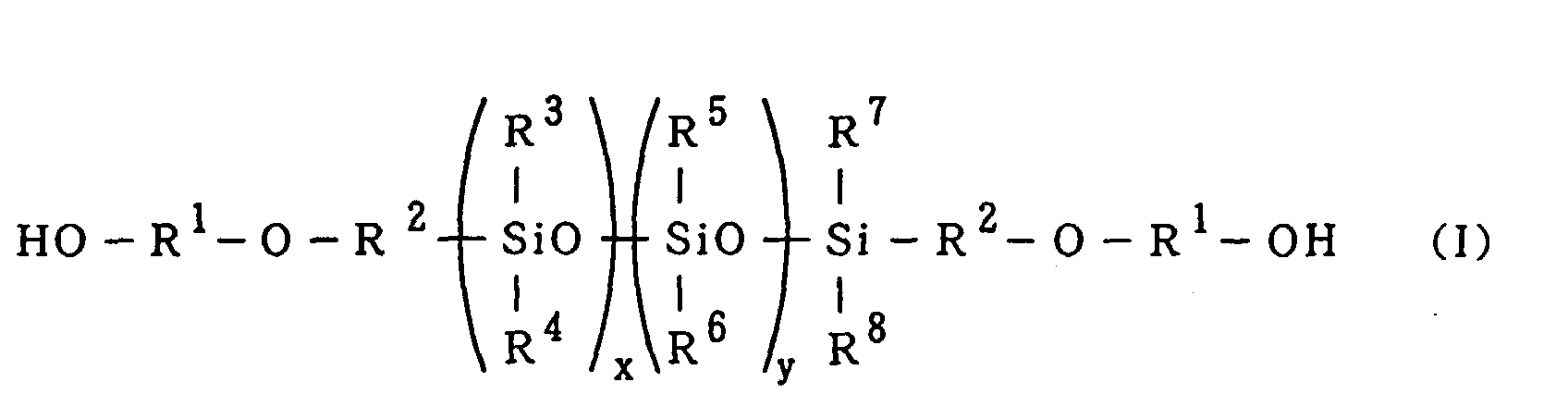
    Typical examples of the dihydroxyl compound (A-2) are, for instance, a hydroxyl group-containing polysiloxane compound represented by the formula (I):
    Figure 00060001
    wherein each of R1 and R2 is independently an alkylene group having 1 to 20 carbon atoms, each of R3, R4, R5, R6, R7 and R8 is independently a linear alkyl group having 1 to 20 carbon atoms, a branched alkyl group having 3 to 20 carbon atoms or a cyclic alkyl group having 3 to 20 carbon atoms, which may be substituted with fluorine atom, x is an integer of 1 to 1500, y is an integer of 1 to 1499, and "x+y" is an integer of 1 to 1500; and the like.
    In the above formula (I), each of R1 and R2 is preferably an alkylene group having 1 to 10 carbon atoms. Each of R3, R4, R5, R6, R7 and R8 is preferably a linear alkyl group which may be substituted with fluorine atom, having 1 to 5 carbon atoms, a branched alkyl group which may be substituted with fluorine atom, having 3 to 5 carbon atoms, or a cyclic alkyl group which may be substituted with fluorine atom, having 3 to 5 carbon atoms. Also, x is preferably an integer of 1 to 500, y is preferably an integer of 1 to 499, and "x+y" is preferably an integer of 1 to 500.
    In addition, as the above dihydroxyl compound (A-2), a dihydroxyl compound having hydroxyl groups in its both ends, such as a polyalkylene glycol such as polyethylene glycol or polypropylene glycol; and the like are exemplified.
    Typical examples of the diisocyanate compound (B-2) are, for instance, a diisocyanate compound represented by the formula (II): O=C=N-R10-N=C=O wherein R10 is a linear aliphatic hydrocarbon group having 1 to 20 carbon atoms, a branched hydrocarbon group having 2 to 20 carbon atoms, a cyclic aliphatic hydrocarbon group having 3 to 20 carbon atoms or an aromatic hydrocarbon group having 6 to 20 carbon atoms; and the like.
    In the above formula (II), R10 is preferably a linear aliphatic hydrocarbon group having 1 to 12 carbon atoms, a branched hydrocarbon group having 2 to 12 carbon atoms, a cyclic aliphatic hydrocarbon group having 3 to 12 carbon atoms or an aromatic hydrocarbon group having 6 to 12 carbon atoms.
    Concrete examples of the diisocyanate compound (B-2) are, for instance, ethylenediisocyanate, isophoronediisocyanate, 1,6-hexamethylenediisocyanate, 1,2-toluenediisocyanate, 1,4-toluenediisocyanate, xylylenediisocyanate, bis(2-isocyanatethyl) fumarate, 1,5-naphthalenediisocyanate, cyclohexyl-1,4-diisocyanate, 4,4'-dicyclohexylmethanediisocyanate, diphenylmethane-4,4'-diisocyanate, 2,2,4-(2,4,4)-trimethylhexane-1,6-diisocyanate and the like.
    It is considered that the ratio of the dihydroxyl compound (A-2) to the diisocyanate compound (B-2) in the urethane reaction (i) considerably effects for the amount of prepared by-products, the amount of residual non-reacted compounds, and molecular weight and molecular weight distribution of the aimed urethane compound.
    In the urethane reaction (i), from the viewpoint of reduction of residual non-reacted isocyanate groups, it is desired that the total amount of hydroxyl group in the dihydroxyl compound (A-2) based on 1 mole of isocyanate group in the diisocyanate compound (B-2) is at least 0.4 mole, preferably at least 0.6 mole, more preferably at least 0.8 mole. From the viewpoint of reduction of residual non-reacted dihydroxyl compound (A-2) which not bonds to the diisocyanate compound (B-2) through urethane bond, it is desired that the total amount of hydroxyl group in the dihydroxyl compound (A-2) based on 1 mole of isocyanate group in the diisocyanate compound (B-2) is at most 2 moles, preferably at most 1.5 moles, more preferably at most 1.25 moles.
    The amount of the dihydroxyl compound (A-2) and the diisocyanate compound (B-2) is adjusted within the above range. Then, these compounds are reacted by stirring and mixing with each other.
    In the above reaction, reaction temperature and reaction time are not particularly limited and suitably adjusted according to kind and combination of each compound. In order to prevent insufficient reaction, it is desired that reaction time is at least 1 minute, preferably at least 30 minutes, and reaction temperature is at least -30°C, preferably at least 0 °C. In order to prevent polymerization due to polymerizable compounds during reaction, it is desired that reaction time is at most 100 hours, preferably at most 50 hours, and reaction temperature is at most 150 °C, preferably at most 100 °C.
    Then, in the urethane reaction (ii),
  • (a) the compound having isocyanate groups in its both ends obtained in the above urethane reaction (i) is reacted with at least one member of monohydroxyl compounds (A-1) as the hydroxyl compound (A) to form urethane bond; or
  • (b) the compound having hydroxyl groups in its both ends obtained in the above urethane reaction (i) is reacted with at least one member of monoisocyanate compounds (B-1) as the isocyanate compound (B) to form urethane bond. By each reaction, the compound (I) having at least four urethane bonds is prepared.
  • Because molecular weight of the aimed urethane compound can be controlled and structure of this compound can be exactly clarified, it is desired that the above two-step urethane reactions (i) and (ii) are carried out in the present invention.
    In the above reaction (a), the monohydroxyl compound (A-1) to be reacted with the compound having isocyanate groups in its both ends is not limited to one member. At least two members of the monohydroxyl compounds (A-1) can be suitably used. In the above reaction (b), the monoisocyanate compound (B-1) to be reacted with the compound having hydroxyl groups in its both ends is not limited to one member. At least two members of the monoisocyanate compounds (B-1) can be suitably used. As a result, the compound (I) obtained in the reaction (a) or (b) can contain the unit derived from two members of the monohydroxyl compounds (A-1) or the unit derived from two members of the monoisocyanate compounds (B-1).
    In accordance that the above urethane reaction (i) is finished only one time or repeatedly carried out stepwise, the number of urethane bond and the number of unit (block) derived from each component in the compound (I) synthesized in the urethane reaction (ii) vary. As a result, for instance, a diblock-type compound (I) is synthesized. Because chain length of each segment in the diblock-type compound (I) is controlled, various different effects can be exhibited.
    Typical examples of the monohydroxyl compound (A-1) are, for instance, a compound having hydroxyl group and an active unsaturated group, such as a hydroxyalkyl (meth)acrylate, allyl alcohol, vinylbenzyl alcohol, monohydroxyl fumarate, monohydroxyl maleate or monohydroxyl itaconate; and the like.
    In consideration of copolymerizability of the aimed compound (I) with the other copolymerizable compound having an active unsaturated group, among the above exemplified compounds, a hydroxyalkyl (meth)acrylate is preferable. Concrete examples of the hydroxyalkyl (meth)acrylate are, for instance, 2-hydroxyethyl (meth)acrylate, 2-hydroxypropyl (meth)acrylate, 3-hydroxypropyl (meth)acrylate, 4-hydroxybutyl (meth)acrylate and the like.
    Typical examples of the monoisocyanate compound (B-1) are, for instance, a compound having isocyanate group and an active unsaturated group, such as allylisocyanate, vinylisocyanate, vinylbenzylisocyanate or 2-isocyanatethyl (meth)acrylate; and the like.
    When the above reaction (b) in the urethane reaction (ii) is carried out, because the number of urethane bond in the compound (I) can be controlled and mechanical strength can be imparted to the compound (I), it is desired that a compound containing a monoisocyanate compound (B-1-1) prepared by reacting the diisocyanate compound (B-2) with the monohydroxyl compound (A-1) is used as the monoisocyanate compound (B-1). It is particularly desired that only the monoisocyanate compound (B-1-1) is used as the monoisocyanate compound (B-1).
    In the reaction (a), it is desired that the ratio of the compound having isocyanate groups in its both ends to the monohydroxyl compound (A-1) is adjusted so as to react isocyanate groups in the compound having isocyanate groups in its both ends with almost neither more nor less hydroxyl groups in the monohydroxyl compound (A-1). For instance, from the viewpoint of reduction of residual non-reacted isocyanate groups, it is desired that the amount of hydroxyl group in the monohydroxyl compound (A-1) based on 1 mole of isocyanate group in the compound having isocyanate groups in its both ends is at least 1.0 mole, preferably at least 1.1 moles, more preferably at least 1.2 moles. From the viewpoint of reduction of residual non-reacted monohydroxyl compound (A-1) which not bonds to the compound having isocyanate groups in its both ends through urethane bond, it is desired that the amount of hydroxyl group in the monohydroxyl compound (A-1) based on 1 mole of isocyanate group in the compound having isocyanate groups in its both ends is at most 2.0 moles, preferably at most 1.75 moles, more preferably at most 1.5 moles.
    The amount of the compound having isocyanate groups in its both ends and the monohydroxyl compound (A-1) is adjusted within the above range. Then, these compounds are reacted by stirring and mixing with each other.
    In the above reaction, reaction temperature and reaction time are not particularly limited and suitably adjusted according to kind and combination of each compound. In order to prevent insufficient reaction, it is desired that reaction time is at least 1 minute, preferably at least 30 minutes, and reaction temperature is at least -30 °C, preferably at least 0 °C. In order to prevent polymerization due to polymerizable compounds during reaction, it is desired that reaction time is at most 100 hours, preferably at most 50 hours, and reaction temperature is at most 150 °C, preferably at most 100 °C.
    In the reaction (b), it is desired that the ratio of the compound having hydroxyl groups in its both ends to the monoisocyanate compound (B-1) is adjusted so as to react hydroxyl groups in the compound having hydroxyl groups in its both ends with almost neither more nor less isocyanate groups in the monoisocyanate compound (B-1). For instance, from the viewpoint of reduction of residual non-reacted hydroxyl groups, it is desired that the amount of isocyanate group in the monoisocyanate compound (B-1) based on 1 mole of hydroxyl group in the compound having hydroxyl groups in its both ends is at least 1.0 mole, preferably at least 1.1 moles, more preferably at least 1.2 moles. From the viewpoint of reduction of residual non-reacted monoisocyanate compound (B-1) which not bonds to the compound having hydroxyl groups in its both ends through urethane bond, it is desired that the amount of isocyanate group in the monoisocyanate compound (B-1) based on 1 mole of hydroxyl group in the compound having hydroxyl groups in its both ends is at most 2.0 moles, preferably at most 1.75 moles, more preferably at most 1.5 moles.
    The amount of the compound having hydroxyl groups in its both ends and the monoisocyanate compound (B-1) is adjusted within the above range. Then, these compounds are reacted by stirring and mixing with each other.
    In the above reaction, reaction temperature and reaction time are not particularly limited and suitably adjusted according to kind and combination of each compound. In order to prevent insufficient reaction, it is desired that reaction time is at least 1 minute, preferably at least 30 minutes, and reaction temperature is at least -30 °C, preferably at least 0 °C. In order to prevent polymerization due to polymerizable compounds during reaction, it is desired that reaction time is at most 100 hours, preferably at most 50 hours, and reaction temperature is at most 150 °C, preferably at most 100 °C.
    When the compound (I) is prepared by the urethane reaction (i) or (ii), in order to prevent active unsaturated groups in each compound from polymerizing with each other, it is desired that a polymerization inhibitor is suitably used.
    Examples of the polymerization inhibitor are, for instance, a stable radical compound; an addition inhibitor such as oxygen, a benzoquinone derivative or a nitro compound; and the like. Hydroquinone, p-methoxyphenol and butylhydroxytoluene are preferably exemplified. It is desired that the amount of the polymerization inhibitor based on 100 parts by weight (hereinafter referred to as "part(s)") of all the compounds having an active unsaturated group is about 0.01 to 1 part.
    The hydroxyl compound (A) can be reacted with the isocyanate compound (B) in the absence of a solvent or in the presence of an organic solvent.
    Examples of the organic solvent are, for instance, tetrahydrofuran, benzene, toluene, acetonitrile, methylene chloride and the like.
    When the organic solvent is used, in order to remove the fear that it becomes difficult to react the hydroxyl compound (A) with the isocyanate compound (B), and so, the yield of the compound (I) is lowered, it is desired that the total concentration of the hydroxyl compound (A) and the isocyanate compound (B) in the organic solvent is at least 0.01 mol/L, preferably at least 0.1 mol/L. That is, the amount (volume) of the organic solvent can be calculated according to the total concentration of the hydroxyl compound (A) and the isocyanate compound (B). A reaction solution composed of the hydroxyl compound (A), the isocyanate compound (B) and the organic solvent is sufficiently stirred or shaken so that the reaction uniformly proceeds.
    In accordance with the above steps, the aimed urethane compound (I) can be prepared. After finishing the reaction for preparing the compound (I), it is desired that the compound (I) is purified by removing non-reacted compounds, compounds having lower molecular weight (by-products) and catalysts.
    For purification of the compound (I), an organic solvent is preferably used. In addition, the compound (I) can he purified by using a supercritical fluid with referring to "Polymer Applications, Vol. 43, No. 11, p. 38 (1994)".
    As the above organic solvent for purification, a solvent which can dissolve the non-reacted compounds, by-products and catalysts or can dissolve the compound (I) is used. Typical examples of the organic solvent are, for instance, methanol, ethanol, acetone, tetrahydrofuran, acetonitrile, methylene chloride, hexane and the like. These can be used alone or in admixture thereof. In order to more effectively purify the compound (I), a mixed solvent of hexane and methanol and a mixed solvent of hexane and acetonitrile are preferably used.
    In order to sufficiently remove the non-reacted compounds, by-products and catalysts, it is desired that the amount of the organic solvent is, on the basis of the volume, at least 1/20 time, preferably at least 1/10 time of the amount of the compound (I). In order to prevent the amount of waste fluid from increasing after purification, it is desired that the amount of the organic solvent is, on the basis of the volume, at most 20 times, preferably at most 10 times of the amount of the compound (I).
    As the above supercritical fluid for purification, a fluid in the supercritical state, such as carbon dioxide, ethane or propane may be cited.
    Condition as to purification with the supercritical fluid varies according to molecular weight and chemical structure of the compound (I). So, the condition cannot be sweepingly determined. For instance, it is desired that treating pressure is 5 to 100 MPa, and treating temperature is 0° to 100 °C.
    In order to more effectively extract the compounds having lower molecular weight, an auxiliary for extraction can be used during purification of the compound (I) with the supercritical fluid. Examples of the auxiliary for extraction are, for instance, acetonitrile, methanol and the like.
    According to the process of the present invention, the urethane compound showing high safety, which is very useful for a material of medical instruments represented by optical materials can be easily prepared, in particular, while molecular weight of the compound is controlled.
    The process for preparing an urethane compound for medical instruments of the present invention is more specifically described and explained by means of the following Examples. It is to be understood that the present invention is not limited to the Examples, and various changes and modifications may be made in the invention without departing from the spirit and scope thereof.
    EXAMPLE 1 (1) Synthesis of HEA-IPDI
    With a 1 L three-necked flask of which side tubes previously substituted with nitrogen gas were equipped with Dimroth reflux condenser, a mechanical stirrer and a thermometer was charged 66.69 g (0.3 mole) of isophoronediisocyanate (hereinafter referred to as "IPDI").
    Then, to IPDI in the three-necked flask was added 41.80 g (0.36 mole) of 2-hydroxyethyl acrylate (hereinafter referred to as "HEA") in which 0.0110 g of iron(III) acetylacetonate (hereinafter referred to as "FeAA") was previously dissolved.
    To the mixture in the three-necked flask was added 0.220 g of p-methoxyphenol (hereinafter referred to as "MEHQ") as a polymerization inhibitor and then, the reaction solution in the three-necked flask was continuously stirred in an oil bath prescribed at 50 °C. After about 3 hours, 1H-NMR spectrum of a sample from the reaction solution was examined and then, the aimed compound (HEA-IPDI) was recognized. Data of 1H-NMR spectrum are as follows:
  • 1H-NMR (CDCl3, δppm)
  • 2.90 (NH-CH 2, 2H, m)
  • 3.02 (CH2-N=C=O, 2H, s)
  • 3.05 (Raw material, CH2-N=C=O, 2H, s)
  • 4.27-4.33 (-(O)CO-CH2-, 4H, m)
  • 4.61 (NH, 1H, s)
  • 4.87 (NH, 1H, s)
  • 5.84 (CH=, 1H, dd)
  • 6.13 (CH=, 1H, dd)
  • 6.42 (CH=, 1H, dd)
  • (2) Reaction of HEA-IPDI with polydimethylsiloxane containing hydroxyl groups in its both ends (Synthesis of compound (I))
    To a reaction solution containing about 60.8 g of the above compound (HEA-IPDI) (amount of isocyanate group: 0.18 mole) in the three-necked flask was added 325.80 g (converted amount of hydroxyl group: 0.09 mole) of polydimethylsiloxane containing hydroxyl groups in its both ends (polymerization degree: 40, number average molecular weight: 3100, code name: KF-6002, made by Shin-Etsu Chemical Co., Ltd.; hereinafter referred to as "DHDMSi-40") in which 0.0330 g of FeAA was previously dissolved. Then, the reaction solution was continuously stirred in the oil bath heated to 80 °C.
    After about 4 hours, 1H-NMR spectrum and FT/IR spectrum of a sample from the reaction solution were examined. Then, structural analysis was carried out by using these spectra, so that the aimed compound (I) was recognized. Data of 1H-NMR spectrum and FT/IR spectrum are as follows:
  • 1H-NMR (CDCl3, δppm)
  • 0.06 (Si-CH3, 3H, m)
  • 0.52 (Si-CH2, 2H, m)
  • 2.91 (NH-CH 2, 2H, d)
  • 3.02 (Intermediate, CH2-N=C=O, 2H, s)
  • 3.42 (-O-CH2, 2H, t)
  • 3.62 (-O-CH2, 2H, m)
  • 4.18-4.34 (-(O)CO-CH2-, 6H, m)
  • 4.54 (NH, 1H, s)
  • 4.85 (NH, 1H, s)
  • 5.84 (CH=, 1H, dd)
  • 6.14 (CH=, 1H, dd)
  • 6.43 (CH=, 1H, dd)
  • FT/IR (cm-1)
  • 1262 and 802 (Si-CH3)
  • 1094 and 1023 (Si-O-Si)
  • 1632 (C=C)
  • near 1728 (C=O, ester and urethane)
  • 2227 (N=C=O)
  • The number average molecular weight of the compound (I) was measured by size exclusion chromatography (hereinafter referred to as "SEC"), and the amount of by-products (compounds having lower molecular weight) was calculated from the area ratio in chromatogram by SEC. The results are shown in TABLE 1.
    (3) Purification of compound (I) with organic solvent (n-hexane/acetonitrile)(Preparation of purified urethane compound)
    Into a 5 L separatory funnel equipped with a side tube was transferred about 400 g of the compound (I) which was previously dissolved in 2 L of n-hexane. Then, 300 mL of acetonitrile was added to the solution in the separatory funnel. After the mixture solution in the separatory funnel was stirred at about 500 rpm for 20 minutes, the mixture solution was allowed to stand. Alter about 1 hour, it was recognized that the contents in the separatory funnel were separated to two layers. Then, acetonitrile layer (lower layer) was removed.
    Hexane layer was washed with 50 mL of acetonitrile. The wash was repeated two times. It was recognized that the hexane layer was colorless and transparent. After the acetonitrile layer was removed, the hexane layer was collected into a 1 L brown pear shaped flask of which dry weight was previously weighed, and the solvent was evaporated under the vacuum. Then, the contents in the pear shaped flask were dried overnight by using a pressure reducing dryer to give 318.49 g of a purified urethane compound. The yield of the purified compound was 83 %.
    1H-NMR spectrum and FT/IR spectrum of the above purified urethane compound were examined. Then, structural analysis was carried out by using these spectra, so that the aimed compound was recognized. Data of 1H-NMR spectrum and FT/IR spectrum are as follows:
  • 1H-NMR (CDCl3, δppm)
  • 0.06 (Si-CH3, 3H, m)
  • 0.52 (Si-CH2, 2H, m)
  • 2.91 (NH-CH 2, 2H, d)
  • 3.42 (-O-CH2, 2H, t)
  • 3.61 (-O-CH2, 2H, m)
  • 4.18-4.34 (-(O)CO-CH2-, 6H, m)
  • 4.54 (NH, 1H, s)
  • 4.85 (NH, 1H, s)
  • 5.84 (CH=, 1H, dd)
  • 6.14 (CH=, 1H, dd)
  • 6.43 (CH=, 1H, dd)
  • FT/IR (cm-1)
  • 1262 and 802 (Si-CH3)
  • 1094 and 1023 (Si-O-Si)
  • 1632 (C=C)
  • near 1728 (C=O, ester and urethane)
  • The number average molecular weight of the purified urethane compound was measured by SEC, and the amount of by-products (compounds having lower molecular weight) was calculated from the area ratio in chromatogram by SEC. The results are shown in TABLE 1.
    Cellular toxicity of the above compound (I), and transparency of the compound (I) and the purified urethane compound were examined. The results are shown in TABLE 1.
    1H-NMR analysis, FT/IR analysis, SEC analysis, evaluation of transparency and cellular toxicity test were carried out in accordance with the following methods, respectively.
    (I) 1H-NMR analysis
    1H-NMR spectrum was examined under the following conditions.
  • Fourier transform NMR spectrometer:
  • GEMINI2000/400BB type, made by Varian Technologies Limited
  • Nuclear:
  • 1H (resonance frequency: 400.42 MHz)
  • Solvent:
  • CDCl3
  • Test sample:
  • About 5 to 10 w/v % CDCl3 solution
  • Measuring temperature:
  • About 22 °C
  • (II) FT/IR analysis
    FT/IR spectrum was examined under the following conditions.
  • Infrared spectrophotometer:
  • FT/IR-8300, made by Nippon Bunko Kabushiki Kaisha
  • Method:
  • KBr disk method
  • (III) SEC analysis
    SEC analysis was carried out under the following conditions.
  • SEC system:
  • Made by Nippon Bunko Kabushiki Kaisha
  • Column oven: 860-CO made by Nippon Bunko Kabushiki Kaisha
  • Degasser: DG-980-50 made by Nippon Bunko Kabushiki Kaisha
  • Pump: PU-980 made by Nippon Bunko Kabushiki Kaisha
    Detector
    (RI type): 830-RI made by Nippon Bunko Kabushiki Kaisha
    (UV type): SPD-10A made by SHIMAZU CORPORATION
  • Column:
  • Ultrastyragel Plus MX 103 Å made by Waters Co. (two columns connected in series)
  • Eluent:
  • Tetrahydrofuran
  • Calibration curve:
  • Produced by using standard polystyrene
  • (IV) Evaluation of transparency
    The test sample was observed with naked eye.
    (V) Cellular toxicity test (Test as to prevention for preparation of colony)
    The test was carried out in accordance with the guideline of "Basic biological test of medical instruments and medical materials" (MEDICAL DEVICES DIVISION PHARMACEUTICAL AFFAIRS BUREAU Notification No. 99, 1995, published on June 27, 1995 in Japan). Then, biological safety of the test sample was evaluated.
    EXAMPLE 2
    A compound (I) was prepared in same manner as in EXAMPLE 1 except that 180 g (converted amount of hydroxyl group: 0.09 mole) of polydimethylsiloxane containing hydroxyl groups in its both ends (polymerization degree: 20, number average molecular weight: 2000, code name: KF-6001, made by Shin-Etsu Chemical Co., Ltd.; hereinafter referred to as "DHDMSi-20") was used instead of DHDMSi-40. Then, the same manner as in EXAMPLE 1 was repeated to give 233.7 g of a purified urethane compound. The yield of the purified compound was 81 %.
    Structure of the compound (I) and the purified urethane compound was examined and confirmed in the same manner as in EXAMPLE 1. Properties of the compound (I) and the purified urethane compound, and the amount of compounds having lower molecular weight (by-products) were examined in the same manner as in EXAMPLE 1. The results are shown in TABLE 1.
    EXAMPLE 3
    The same manner as in EXAMPLE 1 was repeated except that 77.4 g (0.3 mole) of 4,4'-dicyclohexylmethanediisocyanate (hereinafter referred to as "DCHMDI") was used instead of IPDI to give a compound (HEA-DCHMDI). Then, a compound (I) was prepared in the same manner as in EXAMPLE 1 except that HEA-DCHMDI was used instead of HEA-IPDI. Furthermore, the same manner as in EXAMPLE 1 was repeated to give 333.8 g of a purified urethane compound. The yield of the purified compound was 75 %.
    Structure of the compound (HEA-DCHMDI), the compound (I) and the purified urethane compound was examined and confirmed in the same manner as in EXAMPLE 1. Properties of the compound (I) and the purified urethane compound, and the amount of compounds having lower molecular weight (by-products) were examined in the same manner as in EXAMPLE 1. The results are shown in TABLE 1.
    COMPARATIVE EXAMPLE 1 (Method using organic tin compound as reaction catalyst)
    A compound (HEA-IPDI) was prepared in same manner as in EXAMPLE 1 except that 0.011 g of dibutyltin dilaurate (hereinafter referred to as "BSnL") was used instead of FeAA. Then, a compound (I) was prepared in the same manner as in EXAMPLE 1 except that 0.033 g of BSnL was used instead of FeAA. Furthermore, the same manner as in EXAMPLE 1 was repeated to give 373.5 g of a purified urethane compound. The yield of the purified compound was 86 %.
    Structure of the compound (HEA-IPDI), the compound (I) and the purified urethane compound was examined and confirmed in the same manner as in EXAMPLE 1. Properties of the compound (I) and the purified urethane compound, and the amount of compounds having lower molecular weight (by-products) were examined in the same manner as in EXAMPLE 1. The results are shown in TABLE 1.
    Then, the amount of tin contained in the purified urethane compound was quantitated by polarographic analysis method. As a result, the amount of tin contained in the purified urethane compound was 40 ppm on the basis of weight. Now, the amount of tin used for starting synthesis of the compound (I) was about 100 ppm on the basis of weight.
    Ex. No. Kind of reaction catalyst Kind of compound Number average molecular weight Amount of compound having lower molecular weight (% by weight) Transparency Cellular toxicity
    1 FeAA Compound (I) 4600 23 Colorless and transparent Negative
    Purified compound 5800 0.6 Colorless and transparent
    2 FeAA Compound (I) 3400 21 Colorless and transparent Negative
    Purified compound 4400 1.2 Colorless and transparent
    3 FeAA Compound (I) 4700 27 Colorless and transparent Negative
    Purified compound 5900 2.2 Colorless and transparent
    Com. Ex. No. 1 BSnL Compound (I) 4500 22 Colorless and transparent Positive
    Purified compound 5800 6.4 Colorless and transparent
    From the results shown in TABLE 1, it can be understood that according to the process of the present invention in EXAMPLES 1 to 3, the urethane compound showing low toxicity can be easily prepared while molecular weight of the compound is controlled. In addition, it can be understood that the amount of the compound having lower molecular weight (by-product) is considerably small in EXAMPLES 1 to 3.
    To the contrary, it can be understood that according to the process wherein the organic tin compound is used as the reaction catalyst in COMPARATIVE EXAMPLE 1, the amount of tin contained in the aimed purified urethane compound is large, toxicity of the purified urethane compound is high and the amount of the compound having lower molecular weight (by-product) is large.
    EXAMPLE 4 (1) Synthesis of HEA-IPDI
    With a 1 L three-necked flask of which side tubes previously substituted with nitrogen gas were equipped with Dimroth reflux condenser, a mechanical stirrer and a thermometer was charged 33.33 g (0.15 mole) of IPDI.
    Then, to IPDI in the three-necked flask was added 17.40 g (0.15 mole) of HEA in which 0.06 g of triethylenediamine (hereinafter referred to as "TEDA") was previously dissolved.
    To the mixture in the three-necked flask was added 0.09 g of MEHQ as a polymerization inhibitor and then, the reaction solution in the three-necked flask was continuously stirred in an oil bath prescribed at 50 °C. Alter about 3 hours, 1H-NMR spectrum of a sample from the reaction solution was examined and then, the aimed compound (HEA-IPDI) was recognized. Data of 1H-NMR spectrum are as follows:
  • 1H-NMR (CDCl3, δppm)
  • 2.90 (NH-CH 2, 2H, m)
  • 3.02 (CH2-N=C=O, 2H, s)
  • 3.05 (Raw material, CH2-N=C=O, 2H, s)
  • 4.27-4.33 (-(O)CO-CH2-, 4H, m)
  • 4.61 (NH, 1H, s)
  • 4.87 (NH, 1H, s)
  • 5.84 (CH=, 1H, dd)
  • 6.13 (CH=, 1H, dd)
  • 6.42 (CH=, 1H, dd)
  • (2) Reaction of HEA-IPDI with polydimethylsiloxane containing hydroxyl groups in its both ends (Synthesis of compound (I))
    To a reaction solution containing about 50 g of the above compound (HEA-IPDI) (amount of isocyanate group: 0.1 mole) in the three-necked flask was added 271.50 g (converted amount of hydroxyl group: 0.075 mole) of DHDMSi-40 in which 0.30 g of TEDA was previously dissolved. Then, the reaction solution was continuously stirred in the oil bath at 50°C.
    After about 6 hours, 1H-NMR spectrum and FT/IR spectrum of a sample from the reaction solution were examined. Then, structural analysis was carried out by using these spectra, so that the aimed compound (I) was recognized. Data of 1H-NMR spectrum and FT/IR spectrum are as follows:
  • 1H-NMR (CDCl3, δppm)
  • 0.06 (Si-CH3, 3H, m)
  • 0.52 (Si-CH2, 2H, m)
  • 2.91 (NH-CH 2, 2H, d)
  • 3.02 (Intermediate, CH2-N=C=O, 2H, s)
  • 3.42 (-O-CH2, 2H, t)
  • 3.61 (-O-CH2, 2H, m)
  • 4.18-4.34 (-(O)CO-CH2-, 6H, m)
  • 4.54 (NH, 1H, s)
  • 4.85 (NH, 1H, s)
  • 5.84 (CH=, 1H, dd)
  • 6.14 (CH=, 1H, dd)
  • 6.43 (CH=, 1H, dd)
  • FT/IR (cm-1)
  • 1262 and 802 (Si-CH3)
  • 1094 and 1023 (Si-O-Si)
  • 1632 (C=C)
  • near 1728 (C=O, ester and urethane)
  • 2227 (N=C=O)
  • The number average molecular weight of the compound (I) was measured in the same manner as in EXAMPLE 1. As a result, the number average molecular weight was 4300.
    (3) Purification of compound (I) with organic solvent (n-hexane/methanol)(Preparation of purified urethane compound)
    Into a 5 L separatory funnel equipped with a side tube was transferred about 300 g of the compound (I) which was previously dissolved in 2 L of n-hexane. Then, 300 mL of distilled water was added to the solution in the separatory funnel. After the mixture solution in the separatory funnel was stirred at about 500 rpm for 20 minutes, the mixture solution was allowed to stand. After about 1 hour, it was recognized that the contents in the separatory funnel were separated to two layers. Then, water layer (lower layer) was removed.
    Then, 300 mL of methanol was added to hexane layer in the separatory funnel, and after the mixture solution in the separatory funnel was stirred at about 500 rpm for 20 minutes, the mixture solution was allowed to stand. After about 1 hour, it was recognized that the contents in the separatory funnel were separated to two layers. Then, methanol layer (lower layer) was removed.
    Hexane layer was washed with 50 mL of methanol. The wash was repeated two times. After the methanol layer was removed, the hexane layer was collected into a 1 L brown pear shaped flask of which dry weight was previously weighed, and the solvent was removed by a rotating evaporator. Then, the contents in the pear shaped flask were dried overnight by using a pressure reducing dryer to give 220 g of a purified urethane compound. The yield of the purified compound was 70%.
    1H-NMR spectrum and FT/IR spectrum of the above purified urethane compound were examined. Then, structural analysis was carried out by using these spectra, so that the aimed compound was recognized. Data of 1H-NMR spectrum and FT/IR spectrum are as follows:
  • 1H-NMR (CDCl3, δppm)
  • 0.06 (Si-CH3, 3H, m)
  • 0.52 (Si-CH2, 2H, m)
  • 2.91 (NH-CH 2, 2H, d)
  • 3.42 (-O-CH2, 2H, t)
  • 3.61 (-O-CH2, 2H, m)
  • 4.18-4.34 (-(O)CO-CH2-, 6H, m)
  • 4.54 (NH, 1H, s)
  • 4.85 (NH, 1H, s)
  • 5.84 (CH=, 1H, dd)
  • 6.14 (CH=, 1H, dd)
  • 6.43 (CH=, 1H, dd)
  • FT/IR (cm-1)
  • 1262 and 802 (Si-CH3)
  • 1094 and 1023 (Si-O-Si)
  • 1632 (C=C)
  • near 1728 (C=O, ester and urethane)
  • The number average molecular weight of the purified urethane compound was measured in the same manner as in EXAMPLE 1. As a result, the number average molecular weight was 6000.
    Cellular toxicity of the above compound (I) was examined in the same manner as in EXAMPLE 1. As a result, the compound (I) showed negative. So, it can be understood that the urethane compound in EXAMPLE 4 shows lower toxicity.
    In addition to the ingredients used in the Examples, other ingredients can be used in the Examples as set forth in the specification to obtain substantially the same results.
    A process for preparing an urethane compound for medical instruments, characterized by reacting a hydroxyl compound (A) with an isocyanate compound (B) in the absence of a catalyst or in the presence of a reaction catalyst other than an organic tin compound to give an urethane compound (I). According to the process, the urethane compound showing high safety can be easily prepared, in particular, while molecular weight of the compound is controlled.

    Claims (11)

    1. A process for preparing an urethane compound for medical instruments, characterized by
      reacting a hydroxyl compound (A) with an isocyanate compound (B) in the absence of a catalyst or in the presence of a reaction catalyst other than an organic tin compound to give an urethane compound (I).
    2. The process of Claim 1, wherein the reaction catalyst is an organic iron compound or an amine compound.
    3. The process of Claim 1, wherein
      (i) at least one member of dihydroxyl compounds (A-2) as the hydroxyl compound (A) is reacted with at least one member of diisocyanate compounds (B-2) as the isocyanate compound (B) to give a compound having isocyanate groups in its both ends through at least two urethane bonds or a compound having hydroxyl groups in its both ends through at least two urethane bonds; and
      (ii)
      (a) said compound having isocyanate groups in its both ends is reacted with at least one member of monohydroxyl compounds (A-1) as the hydroxyl compound (A), or
      (b) said compound having hydroxyl groups in its both ends is reacted with at least one member of monoisocyanate compounds (B-1) as the isocyanate compound (B)
      to give a compound (I) having at least four urethane bonds.
    4. The process of Claim 3, wherein the compound having hydroxyl groups in its both ends is reacted with a monoisocyanate compound (B-1) containing a monoisocyanate compound (B-1-1) prepared by reacting the diisocyanate compound (B-2) with the monohydroxyl compound (A-1).
    5. The process of Claim 3, wherein the compound having hydroxyl groups in its both ends is reacted with a monoisocyanate compound (B-1-1) prepared by reacting the diisocyanate compound (B-2) with the monohydroxyl compound (A-1).
    6. The process of Claim 3, wherein the monohydroxyl compound (A-1) is a compound having hydroxyl group and an active unsaturated group.
    7. The process of Claim 3, wherein the monohydroxyl compound (A-1) is a hydroxyalkyl (meth)acrylate.
    8. The process of Claim 3, wherein the monoisocyanate compound (B-1) is a compound having isocyanate group and an active unsaturated group.
    9. The process of Claim 3, wherein the dihydroxyl compound (A-2) is a hydroxyl group-containing polysiloxane compound represented by the formula (I):
      Figure 00350001
      wherein each of R1 and R2 is independently an alkylene group having 1 to 20 carbon atoms, each of R3, R4, R5, R6, R7 and R8 is independently a linear alkyl group having 1 to 20 carbon atoms, a branched alkyl group having 3 to 20 carbon atoms or a cyclic alkyl group having 3 to 20 carbon atoms, which may be substituted with fluorine atom, x is an integer of 1 to 1500, y is an integer of 1 to 1499, and "x+y" is an integer of 1 to 1500.
    10. The process of Claim 3, wherein the diisocyanate compound (B-2) is a diisocyanate compound represented by the formula (II): O=C=N-R10-N=C=O wherein R1° is a linear aliphatic hydrocarbon group having 1 to 20 carbon atoms, a branched hydrocarbon group having 2 to 20 carbon atoms, a cyclic aliphatic hydrocarbon group having 3 to 20 carbon atoms or an aromatic hydrocarbon group having 6 to 20 carbon atoms.
    11. The process of Claim 1, wherein the compound (I) is purified with an organic solvent.
    EP00113822A 1999-06-30 2000-06-29 Process for preparing a urethane compound for medical instruments Expired - Lifetime EP1065229B1 (en)

    Applications Claiming Priority (2)

    Application Number Priority Date Filing Date Title
    JP18502399 1999-06-30
    JP18502399 1999-06-30

    Publications (3)

    Publication Number Publication Date
    EP1065229A2 true EP1065229A2 (en) 2001-01-03
    EP1065229A3 EP1065229A3 (en) 2001-10-10
    EP1065229B1 EP1065229B1 (en) 2004-09-15

    Family

    ID=16163437

    Family Applications (1)

    Application Number Title Priority Date Filing Date
    EP00113822A Expired - Lifetime EP1065229B1 (en) 1999-06-30 2000-06-29 Process for preparing a urethane compound for medical instruments

    Country Status (4)

    Country Link
    US (2) US6495651B1 (en)
    EP (1) EP1065229B1 (en)
    AT (1) ATE276300T1 (en)
    DE (1) DE60013702T2 (en)

    Families Citing this family (3)

    * Cited by examiner, † Cited by third party
    Publication number Priority date Publication date Assignee Title
    US20070112161A1 (en) * 2005-11-17 2007-05-17 Bayer Materialscience Llc Low surface energy, ethylenically unsaturated polyisocyanate addition compounds and their use in coating compositions
    DE102007055703A1 (en) * 2007-12-04 2009-06-10 Wacker Chemie Ag Silicone-containing polyurethane foam
    DE102008001384A1 (en) * 2008-04-25 2009-10-29 Wacker Chemie Ag Silicone-containing polyisocyanurate foam

    Family Cites Families (9)

    * Cited by examiner, † Cited by third party
    Publication number Priority date Publication date Assignee Title
    US4136250A (en) * 1977-07-20 1979-01-23 Ciba-Geigy Corporation Polysiloxane hydrogels
    US4879032A (en) * 1984-06-04 1989-11-07 Allied Resin Corporation Fluid separatory devices having improved potting and adhesive compositions
    US4605712A (en) * 1984-09-24 1986-08-12 Ciba-Geigy Corporation Unsaturated polysiloxanes and polymers thereof
    FR2606014B1 (en) * 1986-10-30 1989-05-05 Roussel Uclaf NOVEL ETHYLENIC OXIMES DERIVED FROM CYCLOPROPANE CARBOXYLIC ACID ESTERS, PROCESS FOR THEIR PREPARATION AND THEIR APPLICATION TO PEST CONTROL
    US4886866A (en) * 1987-12-21 1989-12-12 W. R. Grace & Co.-Conn. Contact lenses based on biocompatible polyurethane and polyurea-urethane hydrated polymers
    US5070169A (en) * 1988-02-26 1991-12-03 Ciba-Geigy Corporation Wettable, flexible, oxygen permeable contact lens containing block copolymer polysiloxane-polyoxyalkylene backbone units and use thereof
    US4933408A (en) * 1989-01-11 1990-06-12 Ciba-Geigy Corporation Vinylic macromers containing perfluoropolyalkyl ether and polyalkyl ether segments, polymers and opthalmic devices made therefrom
    US5733945A (en) * 1995-07-20 1998-03-31 Rogers Corporation Process for manufacturing polyurethane using a metal acetyl acetonate/acetyl acetone catalyst system and the product made therefrom
    IT1291511B1 (en) * 1997-04-08 1999-01-11 Tecnobiomedica S P A CHAIN EXTENDER FOR THE SYNTHESIS OF HEPARINISABLE BIOCOMPATIBLE POLYMERS

    Also Published As

    Publication number Publication date
    HK1032599A1 (en) 2001-07-27
    EP1065229A3 (en) 2001-10-10
    US6770727B2 (en) 2004-08-03
    DE60013702D1 (en) 2004-10-21
    DE60013702T2 (en) 2005-09-29
    US20030088047A1 (en) 2003-05-08
    ATE276300T1 (en) 2004-10-15
    EP1065229B1 (en) 2004-09-15
    US6495651B1 (en) 2002-12-17

    Similar Documents

    Publication Publication Date Title
    JP3781432B2 (en) Highly functionalized polyurethane
    WO2021202639A1 (en) Methods of synthesizing multi-hydrogen bonding oligomers
    Boisaubert et al. Photo-crosslinked coatings from an acrylate terminated non-isocyanate polyurethane (NIPU) and reactive diluent
    CA2335258A1 (en) Process for preparing radiation-curable binders, and the coatings produced therewith
    Eceiza et al. Influence of molecular weight and chemical structure of soft segment in reaction kinetics of polycarbonate diols with 4, 4′-diphenylmethane diisocyanate
    US5648402A (en) Contact lenses from highly permeable siloxane polyol material
    US6770728B2 (en) Process for preparing ocular lens with urethane compound and process for preparing urethane compound for medical instruments
    US4544725A (en) Composition based on aliphatic polycarbonates which contain urethan groups and acrylic or metacrylic end groups, to be cross-linked in the presence of radicalic initiators
    JP4761609B2 (en) Method for producing urethane bond-containing compounds for medical devices
    Ferris et al. Synthesis of functional sugar‐based polyurethanes
    US6495651B1 (en) Process for preparing urethane compound for medical instruments
    FR2784113A1 (en) MODIFIED ISOCYANATES
    KR100589891B1 (en) Process for preparing low viscosity tricondensation polyfunctional isocyanate
    KR100803890B1 (en) Synthesis of burettes and isocyanates with alkoxysilane functional groups, formulations containing them and uses thereof
    HK1032599B (en) Process for preparing a urethane compound for medical instruments
    Król et al. Study on the synthesis of urethane oligomers as intermediate products for the production of linear polyurethanes
    KR101362010B1 (en) Novel catalysts for reaction between an isocyanate and an alcohol
    EP0243890A2 (en) Novel diol monomers and polymers thereof
    FR2663931A1 (en) POLYMER PRECURSORS WITH ISOCYANURATE PATTERNS COMPRISING HYDROXYL, URETHAN, ISOCYANATE OR ACRYLIC FUNCTIONS AND THEIR COMBINATIONS, AND METHODS OF MAKING SAME.
    US6433124B1 (en) Reactive polymers and isocyanate-reactive polymers obtainable therefrom
    EP0718345A1 (en) Modification of resins with isocyanatosiloxanes
    JP2634877B2 (en) Method for producing polyisocyanate
    KR970042494A (en) Manufacturing method of photocurable fluorine-modified urethane acrylate oligomer excellent in heat resistance
    JPH0477515A (en) Radiation curing type oligomer
    JP4122074B2 (en) Alicyclic diisocyanate mixture, method for producing the same, and method for producing polyisocyanate adduct

    Legal Events

    Date Code Title Description
    PUAI Public reference made under article 153(3) epc to a published international application that has entered the european phase

    Free format text: ORIGINAL CODE: 0009012

    AK Designated contracting states

    Kind code of ref document: A2

    Designated state(s): AT BE CH CY DE DK ES FI FR GB GR IE IT LI LU MC NL PT SE

    AX Request for extension of the european patent

    Free format text: AL;LT;LV;MK;RO;SI

    PUAL Search report despatched

    Free format text: ORIGINAL CODE: 0009013

    AK Designated contracting states

    Kind code of ref document: A3

    Designated state(s): AT BE CH CY DE DK ES FI FR GB GR IE IT LI LU MC NL PT SE

    AX Request for extension of the european patent

    Free format text: AL;LT;LV;MK;RO;SI

    17P Request for examination filed

    Effective date: 20011002

    AKX Designation fees paid

    Free format text: AT BE CH CY DE DK ES FI FR GB GR IE IT LI LU MC NL PT SE

    17Q First examination report despatched

    Effective date: 20021202

    GRAP Despatch of communication of intention to grant a patent

    Free format text: ORIGINAL CODE: EPIDOSNIGR1

    RTI1 Title (correction)

    Free format text: PROCESS FOR PREPARING A URETHANE COMPOUND FOR MEDICAL INSTRUMENTS

    GRAS Grant fee paid

    Free format text: ORIGINAL CODE: EPIDOSNIGR3

    GRAA (expected) grant

    Free format text: ORIGINAL CODE: 0009210

    AK Designated contracting states

    Kind code of ref document: B1

    Designated state(s): AT BE CH CY DE DK ES FI FR GB GR IE IT LI LU MC NL PT SE

    PG25 Lapsed in a contracting state [announced via postgrant information from national office to epo]

    Ref country code: NL

    Free format text: LAPSE BECAUSE OF FAILURE TO SUBMIT A TRANSLATION OF THE DESCRIPTION OR TO PAY THE FEE WITHIN THE PRESCRIBED TIME-LIMIT

    Effective date: 20040915

    Ref country code: IT

    Free format text: LAPSE BECAUSE OF FAILURE TO SUBMIT A TRANSLATION OF THE DESCRIPTION OR TO PAY THE FEE WITHIN THE PRESCRIBED TIME-LIMIT;WARNING: LAPSES OF ITALIAN PATENTS WITH EFFECTIVE DATE BEFORE 2007 MAY HAVE OCCURRED AT ANY TIME BEFORE 2007. THE CORRECT EFFECTIVE DATE MAY BE DIFFERENT FROM THE ONE RECORDED.

    Effective date: 20040915

    Ref country code: AT

    Free format text: LAPSE BECAUSE OF FAILURE TO SUBMIT A TRANSLATION OF THE DESCRIPTION OR TO PAY THE FEE WITHIN THE PRESCRIBED TIME-LIMIT

    Effective date: 20040915

    Ref country code: BE

    Free format text: LAPSE BECAUSE OF FAILURE TO SUBMIT A TRANSLATION OF THE DESCRIPTION OR TO PAY THE FEE WITHIN THE PRESCRIBED TIME-LIMIT

    Effective date: 20040915

    Ref country code: LI

    Free format text: LAPSE BECAUSE OF FAILURE TO SUBMIT A TRANSLATION OF THE DESCRIPTION OR TO PAY THE FEE WITHIN THE PRESCRIBED TIME-LIMIT

    Effective date: 20040915

    Ref country code: FI

    Free format text: LAPSE BECAUSE OF FAILURE TO SUBMIT A TRANSLATION OF THE DESCRIPTION OR TO PAY THE FEE WITHIN THE PRESCRIBED TIME-LIMIT

    Effective date: 20040915

    Ref country code: CH

    Free format text: LAPSE BECAUSE OF FAILURE TO SUBMIT A TRANSLATION OF THE DESCRIPTION OR TO PAY THE FEE WITHIN THE PRESCRIBED TIME-LIMIT

    Effective date: 20040915

    REG Reference to a national code

    Ref country code: CH

    Ref legal event code: EP

    Ref country code: GB

    Ref legal event code: FG4D

    REG Reference to a national code

    Ref country code: IE

    Ref legal event code: FG4D

    REF Corresponds to:

    Ref document number: 60013702

    Country of ref document: DE

    Date of ref document: 20041021

    Kind code of ref document: P

    PG25 Lapsed in a contracting state [announced via postgrant information from national office to epo]

    Ref country code: SE

    Free format text: LAPSE BECAUSE OF FAILURE TO SUBMIT A TRANSLATION OF THE DESCRIPTION OR TO PAY THE FEE WITHIN THE PRESCRIBED TIME-LIMIT

    Effective date: 20041215

    Ref country code: GR

    Free format text: LAPSE BECAUSE OF FAILURE TO SUBMIT A TRANSLATION OF THE DESCRIPTION OR TO PAY THE FEE WITHIN THE PRESCRIBED TIME-LIMIT

    Effective date: 20041215

    Ref country code: DK

    Free format text: LAPSE BECAUSE OF FAILURE TO SUBMIT A TRANSLATION OF THE DESCRIPTION OR TO PAY THE FEE WITHIN THE PRESCRIBED TIME-LIMIT

    Effective date: 20041215

    PG25 Lapsed in a contracting state [announced via postgrant information from national office to epo]

    Ref country code: ES

    Free format text: LAPSE BECAUSE OF FAILURE TO SUBMIT A TRANSLATION OF THE DESCRIPTION OR TO PAY THE FEE WITHIN THE PRESCRIBED TIME-LIMIT

    Effective date: 20041226

    REG Reference to a national code

    Ref country code: HK

    Ref legal event code: GR

    Ref document number: 1032599

    Country of ref document: HK

    REG Reference to a national code

    Ref country code: CH

    Ref legal event code: PL

    NLV1 Nl: lapsed or annulled due to failure to fulfill the requirements of art. 29p and 29m of the patents act
    PG25 Lapsed in a contracting state [announced via postgrant information from national office to epo]

    Ref country code: IE

    Free format text: LAPSE BECAUSE OF NON-PAYMENT OF DUE FEES

    Effective date: 20050629

    Ref country code: LU

    Free format text: LAPSE BECAUSE OF NON-PAYMENT OF DUE FEES

    Effective date: 20050629

    Ref country code: CY

    Free format text: LAPSE BECAUSE OF FAILURE TO SUBMIT A TRANSLATION OF THE DESCRIPTION OR TO PAY THE FEE WITHIN THE PRESCRIBED TIME-LIMIT

    Effective date: 20050629

    PG25 Lapsed in a contracting state [announced via postgrant information from national office to epo]

    Ref country code: MC

    Free format text: LAPSE BECAUSE OF NON-PAYMENT OF DUE FEES

    Effective date: 20050630

    PLBE No opposition filed within time limit

    Free format text: ORIGINAL CODE: 0009261

    STAA Information on the status of an ep patent application or granted ep patent

    Free format text: STATUS: NO OPPOSITION FILED WITHIN TIME LIMIT

    ET Fr: translation filed
    26N No opposition filed

    Effective date: 20050616

    REG Reference to a national code

    Ref country code: IE

    Ref legal event code: MM4A

    PG25 Lapsed in a contracting state [announced via postgrant information from national office to epo]

    Ref country code: PT

    Free format text: LAPSE BECAUSE OF NON-PAYMENT OF DUE FEES

    Effective date: 20050215

    REG Reference to a national code

    Ref country code: FR

    Ref legal event code: PLFP

    Year of fee payment: 17

    REG Reference to a national code

    Ref country code: FR

    Ref legal event code: PLFP

    Year of fee payment: 18

    REG Reference to a national code

    Ref country code: FR

    Ref legal event code: PLFP

    Year of fee payment: 19

    PGFP Annual fee paid to national office [announced via postgrant information from national office to epo]

    Ref country code: DE

    Payment date: 20190619

    Year of fee payment: 20

    PGFP Annual fee paid to national office [announced via postgrant information from national office to epo]

    Ref country code: FR

    Payment date: 20190619

    Year of fee payment: 20

    PGFP Annual fee paid to national office [announced via postgrant information from national office to epo]

    Ref country code: GB

    Payment date: 20190619

    Year of fee payment: 20

    REG Reference to a national code

    Ref country code: DE

    Ref legal event code: R071

    Ref document number: 60013702

    Country of ref document: DE

    REG Reference to a national code

    Ref country code: GB

    Ref legal event code: PE20

    Expiry date: 20200628

    PG25 Lapsed in a contracting state [announced via postgrant information from national office to epo]

    Ref country code: GB

    Free format text: LAPSE BECAUSE OF EXPIRATION OF PROTECTION

    Effective date: 20200628