EP1065168A1 - Ammonia purification method - Google Patents
Ammonia purification method Download PDFInfo
- Publication number
- EP1065168A1 EP1065168A1 EP00305495A EP00305495A EP1065168A1 EP 1065168 A1 EP1065168 A1 EP 1065168A1 EP 00305495 A EP00305495 A EP 00305495A EP 00305495 A EP00305495 A EP 00305495A EP 1065168 A1 EP1065168 A1 EP 1065168A1
- Authority
- EP
- European Patent Office
- Prior art keywords
- ammonia
- stream
- membrane
- temperature
- pressure
- Prior art date
- Legal status (The legal status is an assumption and is not a legal conclusion. Google has not performed a legal analysis and makes no representation as to the accuracy of the status listed.)
- Withdrawn
Links
- QGZKDVFQNNGYKY-UHFFFAOYSA-N Ammonia Chemical compound N QGZKDVFQNNGYKY-UHFFFAOYSA-N 0.000 title claims abstract description 91
- 229910021529 ammonia Inorganic materials 0.000 title claims abstract description 44
- 238000000034 method Methods 0.000 title claims abstract description 14
- 238000000746 purification Methods 0.000 title description 2
- 239000012528 membrane Substances 0.000 claims abstract description 35
- 239000012466 permeate Substances 0.000 claims abstract description 11
- 239000012535 impurity Substances 0.000 claims abstract description 9
- 239000012465 retentate Substances 0.000 claims abstract description 6
- AUUAIQGEFIEHRO-UHFFFAOYSA-N 1,1,2,2-tetrafluoro-2-[1,1,1,2,3,3-hexafluoro-3-(1,2,2-trifluoroethenoxy)propan-2-yl]oxyethanesulfonic acid Chemical compound OS(=O)(=O)C(F)(F)C(F)(F)OC(F)(C(F)(F)F)C(F)(F)OC(F)=C(F)F AUUAIQGEFIEHRO-UHFFFAOYSA-N 0.000 claims description 2
- 229920001577 copolymer Polymers 0.000 claims description 2
- BFKJFAAPBSQJPD-UHFFFAOYSA-N tetrafluoroethene Chemical group FC(F)=C(F)F BFKJFAAPBSQJPD-UHFFFAOYSA-N 0.000 claims description 2
- 230000035699 permeability Effects 0.000 description 9
- 239000002826 coolant Substances 0.000 description 7
- 239000000047 product Substances 0.000 description 6
- 239000007789 gas Substances 0.000 description 4
- 239000007788 liquid Substances 0.000 description 3
- 238000004519 manufacturing process Methods 0.000 description 3
- 239000000463 material Substances 0.000 description 3
- 229920000642 polymer Polymers 0.000 description 3
- 238000000926 separation method Methods 0.000 description 3
- IJGRMHOSHXDMSA-UHFFFAOYSA-N Atomic nitrogen Chemical compound N#N IJGRMHOSHXDMSA-UHFFFAOYSA-N 0.000 description 2
- CURLTUGMZLYLDI-UHFFFAOYSA-N Carbon dioxide Chemical compound O=C=O CURLTUGMZLYLDI-UHFFFAOYSA-N 0.000 description 2
- VEXZGXHMUGYJMC-UHFFFAOYSA-N Hydrochloric acid Chemical compound Cl VEXZGXHMUGYJMC-UHFFFAOYSA-N 0.000 description 2
- 229920000557 Nafion® Polymers 0.000 description 2
- 230000003247 decreasing effect Effects 0.000 description 2
- 238000011084 recovery Methods 0.000 description 2
- UGFAIRIUMAVXCW-UHFFFAOYSA-N Carbon monoxide Chemical compound [O+]#[C-] UGFAIRIUMAVXCW-UHFFFAOYSA-N 0.000 description 1
- 229920002943 EPDM rubber Polymers 0.000 description 1
- QVGXLLKOCUKJST-UHFFFAOYSA-N atomic oxygen Chemical compound [O] QVGXLLKOCUKJST-UHFFFAOYSA-N 0.000 description 1
- 229910002092 carbon dioxide Inorganic materials 0.000 description 1
- 239000001569 carbon dioxide Substances 0.000 description 1
- 229910002091 carbon monoxide Inorganic materials 0.000 description 1
- 239000000356 contaminant Substances 0.000 description 1
- 230000007423 decrease Effects 0.000 description 1
- 230000001419 dependent effect Effects 0.000 description 1
- 238000009792 diffusion process Methods 0.000 description 1
- 230000000694 effects Effects 0.000 description 1
- HQQADJVZYDDRJT-UHFFFAOYSA-N ethene;prop-1-ene Chemical compound C=C.CC=C HQQADJVZYDDRJT-UHFFFAOYSA-N 0.000 description 1
- 230000004907 flux Effects 0.000 description 1
- 229930195733 hydrocarbon Natural products 0.000 description 1
- 150000002430 hydrocarbons Chemical class 0.000 description 1
- 239000001257 hydrogen Substances 0.000 description 1
- 229910052739 hydrogen Inorganic materials 0.000 description 1
- 125000004435 hydrogen atom Chemical class [H]* 0.000 description 1
- 239000011810 insulating material Substances 0.000 description 1
- 229910052751 metal Inorganic materials 0.000 description 1
- 239000002184 metal Substances 0.000 description 1
- 229910052757 nitrogen Inorganic materials 0.000 description 1
- 239000001301 oxygen Substances 0.000 description 1
- 229910052760 oxygen Inorganic materials 0.000 description 1
- 229920001084 poly(chloroprene) Polymers 0.000 description 1
- 229920001897 terpolymer Polymers 0.000 description 1
- 239000002699 waste material Substances 0.000 description 1
Images
Classifications
-
- C—CHEMISTRY; METALLURGY
- C01—INORGANIC CHEMISTRY
- C01C—AMMONIA; CYANOGEN; COMPOUNDS THEREOF
- C01C1/00—Ammonia; Compounds thereof
- C01C1/02—Preparation, purification or separation of ammonia
- C01C1/024—Purification
Definitions
- This invention relates to a method of purifying ammonia in which an ammonia stream is introduced into one or more membranes to produce a permeate stream comprising purified ammonia and a retentate stream comprising the impurities within the ammonia stream. More particularly, the invention relates to such a method in which the ammonia stream is introduced into the membrane at sub-ambient temperatures.
- a variety of membranes have been provided that can be used to purify gas streams.
- one or more membranes are positioned within a module to receive a feed stream.
- components contained within the feed stream will permeate through the membrane to form a permeate stream while other components will be less permeable to form a retentate stream.
- the permeability of a component, or its ability to permeate through the membrane can be defined as a product of membrane thickness and a rate of permeation per unit area of membrane per unit of driving force. Such permeability can either be dominated by the solubility of the component in the membrane or its diffusivity.
- the rate of diffusion relates to the fact that smaller molecules will travel faster through the membrane than larger molecules.
- Membranes also have the property of selectivity. Selectivity can be defined as the ratio of permeability of one component to the permeability of another component. Permeability is known to depend on the material, the pressure, the temperature and the gas composition. Selectivity is also dependent upon the material and operating conditions such as temperature, pressure and gas composition. Typically, membranes cannot be operated so that they exhibit both high selectivity and permeability at the same time.
- a method of purifying ammonia comprising introducing an ammonia stream into a membrane permeable to ammonia to produce a permeate stream comprising purified ammonia and a retentate stream comprising impurities from the ammonia stream; wherein the ammonia stream is introduced into the membrane at a temperature within a range of between about minus 30°C, and about 10°C. and at a pressure selected such that said ammonia at the temperature will not liquefy
- the selected pressure is typically less than about 1.18 atmospheres absolute at minus 30°C and less than about 6.075 atmospheres at about 10°C.
- the separation efficiency or permeation flux and product purity of ammonia increases at lower temperatures. At temperatures below where the ammonia will tend to liquefy, once liquid droplets appear on the membrane, the separation efficiency decreases.
- the rate of production of ammonia and ammonia purity increase with decreasing temperature.
- the temperature is in a range of about 0°C and about 5°C and the ammonia stream is cooled prior to its introduction into the membrane.
- the membrane can be fabricated , for example, from NAFION (Trade Mark) polymer which may be obtained from E.I. Dupont of Wilmington, Delaware.
- This polymer is a copolymer of tetrafluoroethylene and perfluoro 3,6-dioxa-4-methyl-7-octene-sulphonic acid.
- Other possible materials include EPDM (ethene-propene terpolymer) and polychloroprene.
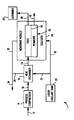
- an apparatus 1 which is designed to purify a contaminated ammonia feed stream 10 to produce an ammonia product stream 12.
- the contaminated ammonia feed stream 10 contains approximately 100 parts per million (ppm) of impurities in the feed.
- impurities include nitrogen, oxygen, hydrogen, carbon monoxide, carbon dioxide, hydrocarbons, organics and metal contaminants.
- the ammonia product stream 12 contains less than about 10 ppm of such impurities.
- the contaminated ammonia product stream 10 is compressed within a process compressor 14 or other means to raise the feed pressure to a pressure that is calculated to prevent the ammonia from liquefying at the temperature at which the process will be conducted.
- the process may be conducted at temperatures ranging from between about minus 30°C and about 10°C. At minus 30°C, the pressure should be less than about 1.18 atmospheres absolute. At 10°C the pressure should be less than about 6.075 atmospheres absolute.
- a compressed feed stream 16 is then cooled within a heat exchanger 18 which may be, for example, a commercially available two pass, plate-fin device in which a liquid coolant, such as obtained from a liquid coolant tank 20, is fed as a coolant stream 22 through a heat exchanger 18.
- the cooled feed stream 24 is fed to a membrane of a membrane module 28 which is housed within a cold box 29 filled with insulating materials.
- Another coolant stream 30 is provided to cool the membrane module 28 and forms another warmed coolant stream 32 which can be combined with warmed coolant stream 26 and then vented through a vent 34.
- the ammonia permeates through the membrane or membranes to form a permeate stream which is removed as the ammonia product stream 12.
- the retentate stream is removed as a waste stream 38 which may be introduced into a scrubber 40 of the type utilising a hydrochloric acid solution.
Landscapes
- Chemical & Material Sciences (AREA)
- Organic Chemistry (AREA)
- Analytical Chemistry (AREA)
- Inorganic Chemistry (AREA)
- Separation Using Semi-Permeable Membranes (AREA)
Abstract
Description
- This invention relates to a method of purifying ammonia in which an ammonia stream is introduced into one or more membranes to produce a permeate stream comprising purified ammonia and a retentate stream comprising the impurities within the ammonia stream. More particularly, the invention relates to such a method in which the ammonia stream is introduced into the membrane at sub-ambient temperatures.
- A variety of membranes have been provided that can be used to purify gas streams. In this regard, one or more membranes are positioned within a module to receive a feed stream. Depending on the type of membrane, components contained within the feed stream will permeate through the membrane to form a permeate stream while other components will be less permeable to form a retentate stream. The permeability of a component, or its ability to permeate through the membrane, can be defined as a product of membrane thickness and a rate of permeation per unit area of membrane per unit of driving force. Such permeability can either be dominated by the solubility of the component in the membrane or its diffusivity. The rate of diffusion relates to the fact that smaller molecules will travel faster through the membrane than larger molecules.
- Membranes also have the property of selectivity. Selectivity can be defined as the ratio of permeability of one component to the permeability of another component. Permeability is known to depend on the material, the pressure, the temperature and the gas composition. Selectivity is also dependent upon the material and operating conditions such as temperature, pressure and gas composition. Typically, membranes cannot be operated so that they exhibit both high selectivity and permeability at the same time.
- However, it has been found that in case of ammonia purification membranes can be selected and operated under temperature conditions that will optimise selectivity and permeability with the end result that the production of purified ammonia can be increased over existing production rates.
- In accordance with the invention, there is provided a method of purifying ammonia comprising introducing an ammonia stream into a membrane permeable to ammonia to produce a permeate stream comprising purified ammonia and a retentate stream comprising impurities from the ammonia stream; wherein the ammonia stream is introduced into the membrane at a temperature within a range of between about
minus 30°C, and about 10°C. and at a pressure selected such that said ammonia at the temperature will not liquefy - The selected pressure is typically less than about 1.18 atmospheres absolute at minus 30°C and less than about 6.075 atmospheres at about 10°C.
- It has been found that it is not simply that the separation efficiency or permeation flux and product purity of ammonia increases at lower temperatures. At temperatures below where the ammonia will tend to liquefy, once liquid droplets appear on the membrane, the separation efficiency decreases. On the other hand when a membrane is operated within the temperature range and pressures (given above), the rate of production of ammonia and ammonia purity increase with decreasing temperature. Preferably the temperature is in a range of about 0°C and about 5°C and the ammonia stream is cooled prior to its introduction into the membrane. The membrane can be fabricated , for example, from NAFION (Trade Mark) polymer which may be obtained from E.I. Dupont of Wilmington, Delaware. This polymer is a copolymer of tetrafluoroethylene and perfluoro 3,6-dioxa-4-methyl-7-octene-sulphonic acid. Other possible materials include EPDM (ethene-propene terpolymer) and polychloroprene.
- For a better understanding of the invention, reference will now be made, by way of exemplification only, to the accompanying drawing being a schematic representation of an apparatus used in carrying out a method of the invention.
- With reference to the drawing, an
apparatus 1 is illustrated which is designed to purify a contaminatedammonia feed stream 10 to produce anammonia product stream 12. The contaminatedammonia feed stream 10 contains approximately 100 parts per million (ppm) of impurities in the feed. Such impurities include nitrogen, oxygen, hydrogen, carbon monoxide, carbon dioxide, hydrocarbons, organics and metal contaminants. Theammonia product stream 12 contains less than about 10 ppm of such impurities. - Preferably, the contaminated
ammonia product stream 10 is compressed within aprocess compressor 14 or other means to raise the feed pressure to a pressure that is calculated to prevent the ammonia from liquefying at the temperature at which the process will be conducted. The process may be conducted at temperatures ranging from between aboutminus 30°C and about 10°C. Atminus 30°C, the pressure should be less than about 1.18 atmospheres absolute. At 10°C the pressure should be less than about 6.075 atmospheres absolute. Acompressed feed stream 16 is then cooled within aheat exchanger 18 which may be, for example, a commercially available two pass, plate-fin device in which a liquid coolant, such as obtained from aliquid coolant tank 20, is fed as acoolant stream 22 through aheat exchanger 18. This produces a cooledfeed stream 24 and a warmedcoolant stream 26. The cooledfeed stream 24 is fed to a membrane of amembrane module 28 which is housed within acold box 29 filled with insulating materials. Anothercoolant stream 30 is provided to cool themembrane module 28 and forms another warmedcoolant stream 32 which can be combined with warmedcoolant stream 26 and then vented through avent 34. - Although a
single membrane module 28 is shown there could be a series of such modules ie one or more membranes may be employed of the same or different types. The ammonia permeates through the membrane or membranes to form a permeate stream which is removed as theammonia product stream 12. The retentate stream is removed as awaste stream 38 which may be introduced into ascrubber 40 of the type utilising a hydrochloric acid solution. - Tests were carried out to investigate the potential performance enhancements of the invention. For a pressure across a membrane (fabricated from a NAFION (Trade Mark) polymer) at about 0.5 atmospheres, the ammonia permeability was found to increase from about 16778 bar(a) to about 45015 bar(a) as the operating temperature was reduced from about 23°C. to about 4°C. The permeability enhancement increases with increasing driving force (or feed pressure for a given downstream pressure).
- Further tests were conducted to determine the permeation of impurities. These results are summarised in the following table.
- Effect of Feed Temperature on Membrane Separation Efficiency
T (°C) 23 2 Gas Feed Permeate Feed Permeate Impurity (ppm) (ppm) (ppm) (ppm) H2 81.85 2.10 79.90 0.94 N2 80.33 0.44 86.12 0.49 O2 87.18 0.86 90.17 0.77 CO 74.71 0.32 73.46 0.25 CH4 82.36 0.50 80.32 0.33 Ammonia Recovery (%) 97.04 98.29 - As can be seen from this table, the percent recovery of the ammonia and ammonia purity increase with decreasing temperature.
Claims (5)
- A method of purifying ammonia comprising introducing an ammonia stream into a membrane permeable to ammonia to produce a permeate stream comprising purified ammonia and a retentate stream comprising impurities from the ammonia stream; wherein the ammonia stream is introduced into the membrane at a temperature within a range of between about minus 30°C, and about 10°C. and at a pressure selected such that said ammonia at the temperature will not liquefy.
- A method according to Claim 1 in which the pressure is less than about 1.18 atmospheres absolute at minus 30°C and less than about 6.075 atmospheres at 10°C.
- A method according to Claim 1 or Claim 2 in which the temperature is between about 0°C and about 5°C.
- A method according to any preceding claim in which the membrane is fabricated from a copolymer of tetrafluoroethylene and perfluoro 3,6-dioxa-4-methyl-7-octene-sulphonic acid.
- A method according to any preceding claim in which the ammonia stream is cooled prior to its introduction into the membrane.
Applications Claiming Priority (2)
| Application Number | Priority Date | Filing Date | Title |
|---|---|---|---|
| US34245199A | 1999-06-29 | 1999-06-29 | |
| US342451 | 1999-06-29 |
Publications (1)
| Publication Number | Publication Date |
|---|---|
| EP1065168A1 true EP1065168A1 (en) | 2001-01-03 |
Family
ID=23341890
Family Applications (1)
| Application Number | Title | Priority Date | Filing Date |
|---|---|---|---|
| EP00305495A Withdrawn EP1065168A1 (en) | 1999-06-29 | 2000-06-29 | Ammonia purification method |
Country Status (3)
| Country | Link |
|---|---|
| EP (1) | EP1065168A1 (en) |
| JP (1) | JP2001039711A (en) |
| ZA (1) | ZA200003123B (en) |
Cited By (3)
| Publication number | Priority date | Publication date | Assignee | Title |
|---|---|---|---|---|
| WO2002078820A1 (en) * | 2001-03-28 | 2002-10-10 | Merck Patent Gmbh | Method for the purification of corrosive gases |
| EP1160199A3 (en) * | 2000-05-23 | 2003-06-11 | Rohm And Haas Company | Method and apparatus for preventing iron contamination in an ammonia recovery process |
| CN103112871A (en) * | 2013-02-19 | 2013-05-22 | 厦门国麟科技有限公司 | Method for preparing high-concentration ammonia by separating and purifying low-concentration aqueous ammonia |
Citations (3)
| Publication number | Priority date | Publication date | Assignee | Title |
|---|---|---|---|---|
| US3545931A (en) * | 1968-08-28 | 1970-12-08 | Monsanto Co | Ammonia analysis system |
| SU1063774A1 (en) * | 1978-02-28 | 1983-12-30 | Всесоюзный научно-исследовательский институт синтетических смол | Method for recovering ammonia from gaseous mixtures |
| EP0293736A2 (en) * | 1987-06-01 | 1988-12-07 | Air Products And Chemicals, Inc. | Ammonia separation using ion exchange polymeric membranes and sorbents |
-
2000
- 2000-06-21 ZA ZA200003123A patent/ZA200003123B/en unknown
- 2000-06-28 JP JP2000193755A patent/JP2001039711A/en active Pending
- 2000-06-29 EP EP00305495A patent/EP1065168A1/en not_active Withdrawn
Patent Citations (3)
| Publication number | Priority date | Publication date | Assignee | Title |
|---|---|---|---|---|
| US3545931A (en) * | 1968-08-28 | 1970-12-08 | Monsanto Co | Ammonia analysis system |
| SU1063774A1 (en) * | 1978-02-28 | 1983-12-30 | Всесоюзный научно-исследовательский институт синтетических смол | Method for recovering ammonia from gaseous mixtures |
| EP0293736A2 (en) * | 1987-06-01 | 1988-12-07 | Air Products And Chemicals, Inc. | Ammonia separation using ion exchange polymeric membranes and sorbents |
Non-Patent Citations (1)
| Title |
|---|
| DATABASE WPI Section Ch Week 198434, Derwent World Patents Index; Class A88, AN 1984-212306, XP002151518 * |
Cited By (7)
| Publication number | Priority date | Publication date | Assignee | Title |
|---|---|---|---|---|
| EP1160199A3 (en) * | 2000-05-23 | 2003-06-11 | Rohm And Haas Company | Method and apparatus for preventing iron contamination in an ammonia recovery process |
| US6706093B2 (en) | 2000-05-23 | 2004-03-16 | Rohm And Haas Company | Method and apparatus for preventing iron contamination in corrosive service |
| WO2002078820A1 (en) * | 2001-03-28 | 2002-10-10 | Merck Patent Gmbh | Method for the purification of corrosive gases |
| US7108737B2 (en) | 2001-03-28 | 2006-09-19 | Basf Aktiengesellschaft | Method for the purification of corrosive gases |
| KR100856187B1 (en) * | 2001-03-28 | 2008-09-03 | 바스프 에스이 | How to clean corrosive gas |
| CN103112871A (en) * | 2013-02-19 | 2013-05-22 | 厦门国麟科技有限公司 | Method for preparing high-concentration ammonia by separating and purifying low-concentration aqueous ammonia |
| CN103112871B (en) * | 2013-02-19 | 2014-10-29 | 厦门国麟科技有限公司 | Method for preparing high-concentration ammonia by separating and purifying low-concentration aqueous ammonia |
Also Published As
| Publication number | Publication date |
|---|---|
| JP2001039711A (en) | 2001-02-13 |
| ZA200003123B (en) | 2001-01-24 |
Similar Documents
| Publication | Publication Date | Title |
|---|---|---|
| Baker et al. | The design of membrane vapor–gas separation systems | |
| CA1272119A (en) | Hybrid membrane/cryogenic process for hydrogen purification | |
| US4990168A (en) | Recovery of carbon dioxide from a carbon dioxide plant vent gas using membranes | |
| US4374657A (en) | Process of separating acid gases from hydrocarbons | |
| US4675030A (en) | Purification of helium | |
| EP1506939A2 (en) | Process and apparatus for enriching ammonia | |
| US9623370B2 (en) | Integrated process and apparatus for recovery of helium rich streams | |
| JPH08173749A (en) | Method for film separation of hydrogen through cascade of film increased in selectivity | |
| EP4023321A1 (en) | Three stage membrane gas separation with cooling and use of sweep gas | |
| KR950016823A (en) | Recovery method of hydrogen by adsorptive membrane | |
| KR102059068B1 (en) | Separation and recovery process of carbon monoxide from by-product gas of steel industry | |
| WO2020079403A1 (en) | Separation of carbon monoxide from carbon monoxide/hydrogen syngas mixtures | |
| KR940008735A (en) | Multiple purification membrane separation method | |
| US5693121A (en) | Semi-permeable membrane separation process for the production of very high purity nitrogen | |
| EP3858786A1 (en) | Nitrous oxide purification method | |
| JP2010500439A (en) | Method for separating synthesis gas containing at least carbon dioxide and water vapor in addition to hydrogen and carbon monoxide | |
| US5817841A (en) | Membrane process for argon purging from ethylene oxide reactors | |
| JP2001039711A (en) | Method for purifying ammonia | |
| EP0971785A1 (en) | Recovery of perfluorinated compounds and hydrofluorocarbon gases using molecular sieve membranes | |
| Matson et al. | Liquid membranes for the production of oxygen-enriched air: III. process design and economics | |
| US6478851B2 (en) | Ethylene treatment by gas permeation | |
| RU2738512C1 (en) | Apparatus for concentrating and purifying helium | |
| KR102273078B1 (en) | Carbon dioxide separation method by using separation membranes in gtl synthesis process | |
| US11148097B2 (en) | Low-temperature membrane separation device and method for capturing carbon dioxide at high concentration | |
| KR20240036566A (en) | Method for separating phosphorus pentafluoride from hydrogen chloride |
Legal Events
| Date | Code | Title | Description |
|---|---|---|---|
| PUAI | Public reference made under article 153(3) epc to a published international application that has entered the european phase |
Free format text: ORIGINAL CODE: 0009012 |
|
| AK | Designated contracting states |
Kind code of ref document: A1 Designated state(s): BE DE FR GB IE NL |
|
| AX | Request for extension of the european patent |
Free format text: AL;LT;LV;MK;RO;SI |
|
| 17P | Request for examination filed |
Effective date: 20010503 |
|
| AKX | Designation fees paid |
Free format text: BE DE FR GB IE NL |
|
| 17Q | First examination report despatched |
Effective date: 20020403 |
|
| GRAH | Despatch of communication of intention to grant a patent |
Free format text: ORIGINAL CODE: EPIDOS IGRA |
|
| STAA | Information on the status of an ep patent application or granted ep patent |
Free format text: STATUS: THE APPLICATION IS DEEMED TO BE WITHDRAWN |
|
| 18D | Application deemed to be withdrawn |
Effective date: 20030704 |