EP1063541A1 - Antistatic layer for lenticular surface - Google Patents
Antistatic layer for lenticular surface Download PDFInfo
- Publication number
- EP1063541A1 EP1063541A1 EP00202046A EP00202046A EP1063541A1 EP 1063541 A1 EP1063541 A1 EP 1063541A1 EP 00202046 A EP00202046 A EP 00202046A EP 00202046 A EP00202046 A EP 00202046A EP 1063541 A1 EP1063541 A1 EP 1063541A1
- Authority
- EP
- European Patent Office
- Prior art keywords
- lenticular
- support
- polymer sheet
- layer
- gelatin
- Prior art date
- Legal status (The legal status is an assumption and is not a legal conclusion. Google has not performed a legal analysis and makes no representation as to the accuracy of the status listed.)
- Granted
Links
- 238000000576 coating method Methods 0.000 claims abstract description 35
- 239000011248 coating agent Substances 0.000 claims abstract description 29
- 229920000642 polymer Polymers 0.000 claims abstract description 19
- 239000004927 clay Substances 0.000 claims abstract description 16
- 239000002245 particle Substances 0.000 claims abstract description 10
- 229910052751 metal Inorganic materials 0.000 claims abstract description 9
- 239000002184 metal Substances 0.000 claims abstract description 9
- 108010010803 Gelatin Proteins 0.000 claims description 30
- 229920000159 gelatin Polymers 0.000 claims description 30
- 235000019322 gelatine Nutrition 0.000 claims description 30
- 235000011852 gelatine desserts Nutrition 0.000 claims description 30
- 239000008273 gelatin Substances 0.000 claims description 28
- -1 polyethylene Polymers 0.000 claims description 21
- 238000000034 method Methods 0.000 claims description 20
- XLYOFNOQVPJJNP-UHFFFAOYSA-N water Substances O XLYOFNOQVPJJNP-UHFFFAOYSA-N 0.000 claims description 16
- 239000006185 dispersion Substances 0.000 claims description 13
- SOLUNJPVPZJLOM-UHFFFAOYSA-N trizinc;distiborate Chemical compound [Zn+2].[Zn+2].[Zn+2].[O-][Sb]([O-])([O-])=O.[O-][Sb]([O-])([O-])=O SOLUNJPVPZJLOM-UHFFFAOYSA-N 0.000 claims description 12
- 229910052709 silver Inorganic materials 0.000 claims description 8
- 239000004332 silver Substances 0.000 claims description 8
- 229920002635 polyurethane Polymers 0.000 claims description 7
- 239000004814 polyurethane Substances 0.000 claims description 7
- 229920005644 polyethylene terephthalate glycol copolymer Polymers 0.000 claims description 4
- 239000004698 Polyethylene Substances 0.000 claims description 2
- 229920000573 polyethylene Polymers 0.000 claims description 2
- 239000010410 layer Substances 0.000 description 71
- 239000000463 material Substances 0.000 description 22
- 229940094522 laponite Drugs 0.000 description 15
- XCOBTUNSZUJCDH-UHFFFAOYSA-B lithium magnesium sodium silicate Chemical compound [Li+].[Li+].[OH-].[OH-].[OH-].[OH-].[OH-].[OH-].[OH-].[OH-].[OH-].[OH-].[OH-].[OH-].[Na+].[Na+].[Mg+2].[Mg+2].[Mg+2].[Mg+2].[Mg+2].[Mg+2].[Mg+2].[Mg+2].[Mg+2].[Mg+2].[Mg+2].[Mg+2].[Mg+2].[Mg+2].[Mg+2].[Mg+2].O1[Si](O2)([O-])O[Si]3([O-])O[Si]1([O-])O[Si]2([O-])O3.O1[Si](O2)([O-])O[Si]3([O-])O[Si]1([O-])O[Si]2([O-])O3.O1[Si](O2)([O-])O[Si]3([O-])O[Si]1([O-])O[Si]2([O-])O3.O1[Si](O2)([O-])O[Si]3([O-])O[Si]1([O-])O[Si]2([O-])O3.O1[Si](O2)([O-])O[Si]3([O-])O[Si]1([O-])O[Si]2([O-])O3.O1[Si](O2)([O-])O[Si]3([O-])O[Si]1([O-])O[Si]2([O-])O3 XCOBTUNSZUJCDH-UHFFFAOYSA-B 0.000 description 15
- FCTDKZOUZXYHNA-UHFFFAOYSA-N 1,4-dioxane-2,2-diol Chemical compound OC1(O)COCCO1 FCTDKZOUZXYHNA-UHFFFAOYSA-N 0.000 description 12
- 238000003384 imaging method Methods 0.000 description 12
- 239000011230 binding agent Substances 0.000 description 11
- ZKSPHENWXBWOPM-UHFFFAOYSA-N 2-methylprop-2-enoic acid oxochromium Chemical compound CC(=C)C(=O)O.O=[Cr] ZKSPHENWXBWOPM-UHFFFAOYSA-N 0.000 description 9
- LYCAIKOWRPUZTN-UHFFFAOYSA-N Ethylene glycol Chemical compound OCCO LYCAIKOWRPUZTN-UHFFFAOYSA-N 0.000 description 8
- 239000012153 distilled water Substances 0.000 description 8
- 229910044991 metal oxide Inorganic materials 0.000 description 8
- 239000004848 polyfunctional curative Substances 0.000 description 8
- 239000004372 Polyvinyl alcohol Substances 0.000 description 7
- XLOMVQKBTHCTTD-UHFFFAOYSA-N Zinc monoxide Chemical compound [Zn]=O XLOMVQKBTHCTTD-UHFFFAOYSA-N 0.000 description 7
- 150000004706 metal oxides Chemical class 0.000 description 7
- 229920002451 polyvinyl alcohol Polymers 0.000 description 7
- 238000012545 processing Methods 0.000 description 7
- 229910021647 smectite Inorganic materials 0.000 description 7
- 230000003068 static effect Effects 0.000 description 7
- CSCPPACGZOOCGX-UHFFFAOYSA-N Acetone Chemical compound CC(C)=O CSCPPACGZOOCGX-UHFFFAOYSA-N 0.000 description 6
- 229920003091 Methocel™ Polymers 0.000 description 6
- 150000002009 diols Chemical class 0.000 description 6
- 239000000839 emulsion Substances 0.000 description 6
- 239000000203 mixture Substances 0.000 description 6
- GWEVSGVZZGPLCZ-UHFFFAOYSA-N Titan oxide Chemical compound O=[Ti]=O GWEVSGVZZGPLCZ-UHFFFAOYSA-N 0.000 description 5
- 125000000129 anionic group Chemical group 0.000 description 5
- 239000003795 chemical substances by application Substances 0.000 description 5
- 239000011229 interlayer Substances 0.000 description 5
- 229920003009 polyurethane dispersion Polymers 0.000 description 5
- VYPSYNLAJGMNEJ-UHFFFAOYSA-N silicon dioxide Inorganic materials O=[Si]=O VYPSYNLAJGMNEJ-UHFFFAOYSA-N 0.000 description 5
- 239000004094 surface-active agent Substances 0.000 description 5
- CPLXHLVBOLITMK-UHFFFAOYSA-N Magnesium oxide Chemical compound [Mg]=O CPLXHLVBOLITMK-UHFFFAOYSA-N 0.000 description 4
- 239000002253 acid Substances 0.000 description 4
- 239000002585 base Substances 0.000 description 4
- 239000004020 conductor Substances 0.000 description 4
- 230000032798 delamination Effects 0.000 description 4
- 125000005442 diisocyanate group Chemical group 0.000 description 4
- 239000000975 dye Substances 0.000 description 4
- 239000003792 electrolyte Substances 0.000 description 4
- QQVIHTHCMHWDBS-UHFFFAOYSA-N isophthalic acid Chemical compound OC(=O)C1=CC=CC(C(O)=O)=C1 QQVIHTHCMHWDBS-UHFFFAOYSA-N 0.000 description 4
- 238000002360 preparation method Methods 0.000 description 4
- 239000000047 product Substances 0.000 description 4
- 239000000523 sample Substances 0.000 description 4
- 239000002904 solvent Substances 0.000 description 4
- 239000000126 substance Substances 0.000 description 4
- ZWEHNKRNPOVVGH-UHFFFAOYSA-N 2-Butanone Chemical compound CCC(C)=O ZWEHNKRNPOVVGH-UHFFFAOYSA-N 0.000 description 3
- ZMXDDKWLCZADIW-UHFFFAOYSA-N N,N-Dimethylformamide Chemical compound CN(C)C=O ZMXDDKWLCZADIW-UHFFFAOYSA-N 0.000 description 3
- WYURNTSHIVDZCO-UHFFFAOYSA-N Tetrahydrofuran Chemical compound C1CCOC1 WYURNTSHIVDZCO-UHFFFAOYSA-N 0.000 description 3
- YXFVVABEGXRONW-UHFFFAOYSA-N Toluene Chemical compound CC1=CC=CC=C1 YXFVVABEGXRONW-UHFFFAOYSA-N 0.000 description 3
- ZMANZCXQSJIPKH-UHFFFAOYSA-N Triethylamine Chemical compound CCN(CC)CC ZMANZCXQSJIPKH-UHFFFAOYSA-N 0.000 description 3
- 230000000052 comparative effect Effects 0.000 description 3
- 239000006258 conductive agent Substances 0.000 description 3
- 150000004985 diamines Chemical class 0.000 description 3
- 230000005611 electricity Effects 0.000 description 3
- 125000002887 hydroxy group Chemical group [H]O* 0.000 description 3
- 238000004519 manufacturing process Methods 0.000 description 3
- 239000000178 monomer Substances 0.000 description 3
- 230000001737 promoting effect Effects 0.000 description 3
- 150000003839 salts Chemical class 0.000 description 3
- PTBDIHRZYDMNKB-UHFFFAOYSA-N 2,2-Bis(hydroxymethyl)propionic acid Chemical compound OCC(C)(CO)C(O)=O PTBDIHRZYDMNKB-UHFFFAOYSA-N 0.000 description 2
- 229920001634 Copolyester Polymers 0.000 description 2
- RGHNJXZEOKUKBD-SQOUGZDYSA-N D-gluconic acid Chemical compound OC[C@@H](O)[C@@H](O)[C@H](O)[C@@H](O)C(O)=O RGHNJXZEOKUKBD-SQOUGZDYSA-N 0.000 description 2
- OAKJQQAXSVQMHS-UHFFFAOYSA-N Hydrazine Chemical compound NN OAKJQQAXSVQMHS-UHFFFAOYSA-N 0.000 description 2
- OFOBLEOULBTSOW-UHFFFAOYSA-N Malonic acid Chemical compound OC(=O)CC(O)=O OFOBLEOULBTSOW-UHFFFAOYSA-N 0.000 description 2
- SECXISVLQFMRJM-UHFFFAOYSA-N N-Methylpyrrolidone Chemical compound CN1CCCC1=O SECXISVLQFMRJM-UHFFFAOYSA-N 0.000 description 2
- KKEYFWRCBNTPAC-UHFFFAOYSA-N Terephthalic acid Chemical compound OC(=O)C1=CC=C(C(O)=O)C=C1 KKEYFWRCBNTPAC-UHFFFAOYSA-N 0.000 description 2
- MCMNRKCIXSYSNV-UHFFFAOYSA-N Zirconium dioxide Chemical compound O=[Zr]=O MCMNRKCIXSYSNV-UHFFFAOYSA-N 0.000 description 2
- YIMQCDZDWXUDCA-UHFFFAOYSA-N [4-(hydroxymethyl)cyclohexyl]methanol Chemical compound OCC1CCC(CO)CC1 YIMQCDZDWXUDCA-UHFFFAOYSA-N 0.000 description 2
- WNLRTRBMVRJNCN-UHFFFAOYSA-N adipic acid Chemical compound OC(=O)CCCCC(O)=O WNLRTRBMVRJNCN-UHFFFAOYSA-N 0.000 description 2
- 229910052783 alkali metal Inorganic materials 0.000 description 2
- 238000004458 analytical method Methods 0.000 description 2
- 150000008064 anhydrides Chemical class 0.000 description 2
- QVGXLLKOCUKJST-UHFFFAOYSA-N atomic oxygen Chemical compound [O] QVGXLLKOCUKJST-UHFFFAOYSA-N 0.000 description 2
- QVQLCTNNEUAWMS-UHFFFAOYSA-N barium oxide Chemical compound [Ba]=O QVQLCTNNEUAWMS-UHFFFAOYSA-N 0.000 description 2
- 230000015572 biosynthetic process Effects 0.000 description 2
- 210000000988 bone and bone Anatomy 0.000 description 2
- 125000002091 cationic group Chemical group 0.000 description 2
- 239000000084 colloidal system Substances 0.000 description 2
- 150000001875 compounds Chemical class 0.000 description 2
- 239000003431 cross linking reagent Substances 0.000 description 2
- 230000001627 detrimental effect Effects 0.000 description 2
- 238000011161 development Methods 0.000 description 2
- GNTDGMZSJNCJKK-UHFFFAOYSA-N divanadium pentaoxide Chemical compound O=[V](=O)O[V](=O)=O GNTDGMZSJNCJKK-UHFFFAOYSA-N 0.000 description 2
- 238000001035 drying Methods 0.000 description 2
- 239000011532 electronic conductor Substances 0.000 description 2
- KWLMIXQRALPRBC-UHFFFAOYSA-L hectorite Chemical compound [Li+].[OH-].[OH-].[Na+].[Mg+2].O1[Si]2([O-])O[Si]1([O-])O[Si]([O-])(O1)O[Si]1([O-])O2 KWLMIXQRALPRBC-UHFFFAOYSA-L 0.000 description 2
- 229910000271 hectorite Inorganic materials 0.000 description 2
- NAQMVNRVTILPCV-UHFFFAOYSA-N hexane-1,6-diamine Chemical compound NCCCCCCN NAQMVNRVTILPCV-UHFFFAOYSA-N 0.000 description 2
- 238000010348 incorporation Methods 0.000 description 2
- 239000004615 ingredient Substances 0.000 description 2
- 239000010416 ion conductor Substances 0.000 description 2
- 150000002500 ions Chemical class 0.000 description 2
- IQPQWNKOIGAROB-UHFFFAOYSA-N isocyanate group Chemical group [N-]=C=O IQPQWNKOIGAROB-UHFFFAOYSA-N 0.000 description 2
- 239000000395 magnesium oxide Substances 0.000 description 2
- JKQOBWVOAYFWKG-UHFFFAOYSA-N molybdenum trioxide Chemical compound O=[Mo](=O)=O JKQOBWVOAYFWKG-UHFFFAOYSA-N 0.000 description 2
- BDJRBEYXGGNYIS-UHFFFAOYSA-N nonanedioic acid Chemical compound OC(=O)CCCCCCCC(O)=O BDJRBEYXGGNYIS-UHFFFAOYSA-N 0.000 description 2
- 230000003287 optical effect Effects 0.000 description 2
- 239000001301 oxygen Substances 0.000 description 2
- 229910052760 oxygen Inorganic materials 0.000 description 2
- XNGIFLGASWRNHJ-UHFFFAOYSA-N phthalic acid Chemical compound OC(=O)C1=CC=CC=C1C(O)=O XNGIFLGASWRNHJ-UHFFFAOYSA-N 0.000 description 2
- 230000000704 physical effect Effects 0.000 description 2
- 229920005862 polyol Polymers 0.000 description 2
- 150000003077 polyols Chemical class 0.000 description 2
- CXMXRPHRNRROMY-UHFFFAOYSA-N sebacic acid Chemical compound OC(=O)CCCCCCCCC(O)=O CXMXRPHRNRROMY-UHFFFAOYSA-N 0.000 description 2
- 239000000377 silicon dioxide Substances 0.000 description 2
- TYFQFVWCELRYAO-UHFFFAOYSA-N suberic acid Chemical compound OC(=O)CCCCCCC(O)=O TYFQFVWCELRYAO-UHFFFAOYSA-N 0.000 description 2
- 238000012360 testing method Methods 0.000 description 2
- XOLBLPGZBRYERU-UHFFFAOYSA-N tin dioxide Chemical compound O=[Sn]=O XOLBLPGZBRYERU-UHFFFAOYSA-N 0.000 description 2
- 229910001887 tin oxide Inorganic materials 0.000 description 2
- GETQZCLCWQTVFV-UHFFFAOYSA-N trimethylamine Chemical compound CN(C)C GETQZCLCWQTVFV-UHFFFAOYSA-N 0.000 description 2
- ZNOKGRXACCSDPY-UHFFFAOYSA-N tungsten trioxide Chemical compound O=[W](=O)=O ZNOKGRXACCSDPY-UHFFFAOYSA-N 0.000 description 2
- 239000011787 zinc oxide Substances 0.000 description 2
- PUPZLCDOIYMWBV-UHFFFAOYSA-N (+/-)-1,3-Butanediol Chemical compound CC(O)CCO PUPZLCDOIYMWBV-UHFFFAOYSA-N 0.000 description 1
- WVWYODXLKONLEM-UHFFFAOYSA-N 1,2-diisocyanatobutane Chemical compound O=C=NC(CC)CN=C=O WVWYODXLKONLEM-UHFFFAOYSA-N 0.000 description 1
- NAOLWIGVYRIGTP-UHFFFAOYSA-N 1,3,5-trihydroxyanthracene-9,10-dione Chemical compound C1=CC(O)=C2C(=O)C3=CC(O)=CC(O)=C3C(=O)C2=C1 NAOLWIGVYRIGTP-UHFFFAOYSA-N 0.000 description 1
- VGHSXKTVMPXHNG-UHFFFAOYSA-N 1,3-diisocyanatobenzene Chemical compound O=C=NC1=CC=CC(N=C=O)=C1 VGHSXKTVMPXHNG-UHFFFAOYSA-N 0.000 description 1
- UFXYYTWJETZVHG-UHFFFAOYSA-N 1,3-diisocyanatobutane Chemical compound O=C=NC(C)CCN=C=O UFXYYTWJETZVHG-UHFFFAOYSA-N 0.000 description 1
- 125000004955 1,4-cyclohexylene group Chemical group [H]C1([H])C([H])([H])C([H])([*:1])C([H])([H])C([H])([H])C1([H])[*:2] 0.000 description 1
- OVBFMUAFNIIQAL-UHFFFAOYSA-N 1,4-diisocyanatobutane Chemical compound O=C=NCCCCN=C=O OVBFMUAFNIIQAL-UHFFFAOYSA-N 0.000 description 1
- SBJCUZQNHOLYMD-UHFFFAOYSA-N 1,5-Naphthalene diisocyanate Chemical compound C1=CC=C2C(N=C=O)=CC=CC2=C1N=C=O SBJCUZQNHOLYMD-UHFFFAOYSA-N 0.000 description 1
- KDLIYVDINLSKGR-UHFFFAOYSA-N 1-isocyanato-4-(4-isocyanatophenoxy)benzene Chemical compound C1=CC(N=C=O)=CC=C1OC1=CC=C(N=C=O)C=C1 KDLIYVDINLSKGR-UHFFFAOYSA-N 0.000 description 1
- HPQUMJNDQVOTAZ-UHFFFAOYSA-N 2,2-dihydroxypropanoic acid Chemical compound CC(O)(O)C(O)=O HPQUMJNDQVOTAZ-UHFFFAOYSA-N 0.000 description 1
- WXTMDXOMEHJXQO-UHFFFAOYSA-N 2,5-dihydroxybenzoic acid Chemical compound OC(=O)C1=CC(O)=CC=C1O WXTMDXOMEHJXQO-UHFFFAOYSA-N 0.000 description 1
- NOWKCMXCCJGMRR-UHFFFAOYSA-N Aziridine Chemical compound C1CN1 NOWKCMXCCJGMRR-UHFFFAOYSA-N 0.000 description 1
- 241000283690 Bos taurus Species 0.000 description 1
- VYZAMTAEIAYCRO-UHFFFAOYSA-N Chromium Chemical compound [Cr] VYZAMTAEIAYCRO-UHFFFAOYSA-N 0.000 description 1
- RGHNJXZEOKUKBD-UHFFFAOYSA-N D-gluconic acid Natural products OCC(O)C(O)C(O)C(O)C(O)=O RGHNJXZEOKUKBD-UHFFFAOYSA-N 0.000 description 1
- JOYRKODLDBILNP-UHFFFAOYSA-N Ethyl urethane Chemical compound CCOC(N)=O JOYRKODLDBILNP-UHFFFAOYSA-N 0.000 description 1
- PIICEJLVQHRZGT-UHFFFAOYSA-N Ethylenediamine Chemical compound NCCN PIICEJLVQHRZGT-UHFFFAOYSA-N 0.000 description 1
- DSLZVSRJTYRBFB-UHFFFAOYSA-N Galactaric acid Natural products OC(=O)C(O)C(O)C(O)C(O)C(O)=O DSLZVSRJTYRBFB-UHFFFAOYSA-N 0.000 description 1
- IAJILQKETJEXLJ-UHFFFAOYSA-N Galacturonsaeure Natural products O=CC(O)C(O)C(O)C(O)C(O)=O IAJILQKETJEXLJ-UHFFFAOYSA-N 0.000 description 1
- 239000005057 Hexamethylene diisocyanate Substances 0.000 description 1
- 206010021143 Hypoxia Diseases 0.000 description 1
- DGAQECJNVWCQMB-PUAWFVPOSA-M Ilexoside XXIX Chemical compound C[C@@H]1CC[C@@]2(CC[C@@]3(C(=CC[C@H]4[C@]3(CC[C@@H]5[C@@]4(CC[C@@H](C5(C)C)OS(=O)(=O)[O-])C)C)[C@@H]2[C@]1(C)O)C)C(=O)O[C@H]6[C@@H]([C@H]([C@@H]([C@H](O6)CO)O)O)O.[Na+] DGAQECJNVWCQMB-PUAWFVPOSA-M 0.000 description 1
- 239000005058 Isophorone diisocyanate Substances 0.000 description 1
- FUJCRWPEOMXPAD-UHFFFAOYSA-N Li2O Inorganic materials [Li+].[Li+].[O-2] FUJCRWPEOMXPAD-UHFFFAOYSA-N 0.000 description 1
- WHXSMMKQMYFTQS-UHFFFAOYSA-N Lithium Chemical compound [Li] WHXSMMKQMYFTQS-UHFFFAOYSA-N 0.000 description 1
- JLVVSXFLKOJNIY-UHFFFAOYSA-N Magnesium ion Chemical compound [Mg+2] JLVVSXFLKOJNIY-UHFFFAOYSA-N 0.000 description 1
- CERQOIWHTDAKMF-UHFFFAOYSA-N Methacrylic acid Chemical compound CC(=C)C(O)=O CERQOIWHTDAKMF-UHFFFAOYSA-N 0.000 description 1
- JLTDJTHDQAWBAV-UHFFFAOYSA-N N,N-dimethylaniline Chemical compound CN(C)C1=CC=CC=C1 JLTDJTHDQAWBAV-UHFFFAOYSA-N 0.000 description 1
- KKCBUQHMOMHUOY-UHFFFAOYSA-N Na2O Inorganic materials [O-2].[Na+].[Na+] KKCBUQHMOMHUOY-UHFFFAOYSA-N 0.000 description 1
- 239000000020 Nitrocellulose Substances 0.000 description 1
- 229920003171 Poly (ethylene oxide) Polymers 0.000 description 1
- 229920001273 Polyhydroxy acid Polymers 0.000 description 1
- 229920000388 Polyphosphate Polymers 0.000 description 1
- 239000004793 Polystyrene Substances 0.000 description 1
- 241000053208 Porcellio laevis Species 0.000 description 1
- ZLMJMSJWJFRBEC-UHFFFAOYSA-N Potassium Chemical compound [K] ZLMJMSJWJFRBEC-UHFFFAOYSA-N 0.000 description 1
- KDYFGRWQOYBRFD-UHFFFAOYSA-N Succinic acid Natural products OC(=O)CCC(O)=O KDYFGRWQOYBRFD-UHFFFAOYSA-N 0.000 description 1
- FEWJPZIEWOKRBE-UHFFFAOYSA-N Tartaric Acid Chemical compound [H+].[H+].[O-]C(=O)C(O)C(O)C([O-])=O FEWJPZIEWOKRBE-UHFFFAOYSA-N 0.000 description 1
- 241000981595 Zoysia japonica Species 0.000 description 1
- FJWGYAHXMCUOOM-QHOUIDNNSA-N [(2s,3r,4s,5r,6r)-2-[(2r,3r,4s,5r,6s)-4,5-dinitrooxy-2-(nitrooxymethyl)-6-[(2r,3r,4s,5r,6s)-4,5,6-trinitrooxy-2-(nitrooxymethyl)oxan-3-yl]oxyoxan-3-yl]oxy-3,5-dinitrooxy-6-(nitrooxymethyl)oxan-4-yl] nitrate Chemical compound O([C@@H]1O[C@@H]([C@H]([C@H](O[N+]([O-])=O)[C@H]1O[N+]([O-])=O)O[C@H]1[C@@H]([C@@H](O[N+]([O-])=O)[C@H](O[N+]([O-])=O)[C@@H](CO[N+]([O-])=O)O1)O[N+]([O-])=O)CO[N+](=O)[O-])[C@@H]1[C@@H](CO[N+]([O-])=O)O[C@@H](O[N+]([O-])=O)[C@H](O[N+]([O-])=O)[C@H]1O[N+]([O-])=O FJWGYAHXMCUOOM-QHOUIDNNSA-N 0.000 description 1
- 238000009825 accumulation Methods 0.000 description 1
- 150000007513 acids Chemical class 0.000 description 1
- NIXOWILDQLNWCW-UHFFFAOYSA-N acrylic acid group Chemical group C(C=C)(=O)O NIXOWILDQLNWCW-UHFFFAOYSA-N 0.000 description 1
- 238000012644 addition polymerization Methods 0.000 description 1
- 239000001361 adipic acid Substances 0.000 description 1
- 235000011037 adipic acid Nutrition 0.000 description 1
- 230000002411 adverse Effects 0.000 description 1
- IAJILQKETJEXLJ-QTBDOELSSA-N aldehydo-D-glucuronic acid Chemical compound O=C[C@H](O)[C@@H](O)[C@H](O)[C@H](O)C(O)=O IAJILQKETJEXLJ-QTBDOELSSA-N 0.000 description 1
- 239000003513 alkali Substances 0.000 description 1
- 125000005250 alkyl acrylate group Chemical group 0.000 description 1
- 239000002168 alkylating agent Substances 0.000 description 1
- 229940100198 alkylating agent Drugs 0.000 description 1
- PNEYBMLMFCGWSK-UHFFFAOYSA-N aluminium oxide Inorganic materials [O-2].[O-2].[O-2].[Al+3].[Al+3] PNEYBMLMFCGWSK-UHFFFAOYSA-N 0.000 description 1
- 150000001450 anions Chemical class 0.000 description 1
- KDYFGRWQOYBRFD-NUQCWPJISA-N butanedioic acid Chemical compound O[14C](=O)CC[14C](O)=O KDYFGRWQOYBRFD-NUQCWPJISA-N 0.000 description 1
- 239000006227 byproduct Substances 0.000 description 1
- MMCOUVMKNAHQOY-UHFFFAOYSA-N carbonoperoxoic acid Chemical class OOC(O)=O MMCOUVMKNAHQOY-UHFFFAOYSA-N 0.000 description 1
- 125000003178 carboxy group Chemical group [H]OC(*)=O 0.000 description 1
- 150000007942 carboxylates Chemical class 0.000 description 1
- 229920002301 cellulose acetate Polymers 0.000 description 1
- 229920006217 cellulose acetate butyrate Polymers 0.000 description 1
- 229920003086 cellulose ether Polymers 0.000 description 1
- 238000012822 chemical development Methods 0.000 description 1
- 229910052804 chromium Inorganic materials 0.000 description 1
- 239000011651 chromium Substances 0.000 description 1
- 239000002734 clay mineral Substances 0.000 description 1
- 239000008199 coating composition Substances 0.000 description 1
- 229910052681 coesite Inorganic materials 0.000 description 1
- 239000002131 composite material Substances 0.000 description 1
- 230000001010 compromised effect Effects 0.000 description 1
- 229920001940 conductive polymer Polymers 0.000 description 1
- 229920000547 conjugated polymer Polymers 0.000 description 1
- 238000011109 contamination Methods 0.000 description 1
- 229910052906 cristobalite Inorganic materials 0.000 description 1
- 125000004093 cyano group Chemical group *C#N 0.000 description 1
- 230000007547 defect Effects 0.000 description 1
- 239000008367 deionised water Substances 0.000 description 1
- 229910021641 deionized water Inorganic materials 0.000 description 1
- 230000002939 deleterious effect Effects 0.000 description 1
- 230000001419 dependent effect Effects 0.000 description 1
- 238000013461 design Methods 0.000 description 1
- KORSJDCBLAPZEQ-UHFFFAOYSA-N dicyclohexylmethane-4,4'-diisocyanate Chemical compound C1CC(N=C=O)CCC1CC1CCC(N=C=O)CC1 KORSJDCBLAPZEQ-UHFFFAOYSA-N 0.000 description 1
- GGSUCNLOZRCGPQ-UHFFFAOYSA-N diethylaniline Chemical compound CCN(CC)C1=CC=CC=C1 GGSUCNLOZRCGPQ-UHFFFAOYSA-N 0.000 description 1
- 238000009792 diffusion process Methods 0.000 description 1
- XUCJHNOBJLKZNU-UHFFFAOYSA-M dilithium;hydroxide Chemical compound [Li+].[Li+].[OH-] XUCJHNOBJLKZNU-UHFFFAOYSA-M 0.000 description 1
- 239000012769 display material Substances 0.000 description 1
- 238000004821 distillation Methods 0.000 description 1
- 230000000694 effects Effects 0.000 description 1
- SOTXZZSZYXIQNA-UHFFFAOYSA-N ethenyl-dimethyl-(2-phenylethyl)azanium Chemical compound C=C[N+](C)(C)CCC1=CC=CC=C1 SOTXZZSZYXIQNA-UHFFFAOYSA-N 0.000 description 1
- STVZJERGLQHEKB-UHFFFAOYSA-N ethylene glycol dimethacrylate Substances CC(=C)C(=O)OCCOC(=O)C(C)=C STVZJERGLQHEKB-UHFFFAOYSA-N 0.000 description 1
- 239000011737 fluorine Substances 0.000 description 1
- 229910052731 fluorine Inorganic materials 0.000 description 1
- 238000009472 formulation Methods 0.000 description 1
- 125000000524 functional group Chemical group 0.000 description 1
- DSLZVSRJTYRBFB-DUHBMQHGSA-N galactaric acid Chemical compound OC(=O)[C@H](O)[C@@H](O)[C@@H](O)[C@H](O)C(O)=O DSLZVSRJTYRBFB-DUHBMQHGSA-N 0.000 description 1
- 239000000174 gluconic acid Substances 0.000 description 1
- 235000012208 gluconic acid Nutrition 0.000 description 1
- 229940097043 glucuronic acid Drugs 0.000 description 1
- 125000003055 glycidyl group Chemical group C(C1CO1)* 0.000 description 1
- 238000010438 heat treatment Methods 0.000 description 1
- 125000005842 heteroatom Chemical group 0.000 description 1
- RRAMGCGOFNQTLD-UHFFFAOYSA-N hexamethylene diisocyanate Chemical compound O=C=NCCCCCCN=C=O RRAMGCGOFNQTLD-UHFFFAOYSA-N 0.000 description 1
- ACCCMOQWYVYDOT-UHFFFAOYSA-N hexane-1,1-diol Chemical compound CCCCCC(O)O ACCCMOQWYVYDOT-UHFFFAOYSA-N 0.000 description 1
- 239000001257 hydrogen Substances 0.000 description 1
- 229910052739 hydrogen Inorganic materials 0.000 description 1
- WGCNASOHLSPBMP-UHFFFAOYSA-N hydroxyacetaldehyde Natural products OCC=O WGCNASOHLSPBMP-UHFFFAOYSA-N 0.000 description 1
- 239000012535 impurity Substances 0.000 description 1
- 229910003437 indium oxide Inorganic materials 0.000 description 1
- PJXISJQVUVHSOJ-UHFFFAOYSA-N indium(iii) oxide Chemical compound [O-2].[O-2].[O-2].[In+3].[In+3] PJXISJQVUVHSOJ-UHFFFAOYSA-N 0.000 description 1
- 229910052500 inorganic mineral Inorganic materials 0.000 description 1
- 230000001788 irregular Effects 0.000 description 1
- NIMLQBUJDJZYEJ-UHFFFAOYSA-N isophorone diisocyanate Chemical compound CC1(C)CC(N=C=O)CC(C)(CN=C=O)C1 NIMLQBUJDJZYEJ-UHFFFAOYSA-N 0.000 description 1
- 150000002596 lactones Chemical class 0.000 description 1
- 239000002346 layers by function Substances 0.000 description 1
- 229910052744 lithium Inorganic materials 0.000 description 1
- 238000001459 lithography Methods 0.000 description 1
- 239000000314 lubricant Substances 0.000 description 1
- 229910001425 magnesium ion Inorganic materials 0.000 description 1
- HCWCAKKEBCNQJP-UHFFFAOYSA-N magnesium orthosilicate Chemical compound [Mg+2].[Mg+2].[O-][Si]([O-])([O-])[O-] HCWCAKKEBCNQJP-UHFFFAOYSA-N 0.000 description 1
- 239000000391 magnesium silicate Substances 0.000 description 1
- 229910052919 magnesium silicate Inorganic materials 0.000 description 1
- 235000019792 magnesium silicate Nutrition 0.000 description 1
- VZCYOOQTPOCHFL-UPHRSURJSA-N maleic acid Chemical compound OC(=O)\C=C/C(O)=O VZCYOOQTPOCHFL-UPHRSURJSA-N 0.000 description 1
- 239000011976 maleic acid Substances 0.000 description 1
- 150000002734 metacrylic acid derivatives Chemical class 0.000 description 1
- 229910001507 metal halide Inorganic materials 0.000 description 1
- 239000011707 mineral Substances 0.000 description 1
- 238000002156 mixing Methods 0.000 description 1
- 150000002772 monosaccharides Chemical class 0.000 description 1
- AJDUTMFFZHIJEM-UHFFFAOYSA-N n-(9,10-dioxoanthracen-1-yl)-4-[4-[[4-[4-[(9,10-dioxoanthracen-1-yl)carbamoyl]phenyl]phenyl]diazenyl]phenyl]benzamide Chemical compound O=C1C2=CC=CC=C2C(=O)C2=C1C=CC=C2NC(=O)C(C=C1)=CC=C1C(C=C1)=CC=C1N=NC(C=C1)=CC=C1C(C=C1)=CC=C1C(=O)NC1=CC=CC2=C1C(=O)C1=CC=CC=C1C2=O AJDUTMFFZHIJEM-UHFFFAOYSA-N 0.000 description 1
- SLCVBVWXLSEKPL-UHFFFAOYSA-N neopentyl glycol Chemical compound OCC(C)(C)CO SLCVBVWXLSEKPL-UHFFFAOYSA-N 0.000 description 1
- 229920001220 nitrocellulos Polymers 0.000 description 1
- 125000004433 nitrogen atom Chemical group N* 0.000 description 1
- 125000001400 nonyl group Chemical group [H]C([*])([H])C([H])([H])C([H])([H])C([H])([H])C([H])([H])C([H])([H])C([H])([H])C([H])([H])C([H])([H])[H] 0.000 description 1
- 239000003960 organic solvent Substances 0.000 description 1
- 230000001590 oxidative effect Effects 0.000 description 1
- 239000003002 pH adjusting agent Substances 0.000 description 1
- FHHJDRFHHWUPDG-UHFFFAOYSA-N peroxysulfuric acid Chemical class OOS(O)(=O)=O FHHJDRFHHWUPDG-UHFFFAOYSA-N 0.000 description 1
- 229920003023 plastic Polymers 0.000 description 1
- 229920000058 polyacrylate Polymers 0.000 description 1
- 229920000515 polycarbonate Polymers 0.000 description 1
- 239000004417 polycarbonate Substances 0.000 description 1
- 229920000728 polyester Polymers 0.000 description 1
- 229920005906 polyester polyol Polymers 0.000 description 1
- 229920000570 polyether Polymers 0.000 description 1
- 229920000139 polyethylene terephthalate Polymers 0.000 description 1
- 239000005020 polyethylene terephthalate Substances 0.000 description 1
- 239000005056 polyisocyanate Substances 0.000 description 1
- 229920001228 polyisocyanate Polymers 0.000 description 1
- 239000001205 polyphosphate Substances 0.000 description 1
- 235000011176 polyphosphates Nutrition 0.000 description 1
- 229920001451 polypropylene glycol Polymers 0.000 description 1
- 229920002223 polystyrene Polymers 0.000 description 1
- 229920000915 polyvinyl chloride Polymers 0.000 description 1
- 239000004800 polyvinyl chloride Substances 0.000 description 1
- 229910052700 potassium Inorganic materials 0.000 description 1
- 239000011591 potassium Substances 0.000 description 1
- 239000000843 powder Substances 0.000 description 1
- ZNZJJSYHZBXQSM-UHFFFAOYSA-N propane-2,2-diamine Chemical compound CC(C)(N)N ZNZJJSYHZBXQSM-UHFFFAOYSA-N 0.000 description 1
- 230000001681 protective effect Effects 0.000 description 1
- 239000010453 quartz Substances 0.000 description 1
- 125000001453 quaternary ammonium group Chemical group 0.000 description 1
- 230000002829 reductive effect Effects 0.000 description 1
- 239000011347 resin Substances 0.000 description 1
- 229920005989 resin Polymers 0.000 description 1
- 238000006748 scratching Methods 0.000 description 1
- 230000002393 scratching effect Effects 0.000 description 1
- 230000035945 sensitivity Effects 0.000 description 1
- 238000005029 sieve analysis Methods 0.000 description 1
- 229910052710 silicon Inorganic materials 0.000 description 1
- 239000010703 silicon Substances 0.000 description 1
- 239000011734 sodium Substances 0.000 description 1
- 229910052708 sodium Inorganic materials 0.000 description 1
- FQENQNTWSFEDLI-UHFFFAOYSA-J sodium diphosphate Chemical compound [Na+].[Na+].[Na+].[Na+].[O-]P([O-])(=O)OP([O-])([O-])=O FQENQNTWSFEDLI-UHFFFAOYSA-J 0.000 description 1
- 229910052682 stishovite Inorganic materials 0.000 description 1
- 238000000859 sublimation Methods 0.000 description 1
- 230000008022 sublimation Effects 0.000 description 1
- BDHFUVZGWQCTTF-UHFFFAOYSA-M sulfonate Chemical compound [O-]S(=O)=O BDHFUVZGWQCTTF-UHFFFAOYSA-M 0.000 description 1
- 239000000725 suspension Substances 0.000 description 1
- 230000008961 swelling Effects 0.000 description 1
- 239000008399 tap water Substances 0.000 description 1
- 235000020679 tap water Nutrition 0.000 description 1
- 150000003512 tertiary amines Chemical class 0.000 description 1
- 238000010998 test method Methods 0.000 description 1
- YLQBMQCUIZJEEH-UHFFFAOYSA-N tetrahydrofuran Natural products C=1C=COC=1 YLQBMQCUIZJEEH-UHFFFAOYSA-N 0.000 description 1
- 235000019818 tetrasodium diphosphate Nutrition 0.000 description 1
- 239000002562 thickening agent Substances 0.000 description 1
- OGIDPMRJRNCKJF-UHFFFAOYSA-N titanium oxide Inorganic materials [Ti]=O OGIDPMRJRNCKJF-UHFFFAOYSA-N 0.000 description 1
- DVKJHBMWWAPEIU-UHFFFAOYSA-N toluene 2,4-diisocyanate Chemical compound CC1=CC=C(N=C=O)C=C1N=C=O DVKJHBMWWAPEIU-UHFFFAOYSA-N 0.000 description 1
- VZCYOOQTPOCHFL-UHFFFAOYSA-N trans-butenedioic acid Natural products OC(=O)C=CC(O)=O VZCYOOQTPOCHFL-UHFFFAOYSA-N 0.000 description 1
- 238000012546 transfer Methods 0.000 description 1
- 229910052905 tridymite Inorganic materials 0.000 description 1
- ODHXBMXNKOYIBV-UHFFFAOYSA-N triphenylamine Chemical compound C1=CC=CC=C1N(C=1C=CC=CC=1)C1=CC=CC=C1 ODHXBMXNKOYIBV-UHFFFAOYSA-N 0.000 description 1
- 229920002554 vinyl polymer Polymers 0.000 description 1
- 238000005406 washing Methods 0.000 description 1
- 238000004804 winding Methods 0.000 description 1
- 239000008096 xylene Substances 0.000 description 1
- 239000001043 yellow dye Substances 0.000 description 1
- PAPBSGBWRJIAAV-UHFFFAOYSA-N ε-Caprolactone Chemical compound O=C1CCCCCO1 PAPBSGBWRJIAAV-UHFFFAOYSA-N 0.000 description 1
Images

Classifications
-
- G—PHYSICS
- G03—PHOTOGRAPHY; CINEMATOGRAPHY; ANALOGOUS TECHNIQUES USING WAVES OTHER THAN OPTICAL WAVES; ELECTROGRAPHY; HOLOGRAPHY
- G03C—PHOTOSENSITIVE MATERIALS FOR PHOTOGRAPHIC PURPOSES; PHOTOGRAPHIC PROCESSES, e.g. CINE, X-RAY, COLOUR, STEREO-PHOTOGRAPHIC PROCESSES; AUXILIARY PROCESSES IN PHOTOGRAPHY
- G03C9/00—Stereo-photographic or similar processes
- G03C9/02—Parallax-stereogram
-
- G—PHYSICS
- G03—PHOTOGRAPHY; CINEMATOGRAPHY; ANALOGOUS TECHNIQUES USING WAVES OTHER THAN OPTICAL WAVES; ELECTROGRAPHY; HOLOGRAPHY
- G03C—PHOTOSENSITIVE MATERIALS FOR PHOTOGRAPHIC PURPOSES; PHOTOGRAPHIC PROCESSES, e.g. CINE, X-RAY, COLOUR, STEREO-PHOTOGRAPHIC PROCESSES; AUXILIARY PROCESSES IN PHOTOGRAPHY
- G03C1/00—Photosensitive materials
- G03C1/76—Photosensitive materials characterised by the base or auxiliary layers
- G03C1/85—Photosensitive materials characterised by the base or auxiliary layers characterised by antistatic additives or coatings
- G03C1/853—Inorganic compounds, e.g. metals
-
- G—PHYSICS
- G03—PHOTOGRAPHY; CINEMATOGRAPHY; ANALOGOUS TECHNIQUES USING WAVES OTHER THAN OPTICAL WAVES; ELECTROGRAPHY; HOLOGRAPHY
- G03C—PHOTOSENSITIVE MATERIALS FOR PHOTOGRAPHIC PURPOSES; PHOTOGRAPHIC PROCESSES, e.g. CINE, X-RAY, COLOUR, STEREO-PHOTOGRAPHIC PROCESSES; AUXILIARY PROCESSES IN PHOTOGRAPHY
- G03C1/00—Photosensitive materials
- G03C1/005—Silver halide emulsions; Preparation thereof; Physical treatment thereof; Incorporation of additives therein
- G03C1/04—Silver halide emulsions; Preparation thereof; Physical treatment thereof; Incorporation of additives therein with macromolecular additives; with layer-forming substances
-
- G—PHYSICS
- G03—PHOTOGRAPHY; CINEMATOGRAPHY; ANALOGOUS TECHNIQUES USING WAVES OTHER THAN OPTICAL WAVES; ELECTROGRAPHY; HOLOGRAPHY
- G03C—PHOTOSENSITIVE MATERIALS FOR PHOTOGRAPHIC PURPOSES; PHOTOGRAPHIC PROCESSES, e.g. CINE, X-RAY, COLOUR, STEREO-PHOTOGRAPHIC PROCESSES; AUXILIARY PROCESSES IN PHOTOGRAPHY
- G03C1/00—Photosensitive materials
- G03C1/76—Photosensitive materials characterised by the base or auxiliary layers
- G03C1/795—Photosensitive materials characterised by the base or auxiliary layers the base being of macromolecular substances
-
- G—PHYSICS
- G03—PHOTOGRAPHY; CINEMATOGRAPHY; ANALOGOUS TECHNIQUES USING WAVES OTHER THAN OPTICAL WAVES; ELECTROGRAPHY; HOLOGRAPHY
- G03C—PHOTOSENSITIVE MATERIALS FOR PHOTOGRAPHIC PURPOSES; PHOTOGRAPHIC PROCESSES, e.g. CINE, X-RAY, COLOUR, STEREO-PHOTOGRAPHIC PROCESSES; AUXILIARY PROCESSES IN PHOTOGRAPHY
- G03C1/00—Photosensitive materials
- G03C1/76—Photosensitive materials characterised by the base or auxiliary layers
- G03C1/795—Photosensitive materials characterised by the base or auxiliary layers the base being of macromolecular substances
- G03C1/7954—Polyesters
-
- G—PHYSICS
- G03—PHOTOGRAPHY; CINEMATOGRAPHY; ANALOGOUS TECHNIQUES USING WAVES OTHER THAN OPTICAL WAVES; ELECTROGRAPHY; HOLOGRAPHY
- G03C—PHOTOSENSITIVE MATERIALS FOR PHOTOGRAPHIC PURPOSES; PHOTOGRAPHIC PROCESSES, e.g. CINE, X-RAY, COLOUR, STEREO-PHOTOGRAPHIC PROCESSES; AUXILIARY PROCESSES IN PHOTOGRAPHY
- G03C7/00—Multicolour photographic processes or agents therefor; Regeneration of such processing agents; Photosensitive materials for multicolour processes
- G03C7/30—Colour processes using colour-coupling substances; Materials therefor; Preparing or processing such materials
- G03C7/32—Colour coupling substances
-
- Y—GENERAL TAGGING OF NEW TECHNOLOGICAL DEVELOPMENTS; GENERAL TAGGING OF CROSS-SECTIONAL TECHNOLOGIES SPANNING OVER SEVERAL SECTIONS OF THE IPC; TECHNICAL SUBJECTS COVERED BY FORMER USPC CROSS-REFERENCE ART COLLECTIONS [XRACs] AND DIGESTS
- Y10—TECHNICAL SUBJECTS COVERED BY FORMER USPC
- Y10S—TECHNICAL SUBJECTS COVERED BY FORMER USPC CROSS-REFERENCE ART COLLECTIONS [XRACs] AND DIGESTS
- Y10S430/00—Radiation imagery chemistry: process, composition, or product thereof
- Y10S430/147—Lenticular
Definitions
- This invention relates to photographic lenticular imaging members and their formation.
- Fogel et al in U. S. Pat. No. 5,729,332, describes a method and apparatus for printing lenticular images which includes imposing lines of information in the form of segmented images of a scene onto a light sensitive material.
- Young et al in U. S. Pat. No. 5,699,190, describes a lenticular media having spatially encoded portions within the media used for precisely determining the location of the lenticules within the media.
- Oehlbeck et al in U. S. Pat. No. 5,633,719, describes a lenticular print having image bundles and an apparatus for aligning and centering the image bundles under the lenticules in a composite overlay assembly process by encoding angular alignment elements into the photographic material during exposure of the element.
- Taguchi et al in U. S. Pat. Nos. 5,539,487, and a divisional patent 5,850,580 describes a method and apparatus for recording stereoscopic images onto an integral lenticular media using a scanning exposing device.
- Morton in U. S. Pat. No. 5,689,372, describes an integral lenticular imaging element having an anti-halation layer positioned on the surface of the lenticules of the media, but does not describe the composition nor method of application of the anti-halation layer.
- Morton in European Patent Application EP 0 780 728 A1, describes an integral lenticular imaging element having an anti-halation layer positioned on the surface of the media opposed to the lenticules of the media.
- Morton in U. S. Pat. No. 5,639,580, describes an integral lenticular imaging element having a non-specular reflective backlayer positioned behind the integral image which reflects more than 80% of the light reaching the reflective layer.
- Kistner in U. S. Pat. No. 5,013,621, describes a one part coating composition for providing a white reflective backlayer to lenticular images wherein the backlayer is applied after exposure, chemical development, and drying.
- Shiba in Japanese Pat. No. 4,097,345 describes a method for applying an anti-reflection overcoat to the lenticular surface of an integral color photographic element having a lenticular support.
- Current color silver halide color print materials utilize three color forming layers comprised of a red light sensitive, cyan dye forming layer; a green light sensitive, magenta dye forming layer and a blue light sensitive, yellow dye forming layer. These color print or display materials -reproduce images which are 2-dimensional representations of the original 3-dimensional scene. Attempts to manufacture images in which the viewer perceives a sense of depth (or 3-dimensionality) or, images in which the viewer perceives a sense of motion have been demonstrated by several manufactures using different manufacturing processes.
- lenticular imaging methods and materials typically use non-integral or integral silver halide photographic elements.
- Other methods of lenticular imaging have also been commercialized which use various printing techniques such as lithography, ink-jet, thermal dye transfer or dye sublimation. The characteristics of these processes are such, however, that the quality of the final lenticular image is restrained by the methods and the resolution of the art which subsequently limit the number of images capable of being uniquely resolvable under each lenticule by the viewer.
- the integral silver halide elements are simpler and more attractive than their non-integral counterparts. Specifically, the integral element avoids the inherent variability associated with adhering a lenticular cover sheet to a separate silver halide element. Also, the integral element avoids the possible contamination resulting from this adhesion step.
- the successful manufacture and use of integral silver halide elements require effective control of static charge generation.
- the accumulation of charge on film or paper surfaces leads to the attraction of dirt, which can produce physical defects.
- the discharge of accumulated charge during or after the application of the sensitized emulsion layer(s) can produce irregular fog patterns or "static marks" in the emulsion.
- the static problems have been aggravated by increase in the sensitivity of new emulsions, increase in coating machine speeds, and increase in post-coating drying efficiency.
- the charge generated during the coating process may accumulate during winding and unwinding operations, during transport through the coating machines and during finishing operations such as slitting and spooling.
- Antistatic layers are typically applied as an outermost coated layer on the side of the support opposite to the emulsion.
- a wide variety of electrically-conductive materials can be incorporated into antistatic layers to produce a wide range of conductivities. These can be divided into two broad groups: (i) ionic conductors and (ii) electronic conductors.
- ionic conductors charge is transferred by the bulk diffusion of charged species through an electrolyte.
- resistivity of the antistatic layer is dependent on temperature and humidity.
- antistatic layers which contain conjugated polymers, semiconductive metal halide salts, semiconductive metal oxide particles, etc., have been described previously. However, these antistatic layers typically contain a high volume percentage of electronically conducting materials which are often expensive and impart unfavorable physical characteristics, such as color, increased brittleness and poor adhesion, to the antistatic layer.
- the antistatic layer additionally needs to be conformal to the lenticules so that the optical properties of the lenticules are not compromised by the overlying antistatic layer.
- a lenticular support comprising a polymer sheet having a lower lenticular surface, wherein said lower lenticular surface has a uniform coating of an antistat comprising clay or metal containing particles.
- the invention provides a lenticular imaging member that does not generate static electricity during transport when being coated with photosensitive materials. Further, the lenticular photographic members of the invention do not have deleterious effects on developing baths during development.
- the invention has numerous advantages over prior practices in the art.
- the invention provides an antistatic layer that is clear with low haze.
- the invention also provides an antistatic layer that has a low change in antistatic properties under differing humidity conditions. Further, the antistatic layer utilized in the invention does not wash off during processing in photographic developer materials.
- the antistatic layer utilized in the invention further provides a uniform layer without thickness variations that would cause image distortions or transport difficulties.
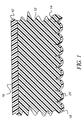
- Fig. 1 is a schematic view of a cross section of a lenticular base wherein 10 is the adhesion promoting subbing layer, 12 is the polymer sheet of the lenticular support, 14 is the array of lenticules, 16 is the upper planar side of the lenticular support, 18 is the lower lenticular side of the lenticular support and 20 is the conformal antistatic layer.
- Fig. 2 is a schematic view in a cross section of a lenticular base coated with photosensitive layers, wherein 22 is the polymer sheet of the lenticular support, 24 is the adhesion promoting subbing layer, 26 is the antistatic layer, 28 is the antihalation layer, 30 is the blue light sensitive layer, 32 is the gelatin based interlayer, 34 is the green light sensitive layer, 36 is the gelatin based interlayer, 38 is the red light sensitive layer and 40 is the overcoat.
- the support utilized in the photographic element of the invention is unique in that it is not symmetrical, having an upper planar side and a lower lenticular side.
- the upper planar side is typically treated with a corona discharge and/or additional subbing materials such as gelatin or mixtures of polymers and gelatin in a thin layer in order to promote adhesion between the emulsion layers and the support.
- the lower lenticular side of the support is comprised of half-cylindrical lenses which are used to focus the image into the emulsion layers on the planar side of the support. For this reason, there is a specific relationship between the curvature of the lens, the thickness of the support and the refractive index of the support material. This relationship defines the focal length of the lens.
- the lenticular side of the support may also be treated with corona discharge in order to promote adhesion of additional layers of material to control static buildup during conveyance of the web through a coating machine at high speed, an anti-reflection layer to reduce light scatter while viewing the image, a protective overcoat to prevent scratching of the lenses, and other functional layers.
- Suitable materials include transparent plastic materials which can be readily formed or extruded such as cellulose nitrate, cellulose acetate, cellulose acetate butyrate, polyacrylate, polystyrene, polyvinyl chloride, polyethylene terephthalate, polycarbonate, etc.
- a preferred material is transparent polyester sheets or webs, particularly extruded copolyesters of terephthalic acid, isophthalic acid, ethylene glycol and 1,4 cyclohexanedimethanol forming noncrystallizable polymers.
- Particularly preferred copolyesters include poly( 1,4 cyclohexylene dimethylene terephthalate) with different amounts of glycol and 1,4 cyclohexanedimethanol.
- Such polyethylene terephthalate-glycolates are henceforth referred to as "PETG.”
- the preferred material is between 75 micrometers and 1250 micrometers in thickness and most preferably about 400 micrometers to 750 micrometers in thickness.
- the lenticular pitch of the material is proportional to the thickness of the support and the refractive index of the support material. Generally, the thinner the support, the higher the pitch. However, as the pitch is increased, the number of images which can be written beneath the lens element diminishes with the diameter of the cylindrical lenticular lens. For this reason, the number of lines of unique image information to be written under each lens must be known as the limitations of the systems capability to resolve each line of image information determines the ultimate pitch of the system.
- the pitch of the material is preferred to be between 5 and 60 lenticules per centimeter and more preferably between 10 and 50 per centimeter. The thickness of the lenticules can vary from 50 to 125 micrometers.
- the antistatic layer superimposed on the lower lenticular surface of the polymer sheet of the present invention primarily comprises an electrically conducting agent and a binder.
- the electrically conducting agent can be a smectite clay or a metal containing particle such as zinc antimonate.
- the binder in the said antistatic layer can be a hydrophilic colloid such as gelatin or a polyurethane.
- the smectite clay material used in this invention is an electrically conducting smectite clay, preferably a synthetic smectite which closely resembles the natural clay mineral hectorite in both structure and composition.
- Hectorite is a natural swelling clay which is relatively rare and occurs contaminated with other minerals such as quartz which are difficult and expensive to remove.
- Synthetic smectite is free from natural impurities, prepared under controlled conditions.
- One such synthetic smectite is commercially marketed under the tradename Laponite by Laporte Industries, Ltd of UK through its US subsidiary, Southern Clay Products, Inc.
- Such a synthetic smectite is preferred for incorporation in the antistatic layer of the present invention.
- Laponite there are many grades of Laponite such as RD, RDS, J, S. etc. each with unique characteristics and can be used for the present invention, as long as they maintain their electrical conductivity. Some of these products contain a polyphosphate peptising agent such as tetrasodium pyrophosphate for rapid dispersion capability; alternatively, a suitable peptiser can be incorporated into Laponite later on for the same purpose.
- a polyphosphate peptising agent such as tetrasodium pyrophosphate for rapid dispersion capability
- a suitable peptiser can be incorporated into Laponite later on for the same purpose.
- Laponite separates into platelets of lateral dimension of 25-50 nm and a thickness of 1-5 nm in deionized aqueous dispersions, commonly referred to as "sols."
- Typical concentration of Laponite in a sol can be 0.1% through 10%.
- an electrical double layer forms around the clay platelets resulting in repulsion between them and no structure build up.
- the double layer can be reduced resulting in attraction between the platelets forming a "House of Cards" structure.
- Laponite provides ionic conductivity because of the presence of charge-balancing ions in its lattice structure.
- Electrically conducting metal containing particles when dispersed in a suitable polymeric film forming binder in an antistatic layer, can provide electronic conductivity.
- Binary metal oxides doped with appropriate donor heteroatoms or containing oxygen deficiencies have been disclosed in the literature to be useful in antistatic layers (vide, for example, US Pat. Nos. 4,275,103; 4,416,963; 4,495,276; 4,418,141; 4,431,764; 4,495,276; 4,571,361; 4,999,276; 5,122,445; 5,294,525; 5,382,494 and 5,459,021).
- Suitable claimed conductive metal oxides include: zinc oxide, titania, tin oxide, alumina, indium oxide, silica, magnesia, zirconia, barium oxide, molybdenum trioxide, tungsten trioxide, and vanadium pentoxide.
- Doped conductive metal oxide granular particles include antimony-doped tin oxide, aluminum-doped zinc oxide and niobium-doped titanium oxide.
- conductive ternary metal oxides such as zinc antimonate, as disclosed in US pat. No. 5,368,995 and incorporated in its entirety herein by reference, are preferred.
- the preferred binder for the antistatic layer of the present invention is a hydrophilic colloid, such as any of the known types of gelatin, used in imaging elements. These include, for example, alkali-treated gelatin (cattle bone or hide gelatin), acid-treated gelatin (pigskin or bone gelatin), modified gelatins, gelatin derivatives such as partially phthalated gelatin, acetylated gelatin, and the like, preferably the deionized gelatins as well as gelatin grafted onto vinyl polymers.
- Another preferred binder for the antistatic layer of the present invention is a water dispersible polyurethane.
- These polyurethanes are prepared by chain extending a prepolymer containing terminal isocyanate groups with an active hydrogen compound, usually a diamine or diol.
- the prepolymer is formed by reacting a diol or polyol having terminal hydroxyl groups with excess diisocyanate or polyisocyanate.
- the prepolymer is functionalized with hydrophilic groups.
- Anionic, cationic, or nonionically stabilized prepolymers can be prepared.
- Anionic dispersions contain usually either carboxylate or sulfonate functionalized co-monomers, e.g., suitably hindered dihydroxy carboxylic acids (dimethylol propionic acid) or dihydroxy sulphonic acids.
- Cationic systems are prepared by the incorporation of diols containing tertiary nitrogen atoms, which are converted to the quaternary ammonium ion by the addition of a suitable alkylating agent or acid.
- Nonionically stabilized prepolymers can be prepared by the use of diol or diisocyanate co-monomers bearing pendant polyethylene oxide chains. These result in polyurethanes with stability over a wide range of pH.
- Nonionic and anionic groups may be combined synergistically to yield "universal" urethane dispersions. Of the above, anionic polyurethanes are by far the most significant.
- the prepolymer may be formed, neutralized or alkylated if appropriate, then chain extended in an excess of organic solvent such as acetone or tetrahydrofuran.
- the prepolymer solution is then diluted with water and the solvent removed by distillation. This is known as the "acetone” process.
- acetone organic solvent
- a low molecular weight prepolymer can be prepared, usually in the presence of a small amount of solvent to reduce viscosity, and chain extended with diamine just after the prepolymer is dispersed into water. The latter is termed the "prepolymer mixing" process and for economic reasons is much preferred over the former.
- Polyols useful for the preparation of polyurethane dispersions include polyester polyols prepared from a diol (e.g. ethylene glycol, butylene glycol, neopentyl glycol, hexane diol or mixtures of any of the above) and a dicarboxylic acid or an anhydride (succinic acid, adipic acid, suberic acid, azelaic acid, sebacic acid, phthalic acid, isophthalic acid, maleic acid and anhydrides of these acids), polylactones from lactones such as caprolactone reacted with a diol, polyethers such as polypropylene glycols, and hydroxyl terminated polyacrylics prepared by addition polymerization of acrylic esters such as the aforementioned alkyl acrylate or methacrylates with ethylenically unsaturated monomers containing functional groups such as carboxyl, hydroxyl, cyano groups and/or glycidyl groups.
- Diisocyanates that can be used are as follows: toluene diisocyanate, tetramethylene diisocyanate, hexamethylene diisocyanate, isophorone diisocyanate, ethylethylene diisocyanate, 2,3-dimethylethylene diisocyanate, 1 -methyltrimethylene diisocyanate, 1 ,3-cycopentylene diisocyanate, 1 ,4-cyclohexylene dilsocyanate, 1,3-phenylene diisocyanate, 4,4' -biphenylene diisocyanate, 1,5-naphthalene diisocyanate, bis-(4-isocyanatocyclohexyl)-methane, 4,4'diisocyanatodiphenyl ether, and tetramethyl xylene diisocyanate.
- Compounds that are reactive with the isocyanate groups and have a group capable of forming an anion are as follows: dihydroxypropionic acid, dimethylolpropionic acid, dihydroxysuccinic acid and dihydroxybenzoic acid.
- Other suitable compounds are the polyhydroxy acids which can be prepared by oxidizing monosaccharides, for example gluconic acid, saccharic acid, mucic acid, and glucuronic acid.
- Suitable tertiary amines which are used to neutralize the acid and form an anionic group for water dispersibility are trimethylamine, triethylamine, dimethylaniline, diethylaniline, and triphenylamine.
- Diamines suitable for chain extension of the polyurethane include ethylenediamine, diaminopropane, hexamethylene diamine, hydrazine, and amnioethylethanolamine.
- Solvents which may be employed to aid in formation of the prepolymer and to lower its viscosity and enhance water dispersibility include methylethylketone, toluene, tetrahydofuran, acetone, dimethylformamide, N-methylpyrrolidone, and the like. Water-miscible solvents like N-methylpyrrolidone are much preferred.
- the electrically conducting agent : binder weight ratio in the dry antistatic layer of the present invention can vary from 1:99 to 99:1 but is preferably between 10:90 and 90:10.
- the dry coverage of the antistatic layer is between 0.1 and 2.0 g/m 2 .
- the antistatic layer of the present invention may contain crosslinking agents, surfactants and coating aids, defoamers, thickeners, coalescing aids, lubricants, pH adjusting agents and other ingredients known in the art.
- SER Surface electrical resistivity
- the antistatic coatings on the lenticular support are evaluated by a microscope for loss/delamination of the coatings after wet photographic processing, such as C-41 processing. Coatings without any loss/delamination are rated “passed” and those with loss/delamination are rated “failed”.
- Various antistatic layers are coated on the lower lenticular side of a PETG support which is nominally 575 micrometers in thickness, including 75 micron thick lenticules.
- the upper planar side of this PETG support is coated with an adhesion promoting subbing layer.
- the following coating solutions A-D are used to form the various antistatic layers on the lenticular support, as per the present invention.
- the conductive agent used is either conductive clay or conductive ternary metal oxide zinc antimonate.
- the conductive clay used is Laponite RDS, supplied by Southern Clay Products.
- the zinc antimonate used is CELNAX CX-Z, supplied by Nissan Chemical Industries, Ltd.
- the binder polymer used is either deionized gelatin or a polyurethane dispersion Witcobond 232, supplied by Witco Corporation.
- the hardener used is either dihydroxydioxane (DHD) or a polyfunctional aziridine cross-linking agent Neocryl CX- 100, supplied by Zeneca Resins.
- the surfactant used is Olin 10G, a nonyl phenoxypolyglycidol, supplied by Olin Mathieson Corporation.
- COATING SOLUTION A Amount grams Distilled water 668.14 Deionized gelatin 2.24 Conductive clay sol, 4% 317.63 Dihydroxydioxane (DHD) hardener 0.5% 12.00 Total 1000.00 COATING SOLUTION B Amount, grams Distilled water 792.54 Polyurethane dispersion Witco232, 30% 24.24 Conductive clay sol, 4% 181.98 CX-100 hardener 50% 0.91 Olin 10G surfactant solution 50% 0.33 Total 1000.00 COATING SOLUTION C Amount, grams Distilled water 944.38 Deionized gelatin 2.24 Zinc antimonate dispersion 30.7% 41.38 Dihydroxydioxane (DHD) hardener 0.5% 12 Total 1000.00 COATING SOLUTION D Amount, grams Distilled water 951.15 Polyurethane dispersion Wi
- the following coating solutions E-H are used to form the antistatic layers on the lenticular support, as comparative samples.
- the conductive agent used in these coating solutions is poly(N-vinylbenzyl-N,N,N-trimethylammonium chloride-co-ethylene glycol dimethacrylate) (93:7), as described in U.S. Pat. No. 4,070,189, and is henceforth referred to as VAEG (93:7). This is a typical conductive agent used for various photographic elements.
- the binder used in these coating solutions is either a cellulose ether polymer, Methocel, supplied by Dow Chemicals or polyvinyl alcohol (PVA).
- the hardener used is a chromium complex of methacrylic acid, Volan, supplied by Du Pont.
- COATING SOLUTION E Amount grams Distilled water 921.35 Cellulosic polymer Methocel 7.15 VAEG(93 :7) dispersion 10% 71.5 Total 1000.00
- COATING SOLUTION F Amount grams Distilled water 921.35 Polyvinyl alcohol 7.15 VAEG(93 :7) dispersion 10% 71.5 Total 1000.00 COATING SOLUTION G Amount, grams Distilled water 922 Cellulosic polymer Methocel 6.5 VAEG(93 :7) dispersion 10% 65 Volan 20% 6.5 Total 1000.00 COATING SOLUTION H Amount, grams Distilled water 922 Polyvinyl alcohol 6.5 VAEG(93:7) dispersion 10% 65 Volan 20% 6.5 Total 1000.00
Landscapes
- Chemical & Material Sciences (AREA)
- Physics & Mathematics (AREA)
- General Physics & Mathematics (AREA)
- Inorganic Chemistry (AREA)
- Engineering & Computer Science (AREA)
- Materials Engineering (AREA)
- Laminated Bodies (AREA)
- Stereoscopic And Panoramic Photography (AREA)
Abstract
Description
- This invention relates to photographic lenticular imaging members and their formation.
- Fogel et al, in U. S. Pat. No. 5,729,332, describes a method and apparatus for printing lenticular images which includes imposing lines of information in the form of segmented images of a scene onto a light sensitive material.
- Young et al, in U. S. Pat. No. 5,699,190, describes a lenticular media having spatially encoded portions within the media used for precisely determining the location of the lenticules within the media.
- Oehlbeck et al, in U. S. Pat. No. 5,633,719, describes a lenticular print having image bundles and an apparatus for aligning and centering the image bundles under the lenticules in a composite overlay assembly process by encoding angular alignment elements into the photographic material during exposure of the element.
- Slater et al, in U. S. Pat. No. 5,822,038, describes a method and apparatus for stretching, aligning and printing a plurality of images onto lenticular media having spatially encoded portions to a silver halide negative material as an alignment process prior to exposure of the negative and the lenticular media in order to correct for pitch errors between the negative and the lenticular media, but does not describe the nature, composition, nor method of preparation of the integral lenticular imaging element.
- Taguchi et al, in U. S. Pat. Nos. 5,539,487, and a divisional patent 5,850,580 describes a method and apparatus for recording stereoscopic images onto an integral lenticular media using a scanning exposing device.
- Howe et al, in U. S. Pat. No. 3,751,258, describes an 'autostereographic' print in which the integral, multilayer color photographic lenticular image also contains an integral reflective backlayer. Since the reflective backlayer is applied on the side opposite the lenticular surface as part of the preparation of the element, the element must then be exposed through the lenticular support.
- Telfer et al, in U. S. Pat. No. 5,279,912, describes an integral, thermal lenticular imaging media in which the image is developed after heating via exposure with an infra-red light emitting laser.
- Morton, in U. S. Pat. No. 5,689,372, describes an integral lenticular imaging element having an anti-halation layer positioned on the surface of the lenticules of the media, but does not describe the composition nor method of application of the anti-halation layer.
- Morton, in European Patent Application EP 0 780 728 A1, describes an integral lenticular imaging element having an anti-halation layer positioned on the surface of the media opposed to the lenticules of the media.
- Morton, in U. S. Pat. No. 5,639,580, describes an integral lenticular imaging element having a non-specular reflective backlayer positioned behind the integral image which reflects more than 80% of the light reaching the reflective layer.
- Kistner, in U. S. Pat. No. 5,013,621, describes a one part coating composition for providing a white reflective backlayer to lenticular images wherein the backlayer is applied after exposure, chemical development, and drying.
- Shiba in Japanese Pat. No. 4,097,345 describes a method for applying an anti-reflection overcoat to the lenticular surface of an integral color photographic element having a lenticular support.
- Current color silver halide color print materials utilize three color forming layers comprised of a red light sensitive, cyan dye forming layer; a green light sensitive, magenta dye forming layer and a blue light sensitive, yellow dye forming layer. These color print or display materials -reproduce images which are 2-dimensional representations of the original 3-dimensional scene. Attempts to manufacture images in which the viewer perceives a sense of depth (or 3-dimensionality) or, images in which the viewer perceives a sense of motion have been demonstrated by several manufactures using different manufacturing processes.
- Existing lenticular imaging methods and materials typically use non-integral or integral silver halide photographic elements. Other methods of lenticular imaging have also been commercialized which use various printing techniques such as lithography, ink-jet, thermal dye transfer or dye sublimation. The characteristics of these processes are such, however, that the quality of the final lenticular image is restrained by the methods and the resolution of the art which subsequently limit the number of images capable of being uniquely resolvable under each lenticule by the viewer. From the perspective of design and manufacturability, the integral silver halide elements are simpler and more attractive than their non-integral counterparts. Specifically, the integral element avoids the inherent variability associated with adhering a lenticular cover sheet to a separate silver halide element. Also, the integral element avoids the possible contamination resulting from this adhesion step.
- A typical example of an integral silver halide element, per U. S. Pat. No. 3,751,258, is described in the following Table 1. This element included a permeable reflective backlayer so that after exposure, the element could be processed, with the color developers diffusing through the layer and the by-products of development washing out.
Conventional Integral Lenticular Structure Overcoat Integral Reflective Backlayer (TiO2/gelatin) Gelatin Interlayer Blue light sensitive layer Gelatin Interlayer Red light sensitive layer Gelatin Interlayer Green light sensitive layer UV absorbing layer Transparent Lenticular Support - Like other photographic elements, the successful manufacture and use of integral silver halide elements, require effective control of static charge generation. The accumulation of charge on film or paper surfaces leads to the attraction of dirt, which can produce physical defects. The discharge of accumulated charge during or after the application of the sensitized emulsion layer(s) can produce irregular fog patterns or "static marks" in the emulsion. The static problems have been aggravated by increase in the sensitivity of new emulsions, increase in coating machine speeds, and increase in post-coating drying efficiency. The charge generated during the coating process may accumulate during winding and unwinding operations, during transport through the coating machines and during finishing operations such as slitting and spooling.
- It is generally known that electrostatic charge can be dissipated effectively by incorporating one or more electrically-conductive "antistatic" layers into the film structure. Antistatic layers are typically applied as an outermost coated layer on the side of the support opposite to the emulsion.
- A wide variety of electrically-conductive materials can be incorporated into antistatic layers to produce a wide range of conductivities. These can be divided into two broad groups: (i) ionic conductors and (ii) electronic conductors. In ionic conductors charge is transferred by the bulk diffusion of charged species through an electrolyte. Here the resistivity of the antistatic layer is dependent on temperature and humidity. Antistatic layers containing simple inorganic salts, alkali metal salts of surfactants, ionic conductive polymers, polymeric electrolytes containing alkali metal salts, and colloidal metal oxide sols (stabilized by metal salts), described previously in patent literature, fall in this category. However, many of the inorganic salts, polymeric electrolytes, and low molecular weight surfactants used are water-soluble and are leached out of the antistatic layers during processing, resulting in a loss of antistatic function. The conductivity of antistatic layers employing an electronic conductor depends on electronic mobility rather than ionic mobility and is independent of humidity. Antistatic layers which contain conjugated polymers, semiconductive metal halide salts, semiconductive metal oxide particles, etc., have been described previously. However, these antistatic layers typically contain a high volume percentage of electronically conducting materials which are often expensive and impart unfavorable physical characteristics, such as color, increased brittleness and poor adhesion, to the antistatic layer.
- For a lenticular support, the antistatic layer additionally needs to be conformal to the lenticules so that the optical properties of the lenticules are not compromised by the overlying antistatic layer.
- There remains a need in the industry for lenticular supports that may be easily manufactured, sensitized and finished without excessive generation of static electricity.
- There is a need for lenticular support materials that may be easily transported, manufactured, sensitized and finished without excessive generation of static electricity. Further there is a need for antistatic coatings for such materials that are not detrimental to photographic processing.
- It is an object of the invention to provide improved lenticular imaging materials.
- It is another object to provide lenticular imaging materials that may be processed through photographic developing baths without substantial detrimental effects to the baths.
- These and other objects of the invention are accomplished by a lenticular support comprising a polymer sheet having a lower lenticular surface, wherein said lower lenticular surface has a uniform coating of an antistat comprising clay or metal containing particles.
- The invention provides a lenticular imaging member that does not generate static electricity during transport when being coated with photosensitive materials. Further, the lenticular photographic members of the invention do not have deleterious effects on developing baths during development.
-
- Fig. 1 is a schematic view of a cross section of a lenticular base bearing the antistatic layer utilized in the invention.
- Fig. 2 is a schematic view in a cross section of a lenticular base of the invention coated with photosensitive layers.
-
- The invention has numerous advantages over prior practices in the art. The invention provides an antistatic layer that is clear with low haze. The invention also provides an antistatic layer that has a low change in antistatic properties under differing humidity conditions. Further, the antistatic layer utilized in the invention does not wash off during processing in photographic developer materials. The antistatic layer utilized in the invention further provides a uniform layer without thickness variations that would cause image distortions or transport difficulties. These and other advantages will be apparent from the detailed description below.
- Fig. 1 is a schematic view of a cross section of a lenticular base wherein 10 is the adhesion promoting subbing layer, 12 is the polymer sheet of the lenticular support, 14 is the array of lenticules, 16 is the upper planar side of the lenticular support, 18 is the lower lenticular side of the lenticular support and 20 is the conformal antistatic layer.
- Fig. 2 is a schematic view in a cross section of a lenticular base coated with photosensitive layers, wherein 22 is the polymer sheet of the lenticular support, 24 is the adhesion promoting subbing layer, 26 is the antistatic layer, 28 is the antihalation layer, 30 is the blue light sensitive layer, 32 is the gelatin based interlayer, 34 is the green light sensitive layer, 36 is the gelatin based interlayer, 38 is the red light sensitive layer and 40 is the overcoat.
- The support utilized in the photographic element of the invention is unique in that it is not symmetrical, having an upper planar side and a lower lenticular side. The upper planar side is typically treated with a corona discharge and/or additional subbing materials such as gelatin or mixtures of polymers and gelatin in a thin layer in order to promote adhesion between the emulsion layers and the support. The lower lenticular side of the support is comprised of half-cylindrical lenses which are used to focus the image into the emulsion layers on the planar side of the support. For this reason, there is a specific relationship between the curvature of the lens, the thickness of the support and the refractive index of the support material. This relationship defines the focal length of the lens. The lenticular side of the support may also be treated with corona discharge in order to promote adhesion of additional layers of material to control static buildup during conveyance of the web through a coating machine at high speed, an anti-reflection layer to reduce light scatter while viewing the image, a protective overcoat to prevent scratching of the lenses, and other functional layers.
- Suitable materials include transparent plastic materials which can be readily formed or extruded such as cellulose nitrate, cellulose acetate, cellulose acetate butyrate, polyacrylate, polystyrene, polyvinyl chloride, polyethylene terephthalate, polycarbonate, etc. A preferred material is transparent polyester sheets or webs, particularly extruded copolyesters of terephthalic acid, isophthalic acid, ethylene glycol and 1,4 cyclohexanedimethanol forming noncrystallizable polymers. Particularly preferred copolyesters include poly( 1,4 cyclohexylene dimethylene terephthalate) with different amounts of glycol and 1,4 cyclohexanedimethanol. Such polyethylene terephthalate-glycolates are henceforth referred to as "PETG." The preferred material is between 75 micrometers and 1250 micrometers in thickness and most preferably about 400 micrometers to 750 micrometers in thickness.
- The lenticular pitch of the material is proportional to the thickness of the support and the refractive index of the support material. Generally, the thinner the support, the higher the pitch. However, as the pitch is increased, the number of images which can be written beneath the lens element diminishes with the diameter of the cylindrical lenticular lens. For this reason, the number of lines of unique image information to be written under each lens must be known as the limitations of the systems capability to resolve each line of image information determines the ultimate pitch of the system. For the preferred thickness of support, and the characteristics of the best line writing systems and photographic characteristics, the pitch of the material is preferred to be between 5 and 60 lenticules per centimeter and more preferably between 10 and 50 per centimeter. The thickness of the lenticules can vary from 50 to 125 micrometers.
- The antistatic layer superimposed on the lower lenticular surface of the polymer sheet of the present invention, primarily comprises an electrically conducting agent and a binder. The electrically conducting agent can be a smectite clay or a metal containing particle such as zinc antimonate. The binder in the said antistatic layer can be a hydrophilic colloid such as gelatin or a polyurethane.
- The smectite clay material used in this invention is an electrically conducting smectite clay, preferably a synthetic smectite which closely resembles the natural clay mineral hectorite in both structure and composition. Hectorite is a natural swelling clay which is relatively rare and occurs contaminated with other minerals such as quartz which are difficult and expensive to remove. Synthetic smectite is free from natural impurities, prepared under controlled conditions. One such synthetic smectite is commercially marketed under the tradename Laponite by Laporte Industries, Ltd of UK through its US subsidiary, Southern Clay Products, Inc. It is a layered hydrous magnesium silicate, in which magnesium ions, partially replaced by suitable monovalent ions such as lithium, sodium, potassium and/or vacancies, are octahedrally coordinated to oxygen and/or hydroxyl ions, some of which may be replaced by fluorine ions, forming the central octahedral sheet; such an octahedral sheet is sandwiched between two tetrahedral sheets of silicon ions, tetrahedrally coordinated to oxygen. Such a synthetic smectite is preferred for incorporation in the antistatic layer of the present invention.
- There are many grades of Laponite such as RD, RDS, J, S. etc. each with unique characteristics and can be used for the present invention, as long as they maintain their electrical conductivity. Some of these products contain a polyphosphate peptising agent such as tetrasodium pyrophosphate for rapid dispersion capability; alternatively, a suitable peptiser can be incorporated into Laponite later on for the same purpose. A typical chemical analysis of Laponite RDS and its physical properties, as per Laponite Product Bulletin, are provided below in Tables 1A and 1B.
Typical Chemical Analysis Component Weight % SiO2 54.5 MgO 26.0 Li2O 0.8 Na2O 5.6 P2O5 4.1 Loss on ignition 8.0 Typical Physical Properties Appearance White Powder Bulk density 1000 kg/m3 Surface Area 330 m2/g pH (2% suspension) 9.7 Sieve analysis, 98% <250 µ Moisture content 10% - Laponite separates into platelets of lateral dimension of 25-50 nm and a thickness of 1-5 nm in deionized aqueous dispersions, commonly referred to as "sols." Typical concentration of Laponite in a sol can be 0.1% through 10%. During dispersion in deionized water an electrical double layer forms around the clay platelets resulting in repulsion between them and no structure build up. However, in a formulation containing electrolytes introduced from tap water or other ingredients, the double layer can be reduced resulting in attraction between the platelets forming a "House of Cards" structure. In a dried layer, Laponite provides ionic conductivity because of the presence of charge-balancing ions in its lattice structure.
- Electrically conducting metal containing particles, such as semiconductive metal oxides, when dispersed in a suitable polymeric film forming binder in an antistatic layer, can provide electronic conductivity. Binary metal oxides doped with appropriate donor heteroatoms or containing oxygen deficiencies have been disclosed in the literature to be useful in antistatic layers (vide, for example, US Pat. Nos. 4,275,103; 4,416,963; 4,495,276; 4,418,141; 4,431,764; 4,495,276; 4,571,361; 4,999,276; 5,122,445; 5,294,525; 5,382,494 and 5,459,021). Suitable claimed conductive metal oxides include: zinc oxide, titania, tin oxide, alumina, indium oxide, silica, magnesia, zirconia, barium oxide, molybdenum trioxide, tungsten trioxide, and vanadium pentoxide. Doped conductive metal oxide granular particles include antimony-doped tin oxide, aluminum-doped zinc oxide and niobium-doped titanium oxide. For the present invention, conductive ternary metal oxides, such as zinc antimonate, as disclosed in US pat. No. 5,368,995 and incorporated in its entirety herein by reference, are preferred.
- The preferred binder for the antistatic layer of the present invention is a hydrophilic colloid, such as any of the known types of gelatin, used in imaging elements. These include, for example, alkali-treated gelatin (cattle bone or hide gelatin), acid-treated gelatin (pigskin or bone gelatin), modified gelatins, gelatin derivatives such as partially phthalated gelatin, acetylated gelatin, and the like, preferably the deionized gelatins as well as gelatin grafted onto vinyl polymers.
- Another preferred binder for the antistatic layer of the present invention is a water dispersible polyurethane. These polyurethanes are prepared by chain extending a prepolymer containing terminal isocyanate groups with an active hydrogen compound, usually a diamine or diol. The prepolymer is formed by reacting a diol or polyol having terminal hydroxyl groups with excess diisocyanate or polyisocyanate. To permit dispersion in water, the prepolymer is functionalized with hydrophilic groups. Anionic, cationic, or nonionically stabilized prepolymers can be prepared.
- Anionic dispersions contain usually either carboxylate or sulfonate functionalized co-monomers, e.g., suitably hindered dihydroxy carboxylic acids (dimethylol propionic acid) or dihydroxy sulphonic acids. Cationic systems are prepared by the incorporation of diols containing tertiary nitrogen atoms, which are converted to the quaternary ammonium ion by the addition of a suitable alkylating agent or acid. Nonionically stabilized prepolymers can be prepared by the use of diol or diisocyanate co-monomers bearing pendant polyethylene oxide chains. These result in polyurethanes with stability over a wide range of pH. Nonionic and anionic groups may be combined synergistically to yield "universal" urethane dispersions. Of the above, anionic polyurethanes are by far the most significant.
- One of several different techniques may be used to prepare polyurethane dispersions. For example, the prepolymer may be formed, neutralized or alkylated if appropriate, then chain extended in an excess of organic solvent such as acetone or tetrahydrofuran. The prepolymer solution is then diluted with water and the solvent removed by distillation. This is known as the "acetone" process. Alternatively, a low molecular weight prepolymer can be prepared, usually in the presence of a small amount of solvent to reduce viscosity, and chain extended with diamine just after the prepolymer is dispersed into water. The latter is termed the "prepolymer mixing" process and for economic reasons is much preferred over the former.
- Polyols useful for the preparation of polyurethane dispersions include polyester polyols prepared from a diol (e.g. ethylene glycol, butylene glycol, neopentyl glycol, hexane diol or mixtures of any of the above) and a dicarboxylic acid or an anhydride (succinic acid, adipic acid, suberic acid, azelaic acid, sebacic acid, phthalic acid, isophthalic acid, maleic acid and anhydrides of these acids), polylactones from lactones such as caprolactone reacted with a diol, polyethers such as polypropylene glycols, and hydroxyl terminated polyacrylics prepared by addition polymerization of acrylic esters such as the aforementioned alkyl acrylate or methacrylates with ethylenically unsaturated monomers containing functional groups such as carboxyl, hydroxyl, cyano groups and/or glycidyl groups.
- Diisocyanates that can be used are as follows: toluene diisocyanate, tetramethylene diisocyanate, hexamethylene diisocyanate, isophorone diisocyanate, ethylethylene diisocyanate, 2,3-dimethylethylene diisocyanate, 1 -methyltrimethylene diisocyanate, 1 ,3-cycopentylene diisocyanate, 1 ,4-cyclohexylene dilsocyanate, 1,3-phenylene diisocyanate, 4,4' -biphenylene diisocyanate, 1,5-naphthalene diisocyanate, bis-(4-isocyanatocyclohexyl)-methane, 4,4'diisocyanatodiphenyl ether, and tetramethyl xylene diisocyanate.
- Compounds that are reactive with the isocyanate groups and have a group capable of forming an anion are as follows: dihydroxypropionic acid, dimethylolpropionic acid, dihydroxysuccinic acid and dihydroxybenzoic acid. Other suitable compounds are the polyhydroxy acids which can be prepared by oxidizing monosaccharides, for example gluconic acid, saccharic acid, mucic acid, and glucuronic acid.
- Suitable tertiary amines which are used to neutralize the acid and form an anionic group for water dispersibility are trimethylamine, triethylamine, dimethylaniline, diethylaniline, and triphenylamine.
- Diamines suitable for chain extension of the polyurethane include ethylenediamine, diaminopropane, hexamethylene diamine, hydrazine, and amnioethylethanolamine.
- Solvents which may be employed to aid in formation of the prepolymer and to lower its viscosity and enhance water dispersibility include methylethylketone, toluene, tetrahydofuran, acetone, dimethylformamide, N-methylpyrrolidone, and the like. Water-miscible solvents like N-methylpyrrolidone are much preferred.
- The electrically conducting agent : binder weight ratio in the dry antistatic layer of the present invention can vary from 1:99 to 99:1 but is preferably between 10:90 and 90:10. The dry coverage of the antistatic layer is between 0.1 and 2.0 g/m2.
- In addition to the electrically conducting agent and the binder, the antistatic layer of the present invention may contain crosslinking agents, surfactants and coating aids, defoamers, thickeners, coalescing aids, lubricants, pH adjusting agents and other ingredients known in the art.
- The following examples illustrate the practice of this invention. They are not intended to be exhaustive of all possible variations of the invention. Parts and percentages are by weight unless otherwise indicated.
- Surface electrical resistivity (SER) is measured at different relative humidity (RH) with a Keithly Model 616 digital electrometer using a two point DC probe by a method similar to that described in US Patent No. 2,801,191. SER values < 12 log ohms/ square at 20% RH and < 11 log ohms/square at 50% RH are considered adequate.
- The antistatic coatings on the lenticular support are evaluated by a microscope for loss/delamination of the coatings after wet photographic processing, such as C-41 processing. Coatings without any loss/delamination are rated "passed" and those with loss/delamination are rated "failed".
- Various antistatic layers are coated on the lower lenticular side of a PETG support which is nominally 575 micrometers in thickness, including 75 micron thick lenticules. The upper planar side of this PETG support is coated with an adhesion promoting subbing layer.
- The following coating solutions A-D are used to form the various antistatic layers on the lenticular support, as per the present invention. The conductive agent used is either conductive clay or conductive ternary metal oxide zinc antimonate. The conductive clay used is Laponite RDS, supplied by Southern Clay Products. The zinc antimonate used is CELNAX CX-Z, supplied by Nissan Chemical Industries, Ltd. The binder polymer used is either deionized gelatin or a polyurethane dispersion Witcobond 232, supplied by Witco Corporation. The hardener used is either dihydroxydioxane (DHD) or a polyfunctional aziridine cross-linking agent Neocryl CX- 100, supplied by Zeneca Resins. The surfactant used is Olin 10G, a nonyl phenoxypolyglycidol, supplied by Olin Mathieson Corporation.
COATING SOLUTION A Amount, grams Distilled water 668.14 Deionized gelatin 2.24 Conductive clay sol, 4% 317.63 Dihydroxydioxane (DHD) hardener 0.5% 12.00 Total 1000.00 COATING SOLUTION B Amount, grams Distilled water 792.54 Polyurethane dispersion Witco232, 30% 24.24 Conductive clay sol, 4% 181.98 CX-100 hardener 50% 0.91 Olin 10G surfactant solution 50% 0.33 Total 1000.00 COATING SOLUTION C Amount, grams Distilled water 944.38 Deionized gelatin 2.24 Zinc antimonate dispersion 30.7% 41.38 Dihydroxydioxane (DHD) hardener 0.5% 12 Total 1000.00 COATING SOLUTION D Amount, grams Distilled water 951.15 Polyurethane dispersion Witco232, 19.4 30% 28.73 Zinc antimonate dispersion 30.7% 0.72 CX-100 hardener 50% Total 1000.00 - The following working examples, Ex. 1-12, are prepared from the coating solutions A-D in accordance with the present invention. The details about the layers and the corresponding test data are presented in Table.6. It is clear that the antistatic layers, coated in accordance with the present invention provide adequate SER values and pass the C-41 processing without any loss/delamination. All these antistatic layers are also conformal to the lenticules without adversely affecting their optical characteristics, thus, demonstrating their suitability for application to lenticular supports.
- The following coating solutions E-H are used to form the antistatic layers on the lenticular support, as comparative samples. The conductive agent used in these coating solutions is poly(N-vinylbenzyl-N,N,N-trimethylammonium chloride-co-ethylene glycol dimethacrylate) (93:7), as described in U.S. Pat. No. 4,070,189, and is henceforth referred to as VAEG (93:7). This is a typical conductive agent used for various photographic elements. The binder used in these coating solutions is either a cellulose ether polymer, Methocel, supplied by Dow Chemicals or polyvinyl alcohol (PVA). The hardener used is a chromium complex of methacrylic acid, Volan, supplied by Du Pont.
COATING SOLUTION E Amount, grams Distilled water 921.35 Cellulosic polymer Methocel 7.15 VAEG(93 :7) dispersion 10%71.5 Total 1000.00 COATING SOLUTION F Amount, grams Distilled water 921.35 Polyvinyl alcohol 7.15 VAEG(93 :7) dispersion 10%71.5 Total 1000.00 COATING SOLUTION G Amount, grams Distilled water 922 Cellulosic polymer Methocel 6.5 VAEG(93 :7) dispersion 10%65 Volan 20%6.5 Total 1000.00 COATING SOLUTION H Amount, grams Distilled water 922 Polyvinyl alcohol 6.5 VAEG(93:7) dispersion 10%65 Volan 20%6.5 Total 1000.00 - The following comparative samples Com 1-6 are prepared from the coating solutions E-H. The details about the layers and the corresponding test data are presented in Table 9. Although electrically conducting, the control coatings of Com 1-6 delaminated from the lenticular support during C-41 photographic processing, indicating their inferiority compared to Ex. 1-12, prepared in accordance with the present invention.
Sample Coating solution Conductor/binder/hardener in dry antistatic layer (wt.%) Coverage g/m2 SER 20% RH log Ω/sq SER 50% RH log Ω/sq Post C-41 rating Ex.1 A Laponite/gelatin/DHD 0.6 9.4 8.5 passed 84.7/14.9/0.4 Ex.2 A Laponite/gelatin/DHD 0.45 9.5 8.9 passed 84.7/14.9/0.4 Ex.3 A Laponite/gelatin/DHD 0.3 9.8 8.8 passed 84.7/14.9/0.4 Ex.4 B Laponite/Witco232/CX100 0.6 10.8 9.8 passed 48.5/48.5/3 Ex.5 B Laponite/Witco232/CX100 0.45 10.8 9.4 passed 48.5/48.5/3 Ex.6 B Laponite/Witco232/CX100 0.3 11.1 9.9 passed 48.5/48.5/3 Ex.7 C Zinc antimonate/gelatin/DHD 0.6 7 7.1 passed 84.7/14.9/0.4 Ex.8 C Zinc antimonate/gelatin/DHD 0.45 7.3 7.4 passed 84.7/14.9/0.4 Ex.9 C Zinc antimonate/gelatin/DHD 0.3 7.6 7.5 passed 84.7/14.9/0.4 Ex.10 D Zinc antimonate/Witco232/CX100 0.6 7.9 7.7 passed 58.8/38.8/2.4 Ex.11 D Zinc antimonate/Witco232/CX100 0.45 8.1 8.1 passed 58.8/38.8/2.4 Ex.12 D Zinc antimonate/Witco232/CX100 0.3 8.6 10.6 passed 58.8/38.8/2.4 Sample Coating solution Conductor/binder/hardener in dry antistatic layer (wt.%) Coverage g/m2 SER 20% RH log Ω/sq SER 50% RH log Ω/sq Post C-41 rating Com.1 Control E VAEG (93:7)/Methocel/Volan 0.5 8.6 7.5 failed 50/50/0 Com.2 Control E VAEG (93:7)/Methocel/Volan 0.3 8.7 7.8 failed 50/50/0 Com.3 Control F VAEG (93:7)/PVA/Volan 0.5 9.9 8.6 failed 50/50/0 Com.4 Control F VAEG (93:7)/PVA/Volan 0.3 10.4 9.1 failed 50/50/0 Com.5 Control G VAEG (93:7)/Methocel/Volan 0.55 8.6 7.7 failed 45.45/45.45/9.1 Com.6 Control H VAEG (93:7)/PVA/Volan 0.55 9.3 8.3 failed 45.45/45.45/9.1
Claims (10)
- A lenticular support comprising a polymer sheet having a lower lenticular surface, wherein said lower lenticular surface has a uniform coating of an antistat comprising clay or metal containing particles.
- The lenticular support of Claim 1 wherein said metal containing particles comprise zinc antimonate.
- The lenticular support of Claim 1 wherein said uniform coating further comprises gelatin or polyurethane.
- The lenticular support of Claim 1 wherein said polymer sheet comprises PETG polyethylene terephthalate-glycolate.
- The lenticular support of Claim 2 wherein said antistat has a dry coverage of between 0.1 and 2.0 g/m2.
- A method of forming a photographic element comprising providing a polymer sheet having lenticules on its lower surface, coating and a uniform antistatic layer onto the lower surface of said polymer sheet wherein said antistatic layer comprises a water dispersion of clay or metal containing particles.
- The method of Claim 6 wherein said uniform coating has a thickness that does not vary by more than 25 percent from the average coverage.
- The method of Claim 6 wherein said polymer sheet comprises lenticules of between 50 and 125 micrometers and the polymer sheet thickness is between 400 and 750 micrometers.
- The method of Claim 6 further comprising coating at least one photosensitive silver halide layer on the upper surface of said polymer sheet.
- A photographic element comprising a lenticular support comprising a polymer sheet having a lower lenticular surface, wherein said lower lenticular surface has a uniform coating of an antistat comprising clay or metal containing particles.
Applications Claiming Priority (2)
| Application Number | Priority Date | Filing Date | Title |
|---|---|---|---|
| US09/337,359 US6083674A (en) | 1999-06-21 | 1999-06-21 | Antistatic layer for lenticular surface |
| US337359 | 1999-06-21 |
Publications (2)
| Publication Number | Publication Date |
|---|---|
| EP1063541A1 true EP1063541A1 (en) | 2000-12-27 |
| EP1063541B1 EP1063541B1 (en) | 2006-08-23 |
Family
ID=23320252
Family Applications (1)
| Application Number | Title | Priority Date | Filing Date |
|---|---|---|---|
| EP00202046A Expired - Lifetime EP1063541B1 (en) | 1999-06-21 | 2000-06-09 | Antistatic layer for lenticular surface |
Country Status (5)
| Country | Link |
|---|---|
| US (1) | US6083674A (en) |
| EP (1) | EP1063541B1 (en) |
| JP (1) | JP2001042463A (en) |
| AU (1) | AU761997B2 (en) |
| DE (1) | DE60030211T2 (en) |
Families Citing this family (5)
| Publication number | Priority date | Publication date | Assignee | Title |
|---|---|---|---|---|
| US6709796B2 (en) * | 2002-06-12 | 2004-03-23 | Eastman Kodak Company | Camera speed color film with base side micro-lenses |
| JP2005250469A (en) * | 2004-03-05 | 2005-09-15 | Arisawa Mfg Co Ltd | Lens, transmissive screen, and lens manufacturing method |
| WO2008048553A2 (en) * | 2006-10-13 | 2008-04-24 | International Paper Company | Coating, coated media, and method for coating media |
| KR101032170B1 (en) * | 2010-12-13 | 2011-05-02 | 서정식 | Microlens combined lenticular lens sheet |
| DE102011000658A1 (en) * | 2011-02-11 | 2012-08-16 | Realeyes Gmbh | Multi-layer color film for lens assembly of photographic three-dimensional image recording and reproducing apparatus, has blue, green and red light-sensitive layers that are sequentially formed on support film |
Citations (7)
| Publication number | Priority date | Publication date | Assignee | Title |
|---|---|---|---|---|
| US4127693A (en) * | 1975-02-10 | 1978-11-28 | Lemelson Jerome H | Reflex reflectors with pyramid-shaped indentations |
| EP0469313A2 (en) * | 1990-07-03 | 1992-02-05 | Matsushita Electric Industrial Co., Ltd. | Transmission-type screen for a projection television device |
| US5368995A (en) * | 1994-04-22 | 1994-11-29 | Eastman Kodak Company | Imaging element comprising an electrically-conductive layer containing particles of a metal antimonate |
| JPH08286004A (en) * | 1995-04-18 | 1996-11-01 | Mitsubishi Rayon Co Ltd | Lens sheet and backlight |
| US5639580A (en) * | 1996-02-13 | 1997-06-17 | Eastman Kodak Company | Reflective integral image element |
| US5869227A (en) * | 1997-12-18 | 1999-02-09 | Eastman Kodak Company | Antistatic layer with smectite clay and an interpolymer containing vinylidene halide |
| EP0905315A1 (en) * | 1997-09-29 | 1999-03-31 | Eastman Kodak Company | Clay containing antistatic layer for photographic paper |
Family Cites Families (15)
| Publication number | Priority date | Publication date | Assignee | Title |
|---|---|---|---|---|
| US3751258A (en) * | 1970-10-29 | 1973-08-07 | Eastman Kodak Co | Autostereographic print element |
| US4173480A (en) * | 1975-08-04 | 1979-11-06 | Wiggins Teape Limited | Photographic sheet with synthetic hectorite antistatic additive as sizing or backcoat |
| US4070189A (en) * | 1976-10-04 | 1978-01-24 | Eastman Kodak Company | Silver halide element with an antistatic layer |
| US5013621A (en) * | 1990-04-23 | 1991-05-07 | Minnesota Mining And Manufacturing Company | One-part white reflective coating |
| JPH0497345A (en) * | 1990-08-14 | 1992-03-30 | Fuji Photo Film Co Ltd | Substrate for stereoscopic color photograph having surface antireflection layer, silver halide photosensitive material and stereoscopic color photograph print |
| JP2746790B2 (en) * | 1992-03-02 | 1998-05-06 | 富士写真フイルム株式会社 | Stereoscopic image recording method and stereoscopic image recording apparatus |
| US5279912A (en) * | 1992-05-11 | 1994-01-18 | Polaroid Corporation | Three-dimensional image, and methods for the production thereof |
| US5326688A (en) * | 1993-05-27 | 1994-07-05 | Eastman Kodak Company | Coating compositions for antistatic layers for photographic elements |
| US5424553A (en) * | 1994-05-16 | 1995-06-13 | Eastman Kodak Company | Method for aligning a lenticular material for printing |
| US5633719A (en) * | 1994-10-28 | 1997-05-27 | Eastman Kodak Company | Method and apparatus for aligning a lenticular overlay with a lenticular print |
| US5729332A (en) * | 1995-05-11 | 1998-03-17 | Eastman Kodak Company | Depth image printing method on precoated lenticular material |
| US5699190A (en) * | 1995-12-05 | 1997-12-16 | Eastman Kodak Company | Lenticular media having spatially encoded portions |
| US6270931B1 (en) * | 1995-12-22 | 2001-08-07 | Eastman Kodak Company | Integral imaging with element having anti-halation layer |
| US5689372A (en) * | 1995-12-22 | 1997-11-18 | Eastman Kodak Company | Integral imaging with anti-halation |
| US5822038A (en) * | 1997-08-14 | 1998-10-13 | Eastman Kodak Company | Apparatus for stretching and aligning film sheets |
-
1999
- 1999-06-21 US US09/337,359 patent/US6083674A/en not_active Expired - Lifetime
-
2000
- 2000-06-09 EP EP00202046A patent/EP1063541B1/en not_active Expired - Lifetime
- 2000-06-09 DE DE60030211T patent/DE60030211T2/en not_active Expired - Fee Related
- 2000-06-19 JP JP2000187502A patent/JP2001042463A/en active Pending
- 2000-06-20 AU AU42543/00A patent/AU761997B2/en not_active Ceased
Patent Citations (7)
| Publication number | Priority date | Publication date | Assignee | Title |
|---|---|---|---|---|
| US4127693A (en) * | 1975-02-10 | 1978-11-28 | Lemelson Jerome H | Reflex reflectors with pyramid-shaped indentations |
| EP0469313A2 (en) * | 1990-07-03 | 1992-02-05 | Matsushita Electric Industrial Co., Ltd. | Transmission-type screen for a projection television device |
| US5368995A (en) * | 1994-04-22 | 1994-11-29 | Eastman Kodak Company | Imaging element comprising an electrically-conductive layer containing particles of a metal antimonate |
| JPH08286004A (en) * | 1995-04-18 | 1996-11-01 | Mitsubishi Rayon Co Ltd | Lens sheet and backlight |
| US5639580A (en) * | 1996-02-13 | 1997-06-17 | Eastman Kodak Company | Reflective integral image element |
| EP0905315A1 (en) * | 1997-09-29 | 1999-03-31 | Eastman Kodak Company | Clay containing antistatic layer for photographic paper |
| US5869227A (en) * | 1997-12-18 | 1999-02-09 | Eastman Kodak Company | Antistatic layer with smectite clay and an interpolymer containing vinylidene halide |
Non-Patent Citations (1)
| Title |
|---|
| PATENT ABSTRACTS OF JAPAN vol. 1997, no. 03 31 March 1997 (1997-03-31) * |
Also Published As
| Publication number | Publication date |
|---|---|
| US6083674A (en) | 2000-07-04 |
| EP1063541B1 (en) | 2006-08-23 |
| AU761997B2 (en) | 2003-06-12 |
| AU4254300A (en) | 2001-01-04 |
| JP2001042463A (en) | 2001-02-16 |
| DE60030211D1 (en) | 2006-10-05 |
| DE60030211T2 (en) | 2007-09-20 |
Similar Documents
| Publication | Publication Date | Title |
|---|---|---|
| US5576162A (en) | Imaging element having an electrically-conductive layer | |
| US5674654A (en) | Imaging element containing an electrically-conductive polymer blend | |
| EP1039342B1 (en) | Scratch resistant antistatic layer for imaging elements | |
| US5719016A (en) | Imaging elements comprising an electrically conductive layer containing acicular metal-containing particles | |
| US5368995A (en) | Imaging element comprising an electrically-conductive layer containing particles of a metal antimonate | |
| US5665498A (en) | Imaging element containing poly(3,4-ethylene dioxypyrrole/styrene sulfonate) | |
| US5457013A (en) | Imaging element comprising a transparent magnetic layer and an electrically-conductive layer containing particles of a metal antimonate | |
| US5866287A (en) | Imaging element comprising and electrically-conductive layer containing metal antimonate and non-conductive metal-containing colloidal particles | |
| US6811724B2 (en) | Composition for antistat layer | |
| US6436619B1 (en) | Conductive and roughening layer | |
| EP0334400B1 (en) | A sheet or web carrying an antistatic layer | |
| EP0709729A2 (en) | Imaging element comprising an electrically conductive layer containing conductive fine particles | |
| US5508135A (en) | Imaging element comprising an electrically-conductive layer exhibiting improved adhesive characteristics | |
| US6300049B2 (en) | Imaging element containing an electrically-conductive layer | |
| US6060229A (en) | Imaging element containing an electrically-conductive layer and a transparent magnetic recording layer | |
| US6083674A (en) | Antistatic layer for lenticular surface | |
| JP2003215752A (en) | Image element having antistatic layer | |
| US5869227A (en) | Antistatic layer with smectite clay and an interpolymer containing vinylidene halide | |
| US6117628A (en) | Imaging element comprising an electrically-conductive backing layer containing metal-containing particles | |
| US6225039B1 (en) | Imaging element containing an electrically-conductive layer containing a sulfonated polyurethane and a transparent magnetic recording layer | |
| US5952164A (en) | Photographic element containing gelatin-modified polyurethane | |
| EP0828184A1 (en) | Imaging element containing an electrically conductive polymer blend |
Legal Events
| Date | Code | Title | Description |
|---|---|---|---|
| PUAI | Public reference made under article 153(3) epc to a published international application that has entered the european phase |
Free format text: ORIGINAL CODE: 0009012 |
|
| AK | Designated contracting states |
Kind code of ref document: A1 Designated state(s): CH DE FR GB LI |
|
| AX | Request for extension of the european patent |
Free format text: AL;LT;LV;MK;RO;SI |
|
| 17P | Request for examination filed |
Effective date: 20010530 |
|
| AKX | Designation fees paid |
Free format text: CH DE FR GB LI |
|
| 17Q | First examination report despatched |
Effective date: 20030916 |
|
| GRAP | Despatch of communication of intention to grant a patent |
Free format text: ORIGINAL CODE: EPIDOSNIGR1 |
|
| GRAS | Grant fee paid |
Free format text: ORIGINAL CODE: EPIDOSNIGR3 |
|
| GRAA | (expected) grant |
Free format text: ORIGINAL CODE: 0009210 |
|
| AK | Designated contracting states |
Kind code of ref document: B1 Designated state(s): DE FR GB |
|
| REG | Reference to a national code |
Ref country code: GB Ref legal event code: FG4D |
|
| REF | Corresponds to: |
Ref document number: 60030211 Country of ref document: DE Date of ref document: 20061005 Kind code of ref document: P |
|
| ET | Fr: translation filed | ||
| PGFP | Annual fee paid to national office [announced via postgrant information from national office to epo] |
Ref country code: DE Payment date: 20070629 Year of fee payment: 8 |
|
| PLBE | No opposition filed within time limit |
Free format text: ORIGINAL CODE: 0009261 |
|
| STAA | Information on the status of an ep patent application or granted ep patent |
Free format text: STATUS: NO OPPOSITION FILED WITHIN TIME LIMIT |
|
| 26N | No opposition filed |
Effective date: 20070524 |
|
| PGFP | Annual fee paid to national office [announced via postgrant information from national office to epo] |
Ref country code: GB Payment date: 20070511 Year of fee payment: 8 |
|
| PGFP | Annual fee paid to national office [announced via postgrant information from national office to epo] |
Ref country code: FR Payment date: 20070605 Year of fee payment: 8 |
|
| GBPC | Gb: european patent ceased through non-payment of renewal fee |
Effective date: 20080609 |
|
| REG | Reference to a national code |
Ref country code: FR Ref legal event code: ST Effective date: 20090228 |
|
| PG25 | Lapsed in a contracting state [announced via postgrant information from national office to epo] |
Ref country code: DE Free format text: LAPSE BECAUSE OF NON-PAYMENT OF DUE FEES Effective date: 20090101 |
|
| PG25 | Lapsed in a contracting state [announced via postgrant information from national office to epo] |
Ref country code: GB Free format text: LAPSE BECAUSE OF NON-PAYMENT OF DUE FEES Effective date: 20080609 |
|
| PG25 | Lapsed in a contracting state [announced via postgrant information from national office to epo] |
Ref country code: FR Free format text: LAPSE BECAUSE OF NON-PAYMENT OF DUE FEES Effective date: 20080630 |