EP1063505A1 - Pressure measuring devices equipped with tribostimulable storage phosphors - Google Patents
Pressure measuring devices equipped with tribostimulable storage phosphors Download PDFInfo
- Publication number
- EP1063505A1 EP1063505A1 EP00202107A EP00202107A EP1063505A1 EP 1063505 A1 EP1063505 A1 EP 1063505A1 EP 00202107 A EP00202107 A EP 00202107A EP 00202107 A EP00202107 A EP 00202107A EP 1063505 A1 EP1063505 A1 EP 1063505A1
- Authority
- EP
- European Patent Office
- Prior art keywords
- pressure
- energy
- phosphor
- panel
- tribostimulable
- Prior art date
- Legal status (The legal status is an assumption and is not a legal conclusion. Google has not performed a legal analysis and makes no representation as to the accuracy of the status listed.)
- Granted
Links
- 238000003860 storage Methods 0.000 title claims abstract description 107
- OAICVXFJPJFONN-UHFFFAOYSA-N Phosphorus Chemical compound [P] OAICVXFJPJFONN-UHFFFAOYSA-N 0.000 claims abstract description 160
- 238000000034 method Methods 0.000 claims abstract description 50
- 239000013078 crystal Substances 0.000 claims description 54
- 230000005855 radiation Effects 0.000 claims description 42
- 230000004936 stimulating effect Effects 0.000 claims description 12
- 230000000149 penetrating effect Effects 0.000 claims description 11
- 230000005540 biological transmission Effects 0.000 claims description 10
- 230000003287 optical effect Effects 0.000 claims description 10
- 238000001514 detection method Methods 0.000 claims description 9
- 230000006870 function Effects 0.000 claims description 9
- 230000000638 stimulation Effects 0.000 claims description 9
- 239000000835 fiber Substances 0.000 claims description 8
- 238000012545 processing Methods 0.000 claims description 4
- 230000003213 activating effect Effects 0.000 claims description 2
- 230000008878 coupling Effects 0.000 claims description 2
- 238000010168 coupling process Methods 0.000 claims description 2
- 238000005859 coupling reaction Methods 0.000 claims description 2
- 230000005684 electric field Effects 0.000 claims description 2
- 230000001678 irradiating effect Effects 0.000 claims description 2
- 238000012544 monitoring process Methods 0.000 claims description 2
- 239000013307 optical fiber Substances 0.000 claims description 2
- 238000006243 chemical reaction Methods 0.000 abstract description 6
- 239000010410 layer Substances 0.000 description 45
- LYQFWZFBNBDLEO-UHFFFAOYSA-M caesium bromide Chemical compound [Br-].[Cs+] LYQFWZFBNBDLEO-UHFFFAOYSA-M 0.000 description 42
- 239000000203 mixture Substances 0.000 description 19
- 239000000463 material Substances 0.000 description 17
- 239000011230 binding agent Substances 0.000 description 16
- 238000000576 coating method Methods 0.000 description 16
- 239000011248 coating agent Substances 0.000 description 14
- WCUXLLCKKVVCTQ-UHFFFAOYSA-M Potassium chloride Chemical compound [Cl-].[K+] WCUXLLCKKVVCTQ-UHFFFAOYSA-M 0.000 description 10
- 239000002245 particle Substances 0.000 description 9
- -1 silver halide Chemical class 0.000 description 9
- 229910052783 alkali metal Inorganic materials 0.000 description 8
- 150000001340 alkali metals Chemical class 0.000 description 8
- AIYUHDOJVYHVIT-UHFFFAOYSA-M caesium chloride Chemical compound [Cl-].[Cs+] AIYUHDOJVYHVIT-UHFFFAOYSA-M 0.000 description 8
- IOLCXVTUBQKXJR-UHFFFAOYSA-M potassium bromide Chemical compound [K+].[Br-] IOLCXVTUBQKXJR-UHFFFAOYSA-M 0.000 description 8
- 239000002131 composite material Substances 0.000 description 7
- 229920001971 elastomer Polymers 0.000 description 7
- 229910001508 alkali metal halide Inorganic materials 0.000 description 6
- 150000008045 alkali metal halides Chemical class 0.000 description 6
- 238000004519 manufacturing process Methods 0.000 description 6
- 229910052751 metal Inorganic materials 0.000 description 6
- 239000002184 metal Substances 0.000 description 6
- 229920000642 polymer Polymers 0.000 description 6
- 239000005060 rubber Substances 0.000 description 6
- JAAGVIUFBAHDMA-UHFFFAOYSA-M rubidium bromide Chemical compound [Br-].[Rb+] JAAGVIUFBAHDMA-UHFFFAOYSA-M 0.000 description 6
- 239000007789 gas Substances 0.000 description 5
- 239000000123 paper Substances 0.000 description 5
- 229920000728 polyester Polymers 0.000 description 5
- 238000003825 pressing Methods 0.000 description 5
- 239000011241 protective layer Substances 0.000 description 5
- 229910052684 Cerium Inorganic materials 0.000 description 4
- 229910052693 Europium Inorganic materials 0.000 description 4
- 229910052688 Gadolinium Inorganic materials 0.000 description 4
- 229910052771 Terbium Inorganic materials 0.000 description 4
- GWEVSGVZZGPLCZ-UHFFFAOYSA-N Titan oxide Chemical compound O=[Ti]=O GWEVSGVZZGPLCZ-UHFFFAOYSA-N 0.000 description 4
- 239000008199 coating composition Substances 0.000 description 4
- 150000001875 compounds Chemical class 0.000 description 4
- 239000006185 dispersion Substances 0.000 description 4
- 239000002019 doping agent Substances 0.000 description 4
- 229910052738 indium Inorganic materials 0.000 description 4
- 239000012948 isocyanate Substances 0.000 description 4
- 238000002360 preparation method Methods 0.000 description 4
- 229910052691 Erbium Inorganic materials 0.000 description 3
- 229910052689 Holmium Inorganic materials 0.000 description 3
- 229910052779 Neodymium Inorganic materials 0.000 description 3
- 229910052769 Ytterbium Inorganic materials 0.000 description 3
- 238000010521 absorption reaction Methods 0.000 description 3
- 238000009825 accumulation Methods 0.000 description 3
- 229910052782 aluminium Inorganic materials 0.000 description 3
- 230000015572 biosynthetic process Effects 0.000 description 3
- 229920001577 copolymer Polymers 0.000 description 3
- 229910052802 copper Inorganic materials 0.000 description 3
- 238000002474 experimental method Methods 0.000 description 3
- 239000011888 foil Substances 0.000 description 3
- 229910052733 gallium Inorganic materials 0.000 description 3
- 239000007788 liquid Substances 0.000 description 3
- 229910052749 magnesium Inorganic materials 0.000 description 3
- 239000002985 plastic film Substances 0.000 description 3
- 229920000139 polyethylene terephthalate Polymers 0.000 description 3
- 239000005020 polyethylene terephthalate Substances 0.000 description 3
- 229920002689 polyvinyl acetate Polymers 0.000 description 3
- 239000011118 polyvinyl acetate Substances 0.000 description 3
- 239000011253 protective coating Substances 0.000 description 3
- 238000002601 radiography Methods 0.000 description 3
- 230000035484 reaction time Effects 0.000 description 3
- 229910052701 rubidium Inorganic materials 0.000 description 3
- 229910052709 silver Inorganic materials 0.000 description 3
- 229910052712 strontium Inorganic materials 0.000 description 3
- 229910052727 yttrium Inorganic materials 0.000 description 3
- 229910052692 Dysprosium Inorganic materials 0.000 description 2
- 108010010803 Gelatin Proteins 0.000 description 2
- 239000004793 Polystyrene Substances 0.000 description 2
- 239000004372 Polyvinyl alcohol Substances 0.000 description 2
- 229910052777 Praseodymium Inorganic materials 0.000 description 2
- 229910052772 Samarium Inorganic materials 0.000 description 2
- 229910052775 Thulium Inorganic materials 0.000 description 2
- 238000002441 X-ray diffraction Methods 0.000 description 2
- XAGFODPZIPBFFR-UHFFFAOYSA-N aluminium Chemical compound [Al] XAGFODPZIPBFFR-UHFFFAOYSA-N 0.000 description 2
- 229910052787 antimony Inorganic materials 0.000 description 2
- 239000002216 antistatic agent Substances 0.000 description 2
- QVGXLLKOCUKJST-UHFFFAOYSA-N atomic oxygen Chemical compound [O] QVGXLLKOCUKJST-UHFFFAOYSA-N 0.000 description 2
- 229910052788 barium Inorganic materials 0.000 description 2
- TZCXTZWJZNENPQ-UHFFFAOYSA-L barium sulfate Chemical compound [Ba+2].[O-]S([O-])(=O)=O TZCXTZWJZNENPQ-UHFFFAOYSA-L 0.000 description 2
- 230000008901 benefit Effects 0.000 description 2
- 229910052790 beryllium Inorganic materials 0.000 description 2
- 229910052797 bismuth Inorganic materials 0.000 description 2
- 229920001400 block copolymer Polymers 0.000 description 2
- 229910052793 cadmium Inorganic materials 0.000 description 2
- 229910052792 caesium Inorganic materials 0.000 description 2
- FJDQFPXHSGXQBY-UHFFFAOYSA-L caesium carbonate Chemical compound [Cs+].[Cs+].[O-]C([O-])=O FJDQFPXHSGXQBY-UHFFFAOYSA-L 0.000 description 2
- HUCVOHYBFXVBRW-UHFFFAOYSA-M caesium hydroxide Chemical compound [OH-].[Cs+] HUCVOHYBFXVBRW-UHFFFAOYSA-M 0.000 description 2
- FLJPGEWQYJVDPF-UHFFFAOYSA-L caesium sulfate Chemical compound [Cs+].[Cs+].[O-]S([O-])(=O)=O FLJPGEWQYJVDPF-UHFFFAOYSA-L 0.000 description 2
- 229910052791 calcium Inorganic materials 0.000 description 2
- 229920002301 cellulose acetate Polymers 0.000 description 2
- 239000003795 chemical substances by application Substances 0.000 description 2
- 239000003086 colorant Substances 0.000 description 2
- 230000006835 compression Effects 0.000 description 2
- 238000007906 compression Methods 0.000 description 2
- 238000005336 cracking Methods 0.000 description 2
- 238000004132 cross linking Methods 0.000 description 2
- LDHQCZJRKDOVOX-NSCUHMNNSA-N crotonic acid Chemical compound C\C=C\C(O)=O LDHQCZJRKDOVOX-NSCUHMNNSA-N 0.000 description 2
- 238000001723 curing Methods 0.000 description 2
- 238000000151 deposition Methods 0.000 description 2
- 238000002059 diagnostic imaging Methods 0.000 description 2
- 238000004880 explosion Methods 0.000 description 2
- 210000004905 finger nail Anatomy 0.000 description 2
- 230000004907 flux Effects 0.000 description 2
- 229920000159 gelatin Polymers 0.000 description 2
- 239000008273 gelatin Substances 0.000 description 2
- 235000019322 gelatine Nutrition 0.000 description 2
- 235000011852 gelatine desserts Nutrition 0.000 description 2
- 229910052732 germanium Inorganic materials 0.000 description 2
- 229910052737 gold Inorganic materials 0.000 description 2
- 150000004820 halides Chemical class 0.000 description 2
- 125000002887 hydroxy group Chemical group [H]O* 0.000 description 2
- 239000011229 interlayer Substances 0.000 description 2
- 150000002513 isocyanates Chemical class 0.000 description 2
- 229910052746 lanthanum Inorganic materials 0.000 description 2
- 229910052745 lead Inorganic materials 0.000 description 2
- 229910052744 lithium Inorganic materials 0.000 description 2
- 238000004377 microelectronic Methods 0.000 description 2
- 238000002156 mixing Methods 0.000 description 2
- 238000005457 optimization Methods 0.000 description 2
- 229910052760 oxygen Inorganic materials 0.000 description 2
- 239000001301 oxygen Substances 0.000 description 2
- 239000000049 pigment Substances 0.000 description 2
- 229920006255 plastic film Polymers 0.000 description 2
- 239000004014 plasticizer Substances 0.000 description 2
- 239000002861 polymer material Substances 0.000 description 2
- 229920002223 polystyrene Polymers 0.000 description 2
- 229920002451 polyvinyl alcohol Polymers 0.000 description 2
- 229910052700 potassium Inorganic materials 0.000 description 2
- 239000002243 precursor Substances 0.000 description 2
- 230000008569 process Effects 0.000 description 2
- 238000011160 research Methods 0.000 description 2
- 229920005989 resin Polymers 0.000 description 2
- 239000011347 resin Substances 0.000 description 2
- 229920006395 saturated elastomer Polymers 0.000 description 2
- 230000035945 sensitivity Effects 0.000 description 2
- 239000004332 silver Substances 0.000 description 2
- 229910052708 sodium Inorganic materials 0.000 description 2
- 239000000126 substance Substances 0.000 description 2
- 238000012360 testing method Methods 0.000 description 2
- 229910052716 thallium Inorganic materials 0.000 description 2
- 229920002725 thermoplastic elastomer Polymers 0.000 description 2
- 229910052718 tin Inorganic materials 0.000 description 2
- LDHQCZJRKDOVOX-UHFFFAOYSA-N trans-crotonic acid Natural products CC=CC(O)=O LDHQCZJRKDOVOX-UHFFFAOYSA-N 0.000 description 2
- 229910052725 zinc Inorganic materials 0.000 description 2
- VSKCCZIUZNTICH-ZPYUXNTASA-N (e)-but-2-enoic acid;ethenyl acetate Chemical compound C\C=C\C(O)=O.CC(=O)OC=C VSKCCZIUZNTICH-ZPYUXNTASA-N 0.000 description 1
- NIXOWILDQLNWCW-UHFFFAOYSA-M Acrylate Chemical compound [O-]C(=O)C=C NIXOWILDQLNWCW-UHFFFAOYSA-M 0.000 description 1
- 239000004925 Acrylic resin Substances 0.000 description 1
- 229920000178 Acrylic resin Polymers 0.000 description 1
- 229910000838 Al alloy Inorganic materials 0.000 description 1
- 229920002284 Cellulose triacetate Polymers 0.000 description 1
- 206010008531 Chills Diseases 0.000 description 1
- 229920002307 Dextran Polymers 0.000 description 1
- 239000001856 Ethyl cellulose Substances 0.000 description 1
- ZZSNKZQZMQGXPY-UHFFFAOYSA-N Ethyl cellulose Chemical compound CCOCC1OC(OC)C(OCC)C(OCC)C1OC1C(O)C(O)C(OC)C(CO)O1 ZZSNKZQZMQGXPY-UHFFFAOYSA-N 0.000 description 1
- PIICEJLVQHRZGT-UHFFFAOYSA-N Ethylenediamine Chemical class NCCN PIICEJLVQHRZGT-UHFFFAOYSA-N 0.000 description 1
- 229910001218 Gallium arsenide Inorganic materials 0.000 description 1
- 229920000084 Gum arabic Polymers 0.000 description 1
- 229920002633 Kraton (polymer) Polymers 0.000 description 1
- 229920001730 Moisture cure polyurethane Polymers 0.000 description 1
- 239000000020 Nitrocellulose Substances 0.000 description 1
- CBENFWSGALASAD-UHFFFAOYSA-N Ozone Chemical compound [O-][O+]=O CBENFWSGALASAD-UHFFFAOYSA-N 0.000 description 1
- 229910019142 PO4 Inorganic materials 0.000 description 1
- ISWSIDIOOBJBQZ-UHFFFAOYSA-N Phenol Chemical class OC1=CC=CC=C1 ISWSIDIOOBJBQZ-UHFFFAOYSA-N 0.000 description 1
- 229920003171 Poly (ethylene oxide) Polymers 0.000 description 1
- 239000004952 Polyamide Substances 0.000 description 1
- 239000004642 Polyimide Substances 0.000 description 1
- 241000978776 Senegalia senegal Species 0.000 description 1
- PPBRXRYQALVLMV-UHFFFAOYSA-N Styrene Natural products C=CC1=CC=CC=C1 PPBRXRYQALVLMV-UHFFFAOYSA-N 0.000 description 1
- 239000004904 UV filter Substances 0.000 description 1
- XTXRWKRVRITETP-UHFFFAOYSA-N Vinyl acetate Chemical compound CC(=O)OC=C XTXRWKRVRITETP-UHFFFAOYSA-N 0.000 description 1
- 229920002433 Vinyl chloride-vinyl acetate copolymer Polymers 0.000 description 1
- 229920001986 Vinylidene chloride-vinyl chloride copolymer Polymers 0.000 description 1
- NNLVGZFZQQXQNW-ADJNRHBOSA-N [(2r,3r,4s,5r,6s)-4,5-diacetyloxy-3-[(2s,3r,4s,5r,6r)-3,4,5-triacetyloxy-6-(acetyloxymethyl)oxan-2-yl]oxy-6-[(2r,3r,4s,5r,6s)-4,5,6-triacetyloxy-2-(acetyloxymethyl)oxan-3-yl]oxyoxan-2-yl]methyl acetate Chemical compound O([C@@H]1O[C@@H]([C@H]([C@H](OC(C)=O)[C@H]1OC(C)=O)O[C@H]1[C@@H]([C@@H](OC(C)=O)[C@H](OC(C)=O)[C@@H](COC(C)=O)O1)OC(C)=O)COC(=O)C)[C@@H]1[C@@H](COC(C)=O)O[C@@H](OC(C)=O)[C@H](OC(C)=O)[C@H]1OC(C)=O NNLVGZFZQQXQNW-ADJNRHBOSA-N 0.000 description 1
- FJWGYAHXMCUOOM-QHOUIDNNSA-N [(2s,3r,4s,5r,6r)-2-[(2r,3r,4s,5r,6s)-4,5-dinitrooxy-2-(nitrooxymethyl)-6-[(2r,3r,4s,5r,6s)-4,5,6-trinitrooxy-2-(nitrooxymethyl)oxan-3-yl]oxyoxan-3-yl]oxy-3,5-dinitrooxy-6-(nitrooxymethyl)oxan-4-yl] nitrate Chemical compound O([C@@H]1O[C@@H]([C@H]([C@H](O[N+]([O-])=O)[C@H]1O[N+]([O-])=O)O[C@H]1[C@@H]([C@@H](O[N+]([O-])=O)[C@H](O[N+]([O-])=O)[C@@H](CO[N+]([O-])=O)O1)O[N+]([O-])=O)CO[N+](=O)[O-])[C@@H]1[C@@H](CO[N+]([O-])=O)O[C@@H](O[N+]([O-])=O)[C@H](O[N+]([O-])=O)[C@H]1O[N+]([O-])=O FJWGYAHXMCUOOM-QHOUIDNNSA-N 0.000 description 1
- 239000000205 acacia gum Substances 0.000 description 1
- 235000010489 acacia gum Nutrition 0.000 description 1
- 125000005595 acetylacetonate group Chemical group 0.000 description 1
- 230000004913 activation Effects 0.000 description 1
- 239000000654 additive Substances 0.000 description 1
- 239000012790 adhesive layer Substances 0.000 description 1
- 230000032683 aging Effects 0.000 description 1
- 239000003513 alkali Substances 0.000 description 1
- 229910052784 alkaline earth metal Inorganic materials 0.000 description 1
- 150000001342 alkaline earth metals Chemical class 0.000 description 1
- 150000001336 alkenes Chemical class 0.000 description 1
- 150000004703 alkoxides Chemical class 0.000 description 1
- 238000004458 analytical method Methods 0.000 description 1
- 238000003491 array Methods 0.000 description 1
- 229910052785 arsenic Inorganic materials 0.000 description 1
- 125000004429 atom Chemical group 0.000 description 1
- 238000000376 autoradiography Methods 0.000 description 1
- QVQLCTNNEUAWMS-UHFFFAOYSA-N barium oxide Chemical compound [Ba]=O QVQLCTNNEUAWMS-UHFFFAOYSA-N 0.000 description 1
- 229910001864 baryta Inorganic materials 0.000 description 1
- JCXGWMGPZLAOME-UHFFFAOYSA-N bismuth atom Chemical compound [Bi] JCXGWMGPZLAOME-UHFFFAOYSA-N 0.000 description 1
- 238000009530 blood pressure measurement Methods 0.000 description 1
- 229910052794 bromium Inorganic materials 0.000 description 1
- 229910000024 caesium carbonate Inorganic materials 0.000 description 1
- 150000004649 carbonic acid derivatives Chemical class 0.000 description 1
- 230000015556 catabolic process Effects 0.000 description 1
- 239000003054 catalyst Substances 0.000 description 1
- 229920002678 cellulose Polymers 0.000 description 1
- 239000001913 cellulose Substances 0.000 description 1
- 229920006217 cellulose acetate butyrate Polymers 0.000 description 1
- 229910052801 chlorine Inorganic materials 0.000 description 1
- 229920001688 coating polymer Polymers 0.000 description 1
- 239000000084 colloidal system Substances 0.000 description 1
- 238000010276 construction Methods 0.000 description 1
- 238000001816 cooling Methods 0.000 description 1
- 238000006731 degradation reaction Methods 0.000 description 1
- 230000001419 dependent effect Effects 0.000 description 1
- 230000006866 deterioration Effects 0.000 description 1
- 238000011161 development Methods 0.000 description 1
- 230000018109 developmental process Effects 0.000 description 1
- 150000001993 dienes Chemical class 0.000 description 1
- 239000002270 dispersing agent Substances 0.000 description 1
- 238000009826 distribution Methods 0.000 description 1
- 238000007606 doctor blade method Methods 0.000 description 1
- 230000009977 dual effect Effects 0.000 description 1
- 230000000694 effects Effects 0.000 description 1
- 239000000839 emulsion Substances 0.000 description 1
- 238000004146 energy storage Methods 0.000 description 1
- 238000005516 engineering process Methods 0.000 description 1
- HQQADJVZYDDRJT-UHFFFAOYSA-N ethene;prop-1-ene Chemical group C=C.CC=C HQQADJVZYDDRJT-UHFFFAOYSA-N 0.000 description 1
- 235000019325 ethyl cellulose Nutrition 0.000 description 1
- 229920001249 ethyl cellulose Polymers 0.000 description 1
- 239000002360 explosive Substances 0.000 description 1
- 239000000945 filler Substances 0.000 description 1
- 238000001914 filtration Methods 0.000 description 1
- 229910052731 fluorine Inorganic materials 0.000 description 1
- 150000004676 glycans Chemical class 0.000 description 1
- 238000007756 gravure coating Methods 0.000 description 1
- 125000005843 halogen group Chemical group 0.000 description 1
- 230000003993 interaction Effects 0.000 description 1
- 229910052740 iodine Inorganic materials 0.000 description 1
- 150000002500 ions Chemical class 0.000 description 1
- 150000003893 lactate salts Chemical class 0.000 description 1
- 239000004973 liquid crystal related substance Substances 0.000 description 1
- 239000000314 lubricant Substances 0.000 description 1
- 150000002690 malonic acid derivatives Chemical class 0.000 description 1
- 239000006224 matting agent Substances 0.000 description 1
- 238000005259 measurement Methods 0.000 description 1
- 230000007246 mechanism Effects 0.000 description 1
- 238000013160 medical therapy Methods 0.000 description 1
- 238000002844 melting Methods 0.000 description 1
- 230000008018 melting Effects 0.000 description 1
- 229910052753 mercury Inorganic materials 0.000 description 1
- QSHDDOUJBYECFT-UHFFFAOYSA-N mercury Chemical compound [Hg] QSHDDOUJBYECFT-UHFFFAOYSA-N 0.000 description 1
- 229910021645 metal ion Inorganic materials 0.000 description 1
- 229910044991 metal oxide Inorganic materials 0.000 description 1
- 150000004706 metal oxides Chemical class 0.000 description 1
- 150000002739 metals Chemical class 0.000 description 1
- 238000003801 milling Methods 0.000 description 1
- 238000012986 modification Methods 0.000 description 1
- 230000004048 modification Effects 0.000 description 1
- 239000000178 monomer Substances 0.000 description 1
- 150000002823 nitrates Chemical class 0.000 description 1
- 229920001220 nitrocellulos Polymers 0.000 description 1
- JRZJOMJEPLMPRA-UHFFFAOYSA-N olefin Natural products CCCCCCCC=C JRZJOMJEPLMPRA-UHFFFAOYSA-N 0.000 description 1
- 150000003891 oxalate salts Chemical class 0.000 description 1
- 238000012856 packing Methods 0.000 description 1
- 235000021317 phosphate Nutrition 0.000 description 1
- 150000003013 phosphoric acid derivatives Chemical class 0.000 description 1
- 125000005498 phthalate group Chemical class 0.000 description 1
- 229920002037 poly(vinyl butyral) polymer Polymers 0.000 description 1
- 229920002239 polyacrylonitrile Polymers 0.000 description 1
- 229920002647 polyamide Polymers 0.000 description 1
- 239000004417 polycarbonate Substances 0.000 description 1
- 229920000515 polycarbonate Polymers 0.000 description 1
- 229920000120 polyethyl acrylate Polymers 0.000 description 1
- 229920001721 polyimide Polymers 0.000 description 1
- 238000006116 polymerization reaction Methods 0.000 description 1
- 229920001282 polysaccharide Polymers 0.000 description 1
- 239000005017 polysaccharide Substances 0.000 description 1
- 239000004814 polyurethane Substances 0.000 description 1
- 229920002635 polyurethane Polymers 0.000 description 1
- 229920000915 polyvinyl chloride Polymers 0.000 description 1
- 239000004800 polyvinyl chloride Substances 0.000 description 1
- 238000003847 radiation curing Methods 0.000 description 1
- 206010037844 rash Diseases 0.000 description 1
- 239000011541 reaction mixture Substances 0.000 description 1
- 238000005096 rolling process Methods 0.000 description 1
- 238000010022 rotary screen printing Methods 0.000 description 1
- 239000005336 safety glass Substances 0.000 description 1
- 229910052706 scandium Inorganic materials 0.000 description 1
- 230000035939 shock Effects 0.000 description 1
- 239000002904 solvent Substances 0.000 description 1
- 238000001228 spectrum Methods 0.000 description 1
- 239000003381 stabilizer Substances 0.000 description 1
- 230000003068 static effect Effects 0.000 description 1
- 125000003011 styrenyl group Chemical group [H]\C(*)=C(/[H])C1=C([H])C([H])=C([H])C([H])=C1[H] 0.000 description 1
- 239000000758 substrate Substances 0.000 description 1
- 150000003871 sulfonates Chemical class 0.000 description 1
- 229920001059 synthetic polymer Polymers 0.000 description 1
- 238000004154 testing of material Methods 0.000 description 1
- 238000009210 therapy by ultrasound Methods 0.000 description 1
- 229920001169 thermoplastic Polymers 0.000 description 1
- 239000004416 thermosoftening plastic Substances 0.000 description 1
- 229910052719 titanium Inorganic materials 0.000 description 1
- 239000010936 titanium Substances 0.000 description 1
- 239000004408 titanium dioxide Substances 0.000 description 1
- 230000007704 transition Effects 0.000 description 1
- 238000005390 triboluminescence Methods 0.000 description 1
- 238000001771 vacuum deposition Methods 0.000 description 1
- 238000009834 vaporization Methods 0.000 description 1
- 230000008016 vaporization Effects 0.000 description 1
- 229940117958 vinyl acetate Drugs 0.000 description 1
- 238000004073 vulcanization Methods 0.000 description 1
- 229910052726 zirconium Inorganic materials 0.000 description 1
Images

Classifications
-
- G—PHYSICS
- G01—MEASURING; TESTING
- G01L—MEASURING FORCE, STRESS, TORQUE, WORK, MECHANICAL POWER, MECHANICAL EFFICIENCY, OR FLUID PRESSURE
- G01L11/00—Measuring steady or quasi-steady pressure of a fluid or a fluent solid material by means not provided for in group G01L7/00 or G01L9/00
- G01L11/02—Measuring steady or quasi-steady pressure of a fluid or a fluent solid material by means not provided for in group G01L7/00 or G01L9/00 by optical means
-
- G—PHYSICS
- G01—MEASURING; TESTING
- G01L—MEASURING FORCE, STRESS, TORQUE, WORK, MECHANICAL POWER, MECHANICAL EFFICIENCY, OR FLUID PRESSURE
- G01L1/00—Measuring force or stress, in general
- G01L1/24—Measuring force or stress, in general by measuring variations of optical properties of material when it is stressed, e.g. by photoelastic stress analysis using infrared, visible light, ultraviolet
Definitions
- the present invention is related with an application of a novel method available to release energy stored in stimulable phosphors, coated in storage phosphor panels. So the present invention relates to a device essentially providing particular storage phosphors as composite compounds having the ability to absorb and to store part of absorbed X-ray and/or UV-ray energy and to emit part of it again under stimulating forces in form of (visible) detectable light energy. This invention also relates to a method of recording and reproducing said energy, pattern-wise where desired, by means of a screen or panel containing such phosphors and built in in the said device.
- a special type of phosphor is used, known as a photostimulable phosphor, which being incorporated in a panel is exposed to incident pattern-wise modulated X-rays and as a result thereof temporarily stores energy contained in the X-ray radiation pattern.
- a beam of visible or infra-red light scans the panel in order to stimulate the release of stored energy as light that is detected and converted to sequential electrical signals which can be processed in order to produce a visible image.
- a device for measuring a pressure force or changes thereof (directly or indirectly) applied by a pressure source differing from a direct air pressure energy source and for reading out said pressure force has been provided as a spin-off from the property of "tribostimulability" of storage phosphors, wherein said device essentially comprises a (tribo)stimulable storage phosphor sheet or panel and means in order to apply said pressure force onto said stimulable storage phosphor sheet or panel and wherein said pressure source and said storage phosphor panel are positioned relative to each other (with or without intermediate means) so that pressure or variations thereof caused or generated (directly or indirectly) by said pressure source reach said stimulable phosphor, also called tribostimulable phosphor, thereby stimulating said phosphor by pressure in order to release tribostimulated light, said device further having capturing means to capture said tribostimulated light and detecting means to detect it (and to measure it after detection as a measurable signal).
- CsBr and CsCl (without further dopant) ; CsBr:Eu,Gd ; CsBr:Ga; CsBr:Ca ; CsBr: Sr; CsBr:Gd ; CsBr:CsF ; CsBr:CsOH ; CsBr:Cs 2 CO 3 ; CsBr:Cs 2 SO 4 ; CsBr:Ge ; CsBr:Sn ; CsBr:Au ; CsCl:Eu ; CsCl 0.5 Br 0.5 :Eu ; CsBr:In; CsBr:Ce ; CsBr:In,Ce ; CsBr:Tb RbBr:Ga; RbBr:Ga,Li and more in general terms to all phosphors mentioned in US-A 5,028,509 and in EP-A
- KBr:Eu is a particularly preferred pressure stimulable storage phosphor giving rise to the emission of blue light after having been pressure stimulated. As a further advantage e.g. versus CsBr:Eu it is much less moisture sensitive. Moreover from the point of view of dark discharge it is a very interesting and suitable pressure stimulable phosphor. Methods suitable for the determination of "tribostimulability" of storage phosphors have been described in the Examples hereinafter.
- Phosphors present in samples (normally provided in supported coated screens or panels, but also in self-supporting panels) suitable for use in most general form as an essential part of devices according to the present invention, and pressure meters in particular, clearly show emission of visible light from the moment that the pressure force applied thereon by a pressure source is varying the said originally applied pressure force. Variations in pressure force are thus immediately detected.
- the light emitted from the sample or screen coated with such a storage phosphor or stimulable phosphor, also called “tribostimulable" phosphor by performing a pressure force variation is clearly observed through an optical filter at the moment that said force variation is applied.
- the intensity of the emitted light caused by the pressure force variations is very much higher than emitted light caused by afterglow.
- the "tribostimulable" crystals are emitting light energy very strongly (with a high light intensity) when the surface of the crystal has been damaged with a knife or even with a finger nail. So when the tribostimulable crystal is "cracked” an intense light pulse is detected.
- the tribostimulable storage phosphor crystal thus showing “tribostimulability”
- the tribostimulable storage phosphor crystal thus showing “tribostimulability”
- the crystal(s) can be placed permanently on the place where the pressure should be measured.
- the crystal(s) should be irradiated before with incident radiation energy having a wavelength of 350 nm or less; more preferably with UV-rays and/or X-rays in order to provide an amount of stored energy.
- the device according to the present invention thus has a tribostimulable storage phosphor panel which absorbs calibrated amounts of energy, generated by incident radiation (X-ray and/or UV-radiation) having a wavelength of 350 nm or less (in order to permit release of (tribo)stimulated light energy in an amount proportional with the said pressure force and in order to determine said pressure force in a quantitative way).
- the pressure meter device described hereinbefore comprising a "tribostimulable" phosphor crystal, present in a coated (self-supporting or supported) layer of a panel, screen or plate as an essential element which has been described hereinbefore, according to the present invention comprises, as part of a housing wherein said device is built-in, in order,
- the device wherein said panel, said capturing and said detecting means are built-in in a housing is thus available as a pressure meter device.
- preferred transmission means are provided by a mechanical, an electrical, an electronical, a hydraulic or a pneumatic system wherein differences in air pressure energy have already been converted into mechanical pressure energy, thus differing from direct pressure energy on the panel by air or gas molecules in more general terms, without however being limited thereto.
- said means providing transport or transmission of the pressure forces and variations thereof is an electrical or an electronical system wherein a piezo-electric crystal is converting an electrical signal into pressure energy.
- said device according to the present invention wherein said means providing transport or transmission of the pressure forces and variations thereof is an electrical system, said transmission means permits pixelwise detection of variations in electrical signals performed by means of at least one layer of piezo-electrical crystals as a source of pressure energy.
- the piezo-electrical crystal When said piezo-electrical crystal is in contact with a stimulable phosphor crystal the thus generated pressure force or pressure force variation is detected in form of light energy emitted from the phosphor crystal by pressure stimulation.
- Arranging the piezo-electrical crystals in one row or array provides measuring pressure and pressure variations in one dimension, i.a. linewise.
- Providing more arrays of piezo-electrical crystals as a source of pressure energy makes available detection of pressure energies and variations thereof in two dimensions and, in accordance with the present invention, the device provides an image. In this application however it is not the purpose to provide a radiological image, although this is principally possible (e.g.
- any light source or any acoustic energy source can thus be analyzed very quickly with a high accuracy and even in quantitative way after calibration of the measuring device.
- Two-dimensional relief profiles or patterns thus obtained by those particular devices and variations thereupon, making use of the method of providing pressure measurements, according to the present invention opens perspectives with respect to applications in the domain of surface quality controll of (composite) materials, research related with surface sciences, colloid surface sciences, thermographic properties (heat conductivity, expansion of materials caused thereby), hardening (chemical - as cross-linking processes - and physical - as phase transitions), orientation of crystals - also liquid crystals -as a function of external magnetic (e.g. microwaves, causing thermal effects and expansion of materials) and/or electrical sources, etc.
- a device offering pixelwise detection (in one or in two dimensions) of variations in pressure or electrical signals by means of at least one layer of piezo-electrical crystals as a source of pressure energy.
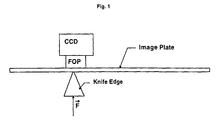
- a device wherein pressure is applied linewise (in one dimension) by means of a knife-edge or (in two dimensions) by means of a roller as a source of pressure energy (applying pressure and pressure variations).
- Said knife-edge and said roller are, according to an embodiment of the device of the present invention, present as mechanical means transporting pressure energy and in a particular embodiment in said device according to the present invention, transmission means provided by said mechanical system proceed by means of a knife-edge or a roller.
- the device according to the present invention having as an essential element a tribostimulable storage phosphor plate or panel thus comprises a alkali-halide phosphor as a tribostimulable phosphor in the most general form.
- the said tribostimulable phosphor present in the device according to the present invention has a composition comprising at least one of CsBr, CsCl, RbBr, KCl or KBr.
- said composition further comprises a dopant selected from the group consisting of Eu, Gd, Ga, Ca, Sr, Ge, Sn, Au, In, Tl, Sb, Tb and Ce or a combination thereof.
- Said dopant(s) is(are) present in an amount of from 500 up to 50000 p.p.m. or in an amount of from 0.1 up to 5 % by weight.
- energy stored in a tribostimulable phosphor is thus converted (in part) by means of a source of pressure energy differing from direct air pressure energy.
- Converting energy stored in a tribostimulable phosphor panel or plate thus comprises the steps of
- the device according to the present invention is provided with capturing means as has already been set forth, wherein said capturing means capture energy released from the tribostimulated phosphor sheet or panel in an amount proportional with the said pressure force.
- the device according to the present invention in one embodiment provides the tribostimulated light to be detected as a signal by capturing means and brought to a photomultiplier where the said signal is further processed.
- said capturing means represent at least one line of optical fibers.
- the device provides said detectable signal become a processed signal stored in an electronic memory.
- said device is provided with a DSP(digital signal processing)-chip as a very suitable electronic memory, wherein said processed signal is stored.
- the device according to the present invention further comprises detecting means selected from the group consisting of a CCD, a photo-multiplier and a photodiode-array.
- said CCD, photomultiplier or photodiode-array is in indirect contact with the storage panel by means of a fiber optic plate and in a particularly preferred embodiment said indirect contact is realized by means of a fiber optic plate or by means of an array of focusing cells or lenses.
- a method for monitoring a dose of penetrating radiation absorbed by an object comprising the steps of
- the alkali metal phosphors used in tribostimulable phosphor panels of devices according to the present invention can be produced according to any way known in the art, starting from phosphor precursors, e.g. oxides, carbonates, sulfonates, halides, phosphates, nitrates, oxalates, lactates, acetylacetonates, malonates, phthalates, alkoxides, phenoxides or ethylenediamine derivatives of the metalions that are to be incorporated in the phosphor. These phosphor precursors are mixed in the appropriate stoechiometric proportions and are then heated for a given time.
- phosphor precursors e.g. oxides, carbonates, sulfonates, halides, phosphates, nitrates, oxalates, lactates, acetylacetonates, malonates, phthalates, alkoxides, phenoxides or
- the sintered block of phosphor is milled into fine phosphor particles.
- the milling operation continues until phosphor particles with the appropriate average particle size and size distribution are obtained.
- any known flux materials can be added to the reaction mixture.
- Flux materials useful for use in the preparation of the phosphors according to the invention are e.g. halides, metasilicates of alkali metals or alkaline earth metals.
- the average grain size of said alkali metal-phosphors is preferably in the range of 2 to 25 ⁇ m, more preferably in the range of 3 to 15 ⁇ m.
- alkali metal phosphors for use in the method of the present invention are beneficially used in order to form a radiation image storage screen or panel.
- a storage panel or screen comprising such a phosphor for use in the method of the present invention comprises the steps of
- alkali metal phosphors suitable for use in stimulable phosphor panels of devices according to the present invention either alone or mixed with one or more other phosphors.
- Mixtures of alkali metal phosphors and other tribostimulable storage phosphors can be useful but also for dual energy applications this may be applied, e.g. mixing tribostimulable phosphors with radiation stimulable phosphors (stimulable by a laser emitting light source between 500 and 1000 nm as e.g.
- an Ar gas ion laser (514 nm), a frequency double NdYAG laser (532 nm), a He-Ne laser (632 nm), a diode lasers emitting at 680 nm, a GaAs laser emitting at 835 nm, etc.
- the relative amounts of both types of stimulable phosphors and their relative absorption capacity of high energetic X-rays and/or UV-rays can be calculated in order to know the relative amounts of stored energy by said both types when calibration and/or precise knowledge of emitted energy is required.
- the storage screen or panels used in devices according to the present invention can be prepared by vacuum deposition of tribostimulable phosphors on a support, yielding a panel or screen. Substantially no binder is then required. It is also possible to prepare panels by electro-depositing the tribostimulable phosphors onto the support also yielding a screen or panel comprising substantially no binder.
- a very suitable method for electro-depositing tribostimulable phosphors for use in a device according to the present invention has e.g. been disclosed in US-A 5,296,117.
- the storage screen or panel is either self-supporting or is coated on a support, whether or not comprising a binder in both cases.
- binders are disclosed e.g. in US-A's 2,502,529; 2,887,379; 3,617,285; 3,300,310; 3,300,311 and 3,743,833.
- a mixture of two or more of these binders may be used, e.g., a mixture of polyethyl acrylate and cellulose acetobutyrate.
- Weight ratios of phosphor to binder are generally within the range of from 50:50 to 99:1, preferably from 80:20 to 99:1.
- a self-supporting or supported layer of tribostimulable phosphor particles comprises said particles dispersed in a binding medium and a protective coating thereover characterized in that the binding medium substantially consists of one or more hydrogenated styrene-diene block copolymers, having a saturated rubber block, as rubbery and/or elastomeric polymers.
- the polymer can be represented by the formula A-B-A (tri-block) or by the formula A-B (di-block), wherein A represents styrene and B represents the hydrogenated diene block e.g. ethylene-butylene or ethylene-propylene.
- the ratio by volume of phoshor to binding medium is referably more than 70/30 and still more preferably more than 85/15.
- KRATON-G 1600 series rubbers are presented as block copolymers in which the elastomeric midblock of the molecule is a saturated olefin rubber.
- KRATON-G 1600 series rubbers are described to possess excellent resistance to degradation by oxygen, ozone and UV light and they also have high cohesive strength and retain their structural integrity at elevated temperatures.
- the coating weight of tribostimulable phosphor particles can be adapted to the desired energy of the storage screen or panel to be captured, but preferably a coating weight between 5 and 250 mg/cm 2 , most preferably between 20 and 175 mg/cm 2 , is used.
- a stimulable storage screen or panel for use in a device according to the present invention can be prepared by the following manufacturing process.
- the tribostimulable phosphor layer can be applied to the support by any coating procedure, making use of solvents for the binder of the phosphor containing layer as well as of useful dispersing agents, useful plasticizers, useful fillers and subbing or interlayer layer compositions that have been described in extenso in EP-A 0 510 753.
- Tribostimulable phosphor particles are mixed with the dissolved rubbery polymer, in a suitable mixing ratio to prepare a dispersion. Said dispersion is uniformly applied to a substrate by a known coating technique, e.g.
- one or more additional layers are occasionally provided between the support and the phosphor containing layer, having subbing- or interlayer compositions, in order to improve the bonding between the support and the phosphor layer, or to improve the sensitivity of the screen or the sharpness and resolution of an image provided thereby.
- a subbing layer or an adhesive layer may be provided by coating polymer material, e.g., gelatin, a polyester cross-linked by a reaction with a tri-isocyanate or a polyester with only terminal hydroxyl groups, the chain length of which has been increased by the reaction of said terminal hydroxyl groups and a di-isocyanate, over the surface of the support on the phosphor layer side.
- Said subbing layer may contain also modified thermoplastic acrylic resins such as those described above to improve the adhesion properties of the subbing layers. After applying the coating dispersion onto the support, the coating dispersion is heated slowly to dryness so as to complete the formation of a phosphor layer.
- conductive compounds can be added to the phosphor/binder mixture or the support can be provided with a conductive layer (lateral resistance ⁇ 10 12 W/square) on that side of the support opposite to the side to be coated with the phosphor/binder mixture.
- the conductive layer on the side of the support opposite to the phosphor/binder mixture layer may be covered by a plastic sheet or web material.
- a protective layer is generally provided on top of the phosphor layer.
- the protective coating composition can be applied as described e.g. in US-A 4,059,768.
- the protective coating composition is applied by a rotary screen printing device as has been described in detail in EP-A 510 753.
- the top coat is preferably formed by applying a radiation curable coating on top of the phosphor layer.
- UV ultraviolet radiation
- a photoinitiator is present in the coating composition to serve as a catalyst to initiate the polymerization of the monomers and their optional cross-linking with the pre-polymers resulting in curing of the coated protective layer composition.
- a storage stabilizer for preparing the coating liquid for the protective layer.
- colorants that can be used in the protective layer include MAKROLEX ROT EG, MAKROLEX ROT GS and MAKROLEX ROT E2G.
- MAKROLEX is a registered tradename of Bayer AG, Leverkusen, Germany.
- a variety of other optional compounds can be included in the radiation-curable coating composition of the present storage article such as compounds suitable for reducing static electrical charge accumulation, plasticizers, matting agents, lubricants, de-foamers and the like as has been described in the EP-A 0 510 753.
- Support materials for tribostimulable storage screens suitable for use in devices in accordance with the present invention include cardboard, plastic films such as films of cellulose acetate, polyvinyl chloride, polyvinyl acetate, polyacrylonitrile, polystyrene, polyester, polyethylene terephthalate, polyamide, polyimide, cellulose triacetate and polycarbonate; metal sheets such as aluminum foil and aluminum alloy foil; ordinary papers; baryta paper; resin-coated papers; pigment papers containing titanium dioxide or the like; and papers sized with polyvinyl alcohol or the like.
- a plastic film preferably employed as support material includes e.g.
- polyethylene terephthalate clear or blue coloured or black coloured (e.g., LUMIRROR C, type X30, (trade name) supplied by Toray Industries, Tokyo, Japan), polyethylene terephthalate filled with TiO 2 or with BaSO 4 .
- Metals as e.g. aluminum, bismuth and the like may be deposited e.g. by vaporization techniques to get a polyester support having radiation-reflective properties. These supports may have thicknesses which may differ depending on the material of the support, and may generally be between 60 and 1000 ⁇ m, more preferably between 80 and 500 ⁇ m from the standpoint of handling or mountability in the device according to the present invention.
- a screen or panel comprising a tribostimulable phosphor useful in devices according to the present invention may carry an antistatic layer either on top of a protective layer or on the side of the support opposite to the side carrying said phosphor.
- Said antistatic layer may comprises inorganic antistatic agents, e.g. metal oxides as disclosed in e.g. EP-A 0 579 016 as well as organic antistatic agents (polyethylene oxides, poly(ethylenedioxy-thiophene) as disclosed in e.g. EP-A 0 440 957.
- the phosphor was exposed to X-rays (200 kV, 10 mA) without filtering in dark with a dose of about 10 mGray.
- the phosphor crystal having two flat parallel surfaces was placed on a table.
- the intensity of the emitted light caused by the pressure force was very much higher than the emitted light caused by afterglow. It was also found that the crystals are emitting strongly when the surface of the crystal was damaged with e.g. a knife or even with a finger nail.
- the said crystal was irradiated beforehand with a well-known amount of energy, generated from UV- or X-rays in order to get a known amount of stored energy.
- the emitted light was detected with a photomultiplier while releasing the known stored energy under the influence of an external pressure source.
- TSP-PMP tribostimulable phosphor-photomultiplier
Landscapes
- Physics & Mathematics (AREA)
- General Physics & Mathematics (AREA)
- Conversion Of X-Rays Into Visible Images (AREA)
Abstract
Description
- a tribostimulable storage phosphor panel as a storage medium for absorbing energy, and more preferably calibrated amounts of energy, generated by incident radiation energy having a wavelength of 350 nm or less, and more preferably having an X-ray and/or UV-radiation source, and, adjacent thereto,
- transmission means permitting to apply a pressure force and variations thereof onto said tribostimulable storage phosphor panel by means of said pressure source, thereby stimulating said tribostimulable storage phosphor panel in order to release stimulated light energy, preferably in an amount proportional with the said pressure force.
In this application however it is not the purpose to provide a radiological image, although this is principally possible (e.g. by "activation" of the pixel-wise arranged piezo-electrical crystals by pixel-wise generating electrical pulses from digitally stored information (e.g. captured from X-ray images obtained by CT-techniques, echography, CRT's, laser sources, acoustic signals etc.). The stability of any light source or any acoustic energy source (required e.g. when accurate and well-known amounts of energy should be added as in medical therapies or in micro-electronics and/or measured as in digitizing techniques, speech technology, etc.) can thus be analyzed very quickly with a high accuracy and even in quantitative way after calibration of the measuring device.
Claims (15)
- A device for measuring a pressure force or changes thereof applied by a pressure source differing from a direct air pressure source, and for reading out said pressure force, wherein said device essentially comprises a stimulable storage phosphor sheet or panel and means in order to apply the said pressure force onto the said stimulable storage phosphor sheet or panel and wherein said pressure source and said storage phosphor panel are positioned relative to each other so that pressure or variations thereof caused or generated by said pressure source reach said stimulable phosphor, called tribostimulable phosphor, thereby stimulating said phosphor by pressure in order to release tribostimulated light, said device further having capturing means to capture said tribostimulated light and detecting means to detect it.
- Device according to claim 1, wherein said tribostimulable storage phosphor panel absorbs calibrated amounts of energy, generated by incident radiation having a wavelength of 350 nm or less, wherein a pressure force or variations thereof are directly performed onto said tribostimulable storage phosphor panel or indirectly performed on said panel by means of transporting or transmission means, wherein said transmission means are provided by a mechanical, an electrical, an electronical, a hydraulic or a pneumatic system and wherein transmission means provided by said electrical system permits pixelwise detection of variations in electrical signals performed by means of at least one layer of piezo-electrical crystals.
- Device according to claim 2, having a layer of piezo-electrical crystals pixelwise performing pressure on the said storage phosphor panel by direct contact between said piezo-electrical crystals and said storage phosphor panel in order to read-out said tribostimulable storage phosphor panel imagewise, wherein said device is provided with means in order to apply an electrical field on said piezo-electrical crystals by row and column electrodes, provided at both sides of said layer and mounted perpendicularly to each other, coupled to a voltage source adapted for applying an electrical potential to each of said electrodes separately.
- Device according to any of claims 1 to 3, wherein said storage phosphor panel comprises a alkali-halide phosphor as a tribostimulable phosphor.
- Device according to any of claims 1 to 4, wherein said capturing means represent at least one line of optical fibers.
- Device according to any of claims 1 to 5, wherein said capturing means capture energy released from the tribostimulated phosphor sheet or panel in an amount proportional with the said pressure force and wherein said detecting means is selected from the group consisting of a CCD, a photo-multiplier and a photodiode-array and wherein said CCD, said photo-multiplier or said photodiode-array is in indirect contact with the storage panel by means of a fiber optic plate or by means of an array of focusing cells or lenses.
- Device according to claim 6, wherein the tribostimulated light is detected as a signal by capturing means and brought to a photomultiplier and where the said signal is further processed.
- Device according to claim 7, wherein said processed signal is further stored in an electronic memory.
- Device according to claim 8, wherein said electronic memory is a DSP(digital signal processing)-chip.
- Device according to any of claims 1 to 9, wherein said panel, said capturing means and said detecting means are built-in in a housing as a pressure meter device.
- Method to determine in a quantitative way amounts of pressure energy comprising the steps of :i) providing a device according to any of claims 1 to 10;ii) irradiating said device by incident irradiation in such a way that the said tribostimulable storage panel is exposed with a calibrated amount of energy;iii) reading out said storage phosphor panel by provoking stimulation of said tribostimulable storage phosphors by a source of pressure force;iv) digitally detecting energy released from said tribostimulable storage phosphor panel by a detector;v) erasing stored rest energy.
- Method to absorb or capture energy and reproduce quantitatively said energy originating from a pressure source by the device according to any of claims 1 to 10, said method comprising the steps ofi) exposing the tribostimulable storage phosphor to a calibrated amount of penetrating radiation having a wavelength of 350 nm or less,ii) storing the said calibrated amount of energy from said penetrating radiation in said storage phosphor,iii) releasing at least part of said stored energy as tribostimulated light by stimulating said phosphor with energy generated by a source of pressure force andiv) reading said tribostimulated light, characterized in that said phosphor is stimulated by pressure emanating from a pixel-wise driven piezo-electrical device.
- Method of measuring a pressure force generated by making use of following steps:i) absorbing and storing incident radiation energy originating from radiation having a wavelength or 350 nm or less, wherein said storage phosphor panel is covered with an optical filter absorbing radiation having a wavelength of 350 nm or more;ii) reading out said storage phosphor by adding stimulating energy to the said storage phosphor panel by means of pressure or energy convertable to pressure,iii) detecting energy released from said storage phosphor panel by a detector as digitally detected energy,iv) storing said digitally detected energy in an electronic memory,v) plotting said data as a function of time,vi) erasing stored rest energy in the storage panel by means of energy from a light source, a heat source or a pressure source.
- Method for monitoring a dose of penetrating radiation absorbed by an object, said method comprising the steps of(a) providing said object with a device for absorbing penetrating radiation, including a tribostimulable storage phosphor for storing energy from said penetrating radiation;(b) coupling said tribostimulable storage phosphor at predetermined intervals to a source of pressure, activating said source of pressure in such a way as to cause said tribostimulable storage phosphor to emit an amount of fluorescent light proportional with an amount of stored energy;(c) reading said amount of fluorescent light and converting it in an electric signal value or values;(d) storing electric signal value(s) obtained at said predetermined intervals and processing them in order to evaluate a total amount of radiation absorbed by said object;(e) comparing said total amount with a predefined threshold value in order to obtain a figure as a difference of values, and(f) displaying said figure on a display.
- Method according to any of claims 11 to 14, wherein said phosphor is stimulated by pressure emanating sheetwise from a source of pressure energy.
Priority Applications (1)
| Application Number | Priority Date | Filing Date | Title |
|---|---|---|---|
| EP20000202107 EP1063505B1 (en) | 1999-06-22 | 2000-06-13 | Pressure measuring devices equipped with tribostimulable storage phosphors |
Applications Claiming Priority (3)
| Application Number | Priority Date | Filing Date | Title |
|---|---|---|---|
| EP99201989 | 1999-06-22 | ||
| EP99201989 | 1999-06-22 | ||
| EP20000202107 EP1063505B1 (en) | 1999-06-22 | 2000-06-13 | Pressure measuring devices equipped with tribostimulable storage phosphors |
Publications (2)
| Publication Number | Publication Date |
|---|---|
| EP1063505A1 true EP1063505A1 (en) | 2000-12-27 |
| EP1063505B1 EP1063505B1 (en) | 2002-12-11 |
Family
ID=26072380
Family Applications (1)
| Application Number | Title | Priority Date | Filing Date |
|---|---|---|---|
| EP20000202107 Expired - Lifetime EP1063505B1 (en) | 1999-06-22 | 2000-06-13 | Pressure measuring devices equipped with tribostimulable storage phosphors |
Country Status (1)
| Country | Link |
|---|---|
| EP (1) | EP1063505B1 (en) |
Cited By (1)
| Publication number | Priority date | Publication date | Assignee | Title |
|---|---|---|---|---|
| US6800870B2 (en) | 2000-12-20 | 2004-10-05 | Michel Sayag | Light stimulating and collecting methods and apparatus for storage-phosphor image plates |
Citations (4)
| Publication number | Priority date | Publication date | Assignee | Title |
|---|---|---|---|---|
| GB2232119A (en) * | 1989-05-30 | 1990-12-05 | Excalibur | Security marking |
| EP0558771A1 (en) * | 1992-03-02 | 1993-09-08 | Aliteco Ag | Luminescent pressure sensitive composition |
| US5817945A (en) * | 1996-04-15 | 1998-10-06 | Mcdonnell Douglas | System and method of determining strain |
| US5905260A (en) * | 1995-11-14 | 1999-05-18 | The Secretary Of State For Defense In Her Britannic Majesty's Government Of The United Kingdom Of Great Britain And Northern Ireland | Triboluminescent damage sensors |
-
2000
- 2000-06-13 EP EP20000202107 patent/EP1063505B1/en not_active Expired - Lifetime
Patent Citations (4)
| Publication number | Priority date | Publication date | Assignee | Title |
|---|---|---|---|---|
| GB2232119A (en) * | 1989-05-30 | 1990-12-05 | Excalibur | Security marking |
| EP0558771A1 (en) * | 1992-03-02 | 1993-09-08 | Aliteco Ag | Luminescent pressure sensitive composition |
| US5905260A (en) * | 1995-11-14 | 1999-05-18 | The Secretary Of State For Defense In Her Britannic Majesty's Government Of The United Kingdom Of Great Britain And Northern Ireland | Triboluminescent damage sensors |
| US5817945A (en) * | 1996-04-15 | 1998-10-06 | Mcdonnell Douglas | System and method of determining strain |
Non-Patent Citations (1)
| Title |
|---|
| GRAYDON, OLIVER: "Composites glow where they crack", OPTO & LASER EUROPE, vol. 61, April 1999 (1999-04-01), pages 26 - 27, XP002122082 * |
Cited By (3)
| Publication number | Priority date | Publication date | Assignee | Title |
|---|---|---|---|---|
| US6800870B2 (en) | 2000-12-20 | 2004-10-05 | Michel Sayag | Light stimulating and collecting methods and apparatus for storage-phosphor image plates |
| US7589341B2 (en) | 2000-12-20 | 2009-09-15 | Michel Sayag | Light stimulating and collecting methods and apparatus for storage-phosphor image plates |
| US7825394B2 (en) | 2000-12-20 | 2010-11-02 | Michel Sayag | Light stimulating and collecting methods and apparatus for storage-phosphor image plates |
Also Published As
| Publication number | Publication date |
|---|---|
| EP1063505B1 (en) | 2002-12-11 |
Similar Documents
| Publication | Publication Date | Title |
|---|---|---|
| US6476406B1 (en) | Devices equipped with tribostimulable storage phosphors | |
| EP0648254B1 (en) | Luminescent article with high phosphor to binder ratio and manufacture thereof | |
| US5736069A (en) | Radiation image storage screen comprising and alkali metal halide phosphor | |
| US6228286B1 (en) | Class of high energy detecting phosphors | |
| US7675039B2 (en) | Phosphor sheet for radiation detector, radiation detector and apparatus for radiographic equipment | |
| CA1234970A (en) | Phosphor, radiation image recording and reproducing method and radiation image storage panel employing the same | |
| US6045722A (en) | Photostimulable phosphor | |
| US4788434A (en) | Radiation image recording and reproducing method | |
| US20010030302A1 (en) | System for digital radiography and dosimetry | |
| US6420724B1 (en) | Method of image formation, dosimetry and personal monitoring | |
| EP0751200B1 (en) | A radiation image storage screen comprising an alkali metal halide phosphor | |
| EP1063505B1 (en) | Pressure measuring devices equipped with tribostimulable storage phosphors | |
| US4800136A (en) | Radiation image storage panel | |
| DE60000949T2 (en) | Pressure gauges equipped with tribostimulable storage phosphor | |
| EP1065671A1 (en) | Method of image formation, dosimetry and personal monitoring | |
| US6344657B1 (en) | Stimulable phosphor sheet for double-side reading system | |
| EP0143301B1 (en) | Phosphor, radiation image recording and reproducing method and radiation image storage panel employing the same | |
| EP0685548B1 (en) | A novel class of high energy detecting materials | |
| US4698508A (en) | Phosphor, radiation image recording and reproducing method and radiation image storage panel | |
| EP0148507B1 (en) | Phosphor and radiation image storage panel employing the same | |
| EP0146974B1 (en) | Phosphor and radiation image storage panel employing the same | |
| JPH08226998A (en) | Recording and reproducing method of radiation image | |
| US5624603A (en) | Bariumfluorohalide phosphor comprising calcium ions at the surface | |
| JP2001215298A (en) | Radiation dose measuring method and radiological image forming method | |
| EP0146970B1 (en) | Use of a divalent Eu activated Ba, Ca, F and halogen containing phosphor in a radiation image recording and reproducing method. |
Legal Events
| Date | Code | Title | Description |
|---|---|---|---|
| PUAI | Public reference made under article 153(3) epc to a published international application that has entered the european phase |
Free format text: ORIGINAL CODE: 0009012 |
|
| AK | Designated contracting states |
Kind code of ref document: A1 Designated state(s): DE FR GB |
|
| AX | Request for extension of the european patent |
Free format text: AL;LT;LV;MK;RO;SI |
|
| 17P | Request for examination filed |
Effective date: 20010627 |
|
| AKX | Designation fees paid |
Free format text: DE FR GB |
|
| 17Q | First examination report despatched |
Effective date: 20010913 |
|
| RAP1 | Party data changed (applicant data changed or rights of an application transferred) |
Owner name: AGFA-GEVAERT |
|
| GRAG | Despatch of communication of intention to grant |
Free format text: ORIGINAL CODE: EPIDOS AGRA |
|
| GRAG | Despatch of communication of intention to grant |
Free format text: ORIGINAL CODE: EPIDOS AGRA |
|
| GRAH | Despatch of communication of intention to grant a patent |
Free format text: ORIGINAL CODE: EPIDOS IGRA |
|
| GRAH | Despatch of communication of intention to grant a patent |
Free format text: ORIGINAL CODE: EPIDOS IGRA |
|
| GRAG | Despatch of communication of intention to grant |
Free format text: ORIGINAL CODE: EPIDOS AGRA |
|
| GRAH | Despatch of communication of intention to grant a patent |
Free format text: ORIGINAL CODE: EPIDOS IGRA |
|
| GRAA | (expected) grant |
Free format text: ORIGINAL CODE: 0009210 |
|
| AK | Designated contracting states |
Kind code of ref document: B1 Designated state(s): DE FR GB |
|
| REG | Reference to a national code |
Ref country code: GB Ref legal event code: FG4D |
|
| REF | Corresponds to: |
Ref document number: 60000949 Country of ref document: DE Date of ref document: 20030123 |
|
| ET | Fr: translation filed | ||
| PLBE | No opposition filed within time limit |
Free format text: ORIGINAL CODE: 0009261 |
|
| STAA | Information on the status of an ep patent application or granted ep patent |
Free format text: STATUS: NO OPPOSITION FILED WITHIN TIME LIMIT |
|
| 26N | No opposition filed |
Effective date: 20030912 |
|
| PGFP | Annual fee paid to national office [announced via postgrant information from national office to epo] |
Ref country code: FR Payment date: 20060522 Year of fee payment: 7 |
|
| PGFP | Annual fee paid to national office [announced via postgrant information from national office to epo] |
Ref country code: DE Payment date: 20060523 Year of fee payment: 7 |
|
| REG | Reference to a national code |
Ref country code: GB Ref legal event code: 746 Effective date: 20070213 |
|
| REG | Reference to a national code |
Ref country code: GB Ref legal event code: 732E |
|
| REG | Reference to a national code |
Ref country code: FR Ref legal event code: TP |
|
| REG | Reference to a national code |
Ref country code: FR Ref legal event code: ST Effective date: 20080229 |
|
| PG25 | Lapsed in a contracting state [announced via postgrant information from national office to epo] |
Ref country code: DE Free format text: LAPSE BECAUSE OF NON-PAYMENT OF DUE FEES Effective date: 20080101 |
|
| PG25 | Lapsed in a contracting state [announced via postgrant information from national office to epo] |
Ref country code: FR Free format text: LAPSE BECAUSE OF NON-PAYMENT OF DUE FEES Effective date: 20070702 |
|
| PGFP | Annual fee paid to national office [announced via postgrant information from national office to epo] |
Ref country code: GB Payment date: 20080627 Year of fee payment: 9 |
|
| GBPC | Gb: european patent ceased through non-payment of renewal fee |
Effective date: 20090613 |
|
| PG25 | Lapsed in a contracting state [announced via postgrant information from national office to epo] |
Ref country code: GB Free format text: LAPSE BECAUSE OF NON-PAYMENT OF DUE FEES Effective date: 20090613 |