BACKGROUND OF THE INVENTION
The present invention relates to a nucleic acid-immobilized
substrate. More specifically, the present
invention relates to a nucleic acid-immobilized
substrate in which nucleic acids are securely
immobilized on a carrier in the form of fine dots,
useful as a DNA array and so forth.
Currently, the following two methods are mainly
used for the preparation of a nucleic acid-immobilized
substrate in which wherein nucleic acids are immobilized
as fine dots on a carrier, for use as a DNA chip, DNA
array or the like:
However, a nucleic acid-immobilized substrate
manufactured by the above method (1) has a drawback that,
when it is used for hybridization, nucleic acids may be
dropped off from the substrate, in particular, during
operation processes, which leads to reduction of
detection sensitivity, fluctuation of results, i.e., a
problem of reproducibility and so forth. Further, as
for the efficiency in immobilization of nucleic acids by
the method (1), it has a drawback that short nucleic
acids of about 300-mer or less such as oligomers cannot
be immobilized efficiently, although longer nucleic
acids can be immobilized without any particular problems.
Further, the above method (2) requires special
apparatuses and reagents for synthesizing DNA on a base
material and cannot be readily employed by everyone.
Further, nucleic acids to be synthesized are limited to
those of about 25-mer or less. Furthermore, nucleic
acids longer than 10-mer cannot so easily be synthesized.
Thus, the conventional methods have problems not
only of having difficulty in preparing a nucleic acid-immobilized
substrate to immobilize nucleic acids of
from 10-mer to 300-mer, but also of being unable to
securely immobilize nucleic acids of other lengths or
being unable to immobilize nucleic acids by using a
simple apparatus.
SUMMARY OF THE INVENTION
The present invention has been accomplished from
the above viewpoints, and an object thereof is to
provide a nucleic acid-immobilized substrate in which
nucleic acids are securely immobilized on a carrier in
the form of fine dots irrespective of their length, and
which can be prepared by using a simple apparatus.
As a result of efforts dedicated by the present
inventors to achieve the above object, it was found that,
if nucleic acids were immobilized through a carbodiimide
group on a carrier composed of a base material carrying
a compound having the carbodiimide group, nucleic acids
could be securely immobilized on the carrier in the form
of fine dots irrespective of their length. Also, it was
found that, if nucleic acids were immobilized through an
isocyanate group on a carrier composed of a base
material carrying a compound having the isocyanate group,
nucleic acids could be securely immobilized on the
carrier in the form of fine dots irrespective of their
length. Thus, the present invention has been
accomplished.
The followings are provided by the present
invention.
According to the present invention, there is
provided a nucleic acid-immobilized substrate in which
DNAs are stably immobilized. Since nucleic acids can be
immobilized on the substrate of the present invention
without any limitation concerning the number of chains
or the length of nucleic acids, various kinds of nucleic
acids can simultaneously be handled on the same base
material.
Furthermore, since nucleic acids are securely
bound to the carrier through covalent bonds, the nucleic
acid-immobilized substrate can be useful for use as a
DNA chip of excellent reproducibility and quantification
characteristics.
DETAILED DESCRIPTION OF THE INVENTION
〈1〉 Carrier
The carrier used for the nucleic acid-immobilized
substrate of the present invention is provided for
immobilizing nucleic acids and comprises a base material
and a compound having a carbodiimide group or an
isocyanate group (also referred to simply as
"carbodiimide compound" or "isocyanate compound"
hereafter, respectively) carried by the base material.
A. Carbodiimide carrier
(1) Base material
The base material used for the present invention
serves as a support for the aforementioned carrier and
is not particularly limited so long as it is basically
insoluble in a solvent and is in a solid or gel state at
an ordinary temperature or within a temperature range
around the ordinary temperature (0 to 100°C). The
expression that the base material is insoluble in a
solvent means that the base material is substantially
insoluble in various solvents such as aqueous solvents
and organic solvents used in various processes when the
carbodiimide compounds are provided on the base material
and nucleic acids are immobilized on the base material
as a carrier, as will be described later, and then it is
used as, for example, a DNA chip.
Materials used for such a base material of the
carrier include, specifically, plastics, inorganic
polymers, metals, natural polymers, ceramics and the
like.
Examples of the plastics include, specifically,
polyethylene, polystyrene, polycarbonate, polypropylene,
polyamide, phenol resin, epoxy resin, polycarbodiimide
resin, polyvinyl chloride, polyvinylidene fluoride,
polyethylene fluoride, polyimide, acrylic resin and so
forth. Examples of the inorganic polymers include glass,
quartz, carbon, silica gel, graphite and so forth.
Examples of the metals include metals that are solid at
an ordinary temperature such as gold, platinum, silver,
copper, iron, aluminum, magnet and paramagnet. Examples
of the natural polymers include cellulose, cellulose
derivatives, chitin, chitosan, alginic acid, alginic
acid salts and so forth. Examples of the ceramics
include apatite, alumina, silica, silicon carbide,
silicon nitride, boron carbide and so forth.
The base material can be in the form of, for
example, film, flat plate, fiber or the like. The size
is not particularly limited.
(2) Compound having a carbodiimide group
The compound having a carbodiimide group used for
the present invention include, for example,
polycarbodiimides that can be prepared by the method
disclosed in Japanese Patent Application Laid-open
(Kokai) No. 51-61599(1976), the method of L. M. Alberino
et al. (J. Appl. Polym. Sci., 21, p.190 (1990)), the
method disclosed in Japanese Patent Application Laid-open
(Kokai) No. 2-292316(1990) or the like, low
molecular-weight carbodiimides such as monocarbodiimide
and dicarbodiimide that are synthesized by a method
generally used for carbodiimide production, such as
dehydration of urea and desulfation of thiourea and so
forth.
Specifically, the aforementioned polycarbodiimides
can be prepared in the presence of a catalyst promoting
carbodiimidation of isocyanate from an organic
polyisocyanate compound (for example, 3-methyl-1-phenyl-2-phospholene-1-oxide).
Examples of the aforementioned organic
polyisocyanate compound used for the preparation of the
polycarbodiimides include, for example, 4,4'-dicyclohexylmethane
diisocyanate, m-tetramethylxylylene
diisocyanate, 2,4-tolylene diisocyanate, 2,6-tolylene
diisocyanate, a mixture of 2,4-tolylene diisocyanate and
2,6-tolylene diisocyanate, crude tolylene diisocyanate,
crude methylenediphenyl diisocyanate, 4,4',4''-triphenylmethylene
triisocyanate, xylene diisocyanate,
hexamethylene-1,6-diisocyanate, lysine diisocyanate,
hydrogenated methylenediphenyl diisocyanate, m-phenyl
diisocyanate, naphthylene-1,5-diisocyanate, 4,4'-biphenylene
diisocyanate, 4,4'-diphenylmethane
diisocyanate, 3,3'-dimethoxy-4,4'-biphenyl diisocyanate,
3,3'-dimethyldiphenylmethane-4,4'-diisocyanate,
isophorone diisocyanate and a mixture of any of these.
Polycondensation occurs upon carbodiimidation of
an isocyanate group in the aforementioned polyisocyanate
compounds or their mixture. In this reaction, molecular
weight (polymerization degree) of the product can be
controlled by adding one or more kinds of monoisocyanate
in an appropriate amount at an appropriate stage to
block the terminals of the carbodiimide compound. The
monoisocyanate can also be added in an appropriate
amount at the beginning of the polycondensation reaction.
Examples of such monoisocyanate include phenyl
isocyanate, (ortho, meta or para)-tolylisocyanate,
dimethylphenyl isocyanate, n-butyl isocyanate,
cyclohexyl isocyanate, methyl isocyanate and so forth.
The polymerization degree can also be controlled by the
concentration of the polyisocyanate compound or the like
or the reaction time.
The terminal blocking agent may be one that can be
derived from a compound having isocyanate at a terminus
easily prepared by a reaction of about 1 mole of a
compound having an alkyl group containing a functional
group such as -OH, -NH2, -COOH, -SH or -NH at its
terminus with 2 moles of aromatic diisocyanate.
Various kinds of substances can be mentioned as
the catalyst for promoting carbodiimidation of the
organic isocyanate. However, 1-phenyl-2-phospholene-1-oxide,
3-methyl-1-phenyl-2-phospholene-1-oxide, 1-ethyl-2-phospholene-1-oxide,
3-phospholene isomers of these
compounds and so forth are preferred in view of yield
and other aspects.
The polycarbodiimide is prepared without solvent
or in a non-reactive organic solvent. In the present
invention, one of polycarbodiimides prepared as
described above or a mixture thereof can be used as the
carbodiimide compound, for example. The
polycarbodiimide may be partially cross-linked.
Other carbodiimide compounds that can be used for
the present invention include, for example, carbodiimide
compounds to which hydrophilicity is imparted by adding
a polyoxyethylene chain in their molecular structures as
described in Japanese Patent Application Laid-open
(Kokai) Nos. 63-172718(1988) and 63-264128(1988). Low
molecular weight carbodiimide compounds such as
monocarbodiimide compounds and dicarbodiimide compounds
can also be used for the present invention.
The carbodiimide group of the aforementioned
carbodiimide compounds is highly reactive and react with
most of active hydrogen groups contained in alcohols,
amines, thiols, phenols, carboxylic acids and so forth.
For example, reactions with a carboxylic acid, alcohol
and amino group proceed as represented by the following
formula (I), (II) and (III), respectively (See Frederick
Kurzer, K. Douraghi-Zadeh, Chemical Reviews, 67, pp.117-135,
(1967) and Andrew Williams, Ibrahim T. Ibrahim,
Chemical Reviews, 81, pp.599-606, (1981)).
R'CO2H + RN=C=NR → R'C(=O)OC(NHR)=NR
C2H5OH + C6H5N=C=NC6H5 → C6H5NHC(=NC6H5)OC2H5
RN=C=NR + R'NH2 → RNHC(=NR')NHR
Therefore, the carrier used for the present
invention can securely immobilize nucleic acids through
the carbodiimide compounds by utilizing this reactivity
of the carbodiimide groups.
(3) Carrier
The carrier of the present invention used for
immobilizing nucleic acids comprises the aforementioned
base material and the aforementioned carbodiimide
compounds carried by the base material. The term "to
carry" used in the present specification means that the
carbodiimide compounds are not substantially eliminated
from the base material in various solvents such as
aqueous solvents and organic solvents used when nucleic
acids are immobilized on a carrier or the nucleic acid-immobilized
substrate is used as a DNA chip or the like.
The aforementioned carbodiimide compounds may be
carried by the carrier used for the present invention
simply due to physical adhesion or chemically carried
through covalent bonds or the like so long as they are
carried by the base material. However, the carbodiimide
compounds are preferably carried by the base material
through covalent bonds on the carrier used for the
present invention.
The carbodiimide compounds may be carried by a
part or the whole of the base material surface as
required.
As the carbodiimide compounds used for preparing a
carrier in which the carbodiimide compounds are carried
by the base material due to physical adhesion, a polymer
compound among the carbodiimide compounds mentioned in
the above (2) can be used without any particular
limitation. The preferable molecular weight range
thereof is from 1000 to 100,000.
Although some polycarbodiimides prepared in the
presence of a catalyst promoting carbodiimidation of
isocyanate from the organic polyisocyanate compound
mentioned in the above (2), for example, have a
molecular weight of less than 1000, the molecular weight
of such polycarbodiimides can be adjusted to be within
the aforementioned range by introducing polyalkylene,
polyoxyalkylene, polyurethane, polyamide or the like
into both termini of these polycarbodiimides through
urea bonds or urethane bonds.
It is preferable for any type of carbodiimide
polymer compounds carried by the carrier due to the
aforementioned physical adhesion that they have 2 to 100
carbodiimide groups in a molecule. If the carbodiimide
polymer compounds have less than two, that is, one
carbodiimide group in each molecule, they may lack in
the ability to immobilize nucleic acids. To the
contrary, if they have 101 or more carbodiimide groups,
viscosity may become too high, a solution thereof may
not be prepared, and thus their handling property upon
immobilization on the base material should be degraded,
while they cause no problem concerning the performance
for immobilizing nucleic acids.
Such carbodiimide polymer compounds have high
adhesion to the aforementioned base material, and they
are carried by the base material due to such adhesion.
The carbodiimide polymer compounds are carried by the
base material due to physical adhesion typically in the
form of a coated film.
As a method for providing the carbodiimide polymer
compounds on the base material as a coated film, known
means such as spraying, dipping, brushing, stamping,
vapor deposition and film coating can be employed.
The carrier carrying the carbodiimide compounds
through covalent bonds will be described below.
The expression "compound having a carbodiimide
group" used in the present specification for the
compound having a carbodiimide group carried by the base
material surface is defined as a compound independent
from the covalent bond moiety present between the
compound and the base material surface (that is actually
a "group", but a term "compound" is used for
convenience). In the present specification, therefore,
as for a carrier carrying the compound having a
carbodiimide group on the base material through covalent
bonds, the compounds having a carbodiimide group are
explained as compounds that do not contain a functional
group involved in the covalent bond with the base
material surface.
The carbodiimide compounds carried through
covalent bonds may be of any type of those described in
the above (2). Each of the carbodiimide compounds
carried by the carrier on the base material surface
through a covalent bond preferably has 5 to 30, more
preferably 7 to 20 carbodiimide groups in a molecule.
If the number of carbodiimide groups in the carbodiimide
compound is between 5 and 30, favorable ability to
immobilize nucleic acids can be obtained. It is also
preferable in its handling because the solution would
have appropriate viscosity.
In order to obtain a carrier carrying the compound
having a carbodiimide group on the base material surface
through covalent bonds (also be referred to as
"carbodiimide compound covalently bonded type
carrier" hereafter), for example, a carbodiimide
compound having a carbodiimide group for immobilizing
nucleic acids on the carrier and another functional
group to be covalently bonded to the base material
surface can be covalently bonded to a functional group
of a base material having a functional group that can be
covalently bonded with the functional group contained in
the carbodiimide compound by an appropriate method.
More specifically, the carbodiimide compound
covalently bonded type carrier can be obtained by
covalently bonding a compound having two or more
carbodiimide groups or having one or more carbodiimide
groups and one or more functional groups other than the
carbodiimide group to a functional group of a base
material having, on its surface, the functional group
that can be covalently bonded with one of the
aforementioned carbodiimide groups or the aforementioned
functional groups other than the carbodiimide group
contained in the compound with leaving at least one
carbodiimide group free.
As the compound having two or more carbodiimide
groups or having one or more carbodiimide groups and one
or more functional groups other than the carbodiimide
group used to prepare the aforementioned carbodiimide
compound covalently bonded type carrier, there can
specifically be mentioned compounds having two or more
carbodiimide groups or having one or more carbodiimide
groups and one or more functional groups other than the
carbodiimide group, among the carbodiimide compounds
mentioned in the above (2), for example. Further, there
can also be used a compound obtained by introducing a
functional group to be used for the covalent bond, for
example, a functional group selected from a hydroxyl
group, an imino group, an amino group, a carboxyl group,
an isocyanate group, an isothiocyanate group and so
forth, into any of the carbodiimide compounds mentioned
in the above (2) by an appropriate method to prepare the
carbodiimide compound covalently bonded type carrier.
In addition, a compound prepared by further introducing
a carbodiimide group into any of the carbodiimide
compounds mentioned in the above (2) as the functional
group to be used for the covalent bond can also be used
for the preparation of the carrier. Known conventional
methods can be employed as a method of introducing such
a functional group into the carbodiimide compound.
As a base material having, on its surface,
functional groups that can be covalently bonded with the
carbodiimide group or a functional group other than the
carbodiimide group contained in the above carbodiimide
compounds used for the preparation of the carbodiimide
group covalently bonded type carrier, there can be
mentioned, for example, the base materials mentioned in
the above (1), on which surface functional groups that
can form covalent bonds are introduced. The functional
group to be introduced is not particularly limited so
long as it is a functional group that can be covalently
bonded with carbodiimide group or a functional group
that can be covalently bonded with the functional group
other than the carbodiimide group contained in the
aforementioned compound. Specifically, however, a
hydroxyl group, an imino group, an amino group, a
carboxyl group, a carbodiimide group and so forth can be
mentioned. These functional groups are suitably
selected depending on the functional group used for the
covalent bond contained in the carbodiimide compound,
and introduced into the base material surface.
The method for introducing the functional group
into the base material surface is suitably selected
depending on the material of the base material and the
functional group to be introduced. Further, the
functional group may be introduced into a part or the
whole of the base material surface.
For example, in order to introduce an amino group
into the whole surface of a glass base material, the
glass base material can be immersed into a solution
obtained by dissolving amino-substituted
organoalkoxysilane such as 3-aminopropyltriethoxysilane
in a suitable solvent, at about 70 to 80°C for about 2
to 3 hours, taken out from the solution, washed with
water and dried by heating at 100 to 120°C for about 4
to 5 hours.
Introduction of such functional groups onto
surfaces of various materials mentioned in the above
explanation for the base material has been commonly
carried out so far, and methods therefor have been known.
Therefore, even when functional groups other than the
amino group are introduced into a glass base material or
the base material is made of a material other than glass,
such functional groups may be introduced onto a surface
of the base material by such conventional known methods.
Furthermore, some of plastic base materials among
those mentioned in the above (1) have the functional
groups mentioned above on the surface. These can be
used as they are to prepare the carbodiimide compound
covalently bonded type carrier without introducing a
functional group into the base material surface.
Moreover, a functional group can further be introduced
into even such plastic base materials to prepare the
carrier.
In order to prepare the carbodiimide compound
covalently bonded type carrier used for the present
invention, the compound having two or more carbodiimide
groups or having one or more carbodiimide groups and one
or more functional groups other than the carbodiimide
group obtained as described above is reacted with the
base material having a functional group that can be
covalently bonded with carbodiimide groups or functional
groups other than the carbodiimide group on its surface
under appropriate conditions so that the functional
group on the base material surface should be covalently
bonded with the compound with leaving at least one
carbodiimide group contained in the compound for each
compound free. That is, when each of the compounds has
one or more carbodiimide groups and one or more
functional groups other than the carbodiimide group, the
reaction can be performed under reaction conditions
under which the functional group or groups other than
the carbodiimide group are used for the covalent bond.
When a compound having only carbodiimide groups as
functional group is used, the reaction may be performed
so that all of the carbodiimide groups should not be
used for the covalent bond.
The carrier for immobilizing nucleic acids
obtained as described above and comprising a base
material and carbodiimide compounds carried by the base
material can securely immobilize nucleic acids of
various types and sizes by utilizing reactivity of the
carbodiimide groups contained in the carbodiimide
compounds.
B. Isocyanate carrier
(1) Base material
A base material used for the carrier for
immobilizing nucleic acids according to the present
invention plays a role of a support for the carrier and
is insoluble in solvents. More specifically, an
isocyanate group is introduced onto the surface of the
base material used in the present invention as described
below to serve as a carrier, and nucleic acids are
immobilized thereon. The carrier with the nucleic acids
being immobilized thereon is used to produce or analyze
nucleic acids. The carrier is substantially insoluble
in various solvents such as aqueous solvents and organic
solvents used during the procedure of the above
production or analysis. The base material used in the
present invention is not particularly limited as long as
it is insoluble in solvents as described above and
basically solid or gel at the ordinary temperature or
within the range of the ordinary temperature (0 to
100°C). Specific examples of the material for the base
material of the carrier include plastics, inorganic
polymers, metals, natural polymers, and ceramics.
Examples of plastics are polyethylene, polystyrene,
polycarbonate, polypropylene, polyamide, phenol resin,
epoxy resin, polycarbodiimide resin, poly(vinyl
chloride), poly(vinylidene fluoride), poly(ethylene
fluoride), polyimide, and acryl resin, etc. Examples of
inorganic polymers are glass, quartz, carbon, silica gel,
graphite, etc. Examples of metals are those which are
solid at the ordinary temperature such as gold,
platinum, silver, Copper, iron, aluminum, magnet,
paramagnet, etc. Examples of natural polymers are
cellulose, cellulose derivatives, chitin, chitosan,
alginic acid, alginate, etc. Examples of ceramics are
apatite, alumina, silica, silicon carbide, silicon
nitride, boron carbide, etc.
The above base materials may be in the form of,
for example, film, flat plate, particle, molded product
(beads, strip, wells of a multiwell plate, tube, mesh,
open-cell foam, membrane, paper, needle, fiber, plate,
slide, or a cell incubation container), or latex. As a
matter of course, its size is not particularly limited.
(2) Production of Carrier
The carrier for immobilizing nucleic acids of the
present invention is the above-described base material
insoluble in solvents, having an isocyanate group on its
surface. This carrier of the present invention can be
obtained by, for example, a method to directly introduce
an isocyanate group for immobilizing nucleic acids when
used as a carrier, onto the surface of the above base
material by an appropriate means, a method to allow a
film-forming compound having an isocyanate group to be
carried by the surface of the above base material by
coating or similar means, or a method to allow a
compound having an isocyanate group to be carried by the
surface of the above base material through a covalent
bond.
More specifically, the method of allowing a film-forming
compound having an isocyanate group to be
carried by the surface of the base material by coating
or a similar method is carried out by, for example,
dissolving a film-forming compound having an isocyanate
group in an appropriate solvent if necessary, coating
the resulting solution on the whole or part of the
surface of the base material by means of spraying,
dipping, brushing, stamp, deposition, film coating, etc.,
and drying the product if required. Specific examples
of the compound having an isocyanate group that can be
coated on the surface of the base material by the above
method include polycarbodiimide compounds having an
isocyanate group at its end, and trialkoxysilane having
an isocyanate group such as isocyanate
propyltriethoxysilane.
The compound having an isocyanate group can be
allowed to be carried by the surface of the base
material by, for example, covalently binding a compound
having an isocyanate group and the other functional
group that is capable of covalently binding to the
surface of the base material, to a functional group
present on the surface of the base material, which is
capable of covalently binding to the above functional
group of the compound, by an appropriate method. The
carrier of the present invention obtained by allowing a
compound having an isocyanate group to be carried by the
surface of the base material insoluble in solvents
through a covalent bond is excellent in durability since
the compound having an isocyanate group is firmly
carried by the surface of the base material through a
covalent bond.
Furthermore, the method of allowing a compound
having an isocyanate group to be carried by the surface
of the base material through a covalent bond is
exemplified by the production method as described below.
The production method is the method for producing
a carrier for immobilizing nucleic acid comprising a
base material insoluble in solvents and having an
isocyanate group on its surface, wherein said method
comprises a step of covalently binding a compound having
at least two isocyanate groups, or at least one
isocyanate group and at least one functional group other
than the isocyanate group, or at least one isocyanate
group and a halogen atom (hereinafter sometimes simply
referred to as "isocyanate compound") onto a functional
group on the surface of the base material insoluble in
solvents, which is capable of covalently binding to the
isocyanate group or to the functional group other than
the isocyanate group or the halogen atom with leaving at
least one isocyanate group of the compound free.
Examples of the compound having at least two
isocyanate groups in its molecule used in the production
method include hexamethylenediisocyanate,
toluenediisocyanate, tetramethylxylenediisocyanate,
naphthalenediisocyanate, etc.
Examples of the functional group other than the
isocyanate group of the compound having at least one
isocyanate group and at least one functional group other
than the isocyanate group, or at least one isocyanate
group and a halogen atom in its molecule include a
hydroxyl group, an amino group, an imino group, a
carboxyl group, etc. Such an isocyanate compound is
exemplified by chloromethyl isocyanate, chloroethyl
isocyanate, etc.
The base material insoluble in solvents used in
the production method, which has, on its surface, a
functional group capable of covalently binding to an
isocyanate group, or a functional group other than the
isocyanate group or a halogen atom of the above compound,
includes those insoluble in solvents described in
〈1〉B(1) on the surface of which a functional group
capable of covalently binding to the above-described
groups is introduced. The functional group to be
introduced is not particularly limited as long as it is
capable of covalently binding to an isocyanate group, or
a functional group other than the isocyanate group or a
halogen atom of the above compound. Specific examples
thereof include a hydroxyl group, an imino group, an
amino group, a carboxyl group, etc. These functional
groups are appropriately selected depending on the
functional group of the above isocyanate compound and
bound to the surface of the base material.
The method for introducing the above-described
functional groups on the surface of the base material
insoluble in solvents is appropriately selected
depending on the material of the base material or the
functional groups to be introduced. The functional
groups can be introduced on the whole or part of the
surface of the base material.
For example, an amino group can be introduced onto
the whole of the surface of the glass base material by
dissolving amino-substituted organoalkoxysilane such as
3-aminopropyltriethoxysilane in an appropriate solvent,
dipping a glass base material in the resulting solution
at about 70 to 80°C for about 2 to 3 hours, taking the-base
material out of the solution to wash it with water,
and heat-drying it at about 100 to 120°C for about 4 to
5 hours.
A functional group other than an amino group can
be introduced onto the glass base material, or an amino
group can be introduced onto the base material made of
the material other than glass by a known method
conventionally used for introducing various functional
groups onto the surface of various materials as listed
in the above description of the base material.
Some plastic base materials among the base
materials listed in 〈1〉B(1) have the above functional
groups on their surface originally. In this case, such
base materials can be used as they are without
introducing the functional groups on their surface. It
is also possible to introduce the functional groups to
such plastic base materials to be used in the present
invention.
In the production method, a compound having at
least two isocyanate groups, or at least one isocyanate
group and at least one functional group other than the
isocyanate group, or at least one isocyanate group and a
halogen atom is reacted with the base material insoluble
in solvents, which has, on its surface, a functional
group capable of covalently binding to an isocyanate
group, or the above-described functional group other
than the isocyanate group or a halogen atom, under
appropriate conditions to covalently bind the above
compound to the above functional group on the surface of
the base material with leaving at least one isocyanate
group of the above compound free. In other words, when
the compound has at least one isocyanate group and at
least one functional group other than the isocyanate
group or at least one isocyanate group and a halogen
atom, the reaction is carried out under such conditions
that the functional group other than the isocyanate
group or the halogen atom is subjected to the covalent
bonding. When the compound having only an isocyanate
group as a functional group is used, the reaction is
carried out under such conditions that all of the
isocyanate groups are not subjected to the covalent
bonding.
The thus-obtained carrier for immobilizing nucleic
acids according to the present invention comprising a
base material insoluble in solvents and having an
isocyanate group on its surface can be used to
immobilize various nucleic acids utilizing the
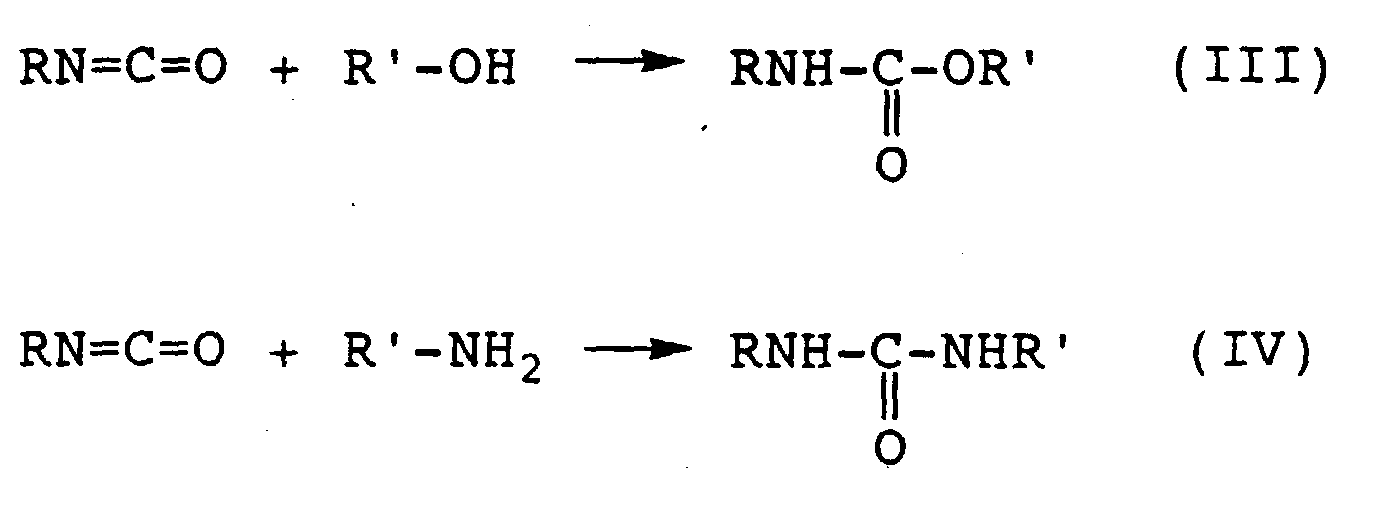
reactivity of the isocyanate group. The isocyanate
group is reactive, for example, with a hydroxyl group as
shown in the following formula (III) and with an amino
group as shown in the following formula (IV).
In the nucleic acid-immobilized substrate of the
present invention, the same kind or different kinds of
nucleic acids are immobilized in the form of dots on a
plurality of sites through the carbodiimide group or the
isocyanate group on a carrier comprising the
aforementioned base material and the carbodiimide
compound or the isocyanate compound carried by the base
material.
The expression "nucleic acids are immobilized in
the form of dots on a carrier" in the nucleic acid-immobilized
substrate of the present invention means
that the site where nucleic acid are immobilized are
sufficiently small so that a plurality of such sites can
be provided on the carrier. The shape of the
aforementioned dots is not particularly limited and
suitably selected depending on the method for use,
applications and so forth of the nucleic acid-immobilized
substrate.
Specifically, each of the aforementioned dots on
which nucleic acids are immobilized in the nucleic acid-immobilized
substrate of the present invention may be in
a substantially circular shape and have a diameter of
from 10 to 3000 µm. The preferred size of the dots is
about 50 to 2000 µm in diameter, more preferably about
100 to 1500 µm in diameter. The substantially circular
shape is not limited to a circle, but includes any
shapes near a circle such as ellipse or the like without
any particular limitation. For example, the diameter of
an ellipse is represented as the average value of its
long diameter and short diameter.
If the diameter of the dots is less than 10 µm,
detection may become difficult. If the diameter exceeds
3000 µm, it may become difficult to secure an
appropriate number of dots per unit area. Therefore, it
is preferable to use a size of the dots within the above
range in order to make detection easy and secure a
required number of dots per unit area.
The number of sites where nucleic acids are
immobilized in the form of dots on the nucleic acid-immobilized
substrate of the present invention is not
particularly limited, and suitably selected depending on
the method of use, applications and so forth of the
nucleic acid-immobilized substrate. Specifically,
however, it is preferable that the number of sites where
the nucleic acids are immobilized is about 10 to 10000,
more preferably about 50 to 350, per cm2 on the base
material. Further, the positions of the sites where
nucleic acids are immobilized in the form of dots on the
nucleic acid-immobilized substrate of the present
invention are also selected as required depending on the
method of use, applications and so forth of the nucleic
acid-immobilized substrate.
As nucleic acids immobilized on the nucleic acid-immobilized
substrate of the present invention, there
can be mentioned natural or synthesized DNA (including
oligonucleotides) or RNA (including oligonucleotides)
without particular limitation. In the present invention,
nucleic acids having a chain length of 10 to 300
nucleotides, in particular, which have conventionally
been difficult to be immobilized, can be immobilized.
Further, nucleic acids to be immobilized may be single-stranded
or double-stranded. Furthermore, in the
present invention, nucleic acids having functional
groups that are reactive with a carbodiimide group or an
isocyanate group are usually used as the aforementioned
nucleic acids. In the nucleic acid-immobilized
substrate of the present invention, nucleic acids
immobilized in the form of dots may be of the same kind
or different kinds. If different kinds of nucleic acids
are used, the positional arrangement of nucleic acids of
each kind and so forth may be selected as required
depending on the method of use, applications and so
forth of the obtained nucleic acid-immobilized substrate.
In order to immobilize such nucleic acids on the
aforementioned carrier in the form of dots, nucleic
acids can be brought into contact and reacted with the
carbodiimide compound or the isocyanate compound by
providing a small amount of the nucleic acids in the
form of dots in a required size on the sites of the
carrier where the carbodiimide compound or the
isocyanate compound is carried, under appropriate
conditions. Through the reaction of the carbodiimide
group of the carbodiimide compound or the isocyanate
group of the isocyanate compound carried by the carrier
with hydroxyl groups, amino groups, thiol groups,
carboxyl groups and so forth contained in the nucleic
acids, the nucleic acids are covalently bonded with the
carbodiimide compound or the isocyanate compound. As a
result, the nucleic acids are immobilized on the carrier.
Specifically, nucleic acids contained in water or
a buffer are usually provided so that activity of the
nucleic acids to be immobilized is maintained in their
reaction of the both substances upon contact. The
temperature during the reaction upon contact is
preferably 0 to 100°C in general so that activity of the
nucleic acids should not be degraded.
In the present invention, as means for providing a
small amount of nucleic acids, usually provided as water
or a buffer containing nucleic acids, on the carrier in
the form of dots, methods using a dispenser, pin, bubble
jet or the like may be employed, but the present
invention is not limited to these methods. Apparatuses
for providing a small amount of solution by these
methods are commercially available and they can be used
for the present invention.
When the nucleic acid-immobilized substrate of the
present invention is used for an analysis or the like,
nucleic acids other than the aforementioned immobilized
nucleic acids are often brought into contact with it.
In order to prevent such nucleic acids or the like other
than the immobilized nucleic acids from nonspecifically
binding with an unreacted carbodiimide group contained
in the carbodiimide compound or an unreacted isocyanate
group contained in the isocyanate compound carried by
the carrier, an excess amount of bovine serum albumin
(BSA), casein, nucleic acids generally used in
hybridization reactions for blocking such as salmon
sperm DNA or the like is preferably brought into contact
with the carrier to block a free carbodiimide group or a
free isocyanate group after nucleic acids are
immobilized in the form of dots on the carrier as
described above.
In the nucleic acid-immobilized substrate of the
present invention obtained as described above, the
nucleic acids are very securely carried by the carrier
and are not dropped even by the washing methods widely
employed for hybridization or the like (washing methods
using a surfactant). Therefore, when an analysis or the
like is performed by using this, the analysis is enabled
with excellent reproducibility and quantification
characteristics. In addition, since nucleic acids can
be immobilized on the nucleic acid-immobilized substrate
of the present invention without limitation on the
number of chains or length, various nucleic acids can
simultaneously be handled on the same base material.
Thus, it can be said that the nucleic acid-immobilized
substrate of the present invention can be used as a DNA
array or the like with excellent performance in
techniques for determining nucleotide sequences by
hybridization using a number of nucleic acids such as
sequencing by hybridization (SBH) and sequencing by
hybridization with oligonucleotide matrix (SHOM).
EXAMPLES
The present invention will be explained more
specifically with reference to the following examples.
Unless otherwise noted, "%" means % by weight.
Preparation Example 1: Preparation of carbodiimidated
slide glass
(1) Preparation of carbodiimide compound solution
117.9 g of 4,4'-dicyclohexylmethane diisocyanate
and 12.5 g of cyclohexyl isocyanate were allowed to
react in the presence of 1.3 g of a carbodiimidation
catalyst (3-methyl-1-phenyl-2-phospholene-1-oxide) under
nitrogen atmosphere at 180°C for 4 days. A carbodiimide
compound (polymerization degree: 10, number average
molecular weight: 2400) was obtained as powder at room
temperature. 10 g of this compound was dissolved in 200
ml of dichloromethane to obtain a carbodiimide compound
solution.
(2) Preparation of aminated slide glass
To 180 ml of distilled water, 20 ml of 10% (v/v)
solution of 3-aminopropyltriethoxysilane in ethanol was
added and the mixture was stirred sufficiently. After
the pH was adjusted to 3 to 4 by adding 6 N HCl thereto,
15 pieces of slide glass were immersed in the solution
and treated at 75°C for 2 hours by heating. After the
heat treatment, the slide glass pieces were taken out
from the solution, sufficiently rinsed with distilled
water, and then dried at 115°C for 4 hours by heating to
obtain aminated slide glass.
(3) Preparation of carbodiimidated slide glass
15 pieces of the aminated slide glass obtained in
(2) were immersed in 200 ml of the carbodiimide compound
solution obtained in (1), immediately taken out from it,
and then dried at 60°C for 1 hour by heating.
Subsequently, these slide glass pieces were washed twice
with 200 ml of dichloromethane for 10 minutes for each
washing and dried at 40°C for 2 hours to obtain
carbodiimidated slide glass.
Preparation Example 2: Preparation of isocyanated slide
glass
(1) Preparation of aminated slide glass
A solution of 10% (v/v) 3-aminopropyl-triethoxysilane
in ethanol (20 ml) was added to 180 ml
of distilled water, and the mixture was stirred well.
After the pH was adjusted to 3 to 4 by adding 6 N HCl
thereto, 15 pieces of slide glasses were dipped in the
solution and treated under heating at 75°C for 2 hours.
After completion of the heat treatment, slide glass
pieces were taken out from the solution, washed well
with distilled water, and dried by heating 115°C for 4
hours to obtain aminated slide glass.
(2) Preparation of isocyanated slide glasses
Fifteen pieces of the aminated slide glasses
obtained above were dipped in a 2.5% solution of
hexamethylenediisocyanate in chloroform and immediately
taken out. The slide glass pieces were washed twice
with 200 ml of chloroform for 10 minutes and dried at
40°C for 2 hours to obtain isocyanated slide glass.
Example 1
(1) Immobilization of nucleic acids onto carbodiimidated
slide glass
By polymerase chain reaction (PCR) using
chromosomal DNA of Escherichia coli O-157 as a template
and oligonucleotides having the nucleotide sequences
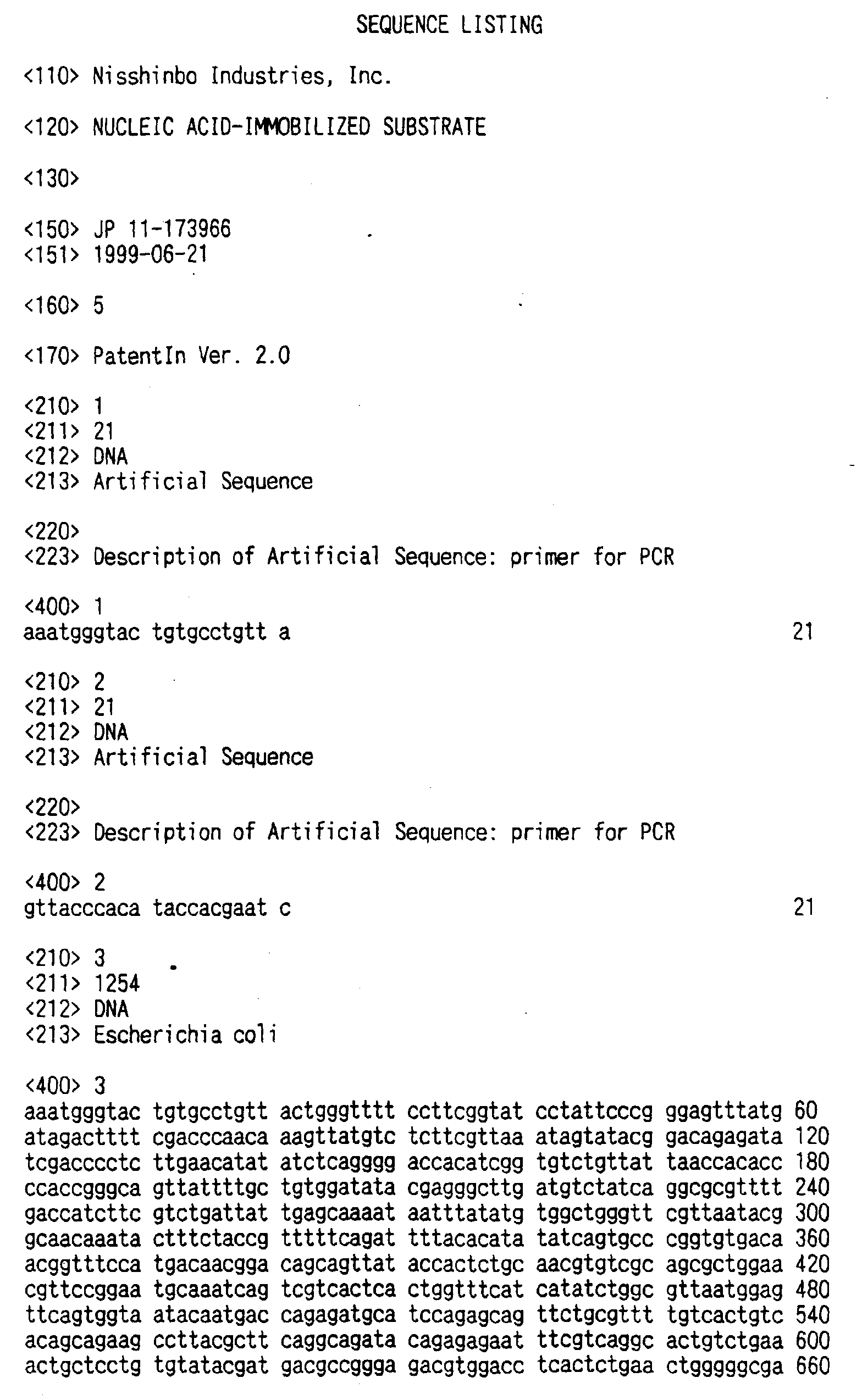
shown by SEQ ID NOS: 1 and 2 as primers, a vero toxin
gene (VT2 gene) fragment having the nucleotide sequence
shown by SEQ ID NO: 3 was amplified.
The above amplification product was dissolved in 2
M NaCl to obtain a DNA solution of 0.1 pmol/µl. By
using SPBIO (arrayer, Hitachi Software Engineering), the
DNA solution was spotted on predetermined 500 sites with
a diameter of 200 µm on the carbodiimidated slide glass
obtained in the above Preparation Example 1. The
carbodiimidated slide glass on which DNA was spotted was
placed in a drier and dried at 37°C for 15 minutes.
Subsequently, it was immersed in Buffer A (0.2 M sodium
chloride, 0.1 M Tris/HCl (pH 7.5), 0.05% Triton X-100)
containing 3% bovine serum albumin (BSA) and then dried
at 37°C for 15 minutes. Then, the slide glass was
washed with TE buffer (10 mM Tris/HCl, pH 7.2, 1 mM
EDTA) and dried at 37°C for 15 minutes to obtain
carbodiimidated slide glass on which nucleic acids
(double-stranded DNA) were immobilized.
(2) Hybridization
The carbodiimidated slide glass on which DNA was
immobilized was immersed in hot water at 100°C for 10
minutes, and then in ice cooled water for 5 minutes to
denature the double-stranded DNA. 30 µl of a
hybridization solution was placed on a portion of this
slide glass on which DNA was immobilized, and the slide
glass was covered with paraflim and incubated overnight
on a water bath at 42°C. The composition of the
hybridization solution is mentioned below. A
biotinylated probe was prepared by amplifying the VT2
gene by using the aforementioned oligonucleotide primers.
It was thermally denatured to be used as a probe.
[Composition of hybridization solution]
5 x SSC (SSC: 1.5 M NaCl, 0.15 M sodium citrate)
1 x Denhardt's solution (100 mg of Ficoll, 100 mg of
polyvinylpyrrolidone, 100 mg of bovine serum albumin,
and H2O to 500 ml)
25 mM sodium phosphate buffer (containing Na2HPO4 and
NaH2PO4), pH 6.5
45% formamide
10 ng/ml of sonicated salmon sperm DNA
2 pmol of biotinylated probe
(3) Posthybridization washing
After the hybridization, the parafilm was removed
from the slide glass. The hybridization solution was
slightly sucked and the posthybridization washing was
performed under the following conditions to remove the
nonspecifically adsorbed probe.
[Posthybridization washing solution and conditions]
Stage 1: 2 x SSC, 1% SDS; room temperature, 5 minutes,
twice
Stage 2: 0.2 x SSC, 1% SDS; 40°C, 5 minutes, twice
Stage 3: 2 x SSC; room temperature, 5 minutes, once
(4) Detection of hybridization
The slide glass after the above posthybridization
washing was immersed in 50 ml of Buffer A containing 3%
BSA to perform blocking at room temperature for 30
minutes. Then, the slide glass was immersed in 20 ml of
streptavidin-alkaline phosphatase conjugate solution
(Gibco BRL, stock solution was diluted 1000 times with
Buffer A containing 3% BSA) and allowed to react at room
temperature for 30 minutes. Subsequently, the slide
glass was immersed in 50 ml of Buffer A, and left at
room temperature for 5 minutes. This procedure was
repeated twice to remove the conjugates that were not
bound to biotin.
Subsequently, the slide glass was washed once with
30 ml of Buffer B (0.1 M sodium chloride, 0.1 M Tris/HCl,
pH 9.5, 50 mM magnesium chloride). Finally, the slide
glass was immersed in a substrate solution (30 ml of
Buffer B + 25 µl of BCIP solution (50 mg of 5-bromo-4-chloro-3-indolylphosphate
in 900 ml of
dimethylformamide) + 50 µl of NBT solution (50 mg of
nitroblue tetrazolium in 1.8 ml of 70% ethanol)) and
left at room temperature for 3 hours. As a result of
the color development reaction, hybridization signals
were obtained at the positions on the slide glass where
DNA was immobilized.
Example 2
(1) Immobilization of nucleic acids onto carbodiimidated
slide glass
λDNA of about 48 kb was dissolved in 0.1 M MgCl2
to obtain a DNA solution of 100 ng/µl. By using SPBIO
(arrayer, Hitachi Software Engineering), the DNA
solution was spotted on predetermined 500 sites with a
diameter of 200 µm on the carbodiimidated slide glass
obtained in the above Preparation Example 1. The
carbodiimidated slide glass on which DNA was spotted was
placed in a drier and dried at 37°C for 15 minutes.
Subsequently, it was immersed in Buffer A containing 3%
BSA and then dried at 37°C for 15 minutes. Then, the
slide glass was washed with TE buffer and dried at 37°C
for 15 minutes to obtain carbodiimidated slide glass on
which nucleic acids (DNA) were immobilized.
(2) Hybridization
The carbodiimidated slide glass on which DNA was
immobilized was immersed in hot water at 100°C for 10
minutes and in ice cooled water for 5 minutes to
denature the double-stranded DNA. 50 µl of a
hybridization solution was placed on each of the
portions of the slide glass on which DNA was immobilized,
and the slide glass was covered with parafilm and
incubated overnight on a water bath at 42°C. The
composition of the hybridization solution is mentioned
below. The biotinylated probe was prepared by
biotinylating λDNA digested with EcoRI by using
Carbobiotin (Nisshinbo Industries).
[Composition of hybridization solution]
5 x SSC (SSC: 1.5 M NaCl, 0.15 M sodium citrate)
1 x Denhardt's solution
10% dextran
45% formamide
10 ng/ml of sonicated salmon sperm DNA
1 pmol of biotinylated probe
(3) Posthybridization washing
After the hybridization, the parafilm was removed
from the slide glass. The hybridization solution was
slightly sucked and the posthybridization washing was
performed under the following conditions to remove the
nonspecifically adsorbed probe.
[Posthybridization washing conditions]
Stage 1: 2 x SSC, 1% SDS; room temperature, 5 minutes,
twice
Stage 2: 0.2 x SSC, 1% SDS; 48°C, 5 minutes, twice
Stage 3: 2 x SSC; room temperature, 5 minutes, once
(4) Detection of hybridization
The slide glass after the above posthybridization
washing was immersed in 50 ml of Buffer A containing 3%
BSA and the blocking was performed at room temperature
for 30 minutes. Then, the slide glass was immersed in
45 ml of streptavidin-alkaline phosphatase conjugate
solution (stock solution was diluted 2000 times with
Buffer A containing 3% BSA) and allowed to react at room
temperature for 30 minutes. Subsequently, the slide
glass was immersed in 50 ml of Buffer A at room
temperature for 5 minutes. This procedure was repeated
twice to remove conjugates that were not bound to biotin.
Subsequently, the slide glass was washed once with
30 ml of Buffer B. Finally, the slide glass is immersed
in a substrate solution (20 ml of Buffer B + 18 µl of
BCIP solution + 50 µl of NBT solution) and left at room
temperature for 3 hours. As a result of the color
development reaction, hybridization signals were
obtained at the positions on the slide glass where DNA
was immobilized.
Example 3
(1) Immobilization of nucleic acids onto carbodiimidated
slide glass
An oligonucleotide (21-mer) having the nucleotide
sequence shown by SEQ ID NO: 2 was dissolved in 2 M NaCl
to obtain a DNA solution of 100 ng/µl. By using SPBIO
(arrayer, Hitachi Software Engineering), the DNA
solution was spotted on predetermined 500 sites with a
diameter of 200 µm on the carbodiimidated slide glass
obtained in the above Preparation Example 1. As control,
a solution of DNA (tet) not complementary to the probe
at 100 ng/µl was spotted on predetermined 100 sites on
the carbodiimidated slide glass. The carbodiimidated
slide glass on which DNA was spotted was placed in a
drier and dried at 37°C for 15 minutes. Subsequently,
it was immersed in Buffer A containing 3% BSA and then
dried at 37°C for 15 minutes. Then, the slide glass was
washed with TE buffer and dried at 37°C for 15 minutes
to obtain carbodiimidated slide glass on which nucleic
acids (single-stranded DNA) were immobilized.
(2) Hybridization
50 µl of a hybridization solution was placed on
portions of the slide glass on which DNA was immobilized,
and the slide glass was covered with parafilm and
incubated overnight on a water bath at 42°C. The
composition of the hybridization solution is mentioned
below. The the same biotinylated probe as used in
Example 1 was used as the probe.
[Composition of hybridization solution]
3 x SSC
10% dextran
1 pmol of biotinylated probe
(3) Posthybridization washing
After the hybridization, the parafilm was removed
from the slide glass. The hybridization solution was
slightly sucked and the posthybridization washing was
performed under the following conditions to remove the
nonspecifically adsorbed probe.
[Posthybridization washing conditions]
Stage 1: 2 x SSC, 0.1% SDS; room temperature, 5 minutes,
twice
Stage 2: 0.2 x SSC, 0.1% SDS; 40°C, 5 minutes, twice
Stage 3: 2 x SSC; room temperature, 5 minutes, once
(4) Detection of hybridization
The slide glass was immersed in 50 ml of Buffer A
containing 3% BSA to perform blocking at room
temperature for 30 minutes. Then, the slide glass was
immersed in 45 ml of streptavidin-alkaline phosphatase
conjugate solution (stock solution was diluted 2000
times with Buffer A containing 3% BSA) and allowed to
react at room temperature for 30 minutes. Subsequently,
the slide glass was immersed in 50 ml of Buffer A and
left at room temperature for 5 minutes. This procedure
was repeated twice to remove the conjugates that were
not bound to biotin. Subsequently, the slide glass was
washed once with 30 ml of Buffer B. Finally, the slide
glass was immersed in a substrate solution (20 ml of
Buffer B + 18 µl of BCIP solution + 36 µl of NBT
solution) and left at room temperature for 3 hours. As
a result of the color development reaction,
hybridization signals were obtained only at the
positions on the slide glass where the oligonucleotide
having the nucleotide sequence shown by SEQ ID NO: 2 was
immobilized, whereas no hybridization signal was
detected at the positions where tet was immobilized.
Example 4
(1) Immobilization of nucleic acids onto carbodiimidated
slide glass
The oligonucleotide (21-mer) having the nucleotide
sequence shown by SEQ ID NO: 2 was dissolved in 2 M NaCl
to obtain a DNA solution of 100 ng/µl. By using SPBIO
(arrayer, Hitachi Software Engineering), the DNA
solution was spotted on predetermined 500 sites with a
diameter of 200 µm on the carbodiimidated slide glass
obtained in the above Preparation Example 1. As control,
a solution of DNA (tet) not complementary to the probe
was spotted on predetermined 100 sites on the slide
glass. The carbodiimidated slide glass on which DNA was
spotted was placed in a drier and dried at 37°C for 15
minutes. Subsequently, it was immersed in Buffer A
containing 3% BSA and then dried at 37°C for 15 minutes.
Then, the slide glass was washed with TE buffer and
dried at 37°C for 15 minutes to obtain carbodiimidated
slide glass on which nucleic acids (single-stranded DNA)
were immobilized.
(2) Hybridization
50 µl of a hybridization solution was placed on
each of the portions on the slide glass on which DNA was
immobilized, and the slide glass was covered with
parafilm and incubated overnight on a water bath at 42°C.
The composition of the hybridization solution is
mentioned below. The same biotinylated probe as used in
Example 1 was used as the probe.
[Composition of hybridization solution]
3 x SSC
10% dextran
1 pmol of biotinylated probe
(3) Posthybridization washing
After the hybridization, the parafilm was removed
from the slide glass. The hybridization solution was
slightly sucked and the posthybridization washing was
performed under the following conditions to remove the
nonspecifically adsorbed probe.
[Posthybridization washing solution and conditions]
Stage 1: 2 x SSC, 0.1% SDS; room temperature, 5 minutes,
twice
Stage 2: 0.2 x SSC, 0.1% SDS; 40°C, 5 minutes, twice
Stage 3: 2 x SSC; room temperature, 5 minutes, once
(4) Detection of hybridization
The slide glass was immersed in 50 ml of Buffer A
containing 3% BSA to perform blocking at room
temperature for 30 minutes. Then, the slide glass was
immersed in 45 ml of streptavidin-alkaline phosphatase
conjugate solution (stock solution was diluted 2000
times with Buffer A containing 3% BSA) and allowed to
react at room temperature for 30 minutes. Subsequently,
the slide glass was immersed in 50 ml of Buffer A and
left at room temperature for 5 minutes. This procedure
was repeated twice to remove conjugates that were not
bound to biotin. Subsequently, the slide glass was
washed once with 30 ml of Buffer B. Finally, the slide
glass was immersed in a substrate solution (20 ml of
Buffer B + 18 µl of BCIP solution + 36 µl of NBT
solution) and left at room temperature for 3 hours. As
a result of the color development reaction,
hybridization signals were obtained only at the
positions on the slide glass where the oligonucleotide
having the nucleotide sequence shown by SEQ ID NO: 2 was
immobilized, whereas no hybridization signal was
detected at the positions where tet was immobilized.
Example 5
(1) Immobilization of nucleic acids onto carbodiimidated
slide glass
By polymerase chain reaction (PCR) using
chromosomal DNA of Escherichia coli O-157 as a template
and oligonucleotides having the nucleotide sequences
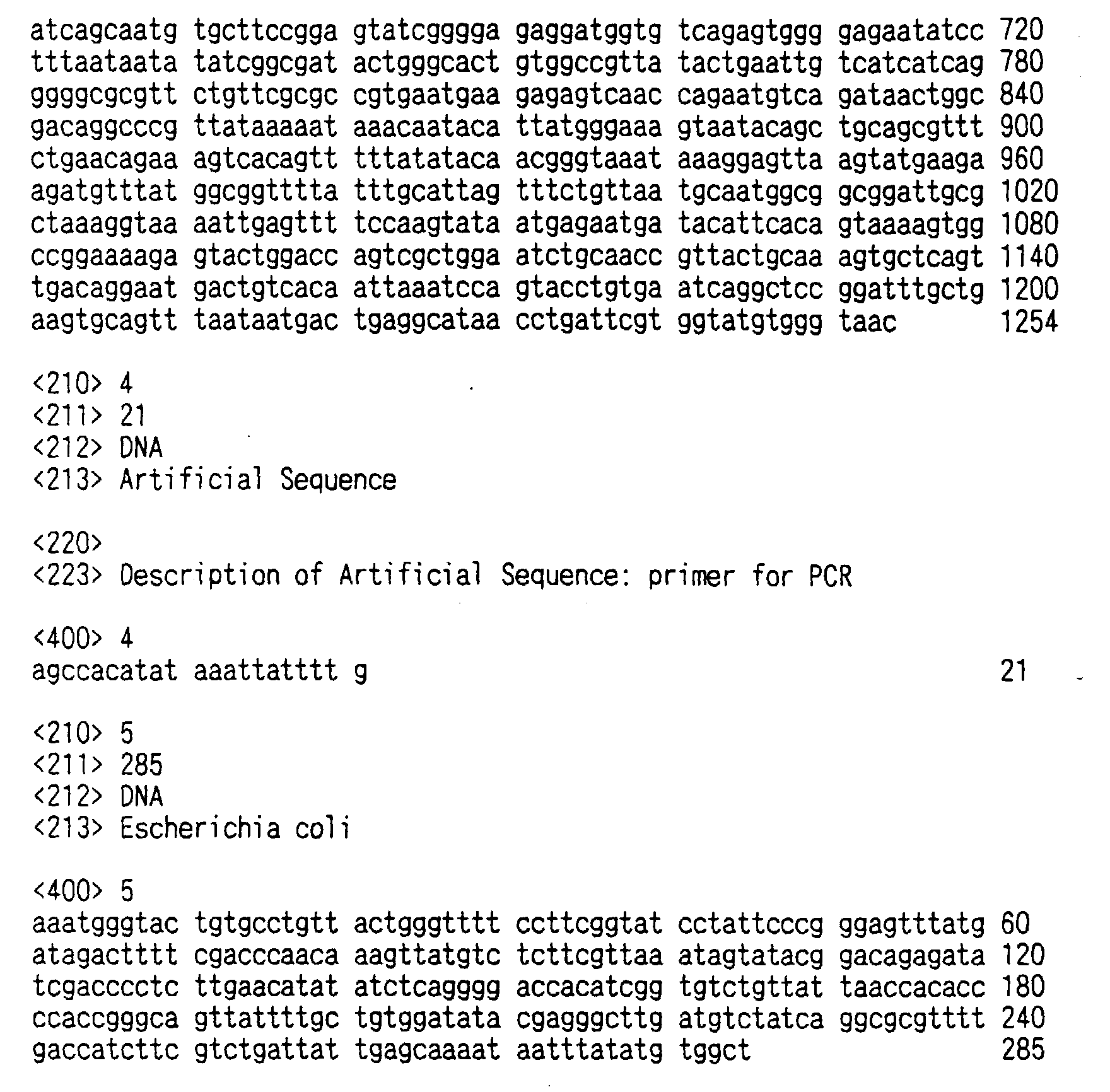
shown by SEQ ID NOS: 1 and 4 as primers, a vero toxin
gene (VT2 gene) fragment having the nucleotide sequence
shown by SEQ ID NO: 5 was amplified.
The above amplification product was dissolved in 2
M NaCl to obtain a DNA solution of 0.1 pmol/µl. By
using SPBIO (arrayer, Hitachi Software Engineering), the
DNA solution was spotted on predetermined 1000 sites
with a diameter of 200 µm on the carbodiimidated slide
glass obtained in the above Preparation Example 1. The
carbodiimidated slide glass on which DNA was spotted was
placed in a drier and dried at 37°C for 15 minutes.
Subsequently, it was immersed in Buffer A containing 3%
BSA and then dried at 37°C for 15 minutes. Then, the
slide glass was washed with TE buffer and dried at 37°C
for 15 minutes to obtain carbodiimidated slide glass on
which nucleic acids (double-stranded DNA) were
immobilized.
(2) Hybridization
The carbodiimidated slide glass on which DNA was
immobilized was immersed in hot water at 100°C for 10
minutes and then in ice cooled water for 5 minutes to
denature the double-stranded DNA. 30 µl of a
hybridization solution was placed on each of portions of
the slide glass on which DNA was immobilized, and the
slide glass was covered with parafilm and incubated
overnight on a water bath at 42°C. The composition of
the hybridization solution is mentioned below. The
biotinylated probe was prepared by amplifying the VT2
gene by using the aforementioned oligonucleotide primers.
The product was thermally denatured to be used as the
probe.
[Composition of hybridization solution]
5 x SSC (SSC: 1.5 M NaCl, 0.15 M sodium citrate)
1 x Denhardt's solution
25 mM sodium phosphate buffer (containing Na2HPO4 and
NaH2PO4), pH 6.5
45% formamide
10 ng/ml of sonicated salmon sperm DNA
2 pmol of biotinylated probe
(3) Posthybridization washing
After the hybridization, the parafilm was removed
from the slide glass. The hybridization solution was
slightly sucked and the posthybridization washing was
performed under the following conditions to remove the
nonspecifically adsorbed probe.
[Posthybridization washing solution and conditions]
Stage 1: 2 x SSC, 1% SDS; room temperature, 5 minutes,
twice
Stage 2: 0.2 x SSC, 1% SDS; 40°C, 5 minutes, twice
Stage 3: 2 x SSC; room temperature, 5 minutes, once
(4) Detection of hybridization
The slide glass after the above posthybridization
washing was immersed in 50 ml of Buffer A containing 3%
BSA to perform blocking at room temperature for 30
minutes. Then, the slide glass was immersed in 20 ml of
streptavidin-alkaline phosphatase conjugate solution
(Gibco BRL, stock solution was diluted 1000 times with
Buffer A containing 3% BSA) and allowed to react at room
temperature for 30 minutes. Subsequently, the slide
glass was immersed in 50 ml of Buffer A and left at room
temperature for 5 minutes. This procedure was repeated
twice to remove conjugates that were not bound to biotin.
Subsequently, the slide glass was washed once with
30 ml of Buffer B. Finally, the slide glass was
immersed in a substrate solution (30 ml of Buffer B + 25
µl of BCIP solution + 50 µl of NBT solution) and left at
room temperature for 3 hours. As a result of the color
development reaction, hybridization signals were
obtained at the positions on the slide glass where DNA
was immobilized.
Example 6
Isocyanated slide glass on which nucleic acids
were immobilized was obtained in a similar manner as
Example 1(1) except that the isocyanated slide glass
obtained in the above Preparation Example 2 was used
instead of the carbodiimidated slide glass in Example
1(1).
Example 7
Isocyanated slide glass on which nucleic acids
were immobilized was obtained in a similar manner as
Example 2(1) except that the isocyanated slide glass
obtained in the above Preparation Example 2 was used
instead of the carbodiimidated slide glass in Example
2(1).
Example 8
Isocyanated slide glass on which nucleic acids
were immobilized was obtained in a similar manner as
Example 3(1) except that the isocyanated slide glass
obtained in the above Preparation Example 2 was used
instead of the carbodiimidated slide glass in Example
3(1).
Example 9
Carbodiimidated slide glass on which nucleic acids
were immobilized was obtained in a similar manner as
Example 1(1) except that the carbodiimidated slide glass
was irradiated with ultraviolet light (254 nm) at 120
mJ/cm2 instead of the steps of placing the
carbodiimidated slide glass in a drier and drying it at
37°C for 15 minutes in Example 1(1).
Example 10
Isocyanated slide glass on which nucleic acids
were immobilized was obtained in a similar manner as
Example 6 except that the isocyanated slide glass was
irradiated with ultraviolet light (254 nm) at 120 mJ/cm2
instead of the steps of placing the isocyanated slide
glass in a drier and drying it at 37°C for 15 minutes in
Example 6.
Comparative Example 1
(1) Immobilization of nucleic acids onto poly-L-lysine-coated
slide glass
The oligonucleotide (21-mer) having the nucleotide
sequence shown by SEQ ID NO: 2 was dissolved in 0.2 x
SSC to obtain a DNA solution of 100 ng/µl. By using
SPBIO (arrayer, Hitachi Software Engineering), the DNA
solution was spotted on predetermined 500 sites with a
diameter of 200 µm on a poly-L-lysine-coated slide glass
(Sigma). As control, a solution of DNA (tet) not
complementary to the probe was spotted on 100 sites.
The poly-L-lysine-coated slide glass on which DNA was
spotted was placed in a chamber, allowed to react at
room temperature for 2 hours, and dried in a drier at
80°C under reduced pressure for 2 hours. Then, the
slide glass was washed with 0.1% SDS and immersed in a
blocking solution (1 g of succinic anhydride, 100 ml of
N-methyl-pyrrolidone and 100 ml of 0.2 M sodium borate,
pH 8.0) at room temperature for 10 minutes, then washed
4 times with distilled water to obtain poly-L-lysine-coated
slide glass on which nucleic acids were
immobilized.
(2) Hybridization
50 µl of a hybridization solution was placed on
each of portions of the poly-L-lysine-coated slide glass
on which DNA was immobilized, and the slide glass was
covered with parafilm and incubated overnight on a water
bath at 42°C. The composition of the hybridization
solution is mentioned below. The same biotinylated
probe as used in Example 1 was used as the probe.
[Composition of hybridization solution]
3 x SSC
10% dextran
1 pmol of biotinylated probe
(3) Posthybridization washing
After the hybridization, the parafilm was removed
from the slide glass. The hybridization solution was
slightly sucked and the posthybridization washing was
performed under the following conditions to remove the
nonspecifically adsorbed probe.
[Posthybridization washing conditions]
Stage 1: 2 x SSC, 0.1% SDS; room temperature, 5 minutes,
twice
Stage 2: 0.2 x SSC, 0.1% SDS; 40°C, 5 minutes, twice
Stage 3: 2 x SSC; room temperature, 5 minutes, once
(4) Detection of hybridization
The slide glass was immersed in 50 ml of Buffer A
containing 3% BSA to perform blocking at room
temperature for 30 minutes. Then, the slide glass was
immersed in 45 ml of a streptavidin-alkaline phosphatase
conjugate solution (stock solution was diluted 2000
times with Buffer A containing 3% BSA) and allowed to
react at room temperature for 30 minutes. Subsequently,
the slide glass was immersed in 50 ml of Buffer A and
left at room temperature for 5 minutes. This procedure
was repeated twice to remove the conjugates that were
not bound to biotin. Subsequently, the slide glass was
washed once with 30 ml of Buffer B. Finally, the slide
glass was immersed in a substrate solution (20 ml of
Buffer B + 18 µl of BCIP solution + 36 µl of NBT
solution) and left at room temperature for 3 hours to
cause the color development reaction. As a result, no
hybridization signal was obtained.
Comparative Example 2
(1) Immobilization of nucleic acids onto poly-L-lysine-coated
slide glass
The oligonucleotide (21-mer) having the nucleotide
sequence shown by SEQ ID NO: 2 was dissolved in 0.2 x
SSC to obtain a DNA solution of 100 ng/µl. By using
SPBIO (arrayer, Hitachi Software Engineering), the DNA
solution was spotted on predetermined 500 sites with a
diameter of 200 µm on a poly-L-lysine-coated slide glass
(Sigma). As control, a solution of DNA (tet) not
complementary to the probe was spotted on 100 sites.
The poly-L-lysine-coated slide glass on which DNA was
spotted was placed in a chamber, allowed to react at
room temperature for 2 hours, and dried in a drier at
80°C under reduced pressure for 2 hours. Then, the
slide glass was washed with 0.1% SDS and immersed in a
blocking solution (1 g of succinic anhydride, 100 ml of
N-methyl-pyrrolidone and 100 ml of 0.2 M sodium borate,
pH 8.0) at room temperature for 10 minutes, then washed
4 times with distilled water to obtain poly-L-lysine-coated
slide glass on which nucleic acids were
immobilized.
(2) Hybridization
50 µl of a hybridization solution was placed on
each of portions of the poly-L-lysine-coated slide glass
on which DNA was immobilized, and the slide glass was
covered with parafilm and incubated overnight on a water
bath at 42°C. The composition of the hybridization
solution is mentioned below. The same biotinylated
probe as used in Example 1 was used as a probe.
[Composition of hybridization solution]
3 x SSC
10% dextran
1 pmol of biotinylated primer
(3) Posthybridization washing
After the hybridization, parafilm was removed from
the slide glass. The hybridization solution was
slightly sucked and the posthybridization washing was
performed under the following conditions to remove the
nonspecifically adsorbed probe.
[Posthybridization washing conditions]
Stage 1: 2 x SSC, 0.1% SDS; room temperature, 5 minutes,
twice
Stage 2: 0.2 x SSC, 0.1% SDS; 40°C, 5 minutes, twice
Stage 3: 2 x SSC; room temperature, 5 minutes, once
(4) Detection
The slide glass was immersed in 50 ml of Buffer A
containing 3% BSA to perform blocking at room
temperature for 30 minutes. Then, the slide glass was
immersed in 45 ml of a streptavidin-alkaline phosphatase
conjugate solution (stock solution was diluted 2000
times with Buffer A containing 3% BSA) and allowed to
react at room temperature for 30 minutes. Subsequently,
the slide glass was immersed in 50 ml of Buffer A and
left at room temperature for 5 minutes. This procedure
was repeated twice to remove conjugates that were not
bound to biotin. Subsequently, the slide glass was
washed once with 30 ml of Buffer B. Finally, the slide
glass was immersed in a substrate solution (20 ml of
Buffer B + 18 µl of BCIP solution + 36 µl of NBT
solution) and left at room temperature for 3 hours to
cause the color development reaction. As a result, no
hybridization signal was obtained.