EP1063297A1 - Farnesyl pyrophosphate synthase (FPS) derived from seedlings of sunflower (Helianthus annus) - Google Patents
Farnesyl pyrophosphate synthase (FPS) derived from seedlings of sunflower (Helianthus annus) Download PDFInfo
- Publication number
- EP1063297A1 EP1063297A1 EP99202021A EP99202021A EP1063297A1 EP 1063297 A1 EP1063297 A1 EP 1063297A1 EP 99202021 A EP99202021 A EP 99202021A EP 99202021 A EP99202021 A EP 99202021A EP 1063297 A1 EP1063297 A1 EP 1063297A1
- Authority
- EP
- European Patent Office
- Prior art keywords
- plant
- dna fragment
- promoter
- transgenic
- host
- Prior art date
- Legal status (The legal status is an assumption and is not a legal conclusion. Google has not performed a legal analysis and makes no representation as to the accuracy of the status listed.)
- Granted
Links
- 101710125754 Farnesyl pyrophosphate synthase Proteins 0.000 title claims abstract description 48
- 102100035111 Farnesyl pyrophosphate synthase Human genes 0.000 title claims abstract description 46
- 235000003222 Helianthus annuus Nutrition 0.000 title claims abstract description 21
- 244000020551 Helianthus annuus Species 0.000 title claims abstract description 6
- 241000208818 Helianthus Species 0.000 title description 15
- 230000009261 transgenic effect Effects 0.000 claims abstract description 53
- 241000196324 Embryophyta Species 0.000 claims abstract description 44
- 235000002637 Nicotiana tabacum Nutrition 0.000 claims abstract description 42
- 244000061176 Nicotiana tabacum Species 0.000 claims abstract description 41
- 239000002299 complementary DNA Substances 0.000 claims abstract description 21
- 239000002773 nucleotide Substances 0.000 claims abstract description 15
- 125000003729 nucleotide group Chemical group 0.000 claims abstract description 15
- 229930002875 chlorophyll Natural products 0.000 claims abstract description 10
- 235000019804 chlorophyll Nutrition 0.000 claims abstract description 10
- 238000004519 manufacturing process Methods 0.000 claims abstract description 10
- 239000013604 expression vector Substances 0.000 claims abstract description 9
- ATNHDLDRLWWWCB-AENOIHSZSA-M chlorophyll a Chemical compound C1([C@@H](C(=O)OC)C(=O)C2=C3C)=C2N2C3=CC(C(CC)=C3C)=[N+]4C3=CC3=C(C=C)C(C)=C5N3[Mg-2]42[N+]2=C1[C@@H](CCC(=O)OC\C=C(/C)CCC[C@H](C)CCC[C@H](C)CCCC(C)C)[C@H](C)C2=C5 ATNHDLDRLWWWCB-AENOIHSZSA-M 0.000 claims abstract description 7
- 108091028043 Nucleic acid sequence Proteins 0.000 claims abstract description 5
- 108020004414 DNA Proteins 0.000 claims description 43
- 108090000623 proteins and genes Proteins 0.000 claims description 28
- 102000004169 proteins and genes Human genes 0.000 claims description 19
- 239000012634 fragment Substances 0.000 claims description 17
- 240000004808 Saccharomyces cerevisiae Species 0.000 claims description 14
- 239000013598 vector Substances 0.000 claims description 14
- 238000000034 method Methods 0.000 claims description 12
- 230000009758 senescence Effects 0.000 claims description 12
- 230000003111 delayed effect Effects 0.000 claims description 6
- 150000007523 nucleic acids Chemical class 0.000 claims description 6
- 230000001580 bacterial effect Effects 0.000 claims description 5
- 238000001727 in vivo Methods 0.000 claims description 5
- 108020004707 nucleic acids Proteins 0.000 claims description 5
- 102000039446 nucleic acids Human genes 0.000 claims description 5
- 241000894006 Bacteria Species 0.000 claims description 4
- 230000008569 process Effects 0.000 claims description 4
- 241000700605 Viruses Species 0.000 claims description 3
- 238000012258 culturing Methods 0.000 claims 2
- 238000000338 in vitro Methods 0.000 claims 2
- 241000589155 Agrobacterium tumefaciens Species 0.000 claims 1
- 244000025254 Cannabis sativa Species 0.000 claims 1
- 241000233866 Fungi Species 0.000 claims 1
- 241000208125 Nicotiana Species 0.000 claims 1
- 230000003362 replicative effect Effects 0.000 claims 1
- 241000701447 unidentified baculovirus Species 0.000 claims 1
- 230000009105 vegetative growth Effects 0.000 claims 1
- 102000004190 Enzymes Human genes 0.000 abstract description 12
- 108090000790 Enzymes Proteins 0.000 abstract description 12
- 150000003505 terpenes Chemical class 0.000 abstract description 9
- 239000002207 metabolite Substances 0.000 abstract description 4
- 230000001851 biosynthetic effect Effects 0.000 abstract description 2
- 230000008641 drought stress Effects 0.000 abstract description 2
- 108090000765 processed proteins & peptides Chemical group 0.000 abstract description 2
- 239000000499 gel Substances 0.000 description 45
- XLYOFNOQVPJJNP-UHFFFAOYSA-N water Substances O XLYOFNOQVPJJNP-UHFFFAOYSA-N 0.000 description 23
- LFQSCWFLJHTTHZ-UHFFFAOYSA-N Ethanol Chemical compound CCO LFQSCWFLJHTTHZ-UHFFFAOYSA-N 0.000 description 16
- 235000018102 proteins Nutrition 0.000 description 16
- HEDRZPFGACZZDS-UHFFFAOYSA-N Chloroform Chemical compound ClC(Cl)Cl HEDRZPFGACZZDS-UHFFFAOYSA-N 0.000 description 14
- 239000000523 sample Substances 0.000 description 14
- 235000014680 Saccharomyces cerevisiae Nutrition 0.000 description 13
- 239000007983 Tris buffer Substances 0.000 description 13
- 210000004027 cell Anatomy 0.000 description 13
- 239000000047 product Substances 0.000 description 13
- FAPWRFPIFSIZLT-UHFFFAOYSA-M Sodium chloride Chemical compound [Na+].[Cl-] FAPWRFPIFSIZLT-UHFFFAOYSA-M 0.000 description 12
- PHTQWCKDNZKARW-UHFFFAOYSA-N isoamylol Chemical compound CC(C)CCO PHTQWCKDNZKARW-UHFFFAOYSA-N 0.000 description 12
- LENZDBCJOHFCAS-UHFFFAOYSA-N tris Chemical compound OCC(N)(CO)CO LENZDBCJOHFCAS-UHFFFAOYSA-N 0.000 description 12
- VWFJDQUYCIWHTN-YFVJMOTDSA-N 2-trans,6-trans-farnesyl diphosphate Chemical compound CC(C)=CCC\C(C)=C\CC\C(C)=C\CO[P@](O)(=O)OP(O)(O)=O VWFJDQUYCIWHTN-YFVJMOTDSA-N 0.000 description 11
- VWFJDQUYCIWHTN-UHFFFAOYSA-N Farnesyl pyrophosphate Natural products CC(C)=CCCC(C)=CCCC(C)=CCOP(O)(=O)OP(O)(O)=O VWFJDQUYCIWHTN-UHFFFAOYSA-N 0.000 description 11
- 239000000203 mixture Substances 0.000 description 11
- 229920000936 Agarose Polymers 0.000 description 10
- PEDCQBHIVMGVHV-UHFFFAOYSA-N Glycerine Chemical compound OCC(O)CO PEDCQBHIVMGVHV-UHFFFAOYSA-N 0.000 description 9
- 239000000872 buffer Substances 0.000 description 9
- 230000000694 effects Effects 0.000 description 8
- 230000014509 gene expression Effects 0.000 description 8
- 239000000243 solution Substances 0.000 description 8
- 239000006228 supernatant Substances 0.000 description 8
- 241000589158 Agrobacterium Species 0.000 description 7
- 102000005927 Cysteine Proteases Human genes 0.000 description 7
- 108010005843 Cysteine Proteases Proteins 0.000 description 7
- KCXVZYZYPLLWCC-UHFFFAOYSA-N EDTA Chemical compound OC(=O)CN(CC(O)=O)CCN(CC(O)=O)CC(O)=O KCXVZYZYPLLWCC-UHFFFAOYSA-N 0.000 description 7
- 239000011543 agarose gel Substances 0.000 description 7
- 230000012010 growth Effects 0.000 description 7
- 239000008188 pellet Substances 0.000 description 7
- 239000013612 plasmid Substances 0.000 description 7
- 108091032973 (ribonucleotides)n+m Proteins 0.000 description 6
- TWRXJAOTZQYOKJ-UHFFFAOYSA-L Magnesium chloride Chemical compound [Mg+2].[Cl-].[Cl-] TWRXJAOTZQYOKJ-UHFFFAOYSA-L 0.000 description 6
- ROOXNKNUYICQNP-UHFFFAOYSA-N ammonium persulfate Chemical compound [NH4+].[NH4+].[O-]S(=O)(=O)OOS([O-])(=O)=O ROOXNKNUYICQNP-UHFFFAOYSA-N 0.000 description 6
- 108020004999 messenger RNA Proteins 0.000 description 6
- 230000002018 overexpression Effects 0.000 description 6
- 239000011780 sodium chloride Substances 0.000 description 6
- CSNNHWWHGAXBCP-UHFFFAOYSA-L Magnesium sulfate Chemical compound [Mg+2].[O-][S+2]([O-])([O-])[O-] CSNNHWWHGAXBCP-UHFFFAOYSA-L 0.000 description 5
- 238000000636 Northern blotting Methods 0.000 description 5
- 108010003581 Ribulose-bisphosphate carboxylase Proteins 0.000 description 5
- 229930006000 Sucrose Natural products 0.000 description 5
- CZMRCDWAGMRECN-UGDNZRGBSA-N Sucrose Chemical compound O[C@H]1[C@H](O)[C@@H](CO)O[C@@]1(CO)O[C@@H]1[C@H](O)[C@@H](O)[C@H](O)[C@@H](CO)O1 CZMRCDWAGMRECN-UGDNZRGBSA-N 0.000 description 5
- 108010006785 Taq Polymerase Proteins 0.000 description 5
- 150000001413 amino acids Chemical group 0.000 description 5
- 238000003556 assay Methods 0.000 description 5
- 230000015572 biosynthetic process Effects 0.000 description 5
- 238000006243 chemical reaction Methods 0.000 description 5
- 108091008146 restriction endonucleases Proteins 0.000 description 5
- 238000012163 sequencing technique Methods 0.000 description 5
- 230000010009 steroidogenesis Effects 0.000 description 5
- 239000005720 sucrose Substances 0.000 description 5
- 238000012546 transfer Methods 0.000 description 5
- OWEGMIWEEQEYGQ-UHFFFAOYSA-N 100676-05-9 Natural products OC1C(O)C(O)C(CO)OC1OCC1C(O)C(O)C(O)C(OC2C(OC(O)C(O)C2O)CO)O1 OWEGMIWEEQEYGQ-UHFFFAOYSA-N 0.000 description 4
- HRPVXLWXLXDGHG-UHFFFAOYSA-N Acrylamide Chemical compound NC(=O)C=C HRPVXLWXLXDGHG-UHFFFAOYSA-N 0.000 description 4
- 229930191978 Gibberellin Natural products 0.000 description 4
- GUBGYTABKSRVRQ-PICCSMPSSA-N Maltose Natural products O[C@@H]1[C@@H](O)[C@H](O)[C@@H](CO)O[C@@H]1O[C@@H]1[C@@H](CO)OC(O)[C@H](O)[C@H]1O GUBGYTABKSRVRQ-PICCSMPSSA-N 0.000 description 4
- KWYHDKDOAIKMQN-UHFFFAOYSA-N N,N,N',N'-tetramethylethylenediamine Chemical compound CN(C)CCN(C)C KWYHDKDOAIKMQN-UHFFFAOYSA-N 0.000 description 4
- LRHPLDYGYMQRHN-UHFFFAOYSA-N N-Butanol Chemical compound CCCCO LRHPLDYGYMQRHN-UHFFFAOYSA-N 0.000 description 4
- 108091034117 Oligonucleotide Proteins 0.000 description 4
- ISWSIDIOOBJBQZ-UHFFFAOYSA-N Phenol Chemical compound OC1=CC=CC=C1 ISWSIDIOOBJBQZ-UHFFFAOYSA-N 0.000 description 4
- 235000001014 amino acid Nutrition 0.000 description 4
- 238000004458 analytical method Methods 0.000 description 4
- 230000018109 developmental process Effects 0.000 description 4
- 230000006870 function Effects 0.000 description 4
- 239000003448 gibberellin Substances 0.000 description 4
- NUHSROFQTUXZQQ-UHFFFAOYSA-N isopentenyl diphosphate Chemical compound CC(=C)CCO[P@](O)(=O)OP(O)(O)=O NUHSROFQTUXZQQ-UHFFFAOYSA-N 0.000 description 4
- 238000002844 melting Methods 0.000 description 4
- 230000008018 melting Effects 0.000 description 4
- 239000012528 membrane Substances 0.000 description 4
- 238000012261 overproduction Methods 0.000 description 4
- 230000037361 pathway Effects 0.000 description 4
- 239000002243 precursor Substances 0.000 description 4
- -1 prenyl quinones Chemical class 0.000 description 4
- 229920001817 Agar Polymers 0.000 description 3
- 108020004635 Complementary DNA Proteins 0.000 description 3
- 241000588724 Escherichia coli Species 0.000 description 3
- 238000012408 PCR amplification Methods 0.000 description 3
- 102000019337 Prenyltransferases Human genes 0.000 description 3
- 108050006837 Prenyltransferases Proteins 0.000 description 3
- 239000013614 RNA sample Substances 0.000 description 3
- HEMHJVSKTPXQMS-UHFFFAOYSA-M Sodium hydroxide Chemical compound [OH-].[Na+] HEMHJVSKTPXQMS-UHFFFAOYSA-M 0.000 description 3
- 239000008272 agar Substances 0.000 description 3
- 229910001870 ammonium persulfate Inorganic materials 0.000 description 3
- 239000001752 chlorophylls and chlorophyllins Substances 0.000 description 3
- 238000011161 development Methods 0.000 description 3
- IXORZMNAPKEEDV-UHFFFAOYSA-N gibberellic acid GA3 Natural products OC(=O)C1C2(C3)CC(=C)C3(O)CCC2C2(C=CC3O)C1C3(C)C(=O)O2 IXORZMNAPKEEDV-UHFFFAOYSA-N 0.000 description 3
- 238000009396 hybridization Methods 0.000 description 3
- 238000011534 incubation Methods 0.000 description 3
- 229930027917 kanamycin Natural products 0.000 description 3
- SBUJHOSQTJFQJX-NOAMYHISSA-N kanamycin Chemical compound O[C@@H]1[C@@H](O)[C@H](O)[C@@H](CN)O[C@@H]1O[C@H]1[C@H](O)[C@@H](O[C@@H]2[C@@H]([C@@H](N)[C@H](O)[C@@H](CO)O2)O)[C@H](N)C[C@@H]1N SBUJHOSQTJFQJX-NOAMYHISSA-N 0.000 description 3
- 229960000318 kanamycin Drugs 0.000 description 3
- 229930182823 kanamycin A Natural products 0.000 description 3
- 230000014634 leaf senescence Effects 0.000 description 3
- 238000011068 loading method Methods 0.000 description 3
- 229910001629 magnesium chloride Inorganic materials 0.000 description 3
- 229910052943 magnesium sulfate Inorganic materials 0.000 description 3
- 230000019612 pigmentation Effects 0.000 description 3
- CBIDRCWHNCKSTO-UHFFFAOYSA-N prenyl diphosphate Chemical compound CC(C)=CCO[P@](O)(=O)OP(O)(O)=O CBIDRCWHNCKSTO-UHFFFAOYSA-N 0.000 description 3
- 230000002285 radioactive effect Effects 0.000 description 3
- 238000009987 spinning Methods 0.000 description 3
- 239000000725 suspension Substances 0.000 description 3
- 235000013343 vitamin Nutrition 0.000 description 3
- 239000011782 vitamin Substances 0.000 description 3
- 229940088594 vitamin Drugs 0.000 description 3
- 229930003231 vitamin Natural products 0.000 description 3
- 150000003722 vitamin derivatives Chemical class 0.000 description 3
- JLIDBLDQVAYHNE-YKALOCIXSA-N (+)-Abscisic acid Chemical compound OC(=O)/C=C(/C)\C=C\[C@@]1(O)C(C)=CC(=O)CC1(C)C JLIDBLDQVAYHNE-YKALOCIXSA-N 0.000 description 2
- OILXMJHPFNGGTO-UHFFFAOYSA-N (22E)-(24xi)-24-methylcholesta-5,22-dien-3beta-ol Natural products C1C=C2CC(O)CCC2(C)C2C1C1CCC(C(C)C=CC(C)C(C)C)C1(C)CC2 OILXMJHPFNGGTO-UHFFFAOYSA-N 0.000 description 2
- RQOCXCFLRBRBCS-UHFFFAOYSA-N (22E)-cholesta-5,7,22-trien-3beta-ol Natural products C1C(O)CCC2(C)C(CCC3(C(C(C)C=CCC(C)C)CCC33)C)C3=CC=C21 RQOCXCFLRBRBCS-UHFFFAOYSA-N 0.000 description 2
- OQMZNAMGEHIHNN-UHFFFAOYSA-N 7-Dehydrostigmasterol Natural products C1C(O)CCC2(C)C(CCC3(C(C(C)C=CC(CC)C(C)C)CCC33)C)C3=CC=C21 OQMZNAMGEHIHNN-UHFFFAOYSA-N 0.000 description 2
- USFZMSVCRYTOJT-UHFFFAOYSA-N Ammonium acetate Chemical compound N.CC(O)=O USFZMSVCRYTOJT-UHFFFAOYSA-N 0.000 description 2
- IJGRMHOSHXDMSA-UHFFFAOYSA-N Atomic nitrogen Chemical compound N#N IJGRMHOSHXDMSA-UHFFFAOYSA-N 0.000 description 2
- 102000012410 DNA Ligases Human genes 0.000 description 2
- 108010061982 DNA Ligases Proteins 0.000 description 2
- 108010067770 Endopeptidase K Proteins 0.000 description 2
- DNVPQKQSNYMLRS-NXVQYWJNSA-N Ergosterol Natural products CC(C)[C@@H](C)C=C[C@H](C)[C@H]1CC[C@H]2C3=CC=C4C[C@@H](O)CC[C@]4(C)[C@@H]3CC[C@]12C DNVPQKQSNYMLRS-NXVQYWJNSA-N 0.000 description 2
- 241000701959 Escherichia virus Lambda Species 0.000 description 2
- 108010007508 Farnesyltranstransferase Proteins 0.000 description 2
- 102000007317 Farnesyltranstransferase Human genes 0.000 description 2
- 108010010803 Gelatin Proteins 0.000 description 2
- 244000043261 Hevea brasiliensis Species 0.000 description 2
- 206010028980 Neoplasm Diseases 0.000 description 2
- 241000608282 Sagiyama virus Species 0.000 description 2
- 238000002105 Southern blotting Methods 0.000 description 2
- 229930182558 Sterol Natural products 0.000 description 2
- 208000037065 Subacute sclerosing leukoencephalitis Diseases 0.000 description 2
- 206010042297 Subacute sclerosing panencephalitis Diseases 0.000 description 2
- JLCPHMBAVCMARE-UHFFFAOYSA-N [3-[[3-[[3-[[3-[[3-[[3-[[3-[[3-[[3-[[3-[[3-[[5-(2-amino-6-oxo-1H-purin-9-yl)-3-[[3-[[3-[[3-[[3-[[3-[[5-(2-amino-6-oxo-1H-purin-9-yl)-3-[[5-(2-amino-6-oxo-1H-purin-9-yl)-3-hydroxyoxolan-2-yl]methoxy-hydroxyphosphoryl]oxyoxolan-2-yl]methoxy-hydroxyphosphoryl]oxy-5-(5-methyl-2,4-dioxopyrimidin-1-yl)oxolan-2-yl]methoxy-hydroxyphosphoryl]oxy-5-(6-aminopurin-9-yl)oxolan-2-yl]methoxy-hydroxyphosphoryl]oxy-5-(6-aminopurin-9-yl)oxolan-2-yl]methoxy-hydroxyphosphoryl]oxy-5-(6-aminopurin-9-yl)oxolan-2-yl]methoxy-hydroxyphosphoryl]oxy-5-(6-aminopurin-9-yl)oxolan-2-yl]methoxy-hydroxyphosphoryl]oxyoxolan-2-yl]methoxy-hydroxyphosphoryl]oxy-5-(5-methyl-2,4-dioxopyrimidin-1-yl)oxolan-2-yl]methoxy-hydroxyphosphoryl]oxy-5-(4-amino-2-oxopyrimidin-1-yl)oxolan-2-yl]methoxy-hydroxyphosphoryl]oxy-5-(5-methyl-2,4-dioxopyrimidin-1-yl)oxolan-2-yl]methoxy-hydroxyphosphoryl]oxy-5-(5-methyl-2,4-dioxopyrimidin-1-yl)oxolan-2-yl]methoxy-hydroxyphosphoryl]oxy-5-(6-aminopurin-9-yl)oxolan-2-yl]methoxy-hydroxyphosphoryl]oxy-5-(6-aminopurin-9-yl)oxolan-2-yl]methoxy-hydroxyphosphoryl]oxy-5-(4-amino-2-oxopyrimidin-1-yl)oxolan-2-yl]methoxy-hydroxyphosphoryl]oxy-5-(4-amino-2-oxopyrimidin-1-yl)oxolan-2-yl]methoxy-hydroxyphosphoryl]oxy-5-(4-amino-2-oxopyrimidin-1-yl)oxolan-2-yl]methoxy-hydroxyphosphoryl]oxy-5-(6-aminopurin-9-yl)oxolan-2-yl]methoxy-hydroxyphosphoryl]oxy-5-(4-amino-2-oxopyrimidin-1-yl)oxolan-2-yl]methyl [5-(6-aminopurin-9-yl)-2-(hydroxymethyl)oxolan-3-yl] hydrogen phosphate Polymers Cc1cn(C2CC(OP(O)(=O)OCC3OC(CC3OP(O)(=O)OCC3OC(CC3O)n3cnc4c3nc(N)[nH]c4=O)n3cnc4c3nc(N)[nH]c4=O)C(COP(O)(=O)OC3CC(OC3COP(O)(=O)OC3CC(OC3COP(O)(=O)OC3CC(OC3COP(O)(=O)OC3CC(OC3COP(O)(=O)OC3CC(OC3COP(O)(=O)OC3CC(OC3COP(O)(=O)OC3CC(OC3COP(O)(=O)OC3CC(OC3COP(O)(=O)OC3CC(OC3COP(O)(=O)OC3CC(OC3COP(O)(=O)OC3CC(OC3COP(O)(=O)OC3CC(OC3COP(O)(=O)OC3CC(OC3COP(O)(=O)OC3CC(OC3COP(O)(=O)OC3CC(OC3COP(O)(=O)OC3CC(OC3COP(O)(=O)OC3CC(OC3CO)n3cnc4c(N)ncnc34)n3ccc(N)nc3=O)n3cnc4c(N)ncnc34)n3ccc(N)nc3=O)n3ccc(N)nc3=O)n3ccc(N)nc3=O)n3cnc4c(N)ncnc34)n3cnc4c(N)ncnc34)n3cc(C)c(=O)[nH]c3=O)n3cc(C)c(=O)[nH]c3=O)n3ccc(N)nc3=O)n3cc(C)c(=O)[nH]c3=O)n3cnc4c3nc(N)[nH]c4=O)n3cnc4c(N)ncnc34)n3cnc4c(N)ncnc34)n3cnc4c(N)ncnc34)n3cnc4c(N)ncnc34)O2)c(=O)[nH]c1=O JLCPHMBAVCMARE-UHFFFAOYSA-N 0.000 description 2
- OIRDTQYFTABQOQ-KQYNXXCUSA-N adenosine group Chemical group [C@@H]1([C@H](O)[C@H](O)[C@@H](CO)O1)N1C=NC=2C(N)=NC=NC12 OIRDTQYFTABQOQ-KQYNXXCUSA-N 0.000 description 2
- 230000003321 amplification Effects 0.000 description 2
- 108010058966 bacteriophage T7 induced DNA polymerase Proteins 0.000 description 2
- UDSAIICHUKSCKT-UHFFFAOYSA-N bromophenol blue Chemical compound C1=C(Br)C(O)=C(Br)C=C1C1(C=2C=C(Br)C(O)=C(Br)C=2)C2=CC=CC=C2S(=O)(=O)O1 UDSAIICHUKSCKT-UHFFFAOYSA-N 0.000 description 2
- 238000012512 characterization method Methods 0.000 description 2
- 238000010367 cloning Methods 0.000 description 2
- SUYVUBYJARFZHO-RRKCRQDMSA-N dATP Chemical compound C1=NC=2C(N)=NC=NC=2N1[C@H]1C[C@H](O)[C@@H](COP(O)(=O)OP(O)(=O)OP(O)(O)=O)O1 SUYVUBYJARFZHO-RRKCRQDMSA-N 0.000 description 2
- SUYVUBYJARFZHO-UHFFFAOYSA-N dATP Natural products C1=NC=2C(N)=NC=NC=2N1C1CC(O)C(COP(O)(=O)OP(O)(=O)OP(O)(O)=O)O1 SUYVUBYJARFZHO-UHFFFAOYSA-N 0.000 description 2
- 230000007423 decrease Effects 0.000 description 2
- 230000029087 digestion Effects 0.000 description 2
- 235000011180 diphosphates Nutrition 0.000 description 2
- 239000012153 distilled water Substances 0.000 description 2
- DNVPQKQSNYMLRS-SOWFXMKYSA-N ergosterol Chemical compound C1[C@@H](O)CC[C@]2(C)[C@H](CC[C@]3([C@H]([C@H](C)/C=C/[C@@H](C)C(C)C)CC[C@H]33)C)C3=CC=C21 DNVPQKQSNYMLRS-SOWFXMKYSA-N 0.000 description 2
- 210000003527 eukaryotic cell Anatomy 0.000 description 2
- 108020001507 fusion proteins Proteins 0.000 description 2
- 102000037865 fusion proteins Human genes 0.000 description 2
- 239000008273 gelatin Substances 0.000 description 2
- 229920000159 gelatin Polymers 0.000 description 2
- 235000019322 gelatine Nutrition 0.000 description 2
- 235000011852 gelatine desserts Nutrition 0.000 description 2
- 230000006698 induction Effects 0.000 description 2
- BPHPUYQFMNQIOC-NXRLNHOXSA-N isopropyl beta-D-thiogalactopyranoside Chemical compound CC(C)S[C@@H]1O[C@H](CO)[C@H](O)[C@H](O)[C@H]1O BPHPUYQFMNQIOC-NXRLNHOXSA-N 0.000 description 2
- 238000002372 labelling Methods 0.000 description 2
- 239000012160 loading buffer Substances 0.000 description 2
- 230000005923 long-lasting effect Effects 0.000 description 2
- 239000012139 lysis buffer Substances 0.000 description 2
- 238000013507 mapping Methods 0.000 description 2
- 239000002480 mineral oil Substances 0.000 description 2
- 235000010446 mineral oil Nutrition 0.000 description 2
- 230000004660 morphological change Effects 0.000 description 2
- 238000003199 nucleic acid amplification method Methods 0.000 description 2
- 230000000243 photosynthetic effect Effects 0.000 description 2
- 239000000419 plant extract Substances 0.000 description 2
- 229920003023 plastic Polymers 0.000 description 2
- 239000004033 plastic Substances 0.000 description 2
- 238000002264 polyacrylamide gel electrophoresis Methods 0.000 description 2
- 238000002360 preparation method Methods 0.000 description 2
- 230000002035 prolonged effect Effects 0.000 description 2
- 239000003528 protein farnesyltransferase inhibitor Substances 0.000 description 2
- 238000011012 sanitization Methods 0.000 description 2
- 238000012216 screening Methods 0.000 description 2
- 239000002689 soil Substances 0.000 description 2
- 238000002798 spectrophotometry method Methods 0.000 description 2
- 238000010186 staining Methods 0.000 description 2
- 150000003432 sterols Chemical class 0.000 description 2
- 235000003702 sterols Nutrition 0.000 description 2
- 238000003786 synthesis reaction Methods 0.000 description 2
- 230000009466 transformation Effects 0.000 description 2
- 241001515965 unidentified phage Species 0.000 description 2
- 102000040650 (ribonucleotides)n+m Human genes 0.000 description 1
- QKNYBSVHEMOAJP-UHFFFAOYSA-N 2-amino-2-(hydroxymethyl)propane-1,3-diol;hydron;chloride Chemical compound Cl.OCC(N)(CO)CO QKNYBSVHEMOAJP-UHFFFAOYSA-N 0.000 description 1
- OINNEUNVOZHBOX-QIRCYJPOSA-K 2-trans,6-trans,10-trans-geranylgeranyl diphosphate(3-) Chemical compound CC(C)=CCC\C(C)=C\CC\C(C)=C\CC\C(C)=C\COP([O-])(=O)OP([O-])([O-])=O OINNEUNVOZHBOX-QIRCYJPOSA-K 0.000 description 1
- OPIFSICVWOWJMJ-AEOCFKNESA-N 5-bromo-4-chloro-3-indolyl beta-D-galactoside Chemical compound O[C@@H]1[C@@H](O)[C@@H](O)[C@@H](CO)O[C@H]1OC1=CNC2=CC=C(Br)C(Cl)=C12 OPIFSICVWOWJMJ-AEOCFKNESA-N 0.000 description 1
- 239000005695 Ammonium acetate Substances 0.000 description 1
- 241000219195 Arabidopsis thaliana Species 0.000 description 1
- 239000002126 C01EB10 - Adenosine Substances 0.000 description 1
- 101710127489 Chlorophyll a-b binding protein of LHCII type 1 Proteins 0.000 description 1
- 101710184917 Chlorophyll a-b binding protein of LHCII type I, chloroplastic Proteins 0.000 description 1
- 102100034229 Citramalyl-CoA lyase, mitochondrial Human genes 0.000 description 1
- YAHZABJORDUQGO-NQXXGFSBSA-N D-ribulose 1,5-bisphosphate Chemical compound OP(=O)(O)OC[C@@H](O)[C@@H](O)C(=O)COP(O)(O)=O YAHZABJORDUQGO-NQXXGFSBSA-N 0.000 description 1
- 108010008286 DNA nucleotidylexotransferase Proteins 0.000 description 1
- 238000001712 DNA sequencing Methods 0.000 description 1
- 108010014303 DNA-directed DNA polymerase Proteins 0.000 description 1
- 102000016928 DNA-directed DNA polymerase Human genes 0.000 description 1
- 102100029764 DNA-directed DNA/RNA polymerase mu Human genes 0.000 description 1
- 108010054576 Deoxyribonuclease EcoRI Proteins 0.000 description 1
- 108010053770 Deoxyribonucleases Proteins 0.000 description 1
- 102000016911 Deoxyribonucleases Human genes 0.000 description 1
- 101710204615 Eukaryotic translation initiation factor 6 Proteins 0.000 description 1
- 108060002716 Exonuclease Proteins 0.000 description 1
- 101150051414 FPS1 gene Proteins 0.000 description 1
- 229920001917 Ficoll Polymers 0.000 description 1
- 230000005526 G1 to G0 transition Effects 0.000 description 1
- 101150094690 GAL1 gene Proteins 0.000 description 1
- 102100028501 Galanin peptides Human genes 0.000 description 1
- OINNEUNVOZHBOX-XBQSVVNOSA-N Geranylgeranyl diphosphate Natural products [P@](=O)(OP(=O)(O)O)(OC/C=C(\CC/C=C(\CC/C=C(\CC/C=C(\C)/C)/C)/C)/C)O OINNEUNVOZHBOX-XBQSVVNOSA-N 0.000 description 1
- 101100121078 Homo sapiens GAL gene Proteins 0.000 description 1
- RRHGJUQNOFWUDK-UHFFFAOYSA-N Isoprene Chemical group CC(=C)C=C RRHGJUQNOFWUDK-UHFFFAOYSA-N 0.000 description 1
- 235000019687 Lamb Nutrition 0.000 description 1
- 108090000364 Ligases Proteins 0.000 description 1
- 102000003960 Ligases Human genes 0.000 description 1
- 239000006137 Luria-Bertani broth Substances 0.000 description 1
- 108020004687 Malate Synthase Proteins 0.000 description 1
- 108050005735 Maltoporin Proteins 0.000 description 1
- OTCCIMWXFLJLIA-BYPYZUCNSA-N N-acetyl-L-aspartic acid Chemical compound CC(=O)N[C@H](C(O)=O)CC(O)=O OTCCIMWXFLJLIA-BYPYZUCNSA-N 0.000 description 1
- 241000208134 Nicotiana rustica Species 0.000 description 1
- 108020005187 Oligonucleotide Probes Proteins 0.000 description 1
- 102000004020 Oxygenases Human genes 0.000 description 1
- 108090000417 Oxygenases Proteins 0.000 description 1
- 108091005804 Peptidases Proteins 0.000 description 1
- 102000035195 Peptidases Human genes 0.000 description 1
- IHPVFYLOGNNZLA-UHFFFAOYSA-N Phytoalexin Natural products COC1=CC=CC=C1C1OC(C=C2C(OCO2)=C2OC)=C2C(=O)C1 IHPVFYLOGNNZLA-UHFFFAOYSA-N 0.000 description 1
- 239000004365 Protease Substances 0.000 description 1
- 108020004511 Recombinant DNA Proteins 0.000 description 1
- 102000006382 Ribonucleases Human genes 0.000 description 1
- 108010083644 Ribonucleases Proteins 0.000 description 1
- 108091081021 Sense strand Proteins 0.000 description 1
- VMHLLURERBWHNL-UHFFFAOYSA-M Sodium acetate Chemical compound [Na+].CC([O-])=O VMHLLURERBWHNL-UHFFFAOYSA-M 0.000 description 1
- 229920002472 Starch Polymers 0.000 description 1
- 239000004098 Tetracycline Substances 0.000 description 1
- 238000010521 absorption reaction Methods 0.000 description 1
- 229960005305 adenosine Drugs 0.000 description 1
- 150000001298 alcohols Chemical class 0.000 description 1
- 229940043376 ammonium acetate Drugs 0.000 description 1
- 235000019257 ammonium acetate Nutrition 0.000 description 1
- 229960000723 ampicillin Drugs 0.000 description 1
- AVKUERGKIZMTKX-NJBDSQKTSA-N ampicillin Chemical compound C1([C@@H](N)C(=O)N[C@H]2[C@H]3SC([C@@H](N3C2=O)C(O)=O)(C)C)=CC=CC=C1 AVKUERGKIZMTKX-NJBDSQKTSA-N 0.000 description 1
- 239000002246 antineoplastic agent Substances 0.000 description 1
- 238000000376 autoradiography Methods 0.000 description 1
- 239000011324 bead Substances 0.000 description 1
- 230000008901 benefit Effects 0.000 description 1
- 230000006696 biosynthetic metabolic pathway Effects 0.000 description 1
- 238000009835 boiling Methods 0.000 description 1
- 238000010805 cDNA synthesis kit Methods 0.000 description 1
- 235000021466 carotenoid Nutrition 0.000 description 1
- 150000001747 carotenoids Chemical class 0.000 description 1
- 238000005266 casting Methods 0.000 description 1
- 230000015556 catabolic process Effects 0.000 description 1
- 230000034303 cell budding Effects 0.000 description 1
- 230000030833 cell death Effects 0.000 description 1
- 210000000170 cell membrane Anatomy 0.000 description 1
- 239000006285 cell suspension Substances 0.000 description 1
- 230000001413 cellular effect Effects 0.000 description 1
- 230000033077 cellular process Effects 0.000 description 1
- 239000003153 chemical reaction reagent Substances 0.000 description 1
- 238000002512 chemotherapy Methods 0.000 description 1
- 238000004440 column chromatography Methods 0.000 description 1
- 238000006482 condensation reaction Methods 0.000 description 1
- 238000010276 construction Methods 0.000 description 1
- 125000000151 cysteine group Chemical group N[C@@H](CS)C(=O)* 0.000 description 1
- RGWHQCVHVJXOKC-SHYZEUOFSA-J dCTP(4-) Chemical compound O=C1N=C(N)C=CN1[C@@H]1O[C@H](COP([O-])(=O)OP([O-])(=O)OP([O-])([O-])=O)[C@@H](O)C1 RGWHQCVHVJXOKC-SHYZEUOFSA-J 0.000 description 1
- NHVNXKFIZYSCEB-XLPZGREQSA-N dTTP Chemical compound O=C1NC(=O)C(C)=CN1[C@@H]1O[C@H](COP(O)(=O)OP(O)(=O)OP(O)(O)=O)[C@@H](O)C1 NHVNXKFIZYSCEB-XLPZGREQSA-N 0.000 description 1
- 238000006731 degradation reaction Methods 0.000 description 1
- 230000000593 degrading effect Effects 0.000 description 1
- FCRACOPGPMPSHN-UHFFFAOYSA-N desoxyabscisic acid Natural products OC(=O)C=C(C)C=CC1C(C)=CC(=O)CC1(C)C FCRACOPGPMPSHN-UHFFFAOYSA-N 0.000 description 1
- FFYPMLJYZAEMQB-UHFFFAOYSA-N diethyl pyrocarbonate Chemical compound CCOC(=O)OC(=O)OCC FFYPMLJYZAEMQB-UHFFFAOYSA-N 0.000 description 1
- 238000010790 dilution Methods 0.000 description 1
- 239000012895 dilution Substances 0.000 description 1
- 239000001177 diphosphate Substances 0.000 description 1
- XPPKVPWEQAFLFU-UHFFFAOYSA-N diphosphoric acid Chemical class OP(O)(=O)OP(O)(O)=O XPPKVPWEQAFLFU-UHFFFAOYSA-N 0.000 description 1
- 238000009826 distribution Methods 0.000 description 1
- 229920001971 elastomer Polymers 0.000 description 1
- 238000001962 electrophoresis Methods 0.000 description 1
- 238000005516 engineering process Methods 0.000 description 1
- 230000002255 enzymatic effect Effects 0.000 description 1
- 230000009088 enzymatic function Effects 0.000 description 1
- 238000001976 enzyme digestion Methods 0.000 description 1
- ZMMJGEGLRURXTF-UHFFFAOYSA-N ethidium bromide Chemical compound [Br-].C12=CC(N)=CC=C2C2=CC=C(N)C=C2[N+](CC)=C1C1=CC=CC=C1 ZMMJGEGLRURXTF-UHFFFAOYSA-N 0.000 description 1
- 238000001704 evaporation Methods 0.000 description 1
- 230000008020 evaporation Effects 0.000 description 1
- 102000013165 exonuclease Human genes 0.000 description 1
- 238000002474 experimental method Methods 0.000 description 1
- 239000000284 extract Substances 0.000 description 1
- 238000000605 extraction Methods 0.000 description 1
- 239000011536 extraction buffer Substances 0.000 description 1
- 125000004030 farnesyl group Chemical group [H]C([*])([H])C([H])=C(C([H])([H])[H])C([H])([H])C([H])([H])C([H])=C(C([H])([H])[H])C([H])([H])C([H])([H])C([H])=C(C([H])([H])[H])C([H])([H])[H] 0.000 description 1
- 108091005640 farnesylated proteins Proteins 0.000 description 1
- 230000006126 farnesylation Effects 0.000 description 1
- 230000008124 floral development Effects 0.000 description 1
- 239000012530 fluid Substances 0.000 description 1
- GVVPGTZRZFNKDS-JXMROGBWSA-N geranyl diphosphate Chemical compound CC(C)=CCC\C(C)=C\CO[P@](O)(=O)OP(O)(O)=O GVVPGTZRZFNKDS-JXMROGBWSA-N 0.000 description 1
- 125000002686 geranylgeranyl group Chemical group [H]C([*])([H])/C([H])=C(C([H])([H])[H])/C([H])([H])C([H])([H])/C([H])=C(C([H])([H])[H])/C([H])([H])C([H])([H])/C([H])=C(C([H])([H])[H])/C([H])([H])C([H])([H])C([H])=C(C([H])([H])[H])C([H])([H])[H] 0.000 description 1
- IXORZMNAPKEEDV-OBDJNFEBSA-N gibberellin A3 Chemical class C([C@@]1(O)C(=C)C[C@@]2(C1)[C@H]1C(O)=O)C[C@H]2[C@]2(C=C[C@@H]3O)[C@H]1[C@]3(C)C(=O)O2 IXORZMNAPKEEDV-OBDJNFEBSA-N 0.000 description 1
- 239000011491 glass wool Substances 0.000 description 1
- ZDXPYRJPNDTMRX-UHFFFAOYSA-N glutamine Natural products OC(=O)C(N)CCC(N)=O ZDXPYRJPNDTMRX-UHFFFAOYSA-N 0.000 description 1
- 239000008187 granular material Substances 0.000 description 1
- 238000010438 heat treatment Methods 0.000 description 1
- 230000002209 hydrophobic effect Effects 0.000 description 1
- 238000010348 incorporation Methods 0.000 description 1
- 239000003112 inhibitor Substances 0.000 description 1
- 230000000977 initiatory effect Effects 0.000 description 1
- 230000003993 interaction Effects 0.000 description 1
- 230000003834 intracellular effect Effects 0.000 description 1
- 238000002955 isolation Methods 0.000 description 1
- 108091005638 isoprenylated proteins Proteins 0.000 description 1
- 230000006122 isoprenylation Effects 0.000 description 1
- 150000002632 lipids Chemical class 0.000 description 1
- 239000007788 liquid Substances 0.000 description 1
- 239000006166 lysate Substances 0.000 description 1
- 210000004962 mammalian cell Anatomy 0.000 description 1
- 239000003550 marker Substances 0.000 description 1
- 238000005259 measurement Methods 0.000 description 1
- 239000002609 medium Substances 0.000 description 1
- 230000004060 metabolic process Effects 0.000 description 1
- 230000004048 modification Effects 0.000 description 1
- 238000012986 modification Methods 0.000 description 1
- 230000000877 morphologic effect Effects 0.000 description 1
- 230000035772 mutation Effects 0.000 description 1
- 229920003052 natural elastomer Polymers 0.000 description 1
- 229920001194 natural rubber Polymers 0.000 description 1
- 229910052757 nitrogen Inorganic materials 0.000 description 1
- 235000015097 nutrients Nutrition 0.000 description 1
- 239000002751 oligonucleotide probe Substances 0.000 description 1
- 231100000590 oncogenic Toxicity 0.000 description 1
- 230000002246 oncogenic effect Effects 0.000 description 1
- 210000000056 organ Anatomy 0.000 description 1
- 108010054353 p21(ras) farnesyl-protein transferase Proteins 0.000 description 1
- 239000002245 particle Substances 0.000 description 1
- 238000005192 partition Methods 0.000 description 1
- 230000002572 peristaltic effect Effects 0.000 description 1
- 150000002989 phenols Chemical class 0.000 description 1
- 239000000280 phytoalexin Substances 0.000 description 1
- 150000001857 phytoalexin derivatives Chemical class 0.000 description 1
- 230000008635 plant growth Effects 0.000 description 1
- 238000003752 polymerase chain reaction Methods 0.000 description 1
- 238000006116 polymerization reaction Methods 0.000 description 1
- 230000004481 post-translational protein modification Effects 0.000 description 1
- 230000013823 prenylation Effects 0.000 description 1
- 238000012545 processing Methods 0.000 description 1
- 235000019419 proteases Nutrition 0.000 description 1
- 238000001243 protein synthesis Methods 0.000 description 1
- 238000000746 purification Methods 0.000 description 1
- 239000011535 reaction buffer Substances 0.000 description 1
- 239000011541 reaction mixture Substances 0.000 description 1
- 238000003259 recombinant expression Methods 0.000 description 1
- 230000001172 regenerating effect Effects 0.000 description 1
- 230000001105 regulatory effect Effects 0.000 description 1
- 230000004044 response Effects 0.000 description 1
- 150000003839 salts Chemical class 0.000 description 1
- 239000012723 sample buffer Substances 0.000 description 1
- 229920006298 saran Polymers 0.000 description 1
- 229920006395 saturated elastomer Polymers 0.000 description 1
- 230000001568 sexual effect Effects 0.000 description 1
- 230000019491 signal transduction Effects 0.000 description 1
- 239000002002 slurry Substances 0.000 description 1
- 239000001632 sodium acetate Substances 0.000 description 1
- 235000017281 sodium acetate Nutrition 0.000 description 1
- 238000002415 sodium dodecyl sulfate polyacrylamide gel electrophoresis Methods 0.000 description 1
- VVLFAAMTGMGYBS-UHFFFAOYSA-M sodium;4-[[4-(ethylamino)-3-methylphenyl]-(4-ethylimino-3-methylcyclohexa-2,5-dien-1-ylidene)methyl]-3-sulfobenzenesulfonate Chemical compound [Na+].C1=C(C)C(NCC)=CC=C1C(C=1C(=CC(=CC=1)S([O-])(=O)=O)S(O)(=O)=O)=C1C=C(C)C(=NCC)C=C1 VVLFAAMTGMGYBS-UHFFFAOYSA-M 0.000 description 1
- 125000006850 spacer group Chemical group 0.000 description 1
- 230000000087 stabilizing effect Effects 0.000 description 1
- 239000008107 starch Substances 0.000 description 1
- 235000019698 starch Nutrition 0.000 description 1
- 239000012089 stop solution Substances 0.000 description 1
- 230000004960 subcellular localization Effects 0.000 description 1
- 239000000126 substance Substances 0.000 description 1
- 239000000758 substrate Substances 0.000 description 1
- 230000002459 sustained effect Effects 0.000 description 1
- 230000008685 targeting Effects 0.000 description 1
- 229960002180 tetracycline Drugs 0.000 description 1
- 229930101283 tetracycline Natural products 0.000 description 1
- 235000019364 tetracycline Nutrition 0.000 description 1
- 150000003522 tetracyclines Chemical class 0.000 description 1
- 230000001131 transforming effect Effects 0.000 description 1
- 230000014616 translation Effects 0.000 description 1
- PIEPQKCYPFFYMG-UHFFFAOYSA-N tris acetate Chemical compound CC(O)=O.OCC(N)(CO)CO PIEPQKCYPFFYMG-UHFFFAOYSA-N 0.000 description 1
- 230000017260 vegetative to reproductive phase transition of meristem Effects 0.000 description 1
- 238000012800 visualization Methods 0.000 description 1
- 235000019155 vitamin A Nutrition 0.000 description 1
- 239000011719 vitamin A Substances 0.000 description 1
- 235000019165 vitamin E Nutrition 0.000 description 1
- 239000011709 vitamin E Substances 0.000 description 1
- 235000019168 vitamin K Nutrition 0.000 description 1
- 239000011712 vitamin K Substances 0.000 description 1
- 238000003260 vortexing Methods 0.000 description 1
- 238000005406 washing Methods 0.000 description 1
- 210000005253 yeast cell Anatomy 0.000 description 1
- DGVVWUTYPXICAM-UHFFFAOYSA-N β‐Mercaptoethanol Chemical compound OCCS DGVVWUTYPXICAM-UHFFFAOYSA-N 0.000 description 1
Images


Classifications
-
- C—CHEMISTRY; METALLURGY
- C12—BIOCHEMISTRY; BEER; SPIRITS; WINE; VINEGAR; MICROBIOLOGY; ENZYMOLOGY; MUTATION OR GENETIC ENGINEERING
- C12N—MICROORGANISMS OR ENZYMES; COMPOSITIONS THEREOF; PROPAGATING, PRESERVING, OR MAINTAINING MICROORGANISMS; MUTATION OR GENETIC ENGINEERING; CULTURE MEDIA
- C12N9/00—Enzymes; Proenzymes; Compositions thereof; Processes for preparing, activating, inhibiting, separating or purifying enzymes
- C12N9/10—Transferases (2.)
- C12N9/1085—Transferases (2.) transferring alkyl or aryl groups other than methyl groups (2.5)
-
- C—CHEMISTRY; METALLURGY
- C12—BIOCHEMISTRY; BEER; SPIRITS; WINE; VINEGAR; MICROBIOLOGY; ENZYMOLOGY; MUTATION OR GENETIC ENGINEERING
- C12N—MICROORGANISMS OR ENZYMES; COMPOSITIONS THEREOF; PROPAGATING, PRESERVING, OR MAINTAINING MICROORGANISMS; MUTATION OR GENETIC ENGINEERING; CULTURE MEDIA
- C12N15/00—Mutation or genetic engineering; DNA or RNA concerning genetic engineering, vectors, e.g. plasmids, or their isolation, preparation or purification; Use of hosts therefor
- C12N15/09—Recombinant DNA-technology
- C12N15/63—Introduction of foreign genetic material using vectors; Vectors; Use of hosts therefor; Regulation of expression
- C12N15/79—Vectors or expression systems specially adapted for eukaryotic hosts
- C12N15/82—Vectors or expression systems specially adapted for eukaryotic hosts for plant cells, e.g. plant artificial chromosomes (PACs)
- C12N15/8241—Phenotypically and genetically modified plants via recombinant DNA technology
- C12N15/8242—Phenotypically and genetically modified plants via recombinant DNA technology with non-agronomic quality (output) traits, e.g. for industrial processing; Value added, non-agronomic traits
- C12N15/8243—Phenotypically and genetically modified plants via recombinant DNA technology with non-agronomic quality (output) traits, e.g. for industrial processing; Value added, non-agronomic traits involving biosynthetic or metabolic pathways, i.e. metabolic engineering, e.g. nicotine, caffeine
-
- C—CHEMISTRY; METALLURGY
- C12—BIOCHEMISTRY; BEER; SPIRITS; WINE; VINEGAR; MICROBIOLOGY; ENZYMOLOGY; MUTATION OR GENETIC ENGINEERING
- C12N—MICROORGANISMS OR ENZYMES; COMPOSITIONS THEREOF; PROPAGATING, PRESERVING, OR MAINTAINING MICROORGANISMS; MUTATION OR GENETIC ENGINEERING; CULTURE MEDIA
- C12N15/00—Mutation or genetic engineering; DNA or RNA concerning genetic engineering, vectors, e.g. plasmids, or their isolation, preparation or purification; Use of hosts therefor
- C12N15/09—Recombinant DNA-technology
- C12N15/63—Introduction of foreign genetic material using vectors; Vectors; Use of hosts therefor; Regulation of expression
- C12N15/79—Vectors or expression systems specially adapted for eukaryotic hosts
- C12N15/82—Vectors or expression systems specially adapted for eukaryotic hosts for plant cells, e.g. plant artificial chromosomes (PACs)
- C12N15/8241—Phenotypically and genetically modified plants via recombinant DNA technology
- C12N15/8242—Phenotypically and genetically modified plants via recombinant DNA technology with non-agronomic quality (output) traits, e.g. for industrial processing; Value added, non-agronomic traits
- C12N15/8243—Phenotypically and genetically modified plants via recombinant DNA technology with non-agronomic quality (output) traits, e.g. for industrial processing; Value added, non-agronomic traits involving biosynthetic or metabolic pathways, i.e. metabolic engineering, e.g. nicotine, caffeine
- C12N15/8249—Phenotypically and genetically modified plants via recombinant DNA technology with non-agronomic quality (output) traits, e.g. for industrial processing; Value added, non-agronomic traits involving biosynthetic or metabolic pathways, i.e. metabolic engineering, e.g. nicotine, caffeine involving ethylene biosynthesis, senescence or fruit development, e.g. modified tomato ripening, cut flower shelf-life
-
- C—CHEMISTRY; METALLURGY
- C12—BIOCHEMISTRY; BEER; SPIRITS; WINE; VINEGAR; MICROBIOLOGY; ENZYMOLOGY; MUTATION OR GENETIC ENGINEERING
- C12N—MICROORGANISMS OR ENZYMES; COMPOSITIONS THEREOF; PROPAGATING, PRESERVING, OR MAINTAINING MICROORGANISMS; MUTATION OR GENETIC ENGINEERING; CULTURE MEDIA
- C12N15/00—Mutation or genetic engineering; DNA or RNA concerning genetic engineering, vectors, e.g. plasmids, or their isolation, preparation or purification; Use of hosts therefor
- C12N15/09—Recombinant DNA-technology
- C12N15/63—Introduction of foreign genetic material using vectors; Vectors; Use of hosts therefor; Regulation of expression
- C12N15/79—Vectors or expression systems specially adapted for eukaryotic hosts
- C12N15/82—Vectors or expression systems specially adapted for eukaryotic hosts for plant cells, e.g. plant artificial chromosomes (PACs)
- C12N15/8241—Phenotypically and genetically modified plants via recombinant DNA technology
- C12N15/8261—Phenotypically and genetically modified plants via recombinant DNA technology with agronomic (input) traits, e.g. crop yield
- C12N15/8291—Hormone-influenced development
- C12N15/8293—Abscisic acid [ABA]
-
- C—CHEMISTRY; METALLURGY
- C12—BIOCHEMISTRY; BEER; SPIRITS; WINE; VINEGAR; MICROBIOLOGY; ENZYMOLOGY; MUTATION OR GENETIC ENGINEERING
- C12N—MICROORGANISMS OR ENZYMES; COMPOSITIONS THEREOF; PROPAGATING, PRESERVING, OR MAINTAINING MICROORGANISMS; MUTATION OR GENETIC ENGINEERING; CULTURE MEDIA
- C12N15/00—Mutation or genetic engineering; DNA or RNA concerning genetic engineering, vectors, e.g. plasmids, or their isolation, preparation or purification; Use of hosts therefor
- C12N15/09—Recombinant DNA-technology
- C12N15/63—Introduction of foreign genetic material using vectors; Vectors; Use of hosts therefor; Regulation of expression
- C12N15/79—Vectors or expression systems specially adapted for eukaryotic hosts
- C12N15/82—Vectors or expression systems specially adapted for eukaryotic hosts for plant cells, e.g. plant artificial chromosomes (PACs)
- C12N15/8241—Phenotypically and genetically modified plants via recombinant DNA technology
- C12N15/8261—Phenotypically and genetically modified plants via recombinant DNA technology with agronomic (input) traits, e.g. crop yield
- C12N15/8291—Hormone-influenced development
- C12N15/8297—Gibberellins; GA3
Definitions
- the present invention is directed to provide a recombinant plant expression vector containing isolated cDNA nucleotides sequence encoding sunflower farnesyl pyrophosphate synthase (SFPS) derived from seedlings of Helianthus annus , and also to produce transgenic tobacco plants conferring delayed senescence, greater flower development and increased seed production.
- SFPS sunflower farnesyl pyrophosphate synthase
- farnesyl-pyrophosphate synthase catalyzes the synthesis of farnesyl pyrophosphate from isopentenyl pyrophosphate and dimethylallyl pyrophosphate.
- Farnesyl pyrophosphate (FPP) synthase is a key enzyme in isoprenoid biosynthesis that supplies C15 precursors for the structurally diverse classes of essential metabolites, such as sterols, carotenoids, and prenyl quinones, especially in steroidogenesis and carotenogenesis.
- the isoprenoid biosynthetic pathway is built around a family of pyrophosphate esters of linear alcohols that contain an increasing number of isoprene units.
- DMAPP and IPP a series of C10 (GPP), C15 (Farnesyl pyrophosphate), C20 (GGPP) and higher molecular weight isoprenoid pyrophosphates are formed by the 1 ' - 4 ' addition of isopentenyl pyrophosphate to the growing chain.
- the 1 ' - 4 ' condensation reactions are catalyzed by a family of prenyltransferases that are highly selective for the chain length and a double bond stereochemistry of both substrates and products.
- FPP is the precursor of the structurally diverse class of sesquiterpenoids such as phytoalexins and lies at a multiple branch point of the isoprenoid pathway, especially in steroidogenesis and carotenogenesis.
- isoprenoid pathway Several thousands of natural plant products are known to originate from the isoprenoid pathway including chlorophylls, vitamins A, E and K, gibberellines, abscisic acid.
- FPS genes have been reported previously in different organisms, including human (Wilkin et al ., J. Biol. Chem.
- FTase Protein farnesyltransferase catalyzes the transfer of the hydrophobic farnesyl group from farnesyl pyrophosphate (FPP) to cellular proteins such as Ras at a cysteine residue near their carboxy-termini. This process is necessary for the subcellular localization of these proteins in the plasma membrane and is required for the transforming activity of oncogenic variants of Ras, making the FTase a prime target for anticancer therapeutics. Farnesylation is required for the membrane partition and function of several proteins, including Ras.
- FPIs Farnesyl-protein transferase inhibitors
- fpp Overproduction of fpp produced a few notable morphological and physiological changes in T 0 plant, including darker pigmentation in leaves, new shoot initiation, sustained growth, prolonged and delayed senescence in leaves followed by normal seed settings, more than doubling of flowers, and at least 2-fold increase in seeds production.
- the skills described in this invention will give the agricultural advantages inherent in the transgenic plants as described below.
- the method this invention includes introducing the sense strand construct of pFPS, regenerating the plant transcribes the nucleotide sequence, and selecting plants which showing dramatic changes in the plant life span, overall seed yield, flower numbers and chlorophyll content.
- the recombinant expression cassette can be introduced into the plant tissue using Agrobacterium or by a sexual cross.
- This invention further provides methods of conferring enhanced growth and development. Although this invention described in conjunction with tobacco plants, these skills may also be used to control growth and development in plants other than tobacco plants.
- An object of the present invention concerning the Farnesyl Pyrophosphate Synthase (FPS) of sunflower ( Helianthus annus ) herein is:
- the present invention provides nucleotide and peptide sequences of an isolated cDNA coding for sunflower farnesyl pyrophosphate synthase, a key enzyme for the structurally diverse class of isoprenoid biosynthetic metabolites.
- the present invention also provides the recombinant plant expression vector comprising said nucleotide sequences and for the host cell into which said DNA sequence in the recombinant plant expression vector has been introduced to produce transgenic tobacco plants.
- the gene for the farnesyl pyrophosphate synthase herein was isolated as follows: all the chemicals used in this works were purchased from Sigma if not mentioned. Leaves from 10 days old seedlings were used for constructing sunflower ⁇ gt10 cDNA library using Stratagene cDNA synthesis kit. This library was originally plated and subsequently amplified on E. coli XL1-Blue MRF ' strain. SOL-R (Stratagene) competent cells kept in 30% Glycerol at -90°C were plated on LB/tetracycline plates for selection and incubated overnight at 37°C incubator.
- the fluids were transferred to tubes and spun at 2,000 rpm for 3 min at 4°C to precipitate debris.
- the supernatants were transferred to new tubes and 50 ⁇ l of DNase and RNase (10 mg/ml respectively) were added.
- the samples were left overnight at 4°C.
- Equal volume of 2 M NaCl and 20% PEG (mw 8,000) in SM was added, vortexed, and incubated on ice for 3 hours. Then, tubes were spun at 12,000 rpm for 20 min at 4°C. After removing the supernatants, the pellets were resuspended in 500 ⁇ l of SM without NaCl and Gelatin and 25 ⁇ l of 20% SDS and 40 ⁇ l of 0.5 M EDTA, pH 7.5 were added.
- Electrophoresis was routinely carried out to separate, identify, and purify nucleic acid on the basis of size using various concentrations of agarose gels (0.7 ⁇ 1.5%).
- Horizontal mini gel apparatus (BRL) was mainly used. The open ends of the plastic tray in the gel box were sealed with two pieces of tape and set on the bench. The correct amount of the agarose and 1x TAE (40 mM Tris-acetate/ 1 mM EDTA, pH 8.0) were added to a Erlenmeyer flask and placed on a Mettler scale to be weighed. Then the slurry was boiled in a microwave oven until the granules of the agarose completely dissolved, with gentle swirling occasionally.
- the agarose gel solution was weighed again and adjusted to its original volume by adding H 2 O on a Mettler. Proper amount of EtBr (0.5 ⁇ g/ml) was added and the gel was poured into the plastic tray with a desired comb. After the gel was set, the comb and tapes were removed. Then, the tank was filled with 1x TAE just enough to cover the gel to a depth of about 1 mm.
- the DNA samples were mixed with gel loading buffer (0.25% Bromophenol blue/0.25% Xylene cyanol FF/15% Ficoll) heated for 5 minutes at 65°C and cooled on ice and loaded using a automatic pipette.
- the gel was run at a voltage of 5 V/cm until the Bromophenol blue reached to 1 cm away from cathode end of the gel. The gel was then examined on an UV light illuminator (Fotodyne) and photographed using a Polaroid (ASA 3,000) high sensitive film.
- the samples were overlaid with a drop of sterilized mineral oil to minimize evaporation.
- the first cycle was run at the condition of 2 min 94°C, 1.5 min 50°C, 3 min ramp to 72°C, 1.5 min 72°C.
- the next two cycles were run 1 min at 94°C, 1.5 min 50°C, 3 min ramp to 72°C, and 1.5 min 72°C.
- pGEM plasmid DNA was digested with Eco RV (NEB) overnight (10 ⁇ g pGEM DNA/6 ⁇ l Eco RV buffer/10 ⁇ g BSA/20 units Eco RV/81 ⁇ l H 2 O). Digested DNA was precipitated in 0.5 M NaCl and 3 volumes of EtOH (-20°C) for 3 hours at - 20°C and spun down. The pellet was resuspended in 100 ⁇ l H 2 O and run on a gel to check the complete digestion.
- the digested vector was incubated with Taq polymerase (Promega) (85 ⁇ l digested vector/10 ⁇ l Taq polymerase buffer/ 2 ⁇ l dTTP (100 mM)/3 ⁇ l Taq polymerase) to remove 3' overhang with its exonuclease activity.
- Taq polymerase Promega
- a drop of the mineral oil was overlaid and the mixture was incubated at 70°C for 2 hours in a thermal cycler.
- the sample was mixed with 2 volumes of phenol/chloroform/Isoamylalcohol and spun for 5 min at 14,000 rpm, followed by chloroform extraction. The supernatant was carefully mixed with 2 volumes of EtOH and incubated in -80°C for 20 min.
- PCR products were then incubated with T-vector (2.5 ⁇ l 4x Ligation buffer/2 ⁇ l pGEM T-vector/1 ⁇ l PCR product/ 1 ⁇ l T 4 DNA ligase/4.5 ⁇ l H 2 O) at 12°C overnight.
- 4x Ligation buffer contained 400 mM Tris, pH 7.5, 80 mM DTT, 20 mM ATP, 40 mM MgCl 2 , 400 ⁇ g/ml BSA and was stored at -20°C. Frozen DH5- ⁇ competent cells were thawed on ice.
- the ligation mixture containing 2 ⁇ l of ⁇ -Me, 3 ⁇ l of Ligase, and 50 ⁇ l of DH5 ⁇ cells was prepared and incubated on ice for 30 min, followed by heating at 42°C for exactly 60 sec. The tube was immediately chilled on ice for 2 min. 450 ⁇ l of LB was added and incubated at 37°C for 1 hour at 250 rpm in a shaker. A quarter of mixture was plated on X-gal/IPTG/Amp plate, and the plate was incubated at 37°C overnight. And over 50 clones were initially analyzed by restriction endonuclease mapping followed by sequencing data from each end of the cDNA using vector sequences as primer sites.
- Supercoiled template DNA (3 ⁇ g) was resuspended in 18 ⁇ l of TE, pH 8.0. The sample was incubated for 5 min at room temperature after adding 2 ⁇ l of 2 M NaOH to denature the template DNA. Then, 8 ⁇ l of 5 M NH 4 OAc, pH 7.5 and 100 ⁇ l of EtOH were added and incubated for 15 min on ice. The denatured DNA was pelletted and dried under vacuum. Dried DNA was resuspended in 7 ⁇ l of H 2 O and mixed with 1 ⁇ l of primer (0.5 pmol/ ⁇ l) and 2 ⁇ l of 5x Sequenase buffer. The mixture was incubated at 65°C for 2 min and cooled to RT.
- Diluted labeling mix, DTT, ⁇ -[ 32 P]dATP, and diluted sequenase were added and incubated at room temperature for 2 min. Termination mixtures were added to 4 aliquots (A,C,G,T) and incubated at 42°C for 2 min. To each tube stop solution was added and the samples were heated at 95°C for 2 min before loading on gel. The samples were separated on 6% acrylamide gel at constant power 35W for the time required getting optimal resolution of the sequence of interest. After running, the gel was placed on a piece of 3MM paper and covered with Saran wrap. The gel was then dried for 30 min at 80°C under vacuum drier (Bio-Rad) and exposed to Kodak X-Omat film overnight at RT. The sequence of the sample was read and analyzed using MacVector Sequencing Analysis Program.
- Plasmid DNA was isolated from a 500 ml culture of clone number 327 using the Maxi-prep kit (Promega). The inserts were isolated by digesting with restriction enzymes of Kpn I and Sac I from 50 ⁇ g of plasmid DNA. Plasmid DNA was digested with Sac I for 2 hours at 37°C and precipitated with 95% EtOH overnight. Then the linerialized DNA was cut with Kpn I under the same condition. All of the DNA samples were run on a 1% Agarose gel and the inserts were isolated using low melting Agarose. After separating the inserts on gel, the gel was examined on the UV light illuminator and the location of the inserts was marked.
- the agarose gel toward the cathode side of the inserts were cut off using a blade and 1% low melting agarose solution was poured into the window.
- the inserts were then electrophoresed Into the low melting agarose region.
- the low melting agarose was excised and an equal volume of 2x Extraction buffer (400 mM NaCl/200 mM Tris, pH 7.9/2 mM EDTA) was added.
- the mixture was heated to 65°C for 15 min to melt the agarose block.
- the dissolved gel slices were combined in a tube and one volume of phenol /chloroform /Isoamylalcohol (25:24:1) was added, followed by chloroform /Isoamylalcohol.
- EtOH-precipitated insert DNA was dried under vacuum and resuspended in TE, pH 8.0. Isolated inserts were labeled using a Multiprime DNA Labeling Kit (Amersham). For one reaction, approximately 25 ⁇ g of DNA was used as a template. To the proper amount of DNA, water was added to 21 ⁇ l (in 50 ⁇ l reaction) and the mixture was heated in boiling water bath for 5 min, and then chilled on ice.
- the reaction was set up (4 ⁇ l unlabeled dNTPs/5 ⁇ l Reaction buffer/5 ⁇ l primer/2 ⁇ l Klenow DNA polymerase/50 ⁇ Ci [ ⁇ - 32 P]dCTP, 3,000 mCi/ml) and mixed together gently by pipetting up and down.
- the reaction was incubated at 37°C for 30 min and 100 ⁇ l of STE (100 mM NaCl/10 mM Tris, pH 8.0/1 mM EDTA, pH 8.0) was added to stop the reaction.
- the labeled DNA was separated using spun-column chromatography. The column was made in 1 ml disposable syringe (Becton-Dickinson).
- the syringe was plugged with a small amount of sterile glass wool (Alltech Associates) and filled with STE equilibrated P-10 (Bio-Rad). The syringe was inserted in 15 ml centrifuge tube and spun at 1,500 rpm for 1 min. The gel was packed down this way until the volume of the packed beads was 0.9 ml. The column was washed with 100 ⁇ l of STE twice. A decapped Eppendorf tube was placed at the bottom of the centrifuge tube and the column was placed into the tube. The needle end of the syringe fitted into the mouth of the Eppendorf tube. The radioactive sample was loaded and spun at 1,500 rpm for 1 min to separate the free nucleotide from the labeled probe.
- the effluent was transferred to a new Eppendorf tube and the volume was measured. Incorporation rate of the labeled nucleotide was calculated by measuring the radioactivity of 1 ⁇ l of sample before and after passing through the column. The labeled DNA was used as a probe to screen cDNA library, Southern, and Northern blottings.
- the sun-FPS1 (1347bp) cDNAs encode M r 31,000 protein containing 346 amino acids, with a typical DDXXD motif (D:Asp, 93 ⁇ 97 amino acids, 232 ⁇ 236 amino acids, Seq. ID. No. 2) that is a characteristic of prenyltransferases.
- an expression vector was constructed using pRSET fusion protein system for protein expression and pYES2 for yeast complementation assay.
- the SFPS protein was overexpressed and partially purified and size of the products was checked. Its enzymatic function was checked by Saccharomyces cerevisiae FPS mutant complementation assay.
- the DNA fragment encoding SFPS subcloned in pGEM vector was amplified by PCR using a pair of modified oligos, 7s-3 CGG GAT CCA TGG CCT CTG ATC TCA AGT C and BIEN TCG CGA GGC GAA TTG GGT ACC GGG. PCR products were subcloned back to pGEM vector.
- Ten positive clones were selected and grown in LB media. The inserts were checked by Eco RI digestion. Real positive clones were picked and frozen glycerol stocks were made. 50 ⁇ l of frozen pRSET-SFPS stock was inoculated in 50 ml of LB containing 50 ⁇ l/ml ampicillin and incubated at 37°C on the shaker overnight. The pre-culture was then inoculated in 500 ml of pre-warmed LB/Amp. When the OD 600 reached to 0.6-0.8, 2 ml of 100 mM IPTG was added to activate the Lac operon. The culture was incubated for 4 more hours and harvested at 2,000 rpm for 15 min. Then the supernatant was carefully removed.
- the pellets were resuspended in 15 ml of Lysis buffer containing 50 mM Tris, pH 8.0, 5 mM EDTA, 10% glycerol, and 0.2% NP-40.
- Cell suspension was sonicated 4 times, 30 seconds each time the power 5 on a scale 10 using Sonicator (Branson) and spun at 12,000 rpm for 30 minutes. The supernatant was recovered and filtered through a 0.45 ⁇ m filter (Amicon). Level of induction of sfps protein was checked by running a gel of the protein extracts.
- 10% PAGE was utilized in this study.
- the lower gel was made using a gradient maker (Hoeffer Sci.). A gradient maker was placed on the magnetic stirrer at setting 3 on a scale 10.
- 10% gel mixture (2.2 ml H 2 O/ 2.9 ml 2 M Tris buffer, pH 8.8/ 2.6 ml 30% acrylamide/ 40 ⁇ l 10% ammonium persulfate/ 40 ⁇ l 20% SDS/ 10 ⁇ l TEMED for 7.8 ml gel solution) was added into the lower concentration chamber and mixed with 20% gel solution (0.2 ml H 2 O/ 2.9 ml 2 M Tris, pH 8.8/ 4.6 ml 30% acrylamide/ 40 ⁇ l 10% ammonium persulfate/ 10 ⁇ l TEMED for 7.8 ml gel solution) in the gradient maker.
- the mixture was pumped by two peristaltic pumps (Pharmacia) into a mini gel cassette (Bio-Rad).
- the lower gel should be set in 30 minutes at room temperature.
- the gel solution was filled into two sandwiches to a level about 2 cm from the tops.
- the slabs were overlaid with the water-saturated n-Button with a greased syringe with 22 gauge needle. Gently apply about 0.3 ml of overlay. Repeat the other side of the slab next to the other spacer.
- the butanol layers were set evenly across the entire surface after a minute. A very sharp butanol-gel interface was visible when the gel was polymerized.
- the lower gel can be poured the night before use and stored at room temperature after covering with a strip of Parafilm on its top.
- the butanol layer was poured off by tilting the casting stand.
- the surface of the gel was rinsed with 20 ml of distilled water.
- 3 ml of gel overlay buffer containing 0.5 M Tris-HCl, pH 8.8 and 0.1% SDS in water was added and allowed to sit at least one hour.
- the gel overlay solution was removed using a syringe with 22 gauge needle.
- the cDNA was expressed in the mutant yeast ( Saccharomyces cerevisiae ) strain CC25, which is a temperature sensitive mutant strain that carries the leaky mutation erg20-2. Therefore this mutant is auxotrophic for ergosterol at a nonpermissive temperature (36°C) .
- An expression vector pYES2-SFPS in 6am HI and Xho I sites was constructed. Mutant yeast was transformed with pYES2-sun-FPS1, carrying a sunflower FPS1 cDNA under the control of the GAL1 promoter.
- the ergosterol auxotrophy of the yeast mutants was complemented by the plasmid pYES2-sun-FPS1 at 36°C.
- the presence of FPS DNA in the rescued yeast were checked by PCR amplification and reveals that this introduced protein is able to replace yeast FPS enzyme activity and even restore following biochemical steps.
- FPP is the precursor of the structurally diverse class of sesquiterpenoids and lies at a multiple branch point of the isoprenoid pathway, especially in steroidogenesis and carotenogenesis.
- the isolation of the FPS cDNA and the description of the gene have made it possible to perform the effects of overexpression in different host systems.
- FPP is the precursor of the structurally diverse class of sesquiterpenoids and lies at a multiple branch point of the isoprenoid pathway, especially in steroidogenesis and carotenogenesis.
- leaf discs were transferred in the shooting MS media (sucrose, vitamin, NAA, 0.1 mg/L and BA, 1 mg/L). After incubating for three days in dark condition at 25°C incubator, remaining Agrobacterium was rinsed off with autoclaved distilled water and leaf discs were transferred to a fresh MS agar plate (sucrose, vitamin, carbenecillin, 250mg/L, kanamycin 100 mg/L, NAA, 0.1 mg/L and BA, 1 mg/L). Subcultures were made every week during next four weeks with increased amount of kanamycin for transformants selection.
- genomic DNA samples were purified. To isolate genomic DNA from transgenic tobacco plants, freeze-thaw method was used. Flash frozen leaves were ground in liquid nitrogen cooled mortar-pestle and transferred in clean 25 ml Corex tubes. Lysis buffer (20 mM Tris, pH 8.0/100 mM EDTA/100 ⁇ g/ml Proteinase K), and SDS was added to 0.5%.
- the mixture was incubated at 70°C for 15 min, followed by addition of Proteinase K to a final concentration of 200 ⁇ g/ml and incubated at 37°C overnight. After incubation, equal volume of Tris buffer-saturated phenol was added, followed by an equal volume of chroloform: isoamylalcohol (24:1) and mixed on Lab Quake for 1 hour. The sample was vortexed at full speed and spun at 14,000 rpm for 5 min. The upper phase was transferred to a new tube and added 400 ⁇ l of chloroform: isoamylalcohol. After brief vortexing, the sample was spun and the upper phase was saved in a new tube.
- the DNA was then suspended in 50 ⁇ 100 ⁇ l of TE, pH 8.0 (10 mM Tris, pH 8.0/1 mM EDTA) checked and quantitated. Same oligonucleotides used for the subcloning SFPS insert were used for PCR amplification at a high stringency condition. PCR products generated from samples of transgenic tobacco plants were then digested with Xba I, which will generate 760 base pairs and 150 base pair fragments. Selected transgenic tobacco plants with those fragments were grown further and expression level of introduced SFPS in the transgenic tobacco plants was checked by Northern blotting.
- RNA samples were purified using Tri reagent (Sigma). Finally, the pellet was resuspended in 400 ⁇ l of distilled H 2 O treated with DEPC (diethylpyrocarbonate), and quantitated by reading the absorption of a 100-fold dilution at 260 nm on a Beckman Du 8 spectrophotometer.
- DEPC diethylpyrocarbonate
- RNA:DNA hybridizations were done as described for DNA:DNA hybridizations. Autoradiography was also carried out as with Southern hybridizations. Northern blot analysis shows that the mRNA encoding sun-FPS1 is of high abundance, and the messages were present in the leaf and stem ( Figure 3).
- transgenic and non-transgenic plants were monitored and there was no significant difference in their growth of transgenic and non-transgenic plants except darker pigmentation of transgenic one ( Figure 4a, and 4b).
- Spectrophotometric determination of the chlorophylls in plant extracts were done on two sets of samples; whole plants of the four-week-old transgenic and non-transgenic tobaccos, and three-month-old leaves of seven-month-old transgenic and four-month-old non-transgenic tobacco plants.
- Transgenic ones in both cases showed darker pigmentation comparing to control ones.
- Boltings in both groups started within few days.
- One drastic feature observed in the transgenic one is ⁇ prolonged delayed senescence ⁇ ( Figure 5a and 5b).
- senescence is the series of degrading processes of many components, protein synthesis is required.
- mRNAs encoding photosynthetic proteins, CAB and Rubisco are known to decline in abundance during senescence (He et al ., 1997) and some mRNAs, cysteine protease, malate synthase, and glutamine synthase, showed increase in abundance (Ding et al., 1993; Oh et al., 1997).
- SAGs senescence-associated gene
- Rubisco cysteine protease in transgenic and non-transgenic tobaccos was compared in response to age.
- transgenic tobacco plants with an SFPS shows, compared with the wild type, higher contents of chlorophyll, higher and long lasting Rubisco contents, and constant level of cysteine protease, while the control plants confirm the reported results. Due to unidentified reasons, transgenic tobacco plants maintain their juvenility in their stems and leaves, presumably by overproduced gibberellins, and apical dominance retains and results continuous axillary budding, higher number of flowers, and higher seed yields.
Landscapes
- Health & Medical Sciences (AREA)
- Genetics & Genomics (AREA)
- Life Sciences & Earth Sciences (AREA)
- Engineering & Computer Science (AREA)
- Biotechnology (AREA)
- Chemical & Material Sciences (AREA)
- Zoology (AREA)
- Organic Chemistry (AREA)
- Bioinformatics & Cheminformatics (AREA)
- Wood Science & Technology (AREA)
- Molecular Biology (AREA)
- General Engineering & Computer Science (AREA)
- Biomedical Technology (AREA)
- Biochemistry (AREA)
- Microbiology (AREA)
- General Health & Medical Sciences (AREA)
- Plant Pathology (AREA)
- Biophysics (AREA)
- Physics & Mathematics (AREA)
- Cell Biology (AREA)
- Nutrition Science (AREA)
- Endocrinology (AREA)
- Medicinal Chemistry (AREA)
- Breeding Of Plants And Reproduction By Means Of Culturing (AREA)
- Micro-Organisms Or Cultivation Processes Thereof (AREA)
- Enzymes And Modification Thereof (AREA)
Abstract
Description
- The present invention is directed to provide a recombinant plant expression vector containing isolated cDNA nucleotides sequence encoding sunflower farnesyl pyrophosphate synthase (SFPS) derived from seedlings of Helianthus annus, and also to produce transgenic tobacco plants conferring delayed senescence, greater flower development and increased seed production.
- The enzyme farnesyl-pyrophosphate synthase (FPS) catalyzes the synthesis of farnesyl pyrophosphate from isopentenyl pyrophosphate and dimethylallyl pyrophosphate. Farnesyl pyrophosphate (FPP) synthase is a key enzyme in isoprenoid biosynthesis that supplies C15 precursors for the structurally diverse classes of essential metabolites, such as sterols, carotenoids, and prenyl quinones, especially in steroidogenesis and carotenogenesis. The isoprenoid biosynthetic pathway is built around a family of pyrophosphate esters of linear alcohols that contain an increasing number of isoprene units. Beginning with the C5 molecule (DMAPP and IPP), a series of C10 (GPP), C15 (Farnesyl pyrophosphate), C20 (GGPP) and higher molecular weight isoprenoid pyrophosphates are formed by the 1' - 4' addition of isopentenyl pyrophosphate to the growing chain. The 1' - 4' condensation reactions are catalyzed by a family of prenyltransferases that are highly selective for the chain length and a double bond stereochemistry of both substrates and products. FPP is the precursor of the structurally diverse class of sesquiterpenoids such as phytoalexins and lies at a multiple branch point of the isoprenoid pathway, especially in steroidogenesis and carotenogenesis. Several thousands of natural plant products are known to originate from the isoprenoid pathway including chlorophylls, vitamins A, E and K, gibberellines, abscisic acid. Also, previous studies showed that the involvement of FPS in the final steps of natural rubber biosynthesis which includes polymerization of isopentenyl pyrophosphate into rubber. FPS genes have been reported previously in different organisms, including human (Wilkin et al., J. Biol. Chem. 1990 265(8): 4607-4614), yeast (Chambon et al., Curr. Genet. 1990 18(1): 41-46), Arabidopsis thaliana (Cunillera et al., 1996 J. Biol. Chem. 271, 7774-7780), rubber tree (Light et al., J. Biol. Chem. 1989 264(31): 18598-607), and E. coli (Fujisaki et al., J. Bacteriol. 1989 171(10): 5654-5658). Isoprenylation is a posttranslational modification that is believed to be necessary, but not sufficient, for the efficient association of numerous eukaryotic cell proteins to membranes. Additional modifications have been shown to be required for proper intracellular targeting and for the function of certain isoprenylated proteins in mammalian and yeast cells. Attachment of the prenyl groups farnesyl and geranylgeranyl to specific eukaryotic cell proteins by protein prenyltransferases is required for the functioning of a number of cellular processes including signal transduction.
- Protein farnesyltransferase (FTase) catalyzes the transfer of the hydrophobic farnesyl group from farnesyl pyrophosphate (FPP) to cellular proteins such as Ras at a cysteine residue near their carboxy-termini. This process is necessary for the subcellular localization of these proteins in the plasma membrane and is required for the transforming activity of oncogenic variants of Ras, making the FTase a prime target for anticancer therapeutics. Farnesylation is required for the membrane partition and function of several proteins, including Ras. Farnesyl-protein transferase inhibitors (FTIs) were developed to prevent Ras processing and for the treatment of cancers harboring mutated Ras. Thus, the inhibitors of protein prenylation have been proposed for the chemotherapy of tumors (Vitale et al., Endocrinology 1999 140 (2) : 698-704; Kohl et al., Science 1993 260 (5116) : 1934-1937). Transgenic plants expressing heterologous farnesyl pyrophosphate synthase show two fold increase in seed production, higher chlorophyll contents in leaves and stronger drought-stress tolerance, as compared to non-transgenic or control vector-transformed tobacco plants.
- Comparison of the amino acid sequences of FPS ranging from plants to human has shown five distinct regions with high similarity. As a first step to characterize the function of FPS, we have cloned a FPS cDNA and shown that it encodes a functional FPS. The 35S promoter fused to the sunflower SFPS (KCTC 0520BP), which encodes the enzyme farnesyl pyrophosphate synthase, was introduced and the morphological changes were examined in the transgenic tobacco plants (Nicotiana tabacum L.). These constructs allowed the overproduction of farnesyl pyrophosphate (fpp) in tobacco in a random manner. Overproduction of fpp produced a few notable morphological and physiological changes in T0 plant, including darker pigmentation in leaves, new shoot initiation, sustained growth, prolonged and delayed senescence in leaves followed by normal seed settings, more than doubling of flowers, and at least 2-fold increase in seeds production. We tested whether an increased production of the fpp in any organs can influence developmental events, such as growth of axillary shoot meristems, flowering, and seed setting or leaf senescence, in the plant.
- Enhanced plant growth and yield has been a major goal of the crop science field. It has been hard to achieve since growth and development is governed by a complex interplay of different genes and their products. One way to increase the productive capacity of biosynthesis would be to apply recombinant DNA technology.
- The skills described in this invention will give the agricultural advantages inherent in the transgenic plants as described below. The method this invention includes introducing the sense strand construct of pFPS, regenerating the plant transcribes the nucleotide sequence, and selecting plants which showing dramatic changes in the plant life span, overall seed yield, flower numbers and chlorophyll content. The recombinant expression cassette can be introduced into the plant tissue using Agrobacterium or by a sexual cross.
- This invention further provides methods of conferring enhanced growth and development. Although this invention described in conjunction with tobacco plants, these skills may also be used to control growth and development in plants other than tobacco plants.
- An object of the present invention concerning the Farnesyl Pyrophosphate Synthase (FPS) of sunflower (Helianthus annus) herein is:
- (a) to amplify and sequence sunflower FPS cDNAs by using a pair of universal FPS oligonucleotides probe,
- (b) to express FPS cDNAs in bacterial cells and to carry out functional complementation assay in yeast mutant to verify its function,
- (c) to generate a line of transgenic tobacco plants to observe the influences of the overexpression of sunflower Farnesyl Pyrophosphate Synthase (SFPS) in vivo,
- (d) to produce more numbers of flowers in the plant life time and to produce more than double amounts of seeds in the transgenic plants.
-
- The present invention provides nucleotide and peptide sequences of an isolated cDNA coding for sunflower farnesyl pyrophosphate synthase, a key enzyme for the structurally diverse class of isoprenoid biosynthetic metabolites. The present invention also provides the recombinant plant expression vector comprising said nucleotide sequences and for the host cell into which said DNA sequence in the recombinant plant expression vector has been introduced to produce transgenic tobacco plants.
- Other objects and aspects of the invention will become apparent from the following description of embodiments with reference to the accompanying drawings in which:
- Figure 1 depicts the patterns of the expressed sun flower
farnesyl pyrophosphate synthase protein in Escherichia coli
on a Coomasie Blue stained gel. In each lane, 10 µg of
protein was loaded and separated on a 10-20% Gradient SDS-polyacrylamide
gel electrophoresis, followed by Coomasie Blue
staining for visualization.
Lane 1,clone 1;lane 2,clone 2; andlane 3; molecular weight marker. Arrow indicates a band of overexpressed protein (Mr 31,000). - Figure 2 depicts the rescue assay of the SFPS in yeast CC25 mutants.
- Figure 3 depicts the expression of the SFPS in the transgenic tobacco plants. Total RNA samples from different transgenic tobacco plants were purified and probed with 32P-random primed SFPS.
- Figure 4 depicts spectrophotometric determination of chlorophylls in plant extracts performed on two sets of samples; whole plants of (a) four-week-old transgenic and non-transgenic tobaccos, and (b) three-month-old leaves of seven-month-old transgenic and four-month-old non-transgenic tobacco plants.
- Figures 5 depicts (a) Comparison of FPS-transgenic and control tobacco plants. Note Leaf greenness after seed setting. (b) Seed collections of FPS-transgenic and control tobacco plants. (c) Seven- month-old FPS-transgenic and four-month-old control tobacco plants. Picture was taken seven months after transplanting to soil.
- Figure 6 depicts the expression patterns of mRNAs for senescence-related cysteine protease and ribulose-1,5 bisphosphate carboxylase/oxygenase.
-
- The gene for the farnesyl pyrophosphate synthase herein was isolated as follows: all the chemicals used in this works were purchased from Sigma if not mentioned. Leaves from 10 days old seedlings were used for constructing sunflower λgt10 cDNA library using Stratagene cDNA synthesis kit. This library was originally plated and subsequently amplified on E. coli XL1-Blue MRF' strain. SOL-R (Stratagene) competent cells kept in 30% Glycerol at -90°C were plated on LB/tetracycline plates for selection and incubated overnight at 37°C incubator. Well-isolated single colony was inoculated in 50ml sterilized LB supplemented 0.2% maltose and 2 mM MgSO4. The culture was grown overnight at 37°C with shaking (250 rpm in a rotary shaker). Bacteria grown in the maltose adsorb λ phage more efficiently; the maltose induces the maltose operon, which contains the gene (lamB) that codes for the bacteriophage λ receptor. Because of their instability SOL-R cells were kept in LB medium at 4°C until needed.
Transfer 5 ml of SOL-R cells into Eppendorf tubes and spin for 8 sec at the full speed in a microfuge. Cells were resuspended in 2.5 ml of 10 mM MgSO4 and their density was read at OD600. 105 pfu of bacteriophage of cDNA library were added to the Falcon tubes (13 mm x 100 mm) containing 0.1 ml of diluted bacterial cells (108 cells/ml) and vortexed briefly. The tubes were incubated at 37°C for 20 min to allow the phage particles to adsorb to the bacteria. While phages and bacterial host cells were incubating, 0.7% Top agarose in LB was melted and adjusted to 47°C in a water bath (Precision). Afterincubation 8 ml of molten Top agarose was added to each tube, vortexed lightly, and overlaid on top of NZY bottom agar plates. The plates were swirled carefully for even distribution of bacteria and left for 10 min to allow the top agarose to harden. Then, the plates were moved to 37°C incubator, inverted and allowed to grow 7 ∼ 8 hours. After 7 hours plaques were checked and incubating was continued a few more hours to obtain confluently lysed plates. To confluent plates, 8 ml of SM (10 mM NaCl/10 mM MgSO47H2O/50 mM Tris, pH 7.5/0.01% Gelatin) was added and the plates were shaken for 1 hour at 4°C. The fluids were transferred to tubes and spun at 2,000 rpm for 3 min at 4°C to precipitate debris. The supernatants were transferred to new tubes and 50 µl of DNase and RNase (10 mg/ml respectively) were added. The samples were left overnight at 4°C. Equal volume of 2 M NaCl and 20% PEG (mw 8,000) in SM was added, vortexed, and incubated on ice for 3 hours. Then, tubes were spun at 12,000 rpm for 20 min at 4°C. After removing the supernatants, the pellets were resuspended in 500 µl of SM without NaCl and Gelatin and 25 µl of 20% SDS and 40 µl of 0.5 M EDTA, pH 7.5 were added. The suspensions were briefly vortexed and incubated at 65°C for 10 min to lyse virus. The lysates were then cooled down to room temperature and 500 µl of PCI (Tris-saturated phenol : chloroform : Isoamylalcohol = 25:24:1) were added to each tube and spun at 5,000 rpm for 5 min. The supernatants were carefully transferred to new tubes and equal volumes of chloroform were added. After spinning at 5,000 rpm for 5 min, supernatants were saved and mixed with 3 volumes of EtOH with 2 M ammonium acetate. Overnight incubation at -20°C produced approximately 1 mg of restriction enzyme digestible DNA in each tube. - Electrophoresis was routinely carried out to separate, identify, and purify nucleic acid on the basis of size using various concentrations of agarose gels (0.7 ∼ 1.5%). Horizontal mini gel apparatus (BRL) was mainly used. The open ends of the plastic tray in the gel box were sealed with two pieces of tape and set on the bench. The correct amount of the agarose and 1x TAE (40 mM Tris-acetate/ 1 mM EDTA, pH 8.0) were added to a Erlenmeyer flask and placed on a Mettler scale to be weighed. Then the slurry was boiled in a microwave oven until the granules of the agarose completely dissolved, with gentle swirling occasionally. The agarose gel solution was weighed again and adjusted to its original volume by adding H2O on a Mettler. Proper amount of EtBr (0.5 µg/ml) was added and the gel was poured into the plastic tray with a desired comb. After the gel was set, the comb and tapes were removed. Then, the tank was filled with 1x TAE just enough to cover the gel to a depth of about 1 mm. The DNA samples were mixed with gel loading buffer (0.25% Bromophenol blue/0.25% Xylene cyanol FF/15% Ficoll) heated for 5 minutes at 65°C and cooled on ice and loaded using a automatic pipette. The gel was run at a voltage of 5 V/cm until the Bromophenol blue reached to 1 cm away from cathode end of the gel. The gel was then examined on an UV light illuminator (Fotodyne) and photographed using a Polaroid (ASA 3,000) high sensitive film.
- We developed a universal oligonucleotide probe based on the reported FPS sequences which was used for PCR amplification using a λZAP cDNA library made with adult leaf mRNA. The sequences of the degenerate primers used for enzymatic amplification of farnesyl pyrophosphate synthase were following:
- Primer 1: 5'- CAR GCH TWY TTY CTT GTD CTT GAT GAY ATH ATG -3'
- Primer 2: 5'- TKM ACS ACY AWC CAA GAR CAT YTR AAA TC -3'.
-
- Total plasmid DNA extracted from a pool of cDNA library, 1 µg, was used in a 50 µl reaction mixture containing 5 µM of
primers - Cloning of PCR products as blunt ended fragments has been very inefficient, due to the template independent terminal transferase activity of Taq polymerase, which results in the addition of a nucleotide at the 3' end of the fragment. In most cases, it is adenosine because of the strong preference of the polymerase for dATP.
- pGEM plasmid DNA was digested with Eco RV (NEB) overnight (10 µg pGEM DNA/6 µl Eco RV buffer/10 µg BSA/20 units Eco RV/81µl H2O). Digested DNA was precipitated in 0.5 M NaCl and 3 volumes of EtOH (-20°C) for 3 hours at - 20°C and spun down. The pellet was resuspended in 100 µl H2O and run on a gel to check the complete digestion. Then, the digested vector was incubated with Taq polymerase (Promega) (85 µl digested vector/10 µl Taq polymerase buffer/ 2 µl dTTP (100 mM)/3 µl Taq polymerase) to remove 3' overhang with its exonuclease activity. A drop of the mineral oil was overlaid and the mixture was incubated at 70°C for 2 hours in a thermal cycler. Then, the sample was mixed with 2 volumes of phenol/chloroform/Isoamylalcohol and spun for 5 min at 14,000 rpm, followed by chloroform extraction. The supernatant was carefully mixed with 2 volumes of EtOH and incubated in -80°C for 20 min. It was spun at full speed for 5 min and the resulting pellet was resuspended in 100 µl of 0.1x TE. The PCR products were then incubated with T-vector (2.5 µl 4x Ligation buffer/2 µl pGEM T-vector/1 µl PCR product/ 1 µl T4 DNA ligase/4.5 µl H2O) at 12°C overnight. 4x Ligation buffer contained 400 mM Tris, pH 7.5, 80 mM DTT, 20 mM ATP, 40 mM MgCl2, 400 µg/ml BSA and was stored at -20°C. Frozen DH5-α competent cells were thawed on ice. The ligation mixture containing 2 µl of β-Me, 3 µl of Ligase, and 50 µl of DH5α cells was prepared and incubated on ice for 30 min, followed by heating at 42°C for exactly 60 sec. The tube was immediately chilled on ice for 2 min. 450 µl of LB was added and incubated at 37°C for 1 hour at 250 rpm in a shaker. A quarter of mixture was plated on X-gal/IPTG/Amp plate, and the plate was incubated at 37°C overnight. And over 50 clones were initially analyzed by restriction endonuclease mapping followed by sequencing data from each end of the cDNA using vector sequences as primer sites.
- Supercoiled template DNA (3 µg) was resuspended in 18 µl of TE, pH 8.0. The sample was incubated for 5 min at room temperature after adding 2 µl of 2 M NaOH to denature the template DNA. Then, 8 µl of 5 M NH4OAc, pH 7.5 and 100 µl of EtOH were added and incubated for 15 min on ice. The denatured DNA was pelletted and dried under vacuum. Dried DNA was resuspended in 7 µl of H2O and mixed with 1 µl of primer (0.5 pmol/µl) and 2 µl of 5x Sequenase buffer. The mixture was incubated at 65°C for 2 min and cooled to RT. Diluted labeling mix, DTT, α-[32P]dATP, and diluted sequenase were added and incubated at room temperature for 2 min. Termination mixtures were added to 4 aliquots (A,C,G,T) and incubated at 42°C for 2 min. To each tube stop solution was added and the samples were heated at 95°C for 2 min before loading on gel. The samples were separated on 6% acrylamide gel at constant power 35W for the time required getting optimal resolution of the sequence of interest. After running, the gel was placed on a piece of 3MM paper and covered with Saran wrap. The gel was then dried for 30 min at 80°C under vacuum drier (Bio-Rad) and exposed to Kodak X-Omat film overnight at RT. The sequence of the sample was read and analyzed using MacVector Sequencing Analysis Program.
- Plasmid DNA was isolated from a 500 ml culture of clone number 327 using the Maxi-prep kit (Promega). The inserts were isolated by digesting with restriction enzymes of Kpn I and Sac I from 50 µg of plasmid DNA. Plasmid DNA was digested with Sac I for 2 hours at 37°C and precipitated with 95% EtOH overnight. Then the linerialized DNA was cut with Kpn I under the same condition. All of the DNA samples were run on a 1% Agarose gel and the inserts were isolated using low melting Agarose. After separating the inserts on gel, the gel was examined on the UV light illuminator and the location of the inserts was marked. Then the agarose gel toward the cathode side of the inserts were cut off using a blade and 1% low melting agarose solution was poured into the window. The inserts were then electrophoresed Into the low melting agarose region. The low melting agarose was excised and an equal volume of 2x Extraction buffer (400 mM NaCl/200 mM Tris, pH 7.9/2 mM EDTA) was added. The mixture was heated to 65°C for 15 min to melt the agarose block. The dissolved gel slices were combined in a tube and one volume of phenol /chloroform /Isoamylalcohol (25:24:1) was added, followed by chloroform /Isoamylalcohol. EtOH-precipitated insert DNA was dried under vacuum and resuspended in TE, pH 8.0. Isolated inserts were labeled using a Multiprime DNA Labeling Kit (Amersham). For one reaction, approximately 25 µg of DNA was used as a template. To the proper amount of DNA, water was added to 21 µl (in 50 µl reaction) and the mixture was heated in boiling water bath for 5 min, and then chilled on ice. While the template DNA was denaturing the reaction was set up (4 µl unlabeled dNTPs/5 µl Reaction buffer/5 µl primer/2 µl Klenow DNA polymerase/50 µCi [α-32P]dCTP, 3,000 mCi/ml) and mixed together gently by pipetting up and down. The reaction was incubated at 37°C for 30 min and 100 µl of STE (100 mM NaCl/10 mM Tris, pH 8.0/1 mM EDTA, pH 8.0) was added to stop the reaction. The labeled DNA was separated using spun-column chromatography. The column was made in 1 ml disposable syringe (Becton-Dickinson). The syringe was plugged with a small amount of sterile glass wool (Alltech Associates) and filled with STE equilibrated P-10 (Bio-Rad). The syringe was inserted in 15 ml centrifuge tube and spun at 1,500 rpm for 1 min. The gel was packed down this way until the volume of the packed beads was 0.9 ml. The column was washed with 100 µl of STE twice. A decapped Eppendorf tube was placed at the bottom of the centrifuge tube and the column was placed into the tube. The needle end of the syringe fitted into the mouth of the Eppendorf tube. The radioactive sample was loaded and spun at 1,500 rpm for 1 min to separate the free nucleotide from the labeled probe. The effluent was transferred to a new Eppendorf tube and the volume was measured. Incorporation rate of the labeled nucleotide was calculated by measuring the radioactivity of 1 µl of sample before and after passing through the column. The labeled DNA was used as a probe to screen cDNA library, Southern, and Northern blottings.
- To clone the farnesyl pyrophosphate synthase gene, bacteriophages containing sunflower cDNA library were prepared and used for screening. Duplicates of filters were prepared and well-isolated coincident plaques were picked and the inserts were sequenced. This has led to the determination of the novel gene depicted below, which encodes farnesyl pyrophosphate synthase. We have cloned one FPS from sunflower and registered to GenBank, the accession number is AF000937 (Sunflower FPS). FASTAn searches show that nucleotide sequence is similar to other reported FPS family, 87% homology of tobacco FPS.
- An examination of all cloned FPS enzymes revealed a conserved amino acid. 50 clones were initially analyzed by restriction endonuclease mapping followed by sequencing data from each end of the cDNA using vector sequences as primer sites. From these clones we selected and characterized a cDNA, sun-FPS, encodes a FPS enzyme which converts DMAPP to FPP for synthesis of sterols, farnesylated proteins, and high chain length isoprenoid diphosphates. The sun-FPS1 (1347bp) cDNAs encode Mr 31,000 protein containing 346 amino acids, with a typical DDXXD motif (D:Asp, 93∼97 amino acids, 232∼236 amino acids, Seq. ID. No. 2) that is a characteristic of prenyltransferases.
- As nucleotide sequencing analysis was completed, an expression vector was constructed using pRSET fusion protein system for protein expression and pYES2 for yeast complementation assay. The SFPS protein was overexpressed and partially purified and size of the products was checked. Its enzymatic function was checked by Saccharomyces cerevisiae FPS mutant complementation assay. The DNA fragment encoding SFPS subcloned in pGEM vector was amplified by PCR using a pair of modified oligos, 7s-3 CGG GAT CCA TGG CCT CTG ATC TCA AGT C and BIEN TCG CGA GGC GAA TTG GGT ACC GGG. PCR products were subcloned back to pGEM vector. Ten positive clones were selected and grown in LB media. The inserts were checked by Eco RI digestion. Real positive clones were picked and frozen glycerol stocks were made. 50 µl of frozen pRSET-SFPS stock was inoculated in 50 ml of LB containing 50 µl/ml ampicillin and incubated at 37°C on the shaker overnight. The pre-culture was then inoculated in 500 ml of pre-warmed LB/Amp. When the OD600 reached to 0.6-0.8, 2 ml of 100 mM IPTG was added to activate the Lac operon. The culture was incubated for 4 more hours and harvested at 2,000 rpm for 15 min. Then the supernatant was carefully removed. The pellets were resuspended in 15 ml of Lysis buffer containing 50 mM Tris, pH 8.0, 5 mM EDTA, 10% glycerol, and 0.2% NP-40. Cell suspension was sonicated 4 times, 30 seconds each time the
power 5 on a scale 10 using Sonicator (Branson) and spun at 12,000 rpm for 30 minutes. The supernatant was recovered and filtered through a 0.45 µm filter (Amicon). Level of induction of sfps protein was checked by running a gel of the protein extracts. - 10% PAGE was utilized in this study. The lower gel was made using a gradient maker (Hoeffer Sci.). A gradient maker was placed on the magnetic stirrer at setting 3 on a scale 10. 10% gel mixture (2.2 ml H2O/ 2.9 ml 2 M Tris buffer, pH 8.8/ 2.6 ml 30% acrylamide/ 40 µl 10% ammonium persulfate/ 40 µl 20% SDS/ 10 µl TEMED for 7.8 ml gel solution) was added into the lower concentration chamber and mixed with 20% gel solution (0.2 ml H2O/ 2.9 ml 2 M Tris, pH 8.8/ 4.6 ml 30% acrylamide/ 40 µl 10% ammonium persulfate/ 10 µl TEMED for 7.8 ml gel solution) in the gradient maker. The mixture was pumped by two peristaltic pumps (Pharmacia) into a mini gel cassette (Bio-Rad). The lower gel should be set in 30 minutes at room temperature. The gel solution was filled into two sandwiches to a level about 2 cm from the tops. The slabs were overlaid with the water-saturated n-Button with a greased syringe with 22 gauge needle. Gently apply about 0.3 ml of overlay. Repeat the other side of the slab next to the other spacer. The butanol layers were set evenly across the entire surface after a minute. A very sharp butanol-gel interface was visible when the gel was polymerized. The lower gel can be poured the night before use and stored at room temperature after covering with a strip of Parafilm on its top. The butanol layer was poured off by tilting the casting stand. The surface of the gel was rinsed with 20 ml of distilled water. Then 3 ml of gel overlay buffer containing 0.5 M Tris-HCl, pH 8.8 and 0.1% SDS in water was added and allowed to sit at least one hour. The gel overlay solution was removed using a syringe with 22 gauge needle. Upper stacking gel (1.1 ml of H2O/ 0.4 ml 4 x Upper Tris / 0.15 ml 30% acrylamide/ 8 µl 10% ammonium persulfate/ 3.3 µl TEMED for a volume of 5 ml) was made and 0.5 ml of it was used for washing the top of the stacking gel before adding AP and TEMED. The gel solution was tilted few times and poured off from the gel cassette. Upper well-former comb was left in place until the samples were ready to be loaded. Each well immediately was washed after removing the upper well-former comb with reservoir buffer using 10 ml syringe with 22 gauge needle. Samples containing 10 to 15 µg protein and prestained low molecular weight markers (Bio-Rad) in sample buffer were adjusted to 1% β-mercaptoethanol and 3% SDS. Then they were heated at 65°C for 15 min before loading. Desired amount of samples were then loaded with Pipetman attached PAGE loading tips. The gel was run at 10 mA constant current/gel cassette until the dye front had just moved into the resolving (lower) gel, then the current was turned up to 20-25 mA/gel. Run until the dye front was reached 0.5 cm from the bottom. The distinct overexpressed protein band was observed in the Coomasie blue staining gel at 31,000 Da corresponds with the predicted molecular mass of the FPS. The protein profile is shown in Figure 1
- To check if the sun-FPS1 encodes a functional enzyme, the cDNA was expressed in the mutant yeast (Saccharomyces cerevisiae) strain CC25, which is a temperature sensitive mutant strain that carries the leaky mutation erg20-2. Therefore this mutant is auxotrophic for ergosterol at a nonpermissive temperature (36°C) . An expression vector pYES2-SFPS in 6am HI and Xho I sites was constructed. Mutant yeast was transformed with pYES2-sun-FPS1, carrying a sunflower FPS1 cDNA under the control of the GAL1 promoter. As shown in Figure 2, the ergosterol auxotrophy of the yeast mutants was complemented by the plasmid pYES2-sun-FPS1 at 36°C. The presence of FPS DNA in the rescued yeast were checked by PCR amplification and reveals that this introduced protein is able to replace yeast FPS enzyme activity and even restore following biochemical steps.
- As mentioned earlier, FPP is the precursor of the structurally diverse class of sesquiterpenoids and lies at a multiple branch point of the isoprenoid pathway, especially in steroidogenesis and carotenogenesis. The isolation of the FPS cDNA and the description of the gene have made it possible to perform the effects of overexpression in different host systems. To measure the SFPS enzyme activity in vivo and to investigate the effects of the FPS overexpression to either steroidogenesis or carotenogenesis, we constructed an agrobacterium-pCIP-SFPS binary vector to generate transgenic tobacco plants. It is also necessary to determine whether the SFPS1 is functional in vivo and overexpression in sunflower itself works positively in metabolism and, thus, the recombinant Agrobacterium clones (pCIP-SFPS) encoding FPS enzyme now was constructed for generating transgenic plants.
- As mentioned earlier, FPP is the precursor of the structurally diverse class of sesquiterpenoids and lies at a multiple branch point of the isoprenoid pathway, especially in steroidogenesis and carotenogenesis. To measure the SFPS enzyme activity in vivo and to investigate the effects of the FPS overexpression to a target plant, we constructed an agrobacterium-pCIP-SFPS binary vector and generated the transgenic tobacco plants. The 850 base pairs of insert in pGEM vector was cut out with Bam HI and Nru I and purified from a agarose gel after 1% TAE-agarose gel running using gel purification kit (Qiagen). PBI121 digested with Bam HI and Nru I and the purified insert DNA fragment was mixed with DNA ligase with an appropriate buffer and incubated at 16°C overnight. One positive clone (clone #668) checked by restriction enzyme digestion after midi scale preparation was used for Agrobacterium transformation. Wild tobacco plants grown on MS-agar media was collected and sanitized. Agrobacterium strain LBA4404 was grown in LB (5g salt/L) until late log/early stationary phase. Pellet cells and resuspend to OD600 = 0.8 in 10mM MgCl2, 5% sucrose, 0.005% Silwet L-77. Sanitized leaves were submerged in Agrobacterium suspension and cut by scalpel. After submerging in Agrobacterium suspension for 15 minutes, leaf discs were transferred in the shooting MS media (sucrose, vitamin, NAA, 0.1 mg/L and BA, 1 mg/L). After incubating for three days in dark condition at 25°C incubator, remaining Agrobacterium was rinsed off with autoclaved distilled water and leaf discs were transferred to a fresh MS agar plate (sucrose, vitamin, carbenecillin, 250mg/L, kanamycin 100 mg/L, NAA, 0.1 mg/L and BA, 1 mg/L). Subcultures were made every week during next four weeks with increased amount of kanamycin for transformants selection. When shoots came out, they were transferred to fresh MS stabilizing media (sucrose, vitamin, carbenecillin, 250mg/L, and kanamycin 200 mg/L) and left for 2 weeks. Selected transformants were transferred to root induction media (1/2 MS and sucrose) until roots come out. After three to four weeks, survived transgenic tobacco plants were transplanted in soil and grown at 27°C green house.
- To verify the expression of the introduced SFPS in different transgenic tobacco plants, genomic DNA samples were purified. To isolate genomic DNA from transgenic tobacco plants, freeze-thaw method was used. Flash frozen leaves were ground in liquid nitrogen cooled mortar-pestle and transferred in clean 25 ml Corex tubes. Lysis buffer (20 mM Tris, pH 8.0/100 mM EDTA/100 µg/ml Proteinase K), and SDS was added to 0.5%.
- The mixture was incubated at 70°C for 15 min, followed by addition of Proteinase K to a final concentration of 200 µg/ml and incubated at 37°C overnight. After incubation, equal volume of Tris buffer-saturated phenol was added, followed by an equal volume of chroloform: isoamylalcohol (24:1) and mixed on Lab Quake for 1 hour. The sample was vortexed at full speed and spun at 14,000 rpm for 5 min. The upper phase was transferred to a new tube and added 400 µl of chloroform: isoamylalcohol. After brief vortexing, the sample was spun and the upper phase was saved in a new tube. One tenth volume of 3 M Sodium acetate, pH 8.0 and two volumes of absolute EtOH (-20°C) were added and mixed gently back and forth. Then the tube was incubated over night at -20°C. DNA was pelleted by spinning at 5,000 rpm for 5 min at 4°C. After spinning, supernatant was discarded carefully with a vacuum connected drawn-out Pasteur pipette. One milliliter of 70% EtOH (-20°C) was added, washed, spun, and removed. The pellet was then dried on a speed vac (Savant) under vacuum to evaporate off the excess EtOH. The DNA was then suspended in 50 ∼ 100 µl of TE, pH 8.0 (10 mM Tris, pH 8.0/1 mM EDTA) checked and quantitated. Same oligonucleotides used for the subcloning SFPS insert were used for PCR amplification at a high stringency condition. PCR products generated from samples of transgenic tobacco plants were then digested with Xba I, which will generate 760 base pairs and 150 base pair fragments. Selected transgenic tobacco plants with those fragments were grown further and expression level of introduced SFPS in the transgenic tobacco plants was checked by Northern blotting.
- Total RNA samples were purified using Tri reagent (Sigma). Finally, the pellet was resuspended in 400 µl of distilled H2O treated with DEPC (diethylpyrocarbonate), and quantitated by reading the absorption of a 100-fold dilution at 260 nm on a
Beckman Du 8 spectrophotometer. - Native analytical gels containing 1.5 µg of RNA from each sample of isolated RNA were run to assure that degradation had not occurred. After this, aliquots containing 10 µg of random total RNA were separated electrophoretically and transferred onto Nytran membrane. The RNA was transferred onto Nytran that had been wetted in distilled H2O and soaked in 20X SSPE for 15 min. The transfer was carried out in an apparatus similar to that used for Southern transfers for 24 hours, with 20X SSPE as the transfer buffer. Deglyoxylation of the transferred RNAs was accomplished by incubating the membranes in 0.02 M Tris, pH 8.0 at 100°C, for 5 min. Radioactive SFPS probe generated as above were used for this experiment. Prehybridizations, hybridizations, and washes for RNA:DNA hybridizations were done as described for DNA:DNA hybridizations. Autoradiography was also carried out as with Southern hybridizations. Northern blot analysis shows that the mRNA encoding sun-FPS1 is of high abundance, and the messages were present in the leaf and stem (Figure 3).
- Overexpression of FPS results the delayed senescence in aged plants and few parameters of the delayed senescence were examined, including chlorophyll content, relative amount of the of Rubisco, and cycteine protease. Leaf senescence is known to be an active, regulatory developmental process ultimately resulting in cell death during which valuable metabolites are recovered for use by the growing (Weaver et al, 1998). Decline of photosynthetic activity is observed as the cells are stripped of their components and the contents of protein and nucleic acid drops several folds and starch and lipids are metabolized (Lers et al., 1998).
- Growth of transgenic and non-transgenic plants was monitored and there was no significant difference in their growth of transgenic and non-transgenic plants except darker pigmentation of transgenic one (Figure 4a, and 4b). Spectrophotometric determination of the chlorophylls in plant extracts were done on two sets of samples; whole plants of the four-week-old transgenic and non-transgenic tobaccos, and three-month-old leaves of seven-month-old transgenic and four-month-old non-transgenic tobacco plants. Transgenic ones in both cases showed darker pigmentation comparing to control ones. Boltings in both groups started within few days. One drastic feature observed in the transgenic one is 〈〈prolonged delayed senescence〉〉 (Figure 5a and 5b). As shown in figure 5 transgenic one continuously showed the 〈〈greenness〉〉 until seed collection time. The greenness lasted longer than normal plant, and extra numbers of axillary buds and new shoots emerged from the bottom of the branch, due to apical dominance, resulted the extra numbers of flowers and its products, seeds (Figure 5c). This long lasting juvenility may be the consequence of higher level of gibberellin by fpp overproduction. While some of these morphological changes result directly from the localized overproduction of gibberellin, other changes probably result from the mobilization of plant nutrients to tissues rich in gibberellin.
- In general, control of senescence is done by nucleus. Though senescence is the series of degrading processes of many components, protein synthesis is required. mRNAs encoding photosynthetic proteins, CAB and Rubisco are known to decline in abundance during senescence (He et al., 1997) and some mRNAs, cysteine protease, malate synthase, and glutamine synthase, showed increase in abundance (Ding et al., 1993; Oh et al., 1997). The expression of a couple of senescence-associated gene (SAGs), Rubisco and cysteine protease in transgenic and non-transgenic tobaccos was compared in response to age. Individual SAGs differed from the norms in different ways, however, suggesting that their gene products play a role in overlapping but not identical circumstances (He et al., 1997). For Northern blot analysis, 2, 3, 5, 8, and 23 weeks old transgenic plants and 2, 3, 5, 8, and 16 weeks old non-transgenic tobaccos were processed to isolate total RNA samples. End-labeled cysteine protease oligos were used as a probe. Northern analysis showed that the mRNA levels of cysteine protease gradually increased during leaf senescence in non-transgenic ones (Figure 6a). However, SFPS-transgenic plants showed rather constant level of the cysteine protease in all samples. As seen in Figure 6b, expression level of Rubisco remains high throughout the 23 weeks old transgenic plant, but the signal gets weaker in non-transgenic plant. In summary, transgenic tobacco plants with an SFPS shows, compared with the wild type, higher contents of chlorophyll, higher and long lasting Rubisco contents, and constant level of cysteine protease, while the control plants confirm the reported results. Due to unidentified reasons, transgenic tobacco plants maintain their juvenility in their stems and leaves, presumably by overproduced gibberellins, and apical dominance retains and results continuous axillary budding, higher number of flowers, and higher seed yields.
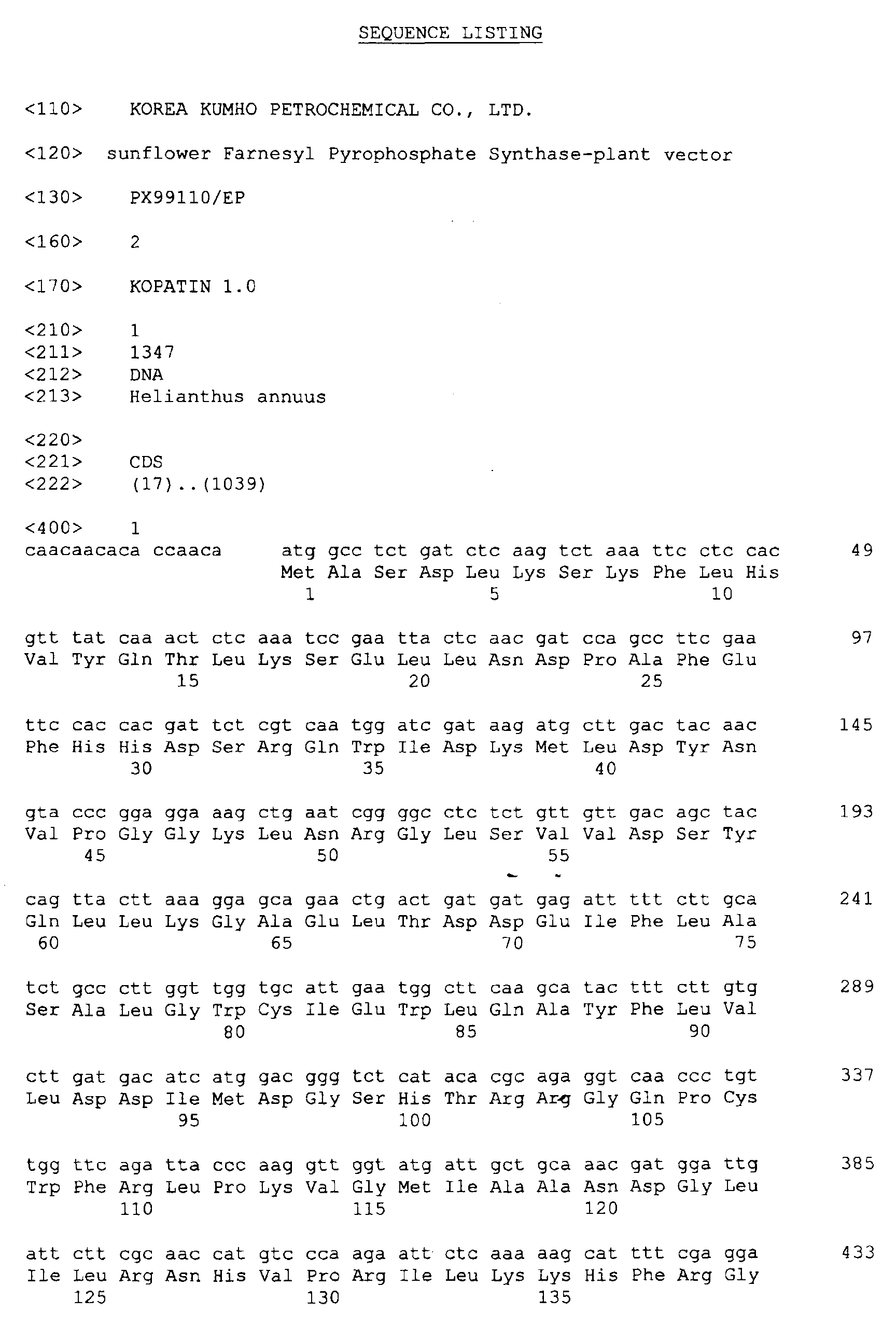

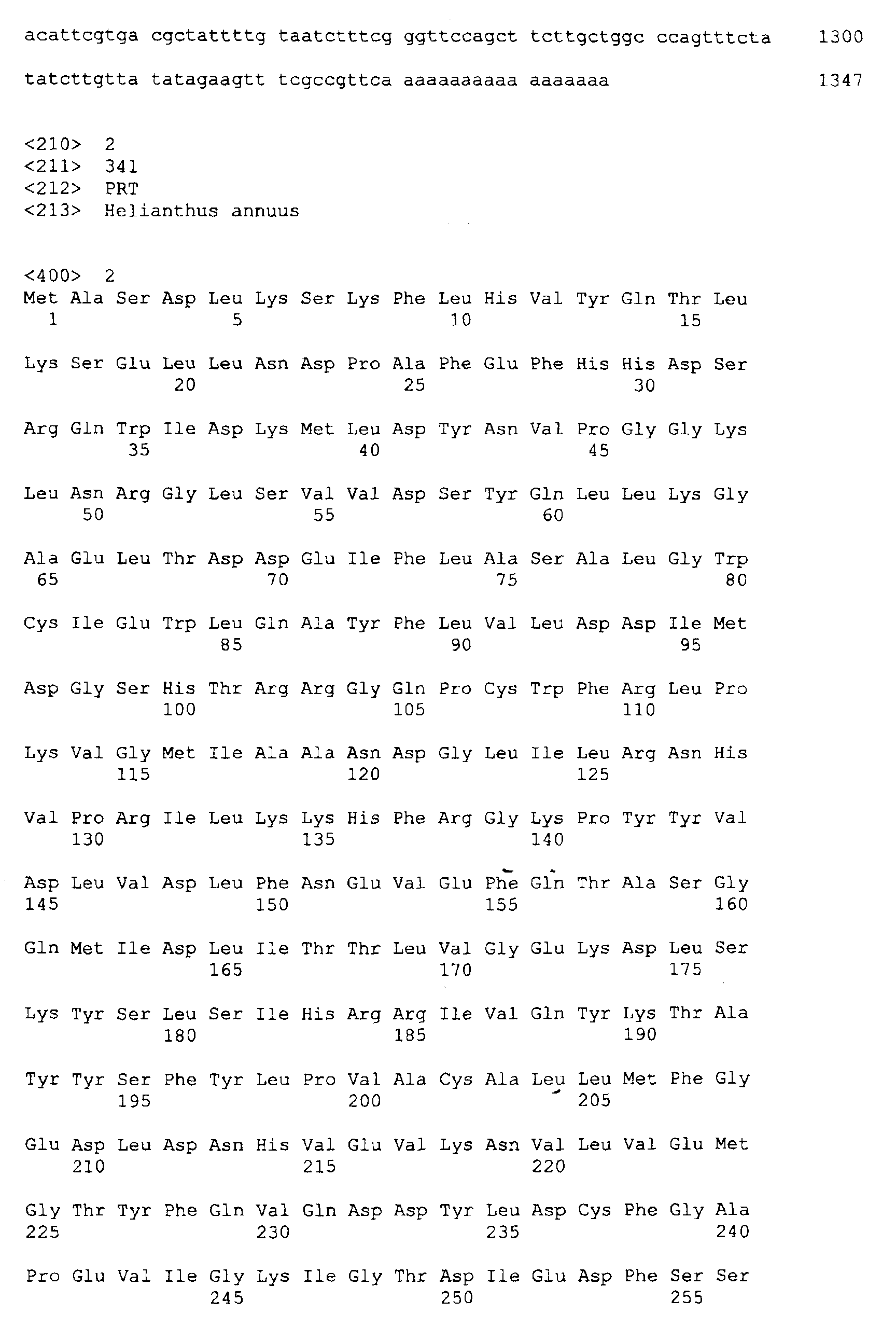

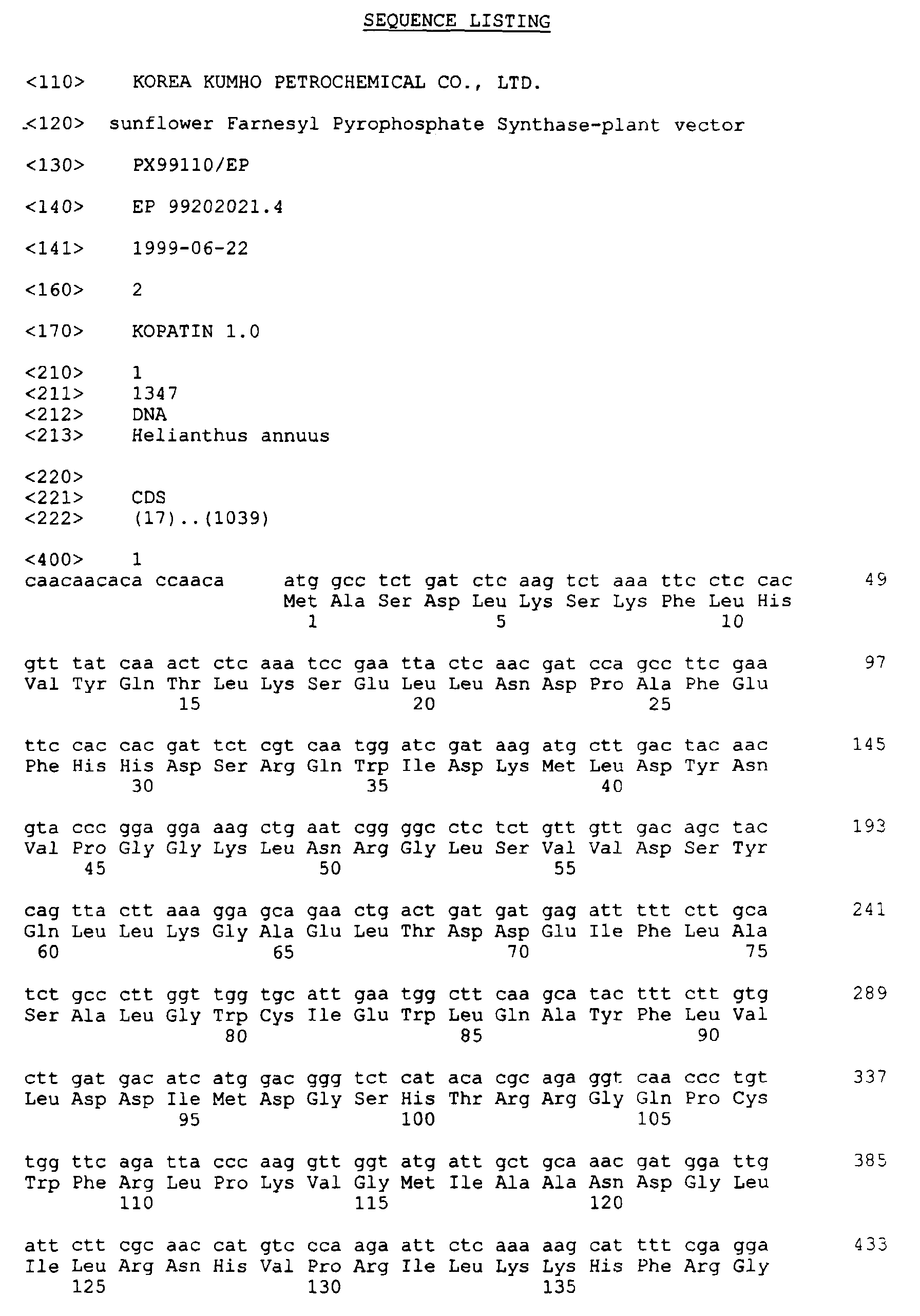
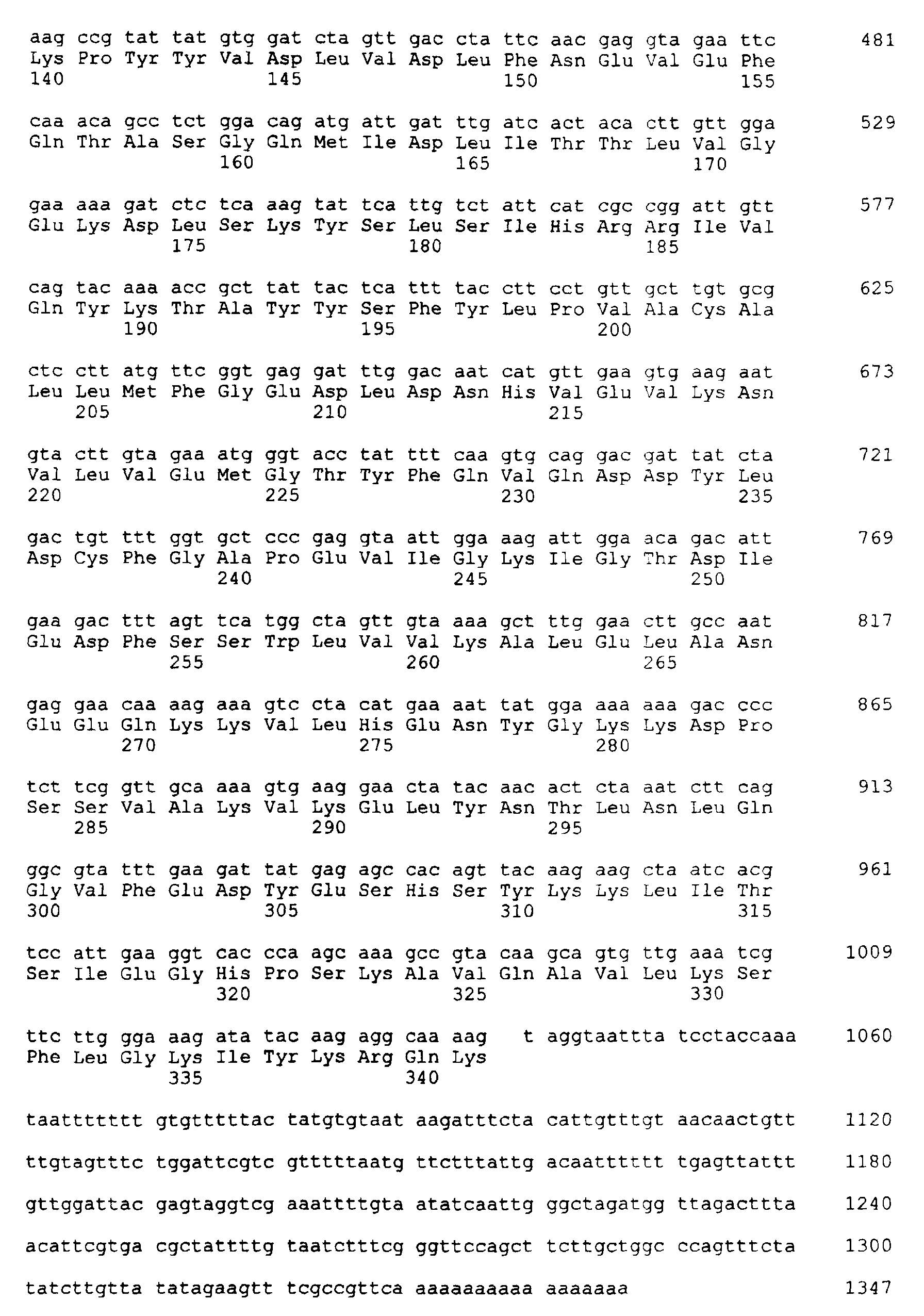


Claims (17)
- A method for increasing chlorophyll contents, vegetative growth, and delayed senescence in leaves and seed production in tobacco plants relating to control plant, comprising the steps of introducing a recombinant plant expression vector including a nucleic acid construct and a promoter into a tobacco plant cells and growing the cells into a plant, wherein the nucleic acid construct comprises isolated cDNA nucleotide sequence that encodes the protein of Sequence Listing ID No. 1.
- The method of claim 1, wherein said cDNA nucleotide sequence is isolated from seedlings of Helianthus annus.
- The method of claim 1, wherein said recombinant plant expression vector is pCIP-sfps (KCTC 0520BP).
- Transgenic tobacco plant produced by the method of claim 2.
- Transgenic tobacco plant comprising a construct, wherein the nucleic acid construct contains the isolated cDNA nucleotide Sequence Listing ID No. 2, and wherein the nucleotide sequence is isolated from seedlings of Helianthus annus or is synthetic.
- The method of claim 1, wherein the nucleotides sequence is Sequence Listing ID No. 1.
- A DNA fragment as claimed in claim 1, wherein the DNA sequence is encoded substantially by a sequence contained in (Agrobacterium tumefaciens or baculovirus or whatever) strains, KCTC No. 0520BP.
- A DNA fragment as claimed in claim 7, wherein said promoter is selected from the group consisting of a bacterial promoter, a plant promoter and a virus promoter.
- A DNA fragment as claimed in claim 8, wherein said promoter is a bacterial promoter and a plant promoter and a virus promoter.
- A hybrid vector comprising a DNA fragment as claimed in 1, wherein said vector is capable of being transferred to and replicating in a host.
- A transformed host comprising the hybrid vector as claimed in claim 10, wherein said host is capable of expressing the DNA fragment.
- A transformed host comprising the DNA fragment as claimed in claim 1, wherein said host is capable of expressing the DNA fragment.
- A process for the production of farnesyl pyrophosphate synthase in vitro comprising the steps of providing a DNA fragment as claimed in claim 1, transferring said DNA fragment to a host cell to produce a transformed host cell and culturing said transformed host in a suitable medium for the production of farnesyl pyrophosphate synthase using said SFPS gene in vitro.
- A process for the production of farnesyl pyrophosphate synthase in vivo comprising the steps of providing a DNA fragment as claimed in claim 1, providing a DNA fragment to a host cell to produce a transformed host cell and culturing said transformed host in an environment that is suitable for the production of the flower and seed in plants.
- A transformed host as claimed in claim 13, wherein said host is selected from a group consisting of a plant, a bacterium, a yeast and a fungus.
- A transformed host as claimed in claim 14, wherein said host is a plant.
- A transformed host as claimed in claim 16, wherein said plant is selected from the group consisting of a tobacco species, a grass species and a perennial plant species.
Priority Applications (6)
| Application Number | Priority Date | Filing Date | Title |
|---|---|---|---|
| DE69940103T DE69940103D1 (en) | 1999-06-22 | 1999-06-22 | Farnesyl pyrophosphate synthase (FPS) from seedlings of the sunflower (Helianthus annus) |
| AT99202021T ATE417932T1 (en) | 1999-06-22 | 1999-06-22 | FARNESYLPYROPHOSPHATE SYNTHASE (FPS) FROM SUNFLOWER SEEDLINGS (HELIANTHUS ANNUS) |
| EP99202021A EP1063297B1 (en) | 1999-06-22 | 1999-06-22 | Farnesyl pyrophosphate synthase (FPS) derived from seedlings of sunflower (Helianthus annus) |
| US09/353,227 US6600094B1 (en) | 1999-06-22 | 1999-07-14 | Recombinant plant expression vector comprising isolated cDNA nucleotide sequence encoding farnesyl pyrophosphate synthase (FPS) derived from seedlings of sunflower (Helianthus annus) |
| JP28058499A JP3410055B2 (en) | 1999-06-22 | 1999-09-30 | Plant vector having sunflower farnesyl pyrophosphate synthase gene and method for producing the same |
| JP2001342497A JP3795377B2 (en) | 1999-06-22 | 2001-11-07 | Plant vector having sunflower farnesyl pyrophosphate synthase gene and method for producing the same |
Applications Claiming Priority (1)
| Application Number | Priority Date | Filing Date | Title |
|---|---|---|---|
| EP99202021A EP1063297B1 (en) | 1999-06-22 | 1999-06-22 | Farnesyl pyrophosphate synthase (FPS) derived from seedlings of sunflower (Helianthus annus) |
Publications (2)
| Publication Number | Publication Date |
|---|---|
| EP1063297A1 true EP1063297A1 (en) | 2000-12-27 |
| EP1063297B1 EP1063297B1 (en) | 2008-12-17 |
Family
ID=8240346
Family Applications (1)
| Application Number | Title | Priority Date | Filing Date |
|---|---|---|---|
| EP99202021A Expired - Lifetime EP1063297B1 (en) | 1999-06-22 | 1999-06-22 | Farnesyl pyrophosphate synthase (FPS) derived from seedlings of sunflower (Helianthus annus) |
Country Status (5)
| Country | Link |
|---|---|
| US (1) | US6600094B1 (en) |
| EP (1) | EP1063297B1 (en) |
| JP (2) | JP3410055B2 (en) |
| AT (1) | ATE417932T1 (en) |
| DE (1) | DE69940103D1 (en) |
Cited By (16)
| Publication number | Priority date | Publication date | Assignee | Title |
|---|---|---|---|---|
| WO2000063391A3 (en) * | 1999-04-15 | 2002-01-17 | Calgene Llc | Nucleic acid sequences to proteins involved in tocopherol synthesis |
| WO2002020733A3 (en) * | 2000-09-01 | 2003-08-14 | Du Pont | Genes involved in isoprenoid compound production |
| US6841717B2 (en) | 2000-08-07 | 2005-01-11 | Monsanto Technology, L.L.C. | Methyl-D-erythritol phosphate pathway genes |
| EP1327686A4 (en) * | 2000-10-06 | 2005-01-19 | Sapporo Breweries | Farnesyl pyrophosphate synthase protein, nucleic acid and promoter region thereof |
| US6872815B1 (en) | 2000-10-14 | 2005-03-29 | Calgene Llc | Nucleic acid sequences to proteins involved in tocopherol synthesis |
| US7112717B2 (en) | 2002-03-19 | 2006-09-26 | Monsanto Technology Llc | Homogentisate prenyl transferase gene (HPT2) from arabidopsis and uses thereof |
| US7161061B2 (en) | 2001-05-09 | 2007-01-09 | Monsanto Technology Llc | Metabolite transporters |
| US7230165B2 (en) | 2002-08-05 | 2007-06-12 | Monsanto Technology Llc | Tocopherol biosynthesis related genes and uses thereof |
| US7238855B2 (en) | 2001-05-09 | 2007-07-03 | Monsanto Technology Llc | TyrA genes and uses thereof |
| US7262339B2 (en) | 2001-10-25 | 2007-08-28 | Monsanto Technology Llc | Tocopherol methyltransferase tMT2 and uses thereof |
| WO2007003346A3 (en) * | 2005-07-06 | 2007-12-06 | Max Planck Gesellschaft | Fungicidal agents |
| WO2008094546A3 (en) * | 2007-01-31 | 2009-02-12 | Univ California | Genetically modified host cells for increased p450 activity levels and methods of use thereof |
| US7553952B2 (en) | 2001-08-17 | 2009-06-30 | Monsanto Technology Llc | Gamma tocopherol methyltransferase coding sequence identified in Cuphea and uses thereof |
| US8017835B2 (en) | 2005-04-19 | 2011-09-13 | University Of Kentucky Research Foundation | Transformed plants accumulating terpenes |
| EP2395092A3 (en) * | 2006-12-21 | 2012-08-01 | BASF Plant Science GmbH | Plants having enhanced yield-related traits and a method for making the same |
| CN120173902A (en) * | 2025-05-20 | 2025-06-20 | 内蒙古农业大学 | Application of tobacco NbCu/Zn-SOD-1 in controlling plant viruses |
Families Citing this family (6)
| Publication number | Priority date | Publication date | Assignee | Title |
|---|---|---|---|---|
| TW200918666A (en) * | 2007-09-11 | 2009-05-01 | Wyeth Corp | Attenuated mycoplasma gallisepticum strains |
| US8293100B2 (en) | 2009-03-13 | 2012-10-23 | Terrasep, Llc | Methods and apparatus for centrifugal liquid chromatography |
| IN2012DE00303A (en) | 2012-02-03 | 2015-04-10 | Council Scient Ind Res | |
| CN105532210A (en) * | 2015-11-18 | 2016-05-04 | 中国农业科学院烟草研究所 | Lighting environment based tobacco seedling growing method |
| CN110476746B (en) * | 2019-09-02 | 2021-05-07 | 山东省农业科学院作物研究所 | Method for detecting influence of farnesyl pyrophosphate synthase gene on size of wheat grains |
| CN112980809B (en) * | 2021-03-17 | 2023-04-11 | 云南中烟工业有限责任公司 | Tobacco farnesyl pyrophosphate synthase gene and application thereof |
Family Cites Families (2)
| Publication number | Priority date | Publication date | Assignee | Title |
|---|---|---|---|---|
| AU7071196A (en) * | 1995-09-14 | 1997-04-01 | Croptech Development Corporation | Production of lysosomal enzymes in plant-based expression systems |
| EP1095034A1 (en) * | 1998-07-06 | 2001-05-02 | Eastman Chemical Company | Preparation of tocopherols |
-
1999
- 1999-06-22 AT AT99202021T patent/ATE417932T1/en not_active IP Right Cessation
- 1999-06-22 DE DE69940103T patent/DE69940103D1/en not_active Expired - Fee Related
- 1999-06-22 EP EP99202021A patent/EP1063297B1/en not_active Expired - Lifetime
- 1999-07-14 US US09/353,227 patent/US6600094B1/en not_active Expired - Lifetime
- 1999-09-30 JP JP28058499A patent/JP3410055B2/en not_active Expired - Fee Related
-
2001
- 2001-11-07 JP JP2001342497A patent/JP3795377B2/en not_active Expired - Fee Related
Non-Patent Citations (5)
| Title |
|---|
| CUTLER ET AL: "A protein farnesyl transferase involved in abscisic acid signal transduction in arabidopsis", SCIENCE,US,AMERICAN ASSOCIATION FOR THE ADVANCEMENT OF SCIENCE,, vol. 273, pages 1239-1241, XP002090871, ISSN: 0036-8075 * |
| DATABASE EMPLN EMBL, Heidelberg, Germany; 6 April 1998 (1998-04-06), PARK S C AND CHO J W: "Helianthus annuus farnesyl pyrophosphate synthase (FPS)", XP002123684 * |
| HE Z ET AL.: "Ribulose-1,5-bisphosphate carboxylase/oxygenase activase deficiency delays senescence of ribulose-1,5-bisphosphate carboxylase/oxygenase but progressively impairs its catalysis during tobacco leaf development", PLANT PHYSIOLOGY, vol. 115, 1997, pages 1569 - 1580, XP002123683 * |
| QIAN ET AL: "Protein farnesyltransferase in plants: molecular characterization and involvement in cell cycle control", PLANT CELL,US,AMERICAN SOCIETY OF PLANT PHYSIOLOGISTS, ROCKVILLE, MD, vol. 8, pages 2381-2394, XP002090873, ISSN: 1040-4651 * |
| WEAVER L M ET AL.: "A comparison of the expression patterns of several senescence-associated genes in response to stress and hormone treatment", PLANT MOLECULAR BIOLOGY, vol. 37, 1998, pages 455 - 469, XP002123682 * |
Cited By (29)
| Publication number | Priority date | Publication date | Assignee | Title |
|---|---|---|---|---|
| US7141718B2 (en) | 1999-04-15 | 2006-11-28 | Calgene Llc | Nucleic acid sequences to proteins involved in tocopherol synthesis |
| US7265207B2 (en) | 1999-04-15 | 2007-09-04 | Calgene Llc | Nucleic acid sequences to proteins involved in tocopherol synthesis |
| US7335815B2 (en) | 1999-04-15 | 2008-02-26 | Calgene Llc | Nucleic acid sequences to proteins involved in isoprenoid synthesis |
| WO2000063391A3 (en) * | 1999-04-15 | 2002-01-17 | Calgene Llc | Nucleic acid sequences to proteins involved in tocopherol synthesis |
| US7067647B2 (en) | 1999-04-15 | 2006-06-27 | Calgene Llc | Nucleic acid sequences to proteins involved in isoprenoid synthesis |
| US6841717B2 (en) | 2000-08-07 | 2005-01-11 | Monsanto Technology, L.L.C. | Methyl-D-erythritol phosphate pathway genes |
| US7405343B2 (en) | 2000-08-07 | 2008-07-29 | Monsanto Technology Llc | Methyl-D-erythritol phosphate pathway genes |
| WO2002020733A3 (en) * | 2000-09-01 | 2003-08-14 | Du Pont | Genes involved in isoprenoid compound production |
| US6660507B2 (en) | 2000-09-01 | 2003-12-09 | E. I. Du Pont De Nemours And Company | Genes involved in isoprenoid compound production |
| US7056717B2 (en) | 2000-09-01 | 2006-06-06 | E. I. Du Pont De Nemours And Company | Genes involved in isoprenoid compound production |
| EP1327686A4 (en) * | 2000-10-06 | 2005-01-19 | Sapporo Breweries | Farnesyl pyrophosphate synthase protein, nucleic acid and promoter region thereof |
| US7091019B2 (en) | 2000-10-06 | 2006-08-15 | Sapporo Breweries Limited | Farnesyl pyrophosphate synthase proteins, nucleic acids and promoter regions therefor |
| US6933374B2 (en) | 2000-10-06 | 2005-08-23 | Sapporo Breweries Limited | Farnesyl pyrophosphate synthase protein, nucleic acid and promoter region thereof |
| US8362324B2 (en) | 2000-10-14 | 2013-01-29 | Monsanto Technology Llc | Nucleic acid sequences to proteins involved in tocopherol synthesis |
| US7420101B2 (en) | 2000-10-14 | 2008-09-02 | Calgene Llc | Nucleic acid sequences to proteins involved in tocopherol synthesis |
| US6872815B1 (en) | 2000-10-14 | 2005-03-29 | Calgene Llc | Nucleic acid sequences to proteins involved in tocopherol synthesis |
| US7238855B2 (en) | 2001-05-09 | 2007-07-03 | Monsanto Technology Llc | TyrA genes and uses thereof |
| US7161061B2 (en) | 2001-05-09 | 2007-01-09 | Monsanto Technology Llc | Metabolite transporters |
| US7553952B2 (en) | 2001-08-17 | 2009-06-30 | Monsanto Technology Llc | Gamma tocopherol methyltransferase coding sequence identified in Cuphea and uses thereof |
| US7595382B2 (en) | 2001-08-17 | 2009-09-29 | Monsanto Technology Llc | Gamma tocopherol methyltransferase coding sequences from Brassica and uses thereof |
| US7605244B2 (en) | 2001-08-17 | 2009-10-20 | Monsanto Technology Llc | Gamma tocopherol methyltransferase coding sequence from Brassica and uses thereof |
| US7262339B2 (en) | 2001-10-25 | 2007-08-28 | Monsanto Technology Llc | Tocopherol methyltransferase tMT2 and uses thereof |
| US7112717B2 (en) | 2002-03-19 | 2006-09-26 | Monsanto Technology Llc | Homogentisate prenyl transferase gene (HPT2) from arabidopsis and uses thereof |
| US7230165B2 (en) | 2002-08-05 | 2007-06-12 | Monsanto Technology Llc | Tocopherol biosynthesis related genes and uses thereof |
| US8017835B2 (en) | 2005-04-19 | 2011-09-13 | University Of Kentucky Research Foundation | Transformed plants accumulating terpenes |
| WO2007003346A3 (en) * | 2005-07-06 | 2007-12-06 | Max Planck Gesellschaft | Fungicidal agents |
| EP2395092A3 (en) * | 2006-12-21 | 2012-08-01 | BASF Plant Science GmbH | Plants having enhanced yield-related traits and a method for making the same |
| WO2008094546A3 (en) * | 2007-01-31 | 2009-02-12 | Univ California | Genetically modified host cells for increased p450 activity levels and methods of use thereof |
| CN120173902A (en) * | 2025-05-20 | 2025-06-20 | 内蒙古农业大学 | Application of tobacco NbCu/Zn-SOD-1 in controlling plant viruses |
Also Published As
| Publication number | Publication date |
|---|---|
| JP2001000192A (en) | 2001-01-09 |
| EP1063297B1 (en) | 2008-12-17 |
| JP2002306005A (en) | 2002-10-22 |
| ATE417932T1 (en) | 2009-01-15 |
| US6600094B1 (en) | 2003-07-29 |
| DE69940103D1 (en) | 2009-01-29 |
| JP3410055B2 (en) | 2003-05-26 |
| JP3795377B2 (en) | 2006-07-12 |
Similar Documents
| Publication | Publication Date | Title |
|---|---|---|
| EP1063297B1 (en) | Farnesyl pyrophosphate synthase (FPS) derived from seedlings of sunflower (Helianthus annus) | |
| Meurer et al. | A nuclear‐encoded protein of prokaryotic origin is essential for the stability of photosystem II in Arabidopsis thaliana | |
| Cunillera et al. | Characterization of dehydrodolichyl diphosphate synthase of Arabidopsis thaliana, a key enzyme in dolichol biosynthesis | |
| CA2087036A1 (en) | Transgenic plants with altered polyol content | |
| CN113621040B (en) | Salt Tolerance Gene PbHSF3A in Duli Pear and Its Application in Genetic Improvement of Plant Salt Tolerance | |
| CA2423041A1 (en) | Plant transgenic for spermidine synthase which has improved environmental stress tolerances and method for producing same | |
| CA2239766A1 (en) | Method for controlling water content of plant | |
| Liang et al. | VaBAM1 weakens cold tolerance by interacting with the negative regulator VaSR1 to suppress β-amylase expression | |
| CA2481764C (en) | Plants with improved morphogenesis and method of constructing the same | |
| AU694457B2 (en) | DNA sequences for ammonium transporter, plasmids, bacteria, yeasts, plant cells and plants containing the transporter | |
| US6753461B2 (en) | Method for increasing stress-resistance to a plant | |
| US7049487B2 (en) | Transgenic plants carrying neoxanthin cleavage enzyme gene | |
| CN101278049B (en) | Protoporphyrinogen oxidase having activity of conferring resistance to acifluorfen and gene thereof | |
| CN119331067A (en) | Application of Brassica napus Bna.A08.SNAT2 protein and its encoding gene in salt stress tolerance | |
| KR101926962B1 (en) | Method for improving the resistance to drought stress using RING finger E3 ligase PIR in plants | |
| KR101660231B1 (en) | Transgenic plants for controlling photosynthetic efficiency in the light and cold stress, and control method thereof | |
| CN114605511B (en) | Cloning and application of novel nicotinamide efflux gene | |
| KR100356705B1 (en) | Recombinant plant expression vector comprising isolated cDNA nucleotide sequence encoding Farnesyl Pyrophosphate Synthase (FPS) derived from seedlings of sunflower (Helianthus annus) | |
| CN109609515B (en) | Gene for regulating growth and development of chloroplast and influencing leaf color under low-temperature stressCDE4And applications | |
| KR101231141B1 (en) | Composition for promoting plant growth comprising IDS gene | |
| CA2520021A1 (en) | Enhanced accumulation of carotenoids in plants | |
| KR20020023471A (en) | Transgenic Plants and Plant Cells with Improved Growth Rate and Related Methods | |
| CN114941003B (en) | Wild grape VyMPBQ gene and its encoded proteins and applications | |
| KR20080101303A (en) | Pepper CFA1 Transforming Plants and Growth of Pepper CLA1 | |
| WO1990013658A1 (en) | Plant hormone regulated expression of genetically engineered gene products in plant cells |
Legal Events
| Date | Code | Title | Description |
|---|---|---|---|
| PUAI | Public reference made under article 153(3) epc to a published international application that has entered the european phase |
Free format text: ORIGINAL CODE: 0009012 |
|
| AK | Designated contracting states |
Kind code of ref document: A1 Designated state(s): AT BE CH CY DE DK ES FI FR GB GR IE IT LI LU MC NL PT SE |
|
| AX | Request for extension of the european patent |
Free format text: AL;LT;LV;MK;RO;SI |
|
| 17P | Request for examination filed |
Effective date: 20010518 |
|
| AKX | Designation fees paid |
Free format text: AT BE CH CY DE DK ES FI FR GB GR IE IT LI LU MC NL PT SE |
|
| 17Q | First examination report despatched |
Effective date: 20040209 |
|
| 17Q | First examination report despatched |
Effective date: 20040209 |
|
| GRAP | Despatch of communication of intention to grant a patent |
Free format text: ORIGINAL CODE: EPIDOSNIGR1 |
|
| GRAS | Grant fee paid |
Free format text: ORIGINAL CODE: EPIDOSNIGR3 |
|
| GRAA | (expected) grant |
Free format text: ORIGINAL CODE: 0009210 |
|
| AK | Designated contracting states |
Kind code of ref document: B1 Designated state(s): AT BE CH CY DE DK ES FI FR GB GR IE IT LI LU MC NL PT SE |
|
| REG | Reference to a national code |
Ref country code: GB Ref legal event code: FG4D |
|
| REG | Reference to a national code |
Ref country code: CH Ref legal event code: EP |
|
| REG | Reference to a national code |
Ref country code: IE Ref legal event code: FG4D |
|
| REF | Corresponds to: |
Ref document number: 69940103 Country of ref document: DE Date of ref document: 20090129 Kind code of ref document: P |
|
| PG25 | Lapsed in a contracting state [announced via postgrant information from national office to epo] |
Ref country code: NL Free format text: LAPSE BECAUSE OF FAILURE TO SUBMIT A TRANSLATION OF THE DESCRIPTION OR TO PAY THE FEE WITHIN THE PRESCRIBED TIME-LIMIT Effective date: 20081217 Ref country code: FI Free format text: LAPSE BECAUSE OF FAILURE TO SUBMIT A TRANSLATION OF THE DESCRIPTION OR TO PAY THE FEE WITHIN THE PRESCRIBED TIME-LIMIT Effective date: 20081217 |
|
| NLV1 | Nl: lapsed or annulled due to failure to fulfill the requirements of art. 29p and 29m of the patents act | ||
| PG25 | Lapsed in a contracting state [announced via postgrant information from national office to epo] |
Ref country code: ES Free format text: LAPSE BECAUSE OF FAILURE TO SUBMIT A TRANSLATION OF THE DESCRIPTION OR TO PAY THE FEE WITHIN THE PRESCRIBED TIME-LIMIT Effective date: 20090328 Ref country code: BE Free format text: LAPSE BECAUSE OF FAILURE TO SUBMIT A TRANSLATION OF THE DESCRIPTION OR TO PAY THE FEE WITHIN THE PRESCRIBED TIME-LIMIT Effective date: 20081217 |
|
| PG25 | Lapsed in a contracting state [announced via postgrant information from national office to epo] |
Ref country code: SE Free format text: LAPSE BECAUSE OF FAILURE TO SUBMIT A TRANSLATION OF THE DESCRIPTION OR TO PAY THE FEE WITHIN THE PRESCRIBED TIME-LIMIT Effective date: 20090317 Ref country code: PT Free format text: LAPSE BECAUSE OF FAILURE TO SUBMIT A TRANSLATION OF THE DESCRIPTION OR TO PAY THE FEE WITHIN THE PRESCRIBED TIME-LIMIT Effective date: 20090518 Ref country code: AT Free format text: LAPSE BECAUSE OF FAILURE TO SUBMIT A TRANSLATION OF THE DESCRIPTION OR TO PAY THE FEE WITHIN THE PRESCRIBED TIME-LIMIT Effective date: 20081217 |
|
| PLBE | No opposition filed within time limit |
Free format text: ORIGINAL CODE: 0009261 |
|
| STAA | Information on the status of an ep patent application or granted ep patent |
Free format text: STATUS: NO OPPOSITION FILED WITHIN TIME LIMIT |
|
| PG25 | Lapsed in a contracting state [announced via postgrant information from national office to epo] |
Ref country code: DK Free format text: LAPSE BECAUSE OF FAILURE TO SUBMIT A TRANSLATION OF THE DESCRIPTION OR TO PAY THE FEE WITHIN THE PRESCRIBED TIME-LIMIT Effective date: 20081217 |
|
| PGFP | Annual fee paid to national office [announced via postgrant information from national office to epo] |
Ref country code: FR Payment date: 20090625 Year of fee payment: 11 |
|
| 26N | No opposition filed |
Effective date: 20090918 |
|
| PGFP | Annual fee paid to national office [announced via postgrant information from national office to epo] |
Ref country code: GB Payment date: 20090625 Year of fee payment: 11 Ref country code: DE Payment date: 20090630 Year of fee payment: 11 |
|
| PG25 | Lapsed in a contracting state [announced via postgrant information from national office to epo] |
Ref country code: MC Free format text: LAPSE BECAUSE OF NON-PAYMENT OF DUE FEES Effective date: 20090630 |
|
| REG | Reference to a national code |
Ref country code: CH Ref legal event code: PL |
|
| PG25 | Lapsed in a contracting state [announced via postgrant information from national office to epo] |
Ref country code: LI Free format text: LAPSE BECAUSE OF NON-PAYMENT OF DUE FEES Effective date: 20090630 Ref country code: IE Free format text: LAPSE BECAUSE OF NON-PAYMENT OF DUE FEES Effective date: 20090622 Ref country code: CH Free format text: LAPSE BECAUSE OF NON-PAYMENT OF DUE FEES Effective date: 20090630 |
|
| PG25 | Lapsed in a contracting state [announced via postgrant information from national office to epo] |
Ref country code: GR Free format text: LAPSE BECAUSE OF FAILURE TO SUBMIT A TRANSLATION OF THE DESCRIPTION OR TO PAY THE FEE WITHIN THE PRESCRIBED TIME-LIMIT Effective date: 20090318 |
|
| GBPC | Gb: european patent ceased through non-payment of renewal fee |
Effective date: 20100622 |
|
| REG | Reference to a national code |
Ref country code: FR Ref legal event code: ST Effective date: 20110228 |
|
| PG25 | Lapsed in a contracting state [announced via postgrant information from national office to epo] |
Ref country code: IT Free format text: LAPSE BECAUSE OF FAILURE TO SUBMIT A TRANSLATION OF THE DESCRIPTION OR TO PAY THE FEE WITHIN THE PRESCRIBED TIME-LIMIT Effective date: 20081217 |
|
| PG25 | Lapsed in a contracting state [announced via postgrant information from national office to epo] |
Ref country code: LU Free format text: LAPSE BECAUSE OF NON-PAYMENT OF DUE FEES Effective date: 20090622 Ref country code: DE Free format text: LAPSE BECAUSE OF NON-PAYMENT OF DUE FEES Effective date: 20110101 |
|
| PG25 | Lapsed in a contracting state [announced via postgrant information from national office to epo] |
Ref country code: FR Free format text: LAPSE BECAUSE OF NON-PAYMENT OF DUE FEES Effective date: 20100630 |
|
| PG25 | Lapsed in a contracting state [announced via postgrant information from national office to epo] |
Ref country code: GB Free format text: LAPSE BECAUSE OF NON-PAYMENT OF DUE FEES Effective date: 20100622 |
|
| PG25 | Lapsed in a contracting state [announced via postgrant information from national office to epo] |
Ref country code: CY Free format text: LAPSE BECAUSE OF FAILURE TO SUBMIT A TRANSLATION OF THE DESCRIPTION OR TO PAY THE FEE WITHIN THE PRESCRIBED TIME-LIMIT Effective date: 20081217 |