This invention relates to a deodorant including a main component of a
decomposition obtained by thermally decomposing a paratinose, foods and
beverages including the deodorant, and an oral composition including the
deodorant as well as a toiletry product including the deodorant.
Recently, people's intention to sanitation has been on the increase with an
improvement of environmental sanitation, and people's interest in the odors
regarding to the living environment and the human body has also been on
the increase. The ode breath odor and the body odor provide particular
influences to the human relationships. In this circumstances, various
deodorant-related merchandises have been proposed to improve them, and
they have now been about to be widely accepted by consumers. The breath
odors are due to odors derived from foods consumed, odors from bacteria
in the mouth and odors from stomach. Moreover, the odor ingredients may
comprise sulfide, nitride and organic acids. Particularly, even a slight
amount of sulfide affects on the breath odor. Typical ones of the known
sulfide are hydrogen sulfide, methyl mercaptan and dimethyl sulfide. It has
been known that particularly after the consumption of garlic and onion,
amounts of sulfide of allyl mercaptan, diallyl sulfide and diallyl sulfide are
remarkably increased.
Currently, catechin as a green tea extract has widely been used as a typical
deodorant. It has been known that catechin reacts with sulfides like methyl
marcapton which is the major cause of the breath odor (Biosci. Biotech.
Biochem., 59(7) 1232-1236, 1995). However, catechin has a strong bitter
and acerbic taste and deteriorates an original flavor of food, it is necessary
to limit the usable amount of catechin. Moreover, catechin shows its
deodorizing effect under the neutral or alkaline condition. The reactivity of
catechin decreases under the acidic condition, thereby reducing the
deodorizing effect thereof. For this reason, even though sour deodorant
foods are designed by adding catechin, the deodorant substance almost
unreacts with the odor substance, and the deodorizing effect is insufficient.
Also, in Japanese laid-open publication 62-169720, it is also disclosed that
caramels and maltols (3-hydroxy-2-methyl-γ-pyrone) obtained from
heating sucrose or glucose show deodorizing effect against garlic and onion
odors. If, however, the odor composition was analyzed by a gas
chromatography, then no change in odor composition was observed.
Furthermore, if the same analysis to sulfides such as methyl marcaptan and
allyl marcaptan which comprise garlic and onion odor ingredients was
carried out, then no change in the composition was observed. From those
results, the deodorizing effect of caramels and maltols against the garlic
and onion odors is the masking effect utilized by their strong scents and
does not directly act on the ingredients of the odor.
On the other hand, a paratinose condensate prepared from heating
paratinose is described in Japanese Patent No.2639386 entitled "paratinose
and method of preparing the same and method of the use". The paratinose
condensates as described are oligo-saccharides in various combinations of
glucose with fructose as condensed. In those oligo-saccharides, paratinose
condensates (syrup) prepared by using the process described in the patent
publication are analyzed in the deodorizing activity against the sulfide
(methyl marcapton), no considerable deodorizing activity is shown. Also
paratinose condensate (paratinose oligosaccharide) purified by NH2 silica
gel column has a further reduced deodorizing activity. Therefore,
paratinose condensates prepared from pratinose by the process described in
the above patent publication have no deodorizing activity.
Accordingly, it is an object of the present invention to solve the above
problems and to provide a deodorant which provides a strong deodorizing
effect against various ingredients of odor in a wide pH range, provided that
addition of a large amount thereof to foods, beverages and oral
compositions provide no influence on their original and good flavors.
Furthermore, the present invention is to provide foods, beverages, oral
compositions and toiletry products which provide strong deodorizing
effects against various ingredients of odor in a wide pH range without
deteriorating the flavor due to bitter and acerbic taste of the conventional
deodorants.
This invention is to solve the problems mentioned above, and to provide
deodorants that are characterized by paratinose-derived thermal
decomposition included as effective ingredients obtained by thermally
decomposing the paratinose. The term "paratinose-derived thermal
decomposition" is defined to be a substance or product which is obtained
by thermally decomposing paratinose. A paratinose-derived thermal
decomposition obtained by thermally decomposing the paratinose in the
range of 120-240°C (particularly 140-200°C) is desirable.
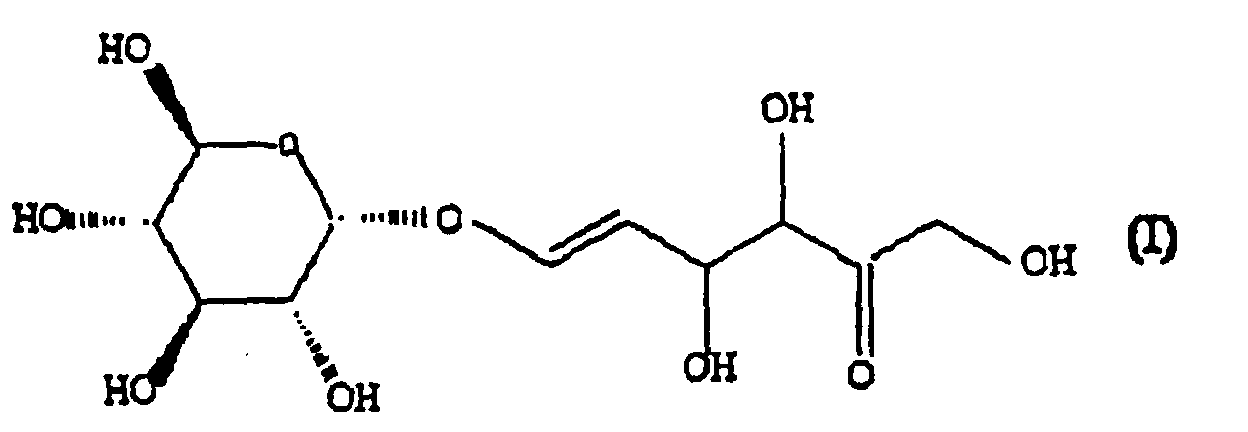
Also, this invention provides a deodorant characterized by 6-(α-D-glucopyranosyloxy)-1,
3, 4-trihydroxyhexa-5-en-2-on included therein as
effective ingredient represented by the following structural formula (I) :
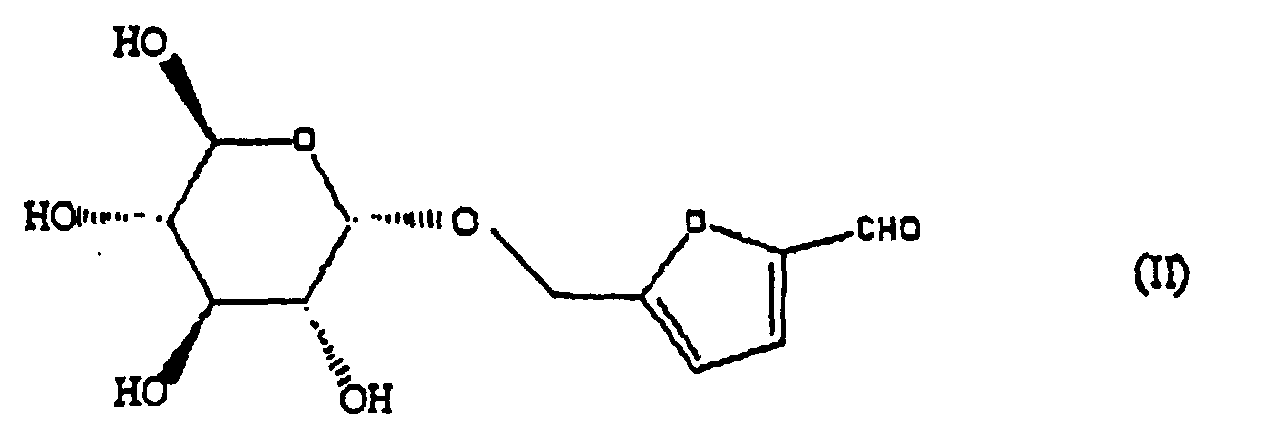
or a deodorant characterized by 5-[(α-D-glucopyranosyloxy)methyl]-2-furancarboxaldehyde
included therein as effective ingredient represented
by the following structural formula (II) :
or deodorant characterized by mixture of above as effective ingredients.
Furthermore, the present invention provides foods, beverages, oral
compositions and toiletry products inclusive of the above novel deodorants.
DICLOSURE OF THE INVENTION
The present inventors have researched on various materials to discover the
effective deodorant in the head-space method using a gas chromatography.
As a result, it was confirmed that a paratinose-derived thermal
decomposition obtained by thermally decomposing the paratinose has a
strong deodorizing effect against methyl mercapton which is the typical
composition of odor. Unheated paratinose does not provide such the effect.
The effect is obtained upon heating process. Also, if other sugars were
heated and prepared, then the paratinose-derived thermal decomposition of
the present invention has shown higher deodorizing effects than the other
sugars heated under the same conditions. Moreover, the paratinose-derived
thermal decomposition of the present invention has also shown a
deodorizing effect against ammonia which is one of nitrides as odor.
Thus, the paratinose-derived thermal decomposition obtained by thermally
decomposing the paratinose in accordance with the present invention serves
as a deodorant which provides deodorizing effects against various
ingredients of odor such as sulfides, nitrides, and a fatty acid.
In order to obtain the paratinose-derived thermal decomposition, it is
necessary to heat the paratinose. For example, powders of paratinose and
water are put in a stainless cup to prepare a solution. This solution is stirred
and heated in a cooker to a final temperature in the range of 120-240°C.
This final temperature should desirably be set in the range of 140-200°C. If
the solution is heat at a high temperature, then the caramel odor becomes
strong and flavor worsens. If, however, a priority is given to the
deodorizing effect, the final temperature of the paratinose solution is set
higher, for example, the paratinose solution is heated up to approximately
200°C to prepare the paratinose-derived thermal decomposition with the
desired strong deodorizing effect.
As to the other conditions than the temperature, the paratinose-derived
thermal decomposition may be prepared under normal, high or low
pressure. For the heating method, it is possible to use a boiler, a continuous
heat-exchange method, and an extruder.
Also, it has commonly been known that acids and alkalis act as catalysts
for caramelization of sugar. It is possible to use acids and alkalis as
catalysts to prepare the paratinose-derived thermal decomposition of the
present invention. A small amount of the deodorant active substance is
formed upon use of alkali. In contrast, the formation of the deodorant
active substance is promoted upon use of any acid. It is available to select
any one or more from a hydrochloric acid, a sulfuric acid, an acetic acid, a
citric acid, a lactic acid, an ascorbic acid, a gluconic acid, a malic acid, a
tartaric acid and a fumaric acid.
A mixing ratio of water and paratinose may optionally be set. If the
concentration of paratinose is low, then it takes a long time necessary for
reaching the final temperature, and it is undesirable in view of the heat
efficiency. It is also possible to heat the powdered paratinose alone at a
temperature which is higher than its melting point of 122-124°C, and for
example, in the range of 125-240°C, and preferably in the range of 140-200°C.
The time of heating the paratinose solution and paratinose powders may
optionally be selected to obtain the heat-decomposed parationose. If the
temperature is relatively low, then a long time heating is required. At a high
temperature, the paratinose-derived thermal decomposition can be prepared
in a short time. It is preferable that the temperature is so set that the
paratinose-derived thermal decomposition is obtained in the range of time
from 5 minutes to 4 hours. Heating time depends on the amount prepared.
For example, if the amount of prepared paratinose is large, then it takes a
long time for heating the large amount of the paratinose to obtain a large
amount of the paratinose-derived thermal decomposition. If the amount of
prepared paratinose is small, then it takes a short time for heating the small
amount of the paratinose to obtain a small amount of the paratinose-derived
thermal decomposition. For example, the paratinose-derived thermal
decomposition showing the deodorizing activity may efficiently be
prepared by heating 5g of paratinose powders at 160°C for 2 hours.
However, a long time heating at a high temperature causes decomposition
and polymerization of active deodorant substances, and the deodorizing
activity decreases. It is also possible for use to purify and concentrate the
active substances in the paratinose-derived thermal decomposition by
purification methods such as column chromatography and solvent
extraction.
The present inventors have further researched on ingredients having the
deodorizing activity contained in the paratinose-derived thermal
decomposition and discovered that compounds, 6-(α-D-glucopyranosyloxy)-1,
3, 4-trihydroxyhexa-5-en-2-on (hereinafter referred
to as GDH) and 5-[(α-D-glucopyranosyloxy)methyl]-2-furancarboxaldehyde
(hereinafter referred to as GMF) have strong
deodorizing effects although GMF is lower in deodorizing effect than
GDH.
If the paratinose-derived thermal decomposition is analyzed by a high
performance liquid chromatography (HPLC) under the following
conditions, then GDH and GMF are eluted at 3.41 and 20.63 minutes,
respectively.
| Conditions of High Performance Liquid Chromatography |
| Column | Senshu Pak. PEGASIL ODS (4.6 ×250 mm) |
| Column Temperature | 40 °C |
| Effluent | Water |
| Rate of Elution | 0.5 ml/min. |
| Detector | UV detector (280 nm) |
Structural formula, chemical formula and characteristic spectral data of the
compound GDH are indicated below.
| Chemical formula | C12H18O9 |
| 1H-NMR Spectrum (δ) | 7.11 (1H, dd, J=3.5, 16.0 Hz), 6.60 (1H, d, J=16.0), 5.48 (2H, s), 5.28 (1H, d, J=3.5) |
| 13C-NMR Spectrum (δ) | 200.1, 152.1, 133.9 |
| MS Spectrum (CI-MS) | 324 m/z (M+1) |
Structural formula, chemical formula and characteristic spectral data of the
compound GDH are indicated below.
| Chemical formula | C12H16O8 |
| 1H-NMR Spectrum (δ) | 9.49 (1H, s), 7.32 (1H, d, J=3.6Hz), 6.65 (1H, d, J=3.6Hz) |
| 13C-NMR Spectrum (δ) | 179.6, 159.5, 154.2, 124.4, 113.0 |
| MS Spectrum (CI-MS) | 289 m/z (M+1) |
GDH and GMF in the present invention can be prepared by thermally
decomposing the paratinose followed by the use of the liquid
chromatography as mentioned above. They may also be prepared by other
methods without heating paratinose. It is possible to use each of GDH and
GMF solely or in combination.
The deodorant in accordance with the present invention, namely, the
paratinose-derived thermal decomposition, one obtained by purifying and
concentrating the paratinose-derived thermal decomposition, and the
compound GDH and the compound GMF may be used directly.
Notwithstanding, generally, they are dissolved or dispersed in a proper
liquid support. Alternatively, they are mixed with proper powders or with a
solid support or are adsorbed therewith or impregnated thereto. If necessary,
they are further added with emulsifiers, dispersing agents, suspending
agents, spreaders, penetrants, wetting agents, and stabilizers for use as the
products of emulsions, oil solutions, hydration agent, powder materials,
tablets, sprays and solid agents.
As foods and beverages containing the above mentioned deodorant, in
accordance with the present invention, a wide range of food and beverage
such as chewing gums, candies, tablets, gummy-jellies and drinks are
available. As oral compositions, mouthwash, toothpaste and troches are
available. As for toiletry products, air fresheners, deodorants and
deodorizing wet tissues for toilet, indoor use, car-use and garbage-use are
available.
Further, since the deodorant in accordance with the present invention is
effective under acidic conditions, the deodorant has a superior deodorizing
effect upon use for sour foods and drinks and oral compositions.
Whereas modifications of the present invention will be apparent to a person
having ordinary skill in the art, to which the invention pertains, it is to be
understood that examples as shown and described by way of illustrations
are by no means intended to be considered in a limiting sense. Accordingly,
it is to be intended to cover by claims all modifications which fall within
the spirit and scope of the present invention.
Example 1:
100 g of a 50 % pratinose solution was added into a stainless beaker to boil
the same up to a temperature of 200 °C by use of a gas cooker, thereby
obtaining 45 g of a paratinose-derived thermal decomposition.
Comparative Example 1:
100g of sucrose solution was heated in the same manner as Example 1 to
obtain 47 g of a heated sucrose.
Example 2:
5g of paratinose powders was heated in an oven for 2 hours at 160 °C, to
obtain 4.6 g of a paratinose-derived thermal decomposition.
Comparative Example 2:
5 g of sucrose was heated in the same manner as Example 2 to obtain 4.8 g
of the heated sucrose.
Example 3:
A citric acid was added at 0.01 % to 100 g of a 50 % paratinose solution for
the same process as Example 1 to obtain 46 g of an acid-added paratinose-derived
thermal decomposition.
Example 4:
5 g of paratinose powders was heated under a low pressure in a vacuum
oven for 2 hours at 160 °C to obtain 4.4 g of a low-pressure treated
paratinose-derived thermal decomposition.
Example 5:
Using a silica gel column, 50 g of the paratinose-derived thermal
decomposition of Example 1 was eluted in 3000 ml of a solvent having a
chloroform to methanol ratio of 4 : 1, and further eluted with a solvent of a
chloroform-to-methanol ratio of 1 : 1. The later elute was concentrated to
obtain 17 g of a crude purified paratinose-derived thermal decomposition.
Example 6:
The crude purified paratinose-derived thermal decomposition of Example 5
as solution was fractionated, and a compound eluted at 6.6 minutes by
HPLC under a fractional condition described below was dried to obtain
GDH.
| Condition of High Performance Liquid Chromatography |
| Column | Senshu Pak. ODS 5251-SH (20 ×250 mm) |
| Column Temperature | Room Temperature |
| Effluent | Water |
| Rate of Elution | 10.0 ml/min |
| Detector | UV detector (210 nm) |
The crude purified paratinose-derived thermal decomposition of Example 5
as a solution was fractionated, and a compound eluted at 9.2 minutes by
HPLC at the fractional condition described below was dried to obtain GMF.
| Condition of High Performance Liquid Chromatography |
| Column | Senshu Pak. ODS 5251-SH (20 ×250 mm) |
| Column Temperature | Room Temperature |
| Effluent | 20 % Methanol |
| Rate of Elution | 10.0 ml/min |
| Detector | UV detector (280 nm) |
A stamping molding was carried out at the following blending ratios in the
normal manner to prepare hard candies, each of which is of 3 g. The heated
paratinose prepared in Example 1 was used. As Comparative Example 3,
the hard candies free of the paratinose-derived thermal decomposition was
prepared.
| | Example 8 | Comparative Example 3 |
| Sucrose | 50.0 | 50.0 |
| Starch Syrup | 47.8 | 49.8 |
| Paratinose-derived thermal decomposition | 2.0 | - |
| Fragrance | 0.2 | 0.2 |
| Total | 100 | 100 |
| % by weight |
A stamping molding was carried out at the following blending ratios in the
normal manner to prepare hard candies, each of which is of 3 g. The
heated-decomposed paratinose prepared in Example 1 was used. As
Comparative Example 4, a hard candy free of the paratinose-derived
thermal decomposition was prepared.
| | Example 9 | Comparative Example 4 |
| Sucrose | 50.0 | 50.0 |
| Starch Syrup | 46.3 | 48.3 |
| Paratinose-derived thermal decomposition | 2.0 | - |
| Fragrance | 0.2 | 0.2 |
| Citric acid | 1.5 | 1.5 |
| Total | 100 | 100 |
| % by Weight |
Tablets, each of which is of 1.5 g, were prepared at the following blending
ratios in the normal manner. The heated-decomposed paratinose prepared
in Example 2 was used. As Comparative Example 5, tablets without using
paratinose-derived thermal decomposition were prepared.
| | Example 10 | Comparative Example 5 |
| Sucrose | 82.3 | 84.3 |
| Glucose | 10.0 | 10.0 |
| Sucrose fatty acid ester | 1.0 | 1.0 |
| Paratinose-derived thermal decomposition | 2.0 | - |
| Water | 4.2 | 4.2 |
| Fragrance | 0.5 | 0.5 |
| Total | 100 | 100 |
| % by Weight |
A mixing process was carried out by a needle mixer at the following
blending ratios in the normal manner to prepare sheet-shaped chewing
gums, each of which is of 3.0 g. The heated-decomposed paratinose
prepared in Example 3 was used. As Comparative Examples 6 and 7,
chewing gums added with paratinose in spite of the paratinose-derived
thermal decomposition was prepared.
| | Example 11 | Example 12 | Comparative Example 6 | Comparative Example 7 |
| Gum base | 13 | 13 | 13 | 13 |
| Sucrose | 55 | 55 | 55 | 55 |
| Glucose | 10 | 10 | 10 | 10 |
| Starch syrup | 20 | 20 | 20 | 20 |
| Mint fragrance | 1.0 | - | 1.0 | - |
| Citric acid | - | 0.5 | - | 0.5 |
| Lemon fragrance | - | 0.5 | - | 0.5 |
| Paratinose-derived thermal decomposition | 1.0 | 1.0 | - | - |
| Paratinose | - | - | 1.0 | 1.0 |
| Total | 100 | 100 | 100 | 100 |
| % by Weight |
A drink was prepared at the following blending ratios in the normal manner.
The heated-decomposed paratinose prepared in Example 1 was used. As
Comparative Example 8, the drink free of paratinose-derived thermal
decomposition was prepared.
| | Example 13 | Comparative Example 8 |
| Fructose glucose solution | 5.0 | 5.0 |
| Honey | 5.0 | 5.0 |
| Paratinose-derived thermal decomposition | 2.0 | - |
| Fragrance | 0.1 | 0.1 |
| Synthetic preservative | 0.01 | 0.01 |
| Purified water | 87.89 | 89.89 |
| Total | 100.0 | 100.0 |
| % by Weight |
A mouth wash was prepared at the following blending ratios in the normal
manner. The heated-decomposed paratinose prepared in Example 3 was
used. As Comparative Example 9, a mouth wash free of paratinose-derived
thermal decomposition was prepared.
| | Example 14 | Comparative Example 9 |
| Ethanol | 20.0 | 20.0 |
| Sodium lauric acid | 1.0 | 1.0 |
| Paratinose-derived thermal decomposition | 2.0 | - |
| Fragrance | 1.5 | 1.5 |
| Glycerol | 10.0 | 10.0 |
| Sodium dihydrogenphosphate | 0.5 | 0.5 |
| D-sorbitol | 5.0 | 5.0 |
| Water | 60.0 | 62.0 |
| Total | 100.0 | 100.0 |
| % by Weight |
A stamping molding was carried out at the following blending ratios in the
normal manner to prepare hard candies, each of which is of 3 g. GDH
isolated and purified by HPLC was used.
| Table 7 |
| | Example 15 |
| Sucrose | 50.0 |
| Starch Syrup | 49.3 |
| GDH | 0.5 |
| Fragrance | 0.2 |
| Total | 100 |
| % by Weight |
The paratinose-derived thermal decomposition and the heat-decomposed
sucrose were respectively dissolved into 0.2 M phosphoric acid buffer (pH
7.5) to have 7.5 mg/ml concentration respectively. After 1.0 ml of the
sample solution and 0.5 ml of 25 ppm sodium methylmercaptan was added
in a vial to shake the same for 30 minutes at 37 °C, and then 200 µl of a
vapor phase component in the vial was gathered. An amount of formed
methylmercaptan was measured by the gas chromatography to compare the
same with a sample-free system, thereby to find a reduction ratio of
methylmercaptan as a deodorizing coefficient. As comparison, non-heated
paratinose, sucrose and paratinose oligosaccharide syrup were subjected to
the deodorant tests respectively in the same manner.
The gas chromatography uses "GC-9A" commercially available from
Shimazu Manufacturing Co., Ltd. The measuring conditions were
described below.
| Column | 20 % DOP (dioctylphthalate), Chromosorb W (AWDMCS) 5.0 m × 3.0 mm I.D |
| Column Temperature | 90 °C |
| Injection Temperature | 150 °C |
| Detector | FPD |
| Detected Temperature | 200 °C |
| Rate of Flow | 60 ml/min Carrier gas (N2 gas) |
The result is shown on Table 8.
| | Deodorant coefficient (%) |
| Example 1 | 58.7 |
| Comparative Example 1 | 3.5 |
| Example 2 | 41.4 |
| Comparative Example 2 | 2.4 |
| Example 3 | 60.8 |
| Example 4 | 59.2 |
| Example 5 | 98.9 |
| Paratinose | 0.0 |
| Sucrose | 0.0 |
| Paratinose oligosaccharide syrup | 3.9 |
| Paratinose oligosaccharide column purified product | 0.5 |
It was confirmed that the paratinose-derived thermal decomposition
obtained by thermally decomposing the paratinose shows the deodorizing
activity specifically.
Test 2: Deodorizing Effect Test at pH 4.0
Each of the paratinose-derived thermal decomposition of Example 1 and
the crude catechin of the green tea (catechin content 80 %) was dissolved
into 0.2 M phosphoric acid buffer (pH 4.0) to have 5 mg/ml concentration
respectively. After 1.0 ml of the sample solution and 0.5 ml of 12.5 ppm
methylmercaptan sodium were added in the vial to shake the same for 3
hours at 37 °C, and then 200 µl of the vapor phase component in the vial
was gathered. An amount of obtained methylmercaptan was measured by
the gas chromatography and compared to the sample free system to find a
reduction ratio of methylmercaptan as a deodorizing rate. The result is
shown on Table 9.
| | Rate of deodorizing (%) |
| Example 1 | 15.2 |
| Crude catechin of the green tea | 7.7 |
It was confirmed that the paratinose-derived thermal decomposition of the
Example 1 obtained by boiling 50 % paratinose solution shows the high
deodorizing effect significantly as compared with the crude catechin of the
green tea under acidic conditions at pH 4.0.
Test 3: Deodorizing Effect Test against Ammonia
Each of 50 mg of the paratinose-derived thermal decomposition of
Example 1 and sodium copper chlorophyllin was dissolved into 1.96 ml of
water in 100ml of the vial respectively. Then, 40 µl of an ammonia solution
(0.28 %) was added and shaken for 5 minutes at 37 °C and 100 ml of the
vapor phase component in the vial was measured under a vacuum pressure
by use of a Kitagawa detecting tube (ammonia No.3). The deodorizing rate
of each sample was calculated from the concentration of ammonia in case
of addition of no sample. The result is shown on Table 10.
| | Rate of deodorizing (%) |
| Example 1 | 42.0 |
| Sodium copper chlorophyllin | 9.2 |
It was confirmed that the heated paratinose of the Example 1 shows the
high deodorizing effect significantly against ammonia as one nitrogen
compound as compared with sodium copper chlorophyllin.
Test 4: Deodorizing Effect Test of GDH
GDH compound in the present invention was dissolved into 0.2 M
phosphoric acid buffer (pH 7.5) to have 0.5 mg/ml concentration. After 1.0
ml of the sample solution and 0.5 ml of 25 ppm sodium methylmercaptan
solution were added in the vial to shake the same for 30 minutes at 37 °C,
and then 200 µl of the vapor phase component in the vial was gathered. An
amount of the obtained methylmercaptan was measured by the gas
chromatography and compared to the sample-free system to find the
reduction rate of methylmercaptan as the deodorizing rate. The deodorizing
activity was at 36.3 %.
Test 5: Deodorizing Effect Test of GMF
GMF of compounds in the present invention was dissolved into 0.2 M
phosphoric acid buffer (pH 7.5) to have 5.0 mg/ml concentration. After 1.0
ml of the sample solution and 0.5 ml of 25 ppm methylmercaptan sodium
solution were added in the vial to shake the same for 30 minutes at 37 °C,
and then 200 µl of the vapor phase component in the vial was gathered. An
amount of obtained methylmercaptan was measured by the gas
chromatography and compared to the sample free system to find the
reduction rate of methylmercaptan as the deodorizing rate. The deodorizing
activity was at 23.1 %.
Test 6: Deodorizing Effect Test of Candy
Candies of Examples 8, 9 and Comparative Examples 3, 4 were dissolved
into 0.2 M phosphoric acid buffer (pH 7.5) to have 250 mg/ml
concentration. After 1.0 ml of the sample solution and 0.5 ml of 25 ppm
sodium methylmercaptan solution were added in the vial to shake the same
for 30 minutes at 37 °C, and then 200 µl of the vapor phase component in
the vial was gathered. An amount of the obtained methylmercaptan was
measured by the gas chromatography and compared to the sample free to
find a reduction rate of methylmercaptan as the deodorizing rate. The result
is shown on Table 11.
| | Rate of deodorizing (%) |
| Example 8 | 48.6 |
| Comparative Example 3 | 7.6 |
| Example 9 | 44.3 |
| Comparative Example 4 | 6.3 |
It was confirmed that the candy added with the paratinose-derived thermal
decomposition shows the high deodorizing effect against methylmercaptan.
It was also confirmed that the paratinose candy of Example 9 has the
deodorizing effect even the candy is of sour type.
Test 7: Deodorizing Effect Test against Garlic Odors Of Candy by
Organoleptics
The deodorizing effect of the candy of Example 8 was investigated. Five of
commercially available garlic-containing Chaotzues were eaten.
Immediately thereafter, 3 g of the candy was put into the mouth for 5
minutes, so that 3000 ml of exhalation was gathered in an odorless bag. In
the same manner, after the Chaotzues were eaten, 3 g of the candy free of
paratinose-derived thermal decomposition in Comparative Example 3 was
put in the mouth for 5 minutes, then the exhalation was gathered in the
odorless bag. The deodorizing effect against garlic odors was estimated
functionality by the following criterions.
Criterions 5: intensive odor 4: strong odor 3: odor easily sensible
2: odor presumable of what kind of the smell 1: odor almost insensible
0: odorless
The results are shows on Table 12.
| Panelist | a | b | c | d | e | f | average |
| Example 8 | 0 | 2 | 1 | 2 | 1 | 1 | 1.2 |
| Comparative Example 3 | 3 | 3 | 4 | 4 | 3 | 4 | 3.5 |
As this result the candy with the paratinose-derived thermal decomposition
showed the high deodorizing effect against the breath odor immediately
after having the garlic.
Test 8: The Deodorizing effect Test against garlic odors of Tablet by
organoleptics
The deodorizing effect of the tablet of Example 10 was investigated. Five
of commercially available garlic-containing Chaotzues were eaten.
Immediately thereafter, 3 g of the tablet of Example 10 was eaten (2 tablets,
each of 1.5g), so that 3000 ml of exhalation was gathered in an odorless
bag. In the same manner, after five of the Chaotzues were eaten, 3 g of the
tablet free of the heated paratinose of Comparative Example 5 was eaten,
and then the exhalation was gathered in the odorless bag. The deodorizing
effect was estimated functionality on the basis of the criterions of Test 5.
The results are shown on Table 13.
| Panelist | a | b | c | d | e | f | average |
| Example 10 | 1 | 2 | 1 | 2 | 2 | 1 | 1.5 |
| Comparative Example 5 | 4 | 4 | 4 | 3 | 5 | 4 | 4.0 |
It was confirmed that the tablet with the heated paratinose shows the high
deodorizing effect against the breath odor immediately after eating the
garlic.
Test 9: Deodorizing Effect Test against Garlic Odors of Chewing Gum by
Organoleptics
The deodorizing effect of the chewing gum of Examples 11, 12 were
investigated. Five of commercially available garlic-containing Chaotzues
were eaten. Immediately after one sheet of the chewing gums of 3 g in
Examples 11 and 12 was chewed for 5 minutes, then 3000 ml of exhalation
was gathered in the odorless bag. In the same manner, after five of the
Chaotzues were eaten, then the chewing gums of Comparative Examples 6,
7 free of the heated paratinose were chewed, so that the exhalation was
gathered in the odorless bag. The deodorizing effect was estimated
functionality on the basis of the criterions of Test 5. The results are shown
on Table 14.
| Panelist | a | b | c | d | e | f | Average |
| Example 11 | 1 | 2 | 1 | 0 | 1 | 1 | 1.0 |
| Example 12 | 1 | 1 | 1 | 0 | 0 | 1 | 0.7 |
| Comparative Example 6 | 3 | 3 | 2 | 2 | 4 | 3 | 2.8 |
| Comparative Example 7 | 4 | 2 | 2 | 2 | 2 | 3 | 2.3 |
It was confirmed that the chewing gums with the heated paratinose show
the high deodorizing effect against the breath odor immediately after eating
the garlic.
Test 10: Deodorizing Effect Test against Garlic Odors of Drink by
Organoleptics
The deodorizing effect of the drink of Examples 13 was investigated. Five
of commercially available garlic-containing Chaotzues were eaten. 300 ml
of the beverages drunk, and then 3000 ml of exhalation was gathered in the
odorless bag. In the same manner, the beverages of Comparative Examples
8 free of the heated paratinose were drunk while the Chaotzues were eaten,
then the exhalation was gathered in the odorless bag. The deodorizing
effect was estimated functionality on the basis of the criterions of Test 5.
The results are shown on Table 15.
| Panelist | a | b | c | d | e | f | Average |
| Example 13 | 2 | 1 | 3 | 2 | 2 | 2 | 2.0 |
| Comparative Example 8 | 5 | 4 | 5 | 4 | 3 | 4 | 4.2 |
It was confirmed that the beverages with the heated paratinose show the
high deodorizing effect against the breath odor immediately after eating the
garlic.
Test 11 : Deodorizing Effect Test against Garlic Odors of Mouth Wash by
Organoleptics
The deodorizing effect of the mouth wash of Examples 14 was investigated.
Five of commercially available garlic-containing Chaotzues were eaten.
Gargle was made three times by use of 50 ml of the mouth wash of
Example 14, and then 3000 ml of exhalation was gathered in the odorless
bag. In the same manner, the exhalation after having been gargled by the
mouth wash of Comparative Examples 9 free of the heated paratinose was
gathered in the odorless bag. The deodorizing effect was estimated
functionality on the basis of the criterions of Test 5. The results are shown
on Table 16.
| Panelist | a | b | c | d | e | f | Average |
| Example 14 | 1 | 2 | 0 | 1 | 1 | 2 | 1.2 |
| Comparative Example 9 | 3 | 5 | 4 | 3 | 4 | 3 | 3.7 |
It was confirmed that the mouth wash with the heated paratinose shows the
high deodorizing effect against the breath odor immediately after eating the
garlic.
Test 12: Deodorizing Effect Test of Candy Contained with GDH
The candy of Example 15 was dissolved into 0.2 M phosphoric acid buffer
(pH 7.5) to have 250 mg/ml concentration. After 1.0 ml of the sample
solution and 0.5 ml of 25 ppm methylmercaptan sodium solution were
added in the vial to shake the same for 30 minutes at 37 °C, then 200 µl of
the vapor phase component in the vial was gathered. An amount of the
obtained methylmercaptan was measured by the gas chromatography and
compared to the sample free system to find the reduction rate of
methylmercaptan as the deodorizing rate. The results are shown on Table
17.
| | Rate of deodorizing (%) |
| Example 15 | 90.8 |
In accordance with the present invention, this paratinose-derived thermal
decomposition obtained by thermally decomposing the paratinose, for
example, 6-(α-D-glucopyranosyloxy)-1, 3, 4-trihydroxyhexa-5-en-2-on and
5-[(α-D-glucopyranosyloxy)methyl]-2-furancarboxaldehyde is superior in
deodorizing effect and flavor. Therefore, this paratinose-derived thermal
decomposition provides the strong deodorizing effect against various
ingredients of odor in a wide pH range. If a large amount of the paratinose-derived
thermal decomposition is used for foods, beverages and oral
compositions, then almost no influence is given to their original and good
flavor.
Also foods, beverages, and oral compositions of the present invention have
the strong deodorizing effect against various ingredients of odor in a wide
pH range without deterioration to the flavor due to bitter and acerbic taste
possessed by the conventional deodorants. Especially, the foods, beverages,
and oral compositions of the present invention are effective to the sour
foods and beverages.
Furthermore, toiletry products of the present invention have the strong
deodorizing effect against both odors from sulfides and nitrides. Therefore,
this invention is applicable to various kinds of odors widely.


 or a mixture thereof.