EP1062630B1 - Datenträger - Google Patents
Datenträger Download PDFInfo
- Publication number
- EP1062630B1 EP1062630B1 EP99914520A EP99914520A EP1062630B1 EP 1062630 B1 EP1062630 B1 EP 1062630B1 EP 99914520 A EP99914520 A EP 99914520A EP 99914520 A EP99914520 A EP 99914520A EP 1062630 B1 EP1062630 B1 EP 1062630B1
- Authority
- EP
- European Patent Office
- Prior art keywords
- application program
- data carrier
- class
- entry
- carrier according
- Prior art date
- Legal status (The legal status is an assumption and is not a legal conclusion. Google has not performed a legal analysis and makes no representation as to the accuracy of the status listed.)
- Expired - Lifetime
Links
Images


Classifications
-
- G—PHYSICS
- G07—CHECKING-DEVICES
- G07F—COIN-FREED OR LIKE APPARATUS
- G07F7/00—Mechanisms actuated by objects other than coins to free or to actuate vending, hiring, coin or paper currency dispensing or refunding apparatus
- G07F7/08—Mechanisms actuated by objects other than coins to free or to actuate vending, hiring, coin or paper currency dispensing or refunding apparatus by coded identity card or credit card or other personal identification means
- G07F7/10—Mechanisms actuated by objects other than coins to free or to actuate vending, hiring, coin or paper currency dispensing or refunding apparatus by coded identity card or credit card or other personal identification means together with a coded signal, e.g. in the form of personal identification information, like personal identification number [PIN] or biometric data
- G07F7/1008—Active credit-cards provided with means to personalise their use, e.g. with PIN-introduction/comparison system
-
- G—PHYSICS
- G06—COMPUTING OR CALCULATING; COUNTING
- G06F—ELECTRIC DIGITAL DATA PROCESSING
- G06F9/00—Arrangements for program control, e.g. control units
- G06F9/06—Arrangements for program control, e.g. control units using stored programs, i.e. using an internal store of processing equipment to receive or retain programs
- G06F9/44—Arrangements for executing specific programs
- G06F9/445—Program loading or initiating
- G06F9/44521—Dynamic linking or loading; Link editing at or after load time, e.g. Java class loading
-
- G—PHYSICS
- G06—COMPUTING OR CALCULATING; COUNTING
- G06Q—INFORMATION AND COMMUNICATION TECHNOLOGY [ICT] SPECIALLY ADAPTED FOR ADMINISTRATIVE, COMMERCIAL, FINANCIAL, MANAGERIAL OR SUPERVISORY PURPOSES; SYSTEMS OR METHODS SPECIALLY ADAPTED FOR ADMINISTRATIVE, COMMERCIAL, FINANCIAL, MANAGERIAL OR SUPERVISORY PURPOSES, NOT OTHERWISE PROVIDED FOR
- G06Q20/00—Payment architectures, schemes or protocols
- G06Q20/30—Payment architectures, schemes or protocols characterised by the use of specific devices or networks
- G06Q20/34—Payment architectures, schemes or protocols characterised by the use of specific devices or networks using cards, e.g. integrated circuit [IC] cards or magnetic cards
- G06Q20/341—Active cards, i.e. cards including their own processing means, e.g. including an IC or chip
-
- G—PHYSICS
- G06—COMPUTING OR CALCULATING; COUNTING
- G06Q—INFORMATION AND COMMUNICATION TECHNOLOGY [ICT] SPECIALLY ADAPTED FOR ADMINISTRATIVE, COMMERCIAL, FINANCIAL, MANAGERIAL OR SUPERVISORY PURPOSES; SYSTEMS OR METHODS SPECIALLY ADAPTED FOR ADMINISTRATIVE, COMMERCIAL, FINANCIAL, MANAGERIAL OR SUPERVISORY PURPOSES, NOT OTHERWISE PROVIDED FOR
- G06Q20/00—Payment architectures, schemes or protocols
- G06Q20/30—Payment architectures, schemes or protocols characterised by the use of specific devices or networks
- G06Q20/34—Payment architectures, schemes or protocols characterised by the use of specific devices or networks using cards, e.g. integrated circuit [IC] cards or magnetic cards
- G06Q20/357—Cards having a plurality of specified features
- G06Q20/3576—Multiple memory zones on card
- G06Q20/35765—Access rights to memory zones
-
- G—PHYSICS
- G06—COMPUTING OR CALCULATING; COUNTING
- G06F—ELECTRIC DIGITAL DATA PROCESSING
- G06F9/00—Arrangements for program control, e.g. control units
- G06F9/06—Arrangements for program control, e.g. control units using stored programs, i.e. using an internal store of processing equipment to receive or retain programs
- G06F9/44—Arrangements for executing specific programs
- G06F9/455—Emulation; Interpretation; Software simulation, e.g. virtualisation or emulation of application or operating system execution engines
- G06F9/45504—Abstract machines for programme code execution, e.g. Java virtual machine [JVM], interpreters, emulators
Definitions
- a known data carrier of this type are chip cards that be used in an increasing number of applications. gearboxes this development is due to the ever increasing performance the processor systems that can be implemented in the chips.
- Such executable Programs directly access and allow basic map functions their manipulation or disruption. To overcome this difficulty offers the use of operating concepts, in which interaction files are saved by an interpreter unit in executable Instructions are implemented.
- JAVA includes an object-oriented programming language as well as a software-implemented virtual machine Processor unit.
- the virtual machine is part of the processor unit, for which an application program is intended.
- the program is in a class file format in which the underlying JAVA program was compiled.
- the virtual machine performs numerous security checks by. Furthermore, it controls the intervention of program instructions into the basic functions of the processor system. To this This ensures that application programs ensure operational safety the processor unit.
- the invention has for its object to implement one Application programs by a user suitable data carrier to be specified with the same operational safety as the JAVA concept smaller programs and processes them faster.
- a data carrier according to the invention has the advantage that User-generated interaction contexts take up less storage space need as usual programs based on class files, as they in particular are intended for virtual JAVA machines. Because of your pronounced structuring, the interpreter unit can clearly see them work faster. These advantages are achieved by introducing a numbering-based referencing system that replaces the otherwise usual textual referencing occurs. The basis for this is the knowledge that the referencing space that can be identified by numbers for many purposes, especially those related to smart card applications sufficient A basic rebuilding of an interpreter unit does not require a data carrier according to the invention. The advantageously allows Interaction file structure according to the invention rather without restriction the takeover of all security checks known from JAVA, so that the operational security of the data carrier with regard to its basic functions remains absolutely guaranteed.
- a particularly advantageous development of the proposed data carrier provides for the packages to be systematically labeled with a simplified label in the form of a short identification number, the labeling system in a table and keep it within a To use the package to reference the entirety of the packages.
- Number designations continue to be very advantageous for those in a set of methods and attributes used.
- FIG. 1 shows the typical structure of a data carrier. Its main components are a microprocessor 10 for processing and managing all im Data carrier handled signals, an input / output interface 11 for Exchange of signals with an external device and a memory 12, in which the programs required to operate the data carrier and the processing and / or data to be managed.
- the memory Accordingly, 12 is formally divided into several areas. A first one contains the operating system 13 for controlling the operation of the microprocessor 10. A second area 14 contains fixed basic functions in the data carrier. This includes, for example, checking a PIN number, if the data carrier is located on a personal chip card, for example.
- An execution program is located in a further memory area 15, which forms the interpreter unit. The one containing the interpreter unit Memory area 15 is expediently not changeable by users. The interpreter unit 15 can also be provided in hardware form perform.
- Another memory area 16 is used to hold application programs, brought by the user into the data carrier be able to equip it with further functionalities.
- the application programs are reference-oriented by the interpreter unit 15 processed They result from the compilation of underlying, preferably in an object-oriented programming language created application source programs.
- a basic concept of Following object-oriented programming, the application packages are in Class files 22 structured.
- Several class files 22 can be added an application package 20, referred to below as a package his. All references within a package 20 are textual, Addresses are not used.
- the packets 20 are interaction contexts 17 assigned, when loading or installing the programs in the Memory 12 are created.
- the suggested disk is - for applications with limited Hardware resources designed, especially for smart cards.
- it is suitable equally for contactless as well as contact-based versions.
- the input / output interface 11 e.g. designed as a coil, in the second as a contact area group.
- Fig. 2 schematically shows the structure of a class file 22 which the Basic structure of a package 20 forms.
- a class file 22 which the Basic structure of a package 20 forms.
- Semantics of the programming language concept consist of a sequence of 8-bit bytes, which are indicated by horizontal lines 23.
- the Byte sequence is organized in rows and contains all for Interpretation of the class file 22 necessary information and references.
- each class file 22 can be divided into six main sections Outline:
- the guide section 24, which information about the class file as a whole includes a library section 25 in which within unchangeable information required in the class file is entered, references used in particular, having an interface section 26 a list of the interfaces contained in the class file, a field section 27 with a list of the data fields defined by the class, a method section 28 with functions defined by the class and an attribute section 29 with additional information in particular the fields and methods.
- Fig. 3 illustrates its structure.
- On Package 20 is each formed by one or more class files 22.
- Each package 20 has a unique textual package identification 40, preferably in the form of a textual name, as well as one, for example by a writable, defined physical number assigned to the first packet bit Layer 42 within the store 12.
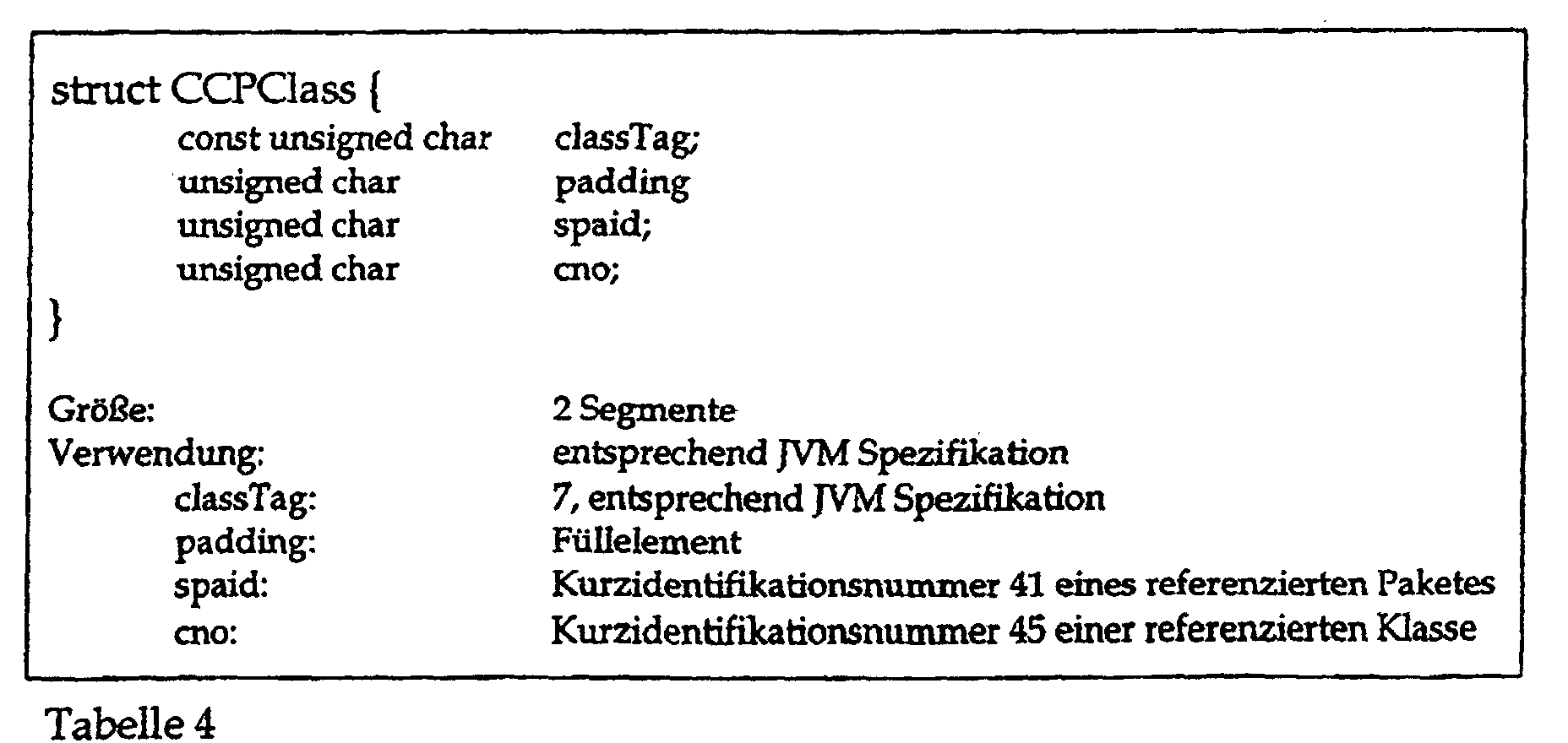
- Each packet continues for processing by the interpreter unit Short identification number 41 created The system is created Depending on the runtime environment during the loading of the package 20 into the Memory 12. The assignment of short identification numbers 41 to packet identifications 40 is recorded in a table 30, which is in each class file 22 of the package 20 added as an entry in the library section 25 becomes.
- the interpreter unit notes when loading a package 20 15 furthermore in a database 31 reserved for this purpose for a packet identification 40 actual physical location 42 of the packet in memory.
- the interpreter unit uses when processing a package 15 then the short identification number 41 for referencing the package 20 by first determining the package identification via table 30, then via the database 31 to the specified package 20 branched.
- Class files 22 are further contained within a package 20 by a simple, each numbered class identification number 45. Based on that, the interpreter unit 15 references a class file 22 when processing a package. Thus, e.g. a bytecode Name of a short and a class identification number on one Class file 22 of another package 20, the interpreter unit 15 branches first in the package 20, which the specified short identification number is assigned, and searches for the class file with the named class identification number 45th
- class files 22 The concept of using a simple numbering based Labeling system instead of textual references is also applied within class files 22. In it are on same Assign the attributes and the methods listed by number names referred to and method identification numbers as well as attribute identification numbers created.
- the names preferably include each two bytes. Part of this determines, e.g. the first four bits the access rights, the remaining bits form a number. Based on the complete Number names are referenced methods and attributes.
- a particularly suitable structure also makes it easier Referencing the entries in library section 25 realized.
- to 4 shows the new structure first Structure of a library section, like a normal one, on a textual basis Class file based on referencing.
- the library section is formed by a sequence of entries 46, the clarity are shown below each other in column form. Every entry 46, starting with an identification character 47, includes one of its contents corresponding number of bytes. The number is in the form of each entry of a byte 48 also preceded. About the resulting episode byte count is the location of each entry within the library section defines and the entries 46 can be referenced.
- the interpreter unit 15 expediently creates a table, which includes each entry indicates the position of its leading byte 47. So in the simplified Example of FIG.
- FIG. 5 shows a section of a library section structured according to the invention 25.
- the byte sequence forming library section 25 is now divided into two byte segments 50.
- all entries 46 in the library section 25 are aligned.
- the segmentation is illustrated in the form of a reproduced in two columns.
- the segments 50 are systematic characterized. In a simple manner they are, as indicated in FIG. 4, numbered.
- all references to entries in library section 25 For example there is a reference to the entry beginning with segment 5 by the Specification of the number 5.
- Apart from the modified referencing the library entries 46 usually have the same information content as it has entries in the "Constant Pool" of a JAVA "Class" file.
- the referencing principle used in library section 25 is consistently in all parts of a class file 22 outside the library section introduced. That all references to entries 46 in the library section 25 are replaced by segment positions.
- Class file further interpretation information can be added, which the results of otherwise by the interpreter unit during processing search and branch steps to be performed in a class. It makes sense to create a table, which is one in a class file referenced method indicates where the method may be was overwritten. When interpreting a recorded method must the interpreter unit then does not initially open all sub and upper classes check any overrides. It is also expedient to create one List of the static variables used in a class. Furthermore It makes sense to form a table in which the structure of the in a Package used objects is held. If there is such a table, the interpreter unit can detect objects in the memory by simple Localize the evaluation of the table quickly and physically correctly. The proposed ones Interpretation information forms one in the class file own section, which is in front of or in place of the usually not set up Attribute section 29 occurs. The establishment of interpretation information and thus the occupancy of the designated section optional.
- Table 1 shows the overall structure of a class file 22 resulting from the implementation of the measures described above in a metalanguage borrowed from the programming language “C”.
- Interfaces comply with the JVM specification arrayCCPInterfaces Size: Use: 2 bytes times the number of interfaces in library section 28 Segment index on class array, which designates the interface in the library section, according to JVM specification (interfaces [])
- noFieldInfo Size Use: 2 bytes Number of FieldInfoElement entries, according to JVM specification (field-info) array fieldInfo Size: Use: 6 bytes times the number of FieldInfo element entries
- Library section 27 noMethodInfo Size: Use: 2 bytes Number of methodinfoEle ment entries contained in library section 28 array method info Size: Use: n bytes times the number of MethodInfoElement entries contained in library section 28 Field with methodInfoElement rvImage Size: Use: 4 bytes times the number of elements Optional.
- noRvImageElements Size Use: 2 bytes Number of entries in rvImage, if 0 no rvImage.
- noSvImageElements Size Use: 2 bytes Number of entries in svImage; if 0 no svImage.
- svImage Size Use: 4 bytes times the number of entries Optional.
- noOImage Size Use: 2 bytes Number of entries in olmage; if 0 no oImage.
- oImage Size Use: 2 bytes times the number of entries Optional object image. Contains briefly abstracted information about all virtual information in order to simplify the structure of link and runtime environment structures.
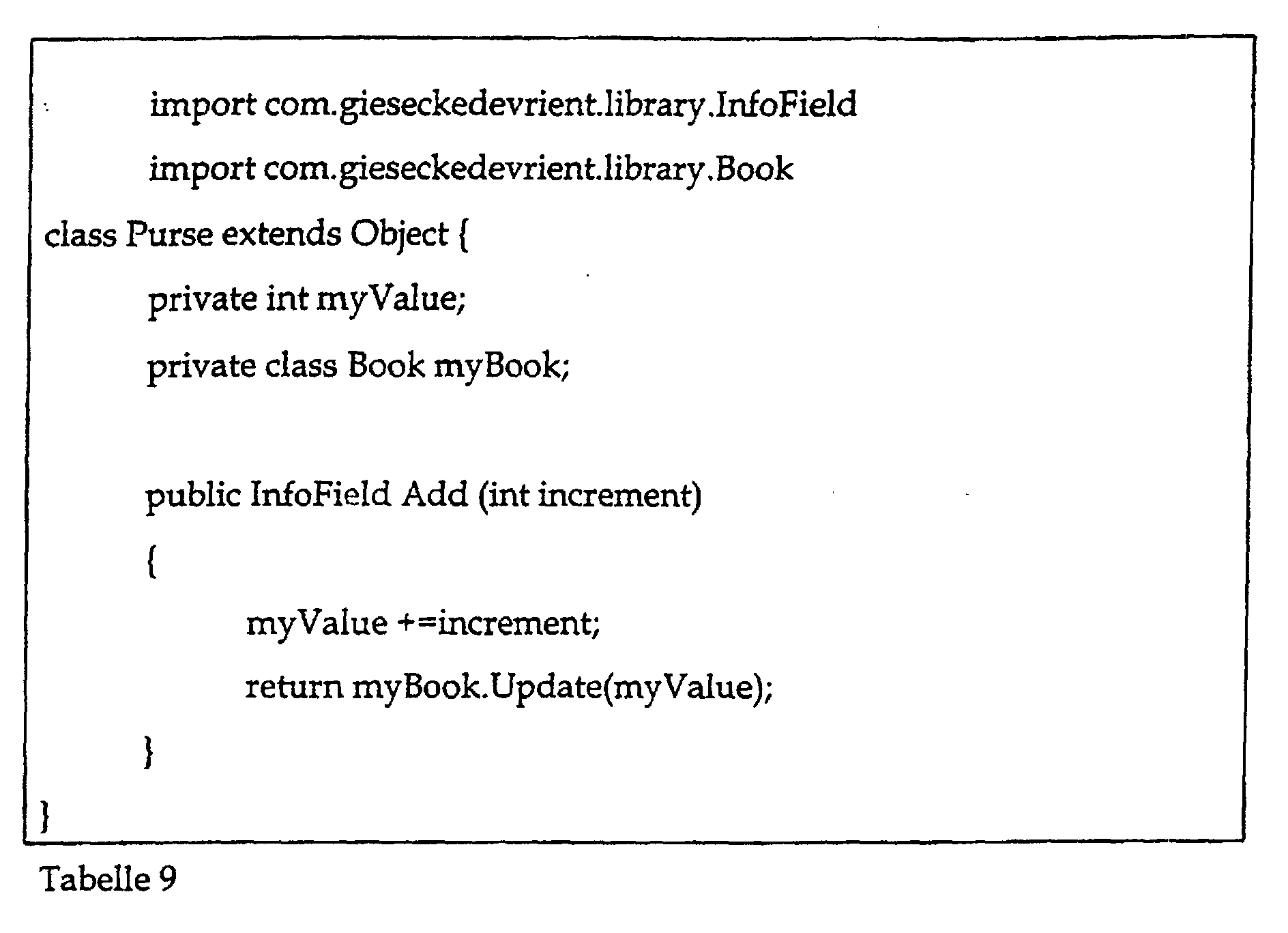
- FIGS. 6 and 7 The simplified processability of a package by an interpreter unit 15 resulting from the proposed referencing system is illustrated in FIGS. 6 and 7 using an example.
- Table 9 The simplified processability of a package by an interpreter unit 15 resulting from the proposed referencing system is illustrated in FIGS. 6 and 7 using an example.
- Table 9 The simplified processability of a package by an interpreter unit 15 resulting from the proposed referencing system is illustrated in FIGS. 6 and 7 using an example.
- Table 9 written in JAVA, which describes an addition and accordingly contains a method "Add".
- the interpreter unit 15 branches into the method section 28 the class file "Purse" to the entry of the method "Add".
- the corresponding one Byte code contains the instruction "invokevirtual" with the specification an element of the library section 25, namely the element # 55th
- the interpreter unit 15 branches accordingly to this.
- Element # 55 in turn contains two branch information, which refer to the refer to further elements # 22 or # 78 of library section 25.
- Element # 22 in turn refers to Element # 33, which is ultimately textual Form information about that specified in the source program sequence Contains class "Book".
- the first text blocks denote a package that last - "Book” - the class.
- the second item specified by item # 55 # 78 again contains two references, one to element # 58, one on item # 64.
- the first contains the text to be carried out Update method. Contains element # 64, also in textual Form, information on the return parameter, here of the "InfoField” type, and the specification of the type of the transfer parameter.
- the first blocks of text again denote a package, the letter “I” in parentheses denotes the type of the transfer parameter, here integer.
- the following Text blocks denote the return type as an instance of the in the package "com / gieseckedevrient / Iibrary" defined class "Infofield".
- the description of the return parameter 53 includes one Reference to segment # 53 of library section 25. Segment # 53 again includes in addition to a tag number 47, which indicates a class, a short identification number 41 of a package and the type of Return parameter identifying class number 45. With these instructions the program sequence is fully described. So replace in the example three branches six when using textual references. Corresponding to the smaller number of individual instructions due to the use of the number-based referencing system the storage space required for the underlying is reduced Class files.
Landscapes
- Engineering & Computer Science (AREA)
- General Physics & Mathematics (AREA)
- Software Systems (AREA)
- Physics & Mathematics (AREA)
- Theoretical Computer Science (AREA)
- Business, Economics & Management (AREA)
- General Business, Economics & Management (AREA)
- Microelectronics & Electronic Packaging (AREA)
- Computer Networks & Wireless Communication (AREA)
- Accounting & Taxation (AREA)
- Strategic Management (AREA)
- General Engineering & Computer Science (AREA)
- Devices For Executing Special Programs (AREA)
- Stored Programmes (AREA)
- Materials For Medical Uses (AREA)
- Liquid Crystal (AREA)
- Holo Graphy (AREA)
- Measurement And Recording Of Electrical Phenomena And Electrical Characteristics Of The Living Body (AREA)
- Magnetic Heads (AREA)
Description

| magicNo Größe: Verwendung: | 4 Byte Identifizierende Kennung einer Klassendatei |
| minorVersion Größe: Verwendung: | 2 Byte entsprechend JVM Spezifikation |
| majorVersion Größe: Verwendung: | 2 Byte entsprechend JVM Spezifikation |
| noCCPEntries Größe: Verwendung: | 2 Byte Anzahl der im Bibliotheksabschnitt 28 enthaltenen Segmente |
| arrayCCPEntries Größe: Verwendung: | Anzahl der Segmente des Eintrags noCCPEntries mal Segmentgröße Bibliotheksabschnitt 28 |
| noSPAIDTableElements Größe: Verwendung: | 2 Byte Anzahl der Elemente in der Kurzidentifikations nummerntabelle, entspricht der Anzahl der verwendeten Kurzidentifikationsnum mern bzw. Paketidentifikationen innerhalb einer Klassendatei |
| spaidTable Größe: Verwendung: | Anzahl der Einträge in noSPAIDTableElements mal Größe der Einze leinträge (16 Byte) Zuordnung der Kurzidentifikationsnummer zu einer Paketidentifi kationsnummer |
| accessFlags Größe: Verwendung: | 2 Byte entsprechend JVM Spezifikation |
| idxCCPSegThisClass Größe: Verwendung: | 2 Byte Segment Index auf Klasseneintrag im Bibliotheksabschnitt 28, ent sprechend JVM-Spezifikation (this_class) |
| idxCCPSegSuperClass Größe: Verwendung: | 2 Byte Segment Index auf einen Klasseneintrag im Bibliotheksabschnitt 28, analog zu JVM-Spezifikation (super_class) |
| noCCPInterfaces Größe: Verwendung: | 2 Byte Anzahl der verwendeten Interfaceklassen im Bibliotheksabschnitt 28. Interfaces entsprechen der JVM-Spezifikation |
| arrayCCPInterfaces Größe: Verwendung: | 2 Byte mal Anzahl der Interfaces im Bibliotheksabschnitt 28 Segmentindex auf Klassenarray, der das Interface im Bibliotheksabschnitt bezeichnet, entsprechend JVM-Spezifikation (interfaces[ ]) |
| noFieldInfo Größe: Verwendung: | 2 Byte Anzahl der FieldInfoElement Einträge, entsprechend JVM-Spezifikation (field-info) |
| arrayFieldInfo Größe: Verwendung: | 6 Byte mal Anzahl der FieldInfoElementeinträge Bibliotheksabschnitt 27 |
| noMethodInfo Größe: Verwendung: | 2 Byte Anzahl der im Bibliotheksabschnitt 28 enthaltenen methodinfoEle ment Einträge |
| arrayMethodInfo Größe: Verwendung: | n Byte mal Anzahl der im Bibliotheksabschnitt 28 enthaltenen MethodInfoElement Einträge Feld mit methodInfoElement |
| rvImage Größe: Verwendung: | 4 Byte mal Anzahl der Elemente Optional.Enthält in Kurzform abstrahierte Informationen über alle virtuellen Informationen, um den Aufbau notwendiger Link- und Laufzeitumgebungs strukturen zu vereinfachen. |
| noRvImageElements Größe: Verwendung: | 2 Byte Anzahl der Einträge in rvImage, falls 0 kein rvImage. |
| noSvImageElements Größe: Verwendung: | 2 Byte Anzahl der Einträge in svImage; falls 0 kein svImage. |
| svImage Größe: Verwendung: | 4 Byte mal Anzahl der Einträge Optional. Enthält in Kurzform abstrahierte Informationen über alle virtuellen Informationen, um den Aufbau notwendiger Link- und Laufzeitumgebungsstrukturen zu vereinfachen. |
| noOImage Größe: Verwendung: | 2 Byte Anzahl der Einträge in olmage; falls 0 kein oImage. |
| oImage Größe: Verwendung: | 2 Byte mal Anzahl der Einträge Optionales Objektabbild. Enthält in Kurzform abstrahierte In formationen über alle virtuellen Informationen, um Aufbau von Link- und Laufzeitumgebungs strukturen zu vereinfachen. |



Claims (9)
- Datenträger mit einer Prozessoreinrichtung (10), einer Kommunikationseinrichtung (11) zum Austausch von Daten mit einer externen Einheit, sowie einer Speichereinrichtung (12), worin wenigstens ein Applikationsprogramm sowie eine Interpretereinheit (15) zur referenzorientierten Abarbeitung des Applikationsprogrammes enthalten sind, wobei das Applikationsprogramm in Klassendateien (22) gegliedert ist, welche jeweils einen Bibliotheksabschnitt (25) aufweisen, dessen Einträge (46) bei der Abarbeitung des die Klassendatei (22) bildenden Codes benötigte unveränderliche Elemente des Interaktionskontextes enthalten,
wobei der Bibliotheksabschnitt (25) in eine Folge gleich langer, jeweils eine vorbestimmte Anzahl von Bytes umfassende Segmente (50) gegliedert ist,
wobei jeder Eintrag (46) in den Bibliotheksabschnitt (25) eine vorgegebene Zahl von Segmenten (50) umfaßt, und
wobei die Position des ersten Segmentes jedes Eintrages (46) innerhalb der Bytefolge als Referenz für den Eintrag (46) dient. - Datenträger nach Anspruch 1, wobei die Klassendateien (22) eines Applikationsprogrammes zu Paketen (20) zusammengefaßt sind.
- Datenträger nach Anspruch 2, wobei den Paketen (20) Kurzidentifikationsnummern (41) zugeordnet sind, welche zur Referenzierung eines Paketes (20) dienen.
- Datenträger nach Anspruch 1, wobei die Klassendateien (22) durch eine Nummer (45) bezeichnet sind, und die Interpretereinheit (15) bei der Abarbeitung eines Applikationsprogrammes die Nummer (45) zum Auffinden der Klassendatei (22) nutzt.
- Datenträger nach Anspruch 1, wobei die in einem Applikationsprogramm enthaltenen Methoden durch eine Nummer bezeichnet sind, und die Nummern zum Auffinden der Methode innerhalb des Applikationsprogrammes dienen.
- Datenträger nach Anspruch 1, wobei die in einem Applikationsprogramm enthaltenen Attribute numeriert sind, und die Nummern zum Auffinden der Attribute dienen.
- Datenträger nach Anspruch 3, wobei der Bibliotheksabschnitt (25) jeder Klasse eines Paketes (20) eine Tabelle (30) enthält, worin alle in dem Paket (20) vergebenen Kurzidentifikationsnummern (41) eingetragen sind.
- Datenträger nach Anspruch 1, wobei eine Klassendatei (22) einen Abschnitt aufweist, worin Informationen abgelegt sind, welche das Ergebnis einer sonst von der Interpretereinheit (15) bei der Interpretation einer Anweisung vorzunehmenden Suche und /oder Verzweigung enthalten.
- Datenträger mit einer Prozessoreinrichtung (10), einer Kommunikationseinrichtung (11) zum Austausch von Daten mit einer externen Einheit, sowie einer Speichereinrichtung (12), worin wenigstens ein Applikationsprogramm sowie eine Interpretereinheit (15) zur referenzorientierten Abarbeitung des Applikationsprogrammes enthalten sind, wobei das Applikationsprogramm in Klassendateien (22) gegliedert ist, welche jeweils einen Bibliotheksabschnitt (25) aufweisen, dessen Einträge (46) bei der Abarbeitung des die Klassendatei (22) bildenden Codes benötigte unveränderliche Elemente des Interaktionskontextes enthalten,
wobei die Klassendateien (22) eines Applikationsprogrammes zu Paketen (20) zusammengefaßt und den Paketen (20) Kurzidentifikationsnummern (41) zugeordnet sind, welche zur Referenzierung eines Paketes (20) dienen.
Applications Claiming Priority (3)
| Application Number | Priority Date | Filing Date | Title |
|---|---|---|---|
| DE19810675 | 1998-03-12 | ||
| DE19810675A DE19810675A1 (de) | 1998-03-12 | 1998-03-12 | Datenträger |
| PCT/EP1999/001636 WO1999046726A2 (de) | 1998-03-12 | 1999-03-12 | Datenträger |
Publications (2)
| Publication Number | Publication Date |
|---|---|
| EP1062630A2 EP1062630A2 (de) | 2000-12-27 |
| EP1062630B1 true EP1062630B1 (de) | 2003-05-28 |
Family
ID=7860592
Family Applications (1)
| Application Number | Title | Priority Date | Filing Date |
|---|---|---|---|
| EP99914520A Expired - Lifetime EP1062630B1 (de) | 1998-03-12 | 1999-03-12 | Datenträger |
Country Status (6)
| Country | Link |
|---|---|
| EP (1) | EP1062630B1 (de) |
| AT (1) | ATE241822T1 (de) |
| AU (1) | AU3331099A (de) |
| DE (2) | DE19810675A1 (de) |
| ES (1) | ES2196794T3 (de) |
| WO (1) | WO1999046726A2 (de) |
Families Citing this family (1)
| Publication number | Priority date | Publication date | Assignee | Title |
|---|---|---|---|---|
| DE10006291A1 (de) * | 2000-02-14 | 2001-08-30 | Giesecke & Devrient Gmbh | Computeranordnung für einen tragbaren Datenträger |
Family Cites Families (5)
| Publication number | Priority date | Publication date | Assignee | Title |
|---|---|---|---|---|
| US4787034A (en) * | 1984-11-14 | 1988-11-22 | Pal Szoke | Program access system |
| US5291601A (en) * | 1989-06-01 | 1994-03-01 | Hewlett-Packard Company | Shared libraries implemented with linking program loader |
| US5615400A (en) * | 1993-06-30 | 1997-03-25 | Apple Computer, Inc. | System for object oriented dynamic linking based upon a catalog of registered function set or class identifiers |
| DE69628073D1 (de) * | 1995-03-22 | 2003-06-18 | Sun Microsystems Inc | Vorrichtung und Verfahren zur Verwaltung von Objektsammlungen |
| US5815718A (en) * | 1996-05-30 | 1998-09-29 | Sun Microsystems, Inc. | Method and system for loading classes in read-only memory |
-
1998
- 1998-03-12 DE DE19810675A patent/DE19810675A1/de not_active Withdrawn
-
1999
- 1999-03-12 WO PCT/EP1999/001636 patent/WO1999046726A2/de not_active Ceased
- 1999-03-12 AU AU33310/99A patent/AU3331099A/en not_active Abandoned
- 1999-03-12 DE DE59905745T patent/DE59905745D1/de not_active Expired - Lifetime
- 1999-03-12 EP EP99914520A patent/EP1062630B1/de not_active Expired - Lifetime
- 1999-03-12 ES ES99914520T patent/ES2196794T3/es not_active Expired - Lifetime
- 1999-03-12 AT AT99914520T patent/ATE241822T1/de not_active IP Right Cessation
Also Published As
| Publication number | Publication date |
|---|---|
| WO1999046726A3 (de) | 1999-11-25 |
| EP1062630A2 (de) | 2000-12-27 |
| DE59905745D1 (de) | 2003-07-03 |
| AU3331099A (en) | 1999-09-27 |
| WO1999046726A2 (de) | 1999-09-16 |
| ES2196794T3 (es) | 2003-12-16 |
| ATE241822T1 (de) | 2003-06-15 |
| DE19810675A1 (de) | 1999-10-14 |
Similar Documents
| Publication | Publication Date | Title |
|---|---|---|
| DE60031370T2 (de) | Tokenbasierte verknüpfung | |
| EP0689694B1 (de) | Verfahren zur maschinellen erzeugung von nebenläufig bearbeitbaren befehlsgruppen aus einem programm für superskalare mikroprozessoren | |
| DE69723286T2 (de) | Echtzeitprogramm-sprachbeschleuniger | |
| DE69800909T2 (de) | Verfahren und Vorrichtung zur Optimierung der präzisen Speicherbereinigung, bei der Programmschleifen mit Zeiger-Feldern verwendet werden | |
| DE69801186T2 (de) | Verfahren und Vorrichtung zum Auffinden von Objekt-Zeigern, für die Erkennung/Sammlung von nicht-referenzierten Daten-Objekten | |
| DE69123775T2 (de) | Programmsteuersystem für eine tragbare Datenspeichervorrichtung | |
| DE69414387T2 (de) | Objektorientiertes dynamisches "link"-system, welches auf katalogisierte funktionen und klassen zugreift | |
| DE69622305T2 (de) | Verfahren und Gerät für einen optimierenden Kompiler | |
| DE60006410T2 (de) | Verfahren und system zum verteilen von objektorientierten rechnerprogrammen | |
| DE69707752T2 (de) | Verfahren und System zur Klassenspeicherung in einem Festspeicher | |
| DE69814174T2 (de) | Java laufzeitsystem mit veränderter sammlung von konstanten | |
| DE19536548A1 (de) | Vorrichtung und Verfahren zur vereinfachten Erzeugung von Werkzeugen zur Initialisierung und Personalisierung von und zur Kommunikation mit einer Chipkarte | |
| DE69634315T2 (de) | Verfahren und Gerät zur Verwendung eines Ladebefehls der keinen Fehler verursacht | |
| DE68929080T2 (de) | Anordnung zum Speichern von Informationen für einen Datenanbieterprozessor | |
| DE19840029C1 (de) | Verfahren zum Linken von in einen Arbeitsspeicher eines Prozessors nachgeladenen Programmodulen auf einer Chipkarte | |
| DE10103070B4 (de) | Verfahren und Prüfschaltung zum Ermitteln eines Gültigkeitsstatus für einen zeitlich zurückliegenden Loadbefehl | |
| EP1352318B1 (de) | Mikroprozessorschaltung für tragbare datenträger | |
| DE69508207T2 (de) | Speicherwörterzugangsschutzvorrichtung | |
| DE112009001892T5 (de) | Datensatz basierte Codestruktur | |
| WO2005055052A2 (de) | Java smart card chip mit für globale variablen reserviertem speicherbereich | |
| DE69729622T2 (de) | Verfahren und gerät zur evolution eines programmes in rom | |
| WO2004100090A1 (de) | Speicherverwaltung bei einem tragbaren datenträger | |
| DE102018127317B3 (de) | Verfahren und vorrichtungen zur computerimplementierten erzeugung eines ausführbaren programmcodes und zur ausführung eines ausführbaren programmcodes | |
| WO1999046726A2 (de) | Datenträger | |
| EP1543411B1 (de) | Prozessor mit expliziter angabe über zu sichernde informationen bei unterprogrammsprüngen |
Legal Events
| Date | Code | Title | Description |
|---|---|---|---|
| PUAI | Public reference made under article 153(3) epc to a published international application that has entered the european phase |
Free format text: ORIGINAL CODE: 0009012 |
|
| 17P | Request for examination filed |
Effective date: 20001012 |
|
| AK | Designated contracting states |
Kind code of ref document: A2 Designated state(s): AT BE CH CY DE DK ES FI FR GB GR IE IT LI LU MC NL PT SE |
|
| GRAH | Despatch of communication of intention to grant a patent |
Free format text: ORIGINAL CODE: EPIDOS IGRA |
|
| RIC1 | Information provided on ipc code assigned before grant |
Free format text: 7G 06F 9/44 A, 7G 06F 9/445 B, 7G 07F 7/10 B |
|
| RIN1 | Information on inventor provided before grant (corrected) |
Inventor name: MERCK, MARTIN Inventor name: FREY, THOMAS |
|
| GRAH | Despatch of communication of intention to grant a patent |
Free format text: ORIGINAL CODE: EPIDOS IGRA |
|
| GRAA | (expected) grant |
Free format text: ORIGINAL CODE: 0009210 |
|
| AK | Designated contracting states |
Designated state(s): AT BE CH CY DE DK ES FI FR GB GR IE IT LI LU MC NL PT SE |
|
| PG25 | Lapsed in a contracting state [announced via postgrant information from national office to epo] |
Ref country code: NL Free format text: LAPSE BECAUSE OF FAILURE TO SUBMIT A TRANSLATION OF THE DESCRIPTION OR TO PAY THE FEE WITHIN THE PRESCRIBED TIME-LIMIT Effective date: 20030528 Ref country code: IE Free format text: LAPSE BECAUSE OF FAILURE TO SUBMIT A TRANSLATION OF THE DESCRIPTION OR TO PAY THE FEE WITHIN THE PRESCRIBED TIME-LIMIT Effective date: 20030528 Ref country code: FI Free format text: LAPSE BECAUSE OF FAILURE TO SUBMIT A TRANSLATION OF THE DESCRIPTION OR TO PAY THE FEE WITHIN THE PRESCRIBED TIME-LIMIT Effective date: 20030528 Ref country code: CY Free format text: LAPSE BECAUSE OF FAILURE TO SUBMIT A TRANSLATION OF THE DESCRIPTION OR TO PAY THE FEE WITHIN THE PRESCRIBED TIME-LIMIT Effective date: 20030528 |
|
| REG | Reference to a national code |
Ref country code: GB Ref legal event code: FG4D Free format text: NOT ENGLISH |
|
| REG | Reference to a national code |
Ref country code: CH Ref legal event code: EP |
|
| GBT | Gb: translation of ep patent filed (gb section 77(6)(a)/1977) | ||
| REG | Reference to a national code |
Ref country code: IE Ref legal event code: FG4D Free format text: GERMAN |
|
| REF | Corresponds to: |
Ref document number: 59905745 Country of ref document: DE Date of ref document: 20030703 Kind code of ref document: P |
|
| PG25 | Lapsed in a contracting state [announced via postgrant information from national office to epo] |
Ref country code: SE Free format text: LAPSE BECAUSE OF FAILURE TO SUBMIT A TRANSLATION OF THE DESCRIPTION OR TO PAY THE FEE WITHIN THE PRESCRIBED TIME-LIMIT Effective date: 20030828 Ref country code: PT Free format text: LAPSE BECAUSE OF FAILURE TO SUBMIT A TRANSLATION OF THE DESCRIPTION OR TO PAY THE FEE WITHIN THE PRESCRIBED TIME-LIMIT Effective date: 20030828 Ref country code: GR Free format text: LAPSE BECAUSE OF FAILURE TO SUBMIT A TRANSLATION OF THE DESCRIPTION OR TO PAY THE FEE WITHIN THE PRESCRIBED TIME-LIMIT Effective date: 20030828 Ref country code: DK Free format text: LAPSE BECAUSE OF FAILURE TO SUBMIT A TRANSLATION OF THE DESCRIPTION OR TO PAY THE FEE WITHIN THE PRESCRIBED TIME-LIMIT Effective date: 20030828 |
|
| ET | Fr: translation filed | ||
| NLV1 | Nl: lapsed or annulled due to failure to fulfill the requirements of art. 29p and 29m of the patents act | ||
| REG | Reference to a national code |
Ref country code: ES Ref legal event code: FG2A Ref document number: 2196794 Country of ref document: ES Kind code of ref document: T3 |
|
| REG | Reference to a national code |
Ref country code: IE Ref legal event code: FD4D |
|
| PG25 | Lapsed in a contracting state [announced via postgrant information from national office to epo] |
Ref country code: LU Free format text: LAPSE BECAUSE OF NON-PAYMENT OF DUE FEES Effective date: 20040312 Ref country code: AT Free format text: LAPSE BECAUSE OF NON-PAYMENT OF DUE FEES Effective date: 20040312 |
|
| PG25 | Lapsed in a contracting state [announced via postgrant information from national office to epo] |
Ref country code: MC Free format text: LAPSE BECAUSE OF NON-PAYMENT OF DUE FEES Effective date: 20040331 Ref country code: LI Free format text: LAPSE BECAUSE OF NON-PAYMENT OF DUE FEES Effective date: 20040331 Ref country code: CH Free format text: LAPSE BECAUSE OF NON-PAYMENT OF DUE FEES Effective date: 20040331 Ref country code: BE Free format text: LAPSE BECAUSE OF NON-PAYMENT OF DUE FEES Effective date: 20040331 |
|
| PLBE | No opposition filed within time limit |
Free format text: ORIGINAL CODE: 0009261 |
|
| STAA | Information on the status of an ep patent application or granted ep patent |
Free format text: STATUS: NO OPPOSITION FILED WITHIN TIME LIMIT |
|
| 26N | No opposition filed |
Effective date: 20040302 |
|
| BERE | Be: lapsed |
Owner name: *GIESECKE & DEVRIENT G.M.B.H. Effective date: 20040331 |
|
| REG | Reference to a national code |
Ref country code: CH Ref legal event code: PL |
|
| PGFP | Annual fee paid to national office [announced via postgrant information from national office to epo] |
Ref country code: ES Payment date: 20090325 Year of fee payment: 11 |
|
| PGFP | Annual fee paid to national office [announced via postgrant information from national office to epo] |
Ref country code: GB Payment date: 20090324 Year of fee payment: 11 |
|
| PGFP | Annual fee paid to national office [announced via postgrant information from national office to epo] |
Ref country code: IT Payment date: 20090326 Year of fee payment: 11 |
|
| GBPC | Gb: european patent ceased through non-payment of renewal fee |
Effective date: 20100312 |
|
| PG25 | Lapsed in a contracting state [announced via postgrant information from national office to epo] |
Ref country code: IT Free format text: LAPSE BECAUSE OF NON-PAYMENT OF DUE FEES Effective date: 20100312 Ref country code: GB Free format text: LAPSE BECAUSE OF NON-PAYMENT OF DUE FEES Effective date: 20100312 |
|
| REG | Reference to a national code |
Ref country code: ES Ref legal event code: FD2A Effective date: 20110419 |
|
| PG25 | Lapsed in a contracting state [announced via postgrant information from national office to epo] |
Ref country code: ES Free format text: LAPSE BECAUSE OF NON-PAYMENT OF DUE FEES Effective date: 20110404 |
|
| PG25 | Lapsed in a contracting state [announced via postgrant information from national office to epo] |
Ref country code: ES Free format text: LAPSE BECAUSE OF NON-PAYMENT OF DUE FEES Effective date: 20100313 |
|
| REG | Reference to a national code |
Ref country code: DE Ref legal event code: R082 Ref document number: 59905745 Country of ref document: DE |
|
| REG | Reference to a national code |
Ref country code: FR Ref legal event code: PLFP Year of fee payment: 18 |
|
| PGFP | Annual fee paid to national office [announced via postgrant information from national office to epo] |
Ref country code: FR Payment date: 20160322 Year of fee payment: 18 |
|
| PGFP | Annual fee paid to national office [announced via postgrant information from national office to epo] |
Ref country code: DE Payment date: 20160331 Year of fee payment: 18 |
|
| REG | Reference to a national code |
Ref country code: DE Ref legal event code: R119 Ref document number: 59905745 Country of ref document: DE |
|
| REG | Reference to a national code |
Ref country code: FR Ref legal event code: ST Effective date: 20171130 |
|
| PG25 | Lapsed in a contracting state [announced via postgrant information from national office to epo] |
Ref country code: DE Free format text: LAPSE BECAUSE OF NON-PAYMENT OF DUE FEES Effective date: 20171003 Ref country code: FR Free format text: LAPSE BECAUSE OF NON-PAYMENT OF DUE FEES Effective date: 20170331 |