EP1061226A2 - Submergence detection power-window apparatus - Google Patents
Submergence detection power-window apparatus Download PDFInfo
- Publication number
- EP1061226A2 EP1061226A2 EP00110825A EP00110825A EP1061226A2 EP 1061226 A2 EP1061226 A2 EP 1061226A2 EP 00110825 A EP00110825 A EP 00110825A EP 00110825 A EP00110825 A EP 00110825A EP 1061226 A2 EP1061226 A2 EP 1061226A2
- Authority
- EP
- European Patent Office
- Prior art keywords
- seat
- belt
- submergence
- loosened
- window
- Prior art date
- Legal status (The legal status is an assumption and is not a legal conclusion. Google has not performed a legal analysis and makes no representation as to the accuracy of the status listed.)
- Granted
Links
Images



Classifications
-
- E—FIXED CONSTRUCTIONS
- E05—LOCKS; KEYS; WINDOW OR DOOR FITTINGS; SAFES
- E05F—DEVICES FOR MOVING WINGS INTO OPEN OR CLOSED POSITION; CHECKS FOR WINGS; WING FITTINGS NOT OTHERWISE PROVIDED FOR, CONCERNED WITH THE FUNCTIONING OF THE WING
- E05F15/00—Power-operated mechanisms for wings
- E05F15/70—Power-operated mechanisms for wings with automatic actuation
-
- E—FIXED CONSTRUCTIONS
- E05—LOCKS; KEYS; WINDOW OR DOOR FITTINGS; SAFES
- E05F—DEVICES FOR MOVING WINGS INTO OPEN OR CLOSED POSITION; CHECKS FOR WINGS; WING FITTINGS NOT OTHERWISE PROVIDED FOR, CONCERNED WITH THE FUNCTIONING OF THE WING
- E05F15/00—Power-operated mechanisms for wings
- E05F15/40—Safety devices, e.g. detection of obstructions or end positions
-
- B—PERFORMING OPERATIONS; TRANSPORTING
- B60—VEHICLES IN GENERAL
- B60J—WINDOWS, WINDSCREENS, NON-FIXED ROOFS, DOORS, OR SIMILAR DEVICES FOR VEHICLES; REMOVABLE EXTERNAL PROTECTIVE COVERINGS SPECIALLY ADAPTED FOR VEHICLES
- B60J7/00—Non-fixed roofs; Roofs with movable panels, e.g. rotary sunroofs
- B60J7/02—Non-fixed roofs; Roofs with movable panels, e.g. rotary sunroofs of sliding type, e.g. comprising guide shoes
- B60J7/04—Non-fixed roofs; Roofs with movable panels, e.g. rotary sunroofs of sliding type, e.g. comprising guide shoes with rigid plate-like element or elements, e.g. open roofs with harmonica-type folding rigid panels
- B60J7/057—Driving or actuating arrangements e.g. manually operated levers or knobs
-
- B—PERFORMING OPERATIONS; TRANSPORTING
- B60—VEHICLES IN GENERAL
- B60R—VEHICLES, VEHICLE FITTINGS, OR VEHICLE PARTS, NOT OTHERWISE PROVIDED FOR
- B60R22/00—Safety belts or body harnesses in vehicles
- B60R22/48—Control systems, alarms, or interlock systems, for the correct application of the belt or harness
-
- E—FIXED CONSTRUCTIONS
- E05—LOCKS; KEYS; WINDOW OR DOOR FITTINGS; SAFES
- E05F—DEVICES FOR MOVING WINGS INTO OPEN OR CLOSED POSITION; CHECKS FOR WINGS; WING FITTINGS NOT OTHERWISE PROVIDED FOR, CONCERNED WITH THE FUNCTIONING OF THE WING
- E05F15/00—Power-operated mechanisms for wings
- E05F15/60—Power-operated mechanisms for wings using electrical actuators
- E05F15/603—Power-operated mechanisms for wings using electrical actuators using rotary electromotors
- E05F15/665—Power-operated mechanisms for wings using electrical actuators using rotary electromotors for vertically-sliding wings
- E05F15/689—Power-operated mechanisms for wings using electrical actuators using rotary electromotors for vertically-sliding wings specially adapted for vehicle windows
- E05F15/695—Control circuits therefor
-
- E—FIXED CONSTRUCTIONS
- E05—LOCKS; KEYS; WINDOW OR DOOR FITTINGS; SAFES
- E05F—DEVICES FOR MOVING WINGS INTO OPEN OR CLOSED POSITION; CHECKS FOR WINGS; WING FITTINGS NOT OTHERWISE PROVIDED FOR, CONCERNED WITH THE FUNCTIONING OF THE WING
- E05F15/00—Power-operated mechanisms for wings
- E05F15/70—Power-operated mechanisms for wings with automatic actuation
- E05F15/72—Power-operated mechanisms for wings with automatic actuation responsive to emergency conditions, e.g. fire
-
- B—PERFORMING OPERATIONS; TRANSPORTING
- B60—VEHICLES IN GENERAL
- B60R—VEHICLES, VEHICLE FITTINGS, OR VEHICLE PARTS, NOT OTHERWISE PROVIDED FOR
- B60R22/00—Safety belts or body harnesses in vehicles
- B60R22/48—Control systems, alarms, or interlock systems, for the correct application of the belt or harness
- B60R2022/4808—Sensing means arrangements therefor
- B60R2022/4816—Sensing means arrangements therefor for sensing locking of buckle
-
- B—PERFORMING OPERATIONS; TRANSPORTING
- B60—VEHICLES IN GENERAL
- B60R—VEHICLES, VEHICLE FITTINGS, OR VEHICLE PARTS, NOT OTHERWISE PROVIDED FOR
- B60R22/00—Safety belts or body harnesses in vehicles
- B60R22/48—Control systems, alarms, or interlock systems, for the correct application of the belt or harness
- B60R2022/4808—Sensing means arrangements therefor
- B60R2022/4825—Sensing means arrangements therefor for sensing amount of belt winded on retractor
-
- E—FIXED CONSTRUCTIONS
- E05—LOCKS; KEYS; WINDOW OR DOOR FITTINGS; SAFES
- E05Y—INDEXING SCHEME ASSOCIATED WITH SUBCLASSES E05D AND E05F, RELATING TO CONSTRUCTION ELEMENTS, ELECTRIC CONTROL, POWER SUPPLY, POWER SIGNAL OR TRANSMISSION, USER INTERFACES, MOUNTING OR COUPLING, DETAILS, ACCESSORIES, AUXILIARY OPERATIONS NOT OTHERWISE PROVIDED FOR, APPLICATION THEREOF
- E05Y2400/00—Electronic control; Electrical power; Power supply; Power or signal transmission; User interfaces
- E05Y2400/10—Electronic control
- E05Y2400/44—Sensors not directly associated with the wing movement
- E05Y2400/447—Moisture or submergence sensors
-
- E—FIXED CONSTRUCTIONS
- E05—LOCKS; KEYS; WINDOW OR DOOR FITTINGS; SAFES
- E05Y—INDEXING SCHEME ASSOCIATED WITH SUBCLASSES E05D AND E05F, RELATING TO CONSTRUCTION ELEMENTS, ELECTRIC CONTROL, POWER SUPPLY, POWER SIGNAL OR TRANSMISSION, USER INTERFACES, MOUNTING OR COUPLING, DETAILS, ACCESSORIES, AUXILIARY OPERATIONS NOT OTHERWISE PROVIDED FOR, APPLICATION THEREOF
- E05Y2900/00—Application of doors, windows, wings or fittings thereof
- E05Y2900/50—Application of doors, windows, wings or fittings thereof for vehicles
- E05Y2900/53—Type of wing
- E05Y2900/55—Windows
Definitions
- the present invention relates to a submergence detection power-window apparatus. More particularly, the present invention relates to a submergence detection power-window apparatus which automatically opens an electrical-power driven opening unit such as a window, a sunroof or the like by actuation of an opening switch employed in the electrical-power driven opening unit when the car submerges under water, causing a submergence detection signal to be output provided that a seat-belt loosened-state detection signal has been activated.
- an electrical-power driven opening unit such as a window, a sunroof or the like
- a power-window apparatus employed in a car generally comprises a window operation unit provided in a door pocket on the driver-seat side or window operation units provided in door pockets on the driver-seat side and the assistant-driver-seat side respectively.
- the power-window apparatus comprises window operation units provided in door pockets on the driver-seat side, the assistant-driver-seat side and the rear-seat sides respectively.
- Each window operation unit of the commonly known power-window apparatus includes window opening/closing manual switches, a driving motor for opening and closing the window and a driving control unit.
- the window opening/closing manual switches are a window opening switch and a window closing switch.
- the driving control unit drives the driving motor in a direction according to operations of the window opening switch and the window closing switch.
- the applicant of a patent for the present invention has recently proposed a window operation unit that is employed in a power-window apparatus, installed in a door pocket on the driver-seat side and provided with a submergence detection control circuit connected to a submergence detector having a submergence detection sensor.
- the submergence detection sensor detects the flowing water, causing the submergence detector to generate a submergence detection signal and supply the signal to the submergence detection control circuit.
- the submergence detection control circuit causes the motor to be driven to open the window on the driver-seat side if the window opening switch employed in the window operation unit provided on the driver-seat side is manually operated. As a result, the window on the driver-seat side can be opened to allow the passengers including the driver to get out from the submerging car.
- the window on the driver-seat side can be opened if the window opening switch employed in the window operation unit provided on the driver-seat side is manually operated within a predetermined period following the submergence state.
- the submergence detection sensor of the submergence detector employed in the window operation unit provided on the driver-seat side detects the flowing water, causing the submergence detector to generate a submergence detection signal and supply the signal to the submergence detection control circuit.
- the window on the driver-seat side can be opened by manually operating the window opening switch employed in the window operation unit provided on the driver-seat side. If the window opening switch is not operated, on the contrary, the window is not opened so that a quick escape from the submerging car is obstructed.
- the passenger of the car normally fastens its seat belt while the car is running so that, even after the car submerges under water due to some causes, the seat belt usually remains fastened as it is.
- the window opening switch employed in the window operation unit provided on the driver-seat side is manually operated to open the window on the driver-seat side with the passenger keeps its seat belt fastened when a car with the proposed power-window apparatus described above submerges under water and the water starts flowing to the inside of the car, a large amount of water will flow to the inside of the car through the opened window. Thus, it becomes difficult to loosen the seat belt. As a result, it is too late for the passenger to escape from the submerged car.
- the submergence detection power-window apparatus is equipped with: a motor for driving opening and closing operations of an electrical-power driven opening unit; a manual switch for opening and closing the electrical-power driven opening unit; a control unit for driving the motor in an operation of the manual switch for opening and closing the electrical-power driven opening unit; and a submergence detector for detecting submergence of a car body and generating a submergence detection signal indicating detected submergence, wherein: the submergence detector comprises a pair of mutually facing electroconductive bars placed at positions adjacent to each other and detects water introduced between the electroconductive bars as an indication of submergence of the car body; and the control unit has a first means for driving the motor in a direction to open the electric-power driven opening unit upon reception of the submergence detection signal.
- the submergence detection power-window apparatus is equipped with: a motor for driving opening and closing operations of an electrical-power driven opening unit; a manual switch for opening and closing the electrical-power driven opening unit; a control unit for driving the motor in response to an operation of the manual switch for opening and closing the electrical-power driven opening unit; a submergence detector for detecting submergence of a car body and generating a submergence detection signal indicating detected submergence; and a fastened/loosened-seat-belt detector for detecting a fastened state and a loosened state of a seat belt and generating a loosened-seat-belt detection signal indicating a loosened state of the seat belt, wherein the control unit has a second means for driving the motor in a direction to open the electric-power driven opening unit upon reception of the submergence detection signal from the submergence detector and the loosened-seat-belt detection signal from
- the control unit when a car submerges under water, causing the submergence detector to generate a submergence detection signal and supply the signal to the control unit, in response to the submergence detection signal, the control unit immediately drives the motor in a direction to open the electric-power driven opening unit.
- the electric-power driven opening unit automatically opens, allowing passengers to escape from the submerging car through the opened electric-power driven opening unit safely.
- the submergence detector comprises a pair of mutually facing metallic bars placed at positions adjacent to each other, and water introduced between the metallic bars serves as a direct electrical conductor between the metallic bars, causing a submergence detection signal to be generated.
- the control unit when a car submerges under water, causing the submergence detector to generate a submergence detection signal and supply the submergence detection signal to the control unit, and if the passenger loosens a seat belt to escape from the submerging car, causing the fastened/loosened-seat-belt detector to generate a loosened-seat-belt detection signal and supply the loosened-seat-belt detection signal to the control unit, in response to the submergence detection signal, the control unit immediately drives the motor in a direction to open the electric-power driven opening unit.
- the electric-power driven opening unit automatically opens, allowing the passenger who has loosened the seat belt to escape from the submerging car through the opened electric-power driven opening unit safely and surely.
- the submergence detection power-window apparatus includes a fastened/loosened seat-belt detector which is used for generating a loosened seat-belt detection signal when a fastening unit of a seat-belt buckle is loosened.
- the passenger loosens the seat belt to start opening the electric-power driven opening unit after completing preparation for escaping from the submerging car.
- the passenger is capable of escaping from the submerging car safely.
- the submergence detection power-window apparatus includes a fastened/loosened seat-belt detection sensor provided in a fastened/loosened seat-belt detector.
- a loosened state of a seat belt can be detected with a high degree of accuracy.
- the submergence detection power-window apparatus includes a fastened/loosened seat-belt detector which generates a loosened seat-belt detection signal when the seat belt is cut.
- an electric-power driven opening unit is opened when a seat belt is cut in case the seat belt can not be loosened for some reasons.
- the passenger is capable of escaping from the submerging car.
- the electric-power driven opening unit is the window on the driver-seat side.
- the opened window is the window on the driver-seat side on which the passenger is most likely sitting.
- the passenger is capable of escaping from the submerging car quickly.
- the electric-power driven opening unit is an electric-power driven sunroof.
- the opened electric-power driven opening unit is an electric-power driven sunroof which is most likely the last component of the submerging car left above the surface of water.
- the passenger is capable of escaping from the submerging car surely.
- Fig. 1 is a block diagram showing the configuration of a first embodiment implementing a submergence detection power-window apparatus provided by the present invention.
- the submergence detection power-window apparatus implemented by the first embodiment comprises a window opening/closing switch 1, a control unit (a CPU) 2, a window opening/closing driving motor 3, a window such as the driver-seat side window 4 and a submergence detector 5.
- the window opening/closing switch 1 comprises a window opening switch and a window closing switch which are not shown in the figure.
- the control unit 2 is also connected to the window opening/closing driving motor 3 and the submergence detector 5.
- the window opening switch of the window opening/closing switch 1 When the window opening switch of the window opening/closing switch 1 is operated, the window opening/closing driving motor 3 is driven in response to the operation into rotation in a direction, namely, a window opening direction.
- the window closing switch of the window opening/closing switch 1 is operated, on the other hand, the window opening/closing driving motor 3 is driven in response to the operation into rotation in another direction, namely, a window closing direction.
- the window opening/closing driving motor 3 When a submergence detection signal is generated by the submergence detector 5, the window opening/closing driving motor 3 is driven into rotation in a direction, namely, the window opening direction, without regard to the operating states of the window closing switch and the window opening switch employed in the window opening/closing switch 1.
- the window opening/closing driving motor 3 is joined to a window such as the driver-seat side window 4 by a window driving mechanism which is not shown in the figure. With such a joint, when the window opening/closing driving motor 3 is driven into rotation in the window opening direction, the window driving mechanism moves the driver-seat side window 4 in the opening direction.
- the submergence detector 5 has a submergence detection sensor which is not shown in the figure.
- the submergence detection sensor typically comprises a pair of mutually facing metallic plates placed at positions adjacent to each other or a pair of mutually facing metallic bars placed at positions adjacent to each other.
- the submergence detector 5 generates a submergence detection signal in response to a change in current flowing through the submergence detection sensor. To put it in detail, when water flowing into the inside of the car inundates the submergence detection sensor, the current of the sensor increases, exceeding a predetermined value. At that time, a submergence detection signal is generated.
- the submergence detection power-window apparatus implemented by the first embodiment having the configuration described above operates as follows.
- the control unit 2 applies a driving voltage to the window opening/closing driving motor 3 in response to the operation of the window opening switch.
- the driving voltage drives the window opening/closing driving motor 3 into rotation in a direction to open the driver-seat side window 4.
- the rotation of the window opening/closing driving motor 3 driven in this direction is propagated to the driver-seat side window 4 through the window driving mechanism.
- the control unit 2 also applies a driving voltage to the window opening/closing driving motor 3 in response to the operation of the window closing switch.
- the driving voltage drives the window opening/closing driving motor 3 into rotation in another direction to close the driver-seat side window 4.
- the rotation of the window opening/closing driving motor 3 driven in this other direction is propagated to the driver-seat side window 4 through the window driving mechanism.
- the driver-seat side window 4 is moved in the closing direction.
- the operation to open the driver-seat side window 4 is carried out continuously as long as the window opening switch of the window opening/closing switch 1 is being operated.
- the operation to close the driver-seat side window 4 is carried out continuously as long as the window closing switch of the window opening/closing switch 1 is being operated.
- the control unit 2 applies a driving voltage driving the window opening/closing driving motor 3 into rotation in a window opening direction to the window opening/closing driving motor 3 in response to the submergence detection signal supplied thereto without regard to a driving voltage supplied to the window opening/closing driving motor 3 so far in order to drive the window opening/closing driving motor 3 into rotation in the direction.
- the rotation of the window opening/closing driving motor 3 driven in this direction is propagated to the driver-seat side window 4 through the window driving mechanism. As a result of the operation, the driver-seat side window 4 is moved in the opening direction.
- the control unit 2 when the car submerges under water, causing the submergence detector 5 to generate a submergence detection signal and supply the submergence detection signal to the control unit 2, the control unit 2 immediately drives the window opening/closing driving motor 3 into rotation in a direction of opening the driver-seat side window 4 in response to the submergence detection signal. As a result, the driver-seat side window 4 is automatically opened, allowing the passengers to escape from the submerging car through the opened window 4 safely.
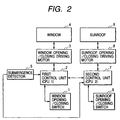
- Fig. 2 is a block diagram showing the configuration of a second embodiment implementing a submergence detection power-window apparatus provided by the present invention.
- the power-window apparatus implemented by the second embodiment comprises a sunroof opening/closing switch 6, a second control unit (a second CPU) 7, a sunroof opening/closing driving motor 8 and an electric-power driven sunroof 9 in addition to the configuration elements employed in the first embodiment.
- the control unit 2 employed in the first embodiment is referred to as a first control unit (a first CPU) 2 for the sake of convenience.
- the other configuration elements of the first embodiment which are employed in the first embodiment are denoted by the same reference numerals as those used in the first embodiment.
- the sunroof opening/closing switch 6 Connected to the second control unit 7, the sunroof opening/closing switch 6 comprises a sunroof opening switch and a sunroof closing switch which are not shown in the figure.
- the second control unit 7 is also connected to the first control unit 2, the sunroof opening/closing driving motor 8 and the submergence detector 5.
- the sunroof opening switch of the sunroof opening/closing switch 6 is operated, the sunroof opening/closing driving motor 8 is driven in response to the operation into rotation in a direction, namely, a sunroof opening direction.
- the sunroof opening/closing driving motor 8 When the sunroof closing switch of the sunroof opening/closing switch 6 is operated, on the other hand, the sunroof opening/closing driving motor 8 is driven in response to the operation into rotation in another direction, namely, a sunroof closing direction.
- a submergence detection signal is generated by the submergence detector 5
- the sunroof opening/closing driving motor 8 is driven into rotation in a direction, namely, the sunroof opening direction, to accompany the operation carried out by the first control unit 2 without regard to the operating states of the sunroof closing switch and the sunroof opening switch employed in the sunroof opening/closing switch 6.
- the sunroof opening/closing driving motor 8 is joined to the electric-motor driven sunroof 9 by a sunroof driving mechanism which is not shown in the figure. With such a joint, when the sunroof opening/closing driving motor 8 is driven into rotation in the sunroof opening direction, the sunroof driving mechanism moves the electric-power driven sunroof 9 in the opening direction. When the sunroof opening/closing driving motor 8 is driven into rotation in the sunroof closing direction, on the other hand, the sunroof driving mechanism moves the electric-power driven sunroof 9 in the closing direction.
- the submergence detection power-sunroof apparatus implemented by the second embodiment having the configuration described above operates as follows.
- the second control unit 7 applies a driving voltage to the sunroof opening/closing driving motor 8 in response to the operation of the sunroof opening switch.
- the driving voltage drives the sunroof opening/closing driving motor 8 into rotation in a direction to open the electric-power driven sunroof 9.
- the rotation of the sunroof opening/closing driving motor 8 driven in this direction is propagated to the electric-power driven sunroof 9 through the sunroof driving mechanism.
- the electric-power driven sunroof 9 is moved in the opening direction.
- the second control unit 7 When a passenger operates the sunroof closing switch of the sunroof opening/closing switch 6, the second control unit 7 also applies a driving voltage to the sunroof opening/closing driving motor 8 in response to the operation of the sunroof closing switch.
- the driving voltage drives the sunroof opening/closing driving motor 8 into rotation in another direction to close the electric-power driven sunroof 9.
- the rotation of the sunroof opening/closing driving motor 8 driven in this other direction is propagated to the electric-power driven sunroof 9 through the sunroof driving mechanism. As a result of the operation, the electric-power driven sunroof 9 is moved in the closing direction.
- the submergence detector 5 When a car submerges under water due to some causes, the submergence detector 5 generates a submergence detection signal and supplies the submergence detection signal to the second control unit 7. At that time, the second control unit 7 applies a driving voltage driving the sunroof opening/closing driving motor 8 into rotation in a certain direction to the sunroof opening/closing driving motor 8 in response to the submergence detection signal supplied thereto without regard to a driving voltage supplied to the sunroof opening/closing driving motor 8 so far in order to drive the sunroof opening/closing driving motor 8 into rotation in the direction.
- the driver-seat side window 4 is controlled and driven by the first control unit 2 to open and, at the same time, the electric-power driven sunroof 9 is controlled and driven by the second control unit 7 to open.
- the posture of the submerged car detected by the first control unit 2 and the second control unit 7 determines an electric-power driven opening unit to be opened, that is, selects the driver-seat side window 4 or the electric-power driven sunroof 9, which allows passengers to escape safely.
- the submergence detection power-sunroof apparatus implemented by the second embodiment, when the car submerges under water, causing the submergence detector 5 to generate a submergence detection signal and supply the submergence detection signal to the first control unit 2 and/or the second control unit 7, the first control unit 2 and/or the second control unit 7 immediately drive the window opening/closing driving motor 3 and/or the sunroof opening/closing driving motor 8 respectively into rotation in a direction of opening the driver-seat side window 4 and/or the electric-power driven sunroof 9 respectively in response to the submergence detection signal.
- the driver-seat side window 4 and/or the electric-power driven sunroof 9 are automatically opened, allowing the passengers to escape from the submerging car through the opened window 4 and/or the opened sunroof 9 safely and quickly.
- the driver-seat side window 4 and the electric-power driven sunroof 9 can be opened at the same time to exhibit an effect of providing a plurality of escape routes to passengers.
- only the electric-power driven sunroof 9 can be opened to exhibit an effect of providing passengers with a longer time to escape from the submerging car before the car submerges under water completely. This is because it is quite within the bounds of probability that the roof of the submerging car is a portion of the car to submerge under water last.
- Fig. 3 is a block diagram showing the configuration of a third embodiment implementing a submergence detection power-window apparatus provided by the present invention.
- the power-window apparatus implemented by the third embodiment includes a fastened/loosened seat-belt detector 10 in addition to the configuration elements employed in the first embodiment.
- Configuration elements identical with those employed in the first embodiment shown in Fig. 1 are denoted by the same reference numerals as the latter.
- the fastened/loosened seat-belt detector 10 has a fastened/loosened seat-belt detection sensor which is not shown in the figure.
- the fastened/loosened seat-belt detection sensor detects a loosened state of the seat belt
- the fastened/loosened seat-belt detector 10 generates a loosened seat-belt detection signal and supplies the signal to the control unit 2.
- the submergence detection power-sunroof apparatus implemented by the third embodiment having the configuration described above operates as follows.
- the submergence detection sensor detects the submergence, causing the submergence detector 5 to generate a submergence detection signal and supply the submergence detection signal to the control unit 2.
- the passenger loosens or unlocks its seat belt in order to escape from the submerging car.
- the loosened seat-belt detection sensor detects a loosened state of the seat belt, causing the fastened/loosened seat-belt detector 10 to generate a loosened-seat-belt detection signal and supply the loosened-seat-belt detection signal to the control unit 2.
- the control unit 2 applies a driving voltage to the window opening/closing driving motor 3 to drive the window opening/closing driving motor 3 into rotation in a direction to open the driver-seat side window 4 without regard to a driving voltage applied to the window opening/closing driving motor 3 so far.
- the force to drive the window opening/closing driving motor 3 into rotation in a direction to open the driver-seat side window 4 is propagated to the driver-seat side window 4 through the window driving mechanism. As a result, the driver-seat side window 4 is moved in the opening direction.
- the control unit 2 when a car submerges under water, causing the submergence detector 5 to generate a submergence detection signal and supply the submergence detection signal to the control unit 2, and if the passenger loosens a seat belt to escape from the submerging car, causing the fastened/loosened-seat-belt detector 10 to generate a loosened-seat-belt detection signal and supply the loosened-seat-belt detection signal to the control unit 2, in response to the submergence detection signal and the loosened-seat-belt detection signal received at the same time, the control unit 2 immediately drives the window opening/closing driving motor 3 in a direction to open the driver-seat side window 4.
- the driver-seat side window 4 remains closed till the passenger loosens the seat belt in preparation for escaping from the submerging car. That is, the driver-seat side window 4 is not opened till the seat belt is loosened so that it is possible to prevent water from flowing into the inside of the car with the passenger held back by the fastened seat belt. As a result, the driver-seat side window 4 automatically opens only after the passenger is released from the state constrained by the fastened seat belt, allowing the passenger to escape from the submerging car through the opened driver-seat side window 4 safely and quickly.
- Fig. 4 is a block diagram showing the configuration of a fourth embodiment implementing a submergence detection power-window apparatus provided by the present invention.
- the power-window apparatus implemented by the fourth embodiment includes the fastened/loosened seat-belt detector 10 employed in the third embodiment in addition to the configuration elements employed in the second embodiment.
- Configuration elements identical with those employed in the second and third embodiments shown in Figs. 2 and 3 respectively are denoted by the same reference numerals as the latter.
- the fastened/loosened seat-belt detector 10 is connected to the first control unit 2 and the second control unit 7. Much like the fastened/loosened seat-belt detector 10 employed in the third embodiment shown in Fig. 3, the fastened/loosened seat-belt detector 10 generates a loosened seat-belt detection signal when the passenger loosens the seat belt.
- the submergence detection power-sunroof apparatus implemented by the fourth embodiment having the configuration described above operates as follows.
- the submergence detection sensor detects the submergence, causing the submergence detector 5 to generate a submergence detection signal and supply the submergence detection signal to the first control unit 2 and the second control unit 7.
- the passenger loosens or unlocks its seat belt in order to escape from the submerging car.
- the loosened seat-belt detection sensor detects a loosened state of the seat belt, causing the fastened/loosened seat-belt detector 10 to generate a loosened-seat-belt detection signal and supply the loosened-seat-belt detection signal to the first control unit 2 and the second control unit 7.
- the first control unit 2 applies a driving voltage to the window opening/closing driving motor 3 to drive the window opening/closing driving motor 3 into rotation in a direction to open the driver-seat side window 4 without regard to a driving voltage applied to the window opening/closing driving motor 3 so far.
- the force to drive the window opening/closing driving motor 3 into rotation in a direction to open the driver-seat side window 4 is propagated to the driver-seat side window 4 through the window driving mechanism. As a result, the driver-seat side window 4 is moved in the opening direction.
- the second control unit 7 applies a driving voltage to the sunroof opening/closing driving motor 8 to drive the sunroof opening/closing driving motor 8 into rotation in a direction to open the electric-power driven sunroof 9 without regard to a driving voltage applied to the sunroof opening/closing driving motor 8 so far.
- the force to drive the sunroof opening/closing driving motor 8 into rotation in a direction is propagated to the electric-power driven sunroof 9 through the sunroof driving mechanism. As a result, the electric-power driven sunroof 9 is moved in the opening direction.
- the submergence detection power-window apparatus when a car submerges under water, causing the submergence detector 5 to generate a submergence detection signal and supply the submergence detection signal to the first control unit 2 and the second control unit 7, and if the passenger loosens a seat belt to escape from the submerging car, causing the fastened/loosened-seat-belt detector 10 to generate a loosened-seat-belt detection signal and supply the loosened-seat-belt detection signal to the first control unit 2 and the second control unit 7, in response to the submergence detection signal and the loosened-seat-belt detection signal received at the same time, the first control unit 2 and/or the second control unit 7 immediately drive the window opening/closing driving motor 3 and/or the sunroof opening/closing driving motor 8 in a direction to open the driver-seat side window 4 and/or the electric-power driven sunroof 9 respectively.
- the driver-seat side window 4 and/or the electric-power driven sunroof 9 automatically open only after the passenger is released from the state constrained by the fastened seat belt, allowing the passenger to escape from the submerging car through the opened driver-seat side window 4 and/or the opened electric-power driven sunroof 9 safely and quickly.
- the driver-seat side window 4 and the electric-power driven sunroof 9 can be opened at the same time to exhibit an effect of providing a plurality of escape routes to passengers.
- only the electric-power driven sunroof 9 can be opened to exhibit an effect of providing passengers with a longer time to escape from the submerging car before the car submerges under water completely. This is because it is quite within the bounds of probability that the roof of the submerging car is a portion of the car to submerge under water last.
- Figs. 5A, 5B, 5C and 5D are explanatory diagrams showing respectively 4 types of the fastened/loosened seat-belt detector 10 employed in the third and fourth embodiments.
- reference numerals 11 and 11 1 denote a seat belt and a seat belt winder respectively.
- Reference numeral 11 2 denotes the seat-belt fixed other end and reference numeral 12 denotes a seat-belt buckle.
- Reference numerals 12 1 and 13 denote a buckle receptacle and a conductor lead respectively.
- Reference numeral 14 denotes a direct-current value detection unit and reference numeral 15 denotes a direct-current power supply.
- Reference numerals 16 and 17 denote a rotational-speed detection unit and a covered metallic body respectively.
- Reference numeral 18 denotes a metal detection unit and reference numeral 19 denotes a seat-belt accommodation unit.
- Reference numeral 20 denotes an external connection conductor lead.
- the conductor lead 13 is embedded in the seat belt 11.
- the ends of the seat belt 11 are electrically connected to the seat-belt winder 11 1 and the seat-belt fixed other end 11 2 respectively.
- the direct-current power supply 15 and the direct-current value detection unit 14 are connected in series by the external connection conductor lead 20 between the seat-belt winder 11 1 and the seat-belt fixed other end 11 2 .
- the seat-belt buckle 12 and the seat-belt fixed other end 11 2 constitute a fastened/loosened seat-belt detection sensor.
- the buckle receptacle 12 1 is divided in transversal direction into 2 portions.
- the direct-current power supply 15 and the direct-current value detection unit 14 are connected in series by the external connection conductor lead 20 between the 2 portions of the buckle receptacle 12 1 .
- the seat-belt buckle 12 and the 2 portions of the buckle receptacle 12 1 constitute a fastened/loosened seat-belt detection sensor.
- the rotational-speed detection unit 16 is joined to the seat-belt winder 11 1 .
- the rotational-speed detection unit 16 and the seat-belt winder 11 1 constitute a fastened/loosened seat-belt detection sensor.
- the covered metallic body 17 is provided on the seat belt 11 at a position separated away from the seat-belt buckle 12 in such a way that, when the seat belt 11 is fastened, the covered metallic body 17 is placed outside the seat-belt accommodation unit 19 and, when the seat belt 11 is loosened, on the other hand, the covered metallic body 17 is positioned inside the seat-belt accommodation unit 19, being covered by the metal detection unit 18.
- the covered metallic body 17 is brought to the inside of the seat-belt accommodation unit 19 at a position adjacent to and facing the metal detection unit 18.
- the covered metallic body 17 and the metal detection unit 18 constitute a fastened/loosened seat-belt detection sensor.
- the fastened/loosened seat-belt detector 10 of the first type the seat-belt buckle 12, the seat-belt fixed other end 11 2 , the conductor lead 13, the direct-current value detection unit 14, the direct-current power supply 15 and the external connection conductor lead 20 form a current close loop and the direct-current value detection unit 14 detects a flow of current flowing through the loop as long as the seat belt 11 is not disengaged. At that time, the fastened/loosened seat-belt detector 10 does not generate a loosened set-belt detection signal.
- the fastened/loosened seat-belt detector 10 When the seat belt 11 is disengaged, however, the current close loop formed by the seat-belt buckle 12, the seat-belt fixed other end 11 2 , the conductor lead 13, the direct-current value detection unit 14, the direct-current power supply 15 and the external connection conductor lead 20 is broken and the direct-current value detection unit 14 thus does not detect a flow of current. At that time, the fastened/loosened seat-belt detector 10 generates a loosened set-belt detection signal to indicate that the passenger has disengaged the seat belt 11.
- the 2 portions of the buckle receptacle 12 1 , the direct-current value detection unit 14, the direct-current power supply 15 and the external connection conductor lead 20 form a current close loop and the direct-current value detection unit 14 detects a flow of current as long as the seat-belt buckle 12 is engaged with the receptacle 12 1 , that is, as long as the passenger keeps the seat belt 11 fastened. At that time, the fastened/loosened seat-belt detector 10 does not generate a loosened set-belt detection signal.
- the current close loop formed by the 2 portions of the buckle receptacle 12 1 , the direct-current value detection unit 14, the direct-current power supply 15 and the external connection conductor lead 20 is broken and the direct-current value detection unit 14 thus does not detect a flow of current.
- the fastened/loosened seat-belt detector 10 generates a loosened set-belt detection signal.
- the seat belt 11 is not wound around the seat-belt winder 11 1 as long as the seat-belt buckle 12 is engaged with the receptacle 12 1 .
- the rotational-speed detection unit 16 does not detects a rotational speed of the seat-belt winder 11 1 .
- the fastened/loosened seat-belt detector 10 does not generate a loosened set-belt detection signal, indicating that the passenger keeps the seat belt 11 fastened.
- the seat belt 11 is wound around the seat-belt winder 11 1 , causing the rotational-speed detection unit 16 to detect a rotational speed of the seat-belt winder 11 1 .
- the fastened/loosened seat-belt detector 10 generates a loosened set-belt detection signal, indicating that the passenger has loosened the seat belt 11.
- the seat belt 11 is not wound around the seat-belt winder 11 1 as long as the seat-belt buckle 12 is engaged with the receptacle 12 1 .
- the covered metallic body 17 veiled by the seat belt 11 is not detected by the metal detection unit 18.
- the fastened/loosened seat-belt detector 10 does not generate a loosened set-belt detection signal, indicating that the passenger keeps the seat belt 11 fastened.
- the seat belt 11 gets wound around the seat-belt winder 11 1 , causing the metal detection unit 18 to detect the covered metallic body 17 on the seat belt 11. At that time, the fastened/loosened seat-belt detector 10 generates a loosened set-belt detection signal, indicating that the passenger has loosened the seat belt 11.
- a loosened seat-belt detector 10 of any appropriate one of the first to fourth types can be selected for the third or fourth embodiment.
- the electric-power driven opening unit is exemplified by the driver-seat side window 4. It should be noted, however, that the electric-power driven opening unit does not have to be the driver-seat side window 4.
- the electric-power driven opening unit can be an electric-power driven sunroof or a window other than the driver-seat side window 4.
- one of the electric-power driven opening units is exemplified by the driver-seat side window 4. It should be noted, however, that one of the electric-power driven opening units does not have to be the driver-seat side window 4.
- one the electric-power driven opening units can be a window other than the driver-seat side window 4.
Landscapes
- Engineering & Computer Science (AREA)
- Mechanical Engineering (AREA)
- Automation & Control Theory (AREA)
- Business, Economics & Management (AREA)
- Emergency Management (AREA)
- Power-Operated Mechanisms For Wings (AREA)
- Window Of Vehicle (AREA)
- Automotive Seat Belt Assembly (AREA)
Abstract
Description
Claims (7)
- A submergence detection power-window apparatus comprising:a motor for driving opening and closing operations of an electrical-power driven opening unit;a manual switch for opening and closing the electrical-power driven opening unit;a control unit for driving the motor in response to an operation of the manual switch for opening and closing the electrical-power driven opening unit; anda submergence detector for detecting submergence of a car body and generating a submergence detection signal indicating detected submergence,
wherein:the submergence detector includes a pair of mutually facing electroconductive bars placed at positions adjacent to each other and detects water introduced between the electroconductive bars as an indication of submergence of the car body; andthe control unit drives the motor in a direction to open the electric-power driven opening unit upon reception of the submergence detection signal. - A submergence detection power-window apparatus according to claim 1, wherein the electric-power driven opening unit is a window on a driver-seat side.
- A submergence detection power-window apparatus according to claim 1 or 2, wherein the electric-power driven opening unit is an electric-power driven sunroof.
- A submergence detection power-window apparatus provided with:a motor for driving opening and closing operations of an electrical-power driven opening unit;a manual switch for opening and closing the electrical-power driven opening unit;a control unit for driving the motor in response to an operation of the manual switch for opening and closing the electrical-power driven opening unit;a submergence detector for detecting submergence of a car body and generating a submergence detection signal indicating detected submergence; anda fastened/loosened-seat-belt detector for detecting a fastened state and a loosened state of a seat belt and generating a loosened-seat-belt detection signal indicating a loosened state of the seat belt,
wherein:the control unit drives the motor in a direction to open the electric-power driven opening unit upon reception of the submergence detection signal from the submergence detector and the loosened-seat-belt detection signal from the fastened/loosened-seat-belt detector. - A submergence detection power-window apparatus according to claim 4, wherein the fastened/loosened-seat-belt detector generates a loosened-seat-belt detection signal when a fastening unit of a seat-belt buckle is loosened.
- A submergence detection power-window apparatus according to claim 5, wherein the fastened/loosened-seat-belt detector has a fastened/loosened-seat-belt detection sensor provided on a seat-belt winding unit.
- A submergence detection power-window apparatus according to any of claims 4 to 6, wherein the fastened/loosened-seat-belt detector generates a loosened-seat-belt detection signal when the seat belt is disengaged.
Applications Claiming Priority (2)
| Application Number | Priority Date | Filing Date | Title |
|---|---|---|---|
| JP14209099 | 1999-05-21 | ||
| JP14209099A JP3809987B2 (en) | 1999-05-21 | 1999-05-21 | Submergence detection power window device |
Publications (3)
| Publication Number | Publication Date |
|---|---|
| EP1061226A2 true EP1061226A2 (en) | 2000-12-20 |
| EP1061226A3 EP1061226A3 (en) | 2000-12-27 |
| EP1061226B1 EP1061226B1 (en) | 2004-10-20 |
Family
ID=15307208
Family Applications (1)
| Application Number | Title | Priority Date | Filing Date |
|---|---|---|---|
| EP00110825A Expired - Lifetime EP1061226B1 (en) | 1999-05-21 | 2000-05-22 | Submergence detection power-window apparatus |
Country Status (4)
| Country | Link |
|---|---|
| EP (1) | EP1061226B1 (en) |
| JP (1) | JP3809987B2 (en) |
| KR (1) | KR20010049374A (en) |
| DE (1) | DE60015015T2 (en) |
Cited By (3)
| Publication number | Priority date | Publication date | Assignee | Title |
|---|---|---|---|---|
| CN103270236A (en) * | 2010-12-24 | 2013-08-28 | 大众汽车有限公司 | Method and motor vehicle for lowering window glass |
| DE102018101033A1 (en) | 2018-01-18 | 2019-07-18 | Schaeffler Technologies AG & Co. KG | Relief system with window opening device and belt opening device, motor vehicle with release system and method for controlling a release system |
| DE102018211111A1 (en) * | 2018-07-05 | 2020-01-09 | Faurecia Innenraum Systeme Gmbh | Safety control device, vehicle interior trim part comprising a corresponding safety control device and method for controlling a closing process and / or opening process of a vehicle window |
Families Citing this family (4)
| Publication number | Priority date | Publication date | Assignee | Title |
|---|---|---|---|---|
| KR100500821B1 (en) * | 2002-11-04 | 2005-07-14 | 기아자동차주식회사 | an Auto open-and-shut method for a window and sun roof of automobile |
| JP5206430B2 (en) * | 2009-01-09 | 2013-06-12 | 株式会社デンソー | Power window control unit and power window control system |
| JP6176779B2 (en) * | 2013-08-02 | 2017-08-09 | アルプス電気株式会社 | Power window equipment |
| DE102019208065B4 (en) * | 2019-06-03 | 2021-07-22 | Conti Temic Microelectronic Gmbh | Circuit for controlling an electric motor of a window regulator of a vehicle, vehicle and method |
Family Cites Families (5)
| Publication number | Priority date | Publication date | Assignee | Title |
|---|---|---|---|---|
| JPS63247149A (en) * | 1987-04-03 | 1988-10-13 | Mazda Motor Corp | Seat belt device for automobile |
| ES2014620A6 (en) * | 1989-05-16 | 1990-07-16 | Busquets Busquets Albert | Integral automatic system for the protection and rescue of the passengers in automobiles engaged in accidents. |
| DE29617425U1 (en) * | 1996-10-08 | 1996-11-28 | Postler, Karl, Dipl.-Ing., 46562 Voerde | Installation of an automatic control of electrical locking devices on vehicles to "open" with a given time delay and negative acceleration after an accident |
| JP3427205B2 (en) * | 1997-08-18 | 2003-07-14 | 東洋電装株式会社 | Power window equipment |
| DE69906402T2 (en) * | 1998-01-23 | 2003-10-30 | Alps Electric Co., Ltd. | Power window drive device and control device therefor |
-
1999
- 1999-05-21 JP JP14209099A patent/JP3809987B2/en not_active Expired - Fee Related
-
2000
- 2000-05-19 KR KR1020000026901A patent/KR20010049374A/en not_active Ceased
- 2000-05-22 DE DE60015015T patent/DE60015015T2/en not_active Expired - Fee Related
- 2000-05-22 EP EP00110825A patent/EP1061226B1/en not_active Expired - Lifetime
Cited By (4)
| Publication number | Priority date | Publication date | Assignee | Title |
|---|---|---|---|---|
| CN103270236A (en) * | 2010-12-24 | 2013-08-28 | 大众汽车有限公司 | Method and motor vehicle for lowering window glass |
| CN103270236B (en) * | 2010-12-24 | 2016-06-22 | 大众汽车有限公司 | Method and motor vehicle for lowering window glass |
| DE102018101033A1 (en) | 2018-01-18 | 2019-07-18 | Schaeffler Technologies AG & Co. KG | Relief system with window opening device and belt opening device, motor vehicle with release system and method for controlling a release system |
| DE102018211111A1 (en) * | 2018-07-05 | 2020-01-09 | Faurecia Innenraum Systeme Gmbh | Safety control device, vehicle interior trim part comprising a corresponding safety control device and method for controlling a closing process and / or opening process of a vehicle window |
Also Published As
| Publication number | Publication date |
|---|---|
| EP1061226B1 (en) | 2004-10-20 |
| JP2000328840A (en) | 2000-11-28 |
| KR20010049374A (en) | 2001-06-15 |
| EP1061226A3 (en) | 2000-12-27 |
| DE60015015D1 (en) | 2004-11-25 |
| JP3809987B2 (en) | 2006-08-16 |
| DE60015015T2 (en) | 2006-03-09 |
Similar Documents
| Publication | Publication Date | Title |
|---|---|---|
| US6288506B1 (en) | Submergence detection power-window apparatus | |
| US6178699B1 (en) | Open/close control system for a vehicle slide door | |
| EP1686228A2 (en) | Vehicle door opening and closing apparatus | |
| EP1061226B1 (en) | Submergence detection power-window apparatus | |
| US6281647B1 (en) | Power window apparatus | |
| JPH10252349A (en) | Vehicle door opening and closing device | |
| EP1033464B1 (en) | Power window apparatus capable of opening any window by operating the corresponding window open switch from the driver seat window operation unit upon detection of flooding inside the automobile | |
| JP3756718B2 (en) | Water resistant power window device | |
| JP2007023585A (en) | Automatic opening and closing device for vehicle | |
| JP4482383B2 (en) | Automatic switchgear for vehicles | |
| JP2000328840A5 (en) | ||
| JP2008005656A (en) | Automatic opening/closing device for vehicle | |
| JPH11166358A (en) | Sliding door opening and closing device for automobile and vehicle stopping attitude determining method | |
| JP3602978B2 (en) | Submersion detection power window device | |
| JP2007023586A (en) | Automatic opening and closing device for vehicle | |
| JP5300228B2 (en) | Open / close body pinching detection device | |
| ATE553008T1 (en) | FAULT DIAGNOSIS METHOD FOR SEAT BELT SYSTEM AND SEAT BELT SYSTEM WITH FAULT DIAGNOSIS FUNCTION | |
| JP2001193349A (en) | Automatic sliding door control device | |
| JP2005194786A (en) | Automatic opening/closing device for vehicle | |
| JP3941568B2 (en) | Opening and closing control device for opening and closing body | |
| KR920004870Y1 (en) | Control device for auto door of vehicle | |
| JP2001193352A (en) | Automatic sliding door control device | |
| CN121625992A (en) | vehicle | |
| JP4292563B2 (en) | Automatic opening / closing control device for vehicle door | |
| JP2000008706A (en) | Automatic opening and closing device for sliding doors for vehicles |
Legal Events
| Date | Code | Title | Description |
|---|---|---|---|
| PUAI | Public reference made under article 153(3) epc to a published international application that has entered the european phase |
Free format text: ORIGINAL CODE: 0009012 |
|
| PUAL | Search report despatched |
Free format text: ORIGINAL CODE: 0009013 |
|
| AK | Designated contracting states |
Kind code of ref document: A2 Designated state(s): DE FR GB NL SE |
|
| AX | Request for extension of the european patent |
Free format text: AL;LT;LV;MK;RO;SI |
|
| AK | Designated contracting states |
Kind code of ref document: A3 Designated state(s): AT BE CH CY DE DK ES FI FR GB GR IE IT LI LU MC NL PT SE |
|
| AX | Request for extension of the european patent |
Free format text: AL;LT;LV;MK;RO;SI |
|
| 17P | Request for examination filed |
Effective date: 20010321 |
|
| AKX | Designation fees paid |
Free format text: DE FR GB NL SE |
|
| 17Q | First examination report despatched |
Effective date: 20031107 |
|
| GRAP | Despatch of communication of intention to grant a patent |
Free format text: ORIGINAL CODE: EPIDOSNIGR1 |
|
| GRAS | Grant fee paid |
Free format text: ORIGINAL CODE: EPIDOSNIGR3 |
|
| GRAA | (expected) grant |
Free format text: ORIGINAL CODE: 0009210 |
|
| AK | Designated contracting states |
Kind code of ref document: B1 Designated state(s): DE FR GB NL SE |
|
| PG25 | Lapsed in a contracting state [announced via postgrant information from national office to epo] |
Ref country code: NL Free format text: LAPSE BECAUSE OF FAILURE TO SUBMIT A TRANSLATION OF THE DESCRIPTION OR TO PAY THE FEE WITHIN THE PRESCRIBED TIME-LIMIT Effective date: 20041020 |
|
| REG | Reference to a national code |
Ref country code: GB Ref legal event code: FG4D |
|
| REF | Corresponds to: |
Ref document number: 60015015 Country of ref document: DE Date of ref document: 20041125 Kind code of ref document: P |
|
| PG25 | Lapsed in a contracting state [announced via postgrant information from national office to epo] |
Ref country code: SE Free format text: LAPSE BECAUSE OF FAILURE TO SUBMIT A TRANSLATION OF THE DESCRIPTION OR TO PAY THE FEE WITHIN THE PRESCRIBED TIME-LIMIT Effective date: 20050120 |
|
| NLV1 | Nl: lapsed or annulled due to failure to fulfill the requirements of art. 29p and 29m of the patents act | ||
| PGFP | Annual fee paid to national office [announced via postgrant information from national office to epo] |
Ref country code: GB Payment date: 20050512 Year of fee payment: 6 |
|
| PGFP | Annual fee paid to national office [announced via postgrant information from national office to epo] |
Ref country code: FR Payment date: 20050519 Year of fee payment: 6 |
|
| PLBE | No opposition filed within time limit |
Free format text: ORIGINAL CODE: 0009261 |
|
| STAA | Information on the status of an ep patent application or granted ep patent |
Free format text: STATUS: NO OPPOSITION FILED WITHIN TIME LIMIT |
|
| ET | Fr: translation filed | ||
| 26N | No opposition filed |
Effective date: 20050721 |
|
| PG25 | Lapsed in a contracting state [announced via postgrant information from national office to epo] |
Ref country code: GB Free format text: LAPSE BECAUSE OF NON-PAYMENT OF DUE FEES Effective date: 20060522 |
|
| GBPC | Gb: european patent ceased through non-payment of renewal fee |
Effective date: 20060522 |
|
| REG | Reference to a national code |
Ref country code: FR Ref legal event code: ST Effective date: 20070131 |
|
| PG25 | Lapsed in a contracting state [announced via postgrant information from national office to epo] |
Ref country code: FR Free format text: LAPSE BECAUSE OF NON-PAYMENT OF DUE FEES Effective date: 20060531 |
|
| PGFP | Annual fee paid to national office [announced via postgrant information from national office to epo] |
Ref country code: DE Payment date: 20080729 Year of fee payment: 9 |
|
| PG25 | Lapsed in a contracting state [announced via postgrant information from national office to epo] |
Ref country code: DE Free format text: LAPSE BECAUSE OF NON-PAYMENT OF DUE FEES Effective date: 20091201 |