EP1061164A2 - Method for manufacturing solid structural material and foundation fabric therefor - Google Patents
Method for manufacturing solid structural material and foundation fabric therefor Download PDFInfo
- Publication number
- EP1061164A2 EP1061164A2 EP00106149A EP00106149A EP1061164A2 EP 1061164 A2 EP1061164 A2 EP 1061164A2 EP 00106149 A EP00106149 A EP 00106149A EP 00106149 A EP00106149 A EP 00106149A EP 1061164 A2 EP1061164 A2 EP 1061164A2
- Authority
- EP
- European Patent Office
- Prior art keywords
- dimensional
- yarn
- woven fabric
- structural material
- divisibly
- Prior art date
- Legal status (The legal status is an assumption and is not a legal conclusion. Google has not performed a legal analysis and makes no representation as to the accuracy of the status listed.)
- Granted
Links
- 239000000463 material Substances 0.000 title claims abstract description 20
- 239000007787 solid Substances 0.000 title claims abstract description 12
- 239000004744 fabric Substances 0.000 title claims description 15
- 238000000034 method Methods 0.000 title claims description 12
- 238000004519 manufacturing process Methods 0.000 title claims description 10
- 238000003780 insertion Methods 0.000 claims abstract description 68
- 230000037431 insertion Effects 0.000 claims abstract description 68
- 239000002759 woven fabric Substances 0.000 claims abstract description 35
- 238000009941 weaving Methods 0.000 claims abstract description 18
- 238000010009 beating Methods 0.000 description 10
- 230000015572 biosynthetic process Effects 0.000 description 1
Images



Classifications
-
- D—TEXTILES; PAPER
- D03—WEAVING
- D03D—WOVEN FABRICS; METHODS OF WEAVING; LOOMS
- D03D11/00—Double or multi-ply fabrics not otherwise provided for
- D03D11/02—Fabrics formed with pockets, tubes, loops, folds, tucks or flaps
-
- D—TEXTILES; PAPER
- D03—WEAVING
- D03D—WOVEN FABRICS; METHODS OF WEAVING; LOOMS
- D03D25/00—Woven fabrics not otherwise provided for
-
- D—TEXTILES; PAPER
- D03—WEAVING
- D03D—WOVEN FABRICS; METHODS OF WEAVING; LOOMS
- D03D25/00—Woven fabrics not otherwise provided for
- D03D25/005—Three-dimensional woven fabrics
-
- D—TEXTILES; PAPER
- D03—WEAVING
- D03D—WOVEN FABRICS; METHODS OF WEAVING; LOOMS
- D03D41/00—Looms not otherwise provided for, e.g. for weaving chenille yarn; Details peculiar to these looms
- D03D41/004—Looms for three-dimensional fabrics
-
- Y—GENERAL TAGGING OF NEW TECHNOLOGICAL DEVELOPMENTS; GENERAL TAGGING OF CROSS-SECTIONAL TECHNOLOGIES SPANNING OVER SEVERAL SECTIONS OF THE IPC; TECHNICAL SUBJECTS COVERED BY FORMER USPC CROSS-REFERENCE ART COLLECTIONS [XRACs] AND DIGESTS
- Y10—TECHNICAL SUBJECTS COVERED BY FORMER USPC
- Y10S—TECHNICAL SUBJECTS COVERED BY FORMER USPC CROSS-REFERENCE ART COLLECTIONS [XRACs] AND DIGESTS
- Y10S139/00—Textiles: weaving
- Y10S139/01—Bias fabric digest
-
- Y—GENERAL TAGGING OF NEW TECHNOLOGICAL DEVELOPMENTS; GENERAL TAGGING OF CROSS-SECTIONAL TECHNOLOGIES SPANNING OVER SEVERAL SECTIONS OF THE IPC; TECHNICAL SUBJECTS COVERED BY FORMER USPC CROSS-REFERENCE ART COLLECTIONS [XRACs] AND DIGESTS
- Y10—TECHNICAL SUBJECTS COVERED BY FORMER USPC
- Y10T—TECHNICAL SUBJECTS COVERED BY FORMER US CLASSIFICATION
- Y10T442/00—Fabric [woven, knitted, or nonwoven textile or cloth, etc.]
- Y10T442/30—Woven fabric [i.e., woven strand or strip material]
- Y10T442/3179—Woven fabric is characterized by a particular or differential weave other than fabric in which the strand denier or warp/weft pick count is specified
- Y10T442/3195—Three-dimensional weave [e.g., x-y-z planes, multi-planar warps and/or wefts, etc.]
Definitions
- the present invention relates to a method for manufacturing a solid structural material using a three-dimensional five-axial woven fabric and a foundation fabric for use in this method.
- Such three-dimensional five-axial woven fabrics are expected to be applied to various fields in the future.
- the present invention is provided to expand the application of three-dimensional five-axial woven fabrics, and it is an object thereof to manufacture a solid structural material using a three-dimensional five-axial woven fabric.
- the present invention is characterized in that in weaving a three-dimensional five-axial woven fabric using a three-dimensional weaving machine, a solid structural material is manufactured by alternately driving upper and lower insertion members for inserting vertical yarns from above and below, respectively, in such a manner that each of the insertion members and a weft insertion rapier are driven with different timings, thereby forming divisibly woven sections in portions of a manufactured three-dimensional five-axial woven fabric.
- the divisibly woven sections can be formed in a longitudinal direction of the three-dimensional five-axial woven fabric by selectively driving each of the insertion members in a cross direction of the three-dimensional five-axial woven fabric in such a manner that a particular insertion member and the weft insertion rapier are driven with different timings.
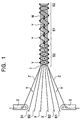
- Figure 1 shows a three-dimensional weaving machine for weaving a three-dimensional five-axial woven fabric W.
- warps X and bias yarns B1, B2 pass through a bias yarn orientation device and is then guided to a cloth fell 1, where the warps X are formed into a plurality of yarn sublayers.
- the bias yarns B1, B2 are formed into sets of two yarn sublayers each in such a manner that these yarn layers are located at opposite sides of the layers of the warps X.
- the upper and lower insertion members 2, 3 are alternately driven in such a manner that each of the insertion members 2, 3 and the weft insertion rapier are driven with different timings, thereby forming divisibly woven sections S1 in portions of the manufactured three-dimensional five-axial woven fabric W.
- a plurality of divisibly woven sections S1 are formed in the cross direction of the three-dimensional five-axial woven fabric W, and the divisibly woven sections S1 and integrally woven sections S2 are alternately formed in a longitudinal direction of the three-dimensional five-axial woven fabric W. The details will be explained below.
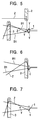
- the lower insertion member 3 passes between the bias yarns B1 and B2, between the warps X, and then between the bias yarns B1 and B2 and then elevates to insert the vertical yarn Z from below the yarn layer. Further, as shown in Figure 6, the lower insertion member 3 moves toward the cloth fell 1 and then beating is done by the lower insertion member 3. Subsequently, as shown in Figure 7, the lower insertion member 3 recedes from the cloth fell 1, and one weft Y is inserted between the yarn sublayers of the warps X.
- wefts Y are each inserted into the outside of the corresponding yarn sublayer of the bias yarns B1, B2, and one weft Y is inserted between the yarn sublayers of the warps X.
- the upper and lower insertion members 2, 3 move toward the cloth fell 1, and subsequently beating is done by the upper and lower insertion members 2, 3.
- the upper insertion member 2 elevates, while simultaneously the lower insertion member 3 lowers, whereby the upper and lower insertion members 2, 3 are removed from the yarn layer.
- the vertical yarn Z crosses the weft Y in both the upper and lower parts of the yarn layer so as to connect the wefts Y together.
- the divisibly woven section S1 in Figure 11 can be cut open along the center line C to manufacture the I beam.
Landscapes
- Engineering & Computer Science (AREA)
- Textile Engineering (AREA)
- Woven Fabrics (AREA)
- Looms (AREA)
Abstract
Description
Claims (3)
- A method for manufacturing a solid structural material characterized in that in weaving a three-dimensional five-axial woven fabric using a three-dimensional weaving machine, a solid structural material is manufactured by alternately driving upper and lower insertion members for inserting vertical yarns from above and below, respectively, in such a manner that each of the insertion members and a weft insertion rapier are driven with different timings, thereby forming divisibly woven sections in portions of a manufactured three-dimensional five-axial woven fabric.
- A method for manufacturing a solid structural material as in Claim 1, characterized in that said divisibly woven sections are formed in a longitudinal direction of the three-dimensional five-axial woven fabric by selectively driving each of the insertion members in a cross direction of the three-dimensional five-axial woven fabric in such a manner that a particular insertion member and the weft insertion rapier are driven with different timings.
- A foundation fabric for use in manufacturing a solid structural material characterized by comprising a three-dimensional five-axial woven fabric having divisibly woven sections in portions thereof.
Applications Claiming Priority (2)
| Application Number | Priority Date | Filing Date | Title |
|---|---|---|---|
| JP11163619A JP2000355849A (en) | 1999-06-10 | 1999-06-10 | Preparation of three-dimensional structural material and its base fabric |
| JP16361999 | 1999-06-10 |
Publications (3)
| Publication Number | Publication Date |
|---|---|
| EP1061164A2 true EP1061164A2 (en) | 2000-12-20 |
| EP1061164A3 EP1061164A3 (en) | 2002-06-26 |
| EP1061164B1 EP1061164B1 (en) | 2004-12-01 |
Family
ID=15777380
Family Applications (1)
| Application Number | Title | Priority Date | Filing Date |
|---|---|---|---|
| EP00106149A Expired - Lifetime EP1061164B1 (en) | 1999-06-10 | 2000-03-21 | Method for manufacturing solid structural material and foundation fabric therefor |
Country Status (4)
| Country | Link |
|---|---|
| US (2) | US6470916B1 (en) |
| EP (1) | EP1061164B1 (en) |
| JP (1) | JP2000355849A (en) |
| DE (1) | DE60016315T2 (en) |
Cited By (4)
| Publication number | Priority date | Publication date | Assignee | Title |
|---|---|---|---|---|
| EP1365051A3 (en) * | 2002-05-23 | 2004-04-07 | Murata Kikai Kabushiki Kaisha | Three-dimensional woven fabric manufacturing method and apparatus |
| WO2014101013A1 (en) * | 2012-12-26 | 2014-07-03 | 机械科学研究总院先进制造技术研究中心 | Method for preparing longitudinally reinforced composite material prefabricated member, and composite material |
| CN106637602A (en) * | 2016-12-06 | 2017-05-10 | 中材科技股份有限公司 | Multilayer three-dimensional preform asymmetrical bilateral rapier weft insertion apparatus and weft insertion method thereof |
| CN108138394A (en) * | 2015-10-15 | 2018-06-08 | 株式会社丰田自动织机 | Multilayer fabric |
Families Citing this family (21)
| Publication number | Priority date | Publication date | Assignee | Title |
|---|---|---|---|---|
| US6874543B2 (en) * | 2001-09-12 | 2005-04-05 | Lockheed Martin Corporation | Woven preform for structural joints |
| FR2840626B1 (en) * | 2002-06-06 | 2004-09-03 | Eads Launch Vehicles | METHOD FOR SELECTIVE LACING OF YARNS ON MULTIDIMENSIONAL TEXTILE PREFORMS AND DEVICE FOR IMPLEMENTING SAME |
| US7655581B2 (en) | 2005-11-17 | 2010-02-02 | Albany Engineered Composites, Inc. | Hybrid three-dimensional woven/laminated struts for composite structural applications |
| US7943535B2 (en) * | 2005-11-17 | 2011-05-17 | Albany Engineered Composites, Inc. | Hybrid three-dimensional woven/laminated struts for composite structural applications |
| CN1800464B (en) * | 2006-01-16 | 2010-11-03 | 赵祖良 | Warp-weft interleave interlayer penetration knitting machine and its weaving method |
| DE102008029405A1 (en) * | 2008-06-23 | 2009-12-24 | Gkd - Gebr. Kufferath Ag | Fabric package for use as heat storage or regenerator in stirling engine, has fabric layers provided with more than ten chaining threads or weft threads, where contact points of fabric layers are distanced from each other |
| US8859083B2 (en) * | 2008-12-30 | 2014-10-14 | Albany Engineered Composites, Inc. | Quasi-isotropic three-dimensional preform and method of making thereof |
| US8846553B2 (en) * | 2008-12-30 | 2014-09-30 | Albany Engineered Composites, Inc. | Woven preform with integral off axis stiffeners |
| FR2946999B1 (en) * | 2009-06-18 | 2019-08-09 | Safran Aircraft Engines | CMC TURBINE DISPENSER ELEMENT, PROCESS FOR MANUFACTURING SAME, AND DISPENSER AND GAS TURBINE INCORPORATING SAME. |
| US7841369B1 (en) * | 2009-11-18 | 2010-11-30 | vParadox LLC | Weaving process for production of a full fashioned woven stretch garment with load carriage capability |
| US7836917B1 (en) * | 2009-11-18 | 2010-11-23 | Paradox LLC | Weaving connectors for three dimensional textile products |
| CN101713120B (en) * | 2009-11-27 | 2011-05-04 | 天津工业大学 | Three-dimensional integral weaving method for grid type prefabricated part and product thereof |
| US9725833B2 (en) * | 2012-07-12 | 2017-08-08 | United Technologies Corporation | Woven structure and method for weaving same |
| US9290865B2 (en) * | 2012-12-26 | 2016-03-22 | Albany Engineered Composites, Inc. | Three-dimensional woven corner fitting with lap joint preforms |
| US11076664B1 (en) | 2014-09-22 | 2021-08-03 | Apple Inc. | Fabric cases for electronic devices |
| HK1252746A1 (en) | 2015-04-30 | 2019-05-31 | The North Face Apparel Corp. | Baffle constructs for insulative fill materials |
| US10550499B2 (en) * | 2017-01-19 | 2020-02-04 | Bell Helicopter Textron Inc. | Fabricating composite core with woven composite fibers |
| CN108442017B (en) * | 2018-03-06 | 2019-12-06 | 浙江英诺威纺织有限公司 | method and equipment for weaving wire-drawing inflatable cloth |
| CN108708047A (en) * | 2018-07-03 | 2018-10-26 | 武汉纺织大学 | A kind of fabric of three-dimensional compound curved surface structure |
| FR3137013B1 (en) * | 2022-06-22 | 2025-05-23 | Safran Landing Systems | Process for manufacturing a part made of composite material intended to be articulated with other parts |
| EP4428279A1 (en) * | 2023-03-10 | 2024-09-11 | Iprotex GmbH & Co. KG | Textile sheet material and process for the manufacture thereof |
Family Cites Families (14)
| Publication number | Priority date | Publication date | Assignee | Title |
|---|---|---|---|---|
| US4019540A (en) * | 1976-03-12 | 1977-04-26 | Mcdonnell Douglas Corporation | Loom for producing three dimensional weaves |
| FR2497839A1 (en) * | 1981-01-12 | 1982-07-16 | Brochier Fils J | THREE-DIMENSIONAL FABRIC FOR REINFORCING LAMINATE MATERIALS AND SHAPED ELEMENTS OBTAINED FROM SUCH A FABRIC |
| JPS6297938A (en) * | 1985-10-23 | 1987-05-07 | 敷島カンバス株式会社 | Method for weaving fabric for three-dimensional molding |
| DE3812909A1 (en) * | 1987-09-26 | 1989-04-13 | Vorwerk Co Interholding | MULTI-LAYER PRE-FORMING |
| US4958663A (en) * | 1988-08-15 | 1990-09-25 | Hitco | Woven multi-layer angle interlock fabrics having fill weaver yarns interwoven with relatively straight extending warp yarns |
| US5076330A (en) * | 1988-09-29 | 1991-12-31 | Three-D Composites Research Corporation | Three-dimensional multi-axis fabric composite materials and methods and apparatuses for making the same |
| US5080142A (en) * | 1989-04-06 | 1992-01-14 | Hitco | Integrally woven multi-apertured multi-layer angle interlock fabrics |
| JPH0823095B2 (en) * | 1989-06-06 | 1996-03-06 | 東レ株式会社 | Reinforcing fiber fabric |
| JPH0672340B2 (en) * | 1990-05-09 | 1994-09-14 | 株式会社スリーデイコンポリサーチ | Textile guiding method and device for rod type three-dimensional multi-spindle loom |
| US5085252A (en) * | 1990-08-29 | 1992-02-04 | North Carolina State University | Method of forming variable cross-sectional shaped three-dimensional fabrics |
| DE4342575A1 (en) * | 1993-10-12 | 1995-04-13 | Textilma Ag | Textile insert for the production of a fiber composite material and fiber composite material |
| US5465760A (en) * | 1993-10-25 | 1995-11-14 | North Carolina State University | Multi-layer three-dimensional fabric and method for producing |
| JP2961355B2 (en) * | 1995-03-23 | 1999-10-12 | ユニチカグラスファイバー株式会社 | Three-dimensional woven structural material and method for producing the same |
| JPH10325041A (en) | 1997-05-22 | 1998-12-08 | Murata Mach Ltd | Three-dimensional weaving machine |
-
1999
- 1999-06-10 JP JP11163619A patent/JP2000355849A/en active Pending
-
2000
- 2000-03-21 EP EP00106149A patent/EP1061164B1/en not_active Expired - Lifetime
- 2000-03-21 DE DE60016315T patent/DE60016315T2/en not_active Expired - Fee Related
- 2000-05-15 US US09/571,320 patent/US6470916B1/en not_active Expired - Fee Related
-
2002
- 2002-01-09 US US10/040,450 patent/US6886603B2/en not_active Expired - Fee Related
Cited By (7)
| Publication number | Priority date | Publication date | Assignee | Title |
|---|---|---|---|---|
| EP1365051A3 (en) * | 2002-05-23 | 2004-04-07 | Murata Kikai Kabushiki Kaisha | Three-dimensional woven fabric manufacturing method and apparatus |
| WO2014101013A1 (en) * | 2012-12-26 | 2014-07-03 | 机械科学研究总院先进制造技术研究中心 | Method for preparing longitudinally reinforced composite material prefabricated member, and composite material |
| CN108138394A (en) * | 2015-10-15 | 2018-06-08 | 株式会社丰田自动织机 | Multilayer fabric |
| EP3363938A4 (en) * | 2015-10-15 | 2018-09-26 | Kabushiki Kaisha Toyota Jidoshokki | Multilayer fabric |
| CN108138394B (en) * | 2015-10-15 | 2020-06-05 | 株式会社丰田自动织机 | Multi-layer fabric |
| US10988869B2 (en) | 2015-10-15 | 2021-04-27 | Kabushiki Kaisha Toyota Jidoshokki | Multilayer fabric |
| CN106637602A (en) * | 2016-12-06 | 2017-05-10 | 中材科技股份有限公司 | Multilayer three-dimensional preform asymmetrical bilateral rapier weft insertion apparatus and weft insertion method thereof |
Also Published As
| Publication number | Publication date |
|---|---|
| EP1061164A3 (en) | 2002-06-26 |
| DE60016315D1 (en) | 2005-01-05 |
| US6886603B2 (en) | 2005-05-03 |
| JP2000355849A (en) | 2000-12-26 |
| US20020056484A1 (en) | 2002-05-16 |
| DE60016315T2 (en) | 2005-11-24 |
| US6470916B1 (en) | 2002-10-29 |
| EP1061164B1 (en) | 2004-12-01 |
Similar Documents
| Publication | Publication Date | Title |
|---|---|---|
| EP1061164B1 (en) | Method for manufacturing solid structural material and foundation fabric therefor | |
| KR100491512B1 (en) | Woven 3d fabric material and a device for producing it | |
| US7836917B1 (en) | Weaving connectors for three dimensional textile products | |
| JP2924091B2 (en) | Three-dimensional fabric and method for producing the same | |
| US5224519A (en) | Method and apparatus for weaving a woven angle ply fabric | |
| EP1015677B1 (en) | Network-like woven 3d fabric material | |
| WO2002077340A1 (en) | High speed three-dimensional weaving method & machine | |
| JP5129256B2 (en) | System for weaving continuous angles | |
| US5327621A (en) | Method of producing fabric reinforcing matrix for composites | |
| US4231401A (en) | Fabric for papermaking machines | |
| US6733211B1 (en) | 3-D sandwich preforms and a method to provide the same | |
| CN108541280A (en) | The method of fabric, especially carpet and braided fabric | |
| US5127444A (en) | Method and apparatus for leno weaving a three dimensional fabric | |
| EP0422293A1 (en) | Woven multi-layer angle interlock fabrics and methods of making same | |
| CN104685123B (en) | Method for preparing the seam region of paper machine clothing substrate fabric | |
| EP1620587B1 (en) | Cloth designed to be provided with at least one permanent fold and method applied thereby | |
| AU2003200644B2 (en) | Open-ended base fabric for papermaking press felt and papermaking press felt | |
| US5217048A (en) | Multi-layer woven fabric with leno cross-linking warp yarns | |
| CN1079123C (en) | Woven 3D fabric material | |
| EP0182597B1 (en) | Pin seamed fabric | |
| EP0887449A1 (en) | Jacquard shadow velvet, apparatus and method for manufacturing such jacquard shadow velvet | |
| CA1279555C (en) | Method of manufacturing an insertion-type seam for making a cloth beltendless, and seaming machine | |
| EP0485911A1 (en) | Method for manufacture of extra-broad woven fabrics | |
| JPH02191743A (en) | Production of three-dimensional cloth | |
| JPH03249238A (en) | Three-dimensional woven cloth and its weaving |
Legal Events
| Date | Code | Title | Description |
|---|---|---|---|
| PUAI | Public reference made under article 153(3) epc to a published international application that has entered the european phase |
Free format text: ORIGINAL CODE: 0009012 |
|
| AK | Designated contracting states |
Kind code of ref document: A2 Designated state(s): AT BE CH CY DE DK ES FI FR GB GR IE IT LI LU MC NL PT SE |
|
| AX | Request for extension of the european patent |
Free format text: AL;LT;LV;MK;RO;SI |
|
| PUAL | Search report despatched |
Free format text: ORIGINAL CODE: 0009013 |
|
| AK | Designated contracting states |
Kind code of ref document: A3 Designated state(s): AT BE CH CY DE DK ES FI FR GB GR IE IT LI LU MC NL PT SE |
|
| AX | Request for extension of the european patent |
Free format text: AL;LT;LV;MK;RO;SI |
|
| 17P | Request for examination filed |
Effective date: 20020916 |
|
| AKX | Designation fees paid |
Designated state(s): DE FR IT |
|
| GRAP | Despatch of communication of intention to grant a patent |
Free format text: ORIGINAL CODE: EPIDOSNIGR1 |
|
| RIN1 | Information on inventor provided before grant (corrected) |
Inventor name: SHINYA, MASHIRO,C/O NAGOYA AEROSPACE SYS.WORKS Inventor name: NISHIYAMA, SHIGERU,C/O NAGOYA AEROSPACE SYS.WORKS Inventor name: UCHIDA, HIROSHI |
|
| GRAS | Grant fee paid |
Free format text: ORIGINAL CODE: EPIDOSNIGR3 |
|
| GRAA | (expected) grant |
Free format text: ORIGINAL CODE: 0009210 |
|
| AK | Designated contracting states |
Kind code of ref document: B1 Designated state(s): DE FR IT |
|
| REG | Reference to a national code |
Ref country code: IE Ref legal event code: FG4D |
|
| REF | Corresponds to: |
Ref document number: 60016315 Country of ref document: DE Date of ref document: 20050105 Kind code of ref document: P |
|
| PGFP | Annual fee paid to national office [announced via postgrant information from national office to epo] |
Ref country code: FR Payment date: 20050318 Year of fee payment: 6 |
|
| PGFP | Annual fee paid to national office [announced via postgrant information from national office to epo] |
Ref country code: DE Payment date: 20050330 Year of fee payment: 6 |
|
| PLBE | No opposition filed within time limit |
Free format text: ORIGINAL CODE: 0009261 |
|
| STAA | Information on the status of an ep patent application or granted ep patent |
Free format text: STATUS: NO OPPOSITION FILED WITHIN TIME LIMIT |
|
| ET | Fr: translation filed | ||
| 26N | No opposition filed |
Effective date: 20050902 |
|
| PGFP | Annual fee paid to national office [announced via postgrant information from national office to epo] |
Ref country code: IT Payment date: 20060331 Year of fee payment: 7 |
|
| PG25 | Lapsed in a contracting state [announced via postgrant information from national office to epo] |
Ref country code: DE Free format text: LAPSE BECAUSE OF NON-PAYMENT OF DUE FEES Effective date: 20061003 |
|
| REG | Reference to a national code |
Ref country code: FR Ref legal event code: ST Effective date: 20061130 |
|
| PG25 | Lapsed in a contracting state [announced via postgrant information from national office to epo] |
Ref country code: FR Free format text: LAPSE BECAUSE OF NON-PAYMENT OF DUE FEES Effective date: 20060331 |
|
| PG25 | Lapsed in a contracting state [announced via postgrant information from national office to epo] |
Ref country code: IT Free format text: LAPSE BECAUSE OF NON-PAYMENT OF DUE FEES Effective date: 20070321 |