EP1061103A2 - Heterocyclic compounds and their use as polymer colorant - Google Patents
Heterocyclic compounds and their use as polymer colorant Download PDFInfo
- Publication number
- EP1061103A2 EP1061103A2 EP00810527A EP00810527A EP1061103A2 EP 1061103 A2 EP1061103 A2 EP 1061103A2 EP 00810527 A EP00810527 A EP 00810527A EP 00810527 A EP00810527 A EP 00810527A EP 1061103 A2 EP1061103 A2 EP 1061103A2
- Authority
- EP
- European Patent Office
- Prior art keywords
- formula
- colorant
- alkyl
- toners
- polymer
- Prior art date
- Legal status (The legal status is an assumption and is not a legal conclusion. Google has not performed a legal analysis and makes no representation as to the accuracy of the status listed.)
- Withdrawn
Links
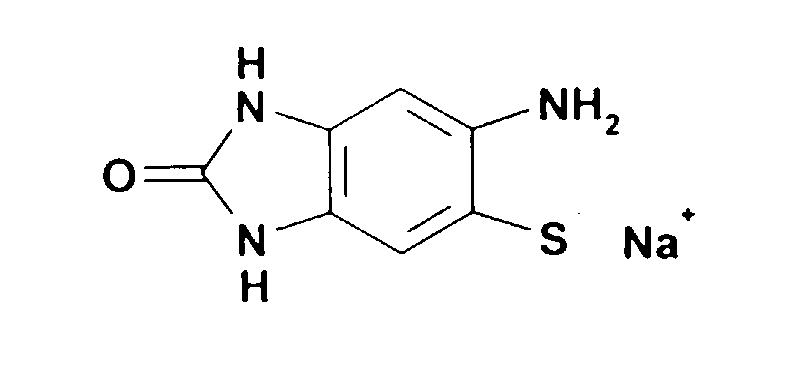
- RVHZELROPUNHHU-UHFFFAOYSA-N Nc(c(S)c1)cc(N2)c1NC2=O Chemical compound Nc(c(S)c1)cc(N2)c1NC2=O RVHZELROPUNHHU-UHFFFAOYSA-N 0.000 description 1
Classifications
-
- C—CHEMISTRY; METALLURGY
- C09—DYES; PAINTS; POLISHES; NATURAL RESINS; ADHESIVES; COMPOSITIONS NOT OTHERWISE PROVIDED FOR; APPLICATIONS OF MATERIALS NOT OTHERWISE PROVIDED FOR
- C09B—ORGANIC DYES OR CLOSELY-RELATED COMPOUNDS FOR PRODUCING DYES, e.g. PIGMENTS; MORDANTS; LAKES
- C09B59/00—Artificial dyes of unknown constitution
-
- C—CHEMISTRY; METALLURGY
- C09—DYES; PAINTS; POLISHES; NATURAL RESINS; ADHESIVES; COMPOSITIONS NOT OTHERWISE PROVIDED FOR; APPLICATIONS OF MATERIALS NOT OTHERWISE PROVIDED FOR
- C09D—COATING COMPOSITIONS, e.g. PAINTS, VARNISHES OR LACQUERS; FILLING PASTES; CHEMICAL PAINT OR INK REMOVERS; INKS; CORRECTING FLUIDS; WOODSTAINS; PASTES OR SOLIDS FOR COLOURING OR PRINTING; USE OF MATERIALS THEREFOR
- C09D11/00—Inks
- C09D11/30—Inkjet printing inks
- C09D11/32—Inkjet printing inks characterised by colouring agents
- C09D11/328—Inkjet printing inks characterised by colouring agents characterised by dyes
-
- C—CHEMISTRY; METALLURGY
- C09—DYES; PAINTS; POLISHES; NATURAL RESINS; ADHESIVES; COMPOSITIONS NOT OTHERWISE PROVIDED FOR; APPLICATIONS OF MATERIALS NOT OTHERWISE PROVIDED FOR
- C09B—ORGANIC DYES OR CLOSELY-RELATED COMPOUNDS FOR PRODUCING DYES, e.g. PIGMENTS; MORDANTS; LAKES
- C09B21/00—Thiazine dyes
-
- C—CHEMISTRY; METALLURGY
- C09—DYES; PAINTS; POLISHES; NATURAL RESINS; ADHESIVES; COMPOSITIONS NOT OTHERWISE PROVIDED FOR; APPLICATIONS OF MATERIALS NOT OTHERWISE PROVIDED FOR
- C09D—COATING COMPOSITIONS, e.g. PAINTS, VARNISHES OR LACQUERS; FILLING PASTES; CHEMICAL PAINT OR INK REMOVERS; INKS; CORRECTING FLUIDS; WOODSTAINS; PASTES OR SOLIDS FOR COLOURING OR PRINTING; USE OF MATERIALS THEREFOR
- C09D5/00—Coating compositions, e.g. paints, varnishes or lacquers, characterised by their physical nature or the effects produced; Filling pastes
- C09D5/03—Powdery paints
- C09D5/033—Powdery paints characterised by the additives
- C09D5/035—Coloring agents, e.g. pigments
-
- G—PHYSICS
- G03—PHOTOGRAPHY; CINEMATOGRAPHY; ANALOGOUS TECHNIQUES USING WAVES OTHER THAN OPTICAL WAVES; ELECTROGRAPHY; HOLOGRAPHY
- G03G—ELECTROGRAPHY; ELECTROPHOTOGRAPHY; MAGNETOGRAPHY
- G03G9/00—Developers
- G03G9/08—Developers with toner particles
- G03G9/09—Colouring agents for toner particles
- G03G9/0906—Organic dyes
-
- G—PHYSICS
- G03—PHOTOGRAPHY; CINEMATOGRAPHY; ANALOGOUS TECHNIQUES USING WAVES OTHER THAN OPTICAL WAVES; ELECTROGRAPHY; HOLOGRAPHY
- G03G—ELECTROGRAPHY; ELECTROPHOTOGRAPHY; MAGNETOGRAPHY
- G03G9/00—Developers
- G03G9/08—Developers with toner particles
- G03G9/09—Colouring agents for toner particles
- G03G9/0906—Organic dyes
- G03G9/0908—Anthracene dyes
-
- G—PHYSICS
- G03—PHOTOGRAPHY; CINEMATOGRAPHY; ANALOGOUS TECHNIQUES USING WAVES OTHER THAN OPTICAL WAVES; ELECTROGRAPHY; HOLOGRAPHY
- G03G—ELECTROGRAPHY; ELECTROPHOTOGRAPHY; MAGNETOGRAPHY
- G03G9/00—Developers
- G03G9/08—Developers with toner particles
- G03G9/09—Colouring agents for toner particles
- G03G9/0906—Organic dyes
- G03G9/0916—Quinoline; Polymethine dyes
-
- G—PHYSICS
- G03—PHOTOGRAPHY; CINEMATOGRAPHY; ANALOGOUS TECHNIQUES USING WAVES OTHER THAN OPTICAL WAVES; ELECTROGRAPHY; HOLOGRAPHY
- G03G—ELECTROGRAPHY; ELECTROPHOTOGRAPHY; MAGNETOGRAPHY
- G03G9/00—Developers
- G03G9/08—Developers with toner particles
- G03G9/09—Colouring agents for toner particles
- G03G9/0906—Organic dyes
- G03G9/092—Quinacridones
Definitions
- the present invention relates to colorants for the mass coloring of polymers.
- mass coloring of polar polymers examples being polyamides, polyesters, polycarbonates and ABS
- stringent requirements in terms of their heat stability and light fastness are expected from the dyes used.
- the object of the present invention is, therefore, to provide heat-stable, light-fast and readily polymer-soluble colorants.
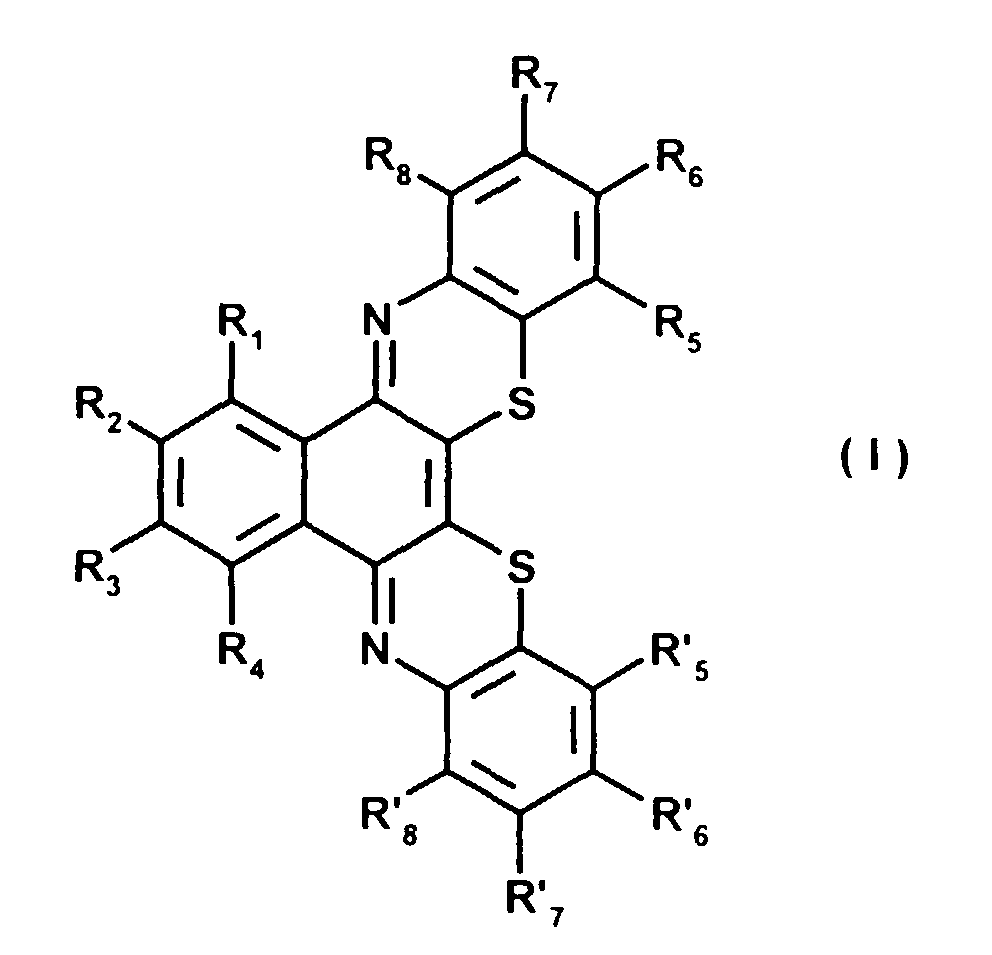
- the invention therefore, relates to the use as a polymer-soluble colorant of a compound of the formula (I) in which R 1 , R 2 , R 3 , R 4 , R 5 , R 6 , R 7 , R 8 , R' 5 , R' 6 , R' 7 , R' 8 are hydrogen, halogen, hydroxy, - NO 2 , -CN, -CF 3 , -CONH 2 , C 1-12 alkyl, phenyl, naphthyl, phenanthryl, anthryl, R 9 R 10 N-, R 9 -O- or R 9 -S-, -CONHR 10 , -CONR 9 R 10 in which R 9 and R 10 are C 1 -C 6 -alkyl, C 6 -C 10 -aryl, (C 6 -C 10 )-aryl-(C 1 -C 6 )-alkyl or (C 1 -C 6 )-alkyl-(C 6 -C
- Preferred compounds of the formula (I) are those in which each R 1 , R 2 , R 3 , R 4 is hydrogen, halogen, methyl or nitro.
- Novel compounds according to the invention have the structure of formula (I) in which at least one of the substitutents R 1 , R 2 , R 3 , R 4 , R 5 , R 6 , R 7 , R 8 , R' 5 , R' 6 , R' 7 or R' 8 has the meaning -CN, -CF 3 , -CONH 2 , phenyl, naphthyl, phenanthryl, anthryl, R 9 R 10 N-, -CONHR 10 or -CONR 9 R 10 as defined above, as well as the compounds where two adjacent groups form an isocyclic or heterocyclic group.
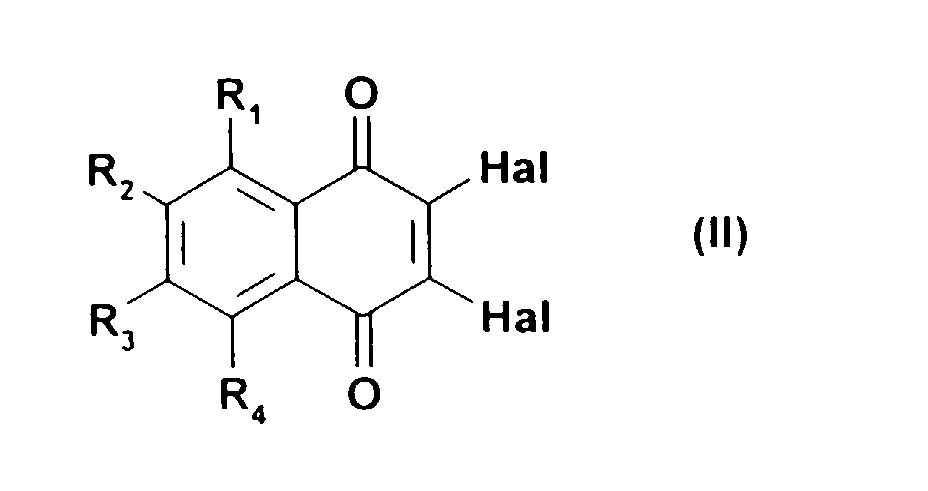
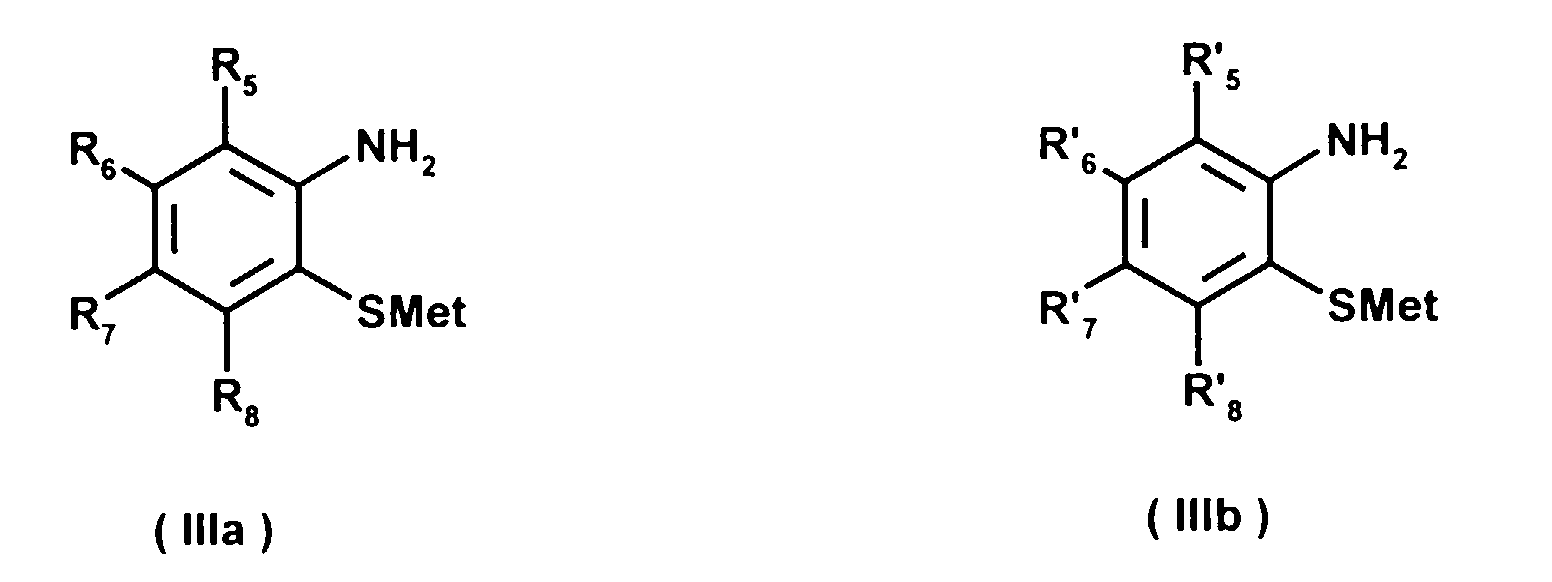
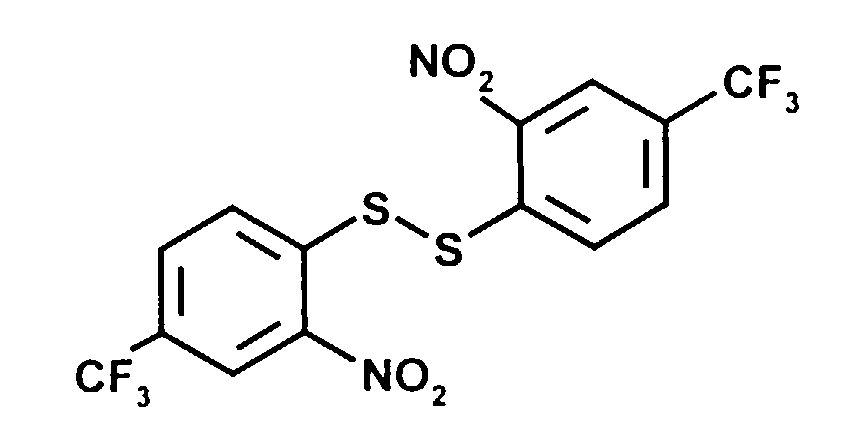
- the present invention also provides a process for preparing the novel compounds of the formula (I) as defined above, characterized in that a naphtoquinone of the formula (II) in which Hal is halogen, preferably Cl or Br, is condensed with compounds of the formula (Illa) and (Illb) in which Met is hydrogen, Na + , K + or Zn 2+ .
- Condensation can be conducted without solvent in the melt at temperatures, for instance, of between 150°C and 300°C, preferably up to 250°C, or in an inert solvent at temperatures between 25°C and 300°C, preferably between 100° and 250°C, in the presence or absence of a catalyst, at atmospheric pressure or under pressure.
- suitable solvents are relatively high-boiling aliphatic or aromatic, substituted or unsubstituted hydrocarbons, examples being xylene (mixture), biphenyl, nitrobenzene, chlorobenzenes, chloronaphthalene, glycol ethers, organic acids and acid amides, especially dimethylformamide, dimethylacetamide or N-methyl-pyrrolidone.
- catalysts examples include inorganic or organic acids, such as hydrochloric or sulphuric acid, benzenesulphonic, toluenesulphonic acid, or acetic acid.
- organic acids such as hydrochloric or sulphuric acid, benzenesulphonic, toluenesulphonic acid, or acetic acid.
- the salts of organic acids such as sodium or potassium acetate, are in many cases also suitable as catalysts.
- the compound of formula (IV) is not heat stable in polyester or polyamides
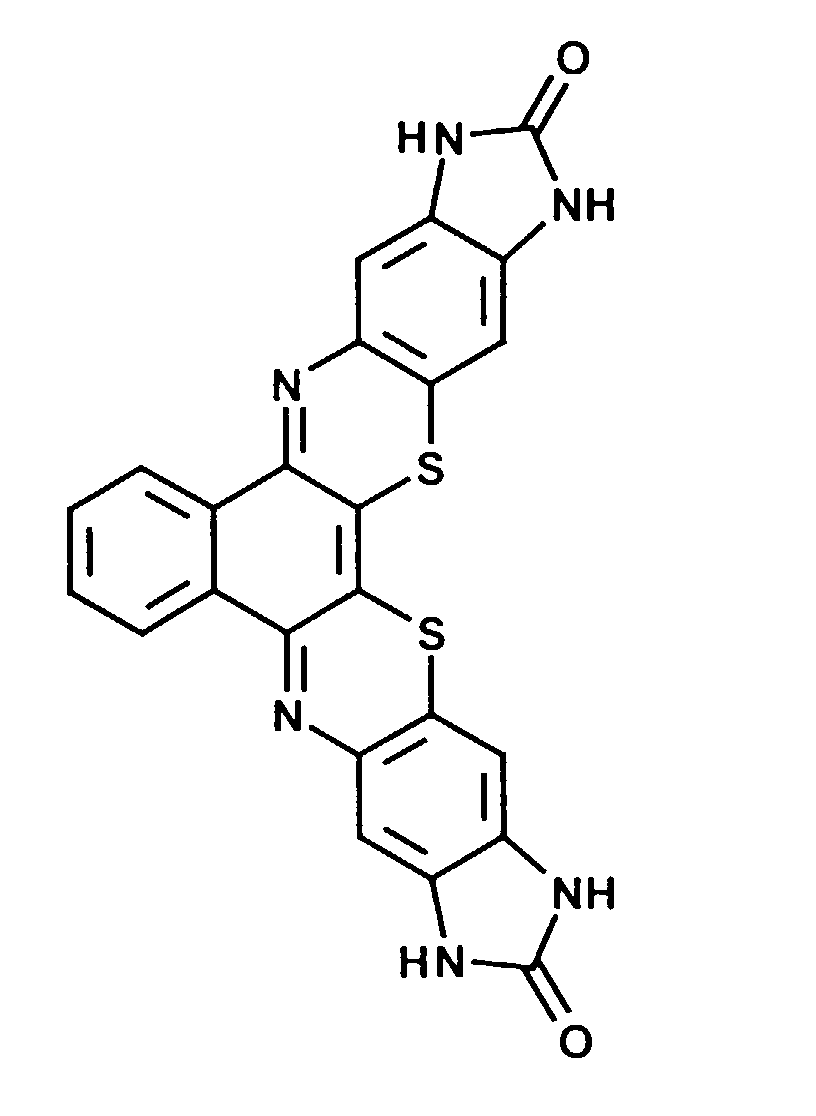
- the compound of formula (V) for example is heat stable in polyamide (up to 300°C) and also in polyester up to 320°C.
- the compound of formula (V) has also a very good light fastness in polyester.
- the compounds of the invention are eminently suitable for the coloring of melts of synthetic polar polymers such as, for example, ABS, polyester, polycarbonate or polyamides.
- Polyamides are, for example, polycondensation products or addition polymerization products of dicarboxylic acids and diamines, e.g. of adipic acid and hexamethylenediamine, of lactams, e.g. ⁇ -caprolactam, or of aminocarboxylic acids, e.g. ⁇ -aminoundecanoic acid.
- the polyamide melt mixed with the pigment is brought into its final form by conventional methods - for example, in melt spinning, injection molding, extrusion or film blowing machines.
- Some of the dyes of formula (I) give a fluorescent coloration in synthetic polar polymers such as, for example, ABS, polyester, polycarbonate or polyamides
- the dyes of the formula (I) are extremely stable to the heat stress which is necessarily part of the coloring of synthetic polyamides, and the substrates mass-colored with them also display excellent fastness properties, especially light fastness. Their high polymer-solubility is particularly noteworthy.
- the compounds of the formula (I) are also suitable as colorants in electrophotographic toners and developers, such as one- or two-component powder toners (also called one- or two-component developers), magnetic toners, liquid toners, polymerization toners and specialty toners (literature: L.B. Schein, "Electrophotography and Development Physics”; Springer Series in Electrophysics 14, Springer Verlag, 2 nd Edition, 1992).
- Typical toner binders are addition polymerization, polyaddition and polycondensation resins, such as styrene, styrene-acrylate, styrene-butadiene, acrylate, polyester and phenol-epoxy resins, polysulphones, polyurethanes, individually or in combination, and also polyethylene and polypropylene, which may comprise further constituents, such as charge control agents, waxes or flow assistants, or may be modified subsequently with these additives.
- polyaddition and polycondensation resins such as styrene, styrene-acrylate, styrene-butadiene, acrylate, polyester and phenol-epoxy resins, polysulphones, polyurethanes, individually or in combination, and also polyethylene and polypropylene, which may comprise further constituents, such as charge control agents, waxes or flow assistants, or may be modified subsequently with these additives.
- the compounds of the formula (I) are suitable, furthermore, as colorants in powders and powder coating materials, especially in triboelectrically or electrokinetically sprayable powder coating materials which are used for the surface coating of articles made, for example, from metal, wood, plastic, glass, ceramic, concrete, textile material, paper or rubber (J.F. Hughes, "Electrostatics Powder Coating” Research Studies, John Wiley & Sons, 1984).
- Powder coating resins that are typically employed are epoxy resins, carboxyl- and hydroxyl-containing polyester resins, polyurethane resins and acrylic resins, together with customary hardeners. Combinations of resins are also used. For example, epoxy resins are frequently employed in combination with carboxyl- and hydroxyl-containing polyester resins.
- Typical hardener components are, for example, acid anhydrides, imidazoles and also dicyanodiamide and its derivatives, blocked isocyanates, bisacylurethanes, phenolic and melamine resins, triglycidyl isocyanurates, oxazolines and dicarboxylic acids.
- the compounds of the formula (I) are suitable as colorants in ink-jet inks, both aqueous and non-aqueous, and in those inks which operate in accordance with the hot-melt process.
- this compound When applied in polyester, this compound gives a very bright magenta transparent color.
- this compound When applied in polyester, this compound gives a very bright magenta transparent color.
- this compound When applied in polyester, this compound gives a very reddish violet transparent color.
- 100 parts of polycaprolactam in the form of a powder are mixed with 0.1 and with 1.0 part respectively of the dye from Example 2 in powder form in a drum mixer. After a short time, the powder is uniformly distributed and adheres to the granules. After about 10 minutes, the mixture is dried at 120°C for 16 hours, transferred to a melt spinning machine and following a residence time of about 8 minutes is spun to fibers at 275-280°C under a nitrogen atmosphere. The magenta-colored fibers are extremely lightfast.
Landscapes
- Chemical & Material Sciences (AREA)
- Physics & Mathematics (AREA)
- General Physics & Mathematics (AREA)
- Organic Chemistry (AREA)
- Wood Science & Technology (AREA)
- Materials Engineering (AREA)
- Engineering & Computer Science (AREA)
- Life Sciences & Earth Sciences (AREA)
- Compositions Of Macromolecular Compounds (AREA)
- Developing Agents For Electrophotography (AREA)
- Inks, Pencil-Leads, Or Crayons (AREA)
- Nitrogen And Oxygen Or Sulfur-Condensed Heterocyclic Ring Systems (AREA)
- Liquid Developers In Electrophotography (AREA)
- Addition Polymer Or Copolymer, Post-Treatments, Or Chemical Modifications (AREA)
- Paints Or Removers (AREA)
Abstract

are eminently suitable for the mass coloring of polymers, in particular polar polymers, for coloring toners, powders and powder coating materials as well as for coloring ink-jet inks.
Description
is condensed with compounds of the formula (Illa) and (Illb)





Claims (11)
- Use as a polymer-soluble colorant of a compound of the formula:where R1, R2, R3, R4, R5, R6, R7, R8, R'5, R'6, R'7, R'8 are hydrogen, halogen, hydroxy, -NO2, -CN, -CF3, -CONH2, C1-12alkyl, phenyl, naphthyl, phenanthryl, anthryl, R9R10N-, R9-O- or R9-S-, -CONHR10, -CONR9R10 in which R9 and R10 are C1-C6-alkyl, C6-C10-aryl, (C6-C10)-aryl-(C1-C6)-alkyl or (C1-C6)-alkyl-(C6-C10)-aryl, in which the alkyl and/or aryl radicals can optionally be substituted by hydroxyl, C1-C6-alkoxy, C6-C10-aryloxy or halogen; and optionally two adjacent groups can form an isocyclic or heterocyclic group.

- Use as a polymer-soluble colorant of a compound according to claim 1, wherein R1, R2, R3, R4 are each selected from hydrogen, halogen, methyl or nitro.
- Use as a polymer-soluble colorant of a compound according to claim 1, wherein R5, R6, R7, R8, R'5, R'6, R'7, R'8 are each, selected from: hydrogen, methyl, chlorine, -CF3 or CONH2.
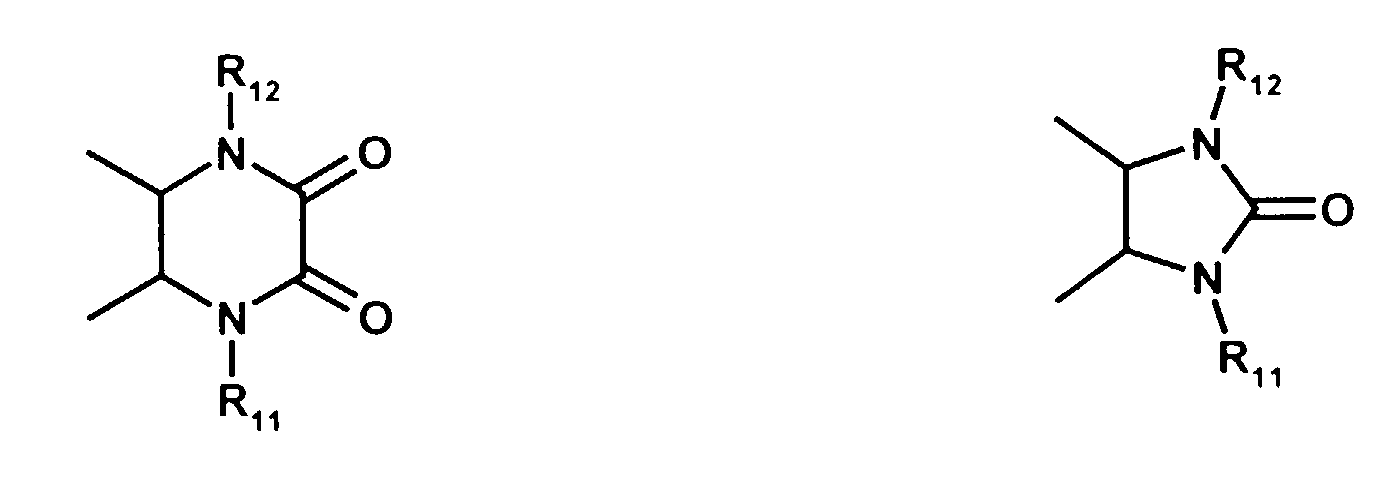
- Use as a polymer-soluble colorant of a compound according to claim 1, wherein two adjacent groups of R5-8 and R'5-8 form heterocyclic rings of the following type:in which R11, R12 are independently hydrogen, C1-12alkyl, phenyl, naphthyl.

- Use as a polymer-soluble colorant of a compound according to claim 1 having a structure selected from:


- A compound of the formula (I) in which at least one of the substitutents R1, R2, R3, R4, R5, R6, R7, R8, R'5, R'6, R'7 or R'8 has the meaning -CN, -CF3, -CONH2, phenyl, naphthyl, phenanthryl, anthryl, R9R10N-, -CONHR10 or -CONR9R10 as defined in claim 1, as well as the compounds where two adjacent groups form an isocyclic or heterocyclic group
- A process for preparing the compounds of the formula (I), as claimed in claim 6, comprising reacting a compound of the formula:in which Hal is halogen and R1, R2, R3 and R4 are as defined in claim 1;

with a compound of the formula:where Met is hydrogen, Na+, K+ or Zn2+ and R5, R6, R7, R8 are as defined in claim 1;
and with a compound of the formula:where Met is hydrogen, Na+, K+ or Zn2+ and R'5, R'6, R'7, R'8 are as defined in claim 1.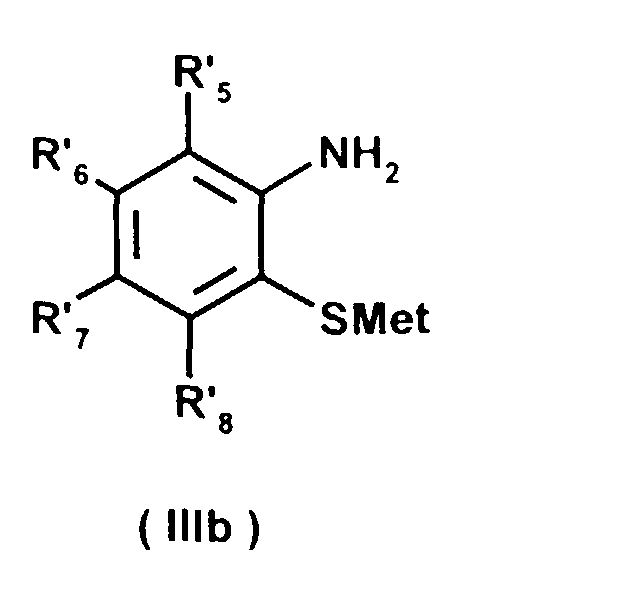
- A method of coloring synthetic polar polymers comprising the steps of providing a synthetic polar polymer; adding an active amount of a colorant of formula I as claimed in claim 1; and mixing said synthetic polar polymer with said colorant.
- A method of coloring toners comprising the steps of providing a toner; said toner is selected from the group consisting of: electrophotographic toners; electrophotographic developers; one-component powder toners; two-component powder toners; magnetic toners; liquid toners; polymerization toners; and specialty toners; adding an active amount of a colorant of formula I as claimed in claim 1; and mixing said toner with said colorant.
- A method of coloring powders and powder coating material comprising the steps of providing a powders or a powder coating material; adding an active amount of a colorant of formula I as claimed in claim 1; and mixing said powders or said powder coating material with said colorant.
- A method of coloring ink-jet inks comprising the steps of providing a ink-jet inks; adding an active amount of a colorant of formula I as claimed in claim 1; and mixing said ink-jet inks with said colorant.
Applications Claiming Priority (2)
| Application Number | Priority Date | Filing Date | Title |
|---|---|---|---|
| GB9914173 | 1999-06-18 | ||
| GBGB9914173.1A GB9914173D0 (en) | 1999-06-18 | 1999-06-18 | New heterocyclic compounds |
Publications (2)
| Publication Number | Publication Date |
|---|---|
| EP1061103A2 true EP1061103A2 (en) | 2000-12-20 |
| EP1061103A3 EP1061103A3 (en) | 2003-05-14 |
Family
ID=10855567
Family Applications (1)
| Application Number | Title | Priority Date | Filing Date |
|---|---|---|---|
| EP00810527A Withdrawn EP1061103A3 (en) | 1999-06-18 | 2000-06-16 | Heterocyclic compounds and their use as polymer colorant |
Country Status (5)
| Country | Link |
|---|---|
| US (1) | US6540820B1 (en) |
| EP (1) | EP1061103A3 (en) |
| JP (1) | JP2001059060A (en) |
| KR (1) | KR20010069206A (en) |
| GB (1) | GB9914173D0 (en) |
Family Cites Families (12)
| Publication number | Priority date | Publication date | Assignee | Title |
|---|---|---|---|---|
| GB698200A (en) * | 1951-02-20 | 1953-10-07 | Ici Ltd | New colouring matters of the thiazine series |
| DE1228356B (en) * | 1963-04-26 | 1966-11-10 | Basf Ag | Process for the production of pigment dyes |
| US3408349A (en) * | 1963-12-04 | 1968-10-29 | American Cyanamid Co | Azine ion-radical salts |
| US3716534A (en) * | 1971-04-13 | 1973-02-13 | Du Pont | THIADIAZOLES[3,4-d]-PYRIDAZINES |
| US4992101A (en) * | 1988-04-15 | 1991-02-12 | Ciba-Geigy Corporation | Process for the preparation of opaque diketopyrrolo-pyrrole pigments |
| DE3911643C2 (en) | 1988-04-20 | 1999-09-23 | Clariant Finance Bvi Ltd | Heterocyclic dyes |
| DE4442291B4 (en) * | 1993-12-06 | 2006-04-13 | Clariant Finance (Bvi) Ltd. | Triphendioxazine compounds |
| US6200378B1 (en) * | 1997-01-29 | 2001-03-13 | CLARIANT FINANCE (BVIø) LIMITED | Thiazine indigo pigments, solid solutions thereof and their preparation |
| DE19727079A1 (en) * | 1997-06-25 | 1999-01-07 | Clariant Int Ltd | Triphendioxazine |
| DE19747395A1 (en) | 1997-10-27 | 1999-04-29 | Clariant Int Ltd | Heterocyclic compounds as polymer-soluble dyes |
| GB9824314D0 (en) | 1998-11-06 | 1998-12-30 | Clariant Int Ltd | New hetercyclic compounds |
| US6375732B1 (en) | 1999-04-08 | 2002-04-23 | Clariant Finance (Bvi) Limited | Pigments, the process of their manufacturing and their use |
-
1999
- 1999-06-18 GB GBGB9914173.1A patent/GB9914173D0/en not_active Ceased
-
2000
- 2000-06-08 US US09/590,524 patent/US6540820B1/en not_active Expired - Fee Related
- 2000-06-16 EP EP00810527A patent/EP1061103A3/en not_active Withdrawn
- 2000-06-16 JP JP2000180869A patent/JP2001059060A/en not_active Withdrawn
- 2000-06-16 KR KR1020000033143A patent/KR20010069206A/en not_active Withdrawn
Also Published As
| Publication number | Publication date |
|---|---|
| JP2001059060A (en) | 2001-03-06 |
| GB9914173D0 (en) | 1999-08-18 |
| US6540820B1 (en) | 2003-04-01 |
| EP1061103A3 (en) | 2003-05-14 |
| KR20010069206A (en) | 2001-07-23 |
Similar Documents
| Publication | Publication Date | Title |
|---|---|---|
| KR100543996B1 (en) | Quinoxaline-monoazo-acetarylide pigment | |
| EP0999239B1 (en) | Hals containing hybrid dyestuffs | |
| US6482817B1 (en) | Hybrid pigments | |
| JP4485611B2 (en) | New triphendioxazine compounds | |
| US6375732B1 (en) | Pigments, the process of their manufacturing and their use | |
| US6046335A (en) | Heterocyclic compounds | |
| US6540820B1 (en) | Heterocyclic compounds | |
| EP1379527B1 (en) | Epindolidione pigments | |
| EP1341851B1 (en) | Process for the preparation of triphenodioxazine pigments | |
| US6472527B1 (en) | Process for the preparation of thiazine-indigo compounds and of new intermediates therefor | |
| KR100416015B1 (en) | Aminoquinazolinedione-insoluble azo colorant | |
| EP1447430A1 (en) | New monoanthraquinone azamethine dyes | |
| EP1447429A1 (en) | New bisanthraquinone azomethine dyes | |
| EP1132432B1 (en) | Preparation process of pigments | |
| EP1422267A1 (en) | New dyes based on 1,4,5,8-naphthalene tetracarboxylic dianhydride | |
| CN100560652C (en) | Heterocyclic colorants based on diazabenzisoindole | |
| JP5004591B2 (en) | 2,4-Dioxopyrimidine-based mesoionic pigment | |
| US6617453B1 (en) | Triphendioxazine compounds |
Legal Events
| Date | Code | Title | Description |
|---|---|---|---|
| PUAI | Public reference made under article 153(3) epc to a published international application that has entered the european phase |
Free format text: ORIGINAL CODE: 0009012 |
|
| AK | Designated contracting states |
Kind code of ref document: A2 Designated state(s): AT BE CH CY DE DK ES FI FR GB GR IE IT LI LU MC NL PT SE |
|
| AX | Request for extension of the european patent |
Free format text: AL;LT;LV;MK;RO;SI |
|
| PUAL | Search report despatched |
Free format text: ORIGINAL CODE: 0009013 |
|
| RIC1 | Information provided on ipc code assigned before grant |
Ipc: 7C 09D 5/03 B Ipc: 7C 09D 11/00 B Ipc: 7G 03G 9/09 B Ipc: 7C 09B 21/00 A |
|
| AK | Designated contracting states |
Designated state(s): AT BE CH CY DE DK ES FI FR GB GR IE IT LI LU MC NL PT SE |
|
| AX | Request for extension of the european patent |
Extension state: AL LT LV MK RO SI |
|
| 17P | Request for examination filed |
Effective date: 20031114 |
|
| AKX | Designation fees paid |
Designated state(s): AT BE CH CY DE DK ES FI FR GB GR IE IT LI LU MC NL PT SE |
|
| STAA | Information on the status of an ep patent application or granted ep patent |
Free format text: STATUS: THE APPLICATION HAS BEEN WITHDRAWN |
|
| 18W | Application withdrawn |
Effective date: 20040902 |