EP1059772A2 - Method of recovering failed unidirectional broadcast paths in telecommunications transoceanic MS-SP rings - Google Patents
Method of recovering failed unidirectional broadcast paths in telecommunications transoceanic MS-SP rings Download PDFInfo
- Publication number
- EP1059772A2 EP1059772A2 EP00401500A EP00401500A EP1059772A2 EP 1059772 A2 EP1059772 A2 EP 1059772A2 EP 00401500 A EP00401500 A EP 00401500A EP 00401500 A EP00401500 A EP 00401500A EP 1059772 A2 EP1059772 A2 EP 1059772A2
- Authority
- EP
- European Patent Office
- Prior art keywords
- path
- ring
- failure
- nodes
- node
- Prior art date
- Legal status (The legal status is an assumption and is not a legal conclusion. Google has not performed a legal analysis and makes no representation as to the accuracy of the status listed.)
- Withdrawn
Links
- 238000000034 method Methods 0.000 title claims abstract description 16
- 239000000835 fiber Substances 0.000 claims abstract description 41
- RGNPBRKPHBKNKX-UHFFFAOYSA-N hexaflumuron Chemical group C1=C(Cl)C(OC(F)(F)C(F)F)=C(Cl)C=C1NC(=O)NC(=O)C1=C(F)C=CC=C1F RGNPBRKPHBKNKX-UHFFFAOYSA-N 0.000 description 3
- 238000012986 modification Methods 0.000 description 2
- 230000004048 modification Effects 0.000 description 2
- 230000005540 biological transmission Effects 0.000 description 1
- 230000001419 dependent effect Effects 0.000 description 1
- 230000001788 irregular Effects 0.000 description 1
- 238000011144 upstream manufacturing Methods 0.000 description 1
Images

Classifications
-
- H—ELECTRICITY
- H04—ELECTRIC COMMUNICATION TECHNIQUE
- H04J—MULTIPLEX COMMUNICATION
- H04J14/00—Optical multiplex systems
- H04J14/02—Wavelength-division multiplex systems
- H04J14/0278—WDM optical network architectures
- H04J14/0283—WDM ring architectures
-
- H—ELECTRICITY
- H04—ELECTRIC COMMUNICATION TECHNIQUE
- H04B—TRANSMISSION
- H04B10/00—Transmission systems employing electromagnetic waves other than radio-waves, e.g. infrared, visible or ultraviolet light, or employing corpuscular radiation, e.g. quantum communication
- H04B10/03—Arrangements for fault recovery
- H04B10/032—Arrangements for fault recovery using working and protection systems
-
- H—ELECTRICITY
- H04—ELECTRIC COMMUNICATION TECHNIQUE
- H04J—MULTIPLEX COMMUNICATION
- H04J3/00—Time-division multiplex systems
- H04J3/02—Details
- H04J3/08—Intermediate station arrangements, e.g. for branching, for tapping-off
- H04J3/085—Intermediate station arrangements, e.g. for branching, for tapping-off for ring networks, e.g. SDH/SONET rings, self-healing rings, meashed SDH/SONET networks
-
- H—ELECTRICITY
- H04—ELECTRIC COMMUNICATION TECHNIQUE
- H04J—MULTIPLEX COMMUNICATION
- H04J14/00—Optical multiplex systems
- H04J14/02—Wavelength-division multiplex systems
- H04J14/0287—Protection in WDM systems
- H04J14/0289—Optical multiplex section protection
-
- H—ELECTRICITY
- H04—ELECTRIC COMMUNICATION TECHNIQUE
- H04J—MULTIPLEX COMMUNICATION
- H04J2203/00—Aspects of optical multiplex systems other than those covered by H04J14/05 and H04J14/07
- H04J2203/0001—Provisions for broadband connections in integrated services digital network using frames of the Optical Transport Network [OTN] or using synchronous transfer mode [STM], e.g. SONET, SDH
- H04J2203/0028—Local loop
- H04J2203/0039—Topology
- H04J2203/0042—Ring
-
- H—ELECTRICITY
- H04—ELECTRIC COMMUNICATION TECHNIQUE
- H04J—MULTIPLEX COMMUNICATION
- H04J2203/00—Aspects of optical multiplex systems other than those covered by H04J14/05 and H04J14/07
- H04J2203/0001—Provisions for broadband connections in integrated services digital network using frames of the Optical Transport Network [OTN] or using synchronous transfer mode [STM], e.g. SONET, SDH
- H04J2203/0057—Operations, administration and maintenance [OAM]
- H04J2203/006—Fault tolerance and recovery
Definitions
- the present invention relates to the field of fiber optic transmission and in particular to the field of fiber optic SDH transoceanic communication networks of MS-SP Ring type. Still more in particular, it concerns a method of restoring the unidirectional path from a source node to a plurality of destination nodes of a transoceanic MS-SP Ring in the instance where a failure occurs.
- transoceanic rings wherein the so-called path, i.e. the interconnection between a source node of the transoceanic ring and a destination node, is generally very long, on the order of thousand kilometers.
- path i.e. the interconnection between a source node of the transoceanic ring and a destination node, is generally very long, on the order of thousand kilometers.
- transoceanic ring means a telecommunication ring involving rather long distances, not necessarily a ring crossing an ocean.
- unidirectional broadcast paths namely unidirectional paths going from a source node to a plurality of destination nodes which all receive the same signal.
- a ring failure as defined by the International Communication Union (ITU) in the various related Recommendations, is a failure affecting the capacity of both the working and the protection fibers in a fiber span, or a failure at a ring node (or network element).
- ITU International Communication Union
- the basic rule indicated by the Annex A of (TU-T Recommendation G.841 to restore the traffic in the event that a ring failure occurs simply states that the source node must execute a path bridge operation, whilst the destination node must perform a switch operation. That is to say, each direction of the bi-directional path must be bridged by its source node on the protection fiber away from the failure and it must be received by its destination node of the protection fiber away from the failure.
- the basic idea of the present invention consists in causing not only that the source node performs a bridge operation, but also that all the destination nodes no longer reachable by the original path perform a Drop & Continue or Switch & Continue operation (substantially a switching operation for extracting the path from the protection channel away from the failure and then for continuing it).
- the method according to the invention is able to restore a path in a telecommunication transoceanic ring should said ring experience a ring failure;
- the ring comprising a plurality of nodes, protection fiber or channels and working fiber or channels connecting the nodes in a closed loop;
- the original path being a unidirectional path installed through the working fiber between a source node and a plurality of destination nodes; in case of failure, at least one of the nodes becoming a node adjacent to the ring failure, said method includes the step of performing a Bridge operation at the source node so that the path is also transmitted on the protection fiber in the opposite direction to the original path direction and is characterized by further comprising the step of performing, at each of destination nodes no longer receiving the path because of the failure, possibly excluding that/those adjacent to the ring failure, a Switch & Continue or Drop & Continue operation.
- the present invention also includes a telecommunication transoceanic ring protected against ring failures, said ring comprising a plurality of nodes, protection fiber or channels and working fiber or channels connecting the nodes in a closed loop with a original unidirectional path being installed through the working fiber between a source node and a plurality of destination nodes, at least one of the nodes, in case of failure, becoming a node adjacent to the ring failure, the source node comprising means for performing a Bridge operation so that the path is also transmitted on the protection fiber in the opposite direction to the original path direction.
- the ring is characterized in that each of destination nodes no longer receiving the path because of the failure, possibly excluding that/those adjacent to the ring failure, comprises means for performing a Switch & Continue or Drop & Continue operation.
- Fig. 1 substantially illustrates the state of the art related to a transoceanic ring in which a broadcast path, i.e. a unidirectional path from a source node A to a plurality of destination nodes (D, E, F), has been installed.
- a broadcast path i.e. a unidirectional path from a source node A to a plurality of destination nodes (D, E, F)
- D, E, F destination nodes
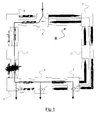
- Fig. 2 illustrates the situation, according to the present invention, in the event of a failure at the same location.
- the source node A being informed of the failure, will perform a path Bridge by utilizing the protection fiber of the other semi-ring.
- the path, along the protection fiber will reach the node F which was previously considered as the farthest node and which will perform a Switch & Continue (or Drop & Continue) operation and not a mere Switch operation.
- Analogous operation will also be performed by node E that receives the path from the adjacent node F along the protection fiber.
- the path, continued through by node E will reach node D, which was previously the closest node to the source node A, again along the protection fiber. Now, with the new path, the node D is the farthest node from the source node and therefore it shall simply perform a Switch operation to extract the path.
- the telecommunication transoceanic ring R comprises a source node and destination nodes D, E, F connected through a unidirectional broadcast path, said source node A comprising means for bridging the path along the protection fiber in the event of a failure, and is characterized in that said destination nodes, possibly excluding those adjacent to the failure, comprise means for performing a Switch & Continue or Drop & Continue operation.
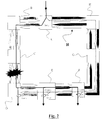
- the destination node (D in the instance of Fig. 2, E in the instance of Fig. 3) that is reached lastly by the new path along the protection fiber comprises means for performing a Switch operation to simply extract the path without continuing it.
- SDH SDH signals as well as SONET signals.
- SONET SONET signals
Landscapes
- Engineering & Computer Science (AREA)
- Computer Networks & Wireless Communication (AREA)
- Signal Processing (AREA)
- Physics & Mathematics (AREA)
- Electromagnetism (AREA)
- Small-Scale Networks (AREA)
- Exchange Systems With Centralized Control (AREA)
Abstract
Description
- Fig. 1 diagrammatically illustrates a transoceanic MS-SP Ring with a unidirectional path interrupted by a failure and restored according to the known, and at present provided, procedure;
- Fig. 2 diagrammatically illustrates a transoceanic MS-Spring in which a unidirectional path, interrupted by a failure and restored according to the method of the present invention, has been installed; and
- Fig. 3 is similar to Fig. 2 but it considers a failure in another position.
Claims (5)
- Method of restoring a path in a telecommunication transoceanic ring (R) should said ring (R) experience a ring failure, the ring (R) comprising a plurality of nodes (A-H), protection fiber or channels and working fiber or channels connecting the nodes (A-H) in a closed loop; the original path being a unidirectional path installed through the working fiber between a source node (A) and a plurality of destination nodes (D-F); in case of failure, at least one of the nodes (D; D, E) becoming a node adjacent to the ring failure, said method including the step of performing a Bridge operation at the source node (A) so that the path is also transmitted on the protection fiber in the opposite direction to the original path direction, characterized by further comprising the step of performing, at each of destination nodes (E, F; F) no longer receiving the path because of the failure, possibly excluding that/those (D; D, E) adjacent to the ring failure, a Switch & Continue or Drop & Continue operation.
- Method according to claim 1, characterized in that the path is continued from a destination node (F, E; F) to a further destination node (E, D; E) through the protection fiber of said telecommunication transoceanic ring (R).
- Method according to claim 1 or 2, characterized in that the destination node (D; E) lastly reached by the new path along the protection fiber performs a Switch operation.
- Telecommunication transoceanic ring (R) protected against ring failures, said ring comprising a plurality of nodes (A-H), protection fiber or channels and working fiber or channels connecting the nodes (A-H) in a closed loop with a original unidirectional path being installed through the working fiber between a source node (A) and a plurality of destination nodes (D-F), at least one of the nodes (D; D, E), in case of failure, becoming a node adjacent to the ring failure, said source node (A) comprising means for performing a Bridge operation so that the path is also transmitted on the protection fiber in the opposite direction to the original path direction, characterized in that each of destination nodes (E, F; F) no longer receiving the path because of the failure, possibly excluding that/those (D; D, E) adjacent to the ring failure, comprises means for performing a Switch & Continue or Drop & Continue operation.
- Transoceanic ring (R) according to claim 4, characterized in that the destination node (D; E) which is lastly reached by the new path along the protection fiber comprises means for performing a Switching operation to simply extract the path without continuing it.
Applications Claiming Priority (2)
| Application Number | Priority Date | Filing Date | Title |
|---|---|---|---|
| ITMI991276 | 1999-06-09 | ||
| IT1999MI001276A ITMI991276A1 (en) | 1999-06-09 | 1999-06-09 | METHOD FOR THE RECOVERY OF UNIDIRECTIONAL PATHS BETWEEN MORE NODES IN THE CASE OF TRANSOCEANIC RINGS TYPE MS-SP RING FOR TELECOMMUNICATIONS SDH |
Publications (2)
| Publication Number | Publication Date |
|---|---|
| EP1059772A2 true EP1059772A2 (en) | 2000-12-13 |
| EP1059772A3 EP1059772A3 (en) | 2002-09-18 |
Family
ID=11383131
Family Applications (1)
| Application Number | Title | Priority Date | Filing Date |
|---|---|---|---|
| EP00401500A Withdrawn EP1059772A3 (en) | 1999-06-09 | 2000-05-26 | Method of recovering failed unidirectional broadcast paths in telecommunications transoceanic MS-SP rings |
Country Status (4)
| Country | Link |
|---|---|
| EP (1) | EP1059772A3 (en) |
| JP (1) | JP2001024679A (en) |
| CA (1) | CA2310901A1 (en) |
| IT (1) | ITMI991276A1 (en) |
Cited By (3)
| Publication number | Priority date | Publication date | Assignee | Title |
|---|---|---|---|---|
| WO2003107565A1 (en) * | 2001-02-05 | 2003-12-24 | Huawei Technologies Co., Ltd. | A virtual protection method and means for the fiber path |
| RU2284662C2 (en) * | 2002-06-14 | 2006-09-27 | Хювэй Текнолоджиз Ко., Лтд. | Method and device for virtual protection of fiber-optic duct |
| CN101883008A (en) * | 2010-06-28 | 2010-11-10 | 中兴通讯股份有限公司 | Subnet protection method and device for transmitting multi-protocol label switching network |
Families Citing this family (3)
| Publication number | Priority date | Publication date | Assignee | Title |
|---|---|---|---|---|
| EP1217789B1 (en) * | 2000-07-17 | 2012-05-30 | Kabushiki Kaisha Toshiba | Self-relief method and re-estabishing method for traffic |
| CN100336358C (en) * | 2002-09-21 | 2007-09-05 | 中兴通讯股份有限公司 | Method for raising protective inversion reliability in multiplexing section of optical transmission circular network |
| CN1852070B (en) * | 2006-05-29 | 2011-06-29 | 浙江工业大学 | Four-fiber bidirectional multiplex section dedicated protection optical fiber ring network |
Family Cites Families (6)
| Publication number | Priority date | Publication date | Assignee | Title |
|---|---|---|---|---|
| GB1229149A (en) * | 1969-07-28 | 1971-04-21 | ||
| US4633246A (en) * | 1984-01-09 | 1986-12-30 | Fiberlan, Inc. | Time divison multiplex ring |
| US4835763A (en) * | 1988-02-04 | 1989-05-30 | Bell Communications Research, Inc. | Survivable ring network |
| US5159595A (en) * | 1988-04-08 | 1992-10-27 | Northern Telecom Limited | Ring transmission system |
| US5751696A (en) * | 1996-01-02 | 1998-05-12 | Lucent Technologies Inc. | Multiplexed-communications network having mixed protection against faults and errors |
| SE9602005L (en) * | 1996-05-24 | 1997-11-25 | Ericsson Telefon Ab L M | Optical fiber network with backup transmitters and receivers |
-
1999
- 1999-06-09 IT IT1999MI001276A patent/ITMI991276A1/en unknown
-
2000
- 2000-05-25 JP JP2000154076A patent/JP2001024679A/en not_active Withdrawn
- 2000-05-26 EP EP00401500A patent/EP1059772A3/en not_active Withdrawn
- 2000-06-07 CA CA002310901A patent/CA2310901A1/en not_active Abandoned
Cited By (3)
| Publication number | Priority date | Publication date | Assignee | Title |
|---|---|---|---|---|
| WO2003107565A1 (en) * | 2001-02-05 | 2003-12-24 | Huawei Technologies Co., Ltd. | A virtual protection method and means for the fiber path |
| RU2284662C2 (en) * | 2002-06-14 | 2006-09-27 | Хювэй Текнолоджиз Ко., Лтд. | Method and device for virtual protection of fiber-optic duct |
| CN101883008A (en) * | 2010-06-28 | 2010-11-10 | 中兴通讯股份有限公司 | Subnet protection method and device for transmitting multi-protocol label switching network |
Also Published As
| Publication number | Publication date |
|---|---|
| JP2001024679A (en) | 2001-01-26 |
| ITMI991276A1 (en) | 2000-12-09 |
| ITMI991276A0 (en) | 1999-06-09 |
| EP1059772A3 (en) | 2002-09-18 |
| CA2310901A1 (en) | 2000-12-09 |
Similar Documents
| Publication | Publication Date | Title |
|---|---|---|
| JP3631592B2 (en) | Error-free switching technology in ring networks | |
| US6587235B1 (en) | Method and apparatus for capacity-efficient restoration in an optical communication system | |
| US6324162B1 (en) | Path-based restoration mesh networks | |
| US6775477B2 (en) | Optical communication network and protection methods | |
| CN1820438B (en) | Method for providing connection protection to additional traffic paths in a communication network, related network | |
| US6154296A (en) | Telecommunications network having shared protect capacity architecture | |
| CN1141105A (en) | Telecommunications networks incorporating channel switching protection devices | |
| US6078596A (en) | Method and system of SONET line trace | |
| US20020114031A1 (en) | Ring configuration method, failure recovery method, and node address assignment method when configuring ring in network | |
| CN1333554C (en) | Method for combining multi-section protection and mesh network recovery | |
| US20040076114A1 (en) | Method and apparatus for shared protection in an optical transport network ring based on the ODU management | |
| CN100440769C (en) | Optical multiplex loop system | |
| CN101141349A (en) | A method for protecting transmission services | |
| CA2299974C (en) | Wdm network and wdm network device | |
| US7054558B2 (en) | Method for traffic protection in WDM fiber optic transport networks | |
| EP1059772A2 (en) | Method of recovering failed unidirectional broadcast paths in telecommunications transoceanic MS-SP rings | |
| US7035203B2 (en) | Interconnection between telecommunication MS-SPRING and SNCP ring networks | |
| US20050141415A1 (en) | Extending SONET/SDH automatic protection switching | |
| CN101197591A (en) | Protection recovery method and device for ASON | |
| US20020097461A1 (en) | Bi-directional wavelength switched ring optical protection switching protocol | |
| US20090196202A1 (en) | Transmitting apparatus and path setting method | |
| EP1235373B1 (en) | Method for managing multiple failures of different type in ring-shaped telecommunicatons network | |
| US20030026203A1 (en) | Method of managing different type multiple failures in ring topology telecommunication networks | |
| Shiragaki et al. | Network resource advantages of bidirectional wavelength-path switched ring | |
| JP2004501567A (en) | Submarine optical fiber transmission network |
Legal Events
| Date | Code | Title | Description |
|---|---|---|---|
| PUAI | Public reference made under article 153(3) epc to a published international application that has entered the european phase |
Free format text: ORIGINAL CODE: 0009012 |
|
| AK | Designated contracting states |
Kind code of ref document: A2 Designated state(s): AT BE CH CY DE DK ES FI FR GB GR IE IT LI LU MC NL PT SE |
|
| AX | Request for extension of the european patent |
Free format text: AL;LT;LV;MK;RO;SI |
|
| PUAL | Search report despatched |
Free format text: ORIGINAL CODE: 0009013 |
|
| AK | Designated contracting states |
Kind code of ref document: A3 Designated state(s): AT BE CH CY DE DK ES FI FR GB GR IE IT LI LU MC NL PT SE |
|
| AX | Request for extension of the european patent |
Free format text: AL;LT;LV;MK;RO;SI |
|
| AKX | Designation fees paid |
Designated state(s): AT BE CH CY DE DK ES FI FR GB GR IE IT LI LU MC NL PT SE |
|
| STAA | Information on the status of an ep patent application or granted ep patent |
Free format text: STATUS: THE APPLICATION IS DEEMED TO BE WITHDRAWN |
|
| 18D | Application deemed to be withdrawn |
Effective date: 20030319 |