EP1059642A2 - Optical disc playback apparatus and optical disc playback method - Google Patents
Optical disc playback apparatus and optical disc playback method Download PDFInfo
- Publication number
- EP1059642A2 EP1059642A2 EP00112290A EP00112290A EP1059642A2 EP 1059642 A2 EP1059642 A2 EP 1059642A2 EP 00112290 A EP00112290 A EP 00112290A EP 00112290 A EP00112290 A EP 00112290A EP 1059642 A2 EP1059642 A2 EP 1059642A2
- Authority
- EP
- European Patent Office
- Prior art keywords
- audio
- management information
- video
- information
- disc
- Prior art date
- Legal status (The legal status is an assumption and is not a legal conclusion. Google has not performed a legal analysis and makes no representation as to the accuracy of the status listed.)
- Withdrawn
Links
Images






Classifications
-
- H—ELECTRICITY
- H04—ELECTRIC COMMUNICATION TECHNIQUE
- H04N—PICTORIAL COMMUNICATION, e.g. TELEVISION
- H04N9/00—Details of colour television systems
- H04N9/79—Processing of colour television signals in connection with recording
- H04N9/80—Transformation of the television signal for recording, e.g. modulation, frequency changing; Inverse transformation for playback
- H04N9/804—Transformation of the television signal for recording, e.g. modulation, frequency changing; Inverse transformation for playback involving pulse code modulation of the colour picture signal components
- H04N9/8042—Transformation of the television signal for recording, e.g. modulation, frequency changing; Inverse transformation for playback involving pulse code modulation of the colour picture signal components involving data reduction
-
- G—PHYSICS
- G11—INFORMATION STORAGE
- G11B—INFORMATION STORAGE BASED ON RELATIVE MOVEMENT BETWEEN RECORD CARRIER AND TRANSDUCER
- G11B19/00—Driving, starting, stopping record carriers not specifically of filamentary or web form, or of supports therefor; Control thereof; Control of operating function ; Driving both disc and head
- G11B19/02—Control of operating function, e.g. switching from recording to reproducing
- G11B19/022—Control panels
-
- G—PHYSICS
- G11—INFORMATION STORAGE
- G11B—INFORMATION STORAGE BASED ON RELATIVE MOVEMENT BETWEEN RECORD CARRIER AND TRANSDUCER
- G11B19/00—Driving, starting, stopping record carriers not specifically of filamentary or web form, or of supports therefor; Control thereof; Control of operating function ; Driving both disc and head
- G11B19/02—Control of operating function, e.g. switching from recording to reproducing
- G11B19/12—Control of operating function, e.g. switching from recording to reproducing by sensing distinguishing features of or on records, e.g. diameter end mark
-
- G—PHYSICS
- G11—INFORMATION STORAGE
- G11B—INFORMATION STORAGE BASED ON RELATIVE MOVEMENT BETWEEN RECORD CARRIER AND TRANSDUCER
- G11B27/00—Editing; Indexing; Addressing; Timing or synchronising; Monitoring; Measuring tape travel
- G11B27/10—Indexing; Addressing; Timing or synchronising; Measuring tape travel
- G11B27/102—Programmed access in sequence to addressed parts of tracks of operating record carriers
- G11B27/105—Programmed access in sequence to addressed parts of tracks of operating record carriers of operating discs
-
- G—PHYSICS
- G11—INFORMATION STORAGE
- G11B—INFORMATION STORAGE BASED ON RELATIVE MOVEMENT BETWEEN RECORD CARRIER AND TRANSDUCER
- G11B27/00—Editing; Indexing; Addressing; Timing or synchronising; Monitoring; Measuring tape travel
- G11B27/10—Indexing; Addressing; Timing or synchronising; Measuring tape travel
- G11B27/11—Indexing; Addressing; Timing or synchronising; Measuring tape travel by using information not detectable on the record carrier
-
- G—PHYSICS
- G11—INFORMATION STORAGE
- G11B—INFORMATION STORAGE BASED ON RELATIVE MOVEMENT BETWEEN RECORD CARRIER AND TRANSDUCER
- G11B27/00—Editing; Indexing; Addressing; Timing or synchronising; Monitoring; Measuring tape travel
- G11B27/10—Indexing; Addressing; Timing or synchronising; Measuring tape travel
- G11B27/19—Indexing; Addressing; Timing or synchronising; Measuring tape travel by using information detectable on the record carrier
- G11B27/28—Indexing; Addressing; Timing or synchronising; Measuring tape travel by using information detectable on the record carrier by using information signals recorded by the same method as the main recording
- G11B27/32—Indexing; Addressing; Timing or synchronising; Measuring tape travel by using information detectable on the record carrier by using information signals recorded by the same method as the main recording on separate auxiliary tracks of the same or an auxiliary record carrier
- G11B27/327—Table of contents
- G11B27/329—Table of contents on a disc [VTOC]
-
- G—PHYSICS
- G11—INFORMATION STORAGE
- G11B—INFORMATION STORAGE BASED ON RELATIVE MOVEMENT BETWEEN RECORD CARRIER AND TRANSDUCER
- G11B2220/00—Record carriers by type
- G11B2220/20—Disc-shaped record carriers
- G11B2220/21—Disc-shaped record carriers characterised in that the disc is of read-only, rewritable, or recordable type
- G11B2220/211—Discs having both read-only and rewritable or recordable areas containing application data; Partial ROM media
-
- G—PHYSICS
- G11—INFORMATION STORAGE
- G11B—INFORMATION STORAGE BASED ON RELATIVE MOVEMENT BETWEEN RECORD CARRIER AND TRANSDUCER
- G11B2220/00—Record carriers by type
- G11B2220/20—Disc-shaped record carriers
- G11B2220/25—Disc-shaped record carriers characterised in that the disc is based on a specific recording technology
- G11B2220/2537—Optical discs
- G11B2220/2562—DVDs [digital versatile discs]; Digital video discs; MMCDs; HDCDs
-
- G—PHYSICS
- G11—INFORMATION STORAGE
- G11B—INFORMATION STORAGE BASED ON RELATIVE MOVEMENT BETWEEN RECORD CARRIER AND TRANSDUCER
- G11B2220/00—Record carriers by type
- G11B2220/60—Solid state media
- G11B2220/65—Solid state media wherein solid state memory is used for storing indexing information or metadata
-
- G—PHYSICS
- G11—INFORMATION STORAGE
- G11B—INFORMATION STORAGE BASED ON RELATIVE MOVEMENT BETWEEN RECORD CARRIER AND TRANSDUCER
- G11B7/00—Recording or reproducing by optical means, e.g. recording using a thermal beam of optical radiation by modifying optical properties or the physical structure, reproducing using an optical beam at lower power by sensing optical properties; Record carriers therefor
- G11B7/002—Recording, reproducing or erasing systems characterised by the shape or form of the carrier
- G11B7/0037—Recording, reproducing or erasing systems characterised by the shape or form of the carrier with discs
-
- H—ELECTRICITY
- H04—ELECTRIC COMMUNICATION TECHNIQUE
- H04N—PICTORIAL COMMUNICATION, e.g. TELEVISION
- H04N5/00—Details of television systems
- H04N5/76—Television signal recording
- H04N5/84—Television signal recording using optical recording
- H04N5/85—Television signal recording using optical recording on discs or drums
-
- H—ELECTRICITY
- H04—ELECTRIC COMMUNICATION TECHNIQUE
- H04N—PICTORIAL COMMUNICATION, e.g. TELEVISION
- H04N9/00—Details of colour television systems
- H04N9/79—Processing of colour television signals in connection with recording
- H04N9/80—Transformation of the television signal for recording, e.g. modulation, frequency changing; Inverse transformation for playback
- H04N9/804—Transformation of the television signal for recording, e.g. modulation, frequency changing; Inverse transformation for playback involving pulse code modulation of the colour picture signal components
- H04N9/806—Transformation of the television signal for recording, e.g. modulation, frequency changing; Inverse transformation for playback involving pulse code modulation of the colour picture signal components with processing of the sound signal
- H04N9/8063—Transformation of the television signal for recording, e.g. modulation, frequency changing; Inverse transformation for playback involving pulse code modulation of the colour picture signal components with processing of the sound signal using time division multiplex of the PCM audio and PCM video signals
-
- H—ELECTRICITY
- H04—ELECTRIC COMMUNICATION TECHNIQUE
- H04N—PICTORIAL COMMUNICATION, e.g. TELEVISION
- H04N9/00—Details of colour television systems
- H04N9/79—Processing of colour television signals in connection with recording
- H04N9/80—Transformation of the television signal for recording, e.g. modulation, frequency changing; Inverse transformation for playback
- H04N9/82—Transformation of the television signal for recording, e.g. modulation, frequency changing; Inverse transformation for playback the individual colour picture signal components being recorded simultaneously only
- H04N9/8205—Transformation of the television signal for recording, e.g. modulation, frequency changing; Inverse transformation for playback the individual colour picture signal components being recorded simultaneously only involving the multiplexing of an additional signal and the colour video signal
- H04N9/8227—Transformation of the television signal for recording, e.g. modulation, frequency changing; Inverse transformation for playback the individual colour picture signal components being recorded simultaneously only involving the multiplexing of an additional signal and the colour video signal the additional signal being at least another television signal
Definitions
- the present invention relates to apparatus and methods for playing back optical discs on which multimedia data including digital moving picture data and digital audio data are recorded. More particularly, the present invention relates to playback apparatus which use optical discs including plural and different kinds of disc management information, in which apparatus the plural kinds of disc management information can be selected by users, whereby all audio data or video data recorded on the optical discs can be played back.
- DVD-Video-Videos having greatly increased storage capacities are coming into wide use in place of conventional laser discs and video CDs, and many movies are put on the market.
- These DVD-Video standard discs are standardized attaching importance to playback of video, without attaching importance to playback of various types of audio. Therefore, DVD-Video standard cannot realize playback in conditions of linear PCM, 192-KHz sampling frequency, 24 bit/sec, 2 channels, and more than 74 minutes, or playback in conditions of linear PCM, 96-KHz sampling frequency, 24 bit/sec, 6 channels, and more than 74 minutes, for example. Accordingly, DVD-Audio standard is established as DVD standard which attaches importance to the playback of various types of audio.
- FIG 6 shows the relationship on standards between DVD-Video standard and DVD-Audio standard
- the physical layer structure and file layer structure of DVD-Audio standard are the same as those of DVD-Video standard, and only its application layer structure is different from that of DVD-Video standard.
- DVD-Video standard and DVD-Audio standard have a common part in the application layer structure.
- Figure 7 shows the comparison of contents between DVD-Video standard and DVD-Audio standard. (Note: DVD-Video standard Ver.1.0, issued in August 1996, DVD-Audio standard Ver.1.0, issued in March 1999.)
- a data structure according to DVD standard is divided broadly into a Volume zone and a File zone. Information of files in the File zone is recorded in the Volume zone. Video data files, audio data files and files of data other than audio/video data (for example, computer data) are recorded in the File zone. The video data files, the audio data files and the files of data other than audio/video data correspond to a DVD-Video zone, a DVD-Audio zone and a DVD-others zone, respectively.
- Figure 8 shows a data structure of a file in a DVD-Video standard disc.
- Three zones i.e., a DVD-Volume zone 81, a DVD-Video zone 82 and a DVD-Others zone 83 are defined.
- the DVD-Video zone 82 comprises one piece of video disc management information (i.e., Video Manager, hereinafter referred to also as "VMG”) 84 and one or more Video Title Sets (hereinafter referred to also as "VTS”) 85.
- VMG Video Manager
- VTS Video Title Sets
- figure 9 shows a data structure of a file in a DVD-Audio standard disc having both of an Audio zone and a Video zone.
- Four zones i.e., a DVD-Volume zone 91, a DVD-Audio zone 92, a DVD-Video zone 93 and a DVD-Others zone 94 are defined.
- the DVD-Audio zone 92 comprises one piece of audio disc management information (i.e., Audio Manager, hereinafter referred to also as "AMG") 95 and one or more Audio Title Sets (hereinafter referred to also as "ATS") 96.
- the DVD-Video zone 93 comprises one VMG 97 and one or more VTSs 98.
- one disc can simultaneously have the DVD-Audio zone 92 and the DVD-Video zone 93.
- the ATS(#1-#m) 96 are selected and when titles in the DVD-Video zone 93 are to be selected, the VTS(#1-#n) 98 are selected.
- the DVD-Video zone 93 has the VMG 97, when the disc is to be managed as a DVD-Audio standard disc, the whole disc is managed using the AMG 95 instead of the VMG 97.
- this disc is to be managed as a DVD-Video standard disc, the whole disc is managed using the VMG 97 instead of the AMG 95 while the Audio zone 92 cannot be played back.
- Figure 10 shows a data structure of a file in a DVD-Audio standard disc having only an Audio zone. In this case, since there is no Video zone, no VMG is included and only the AMG is included as disc management information.
- Figure 5 shows a case where the DVD-Audio standard disc including both of the ATSs and VTSs as shown in figure 9 is played back using the AMG, and figure 4 shows a case this disc is played back using the VMG.
- the disc is played back using an AMG 60 as shown in figure 5, whether a selected title is the ATS or VTS is included in a Title Set Search Pointer 66 in the AMG 60 as Audio Title Category information 67.
- Title Set Management Information 68 includes Object Position Information 75 indicating the position of audio/video data on the optical disc and Sequence information 76 indicating the playback order of the audio-/video data in a lower layer, as Program Chain Information (hereinafter referred to also as "PGCI").
- PGCI Program Chain Information
- PGCI Program Chain Information
- a Title Set which is specified by the PGCI in the Title Set Management Information is played back.
- Title Set Search Pointers 45 included in the VMG 40 have no information indicating the ATS but all of those indicate the VTS 41. Therefore, titles which are selected are only VTSs.
- DVD-Video standard discs having only the disc management information of VMG
- DVD-Audio standard discs having only the disc management information of AMG
- DVD-Audio standard discs having both of the disc management information of VMG and AMG.
- the playback is performed according to the disc management information of VMG.
- the DVD-Audio standard discs may include both of the disc management information of AMG and VMG.
- the playback is performed using one of the disc management information according to types of players.
- the VMG is employed, only the VTSs are managed.
- the ATSs and VTSs are managed.
- the whole VTSs are not always managed by the disc management information of AMG. That is, the number #n of VTSs which are managed by the AMG as shown in figure 5 is equal to or smaller than the number #p of VTSs which are managed by the VMG as shown in figure 4.
- Figure 11 shows the relationship between the discs and players in considering the playback method being combined with the players.
- a DVD-Video standard disc 112 having only VTSs is played back by a conventional DVD-Video player 111
- all the VTSs are played back according to the VMG disc management information.
- a DVD-Audio standard disc 114 in which ATSs and VTSs are mixed and which has both of AMG and VMG is played back by the DVD-Video player 111
- the playback is performed similarly according to the VMG disc management information, whereby all the VTSs are played back, but the ATSs are not played back.
- the player 113 is defined so as to play back titles by using the VMG for the DVD-Video standard disc 112 and the AMG for the DVD-Audio standard discs 114 and 116. Therefore, while all the VTSs in the disc 112 can be played back using the VMG and all the ATSs in the disc 116 can be played back by using the AMG, only part of the ATSs and VTSs are played back when the disc 114 is played back using the AMG, and there is a risk of not all the VTSs being played back.
- DVD-Universal players optical disc playback apparatus
- an apparatus for playing back an optical disc which includes at least one audio/video data storage area which contains at least one audio title set or video title set, at least one title set management information storage area which contains audio/video sequence information indicating a playback order of prescribed pieces of audio/video data constituting an audio/video sequence, and object position information indicating positions of the audio/video data on the optical disc, and at least one disc management information storage area which contains disc management information for managing the whole disc, including title set position information indicating a position of the title set on the optical disc, and the playback apparatus comprises reading means for reading the audio/video data, the audio/video sequence information, the object position information, the title set position information, and the disc management information from the optical disc, to play back the data; control means for controlling the reading means; storage means which contain the disc management information obtained from the at least one disc management information storage area; and external input receiving means for receiving an external input for disc management information selected by a user among plural kinds of the disc management information obtained from the at least one
- an apparatus for playing back an optical disc in which at least one audio title set or video title set, audio disc management information and video disc management information for respectively managing whole titles in the audio title set or video title set, audio/video sequence information, object position information, and title set position information are stored in the medium, comprising information reading means for reading the audio title set or video title set, the audio disc management information, the video disc management information, the audio/video sequence information, the object position information and the title set position information from the optical disc, and storing the audio/video sequence information, the object position information, and the title set position information in a buffer memory; storing means which contain the read audio disc management information and video disc management information, respectively; external input receiving means for receiving an external input for disc management information which is stored in the storage means and selected by a user; and control means for controlling the information reading means so as to read required audio data or video data from the optical disc on the basis of one of the audio disc management information and video disc management information selected by the external input receiving means, to play back the
- the control means control the reading means so as to play back audio or video data on the basis of the title set position information indicating a position of a title set included in the selected audio disc management information or video disc management information, the sequence information stored in the buffer memory which indicates a playback order of the audio or video data, and the object position information indicating positions of the audio or video data on the optical disc. Therefore, data of a selected title set can be arbitrarily played back.
- a method for playing back an optical disc in which at least one audio title set or video title set, audio disc management information and video disc management information for respectively managing titles in the audio title set or video title set, audio/video sequence information, object position information, and title set position information are stored in the medium, comprising steps of reading the audio title set or video title set, the audio disc management information, the video disc management information, the audio/video sequence information, the object position information and the title set position information from the optical disc; storing the read audio disc management information and video disc management information, respectively; receiving an external input for disc management information selected by a user among the stored audio disc management information and video disc management information; and reading required audio data or video data from the optical disc on the basis of the audio disc management information or video disc management information selected in accordance with a selection instruction signal which is input from outside, and playing back the data.
- the users can arbitrarily switch disc management information between the AMG and VMG, whereby the optical disc playback apparatus (DVD-Universal players) can play back all the ATSs and VTSs.
- DVD-Universal players optical disc playback apparatus
- an optical disc playback apparatus for playing back data which are recorded on an optical disc having a physical layer specifying a physical structure, a file layer specifying a data file structure and at least two application layers specifying application structures disposed on the common physical layer and file layer, comprising information reading means for reading respective management information in the plural application layers, and data, sequence information, object position information and title set position information included in applications; storage means which contain the plural management information read by the information reading means; selection means for selecting desired management information among the plural management information stored in the storage means, in accordance with a selection by a user; and control means for controlling the information reading means so as to read required data from the optical disc on the basis of the desired management information selected by the selection means and play back the data.
- the users can arbitrarily switch disc management information between the AMG and VMG, whereby the optical disc playback apparatus (DVD-Universal players) can play back all the ATSs and VTSs.
- DVD-Universal players optical disc playback apparatus
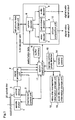
- Figure 1 is a block diagram illustrating a whole structure of an optical disc playback apparatus according to a first embodiment of the present invention.
- reference numeral 1 denotes a spindle motor for rotating an optical disc 20.
- Numeral 2 denotes an optical pickup for reading signals recorded on the optical disc 20.
- Numeral 3 denotes a mechanism control unit for controlling the spindle motor 1 and the optical pickup 2.
- Numeral 4 denotes a signal processing unit for demodulating the signals from the optical pickup 2 into digital signals.
- Numeral 5 denotes an AV decoder unit for decoding video and audio data which are obtained from the signal processing unit 4 via a system control unit 17 and a buffer memory 16 (described later).
- the AV decoder unit 5 comprises a system decoder 6, a video decoder 7, a sub-picture decoder 8, an audio decoder 9 and a picture composition unit 10.
- Numeral 11 denotes a still picture data storage unit which contains still picture data recorded on DVD-Audio standard discs.
- Numeral 12 denotes a video disc management information storage unit which contains video disc management information.
- Numeral 13 denotes an audio disc management information storage unit which contains audio disc management information.
- Numeral 14 denotes a remote control transmitter.
- Numeral 15 denotes a remote control photo detector for receiving remote control signals.
- the buffer memory 16 temporarily retains data from the signal processing unit 4 via the system control unit 17 (described later).
- the system control unit 17 receives the signals of the remote control photo detector 15 and controls the mechanism control unit 3, the signal processing unit 4, the buffer memory 16, the still picture data storage unit 11, the AV decoder 5, the video disc management information storage unit 12 and the audio disc management information storage unit 13.
- the mechanism control unit 3 controls a mechanism system including the spindle motor 1 for driving the disc and the optical pickup 2 for reading the signals recorded on the disc. To be specific, the mechanism control unit 3 controls the speed of the spindle motor and simultaneously controls the actuator of the optical pickup 2 so as to move the pickup position, according to track position information indicated by the system control unit 17. When a correct track is detected under servo control, the unit 3 subjects the optical pickup 2 to rotational delay until the pickup 2 reaches a position where a desired physical sector is recorded, and controls the pickup so as to read signals continuously from the desired position.
- the signal processing unit 4 subjects the signals which are read by the optical pickup 2 to signal processing such as amplification, waveform shaping, binarization, demodulation and error correction, and processed data are stored in the buffer memory 16 in logical block units.
- the system control unit 17 reads the data stored in the buffer memory 16, and when the read data are the video disc management information, stores the data in the video disc management information storage unit 12. When the read data are audio disc management information, the data are stored in the audio disc management information storage unit 13. When the data read from the buffer memory 16 are still picture data, the data are stored in the still picture data storage unit 11. Similarly, when the data read from the buffer memory 16 are data in a title set management information storage area, the system control unit 17 reads audio/video sequence information and object position information, and transfers the audio/video data to the system decoder 6.
- the AV decoder unit 5 decodes the audio/video data which was subjected to the signal processing, into original audio signals or video signals.
- the system decoder 6 distinguishes among data on the basis of stream ID and substream ID information included in the audio/video data which are transferred from the buffer memory 16 via the system control unit 17 in packet units, and outputs video data to the video decoder 7, sub-picture data to the sub-picture decoder 8, and audio data to the audio decoder 9, respectively.
- the system control unit 17 inputs the still picture data from the still picture data storage unit 11 to the system decoder 6, the system decoder 6 outputs the still picture data to the video decoder 7 as video data.
- the video decoder 7 decodes and decompresses the video data which are input by the system decoder 6, and outputs digital video signals to the picture composition unit 10.
- the sub-picture decoder 8 decodes and decompresses the data, and outputs the decoded and decompressed data to the picture composition unit 10 in the same format as that of the video signal.
- the audio decoder 9 decodes and decompresses the audio data which are input by the system decoder 6, and outputs digital audio signals.
- the digital audio signals are converted into analog audio signals by a circuit (not shown), and thereafter input to an audio input of a display apparatus or an audio amplifier.
- the picture composition unit 10 outputs digital video signals which are obtained by combining the output of the video decoder 7 and the output of the sub-picture decoder 8 at a ratio indicated by the system control unit 17. These video signals are converted into analog video signals by a circuit (not shown), and thereafter input to a video input of the display apparatus.
- the remote control 14 receives playback control instructions by the operation of users.
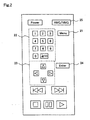
- Figure 2 shows an example of key arrangement of the remote control 14.
- a "Menu” key 21 is one for calling a whole menu showing plural menu items (titles) at a glance, which is displayed during playback of discs.
- "Ten” keys 22 and "direction” keys 23 are keys for selecting one of the displayed menu items.
- a "Enter” key 24 is one for determining the selected item.
- An “AMG/VMG” key 25 is one for switching disc management information. The user selects a desired title from the displayed whole menu using the "ten" keys 22 and "direction" keys 23.
- the remote control photo detector 15 receives infrared key signals which are transmitted by pressing the keys of the remote control 14, and transmits key data to the system control unit 17.
- the buffer memory 16 temporarily retains the data which are input from the signal processing unit 4 via the system control unit 17.
- the system control unit 17 comprises a program memory which contains a program for realizing the function as the system control unit, a processor which implements the program, a general register and a timer, and controls the whole optical disc playback apparatus.
- the unit 17 stores the data transferred from the signal processing unit 4 in the buffer memory 16, reads the data from the buffer memory 16, and performs the control according to types of the read data. That is, when the read data are disc management information, the system control unit 17 stores the data in the video disc management information storage unit 12 or the audio disc management information storage unit 13, and performs the control on the basis of contents of these data.
- the unit 17 When the read data are title set management information such as the audio/video sequence information and object position information, the unit 17 performs the control on the basis of contents of these data.
- the read data are audio/video data
- the unit 17 transfers the audio/video data from the buffer memory 16 to the AV decoder unit 5.
- the data are still picture data of DVD-Audio standard discs
- the data are stored in the still picture data storage unit 11.
- the system control unit 17 calculates a track on the disc corresponding to a logical block which is to be read next, indicates the position of the track, and instructs the mechanism control unit 3 to perform block reading control.
- the unit 17 receives the signals from the remote control photo detector 15, converts the signals into data codes corresponding to pressed keys, and performs the playback control according to the keys.
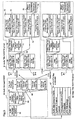
- FIG. 3 is a flowchart showing contents of the processing by the system control unit 17.
- the system control unit 17 detects that a disc is mounted on the playback apparatus (step S31), it controls the mechanism control unit 3 and the signal processing unit 4, thereby controlling the rotation of the disc so as to realize stable reading of data.
- the unit 17 moves the optical pickup in a Volume zone, and controls the optical pickup so as to read information of a file in a File zone, which is recorded in the Volume zone.
- the unit 17 reads disc management information on the basis of the read file information.
- the read information is video disc management information
- the unit 17 stores the data in the video disc management information storage unit 12 and terminates the processing.
- the unit 17 When the read information is audio disc management information, the unit 17 initially stores the data in the audio disc management information storage unit 13, and then further searches video disc management information. When there is video disc management information, the unit 17 reads the information and stores the data in the video disc management information storage unit 12 (step S32). Then, it is judged whether the VMG and AMG are stored in the disc management information storage units 12 and 13. When both of the disc management information, i.e., VMG and AMG are stored, it is checked whether the user switched the disc management information (steps S33 and S34). When the AMG is selected as the disc management information, the AMG is read from the audio disc management information storage unit 13 (steps S35 and S36). On the other hand, when the VMG is selected as the disc management information, the VMG is read from the video disc management information storage unit 12 (step S37).
- the system control unit 17 judges whether the title which is selected in accordance with Title Set Search Pointer information in the disc management information is the ATS or VTS (step S39).
- the system control unit 17 reads audio title set management information in the ATS including the selected title and its attribute tables (audio title set management table and program chain information table), retains the audio title set management information and the attribute tables (step S40), and branches to a first program chain of the audio title (step S41). Then, this program chain group is played (step S42). When the playback is finished, it returns to step S33.
- the system control unit 17 reads video title set management information in the VTS including the selected title and its attribute tables, retains the video title set management information and attribute tables (step S44), and branches to a first program chain of the video title (step S45). Then, this program chain group is played (step S46). When the playback is finished, it returns to step S33.
- step S43 when the user selects a desired title (step S43), the subsequent processes are the same as those in the above-described case where the VTS is played back using the AMG.
- a file structure of a DVD-Audio standard disc having ATSs and VTSs mixed, managed by using the VMG and AMG, respectively, will be described with reference to figures 4 and 5.
- FIG. 4 shows a structure of a file in a DVD-Video zone according to DVD-Audio standard.
- This file comprises one VMG and one or more VTSs.
- Numeral 40 denotes a VMG including management information for whole video titles.
- Numeral 41 denotes a VTS group as a group of one or more VTSs.
- numeral 42 denotes a Video Manager Information (VMGI) including a Video Manager Information Management Table 43 and a Title Set Search Pointer Table 44.
- the Video Manager Information Management Table 43 includes the head address of each Title Set Search Pointer 45.
- the Title Set Search Pointer Table 44 includes data of Title Set Search Pointers 45 of respective titles.
- VMGI Video Manager Information
- the Title Set Search Pointers 45 each indicates the management address of a VTS in the VTS group, as title set position information.
- Numeral 46 denotes Video Title Set Management Information each including a Video Title Set Management Table 48 and a Program Chain Information Table 49 of one VTS.
- Numeral 47 denotes Video Title Sets as entities of video titles.
- the Video Title Set Management Table 48 includes the head address of each Program Chain Information 52.
- the Program Chain Information Table 49 includes a Video Title Set Program Chain Management Table 50, Program Chain Information Search Pointers 51 and Program Chain Information 52.
- the Video Title Set Program Chain Management Table 50 includes the head address of each Program Chain Information Search Pointer 51.
- the Program Chain Information Search Pointer 51 indicates the management address of each Program Chain Information 52.
- the Program Chain Information 52 includes Object Position Information 53 indicating the position of a title on the disc and Sequence Information 54 indicating the playback order of the title.
- the Title Set Search Pointer 45 in the VMG 40 is selected.
- the system control unit 17 reads the address of corresponding Video Title Set Management Information 46 from the selected Title Set Search Pointer 45. Then, the unit 17 retrieves the Program Chain Information 52 from the Program Chain Information Table 49, contains the playback order as the Sequence Information 54, and obtains the Object Position Information 53 on the disc, to control the mechanism control unit 3 and the signal processing unit 4. Thereby, the unit 17 moves the optical pickup 2 to a target object position and performs playback of the target VTS. Basically, all of the VTS#1-VTS#p can be designated by the VMG.
- Figure 5 shows a structure of a file having a DVD-Audio zone and a DVD-Video zone according to DVD-Audio standard, managed using the AMG.
- the file comprises one AMG, one or more ATSs and one or more VTSs.
- the VMG is included in the DVD-Video zone, when the disc is managed using the AMG, the VMG is not utilized. Therefore, the VMG is not described herein.
- Numeral 60 denotes an AMG including management information for whole titles.
- Numeral 61 denotes an ATS group as a group of plural ATSs.
- Numeral 62 denotes a VTS group as a group of plural VTSs.
- Numeral 63 denotes an Audio Manager Information (AMGI) including an Audio Manager Information Management Table 64 and a Title Set Search Pointer Table 65.
- the Audio Manager Information Management Table 64 includes the head address of each Title Set Search Pointer 66.
- the Title Set Search Pointer Table 65 includes data of Title Set Search Pointers 66 of respective titles.
- the Title Set Search Pointers 66 each indicates the management address of each title set in the ATS group and the VTS group, as title set position information.
- Numeral 67 denotes an Audio Title Category which is included in the Title Set Search Pointer 66 and indicates whether the title is an ATS or VTS.
- Numeral 68 denotes Audio Title Set Management Information each including an Audio Title Set Management Table 70 and a Program Chain Information Table 71 of one ATS.
- the Audio Title Set Management Table 70 includes the head address of each Program Chain Information 74.
- the Program Chain Information Table 71 includes an Audio Title Set Program Chain Management Table 72, Program Chain Information Search Pointers 73 and Program Chain Information 74.
- the Audio Title Set Program Chain Management Table 72 includes the head address of each Program Chain Information Search Pointer 73.
- the Program Chain Information Search Pointer 73 indicates the management address of each Program Chain Information 74.
- the Program Chain Information 74 includes Object Position Information 75 indicating the position of a title on a disc and Sequence Information 76 indicating the playback order of the title. Since the VTS is the same as that shown in figure 4, it is not described here.
- the Title Set Search Pointer 66 in the AMG 60 is selected.
- the system control unit 17 reads the ATS/VTS selection information 67 included in the selected Title Set Search Pointer 66, and selects the ATS group or the VTS group. Then, the unit 17 reads the address of corresponding Audio or Video Title Set Management Information from the selected Title Set Search Pointer 66. Then, the unit 17 retrieves the Program Chain Information 74 from the Program Chain Information Table 71, contains the playback order as the Sequence Information 76, and obtains the Object Position Information 75 on the disc, to control the mechanism control unit 3 and the signal processing unit 4. Thereby, the unit 17 moves the optical pickup 2 to a target object position and performs playback of the target ATS or VTS.
- the number of VTSs which can be managed by the AMG is equal to or smaller than the number of VTSs which can be managed by the VMG.
- the optical disc playback apparatus comprises storage means which contain the AMG and VMG, respectively, and selection means for selecting one of the contained AMG and VMG in accordance with external inputs. Therefore, even when a DVD-Audio standard disc having both of the AMG and VMG is played back, this optical disc playback apparatus (DVD-Universal player) can play back all ATSs and VTSs.
- DVD-Universal player DVD-Universal player
- the description is given of only the case where DVD optical discs are played back.
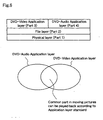
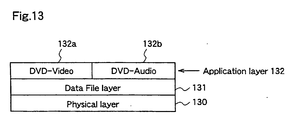
- an optical disc other than DVD optical discs has a physical layer specifying the physical structure, a file layer specifying the data file structure, and at least two application layers specifying the application structure on the common physical layer and file layer as shown in figure 13, the present invention can be applied to the disc.
- storage means contain respective management information of the applications and selection means select one of the respective management information in accordance with an external input
- the optical disc having the at least two application layers can be also played according to the user's selection.
Landscapes
- Engineering & Computer Science (AREA)
- Multimedia (AREA)
- Signal Processing (AREA)
- Management Or Editing Of Information On Record Carriers (AREA)
- Indexing, Searching, Synchronizing, And The Amount Of Synchronization Travel Of Record Carriers (AREA)
- Signal Processing For Digital Recording And Reproducing (AREA)
- Television Signal Processing For Recording (AREA)
Abstract
Description
Claims (5)
- An apparatus for playing back an optical disc which includes at least one audio/video data storage area which contains at least one audio title set or video title set, at least one title set management information storage area which contains audio/video sequence information indicating a playback order of prescribed pieces of audio/video data constituting an audio/video sequence, and object position information indicating positions of the audio/video data on the optical disc, and at least one disc management information storage area which contains disc management information for managing the whole disc, including title set position information indicating a position of the title set on the optical disc,said playback apparatus comprising:reading means for reading the audio/video data, the audio/video sequence information, the object position information, the title set position information, and the disc management information from the optical disc, to play back the data;control means for controlling the reading means;storage means which contain the disc management information obtained from the at least one disc management information storage area; andexternal input receiving means for receiving an external input for disc management information selected by a user among plural kinds of the disc management information obtained from the at least one disc management information storage area, whereinthe control means control the reading means so as to read the audio/video sequence information, the object position information, the title set position information and the disc management information from the optical disc, to play back the audio/video data successively in accordance with the disc management information, the title set position information, the audio/video sequence information and the object position information, andwhen an instruction for selecting one of the plural kinds of disc management information is given, the control means select the disc management information in accordance with the instruction, and perform control so as to play back the audio data or video data on the basis of the title set position information included in the disc management information, the sequence information, and the object position information.
- An apparatus for playing back an optical disc in which at least one audio title set or video title set, audio disc management information and video disc management information for respectively managing whole titles in the audio title set or video title set, audio/video sequence information, object position information, and title set position information are stored in the medium, comprising:information reading means for reading the audio title set or video title set, the audio disc management information, the video disc management information, the audio/video sequence information, the object position information and the title set position information from the optical disc, and storing the audio/video sequence information, the object position information, and the title set position information in a buffer memory;storing means which contain the read audio disc management information and video disc management information, respectively;external input receiving means for receiving an external input for disc management information which is stored in the storage means and selected by a user; andcontrol means for controlling the information reading means so as to read required audio data or video data from the optical disc on the basis of one of the audio disc management information and video disc management information selected by the external input receiving means, to play back the data.
- The optical disc playback apparatus of Claim 2 whereinsaid control means control the reading means so as to play back audio or video data on the basis of the title set position information indicating a position of a title set included in the selected audio disc management information or video disc management information, the sequence information stored in the buffer memory which indicates a playback order of the audio or video data, and the object position information indicating positions of the audio or video data on the optical disc.
- A method for playing back an optical disc in which at least one audio title set or video title set, audio disc management information and video disc management information for respectively managing titles in the audio title set or video title set, audio/video sequence information, object position information, and title set position information are stored in the medium, comprising steps of:reading the audio title set or video title set, the audio disc management information, the video disc management information, the audio/video sequence information, the object position information and the title set position information from the optical disc;storing the read audio disc management information and video disc management information, respectively;receiving an external input for disc management information selected by a user among the stored audio disc management information and video disc management information; andreading required audio data or video data from the optical disc on the basis of the audio disc management information or video disc management information selected in accordance with a selection instruction signal which is input from outside, and playing back the data.
- An optical disc playback apparatus for playing back data which are recorded on an optical disc having a physical layer specifying a physical structure, a file layer specifying a data file structure and at least two application layers specifying application structures disposed on the common physical layer and file layer, comprising:information reading means for reading respective management information in the plural application layers, and data, sequence information, object position information and title set position information included in applications;storage means which contain the plural management information read by the information reading means;selection means for selecting desired management information among the plural management information stored in the storage means, in accordance with a selection by a user; andcontrol means for controlling the information reading means so as to read required data from the optical disc on the basis of the desired management information selected by the selection means and play back the data.
Applications Claiming Priority (2)
| Application Number | Priority Date | Filing Date | Title |
|---|---|---|---|
| JP16327399 | 1999-06-10 | ||
| JP16327399 | 1999-06-10 |
Publications (2)
| Publication Number | Publication Date |
|---|---|
| EP1059642A2 true EP1059642A2 (en) | 2000-12-13 |
| EP1059642A3 EP1059642A3 (en) | 2003-10-29 |
Family
ID=15770685
Family Applications (1)
| Application Number | Title | Priority Date | Filing Date |
|---|---|---|---|
| EP00112290A Withdrawn EP1059642A3 (en) | 1999-06-10 | 2000-06-08 | Optical disc playback apparatus and optical disc playback method |
Country Status (5)
| Country | Link |
|---|---|
| US (1) | US6931200B1 (en) |
| EP (1) | EP1059642A3 (en) |
| CN (1) | CN1135553C (en) |
| MY (1) | MY125219A (en) |
| SG (1) | SG89331A1 (en) |
Cited By (1)
| Publication number | Priority date | Publication date | Assignee | Title |
|---|---|---|---|---|
| US6717891B2 (en) * | 2000-04-18 | 2004-04-06 | Matsushita Electric Industrial Co., Ltd. | Reproducing device and reproducing method |
Families Citing this family (7)
| Publication number | Priority date | Publication date | Assignee | Title |
|---|---|---|---|---|
| JP3593015B2 (en) * | 2000-09-20 | 2004-11-24 | 株式会社東芝 | Record management system with mixed information of different standards |
| KR100509723B1 (en) * | 2002-03-23 | 2005-08-23 | 주식회사 레인콤 | Apparatus and method for playing audio packet stored in a video cd-rom separatedly |
| US7889968B2 (en) * | 2002-06-24 | 2011-02-15 | Lg Electronics Inc. | Recording medium having data structure for managing reproduction of multiple reproduction path video data for at least a segment of a title recorded thereon and recording and reproducing methods and apparatuses |
| US7783159B2 (en) * | 2002-06-24 | 2010-08-24 | Lg Electronics Inc. | Recording medium having data structure for managing reproduction of multiple reproduction path video data for at least a segment of a title recorded thereon and recording and reproducing methods and apparatuses |
| JP3925917B2 (en) * | 2002-09-02 | 2007-06-06 | アルパイン株式会社 | Video disc player |
| KR101014233B1 (en) * | 2003-10-22 | 2011-02-14 | 엘지전자 주식회사 | Additional audio file management and playback method for interactive optical disc |
| JP2007207328A (en) * | 2006-01-31 | 2007-08-16 | Toshiba Corp | Information storage medium, program, information reproducing method, information reproducing apparatus, data transfer method, and data processing method |
Family Cites Families (11)
| Publication number | Priority date | Publication date | Assignee | Title |
|---|---|---|---|---|
| KR100215130B1 (en) * | 1995-04-06 | 1999-08-16 | 니시무로 타이죠 | Recording medium which records reproduction data and attribute information of reproduction data together |
| TW430785B (en) * | 1995-04-14 | 2001-04-21 | Toshiba Corp | Interactively broadcasting recording-media and its regeneration system |
| JP4150084B2 (en) | 1995-11-24 | 2008-09-17 | ソニー株式会社 | Disc recording medium |
| US6381403B1 (en) * | 1997-01-31 | 2002-04-30 | Victor Company Of Japan, Ltd. | Audio disk of improved data structure and reproduction apparatus thereof |
| US6449227B1 (en) * | 1997-03-25 | 2002-09-10 | Samsung Electronics Co., Ltd. | DVD-audio disk, and apparatus and method for playing the same |
| US6741796B1 (en) * | 1997-03-25 | 2004-05-25 | Samsung Electronics, Co., Ltd. | DVD-Audio disk, and apparatus and method for playing the same |
| JP3114971B2 (en) | 1997-08-07 | 2000-12-04 | 松下電器産業株式会社 | Optical disc, reproducing apparatus and reproducing method |
| US6222805B1 (en) | 1997-08-07 | 2001-04-24 | Matsushita Electric Industrial Co., Ltd. | Optical disk, reproduction apparatus, and reproduction method |
| CN1319051C (en) * | 1997-11-21 | 2007-05-30 | 日本胜利株式会社 | Encoding apparatus of audio signal, audio disc and disc reproducing apparatus |
| JP3376265B2 (en) * | 1997-12-25 | 2003-02-10 | 株式会社東芝 | Object sharing system for multiple contents |
| JPH11265563A (en) * | 1998-03-16 | 1999-09-28 | Pioneer Electron Corp | Information recording medium and information reproducing device |
-
2000
- 2000-06-07 SG SG200003193A patent/SG89331A1/en unknown
- 2000-06-08 EP EP00112290A patent/EP1059642A3/en not_active Withdrawn
- 2000-06-09 CN CNB001227157A patent/CN1135553C/en not_active Expired - Fee Related
- 2000-06-09 US US09/590,138 patent/US6931200B1/en not_active Expired - Fee Related
- 2000-06-09 MY MYPI20002612 patent/MY125219A/en unknown
Cited By (1)
| Publication number | Priority date | Publication date | Assignee | Title |
|---|---|---|---|---|
| US6717891B2 (en) * | 2000-04-18 | 2004-04-06 | Matsushita Electric Industrial Co., Ltd. | Reproducing device and reproducing method |
Also Published As
| Publication number | Publication date |
|---|---|
| SG89331A1 (en) | 2002-06-18 |
| US6931200B1 (en) | 2005-08-16 |
| EP1059642A3 (en) | 2003-10-29 |
| CN1278643A (en) | 2001-01-03 |
| MY125219A (en) | 2006-07-31 |
| CN1135553C (en) | 2004-01-21 |
Similar Documents
| Publication | Publication Date | Title |
|---|---|---|
| US7174089B2 (en) | Data storage medium and apparatus and method for reproducing the data from the same | |
| CA2331499C (en) | Optical disk, reproduction apparatus, reproduction method, and recording medium | |
| US6504997B1 (en) | Optical disk recording/reproducing apparatus and method thereof | |
| US6931200B1 (en) | Optical disc playback apparatus and optical disc playback method | |
| US7162147B2 (en) | Data storage medium and apparatus and method for reproducing the data from the same | |
| JP3570296B2 (en) | Optical disc playback device | |
| JP3619426B2 (en) | Optical disc playback apparatus and optical disc playback method | |
| JP4030712B2 (en) | Optical disc and playback device | |
| JP2002369124A (en) | Disk reproducing apparatus | |
| KR100319841B1 (en) | Recording media with menu data and suitable menu display method |
Legal Events
| Date | Code | Title | Description |
|---|---|---|---|
| PUAI | Public reference made under article 153(3) epc to a published international application that has entered the european phase |
Free format text: ORIGINAL CODE: 0009012 |
|
| AK | Designated contracting states |
Kind code of ref document: A2 Designated state(s): AT BE CH CY DE DK ES FI FR GB GR IE IT LI LU MC NL PT SE |
|
| AX | Request for extension of the european patent |
Free format text: AL;LT;LV;MK;RO;SI |
|
| PUAL | Search report despatched |
Free format text: ORIGINAL CODE: 0009013 |
|
| AK | Designated contracting states |
Kind code of ref document: A3 Designated state(s): AT BE CH CY DE DK ES FI FR GB GR IE IT LI LU MC NL PT SE |
|
| AX | Request for extension of the european patent |
Extension state: AL LT LV MK RO SI |
|
| RIC1 | Information provided on ipc code assigned before grant |
Ipc: 7G 11B 27/10 A |
|
| 17P | Request for examination filed |
Effective date: 20040218 |
|
| AKX | Designation fees paid |
Designated state(s): DE FR GB |
|
| 17Q | First examination report despatched |
Effective date: 20050627 |
|
| STAA | Information on the status of an ep patent application or granted ep patent |
Free format text: STATUS: THE APPLICATION IS DEEMED TO BE WITHDRAWN |
|
| 18D | Application deemed to be withdrawn |
Effective date: 20060613 |