EP1059578A2 - Secure backdoor access for a computer - Google Patents
Secure backdoor access for a computer Download PDFInfo
- Publication number
- EP1059578A2 EP1059578A2 EP00304363A EP00304363A EP1059578A2 EP 1059578 A2 EP1059578 A2 EP 1059578A2 EP 00304363 A EP00304363 A EP 00304363A EP 00304363 A EP00304363 A EP 00304363A EP 1059578 A2 EP1059578 A2 EP 1059578A2
- Authority
- EP
- European Patent Office
- Prior art keywords
- function
- computer
- random number
- agent
- secret
- Prior art date
- Legal status (The legal status is an assumption and is not a legal conclusion. Google has not performed a legal analysis and makes no representation as to the accuracy of the status listed.)
- Ceased
Links
Images


Classifications
-
- G—PHYSICS
- G06—COMPUTING OR CALCULATING; COUNTING
- G06F—ELECTRIC DIGITAL DATA PROCESSING
- G06F21/00—Security arrangements for protecting computers, components thereof, programs or data against unauthorised activity
- G06F21/50—Monitoring users, programs or devices to maintain the integrity of platforms, e.g. of processors, firmware or operating systems
- G06F21/55—Detecting local intrusion or implementing counter-measures
-
- G—PHYSICS
- G06—COMPUTING OR CALCULATING; COUNTING
- G06F—ELECTRIC DIGITAL DATA PROCESSING
- G06F21/00—Security arrangements for protecting computers, components thereof, programs or data against unauthorised activity
- G06F21/30—Authentication, i.e. establishing the identity or authorisation of security principals
- G06F21/305—Authentication, i.e. establishing the identity or authorisation of security principals by remotely controlling device operation
-
- G—PHYSICS
- G06—COMPUTING OR CALCULATING; COUNTING
- G06F—ELECTRIC DIGITAL DATA PROCESSING
- G06F21/00—Security arrangements for protecting computers, components thereof, programs or data against unauthorised activity
- G06F21/30—Authentication, i.e. establishing the identity or authorisation of security principals
- G06F21/31—User authentication
Definitions
- the invention relates to password security of a computer, more specifically, it relates to a backdoor access function which allows access to the computer when the password is not known.
- a computer has a password function used to prevent unauthorized access to the computer which can be unlocked by a backdoor function.
- the computer includes a random number generating function which creates a random number.
- the random number has a secret function performed on it by an agent external to the computer.
- the secret function performed on the random number is verified by the backdoor function to allow unlocking of the password function.
- Another aspect of the invention includes a timeout function within the computer which provides a fixed time interval only during which the backdoor function is capable of unlocking the password function.
- the backdoor access scheme should not be susceptible to an attacker of the computer even if the attacker has complete access to the full schematics and source code of the computer. In developing such a scheme, the practical aspects of computer design should be considered.
- the scheme should not add significantly to the product cost nor be so complex that it is difficult to load and execute it at the appropriate time in the boot process.
- the backdoor access scheme should occupy a small code size. Additionally, the backdoor access will likely only be needed when the authorized user of the computer forgets the original password, is killed, disabled, replaced with another individual, or the manufacturer or other authorized entity (head of corporation, police, government agency) needs to service the unit or access the unit and the password is not available. Therefore, the user interface can be minimal.
- Fig. 1 is an exemplary illustration of a computer 10 and an agent 20 which illustrates a problem with conventional backdoor access schemes.
- Agent 20 is external to the computer and is either a separate electronic device or a remote computer system, possibly accessed by a person, used to provide authentication of a user of the computer 10.
- the computer 10 in response to a user's request, first generates a random number through a random number generator function 34.
- a random number generator function 34 Several different random number generators are known to those skilled in the art such as pseudo random code generators, free-running clocks, and one time pads, to name a few. This random number is then communicated to the agent 20, either by electronic or audible means.
- the agent 20 then uses a secret key 30 to encrypt the random number using an encrypt function 32.
- a secret key 30 to encrypt the random number using an encrypt function 32.
- the resultant encrypted random number is then communicated back to the computer 10 which decrypts the encrypted random number in the decryption function 36 using a copy of the secret key 30 before passing the decrypted random number to the backdoor function 40.
- the backdoor function 40 then compares the decrypted random number with the original random number sent to the agent 20. If the two random numbers are the same then the password function 50 is instructed to unlock the computer 10. In this approach of Fig.
- the computer 10 contains not only the secret key 30 but also the method of decryption which likely will be used by an attacker to reveal the encryption function 32 of the agent 20.
- the agent 20 could be substituted by an attacker just from the attacker having access to the design and source code of the computer 10.
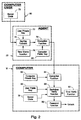
- Fig. 2 illustrates an alternative method of providing a backdoor access to a computer 12 and an agent 22 using conventional public key-private key cryptography.
- Public key-private key cryptography is well known to those skilled in the art.
- a user 60 of computer 10 provides a special backdoor secret code that is known to the computer user 60 in addition to his password.
- This secret code 70 is chosen by the user so that he is unlikely to forget it, such as a birthdate, social security number, mother's maiden name, or even a corporate administration password, to name a few.
- the secret code 70 is then also stored by the user on the computer 12.
- the user private key 72 and computer public key 80 are previously stored on the agent 22.
- the computer private key 82 and user public key 86 we previously stored on computer 12.
- the secret code 70 is communicated to the agent 22 by computer user 60 when the backdoor access is required.
- the agent 22 is once again external to the computer 12.
- the secret code 70 is signed using a previously stored user private key 72 in a signing function 74.
- the signing function 74 is typically just an appending and formatting function.
- the signing function 74 allows for time stamping the signed secret code using a time stamp function 76.
- the signed secret code is then encrypted using encryption function 78 using the computer's public key 80 which has previously been stored on agent 22.
- the encrypted signed secret code is then communicated to the computer 12.
- the computer 12 then uses the computer's private key 82 with a decryption function 84 to decrypt the encrypted signed secret code.
- the signed secret code is then passed to a backdoor verify function 88.
- the backdoor verify function 88 then uses the user's public key 86, and optionally the time verify function 92 if time stamping is used, to unsign the secret code.
- the unsigned secret code is then compared in the backdoor verify function 88 with the secret code 70 that is stored on computer 12. If it is verified as the same, then the password function 90 is unlocked allowing access to computer 12.
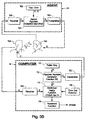
- Fig. 3A is an exemplary illustration of the invention showing the interaction between a computer 14 and an agent 24.
- Computer 14 has stored on it a public key (N) 110 which in conjunction with a random number generator function 112 is used to provide a limit on a random number to a secret function 100 in the agent 24.
- the secret function 100 manipulates the content of the random number using a predetermined mathematical formula that is the secret function.
- One characteristic for the secret function 100 is that it be one of the type known to those skilled in the art as a one-way function with a trap door 102. Several one-way functions with trap doors exist and are known to those skilled in the art (see U.S. Patent No. 5,222,140).
- a one-way function means that it is more difficult to compute the secret function 100 than it is to perform its inverse function. However, if given the trapdoor 102, the computation of the secret function 100 is easy and an output is generated. The output of the secret function 100 is then communicated to the backdoor verify function 114 on the computer 14 which performs the inverse function of the secret function 100 on the received output from agent 24. The backdoor verify function 114 then compares the inverse function result with an expected result passed from the random number generator 112.
- a time out function 118 can be used to restrict the time period in which a response from the agent 24 is allowed to be examined by the backdoor verify function 114. If the backdoor verify function 114 verifies that the output of agent 24 matches the expected result from random number generator 112, then the password function 116 is unlocked, otherwise, the backdoor access is aborted.
- Fig. 3A The exemplary implementation of Fig. 3A is further illustrated in Fig. 3B as having a computer user 154 conversing with a computer manufacturer support person 156.
- the conversation occurs over a phone line or alternatively, the conversation could be held over a data channel such as the internet or a direct communication channel.
- Agent 24 has a receiver circuit 158, such as a keyboard used by the support person 156, for receiving the output of the random number generator function 112 that is sent using a transmitter 152 to the computer user 154 an then onto the support person 156 who inputs this output into the agent 24.
- the computer user 154 receives the output of the random number generator function 112 using preferably a display device on the computer 14 as transmitter 152, such as an video display terminal or liquid crystal display to name a couple.
- the agent 24 passes the received random number to the secret function 100.
- the agent 24 uses a transmit circuit 160, preferably a display device, to output the result of the secret function 100 to the support person 156 who further transmits the result of the secret function 100 to the computer user 154.
- the computer user 154 then transmits the result of the secret function 100 to a receiver input device 150, such as a keyboard, on the computer 14. If the computer user 154 has access to agent 24 then the manufacturing support person 156 is not required.
- transmitter 152 and receiver 158 are electrically coupled, as well as transmitter 160 being electrically coupled to receiver 150. This electrical coupling is either a direct cable connection, a wireless connection, or an internet connection.
- the aforementioned functions of Fig. 3B are performed by either a suitably programmed microprocessor or specially designed hardware in the respective agent 24 or computer 14. Other possible implementations are possible in allocating the various functions to software or hardware and still meet the spirit and scope of the invention.
- the public key 110 is stored in any suitable computer readable memory, such as a electrically erasable programmable read-only memory (EEPROM), dynamic random access memory (DRAM), or hard-disk drive, to name a few, on computer 14.
- EEPROM electrically erasable programmable read-only memory
- DRAM dynamic random access memory
- hard-disk drive to name a few
- the random number generator function 112 and timeout function 118 are preferably implemented using a suitably programmed microprocessor, such as a Pentium processor made by Intel or a system controller such as a Hitachi H8 processor, to name a couple.
- the random number generator function 112 may interface to an on board timer used in the timeout function 118 in order to get a seed for the random number generator function 112, or alternately, a specially designed system controller could implement the random number generator function 112 and timeout function 118 using conventional logic circuits.
- the random number generator function 112 and timeout function 118 are capable of being implemented in a conventional IBM compatible PC or other computer using hardware, or hardware and software combined.
- the backdoor verify function 114 and password function 116 are implemented by a set of software routines stored in computer readable memory encoded with executable instructions that cause a microprocessor, such as the Pentium processor, to function as described.
- the computer readable memory is the Basic Input/Output System (BIOS) code stored in a programmable read-only memory that is executed during the power on self-test (POST) code that the processor runs during initialization.
- BIOS Basic Input/Output System
- POST power on self-test
- the agent 24 in Fig. 3B is preferably a programmed computer or other electronic device having a computer processor with the trap door 102 secret stored in computer readable memory and the secret function 100 implemented as a software program in computer readable memory that is encoded with executable instructions to cause a computer processor to perform the secret function.
- the secret function may be implemented by using conventional logic circuits or a combination of conventional logic circuits and software programs in computer readable memory executing instructions to interface with the conventional logic circuits.
- Fig. 3B uses for the secret function 100 a one-way function with a trapdoor which finds the square root modulo N of a random number modulo N , where N is a number formed by the product of two large prime numbers, for instance P and Q .
- This one way function for quadratic residousity is considered to be an intractable problem.
- N P x Q , where P and Q are prime
- factoring is also considered to be a intractable problem.
- the RSA public key algorithm is considered secure due to this fact. Factoring means that for a sufficiently large P and Q , it is difficult to compute P and Q only given their product N .
- the secret function 100 is chosen to find a square root modulo N of a random number between 1 and public key 110, a Blum integer N , formed by the product of two large random numbers P and Q , where P and Q are chosen to both be congruent to 3 modulo 4.
- the trapdoor 102 secret to the secret function 100 is P and Q and these numbers are only known to the agent 24 and are not the known to the computer 14.
- the public key 110 is stored on computer 14.
- the random number generator function 112 creates a first random number R between 1 and N-1 .
- the number C is then the random number communicated to the secret function 100 of agent 24.
- the secret function 100 then computes one of the square root modulo N ( S ) of the random number C and communicates the number S to the backdoor verify function 114, which also receives the random number C from the random number generating function 112.
- the back door verify function 114 then performs the inverse of the secret function which is the square of S modulo N ( S 2 mod N ) and verifies that the result is equal to C . If the result is verified, the password function 116 is then allowed to unlock. Note that the backdoor verify function 114 only requires the multiplication of two integer numbers and integer modulo arithmetic which is not very complex.
- an optional timeout function 118 provides a limited time window in which to receive a response from agent 24. For audible communications with a human user of the computer14 to the agent 24, an exemplary time period would be 10 seconds.
- an agent 24 that knows the trapdoor 102, P and Q , can compute the proper response within fractions of a second and additional time is allowed for the agent 24 to communicate and have the user enter the response into the computer 14. If a timely and correct response S is received, the computer 24 can conclude that the user knows the secret function and the secret trapdoor 102, P and Q. This is in spite of the fact that the computer 24 doesn't contain either the secret function 100 or the secret trapdoor 102, P and Q.
- Fig. 3A provides excellent security if agent 24 is a separate electronic device which can be safely distributed and secured from attackers.
- the backdoor password function described being the only method of unlocking the password function. That is the password function is only be unlocked by the aforementioned process.
- agent 24 is a remote computer at say a manufacturer's service center
- the user of computer 14 who forgets his password must supply and prove ownership of the computer 14, typically over the phone or internet.
- the backdoor access of Fig. 3A will work with any similar computer of the same model including an improper or stolen unit. Since an attacker may already own another computer 14, he could foil the manufacturing service center into believing that he is an authorized user and thus get access to the stolen unit. Therefore, it is also desired that some optional method be added to this back door access scheme to prevent just having proof of ownership of a computer 14 from being able to unlock an improper or stolen computer 14.
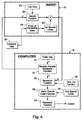
- Fig. 4 is an exemplary illustration of a first alternative embodiment of the invention which incorporates a special code 124 in the computer 15 that is unique to each computer 15.
- a special code 124 might be a serial number or a random number.
- a querying operation is used by the agent 25 to get an index 128 from the computer user 60 to verify proof of ownership, such as a user's name, company, a personal identification number, social security number, or telephone number, to name a few.
- This index 128 is then used to retrieve a special code 122 for this authorized user from a database of authorized users within the agent.
- the special code 122 is then included with the response of the agent, for example by encryption, and sent to the computer.
- the computer then recovers and compares this special code 122 with an expected special code 124 previously stored on the computer in verify special code function 126 before allowing the password function 116 to unlock. If this index 128 is tied to the proof of ownership, such as a serial number, reported by the an authorized user of the computer, only the authorized computer 15 of the computer user 60 will be able to be unlocked. Any other computer 15 would not see the expected response to the challenge and would refuse to unlock.
- this scheme works best when the agent 25 is a remote computer. If the agent 25 is to be a small electronic device, it is preferable to not have a large database present on the agent 25 to save money. In this case, it may be desirable to just have the serial number of computer 15 embedded in the small electronic device so that only those small electronic devices with the proper serial number can provide backdoor access. Alternatively, to allow any agent to provide the backdoor access another alternative is to have the special code be a form of a "hint" which only an authorized user would know.
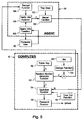
- Fig. 5 is an illustration of a second alternative embodiment in which the agent 26 receives a specially encrypted hint that has been previously stored on a computer 16 by the authorized computer user 60 or another authorized person.
- This hint 130 is a special code that a user is unlikely to forget, such as a maiden name, a social security number, personal identification number, relative's phone number, and child's middle name, to name a few.
- the hint 130 can be used by a corporate security staff to store a special administration password known only to super authorized users.
- the hint 130 in the computer 16 is encrypted by an encrypt function 132 and included with the random number passed by the computer 16 to the agent 26. The agent 26 then decrypts the encrypted hint using the decrypt function 104.
- the agent 26 also performs a query hint function 106 in which the agent 26 asks the computer user 60 to supply a copy of the hint 130.
- the decrypted-encrypted hint is then verified with the computer user supplied hint in a verify hint function 108. If the hint 130 is verified, then the verify hint function 108 passes the random number C to the secret function for processing as performed and explained in Fig. 3.
- the invention provides a backdoor access scheme wherein the secret to unlocking the password function of a computer does not reside on the computer.
- the computer only contains a verification function which verifies that the secret has been performed by an authorized agent external to the computer.
- This technique allows for increased security by preventing access to the computer to unauthorized users while providing a method to gain access to the computer for authorized users even if the password is not known.
- This technique not only allows for small code size and ease of implementation but also the ability to have the computer manufactured anywhere without compromising the secrets of how to access the computer even if the full schematics or source code of the computer are disclosed.
Landscapes
- Engineering & Computer Science (AREA)
- Computer Security & Cryptography (AREA)
- Theoretical Computer Science (AREA)
- Software Systems (AREA)
- Computer Hardware Design (AREA)
- Physics & Mathematics (AREA)
- General Engineering & Computer Science (AREA)
- General Physics & Mathematics (AREA)
- Storage Device Security (AREA)
- Measuring Volume Flow (AREA)
Abstract
Description
Claims (10)
- A computer (14), comprising:a password function (116) used to prevent unauthorized access to the computer (14) capable of being unlocked;a random number generating function (112) capable of creating a random number; anda backdoor function (114), in cooperation with an agent (24) external to the computer (14), capable of verifying that a secret function (100) has been performed on said random number by the agent (24) thereby allowing unlocking of the password function (116) which grants access to the computer.
- The computer (14) of claim 1 wherein said backdoor function (114) is the only method of unlocking said password function (116).
- The computer (14) of claim 1, further comprising:a timeout function (118) which provides a fixed time interval only during which the backdoor function (114) is capable of unlocking the password function (116).
- The computer (14) of claim 1, further comprising:a public key (110), N, stored in the computer (14), said public key (110) formed by the product of a first prime number and a second prime number;means (112) for generating said random number, modulo N;means (152) for communicating said random number to said agent (24) wherein said agent (24) performs said secret function (100) on said random number thereby creating a response;means (150) for receiving said response from said agent (24); andmeans (114) for performing a verification operation on said response to validate that that the secret function (100) has been performed on said first random number before unlocking the password function (116).
- An agent (24) for unlocking a computer (14) having a password, the agent (24) comprising:a receiver (158) for accepting a random number from the computer (14);a secret function (100) operating on said random number thereby creating a response; anda transmitter (160) for sending said response to the computer (14) wherein said response is capable of unlocking the computer (14).
- The agent (24) of claim 5, wherein said means for performing said secret function (100) on said random number comprises the use of a first prime number and a second prime number to find a square root modulo N of said random number; and wherein said response includes said square root modulo N.
- An authorization system, comprising:an agent (24), having,means (158) for receiving a random number;means (100) for performing a secret function on said random number thereby creating a response; andmeans (160) for transmitting said response; anda computer (14) having a password function (116) capable of being unlocked by a backdoor password function (114), said password function (116)prevents unauthorized user access, the computer (14) further having,means (112) of creating said random number;means (152) for transmitting said random number to said agent (24);means (150) for receiving said response from said agent (24); andmeans for unlocking said password function (116) by the backdoor password function (114) if said response confirms that the secret operation was performed on said random number.
- The authorization system of claim 7, wherein said computer (14) further comprises:a timeout function (118) which provides a time interval beginning from an instant when said random number is sent to said agent (24), and only during said time interval said means for unlocking said password function (116) is operable.
- The authorization system of claim 8, wherein said agent (24) is capable of performing said means (158) for receiving, said means (100) for performing a secret operation, and said means (160) for transmitting said response within said time interval.
- The authorization system of claim 7 wherein the password function (116) of said computer (14) only is capable of being unlocked by said backdoor password function (114).
Applications Claiming Priority (2)
| Application Number | Priority Date | Filing Date | Title |
|---|---|---|---|
| US32697799A | 1999-06-07 | 1999-06-07 | |
| US326977 | 1999-06-07 |
Publications (2)
| Publication Number | Publication Date |
|---|---|
| EP1059578A2 true EP1059578A2 (en) | 2000-12-13 |
| EP1059578A3 EP1059578A3 (en) | 2003-02-05 |
Family
ID=23274595
Family Applications (1)
| Application Number | Title | Priority Date | Filing Date |
|---|---|---|---|
| EP00304363A Ceased EP1059578A3 (en) | 1999-06-07 | 2000-05-23 | Secure backdoor access for a computer |
Country Status (2)
| Country | Link |
|---|---|
| EP (1) | EP1059578A3 (en) |
| JP (1) | JP2001034584A (en) |
Cited By (5)
| Publication number | Priority date | Publication date | Assignee | Title |
|---|---|---|---|---|
| US7913094B2 (en) | 2001-12-27 | 2011-03-22 | Fujitsu Limited | Information reproducing apparatus and secure module |
| WO2013156663A1 (en) * | 2012-04-18 | 2013-10-24 | Abb Technology Ag | Password provision for power system device |
| WO2017044352A1 (en) * | 2015-09-11 | 2017-03-16 | Curtail Security, Inc. | Implementation comparison-based security system |
| US10462256B2 (en) | 2016-02-10 | 2019-10-29 | Curtail, Inc. | Comparison of behavioral populations for security and compliance monitoring |
| CN112217604A (en) * | 2020-06-09 | 2021-01-12 | 国家数字交换系统工程技术研究中心 | Input and output system applied to network security defense system |
Families Citing this family (5)
| Publication number | Priority date | Publication date | Assignee | Title |
|---|---|---|---|---|
| ZA200602587B (en) * | 2003-10-14 | 2007-06-27 | Ericsson Telefon Ab L M | Efficient management of cryptographic key generations |
| US7187600B2 (en) * | 2004-09-22 | 2007-03-06 | Freescale Semiconductor, Inc. | Method and apparatus for protecting an integrated circuit from erroneous operation |
| JP2006139757A (en) * | 2004-10-15 | 2006-06-01 | Citizen Watch Co Ltd | Locking system and locking method |
| JP4750734B2 (en) * | 2007-02-26 | 2011-08-17 | 富士通株式会社 | Information reproducing apparatus and secure module |
| JP2023541251A (en) * | 2020-09-09 | 2023-09-29 | ケンブリッジ クアンタム コンピューティング リミテッド | Nondeterministic random number generator based on cryptographic systems and quantum systems |
Family Cites Families (3)
| Publication number | Priority date | Publication date | Assignee | Title |
|---|---|---|---|---|
| US4779224A (en) * | 1985-03-12 | 1988-10-18 | Moseley Donald R | Identity verification method and apparatus |
| GB9515228D0 (en) * | 1995-07-25 | 1995-09-20 | Collins Peter D | Compu-kill |
| US5768373A (en) * | 1996-05-06 | 1998-06-16 | Symantec Corporation | Method for providing a secure non-reusable one-time password |
-
2000
- 2000-05-23 EP EP00304363A patent/EP1059578A3/en not_active Ceased
- 2000-06-07 JP JP2000170368A patent/JP2001034584A/en active Pending
Cited By (10)
| Publication number | Priority date | Publication date | Assignee | Title |
|---|---|---|---|---|
| US7913094B2 (en) | 2001-12-27 | 2011-03-22 | Fujitsu Limited | Information reproducing apparatus and secure module |
| WO2013156663A1 (en) * | 2012-04-18 | 2013-10-24 | Abb Technology Ag | Password provision for power system device |
| WO2017044352A1 (en) * | 2015-09-11 | 2017-03-16 | Curtail Security, Inc. | Implementation comparison-based security system |
| US10432659B2 (en) | 2015-09-11 | 2019-10-01 | Curtail, Inc. | Implementation comparison-based security system |
| US10986119B2 (en) | 2015-09-11 | 2021-04-20 | Curtail, Inc. | Implementation comparison-based security system |
| US11637856B2 (en) | 2015-09-11 | 2023-04-25 | Curtail, Inc. | Implementation comparison-based security system |
| US10462256B2 (en) | 2016-02-10 | 2019-10-29 | Curtail, Inc. | Comparison of behavioral populations for security and compliance monitoring |
| US11122143B2 (en) | 2016-02-10 | 2021-09-14 | Curtail, Inc. | Comparison of behavioral populations for security and compliance monitoring |
| CN112217604A (en) * | 2020-06-09 | 2021-01-12 | 国家数字交换系统工程技术研究中心 | Input and output system applied to network security defense system |
| US12267303B2 (en) | 2020-06-09 | 2025-04-01 | China National Digital Switching System Engineering & Technological R&D Center | Input/output system applied to network security defense system |
Also Published As
| Publication number | Publication date |
|---|---|
| EP1059578A3 (en) | 2003-02-05 |
| JP2001034584A (en) | 2001-02-09 |
Similar Documents
| Publication | Publication Date | Title |
|---|---|---|
| US4590470A (en) | User authentication system employing encryption functions | |
| US8559639B2 (en) | Method and apparatus for secure cryptographic key generation, certification and use | |
| Chang et al. | An efficient and secure multi-server password authentication scheme using smart cards | |
| JP4463979B2 (en) | Apparatus and method for storing, verifying and using cryptographically camouflaged cryptographic keys | |
| US5491752A (en) | System for increasing the difficulty of password guessing attacks in a distributed authentication scheme employing authentication tokens | |
| CN1871810B (en) | Authentication system and remote decentralized storage system | |
| US7502467B2 (en) | System and method for authentication seed distribution | |
| US20090265559A1 (en) | User authentication by linking randomly-generated authentication secret with personalized secret | |
| US7895432B2 (en) | Method and apparatus for using a third party authentication server | |
| CN111159684B (en) | Safety protection system and method based on browser | |
| US20010054147A1 (en) | Electronic identifier | |
| WO2000048064A9 (en) | Security access and authentication token with private key transport functionality | |
| KR20030084983A (en) | Cryptographic authentication with ephemeral modules | |
| US20040059919A1 (en) | Security system for preventing a personal computer from being used by an unauthorized people | |
| JP4107420B2 (en) | Secure biometric authentication / identification method, biometric data input module and verification module | |
| JPH07325785A (en) | Network user authentication method, encrypted communication method, application client and server | |
| US20020091932A1 (en) | Qualification authentication method using variable authentication information | |
| EP1059578A2 (en) | Secure backdoor access for a computer | |
| Chang et al. | An efficient multi-server password authenticated key agreement scheme using smart cards with access control | |
| US20030097559A1 (en) | Qualification authentication method using variable authentication information | |
| Freundenthal et al. | Personal security environment on palm pda | |
| Kadhim et al. | A new initial authentication scheme for kerberos 5 based on biometric data and virtual password | |
| WO2009018513A1 (en) | Systems and methods for implementing a mutating lock box | |
| KR20170001633A (en) | Tokenization-based encryption key managemnent sytem and method | |
| JP2001036522A (en) | Qualification authentication method using variable authentication information |
Legal Events
| Date | Code | Title | Description |
|---|---|---|---|
| PUAI | Public reference made under article 153(3) epc to a published international application that has entered the european phase |
Free format text: ORIGINAL CODE: 0009012 |
|
| AK | Designated contracting states |
Kind code of ref document: A2 Designated state(s): AT BE CH CY DE DK ES FI FR GB GR IE IT LI LU MC NL PT SE |
|
| AX | Request for extension of the european patent |
Free format text: AL;LT;LV;MK;RO;SI |
|
| RAP1 | Party data changed (applicant data changed or rights of an application transferred) |
Owner name: HEWLETT-PACKARD COMPANY, A DELAWARE CORPORATION |
|
| PUAL | Search report despatched |
Free format text: ORIGINAL CODE: 0009013 |
|
| RIC1 | Information provided on ipc code assigned before grant |
Ipc: 7H 04L 9/32 B Ipc: 7G 06F 1/00 A |
|
| AK | Designated contracting states |
Designated state(s): AT BE CH CY DE DK ES FI FR GB GR IE IT LI LU MC NL PT SE |
|
| AX | Request for extension of the european patent |
Extension state: AL LT LV MK RO SI |
|
| 17P | Request for examination filed |
Effective date: 20030430 |
|
| 17Q | First examination report despatched |
Effective date: 20030613 |
|
| AKX | Designation fees paid |
Designated state(s): DE FR GB |
|
| APBN | Date of receipt of notice of appeal recorded |
Free format text: ORIGINAL CODE: EPIDOSNNOA2E |
|
| APBR | Date of receipt of statement of grounds of appeal recorded |
Free format text: ORIGINAL CODE: EPIDOSNNOA3E |
|
| APBK | Appeal reference recorded |
Free format text: ORIGINAL CODE: EPIDOSNREFNE |
|
| APAF | Appeal reference modified |
Free format text: ORIGINAL CODE: EPIDOSCREFNE |
|
| RAP1 | Party data changed (applicant data changed or rights of an application transferred) |
Owner name: HEWLETT-PACKARD COMPANY |
|
| APAF | Appeal reference modified |
Free format text: ORIGINAL CODE: EPIDOSCREFNE |
|
| APBT | Appeal procedure closed |
Free format text: ORIGINAL CODE: EPIDOSNNOA9E |
|
| STAA | Information on the status of an ep patent application or granted ep patent |
Free format text: STATUS: THE APPLICATION HAS BEEN REFUSED |
|
| 18R | Application refused |
Effective date: 20080606 |