EP1059313A1 - Transition metal catalyst component for polymerization, aromatic vinyl compound-olefin copolymer and process for its production by means of the catalyst component - Google Patents
Transition metal catalyst component for polymerization, aromatic vinyl compound-olefin copolymer and process for its production by means of the catalyst component Download PDFInfo
- Publication number
- EP1059313A1 EP1059313A1 EP00112160A EP00112160A EP1059313A1 EP 1059313 A1 EP1059313 A1 EP 1059313A1 EP 00112160 A EP00112160 A EP 00112160A EP 00112160 A EP00112160 A EP 00112160A EP 1059313 A1 EP1059313 A1 EP 1059313A1
- Authority
- EP
- European Patent Office
- Prior art keywords
- group
- vinyl compound
- aromatic vinyl
- hydrogen
- catalyst component
- Prior art date
- Legal status (The legal status is an assumption and is not a legal conclusion. Google has not performed a legal analysis and makes no representation as to the accuracy of the status listed.)
- Withdrawn
Links
- 229920002554 vinyl polymer Polymers 0.000 title claims abstract description 44
- 239000003054 catalyst Substances 0.000 title claims abstract description 34
- 229920000089 Cyclic olefin copolymer Polymers 0.000 title claims abstract description 24
- 229910052723 transition metal Inorganic materials 0.000 title claims abstract description 22
- 150000003624 transition metals Chemical class 0.000 title claims abstract description 22
- 238000004519 manufacturing process Methods 0.000 title claims abstract description 20
- 238000006116 polymerization reaction Methods 0.000 title claims description 30
- 238000000034 method Methods 0.000 title description 12
- 125000004435 hydrogen atom Chemical class [H]* 0.000 claims abstract description 30
- 239000001257 hydrogen Substances 0.000 claims abstract description 28
- 229910052739 hydrogen Inorganic materials 0.000 claims abstract description 28
- -1 aromatic vinyl compound Chemical class 0.000 claims abstract description 26
- 125000003118 aryl group Chemical group 0.000 claims abstract description 25
- 125000000041 C6-C10 aryl group Chemical group 0.000 claims abstract description 24
- 125000001931 aliphatic group Chemical group 0.000 claims abstract description 23
- 125000003837 (C1-C20) alkyl group Chemical group 0.000 claims abstract description 20
- 125000002877 alkyl aryl group Chemical group 0.000 claims abstract description 20
- 150000001336 alkenes Chemical class 0.000 claims abstract description 19
- 125000005843 halogen group Chemical group 0.000 claims abstract description 17
- 229910052751 metal Inorganic materials 0.000 claims abstract description 17
- 239000002184 metal Substances 0.000 claims abstract description 17
- 229910052757 nitrogen Inorganic materials 0.000 claims abstract description 16
- 239000004215 Carbon black (E152) Substances 0.000 claims abstract description 15
- 229930195733 hydrocarbon Natural products 0.000 claims abstract description 15
- 150000002430 hydrocarbons Chemical group 0.000 claims abstract description 15
- IJGRMHOSHXDMSA-UHFFFAOYSA-N Atomic nitrogen Chemical compound N#N IJGRMHOSHXDMSA-UHFFFAOYSA-N 0.000 claims abstract description 14
- JRZJOMJEPLMPRA-UHFFFAOYSA-N olefin Natural products CCCCCCCC=C JRZJOMJEPLMPRA-UHFFFAOYSA-N 0.000 claims abstract description 14
- OKTJSMMVPCPJKN-UHFFFAOYSA-N Carbon Chemical compound [C] OKTJSMMVPCPJKN-UHFFFAOYSA-N 0.000 claims abstract description 12
- 229910052799 carbon Inorganic materials 0.000 claims abstract description 12
- 125000004429 atom Chemical group 0.000 claims abstract description 9
- 150000001450 anions Chemical group 0.000 claims abstract description 7
- 125000004432 carbon atom Chemical group C* 0.000 claims abstract description 7
- 125000001841 imino group Chemical group [H]N=* 0.000 claims abstract description 7
- 230000003647 oxidation Effects 0.000 claims abstract description 7
- 238000007254 oxidation reaction Methods 0.000 claims abstract description 7
- OAICVXFJPJFONN-UHFFFAOYSA-N Phosphorus Chemical compound [P] OAICVXFJPJFONN-UHFFFAOYSA-N 0.000 claims abstract description 3
- NINIDFKCEFEMDL-UHFFFAOYSA-N Sulfur Chemical compound [S] NINIDFKCEFEMDL-UHFFFAOYSA-N 0.000 claims abstract description 3
- QVGXLLKOCUKJST-UHFFFAOYSA-N atomic oxygen Chemical compound [O] QVGXLLKOCUKJST-UHFFFAOYSA-N 0.000 claims abstract description 3
- 229910052760 oxygen Inorganic materials 0.000 claims abstract description 3
- 239000001301 oxygen Substances 0.000 claims abstract description 3
- 229910052698 phosphorus Inorganic materials 0.000 claims abstract description 3
- 239000011574 phosphorus Substances 0.000 claims abstract description 3
- 229910052717 sulfur Inorganic materials 0.000 claims abstract description 3
- 239000011593 sulfur Substances 0.000 claims abstract description 3
- 239000002685 polymerization catalyst Substances 0.000 claims description 8
- 125000000217 alkyl group Chemical group 0.000 claims description 7
- 150000001639 boron compounds Chemical class 0.000 claims description 7
- 125000005234 alkyl aluminium group Chemical group 0.000 claims description 6
- BTBUEUYNUDRHOZ-UHFFFAOYSA-N Borate Chemical compound [O-]B([O-])[O-] BTBUEUYNUDRHOZ-UHFFFAOYSA-N 0.000 description 34
- PPBRXRYQALVLMV-UHFFFAOYSA-N Styrene Chemical compound C=CC1=CC=CC=C1 PPBRXRYQALVLMV-UHFFFAOYSA-N 0.000 description 28
- YXFVVABEGXRONW-UHFFFAOYSA-N Toluene Chemical compound CC1=CC=CC=C1 YXFVVABEGXRONW-UHFFFAOYSA-N 0.000 description 21
- OKKJLVBELUTLKV-UHFFFAOYSA-N Methanol Chemical compound OC OKKJLVBELUTLKV-UHFFFAOYSA-N 0.000 description 18
- JUJWROOIHBZHMG-UHFFFAOYSA-N Pyridine Chemical compound C1=CC=NC=C1 JUJWROOIHBZHMG-UHFFFAOYSA-N 0.000 description 18
- NMCUIPGRVMDVDB-UHFFFAOYSA-L iron dichloride Chemical compound Cl[Fe]Cl NMCUIPGRVMDVDB-UHFFFAOYSA-L 0.000 description 15
- 239000013078 crystal Substances 0.000 description 13
- 238000007334 copolymerization reaction Methods 0.000 description 12
- 229920001577 copolymer Polymers 0.000 description 11
- 125000001495 ethyl group Chemical group [H]C([H])([H])C([H])([H])* 0.000 description 11
- 239000005977 Ethylene Substances 0.000 description 10
- 229920000642 polymer Polymers 0.000 description 10
- 239000002904 solvent Substances 0.000 description 10
- YMWUJEATGCHHMB-UHFFFAOYSA-N Dichloromethane Chemical compound ClCCl YMWUJEATGCHHMB-UHFFFAOYSA-N 0.000 description 9
- VGGSQFUCUMXWEO-UHFFFAOYSA-N Ethene Chemical compound C=C VGGSQFUCUMXWEO-UHFFFAOYSA-N 0.000 description 9
- 150000001875 compounds Chemical class 0.000 description 9
- UMJSCPRVCHMLSP-UHFFFAOYSA-N pyridine Natural products COC1=CC=CN=C1 UMJSCPRVCHMLSP-UHFFFAOYSA-N 0.000 description 9
- OWENECYTSSULHU-UHFFFAOYSA-N 1-[6-[c-methyl-n-(2-propan-2-ylphenyl)carbonimidoyl]pyridin-2-yl]-n-(2-propan-2-ylphenyl)ethanimine Chemical compound CC(C)C1=CC=CC=C1N=C(C)C1=CC=CC(C(C)=NC=2C(=CC=CC=2)C(C)C)=N1 OWENECYTSSULHU-UHFFFAOYSA-N 0.000 description 6
- XEEYBQQBJWHFJM-UHFFFAOYSA-N Iron Chemical compound [Fe] XEEYBQQBJWHFJM-UHFFFAOYSA-N 0.000 description 6
- BDAGIHXWWSANSR-UHFFFAOYSA-N methanoic acid Natural products OC=O BDAGIHXWWSANSR-UHFFFAOYSA-N 0.000 description 6
- AQZWEFBJYQSQEH-UHFFFAOYSA-N 2-methyloxaluminane Chemical compound C[Al]1CCCCO1 AQZWEFBJYQSQEH-UHFFFAOYSA-N 0.000 description 5
- 150000004696 coordination complex Chemical class 0.000 description 5
- 125000002496 methyl group Chemical group [H]C([H])([H])* 0.000 description 5
- 238000002360 preparation method Methods 0.000 description 5
- MCULRUJILOGHCJ-UHFFFAOYSA-N triisobutylaluminium Chemical compound CC(C)C[Al](CC(C)C)CC(C)C MCULRUJILOGHCJ-UHFFFAOYSA-N 0.000 description 5
- BEZVGIHGZPLGBL-UHFFFAOYSA-N 2,6-diacetylpyridine Chemical compound CC(=O)C1=CC=CC(C(C)=O)=N1 BEZVGIHGZPLGBL-UHFFFAOYSA-N 0.000 description 4
- 229940126062 Compound A Drugs 0.000 description 4
- NLDMNSXOCDLTTB-UHFFFAOYSA-N Heterophylliin A Natural products O1C2COC(=O)C3=CC(O)=C(O)C(O)=C3C3=C(O)C(O)=C(O)C=C3C(=O)OC2C(OC(=O)C=2C=C(O)C(O)=C(O)C=2)C(O)C1OC(=O)C1=CC(O)=C(O)C(O)=C1 NLDMNSXOCDLTTB-UHFFFAOYSA-N 0.000 description 4
- BXOUVIIITJXIKB-UHFFFAOYSA-N ethene;styrene Chemical group C=C.C=CC1=CC=CC=C1 BXOUVIIITJXIKB-UHFFFAOYSA-N 0.000 description 4
- 229920001038 ethylene copolymer Polymers 0.000 description 4
- 229920001519 homopolymer Polymers 0.000 description 4
- 238000002844 melting Methods 0.000 description 4
- 230000008018 melting Effects 0.000 description 4
- 238000006384 oligomerization reaction Methods 0.000 description 4
- 125000001997 phenyl group Chemical group [H]C1=C([H])C([H])=C(*)C([H])=C1[H] 0.000 description 4
- 238000003756 stirring Methods 0.000 description 4
- 150000003623 transition metal compounds Chemical class 0.000 description 4
- OSWFIVFLDKOXQC-UHFFFAOYSA-N 4-(3-methoxyphenyl)aniline Chemical compound COC1=CC=CC(C=2C=CC(N)=CC=2)=C1 OSWFIVFLDKOXQC-UHFFFAOYSA-N 0.000 description 3
- UHOVQNZJYSORNB-UHFFFAOYSA-N Benzene Chemical compound C1=CC=CC=C1 UHOVQNZJYSORNB-UHFFFAOYSA-N 0.000 description 3
- RTZKZFJDLAIYFH-UHFFFAOYSA-N Diethyl ether Chemical compound CCOCC RTZKZFJDLAIYFH-UHFFFAOYSA-N 0.000 description 3
- 229910017052 cobalt Inorganic materials 0.000 description 3
- 239000010941 cobalt Substances 0.000 description 3
- GUTLYIVDDKVIGB-UHFFFAOYSA-N cobalt atom Chemical compound [Co] GUTLYIVDDKVIGB-UHFFFAOYSA-N 0.000 description 3
- 238000001914 filtration Methods 0.000 description 3
- 235000019253 formic acid Nutrition 0.000 description 3
- 238000005227 gel permeation chromatography Methods 0.000 description 3
- 238000010438 heat treatment Methods 0.000 description 3
- 229910052742 iron Inorganic materials 0.000 description 3
- 239000000203 mixture Substances 0.000 description 3
- NAOKKJATLKPZMH-UHFFFAOYSA-N n-(2,6-dimethylphenyl)-1-[6-[n-(2,6-dimethylphenyl)-c-methylcarbonimidoyl]pyridin-2-yl]ethanimine Chemical compound C=1C=CC(C(C)=NC=2C(=CC=CC=2C)C)=NC=1C(C)=NC1=C(C)C=CC=C1C NAOKKJATLKPZMH-UHFFFAOYSA-N 0.000 description 3
- VLKZOEOYAKHREP-UHFFFAOYSA-N n-Hexane Chemical compound CCCCCC VLKZOEOYAKHREP-UHFFFAOYSA-N 0.000 description 3
- 230000000704 physical effect Effects 0.000 description 3
- QQONPFPTGQHPMA-UHFFFAOYSA-N propylene Natural products CC=C QQONPFPTGQHPMA-UHFFFAOYSA-N 0.000 description 3
- 125000004805 propylene group Chemical group [H]C([H])([H])C([H])([*:1])C([H])([H])[*:2] 0.000 description 3
- 238000010926 purge Methods 0.000 description 3
- 229920005604 random copolymer Polymers 0.000 description 3
- QPFMBZIOSGYJDE-QDNHWIQGSA-N 1,1,2,2-tetrachlorethane-d2 Chemical compound [2H]C(Cl)(Cl)C([2H])(Cl)Cl QPFMBZIOSGYJDE-QDNHWIQGSA-N 0.000 description 2
- MYRTYDVEIRVNKP-UHFFFAOYSA-N 1,2-Divinylbenzene Chemical compound C=CC1=CC=CC=C1C=C MYRTYDVEIRVNKP-UHFFFAOYSA-N 0.000 description 2
- VNSPACNZFQZEMW-UHFFFAOYSA-N 1-[6-[c-methyl-n-(2,4,6-trimethylphenyl)carbonimidoyl]pyridin-2-yl]-n-(2,4,6-trimethylphenyl)ethanimine Chemical compound C=1C=CC(C(C)=NC=2C(=CC(C)=CC=2C)C)=NC=1C(C)=NC1=C(C)C=C(C)C=C1C VNSPACNZFQZEMW-UHFFFAOYSA-N 0.000 description 2
- KTZVZZJJVJQZHV-UHFFFAOYSA-N 1-chloro-4-ethenylbenzene Chemical compound ClC1=CC=C(C=C)C=C1 KTZVZZJJVJQZHV-UHFFFAOYSA-N 0.000 description 2
- LIKMAJRDDDTEIG-UHFFFAOYSA-N 1-hexene Chemical compound CCCCC=C LIKMAJRDDDTEIG-UHFFFAOYSA-N 0.000 description 2
- KWKAKUADMBZCLK-UHFFFAOYSA-N 1-octene Chemical compound CCCCCCC=C KWKAKUADMBZCLK-UHFFFAOYSA-N 0.000 description 2
- UFFBMTHBGFGIHF-UHFFFAOYSA-N 2,6-dimethylaniline Chemical compound CC1=CC=CC(C)=C1N UFFBMTHBGFGIHF-UHFFFAOYSA-N 0.000 description 2
- JLBJTVDPSNHSKJ-UHFFFAOYSA-N 4-Methylstyrene Chemical compound CC1=CC=C(C=C)C=C1 JLBJTVDPSNHSKJ-UHFFFAOYSA-N 0.000 description 2
- XKRFYHLGVUSROY-UHFFFAOYSA-N Argon Chemical group [Ar] XKRFYHLGVUSROY-UHFFFAOYSA-N 0.000 description 2
- KAKZBPTYRLMSJV-UHFFFAOYSA-N Butadiene Chemical compound C=CC=C KAKZBPTYRLMSJV-UHFFFAOYSA-N 0.000 description 2
- HEDRZPFGACZZDS-UHFFFAOYSA-N Chloroform Chemical compound ClC(Cl)Cl HEDRZPFGACZZDS-UHFFFAOYSA-N 0.000 description 2
- YNQLUTRBYVCPMQ-UHFFFAOYSA-N Ethylbenzene Chemical compound CCC1=CC=CC=C1 YNQLUTRBYVCPMQ-UHFFFAOYSA-N 0.000 description 2
- IMNFDUFMRHMDMM-UHFFFAOYSA-N N-Heptane Chemical compound CCCCCCC IMNFDUFMRHMDMM-UHFFFAOYSA-N 0.000 description 2
- OFBQJSOFQDEBGM-UHFFFAOYSA-N Pentane Chemical compound CCCCC OFBQJSOFQDEBGM-UHFFFAOYSA-N 0.000 description 2
- 239000004793 Polystyrene Substances 0.000 description 2
- KJTLSVCANCCWHF-UHFFFAOYSA-N Ruthenium Chemical compound [Ru] KJTLSVCANCCWHF-UHFFFAOYSA-N 0.000 description 2
- HEDRZPFGACZZDS-MICDWDOJSA-N Trichloro(2H)methane Chemical compound [2H]C(Cl)(Cl)Cl HEDRZPFGACZZDS-MICDWDOJSA-N 0.000 description 2
- 230000002411 adverse Effects 0.000 description 2
- 125000003545 alkoxy group Chemical group 0.000 description 2
- 229920005603 alternating copolymer Polymers 0.000 description 2
- 125000003368 amide group Chemical group 0.000 description 2
- 238000006243 chemical reaction Methods 0.000 description 2
- MVPPADPHJFYWMZ-UHFFFAOYSA-N chlorobenzene Chemical compound ClC1=CC=CC=C1 MVPPADPHJFYWMZ-UHFFFAOYSA-N 0.000 description 2
- 238000003776 cleavage reaction Methods 0.000 description 2
- 230000000052 comparative effect Effects 0.000 description 2
- 230000000536 complexating effect Effects 0.000 description 2
- 238000001816 cooling Methods 0.000 description 2
- LPIQUOYDBNQMRZ-UHFFFAOYSA-N cyclopentene Chemical compound C1CC=CC1 LPIQUOYDBNQMRZ-UHFFFAOYSA-N 0.000 description 2
- AEMVAYJRXURQOZ-UHFFFAOYSA-L dichloroiron;1-[6-[c-methyl-n-(2-propan-2-ylphenyl)carbonimidoyl]pyridin-2-yl]-n-(2-propan-2-ylphenyl)ethanimine Chemical compound Cl[Fe]Cl.CC(C)C1=CC=CC=C1N=C(C)C1=CC=CC(C(C)=NC=2C(=CC=CC=2)C(C)C)=N1 AEMVAYJRXURQOZ-UHFFFAOYSA-L 0.000 description 2
- LDFQFEFEKCCNEF-UHFFFAOYSA-L dichloroiron;n-(2,6-dimethylphenyl)-1-[6-[n-(2,6-dimethylphenyl)-c-methylcarbonimidoyl]pyridin-2-yl]ethanimine Chemical compound Cl[Fe]Cl.C=1C=CC(C(C)=NC=2C(=CC=CC=2C)C)=NC=1C(C)=NC1=C(C)C=CC=C1C LDFQFEFEKCCNEF-UHFFFAOYSA-L 0.000 description 2
- 230000000694 effects Effects 0.000 description 2
- 125000001301 ethoxy group Chemical group [H]C([H])([H])C([H])([H])O* 0.000 description 2
- 230000009477 glass transition Effects 0.000 description 2
- UCNNJGDEJXIUCC-UHFFFAOYSA-L hydroxy(oxo)iron;iron Chemical compound [Fe].O[Fe]=O.O[Fe]=O UCNNJGDEJXIUCC-UHFFFAOYSA-L 0.000 description 2
- YSRDGGGITBSQRL-UHFFFAOYSA-L iron(2+);1-[6-[c-methyl-n-(2-methylphenyl)carbonimidoyl]pyridin-2-yl]-n-(2-methylphenyl)ethanimine;dichloride Chemical compound Cl[Fe]Cl.C=1C=CC(C(C)=NC=2C(=CC=CC=2)C)=NC=1C(C)=NC1=CC=CC=C1C YSRDGGGITBSQRL-UHFFFAOYSA-L 0.000 description 2
- 125000003253 isopropoxy group Chemical group [H]C([H])([H])C([H])(O*)C([H])([H])[H] 0.000 description 2
- AWJUIBRHMBBTKR-UHFFFAOYSA-N isoquinoline Chemical compound C1=NC=CC2=CC=CC=C21 AWJUIBRHMBBTKR-UHFFFAOYSA-N 0.000 description 2
- 239000007788 liquid Substances 0.000 description 2
- 238000005259 measurement Methods 0.000 description 2
- AFVFQIVMOAPDHO-UHFFFAOYSA-M methanesulfonate group Chemical group CS(=O)(=O)[O-] AFVFQIVMOAPDHO-UHFFFAOYSA-M 0.000 description 2
- 125000000956 methoxy group Chemical group [H]C([H])([H])O* 0.000 description 2
- 239000000178 monomer Substances 0.000 description 2
- GQPLMRYTRLFLPF-UHFFFAOYSA-N nitrous oxide Chemical group [O-][N+]#N GQPLMRYTRLFLPF-UHFFFAOYSA-N 0.000 description 2
- RNVCVTLRINQCPJ-UHFFFAOYSA-N o-toluidine Chemical compound CC1=CC=CC=C1N RNVCVTLRINQCPJ-UHFFFAOYSA-N 0.000 description 2
- 229920002223 polystyrene Polymers 0.000 description 2
- 239000000047 product Substances 0.000 description 2
- LVTJOONKWUXEFR-FZRMHRINSA-N protoneodioscin Natural products O(C[C@@H](CC[C@]1(O)[C@H](C)[C@@H]2[C@]3(C)[C@H]([C@H]4[C@@H]([C@]5(C)C(=CC4)C[C@@H](O[C@@H]4[C@H](O[C@H]6[C@@H](O)[C@@H](O)[C@@H](O)[C@H](C)O6)[C@@H](O)[C@H](O[C@H]6[C@@H](O)[C@@H](O)[C@@H](O)[C@H](C)O6)[C@H](CO)O4)CC5)CC3)C[C@@H]2O1)C)[C@H]1[C@H](O)[C@H](O)[C@H](O)[C@@H](CO)O1 LVTJOONKWUXEFR-FZRMHRINSA-N 0.000 description 2
- 229910052707 ruthenium Inorganic materials 0.000 description 2
- YBCAZPLXEGKKFM-UHFFFAOYSA-K ruthenium(iii) chloride Chemical compound [Cl-].[Cl-].[Cl-].[Ru+3] YBCAZPLXEGKKFM-UHFFFAOYSA-K 0.000 description 2
- 125000003808 silyl group Chemical group [H][Si]([H])([H])[*] 0.000 description 2
- 125000001273 sulfonato group Chemical group [O-]S(*)(=O)=O 0.000 description 2
- JOXIMZWYDAKGHI-UHFFFAOYSA-N toluene-4-sulfonic acid Chemical group CC1=CC=C(S(O)(=O)=O)C=C1 JOXIMZWYDAKGHI-UHFFFAOYSA-N 0.000 description 2
- 125000000026 trimethylsilyl group Chemical group [H]C([H])([H])[Si]([*])(C([H])([H])[H])C([H])([H])[H] 0.000 description 2
- 239000004711 α-olefin Substances 0.000 description 2
- FCVIEBIVRPOZPR-UHFFFAOYSA-N 1-[6-(c-methyl-n-phenanthren-9-ylcarbonimidoyl)pyridin-2-yl]-n-phenanthren-9-ylethanimine Chemical compound C1=CC=C2C(N=C(C)C=3C=CC=C(N=3)C(=NC=3C4=CC=CC=C4C4=CC=CC=C4C=3)C)=CC3=CC=CC=C3C2=C1 FCVIEBIVRPOZPR-UHFFFAOYSA-N 0.000 description 1
- NHMYBJOFIDTEGB-UHFFFAOYSA-N 1-[6-[c-methyl-n-(2-methyl-6-propan-2-ylphenyl)carbonimidoyl]pyridin-2-yl]-n-(2-methyl-6-propan-2-ylphenyl)ethanimine Chemical compound CC(C)C1=CC=CC(C)=C1N=C(C)C1=CC=CC(C(C)=NC=2C(=CC=CC=2C)C(C)C)=N1 NHMYBJOFIDTEGB-UHFFFAOYSA-N 0.000 description 1
- NVZWEEGUWXZOKI-UHFFFAOYSA-N 1-ethenyl-2-methylbenzene Chemical compound CC1=CC=CC=C1C=C NVZWEEGUWXZOKI-UHFFFAOYSA-N 0.000 description 1
- JZHGRUMIRATHIU-UHFFFAOYSA-N 1-ethenyl-3-methylbenzene Chemical compound CC1=CC=CC(C=C)=C1 JZHGRUMIRATHIU-UHFFFAOYSA-N 0.000 description 1
- LUECERFWADIZPD-UHFFFAOYSA-N 1-tert-butyl-2-ethenylbenzene Chemical compound CC(C)(C)C1=CC=CC=C1C=C LUECERFWADIZPD-UHFFFAOYSA-N 0.000 description 1
- QEDJMOONZLUIMC-UHFFFAOYSA-N 1-tert-butyl-4-ethenylbenzene Chemical compound CC(C)(C)C1=CC=C(C=C)C=C1 QEDJMOONZLUIMC-UHFFFAOYSA-N 0.000 description 1
- 238000005160 1H NMR spectroscopy Methods 0.000 description 1
- YBYIRNPNPLQARY-UHFFFAOYSA-N 1H-indene Natural products C1=CC=C2CC=CC2=C1 YBYIRNPNPLQARY-UHFFFAOYSA-N 0.000 description 1
- YKOLZVXSPGIIBJ-UHFFFAOYSA-N 2-Isopropylaniline Chemical compound CC(C)C1=CC=CC=C1N YKOLZVXSPGIIBJ-UHFFFAOYSA-N 0.000 description 1
- ISRGONDNXBCDBM-UHFFFAOYSA-N 2-chlorostyrene Chemical compound ClC1=CC=CC=C1C=C ISRGONDNXBCDBM-UHFFFAOYSA-N 0.000 description 1
- YVSMQHYREUQGRX-UHFFFAOYSA-N 2-ethyloxaluminane Chemical compound CC[Al]1CCCCO1 YVSMQHYREUQGRX-UHFFFAOYSA-N 0.000 description 1
- WWUVJRULCWHUSA-UHFFFAOYSA-N 2MP Natural products CCCC(C)=C WWUVJRULCWHUSA-UHFFFAOYSA-N 0.000 description 1
- ZOXJGFHDIHLPTG-UHFFFAOYSA-N Boron Chemical group [B] ZOXJGFHDIHLPTG-UHFFFAOYSA-N 0.000 description 1
- XDTMQSROBMDMFD-UHFFFAOYSA-N Cyclohexane Chemical compound C1CCCCC1 XDTMQSROBMDMFD-UHFFFAOYSA-N 0.000 description 1
- CTQNGGLPUBDAKN-UHFFFAOYSA-N O-Xylene Chemical compound CC1=CC=CC=C1C CTQNGGLPUBDAKN-UHFFFAOYSA-N 0.000 description 1
- 239000004698 Polyethylene Substances 0.000 description 1
- 239000011954 Ziegler–Natta catalyst Substances 0.000 description 1
- QCWXUUIWCKQGHC-UHFFFAOYSA-N Zirconium Chemical compound [Zr] QCWXUUIWCKQGHC-UHFFFAOYSA-N 0.000 description 1
- 150000001338 aliphatic hydrocarbons Chemical class 0.000 description 1
- XYLMUPLGERFSHI-UHFFFAOYSA-N alpha-Methylstyrene Chemical compound CC(=C)C1=CC=CC=C1 XYLMUPLGERFSHI-UHFFFAOYSA-N 0.000 description 1
- XAGFODPZIPBFFR-UHFFFAOYSA-N aluminium Chemical group [Al] XAGFODPZIPBFFR-UHFFFAOYSA-N 0.000 description 1
- 150000001412 amines Chemical class 0.000 description 1
- 238000004458 analytical method Methods 0.000 description 1
- 229910052786 argon Inorganic materials 0.000 description 1
- 150000004945 aromatic hydrocarbons Chemical class 0.000 description 1
- KCXMKQUNVWSEMD-UHFFFAOYSA-N benzyl chloride Chemical compound ClCC1=CC=CC=C1 KCXMKQUNVWSEMD-UHFFFAOYSA-N 0.000 description 1
- 229910052796 boron Inorganic materials 0.000 description 1
- 230000005587 bubbling Effects 0.000 description 1
- 238000001460 carbon-13 nuclear magnetic resonance spectrum Methods 0.000 description 1
- 230000003197 catalytic effect Effects 0.000 description 1
- GVPFVAHMJGGAJG-UHFFFAOYSA-L cobalt dichloride Chemical compound [Cl-].[Cl-].[Co+2] GVPFVAHMJGGAJG-UHFFFAOYSA-L 0.000 description 1
- BZRRQSJJPUGBAA-UHFFFAOYSA-L cobalt(ii) bromide Chemical compound Br[Co]Br BZRRQSJJPUGBAA-UHFFFAOYSA-L 0.000 description 1
- 238000009833 condensation Methods 0.000 description 1
- 230000005494 condensation Effects 0.000 description 1
- 238000000354 decomposition reaction Methods 0.000 description 1
- WTIGZNOJKLRBHI-UHFFFAOYSA-L dichloroiron;n-[2,6-di(propan-2-yl)phenyl]-1-[6-[n-[2,6-di(propan-2-yl)phenyl]-c-methylcarbonimidoyl]pyridin-2-yl]ethanimine Chemical compound Cl[Fe]Cl.CC(C)C1=CC=CC(C(C)C)=C1N=C(C)C1=CC=CC(C(C)=NC=2C(=CC=CC=2C(C)C)C(C)C)=N1 WTIGZNOJKLRBHI-UHFFFAOYSA-L 0.000 description 1
- 150000001993 dienes Chemical class 0.000 description 1
- JGHYBJVUQGTEEB-UHFFFAOYSA-M dimethylalumanylium;chloride Chemical compound C[Al](C)Cl JGHYBJVUQGTEEB-UHFFFAOYSA-M 0.000 description 1
- 238000004821 distillation Methods 0.000 description 1
- 238000009826 distribution Methods 0.000 description 1
- 238000001704 evaporation Methods 0.000 description 1
- 230000008020 evaporation Effects 0.000 description 1
- 238000000605 extraction Methods 0.000 description 1
- 238000012685 gas phase polymerization Methods 0.000 description 1
- 150000008282 halocarbons Chemical class 0.000 description 1
- 229910052736 halogen Inorganic materials 0.000 description 1
- 150000002367 halogens Chemical class 0.000 description 1
- RYPKRALMXUUNKS-UHFFFAOYSA-N hex-2-ene Chemical compound CCCC=CC RYPKRALMXUUNKS-UHFFFAOYSA-N 0.000 description 1
- 150000002466 imines Chemical class 0.000 description 1
- 239000012535 impurity Substances 0.000 description 1
- 239000011261 inert gas Substances 0.000 description 1
- 239000003112 inhibitor Substances 0.000 description 1
- WSSMOXHYUFMBLS-UHFFFAOYSA-L iron dichloride tetrahydrate Chemical compound O.O.O.O.[Cl-].[Cl-].[Fe+2] WSSMOXHYUFMBLS-UHFFFAOYSA-L 0.000 description 1
- GYCHYNMREWYSKH-UHFFFAOYSA-L iron(ii) bromide Chemical compound [Fe+2].[Br-].[Br-] GYCHYNMREWYSKH-UHFFFAOYSA-L 0.000 description 1
- 238000002955 isolation Methods 0.000 description 1
- 239000003446 ligand Substances 0.000 description 1
- 229920002521 macromolecule Polymers 0.000 description 1
- 150000002736 metal compounds Chemical class 0.000 description 1
- 239000012046 mixed solvent Substances 0.000 description 1
- 238000002156 mixing Methods 0.000 description 1
- 239000002808 molecular sieve Substances 0.000 description 1
- TVMXDCGIABBOFY-UHFFFAOYSA-N n-Octanol Natural products CCCCCCCC TVMXDCGIABBOFY-UHFFFAOYSA-N 0.000 description 1
- JFNLZVQOOSMTJK-KNVOCYPGSA-N norbornene Chemical compound C1[C@@H]2CC[C@H]1C=C2 JFNLZVQOOSMTJK-KNVOCYPGSA-N 0.000 description 1
- 125000001037 p-tolyl group Chemical group [H]C1=C([H])C(=C([H])C([H])=C1*)C([H])([H])[H] 0.000 description 1
- 125000000538 pentafluorophenyl group Chemical group FC1=C(F)C(F)=C(*)C(F)=C1F 0.000 description 1
- RGSFGYAAUTVSQA-UHFFFAOYSA-N pentamethylene Natural products C1CCCC1 RGSFGYAAUTVSQA-UHFFFAOYSA-N 0.000 description 1
- 229920000573 polyethylene Polymers 0.000 description 1
- 239000000843 powder Substances 0.000 description 1
- 239000002244 precipitate Substances 0.000 description 1
- 238000000746 purification Methods 0.000 description 1
- KEFOZNJTQPJEOB-UHFFFAOYSA-N pyridine-2,3-diimine Chemical class N=C1C=CC=NC1=N KEFOZNJTQPJEOB-UHFFFAOYSA-N 0.000 description 1
- 150000003839 salts Chemical class 0.000 description 1
- 229920006395 saturated elastomer Polymers 0.000 description 1
- 238000000926 separation method Methods 0.000 description 1
- 239000002002 slurry Substances 0.000 description 1
- URGAHOPLAPQHLN-UHFFFAOYSA-N sodium aluminosilicate Chemical compound [Na+].[Al+3].[O-][Si]([O-])=O.[O-][Si]([O-])=O URGAHOPLAPQHLN-UHFFFAOYSA-N 0.000 description 1
- 150000003440 styrenes Chemical class 0.000 description 1
- 239000000126 substance Substances 0.000 description 1
- 238000006467 substitution reaction Methods 0.000 description 1
- 239000000725 suspension Substances 0.000 description 1
- VOITXYVAKOUIBA-UHFFFAOYSA-N triethylaluminium Chemical compound CC[Al](CC)CC VOITXYVAKOUIBA-UHFFFAOYSA-N 0.000 description 1
- JLTRXTDYQLMHGR-UHFFFAOYSA-N trimethylaluminium Chemical compound C[Al](C)C JLTRXTDYQLMHGR-UHFFFAOYSA-N 0.000 description 1
- MDCWDBMBZLORER-UHFFFAOYSA-N triphenyl borate Chemical compound C=1C=CC=CC=1OB(OC=1C=CC=CC=1)OC1=CC=CC=C1 MDCWDBMBZLORER-UHFFFAOYSA-N 0.000 description 1
- OBAJXDYVZBHCGT-UHFFFAOYSA-N tris(pentafluorophenyl)borane Chemical compound FC1=C(F)C(F)=C(F)C(F)=C1B(C=1C(=C(F)C(F)=C(F)C=1F)F)C1=C(F)C(F)=C(F)C(F)=C1F OBAJXDYVZBHCGT-UHFFFAOYSA-N 0.000 description 1
- 125000000391 vinyl group Chemical group [H]C([*])=C([H])[H] 0.000 description 1
- XLYOFNOQVPJJNP-UHFFFAOYSA-N water Substances O XLYOFNOQVPJJNP-UHFFFAOYSA-N 0.000 description 1
- 239000008096 xylene Substances 0.000 description 1
- 229910052726 zirconium Inorganic materials 0.000 description 1
- VPGLGRNSAYHXPY-UHFFFAOYSA-L zirconium(2+);dichloride Chemical compound Cl[Zr]Cl VPGLGRNSAYHXPY-UHFFFAOYSA-L 0.000 description 1
Classifications
-
- C—CHEMISTRY; METALLURGY
- C08—ORGANIC MACROMOLECULAR COMPOUNDS; THEIR PREPARATION OR CHEMICAL WORKING-UP; COMPOSITIONS BASED THEREON
- C08F—MACROMOLECULAR COMPOUNDS OBTAINED BY REACTIONS ONLY INVOLVING CARBON-TO-CARBON UNSATURATED BONDS
- C08F210/00—Copolymers of unsaturated aliphatic hydrocarbons having only one carbon-to-carbon double bond
- C08F210/02—Ethene
-
- C—CHEMISTRY; METALLURGY
- C08—ORGANIC MACROMOLECULAR COMPOUNDS; THEIR PREPARATION OR CHEMICAL WORKING-UP; COMPOSITIONS BASED THEREON
- C08F—MACROMOLECULAR COMPOUNDS OBTAINED BY REACTIONS ONLY INVOLVING CARBON-TO-CARBON UNSATURATED BONDS
- C08F212/00—Copolymers of compounds having one or more unsaturated aliphatic radicals, each having only one carbon-to-carbon double bond, and at least one being terminated by an aromatic carbocyclic ring
- C08F212/02—Monomers containing only one unsaturated aliphatic radical
- C08F212/04—Monomers containing only one unsaturated aliphatic radical containing one ring
- C08F212/06—Hydrocarbons
- C08F212/08—Styrene
-
- C—CHEMISTRY; METALLURGY
- C08—ORGANIC MACROMOLECULAR COMPOUNDS; THEIR PREPARATION OR CHEMICAL WORKING-UP; COMPOSITIONS BASED THEREON
- C08F—MACROMOLECULAR COMPOUNDS OBTAINED BY REACTIONS ONLY INVOLVING CARBON-TO-CARBON UNSATURATED BONDS
- C08F2500/00—Characteristics or properties of obtained polyolefins; Use thereof
- C08F2500/27—Amount of comonomer in wt% or mol%
Definitions
- the present invention relates to a metal compound for polymerization, a method for producing an aromatic vinyl compound-olefin copolymer employing it, and a novel aromatic vinyl compound-olefin copolymer.
- JP-A-3-163088 and JP-A-7-53618 disclose so-called pseudo random copolymers, obtained by using a complex having a so-called constrained geometrical structure.
- JP-A-11-130808 it has been reported that a stereoregular random styrene-ethylene copolymer can be synthesized by means of a specific crosslinked bisbenzindenyl type zirconium complex.
- the present invention provides a transition metal catalyst component of the following formula (1), preferably (2), as a catalyst component for polymerization to be used for copolymerization of an aromatic vinyl compound with an olefin: wherein Q is a single bond connecting carbon atoms of the two imino groups, or a C 4-20 substituted aromatic, C 1-20 substituted saturated aliphatic or substituted unsaturated aliphatic substituent connecting the two imino groups, provided that from 1 to 3 carbon atoms in the substituted aromatic, substituted saturated aliphatic or substituted unsaturated aliphatic substituent may be replaced by nitrogen, oxygen, sulfur or phosphorus.
- Q is a single bond connecting carbon atoms of the two imino groups, or a C 4-20 substituted aromatic, C 1-20 substituted saturated aliphatic or substituted unsaturated aliphatic substituent connecting the two imino groups, provided that from 1 to 3 carbon atoms in the substituted aromatic, substituted saturated aliphatic or substituted unsaturated alipha
- the plurality of R which are independent of one another, is hydrogen, a C 1-20 alkyl group, a C 6-10 aryl group, a C 7-10 alkylaryl group, a halogen atom, an OSiA 3 group, a SiA 3 group, a PA 2 group (each A is a C 1-10 hydrocarbon group) or a NO 2 group, provided that adjacent plurality of R may together form a 5- to 8-membered aromatic or aliphatic ring.
- the plurality of R which are independent of one another, is hydrogen, a C 1-20 alkyl group, a C 6-10 aryl group, a C 7-10 alkylaryl group, a halogen atom, an OSiA 3 group, a SiA 3 group, a PA 2 group (each A is a C 1-10 hydrocarbon group) or a NO 2 group, provided that adjacent plurality of R may together form a 5- to 8-membered aromatic or aliphatic ring.
- the plurality of R which are independent of one another, is hydrogen, a C 1-20 alkyl group, a C 6-10 aryl group, a C 7-10 alkylaryl group, a halogen atom, an OSiA 3 group, a SiA 3 group, a PA 2 group (each A is a C 1-10 hydrocarbon group) or a NO 2 group, provided that adjacent plurality of R may together form a 5- to 8-membered aromatic or aliphatic ring.
- the corresponding R6 and R11 when R10 and R15 are hydrogen, the corresponding R6 and R11 preferably have a bulkiness larger than the methyl group.
- a transition metal compound wherein the total carbon number of R6 and R11 is less than 2 oligomerization of ethylene may take place preferentially rather than the copolymerization reaction of an aromatic vinyl compound with an olefin intended by the present invention. Namely, it is considered that by the steric space, the ⁇ -cleavage preferentially takes place, and the reaction tends to stop by oligomerization before the copolymerization of the aromatic vinyl compound.
- a transition metal compound of the following formula (2) is particularly preferably employed as a component for a polymerization catalyst for copolymerization of an aromatic vinyl compound with an olefin: wherein each of R1, R2 and R3 which are independent of one another, is hydrogen, a C 1-20 alkyl group, a C 6-10 aryl group, a C 7-20 alkylaryl group, a halogen atom, an OSiA 3 group, a SiA 3 group, a PA 2 group (each A is a C 1-10 hydrocarbon group), provided that adjacent R1, R2 and R3 may together form a 5- to 8-membered aromatic or aliphatic ring.
- the corresponding R6 and R11 when R10 and R15 are hydrogen, the corresponding R6 and R11 preferably have a bulkiness larger than the methyl group.
- a transition metal compound wherein the total carbon number of R6 and R11 is less than 2 oligomerization of ethylene may take place preferentially than the copolymerization reaction of an aromatic vinyl compound with an olefin intended by the present invention. Namely, it is considered that due to the steric space, the ⁇ -cleavage takes place preferentially, and the reaction is terminated by oligomerization before the copolymerization of the aromatic vinyl compound.
- complexes can be synthesized by a known method such as a method disclosed in WO98/30612. Namely, a compound such as 2,6-diacetylpyridine is reacted for condensation with a corresponding amine to prepare a corresponding imine type ligand, which is then reacted with a desired metal salt in a solvent. At that time, such a complex may be subjected to evaporation to dryness without isolation or purification as the complex and may be used as a catalyst powder, or it may be used as a catalyst liquid in the form of a solution.
- a known method such as a method disclosed in WO98/30612. Namely, a compound such as 2,6-diacetylpyridine is reacted for condensation with a corresponding amine to prepare a corresponding imine type ligand, which is then reacted with a desired metal salt in a solvent. At that time, such a complex may be subjected to evaporation to dryness without isolation or purification as the
- the present invention provides a method for producing a copolymer of an aromatic vinyl compound with an olefin, which is characterized in that the copolymerization is carried out by means of a transition metal catalyst component of the above formula (1), preferably (2). In such copolymerization, it is preferred to employ a cocatalyst.
- the method for producing a copolymer of the present invention is an efficient method having a high productivity.
- a cocatalyst which has been used in combination with a transition metal catalyst component can be used.
- a cocatalyst aluminoxane (or alumoxane), an alkylaluminum compound or a boron compound, is preferably employed.
- the present invention provides a method for producing an aromatic vinyl compound-olefin copolymer wherein the cocatalyst to be used is an aluminoxane (or alumoxane) of the following formula (3) or (4): wherein R is a C 1-5 alkyl group, a C 6-10 aryl group or hydrogen, m is an integer of from 2 to 100, and the plurality of R may be the same or different, wherein R' is a C 1-5 alkyl group, a C 6-10 aryl group or hydrogen, n is an integer of from 2 to 100, and the plurality of R' may be the same or different.
- methylalumoxane ethylalumoxane or triisobutylalumoxane
- methylalumoxane is preferably employed. Particularly preferred is methylalumoxane. If necessary, a mixture of these different types of alumoxanes, may be employed. Further, such an alumoxane may be used in combination with an alkylaluminum such as trimethylaluminum, triethylaluminum or triisobutylaluminum, or with a halogen-containing alkylaluminum such as dimethylaluminum chloride.
- alkylaluminum such as trimethylaluminum, triethylaluminum or triisobutylaluminum
- halogen-containing alkylaluminum such as dimethylaluminum chloride.
- Addition of an alkylaluminum to the catalyst is effective for removing substances which hinder polymerization, such as a polymerization inhibitor in styrene, or moisture in the solvent, or for removing adverse effects against the polymerization reaction.
- a boron compound may be used as a cocatalyst together with the above transition metal catalyst component.
- the boron compound to be used as a cocatalyst may, for example, be triphenylcarbeniumtetrakis(pentafluorophenyl) borate ⁇ trityltetrakis(pentafluorophenyl)borate), lithium tetra(pentafluorophenyl)borate, tri(pentafluorophenyl)boran, trimethylammoniumtetraphenyl borate, triethylammoniumtetraphenyl borate, tripropylammoniumtetraphenyl borate, tri(n-butyl)ammoniumtetraphenyl borate, tri(n-butyl)ammoniumtetra(p-tolyl)phenyl borate, tri(n-butyl)ammoniumtetra(p-ethylphenyl)borate, tri(n-butyl)ammoniumtetra(pentafluorophenyl)
- Such a boron compound and the above-mentioned organoaluminum compound may be used at the same time.
- an alkylaluminum compound such as triisobutylaluminum is effective for the removal of impurities which adversely affect the polymerization, such as water contained in the polymerization system.
- Aromatic vinyl compounds to be used in the present invention may, for example, be styrene and various substituted styrenes such as p-methylstyrene, m-methylstyrene, o-methylstyrene, o-t-butylstyrene, p-t-butylstyrene, p-chlorostyrene, o-chlorostyrene, and ⁇ -methylstyrene.
- a compound having a plurality of vinyl groups in one molecule such as divinylbenzene, may also be mentioned.
- styrene p-methylstyrene or p-chlorostyrene is used. Particularly preferably, styrene is used.
- olefins to be used in the present invention C 2-20 ⁇ -olefins such as ethylene, propylene, 1-butene, 1-hexene, 1-methyl-1-pentene, 1-octene and cyclic olefins such as cyclopentene, norbornene and norbonadiene, may be mentioned. These olefins may be used alone or in combination as a mixture of two or more of them. As such olefins, ethylene and propylene are preferred. In the following description, examples in which ethylene and propylene are used as olefins, will be referred to.
- the olefin, the above exemplified aromatic vinyl compound, the transition metal catalyst component as a metal complex and the cocatalyst are contacted.
- an optional known method may be employed.
- the copolymerization temperature is suitably from -78°C to 200°C.
- a polymerization temperature lower than -78°C is industrially disadvantageous, and if the temperature exceeds 200°C, decomposition of the metal complex is likely to take place, such being undesirable.
- Industrially more preferably, the temperature is from 0 to 160°C, particularly from 30 to 160°C.
- the pressure for copolymerization is suitably from 0.1 to 100 atm, preferably from 1 to 30 atm, industrially particularly preferably, from 1 to 10 atm.
- an organoaluminum compound When used as a cocatalyst, it is preferably used in an aluminum atom/complex metal atom ratio of from 0.1 to 100,000, preferably from 10 to 10,000, relative to the metal of the complex. If the ratio is smaller than 0.1, the metal complex can not effectively be activated, and if it exceeds 100,000, such will be economically disadvantageous.
- boron compound When a boron compound is used as a cocatalyst, it is used in an atomic ratio of boron atom/complex metal atom of from 0.01 to 100, preferably from 0.1 to 10, particularly preferably 1. If the atomic ratio is less than 0.01, the metal complex can not effectively be activated, and if it exceeds 100, such is economically disadvantageous.
- the metal complex and the cocatalyst may be prepared by mixing them outside the polymerization tank, or they may be mixed in the tank during polymerization.
- the present invention provides an aromatic vinyl compound-olefin copolymer obtained by using the transition metal catalyst component of the present invention or by the method of the present invention.
- an aromatic vinyl compound-olefin copolymer having an olefin content of from 0.1 to 99.5 mol% i.e. an aromatic vinyl compound content of from 0.5 to 99.9 mol%.
- an aromatic vinyl compound-olefin copolymer having an olefin content of from 44.5 to 99.5 mol% i.e. an aromatic vinyl compound content of from 0.5 to 55.5 mol%.
- an aromatic vinyl compound-olefin copolymer having an olefin content of from 70.0 to 99.5 mol% i.e. an aromatic vinyl compound content of from 0.5 to 30.0 mol%.
- aromatic vinyl compound-olefin copolymer of the present invention may be such that the stereoregularity of phenyl groups in the alternating copolymer structure of olefin units and aromatic units may be of either an isotactic structure, a syndiotactic structure or an atactic structure.
- the weight average molecular weight of the aromatic vinyl compound-olefin random copolymer of the present invention is from 1,000 to 1,000,000, preferably from 5,000 to 600,000, when the physical properties of the copolymer are taken into consideration.
- the molecular weight distribution (Mw/Mn) is at most 6, preferably at most 4, particularly preferably at most 3.
- the aromatic vinyl compound-olefin copolymer of the present invention may have a melting point of from about 50 to 130°C (by DSC), within a styrene content range of from 0.5 to 30 mol%, but in some cases, the melting point may not be observed.
- the aromatic vinyl compound-olefin random copolymer of the present invention may not necessarily be a pure copolymer, and so long as the composition, the molecular weight, etc. are within the above-described ranges, another monomer such as the above-mentioned ⁇ -olefin, an aromatic vinyl compound or a conjugated diene such as butadiene, may be copolymerized.
- an atactic homopolymer having an aromatic vinyl compound thermally, radically or cationically polymerized may be contained in a small amount, but such an amount is at most 10 wt% of the entirety.
- Such a homopolymer can be removed by extraction with a solvent.
- the copolymer may be used as it contains such a homopolymer.
- copolymers of the present invention having different styrene contents, may be blended.
- the 13C-NMR spectrum was measured using TMS as standard, by using ⁇ -500 manufactured by Nippon Denshi Kabushiki Kaisha (JEOL Ltd.) and using a chloroform-d solvent or a 1,1,2,2-tetrachloroethane-d2 solvent.
- the styrene content in the copolymer was determined by 1H-NMR.
- ⁇ -500 manufactured by Nippon Denshi Kabushiki Kaisha (JEOL Ltd.) and AC-250 manufactured by BRUKER Co. were used. The determination was made by comparing the intensity of the peak (6.5 to 7.5 ppm) attributable to the proton of a phenyl group and the proton peak (0.8 to 3 ppm) attributable to an alkyl group, measured by using TMS as standard and chloroform-d or 1,1,2,2-tetrachloroethane-d2 as a solvent.
- the molecular weights in Examples are obtained by GPC (gel permeation chromatography) (HLC-8020, manufactured by TOSOH CORPORATION) using THF as a solvent, as weight average molecular weights calculated as standard polystyrene.
- the DSC measurement was carried out by using DSC200, manufactured by Seiko Denshi K.K. in a nitrogen stream at a temperature raising rate of 10°C/min. to measure the glass transition temperature and the melting point.
- Polymerization was carried out by means of an autoclave having a capacity of 1 l and equipped with a stirrer and a band heater for heating.
- Polymerization was carried out by means of an autoclave having a capacity of 1 l and equipped with a stirrer and a band heater for heating.
- Polymerization was carried out by means of an autoclave having a capacity of 1 l and equipped with a stirrer and a band heater for heating.
- Example 1 0.5 2.4 ⁇ 10 4 12.2 8.1 ⁇ 10 4 4.7 ⁇ 10 4 1.7 -24 86 6.2 ⁇ 10 3 5.0 ⁇ 10 3 1.2 129
- Example 1 as a result of the GPC measurement, two peaks were observed and peak separation was carried out.
- the present invention provides a novel transition metal complex component useful for the production of an aromatic vinyl compound-olefin copolymer. Further, the present invention provides a polymerization catalyst comprising such a complex component and a cocatalyst, and a method for producing a novel aromatic vinyl compound-olefin copolymer employing such a polymerization catalyst.
Landscapes
- Chemical & Material Sciences (AREA)
- Health & Medical Sciences (AREA)
- Chemical Kinetics & Catalysis (AREA)
- Medicinal Chemistry (AREA)
- Polymers & Plastics (AREA)
- Organic Chemistry (AREA)
- Transition And Organic Metals Composition Catalysts For Addition Polymerization (AREA)
Abstract
A method for producing an aromatic vinyl
compound-olefin copolymer, which comprises copolymerizing
an aromatic vinyl compound with an olefin by means of a
transition metal catalyst component of the following
formula (1):
 wherein Q is a single bond connecting the carbon atoms of
the two imino groups, or a C4-20 substituted aromatic,
C1-20 substituted saturated aliphatic or substituted
unsaturated aliphatic substituent connecting the two
imino groups, provided that from 1 to 3 carbon atoms in
the substituted aromatic, substituted saturated aliphatic
or substituted unsaturated aliphatic substituent may be
replaced by nitrogen, oxygen, sulfur or phosphorus,
wherein Q is a single bond connecting the carbon atoms of
the two imino groups, or a C4-20 substituted aromatic,
C1-20 substituted saturated aliphatic or substituted
unsaturated aliphatic substituent connecting the two
imino groups, provided that from 1 to 3 carbon atoms in
the substituted aromatic, substituted saturated aliphatic
or substituted unsaturated aliphatic substituent may be
replaced by nitrogen, oxygen, sulfur or phosphorus,
Description
- The present invention relates to a metal compound for polymerization, a method for producing an aromatic vinyl compound-olefin copolymer employing it, and a novel aromatic vinyl compound-olefin copolymer.
- For the production of a copolymer of an olefin with an aromatic vinyl compound, such as ethylene with styrene, studies have been conducted primarily by using so-called heterogeneous Ziegler-Natta catalysts (e.g. Polymer Bulletin, 20, 237-241 (1988), Macromolecules, 24, 5476 (1991)). However, conventional heterogeneous Ziegler-Natta catalyst systems are not so practical, since the catalytic activities are low, the styrene content in the product is very low at a level of a 1 mol%, or the product does not have a uniform regular copolymer structure or contains a substantial amount of homopolymers such as polyethylene and isotactic or atactic polystyrene.
- Further, some styrene-ethylene copolymers obtainable by using so-called single-site catalyst systems comprising a transition metal catalyst component and an organoaluminum compound, and methods for their production, have been known.
- JP-A-3-163088 and JP-A-7-53618 disclose so-called pseudo random copolymers, obtained by using a complex having a so-called constrained geometrical structure.
- Further, it has recently been reported to produce a styrene-ethylene copolymer close to an alternating copolymer having a stereoregularity under a condition of an extremely low temperature (-25°C) by using 1,2-ethylene(-CH2-CH2-) bridged bisindenyl type Zr complex; rac[ethylenebis(indenyl)zirconium dichloride) (Macromol. Chem., Rapid Commun., 17, 745 (1996)).
- More recently, in JP-A-11-130808, it has been reported that a stereoregular random styrene-ethylene copolymer can be synthesized by means of a specific crosslinked bisbenzindenyl type zirconium complex.
- On the other hand, in J. Am. Chem.. Soc. 120, 4049 (1998), polymerization of ethylene has been reported wherein pyridinebisimine complexes containing iron or cobalt as the center metal, is used. Further, in WO98/30612, polymerization of propylene has been reported wherein similar complexes are employed. However, these references disclose nothing about copolymerization of an aromatic vinyl compound with an olefin.
- It is an object of the present invention to provide a transition metal compound for polymerization and a method for producing a novel aromatic vinyl compound-olefin copolymer employing it.
- Firstly, the present invention provides a transition metal catalyst component of the following formula (1), preferably (2), as a catalyst component for polymerization to be used for copolymerization of an aromatic vinyl compound with an olefin:wherein Q is a single bond connecting carbon atoms of the two imino groups, or a C4-20 substituted aromatic, C1-20 substituted saturated aliphatic or substituted unsaturated aliphatic substituent connecting the two imino groups, provided that from 1 to 3 carbon atoms in the substituted aromatic, substituted saturated aliphatic or substituted unsaturated aliphatic substituent may be replaced by nitrogen, oxygen, sulfur or phosphorus.

- The following structures may be mentioned as examples for the structure of Q in the diimino group containing Q.
- The structure in which Q is a single bond, is represented by the following formula.
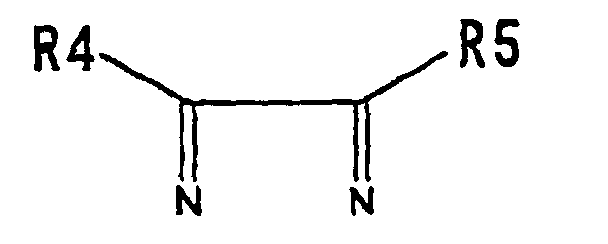
- Structures of the following formulae may be mentioned as examples for the structure of the diimino group containing Q in a case where Q is a substituted aromatic group, but the useful structure is not limited thereto.

- In the above formulae, the plurality of R which are independent of one another, is hydrogen, a C1-20 alkyl group, a C6-10 aryl group, a C7-10 alkylaryl group, a halogen atom, an OSiA3 group, a SiA3 group, a PA2 group (each A is a C1-10 hydrocarbon group) or a NO2 group, provided that adjacent plurality of R may together form a 5- to 8-membered aromatic or aliphatic ring.
- The following examples may be mentioned for the structure of the diimino group containing Q in a case where Q is a substituted saturated aliphatic group, but the useful structure is not limited thereto.

- In the above formulae, the plurality of R which are independent of one another, is hydrogen, a C1-20 alkyl group, a C6-10 aryl group, a C7-10 alkylaryl group, a halogen atom, an OSiA3 group, a SiA3 group, a PA2 group (each A is a C1-10 hydrocarbon group) or a NO2 group, provided that adjacent plurality of R may together form a 5- to 8-membered aromatic or aliphatic ring.
- The following examples may be mentioned for the structure of the diimino group in a case where Q is a substituted unsaturated aliphatic group, but the useful structure is not limited thereto.
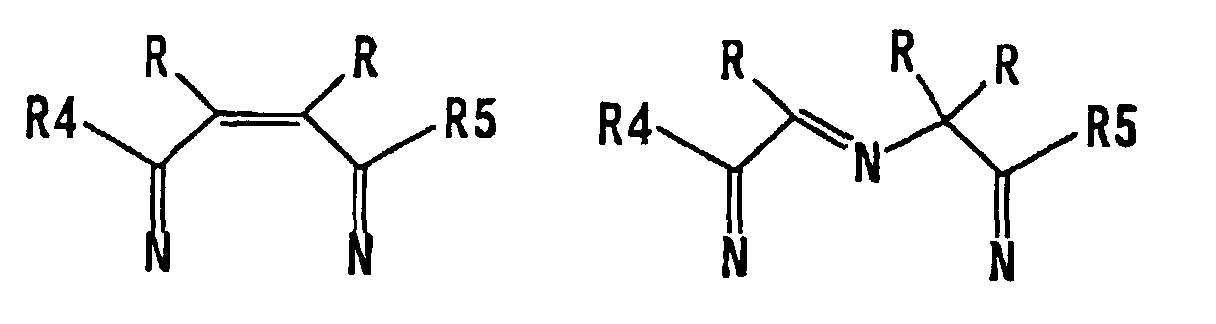
- In the above formulae, the plurality of R which are independent of one another, is hydrogen, a C1-20 alkyl group, a C6-10 aryl group, a C7-10 alkylaryl group, a halogen atom, an OSiA3 group, a SiA3 group, a PA2 group (each A is a C1-10 hydrocarbon group) or a NO2 group, provided that adjacent plurality of R may together form a 5- to 8-membered aromatic or aliphatic ring.
- Each of R4 and R5 which are independent of each other, is hydrogen, a C1-20 alkyl group, a C6-10 aryl group, or a C7-20 alkylaryl group.
- Each of R6, R7, R8, R9 and R10 which are independent of one another, is hydrogen, a C1-20 alkyl group, a C6-10 aryl group, a C7-20 alkylaryl group, a halogen atom, an OSiA3 group, a SiA3 group, a PA2 group (each A is a C1-10 hydrocarbon group) or a NO2 group, provided that adjacent R6 to R10 may together form a 5- to 8-membered aromatic or aliphatic ring, and the total carbon number of R6 and R10 is at least 2, or R6 and/or R10 forms a ring.
- Each of R11, R12, R13, R14 and R15 which are independent of one another, is hydrogen, a C1-20 alkyl group, a C6-10 aryl group, a C7-20 alkylaryl group, a halogen atom, an OSiA3 group, a SiA3 group, a PA2 group (each A is a C1-10 hydrocarbon group) or a NO2 group, provided that adjacent R10 to R15 may together form a 5-to 8-membered aromatic or aliphatic ring, and the total carbon number of R11 and R15 is at least 2, or R11 and/or R15 forms a ring. M is a metal atom of Group 5 to Group 12, preferably an atom of Group 7 to Group 10, particularly preferably iron, cobalt or ruthenium.
- X is an anion and may, for example, be hydrogen, a halogen atom, an alkyl group such as a methyl group or an ethyl group, an aryl group such as a phenyl group, a silyl group such as a trimethylsilyl group, or an alkoxy group such as a methoxy group, an ethoxy group or an isopropoxy group, an amide group such as a dialkylamide group, a diarylamide group or a bistrimethylsilylamide group, a sulfonate group such as a methanesulfonate group or a p-toluenesulfonate group, or a nitrous group. The plurality of X may be the same or different from one another.
- n is a number corresponding to the oxidation number of the metal and takes a value of 0, 1, 2 or 3. For example, when the oxidation number of the center metal is 2, n takes a value of 2 and represents the same or different two anions.
-
- With the transition metal catalyst component to be used in the present invention, when R10 and R15 are hydrogen, the corresponding R6 and R11 preferably have a bulkiness larger than the methyl group. With a transition metal compound wherein the total carbon number of R6 and R11 is less than 2, oligomerization of ethylene may take place preferentially rather than the copolymerization reaction of an aromatic vinyl compound with an olefin intended by the present invention. Namely, it is considered that by the steric space, the β-cleavage preferentially takes place, and the reaction tends to stop by oligomerization before the copolymerization of the aromatic vinyl compound.
- Among compounds of the above formula (1), a transition metal compound of the following formula (2) is particularly preferably employed as a component for a polymerization catalyst for copolymerization of an aromatic vinyl compound with an olefin:wherein each of R1, R2 and R3 which are independent of one another, is hydrogen, a C1-20 alkyl group, a C6-10 aryl group, a C7-20 alkylaryl group, a halogen atom, an OSiA3 group, a SiA3 group, a PA2 group (each A is a C1-10 hydrocarbon group), provided that adjacent R1, R2 and R3 may together form a 5- to 8-membered aromatic or aliphatic ring.

- Each of R4 and R5 which are independent of each other, is hydrogen, a C1-20 alkyl group, a C6-10 aryl group, or a C7-20 alkylaryl group.
- Each of R6, R7, R8, R9 and R10 which are independent of one another is hydrogen, a C1-20 alkyl group, a C6-10 aryl group, a C7-20 alkylaryl group, a halogen atom, an OSiA3 group, a SiA3 group, a PA2 group (each A is a C1-10 hydrocarbon group) or a NO2 group, provided that adjacent R6 to R10 may together form a 5- to 8-membered aromatic or aliphatic ring, and the total carbon number of R6 and R10 is at least 2, or R6 and/or R10 forms a ring.
- Each of R11, R12, R13, R14 and R15 which are independent of one another, is hydrogen, a C1-20 alkyl group, a C6-10 aryl group, a C7-20 alkylaryl group, a halogen atom, an OSiA3 group, a SiA3 group, a PA2 group (each A is a C1-10 hydrocarbon group) or a NO2 group, provided that adjacent R11 to R15 may together form a 5-to 8-membered aromatic or aliphatic ring, and the total carbon number of R11 and R15 is at least 2, or R11 and/or R15 forms a ring.
- M is a metal atom of Group 5 to Group 12, preferably an atom of Group 7 to Group 10, particularly preferably iron, cobalt or ruthenium.
- X is an anion and may, for example, be hydrogen, a halogen atom, an alkyl group such as a methyl group or an ethyl group, an aryl group such as a phenyl group, a silyl group such as a trimethylsilyl group, an alkoxy group such as a methoxy group, an ethoxy group or an isopropoxy group, an amide group such as a dialkylamide group, a diarylamide group or a bistrimethylsilylamide group, a sulfonate group such as a methanesulfonate group or a p-toluenesulfonate group, or a nitrous group. The plurality of X may be the same or different from one another.
- n is a number corresponding to the oxidation number of a metal and takes a value of 0, 1, 2 or 3. For example, when the oxidation number of the center metal is 2, n takes a value of 2 and represents the same or different two anions.
-
- With the transition metal catalyst component to be used in the present invention, when R10 and R15 are hydrogen, the corresponding R6 and R11 preferably have a bulkiness larger than the methyl group. With a transition metal compound wherein the total carbon number of R6 and R11 is less than 2, oligomerization of ethylene may take place preferentially than the copolymerization reaction of an aromatic vinyl compound with an olefin intended by the present invention. Namely, it is considered that due to the steric space, the β-cleavage takes place preferentially, and the reaction is terminated by oligomerization before the copolymerization of the aromatic vinyl compound.
- The following compounds may be mentioned as examples of such a transition metal catalyst component:
- 2,6-bis-[1-(2-isopropylphenylimino)ethyl]pyridine iron[II] chloride, 2,6-bis-[1-(2-isopropylphenylimino)ethyl]pyridine iron[II] bromide, 2,6-bis-[1-(2-isopropylphenylimino)ethyl]pyridine iron[II] bisdiethylamide, 2,6-bis-[1-(2-isopropylphenylimino)ethyl]pyridine iron[II] bistoluenesulfonate, 2,6-bis-[1-(2-isopropylphenylimino)methyl]pyridine iron[II] chloride, 1,3-bis-[1 (2-isopropylphenylimino)ethyl]isoquinoline iron[II] chloride, 2,6-bis-[1-(2,6-diisopropylphenylimino)ethyl]pyridine iron[II] chloride, 2,6-bis-[1-(2-isopropyl-6-methylphenylimino)ethyl]pyridine iron[II] chloride, 2,6-bis-[1-(2,6-dimethylphenylimino)ethyl]pyridine iron[II] chloride, 2,6-bis-[1-(2,4,6-trimethylphenylimino)ethyl]pyridine iron[II] chloride, 2,6-bis-[1-(2-t-butylphenylimino)ethyl]pyridine iron[II] chloride, 2,6-bis-[1-(2-ethyl-4-nitrophenylimino)ethyl]pyridine iron[II] chloride, 2,6-bis-[1-(2-isopropyl-4-nitrophenylimino)ethyl]pyridine iron[II] chloride, 2,6-bis-[1-(2,6-dimethyl-4-nitrophenylimino)ethyl]pyridine iron[II] chloride, 2,6-bis-[1-(2-isopropyl-4-chlorophenylimino)ethyl]pyridine iron[II] chloride, 2,6-bis-[1-(2-isopropyl-5-chlorophenylimino)ethyl]pyridine iron[II] chloride, 2,6-bis-[1-(1-naphthylimino)ethyl]pyridine iron[II] chloride, 2,6-bis-[1-(1-anthracenyl)imino)ethyl]pyridine iron[II] chloride, 2,6-bis-[1-(9-phenanthrylimino)ethyl]pyridine iron[II] chloride, 2,6-bis-[1-(2-isopropylphenylimino)ethyl]pyridine cobalt[II] chloride, 2,6-bis-[1-(2,6-dimethylphenylimino)ethyl]pyridine cobalt[II] bromide, 2,6-bis-[1-(2-isopropylphenylimino)ethyl]pyridine ruthenium[III] chloride, and 2,6-bis-[1-(2,4,6-trimethylphenylimino)ethyl]pyridine ruthenium[III] chloride.
-
- These complexes can be synthesized by a known method such as a method disclosed in WO98/30612. Namely, a compound such as 2,6-diacetylpyridine is reacted for condensation with a corresponding amine to prepare a corresponding imine type ligand, which is then reacted with a desired metal salt in a solvent. At that time, such a complex may be subjected to evaporation to dryness without isolation or purification as the complex and may be used as a catalyst powder, or it may be used as a catalyst liquid in the form of a solution.
- Further, the present invention provides a method for producing a copolymer of an aromatic vinyl compound with an olefin, which is characterized in that the copolymerization is carried out by means of a transition metal catalyst component of the above formula (1), preferably (2). In such copolymerization, it is preferred to employ a cocatalyst. The method for producing a copolymer of the present invention is an efficient method having a high productivity.
- As the cocatalyst to be preferably used in the present invention, a cocatalyst which has been used in combination with a transition metal catalyst component, can be used. As such a cocatalyst, aluminoxane (or alumoxane), an alkylaluminum compound or a boron compound, is preferably employed.
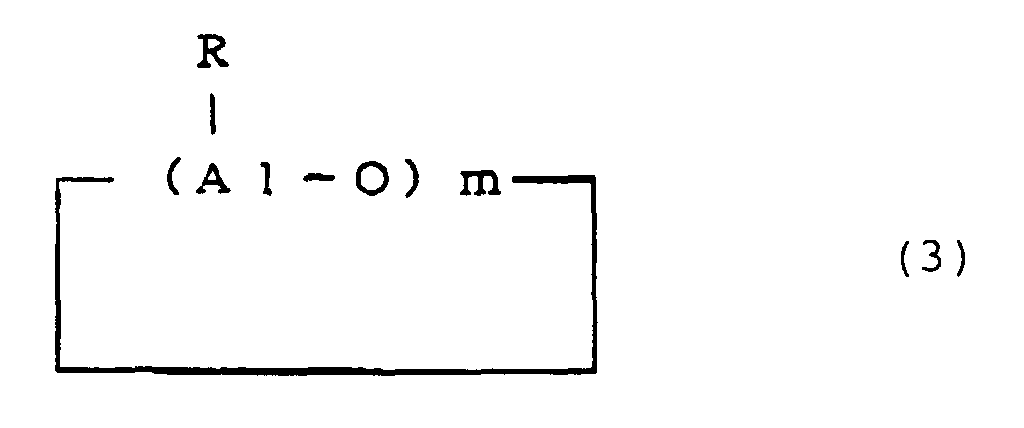
- Further, the present invention provides a method for producing an aromatic vinyl compound-olefin copolymer wherein the cocatalyst to be used is an aluminoxane (or alumoxane) of the following formula (3) or (4):wherein R is a C1-5 alkyl group, a C6-10 aryl group or hydrogen, m is an integer of from 2 to 100, and the plurality of R may be the same or different,
 wherein R' is a C1-5 alkyl group, a C6-10 aryl group or hydrogen, n is an integer of from 2 to 100, and the plurality of R' may be the same or different.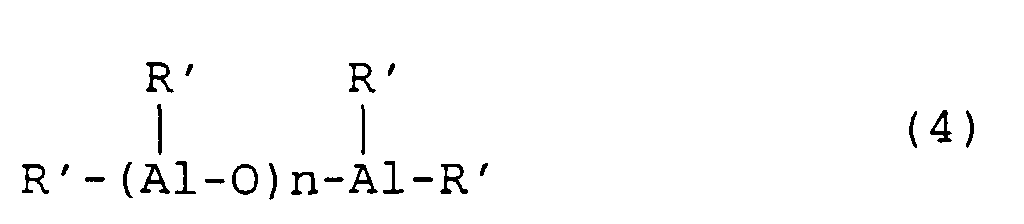
- As the aluminoxane, methylalumoxane, ethylalumoxane or triisobutylalumoxane, is preferably employed. Particularly preferred is methylalumoxane. If necessary, a mixture of these different types of alumoxanes, may be employed. Further, such an alumoxane may be used in combination with an alkylaluminum such as trimethylaluminum, triethylaluminum or triisobutylaluminum, or with a halogen-containing alkylaluminum such as dimethylaluminum chloride.
- Addition of an alkylaluminum to the catalyst is effective for removing substances which hinder polymerization, such as a polymerization inhibitor in styrene, or moisture in the solvent, or for removing adverse effects against the polymerization reaction.
- However, it is not necessarily required to add an alkylaluminum, if the amount of styrene, solvent, etc. is preliminarily reduced to a level not to influence the polymerization, by a known method such as distillation, bubbling with a dry inert gas or passing through a molecular sieve, or by increasing the amount of alumoxane to some extent or adding alumoxane in divided portions.
- In the present invention, a boron compound may be used as a cocatalyst together with the above transition metal catalyst component.
- The boron compound to be used as a cocatalyst may, for example, be triphenylcarbeniumtetrakis(pentafluorophenyl) borate {trityltetrakis(pentafluorophenyl)borate), lithium tetra(pentafluorophenyl)borate, tri(pentafluorophenyl)boran, trimethylammoniumtetraphenyl borate, triethylammoniumtetraphenyl borate, tripropylammoniumtetraphenyl borate, tri(n-butyl)ammoniumtetraphenyl borate, tri(n-butyl)ammoniumtetra(p-tolyl)phenyl borate, tri(n-butyl)ammoniumtetra(p-ethylphenyl)borate, tri(n-butyl)ammoniumtetra(pentafluorophenyl)borate, trimethylammoniumtetra(p-tolyl) borate, trimethylammoniumtetrakis-3,5-tetramethylphenyl borate, triethylammoniumtetrakis-3,5-dimethylphenyl borate, tributylammoniumtetrakis-3,5-dimethylphenyl borate, tributylammoniumtetrakis-2,4-dimethylphenyl borate, aniliumtetrakispentafluorophenyl borate, N,N'-dimethylaniliumtetraphenyl borate, N,N'-dimethylaniliumtetrakis(p-tolyl)borate, N,N'-dimethylaniliumtetrakis(m-tolyl)borate, N,N'-dimethylaniliumtetrakis(2,4-dimethylphenyl)borate, N,N'-dimethylaniliumtetrakis(3,5-dimethylphenyl)borate, N,N'-dimethylaniliumtetrakis(pentafluorophenyl)borate, N,N'-diethylaniliumtetrakis(pentafluorophenyl)borate, N,N'-2,4,5-pentamethylaniliumtetraphenyl borate, N,N'-2,4,5-pentaethylaniliumtetrraphenyl borate, di(isopropyl)ammoniumtetrakispentafluorophenyl borate, dicyclohexylammoniumtetraphenyl borate, triphenylphosphoniumtetraphenyl borate, tri(methylphenyl)phosphoniumtetraphenyl borate, tri(dimethylphenyl)phosphoniumtetraphenyl borate, triphenylcarbeniumtetrakis(p-tolyl)borate, triphenylcarbeniumtetrakis(m-tolyl)borate, triphenylcarbeniumtetrakis(2,4-dimethylphenyl)borate, triphenylcarbeniumtetrakis(3,5-dimethylphenyl)borate, tropiliumtetrakispentafluorophenyl borate, tropiliumtetrakis(p-tolyl)borate, tropiliumtetrakis(m-tolyl)borate, tropiliumtetrakis(2,4-dimethylphenyl)borate or tropiliumtetrakis(3,5-dimethylphenyl)borate.
- Such a boron compound and the above-mentioned organoaluminum compound may be used at the same time.
- Especially when a boron compound is used as a cocatalyst, addition of an alkylaluminum compound such as triisobutylaluminum is effective for the removal of impurities which adversely affect the polymerization, such as water contained in the polymerization system.
- Aromatic vinyl compounds to be used in the present invention may, for example, be styrene and various substituted styrenes such as p-methylstyrene, m-methylstyrene, o-methylstyrene, o-t-butylstyrene, p-t-butylstyrene, p-chlorostyrene, o-chlorostyrene, and α-methylstyrene. Further, a compound having a plurality of vinyl groups in one molecule, such as divinylbenzene, may also be mentioned.
- Industrially preferably, styrene, p-methylstyrene or p-chlorostyrene is used. Particularly preferably, styrene is used.
- Further, as olefins to be used in the present invention, C2-20 α-olefins such as ethylene, propylene, 1-butene, 1-hexene, 1-methyl-1-pentene, 1-octene and cyclic olefins such as cyclopentene, norbornene and norbonadiene, may be mentioned. These olefins may be used alone or in combination as a mixture of two or more of them. As such olefins, ethylene and propylene are preferred. In the following description, examples in which ethylene and propylene are used as olefins, will be referred to.
- For the production of a copolymer of the present invention, the olefin, the above exemplified aromatic vinyl compound, the transition metal catalyst component as a metal complex and the cocatalyst are contacted. As to the manner and order for contacting, an optional known method may be employed.
- As a method for the above copolymerization, it is possible to employ a method for carrying out the polymerization in a liquid monomer without using any solvent, or a method of using a single solvent or a mixed solvent selected from saturated aliphatic or aromatic hydrocarbons or halogenated hydrocarbons, such as pentane, hexane, heptane, cyclohexane, benzene, toluene, ethylbenzene, xylene, chlorobenzene, chlorotoluene, methylene chloride or chloroform. If necessary, batch polymerization, continuous polymerization, stepwise polymerization, slurry polymerization, preliminary polymerization or gas phase polymerization may be employed.
- The copolymerization temperature is suitably from -78°C to 200°C. A polymerization temperature lower than -78°C is industrially disadvantageous, and if the temperature exceeds 200°C, decomposition of the metal complex is likely to take place, such being undesirable. Industrially more preferably, the temperature is from 0 to 160°C, particularly from 30 to 160°C.
- The pressure for copolymerization is suitably from 0.1 to 100 atm, preferably from 1 to 30 atm, industrially particularly preferably, from 1 to 10 atm.
- When an organoaluminum compound is used as a cocatalyst, it is preferably used in an aluminum atom/complex metal atom ratio of from 0.1 to 100,000, preferably from 10 to 10,000, relative to the metal of the complex. If the ratio is smaller than 0.1, the metal complex can not effectively be activated, and if it exceeds 100,000, such will be economically disadvantageous.
- When a boron compound is used as a cocatalyst, it is used in an atomic ratio of boron atom/complex metal atom of from 0.01 to 100, preferably from 0.1 to 10, particularly preferably 1. If the atomic ratio is less than 0.01, the metal complex can not effectively be activated, and if it exceeds 100, such is economically disadvantageous.
- The metal complex and the cocatalyst may be prepared by mixing them outside the polymerization tank, or they may be mixed in the tank during polymerization.
- Further, the present invention provides an aromatic vinyl compound-olefin copolymer obtained by using the transition metal catalyst component of the present invention or by the method of the present invention.
- Particularly, it provides an aromatic vinyl compound-olefin copolymer having an olefin content of from 0.1 to 99.5 mol% i.e. an aromatic vinyl compound content of from 0.5 to 99.9 mol%.
- Preferably, it provides an aromatic vinyl compound-olefin copolymer having an olefin content of from 44.5 to 99.5 mol% i.e. an aromatic vinyl compound content of from 0.5 to 55.5 mol%.
- Particular preferably, it provides an aromatic vinyl compound-olefin copolymer having an olefin content of from 70.0 to 99.5 mol% i.e. an aromatic vinyl compound content of from 0.5 to 30.0 mol%.
- Further, the aromatic vinyl compound-olefin copolymer of the present invention may be such that the stereoregularity of phenyl groups in the alternating copolymer structure of olefin units and aromatic units may be of either an isotactic structure, a syndiotactic structure or an atactic structure.
- The weight average molecular weight of the aromatic vinyl compound-olefin random copolymer of the present invention is from 1,000 to 1,000,000, preferably from 5,000 to 600,000, when the physical properties of the copolymer are taken into consideration. The molecular weight distribution (Mw/Mn) is at most 6, preferably at most 4, particularly preferably at most 3.
- The aromatic vinyl compound-olefin copolymer of the present invention may have a melting point of from about 50 to 130°C (by DSC), within a styrene content range of from 0.5 to 30 mol%, but in some cases, the melting point may not be observed.
- The aromatic vinyl compound-olefin random copolymer of the present invention may not necessarily be a pure copolymer, and so long as the composition, the molecular weight, etc. are within the above-described ranges, another monomer such as the above-mentioned α-olefin, an aromatic vinyl compound or a conjugated diene such as butadiene, may be copolymerized.
- Further, depending upon the polymerization conditions, etc., an atactic homopolymer having an aromatic vinyl compound thermally, radically or cationically polymerized, may be contained in a small amount, but such an amount is at most 10 wt% of the entirety. Such a homopolymer can be removed by extraction with a solvent. However, if there is no particular problem from the viewpoint of the physical properties, the copolymer may be used as it contains such a homopolymer.
- Further, for the purpose of improving the physical properties, it may be blended with other polymers. Furthermore, copolymers of the present invention having different styrene contents, may be blended.
- Now, the present invention will be described in further detail with reference to Examples. However, it should be understood that the present invention is by no means restricted to such specific Examples.
- The analyses of the copolymers obtained in the respective Examples and Comparative Examples were carried out by the following methods.
- The 13C-NMR spectrum was measured using TMS as standard, by using α-500 manufactured by Nippon Denshi Kabushiki Kaisha (JEOL Ltd.) and using a chloroform-d solvent or a 1,1,2,2-tetrachloroethane-d2 solvent.
- The styrene content in the copolymer was determined by 1H-NMR. As the apparatus, α-500 manufactured by Nippon Denshi Kabushiki Kaisha (JEOL Ltd.) and AC-250 manufactured by BRUKER Co. were used. The determination was made by comparing the intensity of the peak (6.5 to 7.5 ppm) attributable to the proton of a phenyl group and the proton peak (0.8 to 3 ppm) attributable to an alkyl group, measured by using TMS as standard and chloroform-d or 1,1,2,2-tetrachloroethane-d2 as a solvent.
- The molecular weights in Examples are obtained by GPC (gel permeation chromatography) (HLC-8020, manufactured by TOSOH CORPORATION) using THF as a solvent, as weight average molecular weights calculated as standard polystyrene.
- The DSC measurement was carried out by using DSC200, manufactured by Seiko Denshi K.K. in a nitrogen stream at a temperature raising rate of 10°C/min. to measure the glass transition temperature and the melting point.
- Into a 100 ml three-necked flask, 2,6-diacetylpyridine (1.0 g, 6.1 mmol) was put and dissolved in 30 ml of methanol. About 6 ml (large excess) of 2,6-dimethylaniline was added, and five drops of formic acid was added, followed by stirring in an oil bath at 50°C overnight.
- Next day, the formed reddish brown solution was cooled to precipitate crystals to obtain 0.8 g of yellow crystals. Then, into a 50 ml Schrenck tube, a stirrer bar was put, and 2,6-bis-[1-(2,6-dimethylphenylimino)ethyl]pyridine (0.36 g, 0.97 mmol) and iron chloride tetrahydrate (0.184 g, 0.93 mmol) were put, followed by argon substitution. About 30 ml of THF was added thereto, followed by stirring at room temperature for about 2 hours, whereby a purple suspension was formed. Diethyl ether was added thereto to precipitate crystals, and purple crystals were collected by filtration. About 0.3 g of purple powdery crystals were obtained.
- Into a 100 ml three-necked flask, 2,6-diacetylpyridine (1.0 g, 6.1 mmol) was put and dissolved in 20 ml of dichloromethane. About 3 ml (large excess) of o-isopropylaniline was added, and five drops of formic acid was added, followed by stirring at room temperature overnight.
- Next day, the formed brown solution was concentrated, and a few ml of methanol was added, and while cooling, the oil was washed, whereby crystals precipitated. The crystals were collected by filtration to obtain 1.2 g of slightly yellow crystals. The yield was 53%.
- In the same manner as for compound A, complexing was carried out to obtain 0.4 g of blue powdery crystals.
- Into a 100 ml three-necked flask, 2,6-diacetylpyridine (1.0 g, 6.1 mmol) was put and dissolved in 20 ml of dichloromethane. About 3 ml (large excess) of o-toluidine was added, and five drops of formic acid was added, followed by stirring at room temperature overnight.
- Next day, the formed brown solution was concentrated, and a few ml of methanol was added, and while cooling, the oil was washed, whereby crystals precipitated. The crystals were collected by filtration to obtain 1.0 g of yellow crystals. The yield was 48%.
- In the same manner as for the compound A, complexing was carried out to obtain 0.4 g of bluish purple powdery crystals.
- Polymerization was carried out by means of an autoclave having a capacity of 1 ℓ and equipped with a stirrer and a band heater for heating.
- 400 ml of toluene and 80 ml of styrene were charged, and heated and stirred at an internal temperature of 50°C. 0.2 ℓ/min of nitrogen was bubbled for about 3 hours to purge the interior of the system. Then, 8.4 mmol of triisobutylaluminum, and 84 mmol, based on Al, of methylalumoxane (MMAO-3A, manufactured by TOSOH AKZO CO.) were added. Immediately, ethylene was introduced, and after the pressure was stabilized at a level of 1.1 MPa (10 kg/cm2G), about 50 ml of a solution having 21 µmol of compound A i.e. 2,6-bis-[1-(2,6-dimethylphenylimino)ethyl]pyridine iron(II) chloride as a catalyst dissolved in toluene, was added to the autoclave from a catalyst tank installed above the autoclave. Polymerization was carried out for 2 hours while maintaining the internal temperature at 50°C and the pressure at 1.1 MPa. The obtained polymerized solution was gradually introduced into excess methanol vigorously stirred to let the formed polymer precipitate. The polymer was dried under reduced pressure until no more weight change was observed at 60°C to obtain 0.5 g of the polymer.
- Polymerization was carried out by means of an autoclave having a capacity of 1 ℓ and equipped with a stirrer and a band heater for heating.
- 400 ml of toluene and 80 ml of styrene were charged, and heated and stirred at an internal temperature of 50°C. 0.2 ℓ/min of nitrogen was bubbled for about 3 hours to purge the interior of the system, whereupon 8.4 mmol of triisobutylaluminum and 84 mmol, based on Al, of methylalumoxane (MMAO-3A, manufactured by TOSOH AKZO CO.) were added. Immediately, ethylene was introduced, and after the pressure was stabilized at 1.1 MPa (10 kg/cm2G), about 50 ml of a solution having 21 µmol of compound B i.e. 2,6-bis-[1-(2-isopropylphenylimino)ethyl]pyridine iron(II) chloride as a catalyst dissolved in toluene, was added to the autoclave from a catalyst tank installed above the autoclave. Polymerization was carried out for 5.5 hours while maintaining the internal temperature at 50°C and the pressure at 1.1 MPa. The obtained polymerized solution was gradually introduced into excess methanol which was vigorously stirred, to precipitate the formed polymer. The polymer was dried under reduced pressure until no more weight change was observed at 60°C, to obtain 23 g of the polymer.
- Polymerization was carried out by means of an autoclave having a capacity of 1 ℓ and equipped with a stirrer and a band heater for heating.
- 400 ml of toluene and 80 ml of styrene were charged, and heated and stirred at an internal temperature of 50°C. 0.2 ℓ/min of nitrogen was bubbled for about 3 hours to purge the interior of the system, and then 8.4 mmol of triisobutylaluminum and 84 mmol, based on Al, of methylalumoxane (MMAO-3A, manufactured by TOSOH AKZO CO.) were added. Immediately, ethylene was introduced, and after the pressure was stabilized at 1.1 MPa (10 kg/cm2G), about 50 ml of a solution having 21 µmol of compound C i.e. 2,6-bis-[1-(2-methylphenylimino)ethyl]pyridine iron(II) chloride dissolved in toluene, was added to the autoclave from a catalyst tank installed above the autoclave. Polymerization was carried out for 5.5 hours while maintaining the internal temperature at 50°C and the pressure at 1.1 MPa. The obtained polymerized solution was gradually put into excess methanol vigorously stirred, but no polymer formed.
- The polymerization results are shown in Table 1.
Example No. Yield (g) Activity (g polymer/mol catalyst) Styrene content (mol%) Weight average molecular weight (Mw) Number average molecular weight (Mn) Mw/Mn Glass transition point (°C) Melting point (°C) Example 1 0.5 2.4 × 10⁴ 12.2 8.1 × 10⁴ 4.7 × 10⁴ 1.7 -24 86 6.2 × 10³ 5.0 × 10³ 1.2 129 Example 2 23 1.1 × 10⁶ 9.8 1.2 × 10⁵ 6.0 × 10⁴ 1.9 -26 75.1 Note) In Example 1, as a result of the GPC measurement, two peaks were observed and peak separation was carried out. - The present invention provides a novel transition metal complex component useful for the production of an aromatic vinyl compound-olefin copolymer. Further, the present invention provides a polymerization catalyst comprising such a complex component and a cocatalyst, and a method for producing a novel aromatic vinyl compound-olefin copolymer employing such a polymerization catalyst.
Claims (10)
- A method for producing an aromatic vinyl compound-olefin copolymer, which comprises copolymerizing an aromatic vinyl compound with an olefin by means of a transition metal catalyst component of the following formula (1):wherein Q is a single bond connecting the carbon atoms of the two imino groups, or a C4-20 substituted aromatic, C1-20 substituted saturated aliphatic or substituted unsaturated aliphatic substituent connecting the two imino groups, provided that from 1 to 3 carbon atoms in the substituted aromatic, substituted saturated aliphatic or substituted unsaturated aliphatic substituent may be replaced by nitrogen, oxygen, sulfur or phosphorus,
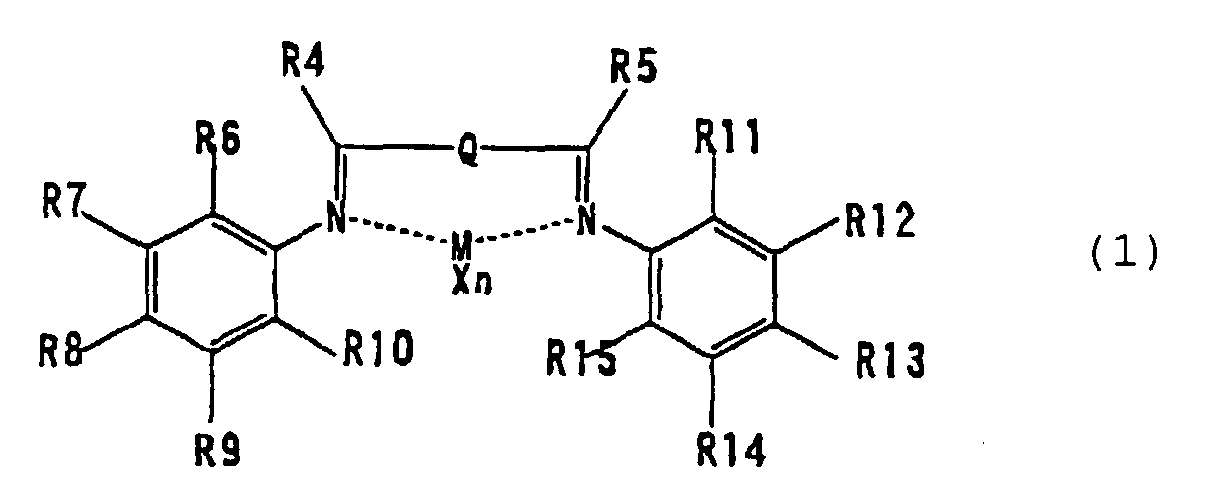 each of R4 and R5 which are independent of each other, is hydrogen, a C1-20 alkyl group, a C6-10 aryl group, or a C7-20 alkylaryl group,each of R6, R7, R8, R9 and R10 which are independent of one another, is hydrogen, a C1-20 alkyl group, a C6-10 aryl group, a C7-20 alkylaryl group, a halogen atom, an OSiA3 group, a SiA3 group, a PA2 group (each A represents a C1-10 hydrocarbon group) or a NO2 group, provided that adjacent R6 to R10 may together form a 5- to 8-membered aromatic or aliphatic ring, and the total carbon number of R6 and R10 is at least 2, or R6 and/or R10 forms a ring,each of R11, R12, R13, R14 and R15 which are independent of one another, is hydrogen, a C1-20 alkyl group, a C6-10 aryl group, a C7-20 alkylaryl group, a halogen atom, an OSiA3 group, a SiA3 group, a PA2 group (each A represents a C1-10 hydrocarbon group) or a NO2 group, provided that adjacent R11 to R15 may together form a 5- to 8-membered aromatic or aliphatic ring, and the total carbon number of R11 and R15 is at least 2, or R11 and/or R15 forms a ring, andM is a metal atom of Group 5 to Group 12, X is an anion, n is a number corresponding to the oxidation number of the metal and takes a value of 0, 1, 2 or 3.
 - A method for producing an aromatic vinyl compound-olefin copolymer, which comprises copolymerizing an aromatic vinyl compound with an olefin by means of a transition metal catalyst component of the following formula (2):wherein each of R1, R2 and R3 which are independent of one another, is hydrogen, a C1-20 alkyl group, a C6-10 aryl group, a C7-20 alkylaryl group, a halogen atom, an OSiA3 group, a SiA3 group, or a PA2 group (each A represents a C1-10 hydrocarbon group), provided that adjacent R1, R2 and R3 may together form a 5- to 8-membered aromatic or aliphatic ring,
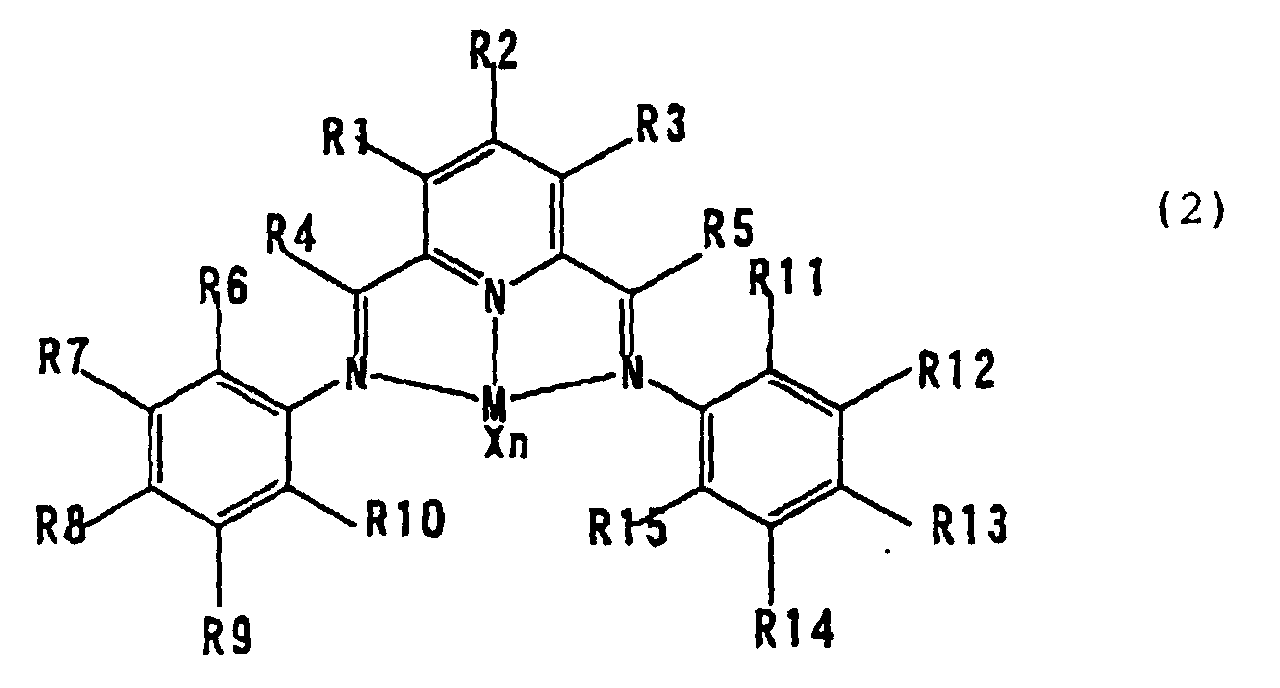 each of R4 and R5 which are independent of each other, is hydrogen, a C1-20 alkyl group, a C6-10 aryl group, or a C7-20 alkylaryl group,each of R6, R7, R8, R9 and R10 which are independent of one another, is hydrogen, a C1-20 alkyl group, a C6-10 aryl group, a C7-20 alkylaryl group, a halogen atom, an OSiA3 group, a SiA3 group, a PA2 group (each A represents a C1-10 hydrocarbon group) or a NO2 group, provided that adjacent R6 to R10 may together form a 5- to 8-membered aromatic or aliphatic ring, and the total carbon number of R6 and R10 is at least 2, or R6 and/or R10 forms a ring,each of R11, R12, R13, R14 and R15 which are independent of one another, is hydrogen, a C1-20 alkyl group, a C6-10 aryl group, a C7-20 alkylaryl group, a halogen atom, an OSiA3 group, a SiA3 group, a PA2 group (each A represents a C1-10 hydrocarbon group) or a NO2 group, provided that adjacent R11 to R15 may together form a 5- to 8-membered aromatic or aliphatic ring, and the total carbon number of R11 and R15 is at least 2, or R11 and/or R15 forms a ring, andM is a metal atom of Group 5 to Group 12, X is an anion, n is a number corresponding to the oxidation number of the metal and takes a value of 0, 1, 2 or 3.
 - The method for producing an aromatic vinyl compound-olefin copolymer, wherein the transition metal catalyst component as defined in Claim 1 or 2 wherein each of R6 and R11 are hydrogen atoms, and each of R10 and R15 is a group having at least two carbon atoms, is used.
- The method for producing an aromatic vinyl compound-olefin copolymer, wherein the transition metal catalyst component as defined in Claim 1 or 2 wherein R6, R10, R11 and R15 are not simultaneously hydrogen atoms, is used.
- The method for producing an aromatic vinyl compound-olefin copolymer, wherein a polymerization catalyst comprising the transition metal catalyst component as defined in Claim 1, 2, 3 or 4 and a cocatalyst, is used.
- The method for producing an aromatic vinyl compound-olefin copolymer, wherein the polymerization catalyst as defined in Claim 5 is used wherein, as the cocatalyst, an aluminoxane (or alumoxane) of the following formula (3) or (4) is used, and, if necessary, an alkyl aluminum is used:wherein R is a C1-5 alkyl group, a C6-10 aryl group or hydrogen, and m is an integer of from 2 to 100, provided that the plurality of R may be the same or different from one another;
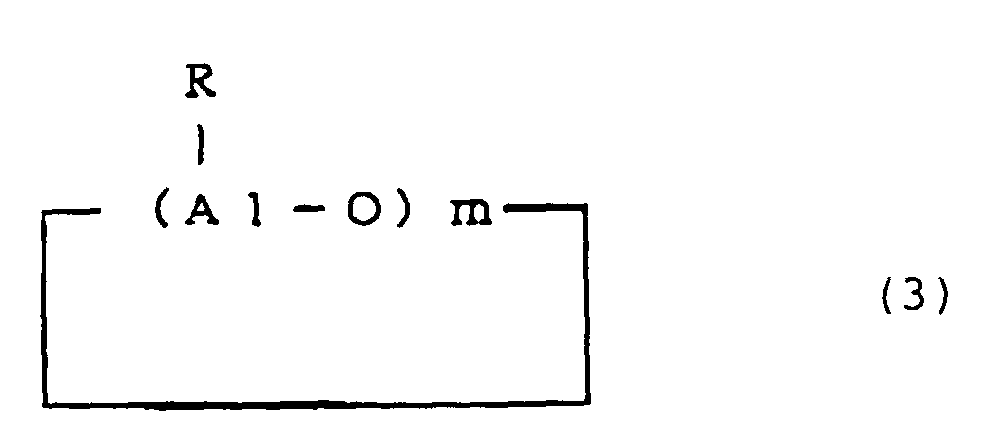 wherein R' is a C1-5 alkyl group, a C6-10 aryl group or hydrogen, and n is an integer of from 2 to 100, provided that the plurality of R' may be the same or different from one another.
- The method for producing an aromatic vinyl compound-olefin copolymer, wherein the polymerization catalyst as defined in Claim 5 is used wherein, as the cocatalyst, a boron compound is used, and, if necessary, an alkyl aluminum is used.
- A transition metal catalyst component for production of an aromatic vinyl compound-olefin copolymer, represented by the formula (1) or (2) as defined in Claim 1, 2, 3 or 4.
- A polymerization catalyst for producing an aromatic vinyl compound-olefin copolymer, comprising the transition metal catalyst component and the cocatalyst, as defined in Claim 5, 6 or 7.
- An aromatic vinyl compound-olefin copolymer obtained by polymerization by means of a polymerization catalyst comprising the transition metal catalyst component and the cocatalyst, as defined in Claim 5, 6 or 7.
Applications Claiming Priority (2)
| Application Number | Priority Date | Filing Date | Title |
|---|---|---|---|
| JP16100499 | 1999-06-08 | ||
| JP16100499 | 1999-06-08 |
Publications (1)
| Publication Number | Publication Date |
|---|---|
| EP1059313A1 true EP1059313A1 (en) | 2000-12-13 |
Family
ID=15726758
Family Applications (1)
| Application Number | Title | Priority Date | Filing Date |
|---|---|---|---|
| EP00112160A Withdrawn EP1059313A1 (en) | 1999-06-08 | 2000-06-06 | Transition metal catalyst component for polymerization, aromatic vinyl compound-olefin copolymer and process for its production by means of the catalyst component |
Country Status (1)
| Country | Link |
|---|---|
| EP (1) | EP1059313A1 (en) |
Cited By (1)
| Publication number | Priority date | Publication date | Assignee | Title |
|---|---|---|---|---|
| US6872692B2 (en) | 2001-09-21 | 2005-03-29 | Exxonmobil Research And Engineering Company | Synthetic hydrocarbon fluid |
Citations (4)
| Publication number | Priority date | Publication date | Assignee | Title |
|---|---|---|---|---|
| WO1997002298A1 (en) * | 1995-06-30 | 1997-01-23 | E.I. Du Pont De Nemours And Company | Olefin polymerization process |
| EP0924223A2 (en) * | 1997-12-22 | 1999-06-23 | Mitsui Chemicals, Inc. | Catalyst component, catalyst and process for ethylenically unsaturated monomer polymerization |
| WO1999058578A1 (en) * | 1998-05-08 | 1999-11-18 | Bp Chemicals Limited | Polymerisation catalyst |
| DE19846314A1 (en) * | 1998-10-08 | 2000-04-13 | Basf Ag | Production of polyolefin nano-composite, useful for production of film, mouldings and fibres, involves transition metal-catalysed polymerisation of olefin in presence of layered silicate |
-
2000
- 2000-06-06 EP EP00112160A patent/EP1059313A1/en not_active Withdrawn
Patent Citations (4)
| Publication number | Priority date | Publication date | Assignee | Title |
|---|---|---|---|---|
| WO1997002298A1 (en) * | 1995-06-30 | 1997-01-23 | E.I. Du Pont De Nemours And Company | Olefin polymerization process |
| EP0924223A2 (en) * | 1997-12-22 | 1999-06-23 | Mitsui Chemicals, Inc. | Catalyst component, catalyst and process for ethylenically unsaturated monomer polymerization |
| WO1999058578A1 (en) * | 1998-05-08 | 1999-11-18 | Bp Chemicals Limited | Polymerisation catalyst |
| DE19846314A1 (en) * | 1998-10-08 | 2000-04-13 | Basf Ag | Production of polyolefin nano-composite, useful for production of film, mouldings and fibres, involves transition metal-catalysed polymerisation of olefin in presence of layered silicate |
Cited By (1)
| Publication number | Priority date | Publication date | Assignee | Title |
|---|---|---|---|---|
| US6872692B2 (en) | 2001-09-21 | 2005-03-29 | Exxonmobil Research And Engineering Company | Synthetic hydrocarbon fluid |
Similar Documents
| Publication | Publication Date | Title |
|---|---|---|
| US5637660A (en) | Polymerization of α-olefins with transition metal catalysts based on bidentate ligands containing pyridine or quinoline moiety | |
| US6232260B1 (en) | Single-site catalysts for olefin polymerization | |
| JP2965572B2 (en) | Catalysts, methods of making these catalysts, and uses of these catalysts | |
| US7119158B2 (en) | Cyclopentadienyl-containing low-valent early transition metal olefin polymerization catalysts | |
| CN113527352A (en) | Pyridine amino hafnium compound and preparation method and application thereof | |
| JP3189175B2 (en) | Method for producing aromatic vinyl compound copolymer | |
| EP1428840A1 (en) | Process for producing polymer | |
| US7148174B2 (en) | Non-metallocene catalyst system | |
| EP3184556B1 (en) | Metallocene-supported catalyst and method of preparing polyolefin using the same | |
| AU773920B2 (en) | Method for polymerising olefins | |
| JPH04300904A (en) | Production of styrene-based copolymer | |
| EP1195386B1 (en) | Transition metal catalyst component for polymerization and process for producing polymer with the same | |
| EP1404690B1 (en) | Novel multinuclear half metallocene catalyst and preparation of styrene polymer using the same | |
| CN108530572B (en) | Preparation method of ethylene-styrene derivative copolymer | |
| JP2001055410A (en) | Transition metal catalyst component for polymerization, aromatic vinyl compound-olefin copolymer using the same, and method for producing the same | |
| EP1059313A1 (en) | Transition metal catalyst component for polymerization, aromatic vinyl compound-olefin copolymer and process for its production by means of the catalyst component | |
| JP3263141B2 (en) | Method for producing styrenic block copolymer | |
| KR100211854B1 (en) | Catalysts for styrene polymerisation and the process of preparation thereof | |
| KR100349979B1 (en) | Multi-metallic Metallocene Catalysts for Polymerization of Styrene and Method of Polymerization Using the Same | |
| KR100376053B1 (en) | Metallocene Catalysts Having Multi-Nuclear Constrained Geometry and Polymerization Process Using the Catalysts | |
| KR100497172B1 (en) | Multinuclear half metallocene catalyst having sandwitch type metallocene derivatives as ligands for styrene polymerization and polymerization process using the metallocene catalyst | |
| EP1842860A1 (en) | Catalyst components based on ferrocenyl complexes used for olefin polymerisation | |
| KR20040011594A (en) | Styrene polymerization process using new multinuclear half metallocene catalyst | |
| JP2002332307A (en) | Transition metal catalyst component for polymerization and method for producing polymer using the same |
Legal Events
| Date | Code | Title | Description |
|---|---|---|---|
| PUAI | Public reference made under article 153(3) epc to a published international application that has entered the european phase |
Free format text: ORIGINAL CODE: 0009012 |
|
| AK | Designated contracting states |
Kind code of ref document: A1 Designated state(s): DE FR GB IT |
|
| AX | Request for extension of the european patent |
Free format text: AL;LT;LV;MK;RO;SI |
|
| 17P | Request for examination filed |
Effective date: 20010503 |
|
| 17Q | First examination report despatched |
Effective date: 20010716 |
|
| AKX | Designation fees paid |
Free format text: DE FR GB IT |
|
| STAA | Information on the status of an ep patent application or granted ep patent |
Free format text: STATUS: THE APPLICATION IS DEEMED TO BE WITHDRAWN |
|
| 18D | Application deemed to be withdrawn |
Effective date: 20011127 |