EP1059295A1 - Production of metal complexes by comproportionation - Google Patents
Production of metal complexes by comproportionation Download PDFInfo
- Publication number
- EP1059295A1 EP1059295A1 EP00111836A EP00111836A EP1059295A1 EP 1059295 A1 EP1059295 A1 EP 1059295A1 EP 00111836 A EP00111836 A EP 00111836A EP 00111836 A EP00111836 A EP 00111836A EP 1059295 A1 EP1059295 A1 EP 1059295A1
- Authority
- EP
- European Patent Office
- Prior art keywords
- metal
- ligand
- precursor
- halogenated
- hexafluoro
- Prior art date
- Legal status (The legal status is an assumption and is not a legal conclusion. Google has not performed a legal analysis and makes no representation as to the accuracy of the status listed.)
- Granted
Links
Classifications
-
- C—CHEMISTRY; METALLURGY
- C07—ORGANIC CHEMISTRY
- C07F—ACYCLIC, CARBOCYCLIC OR HETEROCYCLIC COMPOUNDS CONTAINING ELEMENTS OTHER THAN CARBON, HYDROGEN, HALOGEN, OXYGEN, NITROGEN, SULFUR, SELENIUM OR TELLURIUM
- C07F1/00—Compounds containing elements of Groups 1 or 11 of the Periodic Table
- C07F1/08—Copper compounds
-
- C—CHEMISTRY; METALLURGY
- C07—ORGANIC CHEMISTRY
- C07F—ACYCLIC, CARBOCYCLIC OR HETEROCYCLIC COMPOUNDS CONTAINING ELEMENTS OTHER THAN CARBON, HYDROGEN, HALOGEN, OXYGEN, NITROGEN, SULFUR, SELENIUM OR TELLURIUM
- C07F1/00—Compounds containing elements of Groups 1 or 11 of the Periodic Table
- C07F1/005—Compounds containing elements of Groups 1 or 11 of the Periodic Table without C-Metal linkages
-
- C—CHEMISTRY; METALLURGY
- C23—COATING METALLIC MATERIAL; COATING MATERIAL WITH METALLIC MATERIAL; CHEMICAL SURFACE TREATMENT; DIFFUSION TREATMENT OF METALLIC MATERIAL; COATING BY VACUUM EVAPORATION, BY SPUTTERING, BY ION IMPLANTATION OR BY CHEMICAL VAPOUR DEPOSITION, IN GENERAL; INHIBITING CORROSION OF METALLIC MATERIAL OR INCRUSTATION IN GENERAL
- C23C—COATING METALLIC MATERIAL; COATING MATERIAL WITH METALLIC MATERIAL; SURFACE TREATMENT OF METALLIC MATERIAL BY DIFFUSION INTO THE SURFACE, BY CHEMICAL CONVERSION OR SUBSTITUTION; COATING BY VACUUM EVAPORATION, BY SPUTTERING, BY ION IMPLANTATION OR BY CHEMICAL VAPOUR DEPOSITION, IN GENERAL
- C23C16/00—Chemical coating by decomposition of gaseous compounds, without leaving reaction products of surface material in the coating, i.e. chemical vapour deposition [CVD] processes
- C23C16/06—Chemical coating by decomposition of gaseous compounds, without leaving reaction products of surface material in the coating, i.e. chemical vapour deposition [CVD] processes characterised by the deposition of metallic material
- C23C16/18—Chemical coating by decomposition of gaseous compounds, without leaving reaction products of surface material in the coating, i.e. chemical vapour deposition [CVD] processes characterised by the deposition of metallic material from metallo-organic compounds
Definitions
- CVD Chemical Vapor Deposition
- a metal (i.e.,copper) containing chemical vapor is contacted with a heated substrate surface in such a way that a surface chemical reaction occurs to deposit a pure metal (i.e.,copper) film.
- the CVD precursor must itself be of high purity.
- the leading copper precursors for the CVD of copper films are of the type copper (+1) ( ⁇ -diketonate)(A), where (A) is a neutral ligand usually of the unsaturated type.
- the leading candidate is copper (+1) (hexafluoro-2,4-pentanedionate) (trimethylvinylsilane), known commercially as CupraSelect® precursor available from the Schumacher unit of Air Products and Chemicals, Inc., Carlsbad, CA.
- Doyle also obtained several patents on the use of copper ⁇ -diketonates as adsorbents for various unsaturated materials, i.e., US Patent 4,279,874; US Patent 4,385,005; US Patent 4,425,281; US Patent 4,434,317; and US Patent 4,471,152.
- the present invention describes how the synthesis of these metal-ligand complexes, such as copper (+1) (hexafluoro-2,4-pentanedionate)(A), can be carried out in such a way that the formation of the undesired higher valence metal-ligand complexes, such as Cu +2 (hexafluoro-2,4-pentanedionate) 2 , is suppressed.
- the resulting lowered concentration of higher valence metal-ligand complexes (i.e., Cu +2 (hexafluoro-2,4-pentanedionate) 2 ) in the crude reaction product thus facilitates more efficient purification steps and consequently a higher yield of pure product.
- the present invention is a process for the synthesis of a first metal-ligand complex, M +n (L - ) n , where n ⁇ 1, from a metal compound precursor and a ligand precursor, where the metal of the metal compound precursor is capable of changing to a valence in excess of n during the synthesis; the improvement, to suppress formation of a second metal-ligand complex of the metal with a valence in excess of n, of adding an elemental form of a metal to the synthesis of the first metal-ligand complex.
- the metal is a transition metal.
- the metal is copper.
- the elemental form of the metal is a particulate form.
- the particulate form has an average particle size of less than 100 mm.
- the particle size is in the range of 0.01 microns to 100 mm.
- the ligand precursor is selected from the group consisting of ⁇ -diketones, halogenated ⁇ -diketones, ⁇ -ketoimines, halogenated ⁇ -ketoimines, ⁇ -diimines, halogenated ⁇ -diimines, ⁇ -ketoesters, halogenated ⁇ -ketoesters, carboxylic acids) halogenated carboxylic acids, phenols, halogenated phenols, amides, halogenated amides, alcohols, halogenated alcohols, amines and mixtures thereof
- the ligand precursor is a ⁇ -diketone having a formula: where R 1 and R 3 are each independently C 1-8 alkyl, including halogenated alkyl; aryl including halogenated aryl and R 2 is H, halogen or C 1-8 alkyl or halogenated alkyl and X is H.
- the ligand precursor is selected from the group consisting of 1,1,1,5,5,5-hexafluoro-2,4-pentanedione, 1,1,1,3,5,5,5-heptafluoro-2,4-pentanedione and mixtures thereof.
- n is in the range of 1-3.
- the elemental form of the metal is added in an amount of at least 0.01 weight percent of the metal compound precursor.
- the present invention is a process for the synthesis of Cu +1 (1,1,1,5,5,5-hexafluoro-2,4-pentanedionate) -1 (stabilizing ligand), from the metal compound precursor, cuprous oxide, the ligand precursor, 1,1,1,5,5,5-hexafluoro-2,4-pentanedione and a stabilizing ligand, the improvement, to suppress the formation of Cu +2 (1,1,1,5,5,5-hexafluoro-2,4-pentanedione) 2 , of adding elemental particulate copper to the synthesis of the Cu +1 (1,1,1,5,5,5-hexafluoro-2,4-pentanedionate) -1 (stabilizing ligand).
- the stabilizing ligand is selected from the group consisting of trimethylvinylsilane, alkenes, dienes, silicon substituted alkenes, silicon substituted dienes, alkynes, silicon substituted alkynes, alkyne-alkenes, silicon substituted alkynes-alkenes, nitriles, silicon substituted nitriles, isonitriles, silicon substituted isonitriles, carbon monoxide, trialkyl phosphines, triaryl phosphines, imines, diimines, amines and mixtures thereof.
- the present invention is a process for the synthesis of Cu +1 (1,1,1,5,5,5-hexafluoro-2,4-pentanedionate) -1 .(trimethylvinylsilane), from the metal precursor, cuprous oxide, the ligand precursor, 1,1,1,5,5,5-hexafluoro-2,4-pentanedione, and trimethylvinylsilane; the improvement, to suppress the formation of Cu +2 (1,1,1,5,5,5-hexafluoro-2,4-pentanedionate) 2 , of adding elemental particulate copper to the synthesis of the Cu +1 (1,1,1,5,5,5-hexafluoro-2,4-pentanedionate) -1 .(trimethylvinylsilane).
- the particulate copper has a particle size of less than 100 mm.
- the particle size is in the range of 0.01 to 100 mm.
- the free copper is added in an amount of at least 0.01 weight percent of the metal precursor, copper oxide.
- the free copper is added in an amount in the range of 0.01 to 100 weight percent of the copper oxide precursor.
- the present invention is a synthesis of metal-ligand complexes, such as copper (+1) (1,1,1,5,5,5-hexafluoro-2,4-pentanedionate)(A), so that the formation of undesired higher valence metal-ligand complexes, such as Cu +2 (1,1,1,5,5,5-hexafluoro-2,4-pentanedionate) 2 , is suppressed.
- the resulting lowered concentration of higher valence metal-ligand complexes i.e., Cu +2 (1,1,1,5,5,5-hexafluoro-2,4-pentanedionate) 2
- Cu +2 (1,1,1,5,5,5-hexafluoro-2,4-pentanedionate) 2 in the crude reaction product thus facilitates more efficient purification steps and consequently a higher yield of pure product.
- the present invention is a process for the synthesis of a first metal-ligand complex, M +n (L - ) n , where n ⁇ 1, from a metal compound precursor and a ligand precursor, where the metal of the metal compound precursor may during the synthesis change to a valence in excess of n, in which a free or elemental metal, M 0 , comparable to the metal of the metal compound is added to the synthesis of the first metal-ligand complex to suppress formation of a second metal-ligand complex of the metal with a valence in excess of n.
- M 0 free or elemental metal
- a particularly desired embodiment of the present invention is a process for the synthesis of Cu +1 (1,1,1,5,5,5-hexafluoro-2,4-pentanedionate) -1 (A), from the metal compound precursor, cuprous oxide, the ligand precursor, 1,1,1,5,5,5-hexafluoro-2,4-pentanedione and a stabilizing ligand (A), such as trimethylvinylsilane, where free or elemental particulate copper is added to the synthesis of the Cu +1 (1,1,1,5,5,5-hexafluoro-2,4-pentanedionate) -1 (A) to suppress the formation of Cu +2 (1,1,1,5,5,5-hexafluoro-2,4-pentanedione) 2 .
- A stabilizing ligand
- the protonated form of the ligand precursor, "L” may be ⁇ -diketones, halogenated ⁇ -diketones, ⁇ -ketoimines, halogenated ⁇ -ketoimines, ⁇ -diimines, halogenated ⁇ -diimines, ⁇ -ketoesters, halogenated ⁇ -ketoesters, carboxylic acids, halogenated carboxylic acids, phenols, halogenated phenols, amides, halogenated amides, alcohols, halogenated alcohols, amines and mixtures thereof.
- the protonated form of the ligand precursor, "L” may be a ⁇ -diketone having a formula: where R 1 and R 3 are each independently C 1-8 alkyl, halogenated alkyl, aryl, or halogenated aryl, and R 2 is H or halogen, or C 1-8 alkyl or halogenated alkyl and X is H.
- the protonated ligand precursor, "L” is selected from the group consisting of 1,1,1,5,5,5-hexafluoro-2,4-pentanedione, 1,1,1,3,5,5,5-heptafluoro-2,4-pentanedione and mixtures thereof.
- the metal-ligand complex may also contain a stabilizing ligand, "A". This would result in a metal-ligand complex of M +n (L - ) n (A). More preferably, the additional stabilizing ligand "A" is selected from the group consisting of trimethylvinylsilane, alkenes, dienes, silicon substituted alkenes, silicon substituted dienes, alkynes, silicon substituted alkynes, alkyne-alkenes, silicon substituted alkynes-alkenes, nitriles, silicon substituted nitriles, isonitriles, silicon substituted isonitriles, carbon monoxide, trialkyl phosphines, triaryl phosphines, imines, diimines, amines and mixtures thereof.
- the metal-ligand complex may include a stabilizing ligand " A".
- the metal can broadly meet the following functional definition. If in a chemical reaction to prepare a metal complex of the type M +x (L - ) x some undesired metal complex species of the type M +(x+y) (L - ) (x+y) forms where (x) can be 1,2,3,4 or 5 and y can be 1,2,3 etc., such that (x+y) cannot exceed 6, then the formation of this undesired species can be suppressed by the addition of a metal N to the reaction which is capable of suppressing the formation of M +(x+y) (L - ) (x+y) by providing the required reducing electrochemical potential.
- This metal N can be either the same as the metal M or be a different metal chosen such that the desired suppression of M +(x+y) (L - ) (x+y) formation occurs with essentially no deleterious side reactions. Added metal N is also chosen such that if the metal complex N +x (L - ) x that forms is undesired (formed from the oxidation of N during the suppression of formation of M +(x+y) (L - ) (x+y) ) then it is readily removed from the reaction mixture.
- the metal is selected from the transition metals. Most preferably it is copper.
- the amount of elemental metal powder to be added is an effective amount to achieve at least a detectable suppression of the higher valence metal byproduct, Cu +2 ( ⁇ -diketonate) 2 .
- the elemental metal powder would be added in at least a 0.01 weight percent amount in relation to the metal oxide used in the synthesis. More preferably, the elemental metal powder is added in a range of 0.01 to 100 weight percent in relation to the metal oxide.
- the added elemental or free metal, M 0 is typically added as a powder or particulate having a high surface area.
- the particle size of the metal is no greater than 100mm, preferably in the range of 0.01 microns to 100 mm.
- the metal in excess of what is necessary to suppress the metal byproduct may simply be decanted and filtered from the reaction product after synthesis and preferably before further purification steps, such as column chromatography.
- the metal precursor compound is typically an oxide or a halide or carboxylate, but other compounds of the metal are acceptable.
- the metal compound is a metal oxide. More preferably, the metal compound is cuprous oxide.
- Equation #1 1,1,1,5,5,5-hexafluoro-2,4-pentanedione
- Hhfac 1,1,1,5,5,5-hexafluoro-2,4-pentanedione
- hfac 1,1,1,5,5,5-hexafluoro-2,4-pentanedionate
- the reactions were filtered and their visible light spectrum recorded to directly measure their respective Cu +2 (hfac) 2 concentrations by light absorption at 685 nanometers (nm) and comparing the value obtained to a previously obtained calibration curve of absolute absorbance versus concentration of pure Cu +2 (hfac) 2 in Cu +1 (hfac)(trimethylvinylsilane).
- Trimethylvinylsilane is abbreviated as (“tmvs").
- Two different copper powders were used, i.e., either submicron or 10 micron particle size, as shown below. In all cases where copper powder was used, the filtered reaction mixture was noticeably lighter green colored, when compared to the filtered reaction mixture where no copper powder had been added.
- Hhfac was added dropwise to a suspension of Cu 2 O/Cu (Ex.#1 and #2) or just Cu 2 O (Ex.#3) in tmvs at approximately -10°C for 1.5hr with stirring.
- the reaction mixture turned green with remaining red powders.
- the reaction mixture was stirred at room temperature for 15hr followed by filtration through 5g of celite. From the resulting light green liquid product, 5mL was sampled for spectrophotometric analysis in the visible light region to quantify the concentration of Cu +2 (hfac) 2 by measuring its visible light absorption at 685nm.
- Hhfac was added to the copper oxide mixed with copper powder (Ex.#4 and #5) suspended by stirring in a portion of the total tmvs amount and cooled to -10°C to 0°C. Hhfac blended with the remaining tmvs was then pumped into the cooled suspension over approximately 20 hrs, maintaining a temperature of approximately 0°C to -10°C. The reaction mixture was then filtered and sampled for Cu +2 (hfac) 2 content, as for Ex.#1, #2 and #3. The procedure for Ex. #4 and #5 was used for Ex.#6, but no copper powder was added.
- the present invention provides a remarkable and unexpected enhancement in the synthesis of high purity metal-ligand complexes, such as Cu +1 (hfac) (tmvs).
- high purity metal-ligand complexes such as Cu +1 (hfac) (tmvs).
- the addition of the elemental form of metal powder resulted in dramatic decreases in the by-product Cu +2 (hfac) 2 , well beyond what the inventors expected.
- the unique synthesis step of the present invention provides higher purity material initially upon synthesis, even without any final purification. This results in significantly increased yields.
- the unique synthesis step of the present invention enhances the performance of any subsequent purification processes by decreasing the amount of by-product to be captured.
- Reduction in load on the subsequent purification process results in extended life for the purification step, such as purification chromatographic columns (i.e., alumina, silica, silica gel, carbons, molecular sieves and porous polymers), previously used to purify the Cu +1 (hfac) (tmvs).
- purification chromatographic columns i.e., alumina, silica, silica gel, carbons, molecular sieves and porous polymers
Landscapes
- Chemical & Material Sciences (AREA)
- Organic Chemistry (AREA)
- General Chemical & Material Sciences (AREA)
- Chemical Kinetics & Catalysis (AREA)
- Engineering & Computer Science (AREA)
- Materials Engineering (AREA)
- Mechanical Engineering (AREA)
- Metallurgy (AREA)
- Organic Low-Molecular-Weight Compounds And Preparation Thereof (AREA)
- Electrodes Of Semiconductors (AREA)
- Chemical Vapour Deposition (AREA)
Abstract
Description
- Not applicable.
- Not applicable.
- In the semiconductor industry there is a growing need for metallization processes, particularly copper metallization processes, that can be used to grow high purity metal films, such as copper films, onto silicon wafer surfaces. These copper films then form the basis for creating the microscopic high speed electrical interconnect pathways or 'lines' that are buried inside the architecture of advanced microprocessors. A key technology for fabricating these metal films, such as copper films, is Chemical Vapor Deposition (CVD). In this approach, a metal (i.e.,copper) containing chemical vapor is contacted with a heated substrate surface in such a way that a surface chemical reaction occurs to deposit a pure metal (i.e.,copper) film. To ensure the purity of the metal film, the CVD precursor must itself be of high purity. For example, the leading copper precursors for the CVD of copper films are of the type copper(+1)(β-diketonate)(A), where (A) is a neutral ligand usually of the unsaturated type. Within this class of compounds the leading candidate is copper(+1)(hexafluoro-2,4-pentanedionate) (trimethylvinylsilane), known commercially as CupraSelect® precursor available from the Schumacher unit of Air Products and Chemicals, Inc., Carlsbad, CA.
- This compound and its synthesis has been described in US Patent 5,144,049 by the synthesis route using CuCl rather than Cu2O as the metal compound precursor.
- The synthesis of other similar metal β-diketonates is described in "Alkene and Carbon Monoxide Derivatives of Copper(I) and Silver(I) β-Diketonates", by G. Doyle, et. al., Organometallics, Vol. 4, No. 5, 1985, pp. 830-835.
- Doyle also obtained several patents on the use of copper β-diketonates as adsorbents for various unsaturated materials, i.e., US Patent 4,279,874; US Patent 4,385,005; US Patent 4,425,281; US Patent 4,434,317; and US Patent 4,471,152.
- Dehydration of this type of compound after synthesis using the Cu2O synthesis route is described in US Patent 5,663,391 where anhydrous copper sulfate was added to the synthesis mixture to achieve dehydration of the desired product.
- Typically, during the synthesis of this class of compounds, undesired side reactions occur to form undesired side products which must then be removed. Specifically, in the case where the β-diketone is hexafluoro-2,4-pentanedione, an undesired side reaction product that can form is Cu+2(hexafluoro-2,4-pentanedionate)2. This dark blue colored solid copper complex dissolves into the desired copper(+1)(β-diketonate)(A) product, and since the latter species are typically bright yellow, the resulting solution is green. High concentrations of the Cu+2(hexafluoro-2,4-pentanedionate)2 by-product lead to inefficiencies in subsequent purification processes resulting in lowered yields of the desired copper(+1)(hexafluoro-2,4-pentanedionate)(A) precursor.
- The present invention describes how the synthesis of these metal-ligand complexes, such as copper(+1)(hexafluoro-2,4-pentanedionate)(A), can be carried out in such a way that the formation of the undesired higher valence metal-ligand complexes, such as Cu+2(hexafluoro-2,4-pentanedionate)2, is suppressed. The resulting lowered concentration of higher valence metal-ligand complexes (i.e., Cu+2(hexafluoro-2,4-pentanedionate)2) in the crude reaction product thus facilitates more efficient purification steps and consequently a higher yield of pure product.
- The present invention is a process for the synthesis of a first metal-ligand complex, M+n(L-)n, where n ≥ 1, from a metal compound precursor and a ligand precursor, where the metal of the metal compound precursor is capable of changing to a valence in excess of n during the synthesis; the improvement, to suppress formation of a second metal-ligand complex of the metal with a valence in excess of n, of adding an elemental form of a metal to the synthesis of the first metal-ligand complex.
- Preferably, the metal is a transition metal.
- More preferably, the metal is copper.
- Preferably, the elemental form of the metal is a particulate form.
- More preferably, the particulate form has an average particle size of less than 100 mm.
- More preferably, the particle size is in the range of 0.01 microns to 100 mm.
- Preferably, the ligand precursor is selected from the group consisting of β-diketones, halogenated β-diketones, β-ketoimines, halogenated β-ketoimines, β-diimines, halogenated β-diimines, β-ketoesters, halogenated β-ketoesters, carboxylic acids) halogenated carboxylic acids, phenols, halogenated phenols, amides, halogenated amides, alcohols, halogenated alcohols, amines and mixtures thereof
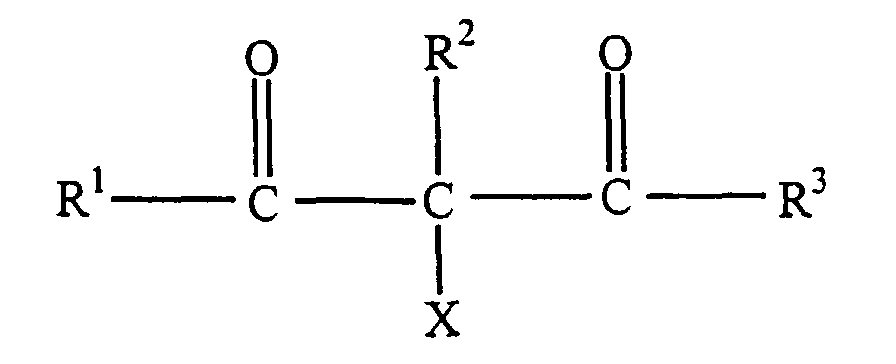
- More preferably, the ligand precursor is a β-diketone having a formula:where R1 and R3 are each independently C1-8 alkyl, including halogenated alkyl; aryl including halogenated aryl and R2 is H, halogen or C1-8 alkyl or halogenated alkyl and X is H.
- Most preferably, the ligand precursor is selected from the group consisting of 1,1,1,5,5,5-hexafluoro-2,4-pentanedione, 1,1,1,3,5,5,5-heptafluoro-2,4-pentanedione and mixtures thereof.
- Preferably, n is in the range of 1-3.
- Preferably, the elemental form of the metal is added in an amount of at least 0.01 weight percent of the metal compound precursor.
- More preferably, the present invention is a process for the synthesis of Cu+1(1,1,1,5,5,5-hexafluoro-2,4-pentanedionate)-1 (stabilizing ligand), from the metal compound precursor, cuprous oxide, the ligand precursor, 1,1,1,5,5,5-hexafluoro-2,4-pentanedione and a stabilizing ligand, the improvement, to suppress the formation of Cu+2(1,1,1,5,5,5-hexafluoro-2,4-pentanedione)2, of adding elemental particulate copper to the synthesis of the Cu+1(1,1,1,5,5,5-hexafluoro-2,4-pentanedionate)-1(stabilizing ligand).
- Preferably, the stabilizing ligand is selected from the group consisting of trimethylvinylsilane, alkenes, dienes, silicon substituted alkenes, silicon substituted dienes, alkynes, silicon substituted alkynes, alkyne-alkenes, silicon substituted alkynes-alkenes, nitriles, silicon substituted nitriles, isonitriles, silicon substituted isonitriles, carbon monoxide, trialkyl phosphines, triaryl phosphines, imines, diimines, amines and mixtures thereof.
- Most preferably, the stabilizing ligand has a formula: C(R4)(R5)=C(R5)Si(R6)3, where R4 is H, C1-8 alkyl or Si(R6)3, each R5 is independently H or C1-8 alkyl, and each R6 is independently phenyl or C1-8 alkyl.
- In a most preferred embodiment, the present invention is a process for the synthesis of Cu+1(1,1,1,5,5,5-hexafluoro-2,4-pentanedionate)-1.(trimethylvinylsilane), from the metal precursor, cuprous oxide, the ligand precursor, 1,1,1,5,5,5-hexafluoro-2,4-pentanedione, and trimethylvinylsilane; the improvement, to suppress the formation of Cu+2(1,1,1,5,5,5-hexafluoro-2,4-pentanedionate)2, of adding elemental particulate copper to the synthesis of the Cu+1(1,1,1,5,5,5-hexafluoro-2,4-pentanedionate)-1 .(trimethylvinylsilane).
- Preferably, the particulate copper has a particle size of less than 100 mm.
- More preferably, the particle size is in the range of 0.01 to 100 mm.
- Preferably, the free copper is added in an amount of at least 0.01 weight percent of the metal precursor, copper oxide.
- More preferably, the free copper is added in an amount in the range of 0.01 to 100 weight percent of the copper oxide precursor.
- Not Applicable
- The present invention is a synthesis of metal-ligand complexes, such as copper(+1)(1,1,1,5,5,5-hexafluoro-2,4-pentanedionate)(A), so that the formation of undesired higher valence metal-ligand complexes, such as Cu+2(1,1,1,5,5,5-hexafluoro-2,4-pentanedionate)2, is suppressed. The resulting lowered concentration of higher valence metal-ligand complexes (i.e., Cu+2(1,1,1,5,5,5-hexafluoro-2,4-pentanedionate)2) in the crude reaction product thus facilitates more efficient purification steps and consequently a higher yield of pure product.
- Generally, the present invention is a process for the synthesis of a first metal-ligand complex, M+n(L-)n, where n ≥ 1, from a metal compound precursor and a ligand precursor, where the metal of the metal compound precursor may during the synthesis change to a valence in excess of n, in which a free or elemental metal, M0, comparable to the metal of the metal compound is added to the synthesis of the first metal-ligand complex to suppress formation of a second metal-ligand complex of the metal with a valence in excess of n.
- A particularly desired embodiment of the present invention is a process for the synthesis of Cu+1(1,1,1,5,5,5-hexafluoro-2,4-pentanedionate)-1(A), from the metal compound precursor, cuprous oxide, the ligand precursor, 1,1,1,5,5,5-hexafluoro-2,4-pentanedione and a stabilizing ligand (A), such as trimethylvinylsilane, where free or elemental particulate copper is added to the synthesis of the Cu+1(1,1,1,5,5,5-hexafluoro-2,4-pentanedionate)-1(A) to suppress the formation of Cu+2(1,1,1,5,5,5-hexafluoro-2,4-pentanedione)2.
- The protonated form of the ligand precursor, "L" may be β-diketones, halogenated β-diketones, β-ketoimines, halogenated β-ketoimines, β-diimines, halogenated β-diimines, β-ketoesters, halogenated β-ketoesters, carboxylic acids, halogenated carboxylic acids, phenols, halogenated phenols, amides, halogenated amides, alcohols, halogenated alcohols, amines and mixtures thereof.
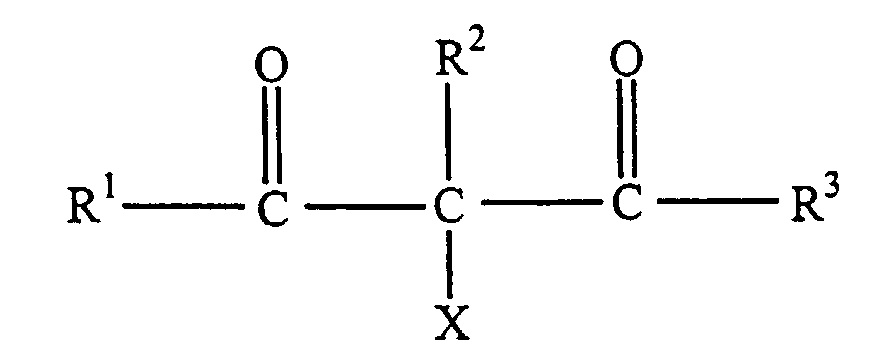
- The protonated form of the ligand precursor, "L" may be a β-diketone having a formula:where R1 and R3 are each independently C1-8 alkyl, halogenated alkyl, aryl, or halogenated aryl, and R2 is H or halogen, or C1-8 alkyl or halogenated alkyl and X is H.
- Most preferably, the protonated ligand precursor, "L" is selected from the group consisting of 1,1,1,5,5,5-hexafluoro-2,4-pentanedione, 1,1,1,3,5,5,5-heptafluoro-2,4-pentanedione and mixtures thereof.
- The metal-ligand complex may also contain a stabilizing ligand, "A". This would result in a metal-ligand complex of M+n(L-)n (A). More preferably, the additional stabilizing ligand "A" is selected from the group consisting of trimethylvinylsilane, alkenes, dienes, silicon substituted alkenes, silicon substituted dienes, alkynes, silicon substituted alkynes, alkyne-alkenes, silicon substituted alkynes-alkenes, nitriles, silicon substituted nitriles, isonitriles, silicon substituted isonitriles, carbon monoxide, trialkyl phosphines, triaryl phosphines, imines, diimines, amines and mixtures thereof. It should be understood that throughout this description, where M+x (L-)x or Cu+1(1,1,1,5,5,5-hexafluoro-2,4-pentanedionate)-1 are recited, that it is contemplated that the metal-ligand complex may include a stabilizing ligand "A".
- The metal can broadly meet the following functional definition. If in a chemical reaction to prepare a metal complex of the type M+x (L-)x some undesired metal complex species of the type M+(x+y)(L-)(x+y) forms where (x) can be 1,2,3,4 or 5 and y can be 1,2,3 etc., such that (x+y) cannot exceed 6, then the formation of this undesired species can be suppressed by the addition of a metal N to the reaction which is capable of suppressing the formation of M+(x+y)(L-) (x+y) by providing the required reducing electrochemical potential. This metal N can be either the same as the metal M or be a different metal chosen such that the desired suppression of M+(x+y)(L-) (x+y) formation occurs with essentially no deleterious side reactions. Added metal N is also chosen such that if the metal complex N+x(L-)x that forms is undesired (formed from the oxidation of N during the suppression of formation of M+(x+y)(L-)(x+y) ) then it is readily removed from the reaction mixture. Preferably, the metal is selected from the transition metals. Most preferably it is copper.
- The amount of elemental metal powder to be added is an effective amount to achieve at least a detectable suppression of the higher valence metal byproduct, Cu+2(β-diketonate)2. Preferably, the elemental metal powder would be added in at least a 0.01 weight percent amount in relation to the metal oxide used in the synthesis. More preferably, the elemental metal powder is added in a range of 0.01 to 100 weight percent in relation to the metal oxide. The added elemental or free metal, M0, is typically added as a powder or particulate having a high surface area. The particle size of the metal is no greater than 100mm, preferably in the range of 0.01 microns to 100 mm. The metal in excess of what is necessary to suppress the metal byproduct may simply be decanted and filtered from the reaction product after synthesis and preferably before further purification steps, such as column chromatography.
- The metal precursor compound is typically an oxide or a halide or carboxylate, but other compounds of the metal are acceptable. Preferably, the metal compound is a metal oxide. More preferably, the metal compound is cuprous oxide.
- The synthesis of copper(+1)(β-diketonate)(A) compounds are achieved via a condensation reaction between copper(+1) oxide and the respective β-diketone in the presence of a ligand (A) where (A) is typically an olefin, alkyne etc. If the β-diketone in question is 1,1,1,5,5,5-hexafluoro-2,4-pentanedione, then the reaction occurs according to Equation #1, where 1,1,1,5,5,5-hexafluoro-2,4-pentanedione is abbreviated as "Hhfac", and its corresponding anion, 1,1,1,5,5,5-hexafluoro-2,4-pentanedionate, as "hfac". This type of synthesis is taught by Doyle, et. al., cited above.
- The efficacy of this technique was illustrated by conducting a series of syntheses of Cu+1(hfac)(trimethylvinylsilane) at both small scale (Experiments #1, #2 and #3) and large scale (Experiments #4, #5 and #5). Experiments #1, #2 and #3 were identical, except that Experiment #3 was conducted with no added copper powder. Experiments #4, #5 and #6 were identical, except that Experiment #6 was conducted with no added copper powder. See the experimental section for details. Once run, the reactions were filtered and their visible light spectrum recorded to directly measure their respective Cu+2(hfac)2 concentrations by light absorption at 685 nanometers (nm) and comparing the value obtained to a previously obtained calibration curve of absolute absorbance versus concentration of pure Cu+2(hfac)2 in Cu+1(hfac)(trimethylvinylsilane). Trimethylvinylsilane is abbreviated as ("tmvs"). Two different copper powders were used, i.e., either submicron or 10 micron particle size, as shown below. In all cases where copper powder was used, the filtered reaction mixture was noticeably lighter green colored, when compared to the filtered reaction mixture where no copper powder had been added. This is exemplary of successful suppression of Cu+2(hfac)2 using the elemental copper powder during the synthesis of Cu+1(hfac)(trimethylvinylsilane). The results obtained from the above experiments are shown in Tables 1 and 2, from which it is apparent that the effect of the invention is to successfully suppress undesired metal-ligand complexes of a higher metal valence than desired.
- Table 1 reports the experimental runs conducted on the smaller scale.
Exp#1 Exp#2 Exp#3 sub-µm Cu powder 10µm Cu powder No Cu powder Abs. 2.50 Abs. 2.67 Abs. 5.60 Cu+2 3710ppm Cu+2 4010ppm Cu+2 8430ppm - The smaller scale experiments were then followed by another three experiments at a larger scale to show that the effect of suppressing the Cu+2(hfac)2 concentration is still observed. These experiments were conducted using the 10 micron copper powder. The results are shown below and confirm that the suppression of Cu+2(hfac)2 does occur at this higher scale of manufacture, maintaining a lower level of Cu+2(hfac)2 by a greater degree than the small scale reaction, probably indicative of superior mixing of reagents at a larger scale.
Exp#4 Exp#5 Exp#6 10 micron powder 10 micron powder no copper powder Abs. 0.3 Abs. O.45 Abs. 1.38 Cu+2 400 ppm Cu+2 630 ppm Cu+2 2000 ppm Note: In the tables above, to convert the Cu+2 concentration into Cu+2(hfac)2 concentration, multiply the Cu+2concentration by 7.52 which represents the molecular weight of Cu+2(hfac)2 divided by the atomic weight of copper (ie 477.6 g/mol / 63.5 g/mol = 7.52). - Further although it is possible to obtain highly pure product using the metal provision/addition of the present invention without substantive additional purification, using the synthetic procedure and reagent quantities outlined above for Ex.#4 and #5, a series of eight additional experiments were run, and the resulting products were further purified by chromatography. The efficiency of this chromatography step for syntheses conducted using the addition of copper powder was found to be substantially higher than for previous syntheses using no added copper powder. In addition, the chromatography "column life" (how much reaction product could be processed before a fresh column was needed) was found to be almost doubled when using the product low in Cu+2(hfac)2 made using the addition of copper powder. These comparisons are shown in the table below.
Improvements in yield due to copper powder addition. Synthesis Technique No Copper Powder Addition of Copper Powder Process Improvement Column Life 27 kg >50 kg >85% Chromatography Yield 56% 82% 46.4% - The results recorded in Table 3 show the benefit of the process of the present invention in producing high purity product without reliance on post synthesis purification. As a result, use of the present invention makes the use of various post synthesis purifications optional or at least dependent on the purity level required by a particular enduse. It also allows for the use of less rigorous post synthesis purification, such that chromatographic purification may not be necessary or desired for a given product synthesis.
-
- Ex.#1:
- Reagents:
- Cu2O
- 53g (0.37mol).
- Hhfac
- 105mL (0.74mol).
- tmvs
- 121mL (0.784mol, 6% excess).
- Copper powder
- 1.18g (0.0185mol, 5 mol% of Cu2O).
particle size: submicron. - Ex.#2:
- same reagent values as above for Ex.#1.
copper particle size: 10 micron. - Ex.#3 (Control):
- same reagent values as above for Ex.#1 & #2 above,
except no addition of copper powder. - Hhfac was added dropwise to a suspension of Cu2O/Cu (Ex.#1 and #2) or just Cu2O (Ex.#3) in tmvs at approximately -10°C for 1.5hr with stirring. The reaction mixture turned green with remaining red powders. The reaction mixture was stirred at room temperature for 15hr followed by filtration through 5g of celite. From the resulting light green liquid product, 5mL was sampled for spectrophotometric analysis in the visible light region to quantify the concentration of Cu+2(hfac)2 by measuring its visible light absorption at 685nm.
-
- Ex.#4 and #5:
- Reagents:
- Cu2O
- 5.3 kg.
- Hhfac
- 15.4 kg.
- tmvs
- 7.9 kg.
- 10 micron copper powder:
- 350g for Ex.# 4; 500g for Ex.# 5.
- Ex.#6
- Cu2O
- 5.1 kg.
- Hhfac
- 14.7 kg.
- tmvs
- 8.1 kg.
no addition of copper powder. - Hhfac was added to the copper oxide mixed with copper powder (Ex.#4 and #5) suspended by stirring in a portion of the total tmvs amount and cooled to -10°C to 0°C. Hhfac blended with the remaining tmvs was then pumped into the cooled suspension over approximately 20 hrs, maintaining a temperature of approximately 0°C to -10°C. The reaction mixture was then filtered and sampled for Cu+2(hfac)2 content, as for Ex.#1, #2 and #3. The procedure for Ex. #4 and #5 was used for Ex.#6, but no copper powder was added.
- As indicated by the experimental results, the present invention provides a remarkable and unexpected enhancement in the synthesis of high purity metal-ligand complexes, such as Cu+1(hfac) (tmvs). The addition of the elemental form of metal powder resulted in dramatic decreases in the by-product Cu+2(hfac)2, well beyond what the inventors expected. The unique synthesis step of the present invention provides higher purity material initially upon synthesis, even without any final purification. This results in significantly increased yields. In addition, the unique synthesis step of the present invention enhances the performance of any subsequent purification processes by decreasing the amount of by-product to be captured. Reduction in load on the subsequent purification process results in extended life for the purification step, such as purification chromatographic columns (i.e., alumina, silica, silica gel, carbons, molecular sieves and porous polymers), previously used to purify the Cu+1(hfac) (tmvs). The overall result is a higher purity, lower cost product using less purification equipment and simplified purification processing.
- The present invention has been set forth with regard to several preferred embodiments, but the full scope of the present invention should be ascertained from the claims which follow.
Claims (22)
- In a process for the synthesis of a first metal-ligand complex, M+n(L-)n, where n ≥ 1, from a metal compound precursor and a ligand precursor, where the metal of said metal compound precursor is capable of changing to a valence in excess of n during the synthesis; the improvement, to suppress formation of a second metal-ligand complex of said metal with a valence in excess of n, of providing an elemental form of a metal for the synthesis of said first metal-ligand complex.
- The process of Claim 1 wherein said metal is a transition metal.
- The process of Claim 1 wherein said metal is copper.
- The process of Claim 1 wherein said elemental form of said metal is a particulate form of said metal.
- The process of Claim 4 wherein said particulate form has a particle size of less than 100 mm.
- The process of Claim 5 wherein said particle size is in the range of 0.01 microns to 100 mm.
- The process of Claim 1 wherein said ligand precursor is selected from the group consisting of β-diketones, halogenated β-diketones, β-ketoimines, halogenated β-ketoimines, β-diimines, halogenated β-diimines, β-ketoesters, halogenated β-ketoesters, carboxylic acids, halogenated carboxylic acids, phenols, halogenated phenols, amides, halogenated amides, alcohols, halogenated alcohols, amines and mixtures thereof.
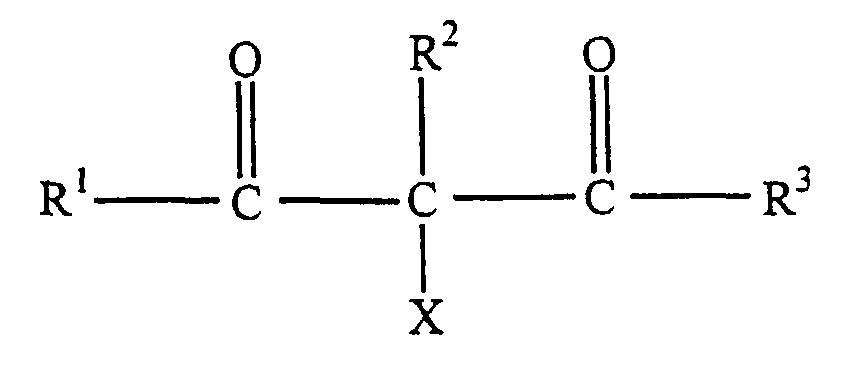
- The process of Claim 1 wherein said ligand precursor is a β-diketone having a formula:where R1 and R3 are each independently C1-8 alkyl or halogenated alkyl, aryl or halogenated aryl, and R2 is H or halogen , or C1-8 alkyl or halogenated alkyl and X is H.
- The process of Claim 1 wherein said ligand precursor, is selected from the group consisting of 1,1,1,5,5,5-hexafluoro-2,4-pentanedione, 1,1,1,3,5,5,5-heptafluoro-2,4-pentanedione and mixtures thereof.
- The process of Claim 1 wherein n is in the range of 1-3.
- The process of Claim 1 wherein said elemental form of said metal is added in an amount of at least 0.01 weight percent of the metal compound precursor.
- The process of Claim 1 wherein said M+n(L-)n has an additional stabilizing ligand.
- The process of Claim 12 wherein said additional stabilizing ligand is selected from the group consisting of: trimethylvinylsilane, alkenes, dienes, silicon substituted alkenes, silicon substituted dienes, alkynes, silicon substituted alkynes, alkyne-alkenes, silicon substituted alkyne-alkenes, nitriles, silicon substituted nitriles, isonitriles, silicon substituted isonitriles, carbon monoxide, trialkyl phosphines, triaryl phosphines, imines, diimines, amines and mixtures thereof.
- The process of Claim 12 wherein said additional stabilizing ligand has a formula: C(R4)(R5)=C(R5)Si(R6)3, where R4 is H, C1-8 alkyl or Si(R6)3, each R5 is independently H or C1-8 alkyl, and each R6 is independently phenyl or C1-8 alkyl.
- In a process for the synthesis of Cu+1(1,1,1,5,5,5-hexafluoro-2,4-pentanedionate)-1(stabilizing ligand), from a metal precursor, cuprous oxide, a ligand precursor, 1,1,1,5,5,5-hexafluoro-2,4-pentanedione and a stabilizing ligand; the improvement, to suppress the formation of Cu+2(1,1,1,5,5,5-hexafluoro-2,4-pentanedionate)2, of adding elemental particulate copper to the synthesis of said Cu+1(1,1,1,5,5,5-hexafluoro-2,4-pentanedionate)-1(stabilizing ligand).
- The process of Claim 15 wherein said stabilizing ligand is selected from the group consisting of trimethylvinylsilane, alkenes, dienes, silicon substituted alkenes, silicon substituted dienes, alkynes, silicon substituted alkynes, alkyne-alkenes, silicon substituted alkyne-alkenes, nitriles, silicon substituted nitriles, isonitriles, silicon substituted isonitriles, carbon monoxide, trialkyl phosphines, triaryl phosphines, imines, diimines, amines and mixtures thereof.
- The process of Claim 15 wherein said stabilizing ligand has a formula: C(R4)(R5)=C(R5)Si(R6)3, where R4 is H, C1-8 alkyl or Si(R6)3, each R5 is independently H or C1-8 alkyl, and each R6 is independently phenyl or C1-8 alkyl.
- In a process for the synthesis of Cu+1(1,1,1,5,5,5-hexafluoro-2,4-pentanedionate)-1 (trimethylvinylsilane), from a metal compound precursor of cuprous oxide, a ligand precursor of 1,1,1,5,5,5-hexafluoro-2,4-pentanedione and trimethylvinylsilane; the improvement, to suppress the formation of Cu+2(1,1,1,5,5,5-hexafluoro-2,4-pentanedionate)2, of adding elemental particulate copper to the synthesis of said Cu+1(1,1,1,5,5,5-hexafluoro-2,4-pentanedionate)-1 (trimethylvinylsilane).
- The process of Claim 18 wherein said particulate copper has a particle size of less than 100 mm.
- The process of Claim 19 wherein said particle size is in the range of 0.01 microns to 100 mm.
- The process of Claim 18 wherein said elemental copper is added in an amount of at least 0.01 weight percent of the metal precursor copper oxide.
- The process of Claim 21 wherein said elemental copper is added in an amount in the range of 0.01 to 100 weight percent of the copper oxide precursor.
Applications Claiming Priority (2)
| Application Number | Priority Date | Filing Date | Title |
|---|---|---|---|
| US09/329,417 US6096913A (en) | 1999-06-10 | 1999-06-10 | Production of metal-ligand complexes |
| US329417 | 1999-06-10 |
Publications (2)
| Publication Number | Publication Date |
|---|---|
| EP1059295A1 true EP1059295A1 (en) | 2000-12-13 |
| EP1059295B1 EP1059295B1 (en) | 2003-08-13 |
Family
ID=23285285
Family Applications (1)
| Application Number | Title | Priority Date | Filing Date |
|---|---|---|---|
| EP00111836A Expired - Lifetime EP1059295B1 (en) | 1999-06-10 | 2000-06-07 | Production of metal complexes by comproportionation |
Country Status (8)
| Country | Link |
|---|---|
| US (1) | US6096913A (en) |
| EP (1) | EP1059295B1 (en) |
| JP (2) | JP2001048827A (en) |
| KR (1) | KR100379312B1 (en) |
| CN (1) | CN1145630C (en) |
| AT (1) | ATE247124T1 (en) |
| DE (1) | DE60004439T2 (en) |
| TW (1) | TWI229675B (en) |
Cited By (1)
| Publication number | Priority date | Publication date | Assignee | Title |
|---|---|---|---|---|
| EP1323720A1 (en) * | 2001-12-27 | 2003-07-02 | Air Products And Chemicals, Inc. | Use of water and acidic water to purify liquid MOCVD precursors |
Families Citing this family (7)
| Publication number | Priority date | Publication date | Assignee | Title |
|---|---|---|---|---|
| US6096913A (en) * | 1999-06-10 | 2000-08-01 | Air Products And Chemicals, Inc. | Production of metal-ligand complexes |
| US6391385B1 (en) * | 1999-10-18 | 2002-05-21 | Advanced Technology Materials, Inc. | Method of abating of effluents from chemical vapor deposition processes using organometallic source reagents |
| US6340768B1 (en) * | 2000-12-04 | 2002-01-22 | Research Foundation Of State University Of New York | MOCVD precursors based on organometalloid ligands |
| KR100807947B1 (en) * | 2001-01-30 | 2008-02-28 | 삼성전자주식회사 | Method for preparing asymmetric β-ketoiminate ligand compound |
| US6537361B2 (en) | 2001-03-30 | 2003-03-25 | Sharp Laboratories Of America, Inc. | Method of the synthesis and control of PGO spin-coating precursor solutions |
| JP4529434B2 (en) * | 2003-12-11 | 2010-08-25 | 東ソー株式会社 | Copper complex and copper complex composition comprising a polysubstituted vinylsilane compound |
| US6838573B1 (en) | 2004-01-30 | 2005-01-04 | Air Products And Chemicals, Inc. | Copper CVD precursors with enhanced adhesion properties |
Family Cites Families (12)
| Publication number | Priority date | Publication date | Assignee | Title |
|---|---|---|---|---|
| JPS5817196B2 (en) * | 1973-06-25 | 1983-04-05 | 三菱油化株式会社 | 1 Kadosaku Kagobutsu no Seihou |
| JPS50135035A (en) * | 1974-04-17 | 1975-10-25 | ||
| US4279874A (en) * | 1980-04-17 | 1981-07-21 | Exxon Research & Engineering Co. | Cu(1) Acetylacetonate complexes for CO separation |
| US4425281A (en) * | 1981-07-13 | 1984-01-10 | Exxon Research And Engineering Co. | Copper or silver complexes with fluorinated diketones and unsaturated ligands |
| US4385005A (en) * | 1981-07-13 | 1983-05-24 | Exxon Research And Engineering Co. | Process for separating unsaturated hydrocarbons using copper or silver complexes with fluorinated diketonates |
| US4471152A (en) * | 1983-05-06 | 1984-09-11 | Exxon Research And Engineering Co. | Separation of olefin mixtures by Cu (I) complexation |
| US4434317A (en) * | 1983-05-06 | 1984-02-28 | Exxon Research And Engineering Company | Separation and recovery of unsaturated hydrocarbons by copper (I) complexes |
| US5085731A (en) * | 1991-02-04 | 1992-02-04 | Air Products And Chemicals, Inc. | Volatile liquid precursors for the chemical vapor deposition of copper |
| JP3230389B2 (en) * | 1993-09-20 | 2001-11-19 | 三菱マテリアル株式会社 | Organic copper compounds for copper thin film formation and selective growth of copper thin films using the same |
| JP2876980B2 (en) * | 1994-03-11 | 1999-03-31 | 三菱マテリアル株式会社 | Organocopper compounds for copper thin film formation by metalorganic chemical vapor deposition with high vapor pressure |
| JP2622671B2 (en) * | 1995-03-07 | 1997-06-18 | 株式会社トリケミカル研究所 | Method for producing copper β-diketonate complex |
| US6096913A (en) * | 1999-06-10 | 2000-08-01 | Air Products And Chemicals, Inc. | Production of metal-ligand complexes |
-
1999
- 1999-06-10 US US09/329,417 patent/US6096913A/en not_active Expired - Fee Related
-
2000
- 2000-06-07 DE DE60004439T patent/DE60004439T2/en not_active Expired - Fee Related
- 2000-06-07 AT AT00111836T patent/ATE247124T1/en not_active IP Right Cessation
- 2000-06-07 EP EP00111836A patent/EP1059295B1/en not_active Expired - Lifetime
- 2000-06-08 KR KR10-2000-0031353A patent/KR100379312B1/en not_active Expired - Fee Related
- 2000-06-09 TW TW089111354A patent/TWI229675B/en not_active IP Right Cessation
- 2000-06-09 JP JP2000179381A patent/JP2001048827A/en not_active Revoked
- 2000-06-10 CN CNB001192086A patent/CN1145630C/en not_active Expired - Fee Related
-
2009
- 2009-11-16 JP JP2009261178A patent/JP2010031060A/en active Pending
Non-Patent Citations (4)
| Title |
|---|
| DATABASE CHEMABS [online] CHEMICAL ABSTRACTS SERVICE, COLUMBUS, OHIO, US; CHI, KAI MING ET AL: "Etching of copper at high rates via generation of volatile copper species", XP002147353, retrieved from STN Database accession no. 118:107485 * |
| DOYLE D. G. ET AL.: "Alkene and Carbonmonoxide derivatives of copper(I) and silver(I) .beta.diketonates", ORGANOMETALLICS, vol. 4, no. 5, 1985, pages 830 - 835, XP000939191 * |
| KLAEUI, WOLFGANG ET AL: "Preparation and characterization of copper(I) complexes with unsaturated small molecules. Crystal structure determination of a copper carbonyl complex stabilized by a tris-chelating oxygen ligand", ORGANOMETALLICS, vol. 7, no. 6, 1988, pages 1357 - 1363, XP000939190 * |
| PROC. SPIE-INT. SOC. OPT. ENG. (1992), 1593(DRY ETCH TECHNOL.), 157-60 * |
Cited By (1)
| Publication number | Priority date | Publication date | Assignee | Title |
|---|---|---|---|---|
| EP1323720A1 (en) * | 2001-12-27 | 2003-07-02 | Air Products And Chemicals, Inc. | Use of water and acidic water to purify liquid MOCVD precursors |
Also Published As
| Publication number | Publication date |
|---|---|
| CN1145630C (en) | 2004-04-14 |
| TWI229675B (en) | 2005-03-21 |
| JP2010031060A (en) | 2010-02-12 |
| DE60004439T2 (en) | 2004-06-24 |
| JP2001048827A (en) | 2001-02-20 |
| ATE247124T1 (en) | 2003-08-15 |
| US6096913A (en) | 2000-08-01 |
| KR20010049504A (en) | 2001-06-15 |
| DE60004439D1 (en) | 2003-09-18 |
| EP1059295B1 (en) | 2003-08-13 |
| KR100379312B1 (en) | 2003-04-10 |
| CN1277966A (en) | 2000-12-27 |
Similar Documents
| Publication | Publication Date | Title |
|---|---|---|
| KR940011709B1 (en) | Volatile liquid precursors for the chemical vapor deposition of copper | |
| EP0533070B1 (en) | Volatile precursors for copper CVD | |
| EP0493754B1 (en) | Process for the chemical vapor deposition of copper | |
| KR100767257B1 (en) | Volatile Metal Beta-Ketoiminate Complexes | |
| JP2010031060A (en) | Method for producing metal-ligand complex | |
| EP1676850B1 (en) | Volatile beta-ketoiminate and metal beta-diiminate complexes | |
| US5144049A (en) | Volatile liquid precursors for the chemical vapor deposition of copper | |
| Woo et al. | Synthesis, reactivity, and characterization of the first donor-stabilized silylene complexes of osmium meso-tetra-p-tolylporphyrin (TTP) Os: SiR2. cntdot. THF (R= Me, Et, iso-Pr) and the molecular structure of (TTP) Os: SiEt2. cntdot. 2THF | |
| KR100517429B1 (en) | Use of water and acidic water to purify liquid mocvd precursors | |
| CA2419837A1 (en) | Self-reducible copper(ii) source reagents for chemical vapor deposition of copper metal | |
| US6822107B1 (en) | Chemical vapor deposition precursors for deposition of copper | |
| Dyer et al. | The oxidative addition of a chlorophosphine to Pd 0: formation and characterisation of a 42-electron triangulo palladium cluster | |
| CN1990491B (en) | Volatile metal beta-ketoiminate and metal beta-diiminate complexes | |
| Himes | Exploratory synthesis of copper alkoxides as potential precursors for chemical vapor deposition of copper | |
| Tao et al. | Organophosphine/phosphite stabilized disilver (I) methanedisulphonates: synthesis, solid state structures and their potential use as MOCVD precursors | |
| Coskran et al. | Substituted Group VI metal carbonyl complexes of dimethyl methylphosphonite and bis (dimethylamino) methylphosphine | |
| EP1792907A1 (en) | Volatile metal beta-ketoiminate complexes | |
| JPH07188256A (en) | Organic silver compounds for forming silver thin films by high vapor pressure organometallic chemical vapor deposition | |
| KR20000025984A (en) | Liquid precursor useful to chemical deposition of copper |
Legal Events
| Date | Code | Title | Description |
|---|---|---|---|
| PUAI | Public reference made under article 153(3) epc to a published international application that has entered the european phase |
Free format text: ORIGINAL CODE: 0009012 |
|
| AK | Designated contracting states |
Kind code of ref document: A1 Designated state(s): AT BE CH CY DE DK ES FI FR GB GR IE IT LI LU MC NL PT SE |
|
| AX | Request for extension of the european patent |
Free format text: AL;LT;LV;MK;RO;SI |
|
| 17P | Request for examination filed |
Effective date: 20010314 |
|
| AKX | Designation fees paid |
Free format text: AT BE CH CY DE DK ES FI FR GB GR IE IT LI LU MC NL PT SE |
|
| 17Q | First examination report despatched |
Effective date: 20020423 |
|
| GRAH | Despatch of communication of intention to grant a patent |
Free format text: ORIGINAL CODE: EPIDOS IGRA |
|
| GRAS | Grant fee paid |
Free format text: ORIGINAL CODE: EPIDOSNIGR3 |
|
| GRAA | (expected) grant |
Free format text: ORIGINAL CODE: 0009210 |
|
| AK | Designated contracting states |
Designated state(s): AT BE CH CY DE DK ES FI FR GB GR IE IT LI LU MC NL PT SE |
|
| PG25 | Lapsed in a contracting state [announced via postgrant information from national office to epo] |
Ref country code: LI Free format text: LAPSE BECAUSE OF FAILURE TO SUBMIT A TRANSLATION OF THE DESCRIPTION OR TO PAY THE FEE WITHIN THE PRESCRIBED TIME-LIMIT Effective date: 20030813 Ref country code: FI Free format text: LAPSE BECAUSE OF FAILURE TO SUBMIT A TRANSLATION OF THE DESCRIPTION OR TO PAY THE FEE WITHIN THE PRESCRIBED TIME-LIMIT Effective date: 20030813 Ref country code: CY Free format text: LAPSE BECAUSE OF FAILURE TO SUBMIT A TRANSLATION OF THE DESCRIPTION OR TO PAY THE FEE WITHIN THE PRESCRIBED TIME-LIMIT Effective date: 20030813 Ref country code: CH Free format text: LAPSE BECAUSE OF FAILURE TO SUBMIT A TRANSLATION OF THE DESCRIPTION OR TO PAY THE FEE WITHIN THE PRESCRIBED TIME-LIMIT Effective date: 20030813 Ref country code: AT Free format text: LAPSE BECAUSE OF FAILURE TO SUBMIT A TRANSLATION OF THE DESCRIPTION OR TO PAY THE FEE WITHIN THE PRESCRIBED TIME-LIMIT Effective date: 20030813 |
|
| REG | Reference to a national code |
Ref country code: GB Ref legal event code: FG4D |
|
| REG | Reference to a national code |
Ref country code: CH Ref legal event code: EP |
|
| REG | Reference to a national code |
Ref country code: IE Ref legal event code: FG4D |
|
| REF | Corresponds to: |
Ref document number: 60004439 Country of ref document: DE Date of ref document: 20030918 Kind code of ref document: P |
|
| PG25 | Lapsed in a contracting state [announced via postgrant information from national office to epo] |
Ref country code: SE Free format text: LAPSE BECAUSE OF FAILURE TO SUBMIT A TRANSLATION OF THE DESCRIPTION OR TO PAY THE FEE WITHIN THE PRESCRIBED TIME-LIMIT Effective date: 20031113 Ref country code: GR Free format text: LAPSE BECAUSE OF FAILURE TO SUBMIT A TRANSLATION OF THE DESCRIPTION OR TO PAY THE FEE WITHIN THE PRESCRIBED TIME-LIMIT Effective date: 20031113 Ref country code: DK Free format text: LAPSE BECAUSE OF FAILURE TO SUBMIT A TRANSLATION OF THE DESCRIPTION OR TO PAY THE FEE WITHIN THE PRESCRIBED TIME-LIMIT Effective date: 20031113 |
|
| PG25 | Lapsed in a contracting state [announced via postgrant information from national office to epo] |
Ref country code: ES Free format text: LAPSE BECAUSE OF FAILURE TO SUBMIT A TRANSLATION OF THE DESCRIPTION OR TO PAY THE FEE WITHIN THE PRESCRIBED TIME-LIMIT Effective date: 20031124 |
|
| PG25 | Lapsed in a contracting state [announced via postgrant information from national office to epo] |
Ref country code: PT Free format text: LAPSE BECAUSE OF FAILURE TO SUBMIT A TRANSLATION OF THE DESCRIPTION OR TO PAY THE FEE WITHIN THE PRESCRIBED TIME-LIMIT Effective date: 20040113 |
|
| REG | Reference to a national code |
Ref country code: CH Ref legal event code: PL |
|
| ET | Fr: translation filed | ||
| PG25 | Lapsed in a contracting state [announced via postgrant information from national office to epo] |
Ref country code: LU Free format text: LAPSE BECAUSE OF NON-PAYMENT OF DUE FEES Effective date: 20040607 Ref country code: IE Free format text: LAPSE BECAUSE OF NON-PAYMENT OF DUE FEES Effective date: 20040607 |
|
| PLBE | No opposition filed within time limit |
Free format text: ORIGINAL CODE: 0009261 |
|
| STAA | Information on the status of an ep patent application or granted ep patent |
Free format text: STATUS: NO OPPOSITION FILED WITHIN TIME LIMIT |
|
| PG25 | Lapsed in a contracting state [announced via postgrant information from national office to epo] |
Ref country code: MC Free format text: LAPSE BECAUSE OF NON-PAYMENT OF DUE FEES Effective date: 20040630 |
|
| 26N | No opposition filed |
Effective date: 20040514 |
|
| REG | Reference to a national code |
Ref country code: IE Ref legal event code: MM4A |
|
| PGFP | Annual fee paid to national office [announced via postgrant information from national office to epo] |
Ref country code: BE Payment date: 20050628 Year of fee payment: 6 |
|
| PGFP | Annual fee paid to national office [announced via postgrant information from national office to epo] |
Ref country code: GB Payment date: 20060505 Year of fee payment: 7 |
|
| PGFP | Annual fee paid to national office [announced via postgrant information from national office to epo] |
Ref country code: NL Payment date: 20060508 Year of fee payment: 7 |
|
| PGFP | Annual fee paid to national office [announced via postgrant information from national office to epo] |
Ref country code: FR Payment date: 20060605 Year of fee payment: 7 |
|
| PG25 | Lapsed in a contracting state [announced via postgrant information from national office to epo] |
Ref country code: BE Free format text: LAPSE BECAUSE OF NON-PAYMENT OF DUE FEES Effective date: 20060630 |
|
| PGFP | Annual fee paid to national office [announced via postgrant information from national office to epo] |
Ref country code: IT Payment date: 20060630 Year of fee payment: 7 Ref country code: DE Payment date: 20060630 Year of fee payment: 7 |
|
| BERE | Be: lapsed |
Owner name: *AIR PRODUCTS AND CHEMICALS INC. Effective date: 20060630 |
|
| GBPC | Gb: european patent ceased through non-payment of renewal fee |
Effective date: 20070607 |
|
| NLV4 | Nl: lapsed or anulled due to non-payment of the annual fee |
Effective date: 20080101 |
|
| REG | Reference to a national code |
Ref country code: FR Ref legal event code: ST Effective date: 20080229 |
|
| PG25 | Lapsed in a contracting state [announced via postgrant information from national office to epo] |
Ref country code: NL Free format text: LAPSE BECAUSE OF NON-PAYMENT OF DUE FEES Effective date: 20080101 Ref country code: DE Free format text: LAPSE BECAUSE OF NON-PAYMENT OF DUE FEES Effective date: 20080101 |
|
| PG25 | Lapsed in a contracting state [announced via postgrant information from national office to epo] |
Ref country code: GB Free format text: LAPSE BECAUSE OF NON-PAYMENT OF DUE FEES Effective date: 20070607 |
|
| PG25 | Lapsed in a contracting state [announced via postgrant information from national office to epo] |
Ref country code: FR Free format text: LAPSE BECAUSE OF NON-PAYMENT OF DUE FEES Effective date: 20070702 |
|
| PG25 | Lapsed in a contracting state [announced via postgrant information from national office to epo] |
Ref country code: IT Free format text: LAPSE BECAUSE OF NON-PAYMENT OF DUE FEES Effective date: 20070607 |