EP1057857A2 - Curing accelerator and resin composition - Google Patents
Curing accelerator and resin composition Download PDFInfo
- Publication number
- EP1057857A2 EP1057857A2 EP00111023A EP00111023A EP1057857A2 EP 1057857 A2 EP1057857 A2 EP 1057857A2 EP 00111023 A EP00111023 A EP 00111023A EP 00111023 A EP00111023 A EP 00111023A EP 1057857 A2 EP1057857 A2 EP 1057857A2
- Authority
- EP
- European Patent Office
- Prior art keywords
- soap
- curing accelerator
- cobalt
- coating
- resin
- Prior art date
- Legal status (The legal status is an assumption and is not a legal conclusion. Google has not performed a legal analysis and makes no representation as to the accuracy of the status listed.)
- Granted
Links
Classifications
-
- C—CHEMISTRY; METALLURGY
- C09—DYES; PAINTS; POLISHES; NATURAL RESINS; ADHESIVES; COMPOSITIONS NOT OTHERWISE PROVIDED FOR; APPLICATIONS OF MATERIALS NOT OTHERWISE PROVIDED FOR
- C09F—NATURAL RESINS; FRENCH POLISH; DRYING-OILS; OIL DRYING AGENTS, i.e. SICCATIVES; TURPENTINE
- C09F9/00—Compounds to be used as driers, i.e. siccatives
-
- C—CHEMISTRY; METALLURGY
- C09—DYES; PAINTS; POLISHES; NATURAL RESINS; ADHESIVES; COMPOSITIONS NOT OTHERWISE PROVIDED FOR; APPLICATIONS OF MATERIALS NOT OTHERWISE PROVIDED FOR
- C09K—MATERIALS FOR MISCELLANEOUS APPLICATIONS, NOT PROVIDED FOR ELSEWHERE
- C09K3/00—Materials not provided for elsewhere
-
- C—CHEMISTRY; METALLURGY
- C08—ORGANIC MACROMOLECULAR COMPOUNDS; THEIR PREPARATION OR CHEMICAL WORKING-UP; COMPOSITIONS BASED THEREON
- C08K—Use of inorganic or non-macromolecular organic substances as compounding ingredients
- C08K5/00—Use of organic ingredients
- C08K5/04—Oxygen-containing compounds
- C08K5/09—Carboxylic acids; Metal salts thereof; Anhydrides thereof
- C08K5/098—Metal salts of carboxylic acids
-
- C—CHEMISTRY; METALLURGY
- C08—ORGANIC MACROMOLECULAR COMPOUNDS; THEIR PREPARATION OR CHEMICAL WORKING-UP; COMPOSITIONS BASED THEREON
- C08K—Use of inorganic or non-macromolecular organic substances as compounding ingredients
- C08K5/00—Use of organic ingredients
- C08K5/16—Nitrogen-containing compounds
- C08K5/17—Amines; Quaternary ammonium compounds
-
- C—CHEMISTRY; METALLURGY
- C09—DYES; PAINTS; POLISHES; NATURAL RESINS; ADHESIVES; COMPOSITIONS NOT OTHERWISE PROVIDED FOR; APPLICATIONS OF MATERIALS NOT OTHERWISE PROVIDED FOR
- C09D—COATING COMPOSITIONS, e.g. PAINTS, VARNISHES OR LACQUERS; FILLING PASTES; CHEMICAL PAINT OR INK REMOVERS; INKS; CORRECTING FLUIDS; WOODSTAINS; PASTES OR SOLIDS FOR COLOURING OR PRINTING; USE OF MATERIALS THEREFOR
- C09D11/00—Inks
- C09D11/02—Printing inks
- C09D11/03—Printing inks characterised by features other than the chemical nature of the binder
Definitions
- the present invention relates to a curing accelerator to be used with a resin for a coating or a printing ink which has an unsaturated fatty acid group in its molecules.
- a curing accelerator (drier) is added as a supplemental agent.
- a metallic soap such as that of cobalt or lead has been hitherto used.
- lead for the purpose of reducing pollution and improvement in the safety and the health of workers, there has been progress in the elimination of lead from curing accelerators.
- cobalt for curing accelerators, because of the unstable supply of cobalt bullion or the like. Accordingly, development of a curing accelerator in which the amounts of cobalt and lead used is restricted has become necessary.
- Aluminum chelates are also useful as a substitute for lead soap (see Japanese Examined Patent Application, Second Publication (Kokoku), No. 61-50114). However, use of such aluminum chelates is limited since they color the resin reddish orange when used with an methyl ethyl ketone oxime, which is widely used as an anti-skinning agent in coatings, and contaminates the hue of the coating.
- Zirconium soap is also useful as a substitute for lead soap.
- the adhesion of a coating film in which a zirconium soap is used is insufficient, and therefore such a coating has the disadvantage that it cannot be used for a general purpose coating.
- Japanese Unexamined Patent Application, First Publication (Kokai), No. Hei 6-172689 discloses a mixture of bipyridyl and a cobalt soap as an additive for enhancing the activity of a curing accelerator.
- a mixture has a dark brown color and colors the coating. Therefore, this mixture has the disadvantage that it is difficult to use it in a white coating.
- An object to be achieved by the present invention is to provide a curing accelerator which does not contain a lead soap, but has a curing property comparable to or surpassing that of a curing accelerator which contains a lead soap, and which does not color the coating. Another object is to minimize the amount of the cobalt soap if such is used.
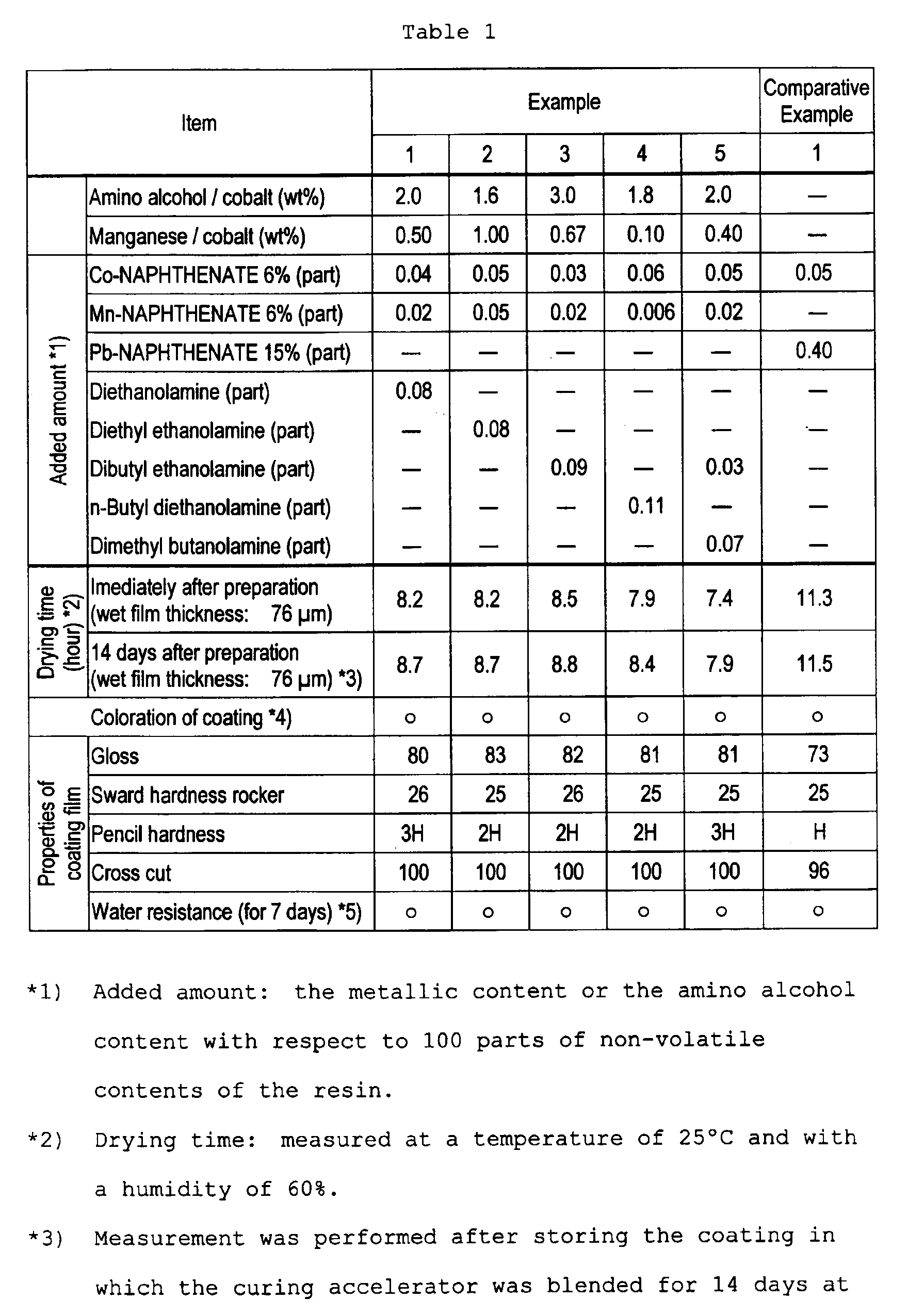
- the present inventors have found that blending a curing accelerator containing a cobalt soap, a manganese soap, and an amino alcohol with a resin for a coating or a printing ink which has a fatty acid group in its molecule enhances the activity of the cobalt soap, shortening the drying time even if a reduced amount of cobalt is used, causing neither deterioration of the drying effect nor coloration of the coating, and improving the gloss, the hardness, and the adhesion of the coating film, even though a lead soap is not used, in comparison with a conventional resin which has an unsaturated fatty acid group in its molecules and which is blended with a cobalt soap and a lead soap.
- the present inventors have accomplished the present invention.
- the present invention provides a curing accelerator containing a cobalt soap, a manganese soap, and an amino alcohol.
- the present invention has the following aspects.
- the curing accelerator according to the present invention contains a cobalt soap, a manganese soap, and an amino alcohol, in which no lead soap is used.
- a cobalt soap added with respect to the non-volatile contents of the resin
- the time for drying the coating or the printing ink is shorter and the properties of the coating film (gloss, hardness, and adhesion) are better than those with a conventional curing accelerator. Accordingly, the curing accelerator according to the present invention is industrially significant.
- the curing accelerator contains as essential components a cobalt soap, a manganese soap, and an amino alcohol.
- any known and conventional ones can be used, examples of which include C 7 to C 12 aliphatic monocarboxylate salts such as octanoic acid salts and neodecanoic acid salts, tall oil fatty acid salts, and naphthenic acid salts.
- the proportions of the amino alcohol and the cobalt soap to be used are not particularly limited. However, it is preferable that the amount of the amino alcohol be in the range of 3 parts by weight or less with respect to 1 part by weight of cobalt metal in the cobalt soap. It is particularly preferable that the amount of the amino alcohol be in the range of 1 to 3 parts by weight with respect to 1 part by weight of cobalt metal in the cobalt soap for good gloss and adhesion of the coating film.
- the proportions of the manganese soap and the cobalt soap to be used are not particularly limited. However, it is preferable that the amount of manganese metal in the manganese soap be in the range of 1.0 part by weight or less with respect to 1 part by weight of cobalt metal in the cobalt soap. It is particularly preferable that the amount of manganese metal in the manganese soap be in the range of 0.1 to 1.0 parts by weight with respect to 1 part by weight of cobalt metal in the cobalt soap for good hardness and adhesion of the coating film.
- the time for a coating with the curing accelerator containing a cobalt soap, a manganese soap, and an amino alcohols to become semi-dry to touch (tack free) is shorter than that for a coating with a curing accelerator containing a cobalt soap and an amino alcohol.
- any known and conventional ones can be used, examples of which include monoethanolamine, diethanolamine, triethanolamine, dimethyl ethanolamine, diethyl ethanolamine, dibutyl ethanolamine, methyl ethanolamine, methyl diethanolamine, ethyl ethanolamine, n-butyl ethanolamine, n-butyl diethanolamine, t-butyl ethanolamine, t-butyl diethanolamine, dimethyl isopropanolamine, dimethyl butanolamine, dimethyl hexanolamine, and dimethylaminophenol.
- diethanolamine, diethyl ethanolamine, dibutyl ethanolamine, and n-butyl diethanolamine are particularly preferable.
- the curing accelerator according to the present invention is used by blending the cobalt soap, the manganese soap, and the amino alcohol with a resin having an unsaturated fatty acid group in its molecules. It is preferable that the cobalt soap, the manganese soap, and the amino alcohol be used as a solution prepared by dissolving the cobalt soap, the manganese soap, and the amino alcohol in a solvent.
- the cobalt soap, the manganese soap, and the amino alcohol may be mixed in advance, and then blended with the resin.
- hydrocarbon solvents such as toluene, xylene, heptane, hexane, cyclohexane, and mineral spirits
- alcohol solvents such as methanol, ethanol, propanol, and cyclohexanol
- ketone solvents such as methyl ethyl ketone, methyl isobutyl ketone, and cyclohexanone
- ether solvents such as propyl ether, methyl cellosolve, cellosolve, butyl cellosolve, methyl carbitol, and butyl carbitol.
- solvents such as toluene, xylene, heptane, hexane, cyclohexane, and mineral spirits
- alcohol solvents such as methanol, ethanol, propanol, and cyclohexanol
- ketone solvents such as methyl ethyl ketone, methyl isobutyl ket
- any known and conventional ones can be used, examples of which are resins whose curing can be accelerated through oxidation polymerization initiated by the cobalt soap.
- Specific examples are drying oils and semi-drying oils, such as alkyd resins containing as a main ingredient, for example, a castor oil, a coconut oil, a linseed oil, a tung oil, a soybean oil, a tall oil, a safflower oil, or a synthetic drying oil, and oil-modified resins such as modified phenol resins and epoxy ester resins.
- the amount of the curing accelerator to be blended, converted to the amount of cobalt metal atoms is in the range of 0.001 to 1 parts by weight, preferably 0.01 to 0.2 parts by weight, with respect to 100 parts by weight of non-volatile contents of the resin for a coating or a printing ink which has an unsaturated fatty acid group in its molecules.
- a metallic soap of iron, nickel, copper, zinc, zirconium, bismuth, cerium, calcium, or the like, a pigment of various types, an anti-sagging agent, an anti-skinning agent, and other types of additives may be blended in.
- the present invention also includes an embodiment as a curing accelerator, which is applicable to a resin for a coating or a printing ink which has an unsaturated fatty acid group in its molecules, containing at least one type of metallic soap selected from the group consisting of an iron soap, a nickel soap, a copper soap, a zinc soap, a zirconium soap, a bismuth soap, a cerium soap, and a calcium soap as a main substance, and a cobalt soap (A), a manganese soap (B), and an amino alcohol (C) added to the main substance.
- the curing accelerator of the present invention functions as a reforming agent for the metallic soap which is the largest component.
- an aluminum chelate compound with the cobalt soap used in the present invention is not preferable since the aluminum chelate compound colors the resin reddish orange due to a mutual reaction with an methyl ethyl ketone oxime, which is widely used as an anti-skinning agent in coatings, and contaminates the hue of the coating, and since the aluminum chelate compound undergoes a crosslinking reaction with a resin component resulting in an increase in the viscosity of the resin during storage.
- a metallic compound component which directly takes part in the curing of the resin be only a cobalt soap and a manganese soap, or a cobalt soap, a manganese soap, and one or several of other metallic soaps selected from the group consisting of a calcium soap, an iron soap, a nickel soap, a copper soap, a zinc soap, a zirconium soap, a bismuth soap, and a cerium soap.
- the curing accelerator of the present invention is used by addition to a resin for a coating or a printing ink having an unsaturated fatty acid group in its molecules.
- a coating composition or a printing ink composition can be prepared.
- the thus-prepared coating or printing ink is suitably applied or printed with a desired thickness of a layer (film), and dried.
- the thickness of the layer may be normally chosen from the range of 1 to 500 ⁇ m.
- titanium white pigment (“TIPAQUE R-820” manufactured by Ishihara Sangyo Kaisha, Ltd.), 3340 g of resin for a coating, "BECKOSOL P470-70” (manufactured by Dainippon Ink and Chemicals, Inc.; an alkyd resin having an unsaturated fatty acid group in its molecules), and 280 g of mineral spirit, 20 g of anti-skinning agent (methyl ethyl ketone oxime) were kneaded using a three-roll mill to obtain a basic coating.
- anti-skinning agent methyl ethyl ketone oxime
- a coating was spread on a glass plate using an applicator to form a wet coating film having a thickness of 152 ⁇ m, and the wet coating film was dried for 3 days at a temperature of 25°C with a humidity of 60%.
- a gloss test was performed on the obtained coating film in accordance with the test procedures for specular gloss at 60 degrees in JIS K5400.
- a coating was spread on a glass plate using an applicator to form a wet coating film having a thickness of 38 ⁇ m, and the wet coating film was dried for 3 days at a temperature of 25°C with a humidity of 60%.
- a Sward hardness rocker test was performed on the obtained coating film, and the measurement obtained using a Sward type hardness rocker testing device (manufactured by Tester Sangyo Co., Ltd.) is expressed as a proportion to the measurement obtained with respect to a glass plate as 100.
- a coating was spread on a steel plate defined by JIS G3141 using an applicator to form a wet coating film having a thickness of 76 ⁇ m, and the wet coating film was dried for 3 days at a temperature of 25°C with a humidity of 60%.
- a pencil hardness test was performed on the obtained coating film in accordance with the procedures of the pencil scratching test in JIS K5400.
- a coating was spread on a steel plate defined by JIS G3141 using an applicator to form a wet coating film having a thickness of 76 ⁇ m, and the wet coating film was dried for 3 days at a temperature of 25°C with a humidity of 60%.
- a cross-cut test was performed on the obtained coating film in accordance with the cross-cut adhesion test in JIS K5400.
- a cellulose adhesive tape was stuck on the coating film in parallel with the direction of application, and then removed. The number of cross-cut cells of the coating film which remained stuck on the tape out of a total of 100 cells was counted and is shown.
- a coating was spread on a glass plate using an applicator to form a wet coating film having a thickness of 152 ⁇ m, and the wet coating film was dried for 3 days at a temperature of 25°C with a humidity of 60%.
- a water resistance test was performed on the obtained coating film in accordance with the procedures of the water resistance test in JIS K5400.
Landscapes
- Chemical & Material Sciences (AREA)
- Organic Chemistry (AREA)
- Chemical Kinetics & Catalysis (AREA)
- Medicinal Chemistry (AREA)
- Health & Medical Sciences (AREA)
- Polymers & Plastics (AREA)
- Materials Engineering (AREA)
- Engineering & Computer Science (AREA)
- General Chemical & Material Sciences (AREA)
- Life Sciences & Earth Sciences (AREA)
- Wood Science & Technology (AREA)
- Paints Or Removers (AREA)
- Compositions Of Macromolecular Compounds (AREA)
Abstract
Description


Claims (7)
- A curing accelerator for a resin having an unsaturated fatty acid group in its molecules, the curing accelerator containing:a cobalt soap (A),a manganese soap (B), andan amino alcohol (C).
- A curing accelerator according to claim 1, wherein the amino alcohol is at least one selected from the group consisting of diethanolamine, diethyl ethanolamine, dibutyl ethanolamine, and n-butyl diethanolamine.
- A curing accelerator according to claim 1 or 2, which contains the amino alcohol in an amount of 1 to 3 parts by weight with respect to 1 part by weight of cobalt metal in the cobalt soap.
- A curing accelerator according to claim 1 or 2, which contains manganese metal in an amount of 0.1 to 1.0 parts by weight in the manganese soap with respect to 1 part by weight of cobalt metal in the cobalt soap.
- A coating composition containing as essential components a resin for a coating having an unsaturated fatty acid group in its molecules and a curing accelerator as in claim 1.
- A printing ink composition containing as essential components a resin for a printing ink having an unsaturated fatty acid group in its molecules and a curing accelerator as in claim 1.
- A curing accelerator for a resin having an unsaturated fatty acid group in its molecules, the curing accelerator consisting essentially of:a cobalt soap (A),a manganese soap (B),an amino alcohol (C), anda solvent (D).
Applications Claiming Priority (2)
| Application Number | Priority Date | Filing Date | Title |
|---|---|---|---|
| JP15639999 | 1999-06-03 | ||
| JP15639999 | 1999-06-03 |
Publications (3)
| Publication Number | Publication Date |
|---|---|
| EP1057857A2 true EP1057857A2 (en) | 2000-12-06 |
| EP1057857A3 EP1057857A3 (en) | 2000-12-13 |
| EP1057857B1 EP1057857B1 (en) | 2003-10-29 |
Family
ID=15626897
Family Applications (1)
| Application Number | Title | Priority Date | Filing Date |
|---|---|---|---|
| EP00111023A Expired - Lifetime EP1057857B1 (en) | 1999-06-03 | 2000-05-31 | Curing accelerator and resin composition |
Country Status (6)
| Country | Link |
|---|---|
| US (1) | US6428613B1 (en) |
| EP (1) | EP1057857B1 (en) |
| KR (1) | KR100596698B1 (en) |
| AU (1) | AU764985B2 (en) |
| CA (1) | CA2310445C (en) |
| DE (1) | DE60006183T2 (en) |
Cited By (14)
| Publication number | Priority date | Publication date | Assignee | Title |
|---|---|---|---|---|
| EP1342739A1 (en) * | 2002-03-06 | 2003-09-10 | Atofina Chemicals, Inc. | Alkanolamine-based promoter systems for curing of unsaturated polyester resin compositions |
| WO2003087192A1 (en) * | 2002-04-12 | 2003-10-23 | Eastman Chemical Company | Fast-dry, high solids coating compositions based on acetoacetate-functionalizedalkyd resins |
| WO2003093384A1 (en) * | 2002-05-03 | 2003-11-13 | Ato B.V. | Drier for air-drying coatings |
| EP1394230A3 (en) * | 2002-08-30 | 2004-03-24 | Dainippon Ink And Chemicals, Inc. | Drier for printing ink and printing ink containing drier |
| US6780523B2 (en) | 2002-04-12 | 2004-08-24 | Eastman Chemical Company | Waterborne acetoacetate-functionalized alkyd coating compositions |
| ITMI20081532A1 (en) * | 2008-08-25 | 2010-02-26 | Marco Pigliafreddo | PLASTIFICATION SYSTEM FOR THERMOPLASTIC POLYMERS AND METHOD FOR ITS USE |
| EP1798269A4 (en) * | 2004-10-07 | 2011-07-27 | Dainippon Ink & Chemicals | OXIDATION-POLYMERIZABLE PREPARATION |
| EP2626383A1 (en) * | 2012-02-09 | 2013-08-14 | Akzo Nobel Chemicals International B.V. | Accelerator for curing resins |
| EP2784130A4 (en) * | 2011-11-22 | 2015-06-24 | Dainippon Ink & Chemicals | CURING ACCELERATOR FOR OXIDIZING POLYMERIZATION TYPE UNSATURATED RESIN, PRINTING INK AND COATING MATERIAL |
| DK178910B1 (en) * | 2015-10-21 | 2017-05-22 | Xl-Water Ivs | Ionic complex of an amino alcohol and a metal carboxylate as a catalyst for polymerization reactions |
| CN110157336A (en) * | 2019-05-12 | 2019-08-23 | 合肥博朗德纳米技术有限公司 | One kind is based on amino-acid rare earth drier and preparation method thereof |
| US10465035B2 (en) | 2013-03-06 | 2019-11-05 | Ege Kimya Sanayi Ve Ticaret A.S. | Cobalt and manganese based urethanized polymers for air drying polymer-based coatings, paints and inks |
| US10954333B2 (en) | 2015-11-13 | 2021-03-23 | Ege Kimya Sanayi Ve Tic Aret A.S. | Metal-bearing urethanized polymer soluble in a low-volatile organic compound solvent |
| US20230019574A1 (en) * | 2017-06-08 | 2023-01-19 | Dic Corporation | Curing accelerator for oxidatively polymerized unsaturated resin, printing ink, and paint |
Families Citing this family (5)
| Publication number | Priority date | Publication date | Assignee | Title |
|---|---|---|---|---|
| US20030209165A1 (en) * | 2002-05-08 | 2003-11-13 | Gernon Michael D. | Compositions providing physical biocide synergist activity in paints, coatings, sealants and adhesives during storage |
| US20060106129A1 (en) * | 2002-05-08 | 2006-05-18 | Michael Gernon | Optimized alkanolamines for latex paints |
| US7682440B2 (en) * | 2005-03-29 | 2010-03-23 | Genesis Ii Of Nc, Llc | Drying enhancement additive and method of using same |
| KR101647342B1 (en) * | 2010-06-14 | 2016-08-10 | 디아이씨 가부시끼가이샤 | Printing ink drying agent and printing ink using same |
| US10538676B2 (en) * | 2015-07-01 | 2020-01-21 | Nippon Paint Holdings Co., Ltd. | Surface layer-peelable composite coating film, coating composition for forming composite coating film, and method |
Family Cites Families (10)
| Publication number | Priority date | Publication date | Assignee | Title |
|---|---|---|---|---|
| FR723442A (en) * | 1931-02-06 | |||
| GB498011A (en) * | 1937-06-29 | 1938-12-29 | Ig Farbenindustrie Ag | Improvements in the manufacture and production of high quality siccatives |
| US3994849A (en) * | 1974-12-20 | 1976-11-30 | Scm (Canada) Limited | Solid paints |
| GB8334268D0 (en) | 1983-12-22 | 1984-02-01 | Turner New Technology Ltd John | Surface coating compositions |
| JPS6183263A (en) * | 1984-09-29 | 1986-04-26 | Kansai Paint Co Ltd | Oxidative drying-type paint |
| US4720352A (en) * | 1985-11-01 | 1988-01-19 | Nuodex Inc. | Process for the preparation of vanadium-containing mixed metal soap solutions |
| JPH03269070A (en) * | 1990-03-16 | 1991-11-29 | Toyo Ink Mfg Co Ltd | Printing ink |
| ATE148146T1 (en) * | 1990-12-21 | 1997-02-15 | Rohm & Haas | AIR CURING POLYMER COMPOSITION |
| US6001913A (en) * | 1996-12-24 | 1999-12-14 | The University Of Southern Mississippi | Latex compositions containing ethylenically unsaturated esters of long-chain alkenols |
| US6174948B1 (en) * | 1996-12-24 | 2001-01-16 | The University Of Southern Mississippi | Latex compositions containing ethylenically unsaturated esters of fatty compounds and applications thereof |
-
2000
- 2000-05-31 EP EP00111023A patent/EP1057857B1/en not_active Expired - Lifetime
- 2000-05-31 KR KR1020000029709A patent/KR100596698B1/en not_active Expired - Fee Related
- 2000-05-31 DE DE60006183T patent/DE60006183T2/en not_active Expired - Lifetime
- 2000-06-01 AU AU37852/00A patent/AU764985B2/en not_active Ceased
- 2000-06-01 CA CA002310445A patent/CA2310445C/en not_active Expired - Fee Related
- 2000-06-02 US US09/585,324 patent/US6428613B1/en not_active Expired - Lifetime
Cited By (20)
| Publication number | Priority date | Publication date | Assignee | Title |
|---|---|---|---|---|
| EP1342739A1 (en) * | 2002-03-06 | 2003-09-10 | Atofina Chemicals, Inc. | Alkanolamine-based promoter systems for curing of unsaturated polyester resin compositions |
| WO2003087192A1 (en) * | 2002-04-12 | 2003-10-23 | Eastman Chemical Company | Fast-dry, high solids coating compositions based on acetoacetate-functionalizedalkyd resins |
| US6780523B2 (en) | 2002-04-12 | 2004-08-24 | Eastman Chemical Company | Waterborne acetoacetate-functionalized alkyd coating compositions |
| US6794049B2 (en) | 2002-04-12 | 2004-09-21 | Eastman Chemical Company | Fast-dry, high solids coating compositions based on acetoacetate-functionalized alkyd resins |
| WO2003093384A1 (en) * | 2002-05-03 | 2003-11-13 | Ato B.V. | Drier for air-drying coatings |
| EP1394230A3 (en) * | 2002-08-30 | 2004-03-24 | Dainippon Ink And Chemicals, Inc. | Drier for printing ink and printing ink containing drier |
| US6899756B2 (en) | 2002-08-30 | 2005-05-31 | Dainippon Ink And Chemicals, Inc. | Drier for printing ink and printing ink containing drier |
| EP1564271A1 (en) * | 2002-08-30 | 2005-08-17 | Dainippon Ink And Chemicals, Inc. | Drier for printing ink and printing ink containing drier |
| CN100424146C (en) * | 2002-08-30 | 2008-10-08 | 大日本油墨化学工业株式会社 | Drier for printing ink and printing ink containing the drier |
| EP1798269A4 (en) * | 2004-10-07 | 2011-07-27 | Dainippon Ink & Chemicals | OXIDATION-POLYMERIZABLE PREPARATION |
| EP2159256A1 (en) | 2008-08-25 | 2010-03-03 | Marco Pigliafreddo | Plasticized thermoplastic polymer composition and production of plasticized articles thereof |
| ITMI20081532A1 (en) * | 2008-08-25 | 2010-02-26 | Marco Pigliafreddo | PLASTIFICATION SYSTEM FOR THERMOPLASTIC POLYMERS AND METHOD FOR ITS USE |
| EP2784130A4 (en) * | 2011-11-22 | 2015-06-24 | Dainippon Ink & Chemicals | CURING ACCELERATOR FOR OXIDIZING POLYMERIZATION TYPE UNSATURATED RESIN, PRINTING INK AND COATING MATERIAL |
| EP2626383A1 (en) * | 2012-02-09 | 2013-08-14 | Akzo Nobel Chemicals International B.V. | Accelerator for curing resins |
| US10465035B2 (en) | 2013-03-06 | 2019-11-05 | Ege Kimya Sanayi Ve Ticaret A.S. | Cobalt and manganese based urethanized polymers for air drying polymer-based coatings, paints and inks |
| DK178910B1 (en) * | 2015-10-21 | 2017-05-22 | Xl-Water Ivs | Ionic complex of an amino alcohol and a metal carboxylate as a catalyst for polymerization reactions |
| US10954333B2 (en) | 2015-11-13 | 2021-03-23 | Ege Kimya Sanayi Ve Tic Aret A.S. | Metal-bearing urethanized polymer soluble in a low-volatile organic compound solvent |
| US20230019574A1 (en) * | 2017-06-08 | 2023-01-19 | Dic Corporation | Curing accelerator for oxidatively polymerized unsaturated resin, printing ink, and paint |
| CN110157336A (en) * | 2019-05-12 | 2019-08-23 | 合肥博朗德纳米技术有限公司 | One kind is based on amino-acid rare earth drier and preparation method thereof |
| CN110157336B (en) * | 2019-05-12 | 2021-08-20 | 合肥博朗德纳米技术有限公司 | Amino acid rare earth-based drier and preparation method thereof |
Also Published As
| Publication number | Publication date |
|---|---|
| CA2310445C (en) | 2008-08-12 |
| EP1057857A3 (en) | 2000-12-13 |
| CA2310445A1 (en) | 2000-12-03 |
| US6428613B1 (en) | 2002-08-06 |
| DE60006183D1 (en) | 2003-12-04 |
| KR100596698B1 (en) | 2006-07-03 |
| EP1057857B1 (en) | 2003-10-29 |
| KR20010007156A (en) | 2001-01-26 |
| DE60006183T2 (en) | 2004-05-19 |
| AU764985B2 (en) | 2003-09-04 |
| AU3785200A (en) | 2000-12-07 |
Similar Documents
| Publication | Publication Date | Title |
|---|---|---|
| EP1057857B1 (en) | Curing accelerator and resin composition | |
| EP2142595A1 (en) | Oxime free anti-skinning combination | |
| DE2812397B2 (en) | 30.09.77 Japan P52-117652 03.10.77 Japan P52-Π8886 03.10.77 Japan P52-118887 13.02.78 Japan P53-15261 Coating compound made of a mixture of an acrylic resin and an amino formaldehyde resin and an acid catalyst Kansai Paint Co, Ltd, Amagasaki, Hyogo ( Japan) | |
| DE2852035A1 (en) | Aqueous coating agent | |
| CA2656899C (en) | Latex based open-time extenders for low voc paints | |
| EP1275701B1 (en) | Antiskinning agent | |
| AT390444B (en) | USE OF ACRYLATE COPOLYMERISATES AS ADDITIVES FOR AQUEOUS ANIONIC LACQUER SYSTEMS | |
| DE2840574A1 (en) | COMPOSITION OF A WATER-REDUCABLE ACRYLIC ENAMEL | |
| CA2247653A1 (en) | Anti-skinning agents for oxidatively drying coating compositions | |
| JP2001049102A (en) | Curing accelerator and resin composition | |
| US4254009A (en) | Binding agent for coating compositions having a long shelf life | |
| DE2907477A1 (en) | HEAT-RESISTANT COATING COMPOUND WITH HIGH SOLID CONTENT | |
| JPH11323214A (en) | Curing accelerator for paints and printing inks | |
| JP2000026771A (en) | Curing accelerator for paints and printing inks | |
| JPH06172689A (en) | Curing accelerator for paints and inks | |
| US6849205B2 (en) | Use of additive combinations for preventing skin formation on air-drying lacquers | |
| KR0143193B1 (en) | High Sunyoung High Solid Resin Compositions and Manufacturing Method Thereof | |
| EP0316732B1 (en) | Aqueous coating, process for its preparation and its use | |
| DE1962243A1 (en) | Pore closers or primer made of an acrylic resin polymer with adhesion promoting groups and an epoxy resin | |
| AU2005252633B2 (en) | Antiskinning compound and compositions containing them | |
| EP1772502A1 (en) | Oxidatively drying composition to be employed in thin layers comprising 1,2 dioxo compounds | |
| JP2001089672A (en) | Curing accelerator for aqueous resin | |
| JP3484685B2 (en) | Curing accelerator for aqueous resin | |
| JP2000239613A (en) | Curing accelerator for aqueous resin | |
| CA1096155A (en) | Corrosion resistant coating from water thinnable amino ethylated interpolymers |
Legal Events
| Date | Code | Title | Description |
|---|---|---|---|
| PUAI | Public reference made under article 153(3) epc to a published international application that has entered the european phase |
Free format text: ORIGINAL CODE: 0009012 |
|
| PUAL | Search report despatched |
Free format text: ORIGINAL CODE: 0009013 |
|
| AK | Designated contracting states |
Kind code of ref document: A2 Designated state(s): DE FR GB IT |
|
| AX | Request for extension of the european patent |
Free format text: AL;LT;LV;MK;RO;SI |
|
| AK | Designated contracting states |
Kind code of ref document: A3 Designated state(s): AT BE CH CY DE DK ES FI FR GB GR IE IT LI LU MC NL PT SE |
|
| AX | Request for extension of the european patent |
Free format text: AL;LT;LV;MK;RO;SI |
|
| 17P | Request for examination filed |
Effective date: 20010504 |
|
| AKX | Designation fees paid |
Free format text: DE FR GB IT |
|
| GRAH | Despatch of communication of intention to grant a patent |
Free format text: ORIGINAL CODE: EPIDOS IGRA |
|
| GRAS | Grant fee paid |
Free format text: ORIGINAL CODE: EPIDOSNIGR3 |
|
| GRAA | (expected) grant |
Free format text: ORIGINAL CODE: 0009210 |
|
| AK | Designated contracting states |
Kind code of ref document: B1 Designated state(s): DE FR GB IT |
|
| REG | Reference to a national code |
Ref country code: GB Ref legal event code: FG4D |
|
| REF | Corresponds to: |
Ref document number: 60006183 Country of ref document: DE Date of ref document: 20031204 Kind code of ref document: P |
|
| ET | Fr: translation filed | ||
| PLBE | No opposition filed within time limit |
Free format text: ORIGINAL CODE: 0009261 |
|
| STAA | Information on the status of an ep patent application or granted ep patent |
Free format text: STATUS: NO OPPOSITION FILED WITHIN TIME LIMIT |
|
| 26N | No opposition filed |
Effective date: 20040730 |
|
| PGFP | Annual fee paid to national office [announced via postgrant information from national office to epo] |
Ref country code: GB Payment date: 20140528 Year of fee payment: 15 |
|
| PGFP | Annual fee paid to national office [announced via postgrant information from national office to epo] |
Ref country code: IT Payment date: 20140521 Year of fee payment: 15 Ref country code: FR Payment date: 20140509 Year of fee payment: 15 Ref country code: DE Payment date: 20140528 Year of fee payment: 15 |
|
| REG | Reference to a national code |
Ref country code: DE Ref legal event code: R119 Ref document number: 60006183 Country of ref document: DE |
|
| GBPC | Gb: european patent ceased through non-payment of renewal fee |
Effective date: 20150531 |
|
| PG25 | Lapsed in a contracting state [announced via postgrant information from national office to epo] |
Ref country code: IT Free format text: LAPSE BECAUSE OF NON-PAYMENT OF DUE FEES Effective date: 20150531 |
|
| REG | Reference to a national code |
Ref country code: FR Ref legal event code: ST Effective date: 20160129 |
|
| PG25 | Lapsed in a contracting state [announced via postgrant information from national office to epo] |
Ref country code: DE Free format text: LAPSE BECAUSE OF NON-PAYMENT OF DUE FEES Effective date: 20151201 Ref country code: GB Free format text: LAPSE BECAUSE OF NON-PAYMENT OF DUE FEES Effective date: 20150531 |
|
| PG25 | Lapsed in a contracting state [announced via postgrant information from national office to epo] |
Ref country code: FR Free format text: LAPSE BECAUSE OF NON-PAYMENT OF DUE FEES Effective date: 20150601 |