EP1057802A2 - Process for manufacturing methyl chloride - Google Patents
Process for manufacturing methyl chloride Download PDFInfo
- Publication number
- EP1057802A2 EP1057802A2 EP00110708A EP00110708A EP1057802A2 EP 1057802 A2 EP1057802 A2 EP 1057802A2 EP 00110708 A EP00110708 A EP 00110708A EP 00110708 A EP00110708 A EP 00110708A EP 1057802 A2 EP1057802 A2 EP 1057802A2
- Authority
- EP
- European Patent Office
- Prior art keywords
- methanol
- methyl chloride
- hydrogen chloride
- range
- liquid medium
- Prior art date
- Legal status (The legal status is an assumption and is not a legal conclusion. Google has not performed a legal analysis and makes no representation as to the accuracy of the status listed.)
- Granted
Links
- NEHMKBQYUWJMIP-UHFFFAOYSA-N chloromethane Chemical compound ClC NEHMKBQYUWJMIP-UHFFFAOYSA-N 0.000 title claims abstract description 81
- 238000000034 method Methods 0.000 title claims abstract description 55
- 229940050176 methyl chloride Drugs 0.000 title claims abstract description 40
- 238000004519 manufacturing process Methods 0.000 title claims abstract description 9
- OKKJLVBELUTLKV-UHFFFAOYSA-N Methanol Chemical compound OC OKKJLVBELUTLKV-UHFFFAOYSA-N 0.000 claims abstract description 245
- VEXZGXHMUGYJMC-UHFFFAOYSA-N Hydrochloric acid Chemical compound Cl VEXZGXHMUGYJMC-UHFFFAOYSA-N 0.000 claims abstract description 67
- 229910000041 hydrogen chloride Inorganic materials 0.000 claims abstract description 60
- IXCSERBJSXMMFS-UHFFFAOYSA-N hydrogen chloride Substances Cl.Cl IXCSERBJSXMMFS-UHFFFAOYSA-N 0.000 claims abstract description 60
- 239000007788 liquid Substances 0.000 claims abstract description 32
- 239000008246 gaseous mixture Substances 0.000 claims abstract description 28
- NEHMKBQYUWJMIP-NJFSPNSNSA-N chloro(114C)methane Chemical compound [14CH3]Cl NEHMKBQYUWJMIP-NJFSPNSNSA-N 0.000 claims abstract description 7
- QAOWNCQODCNURD-UHFFFAOYSA-N Sulfuric acid Chemical compound OS(O)(=O)=O QAOWNCQODCNURD-UHFFFAOYSA-N 0.000 claims description 15
- XLYOFNOQVPJJNP-UHFFFAOYSA-N water Substances O XLYOFNOQVPJJNP-UHFFFAOYSA-N 0.000 claims description 15
- 238000010924 continuous production Methods 0.000 claims description 3
- LCGLNKUTAGEVQW-UHFFFAOYSA-N Dimethyl ether Chemical compound COC LCGLNKUTAGEVQW-UHFFFAOYSA-N 0.000 description 24
- 239000006227 byproduct Substances 0.000 description 6
- 230000015572 biosynthetic process Effects 0.000 description 3
- 238000006243 chemical reaction Methods 0.000 description 3
- 238000004821 distillation Methods 0.000 description 3
- 239000007791 liquid phase Substances 0.000 description 3
- 238000011084 recovery Methods 0.000 description 3
- LFQSCWFLJHTTHZ-UHFFFAOYSA-N Ethanol Chemical compound CCO LFQSCWFLJHTTHZ-UHFFFAOYSA-N 0.000 description 2
- 150000001350 alkyl halides Chemical class 0.000 description 2
- 230000003247 decreasing effect Effects 0.000 description 2
- 239000007789 gas Substances 0.000 description 2
- 238000004817 gas chromatography Methods 0.000 description 2
- 239000007792 gaseous phase Substances 0.000 description 2
- 238000010438 heat treatment Methods 0.000 description 2
- 229910000039 hydrogen halide Inorganic materials 0.000 description 2
- 239000012433 hydrogen halide Substances 0.000 description 2
- 239000000203 mixture Substances 0.000 description 2
- 238000000926 separation method Methods 0.000 description 2
- YZCKVEUIGOORGS-NJFSPNSNSA-N Tritium Chemical compound [3H] YZCKVEUIGOORGS-NJFSPNSNSA-N 0.000 description 1
- 238000010923 batch production Methods 0.000 description 1
- 239000003054 catalyst Substances 0.000 description 1
- 230000003197 catalytic effect Effects 0.000 description 1
- 230000006835 compression Effects 0.000 description 1
- 238000007906 compression Methods 0.000 description 1
- 238000007796 conventional method Methods 0.000 description 1
- 238000001816 cooling Methods 0.000 description 1
- 238000010586 diagram Methods 0.000 description 1
- 238000007599 discharging Methods 0.000 description 1
- 239000006185 dispersion Substances 0.000 description 1
- 230000000694 effects Effects 0.000 description 1
- 238000011156 evaluation Methods 0.000 description 1
- 238000007038 hydrochlorination reaction Methods 0.000 description 1
- FUKUFMFMCZIRNT-UHFFFAOYSA-N hydron;methanol;chloride Chemical compound Cl.OC FUKUFMFMCZIRNT-UHFFFAOYSA-N 0.000 description 1
- 150000005451 methyl sulfates Chemical class 0.000 description 1
- 238000002360 preparation method Methods 0.000 description 1
- 239000002994 raw material Substances 0.000 description 1
- 238000003860 storage Methods 0.000 description 1
- 238000004448 titration Methods 0.000 description 1
- 239000012808 vapor phase Substances 0.000 description 1
Images
Classifications
-
- C—CHEMISTRY; METALLURGY
- C07—ORGANIC CHEMISTRY
- C07C—ACYCLIC OR CARBOCYCLIC COMPOUNDS
- C07C17/00—Preparation of halogenated hydrocarbons
- C07C17/093—Preparation of halogenated hydrocarbons by replacement by halogens
- C07C17/16—Preparation of halogenated hydrocarbons by replacement by halogens of hydroxyl groups
Definitions
- the present invention is a process for manufacturing methyl chloride comprising contacting hydrogen chloride with at least a stoichiometric amount of methanol split into at least two portions with a first portion having 60 to 95 percent of the methanol added to the process in the presence of a first liquid medium at a temperature in the range of 115°C. to 170°C. to form a gaseous mixture containing methyl chloride, contacting the gaseous mixture with a second methanol portion and adding to a second liquid medium at a temperature in the range of 100°C. to 160°C., and separating and recovering the methyl chloride.
- the methyl chloride is contacted with concentrated sulfuric acid producing a dilute sulfuric acid stream contaminated with methyl sulfates. Formation of the dilute sulfuric acid stream is wasteful in terms of greater raw material costs. The disposal of unwanted sulfuric acid containing dimethyl ether presents ecological concerns as well.
- U.S. Patent 4,935,564 describes a process for preparing an alkyl halide from contacting and reacting a hydrogen halide with a stoichiometric excess of alcohol in a plug-flow reactor in which flow of a mixture comprising unreacted alcohol, unreacted hydrogen halide, the alkyl halide and water is co-current.
- U.S. Patent 4,922,043 describes a process for making methyl chloride by catalytic hydrochlorination of methanol in the liquid phase by feeding hydrogen chloride into a first reactor while splitting methanol feed between or among the reactors.
- the process uses a stoichiometric excess of hydrogen chloride to methanol and requires a hydrogen chloride recovery system.
- the present inventors have discovered that by feeding all the hydrogen chloride into a first reactor and splitting the methanol feed between multiple reactors, reduced levels of dimethyl ether by-product were demonstrated by proportionately increasing methanol fed to a second reactor and proportionately decreasing methanol to the first reactor. Furthermore, feeding a stoichiometric excess of methanol relative to hydrogen chloride results in a higher hydrogen chloride percentage conversion to methyl chloride. Increasing the hydrogen chloride conversion percentage to methyl chloride eliminates processing steps for hydrogen chloride recovery and recycle. Decreasing dimethyl ether formation reduces sulfuric acid use and the ecological concerns and disposal cost associated with sulfuric acid use.
- Our process comprises contacting hydrogen chloride with at least a stoichiometric amount of methanol split into at least two portions with a first portion having 60 to 95 percent of the methanol added to the process in the presence of a first liquid medium at a temperature in the range of 115°C. to 170°C. to form a gaseous mixture containing methyl chloride, and contacting the gaseous mixture with a second methanol portion and adding to a second liquid medium at a temperature in the range of 100°C. to 160°C., and recovering the methyl chloride.
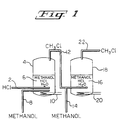
- FIG. 1 is a representative schematic flow diagram of one embodiment for the present process for manufacturing methyl chloride. This representation is presented to be illustrative and is not to be construed as limiting the present process.
- anhydrous hydrogen chloride gas 2 (HCl) is fed to first reactor 4 containing first liquid medium 6.
- the HCl 2 is contacted with first methanol portion 8 in the presence of first liquid medium 6.
- First reactor 4 is heated by heating coil 10 to form gaseous mixture 12 containing methyl chloride.
- Gaseous mixture 12 is withdrawn from first reactor 4 in the vapor phase and is contacted with second methanol portion 14 and fed to second liquid medium 16 contained in second reactor 18 connected in series with first reactor 4.
- Second reactor 18 is heated by heating coil 20.
- the gaseous mixture containing mostly methyl chloride 22 is withdrawn from second reactor 18 and then the methyl chloride is recovered and subsequently purified by conventional methods.
- the present process may be run in any pressurizable reactor suitable for contact with hydrogen chloride.
- the process may be run as a batch process or preferably as a continuous process.
- the process may be run, for example, in a continuous stirred-tank reactor, a bubble-column reactor, or a plug-flow reactor.
- the hydrogen chloride can be fed to the process as an anhydrous gas, and preferably all of the hydrogen chloride is fed to the process at once.
- aqueous hydrochloric acid comprising hydrogen chloride and water can be fed to the process.
- the methanol utilized in the process may be liquid, but is preferably partially vaporized by conventional means and fed to the process in a mostly gaseous phase.
- the methanol is preheated to a temperature above 90°C. before feeding it to the process to help disperse the methanol and control the temperature of the process.
- the methanol is preheated to a temperature in the range of 90°C. to 170°C. before being fed to the process.
- the amount of methanol fed to the process is split into multiple portions with a first portion comprising greater than 60 percent of the methanol added to the process.
- the amount of methanol is split into two portions with the first portion comprising 60 to 95 percent of the total amount of methanol added to the process.
- the amount of methanol is split into two portions with the first portion comprising 70 to 90 percent of the total amount of methanol added to the process.
- first liquid medium comprising methanol, hydrogen chloride and water which is preferably maintained at a constant concentration and level within the first reactor. It is preferable to effect the contact of the hydrogen chloride and methanol by adding the hydrogen chloride and first methanol portion in the first liquid medium at or near the bottom of the first reactor to increase dispersion into the first liquid medium.
- the first liquid medium concentration is 5 to 30 weight percent hydrogen chloride, one to 10 weight percent methanol and the remainder water.
- the first liquid medium concentration is 10 to 20 weight percent hydrogen chloride and 3 to 7 weight percent methanol.
- Contacting of the hydrogen chloride with the first methanol portion in the presence of the first liquid medium is conducted within a temperature range of 115°C. to 170°C.
- the temperature is within the range of 120°C. to 135°C.
- the temperature and pressure are maintained to vaporize the gaseous mixture containing methyl chloride from the first liquid medium and to maintain the first liquid medium at a constant level.
- the pressure is in the range of 240 to 900 kPaG. Most preferably the pressure is in range of 240 to 500 kPaG.
- the gaseous mixture containing methyl chloride typically may contain a portion of unreacted hydrogen chloride, methanol, by-product dimethyl ether and water.
- the gaseous mixture containing methyl chloride is withdrawn from the first reactor as a vapor and contacted with the second methanol portion and added to a second liquid medium comprising methanol, hydrogen chloride and water maintained in a second reactor connected to the first reactor.
- the second methanol portion reacts with the unreacted hydrogen chloride contained in the gaseous mixture and the unreacted hydrogen chloride is converted to additional methyl chloride.
- Water formed in the second medium is vaporized and withdrawn from the second reactor.
- the gaseous mixture containing methyl chloride is contacted with the second methanol portion in the presence of a second liquid medium comprising methanol, hydrogen chloride and water.
- the second methanol portion may be in a gaseous phase, and partially vaporized, but is preferably a liquid.
- the first and second reactors are connected in series. It is desirable that the gaseous mixture and the second methanol portion be dispersed through the second liquid medium at or near the bottom of the second reactor.
- the contacting of the gaseous mixture containing methyl chloride with the second methanol portion is conducted at a temperature within the range of 100°C. to 160°C. Preferably the temperature is within the range of 110°C. to 125°C.
- the temperature and pressure are maintained to continuously vaporize the gaseous mixture containing methyl chloride and portions of unreacted hydrogen chloride, methanol, by-product dimethyl ether and water from the second liquid medium, thereby providing a continuous process.
- the gaseous mixture containing methyl chloride has at least a stoichiometric amount of methanol to hydrogen chloride.
- a stoichiometric excess in the range of 1.2 to 1.6 moles methanol per mole hydrogen chloride.
- an excess of 1.3 to 1.4 moles methanol per mole hydrogen chloride is fed a stoichiometric excess of methanol relative to hydrogen chloride significantly improves hydrogen chloride conversion to methyl chloride.
- greater than 98 percent of the hydrogen chloride added to the process is converted to methyl chloride.
- the space-time yield for the production of the methyl chloride produced by the present process is within the range of 100 to 300 kg/hr ⁇ m 3 .
- the space-time yield is within the range of 150 to 300 kg/hr ⁇ m 3 , however, the space-time yield could be in excess of 300 kg/hr ⁇ m 3 .
- the "space-time yield" is defined as the productivity per unit volume of the reactors per unit time.
- the gaseous mixture containing methyl chloride is withdrawn from the second reactor and may contain small amounts of unreacted hydrogen chloride, methanol, water and by-product dimethyl ether.
- the methyl chloride may be separated and recovered from the gaseous mixture by, for instance, condensing out the unreacted methanol, water and hydrogen chloride and recovering the methyl chloride by distillation.
- the unreacted methanol can be separated and recovered from the liquid phase by such known techniques as distillation and the recovered methanol recycled to the reactors.
- the water resulting from the separation along with a small amount of hydrogen chloride can be discarded.
- the methyl chloride can be purified by contacting with sulfuric acid and liquefied for storage by compression and cooling.
- the contacting of the hydrogen chloride with at least a stoichiometric amount of methanol in a liquid medium to produce methyl chloride is effected in the absence of a catalyst.
- anhydrous hydrogen chloride (3000 kg/hr) and 3168 kg/hr of methanol at a temperature of 110°C. and partially vaporized were fed into a continuous reactor (first reactor) containing a first liquid medium comprising water, hydrogen chloride and methanol.
- the first reactor temperature was maintained at 130°C. and the pressure above the first liquid medium at 280 kPaG.
- the first reactor contained 88 percent of the total amount of methanol fed to the process.
- the gaseous mixture containing methyl chloride exiting as an overhead vapor was contacted with 432 kg/hr second methanol portion and then fed to a second liquid medium maintained in a second reactor connected in series with the first reactor.
- the second reactor temperature was maintained at 117°C.
- the mole ratio of methanol fed to the process was 1.36 moles methanol per mole hydrogen chloride.
- the gaseous mixture exiting the second reactor was analyzed by gas chromatography (GC) to determine the level of dimethyl ether by-product produced.
- GC gas chromatography
- a condensed portion of the gaseous mixture was analyzed by conventional titration with a base to determine hydrogen chloride content.
- Table 1 contains a summary of the run results, the anhydrous hydrogen chloride and methanol feed rates in kg/hr, which are designated as “HCl” and “MeOH", respectively; the MeOH to HCl mole ratio designated as “Ratio”; the percent MeOH fed to the first reactor designated as “MeOH Split”; the amount of dimethyl ether formed in kg of dimethyl ether per 1000 kg of MeCl designated as “DME” and the percent hydrogen chloride converted to methyl chloride designated as "HCl %" Run HCl MeOH MeOH Split Ratio HCl% DME 1 3000 3600 88 1.36 99.5 11 2 3500 4200 86 1.36 99.3 9 3 3400 4080 83 1.36 99.3 8.3 4 3400 4080 82 1.36 99.3 8.0 5 3400 4080 80 1.36 99.2 7.8 6 3400 4080 78 1.36 99.1 7.5
- Example 1 Evaluation to manufacture methyl chloride by feeding 78 to 86 percent of the methanol to the first reactor and 14 to 22 percent of the methanol to the second reactor.
- the procedure of Example 1 was repeated while varying the hydrogen chloride and methanol fed to the process and the amount of methanol fed to the first and second reactors as indicated in Table 1.
- the results from runs 2 to 6 are shown in Table 1.
Landscapes
- Chemical & Material Sciences (AREA)
- Organic Chemistry (AREA)
- Organic Low-Molecular-Weight Compounds And Preparation Thereof (AREA)
Abstract
Description
| Run | HCl | MeOH | MeOH Split | Ratio | HCl% | DME |
| 1 | 3000 | 3600 | 88 | 1.36 | 99.5 | 11 |
| 2 | 3500 | 4200 | 86 | 1.36 | 99.3 | 9 |
| 3 | 3400 | 4080 | 83 | 1.36 | 99.3 | 8.3 |
| 4 | 3400 | 4080 | 82 | 1.36 | 99.3 | 8.0 |
| 5 | 3400 | 4080 | 80 | 1.36 | 99.2 | 7.8 |
| 6 | 3400 | 4080 | 78 | 1.36 | 99.1 | 7.5 |
Claims (9)
- A process for manufacturing methyl chloride comprising:(A) contacting hydrogen chloride with at least a stoichiometric amount of methanol split into at least two portions with a first portion having 60 to 95 percent of the methanol added to the process in the presence of a first liquid medium at a temperature in the range of 115°C. to 170°C. to form a gaseous mixture containing methyl chloride, and(B) contacting the gaseous mixture with a second methanol portion and adding to a second liquid medium at a temperature in the range of 100°C. to 160°C., and(C) recovering the methyl chloride.
- A process according to claim 1 where the first methanol portion is preheated to a temperature in the range of 90°C. to 170°C. before being fed to the process.
- A process according to claim 1 where the concentration of the first liquid medium is 5 to 30 weight percent hydrogen chloride, 1 to 10 weight percent methanol and the remainder water.
- A process according to claim 1 where the contacting is conducted at a pressure in the range of 240 to 900 kPaG.
- A process according to claim 1 where the process is conducted as a continuous process.
- A process according to claim 1 where there is a stoichiometric excess in the range of 1.2 to 1.6 moles methanol per mole hydrogen chloride.
- A process according to claim 1 further comprising contacting the recovered methyl chloride with sulfuric acid.
- A process according to claim 1 where the second methanol portion is partially vaporized.
- A process for manufacturing methyl chloride comprising:(A) contacting aqueous hydrochloric acid with at least a stoichiometric amount of methanol split into at least two portions with a first portion having 60 to 95 percent of the methanol added to the process in the presence of a first liquid medium at a temperature in the range of 115°C. to 170°C. to form a gaseous mixture containing methyl chloride,(B) contacting the gaseous mixture with a second methanol portion and adding to a second liquid medium at a temperature in the range of 100°C. to 160°C., and(C) recovering the methyl chloride.
Applications Claiming Priority (2)
| Application Number | Priority Date | Filing Date | Title |
|---|---|---|---|
| US09/323,411 US6111153A (en) | 1999-06-01 | 1999-06-01 | Process for manufacturing methyl chloride |
| US323411 | 1999-06-01 |
Publications (3)
| Publication Number | Publication Date |
|---|---|
| EP1057802A2 true EP1057802A2 (en) | 2000-12-06 |
| EP1057802A3 EP1057802A3 (en) | 2001-02-28 |
| EP1057802B1 EP1057802B1 (en) | 2004-02-18 |
Family
ID=23259100
Family Applications (1)
| Application Number | Title | Priority Date | Filing Date |
|---|---|---|---|
| EP00110708A Expired - Lifetime EP1057802B1 (en) | 1999-06-01 | 2000-05-19 | Process for manufacturing methyl chloride |
Country Status (5)
| Country | Link |
|---|---|
| US (1) | US6111153A (en) |
| EP (1) | EP1057802B1 (en) |
| JP (2) | JP4897136B2 (en) |
| DE (1) | DE60008315T2 (en) |
| MY (1) | MY117228A (en) |
Cited By (5)
| Publication number | Priority date | Publication date | Assignee | Title |
|---|---|---|---|---|
| CN102295517A (en) * | 2011-07-05 | 2011-12-28 | 镇江市东煌化工有限公司 | Process of synthesizing methyl chloride with hydrogen chloride gas by-produced in production of phosphorous acid from phosphorus trichloride |
| CN105712834A (en) * | 2016-03-14 | 2016-06-29 | 余家骧 | Chloromethane synthesizing and refining technology based on twin tower method |
| CN106008151A (en) * | 2016-07-22 | 2016-10-12 | 合盛硅业股份有限公司 | Methyl chloride synthesis method |
| CN106045802A (en) * | 2016-06-20 | 2016-10-26 | 长江大学 | Preparation method of alicyclic and aromatic-aliphatic chloroformate |
| CN105985217B (en) * | 2015-02-04 | 2018-11-02 | 山东东岳有机硅材料股份有限公司 | Reaction system and its application of reactant utilization rate are improved in a kind of production of chloromethanes |
Families Citing this family (27)
| Publication number | Priority date | Publication date | Assignee | Title |
|---|---|---|---|---|
| WO2002056903A2 (en) * | 2001-01-17 | 2002-07-25 | Praecis Pharmaceuticals Inc. | Methods for treating hormone associated conditions using a combination of lhrh antagonists and specific estrogen receptor modulators |
| EP1770081A1 (en) * | 2003-11-20 | 2007-04-04 | SOLVAY (Société Anonyme) | Process for producing dichloropropanol from glycerol , the glycerol coming eventualy from the conversion of animal fats in the manufacture of biodiesel |
| US8344185B2 (en) * | 2005-05-20 | 2013-01-01 | SOLVAY (Société Anonyme | Method for making a chlorhydrine by reaction between a polyhydroxylated aliphatic hydrocarbon and a chlorinating agent |
| KR20080019005A (en) | 2005-05-20 | 2008-02-29 | 솔베이(소시에떼아노님) | Process for preparing chlorohydrin starting from polyhydroxylated aliphatic hydrocarbons |
| CA2654717A1 (en) | 2006-06-14 | 2007-12-21 | Solvay (Societe Anonyme) | Crude glycerol-based product, process for its purification and its use in the manufacture of dichloropropanol |
| US20100032617A1 (en) * | 2007-02-20 | 2010-02-11 | Solvay (Societe Anonyme) | Process for manufacturing epichlorohydrin |
| FR2913684B1 (en) * | 2007-03-14 | 2012-09-14 | Solvay | PROCESS FOR PRODUCING DICHLOROPROPANOL |
| TW200911773A (en) * | 2007-06-12 | 2009-03-16 | Solvay | Epichlorohydrin, manufacturing process and use |
| TW200911693A (en) * | 2007-06-12 | 2009-03-16 | Solvay | Aqueous composition containing a salt, manufacturing process and use |
| FR2918058A1 (en) * | 2007-06-28 | 2009-01-02 | Solvay | GLYCEROL-BASED PRODUCT, PROCESS FOR ITS PURIFICATION AND USE IN THE MANUFACTURE OF DICHLOROPROPANOL |
| EP2207617A1 (en) * | 2007-10-02 | 2010-07-21 | SOLVAY (Société Anonyme) | Use of compositions containing silicon for improving the corrosion resistance of vessels |
| FR2925045B1 (en) * | 2007-12-17 | 2012-02-24 | Solvay | GLYCEROL-BASED PRODUCT, PROCESS FOR OBTAINING THE SAME AND USE THEREOF IN THE MANUFACTURE OF DICHLOROPROPANOL |
| TWI478875B (en) * | 2008-01-31 | 2015-04-01 | Solvay | Process for degrading organic substances in an aqueous composition |
| US8507643B2 (en) * | 2008-04-03 | 2013-08-13 | Solvay S.A. | Composition comprising glycerol, process for obtaining same and use thereof in the manufacture of dichloropropanol |
| FR2935968B1 (en) * | 2008-09-12 | 2010-09-10 | Solvay | PROCESS FOR THE PURIFICATION OF HYDROGEN CHLORIDE |
| CN101429093B (en) * | 2008-11-28 | 2011-11-09 | 北京石油化工设计院有限公司 | Energy-saving process for producing monochloro methane with liquid phase catalysis method |
| FR2939434B1 (en) * | 2008-12-08 | 2012-05-18 | Solvay | PROCESS FOR TREATING GLYCEROL |
| CN102341156B (en) * | 2009-03-05 | 2014-11-26 | 陶氏环球技术有限责任公司 | Method and apparatus for liquid phase reactions |
| WO2012041816A1 (en) | 2010-09-30 | 2012-04-05 | Solvay Sa | Derivative of epichlorohydrin of natural origin |
| CN103351274A (en) * | 2013-08-06 | 2013-10-16 | 河南清水源科技股份有限公司 | Low-temperature low-pressure gas-liquid-phase monochloromethane synthesis process |
| CN104383787B (en) * | 2014-11-27 | 2017-02-08 | 烟台福川化工有限公司 | Continuous production equipment of hydrogen chloride methanol solution and production technology |
| CN106748632B (en) * | 2017-01-10 | 2019-05-10 | 南通科恩化工技术有限公司 | A kind of clean preparation method synthesizing chloromethanes |
| CN109053363A (en) * | 2018-08-10 | 2018-12-21 | 重庆天原化工有限公司 | The monochloro methane synthesis system of low concentrated sulfuric acid consumption |
| KR102087960B1 (en) * | 2018-09-18 | 2020-03-12 | 한국화학연구원 | A process of preparing methyl chloride using multistage reaction |
| CN111646877A (en) * | 2020-05-25 | 2020-09-11 | 安徽金禾实业股份有限公司 | A kind of treatment method of waste hydrochloric acid in sucralose production |
| CN113896613A (en) * | 2021-10-29 | 2022-01-07 | 新疆晶硕新材料有限公司 | Method and device for synthesizing chloromethane |
| KR102918747B1 (en) * | 2022-09-22 | 2026-01-27 | 한국화학연구원 | A process of preparing methyl chloride using multistage reaction with improved energy efficiency |
Family Cites Families (8)
| Publication number | Priority date | Publication date | Assignee | Title |
|---|---|---|---|---|
| FR647228A (en) * | 1927-01-18 | 1928-11-21 | Ig Farbenindustrie Ag | Process of halogenation of organic compounds |
| JPS5231842B2 (en) * | 1973-10-06 | 1977-08-17 | ||
| JPS5826729B2 (en) * | 1976-09-10 | 1983-06-04 | ザ ダウ ケミカル カンパニ− | Method for producing dry alkyl halides |
| JPS5943930B2 (en) * | 1981-03-09 | 1984-10-25 | 信越化学工業株式会社 | Method for producing methyl chloride |
| US4935564A (en) * | 1988-07-28 | 1990-06-19 | Dow Corning Corporation | Process for preparing alkyl halides |
| US4922043A (en) * | 1988-12-02 | 1990-05-01 | Vulcan Materials Company | Manufacture of methyl chloride by hydrochlorinating methanol, using a split methanol feed |
| DE3938089A1 (en) * | 1989-11-16 | 1991-05-23 | Wacker Chemie Gmbh | PROCESS FOR THE PREPARATION OF HALOGENAL CANS |
| JP3407601B2 (en) * | 1997-05-14 | 2003-05-19 | 信越化学工業株式会社 | Method for producing methyl chloride |
-
1999
- 1999-06-01 US US09/323,411 patent/US6111153A/en not_active Expired - Lifetime
-
2000
- 2000-05-19 DE DE60008315T patent/DE60008315T2/en not_active Expired - Lifetime
- 2000-05-19 EP EP00110708A patent/EP1057802B1/en not_active Expired - Lifetime
- 2000-05-22 JP JP2000149292A patent/JP4897136B2/en not_active Expired - Lifetime
- 2000-05-31 MY MYPI20002451A patent/MY117228A/en unknown
-
2011
- 2011-09-09 JP JP2011197090A patent/JP2011241233A/en active Pending
Cited By (7)
| Publication number | Priority date | Publication date | Assignee | Title |
|---|---|---|---|---|
| CN102295517A (en) * | 2011-07-05 | 2011-12-28 | 镇江市东煌化工有限公司 | Process of synthesizing methyl chloride with hydrogen chloride gas by-produced in production of phosphorous acid from phosphorus trichloride |
| CN105985217B (en) * | 2015-02-04 | 2018-11-02 | 山东东岳有机硅材料股份有限公司 | Reaction system and its application of reactant utilization rate are improved in a kind of production of chloromethanes |
| CN105712834A (en) * | 2016-03-14 | 2016-06-29 | 余家骧 | Chloromethane synthesizing and refining technology based on twin tower method |
| CN105712834B (en) * | 2016-03-14 | 2018-10-12 | 余家骧 | Chloromethanes synthesis based on double tower method and its process for refining |
| CN106045802A (en) * | 2016-06-20 | 2016-10-26 | 长江大学 | Preparation method of alicyclic and aromatic-aliphatic chloroformate |
| CN106045802B (en) * | 2016-06-20 | 2019-02-01 | 长江大学 | A kind of preparation method of alicyclic and araliphatic chloroformate |
| CN106008151A (en) * | 2016-07-22 | 2016-10-12 | 合盛硅业股份有限公司 | Methyl chloride synthesis method |
Also Published As
| Publication number | Publication date |
|---|---|
| EP1057802A3 (en) | 2001-02-28 |
| JP2000344692A (en) | 2000-12-12 |
| JP2011241233A (en) | 2011-12-01 |
| US6111153A (en) | 2000-08-29 |
| MY117228A (en) | 2004-05-31 |
| EP1057802B1 (en) | 2004-02-18 |
| DE60008315D1 (en) | 2004-03-25 |
| JP4897136B2 (en) | 2012-03-14 |
| DE60008315T2 (en) | 2004-12-09 |
Similar Documents
| Publication | Publication Date | Title |
|---|---|---|
| EP1057802B1 (en) | Process for manufacturing methyl chloride | |
| US6013846A (en) | Azeotrope of HF and 1233zd | |
| US5895825A (en) | Preparation of 1,1,1,3,3-pentafluoropropane | |
| US5763708A (en) | Process for the production of difluoromethane | |
| US3968178A (en) | Chlorination of hydrocarbons | |
| IE48289B1 (en) | Preparation of formic acid by hydrolysis of methyl formate | |
| US4975156A (en) | Process for the separation of hydrogen fluoride, 1,1-dichloro-1-fluoroethane and 1-chloro-1,1-difluoroethane from liquid mixtures thereof | |
| EP0161111B1 (en) | Purification of ethylene glycol derived from ethylene carbonate | |
| JPH03130240A (en) | Method for production of 1, 1, 1- chlorodifluoroethane | |
| US3981938A (en) | Method for producing dry alkyl halides | |
| EP0878455B1 (en) | Preparation of methyl chloride | |
| US4935564A (en) | Process for preparing alkyl halides | |
| EP0446869A1 (en) | Process for preparing 1,1,1-trifluorochloroethane and 1,1,1,2-tetrafluoroethane | |
| US5138110A (en) | Process for the preparation of alkyl-halides | |
| US5767330A (en) | Process for preparing alkyl chlorides | |
| US6723877B1 (en) | Dimethylformamide synthesis via reactive distillation of methyl formate and dimethylamine | |
| US4922043A (en) | Manufacture of methyl chloride by hydrochlorinating methanol, using a split methanol feed | |
| EP0628546B1 (en) | Integrated process for the production of ditertiary butyl peroxide | |
| US7034190B2 (en) | Process for the production of fluoromethyl hexafluoroisopropyl ether | |
| JPS6327332B2 (en) | ||
| CA1065348A (en) | Method for producing dry alkyl halides | |
| IL33146A (en) | Perchlorination process | |
| US4251460A (en) | Process for production of dimethylformamide | |
| JPS5826729B2 (en) | Method for producing dry alkyl halides | |
| US3969423A (en) | Continuous preparation of 2,4,4,4-tetrachlorobutanol |
Legal Events
| Date | Code | Title | Description |
|---|---|---|---|
| PUAI | Public reference made under article 153(3) epc to a published international application that has entered the european phase |
Free format text: ORIGINAL CODE: 0009012 |
|
| AK | Designated contracting states |
Kind code of ref document: A2 Designated state(s): DE FR GB |
|
| AX | Request for extension of the european patent |
Free format text: AL;LT;LV;MK;RO;SI |
|
| PUAL | Search report despatched |
Free format text: ORIGINAL CODE: 0009013 |
|
| AK | Designated contracting states |
Kind code of ref document: A3 Designated state(s): AT BE CH CY DE DK ES FI FR GB GR IE IT LI LU MC NL PT SE |
|
| AX | Request for extension of the european patent |
Free format text: AL;LT;LV;MK;RO;SI |
|
| 17P | Request for examination filed |
Effective date: 20010607 |
|
| AKX | Designation fees paid |
Free format text: DE FR GB |
|
| 17Q | First examination report despatched |
Effective date: 20020604 |
|
| GRAP | Despatch of communication of intention to grant a patent |
Free format text: ORIGINAL CODE: EPIDOSNIGR1 |
|
| GRAS | Grant fee paid |
Free format text: ORIGINAL CODE: EPIDOSNIGR3 |
|
| GRAA | (expected) grant |
Free format text: ORIGINAL CODE: 0009210 |
|
| AK | Designated contracting states |
Kind code of ref document: B1 Designated state(s): DE FR GB |
|
| REG | Reference to a national code |
Ref country code: GB Ref legal event code: FG4D |
|
| REF | Corresponds to: |
Ref document number: 60008315 Country of ref document: DE Date of ref document: 20040325 Kind code of ref document: P |
|
| PG25 | Lapsed in a contracting state [announced via postgrant information from national office to epo] |
Ref country code: GB Free format text: LAPSE BECAUSE OF NON-PAYMENT OF DUE FEES Effective date: 20040519 |
|
| ET | Fr: translation filed | ||
| PLBE | No opposition filed within time limit |
Free format text: ORIGINAL CODE: 0009261 |
|
| STAA | Information on the status of an ep patent application or granted ep patent |
Free format text: STATUS: NO OPPOSITION FILED WITHIN TIME LIMIT |
|
| GBPC | Gb: european patent ceased through non-payment of renewal fee |
Effective date: 20040519 |
|
| 26N | No opposition filed |
Effective date: 20041119 |
|
| REG | Reference to a national code |
Ref country code: DE Ref legal event code: R082 Ref document number: 60008315 Country of ref document: DE Representative=s name: FLEISCHER, ENGELS & PARTNER MBB, PATENTANWAELT, DE |
|
| REG | Reference to a national code |
Ref country code: FR Ref legal event code: PLFP Year of fee payment: 17 |
|
| REG | Reference to a national code |
Ref country code: FR Ref legal event code: PLFP Year of fee payment: 18 |
|
| REG | Reference to a national code |
Ref country code: FR Ref legal event code: PLFP Year of fee payment: 19 |
|
| PGFP | Annual fee paid to national office [announced via postgrant information from national office to epo] |
Ref country code: DE Payment date: 20190508 Year of fee payment: 20 |
|
| PGFP | Annual fee paid to national office [announced via postgrant information from national office to epo] |
Ref country code: FR Payment date: 20190410 Year of fee payment: 20 |