EP1057485B1 - Potassium channel activators - Google Patents
Potassium channel activators Download PDFInfo
- Publication number
- EP1057485B1 EP1057485B1 EP99900312A EP99900312A EP1057485B1 EP 1057485 B1 EP1057485 B1 EP 1057485B1 EP 99900312 A EP99900312 A EP 99900312A EP 99900312 A EP99900312 A EP 99900312A EP 1057485 B1 EP1057485 B1 EP 1057485B1
- Authority
- EP
- European Patent Office
- Prior art keywords
- substituted
- cyano
- alkyl
- aryl
- alkoxy
- Prior art date
- Legal status (The legal status is an assumption and is not a legal conclusion. Google has not performed a legal analysis and makes no representation as to the accuracy of the status listed.)
- Expired - Lifetime
Links
- 239000004036 potassium channel stimulating agent Substances 0.000 title abstract description 12
- 125000000217 alkyl group Chemical group 0.000 claims abstract description 66
- 125000003118 aryl group Chemical group 0.000 claims abstract description 54
- 239000001257 hydrogen Substances 0.000 claims abstract description 38
- 229910052739 hydrogen Inorganic materials 0.000 claims abstract description 38
- 125000004093 cyano group Chemical group *C#N 0.000 claims abstract description 21
- UFHFLCQGNIYNRP-UHFFFAOYSA-N Hydrogen Chemical compound [H][H] UFHFLCQGNIYNRP-UHFFFAOYSA-N 0.000 claims abstract description 19
- 150000003233 pyrroles Chemical class 0.000 claims abstract description 16
- 150000003839 salts Chemical class 0.000 claims abstract description 12
- 125000002496 methyl group Chemical group [H]C([H])([H])* 0.000 claims abstract description 11
- 125000002924 primary amino group Chemical group [H]N([H])* 0.000 claims abstract description 7
- 125000004466 alkoxycarbonylamino group Chemical group 0.000 claims abstract description 6
- 125000002947 alkylene group Chemical group 0.000 claims abstract description 6
- 125000003917 carbamoyl group Chemical group [H]N([H])C(*)=O 0.000 claims abstract description 5
- 125000003545 alkoxy group Chemical group 0.000 claims description 49
- 150000001875 compounds Chemical class 0.000 claims description 48
- 229910052736 halogen Inorganic materials 0.000 claims description 37
- 150000002367 halogens Chemical class 0.000 claims description 22
- 239000003814 drug Substances 0.000 claims description 16
- 125000005843 halogen group Chemical group 0.000 claims description 16
- 125000002887 hydroxy group Chemical group [H]O* 0.000 claims description 16
- 125000004435 hydrogen atom Chemical group [H]* 0.000 claims description 14
- 125000002252 acyl group Chemical group 0.000 claims description 13
- 125000004453 alkoxycarbonyl group Chemical group 0.000 claims description 12
- 125000000449 nitro group Chemical group [O-][N+](*)=O 0.000 claims description 12
- 125000001424 substituent group Chemical group 0.000 claims description 12
- 125000002915 carbonyl group Chemical group [*:2]C([*:1])=O 0.000 claims description 8
- 125000004433 nitrogen atom Chemical group N* 0.000 claims description 8
- 230000000069 prophylactic effect Effects 0.000 claims description 6
- 238000004519 manufacturing process Methods 0.000 claims description 5
- 238000011282 treatment Methods 0.000 claims description 5
- ROFNASRJZMNCLY-UHFFFAOYSA-N 2,4-dimethyl-5-phenyl-1h-pyrrole-3-carbonitrile Chemical compound N#CC1=C(C)NC(C=2C=CC=CC=2)=C1C ROFNASRJZMNCLY-UHFFFAOYSA-N 0.000 claims description 4
- VVAFIUVLCCNHFI-UHFFFAOYSA-N 2-amino-4-methyl-5-(3-nitrophenyl)-1h-pyrrole-3-carbonitrile Chemical compound N#CC1=C(N)NC(C=2C=C(C=CC=2)[N+]([O-])=O)=C1C VVAFIUVLCCNHFI-UHFFFAOYSA-N 0.000 claims description 4
- BKPMMOWMLAPMOS-UHFFFAOYSA-N 2-amino-4-methyl-5-phenyl-1h-pyrrole-3-carbonitrile Chemical compound N#CC1=C(N)NC(C=2C=CC=CC=2)=C1C BKPMMOWMLAPMOS-UHFFFAOYSA-N 0.000 claims description 4
- GLMHFNDEQMGOKQ-UHFFFAOYSA-N 2-amino-5-(1,3-benzodioxol-5-yl)-1h-pyrrole-3-carbonitrile Chemical compound N#CC1=C(N)NC(C=2C=C3OCOC3=CC=2)=C1 GLMHFNDEQMGOKQ-UHFFFAOYSA-N 0.000 claims description 4
- XYSFMHDUWPSHPI-UHFFFAOYSA-N 2-amino-5-(2,4-difluorophenyl)-1h-pyrrole-3-carbonitrile Chemical compound N#CC1=C(N)NC(C=2C(=CC(F)=CC=2)F)=C1 XYSFMHDUWPSHPI-UHFFFAOYSA-N 0.000 claims description 4
- KVDWOQGDMAEJLM-UHFFFAOYSA-N 2-amino-5-(2-fluorophenyl)-4-methyl-1h-pyrrole-3-carbonitrile Chemical compound N1C(N)=C(C#N)C(C)=C1C1=CC=CC=C1F KVDWOQGDMAEJLM-UHFFFAOYSA-N 0.000 claims description 4
- WXCJZTVKBMWFKD-UHFFFAOYSA-N 2-amino-5-(3-chlorophenyl)-4-methyl-1h-pyrrole-3-carbonitrile Chemical compound N1C(N)=C(C#N)C(C)=C1C1=CC=CC(Cl)=C1 WXCJZTVKBMWFKD-UHFFFAOYSA-N 0.000 claims description 4
- OUFJHWDMEMPWBB-UHFFFAOYSA-N 2-amino-5-(furan-2-yl)-4-methyl-1h-pyrrole-3-carbonitrile Chemical compound N1C(N)=C(C#N)C(C)=C1C1=CC=CO1 OUFJHWDMEMPWBB-UHFFFAOYSA-N 0.000 claims description 4
- LHPHMQSQQSQCGF-UHFFFAOYSA-N 5-(1,3-benzodioxol-5-yl)-2-pyrrolidin-1-yl-1h-pyrrole-3-carbonitrile Chemical compound N#CC=1C=C(C=2C=C3OCOC3=CC=2)NC=1N1CCCC1 LHPHMQSQQSQCGF-UHFFFAOYSA-N 0.000 claims description 4
- VPSUHGSRNBMQIJ-UHFFFAOYSA-N 5-(3-chlorophenyl)-2-methyl-1h-pyrrole-3-carbonitrile Chemical compound N#CC1=C(C)NC(C=2C=C(Cl)C=CC=2)=C1 VPSUHGSRNBMQIJ-UHFFFAOYSA-N 0.000 claims description 4
- WHUQZTOKEGJNEM-UHFFFAOYSA-N 5-(3-ethoxyphenyl)-2-pyrrolidin-1-yl-1h-pyrrole-3-carbonitrile Chemical compound CCOC1=CC=CC(C=2NC(=C(C#N)C=2)N2CCCC2)=C1 WHUQZTOKEGJNEM-UHFFFAOYSA-N 0.000 claims description 4
- 206010020772 Hypertension Diseases 0.000 claims description 4
- 125000000168 pyrrolyl group Chemical group 0.000 claims description 4
- 230000001225 therapeutic effect Effects 0.000 claims description 4
- 208000006673 asthma Diseases 0.000 claims description 3
- 150000002431 hydrogen Chemical group 0.000 claims 6
- 125000006615 aromatic heterocyclic group Chemical group 0.000 claims 3
- 125000003107 substituted aryl group Chemical group 0.000 claims 3
- 201000004384 Alopecia Diseases 0.000 claims 1
- 231100000360 alopecia Toxicity 0.000 claims 1
- 239000008194 pharmaceutical composition Substances 0.000 abstract description 6
- 239000004480 active ingredient Substances 0.000 abstract description 5
- 230000008602 contraction Effects 0.000 description 18
- 239000000203 mixture Substances 0.000 description 13
- 239000000243 solution Substances 0.000 description 12
- -1 1-indolyl Chemical group 0.000 description 11
- 230000003213 activating effect Effects 0.000 description 11
- 230000000694 effects Effects 0.000 description 11
- 229940079593 drug Drugs 0.000 description 10
- 208000037265 diseases, disorders, signs and symptoms Diseases 0.000 description 9
- 239000000843 powder Substances 0.000 description 9
- 108010083133 potassium channel protein I(sk) Proteins 0.000 description 8
- 239000003826 tablet Substances 0.000 description 8
- 241000700159 Rattus Species 0.000 description 7
- 208000035475 disorder Diseases 0.000 description 7
- 230000002040 relaxant effect Effects 0.000 description 7
- 241001465754 Metazoa Species 0.000 description 5
- 102000004257 Potassium Channel Human genes 0.000 description 5
- 230000036772 blood pressure Effects 0.000 description 5
- 230000037396 body weight Effects 0.000 description 5
- 239000008187 granular material Substances 0.000 description 5
- 231100000252 nontoxic Toxicity 0.000 description 5
- 230000003000 nontoxic effect Effects 0.000 description 5
- 108020001213 potassium channel Proteins 0.000 description 5
- 239000000725 suspension Substances 0.000 description 5
- RTZKZFJDLAIYFH-UHFFFAOYSA-N Diethyl ether Chemical compound CCOCC RTZKZFJDLAIYFH-UHFFFAOYSA-N 0.000 description 4
- 230000009471 action Effects 0.000 description 4
- 210000000709 aorta Anatomy 0.000 description 4
- 239000002775 capsule Substances 0.000 description 4
- 125000004432 carbon atom Chemical group C* 0.000 description 4
- 210000004027 cell Anatomy 0.000 description 4
- 239000003795 chemical substances by application Substances 0.000 description 4
- 229940125782 compound 2 Drugs 0.000 description 4
- 238000009472 formulation Methods 0.000 description 4
- 239000007788 liquid Substances 0.000 description 4
- HQKMJHAJHXVSDF-UHFFFAOYSA-L magnesium stearate Chemical compound [Mg+2].CCCCCCCCCCCCCCCCCC([O-])=O.CCCCCCCCCCCCCCCCCC([O-])=O HQKMJHAJHXVSDF-UHFFFAOYSA-L 0.000 description 4
- 230000003389 potentiating effect Effects 0.000 description 4
- 239000007787 solid Substances 0.000 description 4
- 239000006188 syrup Substances 0.000 description 4
- 235000020357 syrup Nutrition 0.000 description 4
- 229940126585 therapeutic drug Drugs 0.000 description 4
- 210000003437 trachea Anatomy 0.000 description 4
- 0 *C1*=C(*)N(*)C1* Chemical compound *C1*=C(*)N(*)C1* 0.000 description 3
- QTBSBXVTEAMEQO-UHFFFAOYSA-N Acetic acid Chemical compound CC(O)=O QTBSBXVTEAMEQO-UHFFFAOYSA-N 0.000 description 3
- 206010002091 Anaesthesia Diseases 0.000 description 3
- 241000700199 Cavia porcellus Species 0.000 description 3
- 239000002202 Polyethylene glycol Substances 0.000 description 3
- 239000013543 active substance Substances 0.000 description 3
- 230000037005 anaesthesia Effects 0.000 description 3
- KRKNYBCHXYNGOX-UHFFFAOYSA-N citric acid Chemical compound OC(=O)CC(O)(C(O)=O)CC(O)=O KRKNYBCHXYNGOX-UHFFFAOYSA-N 0.000 description 3
- 229940125904 compound 1 Drugs 0.000 description 3
- 229940126214 compound 3 Drugs 0.000 description 3
- 229940125898 compound 5 Drugs 0.000 description 3
- 239000002552 dosage form Substances 0.000 description 3
- 238000002474 experimental method Methods 0.000 description 3
- 239000000314 lubricant Substances 0.000 description 3
- 238000000034 method Methods 0.000 description 3
- 210000002569 neuron Anatomy 0.000 description 3
- 239000002245 particle Substances 0.000 description 3
- 229920001223 polyethylene glycol Polymers 0.000 description 3
- 229920000642 polymer Polymers 0.000 description 3
- 239000003755 preservative agent Substances 0.000 description 3
- 210000000329 smooth muscle myocyte Anatomy 0.000 description 3
- 235000000346 sugar Nutrition 0.000 description 3
- 238000002560 therapeutic procedure Methods 0.000 description 3
- 239000003981 vehicle Substances 0.000 description 3
- QFLWZFQWSBQYPS-AWRAUJHKSA-N (3S)-3-[[(2S)-2-[[(2S)-2-[5-[(3aS,6aR)-2-oxo-1,3,3a,4,6,6a-hexahydrothieno[3,4-d]imidazol-4-yl]pentanoylamino]-3-methylbutanoyl]amino]-3-(4-hydroxyphenyl)propanoyl]amino]-4-[1-bis(4-chlorophenoxy)phosphorylbutylamino]-4-oxobutanoic acid Chemical compound CCCC(NC(=O)[C@H](CC(O)=O)NC(=O)[C@H](Cc1ccc(O)cc1)NC(=O)[C@@H](NC(=O)CCCCC1SC[C@@H]2NC(=O)N[C@H]12)C(C)C)P(=O)(Oc1ccc(Cl)cc1)Oc1ccc(Cl)cc1 QFLWZFQWSBQYPS-AWRAUJHKSA-N 0.000 description 2
- 208000000884 Airway Obstruction Diseases 0.000 description 2
- 206010002383 Angina Pectoris Diseases 0.000 description 2
- IJGRMHOSHXDMSA-UHFFFAOYSA-N Atomic nitrogen Chemical compound N#N IJGRMHOSHXDMSA-UHFFFAOYSA-N 0.000 description 2
- VTYYLEPIZMXCLO-UHFFFAOYSA-L Calcium carbonate Chemical compound [Ca+2].[O-]C([O-])=O VTYYLEPIZMXCLO-UHFFFAOYSA-L 0.000 description 2
- 229920002134 Carboxymethyl cellulose Polymers 0.000 description 2
- VZCYOOQTPOCHFL-OWOJBTEDSA-N Fumaric acid Chemical compound OC(=O)\C=C\C(O)=O VZCYOOQTPOCHFL-OWOJBTEDSA-N 0.000 description 2
- 108010010803 Gelatin Proteins 0.000 description 2
- PEDCQBHIVMGVHV-UHFFFAOYSA-N Glycerine Chemical compound OCC(O)CO PEDCQBHIVMGVHV-UHFFFAOYSA-N 0.000 description 2
- VEXZGXHMUGYJMC-UHFFFAOYSA-N Hydrochloric acid Chemical compound Cl VEXZGXHMUGYJMC-UHFFFAOYSA-N 0.000 description 2
- 241000124008 Mammalia Species 0.000 description 2
- AFVFQIVMOAPDHO-UHFFFAOYSA-N Methanesulfonic acid Chemical compound CS(O)(=O)=O AFVFQIVMOAPDHO-UHFFFAOYSA-N 0.000 description 2
- 208000012902 Nervous system disease Diseases 0.000 description 2
- 208000018262 Peripheral vascular disease Diseases 0.000 description 2
- NBIIXXVUZAFLBC-UHFFFAOYSA-N Phosphoric acid Chemical compound OP(O)(O)=O NBIIXXVUZAFLBC-UHFFFAOYSA-N 0.000 description 2
- VYPSYNLAJGMNEJ-UHFFFAOYSA-N Silicium dioxide Chemical compound O=[Si]=O VYPSYNLAJGMNEJ-UHFFFAOYSA-N 0.000 description 2
- CDBYLPFSWZWCQE-UHFFFAOYSA-L Sodium Carbonate Chemical compound [Na+].[Na+].[O-]C([O-])=O CDBYLPFSWZWCQE-UHFFFAOYSA-L 0.000 description 2
- FAPWRFPIFSIZLT-UHFFFAOYSA-M Sodium chloride Chemical compound [Na+].[Cl-] FAPWRFPIFSIZLT-UHFFFAOYSA-M 0.000 description 2
- 229920002472 Starch Polymers 0.000 description 2
- QAOWNCQODCNURD-UHFFFAOYSA-N Sulfuric acid Chemical compound OS(O)(=O)=O QAOWNCQODCNURD-UHFFFAOYSA-N 0.000 description 2
- 239000011230 binding agent Substances 0.000 description 2
- 239000001768 carboxy methyl cellulose Substances 0.000 description 2
- 235000010948 carboxy methyl cellulose Nutrition 0.000 description 2
- 239000008112 carboxymethyl-cellulose Substances 0.000 description 2
- 229940105329 carboxymethylcellulose Drugs 0.000 description 2
- 229920002678 cellulose Polymers 0.000 description 2
- 239000001913 cellulose Substances 0.000 description 2
- 208000026106 cerebrovascular disease Diseases 0.000 description 2
- ZPUCINDJVBIVPJ-LJISPDSOSA-N cocaine Chemical compound O([C@H]1C[C@@H]2CC[C@@H](N2C)[C@H]1C(=O)OC)C(=O)C1=CC=CC=C1 ZPUCINDJVBIVPJ-LJISPDSOSA-N 0.000 description 2
- 229940125773 compound 10 Drugs 0.000 description 2
- 239000003085 diluting agent Substances 0.000 description 2
- 201000010099 disease Diseases 0.000 description 2
- 239000003995 emulsifying agent Substances 0.000 description 2
- 238000011049 filling Methods 0.000 description 2
- 239000000796 flavoring agent Substances 0.000 description 2
- 235000013355 food flavoring agent Nutrition 0.000 description 2
- 229920000159 gelatin Polymers 0.000 description 2
- 239000008273 gelatin Substances 0.000 description 2
- 235000019322 gelatine Nutrition 0.000 description 2
- 235000011852 gelatine desserts Nutrition 0.000 description 2
- 230000001965 increasing effect Effects 0.000 description 2
- 208000002551 irritable bowel syndrome Diseases 0.000 description 2
- ZLVXBBHTMQJRSX-VMGNSXQWSA-N jdtic Chemical compound C1([C@]2(C)CCN(C[C@@H]2C)C[C@H](C(C)C)NC(=O)[C@@H]2NCC3=CC(O)=CC=C3C2)=CC=CC(O)=C1 ZLVXBBHTMQJRSX-VMGNSXQWSA-N 0.000 description 2
- 235000019359 magnesium stearate Nutrition 0.000 description 2
- 238000002156 mixing Methods 0.000 description 2
- QIQXTHQIDYTFRH-UHFFFAOYSA-N octadecanoic acid Chemical compound CCCCCCCCCCCCCCCCCC(O)=O QIQXTHQIDYTFRH-UHFFFAOYSA-N 0.000 description 2
- XQYZDYMELSJDRZ-UHFFFAOYSA-N papaverine Chemical compound C1=C(OC)C(OC)=CC=C1CC1=NC=CC2=CC(OC)=C(OC)C=C12 XQYZDYMELSJDRZ-UHFFFAOYSA-N 0.000 description 2
- 229910001414 potassium ion Inorganic materials 0.000 description 2
- 229940043274 prophylactic drug Drugs 0.000 description 2
- 230000004044 response Effects 0.000 description 2
- 238000009491 slugging Methods 0.000 description 2
- 239000002904 solvent Substances 0.000 description 2
- 241000894007 species Species 0.000 description 2
- 239000008107 starch Substances 0.000 description 2
- 235000019698 starch Nutrition 0.000 description 2
- 239000000454 talc Substances 0.000 description 2
- 229910052623 talc Inorganic materials 0.000 description 2
- 235000012222 talc Nutrition 0.000 description 2
- 210000001519 tissue Anatomy 0.000 description 2
- JOXIMZWYDAKGHI-UHFFFAOYSA-N toluene-4-sulfonic acid Chemical compound CC1=CC=C(S(O)(=O)=O)C=C1 JOXIMZWYDAKGHI-UHFFFAOYSA-N 0.000 description 2
- VZCYOOQTPOCHFL-UHFFFAOYSA-N trans-butenedioic acid Natural products OC(=O)C=CC(O)=O VZCYOOQTPOCHFL-UHFFFAOYSA-N 0.000 description 2
- 239000001993 wax Substances 0.000 description 2
- SNICXCGAKADSCV-JTQLQIEISA-N (-)-Nicotine Chemical compound CN1CCC[C@H]1C1=CC=CN=C1 SNICXCGAKADSCV-JTQLQIEISA-N 0.000 description 1
- 125000001637 1-naphthyl group Chemical group [H]C1=C([H])C([H])=C2C(*)=C([H])C([H])=C([H])C2=C1[H] 0.000 description 1
- 125000004214 1-pyrrolidinyl group Chemical group [H]C1([H])N(*)C([H])([H])C([H])([H])C1([H])[H] 0.000 description 1
- WNWHHMBRJJOGFJ-UHFFFAOYSA-N 16-methylheptadecan-1-ol Chemical class CC(C)CCCCCCCCCCCCCCCO WNWHHMBRJJOGFJ-UHFFFAOYSA-N 0.000 description 1
- SVUOLADPCWQTTE-UHFFFAOYSA-N 1h-1,2-benzodiazepine Chemical compound N1N=CC=CC2=CC=CC=C12 SVUOLADPCWQTTE-UHFFFAOYSA-N 0.000 description 1
- YQTCQNIPQMJNTI-UHFFFAOYSA-N 2,2-dimethylpropan-1-one Chemical group CC(C)(C)[C]=O YQTCQNIPQMJNTI-UHFFFAOYSA-N 0.000 description 1
- 125000002941 2-furyl group Chemical group O1C([*])=C([H])C([H])=C1[H] 0.000 description 1
- 125000001622 2-naphthyl group Chemical group [H]C1=C([H])C([H])=C2C([H])=C(*)C([H])=C([H])C2=C1[H] 0.000 description 1
- 125000004105 2-pyridyl group Chemical group N1=C([*])C([H])=C([H])C([H])=C1[H] 0.000 description 1
- 125000000389 2-pyrrolyl group Chemical group [H]N1C([*])=C([H])C([H])=C1[H] 0.000 description 1
- 125000000175 2-thienyl group Chemical group S1C([*])=C([H])C([H])=C1[H] 0.000 description 1
- WSNKEJIFARPOSQ-UHFFFAOYSA-N 3-[4-(aminomethyl)-6-(trifluoromethyl)pyridin-2-yl]oxy-N-(1-benzothiophen-2-ylmethyl)benzamide Chemical compound NCC1=CC(=NC(=C1)C(F)(F)F)OC=1C=C(C(=O)NCC2=CC3=C(S2)C=CC=C3)C=CC=1 WSNKEJIFARPOSQ-UHFFFAOYSA-N 0.000 description 1
- BMYNFMYTOJXKLE-UHFFFAOYSA-N 3-azaniumyl-2-hydroxypropanoate Chemical compound NCC(O)C(O)=O BMYNFMYTOJXKLE-UHFFFAOYSA-N 0.000 description 1
- 125000003682 3-furyl group Chemical group O1C([H])=C([*])C([H])=C1[H] 0.000 description 1
- 125000003349 3-pyridyl group Chemical group N1=C([H])C([*])=C([H])C([H])=C1[H] 0.000 description 1
- 125000001397 3-pyrrolyl group Chemical group [H]N1C([H])=C([*])C([H])=C1[H] 0.000 description 1
- 125000001541 3-thienyl group Chemical group S1C([H])=C([*])C([H])=C1[H] 0.000 description 1
- RJBSTXIIQYFNPX-UHFFFAOYSA-N 4-methoxy-6-phenyl-1,3,5-triazin-2-amine Chemical compound COC1=NC(N)=NC(C=2C=CC=CC=2)=N1 RJBSTXIIQYFNPX-UHFFFAOYSA-N 0.000 description 1
- 125000000339 4-pyridyl group Chemical group N1=C([H])C([H])=C([*])C([H])=C1[H] 0.000 description 1
- HJYUNRDQEQBDCG-UHFFFAOYSA-N 5H-thieno[3,2-b]pyran Chemical class C1=CCOC2=C1SC=C2 HJYUNRDQEQBDCG-UHFFFAOYSA-N 0.000 description 1
- HEOQXHNKRXRCTO-UHFFFAOYSA-N 6,7,8,9-tetrahydro-5h-benzo[7]annulene Chemical class C1CCCCC2=CC=CC=C21 HEOQXHNKRXRCTO-UHFFFAOYSA-N 0.000 description 1
- 229930008281 A03AD01 - Papaverine Natural products 0.000 description 1
- 244000215068 Acacia senegal Species 0.000 description 1
- 239000005995 Aluminium silicate Substances 0.000 description 1
- 206010003210 Arteriosclerosis Diseases 0.000 description 1
- 206010007559 Cardiac failure congestive Diseases 0.000 description 1
- 208000024172 Cardiovascular disease Diseases 0.000 description 1
- 206010059109 Cerebral vasoconstriction Diseases 0.000 description 1
- 229920002261 Corn starch Polymers 0.000 description 1
- 229920002785 Croscarmellose sodium Polymers 0.000 description 1
- 229940093444 Cyclooxygenase 2 inhibitor Drugs 0.000 description 1
- FBPFZTCFMRRESA-FSIIMWSLSA-N D-Glucitol Natural products OC[C@H](O)[C@H](O)[C@@H](O)[C@H](O)CO FBPFZTCFMRRESA-FSIIMWSLSA-N 0.000 description 1
- FBPFZTCFMRRESA-KVTDHHQDSA-N D-Mannitol Chemical compound OC[C@@H](O)[C@@H](O)[C@H](O)[C@H](O)CO FBPFZTCFMRRESA-KVTDHHQDSA-N 0.000 description 1
- FEWJPZIEWOKRBE-JCYAYHJZSA-N Dextrotartaric acid Chemical compound OC(=O)[C@H](O)[C@@H](O)C(O)=O FEWJPZIEWOKRBE-JCYAYHJZSA-N 0.000 description 1
- 235000019739 Dicalciumphosphate Nutrition 0.000 description 1
- 208000010228 Erectile Dysfunction Diseases 0.000 description 1
- LFQSCWFLJHTTHZ-UHFFFAOYSA-N Ethanol Chemical compound CCO LFQSCWFLJHTTHZ-UHFFFAOYSA-N 0.000 description 1
- JOYRKODLDBILNP-UHFFFAOYSA-N Ethyl urethane Chemical compound CCOC(N)=O JOYRKODLDBILNP-UHFFFAOYSA-N 0.000 description 1
- 208000018522 Gastrointestinal disease Diseases 0.000 description 1
- 241000237858 Gastropoda Species 0.000 description 1
- 208000010412 Glaucoma Diseases 0.000 description 1
- 229920000084 Gum arabic Polymers 0.000 description 1
- 206010019280 Heart failures Diseases 0.000 description 1
- 229920002153 Hydroxypropyl cellulose Polymers 0.000 description 1
- 206010020751 Hypersensitivity Diseases 0.000 description 1
- 208000013016 Hypoglycemia Diseases 0.000 description 1
- DGAQECJNVWCQMB-PUAWFVPOSA-M Ilexoside XXIX Chemical compound C[C@@H]1CC[C@@]2(CC[C@@]3(C(=CC[C@H]4[C@]3(CC[C@@H]5[C@@]4(CC[C@@H](C5(C)C)OS(=O)(=O)[O-])C)C)[C@@H]2[C@]1(C)O)C)C(=O)O[C@H]6[C@@H]([C@H]([C@@H]([C@H](O6)CO)O)O)O.[Na+] DGAQECJNVWCQMB-PUAWFVPOSA-M 0.000 description 1
- 208000000913 Kidney Calculi Diseases 0.000 description 1
- 229930195725 Mannitol Natural products 0.000 description 1
- 241000699670 Mus sp. Species 0.000 description 1
- 206010029148 Nephrolithiasis Diseases 0.000 description 1
- 206010030043 Ocular hypertension Diseases 0.000 description 1
- UULYVBBLIYLRCU-UHFFFAOYSA-N Palmitinsaeure-n-tetradecylester Natural products CCCCCCCCCCCCCCCC(=O)OCCCCCCCCCCCCCC UULYVBBLIYLRCU-UHFFFAOYSA-N 0.000 description 1
- 206010034568 Peripheral coldness Diseases 0.000 description 1
- 206010036018 Pollakiuria Diseases 0.000 description 1
- 229920003171 Poly (ethylene oxide) Polymers 0.000 description 1
- 239000004372 Polyvinyl alcohol Substances 0.000 description 1
- 208000006399 Premature Obstetric Labor Diseases 0.000 description 1
- 206010036600 Premature labour Diseases 0.000 description 1
- OFOBLEOULBTSOW-UHFFFAOYSA-N Propanedioic acid Natural products OC(=O)CC(O)=O OFOBLEOULBTSOW-UHFFFAOYSA-N 0.000 description 1
- 208000001647 Renal Insufficiency Diseases 0.000 description 1
- 229920001800 Shellac Polymers 0.000 description 1
- 235000021355 Stearic acid Nutrition 0.000 description 1
- KDYFGRWQOYBRFD-UHFFFAOYSA-N Succinic acid Natural products OC(=O)CCC(O)=O KDYFGRWQOYBRFD-UHFFFAOYSA-N 0.000 description 1
- FEWJPZIEWOKRBE-UHFFFAOYSA-N Tartaric acid Natural products [H+].[H+].[O-]C(=O)C(O)C(O)C([O-])=O FEWJPZIEWOKRBE-UHFFFAOYSA-N 0.000 description 1
- 244000299461 Theobroma cacao Species 0.000 description 1
- 235000005764 Theobroma cacao ssp. cacao Nutrition 0.000 description 1
- 235000005767 Theobroma cacao ssp. sphaerocarpum Nutrition 0.000 description 1
- 208000025865 Ulcer Diseases 0.000 description 1
- 206010046543 Urinary incontinence Diseases 0.000 description 1
- 230000005856 abnormality Effects 0.000 description 1
- 239000000205 acacia gum Substances 0.000 description 1
- 235000010489 acacia gum Nutrition 0.000 description 1
- VJHCJDRQFCCTHL-UHFFFAOYSA-N acetic acid 2,3,4,5,6-pentahydroxyhexanal Chemical compound CC(O)=O.OCC(O)C(O)C(O)C(O)C=O VJHCJDRQFCCTHL-UHFFFAOYSA-N 0.000 description 1
- DPXJVFZANSGRMM-UHFFFAOYSA-N acetic acid;2,3,4,5,6-pentahydroxyhexanal;sodium Chemical compound [Na].CC(O)=O.OCC(O)C(O)C(O)C(O)C=O DPXJVFZANSGRMM-UHFFFAOYSA-N 0.000 description 1
- 125000002777 acetyl group Chemical group [H]C([H])([H])C(*)=O 0.000 description 1
- 239000012190 activator Substances 0.000 description 1
- 231100000215 acute (single dose) toxicity testing Toxicity 0.000 description 1
- 238000011047 acute toxicity test Methods 0.000 description 1
- 239000003463 adsorbent Substances 0.000 description 1
- 230000001476 alcoholic effect Effects 0.000 description 1
- 208000026935 allergic disease Diseases 0.000 description 1
- 229910000147 aluminium phosphate Inorganic materials 0.000 description 1
- 235000012211 aluminium silicate Nutrition 0.000 description 1
- 230000001773 anti-convulsant effect Effects 0.000 description 1
- 239000001961 anticonvulsive agent Substances 0.000 description 1
- 229960003965 antiepileptics Drugs 0.000 description 1
- 229940054051 antipsychotic indole derivative Drugs 0.000 description 1
- 229940027991 antiseptic and disinfectant quinoline derivative Drugs 0.000 description 1
- 239000012736 aqueous medium Substances 0.000 description 1
- 239000007864 aqueous solution Substances 0.000 description 1
- 230000006793 arrhythmia Effects 0.000 description 1
- 206010003119 arrhythmia Diseases 0.000 description 1
- 208000011775 arteriosclerosis disease Diseases 0.000 description 1
- QVGXLLKOCUKJST-UHFFFAOYSA-N atomic oxygen Chemical compound [O] QVGXLLKOCUKJST-UHFFFAOYSA-N 0.000 description 1
- 239000002585 base Substances 0.000 description 1
- 239000000440 bentonite Substances 0.000 description 1
- 229910000278 bentonite Inorganic materials 0.000 description 1
- 235000012216 bentonite Nutrition 0.000 description 1
- SVPXDRXYRYOSEX-UHFFFAOYSA-N bentoquatam Chemical compound O.O=[Si]=O.O=[Al]O[Al]=O SVPXDRXYRYOSEX-UHFFFAOYSA-N 0.000 description 1
- SRSXLGNVWSONIS-UHFFFAOYSA-N benzenesulfonic acid Chemical compound OS(=O)(=O)C1=CC=CC=C1 SRSXLGNVWSONIS-UHFFFAOYSA-N 0.000 description 1
- 229940092714 benzenesulfonic acid Drugs 0.000 description 1
- 229940049706 benzodiazepine Drugs 0.000 description 1
- 150000001562 benzopyrans Chemical class 0.000 description 1
- 150000005130 benzoxazines Chemical class 0.000 description 1
- 150000005119 benzoxepines Chemical class 0.000 description 1
- 125000003236 benzoyl group Chemical group [H]C1=C([H])C([H])=C(C([H])=C1[H])C(*)=O 0.000 description 1
- 210000000013 bile duct Anatomy 0.000 description 1
- 125000006268 biphenyl-3-yl group Chemical group [H]C1=C([H])C([H])=C(C([H])=C1[H])C1=C([H])C(*)=C([H])C([H])=C1[H] 0.000 description 1
- 125000000319 biphenyl-4-yl group Chemical group [H]C1=C([H])C([H])=C([H])C([H])=C1C1=C([H])C([H])=C([*])C([H])=C1[H] 0.000 description 1
- 239000008280 blood Substances 0.000 description 1
- 210000004369 blood Anatomy 0.000 description 1
- 230000004531 blood pressure lowering effect Effects 0.000 description 1
- 238000009530 blood pressure measurement Methods 0.000 description 1
- 238000009835 boiling Methods 0.000 description 1
- 125000001246 bromo group Chemical group Br* 0.000 description 1
- 244000309464 bull Species 0.000 description 1
- KDYFGRWQOYBRFD-NUQCWPJISA-N butanedioic acid Chemical compound O[14C](=O)CC[14C](O)=O KDYFGRWQOYBRFD-NUQCWPJISA-N 0.000 description 1
- 235000014121 butter Nutrition 0.000 description 1
- 125000004063 butyryl group Chemical group O=C([*])C([H])([H])C([H])([H])C([H])([H])[H] 0.000 description 1
- 235000001046 cacaotero Nutrition 0.000 description 1
- 239000011575 calcium Substances 0.000 description 1
- 229910000019 calcium carbonate Inorganic materials 0.000 description 1
- 239000001506 calcium phosphate Substances 0.000 description 1
- CJZGTCYPCWQAJB-UHFFFAOYSA-L calcium stearate Chemical compound [Ca+2].CCCCCCCCCCCCCCCCCC([O-])=O.CCCCCCCCCCCCCCCCCC([O-])=O CJZGTCYPCWQAJB-UHFFFAOYSA-L 0.000 description 1
- 239000008116 calcium stearate Substances 0.000 description 1
- 235000013539 calcium stearate Nutrition 0.000 description 1
- 150000001720 carbohydrates Chemical class 0.000 description 1
- 235000014633 carbohydrates Nutrition 0.000 description 1
- 229920003123 carboxymethyl cellulose sodium Polymers 0.000 description 1
- 229940084030 carboxymethylcellulose calcium Drugs 0.000 description 1
- 229940063834 carboxymethylcellulose sodium Drugs 0.000 description 1
- 210000000170 cell membrane Anatomy 0.000 description 1
- 230000001413 cellular effect Effects 0.000 description 1
- 230000008859 change Effects 0.000 description 1
- 125000001309 chloro group Chemical group Cl* 0.000 description 1
- 229960003920 cocaine Drugs 0.000 description 1
- 239000008119 colloidal silica Substances 0.000 description 1
- 239000003086 colorant Substances 0.000 description 1
- 230000009989 contractile response Effects 0.000 description 1
- 239000008120 corn starch Substances 0.000 description 1
- 229960001681 croscarmellose sodium Drugs 0.000 description 1
- 235000010947 crosslinked sodium carboxy methyl cellulose Nutrition 0.000 description 1
- 125000004122 cyclic group Chemical group 0.000 description 1
- 239000003255 cyclooxygenase 2 inhibitor Substances 0.000 description 1
- NEFBYIFKOOEVPA-UHFFFAOYSA-K dicalcium phosphate Chemical compound [Ca+2].[Ca+2].[O-]P([O-])([O-])=O NEFBYIFKOOEVPA-UHFFFAOYSA-K 0.000 description 1
- 229940038472 dicalcium phosphate Drugs 0.000 description 1
- 229910000390 dicalcium phosphate Inorganic materials 0.000 description 1
- 239000002270 dispersing agent Substances 0.000 description 1
- 238000004090 dissolution Methods 0.000 description 1
- 239000008298 dragée Substances 0.000 description 1
- 239000006196 drop Substances 0.000 description 1
- 239000003937 drug carrier Substances 0.000 description 1
- 238000001035 drying Methods 0.000 description 1
- 206010015037 epilepsy Diseases 0.000 description 1
- 150000002148 esters Chemical class 0.000 description 1
- 125000001495 ethyl group Chemical group [H]C([H])([H])C([H])([H])* 0.000 description 1
- 201000005577 familial hyperlipidemia Diseases 0.000 description 1
- 210000001105 femoral artery Anatomy 0.000 description 1
- 239000000945 filler Substances 0.000 description 1
- 239000010419 fine particle Substances 0.000 description 1
- 125000001153 fluoro group Chemical group F* 0.000 description 1
- 125000002485 formyl group Chemical group [H]C(*)=O 0.000 description 1
- 239000012458 free base Substances 0.000 description 1
- 239000001530 fumaric acid Substances 0.000 description 1
- 230000002496 gastric effect Effects 0.000 description 1
- 239000007903 gelatin capsule Substances 0.000 description 1
- 210000004392 genitalia Anatomy 0.000 description 1
- 235000011187 glycerol Nutrition 0.000 description 1
- 238000005469 granulation Methods 0.000 description 1
- 230000003179 granulation Effects 0.000 description 1
- 230000003779 hair growth Effects 0.000 description 1
- 238000011597 hartley guinea pig Methods 0.000 description 1
- 125000003104 hexanoyl group Chemical group O=C([*])C([H])([H])C([H])([H])C([H])([H])C([H])([H])C([H])([H])[H] 0.000 description 1
- 230000013632 homeostatic process Effects 0.000 description 1
- 239000001863 hydroxypropyl cellulose Substances 0.000 description 1
- 235000010977 hydroxypropyl cellulose Nutrition 0.000 description 1
- 239000001866 hydroxypropyl methyl cellulose Substances 0.000 description 1
- 235000010979 hydroxypropyl methyl cellulose Nutrition 0.000 description 1
- 229920003088 hydroxypropyl methyl cellulose Polymers 0.000 description 1
- UFVKGYZPFZQRLF-UHFFFAOYSA-N hydroxypropyl methyl cellulose Chemical compound OC1C(O)C(OC)OC(CO)C1OC1C(O)C(O)C(OC2C(C(O)C(OC3C(C(O)C(O)C(CO)O3)O)C(CO)O2)O)C(CO)O1 UFVKGYZPFZQRLF-UHFFFAOYSA-N 0.000 description 1
- 230000002102 hyperpolarization Effects 0.000 description 1
- 230000009610 hypersensitivity Effects 0.000 description 1
- 230000002218 hypoglycaemic effect Effects 0.000 description 1
- 230000001077 hypotensive effect Effects 0.000 description 1
- 201000001881 impotence Diseases 0.000 description 1
- 230000001976 improved effect Effects 0.000 description 1
- 150000002475 indoles Chemical class 0.000 description 1
- 230000001939 inductive effect Effects 0.000 description 1
- 208000001286 intracranial vasospasm Diseases 0.000 description 1
- 238000007918 intramuscular administration Methods 0.000 description 1
- 238000001990 intravenous administration Methods 0.000 description 1
- 125000002346 iodo group Chemical group I* 0.000 description 1
- 150000002500 ions Chemical class 0.000 description 1
- 208000023589 ischemic disease Diseases 0.000 description 1
- 230000000302 ischemic effect Effects 0.000 description 1
- 125000000959 isobutyl group Chemical group [H]C([H])([H])C([H])(C([H])([H])[H])C([H])([H])* 0.000 description 1
- 125000001449 isopropyl group Chemical group [H]C([H])([H])C([H])(*)C([H])([H])[H] 0.000 description 1
- NLYAJNPCOHFWQQ-UHFFFAOYSA-N kaolin Chemical compound O.O.O=[Al]O[Si](=O)O[Si](=O)O[Al]=O NLYAJNPCOHFWQQ-UHFFFAOYSA-N 0.000 description 1
- 201000006370 kidney failure Diseases 0.000 description 1
- VZCYOOQTPOCHFL-UPHRSURJSA-N maleic acid Chemical compound OC(=O)\C=C/C(O)=O VZCYOOQTPOCHFL-UPHRSURJSA-N 0.000 description 1
- 239000011976 maleic acid Substances 0.000 description 1
- 239000000594 mannitol Substances 0.000 description 1
- 235000010355 mannitol Nutrition 0.000 description 1
- 239000000463 material Substances 0.000 description 1
- 230000007721 medicinal effect Effects 0.000 description 1
- 239000002609 medium Substances 0.000 description 1
- 239000012528 membrane Substances 0.000 description 1
- 230000028161 membrane depolarization Effects 0.000 description 1
- 239000001525 mentha piperita l. herb oil Substances 0.000 description 1
- 229940098779 methanesulfonic acid Drugs 0.000 description 1
- 229920000609 methyl cellulose Polymers 0.000 description 1
- 239000001923 methylcellulose Substances 0.000 description 1
- 235000010981 methylcellulose Nutrition 0.000 description 1
- 239000002480 mineral oil Substances 0.000 description 1
- 235000010446 mineral oil Nutrition 0.000 description 1
- 150000007522 mineralic acids Chemical class 0.000 description 1
- 208000010125 myocardial infarction Diseases 0.000 description 1
- 125000004108 n-butyl group Chemical group [H]C([H])([H])C([H])([H])C([H])([H])C([H])([H])* 0.000 description 1
- 125000004123 n-propyl group Chemical group [H]C([H])([H])C([H])([H])C([H])([H])* 0.000 description 1
- 210000001640 nerve ending Anatomy 0.000 description 1
- 201000001119 neuropathy Diseases 0.000 description 1
- 230000007823 neuropathy Effects 0.000 description 1
- 229960002715 nicotine Drugs 0.000 description 1
- SNICXCGAKADSCV-UHFFFAOYSA-N nicotine Natural products CN1CCCC1C1=CC=CN=C1 SNICXCGAKADSCV-UHFFFAOYSA-N 0.000 description 1
- 229910052757 nitrogen Inorganic materials 0.000 description 1
- OQCDKBAXFALNLD-UHFFFAOYSA-N octadecanoic acid Natural products CCCCCCCC(C)CCCCCCCCC(O)=O OQCDKBAXFALNLD-UHFFFAOYSA-N 0.000 description 1
- 239000003921 oil Substances 0.000 description 1
- 235000019198 oils Nutrition 0.000 description 1
- 239000006186 oral dosage form Substances 0.000 description 1
- 239000007935 oral tablet Substances 0.000 description 1
- 150000007524 organic acids Chemical class 0.000 description 1
- 235000005985 organic acids Nutrition 0.000 description 1
- 239000001301 oxygen Substances 0.000 description 1
- 229910052760 oxygen Inorganic materials 0.000 description 1
- 229960001789 papaverine Drugs 0.000 description 1
- 239000012188 paraffin wax Substances 0.000 description 1
- 235000019477 peppermint oil Nutrition 0.000 description 1
- 239000002304 perfume Substances 0.000 description 1
- 239000000546 pharmaceutical excipient Substances 0.000 description 1
- 125000001997 phenyl group Chemical group [H]C1=C([H])C([H])=C(*)C([H])=C1[H] 0.000 description 1
- 230000035790 physiological processes and functions Effects 0.000 description 1
- 125000000587 piperidin-1-yl group Chemical group [H]C1([H])N(*)C([H])([H])C([H])([H])C([H])([H])C1([H])[H] 0.000 description 1
- 229920002451 polyvinyl alcohol Polymers 0.000 description 1
- 235000019422 polyvinyl alcohol Nutrition 0.000 description 1
- 229920000036 polyvinylpyrrolidone Polymers 0.000 description 1
- 239000001267 polyvinylpyrrolidone Substances 0.000 description 1
- 235000013855 polyvinylpyrrolidone Nutrition 0.000 description 1
- 208000026440 premature labor Diseases 0.000 description 1
- 238000002360 preparation method Methods 0.000 description 1
- 230000002335 preservative effect Effects 0.000 description 1
- 230000008569 process Effects 0.000 description 1
- 230000001737 promoting effect Effects 0.000 description 1
- 238000011321 prophylaxis Methods 0.000 description 1
- 125000001501 propionyl group Chemical group O=C([*])C([H])([H])C([H])([H])[H] 0.000 description 1
- 230000001681 protective effect Effects 0.000 description 1
- 238000010298 pulverizing process Methods 0.000 description 1
- 150000003222 pyridines Chemical class 0.000 description 1
- 125000000246 pyrimidin-2-yl group Chemical group [H]C1=NC(*)=NC([H])=C1[H] 0.000 description 1
- 125000004527 pyrimidin-4-yl group Chemical group N1=CN=C(C=C1)* 0.000 description 1
- 125000002112 pyrrolidino group Chemical group [*]N1C([H])([H])C([H])([H])C([H])([H])C1([H])[H] 0.000 description 1
- 150000003248 quinolines Chemical class 0.000 description 1
- 230000009103 reabsorption Effects 0.000 description 1
- 230000009467 reduction Effects 0.000 description 1
- 230000002336 repolarization Effects 0.000 description 1
- 208000023504 respiratory system disease Diseases 0.000 description 1
- 230000036390 resting membrane potential Effects 0.000 description 1
- 230000002441 reversible effect Effects 0.000 description 1
- CVHZOJJKTDOEJC-UHFFFAOYSA-N saccharin Chemical compound C1=CC=C2C(=O)NS(=O)(=O)C2=C1 CVHZOJJKTDOEJC-UHFFFAOYSA-N 0.000 description 1
- 229940081974 saccharin Drugs 0.000 description 1
- 235000019204 saccharin Nutrition 0.000 description 1
- 239000000901 saccharin and its Na,K and Ca salt Substances 0.000 description 1
- 239000012266 salt solution Substances 0.000 description 1
- 201000000980 schizophrenia Diseases 0.000 description 1
- 125000002914 sec-butyl group Chemical group [H]C([H])([H])C([H])([H])C([H])(*)C([H])([H])[H] 0.000 description 1
- 239000004208 shellac Substances 0.000 description 1
- ZLGIYFNHBLSMPS-ATJNOEHPSA-N shellac Chemical compound OCCCCCC(O)C(O)CCCCCCCC(O)=O.C1C23[C@H](C(O)=O)CCC2[C@](C)(CO)[C@@H]1C(C(O)=O)=C[C@@H]3O ZLGIYFNHBLSMPS-ATJNOEHPSA-N 0.000 description 1
- 229940113147 shellac Drugs 0.000 description 1
- 235000013874 shellac Nutrition 0.000 description 1
- 230000016160 smooth muscle contraction Effects 0.000 description 1
- 239000011734 sodium Substances 0.000 description 1
- 229910052708 sodium Inorganic materials 0.000 description 1
- 229910000029 sodium carbonate Inorganic materials 0.000 description 1
- 239000011780 sodium chloride Substances 0.000 description 1
- 239000007901 soft capsule Substances 0.000 description 1
- 239000000600 sorbitol Substances 0.000 description 1
- 239000003381 stabilizer Substances 0.000 description 1
- 239000008117 stearic acid Substances 0.000 description 1
- 230000001954 sterilising effect Effects 0.000 description 1
- 238000003756 stirring Methods 0.000 description 1
- 239000006190 sub-lingual tablet Substances 0.000 description 1
- 238000007920 subcutaneous administration Methods 0.000 description 1
- 239000000126 substance Substances 0.000 description 1
- 239000007940 sugar coated tablet Substances 0.000 description 1
- 125000004434 sulfur atom Chemical group 0.000 description 1
- 239000000829 suppository Substances 0.000 description 1
- 239000004094 surface-active agent Substances 0.000 description 1
- 238000013268 sustained release Methods 0.000 description 1
- 239000012730 sustained-release form Substances 0.000 description 1
- 239000011975 tartaric acid Substances 0.000 description 1
- 235000002906 tartaric acid Nutrition 0.000 description 1
- 125000000999 tert-butyl group Chemical group [H]C([H])([H])C(*)(C([H])([H])[H])C([H])([H])[H] 0.000 description 1
- 231100000331 toxic Toxicity 0.000 description 1
- 230000002588 toxic effect Effects 0.000 description 1
- 231100000721 toxic potential Toxicity 0.000 description 1
- 231100000397 ulcer Toxicity 0.000 description 1
- 210000003932 urinary bladder Anatomy 0.000 description 1
- 208000014001 urinary system disease Diseases 0.000 description 1
- 125000003774 valeryl group Chemical group O=C([*])C([H])([H])C([H])([H])C([H])([H])C([H])([H])[H] 0.000 description 1
- 235000015112 vegetable and seed oil Nutrition 0.000 description 1
- 239000008158 vegetable oil Substances 0.000 description 1
- 238000009736 wetting Methods 0.000 description 1
Classifications
-
- C—CHEMISTRY; METALLURGY
- C07—ORGANIC CHEMISTRY
- C07D—HETEROCYCLIC COMPOUNDS
- C07D207/00—Heterocyclic compounds containing five-membered rings not condensed with other rings, with one nitrogen atom as the only ring hetero atom
- C07D207/02—Heterocyclic compounds containing five-membered rings not condensed with other rings, with one nitrogen atom as the only ring hetero atom with only hydrogen or carbon atoms directly attached to the ring nitrogen atom
- C07D207/30—Heterocyclic compounds containing five-membered rings not condensed with other rings, with one nitrogen atom as the only ring hetero atom with only hydrogen or carbon atoms directly attached to the ring nitrogen atom having two double bonds between ring members or between ring members and non-ring members
- C07D207/34—Heterocyclic compounds containing five-membered rings not condensed with other rings, with one nitrogen atom as the only ring hetero atom with only hydrogen or carbon atoms directly attached to the ring nitrogen atom having two double bonds between ring members or between ring members and non-ring members with hetero atoms or with carbon atoms having three bonds to hetero atoms with at the most one bond to halogen, e.g. ester or nitrile radicals, directly attached to ring carbon atoms
- C07D207/36—Oxygen or sulfur atoms
- C07D207/40—2,5-Pyrrolidine-diones
- C07D207/416—2,5-Pyrrolidine-diones with hetero atoms or with carbon atoms having three bonds to hetero atoms with at the most one bond to halogen, e.g. ester or nitrile radicals, directly attached to other ring carbon atoms
-
- A—HUMAN NECESSITIES
- A61—MEDICAL OR VETERINARY SCIENCE; HYGIENE
- A61K—PREPARATIONS FOR MEDICAL, DENTAL OR TOILETRY PURPOSES
- A61K31/00—Medicinal preparations containing organic active ingredients
- A61K31/33—Heterocyclic compounds
- A61K31/395—Heterocyclic compounds having nitrogen as a ring hetero atom, e.g. guanethidine or rifamycins
- A61K31/40—Heterocyclic compounds having nitrogen as a ring hetero atom, e.g. guanethidine or rifamycins having five-membered rings with one nitrogen as the only ring hetero atom, e.g. sulpiride, succinimide, tolmetin, buflomedil
-
- A—HUMAN NECESSITIES
- A61—MEDICAL OR VETERINARY SCIENCE; HYGIENE
- A61K—PREPARATIONS FOR MEDICAL, DENTAL OR TOILETRY PURPOSES
- A61K31/00—Medicinal preparations containing organic active ingredients
- A61K31/33—Heterocyclic compounds
- A61K31/395—Heterocyclic compounds having nitrogen as a ring hetero atom, e.g. guanethidine or rifamycins
- A61K31/40—Heterocyclic compounds having nitrogen as a ring hetero atom, e.g. guanethidine or rifamycins having five-membered rings with one nitrogen as the only ring hetero atom, e.g. sulpiride, succinimide, tolmetin, buflomedil
- A61K31/4025—Heterocyclic compounds having nitrogen as a ring hetero atom, e.g. guanethidine or rifamycins having five-membered rings with one nitrogen as the only ring hetero atom, e.g. sulpiride, succinimide, tolmetin, buflomedil not condensed and containing further heterocyclic rings, e.g. cromakalim
Definitions
- the present invention relates to the use a potassium channel (K + -channel) activator comprising a pyrrole derivative or its pharmaceutically acceptable salt as an active ingredient.
- a potassium channel activator is useful for the prophylaxis or therapy of K + -channel-associated physiologic disorders.
- the potassium channel exists in a variety of cells such as nerve cells and smooth muscle cells and is involved in various physiological processes and control the homeostasis of normal cell ions.
- the potassium channel activator causes hyperpolarization of cells. Thereby, in nerve cells, suppress cellular activity to reduce the transmitters release from the nerve endings and, in smooth muscle cells, suppress the contractility.
- a potassium channel activator is considered to be of value in the therapy of nervous system disorders inducing spasmodic or ischemic responses through its action on nerve cells. Furthermore, through its action on smooth muscle cells, a potassium channel activator is expected to be useful in the therapy of various diseases such as hypertension, angina pectoris, asthma and irritable bowel syndrome.
- the compound according to the present invention (hereinafter referred to as the compound of the invention) is a pyrrole derivative which is structurally different from any of the above-mentioned compounds having potassium channel activating activity. It has not heretofore been known that a pyrrole derivative ever has potassium channel activating activity.
- WO 96/40634 corresponding to EP-A-0842923 discloses pyrrole derivatives having urinary bladder capacity increasing activity and are useful for the treatment of pollakiuria and urinary incontinence.
- PATENT ABSTRACTS of JAPAN vol. 1995, no. 08, September 29, 1995, describes new pyrrole type compounds which may be used as a trichogenous and hair growth promoting agent.
- the object of the present invention is to provide a novel use of a potassium channel activator.
- R 95 , R 96 and R 97 may be the same or different and each is selected from the group consisting of (1) hydrogen, (2) halogen, (3) alkyl which may be substituted by halogen, (4) cyano, (5) nitro, (6) alkoxycarbonyl, (7) hydroxy, (8) alkoxy (said alkoxy may be substituted by halogen or alkoxy), (9) -NHSO 2 R 92 (R 92 is as defined above), and (10) -NR 93 R 94 (R 93 and R 94 are as defined above); any two adjacent substituent groups among R 95 , R 96 , and R 97 may jointly represent -O-(CH 2 ) u -O- (u is as defined above).
- alkyl includes straight-chain or branched-chain alkyl groups containing 1-4 carbon atoms, such as methyl, ethyl, n-propyl, isopropyl, n-butyl, isobutyl, sec-butyl and tert-butyl.
- aryl includes aryl groups of 6-12 carbon atoms, such as phenyl, 1-naphthyl, 2-naphthyl, 3-biphenyl and 4-biphenyl.
- aromatic heterocyclyl includes groups of aromatic 5- or 6-membered rings containing 1-4 nitrogen, oxygen or sulfur atoms as ring members and the corresponding benzene-fused ring systems (however, 2-pyrrolyl and 3-pyrrolyl are excluded), thus including 2-pyridyl, 3-pyridyl, 4-pyridyl, 2-pyrimidinyl, 4-pyrimidinyl, 1-indolyl, 2-indolyl, 3-indolyl, 1-tetrazolyl, 2-furyl, 3-furyl, 2-benzofuranyl, 3-benzofuranyl, 2-thienyl, and 3-thienyl, among others.
- alkylene includes straight-chain or branched groups of 1-4 carbon atoms, such as the following.
- alkyl moiety of said "alkoxy”, “alkoxycarbonyl” or “alkoxycarbonylamino” includes the alkyl groups mentioned above.
- halogen includes fluoro, chloro, bromo and iodo.
- acyl includes groups of 1-7 carbon atoms, such as formyl, acetyl, propionyl, butyryl, isobutyryl, valeryl, isovaleryl, pivaloyl, hexanoyl, isohexanoyl and benzoyl.
- the 5-7-membered cyclic amino represented by NR 83 R 84 or NR 93 R 94 includes but is not limited to 1-pyrrolidinyl, 1-piperidinyl and 1-hexamethyleneimino.
- the preferred species of the compound [1] of the invention includes the compound in which R 1 is hydrogen, R 2 is NH 2 , pyrrolidino or methyl, R 3 is cyano, R 4 is hydrogen or methyl, q is 0, and A is aryl which may be substituted or a aromatic heterocyclyl which may be substituted.
- Particularly preferred examples of the compound [1] of the invention includes the following compounds.
- the compound used according to the invention represented by general formula [1] above, can be produced by any of the processes described in WO 96/40634.
- any compound that is basic can be administered for medication in the free base form but optionally may be converted to a pharmaceutically acceptable salt by the known procedure and administered.
- the salt includes salts with inorganic acids such as hydrochloric acid, hydrobromic acid, sulfuric acid, phosphoric acid, and salts with organic acids such as acetic acid, citric acid, tartaric acid, maleic acid, succinic acid, fumaric acid, p-toluenesulfonic acid, benzenesulfonic acid, methanesulfonic acid.
- the compound used according to the invention has potent activating activity on potassium channel and yet is only slightly toxic as shown in the experimental examples which appear hereinafter, and is useful as a prophylactic or therapeutic drug for cardiovascular diseases such as hypertension, ischemic diseases (such as angina pectoris and myocardial infarction), arteriosclerosis, hyperlipemia, congestive heart failure, arrhythmia and peripheral vascular disorders.
- cardiovascular diseases such as hypertension, ischemic diseases (such as angina pectoris and myocardial infarction), arteriosclerosis, hyperlipemia, congestive heart failure, arrhythmia and peripheral vascular disorders.
- the compound is useful as a therapeutic drug for various disorders associated with smooth muscle contraction, such as cerebrovascular disorders (e.g. cerebrovascular spasm), peripheral vascular disorders (e.g. trichogenetic insufficiency, psilosis, coldness of limbs, etc.), respiratory disorders (reversible airway obstruction, hypersensitivity airway obstruction, asthma), gastrointestinal disorders (ulcer, irritable bowel syndrome, bile duct obliteration, etc.), visuoauditory disorders (e.g. glaucoma, ocular hypertension, etc.), urinary system disorders (renal failure, disorders accompanied with the passage of renal calculi, etc.), and genital organ disorders (erectile dysfunction, premature labor, etc.).
- cerebrovascular disorders e.g. cerebrovascular spasm
- peripheral vascular disorders e.g. trichogenetic insufficiency, psilosis, coldness of limbs, etc.
- respiratory disorders reversible airway obstruction,
- the compound is useful as a therapeutic drug for blood sugar abnormalities (hypoglycemia etc.) and as a prophylactic or therapeutic drug for disorders due to abstinence in cases of abuse of such substances as cocaine, nicotine, alcohol, and benzodiazepine, disorders which may be prevented or cured with an anticonvulsant, such as epilepsy, neuropathies arising from cerebrovascular disorders, and various nervous system disorders such as schizophrenia.
- the compound can be administered, either as it is or in the form of a pharmaceutical composition containing it in a concentration of, for example, 0.1-99.5%, preferably 0.5-90%, in a pharmaceutically acceptable, nontoxic and inert carrier, to mammals inclusive of humans.
- the carrier at least one member selected from solid, semisolid or liquid diluents, fillers and other auxiliary formulating agents is employed.
- the pharmaceutical composition is preferably administered in a unit dose form.
- the pharmaceutical composition used according to the present invention can be administered intravenously, orally, into the target tissue, locally (e.g. transdermally) or rectally. Dosage forms suited to the respective routes of administration should of course be selected. Particularly preferred is oral administration.
- Oral administration can be made using a solid or liquid dose unit, such as neat powders, powders, tablets, sugar-coated tablets, capsules, granules, suspensions, solutions, syrups, drops, sublingual tablets and so on.
- a solid or liquid dose unit such as neat powders, powders, tablets, sugar-coated tablets, capsules, granules, suspensions, solutions, syrups, drops, sublingual tablets and so on.
- Neat powders can be prepared by comminuting the active substance to a suitable particle size. Powders can be produced by comminuting the active substance to a suitable particle size and blending the resulting particles with a similarly comminuted pharmaceutical carrier, such as fine particles of, for example, an edible carbohydrate such as starch or mannitol. Where necessary, flavoring agents, preservatives, dispersants, coloring agents, perfumes, etc. can also be added and mixed.
- Capsules can be produced by filling capsule shells, such as gelatin capsule shells, with such comminuted neat powders or powders or granules prepared therefrom as described below for the manufacture of tablets.
- a lubricant or fluidizing agent such as colloidal silica, talc, magnesium stearate, calcium stearate, solid polyethylene glycol, etc., can be added to the powdery material.
- the bioavailability of the medicament after intake of the capsule can be improved by adding a disintegrator or solubilizer, such as carboxymethylcellulose, carboxymethylcellulose calcium, low-substitution-degree hydroxypropylcellulose, croscarmellose sodium, carboxymethylstarch sodium, calcium carbonate, sodium carbonate and so on.
- a disintegrator or solubilizer such as carboxymethylcellulose, carboxymethylcellulose calcium, low-substitution-degree hydroxypropylcellulose, croscarmellose sodium, carboxymethylstarch sodium, calcium carbonate, sodium carbonate and so on.
- the finely divided powder mentioned above may be dispersed in a vegetable oil, polyethylene glycol, glycerin or a surfactant and the resulting suspension be wrapped in gelatin sheets to provide soft capsules.
- Tablets can be produced by preparing a powdery mixture using an excipient, granulating or slugging it, adding a disintegrator or a lubricant, and compressing the mixture.
- the powdery mixture can be prepared by mixing a suitably comminuted powder of the active substance with said diluent or base and, where necessary, adding a binder (e.g.
- the powdery mixture may be processed into granules by wetting it with a binder, such as a syrup, starch paste, gum arabic, a cellulose solution or a polymer solution, in the first place, stirring the mixture, drying it, and pulverizing it. Instead of granulating the powder, it may be compressed with a tablet machine in the first place and crushing the crude-form slugs into granules.
- a binder such as a syrup, starch paste, gum arabic, a cellulose solution or a polymer solution
- the granules thus obtained can be protected against interadhesion by adding a lubricant such as stearic acid, a stearate, talc, mineral oil or the like.
- a lubricant such as stearic acid, a stearate, talc, mineral oil or the like.
- the lubricated mixture is then compressed. Bare tablets thus obtained can be film-coated or sugar coated.
- the drug may be admixed with a free-flowing inert carrier and directly compressed into tablets without said granulation or slugging operation.
- a transparent or translucent protective film comprising a hermetic shellac coat, a sugar or polymer covering film, or a polished wax top coat may also utilized.
- oral dosage forms such as a solution, a syrup and an elixir
- a unit dose form containing a predetermined amount of the drug in a given quantity.
- Syrups can be produced by dissolving the compound in suitable flavored aqueous solutions, while elixirs can be produced by using nontoxic alcoholic vehicles.
- Suspensions can be formulated by dispersing the compound in nontoxic vehicles.
- solubilizers and emulsifiers e.g. ethoxylated isostearyl alcohol, polyoxyethylene sorbitol ester
- preservatives and flavoring agents e.g. peppermint oil, saccharin
- unit dose formulations for oral administration may be microencapsulated. Such formulations may be coated or embedded in a high polymer or a wax for prolonging the duration of action or insuring a sustained release.
- Administration into the target tissue can be made using a liquid unit dosage form suited for subcutaneous, intramuscular or intravenous administration, for example a solution or a suspension.
- a liquid unit dosage form suited for subcutaneous, intramuscular or intravenous administration, for example a solution or a suspension.
- Such dosage forms can be produced by suspending or dissolving a predetermined amount of the compound in an injectable nontoxic liquid vehicle such as an aqueous medium or an oily medium and, then, sterilizing the suspension or solution.
- an injectable nontoxic liquid vehicle such as an aqueous medium or an oily medium
- nontoxic salts or salt solutions may be added.
- a stabilizer, a preservative and/or an emulsifier may also be incorporated.
- Rectal administration can be made using suppositories manufactured by dissolving or suspending the compound in a low-boiling water-soluble or insoluble solid, such as polyethylene glycol, cacao butter, a semisynthetic oil (e.g. WitepsolTM), a higher ester (e.g. myristyl palmitate) or a mixture thereof.
- a low-boiling water-soluble or insoluble solid such as polyethylene glycol, cacao butter, a semisynthetic oil (e.g. WitepsolTM), a higher ester (e.g. myristyl palmitate) or a mixture thereof.
- the dosage as a potassium channel activator is preferably established with reference to the nature and severity of disease, patient factors such as age and body weight, the route of administration, etc. but the usual daily dose is 0.1-1000 mg/adult patient, preferably 1-500 mg/adult patient, in terms of the compound.
- Dosage reduction may be warranted in some cases, while dosage escalation may be needed in others. Moreover, the above dosage may be administered in 2-3 divided doses a day.
- potassium channel activating activity was evaluated by comparing the pIC 50 values representing the relaxing effects of the test drug on the 20 mM KCl-induced contraction and 100 mM KCI-contraction. According to Br. J. Pharmacol., 88 , 103-111 (1986) referred to above, potassium channel activators produce greater relaxing effects on 20 mM KCl-induced contraction than on 100 mM KCl -induced contraction.
- the specimen was caused to contract by replacing the KH solution in the Magnus bath with 20 mM or 100 mM KCl-containing KH solution (NaCl in KH solution was replaced with an equimolar amount of KCl) and when the contractile response had reached plateau, the test drug was cumulatively applied to evaluate the relaxing effect.
- the compound used according to the invention showed a greater relaxing effect on 20 mM KCl-induced contraction than on 100 mM KCl-induced contraction. It is, therefore, clear that the compound used according to the invention has potent activating activity on potassium channel.
- potassium channel activating activity was evaluated by comparing the relaxing effects of the test drug on 20 mM KCl-induced contraction and 100 mM KCl-induced contraction.
- mice Male 5-13-week-old Hartley guinea pigs (body weights 400-730 g) were used in groups of 2-4. After the animal was bled to death under ether anesthesia, the trachea was isolated and 4 tracheal strips were connected to prepare a specimen in accordance with the method of Takagi et al. (Chem. Pharm. Bull., 6 , 716-720 (1958)). The experiment was performed in the same manner as described in Experimental Example 1.
- the compoun used according to the invention showed a greater relaxing effect on 20 mM KCl-induced contraction than on 100 mM KCl-induced contraction. It is, therefore, clear that the compound used according to the invention has potent activating activity on potassium channel.
- mice 10-13-week-old SD rats (body weights 180-300 g) fasted from the previous day were used in groups of 2-4.
- the animal was placed in supine position under urethane anesthesia and the femoral artery was cannulated for blood pressure measurement.
- the blood pressure was recorded on a recorder through the cannula and a pressure transducer.
- the test drug was administered intraduodenally and the effect on blood pressure was monitored up to 3 hours after administration.
- the compound used according to the invention When administered intraduodenally, the compound used according to the invention showed blood pressure-lowering effects apparently ascribable to its potassium channel activating activity.
- mice Male 6-7-week-old ddY mice (body weights 20-40 g) were used in groups of 4. The animal was fasted from the previous day (for 16-18 hours), and using a gastric tube, the test drug in a dose of 1000 mg/kg was administered orally. The mortality of the animals were then monitored for 2 weeks. As test drugs, compound 1, compound 2 and compound 4 were respectively administered. As a result, no death was encountered in any of the compound groups.
- the compound used according to the invention is a compound having potent potassium channel activating activity and of low toxic potential and, therefore, a pharmaceutical composition comprising the compound as an active ingredient is useful as a potassium channel activator in mammals including humans.
Landscapes
- Health & Medical Sciences (AREA)
- Chemical & Material Sciences (AREA)
- Organic Chemistry (AREA)
- Animal Behavior & Ethology (AREA)
- Epidemiology (AREA)
- Life Sciences & Earth Sciences (AREA)
- Pharmacology & Pharmacy (AREA)
- General Health & Medical Sciences (AREA)
- Public Health (AREA)
- Veterinary Medicine (AREA)
- Medicinal Chemistry (AREA)
- Pharmaceuticals Containing Other Organic And Inorganic Compounds (AREA)
- Bakery Products And Manufacturing Methods Therefor (AREA)
- Detergent Compositions (AREA)
- Acyclic And Carbocyclic Compounds In Medicinal Compositions (AREA)
Abstract
Description
- The present invention relates to the use a potassium channel (K+-channel) activator comprising a pyrrole derivative or its pharmaceutically acceptable salt as an active ingredient. A potassium channel activator is useful for the prophylaxis or therapy of K+-channel-associated physiologic disorders.
- The potassium channel exists in a variety of cells such as nerve cells and smooth muscle cells and is involved in various physiological processes and control the homeostasis of normal cell ions. Generally potassium ions regulate the resting membrane potential of cells, and an efflux of potassium ions following depolarization of the cell membrane results in repolarization of the membrane. The potassium channel activator causes hyperpolarization of cells. Thereby, in nerve cells, suppress cellular activity to reduce the transmitters release from the nerve endings and, in smooth muscle cells, suppress the contractility.
- Therefore, a potassium channel activator is considered to be of value in the therapy of nervous system disorders inducing spasmodic or ischemic responses through its action on nerve cells. Furthermore, through its action on smooth muscle cells, a potassium channel activator is expected to be useful in the therapy of various diseases such as hypertension, angina pectoris, asthma and irritable bowel syndrome.
- Already known as compounds having potassium channel activating activity are benzopyran derivatives (Japanese Laid-Open S58-67683, Japanese Laid-Open H6-25233, WO 94/13297, etc.), thienopyran derivatives (WO 94/13297 etc.), benzoxazine derivatives (Japanese Laid-Open H5-70464, WO 94/13297, etc.), benzoxepine derivatives (WO 94/13297 etc.), quinoline derivatives (WO 94/13297 etc.), indole derivatives (WO 94/13297 etc.), benzocycloheptane derivatives (WO 94/13297 etc.) and pyridine derivatives (The Merck Index, 11th edition, 7407), among others.
- The compound according to the present invention (hereinafter referred to as the compound of the invention) is a pyrrole derivative which is structurally different from any of the above-mentioned compounds having potassium channel activating activity. It has not heretofore been known that a pyrrole derivative ever has potassium channel activating activity.
- From WO 99/61016, medicinal compositions containing as the active ingredient pyrrole derivatives similar to the claimed pyrrole derivatives are known. The stated medical effect is due to cyclooxygenase-2-inhibitor activity.
- WO 96/40634 corresponding to EP-A-0842923 discloses pyrrole derivatives having urinary bladder capacity increasing activity and are useful for the treatment of pollakiuria and urinary incontinence.
- PATENT ABSTRACTS of JAPAN, vol. 1995, no. 08, September 29, 1995, describes new pyrrole type compounds which may be used as a trichogenous and hair growth promoting agent.
- The object of the present invention is to provide a novel use of a potassium channel activator.
- Exploring into various compounds with enthusiasm, the inventors of the present invention found surprisingly that a pyrrole derivative of the following general formula [1] has potassium channel activating activity and have completed this invention.
- The present invention, therefore, is directed to the use of a potassium channel activator composition comprising a pyrrole derivative of the following general formula [1] or a pharmaceutically acceptable salt thereof as an active ingredient for the manufacture of a medicament for the prophylactic and/or therapeutic treatment of hypertension,wherein R1 represents hydrogen or alkoxycarbonylamino;
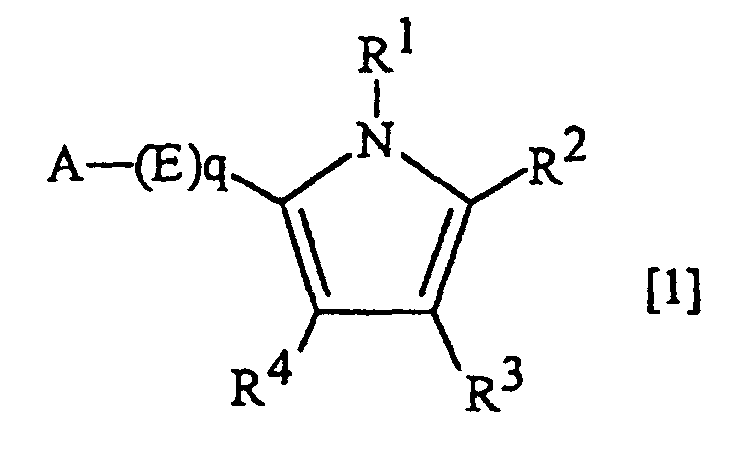
R2 represents (i) alkyl, (ii) aryl which may be substituted, (iii) aromatic heterocyclyl which may be substituted, (iv) a group of the following formula [2][wherein R6 and R7 may be the same or different and each represents (1) hydrogen or (2) alkyl (said alkyl may be substituted by (1) aryl which may be substituted by alkoxy, (2) aromatic heterocyclyl, or (3) hydroxy)], or (v) a group of the following formula [3] Z1 and Z2 may be the same or different and each represents -CH2- or >C=O; provided that Z1 and Z2 do not concurrently represent >C=O;
Y represents -CH2-, -O-, -S-, or >NR9;
R9 represents hydrogen, alkyl, acyl, aryl, or aromatic heterocyclyl;
m represents an integer of 1-3; n represents an integer of 0-2; p represents 0 or 1;
in case R2 represents aryl which is substituted or aromatic heterocyclyl which is substituted, the particular aryl or aromatic heterocyclyl may be substituted by 1-3 same or different members selected from the group consisting of (1) halogen, (2) alkyl which may be substituted by halogen, (3) cyano, (4) nitro, (5) alkoxycarbonyl, (6) hydroxy, (7) alkoxy (said alkoxy may be substituted by (1) halogen, (2) aryl which may be substituted by alkoxy, or (3) alkoxy), (8) -NHSO2R82, and (9) -NR83R84; or two adjacent substituent groups may jointly represent -O-(CH2)t-O- (t represents 1 or 2);
R82 represents (1) alkyl or (2) aryl which may be substituted by alkyl;
R83 and R84 may be the same or different and each represents (1) hydrogen, (2) alkyl, or (3) acyl; or R83 and R84 jointly and taken together with the adjacent N atom represent 5- through 7-membered cyclic amino;
R3 represents cyano or carbamoyl;
R4 represents hydrogen or alkyl;
E represents alkylene; q represents 0 or 1;
A represents (1) methyl, (2) aryl which may be substituted, or (3) aromatic heterocyclyl which may be substituted;
in case A represents aryl which is substituted or aromatic heterocyclyl which is substituted, the particular aryl or aromatic heterocyclyl may be substituted by 1-3 same or different members selected from the group consisting of (1) halogen, (2) alkyl which may be substituted by halogen, (3) cyano, (4) nitro, (5) alkoxycarbonyl, (6) hydroxy, (7) alkoxy (said alkoxy may be substituted by (1) halogen, (2) aryl which may be substituted by alkoxy, or (3) alkoxy), (8) -NHSO2R92, and (9) -NR93R94; or two adjacent substituent groups may jointly represent -O-(CH2)u-O- (u represents 1 or 2);
R92 represents (1) alkyl or (2) aryl which may be substituted by alkyl;
R93 and R94 may be the same or different and each represents (1) hydrogen, (2) alkyl, or (3) acyl; or R93 and R94 jointly and taken together with the adjacent N atom represent 5- through 7-membered cyclic amino;
A-(E)q, R4, and the double bond of the pyrrole ring may jointly, i.e. asX represents -O-, -S-, or >NR90 where R90 represents alkyl;
R95, R96 and R97 may be the same or different and each is selected from the group consisting of (1) hydrogen, (2) halogen, (3) alkyl which may be substituted by halogen, (4) cyano, (5) nitro, (6) alkoxycarbonyl, (7) hydroxy, (8) alkoxy (said alkoxy may be substituted by halogen or alkoxy), (9) -NHSO2R92 (R92 is as defined above), and (10) -NR93R94 (R93 and R94 are as defined above); any two adjacent substituent groups among R95, R96, and R97 may jointly represent -O-(CH2)u-O- (u is as defined above). - In the context of the present invention, the "alkyl" includes straight-chain or branched-chain alkyl groups containing 1-4 carbon atoms, such as methyl, ethyl, n-propyl, isopropyl, n-butyl, isobutyl, sec-butyl and tert-butyl.
- The "aryl" includes aryl groups of 6-12 carbon atoms, such as phenyl, 1-naphthyl, 2-naphthyl, 3-biphenyl and 4-biphenyl.
- The "aromatic heterocyclyl" includes groups of aromatic 5- or 6-membered rings containing 1-4 nitrogen, oxygen or sulfur atoms as ring members and the corresponding benzene-fused ring systems (however, 2-pyrrolyl and 3-pyrrolyl are excluded), thus including 2-pyridyl, 3-pyridyl, 4-pyridyl, 2-pyrimidinyl, 4-pyrimidinyl, 1-indolyl, 2-indolyl, 3-indolyl, 1-tetrazolyl, 2-furyl, 3-furyl, 2-benzofuranyl, 3-benzofuranyl, 2-thienyl, and 3-thienyl, among others.
- The "alkylene" includes straight-chain or branched groups of 1-4 carbon atoms, such as the following.


- The alkyl moiety of said "alkoxy", "alkoxycarbonyl" or "alkoxycarbonylamino" includes the alkyl groups mentioned above.
- The "halogen" includes fluoro, chloro, bromo and iodo.
- The "acyl" includes groups of 1-7 carbon atoms, such as formyl, acetyl, propionyl, butyryl, isobutyryl, valeryl, isovaleryl, pivaloyl, hexanoyl, isohexanoyl and benzoyl.
- The 5-7-membered cyclic amino represented by NR83R84 or NR93R94 includes but is not limited to 1-pyrrolidinyl, 1-piperidinyl and 1-hexamethyleneimino.
- The preferred species of the compound [1] of the invention includes the compound in which R1 is hydrogen, R2 is NH2, pyrrolidino or methyl, R3 is cyano, R4 is hydrogen or methyl, q is 0, and A is aryl which may be substituted or a aromatic heterocyclyl which may be substituted.
- Particularly preferred examples of the compound [1] of the invention includes the following compounds.
- (1) 2-Amino-3-cyano-5-(2-fluorophenyl)-4-methylpyrrole (hereinafter referred to as compound 1)
- (2) 2-Amino-3-cyano-4-methyl-5-phenylpyrrole (hereinafter referred to as compound 2)
- (3) 2-Amino-5-(3-chlorophenyl)-3-cyano-4-methylpyrrole (hereinafter referred to as compound 3)
- (4) 2-Amino-3-cyano-5-(2-furyl)-4-methylpyrrole (hereinafter referred to as compound 4)
- (5) 2-Amino-3-cyano-5-(3,4-methylenedioxyphenyl)pyrrole (hereinafter referred to as compound 5)
- (6) 2-Amino-3-cyano-5-(2,4-difluorophenyl)pyrrole (hereinafter referred to as compound 6)
- (7) 5-(3-Chlorophenyl)-3-cyano-2-methylpyrrole (hereinafter referred to as compound 7)
- (8) 2-Amino-3-cyano-4-methyl-5-(3-nitrophenyl)pyrrole (hereinafter referred to as compound 8)
- (9) 3-Cyano-2,4-dimethyl-5-phenylpyrrole (hereinafter referred to as compound 9)
- (10) 3-Cyano-5-(3-ethoxyphenyl)-2-pyrrolidinopyrrole (hereinafter referred to as compound 10)
- (11) 3-Cyano-5-(3,4-methylenedioxyphenyl)-2-pyrrolidinopyrrole (hereinafter referred to as compound 11)
-
- The compound used according to the invention, represented by general formula [1] above, can be produced by any of the processes described in WO 96/40634.
- Among species of the compound used according to the invention, any compound that is basic can be administered for medication in the free base form but optionally may be converted to a pharmaceutically acceptable salt by the known procedure and administered. The salt includes salts with inorganic acids such as hydrochloric acid, hydrobromic acid, sulfuric acid, phosphoric acid, and salts with organic acids such as acetic acid, citric acid, tartaric acid, maleic acid, succinic acid, fumaric acid, p-toluenesulfonic acid, benzenesulfonic acid, methanesulfonic acid.
- The compound used according to the invention has potent activating activity on potassium channel and yet is only slightly toxic as shown in the experimental examples which appear hereinafter, and is useful as a prophylactic or therapeutic drug for cardiovascular diseases such as hypertension, ischemic diseases (such as angina pectoris and myocardial infarction), arteriosclerosis, hyperlipemia, congestive heart failure, arrhythmia and peripheral vascular disorders.
- In addition, the compound is useful as a therapeutic drug for various disorders associated with smooth muscle contraction, such as cerebrovascular disorders (e.g. cerebrovascular spasm), peripheral vascular disorders (e.g. trichogenetic insufficiency, psilosis, coldness of limbs, etc.), respiratory disorders (reversible airway obstruction, hypersensitivity airway obstruction, asthma), gastrointestinal disorders (ulcer, irritable bowel syndrome, bile duct obliteration, etc.), visuoauditory disorders (e.g. glaucoma, ocular hypertension, etc.), urinary system disorders (renal failure, disorders accompanied with the passage of renal calculi, etc.), and genital organ disorders (erectile dysfunction, premature labor, etc.).
- Furthermore, the compound is useful as a therapeutic drug for blood sugar abnormalities (hypoglycemia etc.) and as a prophylactic or therapeutic drug for disorders due to abstinence in cases of abuse of such substances as cocaine, nicotine, alcohol, and benzodiazepine, disorders which may be prevented or cured with an anticonvulsant, such as epilepsy, neuropathies arising from cerebrovascular disorders, and various nervous system disorders such as schizophrenia.
- For use of the compound as a medicine, the compound can be administered, either as it is or in the form of a pharmaceutical composition containing it in a concentration of, for example, 0.1-99.5%, preferably 0.5-90%, in a pharmaceutically acceptable, nontoxic and inert carrier, to mammals inclusive of humans.
- As the carrier, at least one member selected from solid, semisolid or liquid diluents, fillers and other auxiliary formulating agents is employed. The pharmaceutical composition is preferably administered in a unit dose form. The pharmaceutical composition used according to the present invention can be administered intravenously, orally, into the target tissue, locally (e.g. transdermally) or rectally. Dosage forms suited to the respective routes of administration should of course be selected. Particularly preferred is oral administration.
- Oral administration can be made using a solid or liquid dose unit, such as neat powders, powders, tablets, sugar-coated tablets, capsules, granules, suspensions, solutions, syrups, drops, sublingual tablets and so on.
- Neat powders can be prepared by comminuting the active substance to a suitable particle size. Powders can be produced by comminuting the active substance to a suitable particle size and blending the resulting particles with a similarly comminuted pharmaceutical carrier, such as fine particles of, for example, an edible carbohydrate such as starch or mannitol. Where necessary, flavoring agents, preservatives, dispersants, coloring agents, perfumes, etc. can also be added and mixed.
- Capsules can be produced by filling capsule shells, such as gelatin capsule shells, with such comminuted neat powders or powders or granules prepared therefrom as described below for the manufacture of tablets. Prior to filling, a lubricant or fluidizing agent, such as colloidal silica, talc, magnesium stearate, calcium stearate, solid polyethylene glycol, etc., can be added to the powdery material. Furthermore, the bioavailability of the medicament after intake of the capsule can be improved by adding a disintegrator or solubilizer, such as carboxymethylcellulose, carboxymethylcellulose calcium, low-substitution-degree hydroxypropylcellulose, croscarmellose sodium, carboxymethylstarch sodium, calcium carbonate, sodium carbonate and so on.
- The finely divided powder mentioned above may be dispersed in a vegetable oil, polyethylene glycol, glycerin or a surfactant and the resulting suspension be wrapped in gelatin sheets to provide soft capsules. Tablets can be produced by preparing a powdery mixture using an excipient, granulating or slugging it, adding a disintegrator or a lubricant, and compressing the mixture. The powdery mixture can be prepared by mixing a suitably comminuted powder of the active substance with said diluent or base and, where necessary, adding a binder (e.g. carboxymethylcellulose sodium, methylcellulose, hydroxypropylmethylcellulose, gelatin, polyvinylpyrrolidone, polyvinyl alcohol, etc.), a dissolution retardant (e.g. paraffin), a reabsorption agent (e.g. a quaternary salt) and an adsorbent (e.g. bentonite, kaolin, dicalcium phosphate). The powdery mixture may be processed into granules by wetting it with a binder, such as a syrup, starch paste, gum arabic, a cellulose solution or a polymer solution, in the first place, stirring the mixture, drying it, and pulverizing it. Instead of granulating the powder, it may be compressed with a tablet machine in the first place and crushing the crude-form slugs into granules.
- The granules thus obtained can be protected against interadhesion by adding a lubricant such as stearic acid, a stearate, talc, mineral oil or the like. The lubricated mixture is then compressed. Bare tablets thus obtained can be film-coated or sugar coated.
- The drug may be admixed with a free-flowing inert carrier and directly compressed into tablets without said granulation or slugging operation. A transparent or translucent protective film comprising a hermetic shellac coat, a sugar or polymer covering film, or a polished wax top coat may also utilized.
- Other oral dosage forms, such as a solution, a syrup and an elixir, can also be provided as a unit dose form containing a predetermined amount of the drug in a given quantity. Syrups can be produced by dissolving the compound in suitable flavored aqueous solutions, while elixirs can be produced by using nontoxic alcoholic vehicles. Suspensions can be formulated by dispersing the compound in nontoxic vehicles. Where necessary, solubilizers and emulsifiers (e.g. ethoxylated isostearyl alcohol, polyoxyethylene sorbitol ester), preservatives and flavoring agents (e.g. peppermint oil, saccharin), among others, may also be added.
- If necessary, unit dose formulations for oral administration may be microencapsulated. Such formulations may be coated or embedded in a high polymer or a wax for prolonging the duration of action or insuring a sustained release.
- Administration into the target tissue can be made using a liquid unit dosage form suited for subcutaneous, intramuscular or intravenous administration, for example a solution or a suspension. Such dosage forms can be produced by suspending or dissolving a predetermined amount of the compound in an injectable nontoxic liquid vehicle such as an aqueous medium or an oily medium and, then, sterilizing the suspension or solution. For isotonizing such parenteral products, nontoxic salts or salt solutions may be added. A stabilizer, a preservative and/or an emulsifier may also be incorporated.
- Rectal administration can be made using suppositories manufactured by dissolving or suspending the compound in a low-boiling water-soluble or insoluble solid, such as polyethylene glycol, cacao butter, a semisynthetic oil (e.g. Witepsol™), a higher ester (e.g. myristyl palmitate) or a mixture thereof.
- The dosage as a potassium channel activator is preferably established with reference to the nature and severity of disease, patient factors such as age and body weight, the route of administration, etc. but the usual daily dose is 0.1-1000 mg/adult patient, preferably 1-500 mg/adult patient, in terms of the compound.
- Dosage reduction may be warranted in some cases, while dosage escalation may be needed in others. Moreover, the above dosage may be administered in 2-3 divided doses a day.
- The following experimental examples and formulation example illustrate the present invention in further detail without defining the scope of the invention.
- It has been generally demonstrated that the relaxing effect of a potassium channel activator on a KCl-induced contraction in isolated preparations attenuates as the concentration of KCl is increased (Br. J. Pharmacol., 88, 103-111 (1986)). In the present experiment, potassium channel activating activity was evaluated by comparing the pIC50 values representing the relaxing effects of the test drug on the 20 mM KCl-induced contraction and 100 mM KCI-contraction. According to Br. J. Pharmacol., 88, 103-111 (1986) referred to above, potassium channel activators produce greater relaxing effects on 20 mM KCl-induced contraction than on 100 mM KCl -induced contraction.
- Male 7-13-week-old SD rats (body weights 240-480 g) were used in groups of 4-6. After the animal was bled to death under ether anesthesia, the throacic aorta was isolated and dissected into a spiral specimen about 2 mm wide × about 20 mm long. Each specimen was suspended in a 10 ml Magnus bath containing Krebs-Henseleit solution (KH solution) aerated with 95% O2 + 5% CO2 at 37°C. A tension load of 1 g was applied and with the KH solution exchanged every 20 minutes, the specimen was equilibrated for about 90 minutes. Then, the experiment was commenced. The change in tension of the specimen was recorded on a recticorder through an isometric tension transducer. The specimen was caused to contract by replacing the KH solution in the Magnus bath with 20 mM or 100 mM KCl-containing KH solution (NaCl in KH solution was replaced with an equimolar amount of KCl) and when the contractile response had reached plateau, the test drug was cumulatively applied to evaluate the relaxing effect.
- The results are shown in Table 1. Each result was expressed in the average of the relaxation ratio obtained in the presence of the test drug, with the maximum relaxation found with papaverine (100 µM) being taken as the 100% relaxation response of the specimen.
Effect on the KCl-induced contraction of the isolated rat aorta specimen Compound No. Concentration (µM) Relaxation effect (%) n 20 mM KCl-induced contraction 100 mM KCl-induced contraction Compound 1 10 82 28 4 Compound 2 10 78 17 4-6 Compound 3 1 45 6 4 Compound 4 10 64 12 4-5 Compound 5 10 73 18 4 Compound 6 10 92 24 4 - In the isolated rat aorta specimen, the compound used according to the invention showed a greater relaxing effect on 20 mM KCl-induced contraction than on 100 mM KCl-induced contraction. It is, therefore, clear that the compound used according to the invention has potent activating activity on potassium channel.
- As in Experimental Example 1, potassium channel activating activity was evaluated by comparing the relaxing effects of the test drug on 20 mM KCl-induced contraction and 100 mM KCl-induced contraction.
- Male 5-13-week-old Hartley guinea pigs (body weights 400-730 g) were used in groups of 2-4. After the animal was bled to death under ether anesthesia, the trachea was isolated and 4 tracheal strips were connected to prepare a specimen in accordance with the method of Takagi et al. (Chem. Pharm. Bull., 6, 716-720 (1958)). The experiment was performed in the same manner as described in Experimental Example 1.
- The results are shown in Table 2.
Effect on the KCl-induced contraction of the isolated guinea-pig trachea specimen Compound No. Concentration (µM) Relaxation effect (%) n 20 mM KCl-induced contraction 100 mM KCl-induced contraction Compound 5 10 58 -7 4 Compound 7 3 64 31 4 Compound 8 3 58 -2 2 Compound 9 10 79 39 2-4 Compound 10 3 37 -15 4 Compound 11 10 37 4 4 - In the isolated guinea-pig trachea, the compoun used according to the invention showed a greater relaxing effect on 20 mM KCl-induced contraction than on 100 mM KCl-induced contraction. It is, therefore, clear that the compound used according to the invention has potent activating activity on potassium channel.
- Female 10-13-week-old SD rats (body weights 180-300 g) fasted from the previous day were used in groups of 2-4. The animal was placed in supine position under urethane anesthesia and the femoral artery was cannulated for blood pressure measurement. The blood pressure was recorded on a recorder through the cannula and a pressure transducer. When the blood pressure had stabilized, the test drug was administered intraduodenally and the effect on blood pressure was monitored up to 3 hours after administration.
- The results are shown in Table 3. Each value is expressed as the average of % changes at the time of maximal action.
Effect on blood pressure in anesthetized rats Compound No. Dosage (mg/kg) Hypotensive effect (%) n Compound 2 100 25.9 4 Compound 3 100 14.1 4 Compound 4 100 25.6 2 - When administered intraduodenally, the compound used according to the invention showed blood pressure-lowering effects apparently ascribable to its potassium channel activating activity.
- Male 6-7-week-old ddY mice (body weights 20-40 g) were used in groups of 4. The animal was fasted from the previous day (for 16-18 hours), and using a gastric tube, the test drug in a dose of 1000 mg/kg was administered orally. The mortality of the animals were then monitored for 2 weeks. As test drugs, compound 1, compound 2 and compound 4 were respectively administered. As a result, no death was encountered in any of the compound groups.
-
Tablets (oral tablets) Recipe, in 200 mg per tablet Compound 1 20 mg Corn starch 88 mg Crystalline cellulose 80 mg Carboxymethylcellulose Ca 10 mg Light silicic anhydride 1 mg Magnesium stearate 1 mg - As set forth above, the compound used according to the invention is a compound having potent potassium channel activating activity and of low toxic potential and, therefore, a pharmaceutical composition comprising the compound as an active ingredient is useful as a potassium channel activator in mammals including humans.
Claims (9)
- Use of a pyrrole derivative of the following general formula [1] or a pharmaceutically acceptable salt thereof for the manufacture of a medicament for the prophylactic and/or therapeutic treatment of hypertensionwherein:
 [wherein R6 and R7 may be the same or different and each represents (1) hydrogen or (2) alkyl (said alkyl may be substituted by (1) aryl which may be substituted by alkoxy, or (2) aromatic heterocyclyl, or (3) hydroxy)], or (v) a group of the following formula [3]R1 represents hydrogen or alkoxycarbonylamino;R2 represents (i) alkyl, (ii) aryl which may be substituted, (iii) aromatic heterocyclyl which may be substituted, (iv) a group of the following formula [2]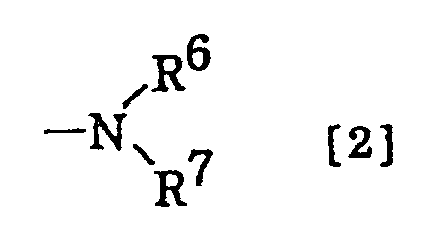
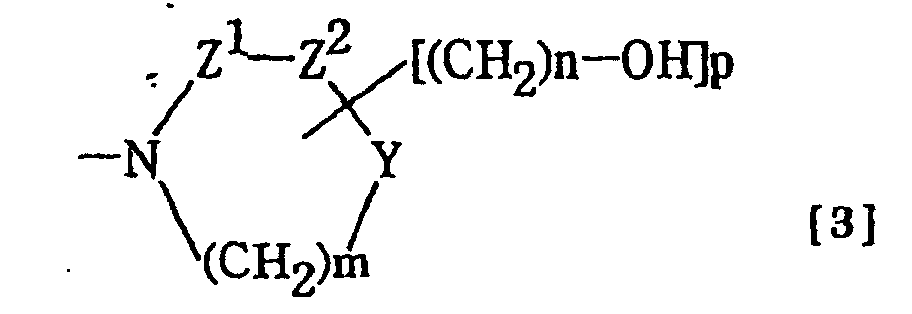 Z1 and Z2 may be the same or different and each represents -CH2- or >C=O; provided that Z1 and Z2 do not concurrently represent >C=O;Y represents -CH2-, -O-, -S-, or >NR9;R9 represents hydrogen, alkyl, acyl, aryl, or aromatic heterocyclyl;m represents an integer of 1-3; n represents an integer of 0-2; p represents 0 or 1;in case R2 represents aryl which is substituted or aromatic heterocyclyl which is substituted, the particular aryl or aromatic heterocyclyl may be substituted by 1-3 same or different members selected from the group consisting of (1) halogen, (2) alkyl which may be substituted by halogen, (3) cyano, (4) nitro, (5) alkoxycarbonyl, (6) hydroxy, (7) alkoxy (said alkoxy may be substituted by (1) halogen, (2) aryl which may be substituted by alkoxy, or (3) alkoxy), (8) -NHSO2R82, and (9) -NR83R84; or two adjacent substituent groups may jointly represent -O-(CH2)t-O- (t represents 1 or 2);R82 represents (1) alkyl or (2) aryl which may be substituted by alkyl;R83 and R84 may be the same or different and each represents (1) hydrogen, (2) alkyl, or (3) acyl; or R83 and R84 jointly and taken together with the adjacent N atom represent 5- through 7-membered cyclic amino;R3 represents cyano or carbamoyl;R4 represents hydrogen or alkyl;E represents alkylene; q represents 0 or 1;A represents (1) methyl, (2) aryl which may be substituted, or (3) aromatic heterocyclyl which may be substituted;in case A represents aryl which is substituted or aromatic heterocyclyl which is substituted, the particular aryl or aromatic heterocyclyl may be substituted by 1-3 same or different members selected from the group consisting of (1) halogen, (2) alkyl which may be substituted by halogen, (3) cyano, (4) nitro, (5) alkoxycarbonyl, (6) hydroxy, (7) alkoxy (said alkoxy may be substituted by (1) halogen, (2) aryl which may be substituted by alkoxy, or (3) alkoxy), (8) -NHSO2R92, and (9) -NR93R94; or two adjacent substituent groups may jointly represent -O-(CH2)u-O- (u represents 1 or 2);R92 represents (1) alkyl or (2) aryl which may be substituted by alkyl;R93 and R94 may be the same or different and each represents (1) hydrogen, (2) alkyl, or (3) acyl; or R93 and R94 jointly and taken together with the adjacent N atom represent 5- through 7-membered cyclic amino;A-(E)q, R4, and the double bond of the pyrrole ring may jointly, i.e.
as X represents -O-, -S-, or >NR90 where R90 represents alkyl;R95, R96 and R97 may be the same or different and each is selected from the group consisting of (1) hydrogen, (2) halogen, (3) alkyl which may be substituted by halogen, (4) cyano, (5) nitro, (6) alkoxycarbonyl, (7) hydroxy, (8) alkoxy (said alkoxy may be substituted by halogen or alkoxy), (9) -NHSO2R92 (R92 is as defined above), and (10) -NR93R94 (R93 and R94 are as defined above); any two adjacent substituent groups among R95, R96, and R97 may jointly represent -O-(CH2)u-O- (u is as defined above).
 - The use according to claim 1,
wherein in the following general formula [1] R1 represents hydrogen,R2 represents NH2,R3 represents cyano,R4 represents hydrogen or methyl,"q" is 0, andA represents substituted or non-substituted aryl or substituted or non-substituted aromatic heterocyclic residue.
 - The use according to claim 1, wherein the said pyrrole derivative is selected from among the following compounds;(1) 2-Amino-3-cyano-5-(2-fluorophenyl)-4-methylpyrrole,(2) 2-Amino-3-cyano-4-methyl-5-phenylpyrrole,(3) 2-Amino-5-(3-chlorophenyl)-3-cyano-4-methylpyrrole,(4) 2-Amino-3-cyano-5-(2-furyl)-4-methylpyrrole,(5) 2-Amino-3-cyano-5-(3,4-methylenedioxyphenyl)pyrrole,(6) 2-Amino-3-cyano-5-(2,4-difluorophenyl)pyrrole,(7) 5-(3-Chlorophenyl)-3-cyano-2-methylpyrrole,(8) 2-Amino-3-cyano-4-methyl-5-(3-nitrophenyl)pyrrole,(9) 3-Cyano-2,4-dimethyl-5-phenylpyrrole,(10) 3-Cyano-5-(3-ethoxyphenyl)-2-pyrrolidinopyrrole,(11) 3-Cyano-5-(3,4-methylenedioxyphenyl)-2-pyrrolidinopyrrole.
- Use of a pyrrole derivative of the following general formula [1] or a pharmaceutically acceptable salt thereof for the manufacture of a medicament for the prophylactic and/or therapeutic treatment of asthmawherein:
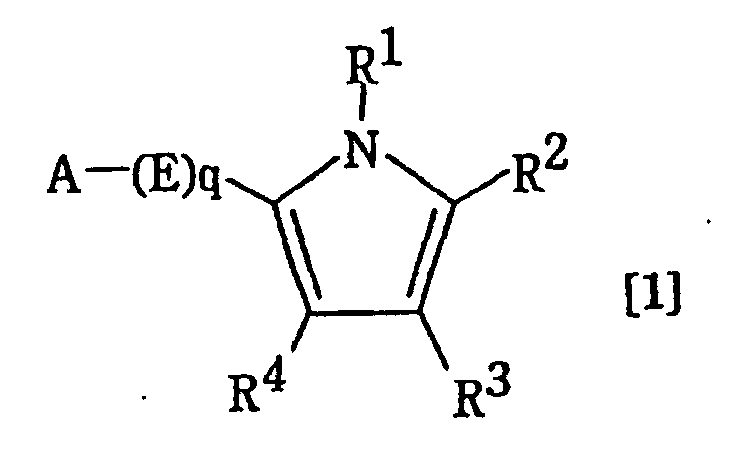 [wherein R6 and R7 may be the same or different and each represents (1) hydrogen or (2) alkyl (said alkyl may be substituted by (1) aryl which may be substituted by alkoxy, or (2) aromatic heterocyclyl, or (3) hydroxy)], or (v) a group of the following formula [3]R1 represents hydrogen or alkoxycarbonylamino;R2 represents (i) alkyl, (ii) aryl which may be substituted, (iii) aromatic heterocyclyl which may be substituted, (iv) a group of the following formula [2]
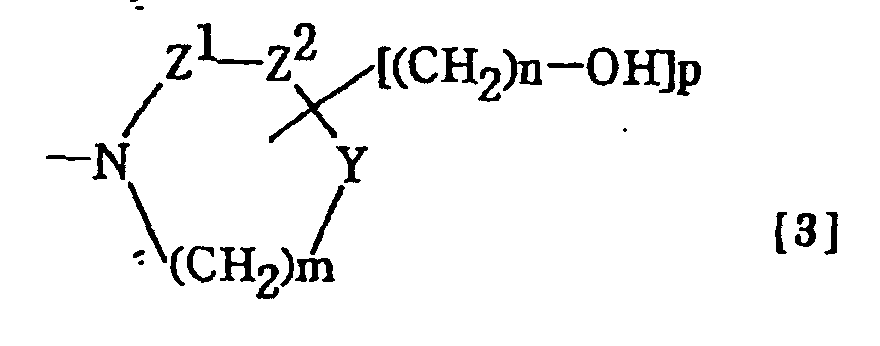 Z1 and Z2 may be the same or different and each represents -CH2- or >C=O; provided that Z1 and Z2 do not concurrently represent >C=O;Y represents -CH2-, -O-, -S-, or >NR9;R9 represents hydrogen, alkyl, acyl, aryl, or aromatic heterocyclyl;m represents an integer of 1-3; n represents an integer of 0-2; p represents 0 or 1;in case R2 represents aryl which is substituted or aromatic heterocyclyl which is substituted, the particular aryl or aromatic heterocyclyl may be substituted by 1-3 same or different members selected from the group consisting of (1) halogen, (2) alkyl which may be substituted by halogen, (3) cyano, (4) nitro, (5) alkoxycarbonyl, (6) hydroxy, (7) alkoxy (said alkoxy may be substituted by (1) halogen, (2) aryl which may be substituted by alkoxy, or (3) alkoxy), (8) =NHSO2R82, and (9) -NR83R84; or two adjacent substituent groups may jointly represent -O-(CH2)t-O- (t represents 1 or 2);R82 represents (1) alkyl or (2) aryl which may be substituted by alkyl;R83 and R84 may be the same or different and each represents (1) hydrogen, (2) alkyl, or (3) acyl; or R83 and R84 jointly and taken together with the adjacent N atom represent 5- through 7-membered cyclic amino;R3 represents cyano or Carbamoyl;R4 represents hydrogen or alkyl;E represents alkylene; q represents 0 or 1;A represents (1) methyl, (2) aryl which may be substituted, or (3) aromatic heterocyclyl which may be substituted;in case A represents aryl which is substituted or aromatic heterocyclyl which is substituted, the particular aryl or aromatic heterocyclyl may be substituted by 1-3 same or different members selected from the group consisting of (1) halogen, (2) alkyl which may be substituted by halogen, (3) cyano, (4) nitro, (5) alkoxycarbonyl, (6) hydroxy, (7) alkoxy (said alkoxy may be substituted by (1) halogen, (2) aryl which may be substituted by alkoxy, or (3) alkoxy), (8) -NHSO2R92, and (9) -NR93R94; or two adjacent substituent groups may jointly represent -O-(CH2)u-O- (u represents 1 or 2);R92 represents (1) alkyl or (2) aryl which may be substituted by alkyl;R93 and R94 may be the same or different and each represents (1) hydrogen, (2) alkyl, or (3) acyl; or R93 and R94 jointly and taken together with the adjacent N atom represent 5- through 7-membered cyclic amino;A-(E)q, R4, and the double bond of the pyrrole ring may jointly, i.e. as
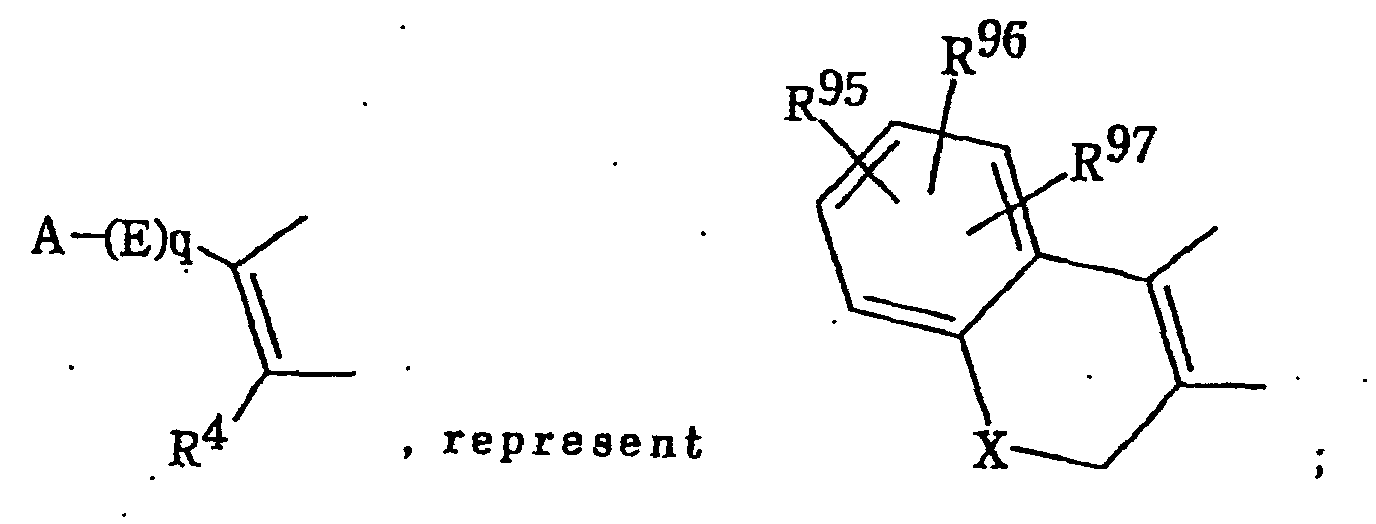 X represents -O-, -S-, or >NR90 were R90 represents alkyl;R95, R96 and R97 may be the same or different and each is selected from the group consisting of (1) hydrogen, (2) halogen, (3) alkyl which may be substituted by halogen, (4) cyano, (6) nitro, (6) alklxycarbonyl, (7) hydroxy, (8) alkoxy (said alkoxy may be substituted by halogen or alkoxy), (9) -NHSO2R92 (R92 is as defined above), and (10) -NR93R94 (R93 and R94 are as defined above); any two adjacent substituent groups among R95, R96, and R97 may jointly represent -O-(CH2)u-O- (u is as defined above).
 - The use according to claim 4,
wherein in the following general formula [1]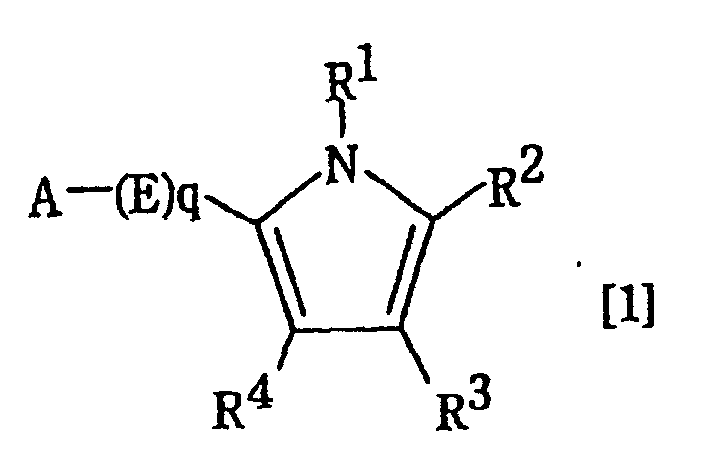 R1 represents hydrogen,R2 represents NH2,R3 represents cyano,R4 represents hydrogen or methyl,"q" is O, andA represents substituted or non-substituted aryl or substituted or non-substituted aromatic heterocyclic residue.
 - The use according to claim 4, wherein the said pyrrole derivative is selected from among the following compounds;(1) 2-Amino-3-cyano-5-(2-fluorophenyl)-4-methylpyrrole,(2) 2-Amino-3-cyano-4-methyl-5-phenylpyrrole,(3) 2-Amino-5-(3-chlorophenyl)-3-cyano-4-methylpyrrole,(4) 2-Amino-3-cyano-5-(2-furyl)-4-methylpyrrole,(6) 2-Amino-3-cyano-5-(3,4-methylenedioxyphenyl)pyrrole,(6) 2-Amino-3-cyano-5-(2,4-difluorophenyl)pyrrole,(7) 5-(3-Chlorophenyl)-3-cyano-2-methylpyrrole,(8) 2-Amino-3-cyano-4-methyl-5-(3-nitrophenyl)pyrrole,(9) 3-Cyano-2,4-dimethyl-5-phenylpyrrole,(10) 3-Cyano-5-(3-ethoxyphenyl)-2-pyrrolidinopyrrole,(11) 3-Cyano-5-(3,4-methylenedioxyphenyl)-2-pyrrolidinopyrrole.
- Use of a pyrrole derivative of the following genera formula [1] or a pharmaceutically acceptable salt thereof for the manufacture of a medicament for the prophylactic and/or therapeutic treatment of trichogenetic insufficiency, psilosi and alopeciawherein:
 [wherein R6 and R7 may be the same or different and each represents (1) hydrogen or (2) alkyl (said alkyl may be substituted by (1) aryl which may be substituted by alkoxy, or (2) aromatic heterocyclyl, or (3) hydroxy)], or (v) a group of the following formula [3]R1 represents hydrogen or alkoxycarbonylamino;R2 represents (i) alkyl, (ii) aryl which may be substituted, (iii) aromatic heterocyclyl which may be substituted, (iv) a group of.the following formula [2]
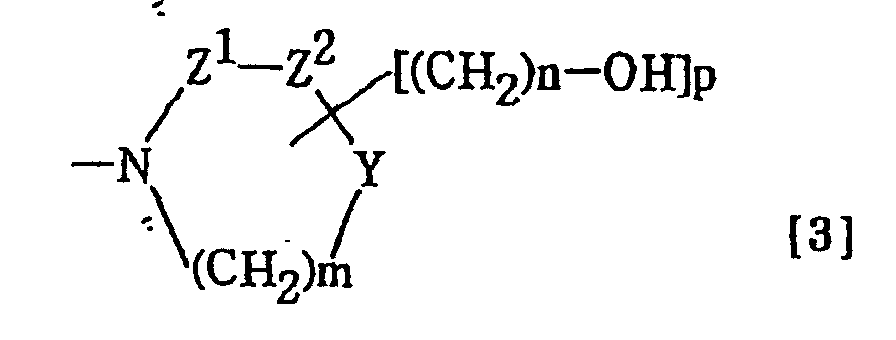 Z1 and Z2 may be the same or different and each represents -CH2- or >C=O; provided that Z1 and Z2 do not concurrently represent >C=O;Y represents -CH2-, -O-, -S-, or >NR9;R9 represents hydrogen, alkyl, acyl, aryl, or aromatic heterocyclyl;m represents an integer of 1-3; n represents an integer of 0-2; p represents 0 or 1;in case R2 represents aryl which is substituted or aromatic heterocyclyl which is substituted, the particular aryl or aromatic heterocyclyl may be substituted by 1-3 same or different members selected from the group consisting of (1) halogen, (2) alkyl which may be substituted by halogen, (3) cyano, (4) nitro, (5) alkoxycarbonyl, (6) hydroxy, (7) alkoxy (said alkoxy may be substituted by (1) halogen, (2) aryl which may be substituted by alkoxy, or (3) alkoxy), (8) -NHSO2R82, and (9) -NR83R84; or two adjacent substituent groups may jointly represent -O-(CH2)t-O- (t represents 1 or 2);R82 represents (1) alkyl or (2) aryl which may be substituted by alkyl;R83 and R84 may be the same or different and each represents (1) hydrogen, (2) alkyl, or (3) acyl; or R83 and R84 jointly and taken together with the adjacent N atom represent 5- through 7-membered cyclic amino;R3 represents cyano or carbamoyl;R4 represents hydrogen or alkyl;E represents alkylene; q represents 0 or 1;A represents (1) methyl, (2) aryl which may be substituted, or (3) aromatic heterocyclyl which may be substituted;in case A represents aryl which is substituted or aromatic heterocyclyl which is substituted, the particular aryl or aromatic heterocyclyl may be substituted by 1-3 same or different members selected from the group consisting of (1) halogen, (2) alkyl which may be substituted by halogen, (3) cyano, (4) nitro, (5) alkoxycarbonyl, (6) hydroxy, (7) alkoxy (said alkoxy may be substituted by (1) halogen, (2) aryl which may be substituted by alkoxy, or (3) alkoxy), (8) -NHSO2R92, and (9) -NR93R94; or two adjacent substituent groups may jointly represent -O-(CH2)u-O- (u represents 1 or 2);R92 represents (1) alkyl or (2) aryl which may be substituted by alkyl;R93 and R94 may be the same or different and each represents (1) hydrogen, (2) alkyl, or (3) acyl; or R93 and R94 jointly and taken together with the adjacent N atom represent 6- through 7-membered cyclic amino;A-(E)q, R4, and the double bond of the pyrrole ring may jointly, i.e. as
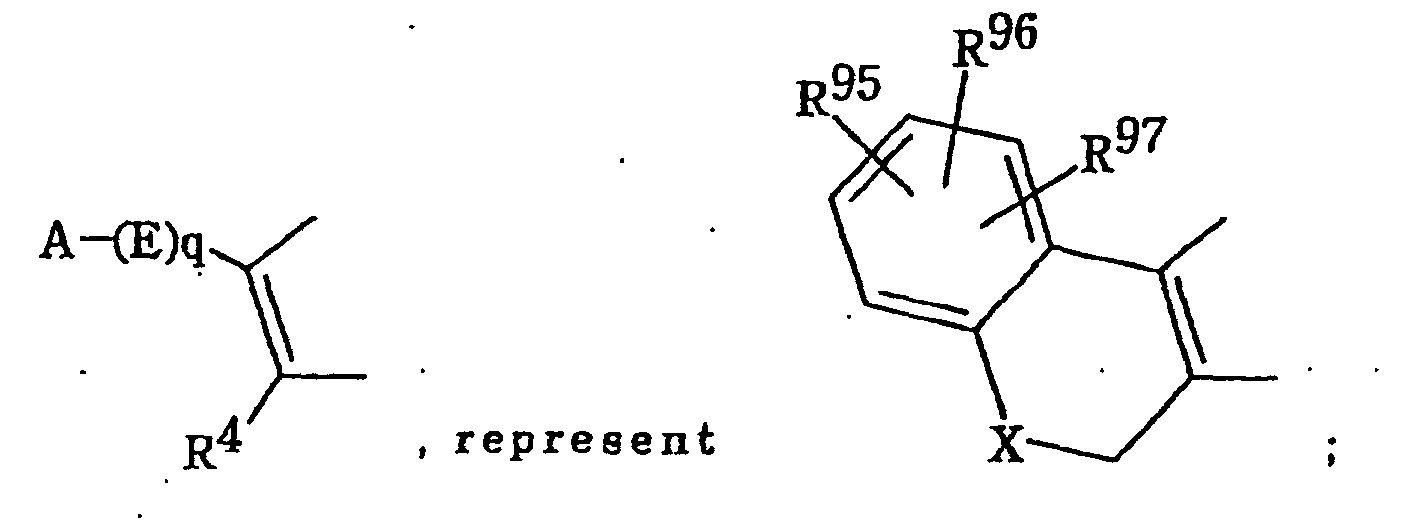 X represents -O-, -S-, or >NR90 where R90 represents alkyl;R95, R96 and R97 may be the same or different and each is selected from the group consisting of (1) hydrogen, (2) halogen, (3) alkyl which may be substituted by halogen, (4) cyano, (6) nitro, (6) alkoxycarbonyl, (7) hydroxy, (8) alkoxy (said alkoxy may be substituted by halogen or alkoxy), (9) -NHSO2R92 (R92 is as defined above), and (10) -NR93R94 (R93 and R94 are as defined above); any two adjacent substituent groups among R95, R96, and R97 may jointly represen -O-(CH2)u-O- (u is as defined above).
 - The use according to claim 7,
wherein in the following general formula [1] R1 represents hydrogen,R2 represents NH2,R3 represents cyano,R4 represents hydrogen or methyl,"q" is O, andA represents substituted or non-substituted aryl or substituted or non-substituted aromatic heterocyclic residue.
 - The use according to claim 7, wherein the said pyrrole derivative is selected from among the following compounds;(1) 2-Amino-3-cyano-5-(2-fluorophenyl)-4-methylpyrrole,(2) 2-Amino-3-cyano-4-methyl-5-phenylpyrrole,(3) 2-Amino-5-(3-chlorophenyl)-3-cyano-4-methylpyrrole,(4) 2-Amino-3-cyano-5-(2-furyl)-4-methylpyrrole,(5) 2-Amino-3-cyano-5-(3,4-methylenedioxyphenyl)pyrrole,(6) 2-Amino-3-cyano-5-(2,4-difluorophenyl)pyrrole,(7) 5-(3-Chlorophenyl)-3-cyano-2-methylpyrrole,(8) 2-Amino-3-cyano-4-methyl-5-(3-nitrophenyl)pyrrole,(9) 3-Cyano-2,4-dimethyl-5-phenylpyrrole,(10) 3-Cyano-5-(3-ethoxyphenyl)-2-pyrrolidinopyrrole,(11) 3-Cyano-5-(3,4-methylenedioxyphenyl)-2-pyrrolidinopyrrole.
Applications Claiming Priority (5)
| Application Number | Priority Date | Filing Date | Title |
|---|---|---|---|
| JP561398 | 1998-01-14 | ||
| JP561398 | 1998-01-14 | ||
| JP5088898 | 1998-03-03 | ||
| JP5088898 | 1998-03-03 | ||
| PCT/JP1999/000103 WO1999036068A1 (en) | 1998-01-14 | 1999-01-13 | Potassium channel activators |
Publications (3)
| Publication Number | Publication Date |
|---|---|
| EP1057485A1 EP1057485A1 (en) | 2000-12-06 |
| EP1057485A4 EP1057485A4 (en) | 2001-05-09 |
| EP1057485B1 true EP1057485B1 (en) | 2005-05-11 |
Family
ID=26339581
Family Applications (1)
| Application Number | Title | Priority Date | Filing Date |
|---|---|---|---|
| EP99900312A Expired - Lifetime EP1057485B1 (en) | 1998-01-14 | 1999-01-13 | Potassium channel activators |
Country Status (10)
| Country | Link |
|---|---|
| US (1) | US6353016B1 (en) |
| EP (1) | EP1057485B1 (en) |
| KR (1) | KR20010034114A (en) |
| CN (1) | CN1162151C (en) |
| AT (1) | ATE295166T1 (en) |
| AU (1) | AU1890299A (en) |
| CA (1) | CA2316853A1 (en) |
| DE (1) | DE69925250T2 (en) |
| RU (1) | RU2204390C2 (en) |
| WO (1) | WO1999036068A1 (en) |
Families Citing this family (7)
| Publication number | Priority date | Publication date | Assignee | Title |
|---|---|---|---|---|
| CN1193754C (en) * | 2000-03-21 | 2005-03-23 | 日本新药株式会社 | Controlled Release Oral Formulations |
| CA2415815A1 (en) * | 2000-07-06 | 2002-01-17 | Nigel H. Greig | Tetrahydrobenzothiazole analogues as neuroprotective agents |
| TWI239952B (en) * | 2001-03-14 | 2005-09-21 | Nippon Shinyaku Co Ltd | Stable crystals of pyrrole compound |
| AU2004269924A1 (en) * | 2003-09-04 | 2005-03-17 | Neurosearch A/S | ERG channel openers for the treatment of cardiac arrhythmias |
| US8026237B2 (en) * | 2004-07-30 | 2011-09-27 | Exelixis, Inc. | Pyrrole derivatives as pharmaceutical agents |
| ES2433215T3 (en) | 2008-04-28 | 2013-12-10 | Janssen Pharmaceutica, N.V. | Benzocycloheptane and Benzoxepine derivatives |
| GB201107176D0 (en) * | 2011-04-28 | 2011-06-15 | Cxr Biosciences Ltd | Pyrrolnitrin derivatives |
Family Cites Families (7)
| Publication number | Priority date | Publication date | Assignee | Title |
|---|---|---|---|---|
| ATE163410T1 (en) * | 1991-12-26 | 1998-03-15 | Mitsubishi Chem Corp | BETA-OXO-BETA-BENZENEPROPANTHIOAMIDE DERIVATIVES |
| FR2698873B1 (en) * | 1992-12-07 | 1995-02-24 | Lipha | Benzocycloheptenes, benzoxepines and benzothiepins activators of potassium channels, preparation process, pharmaceutical composition containing them. |
| JP3439249B2 (en) * | 1993-11-18 | 2003-08-25 | 三和生薬株式会社 | New pyrrole-type compound and hair growth / hair growth promoter |
| EP0842923B1 (en) * | 1995-06-07 | 2006-03-01 | Nippon Shinyaku Company, Limited | Pyrrole derivatives and medicinal composition |
| WO1997016442A1 (en) * | 1995-10-31 | 1997-05-09 | Merck & Co., Inc. | Substituted pyridyl pyrroles, compositions containing such compounds and methods of use |
| CA2260213C (en) * | 1996-07-11 | 2005-03-29 | Pfizer Inc. | Pyridylpyrrole compounds useful as interleukin- and tnf antagonists |
| AU3953899A (en) * | 1998-05-27 | 1999-12-13 | Nippon Shinyaku Co. Ltd. | Cyclooxygenase-2 inhibitors |
-
1999
- 1999-01-13 EP EP99900312A patent/EP1057485B1/en not_active Expired - Lifetime
- 1999-01-13 US US09/582,743 patent/US6353016B1/en not_active Expired - Fee Related
- 1999-01-13 CA CA002316853A patent/CA2316853A1/en not_active Abandoned
- 1999-01-13 RU RU2000121069/14A patent/RU2204390C2/en not_active IP Right Cessation
- 1999-01-13 AT AT99900312T patent/ATE295166T1/en not_active IP Right Cessation
- 1999-01-13 WO PCT/JP1999/000103 patent/WO1999036068A1/en not_active Ceased
- 1999-01-13 KR KR1020007007727A patent/KR20010034114A/en not_active Withdrawn
- 1999-01-13 CN CNB998021067A patent/CN1162151C/en not_active Expired - Fee Related
- 1999-01-13 AU AU18902/99A patent/AU1890299A/en not_active Abandoned
- 1999-01-13 DE DE69925250T patent/DE69925250T2/en not_active Expired - Fee Related
Also Published As
| Publication number | Publication date |
|---|---|
| US6353016B1 (en) | 2002-03-05 |
| AU1890299A (en) | 1999-08-02 |
| EP1057485A4 (en) | 2001-05-09 |
| RU2204390C2 (en) | 2003-05-20 |
| CN1162151C (en) | 2004-08-18 |
| EP1057485A1 (en) | 2000-12-06 |
| WO1999036068A1 (en) | 1999-07-22 |
| DE69925250T2 (en) | 2006-02-23 |
| ATE295166T1 (en) | 2005-05-15 |
| CA2316853A1 (en) | 1999-07-22 |
| DE69925250D1 (en) | 2005-06-16 |
| CN1288377A (en) | 2001-03-21 |
| KR20010034114A (en) | 2001-04-25 |
Similar Documents
| Publication | Publication Date | Title |
|---|---|---|
| AU2006295440B2 (en) | Capsule formulation of pirfenidone and pharmaceutically acceptable excipients | |
| US6353016B1 (en) | Potassium channel activators | |
| UA48214C2 (en) | Benzoyl guanidine derivatives, a process for their preparing and a pharmaceutical composition on their basis | |
| JP2009514856A (en) | Pharmaceutical gallium composition and method | |
| KR20030016222A (en) | Preventives/remedies for postoperative stress | |
| EP0531228A1 (en) | Thiourea derivatives, antimicrobial agent and antiulcer agent containing the same | |
| US6197796B1 (en) | Anticancer composition comprising a diaminotrifluoromethylpyridine derivative | |
| KR960004827B1 (en) | Heteroarylcarboxyamide derivatives, preparation method thereof and pharmaceutical composition containing the same | |
| EP4559923A1 (en) | Antihistamine compound, and preparation method therefor and use thereof | |
| US5962454A (en) | Neovascularization inhibitor | |
| MXPA00006647A (en) | Potassium channel activators | |
| AU2013201986B2 (en) | Capsule Formulation Of Pirfenidone And Pharmaceutically Acceptable Excipients | |
| US4105791A (en) | Hypolipidemic cycloalkylaminobenzoic acids | |
| KR20030002304A (en) | 3-Phenyl-3,7-diazabicyclo[3.3.1]nonane compounds and process for their preparation and medicaments containing these compounds | |
| JPWO1999036068A1 (en) | potassium channel activators | |
| KR20010107929A (en) | Quinolinone derivative preparations and process for producing the same | |
| US5106859A (en) | Certain 1,3,4-thiadiazole derivatives and anti-ulcer agent comprising said derivatives as active ingredient | |
| EP0342577A2 (en) | Use of dihydropyridine derivatives for the prophylaxis or treatment of cerebral circulation disorders | |
| AU2014240300B2 (en) | Capsule Formulation of Pirfenidone and Pharmaceutically Acceptable Excipients | |
| US3821409A (en) | Method of treatment | |
| EP4559922A1 (en) | Antihistamine compound, preparation method therefor and use thereof | |
| US4279910A (en) | Quinazoline therapeutic agents | |
| JPS62283965A (en) | Benzimidazole derivative composition | |
| HK1117762B (en) | Capsule formulation of pirfenidone and pharmaceutically acceptable excipients | |
| CA2044366A1 (en) | Cardiotonic pharmaceutical composition |
Legal Events
| Date | Code | Title | Description |
|---|---|---|---|
| PUAI | Public reference made under article 153(3) epc to a published international application that has entered the european phase |
Free format text: ORIGINAL CODE: 0009012 |
|
| 17P | Request for examination filed |
Effective date: 20000724 |
|
| AK | Designated contracting states |
Kind code of ref document: A1 Designated state(s): AT BE CH CY DE DK ES FI FR GB GR IE IT LI LU NL PT SE |
|
| A4 | Supplementary search report drawn up and despatched |
Effective date: 20010328 |
|
| AK | Designated contracting states |
Kind code of ref document: A4 Designated state(s): AT BE CH CY DE DK ES FI FR GB GR IE IT LI LU NL PT SE |
|
| RIC1 | Information provided on ipc code assigned before grant |
Free format text: 7A 61K 31/40 A, 7C 07D 207/34 B, 7C 07D 405/04 B, 7C 07D 207/34 J, 7C 07D 405:04 J |
|
| 17Q | First examination report despatched |
Effective date: 20010925 |
|
| GRAP | Despatch of communication of intention to grant a patent |
Free format text: ORIGINAL CODE: EPIDOSNIGR1 |
|
| RBV | Designated contracting states (corrected) |
Designated state(s): AT BE CH DE DK ES FI FR GB GR IE IT LI LU NL PT SE |
|
| GRAS | Grant fee paid |
Free format text: ORIGINAL CODE: EPIDOSNIGR3 |
|
| GRAA | (expected) grant |
Free format text: ORIGINAL CODE: 0009210 |
|
| AK | Designated contracting states |
Kind code of ref document: B1 Designated state(s): AT BE CH DE DK ES FI FR GB GR IE IT LI LU NL PT SE |
|
| PG25 | Lapsed in a contracting state [announced via postgrant information from national office to epo] |
Ref country code: NL Free format text: LAPSE BECAUSE OF FAILURE TO SUBMIT A TRANSLATION OF THE DESCRIPTION OR TO PAY THE FEE WITHIN THE PRESCRIBED TIME-LIMIT Effective date: 20050511 Ref country code: LI Free format text: LAPSE BECAUSE OF FAILURE TO SUBMIT A TRANSLATION OF THE DESCRIPTION OR TO PAY THE FEE WITHIN THE PRESCRIBED TIME-LIMIT Effective date: 20050511 Ref country code: FI Free format text: LAPSE BECAUSE OF FAILURE TO SUBMIT A TRANSLATION OF THE DESCRIPTION OR TO PAY THE FEE WITHIN THE PRESCRIBED TIME-LIMIT Effective date: 20050511 Ref country code: CH Free format text: LAPSE BECAUSE OF FAILURE TO SUBMIT A TRANSLATION OF THE DESCRIPTION OR TO PAY THE FEE WITHIN THE PRESCRIBED TIME-LIMIT Effective date: 20050511 Ref country code: BE Free format text: LAPSE BECAUSE OF FAILURE TO SUBMIT A TRANSLATION OF THE DESCRIPTION OR TO PAY THE FEE WITHIN THE PRESCRIBED TIME-LIMIT Effective date: 20050511 Ref country code: AT Free format text: LAPSE BECAUSE OF FAILURE TO SUBMIT A TRANSLATION OF THE DESCRIPTION OR TO PAY THE FEE WITHIN THE PRESCRIBED TIME-LIMIT Effective date: 20050511 |
|
| REG | Reference to a national code |
Ref country code: GB Ref legal event code: FG4D |
|
| REG | Reference to a national code |
Ref country code: CH Ref legal event code: EP |
|
| REG | Reference to a national code |
Ref country code: IE Ref legal event code: FG4D |
|
| REF | Corresponds to: |
Ref document number: 69925250 Country of ref document: DE Date of ref document: 20050616 Kind code of ref document: P |
|
| PG25 | Lapsed in a contracting state [announced via postgrant information from national office to epo] |
Ref country code: SE Free format text: LAPSE BECAUSE OF FAILURE TO SUBMIT A TRANSLATION OF THE DESCRIPTION OR TO PAY THE FEE WITHIN THE PRESCRIBED TIME-LIMIT Effective date: 20050811 Ref country code: GR Free format text: LAPSE BECAUSE OF FAILURE TO SUBMIT A TRANSLATION OF THE DESCRIPTION OR TO PAY THE FEE WITHIN THE PRESCRIBED TIME-LIMIT Effective date: 20050811 Ref country code: DK Free format text: LAPSE BECAUSE OF FAILURE TO SUBMIT A TRANSLATION OF THE DESCRIPTION OR TO PAY THE FEE WITHIN THE PRESCRIBED TIME-LIMIT Effective date: 20050811 |
|
| PG25 | Lapsed in a contracting state [announced via postgrant information from national office to epo] |
Ref country code: ES Free format text: LAPSE BECAUSE OF FAILURE TO SUBMIT A TRANSLATION OF THE DESCRIPTION OR TO PAY THE FEE WITHIN THE PRESCRIBED TIME-LIMIT Effective date: 20050822 |
|
| PG25 | Lapsed in a contracting state [announced via postgrant information from national office to epo] |
Ref country code: PT Free format text: LAPSE BECAUSE OF FAILURE TO SUBMIT A TRANSLATION OF THE DESCRIPTION OR TO PAY THE FEE WITHIN THE PRESCRIBED TIME-LIMIT Effective date: 20051019 |
|
| NLV1 | Nl: lapsed or annulled due to failure to fulfill the requirements of art. 29p and 29m of the patents act | ||
| REG | Reference to a national code |
Ref country code: CH Ref legal event code: PL |
|
| PG25 | Lapsed in a contracting state [announced via postgrant information from national office to epo] |
Ref country code: IE Free format text: LAPSE BECAUSE OF NON-PAYMENT OF DUE FEES Effective date: 20060113 Ref country code: GB Free format text: LAPSE BECAUSE OF NON-PAYMENT OF DUE FEES Effective date: 20060113 |
|
| PG25 | Lapsed in a contracting state [announced via postgrant information from national office to epo] |
Ref country code: LU Free format text: LAPSE BECAUSE OF NON-PAYMENT OF DUE FEES Effective date: 20060131 Ref country code: FR Free format text: LAPSE BECAUSE OF NON-PAYMENT OF DUE FEES Effective date: 20060131 |
|
| PGFP | Annual fee paid to national office [announced via postgrant information from national office to epo] |
Ref country code: IT Payment date: 20060131 Year of fee payment: 8 |
|
| PLBE | No opposition filed within time limit |
Free format text: ORIGINAL CODE: 0009261 |
|
| STAA | Information on the status of an ep patent application or granted ep patent |
Free format text: STATUS: NO OPPOSITION FILED WITHIN TIME LIMIT |
|
| ET | Fr: translation filed | ||
| 26N | No opposition filed |
Effective date: 20060214 |
|
| PG25 | Lapsed in a contracting state [announced via postgrant information from national office to epo] |
Ref country code: DE Free format text: LAPSE BECAUSE OF NON-PAYMENT OF DUE FEES Effective date: 20060801 |
|
| GBPC | Gb: european patent ceased through non-payment of renewal fee |
Effective date: 20060113 |
|
| REG | Reference to a national code |
Ref country code: IE Ref legal event code: MM4A |
|
| REG | Reference to a national code |
Ref country code: FR Ref legal event code: ST Effective date: 20060929 |
|
| PG25 | Lapsed in a contracting state [announced via postgrant information from national office to epo] |
Ref country code: IT Free format text: LAPSE BECAUSE OF NON-PAYMENT OF DUE FEES Effective date: 20070113 |