EP1056813B1 - Pigmented inks and n-(1,2-dicarboxyethyl)-n-disubstituted sulfosuccinamate dispersants used therewith - Google Patents
Pigmented inks and n-(1,2-dicarboxyethyl)-n-disubstituted sulfosuccinamate dispersants used therewith Download PDFInfo
- Publication number
- EP1056813B1 EP1056813B1 EP98926141A EP98926141A EP1056813B1 EP 1056813 B1 EP1056813 B1 EP 1056813B1 EP 98926141 A EP98926141 A EP 98926141A EP 98926141 A EP98926141 A EP 98926141A EP 1056813 B1 EP1056813 B1 EP 1056813B1
- Authority
- EP
- European Patent Office
- Prior art keywords
- ink
- sulfosuccinamate
- inks
- pigment
- dicarboxyethyl
- Prior art date
- Legal status (The legal status is an assumption and is not a legal conclusion. Google has not performed a legal analysis and makes no representation as to the accuracy of the status listed.)
- Expired - Lifetime
Links
- 239000000976 ink Substances 0.000 title claims abstract description 141
- 239000002270 dispersing agent Substances 0.000 title claims abstract description 48
- BCFOOQRXUXKJCL-UHFFFAOYSA-N 4-amino-4-oxo-2-sulfobutanoic acid Chemical class NC(=O)CC(C(O)=O)S(O)(=O)=O BCFOOQRXUXKJCL-UHFFFAOYSA-N 0.000 title abstract description 9
- 239000000049 pigment Substances 0.000 claims abstract description 76
- 238000000034 method Methods 0.000 claims abstract description 16
- 239000012736 aqueous medium Substances 0.000 claims abstract description 10
- 239000003906 humectant Substances 0.000 claims abstract description 5
- 239000000203 mixture Substances 0.000 claims description 24
- -1 aldehyde naphthalene sulfonate Chemical class 0.000 claims description 12
- 239000004094 surface-active agent Substances 0.000 claims description 9
- 239000000654 additive Substances 0.000 claims description 7
- 229910001413 alkali metal ion Inorganic materials 0.000 claims description 3
- 125000003342 alkenyl group Chemical group 0.000 claims description 3
- 125000000217 alkyl group Chemical group 0.000 claims description 3
- 125000003710 aryl alkyl group Chemical group 0.000 claims description 3
- 125000003118 aryl group Chemical group 0.000 claims description 3
- 239000003139 biocide Substances 0.000 claims description 3
- 230000007797 corrosion Effects 0.000 claims description 3
- 238000005260 corrosion Methods 0.000 claims description 3
- 239000000417 fungicide Substances 0.000 claims description 3
- GPRLSGONYQIRFK-UHFFFAOYSA-N hydron Chemical compound [H+] GPRLSGONYQIRFK-UHFFFAOYSA-N 0.000 claims description 3
- 239000003112 inhibitor Substances 0.000 claims description 3
- 238000002156 mixing Methods 0.000 claims description 3
- 239000006174 pH buffer Substances 0.000 claims description 3
- 125000001453 quaternary ammonium group Chemical group 0.000 claims description 3
- 239000003352 sequestering agent Substances 0.000 claims description 3
- 239000004034 viscosity adjusting agent Substances 0.000 claims description 3
- 238000004519 manufacturing process Methods 0.000 claims description 2
- TYLSDQJYPYQCRK-UHFFFAOYSA-N sulfo 4-amino-4-oxobutanoate Chemical compound NC(=O)CCC(=O)OS(O)(=O)=O TYLSDQJYPYQCRK-UHFFFAOYSA-N 0.000 claims 3
- 239000002245 particle Substances 0.000 abstract description 33
- 239000000126 substance Substances 0.000 abstract description 14
- 238000001035 drying Methods 0.000 abstract description 10
- 238000005054 agglomeration Methods 0.000 abstract description 9
- 230000002776 aggregation Effects 0.000 abstract description 9
- 235000001892 vitamin D2 Nutrition 0.000 abstract description 7
- 230000008021 deposition Effects 0.000 abstract description 4
- 239000006185 dispersion Substances 0.000 description 22
- 238000007639 printing Methods 0.000 description 22
- MTHSVFCYNBDYFN-UHFFFAOYSA-N diethylene glycol Chemical compound OCCOCCO MTHSVFCYNBDYFN-UHFFFAOYSA-N 0.000 description 21
- 239000003086 colorant Substances 0.000 description 16
- 239000007787 solid Substances 0.000 description 15
- XLYOFNOQVPJJNP-UHFFFAOYSA-N water Substances O XLYOFNOQVPJJNP-UHFFFAOYSA-N 0.000 description 15
- 238000012360 testing method Methods 0.000 description 13
- HEMHJVSKTPXQMS-UHFFFAOYSA-M Sodium hydroxide Chemical compound [OH-].[Na+] HEMHJVSKTPXQMS-UHFFFAOYSA-M 0.000 description 12
- LYCAIKOWRPUZTN-UHFFFAOYSA-N Ethylene glycol Chemical compound OCCO LYCAIKOWRPUZTN-UHFFFAOYSA-N 0.000 description 10
- 239000006229 carbon black Substances 0.000 description 10
- 235000019241 carbon black Nutrition 0.000 description 10
- 238000005516 engineering process Methods 0.000 description 8
- 239000011521 glass Substances 0.000 description 8
- 239000012456 homogeneous solution Substances 0.000 description 8
- 230000032683 aging Effects 0.000 description 7
- ZJCCRDAZUWHFQH-UHFFFAOYSA-N Trimethylolpropane Chemical compound CCC(CO)(CO)CO ZJCCRDAZUWHFQH-UHFFFAOYSA-N 0.000 description 6
- XSQUKJJJFZCRTK-UHFFFAOYSA-N Urea Chemical compound NC(N)=O XSQUKJJJFZCRTK-UHFFFAOYSA-N 0.000 description 6
- WERYXYBDKMZEQL-UHFFFAOYSA-N butane-1,4-diol Chemical compound OCCCCO WERYXYBDKMZEQL-UHFFFAOYSA-N 0.000 description 6
- 239000004202 carbamide Substances 0.000 description 6
- 238000005189 flocculation Methods 0.000 description 6
- 230000016615 flocculation Effects 0.000 description 6
- 238000012545 processing Methods 0.000 description 6
- 239000004615 ingredient Substances 0.000 description 5
- 230000002829 reductive effect Effects 0.000 description 5
- 241000557626 Corvus corax Species 0.000 description 4
- RTZKZFJDLAIYFH-UHFFFAOYSA-N Diethyl ether Chemical compound CCOCC RTZKZFJDLAIYFH-UHFFFAOYSA-N 0.000 description 4
- 238000013459 approach Methods 0.000 description 4
- 239000006184 cosolvent Substances 0.000 description 4
- 239000008367 deionised water Substances 0.000 description 4
- 239000007788 liquid Substances 0.000 description 4
- 239000000463 material Substances 0.000 description 4
- PEDCQBHIVMGVHV-UHFFFAOYSA-N Glycerine Chemical compound OCC(O)CO PEDCQBHIVMGVHV-UHFFFAOYSA-N 0.000 description 3
- DNIAPMSPPWPWGF-UHFFFAOYSA-N Propylene glycol Chemical compound CC(O)CO DNIAPMSPPWPWGF-UHFFFAOYSA-N 0.000 description 3
- 238000009835 boiling Methods 0.000 description 3
- FPVGTPBMTFTMRT-NSKUCRDLSA-L fast yellow Chemical compound [Na+].[Na+].C1=C(S([O-])(=O)=O)C(N)=CC=C1\N=N\C1=CC=C(S([O-])(=O)=O)C=C1 FPVGTPBMTFTMRT-NSKUCRDLSA-L 0.000 description 3
- 235000019233 fast yellow AB Nutrition 0.000 description 3
- 239000012530 fluid Substances 0.000 description 3
- 238000009472 formulation Methods 0.000 description 3
- 238000010438 heat treatment Methods 0.000 description 3
- 230000002209 hydrophobic effect Effects 0.000 description 3
- 230000009545 invasion Effects 0.000 description 3
- 239000002736 nonionic surfactant Substances 0.000 description 3
- 239000001052 yellow pigment Substances 0.000 description 3
- ARXKVVRQIIOZGF-UHFFFAOYSA-N 1,2,4-butanetriol Chemical compound OCCC(O)CO ARXKVVRQIIOZGF-UHFFFAOYSA-N 0.000 description 2
- LXOFYPKXCSULTL-UHFFFAOYSA-N 2,4,7,9-tetramethyldec-5-yne-4,7-diol Chemical compound CC(C)CC(C)(O)C#CC(C)(O)CC(C)C LXOFYPKXCSULTL-UHFFFAOYSA-N 0.000 description 2
- SVTBMSDMJJWYQN-UHFFFAOYSA-N 2-methylpentane-2,4-diol Chemical compound CC(O)CC(C)(C)O SVTBMSDMJJWYQN-UHFFFAOYSA-N 0.000 description 2
- NECRQCBKTGZNMH-UHFFFAOYSA-N 3,5-dimethylhex-1-yn-3-ol Chemical compound CC(C)CC(C)(O)C#C NECRQCBKTGZNMH-UHFFFAOYSA-N 0.000 description 2
- 229920003171 Poly (ethylene oxide) Polymers 0.000 description 2
- 230000015572 biosynthetic process Effects 0.000 description 2
- 238000004581 coalescence Methods 0.000 description 2
- 238000013329 compounding Methods 0.000 description 2
- 230000003247 decreasing effect Effects 0.000 description 2
- 230000007547 defect Effects 0.000 description 2
- 238000009826 distribution Methods 0.000 description 2
- 239000000975 dye Substances 0.000 description 2
- 230000000694 effects Effects 0.000 description 2
- WGCNASOHLSPBMP-UHFFFAOYSA-N hydroxyacetaldehyde Natural products OCC=O WGCNASOHLSPBMP-UHFFFAOYSA-N 0.000 description 2
- 238000003384 imaging method Methods 0.000 description 2
- 238000007641 inkjet printing Methods 0.000 description 2
- 239000002563 ionic surfactant Substances 0.000 description 2
- 230000007774 longterm Effects 0.000 description 2
- 238000007726 management method Methods 0.000 description 2
- 229920000642 polymer Polymers 0.000 description 2
- 239000000843 powder Substances 0.000 description 2
- 239000011435 rock Substances 0.000 description 2
- 150000005846 sugar alcohols Polymers 0.000 description 2
- PUPZLCDOIYMWBV-UHFFFAOYSA-N (+/-)-1,3-Butanediol Chemical compound CC(O)CCO PUPZLCDOIYMWBV-UHFFFAOYSA-N 0.000 description 1
- SBCDDEFVZNREEU-BDQAORGHSA-N (2s)-2-(octadecylamino)butanedioic acid;2-sulfobutanedioic acid Chemical compound OC(=O)CC(C(O)=O)S(O)(=O)=O.CCCCCCCCCCCCCCCCCCN[C@H](C(O)=O)CC(O)=O SBCDDEFVZNREEU-BDQAORGHSA-N 0.000 description 1
- ZWVMLYRJXORSEP-UHFFFAOYSA-N 1,2,6-Hexanetriol Chemical compound OCCCCC(O)CO ZWVMLYRJXORSEP-UHFFFAOYSA-N 0.000 description 1
- TXWSZJSDZKWQAU-UHFFFAOYSA-N 2,9-dimethyl-5,12-dihydroquinolino[2,3-b]acridine-7,14-dione Chemical compound N1C2=CC=C(C)C=C2C(=O)C2=C1C=C(C(=O)C=1C(=CC=C(C=1)C)N1)C1=C2 TXWSZJSDZKWQAU-UHFFFAOYSA-N 0.000 description 1
- OAYXUHPQHDHDDZ-UHFFFAOYSA-N 2-(2-butoxyethoxy)ethanol Chemical compound CCCCOCCOCCO OAYXUHPQHDHDDZ-UHFFFAOYSA-N 0.000 description 1
- SBASXUCJHJRPEV-UHFFFAOYSA-N 2-(2-methoxyethoxy)ethanol Chemical group COCCOCCO SBASXUCJHJRPEV-UHFFFAOYSA-N 0.000 description 1
- XNWFRZJHXBZDAG-UHFFFAOYSA-N 2-METHOXYETHANOL Chemical group COCCO XNWFRZJHXBZDAG-UHFFFAOYSA-N 0.000 description 1
- IDOQDZANRZQBTP-UHFFFAOYSA-N 2-[2-(2,4,4-trimethylpentan-2-yl)phenoxy]ethanol Chemical compound CC(C)(C)CC(C)(C)C1=CC=CC=C1OCCO IDOQDZANRZQBTP-UHFFFAOYSA-N 0.000 description 1
- OKTJSMMVPCPJKN-UHFFFAOYSA-N Carbon Chemical compound [C] OKTJSMMVPCPJKN-UHFFFAOYSA-N 0.000 description 1
- XZMCDFZZKTWFGF-UHFFFAOYSA-N Cyanamide Chemical compound NC#N XZMCDFZZKTWFGF-UHFFFAOYSA-N 0.000 description 1
- FBPFZTCFMRRESA-FSIIMWSLSA-N D-Glucitol Natural products OC[C@H](O)[C@H](O)[C@@H](O)[C@H](O)CO FBPFZTCFMRRESA-FSIIMWSLSA-N 0.000 description 1
- FBPFZTCFMRRESA-JGWLITMVSA-N D-glucitol Chemical compound OC[C@H](O)[C@@H](O)[C@H](O)[C@H](O)CO FBPFZTCFMRRESA-JGWLITMVSA-N 0.000 description 1
- OWYWGLHRNBIFJP-UHFFFAOYSA-N Ipazine Chemical compound CCN(CC)C1=NC(Cl)=NC(NC(C)C)=N1 OWYWGLHRNBIFJP-UHFFFAOYSA-N 0.000 description 1
- NRCMAYZCPIVABH-UHFFFAOYSA-N Quinacridone Chemical compound N1C2=CC=CC=C2C(=O)C2=C1C=C1C(=O)C3=CC=CC=C3NC1=C2 NRCMAYZCPIVABH-UHFFFAOYSA-N 0.000 description 1
- 229920013802 TRITON CF-10 Polymers 0.000 description 1
- 239000013504 Triton X-100 Substances 0.000 description 1
- 229920004890 Triton X-100 Polymers 0.000 description 1
- 229920004891 Triton X-101 Polymers 0.000 description 1
- 229920004892 Triton X-102 Polymers 0.000 description 1
- 229920004929 Triton X-114 Polymers 0.000 description 1
- 238000005411 Van der Waals force Methods 0.000 description 1
- 230000002411 adverse Effects 0.000 description 1
- 150000005215 alkyl ethers Chemical class 0.000 description 1
- 150000001408 amides Chemical class 0.000 description 1
- 150000001414 amino alcohols Chemical class 0.000 description 1
- 125000000129 anionic group Chemical group 0.000 description 1
- 239000003945 anionic surfactant Substances 0.000 description 1
- 238000001246 colloidal dispersion Methods 0.000 description 1
- 229920001577 copolymer Polymers 0.000 description 1
- VPWFPZBFBFHIIL-UHFFFAOYSA-L disodium 4-[(4-methyl-2-sulfophenyl)diazenyl]-3-oxidonaphthalene-2-carboxylate Chemical compound [Na+].[Na+].[O-]S(=O)(=O)C1=CC(C)=CC=C1N=NC1=C(O)C(C([O-])=O)=CC2=CC=CC=C12 VPWFPZBFBFHIIL-UHFFFAOYSA-L 0.000 description 1
- 239000003995 emulsifying agent Substances 0.000 description 1
- 238000001704 evaporation Methods 0.000 description 1
- 230000008020 evaporation Effects 0.000 description 1
- RBTKNAXYKSUFRK-UHFFFAOYSA-N heliogen blue Chemical compound [Cu].[N-]1C2=C(C=CC=C3)C3=C1N=C([N-]1)C3=CC=CC=C3C1=NC([N-]1)=C(C=CC=C3)C3=C1N=C([N-]1)C3=CC=CC=C3C1=N2 RBTKNAXYKSUFRK-UHFFFAOYSA-N 0.000 description 1
- 229940051250 hexylene glycol Drugs 0.000 description 1
- 239000011810 insulating material Substances 0.000 description 1
- 239000003550 marker Substances 0.000 description 1
- 238000005259 measurement Methods 0.000 description 1
- 239000002609 medium Substances 0.000 description 1
- 238000005065 mining Methods 0.000 description 1
- 230000006911 nucleation Effects 0.000 description 1
- 238000010899 nucleation Methods 0.000 description 1
- 230000036961 partial effect Effects 0.000 description 1
- 238000001935 peptisation Methods 0.000 description 1
- 230000002572 peristaltic effect Effects 0.000 description 1
- 229920003023 plastic Polymers 0.000 description 1
- 229920005862 polyol Polymers 0.000 description 1
- 150000003077 polyols Chemical class 0.000 description 1
- 238000003672 processing method Methods 0.000 description 1
- 230000002035 prolonged effect Effects 0.000 description 1
- 239000011241 protective layer Substances 0.000 description 1
- 239000004576 sand Substances 0.000 description 1
- APSBXTVYXVQYAB-UHFFFAOYSA-M sodium docusate Chemical compound [Na+].CCCCC(CC)COC(=O)CC(S([O-])(=O)=O)C(=O)OCC(CC)CCCC APSBXTVYXVQYAB-UHFFFAOYSA-M 0.000 description 1
- 239000000600 sorbitol Substances 0.000 description 1
- 238000001179 sorption measurement Methods 0.000 description 1
- 238000001228 spectrum Methods 0.000 description 1
- 230000000087 stabilizing effect Effects 0.000 description 1
- 239000000758 substrate Substances 0.000 description 1
- BDHFUVZGWQCTTF-UHFFFAOYSA-M sulfonate Chemical compound [O-]S(=O)=O BDHFUVZGWQCTTF-UHFFFAOYSA-M 0.000 description 1
- 238000010301 surface-oxidation reaction Methods 0.000 description 1
- 239000000375 suspending agent Substances 0.000 description 1
- 239000000725 suspension Substances 0.000 description 1
- FBWNMEQMRUMQSO-UHFFFAOYSA-N tergitol NP-9 Chemical compound CCCCCCCCCC1=CC=C(OCCOCCOCCOCCOCCOCCOCCOCCOCCO)C=C1 FBWNMEQMRUMQSO-UHFFFAOYSA-N 0.000 description 1
- XZPMQCKVOWVETG-UHFFFAOYSA-J tetrasodium;2-[(3-carboxylato-3-sulfonatopropanoyl)-octadecylamino]butanedioate Chemical compound [Na+].[Na+].[Na+].[Na+].CCCCCCCCCCCCCCCCCCN(C(CC([O-])=O)C([O-])=O)C(=O)CC(C([O-])=O)S([O-])(=O)=O XZPMQCKVOWVETG-UHFFFAOYSA-J 0.000 description 1
- 238000012546 transfer Methods 0.000 description 1
- ZIBGPFATKBEMQZ-UHFFFAOYSA-N triethylene glycol Chemical compound OCCOCCOCCO ZIBGPFATKBEMQZ-UHFFFAOYSA-N 0.000 description 1
- JLGLQAWTXXGVEM-UHFFFAOYSA-N triethylene glycol monomethyl ether Chemical group COCCOCCOCCO JLGLQAWTXXGVEM-UHFFFAOYSA-N 0.000 description 1
- QXJQHYBHAIHNGG-UHFFFAOYSA-N trimethylolethane Chemical compound OCC(C)(CO)CO QXJQHYBHAIHNGG-UHFFFAOYSA-N 0.000 description 1
- JSPLKZUTYZBBKA-UHFFFAOYSA-N trioxidane Chemical class OOO JSPLKZUTYZBBKA-UHFFFAOYSA-N 0.000 description 1
- 239000003039 volatile agent Substances 0.000 description 1
- 229920003169 water-soluble polymer Polymers 0.000 description 1
- 238000009736 wetting Methods 0.000 description 1
Classifications
-
- C—CHEMISTRY; METALLURGY
- C09—DYES; PAINTS; POLISHES; NATURAL RESINS; ADHESIVES; COMPOSITIONS NOT OTHERWISE PROVIDED FOR; APPLICATIONS OF MATERIALS NOT OTHERWISE PROVIDED FOR
- C09D—COATING COMPOSITIONS, e.g. PAINTS, VARNISHES OR LACQUERS; FILLING PASTES; CHEMICAL PAINT OR INK REMOVERS; INKS; CORRECTING FLUIDS; WOODSTAINS; PASTES OR SOLIDS FOR COLOURING OR PRINTING; USE OF MATERIALS THEREFOR
- C09D11/00—Inks
- C09D11/30—Inkjet printing inks
- C09D11/32—Inkjet printing inks characterised by colouring agents
- C09D11/324—Inkjet printing inks characterised by colouring agents containing carbon black
- C09D11/326—Inkjet printing inks characterised by colouring agents containing carbon black characterised by the pigment dispersant
Definitions
- the present invention relates to water-based pigmented inks, and in particular, such inks adapted for use with ink jet printing applications.
- ink jet printers make use of liquid-based inks which arc jetted onto a receptor, typically a sheet of paper or film, to produce an image.
- a receptor typically a sheet of paper or film
- ink jet technology is well-suited for high resolution graphic images, particularly those produced using electronic printing systems.
- Such systems typically employ computer technology to create, modify, and store images, text, graphics and the like.
- inks that have been used in the past with ink jet and other printers are primarily comprised of dyes contained within organic- or water-based carrier liquids. Although such inks may offer satisfactory performance in certain applications, the present trend is away from such systems, since such systems tend to produce images that lack the light stability and durability required for outdoor and similarly demanding applications
- Pigmented inks for ink jet applications have to meet several stringent requirements. For example, particle size has to he very small and particle size - distribution has to he narrow in order to avoid pigment settling and nozzle plugging.
- the dispersion has to have good stability against agglomeration in order to avoid nozzle plugging and to have good shelf life.
- the ink has to have good thermal stability, particularly for application in thermal ink jet printers, in order to avoid "kogation".
- Pigment dispersions are thermodynamically unstable.
- the suspended pigment particles tend to agglomerate due to attractive van der Waals forces.
- ink jet printers make use of very small jet nozzles (on the order of less than about 80 micrometers) to provide high resolution images, the resulting pigment agglomeration has a tendency to plug the printer heads.
- thermal ink jet systems such inks also suffer from the tendency of materials to settle onto, and coat, the heating elements inside the nozzles of the printer head. This causes a reduced thermal efficiency of the print head which results in the formation of smaller ink droplets, lower drop velocity, and lower image quality. This effect is commonly referred to as "kogation”.
- dispersants are typically employed to adsorb onto pigment surface to build a protective layer, (either electrostatically or stericly or a combination of both,) around each particle to counteract the attractive forces.
- the dispersants are selected from surfactants which contain a hydrophilic portion as well as a hydrophobic portion.
- This problem results from progressively smaller projected ink drops over the course of a printing job. This effect is believed to be a result of kogation, caused by deposition of thermal insulating materials on the heating elements within the printing cartridge. As a result, heat transfer efficiency into the ink is decreased, thereby reducing the ability to produce properly sized ink bubbles needed for the printing process. Even if the deposited material is thermally conductive, it may still change the nucleation behavior on the heater surface during heating which also may adversely affect the bubble formation. Another problem which is often observed to be associated with polymeric dispersants is that the ink tends to solidify at a nozzle tip to cause obstruction.
- Another critical requirement for a pigmented ink jet ink is long decap time so that crusting of the ink composition does not occur on the nozzle plate either during printing or when the printer is in the idle mode.
- Decap time is defined as the length of time over which an ink remains fluid in the nozzle openings when exposed to air so that ink drops can be fired at their intended targets. Crusting of the nozzle plate will result in poor print quality or even worse may completely plug nozzles thereby causing total print failure. Humectants may be added to promote long decap times, but they niust be carefully selected to neither cause flocculation of the pigmented ink dispersions nor promote kogation.
- a third important property for pigmented inks is the ability to dry fast once ink drops are placed on the receptor to produce the intended image. Fast drying is important because it is one of the key factors that determines the printer productivity.
- an ink comprising:
- the inks of the present invention can comprise any pigment or combination of pigments.
- the inventive inks may be provided with black, cyan, yellow, and magenta pigments.
- black, cyan, yellow, and magenta pigments By varying the individual color densities and overlying monochrome images, it is possible to provide virtually any color on an appropriate substrate.
- electronic graphic image systems virtually any image that can be created or stored electronically can be reproduced using an ink jet printer.
- the present invention is not intended to be limited to inks of the four colors discussed above. Rather, inks employing any pigment that is compatible with electronic graphic image systems may be used herein.
- the inks of the present invention comprise specific N-(1,2-dicarboxyethyl)-N-disubstituted sulfosuccinamates as dispersants or combinations of dispersants.
- the N-(1,2-dicarboxyethyl)-N-disubstituted sulfosuccinamates provide printing of multi-colored images on ink receptor film with reduced color to color bleed or color to color feathering, and reduced image defect caused by mudcracking problems.
- the inks containing N-(1,2-dicarboxyethyl)-N-disubstituted sulfosuccinamate dispersants can be formulated to exhibit a broad range of desired properties such as viscosity and surface tension, to exhibit resistance to nozzle clogging, to produce fast drying printed images with good color quality, and to provide an ink that is stable over time.
- Nonlimiting examples of inks include thermal pigmented inkjet inks, piezo inkjet pigmented inks, bubble jet pigmented inks, marker inks, fine point roller ball pens inks plotter pen inks, fountain pen inks, and the like.
- tetrasodium N-(1,2-dicarboxyethyl)-N-octadecyl sulfosuccinamate can be used to produce excellent water based pigmented inkjet ink dispersions.
- Tetrasodium N-(1,2-dicarboxyethyl)-N-octadecyl sulfosuccinamate is effective in stabilizing pigment particles for making very stable colloidal dispersions free from agglomeration or flocculation for long period of time.
- water based pigment inks formulated with tetrasodium N-(1,2-dicarboxyethyl)-N -octadecyl sulfosuccinamate as dispersant solve the problem of color to color bleed or color to color feathering often encountered when color graphics are generated on inkjet receptor film such as 3M ScotchprintTM Opaque Imaging Media (Product No. 3657-10 from Minnesota Mining and Manufacturing Company (3M) St. Paul, MN. USA), using an inkjet printer, such as NovaJet III printer (Encad Corporation. San Diego, CA, USA), by combining the individual color of cyan, magenta, and yellow inks in various proportions.
- Many thermal inkjet inks, when printed in various colors on ink jet receptor tend to bleed into one another. It is highly desirable to have a border between colors that is clean and free from the invasion of one color into the other.
- color images on inkjet receptor film printed with the inventive ink set are free from mudcracking problems even with heavy ink laydown.
- Another aspect of the present invention is the combination of a pigmented ink of the present invention and an inkjet cartridge as an inkjet delivery system.
- One feature of the present invention is ease by which the inkjet inks can be formulated for use.
- An advantage of the present invention is that a tetrasodium N-(1,2-dicarboxyethyl)-N-octadecyl sulfosuccinamate dispersant reduces the agglomeration or flocculation of pigment particles which reduces the deposition of foreign substances on heater elements during the jetting process.
- Another advantage of the present invention is that N-(1,2-dicarboxyethyl)-N-disubstituted sulfosuccinamate dispersants do not cause the agglomeration or flocculation of pigment particles.
- Another advantage of the present invention is an inkjet ink that offers stability in both short- and long-term regimes.
- One important consideration in formulating a set of colored inks for printing color images is the compatibility of the inks with one another. This is important since the inks will be mixed together, or at the very least, contacted with one another, during the printing process when secondary colors are to be generated. When incompatible inks are mixed together, they can coalesce and present a mottled, non-uniform surface, particularly in solid fill areas. The possibility of coalescence and mottling greatly reduces the quality of the resulting printed image. As such, when used in a multi-color printing process (such as four-color process) it is desirable to formulate each of the various colored inks using compatible, or preferably identical, formulations. Of course, in each of the formulations, the pigment will differ.
- carbon black can be used as the black pigment.
- the selection of carbon blacks suitable for use with the present invention is based primarily upon considerations of surface oxidation (high "volatiles” preferred), and the degree of blackness (also called jetness) of the pigment. Pigments having a high surface oxide content are more hydrophilic, and thereby much easier to disperse. Pigments with a high degree of blackness or jetness provide a high quality printed image.
- black pigments include carbon black, such as Special Black 4, Special Black 5, Special Black 6, Special Black 4A, Color Black FW 200, and Color Black FW2 pigments (all manufactured by Degussa Corporation of Ridgefield, NJ); Raven 1200 carbon black, Raven 1170 carbon black, Raven 3500 carbon black, and Raven 5750 carbon black pigments (all available from Columbian Chemical Corp. of Atlanta, Georgia); Mogul L carbon black and Sterling NS carbon black pigments (both available from Cabot Corp. of Boston, MA); and Carbon Black MA-100 pigment (available from Mitsubishi Kasei Corp. of Tokyo, Japan).
- carbon black such as Special Black 4, Special Black 5, Special Black 6, Special Black 4A, Color Black FW 200, and Color Black FW2 pigments (all manufactured by Degussa Corporation of Ridgefield, NJ)
- Raven 1200 carbon black, Raven 1170 carbon black, Raven 3500 carbon black, and Raven 5750 carbon black pigments all available from Columbian Chemical Corp. of Atlanta, Georgia
- Mogul L carbon black and Sterling NS carbon black pigments both available from Cabot Corp. of Boston
- Nonlimiting examples of yellow pigments include Fanchon Fast Y-5700 PY 139 and Fanchon Fast Yellow Y-5688 C.I. Pigment Yellow 150 pigments (available from Bayer Corp. of Rock Hill. SC); Sunbrite Yellow 14 presscake and Spectra Pac Yellow 83 pigments (both available from Sun Chemical Corp. of Cincinnati, OH); Sandorin Yellow 6GL (available from Clariant Corp. of Charlotte, NC); and Irgazin Yellow 2RLT PY 110, Irgazin Yellow 2GLTN PY 109, Irgazin Yellow 2GLTE PY 109, and Irgazin Yellow 3RLTN PY 110 pigments (all available from Ciba Geigy).
- yellow pigment A primary consideration for selecting yellow pigment is lightfastness, since it is very desirable to produce graphic images that are adapted to outdoor applications. Another consideration is the shade of the pigment. It is generally preferred to have a green shade yellow pigment in this kind of applications. Of all the examples listed above. Fanchon Fast Yellow Y-5688 C.I. Pigment Yellow 150 and Sandorin Yellow 6GL are most preferred because they meet the two considerations.
- magenta inks For magenta inks, lightfastness is also the primary consideration.
- Quinacridone magenta pigment is known to have excellent lightfastness. and therefore, is one preferred magenta pigment.
- magenta pigments include Quindo Magenta RV-6828 Pigment Red 122, Quindo Magenta RV-6831 Pigment Red 122 presscake, Quindo Red R-6713 PV 19, and Quindo Magenta RV-6843 Pigment Red 202 pigments (all available from Bayer Corp.): and Sunfast Magenta 122 and fast Magenta 202 pigments (both available from Sun Chemical Corp.).
- cyan inks For cyan inks, the considerations above, (i.e., lightfastness, durability, etc.). apply as well. As a variety of satisfactory properties may be found using copper phthalocyanine as a cyan pigment, inks comprising such pigments are one preferred embodiment.
- Nonlimiting examples of cyan pigments include Palomar Blue B-4810 PB 15:3, Palomar Blue B-4710 PB 15:1, and Palomar Blue B-4900 pigments (all available from Bayer Corp.); and Sunfast Blue 15:3 presscake and Sunfast Blue 15:3 powder (available from Sun Chemical Corp.)
- the inks of the present invention can contain a N-(1,2-dicarboxyethyl)-N-disubstituted sulfosuccinamate dispersant present in the ink formulation in an amount ranging from about 0.01 to about 6 percent and preferably from about 0.05 to about 3 percent by weight of the total ink composition.
- Nonlimiting examples of N-(1,2-dicarboxyethyl)-N-disubstituted sulfosuccinamate dispersants include tetrasodium N-(1,2-dicarboxyethyl)-N-octadecyl sulfosuccinamate, tetrasodium N-(1,2-dicarboxyethyl)-N-decyl sulfosuccinamate, tetrasodium N-(1,2-dicarboxyethyl)-N- hexadecyl sulfosuccinamate, tetraammonium N-(1,2-dicarboxyethyl)-N-dodecyl sulfosuccinamate , tetraammonium N-(1,2-dicarboxyethyl)-N-tetradecyl sulfosuccinamate, and combinations thereof.
- dispersants useful in the present invention can be grouped according to the following Formula (I): where M is selected from the group of hydrogen ion, alkali metal ions, and quaternary ammonium ion and where R is alkyl, alkenyl, aralkyl, or aryl group.
- N-( 1,2-dicarboxyethyl)-N-disubstituted sulfosuccinamate dispersants of Formula (I) are commercially available from different sources.
- Nonlimiting examples of commercially branded dispersants include Aerosol-22 from Cytec Industries (Morristown, NJ) and Monawet SNO-35 from Mona Industries Inc. (Paterson, NJ).
- the inks will comprise primarily water as the aqueous medium which serves as a pigment suspension agent.
- other additives provide various properties.
- high boiling point water miscible organic cosolvents such as polyhydric alcohols
- Suitable high boiling cosolvents include, for example ethylene glycol, propylene glycol, butylene glycol, triethylene glycol, 1,2,6-hexanetriol, thiodigiycol, hexylene glycol, and diethylene glycol, trimethylolpropane, trimethylolethane, sorbitol; glycerol, and lower alkyl ethers such as ethylene glycol monomethyl or monoethyl ether, diethylene glycol methyl or ethyl ether, and triethylene glycol monomethyl or monoethyl ether.
- Alkylene glycols such as diethylene glycol are the preferred polyhydric alcohols.
- Other useful additives which will also help to control drying rate include urea and its derivatives, amides, hydroxyether derivatives such as butyl carbitol or cellusolve, amino alcohols, and other water soluble or water miscible materials, as well as mixtures thereof.
- the polyols can comprise from about 5 to about 60 weight percent of the aqueous medium and preferably from about 8 to about 40 weight percent.
- Inks of the present invention can employ ionic and nonionic surfactants to improve wetting and to reduce the surface tension of the ink system.
- ionic surfactants include Aerosol OT surfactant (available from American Cyanamid of West Paterson, NJ); and Darvan No. 1 and Darvan No. 7 surfactants (both available from T. T. Vanderbilt Co. of Norwalk, CT).
- Nonlimiting examples of nonionic surfactants include Triton X-100, Triton X-102, Triton X-114, Triton X-101, and Triton CF-10 surfactants (all available from Union Carbide Corp.); Surfynol CT-136 (which is actually a mixture of anionic and nonionic surfactants), Surfynol 104, Surfynol 465, and Surfynol TG surfactants (all available from Air Products and Chemicals of Allentown, PA); and Tergitol NP-9 and Tergitol NP-10 surfactants (both available from Union Carbide Chemicals and Plastics Co. of Danbury, CT).
- the surfactants can comprise from about 0.01 to about 6 weight percent of the aqueous medium and preferably from about 0.05 to about 4 weight percent.
- the inks can typically also include other ingredients to provide various properties.
- a glycol such as diethylene glycol may be employed in combination with a variety of humectants, such as sulfonated polyethylene oxides (disclosed in U.S. Pat. No. 5,725,647 (Carlson, et al)), urea, trimethylolpropane, 1,4-butanediol, 1,2,4-butanetriol, and many others to control the drying rate of the inks.
- ink additives commonly known in the art can also be used, including biocides, fungicides, defoamers, corrosion inhibitors, viscosity modifiers, pH buffers, penetrants, sequestering agents, and the like.
- ink additives can include other dispersants, such as aldehyde naphthalene sulfonate dispersants commercially available from Hampshire Chemical Corp., Lexington, MA. These sulfonate dispersants further assist in meeting the needs of the art.
- Homogenizers and emulsifiers can also be used for ink compounding. These systems generally function by forcing a premix of solids and liquids to collide against a surface, or to collide against itself.
- the conventional two-roll mill and three-roll mill processing technologies can be effective techniques for dispersing pigment particles if the materials can he formulated into highly viscous paste for processing, then followed by a let-down step to produce the final ink.
- the pigment dispersion can be forced through a series of small nozzles having diameters on the order of about 150 micrometers to about 1000 micrometers.
- Such systems must be able to withstand very high pressures at high fluid velocities
- Three different configurations for such systems may be used: a) a "wedge” configuration with orifices of decreasing diameter, b) a "wedge” configuration within which the orifices have cavitation enhancement devices, and c) an "impinging jet” configuration in which the dispersion stream is split into at least two elements, each stream is passed through an orifice to create a jet, and the jet streams are recombined by impinging them against each other.
- the ink After the ink has been processed, it is filtered using, for example, a 5 micrometer Whatman Polycap 36 HD cartridge type filter (available from Arbor Technology, Ann Arbor, MI).
- a pump such as a Masterflex peristaltic pump (available from Barnant Co., Barrington. IL) can be used to feed the ink through the filter.
- a flow rate of about 120 milliliters per minute with a back pressure of about 3 psi (0.21 kg/cm 2 metric) is preferred.
- the inks described in this approach have general utility in printing, particularly in inkjet printing applications.
- dispersants Although there are a wide variety of dispersants that are known in the prior art for water based pigmented inkjet inks, they are not without certain problems. For example, many dispersants are very selective as far as being able to provide good dispersion stability. In many instances, since different class of pigments tend to have different surface properties, it is often difficult to form inks in which stable pigment dispersions can be formulated using the same dispersant. Because of dispersant selectivity for different pigments, a set of multi-colored inks may require several different dispersants. This may lead to a high risk of ink-ink incompatibility. Incompatible inks may result in poor printed image quality.
- At least one pigment in each of the three primary printing colors, cyan, magenta, and yellow has been found to be compatible with the preferred tetrasodium N-(1,2-dicarboxyethyl)-N-octadecyl sulfosuccinamate dispersant of the present invention.
- this chemical as dispersant a set of stable water based cyan, magenta, and yellow pigmented inks has been formulated.
- a set of cyan, magenta, and yellow water based pigment inks were made as follows:
- a pigmented cyan ink was prepared according to the following procedure.
- the mixture was mixed using gentle shaking until a homogeneous solution was obtained.
- Aerosol-22 N-disubstituted sulfosuccinamate (35% solids, obtained from Cytec Industries Inc., West Paterson, NJ) was added to the above solution with additional gentle shaking until it became a homogeneous solution.
- the mixture was mixed on a roller mixer at low rpm for about 3 hours to break up presscake clumps. At this point, the pH of the resulting mixture was measured and determined to be 7.7.
- the pH of the mixture was adjusted to 8.8 by adding dropwise 1 N NaOH solution.
- the pigment was dispersed by using a Misonix model XL2020 Sonicator ((Misonix Incorporated, Farmingdale, NY) for a total of 8 minutes at a setting of 176 Watts.
- the dispersion was allowed to stand on a benchtop for 15 hours for large particles to settle. Then about 120 grams of the top portion of the dispersion was carefully decanted into a clean 8 oz. (228 ml) glass jar to avoid large particles. About 80 grams was used to fill two empty HP 51626A DeskJet cartridges for different printing tests, and the remaining 40 grams was used for other tests such as surface tension, viscosity, final pH, particle size before and after heat aging.
- a pigmented magenta ink was prepared according to the following procedure:
- the mixture was mixed using gentle shaking until a homogeneous solution was obtained.
- Aerosol-22 N-disubstituted sulfosuccinamate (35% solids, obtained from Cytec Industries Inc., West Paterson, NJ) was added to the above solution with additional gentle shaking until it became a homogeneous solution.
- the mixture was mixed on a roller mixer at low rpm for about 3 hours to break up presscake clumps. At this point, the pH of the resulting mixture was measured and determined to be 7.76.
- the pH of the mixture was adjusted to 8.7 by adding dropwise 1 N NaOH solution.
- the pigment was dispersed by using a Misonix model XL2020 Sonicator ((Misonix Incorporated, Farmingdale, NY) for a total of 8 minutes at a setting of 176 Watts.
- the dispersion was allowed to stand on a benchtop for 15 hours for large particles to settle. Then about 120 grams of the top portion of the dispersion was carefully decanted into a clean 8 oz. (228 ml) glass jar to avoid large particles. About 80 grams was used to fill two empty HP 51626A DeskJet cartridges for different printing tests, and the remaining 40 grams was used for other tests such as surface tension, viscosity, final pH, particle size before and after heat aging.
- a pigmented yellow ink was prepared according to the following procedure:
- the mixture was mixed using gentle shaking until a homogeneous solution was obtained.
- Aerosol-22 N-disubstituted sulfosuccinamate (35% solids, obtained from Cytec Industries Inc., West Paterson, NJ) was added to the above solution with additional gentle shaking until it became a homogeneous solution.
- the mixture was mixed on a roller mixer at low rpm for about 3 hours. At this point, the pH of the resulting mixture was measured and determined to be 7.4.
- the pH of the mixture was adjusted to 8.5 by adding dropwise 1 N NaOH solution.
- the pigment was dispersed by using a Misonix model XL2020 Sonicator ((Misonix Incorporated, Farmingdale, NY) for a total of 8 minutes at a setting of 176 Watts.
- the dispersion was allowed to stand on a benchtop for 15 hours for large particles to settle. Then about 120 grams of the top portion of the dispersion was carefully decanted into a clean 8 oz. (228 ml) glass jar to avoid large particles. About 80 grams was used to fill two empty HP 51626A DeskJet cartridges for different printing tests, and the remaining 40 grams was used for other tests such as surface tension, viscosity, final p11, particle size before and after heat aging.
- Viscosity was measured with a Brookfield Model DV-II+ Viscometer with UL-Adapter (Brookfield Engineering 1 aboratories, Inc. Stoughton, MA). Surface tension was measured with a Fisher Scientific Model 21 Tensiomat (Fisher Scientific, Pittsburgh, PA). pH was measured using a Corning lon Analyzer 250. Particle size measurements were made with a Horiba LA-910 Analyzer (Horiba Instruments Inc., Irvine. CA).
- Example 1 Example 2
- Example 3 (Cyan) (Magenta) (Yellow) Viscosity (centipoise) 2.0 2.1 2.2 Surface tension (dynes/cm) 39.8 39.0 40.9 pH 7.7 7.7 7.6
- Particle size (nanometers) 95% under 180 150 155 80% under 160 120 130 50% under 140 95 105 10% under 105 70 70 median 133 99 107 mean 134 102 108 standard deviation 24 29 29 29
- a major criterion of suitability for inkjet ink is dispersion stability.
- a test is to store dispersions in an oven at 65 °C for 7 days and observe particle size before and after. This is not an easy test to pass, but inks made with tetrasodium N-(1,2-dicarboxyethyl)-N-octadecyl sulfosuccinamate as dispersant pass the test as shown in the following Table 2.
- each molecule of the dispersant contains a substantial hydrophobic segment, octadecyl hydrocarbon chain, for strong adsorption to the pigment surface, and each molecule carries four ionizable groups to provide strong negative charges on each pigment particle to prevent agglomeration or flocculation.
- Example 1 (Cyan) 95% under 180 180 Particle Size Before Heat Aging Particle Size After 7 days 65 °C Aging (nanometers) (nanometers) 80% under 160 160 50% under 140 140 10% under 105 105 median 133 133 mean 134 134 standard deviation 24 25
- Example 2 (Magenta) 95% under 150 150 80% under 120 120 50% under 95 95 10% under 70 70 median 99 98 mean 102 102 standard deviation 29 30
- Example 3 (Yellow) 95% under 155 160 80% under 130 130 50% under 105 105 10% under 70 70 median 107 106 mean 108 107 standard deviation 29 28
- Color to color bleed was assessed by printing three solid fill circles (5 cm in diameter) of each color, partially overlapping all three circles by passing the circumference of each circle through the centers of the other two circles.
- circles of cyan, magenta, and yellow are printed in combination, solid images of blue (overlap of cyan and magenta), green (overlap of cyan and yellow), red (overlap of magenta and yellow), and black (3-color black, overlap of cyan, magenta, and yellow) are generated.
- Color to color bleed tests for the ink set described in Examples 1 - 3 were performed both on 3M ScotchprintTM Opaque Ink Jet Film (Product No. 3657-10) and on an inkjet receptor medium made according to U.S. Pat. No.
- a pigmented cyan ink was prepared according to the following procedure:
- the mixture was mixed using gentle shaking until a homogeneous solution was obtained.
- Aerosol-22 N-disubstituted sulfosuccinamate (35% solids. obtained from Cytec Industries Inc., West Paterson, NJ) was added to the above solution with additional gentle shaking until it became a homogeneous solution.
- the mixture was mixed on a roller mixer at low rpm for about 3 hours to break up presscake clumps.
- the pigment was dispersed by using a Misonix model XL2020 Sonicator (Misonix Incorporated, Farmingdale, NY) for a total of 8 minutes at a setting of 176 Watts.
- the pH of the dispersion was adjusted to about 8 by adding dropwise 1N NaOH solution after the dispersion was allowed to cool to room temperature.
- the dispersion was allowed to stand on a benchtop for 15 hours for large particles to settle. Then about 120 grams of the top portion of the dispersion was carefully decanted into a clean 8 oz. (228 ml) glass jar to avoid large particles.
Landscapes
- Chemical & Material Sciences (AREA)
- Life Sciences & Earth Sciences (AREA)
- Engineering & Computer Science (AREA)
- Materials Engineering (AREA)
- Wood Science & Technology (AREA)
- Organic Chemistry (AREA)
- Inks, Pencil-Leads, Or Crayons (AREA)
- Ink Jet (AREA)
- Ink Jet Recording Methods And Recording Media Thereof (AREA)
Abstract
Description
- The present invention relates to water-based pigmented inks, and in particular, such inks adapted for use with ink jet printing applications.
- In recent years, the use of ink jet printers in numerous applications has increased dramatically. Such printers make use of liquid-based inks which arc jetted onto a receptor, typically a sheet of paper or film, to produce an image. By using four basic ink colors (cyan, magenta, yellow, and black) in various combinations and concentrations, virtually any color may be produced as part of the printed image. Additionally, ink jet technology is well-suited for high resolution graphic images, particularly those produced using electronic printing systems. Such systems typically employ computer technology to create, modify, and store images, text, graphics and the like.
- Many of the inks that have been used in the past with ink jet and other printers are primarily comprised of dyes contained within organic- or water-based carrier liquids. Although such inks may offer satisfactory performance in certain applications, the present trend is away from such systems, since such systems tend to produce images that lack the light stability and durability required for outdoor and similarly demanding applications
- In order to solve this problem, inks prepared by using pigments, instead of dyes, as colorants have been investigated.
- Pigmented inks for ink jet applications have to meet several stringent requirements. For example, particle size has to he very small and particle size - distribution has to he narrow in order to avoid pigment settling and nozzle plugging. The dispersion has to have good stability against agglomeration in order to avoid nozzle plugging and to have good shelf life. The ink has to have good thermal stability, particularly for application in thermal ink jet printers, in order to avoid "kogation".
- Pigment dispersions are thermodynamically unstable. The suspended pigment particles tend to agglomerate due to attractive van der Waals forces. Since ink jet printers make use of very small jet nozzles (on the order of less than about 80 micrometers) to provide high resolution images, the resulting pigment agglomeration has a tendency to plug the printer heads. Additionally, in the case of thermal ink jet systems, such inks also suffer from the tendency of materials to settle onto, and coat, the heating elements inside the nozzles of the printer head. This causes a reduced thermal efficiency of the print head which results in the formation of smaller ink droplets, lower drop velocity, and lower image quality. This effect is commonly referred to as "kogation".
- To overcome the problems described above, dispersants are typically employed to adsorb onto pigment surface to build a protective layer, (either electrostatically or stericly or a combination of both,) around each particle to counteract the attractive forces.
- In one approach, as disclosed in U.S. Pat. Nos. 5,125,968 and 4,959,661, the dispersants are selected from surfactants which contain a hydrophilic portion as well as a hydrophobic portion.
- In another approach, polymers having hydrophilic segments and hydrophobic segments have been used. Polymer dispersants having both random and block structures have been disclosed. Examples of these approaches are described in U.S. Pat. No. 4,597,794 and U.S. Pat. No. 5,085,698.
- Other attempts involving the use of polymeric dispersants have been made as well. For example, water-soluble polymers such as styrene-acrylic acid copolymers have also been considered, yet these have yielded only partial success. In particular, such systems, although promising, have tended to produce non-uniform printed solid block images. The lack of uniformity in the printed image, which becomes more pronounced with prolonged printing, is caused by incomplete coverage of the receptor surface in the image area.
- This problem, commonly referred to as "banding" results from progressively smaller projected ink drops over the course of a printing job. This effect is believed to be a result of kogation, caused by deposition of thermal insulating materials on the heating elements within the printing cartridge. As a result, heat transfer efficiency into the ink is decreased, thereby reducing the ability to produce properly sized ink bubbles needed for the printing process. Even if the deposited material is thermally conductive, it may still change the nucleation behavior on the heater surface during heating which also may adversely affect the bubble formation. Another problem which is often observed to be associated with polymeric dispersants is that the ink tends to solidify at a nozzle tip to cause obstruction.
- Another critical requirement for a pigmented ink jet ink is long decap time so that crusting of the ink composition does not occur on the nozzle plate either during printing or when the printer is in the idle mode.
- "Decap time" is defined as the length of time over which an ink remains fluid in the nozzle openings when exposed to air so that ink drops can be fired at their intended targets. Crusting of the nozzle plate will result in poor print quality or even worse may completely plug nozzles thereby causing total print failure. Humectants may be added to promote long decap times, but they niust be carefully selected to neither cause flocculation of the pigmented ink dispersions nor promote kogation.
- A third important property for pigmented inks is the ability to dry fast once ink drops are placed on the receptor to produce the intended image. Fast drying is important because it is one of the key factors that determines the printer productivity.
- The requirement of long decap time and the requirement of fast printed image drying are often in conflict. For example. in order to overcome the crusting problem and improve decap time. a significant amount of a high boiling cosolvent such as ethylene glycol or diethylene glycol is normally employed in the ink composition to reduce the rate of evaporation. However, since these types of cosolvents tend to dramatically reduce the drying rate of the printed image that diminishes the requirement of fast printed image drying.
- In view of the foregoing, a need exists for water-based pigmented inks for ink jet applications that show
- (1) reduced agglomeration or flocculation of pigment particles,
- (2) reduced deposition of foreign substances on heater elements during the jetting process.
- (3) long "decap times" and no crusting on the ink jet printer nozzle plate for an acceptable period of time.
- (4) fast drying of the printed image,
- (5) good image quality.
-
- A need also exists for inks which offer stability in both short- and long-term regimes.
- The present invention solves these problems in the art by providing an ink, comprising:
- (a) an aqueous medium.
- (b) a pigment, and
- (c) a dispersant comprising a N-(1,2-dicarboxyethyl)-N-disubstituted sulfosuccinamate.
-
- The inks of the present invention can comprise any pigment or combination of pigments. In particular, the inventive inks may be provided with black, cyan, yellow, and magenta pigments. By varying the individual color densities and overlying monochrome images, it is possible to provide virtually any color on an appropriate substrate. When combined with electronic graphic image systems, virtually any image that can be created or stored electronically can be reproduced using an ink jet printer. Of course, it should be understood that the present invention is not intended to be limited to inks of the four colors discussed above. Rather, inks employing any pigment that is compatible with electronic graphic image systems may be used herein.
- More particularly, the inks of the present invention comprise specific N-(1,2-dicarboxyethyl)-N-disubstituted sulfosuccinamates as dispersants or combinations of dispersants. Unexpectedly, the N-(1,2-dicarboxyethyl)-N-disubstituted sulfosuccinamates provide printing of multi-colored images on ink receptor film with reduced color to color bleed or color to color feathering, and reduced image defect caused by mudcracking problems. The inks containing N-(1,2-dicarboxyethyl)-N-disubstituted sulfosuccinamate dispersants can be formulated to exhibit a broad range of desired properties such as viscosity and surface tension, to exhibit resistance to nozzle clogging, to produce fast drying printed images with good color quality, and to provide an ink that is stable over time.
- Nonlimiting examples of inks include thermal pigmented inkjet inks, piezo inkjet pigmented inks, bubble jet pigmented inks, marker inks, fine point roller ball pens inks plotter pen inks, fountain pen inks, and the like.
- More particularly, tetrasodium N-(1,2-dicarboxyethyl)-N-octadecyl sulfosuccinamate can be used to produce excellent water based pigmented inkjet ink dispersions. Tetrasodium N-(1,2-dicarboxyethyl)-N-octadecyl sulfosuccinamate is effective in stabilizing pigment particles for making very stable colloidal dispersions free from agglomeration or flocculation for long period of time.
- Quite surprisingly, water based pigment inks formulated with tetrasodium N-(1,2-dicarboxyethyl)-N -octadecyl sulfosuccinamate as dispersant solve the problem of color to color bleed or color to color feathering often encountered when color graphics are generated on inkjet receptor film such as 3M Scotchprint™ Opaque Imaging Media (Product No. 3657-10 from Minnesota Mining and Manufacturing Company (3M) St. Paul, MN. USA), using an inkjet printer, such as NovaJet III printer (Encad Corporation. San Diego, CA, USA), by combining the individual color of cyan, magenta, and yellow inks in various proportions. Many thermal inkjet inks, when printed in various colors on ink jet receptor, tend to bleed into one another. It is highly desirable to have a border between colors that is clean and free from the invasion of one color into the other.
- Moreover, when using inks of the present invention, color images on inkjet receptor film printed with the inventive ink set are free from mudcracking problems even with heavy ink laydown.
- Another aspect of the present invention is the combination of a pigmented ink of the present invention and an inkjet cartridge as an inkjet delivery system.
- One feature of the present invention is ease by which the inkjet inks can be formulated for use.
- An advantage of the present invention is that a tetrasodium N-(1,2-dicarboxyethyl)-N-octadecyl sulfosuccinamate dispersant reduces the agglomeration or flocculation of pigment particles which reduces the deposition of foreign substances on heater elements during the jetting process.
- Another advantage of the present invention is that N-(1,2-dicarboxyethyl)-N-disubstituted sulfosuccinamate dispersants do not cause the agglomeration or flocculation of pigment particles.
- Another advantage of the present invention is an inkjet ink that offers stability in both short- and long-term regimes.
- Other features and advantages will be described in conjunction with embodiments of the invention.
- Each of the elements of the pigmented inkjet ink of the present invention can be varied according to the needs of those skilled in the art within the following parameters.
- One important consideration in formulating a set of colored inks for printing color images is the compatibility of the inks with one another. This is important since the inks will be mixed together, or at the very least, contacted with one another, during the printing process when secondary colors are to be generated. When incompatible inks are mixed together, they can coalesce and present a mottled, non-uniform surface, particularly in solid fill areas. The possibility of coalescence and mottling greatly reduces the quality of the resulting printed image. As such, when used in a multi-color printing process (such as four-color process) it is desirable to formulate each of the various colored inks using compatible, or preferably identical, formulations. Of course, in each of the formulations, the pigment will differ. Unfortunately, however, since the different pigments tend to have different surface properties, it is often very difficult to form inks in which stable pigment suspension liquids can be formulated using the same dispersant. That notwithstanding, the dispersants described below have been found to be compatible with at least one pigment in each of the four primary printing colors.
- For black inks, carbon black can be used as the black pigment. The selection of carbon blacks suitable for use with the present invention is based primarily upon considerations of surface oxidation (high "volatiles" preferred), and the degree of blackness (also called jetness) of the pigment. Pigments having a high surface oxide content are more hydrophilic, and thereby much easier to disperse. Pigments with a high degree of blackness or jetness provide a high quality printed image.
- Nonlimiting examples of black pigments include carbon black, such as Special Black 4, Special Black 5, Special Black 6, Special Black 4A, Color Black FW 200, and Color Black FW2 pigments (all manufactured by Degussa Corporation of Ridgefield, NJ); Raven 1200 carbon black, Raven 1170 carbon black, Raven 3500 carbon black, and Raven 5750 carbon black pigments (all available from Columbian Chemical Corp. of Atlanta, Georgia); Mogul L carbon black and Sterling NS carbon black pigments (both available from Cabot Corp. of Boston, MA); and Carbon Black MA-100 pigment (available from Mitsubishi Kasei Corp. of Tokyo, Japan).
- Nonlimiting examples of yellow pigments include Fanchon Fast Y-5700 PY 139 and Fanchon Fast Yellow Y-5688 C.I. Pigment Yellow 150 pigments (available from Bayer Corp. of Rock Hill. SC); Sunbrite Yellow 14 presscake and Spectra Pac Yellow 83 pigments (both available from Sun Chemical Corp. of Cincinnati, OH); Sandorin Yellow 6GL (available from Clariant Corp. of Charlotte, NC); and Irgazin Yellow 2RLT PY 110, Irgazin Yellow 2GLTN PY 109, Irgazin Yellow 2GLTE PY 109, and Irgazin Yellow 3RLTN PY 110 pigments (all available from Ciba Geigy). A primary consideration for selecting yellow pigment is lightfastness, since it is very desirable to produce graphic images that are adapted to outdoor applications. Another consideration is the shade of the pigment. It is generally preferred to have a green shade yellow pigment in this kind of applications. Of all the examples listed above. Fanchon Fast Yellow Y-5688 C.I. Pigment Yellow 150 and Sandorin Yellow 6GL are most preferred because they meet the two considerations.
- For magenta inks, lightfastness is also the primary consideration. Quinacridone magenta pigment is known to have excellent lightfastness. and therefore, is one preferred magenta pigment. Nonlimiting examples of magenta pigments include Quindo Magenta RV-6828 Pigment Red 122, Quindo Magenta RV-6831 Pigment Red 122 presscake, Quindo Red R-6713 PV 19, and Quindo Magenta RV-6843 Pigment Red 202 pigments (all available from Bayer Corp.): and Sunfast Magenta 122 and fast Magenta 202 pigments (both available from Sun Chemical Corp.).
- For cyan inks, the considerations above, (i.e., lightfastness, durability, etc.). apply as well. As a variety of satisfactory properties may be found using copper phthalocyanine as a cyan pigment, inks comprising such pigments are one preferred embodiment. Nonlimiting examples of cyan pigments include Palomar Blue B-4810 PB 15:3, Palomar Blue B-4710 PB 15:1, and Palomar Blue B-4900 pigments (all available from Bayer Corp.); and Sunfast Blue 15:3 presscake and Sunfast Blue 15:3 powder (available from Sun Chemical Corp.)
- The inks of the present invention can contain a N-(1,2-dicarboxyethyl)-N-disubstituted sulfosuccinamate dispersant present in the ink formulation in an amount ranging from about 0.01 to about 6 percent and preferably from about 0.05 to about 3 percent by weight of the total ink composition.
- Nonlimiting examples of N-(1,2-dicarboxyethyl)-N-disubstituted sulfosuccinamate dispersants include tetrasodium N-(1,2-dicarboxyethyl)-N-octadecyl sulfosuccinamate, tetrasodium N-(1,2-dicarboxyethyl)-N-decyl sulfosuccinamate, tetrasodium N-(1,2-dicarboxyethyl)-N- hexadecyl sulfosuccinamate, tetraammonium N-(1,2-dicarboxyethyl)-N-dodecyl sulfosuccinamate , tetraammonium N-(1,2-dicarboxyethyl)-N-tetradecyl sulfosuccinamate, and combinations thereof.
- Generally, dispersants useful in the present invention can be grouped according to the following Formula (I):where M is selected from the group of hydrogen ion, alkali metal ions, and quaternary ammonium ion and where R is alkyl, alkenyl, aralkyl, or aryl group.

- N-( 1,2-dicarboxyethyl)-N-disubstituted sulfosuccinamate dispersants of Formula (I) are commercially available from different sources. Nonlimiting examples of commercially branded dispersants include Aerosol-22 from Cytec Industries (Morristown, NJ) and Monawet SNO-35 from Mona Industries Inc. (Paterson, NJ).
- In addition to the pigments, and the dispersants. the inks will comprise primarily water as the aqueous medium which serves as a pigment suspension agent. In addition to water in the aqueous medium, other additives provide various properties.
- For example, high boiling point water miscible organic cosolvents such as polyhydric alcohols, may also be employed to help to control the drying rate. Suitable high boiling cosolvents include, for example ethylene glycol, propylene glycol, butylene glycol, triethylene glycol, 1,2,6-hexanetriol, thiodigiycol, hexylene glycol, and diethylene glycol, trimethylolpropane, trimethylolethane, sorbitol; glycerol, and lower alkyl ethers such as ethylene glycol monomethyl or monoethyl ether, diethylene glycol methyl or ethyl ether, and triethylene glycol monomethyl or monoethyl ether. Alkylene glycols such as diethylene glycol are the preferred polyhydric alcohols. Other useful additives which will also help to control drying rate include urea and its derivatives, amides, hydroxyether derivatives such as butyl carbitol or cellusolve, amino alcohols, and other water soluble or water miscible materials, as well as mixtures thereof.
- The polyols can comprise from about 5 to about 60 weight percent of the aqueous medium and preferably from about 8 to about 40 weight percent.
- Inks of the present invention can employ ionic and nonionic surfactants to improve wetting and to reduce the surface tension of the ink system. Nonlimiting examples of ionic surfactants include Aerosol OT surfactant (available from American Cyanamid of West Paterson, NJ); and Darvan No. 1 and Darvan No. 7 surfactants (both available from T. T. Vanderbilt Co. of Norwalk, CT).
- Nonlimiting examples of nonionic surfactants include Triton X-100, Triton X-102, Triton X-114, Triton X-101, and Triton CF-10 surfactants (all available from Union Carbide Corp.); Surfynol CT-136 (which is actually a mixture of anionic and nonionic surfactants), Surfynol 104, Surfynol 465, and Surfynol TG surfactants (all available from Air Products and Chemicals of Allentown, PA); and Tergitol NP-9 and Tergitol NP-10 surfactants (both available from Union Carbide Chemicals and Plastics Co. of Danbury, CT).
- The surfactants can comprise from about 0.01 to about 6 weight percent of the aqueous medium and preferably from about 0.05 to about 4 weight percent.
- In addition to water, pigment, and the dispersant described above, the inks can typically also include other ingredients to provide various properties. For example, a glycol, such as diethylene glycol may be employed in combination with a variety of humectants, such as sulfonated polyethylene oxides (disclosed in U.S. Pat. No. 5,725,647 (Carlson, et al)), urea, trimethylolpropane, 1,4-butanediol, 1,2,4-butanetriol, and many others to control the drying rate of the inks.
- Other ink additives commonly known in the art can also be used, including biocides, fungicides, defoamers, corrosion inhibitors, viscosity modifiers, pH buffers, penetrants, sequestering agents, and the like.
- Other ink additives can include other dispersants, such as aldehyde naphthalene sulfonate dispersants commercially available from Hampshire Chemical Corp., Lexington, MA. These sulfonate dispersants further assist in meeting the needs of the art.
- Current compounding technology for the processing of pigment dispersions employs numerous processing technologies. One such technology makes use of ultrasonic energy to achieve mixing and particle deflocculation. Another technology makes use of media mills, such as ball mills, sand mills or attritors. Media mills achieve acceptable pigment dispersions by subjecting the pigment mixture to high intensity microshearing and cascading which breaks down agglomerations of the pigment particles.
- Homogenizers and emulsifiers can also be used for ink compounding. These systems generally function by forcing a premix of solids and liquids to collide against a surface, or to collide against itself.
- The conventional two-roll mill and three-roll mill processing technologies can be effective techniques for dispersing pigment particles if the materials can he formulated into highly viscous paste for processing, then followed by a let-down step to produce the final ink.
- In still another processing method, the pigment dispersion can be forced through a series of small nozzles having diameters on the order of about 150 micrometers to about 1000 micrometers. Such systems must be able to withstand very high pressures at high fluid velocities Three different configurations for such systems may be used: a) a "wedge" configuration with orifices of decreasing diameter, b) a "wedge" configuration within which the orifices have cavitation enhancement devices, and c) an "impinging jet" configuration in which the dispersion stream is split into at least two elements, each stream is passed through an orifice to create a jet, and the jet streams are recombined by impinging them against each other. Each of these systems has been found to yield satisfactory results when processing water-based pigmented inks. Examples of these processes can be found in U.S. Pat. No. 5,482,077 (Serafin et al.), and PCT Patent Publications WO96/14925 and WO96/14941 (both Serafin et al.).
- After the ink has been processed, it is filtered using, for example, a 5 micrometer Whatman Polycap 36 HD cartridge type filter (available from Arbor Technology, Ann Arbor, MI). A pump, such as a Masterflex peristaltic pump (available from Barnant Co., Barrington. IL) can be used to feed the ink through the filter. A flow rate of about 120 milliliters per minute with a back pressure of about 3 psi (0.21 kg/cm2 metric) is preferred.
- The inks described in this approach have general utility in printing, particularly in inkjet printing applications.
- Although there are a wide variety of dispersants that are known in the prior art for water based pigmented inkjet inks, they are not without certain problems. For example, many dispersants are very selective as far as being able to provide good dispersion stability. In many instances, since different class of pigments tend to have different surface properties, it is often difficult to form inks in which stable pigment dispersions can be formulated using the same dispersant. Because of dispersant selectivity for different pigments, a set of multi-colored inks may require several different dispersants. This may lead to a high risk of ink-ink incompatibility. Incompatible inks may result in poor printed image quality. Another problem which is often observed to be associated with polymeric dispersants is that they tend to impart an undesirable high viscosity to the resulting inks. In addition, inks made with polymeric dispersants tend to solidify at a nozzle tip to cause obstruction. Therefore there is a continuing need for improved dispersants for pigmented inks.
- At least one pigment in each of the three primary printing colors, cyan, magenta, and yellow has been found to be compatible with the preferred tetrasodium N-(1,2-dicarboxyethyl)-N-octadecyl sulfosuccinamate dispersant of the present invention. Using this chemical as dispersant, a set of stable water based cyan, magenta, and yellow pigmented inks has been formulated.
- There are several advantages of using tetrasodium N-(1,2-dicarboxyethyl)-N-octadecyl sulfosuccinamate as dispersant for making pigmented inkjet ink set. The most surprising advantage is the total absence of color to color bleed commonly observed with many thermal ink jet inks when printed in various colors on ink jet receptor film such as 3M Scotchprint™ Opaque Imaging Media (Product No. 3657-10). Freedom from the invasion of one color into the other gives clean border between colors and thus results in printed color images of excellent quality. Another surprising advantage is the total absence of mudcracking problem even in the 3-color black image area with 300 percent ink laydown. Mudcracking problem. which gives rise to poor image quality, is commonly observed when pigmented inks are used to produce images on ink jet receptor films. An ink set that is free from mudcracking is very desirable.
- Specific embodiments of the invention appear in the following examples.
- A set of cyan, magenta, and yellow water based pigment inks were made as follows:
- A pigmented cyan ink was prepared according to the following procedure.
- In an 8 oz. (228 ml) glass jar. the following ingredients were combined:
- 6.0 grams of urea (obtained from Aldrich Chemical Co.)
- 8.0 gram of trimethylolpropane (obtained from Aldrich Chemical Co.)
- 8.0 grams of 1.4-butanediol (obtained from Aldrich Chemical Co.)
- 20.0 grams of diethylene glycol (Aldrich Chemical Co.)
- 145.6 grams of de-ionized water
-
- The mixture was mixed using gentle shaking until a homogeneous solution was obtained.
- 4.6 grams of Aerosol-22 N-disubstituted sulfosuccinamate (35% solids, obtained from Cytec Industries Inc., West Paterson, NJ) was added to the above solution with additional gentle shaking until it became a homogeneous solution.
- 7.8 grams of Sunfast Blue 15:3 aqueous presscake colorant (51% solids, obtained from Sun Chemical Corp.. Cincinnati. OH) was then added to the above solution.
- The mixture was mixed on a roller mixer at low rpm for about 3 hours to break up presscake clumps. At this point, the pH of the resulting mixture was measured and determined to be 7.7.
- The pH of the mixture was adjusted to 8.8 by adding dropwise 1 N NaOH solution.
- The pigment was dispersed by using a Misonix model XL2020 Sonicator ((Misonix Incorporated, Farmingdale, NY) for a total of 8 minutes at a setting of 176 Watts.
- The dispersion was allowed to stand on a benchtop for 15 hours for large particles to settle. Then about 120 grams of the top portion of the dispersion was carefully decanted into a clean 8 oz. (228 ml) glass jar to avoid large particles. About 80 grams was used to fill two empty HP 51626A DeskJet cartridges for different printing tests, and the remaining 40 grams was used for other tests such as surface tension, viscosity, final pH, particle size before and after heat aging.
- A pigmented magenta ink was prepared according to the following procedure:
- In an 8 oz. (228 ml) glass jar. the following ingredients were combined:
- 6.0 grams of urea (Aldrich Chemical Co.)
- 8.0 gram of trimethylolpropane (Aldrich Chemical Co.)
- 8.0 grams of 1.4-butanediol (Aldrich Chemical Co.)
- 20.0 grams of diethylene glycol (Aldrich Chemical Co.)
- 138.4 grams of de-ionized water
-
- The mixture was mixed using gentle shaking until a homogeneous solution was obtained.
- 5.3 grams of Aerosol-22 N-disubstituted sulfosuccinamate (35% solids, obtained from Cytec Industries Inc., West Paterson, NJ) was added to the above solution with additional gentle shaking until it became a homogeneous solution.
- 14.4 grams of Quindo Magenta RV6831 Pigment Red 122 aqueous presscake colorant (32% solids, obtained from Bayer Corp., Rock Hill, SC) was added to the above solution.
- The mixture was mixed on a roller mixer at low rpm for about 3 hours to break up presscake clumps. At this point, the pH of the resulting mixture was measured and determined to be 7.76.
- The pH of the mixture was adjusted to 8.7 by adding dropwise 1 N NaOH solution.
- The pigment was dispersed by using a Misonix model XL2020 Sonicator ((Misonix Incorporated, Farmingdale, NY) for a total of 8 minutes at a setting of 176 Watts.
- The dispersion was allowed to stand on a benchtop for 15 hours for large particles to settle. Then about 120 grams of the top portion of the dispersion was carefully decanted into a clean 8 oz. (228 ml) glass jar to avoid large particles. About 80 grams was used to fill two empty HP 51626A DeskJet cartridges for different printing tests, and the remaining 40 grams was used for other tests such as surface tension, viscosity, final pH, particle size before and after heat aging.
- A pigmented yellow ink was prepared according to the following procedure:
- In an 8 oz. (228 ml) glass jar, the following ingredients were combined:
- 6.0 grams of urea (Aldrich Chemical Co.)
- 8.0 gram of trimethylolpropane (Aldrich Chemical Co.)
- 8.0 grams of 1,4-butanediol (Aldrich Chemical Co.)
- 20.0 grams of diethylene glycol (Aldrich Chemical Co.)
- 147.3 grams of de-ionized water
-
- The mixture was mixed using gentle shaking until a homogeneous solution was obtained.
- 5.7 grams of Aerosol-22 N-disubstituted sulfosuccinamate (35% solids, obtained from Cytec Industries Inc., West Paterson, NJ) was added to the above solution with additional gentle shaking until it became a homogeneous solution.
- 5.0 grams of Fanchon Fast Yellow Y-5688 C.I. Pigment Yellow powder (obtained from Bayer ) was then added to the above solution.
- The mixture was mixed on a roller mixer at low rpm for about 3 hours. At this point, the pH of the resulting mixture was measured and determined to be 7.4.
- The pH of the mixture was adjusted to 8.5 by adding dropwise 1 N NaOH solution.
- The pigment was dispersed by using a Misonix model XL2020 Sonicator ((Misonix Incorporated, Farmingdale, NY) for a total of 8 minutes at a setting of 176 Watts.
- The dispersion was allowed to stand on a benchtop for 15 hours for large particles to settle. Then about 120 grams of the top portion of the dispersion was carefully decanted into a clean 8 oz. (228 ml) glass jar to avoid large particles. About 80 grams was used to fill two empty HP 51626A DeskJet cartridges for different printing tests, and the remaining 40 grams was used for other tests such as surface tension, viscosity, final p11, particle size before and after heat aging.
- Viscosity was measured with a Brookfield Model DV-II+ Viscometer with UL-Adapter (Brookfield Engineering 1 aboratories, Inc. Stoughton, MA). Surface tension was measured with a Fisher Scientific Model 21 Tensiomat (Fisher Scientific, Pittsburgh, PA). pH was measured using a Corning lon Analyzer 250. Particle size measurements were made with a Horiba LA-910 Analyzer (Horiba Instruments Inc., Irvine. CA). Viscosity, surtace tension, pH, particle size and particle size distribution of the inks described in Examples 1 to 3 are summarized in the following Table 1:
Example 1 Example 2 Example 3 (Cyan) (Magenta) (Yellow) Viscosity (centipoise) 2.0 2.1 2.2 Surface tension (dynes/cm) 39.8 39.0 40.9 pH 7.7 7.7 7.6 Particle size (nanometers) 95% under 180 150 155 80% under 160 120 130 50% under 140 95 105 10% under 105 70 70 median 133 99 107 mean 134 102 108 standard deviation 24 29 29 - A major criterion of suitability for inkjet ink is dispersion stability. A test is to store dispersions in an oven at 65 °C for 7 days and observe particle size before and after. This is not an easy test to pass, but inks made with tetrasodium N-(1,2-dicarboxyethyl)-N-octadecyl sulfosuccinamate as dispersant pass the test as shown in the following Table 2. This is probably because each molecule of the dispersant contains a substantial hydrophobic segment, octadecyl hydrocarbon chain, for strong adsorption to the pigment surface, and each molecule carries four ionizable groups to provide strong negative charges on each pigment particle to prevent agglomeration or flocculation.
Particle Size Before Heat Aging Particle Size After 7 days 65 °C Aging (nanometers) (nanometers) Example 1 (Cyan) 95% under 180 180 Particle Size Before Heat Aging Particle Size After 7 days 65 °C Aging (nanometers) (nanometers) 80% under 160 160 50% under 140 140 10% under 105 105 median 133 133 mean 134 134 standard deviation 24 25 Example 2 (Magenta) 95% under 150 150 80% under 120 120 50% under 95 95 10% under 70 70 median 99 98 mean 102 102 standard deviation 29 30 Example 3 (Yellow) 95% under 155 160 80% under 130 130 50% under 105 105 10% under 70 70 median 107 106 mean 108 107 standard deviation 29 28 - All printing tests were done using a NovaJet III printer. One printing test was carried out by continuously printing the ink onto 3M Scotchprint™ Opaque Ink Jet Film (Product No. 3657-10) to make blocks of solid image until the cartridge was empty. All three inks described in Examples 1- 3 printed continuously without any problem to produce uniform solid images of good quality. No nozzle plugging was observed during the entire printing process, no banding was visible on the printed images, and the appearance of the each color density remained the same from the beginning to the end of the solid primed blocks.
- Color to color bleed was assessed by printing three solid fill circles (5 cm in diameter) of each color, partially overlapping all three circles by passing the circumference of each circle through the centers of the other two circles. When circles of cyan, magenta, and yellow are printed in combination, solid images of blue (overlap of cyan and magenta), green (overlap of cyan and yellow), red (overlap of magenta and yellow), and black (3-color black, overlap of cyan, magenta, and yellow) are generated. Color to color bleed tests for the ink set described in Examples 1 - 3 were performed both on 3M Scotchprint™ Opaque Ink Jet Film (Product No. 3657-10) and on an inkjet receptor medium made according to U.S. Pat. No. 4,539,256 (Shipman) and having a fluid management system and a pigment management system included therein. No color bleed was observed for any combination of colors on either inkjet receptor film. All borders between any combination of colors looked very clean and totally free from the invasion of one color into the other.
- Another test was carried out by printing a series of seven stripes of colors perpendicular to the web direction. The width of each stripe (downweb direction) is 3.2 cm. The length of each stripe (crossweb direction) depends on the ink receptor film used; 85 cm on 3M Scotchprint™ Opaque Ink Jet Film (Product No. 3657-10) and 30 cm on the Waller et al. film described above. The color stripes were printed in the following order: yellow, magenta, cyan, blue, green. 3-color black.and red. The amounts of ink laydown are as follows: yellow = 100%; magenta = 100%; cyan = 100%; blue = 200% (100 % magenta + 100% cyan ): green = 200% (100% cyan + 100% yellow); 3-color black = 300% (100% yellow + 100% cyan + 100% magenta); red = 200% (100% magenta + 100% yellow). All color stripes show excellent print quality on both ink receptor films. Each stripe gives a uniform, smooth and vivid color, totally free from any defect such as banding, coalescence, mudcracking and other problems. We were surprised to find that even with 300% ink laydown (3-color black) there was no mudcracking on 3M Scotchprint™ Opaque Ink Jet Film (Product No. 3657-10) at all. There is no color bleed or feathering between color stripes either. The result also shows that 3-color black (cyan + magenta + yellow) gives a true black color of excellent quality.
- A pigmented cyan ink was prepared according to the following procedure:
- In an 8 oz. (228 ml) glass jar, the following ingredients were combined:
- 1.27 grams of Daxad 17 aldehyde naphthalene sulfonate dispersant (obtained from Hampshire Chemical Corp., Lexington, MA)
- 6.0 grams of urea (obtained from Aldrich Chemical Co.)
- 8.0 grams of trimethylolpropane (obtained from Aldrich Chemical Co.)
- 7.0 grams of sulfonated polyethylene oxide (described in U.S. Pat. No. 5,725,647)
- 18.0 grams ofdiethylene glycol (Aldrich Chemical Co.)
- 147.0 grams of de-ionized water
-
- The mixture was mixed using gentle shaking until a homogeneous solution was obtained.
- 1.6 grams of Aerosol-22 N-disubstituted sulfosuccinamate (35% solids. obtained from Cytec Industries Inc., West Paterson, NJ) was added to the above solution with additional gentle shaking until it became a homogeneous solution.
- 11.1 grams of Sunfast Blue 15:3 aqueous presscake colorant (51% solids. obtained from Sun Chemical Corp., Cincinnati, OH) was then added to the above solution.
- The mixture was mixed on a roller mixer at low rpm for about 3 hours to break up presscake clumps.
- The pigment was dispersed by using a Misonix model XL2020 Sonicator (Misonix Incorporated, Farmingdale, NY) for a total of 8 minutes at a setting of 176 Watts.
- The pH of the dispersion was adjusted to about 8 by adding dropwise 1N NaOH solution after the dispersion was allowed to cool to room temperature.
- The dispersion was allowed to stand on a benchtop for 15 hours for large particles to settle. Then about 120 grams of the top portion of the dispersion was carefully decanted into a clean 8 oz. (228 ml) glass jar to avoid large particles.
- The invention is not limited to these embodiments. The claims follow.
Claims (9)
- An ink, comprising:where M is selected from the group consisting of hydrogen ion, alkali metal ions, and quaternary ammonium ion and where R is an alkyl, alkenyl, aralkyl, or aryl group.(a) an aqueous medium,(b) a pigment,(c) a dispersant comprising a sulfosuccinamate represented by the following formula:
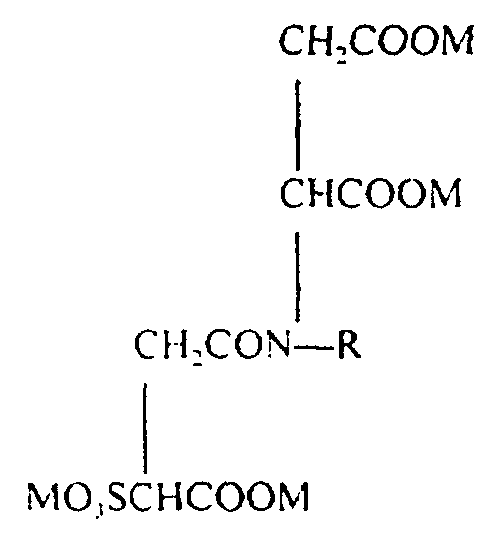
- The ink according to Claim 1, wherein the dispersant is tetrasodium N-(1,2-dicarboxyethyl)-N-octadecyl sulfosuccinamate present in an amount ranging from about 0.01 to about 6 percent by weight of the total ink composition.
- The ink according to Claim 1, further comprising a humectant and an aldehyde naphthalene sulfonate dispersant.
- The ink according to any of Claims 1-3, further comprising additives selected from the group consisting of surfactants, biocides. fungicides, defoamers, corrosion inhibitors, viscosity modifiers, pH buffers, penetrants, sequestering agents, and combinations thereof.
- A method of making pigmented inks , comprising the step of mixingwhere M is selected from the group consisting of hydrogen ion, alkali metal ions, and quaternary ammonium ion and where R is an alkyl, alkenyl, aralkyl, or aryl group.(a) an aqueous medium,(b) a pigment, and(c) a dispersant comprising sulfosuccinamate represented by the following formula:

- The method according to Claim 5, wherein the sulfosuccinamate is tetrasodium N-(1,2-dicarboxyethyl)-N-octadecyl sulfosuccinamate.
- The method according to Claim 5 or Claim 6, further comprising the step of mixing additives selected from the group consisting of humectants. surfactants, biocides, fungicides, defoamers, corrosion inhibitors, viscosity modifiers, pH buffers, penetrants. sequestering agents, and combinations thereof.
- A use of pigmented inks comprising the step of: jetting inkjet ink from a cartridge to media, wherein the ink comprises an ink of any of Claims 1-7.
- An ink delivery system, comprising an inkjet cartridge and inkjet ink of any of Claims 1-7.
Applications Claiming Priority (3)
| Application Number | Priority Date | Filing Date | Title |
|---|---|---|---|
| US09/025,054 US5938830A (en) | 1998-02-17 | 1998-02-17 | Pigmented inks and N-(1,2-dicarboxyethyl)-N-disubstituted sulfosuccinamate dispersants used therewith |
| US25054 | 1998-02-17 | ||
| PCT/US1998/011091 WO1999041319A1 (en) | 1998-02-17 | 1998-06-01 | Pigmented inks and n-(1,2-dicarboxyethyl)-n-disubstituted sulfosuccinamate dispersants used therewith |
Publications (2)
| Publication Number | Publication Date |
|---|---|
| EP1056813A1 EP1056813A1 (en) | 2000-12-06 |
| EP1056813B1 true EP1056813B1 (en) | 2002-04-10 |
Family
ID=21823810
Family Applications (1)
| Application Number | Title | Priority Date | Filing Date |
|---|---|---|---|
| EP98926141A Expired - Lifetime EP1056813B1 (en) | 1998-02-17 | 1998-06-01 | Pigmented inks and n-(1,2-dicarboxyethyl)-n-disubstituted sulfosuccinamate dispersants used therewith |
Country Status (6)
| Country | Link |
|---|---|
| US (1) | US5938830A (en) |
| EP (1) | EP1056813B1 (en) |
| JP (1) | JP2002503745A (en) |
| AU (1) | AU7804698A (en) |
| DE (1) | DE69804867T2 (en) |
| WO (1) | WO1999041319A1 (en) |
Families Citing this family (4)
| Publication number | Priority date | Publication date | Assignee | Title |
|---|---|---|---|---|
| DE69828579T2 (en) * | 1997-07-28 | 2005-06-16 | Seiko Epson Corp. | Ink Composition |
| US6262207B1 (en) * | 1998-12-18 | 2001-07-17 | 3M Innovative Properties Company | ABN dispersants for hydrophobic particles in water-based systems |
| US20040016367A1 (en) * | 2002-03-12 | 2004-01-29 | Seiko Epson Corporation | Aqueous ink composition and ink jet recording process |
| DE10318233A1 (en) * | 2003-04-22 | 2004-11-11 | Clariant Gmbh | Water-based colorant preparations for ink jet printing |
Family Cites Families (11)
| Publication number | Priority date | Publication date | Assignee | Title |
|---|---|---|---|---|
| US4155773A (en) * | 1977-07-12 | 1979-05-22 | Hercules Incorporated | Process for producing pigmented resin particles |
| DE3115532A1 (en) * | 1980-04-17 | 1982-01-28 | Canon K.K., Tokyo | INK-JET RECORDING METHOD AND RECORDING INK FOR RECORDING ON AN IMAGE RECEIVER |
| US4427810A (en) * | 1981-05-04 | 1984-01-24 | Inmont Corporation | Continuous method of producing aqueous phthalocyanine pigment dispersions |
| US4959661A (en) * | 1989-09-28 | 1990-09-25 | Olin Hunt Specialty Products Inc. | Ink-jet printing process |
| EP0448055B1 (en) * | 1990-03-20 | 1996-01-03 | Mitsubishi Chemical Corporation | Recording liquid for ink jet recording |
| US5085698A (en) * | 1990-04-11 | 1992-02-04 | E. I. Du Pont De Nemours And Company | Aqueous pigmented inks for ink jet printers |
| US5840106A (en) * | 1995-11-13 | 1998-11-24 | Minnesota Mining And Manufacturing Company | Water-based pigmented inks |
| JPH09268266A (en) * | 1996-04-01 | 1997-10-14 | Toyo Ink Mfg Co Ltd | Ink jet recording liquid |
| US5725647A (en) * | 1996-11-27 | 1998-03-10 | Minnesota Mining And Manufacturing Company | Pigmented inks and humectants used therewith |
| US5741356A (en) * | 1996-12-20 | 1998-04-21 | Bayer Corporation | Process for surface-treated organic pigments |
| US5738206A (en) * | 1997-04-16 | 1998-04-14 | Leviton Manufacturing Co., Inc. | Child resistant switch lock |
-
1998
- 1998-02-17 US US09/025,054 patent/US5938830A/en not_active Expired - Fee Related
- 1998-06-01 WO PCT/US1998/011091 patent/WO1999041319A1/en not_active Ceased
- 1998-06-01 AU AU78046/98A patent/AU7804698A/en not_active Abandoned
- 1998-06-01 JP JP2000531505A patent/JP2002503745A/en active Pending
- 1998-06-01 DE DE69804867T patent/DE69804867T2/en not_active Expired - Fee Related
- 1998-06-01 EP EP98926141A patent/EP1056813B1/en not_active Expired - Lifetime
Also Published As
| Publication number | Publication date |
|---|---|
| DE69804867D1 (en) | 2002-05-16 |
| US5938830A (en) | 1999-08-17 |
| AU7804698A (en) | 1999-08-30 |
| DE69804867T2 (en) | 2002-11-28 |
| JP2002503745A (en) | 2002-02-05 |
| EP1056813A1 (en) | 2000-12-06 |
| WO1999041319A1 (en) | 1999-08-19 |
Similar Documents
| Publication | Publication Date | Title |
|---|---|---|
| EP0941292B1 (en) | Pigmented inks and humectants used therewith | |
| DE69700413T2 (en) | Ink jet recording method, device and materials | |
| EP0526198B1 (en) | Ink jet compositions and processes | |
| US5531816A (en) | Bleed-alleviated, waterfast, pigment-based ink-jet ink compositions | |
| US6475271B2 (en) | Ink jet ink compositions and printing processes | |
| US4959661A (en) | Ink-jet printing process | |
| EP0656406A2 (en) | Ink, and ink-jet recording method and instrument using the same | |
| DE69607932T2 (en) | Black-color leakage restriction using cationic surfactants | |
| EP0726299B1 (en) | Ink composition suitable for ink jet recording | |
| JPH05194887A (en) | Ink composition for ink jet printing | |
| US20030213402A1 (en) | Ink-jet ink compositions based on oil-in-water microemulsion forming nanoparticles upon application on a surface | |
| EP1056813B1 (en) | Pigmented inks and n-(1,2-dicarboxyethyl)-n-disubstituted sulfosuccinamate dispersants used therewith | |
| US6432183B1 (en) | Microemulsion techniques for ink jet inks | |
| EP0685536A1 (en) | Ink composition for ink jet recording | |
| JP2000327968A (en) | Colored microcapsule-dispersed aqueous jet ink | |
| JPH1088050A (en) | Ink | |
| US6254670B1 (en) | Additive for ink jet ink | |
| EP1828323B1 (en) | Restoration of black to color bleed performance of amphoteric pigment dispersion based inks of low pigment loads | |
| DE19720004C1 (en) | Ink-jet printing method and ink set for multi-color ink-jet printing | |
| JP4366558B2 (en) | Water-based ink set for inkjet and inkjet recording method | |
| EP0896037B1 (en) | Ink set for ink jet printers | |
| US6352340B1 (en) | Ink jet printing method using a pigmented ink | |
| JP3986593B2 (en) | Ink-jet ink composition based on aqueous pigment dispersion with reduced bleeding | |
| US6350028B1 (en) | Ink jet printing method using a pigmented ink composition |
Legal Events
| Date | Code | Title | Description |
|---|---|---|---|
| PUAI | Public reference made under article 153(3) epc to a published international application that has entered the european phase |
Free format text: ORIGINAL CODE: 0009012 |
|
| 17P | Request for examination filed |
Effective date: 20000906 |
|
| AK | Designated contracting states |
Kind code of ref document: A1 Designated state(s): DE FR GB IT NL |
|
| GRAG | Despatch of communication of intention to grant |
Free format text: ORIGINAL CODE: EPIDOS AGRA |
|
| 17Q | First examination report despatched |
Effective date: 20010306 |
|
| GRAG | Despatch of communication of intention to grant |
Free format text: ORIGINAL CODE: EPIDOS AGRA |
|
| GRAG | Despatch of communication of intention to grant |
Free format text: ORIGINAL CODE: EPIDOS AGRA |
|
| GRAH | Despatch of communication of intention to grant a patent |
Free format text: ORIGINAL CODE: EPIDOS IGRA |
|
| REG | Reference to a national code |
Ref country code: GB Ref legal event code: IF02 |
|
| GRAH | Despatch of communication of intention to grant a patent |
Free format text: ORIGINAL CODE: EPIDOS IGRA |
|
| GRAA | (expected) grant |
Free format text: ORIGINAL CODE: 0009210 |
|
| AK | Designated contracting states |
Kind code of ref document: B1 Designated state(s): DE FR GB IT NL |
|
| REF | Corresponds to: |
Ref document number: 69804867 Country of ref document: DE Date of ref document: 20020516 |
|
| PGFP | Annual fee paid to national office [announced via postgrant information from national office to epo] |
Ref country code: NL Payment date: 20020522 Year of fee payment: 5 |
|
| PGFP | Annual fee paid to national office [announced via postgrant information from national office to epo] |
Ref country code: DE Payment date: 20020620 Year of fee payment: 5 |
|
| ET | Fr: translation filed | ||
| PLBE | No opposition filed within time limit |
Free format text: ORIGINAL CODE: 0009261 |
|
| STAA | Information on the status of an ep patent application or granted ep patent |
Free format text: STATUS: NO OPPOSITION FILED WITHIN TIME LIMIT |
|
| 26N | No opposition filed |
Effective date: 20030113 |
|
| PG25 | Lapsed in a contracting state [announced via postgrant information from national office to epo] |
Ref country code: NL Free format text: LAPSE BECAUSE OF NON-PAYMENT OF DUE FEES Effective date: 20040101 Ref country code: DE Free format text: LAPSE BECAUSE OF NON-PAYMENT OF DUE FEES Effective date: 20040101 |
|
| NLV4 | Nl: lapsed or anulled due to non-payment of the annual fee |
Effective date: 20040101 |
|
| PGFP | Annual fee paid to national office [announced via postgrant information from national office to epo] |
Ref country code: GB Payment date: 20040526 Year of fee payment: 7 |
|
| PGFP | Annual fee paid to national office [announced via postgrant information from national office to epo] |
Ref country code: FR Payment date: 20040618 Year of fee payment: 7 |
|
| PG25 | Lapsed in a contracting state [announced via postgrant information from national office to epo] |
Ref country code: IT Free format text: LAPSE BECAUSE OF NON-PAYMENT OF DUE FEES Effective date: 20050601 Ref country code: GB Free format text: LAPSE BECAUSE OF NON-PAYMENT OF DUE FEES Effective date: 20050601 |
|
| PG25 | Lapsed in a contracting state [announced via postgrant information from national office to epo] |
Ref country code: FR Free format text: LAPSE BECAUSE OF NON-PAYMENT OF DUE FEES Effective date: 20060228 |
|
| GBPC | Gb: european patent ceased through non-payment of renewal fee |
Effective date: 20050601 |
|
| REG | Reference to a national code |
Ref country code: FR Ref legal event code: ST Effective date: 20060228 |