EP1056303A2 - Multimode radiotelephone - Google Patents
Multimode radiotelephone Download PDFInfo
- Publication number
- EP1056303A2 EP1056303A2 EP00304423A EP00304423A EP1056303A2 EP 1056303 A2 EP1056303 A2 EP 1056303A2 EP 00304423 A EP00304423 A EP 00304423A EP 00304423 A EP00304423 A EP 00304423A EP 1056303 A2 EP1056303 A2 EP 1056303A2
- Authority
- EP
- European Patent Office
- Prior art keywords
- carrier
- channels
- frequency
- channel
- gsm1900
- Prior art date
- Legal status (The legal status is an assumption and is not a legal conclusion. Google has not performed a legal analysis and makes no representation as to the accuracy of the status listed.)
- Withdrawn
Links
Images

Classifications
-
- H—ELECTRICITY
- H04—ELECTRIC COMMUNICATION TECHNIQUE
- H04W—WIRELESS COMMUNICATION NETWORKS
- H04W48/00—Access restriction; Network selection; Access point selection
- H04W48/18—Selecting a network or a communication service
-
- H—ELECTRICITY
- H04—ELECTRIC COMMUNICATION TECHNIQUE
- H04W—WIRELESS COMMUNICATION NETWORKS
- H04W88/00—Devices specially adapted for wireless communication networks, e.g. terminals, base stations or access point devices
- H04W88/02—Terminal devices
- H04W88/06—Terminal devices adapted for operation in multiple networks or having at least two operational modes, e.g. multi-mode terminals
Definitions
- This invention relates in general to the field of mobile terminals, such as cellular telephones, and more particularly relates to multi-mode, dual band mobile terminals.
- GSM1900 Global System for Mobile Communications (GSM), 1900 MHz) service and one for AMPS (Advanced Mobile Phone Service (AMPS), 800 MHz) service.
- GSM1900 Global System for Mobile Communications
- AMPS Advanced Mobile Phone Service
- 800 MHz 800 MHz
- TDMA1900 and AMPS channels have a width of 30kHz
- GSM1900 employs a 200kHz channel width.
- DAMPS Digital AMPS
- GSM1900 mobile terminal Recently some network providers have expressed an interest providing a Digital AMPS (DAMPS) plus GSM1900 mobile terminal. As can be appreciated, due to cost and size constraints it would be very desirable to provide a single receiver in the mobile terminal, as opposed to two separate receivers (one for each band of interest).
- a single receiver mobile terminal would normally contain only one crystal oscillator, and as a result only one system-specific baseband (BB) clock can be derived at any given time (typically by using a phase locked loop (PLL)).
- PLL phase locked loop
- the mobile terminal happens to be camped on a low priority network, it must periodically search for a higher priority network. Since, for example, the GSM1900 and DAMPS networks cannot communicate their presence to the mobile terminal, the mobile terminal must be able to search for the higher priority network itself. However, the mobile terminal does not know a priori which channels are TDMA1900, CDMA1900 or GSM1900 channels.
- the mobile terminal must then periodically change its BB clock frequency when searching for other (higher priority) channels, then synchronization is lost to the current channel on which the mobile station is camped. Since this channel will normally be a channel on which the mobile terminal receives pages, which inform the mobile terminal of the presence of an incoming call, it is possible that the mobile terminal can miss incoming calls when searching for other networks. This is obviously an undesirable situation from both the user's and the network operator's point of view.
- FFT Fast Fourier Transform
- the present invention seeks to provide a technique that enables a mobile terminal to identify and distinguish transmissions from different wireless services, without having to retune a baseband clock that is used to receive pages.
- the present invention also seeks to provide a multi-mode, dual band mobile terminal having an ability to recognize and distinguish, by example, a GSM1900 channel from a TDMA1900 channel or a CDMA1900 channel, without having to use the GSM1900-specific baseband clock, thereby reducing unnecessary baseband clock changes and a number of missed pages from a currently serving system.
- the present invention seeks to provide a multi-mode, dual band mobile terminal having an ability to recognize and distinguish, by example, a CDMA800 carrier from a TDMA800/AMPS carrier.
- a mobile terminal comprising a receiver having a first filter with a first bandwidth; a second filter with a second bandwidth, wherein the first bandwidth is greater than the second bandwidth, said receiver having an output providing a received signal strength indication (RSSI); a controller coupled to said receiver for identifying a presence of a first carrier that is channelized into first channels having a first bandwidth, and for distinguishing the first carrier from a second carrier that is channelized into second channels having a second bandwidth, wherein the first carrier and the second carrier each occupy at least a portion of a same first frequency band; and means for tuning said receiver to a frequency of one of said first channels and for determining a RSSI value for a received signal filtered through said first filter, wherein said controller being responsive to a condition that the RSSI value is above a predetermined threshold for converting the frequency of the one of the first channels into a frequency of a corresponding one of said second channels in accordance with a predetermined relationship, and for ret
- RSSI received signal strength indication
- This invention teaches a technique to identify and distinguish, for example, a GSM1900 carrier from a TDMA1900 or a CDMA1900 carrier, without requiring a change to the system-specific BB clock frequency.
- the use of this invention thus aids in avoiding unnecessary BB clock frequency changes.
- the mobile terminal constructed and operated in accordance with this invention accomplishes this important function by selectively filtering and then measuring received signal levels.
- a specific method for identifying a GSM1900 channel with an AMPS/TDMA800/TDMA1900/GSM1900 dual band, quadruple mode mobile terminal when operating in the 800MHz band in the AMPS or the TDMA800 mode.
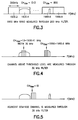
- the mobile terminal measures Received Signal Strength Indicator (RSSI) levels in a candidate GSM1900 MHz channel through a 30kHz bandpass filter, and a 200kHz bandwidth GSM1900 channel is identified if the RSSI values of at least three adjacent 30kHz channel measurements are sufficiently close together.
- RSSI Received Signal Strength Indicator
- the mobile terminal is enabled to recognize and distinguish a GSM1900 carrier from a TDMA1900 or a CDMA1900 carrier, without requiring a change in the system-specific baseband clock frequency.
- a TDMA800/AMPS carrier can be distinguished from a CDMA800 carrier (1.23MHz bandwidth).
- the mobile terminal is enabled to reduce unnecessary baseband clock frequency changes, and thus reduces the chance that a page will be missed during a search for another network.
- the method in accordance with this invention employs a technique based on a frequency spectrum analysis, and exploits to advantage the fact that the GSM1900 channel width is 200kHz, that the TDMA800/AMPS/TDMA1900 channel width is 30kHz, and that the CDMA800 channel width is 1.23MHz.
- This invention thus provide a method for use by a multi-mode, dual band mobile terminal for identifying a presence of a GSM1900 carrier that is channelized into first channels having a bandwidth of 200kHz, and for distinguishing the GSM1900 carrier from at least a TDMA1900 carrier that is channelized into second channels having a bandwidth of 30kHz.
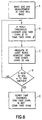
- the method includes steps of (a) tuning a receiver to a frequency of a candidate GSM1900 channel; (b) determining a value of a received signal strength indicator (RSSI) using a 200kHz receiver passband filter; (c) if the RSSI value is above a predetermined threshold, converting the frequency of the candidate GSM1900 channel into a frequency of a TDMA1900 channel using a predetermined relationship; (d) retuning the receiver to the frequency of the TDMA1900 channel; (e) determining a RSSI value using a 30kHz receiver passband filter for the TDMA1900 channel, and also for at least two adjacent TDMA1900 channels, assuming that two adjacent TDMA1900 channels are not used together in a same cell; and, if the at least three RSSI values are all found to be approximately equal within some threshold value, (f) making at least an initial assumption of the presence of the GSM1900 carrier.
- a further step can be executed of verifying that the assumed GSM1900 carrier
- the method has an initial step of camping on a channel of a carrier in another frequency band (e.g., a TDMA800 channel), and the steps of tuning and retuning are executed without changing a baseband clock frequency from a frequency associated with the channel that the mobile terminal is camped on.
- a channel of a carrier in another frequency band e.g., a TDMA800 channel
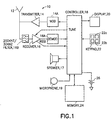
- the mobile terminal 10 is assumed to be a dual band (800MHz/1900MHz), quadruple mode (AMPS/TDMA800/TDMA1900/GSM1900) mobile terminal employing a single receiver and baseband circuitry.
- AMPS/TDMA800/TDMA1900/GSM1900 quadruple mode
- this specific embodiment is not to be read in a limiting sense upon the practice of this invention.
- the mobile terminal 10 includes a modulator (MOD) 14A, a transmitter 14, the single receiver 16 with a demodulator (DEMOD) 16A, and a controller 18 that provides signals to and receives signals from the transmitter 14 and receiver 16, respectively. These signals include signaling information in accordance with the air interface standard of the applicable wireless system, and also user speech and/or user generated data. It is understood that the controller 18 also includes the circuitry required for implementing the audio and logic functions of the mobile terminal. By example, the controller 18 may be comprised of a digital signal processor device, a microprocessor device, and various analog to digital converters, digital to analog converters, and other support circuits. The control and signal processing functions of the mobile terminal are allocated between these devices according to their respective capabilities.
- the receiver 16 is shown to include a filter 16B, which can be taken to represent a 200kHz passband filter as well as a 30kHz bandpass filter. While in practice two separate filters may be provided, it is also within the scope of the teaching of this invention to provide a single filter having a variable and programmable passband.
- the receiver 16 outputs a RSSI signal to the controller 18.
- the generation of the RSSI signal may be conventional in practice; for example it may be derived from an intermediate frequency (IF) stage of the receiver 16.
- IF intermediate frequency
- the receiver 16 is assumed to be tunable over a range of frequencies in both the 800MHz and 1900MHz bands, under the control of a TUNE signal from the controller 18, and the baseband clock is derived from the receive clock.
- a user interface includes a conventional earphone or speaker 17, a conventional microphone 19, a display 20, and a user input device, typically a keypad 22, all of which are coupled to the controller 18.
- the keypad 22 includes the conventional numeric (0-9) and related keys (#,*) 22a, and other keys 22b used for operating the mobile terminal 10 such as, by example, a SEND key, various menu scrolling and soft keys, and a PWR key.
- the mobile terminal 10 also includes a battery 26 for powering the various circuits that are required to operate the mobile terminal, as well as various memories, shown collectively as the memory 24.
- the memory 24 is assumed to contain a stored program for causing the controller 18 to execute a method in accordance with this invention.
- the GSM1900 carrier is identified from TDMA1900 or CDMA1900 carriers by the following method. Reference should also be had to the logic flow diagram of Fig. 6.
- the CDMA1900 channels are spaced apart by 1.23MHz, in the same manner as the CDMA800 channels. If the GSM1900 network is well planned, then it will not have adjacent channels in use in the same cell, similar to the TDMA1900 case. As such, if in Step D it is determined that a particular channel is possibly a GSM1900 channel, the method will measure the neighbor GSM1900 channel, through the 30kHz filter, and it will be detected that there are not the three adjacent channels with about the same signal levels. If however, it is detected that the three adjacent channels do exhibit about the same signal level, then the adjacent channel is possibly a CDMA1900 channel, otherwise it is a GSM1900 channel.
- the possible presence of a CDMA800 carrier is determined by verifying that adjacent 30kHz channel levels are not too close to one another.
Landscapes
- Engineering & Computer Science (AREA)
- Computer Security & Cryptography (AREA)
- Computer Networks & Wireless Communication (AREA)
- Signal Processing (AREA)
- Mobile Radio Communication Systems (AREA)
Abstract
Description
The
Claims (17)
- A method for use by a mobile terminal for identifying a presence of a first carrier that is channelized into first channels having a first bandwidth, and for distinguishing the first carrier from a second carrier that is channelized into second channels having a second bandwidth, where the first carrier and the second carrier each occupy at least a portion of a same first frequency band, and wherein the first bandwidth is greater than a second bandwidth, comprising steps of:tuning a receiver to a frequency of one of said first channels and determining a received signal strength indication for a received signal filtered through a filter having a first passband;if the received signal strength indication is above a predetermined threshold, converting the frequency of the first channels into a frequency of a corresponding one of said second channels in accordance with a predetermined relationship, and tuning the receiver to the frequency of the corresponding one of the second channels;determining a plurality of received signal strength indications for a received signal filtered through a filter having a second passband for the corresponding one of the second channels and also for a plurality of adjacent second channels; andif the plurality of received signal strength indications are substantially equal, within some threshold value, verifying the presence of the first carrier.
- A method as in claim 1, wherein the first carrier is associated with a GSM1900 carrier.
- A method as in claim 2, wherein the second carrier is associated with a TDMA1900 carrier.
- A method as in claim 3, wherein the step of verifying operates to verify that the second carrier is not associated with a CDMA1900 carrier.
- A method as in any preceding claim, wherein the first bandwidth and passband is 200kHz and the second bandwidth and passband is 30kHz.
- A method as in any preceding claim, and comprising an initial step of camping on a channel of a carrier in a second frequency band, and wherein the steps of tuning are executed without changing a baseband clock frequency from a frequency associated with the channel that the mobile terminal is camped on.
- A method as in claim 6, wherein the first frequency band is the 1900MHz band, and wherein the second frequency band is the 800MHz band.
- A mobile terminal comprising a receiver having a first filter with a first bandwidth; a second filter with a second bandwidth, wherein the first bandwidth is greater than the second bandwidth, said receiver having an output providing a received signal strength indication (RSSI); a controller coupled to said receiver for identifying a presence of a first carrier that is channelized into first channels having a first bandwidth, and for distinguishing the first carrier from a second carrier that is channelized into second channels having a second bandwidth, wherein the first carrier and the second carrier each occupy at least a portion of a same first frequency band; and means for tuning said receiver to a frequency of one of said first channels and for determining a RSSI value for a received signal filtered through said first filter, wherein said controller being responsive to a condition that the RSSI value is above a predetermined threshold for converting the frequency of the one of the first channels into a frequency of a corresponding one of said second channels in accordance with a predetermined relationship, and for retuning the receiver to the frequency of the corresponding one of the second channels and then determining a plurality of received signal strength indications, for a received signal filtered through said second filter, for the corresponding one of the second channels and also for a plurality of adjacent second channels; and said controller being responsive to a condition wherein the plurality of received signal strength indications are substantially equal, within some threshold value, for verifying the presence of the first carrier.
- A mobile terminal as in claim 8, wherein the first carrier is associated with a GSM1900 carrier, wherein the second carrier is associated with a TDMA1900 carrier, and wherein the first bandwidth and passband is 200kHz and the second bandwidth and passband is 30kHz.
- A mobile terminal as in claim 9, wherein the stored program operates to verify that the second carrier is not associated with a CDMA1900 carrier.
- A mobile terminal as in any of claims 8 to 10, wherein said mobile terminal is initially camped on a channel of a carrier in a second frequency band, and the receiver is tuned and retuned without changing a baseband clock frequency from a frequency associated with the channel that the mobile terminal is camped on.
- A mobile terminal as in claim 11, wherein the first frequency band is the 1900MHz band, and wherein the second frequency band is the 800MHz band.
- A method for use by a multi-mode, dual band mobile terminal for identifying a presence of a GSM1900 carrier that is channelized into first channels having a bandwidth of 200kHz, and for distinguishing the GSM1900 carrier from at least a TDMA1900 carrier that is channelized into second channels having a bandwidth of 30kHz, comprising steps of:tuning a receiver to a frequency of a GSM1900 channel;determining a value of a received signal strength indicator (RSSI) using a 200kHz receiver passband filter;if the RSSI value is above a predetermined threshold, converting the candidate GSM1900 channel number into a frequency of an equivalent TDMA1900 channel using a predetermined relationship;retuning the receiver to the frequency of the equivalent TDMA1900 channel;determining a RSSI value using a 30kHz receiver passband filter for the equivalent TDMA1900 channel, and also for at least two adjacent TDMA1900 channels, assuming that two adjacent TDMA1900 channels are not used together in a same cell; andif the at least three RSSI values are all found to be approximately equal, within some threshold value, making at least an initial assumption of the presence of the GSM1900 carrier.
- A method as in claim 13, and further comprising a step of verifying that the assumed GSM1900 carrier is not actually a CDMA1900 carrier.
- A method as in claim 13 or 14, and comprising an initial step of camping on a channel of a carrier in another frequency band, and wherein the steps of tuning and retuning are executed without changing a baseband clock frequency from a frequency associated with the channel that the mobile terminal is camped on.
- A method as in claim 15, and wherein the other frequency band is the 800MHz band.
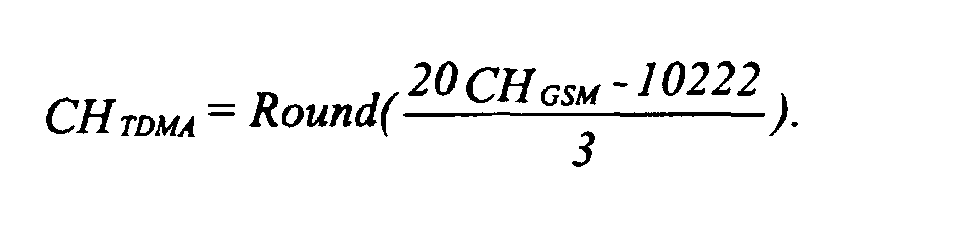
- A method as in any of claims 13 to 16, wherein the step of converting the GSM1900 channel number to an equivalent TDMA1900 channel number is accomplished according to the following formula:

Applications Claiming Priority (2)
| Application Number | Priority Date | Filing Date | Title |
|---|---|---|---|
| US320634 | 1999-05-26 | ||
| US09/320,634 US6487399B1 (en) | 1999-05-26 | 1999-05-26 | Mobile terminal employing 30kHz/200kHz carrier identification |
Publications (2)
| Publication Number | Publication Date |
|---|---|
| EP1056303A2 true EP1056303A2 (en) | 2000-11-29 |
| EP1056303A3 EP1056303A3 (en) | 2001-04-11 |
Family
ID=23247272
Family Applications (1)
| Application Number | Title | Priority Date | Filing Date |
|---|---|---|---|
| EP00304423A Withdrawn EP1056303A3 (en) | 1999-05-26 | 2000-05-24 | Multimode radiotelephone |
Country Status (4)
| Country | Link |
|---|---|
| US (1) | US6487399B1 (en) |
| EP (1) | EP1056303A3 (en) |
| JP (1) | JP2001016164A (en) |
| CA (1) | CA2299942C (en) |
Cited By (6)
| Publication number | Priority date | Publication date | Assignee | Title |
|---|---|---|---|---|
| EP1337041A1 (en) * | 2002-02-14 | 2003-08-20 | Mitsubishi Denki Kabushiki Kaisha | Frequency selection method and receiver |
| WO2003107554A1 (en) * | 2002-06-14 | 2003-12-24 | Qualcomm Incorporated | Frequency scan for cdma acquisition |
| GB2409606A (en) * | 2003-12-23 | 2005-06-29 | Nec Technologies | Cellular network identification and acquisition |
| EP1855395A1 (en) * | 2006-05-08 | 2007-11-14 | Siemens Aktiengesellschaft | Method for signal transmission in a radio communication system |
| US20140357268A1 (en) * | 2013-06-03 | 2014-12-04 | Qualcomm Incorporated | Method and apparatus for efficient radio access technology frequency scanning based on false alarms |
| WO2015130710A1 (en) * | 2014-02-26 | 2015-09-03 | Qualcomm Incorporated | Power scan optimization |
Families Citing this family (15)
| Publication number | Priority date | Publication date | Assignee | Title |
|---|---|---|---|---|
| US20020145987A1 (en) * | 2001-04-10 | 2002-10-10 | Hans Carlsson | Wireless network architecture for GPRS over 30kHz channels |
| US7006797B1 (en) | 2001-05-21 | 2006-02-28 | Counter Technologies, Llc | Coherence frequency determining system and associated radio apparatus |
| US7190937B1 (en) * | 2001-05-21 | 2007-03-13 | Counter Technologies, Llc | Method for determining the frequency of a radio signal and monitoring communications with a radio receiver |
| US8364159B2 (en) * | 2002-02-11 | 2013-01-29 | Qualcomm Incorporated | Method and apparatus for monitoring a channel during an active session in a wireless communication system |
| JP4066165B2 (en) * | 2002-12-04 | 2008-03-26 | 日本電気株式会社 | Cell search method for mobile radio terminal compatible with multiple mobile telephone systems |
| US7340266B2 (en) * | 2002-12-20 | 2008-03-04 | Motorola, Inc. | Method and apparatus for communicating with multimode receiving device in non-synchronized wireless systems |
| US20040224684A1 (en) * | 2003-05-07 | 2004-11-11 | Dorsey Donald A. | Method for a radiotelephone to search for higher priority networks |
| CN1799203B (en) * | 2003-06-04 | 2010-12-01 | Nxp股份有限公司 | Adaptive Intermodulation Distortion Filter for Zero-IF Receiver |
| US7400904B2 (en) * | 2004-12-03 | 2008-07-15 | Itron, Inc. | Dual mode AM-FM receiver with I-Q decoding, such as for utility data collection |
| JP4552732B2 (en) * | 2005-03-30 | 2010-09-29 | 日本電気株式会社 | Wireless receiving apparatus and transmission / reception mode determination method |
| KR100730238B1 (en) | 2006-01-03 | 2007-06-19 | 연세대학교 산학협력단 | Heterogeneous wireless network system and its data communication method |
| US7865156B2 (en) * | 2006-04-28 | 2011-01-04 | Research In Motion Limited | Scanning methods and apparatus which utilize a carrier signal bandwidth test |
| US8326294B2 (en) * | 2009-11-19 | 2012-12-04 | Qualcomm Incorporated | Devices and methods for wireless system acquisition |
| US10701731B2 (en) * | 2016-03-23 | 2020-06-30 | Telefonaktiebolaget Lm Ericsson (Publ) | Determining whether to transmit data on a candidate radio channel |
| CN110572222B (en) * | 2019-07-24 | 2022-02-11 | 浙江三维通信科技有限公司 | Filter-based method and system for identifying BCCH carrier in GSM carrier |
Family Cites Families (12)
| Publication number | Priority date | Publication date | Assignee | Title |
|---|---|---|---|---|
| US4556760A (en) | 1984-06-11 | 1985-12-03 | Itt Corporation | Hand-off filter for cellular mobile radio |
| US5020093A (en) | 1989-06-23 | 1991-05-28 | Motorola, Inc. | Cellular telephone operable on different cellular telephone systems |
| US5168508A (en) | 1990-08-07 | 1992-12-01 | Clarion Co., Ltd. | Spread spectrum receiver |
| US5711001A (en) | 1992-05-08 | 1998-01-20 | Motorola, Inc. | Method and circuit for acquisition by a radio receiver |
| US5442806A (en) | 1993-06-08 | 1995-08-15 | Oki Telecom | Preferred carrier selection method for selecting any available cellular carrier frequency when neither home nor preferred cellular carrier frequencies are available |
| US5640385A (en) | 1994-01-04 | 1997-06-17 | Motorola, Inc. | Method and apparatus for simultaneous wideband and narrowband wireless communication |
| JPH08154062A (en) | 1994-11-28 | 1996-06-11 | Nec Corp | Band switched receiving system using signal quality |
| CA2188330C (en) * | 1995-12-12 | 2001-04-24 | Michael D. Bamburak | A method for selecting a wireless communications service provider in a multi-service provider environment |
| JPH09326713A (en) * | 1996-06-05 | 1997-12-16 | Sharp Corp | Dual-mode cellular telephone system |
| JP3985299B2 (en) * | 1997-07-14 | 2007-10-03 | 三菱電機株式会社 | Mobile communication system |
| US6229996B1 (en) * | 1997-12-12 | 2001-05-08 | Nokia Mobile Phones Limited | Method and apparatus for increasing a probability that a dual-band mobile station will acquire a desired autonomous system |
| US6205334B1 (en) * | 1998-11-24 | 2001-03-20 | Ericsson Inc. | Accelerated scanning of cellular channels by cellular radiotelephones |
-
1999
- 1999-05-26 US US09/320,634 patent/US6487399B1/en not_active Expired - Fee Related
-
2000
- 2000-03-03 CA CA002299942A patent/CA2299942C/en not_active Expired - Fee Related
- 2000-05-24 EP EP00304423A patent/EP1056303A3/en not_active Withdrawn
- 2000-05-26 JP JP2000161153A patent/JP2001016164A/en active Pending
Cited By (11)
| Publication number | Priority date | Publication date | Assignee | Title |
|---|---|---|---|---|
| EP1337041A1 (en) * | 2002-02-14 | 2003-08-20 | Mitsubishi Denki Kabushiki Kaisha | Frequency selection method and receiver |
| WO2003107554A1 (en) * | 2002-06-14 | 2003-12-24 | Qualcomm Incorporated | Frequency scan for cdma acquisition |
| US7593367B2 (en) | 2002-06-14 | 2009-09-22 | Qualcomm Incorporated | Frequency scan for CDMA acquisition |
| EP2445116A3 (en) * | 2002-06-14 | 2013-04-24 | Qualcomm Incorporated | Frequency Scan For CDMA Acquisition |
| GB2409606A (en) * | 2003-12-23 | 2005-06-29 | Nec Technologies | Cellular network identification and acquisition |
| GB2409606B (en) * | 2003-12-23 | 2005-11-23 | Nec Technologies | Cellular network acquisition method and apparatus |
| EP1855395A1 (en) * | 2006-05-08 | 2007-11-14 | Siemens Aktiengesellschaft | Method for signal transmission in a radio communication system |
| US20140357268A1 (en) * | 2013-06-03 | 2014-12-04 | Qualcomm Incorporated | Method and apparatus for efficient radio access technology frequency scanning based on false alarms |
| WO2014197209A3 (en) * | 2013-06-03 | 2015-03-12 | Qualcomm Incorporated | Method and apparatus for efficient radio access technology frequency scanning based on false alarms |
| WO2015130710A1 (en) * | 2014-02-26 | 2015-09-03 | Qualcomm Incorporated | Power scan optimization |
| US9288761B2 (en) | 2014-02-26 | 2016-03-15 | Qualcomm Incorporated | Power scan optimization |
Also Published As
| Publication number | Publication date |
|---|---|
| JP2001016164A (en) | 2001-01-19 |
| EP1056303A3 (en) | 2001-04-11 |
| US6487399B1 (en) | 2002-11-26 |
| CA2299942C (en) | 2009-05-19 |
| CA2299942A1 (en) | 2000-11-26 |
Similar Documents
| Publication | Publication Date | Title |
|---|---|---|
| CA2299942C (en) | Mobile terminal employing 30khz/200khz carrier identification | |
| EP1131968B1 (en) | Accelarated scanning of cellular channels by cellular radiotelephones | |
| RU2336638C2 (en) | Multimode device and method of mobile communication, involving receivers operating simultaneously | |
| CA2070768C (en) | Apparatus and method for detecting intermodulation distortion in a radio frequency receiver | |
| EP2135363B1 (en) | Method and detection device for determining whether a specific channel is available for use in an environment in which multiple networks are coexistable | |
| EP2632206B1 (en) | Parallel Multi-Rat PLMN Search | |
| US9113399B2 (en) | Method for searching for a radio cell and mobile terminal | |
| US20110312274A1 (en) | Radio communication device, receiver controller of a radio communication device, methods for searching for a radio cell | |
| KR20020055891A (en) | Information service method of mobile station | |
| MXPA05006864A (en) | Method, apparatus, and system for selecting a service provider system. | |
| US5903839A (en) | Method and apparatus to provide manual reselection on a digital control channel | |
| WO2004010719A1 (en) | Method and apparatus for acquiring a carrier frequency in a cdma communication system | |
| JP2009239914A (en) | Cell selection techniques for frequency division multiple access systems. | |
| US6119002A (en) | Mobile station having methods and apparatus for performing neighbor channel measurements from analog control channel | |
| US20060153141A1 (en) | Method and apparatus for acquiring a carrier frequency in a CDMA communication system | |
| WO1987005458A1 (en) | A method of operating a radio transmission or communication system including a central station and a plurality of individual remote stations, a radio transmission or communication system, and a remote station | |
| US5940760A (en) | Method and apparatus to reduce non-public mode search time in a mobile station | |
| HK1033873A (en) | Multimode radiotelephone | |
| KR100661211B1 (en) | Periodic recheck of the DCH pointer channel while camping on the ACC | |
| JP3910764B2 (en) | Mobile radio terminal device | |
| EP2420092B1 (en) | Method for processing a frequency band by a wireless communication device and corresponding device | |
| WO2000065729A1 (en) | Method for rejecting a control channel during a registration process | |
| KR20080019029A (en) | Interference reduction methods, mobile stations, network elements, systems, computer-readable recording media and integrated circuits |
Legal Events
| Date | Code | Title | Description |
|---|---|---|---|
| PUAI | Public reference made under article 153(3) epc to a published international application that has entered the european phase |
Free format text: ORIGINAL CODE: 0009012 |
|
| AK | Designated contracting states |
Kind code of ref document: A2 Designated state(s): AT BE CH CY DE DK ES FI FR GB GR IE IT LI LU MC NL PT SE |
|
| AX | Request for extension of the european patent |
Free format text: AL;LT;LV;MK;RO;SI |
|
| PUAL | Search report despatched |
Free format text: ORIGINAL CODE: 0009013 |
|
| AK | Designated contracting states |
Kind code of ref document: A3 Designated state(s): AT BE CH CY DE DK ES FI FR GB GR IE IT LI LU MC NL PT SE |
|
| AX | Request for extension of the european patent |
Free format text: AL;LT;LV;MK;RO;SI |
|
| RIC1 | Information provided on ipc code assigned before grant |
Free format text: 7H 04Q 7/32 A, 7H 04Q 7/38 B, 7H 04B 17/00 B, 7H 04B 1/10 B |
|
| AKX | Designation fees paid | ||
| REG | Reference to a national code |
Ref country code: DE Ref legal event code: 8566 |
|
| RAP1 | Party data changed (applicant data changed or rights of an application transferred) |
Owner name: NOKIA CORPORATION |
|
| STAA | Information on the status of an ep patent application or granted ep patent |
Free format text: STATUS: THE APPLICATION IS DEEMED TO BE WITHDRAWN |
|
| 18D | Application deemed to be withdrawn |
Effective date: 20011012 |
|
| REG | Reference to a national code |
Ref country code: HK Ref legal event code: WD Ref document number: 1033873 Country of ref document: HK |