EP1056288A2 - Apparatus and method of recording audio and video signal - Google Patents
Apparatus and method of recording audio and video signal Download PDFInfo
- Publication number
- EP1056288A2 EP1056288A2 EP00304238A EP00304238A EP1056288A2 EP 1056288 A2 EP1056288 A2 EP 1056288A2 EP 00304238 A EP00304238 A EP 00304238A EP 00304238 A EP00304238 A EP 00304238A EP 1056288 A2 EP1056288 A2 EP 1056288A2
- Authority
- EP
- European Patent Office
- Prior art keywords
- recording
- video signal
- information
- protected
- storage medium
- Prior art date
- Legal status (The legal status is an assumption and is not a legal conclusion. Google has not performed a legal analysis and makes no representation as to the accuracy of the status listed.)
- Ceased
Links
Images


Classifications
-
- H—ELECTRICITY
- H04—ELECTRIC COMMUNICATION TECHNIQUE
- H04N—PICTORIAL COMMUNICATION, e.g. TELEVISION
- H04N21/00—Selective content distribution, e.g. interactive television or video on demand [VOD]
- H04N21/40—Client devices specifically adapted for the reception of or interaction with content, e.g. set-top-box [STB]; Operations thereof
- H04N21/43—Processing of content or additional data, e.g. demultiplexing additional data from a digital video stream; Elementary client operations, e.g. monitoring of home network or synchronising decoder's clock; Client middleware
- H04N21/433—Content storage operation, e.g. storage operation in response to a pause request, caching operations
- H04N21/4334—Recording operations
-
- H—ELECTRICITY
- H04—ELECTRIC COMMUNICATION TECHNIQUE
- H04N—PICTORIAL COMMUNICATION, e.g. TELEVISION
- H04N21/00—Selective content distribution, e.g. interactive television or video on demand [VOD]
- H04N21/40—Client devices specifically adapted for the reception of or interaction with content, e.g. set-top-box [STB]; Operations thereof
- H04N21/43—Processing of content or additional data, e.g. demultiplexing additional data from a digital video stream; Elementary client operations, e.g. monitoring of home network or synchronising decoder's clock; Client middleware
- H04N21/434—Disassembling of a multiplex stream, e.g. demultiplexing audio and video streams, extraction of additional data from a video stream; Remultiplexing of multiplex streams; Extraction or processing of SI; Disassembling of packetised elementary stream
- H04N21/4348—Demultiplexing of additional data and video streams
-
- H—ELECTRICITY
- H04—ELECTRIC COMMUNICATION TECHNIQUE
- H04N—PICTORIAL COMMUNICATION, e.g. TELEVISION
- H04N21/00—Selective content distribution, e.g. interactive television or video on demand [VOD]
- H04N21/40—Client devices specifically adapted for the reception of or interaction with content, e.g. set-top-box [STB]; Operations thereof
- H04N21/45—Management operations performed by the client for facilitating the reception of or the interaction with the content or administrating data related to the end-user or to the client device itself, e.g. learning user preferences for recommending movies, resolving scheduling conflicts
- H04N21/462—Content or additional data management e.g. creating a master electronic programme guide from data received from the Internet and a Head-end or controlling the complexity of a video stream by scaling the resolution or bit-rate based on the client capabilities
- H04N21/4627—Rights management associated to the content
-
- H—ELECTRICITY
- H04—ELECTRIC COMMUNICATION TECHNIQUE
- H04N—PICTORIAL COMMUNICATION, e.g. TELEVISION
- H04N21/00—Selective content distribution, e.g. interactive television or video on demand [VOD]
- H04N21/40—Client devices specifically adapted for the reception of or interaction with content, e.g. set-top-box [STB]; Operations thereof
- H04N21/47—End-user applications
- H04N21/472—End-user interface for requesting content, additional data or services; End-user interface for interacting with content, e.g. for content reservation or setting reminders, for requesting event notification, for manipulating displayed content
- H04N21/47214—End-user interface for requesting content, additional data or services; End-user interface for interacting with content, e.g. for content reservation or setting reminders, for requesting event notification, for manipulating displayed content for content reservation or setting reminders; for requesting event notification, e.g. of sport results or stock market
-
- H—ELECTRICITY
- H04—ELECTRIC COMMUNICATION TECHNIQUE
- H04N—PICTORIAL COMMUNICATION, e.g. TELEVISION
- H04N21/00—Selective content distribution, e.g. interactive television or video on demand [VOD]
- H04N21/40—Client devices specifically adapted for the reception of or interaction with content, e.g. set-top-box [STB]; Operations thereof
- H04N21/47—End-user applications
- H04N21/488—Data services, e.g. news ticker
- H04N21/4882—Data services, e.g. news ticker for displaying messages, e.g. warnings, reminders
-
- H—ELECTRICITY
- H04—ELECTRIC COMMUNICATION TECHNIQUE
- H04N—PICTORIAL COMMUNICATION, e.g. TELEVISION
- H04N21/00—Selective content distribution, e.g. interactive television or video on demand [VOD]
- H04N21/80—Generation or processing of content or additional data by content creator independently of the distribution process; Content per se
- H04N21/83—Generation or processing of protective or descriptive data associated with content; Content structuring
- H04N21/835—Generation of protective data, e.g. certificates
- H04N21/8355—Generation of protective data, e.g. certificates involving usage data, e.g. number of copies or viewings allowed
-
- H—ELECTRICITY
- H04—ELECTRIC COMMUNICATION TECHNIQUE
- H04N—PICTORIAL COMMUNICATION, e.g. TELEVISION
- H04N21/00—Selective content distribution, e.g. interactive television or video on demand [VOD]
- H04N21/80—Generation or processing of content or additional data by content creator independently of the distribution process; Content per se
- H04N21/83—Generation or processing of protective or descriptive data associated with content; Content structuring
- H04N21/84—Generation or processing of descriptive data, e.g. content descriptors
-
- H—ELECTRICITY
- H04—ELECTRIC COMMUNICATION TECHNIQUE
- H04N—PICTORIAL COMMUNICATION, e.g. TELEVISION
- H04N5/00—Details of television systems
- H04N5/76—Television signal recording
- H04N5/91—Television signal processing therefor
- H04N5/913—Television signal processing therefor for scrambling ; for copy protection
-
- H—ELECTRICITY
- H04—ELECTRIC COMMUNICATION TECHNIQUE
- H04N—PICTORIAL COMMUNICATION, e.g. TELEVISION
- H04N7/00—Television systems
- H04N7/16—Analogue secrecy systems; Analogue subscription systems
- H04N7/162—Authorising the user terminal, e.g. by paying; Registering the use of a subscription channel, e.g. billing
- H04N7/163—Authorising the user terminal, e.g. by paying; Registering the use of a subscription channel, e.g. billing by receiver means only
-
- H—ELECTRICITY
- H04—ELECTRIC COMMUNICATION TECHNIQUE
- H04N—PICTORIAL COMMUNICATION, e.g. TELEVISION
- H04N5/00—Details of television systems
- H04N5/76—Television signal recording
- H04N5/91—Television signal processing therefor
- H04N5/913—Television signal processing therefor for scrambling ; for copy protection
- H04N2005/91307—Television signal processing therefor for scrambling ; for copy protection by adding a copy protection signal to the video signal
- H04N2005/91328—Television signal processing therefor for scrambling ; for copy protection by adding a copy protection signal to the video signal the copy protection signal being a copy management signal, e.g. a copy generation management signal [CGMS]
-
- H—ELECTRICITY
- H04—ELECTRIC COMMUNICATION TECHNIQUE
- H04N—PICTORIAL COMMUNICATION, e.g. TELEVISION
- H04N5/00—Details of television systems
- H04N5/76—Television signal recording
- H04N5/78—Television signal recording using magnetic recording
- H04N5/782—Television signal recording using magnetic recording on tape
Definitions
- the present invention relates to recording audio and video signals transmitted by digital broadcasting.
- this invention relates to an audio and video signal recording apparatus having a preset recording function (presetting the preset data of TV programs which will be broadcast later, such as, TV channel, time, etc.) of recording audio and audio signals, such as, TV programs which will be broadcast later.
- a preset recording function presetting the preset data of TV programs which will be broadcast later, such as, TV channel, time, etc.
- Digital broadcasting via communications satellite has been very popular. Not only this, digital broadcasting via broadcasting satellite (BS), ground wave or cable is on drawing boards to start in a few years.
- Digital broadcasting transmits TV programs with copy information including recording inhibit information for TV programs which are inhibited from recording to secure copyrights thereon, due to the fact that digital signals are hardly degraded no matter how many times the signals are recorded.
- Conventional recording apparatus generate a copy guard signal for such TV programs on reception to allow viewers TV viewing but inhibit recording.
- the inventor has proposed a technique of TV-program recording inhibition for TV programs protected from recording by copyright, which is disclosed in Japanese Unexamined-Patent Publication No. 1999 (11)-32266.
- viewers preset TV-program recording while watching an on-screen program guide pre-stored in a digital broadcasting receiver.
- This technique also has the same drawback in that viewers guess wrong that recording has been set mistakenly or the receiver has been out of order. Viewers make such a wrong guess when recording inhibit information has not been recorded on the program guide or they preset recording without reference to the on screen-program guide.
- a purpose of the present invention is to provide an apparatus and a method of audio and video signal recording with a function to inform viewers that a TV program has not been recorded because it is protected by copyright, no matter how viewers preset recording, to avoid viewer's wrong guess such that recording has been set mistakenly or the recording apparatus is out of order.
- the present invention provides a recording apparatus including: a detector to detect auxiliary data carried by at least a video signal which is now being broadcast to decide whether or not the video signal is protected from recording; a recorder to record either the video signal or a predetermined information on a storage medium, the information suggesting that the video signal has not been recorded because it is protected from recording; and control means for controlling at least the recorder so that the video signal is recorded on the storage medium when the video signal is not protected from recording, on the other hand, the information is recorded on the storage medium when the video signal is protected from recording.
- the present invention provides a recording apparatus including: a detector to detect auxiliary data carried by at least a video signal which is now being broadcast to decide whether or not the video signal is protected from recording; a recorder to record the video signal on a storage medium when the video signal is not protected from recording; and means for outputting a predetermined information to a monitor screen or a speaker when the video signal is protected from recording, the information suggesting that the video signal has not been recorded because it is protected from recording, the monitor screen displaying or the speaker giving off the information when there is an attempt to reproduce the video signal from the storage medium.
- the present invention provides a recording method.
- Auxiliary data carried by at least a video signal which is now being broadcast is detected to decide whether or not the video signal is protected from recording.
- Either the video signal or a predetermined information is recorded on a storage medium.
- the first information suggests that the first video signal has not been recorded because it is protected from recording.
- the recording is controlled so that the video signal is recorded on the storage medium when the video signal is not protected from recording, on the other hand, the information is recorded on the storage medium when the video signal is protected from recording.
- the present invention provides a recording method.
- Auxiliary data carried by at least a video signal which is now being broadcast is detected to decide whether or not the video signal is protected from recording.
- the video signal is recorded on a storage medium when the video signal is not protected from recording.
- a predetermined information is output to a monitor screen or a speaker when the video signal is protected from recording. The information suggests that the video signal has not been recorded because it is protected from recording.
- the monitor screen displays or the speaker gives off the information when there is an attempt to reproduce the video signal from the storage medium.
- digital broadcasting transmits TV programs with copy information because digital signals are hardly degraded no matter how many times the signals are recorded.
- the copy information includes copy generation management system (CGMS) data that allows viewers watching only or allows recording only once, etc., to secure copyrights on particular TV programs.
- CGMS copy generation management system
- the present invention utilizes the CGMS data for effective TV-program preset recording.
- FIGS. 1 and 2 The first embodiment of an audio and video signal receiving apparatus according to the present invention is disclosed with reference to a block diagram and a flow chart shown in FIGS. 1 and 2, respectively.
- the audio and video signal recording apparatus shown in FIG. 1 is provided with a recording preset unit 6 that allows a viewer TV-program preset recording and stores the preset data, such as, recording starting and finishing time, a TV channel, and so on.
- the recording preset unit 6 sets a digital broadcasting receiver 2, a set-top-box (STB), to be tuned to the preset TV channel (STEP S12), and feeds a control signal to a controller 5 to start recording.
- STB set-top-box
- An electromagnetic wave carried by the 12-GHz band, for example, via a communications satellite is received by the STB 2 via an antenna 1 for demodulation, error-correction and separation into, for example, MPEG2-compressed video and audio data and other auxiliary data.
- the STB 2 and recording preset unit 6 may be separated from the audio and video recording apparatus shown in FIG. 1.
- the recording prest unit 6 sets the STB 2 to be tuned to the preset TV channel (STEP S12), turns on the recording apparatus and feeds a control signal to the controller 5 to start recording video and audio data (TV program) transmitted from the separate STB 2.
- the video and audio data, and the auxiliary data are fed to a switch 7.
- copy information indicating whether recording is allowed or not is fed to a CGMS detector 3 for deciding whether recording is allowed or not (STEP S13). The result is fed to the controller 5.
- the controller 5 controls the switch 7 to accept the data from the STB 2, and feeds it to a recorder 8 for recording on a storage medium (not shown), such as, a magnetic tape, a disk and a hard disk (STEP S15).
- a storage medium such as, a magnetic tape, a disk and a hard disk
- the controller 5 In case that the copy information indicates that recording is allowed for only once, the controller 5 generates a copy guard signal which is then recorded on the storage medium with the audio and video data, for prohibiting recording twice or more.
- the recording preset unit 6 feeds a control signal to the controller 5 to halt recording at the recorder 8 (STEP S17). Then, the TV-program recording process ends.
- the controller 5 controls the switch 7 to accept data from a memory 4 that has stored non-recording information (character data, still picture compressed data, etc.) indicating that the TV program has not been recorded because it is protected from recording.
- non-recording information character data, still picture compressed data, etc.
- the non-recording information is fed to the recorder 8 via the switch 7, and recorded on the storage medium for a predetermined period, such as, 15 seconds (STEP S18). Then, the TV-program recording process ends.
- the non-recording information will be displayed on a TV screen (not shown) when a viewer tries to reproduce the TV program, for informing him or her that the TV program has not been recorded because it is protected from recording. This avoids that a viewer guesses wrong such that recording has been set mistakenly or the recording apparatus has been out of order.
- the non-recording information stored in the memory 4 is character data, still picture compressed data, etc.
- a small storage capacity- and low cost-memory thus can be used as the memory 4.
- recording setting data stored in the recording preset unit 6 is converted into character data and supplied to the switch 7 via the controller 5 for storage onto the storage medium via the recorder 8 with the non-recording information stored in the memory 4.
- the character data can be displayed on the TV screen, when reproduced, such as illustrated in FIG. 3, to inform which TV program has not been recorded.
- the non-recording information is stored on the storage medium.
- a viewer can be informed, when he or she tries to reproduce the TV program by another reproducing apparatus, that the TV program has not been recorded due to copyright protection.
- FIGS. 4 and 5 The second embodiment of an audio and video signal recording apparatus according to the present invention is disclosed with reference to a block diagram and a flow chart shown in FIGS. 4 and 5, respectively.
- the second embodiment is provided with a memory 4a that has stored information, which will be recorded on a storage medium (not shown), indicating that a TV program has been protected from recording, and a memory 4b that has stored information, which will be displayed on a TV screen (not shown), indicating that a TV program for which a viewer is trying to preset recording with reference to an electronic program guide (EPG) has been protected from recording.
- a memory 4a that has stored information, which will be recorded on a storage medium (not shown), indicating that a TV program has been protected from recording
- a memory 4b that has stored information, which will be displayed on a TV screen (not shown), indicating that a TV program for which a viewer is trying to preset recording with reference to an electronic program guide (EPG) has been protected from recording.
- EPG electronic program guide
- the second embodiment is also provided with an EPG memory 90 for storing an electronic program guide transmitted via the antenna 1 and a STB 20 or through a phone line (not shown), and also a MPEG decoder 100 for decoding MPEG-compressed audio and video data.
- EPG memory 90 for storing an electronic program guide transmitted via the antenna 1 and a STB 20 or through a phone line (not shown)
- MPEG decoder 100 for decoding MPEG-compressed audio and video data.
- the STB 20, the EPG memory 90 and the recording preset unit 6 (surrounded by a dit line) can be separated from the audio and video signal recording apparatus shown in FIG. 4.
- a viewer selects a TV program which he or she wants to record, via a remote controller (not shown), with reference to the time and date of broadcasting, the list of TV programs, the program category, and so on, on the electronic program guide displayed on the TV screen (STEP S23).
- the copy information is fed from the EPG memory 90 to a CGMS detector 30 for decision of whether the selected TV program is protected from recording or not, and the result is informed to the controller 50 (STEP S24).
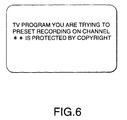
- the controller 50 controls the switch 70 to retrieve the information from the memory 4b to display on the TV-screen via the MPEG decoder 100 such that, as shown in FIG. 6, the TV program, you are trying to preset recording on channel XX, is protected by copyright (STEP S25), and the preset recording process ends.
- STEP S23 when no copy information is listed on the electronic program guide stored in the EPG memory 90, for example, due to mis-recording of copy information on the electronic program guide or when the copy information indicates that the selected TV program is permitted to record, TV-program recording is preset (STEP S26), and the process enters into the recording waiting mode (STEP S27). Then, the process goes to the recording process shown in FIG. 2.
- the process may go to the recording waiting mode (STEP S27).
- the non-recording information as shown in FIG. 3 will be recorded on the storage medium according to the ordinary processing (the first embodiment), however, the TV program can be recorded if it is allowed when actually broadcast.
- the message shown in FIG. 3 will be displayed when the viewer tries to reproduce a TV program which has been protected from recording.
- the message may be audio information or the combination of audio and video information, and which may be stored in the memory 4b as compressed data. These data will be decoded by the MPEG-decoder 100 and sent to the screen and speakers (not shown).
- the present invention when recording is preset for a TV program protected by copyright, the information indicating that the TV program has not been recorded due to copyright protection is recorded on a storage medium on which the TV program should have been recorded, thus achieving unnecessary recording.
- the present invention decides whether or not a TV program is allowed to record not by referring to an electronic program guide but to copy information carried by the TV program when actually broadcast. This avoids missing a chance to record a TV program which is allowed to record.
- the present invention also offers a recording apparatus without a STB and a recording preset unit.
- the recording apparatus detects copy information carried by a TV program which is being broadcast and supplied by the separate STB to decide whether the TV program is allowed to record.
- the first half the TV programs will be stored on a storage medium when recorded, and the message as shown in FIG. 3 will be stored on a storage medium at the time of broadcasting the latter half of the TV programs.
- the present invention can be applied to the situation where a viewer tries to record a TV program which is protected from recording and being broadcast now while he or she is viewing another TV program on different channel.
- a message, such as shown in FIG. 3 will also be stored on a storage medium for this situation.
Landscapes
- Engineering & Computer Science (AREA)
- Multimedia (AREA)
- Signal Processing (AREA)
- Computer Security & Cryptography (AREA)
- Databases & Information Systems (AREA)
- Business, Economics & Management (AREA)
- Finance (AREA)
- Strategic Management (AREA)
- Human Computer Interaction (AREA)
- Television Signal Processing For Recording (AREA)
- Signal Processing For Digital Recording And Reproducing (AREA)
Abstract
Description
Claims (11)
- A recording apparatus comprising:a first detector to detect auxiliary data carried by at least a first video signal which is now being broadcast to decide whether or not the first video signal is protected from recording;a recorder to record either the first video signal or a first predetermined information on a storage medium, the first information suggesting that the first video signal has not been recorded because it is protected from recording; andcontrolling means for controlling at least the recorder so that the first video signal is recorded on the storage medium when the first video signal is not protected from recording, on the other hand, the first information is recorded on the storage medium when the first video signal is protected from recording.
- The recording apparatus according to claim 1, wherein the controlling means retrieves either the first video signal or the first information from the storage medium and outputs the retrieved signal or information to a monitor screen for displaying either the signal or information, or supplies the retrieved information to a speaker for giving off the information.
- The recording apparatus according to claim 1 further comprising a first memory that has stored the first information, the controlling means retrieving the first information from the first memory and storing the retrieved information on the storage medium when the first video signal is protected from recording.
- The recording apparatus according to claim 2 further comprising presetting means for presetting and storing preset data of TV program which will be broadcast later.
- The recording apparatus according to claim 2 further comprising:presetting means for presetting recording of at least a second video signal which will be broadcast later, according to a pre-stored reference; anda second detector to detect the pre-stored reference to decide whether or not the second video signal is protected from recording,
wherein, when the second video signal is protected from recording, the controlling means outputs a second predetermined information to the monitor screen or speaker to display or give off the second information suggesting that the second video signal will not be recorded because it is protected from recording. - The recording apparatus according to claim 5 further comprising a second memory that has stored the second information, the controlling means retrieving the second information from the second memory and outputting the retrieved information to the monitor screen or speaker when the second video signal is protected from recording.
- A recording apparatus comprising:a detector to detect auxiliary data carried by at least a video signal which is now being broadcast to decide whether or not the video signal is protected from recording;a recorder to record the video signal on a storage medium when the video signal is not protected from recording; andmeans for outputting a predetermined information to a monitor screen or a speaker when the video signal is protected from recording, the information suggesting that the video signal has not been recorded because it is protected from recording, the monitor screen displaying or the speaker giving off the information when there is an attempt to reproduce the video signal from the storage medium.
- A recording method comprising the steps of:detecting auxiliary data carried by at least a first video signal which is now being broadcast to decide whether or not the first video signal is protected from recording;recording either the first video signal or a first predetermined information on a storage medium, the first information suggesting that the first video signal has not been recorded because it is protected from recording; andcontrolling at least the recording so that the first video signal is recorded on the storage medium when the first video signal is not protected from recording, on the other hand, the first information is recorded on the storage medium when the first video signal is protected from recording.
- The recording method according to claim 8 further comprising the step of retrieving either the first video signal or the first information from the storage medium and outputting the retrieved signal or information to a monitor screen for displaying either the signal or information, or supplying the retrieved information to a speaker for giving off the information.
- The recording method according to claim 8 further comprising:presetting recording of at least a second video signal which will be broadcast later, according to a pre-stored reference;detecting the pre-stored reference to decide whether or not the second video signal is protected from recording; andoutputting a second predetermined information to the monitor screen or speaker when the second video signal is protected from recording to display or give off the second information suggesting that the second video signal will not be recorded because it is protected from recording.
- A recording method comprising:detecting auxiliary data carried by at least a video signal which is now being broadcast to decide whether or not the video signal is protected from recording;recording the video signal on a storage medium when the video signal is not protected from recording; andoutputting a predetermined information to a monitor screen or a speaker when the video signal is protected from recording, the information suggesting that the video signal has not been recorded because it is protected from recording, the monitor screen displaying or the speaker giving off the information when there is an attempt to reproduce the video signal from the storage medium.
Applications Claiming Priority (4)
| Application Number | Priority Date | Filing Date | Title |
|---|---|---|---|
| JP14457299 | 1999-05-25 | ||
| JP14457299 | 1999-05-25 | ||
| JP2000097419 | 2000-03-31 | ||
| JP2000097419A JP3685382B2 (en) | 1999-05-25 | 2000-03-31 | Video information recording device |
Publications (2)
| Publication Number | Publication Date |
|---|---|
| EP1056288A2 true EP1056288A2 (en) | 2000-11-29 |
| EP1056288A3 EP1056288A3 (en) | 2003-08-13 |
Family
ID=26475950
Family Applications (1)
| Application Number | Title | Priority Date | Filing Date |
|---|---|---|---|
| EP00304238A Ceased EP1056288A3 (en) | 1999-05-25 | 2000-05-19 | Apparatus and method of recording audio and video signal |
Country Status (3)
| Country | Link |
|---|---|
| US (2) | US6879772B1 (en) |
| EP (1) | EP1056288A3 (en) |
| JP (1) | JP3685382B2 (en) |
Cited By (1)
| Publication number | Priority date | Publication date | Assignee | Title |
|---|---|---|---|---|
| EP1587316A3 (en) * | 2004-04-13 | 2007-05-09 | Samsung Electronics Co., Ltd. | Scheduled-recording method that schedules recording of copy-protected content |
Families Citing this family (6)
| Publication number | Priority date | Publication date | Assignee | Title |
|---|---|---|---|---|
| JP4596198B2 (en) * | 2000-08-25 | 2010-12-08 | ソニー株式会社 | Information processing apparatus and method, and recording medium |
| JP2003189232A (en) | 2001-12-21 | 2003-07-04 | Mitsubishi Electric Corp | Recorded MPEG data selection device and MPEG data recording device |
| TW200707197A (en) * | 2005-08-01 | 2007-02-16 | Asustek Comp Inc | Multimedia apparatus and control method thereof capable of automatically selecting preset audio/video setting according to selected signal source |
| JP4850456B2 (en) | 2005-08-31 | 2012-01-11 | キヤノン株式会社 | Digital broadcast receiving apparatus, information content printing method, program, and storage medium in the apparatus |
| US8376956B2 (en) * | 2007-01-09 | 2013-02-19 | The Curators Of The University Of Missouri | Device and method for determining a cap arrangement indicating color discrimination |
| CN105409208B (en) * | 2014-06-20 | 2019-10-11 | 松下知识产权经营株式会社 | Reproduction method and reproduction device |
Family Cites Families (16)
| Publication number | Priority date | Publication date | Assignee | Title |
|---|---|---|---|---|
| ATE516664T1 (en) * | 1990-09-10 | 2011-07-15 | Starsight Telecast Inc | USER TERMINAL FOR TELEVISION PROGRAM BOARD SYSTEM |
| JP3134894B2 (en) * | 1992-01-16 | 2001-02-13 | ソニー株式会社 | Apparatus for detecting the presence or absence of duplication prevention processing |
| JP3128328B2 (en) * | 1992-05-26 | 2001-01-29 | キヤノン株式会社 | Recording device |
| JPH07271865A (en) * | 1994-04-01 | 1995-10-20 | Mitsubishi Corp | Database copyright management method |
| US5659613A (en) * | 1994-06-29 | 1997-08-19 | Macrovision Corporation | Method and apparatus for copy protection for various recording media using a video finger print |
| DE69532434T2 (en) * | 1994-10-27 | 2004-11-11 | Mitsubishi Corp. | Device for file copyright management system |
| MY127916A (en) * | 1994-12-22 | 2006-12-29 | Sony Corp | Recording medium for protecting copyrighted data |
| JP3776493B2 (en) * | 1995-12-27 | 2006-05-17 | オリンパス株式会社 | Image recording device |
| JP3371659B2 (en) | 1995-12-28 | 2003-01-27 | ソニー株式会社 | Recording device and control method |
| US6507953B1 (en) * | 1996-02-02 | 2003-01-14 | Thomson Licensing S.A. | System and method for interfacing multiple electronic devices |
| US5901178A (en) * | 1996-02-26 | 1999-05-04 | Solana Technology Development Corporation | Post-compression hidden data transport for video |
| JPH10106146A (en) * | 1996-09-25 | 1998-04-24 | Victor Co Of Japan Ltd | Recording and reproducing method of disk and reproducing device |
| JP3201587B2 (en) | 1997-03-12 | 2001-08-20 | 日本ビクター株式会社 | Information signal recording / reproducing device |
| JP3422458B2 (en) * | 1997-07-11 | 2003-06-30 | 日本ビクター株式会社 | Digital broadcast receiver |
| US6141488A (en) * | 1997-09-05 | 2000-10-31 | United Video Properties, Inc. | Program guide system for recording television programs |
| US6550008B1 (en) * | 1999-02-26 | 2003-04-15 | Intel Corporation | Protection of information transmitted over communications channels |
-
2000
- 2000-03-31 JP JP2000097419A patent/JP3685382B2/en not_active Expired - Lifetime
- 2000-05-19 EP EP00304238A patent/EP1056288A3/en not_active Ceased
- 2000-05-19 US US09/573,813 patent/US6879772B1/en not_active Expired - Lifetime
-
2004
- 2004-11-01 US US10/976,804 patent/US20050084243A1/en not_active Abandoned
Cited By (2)
| Publication number | Priority date | Publication date | Assignee | Title |
|---|---|---|---|---|
| EP1587316A3 (en) * | 2004-04-13 | 2007-05-09 | Samsung Electronics Co., Ltd. | Scheduled-recording method that schedules recording of copy-protected content |
| US7603722B2 (en) | 2004-04-13 | 2009-10-13 | Samsung Electronics Co., Ltd. | Scheduled-recording method that schedules recording of copy-protected content |
Also Published As
| Publication number | Publication date |
|---|---|
| US20050084243A1 (en) | 2005-04-21 |
| JP3685382B2 (en) | 2005-08-17 |
| EP1056288A3 (en) | 2003-08-13 |
| JP2001045435A (en) | 2001-02-16 |
| US6879772B1 (en) | 2005-04-12 |
Similar Documents
| Publication | Publication Date | Title |
|---|---|---|
| US5825968A (en) | Apparatus for controlling a record operation based on a copy inhibiting signal | |
| JP3341291B2 (en) | Receiver | |
| EP1188321B1 (en) | Television | |
| JP2001223953A (en) | Receiving system, receiving device, and receiving system control method | |
| US6879772B1 (en) | Audio and video signal recording apparatus and method having a function of informing user when the signal is protected from recording | |
| JP3387166B2 (en) | Broadcast signal receiver | |
| EP1599040B1 (en) | Apparatus for time-shifted video information reproduction | |
| JP4818320B2 (en) | Recording apparatus and control method thereof | |
| JP5087123B2 (en) | Playback apparatus and playback method | |
| JP3318794B2 (en) | Broadcast signal receiver and information channel detection method thereof | |
| KR100834302B1 (en) | Television signal receiver | |
| US20080165963A1 (en) | Receiving apparatus | |
| JP2003259286A (en) | Broadcast receiver | |
| JP4487253B2 (en) | Commercial broadcasting system and recording / playback apparatus | |
| JP3133687B2 (en) | Recording device | |
| JPH0766785A (en) | Broadcast signal receiver and time setting method for its internal clock | |
| JP2008312131A (en) | Television broadcast recording device | |
| JP3726514B2 (en) | Magnetic recording / reproducing device | |
| KR100555756B1 (en) | Schedule recording method of combo system | |
| KR100374381B1 (en) | Video display device with wireless call reception function and control method | |
| JP2005286857A (en) | Television system | |
| JPH0795521A (en) | Video player | |
| JP2009164934A (en) | Video recording device | |
| JP2006054792A (en) | Recording / playback device | |
| JP2001111964A (en) | Broadcast signal recording and playback device |
Legal Events
| Date | Code | Title | Description |
|---|---|---|---|
| PUAI | Public reference made under article 153(3) epc to a published international application that has entered the european phase |
Free format text: ORIGINAL CODE: 0009012 |
|
| AK | Designated contracting states |
Kind code of ref document: A2 Designated state(s): AT BE CH CY DE DK ES FI FR GB GR IE IT LI LU MC NL PT SE |
|
| AX | Request for extension of the european patent |
Free format text: AL;LT;LV;MK;RO;SI |
|
| PUAL | Search report despatched |
Free format text: ORIGINAL CODE: 0009013 |
|
| AK | Designated contracting states |
Designated state(s): AT BE CH CY DE DK ES FI FR GB GR IE IT LI LU MC NL PT SE |
|
| AX | Request for extension of the european patent |
Extension state: AL LT LV MK RO SI |
|
| 17P | Request for examination filed |
Effective date: 20030916 |
|
| AKX | Designation fees paid |
Designated state(s): DE FR GB |
|
| 17Q | First examination report despatched |
Effective date: 20061222 |
|
| RAP1 | Party data changed (applicant data changed or rights of an application transferred) |
Owner name: JVC KENWOOD CORPORATION |
|
| STAA | Information on the status of an ep patent application or granted ep patent |
Free format text: STATUS: THE APPLICATION HAS BEEN REFUSED |
|
| 18R | Application refused |
Effective date: 20131112 |