EP1056244A2 - Method and apparatus for media access control for packet transmission over a buffer insertion ring - Google Patents
Method and apparatus for media access control for packet transmission over a buffer insertion ring Download PDFInfo
- Publication number
- EP1056244A2 EP1056244A2 EP00304458A EP00304458A EP1056244A2 EP 1056244 A2 EP1056244 A2 EP 1056244A2 EP 00304458 A EP00304458 A EP 00304458A EP 00304458 A EP00304458 A EP 00304458A EP 1056244 A2 EP1056244 A2 EP 1056244A2
- Authority
- EP
- European Patent Office
- Prior art keywords
- rate
- node
- add
- advertised
- ring
- Prior art date
- Legal status (The legal status is an assumption and is not a legal conclusion. Google has not performed a legal analysis and makes no representation as to the accuracy of the status listed.)
- Granted
Links
Images



Classifications
-
- H—ELECTRICITY
- H04—ELECTRIC COMMUNICATION TECHNIQUE
- H04L—TRANSMISSION OF DIGITAL INFORMATION, e.g. TELEGRAPHIC COMMUNICATION
- H04L12/00—Data switching networks
- H04L12/28—Data switching networks characterised by path configuration, e.g. LAN [Local Area Networks] or WAN [Wide Area Networks]
- H04L12/42—Loop networks
- H04L12/427—Loop networks with decentralised control
- H04L12/433—Loop networks with decentralised control with asynchronous transmission, e.g. token ring, register insertion
Definitions
- This invention relates to a media access control mechanism for packet transmission over a buffer insertion ring and, in particular, to an algorithm for ensuring local fairness in transmission resource sharing in a buffer insertion ring.
- Access control in a buffer insertion ring is designed for asynchronous transmission of variable size packets.
- a node in a buffer insertion ring can transmit a packet as long as its insertion buffer is empty.
- a packet arriving from an upstream ring access point (AP) is given non-preemptive priority over frames to be added at a downstream AP on a buffer insertion ring.
- ring traffic has preemptive priority over node traffic that is to be transmitted on the ring. If a downstream AP is in the process of adding a packet to the ring when a packet arrives from an upstream AP, then the upstream AP's packet is buffered temporarily. When the end of the added packet is transmitted, it is followed immediately by the buffered packet.
- the buffer insertion scheme can, however, result in a phenomenon known as a "starvation.”
- An AP suffers from starvation when an upstream AP transmits continuously and blocks a downstream AP from access to the ring. When this occurs, the downstream AP is said to be "covered” by upstream ring traffic sources.
- the prevention of starvation in a buffer insertion ring requires a media access fairness mechanism to regulate access to the ring.
- An optimal solution quickly achieves fairness among traffic sources, and maximizes network throughput while maintaining a minimal ring access delay and contributing minimally to operating overhead.
- This algorithm suffers from the drawbacks associated with token control in a ring topology. Namely, the algorithm impacts throughput if a small quota allocation is selected. The algorithm also results in degraded access delay if nodes are granted large quotas. The algorithm likewise causes unnecessary losses of throughput in asymmetrically loaded rings.
- the FULL algorithm is an enhancement to the SAT algorithm.
- the enhancement is enabled by assuming that the ring access logic implements a shortest path forwarding policy. Given such a policy, more than one SAT token is simultaneously applied on each half of the ring.
- the FULL algorithm provides a marginal improvement of about 10% on the performance of the original SAT algorithm but shares its drawbacks noted above.
- each AP operates in two modes: restricted and non-restricted mode.
- restricted mode a node can transmit only a predefined quota of data units.
- non-restricted mode the AP has free access to the ring yielding non-preemptive priority to the upstream traffic.
- a starved node triggers the fairness mechanism by sending a request message (REQ) upstream.
- REQ request message
- the upstream AP On receipt of such a message, the upstream AP enters a restricted mode. If an AP that receives the REQ message cannot provide silence because it is receiving traffic from upstream sources, it will in turn forward the REQ message upstream. A node in restricted mode is permitted to add a fixed quota of traffic to the ring. Once this quota is achieved, the node must cease transmission. After all upstream APs have transmitted their quota, the starved AP has a transmit opportunity. After the starved AP has transmitted its quota of traffic, it releases the upstream nodes from the restricted state by issuing a GNT message. Upon receiving a GNT message, the upstream AP follows similar rules.
- the upstream AP will in turn forward a GNT message upon satisfaction of its quota.
- the REQ/GNT algorithm offers better performance than the SAT and FULL algorithms and achieves more optimal throughput in asymmetrically loaded rings. However, the REQ/GNT algorithm falls short of the optimal throughput for certain traffic patterns and suffers from high head of line ring delay.
- HOL delay is defined as the amount of time a first packet in an add buffer of a node has to wait before it is inserted into the ring. Consequently, bandwidth utilization is not optimally achieved using these algorithms.
- One contributing factor is that high throughput and short HOL delay are often conflicting objectives.
- a method of media access control for packet transmission over a buffer insertion ring wherein each node in the buffer insertion ring is assigned a predetermined quota of data packets to be transmitted in a predetermined time interval, and the quota of data packets is transmitted on receipt by the node of a message from a downstream node, wherein:
- a node in a buffer insertion ring wherein each node in the buffer insertion ring is assigned a predetermined quota of data packets to be transmitted in a predetermined time interval, and the quota of data packets is transmitted on receipt by the node of a message from a downstream node, the node having:
- the invention therefore provides a method of media access control, based on an adaptive rate control (ARC) algorithm, which operates on the basis of rate calculations that are performed at each node.
- the rate calculations are performed using rate information available at each node as well as rate information received at the node from a downstream link partner.
- the rate information available at each node is the rate at which packets are received in the insertion buffer, known as the tandem traffic rate.
- the information received from the downstream link partner relates to a rate which the downstream link partner deems to be a fair add rate for the node. This is referred to as the advertised rate.
- the tandem traffic rate and the advertised rate are used to compute a local fair add rate.
- Each node uses its add rate as the fair add rate until the algorithm dictates that it perform a new rate calculation.
- the node can add traffic during an interval between add rate calculations only up to the maximum allowed by the calculated add rate. Once the node has achieved its add rate quota, the node is not permitted to add more traffic to the ring until
- Each node communicates the advertised rate it calculates to its upstream link partner.
- the upstream link partner node upon receipt of the advertised rate, uses it in the calculations of its own add rate as well as a new advertised rate that it transmits to its own upstream link partner node.
- This process continuously runs on the ring, constantly regulating each node's access to the ring. Simulation results have confirmed that the ARC fairness algorithm adjusts the add rate of each node to a fair value. The adjustment is rapidly achieved even under a heavy traffic load in which each node transmits at its full rate to its further downstream node. The algorithm contributes little to the operating overhead of the ring.
- This invention relates to a method of media access control for packet transmission over a buffer insertion ring to ensure local fairness using a negative feedback control system to minimize error between an actual add rate of each node and an ideal value for the add rate.
- the method ensures that adequate information is carried to upstream nodes to permit each node to apply the information in a calculation of a local fair add rate.
- the method of media access control hereinafter referred to as the Adaptive Rate Control (ARC) algorithm operates on the basis of rate calculations performed at each node in a buffer insertion ring.
- An exemplary buffer insertion ring 10 is shown in FIG. 1. This type of ring is known as a dual counter-rotating buffer insertion ring, the construction and operation of which are well known in the art.
- the buffer insertion ring 10 consists of a plurality of nodes 12 also referred to as access points (AP). In this document, the terms "node” and "AP" are synonymous.
- Each node 12 is connected to adjacent neighbor nodes by a pair of fiber optic links 14 and 16 which respectively transfer information in opposite directions between the nodes. The capacities of the fiber optic links 14 and 16 are not necessarily balanced between nodes or within the buffer insertion ring 10.
- ARC rate calculations are performed at each node 12.
- the rate calculations are performed using a tandem traffic rate available at each node, and rate information received at the node from a downstream link partner.
- the tandem traffic rate is a normalized count of the number of bytes passing through the node's tandem buffer during a predefined time period, as will be explained below in more detail.
- the rate information received at the node from the downstream link partner is referred to as the advertised rate, the calculation of which is also explained below in detail.
- each node 12 computes two rates, a local add rate, hereinafter referred to as the Add _ Rate , and the rate which the local node deems to be a fair add rate for its upstream link partner, hereinafter referred to as the Advertised _ Rate .
- the node 12 uses the Add _ Rate as its fair add rate until the next rate calculation. Each node 12 therefore adds traffic during an interval between calculations up to a maximum permitted by the calculated Add _ Rate . Once the node has added traffic equivalent to the Add _ Rate , the node stops adding traffic until a new Add _ Rate is computed.
- Each node 12 communicates its Advertised _ Rate to its upstream link partner.
- the upstream node 12 upon receipt of the Advertised _ Rate applies it to the calculations of its Add _ Rate as well as a new Advertised _ Rate that is sent to its upstream link partner. This process continuously runs on the ring, regulating the access of each node 12 to the ring.
- Rate calculations are based on information collected over a predetermined interval.
- the predetermined interval is defined as T STAT .
- the interval is referred to as "statistics window" during which a node computes its Tandem _ Rate .
- the Tandem _ Rate is a running total of the number of bytes passing through the node's tandem buffer during the time T STAT .
- the Tandem _ Rate and all other calculated rates referred to below, are normalized to the link rate.
- the two rate calculations are performed periodically at a time that may be independent of the statistics window.
- the rate calculation interval is referred to as a messaging interval T , wherein T ⁇ T STAT .
- a new Add _ Rate is calculated for the node and a new Advertised _ Rate is calculated and sent to the upstream link partner.
- the Advertised _ Rate received from a downstream link partner is referred to as the DS _ Rate at the receiving node 12.
- This equation models an integrator, and forces Add _ Rate to converge to DS - Rate after a few time intervals nT . This can be demonstrated by taking a z-transform of the above equation, solving it in the z-domain, and converting the result into the discrete time domain.
- the result of the above integrator may be expressed as:
- nT time intervals nT are required before the output of the integrator stabilizes. For example, it takes less than five time intervals T for the Add _ Rate to converge within about 97% of the DS _ Rate .
- the Add _ Rate of each node is adjusted to a rate that has been advertised from its downstream node. This adjustment process progresses smoothly and in a very few time intervals T .
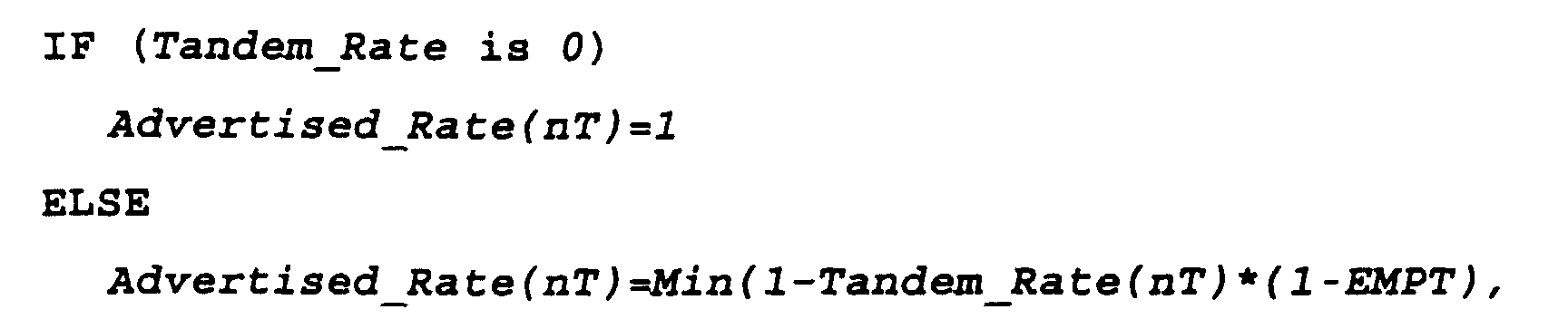
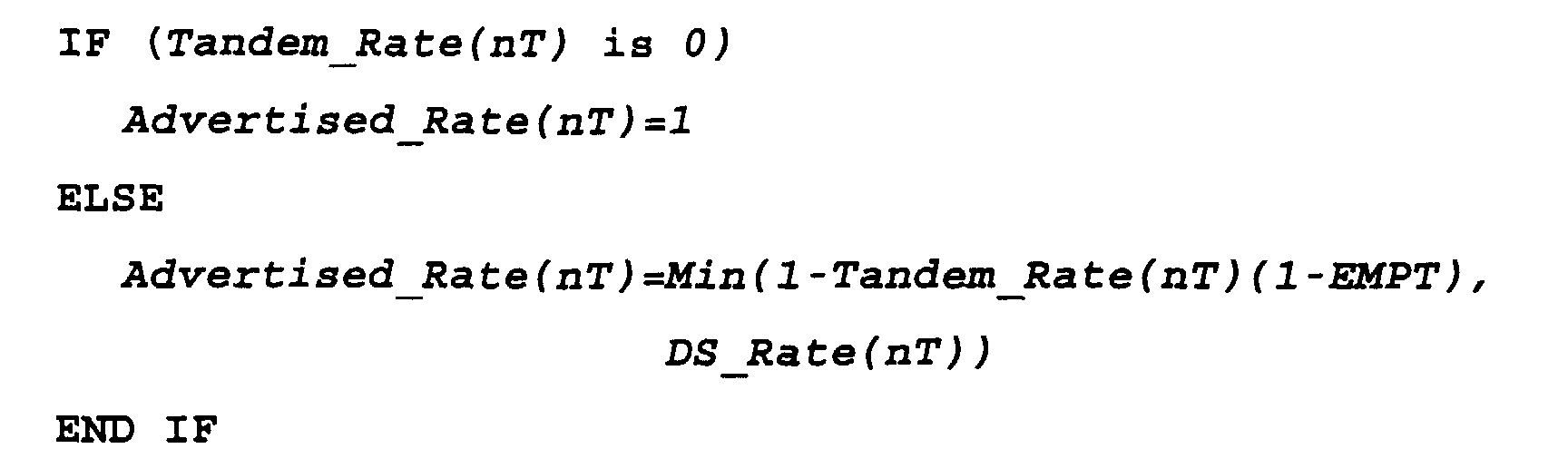
- Tandem _ Rate is 0 , indicating that no upstream node has sent traffic that passes through a node 12 performing this calculation, then a rate of 1 is advertised to the upstream link partner.
- This Advertised _ Rate informs the upstream link partner that it has full access to the ring during the next messaging interval nT .
- Advertising a rate of 1 indicates that a node 12 has no effect on the regulated traffic of some other segment of the ring, and prevents the local traffic on separate segments of the ring from interfering with each other.
- the ELSE condition compensates for a case in which a node 12 receives traffic in its tandem buffer.
- the minimum of DS _ Rate and (1 - Tandem _ Rate * (1 - EMPT)) is advertised to the upstream node.
- the variable EMPT is a Boolean that indicates whether the node has packets to add to the ring. If the node has no packets to add to the ring, the EMPT flag is set to 1 , and the left hand term within the Min function becomes 1 . Consequently, whatever is in DS _ Rate will be advertised to the upstream node. If the EMPT is set to 0 , indicating that the node has packets to add to the ring, the advertised rate becomes:
- the Min function ensures that the DS _ Rate message received from a downstream link partner is passed from a node 12 towards its upstream link partner so that it eventually reaches a node responsible for an unfair contribution to traffic load at some other AP in the ring.
- a node 12 nearest a congested link computes (1 - Tandem _ Rate) and the other nodes pass this Advertised _ Rate to their upstream link partners because of the Min function. If a group of K nodes are sharing a link to transfer traffic to a specific AP, when steady state is achieved, all K nodes are transmitting at a fair rate of 1/K .
- the Tandem _ Rate at the node nearest the congested link would be (K - 1)/K .
- the rate advertised by the node nearest to a congested link is equal to the fair rates for all nodes sharing the congested link. Since the nodes adjust their Add _ Rate to the Advertised _ Rate , a fair access is rapidly achieved for each node 12 in a group of nodes adding traffic to the ring. Note that the effect of this calculation is that the Advertised _ Rate throttles the Add _ Rate of a node 12 during each messaging period nT , so that a node 12 can never exceed that limit.
- the term (1 - Tandem _ Rate) can be considered as negative feedback sent to the upstream link partner. If during a previous messaging interval nT , the Tandem _ Rate was a large number, meaning that the upstream link partner had a great deal of opportunity to add its traffic to the ring, and in a subsequent message the Advertised _ Rate is a small number, the Add _ Rate to the upstream link partner for the next interval nT is reduced accordingly.
- the algorithm rapidly regulates traffic because each node sends the Advertised _ Rate to only its upstream link partner and the messaging interval nT is relatively short.
- the messages are independently sent from each node 12 to its upstream link partner. Therefore, all nodes are continuously adapting their rates, and adding their packets to the ring at the adapted rate. This eliminates long delays and the resulting wastage of bandwidth that has been observed in token-based algorithms.
- FIG. 2a is a flow diagram of the logic used in a first process executed by the ARC fairness algorithm.
- a timer is checked to determine whether the interval T has expired. If not, in step 20, a register is checked in step 20 to determine whether a new Advertised _ Rate has been received from a downstream link partner. If not, the program loops back to step 18. If a new Advertised _ Rate is received or the timer is expired, a New _ Add _ Rate is computed in step 22 using the equation described above. The Add _ Rate is set to the New _ Add _ Rate in step 24 and a new Advertised _ Rate is computed in step 26.
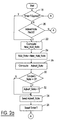
- FIG. 2b is a flow diagram of the logic used in a second process executed by the ARC fairness algorithm.
- the first and second processes shown in FIGS. 2a, b run independently in parallel.
- step 38 the number of tandemed packets is summed to calculate the Tandem _ Rate .
- the tandemed packets are preferably tracked using a sliding window ( T STAT ) which is described below in more detail.
- step 40 the number of packets added to the ring are summed to calculate an Actual _ Add _ Rate .
- the Actual_Add_Rate is likewise tracked using a sliding window ( T STAT ).
- the Actual _ Add _ Rate is compared to the Add _ Rate in step 42. If the Actual _ Add _ Rate is greater than or equal to the Add _ Rate , the process branches back to step 38. Otherwise, the process checks the Add _ Buffer in step 44. If the Add _ Buffer is empty, the process branches back to step 38. If not, a packet is transmitted in step 46 and the process branches back to step 38 after the packet has been sent.
- the algorithm ensures that the DS _ Rate is passed on towards the node that is responsible for the unfairness at some other part of the ring. Consequently, the logic shown in FIGs. 2a,b ensures the fair sharing of resources responsive to actual traffic loads.
- the Advertised_Rate should be propagated with a minimum delay. This means that the Advertised_Rate should be inserted in the header of every frame going upstream. If after waiting for a time equivalent to a transmission time for a maximum size packet, no frame has passed the node in an upstream direction, a new frame should be generated and sent upstream to carry the Advertised _ Rate .
- the messaging timer is preferably set to
- the sliding statistics window ( T STAT ) should be large enough to reflect the actual rates, and prevent unnecessary overshoots and undershoots in the calculated rates.
- the larger the T STAT the smoother are changes in the rates.
- a large statistics window collects a long history, makes the transitions slow, and does not reflect an immediate change in the rate. This may cause problems for nodes that need immediate access to the ring to burst a datastream.
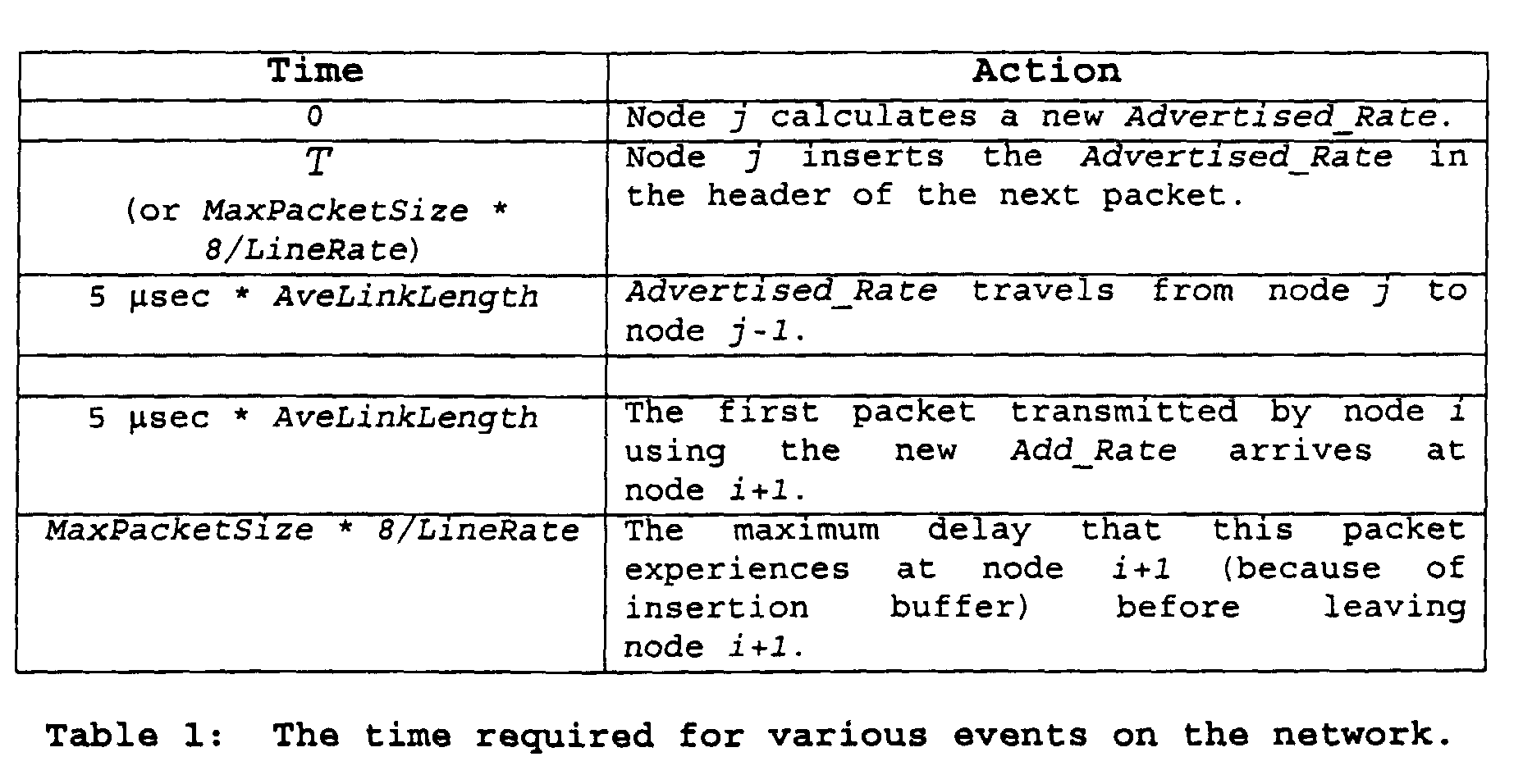
- Table 1 A formula for relating the sliding window size to the network parameters is explained with reference to Table 1.
- the nodes represented in the table are a node " j " and a node " i ", which is upstream of the node j , as well as intermediate nodes " j-1 ", which is a first node upstream of node j , and node " I + 1 " which is a first node downstream of node i .
- the node i is sending packets to the node j .
- Node j is advertising a rate to node i to regulate the traffic.
- the maximum distance between node i and node j in a dual counter rotating ring is N/2 , where N is the total number of nodes on the ring.
- Each event on this network takes a time listed in Table 1.
- Table 1 the propagation delay on the media is assumed 5 ⁇ sec/km, AveLinkLength is the average distance between two nodes in km, and LineRate is the ring bandwidth in bit/sec.
- the traffic sent from node i takes the following time to get to node j : Consequently, the change in the Tandem _ Rate of node j (and its Advertised _ Rate ) takes the following time to get to node i :
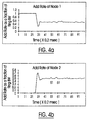
- FIGs. 3a, b and 4a, b illustrate how the ARC algorithm affects traffic on a buffer insertion ring.
- node 1 is sending traffic at full rate to node 3, while node 2 is silent. Since the Tandem _ Rate of node 3 is 0 , it sends an Advertised _ Rate message 50 having a value of 1 to node 2.
- node 1 starts adding its traffic at a rate less than 1 , it will rapidly increase its Add _ Rate to the full rate after a few intervals nT .
- the Add _ Rate of nodes 2 and 3 is also incremented to 1 , although nodes 2 and 3 currently have no packets to add to the buffer insertion ring 10.
- node 2 receives traffic to be added to the ring.
- node 3 advertises a rate of 1 to node 2 in a message 54, but node 2 advertises a rate of close to 0 to node 1 in a message 56.
- This is due to the fact that node 2 has the packets in its add buffer to add to the ring (EMPT 0) .
- the Advertised _ Rate message 56 from node 2 dramatically slows down the transmission rate of node 1. Meanwhile, node 2 starts transmission as the buffer insertion scheme permits it. Accordingly, node 2 buffers upstream traffic coming to its tandem buffer while starting transmission of its own packets on the buffer transmission ring 10.
- FIGs. 4a and 4b respectively show the normalized add rates of node 1 and node 2 during the interval schematically illustrated in FIGs. 3a and 3b.
- This example was simulated using an event driven simulator.
- the buffer insertion ring 10 was operated at OC-12 with 16 gigabit nodes on the ring. The distance between each node was about 1 kilometer.
- the messaging interval nT was 200 ⁇ sec, and the statistics window T STAT was 500 ⁇ sec.
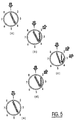
- FIGs. 5a-5e illustrate a further example in which node 1 is transmitting at full rate.
- the fair rate for node 1 is 1 because all other nodes are silent.
- node 2 starts adding traffic to the buffer insertion ring 10.
- the fair rate of nodes 1 and 2 under the influence of the ARC algorithm rapidly migrates to 0 . 5 , respectively.
- node 3 also starts adding packets to the buffer insertion ring 10, as shown in FIG. 5c.
- the fair rate for nodes 1, 2 and 3 at that time migrates to 0 . 333 .
- To determine how quickly the rates converge node 3 and subsequently node 2 are deprived of traffic to be added to the ring as shown in FIGs. 5d and 5e.
- the fair rate of node 1 increases to 0 . 5 and then returns to 1 .
- the upstream link partner takes action to respond. Consequently, it requires at most two message period delays until a node 12 that has sent an advertised rate can sense a change in the incoming traffic to its tandem buffers. Assuming shortest path forwarding, the distance between the most distant nodes in an insertion buffer ring is N/2 hops where N is the total number of nodes in the ring. If a most distant node is the source of congestion on a link, it will take one round trip delay before the node that is sent an advertised rate can sense the change in its tandem traffic. The rates smoothly converge to fair values because the integrator implemented in the algorithm changes the rates in a smooth, stepwise progression.
- the information required to calculate a new rate at each node is locally collected in a few registers.
- the message timer at each node can work independently from timers in other nodes and there is no need to synchronize the timers between nodes.
- HOL delay is defined as the time that a frame waits at the head of an add buffer before it gets access to the buffer insertion ring 10.
- HOL delay must be as short as possible.
- the HOL delay could be significant under certain circumstances.
- the ARC algorithm provides all nodes with continuous access to the ring, and the access is alternated among nodes that are sharing a link. The HOL delay is therefore reduced and maintained within acceptable limits. Providing a low HOL delay is a significant advantage of the ARC algorithm in comparison with prior art fairness algorithms.
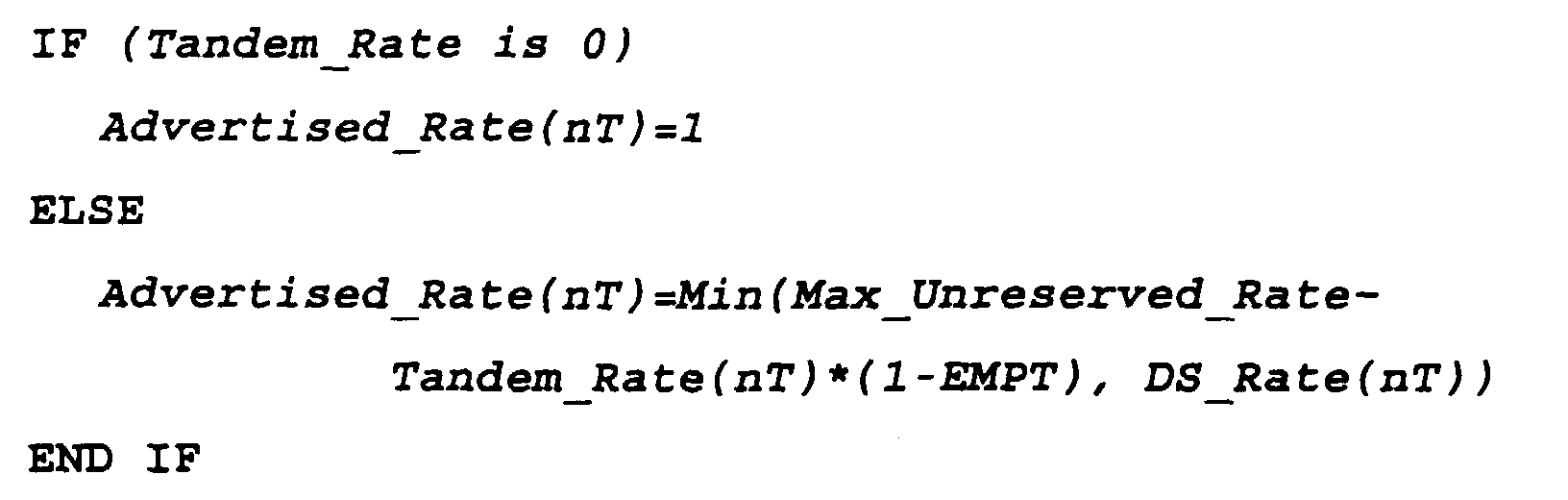
- a fraction of the bandwidth of the buffer insertion ring 10 can be reserved. This also enables an idle node to start adding traffic immediately at a reserved rate before its Advertised _ Rate propagates to upstream nodes and rate regulation is enforced. Bandwidth reservation can be simply implemented in a network which operates under the ARC algorithm. In the program logic described with reference to FIG. 2, all rates are normalized to the link rate and the Advertised _ Rate is represented as number between 0 and 1 . In the statement (1 - Tandem _ Rate) used in the computation of the Advertised _ Rate described above, the number 1 represents the total bandwidth of the ring.
- Max _ Unreserved _ Rate a fraction of the bandwidth of the buffer insertion ring 10 will not be controlled by the ARC algorithm, and will be reserved.
- the reserved bandwidth can be shared equally among nodes, if desired. For example, if Max _ Unreserved _ Rate is set to 0 . 8 , 20% of the capacity of ring 10 is reserved for real time and mission critical traffic, and 80% of the ring capacity is used by delay tolerant traffic.
Landscapes
- Engineering & Computer Science (AREA)
- Computer Networks & Wireless Communication (AREA)
- Signal Processing (AREA)
- Small-Scale Networks (AREA)
- Data Exchanges In Wide-Area Networks (AREA)
Abstract
Description

- T is the period of the message timer;
- MaxPacketSize is the time required to transmit a packet of the maximum size supported by the ring; and
- LineRate is the speed in bits/second of the link.



Claims (16)
- A method of media access control for packet transmission over a buffer insertion ring, wherein each node in the buffer insertion ring is assigned a predetermined quota of data packets to be transmitted in a predetermined time interval, and the quota of data packets is transmitted on receipt by the node of a message from a downstream node, CHARACTERIZED in that:at regular intervals each node computes a local packet add rate and an advertised packet add rate for an upstream link partner node;each node communicates the advertised add rate to the upstream link partner node; andeach node adds packets to the buffer insertion ring at a rate that does not exceed the local packet add rate until a new local packet add rate is computed by the node.
- A method as claimed in claim 1 wherein the add rate calculations are based on information collected over an interval TSTAT , and the regular interval at which the local packet add rate and the advertised rate are computed has a duration T, wherein:T ≤TSTAT .
- A method as claimed in claims 1 or 2 wherein the local packet add rate is computed using the formula:Add _Rate(nT)=(Add_Rate(nT-T)+DS_Rate(nT))/2Add_Rate(nT-T) is the add rate of the immediately preceding interval T; andDS_Rate is the advertised rate of a downstream link neighbor node.
- A method as claimed in claims 2 or 3 wherein each node computes a Tandem_Rate over a statistics window having a duration of TSTAT , the Tandem_Rate being a number of bytes passing through a tandem buffer of the node, normalized to the link rate of the upstream link.
- A method as claimed in claim 4 wherein the statistics window TSTAT is a sliding window to preserve a history of the local add rate and tandem rate in order to enable accurate computation of the rates.
- A method as claimed in claims 4 or 5 wherein the advertised rate is computed as follows:wherein:
 EMPT is a Boolean that indicates whether the node has any packets to send on the ring.
 - A method as claimed in any preceding claim wherein the advertised rate is communicated to the upstream link partner node by inserting the advertised rate into the header of a frame being sent in the upstream direction.
- A method as claimed in claim 7 wherein the advertised rate is communicated to the upstream link partner node in a link integrity message frame sent to the upstream link partner node.
- A method as claimed in claim 8 wherein the advertised rate is inserted in a new minimum sized frame if the link to the upstream link partner node is empty, and the new frame is communicated to the upstream link partner node.
- A method as claimed in any one of claims 2-9 wherein the time intervals T and TSTAT are computed using at least one timer in each node and the timers in different nodes are not synchronized.
- A method as claimed in any one of claims 4-10 wherein a portion of a bandwidth of the ring is fairly shared and a portion is reserved for another purpose, and the advertised rate is computed using the formula:wherein:
 Max_Unreserved_Rate is the fairly shared portion of the bandwidth of the ring; andEMPT is a Boolean that indicates whether the node has any packets to send on the ring.
 - A method as claimed in claim 11 wherein the buffer insertion ring is a Dual Counter Rotating Buffer Insertion Ring.
- A node in a buffer insertion ring in which each node in the buffer insertion ring is assigned a predetermined quota of data packets to be transmitted in a predetermined time interval, and the quota of data packets is transmitted on receipt by the node of a message from a downstream node, CHARACTERIZED by:means for computing at regular intervals nT a local packet add rate for the node using a formula:wherein:Add _Rate(nT)=(Add_Rate(nT-T)+DS_Rate(nT))/2Add_Rate(nT-T) is the add rate for the node during an immediately preceding interval T; andDS_Rate is an advertised rate received from a downstream link neighbor node;means for computing at each interval nT an add rate for an upstream link partner node in the buffer insertion ring using the formula:
 wherein:
 Tandem_Rate is a number of bytes passing through a tandem buffer of the node, normalized to a link rate of the upstream link, during an interval TSTAT , T TSTAT ;EMPT is a Boolean that indicates whether the node has any packets to send on the ring; andDS_Rate is the advertised rate of a downstream link partner node;means for communicating the advertised add rate to the upstream link partner node; andmeans for adding packets to the ring at a rate that does not exceed the local packet add rate until a next local packet add rate is computed.
 - A node as claimed in claim 13 wherein the buffer insertion ring is a Dual Counter Rotating Buffer Insertion Ring.
- A node as claimed in claims 13 or 14 wherein the node includes at least one timer used to compute the time intervals T and TSTAT , and the timer runs independently of equivalent timers in other nodes.
- A node as claimed in any one of claims 13-15 wherein the node communicates the advertised rate to the upstream link partner node by inserting the advertised rate into the header of a frame sent in the upstream direction.
Applications Claiming Priority (2)
| Application Number | Priority Date | Filing Date | Title |
|---|---|---|---|
| US320585 | 1999-05-27 | ||
| US09/320,585 US6614805B1 (en) | 1999-05-27 | 1999-05-27 | Method and apparatus for media access control for packet transmission over a buffer insertion ring |
Publications (3)
| Publication Number | Publication Date |
|---|---|
| EP1056244A2 true EP1056244A2 (en) | 2000-11-29 |
| EP1056244A3 EP1056244A3 (en) | 2002-10-23 |
| EP1056244B1 EP1056244B1 (en) | 2007-12-12 |
Family
ID=23247061
Family Applications (1)
| Application Number | Title | Priority Date | Filing Date |
|---|---|---|---|
| EP00304458A Expired - Lifetime EP1056244B1 (en) | 1999-05-27 | 2000-05-25 | Method and apparatus for media access control for packet transmission over a buffer insertion ring |
Country Status (4)
| Country | Link |
|---|---|
| US (1) | US6614805B1 (en) |
| EP (1) | EP1056244B1 (en) |
| CA (1) | CA2299127C (en) |
| DE (1) | DE60037361T2 (en) |
Cited By (4)
| Publication number | Priority date | Publication date | Assignee | Title |
|---|---|---|---|---|
| WO2004105330A3 (en) * | 2003-05-20 | 2005-01-13 | Matsushita Electric Industrial Co Ltd | Access control method and system |
| EP1304839A3 (en) * | 2001-10-18 | 2007-02-21 | Nec Corporation | Congestion control for communications network |
| US7346080B2 (en) | 2001-11-21 | 2008-03-18 | Alcatel | Procedure and controller for the allocation of variable time slots for a data transmission in a packet-oriented data network |
| CN100525234C (en) * | 2003-08-19 | 2009-08-05 | 思科技术公司 | Systems and methods for alleviating client over-subscription in ring networks |
Families Citing this family (4)
| Publication number | Priority date | Publication date | Assignee | Title |
|---|---|---|---|---|
| JP4999244B2 (en) | 1999-06-08 | 2012-08-15 | ザ トラスティーズ オブ コロンビア ユニヴァーシティ イン ザ シティ オブ ニューヨーク | Network telephone apparatus and system for internet telephones |
| US7174374B2 (en) * | 2002-05-13 | 2007-02-06 | Industrial Technology Research Institute | Multi-priority media access control method for multi-channel slotted ring networks |
| DE602005005303T2 (en) * | 2005-04-19 | 2008-06-26 | Alcatel Lucent | Method for operating a packet-based data network |
| US8804513B2 (en) * | 2010-02-25 | 2014-08-12 | The Trustees Of Columbia University In The City Of New York | Methods and systems for controlling SIP overload |
Family Cites Families (9)
| Publication number | Priority date | Publication date | Assignee | Title |
|---|---|---|---|---|
| US4538147A (en) * | 1982-03-05 | 1985-08-27 | Burroughs Corp. | Bandwidth allocation in a token controlled loop communications network |
| US4926418A (en) | 1989-04-11 | 1990-05-15 | International Business Machines Corporation | Fairness algorithm for full-duplex buffer insertion ring |
| US5229993A (en) * | 1991-02-25 | 1993-07-20 | Old Dominion University | Control of access through local carrier sensing for high data rate networks and control of access of synchronous messages through circulating reservation packets |
| US5475685A (en) | 1993-10-27 | 1995-12-12 | International Business Machines Corporation | Multi-media flow control over FDDI synchronous networks |
| US5467352A (en) | 1994-02-07 | 1995-11-14 | International Business Machines Corporation | Method and apparatus for improved throughput in a multi-node communication system with a shared resource |
| US5446737A (en) | 1994-02-07 | 1995-08-29 | International Business Machines Corporation | Method and apparatus for dynamically allocating shared resource access quota |
| KR960015601B1 (en) | 1994-02-08 | 1996-11-18 | 조백제 | Node unit of ring network with buffer and its control method |
| US6026425A (en) * | 1996-07-30 | 2000-02-15 | Nippon Telegraph And Telephone Corporation | Non-uniform system load balance method and apparatus for updating threshold of tasks according to estimated load fluctuation |
| US6314110B1 (en) * | 1998-03-06 | 2001-11-06 | Cisco Technology, Inc. | Method and apparatus for distributed bandwidth allocation for a bi-directional ring media with spatial and local reuse |
-
1999
- 1999-05-27 US US09/320,585 patent/US6614805B1/en not_active Expired - Lifetime
-
2000
- 2000-02-22 CA CA002299127A patent/CA2299127C/en not_active Expired - Fee Related
- 2000-05-25 EP EP00304458A patent/EP1056244B1/en not_active Expired - Lifetime
- 2000-05-25 DE DE60037361T patent/DE60037361T2/en not_active Expired - Lifetime
Cited By (9)
| Publication number | Priority date | Publication date | Assignee | Title |
|---|---|---|---|---|
| EP1304839A3 (en) * | 2001-10-18 | 2007-02-21 | Nec Corporation | Congestion control for communications network |
| US7468945B2 (en) | 2001-10-18 | 2008-12-23 | Nec Corporation | Congestion control for communication |
| US7346080B2 (en) | 2001-11-21 | 2008-03-18 | Alcatel | Procedure and controller for the allocation of variable time slots for a data transmission in a packet-oriented data network |
| WO2004105330A3 (en) * | 2003-05-20 | 2005-01-13 | Matsushita Electric Industrial Co Ltd | Access control method and system |
| US7212546B2 (en) | 2003-05-20 | 2007-05-01 | Matsushita Electric Industrial Co., Ltd. | Access control method and system |
| CN100459567C (en) * | 2003-05-20 | 2009-02-04 | 松下电器产业株式会社 | Access control method and system |
| US7907631B2 (en) | 2003-05-20 | 2011-03-15 | Panasonic Corporation | Access control method and system |
| KR101025968B1 (en) * | 2003-05-20 | 2011-03-30 | 파나소닉 주식회사 | Access control methods and systems |
| CN100525234C (en) * | 2003-08-19 | 2009-08-05 | 思科技术公司 | Systems and methods for alleviating client over-subscription in ring networks |
Also Published As
| Publication number | Publication date |
|---|---|
| US6614805B1 (en) | 2003-09-02 |
| CA2299127A1 (en) | 2000-11-27 |
| DE60037361T2 (en) | 2008-04-03 |
| EP1056244B1 (en) | 2007-12-12 |
| DE60037361D1 (en) | 2008-01-24 |
| CA2299127C (en) | 2007-09-04 |
| EP1056244A3 (en) | 2002-10-23 |
Similar Documents
| Publication | Publication Date | Title |
|---|---|---|
| US5050161A (en) | Congestion management based on multiple framing strategy | |
| Golestani | Congestion-free communication in high-speed packet networks | |
| US5276677A (en) | Predictive congestion control of high-speed wide area networks | |
| US5968128A (en) | Traffic control system having distributed rate calculation and link by link flow control | |
| JP4041944B2 (en) | Network congestion control system, congestion control node, and congestion control program | |
| EP0688481B1 (en) | Device and method for atm end system cell flow regulation | |
| KR100234212B1 (en) | Adaptive Rate-based Congestion Control in Packet Networks | |
| US6977895B1 (en) | Apparatus and method for rate-based polling of input interface queues in networking devices | |
| EP1065833B1 (en) | Method and apparatus for managing communications between nodes in a bi-directional ring network | |
| US6614805B1 (en) | Method and apparatus for media access control for packet transmission over a buffer insertion ring | |
| US7231471B2 (en) | System using fairness logic for mediating between traffic associated with transit and transmit buffers based on threshold values of transit buffer | |
| US8213454B2 (en) | Self-adapting mechanism for managing data streams in a multiple access shared network | |
| JP2000059377A (en) | Communication device | |
| JPH0771124B2 (en) | Data flow control system | |
| Imer et al. | Control of congestion in high-speed networks | |
| Wang et al. | Congestion control in resilient packet rings | |
| US20060209683A1 (en) | Packet transmission method and station in packet ring telecommunications network | |
| Zhang et al. | Efficient data center flow scheduling without starvation using expansion ratio | |
| Gjessing et al. | Performance evaluation of back-pressure fairness in RPR | |
| Rampal et al. | An Evaluation of Routing and Admission Control Algorithms for Multimedia Tra c in Packet-Switched Networks | |
| Davik et al. | Congestion domain boundaries in resilient packet rings | |
| Peng et al. | Distributed wavelength assignment protocols with priority for WDM all-optical networks | |
| Lauer | On the Duality of Rate-based and Credit-based Flow Control | |
| Gjessing et al. | Avoiding Head of Line blocking using an enhanced fairness algorithm in a Resilient Packet Ring | |
| Auvert et al. | On router control for congestion avoidance |
Legal Events
| Date | Code | Title | Description |
|---|---|---|---|
| PUAI | Public reference made under article 153(3) epc to a published international application that has entered the european phase |
Free format text: ORIGINAL CODE: 0009012 |
|
| AK | Designated contracting states |
Kind code of ref document: A2 Designated state(s): AT BE CH CY DE DK ES FI FR GB GR IE IT LI LU MC NL PT SE |
|
| AX | Request for extension of the european patent |
Free format text: AL;LT;LV;MK;RO;SI |
|
| PUAL | Search report despatched |
Free format text: ORIGINAL CODE: 0009013 |
|
| AK | Designated contracting states |
Kind code of ref document: A3 Designated state(s): AT BE CH CY DE DK ES FI FR GB GR IE IT LI LU MC NL PT SE |
|
| AX | Request for extension of the european patent |
Free format text: AL;LT;LV;MK;RO;SI |
|
| 17P | Request for examination filed |
Effective date: 20030326 |
|
| AKX | Designation fees paid |
Designated state(s): DE FR GB |
|
| RAP1 | Party data changed (applicant data changed or rights of an application transferred) |
Owner name: NORTEL NETWORKS LIMITED |
|
| GRAP | Despatch of communication of intention to grant a patent |
Free format text: ORIGINAL CODE: EPIDOSNIGR1 |
|
| GRAS | Grant fee paid |
Free format text: ORIGINAL CODE: EPIDOSNIGR3 |
|
| GRAA | (expected) grant |
Free format text: ORIGINAL CODE: 0009210 |
|
| AK | Designated contracting states |
Kind code of ref document: B1 Designated state(s): DE FR GB |
|
| REG | Reference to a national code |
Ref country code: GB Ref legal event code: FG4D |
|
| REF | Corresponds to: |
Ref document number: 60037361 Country of ref document: DE Date of ref document: 20080124 Kind code of ref document: P |
|
| ET | Fr: translation filed | ||
| PLBE | No opposition filed within time limit |
Free format text: ORIGINAL CODE: 0009261 |
|
| STAA | Information on the status of an ep patent application or granted ep patent |
Free format text: STATUS: NO OPPOSITION FILED WITHIN TIME LIMIT |
|
| 26N | No opposition filed |
Effective date: 20080915 |
|
| REG | Reference to a national code |
Ref country code: FR Ref legal event code: PLFP Year of fee payment: 16 |
|
| REG | Reference to a national code |
Ref country code: FR Ref legal event code: PLFP Year of fee payment: 17 |
|
| REG | Reference to a national code |
Ref country code: FR Ref legal event code: PLFP Year of fee payment: 18 |
|
| REG | Reference to a national code |
Ref country code: FR Ref legal event code: PLFP Year of fee payment: 19 |
|
| PGFP | Annual fee paid to national office [announced via postgrant information from national office to epo] |
Ref country code: GB Payment date: 20180328 Year of fee payment: 19 |
|
| PGFP | Annual fee paid to national office [announced via postgrant information from national office to epo] |
Ref country code: DE Payment date: 20180507 Year of fee payment: 19 |
|
| PGFP | Annual fee paid to national office [announced via postgrant information from national office to epo] |
Ref country code: FR Payment date: 20180416 Year of fee payment: 19 |
|
| REG | Reference to a national code |
Ref country code: DE Ref legal event code: R119 Ref document number: 60037361 Country of ref document: DE |
|
| GBPC | Gb: european patent ceased through non-payment of renewal fee |
Effective date: 20190525 |
|
| PG25 | Lapsed in a contracting state [announced via postgrant information from national office to epo] |
Ref country code: GB Free format text: LAPSE BECAUSE OF NON-PAYMENT OF DUE FEES Effective date: 20190525 Ref country code: DE Free format text: LAPSE BECAUSE OF NON-PAYMENT OF DUE FEES Effective date: 20191203 |
|
| PG25 | Lapsed in a contracting state [announced via postgrant information from national office to epo] |
Ref country code: FR Free format text: LAPSE BECAUSE OF NON-PAYMENT OF DUE FEES Effective date: 20190531 |