EP1056042A2 - An online type of optimization control method and an optimization control device - Google Patents
An online type of optimization control method and an optimization control device Download PDFInfo
- Publication number
- EP1056042A2 EP1056042A2 EP00111491A EP00111491A EP1056042A2 EP 1056042 A2 EP1056042 A2 EP 1056042A2 EP 00111491 A EP00111491 A EP 00111491A EP 00111491 A EP00111491 A EP 00111491A EP 1056042 A2 EP1056042 A2 EP 1056042A2
- Authority
- EP
- European Patent Office
- Prior art keywords
- individuals
- evaluation
- individual
- evaluation model
- section
- Prior art date
- Legal status (The legal status is an assumption and is not a legal conclusion. Google has not performed a legal analysis and makes no representation as to the accuracy of the status listed.)
- Withdrawn
Links
Images






Classifications
-
- G—PHYSICS
- G06—COMPUTING OR CALCULATING; COUNTING
- G06N—COMPUTING ARRANGEMENTS BASED ON SPECIFIC COMPUTATIONAL MODELS
- G06N3/00—Computing arrangements based on biological models
- G06N3/12—Computing arrangements based on biological models using genetic models
- G06N3/126—Evolutionary algorithms, e.g. genetic algorithms or genetic programming
-
- G—PHYSICS
- G05—CONTROLLING; REGULATING
- G05B—CONTROL OR REGULATING SYSTEMS IN GENERAL; FUNCTIONAL ELEMENTS OF SUCH SYSTEMS; MONITORING OR TESTING ARRANGEMENTS FOR SUCH SYSTEMS OR ELEMENTS
- G05B13/00—Adaptive control systems, i.e. systems automatically adjusting themselves to have a performance which is optimum according to some preassigned criterion
- G05B13/02—Adaptive control systems, i.e. systems automatically adjusting themselves to have a performance which is optimum according to some preassigned criterion electric
- G05B13/0265—Adaptive control systems, i.e. systems automatically adjusting themselves to have a performance which is optimum according to some preassigned criterion electric the criterion being a learning criterion
Definitions
- This invention relates to a method and a device for controlling optimization of control subjects.
- control parameters used in a control module those affecting the characteristics of control subjects are coded to create a generation of a plurality of chromosomes (individuals), characteristics of the control subjects when the individuals of the generation are used are respectively evaluated, a plurality of parent individuals for the next generation including individuals of high evaluations are chosen, the parent individuals are crossed to generate a plurality of individuals of the next generation, and also new individuals are generated at random by mutation.
- the control parameters of the control module are evolved to those capable of obtaining characteristics of high evaluations by repeating the above process.
- the above optimization control method has a problem of poor efficiency. That is, the evolution of each generation does not always proceed to a desirable direction, in some cases for generations in directions the user does not want, because the choice of the parent individuals for the next generation is made at random for individuals other than those having high evaluations, and individuals generated by mutation are made to be contained in each generation.
- this invention intends to provide a method and a device for controlling the optimization of control subjects, making it possible to improve the evolution efficiency while retaining the advantages of the optimization control method previously proposed.
- the invention of claim 1 relates to an online type of optimization control method wherein control parameters affecting the characteristics of control subjects are made to evolve while being made to reflect actual evaluations by repeating the steps of; creating a plurality of individuals corresponding to the control parameters, deeming a set of the individuals to be one generation, choosing parent individuals for the next generation from the individuals set while causing at least actual evaluations to be reflected, and creating a set of individuals for the next generation on the basis of at least the parent individuals, wherein an evaluation model is created on the basis of relation between each individual and the evaluation for the individual, and that the evaluation model is used before making the actual evaluation.
- the invention of claim 15 relates to an optimization control device comprising; a control section, an online type of optimization process section, and an evolution efficiency improving section;
- FIGs. 1 to 9 show an embodiment in which a method and a device for optimization control of control subjects of the invention are applied to the control of a vehicle engine.
- FIG. 1 is a simplified drawing of the relation between an engine 1 and a controller 10 for executing an optimization control method for control subjects according to the invention.
- the engine 1 is provided with an electronic throttle controlled through the controller 10 according to the amount of accelerator operation by a user.
- the controller 10 is constituted to provide throttle characteristics matching the preference of the user.
- the controller 10 receives input information, namely the amount of accelerator operation by the user, and determines the opening degree of the electronic throttle according to the input information.
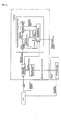
- FIG. 2 is a general block diagram of the controller 10.
- the controller 10 comprises;
- the electronic throttle control module is constituted as shown in FIG. 3 to determine the opening of the electronic throttle valve according to the amount of operation made by the user, and roughly comprises a static characteristic changing section and a dynamic characteristic changing section.
- the term "accelerator operation amount” is a piece of information obtained as a result of the operator actually operating the accelerator (not shown), and includes both information on "accelerator angle” and information on "amount of change in the accelerator.”
- the electronic throttle valve has two characteristics; static and dynamic characteristics.
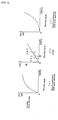
- FIG. 4 shows a few examples of static throttle characteristics. Different settings of the static characteristic as shown provide different throttle openings with the same accelerator angle, for example;
- the static characteristic may be of any type as long as the throttle opening increases or remains unchanged as the accelerator angle increases, and may be expressed with different functions.
- the static characteristic is optimized by optimizing the throttle valve opening rate SP1 in the range of between 0 % and 20 % and the throttle opening rate SP2 in the range of between 20 % and 100 %.
- the dynamic characteristic stems from the changing speed of the throttle valve relative to the accelerator changing speed, and affects the transient characteristic of the vehicle.
- This characteristic can be concretely constituted that the changing speed of the throttle valve relative to the accelerator changing speed may be changed by combining temporary delay and incomplete differential. By combining temporary delay and incomplete differential, different types of dynamic characteristics are obtained as shown in FIG. 5, for example;
- the dynamic characteristic is optimized by optimizing the temporary delay time constant DR and the acceleration compensation coefficient AG.
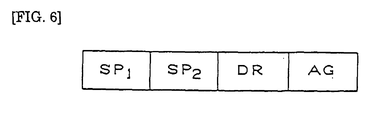
- the optimization process section codes the control parameters, throttle valve opening rates SP1, SP2, temporary delay time constant DR, and acceleration compensation coefficient AG, in the electronic throttle control module shown in FIG. 6 as genic individuals, and optimizes those parameters through evolutionary calculation.
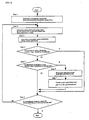
- FIG. 7 is a flowchart of the process in which an evolutionary efficiency improvement method is applied to an example of the optimization process using the evolutionary calculation.
- an evolutionary efficiency improvement method is applied to an example of the optimization process using the evolutionary calculation.
- a plurality of individuals are created to form a set of individuals of the first generation (step 1).
- step 2 a vehicle is actually run using one of the control parameters constituting the individuals set, and the characteristic obtained by the use of the individual is evaluated (step 2).
- step 4 The process consisting of the steps 1 and 2 is repeated for all the individuals in one generation (step 4).
- individuals to be the parent individuals for the individuals set of the next generation are chosen from among the individuals set of one generation, which are used to generate a set of individuals of the next generation by crossing or mutation (step 6).
- the characteristic is optimized using the evolutionary calculation and repeating the above process until the best characteristic the user wants to have is obtained or until processing a predetermined number of generations is over.
- the optimization process is arranged that the evaluation of each individual is made on the basis of ease-of-drive performance physically sensed by the user.
- the control parameters of the electronic throttle control module are optimized according to the evaluations made by the user, and the optimum characteristic of the electronic throttle (ease-of-drive characteristic) best suited for the evaluation given by the user is obtained.
- a button or the like as an input device may be employed for the user to intervene in the evolution and input an evaluation value during driving.
- the user can use the button after a trial ride to input an evaluation value for an individual with which the trial ride has been made.
- the evaluation value is determined with the length of the time of pressing the button.
- There may be such methods as the reciprocal of the pressing time duration being multiplied by a certain factor, or calculating with a fuzzy rule. In this way, it is possible to obtain an evaluation value with a certain accuracy even if there is ambiguity in the evaluation given by the user, and the user can use the evolution method in interactive manner. It is also possible to switch from one individual being evaluated to another at the instant a predetermined period of pressing and holding the button is exceeded.
- Various methods may be employed to choose the parent individuals; a roulette choice method in which individuals are chosen by probability in proportion to evaluation values (adaptability degrees) given by the user, a tournament choice method in which an individual having the best evaluation value is chosen from among n pieces of individuals chosen at random, etc.
- a method can be used in which elite preserving strategy is combined to unconditionally leave elite individuals (individuals having the highest evaluation value) to the next generation.
- crossing parent individuals There are methods of crossing parent individuals; one point crossing, two point crossing, or normal distribution crossing. It can happen that a parent chosen for crossing is the same individual. If this is left as it is, versatility of the individuals set is lost. To avoid this, it is preferable, in the case the same individual is chosen twice for the crossing, to replace one individual with another chosen, so as to avoid crossing with the same individuals.
- a method can be used in which values are changed at random at a certain probability for each locus of the individual. And a method is also conceivable in which perturbation is added according to normal distribution.
- individuals chosen as parents for crossing are the same from the genetic viewpoint although they have been chosen as different individuals, both of the parent individuals to be crossed are made to mutate at a probability higher than normal.
- the static and dynamic characteristics are combined together into a single individual and optimized collectively.
- other methods are also conceivable in which, for example;
- the evolution efficiency improvement process section as shown in FIG. 2 comprises; a data accumulation section, an evaluation model creating section, an individuals set operating section, and an evaluation value reliability calculating section.
- the data accumulation section every time an evaluation value for an individual is inputted in the evolutionary calculating section, determines correspondence between the individual and its evaluation value and accumulates them (step 3 in the flowchart shown in FIG. 7).
- each individual is converted from the expressive type into the genetic type for the purpose of improving calculation efficiency and compressing the data amount.
- the difference among the individuals of the genetic type is small and so creating the evaluation model to be described later becomes more difficult. Therefore, in the data accumulation section, data of the individuals are accumulated as those of the expressive type.
- the term "expressive individual” above means the individual made by coding the parameter value itself, and the “genetic individual” means the individual made by converting the parameter value into bits.
- the conversion can be made with the equation below.
- Xi Yi ⁇ ⁇ + ⁇
- X stands for each of the parameter values (SP1, SP2, DR, AG) constituting the expressive individuals
- Y for each of bit values constituting the genetic individuals
- ⁇ and ⁇ are coefficients that can be changed arbitrarily.
- the evaluation model creating section on the basis of data accumulated in the data accumulating section, creates and renews the evaluation model for predicting the evaluations of individuals given by the user (step 5 in the flowchart shown in FIG. 7).
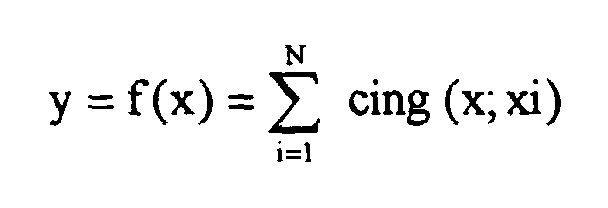
- an RBF radial basis function
- an input-output function which receives input of the parameter values (SP1, SP2, DR, AG) of the four type of throttle characteristics constituting one individual and outputs evaluation values, is approximated with the RBF and used as the evaluation model.
- the RBF which receives input of throttle characteristics x and outputs evaluation values y is shown below.
- N denotes the number of accumulated data
- xi denotes the throttle characteristic accumulation data.
- the basal function g and the coefficient ci of the above function are calculated and the above function is used as the evaluation model.
- contradiction data in the accumulated data are processed. That is, in the case there are different data of the evaluation value y for the same individual x (namely the individual of the same throttle characteristic), a mean value is used as the evaluation value y of that individual.
- the evaluation value may also be weighted according to information of the time when the evaluation is made. For example, when the same individual gets an evaluation value of 50 points in the first evaluation and 100 points in the second evaluation, normally the evaluation value for the individual is made the mean of the two, 75 points.
- data are weighted so that newer data have more weight to make the evaluation value nearer to that of the new data, for example 80 points or 90 points.
- the basal function g is determined using the equation below. where ⁇ denotes a basal function parameter and xi denotes the throttle characteristic accumulation data.
- the symbol I denotes an N x N unitary matrix.
- the symbol ⁇ denotes a normalizing parameter.
- the creation and renewal of the above-described evaluation model can be made at any appropriate time, for example at a time when evaluations of all the individuals in a set of individual are over using all the data accumulated in the data accumulating section by that time.
- the evaluation model by the use of any control module with which learning is possible, other than the RBF function, for example a neural circuit network, a fuzzy inference method, a fuzzy neural circuit network, a CMAC, other function approximation method, etc.
- the RBF function makes its output 0 in a region not learned yet and having no measurement value.
- the neural circuit network, etc. outputs some value even in the unlearned region.
- the reliability of the output value cannot necessarily be said to be high.
- a control module such as the RBF function with which, although no output is obtained in the unlearned region, more reliable output is obtained in the learned region is preferable to a control module which has the possibility of outputting also in the unlearned region some values the reliability of which cannot necessarily be said to be high.
- the evaluation value reliability calculating section calculates, on the basis of data accumulated in the data accumulating section, the reliability of the estimated evaluation values of respective individuals calculated on the basis of the evaluation model.
- the reliability is calculated specifically for example as follows; throttle characteristics represented with respective individuals are expressed with vectors, the distance between "an individual for which reliability is sought" and "an individual, out of those related to the accumulated data, located at the nearest distance from the individual for which the reliability is sought” is determined, and the reciprocal of the determined distance is made the reliability.
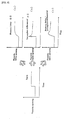
- FIG. 8 shows the concept of processing the individuals set in the individuals set operating section.
- the individuals set operating section before actually evaluating the each individual in the individuals set of each generation, estimates the evaluation value for each individual using the evaluation model created or renewed in the evaluation model creating section (step 7 in the flowchart in FIG. 7).
- the individuals set operating section after the actual evaluation (namely by the user) for all the individuals in the individuals set of the N-th generation is over, determines a "curtailment threshold" (step 1).
- the curtailment threshold may be calculated from a value (such as a mean or variance) determined statistically from evaluation values accumulated in the data accumulating section or may be a fixed value.
- the estimated evaluation value is calculated (step 2) for an individual in the individuals set of the (N+1)th generation using the evaluation model, and the evaluation value reliability of the estimated evaluation value is calculated in the evaluation value reliability calculating section (step 3).
- a comparison is made whether or not the evaluation value reliability is greater than a predetermined "reliability threshold (step 4).
- a predetermined "reliability threshold” In the case the evaluation value reliability is smaller than the reliability threshold, an ensuing steps (5 and 6) based on the estimated evaluation value corresponding to the evaluation value reliability are skipped, and a determination is made whether the comparison is finished for all the individuals in the individuals set (step 8). If the comparison is not finished for all the individuals, the process goes again to the step 2. If finished, the process for the individuals in the individuals set of that generation is ended.
- step 5 a determination is made whether or not the estimated evaluation value corresponding to the evaluation value reliability is greater than the curtailment threshold calculated in the step 1 (step 5). If greater, the process is either ended through the determination of step 8 or brought back to the step 2.
- the individual corresponding to the estimated evaluation value is deleted (step 6) and a newly created individual is added in place of the deleted individual to the individuals set (step 7).
- the step may be arranged that a plural number of individuals are created at random, their estimated evaluation values are determined, and one of them having the highest estimated evaluation value is added to the individuals set, or that a new individual is created so that its estimated evaluation value is greater than at least that of the deleted individual, preferably greater than the curtailment threshold.
- the evaluation model is renewed on the basis of the user's evaluations for the individuals 1a to 1e of the N-th generation set, and the individuals 2a to 2e of the (N+1)th generation set are subjected to the individuals set operation.
- the individual 2c is deleted and a new individual 2c'' is added.
- an evaluation model capable of estimating evaluation values with high accuracy by accumulating the data of combinations of the individuals and the evaluation values of the individuals set actually evaluated by the user in the evolutionary calculating section, and creating the evaluation model on the basis of the accumulated data.
- This also makes it possible that, every time a new generation set of individuals are created in the evolutionary calculating section, before the user making evaluations for the individuals set, to estimate the evaluation values for the individuals in the set using the evaluation model, and to delete individuals that will be given low evaluations by the user. This saves the user wasteful evaluation work and improves evolution efficiency.
- the evolution efficiency improvement section is provided with the evaluation value reliability calculating section, and the evaluation value reliability obtained there is used for preventing the individuals set operating process from being applied to the estimated evaluation values having low reliability.
- the evaluation value reliability calculating section is not essential but may be provided depending on necessity in consideration of conditions of applicable subject, such as whether priority is given to higher evolution efficiency or to shorter overall calculation time and greater available memory capacity.
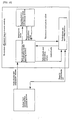
- FIG. 10 shows a general block diagram of the another embodiment of the evolution efficiency improvement process section.
- the evolution efficiency improvement process section comprises a data accumulation type of evaluation model creating section (hereinafter simply referred to as the evaluation model creating section), a representative evaluation value calculating section, and an individuals set operating section.
- the model creating section comprises divided regions corresponding to individuals used in the optimization process section. Every time an evaluation value for an individual is inputted in the optimization process section, an actual evaluation value of the individual is accumulated in the region corresponding to the individual, so that an evaluation model is created.
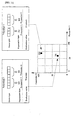
- FIG. 11 shows an example of data accumulation in the case the individual used in the optimization process section has two types of parameter values. To describe the example of FIG. 11 concretely, the individual is coded to produce two types of parameter values when it is converted from the genic type to the expressive type.
- the model creating section plots the parameter values relative to vertical and horizontal axes, and has 16 two-dimensional divided regions, as a result of the parameter values along each axis being divided into four equal parts.
- the model creating section converts the individual 1 into the expressive type, and the actual evaluation value of 75 of the individual 1 is accumulated in the region corresponding to the parameters 1 and 2 of the expressive type.
- the individuals for evolving the throttle characteristics consists of the four types of throttle characteristic parameter values (SP1, SP2, DR, AG). Therefore, the divided regions of the model creating section are four dimensional.
- the divided regions become multidimensional, calculations become complicated, and the amount of data to be accumulated increases.
- the parameter values constituting the individuals may be further converted to other parameter values to reduce the number of types of the parameter values.
- response degrees are calculated on the basis of four parameter values (SP1, SP2, DR, AG) of the throttle characteristics constituting the individuals.
- the region of the model creating section may be divided.
- the model creating section may constitute an evaluation model consisting of three-dimensionally divided 125 regions as a result of dividing the response degrees for each of the low, medium, and high speeds into five equal parts.
- the allowable number of data accumulated in each region is up to the latest 50 and the older data are deleted.
- the representative evaluation value calculating section calculates the mean value of the actual evaluation values of all the individuals contained in the each region (namely the divided region) of the evaluation model created in the model creating section, and the mean value is made the representative evaluation value of each region. However, for the region where no actual evaluation value is accumulated, it is arranged that the representative evaluation value is not calculated. In this way, it does not occur that a representative evaluation value having a low reliability is calculated in the unlearned part.
- the individuals set operating section before actually evaluating each individual in the individuals set of each generation, estimates the evaluation value for each individual by the use of the evaluation model created or renewed in the evaluation model creating section, and processes each individual on the basis of the estimated evaluation value.
- the region of the evaluation model is determined to which the individual for which an evaluation value is to be estimated belongs, the representative evaluation value for that region is calculated in the representative evaluation value calculating section, and the representative evaluation value is made the estimated evaluation value for that individual.
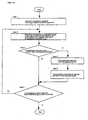
- FIG. 13 shows an example of flowchart of the process in the individuals set operating section.
- a "curtailment threshold" is calculated using the mean of all the evaluation values accumulated in the data accumulating section (step 1).
- the estimated evaluation value is calculated with the above-described method for an individual in the individuals set of the generation next to that created in the evolutionary calculating section, namely of the (N+1 )th generation (step 2).
- step 3 a determination is made whether or not the estimated evaluation value is greater than the curtailment threshold calculated in The step 1 (step 3). If not, the individual is deleted from the individuals set (step 4), and another new individual is created and added to the individuals set (step 5).
- the step may be arranged that a plural number of individuals are created at random, their estimated evaluation values are determined, and one of them having the highest estimated evaluation value is added to the individuals set, or that a new individual is created so that its estimated evaluation value is greater than at least that of the deleted individual, preferably greater than the curtailment threshold.
- constituting the evaluation model with the divided regions simplifies the calculation in comparison with constituting the evaluation model with the RBF.
- the individuals set operating section operates to calculate the estimated evaluation value of each individual, to delete the individual having an estimated evaluation value smaller than the curtailment threshold, and to add another randomly created individual to the individuals set.
- the operation applied to the individuals set is not limited to that of the above embodiments, but may be any operation as long as it enhances the evaluation of entire set of individuals when the evaluation model is used before the individuals of the set of a new generation created in the evolutionary calculating section are actually evaluated.
- the estimated evaluation values are calculated for all the individuals in the individuals set of a new generation created in the optimization process section (step 1).
- An optimum individual having the highest evaluation value with the current evaluation model is created using the evaluation model (step 2) and is used to replace an individual having the lowest evaluation value in the new generation of the individuals set created in the optimization process section (step 3).
- an autonomous evolution section separate from the optimization process section which is the subject of efficiency improvement, is provided to autonomously evolve individuals according to evaluations given with the evaluation model, and the individual evolved with the autonomous evolution process section is made the optimum individual.
- any individual contained in the region having the highest representative evaluation value is made the optimum individual.
- FIG. 15 is the flowchart of still another embodiment of the operation method applied to the individuals set in the individuals set operating section.
- an optimum individual having the highest evaluation value with the current evaluation model is created using the evaluation model (step 1), an individual is chosen at random out of the individuals set of the new generation created in the optimization process section, and the individual is replaced with the optimum individual.
- choosing an individual at random from the individuals set and replacing the chosen individual with the optimum individual eliminates the necessity of calculating the estimated evaluation values for all the individuals in the set.
- the operation applied to the individuals set is further simplified.
- the operation method of the individuals set using the evaluation model is not limited to that of the above embodiment but may be any other method as long as the individuals set is operated before the individuals are actually evaluated.
- the method may be simply addition of an individual created using the evaluation model without deleting individuals at all, or may be simple deletion only of an individual from the individuals set.
- the optimization process section uses the so-called interactive type of evaluation in which each individual in the individuals set is evaluated directly by the user.
- the constitution of the optimization process section need not be limited to the above embodiment but may be for example the so-called autonomous type of evaluation in which each individual in the individuals set is evaluated with an actual evaluation purpose model provided in the controller.
- the controller of the above embodiment performs the so-called one-layer type of evolution process in which the controller evolves directly, in the optimization process section, the control parameter of the basic control module which directly outputs the operation amount to the control subject.
- the manner of performing the process is not limited to that of this embodiment but may be otherwise, for example:
- control parameters affecting the characteristics of control subjects are made to evolve while reflecting actual evaluations by repeating the steps of; creating a plurality of individuals corresponding to the control parameters, making a set of the individuals one generation, choosing parent individuals for the next generation from the individuals set while reflecting at least actual evaluations, and creating a set of individuals for the next generation on the basis of at least the parent individuals.
- An evaluation model is created on the basis of relation between each individual and the actual evaluation value for each individual, and the evaluation model is used before actual evaluation is made.
Landscapes
- Engineering & Computer Science (AREA)
- Physics & Mathematics (AREA)
- Health & Medical Sciences (AREA)
- Biophysics (AREA)
- Life Sciences & Earth Sciences (AREA)
- Artificial Intelligence (AREA)
- Evolutionary Computation (AREA)
- Evolutionary Biology (AREA)
- Theoretical Computer Science (AREA)
- Software Systems (AREA)
- Bioinformatics & Computational Biology (AREA)
- General Physics & Mathematics (AREA)
- Bioinformatics & Cheminformatics (AREA)
- Data Mining & Analysis (AREA)
- Physiology (AREA)
- General Health & Medical Sciences (AREA)
- Molecular Biology (AREA)
- Computing Systems (AREA)
- General Engineering & Computer Science (AREA)
- Biomedical Technology (AREA)
- Mathematical Physics (AREA)
- Genetics & Genomics (AREA)
- Computational Linguistics (AREA)
- Computer Vision & Pattern Recognition (AREA)
- Medical Informatics (AREA)
- Automation & Control Theory (AREA)
- Feedback Control In General (AREA)
- Control Of Throttle Valves Provided In The Intake System Or In The Exhaust System (AREA)
- Electrical Control Of Air Or Fuel Supplied To Internal-Combustion Engine (AREA)
- Combined Controls Of Internal Combustion Engines (AREA)
- Control Of Position Or Direction (AREA)
Abstract
Description
- With a small opening-rapid acceleration type (shown in FIG. 4(a)), the electronic throttle valve opens relatively wide while the accelerator angle is small, and as the accelerator angle increases, the throttle valve opening converges gradually to the wide open state.
- With a proportional type (shown in FIG. 4(b)), the electronic throttle valve opens in proportion to the accelerator angle.
- With a wide opening-rapid acceleration type (shown in FIG. 4(c)), the electronic throttle valve opens gradually while the accelerator angle is small, and as the accelerator angle increases, the throttle valve opens rapidly.
- A slow response type (shown in FIG. 5(a)) with the throttle opening relatively slowly in response to the accelerator operation.
- A quick response type (shown in FIG. 5(b)) with the throttle opening swiftly in response to the accelerator operation, although accompanied by some spikes.
- A type between the above two (shown in FIG. 5(c)).

- The basic control module for outputting the operation amount directly to the control subject is divided into an execution control module and a learning purpose control module to perform the so-called two-layer type evolution process in which the control parameter evolved in the optimization process section is made to be learned in the learning purpose control module. After that, the learning purpose control module is replaced with the execution purpose module.
- A compensation control module for outputting compensation information to the basic control module is provided in addition to the basic control module to perform the so-called two-layer type evolution process in which the control parameters of the compensation control module are directly evolved in the optimization control section.
- The compensation control module is divided into two, one for learning and the other for execution to perform the so-called three-layer type evolution process in which the control parameter evolved in the optimization process section is learned in the learning control module which is then replaced with the execution control module.
Claims (23)
- An online type of optimization control method wherein control parameters affecting the characteristics of control subjects are made to evolve while being made to reflect actual evaluations by repeating the steps of; creating a plurality of individuals corresponding to the control parameters, deeming a set of the individuals to be one generation, choosing parent individuals for the next generation from the individuals set while causing at least actual evaluations to be reflected, and creating a set of individuals for the next generation on the basis of at least the parent individuals, wherein an evaluation model is created on the basis of relation between each individual and the evaluation for the individual, and that the evaluation model is used before making the actual evaluation.
- A control method according to claim 1, characterized in that the actual evaluation is an evaluation made by a user.
- A control method according to claim 1, characterized in that the actual evaluation is an evaluation made with an actual evaluation model other than the evaluation model.
- A control method according to one of the preceding claims 1 to 3, characterized in that the evaluation model consists of a function using individuals as inputs and outputting estimated evaluation values.
- A control method according to claim 4, characterized in that the function is a radial basis function.
- A control method according to one of the preceding claims 1 to 3, characterized in that the evaluation model consists of a plurality of divided regions corresponding to a plurality of individuals, accumulates evaluation values of the individual actually evaluated in corresponding regions, and calculates estimated evaluation values of the divided regions on the basis of the evaluation values accumulated in respective regions.
- A control method according to one of the preceding claims 1 to 6, characterized in that the evaluation value of each individual constituting the individuals set is estimated by the use of an evaluation model and deletion of individuals in the individuals set is made on the basis of the estimated evaluation value.
- A control method according to claim 7, characterized in that individuals having estimated evaluation values lower than a specified threshold value are deleted from the individuals set.
- A control method according to claim 7, characterized in that any number of individuals are deleted in the order of lower evaluation value from the individuals set.
- A control method according to one of the preceding claims 7 to 9, characterized in that the evaluation model is used to create a new individual having an estimated evaluation value higher than that of at least a deleted individual and the new individual is added to the individuals set.
- A control method according to one of the preceding claims 1 to 9, characterized in that the evaluation model is used to create individuals at random and any number of individuals are added to the individuals set in the order of higher estimated evaluation value.
- A control method according to one of the preceding claims 1 to 9, characterized in that the evaluation model is used to create an individual having an estimated evaluation value higher than at least a specified threshold value and the individual is added to the individuals set.
- A control method according to one of the preceding claims 1 to 6, characterized in that an individual to be deleted at random from the individuals set is determined and deleted, and an individual is created to have a high estimated evaluation value with the current evaluation model is added in place of the deleted individual.
- A control method according to claim 13, characterized in that an individual to be added to the individuals set is created to have an estimated evaluation value higher than a specified threshold value.
- An optimization control device comprising;a control section, an online type of optimization process section, and an evolution efficiency improving section;the control section is adapted to output an operation amount for a control subject on the basis of specified input information,the online type of optimization process section is adapted to cause control parameters affecting the characteristics of control subjects to evolve while reflecting actual evaluations by being adapted to repeat the steps of;creating a plurality of individuals corresponding to the control parameters in the control device,deeming a set of the individuals to be one generation,choosing parent individuals for the next generation from the set of individuals while causing at least actual evaluations to be reflected, andcreating a set of individuals of the next generation on the basis of at least the parent individuals,the evolution efficiency improving section comprising;an evaluation model creating section for creating an evaluation model on the basis of relation between an individual and the actual evaluation of the individual, andan individuals set operating section for pre-processing the individuals set by the use of the evaluation model before making actual evaluation.
- A control device according to claim 15, characterized by a means for receiving an evaluation made by a user as the actual evaluation.
- A control device according to claim 15, characterized in that an actual evaluation model other than the evaluation model is provided and actual evaluation is performable with the actual evaluation model.
- A control device according to one of the preceding claims 15 to 17, characterized in that the evaluation model creating section comprises a data accumulating section for accumulating data of individuals and of actual evaluation values for the individuals and that an evaluation model is createable on the basis of the data accumulated in the data accumulating section.
- A control device according to claim 18, characterized in that the evaluation model creating section is adapted to create an evaluation model consisting of a function using individuals as inputs and outputting estimated evaluation values.
- A control device according to claim 19, characterized in that the function is a radial basis function.
- A control device according to claim 18, characterized in that the evaluation model creating section consists of a plural number of divided regions corresponding to the individuals, is adapted to accumulate evaluation values of actually evaluated individuals in corresponding regions, and a data accumulation type of evaluation model for calculating estimated evaluation values of the divided regions are createable on the basis of evaluation values accumulated in respective regions.
- A control method according to one of the preceding claims 1 to 14, characterized in that the control subject is an internal combustion engine, robotor or machine, etc.
- A control device according to one of the preceding claims 15 to 21, characterized in that the control subject is an internal combustion engine, robotor or machine, etc.
Applications Claiming Priority (2)
| Application Number | Priority Date | Filing Date | Title |
|---|---|---|---|
| JP11150541A JP2000339005A (en) | 1999-05-28 | 1999-05-28 | Optimization control method and control device for control target |
| JP15054199 | 1999-05-28 |
Publications (2)
| Publication Number | Publication Date |
|---|---|
| EP1056042A2 true EP1056042A2 (en) | 2000-11-29 |
| EP1056042A3 EP1056042A3 (en) | 2007-11-28 |
Family
ID=15499133
Family Applications (1)
| Application Number | Title | Priority Date | Filing Date |
|---|---|---|---|
| EP00111491A Withdrawn EP1056042A3 (en) | 1999-05-28 | 2000-05-29 | An online type of optimization control method and an optimization control device |
Country Status (3)
| Country | Link |
|---|---|
| US (1) | US6687554B1 (en) |
| EP (1) | EP1056042A3 (en) |
| JP (1) | JP2000339005A (en) |
Cited By (3)
| Publication number | Priority date | Publication date | Assignee | Title |
|---|---|---|---|---|
| CN111684365A (en) * | 2018-03-15 | 2020-09-18 | 欧姆龙株式会社 | Learning device, learning method and its program |
| US20240095030A1 (en) * | 2022-09-21 | 2024-03-21 | Fujitsu Limited | Storage medium, arithmetic operation method, and information processing apparatus |
| CN120447402A (en) * | 2025-07-10 | 2025-08-08 | 中国航发四川燃气涡轮研究院 | An adaptive collaborative control method for large-diameter plunger valves in large-scale air extraction test equipment |
Families Citing this family (7)
| Publication number | Priority date | Publication date | Assignee | Title |
|---|---|---|---|---|
| US20040215495A1 (en) * | 1999-04-16 | 2004-10-28 | Eder Jeff Scott | Method of and system for defining and measuring the elements of value and real options of a commercial enterprise |
| US20060218107A1 (en) * | 2005-03-24 | 2006-09-28 | The University Of Tennessee Research Foundation | Method for controlling a product production process |
| JP4850754B2 (en) * | 2007-02-28 | 2012-01-11 | 富士重工業株式会社 | Automatic adjustment system for control parameters |
| US8924125B2 (en) * | 2011-03-31 | 2014-12-30 | Robert Bosch Gmbh | Perturbing engine performance measurements to determine optimal engine control settings |
| CN104181817B (en) * | 2014-09-12 | 2017-02-15 | 河海大学常州校区 | Two-wheeled self-balancing electric vehicle system controller designing method |
| WO2019215810A1 (en) * | 2018-05-08 | 2019-11-14 | 株式会社日立製作所 | Data analysis device, power flow analysis device, and data analysis method |
| US12117781B2 (en) | 2019-12-26 | 2024-10-15 | Mitsubishi Electric Corporation | Positioning control device and method for moving a mechanical load by a target distance using a motor |
Family Cites Families (6)
| Publication number | Priority date | Publication date | Assignee | Title |
|---|---|---|---|---|
| JP3300584B2 (en) * | 1994-11-24 | 2002-07-08 | 松下電器産業株式会社 | Optimization adjustment method and optimization adjustment device |
| US5897629A (en) * | 1996-05-29 | 1999-04-27 | Fujitsu Limited | Apparatus for solving optimization problems and delivery planning system |
| US6314412B1 (en) * | 1997-09-29 | 2001-11-06 | Yamaha Hatsudoki Kabushiki Kaisha | Evolutionary control of machine based on user's preference inferred from user's operation |
| JP3825845B2 (en) * | 1996-09-27 | 2006-09-27 | ヤマハ発動機株式会社 | Evolutionary control method |
| JPH10154003A (en) * | 1996-09-27 | 1998-06-09 | Yamaha Motor Co Ltd | Evolutionary control method |
| JPH10122017A (en) * | 1996-10-14 | 1998-05-12 | Yamaha Motor Co Ltd | Engine control system |
-
1999
- 1999-05-28 JP JP11150541A patent/JP2000339005A/en active Pending
-
2000
- 2000-05-26 US US09/579,799 patent/US6687554B1/en not_active Expired - Fee Related
- 2000-05-29 EP EP00111491A patent/EP1056042A3/en not_active Withdrawn
Cited By (6)
| Publication number | Priority date | Publication date | Assignee | Title |
|---|---|---|---|---|
| CN111684365A (en) * | 2018-03-15 | 2020-09-18 | 欧姆龙株式会社 | Learning device, learning method and its program |
| EP3767400A4 (en) * | 2018-03-15 | 2021-11-17 | Omron Corporation | DEVICE, LEARNING PROCESS AND PROGRAM |
| US11480931B2 (en) | 2018-03-15 | 2022-10-25 | Omron Corporation | Learning device, learning method, and program therefor |
| US20240095030A1 (en) * | 2022-09-21 | 2024-03-21 | Fujitsu Limited | Storage medium, arithmetic operation method, and information processing apparatus |
| US12282770B2 (en) * | 2022-09-21 | 2025-04-22 | Fujitsu Limited | Storage medium, arithmetic operation method, and information processing apparatus |
| CN120447402A (en) * | 2025-07-10 | 2025-08-08 | 中国航发四川燃气涡轮研究院 | An adaptive collaborative control method for large-diameter plunger valves in large-scale air extraction test equipment |
Also Published As
| Publication number | Publication date |
|---|---|
| EP1056042A3 (en) | 2007-11-28 |
| JP2000339005A (en) | 2000-12-08 |
| US6687554B1 (en) | 2004-02-03 |
Similar Documents
| Publication | Publication Date | Title |
|---|---|---|
| JP3268529B2 (en) | Knowledge database processing system and expert system | |
| EP1056042A2 (en) | An online type of optimization control method and an optimization control device | |
| US6549830B2 (en) | Apparatus for controlling watercraft pilot control | |
| JP2000250604A (en) | Optimization coordination method in characteristic optimization method | |
| CN112292642A (en) | Control device for controlling a technical system and method for configuring a control device | |
| EP0969385A2 (en) | Evaluation method for a hereditary algorithm | |
| US6735576B1 (en) | Method of real-time optimization of control device equipped with fuzzy inference system | |
| WO2018146802A1 (en) | Control customization system, control customization method, and control customization program | |
| US6853991B1 (en) | Fuzzy logic system with evolutionary variables rules | |
| CN113901710A (en) | A kind of optimal control method of centrifugal pump operation | |
| EP1168116B1 (en) | Method for controlling machine with control module optimized by evolutionary computing | |
| CN118810796A (en) | Intelligent car decision-making method based on driving intention and deep reinforcement learning | |
| JP4850754B2 (en) | Automatic adjustment system for control parameters | |
| Downing | Reinforced genetic programming | |
| JP7410365B2 (en) | Part placement system and part placement program | |
| Hoffmann | Incremental tuning of fuzzy controllers by means of evolution strategy | |
| US8185483B2 (en) | System for design and use of decision models | |
| JP2000250602A (en) | Comprehensive characteristic optimization device | |
| JPH11353298A (en) | Online Evaluation Method of Individuals in Genetic Algorithm | |
| JP2004265069A (en) | Model parameter identification method of virtual passive joint model and its control method | |
| Mugica et al. | A new fuzzy inferencing method for inductive reasoning | |
| CN119572921B (en) | Method and system for balancing air pressure fluctuation and stabilizing pressure in buffer tank | |
| CN121636122B (en) | Task execution method and apparatus based on intelligent agent and MCP collaborative optimization | |
| CN120872062B (en) | A vibration compensation control method and device for construction machinery | |
| JPH10333705A (en) | Comprehensive control method |
Legal Events
| Date | Code | Title | Description |
|---|---|---|---|
| PUAI | Public reference made under article 153(3) epc to a published international application that has entered the european phase |
Free format text: ORIGINAL CODE: 0009012 |
|
| AK | Designated contracting states |
Kind code of ref document: A2 Designated state(s): AT BE CH CY DE DK ES FI FR GB GR IE IT LI LU MC NL PT SE |
|
| AX | Request for extension of the european patent |
Free format text: AL;LT;LV;MK;RO;SI |
|
| PUAL | Search report despatched |
Free format text: ORIGINAL CODE: 0009013 |
|
| AK | Designated contracting states |
Kind code of ref document: A3 Designated state(s): AT BE CH CY DE DK ES FI FR GB GR IE IT LI LU MC NL PT SE |
|
| AX | Request for extension of the european patent |
Extension state: AL LT LV MK RO SI |
|
| AKX | Designation fees paid | ||
| STAA | Information on the status of an ep patent application or granted ep patent |
Free format text: STATUS: THE APPLICATION IS DEEMED TO BE WITHDRAWN |
|
| 18D | Application deemed to be withdrawn |
Effective date: 20080529 |
|
| REG | Reference to a national code |
Ref country code: DE Ref legal event code: 8566 |