EP1055995A2 - Printer capable of network connection and method for controlling said printer - Google Patents
Printer capable of network connection and method for controlling said printer Download PDFInfo
- Publication number
- EP1055995A2 EP1055995A2 EP00304309A EP00304309A EP1055995A2 EP 1055995 A2 EP1055995 A2 EP 1055995A2 EP 00304309 A EP00304309 A EP 00304309A EP 00304309 A EP00304309 A EP 00304309A EP 1055995 A2 EP1055995 A2 EP 1055995A2
- Authority
- EP
- European Patent Office
- Prior art keywords
- request
- printer
- peripheral device
- data
- Prior art date
- Legal status (The legal status is an assumption and is not a legal conclusion. Google has not performed a legal analysis and makes no representation as to the accuracy of the status listed.)
- Ceased
Links
Images



Classifications
-
- G—PHYSICS
- G06—COMPUTING OR CALCULATING; COUNTING
- G06F—ELECTRIC DIGITAL DATA PROCESSING
- G06F3/00—Input arrangements for transferring data to be processed into a form capable of being handled by the computer; Output arrangements for transferring data from processing unit to output unit, e.g. interface arrangements
- G06F3/12—Digital output to print unit, e.g. line printer, chain printer
- G06F3/1201—Dedicated interfaces to print systems
- G06F3/1202—Dedicated interfaces to print systems specifically adapted to achieve a particular effect
- G06F3/1203—Improving or facilitating administration, e.g. print management
- G06F3/1206—Improving or facilitating administration, e.g. print management resulting in increased flexibility in input data format or job format or job type
-
- G—PHYSICS
- G06—COMPUTING OR CALCULATING; COUNTING
- G06F—ELECTRIC DIGITAL DATA PROCESSING
- G06F3/00—Input arrangements for transferring data to be processed into a form capable of being handled by the computer; Output arrangements for transferring data from processing unit to output unit, e.g. interface arrangements
- G06F3/12—Digital output to print unit, e.g. line printer, chain printer
- G06F3/1201—Dedicated interfaces to print systems
- G06F3/1223—Dedicated interfaces to print systems specifically adapted to use a particular technique
- G06F3/1237—Print job management
- G06F3/1268—Job submission, e.g. submitting print job order or request not the print data itself
-
- G—PHYSICS
- G06—COMPUTING OR CALCULATING; COUNTING
- G06F—ELECTRIC DIGITAL DATA PROCESSING
- G06F3/00—Input arrangements for transferring data to be processed into a form capable of being handled by the computer; Output arrangements for transferring data from processing unit to output unit, e.g. interface arrangements
- G06F3/12—Digital output to print unit, e.g. line printer, chain printer
- G06F3/1201—Dedicated interfaces to print systems
- G06F3/1278—Dedicated interfaces to print systems specifically adapted to adopt a particular infrastructure
- G06F3/1285—Remote printer device, e.g. being remote from client or server
-
- G—PHYSICS
- G06—COMPUTING OR CALCULATING; COUNTING
- G06F—ELECTRIC DIGITAL DATA PROCESSING
- G06F2206/00—Indexing scheme related to dedicated interfaces for computers
- G06F2206/15—Indexing scheme related to printer interfaces for computers, indexing schema related to group G06F3/12
- G06F2206/1508—Load balancing
-
- G—PHYSICS
- G06—COMPUTING OR CALCULATING; COUNTING
- G06F—ELECTRIC DIGITAL DATA PROCESSING
- G06F3/00—Input arrangements for transferring data to be processed into a form capable of being handled by the computer; Output arrangements for transferring data from processing unit to output unit, e.g. interface arrangements
- G06F3/12—Digital output to print unit, e.g. line printer, chain printer
- G06F3/1201—Dedicated interfaces to print systems
- G06F3/1278—Dedicated interfaces to print systems specifically adapted to adopt a particular infrastructure
- G06F3/1291—Pool of printer devices: self-managing printing devices in a network, e.g. without a server
Definitions
- the present invention relates to the technology of printers applicable to networks. More particularly, this invention relates to the technology of printers capable of direct printing without fetching information resources existing at a certain node on a network and sending them into computers.
- a computer network system is composed of a network and many nodes interconnected through the network.
- Nodes mean, for example, computers, printers, and other equipment.
- Nodes connected to a network exchange information with each other by utilizing various communication services.
- a computer sends a print request through the network to the printer and the printer performs printing on the basis of the print request.
- a network such as LAN (Local Area Network)
- a computer sends a print request through the network to the printer and the printer performs printing on the basis of the print request.
- a client computer accesses server computers, that is, Web servers or Web sites in accordance with a URI (Uniform Resource Identifier) and acquires information resources such as Web pages.
- the client computer then displays the acquired information resource through a browser.
- server computers that is, Web servers or Web sites in accordance with a URI (Uniform Resource Identifier)
- URI Uniform Resource Identifier
- a first feature of this invention is that a printer receives a print request, which is sent from a computer and which includes a request to a peripheral device to acquire print data, and the printer then sends the acquisition request to the peripheral device and performs printing on the basis of the print data sent from the peripheral device in response to the acquisition request. Accordingly, the printer is capable of receiving the print data from the peripheral device instead of receiving the print data from the computer.
- the acquisition request should preferably include information (such as URI or URL) about the location of the peripheral device on a network.
- the printer In response to a given transfer request sent from the computer prior to the receipt of the print request, the printer sends page data, which composes a print acceptance screen to send the print request, to the computer.
- page data Examples of the page data are HTML and XML.
- the page data may include programs (scripts) . Accordingly, the computer is capable of displaying the print acceptance screen on the basis of the page data and accepting the input made by users.
- a second feature of this invention is that in response to a given transfer request sent from a computer, a printer sends, to the computer, page data which composes a print acceptance screen for the computer to request the printing of print data, and the computer sends to a peripheral device a print request including a request to acquire the print data on the basis of the print acceptance screen, the peripheral device then acquires and sends the print data in response to the print request, and the printer receives the print data and performs printing on the basis of the received print data.
- a third feature of this invention is that a computer displays a print acceptance screen on the basis of page data sent from a given node, and the print acceptance screen comprises a first area for a user to specify a peripheral device to acquire print data, a second area for a user to specify a given condition when the peripheral, device acquires the print data, and a third area for a user to specify a printer made to print on the basis of the print data, and the computer acquires the print data from the peripheral device specified in the first area in accordance with the given condition specified in the second area and sends an acquisition/print request for printing to the printer specified in the third area.
- a fourth feature of this invention is that a computer displays a print acceptance screen on the basis of page data sent from a given node, and the print acceptance screen comprises a first area for a user to specify a peripheral device to acquire print data, a second area for a user to specify a given condition when the peripheral device acquires the print data, and a third area for a user to specify a printer made to print on the basis of the print data, and the computer sends an acquisition/print request to the peripheral device specified in the first area to cause the peripheral device to acquire the print data in accordance with the given condition specified in the second area and to send the acquired print data to the printer specified in the third area, thereby causing the printer to print.
- Fig. 1 is a diagram depicting a schematic structure of a print system according to Embodiment 1.
- a printer 1 is connected through network N to a client computer 2 and a peripheral device 3.
- the printer 1 of Embodiment 1 has a so-called Web server function and, therefore, is capable of performing processing according to various requests based on HTTP (Hyper Text Transfer Protocol) sent from the client computer 2 and the like.
- the client computer 2 is typically a terminal unit operated by a user.
- Examples of the peripheral device 3 include a scanner and a digital camera, and the peripheral device 3 may be a file server.
- the peripheral device 3 performs its proper processing in response to a given request sent from the printer 1 and sends given data thereby obtained to the printer 1.
- the print system may be structured in a manner such that the printer 1 and the scanner conduct communications on the basis of specific network protocols, or such that communications are conducted based on the HTTP.
- Embodiment 1 is characterized in that a user inputs given information, including information about the acquisition of the print data, according to a print acceptance screen (Web page) supplied from the printer 1, a print request including the given information is then sent to the printer 1, and the printer 1 which has received the printer request acquires the print data according to the given information and then performs printing. For example, assuming that a user is trying to make the printer 1 directly print the images captured by the scanner as the peripheral device 3, the client computer 2 sends a request to transfer the print acceptance screen to the printer 1 and then displays the print acceptance screen supplied from the printer 1 ((1) in Fig. 1) .
- a print acceptance screen Web page
- the user inputs, on the print acceptance screen, a directive to capture images by means of the scanner and the directive is then sent as a print request to the printer 1 ((2) in Fig. 1).
- the printer 1 receives this print request, it gives the directive to the scanner to capture images and the scanner then sends the captured images to the printer 1 ((3) in Fig. 1) .
- the printer 1 receives the images sent from the scanner and prints the images on a print record medium.
- Fig. 2 is a block diagram depicting a functional structure of the printer according to Embodiment 1.
- a communicating unit 21 performs processing to conduct communications between the client computer 2 and the peripheral device 3. Specifically speaking, the communicating unit 21 physically and logically converts data received through the network N and delivers the converted data to a network control unit 22. Moreover, the communicating unit 21 physically and logically converts data delivered from the network control unit 22 and sends the converted data onto the network N. If the communicating unit 21 is connected to, for example, a LAN, the communicating unit 21 is composed of, for example, a driver or the like corresponding to various hardware and various kinds of protocols such as TCP/IP.
- the network control unit 22 interprets data sent through the communicating unit 21 and performs various processing on the basis of the results of interpretation. Specifically speaking, if the network control unit 22 receives a request to transfer Web pages, the network control unit 22 reads page data, which composes the Web pages specified by the transfer request, from a page data storage unit 23 and sends the page data to the communicating unit 21 so that such page data will be sent to the original requester. If another node (peripheral device 3) makes a request to acquire the print data, the network control unit 22 acquires the print data from the specified peripheral device and sends the acquired print data to a job buffer 24. Details of the network control unit 22 will be described later.
- the page data storage unit 23 stores the page data to be supplied to the client computer 2. This page data composes a print acceptance screen by means of a browser on the client computer 2.
- the job buffer 24 temporarily stores print data sent out through the network control unit 22.
- the job buffer 24 should preferably be composed of auxiliary storages such as hard disks.
- the print data stored on the job buffer 24 is sequentially read out to an image generating unit 25.
- the image generating unit 25 generates dot image data, which composes pixels in print images, on the basis of the print data stored on the job buffer 24 and expands (or writes) it in an image memory 26.
- the image generating unit 25 may be designed to convert the print data once into an intermediate code, expand it in a storage area (not shown in the drawing), and then expand it in the image memory 26.
- the image memory 26 is typically composed of DRAM or SRAM and has storage capacity that can be adequately set according to a print speed of a print engine 28, a bandwidth of printing, and other factors.
- An engine control unit 27 controls the print engine 28, reads the image data expanded in the image memory 26 and supplies the image data to the print engine 28.
- the print engine 28 carries out printing on a print record medium such as paper.
- the print engine 28 is composed of, for example, a laser illumination mechanism, a photosensitive drum, and a paper feed mechanism.
- the print engine 28 is selected as appropriate, for example, for monochrome printing or color printing, or as a high-speed type or a low-speed type.
- Fig. 3 is a block diagram showing details of the network control unit according to Embodiment 1.
- the network control unit 22 includes an interpreting unit 31, a reading unit 32, and an acquisition request unit 33.
- the interpreting unit 31 interprets data sent from the communicating unit 21 and performs processing according to the results of interpretation. Specifically speaking, if the interpreting unit 31 determines that the data sent from the communicating unit 21 is a request to transfer page data which composes a print acceptance screen, the interpreting unit 31 notifies the reading unit 32 of such effect. If the interpreting unit 31 determines that the data sent from the communicating unit 21 is a print request, including a request to the peripheral device 3 to acquire print data, the interpreting unit 31 notifies the acquisition request unit 33 of the acquisition request. Moreover, if the interpreting unit 31 determines that the received data is the print data sent from the peripheral device 3 in response to the acquisition request from the acquisition request unit 33, the interpreting unit 31 sends such data to the job buffer 24.
- the reading unit 32 reads given page data from the page data storage unit 23 according to the results of interpretation by the interpreting unit 31 (the request to transfer page data) and sends the page data to the communicating unit 21. Consequently, the read page data will be eventually sent to the original requester (client computer 2).
- the acquisition request unit 33 sends to the communicating unit 21 a request to acquire the print data from the peripheral device 3 according to the results of interpretation by the interpreting unit 31 (the acquisition request to the peripheral device 3) .
- the acquisition request should preferably include information (or parameters) about image capturing such as resolution and number of colors.
- the request to acquire the print data is sent to the peripheral device 3 as specified by the information about the location on the network, and the peripheral device 3 sends the print data to the printer 1.
- the print data sent from the peripheral device 3 in response to the acquisition request will be sent to the job buffer 24.
- Fig. 4 is a sequence diagram which explains an example operation of the print system according to Embodiment 1.
- the client computer 2 requests the printer 1 to transfer the page data which composes the print acceptance screen ((1) in Fig. 4) .
- a transfer request is realized, for example, when a user designates information about the location of the page data on the network by utilizing the browser.
- the printer 1 reads out given page data from the page data storage unit 23 on the basis of the transfer request sent from the client computer 2 ((2) in Fig. 4) and transfers the page data to the client computer 2 which is the original requester ((3) in Fig. 4). Accordingly, the print acceptance screen will be displayed through the browser of the client computer 2.
- Fig. 4 is a sequence diagram which explains an example operation of the print system according to Embodiment 1.
- the client computer 2 requests the printer 1 to transfer the page data which composes the print acceptance screen ((1) in Fig. 4) .
- Such a transfer request is realized, for example, when a user designates information
- FIG. 5 is a diagram illustrative of an example of the print acceptance screen.
- a user inputs given information on this print acceptance screen.
- a scanner on the network is designated as an acquirer of the print data and various parameters (control information) are also designated as conditions for the scanner to acquire the print data.
- the client computer 2 sends a print request based on the input information to the printer 1 ((4) in Fig. 4) .
- the printer 1 accepts the print request sent from the client computer 2, it interprets the print request ((5) in Fig. 4) and sends an acquisition request to the peripheral device 3 indicated by URL of the print data (6) in Fig. 4) .
- the peripheral device 3 When the peripheral device 3 accepts the acquisition request sent from the printer 1, it acquires the print data by performing its proper processing in accordance with the conditions (parameters) necessary for the acquisition ((7) in Fig. 4) and sends the print data to the printer 1 ((8) in Fig. 4) . If the peripheral device 3 is, for example, a scanner, it reads a manuscript and converts it into a given data format and sends the converted data to the printer 1. Subsequently, when the printer 1 receives the print data in response to the acquisition request, the printer 1 generates image data based on the print data and supplies the image data to the print engine 28, thereby performing printing ((9) in Fig. 4).
- the client computer 2 may make a request to transfer information about a print preview screen to the peripheral device 3.
- the client computer 2 is capable of causing the printer 1 to print the print data existing at the peripheral device 3 on the network through the print acceptance screen provided by the printer 1. Accordingly, the print data existing at the peripheral device 3 is not transferred to the client computer 2 once, but is transferred directly to the printer 1. Therefore, it is possible to lighten the load on the client computer 2 and the network.
- Fig. 6 is a diagram depicting a schematic structure of a print system according to Embodiment 2.
- Embodiment 2 is characterized in that a user gives a print directive by inputting given information, including information about the acquisition of the print data, according to a print acceptance screen supplied from a printer 1, a client computer 2 requests a peripheral device 3 according to the given information to send the print data together with a print request to the printer 1, and the printer 1 which has received them prints the print data.
- the client computer 2 sends a request to transfer the print acceptance screen to the printer 1 and then displays the print acceptance screen supplied from the printer 1 ((1) in Fig. 6) .
- the user inputs, on the print acceptance screen, a directive to capture images by means of the scanner and the directive is then sent together with a print request to the scanner ((2) in Fig. 6) .
- the scanner captures the images according to the image capture directive, it sends out the captured images and the print request to the printer 1 ((3) in Fig. 6) . Subsequently, the printer 1 prints the images sent from the scanner.
- Fig. 7 is a block diagram depicting a functional structure of a browser on the client computer 2 according to Embodiment 2.
- the browser of Embodiment 2 has a function to access Web servers and also a function to determine where to connect on the basis of information inputted on the print acceptance screen.
- Such functions are implemented, for example, as the printer 1 transfers programs (scripts) together with page data and an interpreter incorporated into the browser interprets and executes the programs.
- a user interface unit (hereinafter referred to as the "user I/F unit") 71 presents a browser screen to a user and realizes a function for the user to input given information on the basis of the browser screen.
- a transfer request unit 72 sends a transfer request to a communicating unit 73 in order to request a transfer of page data to a given node (the printer 1 in this example) on the network.
- the given node is represented by, for example, URL and is specified in a given input field on the browser screen presented by the user I/F unit 71.
- the communicating unit 73 sends the transfer request from the transfer request unit 72 onto the network and receives data which has been sent to it and sends the data to a responding unit 74.
- the communicating unit 73 corresponds to the communicating unit 21 of the printer 1 as described above.
- the responding unit 74 sends the data sent from the communicating unit 73 to the user I/F unit 71. Accordingly, the user I/F unit 71 displays a screen which is composed on the basis of the page data transferred from the node designated by the user.
- the printer 1 is designated as the node and the print acceptance screen is displayed on the basis of the page data, including programs, transferred from the printer 1.
- a print request unit 75 generates a print request on the basis of given information inputted by the user on the print acceptance screen.
- the print request unit 75 accepts the given information through the print acceptance screen, it generates the print request including an acquisition request to an acquirer of the print data and sends it to the communicating unit 73 so that the communicating unit 73 will further send the print request.
- the print request herein used is a request to cause the printer 1 to print the acquired print data.
- the communicating unit 73 which has received the print request from the print request generating unit 75 sends the print request to the acquirer of the print data.
- Fig. 8 is a block diagram depicting a functional structure of the peripheral device 3 according to Embodiment 2. As shown in Fig. 8, the peripheral device 3 has a communicating unit 81, a request interpreting unit 82, an acquisition processing unit 83, and a print request unit 84.
- the communicating unit 81 receives data sent from the client computer 2 and sends the data to the request interpreting unit 82, and also sends the print request sent from the print request unit 84 onto the network N so that the print request will be sent to the printer 1.
- the request interpreting unit 82 interprets the print request sent from the client computer 2 through the network N, sends the acquisition request for the print data, which is included in the print request, to the acquisition processing unit 83, and sends to the print request unit 84 the print request to the printer 1.
- the acquisition processing unit 83 performs processing to acquire the print data indicated by the acquisition request.
- the peripheral device 3 is, for example, a scanner, the scanner reads a manuscript placed on a manuscript plate and converts it into a given data format and sends the data to the print request unit 84.
- the peripheral device 3 is a file server, the file server reads a file from the directory designated by the acquisition request and sends the file to the print request unit 84.
- the print request unit 84 generates the print request to make the printer 1 print on the basis of the print data sent from the acquisition processing unit 83 and sends the print request to the communicating unit 81. In other words, when the peripheral device 3 receives the print request, including the acquisition request, from the client computer 2, it acquires the print data in response to the acquisition request and then sends to the printer 1 the print request to cause the printer 1 to print the print data.
- Fig. 9 is a diagram which explains an example operation of the print system according to Embodiment 2.
- the client computer 2 requests the printer 1 to transfer the page data which composes the print acceptance screen ((1) in Fig. 9) .
- a transfer request is realized, for example, when a user designates information about the location of the page data on the network by utilizing the browser.
- the printer 1 reads out desired page data from the page data storage unit 23 on the basis of the transfer request sent from the client computer 2 ((2) in Fig. 9) and transfers the page data to the client computer 2 which is the original requester ((3) in Fig. 9) . Accordingly, as shown in Fig. 5, the print acceptance screen will be displayed on the browser of the client computer 2.
- the client computer 2 sends a print request based on the input information to the peripheral device 3 ((4) in Fig. 9) .
- the browser issues the print request by designating the peripheral device 3 indicated in the section of "URL of Print data" as a new connecting counterpart (or a receiver) so that the print data acquired by the peripheral device 3 will be sent to the printer 1, the present connecting counterpart.
- the peripheral device 3 receives the print request sent from the printer 1, the peripheral device 3 performs its proper processing on the basis of the acquisition request included in the print request, thereby acquiring the print data ((5) in Fig. 9).
- the peripheral device 3 sends the print request to the printer 1 to cause the printer 1 to print the print data ((6) in Fig. 9). If the peripheral device 3 is, for example, a scanner, it reads a manuscript and converts it into a given data format and sends the converted data to the printer 1. Subsequently, receiving the print data, the printer 1 generates image data based on the print data and supplies the image data to the print engine 28, thereby performing printing ((7) in Fig. 9).
- the client computer 2 is capable of causing the printer 1 to print the print data existing at the peripheral device 3 on the network through the print acceptance screen provided by the printer 1.
- the print request together with the request to acquire the print data are sent to the peripheral device 3, and after the peripheral device 3 acquires the print data in response to the acquisition request, the print request is sent to the printer 1. Accordingly, the print data existing at the peripheral device 3 is not transferred to the client computer 2 once, but is transferred directly to the printer 1. Therefore, it is possible to lighten the load on the client computer 2 and the network.
- Fig. 10 is a diagram depicting a schematic structure of a print system according to Embodiment 3.
- Embodiment 3 is a variation of Embodiment 1 and is characterized in that a node, including a printer, on a network other than a printer to perform printing sends a print acceptance screen. This is particularly effective when a printer 1B does not have a function to provide the print acceptance screen. For example, assuming that a user is trying to make the printer 1B print the images captured by a scanner as a peripheral device 3, a client computer 2 sends a request to transfer the print acceptance screen to a printer 1A and then displays the print acceptance screen supplied from the printer 1A ((1) in Fig. 10) .
- the user inputs, on the print acceptance screen, a directive to capture images by means of the scanner and designates the printer 1B as a place to print.
- the client computer 2 sends a print request, including an acquisition request, not only to the printer 1A which sends the print acceptance screen, but also to the printer 1B designated as the place to print ((2) in Fig. 10) .
- the printer 1A receives this print request, it gives the directive to capture images to the scanner and the scanner then sends the captured images to the printer 1B ((3) in Fig. 10) .
- the printer 1B receives the images sent from the scanner and prints the images on a print record medium.
- Fig. 11 is a sequence diagram which explains an example operation of the print system according to Embodiment 3.
- the client computer 2 first requests the printer 1A to transfer the page data which composes the print acceptance screen ((1) in Fig. 11) .
- a transfer request is realized, for example, when a user designates information about the location of the page data on the network by utilizing the browser.
- the printer 1A reads out the given page data from the page data storage unit 23 on the basis of the transfer request sent from the client computer 2 ((2) in Fig. 11) and transfers the page data to the client computer 2 which is the original requester ((3) in Fig. 11) . Accordingly, the print acceptance screen will be displayed on the browser of the client computer 2.
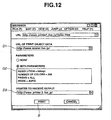
- Fig. 12 is a diagram illustrative of an example of the print acceptance screen.
- the print acceptance screen has: a print data specifying area D1 for specifying the location of a node with the print data existing thereat on the network; a parameter specifying area D2 for specifying given conditions to be imposed on the node where the print data exists; a print place specifying area D3 for specifying a printer to print the print data; and a print button B for giving a print executive instruction.
- the initial value in the print place specifying area D3 may be set as the printer 1A which has sent this print acceptance screen. If a user wants to make the printer 1B to print, the location of the printer 1B on the network will be specified instead of the printer 1A.
- a scanner on the network is specified as an acquirer of the print data and various parameters (control information) are specified as conditions for the scanner to acquire the print data.
- the printer 1B is specified as the print place.
- the client computer 2 sends a print request based on the input information to the printer 1B ((4) in Fig. 11) .
- the printer 1B accepts the print request sent from the client computer 2, it interprets the print request ((5) in Fig. 11) and sends an acquisition request to the peripheral device 3 indicated by URL of the print data (6) in Fig. 11) .
- the peripheral device 3 accepts the acquisition request sent from the printer 1B, it acquires the print data by performing its proper processing in accordance with the conditions (parameters) necessary for the acquisition ((7) in Fig. 11) and sends the print data back to the printer 1B ((8) in Fig. 11).
- the printer 1B receives the print data in response to the acquisition request, the printer 1B generates image data based on the print data and supplies the image data to the print engine 28, thereby performing printing ((9) in Fig. 11).
- Embodiment 3 it is possible to achieve advantageous effects similar to those of Embodiment 1. Specifically, even if the printer which is intended to perform printing does not have a function to provide the print acceptance screen, the print system according to Embodiment 3 can operate as long as another node having such a function exists on the network.
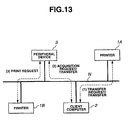
- Fig. 13 is a diagram depicting a schematic structure of a print system according to Embodiment 4.
- Embodiment 4 is a variation of Embodiment 2 and is characterized in that a node, including a printer, on a network other than a printer to perform printing sends a print acceptance screen. This is particularly effective when a printer 1B does not have a function to provide the print acceptance screen. For example, assuming that a user is trying to make a scanner as a peripheral device 3 capture images and to make the printer 1B print the images captured by the scanner, a client computer 2 sends a request to transfer the print acceptance screen to a printer 1A and then displays the print acceptance screen supplied from the printer 1A ((1) in Fig. 13).
- the user inputs, on the print acceptance screen, a directive to capture images by means of the scanner and designates the printer 1B as a place to print.
- the client computer 2 sends a print request, including an acquisition request, to the scanner ((2) in Fig. 13) .
- the scanner captures images in accordance with the image capture directive and then sends the captured images together with the print request to the printer 1B ((3) in Fig. 13) .
- the printer 1B receives the images sent from the scanner and prints the images on a print record medium.
- Fig. 14 is a diagram which explains an example operation of the print system according to Embodiment 4.
- the client computer 2 first requests the printer 1A to transfer the page data which composes the print acceptance screen ((1) in Fig. 14) .
- a transfer request is realized, for example, when a user designates information about the location of the page data on the network by utilizing the browser.
- the printer 1B reads out given page data from the page data storage unit 23 on the basis of the transfer request sent from the client computer 2 ((2) in Fig. 14) and transfers the page data to the client computer 2 which is the original requester ((3) in Fig. 14). Accordingly, the print acceptance screen as shown in Fig. 12 will be displayed on the browser of the client computer 2.
- the client computer 2 sends a print request based on the input information to the peripheral device 3 ((4) in Fig. 14) .
- the browser issues the print request by designating the peripheral device 3 indicated in the section of "URL of Print data" as a new connecting counterpart (or a receiver) so that the print data acquired by the peripheral device 3 will be sent to the printer 1B, the place to print.
- the peripheral device 3 receives the print request sent from the client computer 2, the peripheral device 3 performs its proper processing on the basis of the acquisition request included in the print request, thereby acquiring the print data ((5) in Fig. 14).
- the peripheral device 3 sends the print request to the printer 1B in order to cause the printer 1B designated as the print place to print the print data ((6) in Fig. 14). Subsequently, receiving the print data, the printer 1B generates image data based on the print data and supplies the image data, thereby performing printing ((7) in Fig. 14).
- the client computer 2 is capable of causing the printer 1 to print the print data existing at the peripheral device 3 on the network through the print acceptance screen provided by the printer 1.
- the print request together with the acquisition request for the print data are sent to the peripheral device 3, and after the peripheral device 3 acquires the print data on the basis of the acquisition request, the print request is sent to the printer 1. Accordingly, the print data existing at the peripheral device 3 is not transferred to the client computer 2 once, but is transferred directly to the printer 1. Therefore, it is possible to lighten the load on the client computer 2 and the network.
- Embodiment 4 it is possible to achieve advantageous effects similar to those of Embodiment 2. Specifically, even if the printer which is intended to perform printing does not have a function to provide the print acceptance screen, the print system according to Embodiment 4 can operate as long as another node having such a function exists on the network.
- the present invention can be implemented also as a recording medium or program product with programs stored thereon.
- the recording medium includes not only hard disks (HD), DVD-RAM, flexible disks (FD), CD-ROM and the like, but also memories such as RAM and ROM and communication media such as networks.
- the control unit of the printer includes so-called microcomputers of which central processing unit such as CPU or MPU performs specified processing by interpreting programs.
Landscapes
- Engineering & Computer Science (AREA)
- Theoretical Computer Science (AREA)
- Human Computer Interaction (AREA)
- Physics & Mathematics (AREA)
- General Engineering & Computer Science (AREA)
- General Physics & Mathematics (AREA)
- Accessory Devices And Overall Control Thereof (AREA)
- Computer And Data Communications (AREA)
Abstract
Description
Claims (12)
- A printer connected to a network, comprising:a memory for storing a program and/or data;a processor for executing the program; anda print engine for executing printing on a print record medium,
wherein according to the program, the processor:receives from a computer a print request, including a request to a peripheral device to acquire print data;sends the acquisition request to the peripheral; andcauses the print engine to print on the basis of the print data sent from the peripheral device in response to the acquisition request. - A printer according to claim 1, wherein according to the program and in response to a given transfer request sent from the computer, the processor sends page data, which composes a print acceptance screen for sending the print request, to the computer.
- A printer according to claims 1 and 2, wherein the acquisition request includes a specified condition for the peripheral device to acquire the print data.
- A printer connected to a network, comprising:print request acceptance means of accepting a print request sent from a computer, the print request including a request to a peripheral device to acquire print data;acquisition request means of sending the acquisition request to the peripheral device on the basis of the print request accepted by the print request acceptance means;print data acceptance means of accepting the print data sent from the peripheral device in response to the acquisition request sent by the acquisition request means; andprint means of performing printing on the basis of the print data accepted by the print data acceptance means.
- A printer according to claim 4, wherein the printer further comprises page data sending means of sending page data, which composes a print acceptance screen to send the print request, to the computer in response to a given transfer request sent from the computer.
- A method for controlling a printer connected to a network, comprising the steps of:receiving a print request from a computer, the print request including a request to a peripheral device to acquire print data;sending the acquisition request to the peripheral device; andprinting on the basis of the print data sent from the peripheral device in response to the acquisition request.
- A program product stored thereon for causing a control unit of a printer to perform given functions, the product comprising;a print request acceptance function to accept a print request from a computer, the print request including a request to a peripheral device to acquire print data;an acquisition request function to send the request to acquire the print data to the peripheral device on the basis of the print request accepted by the print request acceptance means;a print data acceptance function to accept the print data sent from the peripheral device in response to the acquisition request sent by the acquisition request function; anda print function to cause a print engine to perform printing on the basis of the print data accepted by the print data acceptance function.
- A print system comprising a printer, a computer and a peripheral device,
wherein the printer receives a print request sent from the computer, the print request including a request to the peripheral device to acquire print data, and sends the acquisition request to the peripheral device,
wherein the peripheral device acquires the print data in response to the acquisition request and sends the acquired print data to the printer, and
wherein the printer performs printing on the basis of the print data sent from the peripheral data. - A printer connected to a network, comprising:a memory for storing a program and/or data;a processor for executing the program; anda print engine for executing printing on a print record medium,
wherein according to the program, the processor:sends page data, which composes a print acceptance screen for a computer to request the printing of print data, to the computer in response to a given transfer request from the computer;receives the print data that a peripheral device acquires and sends in response to a print request as the computer sends the print request to the peripheral device, the print request including a request to acquire the print data on the basis of the print acceptance screen; andcauses the print engine to print on the basis of the received print data. - A print system comprising a printer, a computer and a peripheral device,
wherein in response to a given transfer request from the computer, the printer sends page data to the computer, the page data composing a print acceptance screen for the computer to request the printing of print data,
wherein the computer displays the print acceptance screen on the basis of the page data sent from the printer, and sends a print request, including a request to acquire the print data, to the peripheral device on the basis of given information inputted to the displayed print acceptance screen,
wherein the peripheral device acquires the print data in response to the acquisition request included in the print request and sends the acquired print data to the printer indicated in the print request, and
wherein the printer performs printing on the basis of the print data sent from the peripheral data. - A printing method,
wherein a computer displays a print acceptance screen on the basis of page data sent from a given node,the print acceptance screen comprising:a first area for a user to specify a peripheral device to acquire print data;a second area for a user to specify a given condition when the peripheral device acquires the print data; anda third area for a user to specify a printer made to print on the basis of the print data, and
wherein the computer acquires the print data from the peripheral device specified in the first area in accordance with the given condition specified in the second area and sends an acquisition/print request for printing to the printer specified in the third area. - A printing method,
wherein a computer displays a print acceptance screen on the basis of page data sent from a given node,the print acceptance screen comprising:a first area for a user to specify a peripheral device to acquire print data;a second area for a user to specify a given condition when the peripheral device acquires the print data; anda third area for a user to specify a printer made to print on the basis of the print data, and
wherein the computer sends an acquisition/print request to the peripheral device specified in the first area to cause the peripheral device to acquire the print data in accordance with the given condition specified in the second area and to send the acquired print data to the printer specified in the third area, thereby causing the printer to print.
Applications Claiming Priority (4)
| Application Number | Priority Date | Filing Date | Title |
|---|---|---|---|
| JP14268599 | 1999-05-24 | ||
| JP14268599 | 1999-05-24 | ||
| JP2000063791 | 2000-03-08 | ||
| JP2000063791A JP3876588B2 (en) | 1999-05-24 | 2000-03-08 | Printer, printer control method, print system, and recording medium |
Publications (2)
| Publication Number | Publication Date |
|---|---|
| EP1055995A2 true EP1055995A2 (en) | 2000-11-29 |
| EP1055995A3 EP1055995A3 (en) | 2002-06-26 |
Family
ID=26474607
Family Applications (1)
| Application Number | Title | Priority Date | Filing Date |
|---|---|---|---|
| EP00304309A Ceased EP1055995A3 (en) | 1999-05-24 | 2000-05-22 | Printer capable of network connection and method for controlling said printer |
Country Status (3)
| Country | Link |
|---|---|
| US (2) | US7411689B1 (en) |
| EP (1) | EP1055995A3 (en) |
| JP (1) | JP3876588B2 (en) |
Cited By (1)
| Publication number | Priority date | Publication date | Assignee | Title |
|---|---|---|---|---|
| EP1248435A3 (en) * | 2001-04-05 | 2005-05-04 | Seiko Epson Corporation | Image and sound output system via network |
Families Citing this family (11)
| Publication number | Priority date | Publication date | Assignee | Title |
|---|---|---|---|---|
| JP4890531B2 (en) * | 2002-09-13 | 2012-03-07 | 株式会社リコー | Image forming apparatus and printing processing method |
| JP3821080B2 (en) * | 2002-09-30 | 2006-09-13 | ブラザー工業株式会社 | Printing device |
| US20050094161A1 (en) * | 2003-11-05 | 2005-05-05 | Do Tae-Hoi | Image forming method and image forming apparatus |
| JP4448060B2 (en) * | 2005-05-20 | 2010-04-07 | キヤノン株式会社 | Copying apparatus, control method therefor, program for executing the method, and copying system |
| JP2007081893A (en) * | 2005-09-15 | 2007-03-29 | Ricoh Co Ltd | Image input device and printing system |
| DE102007012589B4 (en) * | 2007-03-13 | 2009-03-19 | Schwab, Martin, Dipl.-Ing. | optical assembly |
| JP4433011B2 (en) * | 2007-08-06 | 2010-03-17 | コニカミノルタビジネステクノロジーズ株式会社 | Data processing apparatus, data processing method, and data processing program |
| JP5528136B2 (en) * | 2010-01-29 | 2014-06-25 | キヤノン株式会社 | Information processing apparatus, information processing apparatus control method, and computer program |
| JP5645515B2 (en) * | 2010-07-09 | 2014-12-24 | キヤノン株式会社 | Processing system, control method, and program thereof |
| JP5917024B2 (en) * | 2011-06-09 | 2016-05-11 | キヤノン株式会社 | Image forming apparatus, image forming apparatus control method, and program |
| US10477062B2 (en) * | 2017-08-10 | 2019-11-12 | Ricoh Company, Ltd. | Image forming apparatus for managing substantially simultaneous image processing requests |
Family Cites Families (25)
| Publication number | Priority date | Publication date | Assignee | Title |
|---|---|---|---|---|
| US6791703B1 (en) * | 1909-06-05 | 2004-09-14 | Canon Kabushiki Kaisha | Image processing apparatus and method, and storage medium therefor |
| EP0971531B1 (en) * | 1994-04-19 | 2006-09-27 | Canon Kabushiki Kaisha | Network system in which a plurality of image processing apparatuses are connected |
| JPH0887390A (en) * | 1994-09-20 | 1996-04-02 | Fujitsu Ltd | Network system having printing device, printing device for network system, server device for network system, and terminal device for network system |
| JPH09238209A (en) | 1996-02-29 | 1997-09-09 | Canon Inc | Image input / output system, image reading apparatus and control method thereof |
| WO1997032274A2 (en) * | 1996-03-01 | 1997-09-04 | Fmr Corp. | Open systems printing |
| JPH09282119A (en) | 1996-04-17 | 1997-10-31 | Fuji Xerox Co Ltd | Printing system |
| US5956487A (en) | 1996-10-25 | 1999-09-21 | Hewlett-Packard Company | Embedding web access mechanism in an appliance for user interface functions including a web server and web browser |
| JPH10161823A (en) * | 1996-11-27 | 1998-06-19 | Nec Corp | Print system |
| US6452692B1 (en) * | 1996-12-02 | 2002-09-17 | Sun Microsystems, Inc. | Networked printer server |
| JPH10164295A (en) | 1996-12-02 | 1998-06-19 | Ricoh Co Ltd | Image reading device |
| JPH10177533A (en) * | 1996-12-17 | 1998-06-30 | Canon Inc | Information input / output device, information input / output device management system, information input / output device position setting method, and information input / output device management method |
| DE69734562T2 (en) * | 1996-12-26 | 2006-07-27 | Canon K.K. | Information processing apparatus and control method therefor |
| JPH10240552A (en) | 1996-12-26 | 1998-09-11 | Canon Inc | Information processing apparatus and method |
| DE69835179T2 (en) * | 1997-03-12 | 2007-07-05 | Canon K.K. | Method, system and device for data transmission and program for data transmission method stored in a storage medium |
| EP0872792A3 (en) | 1997-04-17 | 2000-04-26 | Adobe Systems, Inc. | Network communication with printing systems |
| JP3201514B2 (en) * | 1997-06-09 | 2001-08-20 | セイコーエプソン株式会社 | Print data generation device, print data generation method, printing device, and printing system |
| US6184996B1 (en) * | 1997-06-18 | 2001-02-06 | Hewlett-Packard Company | Network printer with remote print queue control procedure |
| US6453127B2 (en) * | 1997-09-26 | 2002-09-17 | Nexpress Solutions Llc | Establishment at a remote location of an internet/intranet user interface to a copier/printer |
| US6351317B1 (en) * | 1997-09-30 | 2002-02-26 | Brother Kogyo Kabushiki Kaisha | Printing system using communication network |
| JPH11126141A (en) | 1997-10-24 | 1999-05-11 | Fuji Xerox Co Ltd | Image forming device |
| JP4174090B2 (en) * | 1997-10-31 | 2008-10-29 | キヤノン株式会社 | Image processing method, apparatus, and recording medium |
| US6301011B1 (en) * | 1997-11-07 | 2001-10-09 | Xerox Corporation | Dynamic plug and play interface for output device |
| US6434343B1 (en) * | 1998-01-08 | 2002-08-13 | Fujitsu Limited | Composite machine, server, composite machine-server system, and program recording medium |
| US6429952B1 (en) | 1998-08-31 | 2002-08-06 | Sharp Laboratories Of America | Browser interface to scanner |
| US6697091B1 (en) * | 2000-01-19 | 2004-02-24 | Xerox Corporation | Systems, methods and graphical user interfaces for indicating a desired original document orientation for image capture devices |
-
2000
- 2000-03-08 JP JP2000063791A patent/JP3876588B2/en not_active Expired - Fee Related
- 2000-05-22 EP EP00304309A patent/EP1055995A3/en not_active Ceased
- 2000-05-23 US US09/577,078 patent/US7411689B1/en not_active Expired - Fee Related
-
2004
- 2004-03-16 US US10/801,619 patent/US20040174560A1/en not_active Abandoned
Cited By (1)
| Publication number | Priority date | Publication date | Assignee | Title |
|---|---|---|---|---|
| EP1248435A3 (en) * | 2001-04-05 | 2005-05-04 | Seiko Epson Corporation | Image and sound output system via network |
Also Published As
| Publication number | Publication date |
|---|---|
| JP2001043055A (en) | 2001-02-16 |
| JP3876588B2 (en) | 2007-01-31 |
| US7411689B1 (en) | 2008-08-12 |
| US20040174560A1 (en) | 2004-09-09 |
| EP1055995A3 (en) | 2002-06-26 |
Similar Documents
| Publication | Publication Date | Title |
|---|---|---|
| US6983415B2 (en) | Computer peripheral device and a processing system having a hypertext interpretation section and control method therefor | |
| JP4119002B2 (en) | Network printing system | |
| EP1650953B1 (en) | Image forming apparatus, a print process method, a computer program and a computer readable storage medium | |
| US20040105104A1 (en) | Image-processing apparatus and image-processing system | |
| JP2004129248A (en) | Image forming apparatus and scan data processing method | |
| JPH06332636A (en) | Printer server system | |
| US7411689B1 (en) | Printer capable of network connection and method for controlling said printer | |
| US7145672B2 (en) | Image processing apparatus having a function for executing firmware rewriting, image processing method, and management apparatus for managing the image processing apparatus | |
| US7274483B2 (en) | Processing of print data received over a network, and image formation using the processed data | |
| US7543050B2 (en) | Network terminal with a plurality of internal web servers | |
| US6988123B2 (en) | Methods and apparatus for remote execution of an application over the internet | |
| US7463381B2 (en) | Markup language edit method, record medium recording browser, and print system | |
| JP2009255390A (en) | Image forming apparatus, functional cooperation control method, and functional cooperation control program | |
| JP2001243157A (en) | Network system, download device, server, network management method | |
| JP4045800B2 (en) | Printing system and method | |
| JPH07288621A (en) | Server system | |
| JP3740289B2 (en) | Image input device, information processing apparatus, image input method and information processing method, and computer-readable storage medium | |
| JP3507463B2 (en) | Information processing apparatus and control method thereof | |
| JP3507464B2 (en) | Information processing apparatus and control method thereof | |
| JP3685186B2 (en) | Network printing system | |
| JP2004303205A (en) | Image forming apparatus capable of editing stored document information by external device, and document service providing method | |
| JP3747898B2 (en) | Electronic device control method and program | |
| JP2007081893A (en) | Image input device and printing system | |
| JP3860785B2 (en) | Image processing device | |
| JP5031656B2 (en) | COMMUNICATION SYSTEM AND OUTPUT METHOD, SERVER DEVICE, TRANSMISSION METHOD, PROGRAM, AND RECORDING MEDIUM |
Legal Events
| Date | Code | Title | Description |
|---|---|---|---|
| PUAI | Public reference made under article 153(3) epc to a published international application that has entered the european phase |
Free format text: ORIGINAL CODE: 0009012 |
|
| AK | Designated contracting states |
Kind code of ref document: A2 Designated state(s): AT BE CH CY DE DK ES FI FR GB GR IE IT LI LU MC NL PT SE |
|
| AX | Request for extension of the european patent |
Free format text: AL;LT;LV;MK;RO;SI |
|
| PUAL | Search report despatched |
Free format text: ORIGINAL CODE: 0009013 |
|
| AK | Designated contracting states |
Kind code of ref document: A3 Designated state(s): AT BE CH CY DE DK ES FI FR GB GR IE IT LI LU MC NL PT SE |
|
| AX | Request for extension of the european patent |
Free format text: AL;LT;LV;MK;RO;SI |
|
| 17P | Request for examination filed |
Effective date: 20021113 |
|
| AKX | Designation fees paid |
Designated state(s): AT BE CH CY DE DK ES FI FR GB GR IE IT LI LU MC NL PT SE |
|
| 17Q | First examination report despatched |
Effective date: 20060725 |
|
| STAA | Information on the status of an ep patent application or granted ep patent |
Free format text: STATUS: THE APPLICATION HAS BEEN REFUSED |
|
| 18R | Application refused |
Effective date: 20071127 |