EP1055936A2 - Mobile terminal and emergency reporting system - Google Patents
Mobile terminal and emergency reporting system Download PDFInfo
- Publication number
- EP1055936A2 EP1055936A2 EP00110286A EP00110286A EP1055936A2 EP 1055936 A2 EP1055936 A2 EP 1055936A2 EP 00110286 A EP00110286 A EP 00110286A EP 00110286 A EP00110286 A EP 00110286A EP 1055936 A2 EP1055936 A2 EP 1055936A2
- Authority
- EP
- European Patent Office
- Prior art keywords
- data
- terminal
- reporting system
- positional
- emergency
- Prior art date
- Legal status (The legal status is an assumption and is not a legal conclusion. Google has not performed a legal analysis and makes no representation as to the accuracy of the status listed.)
- Granted
Links
Images



Classifications
-
- G—PHYSICS
- G01—MEASURING; TESTING
- G01S—RADIO DIRECTION-FINDING; RADIO NAVIGATION; DETERMINING DISTANCE OR VELOCITY BY USE OF RADIO WAVES; LOCATING OR PRESENCE-DETECTING BY USE OF THE REFLECTION OR RERADIATION OF RADIO WAVES; ANALOGOUS ARRANGEMENTS USING OTHER WAVES
- G01S19/00—Satellite radio beacon positioning systems; Determining position, velocity or attitude using signals transmitted by such systems
- G01S19/01—Satellite radio beacon positioning systems transmitting time-stamped messages, e.g. GPS [Global Positioning System], GLONASS [Global Orbiting Navigation Satellite System] or GALILEO
- G01S19/13—Receivers
- G01S19/14—Receivers specially adapted for specific applications
- G01S19/17—Emergency applications
-
- G—PHYSICS
- G01—MEASURING; TESTING
- G01S—RADIO DIRECTION-FINDING; RADIO NAVIGATION; DETERMINING DISTANCE OR VELOCITY BY USE OF RADIO WAVES; LOCATING OR PRESENCE-DETECTING BY USE OF THE REFLECTION OR RERADIATION OF RADIO WAVES; ANALOGOUS ARRANGEMENTS USING OTHER WAVES
- G01S5/00—Position-fixing by co-ordinating two or more direction or position line determinations; Position-fixing by co-ordinating two or more distance determinations
- G01S5/0009—Transmission of position information to remote stations
- G01S5/0018—Transmission from mobile station to base station
- G01S5/0027—Transmission from mobile station to base station of actual mobile position, i.e. position determined on mobile
-
- G—PHYSICS
- G01—MEASURING; TESTING
- G01S—RADIO DIRECTION-FINDING; RADIO NAVIGATION; DETERMINING DISTANCE OR VELOCITY BY USE OF RADIO WAVES; LOCATING OR PRESENCE-DETECTING BY USE OF THE REFLECTION OR RERADIATION OF RADIO WAVES; ANALOGOUS ARRANGEMENTS USING OTHER WAVES
- G01S2205/00—Position-fixing by co-ordinating two or more direction or position line determinations; Position-fixing by co-ordinating two or more distance determinations
- G01S2205/001—Transmission of position information to remote stations
- G01S2205/006—Transmission of position information to remote stations for emergency situations
Definitions
- the present invention relates to a mobile terminal for transmitting emergency information by compressing the information without degrading the details when the emergency should be reported to an information service centre or an emergency centre (hereinafter referred to as a "centre"), and an emergency reporting system for receiving the information at the centre from the mobile terminal and then provides an emergency service from the centre to the mobile terminal.
- a mobile terminal for transmitting emergency information by compressing the information without degrading the details when the emergency should be reported to an information service centre or an emergency centre (hereinafter referred to as a "centre")
- an emergency reporting system for receiving the information at the centre from the mobile terminal and then provides an emergency service from the centre to the mobile terminal.
- Cellular phones having a position detecting function such as global positioning system (GPS) or movable terminals having a sensor for detecting an abnormality or emergency have been downsized and become inexpensive thanks to technical progresses. Reliability including shockproof characteristic of those mobile terminals has been also improved.
- GPS global positioning system
- Such a mobile terminal in a small body is installed in a vehicle and used as an emergency reporting system when a traffic accident occurs.
- Another small mobile terminal is shaped into a pendant and used as a man locating system for a user having a chronic illness such as a heart disease to inform a centre of his or her location.
- a location sending device as such a mobile terminal is disclosed in Japanese Patent Application Non-Examined Publication No. H06-18648.
- This location sending device measures a present position using GPS satellite 101, and GPS receiver 102 acquires resultant positional information comprising a latitude, longitude and altitude. This information is measured periodically or at spatial intervals when the mobile terminal moves, and the track information between a plurality of locations is stored in ring-buffer-memory 103 cyclically.
- the mobile terminal When an abnormality or emergency occurs, or when a centre issues an emergency request, the mobile terminal produces a transmission signal using a given protocol through the following method: a transmission-starting-time supplied from timer 104 and a mobile terminal ID code held by ID-code-holder 105 are added to the track information between plural positions immediately before the instant position. This track information is selected from other track information stored in ring-buffer-memory 103.
- the transmission signal is formed to have a given signal format at transmission-signal-forming section 107 following a transmission-signal-format provided by transmission-signal-format-holder 106.
- Radio transmitter 108 modulates a high-frequency-carrier-wave with the transmission signal, and outputs the positional data of a sender from antenna 109 to the centre.
- a terminal ID of the centre identifies the sender by checking his membership.
- the track information is plotted on a digital map displayed on a console in the centre, so that the centre can be informed of the track-record of the mobile terminal.
- a conventional system takes a rather long time for the communication because all the track information of a mobile terminal including track records between plural points and a terminal ID must be transmitted.
- C-DGPS method *centre differential GPS method
- the information about 500 points needs as much as 29 kilo Bytes, and it takes about 30 seconds when the information is sent at 9,600 bps.
- This time-consuming transmission has been a bottleneck for tracking and searching a mobile terminal.
- *Centre differential GPS method modifies the information of latitude and longitude acquired by the mobile terminal with error correction, and realises a highly accurate measuring such as a measuring error falling within a 10 to 30 meters range.
- the information about. 500 points needs approx. 9.5 kilo-Bytes, and it takes about 10 seconds for transmission; however a measuring error becomes as large as several hundreds meters. The centre cannot exactly identify the position of the mobile terminal with this poor positional accuracy.
- An emergency reporting system used at a traffic accident or a man-locating system for reporting a heart attack affects people's lives and thus the system needs a high-speed process as well as highly accurate tracking of the mobile terminal's position.
- the conventional system as discussed above has a problem that the high-speed and high-accuracy are not compatible.
- the present invention addresses the problems discussed above and aims to shorten the communication time by coding data when positional information of plural points is transmitted. Further, the present invention aims to transmit positional data within a short time and with a high accuracy responding flexibly to travelling of a mobile terminal.
- the present invention thus concerns an emergency reporting system as defined in the appended claims.
- An information service centre receives the data sent from the mobile terminal, decodes the data responsive to the compression or coding format of the data received, and supplies various services depending on emergency requests including an accident and a sudden illness. As a result, the centre can supply services within a short time for any compression method.
- Fig. 2 shows respective structures of a mobile terminal and a centre of the present invention.
- mobile terminal 11 has GPS receiver 12 for detecting positional data.
- Receiver 12 measures a position of the terminal at given intervals of a distance travelled, given intervals of an elapsed time, given intervals of an angle circled, or intervals of a factor obtained by combining those factors.
- Resultant positional data is stored cyclically in ring-buffer-memory 13.
- the data stored in memory 13 includes time-data, latitude and longitude of each location, a distance travelled, and an angle circled.
- Pseudo distance data between the terminal and respective GPS satellites are also stored in memory 13 because C-DGPS method is employed. The number of the satellites ranges from one to eight, in general.
- the positional data acquired by receiver 12 can be compressed or coded first by data-compressor 14, before storing in memory 13. In this case, the capacity of memory 13 can be reduced.
- the mobile terminal 11 When emergency button 21 is depressed manually in the case of an emergency such as an accident or a sudden illness in order to inform the centre of the emergency personally, the mobile terminal 11 starts an emergency-reporting operation.
- status sensor 22 detects automatically an abnormality such as an accident or a sudden illness or when centre 31 requires a report, terminal 11 performs the same.
- the data stored in memory 13 about each location is read out, and then sequentially compressed by data-compressor 14.
- Compressor 14 uses a relative value of the positional data stored in memory 13 or data-flags indicating existence of data for compressing the data. Data compression is detailed later.
- the compressed positional data is supplied to transmission-signal-producing device 15.
- producing device 15 adds time-data obtained from timer 16, a terminal ID of terminal 11 obtained from terminal-ID-memory 17, and emergency information dispatched from emergency button 21 or status sensor 22. Then producing device 15 produces a given transmission signal following a transmission-signal-format provided by format-memory 18. This transmission signal is supplied to radio transceiver 19, and a high-frequency carrier-wave is modulated by transmission signals and transmitted to centre 31 from antenna 20 following a given protocol.
- mobile terminal 11 After the transmission, mobile terminal 11 is switched by mode switcher 29 to voice-communication from data-communication, and then terminal 11 functions as a normal cellular phone. Voice-communication between terminal 11 and centre 31 now takes place. This switching can be done automatically by CPU 26.
- Display 27 shows an operating status of mobile terminal 11 and a notice from centre 31 to a terminal owner.
- Centre 31 receives the emergency information, positional data and terminal ID sent by transceiver 33 from mobile terminal 11.
- Data analyser 37 analyses the data received, identifies membership, and then decodes the compressed positional data.
- Mobile-terminal-track-data producing device 34 produces track-data of terminal 11 based on the decompressed or decoded positional data.
- map-display 35 retrieves a target map from map database 36 referring to the decoded positional data.
- the track-data produced by producing device 34 and the target map retrieved by map-display 35 are supplied to display 38 on an operator's console.
- Display 38 displays an instant position of mobile terminal 11 together with its track-data on a map on the screen thereof.
- the emergency information and the terminal ID supplied by data analyser 37 are also displayed on display 38.
- the operator watches the emergency information, terminal ID, track-data, and instant position of terminal 11 on the screen, and communicates with the terminal owner with voice, so that the operator answers to the emergency appropriately.
- Fig. 3 shows a flowchart of the protocol between mobile terminal 11 and centre 31.
- step 1 message type is transmitted indicating a basic mode or an extension mode.
- the basic mode transmits a predetermined minimum message required as a transmission message to the centre independent of the will of the mobile terminal's owner.
- This basic message data includes, e.g. as is shown in Figure 4, terminal ID 41, status information 42 indicating the content of an emergency, and mobile terminal's positional data 43. Positional data 43 is detailed later.
- the extension mode transmits the data the terminal's owner has set in advance or transmits additionally the data set responsive to a status during the terminal's travel.
- the extension mode transmits important data for identifying the position, such as an instant address and a name of a building, as well as a method of travelling (by car, bicycle, train, or on foot). Those data are not obtainable by a GPS receiver 12.
- this extension mode is used. In the extension mode, a position can be identified more easily, and the data transmission volume can be reduced.
- a mobile terminal's owner can set the extension mode with mode-setting device 28.
- step 2 the data length of the message is transmitted.
- step 3 the message data per se is transmitted.
- mobile terminal 11 is switched over to a voice communication mode from a data communication mode in step 4. This switch is conducted when an end-button is depressed at completion of transmitting the message data, or may be automatically conducted after a predetermined period following completion of transmitting the message data.
- the terminal owner can start communicating with an operator at centre 31 in step 5 through microphone 24 and speaker 25 equipped to terminal 11.
- positional data 43 which contains local positional data of each point the mobile terminal passes through.
- positional data 43 comprises point data 51 including first point, second point, . . . . k-th point, and local attributions 52 indicating the kind of the local point such as a place name, road, intersection, building, and text data 53.
- Point data 51 is measured at intervals of a given distance, given period, given circular angle or at intervals obtained by combining these factors.
- "n" pieces of data are cyclically stored in ring-buffer-memory 13.
- "cyclically” means that when "n+1"-th data is measured, the oldest data is deleted and the "n+1"-th data is stored in the newest point instead.
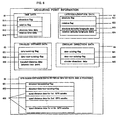
- Fig. 6 details the point data, which describes the content of a local point.
- the point data comprises time data 61, latitude and longitude data 62, travelled distance data 63 between two points, circular direction data 64, and GPS quasi distance data 65 for C-DGPS method.
- absolute time data 613 with absolute flag 611 is transmitted at the first point where measuring is started, and then relative time data 614 having relative flag 612 and indicating a time difference with the former point is transmitted at the second point and onward.
- relative time data 614 having relative flag 612 and indicating a time difference with the former point is transmitted at the second point and onward.
- absolute data 623 with absolute flag 621 or relative data 624 with relative flag 622 is transmitted.
- absolute data 623 is transmitted at the first point
- relative data 624 is transmitted at the second point and onward.
- travelled distance data 633 with data-existing flag 631 or only data-non-existing-flag 632 is transmitted.
- travelled distance data 633 with data-existing flag 631 is transmitted; however, only data-non-existing-flag 632 is transmitted when no data is obtained or the mobile terminal is halted.
- circular-direction data 643 with data-existing flag 641 is transmitted when a circular section travelled through has an angle that is larger than a given angle. In the case of straight travelling without such a circular section, i.e.. there thus is no larger angle than the given angle, only data-non-existing-flag 642 is transmitted.
- Quasi-distance data 65 comprises distance-data-existing-flag 651, distance-data-non-existing-flag 652 and quasi distance data 653 from respective GPS satellites "1"-"m" to the terminal.
- a GPS quasi distance data is not obtainable, and then only distance-data-non-existing-flag 652 is transmitted. This flag-only transmittance can reduce the total transmitted data volume.
- the positional data is converted into relative data or into data using a data-existing-flag or a data-non-existing-flag by data-compressor 23 shown in Fig. 2. This conversion contributes to shortening substantially the transmission time.
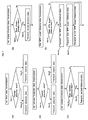
- Fig. 7 is a flowchart illustrating the transmission flow of the point data.
- section (A) represents the transmission flow of time data
- section (B) represents the transmission flow of latitude and longitude data
- section (C) shows that of travelled distance data
- section (D) shows that of circular direction data
- section (E) shows that of GPS quasi distance data.
- step 11 a decision is made in step 11 whether absolute data is transmitted or not.
- absolute data instead of relative data is transmitted.
- step 21 In the latitude and longitude data transmission shown in Fig. 7(B), first a decision is made in step 21 whether or not absolute data is transmitted. This data does not differ so much at each point, thus the absolute data is transmitted at the first point in step 22 and then a changed amount, i.e. the relative data, from the previous point is transmitted at the second point in step 23 and onward.
- This can reduce the data volume to be transmitted by 13 bits.
- step 31 a decision is made in step 31 whether or not a travelled distance data exists. If the data exists, move on to step 32 and then transmit a travelled-distance-data with a data-existing flag. If the data does not exist, the flag is turned to non-existing and no data is transmitted.
- step 41 a decision is made in step 41 whether or not circular-direction-data exists.
- step 42 When the data exists, move on to step 42 and transmit the circular-direction data with a data-existing flag.
- the flag is turned to data-non-existing and no data is transmitted.
- the data exists move on to step 52 and transmit the 1 st quasi-distance-data from the first GPS satellite with a data-existing-flag, then on step 53, transmit the 2 nd quasi-distance-data from the second GPS satellite with the data-existing-flag, and repeat the same process for the third, fourth GPS satellites and onward.
- the signal from a GPS satellite is not receivable because the instant position is in a tunnel or behind a high-rise building, the flag is turned to data-non-existing and no data is transmitted.
- the volume can be reduced by a total of approx. 10 Kbytes. Therefore, when a data transmission at 9600 bps is used, approx. 10 seconds can be saved.
- Fig. 8 illustrates correction of a GPS quasi-distance at mobile terminal 11 and centre 31.
- the GPS quasi-distances have regular errors, thus the error is added to the GPS quasi-distance at the mobile terminal, so that the quasi data is corrected.
- Those measuring errors d 1 , d 2 , d 3 are added to respective quasi-distances t 1 , t 2 , t 3 measured by GPS satellites 81, 82 and 83 between mobile terminal 11 and the respective GPS satellites, so that the true latitude and longitude of mobile terminal 11 is acquired.
- the positional data should be acquired only when a circular angle exceeds a given angle.
- the number of points can be reduced through this method, thus the number of total points as a point attribution is included at the top of transmitting positional data, before being transmitted.
- This method can reduce the number of points, from which positional data are acquired, compared with the method acquiring positional data at intervals of a given distance or a given period, so that the data volume can be substantially reduced. For instance, when positional data of 500 points are transmitted in order to acquire a travelled track across several kilometres, a conventional system employing the C-DGPS method takes nearly 30 seconds, while the method of the present invention takes only less than 20 seconds.
- the present invention selects an appropriate data compression method such as using a relative data, a quasi-distance-compression, data (non-) existing flag, and the data of a number of points, responsive to a status.
- This structure can transmit positional data to a centre within a short time yet can remain accurate in identifying the position.
Landscapes
- Engineering & Computer Science (AREA)
- Radar, Positioning & Navigation (AREA)
- Remote Sensing (AREA)
- Physics & Mathematics (AREA)
- General Physics & Mathematics (AREA)
- Computer Networks & Wireless Communication (AREA)
- Mobile Radio Communication Systems (AREA)
- Position Fixing By Use Of Radio Waves (AREA)
- Navigation (AREA)
- Traffic Control Systems (AREA)
Abstract
Description
Claims (20)
- Emergency reporting system comprising:a mobile terminal (11) linked with an information service centre (31) through radio communication,said system is characterised by:said mobile terminal (11) transmitting a compressed positional data including a track travelled by said terminal together with a terminal ID and emergency information;said information service centre (31) identifying said terminal with the received terminal ID, decoding the compressed positional data and displaying the track travelled by said terminal (11) on a map indicating an instant position of said terminal (11), and answering to said terminal (11) about the emergency information.
- The emergency reporting system as defined in Claim 1, wherein said mobile terminal (11) comprises:a positional data detector (12) for detecting an instant position;a memory (13) for storing positional data at a plurality of points detected by said detector;an input device (22, 29) for inputting information indicating an emergency; anda transceiver (18) for transmitting the positional data to said information service centre (31);a data compressor (14) for compressing the data volume of said positional data at the plurality of points; anda transmission data-producing device (15, 16, 17 and 18) for producing a transmission data including compressed data of the positional data at the plurality of points and said terminal ID.
- The emergency reporting system as defined in Claim 2, wherein the positional data includes a time data (61), a latitude and longitude data (62), a distance data (63) travelled by said terminal (11), a circular direction data (64) and a global positioning system (GPS) quasi-distance data (65).
- The emergency reporting system as defined in Claim 2, wherein said data compressor (14) calculates a time difference between an instant time of said terminal and a time at an immediate last point thereof and compresses the time difference.
- The emergency reporting system as defined in Claim 2, wherein said data compressor (14) calculates differences of the latitude and longitude data between an instant point of said terminal and at an immediate last point thereof and compresses the differences.
- The emergency reporting system as defined in Claim 2, wherein said data compressor (14) calculates a distance difference between an instant point of said terminal and an immediate last point thereof and compresses the difference.
- The emergency reporting system as defined in Claim 2, wherein said data compressor (14) calculates an angle difference between an instant point of said terminal and an immediate last point thereof and compresses the difference.
- The emergency reporting system as defined in Claim 2, wherein said data compressor (14) adds a flag indicating a presence of a distance data travelled, and transmits a data-existing flag and the distance data travelled as a transmission data when the distance data travelled is available, and wherein said data compressor transmits a data-non-existing-flag as a transmission data when no distance data is available.
- The emergency reporting system as defined in Claim 2, wherein said data compressor (14) adds a flag indicating a presence of a circling direction data, and transmits a data-existing flag and the circling direction data as a transmission data when the circling direction data is available, and wherein said data compressor transmits a data-non-existing-flag as a transmission data when no circling direction data is available.
- The emergency reporting system as defined in Claim 2, wherein said data compressor (14) adds a flag indicating a presence of a GPS quasi distance data, and transmits a data-existing flag and the GPS quasi distance data as a transmission data when the GPS quasi distance data is available, and wherein said data compressor transmits a data-non-existing-flag as a transmission data when no GPS quasi distance data is available.
- The emergency reporting system as defined in Claim 2, wherein said data compressor (14) compresses a surplus (r), obtained by dividing the GPS quasi-distance data (65) by a value corresponding to a specified distance, as the transmission data for compressing data volume.
- The emergency reporting system as defined in Claim 2, wherein said data compressor (14) compresses the positional data stored in said memory (13).
- The emergency reporting system as defined in Claim 2, wherein said memory (13) stores the positional data compressed by said data compressor (14).
- The emergency reporting system as defined in Claim 2, wherein said data compressor (14) does not transmit the positional data when the circular angle at the point where the positional data is to be acquired is smaller than a given angle.
- The emergency reporting system as defined in Claim 2, wherein said memory (13) stores the positional data cyclically.
- The emergency reporting system as defined in Claim 2, wherein said input device is a sensor (22) for detecting automatically an emergency.
- The emergency reporting system as defined in Claim 2, wherein said input device is a button (21) operable manually by an owner of said terminal.
- The emergency reporting system as defined in Claim 2, wherein the owner of said terminal can set a transmission data and a data compression method arbitrarily in said transmission data producing device (15).
- The emergency reporting system as defined in Claim 1 or 2 further comprising a switch (26, 29) for switching a data communication mode to a voice communication mode after the transmission data has been transmitted.
- The emergency reporting system as defined in Claim 1, wherein said information service centre (31) comprises:a receiver (33) for receiving emergency information including a compressed positional data from said mobile terminal (11);a travelled-track acquisition device (34) of the mobile terminal (11);an acquisition device (35) of a map corresponding to the positional data; anda display (38) for displaying the travelled track on the map; anda data analyser (37) for decoding the compressed data responsive to a compression format of the positional data, and acquiring the travelled track of the mobile terminal and the map.
Applications Claiming Priority (2)
| Application Number | Priority Date | Filing Date | Title |
|---|---|---|---|
| JP14318799 | 1999-05-24 | ||
| JP14318799A JP3333146B2 (en) | 1999-05-24 | 1999-05-24 | Mobile terminals and information service centers |
Publications (3)
| Publication Number | Publication Date |
|---|---|
| EP1055936A2 true EP1055936A2 (en) | 2000-11-29 |
| EP1055936A3 EP1055936A3 (en) | 2002-04-17 |
| EP1055936B1 EP1055936B1 (en) | 2004-09-01 |
Family
ID=15332910
Family Applications (1)
| Application Number | Title | Priority Date | Filing Date |
|---|---|---|---|
| EP00110286A Expired - Lifetime EP1055936B1 (en) | 1999-05-24 | 2000-05-23 | Mobile terminal and emergency reporting system |
Country Status (4)
| Country | Link |
|---|---|
| US (1) | US6404352B1 (en) |
| EP (1) | EP1055936B1 (en) |
| JP (1) | JP3333146B2 (en) |
| DE (1) | DE60013355T2 (en) |
Cited By (6)
| Publication number | Priority date | Publication date | Assignee | Title |
|---|---|---|---|---|
| EP1243939A1 (en) * | 2001-03-22 | 2002-09-25 | Matsushita Electric Industrial Co., Ltd. | Method and apparatus for reducing vehicle position data based upon data accuracy estimation |
| US6480784B2 (en) | 1999-09-24 | 2002-11-12 | Matsushita Electric Industrial Co., Ltd. | Method and apparatus for applying decimation processing to vehicle position data based upon data accuracy estimation |
| WO2008120971A1 (en) * | 2007-04-02 | 2008-10-09 | Tele Atlas B.V. | Method of and apparatus for providing tracking information together with environmental information using a personal mobile device |
| EP2026525A1 (en) * | 2007-08-13 | 2009-02-18 | British Telecommunications Public Limited Company | Communications method and apparatus for data storage |
| EP2637033A1 (en) * | 2012-03-07 | 2013-09-11 | Nxp B.V. | Contextual data compression for geo-tracking applications |
| CN106101085A (en) * | 2016-06-01 | 2016-11-09 | 北京车网互联科技有限公司 | A kind of gps data Compress softwares method of high compression rate low distortion rate |
Families Citing this family (39)
| Publication number | Priority date | Publication date | Assignee | Title |
|---|---|---|---|---|
| US8352400B2 (en) | 1991-12-23 | 2013-01-08 | Hoffberg Steven M | Adaptive pattern recognition based controller apparatus and method and human-factored interface therefore |
| US10361802B1 (en) | 1999-02-01 | 2019-07-23 | Blanding Hovenweep, Llc | Adaptive pattern recognition based control system and method |
| US7966078B2 (en) | 1999-02-01 | 2011-06-21 | Steven Hoffberg | Network media appliance system and method |
| DE19942522A1 (en) * | 1999-09-07 | 2001-03-08 | Bosch Gmbh Robert | Method for coding and decoding objects related to a traffic network |
| US7218938B1 (en) | 2002-04-24 | 2007-05-15 | Chung Lau | Methods and apparatus to analyze and present location information |
| US7212829B1 (en) | 2000-02-28 | 2007-05-01 | Chung Lau | Method and system for providing shipment tracking and notifications |
| US7321774B1 (en) | 2002-04-24 | 2008-01-22 | Ipventure, Inc. | Inexpensive position sensing device |
| US7366522B2 (en) | 2000-02-28 | 2008-04-29 | Thomas C Douglass | Method and system for location tracking |
| US6975941B1 (en) | 2002-04-24 | 2005-12-13 | Chung Lau | Method and apparatus for intelligent acquisition of position information |
| US7905832B1 (en) | 2002-04-24 | 2011-03-15 | Ipventure, Inc. | Method and system for personalized medical monitoring and notifications therefor |
| US7502672B1 (en) | 2000-04-24 | 2009-03-10 | Usa Technologies, Inc. | Wireless vehicle diagnostics with service and part determination capabilities |
| US6615186B1 (en) * | 2000-04-24 | 2003-09-02 | Usa Technologies, Inc. | Communicating interactive digital content between vehicles and internet based data processing resources for the purpose of transacting e-commerce or conducting e-business |
| US6856820B1 (en) * | 2000-04-24 | 2005-02-15 | Usa Technologies, Inc. | In-vehicle device for wirelessly connecting a vehicle to the internet and for transacting e-commerce and e-business |
| US6690302B1 (en) * | 2000-07-26 | 2004-02-10 | Mitsubishi Denki Kabushiki Kaisha | Vehicle emergency reporting device |
| US6701156B2 (en) * | 2000-12-19 | 2004-03-02 | Lucent Technologies Inc | System and method for managing response to a need at a site |
| US8489063B2 (en) * | 2001-10-24 | 2013-07-16 | Sipco, Llc | Systems and methods for providing emergency messages to a mobile device |
| US9049571B2 (en) | 2002-04-24 | 2015-06-02 | Ipventure, Inc. | Method and system for enhanced messaging |
| US9182238B2 (en) | 2002-04-24 | 2015-11-10 | Ipventure, Inc. | Method and apparatus for intelligent acquisition of position information |
| TW200500965A (en) * | 2003-06-17 | 2005-01-01 | Sin Etke Technology Co Ltd | Personal carry-on rescue system |
| US7983835B2 (en) | 2004-11-03 | 2011-07-19 | Lagassey Paul J | Modular intelligent transportation system |
| WO2005109933A1 (en) * | 2004-05-06 | 2005-11-17 | Mitsubishi Denki Kabushiki Kaisha | Mobile terminal, server, information providing system, communication method of mobile terminal, communication method of server, and information providing method of information providing system |
| JP4596309B2 (en) * | 2004-06-08 | 2010-12-08 | マツダ株式会社 | Alarm system and mobile terminal |
| JP2006084385A (en) * | 2004-09-17 | 2006-03-30 | Fujitsu Ltd | Positioning signal transmission device, positioning signal transmission method, and positioning device |
| TWI263443B (en) * | 2004-09-29 | 2006-10-01 | Benq Corp | Urgent contact apparatus and method for mobile communication |
| US7348895B2 (en) * | 2004-11-03 | 2008-03-25 | Lagassey Paul J | Advanced automobile accident detection, data recordation and reporting system |
| CN101116359B (en) * | 2004-12-07 | 2014-10-29 | 夏普株式会社 | Portable telephone |
| CN101666655B (en) * | 2005-02-17 | 2012-02-29 | 松下电器产业株式会社 | Mobile history conversion device and mobile history conversion method |
| JPWO2006137136A1 (en) * | 2005-06-22 | 2009-01-08 | 富士通株式会社 | Mobile information device for emergency contact |
| WO2008057133A2 (en) * | 2006-03-22 | 2008-05-15 | Michael Rabanne | Positional linking of analog two-way radios |
| JP5089136B2 (en) * | 2006-11-02 | 2012-12-05 | 株式会社デンソー | In-vehicle emergency call device |
| US9633327B2 (en) | 2009-09-25 | 2017-04-25 | Fedex Corporate Services, Inc. | Sensor zone management |
| US8239169B2 (en) | 2009-09-25 | 2012-08-07 | Gregory Timothy L | Portable computing device and method for asset management in a logistics system |
| US8299920B2 (en) | 2009-09-25 | 2012-10-30 | Fedex Corporate Services, Inc. | Sensor based logistics system |
| JP2013156721A (en) * | 2012-01-27 | 2013-08-15 | Advanced Telecommunication Research Institute International | Terminal device |
| US20150293232A1 (en) * | 2014-04-15 | 2015-10-15 | Neoterra Systems Inc. | System and Method for Compressing GPS Data |
| JP5985001B1 (en) * | 2015-04-15 | 2016-09-06 | 三菱電機株式会社 | Travel data providing device, travel data providing method, and travel data providing program |
| WO2018030258A1 (en) * | 2016-08-10 | 2018-02-15 | 京セラ株式会社 | Wireless terminal |
| US10863378B2 (en) * | 2018-12-07 | 2020-12-08 | The Boeing Company | Dynamic fidelity message compression in a live simulation environment |
| WO2026028805A1 (en) * | 2024-08-02 | 2026-02-05 | ソニーセミコンダクタソリューションズ株式会社 | Data processing device, data processing method, and event data output sensor |
Family Cites Families (10)
| Publication number | Priority date | Publication date | Assignee | Title |
|---|---|---|---|---|
| US4651157A (en) * | 1985-05-07 | 1987-03-17 | Mets, Inc. | Security monitoring and tracking system |
| JPH0618648B2 (en) | 1986-08-29 | 1994-03-16 | 三菱重工業株式会社 | On-line grinding method for rolling rolls |
| US5808564A (en) * | 1992-02-06 | 1998-09-15 | Simms Security Corp. | Personal security system with remote activation |
| JPH0618648A (en) | 1992-07-01 | 1994-01-28 | Fujitsu Ltd | Location information transmitter |
| US5719771A (en) * | 1993-02-24 | 1998-02-17 | Amsc Subsidiary Corporation | System for mapping occurrences of conditions in a transport route |
| AU7067394A (en) * | 1993-06-21 | 1995-01-17 | Elke Van Buren | System for summoning help for vehicle occupants or other people carrying a mobile telephone |
| DE4321416A1 (en) * | 1993-06-26 | 1995-01-05 | Deutsche Aerospace | Vehicle emergency radio system |
| US5652570A (en) * | 1994-05-19 | 1997-07-29 | Lepkofker; Robert | Individual location system |
| US5848373A (en) * | 1994-06-24 | 1998-12-08 | Delorme Publishing Company | Computer aided map location system |
| US6104978A (en) * | 1998-04-06 | 2000-08-15 | General Electric Company | GPS-based centralized tracking system with reduced energy consumption |
-
1999
- 1999-05-24 JP JP14318799A patent/JP3333146B2/en not_active Expired - Fee Related
-
2000
- 2000-05-23 EP EP00110286A patent/EP1055936B1/en not_active Expired - Lifetime
- 2000-05-23 DE DE60013355T patent/DE60013355T2/en not_active Expired - Fee Related
- 2000-05-24 US US09/578,067 patent/US6404352B1/en not_active Expired - Fee Related
Cited By (10)
| Publication number | Priority date | Publication date | Assignee | Title |
|---|---|---|---|---|
| US6480784B2 (en) | 1999-09-24 | 2002-11-12 | Matsushita Electric Industrial Co., Ltd. | Method and apparatus for applying decimation processing to vehicle position data based upon data accuracy estimation |
| EP1243939A1 (en) * | 2001-03-22 | 2002-09-25 | Matsushita Electric Industrial Co., Ltd. | Method and apparatus for reducing vehicle position data based upon data accuracy estimation |
| EP2003464A3 (en) * | 2001-03-22 | 2009-10-07 | Panasonic Corporation | Method and apparatus for reducing vehicle position data |
| WO2008120971A1 (en) * | 2007-04-02 | 2008-10-09 | Tele Atlas B.V. | Method of and apparatus for providing tracking information together with environmental information using a personal mobile device |
| EP2026525A1 (en) * | 2007-08-13 | 2009-02-18 | British Telecommunications Public Limited Company | Communications method and apparatus for data storage |
| EP2637033A1 (en) * | 2012-03-07 | 2013-09-11 | Nxp B.V. | Contextual data compression for geo-tracking applications |
| CN103308933A (en) * | 2012-03-07 | 2013-09-18 | Nxp股份有限公司 | Contextual data compression for geo-tracking applications |
| CN103308933B (en) * | 2012-03-07 | 2015-09-02 | 泰利特汽车解决方案公司 | For the context data compression of geographic tracking application |
| US9235591B2 (en) | 2012-03-07 | 2016-01-12 | Telit Automotive Solutions | Contextual data compression for geo-tracking applications |
| CN106101085A (en) * | 2016-06-01 | 2016-11-09 | 北京车网互联科技有限公司 | A kind of gps data Compress softwares method of high compression rate low distortion rate |
Also Published As
| Publication number | Publication date |
|---|---|
| JP3333146B2 (en) | 2002-10-07 |
| EP1055936A3 (en) | 2002-04-17 |
| JP2000329579A (en) | 2000-11-30 |
| EP1055936B1 (en) | 2004-09-01 |
| DE60013355T2 (en) | 2005-09-22 |
| DE60013355D1 (en) | 2004-10-07 |
| US6404352B1 (en) | 2002-06-11 |
Similar Documents
| Publication | Publication Date | Title |
|---|---|---|
| EP1055936B1 (en) | Mobile terminal and emergency reporting system | |
| EP1873549B1 (en) | Method and apparatus for operating a satellite positioning system receiver | |
| US8064378B2 (en) | Location-based broadcast messaging for radioterminal users | |
| US6785551B1 (en) | Method of providing dynamic regionally relevant data to a mobile environment | |
| AU2003267224B2 (en) | Method and apparatus for improved location determination in a private radio network using a public network system | |
| US7590424B2 (en) | Position measuring method and mobile communication terminal | |
| US20020029108A1 (en) | Dual map system for navigation and wireless communication | |
| US20010045886A1 (en) | Mobile terminal and mobile communications system | |
| US9645247B2 (en) | Fast estimation of UTC time in a mobile device using GNSS | |
| EP2932491B1 (en) | System and method for providing alert notifications to a vehicle occupant | |
| US6901260B1 (en) | Differential GPS and/or glonass with wireless communications capability | |
| JPH1141639A (en) | Mobile communication terminal and mobile communication system | |
| JPH1127733A (en) | Mobile communication terminal and mobile communication system | |
| US20030100339A1 (en) | Real time traffic condition reporting system | |
| KR100260253B1 (en) | The transmission method and device for dgps using wireless pager | |
| JPH09281212A (en) | Moving object position detection device | |
| JP2002352383A (en) | Traffic information providing system | |
| JP2000266552A (en) | Navigation system utilizing gps | |
| JPH11118902A (en) | Mobile reporting device and system | |
| JPH09264943A (en) | Apparatus for reporting position of moving body | |
| HK1116871B (en) | Method and apparatus for operating a satellite positioning system receiver | |
| JPH0882526A (en) | Navigation device | |
| HK1036108B (en) | Method and apparatus for operating a satellite positioning system receiver |
Legal Events
| Date | Code | Title | Description |
|---|---|---|---|
| PUAI | Public reference made under article 153(3) epc to a published international application that has entered the european phase |
Free format text: ORIGINAL CODE: 0009012 |
|
| AK | Designated contracting states |
Kind code of ref document: A2 Designated state(s): DE GB Kind code of ref document: A2 Designated state(s): AT BE CH CY DE DK ES FI FR GB GR IE IT LI LU MC NL PT SE |
|
| AX | Request for extension of the european patent |
Free format text: AL;LT;LV;MK;RO;SI |
|
| RIN1 | Information on inventor provided before grant (corrected) |
Inventor name: ICHIKAWA, YUKIO Inventor name: MIYANO, AKIFUMI |
|
| PUAL | Search report despatched |
Free format text: ORIGINAL CODE: 0009013 |
|
| AK | Designated contracting states |
Kind code of ref document: A3 Designated state(s): AT BE CH CY DE DK ES FI FR GB GR IE IT LI LU MC NL PT SE |
|
| AX | Request for extension of the european patent |
Free format text: AL;LT;LV;MK;RO;SI |
|
| RIC1 | Information provided on ipc code assigned before grant |
Free format text: 7G 01S 5/14 A, 7G 08B 25/10 B |
|
| 17P | Request for examination filed |
Effective date: 20020607 |
|
| 17Q | First examination report despatched |
Effective date: 20021113 |
|
| AKX | Designation fees paid |
Free format text: DE GB |
|
| GRAP | Despatch of communication of intention to grant a patent |
Free format text: ORIGINAL CODE: EPIDOSNIGR1 |
|
| GRAS | Grant fee paid |
Free format text: ORIGINAL CODE: EPIDOSNIGR3 |
|
| GRAA | (expected) grant |
Free format text: ORIGINAL CODE: 0009210 |
|
| AK | Designated contracting states |
Kind code of ref document: B1 Designated state(s): DE GB |
|
| REG | Reference to a national code |
Ref country code: GB Ref legal event code: FG4D |
|
| REG | Reference to a national code |
Ref country code: IE Ref legal event code: FG4D |
|
| REF | Corresponds to: |
Ref document number: 60013355 Country of ref document: DE Date of ref document: 20041007 Kind code of ref document: P |
|
| PLAQ | Examination of admissibility of opposition: information related to despatch of communication + time limit deleted |
Free format text: ORIGINAL CODE: EPIDOSDOPE2 |
|
| PLBQ | Unpublished change to opponent data |
Free format text: ORIGINAL CODE: EPIDOS OPPO |
|
| PLBI | Opposition filed |
Free format text: ORIGINAL CODE: 0009260 |
|
| PLAQ | Examination of admissibility of opposition: information related to despatch of communication + time limit deleted |
Free format text: ORIGINAL CODE: EPIDOSDOPE2 |
|
| PLAR | Examination of admissibility of opposition: information related to receipt of reply deleted |
Free format text: ORIGINAL CODE: EPIDOSDOPE4 |
|
| PLBQ | Unpublished change to opponent data |
Free format text: ORIGINAL CODE: EPIDOS OPPO |
|
| PLAB | Opposition data, opponent's data or that of the opponent's representative modified |
Free format text: ORIGINAL CODE: 0009299OPPO |
|
| PLAX | Notice of opposition and request to file observation + time limit sent |
Free format text: ORIGINAL CODE: EPIDOSNOBS2 |
|
| 26 | Opposition filed |
Opponent name: DEUTSCHE TELEKOM AG Effective date: 20050517 |
|
| R26 | Opposition filed (corrected) |
Opponent name: DEUTSCHE TELEKOM AG Effective date: 20050517 |
|
| PLBB | Reply of patent proprietor to notice(s) of opposition received |
Free format text: ORIGINAL CODE: EPIDOSNOBS3 |
|
| PGFP | Annual fee paid to national office [announced via postgrant information from national office to epo] |
Ref country code: DE Payment date: 20080529 Year of fee payment: 9 |
|
| RAP2 | Party data changed (patent owner data changed or rights of a patent transferred) |
Owner name: PANASONIC CORPORATION |
|
| PGFP | Annual fee paid to national office [announced via postgrant information from national office to epo] |
Ref country code: GB Payment date: 20080528 Year of fee payment: 9 |
|
| GBPC | Gb: european patent ceased through non-payment of renewal fee |
Effective date: 20090523 |
|
| PG25 | Lapsed in a contracting state [announced via postgrant information from national office to epo] |
Ref country code: GB Free format text: LAPSE BECAUSE OF NON-PAYMENT OF DUE FEES Effective date: 20090523 |
|
| PG25 | Lapsed in a contracting state [announced via postgrant information from national office to epo] |
Ref country code: DE Free format text: LAPSE BECAUSE OF NON-PAYMENT OF DUE FEES Effective date: 20091201 |
|
| PLBD | Termination of opposition procedure: decision despatched |
Free format text: ORIGINAL CODE: EPIDOSNOPC1 |
|
| PLBM | Termination of opposition procedure: date of legal effect published |
Free format text: ORIGINAL CODE: 0009276 |
|
| STAA | Information on the status of an ep patent application or granted ep patent |
Free format text: STATUS: OPPOSITION PROCEDURE CLOSED |
|
| 27C | Opposition proceedings terminated |
Effective date: 20120602 |