EP1055678A1 - Thioalkenylphosphonic acid ester and process for the preparation thereof - Google Patents
Thioalkenylphosphonic acid ester and process for the preparation thereof Download PDFInfo
- Publication number
- EP1055678A1 EP1055678A1 EP00302091A EP00302091A EP1055678A1 EP 1055678 A1 EP1055678 A1 EP 1055678A1 EP 00302091 A EP00302091 A EP 00302091A EP 00302091 A EP00302091 A EP 00302091A EP 1055678 A1 EP1055678 A1 EP 1055678A1
- Authority
- EP
- European Patent Office
- Prior art keywords
- group
- stands
- following formula
- aryl group
- nmr
- Prior art date
- Legal status (The legal status is an assumption and is not a legal conclusion. Google has not performed a legal analysis and makes no representation as to the accuracy of the status listed.)
- Granted
Links
- 150000002148 esters Chemical class 0.000 title claims description 12
- 238000000034 method Methods 0.000 title claims description 10
- 239000002253 acid Substances 0.000 title claims description 6
- 238000002360 preparation method Methods 0.000 title claims description 6
- KDLHZDBZIXYQEI-UHFFFAOYSA-N Palladium Chemical compound [Pd] KDLHZDBZIXYQEI-UHFFFAOYSA-N 0.000 claims abstract description 36
- -1 phosphonic acid ester compound Chemical class 0.000 claims abstract description 34
- 125000003118 aryl group Chemical group 0.000 claims abstract description 27
- HSFWRNGVRCDJHI-UHFFFAOYSA-N alpha-acetylene Natural products C#C HSFWRNGVRCDJHI-UHFFFAOYSA-N 0.000 claims abstract description 25
- 229910052763 palladium Inorganic materials 0.000 claims abstract description 18
- 239000003054 catalyst Substances 0.000 claims abstract description 14
- RYYWUUFWQRZTIU-UHFFFAOYSA-K thiophosphate Chemical compound [O-]P([O-])([O-])=S RYYWUUFWQRZTIU-UHFFFAOYSA-K 0.000 claims abstract description 9
- 125000000217 alkyl group Chemical group 0.000 claims abstract description 8
- 125000003710 aryl alkyl group Chemical group 0.000 claims abstract description 8
- 125000000753 cycloalkyl group Chemical group 0.000 claims abstract description 8
- 125000003342 alkenyl group Chemical group 0.000 claims abstract description 6
- 125000002947 alkylene group Chemical group 0.000 claims abstract description 6
- 125000000392 cycloalkenyl group Chemical group 0.000 claims abstract description 6
- 125000002993 cycloalkylene group Chemical group 0.000 claims abstract description 6
- 125000004435 hydrogen atom Chemical class [H]* 0.000 claims abstract description 6
- 150000003008 phosphonic acid esters Chemical class 0.000 claims description 5
- 125000003808 silyl group Chemical group [H][Si]([H])([H])[*] 0.000 claims description 5
- 238000006243 chemical reaction Methods 0.000 abstract description 10
- 229910052739 hydrogen Inorganic materials 0.000 abstract 1
- 239000001257 hydrogen Substances 0.000 abstract 1
- 125000001181 organosilyl group Chemical group [SiH3]* 0.000 abstract 1
- HEDRZPFGACZZDS-MICDWDOJSA-N Trichloro(2H)methane Chemical compound [2H]C(Cl)(Cl)Cl HEDRZPFGACZZDS-MICDWDOJSA-N 0.000 description 60
- 125000004432 carbon atom Chemical group C* 0.000 description 28
- XYFCBTPGUUZFHI-UHFFFAOYSA-N phosphine group Chemical group P XYFCBTPGUUZFHI-UHFFFAOYSA-N 0.000 description 22
- 238000005160 1H NMR spectroscopy Methods 0.000 description 15
- 238000004458 analytical method Methods 0.000 description 15
- 239000007788 liquid Substances 0.000 description 15
- 238000004679 31P NMR spectroscopy Methods 0.000 description 14
- OJMIONKXNSYLSR-UHFFFAOYSA-N phosphorous acid Chemical group OP(O)O OJMIONKXNSYLSR-UHFFFAOYSA-N 0.000 description 13
- 229910000073 phosphorus hydride Inorganic materials 0.000 description 11
- 125000001997 phenyl group Chemical group [H]C1=C([H])C([H])=C(*)C([H])=C1[H] 0.000 description 7
- 239000003446 ligand Substances 0.000 description 6
- 125000001624 naphthyl group Chemical group 0.000 description 5
- NFHFRUOZVGFOOS-UHFFFAOYSA-N palladium;triphenylphosphane Chemical compound [Pd].C1=CC=CC=C1P(C=1C=CC=CC=1)C1=CC=CC=C1.C1=CC=CC=C1P(C=1C=CC=CC=1)C1=CC=CC=C1.C1=CC=CC=C1P(C=1C=CC=CC=1)C1=CC=CC=C1.C1=CC=CC=C1P(C=1C=CC=CC=1)C1=CC=CC=C1 NFHFRUOZVGFOOS-UHFFFAOYSA-N 0.000 description 5
- IJGRMHOSHXDMSA-UHFFFAOYSA-N Atomic nitrogen Chemical compound N#N IJGRMHOSHXDMSA-UHFFFAOYSA-N 0.000 description 4
- RTZKZFJDLAIYFH-UHFFFAOYSA-N Diethyl ether Chemical compound CCOCC RTZKZFJDLAIYFH-UHFFFAOYSA-N 0.000 description 4
- 125000005677 ethinylene group Chemical group [*:2]C#C[*:1] 0.000 description 4
- 125000002496 methyl group Chemical group [H]C([H])([H])* 0.000 description 4
- 239000002904 solvent Substances 0.000 description 4
- 125000003944 tolyl group Chemical group 0.000 description 4
- RIOQSEWOXXDEQQ-UHFFFAOYSA-N triphenylphosphine Chemical compound C1=CC=CC=C1P(C=1C=CC=CC=1)C1=CC=CC=C1 RIOQSEWOXXDEQQ-UHFFFAOYSA-N 0.000 description 4
- 125000000094 2-phenylethyl group Chemical group [H]C1=C([H])C([H])=C(C([H])=C1[H])C([H])([H])C([H])([H])* 0.000 description 3
- YXFVVABEGXRONW-UHFFFAOYSA-N Toluene Chemical compound CC1=CC=CC=C1 YXFVVABEGXRONW-UHFFFAOYSA-N 0.000 description 3
- 125000001797 benzyl group Chemical group [H]C1=C([H])C([H])=C(C([H])=C1[H])C([H])([H])* 0.000 description 3
- 125000000484 butyl group Chemical group [H]C([*])([H])C([H])([H])C([H])([H])C([H])([H])[H] 0.000 description 3
- 125000000113 cyclohexyl group Chemical group [H]C1([H])C([H])([H])C([H])([H])C([H])(*)C([H])([H])C1([H])[H] 0.000 description 3
- 125000001495 ethyl group Chemical group [H]C([H])([H])C([H])([H])* 0.000 description 3
- 125000004923 naphthylmethyl group Chemical group C1(=CC=CC2=CC=CC=C12)C* 0.000 description 3
- 125000001436 propyl group Chemical group [H]C([*])([H])C([H])([H])C([H])([H])[H] 0.000 description 3
- XKRFYHLGVUSROY-UHFFFAOYSA-N Argon Chemical compound [Ar] XKRFYHLGVUSROY-UHFFFAOYSA-N 0.000 description 2
- 239000004215 Carbon black (E152) Substances 0.000 description 2
- UEXCJVNBTNXOEH-UHFFFAOYSA-N Ethynylbenzene Chemical group C#CC1=CC=CC=C1 UEXCJVNBTNXOEH-UHFFFAOYSA-N 0.000 description 2
- UHOVQNZJYSORNB-MZWXYZOWSA-N benzene-d6 Chemical compound [2H]C1=C([2H])C([2H])=C([2H])C([2H])=C1[2H] UHOVQNZJYSORNB-MZWXYZOWSA-N 0.000 description 2
- KDKYADYSIPSCCQ-UHFFFAOYSA-N but-1-yne Chemical compound CCC#C KDKYADYSIPSCCQ-UHFFFAOYSA-N 0.000 description 2
- 150000001875 compounds Chemical class 0.000 description 2
- 125000002704 decyl group Chemical group [H]C([H])([H])C([H])([H])C([H])([H])C([H])([H])C([H])([H])C([H])([H])C([H])([H])C([H])([H])C([H])([H])C([H])([H])* 0.000 description 2
- CZZYITDELCSZES-UHFFFAOYSA-N diphenylmethane Chemical group C=1C=CC=CC=1CC1=CC=CC=C1 CZZYITDELCSZES-UHFFFAOYSA-N 0.000 description 2
- 229930195733 hydrocarbon Natural products 0.000 description 2
- 150000002430 hydrocarbons Chemical class 0.000 description 2
- VNWKTOKETHGBQD-UHFFFAOYSA-N methane Chemical compound C VNWKTOKETHGBQD-UHFFFAOYSA-N 0.000 description 2
- 125000004108 n-butyl group Chemical group [H]C([H])([H])C([H])([H])C([H])([H])C([H])([H])* 0.000 description 2
- 229910052757 nitrogen Inorganic materials 0.000 description 2
- UMIPWJGWASORKV-UHFFFAOYSA-N oct-1-yne Chemical compound CCCCCCC#C UMIPWJGWASORKV-UHFFFAOYSA-N 0.000 description 2
- 150000002940 palladium Chemical class 0.000 description 2
- 125000006187 phenyl benzyl group Chemical group 0.000 description 2
- 230000000704 physical effect Effects 0.000 description 2
- 239000002994 raw material Substances 0.000 description 2
- 239000011541 reaction mixture Substances 0.000 description 2
- 125000000999 tert-butyl group Chemical group [H]C([H])([H])C(*)(C([H])([H])[H])C([H])([H])[H] 0.000 description 2
- HVLLSGMXQDNUAL-UHFFFAOYSA-N triphenyl phosphite Chemical compound C=1C=CC=CC=1OP(OC=1C=CC=CC=1)OC1=CC=CC=C1 HVLLSGMXQDNUAL-UHFFFAOYSA-N 0.000 description 2
- 229920002554 vinyl polymer Polymers 0.000 description 2
- UKSZBOKPHAQOMP-SVLSSHOZSA-N (1e,4e)-1,5-diphenylpenta-1,4-dien-3-one;palladium Chemical compound [Pd].C=1C=CC=CC=1\C=C\C(=O)\C=C\C1=CC=CC=C1.C=1C=CC=CC=1\C=C\C(=O)\C=C\C1=CC=CC=C1 UKSZBOKPHAQOMP-SVLSSHOZSA-N 0.000 description 1
- CBYDUPRWILCUIC-UHFFFAOYSA-N 1,2-diethynylbenzene Chemical compound C#CC1=CC=CC=C1C#C CBYDUPRWILCUIC-UHFFFAOYSA-N 0.000 description 1
- DKFHWNGVMWFBJE-UHFFFAOYSA-N 1-ethynylcyclohexene Chemical group C#CC1=CCCCC1 DKFHWNGVMWFBJE-UHFFFAOYSA-N 0.000 description 1
- 238000005133 29Si NMR spectroscopy Methods 0.000 description 1
- 125000004975 3-butenyl group Chemical group C(CC=C)* 0.000 description 1
- UTIJJQGFYOMZCS-ROMGYVFFSA-N C=1C=CC=CC=1OP(=O)(OC=1C=CC=CC=1)/C=C(/CCCCCC)SC1=CC=CC=C1 Chemical compound C=1C=CC=CC=1OP(=O)(OC=1C=CC=CC=1)/C=C(/CCCCCC)SC1=CC=CC=C1 UTIJJQGFYOMZCS-ROMGYVFFSA-N 0.000 description 1
- 238000010485 C−C bond formation reaction Methods 0.000 description 1
- 239000007818 Grignard reagent Substances 0.000 description 1
- 238000006546 Horner-Wadsworth-Emmons reaction Methods 0.000 description 1
- 238000006957 Michael reaction Methods 0.000 description 1
- 238000005481 NMR spectroscopy Methods 0.000 description 1
- NINIDFKCEFEMDL-UHFFFAOYSA-N Sulfur Chemical compound [S] NINIDFKCEFEMDL-UHFFFAOYSA-N 0.000 description 1
- 238000007259 addition reaction Methods 0.000 description 1
- 230000002411 adverse Effects 0.000 description 1
- 229910052786 argon Inorganic materials 0.000 description 1
- 150000001502 aryl halides Chemical class 0.000 description 1
- 150000001728 carbonyl compounds Chemical class 0.000 description 1
- 238000004587 chromatography analysis Methods 0.000 description 1
- 230000008878 coupling Effects 0.000 description 1
- 238000010168 coupling process Methods 0.000 description 1
- 238000005859 coupling reaction Methods 0.000 description 1
- 125000000596 cyclohexenyl group Chemical group C1(=CCCCC1)* 0.000 description 1
- ZXKWUYWWVSKKQZ-UHFFFAOYSA-N cyclohexyl(diphenyl)phosphane Chemical compound C1CCCCC1P(C=1C=CC=CC=1)C1=CC=CC=C1 ZXKWUYWWVSKKQZ-UHFFFAOYSA-N 0.000 description 1
- 125000004956 cyclohexylene group Chemical group 0.000 description 1
- 125000000522 cyclooctenyl group Chemical group C1(=CCCCCCC1)* 0.000 description 1
- 125000000640 cyclooctyl group Chemical group [H]C1([H])C([H])([H])C([H])([H])C([H])([H])C([H])(*)C([H])([H])C([H])([H])C1([H])[H] 0.000 description 1
- 125000001511 cyclopentyl group Chemical group [H]C1([H])C([H])([H])C([H])([H])C([H])(*)C1([H])[H] 0.000 description 1
- 125000004979 cyclopentylene group Chemical group 0.000 description 1
- VPLLTGLLUHLIHA-UHFFFAOYSA-N dicyclohexyl(phenyl)phosphane Chemical compound C1CCCCC1P(C=1C=CC=CC=1)C1CCCCC1 VPLLTGLLUHLIHA-UHFFFAOYSA-N 0.000 description 1
- HASCQPSFPAKVEK-UHFFFAOYSA-N dimethyl(phenyl)phosphine Chemical compound CP(C)C1=CC=CC=C1 HASCQPSFPAKVEK-UHFFFAOYSA-N 0.000 description 1
- 238000004821 distillation Methods 0.000 description 1
- 239000012847 fine chemical Substances 0.000 description 1
- 150000004795 grignard reagents Chemical class 0.000 description 1
- 150000002366 halogen compounds Chemical class 0.000 description 1
- INVGOSUVGOZKSG-UHFFFAOYSA-N hex-2-ynenitrile Chemical compound CCCC#CC#N INVGOSUVGOZKSG-UHFFFAOYSA-N 0.000 description 1
- 125000001183 hydrocarbyl group Chemical group 0.000 description 1
- 238000011065 in-situ storage Methods 0.000 description 1
- 238000004811 liquid chromatography Methods 0.000 description 1
- 238000004519 manufacturing process Methods 0.000 description 1
- 229910052751 metal Inorganic materials 0.000 description 1
- 239000002184 metal Substances 0.000 description 1
- UJNZOIKQAUQOCN-UHFFFAOYSA-N methyl(diphenyl)phosphane Chemical compound C=1C=CC=CC=1P(C)C1=CC=CC=C1 UJNZOIKQAUQOCN-UHFFFAOYSA-N 0.000 description 1
- 125000001570 methylene group Chemical group [H]C([H])([*:1])[*:2] 0.000 description 1
- 239000000203 mixture Substances 0.000 description 1
- 125000004998 naphthylethyl group Chemical group C1(=CC=CC2=CC=CC=C12)CC* 0.000 description 1
- DMOVPHYFYSASTC-UHFFFAOYSA-N nona-1,8-diyne Chemical compound C#CCCCCCC#C DMOVPHYFYSASTC-UHFFFAOYSA-N 0.000 description 1
- 239000012038 nucleophile Substances 0.000 description 1
- 125000002347 octyl group Chemical group [H]C([*])([H])C([H])([H])C([H])([H])C([H])([H])C([H])([H])C([H])([H])C([H])([H])C([H])([H])[H] 0.000 description 1
- YJVFFLUZDVXJQI-UHFFFAOYSA-L palladium(ii) acetate Chemical compound [Pd+2].CC([O-])=O.CC([O-])=O YJVFFLUZDVXJQI-UHFFFAOYSA-L 0.000 description 1
- PKVRJCUKSNFIBN-UHFFFAOYSA-N palladium;triphenylphosphane Chemical compound [Pd].C1=CC=CC=C1P(C=1C=CC=CC=1)C1=CC=CC=C1.C1=CC=CC=C1P(C=1C=CC=CC=1)C1=CC=CC=C1.C1=CC=CC=C1P(C=1C=CC=CC=1)C1=CC=CC=C1 PKVRJCUKSNFIBN-UHFFFAOYSA-N 0.000 description 1
- 150000003003 phosphines Chemical group 0.000 description 1
- AQSJGOWTSHOLKH-UHFFFAOYSA-N phosphite(3-) Chemical group [O-]P([O-])[O-] AQSJGOWTSHOLKH-UHFFFAOYSA-N 0.000 description 1
- 239000002243 precursor Substances 0.000 description 1
- 125000004368 propenyl group Chemical group C(=CC)* 0.000 description 1
- 238000001953 recrystallisation Methods 0.000 description 1
- 239000007858 starting material Substances 0.000 description 1
- 230000000707 stereoselective effect Effects 0.000 description 1
- 239000000126 substance Substances 0.000 description 1
- 125000001424 substituent group Chemical group 0.000 description 1
- 229910052717 sulfur Inorganic materials 0.000 description 1
- 239000011593 sulfur Substances 0.000 description 1
- 125000000383 tetramethylene group Chemical group [H]C([H])([*:1])C([H])([H])C([H])([H])C([H])([H])[*:2] 0.000 description 1
- CYTQBVOFDCPGCX-UHFFFAOYSA-N trimethyl phosphite Chemical compound COP(OC)OC CYTQBVOFDCPGCX-UHFFFAOYSA-N 0.000 description 1
- CWMFRHBXRUITQE-UHFFFAOYSA-N trimethylsilylacetylene Chemical group C[Si](C)(C)C#C CWMFRHBXRUITQE-UHFFFAOYSA-N 0.000 description 1
- COIOYMYWGDAQPM-UHFFFAOYSA-N tris(2-methylphenyl)phosphane Chemical compound CC1=CC=CC=C1P(C=1C(=CC=CC=1)C)C1=CC=CC=C1C COIOYMYWGDAQPM-UHFFFAOYSA-N 0.000 description 1
- IQKSLJOIKWOGIZ-UHFFFAOYSA-N tris(4-chlorophenyl)phosphane Chemical compound C1=CC(Cl)=CC=C1P(C=1C=CC(Cl)=CC=1)C1=CC=C(Cl)C=C1 IQKSLJOIKWOGIZ-UHFFFAOYSA-N 0.000 description 1
- GEPJPYNDFSOARB-UHFFFAOYSA-N tris(4-fluorophenyl)phosphane Chemical compound C1=CC(F)=CC=C1P(C=1C=CC(F)=CC=1)C1=CC=C(F)C=C1 GEPJPYNDFSOARB-UHFFFAOYSA-N 0.000 description 1
- 125000000391 vinyl group Chemical group [H]C([*])=C([H])[H] 0.000 description 1
Classifications
-
- C—CHEMISTRY; METALLURGY
- C07—ORGANIC CHEMISTRY
- C07F—ACYCLIC, CARBOCYCLIC OR HETEROCYCLIC COMPOUNDS CONTAINING ELEMENTS OTHER THAN CARBON, HYDROGEN, HALOGEN, OXYGEN, NITROGEN, SULFUR, SELENIUM OR TELLURIUM
- C07F9/00—Compounds containing elements of Groups 5 or 15 of the Periodic Table
- C07F9/02—Phosphorus compounds
- C07F9/28—Phosphorus compounds with one or more P—C bonds
- C07F9/38—Phosphonic acids [RP(=O)(OH)2]; Thiophosphonic acids ; [RP(=X1)(X2H)2(X1, X2 are each independently O, S or Se)]
- C07F9/40—Esters thereof
- C07F9/4003—Esters thereof the acid moiety containing a substituent or a structure which is considered as characteristic
- C07F9/4018—Esters of cycloaliphatic acids
-
- C—CHEMISTRY; METALLURGY
- C07—ORGANIC CHEMISTRY
- C07F—ACYCLIC, CARBOCYCLIC OR HETEROCYCLIC COMPOUNDS CONTAINING ELEMENTS OTHER THAN CARBON, HYDROGEN, HALOGEN, OXYGEN, NITROGEN, SULFUR, SELENIUM OR TELLURIUM
- C07F9/00—Compounds containing elements of Groups 5 or 15 of the Periodic Table
- C07F9/02—Phosphorus compounds
- C07F9/28—Phosphorus compounds with one or more P—C bonds
- C07F9/38—Phosphonic acids [RP(=O)(OH)2]; Thiophosphonic acids ; [RP(=X1)(X2H)2(X1, X2 are each independently O, S or Se)]
- C07F9/40—Esters thereof
- C07F9/4003—Esters thereof the acid moiety containing a substituent or a structure which is considered as characteristic
- C07F9/4015—Esters of acyclic unsaturated acids
Definitions
- This invention relates to a thioalkenyl phosphonic acid ester and to a process for the preparation thereof.
- Thioalkenyl phosphonic esters are a group of compounds useful as intermediate compounds for the production of fine chemicals, because they can easily give, by Michael reaction with a nucleophile, a carbanion which in turn causes Horner-Emmons addition reaction with a carbonyl compound and because they can undergo a carbon-carbon bond-forming reaction by regio- or stereo-selective coupling with a vinyl halide, an aryl halide or Grignard reagent in the presence of a transitional metal catalyst.
- an object of the present invention to provide a simple process which can produce a thioalkenyl phosphonic ester at low costs using an easily feasible starting material.
- Another object of the present invention is to provide a novel thioalkenyl phosphonic ester.
- R 1 stands for a monovalent group selected from hydrogen atom, an alkyl group, a cycloalkyl group, a cycloalkenyl group, an aryl group, an aralkyl group, an alkenyl group and a silyl group
- R 2 stands for an aryl group
- R 3 stands for an aryl group, comprising reacting an acetylene compound of the following formula (II): wherein R 1 is as defined above, with a phosphorothioate of the following formula (III): wherein R 2 and R 3 are as defined above, in the presence of a palladium complex catalyst.
- the present invention provides a process for the preparation of a bis(thioalkenyl)phosphonic acid ester of the following formula (IV): wherein R 2 stands for an aryl group, R 3 stands for an aryl group and R 4 stands for an alkylene group or a cycloalkylene group, comprising reacting an acetylene compound of the following formula (II): wherein R 4 is as defined above, with a phosphorothioate of the following formula (III): wherein R 2 and R 3 are as defined above, in the presence of a palladium complex catalyst.
- the present invention also provides a thioalkenylphosphonic acid ester of the following formula (I): wherein R 1 stands for a monovalent group selected from hydrogen atom, an alkyl group, a cycloalkyl group, a cycloalkenyl group, an aryl group, an aralkyl group, an alkenyl group and a silyl group and R 2 stands for an aryl group and R 3 stands for an aryl group.
- R 1 stands for a monovalent group selected from hydrogen atom, an alkyl group, a cycloalkyl group, a cycloalkenyl group, an aryl group, an aralkyl group, an alkenyl group and a silyl group
- R 2 stands for an aryl group
- R 3 stands for an aryl group.
- the present invention further provides a bis(thioalkenyl)phosphonic acid ester of the following formula (IV): wherein R 2 stands for an aryl group, R 3 stands for an aryl group and R 4 stands for an alkylene group or a cycloalkylene group.
- the phosphorothioate used as a raw material in the process of the present invention is represented by the formula (III): wherein R 2 and R 3 each stand for an aryl group preferably having 6-14 carbon atoms, more preferably 6-12 carbon atoms.
- R 2 and R 3 each stand for an aryl group preferably having 6-14 carbon atoms, more preferably 6-12 carbon atoms.
- suitable aryl groups are phenyl, tolyl and napththyl.
- acetylene compounds are non-substituted acetylene, butyne, octyne, phenylacetylene, trimethylsilylacetylene, 1,8-nonadiyne, diethynylbenzene, hexynenitrile and cyclohexenylacetylene. It is without saying that the present invention is not limited to these acetylene compounds.
- the above reaction is performed in the presence of a palladium complex catalyst.
- Any known palladium complex catalyst may be used.
- Low valency palladium complexes, inclusive of zero-valent complexes, may be suitably used.
- Low valency palladium complexes having a tertiary phosphine or a tertiary phosphite as a ligand are especially suitably used.
- a precursor substance which can form in situ a low valency palladium complex having a tertiary phosphine or a tertiary phosphite as a ligand during the reaction of the acetylene compound with the secondary phosphite may also be suitably used.
- a palladium complex containing neither tertiary phosphine nor tertiary phosphite may be used in conjunction with a tertiary phosphine or a tertiary phosphite so that a low valency palladium complex having a tertiary phosphine or a tertiary phosphite as a ligand is formed in the reaction mixture.
- a palladium complex containing a tertiary phosphine or tertiary phosphite may be used in conjunction with another tertiary phosphine or another tertiary phosphite.
- a tertiary phosphine of the following formula may be suitably used as a ligand of the palladium complex catalyst: wherein R 5 , R 6 and R 7 are each
- tertiary phosphines examples include triphenylphosphine, tris(4-chlorophenyl)phosphine, tris(4-fluorophenyl)phosphine, tritolylphosphine, diphenylmethylphosphine, phenyldimethylphosphine, diphenylcyclohexylphosphine and phenyldicyclohexylphosphine.
- Suitable palladium complex catalysts containing a tertiary phosphine are tetrakis(triphenylphosphine)palladium, tris(triphenylphosphine)palladium, and ethylenebis(triphenylphosphine)palladium.
- a tertiary phosphite of the following formula may be suitably used as a ligand of the palladium complex catalyst: wherein R 5 , R 6 and R 7 are as defined above.
- tertiary phosphites examples include trimethylphosphite and triphenylphosphite.
- Palladium complex catalysts containing other ligands than tertiary phosphine or tertiary phosphite, such as bis(dibenzylideneacetone)palladium or palladium acetate, may also used, preferably in conjunction with the palladium complex catalyst containing tertiary phosphine or phosphite, for the purpose of the present invention.
- the palladium complex catalyst is used in a catalytically effective amount and, generally, in an amount of up to 20 mole %, based on the acetylene compound.
- the acetylene compound and the phosphorothioate are generally used in a stoichiometric amount. However, the use of the acetylene compound or the phosphorothioate in a stoichiometrically excess amount does not adversely affect the desired reaction.
- the reaction may be carried out with or without using a solvent.
- the solvent when used, may be a hydrocarbon solvent or an ether solvent.
- the reaction is generally performed from room temperature to about 300° C, preferably 50-150°C. It is preferred that the reaction be carried out in an oxygen-free atmosphere, such as in the atmosphere of nitrogen, argon or methane.
- the product can be separated by any known manner such as chromatography, distillation and recrystallization.
- Ph represents a phenyl group
- t-Bu represents a t-butyl group
- Me represents a methyl group
- n-Bu represent a n-butyl group.
- Example 1 was repeated in the same manner as described except that the acetylene compounds shown below were each used in lieu of 1-octyne to produce novel thioalkenylphosphonic acid esters shown below.
- the yield and physical properties of the esters are summarized below.
Landscapes
- Chemical & Material Sciences (AREA)
- Organic Chemistry (AREA)
- Health & Medical Sciences (AREA)
- Life Sciences & Earth Sciences (AREA)
- Biochemistry (AREA)
- General Health & Medical Sciences (AREA)
- Molecular Biology (AREA)
- Low-Molecular Organic Synthesis Reactions Using Catalysts (AREA)
Abstract

Description
- This invention relates to a thioalkenyl phosphonic acid ester and to a process for the preparation thereof.
- Thioalkenyl phosphonic esters are a group of compounds useful as intermediate compounds for the production of fine chemicals, because they can easily give, by Michael reaction with a nucleophile, a carbanion which in turn causes Horner-Emmons addition reaction with a carbonyl compound and because they can undergo a carbon-carbon bond-forming reaction by regio- or stereo-selective coupling with a vinyl halide, an aryl halide or Grignard reagent in the presence of a transitional metal catalyst.
- At present, no methods have been known which can produce thioalkenyl phosphonic esters by a single stage reaction of a hydrocarbon. A reaction of a thioalkenyl halogen compound with a secondary phosphite under basic conditions may yield a thioalkenyl phosphonic ester. An addition of a secondary phosphite to a thioalkyne may also produce a thioalkenyl ether. These methods, however, are not advantageous from the industrial point of view, because the sulfur-containing raw materials are not easily obtainable.
- It is, therefore, an object of the present invention to provide a simple process which can produce a thioalkenyl phosphonic ester at low costs using an easily feasible starting material.
- Another object of the present invention is to provide a novel thioalkenyl phosphonic ester.
- In accordance with one aspect of the present invention, there is provided a process for the preparation of a thioalkenylphosphonic acid ester of the following formula (I).wherein R1 stands for a monovalent group selected from hydrogen atom, an alkyl group, a cycloalkyl group, a cycloalkenyl group, an aryl group, an aralkyl group, an alkenyl group and a silyl group, R2 stands for an aryl group and R3 stands for an aryl group,

comprising reacting an acetylene compound of the following formula (II):wherein R1 is as defined above, with a phosphorothioate of the following formula (III): wherein R2 and R3 are as defined above,
in the presence of a palladium complex catalyst. - In another aspect, the present invention provides a process for the preparation of a bis(thioalkenyl)phosphonic acid ester of the following formula (IV):wherein R2 stands for an aryl group, R3 stands for an aryl group and R4 stands for an alkylene group or a cycloalkylene group,

comprising reacting an acetylene compound of the following formula (II):wherein R4 is as defined above,
with a phosphorothioate of the following formula (III):wherein R2 and R3 are as defined above,
in the presence of a palladium complex catalyst. - The present invention also provides a thioalkenylphosphonic acid ester of the following formula (I):wherein R1 stands for a monovalent group selected from hydrogen atom, an alkyl group, a cycloalkyl group, a cycloalkenyl group, an aryl group, an aralkyl group, an alkenyl group and a silyl group and R2 stands for an aryl group and R3 stands for an aryl group.

- The present invention further provides a bis(thioalkenyl)phosphonic acid ester of the following formula (IV):wherein R2 stands for an aryl group, R3 stands for an aryl group and R4 stands for an alkylene group or a cycloalkylene group.

- Other objects, features and advantages of the present invention will become apparent from the detailed description of the preferred embodiments of the invention to follow.
- The phosphorothioate used as a raw material in the process of the present invention is represented by the formula (III):wherein R2 and R3 each stand for an aryl group preferably having 6-14 carbon atoms, more preferably 6-12 carbon atoms. Illustrative of suitable aryl groups are phenyl, tolyl and napththyl.

- The phosphorothioate is reacted with an acetylene compound of the formula (II) or (V)wherein R1 stands for a monovalent group selected from

- (a) hydrogen atom,
- (b) an alkyl group preferably having 1-18 carbon atoms, more preferably 1-10 carbon atoms, such as methyl, ethyl, propyl, butyl, hexyl octyl or decyl,
- (c) a cycloalkyl group preferably having 5-18 carbon atoms, more preferably 5-10 carbon atoms, such as cyclohexyl, cyclooctyl or cyclododecyl,
- (d) a cycloalkenyl group preferably having 5-18 carbon atoms, more preferably 5-10 carbon atoms, such as cyclohexenyl, cyclooctenyl or cyclododecenyl,
- (e) an aryl group preferably having 6-14 carbon atoms, more preferably 6-10 carbon atoms, such as phenyl, naphthyl, substituted phenyl (e.g. tolyl or benzylphenyl) or substituted naphthyl (e.g. methylnaphthyl),
- (f) an aralkyl group preferably having 7-13 carbon atoms, more preferably 7-9 carbon atoms, such as benzyl, phenethyl, phenylbenzyl, naphthylethyl or naphthylmethyl,
- (g) an alkenyl group preferably having 2-18 carbon atoms, more preferably 2-10 carbon atoms, such as vinyl, propenyl or 3-butenyl and
- (h) a silyl group which may have 1-3 substituents such as a hydrocarbyl group having 1-18 carbon atoms, preferably 1-8 carbon atoms, such as an alkyl (e.g. methyl, ethyl, propyl, butyl or octyl), cycloalkyl (e.g. cyclohexyl), aryl (e.g. phenyl, tolyl, naphthyl) or aralkyl (e.g. benzyl, phenethyl or naphthylmethyl), and R4 stands for
- (i) an alkylene group preferably having 1-20 carbon atoms, more preferably 1-10 carbon atoms, such as methylene or tetramethylene, or
- (j) a cycloalkylene group preferably having 5-18 carbon atoms, more preferably 5-10 carbon atoms, such as cyclopentylene or cyclohexylene.
-
- Illustrative of suitable acetylene compounds are non-substituted acetylene, butyne, octyne, phenylacetylene, trimethylsilylacetylene, 1,8-nonadiyne, diethynylbenzene, hexynenitrile and cyclohexenylacetylene. It is without saying that the present invention is not limited to these acetylene compounds.
- The above reaction is performed in the presence of a palladium complex catalyst.
- Any known palladium complex catalyst may be used. Low valency palladium complexes, inclusive of zero-valent complexes, may be suitably used. Low valency palladium complexes having a tertiary phosphine or a tertiary phosphite as a ligand are especially suitably used.
- In this case, a precursor substance which can form in situ a low valency palladium complex having a tertiary phosphine or a tertiary phosphite as a ligand during the reaction of the acetylene compound with the secondary phosphite may also be suitably used. For example, a palladium complex containing neither tertiary phosphine nor tertiary phosphite may be used in conjunction with a tertiary phosphine or a tertiary phosphite so that a low valency palladium complex having a tertiary phosphine or a tertiary phosphite as a ligand is formed in the reaction mixture. Further, a palladium complex containing a tertiary phosphine or tertiary phosphite may be used in conjunction with another tertiary phosphine or another tertiary phosphite.
- A tertiary phosphine of the following formula may be suitably used as a ligand of the palladium complex catalyst:wherein R5, R6 and R7 are each

- (k) an alkyl group preferably having 1-18 carbon atoms, more preferably 1-12 carbon atoms, such as methyl, ethyl, propyl, butyl, hexyl octyl or decyl,
- (l) a cycloalkyl group preferably having 4-6 carbon atoms, more preferably 5-6 carbon atoms, such as cyclopentyl or cyclohexyl,
- (m) an aryl group preferably having 6-14 carbon atoms, more preferably 6-10 carbon atoms, such as phenyl, naphthyl, substituted phenyl (e.g. tolyl or benzylphenyl) or substituted naphthyl (e.g. methylnaphthyl), or
- (n) an aralkyl group preferably having 6-13 carbon atoms, more preferably 6-10 carbon atoms, such as benzyl, phenethyl, phenylbenzyl or naphthylmethyl.
-
- Examples of the tertiary phosphines include triphenylphosphine, tris(4-chlorophenyl)phosphine, tris(4-fluorophenyl)phosphine, tritolylphosphine, diphenylmethylphosphine, phenyldimethylphosphine, diphenylcyclohexylphosphine and phenyldicyclohexylphosphine.
- Illustrative of suitable palladium complex catalysts containing a tertiary phosphine are tetrakis(triphenylphosphine)palladium, tris(triphenylphosphine)palladium, and ethylenebis(triphenylphosphine)palladium.
- A tertiary phosphite of the following formula may be suitably used as a ligand of the palladium complex catalyst:wherein R5, R6 and R7 are as defined above.
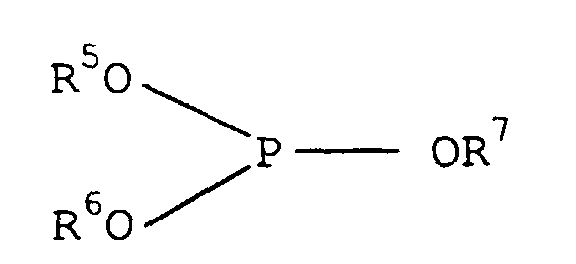
- Examples of the tertiary phosphites include trimethylphosphite and triphenylphosphite.
- Palladium complex catalysts containing other ligands than tertiary phosphine or tertiary phosphite, such as bis(dibenzylideneacetone)palladium or palladium acetate, may also used, preferably in conjunction with the palladium complex catalyst containing tertiary phosphine or phosphite, for the purpose of the present invention.
- The palladium complex catalyst is used in a catalytically effective amount and, generally, in an amount of up to 20 mole %, based on the acetylene compound. The acetylene compound and the phosphorothioate are generally used in a stoichiometric amount. However, the use of the acetylene compound or the phosphorothioate in a stoichiometrically excess amount does not adversely affect the desired reaction.
- The reaction may be carried out with or without using a solvent. The solvent, when used, may be a hydrocarbon solvent or an ether solvent. The reaction is generally performed from room temperature to about 300° C, preferably 50-150°C. It is preferred that the reaction be carried out in an oxygen-free atmosphere, such as in the atmosphere of nitrogen, argon or methane.
- After the termination of the reaction, the product can be separated by any known manner such as chromatography, distillation and recrystallization.
- The following examples will further illustrate the present invention. The symbol Ph represents a phenyl group, t-Bu represents a t-butyl group, Me represents a methyl group and n-Bu represent a n-butyl group.
- To 2 ml of toluene were added 2 mmol of 1-octyne, 2 mmol of PhSP(O)(OPh)2 and 2 mol % of Pd(PPh3)4 (tetrakis(triphenylphosphine)palladium) and the mixture was reacted at 100° C for 5 hours in the atmosphere of nitrogen. The reaction mixture was concentrated and separated by liquid chromatography to isolate diphenyl (Z)-2-phenylthio-1-octenylphosphonate with a yield of 92 %. The physical properties of the novel product are given below.
- 1H-NMR (CDCl3): δ7.15-7.41 (m, 15H), 5.81 (d, 1H JH-P = 17.3 Hz), 2.12 (t, 2H, J = 7.6 Hz), 1.32-1.60 (m, 2H), 1.12-1.24 (m, 2H), 1.04-1.09 (m, 4H), 0.80 (t, 3H, J = 7.0 Hz);
- 13C- NMR (CDCl3): δ165.3, 150.6 (JC-P = 8.3 Hz), 134.7, 130.9, 129.6, 129.2, 129.1, 124.9, 120.7 (JC-P = 4.1 Hz), 110.6 (JC-P = 197.6 Hz), 38.2 (JC-P = 19.7 Hz), 31.3, 28.5, 28.2, 22.4, 14.0
- 31P-NMR (CDCl3): δ8.3
- IR (liquid film) 2932, 2860, 2593, 1491, 1272, 1216, 1193,
1164, 1071, 1025, 930, 754 cm-1
Elementary analysis (as C26H29O3PS): calculated: C, 69.00; H, 6.46 measured: C, 69.06; H, 6.72 HRMS (EI, 70eV): calculated: 452.1575 measured: 452.1577 -
- Example 1 was repeated in the same manner as described except that the acetylene compounds shown below were each used in lieu of 1-octyne to produce novel thioalkenylphosphonic acid esters shown below. The yield and physical properties of the esters are summarized below.
-
- Acetylene compound:

- Product:

- Yield: 65 %
- 1H-NMR (CDCl3): δ7.09-7.42 (m, 15H), 6.57 (d, 1H, JH-P = 17.6 Hz), 1.14 (s, 9H);
- 31P-NMR (CDCl3): δ6.8
- IR (liquid film): 2972, 1591, 1491, 1276, 1214, 1191, 1164,
1027, 926, 748 cm-1
Elementary analysis (as C24H25O3PS): calculated: C, 67.91; H, 5.94 measured: C, 68.21; H, 6.14 HRMS (EI, 70eV): calculated: 424.1262 measured: 424.1172 -
-
- Acetylene compound:

- Product:

- Yield: 90 %
- 1H-NMR (CDCl3): δ7.14-7.36 (m, 30H), 5.74 (d, 2H, JH-P = 17.4 Hz), 2.00 (t, 4H, J = 7.0 Hz), 1.13-1.19 (m, 4H), 0.79-0.83 (m, 2H);
- 31P-NMR (CDCl3): δ8.1
- IR (liquid film): 2938, 1591, 1491, 1270, 1191, 1164, 1025,
928, 754 cm-1
Elementary analysis (as C45H42O6P2S2): calculated: C, 67.15; H, 5.26 measured: C, 67.39; H, 5.41 - FAB-MASS (EI, 70eV): 804 (M+)
-
-
- Acetylene compound:

- Product:
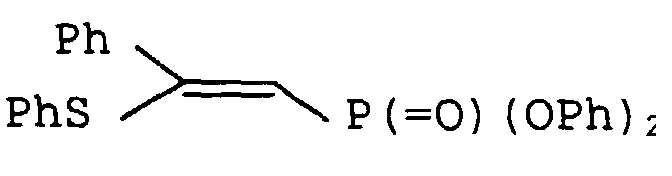
- Yield: 87 % (96/4)
- 1H-NMR (CDCl3): δ6.97-7.41 (m, 20H), 6.12 (d, 1H, JH-P = 17.6 Hz);
- 31P-NMR (CDCl3): δ7.3
- IR (liquid film): 3062, 2928, 1593, 1555, 1,491, 1441,
1274, 1191, 1027, 926, 758, 690 cm-1
Elementary analysis (as C26H21O3PS): calculated: C, 70.26; H, 4.76 measured: C, 70.29; H, 4.94 HRMS (EI, 70eV): calculated: 444.0949 measured: 444.0902 -
-
- Acetylene compound:

- Product:

- Yield: 71 % (93/7)
- 1H-NMR (C6D6): δ7.08-7.33 (m, 19H), 6.19 (d, 1H, JH-P = 17.0 Hz);
- 31P-NMR (CDCl3): δ6.8
- IR (liquid film): 3,064, 1593, 1489, 1272, 1212, 1191,
1164, 1093, 1025, 938, 768 cm-1
Elementary analysis (as C26H20ClO3PS): calculated: C, 65.20; H, 4.21 measured: C, 64.90; H, 4.27 HRMS (EI, 70eV): calculated: 478.0559 measured: 478.0489 -
-
- Acetylene compound:

- Product:

- Yield: 69 % (91/9)
- 1H-NMR (CDCl3): δ6.83-7.34 (m, 19H), 6.16 (d, 1H, JH-P = 17.0 Hz);
- 31P-NMR (CDCl3): δ7.1
- IR (liquid film): 3066, 1597, 1491, 1274, 1212, 1191, 1162,
1025, 934, 797, 766 cm-1
Elementary analysis (as C26H20FO3PS): calculated: C, 67.52; H, 4.36 measured: C, 67.51; H, 4.40 HRMS (EI, 70eV): calculated: 462.0855 measured: 462.0799 -
-
- Acetylene compound:

- Product:

- Yield: 89 % (98/2)
- 1H-NMR (CDCl3): δ6.97-7.33 (m, 19H), 6.20 (d, 1H, JH-P= 17.9 Hz), 2.22 (s, 3H);
- 31P-NMR (CDCl3): δ7.6
- IR (liquid film): 3062, 1593, 1551, 1491, 1274, 1212, 1191,
1164, 1025, 932, 766 cm-1
Elementary analysis (as C27H23O3PS): calculated: C, 70.73; H, 5.06 measured: C, 70.65; H, 5.07 HRMS (EI, 70eV): calculated: 458.1106 measured: 458.1096 -
-
- Acetylene compound:

- Product:

- Yield: 84 %
- 1H-NMR (CDCl3): δ7.06-7.50 (m, 15H), 5.88 (d, 1H, JH-P = 16.4 Hz), 2.30 (t, 2H, J = 7.0 Hz), 2.04 (t, 2H, J = 7.3 Hz), 1.63-1.69 (m, 2H);
- 31P-NMR (CDCl3): δ6.9
- IR (liquid film): 2928, 1591, 1491, 1270, 1191, 1164, 1025,
928, 754 cm-1
Elementary analysis (as C24H22NO3PS): calculated: C, 66.19; H, 5.09; N, 3.22 measured: C, 66.32; H, 5.16; N, 3.14 HRMS (EI, 70eV): calculated: 435.1058 measured: 435.1035 -
-
- Acetylene compound:

- Product:

- Yield: 89 %
- 1H-NMR (CDCl3): δ7.15-7.46 (m, 15H), 5.94 (d, 1H JH-P = 17.4 Hz), 3.55-3.68 (m, 2H), 2.39 (t, 2H, J = 6.5 Hz), 1.82 (bs, 1H);
- 31P-NMR (CDCl3): δ7.4
- IR (liquid film): 3416, 3062, 2932, 1591, 1491, 1249, 1212,
1191, 936, 754 cm-1
Elementary analysis (as C22H21O4PS): calculated: C, 64.07; H, 5.13 measured: C, 63.96; H, 5.16 HRMS (EI, 70eV): calculated: 412.0898 measured: 412.0902 -
-
- Acetylene compound:

- Product:

- Yield: 85 %
- 1H-NMR (CDCl3): δ7.17-7.39 (m, 15H), 5.90 (d, 1H JH-P =16.7 Hz), 3.26 (t, 2H, J = 6.7 Hz), 2.33 (t, 2H, J = 7.0 Hz), 1.77-1.79 (m, 2H);
- 31P-NMR (CDCl3): δ7.6
- IR (liquid film): 2962, 1591, 1491, 1270, 1214, 1191, 1025,
930, 752 cm-1
Elementary analysis (as C23H22ClO3PS): calculated: C, 62.09; H, 4.98 measured: C, 62.44; H, 5.06 HRMS (EI, 70eV): calculated: 444.0716 measured: 444.0698 -
-
- Acetylene compound:

- Product:

- Yield: 68 %
- 1H-NMR (CDCl3): δ7.08-7.34 (m, 15H), 5.85 (d, 1H JH-P = 16.7 Hz), 3.97 (t, 2H, J = 7.0 Hz), 2.41 (t, 2H, J = 7.0 Hz), 1.04 (s, 9H);
- 31P-NMR (CDCl3): δ6.9
- IR (liquid film): 2976, 1729, 1591, 1491, 1280, 1214, 1191,
1162, 932, 768 cm-1
Elementary analysis (as C27H29O5PS): calculated: C, 65.31; H, 5.89 measured: C, 65.66; H, 6.14 HRMS (EI, 70eV): calculated: 496.1473 measured: 496.1425 -
-
- Acetylene compound:
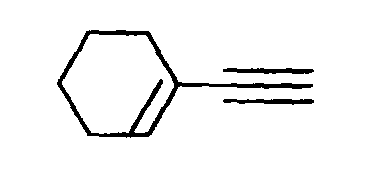
- Product:

- Yield: 91 %
- 1H-NMR (CDCl3): δ7.10-7.41 (m, 15H), 6.09 (bs, 1H), 6.04 (d, 1H, JH-P = 16.6 Hz), 1.92-1.97 (m, 4H), 1.31-1.34 (m, 4H);
- 31P-NMR (CDCl3): δ8.6
- IR (liquid film): 3062, 2934, 1593, 1551, 1491, 1274, 1214,
1191, 1164, 1027, 928, 766 cm-1
Elementary analysis (as C26H25O3PS): calculated: C, 69.62; H, 5.62 measured: C, 69.58; H, 5.80 HRMS (EI, 70eV): calculated: 448.1262 measured: 448.1213 -
-
- Acetylene compound:

- Product:

- Yield: 88 %
- 1H-NMR (CDCl3): δ7.07-7.36 (m, 15H), 6.16 (d, 1H JH-P = 17.7 Hz), 3.67 (s, 2H), 3.11 (s, 3H);
- 31P-NMR (CDCl3): δ8.6
- IR (liquid film): 3046, 2934, 1591, 1491, 1274, 1214, 1191,
1120, 930, 756 cm-1
Elementary analysis (as C22H21O4PS): calculated: C, 64.07; H, 5.13 measured: C, 64.35; H, 5.23 HRMS (EI, 70eV): calculated: 412.0898 measured: 412.0839 -
-
- Acetylene compound:

- Product:

- Yield: 94 %
- 1H-NMR (CDCl3): δ7.15-7.38 (m, 15H), 6.54 (d, 1H JH-P = 20.1 Hz), 2.88 (s, 2H), 2.19 (t, 4H, J = 6.8 Hz), 1.14-1.15 (m, 8H), 0.82 (t, 6H, J = 6.7 Hz);
- 31P-NMR (CDCl3): δ10.0
- IR (liquid film): 3064, 2960, 2866, 1593, 1491, 1274, 1216,
1193, 1164, 930, 768 cm-1
Elementary analysis (as C29H36NO3PS): calculated: C, 68.34; H, 7.12; N, 2.75 measured: C, 68.90; H, 7.39; N, 2.67 HRMS (EI, 70eV): calculated: 509.2154 measured: 509.2124 -
-
- Acetylene compound:

- Product:

- Yield: 60 %
- 1H-NMR (CDCl3): δ7.14-7.36 (m, 15H), 6.43 (d, 1H JH-P = 22.9 Hz), -0.08 (s, 9H);
- 29Si-NMR (CDCl3): δ4.4 (JP-Si = 26.2 Hz)
- IR (liquid film): 3064, 2960, 1593, 1491, 1272, 1251, 1212,
1191, 1164, 930, 841, 793, 754 cm-1
Elementary analysis (as C23H25O3PSSi): calculated: C, 62.70; H, 5.72 measured: C, 63.26; H, 5.60 HRMS (EI, 70eV): calculated: 440.1031 measured: 440.1035 -
Claims (4)
- A process for the preparation of a thioalkenylphosphonic acid ester of the following formula (I):wherein R1 stands for a monovalent group selected from hydrogen atom, an alkyl group, a cycloalkyl group, a cycloalkenyl group, an aryl group, an aralkyl group, an alkenyl group and a silyl group, R2 stands for an aryl group and R3 stands for an aryl group,

comprising reacting an acetylene compound of the following formula (II):wherein R1 is as defined above, with a phosphorothioate of the following formula (III): wherein R2 and R3 are as defined above, in the presence of a palladium complex catalyst.
- A process for the preparation of a bis(thioalkenyl)phosphonic acid ester of the following formula (IV):wherein R2 stands for an aryl group, R3 stands for an aryl group and R4 stands for an alkylene group or a cycloalkylene group,

comprising reacting an acetylene compound of the following formula (II):wherein R4 is as defined above,
with a phosphorothioate of the following formula (III):wherein R2 and R3 are as defined above,
in the presence of a palladium complex catalyst. - A thioalkenylphosphonic acid ester of the following formula (I) :wherein R1 stands for a monovalent group selected from hydrogen atom, an alkyl group, a cycloalkyl group, a cycloalkenyl group, an aryl group, an aralkyl group, an alkenyl group and a silyl group and R2 stands for an aryl group and R3 stands for an aryl group.

- A bis(thioalkenyl)phosphonic acid ester of the following formula (IV):wherein R2 stands for an aryl group, R3 stands for an aryl group and R4 stands for an alkylene group or a cycloalkylene group.

Applications Claiming Priority (2)
| Application Number | Priority Date | Filing Date | Title |
|---|---|---|---|
| JP11146135A JP3051928B1 (en) | 1999-05-26 | 1999-05-26 | Thioalkenyl phosphonate and method for producing the same |
| JP14613599 | 1999-05-26 |
Publications (2)
| Publication Number | Publication Date |
|---|---|
| EP1055678A1 true EP1055678A1 (en) | 2000-11-29 |
| EP1055678B1 EP1055678B1 (en) | 2003-01-22 |
Family
ID=15400944
Family Applications (1)
| Application Number | Title | Priority Date | Filing Date |
|---|---|---|---|
| EP00302091A Expired - Lifetime EP1055678B1 (en) | 1999-05-26 | 2000-03-15 | Thioalkenylphosphonic acid ester and process for the preparation thereof |
Country Status (5)
| Country | Link |
|---|---|
| US (1) | US6191298B1 (en) |
| EP (1) | EP1055678B1 (en) |
| JP (1) | JP3051928B1 (en) |
| AU (1) | AU768237B2 (en) |
| DE (1) | DE60001248T2 (en) |
Cited By (1)
| Publication number | Priority date | Publication date | Assignee | Title |
|---|---|---|---|---|
| CN107434832A (en) * | 2016-05-25 | 2017-12-05 | 中国石油天然气股份有限公司 | A kind of polypropylene catalyst component, preparation method and catalyst thereof |
Citations (1)
| Publication number | Priority date | Publication date | Assignee | Title |
|---|---|---|---|---|
| DE3936885A1 (en) * | 1989-11-06 | 1991-05-08 | Bunawerke Huels Gmbh | New di:alkyl aryl:methane-di:thio:carboxy-phosphonate(s) and salts - useful as radical deactivators for stopping radical polymerisation of diene(s) and vinyl aromatic cpds., etc. |
Family Cites Families (1)
| Publication number | Priority date | Publication date | Assignee | Title |
|---|---|---|---|---|
| US3584084A (en) * | 1968-02-12 | 1971-06-08 | Chevron Res | O,o-dialkyl-beta-phenylthiovinyl phosphates |
-
1999
- 1999-05-26 JP JP11146135A patent/JP3051928B1/en not_active Expired - Lifetime
-
2000
- 2000-03-09 US US09/521,844 patent/US6191298B1/en not_active Expired - Fee Related
- 2000-03-15 EP EP00302091A patent/EP1055678B1/en not_active Expired - Lifetime
- 2000-03-15 DE DE60001248T patent/DE60001248T2/en not_active Expired - Lifetime
- 2000-03-31 AU AU25222/00A patent/AU768237B2/en not_active Ceased
Patent Citations (1)
| Publication number | Priority date | Publication date | Assignee | Title |
|---|---|---|---|---|
| DE3936885A1 (en) * | 1989-11-06 | 1991-05-08 | Bunawerke Huels Gmbh | New di:alkyl aryl:methane-di:thio:carboxy-phosphonate(s) and salts - useful as radical deactivators for stopping radical polymerisation of diene(s) and vinyl aromatic cpds., etc. |
Non-Patent Citations (1)
| Title |
|---|
| HAN L-B ET AL: "Novel Palladium-Catalyzed Thiophosphorylation of Alkynes with Phosphorothioate: An Efficient Route to (Z)-1-(Diphenoxyphosphinyl)-2-(phenylthio)alkenes", CHEMISTRY LETTERS, no. 9, September 1999 (1999-09-01), pages 863 - 864, XP002901033 * |
Cited By (2)
| Publication number | Priority date | Publication date | Assignee | Title |
|---|---|---|---|---|
| CN107434832A (en) * | 2016-05-25 | 2017-12-05 | 中国石油天然气股份有限公司 | A kind of polypropylene catalyst component, preparation method and catalyst thereof |
| CN107434832B (en) * | 2016-05-25 | 2020-02-14 | 中国石油天然气股份有限公司 | Polypropylene catalyst component, preparation method and catalyst thereof |
Also Published As
| Publication number | Publication date |
|---|---|
| AU768237B2 (en) | 2003-12-04 |
| DE60001248T2 (en) | 2003-10-30 |
| DE60001248D1 (en) | 2003-02-27 |
| US6191298B1 (en) | 2001-02-20 |
| JP2000336096A (en) | 2000-12-05 |
| JP3051928B1 (en) | 2000-06-12 |
| AU2522200A (en) | 2000-11-30 |
| EP1055678B1 (en) | 2003-01-22 |
Similar Documents
| Publication | Publication Date | Title |
|---|---|---|
| US7135583B2 (en) | Process for preparation of alkenylphosphine oxides or alkenylphosphinic esters | |
| EP0614901B1 (en) | Phosphine compound and transition metal-phosphine complex containing the same as ligand | |
| EP1055678B1 (en) | Thioalkenylphosphonic acid ester and process for the preparation thereof | |
| US5693826A (en) | Process for the production of unsaturated phosphonic ester | |
| US5710306A (en) | Process to prepare a multidentate phosphite compound | |
| US6111127A (en) | Process for the preparation of unsaturated phosphonic acid ester | |
| US6949667B2 (en) | Alkenylphosphonic ester and preparation process thereof | |
| EP0794190B1 (en) | Method of producing alkenylphosphine oxide or bis (alkenylphosphine oxide) | |
| CN1100783C (en) | Method for producing vinyl phosphonic acid compounds | |
| WO2000002890A1 (en) | Hydroformylation process | |
| US6479687B2 (en) | Preparation of vinylphosphonic acid compounds | |
| JP3877151B2 (en) | Process for producing alkenylphosphinic acid esters | |
| JP2775426B2 (en) | Method for producing unsaturated phosphonate ester | |
| JP3572352B2 (en) | Allylphosphonate compound and method for producing the same | |
| JPH09241276A (en) | Production of alkenylphosphine oxide compound | |
| JP2005232067A (en) | Method for producing phosphorus-containing butadiene compound | |
| JP2777985B2 (en) | Selenoalkenyl phosphonate and method for producing the same | |
| US20040092752A1 (en) | Optically active alkenylphosphinic acid esters and process for producing the same | |
| JP4102879B2 (en) | Method for producing organophosphorus compound | |
| JP2001521513A (en) | Method for producing 2-alkyne esters | |
| SU1659416A1 (en) | Method for obtaining n,n-tetrasubstituted o-trimethylsilylbis-(aminomethyl) phosphinates | |
| US5283350A (en) | Aryl esters of phosphonous halides and a process for the preparation thereof | |
| US5298644A (en) | Aryl phosphinites | |
| SU996421A1 (en) | Process for producing dichloroanhydrides of unsaturated phosphonous acids | |
| JP2003300991A (en) | Butadienyl phosphonic acid cyclic ester and method for producing the same |
Legal Events
| Date | Code | Title | Description |
|---|---|---|---|
| PUAI | Public reference made under article 153(3) epc to a published international application that has entered the european phase |
Free format text: ORIGINAL CODE: 0009012 |
|
| AK | Designated contracting states |
Kind code of ref document: A1 Designated state(s): DE FR |
|
| AX | Request for extension of the european patent |
Free format text: AL;LT;LV;MK;RO;SI |
|
| 17P | Request for examination filed |
Effective date: 20010307 |
|
| AKX | Designation fees paid |
Free format text: DE FR |
|
| GRAG | Despatch of communication of intention to grant |
Free format text: ORIGINAL CODE: EPIDOS AGRA |
|
| 17Q | First examination report despatched |
Effective date: 20020528 |
|
| GRAG | Despatch of communication of intention to grant |
Free format text: ORIGINAL CODE: EPIDOS AGRA |
|
| GRAH | Despatch of communication of intention to grant a patent |
Free format text: ORIGINAL CODE: EPIDOS IGRA |
|
| RAP1 | Party data changed (applicant data changed or rights of an application transferred) |
Owner name: NATIONAL INSTITUTE OF ADVANCED INDUSTRIAL SCIENCE |
|
| GRAH | Despatch of communication of intention to grant a patent |
Free format text: ORIGINAL CODE: EPIDOS IGRA |
|
| GRAA | (expected) grant |
Free format text: ORIGINAL CODE: 0009210 |
|
| AK | Designated contracting states |
Kind code of ref document: B1 Designated state(s): DE FR |
|
| REF | Corresponds to: |
Ref document number: 60001248 Country of ref document: DE Date of ref document: 20030227 Kind code of ref document: P |
|
| ET | Fr: translation filed | ||
| PLBE | No opposition filed within time limit |
Free format text: ORIGINAL CODE: 0009261 |
|
| STAA | Information on the status of an ep patent application or granted ep patent |
Free format text: STATUS: NO OPPOSITION FILED WITHIN TIME LIMIT |
|
| 26N | No opposition filed |
Effective date: 20031023 |
|
| PGFP | Annual fee paid to national office [announced via postgrant information from national office to epo] |
Ref country code: FR Payment date: 20100402 Year of fee payment: 11 |
|
| REG | Reference to a national code |
Ref country code: FR Ref legal event code: ST Effective date: 20111130 |
|
| PG25 | Lapsed in a contracting state [announced via postgrant information from national office to epo] |
Ref country code: FR Free format text: LAPSE BECAUSE OF NON-PAYMENT OF DUE FEES Effective date: 20110331 |
|
| PGFP | Annual fee paid to national office [announced via postgrant information from national office to epo] |
Ref country code: DE Payment date: 20120323 Year of fee payment: 13 |
|
| REG | Reference to a national code |
Ref country code: DE Ref legal event code: R119 Ref document number: 60001248 Country of ref document: DE Effective date: 20131001 |
|
| PG25 | Lapsed in a contracting state [announced via postgrant information from national office to epo] |
Ref country code: DE Free format text: LAPSE BECAUSE OF NON-PAYMENT OF DUE FEES Effective date: 20131001 |