EP1054875B1 - Insecticidal dihydro-oxadiazines, -thiadiazines and -triazines - Google Patents
Insecticidal dihydro-oxadiazines, -thiadiazines and -triazines Download PDFInfo
- Publication number
- EP1054875B1 EP1054875B1 EP99902412A EP99902412A EP1054875B1 EP 1054875 B1 EP1054875 B1 EP 1054875B1 EP 99902412 A EP99902412 A EP 99902412A EP 99902412 A EP99902412 A EP 99902412A EP 1054875 B1 EP1054875 B1 EP 1054875B1
- Authority
- EP
- European Patent Office
- Prior art keywords
- alkoxy
- phenyl
- compound
- alkyl
- recited
- Prior art date
- Legal status (The legal status is an assumption and is not a legal conclusion. Google has not performed a legal analysis and makes no representation as to the accuracy of the status listed.)
- Expired - Lifetime
Links
- 0 CC1N(C(N(*)c2ccc(*)cc2)=O)N=C(*)OC1 Chemical compound CC1N(C(N(*)c2ccc(*)cc2)=O)N=C(*)OC1 0.000 description 1
Classifications
-
- C—CHEMISTRY; METALLURGY
- C07—ORGANIC CHEMISTRY
- C07D—HETEROCYCLIC COMPOUNDS
- C07D253/00—Heterocyclic compounds containing six-membered rings having three nitrogen atoms as the only ring hetero atoms, not provided for by group C07D251/00
- C07D253/02—Heterocyclic compounds containing six-membered rings having three nitrogen atoms as the only ring hetero atoms, not provided for by group C07D251/00 not condensed with other rings
- C07D253/06—1,2,4-Triazines
-
- A—HUMAN NECESSITIES
- A01—AGRICULTURE; FORESTRY; ANIMAL HUSBANDRY; HUNTING; TRAPPING; FISHING
- A01N—PRESERVATION OF BODIES OF HUMANS OR ANIMALS OR PLANTS OR PARTS THEREOF; BIOCIDES, e.g. AS DISINFECTANTS, AS PESTICIDES OR AS HERBICIDES; PEST REPELLANTS OR ATTRACTANTS; PLANT GROWTH REGULATORS
- A01N47/00—Biocides, pest repellants or attractants, or plant growth regulators containing organic compounds containing a carbon atom not being member of a ring and having no bond to a carbon or hydrogen atom, e.g. derivatives of carbonic acid
- A01N47/08—Biocides, pest repellants or attractants, or plant growth regulators containing organic compounds containing a carbon atom not being member of a ring and having no bond to a carbon or hydrogen atom, e.g. derivatives of carbonic acid the carbon atom having one or more single bonds to nitrogen atoms
- A01N47/28—Ureas or thioureas containing the groups >N—CO—N< or >N—CS—N<
- A01N47/38—Ureas or thioureas containing the groups >N—CO—N< or >N—CS—N< containing the group >N—CO—N< where at least one nitrogen atom is part of a heterocyclic ring; Thio analogues thereof
-
- A—HUMAN NECESSITIES
- A01—AGRICULTURE; FORESTRY; ANIMAL HUSBANDRY; HUNTING; TRAPPING; FISHING
- A01N—PRESERVATION OF BODIES OF HUMANS OR ANIMALS OR PLANTS OR PARTS THEREOF; BIOCIDES, e.g. AS DISINFECTANTS, AS PESTICIDES OR AS HERBICIDES; PEST REPELLANTS OR ATTRACTANTS; PLANT GROWTH REGULATORS
- A01N57/00—Biocides, pest repellants or attractants, or plant growth regulators containing organic phosphorus compounds
- A01N57/18—Biocides, pest repellants or attractants, or plant growth regulators containing organic phosphorus compounds having phosphorus-to-carbon bonds
- A01N57/24—Biocides, pest repellants or attractants, or plant growth regulators containing organic phosphorus compounds having phosphorus-to-carbon bonds containing heterocyclic radicals
-
- C—CHEMISTRY; METALLURGY
- C07—ORGANIC CHEMISTRY
- C07D—HETEROCYCLIC COMPOUNDS
- C07D273/00—Heterocyclic compounds containing rings having nitrogen and oxygen atoms as the only ring hetero atoms, not provided for by groups C07D261/00 - C07D271/00
- C07D273/02—Heterocyclic compounds containing rings having nitrogen and oxygen atoms as the only ring hetero atoms, not provided for by groups C07D261/00 - C07D271/00 having two nitrogen atoms and only one oxygen atom
- C07D273/04—Six-membered rings
-
- C—CHEMISTRY; METALLURGY
- C07—ORGANIC CHEMISTRY
- C07D—HETEROCYCLIC COMPOUNDS
- C07D285/00—Heterocyclic compounds containing rings having nitrogen and sulfur atoms as the only ring hetero atoms, not provided for by groups C07D275/00 - C07D283/00
- C07D285/15—Six-membered rings
- C07D285/16—Thiadiazines; Hydrogenated thiadiazines
-
- C—CHEMISTRY; METALLURGY
- C07—ORGANIC CHEMISTRY
- C07D—HETEROCYCLIC COMPOUNDS
- C07D413/00—Heterocyclic compounds containing two or more hetero rings, at least one ring having nitrogen and oxygen atoms as the only ring hetero atoms
- C07D413/02—Heterocyclic compounds containing two or more hetero rings, at least one ring having nitrogen and oxygen atoms as the only ring hetero atoms containing two hetero rings
- C07D413/04—Heterocyclic compounds containing two or more hetero rings, at least one ring having nitrogen and oxygen atoms as the only ring hetero atoms containing two hetero rings directly linked by a ring-member-to-ring-member bond
-
- C—CHEMISTRY; METALLURGY
- C07—ORGANIC CHEMISTRY
- C07F—ACYCLIC, CARBOCYCLIC OR HETEROCYCLIC COMPOUNDS CONTAINING ELEMENTS OTHER THAN CARBON, HYDROGEN, HALOGEN, OXYGEN, NITROGEN, SULFUR, SELENIUM OR TELLURIUM
- C07F9/00—Compounds containing elements of Groups 5 or 15 of the Periodic Table
- C07F9/02—Phosphorus compounds
- C07F9/547—Heterocyclic compounds, e.g. containing phosphorus as a ring hetero atom
- C07F9/6527—Heterocyclic compounds, e.g. containing phosphorus as a ring hetero atom having nitrogen and oxygen atoms as the only ring hetero atoms
- C07F9/6533—Six-membered rings
Definitions
- This invention relates to insecticidal substituted dihydrooxadiazine compounds, insecticidal compositions containing the dihydrooxadiazine compounds, and methods for their use.
- oxadiazine compounds have been described as useful as pesticides and as pharmaceutical agents.
- U.S. Patent No. 5,536,720 describes substituted 2-phenyl-1,3,4-oxadiazine-4-carbamide compounds useful as insecticides and acaricides.
- Trepanier et al, J. Med. Chem 9: 753-758 (1966) describe certain 2-substituted 4H-1,3,4-oxadiazines useful as anticonvulsants in mice.
- U.S. Patent No. 3,420,826 describes certain 2,4,6-substituted 4H-1,3,4-oxadiazines, useful as sedatives, anticonvulsants, and as pesticides against nematodes, plants, and fungi.
- U.S. Patent 3,420,825 describes methods for producing certain 2,4,6-substituted 4H-1,3,4-oxadiazines.
- the present invention relates to a compound having the formula: wherein X is O, N or S; R is phenyl, unsubstituted or mono-, di-, or tri-substituted with halogen, C 1 -C 4 haloalkyl, C 1 -C 4 haloalkoxy, or C 1 -C 4 haloalkyl thio; or R is a C 4 -C 5 heterocyclic group containing one nitrogen, sulfur, or oxygen atom, unsubstituted or mono-, di-, or tri-substituted with halogen, C 1 -C 4 haloalkyl, or C 1 -C 4 haloalkoxy; R 1 is halogen, C 1 -C 4 haloalkyl, C 1 -C 4 haloalkoxy, C 1 -C 6 haloalkyl sulfonyl, or C 1 -C 4 haloalkyl sulfinyl;
- the insecticidal compositions of this invention comprise: (a) an effective amount of one or more compounds of formula I, and (b) a suitable carrier.
- the compound of this invention has the formula: wherein R, R 1 , R 2 , R 3 , R 4 , R 5 , R 6 , and X are as described
- R is phenyl, thienyl, furanyl, pyridinyl, optionally mono-, di- or tri-substituted by bromo, chloro, trihaloalkyl, or trihaloalkoxy, more preferably, one bromo, one chloro, one trihalomethyl, one trihaloethyl, one trihalomethoxy, or one trihaloethoxy;
- X is O;
- R 1 is C 1 -C 4 trihaloalkyl or C 1 -C 4 trihaloalkoxy, more preferably, trihalomethyl or trihalomethoxy;
- R 2 , R 3 , and R 4 are, independently, C 1 -C 4 alkyl or C 1 -C 4 alkoxy, more preferably, methyl, ethyl, methoxy, or ethoxy;
- R 5 is C 1 -C 4 alkoxy, C 1 -C 4 alkyl, C 1 -C 4 alkylthi
- the compound of this invention has the formula: wherein R is phenyl, unsubstituted or mono-, di-, or tri-substituted with halogen, C 1 -C 4 haloalkyl, C 1 -C 4 haloalkoxy, C 1 -C 4 haloalkyl thio, C 1 -C 4 haloalkyl sulfinyl, or C 1 -C 4 haloalkyl sulfonyl; or R is a C 4 -C 5 heterocyclic group containing one nitrogen, sulfur, or oxygen atom, unsubstituted or mono-, di-, or tri-substituted with halogen, C 1 -C 4 haloalkyl, or C 1 -C 4 haloalkoxy; R 1 is halogen, C 1 -C 4 haloalkyl, C 1 -C 4 , haloalkoxy, C 1 -C
- R is phenyl, optionally mono-, di- or tri-substituted by bromo, chloro, trihaloalkyl, or trihaloalkoxy, more preferably, one bromo, one chloro, one trihalomethyl, one trihaloethyl, one trihalomethoxy, or one trihaloethoxy;
- R 1 is C 1 -C 4 trihaloalkyl or C 1 -C 4 trihaloalkoxy, more preferably, trihalomethyl or trihalomethoxy;
- R 2 is C 1 -C 6 alkylthio, C 1 -C 6 alkylsulfinyl, C 1 -C 6 alkylsulfonyl, nitro(C 1 -C 4 alkoxy), hydroxy, di-(C 1 -C 4 alkoxy)-phosphinyl, cyano, C 2 -C 6 acyloxy, C 1 -C 6 alkoxy, C
- the compounds and compositions of this invention are useful as plant protecting agents against insects and are particularly effective against coleopterous insects and lepidopterous insects, such as tobacco budworm.
- the compounds of the instant invention can be prepared by reacting an oxadiazine of formula A below, wherein R, R 2 , R 3 , R 4 , R 5 , and X are as described above, with an isocyanate of formula B below, wherein R 1 is as described above, and a catalytic amount of triethylamine in a suitable solvent such as acetonitrile or toluene, to produce the compound of formula IC (the compounds of formula I in which R 6 is hydrogen) .
- a suitable solvent such as acetonitrile or toluene
- R 6 is C 1 -C 6 alkyl, C 1 -C 4 alkylthio, (C 1 -C 4 alkoxy)C 1 -C 4 alkyl, C 2 -C 8 acyl, or benzyl
- R 6 Y wherein Y is halogen and R 6 is C 1 -C 6 alkyl, C 1 -C 4 alkylthio, (C 1 -C 4 alkoxy) C 1 -C 4 alkyl, C 2 -C 8 acyl, or benzyl, with a suitable base such as triethylamine or sodium hydride.
- R 3 , R 4 , and R 5 are hydrogen; and R 2 is C 1 -C 6 alkylthio, C 1 -C 6 alkylsulfinyl, C 1 -C 6 alkylsulfonyl, nitro(C 1 -C 6 alkoxy), hydroxy, di-(C 1 -C 4 alkoxy) -phosphinyl, cyano, C 2 -C 6 acyloxy, C 1 -C 6 alkoxy, C 1 -C 6 haloalkoxy, C 4 -C 6 cycloalkyl, or C 3 -C 6 alkenyl; or R 2 is phenyl, phenylthio, phenylsulfinyl, phenylsulfonyl, pyrazolyl, furanyl, thienyl, phenyl (C 1 -C 6 alkoxy), or benzoyloxy, unsubstituted or mono-
- compositions of the present invention can be prepared by formulating one or more compounds of the present invention with a suitable carrier.
- Suitable liquid carriers can comprise water, alcohols, ketones, phenols, toluene and xylenes.
- additives conventionally employed in the art can be utilized, such as one or more surface active agents and/or inert diluents, to facilitate handling and application of the resulting insecticidal composition.
- the compounds of this invention can be applied as a liquid or in sprays when utilized in a liquid carrier, such as a solution comprising a compatible solvent such as acetone, benzene, toluene or kerosene, or a dispersion comprising a suitable non-solvent medium such as water.
- a liquid carrier such as a solution comprising a compatible solvent such as acetone, benzene, toluene or kerosene, or a dispersion comprising a suitable non-solvent medium such as water.
- compositions of this invention can alternatively comprise solid carriers taking the form of dusts, granules, wettable powders, pastes, aerosols, emulsions, emulsifiable concentrates, and water-soluble solids.
- the compounds of this invention can be applied as dusts when admixed with or absorbed onto powdered solid carriers, such as mineral silicates, talc, pyrophyllite and clays, together with a surface-active dispersing agent so that a wettable powder is obtained which then is applied directly to the loci to be treated.
- the powdered solid carrier containing the compound admixed therewith can be dispersed in water to form a suspension for application in such form.
- Granular formulations of the compounds are preferred for field treatment and are suitable for application by broadcasting, side dressing, soil incorporation or seed treatment, and are suitably prepared using a granular or pelletized form of carrier such as granular clays, vermiculite, charcoal or corn cobs.
- carrier such as granular clays, vermiculite, charcoal or corn cobs.
- the compound of this invention is dissolved in a solvent and sprayed onto an inert mineral carrier such as attapulgite granules (10-100 mesh), and the solvent is then evaporated.
- Such granular compositions can contain from 2-25% of a compound of this invention, based on carrier plus compound, preferably, 3-15%.
- the compounds of this invention can also be incorporated into a polymeric carrier such as polyethylene, polypropylene, butadiene-styrene, styrene-acrylonitrile resins, polyamides, poly(vinyl acetates), and the like.
- a polymeric carrier such as polyethylene, polypropylene, butadiene-styrene, styrene-acrylonitrile resins, polyamides, poly(vinyl acetates), and the like.
- Aerosol treatment for which the compound can be dissolved in an aerosol carrier which is a liquid under pressure but which is a gas at ordinary temperature (e.g., 20°C) and atmospheric pressure.
- Aerosol formulations can also be prepared by first dissolving the compound in a less volatile solvent and then admixing the resulting solution with a highly volatile liquid aerosol carrier.
- the compounds of the invention preferably are applied in aqueous emulsions containing a surface-active dispersing agent which can be non-ionic, cationic or anionic.
- a surface-active dispersing agent which can be non-ionic, cationic or anionic.
- Suitable surface-active agents are well known in the art, such as those disclosed in U.S. Patent 2,547,724 (columns 3 and 4).
- the compounds of this invention can be mixed with such surface-active dispersing agents, with or without an organic solvent, as concentrates for the subsequent addition of water, to yield aqueous suspensions of the compounds at desired concentration levels.
- the compounds can be employed with carriers which themselves are pesticidally active, such as insecticides, acaricides, fungicides or bactericides.
- the effective amount of a compound in a given formulation will vary depending, e.g., upon the specific pest to be combated, as well as upon the specific chemical composition and formulation of the compound being employed, the method of applying the compound/formulation and the locus of treatment. Generally, however, the effective amount of the compound of this invention can range from about 0.1 to about 95 percent by weight. Spray dilutions can be as low as a few parts per million, while at the opposite extreme, full strength concentrates of the compound can be usefully applied by ultra low volume techniques. When plants constitute the loci of treatment, concentration per unit area can range between about 0.01 and about 50 pounds per acre, with concentrations of between about 0.1 and about 10 pounds per acre preferably being employed for crops such as corn, tobacco, rice and the like.
- sprays of the compounds can be applied to any suitable locus, such as to the insects directly and/or to plants upon which they feed or nest.
- the compositions of this invention can also be applied to the soil or other medium in which the pests are present.
- the remaining examples relate to the insecticidal use of the compounds of this invention.
- a stock solution for the compounds was prepared at 1000 ppm by dissolving 0.13 gram of each compound to be tested in 13 ml of acetone and adding 117 ml of distilled water plus 5 drops of ethoxylated sorbitan monolaurate, a wetting agent.
- This stock solution was used in the remaining examples demonstrating the insecticidal use of representative compounds of this invention. For each example that follows, this stock solution was used and the specificized dilutions made. All the tests discussed below, which involved treatment with compounds of this invention were always repeated with controls, in which the active compound was not provided, to permit a comparison upon which the percent control was calculated.
- the stock solution of 1000 ppm prepared in Example A above was diluted to 100 ppm (test solution).
- test solution 100 ppm
- 2.5 ml of the test solution was pipetted onto a filter paper (Whatman #3) at the bottom of a 100 mm petri dish.
- Two corn seedlings were soaked in the 100 ppm solution for 1 hour and transferred to the petri dish containing the same test solution.
- each dish was loaded with 5 second instar larvae of Southern Corn Rootworm ( Diabrotica undecimpunctata) . After five days, the number of live larvae was noted and the percent control, corrected by Abbott's formula [see J. Economic Entomology 18: 265-267 (1925) ] was calculated.
- Example A The stock solution of 1000 ppm prepared in Example A above, was used undiluted.
- One pot containing approximately 20 Mars variety rice seedlings was treated with each formulation by spraying with a spray atomizer.
- One day after treatment plants were covered with a tubular cage and twenty adult rice delphacids, Sogatodes orizicola, were transferred into each cage. Five days after transferring, counts were made of the surviving planthoppers in each pot and percent control was estimated.
- Example A For each compound, 0.2 ml of the stock solution prepared in Example A above, was pipetted onto the surface of each of 5 diet cells, allowed to spread over the surfaces and air dried for two hours. Then a second instar Helicoverpa virescens larva was introduced into each cell. After 14 days, the number of living larvae was determined for each treatment and percent control, corrected by Abbott's formula, was calculated.
Landscapes
- Chemical & Material Sciences (AREA)
- Organic Chemistry (AREA)
- Life Sciences & Earth Sciences (AREA)
- Health & Medical Sciences (AREA)
- General Health & Medical Sciences (AREA)
- Environmental Sciences (AREA)
- Zoology (AREA)
- Agronomy & Crop Science (AREA)
- Pest Control & Pesticides (AREA)
- Plant Pathology (AREA)
- Engineering & Computer Science (AREA)
- Dentistry (AREA)
- Wood Science & Technology (AREA)
- Molecular Biology (AREA)
- Biochemistry (AREA)
- Heterocyclic Carbon Compounds Containing A Hetero Ring Having Nitrogen And Oxygen As The Only Ring Hetero Atoms (AREA)
- Plural Heterocyclic Compounds (AREA)
- Agricultural Chemicals And Associated Chemicals (AREA)
- Nitrogen And Oxygen Or Sulfur-Condensed Heterocyclic Ring Systems (AREA)
- Nitrogen- Or Sulfur-Containing Heterocyclic Ring Compounds With Rings Of Six Or More Members (AREA)
Abstract
Description
- This invention relates to insecticidal substituted dihydrooxadiazine compounds, insecticidal compositions containing the dihydrooxadiazine compounds, and methods for their use.
- Certain oxadiazine compounds have been described as useful as pesticides and as pharmaceutical agents. For example,
U.S. Patent No. 5,536,720 describes substituted 2-phenyl-1,3,4-oxadiazine-4-carbamide compounds useful as insecticides and acaricides. Trepanier et al, J. Med. Chem 9: 753-758 (1966) describe certain 2-substituted 4H-1,3,4-oxadiazines useful as anticonvulsants in mice.U.S. Patent No. 3,420,826 describes certain 2,4,6-substituted 4H-1,3,4-oxadiazines, useful as sedatives, anticonvulsants, and as pesticides against nematodes, plants, and fungi.U.S. Patent 3,420,825 describes methods for producing certain 2,4,6-substituted 4H-1,3,4-oxadiazines. - It is a purpose of this invention to provide novel dihydrooxadiazine derivatives useful as insecticides.
- The present invention relates to a compound having the formula:

X is O, N or S;
R is phenyl, unsubstituted or mono-, di-, or tri-substituted with halogen, C1-C4 haloalkyl, C1-C4 haloalkoxy, or C1-C4 haloalkyl thio; or R is a C4 -C5 heterocyclic group containing one nitrogen, sulfur, or oxygen atom, unsubstituted or mono-, di-, or tri-substituted with halogen, C1-C4 haloalkyl, or C1-C4 haloalkoxy;
R1 is halogen, C1-C4 haloalkyl, C1-C4 haloalkoxy, C1-C6 haloalkyl sulfonyl, or C1-C4 haloalkyl sulfinyl;
R2, R3, R4, and R5 are one of the following: - a) R2, R3, and R4 are, independently, hydrogen, C1-C6 alkyl, C1-C6 alkoxy, or furanyl; and R5 is nitro, cyano, C1-C6 alkyl, di(C1-C6)alkylamino, C1-C6 alkylthio, C1-C6 alkoxy, C1-C6 haloalkoxy, phenoxy, phenylthio, or (C1-C6 alkoxy) carbonyl, wherein R3 and R5 together can form a ring; or
- b) R3, R4, and R5 are hydrogen; and R2 is C1-C6 alkylthio, C1-C6 alkylsulfinyl, C1-C6 alkylsulfonyl, nitro(C1-C6 alkoxy), hydroxy, di-(C1-C4 alkoxy)-phosphinyl, cyano, C2-C6 acyloxy, C1-C6 alkoxy, C1-C6 haloalkoxy, C4-C6 cycloalkyl, or C3-C6 alkenyl; or R2 is phenyl, phenylthio, phenylsulfinyl, phenylsulfonyl, pyrazolyl, furanyl, thienyl, phenyl(C1-C6 alkoxy), or benzoyloxy, unsubstituted or mono-, di-, or tri-substituted with halogen, C1-C4 alkyl, or C1-C4 alkoxy;
- These compounds, or physiologically acceptable salts thereof, are useful as insecticides.
- The insecticidal compositions of this invention comprise: (a) an effective amount of one or more compounds of formula I, and (b) a suitable carrier.
- Preferably, the compound of this invention has the formula:
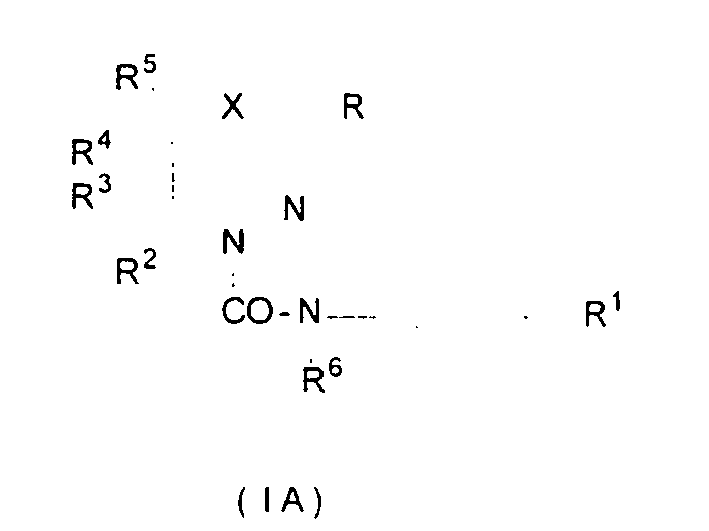
- In one preferred embodiment of this invention, R is phenyl, thienyl, furanyl, pyridinyl, optionally mono-, di- or tri-substituted by bromo, chloro, trihaloalkyl, or trihaloalkoxy, more preferably, one bromo, one chloro, one trihalomethyl, one trihaloethyl, one trihalomethoxy, or one trihaloethoxy; X is O; R1 is C1-C4 trihaloalkyl or C1-C4 trihaloalkoxy, more preferably, trihalomethyl or trihalomethoxy; R2, R3, and R4 are, independently, C1-C4 alkyl or C1-C4 alkoxy, more preferably, methyl, ethyl, methoxy, or ethoxy; R5 is C1-C4 alkoxy, C1-C4 alkyl, C1-C4 alkylthio, or di(C1-C4)alkylamino, more preferably, methoxy or ethoxy; and R6 is hydrogen, C1-C4 alkyl, C1-C4 alkylthio, (C1-C4 alkoxy) methyl or C2-C8 acyl, more preferably, methyl, methylthio, methoxymethyl or acetyl. Particularly preferred in this embodiment is the compound of formula IA wherein R is phenyl, thienyl, or pyridinyl, substituted by bromo, chloro, methyl, trifluoromethyl, or trifluoromethoxy.
- In another preferred embodiment of this invention, the compound of this invention has the formula:

R is phenyl, unsubstituted or mono-, di-, or tri-substituted with halogen, C1-C4 haloalkyl, C1-C4 haloalkoxy, C1-C4 haloalkyl thio, C1-C4 haloalkyl sulfinyl, or C1-C4 haloalkyl sulfonyl; or R is a C4-C5 heterocyclic group containing one nitrogen, sulfur, or oxygen atom, unsubstituted or mono-, di-, or tri-substituted with halogen, C1-C4 haloalkyl, or C1-C4 haloalkoxy;
R1 is halogen, C1-C4 haloalkyl, C1-C4, haloalkoxy, C1-C4 haloalkyl thio, C1-C6 haloalkyl sulfinyl, C1-C6 haloalkyl sulfonyl;
R2 is C1-C6 alkylthio, C1-C6 alkylsulfinyl, C1-C6 alkylsulfonyl, nitro(C1-C6 alkoxy), hydroxy, di-(C1-C4 alkoxy)-phosphinyl, cyano, C2-C6 acyloxy, C1-C6 alkoxy, C1-C6 haloalkoxy, C4-C6 cycloalkyl, or C3-C6 alkenyl; or R2 is phenyl, phenylthio, phenylsulfinyl, phenylsulfonyl, pyrazolyl, furanyl, thienyl, phenyl(C1-C6 alkoxy), or benzoyloxy, unsubstituted or mono-, di-, or tri-substituted with halogen, C1-C4 alkyl, or C1-C4 alkoxy; and
R6 is hydrogen, C1-C6 alkyl, (C1-C4 alkoxy) C1-C4 alkyl, C2-C6 haloacyl, C2-C8 acyl, or (C1-C6 alkoxy)carbonyl. - More preferred in this embodiment is the compound of IB wherein R is phenyl, optionally mono-, di- or tri-substituted by bromo, chloro, trihaloalkyl, or trihaloalkoxy, more preferably, one bromo, one chloro, one trihalomethyl, one trihaloethyl, one trihalomethoxy, or one trihaloethoxy; R1 is C1-C4 trihaloalkyl or C1-C4 trihaloalkoxy, more preferably, trihalomethyl or trihalomethoxy; R2 is C1-C6 alkylthio, C1-C6 alkylsulfinyl, C1-C6 alkylsulfonyl, nitro(C1-C4 alkoxy), hydroxy, di-(C1-C4 alkoxy)-phosphinyl, cyano, C2-C6 acyloxy, C1-C6 alkoxy, C,-C6 haloalkoxy, C4-C6 cycloalkyl, or C3-C6 alkenyl, phenyl, phenylthio, phenylsulfinyl, phenylsulfonyl, pyrazolyl, mono- or di-(C1-C4 alkyl)-pyrazolyl, furanyl, (C1-C4 alkyl)furanyl, thienyl, phenyl(C1-C4 alkoxy), or benzoyloxy; and R6 is hydrogen, C1-C4 alkyl, C1-C4 alkylthio, (C1-C4 alkoxy)methyl or C2-C8 acyl, more preferably, hydrogen, methyl, methylthio, methoxymethyl or acetyl. Particularly preferred in this embodiment is the compound of formula IB wherein R is phenyl substituted by bromo, chloro, methyl, trifluoromethyl, or trifluoromethoxy.
- The compounds and compositions of this invention are useful as plant protecting agents against insects and are particularly effective against coleopterous insects and lepidopterous insects, such as tobacco budworm.
- The compounds of the instant invention can be prepared by reacting an oxadiazine of formula A below, wherein R, R2, R3, R4, R5, and X are as described above, with an isocyanate of formula B below, wherein R1 is as described above, and a catalytic amount of triethylamine in a suitable solvent such as acetonitrile or toluene, to produce the compound of formula IC (the compounds of formula I in which R6 is hydrogen) .

- The compounds of formula I in which R6 is C1-C6 alkyl, C1-C4 alkylthio, (C1-C4 alkoxy)C1-C4 alkyl, C2-C8 acyl, or benzyl, can be prepared by reacting the compound of formula IB with R6Y wherein Y is halogen and R6 is C1-C6 alkyl, C1-C4 alkylthio, (C1-C4 alkoxy) C1-C4 alkyl, C2-C8 acyl, or benzyl, with a suitable base such as triethylamine or sodium hydride.

- Compounds of formula A above can be prepared by the cyclization of an azo compound (RCXN=NCO2C2H5) with an alkene of the formula:

followed by hydrolysis of the resultant intermediate. - The compounds of formula IB in which R3, R4, and R5 are hydrogen; and R2 is C1-C6 alkylthio, C1-C6 alkylsulfinyl, C1-C6 alkylsulfonyl, nitro(C1-C6 alkoxy), hydroxy, di-(C1-C4 alkoxy) -phosphinyl, cyano, C2-C6 acyloxy, C1-C6 alkoxy, C1-C6 haloalkoxy, C4-C6 cycloalkyl, or C3-C6 alkenyl; or R2 is phenyl, phenylthio, phenylsulfinyl, phenylsulfonyl, pyrazolyl, furanyl, thienyl, phenyl (C1-C6 alkoxy), or benzoyloxy, unsubstituted or mono-, di-, or tri-substituted with halogen, C1-C4 alkyl, or C1-C4 alkoxy, can be prepared by reacting an oxadiazine of formula C below, wherein R, R1, and R6 are as described above, with a nucleophile R2H, wherein R2 is as described above, and a Lewis acid such as boron trifluoride etherate in a suitable solvent such as dichloromethane or tetrahydrofuran to produce the compound of formula IB.
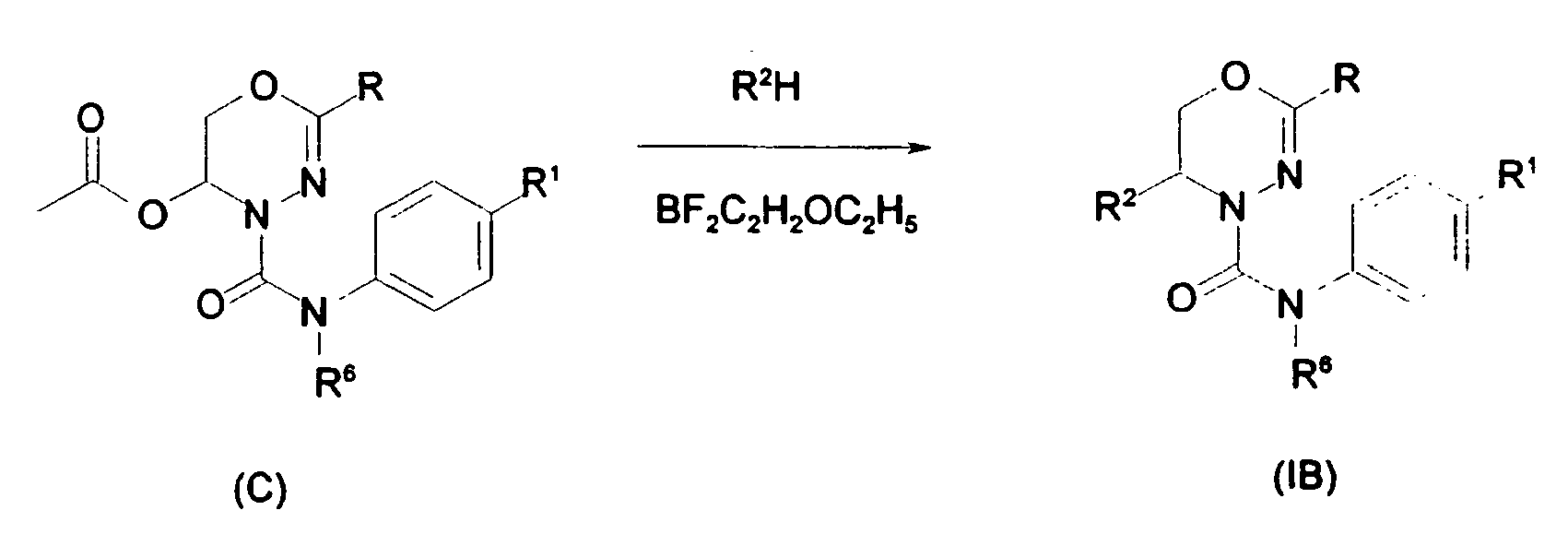
- Compounds of formula (C) above can be prepared by the following scheme in which an oxadiazinone of formula (II) is reacted with an isocyanate of formula (III) and a catalytic amount of tributyltin diacetate in a solvent such as acetonitrile to give the intermediate (IV) which is further reacted with a reducing agent sodium borohydride to give the intermediate alcohol (V) which is further reached with an acid chloride such as acetyl chloride to give the intermediate (C). The compounds of formula IA in which R2 is hydroxy or acyloxy or aroyloxy are made at the intermediate stages shown in the scheme:

- Some of the compounds of formula IB in which R is alkylthio or arylthio can be further reacted to give the alkylsulfinyl, alkylsulfonyl, arylsulfinyl or arylsulfonyl derivatives by oxidation with meta-chloroperbenzoic acid.
- The compositions of the present invention can be prepared by formulating one or more compounds of the present invention with a suitable carrier.
- Suitable liquid carriers can comprise water, alcohols, ketones, phenols, toluene and xylenes. In such formulations, additives conventionally employed in the art can be utilized, such as one or more surface active agents and/or inert diluents, to facilitate handling and application of the resulting insecticidal composition.
- Alternatively, the compounds of this invention can be applied as a liquid or in sprays when utilized in a liquid carrier, such as a solution comprising a compatible solvent such as acetone, benzene, toluene or kerosene, or a dispersion comprising a suitable non-solvent medium such as water.
- The compositions of this invention can alternatively comprise solid carriers taking the form of dusts, granules, wettable powders, pastes, aerosols, emulsions, emulsifiable concentrates, and water-soluble solids. For example, the compounds of this invention can be applied as dusts when admixed with or absorbed onto powdered solid carriers, such as mineral silicates, talc, pyrophyllite and clays, together with a surface-active dispersing agent so that a wettable powder is obtained which then is applied directly to the loci to be treated. Alternatively, the powdered solid carrier containing the compound admixed therewith, can be dispersed in water to form a suspension for application in such form.
- Granular formulations of the compounds are preferred for field treatment and are suitable for application by broadcasting, side dressing, soil incorporation or seed treatment, and are suitably prepared using a granular or pelletized form of carrier such as granular clays, vermiculite, charcoal or corn cobs. The compound of this invention is dissolved in a solvent and sprayed onto an inert mineral carrier such as attapulgite granules (10-100 mesh), and the solvent is then evaporated. Such granular compositions can contain from 2-25% of a compound of this invention, based on carrier plus compound, preferably, 3-15%. In addition, the compounds of this invention can also be incorporated into a polymeric carrier such as polyethylene, polypropylene, butadiene-styrene, styrene-acrylonitrile resins, polyamides, poly(vinyl acetates), and the like. When encapsulated, the compound of this invention can advantageously be released over an even longer time period, extending its effectiveness further than when used in non-encapsulated form.
- Another method of applying the compound of this invention to the loci to be treated is by aerosol treatment, for which the compound can be dissolved in an aerosol carrier which is a liquid under pressure but which is a gas at ordinary temperature (e.g., 20°C) and atmospheric pressure. Aerosol formulations can also be prepared by first dissolving the compound in a less volatile solvent and then admixing the resulting solution with a highly volatile liquid aerosol carrier.
- For treatment of plants (such term including plant parts), the compounds of the invention preferably are applied in aqueous emulsions containing a surface-active dispersing agent which can be non-ionic, cationic or anionic. Suitable surface-active agents are well known in the art, such as those disclosed in
U.S. Patent 2,547,724 (columns 3 and 4). The compounds of this invention can be mixed with such surface-active dispersing agents, with or without an organic solvent, as concentrates for the subsequent addition of water, to yield aqueous suspensions of the compounds at desired concentration levels. - In addition, the compounds can be employed with carriers which themselves are pesticidally active, such as insecticides, acaricides, fungicides or bactericides.
- It will be understood that the effective amount of a compound in a given formulation will vary depending, e.g., upon the specific pest to be combated, as well as upon the specific chemical composition and formulation of the compound being employed, the method of applying the compound/formulation and the locus of treatment. Generally, however, the effective amount of the compound of this invention can range from about 0.1 to about 95 percent by weight. Spray dilutions can be as low as a few parts per million, while at the opposite extreme, full strength concentrates of the compound can be usefully applied by ultra low volume techniques. When plants constitute the loci of treatment, concentration per unit area can range between about 0.01 and about 50 pounds per acre, with concentrations of between about 0.1 and about 10 pounds per acre preferably being employed for crops such as corn, tobacco, rice and the like.
- To combat insects, sprays of the compounds can be applied to any suitable locus, such as to the insects directly and/or to plants upon which they feed or nest. The compositions of this invention can also be applied to the soil or other medium in which the pests are present.
- The specific methods of application of the compounds and compositions of this invention, as well as the selection and concentration of these compounds, will vary depending upon such circumstances as crops to be protected, geographic area, climate, topography, plant tolerance, etc.
- The following examples are provided to illustrate the present invention.
- 70g of (3-trifluoromethyl)benzoic acid hydrazide (0.34 mol) and 40 ml of pyridine were dissolved in 150 ml of N,N-dimethylformamide and stirred at 15°C (water bath). 40 ml of ethyl chloroformate (0.41 mol) was added dropwise to this mixture while the reaction temperature was kept below 20°C. After addition of the ethylchloroformate, the resultant reaction mixture was stirred at room temperature for four hours and then 500 ml of water was added with stirring. The resultant precipitate was filtered by suction, washed with water four times, and then dried in air, to produce 80g of 2-[3-(trifluoromethyl)benzoyl]hydrazinecarboxylic acid ethyl ester (85% yield). The structure was confirmed by infrared (IR) and nuclear magnetic resonance (NMR) spectra.
- 15g of 2-[3-(trifluoromethyl)benzoyl]hydrazinecarboxylic acid ethyl ester was stirred with 200 ml of dichloromethane at room temperature. 150 ml of 5% NaOCl (0.10 mol) solution was then rapidly added to the reaction mixture, which exothermed to 30°C, and stirred for three hours until all the white solid disappeared and a deep red colored organic layer appeared. This organic layer was separated, dried (MgSO4), and the solvent removed to give 13.5g of 4-[3-trifluoromethyl)benzoyl]-diazenecarboxylic acid ethyl ester (89%). The structure was confirmed by IR and NMR spectra.
- 20g of benzene was added to 13.5g of 4-[3-trifluoromethyl)benzoyl]-diazenecarboxylic acid ethyl ester, followed by the addition of 7g of ethyl vinyl ether to prepare a reaction mixture. The reaction mixture was kept at room temperature overnight. After the red color of the reaction mixture faded, the solvent was removed, giving 17g of crude 6-ethoxy-5,6-dihydro-2-[3-(trifluoro-methyl)phenyl]-4H-1,3,4-oxadiazine-4-carboxylic acid ethyl ester, which was not purified and was used in Step D below.
- The crude 6-ethoxy-5,6-dihydro-2-[3-(trifluoromethyl)phenyl]-4H-1,3,4-oxadiazine-4-carboxylic acid ethyl ester (17g) from Step C above, was mixed with 12g of KOH, 20g of ethanol, and 40g of water to create a reaction mixture. The reaction mixture was refluxed for 6 hours and then cooled. 50 ml of water was then added to the reaction mixture, followed by extraction with ethyl acetate (4 x 100 ml). The ethyl acetate extracts were conbined, dried (MgSO4) and the solvent removed, to give 7g of crude 6-ethoxy-5,5-dihydro-2-[3-(trifluoromethyl)phenyl]-4H-1,3,4-oxadiazine, which was not purified and was used in Step E below.
- The crude 6-ethoxy-5,6-dihydro-2-[3-(trifluoromethyl)phenyl]-4H-1,3,4-oxadiazine (7g) from Step D above, was dissolved in 20g of acetonitrile and then 5g of (4-trifluoromethoxy)phenyl isocyanate was added, to create a reaction mixture. The reaction mixture was refluxed for four hours and then the acetonitrile was removed. The residue was then purified by column chromatography on 100g of silica gel using 1000 ml of toluene. The toluene was removed and the residue was crystallized with methanol to give two crops of crystals, total weight 5g (0.015 mol) of 6-ethoxy-5,6-dihydro-N-[4-(trifluoro-methoxy)phenyl]-2-[3-trifluoromethyl)phenyl]-4H-1,3,4-oxadiazine-4-carboxamide (26% yield based on hydrazinecarboxylic acid ethyl ester), m.p. 105-107°C.
- Prepared as described above in Example 1 except that 4-bromobenzoic acid hydrazide was used instead of 3-trifluoromethyl benzoic acid hydrazide in Step A.
- Prepared as described above in Example 1 except that 5-bromo-2-thiophenecarboxylic acid hydrazide was used instead of 3-trifluoromethyl benzoic acid hydrazide in Step A.
- Prepared as described above in Example 1 except that 5-bromo-2-thiophenecarboxylic acid hydrazide was used instead of 3-trifluoromethyl benzoic acid hydrazide in Step A and 2-methoxypropene was used instead of ethyl vinyl ether in Step C.
- Prepared as described above in Example 1 except that ethyl-1-propenyl ether was used instead of ethyl vinyl ether in Step C.
- Prepared as described above in Example 1 except that 4-bromobenzoic acid hydrazide was used instead of 3-trifluoromethyl benzoic acid hydrazide in Step A and 2,3-dihydrofuran was used instead of ethyl vinyl ether in Step C.
- Prepared as described above in Example 1 except that 4-bromobenzoic acid hydrazide was used instead of 3-trifluoromethyl benzoic acid hydrazide in Step A and 3,4-dihydropyran was used instead of ethyl vinyl ether in Step C.
- Prepared as described above in Example 1 except that methyl vinyl ether was used instead of ethyl vinyl ether in Step C.
- Prepared as described above in Example 1 except that (4-trifluoromethyl)phenyl isocyanate was used instead of (4-trifluoromethoxy)phenyl isocyanate in Step E.
- 11g of 4-(trifluoromethoxy)benzoic acid hydrazide (0.05 mol) and 6.5 g of 2-chloropropionyl chloride (0.05 mol) were dissolved in 100 ml of 1,4-dioxane and stirred at reflux for three hours. After evaporation of the solvent under reduced pressure, the remaining oil was purified by column chromatography. 8 g of 2-(2-chloro-1-oxopropyl)hydrazide of 4-(trifluoromethoxy)benzoic acid as a white solid was obtained. The structure was confirmed by nuclear magnetic resonance spectroscopy.
- 8 g of the 2-(2-chloro-1-oxopropyl)hydrazide of 4-(trifluoromethoxy)benzoic acid (0.03 mol) prepared above in A was dissolved in 100 ml of acetonitrile. 3 g of triethylamine was then added and the resulting solution was stirred and refluxed for 24 hours. After cooling, the precipitate was filtered and the filtrate evaporated under reduced pressure, leaving 7.5 g of an oil. Purification by column chromatography produced 3 g of 6-methyl-2-(4-trifluoromethoxy)-phenyl-4H-1,3,4-oxadiazin-5(6H)-one as a white solid. The structure was confirmed by nuclear magnetic resonance spectroscopy.
- 3 g of the 6-methyl-2-(4-trifluoromethoxy)phenyl-4H-1,3,4-oxadiazin-5(6H)-one prepared above in B was dissolved in 25 ml of 1,4-dioxane. The solution was cooled to 0°C and then 0.5 g of acetic acid was added. The reaction mixture was then refluxed for 24 hours. After cooling to room temperature, 100 ml of water was added and the mixture was extracted with 200 ml of dichloromethane. 2.6 g of an oil remained which was purified by column chromatography to produce 1.0 g of 5,6-dihydro-6-methyl-2-(4-trifluoromethoxyphenyl)-4H-1,3,4-oxadiazine as an oil. The structure was confirmed by nuclear magnetic resonance spectroscopy.
- 1 g of the 5,6-dihydro-6-methyl-2-(4-trifluoromethoxyphenyl)-4H-1,3,4-oxadiazine prepared above was dissolved in 10 ml of acetonitrile. 1 g of 4-(trifluoromethyl)phenyl isocyanate was added dropwise and then the resulting reaction mixture was refluxed for two hours. Evaporation of the solvent at reduced pressure afforded 1.5 g of 5,6-dihydro-6-methyl-2-{4-trifluoromethoxyphenyl)-N-(4-triflueromethylphenyl)-4H-1,3,4-oxadiazine-4-carboxamide as a solid which was washed with a few milliliters of acetonitrile. The structure was confirmed by nuclear magnetic resonance spectroscopy.
- 25 g of 4-(trifluoromethoxy)benzoic acid hydrazide (0.13 mol) and 30 g of ethyl 2,3-dibromopropionate (0.13 mol) were dissolved in 150 ml of acetonitrile. 26 g (0.26 mol) of triethylamine was then added and then the resultant reaction mixture was refluxed for 24 hours. After cooling, the reaction mixture was filtered and then the filtrate was evaporated under reduced pressure leaving 35 g of a crude oil. The crude oil was purified by column chromatography to afford 4.5 g of ethyl 5,6-dihydro-2-(4-trifluoro-methoxyphenyl-4H-1,3,4-oxadiazine-6-carboxylate as an oil. The structure was confirmed by nuclear magnetic resonance spectroscopy.
- 1 g of the ethyl 5,6-dihydro-2-(4-trifluoromethoxyphenyl-4H-1,3,4-oxadiazine-6-carboxylate prepared above in A was dissolved in 15 ml of acetonitrile. 1 g of 4-(trifluoromethyl)phenyl isocyanate was added dropwise. The resulting reaction mixture was refluxed for two hours and then the solvent was evaporated under reduced pressure to produce a solid. The solid was washed with a few milliliters of acetonitrile to produce 1.2 g of ethyl 5,6-dihydro-2-(4-trifluoromethoxyphenyl)-N-(((4-trifluoromethylphenyl)aminocarbonyl)-4H-1,3,4-oxadiazine-6-carboxylate as a white solid. The structure was confirmed by nuclear magnetic resonance spectroscopy.
- 1g of 6-ethoxy-5,6-dihydro-N-[4-(trifluoromethoxy)phenyl]-2-[3-trifluoromethyl)phenyl]-4H-1,3,4-oxadiazine-4-carboxamide (Compound No. 1) was added to 0.3g of hexane-washed sodium hydride dissolved in 20 ml of toluene and the resulting reaction mixture was heated to 60°C for one hour. After to room temperature, 3 ml of methyl iodide was added dropwise to the reaction mixture. The reaction mixture was then stirred at room temperature for 18 hours. 100 ml of water was then added to the reaction mixture and then extracted with 100 mol of toluene. After drying over sodium sulfate, the filtered solution was evaporated under reduced pressure, to produce an oil. The oil was purified by column chromatography producing 6-ethoxy-5,6-dihydro-N-methyl-N-[4-(trifluoromethoxy)phenyl]-2-[3-(trifluoromethyl)-phenyl]-4H-1,3,4-oxadiazine-4-carboxamide, as a viscous oil. The structure was confirmed by nuclear magnetic resonance spectroscopy.
- 39.0 ml of chloroacetyl chloride was added to a solution of 100 g of 3-trifluoromethylbenzoic acid hydrazide in 500 ml 1,4-dioxane and the resultant mixture was heated to reflux for 1.5 h. The mixture was then cooled and concentrated under vacuum to produce a residue. The residue was suspended in 21 acetonitrile and then 200 ml triethylamine was added. The resultant mixture was heated to reflux for 16 h and then cooled and filtered. The filtrate was concentrated under vacuum to give crude 2-[3-(trifluoromethyl)phenyl]-4H-1,3,4-oxadiazin-5(6)-one which was purified by recrystallization from ethanol/water. The structure was confirmed by 1H NMR.
- A mixture of 52.5 g 2-[3-(trifluoromethyl)phenyl]-4H-1,3,4-oxadiazin-5(6)-one (prepared in A above), 52.5 g 4-trifluoromethyl-phenyl isocyanate and 2 ml dibutyltin diacetate in 500 ml acetonitrile was heated to reflux for 3 h. The mixture was then cooled and filtered to produce 5,6-dihydro-5-oxo-2-[3-(trifluoro-methyl)phenyl]-N-[4-(trifluoromethyl)phenyl]-4H-1,3,4-oxadiazine-4-carboxamide as a white solid. The structure was confirmed by 1H NMR.
- To an ice-cooled suspension of 26.0 g 5,6-dihydro-5-oxo-2-[3-(trifluoromethyl)phenyl]-N-[4-(trifluoromethyl)-phenyl]-4H-1,3,4-oxadiazine-4-carboxamide (prepared in B above) in 300 ml dichloromethane and 300 ml methanol was added 2.3 g sodium borohydride in portions. The resultant mixture was stirred for 45 min and then quenched with 200 ml 1M HCl and diluted with 1 1 dichloromethane. The phases were separated and the organic phase was washed with 200 ml 1M HCl and 100 ml saturated sodium bicarbonate, dried over sodium sulfate and concentrated under vacuum to give 5,6-dihydro-5-hydroxy-2-[3-(trifluoromethyl)phenyl]-N-[4- (trifluoromethyl)phenyl]-4H-1,3,4-oxadiazine-4-carboxamide. The structure was confirmed by 1H NMR.
- A mixture of 21.0 g 5,6-dihydro-5-hydroxy-2-[3-(trifluoromethyl)phenyl]-N-[4-(trifluoromethyl)phenyl]-4H-1,3,4-oxadiazine-4-carboxamide (prepared in C above), 13.0 ml triethylamine, and 6.5 ml acetic anhydride was stirred at room temperature for 3 h. The mixture was then concentrated under vacuum to produce a solid residue. The solid residue was taken up in 400 ml dichloromethane and washed twice with 100 ml saturated sodium bicarbonate. The organic phase was then dried over sodium sulfate and concentrated under vacuum to produce 5,6-dihydro-5-acetyloxy-2-[3-(trifluoromethyl)phenyl] -N- [4-(trifluoromethyl)phenyl]-4H-1,3,4-oxadiazine-4-carboxamide. The structure was confirmed by 1H NMR.
- To a cooled (-78 °C) mixture of 3.0 g 5,6-dihydro-5-acetyloxy-2-[3-(trifluoromethyl)phenyl]-N-[4-(trifluoromethyl)phenyl]-4H-1,3,4-oxadiazine-4-carboxamide (prepared in D above) and 2.0 ml butanethiol in 50 ml dichloromethane was added 1.0 ml borontrifluoride etherate. The cooling bath was removed and the mixture was stirred for 1 h. The mixture was then quenched with saturated sodium bicarbonate and the phases were separated. The organic phase was washed with 1 M sodium hydroxide and saturated sodium bicarbonate, dried over sodium sulfate and concentrated under vacuum to give 5-(butylthio)-5,6-dihydro-2-[3-(trifluoromethyl)phenyl]-N-[4-(trifluoromethyl)phenyl]-4H-1,3,4-oxadiazine-4-carboxamide. The structure was confirmed by 1H NMR.
- To an ice-cooled mixture of 1.1 g 5-(butylthio)-5,6-dihydro-2-[3-(trifluoromethyl)phenyl]-N-[4-(trifluoromethyl)phenyl]-4H-1,3,4-oxadiazine-4-carboxamide (Compound 14) and 1.8 g sodium bicarbonate in 15 ml dichloromethane was added dropwise a solution of 0.52 g 3-chloroperbenzoic acid in 4 ml dichloromethane. After stirring for 30 min the mixture was filtered. The filtrate was washed with 2M sodium sulfite and saturated sodium bicarbonate and then dried over sodium sulfate and concentrated under vacuum to produce 5-(butylsulfinyl)-5,6-dihydro-2-[3-(trifluoromethyl)phenyl]-N-[4-(trifluoromethyl)phenyl]-4H-1,3,4-oxadiazine-4-carboxamide. The structure was confirmed by 1H NMR.
- To an ice-cool mixture of 1.1 g 5-(butylthio)-5,6-dihydro-2- [3- (trifluoromethyl)phenyl] -N- [4-(trifluoromethyl)phenyl]-4H-1,3,4-oxadiazine-4-carboxamide (Compound No. 14) and 1.8 g sodium bicarbonate in 15 ml dichloromethane was added 2.2 g 3-chloroperbenzoic acid. After stirring for 60 min the mixture was filtered. The filtrate was washed with 2M sodium sulfite and saturated sodium bicarbonate and then dried over sodium sulfate and concentrated under vacuum to produce 5-(butylsulfonyl)-5, 6-dihydro-2-[3-(trifluoromethyl)phenyl]-N-[4-(trifluoro-methyl)phenyl]-4H-1,3,4-oxadiazine-4-carboxamide. The structure was confirmed by 1H NMR.
- Compounds 17 - 36 were prepared in a similar manner as described in Examples 13 - 15.
TABLE 1 
Cmpd No. R R1 R2 R3 R4 R5 R6 1 3-CF3C6H4 4-CF3O H H H C2H5O H 2 4 -BrC6H4 4-CF3O H H H C2H5O H 3 5-Br-2-C4H2S 4-CF3O H H H C2H5O H 4 5-Br-2-C4H2S 4-CF3O H H CH3 CH3O H 5 3-CF3C6H4 4-CF3O CH3 H H C2H5O H 61 4-BrC6H4 4-CF3O H CH2 H CH2O H 72 4-BrC6H4 4-CF3O H CH2CH2 H CH2O H 8 3-CF3C6H4 4-CF3O H H H CH3O H 9 3-CF3C6H4 4-CF3 H H H C2H5O H 10 4-CF3O- C6H4 4-CF3 H H H CH3 H 11 4-CF3O- C6H4 4-CF3 H H H 
H 12 3-CF3C6H4 4-CF3O H H H C2H5O CH3 13 3-CF3C6H4 4-CF3O H H H C2H5O 
1 R3 and R5 together form a 5-membered ring (furan)
2 R3 and R5 together form a 6-membered ring (pyran)Table 1A 
Cmpd. No. R R1 R2 R6 14 3-CF3C6H4 4-CF3 C4H9S H 15 3-CF3C6H4 4-CF3 C4H9S=O H 16 3-CF3C6H4 4-CF3 C4H9SO2 H 17 3-CF3C6H4 4-CF3 C6H5S H 18 3-CF3C6H4 4-CF3 C6H5S=O H 19 3-CF3C6H4 4-CF3 C6H5SO2 H 20 3-CF3C6H4 4-CF3 3,5-di-CH3-4- pyrazolyl H 21 3-CF3C6H4 4-CF3 2-thienyl H 22 3-CF3C6H4 4-CF3 (CH30) 2P=O H 23 3-CF3C6H4 4-CF3 NC H 24 3-CF3C6H4 4-CF3 4-CH3OC6H4 H 25 3-CF3C6H4 4-CF3 HO H 26 3-CF3C6H4 4-CF3 CF3CH2O H 27 3-CF3C6H4 4-CF3 2-oxo-cyclohexyl H 28 3-CF3C6H4 4-CF3 CH2=CHCH2 H 29 3-CF3C6H4 4-CF3 NO2CH2CH2O H 30 3-CF3C6H4 4-CF3 C6H5CH2O H 31 3-CF3C6H4 4-CF3 CH3CO2 H 32 3-CF3C6H4 4-CF3 C6H5CO2 H 33 3-CF3C6H4 4-CF3 CH3O H 34 3-CF3C6H4 4-CF3 5-methyl-2-furanyl H 35 3-CF3C6H4 4-CF3 2-furanyl H 36 3-CF3C6H4 4-OCF3 2-furanyl H TABLE 2 Compound No. NMR Data (ppm) in DMSO 1 t(3) 1.2; m(4) 3.5-4.1; t (1) 5.7; m(8) 7.0-7.9; s(1) 9.4 2 t (3) 1.2; m(4) 3.5-4.1; t (1) 5.4; m(8) 7.0-8.5; s (1) 8.4 3 t (3) 1.2; m(4) 3.5-4.1; t (1) 5.4; m(8) 7.0-7.8; s (1) 8.3 4 s(3) 1.5; d(1) 3.2; s(3) 3.4; q(1) 4.3; m(6) 6.9-7.8; s(1) 8.3 5 t(3) 1.1; t(3) 1.3; q(2) 3.8; m(1) 4.4-4.8; d(1) 5.6; m(8) 7.1-8.2; s(1) 9.4 6 m(2) 1.4-2.0; m(2) 3.5-3.9; m(1) 4.4-4.7; d(1) 5.7; m(8) 7.1-8.2; s(1) 9.4 7 m(4) 1.4-2.2; m(2) 3.9-4.4; m(1) 4.8-5.2; d(1) 5.7; m(8) 7.1-8.2; s(1) 9.4 8 s(3) 3.6; m(2) 3.3-4.3; t(1) 5.7; m(8) 7.1-8.6; s(1) 9.4 9 t(3) 1.2; m(4) 3.5-4.3; t(1) 5.9; m(8) 7.5-8.6; s(1) 9.6 10 d(3) 1.5; m(1) 3.3-3.6; m(2) 4.3-4.8; m(8) 7.5-8.3; s(1) 9.5 11 t (3) 1.2; m(4) 3.9-4.6; t (1) 5.7; m(8) 7.4-8.3; s(1) 9.5 12 t (3) 1.2; s (3) 3.3; m(4) 3.9-4.6; t (1) 5.7; m(8) 7.4-8.3 14 s(1) 9.7; m(2) 8.5; m(6) 8.0-7.6; s(1) 6.1; s(2) 4.7; t(2) 2.8; m(4) 1.7-1.2; m(3) 0.9 15 s(1) 9.8; m(2) 8.4; m(6) 8.0-7.6; s(1) 5.9; m(2) 5.1-4.6; m(2) 3.0; m(4) 1.8-1.5; m(3) 0.9 16 s(1) 9.8; m(2) 8.4; m(6) 8.0-7.6; m(1) 6.2; d(1) 5.2; m(1) 4.6; m(2) 3.3; m(4) 1.8-1.3; m(3) 0.9 17 s(1) 9.8; m(2) 8.5; m(11) 8.0-7.3; s(1) 6.3; s(2) 4.8 18 s(1) 9.8; m(13) 8.5-7.5; d(1) 5.9; m(2) 5.3-4.6 19 s(1) 9.6; m(2) 8.3; m(11) 7.9-7.5; m(1) 6.2; m(2) 5.3-4.6 20 br s(1) 12.2; s(1) 9.6; m(2) 8.4; m(6) 8.0-7.6; s(1) 5.7; s(2) 4.6; s(6) 2.1 21 s(1) 9.4; m(2) 8.3; m(9) 7.9-7.0; m(1) 6.1; m(2) 4.8 22 s(1) 9.8; m(2) 8.4; m(6) 8.0-7.6; m(1) 5.3; m(2) 4.8; m(6) 3.7 23 s(1) 9.8; m(2) 8.4; m(6) 7.9-7.6; s(1) 5.9; m(2) 5.2-4.5 24 s(1) 9.7; m(2) 8.4; m(6) 8.0-7.6; d(2) 7.2; d(2) 7.8; s(1) 5.8; m(2) 4.7; s(3) 3.7 25 s(1) 9.6; m(2) 8.4; m(6) 8.1-7.6; d(1) 6.7; d(1) 6.1; m(2) 4.5 26 s(1) 9.7; m(2) 8.4; m(6) 8.0-7.6; s(1) 6.2; m(4) 4.9-4.1 27 s(1) 9.6; m(2) 8.4; m(6) 8.2-7.7; m(1) 5.3; m(2) 4.7; m(1) 3.1; m(2) 2.6; m(6) 2.2-1.6 28 s(1) 9.6; m(2) 8.4; m(6) 8.0-7.5; m(1) 5.8; m(5) 5.2-4.5; m(2) 2.4 29 s(1) 9.6; m(2) 8.4; m(6) 8.1-7.6; d(1) 6.7; d(1) 6.1; m(2) 4.5 30 s(1) 9.7; m(2) 8.4; m(6) 8.0-7.6; s(5) 7.3; s(1) 6.2; m(3) 4.8-4.3 31 s(1) 9.8; m(2) 8.5; m(6) 8.0-7.6; s(1) 7.1; s(2) 4.7; s(3) 2.1 32 s(1) 9.8; m(2) 8.5; m(12) 8.0-7.4; s(2) 4.8 33 s(1) 9.7; m(2) 8.4; m(6) 8.0-7.6; s(1) 5.9; q(2) 4.5; s(3) 3.4 34* s(1) 8.6; m(2) 8.1; m(6) 7.6; m(1) 6.2; m(2) 5.9; m(2) 5.0-4.3; s(3) 2.2 35* s(1) 8.6; m(2) 8.2; m(7) 7.7-7.4; d(2) 6.3; m(1) 6.0; m(2) 4.7 36 s(1) 9.3; m(2) 8.3; m(7) 7.7-7.1; d(2) 6.3; m(1) 6.0; m(2) 4.7 * Spectrum taken in CDCl3 - The remaining examples relate to the insecticidal use of the compounds of this invention. In all these examples, a stock solution for the compounds was prepared at 1000 ppm by dissolving 0.13 gram of each compound to be tested in 13 ml of acetone and adding 117 ml of distilled water plus 5 drops of ethoxylated sorbitan monolaurate, a wetting agent. This stock solution was used in the remaining examples demonstrating the insecticidal use of representative compounds of this invention. For each example that follows, this stock solution was used and the specificized dilutions made. All the tests discussed below, which involved treatment with compounds of this invention were always repeated with controls, in which the active compound was not provided, to permit a comparison upon which the percent control was calculated.
- The stock solution of 1000 ppm prepared in Example A above, was diluted to 100 ppm (test solution). For each compound, 2.5 ml of the test solution was pipetted onto a filter paper (Whatman #3) at the bottom of a 100 mm petri dish. Two corn seedlings were soaked in the 100 ppm solution for 1 hour and transferred to the petri dish containing the same test solution. After 24 hours, each dish was loaded with 5 second instar larvae of Southern Corn Rootworm (Diabrotica undecimpunctata). After five days, the number of live larvae was noted and the percent control, corrected by Abbott's formula [see J. Economic Entomology 18: 265-267 (1925)] was calculated.
- The results or the testing of Southern Corn Rootworm (CR) are presented in Table 3 below.
- The stock solution of 1000 ppm prepared in Example A above, was used undiluted. One pot containing approximately 20 Mars variety rice seedlings was treated with each formulation by spraying with a spray atomizer. One day after treatment plants were covered with a tubular cage and twenty adult rice delphacids, Sogatodes orizicola, were transferred into each cage. Five days after transferring, counts were made of the surviving planthoppers in each pot and percent control was estimated.
- Results of the testing of rice planthoppers (RPH) are presented in Table 3 below.
- For each compound, 0.2 ml of the stock solution prepared in Example A above, was pipetted onto the surface of each of 5 diet cells, allowed to spread over the surfaces and air dried for two hours. Then a second instar Helicoverpa virescens larva was introduced into each cell. After 14 days, the number of living larvae was determined for each treatment and percent control, corrected by Abbott's formula, was calculated.
- The results of the testing of tobacco budworms (TB) are presented in Table 3 below.
TABLE 3 PERCENT CONTROL OF SOUTHERN CORN ROOTWORM, RICE PLANTHOPPER AND TOBACCO BUDWORM Compound No. Percent Control CR RPH TB 1 100 0 100 2 0 0 100 3 80 0 100 4 80 0 100 5 100 0 100 6 0 0 100 7 100 100 52 8 100 0 100 9 100 0 100 10 0 0 100 11 0 0 37 12 40 100 100 14 100 -- 25 15 100 -- 100 16 50 -- 100 17 47 -- 100 18 100 -- 100 19 100 -- 0 20 50 -- 100 21 100 -- 100 22 25 -- 100 23 100 -- 100 24 50 -- 100 25 60 -- 100 26 33 -- 100 27 100 -- 100 28 25 -- 100 29 100 -- 100 30 100 -- 100 31 100 -- 100 32 100 -- 100 33 100 -- 100 34 100 -- 100 35 80 -- 100 36 60 -- 100
Claims (19)
- A compound having the formula:

X is O, N or S;
R is phenyl, unsubstituted or mono-, di-, or tri-substituted with halogen, C1-C4 haloalkyl, C1-C4 haloalkoxy or C1-C4 haloalkylthio; or R is a C4-C5 heterocyclic group containing one nitrogen, sulfur, or oxygen atom, unsubstituted or mono-, di-, or tri-substituted with halogen, C1-C4 haloalkyl, or C1-C4 haloalkoxy;
R1 is halogen, C1-C4 haloalkyl, C1-C4 haloalkoxy, C1-C4 haloalkyl sulfonyl, or C1-C4 haloalkyl sulfinyl;
R2, R3, R4, and R5 are one of the following:a) R2, R3, and R4 are, independently, hydrogen, C1-C6 alkyl, C1-C6 alkoxy, or furanyl; and R5 is nitro, cyano, C1-C6 alkyl, di(C1-C6)alkylamino, C1-C6 alkylthio, C1-C6 alkoxy, C1-C6 haloalkoxy, phenoxy, phenylthio, or (C1-C6 alkoxy)carbonyl, wherein R3 and R5 together can form a ring; orb) R3, R4, and R5 are hydrogen; and R2 is C1- C6 alkylthio, C1-C6, alkylsulfinyl, C1-C6 alkylsulfonyl, nitro (C1-C6 alkoxy), hydroxy, di-(C1-C4 alkoxy)-phosphinyl, cyano, C2-C6 acyloxy, C1-C6 alkoxy, C1-C6 haloalkoxy, C4-C6 cycloalkyl, or C3-C6 alkenyl; or R is phenyl, phenylthio, phenylsulfinyl, phenylsulfonyl, pyrazolyl, furanyl, thienyl, phenyl (C1-C4 alkoxy), or benzoyloxy, unsubstituted or mono-, di-, or tri-substituted with halogen, C1-C4 alkyl, or C1-C4 alkoxy; and
R6 is hydrogen, C1-C6 alkyl, C1-C4 alkylthio, (C1-C4 alkoxy) C1-C4 alkyl, C2-C8 acyl, benzyl, or (C1-C6 alkoxy)-carbonyl. - A compound as recited in claim 1 having the formula:
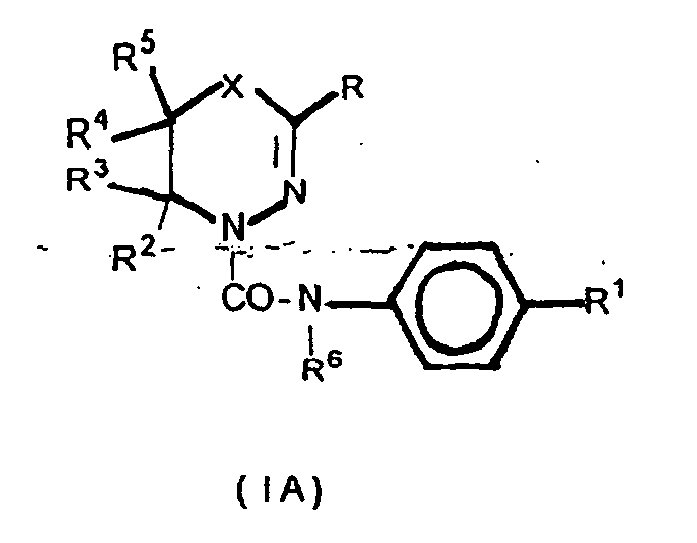
- A compound as recited in claim 2 wherein R is phenyl, thienyl, furanyl, or pyridinyl, optionally mono-, di- or tri-substitutsd by bromo, chloro, C1-C4 alkyl, C1-C4 trihaloalkyl, or C1-C4 trihaloalkoxy.
- A compound as recited in claim 3 wherein X is 0; R1 is C1-C4 trihaloalkyl or C1-C4 trihaloalkoxy; R2, R3, and R4 are, independently, C1-C4 alkyl or C1-C4 alkoxy; R5 is C1-C4 alkoxy, C1-C4 alkyl, C1-C4 alkylthio, or di (C1-C4)alkylamino; and R6 is hydrogen, C1-C4 alkyl, C1-C4 alkylthio, (C1-C4 alkoxy) methyl, or C2-C8 acyl.
- A compound as recited in claim 4 wherein R is phenyl, thienyl, furanyl, or pyridinyl, optionally mono-substituted by one bromo, one chloro, one methyl, one t-butyl, one trihalomethyl, one trihaloethyl, one trihalomethoxy, or one trihaloethoxy.
- A compound as recited in claim 5 wherein R1 is trihalomethyl or trihaloethyl; R2, R3, and R4 are, independently, methyl, ethyl, methoxy, or ethoxy; R5 is methoxy or ethoxy; and R6 is methyl, methylthio, methoxymethyl or acetyl.
- A compound as recited in claim 6 wherein R is phenyl, thienyl, pyridinyl, or benzothienyl, substituted by bromo, chloro, methyl, t-butyl, trifluoromethyl, or trifluoromethoxy.
- A compound as recited in claim 1 having the formula:

R is phenyl, unsubstituted or mono-, di-, or tri-substituted with halogen, C1-C4 haloalkyl, C1-C4 haloalkoxy, C1-C4 haloalkyl thio, C1-C4 haloalkyl sulfinyl, or C1-C4 haloalkyl sulfonyl; or R is a C4-C5 heterocyclic group containing one nitrogen, sulfur, or oxygen atom, unsubstituted or mono-, di-, or tri-substituted with halogen, C1-C4 haloalkyl, or C1-C4 haloalkoxy;
R1 is halogen, C1-C4 haloalkyl, C1-C4 haloalkoxy, C1-C4 haloalkyl thio, C1-C6 haloalkyl sulfinyl, C1-C6 haloalkyl sulfonyl;
R2 is C1-C6 alkylthio, C1-C6 alkylsulfinyl, C1-C6 alkylsulfonyl, nitro(C1-C6 alkoxy), hydroxy, di-(C1-C4 alkoxy)-phosphinyl, cyano, C2-C6 acyloxy, C1-C6 alkoxy, C1-C6 haloalkoxy, C4-C6 cycloalkyl, or C3-C6 alkenyl; or R2 is phenyl, phenylthio, phenylsulfinyl, phenylsulfonyl, pyrazolyl, furanyl, thienyl, phenyl(C1-C4 alkoxy), or benzoyloxy, unsubstituted or mono-, di-, or tri-substituted with halogen, C1-C4 alkyl, or C1-C4 alkoxy; and
R6 is hydrogen, C1-C6 alkyl, (C1-C4 alkoxy) C1-C4 alkyl, C2-C6 haloacyl, C2-C8 acyl, or (C1-C6 alkoxy)carbonyl. - A compound as recited in claim 8 wherein R is phenyl, optionally mono-, di- or tri-substituted by bromo, chloro, C1-C4 alkyl, C1-C4 trihaloalkyl, or C1-C4 trihaloalkoxy.
- A compound as recited in claim 9 wherein R1 is C1-C4 trihaloalkyl or C1-C4 trihaloalkoxy; R2 is C1-C6 alkylthio, C1-C6 alkylsulfinyl, C1-C6 alkylsulfonyl, nitro(C1-C4 alkoxy), hydroxy, di-(C1-C4 alkoxy)-phosphinyl, cyano, C2-C6 acyloxy, C1-C6 alkoxy, C1-C6 haloalkoxy, C4-C6 cycloalkyl, or C3-C6 alkenyl, phenyl, phenylthio, phenylsulfinyl, phenylsulfonyl, pyrazolyl, mono- or di-(C1-C4 alkyl)-pyrazolyl, furanyl, (C1-C4 alkyl)furanyl, thienyl, phenyl (C1-C4 alkoxy), or benzoyloxy; and R6 is hydrogen, C1-C4 alkyl, C1-C4 alkylthio, (C1-C4 alkoxy)-methyl, or C2-C8 acyl.
- A compound as recited in claim 10 wherein R is phenyl, optionally mono-substituted by one bromo, one chloro, one methyl, one t-butyl, one trihalomethyl, one trihaloethyl, one trihalomethoxy, or one trihaloethoxy.
- A compound as recited in claim 11 wherein R1 is trihalomethyl or trihaloethyl; and R6 is hydrogen or methyl.
- A compound as recited in claim 12 wherein R is phenyl substituted by bromo, chloro, methyl, t-butyl, trifluoromethyl, or trifluoromethoxy.
- An insecticidal composition comprising: a) an effective amount of a compound as recited in claim 1; and b) a suitable carrier.
- An insecticidal composition comprising: a) an effective amount of a compound as recited in claim 2; and b) a suitable carrier.
- An insecticidal composition comprising: a) an effective amount of a compound as recited in claim 8; and b) a suitable carrier.
- A method for controlling insects which comprises applying an effective amount of a compound as recited in claim 1 to the locus to be protected.
- A method for controlling insects which comprises applying an effective amount of a compound as recited in claim 2 to the locus to be protected.
- A method for controlling insects which comprises applying an effective amount of a compound as recited in claim 8 to the locus to be protected.
Applications Claiming Priority (5)
| Application Number | Priority Date | Filing Date | Title |
|---|---|---|---|
| US09/022,616 US6011034A (en) | 1998-02-12 | 1998-02-12 | Insecticidal dihydrooxadiazine compounds |
| US22616 | 1998-02-12 | ||
| US09/228,349 US6197766B1 (en) | 1998-02-12 | 1999-01-11 | Insecticidal dihydrooxadiazine compounds |
| US228349 | 1999-01-11 | ||
| PCT/US1999/001245 WO1999041245A1 (en) | 1998-02-12 | 1999-01-22 | Insecticidal dihydro-oxadiazines, -thiadiazines and -triazines |
Publications (2)
| Publication Number | Publication Date |
|---|---|
| EP1054875A1 EP1054875A1 (en) | 2000-11-29 |
| EP1054875B1 true EP1054875B1 (en) | 2008-04-23 |
Family
ID=26696138
Family Applications (1)
| Application Number | Title | Priority Date | Filing Date |
|---|---|---|---|
| EP99902412A Expired - Lifetime EP1054875B1 (en) | 1998-02-12 | 1999-01-22 | Insecticidal dihydro-oxadiazines, -thiadiazines and -triazines |
Country Status (8)
| Country | Link |
|---|---|
| EP (1) | EP1054875B1 (en) |
| JP (1) | JP3378237B2 (en) |
| CN (1) | CN1162410C (en) |
| AT (1) | ATE393149T1 (en) |
| AU (2) | AU2239899A (en) |
| BR (1) | BR9907815A (en) |
| CA (1) | CA2318889C (en) |
| WO (1) | WO1999041245A1 (en) |
Family Cites Families (5)
| Publication number | Priority date | Publication date | Assignee | Title |
|---|---|---|---|---|
| US3397201A (en) * | 1966-04-08 | 1968-08-13 | Dow Chemical Co | 5, 6-dihydro-2-(substituted)-6-phenyl-3, 4, 5-trimethyl-4h-1, 3, 4-oxadiazinium halides |
| US3420826A (en) | 1966-09-28 | 1969-01-07 | Dow Chemical Co | 2,4,6-(substituted)-1,3,4-oxadiazines and method for their preparation |
| US5536720A (en) * | 1992-09-09 | 1996-07-16 | Uniroyal Chemical Company, Inc. | Pesticidal oxadiazines |
| BR9510594A (en) | 1995-05-17 | 2002-01-08 | Uniroyal Chem Co Inc | Pesticide oxadiazines |
| US5804579A (en) * | 1997-01-30 | 1998-09-08 | Uniroyal Chemical Company, Inc. | Insecticidal oxadiazine compounds |
-
1999
- 1999-01-22 JP JP2000531440A patent/JP3378237B2/en not_active Expired - Fee Related
- 1999-01-22 BR BR9907815-5A patent/BR9907815A/en not_active IP Right Cessation
- 1999-01-22 AU AU22398/99A patent/AU2239899A/en not_active Abandoned
- 1999-01-22 AT AT99902412T patent/ATE393149T1/en not_active IP Right Cessation
- 1999-01-22 EP EP99902412A patent/EP1054875B1/en not_active Expired - Lifetime
- 1999-01-22 WO PCT/US1999/001245 patent/WO1999041245A1/en not_active Ceased
- 1999-01-22 CN CNB998029084A patent/CN1162410C/en not_active Expired - Fee Related
- 1999-01-22 CA CA002318889A patent/CA2318889C/en not_active Expired - Fee Related
-
2003
- 2003-09-12 AU AU2003246309A patent/AU2003246309B9/en not_active Ceased
Also Published As
| Publication number | Publication date |
|---|---|
| AU2003246309B9 (en) | 2007-02-15 |
| CN1290257A (en) | 2001-04-04 |
| JP3378237B2 (en) | 2003-02-17 |
| AU2003246309B2 (en) | 2007-02-08 |
| BR9907815A (en) | 2000-10-24 |
| WO1999041245A1 (en) | 1999-08-19 |
| EP1054875A1 (en) | 2000-11-29 |
| CA2318889C (en) | 2010-01-05 |
| CN1162410C (en) | 2004-08-18 |
| CA2318889A1 (en) | 1999-08-19 |
| AU2239899A (en) | 1999-08-30 |
| JP2002503656A (en) | 2002-02-05 |
| AU2003246309A1 (en) | 2003-10-09 |
| ATE393149T1 (en) | 2008-05-15 |
Similar Documents
| Publication | Publication Date | Title |
|---|---|---|
| WO1996036229A1 (en) | Fungicidal cyclic amides | |
| US5750470A (en) | Herbicidal 2,6-disubstituted pyridine compounds and compositions | |
| AU681140B2 (en) | Herbicidal substituted 1-phenyl or 1-pyridinyl-benzotriazoles | |
| JP3446052B2 (en) | Arthropodic amides | |
| EP1072598B1 (en) | Pyrazolinone derivatives | |
| EP0533276A1 (en) | Oxa(thia)diazol - and triazol-ones (thiones) having a miticide and insecticide activity | |
| AU2007214826A1 (en) | Insecticidal substituted amino heterocyclic and heteroaryl derivatives | |
| US6197766B1 (en) | Insecticidal dihydrooxadiazine compounds | |
| CA2318889C (en) | Insecticidal dihydro-oxadiazines, -thiadiazines and -triazines | |
| EP0964862B1 (en) | Insecticidal oxadiazine compounds | |
| US6451835B1 (en) | Pesticidal fluoroethyl pyrazole derivatives | |
| US5869504A (en) | Pesticidal tetrazole derivatives | |
| US6020355A (en) | Pesticidal tetrazole derivatives | |
| EP0533734A1 (en) | Fungicidal iminooxazolidinones | |
| MXPA00007906A (en) | Insecticidal dihydro-oxadiazines, -thiadiazines and -triazines | |
| JPH0692398B2 (en) | Pyrazol oxime derivative and bactericidal insecticide, acaricide containing the compound | |
| US6180126B1 (en) | Pesticidal thiadiazine compounds | |
| US20040157892A1 (en) | Pesticidal fluoroethyl pyrazoles | |
| JP2002539123A (en) | Pesticide heterosubstituted oxadiazine compounds |
Legal Events
| Date | Code | Title | Description |
|---|---|---|---|
| PUAI | Public reference made under article 153(3) epc to a published international application that has entered the european phase |
Free format text: ORIGINAL CODE: 0009012 |
|
| 17P | Request for examination filed |
Effective date: 20000711 |
|
| AK | Designated contracting states |
Kind code of ref document: A1 Designated state(s): AT BE CH CY DE DK ES FI FR GB GR IE IT LI LU MC NL PT SE |
|
| RAP1 | Party data changed (applicant data changed or rights of an application transferred) |
Owner name: CROMPTON CO./CIE Owner name: UNIROYAL CHEMICAL COMPANY, INC. |
|
| 17Q | First examination report despatched |
Effective date: 20030416 |
|
| RAP1 | Party data changed (applicant data changed or rights of an application transferred) |
Owner name: CROMPTON CO./CIE Owner name: CHEMTURA CORPORATION |
|
| GRAP | Despatch of communication of intention to grant a patent |
Free format text: ORIGINAL CODE: EPIDOSNIGR1 |
|
| RIC1 | Information provided on ipc code assigned before grant |
Ipc: A01N 57/24 20060101ALI20071115BHEP Ipc: A01N 47/38 20060101ALI20071115BHEP Ipc: C07F 9/6533 20060101ALI20071115BHEP Ipc: C07D 498/04 20060101ALI20071115BHEP Ipc: C07D 413/04 20060101ALI20071115BHEP Ipc: C07D 253/06 20060101ALI20071115BHEP Ipc: C07D 285/16 20060101ALI20071115BHEP Ipc: C07D 273/04 20060101AFI20071115BHEP |
|
| GRAS | Grant fee paid |
Free format text: ORIGINAL CODE: EPIDOSNIGR3 |
|
| GRAA | (expected) grant |
Free format text: ORIGINAL CODE: 0009210 |
|
| AK | Designated contracting states |
Kind code of ref document: B1 Designated state(s): AT BE CH CY DE DK ES FI FR GB GR IE IT LI LU MC NL PT SE |
|
| REG | Reference to a national code |
Ref country code: GB Ref legal event code: FG4D |
|
| REG | Reference to a national code |
Ref country code: CH Ref legal event code: EP |
|
| REF | Corresponds to: |
Ref document number: 69938586 Country of ref document: DE Date of ref document: 20080605 Kind code of ref document: P |
|
| REG | Reference to a national code |
Ref country code: IE Ref legal event code: FG4D Free format text: LANGUAGE OF EP DOCUMENT: FRENCH |
|
| NLV1 | Nl: lapsed or annulled due to failure to fulfill the requirements of art. 29p and 29m of the patents act | ||
| PG25 | Lapsed in a contracting state [announced via postgrant information from national office to epo] |
Ref country code: PT Free format text: LAPSE BECAUSE OF FAILURE TO SUBMIT A TRANSLATION OF THE DESCRIPTION OR TO PAY THE FEE WITHIN THE PRESCRIBED TIME-LIMIT Effective date: 20080923 Ref country code: NL Free format text: LAPSE BECAUSE OF FAILURE TO SUBMIT A TRANSLATION OF THE DESCRIPTION OR TO PAY THE FEE WITHIN THE PRESCRIBED TIME-LIMIT Effective date: 20080423 Ref country code: FI Free format text: LAPSE BECAUSE OF FAILURE TO SUBMIT A TRANSLATION OF THE DESCRIPTION OR TO PAY THE FEE WITHIN THE PRESCRIBED TIME-LIMIT Effective date: 20080423 Ref country code: ES Free format text: LAPSE BECAUSE OF FAILURE TO SUBMIT A TRANSLATION OF THE DESCRIPTION OR TO PAY THE FEE WITHIN THE PRESCRIBED TIME-LIMIT Effective date: 20080803 |
|
| PG25 | Lapsed in a contracting state [announced via postgrant information from national office to epo] |
Ref country code: AT Free format text: LAPSE BECAUSE OF FAILURE TO SUBMIT A TRANSLATION OF THE DESCRIPTION OR TO PAY THE FEE WITHIN THE PRESCRIBED TIME-LIMIT Effective date: 20080423 |
|
| ET | Fr: translation filed | ||
| PG25 | Lapsed in a contracting state [announced via postgrant information from national office to epo] |
Ref country code: SE Free format text: LAPSE BECAUSE OF FAILURE TO SUBMIT A TRANSLATION OF THE DESCRIPTION OR TO PAY THE FEE WITHIN THE PRESCRIBED TIME-LIMIT Effective date: 20080723 Ref country code: DK Free format text: LAPSE BECAUSE OF FAILURE TO SUBMIT A TRANSLATION OF THE DESCRIPTION OR TO PAY THE FEE WITHIN THE PRESCRIBED TIME-LIMIT Effective date: 20080423 |
|
| PG25 | Lapsed in a contracting state [announced via postgrant information from national office to epo] |
Ref country code: BE Free format text: LAPSE BECAUSE OF FAILURE TO SUBMIT A TRANSLATION OF THE DESCRIPTION OR TO PAY THE FEE WITHIN THE PRESCRIBED TIME-LIMIT Effective date: 20080423 |
|
| PLBE | No opposition filed within time limit |
Free format text: ORIGINAL CODE: 0009261 |
|
| STAA | Information on the status of an ep patent application or granted ep patent |
Free format text: STATUS: NO OPPOSITION FILED WITHIN TIME LIMIT |
|
| 26N | No opposition filed |
Effective date: 20090126 |
|
| PG25 | Lapsed in a contracting state [announced via postgrant information from national office to epo] |
Ref country code: MC Free format text: LAPSE BECAUSE OF NON-PAYMENT OF DUE FEES Effective date: 20090131 |
|
| REG | Reference to a national code |
Ref country code: CH Ref legal event code: PL |
|
| REG | Reference to a national code |
Ref country code: IE Ref legal event code: MM4A |
|
| PG25 | Lapsed in a contracting state [announced via postgrant information from national office to epo] |
Ref country code: LI Free format text: LAPSE BECAUSE OF NON-PAYMENT OF DUE FEES Effective date: 20090131 Ref country code: CH Free format text: LAPSE BECAUSE OF NON-PAYMENT OF DUE FEES Effective date: 20090131 |
|
| PG25 | Lapsed in a contracting state [announced via postgrant information from national office to epo] |
Ref country code: IE Free format text: LAPSE BECAUSE OF NON-PAYMENT OF DUE FEES Effective date: 20090122 |
|
| PG25 | Lapsed in a contracting state [announced via postgrant information from national office to epo] |
Ref country code: GR Free format text: LAPSE BECAUSE OF FAILURE TO SUBMIT A TRANSLATION OF THE DESCRIPTION OR TO PAY THE FEE WITHIN THE PRESCRIBED TIME-LIMIT Effective date: 20080724 |
|
| PGFP | Annual fee paid to national office [announced via postgrant information from national office to epo] |
Ref country code: FR Payment date: 20101221 Year of fee payment: 13 |
|
| PGFP | Annual fee paid to national office [announced via postgrant information from national office to epo] |
Ref country code: GB Payment date: 20101215 Year of fee payment: 13 |
|
| PG25 | Lapsed in a contracting state [announced via postgrant information from national office to epo] |
Ref country code: LU Free format text: LAPSE BECAUSE OF NON-PAYMENT OF DUE FEES Effective date: 20090122 |
|
| PGFP | Annual fee paid to national office [announced via postgrant information from national office to epo] |
Ref country code: DE Payment date: 20110131 Year of fee payment: 13 Ref country code: IT Payment date: 20110119 Year of fee payment: 13 |
|
| PG25 | Lapsed in a contracting state [announced via postgrant information from national office to epo] |
Ref country code: CY Free format text: LAPSE BECAUSE OF FAILURE TO SUBMIT A TRANSLATION OF THE DESCRIPTION OR TO PAY THE FEE WITHIN THE PRESCRIBED TIME-LIMIT Effective date: 20080423 |
|
| GBPC | Gb: european patent ceased through non-payment of renewal fee |
Effective date: 20120122 |
|
| REG | Reference to a national code |
Ref country code: FR Ref legal event code: ST Effective date: 20120928 |
|
| PG25 | Lapsed in a contracting state [announced via postgrant information from national office to epo] |
Ref country code: DE Free format text: LAPSE BECAUSE OF NON-PAYMENT OF DUE FEES Effective date: 20120801 Ref country code: GB Free format text: LAPSE BECAUSE OF NON-PAYMENT OF DUE FEES Effective date: 20120122 |
|
| REG | Reference to a national code |
Ref country code: DE Ref legal event code: R119 Ref document number: 69938586 Country of ref document: DE Effective date: 20120801 |
|
| PG25 | Lapsed in a contracting state [announced via postgrant information from national office to epo] |
Ref country code: IT Free format text: LAPSE BECAUSE OF NON-PAYMENT OF DUE FEES Effective date: 20120122 |
|
| PG25 | Lapsed in a contracting state [announced via postgrant information from national office to epo] |
Ref country code: FR Free format text: LAPSE BECAUSE OF NON-PAYMENT OF DUE FEES Effective date: 20120131 |