EP1052866A2 - High priority and/or emergency overload access control system - Google Patents
High priority and/or emergency overload access control system Download PDFInfo
- Publication number
- EP1052866A2 EP1052866A2 EP00303267A EP00303267A EP1052866A2 EP 1052866 A2 EP1052866 A2 EP 1052866A2 EP 00303267 A EP00303267 A EP 00303267A EP 00303267 A EP00303267 A EP 00303267A EP 1052866 A2 EP1052866 A2 EP 1052866A2
- Authority
- EP
- European Patent Office
- Prior art keywords
- high priority
- access
- wireless unit
- overload
- wireless
- Prior art date
- Legal status (The legal status is an assumption and is not a legal conclusion. Google has not performed a legal analysis and makes no representation as to the accuracy of the status listed.)
- Granted
Links
Images



Classifications
-
- G—PHYSICS
- G06—COMPUTING OR CALCULATING; COUNTING
- G06F—ELECTRIC DIGITAL DATA PROCESSING
- G06F13/00—Interconnection of, or transfer of information or other signals between, memories, input/output devices or central processing units
- G06F13/14—Handling requests for interconnection or transfer
- G06F13/20—Handling requests for interconnection or transfer for access to input/output bus
-
- H—ELECTRICITY
- H04—ELECTRIC COMMUNICATION TECHNIQUE
- H04W—WIRELESS COMMUNICATION NETWORKS
- H04W48/00—Access restriction; Network selection; Access point selection
- H04W48/02—Access restriction performed under specific conditions
- H04W48/06—Access restriction performed under specific conditions based on traffic conditions
-
- H—ELECTRICITY
- H04—ELECTRIC COMMUNICATION TECHNIQUE
- H04W—WIRELESS COMMUNICATION NETWORKS
- H04W4/00—Services specially adapted for wireless communication networks; Facilities therefor
- H04W4/90—Services for handling of emergency or hazardous situations, e.g. earthquake and tsunami warning systems [ETWS]
-
- H—ELECTRICITY
- H04—ELECTRIC COMMUNICATION TECHNIQUE
- H04W—WIRELESS COMMUNICATION NETWORKS
- H04W76/00—Connection management
- H04W76/50—Connection management for emergency connections
Definitions
- This invention relates to wireless communications and, more particularly, to a access control system for a cellular communications system.
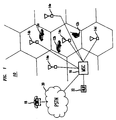
- FIG. 1 depicts a diagram of a wireless communications system 10 which provide wireless communications service to a number of wireless units (e.g., wireless units 12a-c) that are situated within a geographic region.
- the wireless cellular communications system 10 comprises a number of base stations 14a-e, geographically distributed to support transmission and receipt of communication signals to and from the wireless units 12a-c, which can be mobile or fixed, in the geographic region.
- each cell contains a base station, which comprises the radios and antennas that the base station uses to communicate with the wireless units in that cell.
- Each base station 14a-e handles voice and/or data communications over a particular region called a cell, and the overall coverage area for the cellular system is defined by the union of cells for all of the cell sites, where the coverage areas for nearby cell sites overlap to some degree to ensure (if possible) contiguous communications coverage within the outer boundaries of the system's coverage area.
- each cell is schematically represented by one hexagon in a honeycomb pattern; in practice, however, each cell has an irregular shape that depends on the topography of the terrain surrounding the cell. One cell site may sometimes provide coverage for several sectors. In this specification, cells and sectors are referred to interchangeably.
- the base stations also comprise the transmission equipment that the base station uses to communicate with a mobile switching center (MSC) for the geographic region.
- MSC mobile switching center
- An MSC 16 is responsible for, among other things, establishing and maintaining calls between the wireless units and calls between a wireless unit and a wireline unit (e.g., wireline unit 18). As such, the MSC interconnects the wireless units within the geographic region with a public switched telephone network (PSTN) 20. Within a geographic region, the MSC switches calls between base stations in real time as the wireless unit moves between cells, referred to as call handoff.
- PSTN public switched telephone network
- the MSC 16 is connected to or integrated with a home location register (HLR) 22.
- the HLR 22 contains subscriber information and location information for all wireless units which reside in the geographic region of the MSC 16.
- a base station and a wireless unit communicate voice and/or data over a forward link and a reverse link, wherein the forward link carries communication signals from the base station to the wireless unit and the reverse link carries communication signals from the wireless unit to the base station.
- the forward link carries communication signals from the base station to the wireless unit
- the reverse link carries communication signals from the wireless unit to the base station.
- wireless communications links between the wireless units and the base stations can be defined according to different radio protocols, including TDMA (time-division multiple access), FDMA (frequency-division multiple access), and CDMA (code-division multiple access).
- subscriber access control allows a service provider to control the availability of communications links to wireless units.
- a purpose behind subscriber access control was to ensure the availability of communications links if an emergency overload condition should develop.
- a technical industry standard that is desirably observed in introducing access controls in a mobile communications system is TIA/EIA-95-A Mobile Station-Base Station Compatibility Standard for Dual-Mode Wideband Spread Spectrum Cellular System (March, 1995) ("IS-95-A"); and ANSI J-STD-008 Personal Station-Base Station Compatibility Requirements for 1.8 to 2.0 GHz Code Division Multiple Access (CDMA) Personal Communications Systems, (Corrected Version - August 29, 1995).
- CDMA Code Division Multiple Access
- a detailed sequence of activities are typically followed before the wireless unit can access the wireless communications system to establish a call to a phone number.
- calls between a CDMA mobile station and a base station typically employ several kinds of channels. Initially, a pilot channel is employed as a reference signal for detecting other forward link channels.
- a sync channel is used to establish time and frame synchronization at the wireless unit. The sync channel message also provides information about another class of channels, the paging channels .
- Paging channels are used to broadcast a variety of control information, including access channel information, contained in the access parameter message.
- This access parameter message contains information such as persistence parameters(0-9), persistence parameters (10-15), persistence modifiers MSG_PSIST and REG_PSIST, initial access power requirements, the number of access channels, the number of access attempts, maximum size of access messages, values for various overload classes, access attempt backoff parameters and other information of interest to mobiles seeking access to the base station.
- the user To initiate a call and obtain access to the wireless communications system, the user inputs or dials the number into the wireless unit, and the wireless unit stores the phone number in storage, such as a memory. When the user finishes inputting the phone number, the user typically presses a send button to initiate the call. Before the wireless unit can access the wireless communications system, the wireless unit checks to ensure that the parameters received from the base station, such as those in the access parameter message, are current. After the wireless unit updates the parameters or determines that the parameters are current, the wireless unit commences the access procedure.
- Access channel(s) are used by the wireless unit to obtain access to the wireless communications system, for example, to originate a call.
- the IS-95-A standard cited above provides a detailed sequence of activities that are to be followed in transmitting messages over an access channel to a base station.
- CDMA wireless units transmit on the access channels according to a random access protocol in which the wireless unit attempts to gain access to the wireless communications system, referred to as an access attempt by sending an access message and receiving (or failing to receive) an acknowledgment for that access message.
- each transmission in the access attempt is called an access probe, and within an access attempt, access probes are grouped into access probe sequences.
- Each access attempt comprises up to max_req_seq (for a request access) or max_rsp_seq (for a response access) access probe sequences.
- Each access probe sequence consists of up to 1+NUM_STEP access probes, for example 15, all transmitted on the same Access Channel.
- the first access probe of each access probe sequence is transmitted at a specified power level relative to a nominal power level, and each subsequent access probe is transmitted at a power level a specified amount higher than the previous access probe.
- the timing of access probes and access probe sequences is expressed in terms of Access Channel slots.
- the transmission of an access probe begins at the start of an Access Channel slot.
- each such access probe comprises an access channel preamble and an access channel message capsule.
- the length of the preamble 1 + pam_sz as well as the length of message capsule 3 + max_cap_sz are expressed in terms of a number of 20 millisecond frames.
- the duration of an access probe (access channel slot) is 4 + pam_sz + max_cap_sz frames.
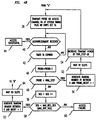
- FIGs. 4a and 4b show an example access procedure according to the IS-95-A standard.
- two types of messages are typically sent on the access channel: a response message (one that is a response to a base station message), or a request message (one that is sent autonomously by the mobile).
- counters PROBE and SEQ are initialized to count the access probe sequence numbers and the access probes.
- the transmission of an access probe begins at the start of an access channel slot.
- the precise timing of an access channel slot transmission in an access attempt is determined by a procedure called PN randomization.
- the mobile station computes at block 32 a delay, RN, from 0 to 2 probe_pn_ran PN chips using a (nonrandom) hash function that depends on its electronic serial number, ESN.
- the access channel number, RA, used for each access probe sequence is chosen pseudo randomly from 0 to acc-chan among all the access channels associated with the current paging channel as shown in block 34. Once chosen, this access channel number is used by the wireless unit for all access probes in the current access probe sequence.
- the first access probe of each access probe sequence is transmitted at a specified power level relative to the nominal open loop power level as shown in block 36.
- the mobile station transmits the first probe in each access probe sequence at a mean output power level (referenced to the nominal CDMA channel bandwidth of 1.23 MHz) depending on open loop power estimate, the initial power offset for access init_pwr and the nominal transmit power offset nom_pwr .
- the next access probe and each subsequent access probe is transmitted at a power level a specified amount PI dB (determined from pwr_step ) higher than the previous access probe until an acknowledgment response is obtained or the sequence ends as determined at block 48.
- Each access attempt comprises up to max_req_seq (for a request access) or max_rsp_seq (for a response access) access probe sequences as shown by blocks 56 and 58. If an acknowledgment has not been received after the last access probe sequence has been transmitted, the access attempt fails as shown in block 60.
- a backoff delay, RS of from 0 to 1+ bkoff slots is generated pseudo randomly and applied as shown by blocks 62 and 64.
- the wireless station performs a persistence test 68 for every Access Channel slot.
- the wireless unit transmits the first access probe of an access probe sequence in a slot only if the wireless unit passes the persistence test for that slot.
- the wireless unit generates a random number RP (0 ⁇ RP ⁇ 1) and compares it with a pre-determined threshold P as shown in blocks 70 and 72. If the generated random number RP is smaller than the pre-determined threshold P, transmission of the access probe sequence is initiated at step 34. If the persistence test fails, the access probe sequence is deferred until at least the next slot.
- the pre-computed threshold P varies, depending on the nature of the request, the access overload class n , the persistence value psist(n) for the overload class which is found in the access parameters message from the base station, and its persistence modifier msg_psist (for message transmission) or reg_psist (or registrations).
- Table 1 summarizes persistence test thresholds for various types of requests and access overload classes used in systems based on the IS-95-A standard. Table 1 shows that the maximum persistence value is 63 for access overload classes 0 through 9, and is 7 for access overload classes 10 through 15. If the maximum persistence value is assigned to the mobile station, the access attempts fails.
- Table 2 summarizes average persistence delay for various types of access channel requests as known in systems based on the IS-95-A standard.
- a wireless unit in a normal overload class (e.g. overload class 0-9) can experience significant delay even when it is making a high priority call, such as an emergency call.
- the present invention involves a high priority and/or emergency overload access control system in which a wireless unit is treated as a higher priority wireless unit when the wireless unit is attempting to access a wireless communications system with a high priority call, such as an emergency call.
- the overload access control system can recognize if the wireless unit is attempting to initiate a call to an emergency number. If so, the wireless unit can perform a persistence test as an emergency class (e.g. overload class 10-15) wireless unit in attempting to access the wireless communications system.
- an emergency class e.g. overload class 10-15
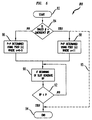
- FIG. 5 shows an embodiment 80 of the high priority and/or emergency overload access control system performed in the processing circuitry of a wireless unit of a normal overload class, for example overload classes 0 to 9, according to the principles of the present invention.
- the overload access control system has been incorporated in the access procedure of FIG. 4 as performing the persistence test. Other embodiments can be incorporated as part of an access procedure in different ways.
- the emergency and/or high priority persistence test 80 is initiated because an access channel request is being made by the wireless unit. If an access channel response is being made, for example, if the wireless unit is receiving a call, then the persistence test is typically bypassed.
- the overload access control system of the wireless unit determines at block 84 whether the phone number dialed into the wireless unit corresponds to an emergency number or a high priority number or code. For example, if the wireless unit dials the emergency number 911, the overload access control system recognizes that an emergency number has been dialed. In this embodiment, if the dialed number is not an emergency number, the overload access control system proceeds with the persistence test using a P calculated with the persistence value psist(n) where n corresponds to an ordinary overload class 0 to 9 as shown in block 86.
- the overload access control system proceeds with the persistence test using a P calculated with the persistence value psist(n) where n corresponds to a high priority and/or emergency overload class, for example the overload class 11 corresponding to an emergency class wireless unit as shown in block 88.
- the persistence test can be bypassed as shown by line 85.
- the overload access control system generates a random number RP at the beginning of an access channel slot at block 90.
- RP if RP is not less than P, the persistence test fails, and the overload access control system proceeds to block 90 to generate another random number at the beginning of the next access channel slot. If RP is less than P, which is highly likely if P is generated using an persistence value psist(11) for the emergency overload class, then the persistence test is passed at block 94, and the wireless unit proceeds to transmit an access probe sequence according to the remainder of the example access procedure.
- the above-described embodiment of the overload access control system reflects the logic used in incorporating the overload access control system into the access procedure for the IS-95-A standard.
- Alternative embodiments of the overload access control system are possible in which high priority and/or emergency number(s) can be recognized by the overload access control system to alter the access procedure and/or the persistence test by having the overload access control system in the wireless unit use high priority and/or emergency parameter(s) in attempting to access the system.
- Other changes in the implementation and the manner of incorporating the overload access control system into the example access procedure as described below or other access procedures are possible.
- portions of the high priority and/or access control system can be inserted at different points within and/or before the example access procedure or other access procedures to calculate P values and/or make a determination as to which P values to use or which to calculate based on whether the dialed number is an emergency or high priority number.
- multiple P values for different overload classes can be calculated initially, and after the class of the phone number is recognized then the appropriate P value is used in the persistence test.
- the P values can be updated when new persistence values are received from the base station, or re-calculated at each pass through the persistence test to ensure that updated persistence parameters are used to calculate the P values.
- New P values can be determined or the comparison of the dialed phone number can occur once per access attempt or after each pass through the persistence test, to ensure updated information is used.
- the overload access control system can obtain emergency and/or higher priority number(s) from a storage which can be programmed initially into the wireless unit, periodically updated, or updated through messages from the base station.
- FIG. 6 shows an alternative or more detailed embodiment of the emergency and/or high priority access control system according to the principles of the present invention.
- the wireless unit obtains the emergency and/or high priority number(s) or determines whether the emergency and/or high priority numbers stored at the wireless unit are current.
- the base station broadcasts emergency number(s) and/or high priority number(s) which the wireless unit can obtain, store and use to determine whether the wireless unit is being used to place an emergency and/or high priority call.
- the emergency number(s) and/or high priority number(s) can be transmitted to the wireless unit as part of the access parameter message, as part of other overhead messages sent over the paging channel or other channels, or as a message sent from the base station to the wireless unit in other possible manners.
- the wireless unit can determine if the emergency and/or high priority number(s) are current. Additionally, at block 98, the overload access control system obtains the persistence parameters or determines whether the persistence parameters stored in the wireless unit are current. Similarly, the wireless unit receives the persistence parameters from the base station as part of the access parameter message. When the user initiates a call on the wireless unit, the wireless unit checks if the persistence parameters as well as other parameters are current. Depending on the embodiment, blocks 96 and 98 can be performed at the same time, in a different order or during persistence test 100.
- the wireless unit determines whether the access attempt is an access channel response or an access channel request. In this embodiment at the block 66, if the access attempt is an access channel response, the persistence test 100 is bypassed. If the access attempt is an access channel request, for example to initiate an emergency call, the persistence test 100 is performed according to the principles of the present invention.
- the overload access control system ends the access attempt at block 106. If psist(11) is not equal to 7, the overload access control system uses a P calculated from the persistence value psist(11) corresponding to the emergency class for wireless units as shown at block 108. At block 110, the overload access control system generates a random number RP at the beginning of an access channel slot.
- the persistence test fails, and the overload access control system proceeds back to block 110 to generate a new random number RN at the beginning of an access channel slot in this embodiment.
- the persistence test is passed and the wireless unit proceeds to transmit an access probe on the access channel as shown in block 114.
- the persistence test proceeds according to the access procedure of IS-95-A in this embodiment.
- the line 116 is shown as broken because in alternative embodiments the dialed number could be compared to other emergency and/or high priority numbers, and as would be understood by one of skill in the art, a P determined using the corresponding persistence parameters would be used in the comparison 112.
- the overload access control system uses a P calculated from the persistence value for psist(0-9) obtained from the access parameters message.
- the overload access control system generates the random number RP at the beginning of an access channel slot. As described above for the block 112, if RP is less than the appropriate P, then the persistence test is passed and the wireless unit proceeds to transmit an access probe on the access channel as shown in block 114. If RP is not less than P, the persistence test fails, and the overload access control system proceeds back to block 110 to generate a new random number RN at the beginning of an access channel slot in this embodiment.
- the emergency and/or high priority overload access control system has been described with a particular system, but the overload access control system can be used with different cellular systems and configurations which omit and/or add components and/or use variations or portions of the described system.
- the overload access control system has been described with particular reference to a CDMA wireless unit in a wireless communications system using the IS-95-A standard, but other wireless systems using different standards (such as TIA/EIA-95-B Mobile Station-Base Station Compatibility Standard For Dual Mode Spread Spectrum Systems (October 1, 1998) ("IS-95-B”) and/or radio protocols, such as time division multiple access (TDMA), can use the overload access control system.
- IS-95-B TIA/EIA-95-B Mobile Station-Base Station Compatibility Standard For Dual Mode Spread Spectrum Systems (October 1, 1998)
- TDMA time division multiple access
- overload access control system and portions thereof can be implemented in application specific integrated circuits, software-driven processing circuitry, firmware or other arrangements of components in a wireless unit, such as a cellular phone, the base station and/or the MSC as would be understood by one of ordinary skill in the art with the benefit of this disclosure.
- a wireless unit such as a cellular phone, the base station and/or the MSC as would be understood by one of ordinary skill in the art with the benefit of this disclosure.
Landscapes
- Engineering & Computer Science (AREA)
- Computer Security & Cryptography (AREA)
- Computer Networks & Wireless Communication (AREA)
- Signal Processing (AREA)
- Theoretical Computer Science (AREA)
- Physics & Mathematics (AREA)
- General Engineering & Computer Science (AREA)
- General Physics & Mathematics (AREA)
- Mobile Radio Communication Systems (AREA)
- Alarm Systems (AREA)
- Train Traffic Observation, Control, And Security (AREA)
- External Artificial Organs (AREA)
Abstract
Description
| Persistence Test Threshold P | ||||
| access overload classes n = 0,1,···,9 | access overload classes n = 10, 11,···, 15 | |||
| psist(n) ≠ 63 | psist(n) = 63 | psist(n) ≠ 7 | Psist(n) = 7 | |
| | 2- psist(n) / 4 -reg_psist | 0 | 2-psist(n)-reg_psist | 0 |
| | 2- psist(n / 4 -msg_psist | 0 | 2-psist(n)-msg_psist | 0 |
| | 2- psist(n / 4 | 0 | 2-psist(n) | 0 |
| Average Persistence Delay E{PD} | ||||
| access overload classes n = 0,1,···,9 | access overload classes n = 10, 11,···, 15 | |||
| psist(n) ≠ 63 | psist(n) = 63 | psist(n) ≠ 7 | Psist(n) = 7 | |
| Registration Request | 2 psist(n) / 4 +reg_psist -1 | : | 2 psist (n)+reg_psist -1 | : |
| Message Request | 2 psist(n) / 4 +msg_psist -1 | : | 2 psist (n)+msg_psist -1 | : |
| Other Request | 2 psist(n) / 4-1 | : | 2 psist (n)-1 | : |
Claims (13)
- A method of controlling access to a wireless communications system (10) by a wireless unit (12) said method CHARACTERIZED BY:determining said wireless unit (12) is initiating a high priority call;using a parameter of a high priority class in establishing said high priority call.
- The method of claim 1 CHARACTERIZED IN THAT determining including:providing at least one high priority number to be stored in said wireless unit (12); andcomparing a number dialed into said wireless unit (12) with said at least one high priority number stored in said wireless unit (12) to determine if said number dialed is of high priority.
- The method of claim 1 CHARACTERIZED IN THAT providing further including:providing at least one emergency number as said at least one high priority number to be stored in said wireless unit (12).
- The method of claim 2 CHARACTERIZED IN THAT:obtaining said at least one high priority number from a base station (14).
- The method of claim 1 CHARACTERIZED IN THAT using further including:determining a P value calculated from a persistence value for a wireless unit (12) of a high priority class if said comparing indicates said number dialed is of high priority;generating a random number for a persistence test;comparing said P value to said random number; andinitiating an access channel transmission if results of said comparing indicate a passing of said persistence test.
- The method of claim 5 CHARACTERIZED BY:repeating said steps of generating and comparing if said persistence test fails.
- The method of claim 5 further CHARACTERIZED BY:determining a P value calculated from a persistence value for a wireless unit (12) of said normal class if said comparing indicates said number dialed is not of high priority.
- A wireless unit (12) of a normal class in a wireless communications system (10) said apparatus CHARACERIZED BY:an overload access control system configured to detetmine if said wireless unit (12) is initiating a high priority call and to use a parameter of a high priority class in establishing said high priority call.
- The apparatus of claim 1 CHARACTERIZED IN THAT said overload access control system stores at least one high priority number in said wireless unit (12) and compares a number dialed into said wireless unit (12) with said at least one high priority number stored in said wireless unit (12) to determine if said number dialed is of high priority.
- The apparatus of claim 9 wherein said overload access control system determining a P value calculated from a persistence value for a wireless unit (12) of a high priority class if said number dialed is of high priority and generating a random number for a persistence test, said random number being compared to said P value to initiate an access channel transmission.
- A method of controlling access to a wireless communications system by a wireless unit (12) of a normal class, said method comprising:obtaining a high priority number from a base station; andusing said high priority number to determine if said wireless unit is initiating a high priority call.
- A method of controlling access to a wireless communications system by a wireless unit (12) of a normal class, said method comprising:transmitting a high priority number to said wireless unit for said wireless unit to use in determine if said wireless unit is initiating a high priority call.
- A wireless unit comprising circuitry configured to determine said wireless unit (12) is initiating a high priority call, said circuitry using a parameter of a high priority class in establishing said high priority call.
Applications Claiming Priority (2)
| Application Number | Priority Date | Filing Date | Title |
|---|---|---|---|
| US09/307,911 US6374099B1 (en) | 1999-05-10 | 1999-05-10 | High priority and/or emergency overload access control system |
| US307911 | 1999-05-10 |
Publications (3)
| Publication Number | Publication Date |
|---|---|
| EP1052866A2 true EP1052866A2 (en) | 2000-11-15 |
| EP1052866A3 EP1052866A3 (en) | 2000-11-29 |
| EP1052866B1 EP1052866B1 (en) | 2006-06-21 |
Family
ID=23191703
Family Applications (1)
| Application Number | Title | Priority Date | Filing Date |
|---|---|---|---|
| EP00303267A Expired - Lifetime EP1052866B1 (en) | 1999-05-10 | 2000-04-18 | High priority and/or emergency overload access control system |
Country Status (11)
| Country | Link |
|---|---|
| US (1) | US6374099B1 (en) |
| EP (1) | EP1052866B1 (en) |
| JP (1) | JP3877936B2 (en) |
| KR (1) | KR100397406B1 (en) |
| CN (1) | CN1273500A (en) |
| AT (1) | ATE331405T1 (en) |
| AU (1) | AU3254400A (en) |
| BR (1) | BR0007369A (en) |
| CA (1) | CA2307442A1 (en) |
| DE (1) | DE60028864T2 (en) |
| ID (1) | ID25980A (en) |
Cited By (9)
| Publication number | Priority date | Publication date | Assignee | Title |
|---|---|---|---|---|
| EP1747687A4 (en) * | 2004-05-07 | 2008-08-06 | Interdigital Tech Corp | Supporting emergency calls on a wireless local area network |
| WO2008127163A1 (en) * | 2007-04-17 | 2008-10-23 | Telefonaktiebolaget Lm Ericsson (Publ) | A method of handling radio access and to prioritize subscribers in case of an emergency |
| WO2007050870A3 (en) * | 2005-10-27 | 2009-09-03 | Qualcomm Incorporated | Establishing access channel in wireless communication systems |
| US7623840B2 (en) | 2001-04-27 | 2009-11-24 | Nokia Corporation | Method and system for handling a network-identified emergency session |
| GB2465192A (en) * | 2008-11-10 | 2010-05-12 | Samsung Electronics Co Ltd | Controlling connection establishment |
| GB2466113A (en) * | 2008-12-11 | 2010-06-16 | Motorola Inc | Assigning a priority to a network node based on determining that traffic congestion in a wireless communication network is above a threshold value |
| US8145182B2 (en) | 2004-05-07 | 2012-03-27 | Interdigital Technology Corporation | Supporting emergency calls on a wireless local area network |
| WO2012150381A1 (en) * | 2011-05-04 | 2012-11-08 | Nokia Corporation | Random access improvement |
| US8682279B2 (en) | 2004-05-07 | 2014-03-25 | Interdigital Technology Corporation | Supporting emergency calls on a wireless local area network |
Families Citing this family (51)
| Publication number | Priority date | Publication date | Assignee | Title |
|---|---|---|---|---|
| USRE47895E1 (en) | 1999-03-08 | 2020-03-03 | Ipcom Gmbh & Co. Kg | Method of allocating access rights to a telecommunications channel to subscriber stations of a telecommunications network and subscriber station |
| JP4293680B2 (en) * | 1999-07-02 | 2009-07-08 | 富士通株式会社 | Priority call connection method and apparatus in wireless communication system |
| TW527797B (en) * | 1999-09-20 | 2003-04-11 | Koninkl Philips Electronics Nv | Wireless network with a plurality of persistency probabilities for accessing a RACH channel |
| KR100344872B1 (en) * | 1999-09-29 | 2002-07-19 | 엘지정보통신주식회사 | Emergency call origination method in mobile terminal |
| US6628933B1 (en) * | 2000-03-17 | 2003-09-30 | Samsung Electronics Co., Ltd. | System and method for prevention of emergency call drops in a wireless network |
| CA2372557C (en) * | 2000-04-10 | 2008-08-05 | Samsung Electronics Co., Ltd. | Method for measuring confusion rate of a common packet channel in a cdma communication system |
| US6907237B1 (en) * | 2000-08-28 | 2005-06-14 | Motorola, Inc. | Communication system that provides backup communication services to a plurality of communication devices |
| US6738643B1 (en) * | 2000-10-31 | 2004-05-18 | Scott C. Harris | Phone sync |
| US7333794B2 (en) * | 2001-03-06 | 2008-02-19 | At&T Mobility Ii Llc | Real-time network analysis and performance management |
| US8238944B2 (en) * | 2002-04-16 | 2012-08-07 | Hewlett-Packard Development Company, L.P. | Disaster and emergency mode for mobile radio phones |
| US6748211B1 (en) * | 2002-05-22 | 2004-06-08 | Motorola, Inc. | Device and method for transmitting a message from a client device to a service center |
| US20030224806A1 (en) * | 2002-06-03 | 2003-12-04 | Igal Hebron | System and method for network data quality measurement |
| US6985740B2 (en) * | 2002-08-08 | 2006-01-10 | Green Wireless Llc | System for and method of providing priority access service and cell load redistribution |
| US7003303B2 (en) * | 2002-08-23 | 2006-02-21 | Motorola, Inc. | Dedicated high priority access channel |
| EP1586217B1 (en) * | 2003-01-21 | 2007-01-03 | Research In Motion Limited | Method and apparatus to enhance the probability of successful emergency call completion in a mobile station |
| US7339893B2 (en) * | 2003-03-18 | 2008-03-04 | Cisco Technology, Inc. | Pre-empting low-priority traffic with high-priority traffic on a dedicated link |
| US7424029B1 (en) * | 2003-05-30 | 2008-09-09 | The United States Of America As Represented By The Secretary Of The Navy | Stochastic unified multiple access to a communications channel |
| US7228134B2 (en) * | 2003-06-17 | 2007-06-05 | Lucent Technologies Inc. | Method of minimizing reverse channel interference caused by an abnormally high number of access attempts in a wireless communications system |
| WO2005032198A1 (en) * | 2003-09-25 | 2005-04-07 | Nec Corporation | System for receiving call having priority in call regulation, method for receiving call having priority, and program thereof |
| US6985089B2 (en) * | 2003-10-24 | 2006-01-10 | Palo Alto Reserach Center Inc. | Vehicle-to-vehicle communication protocol |
| US7254609B2 (en) * | 2003-12-09 | 2007-08-07 | Viasat, Inc. | Method for channel congestion management |
| US7650379B2 (en) * | 2003-12-09 | 2010-01-19 | Viasat, Inc. | Method for channel congestion management |
| US20050198264A1 (en) * | 2004-01-29 | 2005-09-08 | Bekiares Tyrone D. | Dynamic selection of behavior sets for middleware |
| KR100660054B1 (en) * | 2004-09-01 | 2006-12-20 | 한국전자통신연구원 | Downlink Packet Scheduling Using Service Delay Time and Channel Status |
| US7924871B2 (en) * | 2004-11-24 | 2011-04-12 | Nextel Communications Inc. | Control channel priority access systems and methods |
| US7127230B2 (en) * | 2004-12-10 | 2006-10-24 | Bellsouth Intellectual Property Corporation | Methods and computer program products for providing communications in emergency situations |
| US7742444B2 (en) | 2005-03-15 | 2010-06-22 | Qualcomm Incorporated | Multiple other sector information combining for power control in a wireless communication system |
| KR100685997B1 (en) | 2005-03-30 | 2007-02-26 | 엘지전자 주식회사 | Mobile communication terminal with output power control function and call connection method using the same |
| EP1884042B1 (en) * | 2005-05-03 | 2014-01-22 | LG Electronics, Inc. | Changing a radio access configuration between a terminal and a network |
| US7974261B2 (en) | 2005-06-13 | 2011-07-05 | Qualcomm Incorporated | Basestation methods and apparatus for supporting timing synchronization |
| US8036205B2 (en) * | 2005-06-13 | 2011-10-11 | Qualcomm Incorporated | Methods and apparatus for supporting uplinks with remote base stations |
| US7574224B2 (en) | 2005-06-13 | 2009-08-11 | Qualcomm Incorporated | Methods and apparatus for performing timing synchronization with base stations |
| KR101232657B1 (en) * | 2005-06-15 | 2013-02-12 | 한국전자통신연구원 | Device and method for controlling state in cellular system |
| US9055552B2 (en) | 2005-06-16 | 2015-06-09 | Qualcomm Incorporated | Quick paging channel with reduced probability of missed page |
| US8750908B2 (en) | 2005-06-16 | 2014-06-10 | Qualcomm Incorporated | Quick paging channel with reduced probability of missed page |
| US8010672B2 (en) * | 2005-07-29 | 2011-08-30 | Alcatel Lucent | Methods and systems for controlling utilization of resources of contention |
| CN101268713B (en) | 2005-09-22 | 2012-08-29 | Lg电子株式会社 | Access probe randomization for wireless communication system |
| US20090207790A1 (en) | 2005-10-27 | 2009-08-20 | Qualcomm Incorporated | Method and apparatus for settingtuneawaystatus in an open state in wireless communication system |
| KR100981811B1 (en) * | 2005-10-31 | 2010-09-13 | 엘지전자 주식회사 | Wireless access information delivery method in mobile communication system |
| US7565161B2 (en) * | 2005-12-23 | 2009-07-21 | Alcatel-Lucent Usa Inc. | Method and system for wireless priority call processing |
| CN101114873B (en) * | 2006-07-26 | 2011-03-30 | 华为技术有限公司 | Load control method and apparatus in random access process |
| US20080031219A1 (en) * | 2006-08-01 | 2008-02-07 | Lucent Technologies, Inc. | Accessing an access network to enable grade of service in calls or flow requests for target users of access terminals |
| US8761792B2 (en) * | 2008-03-27 | 2014-06-24 | At&T Mobility Ii Llc | Management of preemptable communications resources |
| CN101321389B (en) * | 2008-06-26 | 2012-04-04 | 华为技术有限公司 | Method and control device for connecting calls |
| GB0812855D0 (en) * | 2008-07-15 | 2008-08-20 | Vodafone Plc | Emergency communication device |
| US8254874B1 (en) * | 2009-10-14 | 2012-08-28 | Sprint Spectrum L.P. | Variable persistence delay for mobile stations receiving concatenated pages |
| JP5402685B2 (en) * | 2010-02-01 | 2014-01-29 | 富士通株式会社 | Mobile station and radio communication method |
| WO2012121751A1 (en) * | 2011-03-07 | 2012-09-13 | Intel Corporation | Grouped machine-to-machine communications |
| US8606219B1 (en) * | 2012-05-10 | 2013-12-10 | Sprint Spectrum L.P. | Selective suppression of access probe transmission in response to external impact event |
| US9706595B2 (en) * | 2013-08-23 | 2017-07-11 | Nec Corporation | Call processing control device, mobile communication system, method for restricting reception of call connection request, and readable medium |
| US10575160B2 (en) | 2016-03-30 | 2020-02-25 | Vitrotv Hk Ltd | Systems and methods for operating display devices with dual pathway connections |
Family Cites Families (15)
| Publication number | Priority date | Publication date | Assignee | Title |
|---|---|---|---|---|
| WO1987007800A1 (en) | 1986-06-13 | 1987-12-17 | Keith Askham | Telephone security system |
| US5615249A (en) * | 1994-11-30 | 1997-03-25 | Lucent Technologies Inc. | Service prioritization in a cellular telephone system |
| US5729542A (en) * | 1995-06-28 | 1998-03-17 | Motorola, Inc. | Method and apparatus for communication system access |
| US5752193A (en) * | 1995-09-01 | 1998-05-12 | Motorola, Inc. | Method and apparatus for communicating in a wireless communication system |
| EP0801871A4 (en) * | 1995-11-01 | 1999-08-18 | Motorola Inc | Method and apparatus for allocating a communication channel in a communication system |
| FI960986A7 (en) * | 1996-03-01 | 1997-09-02 | Nokia Telecommunications Oy | Allocation of emergency speeches in the mobile communications system |
| US6067457A (en) * | 1996-04-30 | 2000-05-23 | Motorola, Inc. | Method for dynamically assigning priority to a call |
| US5884148A (en) * | 1996-07-08 | 1999-03-16 | Omnipoint Corporation | Wireless local loop system and method |
| FI964621L (en) | 1996-11-19 | 1998-05-20 | Ericsson Telefon Ab L M | Methods and devices for accessing telephone numbers |
| DE19648077C2 (en) | 1996-11-20 | 1998-12-03 | Nokia Mobile Phones Ltd | Method for setting the access persistence of a mobile station in a cellular mobile radio network |
| US6115596A (en) * | 1997-04-22 | 2000-09-05 | Ericsson Inc. | Systems and methods for handling emergency calls in hierarchical cell structures |
| JP3390126B2 (en) * | 1997-04-30 | 2003-03-24 | 日立ソフトウエアエンジニアリング株式会社 | Method of resetting communication path and communication exchange |
| US6157627A (en) * | 1997-06-23 | 2000-12-05 | Telefonaktiebolaget Lm Ericsson | Channel allocation for mixed multislot services |
| JP3998760B2 (en) * | 1997-08-01 | 2007-10-31 | 株式会社リコー | Multicolor image forming apparatus |
| US6112101A (en) * | 1997-10-09 | 2000-08-29 | Ericsson Inc. | Load based priority for the mobile subscriber |
-
1999
- 1999-05-10 US US09/307,911 patent/US6374099B1/en not_active Expired - Lifetime
-
2000
- 2000-04-18 EP EP00303267A patent/EP1052866B1/en not_active Expired - Lifetime
- 2000-04-18 DE DE60028864T patent/DE60028864T2/en not_active Expired - Lifetime
- 2000-04-18 AT AT00303267T patent/ATE331405T1/en not_active IP Right Cessation
- 2000-04-20 ID IDP20000315A patent/ID25980A/en unknown
- 2000-05-02 CA CA002307442A patent/CA2307442A1/en not_active Abandoned
- 2000-05-05 AU AU32544/00A patent/AU3254400A/en not_active Abandoned
- 2000-05-05 BR BR0007369-5A patent/BR0007369A/en not_active Application Discontinuation
- 2000-05-09 CN CN00108287A patent/CN1273500A/en active Pending
- 2000-05-10 JP JP2000137226A patent/JP3877936B2/en not_active Expired - Fee Related
- 2000-05-10 KR KR10-2000-0024962A patent/KR100397406B1/en not_active Expired - Fee Related
Cited By (16)
| Publication number | Priority date | Publication date | Assignee | Title |
|---|---|---|---|---|
| US7623840B2 (en) | 2001-04-27 | 2009-11-24 | Nokia Corporation | Method and system for handling a network-identified emergency session |
| US8682279B2 (en) | 2004-05-07 | 2014-03-25 | Interdigital Technology Corporation | Supporting emergency calls on a wireless local area network |
| EP1747687A4 (en) * | 2004-05-07 | 2008-08-06 | Interdigital Tech Corp | Supporting emergency calls on a wireless local area network |
| US9826376B2 (en) | 2004-05-07 | 2017-11-21 | Interdigital Technology Corporation | Supporting emergency calls on a wireless local area network |
| US9258690B2 (en) | 2004-05-07 | 2016-02-09 | Interdigital Technology Corporation | Supporting emergency calls on a wireless local area network |
| US8145182B2 (en) | 2004-05-07 | 2012-03-27 | Interdigital Technology Corporation | Supporting emergency calls on a wireless local area network |
| US8849283B2 (en) | 2004-05-07 | 2014-09-30 | Interdigital Technology Corporation | Supporting emergency calls on a wireless local area network |
| WO2007050870A3 (en) * | 2005-10-27 | 2009-09-03 | Qualcomm Incorporated | Establishing access channel in wireless communication systems |
| WO2008127163A1 (en) * | 2007-04-17 | 2008-10-23 | Telefonaktiebolaget Lm Ericsson (Publ) | A method of handling radio access and to prioritize subscribers in case of an emergency |
| US9462443B2 (en) | 2007-04-17 | 2016-10-04 | Telefonaktiebolaget Lm Ericsson (Publ) | Method of handling radio access and to prioritize subscribers in case of an emergency |
| GB2465192A (en) * | 2008-11-10 | 2010-05-12 | Samsung Electronics Co Ltd | Controlling connection establishment |
| GB2465192B (en) * | 2008-11-10 | 2011-03-30 | Samsung Electronics Co Ltd | Controlling connection establishment |
| GB2466113B (en) * | 2008-12-11 | 2012-02-15 | Motorola Solutions Inc | Method and apparatus for controlling traffic congestion in a wireless communication network |
| GB2466113A (en) * | 2008-12-11 | 2010-06-16 | Motorola Inc | Assigning a priority to a network node based on determining that traffic congestion in a wireless communication network is above a threshold value |
| WO2012150381A1 (en) * | 2011-05-04 | 2012-11-08 | Nokia Corporation | Random access improvement |
| US8861348B2 (en) | 2011-05-04 | 2014-10-14 | Nokia Corporation | Random access improvement |
Also Published As
| Publication number | Publication date |
|---|---|
| EP1052866A3 (en) | 2000-11-29 |
| JP3877936B2 (en) | 2007-02-07 |
| DE60028864D1 (en) | 2006-08-03 |
| AU3254400A (en) | 2000-11-16 |
| JP2000358274A (en) | 2000-12-26 |
| ATE331405T1 (en) | 2006-07-15 |
| KR20010014894A (en) | 2001-02-26 |
| ID25980A (en) | 2000-11-16 |
| DE60028864T2 (en) | 2006-12-07 |
| BR0007369A (en) | 2001-09-04 |
| EP1052866B1 (en) | 2006-06-21 |
| CN1273500A (en) | 2000-11-15 |
| CA2307442A1 (en) | 2000-11-10 |
| US6374099B1 (en) | 2002-04-16 |
| KR100397406B1 (en) | 2003-09-13 |
Similar Documents
| Publication | Publication Date | Title |
|---|---|---|
| US6374099B1 (en) | High priority and/or emergency overload access control system | |
| KR100914237B1 (en) | Improved secondary cell change | |
| EP0872982B1 (en) | Method and apparatus for packet data call re-establishment in a telecommunications system | |
| US6426960B2 (en) | Increased capacity data transmission in a CDMA wireless communication system | |
| US6374103B1 (en) | Method and system for overhead message updates | |
| KR100299639B1 (en) | Method and apparatus for determining remote unit location in a communication system | |
| EP1468582B1 (en) | Method, device and system for adjusting mobility management | |
| US7257419B2 (en) | Method for attempting to establish a connection between a mobile station and a wireless communication system including a parameter identifying reason for a previously failed reconnection attempt and a parameter indicating a number of times that the reason occurred | |
| US6535736B1 (en) | System and method for variably delaying access requests in wireless communications system | |
| US9155108B2 (en) | Transmitting information to a radio access network based on default reporting | |
| US6754501B1 (en) | Media access adaptive control to improve system throughput | |
| EP1258155A2 (en) | Method and apparatus for common packet channel assignment | |
| US10820344B2 (en) | Preamble signature selection for contention based random access in mobile communication | |
| KR100204595B1 (en) | The random access method by saving transmitting power in wireless subscriber network | |
| JP2004158931A (en) | Transmission rate control device and transmission rate control method | |
| KR100854513B1 (en) | Method and system for automatic setting of initial transmission power through random access channel | |
| WO2002035861A2 (en) | Call re-origination via a new base station to be placed in soft/softer handoff condition with a serving base station prior to call dropping | |
| HK1028304B (en) | A method and system for wireless communication | |
| HK1064853A1 (en) | Method and apparatus for controlling call request in a communication system | |
| HK1064853B (en) | Method and apparatus for controlling call request in a communication system |
Legal Events
| Date | Code | Title | Description |
|---|---|---|---|
| PUAI | Public reference made under article 153(3) epc to a published international application that has entered the european phase |
Free format text: ORIGINAL CODE: 0009012 |
|
| PUAL | Search report despatched |
Free format text: ORIGINAL CODE: 0009013 |
|
| AK | Designated contracting states |
Kind code of ref document: A2 Designated state(s): AT BE CH CY DE DK ES FI FR GB GR IE IT LI LU MC NL PT SE |
|
| AX | Request for extension of the european patent |
Free format text: AL;LT;LV;MK;RO;SI |
|
| AK | Designated contracting states |
Kind code of ref document: A3 Designated state(s): AT BE CH CY DE DK ES FI FR GB GR IE IT LI LU MC NL PT SE |
|
| AX | Request for extension of the european patent |
Free format text: AL;LT;LV;MK;RO;SI |
|
| 17P | Request for examination filed |
Effective date: 20010517 |
|
| AKX | Designation fees paid |
Free format text: AT BE CH CY DE DK ES FI FR GB GR IE IT LI LU MC NL PT SE |
|
| 17Q | First examination report despatched |
Effective date: 20050425 |
|
| GRAP | Despatch of communication of intention to grant a patent |
Free format text: ORIGINAL CODE: EPIDOSNIGR1 |
|
| GRAS | Grant fee paid |
Free format text: ORIGINAL CODE: EPIDOSNIGR3 |
|
| GRAA | (expected) grant |
Free format text: ORIGINAL CODE: 0009210 |
|
| AK | Designated contracting states |
Kind code of ref document: B1 Designated state(s): AT BE CH CY DE DK ES FI FR GB GR IE IT LI LU MC NL PT SE |
|
| PG25 | Lapsed in a contracting state [announced via postgrant information from national office to epo] |
Ref country code: IT Free format text: LAPSE BECAUSE OF FAILURE TO SUBMIT A TRANSLATION OF THE DESCRIPTION OR TO PAY THE FEE WITHIN THE PRESCRIBED TIME-LIMIT;WARNING: LAPSES OF ITALIAN PATENTS WITH EFFECTIVE DATE BEFORE 2007 MAY HAVE OCCURRED AT ANY TIME BEFORE 2007. THE CORRECT EFFECTIVE DATE MAY BE DIFFERENT FROM THE ONE RECORDED. Effective date: 20060621 Ref country code: CH Free format text: LAPSE BECAUSE OF FAILURE TO SUBMIT A TRANSLATION OF THE DESCRIPTION OR TO PAY THE FEE WITHIN THE PRESCRIBED TIME-LIMIT Effective date: 20060621 Ref country code: FI Free format text: LAPSE BECAUSE OF FAILURE TO SUBMIT A TRANSLATION OF THE DESCRIPTION OR TO PAY THE FEE WITHIN THE PRESCRIBED TIME-LIMIT Effective date: 20060621 Ref country code: BE Free format text: LAPSE BECAUSE OF FAILURE TO SUBMIT A TRANSLATION OF THE DESCRIPTION OR TO PAY THE FEE WITHIN THE PRESCRIBED TIME-LIMIT Effective date: 20060621 Ref country code: LI Free format text: LAPSE BECAUSE OF FAILURE TO SUBMIT A TRANSLATION OF THE DESCRIPTION OR TO PAY THE FEE WITHIN THE PRESCRIBED TIME-LIMIT Effective date: 20060621 Ref country code: NL Free format text: LAPSE BECAUSE OF FAILURE TO SUBMIT A TRANSLATION OF THE DESCRIPTION OR TO PAY THE FEE WITHIN THE PRESCRIBED TIME-LIMIT Effective date: 20060621 Ref country code: AT Free format text: LAPSE BECAUSE OF FAILURE TO SUBMIT A TRANSLATION OF THE DESCRIPTION OR TO PAY THE FEE WITHIN THE PRESCRIBED TIME-LIMIT Effective date: 20060621 |
|
| REG | Reference to a national code |
Ref country code: GB Ref legal event code: FG4D |
|
| REG | Reference to a national code |
Ref country code: CH Ref legal event code: EP |
|
| REG | Reference to a national code |
Ref country code: IE Ref legal event code: FG4D |
|
| REF | Corresponds to: |
Ref document number: 60028864 Country of ref document: DE Date of ref document: 20060803 Kind code of ref document: P |
|
| PG25 | Lapsed in a contracting state [announced via postgrant information from national office to epo] |
Ref country code: SE Free format text: LAPSE BECAUSE OF FAILURE TO SUBMIT A TRANSLATION OF THE DESCRIPTION OR TO PAY THE FEE WITHIN THE PRESCRIBED TIME-LIMIT Effective date: 20060921 Ref country code: DK Free format text: LAPSE BECAUSE OF FAILURE TO SUBMIT A TRANSLATION OF THE DESCRIPTION OR TO PAY THE FEE WITHIN THE PRESCRIBED TIME-LIMIT Effective date: 20060921 |
|
| PG25 | Lapsed in a contracting state [announced via postgrant information from national office to epo] |
Ref country code: ES Free format text: LAPSE BECAUSE OF FAILURE TO SUBMIT A TRANSLATION OF THE DESCRIPTION OR TO PAY THE FEE WITHIN THE PRESCRIBED TIME-LIMIT Effective date: 20061002 |
|
| PG25 | Lapsed in a contracting state [announced via postgrant information from national office to epo] |
Ref country code: PT Free format text: LAPSE BECAUSE OF FAILURE TO SUBMIT A TRANSLATION OF THE DESCRIPTION OR TO PAY THE FEE WITHIN THE PRESCRIBED TIME-LIMIT Effective date: 20061121 |
|
| NLV1 | Nl: lapsed or annulled due to failure to fulfill the requirements of art. 29p and 29m of the patents act | ||
| ET | Fr: translation filed | ||
| REG | Reference to a national code |
Ref country code: CH Ref legal event code: PL |
|
| PLBE | No opposition filed within time limit |
Free format text: ORIGINAL CODE: 0009261 |
|
| STAA | Information on the status of an ep patent application or granted ep patent |
Free format text: STATUS: NO OPPOSITION FILED WITHIN TIME LIMIT |
|
| 26N | No opposition filed |
Effective date: 20070322 |
|
| PG25 | Lapsed in a contracting state [announced via postgrant information from national office to epo] |
Ref country code: GR Free format text: LAPSE BECAUSE OF FAILURE TO SUBMIT A TRANSLATION OF THE DESCRIPTION OR TO PAY THE FEE WITHIN THE PRESCRIBED TIME-LIMIT Effective date: 20060922 |
|
| PG25 | Lapsed in a contracting state [announced via postgrant information from national office to epo] |
Ref country code: IE Free format text: LAPSE BECAUSE OF NON-PAYMENT OF DUE FEES Effective date: 20070418 |
|
| PG25 | Lapsed in a contracting state [announced via postgrant information from national office to epo] |
Ref country code: MC Free format text: LAPSE BECAUSE OF NON-PAYMENT OF DUE FEES Effective date: 20070430 |
|
| PG25 | Lapsed in a contracting state [announced via postgrant information from national office to epo] |
Ref country code: CY Free format text: LAPSE BECAUSE OF FAILURE TO SUBMIT A TRANSLATION OF THE DESCRIPTION OR TO PAY THE FEE WITHIN THE PRESCRIBED TIME-LIMIT Effective date: 20060621 Ref country code: LU Free format text: LAPSE BECAUSE OF NON-PAYMENT OF DUE FEES Effective date: 20070418 |
|
| REG | Reference to a national code |
Ref country code: GB Ref legal event code: 732E Free format text: REGISTERED BETWEEN 20131107 AND 20131113 |
|
| REG | Reference to a national code |
Ref country code: FR Ref legal event code: CD Owner name: ALCATEL-LUCENT USA INC. Effective date: 20131122 |
|
| REG | Reference to a national code |
Ref country code: FR Ref legal event code: GC Effective date: 20140410 |
|
| REG | Reference to a national code |
Ref country code: FR Ref legal event code: RG Effective date: 20141015 |
|
| REG | Reference to a national code |
Ref country code: FR Ref legal event code: PLFP Year of fee payment: 16 |
|
| REG | Reference to a national code |
Ref country code: FR Ref legal event code: PLFP Year of fee payment: 17 |
|
| REG | Reference to a national code |
Ref country code: FR Ref legal event code: PLFP Year of fee payment: 18 |
|
| REG | Reference to a national code |
Ref country code: FR Ref legal event code: PLFP Year of fee payment: 19 |
|
| PGFP | Annual fee paid to national office [announced via postgrant information from national office to epo] |
Ref country code: GB Payment date: 20180418 Year of fee payment: 19 |
|
| PGFP | Annual fee paid to national office [announced via postgrant information from national office to epo] |
Ref country code: FR Payment date: 20190313 Year of fee payment: 20 |
|
| PGFP | Annual fee paid to national office [announced via postgrant information from national office to epo] |
Ref country code: DE Payment date: 20190402 Year of fee payment: 20 |
|
| GBPC | Gb: european patent ceased through non-payment of renewal fee |
Effective date: 20190418 |
|
| PG25 | Lapsed in a contracting state [announced via postgrant information from national office to epo] |
Ref country code: GB Free format text: LAPSE BECAUSE OF NON-PAYMENT OF DUE FEES Effective date: 20190418 |
|
| REG | Reference to a national code |
Ref country code: DE Ref legal event code: R071 Ref document number: 60028864 Country of ref document: DE |