EP1052274A2 - Cationic azo dye for ink jet ink - Google Patents
Cationic azo dye for ink jet ink Download PDFInfo
- Publication number
- EP1052274A2 EP1052274A2 EP00201351A EP00201351A EP1052274A2 EP 1052274 A2 EP1052274 A2 EP 1052274A2 EP 00201351 A EP00201351 A EP 00201351A EP 00201351 A EP00201351 A EP 00201351A EP 1052274 A2 EP1052274 A2 EP 1052274A2
- Authority
- EP
- European Patent Office
- Prior art keywords
- group
- substituted
- composition
- carbon atoms
- methyl
- Prior art date
- Legal status (The legal status is an assumption and is not a legal conclusion. Google has not performed a legal analysis and makes no representation as to the accuracy of the status listed.)
- Granted
Links
- 0 CC1(*)C=*(*)*(*)C(*=*C(C2=C3C=CC(C)(C)C=C2)=C(*)*3O)=C1 Chemical compound CC1(*)C=*(*)*(*)C(*=*C(C2=C3C=CC(C)(C)C=C2)=C(*)*3O)=C1 0.000 description 1
Classifications
-
- C—CHEMISTRY; METALLURGY
- C09—DYES; PAINTS; POLISHES; NATURAL RESINS; ADHESIVES; COMPOSITIONS NOT OTHERWISE PROVIDED FOR; APPLICATIONS OF MATERIALS NOT OTHERWISE PROVIDED FOR
- C09D—COATING COMPOSITIONS, e.g. PAINTS, VARNISHES OR LACQUERS; FILLING PASTES; CHEMICAL PAINT OR INK REMOVERS; INKS; CORRECTING FLUIDS; WOODSTAINS; PASTES OR SOLIDS FOR COLOURING OR PRINTING; USE OF MATERIALS THEREFOR
- C09D11/00—Inks
- C09D11/30—Inkjet printing inks
- C09D11/32—Inkjet printing inks characterised by colouring agents
- C09D11/328—Inkjet printing inks characterised by colouring agents characterised by dyes
Definitions
- This invention relates to a certain cationic azo dye useful as a colorant in an ink jet ink composition.
- Ink jet printing is a non-impact method for producing images by the deposition of ink droplets in a pixel-by-pixel manner to an image-recording element in response to digital signals.
- continuous ink jet a continuous stream of droplets is charged and deflected in an imagewise manner onto the surface of the image-recording element, while unimaged droplets are caught and returned to an ink sump.
- drop-on-demand ink jet individual ink droplets are projected as needed onto the image-recording element to form the desired image.
- Common methods of controlling the projection of ink droplets in drop-on-demand printing include piezoelectric transducers and thermal bubble formation. Ink jet printers have found broad applications across markets ranging from industrial labeling to short run printing to desktop document and pictorial imaging.
- the inks used in the various ink jet printers can be classified as either dye-based or pigment-based.
- a dye is a colorant, which is dissolved in the carrier medium.
- a pigment is a colorant that is insoluble in the carrier medium, but is dispersed or suspended in the form of small particles, often stabilized against flocculation and settling by the use of dispersing agents.
- the carrier medium can be a liquid or a solid at room temperature in both cases. Commonly used carrier media include water, mixtures of water and organic co-solvents and high boiling organic solvents, such as hydrocarbons, esters, ketones, etc.
- the choice of a colorant in ink jet systems is critical to image quality.
- colors such as cyan, magenta, yellow, green, orange, etc.
- the peak wavelength ( ⁇ -max) the width of the absorption curve and the absence of secondary absorptions are important.
- the colorant should also have a high degree of light fastness after printing onto the ink-receiving element.
- aqueous dye-based inks the dye needs to be sufficiently soluble in water to prepare a solution that is capable of producing adequate density on the receiving element and stable for extended periods of storage without precipitation.
- High quality ink jet printing with dye-based inks requires dyes which will provide both bright hue and good light stability. It is difficult to find dyes, particularly yellow dyes, which meet all of these requirements.
- Aqueous dye-based inks for high-quality, photo-realistic, ink jet printing require water-soluble dyes with excellent color and high light- and water-fastness.
- the dyes are chosen from acid, direct and reactive dyestuffs developed for the dyeing of natural fibers such as paper, wool and cotton. Water solubility of these dyes is due to the incorporation of negatively charged substituent groups such as sulfo or carboxy.
- Another group of dyes are basic or cationic dyes which were developed mainly for the dyeing of synthetic textile fibers such as acrylics and acid-modified polyesters. These dyes are positively charged, due to either the incorporation of pendant, positively-charged substituent groups, such as tetraalkylammonium or by virtue of the basic chromophore comprising a delocalized cationic system such as a cyanine, azacyanine or azo (diazacyanine).
- US-A-5,560,996 discloses a variety of cationic dyes, including cationic azo dyes such as Basic Yellow 25 and other cationic yellow dyes such as Basic Yellow 2 and Basic Yellow 11 for use in an ink jet ink.
- cationic azo dyes such as Basic Yellow 25
- other cationic yellow dyes such as Basic Yellow 2 and Basic Yellow 11 for use in an ink jet ink.
- these dyes there is a problem with these dyes as will be shown hereafter, in that they have poor water solubility, color and/or light stability.
- EPA 624628 describes the synthesis and use of quaternized pyrazoleazoindole cationic yellow dyes in the conventional dyeing of textiles. However, there is no disclosure in this reference that these dyes may be used in an ink jet ink composition.
- an ink jet ink composition comprising water, a humectant, and a cationic azo dye derived from the quaternization of a pyrazoleazoindole dye.
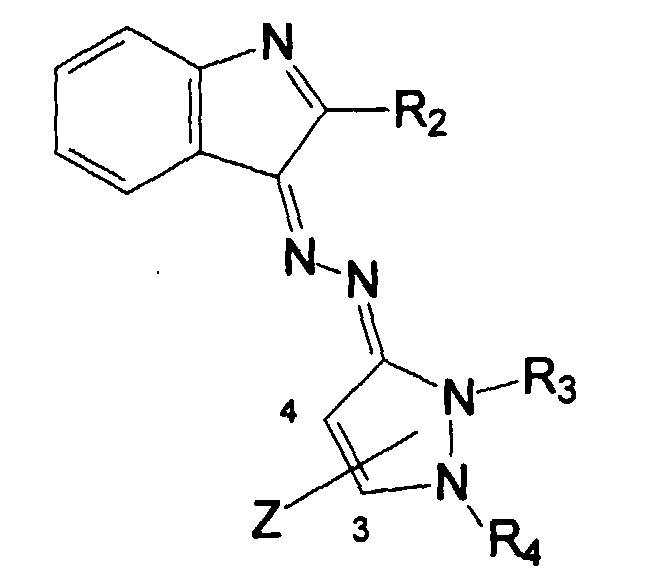
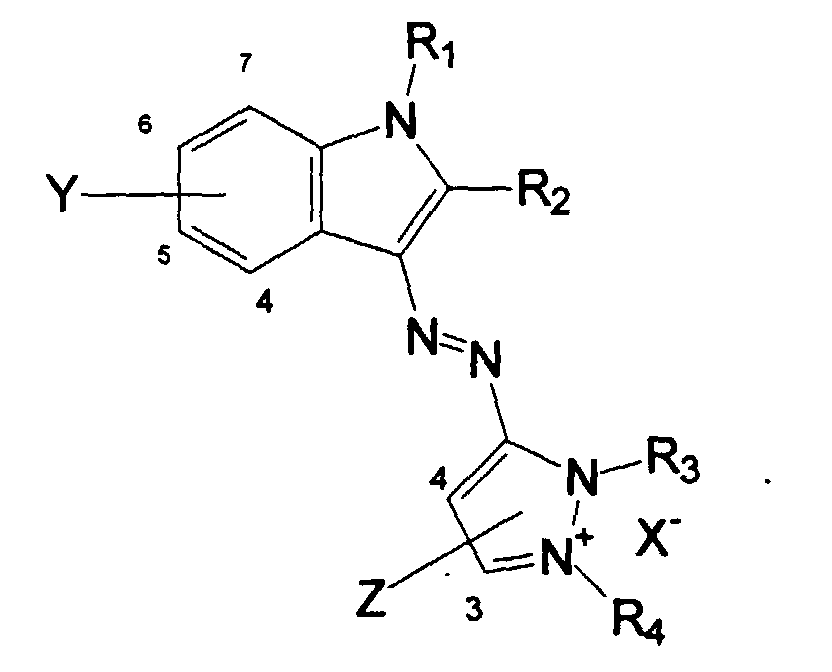
- the quaternized pyrazoleazoindole cationic yellow dye may be represented by the following structure: wherein:
- R 1 in the above formula represents H or methyl.
- R 2 represents H, methyl, ethoxycarbonyl or phenyl.
- R 3 represents methyl, ethyl, allyl or phenyl.
- R 4 represents methyl, ethyl or allyl.
- Y represents H.
- Z represents H, cyano, methyl or phenyl.
- examples of a substituted or unsubstituted alkyl group include methyl, ethyl, isopropyl, hydroxyethyl, 3-(N,N-dimethylamino)propyl and benzyl.
- examples of a substituted or unsubstituted aryl group include phenyl, naphthyl and 4-chlorophenyl.
- Examples of a substituted or unsubstituted hetaryl group include pyridyl, imidazolyl and quinolyl.
- Examples of a polyoxyalkylene group of 2-20 alkylene oxide residues include 3,6,9-trioxadecyl, 11-hydroxy-3,6,9-trioxa-5,8-dimethyldodecyl and 11-hydroxy-3,6,9-trioxaundecyl.
- Examples of halogen include chloro, fluoro, bromo and iodo.
- Examples of a substituted or unsubstituted alkoxy group include methoxy, isopropoxy and 2-hydroxyethoxy.
- Examples of a substituted or unsubstituted alkoxy- or aryloxycarbonyl group of 1-10 carbon atoms include methoxycarbonyl, ethoxycarbonyl, 2-methoxy-ethoxycarbonyl and phenoxy-carbonyl.
- Examples of a substituted or unsubstituted alkyl-, aralkyl-, aryl-, diaryl- or dialkyl carbamoyl group include N-methylcarbamoyl, N-methyl-N-phenyl-carbamoyl, N-p-(trimethylammonium)phenylcarbamoyl and N,N-bis (4-dimethylaminophenyl)carbamoyl.
- Examples of a substituted or unsubstituted alkyl-, aralkyl-, aryl-, diaryl- or dialkyl sulfamoyl group include N-methyl-sulfamoyl, N-methyl-N-phenyl-sulfamoyl, N-p-(trimethylammonium)-phenylsulfamoyl and N,N-bis (4-dimethylaminophenyl)-sulfamoyl.
- Examples of an acylamino group include acetamido, methoxyethylacetamido and benzamido.
- Examples of a ureido group include N-methylureido, ureido and N,N'-dimethyl-ureido.
- Examples of a sulfonylamino group include methanesulfonamido, p-toluenesulfonamido and 2-(trimethlyammonium)-ethanesulfonamido.
- Examples of a substituted or unsubstituted alkyl-, aralkyl-, aryl-, diaryl- or dialkyl-amino group include methylamino, N,N-dimethylamino, methoxyethylamino and anilino.
- Examples of a quaternary ammonium group include trimethylammonium and benzyldimethylammonium.
- Examples of a phosphonium group include triphenylphosphonium and trimethlyphosphonium.
- X - examples include chloride, methosulfate, acetate, chloroacetate, trifluoroacetate, methanesulfonate, p-toluenesulfonate, lactate, citrate, gluconate and 3-ureidopropionate.
- X - is methosulfate or lactate.
- the water solubility of cationic dyes is significantly affected by the nature of the counterion X - .
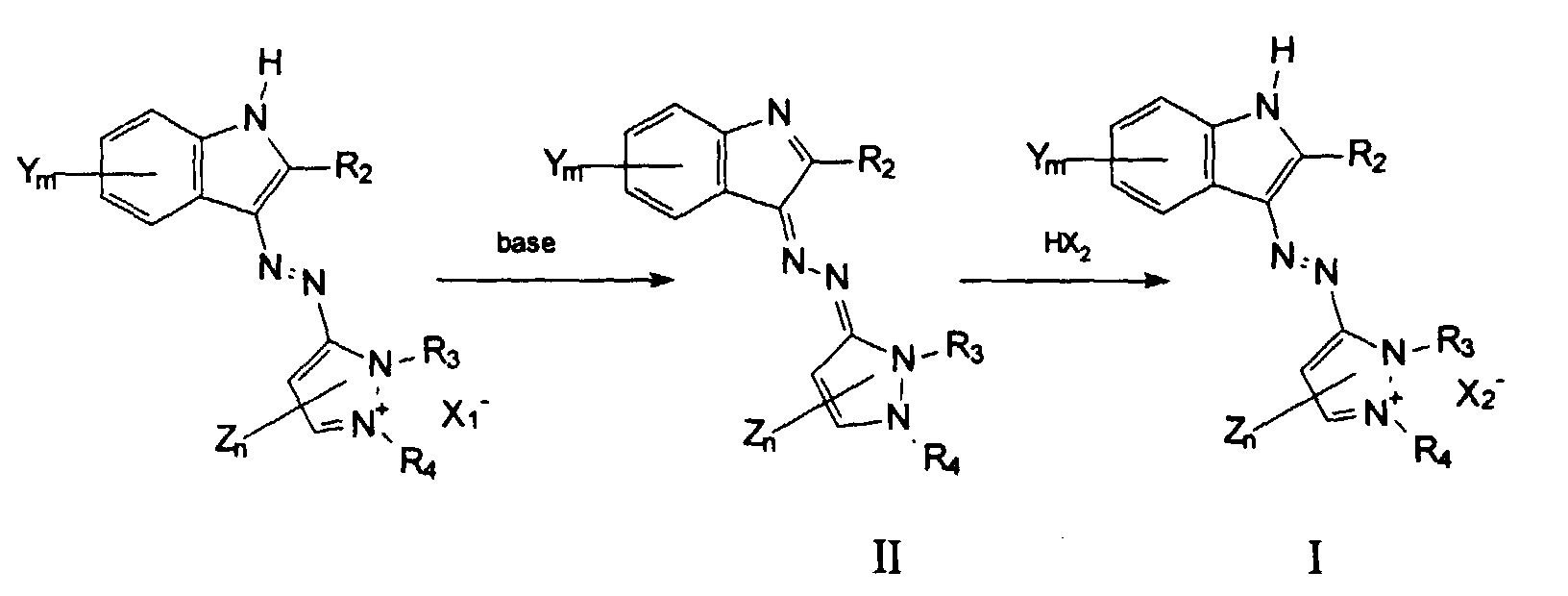
- the counterion preferred for solubility is often not readily incorporated during the synthesis. Ion exchange via ion exchange resins or dialysis/ultrafiltration is often difficult, time consuming and/or expensive. In addition, it is often difficult to isolate, purify and characterize the preferred salt forms of the dyes due to their high water solubility.
- R 1 in the structure I above is H.
- the electrically neutral, deprotonated form of the cationic dye (e.g., II below) may conveniently be isolated by treatment of the cationic dye with a base, purified and characterized.
- the cationic dye with the desired counterion may be regenerated by simply dissolving the electrically neutral form of the dye in an aqueous solution of the conjugate acid of the counterion during the preparation of the ink. This process is shown by the following:
- dyes used in this invention include: Dye R 1 R 2 R 3 R 4 Y Z X - 19 CH 3 CH 3 C 2 H 5 OH CH 3 5-OCH 3 3-CH 3 CH 3 OSO 3 - 20 allyl CH 3 2-pyridyl CH 3 5,7-(CH 3 ) 2 4-CONH 2 4-CH 3 C 6 H 4 SO 3 - 21 (CH 3 ) 3 N + C 3 H 6 Cl - C 2 H 5 CH 3 allyl 5-Cl 3-C 6 H 5 Cl - 22 NCC 2 H 4 C 6 H 5 C 6 H 5 C 2 H 5 OH 5-NO 2 4-CONHCH 3 CF 3 CO2 - 23 C 6 H 5 CH 2 H -C 3 H 6 - 5,6-(CH 3 O) 2 4-NO 2 CH 3 SO 3 - 24 CH 3 CH 3 CH 3 CH 3 6,7-benzo 3-C 6 H 5 CH 3 OSO 3 - 25 CH 3 C 6 H 5 C 6 H 5 CH 3 H 4-CN CH 3 OSO 3 - 26 CH 3 H CH 3 CH 3 H 4-
- the above dyes comprise from 0.2 to 5 %, preferably from 0.5 to 3% by weight of the ink jet ink composition.
- a humectant is employed in the ink jet composition of the invention to help prevent the ink from drying out or crusting in the orifices of the printhead.
- humectants which can be used include polyhydric alcohols, such as ethylene glycol, diethylene glycol, triethylene glycol, propylene glycol, tetraethylene glycol, polyethylene glycol, glycerol, 2-methyl-2,4-pentanediol 1,2,6-hexanetriol and thioglycol; lower alkyl mono- or di-ethers derived from alkylene glycols, such as ethylene glycol mono-methyl or mono-ethyl ether, diethylene glycol mono-methyl or mono-ethyl ether, propylene glycol mono-methyl or mono-ethyl ether, triethylene glycol mono-methyl or mono-ethyl ether, diethylene glycol di-methyl or di-ethyl ether, and diethylene glycol monobutylether; nitrogen-
- Water-miscible organic solvents may also be added to the aqueous ink of the invention to help the ink penetrate the receiving substrate, especially when the substrate is a highly sized paper.
- solvents include alcohols, such as methyl alcohol, ethyl alcohol, n-propyl alcohol, isopropyl alcohol, n-butyl alcohol, sec-butyl alcohol, t-butyl alcohol, iso-butyl alcohol, furfuryl alcohol, and tetrahydrofurfuryl alcohol; ketones or ketoalcohols such as acetone, methyl ethyl ketone and diacetone alcohol; ethers, such as tetrahydrofuran and dioxane; and esters, such as, ethyl lactate, ethylene carbonate and propylene carbonate.
- Surfactants may be added to adjust the surface tension of the ink to an appropriate level.
- the surfactants may be anionic, cationic, amphoteric or nonionic.
- a biocide may be added to the composition of the invention to suppress the growth of micro-organisms such as molds, fungi, etc. in aqueous inks.
- a preferred biocide for the ink composition of the present invention is Proxel® GXL (Zeneca Specialties Co.) at a final concentration of 0.0001-0.5 wt. %.
- the pH of the aqueous ink compositions of the invention may be adjusted by the addition of organic or inorganic acids or bases.
- Useful inks may have a preferred pH of from 2 to 10, depending upon the type of dye being used.
- Typical inorganic acids include hydrochloric, phosphoric and sulfuric acids.
- Typical organic acids include methanesulfonic, acetic and lactic acids.
- Typical inorganic bases include alkali metal hydroxides and carbonates.
- Typical organic bases include ammonia, triethanolamine and tetramethylethlenediamine.
- a typical ink composition of the invention may comprise, for example, the following substituents by weight: colorant (0.05-20%), water (20-95%), a humectant (5-70%), water miscible co-solvents (2-20%), surfactant (0.1-10%), biocide (0.05-5%) and pH control agents (0.1-10%).
- Additional additives which may optionally be present in the ink jet ink composition of the invention include thickeners, conductivity enhancing agents, anti-kogation agents, drying agents, and defoamers.
- the ink jet inks provided by this invention may be employed in ink jet printing wherein liquid ink drops are applied in a controlled fashion to an ink receptive layer substrate, by ejecting ink droplets from a plurality of nozzles or orifices of the print head of an ink jet printer.
- Ink-receptive substrates useful in ink jet printing are well known to those skilled in the art. Representative examples of such substrates are disclosed in US-A-5,605,750; US-A-5,723,211; and US-A-5,789,070 and EP 813 978 A1.
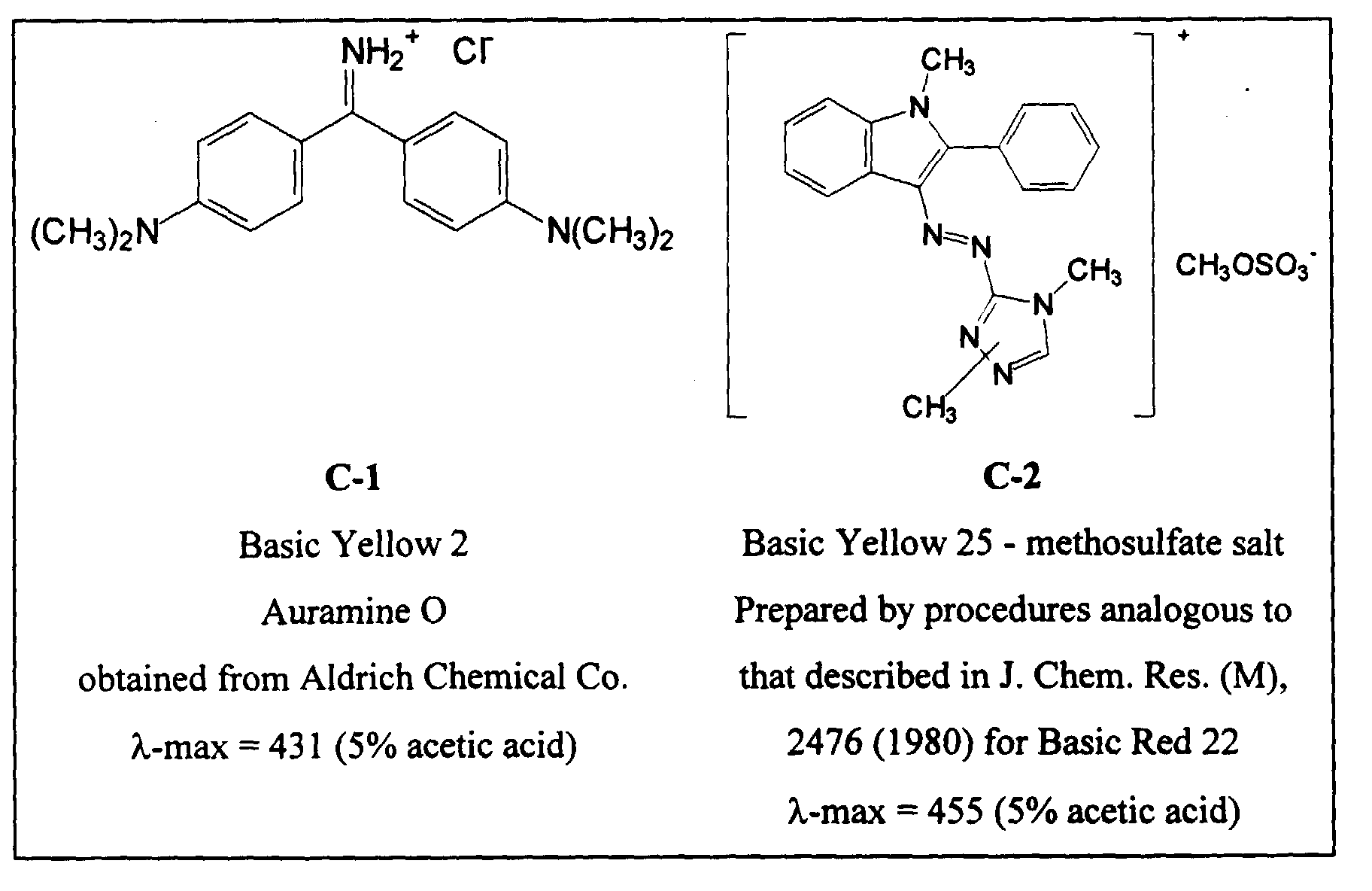
- control dyes were evaluated as comparative examples:
- Inks containing the dyes of the invention and control dyes were prepared by dissolving an appropriate amount of the dye in deionized water containing humectants of diethylene glycol and glycerol, each at 6 wt. %, a biocide, Proxel GXL ® at 0.003 wt. % and a surfactant, Surfynol 465 ® (Air Products Co.) at 0.5 wt. %. Lactic acid was optionally added to help solubilize the dyes and/or convert the electrically neutral, deprotonated forms of the dyes into the corresponding lactate salts.
- the Status A red, green and blue reflection densities of the maximum patch of the above stepped images were measured using an X-Rite® 820 densitometer.
- the D-max blue density is listed in Table 2. Maximum densities of more than 1.5 are acceptable.
- the ratio of blue to green (B/G) densities, a measure of color purity, was also calculated for each of the printed images. High B/G ratios indicate less unwanted absorptions and better color purity which are preferred.
- the stepped images were then subjected to light fade under 50 Klux high-intensity daylight irradiation and 50% relative humidity conditions for 1 week.
- the Status A blue densities of the stepped images were remeasured and the % loss in Status A blue density for the D-max patches was calculated. Losses of less than 10 % are preferred.
- the above results show that the dyes employed in the invention are much more light stable than C-1 and C-4 of the prior art.
- the dyes employed in the invention also generally have better hue than C-2 along with equivalent or better light stability and density.
Landscapes
- Chemical & Material Sciences (AREA)
- Life Sciences & Earth Sciences (AREA)
- Engineering & Computer Science (AREA)
- Materials Engineering (AREA)
- Wood Science & Technology (AREA)
- Organic Chemistry (AREA)
- Inks, Pencil-Leads, Or Crayons (AREA)
- Ink Jet Recording Methods And Recording Media Thereof (AREA)
Abstract
Description

| Dye | R2 | R3 | R4 | Z | λ-max of Cationic Form |
| 1 | CH3 | CH3 | CH3 | 4-CN | 453 |
| 451 | |||||
| 2 | CH3 | C2H5/CH3 mixture | CH3/C2H5 mixture | 4-CN | 456 |
| 3 | CH3 | C2H5 | C2H5 | 4-CN | 457 |
| 4 | CH3 | allyl/CH3 mixture | CH3/allyl mixture | 4-CN | 458 |
| 5 | CH3 | C6H5 | CH3 | 4-CN | 466 |
| 466 | |||||
| 6 | CH3 | C6H5 | CH3 | 3-CH3 | 466 |
| 4-CN | |||||
| 7 | CH3 | 2-CH3C6H4 | CH3 | 4-CN | 468 |
| 466 | |||||
| 8 | CH3 | CH3 | CH3 | 3-C6H5 | 432 |
| 9 | CH3 | C2H5 | CH3 | 3-C6H5 | 434 |
| 433 | |||||
| 10 | CH3 | C6H5 | CH3 | 3-CH3 | 437 |
| 440 | |||||
| 11 | CH3 | C6H5 | C2H5 | H | 440 |
| 441 | |||||
| 12 | CH3 | 4-CH3OC6H4 | CH3 | 3-CH3 | 436 |
| 13 | CH3 | CH2CF3 | CH3 | 3-CH3 | 446 |
| 4-CN | |||||
| 14 | C6H5 | CH3 | CH3 | 4-CN | 481 |
| 15 | CO2C2H5 | CH3 | CH3 | 4-CN | 444 |
| 16 | CO2C2H5 | C2H5/CH3 mixture | CH3/C2H5 mixture | 4-CN | 446 |
| 17 | C6H5 | CH3 | CH3 | 3-C6H5 | 449 |
| 18 | C6H5 | C6H5 | CH3 | 3-CH3 | 463 |
| 459 |
| Dye | R1 | R2 | R3 | R4 | Y | Z | X- |
| 19 | CH3 | CH3 | C2H5OH | CH3 | 5-OCH3 | 3-CH3 | CH3OSO3 - |
| 20 | allyl | CH3 | 2-pyridyl | CH3 | 5,7-(CH3)2 | 4-CONH2 | 4-CH3C6H4SO3 - |
| 21 | (CH3)3N+ C3H6Cl- | C2H5 | CH3 | allyl | 5-Cl | 3-C6H5 | Cl- |
| 22 | NCC2H4 | C6H5 | C6H5 | C2H5OH | 5-NO2 | 4-CONHCH3 | CF3CO2- |
| 23 | C6H5CH2 | H | -C3H6- | 5,6-(CH3O)2 | 4-NO2 | CH3SO3 - | |
| 24 | CH3 | CH3 | CH3 | CH3 | 6,7-benzo | 3-C6H5 | CH3OSO3 - |
| 25 | CH3 | C6H5 | C6H5 | CH3 | H | 4-CN | CH3OSO3 - |
| 26 | CH3 | H | CH3 | CH3 | H | 4-CN | CH3OSO3 - |

| Ink | Dye | Wt. % Dye | Wt. % Lactic Acid |
| 1 | 1 | 0.99 | 2.5 |
| 2 | 9 | 1.17 | 2.5 |
| 3 | 10 | 1.18 | 0.5 |
| 4 | 11 | 1.16 | 2.5 |
| 5 | 17 | 1.60 | 2.5 |
| 6 | 18 | 1.58 | 2.5 |
| 7 | 26 | 1.35 | - |
| C-1 | C-1 | 0.88 | 1.7 |
| C-2 | C-2 | 1.97 | 0.7 |
| C-3 | C-3 | Insufficient solubility | - |
| C-4 | C-4 | 0.8 | 5 |
| Ink | Blue D-max | % Loss Light Fade | B/G Ratio |
| 1 | 2.2 | 4 | 13 |
| 2 | 1.9 | 2 | 17 |
| 3 | 2.0 | 3 | 20 |
| 4 | 2.0 | 1 | 13 |
| 5 | 2.2 | 1 | 4 |
| 6 | 2.1 | 3 | 3 |
| 7 | 1.8 | 6 | 7 |
| C-1 | 1.7 | 87 | - |
| C-2 | 2.0 | 3 | 7 |
| C-4 | 1.8 | 16 | - |
Claims (10)
- An ink jet ink composition comprising water, a humectant, and a cationic azo dye derived from the quaternization of a pyrazoleazoindole dye.
- The composition of Claim 1 wherein said cationic azo dye derived from the quaternization of a pyrazoleazoindole dye has the following structure:wherein:
 R3 and R4 each independently represents a substituted or unsubstituted alkyl group of 1-6 carbon atoms, a substituted or unsubstituted allyl group, a substituted or unsubstituted aryl group of 6-10 carbon atoms, a substituted or unsubstituted hetaryl group of 5-10 atoms or a polyoxyalkylene group of 2-20 alkylene oxide residues;R1 represents hydrogen or the same groups as listed above for R3 and R4;R2, Y and Z each independently represents the same groups listed above for R1, halogen, nitro, cyano, a substituted or unsubstituted alkoxy group of 1-6 carbon atoms, a substituted or unsubstituted alkoxy- or aryloxy-carbonyl group of 1-10 carbon atoms, carbamoyl, a substituted or unsubstituted alkyl-, aralkyl-, aryl-, diaryl- or dialkyl-carbamoyl group of 1-20 carbon atoms, sulfamoyl, a substituted or unsubstituted alkyl-, aralkyl-, aryl-, diaryl- or dialkyl-sulfamoyl group of 1-20 carbon atoms, acylamino, ureido, sulfonylamino, amino, a substituted or unsubstituted alkyl-, aralkyl-, aryl-, diaryl- or dialkyl-amino group of 1-20 carbon atoms, a quaternary ammonium group or a phosphonium group;m represents an integer from 0-4;n represents an integer from 0-2; andX- represents an anion;any two of Y or Z can together represent a 5- to 7-membered saturated or unsaturated hetero- or carbocyclic fused ring; andand any of R1 and R2, R3 and R4, R1 and Y, and R4 and Z can be combined to form a 5- to 7-membered hetero- or carbocyclic ring.
 - The composition of Claim 2 wherein R1 represents H or methyl.
- The composition of Claim 2 wherein R2 represents H, methyl, ethoxycarbonyl or phenyl.
- The composition of Claim 2 wherein R3 represents methyl, ethyl, allyl or phenyl.
- The composition of Claim 2 wherein R4 represents methyl, ethyl or allyl.
- The composition of Claim 2 wherein X- represents methosulfate or lactate.
- The composition of Claim 2 wherein Y represents H.
- The composition of Claim 2 wherein Z represents H, cyano, methyl or phenyl.
- The composition of Claim 1 wherein said humectant is diethylene glycol, glycerol or diethylene glycol monobutylether.
Applications Claiming Priority (2)
| Application Number | Priority Date | Filing Date | Title |
|---|---|---|---|
| US09/299,412 US6136080A (en) | 1999-04-26 | 1999-04-26 | Cationic azo dye for ink jet ink |
| US299412 | 1999-04-26 |
Publications (3)
| Publication Number | Publication Date |
|---|---|
| EP1052274A2 true EP1052274A2 (en) | 2000-11-15 |
| EP1052274A3 EP1052274A3 (en) | 2002-06-12 |
| EP1052274B1 EP1052274B1 (en) | 2004-03-31 |
Family
ID=23154694
Family Applications (1)
| Application Number | Title | Priority Date | Filing Date |
|---|---|---|---|
| EP00201351A Expired - Lifetime EP1052274B1 (en) | 1999-04-26 | 2000-04-14 | Cationic azo dye for ink jet ink |
Country Status (4)
| Country | Link |
|---|---|
| US (1) | US6136080A (en) |
| EP (1) | EP1052274B1 (en) |
| JP (1) | JP4652521B2 (en) |
| DE (1) | DE60009382T2 (en) |
Cited By (4)
| Publication number | Priority date | Publication date | Assignee | Title |
|---|---|---|---|---|
| EP1197534A3 (en) * | 2000-10-12 | 2003-11-12 | Eastman Kodak Company | Ink jet printing method |
| EP1197535A3 (en) * | 2000-10-12 | 2003-11-12 | Eastman Kodak Company | Ink-jet ink composition containing a pyrazoleazoindole dye |
| EP1460113A1 (en) * | 2003-03-20 | 2004-09-22 | Eastman Kodak Company | Stable ink jet ink composition and printing method |
| EP1050563B1 (en) * | 1999-05-06 | 2005-08-24 | Eastman Kodak Company | Dye for ink jet ink |
Families Citing this family (3)
| Publication number | Priority date | Publication date | Assignee | Title |
|---|---|---|---|---|
| US6444020B1 (en) * | 1999-04-16 | 2002-09-03 | Fuji Photo Film Co., Ltd. | Tetraalkyl-substituted nitrogen-containing hetero ring-bonded azo dye, ink-jet ink comprising said dye, ink-jet recording method using said ink, and thermal transfer recording material comprising said dye |
| US6523950B1 (en) * | 2000-11-21 | 2003-02-25 | Eastman Kodak Company | Ink jet printing method |
| US7033425B2 (en) * | 2004-04-15 | 2006-04-25 | Eastman Kodak Company | Ink jet ink set |
Family Cites Families (15)
| Publication number | Priority date | Publication date | Assignee | Title |
|---|---|---|---|---|
| US3435022A (en) * | 1964-07-10 | 1969-03-25 | Geigy Ag J R | Pyrazolone monoazo dyes containing indole or carbazole groups |
| US3515715A (en) * | 1967-01-23 | 1970-06-02 | Eastman Kodak Co | Quaternized pyrazolylazo dyes |
| US3585182A (en) * | 1968-02-28 | 1971-06-15 | Eastman Kodak Co | Quaternized triazoliumazo - 4 - phenyl-thiomorpholino-1,1-dioxide dyestuffs |
| DE2520816C3 (en) * | 1975-05-09 | 1979-02-15 | Bayer Ag, 5090 Leverkusen | Methine dyes |
| US4201707A (en) * | 1975-05-09 | 1980-05-06 | Bayer Aktiengesellschaft | Methine dyestuffs containing a phenyl azo group |
| FR2326453A1 (en) * | 1975-09-30 | 1977-04-29 | Ugine Kuhlmann | NEW CATIONIC DYES |
| JPS575771A (en) * | 1980-06-13 | 1982-01-12 | Fuji Photo Film Co Ltd | Formation of colored image by ink jetting method |
| JPS6050393B2 (en) * | 1980-06-13 | 1985-11-08 | 富士写真フイルム株式会社 | water-based ink composition |
| US4382801A (en) * | 1980-12-24 | 1983-05-10 | Ciba-Geigy Corporation | Process for spin dyeing polymers or copolymers of acrylonitrile with quaternized heterocyclic diazo dye and tetrafluoro-borate anion |
| US4929277A (en) * | 1987-07-10 | 1990-05-29 | Fuji Photo Film Co., Ltd. | Recording liquid |
| DE4315383A1 (en) * | 1993-05-08 | 1994-11-10 | Bayer Ag | Cationic diazacyanine dyes |
| JP3451718B2 (en) * | 1993-07-08 | 2003-09-29 | ソニー株式会社 | Photographic paper, composition for forming dye-receiving layer for production thereof, and image forming method using the same |
| DE4444863A1 (en) * | 1994-12-16 | 1996-06-20 | Bayer Ag | Cationic 1,3,4-thiadiazole dyes |
| GB2315493B (en) * | 1996-07-24 | 2001-01-03 | Lexmark Int Inc | Ink jet ink dyes |
| JPH10251577A (en) * | 1997-03-07 | 1998-09-22 | Canon Inc | Ink jet ink and ink jet recording method using the ink |
-
1999
- 1999-04-26 US US09/299,412 patent/US6136080A/en not_active Expired - Lifetime
-
2000
- 2000-04-14 DE DE60009382T patent/DE60009382T2/en not_active Expired - Fee Related
- 2000-04-14 EP EP00201351A patent/EP1052274B1/en not_active Expired - Lifetime
- 2000-04-25 JP JP2000128964A patent/JP4652521B2/en not_active Expired - Fee Related
Cited By (5)
| Publication number | Priority date | Publication date | Assignee | Title |
|---|---|---|---|---|
| EP1050563B1 (en) * | 1999-05-06 | 2005-08-24 | Eastman Kodak Company | Dye for ink jet ink |
| EP1197534A3 (en) * | 2000-10-12 | 2003-11-12 | Eastman Kodak Company | Ink jet printing method |
| EP1197535A3 (en) * | 2000-10-12 | 2003-11-12 | Eastman Kodak Company | Ink-jet ink composition containing a pyrazoleazoindole dye |
| EP1460113A1 (en) * | 2003-03-20 | 2004-09-22 | Eastman Kodak Company | Stable ink jet ink composition and printing method |
| US7160933B2 (en) | 2003-03-20 | 2007-01-09 | Eastman Kodak Company | Stable ink jet ink composition and printing method |
Also Published As
| Publication number | Publication date |
|---|---|
| US6136080A (en) | 2000-10-24 |
| DE60009382T2 (en) | 2005-03-10 |
| EP1052274B1 (en) | 2004-03-31 |
| JP2000319558A (en) | 2000-11-21 |
| DE60009382D1 (en) | 2004-05-06 |
| JP4652521B2 (en) | 2011-03-16 |
| EP1052274A3 (en) | 2002-06-12 |
Similar Documents
| Publication | Publication Date | Title |
|---|---|---|
| EP1006157B1 (en) | Metal complex for ink jet ink | |
| EP1197535B1 (en) | Ink-jet ink composition containing a pyrazoleazoindole dye | |
| EP1006159B1 (en) | Ink jet printing with metal complex | |
| US6706102B2 (en) | Dye mixture for ink jet ink | |
| US6685768B2 (en) | Ink jet ink set | |
| EP1050563B1 (en) | Dye for ink jet ink | |
| US6464767B1 (en) | Ink jet printing method | |
| EP1234860B1 (en) | Metal complex for ink jet ink | |
| EP1052274B1 (en) | Cationic azo dye for ink jet ink | |
| US6136079A (en) | Dye for ink jet ink | |
| US6511170B1 (en) | Ink jet printing method | |
| EP1048701B1 (en) | Delocalized cationic azo dye for ink jet ink | |
| EP1281738B1 (en) | Dye mixture for ink jet ink and printing method | |
| EP1281736A1 (en) | Ink jet ink set and printing method | |
| EP1182238B1 (en) | Ink jet printing method | |
| US6524378B2 (en) | Ink jet printing method | |
| EP1182240A2 (en) | Ink jet ink composition |
Legal Events
| Date | Code | Title | Description |
|---|---|---|---|
| PUAI | Public reference made under article 153(3) epc to a published international application that has entered the european phase |
Free format text: ORIGINAL CODE: 0009012 |
|
| AK | Designated contracting states |
Kind code of ref document: A2 Designated state(s): AT BE CH CY DE DK ES FI FR GB GR IE IT LI LU MC NL PT SE |
|
| AX | Request for extension of the european patent |
Free format text: AL;LT;LV;MK;RO;SI |
|
| PUAL | Search report despatched |
Free format text: ORIGINAL CODE: 0009013 |
|
| RIC1 | Information provided on ipc code assigned before grant |
Free format text: 7C 09D 11/00 A, 7C 09B 44/14 B |
|
| AK | Designated contracting states |
Kind code of ref document: A3 Designated state(s): AT BE CH CY DE DK ES FI FR GB GR IE IT LI LU MC NL PT SE |
|
| AX | Request for extension of the european patent |
Free format text: AL;LT;LV;MK;RO;SI |
|
| 17P | Request for examination filed |
Effective date: 20021113 |
|
| AKX | Designation fees paid |
Designated state(s): DE FR GB |
|
| GRAP | Despatch of communication of intention to grant a patent |
Free format text: ORIGINAL CODE: EPIDOSNIGR1 |
|
| GRAS | Grant fee paid |
Free format text: ORIGINAL CODE: EPIDOSNIGR3 |
|
| GRAA | (expected) grant |
Free format text: ORIGINAL CODE: 0009210 |
|
| AK | Designated contracting states |
Kind code of ref document: B1 Designated state(s): DE FR GB |
|
| REG | Reference to a national code |
Ref country code: GB Ref legal event code: FG4D |
|
| REG | Reference to a national code |
Ref country code: IE Ref legal event code: FG4D |
|
| REF | Corresponds to: |
Ref document number: 60009382 Country of ref document: DE Date of ref document: 20040506 Kind code of ref document: P |
|
| ET | Fr: translation filed | ||
| REG | Reference to a national code |
Ref country code: IE Ref legal event code: MM4A |
|
| PLBE | No opposition filed within time limit |
Free format text: ORIGINAL CODE: 0009261 |
|
| STAA | Information on the status of an ep patent application or granted ep patent |
Free format text: STATUS: NO OPPOSITION FILED WITHIN TIME LIMIT |
|
| 26N | No opposition filed |
Effective date: 20050104 |
|
| PGFP | Annual fee paid to national office [announced via postgrant information from national office to epo] |
Ref country code: GB Payment date: 20070313 Year of fee payment: 8 |
|
| PGFP | Annual fee paid to national office [announced via postgrant information from national office to epo] |
Ref country code: DE Payment date: 20070430 Year of fee payment: 8 |
|
| PGFP | Annual fee paid to national office [announced via postgrant information from national office to epo] |
Ref country code: FR Payment date: 20070404 Year of fee payment: 8 |
|
| GBPC | Gb: european patent ceased through non-payment of renewal fee |
Effective date: 20080414 |
|
| PG25 | Lapsed in a contracting state [announced via postgrant information from national office to epo] |
Ref country code: DE Free format text: LAPSE BECAUSE OF NON-PAYMENT OF DUE FEES Effective date: 20081101 |
|
| REG | Reference to a national code |
Ref country code: FR Ref legal event code: ST Effective date: 20081231 |
|
| PG25 | Lapsed in a contracting state [announced via postgrant information from national office to epo] |
Ref country code: FR Free format text: LAPSE BECAUSE OF NON-PAYMENT OF DUE FEES Effective date: 20080430 |
|
| PG25 | Lapsed in a contracting state [announced via postgrant information from national office to epo] |
Ref country code: GB Free format text: LAPSE BECAUSE OF NON-PAYMENT OF DUE FEES Effective date: 20080414 |