EP1052272A2 - Liquid crystal polyester resin composition - Google Patents
Liquid crystal polyester resin composition Download PDFInfo
- Publication number
- EP1052272A2 EP1052272A2 EP00109147A EP00109147A EP1052272A2 EP 1052272 A2 EP1052272 A2 EP 1052272A2 EP 00109147 A EP00109147 A EP 00109147A EP 00109147 A EP00109147 A EP 00109147A EP 1052272 A2 EP1052272 A2 EP 1052272A2
- Authority
- EP
- European Patent Office
- Prior art keywords
- liquid crystal
- crystal polyester
- polyester resin
- parts
- resin composition
- Prior art date
- Legal status (The legal status is an assumption and is not a legal conclusion. Google has not performed a legal analysis and makes no representation as to the accuracy of the status listed.)
- Withdrawn
Links
Classifications
-
- C—CHEMISTRY; METALLURGY
- C08—ORGANIC MACROMOLECULAR COMPOUNDS; THEIR PREPARATION OR CHEMICAL WORKING-UP; COMPOSITIONS BASED THEREON
- C08L—COMPOSITIONS OF MACROMOLECULAR COMPOUNDS
- C08L67/00—Compositions of polyesters obtained by reactions forming a carboxylic ester link in the main chain; Compositions of derivatives of such polymers
-
- C—CHEMISTRY; METALLURGY
- C08—ORGANIC MACROMOLECULAR COMPOUNDS; THEIR PREPARATION OR CHEMICAL WORKING-UP; COMPOSITIONS BASED THEREON
- C08K—Use of inorganic or non-macromolecular organic substances as compounding ingredients
- C08K7/00—Use of ingredients characterised by shape
-
- C—CHEMISTRY; METALLURGY
- C08—ORGANIC MACROMOLECULAR COMPOUNDS; THEIR PREPARATION OR CHEMICAL WORKING-UP; COMPOSITIONS BASED THEREON
- C08L—COMPOSITIONS OF MACROMOLECULAR COMPOUNDS
- C08L67/00—Compositions of polyesters obtained by reactions forming a carboxylic ester link in the main chain; Compositions of derivatives of such polymers
- C08L67/02—Polyesters derived from dicarboxylic acids and dihydroxy compounds
- C08L67/03—Polyesters derived from dicarboxylic acids and dihydroxy compounds the dicarboxylic acids and dihydroxy compounds having the carboxyl- and the hydroxy groups directly linked to aromatic rings
-
- C—CHEMISTRY; METALLURGY
- C08—ORGANIC MACROMOLECULAR COMPOUNDS; THEIR PREPARATION OR CHEMICAL WORKING-UP; COMPOSITIONS BASED THEREON
- C08L—COMPOSITIONS OF MACROMOLECULAR COMPOUNDS
- C08L67/00—Compositions of polyesters obtained by reactions forming a carboxylic ester link in the main chain; Compositions of derivatives of such polymers
- C08L67/04—Polyesters derived from hydroxycarboxylic acids, e.g. lactones
-
- C—CHEMISTRY; METALLURGY
- C08—ORGANIC MACROMOLECULAR COMPOUNDS; THEIR PREPARATION OR CHEMICAL WORKING-UP; COMPOSITIONS BASED THEREON
- C08L—COMPOSITIONS OF MACROMOLECULAR COMPOUNDS
- C08L27/00—Compositions of homopolymers or copolymers of compounds having one or more unsaturated aliphatic radicals, each having only one carbon-to-carbon double bond, and at least one being terminated by a halogen; Compositions of derivatives of such polymers
- C08L27/02—Compositions of homopolymers or copolymers of compounds having one or more unsaturated aliphatic radicals, each having only one carbon-to-carbon double bond, and at least one being terminated by a halogen; Compositions of derivatives of such polymers not modified by chemical after-treatment
- C08L27/12—Compositions of homopolymers or copolymers of compounds having one or more unsaturated aliphatic radicals, each having only one carbon-to-carbon double bond, and at least one being terminated by a halogen; Compositions of derivatives of such polymers not modified by chemical after-treatment containing fluorine atoms
-
- C—CHEMISTRY; METALLURGY
- C08—ORGANIC MACROMOLECULAR COMPOUNDS; THEIR PREPARATION OR CHEMICAL WORKING-UP; COMPOSITIONS BASED THEREON
- C08L—COMPOSITIONS OF MACROMOLECULAR COMPOUNDS
- C08L27/00—Compositions of homopolymers or copolymers of compounds having one or more unsaturated aliphatic radicals, each having only one carbon-to-carbon double bond, and at least one being terminated by a halogen; Compositions of derivatives of such polymers
- C08L27/02—Compositions of homopolymers or copolymers of compounds having one or more unsaturated aliphatic radicals, each having only one carbon-to-carbon double bond, and at least one being terminated by a halogen; Compositions of derivatives of such polymers not modified by chemical after-treatment
- C08L27/12—Compositions of homopolymers or copolymers of compounds having one or more unsaturated aliphatic radicals, each having only one carbon-to-carbon double bond, and at least one being terminated by a halogen; Compositions of derivatives of such polymers not modified by chemical after-treatment containing fluorine atoms
- C08L27/18—Homopolymers or copolymers or tetrafluoroethene
Definitions
- the present invention relates to a liquid crystal polyester resin composition which can be utilized as a raw material for a resin molded article having excellent appearance, mechanical strength and lubricative properties in electric and electronic fields, and more specifically, to a liquid crystal polyester resin composition in which dispersibility of a fluorine resin in the composition is improved.
- a liquid crystal polyester resin which manifests liquid crystal property in melting (hereinafter, sometimes referred to as LCP) is excellent in heat-resistance, and is excellent in flowability and processability in melting, therefore, LCP is used, as a resin molding material which can provide precise molding, in various fields typically including electric and electronic fields.
- LCP liquid crystal polyester resin which manifests liquid crystal property in melting
- PTFE polytetrafluoroethylene
- fluorine resins particularly PTFE having high self lubrication imparting effect have a high melting point, and manifest an extremely high melt viscosity or does not flow at all even at higher temperatures more than the melting point. Therefore, in resin compositions obtained by compounding such a fluorine resin into a liquid crystal polyester resin, the fluorine resin can not be dispersed easily even by shearing, or flocculates to give materials having extremely poor dispersibility, in processes such as kneading extrusion, injection molding and the like. Resultantly, there occur deterioration of the appearance of a molded article, decrease in mechanical strength of a molded article, poor releasing from a mold, falling of fluorine resin particles from the surface of a molded article, and the like.
- An object of the present invention is to provide a liquid crystal polyester resin composition having excellent dispersibility, particularly, dispersibility of a fluorine resin component.
- Another object of the present invention is to provide a liquid crystal polyester resin composition which gives excellent appearance, mechanical strength and lubricative properties of the resulting resin molded article and can be utilized as a raw material for a resin molded article in electric and electronic fields and the like.
- the present invention provides a liquid crystal polyester resin composition
- a liquid crystal polyester resin composition comprising a liquid crystal polyester resin and a fluorocarbon polymer having a flow beginning temperature of 350°C or less, measured according to the following method, in an amount of 0.2 to 50 parts by weight based on 100 parts by weight of the liquid crystal polyester resin:
- Flow beginning temperature a temperature at which the melt viscosity measured by a capillary type rheometer is 48,000 poise when a resin which has been melted by heating at a heating rate of 4°C/min is extruded through a nozzle having an internal diameter of 1 mm and a length of 10 mm under a load of 100 kg/cm 2 .
- the present invention comprises a liquid crystal polyester resin and a specific fluorocarbon polymer in a specific ratio.
- thermotropic liquid crystal polymer As the liquid crystal polyester resin to be used in the present invention, there are listed polyesters generally called thermotropic liquid crystal polymer, and for example, polyesters (1) to (4) shown in the following list can be used.
- liquid crystal polyester resins may be used in combination of two or more. Further, ester-forming derivatives thereof may also be used instead of the above-described aromatic dicarboxylic acid, aromatic diol and aromatic hydroxycarboxylic acid.
- liquid crystal polyester resin there is preferably used a polyester which forms an anisotropic melted body at a temperature of 400°C or less from the standpoint of molding processability, and the like.
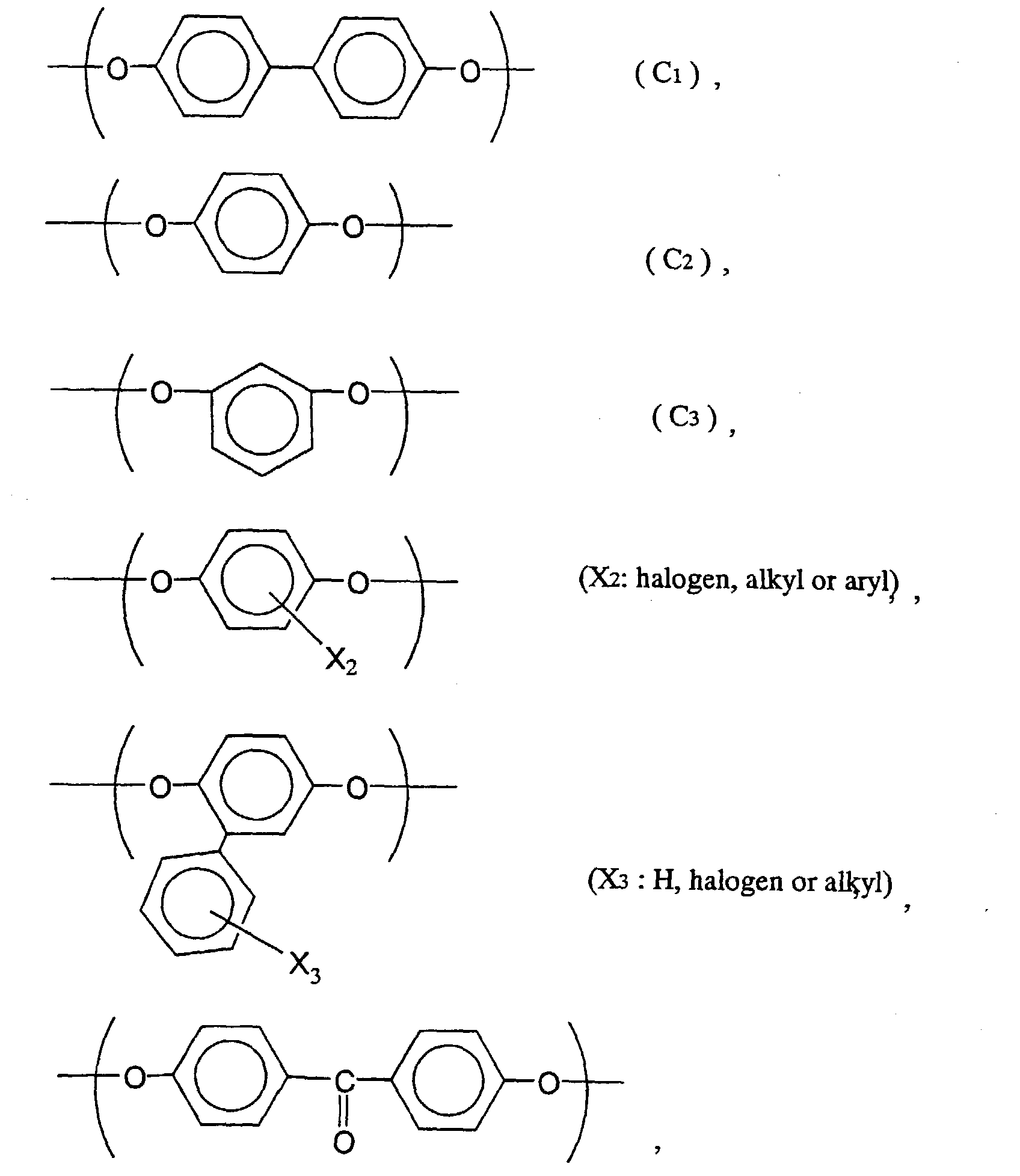
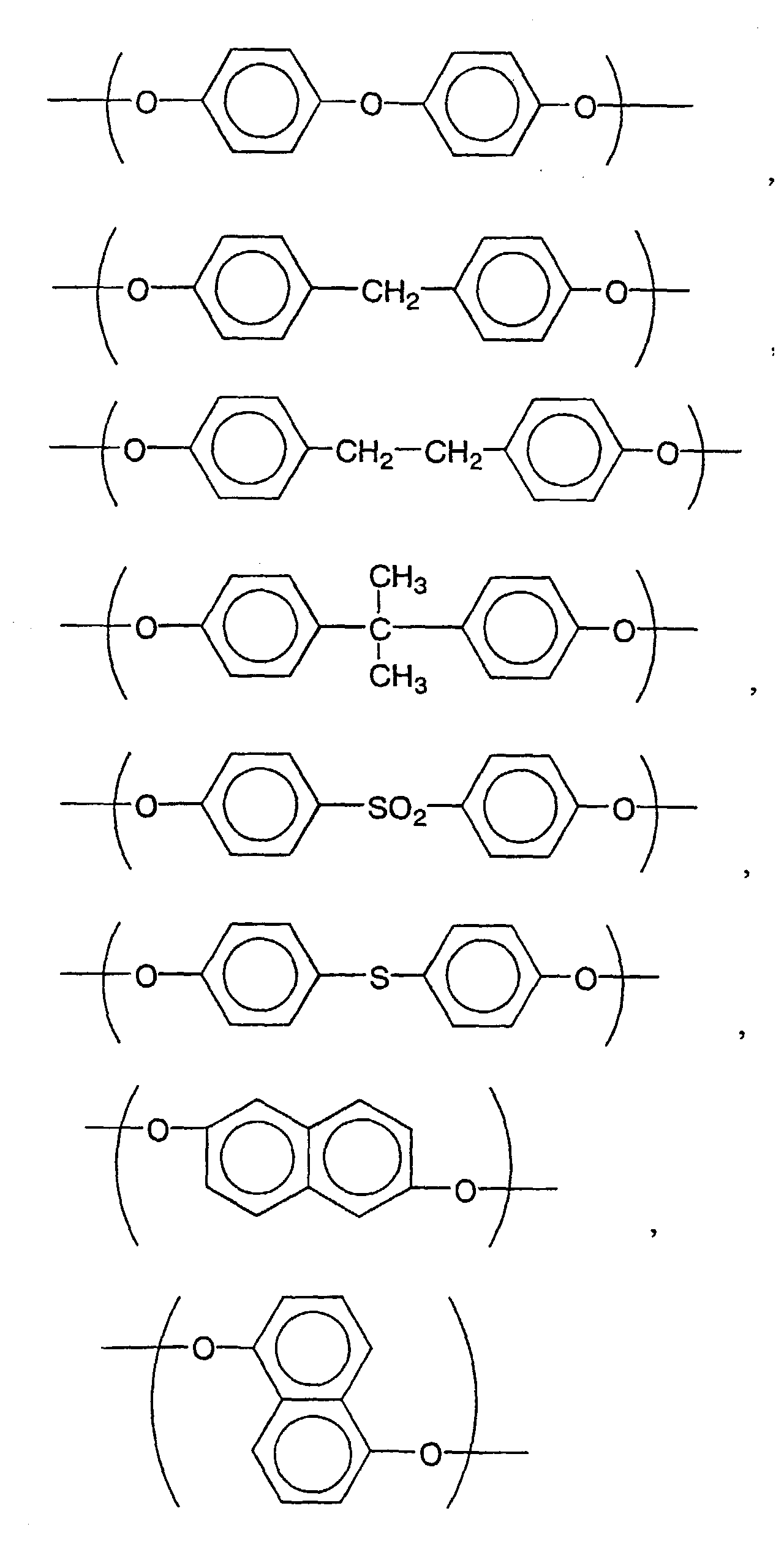
- repeating structure unit of the liquid crystal polyester examples include, but are not limited to, the following structure units.
- liquid crystal polyester resins containing a repeating structure unit represented by (A 1 ) in an amount of at least 30 mol% are particularly preferably used, from the standpoint of balance between heat-resistance, mechanical property and processability.
- Liquid crystal polyester resins of (a), (b) and (c) which are basic structures are described in Japanese Patent Kokoku Publication (JP-B) Nos. 47-47870 and 63-3888, respectively.
- the specific fluorocarbon polymer used in the present invention is not particularly restricted, providing it is a polymer having a flow beginning temperature of 350°C or lower measured by the above-mentioned method.
- the flow beginning temperature is, preferably, from 225°C to 350°C, and more preferably, from 265°C to 350°C.
- the fluorocarbon polymer has a lower molecular weight indicated by a flow beginning temperature and higher flowability in melt-kneading, thus exhibiting excellent dispersibility in a liquid crystal polyester resin.
- Examples thereof include PTFE, tetrafluoroethylene-hexafluoropropylene copolymer, Polytrichlorofluoroethylene, tetrafluoroethylene-perfluoroalkyl vinyl ether copolymer and the like, and particularly, lower molecular weight PTFE which has been fluorinated to molecular terminals thereof is preferable.
- Examples of such commercially available PTFE include "CEFRAL LUBE I", “CEFRAL LUBE IP” (trade name: manufactured by Central Glass Co., Ltd.) and the like.
- the content of the above-mentioned fluorocarbon polymer is from 0.2 to 50 parts by weight, preferably from 0.2 to 30 parts by weight, and more preferably from 0.2 to 25 parts by weight based on 100 parts by weight of the liquid crystal polyester resin.
- the addition effect of a fluorocarbon polymer is not obtained easily.
- the molding properties and the mechanical strength of the resulting molded article lower.
- fillers can be compounded for improving performances such as the elastic modulus, mechanical strength and the like of the resulting molded article.
- the filler glass fibers or carbon fibers are particularly useful, and both of them can also be used together.
- the length of such fibers as a filler is not restricted, and can be appropriately selected depending on the desired molded article.
- the compounding ratio of glass fibers, carbon fibers and the like to be compounded as a filler is suitably from 10 to 100 parts by weight based on 100 parts by weight of a liquid crystal polyester resin, from the standpoints of processability and mechanical ability of the resulting resin molded article.
- glass fibers and carbon fibers there may also be compounded, for example, one or more of fibrous fillers such as ceramic fibers, silica alumina fibers, wollastonite, potassium titanate fibers, aramid fibers and the like; inorganic filler such as calcium carbonate, talc, mica, clay, glass beads and the like, if necessary.
- fibrous fillers such as ceramic fibers, silica alumina fibers, wollastonite, potassium titanate fibers, aramid fibers and the like
- inorganic filler such as calcium carbonate, talc, mica, clay, glass beads and the like, if necessary.
- one or more of usual additives such as coloring agents such as dye, pigment and the like; antioxidants; heat stabilizers; ultraviolet absorbers; antistatic agents; surfactants and the like can be added, within the range wherein the object of the present invention is attained.
- thermoplastic resin examples include polyamide, polyester, polyphenylene sulfide, polyether ketone, polycarbonate, polyphenylene ether and modified substances thereof, polysulfone, polyether sulfone, polyether imide and the like.
- thermosetting resin examples include, for example, phenol resins, epoxy resins, polyimide resins and the like. Also, two or more of them may be combined and compounded.
- the means for compounding the resin composition of the present invention is not particularly restricted.
- a liquid crystal polyester resin and the above-mentioned fluorocarbon polymer, and if necessary, fillers such as glass fiber and the like, further, various additives are mixed by a Henschel mixer, tumbler or the like, and melt-kneaded using an extruder.
- parts and members molded from the resin composition of the present invention is not particularly restricted. They can be used in wide variety of uses such as: electric and electronic parts such as connector, socket, relay parts, coil bobbin, light pick up vibrator, printed wiring board, computer-related parts and the like; semiconductor production process-related parts such as IC tray, wafer carrier and the like; domestic electric appliance parts such as VTR, television, iron, air conditioner, stereo, cleaner, refrigerator, rice boiler, illumination instruments and the like; illumination instrument parts such as lamp reflector, lamp holder and the like; audio product parts such as compact disk, laser disk, speaker and the like; communication instrument parts such as light cable ferrule, telephone parts, facsimile parts, modem and the like; copy machine-related parts such as separation claw, heated holder and the like; machine parts such as impeller, fan gear, gear, bearing, motor parts and motor case, and the like; automobile parts such as mechanical parts for automobile, engine parts, inner parts of engine room, electrical equipment, interior parts and the like; cooking appliances such as microwave cooking pan, heat-resistant
- the resin composition of the present invention can be molded into a film or sheet, to be utilized as an industrially useful material.
- Examples of the use include display parts, electrically insulating film, flexible circuit board film, wrapping film, recording medium film and the like.
- the resin composition of the present invention can be processed into fibrous forms such as continuous fiber, short fiber, pulp and the like, to be used as an industrially useful material.
- fibrous forms such as continuous fiber, short fiber, pulp and the like
- examples thereof include cloth, heat-resistant thermal insulation material, reinforcing material for FRP, rubber reinforcing material, rope, cable, non-woven fabric and the like.
- An injection molded article is abraded, and observed using a scanning type electron microscope at a magnification of 500 to 1000, and dispersibility and dispersed particle size were evaluated.
- ASTM No. 4 dumbbell was molded using an injection molding machine, and tensile strength was measured according to ASTM D638.
- a specimen of 12.7 mm ⁇ 6.4 mm ⁇ 127 mm was molded using an injection molding machine, and deflection temperature under load was measured according to ASTM D648.
- a flexural test specimen of length 127 mm ⁇ width 12.7 mm ⁇ thickness 6.4 mm was bisected along the injection direction and used as a specimen, and Izod impact strength was measured according to ASTM D256.
- a cylindrical bush of inner diameter 11 mm ⁇ outer diameter 15 mm ⁇ height 15 mm was molded using an injection molding machine (manufactured by Sumitomo Heavy Industries, Ltd., Sycap N110/45) at a cylinder temperature of 350°C and a mold temperature of 130°C, and releasing resistance when the bush is released from a mold was detected by setting a pressure sensor to an ejector.
- the releasing resistance of the composition of the present invention is represented by % based on that of the composition containing no PTFE as 100%.
- a friction ring of outer diameter 25.6 mm ⁇ inner diameter 20 mm ⁇ height 15 mm was injection-molded, and friction coefficient was measured by Suzuki type friction abrasion testor using SUS304 as an opposite material at a pressure of 6 kg/cm 2 and a speed of 40 m/min.
- a liquid crystal polyester resin which is composed of repeating structure units A 1 , B 1 , B 2 and C 1 and in which A 1 :B 1 :B 2 :C 1 molar ratio is 60:15:5:20; a fluorine resin (manufactured by Central Glass Co., Ltd., trade name: "CEFRAL LUBE I”) which has a flow beginning temperature of 330°C and a melting point of 318°C and which has been fluorinated to molecular terminals thereof or a fluorine resin (manufactured by Asahi Glass Co., Ltd., "FLUONE L169J") which has a melting point of 326°C and which does not flow even at 380°C in a measurement according to the above-described method for measuring flow beginning temperature, as PTFE; and glass fiber (manufactured by Central Glass Co., Ltd., EFH75-01) were mixed by a Henschel mixer at a composition shown in Table 1.
- a fluorine resin
- the mixture was granulated by a twin-screw extruder (PCM-30 type, manufactured by Ikegai Iron Works, Ltd.) at a cylinder temperature of 340°C, to obtain a pellet composed of a liquid crystal polyester resin composition.
- PCM-30 type manufactured by Ikegai Iron Works, Ltd.
- the resulted pellet was injection-molded by PS40E5ASE type injection molding machine manufactured by Nissei Plastic Industrial Co., Ltd. at a cylinder temperature of 350°C and a mold temperature of 130°C, to mold a specimen for the above-described evaluation.
- a liquid crystal polyester resin which is composed of repeating structure units A 1 , B 1 , B 2 and C 1 and in which A 1 :B 1 :B 2 :C 1 molar ratio is 60:15:5:20; a fluorine resin (manufactured by Central Glass Co., Ltd., trade name: "CEFRAL LUBE IP”) which has a flow beginning temperature of 344°C and a melting point of 323°C and which has been fluorinated to molecular terminals thereof, as PTFE; glass fiber (manufactured by Central Glass Co., Ltd., EFDE90-01) and talc (S talc, manufactured by Hayashi Kasei Co., Ltd.) were mixed by a henschel mixer at a composition shown in Table 2.
- a fluorine resin manufactured by Central Glass Co., Ltd., trade name: "CEFRAL LUBE IP"
- glass fiber manufactured by Central Glass Co., Ltd., EFDE90-01
- talc S talc
- the mixture was granulated by a twin-screw extruder (PCM-30 type, manufactured by Ikegai Iron Works, Ltd.) at a cylinder temperature of 340°C, to obtain a pellet composed of a liquid crystal polyester resin composition.
- PCM-30 type manufactured by Ikegai Iron Works, Ltd.
- the resulted pellet was injection-molded by PS40E5ASE type injection molding machine manufactured by Nissei Plastic Industrial Co., Ltd. at a cylinder temperature of 350°C and a mold temperature of 130°C, to mold a specimen for the above-described evaluation.
- the evaluation results are shown in Table 2.
- a resin composition was granulated, a specimen was molded and tests were conducted, in the same manner as in Example 3, except that a fluorine resin (manufactured by Asahi Glass Co., Ltd., "FLUONE L169J") which has a melting point of 326°C and which does not flow even at 380°C in a measurement according to the above-described method for measuring flow beginning temperature was used,
- the evaluation results are shown in Table 2.
- the liquid crystal polyester resin composition of the present invention manifests excellent dispersibility of a fluorocarbon polymer and can gives excellent appearance, mechanical strength and lubricative property of the resulting resin molded article, because of inclusion of a specific fluorocarbon polymer in specific ratio in a liquid crystal polyester resin. Therefore, this composition is useful particularly, as a raw material of resin molded articles in electric and electronic fields and the like, and further, useful in wide variety of uses.
Landscapes
- Chemical & Material Sciences (AREA)
- Health & Medical Sciences (AREA)
- Chemical Kinetics & Catalysis (AREA)
- Medicinal Chemistry (AREA)
- Polymers & Plastics (AREA)
- Organic Chemistry (AREA)
- Compositions Of Macromolecular Compounds (AREA)
Abstract
Description


| LCP (parts by weight) | Fluorine resin (parts by weight) | Glass fiber (parts by weight) | Releasing property from mold (%) | Tensile strength (kg/cm2) | Deflection temperature under load (°C) | |
| Example 1 | 100 | CEFRAL LUBE I (1.0) | 66.7 | 73 | 1610 | 277 |
| Example 2 | 100 | CEFRAL LUBE I (2.0) | 66.7 | 56 | 1540 | 275 |
| Comparative example 1 | 100 | - | 66.7 | 100 | 1600 | 277 |
| Comparative example 1 | 100 | CEFRAL LUBE I (0.1) | 66.7 | 98 | 1600 | 277 |
| Comparative example 1 | 100 | FLUONE L169J (2.0) | 66.7 | 95 | 1540 | 279 |
| CEFRAL LUBE I: Manufactured by Central Glass Co., Ltd., trade name FLUONE L169J: Manufactured by Asahi Glass Co., Ltd., trade name |
| LCP (parts by weight) | Fluorine resin (parts by weight) | Glass fiber (parts by weight) | Talc (parts by weight) | Dispersed particle size of fluorine resin (µm) | Deflection temparature under load (°C) | Izod impact strength (kg· cm/cm) | Friction coefficient | Appearance | |
| Example 3 | 100 | CEFRAL LUBE IP (20) | 50 | 30 | 20∼80 | 277 | 22 | 0.07 | Good |
| Comparative example 4 | 100 | FLUONE L169J (20) | 50 | 30 | 150∼250 | 279 | 18 | 0.10 | White plaque |
| CEFRAL LUBE IP: Manufactured by Central Glass Co., Ltd., trade
name FLUONE L169J: Manufactured by Asahi Glass Co., Ltd., trade name |
Claims (5)
- A liquid crystal polyester resin composition comprising a liquid crystal polyester resin and a fluorocarbon polymer having a flow beginning temperature of 350°C or less, measured according to the following method, in an amount of 0.2 to 50 parts by weight based on 100 parts by weight of the liquid crystal polyester resin:Flow beginning temperature: a temperature at which the melt viscosity measured by a capillary type rheometer is 48,000 poise when a resin which has been melted by heating at a heating rate of 4°C/min is extruded through a nozzle having an internal diameter of 1 mm and a length of 10 mm under a load of 100 kg/cm2.
- The liquid crystal polyester resin composition according to Claim 1 wherein the fluorocarbon polymer is a polytetrafluoroethylene which has been fluorinated to molecular terminals thereof.
- The liquid crystal polyester resin composition according to Claim 1 or 2 wherein the liquid crystal polyester resin contains a repeating structure unit represented by the formula (A1) in an amount of at least 30 mol% based on the total amount.

- The liquid crystal polyester resin composition according to Claim 1 or 2, wherein the resin composition further comprises glass fibers and/or carbon fibers as a filler.
- The liquid crystal polyester resin composition according to Claim 4 wherein the content of the glass fibers and/or carbon fibers is from 10 to 100 parts by weight based on 100 parts by weight of the liquid crystal polyester resin.
Applications Claiming Priority (2)
| Application Number | Priority Date | Filing Date | Title |
|---|---|---|---|
| JP12794799 | 1999-05-10 | ||
| JP12794799 | 1999-05-10 |
Publications (2)
| Publication Number | Publication Date |
|---|---|
| EP1052272A2 true EP1052272A2 (en) | 2000-11-15 |
| EP1052272A3 EP1052272A3 (en) | 2002-11-27 |
Family
ID=14972584
Family Applications (1)
| Application Number | Title | Priority Date | Filing Date |
|---|---|---|---|
| EP00109147A Withdrawn EP1052272A3 (en) | 1999-05-10 | 2000-05-08 | Liquid crystal polyester resin composition |
Country Status (3)
| Country | Link |
|---|---|
| EP (1) | EP1052272A3 (en) |
| KR (1) | KR20000077159A (en) |
| CN (1) | CN1277243A (en) |
Cited By (9)
| Publication number | Priority date | Publication date | Assignee | Title |
|---|---|---|---|---|
| WO2002060987A1 (en) * | 2001-01-30 | 2002-08-08 | Daikin Industries, Ltd. | Molding resin material for jig for electronic-part cleaning and jig for electronic-part cleaning made therefrom |
| US20120135228A1 (en) * | 2010-11-30 | 2012-05-31 | Sumitomo Chemical Company, Limited | Liquid crystalline polyester composition |
| US9156973B2 (en) | 2011-09-30 | 2015-10-13 | Saint-Gobain Performance Plastics Corporation | Meltprocessed fluoropolymer article and method for melt-processing fluoropolymers |
| EP2987832A4 (en) * | 2013-04-17 | 2017-03-29 | Daicel-Evonik Ltd. | Light-resistance improver |
| EP3521367A4 (en) * | 2016-09-29 | 2020-03-11 | JXTG Nippon Oil & Energy Corporation | Polyester resin composition |
| US10829634B2 (en) | 2017-12-05 | 2020-11-10 | Ticona Llc | Aromatic polymer composition for use in a camera module |
| US11917753B2 (en) | 2019-09-23 | 2024-02-27 | Ticona Llc | Circuit board for use at 5G frequencies |
| US12142820B2 (en) | 2019-09-10 | 2024-11-12 | Ticona Llc | 5G system containing a polymer composition |
| US12209164B2 (en) | 2019-09-10 | 2025-01-28 | Ticona Llc | Polymer composition and film for use in 5G applications |
Families Citing this family (5)
| Publication number | Priority date | Publication date | Assignee | Title |
|---|---|---|---|---|
| JP2002294038A (en) * | 2001-03-28 | 2002-10-09 | Sumitomo Chem Co Ltd | Liquid crystal polyester resin composition |
| JP2011020445A (en) * | 2009-06-15 | 2011-02-03 | Sumitomo Chemical Co Ltd | Resin molding, method for manufacturing the same, and relay |
| CN102352259B (en) * | 2011-08-31 | 2013-10-23 | 金发科技股份有限公司 | Liquid crystal polymer composition, preparation method and application thereof |
| CN106633680A (en) * | 2016-12-29 | 2017-05-10 | 江苏沃特特种材料制造有限公司 | Modified liquid crystal polyester resin composition, preparation method thereof and application of composition |
| JP7576030B2 (en) * | 2019-07-17 | 2024-10-30 | 住友化学株式会社 | Method for manufacturing welded molded body, welded molded body and pipe |
Family Cites Families (4)
| Publication number | Priority date | Publication date | Assignee | Title |
|---|---|---|---|---|
| ATE14893T1 (en) * | 1980-11-07 | 1985-08-15 | Ici Plc | PTFE COMPOSITIONS CONTAINING ANISOTROPIC MELT-FORMING POLYMERS. |
| JP2614649B2 (en) * | 1988-10-17 | 1997-05-28 | 積水化学工業株式会社 | Polyvinylidene fluoride molded body |
| JPH04224853A (en) * | 1990-12-27 | 1992-08-14 | Daikin Ind Ltd | Molten fluororesin composition |
| EP0545308A3 (en) * | 1991-11-30 | 1993-08-04 | Hoechst Aktiengesellschaft | Mixtures of liquid crystalline copolymers and fluorinated thermoplastics, and their use |
-
2000
- 2000-05-04 KR KR1020000023923A patent/KR20000077159A/en not_active Withdrawn
- 2000-05-08 EP EP00109147A patent/EP1052272A3/en not_active Withdrawn
- 2000-05-08 CN CN00118651A patent/CN1277243A/en active Pending
Cited By (11)
| Publication number | Priority date | Publication date | Assignee | Title |
|---|---|---|---|---|
| WO2002060987A1 (en) * | 2001-01-30 | 2002-08-08 | Daikin Industries, Ltd. | Molding resin material for jig for electronic-part cleaning and jig for electronic-part cleaning made therefrom |
| US20120135228A1 (en) * | 2010-11-30 | 2012-05-31 | Sumitomo Chemical Company, Limited | Liquid crystalline polyester composition |
| US9156973B2 (en) | 2011-09-30 | 2015-10-13 | Saint-Gobain Performance Plastics Corporation | Meltprocessed fluoropolymer article and method for melt-processing fluoropolymers |
| EP2987832A4 (en) * | 2013-04-17 | 2017-03-29 | Daicel-Evonik Ltd. | Light-resistance improver |
| EP3521367A4 (en) * | 2016-09-29 | 2020-03-11 | JXTG Nippon Oil & Energy Corporation | Polyester resin composition |
| US11098157B2 (en) | 2016-09-29 | 2021-08-24 | Eneos Corporation | Polyester resin composition |
| US10829634B2 (en) | 2017-12-05 | 2020-11-10 | Ticona Llc | Aromatic polymer composition for use in a camera module |
| US11725106B2 (en) | 2017-12-05 | 2023-08-15 | Ticona Llc | Aromatic polymer composition for use in a camera module |
| US12142820B2 (en) | 2019-09-10 | 2024-11-12 | Ticona Llc | 5G system containing a polymer composition |
| US12209164B2 (en) | 2019-09-10 | 2025-01-28 | Ticona Llc | Polymer composition and film for use in 5G applications |
| US11917753B2 (en) | 2019-09-23 | 2024-02-27 | Ticona Llc | Circuit board for use at 5G frequencies |
Also Published As
| Publication number | Publication date |
|---|---|
| KR20000077159A (en) | 2000-12-26 |
| CN1277243A (en) | 2000-12-20 |
| EP1052272A3 (en) | 2002-11-27 |
Similar Documents
| Publication | Publication Date | Title |
|---|---|---|
| US6733691B2 (en) | Liquid crystal polyester resin composition | |
| US6756427B2 (en) | Process for producing thermoplastic resin composition | |
| JP6439027B1 (en) | Liquid crystal polyester resin composition and molded body | |
| JP6473796B1 (en) | Liquid crystal polyester resin composition and molded body | |
| US5141985A (en) | Wholly aromatic polyester resin composition and ovenware obtained by molding said composition | |
| US20020017631A1 (en) | Liquid crystal polyester resin composition, process for producing the same, and molded article thereof | |
| US6433071B1 (en) | Aromatic polysulfone resin composition and molded article thereof | |
| US5308913A (en) | Wholly aromatic polyester resin composition and ovenware obtained by molding said composition | |
| KR19980070967A (en) | Liquid crystal resin composition and precision molded articles of the composition | |
| JP2019094489A (en) | Liquid crystal polyester resin composition, and molded article | |
| JP2019094497A (en) | Liquid-crystal polyester resin composition and molded body | |
| KR20000077159A (en) | Liquid crystal polyester resin composition | |
| US6346568B1 (en) | Liquid crystal polyester resin composition and molded article thereof | |
| JP2001026699A (en) | Liquid crystal polyester resin composition | |
| JP3282505B2 (en) | Liquid crystal polyester resin composition | |
| JP5447440B2 (en) | Method for producing liquid crystal polyester resin composition | |
| JP2011202062A (en) | Thermoplastic resin composition for sliding, method for producing thermoplastic resin composition for sliding, and sliding part | |
| JP2002534550A (en) | High arc tracking index poly (phenylene oxide) liquid crystal polymer blend composition | |
| JP2001279066A (en) | Liquid crystal polyester resin composition | |
| US6177500B1 (en) | Aromatic polyester composition | |
| EP0801113B1 (en) | Engineering plastics compositions containing a wholly aromatic polyester | |
| JP3303697B2 (en) | Resin composition for sliding members with excellent dimensional accuracy | |
| JP2002020621A (en) | Aromatic polysulfone resin composition and molded article thereof | |
| JP2002020622A (en) | Aromatic polysulfone resin composition and molded article thereof | |
| JP2001152014A (en) | Polyetherimide resin composition and molded article thereof |
Legal Events
| Date | Code | Title | Description |
|---|---|---|---|
| PUAI | Public reference made under article 153(3) epc to a published international application that has entered the european phase |
Free format text: ORIGINAL CODE: 0009012 |
|
| AK | Designated contracting states |
Kind code of ref document: A2 Designated state(s): AT BE CH CY DE DK ES FI FR GB GR IE IT LI LU MC NL PT SE |
|
| AX | Request for extension of the european patent |
Free format text: AL;LT;LV;MK;RO;SI |
|
| PUAL | Search report despatched |
Free format text: ORIGINAL CODE: 0009013 |
|
| AK | Designated contracting states |
Kind code of ref document: A3 Designated state(s): AT BE CH CY DE DK ES FI FR GB GR IE IT LI LU MC NL PT SE |
|
| AX | Request for extension of the european patent |
Free format text: AL;LT;LV;MK;RO;SI |
|
| 17P | Request for examination filed |
Effective date: 20030522 |
|
| AKX | Designation fees paid |
Designated state(s): BE DE FR GB |
|
| STAA | Information on the status of an ep patent application or granted ep patent |
Free format text: STATUS: THE APPLICATION HAS BEEN WITHDRAWN |
|
| 18W | Application withdrawn |
Effective date: 20040420 |