EP1052240A1 - Process for the preparation of substituted 3-hydroxybutyrate esters - Google Patents
Process for the preparation of substituted 3-hydroxybutyrate esters Download PDFInfo
- Publication number
- EP1052240A1 EP1052240A1 EP00303542A EP00303542A EP1052240A1 EP 1052240 A1 EP1052240 A1 EP 1052240A1 EP 00303542 A EP00303542 A EP 00303542A EP 00303542 A EP00303542 A EP 00303542A EP 1052240 A1 EP1052240 A1 EP 1052240A1
- Authority
- EP
- European Patent Office
- Prior art keywords
- alkyl
- platinum
- polyhalo
- halo
- substituted
- Prior art date
- Legal status (The legal status is an assumption and is not a legal conclusion. Google has not performed a legal analysis and makes no representation as to the accuracy of the status listed.)
- Granted
Links
- 238000000034 method Methods 0.000 title claims abstract description 30
- 238000002360 preparation method Methods 0.000 title claims description 11
- WHBMMWSBFZVSSR-UHFFFAOYSA-N 3-hydroxybutyric acid Chemical class CC(O)CC(O)=O WHBMMWSBFZVSSR-UHFFFAOYSA-N 0.000 title abstract description 4
- BASFCYQUMIYNBI-UHFFFAOYSA-N platinum Chemical compound [Pt] BASFCYQUMIYNBI-UHFFFAOYSA-N 0.000 claims abstract description 71
- 229910052697 platinum Inorganic materials 0.000 claims abstract description 32
- 239000003054 catalyst Substances 0.000 claims abstract description 21
- -1 3-hydroxybutyrate ester Chemical class 0.000 claims abstract description 16
- 239000002253 acid Substances 0.000 claims abstract description 12
- 125000006526 (C1-C2) alkyl group Chemical group 0.000 claims description 40
- ZMANZCXQSJIPKH-UHFFFAOYSA-N Triethylamine Chemical group CCN(CC)CC ZMANZCXQSJIPKH-UHFFFAOYSA-N 0.000 claims description 27
- 125000005843 halogen group Chemical group 0.000 claims description 22
- 125000004356 hydroxy functional group Chemical group O* 0.000 claims description 18
- 125000000217 alkyl group Chemical group 0.000 claims description 17
- 125000004178 (C1-C4) alkyl group Chemical group 0.000 claims description 16
- 125000004435 hydrogen atom Chemical group [H]* 0.000 claims description 16
- 125000001997 phenyl group Chemical group [H]C1=C([H])C([H])=C(*)C([H])=C1[H] 0.000 claims description 16
- UFHFLCQGNIYNRP-UHFFFAOYSA-N Hydrogen Chemical compound [H][H] UFHFLCQGNIYNRP-UHFFFAOYSA-N 0.000 claims description 13
- 125000006536 (C1-C2)alkoxy group Chemical group 0.000 claims description 12
- 150000001875 compounds Chemical class 0.000 claims description 12
- 239000001257 hydrogen Substances 0.000 claims description 12
- 229910052739 hydrogen Inorganic materials 0.000 claims description 12
- 125000001188 haloalkyl group Chemical group 0.000 claims description 11
- 125000006684 polyhaloalkyl group Chemical group 0.000 claims description 11
- 230000003197 catalytic effect Effects 0.000 claims description 10
- 125000001153 fluoro group Chemical group F* 0.000 claims description 10
- QTBSBXVTEAMEQO-UHFFFAOYSA-N Acetic acid Chemical compound CC(O)=O QTBSBXVTEAMEQO-UHFFFAOYSA-N 0.000 claims description 9
- 125000001309 chloro group Chemical group Cl* 0.000 claims description 8
- 125000002373 5 membered heterocyclic group Chemical group 0.000 claims description 6
- 125000004070 6 membered heterocyclic group Chemical group 0.000 claims description 6
- AFVFQIVMOAPDHO-UHFFFAOYSA-N Methanesulfonic acid Chemical compound CS(O)(=O)=O AFVFQIVMOAPDHO-UHFFFAOYSA-N 0.000 claims description 6
- 229910052757 nitrogen Inorganic materials 0.000 claims description 6
- 125000004433 nitrogen atom Chemical group N* 0.000 claims description 6
- JUJWROOIHBZHMG-UHFFFAOYSA-N Pyridine Chemical compound C1=CC=NC=C1 JUJWROOIHBZHMG-UHFFFAOYSA-N 0.000 claims description 5
- 125000003545 alkoxy group Chemical group 0.000 claims description 5
- 238000006243 chemical reaction Methods 0.000 claims description 5
- 125000001495 ethyl group Chemical group [H]C([H])([H])C([H])([H])* 0.000 claims description 5
- 125000004438 haloalkoxy group Chemical group 0.000 claims description 5
- OKTJSMMVPCPJKN-UHFFFAOYSA-N Carbon Chemical compound [C] OKTJSMMVPCPJKN-UHFFFAOYSA-N 0.000 claims description 4
- VYPSYNLAJGMNEJ-UHFFFAOYSA-N Silicium dioxide Chemical compound O=[Si]=O VYPSYNLAJGMNEJ-UHFFFAOYSA-N 0.000 claims description 4
- PNEYBMLMFCGWSK-UHFFFAOYSA-N aluminium oxide Inorganic materials [O-2].[O-2].[O-2].[Al+3].[Al+3] PNEYBMLMFCGWSK-UHFFFAOYSA-N 0.000 claims description 4
- 229910052799 carbon Inorganic materials 0.000 claims description 4
- JOXIMZWYDAKGHI-UHFFFAOYSA-N toluene-4-sulfonic acid Chemical compound CC1=CC=C(S(O)(=O)=O)C=C1 JOXIMZWYDAKGHI-UHFFFAOYSA-N 0.000 claims description 4
- 125000005270 trialkylamine group Chemical group 0.000 claims description 4
- YKIOKAURTKXMSB-UHFFFAOYSA-N adams's catalyst Chemical compound O=[Pt]=O YKIOKAURTKXMSB-UHFFFAOYSA-N 0.000 claims description 3
- 239000003957 anion exchange resin Substances 0.000 claims description 3
- 239000000919 ceramic Substances 0.000 claims description 3
- 229940098779 methanesulfonic acid Drugs 0.000 claims description 3
- 125000002496 methyl group Chemical group [H]C([H])([H])* 0.000 claims description 3
- UMJSCPRVCHMLSP-UHFFFAOYSA-N pyridine Natural products COC1=CC=CN=C1 UMJSCPRVCHMLSP-UHFFFAOYSA-N 0.000 claims description 3
- 125000006273 (C1-C3) alkyl group Chemical group 0.000 claims description 2
- NWUYHJFMYQTDRP-UHFFFAOYSA-N 1,2-bis(ethenyl)benzene;1-ethenyl-2-ethylbenzene;styrene Chemical compound C=CC1=CC=CC=C1.CCC1=CC=CC=C1C=C.C=CC1=CC=CC=C1C=C NWUYHJFMYQTDRP-UHFFFAOYSA-N 0.000 claims description 2
- BVKZGUZCCUSVTD-UHFFFAOYSA-M Bicarbonate Chemical compound OC([O-])=O BVKZGUZCCUSVTD-UHFFFAOYSA-M 0.000 claims description 2
- VEXZGXHMUGYJMC-UHFFFAOYSA-N Hydrochloric acid Chemical compound Cl VEXZGXHMUGYJMC-UHFFFAOYSA-N 0.000 claims description 2
- QAOWNCQODCNURD-UHFFFAOYSA-N Sulfuric acid Chemical compound OS(O)(=O)=O QAOWNCQODCNURD-UHFFFAOYSA-N 0.000 claims description 2
- 239000003729 cation exchange resin Substances 0.000 claims description 2
- 239000007810 chemical reaction solvent Substances 0.000 claims description 2
- 150000003222 pyridines Chemical class 0.000 claims description 2
- 239000000377 silicon dioxide Substances 0.000 claims description 2
- YNJBWRMUSHSURL-UHFFFAOYSA-N trichloroacetic acid Chemical compound OC(=O)C(Cl)(Cl)Cl YNJBWRMUSHSURL-UHFFFAOYSA-N 0.000 claims description 2
- 125000005265 dialkylamine group Chemical group 0.000 claims 2
- BVKZGUZCCUSVTD-UHFFFAOYSA-L Carbonate Chemical compound [O-]C([O-])=O BVKZGUZCCUSVTD-UHFFFAOYSA-L 0.000 claims 1
- 150000001412 amines Chemical class 0.000 claims 1
- XLYOFNOQVPJJNP-UHFFFAOYSA-M hydroxide Chemical compound [OH-] XLYOFNOQVPJJNP-UHFFFAOYSA-M 0.000 claims 1
- 239000002904 solvent Substances 0.000 abstract description 9
- 239000003426 co-catalyst Substances 0.000 abstract description 8
- 238000009903 catalytic hydrogenation reaction Methods 0.000 abstract description 3
- 150000002148 esters Chemical class 0.000 abstract description 2
- 239000012847 fine chemical Substances 0.000 abstract description 2
- 239000000543 intermediate Substances 0.000 abstract description 2
- ZWEDFBKLJILTMC-UHFFFAOYSA-N ethyl 4,4,4-trifluoro-3-hydroxybutanoate Chemical compound CCOC(=O)CC(O)C(F)(F)F ZWEDFBKLJILTMC-UHFFFAOYSA-N 0.000 description 10
- 238000001914 filtration Methods 0.000 description 9
- IJGRMHOSHXDMSA-UHFFFAOYSA-N Atomic nitrogen Chemical compound N#N IJGRMHOSHXDMSA-UHFFFAOYSA-N 0.000 description 7
- 229910001873 dinitrogen Inorganic materials 0.000 description 7
- 239000000203 mixture Substances 0.000 description 7
- 125000001931 aliphatic group Chemical group 0.000 description 6
- OCJKUQIPRNZDTK-UHFFFAOYSA-N ethyl 4,4,4-trifluoro-3-oxobutanoate Chemical compound CCOC(=O)CC(=O)C(F)(F)F OCJKUQIPRNZDTK-UHFFFAOYSA-N 0.000 description 5
- 239000007858 starting material Substances 0.000 description 5
- 238000005984 hydrogenation reaction Methods 0.000 description 4
- PXHVJJICTQNCMI-UHFFFAOYSA-N Nickel Chemical compound [Ni] PXHVJJICTQNCMI-UHFFFAOYSA-N 0.000 description 3
- 125000004430 oxygen atom Chemical group O* 0.000 description 3
- 238000006722 reduction reaction Methods 0.000 description 3
- KDLHZDBZIXYQEI-UHFFFAOYSA-N Palladium Chemical compound [Pd] KDLHZDBZIXYQEI-UHFFFAOYSA-N 0.000 description 2
- KJTLSVCANCCWHF-UHFFFAOYSA-N Ruthenium Chemical compound [Ru] KJTLSVCANCCWHF-UHFFFAOYSA-N 0.000 description 2
- 125000001246 bromo group Chemical group Br* 0.000 description 2
- MFRIOKNLYRUYHP-UHFFFAOYSA-N ethyl 4,4,4-trifluoro-3-hydroxy-2-methylbutanoate Chemical compound CCOC(=O)C(C)C(O)C(F)(F)F MFRIOKNLYRUYHP-UHFFFAOYSA-N 0.000 description 2
- 239000003622 immobilized catalyst Substances 0.000 description 2
- 239000000463 material Substances 0.000 description 2
- QESVONPBAOMUNG-UHFFFAOYSA-N propan-2-yl 4,4,4-trifluoro-3-hydroxybutanoate Chemical compound CC(C)OC(=O)CC(O)C(F)(F)F QESVONPBAOMUNG-UHFFFAOYSA-N 0.000 description 2
- 230000035484 reaction time Effects 0.000 description 2
- 125000006012 2-chloroethoxy group Chemical group 0.000 description 1
- 125000004777 2-fluoroethyl group Chemical group [H]C([H])(F)C([H])([H])* 0.000 description 1
- 239000007868 Raney catalyst Substances 0.000 description 1
- 229910000564 Raney nickel Inorganic materials 0.000 description 1
- 240000004808 Saccharomyces cerevisiae Species 0.000 description 1
- 235000014680 Saccharomyces cerevisiae Nutrition 0.000 description 1
- HCHKCACWOHOZIP-UHFFFAOYSA-N Zinc Chemical compound [Zn] HCHKCACWOHOZIP-UHFFFAOYSA-N 0.000 description 1
- 150000007513 acids Chemical class 0.000 description 1
- 238000013019 agitation Methods 0.000 description 1
- 239000003905 agrochemical Substances 0.000 description 1
- 150000004649 carbonic acid derivatives Chemical class 0.000 description 1
- 238000005119 centrifugation Methods 0.000 description 1
- 239000003153 chemical reaction reagent Substances 0.000 description 1
- 125000004218 chloromethyl group Chemical group [H]C([H])(Cl)* 0.000 description 1
- 238000010924 continuous production Methods 0.000 description 1
- 230000001419 dependent effect Effects 0.000 description 1
- 125000004786 difluoromethoxy group Chemical group [H]C(F)(F)O* 0.000 description 1
- 125000001028 difluoromethyl group Chemical group [H]C(F)(F)* 0.000 description 1
- 239000003814 drug Substances 0.000 description 1
- 239000000975 dye Substances 0.000 description 1
- 238000002474 experimental method Methods 0.000 description 1
- 125000004785 fluoromethoxy group Chemical group [H]C([H])(F)O* 0.000 description 1
- 150000004679 hydroxides Chemical class 0.000 description 1
- 150000007529 inorganic bases Chemical class 0.000 description 1
- 125000001972 isopentyl group Chemical group [H]C([H])([H])C([H])(C([H])([H])[H])C([H])([H])C([H])([H])* 0.000 description 1
- 125000001449 isopropyl group Chemical group [H]C([H])([H])C([H])(*)C([H])([H])[H] 0.000 description 1
- 239000004973 liquid crystal related substance Substances 0.000 description 1
- 229910052751 metal Inorganic materials 0.000 description 1
- 239000002184 metal Substances 0.000 description 1
- 150000002739 metals Chemical class 0.000 description 1
- XRCSXYDSFRSLEX-UHFFFAOYSA-N methyl 2-(1h-benzimidazol-2-yl)acetate Chemical compound C1=CC=C2NC(CC(=O)OC)=NC2=C1 XRCSXYDSFRSLEX-UHFFFAOYSA-N 0.000 description 1
- JLRNIIRSSQRNJQ-UHFFFAOYSA-N methyl 4-(4-bromophenyl)-2,4-dioxobutanoate Chemical compound COC(=O)C(=O)CC(=O)C1=CC=C(Br)C=C1 JLRNIIRSSQRNJQ-UHFFFAOYSA-N 0.000 description 1
- 150000007522 mineralic acids Chemical class 0.000 description 1
- 125000006606 n-butoxy group Chemical group 0.000 description 1
- 125000004108 n-butyl group Chemical group [H]C([H])([H])C([H])([H])C([H])([H])C([H])([H])* 0.000 description 1
- 125000001280 n-hexyl group Chemical group C(CCCCC)* 0.000 description 1
- 125000004123 n-propyl group Chemical group [H]C([H])([H])C([H])([H])C([H])([H])* 0.000 description 1
- 229910052759 nickel Inorganic materials 0.000 description 1
- 150000007524 organic acids Chemical class 0.000 description 1
- 150000007530 organic bases Chemical class 0.000 description 1
- 238000000746 purification Methods 0.000 description 1
- 239000011541 reaction mixture Substances 0.000 description 1
- 229910052707 ruthenium Inorganic materials 0.000 description 1
- 125000002914 sec-butyl group Chemical group [H]C([H])([H])C([H])([H])C([H])(*)C([H])([H])[H] 0.000 description 1
- 125000000999 tert-butyl group Chemical group [H]C([H])([H])C(*)(C([H])([H])[H])C([H])([H])[H] 0.000 description 1
- 125000004784 trichloromethoxy group Chemical group ClC(O*)(Cl)Cl 0.000 description 1
- 125000003866 trichloromethyl group Chemical group ClC(Cl)(Cl)* 0.000 description 1
- 125000000876 trifluoromethoxy group Chemical group FC(F)(F)O* 0.000 description 1
- 125000002023 trifluoromethyl group Chemical group FC(F)(F)* 0.000 description 1
- 239000002699 waste material Substances 0.000 description 1
- 229910052725 zinc Inorganic materials 0.000 description 1
- 239000011701 zinc Substances 0.000 description 1
Classifications
-
- C—CHEMISTRY; METALLURGY
- C07—ORGANIC CHEMISTRY
- C07C—ACYCLIC OR CARBOCYCLIC COMPOUNDS
- C07C67/00—Preparation of carboxylic acid esters
- C07C67/30—Preparation of carboxylic acid esters by modifying the acid moiety of the ester, such modification not being an introduction of an ester group
- C07C67/31—Preparation of carboxylic acid esters by modifying the acid moiety of the ester, such modification not being an introduction of an ester group by introduction of functional groups containing oxygen only in singly bound form
Definitions
- the present invention relates to a process for the reduction of esters of 4,4,4-trihaloacetoacetic acid and derivatives.
- the process involves catalytic hydrogenation in the absence of a solvent using a platinum catalyst and is co-catalyzed by the addition of an acid or a base.
- the resulting product 3-hydroxybutyrate esters are useful as solvents or cleaners, or as fine chemical intermediates to pharmaceuticals, agricultural chemicals, liquid crystals, and dyes.
- this invention provides a process for the preparation of a compound of formula (I) from a compound of formula (II) without a reaction solvent being present which comprises the steps of
- alkyl refers to straight and branched aliphatic hydrocarbon chains, for example, methyl, ethyl, n -propyl, isopropyl, n -butyl, sec -butyl, tert -butyl, isoamyl and n -hexyl.
- alkoxy refers to straight and branched aliphatic hydrocarbon chains attached to an oxygen atom, for example, methoxy, ethoxy, n -propoxy, isopropoxy and n -butoxy.
- haloalkyl refers to a straight or branched aliphatic hydrocarbon chain substituted with a fluoro, chloro or bromo, for example chloromethyl, 2-fluoroethyl and 4-bromobutyL
- polyhaloalkyl refers to a straight or branched aliphatic hydrocarbon chain multiply substituted with a fluoro or chloro, for example difluoromethyl, trifluoromethyl, 1,1,2,2,2-pentafluoroethyl and trichloromethyl.
- haloalkoxy refers to a straight or branched aliphatic hydrocarbon chain, attached to an oxygen atom, substituted with a fluoro, chloro or bromo, for example fluoromethoxy, 2-chloroethoxy and 4-bromobutoxy.
- polyhaloalkoxy refers to a straight or branched aliphatic hydrocarbon chain, attached to an oxygen atom, multiply substituted with a fluoro or chloro, for example difluoromethoxy, trifluoromethoxy, 1,1,2,2,2-pentafluoroethoxy and trichloromethoxy.
- R is methyl or ethyl and R' is a hydrogen atom, (C 1 -C 2 )alkyl or polyhalo(C 1 -C 2 )alkyl.
- R is ethyl and R' is a hydrogen atom.
- the catalytic amount of platinum can be any form of platinum with a high surface area.
- Such catalysts may take the form of platinum on a carbon support, preferably 5% by weight of platinum on carbon (5% Pt/C), platinum on an alumina support, platinum on a silica support, platinum on a ceramic support, platinum(IV) oxide (PtO 2 ) or a fluidized bed.
- the catalyst load can range from 0.001 to 10%, preferably from 0.001 to 0.1%, more preferably from 0.001 to 0.05% and even more preferably from 0.01 to 0.05%.
- the catalyst load is measured as the weight of platinum relative to the weight of 4,4,4-trihaloacetoacetate starting material.
- Other metals have been explored as catalysts, including Raney nickel, palladium on carbon, and ruthenium on carbon. Only very low yields of a 4,4,4-trihalo-3-hydroxybutyrate ester product were obtained (0-25%)
- the hydrogen pressure can range from 1 to 100 bars, preferably from 2 to 5 bars.
- the reduction reaction temperature can range from ambient to 150°C, preferably from ambient to 80°C, more preferably from 30 to 60°C.
- Reaction times are dependent on the reactor design, reaction temperature, hydrogen pressure, etc. but are usually from 1 to 24 hours, preferably from 2 to 10 hours. Good agitation of the reaction mixture leads to shorter reaction times.
- a base or acid is added as a co-catalyst.
- Loading of the co-catalyst can be from 0.1 to 10% by weight relative to the weight of trihaloacetoacetate starting material. Preferred is from 0.1 to 3% by weight.
- the co-catalyst can be a soluble or insoluble acid or base. Bases are more preferable than acids as co-catalyst. Examples of acid co-catalysts are organic or inorganic acids such as HCl, H 2 SO 4 , p -toluenesulfonic acid, methanesulfonic acid, acetic acid, trichloroacetic acid, a cation-exchange resin, etc.
- bases are organic or inorganic bases such as triethylamine (and other mono-, di-, and trialkylamines), pyridine and substituted pyridines, hydroxides, carbonates, bicarbonates, an anion-exchange resin, etc.
- Preferred bases are triethylamine and mono-, di- and trialkylamines. If very high purity 4,4,4-trihalo-3-hydroxybutyrate ester product is desired, it may be best to use insoluble bases such as poly(vinylpyridine) or an anion-exchange resin which can be removed from the product by filtration.
- the process can be run as a batch reaction, in which 4,4,4-trihaloacetoacetate starting material, platinum catalyst and co-catalyst are charged, the reactor is charged with hydrogen gas and agitated to produce product. The product is then isolated by filtration, centrifugation or other suitable means to remove catalyst.
- the process could also be performed in a semi-continuous fashion, in which 4,4,4-trihaloacetoacetate starting material containing the co-catalyst is passed over a bed of immobilized catalyst, and pure product collected at the end.
- the catalyst bed should be made in such a way as to provide mechanical stability and a high surface area of platinum.
- the support material could be carbon, alumina, ceramic or other materials.
- the reaction can be heated in either mode of operation.
- Ethyl 2-methyl-4,4,4-trifluoroacetoacetate (50 g), under a blanket of nitrogen gas, is heated to 40°C and treated with platinum (0.1 g of 5% Pt/C, 0.01% load) and triethylamine (0.2 g, 0.4 % load). Hydrogen is charged to a pressure of 5 bars, and the mixture agitated at 40°C for 6h. After filtration to remove the catalyst, 48.5 g (96% yield) of ethyl 2-methyl-4,4,4-trifluoro-3-hydroxybutyrate is obtained.
- Ethyl 4,4,4-trifluoroacetoacetate (50 g), under a blanket of nitrogen gas, is heated to 40°C and treated with platinum (0.1 g of 5% Pt/C, 0.01% load) and methanesulfonic acid (1.5 g, 2.9% load). Hydrogen is charged to a pressure of 5 bars, and the mixture agitated at 40°C for 6h. After filtration to remove the catalyst, 25.3 g (50% yield) of ethyl 4,4,4-trifluoro-3-hydroxybutyrate is obtained.
- Ethyl 4,4,4-trifluoroacetoacetate (50 g), under a blanket of nitrogen gas, is heated to 40°C and treated with platinum (0.5 g of 1% Pt/C, 0.05% load) and triethylamine (0.2 g, 0.4% load). Hydrogen is charged to a pressure of 5 bars, and the mixture agitated at 40°C for 6h. After filtration to remove the catalyst, 48.5 g (96% yield) of ethyl 4,4,4-trifluoro-3-hydroxybutyrate is obtained.
- Ethyl 4,4,4-trifluoroacetoacetate (50 g), under a blanket of nitrogen gas, is heated to 40°C and treated with platinum (0.1 g of 5% Pt/alumina, 0.01% load) and triethylamine (0.2 g, 0.4% load). Hydrogen is charged to a pressure of 5 bars, and the mixture agitated at 40°C for 6h. After filtration to remove the catalyst, 48.5 g (96% yield) of ethyl 4,4,4-trifluoro-3-hydroxybutyrate is obtained.
- Isopropyl 4,4,4-trifluoroacetoacetate (50 g), under a blanket of nitrogen gas, is heated to 40°C and treated with platinum (0.1 g of 5% Pt/C, 0.01% load) and triethylamine (0.2 g, 0.4 % load). Hydrogen is charged to a pressure of 5 bars, and the mixture agitated at 40°C for 6h. After filtration to remove the catalyst, 48.5 g (96% yield) of isopropyl 4,4,4-trifluoro-3-hydroxybutyrate is obtained.
Landscapes
- Chemical & Material Sciences (AREA)
- Organic Chemistry (AREA)
- Organic Low-Molecular-Weight Compounds And Preparation Thereof (AREA)
- Catalysts (AREA)
- Low-Molecular Organic Synthesis Reactions Using Catalysts (AREA)
Abstract
Description
- The present invention relates to a process for the reduction of esters of 4,4,4-trihaloacetoacetic acid and derivatives. The process involves catalytic hydrogenation in the absence of a solvent using a platinum catalyst and is co-catalyzed by the addition of an acid or a base. The resulting product 3-hydroxybutyrate esters are useful as solvents or cleaners, or as fine chemical intermediates to pharmaceuticals, agricultural chemicals, liquid crystals, and dyes.
- There are a number of ways of reducing β-ketoesters which have been disclosed. In addition to hydrogenation, reduction with zinc/acetic acid or with borohydride reagents are known. For the hydrogenation reactions reported in the literature, most use ruthenium, nickel, or baker's yeast as catalyst. All use a solvent. F. G. Kathawala et al. in Helvetica Chimica Acta, 69, 803-805 (1986) disclose an example in which 5% platinum on carbon is used as a catalyst for the reduction of various β-ketoesters using methanol as a solvent. T. Fujima et al. in JP 09268146 A2, October 14, 1997 disclose the hydrogenation of ethyl trifluoroacetoacetate using a nickel catalyst in tetrahydrofuran solvent to provide ethyl 4,4,4-trifluoro-3-hydroxybutyrate in 78% yield. N. Sayo et al. in US 4,933,482, June 12, 1990 disclose the hydrogenation of ethyl trifluoroacetoacetate using a ruthenium catalyst in a polar solvent such as an alcohol or tetrahydrofuran to provide ethyl 4,4,4-trifluoro-3-hydroxybutyrate in 95% yield. None of these references disclose or suggest the process of the present invention in which we have discovered that no solvent is necessary for the catalytic hydrogenation.
- The advantages of not using a solvent in the hydrogenation process are:
- (1) lower cost preparation of the product because no solvent has to be added,
- (2) lower waste disposal costs,
- (3) the need for solvent recycle is eliminated,
- (4) higher yields of desired product result,
- (5) higher process reactor productivity because of reduced volume,
- (6) product purification is facilitated since the practitioner needs to only filter away the catalyst to obtain pure product without the need to distill solvent or product,
- (7) lower catalysts loads are required for productive hydrogenation, and
- (8) the process can be made a continuous process by flowing starting material over a bed of immobilized catalyst.
-
- Accordingly, this invention provides a process for the preparation of a compound of formula (I)from a compound of formula (II)
 without a reaction solvent being present which comprises the steps of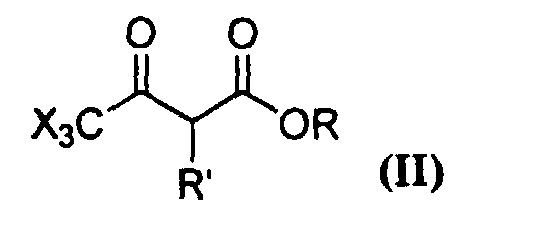
- (i) reacting the compound of formula (II) with hydrogen in the presence of a catalytic amount of platinum and a catalytic amount of an acid or base to form the compound of formula (I), and
- (ii) separating the compound of formula (I) from the platinum catalyst,
wherein
- X is fluoro or chloro,
- R is alkyl, haloalkyl, polyhaloalkyl, alkyl substituted with NR2R3, hydroxy or OR4, phenyl or phenyl substituted with one or more groups independently selected from halo, alkyl, hydroxy, alkoxy, haloalkoxy, polyhaloalkoxy, haloalkyl or polyhaloalkyl,
- R' is a hydrogen atom, alkyl, haloalkyl, polyhaloalkyl, alkyl substituted with NR2R3, hydroxy or OR4, phenyl or phenyl substituted with one or more groups independently selected from halo, alkyl, hydroxy, alkoxy, haloalkoxy, polyhaloalkoxy, haloalkyl or polyhaloalkyl, R2 and R3 are each independently a hydrogen atom, alkyl, or together with the nitrogen atom to which they are attached form a 5- or 6-membered heterocyclic ring, and
- R4 is alkyl, haloalkyl or polyhaloalkyl.
-
- As used herein, the term "alkyl" refers to straight and branched aliphatic hydrocarbon chains, for example, methyl, ethyl, n-propyl, isopropyl, n-butyl, sec-butyl, tert-butyl, isoamyl and n-hexyl.
- The term "alkoxy" refers to straight and branched aliphatic hydrocarbon chains attached to an oxygen atom, for example, methoxy, ethoxy, n-propoxy, isopropoxy and n-butoxy.
- The term "haloalkyl" refers to a straight or branched aliphatic hydrocarbon chain substituted with a fluoro, chloro or bromo, for example chloromethyl, 2-fluoroethyl and 4-bromobutyL
- The term "polyhaloalkyl" refers to a straight or branched aliphatic hydrocarbon chain multiply substituted with a fluoro or chloro, for example difluoromethyl, trifluoromethyl, 1,1,2,2,2-pentafluoroethyl and trichloromethyl.
- The term "haloalkoxy" refers to a straight or branched aliphatic hydrocarbon chain, attached to an oxygen atom, substituted with a fluoro, chloro or bromo, for example fluoromethoxy, 2-chloroethoxy and 4-bromobutoxy.
- The term "polyhaloalkoxy" refers to a straight or branched aliphatic hydrocarbon chain, attached to an oxygen atom, multiply substituted with a fluoro or chloro, for example difluoromethoxy, trifluoromethoxy, 1,1,2,2,2-pentafluoroethoxy and trichloromethoxy.
- In a preferred process of this invention,
- X is fluoro or chloro,
- R is (C1-C4)alkyl, halo(C1-C4)alkyl, polyhalo(C1-C4)alkyl, (C1-C4)alkyl substituted with NR2R3, hydroxy or OR4, phenyl or phenyl substituted with one or more groups independently selected from halo, (C1-C2)alkyl, hydroxy, (C1-C2)alkoxy, halo(C1-C2)alkoxy, polyhalo(C1-C2)alkoxy, halo(C1-C2)alkyl or polyhalo(C1-C2)alkyl,
- R' is a hydrogen atom, (C1-C4)alkyl, halo(C1-C4)alkyl, polyhalo(C1-C4)alkyl, (C1-C4)alkyl substituted with NR2R3, hydroxy or OR4, phenyl or phenyl substituted with one or more groups independently selected from halo, (C1-C2)alkyl, hydroxy, (C1-C2)alkoxy, halo(C1-C2)alkoxy, polyhalo(C1-C2)alkoxy, halo(C1-C2)alkyl or polyhalo(C1-C2)alkyl,
- R2 and R3 are each independently a hydrogen atom, (C1-C2)alkyl, or together with the nitrogen atom to which they are attached form a 5- or 6-membered heterocyclic ring, and
- R4 is (C1-C2)alkyl, halo(C1-C2)alkyl or polyhalo(C1-C2)alkyl.
-
- In a more preferred process of this invention,
- X is fluoro,
- R is (C1-C3)alkyl, polyhalo(C1-C2)alkyl or (C1-C2)alkyl substituted with OR4,
- R' is a hydrogen atom, (C1-C2)alkyl, polyhalo(C1-C2)alkyl, (C1-C2)alkyl substituted with NR2R3, hydroxy or OR4,
- R2 and R3 are each independently a hydrogen atom, (C1-C2)alkyl, or together with the nitrogen atom to which they are attached form a 5- or 6-membered heterocyclic ring, and
- R4 is (C1-C2)alkyl or polyhalo(C1-C2)alkyl.
-
- In an even more preferred process of this invention, R is methyl or ethyl and R' is a hydrogen atom, (C1-C2)alkyl or polyhalo(C1-C2)alkyl.
- In a most preferred process of this invention, R is ethyl and R' is a hydrogen atom.
- The catalytic amount of platinum can be any form of platinum with a high surface area. Such catalysts may take the form of platinum on a carbon support, preferably 5% by weight of platinum on carbon (5% Pt/C), platinum on an alumina support, platinum on a silica support, platinum on a ceramic support, platinum(IV) oxide (PtO2) or a fluidized bed. The catalyst load can range from 0.001 to 10%, preferably from 0.001 to 0.1%, more preferably from 0.001 to 0.05% and even more preferably from 0.01 to 0.05%. The catalyst load is measured as the weight of platinum relative to the weight of 4,4,4-trihaloacetoacetate starting material. Other metals have been explored as catalysts, including Raney nickel, palladium on carbon, and ruthenium on carbon. Only very low yields of a 4,4,4-trihalo-3-hydroxybutyrate ester product were obtained (0-25%)
- The hydrogen pressure can range from 1 to 100 bars, preferably from 2 to 5 bars. The reduction reaction temperature can range from ambient to 150°C, preferably from ambient to 80°C, more preferably from 30 to 60°C. Reaction times are dependent on the reactor design, reaction temperature, hydrogen pressure, etc. but are usually from 1 to 24 hours, preferably from 2 to 10 hours. Good agitation of the reaction mixture leads to shorter reaction times.
- A base or acid is added as a co-catalyst. Loading of the co-catalyst can be from 0.1 to 10% by weight relative to the weight of trihaloacetoacetate starting material. Preferred is from 0.1 to 3% by weight. The co-catalyst can be a soluble or insoluble acid or base. Bases are more preferable than acids as co-catalyst. Examples of acid co-catalysts are organic or inorganic acids such as HCl, H2SO4, p-toluenesulfonic acid, methanesulfonic acid, acetic acid, trichloroacetic acid, a cation-exchange resin, etc. Examples of bases are organic or inorganic bases such as triethylamine (and other mono-, di-, and trialkylamines), pyridine and substituted pyridines, hydroxides, carbonates, bicarbonates, an anion-exchange resin, etc. Preferred bases are triethylamine and mono-, di- and trialkylamines. If very high purity 4,4,4-trihalo-3-hydroxybutyrate ester product is desired, it may be best to use insoluble bases such as poly(vinylpyridine) or an anion-exchange resin which can be removed from the product by filtration.
- The process can be run as a batch reaction, in which 4,4,4-trihaloacetoacetate starting material, platinum catalyst and co-catalyst are charged, the reactor is charged with hydrogen gas and agitated to produce product. The product is then isolated by filtration, centrifugation or other suitable means to remove catalyst. The process could also be performed in a semi-continuous fashion, in which 4,4,4-trihaloacetoacetate starting material containing the co-catalyst is passed over a bed of immobilized catalyst, and pure product collected at the end. The catalyst bed should be made in such a way as to provide mechanical stability and a high surface area of platinum. The support material could be carbon, alumina, ceramic or other materials. The reaction can be heated in either mode of operation.
- The following examples and experimental procedures are provided for additional guidance to the practitioner.
- Ethyl 4,4,4-trifluoroacetoacetate (350 g), under a blanket of nitrogen gas, was heated to 40°C and treated with platinum (0.7 g of 5% Pt/C, 0.01% load) and triethylamine (1.5 g, 0.4% load). Hydrogen was charged to a pressure of 5 bars and the mixture agitated at 40°C for 6h. After filtration to remove the catalyst, 341 g (96% yield) of ethyl 4,4,4-trifluoro-3-hydroxybutyrate was obtained.
- Ethyl 4,4,4-trifluoroacetoacetate (50 g), under a blanket of nitrogen gas, was heated to 40°C and treated with platinum (0.1 g of 5% Pt/C, 0.01% load) and triethylamine (1.5 g, 2.9% load). Hydrogen was charged to a pressure of 5 bars, and the mixture agitated at 40°C for 6h. After filtration to remove the catalyst, 48.5 g (96% yield) of ethyl 4,4,4-trifluoro-3-hydroxybutyrate was obtained.
- Ethyl 2-methyl-4,4,4-trifluoroacetoacetate (50 g), under a blanket of nitrogen gas, is heated to 40°C and treated with platinum (0.1 g of 5% Pt/C, 0.01% load) and triethylamine (0.2 g, 0.4 % load). Hydrogen is charged to a pressure of 5 bars, and the mixture agitated at 40°C for 6h. After filtration to remove the catalyst, 48.5 g (96% yield) of ethyl 2-methyl-4,4,4-trifluoro-3-hydroxybutyrate is obtained.
- Ethyl 4,4,4-trifluoroacetoacetate (50 g), under a blanket of nitrogen gas, is heated to 40°C and treated with platinum (0.1 g of 5% Pt/C, 0.01% load) and methanesulfonic acid (1.5 g, 2.9% load). Hydrogen is charged to a pressure of 5 bars, and the mixture agitated at 40°C for 6h. After filtration to remove the catalyst, 25.3 g (50% yield) of ethyl 4,4,4-trifluoro-3-hydroxybutyrate is obtained.
- Ethyl 4,4,4-trifluoroacetoacetate (50 g), under a blanket of nitrogen gas, is heated to 40°C and treated with platinum (0.5 g of 1% Pt/C, 0.05% load) and triethylamine (0.2 g, 0.4% load). Hydrogen is charged to a pressure of 5 bars, and the mixture agitated at 40°C for 6h. After filtration to remove the catalyst, 48.5 g (96% yield) of ethyl 4,4,4-trifluoro-3-hydroxybutyrate is obtained.
- Ethyl 4,4,4-trifluoroacetoacetate (50 g), under a blanket of nitrogen gas, is heated to 40°C and treated with platinum (0.1 g of 5% Pt/alumina, 0.01% load) and triethylamine (0.2 g, 0.4% load). Hydrogen is charged to a pressure of 5 bars, and the mixture agitated at 40°C for 6h. After filtration to remove the catalyst, 48.5 g (96% yield) of ethyl 4,4,4-trifluoro-3-hydroxybutyrate is obtained.
- Isopropyl 4,4,4-trifluoroacetoacetate (50 g), under a blanket of nitrogen gas, is heated to 40°C and treated with platinum (0.1 g of 5% Pt/C, 0.01% load) and triethylamine (0.2 g, 0.4 % load). Hydrogen is charged to a pressure of 5 bars, and the mixture agitated at 40°C for 6h. After filtration to remove the catalyst, 48.5 g (96% yield) of isopropyl 4,4,4-trifluoro-3-hydroxybutyrate is obtained.
Claims (16)
- A process for the preparation of a compound of formula (I)from a compound of formula (II)
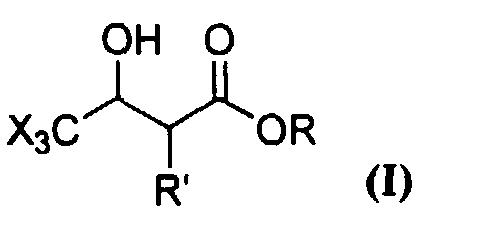 without a reaction solvent being present which comprises the steps of
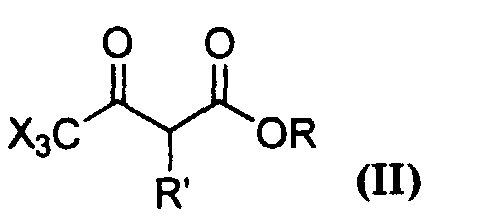 (i) reacting the compound of formula (II) with hydrogen in the presence of a catalytic amount of platinum and a catalytic amount of an acid or a base to form the compound of formula (I), and(ii) separating the compound of formula (I) from the platinum catalyst, whereinX is fluoro or chloro,R is alkyl, haloalkyl, polyhaloalkyl, alkyl substituted with NR2R3, hydroxy or OR4, phenyl or phenyl substituted with one or more groups independently selected from halo, alkyl, hydroxy, alkoxy, haloalkoxy, polyhaloalkoxy, haloalkyl or polyhaloalkyl,R' is a hydrogen atom, alkyl, haloalkyl, polyhaloalkyl, alkyl substituted with NR2R3, hydroxy or OR4, phenyl or phenyl substituted with one or more groups independently selected from halo, alkyl, hydroxy, alkoxy, haloalkoxy, polyhaloalkoxy, haloalkyl or polyhaloalkyl,R2 and R3 are each independently a hydrogen atom, alkyl, or together with the nitrogen atom to which they are attached form a 5- or 6-membered heterocyclic ring, andR4 is alkyl, haloalkyl or polyhaloalkyl.
 - The process of claim 1 whereinX is fluoro or chloro,R is (C1-C4)alkyl, halo(C1-C4)alkyl, polyhalo(C1-C4)alkyl, (C1 -C4)alkyl substituted with NR2R3, hydroxy or OR4, phenyl or phenyl substituted with one or more groups independently selected from halo, (C1-C2)alkyl, hydroxy, (C1-C2)alkoxy, halo(C1-C2)alkoxy, polyhalo(C1-C2)alkoxy, halo(C1-C2)alkyl or polyhalo(C1-C2)alkyl,R' is a hydrogen atom, (C1-C4)alkyl, halo(C1-C4)alkyl, polyhalo(C1-C4)alkyl, (C1-C4)alkyl substituted with NR2R3, hydroxy or OR4, phenyl or phenyl substituted with one or more groups independently selected from halo, (C1-C2)alkyl, hydroxy, (C1-C2)alkoxy, halo(C1-C2)alkoxy, polyhalo(C1-C2)alkoxy, halo(C1-C2)alkyl or polyhalo(C1-C2)alkyl,R2 and R3 are each independently a hydrogen atom, (C1-C2)alkyl, or together with the nitrogen atom to which they are attached form a 5- or 6-membered heterocyclic ring, andR4 is (C1-C2)alkyl, halo(C1-C2)alkyl or polyhalo(C1-C2)alkyl.
- The process of claim 2 whereinX is fluoro,R is (C1-C3)alkyl, polyhalo(C1-C2)alkyl or (C1-C2)alkyl substituted with OR4,R' is a hydrogen atom, (C1-C2)alkyl, polyhalo(C1-C2)alkyl, (C1-C2)alkyl substituted with NR2R3, hydroxy or OR4,R2 and R3 are each independently a hydrogen atom, (C1-C2)alkyl, or together with the nitrogen atom to which they are attached form a 5- or 6-membered heterocyclic ring, andR4 is (C1-C2)alkyl or polyhalo(C1-C2)alkyl.
- The process of claim 3 wherein R is methyl or ethyl and R' is a hydrogen atom, (C1-C2)alkyl or polyhalo(C1-C2)alkyl.
- The process of claim 4 wherein R is ethyl and R' is a hydrogen atom.
- The process as in any one of the preceding claims in which the catalytic amount of platinum in step (i) is selected from the group consisting of platinum on a carbon support, platinum on an alumina support, platinum on a silica support, platinum on a ceramic support and platinum(IV) oxide.
- The process of claim 6 wherein the catalytic amount of platinum is 5% by weight platinum on a carbon support.
- The process of claim 6 wherein the catalytic amount of an acid or a base is selected from the group consisting of HCl, H2SO4, p-toluenesulfonic acid, methanesulfonic acid, acetic acid, trichloroacetic acid, a cation-exchange resin, a monoalkylamine, a dialkylamine, a trialkylamine, pyridine, a substituted pyridine, a hydroxide, a carbonate, a bicarbonate, an anion-exchange resin and poly(vinylpyridine).
- The process of claim 8 wherein the base is a dialkylamine or a trialkylamine.
- The process of claim 9 wherein the amine is triethylamine.
- The process of claim 8 wherein the acid or base is present in an amount from 0.1 to 10% by weight relative to the weight of the compound of formula (II).
- The process of claim 6 wherein the catalytic amount of platinum is present in an amount from 0.001 to 10% by weight relative to the weight of the compound of formula (II).
- The process of claim 12 wherein the catalytic amount of platinum is present in an amount from 0.001 to 0.1% by weight.
- The process of claim 6 wherein the hydrogen pressure is from 1 to 100 bars.
- The process of claim 6 wherein the reaction temperature is from ambient to 150°C.
- The process of claim 15 wherein the reaction temperature is from ambient to 80°C.
Applications Claiming Priority (2)
| Application Number | Priority Date | Filing Date | Title |
|---|---|---|---|
| US13343499P | 1999-05-11 | 1999-05-11 | |
| US133434P | 1999-05-11 |
Publications (2)
| Publication Number | Publication Date |
|---|---|
| EP1052240A1 true EP1052240A1 (en) | 2000-11-15 |
| EP1052240B1 EP1052240B1 (en) | 2003-03-19 |
Family
ID=22458612
Family Applications (1)
| Application Number | Title | Priority Date | Filing Date |
|---|---|---|---|
| EP00303542A Expired - Lifetime EP1052240B1 (en) | 1999-05-11 | 2000-04-27 | Process for the preparation of substituted 3-hydroxybutyrate esters |
Country Status (10)
| Country | Link |
|---|---|
| US (1) | US6307094B1 (en) |
| EP (1) | EP1052240B1 (en) |
| JP (1) | JP2000336065A (en) |
| KR (1) | KR20000077194A (en) |
| CN (1) | CN1273234A (en) |
| AU (1) | AU3251000A (en) |
| BR (1) | BR0002096A (en) |
| DE (1) | DE60001686T2 (en) |
| IL (1) | IL135864A0 (en) |
| MX (1) | MXPA00004328A (en) |
Cited By (2)
| Publication number | Priority date | Publication date | Assignee | Title |
|---|---|---|---|---|
| WO2003097569A1 (en) * | 2002-05-22 | 2003-11-27 | Phoenix Chemicals Limited | Continuous process for the enantioselective catalytic hydrogenation of beta-ketoesters |
| CN112574037A (en) * | 2021-02-20 | 2021-03-30 | 湖南师范大学 | Synthetic method of alpha, gamma-tetrachlorobutyrate |
Families Citing this family (9)
| Publication number | Priority date | Publication date | Assignee | Title |
|---|---|---|---|---|
| KR100449750B1 (en) * | 2001-12-13 | 2004-09-22 | 화일약품주식회사 | Process for the preparation of racemic alkyl 4-chloro-3-hydroxy butyrate |
| CN100335457C (en) * | 2005-09-08 | 2007-09-05 | 上海交通大学 | 3,4-dihydroxy butyric ester of which 3 chiral hydroxyl group is protected, and its preparation method |
| US9388114B2 (en) * | 2013-08-02 | 2016-07-12 | Eastman Chemical Company | Compositions including an alkyl 3-hydroxybutyrate |
| US9249378B2 (en) | 2013-08-02 | 2016-02-02 | Eastman Chemical Company | Aqueous cleaning compositions having enhanced properties |
| US9163202B2 (en) | 2013-08-02 | 2015-10-20 | Eastman Chemical Company | Aqueous cleaning compositions including an alkyl 3-hydroxybutyrate |
| US9255059B2 (en) | 2013-08-02 | 2016-02-09 | Eastman Chemical Company | Method for producing an alkyl 3-hydroxybutyrate |
| RU2761829C2 (en) * | 2016-06-07 | 2021-12-13 | Зе Дж. Дэвид Глэдстоун Инститьютс | Esters of beta-hydroxybutyrate and butanediol formed by medium-chain fatty acids and compositions and methods based on them |
| BR112020001285A2 (en) | 2017-07-21 | 2020-07-28 | Buck Institute For Research On Aging | beta-hydroxybutyrate and butanediol s-enantiomers and methods for their use |
| US12037317B2 (en) | 2018-01-25 | 2024-07-16 | Buck Institute For Research On Aging | Synthesis of 3-hydroxybutyryl 3-hydroxybutyrate and related compounds |
Family Cites Families (2)
| Publication number | Priority date | Publication date | Assignee | Title |
|---|---|---|---|---|
| JPH0699367B2 (en) | 1987-06-11 | 1994-12-07 | 高砂香料工業株式会社 | Production method of optically active alcohol |
| JPH0879046A (en) | 1994-08-31 | 1996-03-22 | Toshiba Microelectron Corp | Output circuit |
-
2000
- 2000-04-27 EP EP00303542A patent/EP1052240B1/en not_active Expired - Lifetime
- 2000-04-27 DE DE60001686T patent/DE60001686T2/en not_active Expired - Fee Related
- 2000-04-28 IL IL13586400A patent/IL135864A0/en unknown
- 2000-05-02 US US09/564,656 patent/US6307094B1/en not_active Expired - Fee Related
- 2000-05-04 AU AU32510/00A patent/AU3251000A/en not_active Abandoned
- 2000-05-04 MX MXPA00004328A patent/MXPA00004328A/en not_active Application Discontinuation
- 2000-05-09 KR KR1020000024607A patent/KR20000077194A/en not_active Withdrawn
- 2000-05-09 CN CN00107506A patent/CN1273234A/en active Pending
- 2000-05-10 JP JP2000137367A patent/JP2000336065A/en not_active Withdrawn
- 2000-05-10 BR BR0002096-6A patent/BR0002096A/en not_active IP Right Cessation
Non-Patent Citations (2)
| Title |
|---|
| FAIZULLA G. KATHAWALA ET AL.: "Stereoselective Reduction of delta-Hydroxy-beta-ketoesters", HELVETICA CHIMICA ACTA., vol. 69, no. 4, 18 June 1986 (1986-06-18), VERLAG HELVETICA CHIMICA ACTA. BASEL., CH, pages 803 - 805, XP002145104, ISSN: 0018-019X * |
| REUBEN G. JONES: "Aliphatic Ketones and Amines Containing the Trifluoromethyl Group", JOURNAL OF THE AMERICAN CHEMICAL SOCIETY., vol. 70, no. 1, 3 February 1948 (1948-02-03), AMERICAN CHEMICAL SOCIETY, WASHINGTON, DC., US, pages 143 - 144, XP002145105, ISSN: 0002-7863 * |
Cited By (3)
| Publication number | Priority date | Publication date | Assignee | Title |
|---|---|---|---|---|
| WO2003097569A1 (en) * | 2002-05-22 | 2003-11-27 | Phoenix Chemicals Limited | Continuous process for the enantioselective catalytic hydrogenation of beta-ketoesters |
| US7057064B2 (en) | 2002-05-22 | 2006-06-06 | Phoenix Chemicals Limited | Continuous process for the enantioselective catalytic hydrogenation of β-ketoesters |
| CN112574037A (en) * | 2021-02-20 | 2021-03-30 | 湖南师范大学 | Synthetic method of alpha, gamma-tetrachlorobutyrate |
Also Published As
| Publication number | Publication date |
|---|---|
| EP1052240B1 (en) | 2003-03-19 |
| MXPA00004328A (en) | 2002-03-08 |
| CN1273234A (en) | 2000-11-15 |
| DE60001686D1 (en) | 2003-04-24 |
| US6307094B1 (en) | 2001-10-23 |
| DE60001686T2 (en) | 2003-08-21 |
| JP2000336065A (en) | 2000-12-05 |
| KR20000077194A (en) | 2000-12-26 |
| BR0002096A (en) | 2001-01-02 |
| AU3251000A (en) | 2000-11-16 |
| IL135864A0 (en) | 2001-05-20 |
Similar Documents
| Publication | Publication Date | Title |
|---|---|---|
| EP1052240B1 (en) | Process for the preparation of substituted 3-hydroxybutyrate esters | |
| KR101158132B1 (en) | Manufacture of vitamin b6 | |
| US6458954B2 (en) | Process for preparing piperidines | |
| EP0571770A1 (en) | Method for producing an asymmetric biaryl derivative | |
| KR100199335B1 (en) | Process for the synthesis of nabumetone | |
| CN113968798B (en) | Cyclohexyl ester compound, preparation method and application thereof | |
| SK147494A3 (en) | Method of preparation of imidazopyridine derivatives | |
| EP2123627B1 (en) | Process for producing aromatic amine having aralkyloxy or heteroaralkyloxy group | |
| US6342603B1 (en) | Purine derivatives having cyclopropane ring | |
| CN106748797A (en) | A kind of preparation method of the naphthol derivative of 2 nitro 1 | |
| EP0844242B1 (en) | Method of producing 4-hydroxy-2-pyrrolidinone and method of purifying the same | |
| KR0139633B1 (en) | Method for preparing 2-chloro-5-chloromethylpyridine | |
| JP3168079B2 (en) | Method for producing 2-alkylformylimidazole | |
| CA2679753A1 (en) | Process for preparing heterocycles | |
| JPH05117214A (en) | Production of diphenylamine derivative | |
| EP4703350A1 (en) | Method for preparing 4-aminoindan and method for preparing dihydroindenyl-pyrazolo[3,4-b]pyridine-amine | |
| JP2622136B2 (en) | Novel aromatic hydroxy compound and method for producing the same | |
| JP3849155B2 (en) | Process for producing benzobisoxazolone derivatives and intermediates thereof | |
| EP1212289A1 (en) | Preparation of halogenated primary amines | |
| CA3289838A1 (en) | Method for preparing 4-aminoindan and method for preparing dihydroindenyl-pyrazolo[3,4-b]pyridine-amine | |
| EP4703351A1 (en) | Method of preparing 4-aminoindan and method of preparing dihydroindenyl-pyrazolo[3,4-b]pyridine-amine compound | |
| JP2797539B2 (en) | Production method of β-lactone derivative | |
| JPH06184106A (en) | Production of indole or indole derivative | |
| JPH08325240A (en) | Production of substituted 3-arylquinazoline-2,4-dione | |
| JPH05301845A (en) | Process for producing 2-alkoxycarbonyl-2-fluorocycloalkanol derivative |
Legal Events
| Date | Code | Title | Description |
|---|---|---|---|
| PUAI | Public reference made under article 153(3) epc to a published international application that has entered the european phase |
Free format text: ORIGINAL CODE: 0009012 |
|
| 17P | Request for examination filed |
Effective date: 20000511 |
|
| AK | Designated contracting states |
Kind code of ref document: A1 Designated state(s): CH DE FR GB IT LI |
|
| AX | Request for extension of the european patent |
Free format text: AL;LT;LV;MK;RO;SI |
|
| AKX | Designation fees paid |
Free format text: CH DE FR GB IT LI |
|
| RAP1 | Party data changed (applicant data changed or rights of an application transferred) |
Owner name: DOW AGROSCIENCES LLC |
|
| 17Q | First examination report despatched |
Effective date: 20011010 |
|
| GRAH | Despatch of communication of intention to grant a patent |
Free format text: ORIGINAL CODE: EPIDOS IGRA |
|
| GRAH | Despatch of communication of intention to grant a patent |
Free format text: ORIGINAL CODE: EPIDOS IGRA |
|
| GRAA | (expected) grant |
Free format text: ORIGINAL CODE: 0009210 |
|
| AK | Designated contracting states |
Designated state(s): CH DE FR GB IT LI |
|
| REG | Reference to a national code |
Ref country code: GB Ref legal event code: FG4D |
|
| REG | Reference to a national code |
Ref country code: CH Ref legal event code: NV Representative=s name: FIAMMENGHI-FIAMMENGHI Ref country code: CH Ref legal event code: EP |
|
| PGFP | Annual fee paid to national office [announced via postgrant information from national office to epo] |
Ref country code: DE Payment date: 20030331 Year of fee payment: 4 |
|
| REF | Corresponds to: |
Ref document number: 60001686 Country of ref document: DE Date of ref document: 20030424 Kind code of ref document: P |
|
| PGFP | Annual fee paid to national office [announced via postgrant information from national office to epo] |
Ref country code: FR Payment date: 20030516 Year of fee payment: 4 |
|
| ET | Fr: translation filed | ||
| PLBE | No opposition filed within time limit |
Free format text: ORIGINAL CODE: 0009261 |
|
| STAA | Information on the status of an ep patent application or granted ep patent |
Free format text: STATUS: NO OPPOSITION FILED WITHIN TIME LIMIT |
|
| 26N | No opposition filed |
Effective date: 20031222 |
|
| PG25 | Lapsed in a contracting state [announced via postgrant information from national office to epo] |
Ref country code: GB Free format text: LAPSE BECAUSE OF NON-PAYMENT OF DUE FEES Effective date: 20040427 |
|
| PG25 | Lapsed in a contracting state [announced via postgrant information from national office to epo] |
Ref country code: LI Free format text: LAPSE BECAUSE OF NON-PAYMENT OF DUE FEES Effective date: 20040430 Ref country code: CH Free format text: LAPSE BECAUSE OF NON-PAYMENT OF DUE FEES Effective date: 20040430 |
|
| PG25 | Lapsed in a contracting state [announced via postgrant information from national office to epo] |
Ref country code: DE Free format text: LAPSE BECAUSE OF NON-PAYMENT OF DUE FEES Effective date: 20041103 |
|
| PG25 | Lapsed in a contracting state [announced via postgrant information from national office to epo] |
Ref country code: FR Free format text: LAPSE BECAUSE OF NON-PAYMENT OF DUE FEES Effective date: 20041130 |
|
| GBPC | Gb: european patent ceased through non-payment of renewal fee |
Effective date: 20040427 |
|
| REG | Reference to a national code |
Ref country code: CH Ref legal event code: PL |
|
| REG | Reference to a national code |
Ref country code: FR Ref legal event code: ST |
|
| PG25 | Lapsed in a contracting state [announced via postgrant information from national office to epo] |
Ref country code: IT Free format text: LAPSE BECAUSE OF NON-PAYMENT OF DUE FEES Effective date: 20050427 |