EP1051410B1 - Benzo[b]pyran derivatives useful as external agents for the skin - Google Patents
Benzo[b]pyran derivatives useful as external agents for the skin Download PDFInfo
- Publication number
- EP1051410B1 EP1051410B1 EP99901898A EP99901898A EP1051410B1 EP 1051410 B1 EP1051410 B1 EP 1051410B1 EP 99901898 A EP99901898 A EP 99901898A EP 99901898 A EP99901898 A EP 99901898A EP 1051410 B1 EP1051410 B1 EP 1051410B1
- Authority
- EP
- European Patent Office
- Prior art keywords
- skin
- formula
- external agent
- compound
- group
- Prior art date
- Legal status (The legal status is an assumption and is not a legal conclusion. Google has not performed a legal analysis and makes no representation as to the accuracy of the status listed.)
- Expired - Lifetime
Links
Classifications
-
- A—HUMAN NECESSITIES
- A61—MEDICAL OR VETERINARY SCIENCE; HYGIENE
- A61Q—SPECIFIC USE OF COSMETICS OR SIMILAR TOILETRY PREPARATIONS
- A61Q19/00—Preparations for care of the skin
- A61Q19/02—Preparations for care of the skin for chemically bleaching or whitening the skin
-
- A—HUMAN NECESSITIES
- A61—MEDICAL OR VETERINARY SCIENCE; HYGIENE
- A61K—PREPARATIONS FOR MEDICAL, DENTAL OR TOILETRY PURPOSES
- A61K8/00—Cosmetics or similar toiletry preparations
- A61K8/02—Cosmetics or similar toiletry preparations characterised by special physical form
- A61K8/0212—Face masks
-
- A—HUMAN NECESSITIES
- A61—MEDICAL OR VETERINARY SCIENCE; HYGIENE
- A61K—PREPARATIONS FOR MEDICAL, DENTAL OR TOILETRY PURPOSES
- A61K8/00—Cosmetics or similar toiletry preparations
- A61K8/18—Cosmetics or similar toiletry preparations characterised by the composition
- A61K8/30—Cosmetics or similar toiletry preparations characterised by the composition containing organic compounds
- A61K8/49—Cosmetics or similar toiletry preparations characterised by the composition containing organic compounds containing heterocyclic compounds
- A61K8/4973—Cosmetics or similar toiletry preparations characterised by the composition containing organic compounds containing heterocyclic compounds with oxygen as the only hetero atom
- A61K8/498—Cosmetics or similar toiletry preparations characterised by the composition containing organic compounds containing heterocyclic compounds with oxygen as the only hetero atom having 6-membered rings or their condensed derivatives, e.g. coumarin
-
- A—HUMAN NECESSITIES
- A61—MEDICAL OR VETERINARY SCIENCE; HYGIENE
- A61K—PREPARATIONS FOR MEDICAL, DENTAL OR TOILETRY PURPOSES
- A61K8/00—Cosmetics or similar toiletry preparations
- A61K8/18—Cosmetics or similar toiletry preparations characterised by the composition
- A61K8/30—Cosmetics or similar toiletry preparations characterised by the composition containing organic compounds
- A61K8/60—Sugars; Derivatives thereof
- A61K8/602—Glycosides, e.g. rutin
-
- A—HUMAN NECESSITIES
- A61—MEDICAL OR VETERINARY SCIENCE; HYGIENE
- A61P—SPECIFIC THERAPEUTIC ACTIVITY OF CHEMICAL COMPOUNDS OR MEDICINAL PREPARATIONS
- A61P17/00—Drugs for dermatological disorders
- A61P17/16—Emollients or protectives, e.g. against radiation
-
- C—CHEMISTRY; METALLURGY
- C07—ORGANIC CHEMISTRY
- C07D—HETEROCYCLIC COMPOUNDS
- C07D311/00—Heterocyclic compounds containing six-membered rings having one oxygen atom as the only hetero atom, condensed with other rings
- C07D311/02—Heterocyclic compounds containing six-membered rings having one oxygen atom as the only hetero atom, condensed with other rings ortho- or peri-condensed with carbocyclic rings or ring systems
- C07D311/04—Benzo[b]pyrans, not hydrogenated in the carbocyclic ring
- C07D311/58—Benzo[b]pyrans, not hydrogenated in the carbocyclic ring other than with oxygen or sulphur atoms in position 2 or 4
- C07D311/60—Benzo[b]pyrans, not hydrogenated in the carbocyclic ring other than with oxygen or sulphur atoms in position 2 or 4 with aryl radicals attached in position 2
-
- C—CHEMISTRY; METALLURGY
- C07—ORGANIC CHEMISTRY
- C07H—SUGARS; DERIVATIVES THEREOF; NUCLEOSIDES; NUCLEOTIDES; NUCLEIC ACIDS
- C07H17/00—Compounds containing heterocyclic radicals directly attached to hetero atoms of saccharide radicals
- C07H17/04—Heterocyclic radicals containing only oxygen as ring hetero atoms
Definitions
- the present invention relates to an external agent for the skin and a novel compound that is applicable thereto. More particularly, the present invention relates to an external agent for the skin that contains a compound having an inhibitory activity against melanine synthesis, that is excellent in the prevention and amelioration of skin pigmentation and that is suitable for cosmetics for whitening, and a novel compound having an inhibitory activity against melanine synthesis used preferably thereto.
- an object of the present invention is to provide an external agent for the skin that not only exhibits excellent effects of prevention and amelioration of skin pigmentation but also has no fear of giving adverse influences to the skin and can be used safely.
- external agent for the skin refers to a composition of any type of formula that can be administered to the skin and be pooled there continuously, used in a broad concept including cosmetics, quasi-drugs, external medicines for the skin and the like.
- the present invention relates to an external agent for the skin comprising one or more compound(s) selected from compounds represented by formula (I) below: (wherein R 1 , R 2 , R 3 , R 4 , and R 5 , independently represent a hydrogen atom or an alkyl group having 1 to 4 carbon atoms; and R represents a hydrogen atom, an acyl group, or a sugar residue).
- R 1 , R 2 , R 3 , R 4 , and R 5 independently represent a hydrogen atom or an alkyl group having 1 to 4 carbon atoms; and R represents a hydrogen atom, an acyl group, or a sugar residue).
- the external agent for the skin of the present invention content of one or more compound(s) selected from the compounds represented by formula (I) renges in an amount from 0.0005 to 10% by weight based on the total weight of the external agent.
- the external agent for the skin of the present invention is used advantageously as an external agent for the skin for whitening the skin.
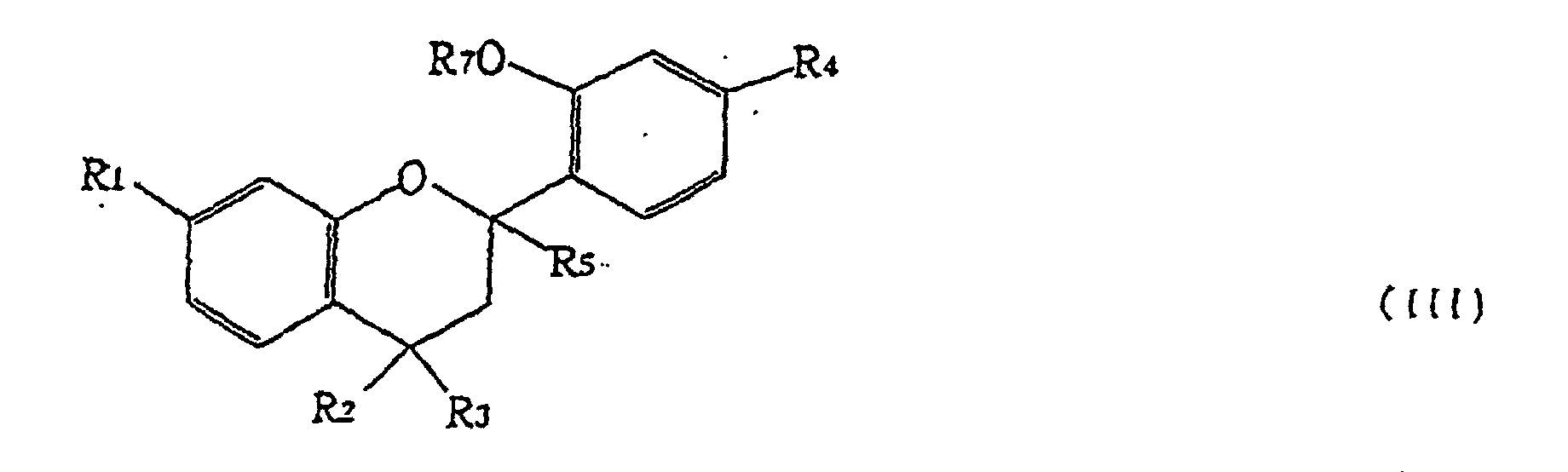
- the present invention relates to a compound represented by formula (III) below: (wherein R 1 , R 2 , R 3 , R 4 , and R 5 , independently represent a hydrogen atom or an alkyl group having 1 to 4 carbon atoms; and R 7 represents an acyl group or a sugar residue).
- the external agent for the skin of the present invention contains one or more compounds represented by formula (I) above as an essential component.
- R 1 , R 2 , R 3 , R 4 , and R 5 independently represent a hydrogen atom or an alkyl group having 1 to 4 carbon atoms.
- the alkyl group having 1 to 4 carbon atoms may be either of a straight or branched chain and specifically includes a methyl group, an ethyl group, a n-propyl group, an isopropyl group, a n-butyl group, a sec-butyl group, or a tert-butyl group, and the like.
- a methyl group is particularly preferred.
- R represents a hydrogen atom of a hydroxyl group or a substituent of the hydrogen atom of a hydroxyl group, more specifically an acyl group or a sugar residue.
- the acyl group includes an acyl group represented by R 6 -CO-, wherein R 6 represents an alkyl group having 1 to 17 carbon atoms or an alkenyl group having one or two double bonds and 3 to 17 carbon atoms, and more specifically an acetyl group, a pentanoyl group, an isooctanoyl group, a stearoyl group, an isostearoyl group, an oleoyl group, an octadecadienoyl and the like.
- the above-described sugar residue is not limited particularly and includes any sugar residue having a glucoside linkage terminal, wherein the sugar is a monosaccharide or disaccharide that can be connected through a glucoside linkage.
- specific examples thereof include a glucose residue, a xylose residue, a fructose residue, an arabinose residue, a rhamnose residue, a galactose residue, a sucrose residue, a maltose residue, and the like.
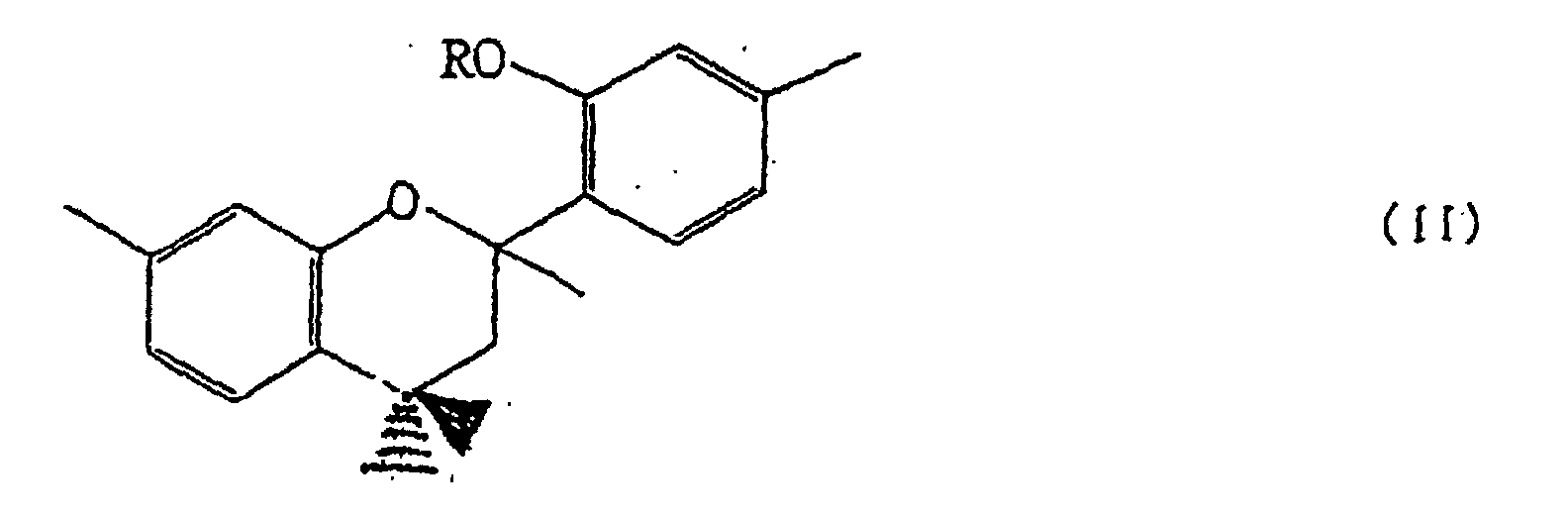
- those compounds preferably used for external agent for the skin of the present invention include compounds represented by formula (II) below: (wherein R represents a hydrogen atom, an acyl group represented by R 6 -CO- or a sugar residue; in which R 6 represents an alkyl group having 1 to 17 carbon atoms or an alkenyl group having one or two double bonds and 3 to 17 carbon atoms).
- the compounds represented by formula (II) above are compounds represented by formula (I) in which R 1 , R 2 , R 3 , R 4 , and R 5 are each a methyl group. Further, as the acyl group or sugar residue represented by R in formula (II), there may be cited the same acyl group or sugar residue in the compounds represented by formula (I) above.
- the compound in which R is a hydrogen atom is known as inulavosin. It is also known that the compound has fish toxin activity and antibacterial activity, for example, that for Staphylococcus aureus , Pseudomonas aeruginosa , and the like(Heterocycles, Vol. 41, No. 9, 1923-1926 (1995)). Also, inulavosin can be produced by the method as described above.
- the compounds represented by formula (III) correspond to the acylated compounds or glycosides of the compounds represented by formula (I) above in which R is a hydrogen atom.
- R 1 , R 2 , R 3 , R 4 , and R 5 independently represent a hydrogen atom or an alkyl group having 1 to 4 carbon atoms; and R 7 represents an acyl group or a sugar residue).
- examples of R 1 , R 2 , R 3 , R 4 , and R 5 may be cited the same as those for R 1 , R 2 , R 3 , R 4 , and R 5 in formula (I) above.
- the acyl group or sugar residue represented by R 7 there may be cited the same acyl group or sugar residue in the compounds represented by formula (I) above.
- those compounds represented by formula (IV) below are compounds that can be used advantageously in the external agent for the skin of the present invention.
- the compounds represented by formula (IV) correspond to the acylated compounds or glycosides of the above inulavosin. (wherein R 7 represents an acyl group represented by R 8 -CO- or a sugar residue; in which R 8 represents an alkyl group having 1 to 17 carbon atoms or an alkenyl group having one or two double bonds and 3 to 17 carbon atoms).
- the compounds represented by formula (IV) above are compounds represented by formula (III) in which R 1 , R 2 , R 3 , R 4 , and R 5 are each a methyl group. Further, as the acyl group or sugar residue represented by R 7 in formula (IV), there may be cited the same acyl group or sugar residue in the compounds represented by formula (III) above.
- particularly preferred compounds to be applied to the external agent for the skin of the present invention include acetylinulavosin and glucosides of inulavosin.
- novel compounds can be produced by a conventional method using a known compound represented by formula (I) in which R is a hydrogen atom such as inulavosin, for example, by condensation reaction with an acylating agent such as acyl chloride when the targeted compound is an acylated compound, or with a halide of a sugar using silver nitrate or silver oxide as a catalyst when the targeted compound is a glycoside.
- R is a hydrogen atom such as inulavosin
- the external agent for the skin of the present invention is characterized by containing one or more compound(s) selected from the compounds represented by formula (I) above.
- preferred for the external agent for the skin of the present invention are inulavosin, acylinulavosin, and inolabosin glycosides represented by formula (II) above.
- inulavosin, acetylinulavosin and inulavosin glucosides are particularly preferred.
- addition of one or more compound(s) represented by formula (I) in a basic formulation of external agent for the skin allows exhibition of excellent whitening effect based on the inhibitory activity against melanine synthesis.
- the content of the above-described compound or compounds ranges preferably in an amount from 0.0005 to 10% by weight based on the total weight of the external agent for the skin.
- the external agent for the skin of the present invention may include the compounds represented by formula (I) singly or in combination of two or more of them. When two or more of compounds are used in combination, a preferred range of the above-described content may be considered a range of the sum of the contents of the compounds represented by formula (I).
- the external agent for the skin when used for preventing skin pigmentation that would cause blotches, freckles, blackening of skin after sunburnt or chromatosis such as melanosis, its content is desirably 0.0005% or more by weight in point of effect. Further, when the external agent for the skin is used for ameliorating skin pigmentation, its content is preferably 0.1% or more by weight, and more preferably 1% or more by weight in point of effect. As will be apparent from the experimental results described hereinbelow, when the content of the above-described compound is less than 0.0005% by weight, the tendency is observed that the inhibitory activity against melanine synthesis is decreased considerably while in spite of use of the amount of above 10% by weight, the effect reaches a plateau. Therefore, it is desirable that the external agent for the skin of the present invention contains the compound(s) in the above-described range.
- the external agent for the skin of the present invention is desirably one that is used in the form in which it is pooled on the skin continuously in view of the characteristics of the compound or compounds activity represented by general formula (I) that the external agent for the skin of the present invention contains as an essential component.
- most external agents for the skin conventionally used take application forms desirable for the external agent for the skin of the present invention.
- a washing agent is one embodiment of the external agent for the skin of the present invention, it cannot be said to be a preferred embodiment of the external agent for the skin of the present invention since its application form is temporary in nature.
- a pack material or the like has a shielding effect, though its contact time with skin is short, so that it is a preferred embodiment of the external agent for the skin of the present invention.
- the external agent for the skin of the present invention can be obtained by blending one or more compounds selected from the compounds represented by formula (I) above in a basic formulation for external agents for the skin conventionally used for external agents for the skin, such as external medicines for the skin, cosmetics, and the like by a conventional method and can be produced in the same manner as the conventional external agents for the skin except that one or more compounds selected from the compounds represented by formula (I) above is or are blended therein.
- the external agent for the skin of the present invention may optionally contain one or more medical components such as a humectant, an ultraviolet shielding agent, and an anti-inflammatory agent.
- the external agent for the skin of the present invention may optionally contain one or more whitening components such as a whitening agent, for example, pantetheine-S-sulfonic acid, isoferulic acid, magnesium phosphate ascorbic acid salt, arbutin, kojic acid, rinolic acid, methyl rinolate, and the like.
- a whitening agent for example, pantetheine-S-sulfonic acid, isoferulic acid, magnesium phosphate ascorbic acid salt, arbutin, kojic acid, rinolic acid, methyl rinolate, and the like.
- the application form of the external agent for the skin of the present invention may be of any type conventionally used for this type of external agent for the skin and includes, for example, ointment, cream, emulsion, lotion, pack and the like application forms.
- external agent for the skin of the present invention include cosmetics, quasi-drugs, external medicine for the skin and the like. Further, the external agents for the skin can be used advantageously for whitening.
- the medium was removed from the incubation flask and the flask was washed with equilibrium phosphate buffer solution (hereinafter referred as "PBS"). Thereafter, the cells adhered on the incubation flask were stripped off with a solution containing trypsin and EDTA and then the obtained mixture was centrifuged to collect the cells.
- PBS equilibrium phosphate buffer solution
- Tables 1 to 3 show the results obtained as average values of five flasks together with standard deviations. Tables 1 to 3 show the results for inulavosin, acetylinulavosin, and glucosylinulavosin, respectively.
- Oil-in-water creams according to the formulation shown in Table 4 below was prepared by the following production method.
- component (A) The ingredients in component (A) were combined and heated at 80°C. Also, the ingredients in component (B) were combined and heated at 80°C. The component (B) was added to the component (A) and stirred for emulsification. Thereafter, the mixture was cooled down to 35°C.
- Component Blending Amount (% by weight) (A) POE(30) Cetyl ether 2.0 Glycerol monostearate 10.0 Liquid paraffin 10.0 Vaseline 4.0 Cetanol 5.0 ⁇ -Tocopherol 0.05 Dibutylhydroxytoluene(BHT) 0.01 Butylparaben 0.1 Inulavosin 0.5 (B) Propylene glycol 10.0 Distilled water 58.34
- the efficiency was a value obtained by judging the persons who got evaluation of slightly ameliorated or of higher rank as effective and counting the number of persons who were effective and then calculating the percentage of the number of effective persons to the total number of the persons constituting the group, i.e.,20.
- Evaluation Product of the present invention (Example 4) Comparative Product Considerably ameliorated 5 0 Fairly ameliorated 7 1 Slightly ameliorated 4 2 No change 4 17 Aggravated 0 0 Efficiency (%) 80% 15%
- Emulsion according to the formulation shown in Table 6 was prepared by the following production method.
- component (A) The ingredients in component (A) and the ingredients in component (B) were each dissolved at 70°C with stirring.
- the component (A) was added to the component (B) and preliminarily emulsified and then uniformly emulsified using a homomixer. After the emulsification, the emulsion was cooled to 30°C with stirring.
- Lotion was prepared according to the formulation shown in Table 7 by the following production method.
- component (A) The ingredients in component (A) were combined and dissolved at room temperature. On the other hand, the ingredients in component (B) were dissolved at room temperature. The component (B) was added to the component (A) to solubilize it.
- Component Blending Amount (% by weight) (A) POE(20) Sorbitan monolaurate 1.5 POE(20) lauryl ester 0.5 Ethanol 10.0 ⁇ -Tocopherol 0.02 Inulavosin 0.25 (B) Glycerol 5.0 Propylene glycol 4.0 Sodium isoferulate 0.5 Citric acid 0.15 Sodium citrate 0.1 Distilled water 77.98
- a pack material was prepared according to the formulation shown in Table 8 by the following production method.
- component (A) Polyvinyl alcohol 15.0 Distilled water 40.0
- component (B) Bisabolol 0.5 ⁇ -Tocopherol 0.02
- Ethanol 4.0 Inulavosin 3.0 POE(8) Polyoxypropylene glycol (55) 3.0 Distilled water 34.48
- An oil-in-water cream was prepared according to the formulation shown in Table 9 by the following production method.
- component (A) The ingredients in component (A) were combined and heated at 80 °C. Also, the ingredients in component (B) were combined and heated at 80 °C. The component (B) was added to the component (A) and stirred for emulsification. Thereafter, the mixture was cooled down to 35°C.
- Component Blending Amount (% by weight) (A) POE(30) Cetyl ether 2.0 Glycerol monostearate 10.0 Liquid paraffin 10.0 Vaseline 4.0 Cetanol 5.0 ⁇ -Tocopherol 0.05 Dibutylhydroxytoluene(BHT) 0.01 Butylparaben 0.1 Glucosylinulavosin 0.5 (B) Propylene glycol 10.0 Distilled water 58.34
- the external agent for the skin of the present invention exhibits excellent effects of preventing or ameliorating skin pigmentation attributed to the excellent inhibitory activity of the compounds represented by formula (I) against the melanine synthesis. Further, the above-described compounds have no fear in safety so that it can be said that there is no problem in safety in using the external agent for the skin of the present invention.
Landscapes
- Health & Medical Sciences (AREA)
- Life Sciences & Earth Sciences (AREA)
- Chemical & Material Sciences (AREA)
- General Health & Medical Sciences (AREA)
- Organic Chemistry (AREA)
- Veterinary Medicine (AREA)
- Public Health (AREA)
- Animal Behavior & Ethology (AREA)
- Epidemiology (AREA)
- Birds (AREA)
- Engineering & Computer Science (AREA)
- Dermatology (AREA)
- Genetics & Genomics (AREA)
- Molecular Biology (AREA)
- Biotechnology (AREA)
- Biochemistry (AREA)
- General Chemical & Material Sciences (AREA)
- Chemical Kinetics & Catalysis (AREA)
- Bioinformatics & Cheminformatics (AREA)
- Medicinal Chemistry (AREA)
- Nuclear Medicine, Radiotherapy & Molecular Imaging (AREA)
- Toxicology (AREA)
- Pharmacology & Pharmacy (AREA)
- Cosmetics (AREA)
- Pharmaceuticals Containing Other Organic And Inorganic Compounds (AREA)
- Plural Heterocyclic Compounds (AREA)
- Saccharide Compounds (AREA)
- Pyrane Compounds (AREA)
Abstract
Description
- The present invention relates to an external agent for the skin and a novel compound that is applicable thereto. More particularly, the present invention relates to an external agent for the skin that contains a compound having an inhibitory activity against melanine synthesis, that is excellent in the prevention and amelioration of skin pigmentation and that is suitable for cosmetics for whitening, and a novel compound having an inhibitory activity against melanine synthesis used preferably thereto.
- Skin pigmentation that causes blotches, freckles, and blackening of the skin after sunburnt is attributed to considerable sthenia of melanine synthesis, which is in turn due to activation of melanocytes in the skin. This is one of problems concerning the skin of middle- to high-aged persons. Accordingly, in order to prevent or ameliorate such a trouble on the skin pigmentation, there have been known external agents for the skin that contain ascorbic acids, aqueous hydrogen peroxide, glutathione, colloidal sulfur, hydroquinone, cathecol or the like.
- However, for the prevention and amelioration of skin pigmentation as described above, ascorbic acids tend to be oxidized and thus are unstable and causes discoloration in systems that contain much moisture, such as water-contained cosmetics. Also, aqueous hydrogen peroxide has the problems of stability during storage and safety while glutathione and colloidal sulfur give strong undesirable odors so that their use in products is restricted. Further, those additives such as hydroquinone and cathecol may have the problems of safety, such as skin irritation and allergy. Therefore, there has been currently obtained no external agent for the skin which is satisfactory in the prevention and amelioration of skin pigmentation. That is, there has been a need for a novel external agent for the skin that is safe and has an excellent whitening activity.
- On the other hand, among compounds represented by formula (I) used for the external agent for the skin of the present invention, those in which R is a hydrogen atom are known compounds which are described in U. S. Patents 2,418,458/1947 and 2,418,459/1947, and the like. Further, it is also known that inulavosin among these compounds has fish toxin activity and antibacterial activity, for example, that for Staphylococcus aureus, Pseudomonas aeruginosa, and the like (Heterocycles, Vol. 41, No. 9, 1923-1926 (1995)). However, it has not been known that the compounds represented by formula (I) inclusive of the above compounds have an inhibitory activity against melanine synthesis in skin. Further, it has not been reported that the compounds represented by formula (I) are used for an external agent for the skin to prevent and ameliorate of skin pigmentation.
- Related compounds, but not their uses as ingredients of skin-treating agents, are disclosed in the following:
- W. BAKER ET AL.: 'Condensation products of phenols and ketones.' JOURNAL OF THE CHEMICAL SOCIETY., 1957, pages 3060-3064;
- CHEMICAL ABSTRACTS, vol. 77, no. 19, 6 November 1972 Columbus, Ohio, US; abstract no.126369k, SVADKOVSKAYA, G. E. ET AL: 'Products formed during the condensation of m-cresol with acetone in the presence of acid catalysts';
- K. YAMADA ET AL.: 'The consensation product of monomethylammonium 6-aminosalicylate with acetone' BULLETIN OF THE CHEMICAL SOCIETY OF JAPAN., vol. 38, no. 12, 1965, pages 2057-2060.
- DATABASE WPI Section Ch, Derwent Publications Ltd., London, GB; AN 94-089260 & JP 06 040883 disclose a skin-whitening cosmetic containing catechin glycoside.
-
- Under the circumstances, the present invention has been made and an object of the present invention is to provide an external agent for the skin that not only exhibits excellent effects of prevention and amelioration of skin pigmentation but also has no fear of giving adverse influences to the skin and can be used safely.
- The term "external agent for the skin" as used herein refers to a composition of any type of formula that can be administered to the skin and be pooled there continuously, used in a broad concept including cosmetics, quasi-drugs, external medicines for the skin and the like.
- As a result of intensive investigation with a view to achieve the above-described object, the present inventors have discovered that compounds represented by formula (I) below have strong inhibitory activity against the melanine synthesis by live melanocytes and further that they exhibit excellent effects of prevention and amelioration of skin pigmentation when they are contained in a basic formulation of external agents for the skin. Also, the present inventors have newly produced the compounds having the above-described activity. Based on these, the present invention has been completed.
- That is, the present invention relates to an external agent for the skin comprising one or more compound(s) selected from compounds represented by formula (I) below:(wherein R1, R2, R3, R4, and R5, independently represent a hydrogen atom or an alkyl group having 1 to 4 carbon atoms; and R represents a hydrogen atom, an acyl group, or a sugar residue).
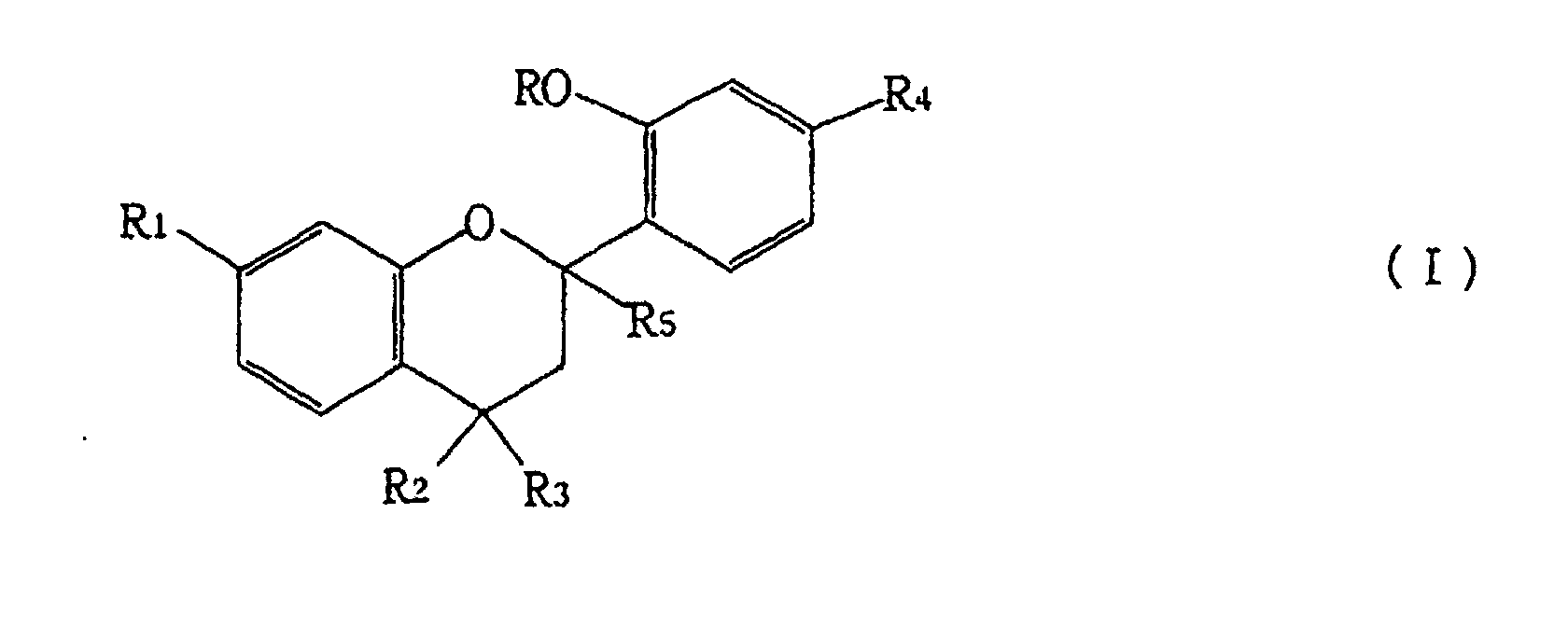
- In a preferred embodiment of the external agent for the skin of the present invention, content of one or more compound(s) selected from the compounds represented by formula (I) renges in an amount from 0.0005 to 10% by weight based on the total weight of the external agent. The external agent for the skin of the present invention is used advantageously as an external agent for the skin for whitening the skin.
- Also, the present invention relates to a compound represented by formula (III) below:(wherein R1, R2, R3, R4, and R5, independently represent a hydrogen atom or an alkyl group having 1 to 4 carbon atoms; and R7 represents an acyl group or a sugar residue).

- Hereafter, the present invention will be described in detail.
- The external agent for the skin of the present invention contains one or more compounds represented by formula (I) above as an essential component. In formula (I), R1, R2, R3, R4, and R5 independently represent a hydrogen atom or an alkyl group having 1 to 4 carbon atoms. The alkyl group having 1 to 4 carbon atoms may be either of a straight or branched chain and specifically includes a methyl group, an ethyl group, a n-propyl group, an isopropyl group, a n-butyl group, a sec-butyl group, or a tert-butyl group, and the like. Among these, a methyl group is particularly preferred.
- In formula (I), R represents a hydrogen atom of a hydroxyl group or a substituent of the hydrogen atom of a hydroxyl group, more specifically an acyl group or a sugar residue. Specifically, the acyl group includes an acyl group represented by R6-CO-, wherein R6 represents an alkyl group having 1 to 17 carbon atoms or an alkenyl group having one or two double bonds and 3 to 17 carbon atoms, and more specifically an acetyl group, a pentanoyl group, an isooctanoyl group, a stearoyl group, an isostearoyl group, an oleoyl group, an octadecadienoyl and the like. The above-described sugar residue is not limited particularly and includes any sugar residue having a glucoside linkage terminal, wherein the sugar is a monosaccharide or disaccharide that can be connected through a glucoside linkage. Specific examples thereof include a glucose residue, a xylose residue, a fructose residue, an arabinose residue, a rhamnose residue, a galactose residue, a sucrose residue, a maltose residue, and the like.
- Further, among the compounds represented by formula (I) above, those compounds preferably used for external agent for the skin of the present invention include compounds represented by formula (II) below:(wherein R represents a hydrogen atom, an acyl group represented by R6-CO- or a sugar residue; in which R6 represents an alkyl group having 1 to 17 carbon atoms or an alkenyl group having one or two double bonds and 3 to 17 carbon atoms).
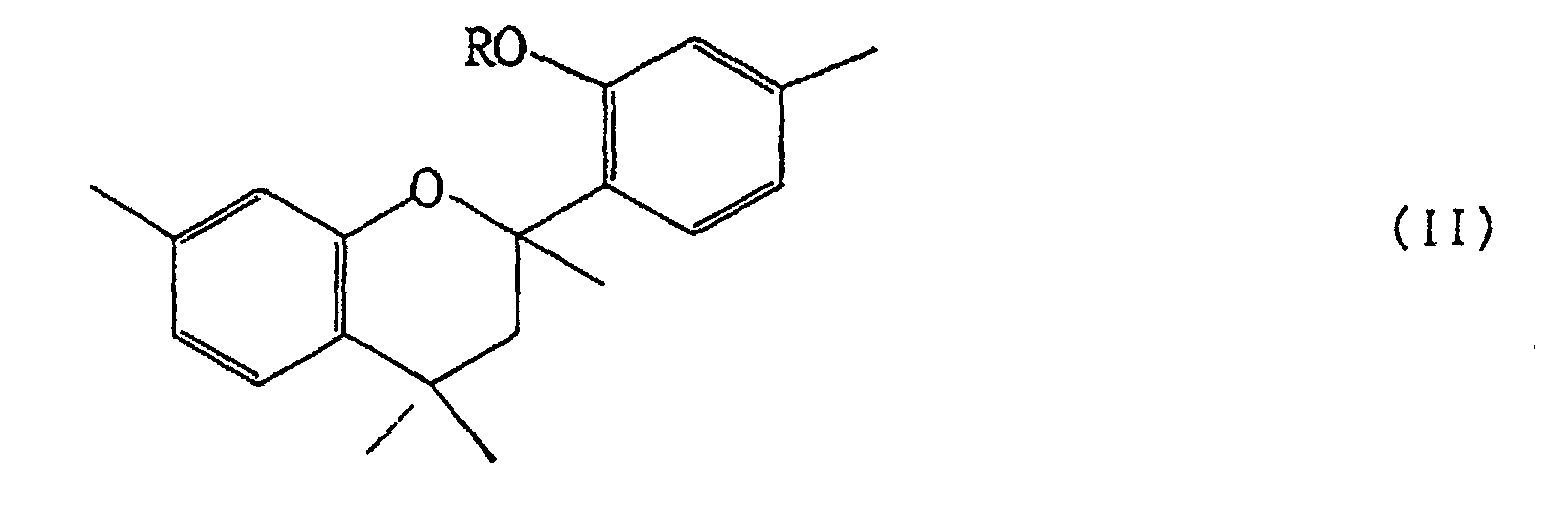
- The compounds represented by formula (II) above are compounds represented by formula (I) in which R1, R2, R3, R4, and R5 are each a methyl group. Further, as the acyl group or sugar residue represented by R in formula (II), there may be cited the same acyl group or sugar residue in the compounds represented by formula (I) above.
- Among the compounds represented by formula (I) above, those in which R is a hydrogen atom are known compounds. Methods for their synthesis are described in U. S. Patents 2,418,458/1947 and 2,418,459/1947. The above-described compounds produced by such methods can be used in the present invention.
- Further, among the compounds represented by formula (II) that are used advantageously in the present invention, the compound in which R is a hydrogen atom is known as inulavosin. It is also known that the compound has fish toxin activity and antibacterial activity, for example, that for Staphylococcus aureus, Pseudomonas aeruginosa, and the like(Heterocycles, Vol. 41, No. 9, 1923-1926 (1995)). Also, inulavosin can be produced by the method as described above.
- However, it has not been known that the compounds represented by formula (I) above in which R is a hydrogen atom, inclusive of inulavosin, have an inhibitory activity against melanine synthesis in skin. Further, it has not been known that direct application of the compounds to the skin based on the above-described activity gives rise to so-called whitening effects such as excellent prevention and amelioration of skin pigmentation that would lead to blotches, freckles, blackening of skin after sunburnt or chromatosis such as melanosis. It is believed that the present inventors have found this for the first time.
- Further, among the compounds represented by formula (I), the compounds represented by formula (III) below are novel compounds that are not described in the literature. The compounds represented by formula (III) correspond to the acylated compounds or glycosides of the compounds represented by formula (I) above in which R is a hydrogen atom.(wherein R1, R2, R3, R4, and R5, independently represent a hydrogen atom or an alkyl group having 1 to 4 carbon atoms; and R7 represents an acyl group or a sugar residue).

- In formula (III) above, examples of R1, R2, R3, R4, and R5 may be cited the same as those for R1, R2, R3, R4, and R5 in formula (I) above. Further, as the acyl group or sugar residue represented by R7, there may be cited the same acyl group or sugar residue in the compounds represented by formula (I) above.
- Further, among the novel compounds represented by formula (III) above, those compounds represented by formula (IV) below are compounds that can be used advantageously in the external agent for the skin of the present invention. The compounds represented by formula (IV) correspond to the acylated compounds or glycosides of the above inulavosin.(wherein R7 represents an acyl group represented by R8-CO- or a sugar residue; in which R8 represents an alkyl group having 1 to 17 carbon atoms or an alkenyl group having one or two double bonds and 3 to 17 carbon atoms).
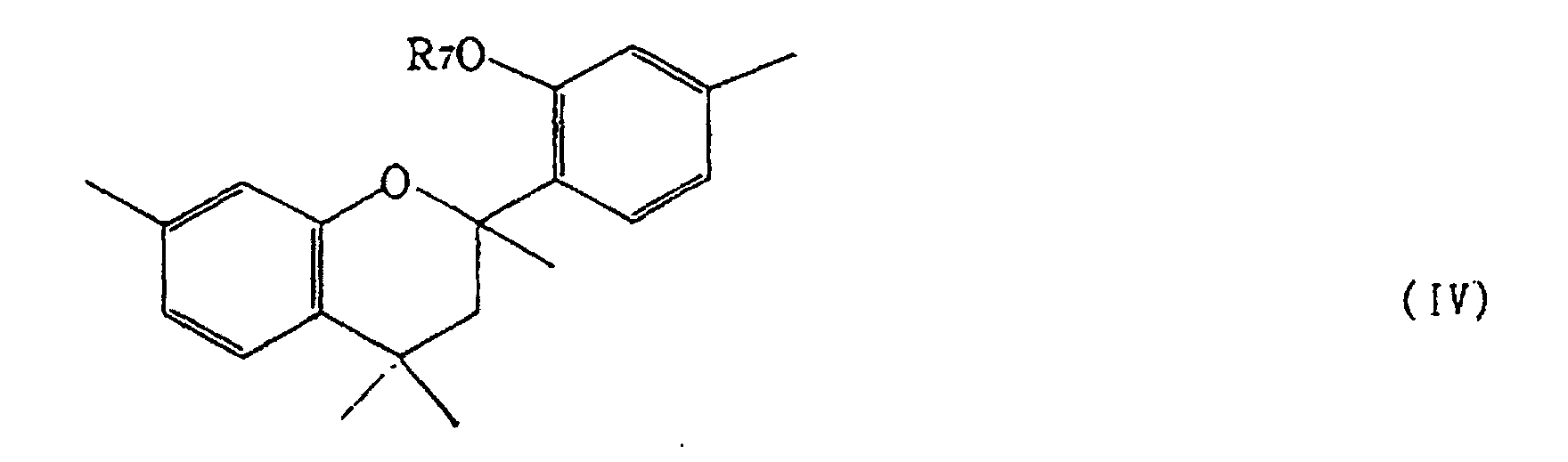
- The compounds represented by formula (IV) above are compounds represented by formula (III) in which R1, R2, R3, R4, and R5 are each a methyl group. Further, as the acyl group or sugar residue represented by R7 in formula (IV), there may be cited the same acyl group or sugar residue in the compounds represented by formula (III) above.
- Further, of these novel compounds, particularly preferred compounds to be applied to the external agent for the skin of the present invention include acetylinulavosin and glucosides of inulavosin.
- These novel compounds can be produced by a conventional method using a known compound represented by formula (I) in which R is a hydrogen atom such as inulavosin, for example, by condensation reaction with an acylating agent such as acyl chloride when the targeted compound is an acylated compound, or with a halide of a sugar using silver nitrate or silver oxide as a catalyst when the targeted compound is a glycoside.
- The external agent for the skin of the present invention is characterized by containing one or more compound(s) selected from the compounds represented by formula (I) above. Among the compounds represented by formula (I), preferred for the external agent for the skin of the present invention are inulavosin, acylinulavosin, and inolabosin glycosides represented by formula (II) above. Of these, inulavosin, acetylinulavosin and inulavosin glucosides are particularly preferred.
- In the present invention, addition of one or more compound(s) represented by formula (I) in a basic formulation of external agent for the skin allows exhibition of excellent whitening effect based on the inhibitory activity against melanine synthesis. The content of the above-described compound or compounds ranges preferably in an amount from 0.0005 to 10% by weight based on the total weight of the external agent for the skin. Of course, as stated above, the external agent for the skin of the present invention may include the compounds represented by formula (I) singly or in combination of two or more of them. When two or more of compounds are used in combination, a preferred range of the above-described content may be considered a range of the sum of the contents of the compounds represented by formula (I).
- That is, when the external agent for the skin is used for preventing skin pigmentation that would cause blotches, freckles, blackening of skin after sunburnt or chromatosis such as melanosis, its content is desirably 0.0005% or more by weight in point of effect. Further, when the external agent for the skin is used for ameliorating skin pigmentation, its content is preferably 0.1% or more by weight, and more preferably 1% or more by weight in point of effect. As will be apparent from the experimental results described hereinbelow, when the content of the above-described compound is less than 0.0005% by weight, the tendency is observed that the inhibitory activity against melanine synthesis is decreased considerably while in spite of use of the amount of above 10% by weight, the effect reaches a plateau. Therefore, it is desirable that the external agent for the skin of the present invention contains the compound(s) in the above-described range.
- Also, the external agent for the skin of the present invention is desirably one that is used in the form in which it is pooled on the skin continuously in view of the characteristics of the compound or compounds activity represented by general formula (I) that the external agent for the skin of the present invention contains as an essential component. In this respect, it can be said that most external agents for the skin conventionally used take application forms desirable for the external agent for the skin of the present invention. Although a washing agent is one embodiment of the external agent for the skin of the present invention, it cannot be said to be a preferred embodiment of the external agent for the skin of the present invention since its application form is temporary in nature. On the other hand, a pack material or the like has a shielding effect, though its contact time with skin is short, so that it is a preferred embodiment of the external agent for the skin of the present invention.
- The external agent for the skin of the present invention can be obtained by blending one or more compounds selected from the compounds represented by formula (I) above in a basic formulation for external agents for the skin conventionally used for external agents for the skin, such as external medicines for the skin, cosmetics, and the like by a conventional method and can be produced in the same manner as the conventional external agents for the skin except that one or more compounds selected from the compounds represented by formula (I) above is or are blended therein.
- As components of the basic formulation for the above-described external agents for the skin, there can be cited, for example, a moisture component, an oil component, a powder component, a surfactant, a tackifier, a colorant, a fragrant, an anti-oxidant, a pH adjusting agent, a chelating agent, a preservative and the like. In addition to the compounds represented by formula (I), the external agent for the skin of the present invention may optionally contain one or more medical components such as a humectant, an ultraviolet shielding agent, and an anti-inflammatory agent. Further, in addition to the compounds represented by formula (I), the external agent for the skin of the present invention may optionally contain one or more whitening components such as a whitening agent, for example, pantetheine-S-sulfonic acid, isoferulic acid, magnesium phosphate ascorbic acid salt, arbutin, kojic acid, rinolic acid, methyl rinolate, and the like.
- Further, the application form of the external agent for the skin of the present invention may be of any type conventionally used for this type of external agent for the skin and includes, for example, ointment, cream, emulsion, lotion, pack and the like application forms.
- Applications of the external agent for the skin of the present invention include cosmetics, quasi-drugs, external medicine for the skin and the like. Further, the external agents for the skin can be used advantageously for whitening.
- Hereafter, the present invention will be described in more detail by examples. However, the present invention should not be construed as being limited thereto.
- 12.0 g of m-cresol was dissolved in 100 ml of dry acetone and then hydrogen chloride gas was bubbled therein till saturation under ice cooling condition, followed by standing for 24 hours at room temperature with a stopper. Thereafter, the obtained mixture was cooled with ice again, a small amount of ether was added thereto, and the mixture was rendered strong alkaline by addition of an aqueous solution of 20% sodium hydroxide, followed by vigorous stirring overnight. Next, the reaction mixture thus obtained was neutralized with 1N hydrochloric acid, extracted with ether, and the ether layer was taken out. The ether layer was concentrated and purified by silica gel chromatography. Then the necessary fractions were concentrated and recrystallized from a small amount of ether. Since the crystals obtained were ether-conjugates, they were dried well using a vacuum pump. As a result, 3.0 g of inulavosin was obtained as white powder. NMR measurement of the inulavosin thus obtained gave the following results.
(Results of NMR Measurement)
1H-NMR (in CDCl3); 1.18 (3H,s), 1.42(3H,s), 1.69(3H,s), 2.06(1H,d), 2.26(3H,s), 2.30(3H,S), 2.54(1H,d), 6.65(1H,d), 6.67(1H,S)/ 6.75(1H,s), 6.81(1H,d), 7.03(1H,d 7.17(1H,d) - After 5.0 g of inulavosin (2'-hydroxy-2,4,4,7,4'-pentamethylflavan) obtained in Production Example 1 above was dissolved in a mixed solution of 60 ml of pyridine and 40 ml of acetic anhydride and the mixture was left to stand overnight, the reaction mixture was poured into water. The precipitate that formed was recrystallized from ethanol to obtain 4.8 g of acetylinulavosin (2'-acetoxy-2,4,4,7,4'-pentamethylflavan). NMR measurement of the acetylinulavosin thus obtained gave the following results.
(Results of NMR Measurement)
1H-NMR (in CDCl3) 1.18 (3H,s), 1.42(3H,s), 1.69(3H,s), 2.06(1H,d), 2.23(3H,s), 2.26(3H,s), 2.31(3H,s), 2.54(1H,d), 6.65(1H,d), 6.67(1H,s), 6.77(1H,s), 6.81(1H,d), 7.04(1H,d), 7.18(1H,d - 5.0 g of inulavosin (2'-hydroxy-2,4,4,7,4'-pentamethylflavan) obtained in Production Example 1 above and 7.0 g of tetra-O-acetyl-glucosyl-bromide were dissolved in 100 ml of dichloromethane, 4.0 g of silver oxide was added thereto, and the mixture was stirred with light shield. After filtration of the silver and concentration of the filtrate, the filtrate was purified by silica gel chromatography to obtain 2'-(tetra-O-acetyl-glucosyl)-2,4,4,7,4'-pentamethylflavan. After this compound was dissolved in methanol and 1N MeONa was added thereto, the mixture was stirred at room temperature to liberate the acetyl group from the above-described compound. After concentration of the reaction mixture, recrystallization from ethanol afforded 6.3 g of glucosylinulavosin (2'-O-glucosyl-2,4,4,7,4'-pentamethylflavan).
- NMR measurement of the above obtained 2'-(tetra-O-acetyl-glucosyl)-2,4,4,7,4'-pentamethylflavan gave the following results.
(Results of NMR Measurement)
1H-NMR (in CDCl3); 1.18 (3H,s), 1.42(3H,s), 1.69(3H,s), 2.02(3H,s), 2.03(3H,s), 2.04(3H,s), 2.06(1H,d), 2.11(3H,s), 2.26(3H,s), 2.30(3H,s), 2.54(1H,d) 3.72(2H,m), 4.20(1H,m), 4.61(1H,d), 5.08-5.32(3H,m), 6.65(1H,d 6.67(1H,s), 6.74(1H,S), 6.81(1H,d) 7.03(1H,d), 7.17(1H,d) - To evaluate the potency of the compounds represented by formula (I) of the present invention on the inhibitory activity against the melanine synthesis by melanocytes, the following experiments were conducted.
- 3 x 10⁴ cells of mouse melanoma-derived cells B-16 were inoculated in a plastic incubation flask (75 cm3) and incubated in Eagle MEM medium containing 10% fetal bovine serum under the conditions of 5% CO2 and 37°C. Two days after the start of the incubation, the inulavosin obtained in Production Example 1 above, the acetylinulavosin obtained in Example 1, or the glucosylinulavosin obtained in Example 2 was added to the incubation flask so that its concentration in the medium became 5 x 10⁻⁵ to 1 x 10⁻³ (W/V%) as shown in Tables 1 to 3 below, and the incubation was continued for additional 4 days. After completion of the incubation, the medium was removed from the incubation flask and the flask was washed with equilibrium phosphate buffer solution (hereinafter referred as "PBS"). Thereafter, the cells adhered on the incubation flask were stripped off with a solution containing trypsin and EDTA and then the obtained mixture was centrifuged to collect the cells.
- After washing the collected cells with PBS, 1N sodium hydroxide was added to the precipitate, and the mixture was heat-dissolved. After cooling, chloroform was added thereto and the mixture was stirred and centrifuged again. The resultant supernatant was measured for absorbance at 400 nm and the amount of melanine was obtained by a calibration curve prepared in advance using synthetic melanine. The amount of melanine was obtained as weight (µg) per 106 cells. In the experiments, five flasks were used for each concentration of the test samples.
- Tables 1 to 3 show the results obtained as average values of five flasks together with standard deviations. Tables 1 to 3 show the results for inulavosin, acetylinulavosin, and glucosylinulavosin, respectively.
- In addition, as a control, the amount of melanine was determined by conducting the same experiments as described above except that the compound represented by formula (I) was not added. From the amount of melanine in the absence of samples and the amount of melanine in the presence of a sample, there was obtained melanine synthesis inhibition ratio (R(%)) by the following equation. The amount of melanine in the equation was an average value obtained from five flasks.
A : Amount of melanine in the absence of samples
B : Amount of melanine in the presence of a sample - The results are shown at most right columns in Tables 1 to 3, respectively.
Inulavosin (W/V%) Amount of Melanine (µg/106 cells) Inhibition Ratio (%) No addition 3.23 ± 0.36 - 5 x 10⁻⁵ 2.74 ± 0.32 15.2 1 x 10⁻⁴ 2.23 ± 0.24 31.0 5 x 10⁻⁴ 0.87 ± 0.21 73.1 1 x 10⁻³ 0.28 ± 0.17 91.3 Acetylinulavosin (W/V%) Amount of Melanine (µg/106 cells) Inhibition Ratio (%) No addition 3.23 ± 0.36 - 5 x 10⁻⁵ 2.93 ± 0.35 9.3 1 x 10⁻⁴ 2.42 ± 0.26 25.1 5 x 10⁻⁴ 1.22 ± 0.17 62.2 1 x 10⁻³ 0.39 ± 0.18 87.9 Glucosylinulavosin (W/V%) Amount of Melanine (µg/106 cells) Inhibition Ratio (%) No addition 3.23 ± 0.36 - 5 x 10⁻⁵ 3.02 ± 0.33 6.5 1 x 10⁻⁴ 2.52 ± 0.23 22.0 5 x 10⁻⁴ 1.35 ± 0.17 58.2 1 x 10⁻³ 0.62 ± 0.15 80.8 - As will be clear from the results in Tables 1 to 3, it was demonstrated that inulavosin, acetylinulavosin, and glucosylinulavosin have inhibitory activity against the melanine synthesis by melanocytes and that this activity was remarkable in concentrations of 0.0005 W/V% or more, particularly. Note that no toxicity of the compounds represented by formula (I) to melanocytes was observed during the above experiments. From this it follows that the compounds represented by formula (I) have high safety.
- Oil-in-water creams according to the formulation shown in Table 4 below was prepared by the following production method.
- The ingredients in component (A) were combined and heated at 80°C. Also, the ingredients in component (B) were combined and heated at 80°C. The component (B) was added to the component (A) and stirred for emulsification. Thereafter, the mixture was cooled down to 35°C.
Component Blending Amount (% by weight) (A) POE(30) Cetyl ether 2.0 Glycerol monostearate 10.0 Liquid paraffin 10.0 Vaseline 4.0 Cetanol 5.0 γ-Tocopherol 0.05 Dibutylhydroxytoluene(BHT) 0.01 Butylparaben 0.1 Inulavosin 0.5 (B) Propylene glycol 10.0 Distilled water 58.34 - Next, taking into consideration the test results of the above-described inhibitory activity against the melanine synthesis, actual use tests by long term continuous use were conducted using the oil-in-water creams obtained in Example 4 above in order to demonstrate how the external agent for the skin of the present invention was excellent in the effects of prevention and amelioration of skin pigmentation and their effectiveness was confirmed. As comparative preparation, there was used an oil-in-water cream prepared in the same manner as in Example 4 except that inulavosin was replaced by distilled water.
- That is, 40 female volunteers who suffered from dark complexion, blotches, or freckles were divided into two statistically equivalent groups A and B. The group A persons used the oil-in-water cream of Example 4 of the present invention, while the group B persons used the comparative preparation of oil-in-water cream, for 3 months for application to their faces. After 3 months, ameliorating effect against pigmentation was evaluated by naked eyes and inter-group comparison was performed. The evaluation was made based on 5-rank criteria of considerably ameliorated, fairly ameliorated, slightly ameliorated, no change, and aggravated. Table 5 shows the results obtained. The efficiency was a value obtained by judging the persons who got evaluation of slightly ameliorated or of higher rank as effective and counting the number of persons who were effective and then calculating the percentage of the number of effective persons to the total number of the persons constituting the group, i.e.,20.
Evaluation Product of the present invention (Example 4) Comparative Product Considerably ameliorated 5 0 Fairly ameliorated 7 1 Slightly ameliorated 4 2 No change 4 17 Aggravated 0 0 Efficiency (%) 80% 15% - As the results in Table 5 show, it was demonstrated that the external agent for the skin of the present invention has much superior effects of preventing and ameliorating skin pigmentation to the comparative external agent for the skin. In addition, no undesirable response was observed in the skin at the site where the external agent of the present invention was applied, which also confirmed that the external agent for the skin of the present invention is highly safe.
- Emulsion according to the formulation shown in Table 6 was prepared by the following production method.
- The ingredients in component (A) and the ingredients in component (B) were each dissolved at 70°C with stirring. The component (A) was added to the component (B) and preliminarily emulsified and then uniformly emulsified using a homomixer. After the emulsification, the emulsion was cooled to 30°C with stirring.
Component Blending Amount (% by weight) (A) Synthetic spermaceti 2.5 Cetanol 1.0 Squalane 4.0 Stearic acid 1.0 Monosteraric acid polyethylene glycol (25EO) 2.2 Glycerol monostearate 0.5 Butylparaben 0.1 γ-Tocopherol 0.05 BHT 0.01 4-(1,1-Dimethylethyl)-4'-methoxy-benzoylmethane 0.5 Inulavosin 1.0 (B) 1,3-Butylene glycol 3.0 Propylene glycol 7.0 Xanthan gum 0.1 Carboxyvinylpolymer 0.2 Potassium hydroxide 0.2 Distilled water 76.64 - Lotion was prepared according to the formulation shown in Table 7 by the following production method.
- The ingredients in component (A) were combined and dissolved at room temperature. On the other hand, the ingredients in component (B) were dissolved at room temperature. The component (B) was added to the component (A) to solubilize it.
Component Blending Amount (% by weight) (A) POE(20) Sorbitan monolaurate 1.5 POE(20) lauryl ester 0.5 Ethanol 10.0 γ-Tocopherol 0.02 Inulavosin 0.25 (B) Glycerol 5.0 Propylene glycol 4.0 Sodium isoferulate 0.5 Citric acid 0.15 Sodium citrate 0.1 Distilled water 77.98 - A pack material was prepared according to the formulation shown in Table 8 by the following production method.
- The ingredients in component (A) were dispersed and dissolved at room temperature. On the other hand, the ingredients in component (B) were dissolved at room temperature. The component (B) was added to the component (A) and uniformly dissolved.
Component Blending Amount (% by weight) (A) Polyvinyl alcohol 15.0 Distilled water 40.0 (B) Bisabolol 0.5 γ-Tocopherol 0.02 Ethanol 4.0 Inulavosin 3.0 POE(8) Polyoxypropylene glycol (55) 3.0 Distilled water 34.48 - An oil-in-water cream was prepared according to the formulation shown in Table 9 by the following production method.
- The ingredients in component (A) were combined and heated at 80 °C. Also, the ingredients in component (B) were combined and heated at 80 °C. The component (B) was added to the component (A) and stirred for emulsification. Thereafter, the mixture was cooled down to 35°C.
Component Blending Amount (% by weight) (A) POE(30) Cetyl ether 2.0 Glycerol monostearate 10.0 Liquid paraffin 10.0 Vaseline 4.0 Cetanol 5.0 γ-Tocopherol 0.05 Dibutylhydroxytoluene(BHT) 0.01 Butylparaben 0.1 Glucosylinulavosin 0.5 (B) Propylene glycol 10.0 Distilled water 58.34 - The external agent for the skin of the present invention exhibits excellent effects of preventing or ameliorating skin pigmentation attributed to the excellent inhibitory activity of the compounds represented by formula (I) against the melanine synthesis. Further, the above-described compounds have no fear in safety so that it can be said that there is no problem in safety in using the external agent for the skin of the present invention.
Claims (8)
- An external agent for the skin comprising one or more compound(s) selected from compounds represented by formula (I) below:wherein R1, R2, R3, R4, and R5, independently represent a hydrogen atom or an alkyl group having 1 to 4 carbon atoms; and R represents a hydrogen atom, an acyl group, or a sugar residue.

- The external agent for the skin as claimed in claim 1, wherein said compound represented by formula (I) is a compound represented by formula (II) below:wherein R represents a hydrogen atom, an acyl group represented by R6-CO-, or a sugar residue; in which R6 represents an alkyl group having 1 to 17 carbon atoms or an alkenyl group having one or two double bonds and 3 to 17 carbon atoms.
- The external agent for the skin as claimed in claim 2, comprising one or more compound(s) selected from the group consisting of inulavosin, acetylinulavosin, and glucoside of inulavosin.
- The external agent for the skin as claimed in any one of claims 1 to 3, wherein said one or more compound(s) selected from the compounds represented by formula (I) is or are contained in an amount of 0.0005 to 10% by weight based on the total weight of the external agent.
- The external agent for the skin as claimed in any one of claims 1 to 4, wherein said agent is for whitening the skin.
- A compound represented by formula (III) below:wherein R1, R2, R3, R4, and R5, independently represent a hydrogen atom or an alkyl group having 1 to 4 carbon atoms; and R7 represents a sugar residue.
- The compound represented by formula (IV):wherein R7 represents an acyl group represented by R8-CO- or a sugar residue,
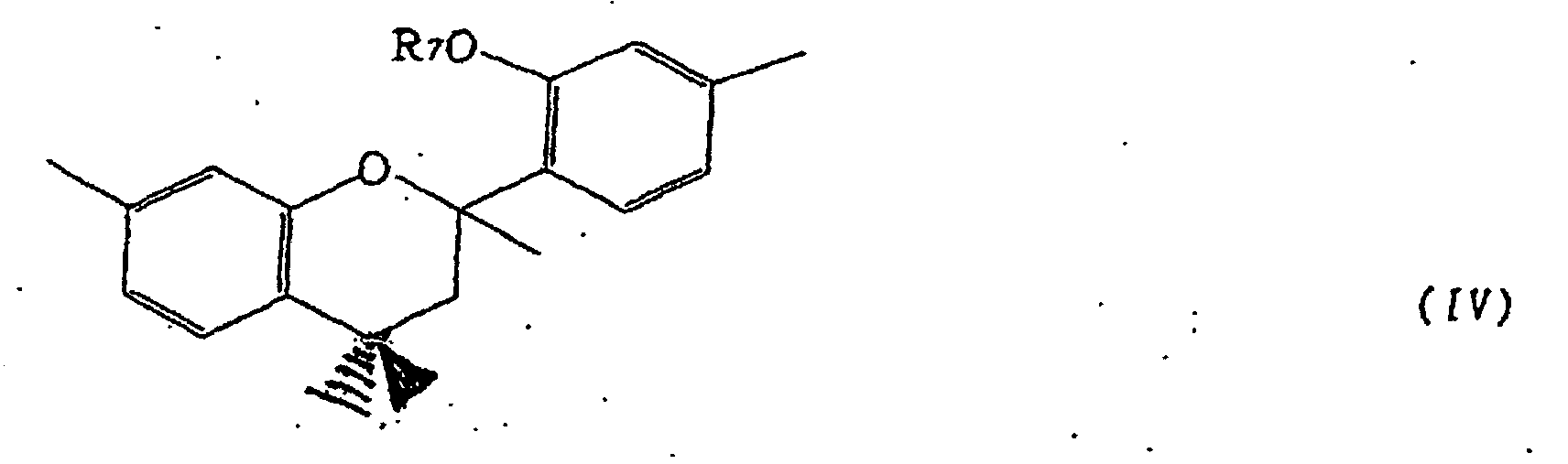
wherein R8 represents an alkenyl group having one or two double bonds and 3 to 17 carbon atoms. - The compound as claimed in claim 7, wherein said compound is glucoside of inulavosin.
Applications Claiming Priority (5)
| Application Number | Priority Date | Filing Date | Title |
|---|---|---|---|
| JP3057898 | 1998-01-28 | ||
| JP3057898 | 1998-01-28 | ||
| JP16435098 | 1998-05-28 | ||
| JP16435098 | 1998-05-28 | ||
| PCT/JP1999/000358 WO1999038858A1 (en) | 1998-01-28 | 1999-01-28 | Benzo[b]pyran derivatives useful as external agents for the skin |
Publications (2)
| Publication Number | Publication Date |
|---|---|
| EP1051410A1 EP1051410A1 (en) | 2000-11-15 |
| EP1051410B1 true EP1051410B1 (en) | 2003-03-05 |
Family
ID=26368958
Family Applications (1)
| Application Number | Title | Priority Date | Filing Date |
|---|---|---|---|
| EP99901898A Expired - Lifetime EP1051410B1 (en) | 1998-01-28 | 1999-01-28 | Benzo[b]pyran derivatives useful as external agents for the skin |
Country Status (13)
| Country | Link |
|---|---|
| US (1) | US6495524B1 (en) |
| EP (1) | EP1051410B1 (en) |
| JP (1) | JP4422329B2 (en) |
| KR (1) | KR100589873B1 (en) |
| CN (1) | CN1294587A (en) |
| AT (1) | ATE233748T1 (en) |
| AU (1) | AU762097B2 (en) |
| CA (1) | CA2318343A1 (en) |
| DE (1) | DE69905695T2 (en) |
| ES (1) | ES2192830T3 (en) |
| PT (1) | PT1051410E (en) |
| TW (1) | TW546150B (en) |
| WO (1) | WO1999038858A1 (en) |
Families Citing this family (4)
| Publication number | Priority date | Publication date | Assignee | Title |
|---|---|---|---|---|
| EP1241165A4 (en) * | 1999-12-13 | 2003-03-19 | Chugai Pharmaceutical Co Ltd | OPTICALLY ACTIVE CHROMANE AND THIOCHROMANE DERIVATIVES |
| JP2003267966A (en) * | 2002-03-13 | 2003-09-25 | Pola Chem Ind Inc | Flavan derivatives, skin fibroblast growth inhibitor and skin external preparation |
| WO2010087983A1 (en) * | 2009-01-29 | 2010-08-05 | Kambiz Thomas Moazed | Method and system for effecting changes in pigmented tissue |
| US9744237B2 (en) * | 2009-01-29 | 2017-08-29 | Kambiz Thomas Moazed | Method and system for effecting changes in pigmented tissue |
Family Cites Families (1)
| Publication number | Priority date | Publication date | Assignee | Title |
|---|---|---|---|---|
| JP3239191B2 (en) | 1992-07-16 | 2001-12-17 | 鈴与株式会社 | Method for producing ingredients for whitening cosmetics |
-
1999
- 1999-01-27 TW TW088101202A patent/TW546150B/en active
- 1999-01-28 JP JP2000529326A patent/JP4422329B2/en not_active Expired - Fee Related
- 1999-01-28 WO PCT/JP1999/000358 patent/WO1999038858A1/en not_active Ceased
- 1999-01-28 EP EP99901898A patent/EP1051410B1/en not_active Expired - Lifetime
- 1999-01-28 KR KR1020007008202A patent/KR100589873B1/en not_active Expired - Fee Related
- 1999-01-28 PT PT99901898T patent/PT1051410E/en unknown
- 1999-01-28 US US09/600,617 patent/US6495524B1/en not_active Expired - Fee Related
- 1999-01-28 CN CN99804305A patent/CN1294587A/en active Pending
- 1999-01-28 DE DE69905695T patent/DE69905695T2/en not_active Expired - Fee Related
- 1999-01-28 AU AU21841/99A patent/AU762097B2/en not_active Ceased
- 1999-01-28 ES ES99901898T patent/ES2192830T3/en not_active Expired - Lifetime
- 1999-01-28 CA CA002318343A patent/CA2318343A1/en not_active Abandoned
- 1999-01-28 AT AT99901898T patent/ATE233748T1/en not_active IP Right Cessation
Also Published As
| Publication number | Publication date |
|---|---|
| CA2318343A1 (en) | 1999-08-05 |
| AU2184199A (en) | 1999-08-16 |
| WO1999038858A8 (en) | 1999-11-04 |
| DE69905695T2 (en) | 2003-10-16 |
| ES2192830T3 (en) | 2003-10-16 |
| JP4422329B2 (en) | 2010-02-24 |
| US6495524B1 (en) | 2002-12-17 |
| TW546150B (en) | 2003-08-11 |
| ATE233748T1 (en) | 2003-03-15 |
| EP1051410A1 (en) | 2000-11-15 |
| KR100589873B1 (en) | 2006-06-15 |
| DE69905695D1 (en) | 2003-04-10 |
| KR20010034430A (en) | 2001-04-25 |
| AU762097B2 (en) | 2003-06-19 |
| CN1294587A (en) | 2001-05-09 |
| WO1999038858A1 (en) | 1999-08-05 |
| PT1051410E (en) | 2003-06-30 |
| JP2002501914A (en) | 2002-01-22 |
Similar Documents
| Publication | Publication Date | Title |
|---|---|---|
| US4990330A (en) | Compositions for topical use having melanin synthesis-inhibiting activity | |
| US4919921A (en) | Compositions for topical use having melanin synthesis-inhibiting activity | |
| US5045533A (en) | Retinoic esters of antibiotics and pharmaceutical and cosmetic compositions containing them | |
| JPH0725742A (en) | Whitening cosmetics | |
| DE69727836T2 (en) | PREVENTIVE DIGESTIVE AND THERAPEUTIC MEDICINAL PRODUCTS | |
| WO1999006020A1 (en) | Skin whitener composition containing mercaptodextran | |
| US6495524B1 (en) | Benzo[b]pyran derivatives useful as external agents for the skin | |
| JP2549127B2 (en) | Topical drug for suppressing melanin production | |
| US7754864B2 (en) | Tyrosinase activity controlling agent, process for producing the same and external preparation containing the same | |
| JPWO2000057889A1 (en) | topical skin preparations | |
| JPH0580449B2 (en) | ||
| JP3034057B2 (en) | Sugar-cinnamic acid derivatives and UV absorbers | |
| JPH0977660A (en) | Melanogenesis suppressing agent and skin preparation for external use | |
| JPH02142714A (en) | External preparation for skin | |
| JPH1029913A (en) | External composition for skin | |
| JP3106408B2 (en) | Glucosylated kojic acid and composition containing the same | |
| JP3014401B2 (en) | Retinoic acid ester of D-desosamine, its preparation, human or veterinary medicine and cosmetic composition | |
| US5004733A (en) | Esters of the etretinic type or related to macrolidic and lincosamidic antibiotics and pharmaceutical and cosmetic compositions containing said esters | |
| JPH04261115A (en) | External agent for skin | |
| JP2003238585A (en) | Naphthol glycoside and whitening composition for external use containing same | |
| JP2000095641A (en) | Bleaching preparation | |
| CA1173052A (en) | Pyranone compounds and skin lightening cosmetic preparations or local demelanizing agents containing the same | |
| CA1179605A (en) | Pyranone compounds and skin lightening cosmetic preparations or local demelanizing agents containing the same | |
| JPH0476082A (en) | Gelling agent | |
| JPH08268868A (en) | Dermal preparation for external use |
Legal Events
| Date | Code | Title | Description |
|---|---|---|---|
| PUAI | Public reference made under article 153(3) epc to a published international application that has entered the european phase |
Free format text: ORIGINAL CODE: 0009012 |
|
| 17P | Request for examination filed |
Effective date: 20000804 |
|
| AK | Designated contracting states |
Kind code of ref document: A1 Designated state(s): AT BE CH CY DE DK ES FI FR GB GR IE IT LI LU MC NL PT SE |
|
| 17Q | First examination report despatched |
Effective date: 20010622 |
|
| GRAG | Despatch of communication of intention to grant |
Free format text: ORIGINAL CODE: EPIDOS AGRA |
|
| GRAG | Despatch of communication of intention to grant |
Free format text: ORIGINAL CODE: EPIDOS AGRA |
|
| GRAH | Despatch of communication of intention to grant a patent |
Free format text: ORIGINAL CODE: EPIDOS IGRA |
|
| GRAG | Despatch of communication of intention to grant |
Free format text: ORIGINAL CODE: EPIDOS AGRA |
|
| GRAG | Despatch of communication of intention to grant |
Free format text: ORIGINAL CODE: EPIDOS AGRA |
|
| GRAH | Despatch of communication of intention to grant a patent |
Free format text: ORIGINAL CODE: EPIDOS IGRA |
|
| GRAH | Despatch of communication of intention to grant a patent |
Free format text: ORIGINAL CODE: EPIDOS IGRA |
|
| GRAA | (expected) grant |
Free format text: ORIGINAL CODE: 0009210 |
|
| AK | Designated contracting states |
Designated state(s): AT BE CH CY DE DK ES FI FR GB GR IE IT LI LU MC NL PT SE |
|
| PG25 | Lapsed in a contracting state [announced via postgrant information from national office to epo] |
Ref country code: NL Free format text: LAPSE BECAUSE OF FAILURE TO SUBMIT A TRANSLATION OF THE DESCRIPTION OR TO PAY THE FEE WITHIN THE PRESCRIBED TIME-LIMIT Effective date: 20030305 Ref country code: GR Free format text: LAPSE BECAUSE OF FAILURE TO SUBMIT A TRANSLATION OF THE DESCRIPTION OR TO PAY THE FEE WITHIN THE PRESCRIBED TIME-LIMIT Effective date: 20030305 Ref country code: FI Free format text: LAPSE BECAUSE OF FAILURE TO SUBMIT A TRANSLATION OF THE DESCRIPTION OR TO PAY THE FEE WITHIN THE PRESCRIBED TIME-LIMIT Effective date: 20030305 Ref country code: CY Free format text: LAPSE BECAUSE OF FAILURE TO SUBMIT A TRANSLATION OF THE DESCRIPTION OR TO PAY THE FEE WITHIN THE PRESCRIBED TIME-LIMIT Effective date: 20030305 Ref country code: BE Free format text: LAPSE BECAUSE OF FAILURE TO SUBMIT A TRANSLATION OF THE DESCRIPTION OR TO PAY THE FEE WITHIN THE PRESCRIBED TIME-LIMIT Effective date: 20030305 |
|
| REG | Reference to a national code |
Ref country code: GB Ref legal event code: FG4D |
|
| REG | Reference to a national code |
Ref country code: CH Ref legal event code: EP |
|
| REG | Reference to a national code |
Ref country code: IE Ref legal event code: FG4D |
|
| REF | Corresponds to: |
Ref document number: 69905695 Country of ref document: DE Date of ref document: 20030410 Kind code of ref document: P |
|
| REG | Reference to a national code |
Ref country code: CH Ref legal event code: NV Representative=s name: BOVARD AG PATENTANWAELTE |
|
| PG25 | Lapsed in a contracting state [announced via postgrant information from national office to epo] |
Ref country code: SE Free format text: LAPSE BECAUSE OF FAILURE TO SUBMIT A TRANSLATION OF THE DESCRIPTION OR TO PAY THE FEE WITHIN THE PRESCRIBED TIME-LIMIT Effective date: 20030605 Ref country code: DK Free format text: LAPSE BECAUSE OF FAILURE TO SUBMIT A TRANSLATION OF THE DESCRIPTION OR TO PAY THE FEE WITHIN THE PRESCRIBED TIME-LIMIT Effective date: 20030605 |
|
| REG | Reference to a national code |
Ref country code: PT Ref legal event code: SC4A Free format text: AVAILABILITY OF NATIONAL TRANSLATION Effective date: 20030415 |
|
| NLV1 | Nl: lapsed or annulled due to failure to fulfill the requirements of art. 29p and 29m of the patents act | ||
| REG | Reference to a national code |
Ref country code: ES Ref legal event code: FG2A Ref document number: 2192830 Country of ref document: ES Kind code of ref document: T3 |
|
| ET | Fr: translation filed | ||
| PGFP | Annual fee paid to national office [announced via postgrant information from national office to epo] |
Ref country code: GB Payment date: 20031125 Year of fee payment: 6 |
|
| PGFP | Annual fee paid to national office [announced via postgrant information from national office to epo] |
Ref country code: PT Payment date: 20031204 Year of fee payment: 6 |
|
| PGFP | Annual fee paid to national office [announced via postgrant information from national office to epo] |
Ref country code: DE Payment date: 20031212 Year of fee payment: 6 |
|
| PGFP | Annual fee paid to national office [announced via postgrant information from national office to epo] |
Ref country code: ES Payment date: 20031229 Year of fee payment: 6 |
|
| PGFP | Annual fee paid to national office [announced via postgrant information from national office to epo] |
Ref country code: FR Payment date: 20031230 Year of fee payment: 6 |
|
| PLBE | No opposition filed within time limit |
Free format text: ORIGINAL CODE: 0009261 |
|
| STAA | Information on the status of an ep patent application or granted ep patent |
Free format text: STATUS: NO OPPOSITION FILED WITHIN TIME LIMIT |
|
| PGFP | Annual fee paid to national office [announced via postgrant information from national office to epo] |
Ref country code: CH Payment date: 20040114 Year of fee payment: 6 Ref country code: AT Payment date: 20040114 Year of fee payment: 6 |
|
| PG25 | Lapsed in a contracting state [announced via postgrant information from national office to epo] |
Ref country code: LU Free format text: LAPSE BECAUSE OF NON-PAYMENT OF DUE FEES Effective date: 20040128 Ref country code: IE Free format text: LAPSE BECAUSE OF NON-PAYMENT OF DUE FEES Effective date: 20040128 |
|
| PG25 | Lapsed in a contracting state [announced via postgrant information from national office to epo] |
Ref country code: MC Free format text: LAPSE BECAUSE OF NON-PAYMENT OF DUE FEES Effective date: 20040131 |
|
| 26N | No opposition filed |
Effective date: 20031208 |
|
| REG | Reference to a national code |
Ref country code: IE Ref legal event code: MM4A |
|
| PG25 | Lapsed in a contracting state [announced via postgrant information from national office to epo] |
Ref country code: IT Free format text: LAPSE BECAUSE OF NON-PAYMENT OF DUE FEES Effective date: 20050128 Ref country code: AT Free format text: LAPSE BECAUSE OF NON-PAYMENT OF DUE FEES Effective date: 20050128 |
|
| PG25 | Lapsed in a contracting state [announced via postgrant information from national office to epo] |
Ref country code: ES Free format text: LAPSE BECAUSE OF NON-PAYMENT OF DUE FEES Effective date: 20050129 |
|
| PG25 | Lapsed in a contracting state [announced via postgrant information from national office to epo] |
Ref country code: LI Free format text: LAPSE BECAUSE OF NON-PAYMENT OF DUE FEES Effective date: 20050131 Ref country code: CH Free format text: LAPSE BECAUSE OF NON-PAYMENT OF DUE FEES Effective date: 20050131 |
|
| PG25 | Lapsed in a contracting state [announced via postgrant information from national office to epo] |
Ref country code: PT Free format text: LAPSE BECAUSE OF NON-PAYMENT OF DUE FEES Effective date: 20050728 |
|
| PG25 | Lapsed in a contracting state [announced via postgrant information from national office to epo] |
Ref country code: DE Free format text: LAPSE BECAUSE OF NON-PAYMENT OF DUE FEES Effective date: 20050802 |
|
| GBPC | Gb: european patent ceased through non-payment of renewal fee |
Effective date: 20050128 |
|
| REG | Reference to a national code |
Ref country code: CH Ref legal event code: PL |
|
| PG25 | Lapsed in a contracting state [announced via postgrant information from national office to epo] |
Ref country code: FR Free format text: LAPSE BECAUSE OF NON-PAYMENT OF DUE FEES Effective date: 20050930 |
|
| REG | Reference to a national code |
Ref country code: PT Ref legal event code: MM4A Effective date: 20050728 |
|
| REG | Reference to a national code |
Ref country code: FR Ref legal event code: ST |
|
| REG | Reference to a national code |
Ref country code: ES Ref legal event code: FD2A Effective date: 20050129 |