EP1051374B1 - The use of compressed carbon dioxide in chemical reactions - Google Patents
The use of compressed carbon dioxide in chemical reactions Download PDFInfo
- Publication number
- EP1051374B1 EP1051374B1 EP99902691A EP99902691A EP1051374B1 EP 1051374 B1 EP1051374 B1 EP 1051374B1 EP 99902691 A EP99902691 A EP 99902691A EP 99902691 A EP99902691 A EP 99902691A EP 1051374 B1 EP1051374 B1 EP 1051374B1
- Authority
- EP
- European Patent Office
- Prior art keywords
- reactor
- mmol
- polymer
- white
- mixture
- Prior art date
- Legal status (The legal status is an assumption and is not a legal conclusion. Google has not performed a legal analysis and makes no representation as to the accuracy of the status listed.)
- Expired - Lifetime
Links
- 238000006243 chemical reaction Methods 0.000 title claims description 12
- CURLTUGMZLYLDI-UHFFFAOYSA-N Carbon dioxide Chemical compound O=C=O CURLTUGMZLYLDI-UHFFFAOYSA-N 0.000 title description 104
- 229910002092 carbon dioxide Inorganic materials 0.000 title description 93
- 239000001569 carbon dioxide Substances 0.000 title description 11
- 238000000034 method Methods 0.000 claims abstract description 36
- 230000008569 process Effects 0.000 claims abstract description 26
- 239000002904 solvent Substances 0.000 claims abstract description 24
- 229910052698 phosphorus Inorganic materials 0.000 claims description 31
- 125000000217 alkyl group Chemical group 0.000 claims description 9
- 239000003446 ligand Substances 0.000 claims description 6
- 238000007341 Heck reaction Methods 0.000 claims description 5
- 229910052760 oxygen Inorganic materials 0.000 claims description 5
- 229910052717 sulfur Inorganic materials 0.000 claims description 5
- 238000005859 coupling reaction Methods 0.000 claims description 4
- 229910052785 arsenic Inorganic materials 0.000 claims description 3
- 229910052757 nitrogen Inorganic materials 0.000 claims description 3
- 238000006069 Suzuki reaction reaction Methods 0.000 claims description 2
- 125000000746 allylic group Chemical group 0.000 claims description 2
- 230000008878 coupling Effects 0.000 claims description 2
- 238000010168 coupling process Methods 0.000 claims description 2
- 238000006880 cross-coupling reaction Methods 0.000 claims description 2
- 229910052711 selenium Inorganic materials 0.000 claims description 2
- 238000006467 substitution reaction Methods 0.000 claims description 2
- 238000003477 Sonogashira cross-coupling reaction Methods 0.000 claims 1
- 125000000962 organic group Chemical group 0.000 claims 1
- 239000000178 monomer Substances 0.000 abstract description 65
- 239000004094 surface-active agent Substances 0.000 abstract description 31
- 229920006037 cross link polymer Polymers 0.000 abstract description 10
- 239000012798 spherical particle Substances 0.000 abstract description 2
- 230000009466 transformation Effects 0.000 abstract description 2
- 229920000642 polymer Polymers 0.000 description 61
- RTZKZFJDLAIYFH-UHFFFAOYSA-N Diethyl ether Chemical compound CCOCC RTZKZFJDLAIYFH-UHFFFAOYSA-N 0.000 description 53
- 239000000203 mixture Substances 0.000 description 45
- 238000003756 stirring Methods 0.000 description 44
- CSCPPACGZOOCGX-UHFFFAOYSA-N Acetone Chemical compound CC(C)=O CSCPPACGZOOCGX-UHFFFAOYSA-N 0.000 description 40
- YMWUJEATGCHHMB-UHFFFAOYSA-N Dichloromethane Chemical compound ClCCl YMWUJEATGCHHMB-UHFFFAOYSA-N 0.000 description 37
- 239000007788 liquid Substances 0.000 description 33
- 239000000843 powder Substances 0.000 description 31
- 229910052799 carbon Inorganic materials 0.000 description 29
- 239000012071 phase Substances 0.000 description 29
- ZMANZCXQSJIPKH-UHFFFAOYSA-N Triethylamine Chemical compound CCN(CC)CC ZMANZCXQSJIPKH-UHFFFAOYSA-N 0.000 description 27
- 239000000047 product Substances 0.000 description 22
- VLKZOEOYAKHREP-UHFFFAOYSA-N n-Hexane Chemical compound CCCCCC VLKZOEOYAKHREP-UHFFFAOYSA-N 0.000 description 21
- OZAIFHULBGXAKX-UHFFFAOYSA-N 2-(2-cyanopropan-2-yldiazenyl)-2-methylpropanenitrile Chemical compound N#CC(C)(C)N=NC(C)(C)C#N OZAIFHULBGXAKX-UHFFFAOYSA-N 0.000 description 19
- 230000015572 biosynthetic process Effects 0.000 description 17
- 239000007787 solid Substances 0.000 description 17
- OZAIFHULBGXAKX-VAWYXSNFSA-N AIBN Substances N#CC(C)(C)\N=N\C(C)(C)C#N OZAIFHULBGXAKX-VAWYXSNFSA-N 0.000 description 15
- -1 chlorofluorocarbons Chemical compound 0.000 description 15
- 238000000746 purification Methods 0.000 description 15
- 239000011541 reaction mixture Substances 0.000 description 15
- 229910052594 sapphire Inorganic materials 0.000 description 15
- 239000010980 sapphire Substances 0.000 description 15
- KDLHZDBZIXYQEI-UHFFFAOYSA-N palladium Substances [Pd] KDLHZDBZIXYQEI-UHFFFAOYSA-N 0.000 description 14
- 239000004810 polytetrafluoroethylene Substances 0.000 description 14
- 229920001343 polytetrafluoroethylene Polymers 0.000 description 14
- 239000000725 suspension Substances 0.000 description 14
- 238000013022 venting Methods 0.000 description 14
- WEVYAHXRMPXWCK-UHFFFAOYSA-N Acetonitrile Chemical compound CC#N WEVYAHXRMPXWCK-UHFFFAOYSA-N 0.000 description 12
- 239000000839 emulsion Substances 0.000 description 12
- 239000004005 microsphere Substances 0.000 description 12
- 239000012043 crude product Substances 0.000 description 11
- 239000002244 precipitate Substances 0.000 description 11
- VYPSYNLAJGMNEJ-UHFFFAOYSA-N Silicium dioxide Chemical compound O=[Si]=O VYPSYNLAJGMNEJ-UHFFFAOYSA-N 0.000 description 10
- 238000003818 flash chromatography Methods 0.000 description 10
- 239000000741 silica gel Substances 0.000 description 10
- 229910002027 silica gel Inorganic materials 0.000 description 10
- OKKJLVBELUTLKV-UHFFFAOYSA-N Methanol Chemical compound OC OKKJLVBELUTLKV-UHFFFAOYSA-N 0.000 description 9
- YXFVVABEGXRONW-UHFFFAOYSA-N Toluene Chemical compound CC1=CC=CC=C1 YXFVVABEGXRONW-UHFFFAOYSA-N 0.000 description 9
- 125000003118 aryl group Chemical group 0.000 description 9
- 125000000524 functional group Chemical group 0.000 description 9
- HEDRZPFGACZZDS-MICDWDOJSA-N Trichloro(2H)methane Chemical compound [2H]C(Cl)(Cl)Cl HEDRZPFGACZZDS-MICDWDOJSA-N 0.000 description 8
- 239000002245 particle Substances 0.000 description 8
- 239000011347 resin Substances 0.000 description 8
- 229920005989 resin Polymers 0.000 description 8
- 239000003054 catalyst Substances 0.000 description 7
- 229910052751 metal Inorganic materials 0.000 description 7
- 239000002184 metal Substances 0.000 description 7
- RPGWZZNNEUHDAQ-UHFFFAOYSA-N phenylphosphine Chemical compound PC1=CC=CC=C1 RPGWZZNNEUHDAQ-UHFFFAOYSA-N 0.000 description 7
- 238000003786 synthesis reaction Methods 0.000 description 7
- XYFCBTPGUUZFHI-UHFFFAOYSA-N Phosphine Chemical compound P XYFCBTPGUUZFHI-UHFFFAOYSA-N 0.000 description 6
- HEMHJVSKTPXQMS-UHFFFAOYSA-M Sodium hydroxide Chemical compound [OH-].[Na+] HEMHJVSKTPXQMS-UHFFFAOYSA-M 0.000 description 6
- OKKRPWIIYQTPQF-UHFFFAOYSA-N Trimethylolpropane trimethacrylate Chemical compound CC(=C)C(=O)OCC(CC)(COC(=O)C(C)=C)COC(=O)C(C)=C OKKRPWIIYQTPQF-UHFFFAOYSA-N 0.000 description 6
- 239000003153 chemical reaction reagent Substances 0.000 description 6
- 229910001220 stainless steel Inorganic materials 0.000 description 6
- 239000010935 stainless steel Substances 0.000 description 6
- MYRTYDVEIRVNKP-UHFFFAOYSA-N 1,2-Divinylbenzene Chemical compound C=CC1=CC=CC=C1C=C MYRTYDVEIRVNKP-UHFFFAOYSA-N 0.000 description 5
- PNEYBMLMFCGWSK-UHFFFAOYSA-N aluminium oxide Inorganic materials [O-2].[O-2].[O-2].[Al+3].[Al+3] PNEYBMLMFCGWSK-UHFFFAOYSA-N 0.000 description 5
- 238000004873 anchoring Methods 0.000 description 5
- YCOXTKKNXUZSKD-UHFFFAOYSA-N as-o-xylenol Natural products CC1=CC=C(O)C=C1C YCOXTKKNXUZSKD-UHFFFAOYSA-N 0.000 description 5
- SNHMUERNLJLMHN-UHFFFAOYSA-N iodobenzene Chemical compound IC1=CC=CC=C1 SNHMUERNLJLMHN-UHFFFAOYSA-N 0.000 description 5
- CCRCUPLGCSFEDV-BQYQJAHWSA-N methyl trans-cinnamate Chemical compound COC(=O)\C=C\C1=CC=CC=C1 CCRCUPLGCSFEDV-BQYQJAHWSA-N 0.000 description 5
- 230000007935 neutral effect Effects 0.000 description 5
- 229910052763 palladium Inorganic materials 0.000 description 5
- 239000003381 stabilizer Substances 0.000 description 5
- HEDRZPFGACZZDS-UHFFFAOYSA-N Chloroform Chemical compound ClC(Cl)Cl HEDRZPFGACZZDS-UHFFFAOYSA-N 0.000 description 4
- FOQABOMYTOFLPZ-ISLYRVAYSA-N Disperse Red 1 Chemical compound C1=CC(N(CCO)CC)=CC=C1\N=N\C1=CC=C([N+]([O-])=O)C=C1 FOQABOMYTOFLPZ-ISLYRVAYSA-N 0.000 description 4
- VEXZGXHMUGYJMC-UHFFFAOYSA-N Hydrochloric acid Chemical compound Cl VEXZGXHMUGYJMC-UHFFFAOYSA-N 0.000 description 4
- PPBRXRYQALVLMV-UHFFFAOYSA-N Styrene Chemical compound C=CC1=CC=CC=C1 PPBRXRYQALVLMV-UHFFFAOYSA-N 0.000 description 4
- 230000008901 benefit Effects 0.000 description 4
- 229920001577 copolymer Polymers 0.000 description 4
- 229920000359 diblock copolymer Polymers 0.000 description 4
- 239000000975 dye Substances 0.000 description 4
- YJVFFLUZDVXJQI-UHFFFAOYSA-L palladium(ii) acetate Chemical compound [Pd+2].CC([O-])=O.CC([O-])=O YJVFFLUZDVXJQI-UHFFFAOYSA-L 0.000 description 4
- 239000000376 reactant Substances 0.000 description 4
- 238000000926 separation method Methods 0.000 description 4
- JQWHASGSAFIOCM-UHFFFAOYSA-M sodium periodate Chemical compound [Na+].[O-]I(=O)(=O)=O JQWHASGSAFIOCM-UHFFFAOYSA-M 0.000 description 4
- 125000001424 substituent group Chemical group 0.000 description 4
- 239000012855 volatile organic compound Substances 0.000 description 4
- DBCAQXHNJOFNGC-UHFFFAOYSA-N 4-bromo-1,1,1-trifluorobutane Chemical compound FC(F)(F)CCCBr DBCAQXHNJOFNGC-UHFFFAOYSA-N 0.000 description 3
- UHOVQNZJYSORNB-UHFFFAOYSA-N Benzene Chemical compound C1=CC=CC=C1 UHOVQNZJYSORNB-UHFFFAOYSA-N 0.000 description 3
- 241000589902 Leptospira Species 0.000 description 3
- 238000007792 addition Methods 0.000 description 3
- 239000003814 drug Substances 0.000 description 3
- STVZJERGLQHEKB-UHFFFAOYSA-N ethylene glycol dimethacrylate Substances CC(=C)C(=O)OCCOC(=O)C(C)=C STVZJERGLQHEKB-UHFFFAOYSA-N 0.000 description 3
- 229910052739 hydrogen Inorganic materials 0.000 description 3
- 239000003999 initiator Substances 0.000 description 3
- 229920002521 macromolecule Polymers 0.000 description 3
- LXNAVEXFUKBNMK-UHFFFAOYSA-N palladium(II) acetate Substances [Pd].CC(O)=O.CC(O)=O LXNAVEXFUKBNMK-UHFFFAOYSA-N 0.000 description 3
- 229910000073 phosphorus hydride Inorganic materials 0.000 description 3
- 238000001556 precipitation Methods 0.000 description 3
- 238000010532 solid phase synthesis reaction Methods 0.000 description 3
- 238000005406 washing Methods 0.000 description 3
- XLYOFNOQVPJJNP-UHFFFAOYSA-N water Substances O XLYOFNOQVPJJNP-UHFFFAOYSA-N 0.000 description 3
- 230000004580 weight loss Effects 0.000 description 3
- NVVZEKTVIXIUKW-UHFFFAOYSA-N 1,1,1,2,2,3,3,4,4,5,5,6,6-tridecafluoro-8-iodooctane Chemical compound FC(F)(F)C(F)(F)C(F)(F)C(F)(F)C(F)(F)C(F)(F)CCI NVVZEKTVIXIUKW-UHFFFAOYSA-N 0.000 description 2
- IJGRMHOSHXDMSA-UHFFFAOYSA-N Atomic nitrogen Chemical compound N#N IJGRMHOSHXDMSA-UHFFFAOYSA-N 0.000 description 2
- OKTJSMMVPCPJKN-UHFFFAOYSA-N Carbon Chemical group [C] OKTJSMMVPCPJKN-UHFFFAOYSA-N 0.000 description 2
- 239000004971 Cross linker Substances 0.000 description 2
- YFPJFKYCVYXDJK-UHFFFAOYSA-N Diphenylphosphine oxide Chemical compound C=1C=CC=CC=1[P+](=O)C1=CC=CC=C1 YFPJFKYCVYXDJK-UHFFFAOYSA-N 0.000 description 2
- LFQSCWFLJHTTHZ-UHFFFAOYSA-N Ethanol Chemical compound CCO LFQSCWFLJHTTHZ-UHFFFAOYSA-N 0.000 description 2
- UEXCJVNBTNXOEH-UHFFFAOYSA-N Ethynylbenzene Chemical group C#CC1=CC=CC=C1 UEXCJVNBTNXOEH-UHFFFAOYSA-N 0.000 description 2
- 239000007818 Grignard reagent Substances 0.000 description 2
- FYYHWMGAXLPEAU-UHFFFAOYSA-N Magnesium Chemical compound [Mg] FYYHWMGAXLPEAU-UHFFFAOYSA-N 0.000 description 2
- CERQOIWHTDAKMF-UHFFFAOYSA-M Methacrylate Chemical compound CC(=C)C([O-])=O CERQOIWHTDAKMF-UHFFFAOYSA-M 0.000 description 2
- BAPJBEWLBFYGME-UHFFFAOYSA-N Methyl acrylate Chemical compound COC(=O)C=C BAPJBEWLBFYGME-UHFFFAOYSA-N 0.000 description 2
- WQDUMFSSJAZKTM-UHFFFAOYSA-N Sodium methoxide Chemical compound [Na+].[O-]C WQDUMFSSJAZKTM-UHFFFAOYSA-N 0.000 description 2
- 150000001298 alcohols Chemical class 0.000 description 2
- 125000000129 anionic group Chemical group 0.000 description 2
- 150000001732 carboxylic acid derivatives Chemical group 0.000 description 2
- 238000006555 catalytic reaction Methods 0.000 description 2
- CCRCUPLGCSFEDV-UHFFFAOYSA-N cinnamic acid methyl ester Natural products COC(=O)C=CC1=CC=CC=C1 CCRCUPLGCSFEDV-UHFFFAOYSA-N 0.000 description 2
- 238000013270 controlled release Methods 0.000 description 2
- 238000004132 cross linking Methods 0.000 description 2
- ZUOUZKKEUPVFJK-UHFFFAOYSA-N diphenyl Chemical compound C1=CC=CC=C1C1=CC=CC=C1 ZUOUZKKEUPVFJK-UHFFFAOYSA-N 0.000 description 2
- GPAYUJZHTULNBE-UHFFFAOYSA-N diphenylphosphine Chemical compound C=1C=CC=CC=1PC1=CC=CC=C1 GPAYUJZHTULNBE-UHFFFAOYSA-N 0.000 description 2
- 239000006185 dispersion Substances 0.000 description 2
- 239000003205 fragrance Substances 0.000 description 2
- 229920000578 graft copolymer Polymers 0.000 description 2
- 150000004795 grignard reagents Chemical class 0.000 description 2
- 238000007037 hydroformylation reaction Methods 0.000 description 2
- 238000005984 hydrogenation reaction Methods 0.000 description 2
- PNDPGZBMCMUPRI-UHFFFAOYSA-N iodine Chemical compound II PNDPGZBMCMUPRI-UHFFFAOYSA-N 0.000 description 2
- 239000000463 material Substances 0.000 description 2
- 230000001404 mediated effect Effects 0.000 description 2
- 231100000252 nontoxic Toxicity 0.000 description 2
- 230000003000 nontoxic effect Effects 0.000 description 2
- AHHWIHXENZJRFG-UHFFFAOYSA-N oxetane Chemical compound C1COC1 AHHWIHXENZJRFG-UHFFFAOYSA-N 0.000 description 2
- HXITXNWTGFUOAU-UHFFFAOYSA-N phenylboronic acid Chemical compound OB(O)C1=CC=CC=C1 HXITXNWTGFUOAU-UHFFFAOYSA-N 0.000 description 2
- 229920003229 poly(methyl methacrylate) Polymers 0.000 description 2
- 239000002675 polymer-supported reagent Substances 0.000 description 2
- 239000004926 polymethyl methacrylate Substances 0.000 description 2
- 229920002223 polystyrene Polymers 0.000 description 2
- ZFRKQXVRDFCRJG-UHFFFAOYSA-N skatole Chemical compound C1=CC=C2C(C)=CNC2=C1 ZFRKQXVRDFCRJG-UHFFFAOYSA-N 0.000 description 2
- 239000000758 substrate Substances 0.000 description 2
- 230000008961 swelling Effects 0.000 description 2
- 231100000331 toxic Toxicity 0.000 description 2
- 230000002588 toxic effect Effects 0.000 description 2
- ZDHXKXAHOVTTAH-UHFFFAOYSA-N trichlorosilane Chemical compound Cl[SiH](Cl)Cl ZDHXKXAHOVTTAH-UHFFFAOYSA-N 0.000 description 2
- 239000005052 trichlorosilane Substances 0.000 description 2
- SMZOUWXMTYCWNB-UHFFFAOYSA-N 2-(2-methoxy-5-methylphenyl)ethanamine Chemical compound COC1=CC=C(C)C=C1CCN SMZOUWXMTYCWNB-UHFFFAOYSA-N 0.000 description 1
- NIXOWILDQLNWCW-UHFFFAOYSA-N 2-Propenoic acid Natural products OC(=O)C=C NIXOWILDQLNWCW-UHFFFAOYSA-N 0.000 description 1
- PJRGDKFLFAYRBV-UHFFFAOYSA-N 2-phenylthiophene Chemical compound C1=CSC(C=2C=CC=CC=2)=C1 PJRGDKFLFAYRBV-UHFFFAOYSA-N 0.000 description 1
- MCSXGCZMEPXKIW-UHFFFAOYSA-N 3-hydroxy-4-[(4-methyl-2-nitrophenyl)diazenyl]-N-(3-nitrophenyl)naphthalene-2-carboxamide Chemical compound Cc1ccc(N=Nc2c(O)c(cc3ccccc23)C(=O)Nc2cccc(c2)[N+]([O-])=O)c(c1)[N+]([O-])=O MCSXGCZMEPXKIW-UHFFFAOYSA-N 0.000 description 1
- ATVJXMYDOSMEPO-UHFFFAOYSA-N 3-prop-2-enoxyprop-1-ene Chemical compound C=CCOCC=C ATVJXMYDOSMEPO-UHFFFAOYSA-N 0.000 description 1
- NIXOWILDQLNWCW-UHFFFAOYSA-M Acrylate Chemical compound [O-]C(=O)C=C NIXOWILDQLNWCW-UHFFFAOYSA-M 0.000 description 1
- 229910021595 Copper(I) iodide Inorganic materials 0.000 description 1
- 238000010485 C−C bond formation reaction Methods 0.000 description 1
- LYCAIKOWRPUZTN-UHFFFAOYSA-N Ethylene glycol Chemical group OCCO LYCAIKOWRPUZTN-UHFFFAOYSA-N 0.000 description 1
- IAYPIBMASNFSPL-UHFFFAOYSA-N Ethylene oxide Chemical compound C1CO1 IAYPIBMASNFSPL-UHFFFAOYSA-N 0.000 description 1
- CERQOIWHTDAKMF-UHFFFAOYSA-N Methacrylic acid Chemical compound CC(=C)C(O)=O CERQOIWHTDAKMF-UHFFFAOYSA-N 0.000 description 1
- VVQNEPGJFQJSBK-UHFFFAOYSA-N Methyl methacrylate Chemical compound COC(=O)C(C)=C VVQNEPGJFQJSBK-UHFFFAOYSA-N 0.000 description 1
- OAICVXFJPJFONN-UHFFFAOYSA-N Phosphorus Chemical compound [P] OAICVXFJPJFONN-UHFFFAOYSA-N 0.000 description 1
- 239000004721 Polyphenylene oxide Substances 0.000 description 1
- 238000000944 Soxhlet extraction Methods 0.000 description 1
- NINIDFKCEFEMDL-UHFFFAOYSA-N Sulfur Chemical compound [S] NINIDFKCEFEMDL-UHFFFAOYSA-N 0.000 description 1
- 238000001042 affinity chromatography Methods 0.000 description 1
- 239000003905 agrochemical Substances 0.000 description 1
- 150000001299 aldehydes Chemical class 0.000 description 1
- 238000005865 alkene metathesis reaction Methods 0.000 description 1
- 150000001336 alkenes Chemical class 0.000 description 1
- 150000001345 alkine derivatives Chemical class 0.000 description 1
- 125000003545 alkoxy group Chemical group 0.000 description 1
- 150000001347 alkyl bromides Chemical class 0.000 description 1
- 150000001348 alkyl chlorides Chemical class 0.000 description 1
- 150000001351 alkyl iodides Chemical class 0.000 description 1
- 150000001408 amides Chemical class 0.000 description 1
- 150000001412 amines Chemical class 0.000 description 1
- 125000004103 aminoalkyl group Chemical group 0.000 description 1
- 125000005001 aminoaryl group Chemical group 0.000 description 1
- 238000004458 analytical method Methods 0.000 description 1
- RBFQJDQYXXHULB-UHFFFAOYSA-N arsane Chemical compound [AsH3] RBFQJDQYXXHULB-UHFFFAOYSA-N 0.000 description 1
- RQNWIZPPADIBDY-UHFFFAOYSA-N arsenic atom Chemical compound [As] RQNWIZPPADIBDY-UHFFFAOYSA-N 0.000 description 1
- 150000001501 aryl fluorides Chemical class 0.000 description 1
- 150000001503 aryl iodides Chemical class 0.000 description 1
- 125000004104 aryloxy group Chemical group 0.000 description 1
- QVGXLLKOCUKJST-UHFFFAOYSA-N atomic oxygen Chemical compound [O] QVGXLLKOCUKJST-UHFFFAOYSA-N 0.000 description 1
- 239000011324 bead Substances 0.000 description 1
- 239000004305 biphenyl Substances 0.000 description 1
- 235000010290 biphenyl Nutrition 0.000 description 1
- JRXXLCKWQFKACW-UHFFFAOYSA-N biphenylacetylene Chemical group C1=CC=CC=C1C#CC1=CC=CC=C1 JRXXLCKWQFKACW-UHFFFAOYSA-N 0.000 description 1
- 125000005620 boronic acid group Chemical class 0.000 description 1
- 125000004432 carbon atom Chemical group C* 0.000 description 1
- 230000006315 carbonylation Effects 0.000 description 1
- 238000005810 carbonylation reaction Methods 0.000 description 1
- 125000002091 cationic group Chemical group 0.000 description 1
- 238000006757 chemical reactions by type Methods 0.000 description 1
- XGRJZXREYAXTGV-UHFFFAOYSA-N chlorodiphenylphosphine Chemical compound C=1C=CC=CC=1P(Cl)C1=CC=CC=C1 XGRJZXREYAXTGV-UHFFFAOYSA-N 0.000 description 1
- 238000004581 coalescence Methods 0.000 description 1
- 239000000084 colloidal system Substances 0.000 description 1
- 150000001875 compounds Chemical class 0.000 description 1
- 239000000599 controlled substance Substances 0.000 description 1
- 238000007796 conventional method Methods 0.000 description 1
- 238000001816 cooling Methods 0.000 description 1
- LSXDOTMGLUJQCM-UHFFFAOYSA-M copper(i) iodide Chemical compound I[Cu] LSXDOTMGLUJQCM-UHFFFAOYSA-M 0.000 description 1
- 150000003983 crown ethers Chemical class 0.000 description 1
- 239000000412 dendrimer Substances 0.000 description 1
- 229920000736 dendritic polymer Polymers 0.000 description 1
- WGLUMOCWFMKWIL-UHFFFAOYSA-N dichloromethane;methanol Chemical compound OC.ClCCl WGLUMOCWFMKWIL-UHFFFAOYSA-N 0.000 description 1
- IMDXZWRLUZPMDH-UHFFFAOYSA-N dichlorophenylphosphine Chemical compound ClP(Cl)C1=CC=CC=C1 IMDXZWRLUZPMDH-UHFFFAOYSA-N 0.000 description 1
- KPUWHANPEXNPJT-UHFFFAOYSA-N disiloxane Chemical class [SiH3]O[SiH3] KPUWHANPEXNPJT-UHFFFAOYSA-N 0.000 description 1
- 239000002270 dispersing agent Substances 0.000 description 1
- 238000009826 distribution Methods 0.000 description 1
- 229940079593 drug Drugs 0.000 description 1
- 238000012377 drug delivery Methods 0.000 description 1
- 230000000694 effects Effects 0.000 description 1
- 238000006735 epoxidation reaction Methods 0.000 description 1
- 150000002148 esters Chemical class 0.000 description 1
- 239000000284 extract Substances 0.000 description 1
- 238000000605 extraction Methods 0.000 description 1
- 239000000706 filtrate Substances 0.000 description 1
- 238000001914 filtration Methods 0.000 description 1
- 239000000796 flavoring agent Substances 0.000 description 1
- 235000019634 flavors Nutrition 0.000 description 1
- 238000003682 fluorination reaction Methods 0.000 description 1
- 125000003709 fluoroalkyl group Chemical group 0.000 description 1
- 239000006260 foam Substances 0.000 description 1
- 239000007789 gas Substances 0.000 description 1
- 125000001072 heteroaryl group Chemical group 0.000 description 1
- 125000005553 heteroaryloxy group Chemical group 0.000 description 1
- 238000007172 homogeneous catalysis Methods 0.000 description 1
- 239000002815 homogeneous catalyst Substances 0.000 description 1
- 239000012456 homogeneous solution Substances 0.000 description 1
- 238000006197 hydroboration reaction Methods 0.000 description 1
- 238000005669 hydrocyanation reaction Methods 0.000 description 1
- XMBWDFGMSWQBCA-UHFFFAOYSA-N hydrogen iodide Chemical compound I XMBWDFGMSWQBCA-UHFFFAOYSA-N 0.000 description 1
- 238000006459 hydrosilylation reaction Methods 0.000 description 1
- 125000001841 imino group Chemical group [H]N=* 0.000 description 1
- 238000011065 in-situ storage Methods 0.000 description 1
- 238000010348 incorporation Methods 0.000 description 1
- 230000006698 induction Effects 0.000 description 1
- 230000000977 initiatory effect Effects 0.000 description 1
- 230000002452 interceptive effect Effects 0.000 description 1
- 239000003456 ion exchange resin Substances 0.000 description 1
- 229920003303 ion-exchange polymer Polymers 0.000 description 1
- 238000002955 isolation Methods 0.000 description 1
- 239000011159 matrix material Substances 0.000 description 1
- QLOAVXSYZAJECW-UHFFFAOYSA-N methane;molecular fluorine Chemical compound C.FF QLOAVXSYZAJECW-UHFFFAOYSA-N 0.000 description 1
- 239000003960 organic solvent Substances 0.000 description 1
- 230000003647 oxidation Effects 0.000 description 1
- 238000007254 oxidation reaction Methods 0.000 description 1
- 150000002924 oxiranes Chemical class 0.000 description 1
- 239000001301 oxygen Substances 0.000 description 1
- MUJIDPITZJWBSW-UHFFFAOYSA-N palladium(2+) Chemical compound [Pd+2] MUJIDPITZJWBSW-UHFFFAOYSA-N 0.000 description 1
- 239000010702 perfluoropolyether Substances 0.000 description 1
- 150000003003 phosphines Chemical class 0.000 description 1
- 150000003017 phosphorus Chemical class 0.000 description 1
- 239000011574 phosphorus Substances 0.000 description 1
- 239000002798 polar solvent Substances 0.000 description 1
- 229920000435 poly(dimethylsiloxane) Polymers 0.000 description 1
- 229920000570 polyether Polymers 0.000 description 1
- 229920001223 polyethylene glycol Polymers 0.000 description 1
- 229920002959 polymer blend Polymers 0.000 description 1
- 239000002952 polymeric resin Substances 0.000 description 1
- 150000004032 porphyrins Chemical class 0.000 description 1
- 238000002360 preparation method Methods 0.000 description 1
- 239000011164 primary particle Substances 0.000 description 1
- 238000011165 process development Methods 0.000 description 1
- 238000004064 recycling Methods 0.000 description 1
- 238000010992 reflux Methods 0.000 description 1
- 238000007151 ring opening polymerisation reaction Methods 0.000 description 1
- 238000004626 scanning electron microscopy Methods 0.000 description 1
- 125000004469 siloxy group Chemical group [SiH3]O* 0.000 description 1
- 241000894007 species Species 0.000 description 1
- 239000000126 substance Substances 0.000 description 1
- 239000011593 sulfur Substances 0.000 description 1
- 229920000247 superabsorbent polymer Polymers 0.000 description 1
- 239000004583 superabsorbent polymers (SAPs) Substances 0.000 description 1
- 238000004808 supercritical fluid chromatography Methods 0.000 description 1
- 238000000194 supercritical-fluid extraction Methods 0.000 description 1
- 125000001544 thienyl group Chemical group 0.000 description 1
- 125000004001 thioalkyl group Chemical group 0.000 description 1
- 125000005000 thioaryl group Chemical group 0.000 description 1
- ARYHTUPFQTUBBG-UHFFFAOYSA-N thiophen-2-ylboronic acid Chemical compound OB(O)C1=CC=CS1 ARYHTUPFQTUBBG-UHFFFAOYSA-N 0.000 description 1
- 238000005809 transesterification reaction Methods 0.000 description 1
- 238000000844 transformation Methods 0.000 description 1
- 150000003624 transition metals Chemical group 0.000 description 1
Classifications
-
- C—CHEMISTRY; METALLURGY
- C07—ORGANIC CHEMISTRY
- C07D—HETEROCYCLIC COMPOUNDS
- C07D401/00—Heterocyclic compounds containing two or more hetero rings, having nitrogen atoms as the only ring hetero atoms, at least one ring being a six-membered ring with only one nitrogen atom
- C07D401/02—Heterocyclic compounds containing two or more hetero rings, having nitrogen atoms as the only ring hetero atoms, at least one ring being a six-membered ring with only one nitrogen atom containing two hetero rings
- C07D401/06—Heterocyclic compounds containing two or more hetero rings, having nitrogen atoms as the only ring hetero atoms, at least one ring being a six-membered ring with only one nitrogen atom containing two hetero rings linked by a carbon chain containing only aliphatic carbon atoms
-
- C—CHEMISTRY; METALLURGY
- C07—ORGANIC CHEMISTRY
- C07B—GENERAL METHODS OF ORGANIC CHEMISTRY; APPARATUS THEREFOR
- C07B37/00—Reactions without formation or introduction of functional groups containing hetero atoms, involving either the formation of a carbon-to-carbon bond between two carbon atoms not directly linked already or the disconnection of two directly linked carbon atoms
- C07B37/04—Substitution
-
- C—CHEMISTRY; METALLURGY
- C07—ORGANIC CHEMISTRY
- C07B—GENERAL METHODS OF ORGANIC CHEMISTRY; APPARATUS THEREFOR
- C07B37/00—Reactions without formation or introduction of functional groups containing hetero atoms, involving either the formation of a carbon-to-carbon bond between two carbon atoms not directly linked already or the disconnection of two directly linked carbon atoms
- C07B37/10—Cyclisation
-
- C—CHEMISTRY; METALLURGY
- C07—ORGANIC CHEMISTRY
- C07B—GENERAL METHODS OF ORGANIC CHEMISTRY; APPARATUS THEREFOR
- C07B61/00—Other general methods
-
- C—CHEMISTRY; METALLURGY
- C07—ORGANIC CHEMISTRY
- C07D—HETEROCYCLIC COMPOUNDS
- C07D209/00—Heterocyclic compounds containing five-membered rings, condensed with other rings, with one nitrogen atom as the only ring hetero atom
- C07D209/02—Heterocyclic compounds containing five-membered rings, condensed with other rings, with one nitrogen atom as the only ring hetero atom condensed with one carbocyclic ring
- C07D209/52—Heterocyclic compounds containing five-membered rings, condensed with other rings, with one nitrogen atom as the only ring hetero atom condensed with one carbocyclic ring condensed with a ring other than six-membered
-
- C—CHEMISTRY; METALLURGY
- C07—ORGANIC CHEMISTRY
- C07D—HETEROCYCLIC COMPOUNDS
- C07D403/00—Heterocyclic compounds containing two or more hetero rings, having nitrogen atoms as the only ring hetero atoms, not provided for by group C07D401/00
- C07D403/02—Heterocyclic compounds containing two or more hetero rings, having nitrogen atoms as the only ring hetero atoms, not provided for by group C07D401/00 containing two hetero rings
- C07D403/06—Heterocyclic compounds containing two or more hetero rings, having nitrogen atoms as the only ring hetero atoms, not provided for by group C07D401/00 containing two hetero rings linked by a carbon chain containing only aliphatic carbon atoms
-
- C—CHEMISTRY; METALLURGY
- C07—ORGANIC CHEMISTRY
- C07D—HETEROCYCLIC COMPOUNDS
- C07D453/00—Heterocyclic compounds containing quinuclidine or iso-quinuclidine ring systems, e.g. quinine alkaloids
- C07D453/06—Heterocyclic compounds containing quinuclidine or iso-quinuclidine ring systems, e.g. quinine alkaloids containing isoquinuclidine ring systems
-
- C—CHEMISTRY; METALLURGY
- C08—ORGANIC MACROMOLECULAR COMPOUNDS; THEIR PREPARATION OR CHEMICAL WORKING-UP; COMPOSITIONS BASED THEREON
- C08F—MACROMOLECULAR COMPOUNDS OBTAINED BY REACTIONS ONLY INVOLVING CARBON-TO-CARBON UNSATURATED BONDS
- C08F2/00—Processes of polymerisation
- C08F2/04—Polymerisation in solution
-
- C—CHEMISTRY; METALLURGY
- C08—ORGANIC MACROMOLECULAR COMPOUNDS; THEIR PREPARATION OR CHEMICAL WORKING-UP; COMPOSITIONS BASED THEREON
- C08F—MACROMOLECULAR COMPOUNDS OBTAINED BY REACTIONS ONLY INVOLVING CARBON-TO-CARBON UNSATURATED BONDS
- C08F212/00—Copolymers of compounds having one or more unsaturated aliphatic radicals, each having only one carbon-to-carbon double bond, and at least one being terminated by an aromatic carbocyclic ring
- C08F212/34—Monomers containing two or more unsaturated aliphatic radicals
- C08F212/36—Divinylbenzene
-
- C—CHEMISTRY; METALLURGY
- C08—ORGANIC MACROMOLECULAR COMPOUNDS; THEIR PREPARATION OR CHEMICAL WORKING-UP; COMPOSITIONS BASED THEREON
- C08F—MACROMOLECULAR COMPOUNDS OBTAINED BY REACTIONS ONLY INVOLVING CARBON-TO-CARBON UNSATURATED BONDS
- C08F22/00—Homopolymers and copolymers of compounds having one or more unsaturated aliphatic radicals each having only one carbon-to-carbon double bond, and at least one being terminated by a carboxyl radical and containing at least one other carboxyl radical in the molecule; Salts, anhydrides, esters, amides, imides or nitriles thereof
- C08F22/10—Esters
- C08F22/1006—Esters of polyhydric alcohols or polyhydric phenols, e.g. ethylene glycol dimethacrylate
Definitions
- the present invention relates to the use of compressed CO 2 in chemical reactions. More particularly, it relates to homogeneous catalysis in compressed CO 2 , e.g. metal-catalysed reactions, and also to the synthesis of cross-linked polymers in CO 2 .
- Metal-catalysed processes are extremely common in the formation of organic molecules, in particular pharmaceuticals, agrochemicals, flavours, fragrances and other consumer products.
- a coordinating ligand in such transformations, allows control of such variables as reaction rates, asymmetric induction, solubility, functional group specificity, product distribution and the yield of the process.
- VOCs organic solvents
- CFCs restricted in availability
- Compressed carbon dioxide is an attractive solvent for the preparation of organic molecules because it is inexpensive, non-toxic, and non-flammable. Unlike conventional liquid solvents, compressed CO 2 is highly compressible and the density (and therefore solvent properties) can be tuned over a wide range by varying the pressure. Moreover, compressed CO 2 reverts to the gaseous state upon depressurisation, greatly simplifying the separation of solvent from solute(s) and thereby reducing solvent residues in the products.
- WO-A-9601851 and WO-A-9832533 disclose polymerisation processes, including olefin metathesis in CO 2 .
- the former states that a fluorinated dispersing agent may be used.
- Cross-linked polymer resins are useful in a wide range of applications, including solid-phase synthesis, combinatorial chemistry, polymer-supported reagents, molecular imprinting, size-exclusion chomatography, ion-exchange resins, medical diagnostics, and the controlled release of drugs.
- amphiphilic surfactants or stabilisers are used to prevent particle coalescence in these processes; however, residual surfactant on the particle surfaces may sometimes impair the performance properties of the resulting polymers.
- the formation of uniform cross-linked polymer microspheres has been achieved in the absence of surfactants; however, the solvents employed are often toxic (e.g., acetonitrile) [Li et al , J. Polym. Sci., Part A, Polym. Chem., 1993, 31, 3257] and/or expensive (e.g. perfluorocarbons) [Zhu, Macromolecules (1996) 29, 2813].
- scCO 2 Supercritical carbon dioxide
- scCO 2 is an attractive solvent for polymer chemistry because it is inexpensive, non-toxic, and non-flammable [Canelas et al , Adv. Polym. Sci. (1997) 133, 103].
- scCO 2 is highly compressible and the density (and therefore solvent properties) can be tuned over a wide range by varying pressure.
- scCO 2 reverts to the gaseous state upon depressurisation, greatly simplifying the separation of solvent from solute(s).
- scCO 2 has been used as a solvent medium for homogeneous polymerisations [DeSimone et al , Science (1992) 257, 945; and PCT/US93/01626] and heterogeneous precipitation polymerisations [Romack et al , Macromolecules (1995) 28, 912]. In many cases, the precipitation polymerisation of polymers which are insoluble in scCO 2 occurs, to give low polymer yields and undefined, agglomerated polymer morphologies [Canelas et al, supra ].
- styrene methyl methacrylate, acrylic acid
- bi- or multi-functional monomers of the type known to promote cross-linking in polymerisations (e.g. divinylbenzene (DVB), trimethylol propane trimethacrylate (TRM), ethylene glycol dimethacrylate (EGDMA)).
- DVB divinylbenzene
- TRM trimethylol propane trimethacrylate
- ELDMA ethylene glycol dimethacrylate
- US-A-4748220 discloses that cross-linked polymer particles were formed in liquid or supercritical CO 2 .
- the polymers were formed as pulverulent powders with primary particles in the size range 0.5-3 ⁇ m; however, the particles were not formed as regular microspheres.
- scCO 2 to form cross-linked nanoporous polymer monoliths [US-A-5629353] and microcellular cross-linked foams [US-A-5128382; US-A-4748220; US-A-5066684] has also been described.
- a first aspect of the present invention is based on the surprising observation that the incorporation of perfluorinated chains dramatically increases the solubility of ligand-metal complexes in compressed CO 2 , and enables metal-catalysed reactions to take place in a non-polar medium without chemical participation of the carbon dioxide.
- This improved solubility allows the ligand metal complexes to act as homogeneous catalysts.
- fluorinated phosphines are useful in palladium-catalysed processes.
- An application of particular value is where a reactant is immobilised on a material that swells in the presence of CO 2 .
- a second aspect of the present invention is based on the surprising discovery that a range of cross-linked polymers can be formed using compressed CO 2 as the polymerisation medium, and that the polymers can be isolated in high yields directly from the reaction vessel as dry, free-flowing powders, in the form of discrete, uniform microspheres. This may be done, depending on the reactants and conditions, with or without the use of added surfactants.
- the invention thus provides for the synthesis of a range of cross-linked copolymers in CO 2 for a variety of potential applications, including molecular imprinting, solid-phase synthesis, combinatorial chemistry, polymer supported reagents, size-exclusion chomatography, and medical diagnostics.
- the polymerisation route is simple, polymer yields are high, the solvent can be easily separated from the products, and the procedure allows the formation of uniform polymer microspheres with diameters in the range 1-5 ⁇ m by suspension or precipitation polymerisation, from styrenic monomers, without the use of any surfactants or stabilisers.
- surfactants are used, smaller particles with controlled sizes of less than 0.5 ⁇ m diameter can be formed by emulsion polymerisation.
- the first aspect of this invention typically uses fluorinated phosphorus-derived ligands of the formula wherein X is selected from O, S and Se or may simply be an unshared pair of electrons.
- X is O or S.
- X is an unshared electron pair.
- R 1 , R 2 and R 3 may each be any non-interfering group. Examples are alkyl, aryl, heteroaryl, alkoxy, aryloxy, heteroaryloxy, thioalkyl, thioaryl, thioheteroaryl, aminoalkyl (primary, secondary, tertiary), aminoaryl, imino.
- R 1 or R 2 carries a perfluorinated carbon chain or partially fluorinated carbon, siloxy or short polyether chain.
- the carbon chain is a substituent in its own right or a group within the chosen substituent. It is selected from chain length C1 to C40, preferably C4 to C8 and most preferably C6. It may be branched or linear.
- the perfluorinated part comprises at least 1, 2, 3, 4, 5 or more C atoms.
- R 1 , R 2 and R 3 may be further modified by carrying another metal-chelating substituent such as a phosphine, nitrogen, oxygen or sulfur-based functionality or arsine.
- the phosphorus in formula 1 may instead be arsenic.
- the perfluorinated group is part of the substituent.
- a range of catalyst concentrations may be employed in metal-catalysed processes. Typical concentrations are in the range of 0.01-50 mol% versus substrate, with preference for 1-10 mol%, specifically 1-5 mol% catalyst concentration.
- the yield of product for a given process is dependant on the time of reaction, catalyst concentration, temperature and the identity of other reagents.
- fluorinated ligand-metal complexes are versatile catalysts in compressed CO 2 . Both intramolecular and intermolecular metal-catalysed processes may be conducted. Specific types of reactions that may be conducted using fluorinated ligand-metal complexes are hydrogenation, hydroboration, hydrosilylation, hydrocyanation, hydroformylation, allylic substitution, carbonylation, cross-coupling processes, cyclisation processes, conjugate addition, oxidation and epoxidation. Preferably, palladium-mediated carbon-carbon bond forming reactions take place. Most specifically, Heck [see Heck, "Palladium Reagents in Organic Synthesis", Academic Press, Orlando.
- Suzuki see Migaura et al , Syn. Commun. (1981) 11, 513]; Sonogashira [see Sonogashira et al , Tetrahedron. Lett. (1975) 4467] couplings are surprisingly effective in compressed CO 2 .
- polar solvents are specifically preferred for the Heck reaction [see Spencer, J. Organomet. Chem. (1983) 258 , 101].
- boronic acids of the type suitable for use in the Suzuki reaction are surprisingly soluble in CO 2 .
- An important advantage of this invention is the surprising ease of product isolation in comparison to conventional techniques. Improvements in product separation and purification using tandem supercritical fluid extraction (SFE) and supercritical fluid chromatography (SFC) are expected. Other advantages in this area of process development may include the use of the catalysts in solid-phase synthesis.
- the process of this invention is particularly suited to the use of palladium-mediated coupling reactions in compressed CO 2 , in which there are one or more reactants supported on resins or dendrimers which undergo swelling by compressed CO 2 . This may accelerate reaction rates and enhance mass transport within the supported reactant.
- the second aspect of this invention refers to the formation of cross-linked polymers in compressed CO 2 (by way of example only "scCO 2 " may be discussed below) by the polymerisation of multi-functional monomers containing two or more polymerisable functional groups.
- multi-functional monomers examples include bi- / multi-functional styrene monomers, bi- / multi-functional methacrylate monomers, bi- / multi-functional acrylate monomers, bi- / multi-functional allyl ether monomers, bi- / multi-functional epoxide monomers, and bi- / multi-functional oxetane monomers.
- the most preferred monomers are divinylbenzene 1 , ethylene glycol dimethacrylate 2 , and trimethylol propane trimethacrylate 3
- the polymerisation process of the invention may utilise one or more monomers.
- the weight of the cross-linker with respect to total monomer weight is typically 2-100%, preferably 40-100%.
- a styrenic monomer such as DVB
- a concentration of monomers in CO 2 of between 15 and 40 vol%
- surfactant is unnecessary. If less reactive monomers, and therefore also a surfactant, are used, the monomer concentration in CO 2 is less critical.
- the cross-linked polymers can be isolated as dry, free-flowing powders, directly from the reactor. Since the solvent, CO 2 , reverts to a gas upon depressurisation, no solvent residues are left in the resulting cross-linked polymers, and the use of VOC solvents is avoided.
- regular polymeric microspheres (1-5 ⁇ m diameter) can be formed by suspension polymerisation in the absence of any added surfactants or stabilisers.
- highly regular cross-linked microspheres ⁇ 0.5 ⁇ m diameter
- scCO 2 scCO 2
- the polymerisation procedure works efficiently in scCO 2 when thermal-free radical initiation is used, employing 2,2'-azobisisobutyronitrile (AIBN) at 65°C as the preferred initiator.
- AIBN 2,2'-azobisisobutyronitrile
- Other free-radical initiators may be used, as may be cationic initiators, e.g. in the case of ring-opening polymerisations of oxirane/oxetane-based cross-linking monomers.
- scCO 2 is a useful and versatile solvent for the synthesis of cross-linked resins in the form of uniform microspheres with precise control of particle size and morphology.
- the ease of separation of solvent from solute is an important advantage.
- Other advantages may include the formation of macroporous cross-linked structures by swelling with scCO 2 , and the tuning of cross-linked particle size and morphology by the variation of CO 2 pressure during polymerisation.
- a range of cross-linked copolymers may be generated, by copolymerisation of the cross-linker with comonomers which contain surface-active or derivatisable/reactive functional groups.
- Preferred comonomers of this type contain alkyl, alkyl chloride, aryl fluoride, fluoroalkyl and carboxylic acid functional groups. Specific examples are:
- Suitable comonomers contain poly(dimethyl siloxane) chains, low molecular weight poly(ethylene glycol) chains, perfluoropolyether chains, alkyl bromides, alkyl iodides, alcohols (alkyl and aryl), protected alcohols (alkyl and aryl), esters (alkyl and aryl), aldehydes (alkyl and aryl), amines (alkyl and aryl), amides (alkyl and aryl), crown ethers, porphyrins, fluorescent functional groups, radio-labelled functional groups, template groups for molecular imprinting, hygroscopic groups for the formation of superabsorbent polymers, functional groups for affinity chromatography, derivatisable functional groups for parallel synthesis on well-defined polymer beads, organic dyes, pharmaceutical molecules for controlled drug delivery, inorganic/organic reagents for organic synthesis, and transition metal/main group metal catalysts.
- cross-linked polymer microspheres incorporating a dispersed organic dye can be synthesised by this method.
- the polymer environment may contain functional groups of the type used in molecular imprinting (e.g. the carboxylic acid functionalities in a methacrylic acid comonomer).
- Cross-linked microspheres may incorporate other molecules, such as template molecules for molecular imprinting, pharmaceuticals for controlled release, biomolecules, fluorescent molecules, odour-releasing molecules (e.g. fragrances), rigid rod fluorophores, LED fluorescent emitters, and molecules with magnetic properties.
- Any surfactant used in the invention should be soluble in CO 2 .
- the amount of surfactant that is used may be, for example, 0.25 to 5% w/w, preferably about 3% w/w, with respect to monomer.
- a CO 2 -soluble, diblock copolymer surfactant has been synthesised by a modified screened anionic polymerisation (SAP) route [see Yong et al , Chem. Commun. (1997) 1811]. It has the formula The copolymer, which contains a CO 2 -soluble fluorinated segment and a methacrylate-based anchoring segment, was found to be highly soluble in scCO 2 . The use of this surfactant has been shown to lead to the formation of uniform cross-linked microspheres (diameter ⁇ 0.5 ⁇ m) by emulsion polymerisation in scCO 2 .
- the most preferred surfactants are diblock copolymers prepared by screened anionic polymerisation consisting of a CO 2 -soluble poly(fluoro methacrylate) block and a CO 2 -insoluble poly(methyl methacrylate) anchoring block.
- surfactants that may be suitable use in the invention are fluorinated graft copolymers, siloxane-based graft copolymers, diblock copolymer surfactants consisting of a CO 2 -soluble poly(fluoro methacrylate) block and a CO 2 -insoluble poly(styrene) anchoring block, diblock copolymer surfactants consisting of a CO 2 -soluble poly(siloxane) block and a CO 2 -insoluble poly(methyl methacrylate) anchoring block, and diblock coplymer surfactants consisting of a CO 2 -soluble poly(siloxane) block and a CO 2 -insoluble poly(styrene) anchoring block.
- cross-linked copolymers are synthesised in scCO 2 and can be isolated directly from the reactor in the form of uniform microspherical particles both with and, unexpectedly, without the use of added surfactants.
- Trichlorosilane (0.1 ml, 1 mmol) was added, at room temperature, to a suspension of ( 1H, 1H, 2H, 2H -perfluorooctyl)diphenylphosphine oxide (55 mg, 0.1 mmol) and triethylamine (0.1 ml, 0.7 mmol) in toluene (5 ml). The mixture was then heated at 100 C overnight and then allowed to cool. Aqueous sodium hydroxide (40 ml of a 1M solution) was added and the resulting mixture extracted with ether (4 x 25 ml). The organic fractions were combined, dried (MgSO 4 ) and concentrated in vacuo to give the crude product.
- Trichlorosilane (1 ml, 10 mmol) was added, at room temperature, to a solution of di( 1H, 1H, 2H, 2H -perfluorooctyl)phenylphosphine oxide (818 mg, 1 mmol) and triethylamine (1 ml, 7.2 mmol) in toluene (40 ml). The mixture was then heated at 100 C overnight and then allowed to cool. Aqueous sodium hydroxide (100 ml of a 1M solution) was added and the resulting mixture extracted with ether (3 x 250 ml). The organic fractions were combined, dried (MgSO 4 ) and concentrated in vacuo to give the crude product.
- the reaction was also conducted at higher temperatures (80 and 100 C) by the same procedure, except that the cell was filled approximately three quarters full with carbon dioxide and then brought to the reaction temperature. Once at this temperature, the pressure was increased until approx. 25600 kPa (4000 psi).
- a typical procedure was as follows: bis(1H,1H,2H,2H -perfluorooctyl)phenylphosphine (80 mg, 0.1 mmol), palladium (II) acetate (11 mg, 0.05 mmol), iodobenzene (0.11 ml, 1 mmol), methyl acrylate (0.11 ml, 1 mmol) and triethylamine (0.15 ml, 1.1 mmol) were placed in a 10 ml stainless steel cell. The cell was sealed and pressurised to approximately 6900 kPa (1000 psi) (about 3 ⁇ 4 full of liquid carbon dioxide).
- the suspended reagents were magnetically stirred and afforded a dark red-coloured medium as the cell was heated to 100°C.
- the reagents were stirred at this temperature for 40 h when a crystalline deposit formed on the sapphire window.
- the cell was then cooled, and when the pressure had dropped below 13800 kPa (2000 psi), the cell was vented into ether (100 ml), the cell was opened once atmospheric pressure was reached and washed out with a quantity of dichloromethane (10 ml).
- the organic fractions were combined and concentrated in vacuo to give the crude product.
- the suspended reagents were magnetically stirred and afforded a dark red-coloured medium, the resin remained as a powder in the bottom of the cell.
- the cell was heated to 100°C and the reaction mixture stirred at this temperature for 40 h.
- the cell was then cooled, and when the pressure had dropped below 13800 kPa (2000 psi), the cell was vented into ether (100 ml), the cell was opened once atmospheric pressure was reached and washed out with a quantity of dichloromethane (10 ml).
- the resulting resin was removed from the cell and washed (Soxhlet) with dichloromethane (100 ml) for 24 h.
- the resin was then dried under vacuum, to a constant weight, (257 mg) and a portion taken for analysis and release of the product by transesterification.
- the resin (102 mg, ⁇ 0.05 mmol) was suspended in a solution of sodium methoxide (8 mg, 0.15 mmol) in methanol (2 ml) and THF (8 ml). The mixture was heated at reflux for 24 h, after cooling the resin was removed by filtration and washed with methanol (5 ml) and ether (5 ml).
- a mixture of monomers 1 and 4 was purified by passing though a neutral alumina column.
- This mixture 2.0 g
- 2,2'-azobisisobutyronitrile (AIBN, 0.16 g) was added to a 10 mL high pressure reactor, equipped with a sapphire window for the observation of phase behaviour.
- the reactor was left stirring at 65°C for 24 h, after which the system was cooled to ambient temperature.
- the CO 2 was vented slowly though acetone to trap any polymer/monomer that might otherwise escape during venting.
- the polymer was removed from the reactor as a dry, white, free-flowing powder.
- the reactor was then rinsed with acetone to collect any residual solids.
- the polymeric product was washed by suspension in a solvent ( ⁇ 25 mL) followed by centrifuging and decanting. This procedure was repeated twice, both with THF and with methanol.
- the polymer was then left under acetone overnight, resuspended twice in ethanol, centrifuged, decanted, and dried under vacuum at 50 °C. There was no apparent weight loss after the washing procedure, and no soluble polymer fraction was detected.
- the purified polymer was isolated as a white powder (1.78 g, 89%). Found: C, 90.2; H, 8.3; Calculated: C, 91.6; H, 8.4%.
- IR (KBr)/cm -1 3450, 3018, 2964, 2925, 1603, 1511, 1486, 1449, 903, 834, 795, 710.
- a mixture of monomers 1 and 4 was purified by passing though a neutral alumina column.
- This mixture (4.34 g) and AIBN (0.35 g) was added to a 10 mL high pressure reactor, equipped with a sapphire window for the observation of phase behaviour.
- the reactor was left stirring at 65°C for 24 h, after which the system was cooled to ambient temperature.
- the CO 2 was vented slowly though acetone to trap any polymer/monomer that might otherwise escape during venting.
- the polymer was removed from the reactor as a dry, white, free-flowing powder.
- the same purification procedures were used as for Example 19.
- the purified polymer was isolated as a white powder (4.29 g, 99%). Found: C, 88.7; H, 8.0; Calculated: C, 91.6; H, 8.4%.
- IR (KBr)/cm -1 3450, 3018, 2964, 2925, 1603, 1511, 1486, 1449, 903, 834, 795, 710.
- a mixture of monomers 1 and 4 (80:20 wt/wt) was purified by passing though a neutral alumina column.
- This mixture 2.0 g
- AIBN (0.16 g) was added to a 10 mL high pressure reactor, equipped with a sapphire window for the observation of phase behaviour.
- Example 19 The same purification procedures were used as for Example 19. The purified polymer was isolated as a white powder (1.84 g, 92%). Found: C, 90.1; H, 8.0; Calculated: C, 91.9; H, 8.0%. IR (KBr)/cm -1 : 3450, 3018, 2964, 2925, 1603, 1511, 1486, 1449, 903, 834, 795, 710.
- a mixture of 2 (2.0 g) and AIBN (0.16 g) was added to a 10 mL high pressure reactor, equipped with a sapphire window for the observation of phase behaviour.
- the reactor was left stirring at 65°C for 24 h, after which the system was cooled to ambient temperature.
- the CO 2 was vented slowly though acetone to trap any polymer/monomer that might otherwise escape during venting.
- the polymer was removed from the reactor as a dry, white, free-flowing powder.
- the same purification procedures were used as for Example 19.
- the purified polymer was isolated as a white powder (1.60 g, 80%).
- IR (KBr)/cm -1 2997, 2964, 1737, 1468, 1395, 1356, 1245, 1214, 1150.
- a mixture of 3 (2.0 g) and AIBN (0.16 g) was added to a 10 mL high pressure reactor, equipped with a sapphire window for the observation of phase behaviour.
- the reactor was left stirring at 65°C for 24 h, after which the system was cooled to ambient temperature.
- the CO 2 was vented slowly though acetone to trap any polymer/monomer that might otherwise escape during venting.
- the polymer was removed from the reactor as a dry, white, free-flowing powder.
- the same purification procedures were used as for Example 19.
- the purified polymer was isolated as a white powder (1.87 g, 93.5%). Found: C, 62.3; H, 7.6; Calculated: C, 63.9; H, 7.8%.
- IR (KBr)/cm -1 2970, 1735, 1650, 1559, 1542, 1517, 1490, 1461, 1264, 1152.
- a mixture of monomers 1 (1.02 g), 4 (0.83 g) and 5 (0.28 g) and AIBN (0.16 g) was added to a 10 mL high pressure reactor, equipped with a sapphire window for the observation of phase behaviour.
- the reactor was left stirring at 65°C for 24 h, after which the system was cooled to ambient temperature.
- the CO 2 was vented slowly though acetone to trap any polymer/monomer that might otherwise escape during venting.
- the polymer was removed from the reactor as a dry, white, free-flowing powder.
- the same purification procedures were used as for Example 19.
- the purified polymer was isolated as a white powder (1.95 g, 92%). Found: C, 87.64; H, 8.02; Cl, 2.70; Calculated: C, 89.55; H, 8.13%; Cl, 2.32.
- IR (KBr)/cm -1 3450, 3018, 2964, 2925, 1603, 1511, 1486, 1449, 903, 834, 795, 710.
- a mixture of monomers 1 (0.99 g), 4 (0.81 g) and 6 (0.20 g) and AIBN (0.16 g) was added to a 10 mL high pressure reactor, equipped with a sapphire window for the observation of phase behaviour.
- the reactor was left stirring at 65°C for 24 h, after which the system was cooled to ambient temperature.
- the CO 2 was vented slowly though acetone to trap any polymer/monomer that might otherwise escape during venting.
- the polymer was removed from the reactor as a dry, white, free-flowing powder.
- the same purification procedures were used as for Example 19.
- the purified polymer was isolated as a white powder (1.79 g, 90%). Found: C, 86.3; H, 7.6; Calculated: C, 87.4; H, 7.6%.
- IR (KBr)/cm -1 3450, 3018, 2964, 2925, 1603, 1511, 1486, 1449, 903, 834, 795, 710.
- a mixture of monomers 1 (0.99 g), 4 (0.81 9) and 7 (0.20 g) and AIBN (0.16 g) was added to a 10 mL high pressure reactor, equipped with a sapphire window for the observation of phase behaviour.
- the reactor was left stirring at 65°C for 24 h, after which the system was cooled to ambient temperature.
- the CO 2 was vented slowly though acetone to trap any polymer/monomer that might otherwise escape during venting.
- the polymer was removed from the reactor as a dry, white, free-flowing powder.
- the same purification procedures were used as for Example 19.
- the purified polymer was isolated as a white powder (1.79 g, 90%). Found: C, 89.5; H, 8.7; Calculated: C, 90.2; H, 8.8%.
- IR (KBr)/cm -1 2854, 1731, 1603, 1486, 1449, 901, 795, 708.
- a mixture of monomers 1 (0.99 g), 4 (0.81 g) and 8 (0.20 g) and AIBN (0.16 g) was added to a 10 mL high pressure reactor, equipped with a sapphire window for the observation of phase behaviour.
- the reactor was left stirring at 65°C for 24 h, after which the system was cooled to ambient temperature.
- the CO 2 was vented slowly though acetone to trap any polymer/monomer that might otherwise escape during venting.
- the polymer was removed from the reactor as a dry, white, free-flowing powder.
- the same purification procedures were used as for Example 19.
- the purified polymer was isolated as a white powder (1.80 g, 90%).
- a mixture of monomers 1 (1.28 g), 4 (0.32 g) and 9 (0.40 g) and AIBN (0.16 g) was added to a 10 mL high pressure reactor, equipped with a sapphire window for the observation of phase behaviour.
- the reactor was left stirring at 65°C for 24 h, after which the system was cooled to ambient temperature.
- the CO 2 was vented slowly though acetone to trap any polymer/monomer that might otherwise escape during venting.
- the polymer was removed from the reactor as a dry, white, free-flowing powder.
- the same purification procedures were used as for Example 19.
- the purified polymer was isolated as a white powder (1.82 g, 91%). Found: C, 80.4; H, 7.6; Calculated: C, 84.8; H, 7.8%.
- IR(KBr)/cm -1 3047, 3016, 2967, 2931, 1700, 1602, 1449, 1214, 907, 799, 712.
- a mixture of monomers 1 and 4 was purified by passing though a neutral alumina column.
- This mixture 2.0 g
- AIBN (0.16 g)
- surfactant 10 60 mg
- the reactor was left stirring at 65°C for 24 h, after which the system was cooled to ambient temperature.
- the CO 2 was vented slowly though acetone to trap any polymer/monomer that might otherwise escape during venting.
- the polymer was removed from the reactor as a dry, white, free-flowing powder.
- the reactor was then rinsed with acetone to collect any residual solids. The same purification procedures were used as for Example 19. There was no apparent weight loss after the washing procedure, and no soluble polymer fraction was detected.
- the purified polymer was isolated as a white powder (1.92 g, 96%). Found: C, 89.9; H, 8.3; Calculated: C, 91.6; H, 8.4%.
- IR (KBr)/cm -1 3450, 3018, 2964, 2925, 1603, 1511, 1486, 1449, 903, 834, 795, 710.
- a mixture of monomers 1 and 4 (80:20 wt/wt) was purified by passing though a neutral alumina column.
- This mixture 2.0 g
- AIBN (0.16 g)
- surfactant 10 60 mg
- the reactor was left stirring at 65°C for 24 h, after which the system was cooled to ambient temperature.
- the CO 2 was vented slowly though acetone to trap any polymer/monomer that might otherwise escape during venting.
- the polymer was removed from the reactor as a dry, white, free-flowing powder.
- the reactor was then rinsed with acetone to collect any residual solids. The same purification procedures were used as for Example 19. There was no apparent weight loss after the washing procedure, and no soluble polymer fraction was detected.
- the purified polymer was isolated as a white powder (1.90 g, 95%). Found: C, 88.3; H, 7.9; Calculated: C, 91.9; H, 8.0%.
- IR (KBr)/cm -1 3450, 3018, 2964, 2925, 1603, 1511, 1486, 1449, 903, 834, 795, 710.
- a mixture of monomers 1 (1.28 g), 4 (0.32 g), 9 (0.40 g), AIBN (0.16 g) and surfactant 10 (60 mg) was added to a 10 mL high pressure reactor, equipped with a sapphire window for the observation of phase behaviour.
- the reactor was left stirring at 65°C for 24 h, after which the system was cooled to ambient temperature.
- the CO 2 was vented slowly though acetone to trap any polymer/monomer that might otherwise escape during venting.
- the polymer was removed from the reactor as a dry, white, free-flowing powder.
- the same purification procedures were used as for Example 19.
- the purified polymer was isolated as a white powder (1.94 g, 97%). Found: C, 80.4; H, 7.6; Calculated: C, 84.8; H, 7.8%.
- IR (KBr)/cm -1 3047, 3016, 2967, 2931, 1700, 1602, 1449, 1214, 907, 799, 712.
- a mixture of monomers 1 (1.28 g), 4 (0.32 g) and 9 (0.40 g), AIBN (0.16 g), Disperse Red 1 (60 mg), and surfactant 10 (60 mg) was added to a 10 mL high pressure reactor, equipped with a sapphire window for the observation of phase behaviour.
- Disperse Red 1 which is insoluble in CO 2 under these conditions, was dissolved in the emulsified monomer phase.
- the reactor was left stirring at 65°C for 24 h, after which the system was cooled to ambient temperature.
- the CO 2 was vented slowly though acetone to trap any polymer/monomer that might otherwise escape during venting.
- the polymer was removed from the reactor as a dry, pale red, free-flowing powder. (1.90 g, 92%).
Landscapes
- Chemical & Material Sciences (AREA)
- Organic Chemistry (AREA)
- Chemical Kinetics & Catalysis (AREA)
- Health & Medical Sciences (AREA)
- Medicinal Chemistry (AREA)
- Polymers & Plastics (AREA)
- Organic Low-Molecular-Weight Compounds And Preparation Thereof (AREA)
- Catalysts (AREA)
Abstract
Description
- The present invention relates to the use of compressed CO2 in chemical reactions. More particularly, it relates to homogeneous catalysis in compressed CO2, e.g. metal-catalysed reactions, and also to the synthesis of cross-linked polymers in CO2.
- Metal-catalysed processes are extremely common in the formation of organic molecules, in particular pharmaceuticals, agrochemicals, flavours, fragrances and other consumer products. The use of a coordinating ligand, in such transformations, allows control of such variables as reaction rates, asymmetric induction, solubility, functional group specificity, product distribution and the yield of the process.
- Metal-catalysed processes are typically conducted in conventional organic solvents (VOCs - volatile organic compounds). However, these materials have several drawbacks associated with their use. VOCs can be expensive, toxic (benzene, chlorofluorocarbons, acetonitrile), flammable (diethyl ether), restricted in availability (CFCs), difficult to process (solvent residues) and have associated disposal/recycling problems.
- Compressed carbon dioxide is an attractive solvent for the preparation of organic molecules because it is inexpensive, non-toxic, and non-flammable. Unlike conventional liquid solvents, compressed CO2 is highly compressible and the density (and therefore solvent properties) can be tuned over a wide range by varying the pressure. Moreover, compressed CO2 reverts to the gaseous state upon depressurisation, greatly simplifying the separation of solvent from solute(s) and thereby reducing solvent residues in the products.
- The metal-catalysed formation of organic molecules, in compressed CO2, has been very limited: hydrogenation [Burk et al, J. Am. Chem. Soc. (1995) 117, 8277; Jessop et al, Nature (1994) 368, 231], hydroformylation [Kainz et al, Angew. Chem. Int. Ed. Engl. (1997) 36, 1628] and others [Furstner et al, Angew. Chem. Int. Ed. Engl. (1997) 36, 2466] have been reported.
- WO-A-9601851 and WO-A-9832533 disclose polymerisation processes, including olefin metathesis in CO2. The former states that a fluorinated dispersing agent may be used.
- Cross-linked polymer resins are useful in a wide range of applications, including solid-phase synthesis, combinatorial chemistry, polymer-supported reagents, molecular imprinting, size-exclusion chomatography, ion-exchange resins, medical diagnostics, and the controlled release of drugs. In all of these various applications, it is often desirable to produce the cross-linked resins in the form of uniform microspheres. This is usually achieved by heterogeneous methods such as suspension, dispersion, or emulsion polymerisation [Arshady, Colloid Polym. Sci., (1992) 270, 717]. Typically, amphiphilic surfactants or stabilisers are used to prevent particle coalescence in these processes; however, residual surfactant on the particle surfaces may sometimes impair the performance properties of the resulting polymers. The formation of uniform cross-linked polymer microspheres has been achieved in the absence of surfactants; however, the solvents employed are often toxic (e.g., acetonitrile) [Li et al, J. Polym. Sci., Part A, Polym. Chem., 1993, 31, 3257] and/or expensive (e.g. perfluorocarbons) [Zhu, Macromolecules (1996) 29, 2813].
- Supercritical carbon dioxide (scCO2) is an attractive solvent for polymer chemistry because it is inexpensive, non-toxic, and non-flammable [Canelas et al, Adv. Polym. Sci. (1997) 133, 103]. Unlike conventional liquid solvents, scCO2 is highly compressible and the density (and therefore solvent properties) can be tuned over a wide range by varying pressure. Moreover, scCO2 reverts to the gaseous state upon depressurisation, greatly simplifying the separation of solvent from solute(s). scCO2 has been used as a solvent medium for homogeneous polymerisations [DeSimone et al, Science (1992) 257, 945; and PCT/US93/01626] and heterogeneous precipitation polymerisations [Romack et al, Macromolecules (1995) 28, 912]. In many cases, the precipitation polymerisation of polymers which are insoluble in scCO2 occurs, to give low polymer yields and undefined, agglomerated polymer morphologies [Canelas et al, supra].
- Polymeric surfactants or stabilisers have been developed which allow the synthesis of CO2-insoluble polymers in scCO2 in high yields by dispersion polymerisation [DeSimone et al, Science (1994) 265, 356; Canelas et al, Macromolecules (1997) 30, 5673; US-A-5679737]. By using the appropriate surfactants or stabilisers, it was possible to generate these polymers as uniform microspheres. All of these examples relate to the polymerisation in scCO2 of monomers containing a single polymerisable functional group (e.g. styrene, methyl methacrylate, acrylic acid) and not bi- or multi-functional monomers of the type known to promote cross-linking in polymerisations (e.g. divinylbenzene (DVB), trimethylol propane trimethacrylate (TRM), ethylene glycol dimethacrylate (EGDMA)).
- US-A-4748220 discloses that cross-linked polymer particles were formed in liquid or supercritical CO2. The polymers were formed as pulverulent powders with primary particles in the size range 0.5-3 µm; however, the particles were not formed as regular microspheres. The use of scCO2 to form cross-linked nanoporous polymer monoliths [US-A-5629353] and microcellular cross-linked foams [US-A-5128382; US-A-4748220; US-A-5066684] has also been described.
- A first aspect of the present invention is based on the surprising observation that the incorporation of perfluorinated chains dramatically increases the solubility of ligand-metal complexes in compressed CO2, and enables metal-catalysed reactions to take place in a non-polar medium without chemical participation of the carbon dioxide. This improved solubility allows the ligand metal complexes to act as homogeneous catalysts. In particular, fluorinated phosphines are useful in palladium-catalysed processes. An application of particular value is where a reactant is immobilised on a material that swells in the presence of CO2.
- A second aspect of the present invention is based on the surprising discovery that a range of cross-linked polymers can be formed using compressed CO2 as the polymerisation medium, and that the polymers can be isolated in high yields directly from the reaction vessel as dry, free-flowing powders, in the form of discrete, uniform microspheres. This may be done, depending on the reactants and conditions, with or without the use of added surfactants. The invention thus provides for the synthesis of a range of cross-linked copolymers in CO2 for a variety of potential applications, including molecular imprinting, solid-phase synthesis, combinatorial chemistry, polymer supported reagents, size-exclusion chomatography, and medical diagnostics.
- The polymerisation route is simple, polymer yields are high, the solvent can be easily separated from the products, and the procedure allows the formation of uniform polymer microspheres with diameters in the range 1-5 µm by suspension or precipitation polymerisation, from styrenic monomers, without the use of any surfactants or stabilisers. When surfactants are used, smaller particles with controlled sizes of less than 0.5 µm diameter can be formed by emulsion polymerisation.
- The first aspect of this invention typically uses fluorinated phosphorus-derived ligands of the formulawherein X is selected from O, S and Se or may simply be an unshared pair of electrons. Preferably, X is O or S. Most preferably, is X is an unshared electron pair.
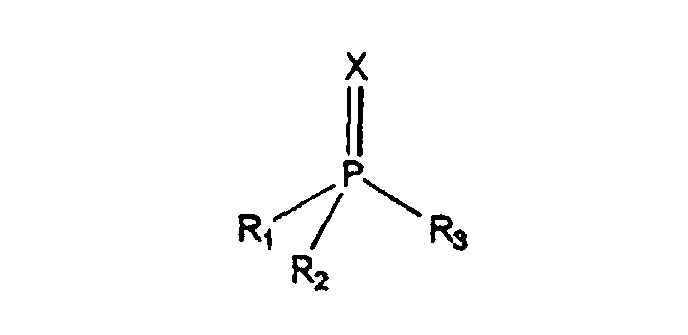
- R1, R2 and R3 may each be any non-interfering group. Examples are alkyl, aryl, heteroaryl, alkoxy, aryloxy, heteroaryloxy, thioalkyl, thioaryl, thioheteroaryl, aminoalkyl (primary, secondary, tertiary), aminoaryl, imino.
- Preferably, R1 or R2 carries a perfluorinated carbon chain or partially fluorinated carbon, siloxy or short polyether chain. The carbon chain is a substituent in its own right or a group within the chosen substituent. It is selected from chain length C1 to C40, preferably C4 to C8 and most preferably C6. It may be branched or linear. Typically, the perfluorinated part comprises at least 1, 2, 3, 4, 5 or more C atoms.
- R1, R2 and R3 may be further modified by carrying another metal-chelating substituent such as a phosphine, nitrogen, oxygen or sulfur-based functionality or arsine.
- The phosphorus in formula 1 may instead be arsenic.
- For specific applications, one preference is for R1=R2=CH2CH2C6F13 and R3=Ph. The perfluorinated group is part of the substituent.
- The use of fluorinated ligands increases the solubility of ligand-metal complexes in compressed CO2. It is also shown that solubility for a given complex is dependant upon the degree of fluorination. Metal that may show the effect of improved solubility with fluorinated ligands is Pd. Palladium (II), leading to a reactive palladium (0) species is preferred.
- A range of catalyst concentrations may be employed in metal-catalysed processes. Typical concentrations are in the range of 0.01-50 mol% versus substrate, with preference for 1-10 mol%, specifically 1-5 mol% catalyst concentration.
- The yield of product for a given process is dependant on the time of reaction, catalyst concentration, temperature and the identity of other reagents.
- A range of reaction types may be conducted in compressed CO2 and fluorinated ligand-metal complexes are versatile catalysts in compressed CO2. Both intramolecular and intermolecular metal-catalysed processes may be conducted. Specific types of reactions that may be conducted using fluorinated ligand-metal complexes are hydrogenation, hydroboration, hydrosilylation, hydrocyanation, hydroformylation, allylic substitution, carbonylation, cross-coupling processes, cyclisation processes, conjugate addition, oxidation and epoxidation. Preferably, palladium-mediated carbon-carbon bond forming reactions take place. Most specifically, Heck [see Heck, "Palladium Reagents in Organic Synthesis", Academic Press, Orlando. 1985], Suzuki [see Migaura et al, Syn. Commun. (1981) 11, 513]; Sonogashira [see Sonogashira et al, Tetrahedron. Lett. (1975) 4467] couplings are surprisingly effective in compressed CO2. This is surprising, because polar solvents are specifically preferred for the Heck reaction [see Spencer, J. Organomet. Chem. (1983) 258, 101]. Further, boronic acids of the type suitable for use in the Suzuki reaction are surprisingly soluble in CO2.
- For the Heck reaction, it is particularly preferred to use an aryl iodide as the substrate. As the complex, palladium acetate is preferred since it is reactive, gives good yields and can be generated in situ.
- An important advantage of this invention is the surprising ease of product isolation in comparison to conventional techniques. Improvements in product separation and purification using tandem supercritical fluid extraction (SFE) and supercritical fluid chromatography (SFC) are expected. Other advantages in this area of process development may include the use of the catalysts in solid-phase synthesis.
- The process of this invention is particularly suited to the use of palladium-mediated coupling reactions in compressed CO2, in which there are one or more reactants supported on resins or dendrimers which undergo swelling by compressed CO2. This may accelerate reaction rates and enhance mass transport within the supported reactant.
- The second aspect of this invention refers to the formation of cross-linked polymers in compressed CO2 (by way of example only "scCO2" may be discussed below) by the polymerisation of multi-functional monomers containing two or more polymerisable functional groups. Examples of such monomers are bi- / multi-functional styrene monomers, bi- / multi-functional methacrylate monomers, bi- / multi-functional acrylate monomers, bi- / multi-functional allyl ether monomers, bi- / multi-functional epoxide monomers, and bi- / multi-functional oxetane monomers. The most preferred monomers are divinylbenzene 1, ethylene glycol dimethacrylate 2, and trimethylol propane trimethacrylate 3

- It will be evident that the polymerisation process of the invention may utilise one or more monomers. There may be one or more monomers containing two or more polymerisable groups, optionally together with one or more of other copolymerisable monomers. The weight of the cross-linker with respect to total monomer weight is typically 2-100%, preferably 40-100%. Using more than 50% of a styrenic monomer such as DVB, and a concentration of monomers in CO2 of between 15 and 40 vol%, surfactant is unnecessary. If less reactive monomers, and therefore also a surfactant, are used, the monomer concentration in CO2 is less critical.
- The cross-linked polymers can be isolated as dry, free-flowing powders, directly from the reactor. Since the solvent, CO2, reverts to a gas upon depressurisation, no solvent residues are left in the resulting cross-linked polymers, and the use of VOC solvents is avoided.
- Under certain conditions, regular polymeric microspheres (1-5 µm diameter) can be formed by suspension polymerisation in the absence of any added surfactants or stabilisers. In the presence of a surfactant, highly regular cross-linked microspheres (<0.5 µm diameter) can be formed by emulsion polymerisation in scCO2.
- The polymerisation procedure works efficiently in scCO2 when thermal-free radical initiation is used, employing 2,2'-azobisisobutyronitrile (AIBN) at 65°C as the preferred initiator. Other free-radical initiators (either thermally or photochemically-decomposed) may be used, as may be cationic initiators, e.g. in the case of ring-opening polymerisations of oxirane/oxetane-based cross-linking monomers.
- scCO2 is a useful and versatile solvent for the synthesis of cross-linked resins in the form of uniform microspheres with precise control of particle size and morphology. The ease of separation of solvent from solute is an important advantage. Other advantages may include the formation of macroporous cross-linked structures by swelling with scCO2, and the tuning of cross-linked particle size and morphology by the variation of CO2 pressure during polymerisation. A range of cross-linked copolymers may be generated, by copolymerisation of the cross-linker with comonomers which contain surface-active or derivatisable/reactive functional groups.
- Preferred comonomers of this type contain alkyl, alkyl chloride, aryl fluoride, fluoroalkyl and carboxylic acid functional groups. Specific examples are:

- Other suitable comonomers contain poly(dimethyl siloxane) chains, low molecular weight poly(ethylene glycol) chains, perfluoropolyether chains, alkyl bromides, alkyl iodides, alcohols (alkyl and aryl), protected alcohols (alkyl and aryl), esters (alkyl and aryl), aldehydes (alkyl and aryl), amines (alkyl and aryl), amides (alkyl and aryl), crown ethers, porphyrins, fluorescent functional groups, radio-labelled functional groups, template groups for molecular imprinting, hygroscopic groups for the formation of superabsorbent polymers, functional groups for affinity chromatography, derivatisable functional groups for parallel synthesis on well-defined polymer beads, organic dyes, pharmaceutical molecules for controlled drug delivery, inorganic/organic reagents for organic synthesis, and transition metal/main group metal catalysts.
- By way of example, cross-linked polymer microspheres incorporating a dispersed organic dye can be synthesised by this method. The polymer environment may contain functional groups of the type used in molecular imprinting (e.g. the carboxylic acid functionalities in a methacrylic acid comonomer). Cross-linked microspheres may incorporate other molecules, such as template molecules for molecular imprinting, pharmaceuticals for controlled release, biomolecules, fluorescent molecules, odour-releasing molecules (e.g. fragrances), rigid rod fluorophores, LED fluorescent emitters, and molecules with magnetic properties.
- Any surfactant used in the invention should be soluble in CO2. The amount of surfactant that is used may be, for example, 0.25 to 5% w/w, preferably about 3% w/w, with respect to monomer.
- A CO2-soluble, diblock copolymer surfactant has been synthesised by a modified screened anionic polymerisation (SAP) route [see Yong et al, Chem. Commun. (1997) 1811]. It has the formulaThe copolymer, which contains a CO2-soluble fluorinated segment and a methacrylate-based anchoring segment, was found to be highly soluble in scCO2. The use of this surfactant has been shown to lead to the formation of uniform cross-linked microspheres (diameter <0.5 µm) by emulsion polymerisation in scCO2. The most preferred surfactants are diblock copolymers prepared by screened anionic polymerisation consisting of a CO2-soluble poly(fluoro methacrylate) block and a CO2-insoluble poly(methyl methacrylate) anchoring block. Other surfactants that may be suitable use in the invention are fluorinated graft copolymers, siloxane-based graft copolymers, diblock copolymer surfactants consisting of a CO2-soluble poly(fluoro methacrylate) block and a CO2-insoluble poly(styrene) anchoring block, diblock copolymer surfactants consisting of a CO2-soluble poly(siloxane) block and a CO2-insoluble poly(methyl methacrylate) anchoring block, and diblock coplymer surfactants consisting of a CO2-soluble poly(siloxane) block and a CO2-insoluble poly(styrene) anchoring block.
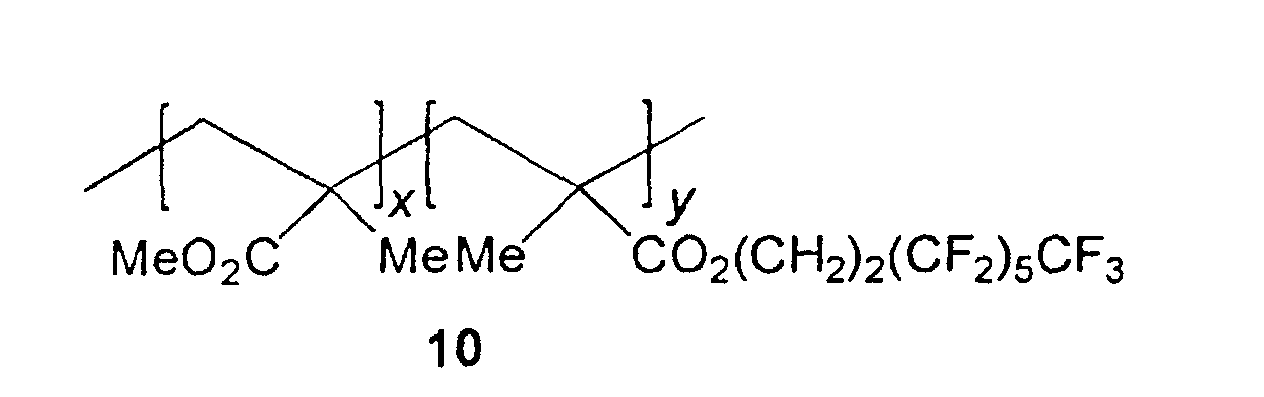
- Accordingly, cross-linked copolymers are synthesised in scCO2 and can be isolated directly from the reactor in the form of uniform microspherical particles both with and, unexpectedly, without the use of added surfactants.
- The following Examples illustrate the invention.
- A solution of 1H, 1H, 2H, 2H-perfluorooctyl iodide (9.48 g, 20 mmol) in ether (40 ml) was added to a suspension of magnesium turnings (960 mg, 40 mmol), with a trace of iodine, also in ether (40 ml). The mixture was stirred at room temperature overnight, the stirring was stopped and the remaining solids allowed to settle. The resulting Grignard reagent, as a solution in ether, was added via cannula to a solution of chlorodiphenylphosphine (2.20 g, 10 mmol) also in ether (40 ml). This addition was accompanied by the rapid formation of a white precipitate. The mixture was stirred at room temperature for a further 3 hrs when aqueous hydrochloric acid (100 ml of a 1M solution) was added. The mixture was extracted with ether (4 x 250 ml) and the organic fractions combined, dried (MgSO4) and concentrated in vacuo to give the crude product (7.29 g) which was used in the next step without purification.
- Sodium periodate (3.0 g, 15 mmol) was added to a solution of the crude phosphine (7.29 g) in acetone (100 ml) and the mixture stirred at room temperature overnight. The solvent was removed in vacuo and water (200 ml) added, the resulting mixture was extracted with ether (4 x 250 ml) and the organic fractions combined, dried (MgSO4) and concentrated in vacuo to give the crude product. The product was purified by flash column chromatography on silica gel, eluting with methanol-dichloromethane (5: 95) to give a white crystalline solid (4.64 g, 8.47 mmol, 85%), mp (CH2Cl2) 103-105 C (Found: M+, 549.0610. C20H14F13PO requires M+, 549.0653).
- A solution of 1H, 1H, 2H, 2H-perfluorooctyl iodide (18.96 g, 40 mmol) in ether (80 ml) was added to a suspension of magnesium turnings (1.920 g, 80 mmol), with a trace of iodine, also in ether (40 ml). The mixture was stirred at room temperature overnight, the stirring was stopped and the remaining solids allowed to settle. The resulting Grignard reagent, as a solution in ether, was added via cannula to a solution of dichlorophenylphosphine (1.79 g, 10 mmol) also in ether (80 ml). This addition was accompanied by the rapid formation of a white precipitate. The mixture was stirred at room temperature for a further 3 hrs when aqueous hydrochloric acid (100 ml of a 1M solution) was added. The mixture was extracted with ether (4 x 250 ml) and the organic fractions combined, dried (MgSO4) and concentrated in vacuo to give the crude product (10.18 g) which was used in the next step without purification.
- Sodium periodate (3.0 g, 15 mmol) was added to a solution of the crude phosphine (10.18 g) in acetone (100 ml) and the mixture stirred at room temperature overnight. The solvent was removed in vacuo and water (200 ml) added, the resulting mixture was extracted with ether (4 x 250 ml) and the organic fractions combined, dried (MgSO4) and concentrated in vacuo to give the crude product. The product was purified by flash column chromatography on silica gel, eluting with dichloromethane to give a white crystalline solid (5.94 g, 7.26 mmol, 73%), mp (CH2Cl2) 91-93 C (Found: M+, 819.0313. C22H13F26PO requires M+, 819.0367).
- Trichlorosilane (0.1 ml, 1 mmol) was added, at room temperature, to a suspension of (1H, 1H, 2H, 2H-perfluorooctyl)diphenylphosphine oxide (55 mg, 0.1 mmol) and triethylamine (0.1 ml, 0.7 mmol) in toluene (5 ml). The mixture was then heated at 100 C overnight and then allowed to cool. Aqueous sodium hydroxide (40 ml of a 1M solution) was added and the resulting mixture extracted with ether (4 x 25 ml). The organic fractions were combined, dried (MgSO4) and concentrated in vacuo to give the crude product. The product was purified by flash column chromatography on silica gel, eluting with hexane to give a white crystalline solid (42 mg, 0.079 mmol, 79%), mp (CH2Cl2) 44-45 °C (Found: M+, 532.0600. C20H14F13P requires M+, 532.0625).
- Trichlorosilane (1 ml, 10 mmol) was added, at room temperature, to a solution of di(1H, 1H, 2H, 2H-perfluorooctyl)phenylphosphine oxide (818 mg, 1 mmol) and triethylamine (1 ml, 7.2 mmol) in toluene (40 ml). The mixture was then heated at 100 C overnight and then allowed to cool. Aqueous sodium hydroxide (100 ml of a 1M solution) was added and the resulting mixture extracted with ether (3 x 250 ml). The organic fractions were combined, dried (MgSO4) and concentrated in vacuo to give the crude product. The product was purified by flash column chromatography on silica gel, eluting with hexane to give a white crystalline solid (710 mg, 0.88 mmol, 88%), mp (CHCl3) 37-39 °C (Found: M+, 802.0319. C22H13F26P requires M+, 802.0339).
- A solution of (1H,1H,2H,2H-perfluorooctyl)diphenylphosphine (53 mg, 0.1 mmol) in chloroform (1 ml) was added to bis(acetonitrile)palladium dichoride (13 mg, 0.05 mmol). After 1 hr the solution was concentrated in vacuo to give the product as a orange crystalline solid (53 mg, 0.043 mmol, 86%), mp (CH2Cl2) 149-151 C (Found: M+-Cl, 1205.0061. C40H28C12F26P2Pd requires M+-Cl, 1204.9974).
- A solution of di(1H,1H,2H,2H-perfluorooctyl)phenylphosphine (401 mg, 0.5 mmol) in dichloromethane (5 ml) was added to bis(acetonitrile)palladium dichoride (65 mg, 0.25 mmol). After 1 hr the solution was concentrated in vacuo to give the product as a orange crystalline solid (435 mg, 0.244 mmol, 97%), mp (CH2Cl2) 91-93 C (Found: M+-Cl, 1744.9402. C44H26Cl2F52P2Pd requires M+-Cl, 1744.9403).
- Bis{di(1H,1H,2H,2H-perfluorooctyl)phenylphosphino}palladium dichloride (89 mg, 0.05 mmol), copper (I) iodide (9 mg, 0.05 mmol), iodobenzene (0.11 ml, 1 mmol), phenylacetylene (0.11 ml, 1 mmol) and triethylamine (0.15 ml, 1.1 mmol) were placed in a 10 ml stainless steel cell. The cell was sealed and pressurised to approximately 6900 kPa (1000 psi) (full of carbon dioxide). The cell was then heated to 60 C for 40 hrs and then allowed to cool. When the pressure had dropped below 13800 kPa (2000 psi), the cell was vented into ether (100 ml), the cell was opened once atmospheric pressure was reached and washed out with a further quantity of ether (20 ml). The extracts were combined and washed with water (100 ml). The resultant aqueous layer was further extracted with ether (2 x 100 ml) and the organic fractions combined, dried (MgSO4) and concentrated in vacuo to give the crude product. The product was purified by flash column chromatography on silica gel, eluting with hexane to give a white crystalline solid (105 mg, 0.60 mmol, 60%); δH (250 MHz; CDCl3) 7.56-7.61 (4 H, m, o-Ph), 7.33-7.43 (6 H, m, m/p-Ph); δc 131.7 (o-C), 128.5 (m-Ph), 128.4 (p-Ph), 123.4 (quaternary Ph), 89.5 (alkyne).
- The reaction was also conducted at higher temperatures (80 and 100 C) by the same procedure, except that the cell was filled approximately three quarters full with carbon dioxide and then brought to the reaction temperature. Once at this temperature, the pressure was increased until approx. 25600 kPa (4000 psi).
- Di(1H,2H,2H-perfluorooctyl)phenylphosphine (80 mg, 0.1 mmol), palladium (II) acetate (11 mg, 0.05 mmol), N-allyl-2-iodoaniline (259 mg, 1 mmol) and triethylamine (0.15 ml, 1.1 mmol) were placed in a 10 ml stainless steel cell. The cell was sealed and pressurised to approximately 5520 kPa (800 psi) (i.e. full of carbon dioxide). The cell was then heated to 100 C for 64 hrs and then allowed to cool. When the pressure had dropped below 13800 kPa (2000 psi), the cell was vented into ether (100 ml), the cell was opened once atmospheric pressure was reached and washed out with dichloromethane (20 ml). The organic fractions were combined and concentrated in vacuo to give the crude product. The product was purified by flash column chromatography on silica gel, eluting with 20% ether in hexane to give a white crystalline solid (49 mg, 0.37 mmol, 37%); δH (250 MHz; CDCl3) 7.85 (1 H, br, NH), 7.63 (1 H, m, H7), 7.34 (1 H, m, H4), 7.15-7.26 (2 H, m, H5 and H6), 6.97 (1 H, s, NHCH), 2.38 (3 H, s, Me).
- Bis{di(1H,1H,2H,2H-perfluorooctyl)phenylphosphino}palladium dichloride (89 mg, 0.05 mmol), iodobenzene (0.11 ml, 1 mmol), phenylboronic acid (122 mg, 1 mmol) and triethylamine (0.15 ml, 1.1 mmol) were placed in a 10 ml stainless steel cell. The cell was sealed and pressurised to approximately 5520 kPa (800 psi) (i.e. full of carbon dioxide). The cell was then heated to 100 C for 64 hrs and then allowed to cool. When the pressure had dropped below 13800 kPa (2000 psi) the cell was vented into ether (100 ml), the cell was opened once atmospheric pressure was reached and washed out with dichloromethane (20 ml). The organic fractions were combined and concentrated in vacuo to give the crude product. The product was purified by flash column chromatography on silica gel, eluting with hexane to give a white crystalline solid (80 mg, 0.52 mmol, 52%); δ H (250 MHz; CDCl3) 7.34-7.65 (10 H, m, aryl).
- Bis{di(1H,1H,2H,2H-perfluorooctyl)phenylphosphino}palladium dichloride (89 mg, 0.05 mmol), iodobenzene (0.11 ml, 1 mmol), thiophene-2-boronic acid (128 mg, 1 mmol) and triethylamine (0.15 ml, 1.1 mmol) were placed in a 10 ml stainless steel cell. The cell was sealed and pressurised to approximately 5520 kPa (800 psi) (i.e. full of carbon dioxide). The cell was then heated to 100 C for 64 hrs and then allowed to cool. When the pressure had dropped below 13800 kPa (2000 psi) the cell was vented into ether (100 ml), the cell was opened once atmospheric pressure was reached and washed out with dichloromethane (20 ml). The organic fractions were combined and concentrated in vacuo to give the crude product. The product was purified by flash column chromatography on silica gel, eluting with hexane to give a white crystalline solid (78 mg, 0.49 mmol, 49%); δH (250 MHz; CDCl3) 7.09-7.66 (8 H, m, aryl and thienyl).
- The following reactions and conditions were used: iodide (1.0 mmol), alkene (1.0 mmol), triethylamine (1.1 mmol), catalyst (5 mol%), 40 h, 100°C.
- A typical procedure was as follows: bis(1H,1H,2H,2H-perfluorooctyl)phenylphosphine (80 mg, 0.1 mmol), palladium (II) acetate (11 mg, 0.05 mmol), iodobenzene (0.11 ml, 1 mmol), methyl acrylate (0.11 ml, 1 mmol) and triethylamine (0.15 ml, 1.1 mmol) were placed in a 10 ml stainless steel cell. The cell was sealed and pressurised to approximately 6900 kPa (1000 psi) (about ¾ full of liquid carbon dioxide). The suspended reagents were magnetically stirred and afforded a dark red-coloured medium as the cell was heated to 100°C. The reagents were stirred at this temperature for 40 h when a crystalline deposit formed on the sapphire window. The cell was then cooled, and when the pressure had dropped below 13800 kPa (2000 psi), the cell was vented into ether (100 ml), the cell was opened once atmospheric pressure was reached and washed out with a quantity of dichloromethane (10 ml). The organic fractions were combined and concentrated in vacuo to give the crude product. The product was purified by flash column chromatography on silica gel, eluting with dichloromethane to give trans-methylcinnamate as a white crystalline solid (157 mg, 0.97 mmol, 97%); [CAS 1754-62-7] mp 35-37°C.
- This and other Heck reactions are tabulated below.
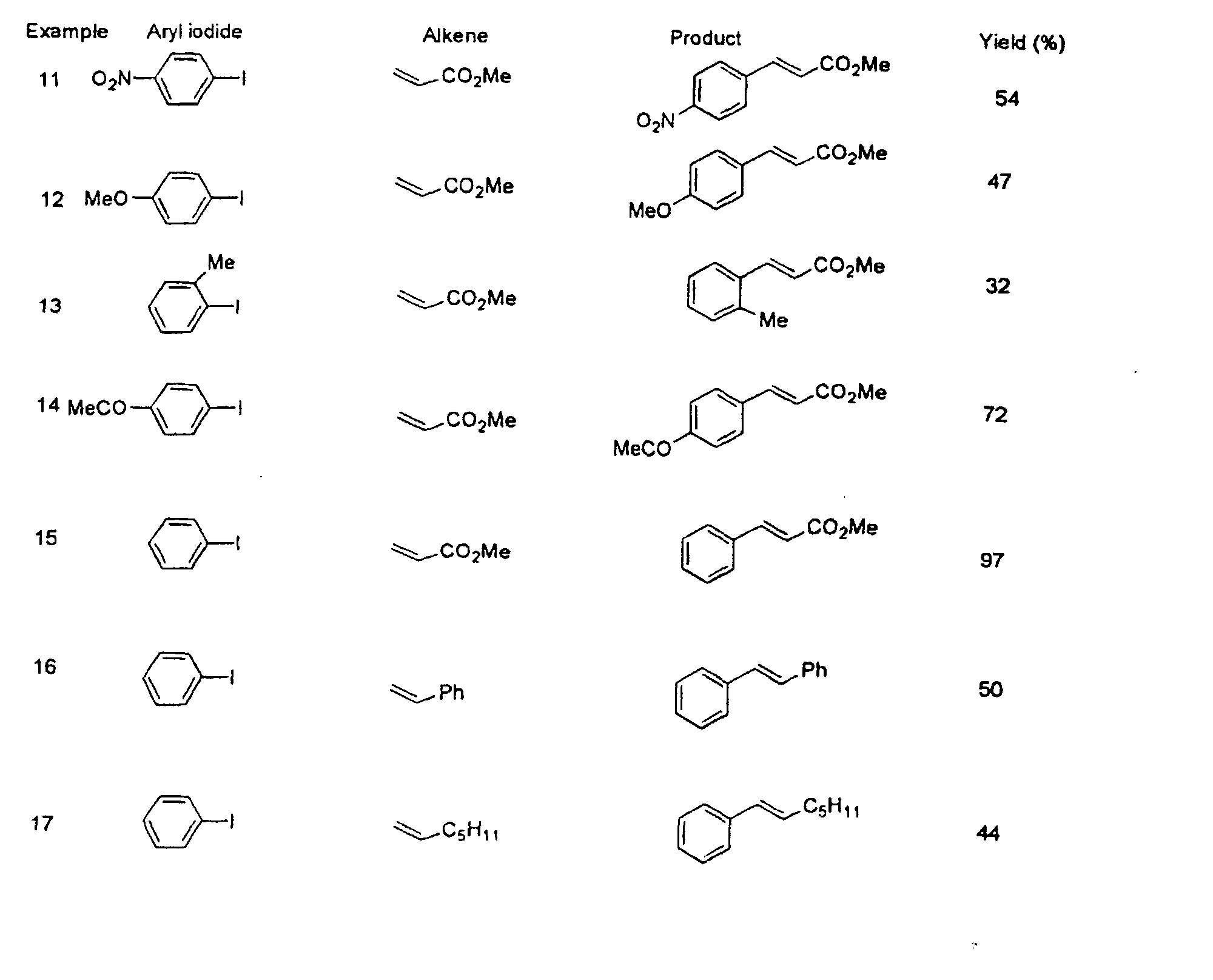
- Bis(1H, 1H,2H,2H-perfluorooctyl)phenylphosphine (14.5 mg, 0.019 mmol), palladium (II) acetate (2 mg, 0.009 mmol), iodobenzene (0.02 ml, 0.22 mmol), REM Resin (Aldrich, 250 mg, 0.25-1.25 mmol) and triethylamine (0.03 ml, 0.22 mmol) were placed in a 10 ml stainless steel cell. The cell was sealed and pressurised to approximately 6900 kPa (1000 psi) (about ¾ full of liquid carbon dioxide). The suspended reagents were magnetically stirred and afforded a dark red-coloured medium, the resin remained as a powder in the bottom of the cell. The cell was heated to 100°C and the reaction mixture stirred at this temperature for 40 h. The cell was then cooled, and when the pressure had dropped below 13800 kPa (2000 psi), the cell was vented into ether (100 ml), the cell was opened once atmospheric pressure was reached and washed out with a quantity of dichloromethane (10 ml). The resulting resin was removed from the cell and washed (Soxhlet) with dichloromethane (100 ml) for 24 h. The resin was then dried under vacuum, to a constant weight, (257 mg) and a portion taken for analysis and release of the product by transesterification. The resin (102 mg, <0.05 mmol) was suspended in a solution of sodium methoxide (8 mg, 0.15 mmol) in methanol (2 ml) and THF (8 ml). The mixture was heated at reflux for 24 h, after cooling the resin was removed by filtration and washed with methanol (5 ml) and ether (5 ml). The filtrate was concentrated in vacuo and the product purified by flash chromatography on silica gel, eluting with 10% ether in hexane to give the title compound as a white crystalline solid (6 mg, 0.037 mmol, >74%). [CAS 1754-62-7] mp 35-37°C.
- A mixture of monomers 1 and 4 (55:45 wt/wt) was purified by passing though a neutral alumina column. This mixture (2.0 g) and 2,2'-azobisisobutyronitrile (AIBN, 0.16 g) was added to a 10 mL high pressure reactor, equipped with a sapphire window for the observation of phase behaviour. The reactor was purged with a slow flow of CO2 for 20 min, after which time the vessel was filled with liquid CO2 (T = 22°C, P = 64 bar) and stirring was commenced using a PTFE-coated magnetic stir bar. Under these initial conditions, much of the monomer mixture was insoluble in the liquid CO2 phase, and the reaction mixture existed as a white, cloudy suspension. The reactor was heated to achieve the required polymerisation conditions (65°C, P = 290 ± 10 bar) and a fine white precipitate began to form in the reactor after around 90 min. The reactor was left stirring at 65°C for 24 h, after which the system was cooled to ambient temperature. The CO2 was vented slowly though acetone to trap any polymer/monomer that might otherwise escape during venting. The polymer was removed from the reactor as a dry, white, free-flowing powder. The reactor was then rinsed with acetone to collect any residual solids. The polymeric product was washed by suspension in a solvent (∼25 mL) followed by centrifuging and decanting. This procedure was repeated twice, both with THF and with methanol. The polymer was then left under acetone overnight, resuspended twice in ethanol, centrifuged, decanted, and dried under vacuum at 50 °C. There was no apparent weight loss after the washing procedure, and no soluble polymer fraction was detected. The purified polymer was isolated as a white powder (1.78 g, 89%). Found: C, 90.2; H, 8.3; Calculated: C, 91.6; H, 8.4%. IR (KBr)/cm-1: 3450, 3018, 2964, 2925, 1603, 1511, 1486, 1449, 903, 834, 795, 710.
- A mixture of monomers 1 and 4 (55:45 wt/wt) was purified by passing though a neutral alumina column. This mixture (4.34 g) and AIBN (0.35 g) was added to a 10 mL high pressure reactor, equipped with a sapphire window for the observation of phase behaviour. The reactor was purged with a slow flow of CO2 for 20 min, after which time the vessel was filled with liquid CO2 (T = 24°C, P = 95 bar) and stirring was commenced using a PTFE-coated magnetic stir bar. Under these initial conditions, much of the monomer mixture was insoluble in the liquid CO2 phase, and the reaction mixture existed as a white, cloudy suspension. The reactorwas heated to achieve the required polymerisation conditions (65°C, P = 318 ± 10 bar) and a fine white precipitate began to form in the reactor after around 30 min. The reactor was left stirring at 65°C for 24 h, after which the system was cooled to ambient temperature. The CO2 was vented slowly though acetone to trap any polymer/monomer that might otherwise escape during venting. The polymer was removed from the reactor as a dry, white, free-flowing powder. The same purification procedures were used as for Example 19. The purified polymer was isolated as a white powder (4.29 g, 99%). Found: C, 88.7; H, 8.0; Calculated: C, 91.6; H, 8.4%. IR (KBr)/cm-1: 3450, 3018, 2964, 2925, 1603, 1511, 1486, 1449, 903, 834, 795, 710.
- A mixture of monomers 1 and 4 (80:20 wt/wt) was purified by passing though a neutral alumina column. This mixture (2.0 g) and AIBN (0.16 g) was added to a 10 mL high pressure reactor, equipped with a sapphire window for the observation of phase behaviour. The reactor was purged with a slow flow of CO2 for 20 min, after which time the vessel was filled with liquid CO2 (T = 24°C, P = 66 bar) and stirring was commenced using a PTFE-coated magnetic stir bar. Under these initial conditions, much of the monomer/polymer mixture was insoluble in the liquid CO2 phase, and the reaction mixture existed as a white, cloudy suspension, possibly due to early oligomerisation/polymerisation before the vessel was brought up to the reaction temperature. The reactor was heated to achieve the required polymerisation conditions (65°C, P = 333 ± 10 bar) and a fine white precipitate began to form in the reactor after a few minutes. The reactor was left stirring at 65°C for 24 h, after which the system was cooled to ambient temperature. The CO2 was vented slowly though acetone to trap any polymer/monomer that might otherwise escape during venting. The polymer was removed from the reactor as a dry, white, free-flowing powder. The same purification procedures were used as for Example 19. The purified polymerwas isolated as a white powder (1.84 g, 92%). Found: C, 90.1; H, 8.0; Calculated: C, 91.9; H, 8.0%. IR (KBr)/cm-1: 3450, 3018, 2964, 2925, 1603, 1511, 1486, 1449, 903, 834, 795, 710.
- A mixture of 2 (2.0 g) and AIBN (0.16 g) was added to a 10 mL high pressure reactor, equipped with a sapphire window for the observation of phase behaviour. The reactor was purged with a slow flow of CO2 for 20 min, after which time the vessel was filled with liquid CO2 (T = 23°C, P = 84 bar) and stirring was commenced using a PTFE-coated magnetic stir bar. Under these initial conditions, the monomer was soluble in the liquid CO2 phase, and the reaction mixture was homogeneous. The reactor was heated to achieve the required polymerisation conditions (65°C, P = 295 ± 10 bar), whereupon a yellow colour was observed briefly and a fine white precipitate began to form in the reactor after a few minutes. The reactor was left stirring at 65°C for 24 h, after which the system was cooled to ambient temperature. The CO2 was vented slowly though acetone to trap any polymer/monomer that might otherwise escape during venting. The polymer was removed from the reactor as a dry, white, free-flowing powder. The same purification procedures were used as for Example 19. The purified polymer was isolated as a white powder (1.60 g, 80%). IR (KBr)/cm-1: 2997, 2964, 1737, 1468, 1395, 1356, 1245, 1214, 1150.
- A mixture of 3 (2.0 g) and AIBN (0.16 g) was added to a 10 mL high pressure reactor, equipped with a sapphire window for the observation of phase behaviour. The reactor was purged with a slow flow of CO2 for 20 min, after which time the vessel was filled with liquid CO2 (T = 27°C, P = 82 bar) and stirring was commenced using a PTFE-coated magnetic stir bar. Under these initial conditions, the monomer was soluble in the liquid CO2 phase, and the reaction mixture was homogeneous. The reactor was heated to achieve the required polymerisation conditions (65°C, P = 300 ± 10 bar), whereupon a yellow colour was observed briefly and a fine white precipitate began to form in the reactor after around 30 minutes. The reactor was left stirring at 65°C for 24 h, after which the system was cooled to ambient temperature. The CO2 was vented slowly though acetone to trap any polymer/monomer that might otherwise escape during venting. The polymer was removed from the reactor as a dry, white, free-flowing powder. The same purification procedures were used as for Example 19. The purified polymer was isolated as a white powder (1.87 g, 93.5%). Found: C, 62.3; H, 7.6; Calculated: C, 63.9; H, 7.8%. IR (KBr)/cm-1: 2970, 1735, 1650, 1559, 1542, 1517, 1490, 1461, 1264, 1152.
- A mixture of monomers 1 (1.02 g), 4(0.83 g) and 5 (0.28 g) and AIBN (0.16 g) was added to a 10 mL high pressure reactor, equipped with a sapphire window for the observation of phase behaviour. The reactor was purged with a slow flow of CO2 for 20 min, after which time the vessel was filled with liquid CO2 (T = 25°C, P = 106 bar) and stirring was commenced using a PTFE-coated magnetic stir bar. Under these initial conditions, much of the monomer mixture was insoluble in the liquid CO2 phase, and the reaction mixture existed as a white, cloudy suspension. The reactor was heated to achieve the required polymerisation conditions (65°C, P = 327 ± 10 bar) and a fine white precipitate began to form in the reactor after around 30 min. The reactor was left stirring at 65°C for 24 h, after which the system was cooled to ambient temperature. The CO2 was vented slowly though acetone to trap any polymer/monomer that might otherwise escape during venting. The polymer was removed from the reactor as a dry, white, free-flowing powder. The same purification procedures were used as for Example 19. The purified polymer was isolated as a white powder (1.95 g, 92%). Found: C, 87.64; H, 8.02; Cl, 2.70; Calculated: C, 89.55; H, 8.13%; Cl, 2.32. IR (KBr)/cm-1: 3450, 3018, 2964, 2925, 1603, 1511, 1486, 1449, 903, 834, 795, 710.
- A mixture of monomers 1 (0.99 g), 4 (0.81 g) and 6 (0.20 g) and AIBN (0.16 g) was added to a 10 mL high pressure reactor, equipped with a sapphire window for the observation of phase behaviour. The reactor was purged with a slow flow of CO2 for 20 min, after which time the vessel was filled with liquid CO2 (T = 26°C, P = 81 bar) and stirring was commenced using a PTFE-coated magnetic stir bar. Under these initial conditions, much of the monomer mixture was insoluble in the liquid CO2 phase, and the reaction mixture existed as a white, cloudy suspension. The reactor was heated to achieve the required polymerisation conditions (65°C, P = 286 ± 10 bar) and a fine white precipitate began to form in the reactor after a few minutes. The reactor was left stirring at 65°C for 24 h, after which the system was cooled to ambient temperature. The CO2 was vented slowly though acetone to trap any polymer/monomer that might otherwise escape during venting. The polymer was removed from the reactor as a dry, white, free-flowing powder. The same purification procedures were used as for Example 19. The purified polymer was isolated as a white powder (1.79 g, 90%). Found: C, 86.3; H, 7.6; Calculated: C, 87.4; H, 7.6%. IR (KBr)/cm-1: 3450, 3018, 2964, 2925, 1603, 1511, 1486, 1449, 903, 834, 795, 710.
- A mixture of monomers 1 (0.99 g), 4 (0.81 9) and 7 (0.20 g) and AIBN (0.16 g) was added to a 10 mL high pressure reactor, equipped with a sapphire window for the observation of phase behaviour. The reactor was purged with a slow flow of CO2 for 20 min, after which time the vessel was filled with liquid CO2 (T = 22°C, P = 85 bar) and stirring was commenced using a PTFE-coated magnetic stir bar. Under these initial conditions, much of the monomer mixture was insoluble in the liquid CO2 phase, and the reaction mixture existed as a white, cloudy suspension. As the reactor was heated, the solution gradually became homogeneous (T >37°C, P >179 bar). A deep red colour was formed under the polymerisation conditions (65°C, P = 332 ± 10 bar), followed by the formation of a fine in the reactor after a few minutes. The reactor was left stirring at 65°C for 24 h, after which the system was cooled to ambient temperature. The CO2 was vented slowly though acetone to trap any polymer/monomer that might otherwise escape during venting. The polymer was removed from the reactor as a dry, white, free-flowing powder. The same purification procedures were used as for Example 19. The purified polymer was isolated as a white powder (1.79 g, 90%). Found: C, 89.5; H, 8.7; Calculated: C, 90.2; H, 8.8%. IR (KBr)/cm-1: 2854, 1731, 1603, 1486, 1449, 901, 795, 708.
- A mixture of monomers 1 (0.99 g), 4 (0.81 g) and 8 (0.20 g) and AIBN (0.16 g) was added to a 10 mL high pressure reactor, equipped with a sapphire window for the observation of phase behaviour. The reactor was purged with a slow flow of CO2 for 20 min, after which time the vessel was filled with liquid CO2 (T = 28°C, P = 103 bar) and stirring was commenced using a PTFE-coated magnetic stir bar. Under these initial conditions, much of the monomer mixture was insoluble in the liquid CO2 phase, and the reaction mixture existed as a white, cloudy suspension. The reactor was heated to achieve the required polymerisation conditions (65°C, P = 276 ± 10 bar) and a fine white precipitate began to form in the reactor after a few minutes. The reactor was left stirring at 65°C for 24 h, after which the system was cooled to ambient temperature. The CO2 was vented slowly though acetone to trap any polymer/monomer that might otherwise escape during venting. The polymer was removed from the reactor as a dry, white, free-flowing powder. The same purification procedures were used as for Example 19. The purified polymer was isolated as a white powder (1.80 g, 90%). Found: C, 85.1; H, 7.8; N, 0.9; S, 0.4; Calculated: C, 85.5; H, 7.7; N, 0.2; S, 0.5. IR (KBr)/cm-1: 3020, 2966, 2927, 1733, 1601, 1484, 1447, 1240, 1213, 1154.
- A mixture of monomers 1 (1.28 g), 4 (0.32 g) and 9 (0.40 g) and AIBN (0.16 g) was added to a 10 mL high pressure reactor, equipped with a sapphire window for the observation of phase behaviour. The reactor was purged with a slow flow of CO2 for 20 min, after which time the vessel was filled with liquid CO2 (T = 29°C, P = 86 bar) and stirring was commenced using a PTFE-coated magnetic stir bar. Under these initial conditions, the monomer mixture was soluble in the liquid CO2 phase, and the reaction mixture existed as a homogeneous solution. The reactor was heated to achieve the required polymerisation conditions (65°C, P = 282 ± 10 bar) and a pale yellow colour was observed, followed by the formation of a fine white precipitate in the reactor after a few minutes. The reactor was left stirring at 65°C for 24 h, after which the system was cooled to ambient temperature. The CO2 was vented slowly though acetone to trap any polymer/monomer that might otherwise escape during venting. The polymer was removed from the reactor as a dry, white, free-flowing powder. The same purification procedures were used as for Example 19. The purified polymer was isolated as a white powder (1.82 g, 91%). Found: C, 80.4; H, 7.6; Calculated: C, 84.8; H, 7.8%. IR(KBr)/cm-1 : 3047, 3016, 2967, 2931, 1700, 1602, 1449, 1214, 907, 799, 712.
- A mixture of monomers 1 and 4 (55:45 wt/wt) was purified by passing though a neutral alumina column. This mixture (2.0 g), AIBN (0.16 g) and surfactant 10 (60 mg) was added to a 10 mL high pressure reactor, equipped with a sapphire window for the observation of phase behaviour. The reactor was purged with a slow flow of CO2 for 20 min, after which time the vessel was filled with liquid CO2 (T = 22°C, P = 75 bar) and stirring was commenced using a PTFE-coated magnetic stir bar. Under these initial conditions, the monomer mixture was emulsified in the liquid CO2 phase, and the reaction mixture existed as a uniform, white opaque emulsion. The reactor was heated to achieve the required polymerisation conditions (65 °C, P = 310 ± 10 bar) and polymerisation was carried out. The emulsion persisted during polymerisation and a uniform white appearance was observed throughout. The reactor was left stirring at 65°C for 24 h, after which the system was cooled to ambient temperature. The CO2 was vented slowly though acetone to trap any polymer/monomer that might otherwise escape during venting. The polymer was removed from the reactor as a dry, white, free-flowing powder. The reactor was then rinsed with acetone to collect any residual solids. The same purification procedures were used as for Example 19. There was no apparent weight loss after the washing procedure, and no soluble polymer fraction was detected. The purified polymer was isolated as a white powder (1.92 g, 96%). Found: C, 89.9; H, 8.3; Calculated: C, 91.6; H, 8.4%. IR (KBr)/cm-1: 3450, 3018, 2964, 2925, 1603, 1511, 1486, 1449, 903, 834, 795, 710.
- A mixture of monomers 1 and 4 (80:20 wt/wt) was purified by passing though a neutral alumina column. This mixture (2.0 g), AIBN (0.16 g) and surfactant 10 (60 mg) was added to a 10 mL high pressure reactor, equipped with a sapphire window for the observation of phase behaviour. The reactor was purged with a slow flow of CO2 for 20 min, after which time the vessel was filled with liquid CO2 (T = 27°C, P = 77 bar) and stirring was commenced using a PTFE-coated magnetic stir bar. Under these initial conditions, the monomer mixture was emulsified in the liquid CO2 phase, and the reaction mixture existed as a uniform, white opaque emulsion. The reactor was heated to achieve the required polymerisation conditions (65°C, P = 286 ± 10 bar) and polymerisation was carried out. The emulsion persisted during polymerisation and a uniform white appearance was observed throughout. The reactor was left stirring at 65°C for 24 h, after which the system was cooled to ambient temperature. The CO2 was vented slowly though acetone to trap any polymer/monomer that might otherwise escape during venting. The polymer was removed from the reactor as a dry, white, free-flowing powder. The reactor was then rinsed with acetone to collect any residual solids. The same purification procedures were used as for Example 19. There was no apparent weight loss after the washing procedure, and no soluble polymer fraction was detected. The purified polymer was isolated as a white powder (1.90 g, 95%). Found: C, 88.3; H, 7.9; Calculated: C, 91.9; H, 8.0%. IR (KBr)/cm-1: 3450, 3018, 2964, 2925, 1603, 1511, 1486, 1449, 903, 834, 795, 710.
- A mixture of monomers 1 (1.28 g), 4 (0.32 g), 9 (0.40 g), AIBN (0.16 g) and surfactant 10 (60 mg) was added to a 10 mL high pressure reactor, equipped with a sapphire window for the observation of phase behaviour. The reactor was purged with a slow flow of CO2 for 20 min, after which time the vessel was filled with liquid CO2 (T = 25°C, P = 102 bar) and stirring was commenced using a PTFE-coated magnetic stir bar. Under these initial conditions, the monomer mixture was emulsified in the liquid CO2 phase, and the reaction mixture existed as a uniform, white opaque emulsion. The reactor was heated to achieve the required polymerisation conditions (65°C, P = 328 ± 10 bar) and polymerisation was carried out. The emulsion persisted during polymerisation and a uniform white appearance was observed throughout. The reactor was left stirring at 65°C for 24 h, after which the system was cooled to ambient temperature. The CO2 was vented slowly though acetone to trap any polymer/monomer that might otherwise escape during venting. The polymer was removed from the reactor as a dry, white, free-flowing powder. The same purification procedures were used as for Example 19. The purified polymer was isolated as a white powder (1.94 g, 97%). Found: C, 80.4; H, 7.6; Calculated: C, 84.8; H, 7.8%. IR (KBr)/cm-1: 3047, 3016, 2967, 2931, 1700, 1602, 1449, 1214, 907, 799, 712.
-

- A mixture of monomers 1 (1.28 g), 4 (0.32 g) and 9 (0.40 g), AIBN (0.16 g), Disperse Red 1 (60 mg), and surfactant 10 (60 mg) was added to a 10 mL high pressure reactor, equipped with a sapphire window for the observation of phase behaviour. The reactor was purged with a slow flow of CO2 for 20 min, after which time the vessel was filled with liquid CO2 (T = 28°C, P = 85 bar) and stirring was commenced using a PTFE-coated magnetic stir bar. Under these initial conditions, the monomer mixture was emulsified in the liquid CO2 phase, and the reaction mixture existed as a uniform, pale red, opaque emulsion. Nearly all of the dye, Disperse Red 1, which is insoluble in CO2 under these conditions, was dissolved in the emulsified monomer phase. The reactor was heated to achieve the required polymerisation conditions (65°C, P= 326 ± 10 bar) and polymerisation was carried out. The emulsion persisted during polymerisation and a uniform opaque red appearance was observed throughout. The reactor was left stirring at 65°C for 24 h, after which the system was cooled to ambient temperature. The CO2 was vented slowly though acetone to trap any polymer/monomer that might otherwise escape during venting. The polymer was removed from the reactor as a dry, pale red, free-flowing powder. (1.90 g, 92%). Found: C, 80.4; H, 7.6; N, 1.5; Calculated: C, 84.1; H, 7.8; N, 0.5%. IR (KBr)/cm-1: 3047, 3016, 2967, 2931, 1700, 1602, 1449, 1214, 907, 799, 712. The pale red polymer was treated by Soxhlet extraction (95°C, toluene, 72 h). After extraction, an off-white polymer was obtained, demonstrating that a large percentage of the dye was extractable from the cross-linked matrix.
- Scanning Electron Microscopy showed that the polymer products obtained in each of Examples 19 to 32 were substantially uniform, substantially spherical particles.
Claims (10)
- A process which is a Heck, Suzuki or Sonogashira coupling reaction catalysed by a ligand-Pd complex, which is conducted in compressed CO2 as a solvent and wherein the complex comprises a perfluorinated group.
- A process according to claim 1, wherein the ligand has the formula X=YR1R2R3, in which X is O, S or Se, or represents an unshared pair of electrons, Y is P or As, and R1, R2 and R3 are each an organic group of which least one is at least partially perfluorinated.
- A process according to claim 2, wherein R1, R2 and R3 are each C4-8 alkyl.
- A process according to claim 2 or claim 3, wherein X is an unshared pair of electrons.
- A process according to any of claims 2 to 4, wherein Y is P.
- A process according to any of claims 2 to 5, wherein any of R1, R2 or R3 comprise a Pd-chelating group.
- A process according to claim 6, wherein the Pd-chelating group comprises P, N, O, S or As.
- A process according to any preceding claim, wherein a component of the coupling reaction is immobilised.
- A process according to any preceding claim, wherein the coupling results in allylic substitution, cross-coupling, cydisation or conjugate addition.
- A process according to any preceding claim, which is a Heck reaction.
Applications Claiming Priority (5)
| Application Number | Priority Date | Filing Date | Title |
|---|---|---|---|
| GBGB9801665.2A GB9801665D0 (en) | 1998-01-28 | 1998-01-28 | Manufacturing cross-linked copolymer microspheres |
| GB9801665 | 1998-01-28 | ||
| GBGB9801915.1A GB9801915D0 (en) | 1998-01-30 | 1998-01-30 | Metal-catalysed transformatuons in carbon dioxide |
| GB9801915 | 1998-01-30 | ||
| PCT/GB1999/000294 WO1999038820A1 (en) | 1998-01-28 | 1999-01-28 | The use of compressed co2 in chemical reactions |
Publications (2)
| Publication Number | Publication Date |
|---|---|
| EP1051374A1 EP1051374A1 (en) | 2000-11-15 |
| EP1051374B1 true EP1051374B1 (en) | 2003-10-15 |
Family
ID=26313021
Family Applications (1)
| Application Number | Title | Priority Date | Filing Date |
|---|---|---|---|
| EP99902691A Expired - Lifetime EP1051374B1 (en) | 1998-01-28 | 1999-01-28 | The use of compressed carbon dioxide in chemical reactions |
Country Status (5)
| Country | Link |
|---|---|
| US (1) | US6458985B1 (en) |
| EP (1) | EP1051374B1 (en) |
| AU (1) | AU2290399A (en) |
| DE (1) | DE69912097T2 (en) |
| WO (1) | WO1999038820A1 (en) |
Families Citing this family (5)
| Publication number | Priority date | Publication date | Assignee | Title |
|---|---|---|---|---|
| AU2002345243A1 (en) * | 2001-07-23 | 2003-02-17 | Tessa R. Early | Palladium-catalysed carbon-carbon bond forming reactions in compressed carbon dioxide |
| GB0804055D0 (en) * | 2008-03-04 | 2008-04-09 | Univ Nottingham Trent | Cleaning method |
| US7868200B2 (en) * | 2008-12-30 | 2011-01-11 | Lyondellbasell Flavors & Fragrances, Llc | Process for preparing alicyclic carboxylic acid compounds |
| CN104189026B (en) * | 2014-08-20 | 2017-04-05 | 山东省分析测试中心 | A kind of method for removing from Ginkgo Biloba Extract and being enriched with ginkgoic acid |
| CN114716473B (en) * | 2022-04-07 | 2024-01-09 | 中山大学 | A kind of preparation method of fluoroalkyl-substituted trivalent organic phosphine compound |
Family Cites Families (7)
| Publication number | Priority date | Publication date | Assignee | Title |
|---|---|---|---|---|
| DE3609829A1 (en) | 1986-03-22 | 1987-09-24 | Basf Ag | METHOD FOR PRODUCING POWDERED CROSSLINKED COPOLYMERISATS |
| US5066684A (en) | 1990-06-08 | 1991-11-19 | The United States Of America As Represented By The United States Department Of Energy | Low density microcellular foams |
| US5128382A (en) | 1991-11-15 | 1992-07-07 | The University Of Akron | Microcellular foams |
| US5312882A (en) | 1993-07-30 | 1994-05-17 | The University Of North Carolina At Chapel Hill | Heterogeneous polymerization in carbon dioxide |
| JPH10502690A (en) | 1994-07-08 | 1998-03-10 | ミネソタ マイニング アンド マニュファクチャリング カンパニー | Hyperbaric reaction |
| US5629353A (en) | 1995-05-22 | 1997-05-13 | The Regents Of The University Of California | Highly cross-linked nanoporous polymers |
| DE19702025A1 (en) * | 1997-01-23 | 1998-07-30 | Studiengesellschaft Kohle Mbh | Use of perfluoroalkyl-substituted phosphorus compounds as ligands for homogeneous catalysis in supercritical carbon dioxide |
-
1999
- 1999-01-28 DE DE69912097T patent/DE69912097T2/en not_active Expired - Lifetime
- 1999-01-28 WO PCT/GB1999/000294 patent/WO1999038820A1/en not_active Ceased
- 1999-01-28 EP EP99902691A patent/EP1051374B1/en not_active Expired - Lifetime
- 1999-01-28 AU AU22903/99A patent/AU2290399A/en not_active Abandoned
-
2000
- 2000-07-28 US US09/627,759 patent/US6458985B1/en not_active Expired - Fee Related
Also Published As
| Publication number | Publication date |
|---|---|
| AU2290399A (en) | 1999-08-16 |
| DE69912097T2 (en) | 2004-07-01 |
| US6458985B1 (en) | 2002-10-01 |
| DE69912097D1 (en) | 2003-11-20 |
| WO1999038820A1 (en) | 1999-08-05 |
| EP1051374A1 (en) | 2000-11-15 |
Similar Documents
| Publication | Publication Date | Title |
|---|---|---|
| CN102417557B (en) | Hydrophilic crosslinked polymer | |
| DeSimone et al. | Dispersion polymerizations in supercritical carbon dioxide | |
| CN101747473B (en) | Surface-functionalized molecularly imprinted polymer microsphere and preparation method thereof | |
| JP5173932B2 (en) | Catalyst composition and its production and use for producing polymers from ethylenically unsaturated monomers | |
| Kim et al. | N-Heterocyclic carbene–palladium complex on polystyrene resin surface as polymer-supported catalyst and its application in Suzuki cross-coupling reaction | |
| KR19980018166A (en) | (Meth) acrylic and vinyl monomers, and the resulting (co) polymers | |
| Bergbreiter | Alternative polymer supports for organic chemistry | |
| JP2010077128A (en) | Metal complex used in metathesis | |
| JP3158186B2 (en) | Alkyl group-containing porous resin, production method thereof and use thereof | |
| Suzuki et al. | Palladium-catalyzed Mizoroki-Heck reactions in water using thermoresponsive polymer micelles | |
| TW200400204A (en) | Method for the preparation of olefin polymerisation catalysts | |
| Nuyken et al. | Amphiphilic poly (oxazoline) s–synthesis and application for micellar catalysis | |
| Wang et al. | Triphenylphosphine‐functionalized core‐cross‐linked micelles and nanogels with a polycationic outer shell: synthesis and application in rhodium‐catalyzed biphasic hydrogenations | |
| US6458985B1 (en) | Use of compressed CO2 in chemical reactions | |
| Poli et al. | One-pot raft synthesis of triphenylphosphine-functionalized amphiphilic core-shell polymers and application as catalytic nanoreactors in aqueous biphasic hydroformylation | |
| US5026675A (en) | Polymerization catalyst, the process for its preparation and its use in ethylene homo and copolymerization | |
| Cardozo et al. | Preparation of polymer supported phosphine ligands by metal catalyzed living radical copolymerization and their application to hydroformylation catalysis | |
| US20070203019A1 (en) | Phase selective polymer supports for catalysis | |
| JP7231574B2 (en) | Novel porous crosslinked polymer, immobilized catalyst and device using the same | |
| Chen et al. | Triphenylphosphine-containing thermo-responsive copolymers: synthesis, characterization and catalysis application | |
| KR19990070970A (en) | Method for producing porous polymer particles | |
| Bergbreiter | Thermomorphic catalysts | |
| JP2006055730A (en) | Catalyst for heterogeneous reaction and method for synthesizing organic compound by using the same | |
| KR20130119729A (en) | Pd nanoparticles on thermoresponsive hydrogels and method for preparing biaryl compounds using the nanoparticles | |
| Donner | Surfactants with N-Heterocyclic Carbene Heads for the Application in Catalysis |
Legal Events
| Date | Code | Title | Description |
|---|---|---|---|
| PUAI | Public reference made under article 153(3) epc to a published international application that has entered the european phase |
Free format text: ORIGINAL CODE: 0009012 |
|
| 17P | Request for examination filed |
Effective date: 20000823 |
|
| AK | Designated contracting states |
Kind code of ref document: A1 Designated state(s): DE FR GB |
|
| 17Q | First examination report despatched |
Effective date: 20010702 |
|
| GRAH | Despatch of communication of intention to grant a patent |
Free format text: ORIGINAL CODE: EPIDOS IGRA |
|
| GRAS | Grant fee paid |
Free format text: ORIGINAL CODE: EPIDOSNIGR3 |
|
| GRAA | (expected) grant |
Free format text: ORIGINAL CODE: 0009210 |
|
| AK | Designated contracting states |
Kind code of ref document: B1 Designated state(s): DE FR GB |
|
| REG | Reference to a national code |
Ref country code: GB Ref legal event code: FG4D |
|
| REF | Corresponds to: |
Ref document number: 69912097 Country of ref document: DE Date of ref document: 20031120 Kind code of ref document: P |
|
| ET | Fr: translation filed | ||
| PLBE | No opposition filed within time limit |
Free format text: ORIGINAL CODE: 0009261 |
|
| STAA | Information on the status of an ep patent application or granted ep patent |
Free format text: STATUS: NO OPPOSITION FILED WITHIN TIME LIMIT |
|
| 26N | No opposition filed |
Effective date: 20040716 |
|
| PGFP | Annual fee paid to national office [announced via postgrant information from national office to epo] |
Ref country code: FR Payment date: 20120202 Year of fee payment: 14 |
|
| PGFP | Annual fee paid to national office [announced via postgrant information from national office to epo] |
Ref country code: DE Payment date: 20120125 Year of fee payment: 14 |
|
| PGFP | Annual fee paid to national office [announced via postgrant information from national office to epo] |
Ref country code: GB Payment date: 20120125 Year of fee payment: 14 |
|
| GBPC | Gb: european patent ceased through non-payment of renewal fee |
Effective date: 20130128 |
|
| REG | Reference to a national code |
Ref country code: FR Ref legal event code: ST Effective date: 20130930 |
|
| PG25 | Lapsed in a contracting state [announced via postgrant information from national office to epo] |
Ref country code: DE Free format text: LAPSE BECAUSE OF NON-PAYMENT OF DUE FEES Effective date: 20130801 |
|
| REG | Reference to a national code |
Ref country code: DE Ref legal event code: R119 Ref document number: 69912097 Country of ref document: DE Effective date: 20130801 |
|
| PG25 | Lapsed in a contracting state [announced via postgrant information from national office to epo] |
Ref country code: GB Free format text: LAPSE BECAUSE OF NON-PAYMENT OF DUE FEES Effective date: 20130128 Ref country code: FR Free format text: LAPSE BECAUSE OF NON-PAYMENT OF DUE FEES Effective date: 20130131 |