EP1050542B1 - Novel potassium channel protein - Google Patents
Novel potassium channel protein Download PDFInfo
- Publication number
- EP1050542B1 EP1050542B1 EP99900645A EP99900645A EP1050542B1 EP 1050542 B1 EP1050542 B1 EP 1050542B1 EP 99900645 A EP99900645 A EP 99900645A EP 99900645 A EP99900645 A EP 99900645A EP 1050542 B1 EP1050542 B1 EP 1050542B1
- Authority
- EP
- European Patent Office
- Prior art keywords
- potassium channel
- sequence
- channel protein
- protein
- gene
- Prior art date
- Legal status (The legal status is an assumption and is not a legal conclusion. Google has not performed a legal analysis and makes no representation as to the accuracy of the status listed.)
- Expired - Lifetime
Links
- 108020001213 potassium channel Proteins 0.000 title claims abstract description 167
- 102000004257 Potassium Channel Human genes 0.000 title claims abstract description 162
- 108090000623 proteins and genes Proteins 0.000 claims abstract description 79
- 239000013598 vector Substances 0.000 claims abstract description 17
- 125000003275 alpha amino acid group Chemical group 0.000 claims description 22
- 238000004519 manufacturing process Methods 0.000 claims description 11
- 238000009396 hybridization Methods 0.000 claims description 9
- 239000002773 nucleotide Substances 0.000 claims description 6
- 125000003729 nucleotide group Chemical group 0.000 claims description 6
- 238000005406 washing Methods 0.000 claims description 4
- 238000000034 method Methods 0.000 abstract description 69
- 210000004027 cell Anatomy 0.000 abstract description 68
- 210000004556 brain Anatomy 0.000 abstract description 34
- 108091006146 Channels Proteins 0.000 abstract description 31
- 108020004999 messenger RNA Proteins 0.000 abstract description 24
- 102000004169 proteins and genes Human genes 0.000 abstract description 22
- 239000002299 complementary DNA Substances 0.000 abstract description 20
- 230000014509 gene expression Effects 0.000 abstract description 16
- 102000034573 Channels Human genes 0.000 abstract description 10
- 239000013604 expression vector Substances 0.000 abstract description 9
- 238000003757 reverse transcription PCR Methods 0.000 abstract description 7
- 238000010240 RT-PCR analysis Methods 0.000 abstract description 3
- 210000005260 human cell Anatomy 0.000 abstract description 3
- 108700026220 vif Genes Proteins 0.000 abstract description 3
- 108020004414 DNA Proteins 0.000 description 37
- 230000000694 effects Effects 0.000 description 27
- 230000001419 dependent effect Effects 0.000 description 21
- 235000018102 proteins Nutrition 0.000 description 21
- 241000282414 Homo sapiens Species 0.000 description 18
- 150000001875 compounds Chemical class 0.000 description 18
- 239000003795 chemical substances by application Substances 0.000 description 17
- 210000002569 neuron Anatomy 0.000 description 17
- 108090000765 processed proteins & peptides Proteins 0.000 description 17
- 239000000523 sample Substances 0.000 description 17
- 238000012216 screening Methods 0.000 description 17
- 239000000243 solution Substances 0.000 description 17
- 239000013612 plasmid Substances 0.000 description 15
- 239000012528 membrane Substances 0.000 description 14
- 239000012634 fragment Substances 0.000 description 13
- 230000000051 modifying effect Effects 0.000 description 13
- 102000004196 processed proteins & peptides Human genes 0.000 description 13
- 239000003814 drug Substances 0.000 description 11
- 241000700159 Rattus Species 0.000 description 10
- 210000003710 cerebral cortex Anatomy 0.000 description 10
- 230000003834 intracellular effect Effects 0.000 description 10
- 235000001014 amino acid Nutrition 0.000 description 9
- 150000001413 amino acids Chemical class 0.000 description 9
- TWRXJAOTZQYOKJ-UHFFFAOYSA-L Magnesium chloride Chemical compound [Mg+2].[Cl-].[Cl-] TWRXJAOTZQYOKJ-UHFFFAOYSA-L 0.000 description 8
- 210000001320 hippocampus Anatomy 0.000 description 8
- 229910001414 potassium ion Inorganic materials 0.000 description 8
- 210000001519 tissue Anatomy 0.000 description 8
- 210000004102 animal cell Anatomy 0.000 description 7
- 208000015114 central nervous system disease Diseases 0.000 description 7
- 239000000975 dye Substances 0.000 description 7
- 230000028161 membrane depolarization Effects 0.000 description 7
- 210000002763 pyramidal cell Anatomy 0.000 description 7
- 108091032973 (ribonucleotides)n+m Proteins 0.000 description 6
- 108091028043 Nucleic acid sequence Proteins 0.000 description 6
- 238000004458 analytical method Methods 0.000 description 6
- 210000002216 heart Anatomy 0.000 description 6
- 206010001497 Agitation Diseases 0.000 description 5
- LFQSCWFLJHTTHZ-UHFFFAOYSA-N Ethanol Chemical compound CCO LFQSCWFLJHTTHZ-UHFFFAOYSA-N 0.000 description 5
- 239000004480 active ingredient Substances 0.000 description 5
- 230000000052 comparative effect Effects 0.000 description 5
- 238000001514 detection method Methods 0.000 description 5
- 230000006870 function Effects 0.000 description 5
- 238000002347 injection Methods 0.000 description 5
- 239000007924 injection Substances 0.000 description 5
- 239000007788 liquid Substances 0.000 description 5
- 239000003550 marker Substances 0.000 description 5
- 239000000203 mixture Substances 0.000 description 5
- 238000010369 molecular cloning Methods 0.000 description 5
- 108020004707 nucleic acids Proteins 0.000 description 5
- 102000039446 nucleic acids Human genes 0.000 description 5
- 150000007523 nucleic acids Chemical class 0.000 description 5
- 229910001419 rubidium ion Inorganic materials 0.000 description 5
- 229940124597 therapeutic agent Drugs 0.000 description 5
- UXVMQQNJUSDDNG-UHFFFAOYSA-L Calcium chloride Chemical compound [Cl-].[Cl-].[Ca+2] UXVMQQNJUSDDNG-UHFFFAOYSA-L 0.000 description 4
- 206010012289 Dementia Diseases 0.000 description 4
- FAPWRFPIFSIZLT-UHFFFAOYSA-M Sodium chloride Chemical compound [Na+].[Cl-] FAPWRFPIFSIZLT-UHFFFAOYSA-M 0.000 description 4
- 230000000692 anti-sense effect Effects 0.000 description 4
- 239000001110 calcium chloride Substances 0.000 description 4
- 229910001628 calcium chloride Inorganic materials 0.000 description 4
- 210000003169 central nervous system Anatomy 0.000 description 4
- 210000001947 dentate gyrus Anatomy 0.000 description 4
- 208000037265 diseases, disorders, signs and symptoms Diseases 0.000 description 4
- 238000009826 distribution Methods 0.000 description 4
- 206010015037 epilepsy Diseases 0.000 description 4
- 210000004565 granule cell Anatomy 0.000 description 4
- 238000007901 in situ hybridization Methods 0.000 description 4
- 239000003701 inert diluent Substances 0.000 description 4
- 210000003734 kidney Anatomy 0.000 description 4
- 210000002429 large intestine Anatomy 0.000 description 4
- 210000000265 leukocyte Anatomy 0.000 description 4
- 210000004185 liver Anatomy 0.000 description 4
- 230000007774 longterm Effects 0.000 description 4
- 210000004072 lung Anatomy 0.000 description 4
- 229910001629 magnesium chloride Inorganic materials 0.000 description 4
- 210000000056 organ Anatomy 0.000 description 4
- 210000001672 ovary Anatomy 0.000 description 4
- 210000000496 pancreas Anatomy 0.000 description 4
- 210000005259 peripheral blood Anatomy 0.000 description 4
- 239000011886 peripheral blood Substances 0.000 description 4
- 210000002826 placenta Anatomy 0.000 description 4
- 210000002307 prostate Anatomy 0.000 description 4
- 230000004044 response Effects 0.000 description 4
- 210000002027 skeletal muscle Anatomy 0.000 description 4
- 210000000813 small intestine Anatomy 0.000 description 4
- 238000005063 solubilization Methods 0.000 description 4
- 230000007928 solubilization Effects 0.000 description 4
- 210000000952 spleen Anatomy 0.000 description 4
- 239000000126 substance Substances 0.000 description 4
- 210000001550 testis Anatomy 0.000 description 4
- 210000001541 thymus gland Anatomy 0.000 description 4
- WQZGKKKJIJFFOK-GASJEMHNSA-N Glucose Natural products OC[C@H]1OC(O)[C@H](O)[C@@H](O)[C@@H]1O WQZGKKKJIJFFOK-GASJEMHNSA-N 0.000 description 3
- 108091034117 Oligonucleotide Proteins 0.000 description 3
- 108700026244 Open Reading Frames Proteins 0.000 description 3
- ZLMJMSJWJFRBEC-UHFFFAOYSA-N Potassium Chemical compound [K] ZLMJMSJWJFRBEC-UHFFFAOYSA-N 0.000 description 3
- DNIAPMSPPWPWGF-UHFFFAOYSA-N Propylene glycol Chemical compound CC(O)CO DNIAPMSPPWPWGF-UHFFFAOYSA-N 0.000 description 3
- 239000000654 additive Substances 0.000 description 3
- 210000001159 caudate nucleus Anatomy 0.000 description 3
- 230000002490 cerebral effect Effects 0.000 description 3
- 238000006243 chemical reaction Methods 0.000 description 3
- 210000004978 chinese hamster ovary cell Anatomy 0.000 description 3
- 238000012258 culturing Methods 0.000 description 3
- 238000004925 denaturation Methods 0.000 description 3
- 230000036425 denaturation Effects 0.000 description 3
- 208000035475 disorder Diseases 0.000 description 3
- 235000019441 ethanol Nutrition 0.000 description 3
- 238000010353 genetic engineering Methods 0.000 description 3
- 239000008103 glucose Substances 0.000 description 3
- 230000000302 ischemic effect Effects 0.000 description 3
- 230000004048 modification Effects 0.000 description 3
- 238000012986 modification Methods 0.000 description 3
- 210000000663 muscle cell Anatomy 0.000 description 3
- 238000007911 parenteral administration Methods 0.000 description 3
- 239000011591 potassium Substances 0.000 description 3
- 229910052700 potassium Inorganic materials 0.000 description 3
- 238000002360 preparation method Methods 0.000 description 3
- 230000002441 reversible effect Effects 0.000 description 3
- FGDZQCVHDSGLHJ-UHFFFAOYSA-M rubidium chloride Chemical compound [Cl-].[Rb+] FGDZQCVHDSGLHJ-UHFFFAOYSA-M 0.000 description 3
- 238000003786 synthesis reaction Methods 0.000 description 3
- XLYOFNOQVPJJNP-UHFFFAOYSA-N water Chemical compound O XLYOFNOQVPJJNP-UHFFFAOYSA-N 0.000 description 3
- NUKYPUAOHBNCPY-UHFFFAOYSA-N 4-aminopyridine Chemical compound NC1=CC=NC=C1 NUKYPUAOHBNCPY-UHFFFAOYSA-N 0.000 description 2
- 108091003079 Bovine Serum Albumin Proteins 0.000 description 2
- 108020004705 Codon Proteins 0.000 description 2
- 108700010070 Codon Usage Proteins 0.000 description 2
- 241000588724 Escherichia coli Species 0.000 description 2
- 241000206602 Eukaryota Species 0.000 description 2
- ZHNUHDYFZUAESO-UHFFFAOYSA-N Formamide Chemical compound NC=O ZHNUHDYFZUAESO-UHFFFAOYSA-N 0.000 description 2
- ZRALSGWEFCBTJO-UHFFFAOYSA-N Guanidine Chemical compound NC(N)=N ZRALSGWEFCBTJO-UHFFFAOYSA-N 0.000 description 2
- 102100034343 Integrase Human genes 0.000 description 2
- 239000000020 Nitrocellulose Substances 0.000 description 2
- 238000000636 Northern blotting Methods 0.000 description 2
- ISWSIDIOOBJBQZ-UHFFFAOYSA-N Phenol Chemical compound OC1=CC=CC=C1 ISWSIDIOOBJBQZ-UHFFFAOYSA-N 0.000 description 2
- 108010092799 RNA-directed DNA polymerase Proteins 0.000 description 2
- 241000700162 Rattus sp. Species 0.000 description 2
- 102000007056 Recombinant Fusion Proteins Human genes 0.000 description 2
- 108010008281 Recombinant Fusion Proteins Proteins 0.000 description 2
- 108020005091 Replication Origin Proteins 0.000 description 2
- 230000005856 abnormality Effects 0.000 description 2
- 230000004913 activation Effects 0.000 description 2
- 210000004727 amygdala Anatomy 0.000 description 2
- 230000002421 anti-septic effect Effects 0.000 description 2
- 239000007864 aqueous solution Substances 0.000 description 2
- 239000007900 aqueous suspension Substances 0.000 description 2
- 230000015572 biosynthetic process Effects 0.000 description 2
- 210000004899 c-terminal region Anatomy 0.000 description 2
- 238000005520 cutting process Methods 0.000 description 2
- 239000003085 diluting agent Substances 0.000 description 2
- 239000000839 emulsion Substances 0.000 description 2
- 230000005284 excitation Effects 0.000 description 2
- 230000002964 excitative effect Effects 0.000 description 2
- 238000002474 experimental method Methods 0.000 description 2
- 238000000605 extraction Methods 0.000 description 2
- 229960004979 fampridine Drugs 0.000 description 2
- 239000012091 fetal bovine serum Substances 0.000 description 2
- 230000002496 gastric effect Effects 0.000 description 2
- 239000008187 granular material Substances 0.000 description 2
- 230000002209 hydrophobic effect Effects 0.000 description 2
- 150000002500 ions Chemical class 0.000 description 2
- 239000003446 ligand Substances 0.000 description 2
- 239000002609 medium Substances 0.000 description 2
- 229920001220 nitrocellulos Polymers 0.000 description 2
- 239000012457 nonaqueous media Substances 0.000 description 2
- -1 phosphite triester Chemical class 0.000 description 2
- 239000002504 physiological saline solution Substances 0.000 description 2
- 239000006187 pill Substances 0.000 description 2
- 238000003752 polymerase chain reaction Methods 0.000 description 2
- 210000002637 putamen Anatomy 0.000 description 2
- 230000009467 reduction Effects 0.000 description 2
- 230000002336 repolarization Effects 0.000 description 2
- 239000011780 sodium chloride Substances 0.000 description 2
- 239000008247 solid mixture Substances 0.000 description 2
- 230000003381 solubilizing effect Effects 0.000 description 2
- 239000002904 solvent Substances 0.000 description 2
- 239000003381 stabilizer Substances 0.000 description 2
- 239000000725 suspension Substances 0.000 description 2
- 210000000225 synapse Anatomy 0.000 description 2
- 230000005062 synaptic transmission Effects 0.000 description 2
- CBXCPBUEXACCNR-UHFFFAOYSA-N tetraethylammonium Chemical compound CC[N+](CC)(CC)CC CBXCPBUEXACCNR-UHFFFAOYSA-N 0.000 description 2
- 230000035897 transcription Effects 0.000 description 2
- 238000013518 transcription Methods 0.000 description 2
- 230000005030 transcription termination Effects 0.000 description 2
- 238000001890 transfection Methods 0.000 description 2
- 230000009466 transformation Effects 0.000 description 2
- 230000014616 translation Effects 0.000 description 2
- JKMHFZQWWAIEOD-UHFFFAOYSA-N 2-[4-(2-hydroxyethyl)piperazin-1-yl]ethanesulfonic acid Chemical compound OCC[NH+]1CCN(CCS([O-])(=O)=O)CC1 JKMHFZQWWAIEOD-UHFFFAOYSA-N 0.000 description 1
- UMCMPZBLKLEWAF-BCTGSCMUSA-N 3-[(3-cholamidopropyl)dimethylammonio]propane-1-sulfonate Chemical compound C([C@H]1C[C@H]2O)[C@H](O)CC[C@]1(C)[C@@H]1[C@@H]2[C@@H]2CC[C@H]([C@@H](CCC(=O)NCCC[N+](C)(C)CCCS([O-])(=O)=O)C)[C@@]2(C)[C@@H](O)C1 UMCMPZBLKLEWAF-BCTGSCMUSA-N 0.000 description 1
- HAPJROQJVSPKCJ-UHFFFAOYSA-N 3-[4-[2-[6-(dibutylamino)naphthalen-2-yl]ethenyl]pyridin-1-ium-1-yl]propane-1-sulfonate Chemical compound C1=CC2=CC(N(CCCC)CCCC)=CC=C2C=C1C=CC1=CC=[N+](CCCS([O-])(=O)=O)C=C1 HAPJROQJVSPKCJ-UHFFFAOYSA-N 0.000 description 1
- GUBGYTABKSRVRQ-XLOQQCSPSA-N Alpha-Lactose Chemical compound O[C@@H]1[C@@H](O)[C@@H](O)[C@@H](CO)O[C@H]1O[C@@H]1[C@@H](CO)O[C@H](O)[C@H](O)[C@H]1O GUBGYTABKSRVRQ-XLOQQCSPSA-N 0.000 description 1
- 108020005544 Antisense RNA Proteins 0.000 description 1
- 241000972773 Aulopiformes Species 0.000 description 1
- 241000894006 Bacteria Species 0.000 description 1
- 201000006474 Brain Ischemia Diseases 0.000 description 1
- OYPRJOBELJOOCE-UHFFFAOYSA-N Calcium Chemical compound [Ca] OYPRJOBELJOOCE-UHFFFAOYSA-N 0.000 description 1
- 102000005702 Calcium-Activated Potassium Channels Human genes 0.000 description 1
- 108010045489 Calcium-Activated Potassium Channels Proteins 0.000 description 1
- 108091005462 Cation channels Proteins 0.000 description 1
- 206010008120 Cerebral ischaemia Diseases 0.000 description 1
- FBPFZTCFMRRESA-KVTDHHQDSA-N D-Mannitol Chemical compound OC[C@@H](O)[C@@H](O)[C@H](O)[C@H](O)CO FBPFZTCFMRRESA-KVTDHHQDSA-N 0.000 description 1
- 229920002307 Dextran Polymers 0.000 description 1
- QRLVDLBMBULFAL-UHFFFAOYSA-N Digitonin Natural products CC1CCC2(OC1)OC3C(O)C4C5CCC6CC(OC7OC(CO)C(OC8OC(CO)C(O)C(OC9OCC(O)C(O)C9OC%10OC(CO)C(O)C(OC%11OC(CO)C(O)C(O)C%11O)C%10O)C8O)C(O)C7O)C(O)CC6(C)C5CCC4(C)C3C2C QRLVDLBMBULFAL-UHFFFAOYSA-N 0.000 description 1
- SHIBSTMRCDJXLN-UHFFFAOYSA-N Digoxigenin Natural products C1CC(C2C(C3(C)CCC(O)CC3CC2)CC2O)(O)C2(C)C1C1=CC(=O)OC1 SHIBSTMRCDJXLN-UHFFFAOYSA-N 0.000 description 1
- 239000006145 Eagle's minimal essential medium Substances 0.000 description 1
- 241000196324 Embryophyta Species 0.000 description 1
- 108700039691 Genetic Promoter Regions Proteins 0.000 description 1
- WHUUTDBJXJRKMK-UHFFFAOYSA-N Glutamic acid Natural products OC(=O)C(N)CCC(O)=O WHUUTDBJXJRKMK-UHFFFAOYSA-N 0.000 description 1
- 108010043121 Green Fluorescent Proteins Proteins 0.000 description 1
- 102000004144 Green Fluorescent Proteins Human genes 0.000 description 1
- 239000007995 HEPES buffer Substances 0.000 description 1
- 241000238631 Hexapoda Species 0.000 description 1
- 229920002153 Hydroxypropyl cellulose Polymers 0.000 description 1
- 229930010555 Inosine Natural products 0.000 description 1
- UGQMRVRMYYASKQ-KQYNXXCUSA-N Inosine Chemical compound O[C@@H]1[C@H](O)[C@@H](CO)O[C@H]1N1C2=NC=NC(O)=C2N=C1 UGQMRVRMYYASKQ-KQYNXXCUSA-N 0.000 description 1
- 108010050904 Interferons Proteins 0.000 description 1
- 102000009855 Inwardly Rectifying Potassium Channels Human genes 0.000 description 1
- 108010009983 Inwardly Rectifying Potassium Channels Proteins 0.000 description 1
- GUBGYTABKSRVRQ-QKKXKWKRSA-N Lactose Natural products OC[C@H]1O[C@@H](O[C@H]2[C@H](O)[C@@H](O)C(O)O[C@@H]2CO)[C@H](O)[C@@H](O)[C@H]1O GUBGYTABKSRVRQ-QKKXKWKRSA-N 0.000 description 1
- 229930195725 Mannitol Natural products 0.000 description 1
- 229920000168 Microcrystalline cellulose Polymers 0.000 description 1
- CHJJGSNFBQVOTG-UHFFFAOYSA-N N-methyl-guanidine Natural products CNC(N)=N CHJJGSNFBQVOTG-UHFFFAOYSA-N 0.000 description 1
- MBBZMMPHUWSWHV-BDVNFPICSA-N N-methylglucamine Chemical compound CNC[C@H](O)[C@@H](O)[C@H](O)[C@H](O)CO MBBZMMPHUWSWHV-BDVNFPICSA-N 0.000 description 1
- 241001045988 Neogene Species 0.000 description 1
- 101710163270 Nuclease Proteins 0.000 description 1
- 108020005187 Oligonucleotide Probes Proteins 0.000 description 1
- 108700020796 Oncogene Proteins 0.000 description 1
- 241000283973 Oryctolagus cuniculus Species 0.000 description 1
- 108010002747 Pfu DNA polymerase Proteins 0.000 description 1
- 239000002202 Polyethylene glycol Substances 0.000 description 1
- 239000012980 RPMI-1640 medium Substances 0.000 description 1
- 108020004511 Recombinant DNA Proteins 0.000 description 1
- 240000004808 Saccharomyces cerevisiae Species 0.000 description 1
- 229920002472 Starch Polymers 0.000 description 1
- 208000037065 Subacute sclerosing leukoencephalitis Diseases 0.000 description 1
- 206010042297 Subacute sclerosing panencephalitis Diseases 0.000 description 1
- 229930006000 Sucrose Natural products 0.000 description 1
- CZMRCDWAGMRECN-UGDNZRGBSA-N Sucrose Chemical compound O[C@H]1[C@H](O)[C@@H](CO)O[C@@]1(CO)O[C@@H]1[C@H](O)[C@@H](O)[C@H](O)[C@@H](CO)O1 CZMRCDWAGMRECN-UGDNZRGBSA-N 0.000 description 1
- 239000004098 Tetracycline Substances 0.000 description 1
- 108010022394 Threonine synthase Proteins 0.000 description 1
- 241000209140 Triticum Species 0.000 description 1
- 235000021307 Triticum Nutrition 0.000 description 1
- 229920004890 Triton X-100 Polymers 0.000 description 1
- 239000013504 Triton X-100 Substances 0.000 description 1
- 241000251539 Vertebrata <Metazoa> Species 0.000 description 1
- 241000269370 Xenopus <genus> Species 0.000 description 1
- JLCPHMBAVCMARE-UHFFFAOYSA-N [3-[[3-[[3-[[3-[[3-[[3-[[3-[[3-[[3-[[3-[[3-[[5-(2-amino-6-oxo-1H-purin-9-yl)-3-[[3-[[3-[[3-[[3-[[3-[[5-(2-amino-6-oxo-1H-purin-9-yl)-3-[[5-(2-amino-6-oxo-1H-purin-9-yl)-3-hydroxyoxolan-2-yl]methoxy-hydroxyphosphoryl]oxyoxolan-2-yl]methoxy-hydroxyphosphoryl]oxy-5-(5-methyl-2,4-dioxopyrimidin-1-yl)oxolan-2-yl]methoxy-hydroxyphosphoryl]oxy-5-(6-aminopurin-9-yl)oxolan-2-yl]methoxy-hydroxyphosphoryl]oxy-5-(6-aminopurin-9-yl)oxolan-2-yl]methoxy-hydroxyphosphoryl]oxy-5-(6-aminopurin-9-yl)oxolan-2-yl]methoxy-hydroxyphosphoryl]oxy-5-(6-aminopurin-9-yl)oxolan-2-yl]methoxy-hydroxyphosphoryl]oxyoxolan-2-yl]methoxy-hydroxyphosphoryl]oxy-5-(5-methyl-2,4-dioxopyrimidin-1-yl)oxolan-2-yl]methoxy-hydroxyphosphoryl]oxy-5-(4-amino-2-oxopyrimidin-1-yl)oxolan-2-yl]methoxy-hydroxyphosphoryl]oxy-5-(5-methyl-2,4-dioxopyrimidin-1-yl)oxolan-2-yl]methoxy-hydroxyphosphoryl]oxy-5-(5-methyl-2,4-dioxopyrimidin-1-yl)oxolan-2-yl]methoxy-hydroxyphosphoryl]oxy-5-(6-aminopurin-9-yl)oxolan-2-yl]methoxy-hydroxyphosphoryl]oxy-5-(6-aminopurin-9-yl)oxolan-2-yl]methoxy-hydroxyphosphoryl]oxy-5-(4-amino-2-oxopyrimidin-1-yl)oxolan-2-yl]methoxy-hydroxyphosphoryl]oxy-5-(4-amino-2-oxopyrimidin-1-yl)oxolan-2-yl]methoxy-hydroxyphosphoryl]oxy-5-(4-amino-2-oxopyrimidin-1-yl)oxolan-2-yl]methoxy-hydroxyphosphoryl]oxy-5-(6-aminopurin-9-yl)oxolan-2-yl]methoxy-hydroxyphosphoryl]oxy-5-(4-amino-2-oxopyrimidin-1-yl)oxolan-2-yl]methyl [5-(6-aminopurin-9-yl)-2-(hydroxymethyl)oxolan-3-yl] hydrogen phosphate Polymers Cc1cn(C2CC(OP(O)(=O)OCC3OC(CC3OP(O)(=O)OCC3OC(CC3O)n3cnc4c3nc(N)[nH]c4=O)n3cnc4c3nc(N)[nH]c4=O)C(COP(O)(=O)OC3CC(OC3COP(O)(=O)OC3CC(OC3COP(O)(=O)OC3CC(OC3COP(O)(=O)OC3CC(OC3COP(O)(=O)OC3CC(OC3COP(O)(=O)OC3CC(OC3COP(O)(=O)OC3CC(OC3COP(O)(=O)OC3CC(OC3COP(O)(=O)OC3CC(OC3COP(O)(=O)OC3CC(OC3COP(O)(=O)OC3CC(OC3COP(O)(=O)OC3CC(OC3COP(O)(=O)OC3CC(OC3COP(O)(=O)OC3CC(OC3COP(O)(=O)OC3CC(OC3COP(O)(=O)OC3CC(OC3COP(O)(=O)OC3CC(OC3CO)n3cnc4c(N)ncnc34)n3ccc(N)nc3=O)n3cnc4c(N)ncnc34)n3ccc(N)nc3=O)n3ccc(N)nc3=O)n3ccc(N)nc3=O)n3cnc4c(N)ncnc34)n3cnc4c(N)ncnc34)n3cc(C)c(=O)[nH]c3=O)n3cc(C)c(=O)[nH]c3=O)n3ccc(N)nc3=O)n3cc(C)c(=O)[nH]c3=O)n3cnc4c3nc(N)[nH]c4=O)n3cnc4c(N)ncnc34)n3cnc4c(N)ncnc34)n3cnc4c(N)ncnc34)n3cnc4c(N)ncnc34)O2)c(=O)[nH]c1=O JLCPHMBAVCMARE-UHFFFAOYSA-N 0.000 description 1
- 238000010521 absorption reaction Methods 0.000 description 1
- 230000001133 acceleration Effects 0.000 description 1
- 230000009471 action Effects 0.000 description 1
- 230000036982 action potential Effects 0.000 description 1
- 230000003213 activating effect Effects 0.000 description 1
- 239000013543 active substance Substances 0.000 description 1
- 238000005377 adsorption chromatography Methods 0.000 description 1
- 238000001042 affinity chromatography Methods 0.000 description 1
- 238000000246 agarose gel electrophoresis Methods 0.000 description 1
- 150000001298 alcohols Chemical class 0.000 description 1
- 230000004075 alteration Effects 0.000 description 1
- 229940009868 aluminum magnesium silicate Drugs 0.000 description 1
- WMGSQTMJHBYJMQ-UHFFFAOYSA-N aluminum;magnesium;silicate Chemical compound [Mg+2].[Al+3].[O-][Si]([O-])([O-])[O-] WMGSQTMJHBYJMQ-UHFFFAOYSA-N 0.000 description 1
- 125000000539 amino acid group Chemical group 0.000 description 1
- 229960000723 ampicillin Drugs 0.000 description 1
- AVKUERGKIZMTKX-NJBDSQKTSA-N ampicillin Chemical compound C1([C@@H](N)C(=O)N[C@H]2[C@H]3SC([C@@H](N3C2=O)C(O)=O)(C)C)=CC=CC=C1 AVKUERGKIZMTKX-NJBDSQKTSA-N 0.000 description 1
- 229940064004 antiseptic throat preparations Drugs 0.000 description 1
- 230000006907 apoptotic process Effects 0.000 description 1
- SZVFWKMEQJREMC-UHFFFAOYSA-N benzene-1,3-dicarboxylic acid;1-benzofuran Chemical compound C1=CC=C2OC=CC2=C1.OC(=O)C1=CC=CC(C(O)=O)=C1 SZVFWKMEQJREMC-UHFFFAOYSA-N 0.000 description 1
- WQZGKKKJIJFFOK-VFUOTHLCSA-N beta-D-glucose Chemical compound OC[C@H]1O[C@@H](O)[C@H](O)[C@@H](O)[C@@H]1O WQZGKKKJIJFFOK-VFUOTHLCSA-N 0.000 description 1
- 239000000872 buffer Substances 0.000 description 1
- 239000011575 calcium Substances 0.000 description 1
- 229910052791 calcium Inorganic materials 0.000 description 1
- 239000002775 capsule Substances 0.000 description 1
- 239000000969 carrier Substances 0.000 description 1
- 230000030833 cell death Effects 0.000 description 1
- 230000003915 cell function Effects 0.000 description 1
- 239000006285 cell suspension Substances 0.000 description 1
- 210000004671 cell-free system Anatomy 0.000 description 1
- 239000001913 cellulose Substances 0.000 description 1
- 229920002678 cellulose Polymers 0.000 description 1
- 210000001638 cerebellum Anatomy 0.000 description 1
- 206010008118 cerebral infarction Diseases 0.000 description 1
- JFRSSYYNWAGMIW-UHFFFAOYSA-M cesium;guanidine;thiocyanic acid;chloride Chemical compound [Cl-].[Cs+].SC#N.NC(N)=N JFRSSYYNWAGMIW-UHFFFAOYSA-M 0.000 description 1
- 238000001311 chemical methods and process Methods 0.000 description 1
- 238000007385 chemical modification Methods 0.000 description 1
- 238000004587 chromatography analysis Methods 0.000 description 1
- 210000000349 chromosome Anatomy 0.000 description 1
- 238000000975 co-precipitation Methods 0.000 description 1
- 238000012761 co-transfection Methods 0.000 description 1
- 239000003184 complementary RNA Substances 0.000 description 1
- 210000000877 corpus callosum Anatomy 0.000 description 1
- 230000008878 coupling Effects 0.000 description 1
- 238000010168 coupling process Methods 0.000 description 1
- 238000005859 coupling reaction Methods 0.000 description 1
- 239000012228 culture supernatant Substances 0.000 description 1
- 125000004122 cyclic group Chemical group 0.000 description 1
- 230000002950 deficient Effects 0.000 description 1
- 238000000432 density-gradient centrifugation Methods 0.000 description 1
- 238000000502 dialysis Methods 0.000 description 1
- 239000005546 dideoxynucleotide Substances 0.000 description 1
- 230000029087 digestion Effects 0.000 description 1
- UVYVLBIGDKGWPX-KUAJCENISA-N digitonin Chemical compound O([C@@H]1[C@@H]([C@]2(CC[C@@H]3[C@@]4(C)C[C@@H](O)[C@H](O[C@H]5[C@@H]([C@@H](O)[C@@H](O[C@H]6[C@@H]([C@@H](O[C@H]7[C@@H]([C@@H](O)[C@H](O)CO7)O)[C@H](O)[C@@H](CO)O6)O[C@H]6[C@@H]([C@@H](O[C@H]7[C@@H]([C@@H](O)[C@H](O)[C@@H](CO)O7)O)[C@@H](O)[C@@H](CO)O6)O)[C@@H](CO)O5)O)C[C@@H]4CC[C@H]3[C@@H]2[C@@H]1O)C)[C@@H]1C)[C@]11CC[C@@H](C)CO1 UVYVLBIGDKGWPX-KUAJCENISA-N 0.000 description 1
- UVYVLBIGDKGWPX-UHFFFAOYSA-N digitonine Natural products CC1C(C2(CCC3C4(C)CC(O)C(OC5C(C(O)C(OC6C(C(OC7C(C(O)C(O)CO7)O)C(O)C(CO)O6)OC6C(C(OC7C(C(O)C(O)C(CO)O7)O)C(O)C(CO)O6)O)C(CO)O5)O)CC4CCC3C2C2O)C)C2OC11CCC(C)CO1 UVYVLBIGDKGWPX-UHFFFAOYSA-N 0.000 description 1
- QONQRTHLHBTMGP-UHFFFAOYSA-N digitoxigenin Natural products CC12CCC(C3(CCC(O)CC3CC3)C)C3C11OC1CC2C1=CC(=O)OC1 QONQRTHLHBTMGP-UHFFFAOYSA-N 0.000 description 1
- SHIBSTMRCDJXLN-KCZCNTNESA-N digoxigenin Chemical compound C1([C@@H]2[C@@]3([C@@](CC2)(O)[C@H]2[C@@H]([C@@]4(C)CC[C@H](O)C[C@H]4CC2)C[C@H]3O)C)=CC(=O)OC1 SHIBSTMRCDJXLN-KCZCNTNESA-N 0.000 description 1
- 102000004419 dihydrofolate reductase Human genes 0.000 description 1
- SWSQBOPZIKWTGO-UHFFFAOYSA-N dimethylaminoamidine Natural products CN(C)C(N)=N SWSQBOPZIKWTGO-UHFFFAOYSA-N 0.000 description 1
- 201000010099 disease Diseases 0.000 description 1
- 239000002270 dispersing agent Substances 0.000 description 1
- 239000012153 distilled water Substances 0.000 description 1
- 238000004520 electroporation Methods 0.000 description 1
- 238000010828 elution Methods 0.000 description 1
- 239000003995 emulsifying agent Substances 0.000 description 1
- 230000001037 epileptic effect Effects 0.000 description 1
- DEFVIWRASFVYLL-UHFFFAOYSA-N ethylene glycol bis(2-aminoethyl)tetraacetic acid Chemical compound OC(=O)CN(CC(O)=O)CCOCCOCCN(CC(O)=O)CC(O)=O DEFVIWRASFVYLL-UHFFFAOYSA-N 0.000 description 1
- 239000000945 filler Substances 0.000 description 1
- 238000001914 filtration Methods 0.000 description 1
- 239000000796 flavoring agent Substances 0.000 description 1
- 235000019634 flavors Nutrition 0.000 description 1
- 235000003599 food sweetener Nutrition 0.000 description 1
- 210000001652 frontal lobe Anatomy 0.000 description 1
- 108020001507 fusion proteins Proteins 0.000 description 1
- 102000037865 fusion proteins Human genes 0.000 description 1
- 229960003692 gamma aminobutyric acid Drugs 0.000 description 1
- BTCSSZJGUNDROE-UHFFFAOYSA-N gamma-aminobutyric acid Chemical compound NCCCC(O)=O BTCSSZJGUNDROE-UHFFFAOYSA-N 0.000 description 1
- 210000004211 gastric acid Anatomy 0.000 description 1
- 238000002523 gelfiltration Methods 0.000 description 1
- 230000002070 germicidal effect Effects 0.000 description 1
- 235000001727 glucose Nutrition 0.000 description 1
- 235000013922 glutamic acid Nutrition 0.000 description 1
- 239000004220 glutamic acid Substances 0.000 description 1
- 239000005090 green fluorescent protein Substances 0.000 description 1
- 229960004198 guanidine Drugs 0.000 description 1
- TZZZDHRJSLJNBU-UHFFFAOYSA-N guanidine;thiocyanic acid;hydrochloride Chemical compound Cl.SC#N.NC(N)=N.NC(N)=N TZZZDHRJSLJNBU-UHFFFAOYSA-N 0.000 description 1
- 238000004128 high performance liquid chromatography Methods 0.000 description 1
- 239000005556 hormone Substances 0.000 description 1
- 229940088597 hormone Drugs 0.000 description 1
- 239000001863 hydroxypropyl cellulose Substances 0.000 description 1
- 235000010977 hydroxypropyl cellulose Nutrition 0.000 description 1
- 230000002102 hyperpolarization Effects 0.000 description 1
- 238000001727 in vivo Methods 0.000 description 1
- 238000011534 incubation Methods 0.000 description 1
- 230000006698 induction Effects 0.000 description 1
- 229960003786 inosine Drugs 0.000 description 1
- 210000001153 interneuron Anatomy 0.000 description 1
- 238000007918 intramuscular administration Methods 0.000 description 1
- 238000001990 intravenous administration Methods 0.000 description 1
- 238000010253 intravenous injection Methods 0.000 description 1
- 238000007914 intraventricular administration Methods 0.000 description 1
- 238000004255 ion exchange chromatography Methods 0.000 description 1
- 238000002955 isolation Methods 0.000 description 1
- 101150091472 kat gene Proteins 0.000 description 1
- 239000008101 lactose Substances 0.000 description 1
- 238000004811 liquid chromatography Methods 0.000 description 1
- 239000000314 lubricant Substances 0.000 description 1
- 239000006166 lysate Substances 0.000 description 1
- 239000000594 mannitol Substances 0.000 description 1
- 235000010355 mannitol Nutrition 0.000 description 1
- 230000007246 mechanism Effects 0.000 description 1
- 230000001404 mediated effect Effects 0.000 description 1
- 244000005700 microbiome Species 0.000 description 1
- 239000008108 microcrystalline cellulose Substances 0.000 description 1
- 235000019813 microcrystalline cellulose Nutrition 0.000 description 1
- 229940016286 microcrystalline cellulose Drugs 0.000 description 1
- 238000002156 mixing Methods 0.000 description 1
- 239000002808 molecular sieve Substances 0.000 description 1
- 230000004118 muscle contraction Effects 0.000 description 1
- 101150091879 neo gene Proteins 0.000 description 1
- 210000001577 neostriatum Anatomy 0.000 description 1
- 230000001537 neural effect Effects 0.000 description 1
- 239000002858 neurotransmitter agent Substances 0.000 description 1
- 239000012740 non-selective inhibitor Substances 0.000 description 1
- 210000000869 occipital lobe Anatomy 0.000 description 1
- 239000002751 oligonucleotide probe Substances 0.000 description 1
- 239000004006 olive oil Substances 0.000 description 1
- 235000008390 olive oil Nutrition 0.000 description 1
- 210000000287 oocyte Anatomy 0.000 description 1
- 230000000661 pacemaking effect Effects 0.000 description 1
- 210000000578 peripheral nerve Anatomy 0.000 description 1
- 238000002823 phage display Methods 0.000 description 1
- 239000000825 pharmaceutical preparation Substances 0.000 description 1
- 230000000144 pharmacologic effect Effects 0.000 description 1
- 230000000704 physical effect Effects 0.000 description 1
- 239000010773 plant oil Substances 0.000 description 1
- 230000008488 polyadenylation Effects 0.000 description 1
- 229920001223 polyethylene glycol Polymers 0.000 description 1
- 239000000244 polyoxyethylene sorbitan monooleate Substances 0.000 description 1
- 235000010482 polyoxyethylene sorbitan monooleate Nutrition 0.000 description 1
- 229920000053 polysorbate 80 Polymers 0.000 description 1
- 229940068968 polysorbate 80 Drugs 0.000 description 1
- 229920000036 polyvinylpyrrolidone Polymers 0.000 description 1
- 239000001267 polyvinylpyrrolidone Substances 0.000 description 1
- 235000013855 polyvinylpyrrolidone Nutrition 0.000 description 1
- 239000000843 powder Substances 0.000 description 1
- 230000035755 proliferation Effects 0.000 description 1
- 230000004853 protein function Effects 0.000 description 1
- 238000000746 purification Methods 0.000 description 1
- 239000008213 purified water Substances 0.000 description 1
- 230000002285 radioactive effect Effects 0.000 description 1
- 230000010076 replication Effects 0.000 description 1
- 108091008146 restriction endonucleases Proteins 0.000 description 1
- 210000001995 reticulocyte Anatomy 0.000 description 1
- 238000010839 reverse transcription Methods 0.000 description 1
- 235000019515 salmon Nutrition 0.000 description 1
- 230000028327 secretion Effects 0.000 description 1
- 238000000926 separation method Methods 0.000 description 1
- 238000002864 sequence alignment Methods 0.000 description 1
- 210000002966 serum Anatomy 0.000 description 1
- 238000002741 site-directed mutagenesis Methods 0.000 description 1
- URGAHOPLAPQHLN-UHFFFAOYSA-N sodium aluminosilicate Chemical compound [Na+].[Al+3].[O-][Si]([O-])=O.[O-][Si]([O-])=O URGAHOPLAPQHLN-UHFFFAOYSA-N 0.000 description 1
- 238000001179 sorption measurement Methods 0.000 description 1
- 210000000278 spinal cord Anatomy 0.000 description 1
- 239000008107 starch Substances 0.000 description 1
- 235000019698 starch Nutrition 0.000 description 1
- 239000008223 sterile water Substances 0.000 description 1
- 210000003523 substantia nigra Anatomy 0.000 description 1
- 210000004281 subthalamic nucleus Anatomy 0.000 description 1
- 239000005720 sucrose Substances 0.000 description 1
- 238000009495 sugar coating Methods 0.000 description 1
- 230000001502 supplementing effect Effects 0.000 description 1
- 239000000829 suppository Substances 0.000 description 1
- 239000000375 suspending agent Substances 0.000 description 1
- 239000003765 sweetening agent Substances 0.000 description 1
- 208000024891 symptom Diseases 0.000 description 1
- 239000006188 syrup Substances 0.000 description 1
- 235000020357 syrup Nutrition 0.000 description 1
- 239000003826 tablet Substances 0.000 description 1
- 230000008685 targeting Effects 0.000 description 1
- 210000001587 telencephalon Anatomy 0.000 description 1
- 210000003478 temporal lobe Anatomy 0.000 description 1
- 238000012360 testing method Methods 0.000 description 1
- 229960002180 tetracycline Drugs 0.000 description 1
- 229930101283 tetracycline Natural products 0.000 description 1
- 235000019364 tetracycline Nutrition 0.000 description 1
- 150000003522 tetracyclines Chemical class 0.000 description 1
- 210000001103 thalamus Anatomy 0.000 description 1
- 238000013519 translation Methods 0.000 description 1
- 238000000108 ultra-filtration Methods 0.000 description 1
- 238000011144 upstream manufacturing Methods 0.000 description 1
- 238000001262 western blot Methods 0.000 description 1
Images


Classifications
-
- C—CHEMISTRY; METALLURGY
- C07—ORGANIC CHEMISTRY
- C07K—PEPTIDES
- C07K14/00—Peptides having more than 20 amino acids; Gastrins; Somatostatins; Melanotropins; Derivatives thereof
- C07K14/435—Peptides having more than 20 amino acids; Gastrins; Somatostatins; Melanotropins; Derivatives thereof from animals; from humans
- C07K14/705—Receptors; Cell surface antigens; Cell surface determinants
Definitions
- the present invention belongs to the field of genetic engineering, and particularly relates to a novel potassium channel protein expressed exclusively in the brain, a gene encoding the protein a vector containing the gene, a host cell containing the vector, and so on.
- a Potassium channel is a protein which is distributed in the surface membrane of cells and selectively allows potassium ions to pass through it, and it is considered that it takes an important role in controlling membrane potential of cells. Particularly, in nerve and muscle cells, it contributes to the neurotransmission of central and peripheral nerves, pace making of the heart, contraction of muscles and the like by controlling frequency, persistency and the like of action potential. In addition, it has been shown that it is also concerned in the secretion of hormones, adjustment of cell volume, proliferation of cells and the like.
- a voltage-dependent potassium channel As the classification based on the opening and closing mechanism of the channel, a voltage-dependent potassium channel, an inwardly rectifying potassium channel, a calcium-dependent potassium channel, a receptor coupling type potassium channel and the like have so far been identified.
- an ATP-dependent potassium channel, a pH-dependent potassium channel and the like have also been reported.
- the voltage-dependent potassium channel has a characteristic in that it opens when the membrane potential is depolarized.
- potassium ions are present in a non-equilibrium state of about 5 mM outside the cell and about 150 mM inside the cell.
- the opening of voltage-dependent potassium channel induces reduction of excitability of nerve and muscle cells and the like. Also, it causes changes in cellular functions in non-excitatory cells too, such as increase in the driving force for Ca 2+ and subsequent increase in the flow of the same ion into the intracellular part.
- a compound capable of modifying opening of the voltage-dependent channel has a possibility of controlling various functions of cells, including excitability of nerve and muscle cells.
- the voltage-dependent potassium channel has six transmembrane domains (S1 to S6) and one ion permeation region (H5). Also, it is assumed that the fourth transmembrane domain S4 contains basic amino acids having positive charge at intervals of 3 to 4 bases and functions as a voltage sensor.
- the Shaker type is a family having markedly high diversity and can be further divided into four groups of Kv1, Kv2, Kv3 and Kv4.
- the eag type is constituted by eag, eag-related gene and elk, and related genes include hyperpolarization activation type potassium channels corresponding to KAT gene cluster and a cation channel which is activated by a cyclic nucleotide.
- An object of the present invention is to provide a novel potassium channel protein expressed exclusively in the brain, as a target of therapeutic agents for central nervous system disorders such as dementia, cerebral ischemic disorder, epilepsy and the like, and another object of the present invention is to provide a method for screening compounds and peptides capable of modifying activity of the same potassium channel protein, which are useful as therapeutic agents for central nervous system disorders, and a novel agent for use in the treatment of central nervous system disorders, which specifically acts upon the central nervous system and generates less side effects.
- the present inventors have conducted intensive studies and, as a result, succeeded in isolating a gene coding for a novel potassium channel Protein expressed exclusively in the brain.
- the inventors have also succeeded in expressing the novel potassium channel protein expressed exclusively in the brain and establishing a method for the screening of compounds and peptides capable of modifying activity of the same potassium channel protein.
- the present invention relates to:
- the term “expressed exclusively in the brain” means that it is expressed in the brain but not expressed in the heart, placenta, lung, liver, skeletal muscle, kidney, pancreas, spleen, thymus, prostate, testis, ovary, small intestines, large intestine and peripheral blood leukocytes, illustratively, it means that when Northern blotting is carried out under the conditions of Examples, the signal is detected only in the brain and not detected in the heart, placenta, lung, liver, skeletal muscle, kidney, pancreas, spleen, thymus, prostate, testis, ovary, small intestines, large intestine and peripheral blood leukocytes.
- the term "equivalent” means a protein having a sequence in which one or a plurality of amino acids are substituted, deleted or inserted in the amino acid sequence of the protein which is expressed in the brain but not expressed in the heart, placenta, lung, liver, skeletal muscle, kidney, pancreas, spleen, thymus, prostate, testis, ovary, small intestines, large intestine and peripheral blood leukocytes, but still having the same functions when compared with the protein without alteration of its amino acid sequence.
- human origin means that it is the same amino acid sequence of a potassium channel protein expressed- in human.
- the potassium channel and the potassium channel protein are used as synonyms.
- the novel potassium channel protein of the present invention may be any potassium channel protein but is preferably a human origin.
- a potassium channel protein which has an amino acid sequence of Sequence No. 2 and is expressed exclusively in the brain is included in the present invention and is preferably a human origin.
- the gene which has a sequence encoding the novel potassium channel protein of the present invention or an equivalent thereof may be any gene which has a sequence encoding a potassium channel protein or an equivalent thereof expressed exclusively in the brain, but is preferably a gene which encodes a potassium channel protein of human origin.
- a gene which encodes a potassium channel protein having an amino acid sequence of Sequence No. 2, or a gene which encodes a potassium channel protein and is expressed exclusively in the brain is included in the present invention, and the gene is preferably a gene which encodes a human origin potassium channel protein. More preferred is a gene which encodes an amino acid sequence of Sequence No. 2. Most preferred is a gene which has a gene sequence selected from either of the 6th to 3257th gene sequence of Sequence No. 1. Also included in the present invention is a gene which hybridizes with the gene of Sequence No. 1 under a stringent condition.
- Hybridization can be carried out in accordance with a known method (Maniatis, T. et al . (1982): “Molecular Cloning - A Laboratory Manual", Cold Spring Harbor Laboratory, NY).
- stringent condition means a. condition that a sample after hybridization is washed twice in 2 x SSC containing 0.1% SDS and then subjected to the following washing step.
- This washing step means that the washing (65°C) is carried out in 0.5 x SSC containing 0.1% SDS, preferably in 0.2 x SSC containing 0.1% SDS, most preferably in 0.1 x SSC containing 0.1% SDS.
- a gene which encodes the novel potassium channel protein of the present invention can be obtained by the following methods.
- mRNA is extracted from human cells or tissue capable of producing a novel potassium channel protein.
- Two primers between which the channel protein mRNA or a part of the mRNA region is located are used with the thus extracted mRNA as a template.
- RT-PCR reverse transcriptase-polymerase chain reaction
- the channel protein cDNA or a part thereof can be obtained.
- the channel protein can be produced by integrating the thus obtained novel potassium channel cDNA or a part of the same into an appropriate expression vector to carry out its expression in a host cell.
- mRNA containing that encoding the protein is extracted by a known method.
- Guanidine thiocyanate-hot phenol method, guanidine thiocyanate-guanidine hydrochloride method and the like can be exemplified as the extraction method, but guanidine thiocyanate-cesium chloride method can be cited as a preferred method.
- the cells or tissue capable of producing the protein can be identified, for example, by a western blotting method which uses an antibody specific for the protein.
- the mRNA can be purified by the adsorption and elution using an oligo(dT)-cellulose column.
- the mRNA can be further fractionated by a sucrose density gradient centrifugation or the like.
- mRNA extracted sample may be used without carrying out the extraction of the mRNA.
- single-stranded cDNA is synthesized by carrying out reverse transcriptase reaction of the thus purified mRNA in the presence of a random primer or an oligo dT primer. This synthesis can be carried out in the usual way.
- the thus obtained single-stranded cDNA is subjected to PCR using two primers between which a partial region of the gene of interest is located, thereby amplifying the novel potassium channel DNA of interest.
- the thus obtained DNA is fractionated by an agarose gel electrophoresis or the like.
- a DNA fragment of interest can be obtained by carrying out digestion of the DNA with restriction enzymes and subsequent ligation.
- the gene of the present invention can also be produced using conventional genetic engineering techniques. Firstly, single-stranded cDNA is synthesized using reverse transcriptase, making use of the mRNA obtained by the aforementioned method as a template, and then doublestranded cDNA is synthesized from the single-stranded cDNA. Examples of this method include S1 nuclease method (Efstratiadis, A. et al. (1976), Cell, 7, 279 - 288), Land method (Land, H. et al. (1981), Nucleic Acids Res., 9, 2251 - 2266), O . Joon Yoo method (Yoo, O.J. et al .
- the recombinant plasmid obtained by the above method is introduced into an Escherichia coli strain, such as DH 5 ⁇ , to effect its transformation, and then a transformant can be selected making use of tetracycline resistance or ampicillin resistance as a marker.
- transformation of the host cell can be carried out, for example, by the method of Hanahan (Hanahan, D. (1983), J. Mol. Biol., 166, 557 - 580), namely a method in which the recombinant DNA is added to competent cells prepared in the presence of CaCl 2 and MgCl 2 or RbCl.
- phage vectors such as a lambda system or the like can also be used as the vector in addition to a plasmid.
- An oligonucleotide which corresponds to the entire portion or a part of the novel potassium channel protein is synthesized (in this case, it may be either a nucleotide sequence taking the codon usage into consideration or a plurality of nucleotide sequences as a combination of possible nucleotide sequences, and in the latter case, their numbers can be reduced by including inosine) and, using this as a probe (labeled with 32 P or 33 P), hybridized with transformant DNA samples denatured and fixed on a nitrocellulose filter and the resulting positive strains are screened and selected.
- Oligonucleotides of sense primer and antisense primer corresponding to a part of the novel potassium channel protein are synthesized, and a DNA fragment which encodes the entire portion or a part of the novel potassium channel protein of interest is amplified by carrying out polymerase chain reaction (Saiki, R.K. et al. (1988), Science, 239, 487 - 491) using these primers in combination.
- polymerase chain reaction Saiki, R.K. et al. (1988), Science, 239, 487 - 491
- cDNA synthesized by reverse transcription reaction from mRNA of cells capable of producing the novel potassium channel protein, or genomic DNA can be used.
- the thus prepared DNA fragment is labeled with 32 P or 33 P, and the clone of interest is selected by carrying out colony hybridization or plaque hybridization using this fragment as a probe.
- Genes are amplified by culturing the transformants, and transfection of animal cells with the genes is carried out (in this case, either a plasmid which can replicate by itself and contains a transcription promoter region or a plasmid which can be integrated into the chromosome of animal cells may be used), thereby effecting production of proteins encoded by the genes on the cell surface.
- a strain containing cDNA which encodes the novel potassium channel protein of interest is selected by detecting the protein using an antibody for the novel potassium channel protein, or from the original transformants using the channel activity as a marker.
- cDNA is integrated into an expression vector in advance, proteins are produced on the cell surface of transformants, and the strain of interest is selected by detecting desired novel potassium channel protein producing strains using the channel activity as a marker.
- cDNA is integrated into an expression vector in advance, proteins are produced on the cell surface of transformants, and the strain of interest is selected by detecting desired novel potassium channel protein producing strains using an antibody for the novel potassium channel protein and a second antibody for the first antibody.
- cDNA obtained from each transformant is blotted for example on a nitrocellulose filter and hybridized with mRNA prepared from the novel potassium channel protein producing cells, and then the mRNA bonded to the cDNA is dissociated and recovered.
- the thus recovered mRNA is translated into protein in a protein translation system such as injection into Xenopus oocyte or a cell-free system such as a rabbit reticulocyte lysate, wheat germ or the like.
- a strain of interest is selected by the detection using an antibody for the novel potassium channel protein.
- the method for collecting DNA which encodes the novel potassium channel protein from the thus obtained transformant of interest can be carried out in accordance with a known method (Maniatis, T. et al. (1982): “Molecular Cloning - A Laboratory Manual", Cold Spring Harbor Laboratory, NY). For example, it can be made by separating a fraction corresponding to the plasmid DNA from cells and cutting out the cDNA region from the plasmid DNA.
- the method for collecting DNA which encodes the novel potassium channel protein from the thus obtained transformant of interest can be carried out in accordance with a known method (Maniatis, T. et al. (1982) : “Molecular Cloning - A Laboratory Manual", Cold Spring Harbor Laboratory, NY). For example, it can be made by separating a fraction corresponding to the plasmid DNA from cells and cutting out the cDNA region from the plasmid DNA.
- the DNA having a nucleotide sequence which encodes the amino acid sequence selected from either of Sequence Nos. 2 and 6 can also be produced by binding a gene fragment produced by-a chemical synthesis method.
- Each DN A can be synthesized using a DNA synthesizer (e.g., Oligo 1000M DNA Synthesizer (Beckman) or 394 DNA/RNA Synthesizer (Applied Biosystems)).
- partial modification of codons of these nucleotide sequences can be carried out in accordance with a usual method such as site specific mutagenesis which uses a primer comprised of a synthetic oligonucleotide coding for a desired modification (Mark, D.F. et al. (1984), Proc. Natl. Acad. Sci. USA, 81, 5662 - 5666).
- Determination of the DNA sequences obtained by the above methods a) to d) can be carried out by, for example, the Maxam-Gilbert chemical modification method (Maxam, A.M. and Gilbert, W. (1980): “Methods in Enzymology” 65, 499 - 559) or the dideoxynucleotide chain termination method which uses M13 (Messing, J. and Vieira, J (1982), Gene, 19, 269 - 276).
- vector of the present invention can be obtained by the following methods.
- An isolated fragment containing a gene coding for the novel potassium channel protein can transform a host cell of other eucaryote by re-integrating it into an appropriate vector DNA. Also, it is possible to effect expression of the gene in respective host cell, by introducing an appropriate promoter and a sequence related to the gene expression into the vector.
- COS cell as a simian cell (Gluzman, Y. (1981), Cell, 23, 175 - 182), a dihydrofolate reductase defective strain of Chinese hamster ovary cell (CHO) (Urlaub, G. and Chasin, L.A. (1980), Proc. Natl. Acad. Sci. USA, 77, 4216 - 4220) and the like are frequently used as the vertebral cells, though not limited thereto.
- the expression vector which can be used in vertebral cells generally has a promoter positioned at the upstream of the gene to be expressed, an RNA splicing region, a polyadenylation region, a transcription termination sequence and the like, and it may further have a replication origin as occasion demands.
- Examples of the expression vector include pSV2dhfr which has SV40 early promoter (Subramani, S. et al. (1981), Mol. Cell. Biol., 1, 854 - 864), though not limited thereto.
- a vector which has the SV40 replication origin can perform autonomous replication and has a transcription promoter, a transcription termination signal and an RNA splicing region can be used as the expression vector, and its examples include pME18S (Maruyama, K. and Takebe, Y. (1990), Med. Immunol., 20, 27 - 32), pEF-BOS (Mizushima, S. and Nagata, S. (1990), Nucleic Acids Res., 18, 5322), pCDM8 (Seed, B. (1987), Nature, 329, 840 - 842) and the like.
- the expression vector can be incorporated into COS cell, for example, by DEAE-dextran method (Luthman, H. and Magnusson, G. (1983), Nucleic Acids Res., 11, 1295 - 1308), calcium phosphate-DNA co-precipitation method (Graham, F.L. and van der Ed, A.J. (1973), Virology, 52, 456 - 457) or electroporation (Neumann, E. et al. (1982), EMBO J., 1, 841 - 845), thereby obtaining a desired transformant cell.
- a transformant cell capable of stably producing the novel potassium channel protein can be obtained by carrying out co-transfection of a expression vector together with a vector capable of expressing neo gene which functions as a G418 resistance marker, such as pRSVneo (Sambrook, J. et al. (1989): “Molecular Cloning - A Laboratory Manual", Cold Spring Harbor Laboratory, NY) or pSV2-neo (Southern, P.J. and Berg, P. (1982), J. Mol . Appl. Genet., 1, 327 - 341) or the like, and selecting G418 resistant colonies.
- pRSVneo Standardbrook, J. et al. (1989): “Molecular Cloning - A Laboratory Manual", Cold Spring Harbor Laboratory, NY
- pSV2-neo Southern, P.J. and Berg, P. (1982), J. Mol . Appl. Genet., 1, 327 - 341
- the thus obtained transformant of interest can be cultured in the usual way, and the novel potassium channel protein is produced inside the cells or on the cell surface.
- the medium to be used in the culturing it can be optionally selected from various commonly used types depending on the host cell used, and in the case of the aforementioned COS cell for example, a medium such as RPMI-1640 medium, Dulbecco's modified Eagle's minimum essential medium (DMEM) or the like can be used by supplementing it with serum component such as fetal bovine serum (FBS) or the like as occasion demands.
- DMEM Dulbecco's modified Eagle's minimum essential medium
- the novel potassium channel protein thus produced in the cells or on the cell surface of the transformant can be separated and purified therefrom by various known separation techniques making use of the physical properties, chemical properties and the like of the channel protein.
- Illustrative examples of such techniques, to be carried out after solubilization of the channel protein-containing membrane fraction include usual treatment with a protein precipitant, ultrafiltration, various liquid chromatography techniques such as molecular sieve chromatography (gel filtration), adsorption chromatography, ion exchange chromatography, affinity chromatography, high performance liquid chromatography (HPLC) and the like, dialysis and combinations thereof.
- the membrane fraction can be obtained in the usual way.
- the channel protein can be solubilized using a solubilizing agent as mild as possible (CHAPS, Triton X-100, digitonin or the like), characteristics of the channel can be maintained after the solubilization.
- a solubilizing agent as mild as possible (CHAPS, Triton X-100, digitonin or the like).
- a method for the screening of compounds and peptides capable of modifying activities of the potassium channel protein is included in the present invention.
- This screening method includes a means of adding an agent to be tested to the system and measuring the index, in which an index of the modification of potassium channel protein in response to a physiological characteristic of the potassium channel protein is measured making use of the thus constructed potassium channel protein which is expressed exclusively in the brain.
- the following screening methods can be cited as illustrative examples of this measuring system.
- examples of the agents to be tested include compounds or peptides which are conventionally known to have potassium channel ligand activities but their ability to selectively modify activities of the potassium channel protein expressed exclusively in the brain is not clear (e.g., compounds described in JP-A-4-178375; the term “JP-A” as used herein means an "unexamined published Japanese patent application”), various known compounds and peptides registered in chemical files but their potassium channel ligand activities are unknown, compounds obtained by combinatorial chemistry techniques and random peptides prepared by employing a method such as phage display and the like.
- culture supernatants of microorganisms and natural components originated from plants and marine organisms are also objects of the screening.
- compounds or peptides obtained by chemically or biologically modifying a compound or peptide selected by the screening method of the present invention are also objects of the screening.
- Channel activities of the novel potassium channel protein can be measured by the whole-cell voltage-clamp method.
- Cells in which the channel protein is expressed are subjected to membrane potential fixation by the whole-cell voltage-clamp method and whole-cell current is measured.
- a solution containing 145 mM NaCl, 5.4 mM KCl, 2 mM CaCl 2 and 0.8 mM MgCl 2 is used as the extracellular liquid, and a solution containing 155 mM KC1 is used as the intracellular liquid (patch electrode solution).
- Compounds and peptides capable of modifying activities of the novel potassium channel protein can be screened by comparing outward currents generated by a depolarization stimulus, namely shifting of membrane potential from the holding potential (e.g., -70 mV) to the depolarization side (e.g., -80 mV), in the presence and absence of an agent to be tested.
- a depolarization stimulus namely shifting of membrane potential from the holding potential (e.g., -70 mV) to the depolarization side (e.g., -80 mV)
- the potassium channel can pass Rb + ion similar to K + ion, so that its channel activity can be measured using radioactive isotope 86 Rb + release as an index.
- 86 Rb + By carrying out incubation of novel potassium channel protein-expressed cells together with 86 RbCl (e.g., 18 hr at 37°C), 86 Rb + can be incorporated into the cells.
- the cells are washed with low K + concentration physiological saline (e.g., 4.5 mM K + ) and then suspended in the same solution.
- K + concentration physiological saline e.g., 4.5 mM K +
- membrane potential of the cells is depolarized and the potassium channel is activated.
- the radioactivity in the extracellular liquid can be used as an index of the channel activity.
- Compounds and peptides capable of modifying activity of the novel potassium channel protein can be screened by comparing radioactivity released into the extracellular moiety when the high K + concentration solution is added, in the presence and absence of an agent to be tested.
- a voltage-sensitive dye or a intracellular K + detecting dye can optically detect changes in the membrane potential or intracellular K + concentration accompanied by the opening of the potassium channel.
- the voltage-sensitive dye RH155, WW781, Di-4-ANEPPS or derivatives thereof can be used.
- a chimeric protein prepared by inserting the amino acid sequence of green fluorescent protein into the C-terminal intracellular region of Shaker type voltage-dependent potassium channel can be used for the detection of membrane potential (Siegel, M.S. and Isacoff, E.Y. (1997), Neuron, 19, 735 - 741).
- K + detecting dye K + -binding benzofuran isophthalate and the like can be used. Since channel activity of the novel potassium channel can be measured by the use of these dyes, compounds and peptides capable of modifying activity of the novel potassium channel protein can be screened by comparing the changing amounts in the presence and absence of an agent to be tested.
- a medicament which contains a compound or peptide capable of significantly modifying the activity of potassium channel protein exclusively expressed in the brain, selected by the aforementioned screening as an active ingredient, is included in the present invention.
- the medicament of the present invention is characterized in that it has novel pharmacological action to selectively control activities of potassium channel in the brain, and the use of the medicament is for diseases caused by abnormalities (e.g., acceleration, reduction, and denaturation) of potassium channel activities in the brain or those which express and complicate such abnormalities, wherein their illustrative examples include central nervous system disorders such as dementia, cerebral ischemic disorder, epilepsy and the like.
- abnormalities e.g., acceleration, reduction, and denaturation
- the pharmaceutical preparation which contains a compound or peptide capable of modifying activity of the potassium channel protein of the present invention, as an active ingredient can be prepared using carriers, fillers and other additives generally used in the preparation of medicaments, in response to each type of the active ingredient.
- parenteral administration examples include oral administration by tablets, pills, capsules, granules, fine granules, powders, oral solutions and the like, and parenteral administration by injections (e.g., intravenous, intramuscular or the like), suppositories, transdermal preparations, transmucosal absorption preparations and the like.
- parenteral administration such as intravenous injection or the like, or lower gastrointestinal delivery administration is desirable.
- one or more active substances are mixed with at least one inert diluent such as lactose, mannitol, glucose, microcrystalline cellulose, hydroxypropylcellulose, starch, polyvinyl pyrrolidone or aluminum magnesium silicate.
- the composition may contain other additives than the inert diluent, such as a lubricant, a disintegrating agent, a stabilizing agent and a solubilizing or solubilization assisting agent.
- tablets or pills may be coated with a sugar coating or a film of a gastric or enteric substance.
- the liquid composition for oral administration includes emulsions, solutions, suspensions, syrups and elixirs and contains a generally used inert diluent such as purified water or ethyl alcohol.
- this composition may also contain other additives such as moistening agents, suspending agents, sweeteners, flavors and antiseptics.
- the injections for parenteral administration includes aseptic aqueous or non-aqueous solutions, suspensions and emulsions.
- examples of the diluent for use in the aqueous solutions and suspensions include distilled water for injection use and physiological saline.
- examples of the diluent for use in the non-aqueous solutions and suspensions include propylene glycol, polyethylene glycol, plant oil (e.g., olive oil or the like), alcohols (e.g., ethanol or the like), polysorbate 80 and the like.
- Such a composition may further contain a moistening agent, an emulsifying agent, a dispersing agent, a stabilizing agent, a solubilizing or solubilization assisting agent, an antiseptic and the like.
- a moistening agent an emulsifying agent, a dispersing agent, a stabilizing agent, a solubilizing or solubilization assisting agent, an antiseptic and the like.
- These compositions are sterilized for example by filtration through a bacteria retaining filter, blending of a germicide or irradiation. Alternatively, they may be used by firstly making into sterile solid compositions and dissolving them in sterile water or other sterile solvent for injection use prior to their use.
- the dose is optionally decided by taking into consideration strength of each active ingredient selected by the aforementioned screening method and symptoms, age, sex and the like of each patient to be administered.
- the full-length cDNA encoding the novel potassium channel protein was obtained by RT-PCR using human brain poly A + RNA (Clontech) as a template.
- This sequence has a 3252-base open reading frame (from the 6th to 3257th of Sequence No. 1).
- the amino acid sequence (1083 amino acids) deduced from the open leading frame is shown in Sequence No. 2 in the Sequence Listing.
- 5'-GCC ATG CCG GTC ATG AAG G-3' (Sequence No. 7) was used as a forward primer
- 5'-GCC AGG GTC AGT GGA ATG TG-3' (Sequence No. 8) as a reverse primer
- RT-PCR was carried out by Hot Start method using TaKaRa LA Taq (Takara Shuzo) . After carrying out first thermal denaturation at 98°C (1 minute), a cycle of 98°C (15 seconds) /68°C (3 minutes) was repeated 35 times and then finally 10 minutes of extension reaction was carried out at 72°C.
- Both of the amino acid sequences of the potassium channels have six hydrophobic regions considered to be transmembrane domains (S1 to S6) which are characteristic of voltage-dependent potassium channel.
- the S4 domain which is considered to be a voltage sensor has a characteristic in that basic amino acids are continued at an interval of 3 amino acids, and a moderately basic sequence which corresponds to the H5 region is also present between S5 and S6.
- both amino acid sequences have high mutual homology. Results of the alignment of both amino acid sequences are shown in Fig. 1. Their homology was 48% with the entire amino acid sequences and 70% with the hydrophobic regions (from 227 position Trp to 508 position Tyr of Sequence No. 2 and from 229 position Trp to 482 position Tyr of Sequence No. 6). In this case, MegAlign program of an analyzing software Lasergene (DNASTAR) was used in the analyses of sequence alignment and homology.
- a cDNA fragment corresponding to the C-terminal intracellular region was used as a probe.
- Hybridization of the probe with a membrane on which poly A + RNA (2 ⁇ g) of each human organ had been blotted was carried out at 42°C (18 hours) in a solution containing 50% formamide, 5 x SSPE, 10 x Denhardt's solution, 2% SDS and 100 ⁇ g/ml of denatured salmon sperm DNA.
- the membrane was finally washed twice with a solution containing 0.1 x SSC and 0.1% SDS (at 55°C on the potassium channel of Sequence No. 2 and at 60°C on the potassium channel of Sequence No. 6, each for 30 minutes).
- the Northern analysis was carried out also on various regions of the human brain (cerebellum, cerebral cortex, medulla, spinal cord, cerebral cortex occipital lobe, cerebral cortex frontal lobe, cerebral cortex temporal lobe, putamen, amygdala caudate nucleus, corpus callosum, hippocampus, substantia nigra, subthalamic nucleus and thalamus). It was found that mRNA of the potassium channel shown in Sequence No. 2 is expressed exclusively in the telencephalon including cerebral cortex, caudate nucleus, hippocampus and striatum (putamen and caudate nucleus) (Fig. 3 A and B).
- mRNA of the comparative potassium channel shown in Sequence No. 6 is expressed frequently in striped body and cerebral cortex (Fig. 3 C and D). Also, weak expression was found in hippocampus and amygdala. Distributions of both potassium channel genes overlapped.
- RT-PCR was carried out using 5'-ACC TTC CTG GAC ACC ATC GC-3' (Sequence No. 11) and 5'-CCA AAC ACC ACC GCG TGC AT-3' (Sequence No. 12) as primers. Both primers correspond to a region of from 14 to 20 positions and a region of from 493 to 499 positions of the amino acid sequence of Sequence No. 2, respectively.
- RT-PCR using poly A + RNA isolated from rat brain as a template, fragments of about 1.5 kb and about 1.4 kb respectively corresponding to rat orthologous genes of the potassium channels described in Sequence No. 2 and Sequence No. 6 were obtained.
- the transfected cell was voltage-clamped and whole-cell current was measured using the whole-cell voltage-clamp method.
- the cell transfected with pME-E1 was depolarized to voltages between -40 mV and +80 mV at 20 mV intervals for 200 msec from the holding potential of -70 mV (Fig. 5), or the cells transfected with pME-E2 was depolarized to voltages between -60 mV and +60 mV at 20 mV intervals for 200 msec from the holding potential of -120 mV (Fig. 6).
- distinctive outward current was induced in both cells. It was found from this result that both of the protein shown in Sequence No. 2 and the protein shown in reference Sequence No. 6 are voltage-dependent channels.
- tail current was measured.
- the current was examined by a method similar to Example 5. Based on the tail current (activation of the channel by depolarization stimulus of +80 mV for 200 msec from the holding potential of -70 mV and then repolarization to voltages between -120 mV and -20 mV at 20 mV intervals), the reversal potential in this solution was found to be -80 mV (Fig. 7).
- a novel potassium channel protein expressed exclusively in the brain, a gene encoding this protein, a vector containing this gene, a host cell containing this vector and a method for producing this potassium channel protein were provided by the present invention.
- hippocampus is a region where its relationship with memory and learning is strongly suggested (Lavitan, I.B. and Kaczmarek, L.K. (1991), The Neuron: Cell and Molecular Biology , Oxford University Press, New York, NY).
- granule cells of the dentate gyrus and pyramidal cells of the CA1 and CA3 fields in which expression of the potassium channel was confirmed form a neural circuit, and various memory inputs are transmitted from the granule cells of the dentate gyrus to pyramidal cells of the CA3 field via pyramidal cells of the CA1 field, mediated by an excitatory synapse which uses glutamic acid as a neurotransmitter. It is considered that long-term changes in the efficiency of synaptic transmission observed in respective synapse, such as long-term increase and long-term repression, are deeply concerned in memory and learning.
- the medicament which contains a compound or peptide capable of specifically modifying activity of the potassium channel protein of the present invention as its active ingredient
- its usefulness is expected for example as a therapeutic agent for central nervous system disorders such as dementia, cerebral ischemic disorders and epilepsy, which acts central nervous system-specifically and has less side effects.
Landscapes
- Health & Medical Sciences (AREA)
- Chemical & Material Sciences (AREA)
- Life Sciences & Earth Sciences (AREA)
- Organic Chemistry (AREA)
- Biochemistry (AREA)
- Genetics & Genomics (AREA)
- Gastroenterology & Hepatology (AREA)
- Toxicology (AREA)
- Immunology (AREA)
- Biophysics (AREA)
- General Health & Medical Sciences (AREA)
- Zoology (AREA)
- Medicinal Chemistry (AREA)
- Molecular Biology (AREA)
- Proteomics, Peptides & Aminoacids (AREA)
- Cell Biology (AREA)
- Peptides Or Proteins (AREA)
- Preparation Of Compounds By Using Micro-Organisms (AREA)
- Micro-Organisms Or Cultivation Processes Thereof (AREA)
Abstract
Description
- The present invention belongs to the field of genetic engineering, and particularly relates to a novel potassium channel protein expressed exclusively in the brain, a gene encoding the protein a vector containing the gene, a host cell containing the vector, and so on.
- A Potassium channel is a protein which is distributed in the surface membrane of cells and selectively allows potassium ions to pass through it, and it is considered that it takes an important role in controlling membrane potential of cells. Particularly, in nerve and muscle cells, it contributes to the neurotransmission of central and peripheral nerves, pace making of the heart, contraction of muscles and the like by controlling frequency, persistency and the like of action potential. In addition, it has been shown that it is also concerned in the secretion of hormones, adjustment of cell volume, proliferation of cells and the like.
- As the classification based on the opening and closing mechanism of the channel, a voltage-dependent potassium channel, an inwardly rectifying potassium channel, a calcium-dependent potassium channel, a receptor coupling type potassium channel and the like have so far been identified. In addition, an ATP-dependent potassium channel, a pH-dependent potassium channel and the like have also been reported. Among them, the voltage-dependent potassium channel has a characteristic in that it opens when the membrane potential is depolarized. In general, potassium ions are present in a non-equilibrium state of about 5 mM outside the cell and about 150 mM inside the cell. Thus, when the voltage-dependent potassium channel is opened by depolarization, potassium ions flow out from intracellular part to extracellular part and, as a result, induce restoration of the membrane potential (repolarization). Accordingly, the opening of voltage-dependent potassium channel induces reduction of excitability of nerve and muscle cells and the like. Also, it causes changes in cellular functions in non-excitatory cells too, such as increase in the driving force for Ca2+ and subsequent increase in the flow of the same ion into the intracellular part. A compound capable of modifying opening of the voltage-dependent channel has a possibility of controlling various functions of cells, including excitability of nerve and muscle cells.
- Genes of some types of the voltage-dependent potassium channel have been isolated from the brain and heart, and primary structure of the protein has been revealed. Based on the primary structure, it has been suggested that the voltage-dependent potassium channel has six transmembrane domains (S1 to S6) and one ion permeation region (H5). Also, it is assumed that the fourth transmembrane domain S4 contains basic amino acids having positive charge at intervals of 3 to 4 bases and functions as a voltage sensor.
- These channels are roughly divided into Shaker type and eag type, based on the similarity of amino acid sequences. The Shaker type is a family having markedly high diversity and can be further divided into four groups of Kv1, Kv2, Kv3 and Kv4. On the other hand, the eag type is constituted by eag, eag-related gene and elk, and related genes include hyperpolarization activation type potassium channels corresponding to KAT gene cluster and a cation channel which is activated by a cyclic nucleotide.
- Regarding the importance of voltage-dependent potassium current in the brain, several findings have been obtained using these cloned voltage-dependent potassium channels. For example, relationship of Kv1.1 with memory and pain has been suggested by antisense-aided in vivo experiments (Meiri, N. et al. (1997) Proc. Natl. Acad. Sci . USA, 94, 4430 - 4434; Galeotti, N. et al. (1997) J. Pharmacol. Exp. Ther., 281, 941 - 949). Regarding Kv3.1, its participation in the excitability of GABA activating interneuron in cerebral cortex has been shown (Massengill, J. et al. (1997) J. Neurosci., 3136 - 3147). On the other hand, some experiments carried out using tetraethylammonium and 4-aminopyridine as non-selective inhibitors of the voltage-dependent potassium channel have also been reported. It has been shown that tetraethylammonium suppresses voltage-dependent potassium current in cerebral cortex nerve cells and also inhibits apoptosis of the same nerve cells (Yu, S.P. et al. (1997), Science, 278, 114 - 117). Also, it is known that intraventricular administration of 4-aminopyridine causes epileptic attack. These results suggest a possibility that an agent capable of controlling the activity of voltage-dependent potassium channel in the brain will become a therapeutic agent for central nervous system disorders such as dementia due to disturbance of memory and so on, nerve cell death accompanied by cerebral ischemia, epilepsy and the like.
- On the other hand, most of the voltage-dependent potassium channels so far cloned are distributed in a large number of tissues among organs in the whole body. Thus, even when an agent which acts selectively on a specified voltage-dependent potassium channel is found, there is a possibility that the agent acts on many tissues and thereby induces originally unexpected agent effects. In order to find an agent having less side effects by targeting a potassium channel, it is necessary to clone a potassium channel in which its expressing tissue is restricted.
- An object of the present invention is to provide a novel potassium channel protein expressed exclusively in the brain, as a target of therapeutic agents for central nervous system disorders such as dementia, cerebral ischemic disorder, epilepsy and the like, and another object of the present invention is to provide a method for screening compounds and peptides capable of modifying activity of the same potassium channel protein, which are useful as therapeutic agents for central nervous system disorders, and a novel agent for use in the treatment of central nervous system disorders, which specifically acts upon the central nervous system and generates less side effects.
- With the aim of solving the aforementioned problems, the present inventors have conducted intensive studies and, as a result, succeeded in isolating a gene coding for a novel potassium channel Protein expressed exclusively in the brain. The inventors have also succeeded in expressing the novel potassium channel protein expressed exclusively in the brain and establishing a method for the screening of compounds and peptides capable of modifying activity of the same potassium channel protein.
- The present invention relates to:
- 1) a potassium channel protein, which has the amino acid sequence of Sequence No. 2,
- 2) a gene encoding the potassium channel protein described in the item 1),
- 3) a gene encoding the potassium channel protein which hybridises with the gene of seq ID No 1 under specific stringent conditions provided in claim 2,
- 4) a gene which has a gene sequence of the 6th to 3257th gene sequence of Sequence No. 1 or a gene which is degenerate with respect to said gene,
- 5) a vector which contains the gene of the items 2 to 4,
- 6) a host cell which contains the vector of the item 5, or
- 7) a method for producing the potassium channel protein described in the item 1) which uses the host cell of the item 6).
- The terms to be used in the present invention are explained in the following.
- The term "expressed exclusively in the brain" means that it is expressed in the brain but not expressed in the heart, placenta, lung, liver, skeletal muscle, kidney, pancreas, spleen, thymus, prostate, testis, ovary, small intestines, large intestine and peripheral blood leukocytes, illustratively, it means that when Northern blotting is carried out under the conditions of Examples, the signal is detected only in the brain and not detected in the heart, placenta, lung, liver, skeletal muscle, kidney, pancreas, spleen, thymus, prostate, testis, ovary, small intestines, large intestine and peripheral blood leukocytes.
- Also, the term "equivalent" means a protein having a sequence in which one or a plurality of amino acids are substituted, deleted or inserted in the amino acid sequence of the protein which is expressed in the brain but not expressed in the heart, placenta, lung, liver, skeletal muscle, kidney, pancreas, spleen, thymus, prostate, testis, ovary, small intestines, large intestine and peripheral blood leukocytes, but still having the same functions when compared with the protein without alteration of its amino acid sequence.
- The term "human origin" means that it is the same amino acid sequence of a potassium channel protein expressed- in human.
- In this connection, the potassium channel and the potassium channel protein are used as synonyms.
- The novel potassium channel protein of the present invention may be any potassium channel protein but is preferably a human origin. Illustratively, a potassium channel protein which has an amino acid sequence of Sequence No. 2 and is expressed exclusively in the brain, is included in the present invention and is preferably a human origin.
- The gene which has a sequence encoding the novel potassium channel protein of the present invention or an equivalent thereof may be any gene which has a sequence encoding a potassium channel protein or an equivalent thereof expressed exclusively in the brain, but is preferably a gene which encodes a potassium channel protein of human origin. Illustratively, a gene which encodes a potassium channel protein having an amino acid sequence of Sequence No. 2, or a gene which encodes a potassium channel protein and is expressed exclusively in the brain, is included in the present invention, and the gene is preferably a gene which encodes a human origin potassium channel protein. More preferred is a gene which encodes an amino acid sequence of Sequence No. 2. Most preferred is a gene which has a gene sequence selected from either of the 6th to 3257th gene sequence of Sequence No. 1. Also included in the present invention is a gene which hybridizes with the gene of Sequence No. 1 under a stringent condition.
- Hybridization can be carried out in accordance with a known method (Maniatis, T. et al. (1982): "Molecular Cloning - A Laboratory Manual", Cold Spring Harbor Laboratory, NY). The term "stringent condition" means a. condition that a sample after hybridization is washed twice in 2 x SSC containing 0.1% SDS and then subjected to the following washing step.
- This washing step means that the washing (65°C) is carried out in 0.5 x SSC containing 0.1% SDS, preferably in 0.2 x SSC containing 0.1% SDS, most preferably in 0.1 x SSC containing 0.1% SDS. A gene which encodes the novel potassium channel protein of the present invention can be obtained by the following methods.
- mRNA is extracted from human cells or tissue capable of producing a novel potassium channel protein. Two primers between which the channel protein mRNA or a part of the mRNA region is located are used with the thus extracted mRNA as a template. By carrying out a reverse transcriptase-polymerase chain reaction (to be referred to as RT-PCR hereinafter), the channel protein cDNA or a part thereof can be obtained. Thereafter, the channel protein can be produced by integrating the thus obtained novel potassium channel cDNA or a part of the same into an appropriate expression vector to carry out its expression in a host cell.
- Firstly, from human cells or tissue capable of producing the novel potassium channel protein of the present invention, such as human cerebral cortex, mRNA containing that encoding the protein is extracted by a known method. Guanidine thiocyanate-hot phenol method, guanidine thiocyanate-guanidine hydrochloride method and the like can be exemplified as the extraction method, but guanidine thiocyanate-cesium chloride method can be cited as a preferred method. The cells or tissue capable of producing the protein can be identified, for example, by a western blotting method which uses an antibody specific for the protein.
- Purification of the mRNA can be made in accordance with a usual method, for example, the mRNA can be purified by the adsorption and elution using an oligo(dT)-cellulose column. The mRNA can be further fractionated by a sucrose density gradient centrifugation or the like.
- Alternatively, a commercially available mRNA extracted sample may be used without carrying out the extraction of the mRNA.
- Next, single-stranded cDNA is synthesized by carrying out reverse transcriptase reaction of the thus purified mRNA in the presence of a random primer or an oligo dT primer. This synthesis can be carried out in the usual way. The thus obtained single-stranded cDNA is subjected to PCR using two primers between which a partial region of the gene of interest is located, thereby amplifying the novel potassium channel DNA of interest. The thus obtained DNA is fractionated by an agarose gel electrophoresis or the like. As occasion demands, a DNA fragment of interest can be obtained by carrying out digestion of the DNA with restriction enzymes and subsequent ligation.
- In addition to the above production method, the gene of the present invention can also be produced using conventional genetic engineering techniques. Firstly, single-stranded cDNA is synthesized using reverse transcriptase, making use of the mRNA obtained by the aforementioned method as a template, and then doublestranded cDNA is synthesized from the single-stranded cDNA. Examples of this method include S1 nuclease method (Efstratiadis, A. et al. (1976), Cell, 7, 279 - 288), Land method (Land, H. et al. (1981), Nucleic Acids Res., 9, 2251 - 2266), O. Joon Yoo method (Yoo, O.J. et al. (1983), Proc. Natl. Acad. Sci. USA, 79, 1049 - 1053) and Okayama-Berg method (Okayama, H. and Berg, P. (1982), Mol. Cell. Biol., 2, 161 - 170).
- Next, the recombinant plasmid obtained by the above method is introduced into an Escherichia coli strain, such as DH 5α, to effect its transformation, and then a transformant can be selected making use of tetracycline resistance or ampicillin resistance as a marker. When the host cell is E. coli, transformation of the host cell can be carried out, for example, by the method of Hanahan (Hanahan, D. (1983), J. Mol. Biol., 166, 557 - 580), namely a method in which the recombinant DNA is added to competent cells prepared in the presence of CaCl2 and MgCl2 or RbCl. In this connection, phage vectors such as a lambda system or the like can also be used as the vector in addition to a plasmid.
- Regarding the method for selecting a strain containing DNA which encodes the novel potassium channel protein of interest from the transformants obtained above, various methods such as those shown below can be employed.
- An oligonucleotide which corresponds to the entire portion or a part of the novel potassium channel protein is synthesized (in this case, it may be either a nucleotide sequence taking the codon usage into consideration or a plurality of nucleotide sequences as a combination of possible nucleotide sequences, and in the latter case, their numbers can be reduced by including inosine) and, using this as a probe (labeled with 32P or 33P), hybridized with transformant DNA samples denatured and fixed on a nitrocellulose filter and the resulting positive strains are screened and selected.
- Oligonucleotides of sense primer and antisense primer corresponding to a part of the novel potassium channel protein are synthesized, and a DNA fragment which encodes the entire portion or a part of the novel potassium channel protein of interest is amplified by carrying out polymerase chain reaction (Saiki, R.K. et al. (1988), Science, 239, 487 - 491) using these primers in combination. As the template DNA to be used herein, cDNA synthesized by reverse transcription reaction from mRNA of cells capable of producing the novel potassium channel protein, or genomic DNA, can be used. The thus prepared DNA fragment is labeled with 32P or 33P, and the clone of interest is selected by carrying out colony hybridization or plaque hybridization using this fragment as a probe.
- Genes are amplified by culturing the transformants, and transfection of animal cells with the genes is carried out (in this case, either a plasmid which can replicate by itself and contains a transcription promoter region or a plasmid which can be integrated into the chromosome of animal cells may be used), thereby effecting production of proteins encoded by the genes on the cell surface. A strain containing cDNA which encodes the novel potassium channel protein of interest is selected by detecting the protein using an antibody for the novel potassium channel protein, or from the original transformants using the channel activity as a marker.
- cDNA is integrated into an expression vector in advance, proteins are produced on the cell surface of transformants, and the strain of interest is selected by detecting desired novel potassium channel protein producing strains using the channel activity as a marker.
- cDNA is integrated into an expression vector in advance, proteins are produced on the cell surface of transformants, and the strain of interest is selected by detecting desired novel potassium channel protein producing strains using an antibody for the novel potassium channel protein and a second antibody for the first antibody.
- cDNA obtained from each transformant is blotted for example on a nitrocellulose filter and hybridized with mRNA prepared from the novel potassium channel protein producing cells, and then the mRNA bonded to the cDNA is dissociated and recovered. The thus recovered mRNA is translated into protein in a protein translation system such as injection into Xenopus oocyte or a cell-free system such as a rabbit reticulocyte lysate, wheat germ or the like. A strain of interest is selected by the detection using an antibody for the novel potassium channel protein.
- The method for collecting DNA which encodes the novel potassium channel protein from the thus obtained transformant of interest can be carried out in accordance with a known method (Maniatis, T. et al. (1982): "Molecular Cloning - A Laboratory Manual", Cold Spring Harbor Laboratory, NY). For example, it can be made by separating a fraction corresponding to the plasmid DNA from cells and cutting out the cDNA region from the plasmid DNA.
- The method for collecting DNA which encodes the novel potassium channel protein from the thus obtained transformant of interest can be carried out in accordance with a known method (Maniatis, T. et al. (1982) : "Molecular Cloning - A Laboratory Manual", Cold Spring Harbor Laboratory, NY). For example, it can be made by separating a fraction corresponding to the plasmid DNA from cells and cutting out the cDNA region from the plasmid DNA.
- The DNA having a nucleotide sequence which encodes the amino acid sequence selected from either of Sequence Nos. 2 and 6 can also be produced by binding a gene fragment produced by-a chemical synthesis method. Each DNA can be synthesized using a DNA synthesizer (e.g., Oligo 1000M DNA Synthesizer (Beckman) or 394 DNA/RNA Synthesizer (Applied Biosystems)).
- In order to effect expression of the novel potassium channel protein function expressed exclusively in the brain by the substance obtained by genetic engineering techniques making use of the DNA of the present invention, it is not always necessary to have entire portion of the amino acid sequence of Sequence No. 2 for example, when a part of the sequence shows functions of the novel potassium channel protein expressed exclusively in the brain, such an amino acid sequence is also included in the potassium channel protein of the present invention. Also, as is known in the interferon gene and the like, it is considered that genes of eucaryote generally show polymorphism (e.g., see Nishi, T. et al., (1985), J. Biochem., 97, 153 - 159), so that there will be a case in which one or a plurality of amino acids are substituted due to the polymorphism or a case in which the nucleotide sequence is changed but the amino acids are not changed. In consequence, even in the case of a protein in which one or a plurality of amino acid residues are substituted, deleted or inserted at one or a plural positions in the amino acid sequence of Sequence No. 2 it is possible that it has the channel activity and is expressed exclusively in the brain. In the present invention, such a protein is called an equivalent of the novel potassium channel protein.
- All genes which encode such equivalents of the novel potassium channel protein and have equivalent nucleotide sequences are included in the present invention. These various types of DNA of the present invention can also be produced by nucleic acid chemical synthesis in accordance with a usual method such as phosphite triester method (Hunkapiller, M. et al. (1984), Nature, 10, 105 - 111), based on the information on the aforementioned novel potassium channel protein. In this connection, codons for each amino acid are well known and can be optionally selected and determined in the usual way, for example by taking codon usage of each host to be used into consideration (Crantham, R. et al. (1981), Nucleic Acids Res., 9, r43 - r74). In addition, partial modification of codons of these nucleotide sequences can be carried out in accordance with a usual method such as site specific mutagenesis which uses a primer comprised of a synthetic oligonucleotide coding for a desired modification (Mark, D.F. et al. (1984), Proc. Natl. Acad. Sci. USA, 81, 5662 - 5666).
- Determination of the DNA sequences obtained by the above methods a) to d) can be carried out by, for example, the Maxam-Gilbert chemical modification method (Maxam, A.M. and Gilbert, W. (1980): "Methods in Enzymology" 65, 499 - 559) or the dideoxynucleotide chain termination method which uses M13 (Messing, J. and Vieira, J (1982), Gene, 19, 269 - 276).
- Also, the vector of the present invention, the host cell of the present invention and the potassium channel protein of the present invention can be obtained by the following methods.
- An isolated fragment containing a gene coding for the novel potassium channel protein can transform a host cell of other eucaryote by re-integrating it into an appropriate vector DNA. Also, it is possible to effect expression of the gene in respective host cell, by introducing an appropriate promoter and a sequence related to the gene expression into the vector.
- Cells of vertebrates, insects, yeast and the like are included in the eucaryotic host cells, and COS cell as a simian cell (Gluzman, Y. (1981), Cell, 23, 175 - 182), a dihydrofolate reductase defective strain of Chinese hamster ovary cell (CHO) (Urlaub, G. and Chasin, L.A. (1980), Proc. Natl. Acad. Sci. USA, 77, 4216 - 4220) and the like are frequently used as the vertebral cells, though not limited thereto.
- The expression vector which can be used in vertebral cells generally has a promoter positioned at the upstream of the gene to be expressed, an RNA splicing region, a polyadenylation region, a transcription termination sequence and the like, and it may further have a replication origin as occasion demands. Examples of the expression vector include pSV2dhfr which has SV40 early promoter (Subramani, S. et al. (1981), Mol. Cell. Biol., 1, 854 - 864), though not limited thereto.
- When COS cell is used as the host cell, a vector which has the SV40 replication origin, can perform autonomous replication and has a transcription promoter, a transcription termination signal and an RNA splicing region can be used as the expression vector, and its examples include pME18S (Maruyama, K. and Takebe, Y. (1990), Med. Immunol., 20, 27 - 32), pEF-BOS (Mizushima, S. and Nagata, S. (1990), Nucleic Acids Res., 18, 5322), pCDM8 (Seed, B. (1987), Nature, 329, 840 - 842) and the like. The expression vector can be incorporated into COS cell, for example, by DEAE-dextran method (Luthman, H. and Magnusson, G. (1983), Nucleic Acids Res., 11, 1295 - 1308), calcium phosphate-DNA co-precipitation method (Graham, F.L. and van der Ed, A.J. (1973), Virology, 52, 456 - 457) or electroporation (Neumann, E. et al. (1982), EMBO J., 1, 841 - 845), thereby obtaining a desired transformant cell. Also, when CHO cell is used as the host cell, a transformant cell capable of stably producing the novel potassium channel protein can be obtained by carrying out co-transfection of a expression vector together with a vector capable of expressing neo gene which functions as a G418 resistance marker, such as pRSVneo (Sambrook, J. et al. (1989): "Molecular Cloning - A Laboratory Manual", Cold Spring Harbor Laboratory, NY) or pSV2-neo (Southern, P.J. and Berg, P. (1982), J. Mol. Appl. Genet., 1, 327 - 341) or the like, and selecting G418 resistant colonies.
- The thus obtained transformant of interest can be cultured in the usual way, and the novel potassium channel protein is produced inside the cells or on the cell surface. Regarding the medium to be used in the culturing, it can be optionally selected from various commonly used types depending on the host cell used, and in the case of the aforementioned COS cell for example, a medium such as RPMI-1640 medium, Dulbecco's modified Eagle's minimum essential medium (DMEM) or the like can be used by supplementing it with serum component such as fetal bovine serum (FBS) or the like as occasion demands.
- The novel potassium channel protein thus produced in the cells or on the cell surface of the transformant can be separated and purified therefrom by various known separation techniques making use of the physical properties, chemical properties and the like of the channel protein. Illustrative examples of such techniques, to be carried out after solubilization of the channel protein-containing membrane fraction, include usual treatment with a protein precipitant, ultrafiltration, various liquid chromatography techniques such as molecular sieve chromatography (gel filtration), adsorption chromatography, ion exchange chromatography, affinity chromatography, high performance liquid chromatography (HPLC) and the like, dialysis and combinations thereof. In this connection, the membrane fraction can be obtained in the usual way. For example, it can be obtained by culturing the cells which expressed the novel potassium channel protein on the cell surface, suspending them in a buffer and then homogenizing and centrifuging them. Also, when the channel protein is solubilized using a solubilizing agent as mild as possible (CHAPS, Triton X-100, digitonin or the like), characteristics of the channel can be maintained after the solubilization.
- A method for the screening of compounds and peptides capable of modifying activities of the potassium channel protein is included in the present invention. This screening method includes a means of adding an agent to be tested to the system and measuring the index, in which an index of the modification of potassium channel protein in response to a physiological characteristic of the potassium channel protein is measured making use of the thus constructed potassium channel protein which is expressed exclusively in the brain. The following screening methods can be cited as illustrative examples of this measuring system. Also, examples of the agents to be tested include compounds or peptides which are conventionally known to have potassium channel ligand activities but their ability to selectively modify activities of the potassium channel protein expressed exclusively in the brain is not clear (e.g., compounds described in JP-A-4-178375; the term "JP-A" as used herein means an "unexamined published Japanese patent application"), various known compounds and peptides registered in chemical files but their potassium channel ligand activities are unknown, compounds obtained by combinatorial chemistry techniques and random peptides prepared by employing a method such as phage display and the like. In addition, culture supernatants of microorganisms and natural components originated from plants and marine organisms are also objects of the screening. Also useful are compounds or peptides obtained by chemically or biologically modifying a compound or peptide selected by the screening method of the present invention.
- Channel activities of the novel potassium channel protein can be measured by the whole-cell voltage-clamp method. Cells in which the channel protein is expressed are subjected to membrane potential fixation by the whole-cell voltage-clamp method and whole-cell current is measured. A solution containing 145 mM NaCl, 5.4 mM KCl, 2 mM CaCl2 and 0.8 mM MgCl2 is used as the extracellular liquid, and a solution containing 155 mM KC1 is used as the intracellular liquid (patch electrode solution). Compounds and peptides capable of modifying activities of the novel potassium channel protein can be screened by comparing outward currents generated by a depolarization stimulus, namely shifting of membrane potential from the holding potential (e.g., -70 mV) to the depolarization side (e.g., -80 mV), in the presence and absence of an agent to be tested.
- In general, the potassium channel can pass Rb+ ion similar to K+ ion, so that its channel activity can be measured using radioactive isotope 86Rb+ release as an index. By carrying out incubation of novel potassium channel protein-expressed cells together with 86RbCl (e.g., 18 hr at 37°C), 86Rb+ can be incorporated into the cells. The cells are washed with low K+ concentration physiological saline (e.g., 4.5 mM K+) and then suspended in the same solution. When a high K+ concentration solution (e.g., 100 mM in final concentration) is added to the cell suspension, membrane potential of the cells is depolarized and the potassium channel is activated. Since 86Rb+ inside the cells is thereby released into the extracellular moiety, the radioactivity in the extracellular liquid can be used as an index of the channel activity. Compounds and peptides capable of modifying activity of the novel potassium channel protein can be screened by comparing radioactivity released into the extracellular moiety when the high K+ concentration solution is added, in the presence and absence of an agent to be tested.
- A voltage-sensitive dye or a intracellular K+ detecting dye can optically detect changes in the membrane potential or intracellular K+ concentration accompanied by the opening of the potassium channel. As the voltage-sensitive dye, RH155, WW781, Di-4-ANEPPS or derivatives thereof can be used. Also, a chimeric protein prepared by inserting the amino acid sequence of green fluorescent protein into the C-terminal intracellular region of Shaker type voltage-dependent potassium channel can be used for the detection of membrane potential (Siegel, M.S. and Isacoff, E.Y. (1997), Neuron, 19, 735 - 741). As the intracellular K+ detecting dye, K+-binding benzofuran isophthalate and the like can be used. Since channel activity of the novel potassium channel can be measured by the use of these dyes, compounds and peptides capable of modifying activity of the novel potassium channel protein can be screened by comparing the changing amounts in the presence and absence of an agent to be tested.
- A medicament which contains a compound or peptide capable of significantly modifying the activity of potassium channel protein exclusively expressed in the brain, selected by the aforementioned screening as an active ingredient, is included in the present invention.
- The medicament of the present invention is characterized in that it has novel pharmacological action to selectively control activities of potassium channel in the brain, and the use of the medicament is for diseases caused by abnormalities (e.g., acceleration, reduction, and denaturation) of potassium channel activities in the brain or those which express and complicate such abnormalities, wherein their illustrative examples include central nervous system disorders such as dementia, cerebral ischemic disorder, epilepsy and the like.
- The pharmaceutical preparation which contains a compound or peptide capable of modifying activity of the potassium channel protein of the present invention, as an active ingredient, can be prepared using carriers, fillers and other additives generally used in the preparation of medicaments, in response to each type of the active ingredient.
- Examples of its administration include oral administration by tablets, pills, capsules, granules, fine granules, powders, oral solutions and the like, and parenteral administration by injections (e.g., intravenous, intramuscular or the like), suppositories, transdermal preparations, transmucosal absorption preparations and the like. Particularly, in the case of peptides which are digested by gastric acid, parenteral administration such as intravenous injection or the like, or lower gastrointestinal delivery administration is desirable.
- In the solid composition for use in the oral administration according to the present invention, one or more active substances are mixed with at least one inert diluent such as lactose, mannitol, glucose, microcrystalline cellulose, hydroxypropylcellulose, starch, polyvinyl pyrrolidone or aluminum magnesium silicate. In the usual way, the composition may contain other additives than the inert diluent, such as a lubricant, a disintegrating agent, a stabilizing agent and a solubilizing or solubilization assisting agent. If necessary, tablets or pills may be coated with a sugar coating or a film of a gastric or enteric substance.
- The liquid composition for oral administration includes emulsions, solutions, suspensions, syrups and elixirs and contains a generally used inert diluent such as purified water or ethyl alcohol. In addition to the inert diluent, this composition may also contain other additives such as moistening agents, suspending agents, sweeteners, flavors and antiseptics.
- The injections for parenteral administration includes aseptic aqueous or non-aqueous solutions, suspensions and emulsions. Examples of the diluent for use in the aqueous solutions and suspensions include distilled water for injection use and physiological saline. Examples of the diluent for use in the non-aqueous solutions and suspensions include propylene glycol, polyethylene glycol, plant oil (e.g., olive oil or the like), alcohols (e.g., ethanol or the like), polysorbate 80 and the like. Such a composition may further contain a moistening agent, an emulsifying agent, a dispersing agent, a stabilizing agent, a solubilizing or solubilization assisting agent, an antiseptic and the like. These compositions are sterilized for example by filtration through a bacteria retaining filter, blending of a germicide or irradiation. Alternatively, they may be used by firstly making into sterile solid compositions and dissolving them in sterile water or other sterile solvent for injection use prior to their use.
- The dose is optionally decided by taking into consideration strength of each active ingredient selected by the aforementioned screening method and symptoms, age, sex and the like of each patient to be administered.
-
- Fig. 1 shows amino acid sequences of Sequence No. 2 (upper line) and the reference Sequence No. 6 (lower line) potassium channels.
- Fig. 2 shows results of Northern analysis on the novel potassium channel in each human organ. A and B. represent results on the potassium channel of Sequence No. 2, and C and D on the potassium channel of reference Sequence No. 6.
- Fig. 3 shows results of Northern analysis on the novel potassium channel in each region of the human brain. A and B represent results on the potassium channel of Sequence No. 2, and C and D on the potassium channel of reference Sequence No. 6.
- In Fig. 4, A and B show results of in situ hybridization regarding potassium channel (Sequence No. 2) (DG, the granule cell layer of the dentate gyrus; CA1 and CA3, the pyramidal cell layer of the CA1 and CA3 fields of Ammon's horn; Cx, cerebral cortex). C and D represent enlarged images of cerebral cortex (arrows indicate signals in typical pyramidal cells). An antisense probe (in A and C) or a sense probe (in B and D) was used in the hybridization. The scale bar indicates 1.5 mm (A and B) or 50 µm (B and D).
- Fig. 5 shows results of the detection of the channel activity of potassium channel (Sequence No. 2) by depolarization stimulus.
- Fig. 6 shows results of the detection of the channel activity of potassium channel (reference Sequence No. 6) by depolarization stimulus.
- Fig. 7 shows tail current of the potassium channel shown in Sequence No. 2.
- Fig. 8 shows current response of the potassium channel shown in reference Sequence No. 6 in high potassium extracellular liquid.
- In order to disclose the present invention more illustratively, examples are described in the following, but the present invention is not limited to the examples. In this connection, unless otherwise noted, they can be carried out in accordance with known methods (Maniatis, T. et al. (1982): "Molecular Cloning - A Laboratory Manual", Cold Spring Harbor Laboratory, NY).
- The full-length cDNA encoding the novel potassium channel protein was obtained by RT-PCR using human brain poly A+ RNA (Clontech) as a template.
- In order to isolate gene of the potassium channel protein shown in Sequence No. 2, 5'-GGAATTCC CTA AGA TGC CGG CCA TGC-3' (Sequence No. 3) was used as a forward primer, and 5'-GCTCTAGAGC ACT CTG AGG TTG GGC CGA AC-3' (Sequence No. 4) as a reverse primer (EcoRI site and XbaI site are added to respective 5'-termini). RT-PCR was carried out by Hot Start method using Pfu DNA polymerase (Stratagene). After carrying out first thermal denaturation at 96°C (1 minute), a cycle of 96°C (10 seconds)/68°C (30 seconds)/72°C (7 minutes) was repeated 35 times. As a result, a DNA fragment of about 3.3 kbp was amplified. This fragment was digested with EcoRI and XbaI and then cloned using pME18S plasmid. Since the pME18S plasmid contains SR promoter which shows strong promoter activity in animal cells (Takebe, Y. et al. (1988), Mol. Cell. Biol., 8, 466 - 472), it can be used for expressing recombinant protein in animal cells. This plasmid was received from Dr. Saito at Chiba University (Maruyama, K and Takebe, Y. (1990), Med. Immunol., 20, 27 - 32). Nucleotide sequence of the thus obtained clone pME-E1 was analyzed by dideoxy terminator method using ABI377 DNA Sequencer (Applied Biosystems). The thus revealed sequence is shown in Sequence No. 1 of Sequence Listing.
- This sequence has a 3252-base open reading frame (from the 6th to 3257th of Sequence No. 1). The amino acid sequence (1083 amino acids) deduced from the open leading frame is shown in Sequence No. 2 in the Sequence Listing.
- In order to isolate gene of the potassium channel protein shown in Sequence No. 6 which does not constitute part of the invention, 5'-GCC ATG CCG GTC ATG AAG G-3' (Sequence No. 7) was used as a forward primer, and 5'-GCC AGG GTC AGT GGA ATG TG-3' (Sequence No. 8) as a reverse primer. RT-PCR was carried out by Hot Start method using TaKaRa LA Taq (Takara Shuzo) . After carrying out first thermal denaturation at 98°C (1 minute), a cycle of 98°C (15 seconds) /68°C (3 minutes) was repeated 35 times and then finally 10 minutes of extension reaction was carried out at 72°C. As a result, a DNA fragment of about 3.1 kbp was amplified. This fragment was cloned using pCR2.1 plasmid (Invitrogen). Nucleotide sequence of the thus obtained clone is shown n Sequence No. 5 of Sequence Listing and serves as a reference only. In order to express the gene in animal cells, it was subcloned in pME18S plasmid and named pME-E2. The Sequence No. 5 contains an open reading frame of 3,054 bases (from 4th to 3057th positions of Sequence No. 5). Amino acid sequence deduced from the open reading frame (1,017 amino acids) is shown in Sequence No. 6 of Sequence Listing, and serves as a reference only.
- Both of the amino acid sequences of the potassium channels have six hydrophobic regions considered to be transmembrane domains (S1 to S6) which are characteristic of voltage-dependent potassium channel. Also, the S4 domain which is considered to be a voltage sensor has a characteristic in that basic amino acids are continued at an interval of 3 amino acids, and a moderately basic sequence which corresponds to the H5 region is also present between S5 and S6. In addition, both amino acid sequences have high mutual homology. Results of the alignment of both amino acid sequences are shown in Fig. 1. Their homology was 48% with the entire amino acid sequences and 70% with the hydrophobic regions (from 227 position Trp to 508 position Tyr of Sequence No. 2 and from 229 position Trp to 482 position Tyr of Sequence No. 6). In this case, MegAlign program of an analyzing software Lasergene (DNASTAR) was used in the analyses of sequence alignment and homology.
- Distribution of the novel potassium channel gene expression was analyzed by Northern blot hybridization. A cDNA fragment corresponding to the C-terminal intracellular region (from 2105th to 2956th positions of Sequence No. 1 for the potassium channel of Sequence No. 2, or from 2241st to 2898th positions of comparative Sequence No. 5 for the potassium channel of reference of Sequence No. 6) was used as a probe. Hybridization of the probe with a membrane on which poly A+ RNA (2 µg) of each human organ had been blotted was carried out at 42°C (18 hours) in a solution containing 50% formamide, 5 x SSPE, 10 x Denhardt's solution, 2% SDS and 100 µg/ml of denatured salmon sperm DNA. The membrane was finally washed twice with a solution containing 0.1 x SSC and 0.1% SDS (at 55°C on the potassium channel of Sequence No. 2 and at 60°C on the potassium channel of Sequence No. 6, each for 30 minutes).
- When Northern analysis was carried out on various human organs (the heart, brain, placenta, lung, liver, skeletal muscle, kidney, pancreas, spleen, thymus, prostate, testis, ovary, small intestines, large intestine and peripheral blood leukocyte), a signal of about 4 kb on the potassium channel of Sequence No. 2 and signals of about 4.4 kb and about 7.5 kb on the comparative potassium channel of Sequence No. 6 were detected, all in the brain alone (Fig. 2). That is, it was found that the mRNA of both of the novel potassium channels is expressed exclusively in the brain. In this connection, selective expression of the reference Sequence No. 6 potassium channel mRNA in the brain was confirmed also by RT-PCR analysis.
- In addition, the Northern analysis was carried out also on various regions of the human brain (cerebellum, cerebral cortex, medulla, spinal cord, cerebral cortex occipital lobe, cerebral cortex frontal lobe, cerebral cortex temporal lobe, putamen, amygdala caudate nucleus, corpus callosum, hippocampus, substantia nigra, subthalamic nucleus and thalamus). It was found that mRNA of the potassium channel shown in Sequence No. 2 is expressed exclusively in the telencephalon including cerebral cortex, caudate nucleus, hippocampus and striatum (putamen and caudate nucleus) (Fig. 3 A and B). On the other hand, it was found that mRNA of the comparative potassium channel shown in Sequence No. 6 is expressed frequently in striped body and cerebral cortex (Fig. 3 C and D). Also, weak expression was found in hippocampus and amygdala. Distributions of both potassium channel genes overlapped.
- In order to examine expression of the novel potassium channel gene in neurons of the central nervous system, in situ hybridization analysis of rat brain sections was carried out. The in situ hybridization was carried out in accordance with a report (Okumura, K. et al. (1997), Oncogene, 14, 713 - 720) using an antisense RNA probe labeled with digoxigenin. A sense probe was used in the control test. These probes were prepared based on a rat potassium channel gene sequence revealed by the following procedure.
- In order to obtain partial sequences of rat potassium channel genes, RT-PCR was carried out using 5'-ACC TTC CTG GAC ACC ATC GC-3' (Sequence No. 11) and 5'-CCA AAC ACC ACC GCG TGC AT-3' (Sequence No. 12) as primers. Both primers correspond to a region of from 14 to 20 positions and a region of from 493 to 499 positions of the amino acid sequence of Sequence No. 2, respectively. As a result of carrying out RT-PCR using poly A+ RNA isolated from rat brain as a template, fragments of about 1.5 kb and about 1.4 kb respectively corresponding to rat orthologous genes of the potassium channels described in Sequence No. 2 and Sequence No. 6 were obtained. Next, based on the nucleotide sequences revealed from the respective fragments, RACE was carried out on them to reveal complete length sequences. RACE was carried out using Rat Brain Marathon-Ready cDNA (Clontech) in accordance with the manufacturer's instruction. Sequence of the rat orthologous gene of the potassium channel described in Sequence No. 2 is shown in Sequence No. 9, and sequence of the rat orthologous gene of the potassium channel described in reference Sequence No. 6 is shown in Sequence No. 10.
- An antisense sequence or sense sequence of from 2,683. to 3,204 positions of Sequence No. 9 was used as a probe for the aforementioned rat orthologous gene of the potassium channel described in Sequence No. 2. As a result of the in situ hybridization, signals were observed in hippocampus only when the antisense probe was used, and the expression was confirmed in the same region (Fig. 4 A and B). The expression in hippocampus was observed in granule cells of the dentate gyrus, pyramidal cells of the CA1 and CA3 fields of Ammon's horn and the like neurons. Specific signals were also observed in pyramidal cells as neurons of cerebral cortex (Fig. 4 C and D). Thus, it was confirmed that the potassium channel is expressed in the neurons of the central nervous system.
- A sequence of from 3,140 to 3,750 positions of Sequence No. 10 was used as a probe for the aforementioned rat orthologous gene of the potassium channel described in comparative Sequence No. 6. It was found that this potassium channel was strongly expressed in neurons of, the cerebral cortex.
- In order to detect channel activity of the novel potassium channel protein, expression of the protein was induced in an animal cell. As the cell, L929 cell which does not generate current by intrinsic channel through changes in the membrane potential was used. Transfection of the cell was carried out by lipofectAMINE method using pME-E1 plasmid or pME-E2 plasmid.
- The transfected cell was voltage-clamped and whole-cell current was measured using the whole-cell voltage-clamp method. A solution containing 140 mM NaCl, 5.4 mM KC1, 2 mM CaCl., 0.8 mM MgCl2, 15 mM glucose and 10 mM HEPES-Na (pH = 7.4) was used as the extracellular solution, and a solution containing 125 mM KC1, 1 mM CaCl2, 2 mM MgCl2, 11 mM EGTA and 10 mM HEPES-K (pH = 7.2) was used as the intracellular solution.
- The cell transfected with pME-E1 was depolarized to voltages between -40 mV and +80 mV at 20 mV intervals for 200 msec from the holding potential of -70 mV (Fig. 5), or the cells transfected with pME-E2 was depolarized to voltages between -60 mV and +60 mV at 20 mV intervals for 200 msec from the holding potential of -120 mV (Fig. 6). As a result, distinctive outward current was induced in both cells. It was found from this result that both of the protein shown in Sequence No. 2 and the protein shown in reference Sequence No. 6 are voltage-dependent channels.
- In order to examine selectivity of K+ ion by the potassium channel shown in Sequence No. 2, tail current was measured. The current was examined by a method similar to Example 5. Based on the tail current (activation of the channel by depolarization stimulus of +80 mV for 200 msec from the holding potential of -70 mV and then repolarization to voltages between -120 mV and -20 mV at 20 mV intervals), the reversal potential in this solution was found to be -80 mV (Fig. 7). Since this value almost coincided with the equilibrium potential of K+ obtained by the formula of Nernst (-87 mV, 25°C; [K] out = 5.4 mM, [K] in = 158 mM), this channel was considered to have large selectivity for K+ ion.
- An extracellular solution containing 155 mM KCl, 4.5 mM N-methyl-D-glucamine, 2 mM CaCl2, 10 mM glucose and 10 mM HEPES (pH = 7.4) was used for the examination of K+ selectivity of the comparative potassium channel shown in Sequence No. 6. Other conditions were examined by a method similar to Example 5. When depolarization stimulus (between -20 mV and +20 mV at 10 mV intervals for 200 msec from the holding potential of -120 mV) was carried out, the current response was reversed at 0 mV (Fig. 8). It was estimated from this result that the reverse potential was approximately 0 mV. Since this value almost coincided with the equilibrium potential of K+ obtained by the formula of Nernst (-5 mV, 25°C; [K]out = 155 mM, [K]in = 158 mM), and outward current was induced in Example 5, this channel was considered to have large selectivity for K+ ion.
- A novel potassium channel protein expressed exclusively in the brain, a gene encoding this protein, a vector containing this gene, a host cell containing this vector and a method for producing this potassium channel protein were provided by the present invention.
- Also, there was provided a method for the screening of new medicaments, particularly new therapeutic agents for central nervous system disorders, in which compounds and peptides capable of modifying activity of the potassium channel protein are screened by allowing the potassium channel protein of the present invention to contact with agents to be tested.
- For example, among tissues in which the potassium channel of the present invention shown in Sequence No. 2 was expressed as the result of Example 3, hippocampus is a region where its relationship with memory and learning is strongly suggested (Lavitan, I.B. and Kaczmarek, L.K. (1991), The Neuron: Cell and Molecular Biology, Oxford University Press, New York, NY). Particularly, granule cells of the dentate gyrus and pyramidal cells of the CA1 and CA3 fields in which expression of the potassium channel was confirmed form a neural circuit, and various memory inputs are transmitted from the granule cells of the dentate gyrus to pyramidal cells of the CA3 field via pyramidal cells of the CA1 field, mediated by an excitatory synapse which uses glutamic acid as a neurotransmitter. It is considered that long-term changes in the efficiency of synaptic transmission observed in respective synapse, such as long-term increase and long-term repression, are deeply concerned in memory and learning. These long-term changes are controlled by the excitation frequency and excitation strength of nerve cells, and voltage-dependent potassium channels generally have a possibility of being able to control excitability of neurons, so that the potassium channel protein of the present invention which is a voltage-dependent potassium channel has a possibility that it is concerned in the formation of memory and learning via the excitability control of neurons.
- Regarding the medicament which contains a compound or peptide capable of specifically modifying activity of the potassium channel protein of the present invention as its active ingredient, its usefulness is expected for example as a therapeutic agent for central nervous system disorders such as dementia, cerebral ischemic disorders and epilepsy, which acts central nervous system-specifically and has less side effects.
-
- <110> Yamanouchi Pharmaceutical Co., Ltd.
- <120> A novel potassium channel protein
- <130> Y9903-PCT
- <140>
<141> - <150> JP P1998-011434
<151> 1998-01-23 - <150> JP P1998-346198
<151> 1998-12-04 - <160> 12
- <170> PatentIn Ver. 2.0
- <210> 1
<211> 3323
<212> DNA
<213> Homo sapiens - <220>
<221> CDS
<222> (6)..(3257) - <400> 1
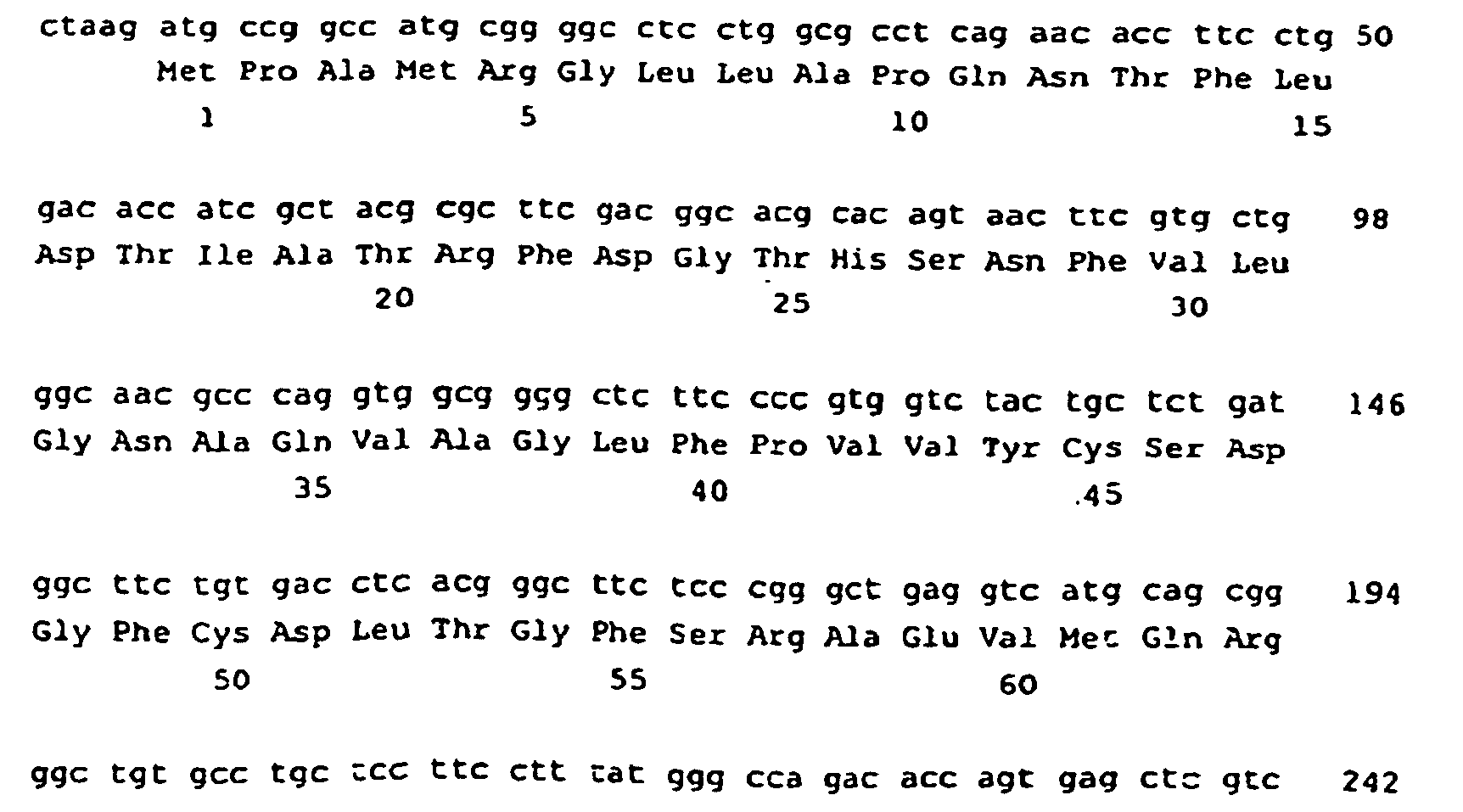
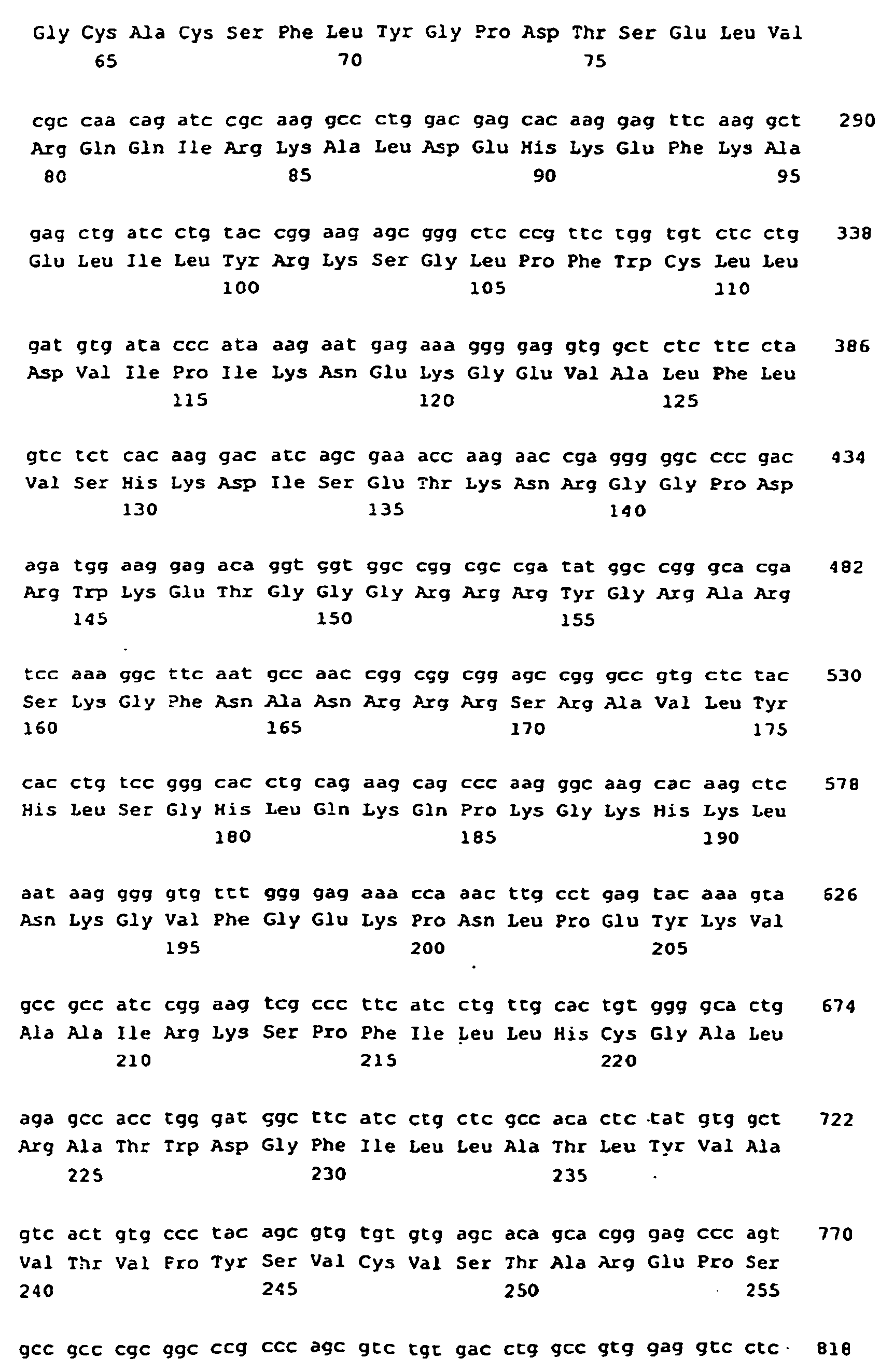


- <210> 2
<211> 1083
<212> PRT
<213> Homo sapiens - <400> 2


- <210> 3
<211> 26
<212> DNA
<213> Artificial Sequence - <220>
<223> Description of Artificial Sequence:Primer - <400> 3

- <210> 4
<211> 30
<212> DNA
<213> Artificial Sequence - <220>
<223> Description of Artificial Sequence:Primer - <400> 4

- <210> 5
<211> 3064
<212> DNA
<213> Homo sapiens - <220>
<221> CDS
<222> (4)..(3057) - <400> 5


- <210> 6
<211> 1017
<212> PRT
<213> Homo sapiens - <400> 6


- <210> 7
<211> 19
<212> DNA
<213> Artificial Sequence - <220>
<223> Description of Artificial Sequence:Primer - <400> 7

- <210> 8
<211> 20
<212> DNA
<213> Artificial Sequence - <220>
<223> Description of Artificial Sequence: Primer - <400> 8

- <210> 9
<211> 3715
<212> DNA
<213> Rattus sp. - <400> 9


- <210> 10
<211> 3736
<212> DNA
<213> Rattus sp. - <400> 10


- <210> 11
<211> 20
<212> DNA
<213> Artificial Sequence - <220>
<223> Description of Artificial Sequence:probe - <400> 11

- <210> 12
<211> 20
<212> DNA
<213> Artificial Sequence - <220>
<223> Description of Artificial Sequence:probe - <400> 12

Claims (7)
- A potassium channel protein which has an amino acid sequence of SEQ ID No. 2.
- A gene encoding a potassium channel protein which hybridises with SEQ ID No. 1 under the conditions, wherein a sample after hybridisation is washed twice in 2 X SSC containing 0.1% SDS then subjected to a washing step at 65°C carried out in a solution selected from the group consisting of 0.5 X SSC containing 0.1% SDS, 0.2 X SSC containing 0.1% SDS, and 0.1 X SSC containing 0.1% SDS.
- The gene according to claim 2 encoding the potassium channel protein as described in claim 1.
- The gene according to claim 3 selected from either of the 6th to 3257th nucleotide of Sequence No. 1 or a gene which is degenerate with respect to said gene and encodes the potassium channel protein as described in claim 1.
- A vector which contains the gene described in claims 2 to 4.
- A host cell which contains the vector described in claim 5.
- A method for producing the potassium channel protein described in claim 1 which uses the host cell described in claim 6.
Applications Claiming Priority (5)
| Application Number | Priority Date | Filing Date | Title |
|---|---|---|---|
| JP1143498 | 1998-01-23 | ||
| JP1143498 | 1998-01-23 | ||
| JP346198 | 1998-12-04 | ||
| JP34619898 | 1998-12-04 | ||
| PCT/JP1999/000190 WO1999037677A1 (en) | 1998-01-23 | 1999-01-20 | Novel potassium channel protein |
Publications (3)
| Publication Number | Publication Date |
|---|---|
| EP1050542A1 EP1050542A1 (en) | 2000-11-08 |
| EP1050542A4 EP1050542A4 (en) | 2003-02-26 |
| EP1050542B1 true EP1050542B1 (en) | 2006-03-29 |
Family
ID=26346858
Family Applications (1)
| Application Number | Title | Priority Date | Filing Date |
|---|---|---|---|
| EP99900645A Expired - Lifetime EP1050542B1 (en) | 1998-01-23 | 1999-01-20 | Novel potassium channel protein |
Country Status (8)
| Country | Link |
|---|---|
| US (2) | US6326168B1 (en) |
| EP (1) | EP1050542B1 (en) |
| JP (1) | JP3600526B2 (en) |
| AT (1) | ATE321779T1 (en) |
| AU (1) | AU1982799A (en) |
| DE (1) | DE69930610T2 (en) |
| ES (1) | ES2262307T3 (en) |
| WO (1) | WO1999037677A1 (en) |
Families Citing this family (11)
| Publication number | Priority date | Publication date | Assignee | Title |
|---|---|---|---|---|
| AU1982799A (en) * | 1998-01-23 | 1999-08-09 | Yamanouchi Pharmaceutical Co., Ltd. | Novel potassium channel protein |
| AU4852499A (en) | 1998-07-01 | 2000-01-24 | Icagen, Incorporated | Human elk, a voltage-gated potassium channel subunit |
| AU5487199A (en) * | 1998-08-14 | 2000-03-06 | Elan Pharmaceuticals, Inc. | Novel esk potassium channel polypeptide and polynucleotide compositions |
| EP1002863A1 (en) * | 1998-10-13 | 2000-05-24 | Sanofi-Synthelabo | A potassium channel member of the erg family |
| JP3679403B2 (en) * | 2001-11-14 | 2005-08-03 | アステラス製薬株式会社 | Transgenic animals |
| US7375222B2 (en) * | 2002-02-05 | 2008-05-20 | Astellas Pharma Inc. | 2,4,6-Triamino-1,3,5-triazine derivative |
| US20090058430A1 (en) * | 2007-09-05 | 2009-03-05 | Sentrinsic | Systems and Methods for Sensing Positions of Components |
| CA2660962A1 (en) | 2009-03-31 | 2010-09-30 | Astellas Pharma Inc. | Novel pharmaceutical composition for treatment of schizophrenia |
| US8399663B2 (en) * | 2009-04-03 | 2013-03-19 | Astellas Pharma Inc. | Salt of 1,3,5-triazine-2,4,6-triamine derivative |
| BRPI1014545A2 (en) | 2009-05-29 | 2016-04-05 | Astellas Pharma Inc | pharmaceutical composition for the prevention and / or treatment of attention deficit / hyperactivity disorder |
| US9133496B2 (en) * | 2010-06-29 | 2015-09-15 | Public University Corporation Nagoya City University | Material for screening for compound acting on ion channel and use thereof |
Family Cites Families (1)
| Publication number | Priority date | Publication date | Assignee | Title |
|---|---|---|---|---|
| AU1982799A (en) * | 1998-01-23 | 1999-08-09 | Yamanouchi Pharmaceutical Co., Ltd. | Novel potassium channel protein |
-
1999
- 1999-01-10 AU AU19827/99A patent/AU1982799A/en not_active Abandoned
- 1999-01-20 WO PCT/JP1999/000190 patent/WO1999037677A1/en not_active Ceased
- 1999-01-20 US US09/600,776 patent/US6326168B1/en not_active Expired - Lifetime
- 1999-01-20 AT AT99900645T patent/ATE321779T1/en active
- 1999-01-20 DE DE69930610T patent/DE69930610T2/en not_active Expired - Lifetime
- 1999-01-20 EP EP99900645A patent/EP1050542B1/en not_active Expired - Lifetime
- 1999-01-20 JP JP2000528597A patent/JP3600526B2/en not_active Expired - Fee Related
- 1999-01-20 ES ES99900645T patent/ES2262307T3/en not_active Expired - Lifetime
-
2001
- 2001-10-01 US US09/965,830 patent/US6828101B2/en not_active Expired - Lifetime
Non-Patent Citations (1)
| Title |
|---|
| TITUS ET AL: "The Drosophila erg K+ channel polypeptide is encoded by the seizure locus", THE JOURNAL OF NEUROSCIENCE, vol. 17, 1 February 1997 (1997-02-01), NEW YORK, pages 875 - 880, XP002092027 * |
Also Published As
| Publication number | Publication date |
|---|---|
| US20020177201A1 (en) | 2002-11-28 |
| AU1982799A (en) | 1999-08-09 |
| EP1050542A4 (en) | 2003-02-26 |
| ES2262307T3 (en) | 2006-11-16 |
| US6828101B2 (en) | 2004-12-07 |
| DE69930610D1 (en) | 2006-05-18 |
| ATE321779T1 (en) | 2006-04-15 |
| WO1999037677A1 (en) | 1999-07-29 |
| US6326168B1 (en) | 2001-12-04 |
| JP3600526B2 (en) | 2004-12-15 |
| EP1050542A1 (en) | 2000-11-08 |
| DE69930610T2 (en) | 2007-01-18 |
Similar Documents
| Publication | Publication Date | Title |
|---|---|---|
| EP1338651B9 (en) | Method of screening remedy for diabetes | |
| US6383762B1 (en) | Methods of obtaining compounds that interact with a human serotonin (5-HT2) receptor | |
| US6555344B1 (en) | Polynucleotides encoding SRE B2 receptor | |
| EP1042460B1 (en) | Brain or heart cyclic nucleotide gated ion channel compounds and uses thereof | |
| EP1050542A1 (en) | Novel potassium channel protein | |
| JPWO1999037677A1 (en) | Novel potassium channel protein | |
| JP2002536989A (en) | G protein-coupled receptor similar to galanin receptor | |
| JP2002504492A (en) | G-protein coupled receptor Fishboy | |
| US5610282A (en) | cDNA encoding a rat D1 dopamine receptor linked to adenylyl cyclase activation and expression of the receptor protein in plasmid-transfected cell lines | |
| US6416972B1 (en) | DNA encoding a prostaglandin F2α receptor, a host cell transformed therewith and an expression product thereof | |
| US20040241757A1 (en) | Novel screening method using prokineticin receptor | |
| US7329510B2 (en) | Full length human HCN1Ih channel subunit and variants | |
| US20030077709A1 (en) | Novel leukotriene B4 receptor | |
| JP2003525571A (en) | 7TM receptor GABAB-R2a | |
| EP1507006A1 (en) | Method of screening remedy for renal failure | |
| Mcintyre | Molecular studies on kinin receptors |
Legal Events
| Date | Code | Title | Description |
|---|---|---|---|
| PUAI | Public reference made under article 153(3) epc to a published international application that has entered the european phase |
Free format text: ORIGINAL CODE: 0009012 |
|
| 17P | Request for examination filed |
Effective date: 20000718 |
|
| AK | Designated contracting states |
Kind code of ref document: A1 Designated state(s): AT BE CH DE DK ES FI FR GB GR IE IT LI LU NL PT SE |
|
| A4 | Supplementary search report drawn up and despatched |
Effective date: 20030113 |
|
| 17Q | First examination report despatched |
Effective date: 20030709 |
|
| GRAP | Despatch of communication of intention to grant a patent |
Free format text: ORIGINAL CODE: EPIDOSNIGR1 |
|
| RAP1 | Party data changed (applicant data changed or rights of an application transferred) |
Owner name: ASTELLAS PHARMA INC. |
|
| GRAS | Grant fee paid |
Free format text: ORIGINAL CODE: EPIDOSNIGR3 |
|
| GRAA | (expected) grant |
Free format text: ORIGINAL CODE: 0009210 |
|
| AK | Designated contracting states |
Kind code of ref document: B1 Designated state(s): AT BE CH DE DK ES FI FR GB GR IE IT LI LU NL PT SE |
|
| PG25 | Lapsed in a contracting state [announced via postgrant information from national office to epo] |
Ref country code: IT Free format text: LAPSE BECAUSE OF FAILURE TO SUBMIT A TRANSLATION OF THE DESCRIPTION OR TO PAY THE FEE WITHIN THE PRESCRIBED TIME-LIMIT;WARNING: LAPSES OF ITALIAN PATENTS WITH EFFECTIVE DATE BEFORE 2007 MAY HAVE OCCURRED AT ANY TIME BEFORE 2007. THE CORRECT EFFECTIVE DATE MAY BE DIFFERENT FROM THE ONE RECORDED. Effective date: 20060329 |
|
| REG | Reference to a national code |
Ref country code: GB Ref legal event code: FG4D |
|
| REG | Reference to a national code |
Ref country code: CH Ref legal event code: EP |
|
| REG | Reference to a national code |
Ref country code: IE Ref legal event code: FG4D |
|
| REF | Corresponds to: |
Ref document number: 69930610 Country of ref document: DE Date of ref document: 20060518 Kind code of ref document: P |
|
| RAP2 | Party data changed (patent owner data changed or rights of a patent transferred) |
Owner name: ASTELLAS PHARMA INC. |
|
| REG | Reference to a national code |
Ref country code: SE Ref legal event code: TRGR |
|
| PG25 | Lapsed in a contracting state [announced via postgrant information from national office to epo] |
Ref country code: DK Free format text: LAPSE BECAUSE OF FAILURE TO SUBMIT A TRANSLATION OF THE DESCRIPTION OR TO PAY THE FEE WITHIN THE PRESCRIBED TIME-LIMIT Effective date: 20060629 |
|
| REG | Reference to a national code |
Ref country code: CH Ref legal event code: NV Representative=s name: BOVARD AG PATENTANWAELTE |
|
| NLT2 | Nl: modifications (of names), taken from the european patent patent bulletin |
Owner name: ASTELLAS PHARMA INC. Effective date: 20060524 |
|
| PG25 | Lapsed in a contracting state [announced via postgrant information from national office to epo] |
Ref country code: PT Free format text: LAPSE BECAUSE OF FAILURE TO SUBMIT A TRANSLATION OF THE DESCRIPTION OR TO PAY THE FEE WITHIN THE PRESCRIBED TIME-LIMIT Effective date: 20060829 |
|
| ET | Fr: translation filed | ||
| REG | Reference to a national code |
Ref country code: ES Ref legal event code: FG2A Ref document number: 2262307 Country of ref document: ES Kind code of ref document: T3 |
|
| PG25 | Lapsed in a contracting state [announced via postgrant information from national office to epo] |
Ref country code: IE Free format text: LAPSE BECAUSE OF NON-PAYMENT OF DUE FEES Effective date: 20070122 |
|
| PLBE | No opposition filed within time limit |
Free format text: ORIGINAL CODE: 0009261 |
|
| STAA | Information on the status of an ep patent application or granted ep patent |
Free format text: STATUS: NO OPPOSITION FILED WITHIN TIME LIMIT |
|
| 26N | No opposition filed |
Effective date: 20070102 |
|
| PG25 | Lapsed in a contracting state [announced via postgrant information from national office to epo] |
Ref country code: GR Free format text: LAPSE BECAUSE OF FAILURE TO SUBMIT A TRANSLATION OF THE DESCRIPTION OR TO PAY THE FEE WITHIN THE PRESCRIBED TIME-LIMIT Effective date: 20060630 |
|
| PG25 | Lapsed in a contracting state [announced via postgrant information from national office to epo] |
Ref country code: FI Free format text: LAPSE BECAUSE OF FAILURE TO SUBMIT A TRANSLATION OF THE DESCRIPTION OR TO PAY THE FEE WITHIN THE PRESCRIBED TIME-LIMIT Effective date: 20060329 |
|
| PG25 | Lapsed in a contracting state [announced via postgrant information from national office to epo] |
Ref country code: LU Free format text: LAPSE BECAUSE OF NON-PAYMENT OF DUE FEES Effective date: 20070120 |
|
| REG | Reference to a national code |
Ref country code: CH Ref legal event code: PFA Owner name: ASTELLAS PHARMA INC. Free format text: ASTELLAS PHARMA INC.#3-11, NIHONBASHI-HONCHO 2-CHOME, CHUO-KU#TOKYO 103-8411 (JP) -TRANSFER TO- ASTELLAS PHARMA INC.#3-11, NIHONBASHI-HONCHO 2-CHOME, CHUO-KU#TOKYO 103-8411 (JP) |
|
| REG | Reference to a national code |
Ref country code: FR Ref legal event code: PLFP Year of fee payment: 18 |
|
| REG | Reference to a national code |
Ref country code: FR Ref legal event code: PLFP Year of fee payment: 19 |
|
| REG | Reference to a national code |
Ref country code: FR Ref legal event code: PLFP Year of fee payment: 20 |
|
| PGFP | Annual fee paid to national office [announced via postgrant information from national office to epo] |
Ref country code: FR Payment date: 20171211 Year of fee payment: 20 Ref country code: NL Payment date: 20171213 Year of fee payment: 20 |
|
| PGFP | Annual fee paid to national office [announced via postgrant information from national office to epo] |
Ref country code: BE Payment date: 20171213 Year of fee payment: 20 |
|
| PGFP | Annual fee paid to national office [announced via postgrant information from national office to epo] |
Ref country code: GB Payment date: 20180117 Year of fee payment: 20 Ref country code: DE Payment date: 20180110 Year of fee payment: 20 Ref country code: ES Payment date: 20180201 Year of fee payment: 20 Ref country code: CH Payment date: 20180115 Year of fee payment: 20 |
|
| PGFP | Annual fee paid to national office [announced via postgrant information from national office to epo] |
Ref country code: IT Payment date: 20180122 Year of fee payment: 20 Ref country code: SE Payment date: 20180213 Year of fee payment: 20 Ref country code: AT Payment date: 20171228 Year of fee payment: 20 |
|
| REG | Reference to a national code |
Ref country code: DE Ref legal event code: R071 Ref document number: 69930610 Country of ref document: DE |
|
| REG | Reference to a national code |
Ref country code: NL Ref legal event code: MK Effective date: 20190119 |
|
| REG | Reference to a national code |
Ref country code: CH Ref legal event code: PL |
|
| REG | Reference to a national code |
Ref country code: GB Ref legal event code: PE20 Expiry date: 20190119 |
|
| REG | Reference to a national code |
Ref country code: BE Ref legal event code: MK Effective date: 20190120 |
|
| REG | Reference to a national code |
Ref country code: AT Ref legal event code: MK07 Ref document number: 321779 Country of ref document: AT Kind code of ref document: T Effective date: 20190120 |
|
| PG25 | Lapsed in a contracting state [announced via postgrant information from national office to epo] |
Ref country code: GB Free format text: LAPSE BECAUSE OF EXPIRATION OF PROTECTION Effective date: 20190119 |
|
| REG | Reference to a national code |
Ref country code: ES Ref legal event code: FD2A Effective date: 20201204 |
|
| PG25 | Lapsed in a contracting state [announced via postgrant information from national office to epo] |
Ref country code: ES Free format text: LAPSE BECAUSE OF EXPIRATION OF PROTECTION Effective date: 20190121 |