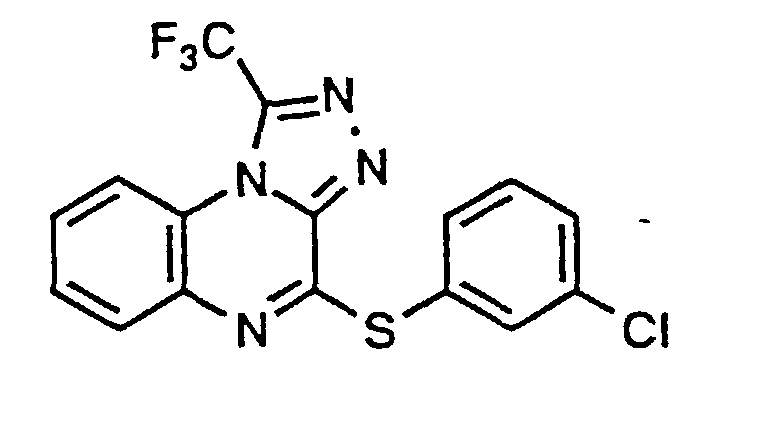
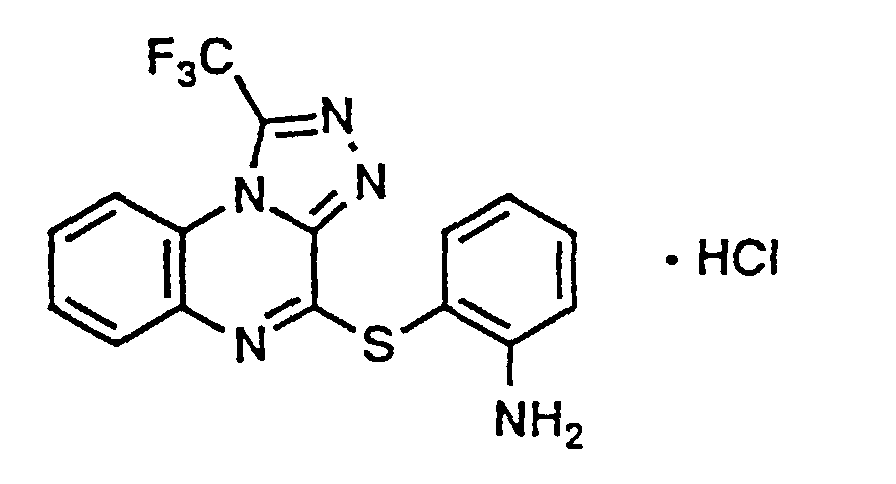
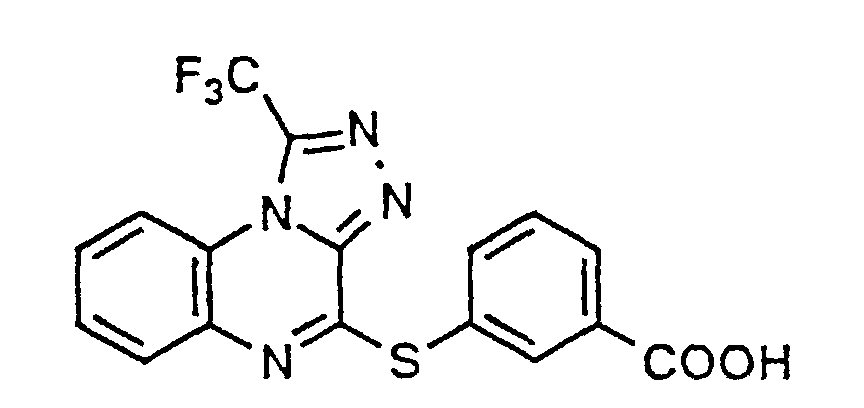
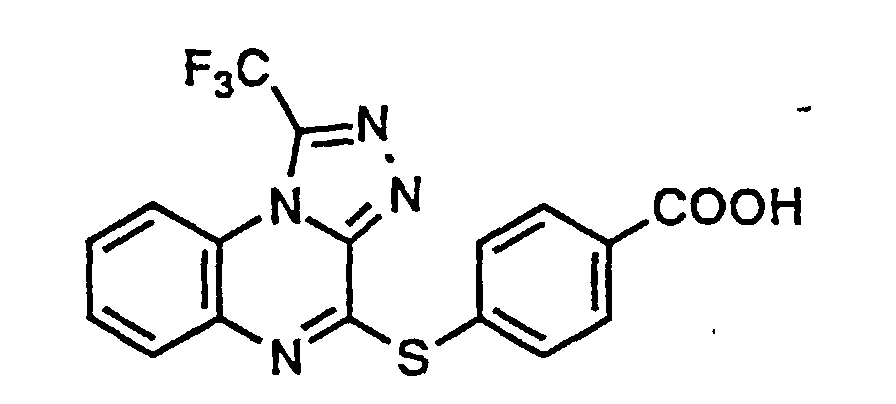
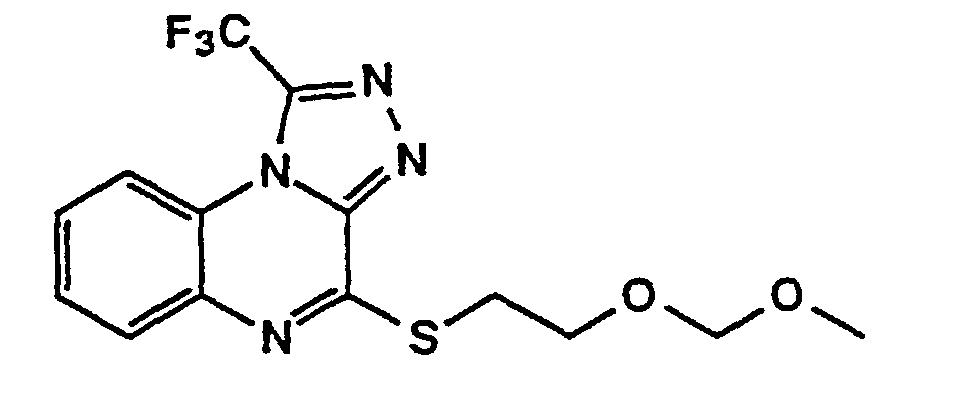
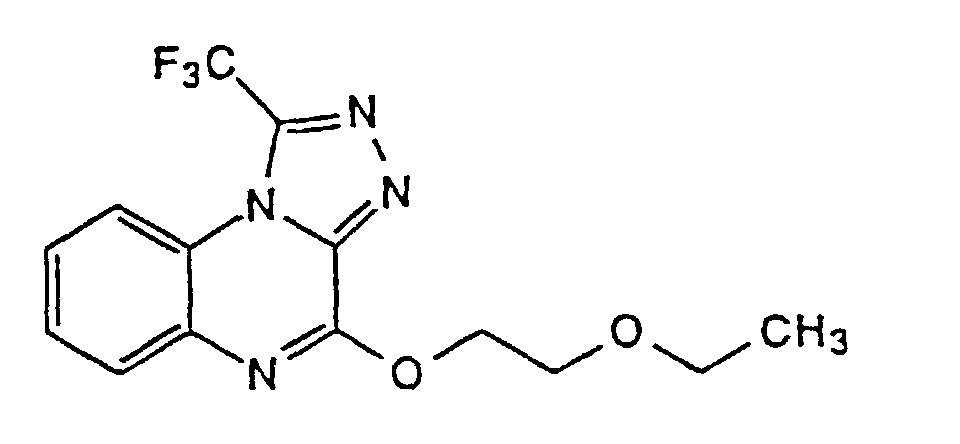
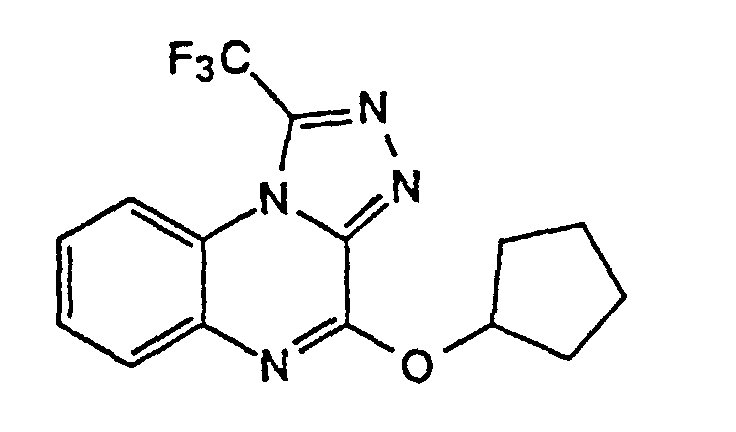
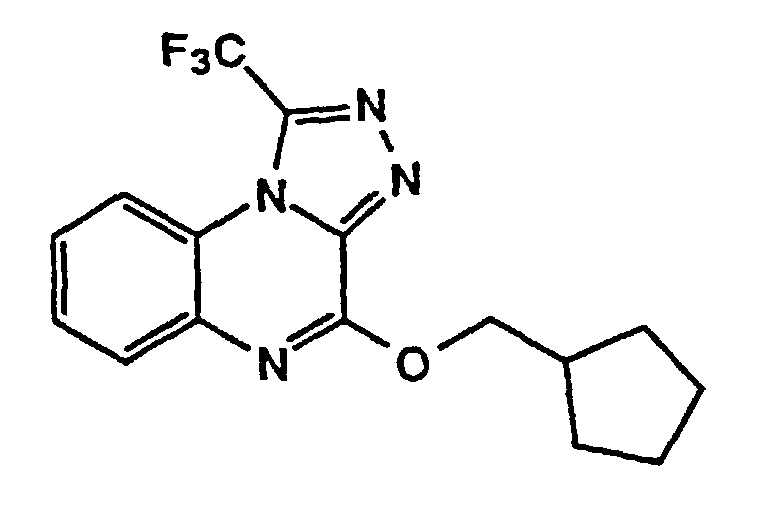
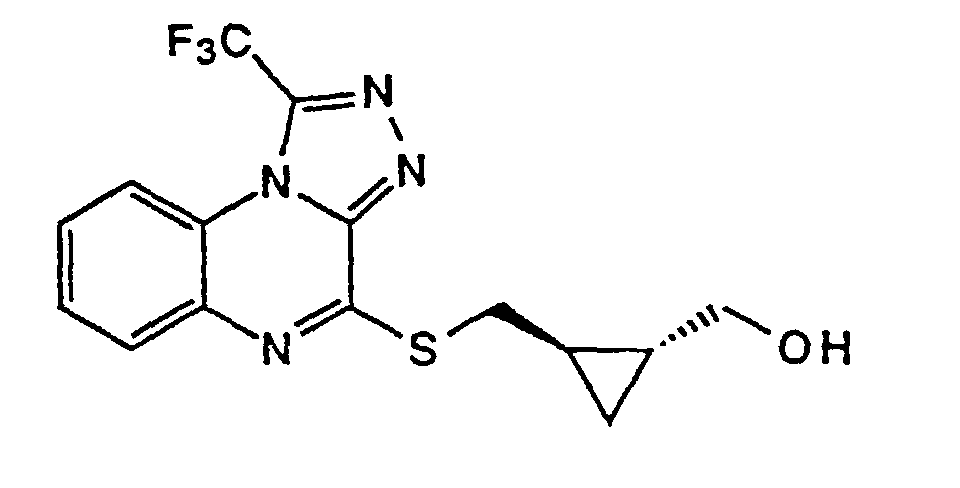
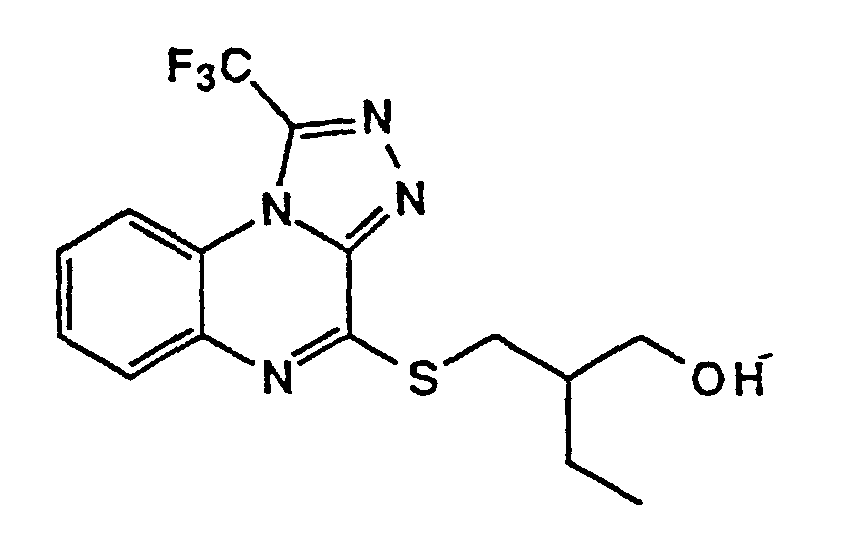
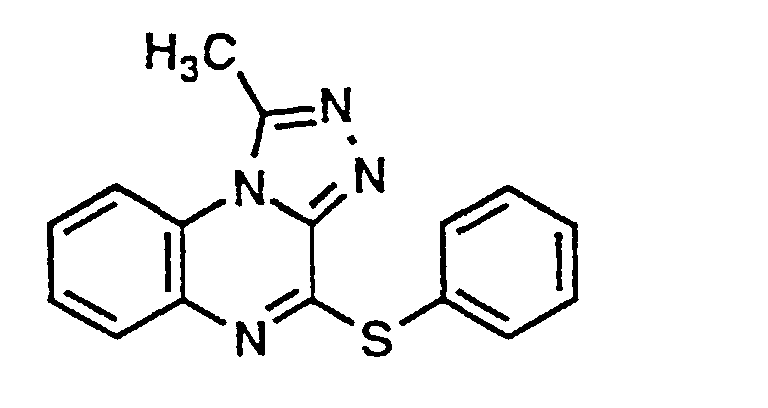
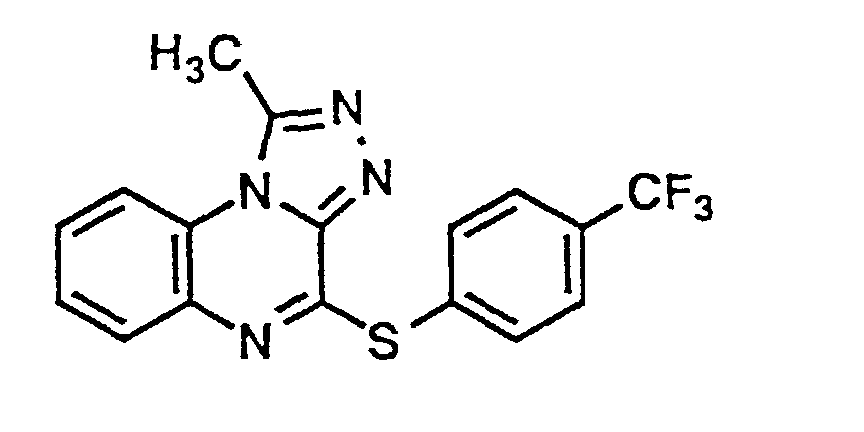
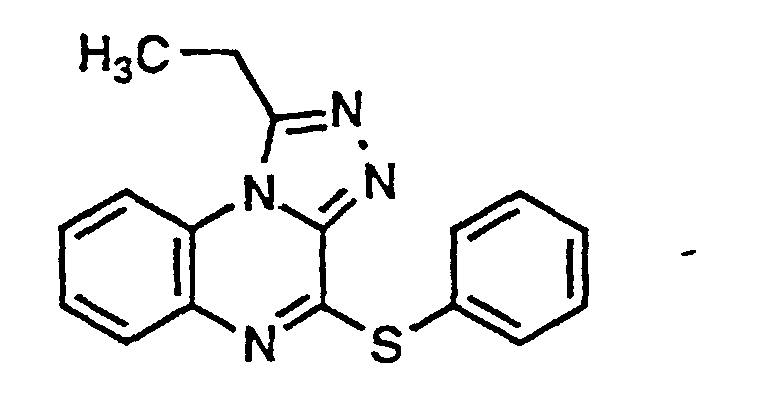
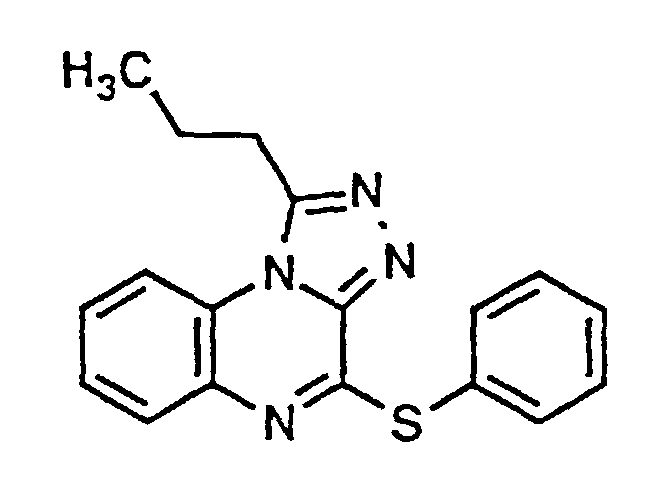
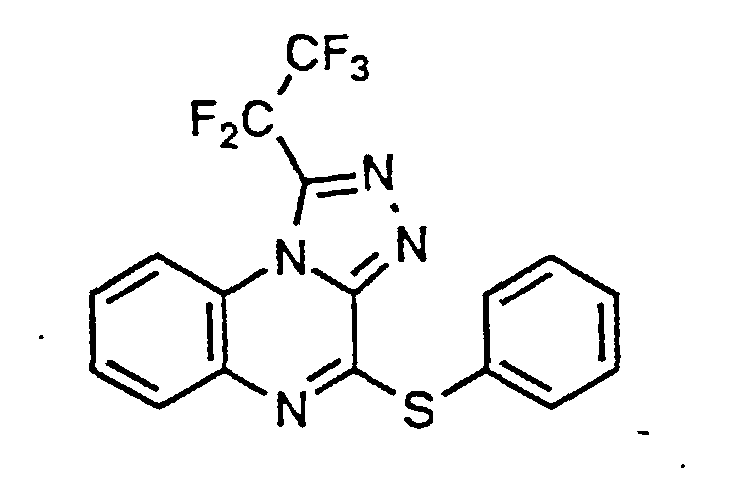
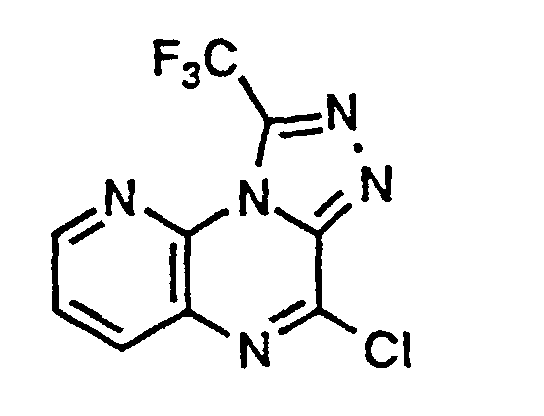
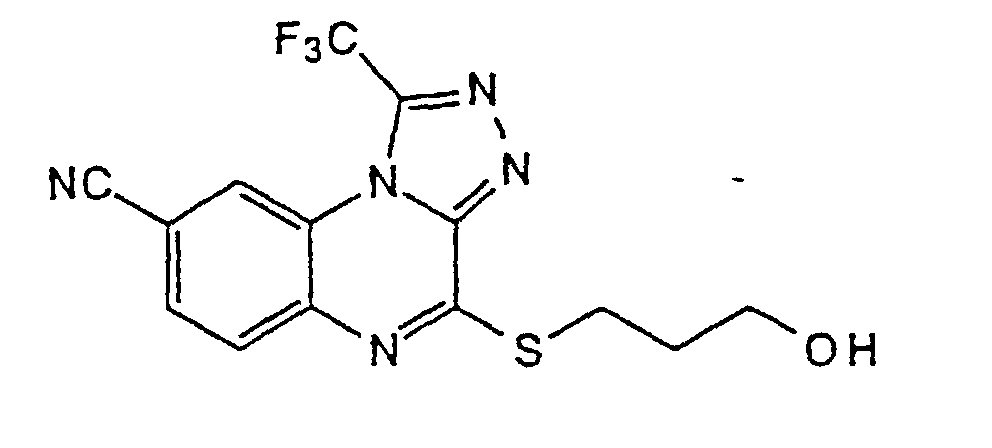
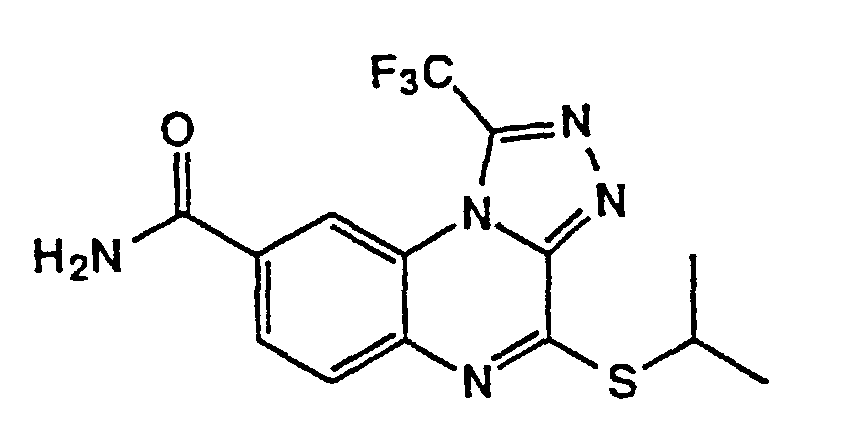
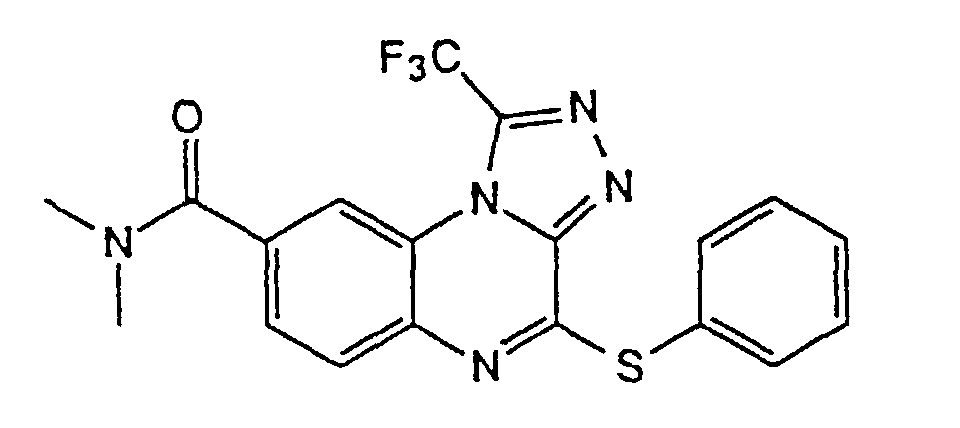
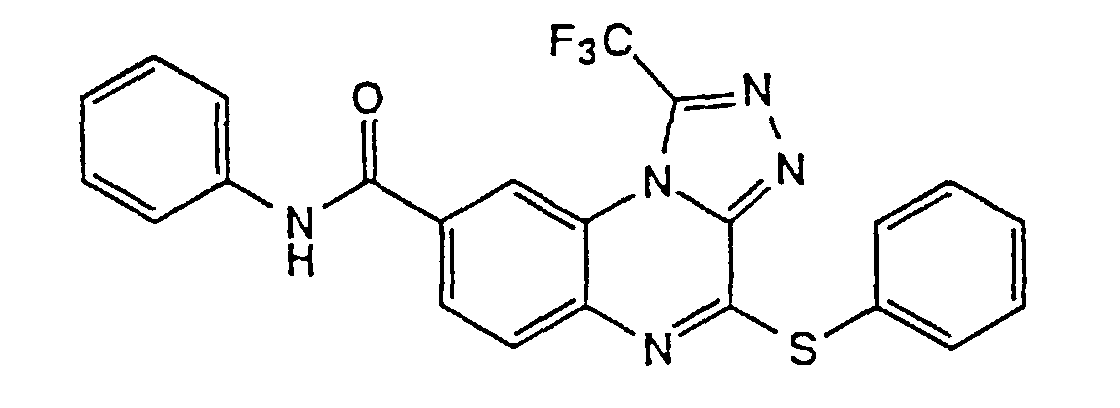
EP1050535A1 - Fused pyrazine compounds - Google Patents

Fused pyrazine compounds Download PDF

Info

Publication number
EP1050535A1
EP1050535A1 EP98950472A EP98950472A EP1050535A1 EP 1050535 A1 EP1050535 A1 EP 1050535A1 EP 98950472 A EP98950472 A EP 98950472A EP 98950472 A EP98950472 A EP 98950472A EP 1050535 A1 EP1050535 A1 EP 1050535A1
Authority
EP
European Patent Office
Prior art keywords
triazolo
trifluoromethyl
quinoxaline
thio
alkyl
Prior art date
Legal status (The legal status is an assumption and is not a legal conclusion. Google has not performed a legal analysis and makes no representation as to the accuracy of the status listed.)
Withdrawn
Application number
EP98950472A
Other languages
German (de)
French (fr)
Other versions
EP1050535A4 (en
Inventor
Kaoru Minase Research Institute KOBAYASHI
Tadashi Minase Research Institute TATSUMI
Kiyoyuki Minase Research Institute SATO
Hiroyuki Minase Research Institute OHNO
Current Assignee (The listed assignees may be inaccurate. Google has not performed a legal analysis and makes no representation or warranty as to the accuracy of the list.)
Ono Pharmaceutical Co Ltd
Original Assignee
Ono Pharmaceutical Co Ltd
Priority date (The priority date is an assumption and is not a legal conclusion. Google has not performed a legal analysis and makes no representation as to the accuracy of the date listed.)
Filing date
Publication date
Application filed by Ono Pharmaceutical Co Ltd filed Critical Ono Pharmaceutical Co Ltd
Publication of EP1050535A1 publication Critical patent/EP1050535A1/en
Publication of EP1050535A4 publication Critical patent/EP1050535A4/en
Withdrawn legal-status Critical Current

Links

Classifications

    • CCHEMISTRY; METALLURGY
    • C07ORGANIC CHEMISTRY
    • C07DHETEROCYCLIC COMPOUNDS
    • C07D211/00Heterocyclic compounds containing hydrogenated pyridine rings, not condensed with other rings
    • C07D211/04Heterocyclic compounds containing hydrogenated pyridine rings, not condensed with other rings with only hydrogen or carbon atoms directly attached to the ring nitrogen atom
    • C07D211/06Heterocyclic compounds containing hydrogenated pyridine rings, not condensed with other rings with only hydrogen or carbon atoms directly attached to the ring nitrogen atom having no double bonds between ring members or between ring members and non-ring members
    • C07D211/36Heterocyclic compounds containing hydrogenated pyridine rings, not condensed with other rings with only hydrogen or carbon atoms directly attached to the ring nitrogen atom having no double bonds between ring members or between ring members and non-ring members with hetero atoms or with carbon atoms having three bonds to hetero atoms with at the most one bond to halogen, e.g. ester or nitrile radicals, directly attached to ring carbon atoms
    • C07D211/60Carbon atoms having three bonds to hetero atoms with at the most one bond to halogen, e.g. ester or nitrile radicals
    • C07D211/62Carbon atoms having three bonds to hetero atoms with at the most one bond to halogen, e.g. ester or nitrile radicals attached in position 4
    • C07D211/66Carbon atoms having three bonds to hetero atoms with at the most one bond to halogen, e.g. ester or nitrile radicals attached in position 4 having a hetero atom as the second substituent in position 4
    • CCHEMISTRY; METALLURGY
    • C07ORGANIC CHEMISTRY
    • C07DHETEROCYCLIC COMPOUNDS
    • C07D487/00Heterocyclic compounds containing nitrogen atoms as the only ring hetero atoms in the condensed system, not provided for by groups C07D451/00 - C07D477/00
    • C07D487/12Heterocyclic compounds containing nitrogen atoms as the only ring hetero atoms in the condensed system, not provided for by groups C07D451/00 - C07D477/00 in which the condensed system contains three hetero rings
    • C07D487/14Ortho-condensed systems
    • AHUMAN NECESSITIES
    • A61MEDICAL OR VETERINARY SCIENCE; HYGIENE
    • A61KPREPARATIONS FOR MEDICAL, DENTAL OR TOILETRY PURPOSES
    • A61K31/00Medicinal preparations containing organic active ingredients
    • A61K31/33Heterocyclic compounds
    • A61K31/395Heterocyclic compounds having nitrogen as a ring hetero atom, e.g. guanethidine or rifamycins
    • A61K31/495Heterocyclic compounds having nitrogen as a ring hetero atom, e.g. guanethidine or rifamycins having six-membered rings with two or more nitrogen atoms as the only ring heteroatoms, e.g. piperazine or tetrazines
    • A61K31/4985Pyrazines or piperazines ortho- or peri-condensed with heterocyclic ring systems
    • CCHEMISTRY; METALLURGY
    • C07ORGANIC CHEMISTRY
    • C07DHETEROCYCLIC COMPOUNDS
    • C07D211/00Heterocyclic compounds containing hydrogenated pyridine rings, not condensed with other rings
    • C07D211/04Heterocyclic compounds containing hydrogenated pyridine rings, not condensed with other rings with only hydrogen or carbon atoms directly attached to the ring nitrogen atom
    • C07D211/80Heterocyclic compounds containing hydrogenated pyridine rings, not condensed with other rings with only hydrogen or carbon atoms directly attached to the ring nitrogen atom having two double bonds between ring members or between ring members and non-ring members
    • C07D211/84Heterocyclic compounds containing hydrogenated pyridine rings, not condensed with other rings with only hydrogen or carbon atoms directly attached to the ring nitrogen atom having two double bonds between ring members or between ring members and non-ring members with hetero atoms or with carbon atoms having three bonds to hetero atoms, with at the most one bond to halogen directly attached to ring carbon atoms
    • C07D211/86Oxygen atoms
    • CCHEMISTRY; METALLURGY
    • C07ORGANIC CHEMISTRY
    • C07DHETEROCYCLIC COMPOUNDS
    • C07D211/00Heterocyclic compounds containing hydrogenated pyridine rings, not condensed with other rings
    • C07D211/92Heterocyclic compounds containing hydrogenated pyridine rings, not condensed with other rings with a hetero atom directly attached to the ring nitrogen atom
    • C07D211/94Oxygen atom, e.g. piperidine N-oxide
    • CCHEMISTRY; METALLURGY
    • C07ORGANIC CHEMISTRY
    • C07DHETEROCYCLIC COMPOUNDS
    • C07D225/00Heterocyclic compounds containing rings of more than seven members having one nitrogen atom as the only ring hetero atom
    • C07D225/02Heterocyclic compounds containing rings of more than seven members having one nitrogen atom as the only ring hetero atom not condensed with other rings
    • CCHEMISTRY; METALLURGY
    • C07ORGANIC CHEMISTRY
    • C07DHETEROCYCLIC COMPOUNDS
    • C07D239/00Heterocyclic compounds containing 1,3-diazine or hydrogenated 1,3-diazine rings
    • C07D239/02Heterocyclic compounds containing 1,3-diazine or hydrogenated 1,3-diazine rings not condensed with other rings
    • C07D239/04Heterocyclic compounds containing 1,3-diazine or hydrogenated 1,3-diazine rings not condensed with other rings having no double bonds between ring members or between ring members and non-ring members
    • CCHEMISTRY; METALLURGY
    • C07ORGANIC CHEMISTRY
    • C07DHETEROCYCLIC COMPOUNDS
    • C07D249/00Heterocyclic compounds containing five-membered rings having three nitrogen atoms as the only ring hetero atoms
    • C07D249/02Heterocyclic compounds containing five-membered rings having three nitrogen atoms as the only ring hetero atoms not condensed with other rings
    • C07D249/081,2,4-Triazoles; Hydrogenated 1,2,4-triazoles
    • CCHEMISTRY; METALLURGY
    • C07ORGANIC CHEMISTRY
    • C07DHETEROCYCLIC COMPOUNDS
    • C07D263/00Heterocyclic compounds containing 1,3-oxazole or hydrogenated 1,3-oxazole rings
    • C07D263/02Heterocyclic compounds containing 1,3-oxazole or hydrogenated 1,3-oxazole rings not condensed with other rings
    • C07D263/04Heterocyclic compounds containing 1,3-oxazole or hydrogenated 1,3-oxazole rings not condensed with other rings having no double bonds between ring members or between ring members and non-ring members
    • C07D263/06Heterocyclic compounds containing 1,3-oxazole or hydrogenated 1,3-oxazole rings not condensed with other rings having no double bonds between ring members or between ring members and non-ring members with hydrocarbon radicals, substituted by oxygen atoms, attached to ring carbon atoms
    • CCHEMISTRY; METALLURGY
    • C07ORGANIC CHEMISTRY
    • C07DHETEROCYCLIC COMPOUNDS
    • C07D401/00Heterocyclic compounds containing two or more hetero rings, having nitrogen atoms as the only ring hetero atoms, at least one ring being a six-membered ring with only one nitrogen atom
    • C07D401/02Heterocyclic compounds containing two or more hetero rings, having nitrogen atoms as the only ring hetero atoms, at least one ring being a six-membered ring with only one nitrogen atom containing two hetero rings
    • C07D401/06Heterocyclic compounds containing two or more hetero rings, having nitrogen atoms as the only ring hetero atoms, at least one ring being a six-membered ring with only one nitrogen atom containing two hetero rings linked by a carbon chain containing only aliphatic carbon atoms
    • CCHEMISTRY; METALLURGY
    • C07ORGANIC CHEMISTRY
    • C07DHETEROCYCLIC COMPOUNDS
    • C07D401/00Heterocyclic compounds containing two or more hetero rings, having nitrogen atoms as the only ring hetero atoms, at least one ring being a six-membered ring with only one nitrogen atom
    • C07D401/02Heterocyclic compounds containing two or more hetero rings, having nitrogen atoms as the only ring hetero atoms, at least one ring being a six-membered ring with only one nitrogen atom containing two hetero rings
    • C07D401/12Heterocyclic compounds containing two or more hetero rings, having nitrogen atoms as the only ring hetero atoms, at least one ring being a six-membered ring with only one nitrogen atom containing two hetero rings linked by a chain containing hetero atoms as chain links
    • CCHEMISTRY; METALLURGY
    • C07ORGANIC CHEMISTRY
    • C07DHETEROCYCLIC COMPOUNDS
    • C07D405/00Heterocyclic compounds containing both one or more hetero rings having oxygen atoms as the only ring hetero atoms, and one or more rings having nitrogen as the only ring hetero atom
    • C07D405/02Heterocyclic compounds containing both one or more hetero rings having oxygen atoms as the only ring hetero atoms, and one or more rings having nitrogen as the only ring hetero atom containing two hetero rings
    • C07D405/12Heterocyclic compounds containing both one or more hetero rings having oxygen atoms as the only ring hetero atoms, and one or more rings having nitrogen as the only ring hetero atom containing two hetero rings linked by a chain containing hetero atoms as chain links
    • CCHEMISTRY; METALLURGY
    • C07ORGANIC CHEMISTRY
    • C07DHETEROCYCLIC COMPOUNDS
    • C07D407/00Heterocyclic compounds containing two or more hetero rings, at least one ring having oxygen atoms as the only ring hetero atoms, not provided for by group C07D405/00
    • C07D407/02Heterocyclic compounds containing two or more hetero rings, at least one ring having oxygen atoms as the only ring hetero atoms, not provided for by group C07D405/00 containing two hetero rings
    • C07D407/12Heterocyclic compounds containing two or more hetero rings, at least one ring having oxygen atoms as the only ring hetero atoms, not provided for by group C07D405/00 containing two hetero rings linked by a chain containing hetero atoms as chain links
    • CCHEMISTRY; METALLURGY
    • C07ORGANIC CHEMISTRY
    • C07DHETEROCYCLIC COMPOUNDS
    • C07D471/00Heterocyclic compounds containing nitrogen atoms as the only ring hetero atoms in the condensed system, at least one ring being a six-membered ring with one nitrogen atom, not provided for by groups C07D451/00 - C07D463/00
    • C07D471/02Heterocyclic compounds containing nitrogen atoms as the only ring hetero atoms in the condensed system, at least one ring being a six-membered ring with one nitrogen atom, not provided for by groups C07D451/00 - C07D463/00 in which the condensed system contains two hetero rings
    • C07D471/04Ortho-condensed systems
    • CCHEMISTRY; METALLURGY
    • C07ORGANIC CHEMISTRY
    • C07DHETEROCYCLIC COMPOUNDS
    • C07D487/00Heterocyclic compounds containing nitrogen atoms as the only ring hetero atoms in the condensed system, not provided for by groups C07D451/00 - C07D477/00
    • C07D487/02Heterocyclic compounds containing nitrogen atoms as the only ring hetero atoms in the condensed system, not provided for by groups C07D451/00 - C07D477/00 in which the condensed system contains two hetero rings
    • C07D487/04Ortho-condensed systems
    • CCHEMISTRY; METALLURGY
    • C07ORGANIC CHEMISTRY
    • C07DHETEROCYCLIC COMPOUNDS
    • C07D495/00Heterocyclic compounds containing in the condensed system at least one hetero ring having sulfur atoms as the only ring hetero atoms
    • C07D495/12Heterocyclic compounds containing in the condensed system at least one hetero ring having sulfur atoms as the only ring hetero atoms in which the condensed system contains three hetero rings
    • C07D495/14Ortho-condensed systems

Definitions

  • This invention is related to fused pyrazine derivatives and adhesion molecules expression inhibitors containing fused pyrazine derivatives as active ingredient. More particularly, this invention is related to adhesion molecules expression inhibitors containing fused pyrazine derivatives of the formula (I): wherein all the symbols are the same meaning as hereinafter defined, and non-toxic salts thereof, and novel fused pyrazine derivatives of the above formula (I) and non-toxic salts thereof, and processes for the preparation thereof.
  • Inflammatory reaction which protect a host from a foreign matter, is essentially one of the defensive response in the organism and it is thought that acceleration of leukocytes adhesion to endothelial cells is a central process in the early step in this reaction.
  • Leukocytes are one of the major cells in inflammation and migrate into the inflammatory tissues and secrete chemical mediators, cytokines or enzymes and develop inflammation. Therefore, it has been thought leukocytes extravasation from the vascular flow is an important process in inflammatory development and the process, which is leukocytes-endothelial cells adhesion, is essential in the early step in transmigration.
  • endothelial adhesion molecules which are E-selectin, VCAM-1 and ICAM-1 are induced molecules stimulated by inflammatory cytokines, such as TNF and IL-1.
  • cytokines such as TNF and IL-1.
  • TNF and IL-1 inflammatory cytokines
  • adhesion molecules expression which are E-selectin, ⁇ /CAM-1 and ICAM-1 suppresses the cellular adhesion and links the treatment for various diseases.
  • the present invitation provides a useful new therapeutic agent which has inhibitory activity on these adhesion molecules expression.
  • the present invitation provides the use of the compounds for treatment and/or prevention of disorders mediated by cellular adhesion and infiltration, such as inflammation, rheumatoid arthritis, allergies, asthma, atopic dermatitis, psoriasis, suppression of ischemia reperfusion injury, nephritis, hepatitis, multiple sclerosis, ulcerative colitis, adult respiratory distress syndrome (ARDS), suppression of transplant rejection, sepsis, diabetes, autoimmune diseases, tumor metastasis, arteriosclerosis and AIDS [The Hand Book of Immunopharmacology, Adhesion Molecule, Academic Press, (1994), Trends in Pharmacological Science 16 , 418-423, (1995), Molecular Medicine Today, 3, 418-423 (1997), Molecular Medicine Today, 3, 310-321 (1997), Japanese Journal of Inflammation 17, 459-467 (1997)].
  • disorders mediated by cellular adhesion and infiltration such as inflammation, rheumatoid arthritis, allergies, asthma, atopic derma
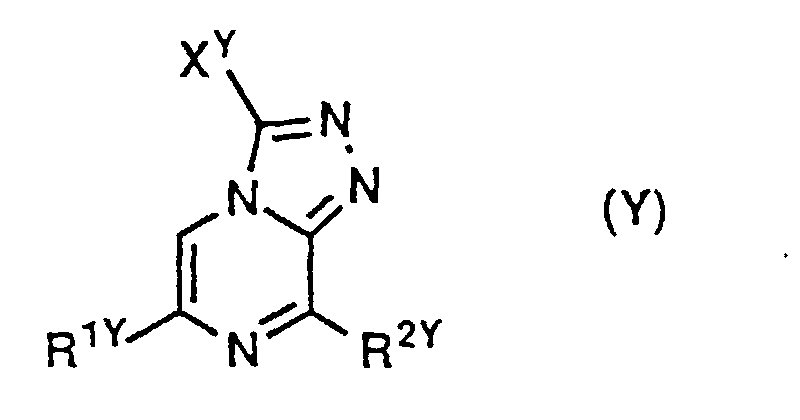
  • 1, 2, 4-triazolo-[4, 3-a]pyrazine derivatives of the formula (X): in the specification of GB 1235910, and the formula (Y): in the specification of GB 1146770, are disclosed to be useful as treatment of bronchial disorder.
  • imidazo-[1, 2-a]quinoxaline derivatives are disclosed to be useful as immunosuppressants, anti-inflammatory agents, antifungal agents, antiyeast agents, treatment of bronchial disorder.
  • fused imidazole derivatives of the formula (Z): are disclosed to have an inhibitory activity of adhesion molecules expression.
  • Fused pyrazine derivatives of the formula (I) of the present invention are not known as adhesion molecules expression inhibitors at all. Besides, a lot of fused pyrazine derivatives of the formula (I) are novel compounds.
  • the present invention is related to:
  • alkyl, alkoxy and alkylene include straight and branched isomers.
  • Double bond in alkenylene includes structure of configurations E, Z and EZ mixture. Isomers resulting from the presence of asymmetric carbon(s) e.g. branched alkyl, alkoxy and alkylene are also included within the present invention.
  • C1-4 alkyl is methyl, ethyl, propyl, butyl and isomeric groups thereof.
  • C1-8 alkyl is methyl, ethyl, propyl, butyl, pentyl, hexyl, heptyl, octyl and isomeric groups thereof.
  • C1-8 alkoxy is methoxy, ethoxy, propoxy, butoxy, pentyloxy, hexyloxy, heptyloxy, octyloxy and isomeric groups thereof.
  • C1-8 alkylthio is methylthio, ethylthio, propylthic, butylthio, pentylthio, hexylthio, heptylthio, octylthio and isomeric groups thereof.
  • Halogen atom is chlorine, bromine, fluorine, or iodine.
  • Trihalomethyl is methyl tri-substituted by chlorine, bromine, fluorine, or iodine.
  • Trihalomethoxy is methoxy tri-substituted by chlorine, bromine, fluorine, or iodine.
  • C1-8 alkylamino is methylamino, ethylamino, propylamino, butylamino, pentylamino, hexylamino, heptylamino, octylamino and isomeric groups thereof.
  • C1-8 alkyl substituted by 1-17 of halogen atom is methyl, ethyl, propyl, butyl, pentyl, hexyl, heptyl, octyl and isomenic groups thereof substituted by 1-17 of chlorine, bromine, fluorine, or iodine.
  • C1-8 alkoxy substituted by 1-17 of halogen atom is methoxy, ethoxy, propoxy, butoxy, pentyloxy, hexyloxy, heptyloxy, octyloxy and isomeric groups thereof substituted by 1-17 of chlorine, bromine, fluorine, or iodine.
  • C1-4 alkylene is methylene, ethylene, trimethylene, tetramethylene and isomeric groups thereof.
  • C2-8 alkenyl is vinyl, propenyl, butenyl, pentenyl, hexenyl, heptenyl, octenyl, butadienyl, pentadienyl, hexadienyl, heptadienyl, octadienyl, hexatrienyl, heptatrienyl, octatrienyl and isomeric groups thereof.
  • C2-8 alkynyl is ethynyl, propynyl, butynyl, pentynyl, hexynyl, heptynyl, octynyl and isomeric groups thereof.
  • C2-5 acyl is acetyl, propionyl, butyryl, pentanoyl and isomeric groups thereof.
  • C3-7 mono-carbocyclic ring is, for example, cyclopropane, cyclobutane, cyclopentane, cyclohexane, cycloheptane, cyclopentene, cyclohexene, cyclopentadiene, cyclohexadiene, benzene.
  • 3-7 membered mono-heterocyclic ring containing 1-4 of nitrogen(s), 1-2 of oxygen(s) and / or 1 of sulfur is 3-7 membered mono-heterocyclic aryl containing 1-4 of nitrogen(s), 1-2 of oxygen(s) and / or 1 of sulfur, partially or fully saturated thereof.
  • 3-7 membered mono-heterocyclic aryl containing 1-4 of nitrogen(s), 1-2 of oxygen(s) and / or 1 of sulfur is, for example, pyrrole, imidazole, triazole, tetrazole, pyrazole, pyridine, pyrazine, pyrimidine, pyridazine, azepine, diazepine, furan, pyran, oxepin, oxazepine, thiophene, thiain (thiopyran), thiepin, oxazole, isoxazole, thiazole, isothiazole, oxadiazole, oxazine, oxadiazine, oxazepine, oxadiazepine, thiadiazole, thiazine, thiadiazine, thiazepine, thiadiazepine.
  • Partially or fully saturated 3-7 membered mono-heterocyclic ring containing 1-4 of nitrogen(s), 1-2 of oxygen(s) and / or 1 of sulfur is, for example, oxirane, aziridine, azetidine, pyrroline, pyrrolidine, imidazoline, imidazolidine, triazoline, triazolidine, tetrazoline, tetrazolidine, pyrazoline, pyrazolidine, piperidine, piperazine, tetrahydropyrimidine, tetrahydropyridazine, dihydrofuran, tetrahydrofuran, dihydropyran, tetrahydropyran, dihydrothiophene, tetrahydrothiophene, dihydrothiain (dihydrothiopyran), tetrahydrothiain (tetrahydrothiopyran), dihydroooxazole, tetrahydrooxazole,
  • C3-15 mono-, bi- or tri-carbocyclic ring is, for example, cyclopropane, cyclobutane, cyclopentane, cyclohexane, cycloheptane, cyclopentene, cyclohexene, cyclopentadiene, cyclohexadiene, benzene, pentalene, indene, naphthalene, azulene, fluorene, phenanthrene, anthracene, acenaphthylene, biphenylene, perhydropentalene, perhydroindene, perhydronaphthalene, perhydroazulene, perhydrofluorene, perhydrophenanthrene, perhydroanthracene, perhydroacenaphthylene, perhydrobiphenylene.
  • 5-18 membered mono-, bi- or tri-heterocyclic ring containing 1-4 of nitrogen(s), 1-2 of oxygen(s) and / or 1 of sulfur is 5-18 membered mono-, bi-or tri-heterocyclic aryl containing 1-4 of nitrogen(s), 1-2 of oxygen(s) and / or 1 of sulfur, partially or fully saturated thereof.
  • 5-18 membered mono-, bi- or tri-heterocyclic aryl containing 1-4 of nitrogen(s), 1-2 of oxygen(s) and / or 1 of sulfur is, for example, pyrrole, imidazole, triazole, tetrazole, pyrazole, pyridine, pyrazine, pyrimidine, pyridazine, azepine, diazepine, furan, pyran, oxepin, oxazepine, thiophene, thiain (thiopyran), thiepin, oxazole, isoxazole, thiazole, isothiazole, oxadiazole, oxazine, oxadiazine, oxazepine, oxadiazepine, thiadiazole, thiazine, thiadiazine, thiazepine, thiadiazepine, indole, isoindo
  • 5-7 membered mono-heterocyclic ring containing 1-2 of nitrogen(s), or 1 of nitrogen and 1 of oxygen is, for example, pyrrole, pyrroline, pyrrolidine, imidazole, pyrazole, imidazoline, imidazolidine, pyrazoline, pyrazolidine, pyridine, pyridazine, pyrimidine, pyrazine, piperidine, piperazine, oxazole, , isoxazole, oxazine, morpholine.
  • C3-7 cycloalkyl represented by one carbon atom in C1-8 alkyl or C1-8 alkylene, which is a component atom of cycloalkyl, is, for example, in case of C2 alkyl or alkylene, in case of C3 alkyl or alkylene,
  • C3-7 cycloalkyl represented by neighboring two carbon atoms in C1-8 alkyl or C1-8 alkylene, which is component atoms of cycloalkyl, is , for example, in case of C4 alkyl or alkylene,
  • Non-toxic salts of the present invention include all pharmaceutically acceptable salts, for example, general salts, acid addition salts, hydrate salts.
  • Non-toxic salts and water-soluble salts are preferred.
  • Suitable salts include: salts of alkali metals (e.g. potassium, sodium), salts of alkaline earth metals (e.g. calcium, magnesium), ammonium salts, salts of pharmaceutically acceptable organic amines (e.g. tetramethylammonium, triethylamine, methylamine, dimethylamine, cyclopentylamine, benzylamine, phenethylamine, piperidine, monoethanolamine, diethanolamine, tris(hydroxymethyl)amine, lysine, arginine, N-methyl-D-glucamine ).
  • alkali metals e.g. potassium, sodium
  • salts of alkaline earth metals e.g. calcium, magnesium
  • ammonium salts salts of pharmaceutically acceptable organic amines (e.g. tetramethylammonium, triethylamine, methylamine, dimethylamine, cyclopentylamine,
  • Non-toxic acid addition salts and water-soluble acid addition salts are preferred.
  • Suitable salts include: salts of inorganic acids e.g. hydrochloride, hydrobromide, sulfate, phosphate, nitrate; salts of organic acids e.g. acetate, trifluoroacetate, lactate, tartarate, oxalate, fumarate, maleate, citrate, benzoate, methanesulphonate, ethanesulphonate, benzenesulphonate, toluenesulphonate, isethionate, glucuronate, gluconate.
  • the compounds of formulae (I) and salts thereof may be converted into the corresponding hydrates by conventional means.
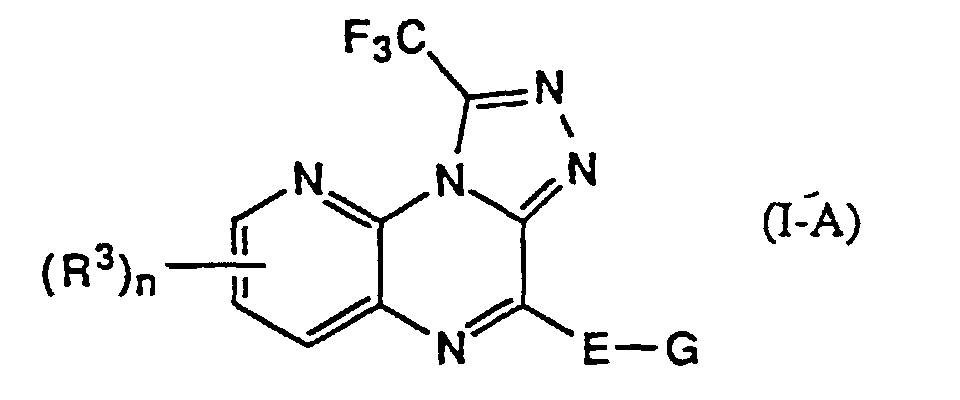
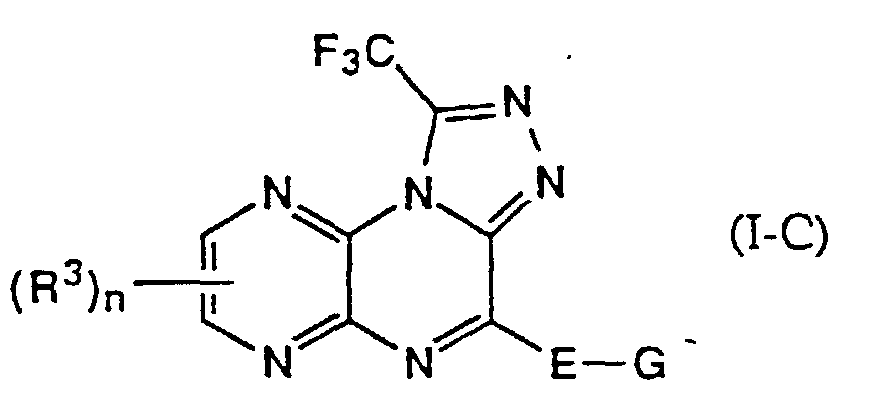
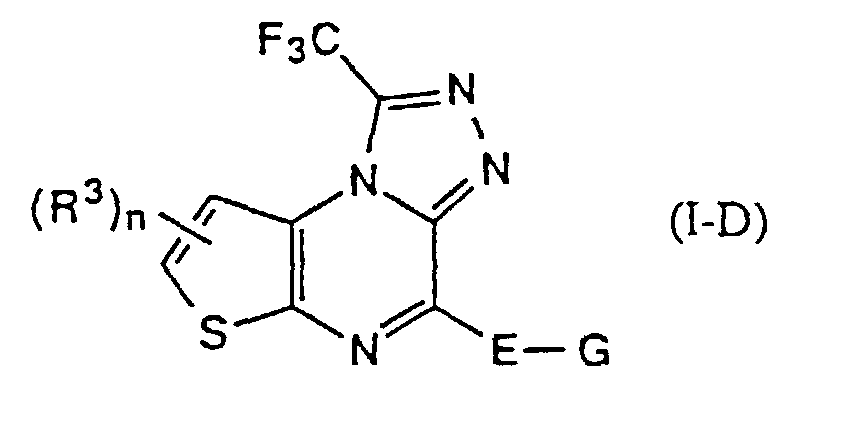
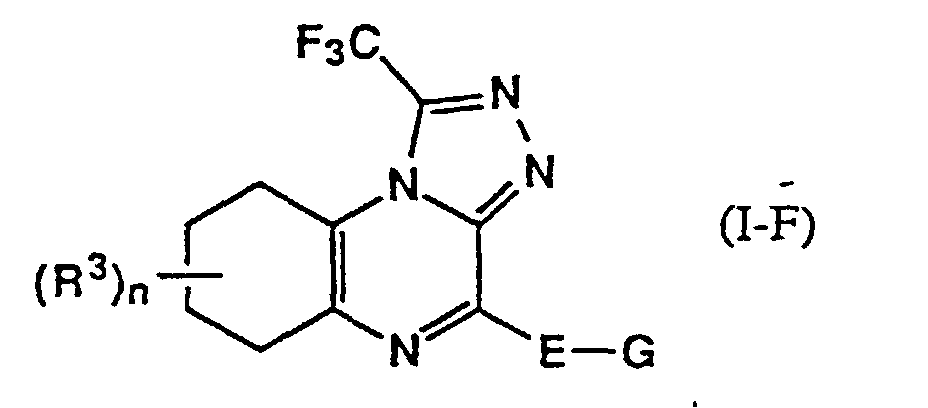
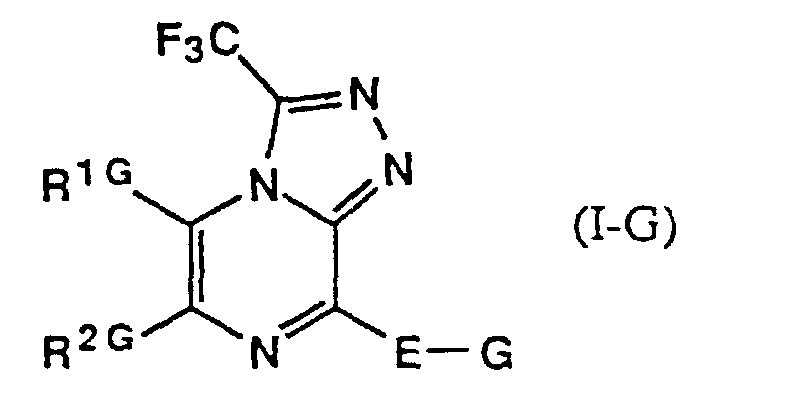
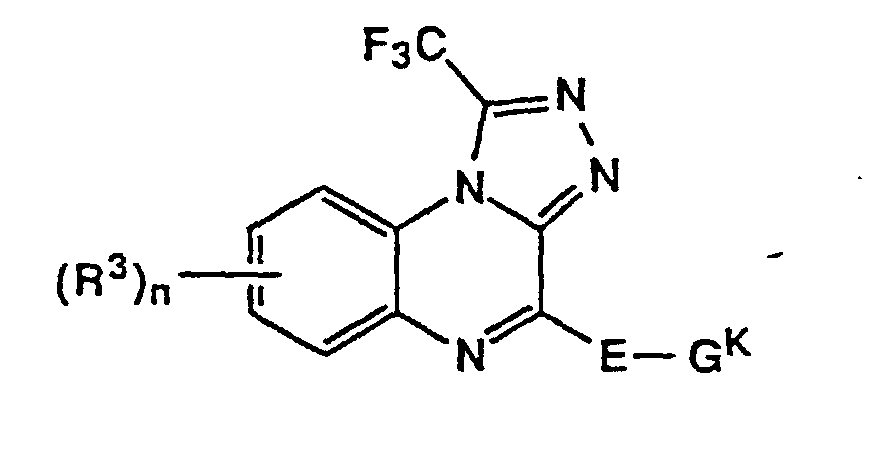
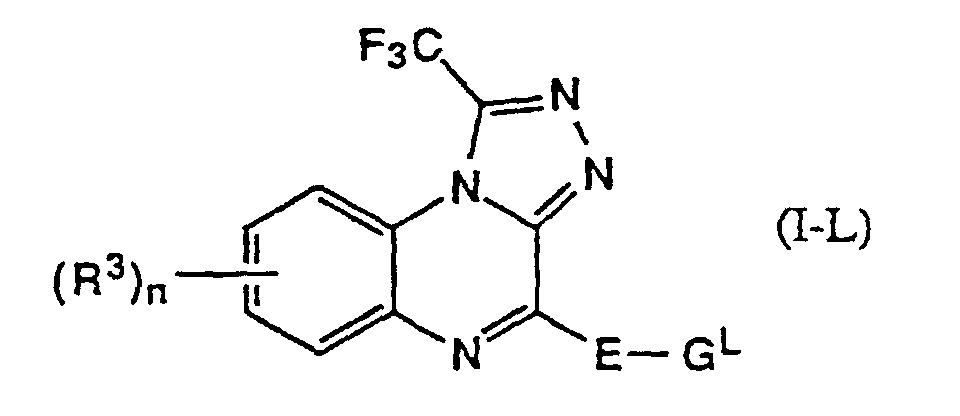
  • the following compounds of the formulae are preferred: the formula (I-A): wherein all the symbols are as hereinbefore defined; the formula (I-B): wherein all the symbols are as hereinbefore defined; the formula (I-C): wherein all the symbols are as hereinbefore defined; the formula (I-D): wherein all the symbols are as hereinbefore defined; the formula (I-E): wherein all the symbols are as hereinbefore defined; the formula (I-F); wherein all the symbols are as hereinbefore defined; the formula (I-G): wherein R 1G and R 2G each, independently, is (i) hydrogen, (ii) C1-8 alkyl, (iii) C1-8 alkoxy, (iv) C1-8 alkylthio, (v) Cyc1, (vi) nitrile, (vii) formyl, (viii) -COOR 14 , (ix) -CONR 15 R 16 , (x) C1-8
  • the compounds of the present invention of the formula (I), may be prepared by following methods or the methods described in the Examples.
  • t is 0 or 1-6
  • R W is hydrogen, C1-6 alkyl, C2-6 alkenyl, halogen atom, nitrile, COOR 6a , in which R 6a is C1-8 alkyl
  • R Z is hydrogen, C1-6 alkyl, halogen atom or nitrile, and the other symbols are as hereinbefore defined.
  • products may be purified by conventional techniques.
  • purification may be carried out by distillation at atmospheric or reduced pressure, by high performance liquid chromatography, by thin layer chromatography or by column chromatography using silica gel or magnesium silicate, by washing or by recrystallization. Purification may be carried out after each reaction, or after a series of reactions.
  • Human umbilical vein endothelial cells were cultured using MCDB104 medium (Nissui) containing 5 % Fetal bovine serum supplemented antibiotics (100U/ml penicillin, 100 ⁇ g/ml streptomycin (Gibco)), 0.01mg/ml heparin (Nissui) and 0.005mg/ml endothelial cells (EC) growth factor (Nissui) in gelatin coated 96-well microtiter plates by resulting in confluent monolayers.
  • antibiotics 100U/ml penicillin, 100 ⁇ g/ml streptomycin (Gibco)
  • 0.01mg/ml heparin Nasui
  • EC endothelial cells
  • Cytokine stimulation of EC was performed by adding 50 ⁇ l of 10 ng/ml TNF ⁇ (Genzyme) (for E-selectin, and ICAM-1 expression-) or 50 ⁇ l of 10ng/ml TNF ⁇ plus 1ng/ml IL-4 (Genzyme)(for VCAM- expression).
  • EC were incubated for 30 minutes in turn with 100 ⁇ l primary antibody which were anti-ICAM-1 antibody (BBA4), anti-E-selectin antibody (BBA2) or anti-VCAM-1 antibody (BBA6) (mouse IgG1, 1.25 ⁇ l/ml; R&D), with 100 ⁇ l of secondary antibody which was goat anti-mouse IgG conjugated peroxidase (dilution (1/400) ; Nordic Immunological laboratories).
  • the enzyme substrate 1mg/ml o-phenylenediamine/2HCl and 0.1% hydrogen peroxide of 100 ⁇ l was added and incubated for 4 minutes at room temperature.
  • Inhibitory percentage [(C-S)/(C-B)]x100
  • MTT [3-(4, 5-dimethyl-2-thiazolyl)-2, 5-diphenyl-2H-tetrazolium bromide] assay was enforced and the number of living cells was counted in order to estimate the effect of compound not to depend cytotoxicity on the above evaluation system.
  • IC 50 values of compound (12), Example 3 (16) and Example 3 (73) were more than 50 ⁇ M, 100 ⁇ M and 25 ⁇ M respectively.
  • the toxicity of the compounds of the present invention is very low and therefore, the compounds may be considered safe for pharmaceutical use.
  • Inhibition of adhesion molecules expression is useful for prevention and / or treatment of diseases, for example, inflammation, rheumatoid arthritis, allergies, asthma, atopic dermatitis, psoriasis, suppression of ischemia reperfusion injury, nephritis, hepatitis. multiple sclerosis, ulcerative colitis, ARDS, suppression of transplant rejection, sepsis, diabetes, autoimmune diseases, tumor metastasis, arteriosclerosis and AIDS in animals including human beings, especially human beings.
  • diseases for example, inflammation, rheumatoid arthritis, allergies, asthma, atopic dermatitis, psoriasis, suppression of ischemia reperfusion injury, nephritis, hepatitis.
  • non-toxic salts, acid addition salts or hydrates thereof may be normally by administered systemically or locally, usually by oral or parenteral administration.
  • the doses to be administered are determined depending upon, for example, age, body weight, symptom, the desired therapeutic effect, the route of administration, and the duration of the treatment.
  • the doses per person are generally from 1 mg to 1000 mg, by oral administration, up to several times per day, and from 1 mg to 100 mg, by parenteral administration (preferably intravenous administration), up to several times per day, or continuous administration from 1 to 24 hours per day from vein.
  • the doses to be used depend upon various conditions. Therefore, there are cases in which doses lower than or greater than the ranges specified above may be used.
  • the compounds of the present invention may be administered in the form of, for example, solid forms for oral administration, liquid forms for oral administration, injections, liniments or suppositories for parenteral administration.
  • Solid forms for oral administration include compressed tablets, pills, capsules, dispersible powders, and granules.
  • Capsules include hard capsules and soft capsules.
  • one or more of the active compound(s) may be admixed with vehicles (such as lactose, mannitol, glucose, microcrystalline cellulose, starch), binders (such as hydroxypropyl cellulose, polyvinylpyrrolidone or magnesium metasilicate aluminate), disintegrants (such as cellulose calcium glycolate), lubricants (such as magnesium stearate), stabilizing agents, and solution adjuvants (such as glutamic acid or aspartic acid) and prepared according to methods well known in normal pharmaceutical practice.
  • vehicles such as lactose, mannitol, glucose, microcrystalline cellulose, starch
  • binders such as hydroxypropyl cellulose, polyvinylpyrrolidone or magnesium metasilicate aluminate
  • disintegrants such as cellulose calcium glycolate
  • lubricants such as magnesium stearate
  • stabilizing agents such as glutamic acid or aspartic acid
  • the solid forms may, it desired, be coated with coating agents (such as sugar, gelatin, hydroxypropyl cellulose or hydroxypropylmethyl cellulose phthalate), or be coated with two or more films. And further, coating may include containment within capsules of absorbable materials such as gelatin.
  • coating agents such as sugar, gelatin, hydroxypropyl cellulose or hydroxypropylmethyl cellulose phthalate
  • coating may include containment within capsules of absorbable materials such as gelatin.
  • Liquid forms for oral administration include pharmaceutically acceptable solutions, suspensions and emulsions, syrups and elixirs.
  • one or more of the active compound(s) may be dissolved, suspended or emulized into diluent(s) commonly used in the art (such as purified water, ethanol or a mixture thereof).
  • diluent(s) commonly used in the art (such as purified water, ethanol or a mixture thereof).
  • Besides such liquid forms may also comprise some additives, such as wetting agents, suspending agents, emulsifying agents, sweetening agents, flavoring agents, aroma, preservative or buffering agent.
  • Injections for parenteral administration include sterile aqueous, suspensions, emulsions and solid forms which are dissolved or suspended into solvent(s) for injection immediately before use.
  • one or more of the active compound(s) may be dissolved, suspended or emulized into solvent(s).
  • the solvents may include distilled water for injection, physiological salt solution, vegetable oil, propylene glycol, polyethylene glycol, alcohol, e.g. ethanol, or a mixture thereof.
  • Injections may comprise some additives, such as stabilizing agents, solution adjuvants (such as glutamic acid, aspartic acid or POLYSORBATE80 (registered trade mark)), suspending agents, emulsifying agents, soothing agent buffering agents, preservative. They may be sterilized at a final step, or may be prepared and compensated according to sterile methods. They may also be manufactured in the form of sterile solid forms which may be dissolved in sterile water or some other sterile diluent(s) for injection immediately before use.
  • parenteral administration examples include liquids for external use, ointments and endermic liniments, inhalations, sprays, suppositories and pessaries for vaginal administration which comprise one or more of the active compound(s) and may be prepared by methods known per se.
  • Sprays may comprise additional substances other than diluents, such as stabilizing agents (such as sodium sulfate), isotonic buffers (such as sodium chloride, sodium citrate or citric acid).
  • stabilizing agents such as sodium sulfate
  • isotonic buffers such as sodium chloride, sodium citrate or citric acid
  • the solvents in the parentheses show the developing or eluting solvents and the ratios of the solvents used are by volume in chromatographic separations or TLC.
  • the solvents in the parentheses in NMR show the solvents used in measurement.
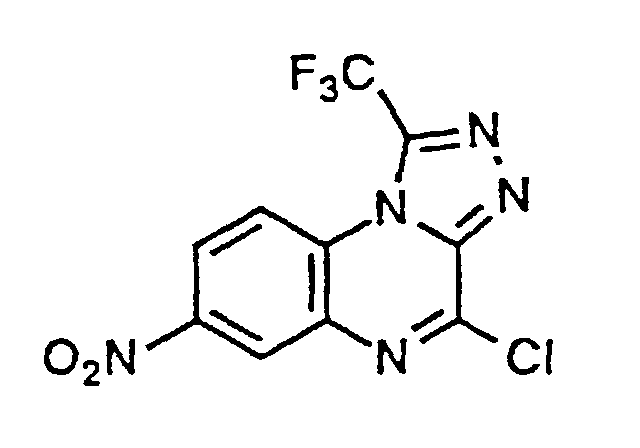
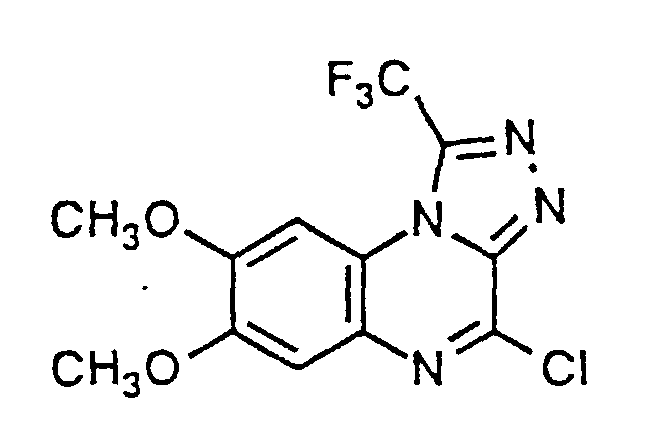
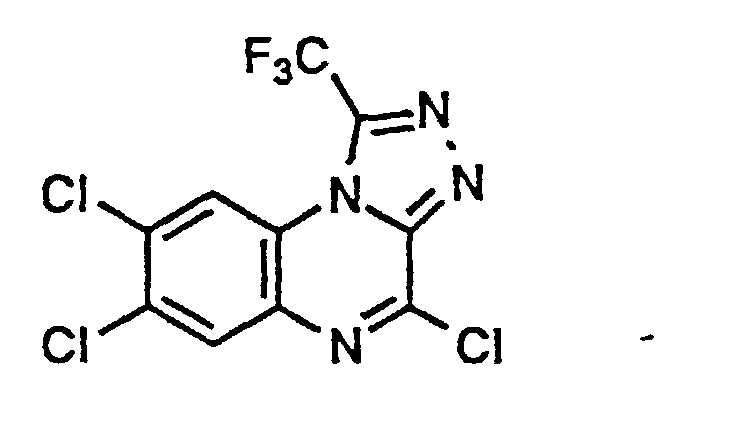
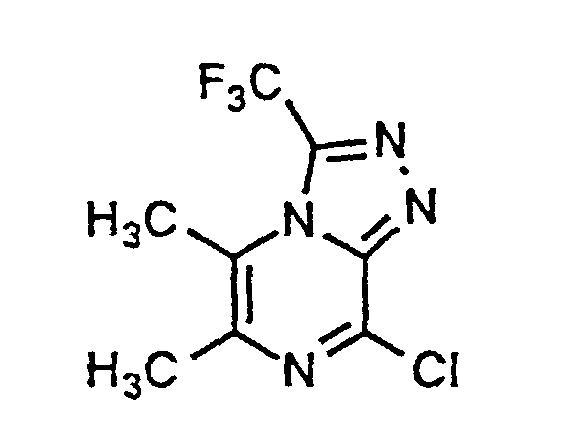
  • Phosphorus oxychloride (20 ml) was added to a solution of the compound prepared in Reference Example 2 (2.0 g) in dimethylformamide (1.07 ml). The mixture was stirred for 2 hours at 100 °C. The reaction mixture was cooled to room temperature. Water was added to the mixture, and the mixture was extracted with ethyl acetate. The extract was washed with a saturated aqueous solution of sodium bicarbonate, a saturated aqueous solution of sodium chloride, successively, dried over anhydrous magnesium sulfate and concentrated to give the title compound (2.3 g) having the following physical data.

Landscapes

  • Chemical & Material Sciences (AREA)
  • Organic Chemistry (AREA)
  • Health & Medical Sciences (AREA)
  • Medicinal Chemistry (AREA)
  • Pharmacology & Pharmacy (AREA)
  • Epidemiology (AREA)
  • Life Sciences & Earth Sciences (AREA)
  • Animal Behavior & Ethology (AREA)
  • General Health & Medical Sciences (AREA)
  • Public Health (AREA)
  • Veterinary Medicine (AREA)
  • Pharmaceuticals Containing Other Organic And Inorganic Compounds (AREA)
  • Nitrogen Condensed Heterocyclic Rings (AREA)

Abstract

Compounds represented by general formula (I) (wherein each symbol is as defined in the description) and salts thereof. The compounds inhibit adhesion molecule expression and are useful for inhibiting various inflammatory diseases, rheumatoid arthritis, allergy, bronchial asthma, atopic dermatitis, psoriasis, ischemic reperfusion injury, nephritis, hepatitis, multiple sclerosis, ulcerative colitis, acute respiratory distress syndrome, graft rejection, sepsis, diabetes and autoimmune diseases, and for preventing and/or remedying sepsis, diabetes, autoimmune disease, cancer metastasis, arteriosclerosis and AIDS.

Description

Summary
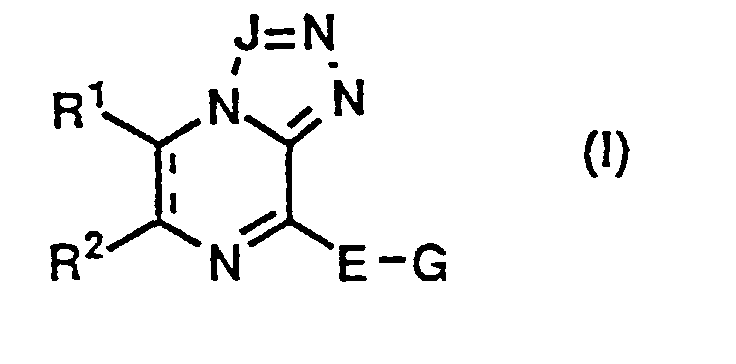
This invention is related to fused pyrazine derivatives and adhesion molecules expression inhibitors containing fused pyrazine derivatives as active ingredient. More particularly, this invention is related to adhesion molecules expression inhibitors containing fused pyrazine derivatives of the formula (I):
Figure 00010001
wherein all the symbols are the same meaning as hereinafter defined, and non-toxic salts thereof, and novel fused pyrazine derivatives of the above formula (I) and non-toxic salts thereof, and processes for the preparation thereof.
Background
Cellular adhesions are basic responses in the organism and relate to various biological phenomenon deeply. In diseases, there are various examples which are mediated by excess reactions or disordered reactions. Inflammatory reaction, which protect a host from a foreign matter, is essentially one of the defensive response in the organism and it is thought that acceleration of leukocytes adhesion to endothelial cells is a central process in the early step in this reaction. Leukocytes are one of the major cells in inflammation and migrate into the inflammatory tissues and secrete chemical mediators, cytokines or enzymes and develop inflammation. Therefore, it has been thought leukocytes extravasation from the vascular flow is an important process in inflammatory development and the process, which is leukocytes-endothelial cells adhesion, is essential in the early step in transmigration.
Cellular migration is at least classified following 4 steps:
  • 1) tethering of leukocytes to endothelial cells,
  • 2) rolling of leukocytes,
  • 3) firm adhesion of leukocytes to endothelial cells,
  • 4) transmigration of leukocytes.
  • Recently, it has been reported these various cellular adhesions are mediated by cell surface molecular groups which are called adhesion molecules and explained the distinct molecular groups specifically play a central role in the previous each adhesion step. That is to say, it has been explained tethering and rolling process are induced by interaction of carbohydrate and selectin, such as E-selectin, and subsequent firm adhesion and extravasation processes are mediated by interaction of integrin family on leukocytes and immunoglobulin superfamily, such as ICAM-1 (Intercellular Adhesion Molecule-1) and VCAM-1 (Vascular Cell Adhesion Molecule-1).
    Any of endothelial adhesion molecules which are E-selectin, VCAM-1 and ICAM-1 are induced molecules stimulated by inflammatory cytokines, such as TNF and IL-1. In fact, it has been reported that these adhesion molecules expression are upregulated in the various lesional sites. Therefore the upregulation of adhesion molecules develops cellular adhesion and participates in disease formation, such as chronic inflammation.
    It has been suggested these cellular adhesions to endothelial cells participate not only inflammatory reaction but also tumor metastasis, allergic reaction and immune reaction. Furthermore, the reports which showed the upregulation of VCAM-1 and the increase of ICAM-1 concentration in HIV infected patients have suggested the relation between adhesion molecules expression and HIV infection [Clinical Immunology and Immunopathology, 81, 6-21 (1996)].
    From these viewpoints, it is expected the inhibition of adhesion molecules expression which are E-selectin, \/CAM-1 and ICAM-1 suppresses the cellular adhesion and links the treatment for various diseases.
    The present invitation provides a useful new therapeutic agent which has inhibitory activity on these adhesion molecules expression.
    According to a further aspect, the present invitation provides the use of the compounds for treatment and/or prevention of disorders mediated by cellular adhesion and infiltration, such as inflammation, rheumatoid arthritis, allergies, asthma, atopic dermatitis, psoriasis, suppression of ischemia reperfusion injury, nephritis, hepatitis, multiple sclerosis, ulcerative colitis, adult respiratory distress syndrome (ARDS), suppression of transplant rejection, sepsis, diabetes, autoimmune diseases, tumor metastasis, arteriosclerosis and AIDS [The Hand Book of Immunopharmacology, Adhesion Molecule, Academic Press, (1994), Trends in Pharmacological Science 16, 418-423, (1995), Molecular Medicine Today, 3, 418-423 (1997), Molecular Medicine Today, 3, 310-321 (1997), Japanese Journal of Inflammation 17, 459-467 (1997)].
    For example, 1, 2, 4-triazolo-[4, 3-a]pyrazine derivatives of the formula (X):
    Figure 00030001
    in the specification of GB 1235910, and the formula (Y):
    Figure 00030002
    in the specification of GB 1146770, are disclosed to be useful as treatment of bronchial disorder.
    In the specification of US 4200750, US 4198508, US 4191767, US 4191766, BE 878028 and BE 862608, imidazo-[1, 2-a]quinoxaline derivatives are disclosed to be useful as immunosuppressants, anti-inflammatory agents, antifungal agents, antiyeast agents, treatment of bronchial disorder.
    Besides, in the specification of WO 9535296, fused imidazole derivatives of the formula (Z):
    Figure 00040001
    are disclosed to have an inhibitory activity of adhesion molecules expression.
    Disclosure of the Invention
    Energetic investigations have been carried out in order to make adhesion molecules expression inhibitors. The present inventors have found that fused pyrazine derivatives of the formula (I) accomplished the present purpose.
    Fused pyrazine derivatives of the formula (I) of the present invention are not known as adhesion molecules expression inhibitors at all. Besides, a lot of fused pyrazine derivatives of the formula (I) are novel compounds.
    The present invention is related to:
  • (i) adhesion molecules expression inhibitors containing fused pyrazine derivatives of the formula (I):
    Figure 00040002
  • wherein R1 and R2 each, independently, is (i) hydrogen, (ii) C1-8 alkyl, (iii) C1-8 alkoxy, (iv) C1-8 alkylthio, (v) Cyc1, (vi) nitrile, (vii) formyl, (viii) -COOR14, in which R14 is hydrogen or C1-8 alkyl, (ix) -CONR15R16, in which R15 and R16 each, independently, is hydrogen, C1-8 alkyl or phenyl, (x) C1-8 alkyl or C2-8 alkenyl substituted by 1 or 2 of hydroxy, C1-4 alkoxy, phenoxy, halogen atom, nitrile, C2-5 acyl, -COOR14, -CONR15R16, or -NR17R18, in which R17 and R18 each, independently, is hydrogen, C1-8 alkyl or acetyl, (xi) C1-8 alkyl, C1-8 alkoxy or C1-8 alkylthio substituted by Cyc1, or R1 and R2, taken together with carbon atoms which are attached to each of them, is
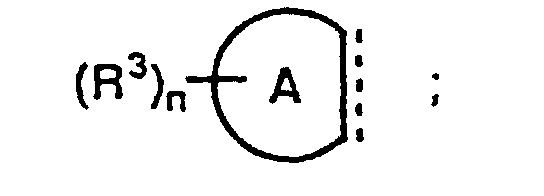
    Figure 00050001
    in which Cyc1 is C3-15 mono-, bi- or tri-carbocyclic ring or 5-18 membered mono-, bi- or tri-heterocyclic ring containing 1-4 of nitrogen(s), 1-2 of oxygen(s) and / or 1 of sulfur, the above carbocyclic ring or heterocyclic ring may be substituted by one or more of (i) C1-8 alkyl, (ii) C1-8 alkoxy, (iii) nitro, (iv) halogen atom, (v) nitrile, (vi) hydroxy, (vii) benzyloxy, (viii) -NR101R102, in which R101 and R102 each, independently, is hydrogen or C1-8 alkyl, (ix) - COOR103, in which R103 is hydrogen or C1-8 alkyl, (x) trihalomethyl, (xi) trihalomethoxy, (xii) phenyl, (xiii) phenyloxy, (xiv) C1-8 alkyl or C1-8 alkoxy substituted by phenyl, phenyloxy, hydroxy, -NR101R102 or -COOR103;
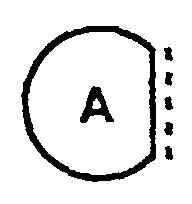
    Figure 00050002
    is C3-7 mono-carbocyclic ring or 3-7 membered mono-heterocyclic ring containing 1-4 of nitrogen(s), 1-2 of oxygen(s) and / or 1 of sulfur;
  • R3 is
  • 1) hydrogen,
  • 2) C1-8 alkyl,
  • 3) C2-8 alkenyl,
  • 4) C1-8 alkoxy,
  • 5) C1-8 alkylthio,
  • 6) halogen atom,
  • 7) nitro,
  • 8) cyano,
  • 9) hydroxy,
  • 10) formyl,
  • 11)C2-5 acyl,
  • 12) -NR4R5, in which R4 and R5 each, independently, is hydrogen, C1-8 alkyl or acetyl,
  • 13) -COOR6, in which R6 is hydrogen or C1-8 alkyl,
  • 14) -CONR19R20, in which R19 and R20 each, independently, is hydrogen, C1-8 alkyl, phenyl, or C1-4 alkyl substituted by hydroxy, 5-7 membered mono-heterocyclic ring containing 1-2 of nitrogen(s), or 1 of nitrogen and 1 of oxygen, or R19 and R20, taken together is =CH-NR21R22, in which R21 and R22 each, independently, is hydrogen or C1-4 alkyl,
  • 15) trihalomethyl,
  • 16) trihalomethoxy,
  • 17) phenyl,
  • 18) phenyloxy,
  • 19) phenylthio, or
  • 20) C1-8 alkyl, C1-8 alkoxy, C1-8 alkylthio or C1-8 alkylamino substituted by phenyl, or
  • 21) C1-8 alkyl or C2-8 alkenyl substituted by 1 or 2 of hydroxy, C1-4 alkoxy, phenoxy, halogen atom, nitrile, C2-5 acyl, -COOR6, -CONR19R20 or -NR4R5;
  • n is 0 or 1-5;
  • J is nitrogen atom or C-R7;
  • R7 is
  • 1) hydrogen,
  • 2) C1-8 alkyl,
  • 3) Cyc2,
  • 4) C1-8 alkyl substituted by Cyc2,
  • 5) C1-8 alkyl or C1-8 alkoxy substituted by 1-17 of halogen atom, or
  • 6) halogen atom,
  • in which Cyc2 is C3-15 mono-, bi- or tri-carbocyclic ring or 5-18 membered mono-, bi- or tri-heterocyclic ring containing 1-4 of nitrogen(s), 1-2 of oxygen(s) and / or 1 of sulfur, the above carbocyclic ring or heterocyclic ring may be substituted by one or more of (i) C1-8 alkyl, (ii) C1-8 alkoxy, (iii) nitro, (iv) halogen atom, (v) nitrile, (vi) hydroxy, (vii) benzyloxy, (viii) -NR201R202, in which R201 and R202 each, independently, is hydrogen or C1-8 alkyl, (ix) - COOR203, in which R203 is hydrogen or C1-8 alkyl, (x) trihalomethyl, (xi) trihalomethoxy, (xii) phenyl, (xiii) phenyloxy, (xiv) C1-8 alkyl or C1-8 alkoxy substituted by phenyl, phenyloxy, hydroxy, -NR201R202 or -COOR203;
  • E is a single bond, C1-4 alkylene, oxygen atom, sulfur atom, -SO-, -SO2-,C1-4 alkylene-M- , with the proviso that alkylene bond to ring and M is bond to G;
  • M is oxygen atom, sulfur atom, -SO-, -SO2-;
  • G is
  • 1) C1-8 alkyl,
  • 2) C2-8 alkenyl,
  • 3) C2-8 alkynyl,
  • 4) Cyc3, or
  • 5) C1-8 alkyl substituted by -OR8, -SR8, -NR9R10, -COR11 or Cyc3, with the proviso that (i) one carbon atom in C1-8 alkyl, which is a component atom of cycloalkyl, may represent 3-7 membered cycloalkyl, or (ii) neighboring two carbon atom in C1-8 alkyl, which are component atoms of cycloalkyl, may represent 3-7 membered cycloalkyl;
  • in which Cyc3 is C3-15 mono-, bi- or tri-carbocyclic ring or 5-18 membered mono-, bi- or tri-heterocyclic ring containing 1-4 of nitrogen(s), 1-2 of oxygen(s) and / or 1 of sulfur, the above carbocyclic ring or heterocyclic ring may be substituted by one or more of (i) C1-8 alkyl, (ii) C1-8 alkoxy, (iii) nitro, (iv) halogen atom, (v) nitrite, (vi) hydroxy, (vii) benzyloxy, (viii) -NR301R302, in which R301 and R302 each, independently, is hydrogen or C1-8 alkyl, (ix) - COOR303, in which R303 is hydrogen. or C1-8 alkyl, (x) trihalomethyl, (xi) trihalomethoxy, (xii) phenyl, (xiii) phenyloxy, (xiv) C1-8 alkyl or C1-8 alkoxy substituted by phenyl, phenyloxy, hydroxy, -NR301R302 or -COOR303;
  • R8 is hydrogen, C1-8 alkyl, C2-8 alkenyl, C1-8 alkyl substituted by phenyl or C1-8 alkoxy, or -S-(C1-8 alkylene)-OR23, in which R23 is hydrogen or C1-8 alkyl; with the proviso that (i) one carbon atom in C1-8 alkylene, which is a component atom of cycloalkyl, may represent 3-7 membered cycloalkyl , or (ii) neighboring two carbon atom in C1-8 alkylene, which are component atoms of cycloalkyl, may represent 3-7 membered cycloalkyl;
  • R9 is hydrogen, C1-8 alkyl, C2-8 alkenyl, C1-8 alkyl substituted by phenyl or C1-8 alkoxy;
  • R10 is hydrogen, C1-8 alkyl, C2-8 alkenyl, C1-8 alkyl substituted by phenyl, or C2-5 acyl;
  • R11 is (i) C1-8 alkyl, (ii) C1-8 alkoxy, (iii) hydroxy, (iv) C1-8 alkyl or C1-8 alkoxy substituted by phenyl, or (v) -NR12R13, in which R12 and R13 each, independently, is hydrogen, C1-8 alkyl or C1-8 alkyl substituted by phenyl;
  • Figure 00070001
    is a single bond or a double bond;
  • with the proviso that the compounds in which R2 is C1-8 alkyl, E is a single bond or C1-4 alkylene and G is C1-8 alkyl are excluded;
  • or non-toxic acid thereof as active ingredient,
  • (ii) novel fused pyrazine derivatives of the formula (I):
    Figure 00080001
  • wherein R1 and R2 each, independently, is (i) hydrogen, (ii) C1-8 alkyl, (iii) C1-8 alkoxy, (iv) C1-8 alkylthio, (v) Cyc1, (vi) nitrite, (vii) formyl, (viii) -COOR14, in which R14 is hydrogen or C1-8 alkyl, (ix) -CONR15R16, in which R15 and R16 each, independently, is hydrogen, C1-8 alkyl or phenyl, (x) C1-8 alkyl or C2-8 alkenyl substituted by 1 or 2 of hydroxy, C1-4 alkoxy, phenoxy, halogen atom, nitrile, C2-5 acyl, -COOR14, -CONR15R16, or -NR17R18, in which R17 and R18 each, independently, is hydrogen, C1-8 alkyl or acetyl, (xi) C1-8 alkyl, C1-8 alkoxy or C1-8 alkylthio substituted by Cyc1, or R1 and R2, taken together with carbon atoms which are all ached to each of them, is
    Figure 00080002
    in which Cyc1 is C3-15 mono-, bi- or tri-carbocyclic ring or 5-18 membered mono-, bi- or tri-heterocyclic ring containing 1-4 of nitrogen(s), 1-2 of oxygen(s) and / or 1 of sulfur, the above carbocyclic ring or heterocyclic ring may be substituted by one or more of (i) C1-8 alkyl, (ii) C1-8 alkoxy, (iii) nitro, (iv) halogen atom, (v) nitrite, (vi) hydroxy, (vii) benzyloxy, (viii) -NR101R102, in which R101 and R102 each, independently, is hydrogen or C1-8 alkyl, (ix) - COOR103, in which R103 is hydrogen or C1-8 alkyl, (x) trihalomethyl, (xi) trihalomethoxy, (xii) phenyl, (xiii) phenyloxy, (xiv) C1-8 alkyl or C1-8 alkoxy substituted by phenyl, phenyloxy, hydroxy, -NR101R102 or -COOR103;
    Figure 00080003
    is C3-7 mono-carbocyclic ring or 3-7 membered mono-heterocyclic ring containing 1-4 of nitrogen(s), 1-2 of oxygen(s) and / or 1 of sulfur;
  • R3 is
  • 1) hydrogen,
  • 2) C1-8 alkyl,
  • 3) C2-8 alkenyl,
  • 4) C1-8 alkoxy,
  • 5) C1-8 alkylthio,
  • 6) halogen atom,
  • 7) nitro,
  • 8) cyano,
  • 9) hydroxy,
  • 10) formyl,
  • 11) C2-5 acyl,
  • 12) -NR4R5, in which R4 and R5 each, independently, is hydrogen, C1-8 alkyl or acetyl,
  • 13) -COOR6, in which R6 is hydrogen or C1-8 alkyl,
  • 14) -CONR19R20, in which R19 and R20 each, independently, is hydrogen, C1-8 alkyl, phenyl, or C1-4 alkyl substituted by hydroxy, 5-7 membered mono-heterocyclic ring containing 1-2 of nitrogen(s), or 1 of nitrogen and 1 of oxygen, or R19 and R20, taken together is =CH-NR21R22, in which R21 and R22 each, independently, is hydrogen or C1-4 alkyl,
  • 15) trihalomethyl,
  • 16) trihalomethoxy,
  • 17) phenyl,
  • 18) phenyloxy,
  • 19) phenylthio, or
  • 20) C1-8 alkyl, C1-8 alkoxy, C1-8 alkylthio or C1-8 alkylamino substituted by phenyl, or
  • 21) C1-8 alkyl or C2-8 alkenyl substituted by 1 or 2 of hydroxy, C1-4 alkoxy, phenoxy, halogen atom, nitrile, C2-5 acyl, -COOR6, -CONR19R20 or -NR4R5;
  • n is 0 or 1-5;
  • J is nitrogen atom or C-R7;
  • R7 is
  • 1) hydrogen,
  • 2) C1-8 alkyl,
  • 3) Cyc2,
  • 4) C1-8 alkyl substituted by Cyc2,
  • 5) C1-8 alkyl or C1-8 alkoxy substituted by 1-17 of halogen atom, or
  • 6) halogen atom,
  • in which Cyc2 is C3-15 mono-, bi- or tri-carbocyclic ring or 5-18 membered mono-, bi- or tri-heterocyclic ring containing 1-4 of nitrogen(s), 1-2 of oxygen(s) and / or 1 of sulfur, the above carbocyclic ring or heterocyclic ring may be substituted by one or more of (i) C1-8 alkyl, (ii) C1-8 alkoxy, (iii) nitro, (iv) halogen atom, (v) nitrile, (vi) hydroxy, (vii) benzyloxy, (viii) -NR201R202, in which R201 and R202 each, independently, is hydrogen or C1-8 alkyl, (ix) - COOR203, in which R203 is hydrogen or C1-8 alkyl, (x) trihalomethyl, (xi) trihalomethoxy, (xii) phenyl, (xiii) phenyloxy, (xiv) C1-8 alkyl or C1-8 alkoxy substituted by phenyl, phenyloxy, hydroxy, -NR201R202 or -COOR203;
  • E is a single bond, C1-4 alkylene, oxygen atom, sulfur atom, -SO-, -SO2-, C1-4 alkylene-M- , with the proviso that alkylene bond to ring and M is bond to G;
  • M is oxygen atom, sulfur atom, -SO-, -SO2-;
  • G is
  • 1) C1-8 alkyl,
  • 2) C2-8 alkenyl,
  • 3) C2-8 alkynyl,
  • 4) Cyc3, or
  • 5) C1-8 alkyl substituted by -OR8, -SR8, -NR9R10, -COR11 or Cyc3, with the proviso that (i) one carbon atom in C1-8 alkyl, which is a component atom of cycloalkyl, may represent 3-7 membered cycloalkyl, or (ii) neighboring two carbon atom in C1-8 alkyl, which are component atoms of cycloalkyl, may represent 3-7 membered cycloalkyl;
  • in which Cyc3 is C3-15 mono-, bi- or tri-carbocyclic ring or 5-18 membered mono-, bi- or tri-heterocyclic ring containing 1-4 of nitrogen(s), 1-2 of oxygen(s) and / or 1 of sulfur, the above carbocyclic ring or heterocyclic ring may be substituted by one or more of (i) C1-8 alkyl, (ii) C1-8 alkoxy, (iii) nitro, (iv) halogen atom, (v) nitrile, (vi) hydroxy, (vii) benzyloxy, (viii) -NR301R302, in which R301 and R302 each, independently, is hydrogen or C1-8 alkyl, (ix) -COOR303, in which R303 is hydrogen or C1-8 alkyl, (x) trihalomethyl, (xi) trihalomethoxy, (xii) phenyl, (xiii) phenyloxy, (xiv) C1-8 alkyl or C1-8 alkoxy substituted by phenyl, phenyloxy, hydroxy, -NR301R302 or -COOR303;
  • R8 is hydrogen, C1-8 alkyl, C2-8 alkenyl, C1-8 alkyl substituted by phenyl or C1-8 alkoxy, or -S-(C1-8 alkylene)-OR23, in which R23 is hydrogen or C1-8 alkyl; with the proviso that (i) one carbon atom in C1-8 alkylene, which is a component atom of cycloalkyl, may represent 3-7 membered cycloalkyl , or (ii) neighboring two carbon atom in C1-8 alkylene, which are component atoms of cycloalkyl, may represent 3-7 membered cycloalkyl;
  • R9 is hydrogen, C1-8 alkyl, C2-8 alkenyl, C1-8 alkyl substituted by phenyl or C1-8 alkoxy;
  • R10 is hydrogen, C1-8 alkyl, C2-8 alkenyl, C1-8 alkyl substituted by phenyl, or C2-5 acyl;
  • R11 is (i) C1-8 alkyl, (ii) C1-8 alkoxy, (iii) hydroxy, (iv) C1-8 alkyl or C1-8 alkoxy substituted by phenyl, or (v) -NR12R13, in which R12 and R13 each, independently, is hydrogen, C1-8 alkyl or C1-8 alkyl substituted by phenyl;
  • is a single bond or a double bond;
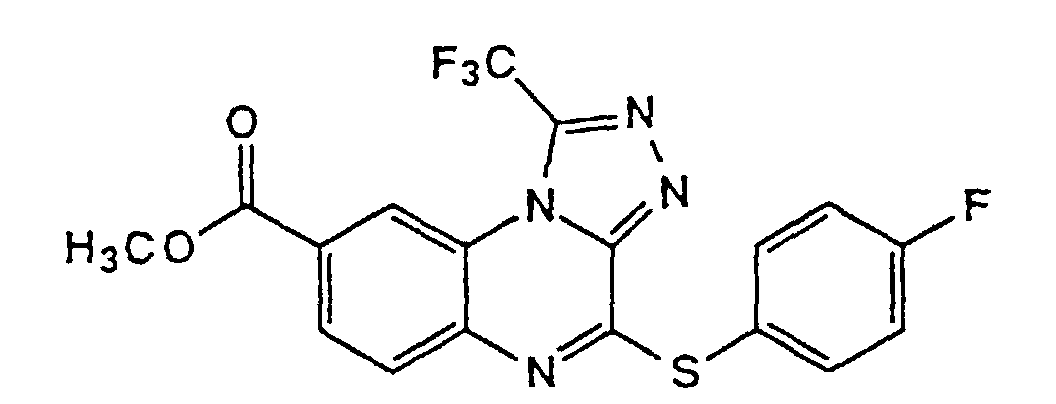
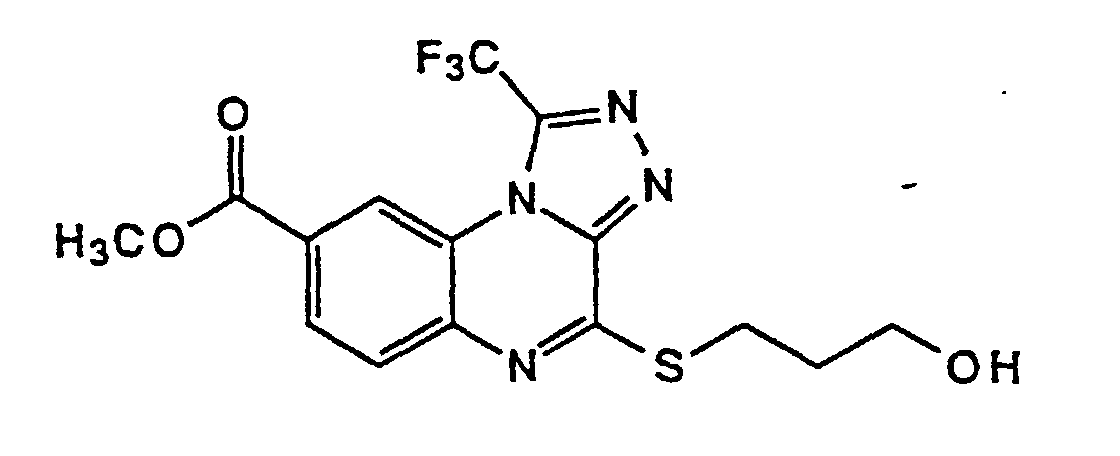
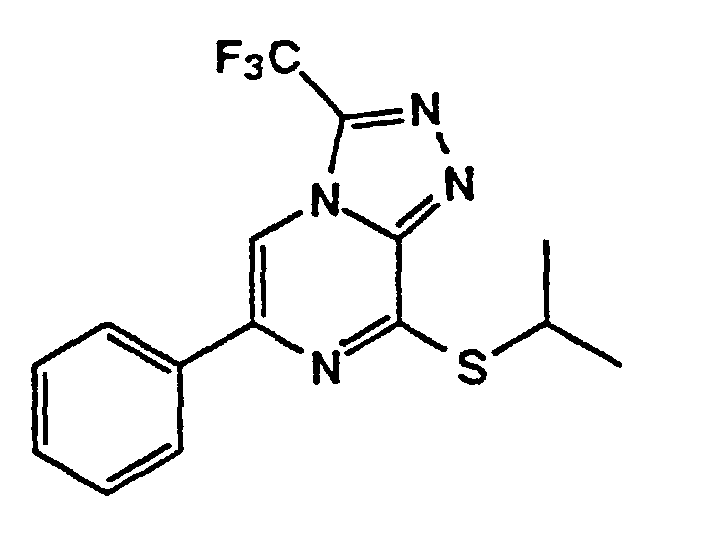
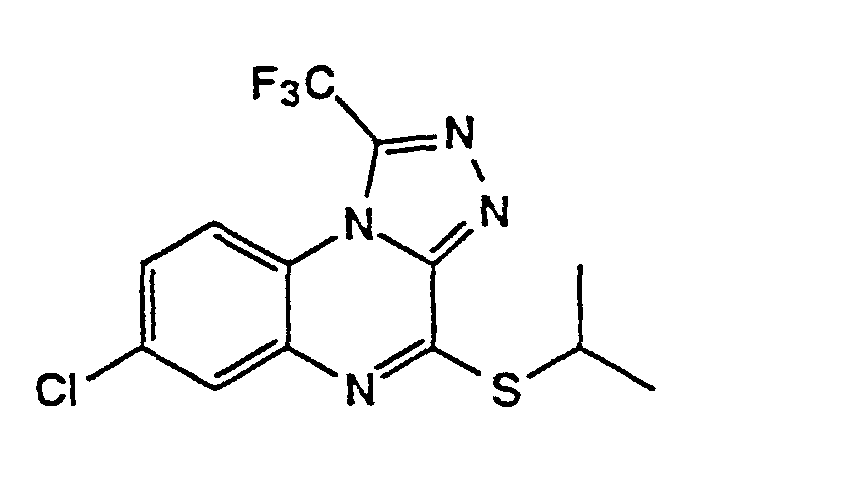
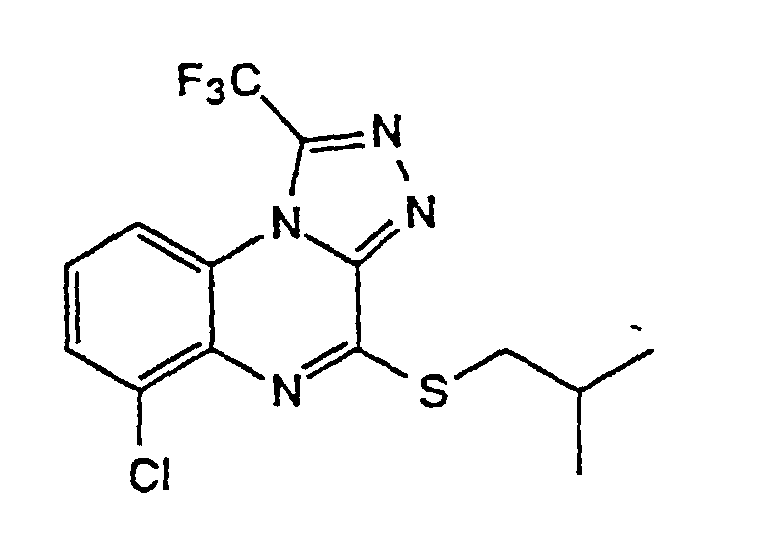
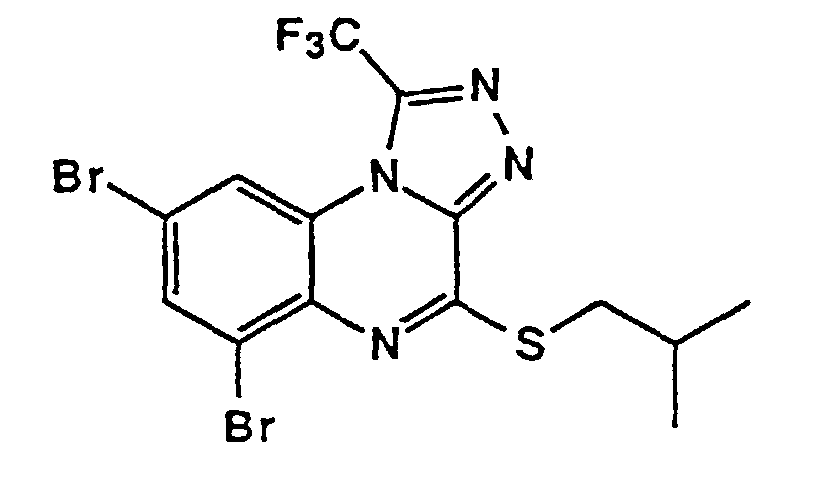
  • with the proviso that the compounds in which R2 is C1-8 alkyl, E is a single bond or C1-4 alkylene and G is C1-8 alkyl and the following compounds of (1)-(14) are excluded;
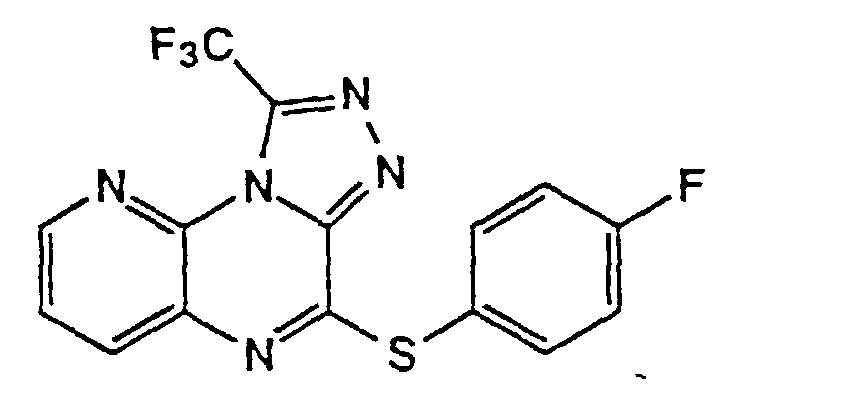
  • (1) 4-(4-Chlorophenyl)thio(1, 2, 4-triazolo)-[4, 3-a]quinoxaline,
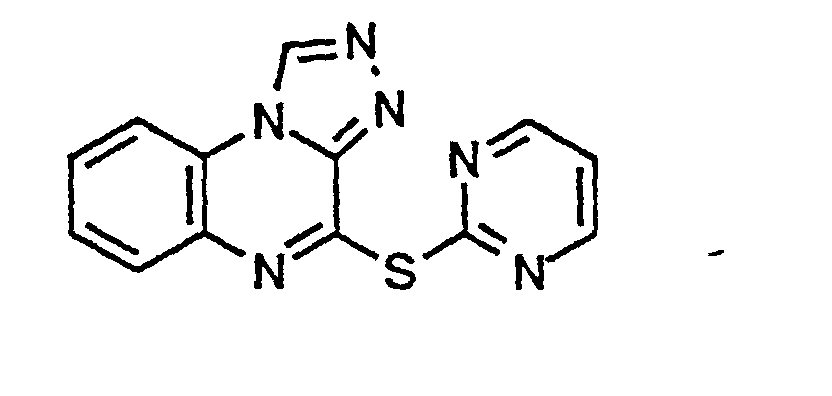
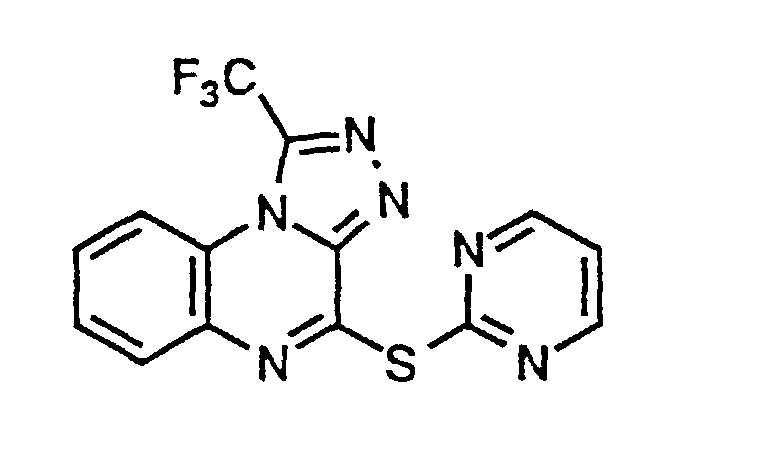
  • (2) 4-(Pyrimidine-2-yl)thio(1, 2, 4-triazolo)-[4, 3-a]quinoxaline,
  • (3) 4-Methoxycarbonylmethylthio(5-methyl-1, 2, 4-triazolo)-[4, 3-a]quinoxaline,
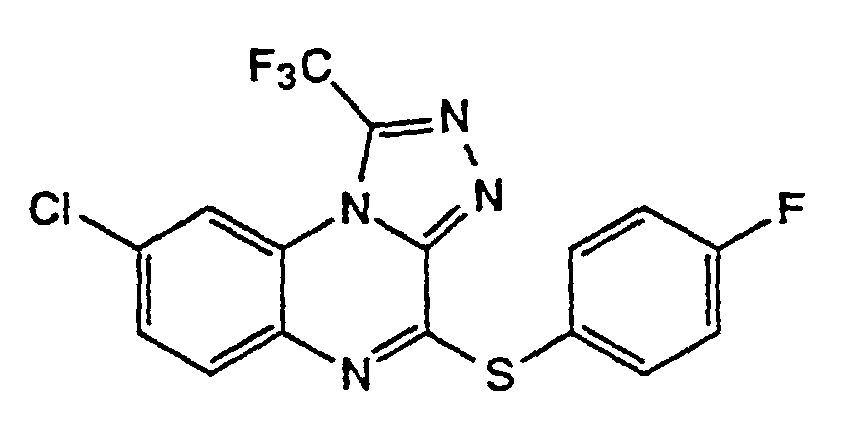
  • (4) 4-Phenylthio-8-chloro(5-trifluoromethyl-1, 2, 4-triazolo)-[4, 3-a]quinoxaline,
  • (5) 4-Phenylmethylthio(1, 2, 4-triazolo)-[4, 3-a]quinoxaline,
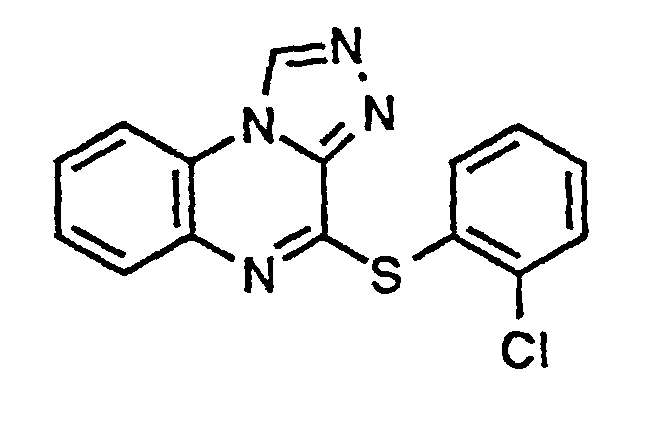
  • (6) 4-(2-Chlorophenyl)thio(1, 2, 4-triazolo)-[4, 3-a]quinoxaline,
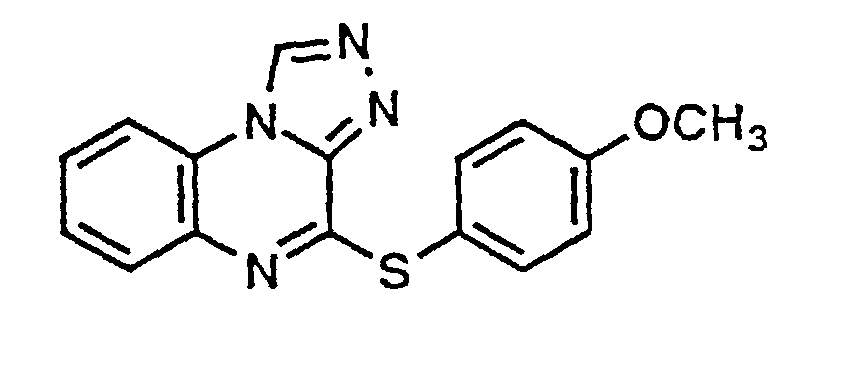
  • (7) 4-(4-Methoxyphenyl)thio(1, 2, 4-triazolo)-[4, 3-a]quinoxaline,
  • (8) 4-Allylthio(1, 2, 4-triazolo)-[4, 3-a]quinoxaline,
  • (9) 4-(4-Chlorophenyl)thio(5-trifluoromethyl-1, 2, 4-triazolo)-[4, 3-a] quinoxaline,
  • (10) 4-Phenylmethylthio(5-trifluoromethyl-1, 2, 4-triazolo)-[4, 3-a]quinoxaline,
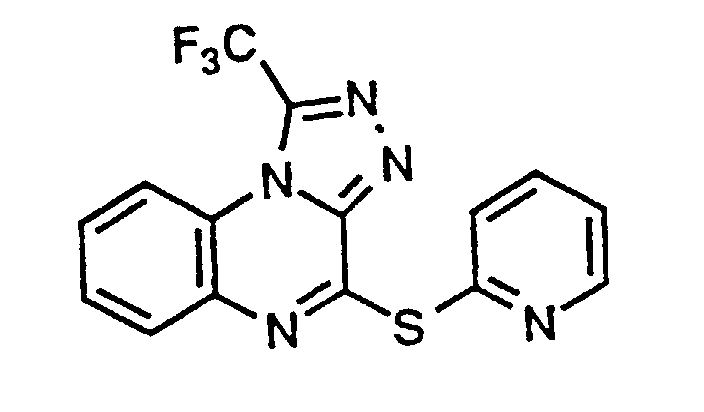
  • (11) 4-(Pyridin-2-yl)thio(5-trifluoromethyl-1, 2, 4-triazolo)-[4, 3-a]quinoxaline,
  • (12) 4-Phenylthio(5-trifluoromethyl-1, 2, 4-triazolo)-[4, 3-a]quinoxaline,
  • (13) 4-(4-Methoxyphenyl)thio(5-trifluoromethyl-1, 2, 4-triazolo)-[4, 3-a] quinoxaline, and
  • (14) 4-Phenyl(5-methyl-1, 2, 4-triazolo)-[4, 3-a]quinoxaline;
  • or non-toxic salts thereof, and
  • (iii) a process for the preparation of fused pyrazine derivatives of the formula (I) and non-toxic salts thereof.
  • Detail description of invention
    Unless otherwise specified, all isomers are included in the present invention. For example, alkyl, alkoxy and alkylene include straight and branched isomers. Double bond in alkenylene includes structure of configurations E, Z and EZ mixture. Isomers resulting from the presence of asymmetric carbon(s) e.g. branched alkyl, alkoxy and alkylene are also included within the present invention.
    In the present invention, C1-4 alkyl is methyl, ethyl, propyl, butyl and isomeric groups thereof.
    C1-8 alkyl is methyl, ethyl, propyl, butyl, pentyl, hexyl, heptyl, octyl and isomeric groups thereof.
    C1-8 alkoxy is methoxy, ethoxy, propoxy, butoxy, pentyloxy, hexyloxy, heptyloxy, octyloxy and isomeric groups thereof.
    C1-8 alkylthio is methylthio, ethylthio, propylthic, butylthio, pentylthio, hexylthio, heptylthio, octylthio and isomeric groups thereof.
    Halogen atom is chlorine, bromine, fluorine, or iodine.
    Trihalomethyl is methyl tri-substituted by chlorine, bromine, fluorine, or iodine.
    Trihalomethoxy is methoxy tri-substituted by chlorine, bromine, fluorine, or iodine.
    C1-8 alkylamino is methylamino, ethylamino, propylamino, butylamino, pentylamino, hexylamino, heptylamino, octylamino and isomeric groups thereof.
    C1-8 alkyl substituted by 1-17 of halogen atom is methyl, ethyl, propyl, butyl, pentyl, hexyl, heptyl, octyl and isomenic groups thereof substituted by 1-17 of chlorine, bromine, fluorine, or iodine.
    C1-8 alkoxy substituted by 1-17 of halogen atom is methoxy, ethoxy, propoxy, butoxy, pentyloxy, hexyloxy, heptyloxy, octyloxy and isomeric groups thereof substituted by 1-17 of chlorine, bromine, fluorine, or iodine.
    C1-4 alkylene is methylene, ethylene, trimethylene, tetramethylene and isomeric groups thereof.
    C2-8 alkenyl is vinyl, propenyl, butenyl, pentenyl, hexenyl, heptenyl, octenyl, butadienyl, pentadienyl, hexadienyl, heptadienyl, octadienyl, hexatrienyl, heptatrienyl, octatrienyl and isomeric groups thereof.
    C2-8 alkynyl is ethynyl, propynyl, butynyl, pentynyl, hexynyl, heptynyl, octynyl and isomeric groups thereof.
    C2-5 acyl is acetyl, propionyl, butyryl, pentanoyl and isomeric groups thereof.
    C3-7 mono-carbocyclic ring is, for example, cyclopropane, cyclobutane, cyclopentane, cyclohexane, cycloheptane, cyclopentene, cyclohexene, cyclopentadiene, cyclohexadiene, benzene.
    3-7 membered mono-heterocyclic ring containing 1-4 of nitrogen(s), 1-2 of oxygen(s) and / or 1 of sulfur is 3-7 membered mono-heterocyclic aryl containing 1-4 of nitrogen(s), 1-2 of oxygen(s) and / or 1 of sulfur, partially or fully saturated thereof.
    3-7 membered mono-heterocyclic aryl containing 1-4 of nitrogen(s), 1-2 of oxygen(s) and / or 1 of sulfur is, for example, pyrrole, imidazole, triazole, tetrazole, pyrazole, pyridine, pyrazine, pyrimidine, pyridazine, azepine, diazepine, furan, pyran, oxepin, oxazepine, thiophene, thiain (thiopyran), thiepin, oxazole, isoxazole, thiazole, isothiazole, oxadiazole, oxazine, oxadiazine, oxazepine, oxadiazepine, thiadiazole, thiazine, thiadiazine, thiazepine, thiadiazepine.
    Partially or fully saturated 3-7 membered mono-heterocyclic ring containing 1-4 of nitrogen(s), 1-2 of oxygen(s) and / or 1 of sulfur is, for example, oxirane, aziridine, azetidine, pyrroline, pyrrolidine, imidazoline, imidazolidine, triazoline, triazolidine, tetrazoline, tetrazolidine, pyrazoline, pyrazolidine, piperidine, piperazine, tetrahydropyrimidine, tetrahydropyridazine, dihydrofuran, tetrahydrofuran, dihydropyran, tetrahydropyran, dihydrothiophene, tetrahydrothiophene, dihydrothiain (dihydrothiopyran), tetrahydrothiain (tetrahydrothiopyran), dihydrooxazole, tetrahydrooxazole, dihydroisoxazole, tetrahydroisoxazole, dihydrothiazole, tetrahydrothiazole, dihydroisothiazole, tetrahydroisothiazole, morpholine, thiomorpholine, oxolane, oxane.
    C3-15 mono-, bi- or tri-carbocyclic ring is, for example, cyclopropane, cyclobutane, cyclopentane, cyclohexane, cycloheptane, cyclopentene, cyclohexene, cyclopentadiene, cyclohexadiene, benzene, pentalene, indene, naphthalene, azulene, fluorene, phenanthrene, anthracene, acenaphthylene, biphenylene, perhydropentalene, perhydroindene, perhydronaphthalene, perhydroazulene, perhydrofluorene, perhydrophenanthrene, perhydroanthracene, perhydroacenaphthylene, perhydrobiphenylene.
    5-18 membered mono-, bi- or tri-heterocyclic ring containing 1-4 of nitrogen(s), 1-2 of oxygen(s) and / or 1 of sulfur is 5-18 membered mono-, bi-or tri-heterocyclic aryl containing 1-4 of nitrogen(s), 1-2 of oxygen(s) and / or 1 of sulfur, partially or fully saturated thereof.
    5-18 membered mono-, bi- or tri-heterocyclic aryl containing 1-4 of nitrogen(s), 1-2 of oxygen(s) and / or 1 of sulfur, is, for example, pyrrole, imidazole, triazole, tetrazole, pyrazole, pyridine, pyrazine, pyrimidine, pyridazine, azepine, diazepine, furan, pyran, oxepin, oxazepine, thiophene, thiain (thiopyran), thiepin, oxazole, isoxazole, thiazole, isothiazole, oxadiazole, oxazine, oxadiazine, oxazepine, oxadiazepine, thiadiazole, thiazine, thiadiazine, thiazepine, thiadiazepine, indole, isoindole, benzofuran, isobenzofuran, benzothiophene, isobenzothiophene, indazole, quinoline, isoquinoline, phthalazine, naphthyridine, quinoxaline, quinazoline, cinnoline, benzoxazole, benzothiazole, benzoimidazole, carbazole or acridine.
    Partially or fully saturated 5-18 membered mono-, bi- or tri-heterocyclic ring containing 1-4 of nitrogen(s), 1-2 of oxygen(s) and / or 1 of sulfur, for example, pyrroline, pyrrolidine, imidazoline, imidazolidine, triazoline, triazolidine, tetrazoline, tetrazolidine, pyrazoline, pyrazolidine, piperidine, piperazine, tetrahydropyrimidine, tetrahydropyridazine, dihydrofuran, tetrahydrofuran, dihydropyran, tetrahydropyran, dihydrothiophene, tetrahydrothiophene, dihydrothiain (dihydrothiopyran), tetrahydrothiain (tetrahydrothiopyran), dihydrooxazole, tetrahydrooxazole, dihydroisoxazole, tetrahydroisoxazole, dihydrothiazole, tetrahydrothiazole, dihydroisothiazole, tetrahydroisothiazole, morpholine, thiomorpholine, oxolane, oxane, indoline, isoindoline, dihydrobenzofuran, perhydrobenzofuran, dihydroisobenzofuran, perhydroisobenzofuran, dihydrobenzothiophene, perhydrobenzothiophene, dihydroisobenzothiophene, perhydroisobenzothiophene, dihydroindazole, perhydroindazole, dihydroquinoline, tetrahydroquinoline, perhydroquinoline, dihydroisoquinoline, tetrahydroisoquinoline, perhydroisoquinoline, dihydrophthalazine, tetrahydrophthalazine, perhydrophthalazine, dihydronaphthyridine, tetrahydronaphthyridine, perhydronaphthyridine, dihydroquinoxaline, tetrahydroquinoxaline, perhydroquinoxaline, dihydroquinazoline, tetrahydroquinazoline, perhydroquinazoline, dihydrocinnoline, tetrahydrocinnoline, perhydrocinnoline, dihydrobenzoxazole, perhydrobenzoxazole, dihydrobenzothiazole, perhydrobenzothiazole, dihydrobenzimidazole, perhydrobenzimidazole, benzoxazepine, benzoxadiazepine, benzothiazepine, benzothiadiazepine, benzoazepine, benzodiazepine, indolooxazepine, indolotetrahydrooxazepine, indolooxadiazepine, indolotetrahydrooxadiazepine, indolothiazepine, indolotetrahydrothiazepine, indolothiadiazepine, indolotetrahydrothiadiazepine, indoloazepine, indolotetrahydroazepine, indolodiazepine, indolotetrahydrodiazepine, benzofurazan, benzothiadiazole, benzotriazole, camphor, imidazothiazole, dihydrocarbazole, tetrahydrocarbazole, perhydrocarbazole, dihydroacridine, tetrahydroacridine, perhydroacridine.
    5-7 membered mono-heterocyclic ring containing 1-2 of nitrogen(s), or 1 of nitrogen and 1 of oxygen is, for example, pyrrole, pyrroline, pyrrolidine, imidazole, pyrazole, imidazoline, imidazolidine, pyrazoline, pyrazolidine, pyridine, pyridazine, pyrimidine, pyrazine, piperidine, piperazine, oxazole, , isoxazole, oxazine, morpholine.
    C3-7 cycloalkyl represented by one carbon atom in C1-8 alkyl or C1-8 alkylene, which is a component atom of cycloalkyl, is, for example, in case of C2 alkyl or alkylene,
    Figure 00150001
    in case of C3 alkyl or alkylene,
    Figure 00160001
    C3-7 cycloalkyl represented by neighboring two carbon atoms in C1-8 alkyl or C1-8 alkylene, which is component atoms of cycloalkyl, is , for example, in case of C4 alkyl or alkylene,
    Figure 00160002
    Salts
    Non-toxic salts of the present invention include all pharmaceutically acceptable salts, for example, general salts, acid addition salts, hydrate salts.
    The compounds of formulae (I) of the present invention may be converted into the corresponding salts. Non-toxic salts and water-soluble salts are preferred. Suitable salts, for example, include: salts of alkali metals (e.g. potassium, sodium), salts of alkaline earth metals (e.g. calcium, magnesium), ammonium salts, salts of pharmaceutically acceptable organic amines (e.g. tetramethylammonium, triethylamine, methylamine, dimethylamine, cyclopentylamine, benzylamine, phenethylamine, piperidine, monoethanolamine, diethanolamine, tris(hydroxymethyl)amine, lysine, arginine, N-methyl-D-glucamine ).
    The compounds of formulae (I) may be converted into the corresponding acid addition salts. Non-toxic acid addition salts and water-soluble acid addition salts are preferred. Suitable salts, for example, include: salts of inorganic acids e.g. hydrochloride, hydrobromide, sulfate, phosphate, nitrate; salts of organic acids e.g. acetate, trifluoroacetate, lactate, tartarate, oxalate, fumarate, maleate, citrate, benzoate, methanesulphonate, ethanesulphonate, benzenesulphonate, toluenesulphonate, isethionate, glucuronate, gluconate.
    The compounds of formulae (I) and salts thereof may be converted into the corresponding hydrates by conventional means.
    In the compounds of the present invention of formulae (I), the following compounds of the formulae are preferred:
    the formula (I-A):
    Figure 00170001
    wherein all the symbols are as hereinbefore defined;
    the formula (I-B):
    Figure 00170002
    wherein all the symbols are as hereinbefore defined;
    the formula (I-C):
    Figure 00170003
    wherein all the symbols are as hereinbefore defined;
    the formula (I-D):
    Figure 00170004
    wherein all the symbols are as hereinbefore defined;
    the formula (I-E):
    Figure 00180001
    wherein all the symbols are as hereinbefore defined;
    the formula (I-F);
    Figure 00180002
    wherein all the symbols are as hereinbefore defined;
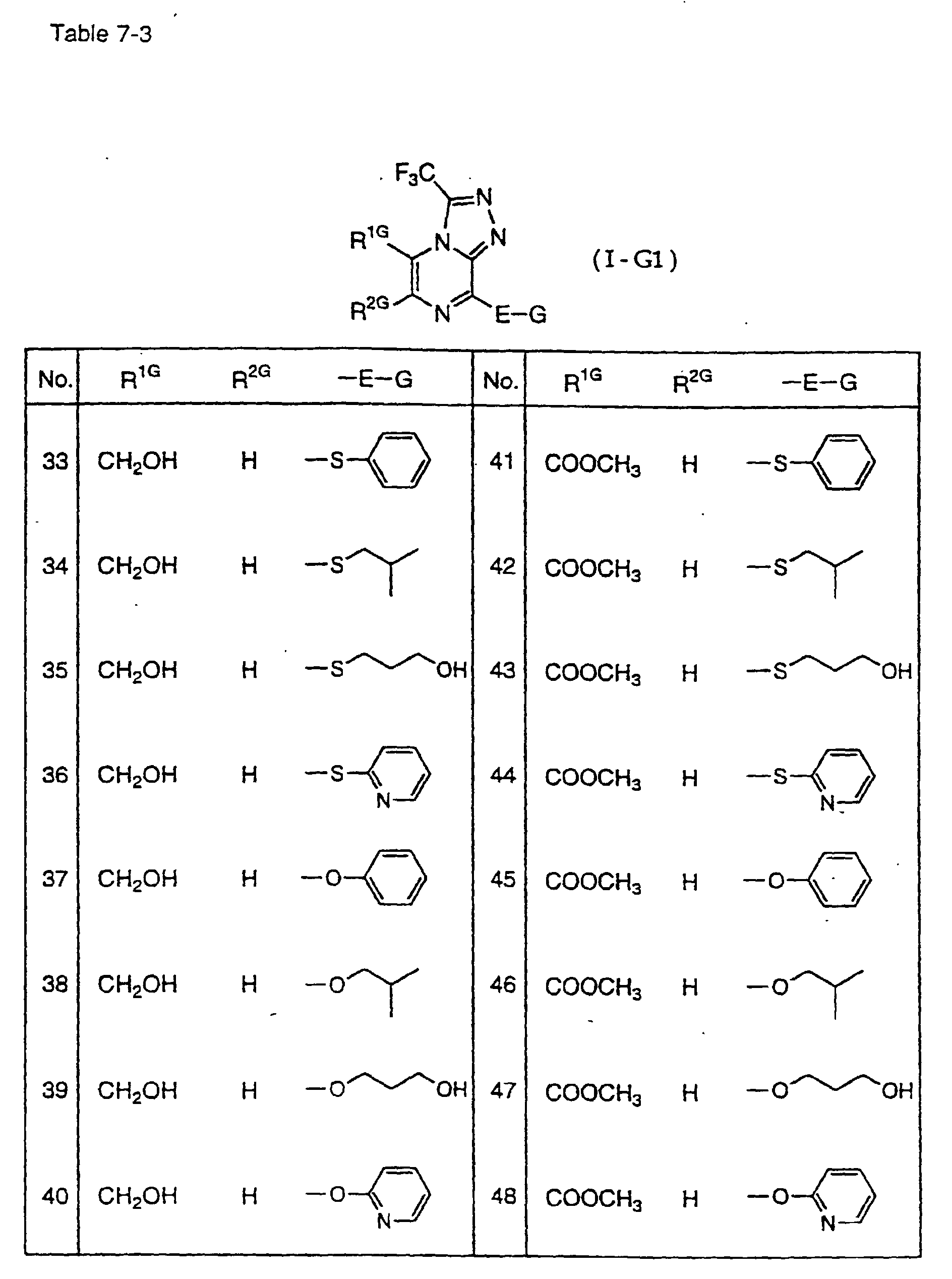
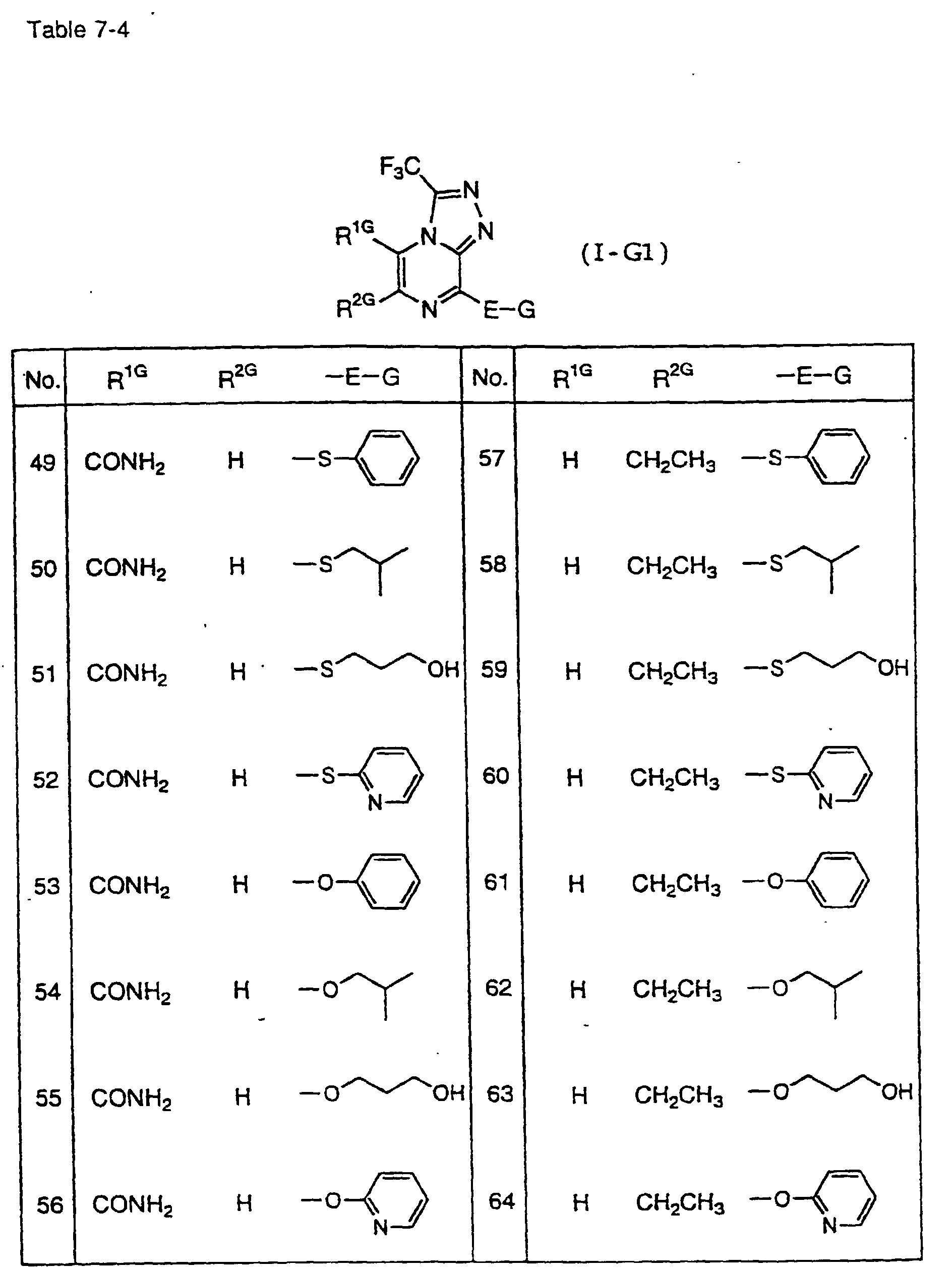
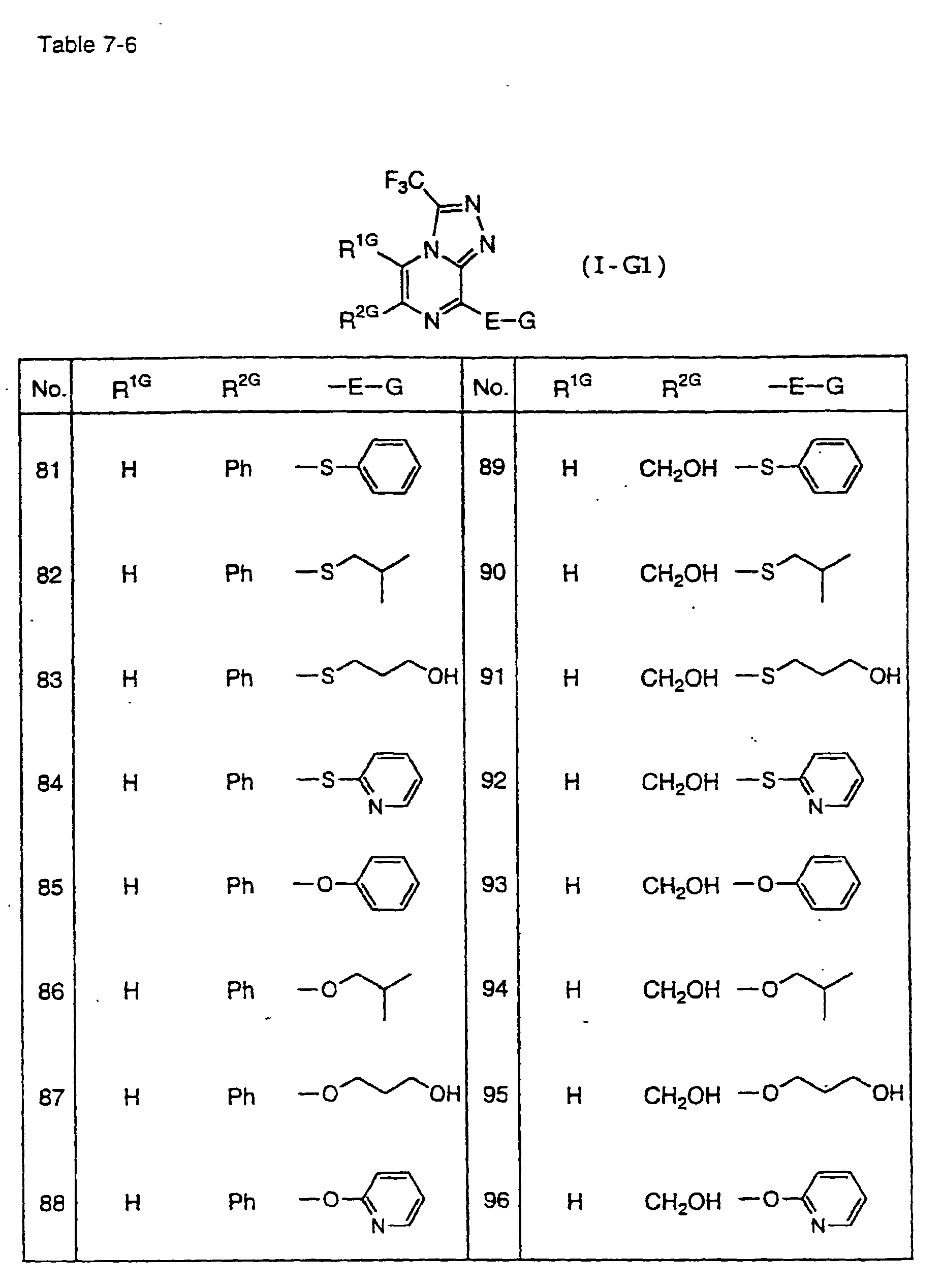
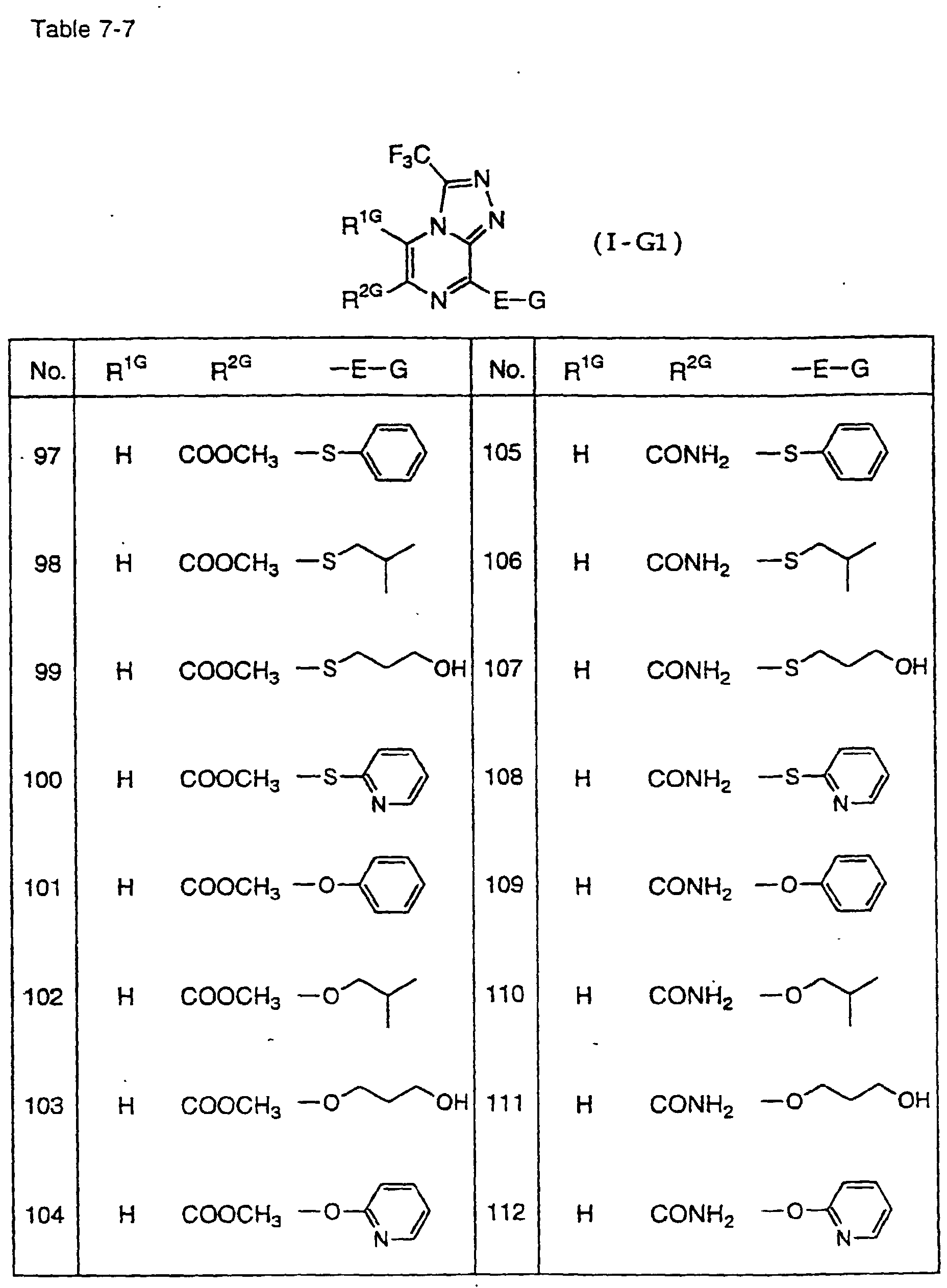
    the formula (I-G):
    Figure 00180003
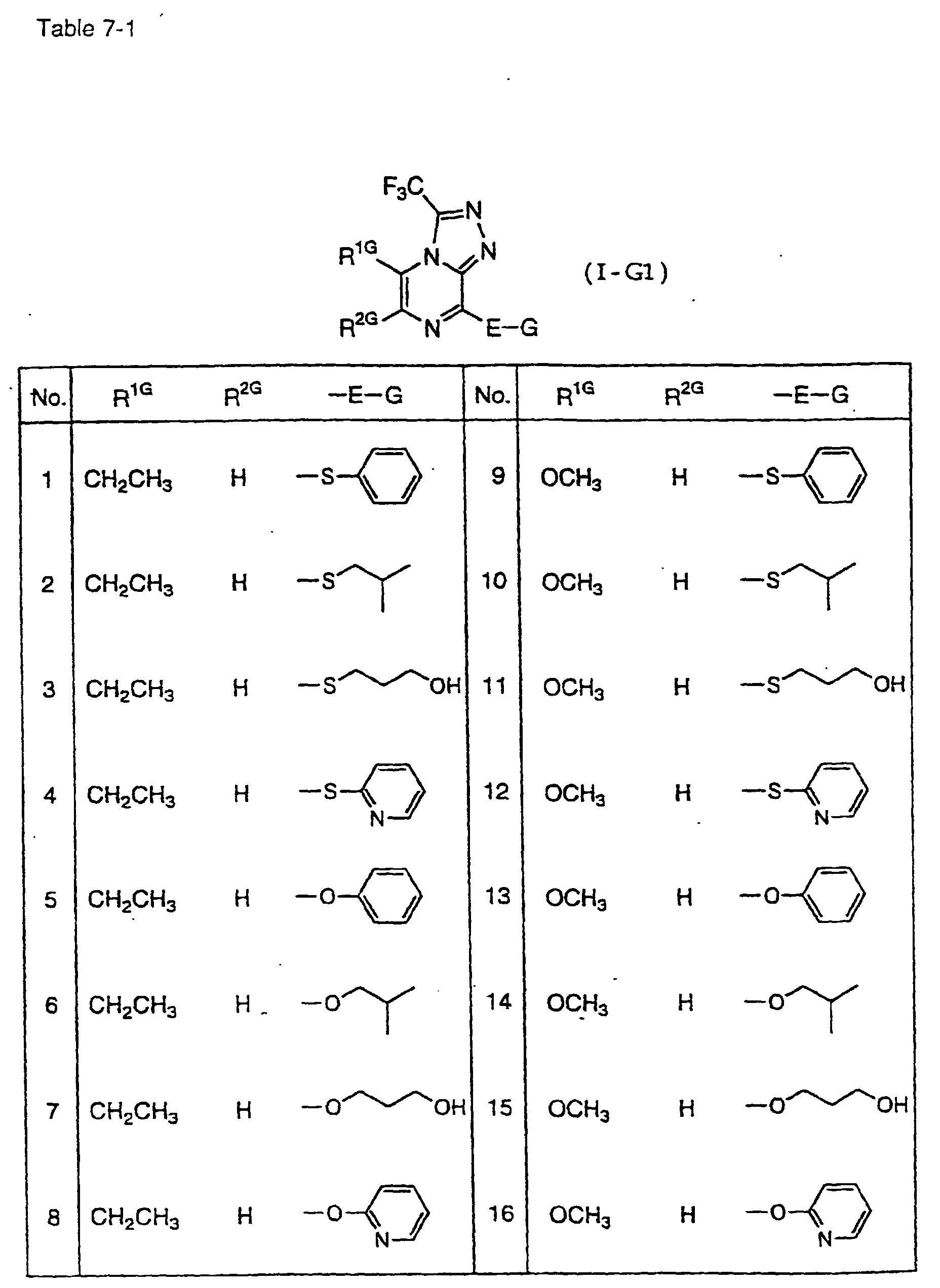
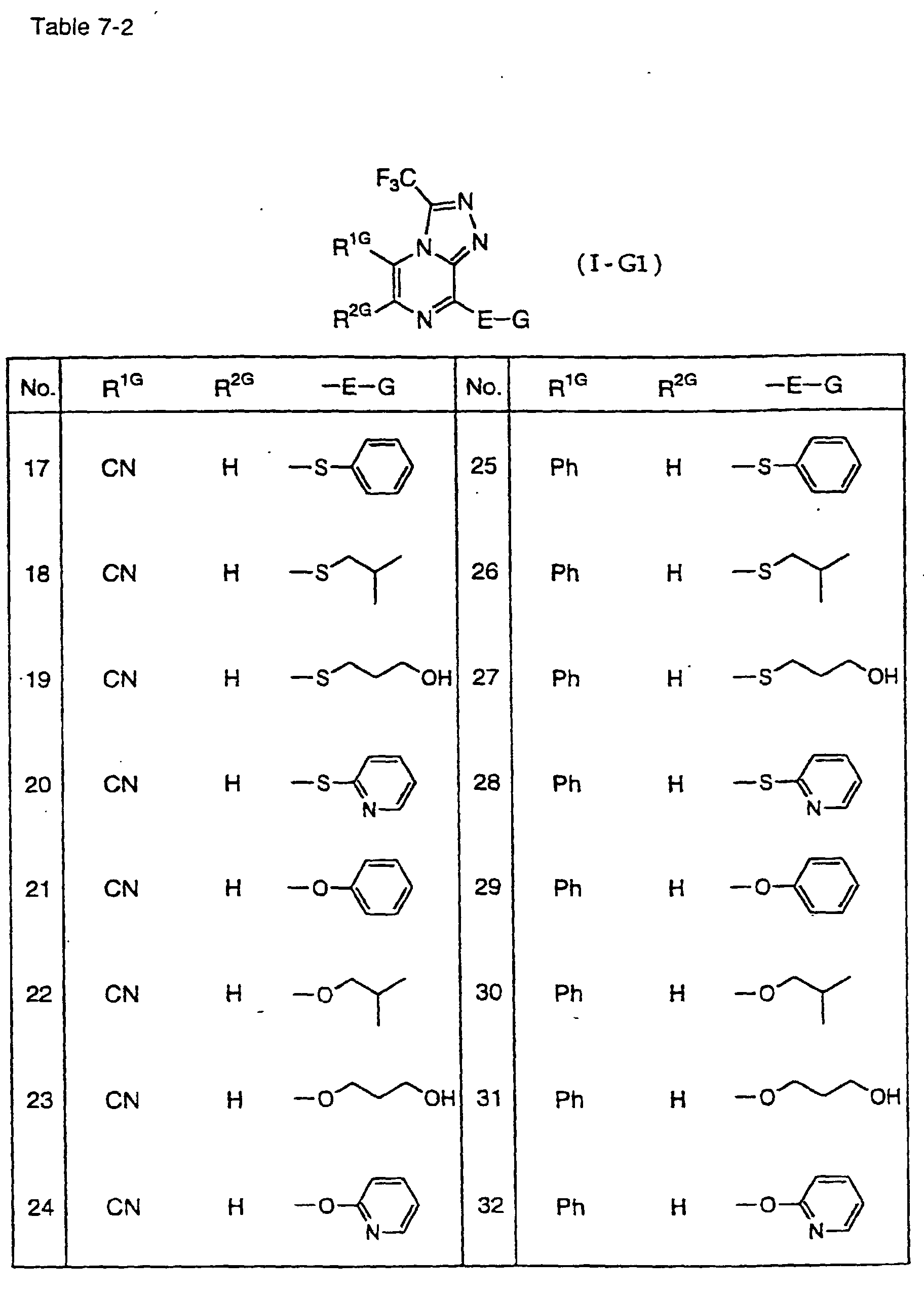
    wherein R1G and R2G each, independently, is (i) hydrogen, (ii) C1-8 alkyl, (iii) C1-8 alkoxy, (iv) C1-8 alkylthio, (v) Cyc1, (vi) nitrile, (vii) formyl, (viii) -COOR14, (ix) -CONR15R16, (x) C1-8 alkyl or C2-8 alkenyl substituted by 1 or 2 of hydroxy, C1-4 alkoxy, phenoxy, halogen atom, nitrile, C2-5 acyl, -COOR14, -CONR15R16, or -NR17R18, (xi) C1-8 alkyl, C1-8 alkoxy or C1-8 alkylthio substituted by Cyc1, and the other symbols are as hereinbefore defined;
    the formula (I-H):
    Figure 00180004
    wherein GH is substituted or unsubstituted C3-15 mono-, bi- or tri-carbocyclic ring, and the other symbols are as hereinbefore defined;
    the formula (I-J):
    Figure 00190001
    wherein GJ is C1-8 alkyl, and the other symbols are as hereinbefore defined;
    the formula (I-K):
    Figure 00190002
    wherein GK is C1-8 alkyl substituted by hydroxy, and the other symbols are as hereinbefore defined;
    the formula (I-L):
    Figure 00190003
    wherein GL is substituted or unsubstituted 5-18 membered mono-, bi- or tri-heterocyclic ring containing 1-4 of nitrogen(s), 1 of oxygen and / on 1 of sulfur, and the other symbols are as hereinbefore defined.
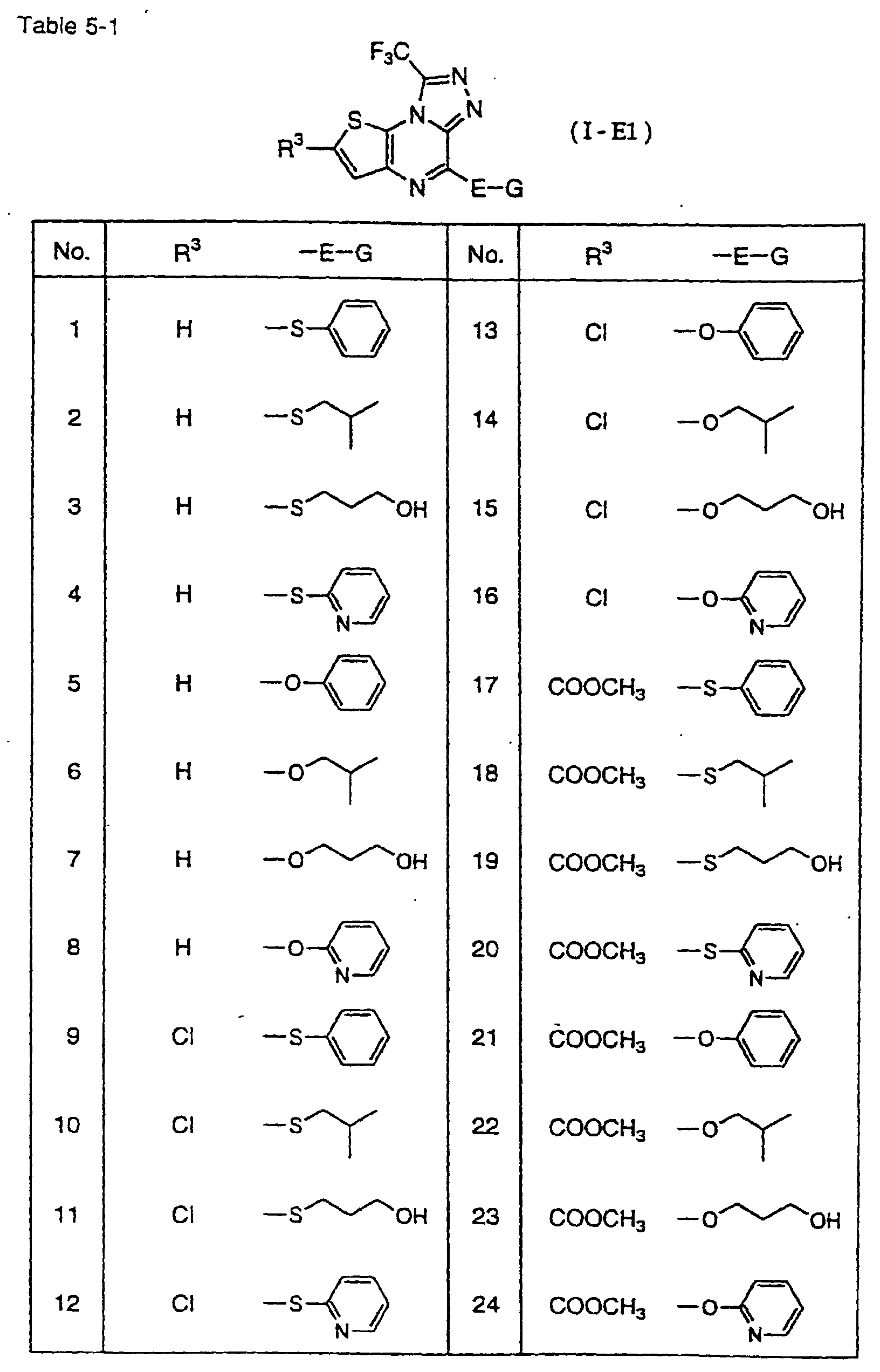
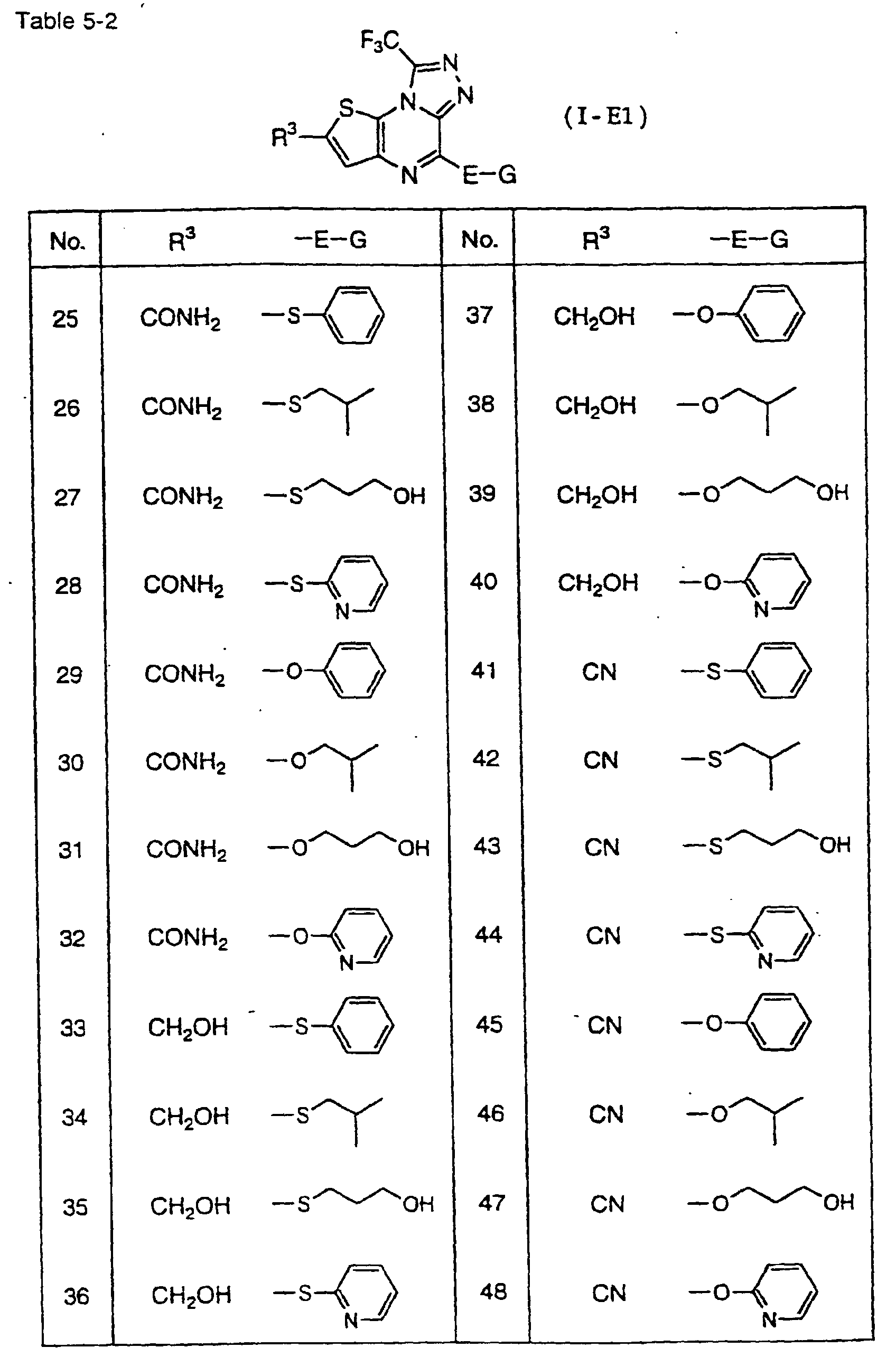
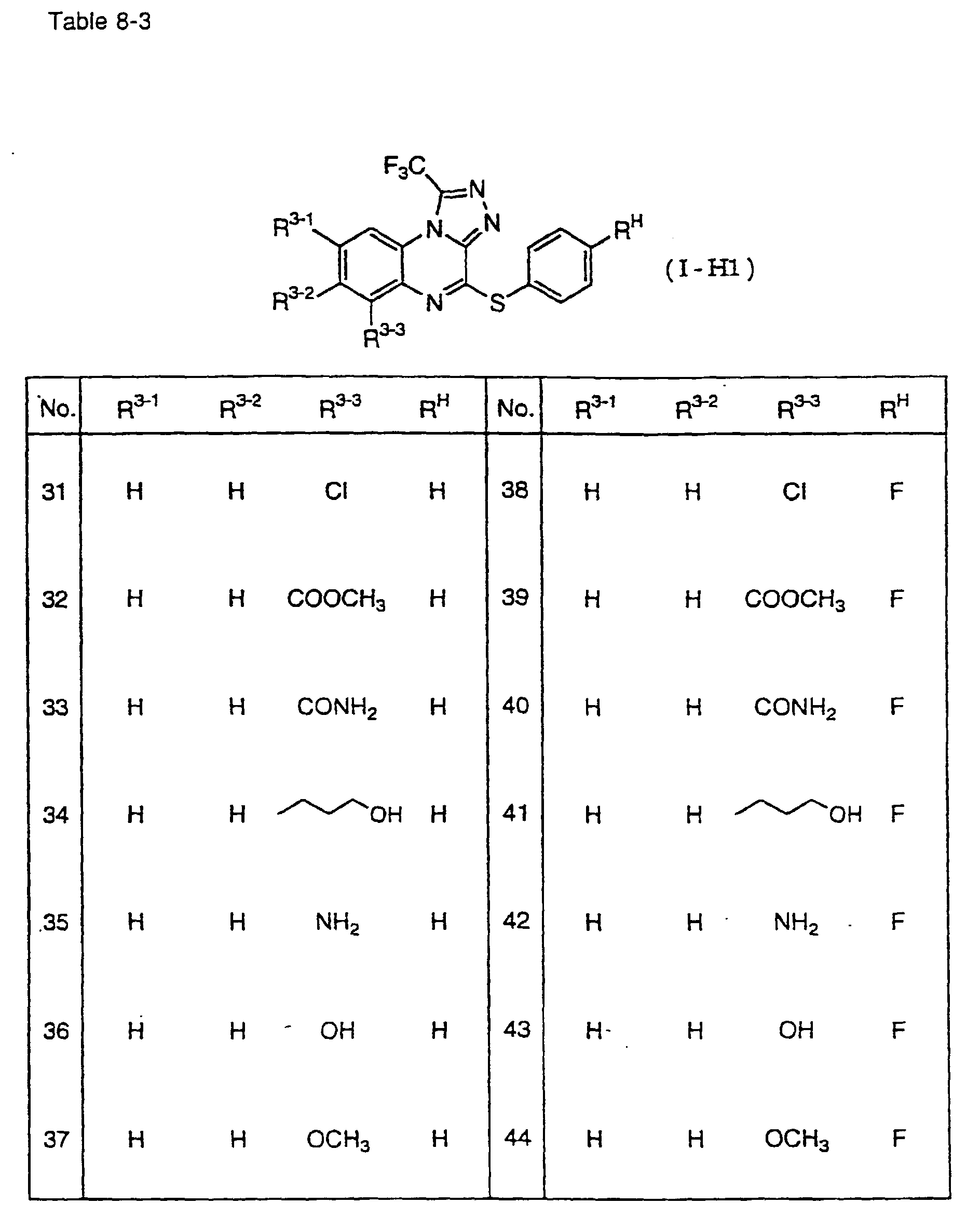
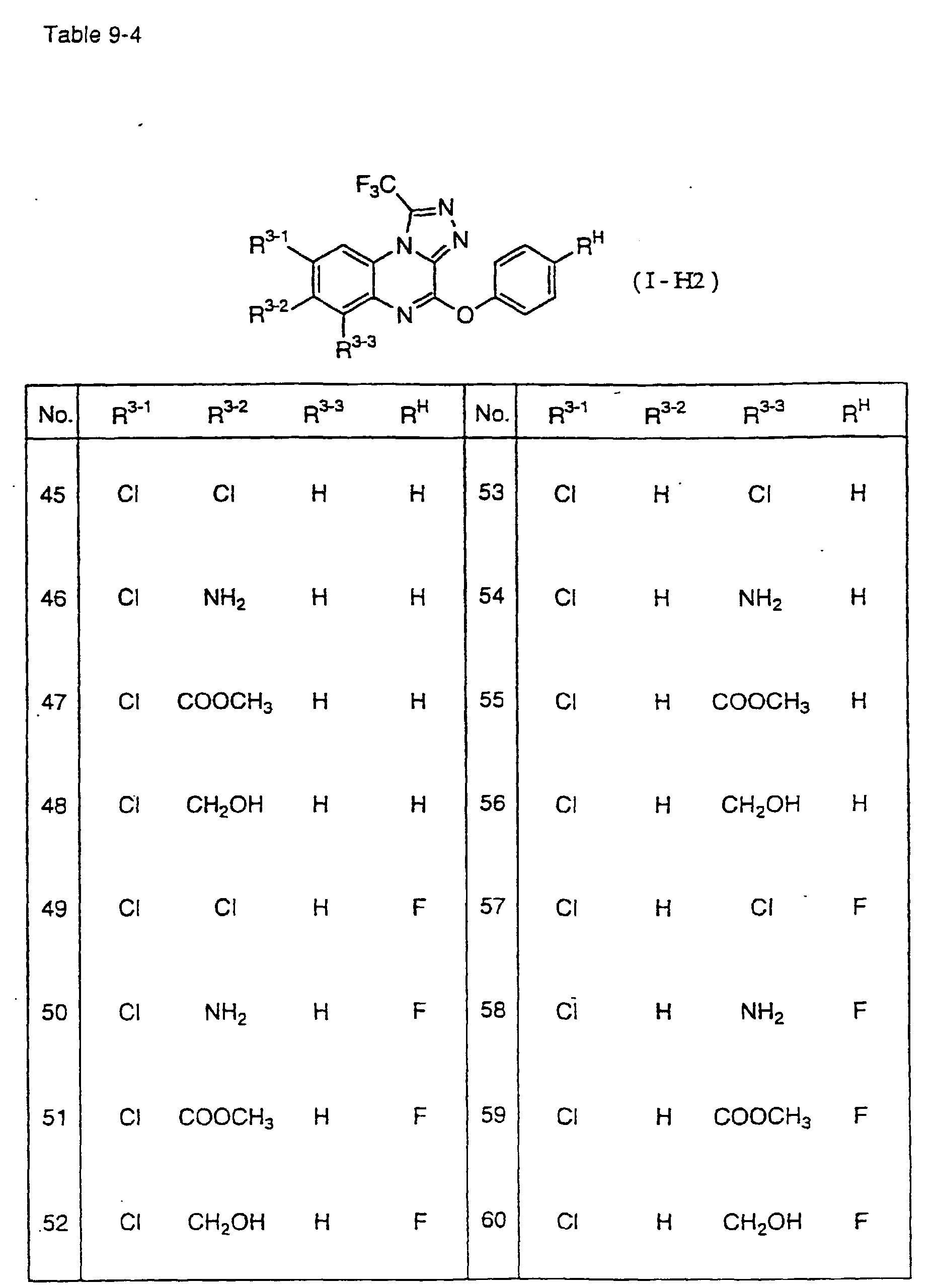
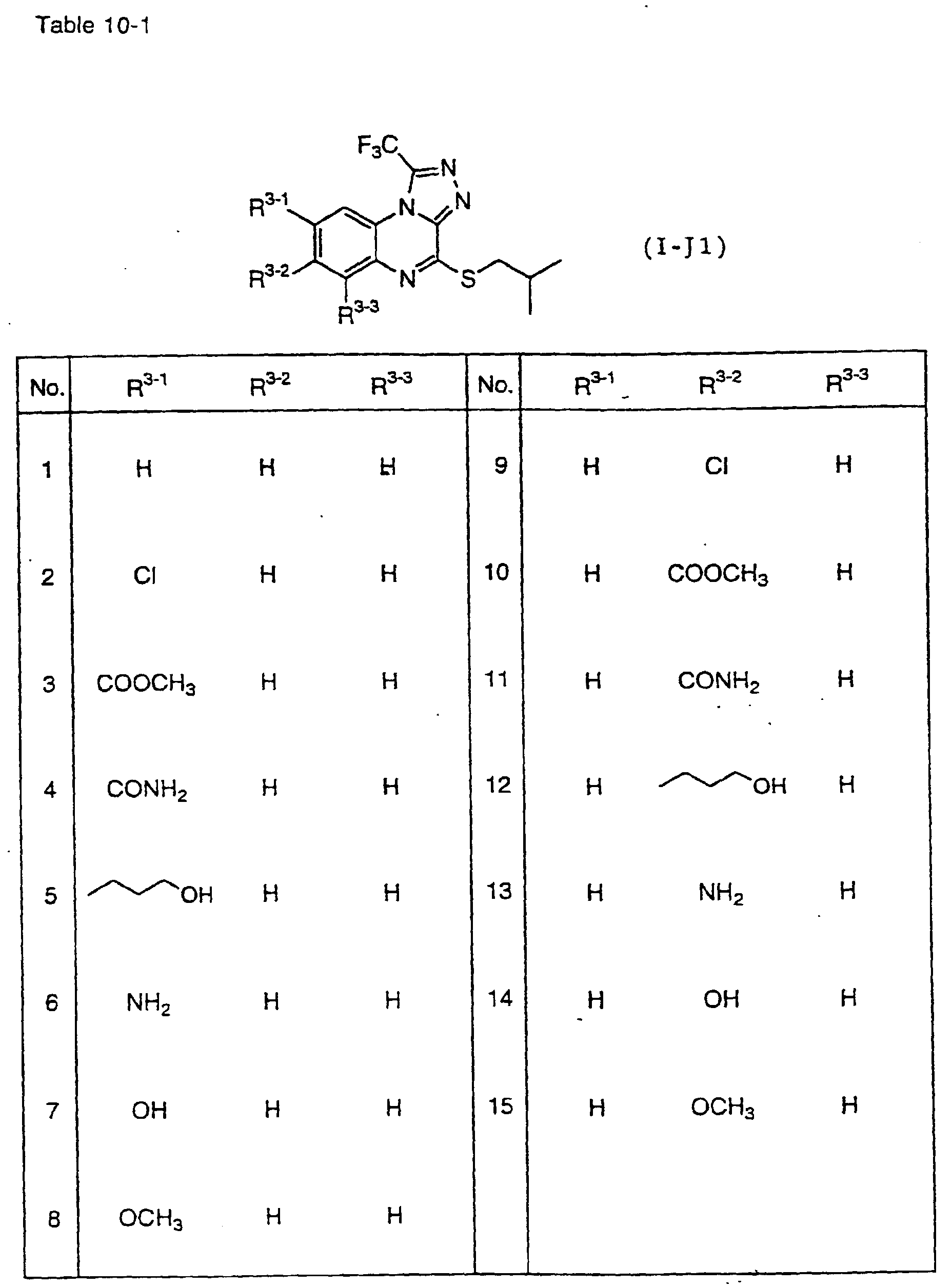
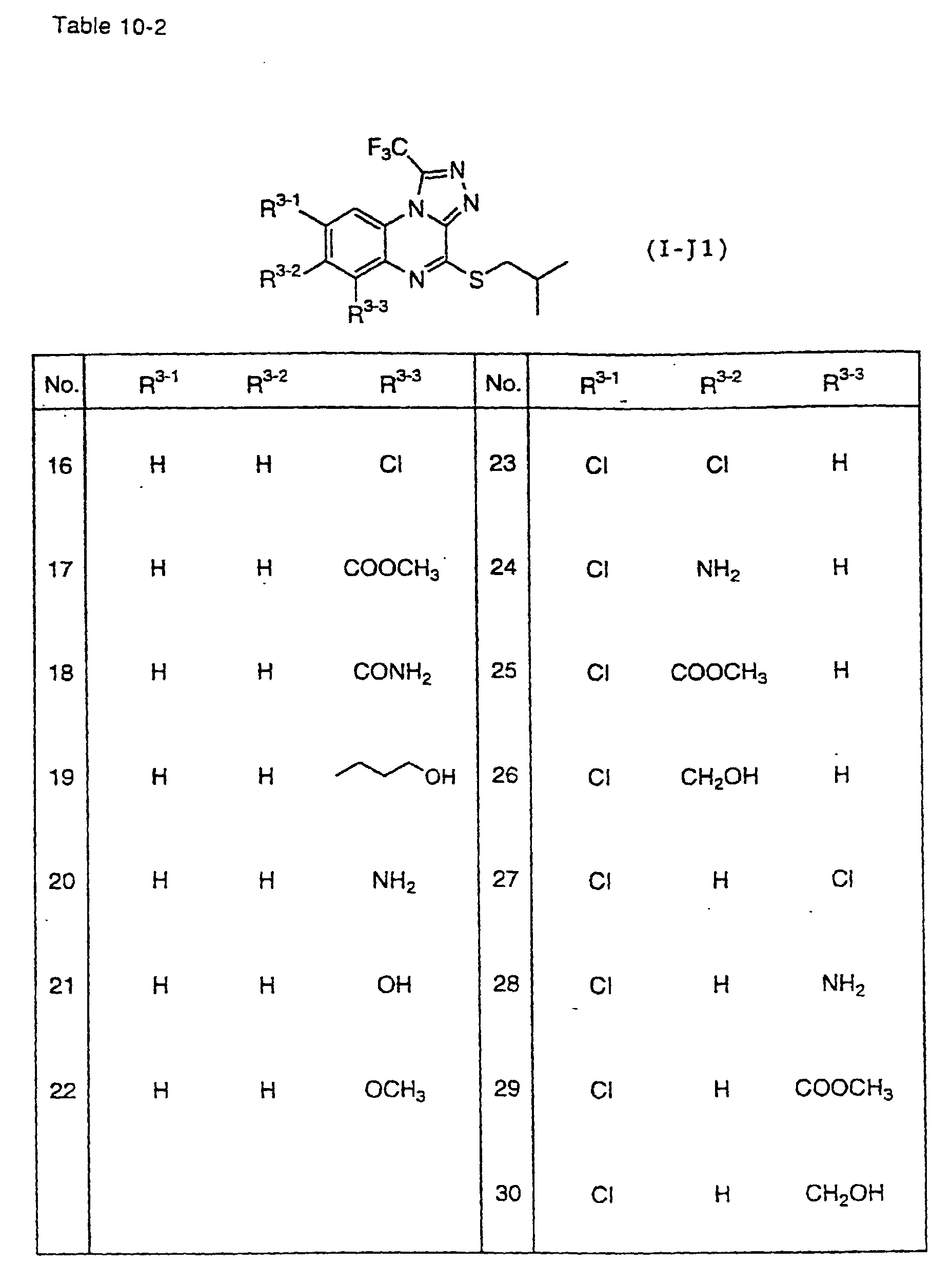
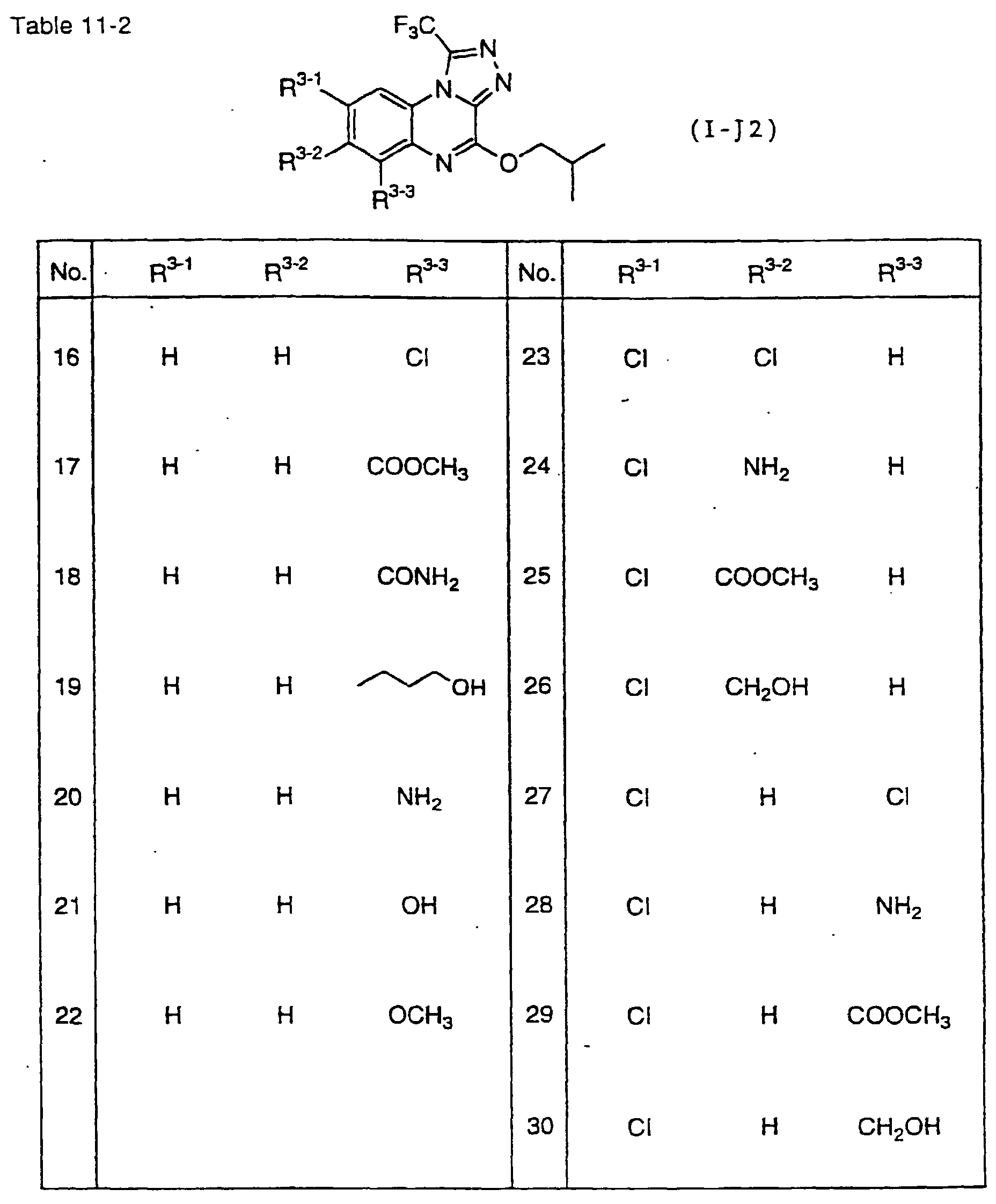
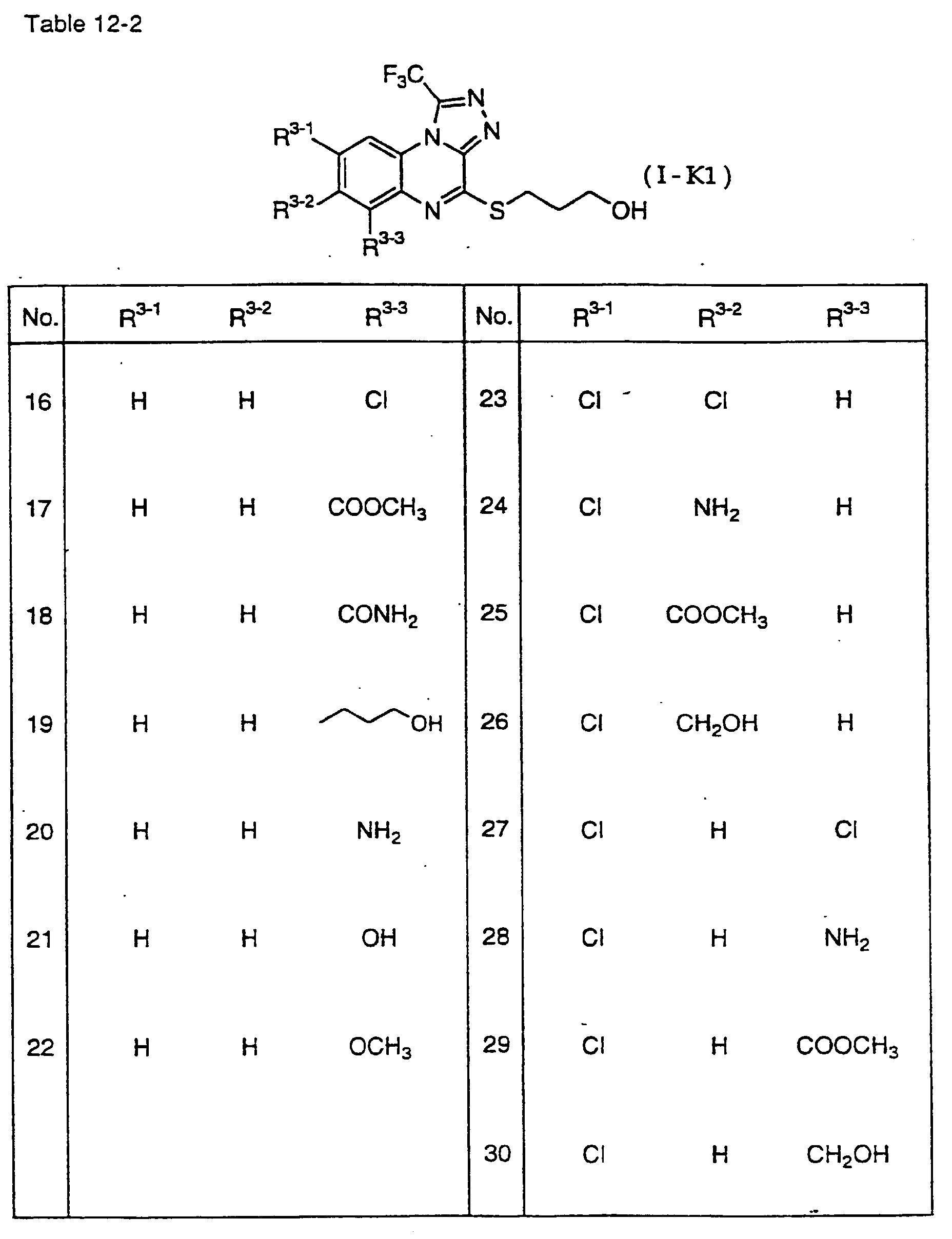
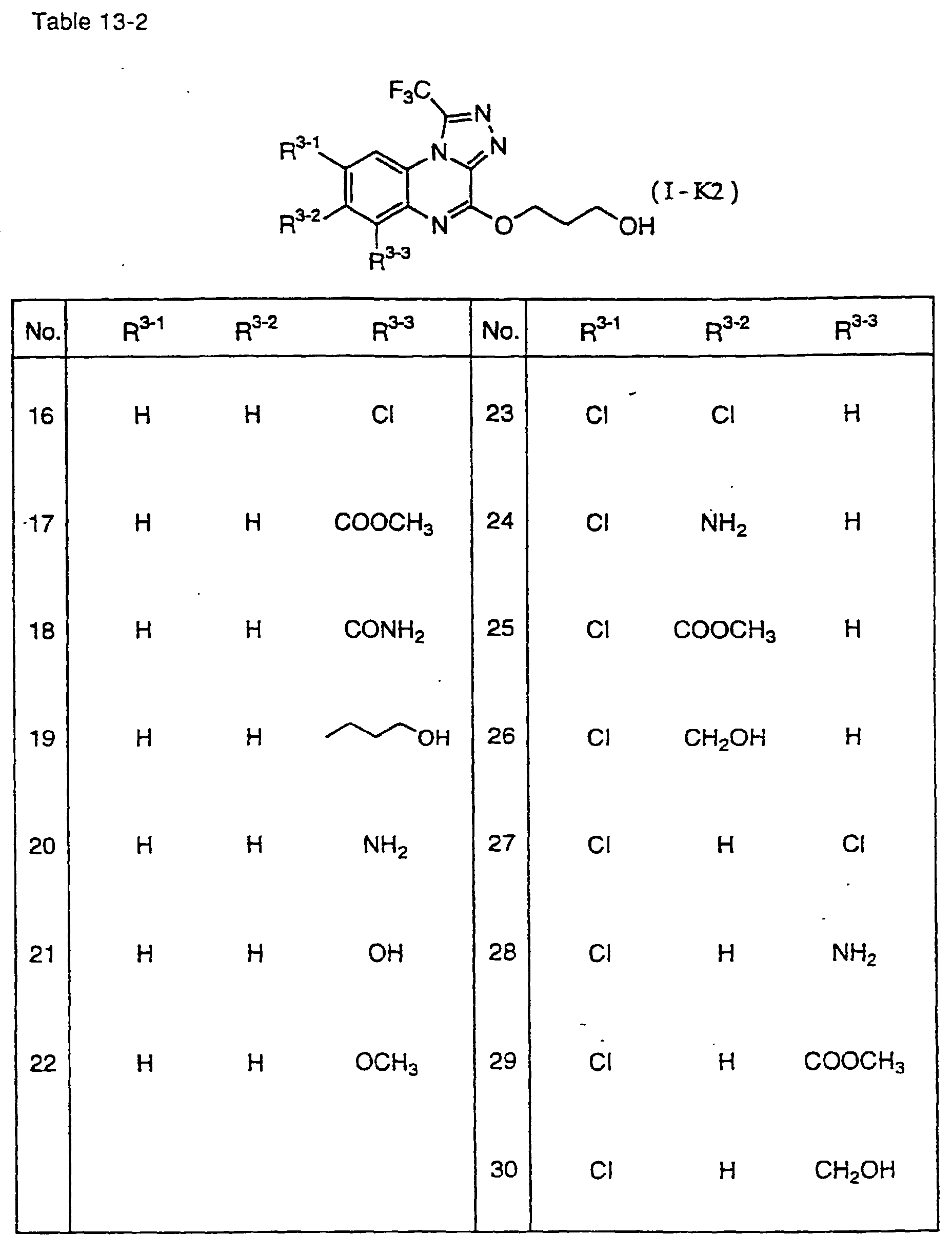
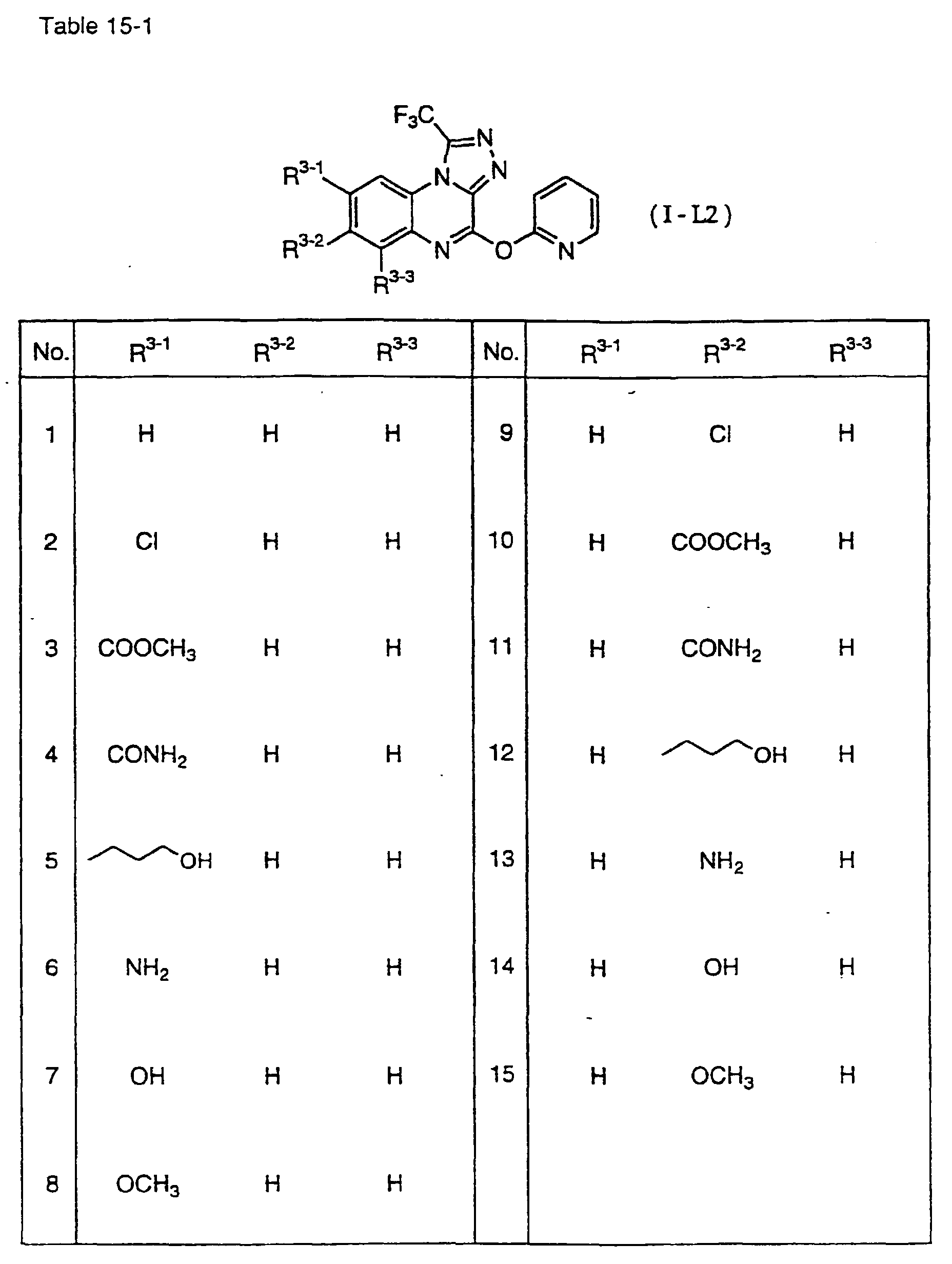
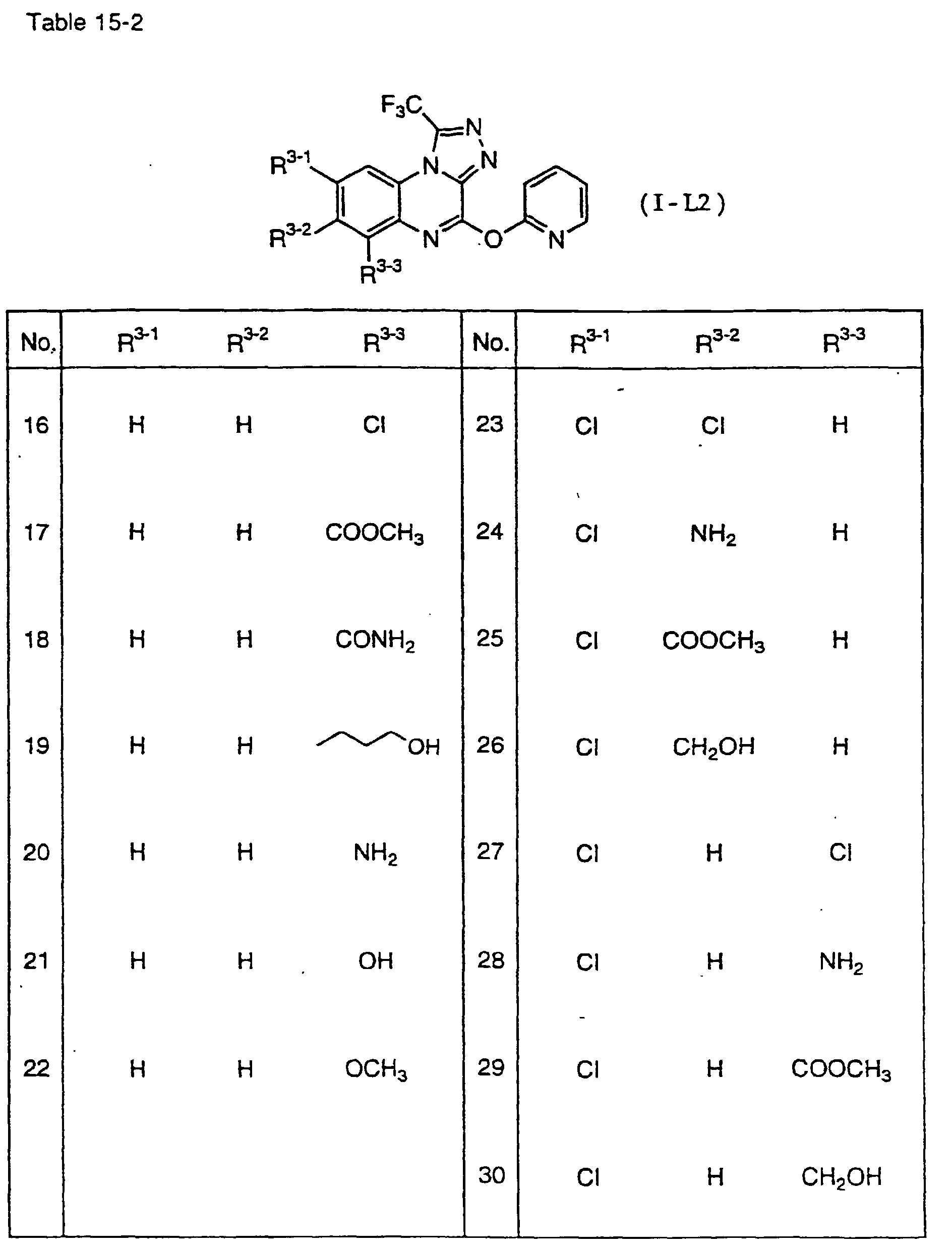
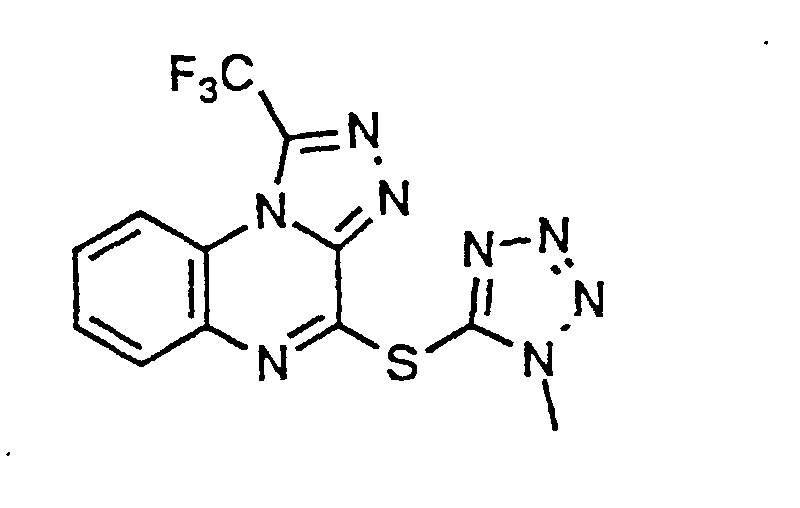
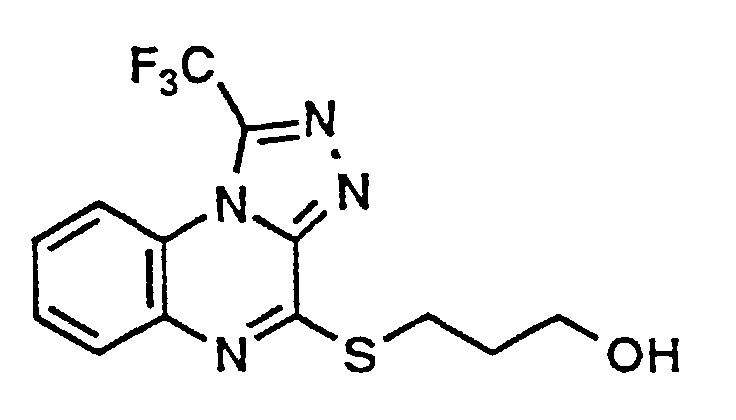
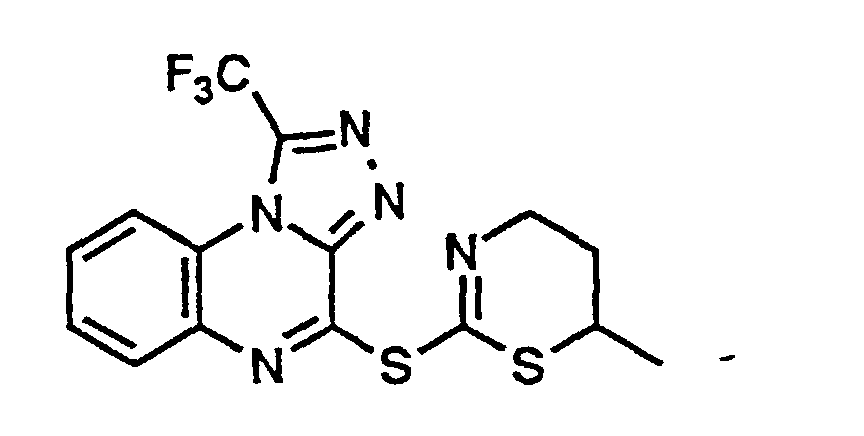
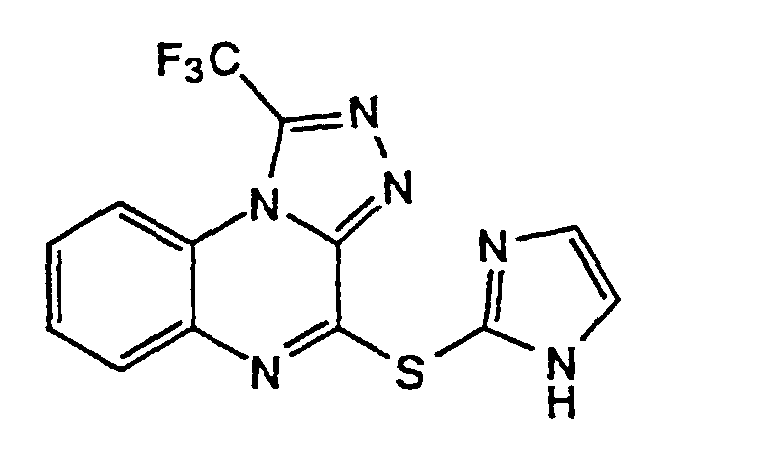
    The following compounds, the compounds described in Table 1 - Table 15 and the compounds described in the Examples or non-toxic salts thereof are more preferred.
    The following known compounds of (1) - (14) are on the market but they are not known as adhesion molecules expression inhibitors at all.
    compound (1): 4-(4-Chlorophenyl)thio(1, 2, 4-triazolo)-[4, 3-a]quinoxaline (Bionet ; a catalog No. 10E-957)
    Figure 00200001
    compound (2): 4-(Pyrimidine-2-yl)thio(1, 2, 4-triazolo)-[4, 3-a]quinoxaline (Bionet ; a catalog No. 11E-909)
    Figure 00200002
    compound (3): 4-Methoxycarbonylmethylthio (5-methyl-1, 2, 4-triazolo)-[4, 3-a]quinoxaline (Bionet; a catalog No. 12E-941)
    Figure 00200003
    compound (4): 4-Phenylthio-8-chloro(5-trifluoromethyl-1, 2, 4-triazolo)-[4, 3-a]quinoxaline (Bionet; a catalog No. 12E-954)
    Figure 00200004
    compound (5): 4-Phenylmethylthio(1, 2, 4-triazolo)-[4, 3-a]quinoxaline (Bionet; a catalog No. 4G-912)
    Figure 00210001
    compound (6): 4-(2-Chlorophenyl)thio(1, 2, 4-triazolo)-[4, 3-a]quinoxaline (Bionet; a catalog No. 4G-913)
    Figure 00210002
    compound (7): 4-(4-Methoxyphenyl)thio(1, 2, 4-triazolo)-[4, 3-a]quinoxaline (Bionet; a catalog No. 4G-914)
    Figure 00210003
    compound (8): 4-Allylthio(1, 2, 4-triazolo)-[4, 3-a]quinoxaline (Bionet ; a catalog No. 4G-922)
    Figure 00210004
    compound (9): 4-(4-Chlorophenyl)thio(5-trifluoromethyl-1, 2, 4-triazolo)-[4, 3-a]quinoxaline (Bionet ; a catalog No. 4G-937)
    Figure 00210005
    compound (10): 4-Phenylmethylthio(5-trifluoromethyl-1, 2, 4-triazolo)-[4, 3-a]quinoxaline (Bionet; a catalog No. 4G-938)
    Figure 00220001
    compound (11): 4(Pyridin-2-yl)thio(5-trifluoromethyl-1, 2, 4-triazolo)-[4, 3-a]quinoxaline (Bionet; a catalog No. 4G-943)
    Figure 00220002
    compound (12): 4-Phenylthio(5-trifluoromethyl-1, 2, 4-triazolo)-[4, 3-a]quinoxaline (Bionet ; a catalog No. 4G-944)
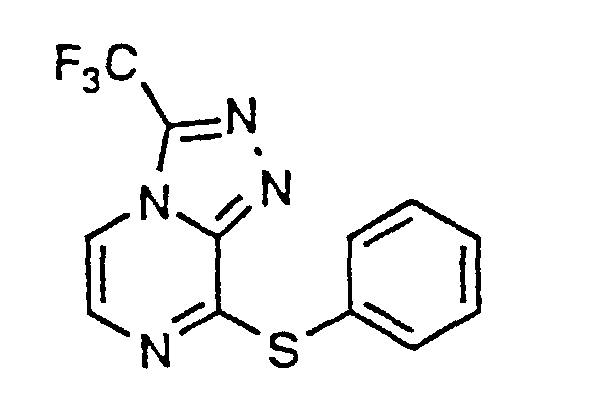
    Figure 00220003
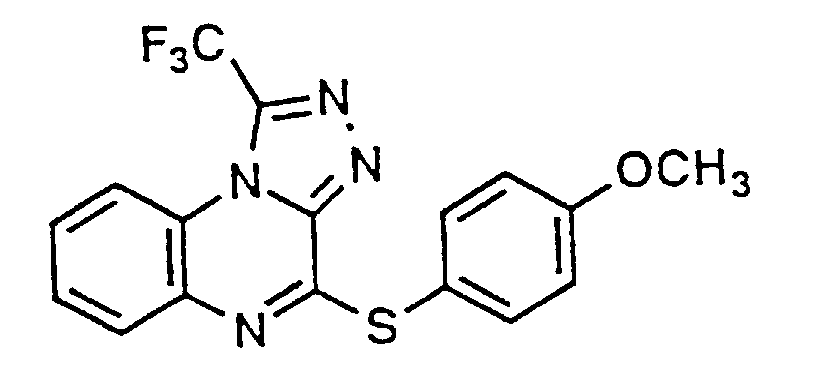
    compound (13): 4-(4-Methoxyphenyl)thio(5-trifluoromethyl-1, 2, 4-triazolo)-[4, 3-a]quinoxaline (Bionet; a catalog No. 4G-945)
    Figure 00220004
    compound (14): 4-Phenyl(5-methyl-1 2, 4-triazolo)-[4, 3-a]quinoxaline (Labotest ; a catalog No. LT-2 VO 14)
    Figure 00230001
    Figure 00240001
    Figure 00250001
    Figure 00260001
    Figure 00270001
    Figure 00280001
    Figure 00290001
    Figure 00300001
    Figure 00310001
    Figure 00320001
    Figure 00330001
    Figure 00340001
    Figure 00350001
    Figure 00360001
    Figure 00370001
    Figure 00380001
    Figure 00390001
    Figure 00400001
    Figure 00410001
    Figure 00420001
    Figure 00430001
    Figure 00440001
    Figure 00450001
    Figure 00460001
    Figure 00470001
    Figure 00480001
    Figure 00490001
    Figure 00500001
    Figure 00510001
    Figure 00520001
    Figure 00530001
    Figure 00540001
    Figure 00550001
    Figure 00560001
    Figure 00570001
    Figure 00580001
    Figure 00590001
    Figure 00600001
    Figure 00610001
    Figure 00620001
    Process for the preparation
    The compounds of the present invention of the formula (I), may be prepared by following methods or the methods described in the Examples.
  • [1] In the compounds of the present invention of the formula (I), the compound in which R3 is not -NH2, that is the compound of the formula (I-1):
    Figure 00630001
    wherein R1-1 and R2-1 each, independently, is the a same meaning as R1 and R2, with the proviso that, R3 in R1-1 and R2-1 is not -NH2, the other symbols are as hereinbefore defined;
    may be prepared by following methods (a) - (d).
  • (a) The compound in which E is oxygen atom, sulfur atom, -(C1-4 alkylene)-O-or -(C1-4 alkylene)-S-, that is the compound of the formula (I-1-a):
    Figure 00630002
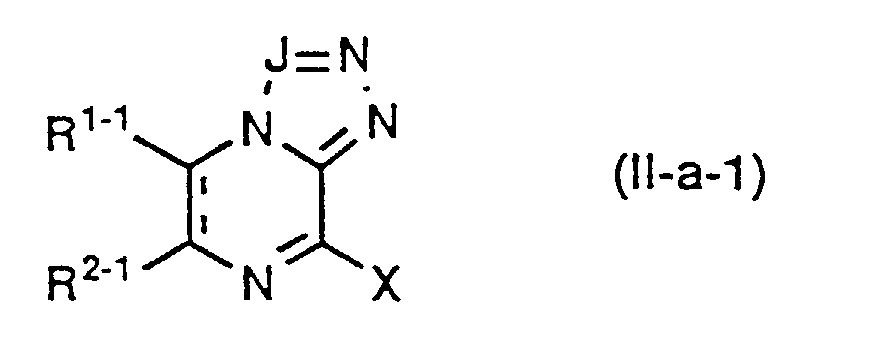
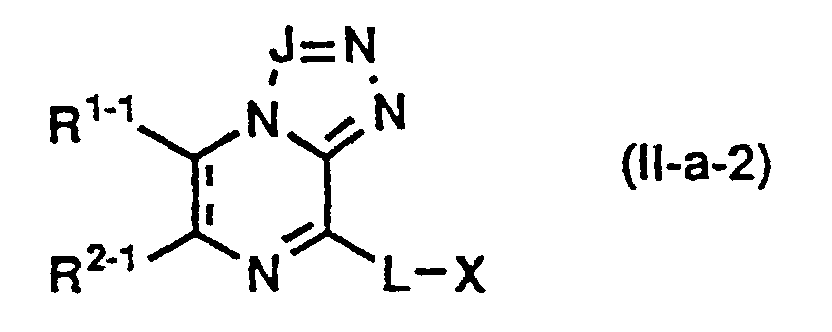
    wherein Ea is oxygen atom, sulfur atom, -(C1-4 alkylene)-O- or -(C1-4 alkylene)-S-, and the other symbols are as hereinbefore defined; maybe prepared by reacting the compound of the formula (II-a-1):
    Figure 00630003
    wherein X is an ordinary elimination group (e.g. chloride, bromide, iodide, mesyl or tosyl), and the other symbols are as hereinbefore defined; or the compound of the formula (II-a-2):
    Figure 00640001
    wherein L is C1-4 alkylene, and the other symbols are as hereinbefore defined;
    with the compound of the formula (III-a):
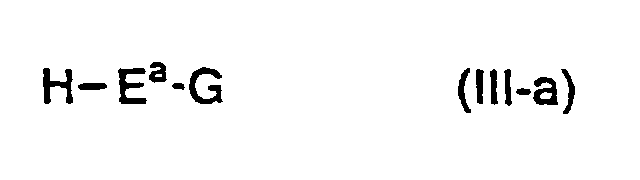
    Figure 00640002
    wherein all the symbols are as hereinbefore defined. The reaction of the compound of the formula (II-a-1) or the formula (II-a-2), and the compound of the formula (III-a) was known, for example, it may be carried out by reacting alcohol or thiol of the formula (III-a) in an inactive organic solvent (e.g. dimethylformamide, dimethyl sulfoxide, acetonitrile, tetrahydrofuran or acetone), using an alkali metal hydride, an alkali metal hydroxide, (e.g. sodium hydroxide, potassium hydroxide or lithium hydroxide), an alkaline earth metal hydroxide (e.g. barium hydroxide or calcium hydroxide) or a carbonate (e.g. sodium carbonate or potassium carbonate), an aqueous solution thereof or mixture thereof at 0-40°C, and reacting the obtained alkoxide ion or thiolate ion and the compound of the formula (II-a-1) or the formula (II-a-2) at 0-40°C.This reaction may be carried out under an inert gas (e.g. argon, nitrogen) to avoid water in order to obtain a preferable result.
  • (b) The compound in which J is C-R7 and E is a single bond or C1-4 alkylene, that is the compound of the formula (I-1-b):
    Figure 00640003
    wherein Eb is a single bond or C1-4 alkylene, the other symbols are as hereinbefore defined;
    may be prepared by reacting the compound (II-b):
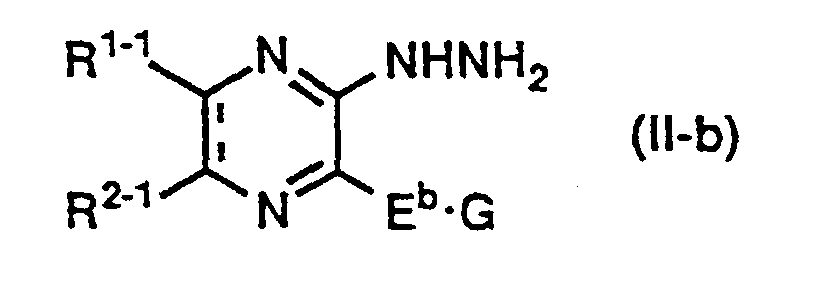
    Figure 00650001
    wherein all the symbols are as hereinbefore defined;
    with the compound of the formula (III-b-1):
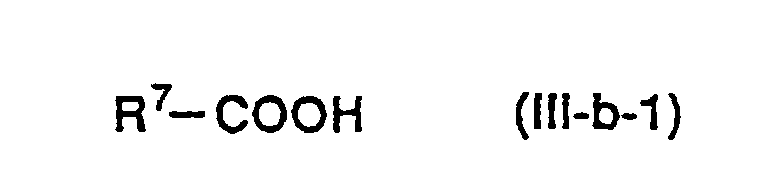
    Figure 00650002
    wherein all the symbols are as hereinbefore defined;
    or the compound of the formula (III-b-2):
    Figure 00650003
    wherein all the symbols are as hereinbefore defined;
    or the compound of the formula (III-b-3):
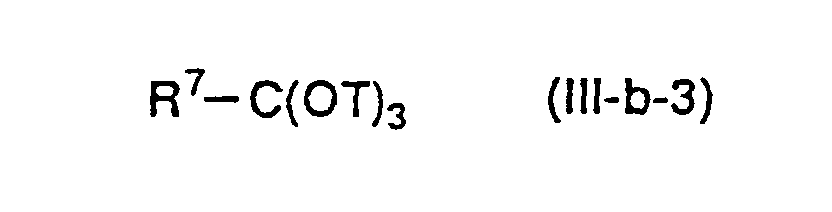
    Figure 00650004
    wherein T is C1-8 alkyl, the other symbols are as hereinbefore defined. The reaction of the compound of the formula (II-b) and the compound of the formula (III-b-1), the formula (III-b-2) or the formula (III-b-3) was known (See J Med. Chem., 33, 2240 (1990), J. Heterocyclic Chem. 31, 549 (1994).), for example, it may be carried out in organic solvent (e.g. pyridine, toluene, benzene, dichloromethane, 1, 2-dichloroethane, methanol, ethanol) or without a solvent at 20-150 °C.
  • (c) The compound in which J is nitrogen atom and E is a single bond or C1-4 alkylene, that is the compound of the formula (I-1-c):
    Figure 00660001
    wherein all the symbols are as hereinbefore defined;
    may be prepared by reacting the compound (II-c):
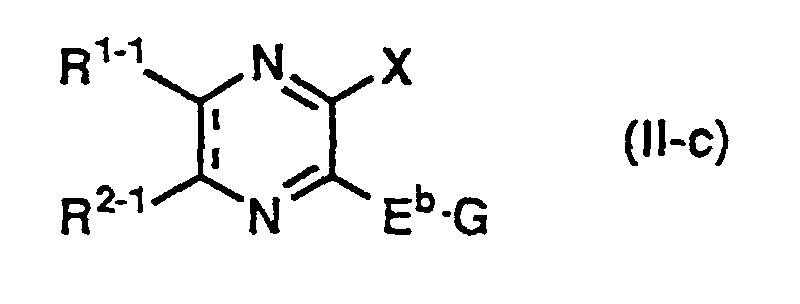
    Figure 00660002
    wherein all the symbols are as hereinbefore defined;
    with an alkali metal azide. The reaction of the compound of the formula (II-c) and an alkali metal azide was known (See J. Med. Chem. 35, 3323 (1992).), for example, it may be carried out in an alcohol solvent (e.g. methanol, ethanol), in the presence of an inorganic acid (e.g. hydrochloric acid or sulfuric acid) using an alkali metal azide (e.g. sodium azide) at 40-120 °C.
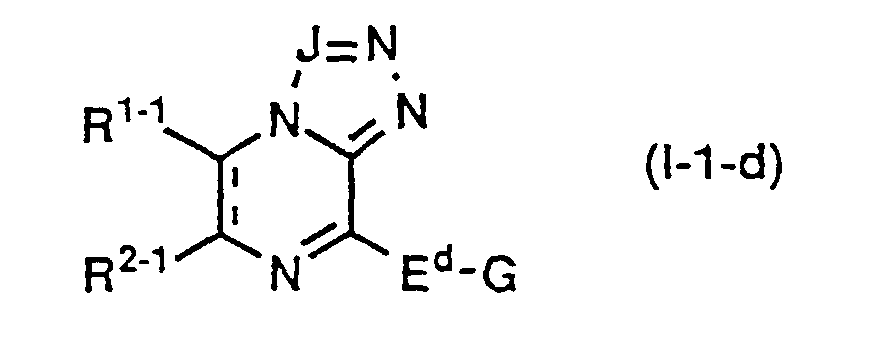
  • (d) The compound in which E is -SO-, -SO2-, -(C1-4 alkylene)-SO- or -(C1-4 alkylene)-SO2-, that is the compound of the formula (I-1-d):
    Figure 00660003
    wherein Ed is -SO-, -SO2-, -(C1-4 alkylene)-SO- or -(C1-4 alkylene)-SO2-, and the other symbols are as hereinbefore defined;
    may be prepared by subjecting the compound in which E is sulfur atom or -(C1-4 alkylene)-S- in the above compound of the formula (I-1-a), that is the compound of the formula (I-1-a-1):
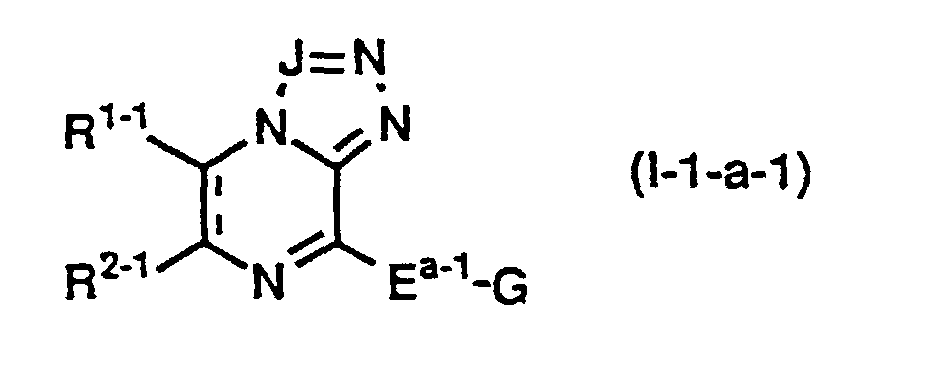
    Figure 00670001
    wherein Ea-1 is sulfur atom or-(C1-4 alkylene)-S-, and the other symbols are as hereinbefore defined;
    to oxidation reaction.
  • The oxidation reaction was known, for example, in case of the compound in which Ed is -SO- or -(C1-4 alkylene)-SO-, it may be carried out in a suitable organic solvent (e.g. dichloromethane, chloroform, benzene, hexane, t-butyl alcohol), in the presence of 1 equivalent oxidizing agent (e.g. hydrogen peroxide, sodium periodate, acyl nitrite, sodium perborate, peroxide (such as 3-chloroperbenzoic acid, peracetic acid)) at -78 - 0 °C.In case of the compound in which Ed is -SO2- or-(C1-4 alkylene)-SO2-, it may be carried out in a suitable organic solvent (e.g. dichloromethane, chloroform, benzene, hexane, t-butyl alcohol), in the presence of an excess amount of oxidizing agent (e.g. hydrogen peroxide, sodium periodate, acyl nitrite, sodium perborate, peroxide (such as 3-chloroperbenzoic acid, peracetic acid)) at 0-40 °C.
  • [2] In the compounds of the present invention of the formula (I), the compound in which R3 is -NH2, that is the compound of the formula (I-2):
    Figure 00670002
    wherein R1-2 and R2-2 each, independently, is the a same meaning as R1 and R2, with the proviso that, R3 in R1-2 and R2-2 is -NH2, the other symbols are as hereinbefore defined;
    may be prepared by subjecting the compound in which R3 is nitro in the compound of formula (I-1), that is the compound of the formula (I-1-2):
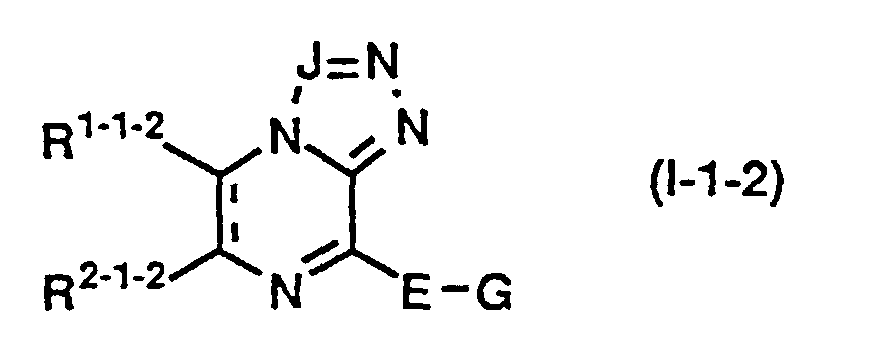
    Figure 00680001
    wherein R1-1-2 and R2-1-2 each, independently, is the a same meaning as R1 and R2, with the proviso that, R3 in R1-1-2 and R2-1-2 is nitro, the other symbols are as hereinbefore defined;
    to reduction. The reduction of nitro was known, for example, it may be carried out by hydrogenolysis and reduction using an organic metal.Hydrogenolysis was known, for example, it may be carried out in an inactive solvent [e.g. ether (such as tetrahydrofuran, dioxane, dimethoxyethane or diethyl ether), alcohol (such as methanol or ethanol), benzene (such as benzene or toluene), ketone (such as acetone or methyl ethyl ketone), nitrile (such as acetonitrile), amide (such as dimethylformamide), water, ethyl acetate, acetic acid or two more mixture thereof], in the presence of a catalyst (e.g. palladium on carbon, palladium black, palladium, palladium hydroxide, platinum dioxide, nickel or Raney-nickel), optionally in the presence of an inorganic acid (e.g. hydrochloric acid, sulfuric acid, hypochlorous acid, boric acid or tetrafluoroboric acid) or an organic acid (e.g. acetic acid, p-toluenesulfonic acid, oxalic acid, trifluoroacetic acid or formic acid), at ordinary or elevated pressure of hydrogen gas or in the presence of ammonium formate at 0-200°C. It does not matter using a salt of acid, when it is carried out in the presence of an acid.The reduction using an organic metal was known, for example, it may be carried out in a water miscible solvent (such as ethanol or methanol), optionally in the presence of an aqueous solution of hydrochloric acid using an organic metal (such as zinc, iron, tin, tin chloride, iron chloride) at 0-150 °C
  • [3] In the compounds of the present invention of the formula (I), the compound in which R3 is -NR4-3R5-3, in which R4-3 and R5-3 each, independently, is the a same meaning as R4 and R5, with the proviso that, they are not hydrogen at same time, that is the compound of the formula (I-3):
    Figure 00690001
    wherein R1-3 and R2-3 each, independently, is the a same meaning as R1 and R2, with the proviso that, R3 in R1-3 and R2-3 is -NR4-3R5-3, and the other symbols are as hereinbefore defined;
    may be prepared by subjecting the above compound of the formula (I-2) to alkylation or acetylation also. The reaction of alkylation was known, for example, it may be carried out in a solvent (such as tetrahydrofuran dimethylformamide or a mixture thereof) using alkyl iodide (such as methyl iodide), in the presence of sodium hydride at 0-40 °C.The reaction of acetylation was known, for example, it may be carried out in the presence of tertiary amine or pyridine, using anhydrous acetic acid at 0-80 °C.
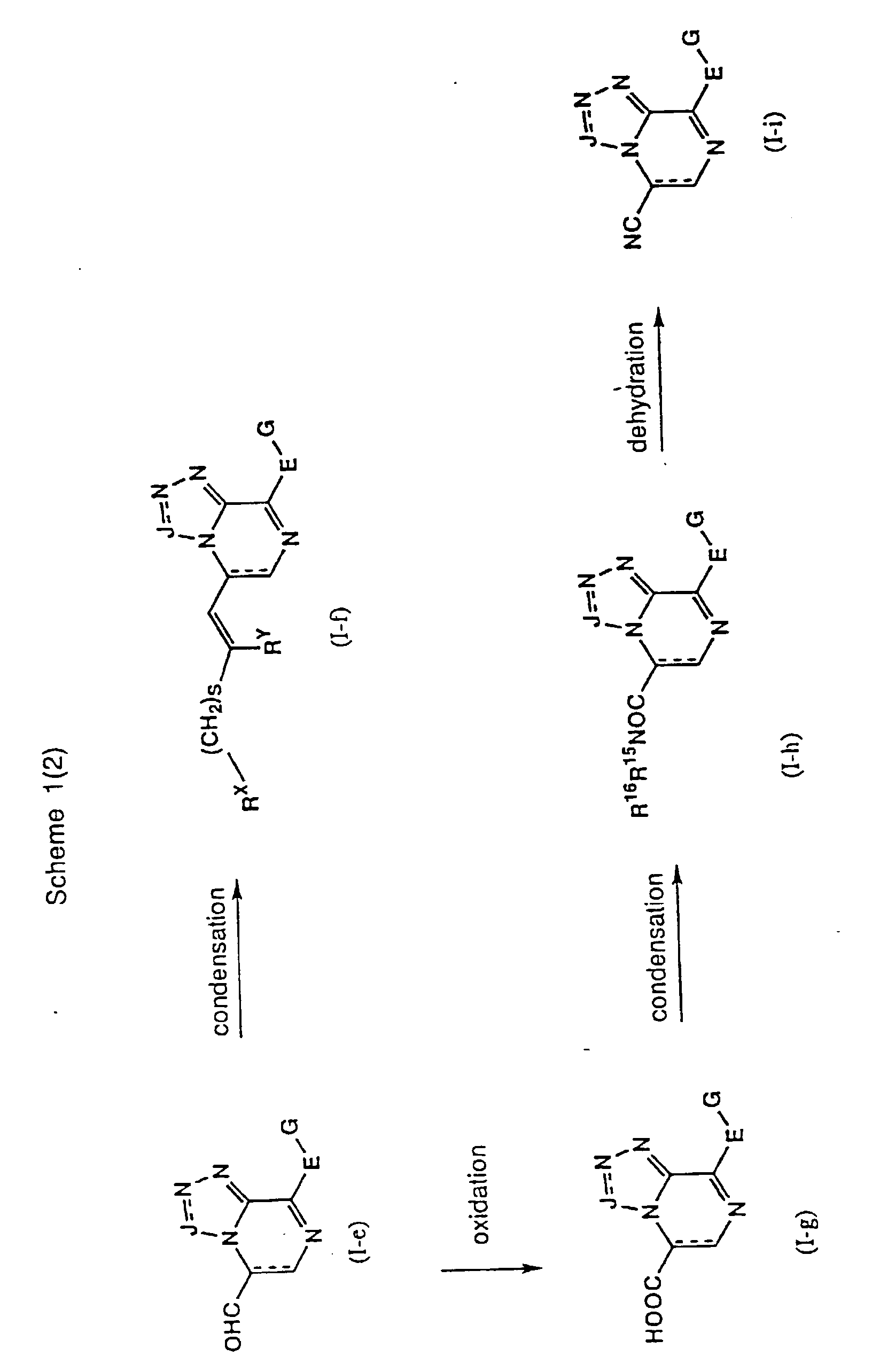
  • [4] The compound in which R1 is (i) COOH, (ii) CONR15R16, (iii) formyl, (iv) nitrile, (v) C2-8 alkenyl, (vi) methyl substituted by halogen atom, hydroxy or phenoxy, (vii) ethenyl substituted by COOR14a, in which R14a is C1-8 alkyl; nitrile, halogen atom, acetyl, C1-6 alkyl or C2-6 alkenyl, and R2 is hydrogen, may be prepared by following methods described in scheme 1(1) and scheme 1(2) also. In the schemes, X is halogen atom, Ph is phenyl, s is 0 or 1-6, RX is hydrogen, halogen atom, C1-6 alkyl, C2-6 alkenyl, COOR14a, nitrile or acetyl, RY is hydrogen, C1 -6 alkyl, halogen atom or nitrile, and the other symbols are as hereinbefore defined.All reactions in scheme were known.
    Figure 00700001
    Figure 00710001
  • [5]The compound in which n is 1, R3 is (i) formyl, (ii) C1-8 alkanoyl, (iii) C2-8 alkenyl, (iv) methyl substituted by halogen atom or -NR4R5, (v) C1-8 alkyl substituted by hydroxy, (vi) C2-8 alkenyl substituted by COOR6, hydroxy, halogen atom, nitrile, may be prepared by following methods described in scheme 2(1) and scheme 2(2) also.
  • In the schemes, t is 0 or 1-6, RW is hydrogen, C1-6 alkyl, C2-6 alkenyl, halogen atom, nitrile, COOR6a, in which R6a is C1-8 alkyl; RZ is hydrogen, C1-6 alkyl, halogen atom or nitrile, and the other symbols are as hereinbefore defined.
    All reactions in scheme were known.
    Figure 00730001
    Figure 00740001
    The compounds of the formulae (II-a), (III-a), (II-b), (III-b-1), (III-b-2) are known per se or may be prepared by known methods (See J. Med. Chem. 33, 2240 (1990) or J. Med. Chem. 35, 3323 (1992).).
    In each reaction in the present specification, products may be purified by conventional techniques. For example, purification may be carried out by distillation at atmospheric or reduced pressure, by high performance liquid chromatography, by thin layer chromatography or by column chromatography using silica gel or magnesium silicate, by washing or by recrystallization. Purification may be carried out after each reaction, or after a series of reactions.
    Pharmacological Activities
    The inhibitory activity of adhesion molecules expression of the compound of the formula (I) was confirmed as below.
    (1) Inhibition of adhesion molecules expression in HUVEC
    Human umbilical vein endothelial cells were cultured using MCDB104 medium (Nissui) containing 5 % Fetal bovine serum supplemented antibiotics (100U/ml penicillin, 100µg/ml streptomycin (Gibco)), 0.01mg/ml heparin (Nissui) and 0.005mg/ml endothelial cells (EC) growth factor (Nissui) in gelatin coated 96-well microtiter plates by resulting in confluent monolayers.
    The compounds were dissolved in dimethyl sulfoxide and prepared final 0.2% concentration in the medium and then added 50µl into the well. Cytokine stimulation of EC was performed by adding 50µl of 10 ng/ml TNFα (Genzyme) (for E-selectin, and ICAM-1 expression-) or 50µl of 10ng/ml TNFα plus 1ng/ml IL-4 (Genzyme)(for VCAM- expression).
    After stimulation for 6 hours, the wells were washed with PBS(-) once and EC monolayers were fixed by incubating with methanol containing 0.3% hydrogen peroxide for 10 minutes at room temperature. After washing with PBS(-) three times, an ELISA was used to measure the expression of adhesion molecules on EC surface The ELISA was performed at room temperature with three times washes with PBS(-) between each step. EC were incubated for 30 minutes in turn with 100µl primary antibody which were anti-ICAM-1 antibody (BBA4), anti-E-selectin antibody (BBA2) or anti-VCAM-1 antibody (BBA6) (mouse IgG1, 1.25µl/ml; R&D), with 100µl of secondary antibody which was goat anti-mouse IgG conjugated peroxidase (dilution (1/400) ; Nordic Immunological laboratories). The enzyme substrate 1mg/ml o-phenylenediamine/2HCl and 0.1% hydrogen peroxide of 100µl was added and incubated for 4 minutes at room temperature.
    Reaction was stopped with 50µl of 8N sulfuric acid and optical density (OD) of each well read at 490 nm in immunoreder. Inhibitory percentage was calculated as follows and IC50 value was estimated by percentage for control. Inhibitory percentage (%) = [(C-S)/(C-B)]x100
  • C: OD of the sample stimulated by cytokines
  • S: OD of the sample stimulated by cytokines in the presence of test compound
  • B: OD of the nonstimulated sample
  • These results are shown in Table 16.
    IC50(µM)
    E-selectin VCAM-1 ICAM-1
    Compound (12) 1.04 0.95 0.95
    Example 3(16) 0.103 0.032 0.073
    Example 3(73) 0.60 0.20 0.40
    Furthermore, MTT [3-(4, 5-dimethyl-2-thiazolyl)-2, 5-diphenyl-2H-tetrazolium bromide] assay was enforced and the number of living cells was counted in order to estimate the effect of compound not to depend cytotoxicity on the above evaluation system.
    (2) Cytotoxicity test by MTT assay [method]
    EC wore treated under conditions identical to those employed for measurement of adhesion molecules expression. After incubation, the wells were washed with PBS(-) once, added 100µl of MTT solution (1mg/ml) and incubated for 3 hours. After incubation, supernatants were discarded and 100µl of methanol added. After stirring, OD of each well read at 570 nm/690 nm in immunoreader. Inhibitory percentage was calculated as follows and IC50 value was estimated by percentage for control. Inhibitory percentage (%) = [(C-S)/C)]x100
  • C: OD of the sample stimulated by cytokines
  • S: OD of the sample stimulated by cytokines in the presence of test compound
  • As the result, IC50 values of compound (12), Example 3 (16) and Example 3 (73) were more than 50µM, 100µM and 25µM respectively.
    Toxicity
    The toxicity of the compounds of the present invention is very low and therefore, the compounds may be considered safe for pharmaceutical use.
    Application for Pharmaceuticals
    Inhibition of adhesion molecules expression is useful for prevention and / or treatment of diseases, for example, inflammation, rheumatoid arthritis, allergies, asthma, atopic dermatitis, psoriasis, suppression of ischemia reperfusion injury, nephritis, hepatitis. multiple sclerosis, ulcerative colitis, ARDS, suppression of transplant rejection, sepsis, diabetes, autoimmune diseases, tumor metastasis, arteriosclerosis and AIDS in animals including human beings, especially human beings.
    For the purpose above described, the compounds of formulae (I) of the present invention, non-toxic salts, acid addition salts or hydrates thereof may be normally by administered systemically or locally, usually by oral or parenteral administration.
    The doses to be administered are determined depending upon, for example, age, body weight, symptom, the desired therapeutic effect, the route of administration, and the duration of the treatment. In the human adult, the doses per person are generally from 1 mg to 1000 mg, by oral administration, up to several times per day, and from 1 mg to 100 mg, by parenteral administration (preferably intravenous administration), up to several times per day, or continuous administration from 1 to 24 hours per day from vein.
    As mentioned above, the doses to be used depend upon various conditions. Therefore, there are cases in which doses lower than or greater than the ranges specified above may be used.
    The compounds of the present invention may be administered in the form of, for example, solid forms for oral administration, liquid forms for oral administration, injections, liniments or suppositories for parenteral administration.
    Solid forms for oral administration include compressed tablets, pills, capsules, dispersible powders, and granules. Capsules include hard capsules and soft capsules.
    In such solid forms, one or more of the active compound(s) may be admixed with vehicles (such as lactose, mannitol, glucose, microcrystalline cellulose, starch), binders (such as hydroxypropyl cellulose, polyvinylpyrrolidone or magnesium metasilicate aluminate), disintegrants (such as cellulose calcium glycolate), lubricants (such as magnesium stearate), stabilizing agents, and solution adjuvants (such as glutamic acid or aspartic acid) and prepared according to methods well known in normal pharmaceutical practice. The solid forms may, it desired, be coated with coating agents (such as sugar, gelatin, hydroxypropyl cellulose or hydroxypropylmethyl cellulose phthalate), or be coated with two or more films. And further, coating may include containment within capsules of absorbable materials such as gelatin.
    Liquid forms for oral administration include pharmaceutically acceptable solutions, suspensions and emulsions, syrups and elixirs. In such forms, one or more of the active compound(s) may be dissolved, suspended or emulized into diluent(s) commonly used in the art (such as purified water, ethanol or a mixture thereof). Besides such liquid forms may also comprise some additives, such as wetting agents, suspending agents, emulsifying agents, sweetening agents, flavoring agents, aroma, preservative or buffering agent.
    Injections for parenteral administration include sterile aqueous, suspensions, emulsions and solid forms which are dissolved or suspended into solvent(s) for injection immediately before use. In injections, one or more of the active compound(s) may be dissolved, suspended or emulized into solvent(s). The solvents may include distilled water for injection, physiological salt solution, vegetable oil, propylene glycol, polyethylene glycol, alcohol, e.g. ethanol, or a mixture thereof.
    Injections may comprise some additives, such as stabilizing agents, solution adjuvants (such as glutamic acid, aspartic acid or POLYSORBATE80 (registered trade mark)), suspending agents, emulsifying agents, soothing agent buffering agents, preservative. They may be sterilized at a final step, or may be prepared and compensated according to sterile methods. They may also be manufactured in the form of sterile solid forms which may be dissolved in sterile water or some other sterile diluent(s) for injection immediately before use.
    Other forms for parenteral administration include liquids for external use, ointments and endermic liniments, inhalations, sprays, suppositories and pessaries for vaginal administration which comprise one or more of the active compound(s) and may be prepared by methods known per se. Sprays may comprise additional substances other than diluents, such as stabilizing agents (such as sodium sulfate), isotonic buffers (such as sodium chloride, sodium citrate or citric acid). For preparation of such sprays, for example, the method described in the United States Patent No. 2,868,691 or 3,095,355 may be used
    The best form in order to conduct a present invention
    The following Reference Examples and Examples illustrate the present invention, but do not limit the present invention.
    The solvents in the parentheses show the developing or eluting solvents and the ratios of the solvents used are by volume in chromatographic separations or TLC.
    The solvents in the parentheses in NMR show the solvents used in measurement.
    Example 1
    4-Isopropylthio-(5-trifluoromethyl-1, 2, 4-triazolo)[4, 3-a]quinoxaline
    Figure 00800001
    60% Sodium hydride (44 mg) was added to a solution of 2-propanthiol (0.94 ml) in dimethylformamide (10 ml) at 0 °C. The mixture was stirred for 30 minutes at room temperature. 4-Chloro-(5-trifluoromethyl-1, 2, 4-triazolo)[4, 3-a]quinoxaline (The compound is described in J. Med. Chem., 33 2240 (1990).) (250 mg) was added to the mixture at 0 °C. The mixture was stirred for 30 minutes at room temperature. Water with ice was added to the reaction mixture and the mixture was extracted with chloroform. The extract was washed with a saturated aqueous solution of sodium chloride, dried over anhydrous sodium sulfate and concentrated. The residue was purified by column chromatography on silica gel (hexane ; ethyl acetate = 9 : 1 → 4 : 1) to give the present compound (0.203 g) having the following physical data.
  • TLC : Rf 0.61 (Hexane : Ethyl acetate = 4 :1);
  • NMR (d6-DMSO) : δ 8.10-7.97 (2H, m), 7.84-7.70 (2H, m), 4.30 (1H, sept J=6.8Hz), 1.50 (6H, d, J=6.8Hz).
  • Example 1(1) - 1(84)
    The following present compounds were obtained by the same procedure as a series of reaction of Example 1, using a corresponding thiol or alcohol instead of 2-propanthiol, if necessary by converting into the corresponding salts by a known method.
    Example 1(1)
    4-Phenyloxy-(5-trifluoromethyl-1, 2, 4-triazolo)[4, 3-a]quinoxaline
    Figure 00810001
  • TLC : Rf 0.53 (Hexane : Ethyl acetate = 2 : 1);
  • NMR (CDCl3) : δ 8.22 -8.10 (1H, m), 7.89-7.78 (1H, m), 7.69-7.58 (2H, m), 7.57-7.45 (2H, m), 7.44-7.31 (3H, m).
  • Example 1(2)
    4-(Pyrimidin-2-yl)thio-(5-trifluoromethyl-1, 2, 4-triazolo)[4, 3-a] quinoxaline
    Figure 00810002
  • TLC : Rf 0.38 (Chloroform : Methanol = 10 : 1);
  • NMR (d6-DMSO) : δ 8.69 (2H, d, J=5.0Hz), 8.23-8.08 (2H, m), 8.04-7.81 (2H, m), 7.42 (1H, t, J=5.0Hz).
  • Example 1(3)
    4-Allylthio-(5-trifluoromethyl-1, 2, 4-triazolo)[4, 3-a]quinoxaline
    Figure 00810003
  • TLC : Rf 0.49 (Hexane : Ethyl acetate = 4 : 1) ;
  • NMR (d6-DMSO): δ 8.17-7.94 (2H, m), 7.86-7.69 (2H, m), 6.14-5.94 (1H, m), 5.47 (1H, d, J=15.6Hz), 5.21 (1H, d, J=10.0Hz), 4.11 (1H, d, J=7.0Hz).
  • Example 1(4)
    4-(Thiophen-2-yl)thio-(5-trifluoromethyl-1, 2, 4-triazolo)[4, 3-a] quinoxaline
    Figure 00820001
  • TLC : Rf 0.46 (Hexane : Ethyl acetate =4 :1);
  • NMR (d6-DMSO) : δ 8.09-7.97 (2H, m), 7.88-7.66 (3H, m), 7.56 (1H, d, J=5.3Hz), 7.30 (1H, dd, J=5.3, 3.4Hz).
  • Example 1(5)
    4-Cyclohexylthio-(5-trifluoromethyl-1, 2, 4-triazolo)[4, 3-a]quinoxaline
    Figure 00820002
  • TLC : Rf 0.63 (Hexane : Ethyl acetate = 4 : 1) ;
  • NMR (d6-DMSO): δ 8.10-7.94 (2H, m), 7.84-7.68 (2H, m), 4.33-4.12 (1H, m), 2.26-1.98 (2H, m), 1.93-1.19 (8H, m).
  • Example 1(6)
    4-(4-Trifluoromethylphenyl)thio-(5-trifluoromethyl-1, 2, 4-triazolo)[4, 3-a]quinoxaline
    Figure 00830001
  • TLC : Rf 0.53 (Hexane : Ethyl acetate = 4 : 1) ;
  • NMR (CDCl3) : δ 8.18-8.07 (1H, m), 7.90-7.72 (5H, m), 7.70-7.59 (2H, m).
  • Example 1(7)
    4-(4-Trifluoromethoxyphenyl)thio-(5-trifluoromethyl-1, 2, 4-triazolo)[4, 3-a]quinoxaline
    Figure 00830002
  • TLC : Rf 0.43 (Chloroform) ;
  • NMR (CDCl3): δ 8.15-8.10 (1H, m), 7.87-7.82 (1H, m), 7.75 (2H, d, J=8.8Hz), 7.68-7.62 (2H, m), 7.37 (2H, d, J=8.8Hz).
  • Example 1(8)
    4-(Pyridin-4-yl)thio-(5-trifluoromethyl-1, 2, 4-triazolo)[4, 3-a]quinoxaline
    Figure 00830003
  • TLC : Rf 0.23 (Hexane : Ethyl acetate = 2 : 1) ;
  • NMR (CDCl3): δ 8.76 (2H, d, J=6.2Hz), 8.21-8.10 (1H, m), 7.94-7.88 (1H, m), 7.75-7.65 (4H, m).
  • Example 1(9)
    4-(Pyridin-4-yl)thio-(5-trifluoromethyl-1, 2, 4-triazolo)[4, 3-a]quinoxaline·hydrochloride
    Figure 00840001
  • TLC : Rf 0.69 (Chloroform : Methanol = 10 : 1) ;
  • NMR(CDCl3) : δ 8.83 (2H, d, J=6.6Hz), 8.14 (2H, d, J=6.6Hz), 8.12-7.77 (4H, m).
  • Example 1(10)
    4-(2-Methoxyphenyl)thio-(5-trifluoromethyl-1, 2, 4-triazolo)[4, 3-a] quinoxaline
    Figure 00840002
  • TLC : Rf 0.56 (Hexane : Ethyl acetate = 2 : 1) ;
  • NMR (CDCl3) : δ 8.13-8.08 (1H, m), 7.83-7.75 (1H, m), 7.67 (1H, dd, J=7.8, 6.0Hz), 7.62-7.57 (2H, m), 7.53 (1H, dd, J=7.8, 6.0Hz), 7.09 (2H, dd, J=7.8, 7.8Hz), 3.80 (3H, s).
  • Example 1(11)
    4-(3-Methoxyphenyl)thio-(5-trifluoromethyl-1, 2, 4-triazolo)[4, 3-a] quinoxaline
    Figure 00840003
  • TLC : Rf 0.62 (Hexane : Ethyl acetate = 2 : 1) ;
  • NMR (CDCl3) : δ 8.14-8.09 (1H, m), 7.89-7.84 (1H, m), 7.68-7.58 (2H, m), 7.43 (1 H, dd, J=8.0, 8.0Hz), 7.30 (1 H, dd, J=8.0, 5.6Hz), 7.28 (1H, s), 7.07 (1H, dd, J=8.0, 5.6Hz), 3.86 (3H, s).
  • Example 1(12)
    4-(2-Chlorophenyl)thio-(5-trifluoromethyl-1, 2, 4-triazolo)[4, 3-a] quinoxaline
    Figure 00850001
  • TLC : Rf 0.61 (Hexane : Ethyl acetate = 2 : 1) ;
  • NMR (CDCl3) : δ 8.15-8.10 (1H, m), 7.83-7.77 (2H, m), 7.68-7.59 (3H, m), 7.51 (1H, ddd, J=7.6, 7.6, 2.0Hz), 7.41 (1H, ddd, J=7.6, 7.6, 2.0Hz).
  • Example 1(13)
    4-(3-Chlorophenyl)thio-(5-trifluoromethyl-1, 2, 4-triazolo)[4, 3-a] quinoxaline
    Figure 00850002
  • TLC : Rf 0.68 (Hexane : Ethyl acetate = 2 : 1) ;
  • NMR(CDCl3) : δ 8.15-8.10 (1H, m) 7.89-7.84 (1H, m), 7.74 (1H, s), 7.67-7.41 (5H, m).
  • Example 1(14)
    4-(2-Aminophenyl)thio-(5-trifluoromethyl-1, 2, 4-triazolo)[4, 3-a] quinoxaline
    Figure 00860001
  • TLC : Rf 0.56 (Hexane : Ethyl acetate = 2 : 1) ;
  • NMR (d6-DMSO): δ 8.03 (1H, d, J=8.0Hz), 7.81-7.63 (3H, m), 7.38 (1H, dd, J=8.0, 1.4Hz), 7.27 (1H, ddd, J=8.0, 8.0, 1.4Hz), 6.84 (1H, dd, J=8.0, 1.4Hz), 6.65 (1H, ddd, J=8.0, 8.0, 1.4Hz), 5.42 (2H, brs).
  • Example 1(15)
    4-(2-Aminophenyl)thio-(5-trifluoromethyl-1, 2, 4-triazolo)[4, 3-a] quinoxaline·hydrochloride
    Figure 00860002
  • TLC : Rf 0.56 (Hexane : Ethyl acetate = 2 : 1) ;
  • NMR (d6-DMSO): δ 8.19-8.15 (1H, m), 7.89-7.84 (1H, m), 7.55-7.50 (2H, m), 7.31-7.22 (2H, m), 6.82 (1H, d, J=8.0Hz), 6.62 (1H, dd, J=8.0, 7.2Hz), 5.52 (2H, brs).
  • Example 1(16)
    4-(3-Carboxyphenyl)thio-(5-trifluoromethyl-1, 2, 4-triazolo)[4, 3-a] quinoxaline
    Figure 00860003
  • TLC : Rf 0.33 (Chloroform : Methanol = 10 : 1) ;
  • NMR (d6-DMSO) : δ 8.24 (1H, s), 8.11 (1H, d, J=8.0Hz), 8.03 (1H, d, J=8.4Hz), 7.92 (1 H, d, J=8.0 Hz), 7.84-7.64 (4H, m).
  • Example 1(17)
    4-(4-Carboxyphenyl)thio-(5-trifluoromethyl-1, 2, 4-triazolo)[4, 3-a] quinoxaline
    Figure 00870001
  • TLC : Rf 0.31 (Chloroform : Methanol = 10 : 1) ;
  • NMR (d6-DMSO) : δ 8.10-8.02 (1H, m), 8.08 (2H, d, J=8.6Hz), 7.85 (2H, d, J=8.6Hz), 7.84-7.69 (3H, m).
  • Example 1(18)
    4-(4-Aminophenyl)thio-(5-trifluoromethyl-1, 2, 4-triazolo)[4, 3-a] quinoxaline
    Figure 00870002
  • TLC : Rf 0.22 (Chloroform) ;
  • NMR(d6-DMSO) : δ 8.00 (1H, d, J=8.5Hz), 7.77-7.73 (2H, m), 7.67 (1H, dd, J=8.5, 7.0Hz), 7.28 (2H, d, J=8.0Hz), 6.69 (2H, d, J=8.0Hz), 5.66 (2H, brs).
  • Example 1(19)
    4-(4-Aminophenyl)thio-(5-trifluoromethyl-1, 2, 4-triazolo)[4, 3-a] quinoxaline·hydrochloride
    Figure 00880001
  • TLC : Rf 0.22 (Chloroform) ;
  • NMR (d6-DMSO) : δ 8.02 (1H, d, J=8.0Hz), 7.79-7.75 (2H, m), 7.68 (1H, dd, J=8.0, 7.0Hz), 7.55 (2H, d, J=8.0Hz), 7.11 (2H, d, J=8.0Hz), 5.00-2.80 (3H, br).
  • Example 1(20)
    4-(4-(2-Carboxyethyl)phenyl)thio-(5-trifluoromethyl-1, 2, 4-triazolo)[4, 3-a]quinoxaline
    Figure 00880002
  • TLC : Rf 0.41 (Chloroform : Methanol = 10 : 1) ;
  • NMR (d6-DMSO) : δ 8.02 (1H, d, J=7.8Hz), 7.81 -7.69 (3H, m), 7.63 (2H, d, J=8.4Hz), 7.43 (2H, d, J=8.4Hz), 2.93 (2H, t J=7.8Hz), 2.62 (2H, t, J=7.8Hz).
  • Example 1(21)
    4-(N, N,-Dimethylamino)ethylthio-(5-trifluoromethyl-1, 2, 4-triazolo)[4, 3-a]quinoxaline
    Figure 00880003
  • TLC : Rf 0.49 (Chloroform : Methanol = 10 : 1) ;
  • NMR (d6-DMSO) : δ 8.07-8.00 (2H, m), 7.83-7.74 (2H, m), 3.54 (2H, t, J=7.0Hz), 2.66 (2H, t, J=7.0Hz), 2.26 (6H, s).
  • Example 1(22)
    4-(N, N,-Dimethylamino)ethylthio-(5-trifluoromethyl-1, 2, 4-triaizolo)[4, 3-a]quinoxaline·hydrochloride
    Figure 00890001
  • TLC : Rf 0. 49 (Chloroform : Methanol = 10 : 1) ;
  • NMR (d6-DMSO) : δ 10.8 (1H, brs), 8.24-8.20 (1H, m), 8.08-8.03 (1H, m), 7.85-7.80 (2H, m), 3.80 (2H, t, J=7.4Hz), 3.43 (2H, t, J=7.4Hz), 2.88 (6H, s).
  • Example 1(23)
    4-(3-Methoxycarbonylphenyl)thio-(5-trifluoromethyl-1, 2, 4-triazolo)[4, 3-a]quinoxaline
    Figure 00890002
  • TLC : Rf 0.32 (Chloroform) ;
  • NMR (d6-DMSO) : δ 8.27 (1H, s), 8.15 (1H, d, J=7.6Hz), 8.06-7.99 (2H, m), 7.85-7.69 (4H, m), 3.88 (3H, s).
  • Example 1(24)
    4-(4-Methoxycarbonylphenyl)thio-(5-trifluoromethyl-1, 2, 4-triazolo)[4, 3-a]quinoxaline
    Figure 00890003
  • TLC : Rf 0.25 (Chloroform) ;
  • NMR (d6-DMSO) : δ 8.11 (2H, d, J=8.4Hz), 8.08-8.03 (1H, m), 7.90 (2H, d, J=8.4Hz), 7.86-7.67 (3H, m), 3.91 (3H, s).
  • Example 1(25)
    4-(4-(2-Methoxycarbonyethyl)phenyl)thio-(5-trifluoromethyl-1, 2, 4-triazolo)[4, 3-a]quinoxaline
    Figure 00900001
  • TLC : Rf 0.30 (Chloroform) ;
  • NMR (CDCl3) : δ 8.13-8.09 (1H, m), 7.86-7.81 (1H, m), 7.67-7.59 (2H, m), 7.63 (2H, d, J=8.0Hz), 7.35 (2H, d, J=8.0Hz), 3.71 (3H, s), 3.06 (2H, t, J=7.8Hz), 2.72 (2H, t J=7.8Hz).
  • Example 1(26)
    4-(3-Aminophenyl)thio-(5-trifluoromethyl-1, 2, 4-triazolo)[4, 3-a] quinoxaline
    Figure 00900002
  • TLC : Rf 0.21 (Hexane : Ethyl acetate = 2 : 1) ;
  • NMR(d6-DMSO) : δ 8.02 (1H, d, J=7.8Hz), 7.83-7.65 (3H, m), 7.19 (1H, dd, J=7.8, 7.8Hz), 6.91 (1H, s), 6.82 (1H, d, J=7.8Hz), 6.73 (1H, d, J=7.8Hz), 5.39 (2H, brs).
  • Example 1(27)
    4-(3-Aminophenyl)thio-(5-trifluoromethyl-1, 2, 4-triazolo)[4, 3-a] quinoxaline·hydrochloride
    Figure 00910001
  • TLC : Rf 0.21 (Hexane : Ethyl acetate = 2 : 1) ;
  • NMR(d6-DMSO) : δ 8.04 (1H, d, J=8.8Hz), 7.84-7.70 (3H, m), 7.45 (1H, dd, J=7.8, 7.8Hz), 7.36 (1H, s), 7.31 (1H, d, J=7.8Hz), 7.17 (1H, d, J=7.8Hz), 4.00-3.00 (3H, br).
  • Example 1(28)
    4-Isopropyloxy-(5-trifluoromethyl-1, 2, 4-triazolo)[4, 3-a]quinoxaline
    Figure 00910002
  • TLC : Rf 0.54 (Hexane : Ethyl acetate = 3 : 1) ;
  • NMR (CDCl3) : δ 8.10 (1H, d, J=8.5Hz), 7.92 (1H, dd, J=7.5, 1.5Hz), 7.67-7.63 (1H, m), 7.59-7.55 (1H, m), 5.78 (1H, seq, J=6.5Hz), 1.56 (6H, d, J=6.5Hz).
  • Example 1(29)
    4-Allyloxy-(5-trifluoromethyl-1, 2, 4-triazolo)[4, 3-a]quinoxaline
    Figure 00910003
  • TLC : Rf 0.38 (Hexane : Ethyl acetate = 3 : 1) ;
  • NMR (CDCl3) : δ 8.12 (1H, d, J=8.5Hz), 7.94 (1H, dd, J=8.5, 1.5Hz), 7.68-7.65 (1H, m), 7.61-7.58 (1H, m), 6.27-6.19 (1H, m), 5.57 (1H, dd, J=17.0, 1.5Hz), 5.39 (1H, dd, J=10.5, 1.5Hz), 5.24 (2H, d, J=6.0Hz).
  • Example 1(30)
    4-Methoxycarbonylmethylthio-(5-trifluoromethyl-1, 2, 4-triazolo)[4, 3-a]quinoxaline
    Figure 00920001
  • TLC : Rf 0.28 (Hexane : Ethyl acetate = 2 : 1) ;
  • NMR (CDCl3) : δ 8.15-8.11 (1H, m), 8.07-8.02 (1H, m), 7.72-7.66 (2H, m), 4.22 (2H, s), 3.80 (3H, s).
  • Example 1(31)
    4-(1-Ethoxycarbonylethyl)thio-(5-trifluoromethyl-1, 2, 4-triazolo)[4, 3-a]quinoxaline
    Figure 00920002
  • TLC : Rf 0.52 (Hexane : Ethyl acetate = 2 : 1) ;
  • NMR (CDCl3) : δ 8.15-8.10 (1H, m), 8.06-8.01 (1H, m), 7.75-7.62 (2H, m), 4.84 (1H, q, J=7.4Hz), 4.25 (2H, q, J=7.2Hz), 1 .77 (3H, d, J=7.4Hz), 1.29 (3H, t, J=7.2Hz).
  • Example 1(32)
    4-(2-Thiazolin-2-yl)thio-(5-trifluoromethyl-1, 2, 4-triazolo)[4, 3-a] quinoxaline
    Figure 00930001
  • TLC : Rf 0.64 (Hexane : Ethyl acetate =2 : 1) ;
  • NMR (CDCl3): δ 8.18-8.10 (2H, m), 7.78-7.69 (2H, m), 4.00 (2H, t J=6.8Hz), 3.76 (2H, t, J=6.8Hz).
  • Example 1(33)
    4-(Thiazol-2-yl)thio-(5-trifluoromethyl-1, 2, 4-triazolo)[4, 3-a]quinoxaline
    Figure 00930002
  • TLC : Rf 0.56 (Hexane : Ethyl acetate =2 : 1) ;
  • NMR (CDCl3) : δ 8.20-8.15 (1H, m), 8.10-8.05 (1H, m), 8.04 (1H, d, J=3.6Hz), 7.77-7.69 (2H, m), 7.68 (1H, d, J=3.6Hz).
  • Example 1(34)
    4-(1-Methyltetrazol-5-yl)thio-(5-trifluoromethyl-1, 2, 4-triazolo)[4, 3-a]quinoxaline
    Figure 00930003
  • TLC : Rf 0.21 (Hexane : Ethyl acetate = 2 : 1) ;
  • NMR (d6-DMSO) : δ 8.07 (1H, d, J=8.4Hz), 7.92-7.70 (3H, m), 4.11 (3H, s).
  • Example 1(35)
    4-(1-Phenyltetrazol-5-yl)thio-(5-trifluoromethyl-1, 2, 4-triazolo)[4, 3-a]quinoxaline
    Figure 00940001
  • TLC : Rf 0.41 (Hexane : Ethyl acetate =2 : 1) ;
  • NMR (d6-DMSO) : δ 8.01 (1H, d, J=7.6Hz), 7.88-7.73 (5H, m), 7.55-7.51 (3H, m).
  • Example 1(36)
    4-(2-Hydroxyethyl)thio-(5-trifluoromethyl-1, 2, 4-triazolo)[4, 3-a]quinoxaline
    Figure 00940002
  • TLC : Rf 0.26 (Hexane : Ethyl acetate = 1 : 1) ;
  • NMR (CDCl3) : δ 8.16-8.05 (2H, m), 7.76-7.64 (2H, m), 4.08 (2H, t J=5.8Hz), 3.68 (2H, t, J=5.8Hz), 3.00-2.90 (1H, br).
  • Example 1(37)
    4-(2-Hydroxypropyl)thio-(5-trifluoromethyl-1, 2, 4-triazolo)[4, 3-a]quinoxaline
    Figure 00950001
  • TLC : Rf 0.38 (Hexane : Ethyl acetate =1 : 1) ;
  • NMR (CDCl3) : δ 8.16-8.04 (2H, m), 7.76-7.64 (2H, m), 4.33-4.22 (1H, m), 3.71 (1H, dd, J=14.0, 3.7Hz), 3.48 (1H, dd, J=14.0, 6.8Hz), 1.42 (3H, d, J=6.0Hz).
  • Example 1(38)
    4-(3-Hydroxypropyl)thio-(5-trifluoromethyl-1, 2, 4-triazolo)[4, 3-a]quinoxaline
    Figure 00950002
  • TLC : Rf 0.35 (Hexane : Ethyl acetate = 1 : 1) ;
  • NMR (CDCl3) : δ 8.16-8.03 (2H, m), 7.73-7.65 (2H, m), 3.81 (2H, t, J=5.6Hz), 3.62 (2H, t, J=6.6Hz), 2.12 (2H, tt, J=6.6, 5.6Hz).
  • Example 1(39)
    4-(2-Methylfuran-3-yl)thio-(5-trifluoromethyl-1, 2, 4-triazolo)[4, 3-a] quinoxaline
    Figure 00950003
  • TLC : Rf 0.57 (Hexane : Ethyl acetate = 3 : 1) ;
  • NMR (CDCl3) : δ 8.15-8.10 (1H, m), 7.97-7.92 (1H, m), 7.69-7.63 (2H, m), 7.49 (1H, d, J=2.2Hz), 6.55 (1H, d, J=2.2Hz), 2.40 (3H, s).
  • Example 1(40)
    4-(6-Methyl-4H, 5H-1, 3-thiazine)thio-(5-trifluoromethyl-1, 2, 4-triazolo) [4, 3-a]quinoxaline
    Figure 00960001
  • TLC : Rf 0.56 (Hexane : Ethylacetate = 2 : 1) ;
  • NMR (CDCl3) : δ 8.21 (1H, dd, J=7.4, 2.2Hz), 8.13 (1H, d, J=8.4Hz), 7.77-7.63 (2H, m), 4.65-4.50 (1H, m), 3.83-3.74 (2H, m), 2.34-2.15 (2H, m), 1.62 (3H, d, J=7.0Hz).
  • Example 1(41)
    4-(Imidazol-2-yl)thio-(5-trifluoromethyl-1, 2, 4-triazolo)[4, 3-a] quinoxaline
    Figure 00960002
  • TLC : Rf 0.54 (Ethyl acetate) ;
  • NMR (d6-DMSO) : δ 13.0 (1H, br s), 8.05 (1H, d, J=7.8Hz), 7.90-7.72 (3H, m), 7.55 (1H, br s), 7.26 (1H, br s).
  • Example 1(42)
    4-[3-(Methoxymethoxy)propyl]thio-(5-trifluoromethyl-1, 2, 4-triazolo)[4, 3-a]quinoxaline
    Figure 00970001
  • TLC : Rf 0.19 (Toluene : Ethyl acetate = 9 : 1) ;
  • NMR (CDCl3) : δ 8.17-8.03 (2H, m), 7.76-7.59 (2H, m), 4.68 (2H, s), 3.74 (2H, t, J=6.0Hz), 3.57 (2H, t J=7.0Hz), 3.41 (3H, s), 2.25-2.09 (2H, m).
  • Example 1(43)
    4-(3-Methylpropoxy)-(5-trifluoromethyl-1, 2, 4-triazolo)[4, 3-a] quinoxaline
    Figure 00970002
  • TLC : Rf 0.53 (Toluene : Ethyl acetate = 4 : 1) ;
  • NMR (CDCl3) : δ 8.17-8.07 (1H, m), 8.00-7.90 (1H, m), 7.74-7.54 (2H, m), 4.84 (2H, t J=6.3Hz), 2.78 (2H, t, J=7.1 Hz), 2.37-2.22 (2H, m), 2.16 (3H, s).
  • Example 1(44)
    4-(3-Methoxypropyl)thio-(5-trifluoromethyl-1, 2, 4-triazolo)[4, 3-a] quinoxaline
    Figure 00970003
  • TLC : Rf 0.70 (Toluene : Ethyl acetate = 2 : 1) ;
  • NMR (CDCl3) : δ 8.16-8.03 (2H, m), 7.75-7.59 (2H, m), 3.59 (2H, t, J=6.1Hz), 3.54 (2H, t, J=7.1 Hz), 3.39 (3H, s), 2.22-2.06 (2H, m).
  • Example 1(45)
    4-(2-Methoxyethyl)thio-(5-trifluoromethyl-1, 2, 4-triazolo)[4, 3-a]quinoxaline
    Figure 00980001
  • TLC : Rf 0.66 (Toluene : Ethyl acetate = 2 : 1) ;
  • NMR (CDCl3) : δ 8.13 (1H, d, J=8.1 Hz), 8.07 (1H, m), 7.75-7.62 (2H, m), 3.83-3.76 (2H, m), 3.72-3.67 (2H, m), 3.45 (3H, s).
  • Example 1(46)
    (±)-4-(2-Methoxypropyl)thio- (5-trifluoro methyl-1, 2, 4-triazolo)[4, 3-a]quinoxaline
    Figure 00980002
  • TLC : Rf 0.68 (Toluene : Ethyl acetate = 2 : 1) ;
  • NMR (CDCl3) : δ 8.13 (1H, d, J=8.1 Hz), 8.06 (1H, m), 7.75-7.61 (2H, m), 3.77-3.64 (2H, m), 3.58-3.48 (1H, m), 3.48 (3H, s), 1.37 (3H, d, J=6.0Hz).
  • Example 1(47)
    4-[2-(Methoxymethoxy)ethyl]thio-(5-trifluoromethyl-1, 2, 4-triazolo)[4, 3-a]quinoxaline
    Figure 00990001
  • TLC : Rf 0.64 (Toluene : Ethyl acetate = 2 : 1) ;
  • NMR(CDCl3) : δ 8.13 (1H, d, J=8.1 Hz), 8.07 (1H, m), 7.75-7.62 (2H, m), 4.72 (2H, s), 3.95 (2H, t, J=6.3Hz), 3.71 (2H, t J=6.3Hz), 3.43 (3H, s).
  • Example 1(48)
    (±)-4-[2-(Methoxymethoxy)propyl]thio-(5-trifiuoromethyl-1, 2, 4-triazolo)[4, 3-a]quinoxaline
    Figure 00990002
  • TLC : Rf 0.68 (Toluene : Ethyl acetate = 2 : 1) ;
  • NMR (CDCl3) : δ 8.13 (1H, d, J=8.1 Hz), 8.06 (1H, m), 7.75-7.61 (2H, m), 4.82 and 4.76 (each 1H, ABq, J=6.9Hz), 4.14 (1H, m), 3.66 (1H, dd, J=6.0, 13.5Hz), 3.58 (1H, dd, J=5.7, 13.5Hz), 3.44 (3H, s), 1.41 (3H, d, J=6.3Hz).
  • Example 1(49)
    4-(2-Ethoxyethoxy)-(5-trifluoromethyl-1, 2, 4-triazolo)[4, 3-a]quinoxaline
    Figure 00990003
  • TLC : Rf 0.35 (Hexane : Ethyl acetate = 2 : 1) ;
  • NMR (CDCl3) : δ 8.12 (m, 1H), 7.94 (m, 1H), 7.72-7.54 (m, 2H), 4.88 (m, 2H), 3.98 (m, 2H), 3.65 (q, J=7.0Hz, 2H), 1.24 (t, J=7.0Hz, 3H).
  • Example 1(50)
    4-(3-Hydroxypropoxy)-(5-trifluoromethyl-1, 2, 4-triazolo)[4, 3-a]quinoxaline
    Figure 01000001
  • TLC : Rf 0.50 (Toluene : Ethyl acetate = 1 : 1) ;
  • NMR (CDCl3) : δ 8.12 (d, J=8.1 Hz, 1H), 7.93 (dd, J=8.1, 1.8Hz, 1H), 7.72-7.57 (m, 2H), 4.92 (t, J= 6.0Hz, 2H), 3.89 (m, 2H), 2.26 (m, 1H), 2.23 (quintet J=6.0Hz, 2H).
  • Example 1(51)
    4-Cyclopentyloxy-(5-trifluoromethyl-1, 2, 4-triazolo)[4, 3-a]quinoxaline
    Figure 01000002
  • TLC : Rf 0.72 (Hexane : Ethyl acetate =2 : 1) ;
  • NMR (CDCl3) : δ 8.10 (d, J=8.0Hz, 1H), 7.93 (dd, J=8.0, 2.0Hz, 1H), 7.66 (ddd, J=8.0, 8.0, 2.0Hz, 1H), 7.57 (ddd, J=8.0, 8.0, 2.0Hz, 1H), 5.88-5.82 (m, 1H), 2.22-2.04 (m, 4H), 2.00-1.86 (m, 2H), 1.78-1.68 (m, 2H).
  • Example 1(52)
    4-Cyclopentylmethyloxy-(5-trifluoromethyl-1, 2, 4-triazolo)[4, 3-a]quinoxaline
    Figure 01010001
  • TLC : Rf 0.73 (Hexane : Ethyl acetate = 2 : 1) ;
  • NMR (CDCl3) : δ 8.11 (d, J=8.0Hz, 1H), 7.93 (dd, J=8.0, 2.0Hz, 1H), 7.66 (ddd, J=8.0, 8.0, 2.0Hz, 1H), 7.58 (ddd, J=8.0, 8.0, 2.0Hz, 1H), 4.60 (d, J=7.0Hz, 2H), 2.61 (hept J=7.0Hz, 1H), 2.00-1.88 (m, 2H), 1.79-1.60 (m, 4H), 1.56-1.40 (m, 2H).
  • Example 1(53)
    4-Cyclobutyloxy-(5-trifluoromethyl-1, 2, 4-triazolo)[4, 3-a]quinoxaline
    Figure 01010002
  • TLC : Rf 0.53 (Hexane : Ethyl acetate = 4 : 1) ;
  • NMR(CDCl3) : δ 8.10 (d, J=8.8Hz, 1H), 7.92 (dd, J=8.0, 1.6Hz, 1H), 7.71-7.52 (m, 2H), 5.60 (quintet J=7.6Hz, 1H), 222-2.52 (m, 2H), 2.52-2.32 (m, 2H), 2.07-1.66 (m, 2H).
  • Example 1(54)
    4-Cyclohexylmethyloxy-(5-trifluoromethyl-1, 2, 4-triazolo)[4, 3-a]quinoxaline
    Figure 01010003
  • TLC : Rf 0.39 (Hexane : Ethyl acetate = 8 : 1) ;
  • NMR (CDCl3) : δ 8.11 (d, J=7.8Hz, 1H), 7.94 (dd, J=7.8, 1.8Hz, 1H), 7.62 (m, 2H), 4.52 (d, J=6.6Hz, 2H), 2.18-1.60 (m, 5H), 1.45-1.00 (m, 6H).
  • Example 1(55)
    4-Cyclopropylmethyloxy-(5-trifluoromethyl-1, 2, 4-triazolo)[4, 3-a]quinoxaline
    Figure 01020001
  • TLC : Rf 0.46 (Hexane : Ethyl acetate = 4 : 1) ;
  • NMR (CDCl3) : δ 8.11 (d, J=8.1 Hz, 1H), 7.91 (dd, J=7.5, 1.8Hz, 1H), 7.66 (td, J=7.5, 1.5Hz, 1H), 7.58 (ddd, J=8.1, 7.5, 1.5Hz, 1H), 4.57 (d, J=7.2Hz, 2H), 1.59-1.45 (m, 1H), 0.75-0.62 (m, 2H), 0.54-0.47 (m, 2H).
  • Example 1(56)
    4-Cycloheptyloxy-(5-trifluoromethyl-1, 2, 4-triazolo)[4, 3-a]quinoxaline
    Figure 01020002
  • TLC : Rf 0.52 (Hexane : Ethyl acetate = 4 : 1) ;
  • NMR (d6-DMSO) : δ 8.02-7.95 (m, 1 H), 7.93-7.86 (m, 1H), 7.74-7.64 (m, 2H), 5.66-5.56 (m, 1H), 2.21-2.09 (m, 2H), 2.00-1.86 (m, 2H), 1.81 -1.47 (m, 8H).
  • Example 1(57)
    4-(4-Fluorophenoxy)-(5-trifluoromethyl-1, 2, 4-triazolo)[4, 3-a]quinoxaline
    Figure 01030001
  • TLC : Rf 0.47 (Hexane : Ethyl acetate =4 : 1) ;
  • NMR (CDCl3) : δ 8.22-8.12 (m, 1H), 7.87-7.79 (m, 1H), 7.70-7.60 (m, 2H), 7.41-7.33 (m, 2H), 7.24-7.15 (m, 2H).
  • Example 1(58)
    4-(4-Chlorophenoxy)- (5-trifluoromethyl-1, 2, 4-triazolo)[4, 3-a] quinoxaline
    Figure 01030002
  • TLC : Rf 0.56 (Toluene : Ethyl acetate = 9 : 1) ;
  • NMR (CDCl3) : δ 8.20-8.12 (m, 1H), 7.87-7.80 (m, 1H), 7.69-7.62 (m, 2H), 7.50-7.44 (m, 2H), 7.38-7.32 (m, 2H).
  • Example 1(59)
    4-(2-Hydroxyethoxy)-(5-trifluoromethyl-1, 2, 4-triazolo)[4, 3-a] quinoxaline
    Figure 01030003
  • TLC : Rf 0.29 (Toluene : Ethyl acetate = 1 : 1) ;
  • NMR (CDCl3) : δ 8.12 (d, J=8.0Hz, 1H), 7.94 (dd, J=8.0, 2.0Hz, 1H), 7.68 (ddd, J=8.0, 8.0, 2.0Hz, 1H), 7.62 (ddd, J=8.0, 8.0, 2.0Hz, 1H), 4.86-4.83 (m, 2H), 4.19-4.12 (m, 2H), 3.16 (br s, 1H).
  • Example 1(60)
    4-(3-Hydroxy-3-methylbutyl)thio-(5-trifluoromethyl-1, 2, 4-triazolo)[4, 3-a]quinoxaline
    Figure 01040001
  • TLC : Rf 0.20 (Hexane : Ethyl acetate =2 : 1) ;
  • NMR (CDCl3) : δ 8.16-8.02 (m, 2H), 7.75-7.60 (m, 2H), 3.57-3.49 (m, 2H), 2.09-2.00 (m, 2H), 1.97 (brs, 1H), 1.38 (s, 6H).
  • Example 1(61)
    (±)-4-(3-Hydroxybutyl)thio-(5-trifluoromethyl-1, 2, 4-triazolo)[4, 3-a]quinoxaline
    Figure 01040002
  • TLC : Rf 0.44 (Hexane : Ethyl acetate = 1 : 1) ;
  • NMR (CDCl3) : δ 8.13 (m, 1H), 8.06 (m, 1H), 7.76-7.61 (m, 2H), 4.00 (m, 1H), 3.75 (ddd, J=14.0, 7.4, 7.0Hz, 1H), 3.45 (ddd, J=14.0, 5.8, 5.6Hz, 1H), 3.14 (brs, 1H), 2.03-1.93 (m, 2H), 1.27 (d, J=6.2Hz, 3H).
  • Example 1(62)
    4-(3-Hydroxy-2, 2-dimethylpropyl)thio-(5-trifluoromethyl-1, 2, 4-triazolo)[4, 3-a]quinoxaline
    Figure 01050001
  • TLC : Rf 0.52 (Hexane : Ethyl acetate = 2 : 1) ;
  • NMR (CDCl3) : δ 8.14 (d, J=7.8Hz, 1H), 8.04 (dd, J=7.0, 2.4Hz, 1H), 7.75-7.65 (m, 2H), 3.90 (t J=6.9Hz, 1H), 3.50 (s, 2H), 3.38 (d, J=6.9Hz, 2H), 1.15 (s, 6H).
  • Example 1(63)
    4-(2-Hydroxy-2-methylpropyl)thio-(5-trifluoromethyl- 1, 2, 4-triazolo)[4, 3-a]quinoxaline
    Figure 01050002
  • TLC : Rf 0.27 (Hexane : Ethyl acetate = 2 : 1) ;
  • NMR (CDCl3) : δ 8.16-8.11 (m, 1H), 8.08-8.04 (m, 1H), 7.74-7.64 (m, 2H), 3.67 (s, 2H), 3.17 (brs, 1H), 1.46 (s, 6H).
  • Example 1(64)
    4-(4-Hydroxybutyl)thio-(5-trifluoromethyl-1, 2, 4-triazolo)[4, 3-a]quinoxaline
    Figure 01050003
  • TLC : Rf 0.15 (Hexane : Ethyl acetate = 2 : 1) ;
  • NMR (CDCl3) : δ 8.15-8.06 (m, 2H), 7.74-7.61 (m, 2H), 3.77 (brt, 2H), 3.50 (t, J=7.2Hz, 2H), 1.98 (m, 2H), 1.81 (m, 2H).
  • Example 1(65)
    4-(5-Hydroxypentyl)thio-(5-trifluoromethyl-1, 2, 4-triazolo)[4, 3-a]quinoxaline
    Figure 01060001
  • TLC : Rf 0.43 (Hexane : Ethyl acetate = 1 : 2) ;
  • NMR (CDCl3) : δ 8.15-8.05 (2H, m), 7.75-7.60 (2H, m), 3.70 (2H, t, J=6.2Hz), 3.47 (2H, t, J=7.0Hz), 1.98-1.80 (2H, m), 1.75-1.40 (5H, m).
  • Example 1(66)
    4-(6-Hydroxyhexyl)thio-(5-trifluoromethyl-1, 2, 4-triazolo)[4, 3-a]quinoxaline
    Figure 01060002
  • TLC : Rf 0.49 (Hexane : Ethyl acetate = 1 : 2) ;
  • NMR (CDCl3) : δ 8.14-8.05 (2H, m), 7.75-7.59 (2H, m), 3.67 (2H, t, J=6.2Hz), 3.46 (2H, t J=7.0Hz), 1.98-1.80 (2H, m), 1.70-1.40 (7H, m).
  • Example 1(67)
    4-[1-(Hydroxymethyl)cyclopropyl-1-yl]methylthio-(5-trifluoromethyl-1, 2, 4-triazolo)[4, 3-a]quinoxaline
    Figure 01070001
  • TLC : Rf 0.20 (Hexane : Ethyl acetate = 2 : 1) ;
  • NMR (CDCl3) : δ 8.16-8.10 (m, 1H), 8.06-8.00 (m, 1H), 7.76-7.61 (m, 2H), 3.61 (s, 2H), 3.49 (s, 2H), 1.65 (brs, 1H) 0.77-0.65 (m, 4H).
  • Example 1(68)
    (±)-4-(3-Hydroxy-2-methylpropyl)thio-(5-trifluoromethyl-1, 2, 4-triazolo)[4, 3-a]quinoxaline
    Figure 01070002
  • TLC : Rf 0.12 (Hexane : Ethyl acetate = 2 : 1) ;
  • NMR (CDCl3) : δ 8.13 (m, 1H), 8.03 (m, 1H), 7.76-7.61 (m, 1H), 3.72-3.46 (m, 4H), 3.31 (m, 2H), 2.24 (m, 1H), 1 .14 (d, J=7.0Hz, 4H).
  • Example 1(69)
    (±)-4-(4-Hydroxy-2-butyl)thio-(5-trifluoromethyl-1, 2, 4-triazolo)[4, 3-a]quinoxaline
    Figure 01070003
  • TLC : Rf 0.45 (Hexane : Ethyl acetate = 1 : 1) ;
  • NMR (CDCl3) : δ 8.18-8.10 (m, 1H), 8.06-7.95 (m, 1H), 7.77-7.62 (m, 2H), 4.62-4.41 (m, 1H), 3.85-3.73 (m, 2H), 3.38-3.24 (brs, 1H), 2.30-2.15 (m, 1H), 2.07-1.85 (m, 1H), 1.63 (d, J=7.0Hz, 3H).
  • Example 1(70)
    (±)-4-(3-Hydroxy-2-propyl)thio-(5-trifluoromethyl-1, 2, 4-triazolo)[4, 3-a]quinoxaline
    Figure 01080001
  • TLC : Rf 0.55 (Hexane : Ethyl acetate = 1 : 1) ;
  • NMR (CDCl3) : δ 8.13 (d, J=8.7Hz, 1H), 8.05 (d, J=8.1 Hz, 1H), 7.74-7.64 (m, 2H), 4.54-4.42 (m, 2H), 4.06-3.87 (m, 2H), 277 (brs, 1H), 1.58 (d, J=7.2Hz, 3H).
  • Example 1(71)
    (±)-4-(1-Hydroxy-2-butyl)thio-(5-trifluoromethyl-1, 2, 4-triazolo)[4, 3-a]quinoxaline
    Figure 01080002
  • TLC : Rf 0.57 (Hexane : Ethyl acetate = 1 : 1) ;
  • NMR (CDCl3) : δ 8.13 (d, J=9.0Hz, 1H), 8.05 (d, J=7.5Hz, 1H), 7.75-7.64 (m, 2H), 4.42-4.32 (m, 1H), 4.09-3.92 (m, 2H), 2.72 (brs, 1H), 2.10-1.81 (m, 2H), 1.17 (t, J=7.5Hz, 3H).
  • Example 1(72)
    (±)-4-(1-Hydroxy-3-pentyl)thio-(5-trifluoromethyl-1, 2, 4-triazolo)[4, 3-a]quinoxaline
    Figure 01090001
  • TLC : Rf 0.65 (Hexane : Ethyl acetate = 1 : 1) ;
  • NMR (CDCl3) : δ 8.15-8.12 (m, 1H), 8.02-7.99 (m, 1H), 7.74-7.64 (m, 2H), 4.44-4.33 (m, 1H), 3.83-3.74 (m, 2H), 3.59 (brs, 1H), 2.32-2.18 (m, 1H), 2.06-1.82 (m, 3H), 1.54 (t, J=7.2Hz, 3H).
  • Example 1(73)
    (±)-4-(2-Hydroxybutyl)thio-(5-trifluoromethyl-1, 2, 4-triazolo)[4, 3-a]quinoxaline
    Figure 01090002
  • TLC : Rf 0.54 (Hexane : Ethylacetate = 1 : 1) ;
  • NMR (CDCl3) : δ 8.15-8.12 (m, 1H), 8.08-8.04 (m, 1H), 7.74-7.64 (m, 2H), 3.98-3.92 (m, 1H), 3.75 (dd, J=14.1, 3.3Hz, 1H), 3.46 (dd, J=14.1, 7.5Hz, 1H), 3.23 (brs, 1H), 1.78-1.57 (m, 2H), 1.08 (t, J=7.2Hz, 3H).
  • Example 1(74)
    (±)-4-(4-Hydroxypentyl)thio-(5-trifluoromethyl-1, 2, 4-triazolo)[4, 3-a]quinoxaline
    Figure 01100001
  • TLC : Rf 0.51 (Hexane : Ethyl acetate = 1 : 1) ;
  • NMR (CDCl3) : δ 8.13-8.05 (m, 2H), 7.74-7.58 (m, 2H), 4.01-3.85 (m, 1H), 3.52-3.40 (m, 2H), 2.09-1.89 (m, 2H), 1.75-1.62 (m, 3H), 1.24 (d, J=6.2Hz, 3H).
  • Example 1(75)
    4-(4-Hydroxy-2-cis-butenyl)thio-(5-trifluoromethyl-1, 2, 4-triazolo)[4, 3-a]quinoxaline
    Figure 01100002
  • TLC : Rf 0.35 (Hexane : Ethyl acetate = 1 : 1) ;
  • NMR (CDCl3) : δ 8.13 (d, J=8.1 Hz, 2H), 7.75-7.64 (m, 2H), 5.87-5.73 (m, 2H), 4.49 (d, J=5.1 Hz, 2H), 4.19 (d, J=6.9Hz, 2H), 2.36 (brs, 1H).
  • Example 1(76)
    (±)-4-(1-Hydroxy-3-methylbutyl)thio-(5-trifluoromethyl-1, 2, 4-triazolo)[4, 3-a]quinoxaline
    Figure 01100003
  • TLC : Rf 0.65 (Hexane : Ethyl acetate = 1 : 1) ;
  • NMR (CDCl3) : δ 8.12 (d, J=7.5Hz, 1H), 8.04 (d, J=7.5Kz, 1H), 7.73-7.63 (m, 2H), 4.48-4.42 (m, 1H), 4.10-3.48 (m, 2H), 2.76 (brs, 1H), 2.42-2.30 (m, 1H), 1.16 (t J=6.6Hz, 6H).
  • Example 1(77)
    (±)-cis-4-[2-(Hydroxymethyl)cyclopropylmethyl]thio-(5-trifluoromethyl-1, 2, 4-triazolo)[4, 3-a]quinoxaline
    Figure 01110001
  • TLC : Rf 0.45 (Hexane : Ethyl acetate = 1 : 1) ;
  • NMR (CDCl3) : δ 8.11 (t, J=9.0Hz, 2H), 7.73-7.62 (m, 2H), 3.93 (dd, J=11.7, 6.0Hz, 1H), 3.75-3.65 (m, 2H), 3.48 (dd, J=13.8, 8.4Hz, 1H), 1.82 (brs, 1H), 1.61-1.36 (m, 2H), 1.00-0.94 (m, 1H), 0.45-0.39 (dd, J=11.1, 5.7, 1H).
  • Example 1(78)
    4-(4-Hydroxy-2-trans-butenyl)thio-(5-trifluoromethyl-1, 2, 4-triazolo)[4, 3-a]quinoxaline
    Figure 01110002
  • TLC : Rf 0.45 (Hexane : Ethyl acetate = 1 : 1) ;
  • NMR (CDCl3) : δ 8.11 (d, J=7.8Hz, 1H), 8.07 (d, J=7.8Hz, 1H), 7.73-7.61 (m, 2H), 6.08 (dt, J=15.3, 5.1Hz, 1H), 5.94 (dt, J=15.3, 6.6Hz, 1H), 4.16 (d, J=5.1Hz, 2H), 4.11 (d, J=6.6Hz, 2H), 1.52 (brs, 1H).
  • Example 1(79)
    4-(Cyclopropylmethyl)thio-(5-trifluoromethyl-1, 2, 4-triazolo)[4, 3-a]quinoxaline
    Figure 01120001
  • TLC : Rf 0.40 (Hexane : Ethyl acetate = 9 : 1) ;
  • NMR (CDCl3) : δ 8.12 (d, J=8.4Hz, 1H), 8.06 (d, J=7.8Hz, 1H), 7.72-7.61 (m, 2H), 3.41 (d, J=7.5Hz, 2H), 1.37-1.22 (m, 1H), 0.71-0.65 (m, 2H), 0.47-0.43 (m,2H).
  • Example 1(80)
    (±)-4-(2, 2-Dimethyl-1, 3-dioxolan-4-yl)methylthio-(5-trifluoromethyl-1, 2, 4-triazolo)[4, 3-a]quinoxaline
    Figure 01120002
  • TLC : Rf 0.36 (Hexane : Ethyl acetate = 4 : 1) ;
  • NMR (CDCl3) : δ 8.16-8.07 (m, 2H), 7.74-7.63 (m, 2H), 4.58-4.50 (m, 1H), 4.17 (dd, J=8.7, 6.0Hz, 1H), 3.89 (dd, J=8.7, 6.0Hz, 1H), 3.85 (dd, J=13.5, 6.0Hz, 1H), 3.53 (dd, J=13.5, 6.0Hz, 1H), 1.51 (s, 3H), 1.38 (s, 3H).
  • Example 1(81)
    (±)-4-(2, 3-Dihydroxypropyl)thio-(5-trifluoromethyl-1, 2, 4-triazolo)[4, 3-a]quinoxaline
    Figure 01130001
  • TLC : Rf 0.20 (Hexane : Ethyl acetate = 1 : 1) ;
  • NMR (CDCl3) : δ 8.08 (d, J=8.1 Hz, 1H), 7.98 (dd, J=6.9, 2.1 Hz, 1H), 7.69-7.60 (m, 2H), 4.09 (m, 1H), 3.80-3.49(m, 4H), 3.37 (brs, 1H), 2.63 (brs, 1H).
  • Example 1(82)
    (±)-trans-4-[2-(Hydroxymethyl)cyclopropyl] methoxy-(5-trifluoromethyl- 1, 2, 4-triazolo)[4, 3-a]quinoxaline
    Figure 01130002
  • TLC : Rf 0.38 (Hexane : Ethyl acetate = 1 : 1) ;
  • NMR (CDCl3) : δ 8.12 (brd, J = 8.2 Hz, 1H), 8.06 (dd, J = 7.4, 1.5 Hz, 1H), 7.76-7.59 (m,2H), 3.60-3.35 (m, 4H), 1 .42 (brs, 1H), 1.34-1.18 (m, 2H), 0.80-0.62 (m, 2H).
  • Example 1(83)
    (±)-4-(3-Hydroxy-1-trifluoromethylpropyl)thio-(5-trifluoromethyl-1, 2, 4-triazolo)[4, 3-a]quinoxaline
    Figure 01130003
  • TLC : Rf 0.62 (Hexane : Ethyl acetate = 1 : 1) ;
  • NMR (CDCl3) : δ 8.16-8.08 (m, 2H), 7.77-7.69 (m, 2H), 5.33 (m, 1H), 3.93-3.83 (m, 2H), 2.51 (m, 1H), 2.41 (brs, 1H), 2.03 (m, 1H).
  • Example 1(84)
    (±)-4-(2-Hydroxymethylbutyl)thio-(5-trifluoromethyl-1, 2, 4-triazolo)[4, 3-a]quinoxaline
    Figure 01140001
  • TLC : Rf 0.29 (Toluene : Ethyl acetate = 4 :1) ;
  • NMR (CDCl3) : δ 8.18-8.10 (1H, m), 8.07-8.01 (1H, m), 7.77-7.62 (2H, m), 3.75-3.40 (3H, m), 3.71 (1H, dd, J=14.2, 4.4Hz), 3.53 (1H, dd, J=14.2, 6.6Hz), 2.04-1.92 (1H, m), 1.60-1.45 (2H, m), 1.05 (3H, t, J=7.2Hz).
  • Example 2(1) - 2(10)
    The following present compounds were obtained by the same procedure as a series of reaction of Example 1, using 4-Chloro-(5-methyl-1, 2, 4-triazolo)[4, 3-a]quinoxaline, 4-Chloro-(5-phenyl-1, 2, 4-triazolo)[4, 3-a]quinoxaline, 4-Chloro-(5-ethyl-1, 2, 4-triazolo)[4, 3-a]quinoxaline, 4-Chloro-(5-propyl-1, 2, 4-triazolo)[4, 3-a]quinoxaline, 4-Chloro-(1, 2, 4-triazolo)[4, 3-a]quinoxaline or 4-Chloro-(5-pentafluoroethyl-1, 2, 4-triazolo)[4, 3-a]quinoxaline (They were described in J. Med. Chem., 33, 2240 (1990).) instead of 4-Chloro-(5-trifluoromethyl-1, 2, 4-triazolo)[4, 3-a]quinoxaline, and using a corresponding thiol or alcohol.
    Example 2(1)
    4-Phenylthio-(5-methyl-1, 2, 4-triazolo)[4, 3-a]quinoxaline
    Figure 01150001
  • TLC : Rf 0.20 (Toluene : Ethyl acetate = 3 : 1) ;
  • NMR (CDCl3) : δ 8.11-8.06 (1H, m), 7.79-7.69 (3H, m), 7.56-7.48 (5H, m), 3.17 (3H, s).
  • Example 2(2)
    4-Phenyloxy-(5-methyl-1, 2, 4-triazolo)[4, 3-a]quinoxaline
    Figure 01150002
  • TLC : Rf 0.48 (Chloroform : Methanol = 10 : 1) ;
  • NMR (d6-DMSO): δ 8.30 (1H, d, J=7.7Hz), 7.70-7.47 (5H, m), 7.46-7.27 (3H, m), 3.11 (3H, s).
  • Example 2(3)
    4-(Pyrimidin-2-yl)thio-(5-methyl-1, 2, 4-triazolo)[4, 3-a]quinoxaline
    Figure 01160001
  • TLC : Rf 0.18 (Chloroform : Methanol = 10 : 1) ;
  • NMR(d6-DMSO) : δ 8.64 (1H, d, J=5.0Hz), 8.38 (1H, d, J=8.4Hz), 8.05 (1H, dd, J=7.8, 1.4Hz), 7.90-7.66 (2H, m), 7.36 (1H, t, J=5.0Hz), 3.10 (3H, s).
  • Example 2(4)
    4-(4-Trifluoromethylphenyl)thio-(5-methyl-1, 2, 4-triazolo)[4, 3-a] quinoxaline
    Figure 01160002
  • TLC : Rf 0.60 (Chloroform : Methanol = 10 : 1) ;
  • NMR (CDCl3) : δ 8.16-8.06 (1H, m), 7.91-7.71 (5H, m), 7.64-7.48 (2H, m), 3.17 (3H, s).
  • Example 2(5)
    4-Phenylthio-(5-phenyl-1, 2, 4-triazolo)[4, 3-a]quinoxaline
    Figure 01160003
  • TLC : Rf 0.47 (Chloroform : Methanol = 20 : 1) ;
  • NMR (d6-DMSO) : δ 7.82-7.56 (11H, m), 7.49 (1H, dt, J=1.6, 7.2Hz), 7.42-7.26 (3H, m).
  • Example 2(6)
    4-Phenylthio-(5-ethyl-1, 2, 4-triazolo)[4, 3-a]quinoxaline
    Figure 01170001
  • TLC : Rf 0.26 (Chloroform : Methanol = 20 : 1) ;
  • NMR (CDCl3) : δ 8.07-8.00 (1H, m), 7.79-7.66 (3H, m), 7.59-7.44 (5H, m), 3.50 (2H, q, J=7.4Hz), 1.64 (3H, t, J=7.4Hz).
  • Example 2(7)
    4-Phenylthio-(5-propyl-1, 2, 4-triazolo)[4, 3-a]quinoxaline
    Figure 01170002
  • TLC : Rf 0.34 (Chloroform : Methanol = 20 : 1) ;
  • NMR (CDCl3) : δ 8.04-7.97 (1H, m), 7.79-7.66 (3H, m), 7.60-7.43 (5H, m), 3.44 (2H, t, J=7.6Hz), 2.07 (2H, m), 1.18 (3H, t J=7.4Hz).
  • Example 2(8)
    4-Propylthio-(1, 2, 4-triazolo)[4, 3-a]quinoxaline
    Figure 01170003
  • TLC : Rf 0.51 (Chloroform : Methanol = 10 : 1) ;
  • NMR (CDCl3) : δ 9.22 (1H, s), 8.02-7.97 (1H, m), 7.89-7.84 (1H, m), 7.67 - 7.52 (2H, m), 3.43 (2H, t, J=7.2Hz), 1.89 (2H, qt, J=7.2, 7.2Hz), 1.31 (3H, t, J=7.2Hz).
  • Example 2(9)
    4-Isopropylthio-(1, 2, 4-triazolo)[4, 3-a]quinoxaline
    Figure 01180001
  • TLC : Rf 0.54 (Chloroform : Methanol = 10 : 1) ;
  • NMR (CDCl3) : δ 9.22 (1H, s), 8.02-7.97 (1H, m), 7.89-7.84 (1H, m), 7.67-7.52 (2H, m), 4.40 (1H, sept, J=6.8Hz), 1.56 (6H, d, J=6.8Hz).
  • Example 2(10)
    4-Phenylthio-(5-pentafluoroethyl-1, 2, 4-triazolo)[4, 3-a]quinoxaline
    Figure 01180002
  • TLC : Rf 0.58 (Hexane : Ethyl acetate = 4 : 1) ;
  • NMR (CDCl3) : δ 8.26-8.14 (1H, m), 7.88-7.78 (1H, m), 7.76-7.67 (2H, m), 7.67-7.58 (2H, m), 7.58-7.48 (3H, m).
  • Reference Example 1(1) - 1(34)
    The following compounds were obtained by the same procedure as a series of reaction in J. Med. Chem., 33, 2240 (1990), using a corresponding benzopyrazine derivative or pyrazine derivative instead of 2, 3-Dichlorobenzopyrazine.
    Reference Example 1(1)
    4-Chloro-(5-trifluoromethyl-1, 2, 4-triazolo)[3, 4-c]1, 4, 5-triazanaphthalene
    Figure 01190001
  • TLC : Rf 0.60 (Hexane : Ethyl acetate = 1 : 1) ;
  • NMR (CDCl3) : δ 8.87 (1H, dd, J=1.6, 4.6Hz), 8.50 (1 H, dd, J=1.6, 8.0Hz), 7.81 (1H, dd, J=4.6, 8.0Hz).
  • Reference Example 1(2)
    4-Chloro-7-nitro-(5-trifluoromethyl-1, 2, 4-triazolo)[4, 3-a]quinoxaline
    Figure 01190002
  • TLC : Rf 0.13 (Toluene) ;
  • NMR (CDCl3) : δ 9.04 (1H, d, J=2.8Hz), 8.67 (1H, dd, J=2.8, 9.2Hz), 8.39 (1H, d, J=9.2Hz).
  • Reference Example 1(3)
    4-Chloro-7, 8-dimethoxy-(5-trifluoromethyl-1, 2, 4-triazolo)[4, 3-a]quinoxaline
    Figure 01190003
  • TLC : Rf 0.27 (Hexane : Ethyl acetate = 3 : 1) ;
  • NMR (d6-DMSO) : δ 7.70 (1H, s), 7.39 (1H, s), 3.96 (6H, s).
  • Reference Example 1(4)
    4, 7, 8-Trichloro-(5-trifluoromethyl-1, 2, 4-triazolo)[4, 3-a]quinoxaline
    Figure 01200001
  • TLC : Rf 0.43 (Toluene).
  • Reference Example 1(5)
    4-Chloro-7-methoxycarbonyl-(5-trifluoromethyl-1, 2, 4-triazolo)[4, 3-a]quinoxaline
    Figure 01200002
  • TLC : Rf 0.46 (Hexane : Ethyl acetate = 5 : 1) ;
  • NMR (CDCl3) : δ 8.83 (1H, d, J=2.1Hz), 8.47 (1H, dd, J=9.0, 2.0Hz), 8.27 (1H, d, J=9.0Hz), 4.04 (3H, s).
  • Reference Example 1(6)
    4-Chloro-6, 7, 8, 9-tetrahydro-(5-trifluoromethyl-1, 2, 4-triazolo)[4, 3-a]quinoxaline
    Figure 01200003
  • TLC : Rf 0.28 (Hexane : Ethyl acetate = 4 : 1).
  • Reference Example 1(7)
    4-Chloro-(5-trifluoromethyl-1, 2, 4-triazolo)[4, 3-a]pyrazine
    Figure 01210001
  • TLC : Rf 0.65 (Chloroform : Methanol = 9 : 1).
  • Reference Example 1(8)
    4-Chloro-6, 7-dimethyl-(5-trifluoromethyl-1, 2, 4-triazolo)[4, 3-a]pyrazine
    Figure 01210002
  • TLC : Rf 0.33 (Hexane : Ethyl acetate = 4 : 1).
  • Reference Example 1(9)
    4-Chloro-8-nitro-(5-trifluoromethyl-1, 2, 4-triazolo)[4, 3-a]quinoxaline
    Figure 01210003
  • TLC : Rf 0.49 (Hexane : Ethyl acetate = 2 : 1) ;
  • NMR (CDCl3) : δ 9.18 (1H, d, J=2.2Hz), 8.65 (1H, dd, J=2.2, 9.2Hz), 8.37 (1H, d, J=9.2Hz).
  • Reference Example 1(10)
    4-Chloro-8- methoxycarbonyl-(5-trifluoromethyl-1, 2, 4-triazolo)[4, 3-a]quinoxaline
    Figure 01220001
  • TLC : Rf 0.35(Hexane : Ethyl acetate = 3 : 1).
  • Reference Example 1(11)
    4-Chloro-6-ethoxycarbonyl-(5-trifluoromethyl-1, 2, 4-triazolo)[4, 3-a]quinoxaline
    Figure 01220002
  • TLC : Rf 0.37 (Hexane : Ethyl acetate = 2 : 1).
  • Reference Example 1(12)
    4, 8-Dichloro-6-methoxycarbonyl-(5-trifluoromethyl-1, 2, 4-triazolo)[4, 3-a]quinoxaline
    Figure 01220003
  • TLC : Rf 0.39 (Hexane : Ethyl acetate = 4 : 1).
  • Reference Example 1(13)
    8-Carboxy-4-Chloro-(5-trifluoromethyl- 1, 2, 4-triazolo)[4, 3-a]quinoxaline
    Figure 01230001
  • TLC : Rf 0.40 (Chloroform : Methanol = 2 : 1).
  • Reference Example 1(14)
    4-Chloro-6-nitro-(5-trifluoromethyl-1, 2, 4-triazolo)[4, 3-a]quinoxaline
    Figure 01230002
  • TLC : Rf 0.55 (Toluene : Ethyl acetate = 9 : 1).
  • Reference Example 1(15)
    4-Chloro-(5-trifluoromethyl-1, 2, 4-triazolo)[4, 3-a]1, 4, 5-triazanaphthalene
    Figure 01230003
  • TLC : Rf 0.76 (Hexane : Ethyl acetate = 1 : 1).
  • Reference Example 1(16)
    4-Chloro-6-phenyl-(5-trifluoromethyl-1, 2, 4-triazolo)[4, 3-a]pyrazine
    Figure 01240001
  • TLC : Rf 0.52 (Toluene : Ethyl acetate = 9 : 1).
  • Reference Example 1(17)
    4-Chloro-7-methyl-(5-trifluoromethyl-1, 2, 4-triazolo)[4, 3-a]pyrazine
    Figure 01240002
  • TLC : Rf 0.29 (Toluene : Ethyl acetate = 9 : 1).
  • Reference Example 1(18)
    4-Chloro-7-ethyl-(5-trifluoromethyl-1, 2, 4-triazolo)[4, 3-a]pyrazine
    Figure 01240003
  • TLC : Rf 0.27 (Hexane : Ethyl acetate = 4 : 1).
  • Reference Example 1(19)
    4, 7-Dichloro-(5-trifluoromethyl-1, 2, 4-triazolo)[4, 3-a]quinoxaline
    Figure 01250001
  • TLC : Rf 0.64 (Hexane : Ethyl acetate = 4 : 1).
  • Reference Example 1(20)
    4, 8-Dichloro-(5-trifluoro methyl-1, 2, 4-triazolo)[4, 3-a]quinoxaline
    Figure 01250002
  • TLC : Rf 0.59(Hexane : Ethyl acetate = 4 : 1).
  • Reference Example 1(21)
    4, 6-Dichloro-(5-trifluoromethyl-1, 2, 4-triazolo)[4, 3-a]quinoxaline
    Figure 01250003
  • TLC : Rf 0.47 (Hexane : Ethyl acetate = 4 : 1).
  • Reference Example 1(22)
    4, 6, 8-Trichloro-(5-trifluoromethyl-1, 2, 4-triazolo)[4, 3-a]quinoxaline
    Figure 01260001
  • TLC : Rf 0.35 (Toluene).
  • Reference Example 1(23)
    8-Bromo-4-chloro-(5-trifluoromethyl-1, 2, 4-triazolo)[4, 3-a]quinoxaline
    Figure 01260002
  • TLC : Rf 0.36 (Hexane : Ethyl acetate = 4 : 1).
  • Reference Example 1(24)
    4-Chloro-6, 8-dibromo-(5-trifluoromethyl-1, 2, 4-triazolo)[4, 3-a]quinoxaline
    Figure 01260003
  • TLC : Rf 0.38 (Hexane : Ethyl acetate = 10 : 1).
  • Reference Example 1(25)
    4-Chloro-8-trifluoromethyl-(5-trifluoromethyl-1, 2, 4-triazolo)[4, 3-a]quinoxaline
    Figure 01270001
  • TLC : Rf 0.34 (Chloroform).
  • Reference Example 1(26)
    4-Chloro-8-fluoro-(5-trifluoromethyl-1, 2, 4-triazolo)[4, 3-a]quinoxaline
    Figure 01270002
  • TLC : Rf 0.42 (Hexane : Ethyl acetate = 4 : 1).
  • Reference Example 1(27)
    4-Chloro-7-propyl-(5-trifluoromethyl-1, 2, 4-triazolo)[4, 3-a]pyrazine
    Figure 01270003
  • TLC : Rf 0.30 (Hexane : Ethyl acetate = 3 : 1).
  • Reference Example 1(28)
    7-Butyl-4-chloro-(5-trifluoromethyl-1, 2, 4-triazolo)[4, 3-a]pyrazine
    Figure 01270004
  • TLC : Rf 0.31 (Hexane : Ethyl acetate = 4 : 1).
  • Reference Example 1(29)
    4-Chloro-7-pentyl-(5-trifluoromethyl-1, 2, 4-triazolo)[4, 3-a]pyrazine
    Figure 01280001
  • TLC : Rf 0.35 (Hexane : Ethyl acetate = 4 : 1).
  • Reference Example 1(30)
    4-Chloro-8-fluoro-6-methoxycarbonyl-(5-trifluoromethyl-1, 2, 4-triazolo)[4, 3-a]quinoxaline
    Figure 01280002
  • TLC : Rf 0.35 (Hexane : Ethyl acetate = 4 : 1).
  • Reference Example 1(31)
    4-Chloro-7-methoxycarbonyl-(5-trifluoromethyl-1, 2, 4-triazolo)[3, 4-c]1, 4, 5-triazanaphthalene
    Figure 01280003
  • TLC : Rf 0.16 (Chloroform).
  • Reference Example 1(32)
    4-Chloro-8-hydroxymethyl-(5-trifluoromethyl-1, 2, 4-triazolo)[4, 3-a]quinoxaline
    Figure 01290001
    A solution of the compound prepared in Reference Example 1(10) (2.47 g) in anhydrous tetrahydrofuran (THF) (70 ml) was cooled to -78 °C under an atmosphere of argon. Diisobutylaluminum hydride (22.5 ml ; 1.0M toluene solution) was added to the solution. The mixture was stirred for 3 hours. The reaction mixture was warmed to 0 °C The mixture was diluted with diethyl ether. A saturated aqueous solution of anhydrous sodium sulfate was added to the mixture, and the mixture was stirred enough. Insoluble material was removed by filtration. The filtrate was concentrated. The residue was purified by column chromatography on silica gel (methylene chloride : ethyl acetate = 20 : 1) to give the title compound (1.80 g) having the following physical data.
  • TLC : Rf 0.49 (Toluene : Ethyl acetate = 1 : 1).
  • Reference Example 1(33) - 1(35)
    The following compounds were obtained by the same procedure as a series of reaction of Reference Example 1(32), using the compounds prepared in Reference Example 1(11), 1(12), 1(30).
    Reference Example 1(33)
    4-Chloro-6-hydroxymethyl-(5-trifluoromethyl-1, 2, 4-triazolo)[4, 3-a]quinoxaline
    Figure 01300001
  • TLC : Rf 0.53 (Methylene chloride : Ethyl acetate = 10 : 1).
  • Reference Example 1(34)
    4, 8-Dichloro-6-hydroxymethyl-(5-trifluoromethyl-1, 2, 4-triazolo)[4, 3-a]quinoxaline
    Figure 01300002
  • TLC : Rf 0.45 (Chloroform : Methanol = 10 : 1).
  • Reference Example 1(35)
    4-Chloro-8-fluoro-6-hydroxymethyl-(5-trifluoromethyl-1, 2, 4-triazolo)[4, 3-a]quinoxaline
    Figure 01300003
  • TLC : Rf 0.42 (Chloroform : Methanol = 10 : 1).
  • Example 3(1) - 3(135)
    The following present compounds were obtained by the same procedure as a series of reaction of Example 1, using the compound prepared in Reference Example 1(1) - 1(37) instead of 4-Chloro-(5-trifluoromethyl-1, 2, 4-triazolo)[4, 3 - a] quinoxaline, and using a corresponding thiol or alcohol.
    Example 3(1)
    4-Phenylthio-(5-trifluoromethyl-1, 2, 4-triazolo)[3, 4-c]1, 4, 5-triazanaphthalene
    Figure 01310001
  • TLC : Rf 0.30 (Chloroform) ;
  • NMR (CDCl3) : δ 8.66 (1 H, dd, J=1.8, 4.8Hz), 8.13 (1 H, dd, J=1.8, 8.0Hz), 7.74-7.50 (6H, m).
  • Example 3(2)
    4-Phenylthio-7-nitro-(5-trifluoromethyl-1, 2, 4-triazolo)[4, 3-a] quinoxaline
    Figure 01310002
  • TLC : Rf 0.51 (Hexane : Ethyl acetate = 3 : 1) ;
  • NMR (CDCl3) : δ 8.63 (1H, d, J=2.6Hz), 8.45 (1H, dd, J=2.6, 9.2Hz), 8.25 (1H, d, J=9.2Hz), 7.74-754 (5H, m).
  • Example 3(3)
    4-Phenylthio-7, 8-dimethoxy-(5-trifluoromethyl-1, 2, 4-triazolo)[4, 3-a]quinoxaline
    Figure 01320001
  • TLC : Rf 0.22 (Chloroform) ;
  • NMR (CDCl3) : δ 7.75-7.69 (2H, m), 7.57-7.50 (4H, m), 7.21 (1H, s). 4.02 (3H, s), 3.95 (3H, s).
  • Example 3(4)
    4-Phenylthio-7, 8-dichloro-(5-trifluoromethyl-1, 2, 4-triazolo)[4, 3-a]quinoxaline
    Figure 01320002
  • TLC : Rf 0.60 (Hexane : Ethyl acetate = 4 : 1) ;
  • NMR (CDCl3) : δ 8.19 (1H, s), 7.90 (1H, s), 7.70-7.63 (2H, m), 7.58-7.50 (3H, m).
  • Example 3(5)
    4-Phenylthio-7-methoxycarbonyl-(5-trifluoromethyl-1, 2, 4-triazolo)[4, 3-a)quinoxaline
    Figure 01320003
  • TLC : Rf 0.42 (Hexane : Ethyl acetate = 3 : 1) ;
  • NMR (CDCl3) : δ 8.54 (1H, d, J=1.8Hz), 8.26 (1H, dd, J=8.6, 1.8Hz), 8.15 (1H, d, J=8.6Hz), 7.73-7.68 (2H, m), 7.60-7.51 (3H, m), 3.97 (3H, s).
  • Example 3(6)
    4-Phenyloxy-7-methoxycarbonyl-(5-trifluoremethyl-1, 2, 4-triazolo)[4, 3-a]quinoxaline
    Figure 01330001
  • TLC : Rf 0.34 (Hexane : Ethyl acetate =3 : 1) ;
  • NMR (CDCl3) : δ 8.28 (1H, dd, J=8.8, 2.0Hz), 8.17 (1H, d, J=8.8Hz), 8.15 (1H, d, J=2.0Hz), 7.63-7.51 (2H, m), 7.48-7.34 (3H, m), 3.88 (3H, s).
  • Example 3(7)
    4-Phenylthio-6, 7, 8, 9-tetrahydro-(5-trifluoromethyl-1, 2, 4-triazolo)[4, 3-a]quinoxaline
    Figure 01330002
  • TLC : Rf 0.77 (Hexane : Ethyl acetate = 4 : 1) ;
  • NMR (CDCl3) : δ 7.69-7.59 (2H, m), 7.50-7.41 (3H, m), 3.06-2.93 (2H, m), 2.75 (2H, t J=6.1Hz). 2.07-1.75 (4H, m).
  • Example 3(8)
    4-Phenylthio-(5-trifluoromethyl-1, 2, 4-triazolo)[4, 3-a]pyrazine
    Figure 01330003
  • TLC : Rf 0.35 (Toluene : Ethyl acetate = 15 : 1) ;
  • NMR (CDCl3) : δ 7.85 (1H, d, J=4.6Hz), 7.75 (1H, d, J=5.0Hz), 7.70-7.63 (2H, m), 7.57-7.48 (3H, m).
  • Example 3(9)
    4-Allylthio-(5-trifluoromethyl-1, 2, 4-triazolo)[4, 3-a]pyrazine
    Figure 01340001
  • TLC : Rf 0.30 (Hexane : Ethyl acetate = 5 : 1) ;
  • NMR (CDCl3) : δ 7.87 (2H, m), 6.11-5.90 (1H, m), 5.42 (1H, dd, J=1.4, 17.0Hz), 5.22 (1H, dd, J=1.4, 10.0Hz), 4.03 (2H, dt, J=1.1, 6.8Hz).
  • Example 3(10)
    4-(3-Allylthiopropyl)thio-(5-trifluoromethyl-1, 2, 4-triazolo)[4, 3-a] pyrazine
    Figure 01340002
  • TLC : Rf 0.26 (Hexane : Ethyl acetate = 5 : 1) ;
  • NMR (CDCl3) : δ 7.89 (2H, s), 5.90-5.70 (1H, m), 5.17-5.05 (2H, m), 3.48 (2H, t, J=7.2Hz), 3.17 (2H, dd, J=1.0, 7.0Hz), 2.65 (2H, t, J=7.2Hz), 2.07 (2H, m).
  • Example 3(11)
    4-Phenylthio-6, 7-dimethyl-(5-trifluoromethyl-1, 2, 4-triazolo)[4, 3-a]pyrazine
    Figure 01350001
  • TLC : Rf 0.37 (Hexane : Ethyl acetate = 4 : 1) ;
  • NMR (CDCl3) : δ 7.72-7.57 (2H, m), 7.53-7.40 (3H, m), 2.64 (3H, s), 2.39 (3H, s).
  • Example 3(12)
    4-Phenylthio-8-nitro-(5-trifluoromethyl-1, 2, 4-triazolo)[4, 3-a] quinoxaline
    Figure 01350002
  • TLC : Rf 0.57 (Hexane : Ethyl acetate =2 : 1) ;
  • NMR (CDCl3) : δ 9.08 (1H, d, J=2.2Hz), 8.43 (1H, dd, J=2.2, 9.0Hz), 7.94 (1H, d, J=9.0Hz), 7.72-7.50 (5H, m).
  • Example 3(13)
    4, 8-Diphenylthio-(5-trifluoromethyl-1, 2, 4-triazolo)[4, 3-a]quinoxaline
    Figure 01350003
  • TLC : Rf 0.63 (Hexane : Ethyl acetate = 1 : 1) ;
  • NMR (CDCl3) : δ 7.72-7.64 (3H, m), 7.61-7.44 (9H, m), 7.44 (1H, dd, J=1.4, 8.4Hz).
  • Example 3(14)
    8-Methoxycarbonyl-4-phenylthio-(5-trifluoromethyl-1, 2, 4-triazolo)(4, 3-a]quinoxaline
    Figure 01360001
  • TLC : Rf 0.39 (Hexane : Ethyl acetate = 3 : 1) ;
  • NMR (CDCl3) : δ 8.84 (1H, s), 8.23 (1H, dd, J=8.6, 1.4Hz), 7.84 (1H, d, J=8.6Hz), 7.76-7.62 (2H, m), 7.60-7.47 (3H, m), 4.01 (3H, s).
  • Example 3(15)
    8-Methoxycarbonyl-4-phenoxy- (5-trifluoromethyl-1, 2, 4-triazolo)[4, 3-a]quinoxaline
    Figure 01360002
  • TLC : Rf 0.37 (Hexane : Ethyl acetate = 3 : 1) ;
  • NMR (CDCl3) : δ 8.89 (1H, s), 8.27 (1H, dd, J=8.6, 1.7Hz), 7.87 (1H, d, J=8.6Hz), 7.59-7.46 (2H, m), 7.44-7.33 (3H, m), 4.02 (3H, s).
  • Example 3(16)
    4-Isopropylthio-(5-trifluoromethyl-1, 2, 4-triazolo)[3, 4-c]1, 4, 5-triazanaphthalene
    Figure 01360003
  • TLC : Rf 0.39 (Hexane : Ethyl acetate = 4 : 1) ;
  • NMR (CDCl3) : δ 8.67 (1H, dd, J=4.6, 1.8Hz), 8.34 (1H, dd, J=8.2, 1.8Hz), 7.68 (1H, dd, J=8.2, 4.6Hz), 4.39 (1H, quint., J=6.8Hz), 1.57 (6H, d, J=6.8Hz).
  • Example 3(17)
    4-Isobutylthio-(5-trifluoromethyl-1, 2, 4-triazolo)[3, 4-c]1, 4, 5-triazanaphthalene
    Figure 01370001
  • TLC : Rf 0.52 (Hexane : Ethyl acetate = 4 : 1) ;
  • NMR (CDCl3) : δ 8.67 (1H, dd, J=4.8, 1.5Hz), 8.34 (1H, dd, J=8.1, 1.5Hz), 7.68 (1H, dd, J=8.1, 4.8Hz), 3.39 (2H, d, J=6.9Hz), 2.14 (1H, m), 1.14 (6H, d, J=6.6Hz).
  • Example 3(18)
    4-Butylthio-(5-trifluoromethyl-1, 2, 4-triazolo)[3, 4-c]1, 4, 5-triazanaphthalene
    Figure 01370002
  • TLC : Rf 0.46 (Hexane : Ethyl acetate = 4 : 1) ;
  • NMR (CDCl3) : δ 8.67 (1H, dd, J=4.6, 1.6Hz), 8.34 (1H, dd, J=8.4, 1.6Hz), 7.68 (1H, dd, J=8.4, 4.6Hz), 3.47 (2H, t, J=7.4Hz), 1.85 (2H, m), 1.57 (2H, m), 1.01 (3H, t, J=7.4Hz).
  • Example 3(19)
    4-Cyclopentylthio-(5-trifluoromethyl-1, 2, 4-triazolo)[3, 4-c]1, 4, 5-triazanaphthalene
    Figure 01380001
  • TLC : Rf 0.44 (Hexane : Ethyl acetate = 4 : 1) ;
  • NMR (CDCl3) : δ 8.67 (1H, dd, J=4.6, 1.8Hz), 8.34 (1H, dd, J=8.0, 1.8Hz), 7.67 (1H, dd, J=8.0, 4.6Hz), 4.40 (1H, m), 2.35 (2H, m), 1.80 (6H, m).
  • Example 3(20)
    6-Nitro-4-phenylthio-(5-trifluoromethyl-1, 2, 4-triazolo)[4, 3-a]quinoxaline
    Figure 01380002
  • TLC : Rf 0.29 (Hexane : Ethyl acetate = 4 : 1) ;
  • NMR (CDCl3) : δ 8.28 (1H, dd, J=9.0, 0.9Hz), 7.85 (1H, dd, J=8.1, 0.9Hz), 7.71 (1H, dd, J=9.0, 8.1Hz), 7.68-7.50 (5H, m).
  • Example 3(21)
    6-Ethoxycarboyl-4-phenylthio-(5-trifluoromethyl-1, 2, 4-triazolo)[4, 3-a]quinoxaline
    Figure 01380003
  • TLC : Rf 0.38 (Hexane : Ethyl acetate = 3 : 1) ;
  • NMR (CD3OD) : δ 8.19 (1H, d, J=6.8Hz), 7.76-7.60 (4H, m), 7.57-7.47 (3H, m), 3.97 (2H, q, J=7.0Hz), 1.11 (3H, t, J=7.0Hz).
  • Example 3(22)
    6-Ethoxycarbonyl-4-isopropylthio-(5-trifluoromethyl-1, 2, 4-triazolo)[4, 3-a]quinoxaline
    Figure 01390001
  • TLC : Rf 0.51 (Hexane : Ethyl acetate = 3 : 1) ;
  • NMR (CD3OD) : δ 8.20 (1H, d, J=8.6Hz), 7.86 (1H, dd, J=7.6, 1.2Hz), 7.66 (1H, dd, J=8.6, 7.6Hz), 4.50 (2H q, J=7.0Hz), 4.29 (1H, sept, J=6.8Hz), 1.56 (6H, d, J=6.8Hz), 1.44 (3H, t, J=7.0Hz).
  • Example 3(23)
    8-Carboxy-4-phenylthio-(5-trifluoromethyl-1, 2, 4-triazolo[4, 3-a]quinoxaline
    Figure 01390002
  • TLC : Rf 0.55 (Chloroform : Methanol = 2 : 1) ;
  • NMR (d6-DMSO) : δ 8.64 (1H, s), 8.16 (1H, d, J=8.6Hz), 7.79 (1H, d, J=8.6Hz), 7.77-7.71 (2H, m), 7.66-7.58 (3H, m).
  • Example 3(24)
    8-Carboxy-4-isopropylthio-(5-trifluoromethyl-1, 2, 4-triazolo)[4, 3-a]quinoxaline
    Figure 01400001
  • TLC : Rf 0.47 (Chloroform : Methanol = 3 : 1) ;
  • NMR(d6-DMSO) : δ 8.64 (1H, brs), 8.24 (1H, dd, J=8.7, 1.8Hz), 8.12 (1H, d, J=8.7Hz), 4.33 (1H, hept, J=6.9Hz), 1.52 (6H, d, J=6.9Hz).
  • Example 3(25)
    4-Isopropylthio-8-methoxycarbonyl-(5-trifluoromethyl-1, 2, 4-triazolo)[4, 3-a]quinoxaline
    Figure 01400002
  • TLC : Rf 0.79 (Hexane : Ethyl acetate = 2 : 1) ;
  • NMR (CDCl3) : δ 8.83 (d, J=1.5Hz, 1H), 8.33 (dd, J=8.4, 1.5Hz, 1H), 8.00 (d, J=8.4Hz, 1H), 4.40 (sept, J=6.9Hz, 1H), 4.03 (s, 3H), 1.58 (d, J=6.9Hz, 6H).
  • Example 3(26)
    4-(4-Fluorophenyl)thio-8-methoxycarbonyl-(5-trifluoromethyl-1, 2, 4-triazolo)[4, 3-a]quinoxaline
    Figure 01400003
  • TLC : Rf 0.59 (Chloroform : Methanol = 10 : 1) ;
  • NMR (CDCl3) : δ 8.85 (d, J=1.5Hz, 1H), 8.25 (dd, J=8.5, 1.5Hz, 1H), 7.86 (d, J=8.5Hz, 1H), 7.72-7.63 (m, 2H), 7.29-7.20 (m, 3H), 4.01 (s, 3H).
  • Example 3(27)
    4-(3-Hydroxypropyl)thio-8-methoxycarbonyl-(5-trifluoromethyl-1, 2, 4-triazolo)[4, 3-a]quinoxaline
    Figure 01410001
  • TLC : Rf 0.46 (Chloroform : Methanol = 10 : 1) ;
  • NMR (CDCl3) : δ 8.86 (d, J=1.2Hz, 1H), 8.33 (dd, J=8.1, 1.2Hz, 1H), 8.09 (d, J=8.1 Hz, 1H), 4.04 (s, 3H), 3.82 (t, J=5.7Hz, 1H), 3.62 (t, J=6.6Hz, 1H), 2.60-2.34 (br, 1H, OH), 2.17-2.09 (m, 1H).
  • Example 3(28)
    4-(Imidazol-2-yl)thio-8-methoxycarbonyl-(5-trifluoromethyl-1, 2, 4-triazolo)[4, 3-a]quinoxaline
    Figure 01410002
  • TLC : Rf 0.28 (Chloroform : Methanol = 10 : 1) ;
  • NMR (CD3OD + CDCl3) : δ 8.98 (s, 1H), 8.46 (dd, J=8.4, 1.2Hz, 1H), 8.38 (d, J=8.4Hz, 1H), 7.46 (d, J=2.7Hz, 1H), 7.10 (d, J=2.7Hz, 1H), 4.04 (s, 3H).
  • Example 3(29)
    4-Isopropylthio-6-phenyl-(5-trifluoromethyl-1, 2, 4-triazolo)[4, 3-a]pyrazine
    Figure 01420001
  • TLC : Rf 0.61 (Toluene : Ethyl acetate = 9 : 1) ;
  • NMR (CDCl3) : δ 8.12 (s, 1H), 7.99-7.93 (m, 2H), 7.58-7.46 (m, 3H), 4.41 (heptet, J=6.6 Hz, 1H), 1.60 (d, J=6.6Hz, 6H).
  • Example 3(30)
    7-Chloro-4-isopropylthio-(5-trifluoromethyl-1, 2, 4-triazolo)[4, 3-a]quinoxaline
    Figure 01420002
  • TLC : Rf 0.53 (Hexane : Ethyl acetate = 4 : 1) ;
  • NMR (CDCl3) : δ 8.07 (d, J=2.4Hz, 1H), 8.03 (d, J=9.0Hz, 1H), 7.59 (dd, J=9.0, 2.4Hz, 1H), 4.36 (sept, J=6.9Hz, 1H), 1.56 (d, J=6.9Hz, 6H).
  • Example 3(31)
    8-Chloro-4-isopropylthio-(5-trifluoromethyl-1, 2, 4-triazolo)[4, 3-a]quinoxaline
    Figure 01420003
  • TLC : Rf 0.53 (Hexane : Ethyl acetate = 10 : 1) ;
  • NMR (CDCl3) : δ 8.09 (d, J=2.1Hz, 1H), 8.00 (d, J=8.4Hz, 1H), 7.65 (dd, J=8.4, 2.1Hz, 1H), 4.36 (sept, J=6.9Hz, 1H), 1.56 (d, J=6.9Hz, 6H).
  • Example 3(32)
    4-Isobutylthio-7-methyl-(5-trifluoromethyl-1, 2, 4-triazolo)[4, 3-a]pyrazine
    Figure 01430001
  • TLC : Rf 0.52 (Hexane : Ethyl acetate = 4 : 1) ;
  • NMR (CDCl3) : δ 7.63-7.61 (m, 1H), 3.25 (d, J=6.6Hz, 2H), 2.70-2.68 (m, 3H), 2.15-1.97 (m, 1H), 1.10 (d, J=6.6Hz, 6H).
  • Example 3(33)
    4-(4-Fluorophenyl)thio-(5-trifluoromethyl-1, 2, 4-triazolo)[3, 4-c]1, 4, 5-triazanaphthalene
    Figure 01430002
  • TLC : Rf 0.43 (Hexane : Ethyl acetate = 4 : 1) ;
  • NMR (CDCl3) : δ 8.67 (dd, J=4.8, 1.8Hz, 1H), 8.13 (dd, J=8.0, 1.8Hz, 1H), 7.73-7.57 (m, 3H), 7.30-7.18 (m, 2H).
  • Example 3(34)
    4-(3-Hydroxypropyl)thio-(5-trifluoromethyl-1, 2, 4-triazolo)[3, 4-c]1, 4, 5-triazanaphthalene
    Figure 01440001
  • TLC : Rf 0.31 (Hexane : Ethyl acetate = 1 : 1) ;
  • NMR (CDCl3 + CD3OD(2 drops)) : δ 8.70 (dd, J=4.4, 1.8Hz, 1H), 8.36 (dd, J=8.0, 1.8Hz, 1H), 7.71 (dd, J=8.0, 4.4Hz, 1H), 3.81 (t, J=5.8Hz, 2H), 3.61 (t, J=7.0Hz, 2H), 2.12 (m, 2H).
  • Example 3(35)
    8-Chloro-4-(4-fluorophenyl)thio-(5-trifluoromethyl-1, 2, 4-triazolo)[4, 3-a]quinoxaline
    Figure 01440002
  • TLC : Rf 0.52 (Hexane : Ethyl acetate = 4 : 1) ;
  • NMR (CDCl3) : δ 8.09 (d, J=2.1 Hz, 1H), 7.75 (d, J=8.7Hz, 1H), 7.70-7.63 (m, 2H), 7.58 (dd, J=8.7, 2.1Hz, 1H), 7.27-7.18 (m, 3H).
  • Example 3(36)
    8-Chloro-4-(3-Hydroxypropyl)thio-(5-trifluoromethyl-1, 2, 4-triazolo)[4, 3-a]quinoxaline
    Figure 01440003
  • TLC : Rf 0.49 (Chloroform : Methanol = 10 : 1) ;
  • NMR (CDCl3) : δ 8.11 (d, J=2.1Hz, 1H), 7.98 (d, J=8.7Hz, 1H), 7.67 (dd, J=8.7, 2.1Hz, 1H), 3.86-3.77 (m, 2H), 3.59 (t, J=6.6Hz, 2H), 2.52-2.41 (m, 1H), 2.15-2.07 (m, 2H).
  • Example 3(37)
    4-Isobutyloxy-(5-trifluoromethyl-1, 2, 4-triazolo)[3, 4-c]1, 4, 5-triazanaphthalene
    Figure 01450001
  • TLC : Rf 0.44 (Hexane : Ethyl acetate = 4 : 1) ;
  • NMR (CDCl3) : δ 8.63 (dd, J=4.8, 1.8Hz, 1H), 8.22 (dd, J=8.4, 1.8Hz, 1H), 7.65 (dd, J=8.4, 4.8Hz, 1H), 4.51 (d, J=7.0Hz, 2H), 2.36 (sept., J=6.6Hz, 1H), 1.13 (d, J=6.6Hz, 6H).
  • Example 3(38)
    6-Chloro-4-isobutylthio-(5-trifluoromethyl-1, 2, 4-triazolo)[4, 3-a]quinoxaline
    Figure 01450002
  • TLC: Rf 0.67 (Hexane : Ethyl acetate = 3 : 1) ;
  • NMR (CDCl3) : δ 8.04 (d, J=8.8Hz, 1H), 7.81 (dd, J=8.0, 1.0Hz, 1H), 7.54 (dd, J=8.8, 8.0Hz, 1H), 3.43 (d, J=6.8Hz, 2H), 2.31-2.08 (m, 1H), 1.14 (d, J=6.6Hz, 6H).
  • Example 3(39)
    6, 8-Dichloro-4-isobutylthio-(5-trifluoromethyl-1, 2, 4-triazolo)[4, 3-a]quinoxaline
    Figure 01460001
  • TLC : Rf 0.46 (Toluene : Ethyl acetate = 99 : 1) ;
  • NMR (CDCl3) : δ 8.01 (d, J=1.5Hz, 1H), 7.79 (d, J=1.5Hz, 1H), 3.40 (d, J=6.6Hz, 2H), 2.26-2.12 (m, 1H), 1.14 (d, J=6.9Hz, 6H).
  • Example 3(40)
    4-Isobutylthio-8-trifluoromethyl-(5-trifluoromethyl-1, 2, 4-triazolo)[4, 3-a]quinoxaline
    Figure 01460002
  • TLC : Rf 0.42 (Hexane : Ethyl acetate = 10 : 1) ;
  • NMR (CDCl3) : δ 8.39 (s, 1H), 8.18 (d, J=8.8Hz, 1H), 7.92 (dd, J=8.8, 1.8Hz, 1H), 3.40 (d, J=7.0Hz, 2H), 2.15 (sept., J=6.6Hz, 1H), 1.15 (d, J=6.6Hz, 6H).
  • Example 3(41)
    8-Fluoro-4-isobutylthio-(5-trifluoromethyl-1, 2, 4-triazolo)[4, 3-a]quinoxaline
    Figure 01460003
  • TLC : Rf 0.44 (Hexane : Ethyl acetate = 10 : 1) ;
  • NMR (CDCl3) : δ 8.07 (dd, J=8.8, 6.0Hz, 1H), 7.83 (dd, J=9.0, 2.6Hz, 1H), 7.44 (ddd, J=8.8, 7.8, 2.6Hz, 1H), 3.36 (d, J=6.6Hz, 2H), 2.13 (sept, J=6.6Hz, 1H), 1.14 (d, J=6.6Hz, 6H).
  • Example 3(42)
    6, 8-Dibromo-4-isobutylthio-(5-trifluoromethyl-1, 2, 4-triazolo)[4, 3-a]quinoxaline
    Figure 01470001
  • TLC : Rf 0.30 (Hexane : Ethyl acetate = 20 : 1) ;
  • NMR (CDCl3) : δ 8.21 (d, J=2.0Hz, 1H), 8.14 (d, J=2.0Hz, 1H), 3.42 (d, J=7.0Hz, 2H), 2.21 (sept., J=6.6Hz, 1H), 1.15 (d, J=6.6Hz, 6H).
  • Example 3(43)
    4-(4-Fluorophenyl)thio-8-fluoro-(5-trifluoromethyl-1, 2, 4-triazolo)[4, 3-a]quinoxaline
    Figure 01470002
  • TLC : Rf 0.33 (Hexane : Ethyl acetate = 10 : 1) ;
  • NMR (CDCl3) : δ 7.84 (dd, J=8.8, 2.6Hz, 1H), 7.83 (dd, J=8.8, 5.8Hz, 1H), 7.73-7.61 (m, 1H) 7.67 (dd, J=8.8, 5.0Hz, 1H), 7.37 (ddd, J=8.8, 7.8, 2.6Hz, 1H), 7.29-7.15 (m, 2H).
  • Example 3(44)
    8-Fluoro-4-(3-hydroxypropyl)thio-(5-trifluoromethyl-1, 2, 4-triazolo)[4, 3-a]quinoxaline
    Figure 01480001
  • TLC : Rf 0.31 (Hexane : Ethyl acetate =1 : 1) ;
  • NMR (CDCl3) : δ 8.06 (dd, J=9.2, 5.8Hz, 1H), 7.85 (dd, J=9.2, 2.6Hz, 1H), 7.46 (ddd, J=9.2, 7.4, 2.6Hz, 1H) 3.81 (brt, J=5.4Hz, 2H), 3.60 (t, J=7.0Hz, 2H), 2.56 (br, 1H; OH), 2.12 (m, 2H).
  • Example 3(45)
    4-(3-Hydroxy-3-methylbutyl)thio-(5-trifluoromethyl-1, 2, 4-triazolo)[3, 4-c]1, 4, 5-triazanaphthalene
    Figure 01480002
  • TLC : Rf 0.10 (Hexane : Ethyl acetate = 2 : 1 ) ;
  • NMR (CDCl3) : δ 8.68 (dd, J=4.4, 1.8Hz, 1H), 8.34 (dd, J=8.0, 1.8Hz, 1H), 7.69 (dd, J=8.0, 4.4Hz, 1H), 3.59-3.50 (m, 2H), 2.08-2.00 (m, 2H), 1.92 (brs, 1H), 1.38 (s, 6H).
  • Example 3(46)
    8-Chloro-4-(3-hydroxy-3-methylbutyl)thio-(5-trifluoromethyl-1, 2, 4-triazolo)[4, 3-a]quinoxaline
    Figure 01490001
  • TLC : Rf 0.23 (Hexane : Ethyl acetate = 2 : 1) ;
  • NMR (CDCl3) : δ 8.10 (d, J=1.8Hz, 1H), 7.98 (d, J=8.8Hz, 1H), 7.66 (dd, J=8.8, 1.8Hz, 1H), 3.56-3.48 (m, 2H), 2.07-1.99 (m, 2H), 1.82 (brs, 1H), 1.37 (brs, 6H).
  • Example 3(47)
    (±)-8-Chloro-4-(3-hydroxybutyl)thio-(5-trifluoromethyl-1, 2, 4-triazolo)[4, 3-a]quinoxaline
    Figure 01490002
  • TLC : Rf 0.48 (Hexane : Ethyl acetate = 1 : 1) ;
  • NMR (CDCl3) : δ 8.10 (d, J=2.0Hz, 1H), 7.98 (d, J=8.8Hz, 1H), 7.67 (dd, J=8.8, 2.0Hz, 1H), 3.99 (m, 1H), 3.69 (m, 1H), 3.47 (ddd, J=14.0, 6.2, 5.4Hz, 1H), 2.77 (brs, 1H), 2.03-1.92 (m, 2H), 1.27 (d, J=6.4Hz, 3H).
  • Example 3(48)
    4-Isobutylthio-6-methyl-(5-trifluoromethyl-1, 2, 4-triazolo)[4, 3-a]pyrazine
    Figure 01490003
  • TLC : Rf 0.61 (Toluene : Ethyl acetate = 9 : 1) ;
  • NMR (CDCl3) : δ 7.61 (brs, 1H), 3.29 (d, J=6.6Hz, 2H), 2.51 (d, J=1.2Hz, 3H), 2.17-1.98 (m, 1H), 1.10 (d, J=6.9Hz, 6H).
  • Example 3(49)
    8-Chloro-4-(3-hydroxy-2, 2-dimethylpropyl)thio-(5-trifluoromethyl-1, 2, 4-triazolo)[4, 3-a]quinoxaline
    Figure 01500001
  • TLC : Rf 0.59 (Hexane : Ethyl acetate = 2 : 1) ;
  • NMR (CDCl3) : δ 8.11 (d, J=1.8Hz, 1H), 7.97 (d, J=8.7Hz, 1H), 7.67 (dd, J=8.7, 1.8Hz, 1H), 3.53 (t, J=6.9Hz, 1H), 3.49 (s, 2H), 3.38 (d, J=6.9Hz, 2H), 1.14 (s, 6H).
  • Example 3(50)
    8-Chloro-4-(2-hydroxy-2-methylpropyl)thio-(5-trifluoromethyl-1, 2, 4-triazolo)[4, 3-a]quinoxaline
    Figure 01500002
  • TLC : Rf 0.29 (Hexane : Ethyl acetate = 2 : 1) ;
  • NMR (CDCl3) : δ 8.11 (d, J=1.8Hz, 1H), 7.99 (d, J=8.7Hz, 1H), 7.67 (dd, J=8.7, 1.8Hz, 1H), 3.66 (s, 2H), 2.83 (brs, 1H), 1.45 (s, 6H).
  • Example 3(51)
    8-Chloro-4-isobutylthio-6-methoxycarbonyl-(5-trifluoromethyl-1, 2, 4-triazolo)[4, 3-a]quinoxaline
    Figure 01510001
  • TLC : Rf 0.51 (Hexane : Ethyl acetate = 4 : 1) ;
  • NMR (CDCl3) : δ 8.18 (d, J=2.2Hz, 1H), 7.86 (d, J=2.2Hz, 1H), 4.03 (s, 3H), 3.33 (d, J=6.8Hz, 2H), 2.20-2.02 (m, 1H), 1.11 (d, J=6.8Hz, 6H).
  • Example 3(52)
    8-Chloro-4-(4-fluorophenyl)thio-6-methoxycarbonyl-(5-trifluoromethyl-1, 2, 4-triazolo)[4, 3-a]quinoxaline
    Figure 01510002
  • TLC : Rf 0.45 (Hexane : Ethyl acetate = 4 : 1) ;
  • NMR (CDCl3) : δ 8.15 (d, J=1.6Hz, 1H), 7.72 (d, J=1.6Hz, 1H), 7.71-7.62 (m, 2H), 7.28-7.20 (m, 2H), 3.60 (s, 3H).
  • Example 3(53)
    8-Chloro-4-(4-hydroxybutyl)thio-(5-trifluoromethyl-1, 2, 4-triazolo)[4, 3-a]quinoxaline
    Figure 01510003
  • TLC : Rf 0.17 (Hexane : Ethyl acetate = 2 : 1) ;
  • NMR (CDCl3) : δ 8.10 (d, J=1.8Hz, 1H), 8.01 (d, J=8.7Hz, 1H), 7.66 (dd, J=8.7, 1.8Hz, 1H), 3.76 (brt, 2H), 3.48 (t, J=7.2Hz, 2H), 1.97 (m, 2H), 1.81 (m, 2H).
  • Example 3(54)
    8-Chloro-4-[[1-[[1-(hydroxymethyl)cyclopropyl-1-yl]methylsufanyl methyl]cyclopropyl-1 -yl] methyloxy]- (5-trifluoromethyl-1, 2, 4-triazolo)[4, 3-a]quinoxaline
    Figure 01520001
  • TLC : Rf 0.38 (Hexane : Ethyl acetate = 2 : 1) ;
  • NMR (CDCl3) : δ 8.10 (d, J=1.8Hz, 1H), 7.86 (d, J=8.7Hz, 1H), 7.63 (dd, J=8.7, 1.8Hz, 1H), 4.72 (s, 2H), 3.55 (d, J=4.2Hz, 2H), 3.12 (s, 2H), 2.97 (s, 2H), 2.10 (brs, 1H), 0.92-0.89 (m, 4H), 0.54 (s, 4H).
  • Example 3(55)
    4-[1-(Hydroxy)cyclopropyl-1-yl]methylthio-(5-trifluoromethyl-1, 2, 4-triazolo)[4, 3-a]quinoxaline
    Figure 01520002
  • TLC : Rf 0.33 (Hexane : Ethyl acetate = 2 : 1) ;
  • NMR (d6-DMSO) : δ 8.05-8.00 (m, 2H), 7.80-7.73 (m, 2H), 5.75 (s, 1H), 3.71 (s, 2H), 0.76-0.73 (m, 4H).
  • Example 3(56)
    4[1-(Hydroxy)cyclopropyl-1-yl] methylthio-8-chloro-(5-trifluoromethyl-1, 2, 4-triazolo)[4, 3-a]quinoxaline
    Figure 01530001
  • TLC : Rf 0.36 (Hexane : Ethyl acetate = 2 : 1) ;
  • NMR (d6-DMSO) : δ 8.06 (d, J=8.4Hz, 1H), 7.86 (d, J=2.1 Hz, 1H), 7.84 (dd, J=8.4, 2.1Hz, 1H), 5.76 (s, 1H), 3.71 (s, 2H), 0.76-0.73 (m, 4H).
  • Example 3(57)
    4-(3-Hydroxy-2, 2-dimethylpropyl)thio-(5-trifluoromethyl-1, 2, 4-triazolo)[3, 4-c]1, 4, 5-triazanaphthalene
    Figure 01530002
  • TLC : Rf 0.51 (Hexane : Ethyl acetate = 2 : 1) ;
  • NMR (CDCl3) : δ 8.70 (dd, J=4.8, 1.4Hz, 1H), 8.32 (dd, J=8.0, 1.4Hz, 1H), 7.69 (dd, J=8.0, 4.8Hz, 1H), 3.52 (s, 2H), 3.50-3.37 (m, 3H), 1.15 (s, 6H).
  • Example 3(58)
    4-(4-Hydroxybutyl)thio-(5-trifluoromethyl-1, 2, 4-triazolo)[3, 4-c]1, 4, 5-triazanaphthalene
    Figure 01540001
  • TLC : Rf 0.24 (Hexane : Ethyl acetate = 1 : 1) ;
  • NMR (CDCl3) : δ 8.68 (dd, J=4.4, 1.6Hz, 1H), 8.36 (dd, J=8.0, 1.6Hz, 1H), 7.68 (dd, J=8.0, 4.4Hz, 1H), 3.84-3.72 (m, 2H), 3.51 (t, J=7.2Hz, 2H), 2.07-1.91 (m, 2 H), 1.89-1.74 (m, 2H), 1 .61 (brs, 1H).
  • Example 3(59)
    (±)-4-(3-Hydroxybutyl)thio-(5-trifluoromethyl-1, 2, 4-triazolo)[3, 4-c]1, 4, 5-triazanaphthalene
    Figure 01540002
  • TLC : Rf 0.29 (Hexane : Ethyl acetate = 1 : 1) ;
  • NMR (CDCl3) : δ 8.69 (dd, J=4.8, 1.4Hz, 1H), 8.33 (dd, J=8.4, 1.4Hz, 1H), 7.69 (dd, J=8.4, 4.8Hz, 1H), 4.00 (m, 1H), 3.70 (ddd, J=14, 8.0, 7.2Hz, 1H), 3.50 (ddd, J=14, 6.0, 5.8Hz, 1H), 2.72 (brs, 1H), 2.03-1.93 (m, 2H), 1.27 (d, J=6.0Hz, 6H).
  • Example 3(60)
    4-Isobutylthio-6, 7, 8, 9-tetrahydro-(5-trifluoromethyl-1, 2, 4-triazolo)[4, 3-a]quinoxaline
    Figure 01540003
  • TLC : Rf 0.71 (Hexane : Ethyl acetate = 3 : 1) ;
  • NMR (CDCl3) : δ 3.24 (d, J=6.9Hz, 2H), 3.04-2.93 (m, 4H), 2.12-1.98 (m, 1H), 2.00-1.89 (m, 4H), 1.09 (d, J=6.3Hz, 6H).
  • Example 3(61)
    4-(4-Hydroxybutyl)thio-6, 7, 8, 9-tetrahydro-(5-trifluoromethyl-1, 2, 4-triazolo)[4, 3-a]quinoxaline
    Figure 01550001
  • TLC : Rf 0.20 (Hexane : Ethyl acetate = 1 : 1) ;
  • NMR (CDCl3) : δ 3.73 (t, J=7.2Hz, 2H), 3.36 (t, J=7.2Hz, 2H) 3.05-2.94 (m, 4H), 2.03-1.83 (m, 6H), 1.81-1.71 (m, 2H).
  • Example 3(62)
    8-Fluoro-4-(4-hydroxybutyl)thio-(5-trifluoromethyl-1, 2, 4-triazolo)[4, 3-a]quinoxaline
    Figure 01550002
  • TLC: Rf 0.24 (Hexane : Ethyl acetate = 1 : 1) ;
  • NMR (CDCl3) : δ 8.09 (dd, J=9.0, 5.7Hz, 1H), 7.83 (dd, J=9.3, 2.1 Hz, 1H), 7.44 (ddd, J=9.3, 5.7, 2.1Hz, 1H), 3.77 (t, J=6.3Hz, 2H), 3.48 (t, J =6.3Hz, 2H), 2.02-1.92 (m, 2H), 1.85-1.76 (m, 2H).
  • Example 3(63)
    7-Ethyl-4-isobutylthio-(5-trifluoromethyl-1, 2, 4-triazolo)[4, 3-a]pyrazine
    Figure 01560001
  • TLC : Rf 0.51 (Hexane : Ethyl acetate =4 : 1) ;
  • NMR (CDCl3) : δ 7.67 (brs, 1H), 3.26 (d, J=6.6Hz, 2H), 3.06 (q, J=7.2Hz, 2H), 2.16-1.96 (m, 1H), 1.46 (t, J=7.2Hz, 3H), 1.10 (d, J=6.6Hz, 6H).
  • Example 3(64)
    8-Fluoro-4-(2-hydroxyethyl)thio-(5-trifluoromethyl-1, 2, 4-triazolo)[4, 3-a]quinoxaline
    Figure 01560002
  • TLC : Rf 0.35 (Hexane : Ethyl acetate = 1 : 1) ;
  • NMR (CDCl3) : δ 8.07 (dd, J=9.0, 5.7Hz, 1H), 7.84 (dd, J=9.0, 2.1 Hz, 1H), 7.46 (ddd, J=9.0 5.7 2.1Hz, 1H), 4.06 (q, J=5.7Hz, 2H), 3.67 (t, J=5.7Hz, 2H), 2.54 (t, J=5.7Hz, 1H).
  • Example 3(65)
    (±)-4-(3-Hydroxy-2-methylpropyl)thio-(5-trifluoromethyl-1, 2, 4-triazolo)[3, 4-c]1, 4, 5-triazanaphthalene
    Figure 01560003
  • TLC : Rf 0.06 (Hexane : Ethyl acetate = 2 : 1) ;
  • NMR (CDCl3) : δ 8.68 (dd, J=4.8, 1.6Hz, 1H), 8.32 (dd, J=8.4, 1.6Hz, 1H), 7.69 (dd, J=8.4, 4.8Hz, 1H), 3.72-3.49 (m, 2H), 3.57 (d, J=5.8Hz, 2H), 2.96 (brs, 1H), 2.24 (m, 1H) 1.14 (d, J=7.0Hz, 3H).
  • Example 3(66)
    4-Isobutylthio-8-nitro-(5-trifluoromethyl-1, 2, 4-triazolo)[4, 3-a]quinoxaline
    Figure 01570001
  • TLC : Rf 0.39 (Hexane : Ethyl acetate = 4 : 1) ;
  • NMR (CDCl3) : δ 9.08 (d, J=2.1Hz, 1H), 8.53 (dd, J=9.3, 2.1Hz, 1H), 8.19 (d, J=9.3Hz, 1H), 3.42 (d, J=6.9Hz, 2H), 2.25-2.08 (m, 1H), 1.16 (d, J=6.6Hz, 6H).
  • Example 3(67)
    4-(3-Hydroxypropyl)thio-8-nitro-(5-trifluoromethyl-1, 2, 4-triazolo)[4, 3-a]quinoxaline
    Figure 01570002
  • TLC : Rf 0.19 (Hexane : Ethyl acetate = 1 : 1) ;
  • NMR (CDCl3) : δ 9.09 (d, J=2.1 Hz, 1H), 8.54 (dd, J=8.7, 2.1Hz, 1H), 8.20 (d, J=8.7Hz, 1H), 3.85 (t, J=5.7Hz, 2H), 3.65 (t J=6.9Hz, 2H), 2.15 (tt, J=6.9, 5.7Hz, 2H).
  • Example 3(68)
    4-(4-Hydroxybutyl)thio-8-nitro-(5-trifluoromethyl- 1, 2, 4-triazolo)[4, 3-a]quinoxaline
    Figure 01580001
  • TLC : Rf 0.26 (Hexane : Ethyl acetate = 1 : 1) ;
  • NMR (d6-DMSO) : δ 8.78 (d, J=2.4Hz, 1H), 8.55 (dd, J=9.0, 2.4Hz, 1H), 8.25 (d, J=9.0Hz, 1H), 4.48 (t, J=4.8Hz, 1H), 3.53-3.44 (m, 4H), 1.91-1.79 (m, 2H), 1.69-1.58 (m, 2H).
  • Example 3(69)
    4-(4-Hydroxybutyl)thio-7-methyl-(5-trifluoromethyl-1, 2, 4-triazolo)[4, 3-a]pyrazine
    Figure 01580002
  • TLC : Rf 0.22 (Hexane : Ethyl acetate = 1 : 1) ;
  • NMR (CDCl3) : δ 7.63 (brd, J=1.2Hz, 1H), 3.74 (t, J=6.0Hz, 2H), 3.37 (t, J=7.2Hz, 2H), 2.68 (brs, 3H), 1.97-1.85 (m, 2H), 1.78-1.68 (m, 2H).
  • Example 3(70)
    4-Isobutylthio-(5-trifluoromethyl-1, 2, 4-triazolo)[4, 3-a]pyrazine
    Figure 01590001
  • TLC : Rf 0.47 (Hexane : Ethyl acetate = 4 : 1) ;
  • NMR (CDCl3) : δ 7.87-7.80 (m, 2H), 3.29 (d, J=7.0Hz, 2H), 2.19-2.07 (m, 1H), 1.11 (d, J=6.6Hz, 6H).
  • Example 3(71)
    4-(5-Hydroxypentyl)thio-(5-trifluoromethyl-1, 2, 4-triazolo)[3, 4-c]1, 4, 5-triazanaphthalene
    Figure 01590002
  • TLC : Rf 0.38 (Hexane : Ethyl acetate = 1 : 2) ;
  • NMR (CDCl3) : δ 8.67 (1H, dd, J=4.8, 1.6Hz), 8.34 (1H, dd, J=8.4, 1.6Hz), 7.68 (1H, dd, J=84, 4.8Hz), 3.70 (2H, t, J=6.2Hz), 3.48 (2H, t, J=7.0Hz), 1.98-1.82 (2H, m), 1.75-1.20 (5H, m).
  • Example 3(72)
    4-(6-Hydroxyhexyl)thio-(5-trifluoromethyl-1, 2, 4-triazolo)[3, 4-c]1, 4, 5-triazanaphthalene
    Figure 01600001
  • TLC : Rf 0.45 (Hexane : Ethyl acetate = 1 : 2) ;
  • NMR (CDCl3) : δ 8.67 (1H, dd, J=4.4, 1.8Hz), 8.35 (1H, dd, J=8.0, 1.8Hz), 7.68 (1H, dd, J=8.0, 4.4Hz), 3.67 (2H, t, J=6.2Hz), 3.47 (2H, t, J=7.0Hz), 1.95-1.81 (2H, m), 1.69-1.16 (7H, m).
  • Example 3(73)
    8-Chloro-4-(5-hydroxypentyl)thio-(5-trifluoromethyl-1, 2, 4-triazolo)[4, 3-a]quinoxaline
    Figure 01600002
  • TLC : Rf 0.35 (Hexane : Ethyl acetate = 1 : 1) ;
  • NMR (CDCl3) : δ 8.09 (1H, d, J=1.8Hz), 8.00 (1H, d, J=8.8Hz), 7.66 (1H, dd, J=8.8, 1.8Hz), 3.69 (2H, t, J=6.2Hz), 3.45 (2H, t, J=7.0Hz), 1.98-1.82 (2H, m), 1.75-1.20 (5H, m).
  • Example 3(74)
    8-Chloro-4-(6-hydroxyhexyl)thio-(5-trifluoromethyl-1, 2, 4-triazolo)[4, 3-a]quinoxaline
    Figure 01600003
  • TLC : Rf 0.37 (Hexane : Ethyl acetate = 1 : 1) ;
  • NMR (CDCl3) : δ 8.09 (1H, d, J=2.2Hz), 8.00 (1H, d, J=8.8Hz), 7.66 (1H, dd, J=8.8, 2.2Hz), 3.67 (2H, t, J=6.2Hz), 3.44 (2H, t, J=7.0Hz), 1.98-1.82 (2H, m), 1.70-1.20 (7H, m).
  • Example 3(75)
    4-[1-(Hydroxymethyl)cyclopropyl-1-yl]methylthio-(5-trifluoromethyl-1, 2, 4-triazolo)[3, 4-c]1, 4, 5-triazanaphthalene
    Figure 01610001
  • TLC : Rf 0.12 (Hexane : Ethyl acetate = 2 : 1) ;
  • NMR (CDCl3) : δ 8.69 (dd, J=4.8, 1.6Hz, 1H), 8.31 (dd, J=8.4, 1.6Hz, 1H), 7.69 (dd, J=8.4, 4.8Hz, 1H), 3.63 (s, 2H), 3.51 (s, 2H), 3.08 (brs, 1H), 0.79-0.68 (m, 4H).
  • Example 3(76)
    8-Fluoro-4-(5-hydroxypentyl)thio-(5-trifluoromethyl-1, 2, 4-triazolo)[4, 3-a]quinoxaline
    Figure 01610002
  • TLC : Rf 0.30 (Hexane : Ethyl acetate = 1 : 1) ;
  • NMR (CDCl3) : δ 8.07 (1H, dd, J=9.2, 5.8Hz), 7.83 (1H, dd, J=9.4, 2.6Hz), 7.44 (1H, ddd, J=9.2, 7.6, 2.6Hz), 3.69 (2H, t, J=6.2Hz), 3.45 (2H, t, J=7.0Hz), 1.98-1.82 (2H, m), 1.75-1.20 (5H, m).
  • Example 3(77)
    8-Fluoro-4-(6-hydroxyhexyl)thio-(5-trifluoromethyl-1, 2, 4-triazolo)[4, 3-a]quinoxaline
    Figure 01620001
  • TLC : Rf 0.34 (Hexane : Ethyl acetate = 1 : 1) ;
  • NMR (CDCl3) : δ 8.07 (1H, dd, J=9.2, 5.8Hz), 7.83 (1H, dd, J=9.4, 2.6Hz), 7.44 (1H, ddd, J=9.2, 7.6, 2.6Hz), 3.67 (2H, t, J=6.2Hz), 3.44 (2H, t, J=7.2Hz), 1.98-1.82 (2H, m), 1.75-1.20 (7H, m).
  • Example 3(78)
    4-Isobutylthio-7-methoxycarbonyl-(5-trifluoromethyl-1, 2, 4-triazolo)[4, 3-a]quinoxaline
    Figure 01620002
  • TLC : Rf 0.55 (Hexane : Ethyl acetate = 5 : 1) ;
  • NMR (CDCl3) : δ 8.71 (d, J=1.8Hz, 1H), 8.27 (dd, J=9.0, 1.8Hz, 1H), 8.16 (d, J=9.0Hz, 1H), 4.03 (s, 3H), 3.39 (d, J=6.6Hz, 2H), 2.25-2.05 (m, 1H), 1.15 (d, J=6.6Hz, 6H).
  • Example 3(79)
    8-Hydroxymethyl-4-isobutylthio-(5-trifluoromethyl-1, 2, 4-triazolo)[4, 3-a]quinoxaline
    Figure 01630001
  • TLC : Rf 0.41 (Hexane : Ethyl acetate = 1 : 1) ;
  • NMR (CDCl3) : δ 8.15 (s, 1H), 8.03 (d, J=8.4Hz, 1H), 7.66 (d, J=8.4Hz, 1H), 4.94 (d, J=4.0Hz, 2H), 3.37 (d, J=7.0Hz, 2H), 2.24-1.98 (m, 2H), 1.13 (d, J=7.0Hz, 6H).
  • Example 3(80)
    8-Hydroxymethyl-4-(3-hydroxypropyl)thio-(5-trifluoromethyl-1, 2, 4-triazolo)[4, 3-a]quinoxaline
    Figure 01630002
  • TLC : Rf 0.51 (Ethyl acetate) ;
  • NMR (d6-DMSO) : δ 8.08 (s, 1H), 8.01 (d, J=8.4Hz, 1H), 7.65 (d, J=8.4Hz, 1H), 5.65 (t, J=5.4Hz, 1H), 4.73 (d, J=5.0Hz, 2H), 4.70-4.60 (m, 1H), 3.62-3.53 (m, 2H), 3.45 (t, J=7.0Hz, 2H), 2.00-1.85 (m, 2H).
  • Example 3(81)
    8-Chloro-4-[1-(Hydroxymethyl)cyclopropyl-1-yl]methylthio-(5-trifluoromethyl-1, 2, 4-triazolo)[4, 3-a]quinoxaline
    Figure 01630003
  • TLC : Rf 0.18 (Hexane : Ethyl acetate = 2 : 1) ;
  • NMR (CDCl3) : δ 8.10 (d, J=2.2Hz, 1H), 7.95 (d, J=8.8Hz, 1H), 7.66 (dd, J=8.8, 2.2Hz, 1H), 3.60 (s, 2H), 3.50 (s, 2H), 2.80 (brs, 1H), 0.77-0.65 (m, 4H).
  • Example 3(82)
    (±)-8-Chloro-4-(3-hydroxy-2-methylpropyl)thio-(5-trifluoromethyl-1, 2, 4-triazolo)[4, 3-a]quinoxaline
    Figure 01640001
  • TLC : Rf 0.23 (Hexane : Ethyl acetate = 2 : 1) ;
  • NMR (CDCl3) ; δ 8.11 (d, J=1.8Hz, 1H), 7.97 (d, J=8.8Hz, 1H), 7.67 (dd, J=8.8, 1.8Hz, 1H), 3.67 (dd, J=11.4, 4.8Hz, 1H), 3.55 (brd, J=6.0Hz, 1H), 3.54 (brs, 1H), 3.53 (dd, J=11.4, 7.0Hz, 1H), 2.23 (m, 1H), 1.13 (d, J=7.0Hz, 3H).
  • Example 3(83)
    6, 7-Dimethyl-4-isobutylthio-(5-trifluoromethyl-1, 2, 4-triazolo)[4, 3-a]pyrazine
    Figure 01640002
  • TLC : Rf 0.70 (Hexane : Ethyl acetate = 2 : 1) ;
  • NMR (CDCl3) : δ 3.25 (d, J=6.6Hz, 2H), 2.65-2.64 (m, 3H), 2.58-2.57 (m, 3H), 2.05 (m, 1H), 1.08 (d, J=6.6Hz, 6H).
  • Example 3(84)
    8-Bromo-4-isobutylthio-(5-trifluoromethyl-1, 2, 4-triazolo)[4, 3-a]quinoxaline
    Figure 01650001
  • TLC : Rf 0.49 (Hexane : Ethyl acetate = 4 : 1) ;
  • NMR (CDCl3) : δ 8.24 (d, J=2.1 Hz, d), 7.92 (d, J=8.7Hz, 1H), 7.80 (dd, J=8.7, 2.1 Hz, 1H), 3.36 (d, J=6.6Hz, 2H), 2.20-2.06 (m, 1H), 1.13 (d, J=6.9Hz, 6H).
  • Example 3(85)
    8-Bromo-4-(3-hydroxypropyl)thio-(5-trifluoromethyl-1, 2, 4-triazolo)[4, 3-a]quinoxaline
    Figure 01650002
  • TLC : Rf 0.46 (Toluene : Ethyl acetate = 1 : 1) ;
  • NMR (CDCl3) : δ 8.26 (d, J=1.8Hz, d), 7.91 (d, J=8.7Hz, 1H), 7.81 (dd, J=8.7, 1.8Hz, 1H), 3.85-3.77 (m, 2H), 3.59 (t, J=6.9Hz, 2H), 2.48 (brs, 1H), 2.16-2.07 (m, 2H).
  • Example 3(86)
    8-Bromo-4-(4-hydroxybutyl)thio-(5-trifluoromethyl-1, 2, 4-triazolo)[4, 3-a]quinoxaline
    Figure 01650003
  • TLC : Rf 0.46 (Toluene : Ethyl acetate = 1 : 1) ;
  • NMR (CDCl3) : δ 8.25 (d, J=1.8Hz, d), 7.94 (d, J=8.7Hz, 1H), 7.80 (dd, J=8.7, 1.8Hz, 1H), 3.77 (t, J=6.0Hz, 2H), 3.48 (t, J=7.2Hz, 2H), 2.03-1.92 (m, 2H), 1.86-1.76 (m, 2H).
  • Example 3(87)
    4-Isobutylthio-(5-trifluoromethyl-1, 2, 4-triazolo)[4, 3-a]1, 4, 5-triazanaphthalene
    Figure 01660001
  • TLC : Rf 0.20 (Hexane : Ethyl acetate = 2 : 1) ;
  • NMR (CDCl3) : δ 8.96 (dd, J=4.4, 1.4Hz, 1H), 8.46 (m, 1H), 7.60 (dd, J=8.4, 4.4Hz, 1H), 3.50 (d, J=7.0Hz, 2H), 2.17 (m, 1H), 1.15 (d, J=6.6Hz, 6H).
  • Example 3(88)
    4-Cyclopentylthio-6-hydroxymethyl-(5-trifluoromethyl-1, 2, 4-triazolo)[4, 3-a]quinoxaline
    Figure 01660002
  • TLC : Rf 0.59 (Hexane : Ethyl acetate = 1 : 1) ;
  • NMR (CDCl3) : δ 8.07 (d, J=8.4Hz, 1H), 7.72 (d, J=6.9Hz, 1H), 7.62 (dd, J=8.4, 6.9Hz, 1H), 5.21 (d, J=6.3Hz, 2H), 4.37-4.25 (m, 1H), 3.28 (t, J=6.3Hz, 1H), 2.45-2.27 (m, 2H), 1.96-1.68 (m, 6H).
  • Example 3(89)
    4-Cyclohexylthio-6-hydroxymethyl-(5-trifluoromethyl-1, 2, 4-triazolo)[4, 3-a]quinoxaline
    Figure 01670001
  • TLC : Rf 0.59 (Hexane : Ethyl acetate = 1 : 1) ;
  • NMR (CDCl3) : δ 8.07 (d, J=9.0Hz, 1H), 7.72 (d, J=6.9Hz, 1H), 7.62 (dd, J=9.0, 6.9Hz, 1H), 5.21 (d, J=6.0Hz, 2H), 4.21 -4.07 (m, 1H), 3.14 (t, J=6.0Hz, 1H), 2.28-2.16 (m, 2H), 1.94-1.82 (m, 2H), 1.80-1.34 (m, 6H).
  • Example 3(90)
    (±)-8-Fluoro-4-(2-hydroxypropyl)thio-(5-trifluoromethyl-1, 2, 4-triazolo)[4, 3-a]quinoxaline
    Figure 01670002
  • TLC : Rf 0.47 (Hexane : Ethyl acetate = 1 : 1) ;
  • NMR (CDCl3) : δ 8.06 (dd, J=9.2, 6.0Hz, 1H), 7.83 (dd, J=9.2, 2.6Hz, 1H), 7.50-7.39 (m, 1H), 4.46-4.18 (m, 1H), 3.68 (dd, J=14.0, 4.0Hz, 1H), 3.45 (dd, J=14.0, 6.8Hz, 1H), 2.87 (brs, 1H), 1.40 (d, J=6.2Hz, 3H).
  • Example 3(91)
    (±)-8-Fluoro-4-(3-hydroxy-2-methylpropyl)thio-(5-trifluoromethyl-1, 2, 4-triazolo)[4, 3-a]quinoxaline
    Figure 01680001
  • TLC : Rf 0.63 (Hexane : Ethyl acetate = 1 : 1) ;
  • NMR (CDCl3) : δ 8.05 (dd, J=8.8, 5.4Hz, 1H), 7.84 (dd, J=9.2, 2.2Hz, 1H), 7.51-7.40 (m, 1H), 3.76-3.47 (m, 2H), 3.56 (d, J=6.0Hz, 2H), 3.03 (brs, 1H), 2.36-2.17 (m, 1H), 1.14 (d, J=6.4Hz, 3H).
  • Example 3(92)
    4-Butylthio-6-hydroxymethyl-(5-trifluoromethyl-1, 2, 4-triazolo)[4, 3-a]quinoxaline
    Figure 01680002
  • TLC : Rf 0.74 (Hexane : Ethyl acetate = 1 : 1) ;
  • NMR (CDCl3) : δ 8.07 (d, J=8.4Hz, 1H), 7.74 (d, J=7.2Hz, 1H), 7.63 (dd, J=8.4, 7.2Hz, 1H), 5.23 (d, J=6.0Hz, 2H), 3.41 (t, J=7.2Hz, 2H), 3.09 (t, J=6.0Hz, 1H), 1.94-1.82 (m, 2H), 1.64-1.50 (m, 2H), 1.00 (t, J=7.5Hz, 3H).
  • Example 3(93)
    4-(4-Fluorophenyl)thio-6-hydroxymethyl-(5-trifluoromethyl-1, 2, 4-triazolo)[4, 3-a]quinoxaline
    Figure 01690001
  • TLC: Rf 0.70 (Hexane : Ethyl acetate = 1 : 1) ;
  • NMR (CDCl3) : d 8.07 (d, J=8.7Hz, 1H), 772-7.63 (m, 2H), 7.61 (d, J=7.1 Hz, 1H), 7.56 (dd, J=8.7, 7.1 Hz, 1H), 7.34-7.25 (m, 2H), 4.70 (d, J=7.2Hz, 2H), 2.65 (t, J=7.2 Hz, 1H).
  • Example 3(94)
    4-Butylthio-8-chloro-6-hydroxymethyl-(5-trifluoromethyl-1, 2, 4-triazolo)[4, 3-a]quinoxaline
    Figure 01690002
  • TLC : Rf 0.53 (Hexane : Ethyl acetate = 2 : 1) ;
  • NMR (CDCl3) : δ 8.03 (brd, J=1.8Hz, 1H), 7.78 (m, 1H), 5.22 (s, 2H), 3.39 (t, J=7.4Hz, 2H), 2.86 (brs, 1H), 1.93-1.78 (m, 2H), 1.66-1.48 (m, 2H), 1.00 (t, J=7.2Hz, 2H).
  • Example 3(95)
    8-Chloro-4-cyclohexylthio-6-hydroxymethyl-(5-trifluoromethyl-1, 2, 4-triazolo)[4, 3-a]quinoxaline
    Figure 01700001
  • TLC : Rf 0.50 (Hexane : Ethyl acetate = 2 : 1) ;
  • NMR (CDCl3) : δ 8.02 (brd, J=1.8Hz, 1H), 7.76 (m, 1H), 5.21 (s, 2H), 4.11 (m, 1H), 2.84 (brs, 1H), 2.23-2.16 (m, 1H), 1.91-1.40 (m, 8H).
  • Example 3(96)
    (±)-8-Chloro-4-(2-hydroxypropyl)thio-(5-trifluoromethyl-1, 2, 4-triazolo)[4, 3-a]quinoxaline
    Figure 01700002
  • TLC : Rf 0.51 (Hexane : Ethyl acetate = 1 : 1) ;
  • NMR (CDCl3) : δ 8.11 (d, J=1.8Hz, 1H), 8.00 (d, J=9.0Hz, 1H), 7.67 (dd, J=9.0, 1.8Hz, 1H), 4.32-4.22 (m, 1H), 3.69 (dd, J=14.1, 3.9Hz, 1H), 3.47 (dd, J=14.1, 6.9Hz, 1H), 2.81 (brs, 1H), 1.41 (d, J=6.3Hz,3H).
  • Example 3(97)
    (±)-4-(2-Hydroxypropyl)thio-(5-trifluoromethyl-1, 2, 4-triazolo)[3, 4-c]1, 4, 5-triazanaphthalene
    Figure 01700003
  • TLC : Rf 0.40 (Hexane : Ethyl acetate = 1 : 1) ;
  • NMR (CDCl3) : δ 8.70 (dd, J=4.8, 1.8Hz, 1H), 8.34 (dd, J=7.8, 1.5Hz, 1H), 7.70 (dd, J=8.4, 4.8Hz, 1H), 4.32-4.22 (m, 1H), 3.71 (dd, J=14.1, 4.2Hz, 1H), 3.50 (dd, J=14.1, 6.9Hz, 1H), 2.78 (brs, 1H), 1.42 (d, J=6.3Hz, 3H).
  • Example 3(98)
    6-Hydroxymethyl-4-isobutylthio- (5-trifluoromethyl-1, 2, 4-triazolo)[4, 3-a]quinoxaline
    Figure 01710001
  • TLC : Rf 0.50 (Hexane : Ethyl acetate = 2 : 1) ;
  • NMR (CDCl3) : δ 8.08 (d, J=8.0Hz, 1H), 7.75 (d, J=7.2Hz, 1H), 7.63 (dd, J=8.0, 7.2Hz, 1H), 5.23 (d, J=6.0Hz, 2H), 3.31 (d, J=7.0Hz, 2H), 3.05 (t, J=6.0Hz, 1H), 2.27-2.04 (m, 1H), 1.16 (d, J=6.6Hz, 6H).
  • Example 3(99)
    8-Chloro-4-(4-fluorophenyl)thio-6-hydroxymethyl-(5-trifluoromethyl-1, 2, 4-triazolo)[4, 3-a]quinoxaline
    Figure 01710002
  • TLC : Rf 0.55 (Hexane : Ethyl acetate = 2 : 1) ;
  • NMR (CDCl3) : δ 8.03 (m, 1H), 7.70-7.64 (m, 2H), 7.58 (m, 1H), 7.33-7.25 (m, 2H), 4.66 (d, J=7.0Hz, 2H), 2.52 (t, J=7.0Hz, 1H).
  • Example 3(100)
    8-Chloro-4-cyclopentylthio-6-hydroxymethyl-(5-trifluoromethyl-1, 2, 4-triazolo)[4, 3-a]quinoxaline
    Figure 01720001
  • TLC : Rf 0.55 (Hexane : Ethyl acetate = 2 : 1) ;
  • NMR (CDCl3) : δ 8.03 (d, J=2.2Hz, 1H), 7.75 (m, 1H), 5.20 (brs, 2H), 4.27 (m, 1H), 3.02 (brs, 1H), 2.42-2.23 (m, 1H), 1.92-1.72 (m, 8H).
  • Example 3(101)
    4-Isobutylthio-7-propyl-(5-trifluoromethyl-1, 2, 4-triazolo)[4, 3-a]pyrazine
    Figure 01720002
  • TLC : Rf 0.48 (Hexane : Ethyl acetate = 3 : 1) ;
  • NMR (CDCl3) : δ 7.65 (s, 1H), 3.25 (d, J=6.9Hz, 2H), 2.96 (t, J=7.8Hz, 2H), 2.15-1 .97 (m, 1H), 1.89-1.75 (m, 2H), 1.13 (t, J=7.5Hz, 3H), 1.10 (d, J=6.6Hz, 6H).
  • Example 3(102)
    7-Butyl-4-isobutylthio-(5-trifluoromethyl-1, 4-triazolo)[4, 3-a]pyrazine
    Figure 01730001
  • TLC : Rf 0.48 (Hexane : Ethyl acetate = 4 : 1) ;
  • NMR (CDCl3) : δ 7.65 (s, 1H), 3.25 (d, J=6.6Hz, 2H), 2.98 (t, J=7.5Hz, 2H), 2.15-1.97 (m, 1H), 1.77 (quintet, J=7.5Hz, 2H), 1.57-1.47 (m, 2H), 1.10 (d, J=6.6Hz, 6H), 1.01 (t, J=7.2Hz, 3H).
  • Example 3(103)
    4-Isobutylthio-7-pentyl-(5-trifluoromethyl-1, 2, 4-triazolo)[4, 3-a]pyrazine
    Figure 01730002
  • TLC : Rf 0.51 (Hexane : Ethyl acetate = 4 : 1) ;
  • NMR (CDCl3) : δ 7.65 (s, 1H), 3.25 (d, J=6.6Hz, 2H), 2.97 (t, J=7.5Hz, 2H), 2.15-1.97 (m, 1H), 1.79 (quintet J=7.5Hz, 2H), 1.54-1.34 (m, 4H), 1.10 (d, J=6.6Hz, 6H), 0.95 (t, J=6.9Hz, 3H).
  • Example 3(104)
    4-(4-Hydroxypropyl)thio-8-trifluoromethyl-(5-trifluoromethyl-1, 2, 4-triazolo)[4, 3-a]quinoxaline
    Figure 01730003
  • TLC : Rf 0.35 (Hexane : Ethyl acetate = 1 : 1) ;
  • NMR(CDCl3) : δ 8.40 (brs, 1H), 8.17 (d, J=8.4Hz, 1H), 7.94 (dd, J=8.4, 1.2Hz, 1H), 3.88-3.78 (m, 2H), 3.63 (t, J=6.9Hz, 2H), 2.32 (brs, 1H), 2.13 (m, 2H).
  • Example 3(105)
    4-(4-Hydroxybutyl)thio-8-trifluoromethyl-(5-trifluoromethyl- 1, 2, 4-triazolo)[4, 3-a]quinoxaline
    Figure 01740001
  • TLC : Rf 0.35 (Hexane : Ethyl acetate = 1 : 1) ;
  • NMR (CDCl3) : δ 8.39 (brs, 1H), 8.19 (d, J=8.4Hz, 1H), 7.93 (dd, J=8.4, 1.5Hz, 1H), 3.77 (t, J=6.3Hz, 2H), 3.52 (t, J=7.2Hz, 2H), 2.06-1.93 (m, 2H), 1.88-1.76 (m, 2H).
  • Example 3(106)
    4-(4-Hydroxypentyl)thio-8-trifluoromethyl-(5-trifluoromethyl-1, 2, 4-triazolo)[4, 3-a]quinoxaline
    Figure 01740002
  • TLC : Rf 0.38 (Hexane : Ethyl acetate = 1 : 1) ;
  • NMR (CDCl3) : δ 8.38 (brs, 1H), 8.18 (d, J=8.4Hz, 1H), 7.92 (dd, J=8.4, 1.5Hz, 1 H), 3.70 (t, J=6.3Hz, 2H), 3.49 (t, J=7.2Hz, 2H), 1.91 (m, 2H), 1.75-1.55 (m, 4H).
  • Example 3(107)
    (±)-cis-8- Fluoro-4-[2-(hydroxymethyl)cyclopropyl]methylthio-(5-trifluoromethyl-1, 2, 4-triazolo)[4, 3-a]quinoxaline
    Figure 01750001
  • TLC : Rf 0.44 (Hexane : Ethyl acetate = 1 : 1) ;
  • NMR (CDCl3) : δ 8.07 (dd, J=9.0, 5.7Hz, 1H), 7.81 (d, J=9.6Hz, 1H), 7.43 (dt, J=2.4, 7.8Hz, 1H), 3.92 (dd, J=12.0, 5.7Hz, 1H), 3.71-3.63 (m, 2H), 3.45 (dd, J=13.2, 7.8Hz, 1H), 1.92 (brs, 1H), 1.65-1.30 (m, 2H), 1.00-0.92 (m, 1H), 0.43-0.37 (m, 1H).
  • Example 3(108)
    (±)-cis-8-Chloro-4-[2-(hydroxymethyl)cyclopropyl]methylthio-(5-trifluoromethyl-1, 2, 4-triazolo)[4, 3-a]quinoxaline
    Figure 01750002
  • TLC: Rf 0.42 (Hexane : Ethyl acetate = 1 : 1) ;
  • NMR (CDCl3) : δ 8.08 (s, 1H), 8.01 (d, J = 8.7Hz, 1H), 7.65 (d, J = 8.7 Hz, 1H), 3.92 (dd, J = 12.0, 6.3 Hz, 1H), 3.71-3.62 (m, 2H), 3.46 (dd, J = 13.5, 8.1 Hz, 1H), 1.79 (brs, 1H), 1.56-1.32 (m, 2H), 1.00-0.93 (m, 1H), 0.43-0.38 (m, 1H).
  • Example 3(109)
    4-Cyclohexylthio-8-fluoro-6-hydroxymethyl-(5-trifluoromethyl-1, 2, 4-triazolo)[4, 3-a]quinoxaline
    Figure 01760001
  • TLC : Rf 0.56 (Hexane : Ethyl acetate = 2 : 1) ;
  • NMR (CDCl3) : δ 7.75 (dd, J = 9.2, 2.6 Hz, 1H), 7.56 (dd, J = 8.8, 2.6 Hz, 1H),5.24 (brs, 2H), 4.11 (m, 1H), 2.94 (brs, 1H), 2.24-2.16 (m, 2H), 1.94-1.42 (m, 8H).
  • Example 3(110)
    4-Butylthio-8-fluoro-6-hydroxymethyl-(5-trifluoromethyl-1, 2, 4-triazolo)[4, 3-a]quinoxaline
    Figure 01760002
  • TLC : Rf 0.39 (Hexane : Ethyl acetate = 2 : 1) ;
  • NMR (CDCl3) : δ 7.76 (dd, J = 9.2, 2.6 Hz, 1H), 7.56 (dd, J = 8.8, 2.6 Hz, 1H), 5.25 (brs, 2H), 3.38 (1, J = 7.2 Hz, 2H), 2.88 (brs, 1H), 1.92-1.78 (m, 2H), 1.66-1.45 (m, 2H), 1.00 (t, 7.4 Hz, 3H).
  • Example 3(111)
    4-Cyclopentylthio-8-fluoro-6-hydroxymethyl-(5-trifluoromethyl-1, 2, 4-triazolo)[4, 3-a]quinoxaline
    Figure 01770001
  • TLC : Rf 0.40 (Hexane : Ethyl acetate = 2 : 1) ;
  • NMR (CDCl3) : δ 7.75 (dd, J = 9.2, 2.6 Hz, 1H), 7.54 (dd, J = 8.4, 2.6 Hz, 1H), 5.23 (brd, J = 4.8 Hz, 2H), 4.27 (m, 1H). 3.01 (m, 1H), 2.44-2.25 (m, 2H), 1.87-1.74 (m, 6H).
  • Example 3(112)
    8-Fluoro-4-(4-fluorophenyl)thio-6-hydroxymethyl-(5-trifluoromethyl-1, 2, 4-triazolo)[4, 3-a]quinoxaline
    Figure 01770002
  • TLC : Rf 0.43 (Hexane : Ethyl acetate = 2 : 1) ;
  • NMR (d6-DMSO) : δ 7.79-7.74 (m, 2H), 7.58 (m, 1H), 7.53 (m, 1H), 7.49-7.43 (m, 2H), 5.46 (d, J = 5.4 Hz, 1H), 4.56 (d. J = 5.4 Hz, 2H).
  • Example 3(113)
    8-Fluoro-6-hydroxymethyl-4-isobutylthio-(5-trifluoromethyl-1, 2, 4-triazolo)[4, 3-a]quinoxaline
    Figure 01780001
  • TLC : Rf 0.47 (Hexane : Ethyl acetate = 2 : 1) ;
  • NMR (d6-DMSO) : δ 7.75 (dd, J = 6.2, 1.6 Hz, 1H), 7.58 (dd, J = 5.6, 2.6 Hz, 1H), 5.26 (s, 2H), 3.29 (d, J = 4.6 Hz, 2H), 2.87 (brs, 1H), 2.14 (m, 1H),1.15 (d, J = 7.4 Hz, 6H).
  • Example 3(114)
    8-Chloro-4-allylthio-(5-trifluoromethyl-1, 2, 4-triazolo)[4, 3-a]quinoxaline
    Figure 01780002
  • TLC : Rf 0.28 (Toluene) ;
  • NMR (CDCl3) : δ 8.10 (d, J = 2.0 Hz, 1H), 8.02 (d, J = 8.8 Hz, 1H), 7.67 (dd, J = 8.8, 2.0 Hz, 1H), 6.03 (ddt, J = 16.8, 9.8, 7.0 Hz, 1H), 5.46 (brd, J = 16.8 Hz, 1H), 5.24 (brd, J = 9.8 Hz, 1H), 4.10 (brd, J = 7.0 Hz, 2H).
  • Example 3(115)
    4-Allylthio-8-fluoro-(5-trifluoromethyl-1, 2, 4-triazolo)[4, 3-a]quinoxaline
    Figure 01780003
  • TLC : Rf 0.37 (Toluene : Ethyl acetate = 99 : 1) ;
  • NMR (CDCl3) : δ 8.09 (dd, J = 9.2, 5.8 Hz, 1H), 7.84 (dd, J = 9.2, 2.6 Hz, 1H), 7.45 (ddd, J = 9.2, 7.8, 2.6 Hz, 1H), 6.05 (ddt, J = 16.8, 10.2, 7.0 Hz, 1H), 5.46 (brd, J = 16.8 Hz, 1H), 5.24 (brd, J = 10.2 Hz, 1H), 4.10 (brd, J = 7.0 Hz, 2H).
  • Example 3(116)
    4-Allylthio-(5-trifluoromethyl-1, 2, 4-triazolo)[3, 4-c]1, 4, 5-triazanaphthalene
    Figure 01790001
  • TLC : Rf 0.22 (Toluene : Ethyl acetate = 99 : 1) ;
  • NMR (CDCl3) : δ 8.69 (dd, J = 4.4, 1.4 Hz, 1H), 8.36 (dd, J = 8.0, 1.4 Hz, 1H), 7.45 (dd, J = 8.0, 4.4 Hz, 1H), 6.05 (ddt, J = 17.0, 10.0, 7.0 Hz, 1H), 5.47 (brd, J =17.0 Hz, 1H), 5.25 (brd, J = 10.0 Hz, 1H), 4.12 (brd, J = 7.0 Hz, 2H).
  • Example 3(117)
    (±)-cis-4-[2-(Hydroxymethyl)cyclopropyl]methylthio-(5-trifluoromethyl-1, 2, 4-triazolo)[3, 4-c]1, 4, 5-triazanaphthalene
    Figure 01790002
  • TLC : Rf 0.32 (Hexane : Ethyl acetate = 1 : 1) ;
  • NMR (CDCl3) : δ 8.67 (dd, J = 4.5, 1.8 Hz, 1H), 8.36 (dd, J = 8.1, 1.8 Hz, 1H), 7.68 (dd, J = 8.1, 4.5 Hz, 1H), 3.93 (dd, J = 11.7, 6.0 Hz, 1H), 3.72-3.63 (m, 2H), 3.50 (dd, J = 13.8, 8.1 Hz, 1H), 1.83 (brs, 1H), 1.56-1.24 (m, 2H), 1.00-0.93 (m, 1H), 0.44-0.38 (m, 1H).
  • Example 3(118)
    8-Chloro-4-(4-hydroxy-2-butenyl)thio-(5-trifluoromethyl-1, 2, 4-triazolo)[4, 3-a]quinoxaline
    Figure 01800001
  • TLC : Rf 0.47 (Hexane : Ethyl acetate = 1 : 1) ;
  • NMR (d6-DMSO) : δ 8.11 (d, J = 9.3 Hz, 1H), 7.86 (s, 1H), 7.85 (d, J = 9.3 Hz, 1H), 6.00 (dt, J = 15.0, 5.4 Hz, 1H), 5.85-5.76 (m, 1H), 4.74 (t, J = 6.0 Hz, 1H), 4.10 (d, J = 6.9 Hz, 2H), 3.92 (brt, J = 5.4 Hz, 2H).
  • Example 3(119)
    8-Fluoro-4-(4-hydroxy-2-butenyl)thio-(5-trifluoromethyl-1, 2, 4-triazolo)[4, 3-a]quinoxaline
    Figure 01800002
  • TLC : Rf 0.48 (Hexane : Ethyl acetate = 1 : 1) ;
  • NMR (d6-DMSO) : δ 8.17 (dd, J = 8.7, 6.0 Hz, 1H), 7.76-7.61 (m, 2H), 6.00 (dt, J = 15.0, 4.5 Hz, 1H), 5.87-5.75 (m, 1H), 4.74 (t, J = 5.4 Hz, 1H), 4.09 (d, J = 6.9 Hz, 2H), 3.92 (s, 2H).
  • Example 3(120)
    4-(4-Hydroxy-2-butenyl)thio-(5-trifluoromethyl-1, 2, 4-triazolo)[3, 4-c]1, 4, 5-triazanaphthalene
    Figure 01810001
  • TLC : Rf 0.32 (Hexane : Ethylacetate = 1 : 1) ;
  • NMR (CDCl3) : δ 8.73 (dd, J = 4.8, 1.8 Hz, 1H), 8.49 (dd, J = 8.0, 1.8 Hz, 1H), 7.84 (dd, J = 8.0, 4.8 Hz, 1H), 6.02 (dt, J = 15.4, 4.4 Hz, 1H), 5.90-5.75 (m, 1H), 4.75 (t, J = 5.4 Hz, 1H), 4.13 (d, J = 6.6 Hz, 2H), 3.93 (brt, J = 4.4 Hz, 2H).
  • Example 3(121)
    (±)-trans-8-Fluoro-4-[2-(hydroxymethyl)cyclopropyl]methylthio-(5-trifluoromethyl-1, 2, 4-triazolo)[4, 3-a]quinoxaline
    Figure 01810002
  • TLC : Rf 0.35 (Hexane : Ethyl acetate = 1 : 1) ;
  • NMR (CDCl3) : δ 8.07 (dd, J = 9.2, 6.0 Hz, 1H), 7.82 (dd, J = 9.2, 2.4 Hz, 1H), 7.49-7.39 (m, 1H), 3.60-3.32 (m, 4H), 1.32-1.16 (m, 2H), 0.80-0.63 (m, 2H).
  • Example 3(122)
    (±)-trans-8-Chloro-4-[2-(hydroxymethyl)cyclopropyl]methylthio-(5-trifluoromethyl-1, 2, 4-triazolo)[4, 3-a]quinoxaline
    Figure 01810003
  • TLC : Rf 0.40 (Hexane : Ethyl acetate = 1 : 1) ;
  • NMR (CDCl3) : δ 8.09 (d, J = 2.2 Hz, 1H), 7.99 (d, J = 8.8 Hz, 1H), 7.65 (dd, J = 8.8, 2.2 Hz, 1H), 3.59 -3.32 (m, 4H), 1.30-1.14 (m, 2H), 0.78-0.62 (m, 2H).
  • Example 3(123)
    (±)-trans-4-[2-(Hydroxymethyl)cyclopropyl)methylthio-(5-trifluoromethyl-1, 2, 4-triazolo)[3, 4-c]1, 4, 5-triazanaphthalene
    Figure 01820001
  • TLC : Rf 0.21 (Hexane : Ethyl acetate = 1 : 1) ;
  • NMR (CDCl3) : δ 8.65 (dd, J = 4.4, 1.8 Hz, 1H), 8.32 (dd, J = 8.4, 1.8 Hz, 1H), 7.66 (dd, J = 8.4, 4.4 Hz, 1H), 3.60-3.30 (m, 4H), 1.34-1.15 (m, 2H), 0.76-0.63 (m, 2H).
  • Example 3(124)
    4-Cyclopropylmethylthio-8-hydroxymethyl-(5-trifluoromethyl-1, 2, 4-triazolo)[4, 3-a]quinoxaline
    Figure 01820002
  • TLC : Rf 0.59 (Hexane : Ethyl acetate = 1 : 1) ;
  • NMR (CDCl3) : δ 8.16 (brs, 1H), 8.04 (d, J = 8.4 Hz, 1H), 7.66 (dd, J = 8.4, 1.2 Hz, 1H), 4.93 (brs, 2H), 3.41 (d, J = 7.4 Hz, 2H), 2.06 (m, 1H), 1.29 (m, 1H), 0.75-0.63 (m, 2H), 0.50-0.39 (m, 2H).
  • Example 3(125)
    (±)-8-Fluoro-4-(2-hydroxymethylbutyl)thio-(5-trifluoromethyl-1, 2, 4-triazolo)[4, 3-a]quinoxaline
    Figure 01830001
  • TLC : Rf 0.32 (Toluene : Ethyl acetate = 4 : 1) ;
  • NMR (CDCl3) : δ 8.04 (1H, dd, J = 9.2, 5.6 Hz), 7.85 (1H, dd, J = 9.6, 2.4 Hz), 7.46 (1H, ddd, J = 9.2, 7.8, 2.4 Hz), 3.80-3.50 (2H, m), 3.68 (1H, dd, J = 13.8, 4.4 Hz), 3.52 (1H, dd, J = 13.8, 6.2 Hz), 3.20-3.07 (1H, br), 2.04-1.92 (1H, m), 1.62-1.44 (2H, m), 1.05 (3H, t, J = 7.2 Hz).
  • Example 3(126)
    (±)-8-Chloro-4-(2-hydroxymethylbutyl)thio-(5-trifluoromethyl-1, 2, 4-triazolo)[4, 3-a]quinoxaline
    Figure 01830002
  • TLC : Rf 0.59 (Toluene : Ethyl acetate = 1 : 1) ;
  • NMR (CDCl3) : δ 8.11 (1H, d, J = 2.0 Hz), 7.97 (1H, d, J = 8.4 Hz), 7.67 (1H, dd, J = 8.4, 2.0 Hz), 3.80-3.44 (2H, m), 3.68 (1H, dd, J = 14.2, 4.8 Hz), 3.52 (1H, dd, J = 14.2, 6.6 Hz), 3.15-3.00 (1H, br), 2.06-1.90 (1H, m), 1.60-1.45 (2H, m), 1.05 (3H, t, J = 7.4 Hz).
  • Example 3(127)
    (±)-4-(2-Hydroxymethylbutyl)thio-(5-trifluoromethyl-1, 2, 4-triazolo)[3, 4-c]1, 4, 5-triazanaphthalene
    Figure 01840001
  • TLC : Rf 0.45 (Toluene : Ethyl acetate = 1 : 1) ;
  • NMR(CDCl3) : δ 8.68 (1H, dd, J = 4.4, 1.6 Hz), 8.32 (1H, dd, J = 8.2, 1.6 Hz), 7.70 (1H, dd, J = 8.2, 4.4 Hz), 3.80-3.55 (2H, m), 3.70 (1H, dd, J = 14.0, 4.4 Hz), 3.55 (1H, dd, J = 14.0, 6.4 Hz), 3.15-3.00 (1H, br), 2.08-1.90 (1H, m), 1.60-1.44 (2H, m), 1.05 (3H, t, J = 7.6 Hz).
  • Example 3(128)
    4-(Cyclopropylmethyl)thio-7-methoxycarbonyl-(5-trifluoromethyl-1, 2, 4-triazolo)[3, 4-c]1, 4, 5-triazanaphthalene
    Figure 01840002
  • TLC : Rf 0.43 (Chloroform) ;
  • NMR (CDCl3) : δ 9.25 (d, J = 2.1 Hz, 1H), 8.92 (d, J = 2.1 Hz, 1H), 4.05 (s, 3H), 3.42 (d, J = 7.5 Hz, 2H), 1.29 (m, 1H), 0.75-0.66 (m, 2H), 0.48-0.41 (m, 2H).
  • Example 3(129)
    4-Cyclopentylthio-8-hydroxymethyl-(5-trifluoromethyl-1, 2, 4-triazolo)[4, 3-a]quinoxaline
    Figure 01850001
  • TLC : Rf 0.61 (Toluene : Ethyl acetate = 1 : 1) ;
  • NMR (CDCl3) : δ 8.15 (1H, brs), 8.04 (1H, d, J = 8.4 Hz), 7.67 (1H, d, J = 8.4 Hz), 4.94 (2H, s), 4.46-4.30 (1H, m), 2.43-2.25 (2H, m), 2.30-1.90 (1H, br), 1.90-1.60 (6H, m).
  • Example 3(130)
    4-Cyclohexylthio-8-hydroxymethyl-(5-trifluoromethyl-1, 2, 4-triazolo)[4, 3-a]quinoxaline
    Figure 01850002
  • TLC : Rf 0.61 (Toluene : Ethyl acetate = 1 : 1) ;
  • NMR (CDCl3) : δ 8.15 (1H, brs), 8.04 (1H, d, J = 8.0 Hz), 7.66 (1H, dd, J = 8.0, 1.4 Hz), 4.94 (2H, brs), 4.38-4.22 (1H, m), 2.28-2.12 (2H, m), 2.15-1.90 (1H, br), 1.90-1.40 (8H, m).
  • Example 3(131)
    4-Butylthio-8-hydroxymethyl-(5-trifluoromethyl-1, 2, 4-triazolo)[4, 3-a]quinoxaline
    Figure 01850003
  • TLC : Rf 0.62 (Toluene : Ethyl acetate = 1 : 1) ;
  • NMR (CDCl3) : δ 8.16 (1H, brs), 8.04 (1H, d, J = 8.0 Hz), 7.67 (1H, dd, J = 8.0, 1.4 Hz), 4.94 (2H, d, J = 5.0 Hz), 3.46 (2H, t, J = 7.4 Hz), 2.03 (1H, t, J = 5.0 Hz), 1.95-1.78 (2H, m), 1.68-1.50 (2H, m), 1.01 (3H, t, J =7.2 Hz).
  • Example 3(132)
    8-Chloro-4-(cyclopropylmethyl)thio-(5-trifluoromethyl-1, 2, 4-trlazolo)[4, 3-a]quinoxaline
    Figure 01860001
  • TLC : Rf 0.56 (Hexane : Ethyl acetate =4 : 1) ;
  • NMR (CDCl3) : δ 8.08 (d, J = 2.2 Hz, 1H), 7.98 (d, J = 8.8 Hz, 1H), 7.63 (dd, J = 8.8, 2.2 Hz, 1H), 3.38 (d, J = 7.4 Hz, 2H), 1.40-1.18 (m, 1H), 0.74-0.63 (m, 2H), 0.47-0.39 (m, 2H).
  • Example 3(133)
    4-(Cyclopropylmethyl)thio-8-fluoro-(5-trifluoromethyl-1, 2, 4-triazolo)[4, 3-a]quinoxaline
    Figure 01860002
  • TLC : Rf 0.56 (Hexane : Ethyl acetate = 4 : 1) ;
  • NMR (CDCl3) : δ 8.06 (dd, J = 9.2, 5.8 Hz, 1H), 7.82 (dd, J = 9.2, 2.6 Hz, 1H), 7.48-7.38 (m, 1H), 3.38 (d, J = 7.4 Hz, 2H), 1.37-1.20 (m, 1H), 0.74-0.63 (m, 2H), 0.49-0.39 (m, 2H).
  • Example 3(134)
    4-(Cyclopropylmethyl)thio-(5-trifluoromethyl-1, 2, 4-triazolo)[3, 4-c]1, 4, 5-triazanaphthalene
    Figure 01870001
  • TLC : Rf 0.67 (Toluene : Ethyl acetate = 4 : 1) ;
  • NMR (CDCl3) : δ 8.67 (1H, dd, J = 4.8, 1.6 Hz), 8.34 (1H, dd, J = 8.2, 1.6 Hz), 7.68 (1H, dd, J = 8.2, 4.8 Hz), 3.42 (2H, d, J = 7.4 Hz), 1.40-1.20 (1H, m), 0.75-0.63 (2H, m), 0.49-0.40 (2H, m).
  • Example 3(135)
    4-Cyclopropylmethylthio-8-fluoro-6-hydroxymethyl-(5-trifluoromethyl-1, 2, 4-triazolo)[4, 3-a]quinoxaline
    Figure 01870002
  • TLC : Rf 0.39 (Toluene : Ethyl acetate = 4 : 1) ;
  • NMR (CDCl3) : δ 7.77 (1H, dd, J = 9.2, 2.6 Hz), 7.58 (1H, dd, J = 8.4, 2.6 Hz), 5.26 (2H, d, J = 6.2 Hz), 3.36 (2H, d, J = 7.2 Hz), 2.84 (1H, t, J = 6.2 Hz), 1.37-1.18 (1H, m), 0.77-0.64 (2H, m), 0.48-0.39 (2H, m).
  • Example 4
    4-Phenylthio-7-amino-(5-trifluoromethyl-1, 2, 4-triazolo)[4, 3-a] quinoxaline
    Figure 01880001
    Platinum dioxide (0.054 g) was added to a solution of the compound prepared in Example 3(2) (0.33 g) in ethanol (10 ml). The mixture was stirred for 2.5 hours under an atmosphere of hydrogen gas. The reaction mixture was filtered through celite (registered trade mark). The filtrate was concentrated. The residue was purified by column chromatography on silica gel (chloroform) to give the present compound (0.044 g) having the following physical data.
  • TLC: Rf 0.10 (Chloroform) ;
  • NMR (CDCl3): δ 7.86 (1H, d, J=9.2Hz), 7.74-7.65 (2H, m), 7.56-7.47 (3H, m), 6.99 (1H, d, J=2.6Hz), 6.91 (1H, dd, J=2.6, 9.2Hz), 4.00 (2H, brs).
  • Example 4(1) - 4(2)
    The following compounds were obtained by the same procedure as a series of reaction of Example 4, using the compound prepared in Example 3(12) or 3(20) instead of the compound prepared in Example 3(2).
    Example 4(1)
    6-Amino-4-phenylthio-(5-trifluoromethyl-1, 2, 4-triazolo)[4, 3-a]quinoxaline
    Figure 01880002
  • TLC: Rf 0.31 (Toluene : Ethyl acetate = 19 : 1) ;
  • NMR (CDCl3) : δ 7.76-7.66 (2H, m), 7.57-7.48 (3H, m), 7.38-7.31 (2H, m), 6.84 (1H, t, J=4.6Hz), 4.51 (2H, brs).
  • Example 4(2)
    8-Amino-4-phenylthio-(5-trifluoromethyl-1, 2, 4-triazolo)[4, 3-a]quinoxaline
    Figure 01890001
  • TLC : Rf 0.40 (Toluene : Ethyl acetate = 4 : 1) ;
  • NMR (CDCl3) : δ 7.73-7.67 (2H, m), 7.62 (1H, d, J=9.0Hz), 7.53-7.46 (3H, m), 7.23 (1H, d, J=2.4Hz), 6.90 (1H, dd, J=2.4, 9.0Hz), 4.27 (2H, brs).
  • Reference Example 2
    2-Hydroxy-3-benzylquinoxaline
    Figure 01890002
    The mixture of 1, 2-phenylenediamine (8.64 g), phenylpyruvic acid (13.1 g), ethanol (100 ml)and 2N hydrochloric acid (100 ml) was stirred for 1.5 hours at 50 °C. The reaction mixture was cooled to room temperature. The precipitated crystals were obtained by filtration. The crystals were washed with ethanol and dried to give the title compound (15.05 g) having the following physical data.
  • TLC : Rf 0.62 (Chloroform : Methanol = 10 : 1).
  • Reference Example 3
    2-Chloro-3-benzylquinoxaline
    Figure 01900001
    Phosphorus oxychloride (20 ml) was added to a solution of the compound prepared in Reference Example 2 (2.0 g) in dimethylformamide (1.07 ml). The mixture was stirred for 2 hours at 100 °C. The reaction mixture was cooled to room temperature. Water was added to the mixture, and the mixture was extracted with ethyl acetate. The extract was washed with a saturated aqueous solution of sodium bicarbonate, a saturated aqueous solution of sodium chloride, successively, dried over anhydrous magnesium sulfate and concentrated to give the title compound (2.3 g) having the following physical data.
  • TLC : Rf 0.69 (Hexane : Ethyl acetate = 4 : 1).
  • Reference Example 4
    2-Hydrazino-3-benzylquinoxaline
    Figure 01900002
    Hydrazine·monohydrate (1.01 ml) was added to a solution of the compound prepared in Reference Example 3 (2.3 g) in ethanol (50 ml). The mixture was stirred for 5 hours at 70 °C. The reaction mixture was cooled to room temperature. The precipitated crystals were obtained by filtration. The crystals were washed with ethanol and dried to give the title compound (2.43 g) having the following physical data.
  • TLC : Rf 0.45(Chloroform : Methanol = 10 : 1).
  • Example 5
    4-Benzyl-(5-trifluoromethyl-1, 2, 4-triazolo)[4, 3-a]quinoxaline
    Figure 01910001
    A solution of the compound prepared in Reference Example 4 (2.43 g) in trifluoroacetic acid (7.5 ml) was refluxed for 3 hours. The reaction mixture was cooled to room temperature. Water was added to the mixture. The precipitated crystals were obtained by filtration. The crystals were washed with water and dried to give the present compound (2.51 g) having the following physical data.
  • TLC : Rf 0.47 (Hexane : Ethyl acetate = 4 : 1) ;
  • NMR (CDCl3) : δ 8.26-8.08 (2H, m), 7.79-7.67 (2H, m), 7.62 (2H, dd, J=8.0, 1.4Hz), 7.36-7.16 (3H, m), 4.73 (2H, s).
  • Example 5(1) - 5(7)
    The following present compounds were obtained by the same procedure as a series of reaction of Reference Example 2 → Reference Example 3 → Reference Example 4 → Example 5, using a corresponding α-ketocarboxylic acid derivative instead of penylpyruvic acid.
    Example 5(1)
    4-Isobutyl-(5-trifluoromethyl-1, 2, 4-triazolo)[4, 3-a]quinoxaline
    Figure 01910002
  • TLC : Rf 0.55 (Hexane : Ethyl acetate = 4 : 1) ;
  • NMR (CDCl3) : δ 8.23-8.12 (2H, m), 7.80-7.68 (2H, m), 3.31 (2H, d, J=7.4Hz), 2.60 (1H, sept, J=6.6Hz), 1.08 (6H, d, J=6.6Hz).
  • Example 5(2)
    4-Methyl-(5-trifluoromethyl-1, 2, 4-triazolo)[4, 3-a]quinoxaline
    Figure 01920001
  • TLC : Rf 0.28 (Hexane : Ethyl acetate = 3 : 1) ;
  • NMR (CDCl3) : δ 8.25-8.10 (2H, m), 7.83-7.68 (2H, m), 3.09 (3H, m).
  • Example 5(3)
    4-Isopropyl-(5-trifluoromethyl-1, 2, 4-triazolo)[4, 3-a]quinoxaline
    Figure 01920002
  • TLC : Rf 0.63 (Hexane : Ethyl acetate = 3 : 1) ;
  • NMR (CDCl3) : δ 8.26-8.12 (2H, m), 7.80-7.68 (2H, m), 4.07 (1H, sept, J=6.8Hz), 1.55 (6H, d, J=6.8Hz).
  • Example 5(4)
    4-Phenyl-(5-trifluoromethyl-1, 2, 4-triazolo)[4, 3-a]quinoxaline
    Figure 01920003
  • TLC : Rf 0.43 (Hexane : Ethyl acetate = 4 : 1) ;
  • NMR (CDCl3) : δ 8.89-8.76 (2H, m), 8.38-8.18 (2H, m), 7.86-7.73 (2H, m), 7.69-7.57 (3H, m).
  • Example 5(5)
    4-(Thiophen-3-yl)-(5-trifluoromethyl-1, 2, 4-triazolo)[4, 3-a]quinoxaline
    Figure 01930001
  • TLC : Rf 0.54 (Hexane : Ethyl acetate = 4 : 1) ;
  • NMR (CDCl3) : δ 9.02 (1H, dd, J=3.8, 1.2Hz), 8.25-8.13 (2H, m), 7.80-7.64 (3H, m), 7.29 (1H, dd, J=4.9, 3.8Hz).
  • Example 5(6)
    4-(Furan-3-yl)-(5-trifluoromethyl-1, 2, 4-triazolo)[4, 3-a]quinoxaline
    Figure 01930002
  • TLC : Rf 0.34 (Hexane : Ethyl acetate = 3 : 1) ;
  • NMR (CDCl3) : δ 8.26-8.05 (4H, m), 7.94-7.78 (2H, m), 6.89 (1H, dd, J=3.4, 2.0Hz).
  • Example 5(7)
    4(4-Dimethyaminophenyl)-(5-trifluoromethyl-1, 2, 4-triazolo)[4, 3-a]quinoxaline
    Figure 01940001
  • TLC : Rf 0.42 (Hexane : Ethyl acetate = 3 : 1) ;
  • NMR (CDCl3) : δ 8.89 (2H, d, J=9.2Hz), 8.21-8.12 (2H, m), 7.86-7.58 (2H, m), 6.86 (2H, d, J=9.2Hz), 3.12 (6H, s).
  • Reference Example 5
    4-Chloro-tetrazolo[1, 5-a]quinoxaline
    Figure 01940002
    The title compound was obtained by the same procedure as a series of reaction of Reference Example 3, using 4-Hydroxy-(tetrazolo)[1, 5-a]quinoxaline (It is described in J. Med. Chem., 35, 3319 (1992).) instead of the compound prepared in Reference Example 2.
  • TLC : Rf 0.42 (Hexane : Ethyl acetate = 2 : 1).
  • Example 6(1) and 6(2)
    The following present compounds were obtained by the same procedure as a series of reaction of Example 1, using the compound prepared in Reference Example 5 instead of 4-Chloro-(5-trifluoromethyl-1, 2, 4-triazolo)[4, 3-a]quinoxaline, and a corresponding thiol.
    Example 6(1)
    4-Phenylthio-tetrazolo[1, 5-a]quinoxaline
    Figure 01950001
  • TLC : Rf 0.59 (Hexane : Ethyl acetate = 2 : 1) ;
  • NMR (CDCl3) : δ 8.54-8.46 (1H, m), 7.92-7.84 (1H, m), 7.80-7.62 (4H, m), 7.58-7.48 (3H, m).
  • Example 6(2)
    4-Allylthio-tetrazolo[1, 5-a]quinoxaline
    Figure 01950002
  • TLC : Rf 0.53 (Hexane : Ethyl acetate = 3 : 1) ;
  • NMR (CDCl3) : δ 8.58-8.46 (1H, m), 8.19-8.05 (1H, m), 7.86-7.68 (2H, m), 6.18-5.96 (1H, m), 5.48 (1H, d, J=17.1 Hz), 5.25 (1H, d, J=10.0Hz), 4.16 (1H, d, J=6.8Hz).
  • Example 7
    4-Phenylsulfinyl-(5-trifluoromethyl-1, 2, 4-triazolo)[4, 3-a]quinoxaline
    Figure 01950003
    m-Chloroperoxybenzoic acid (0.6 g) was added to a solution of 4-Phenylthio-(5-trifluoromethyl-1, 2, 4-triazolo)[4, 3-a]quinoxaline (Bionet)(0.5 g) in chloroform (30 ml) at -50 °C. The mixture was stirred for 3 hours at -15 °C. A saturated aqueous solution of sodium thiosulfate and the mixture was extracted with chloroform. The extract was washed with a saturated aqueous solution of sodium bicarbonate, dried over anhydrous sodium sulfate and concentrated. The residue was purified by column chromatography on silica gel (chloroform : methanol = 100 : 1) to give the present compound (0.158 g) having the following physical data.
  • TLC : Rf 0.21 (Chloroform : Methanol = 100 : 1) ;
  • NMR (CDCl3) : δ 8.61-8.46 (1H, m), 8.30-8.07 (3H, m), 7.98-7.76 (2H, m), 7.58-7.41 (3H, m).
  • Example 7(1)
    4-Isopropylsulfinyl-(5-trifluoromethyl-1, 2, 4-triazolo)[3, 4-c]1, 4, 5-triazanaphthalene
    Figure 01960001
    The title compound was obtained by the same procedure as a series of reaction of Example 7, using the compound prepared in Example 3(16).
  • TLC : Rf 0.38 (Ethyl acetate) ;
  • NMR (CDCl3) : δ 8.93 (dd, J=4.6, 1.6Hz, 1H), 8.84 (dd, J=8.2, 1.6Hz, 1H), 7.87 (dd, J=8.2, 4.6Hz, 1H), 4.10 (quint., J=7.0Hz, 1H), 1.70 (d, J=7.0Hz, 3H), 1.22 (d, J=6.6Hz, 3H).
  • Example 8
    6-t-Butylamino-4-phenylthio-(5-trifluoromethyl-1, 2, 4-triazolo)[4, 3-a]quinoxaline
    Figure 01960002
    The mixture of the compound prepared in Example 3(20) (98 mg) and Tin (II) chloride (250 mg) in ethyl acetate and t-butanol (15 ml ; 9 : 1) was stirred for 90 minutes at 60 °C. Sodium borohydride (46 mg) was added to the mixture at 60 °C. The mixture was stirred for 90 minutes at same temperature. The reaction solution was poured into a saturated aqueous solution of sodium bicarbonate with ice, and diluted with water. The mixture was extracted with chloroform. The organic layer was washed with water and a saturated aqueous solution of sodium chloride, successively, dried over anhydrous magnesium sulfate and concentrated. The residue was purified by column chromatography on silica gel (toluene : ethyl acetate = 100 : 1 → 19 : 1) to give the present compound (24 mg) having the following physical data.
  • TLC : Rf 0.53 (Toluene : Ethyl acetate = 19 : 1) ;
  • NMR (CDCl3) : δ 7.77-7.67 (2H, m), 7.58-7.48 (3H, m), 7.36 (1H, dd, J=8.2, 8.6Hz), 7.22 (1 H, d, J=8.6Hz), 6.92 (1H, d, J=8.2Hz), 5.71 (1H, brs), 1.25 (9H, s).
  • Example 9
    6-Acetylamino-4-phenylthio-(5-trifluoromethyl-1, 2, 4-triazolo)[4, 3-a]quinoxaline
    Figure 01970001
    Anhydrous acetic acid (0.5 ml) was added to the compound prepared in Example 4(1) (108 mg) in pyridine (1 ml). The mixture was stirred for 4 hours at 60 °C. The reaction solution was cooled with ice. Methanol was added to the mixture, and the mixture was concentrated, and distilled off an azeotropic mixture with toluene. The residue was purified by column chromatography on silica gel (toluene : ethyl acetate = 9 : 1) to give the title compound (117 mg) having the following physical data.
  • TLC : Rf 0.28 (Toluene : Ethyl acetate = 9 : 1) ;
  • NMR (CDCl3) : δ 7.75-7.68 (m, 2H), 7.59-7.50 (m, 3H), 7.42 (t J=8.4Hz, 1H), 7.24 (d, J=8.4Hz, 1H), 6.63 (d, J=8.4Hz, 1H), 5.35 (m, 1H), 2.80 (d, J=5.1 Hz, 3H).
  • Example 10
    6-Methylamino-4-phenylthio- (5-trifluoromethyl-1, 2, 4-triazolo)[4, 3-a]quinoxaline
    Figure 01980001
    Methyl iodide (3.0 ml) was added to a mixed solution of the compound prepared in Example 4(1) (440 mg) in tetrahydrofuran (THF) (18 ml) / dimethylformamide (DMF) (2 ml). The mixture was cooled with ice, and sodium hydride (153 mg) was added to the mixture. The mixture was stirred for 3 hours at room temperature. The reaction mixture was poured into water with ice and extracted with ethyl acetate. The organic layer was washed with water and a saturated aqueous solution of sodium chloride, successively, dried over anhydrous magnesium sulfate and concentrated. The residue was purified by column chromatography on silica gel (toluene : ethyl acetate = 49 : 1 → 29 : 1) to give the title compound (128 mg) having the following physical data.
  • TLC : Rf 0.66 (Toluene : Ethyl acetate = 9 : 1) ;
  • NMR (CDCl3) : δ 8.70-8.64 (m, 2H), 7.78-7.70 (m, 3H), 7.66-7.54 (m, 4H), 1.94 (s, 3H).
  • Example 10(1)
    8-Methylamino-4-phenylthio-(5-trifluoromethyl-1, 2, 4-triazolo)[4, 3-a]quinoxaline
    Figure 01990001
    The title compound having the following physical data was obtained by the same procedure as a series of reaction of Example 10, using the compound prepared in Example 4(2).
  • TLC : Rf 0.38 (Toluene : Ethyl acetate = 9 : 1) ;
  • NMR(d6-DMSO) : δ 7.69-7.63 (m, 2H), 7.54-7.47 (m, 4H), 7.05 (m, 1H), 6.94 (dt, J=8.7, 1.8Hz, 1H), 6.88 (brs, 1H), 2.77 (d, J=4.8Hz, 3H).
  • Reference Example 6
    4-Bromomethyl-(5-trifluoromethyl-1, 2, 4-triazolo)[4, 3-a]quinoxaline
    Figure 01990002
    N-Bromosuccinimide (16 mg) and benzoylperoxide (a catalytic amount) were added to a solution of the compound (23 mg) prepared in Example 5(2) in carbon tetrachloride (1 ml). The mixture was stirred overnight at 100 °C. The reaction solution was diluted with carbon tetrachloride. The mixture was washed with a saturated aqueous solution of sodium chloride, dried over anhydrous magnesium sulfate and concentrated. The residue was purified by column chromatography on silica gel (hexane : ethyl acetate = 3 : 1) to give the title compound (15 mg) having the following physical data.
  • TLC : Rf 0.53 (Hexane : Ethyl acetate = 2 : 1) ;
  • NMR (CDCl3) : δ 8.28-8.20 (m, 2H), 7.86-7.79 (m, 2H), 5.09 (s, 2H).
  • Example 11
    4-Isopropylthiomethyl-(5-trifluoromethyl-1, 2, 4-triazolo)[4, 3-a]quinoxaline
    Figure 02000001
    The title compound (38 mg) having the following physical data was obtained by the same procedure as a series of reaction of Example 1, using the compound (49 mg) prepared in Reference Example 6 instead of 4-Chloro-(5-trifluoromethyl-1, 2, 4-triazolo)[4, 3-a]quinoxaline.
  • TLC : Rf 0.55 (Hexane : Ethyl acetate = 2 : 1) ;
  • NMR (CDCl3) : δ 8.23-8.17 (2H, m), 7.81-7.72 (2H, m), 4.42 (2H, s), 3.21 (1H, hept, J=7.0Hz), 1.36 (6H, d, J=7.0Hz).
  • Example 11(1) - 11(2)
    The following compounds were obtained by the same procedure as a series of reaction of Example 11, using a corresponding thiol
    Example 11(1)
    4-Cyclopentylthiomethyl-(5-trifluoromethyl-1, 2, 4-triazolo)[4, 3-a]quinoxaline
    Figure 02000002
  • TLC : Rf 0.65 (Hexane : Ethyl acetate = 2 : 1 ) ;
  • NMR (CDCl3) : δ 8.22-8.18 (m, 2H), 7.78-7.75 (m, 2H), 4.42 (s, 2H), 3.37 (quintet, J=7.2Hz, 1H), 2.16-2.00 (m, 2H), 1.86-1.50 (m, 6H).
  • Example 11(2)
    4-Phenylthiomethyl-(5-trifluoromethyl-1, 2, 4-triazolo)[4, 3-a]quinoxaline
    Figure 02010001
  • TLC : Rf 0.58 (Hexane : Ethyl acetate = 2 : 1) ;
  • NMR (CDCl3) : δ 8.20-8.12 (m, 2H), 7.80-7.71 (m, 2H), 7.53-7.50 (m, 2H), 7.31-7.20 (m, 3H), 4.82 (s, 2H).
  • Example 12
    8-Hydroxymethyl-4-isopropylthio-(5-trifluoromethyl-1, 2, 4-triazolo)[4, 3-a]quinoxaline
    Figure 02010002
    Diisobutylammonium hydride (24.7 ml ; 1.0M toluene solution) was dropped to a solution of the compound (3.0 g) prepared in Example 3(25) in anhydrous methylene chloride (180 ml) under an atmosphere of argon at -78 °C. The mixture was stirred for 1.5 hours at same temperature. A saturated aqueous solution of ammonium chloride was added to the reaction mixture. The mixture was warmed to room temperature. The reaction mixture was diluted with water and extracted with methylene chloride. The organic layer was washed with water and a saturated aqueous solution of sodium chloride, dried over anhydrous magnesium sulfate and concentrated. The residue was purified by column chromatography on silica gel (hexane : ethyl acetate = 3 : 1 → 2 : 1) to give the title compound (2.34 g) having the following physical data.
  • TLC : Rf 0.28 (Hexane : Ethyl acetate = 2 : 1) ;
  • NMR (CDCl3) : δ 8.14 (s, 1H), 8.02 (d, J=8.4Hz, 1H), 7.66 (dd. J=8.4, 1.4Hz, 1H), 4.94 (d, J=5.0Hz, 2H), 4.37 (sept, J=6.6Hz, 1H), 2.24 (t, J=5.0, 1H), 1.56 (d, J=6.6Hz, 6H).
  • Example 12(1) - 12(11)
    The following compounds were obtained by the same procedure as a series of reaction of Example 12, using the compound prepared in Example 3(5), 3(6), 3(14), 3(15), 3(21), 3(22), 3(26), 3(51), 3(78) or 3(128) instead of the compound prepared in Example 3(25).
    Example 12(1)
    7-Hydroxymethyl-4-phenoxy-(5-trifluoromethyl-1, 2, 4-triazolo)[4, 3-a]quinoxaline
    Figure 02020001
  • TLC : Rf 0.51 (Hexane : Ethyl acetate = 1 : 1) ;
  • NMR (CDCl3 + CD3OD) : δ 8.1 2 (1H, d, J=8.8Hz), 7.82 (1H, d, J=2.0Hz), 7.64 (1H, dd, J=8.8Hz, 2.0Hz), 7.56-7.46 (2H, m), 7.42-7.20 (3H, m), 4.80 (2H, s).
  • Example 12(2)
    8-Hydroxymethyl-4-phenoxy-(5-trifluoromethyl-1, 2, 4-triazolo)[4, 3-a]quinoxaline
    Figure 02020002
  • TLC : Rf 0.68 (Chloroform : Methanol = 10 : 1) ;
  • NMR (CDCl3 + CD3OD) : δ 8.22 (1H, s), 7.80 (1H, d, J=8.4Hz), 7.61 (1H, dd, J=8.4, 1.5Hz), 7.57-7.47 (2H, m), 7.44-7.35 (3H, m), 4.86 (2H, s).
  • Example 12(3)
    7-Hydroxymethyl-4-phenylthio-(5-trifluoromethyl-1, 2, 4-triazolo)[4, 3-a]quinoxaline
    Figure 02030001
  • TLC : Rf 0.65 (Chloroform : Methanol = 10 : 1) ;
  • NMR (CD3OD) : δ 8.11 (1H, d, J=8.8Hz), 7.78-7.65 (4H, m), 7.59-7.50 (3H, m), 4.73 (2H, s).
  • Example 12(4)
    8-Hydroxymethyl-4-phenylthio-(5-trifluoromethyl-1, 2, 4-triazolo)[4, 3-a]quinoxaline
    Figure 02030002
  • TLC: Rf 0.60 (Chloroform : Methanol = 10 : 1) ;
  • NMR (CD3OD) : δ 8.22 (1H, s), 7.82-7.66 (3H, m), 7.64-7.49 (4H, m), 4.81 (2H, s).
  • Example 12(5)
    6-Hydroxymethyl-4-isopropylthio-(5-trifluoromethyl-1, 2, 4-triazolo)[4, 3-a]quinoxaline
    Figure 02040001
  • TLC : Rf 0.38 (Hexane : Ethyl acetate = 2 : 1) ;
  • NMR (CDCl3) : δ 8.08 (1H, d, J=8.2Hz), 7.74 (1H, d, J=7.4Hz), 7.65 (1H, dd, J=8.2, 7.4Hz), 5.23 (2H, d, J=5.8Hz), 4.26 (1H, sept, J=6.8Hz), 3.07 (1H, t, J=5.8Hz),1.60 (6H, d, J=6.8Hz).
  • Example 12(6)
    6-Hydroxymethyl-4-phenylthio-(5-trifluoromethyl-1, 2, 4-triazolo)[4, 3-a]quinoxaline
    Figure 02040002
  • TLC : Rf 0.33 (Hexane : Ethyl acetate = 2 : 1) ;
  • NMR (CDCl3) : δ 8.06 (1H, d, J=8.2Hz), 7.76-7.48 (7H, m), 4.64 (2H, d, J=7.2Hz), 2.67 (1H, t, J=7.2Hz).
  • Example 12(7)
    6-Hydroxymethyl-4-isopropylthio-(5-trifluoromethyl-1, 2, 4-triazolino)[4, 3-a]quinoxaline
    Figure 02050001
  • TLC : Rf 0.26 (Hexane : Ethyl acetate = 2 : 1) ;
  • NMR (CDCl3) : δ 7.23 (1H, dd, J=8.0, 7.4Hz), 7.09 (1H) d, J=7.4Hz), 6.80 (1H, d, J=8.0Hz), 6.17 (1H, dq, J=7.2, 4.2Hz), 5.57 (1H, d, J=7.2Hz, NH), 4.96 (2H, s), 4.01 (1H, sept, J=6.8Hz), 3.34 (1H, brs, OH), 1.49 (3H, d, J=6.8Hz), 1.48 (3H, d, J=6.8Hz).
  • Example 12(8)
    4-(4-Fluorophenyl)thio-8-hydroxymethyl-(5-trifluoromethyl-1, 2, 4-triazolo)[4, 3-a]quinoxaline
    Figure 02050002
  • TLC : Rf 0.27 (Hexane : Ethyl acetate = 2 : 1) ;
  • NMR (CDCl3) : δ 8.17 (s, 1H), 7.80 (d, J=8.4Hz, 1H), 7.74-7.63 (m, 2H), 7.59 (dd, J=8.4, 1.8Hz, 1H), 7.26-7.16 (m, 2H), 4.93 (d, J=5.2Hz, 2H), 2.03 (t, J=5.2Hz, 1H).
  • Example 12(9)
    8-Chloro-6-hydroxymethyl-4-isobutylthio-(5-trifluoromethyl-1, 2, 4-triazolo)[4, 3-a]quinoxaline
    Figure 02060001
  • TLC : Rf 0.59 (Hexane : Ethyl acetate = 2 : 1) ;
  • NMR (CDCl3) : δ 8.03 (d, J=1.6Hz, 1H), 7.78 (d, J=1.6Hz, 1H), 5.23 (d, J=6.2Hz, 2H), 3.29 (d, J=6.6Hz, 2H), 2.82 (t, J=6.2Hz, 1H), 2.24-2.03 (m, 1H), 1.15 (d, J=6.6Hz, 6H).
  • Example 12(10)
    7-Hydroxymethyl-4-isobutylthio-(5-trifluoromethyl-1, 2, 4-triazolo)[4, 3-a]quinoxaline
    Figure 02060002
  • TLC : Rf 0.45 (Hexane : Ethyl acetate = 2 : 1) ;
  • NMR (CDCl3) : δ 8.03 (d, J=8.7Hz, 1H), 8.01 (d, J=1.8Hz, 1H), 7.61 (dd, J=8.7, 1.8Hz, 1H), 4.91 (d, J=5.4Hz, 2H), 3.36 (d, J=6.6Hz, 2H), 2.23-2.06 (m, 2H), 1.15 (d, J=6.6Hz, 6H).
  • Example 12(11)
    4-(Cyclopropylmethyl)thio-7-hydroxymethyl-(5-trifluoromethyl-1, 2, 4-triazolo)[3, 4-c]1, 4, 5-triazanaphthalene
    Figure 02070001
  • TLC : Rf 0.25 (Chloroform : Methanol = 30 : 1) ;
  • NMR (CDCl3) : δ 8.66 (d, J = 1.8 Hz, 1H), 8.37 (d, J = 1.8 Hz, 1H), 4.98 (d, J = 5.2 Hz, 2H), 3.41 (d, J = 7.2 Hz, 2H), 2.06 (t, J = 5.2 Hz, 2H), 1.27 (m, 1H), 0.75-0.64 (m, 2H), 0.49-0.39 (m, 2H).
  • Example 13
    8-Formyl-4-isopropylthio-(5-trifluoromethyl-1, 2, 4-triazolo)[4, 3-a]quinoxaline
    Figure 02070002
    The compound (446 mg) prepared in Example 12 was added to a suspension of pyridinium dichlomate (827 mg) in methylene chloride (10 ml). The mixture was stirred overnight at room temperature. Insoluble material was removed by filtration from the reaction mixture and the material was washed with methylene chloride. A solution of the filtrate and the washings was washed with 1N hydrochloric acid, a saturated aqueous solution of sodium bicarbonate and a saturated aqueous solution of sodium chloride, successively, dried over anhydrous magnesium sulfate and concentrated. The residue was purified by column chromatography on silica gel (chloroform) to give the title compound (368 mg) having the following physical data.
  • TLC : Rf 0.33 (Hexane : Ethyl acetate = 4 : 1) ;
  • NMR (CDCl3) : δ 10.2 (s, 1H), 8.60 (s, 1H), 8.19 (s, 2H), 4.42 (hept, J=7.2Hz, 1H), 1.56 (d, J=7.2Hz, 6H).
  • Example 13(1)
    8-Formyl-4-isobutylthio-(5-trifluoromethyl-1, 2, 4-triazolo)[4, 3-a]quinoxaline
    Figure 02080001
    The title compound having the following physical data was obtained by the same procedure as a series of reaction of Example 13, using the compound prepared in Example 3(79) instead of the compound prepared in Example 12.
  • TLC: Rf 0.35 (Hexane : Ethyl acetate = 4 : 1) ;
  • NMR (CDCl3) : δ 10.17 (s, 1H), 8.61 (s, 1H), 8.19 (brs, 2H), 3.41 (d, J=6.9Hz, 2H), 2.26-2.03 (m, 1H), 1.15 (d, J=6.9Hz, 6H).
  • Example 14
    4-Isopropylthio-8-(2-methoxycarbonylethenyl)-(5-trifluoromethyl-1, 2, 4-triazolo)[4, 3-a]quinoxaline
    Figure 02080002
    Trimethylphosphono acetate (135 µl) was added to a suspension of sodium hydride (33 mg ; 60% dispersion in oil) in dimethylformamide (DMF) (5 ml) under cooling with ice. The mixture was stirred for 20 minutes. The compound (236 mg) prepared in Example 13 was added to the mixture. The mixture was stirred for 1 hour. Water was added to the reaction mixture, and the mixture was extracted with ethyl acetate. The organic layer was washed with a saturated aqueous solution of sodium chloride, dried over anhydrous magnesium sulfate and concentrated. The residue was purified by column chromatography on silica gel (chloroform) to give the title compound (250 mg) having the following physical data.
  • TLC : Rf 0.34 (Hexane : Ethyl acetate = 4 : 1) ;
  • NMR (CDCl3) : δ 820 (s, 1H), 8.05 (d, J=8.7Hz, 1H), 7.85 (d, J=8.7Hz, 1H), 7.81 (d, J=15.6Hz, 1H), 6.58 (d, J=15.6Hz, 1H), 4.39 (hept, J=6.9Hz, 1H), 3.87 (s, 3H), 1.57 (d, J=6.9Hz, 6H).
  • Example 14(1)
    4-Isobutylthio-8-(3-oxo-1-butenyl)-(5-trifluoromethyl-1, 2, 4-triazolo)[4, 3-a]quinoxaline
    Figure 02090001
    The title compound having the following physical data was obtained by the same procedure as a series of reaction of Example 14, using the compound prepared in Example 13(1) instead of the compound prepared in Example 13.
  • TLC : Rf 0.50 (Hexane: Ethyl acetate = 2 : 1 ) ;
  • NMR (CDCl3) : δ 8.22 (brs, 1H), 8.06 (d, J=8.4Hz, 1H), 7.87 (dd, J=8.4, 1.8Hz, 1H), 7.62 (d, J=16.2Hz, 1H), 6.85 (d, J=16.2Hz, 1H), 3.39 (d, J=6.6Hz, 2H), 2.46 (s, 3H), 2.22-2.08 (m, 1H), 1.14 (d, J=6.9Hz, 6H).
  • Example 15
    8-(3-Hydroxy-1-propenyl)-4-isopropylthio-(5-trifluoromethyl-1, 2, 4-triazolo)[4, 3-a]quinoxaline
    Figure 02100001
    The title compound (576 mg) was obtained by the same procedure as a series of reaction of Example 12, using the compound prepared in Example 14 (809 mg).
  • TLC : Rf 0.12 (Toluene : Ethylacetate = 9 : 1) ;
  • NMR(d6-DMSO) : δ 7.99 (d, J=9.2Hz, 1H), 7.94-7.90 (m, 2H), 6.78 (d, J=16.2Hz, 1H), 6.57 (dt, J=16.2, 4.4Hz, 1H), 5.03 (t, J=5.4Hz, 1H), 4.29 (heptet, J=7.0Hz, 1H), 4.24-4.16 (m, 2H), 1.51 (d, J=7.0Hz, 6H).
  • Example 16
    8-Vinyl-4-isobutylthio-(5-trifluoromethyl-1, 2, 4-triazolo)[4, 3-a]quinoxaline
    Figure 02100002
    Tetrahydrofuran (60 ml) was added to a mixture of methyltriphenylphosphonium bromide (3.41 g) and potassium t-butoxide (945 mg) under an atmosphere of argon. The mixture was stirred for 1 hour at room temperature. The compound prepared in Example 13(1) (2.01 g) was added to the mixture, and the mixture was stirred for 15 minutes at room temperature. To the reaction mixture, a saturated aqueous solution of ammonium chloride, ether and a saturated aqueous solution of sodium chloride were added. The organic layer dried over anhydrous magnesium sulfate and concentrated. The residue was purified by column chromatography on silica gel (Hexane : Ethyl acetate = 19 : 1) to give the title compound (1.433 g) having the following physical data.
  • TLC : Rf 0.31 (Toluene : Ethyl acetate = 49 : 1) ;
  • NMR (CDCl3) : δ 8.10 (brs, 1H), 7.99 (d, J=8.4Hz, 1H), 7.73 (dd, J=8.4, 1.8Hz, 1H), 6.87 (dd, J=17.4, 10.8Hz, 1H), 5.94 (d, J=17.4Hz, 1H), 5.50 (d, J=10.8Hz, 1H), 3.37 (d, J=6.6Hz, 2H), 2.22-2.06 (m, 1H), 1.14 (d, J=6.6Hz, 6H).
  • Example 17(1)- 17(2)
    Borane dimethylsulfide (0.210 ml) was added to a solution of the compound prepared in Example 16 (776.1 mg) in THF (20 ml) under cooling with ice. The mixture was stirred for 1 hour at room temperature. Water was added to the solution under cooling with ice, and 2N aqueous solution of sodium hydroxide (2 ml) was added, continuously, 30% hydrogen peroxide (2 ml) was added slowly to the solution. The mixture was stirred for 1 hour at room temperature. The reaction solution was diluted with ethyl acetate, and washed with water a saturated aqueous solution of sodium chloride, dried over anhydrous magnesium sulfate and concentrated. The residue was purified by column chromatography on silica gel (Hexane : Ethyl acetate = 4 : 1 → 2 : 1) to give following compounds of Example 17(1) (246.4 mg) and Example 17(2) (34.6 mg).
    Example 17(1)
    8-(2-Hydroxyethyl)-4-isobutylthio-(5-trifluoromethyl-1, 2, 4-triazolo)[4, 3-a]quinoxaline
    Figure 02110001
  • TLC : Rf 0.45 (Toluene : Ethyl acetate = 2 : 1) ;
  • NMR (CDCl3) : δ 8.02-7.97 (m, 2H), 7.57 (dd, J=8.4, 1.5Hz, 1H), 4.00 (t, J=6.0Hz, 2H), 3.36 (d, J=6.6Hz, 2H), 3.09 (t, J=6.0Hz, 2H), 2.20-2.05 (m, 1H), 1.13 (d, J=6.6Hz, 6H).
  • Example 17(2)
    8-(1-Hydroxyethyl)-4-isobutylthio-(5-trifluoromethyl-1, 2, 4-triazolo)[4, 3-a]quinoxaline
    Figure 02120001
  • TLC : Rf 0.56 (Toluene : Ethyl acetate = 2 : 1) ;
  • NMR (CDCl3) : δ 8.15 (brs, 1H), 7.98 (d, J=8.1 Hz, 1H), 7.67 (brd, J=8.1 Hz, 1H), 5.14 (q, J=6.6Hz, 1H), 3.35 (d, J=6.6Hz, 2H), 2.22-2.04 (m, 1H), 1.59 (d, J=6.6Hz, 3H), 1.13 (d, J=6.6Hz, 6H).
  • Example 17(3) -17(6)
    The following compounds were obtained by the same procedure as a series of reaction of Example 12 → Example 13 → Example 16 → Example 17, using the compound prepared in Example 3(98), Example 3(129), Example 3(130) or Example 3(131).
    Example 17(3)
    6-(2-Hydroxyethyl)-4-isobutylthio-(5-trifluoromethyl-1, 2, 4-triazolo)[4, 3-a]quinoxaline
    Figure 02120002
  • TLC : Rf 0.47 (Hexane : Ethyl acetate = 1 : 1) ;
  • NMR (CDCl3) : δ 8.03 (d, J = 8.1 Hz, 1H), 7.63 (dd, J = 7.2, 1.2 Hz, 1H), 7.58 (dd, J = 8.1, 7.2 Hz, 1H), 4.04 (t, J = 6.6 Hz, 2H), 3.51 (t, J = 6.6 Hz, 1H), 3.34 (d, J = 6.6 Hz, 2H), 2.23-2.10 (m, 1H), 1.15 (d, J = 7.2 Hz, 6H).
  • Example 17(4)
    4-Cyclopentylthio-8-(2-hydroxyethyl)-(5-trifluromethyl-1, 2, 4-triazolo)[4, 3-a]quinoxaline
    Figure 02130001
  • TLC : Rf 0.56 (Toluene : Ethyl acetate = 1 : 1) ;
  • NMR (CDCl3) : δ 8.00 (1H, d, J = 8.4 Hz), 8.00 (1H, brs), 7.57 (1H, dd, J = 8.4, 1.8 Hz), 4.43-4.30 (1H, m), 3.99 (2H, t, J = 6.2 Hz), 3.09 (2H, t, J = 6.2 Hz), 2.42-2.25 (2H, m), 1.90-1.60 (6H, m).
  • Example 17(5)
    4-Cyclohexylthio-8-(2-hydroxyethyl)-(5-trifluoromethyl-1, 2, 4-triazolo)[4, 3-a]quinoxaline
    Figure 02130002
  • TLC : Rf 0.60 (Toluene : Ethyl acetate = 1 : 1) ;
  • NMR (CDCl3) : δ 7.99 (1H, d, J = 8.4 Hz), 7.99 (1H, brs), 7.57 (1H, dd, J = 8.4, 1.4 Hz), 4.37-4.18 (1H, m), 3.99 (2H, t, J = 6.4 Hz), 3.10 (2H, t, J = 6.4 Hz), 2.30-2.12 (2H, m), 1.92-1.30 (8H, m).
  • Example 17(6)
    4-Butylthio-8-(2-hydroxyethyl)-(5-trifluoromethyl-1, 2, 4-triazolo)[4, 3-a]quinoxaline
    Figure 02140001
  • TLC : Rf 0.56 (Toluene : Ethyl acetate = 1 : 1) ;
  • NMR (CDCl3) : δ 8.00 (1H, d, J = 8.0 Hz), 8.00 (1H, brs), 7.58 (1H, dd, J = 8.0, 1.6 Hz), 4.00 (2H, t, J = 6.2 Hz), 3.45 (2H, t J = 7.0 Hz), 3.10 (2H, t, J = 6.2 Hz), 1.92-1.76 (2H, m), 1.62-1.50 (2H, m), 1.00 (3H, t, J =7.2 Hz).
  • Example 18
    8-Acetyl-4-isobutylthio-(5-trifluoromethyl-1, 2, 4-triazolo)[4, 3-a]quinoxaline
    Figure 02140002
    Jone's agent was added to a solution of the compound prepared in Example 17(2) (50 mg) in acetone (2 ml) in ice bath, and the mixture was stirred. 2-Propanol was added to the reaction solution, and the solution was stirred. Water was added, and the solution was extracted with ethyl acetate. The organic layer was washed with a saturated aqueous solution of sodium chloride, dried over anhydrous magnesium sulfate and concentrated. The residue was purified by column chromatography on silica gel (chloroform) to give the title compound (20.2 mg) having the following physical data.
  • TLC : Rf 0.28 (Chloroform) ;
  • NMR (CDCl3) : δ 8.76 (d, J=1.2Hz, 1H), 8.25 (dd, J=8.7, 1.2Hz, 1H), 8.12 (d, J=8.7Hz, 1H), 3.40 (d, J=6.6Hz, 2H), 2.74 (s, 3H), 2.25-2.05 (m, 1H), 1.15 (d, J=6.9Hz, 6H).
  • Example 19
    6-Bromomethyl-4-isopropylthio-(5-trifluoromethyl-1, 2, 4-triazolo)[4, 3-a]quinoxaline
    Figure 02150001
    To a suspension of the compound prepared in Example 12(5) (112 mg), triphenylphosphine (102 mg) and sodium bicarbonate (92 mg) in methylene chloride (5 ml), carbon tetrabromide (162 mg) was added. The mixture was stirred for 5 minutes at room temperature. The reaction solution was diluted with methylene chloride. The solution was washed with a saturated aqueous solution of sodium bicarbonate and a saturated aqueous solution of sodium chloride, successively, dried over anhydrous magnesium sulfate and concentrated. The residue was purified by column chromatography on silica gel (methylene chloride) to give the title compound (118 mg) having the following physical data.
  • TLC : Rf 0.44 (Methylene chloride) ;
  • NMR (CDCl3): δ 8.11 (s, 1H), 8.03 (d, J = 8.4 Hz, 1H), 7.71 (dd, J=8.4, 2.0 Hz, 1H), 4.65 (s, 2H), 4.38 (sept, J = 7.0 Hz, 1H, CH), 1.56 (d, J = 7.0 Hz, 6H, CH3 x 2).
  • Example 20
    6-Aminomethyl-4-isopropylthio-(5-trifluoromethyl-1, 2, 4-triazolo)[4, 3-a]quinoxaline
    Figure 02150002
    To a solution of the compound prepared in Example 19 (75 mg) in THF (5 ml), an aqueous solution of ammonia (334 µl) was added under cooling with ice. The solution was stirred for 30 minutes at same temperature. Furthermore, an excess amount of an aqueous solution of ammonia was added, the solution was stirred for 30 minutes at room temperature. The reaction solution was concentrated. The residue was purified by column chromatography on silica gel (Chloroform : Methanol = 20 : 1 → 10 :1) to give the title compound (34 mg) having the following physical data.
  • TLC : Rf 0.25 (Chloroform : Methanol = 10 : 1) ;
  • NMR (CDCl3) : δ 8.04 (1H, d, J=8.4Hz), 7.70 (1H, d, J=7.6Hz), 7.60 (1H, dd, J=8.4, 7.6Hz), 4.41 (2H, s), 4.34 (1H, sept, J=6.8Hz), 1.59 (6H, d, J=6.8Hz).
  • Example 20(1) - 20(3)
    The following compounds were obtained by the same procedure as a series of reaction of Example 19 → Example 20, using the compound prepared in Example 12 or 12(5), and a corresponding amine.
    Example 20(1)
    8-Aminomethyl-4-isopropylthio-(5-trifluoromethyl-1, 2, 4-triazolo)[4, 3-a]quinoxaline
    Figure 02160001
  • TLC : Rf 0.45 (Methylene chloride : Methanol = 10 : 1) ;
  • NMR (CDCl3) : δ 8.13 (s, 1H), 8.01 (d, J=8.4Hz, 1H), 7.66 (dd, J=8.4, 1.8Hz, 1H), 4.37 (sept, J=6.9Hz, 1H), 4.12 (s, 2H), 1.56 (d, J=6.9Hz, 6H).
  • Example 20(2)
    6-Dimethylaminomethyl-4-isopropylthio-(5-trifluoromethyl-1, 2, 4-triazolo)[4, 3-a]quinoxaline
    Figure 02170001
  • TLC : Rf 0.67 (Chloroform : Methanol = 10 : 1) ;
  • NMR (CDCl3) : δ 8.04 (1H, d, J=8.4Hz), 7.80 (1H, d, J=7.6Hz), 7.61 (1H, dd, J=8.4, 7.6Hz), 4.36 (1H, sept, J=6.8Hz), 4.07 (2H, s), 2.36 (6H, s), 1.61 (6H, d, J=6.8Hz).
  • Example 20(3)
    8-Dimethylaminomethyl-4-isopropylthio-(5-trifluoromethyl-1, 2, 4-triazolo)[4, 3-a]quinoxaline
    Figure 02170002
  • TLC : Rf 0.68 (Chloroform : Methanol = 10 : 1) ;
  • NMR (CDCl3) : δ 8.08 (s, 1H), 8.01 (d, J=8.1 Hz, 1H), 7.65 (dd, J=8.1, 1.8Hz, 1H), 4.37 (sept, J=6.9Hz, 1H), 3.63 (s, 2H), 2.30 (s, 6H), 1.56 (d, J=6.9Hz, 6H).
  • Example 21
    4-Methoxy-8-methoxycarbonyl-(5-trifluoromethyl-1, 2, 4-triazolo)[4, 3-a]quinoxaline
    Figure 02170003
    To a solution of the compound prepared in Reference Example 1(10) (9.51 g) in THF (200 ml) / methanol (50 ml), sodium methylate (3.10 g) was added under an atmosphere of argon. The mixture was stirred overnight at room temperature. The reaction solution was concentrated. The residue was diluted with chloroform, washed with water and a saturated aqueous solution of sodium chloride, successively, dried over anhydrous magnesium sulfate and concentrated. The residue was washed with ethyl acetate to give the title compound (7.62 g). Besides, the filtrate was concentrated. The residue was purified by column chromatography on silica gel (toluene : ethyl acetate = 9 : 1) to give the title compound (0.895 g ; total 8.515 g) having the following physical data.
  • TLC : Rf 0.21 (Toluene : Ethyl acetate = 9 : 1) ;
  • NMR (CDCl3) : δ 8.87 (d, J=1.5Hz, 1H), 8.32 (dd, J=8.4, 1.5Hz, 1H), 8.01 (d, J=8.4Hz, 1H), 4.36 (s, 3H), 4.03 (s, 3H).
  • Example 22
    4-Methoxy-8-(2-methoxycarbonylethenyl)-(5-trifluoromethyl-1, 2, 4-triazolo)[4, 3-a]quinoxaline
    Figure 02180001
    The title compound having the following physical data was obtained by the same procedure as a series of reaction of Example 12 → Example 13 → Example 14, using the compound prepared in Example 21.
  • TLC : Rf 0.49 (Chloroform : Ethyl acetate = 9 : 1) ;
  • NMR (CDCl3) : δ 8.22 (brs, 1H), 7.96 (d, J=8.4Hz, 1H), 7.83 (dd, J=8.4, 1.5Hz, 1H), 7.81 (d, J=15.9Hz, 1H), 6.57 (d, J=15.9Hz, 1H), 4.34 (s, 3H), 3.87 (s, 3H).
  • Example 23
    4-Methoxy-8-(2-methoxycarbonylethyl)-(5-trifluoromethyl-1, 2, 4-triazolo)[4, 3-a]quinoxaline
    Figure 02190001
    5% Palladium carbon and ammonium formate (4.50 g) were added to a suspension of the compound prepared in Example 22 (4.44 g) in acetic acid (25 ml) under an atmosphere of argon. The mixture was stirred for 15 minutes at 100 °C. The cooled reaction mixture was diluted with methylene chloride. The solution was filtered trough celite (registered trade mark). The filtrate was washed with water and an aqueous solution of sodium hydroxide and water, successively, dried over anhydrous magnesium sulfate and concentrated to give the title compound (4.48 g) having the following physical data.
  • TLC : Rf 0.41 (Toluene : Ethyl acetate = 4 : 1) ;
  • NMR (CDCl3) : δ 7.94 (brs, 1H), 7.88 (d, J=8.4Hz, 1H), 7.53 (dd, J=8.4, 2.0Hz, 1H), 4.31 (s, 3H), 3.69 (s, 3H), 3.16 (q, J=7.2Hz, 2H), 2.75 (t, J=7.2Hz, 2H).
  • Reference Example 7
    8-(2-Carboxyethyl)-4-methoxy-(5-trifluoromethyl-1, 2, 4-triazolo)[4, 3-a]quinoxaline
    Figure 02190002
    Acetic acid (15 ml) and 1N hydrochloric acid (50 ml) were added to the compound prepared in Example 23 (717 mg). The mixture was refluxed with heating for 3 hours. The cooled reaction solution was concentrated. The residue was distilled off an azeotropic mixture with toluene. To the obtained solid, phosphorus oxychloride (4.0 ml) was added. The mixture was refluxed with heating for 3 hours at 130 °C. The cooled reaction solution was poured into water with ice, and stirred. The solution was extracted with ethyl acetate. The organic layer was washed with water and a saturated aqueous solution of sodium chloride, successively, dried over anhydrous magnesium sulfate and concentrated. The residue was purified by column chromatography on silica gel (Chloroform : Methanol = 9 : 1) to give the title compound (477 mg) having the following physical data.
  • TLC : Rf 0.28 (Chloroform : Methanol =9 : 1) ;
  • NMR (d6-DMSO) : δ 12.26 (brs, 1H), 8.09 (d, J=8.4Hz, 1H), 7.91 (brs, 1H), 7.77 (dd, J=8.4, 1.5Hz, 1H), 3.11 (t, J=7.2Hz, 2H), 2.68 (t, J=7.2Hz, 2H).
  • Reference Example 8
    4-Chloro-8-(2-methoxycarbonylethyl )-(5-trifluoromethyl-1, 2, 4-triazolo)[4, 3-a]quinoxaline
    Figure 02200001
    A solution of the compound prepared in Reference Example 7 (466 mg) in thionyl chloride (4.0 ml) was refluxed with heating for 1 hour at 80 °C. The cooled reaction solution was concentrated. The residue was distilled off an azeotropic mixture with toluene. The obtained solid was dissolved into methylene chloride. Methanol was added to the solution under cooling with ice, and the mixture was stirred at room temperature. The reaction solution was concentrated. To the residue in acetone (10 ml), isobutyl mercaptan (160 µl) and potassium carbonate (218 mg) were added. The mixture was stirred for 5 hours at room temperature. The reaction solution was diluted with ethyl acetate, washed with water and a saturated aqueous solution of sodium chloride, successively, dried over anhydrous magnesium sulfate and concentrated. The residue was purified by column chromatography on silica gel (toluene : ethyl acetate = 97 : 3) to give the title compound (490 mg) having the following physical data.
  • TLC : Rf 0.54 (Toluene : Ethyl acetate = 9 : 1) ;
  • NMR (CDCl3) : δ 7.98 (d, J = 8.4 Hz, 1H), 7.93 (brs, 1H), 7.54 (dd, J = 8.4, 1.5 Hz, 1H), 3.69 (s, 3H), 3.36 (d, J = 6.9 Hz, 2H), 3.18 (t, J = 7.5 Hz, 2H), 2.75 (t, J = 7.5 Hz, 2H), 2.20-2.06 (m, 1H), 1.13 (d, J = 6.9 Hz, 6H).
  • Example 24
    4-Isobutyl-8-(2-methoxycarbonylethyl)-(5-trifluoromethyl-1, 2, 4-triazolo)[4, 3-a]quinoxaline
    Figure 02210001
    The title compound having the following physical data was obtained by the same procedure as a series of reaction of Example 1, using the compound prepared in Reference Example 8 and a corresponding thiol.
  • TLC : Rf 0.54 (Toluene : Ethyl acetate = 9 : 1) ;
  • NMR (CDCl3) : δ 7.98 (d, J=8.4Hz, 1H), 7.93 (brs, 1H), 7.54 (dd, J=8.4, 1.5Hz, 1H), 3.69 (s, 3H), 3.36 (d, J=6.9Hz, 2H), 3.18 (t, J=7.5Hz, 2H), 2.75 (t, J=7.5Hz, 2H), 2.20-2.06 (m, 1 H), 1.13 (d, J=6.9Hz, 6H).
  • Reference Example 9
    4-Chloro-8-(3-hydroxypropyl)-(5-trifluoromethyl-1, 2, 4-triazolo)[4, 3-a]quinoxaline
    Figure 02210002
    Borane dimethylsulfide complex (570 µl) was dropped into a solution of the compound prepared in Reference Example 7 (2.47 g) in THF (15 ml) at 0 °C. The mixture was stirred for 2 hours at same temperature. The reaction solution was diluted with acetic acid, and a saturated aqueous solution of potassium carbonate was added. The separated organic layer was washed with water and a saturated aqueous solution of sodium chloride, successively, dried over anhydrous magnesium sulfate and concentrated. The residue was purified by column chromatography on silica gel (toluene : ethyl acetate = 97 : 3) to give the title compound (510 mg) having the following physical data.
  • TLC : Rf 0.20 (Toluene : Ethyl acetate = 4 : 1) ;
  • NMR (CDCl3) : δ 8.09 (d, J = 8.0Hz, 1H), 8.04 (brs, 1H), 7.66 (dd, J = 8.0, 1.8Hz, 1H), 3.75 (t, J=6.2Hz, 2H), 3.03 (t, J = 7.6Hz, 2H), 2.45-2.30 (br, 1H), 2.08-1.95 (m, 2H).
  • Example 25
    8-(3-Hydroxypropyl)-4-(3-hydroxypropyl)thio-(5-trifluoromethyl-1, 2, 4-triazolo)[4, 3-a]quinoxaline
    Figure 02220001
    The title compound having the following physical data was obtained by the same procedure as a series of reaction of Example 1, using the compound prepared in Reference Example 9 and a corresponding thiol.
  • TLC : Rf 0.35 (Ethyl acetate);
  • NMR (CDCl3) : δ 7.96 (d, J=8.0Hz, 1H), 7.95 (s, 1H), 7.56 (dd, J=8.0, 1.4Hz, 1H), 3.79 (t, 5.8Hz, 2H), 3.74 (t, J=6.2Hz, 2H), 3.60 (t, J=6.6Hz, 2H), 2.97 (t, J=7.9Hz, 2H), 2.50-1.80 (br, 2H), 2.17-1.91 (m, 4H).
  • Example 25(1) - 25(5)
    The following compounds were obtained by the same procedure as a series of reaction of Example 25, using a corresponding thiol.
    Example 25(1)
    8-(3-Hydroxypropyl)-4-isobutylthio-(5-trifluoromethyl-1, 2, 4-triazolo)[4, 3-a]quinoxaline
    Figure 02230001
  • TLC : Rf 0.53 (Hexane : Ethyl acetate = 1 : 1) ;
  • NMR (CDCl3) : δ 7.97 (d, J=8.1 Hz, 1H), 7.93 (brs, 1H), 7.54 (d, J=8.1 Hz, 1H), 3.75 (t, J=6.0Hz, 2H), 3.36 (d, J=6.6Hz, 2H), 2.96 (t, J=7.5Hz, 2H), 2.22-2.02 (m, 1H), 2.04-1.94 (m, 2 H), 1.46 (brs, 1H), 1.13 (d, J=6.6Hz, 6H).
  • Example 25(2)
    4-Cyclohexylthio-8-(3-hydroxypropyl)-(5-trifluoromethyl-1, 2, 4-triazolo)[4, 3-a]quinoxaline
    Figure 02230002
  • TLC : Rf 0.36 (Toluene : Ethyl acetate = 4 : 1) ;
  • NMR (CDCl3) : δ 7.98 (d, J=8.4Hz, 1H), 7.93 (s, 1H), 7.54 (dd, J=8.4, 1.4Hz, 1H), 4.35-4.20 (m, 1H), 3.74 (t, J=6.2Hz, 2H), 2.96 (t, J=7.7Hz, 2H), 227- 2.10 (m, 2H), 2.05-1.20 (m, 11H).
  • Example 25(3)
    4-Butylthio-8-(3-hydroxypropyl)-(5-trifluoromethyl-1, 2, 4-triazolo)[4, 3-a]quinoxaline
    Figure 02230003
  • TLC : Rf 0.28 (Toluene : Ethyl acetate = 4 : 1) ;
  • NMR (CDCl3) : δ 7.98 (d, J=8.0Hz, 1H), 7.94 (s, 1H), 7.54 (dd, J=8.0, 1.6Hz, 1H), 3.75 (t, J=6.2Hz, 2H), 3.45 (t, J=6.6Hz, 2H), 2.96 (t, J=7.9Hz, 2H), 2.06-1.50 (m, 7H), 1.00 (t, J=7.4Hz, 3H).
  • Example 25(4)
    4-(4-Fluorophenyl)thio-8-(3-hydroxypropyl)-(5-trifluoromethyl-1, 2, 4-triazolo)[4, 3-a]quinoxaline
    Figure 02240001
  • TLC : Rf 0.31 (Toluene : Ethyl acetate = 4 : 1) ;
  • NMR (CDCl3) : δ 7.94 (s, 1H), 7.76-7.65 (m, 3H), 7.47 (dd, J=8.4, 1.8Hz, 1H), 7.19 (dd, J=8.8Hz, 1H), 3.72 (t, J=6.2Hz, 2H), 2.95 (t, J=7.2Hz, 2H), 2.04-1.90 (m, 2H), 1.90-1.40 (br, 1H).
  • Example 25(5)
    4-Cyclopentylthio-8-(3-hydroxypropyl)-(5-trifluoromethyl-1, 2, 4-triazolo)[4, 3-a]quinoxaline
    Figure 02240002
  • TLC : Rf 0.51 (Toluene : Ethyl acetate = 1 : 1) ;
  • NMR (CDCl3) : δ 7.98 (d, J=8.0Hz, 1H), 7.93 (s, 1H), 7.54 (dd, J=8.0, 1.8Hz, 1H), 4.43-4.30 (m, 1H), 3.74 (t, J=6.2Hz, 2H), 2.96 (t, J=7.4Hz, 2H), 2.48- 2.23 (m, 2H), 2.05-1.20 (m, 9H).
  • Reference Example 10
    8-Carbamoyl-4-chloro-(5-trifluoromethyl-1 2, 4-triazolo)[4, 3-a]quinoxaline
    Figure 02250001
    A solution of the compound prepared in Reference Example 1(13) (2.09 g) in thionyl chloride (2 ml) was refluxed with heating for 2 hours. The reaction solution was concentrated, and distilled off an azeotropic mixture with toluene. A solution of the residue in THF was poured into a solution of an aqueous solution of ammonium in THF. Water was added to the solution, the mixture was extracted with chloroform. The organic layer was dried over anhydrous magnesium sulfate and concentrated. The residue was purified by column chromatography on silica gel (toluene : ethyl acetate = 4 : 1 → 2 : 1) to give the title compound (0.89 g) having the following physical data.
  • TLC : Rf 0.55 (Ethyl acetate) ;
  • NMR (d6-DMSO) : δ 8.53 (s, 1H), 8.43 (brs, 1H), 8.05 (d, J=8.4Hz, 1H), 7.88 (brs, 1H), 7.62 (d, J=8.4Hz, 1H).
  • Reference Example 11
    4-Chloro-8-nitrile-(5-trifluoromethyl-1, 2, 4-triazolo)[4, 3-a]quinoxaline
    Figure 02250002
    To a solution of the compound prepared in Reference Example 10 (845 mg) in dioxane (10 ml), pyridine (0.5 ml) was added and anhydrous trifluoroacetic acid (0.6 ml) was dropped under cooling with ice. The mixture was stirred for 30 minutes. The reaction solution was diluted with ethyl acetate. The solution was washed with 2N hydrochloric acid and a saturated aqueous solution of sodium chloride, successively, dried over anhydrous magnesium sulfate and concentrated. The precipitate was separated from the solution by filtration, and washed with ether to give the title compound (712 mg) having the following physical data.
  • TLC : Rf 0.57 (Hexane : Ethyl acetate =2 : 1) ;
  • NMR (d6-DMSO) : δ 8.38 (d, J=8.4Hz, 1H), 8.33 (d, J=8.4Hz, 1H), 8.27 (s, 1H).
  • Example 26
    4-Isobutylthio-8-nitrile-(5-trifluoromethyl-1, 2, 4-triazolo)[4, 3-a]quinoxaline
    Figure 02260001
    The title compound (134 mg) having the following physical data was obtained by the same procedure as a series of reaction of Example 1, using the compound prepared in Reference Example 11(318 mg).
  • TLC : Rf 0.58 (Chloroform) ;
  • NMR (CDCl3) : δ 8.36 (d, J=1.5Hz, 1H), 8.15 (d, J=8.4Hz, 1H), 7.93 (dd, J=8.4, 1.5Hz, 1H), 3.40 (d, J=6.6Hz, 2H), 2.24-2.06 (m, 1H), 1.15 (d, J=6.6Hz, 6H).
  • Example 26(1) - 26(3)
    The following compounds were obtained by the same procedure as a series of reaction of Example 26, using a corresponding thiol.
    Example 26(1)
    4-Isopropylthio-8-nitrile-(5-trifluoromethyl-1, 2, 4-triazolo)[4, 3-a]quinoxaline
    Figure 02260002
  • TLC : Rf 0.66 (Hexane : Ethyl acetate = 2 : 1) ;
  • NMR (d6-DMSO) : δ 8.20 (s, 2H), 8.16 (s, 1H), 4.33 (hept, J=6.9Hz, 1H), 1.52 (d, J=6.9Hz, 6H).
  • Example 26(2)
    4-(4-Hydroxybutyl)thio-8-nitrile-(5-trifluoromethyl-1, 2, 4-triazolo)[4, 3-a]quinoxaline
    Figure 02270001
  • TLC : Rf 0.56 (Chloroform : Methanol = 9 : 1) ;
  • NMR (CDCl3) : δ 8.37 (d, J=1.5Hz, 1H), 8.16 (d, J=8.4Hz, 1H), 7.94 (dd, J=8.4, 1.5Hz, 1H), 3.77 (t, J=6.0Hz, 2H), 3.52 (t, J=7.2Hz, 2H), 2.05-1.94 (m, 2H), 1.86-1.76 (m, 2H).
  • Example 26(3)
    4-(3-Hydroxypropyl)thio-8-nitrile-(5-trifluoromethyl-1, 2, 4-triazolo)[4, 3-a]quinoxaline
    Figure 02270002
  • TLC : Rf 0.51 (Chloroform : Methanol = 10 : 1) ;
  • NMR (CDCl3) : δ 8.37 (d, J=1.8Hz, 1H), 8.14 (d, J=8.4Hz, 1H), 7.94 (dd, J=8.4, 1.8Hz, 1H), 3.84 (dt, J=4.8, 7.0Hz, 2H), 3.63 (t, J=7.2Hz, 2H), 2.18-2.09 (m, 3H).
  • Example 27
    8-Carbamoyl-4-isopropylthio-(5-trifluoromethyl-1, 2, 4-triazolo)[4, 3-a]quinoxaline
    Figure 02280001
    The title compound (131 mg) having the following physical data was obtained by the same procedure as a series of reaction of Example 1, using the compound prepared in Reference Example 10 (176 mg) and a corresponding thiol.
  • TLC : Rf 0.63 (Ethyl acetate) ;
  • NMR (d6-DMSO) : δ 8.63 (1H, s), 8.33 (1H, brs), 8.24 (1H, d, J=8.4Hz), 8.10 (1H, d, J=8.4Hz), 7.75 (1H, brs), 4.32 (1H, hept, J=6.9Hz), 1.52 (6H, d, J=6.9 Hz).
  • Example 27(1) - 27(8)
    The following compounds were obtained by the same procedure as a series of reaction of Example 27, using the compound prepared in Reference Example 10, or the compound prepared by the same procedure as a series of reaction of Example 10 using a corresponding amine instead of the compound in Reference Example 1(13) and a corresponding amine.
    Example 27(1)
    8-(N, N-Dimethylcarbamoyl)-4-phenylthio-(5-trifluoromethyl-1, 2, 4-triazolo)[4, 3-a]quinoxaline
    Figure 02280002
  • TLC : Rf 0.61 (Ethyl acetate) ;
  • NMR (CDCl3) : δ 8.16 (1H, s), 7.85 (1H, d, J=8.2Hz), 7.73-7.66 (3H, m), 7.57-7.50 (3H, m), 3.17 (3H, s), 3.03 (3H, s).
  • Example 27(2)
    8-Carbamoyl-4-phenylthio-(5-trifluoromethyl-1, 2, 4-triazolo)[4, 3-a]quinoxaline
    Figure 02290001
  • TLC : Rf 0.54 (Ethyl acetate) ;
  • NMR (d6-DMSO) : δ 8.62 (1H, s), 8.32 (1H, brs), 8.16 (1H, d, J=8.2Hz), 7.78 (1H, d, J=8.2Hz), 7.76-7.70 (3H, m), 7.65-7.55 (3H, m).
  • Example 27(3)
    8-(N-Phenylcarbamoyl)-4-phenylthio-(5-trifluoromethyl-1, 2, 4-triazolo)[4, 3-a]quinoxaline
    Figure 02290002
  • TLC : Rf 0.68 (Hexane : Ethyl acetate = 1 : 1) ;
  • NMR (d6-DMSO) : δ 8.65 (1H, s), 8.35 (1H, d, J=8.8Hz), 7.87 (1H, d, J=8.8Hz), 7.85-7.73 (5H, m), 7.63-7.58 (3H, m), 7.38 (2H, t, J=7.6Hz), 7.14 (1H, t, J =7.6Hz).
  • Example 27(4)
    4-Isopropylthio-8-(N-phenylcarbamoyl)-(5-trifluoromethyl-1, 2, 4-triazolo)[4, 3-a]quinoxaline
    Figure 02300001
  • TLC : Rf 0.46 (Hexane : Ethyl acetate =2 : 1) ;
  • NMR (CDCl3) : δ 8.75 (1H, brs), 8.16 (1H, d, J=8.8Hz), 8.09 (1H, dd, J=8.8, 1.8Hz), 7.89 (1H, brs), 7.69 (2H, d, J=8.8Hz), 7.43 (2H, dd, J=8.8, 8.8Hz), 7.22 (1H, t, J=8.8Hz), 4.42 (1H, hept, J=7.0Hz), 1.59 (6H, d, J=7.0Hz).
  • Example 27(5)
    8-(N, N-Dimethylcarbamoyl)-4-isopropylthio-(5-trifluoromethyl-1, 2, 4-triazolo)[4, 3-a]quinoxaline
    Figure 02300002
  • TLC : Rf 0.69 (Ethyl acetate) ;
  • NMR (d6-DMSO) : δ 8.09 (1H, d, J=8.1 Hz), 7.97 (1H, s), 7.82 (1H, d, J=8.1 Hz), 4.32 (1H, hept, J=6.9Hz), 3.04 (3H, s), 2.99 (3H, s), 1.51 (6H, d, J=6.9Hz).
  • Example 27(6)
    7-Carbamoyl-4-isopropylthio-(5-trifluoromethyl-1, 2, 4-triazolo)[4, 3-a]quinoxaline
    Figure 02300003
  • TLC : Rf 0.65 (Ethyl acetate) ;
  • NMR (d6-DMSO) : δ 8.54 (d, J=1.8Hz, 1H), 8.35 (brs, 1H), 8.21 (dd, J=8.7, 1.8Hz, 1H), 8.05 (d, J=8.7Hz, 1H), 7.67 (brs, 1H), 4.32 (hept, J=6.9Hz, 1H), 1.53 (d, J=6.9Hz, 6H).
  • Example 27(7)
    8-[N-(2-Hydroxyethyl)carbamoyl]-4-isopropylthio-(5-trifluoromethyl-1, 2, 4-triazolo)[4, 3-a]quinoxaline
    Figure 02310001
  • TLC: Rf 0.44 (Chloroform : Methanol = 9 : 1) ;
  • NMR (d6-DMSO) : δ 8.83 (t, J=6.0Hz, 1H), 8.61 (s, 1H), 8.25 (d, J=8.4Hz, 1H), 8.12 (d, J=8.4Hz, 1H), 4.77 (t, J=6.0Hz, 1H), 4.32 (hept, J=6.9Hz, 1H), 3.55 (dt, J=6.0, 5.7Hz, 2H), 3.39 (dt, J=6.0, 5.7Hz, 2H), 1.52 (d, J=6.9Hz, 6H).
  • Example 27(8)
    4-Isopropylthio-8-[N-(2-morpholinoethyl)carbamoyl]-(5-trifluoromethyl-1, 2, 4-triazolo)[4, 3-a]quinoxaline
    Figure 02310002
  • TLC : Rf 0.51 (Chloroform : Methanol = 5 : 1) ;
  • NMR (CDCl3) : δ 8.56 (s, 1H), 8.12 (d, J=8.4Hz, 1H), 8.08 (d, J=8.4Hz, 1H), 7.01 (brs, 1H), 4.41 (hept, J=6.9Hz, 1H), 3.76 (t, J=4.8Hz, 4H), 3.63 (dt, J=6.0, 5.4Hz, 2H), 2.67 (t, J=6.0Hz, 2H), 2.56 (t, J=4.8Hz, 4H), 1.58 (d, J=6.9Hz, 6H).
  • Example 28
    8-[N-(Dimethylaminomethylene)carbamoyl]-4-isopropylthio-(5-trifluoromethyl- 1, 2, 4-triazolo)[4, 3-a]quinoxaline
    Figure 02320001
    To the compound prepared in Example 27 (519 mg), thionyl chloride (1 ml) was dropped, and one drop of DMF was added. The mixture was stirred for 6 hours at 80 °C. The reaction solution was concentrated. the residue was diluted with chloroform, washed with a saturated aqueous solution of sodium chloride, dried over anhydrous magnesium sulfate and concentrated. The residue was purified by column chromatography on silica gel (toluene : ethyl acetate = 1 : 1) to give the title compound (128 mg) having the following physical data and the same compound (329 mg) prepared in Example 26.
  • TLC : Rf 0.70 (Ethyl acetate) ;
  • NMR (CDCl3) : δ 9.32 (s, 1H), 8.72 (s, 1H), 8.50 (d, J=8.7Hz, 1H), 8.06 (d, J=8.7Hz, 1H), 4.41 (hept, J=6.6Hz, 1H), 3.30 (s, 3H), 3.27 (s, 3H), 1.58 (d, J=6.6Hz, 6H).
  • Example 29
    7-Bromomethyl-4-isobutylthio-(5-trifluoromethyl-1, 2, 4-triazolo)[4, 3-a]pyrazine
    Figure 02320002
    N-Bromo succinimide (197 mg) and benzoyl peroxide (30 mg) were added to a solution of the compound prepared in Example 3(32) (308 mg) in carbon tetrachloride (10 ml). The mixture was refluxed with heating overnight. The cooled reaction solution was diluted with chloroform, washed with water and a saturated aqueous solution of sodium chloride, successively, dried over anhydrous magnesium sulfate and concentrated. The residue was purified by column chromatography on silica gel (Hexane : Ethyl acetate = 9 : 1) to give the title compound (201 mg) having the following physical data.
  • TLC : Rf 0.58 (Toluene : Ethyl acetate = 9 : 1) ;
  • NMR (CDCl3) : δ 7.92 (s, 1H), 4.82 (s, 2H), 3.28 (d, J=6.9Hz, 2H), 2.15-2.01 (m, 1H), 1.11 (d, J=6.6Hz, 6H).
  • Example 30
    7-Hydroxymethyl-4-isobutylthio-(5-trifluoromethyl-1, 2, 4-triazolo)[4, 3-a]pyrazine
    Figure 02330001
    Distilled water (1 ml) and calcium carbonate (161 mg) were added to a solution of the compound prepared in Example 29 (195 mg) in dioxane (1 ml). The mixture was refluxed with heating for 90 minutes. The cooled reaction solution was diluted with ethyl acetate, and filtered. The filtrate was washed with water and a saturated aqueous solution of sodium chloride, successively, dried over anhydrous magnesium sulfate and concentrated. The residue was purified by column chromatography on silica gel (Hexane : Ethyl acetate = 5 : 1) to give the title compound (68.6 mg) having the following physical data.
  • TLC : Rf 0.19 (Hexane : Ethyl acetate = 4 : 1) ;
  • NMR (CDCl3) : δ 7.96 (brs, 1H), 5.03 (d, J = 5.7 Hz, 2H), 3.28 (d, J = 6.6 Hz, 2H), 2.20 (t, J = 5.7 Hz, 1H), 2.14-2.00 (m, 1H), 1.10 (d, J = 6.9 Hz, 6H).
  • Example 31
    4-Isobutylthio-7-phenoxymethyl-(5-trifluoromethyl-1, 2, 4-triazolo)[4, 3-a]pyrazine
    Figure 02330002
    Triphenyl phosphine (206.8 mg) and diethyl azodicarboxylate (0.130 ml) were added to a solution of the compound prepared in Example 30 (203.3 mg) and phenol (75.2 mg) in THF (3 ml) under an atmosphere of argon. The mixture was stirred for 40 minutes at room temperature, and concentrated. The residue was purified by column chromatography on silica gel (Hexane : Ethyl acetate = 9 : 1) to give the title compound (122.3 mg) having the following physical data.
  • TLC : Rf 0.20 (Hexane : Ethyl acetate = 9 : 1) ;
  • NMR (CDCl3) : δ 7.97 (brs, 1H), 7.39-7.31 (m, 2H), 7.10-7.03 (m, 1H), 6.99-6.93 (m, 2H), 5.31 (s, 2H), 3.29 (d, J=6.9Hz, 2H), 2.16-2.02 (m, 1H), 1.11 (d, J=6.6Hz, 6H).
  • Example 32
    7-Formyl-4-isobutylthio-(5-trifluoromethyl- 1, 2, 4-triazolo)[4, 3-a]pyrazine
    Figure 02340001
    The title compound having the following physical data was obtained by the same procedure as a series of reaction of Example 13, using the compound prepared in Example 30.
  • TLC : Rf 0.61(Hexane : Ethyl acetate = 2 : 1) ;
  • NMR(CDCl3) : δ 10.06 (s, 1H), 8.38 (s, 1H), 3.38 (d, J=6.6Hz, 2H), 2.21-2.03 (m, 1H), 1.13 (d, J=6.9Hz, 6H).
  • Example 33
    7-Carboxy-4-isobutylthio-(5-trifluoromethyl-1, 2, 4-triazolo)[4, 3-a]pyrazine
    Figure 02350001
    2-Methyl-2-butene (0.310 ml), sodium dihydrogenphosphate bihydrate (116.5 mg) and hypochlorous acid (80% active ingredient) (225.2 mg) were added to a solution of the compound prepared in Example 32 (206.1 mg) in butanol / water (3 : 1 ; 6 ml). The mixture was stirred for 30 minutes at room temperature. Hydrochloric acid was added to the reaction solution under cooling with ice. The solution was extracted with chloroform. The organic layer was dried over anhydrous magnesium sulfate and concentrated. The residue was purified by column chromatography on silica gel (Chloroform : Methanol = 9 : 1) to give the title compound (162.6 mg) having the following physical data.
  • TLC : Rf 0.43 (Chloroform : Methanol = 4 : 1) ;
  • NMR (CDCl3) : δ 8.37 (s, 1H), 3.33 (d, J=6.3Hz, 2H), 2.16-2.02 (m, 1H), 1.11 (d, J=6.6Hz, 6H).
  • Example 34
    7-Carbamoyl-4-isobutylthio-(5-trifluoromethyl-1, 2, 4-triazolo)[4, 3-a]pyrazine
    Figure 02350002
    A solution of the compound prepared in Example 33 (464.4 mg) in thionyl chloride (4 ml) was refluxed with heating for 2 hours. The reaction solution was concentrated. The residue was distilled off an azeotropic mixture with toluene. A solution of the residue in THF was poured into an aqueous solution of ammonium in THF under cooling with ice. Water was added to the solution, and the solution was extracted with chloroform. The organic layer was dried over anhydrous magnesium sulfate and concentrated. The residue was purified by column chromatography on silica gel (toluene : ethyl acetate = 4 : 1 → 2 : 1) to give the title compound (404.4 mg) having the following physical data.
  • TLC : Rf 0.39 (Toluene : Ethyl acetate = 1 : 1) ;
  • NMR (CDCl3) : δ 8.05 (s, 1H), 3.30 (d, J=6.6Hz, 2H), 2.15-2.01 (m, 1H), 1.10 (d, J=6.6Hz, 6H).
  • Example 35
    4-Isobutylthio-7-nitrile-(5-trifluoromethyl-1, 2, 4-triazolo)[4, 3-a]pyrazine
    Figure 02360001
    The title compound (209.9 mg) having the following physical data was obtained by the same procedure as a series of reaction of Reference Example 11, using the compound prepared in Example 34 (232.1 mg).
  • TLC : Rf 0.31 (Hexane : Ethyl acetate = 4 : 1) ;
  • NMR (CDCl3) : δ 8.27 (s, 1H), 3.36 (d, J=6.8Hz, 2H), 2.24-1.97 (m, 1H), 1.12 (d, J=6.6Hz, 6H).
  • Example 36(1) - 36(3)
    The following compounds were obtained by the same procedure as a series of reaction of Example 14, using the compound prepared in Example 32 and a corresponding compound instead of trimethyl phosphonoacetate.
    Example 36(1)
    4-Isobutylthio-7-(2-nitrileethenyl)-(5-trifluoromethyl-1, 2, 4-triazolo)[4, 3-a]pyrazine
    Figure 02370001
  • TLC : Rf 0.37 and 0.33 (Hexane : Ethyl acetate = 4 : 1) ;
  • NMR (CDCl3) : δ 8.35 (d, J=0.6Hz, 0.3H), 7.96 (d, J=1.2Hz, 0.7H), 7.59 (dt, J=16.2, 1.2Hz, 0.7H), 7.36 (brd, J=12.0Hz, 0.3H), 6.07 (d, J=16.2Hz, 0.7H), 5.88 (d, J=12.0Hz, 0.3H), 3.33 (d, J=6.6Hz, 0.6H), 3.31 (d, J=6.6Hz, 1.4H), 2.17-2.03 (m, 1H), 1.12 (d, J=6.6Hz, 1.8H), 1.11 (d, J=6.6Hz, 4.2H).
  • Example 36(2)
    7-(2-trans-Ethoxycarbonylethenyl)-4-isobutylthio-(5-trifluoromethyl-1, 2, 4-triazolo)[4, 3-a]pyrazine
    Figure 02370002
  • TLC : Rf 0.66 (Hexane : Ethyl acetate = 2 : 1) ;
  • NMR (CDCl3) : δ 8.00 (d, J=0.9Hz, 1H), 7.91 (dt J=15.3, 0.9Hz, 1H), 6.54 (d, J=15.3Hz, 1H), 4.33 (q, J=7.2Hz, 2H), 3.31 (d, J=6.6Hz, 2H), 2.16-2.02 (m, 1H), 1.37 (t, J=7.2Hz, 3H), 1.11 (d, J=6.6Hz, 6H).
  • Example 36(3)
    7-(2-trans-Acetylethenyl)-4-isobutylthio-(5-trifluoromethyl-1, 2, 4-triazolo)[4, 3-a]pyrazine
    Figure 02370003
  • TLC : Rf 0.21 (Hexane : Ethyl acetate = 4 : 1) ;
  • NMR (CDCl3) : δ 8.03 (brs, 1H), 7.72 (brd, J=15.6Hz, 1H), 6.76 (d, J=15.6Hz, 1H), 3.32 (d, J=7.0Hz, 2H), 2.45 (s, 3H), 2.19-1.98 (m, 1H), 1.11 (d, J=6.6Hz, 6H).
  • Example 37
    7-(2, 2-Dinitrileethenyl)-4-isobutylthio-(5-trifluoromethyl-1, 2, 4-triazolo)[4, 3-a]pyrazine
    Figure 02380001
    Malononitrile (66.0 mg) and piperidine (a catalytic amount) were added to a solution of the compound prepared in Example 32 (201.8 mg) in ethanol (5 ml). The mixture was stirred for 30 minutes at room temperature. The reaction solution was concentrated. The residue was purified by column chromatography on silica gel (ethyl acetate) to give the title compound (126.9 mg) having the following physical data.
  • TLC : Rf 0.68 (Toluene : Ethyl acetate = 4 : 1) ;
  • NMR (CDCl3) : δ 8.56 (d, J=0.9Hz, 1H), 7.93 (brs, 1H), 3.39 (d, J=6.9Hz, 2H), 2.19-2.05 (m, 1H), 1.13 (d, J=6.6Hz, 6H).
  • Example 38
    7-(2, 2-Dichloroethenyl)-4-isobutylthio-(5-trifluoromethyl-1, 2, 4-triazolo)[4, 3-a]pyrazine
    Figure 02380002
    A solution of carbon tetrachloride (190 µl) in methylene chloride (1 ml) was added to a solution of triphenylphosphine (1.02 g) in methylene chloride (3 ml) under an atmosphere of argon, under cooling with ice. The mixture was stirred for 30 minutes at room temperature. The compound prepared in Example 32 (207.7 mg) was added to the solution. The mixture was stirred for 2 hours at room temperature. Methanol was added to the reaction solution under cooling with ice, and the mixture was stirred. The mixture was diluted with ethyl acetate, washed with water and a saturated aqueous solution of sodium chloride, successively, dried over anhydrous magnesium sulfate and concentrated. The residue was purified by column chromatography on silica gel (toluene) to give the title compound (144.5 mg) having the following physical data.
  • TLC : Rf 0.38 (Toluene) ;
  • NMR (CDCl3) : δ 7.94 (d, J=1.5Hz, 1H), 6.90 (t, J=1.5Hz, 1H), 3.30 (d, J=6.9Hz, 2H), 2.16-2.02 (m, 1H), 1.11 (d, J=6.6Hz, 6H).
  • Formulation example 1
    The following components were admixed in conventional method and punched out to obtain 100 tablets each containing 50 mg of active ingredient.
    · 4-Isopropylthio-(5-trifluoromethyl-1, 2, 4-triazolo)[3, 4-c]1, 4, 5-triazanaphthalene 5.0g
    · Carboxymethyl Cellulose calcium (disintegrating agent) 0.2g
    · Magnesium stearate (lubricating agent) 0.1g
    · Microcrystalline cellulose 4.7g
    Formulation example 2
    The following components were admixed in conventional method. The solution was sterilized in conventional manner, placed 5 ml portions into ampoules and freeze-dried to obtain 100 ampoules each containing 20 mg of the active ingredient.
    · 4-Isopropylthio-(5-trifluoromethyl-1, 2, 4-triazolo)[3, 4-c]1, 4, 5-triazanaphthalene 2.0g
    · mannitol 20 g
    · distilled water 500 ml

    Claims (8)

    1. Adhesion molecules expression inhibitors containing fused pyrazine derivatives of the formula (I):
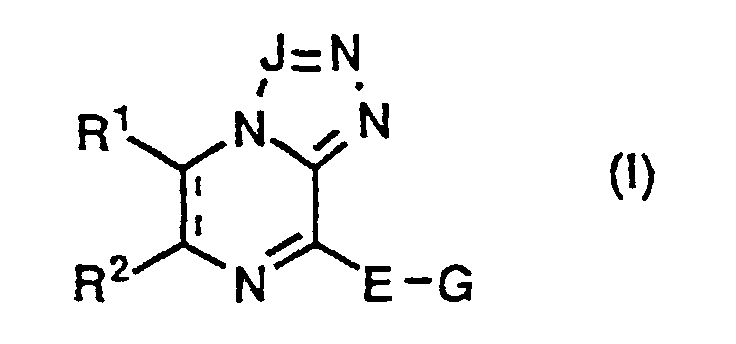
      Figure 02400001
      wherein R1 and R2 each, independently, is (i) hydrogen, (ii) C1-8 alkyl, (iii) C1-8 alkoxy, (iv) C1-8 alkylthio, (v) Cyc1, (vi) nitrite, (vii) formyl, (viii) -COOR14, in which R14 is hydrogen or C1-8 alkyl, (ix) -CONR15R16, in which R15 and R16 each, independently, is hydrogen, C1-8 alkyl or phenyl, (x) C1-8 alkyl or C2-8 alkenyl substituted by 1 or 2 of hydroxy, C1-4 alkoxy, phenoxy, halogen atom, nitrite, C2-5 acyl, -COOR14, -CONR15R16, or -NR17R18, in which R17 and R18 each, independently, is hydrogen, C1-8 alkyl or acetyl, (xi) C1-8 alkyl, C1-8 alkoxy or C1-8 alkylthio substituted by Cyc1, or R1 and R2, taken together with carbon atoms which are attached to each of them, is
      Figure 02400002
      in which Cyc1 is C3-15 mono-, bi- or tri-carbocyclic ring or 5-18 membered mono-, bi- or tri-heterocyclic ring containing 1-4 of nitrogen(s), 1-2 of oxygen(s) and / or 1 of sulfur, the above carbocyclic ring or heterocyclic ring may be substituted by one or more of (i) C1-8 alkyl, (ii) C1-8 alkoxy, (iii) nitro, (iv) halogen atom, (v) nitrile, (vi) hydroxy, (vii) benzyloxy, (viii) -NR101R102, in which R101 and R102 each, independently, is hydrogen or C1-8 alkyl, (ix) -COOR103, in which R103 is hydrogen or C1-8 alkyl, (x) trihalomethyl, (xi) trihalomethoxy, (xii) phenyl, (xiii) phenyloxy, (xiv) C1-8 alkyl or C1-8 alkoxy substituted by phenyl, phenyloxy, hydroxy, -NR101R102 or -COOR103;
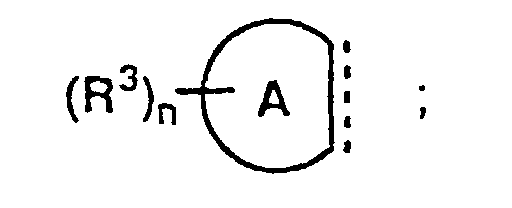
      Figure 02400003
      is C3-7 mono-carbocyclic ring or 3-7 membered mono-heterocyclic ring containing 1-4 of nitrogen(s), 1-2 of oxygen(s) and / or 1 of sulfur;
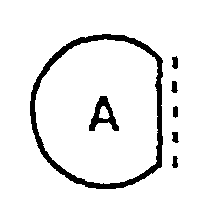
      R3 is
      1) hydrogen,
      2) C1-8 alkyl,
      3) C2-8 alkenyl,
      4) C1-8 alkoxy,
      5) C1-8 alkylthio,
      6) halogen atom,
      7) nitro,
      8) cyano,
      9) hydroxy,
      10) formyl,
      11) C2-5 acyl,
      12) -NR4R5, in which R4 and R5 each, independently, is hydrogen, C1-8 alkyl or acetyl,
      13) -COOR6, in which R6 is hydrogen or C1-8 alkyl,
      14) -CONR19R20, in which R19 and R20 each, independently, is hydrogen, C1-8 alkyl, phenyl, or C1-4 alkyl substituted by hydroxy, 5-7 membered mono-heterocyclic ring containing 1-2 of nitrogen(s), or 1 of nitrogen and 1 of oxygen, or R19 and R20, taken together is =CH-NR21R22, in which R21 and R22 each, independently, is hydrogen or C1-4 alkyl,
      15) trihalomethyl,
      16) trihalomethoxy,
      17) phenyl,
      18) phenyloxy,
      19) phenylthio, or
      20) C1-8 alkyl, C1-8 alkoxy, C1-8 alkylthio or C1-8 alkylamino substituted by phenyl, or
      21) C1-8 alkyl or C2-8 alkenyl substituted by 1 or 2 of hydroxy, C1-4 alkoxy, phenoxy, halogen atom, nitrile, C2-5 acyl, -COOR6, -CONR19R20 or -NR4R5;
      n is 0 or 1-5;
      J is nitrogen atom or C-R7;
      R7 is
      1) hydrogen,
      2) C1-8 alkyl,
      3) Cyc2,
      4) C1-8 alkyl substituted by Cyc2,
      5) C1-8 alkyl or C1-8 alkoxy substituted by 1-17 of halogen atom, or
      6) halogen atom,
      in which Cyc2 is C3-15 mono-, bi- or tri-carbocyclic ring or 5-18 membered mono-, bi- or tri-heterocyclic ring containing 1-4 of nitrogen(s), 1-2 of oxygen(s) and / or 1 of sulfur, the above carbocyclic ring or heterocyclic ring may be substituted by one or more of (i) C1-8 alkyl, (ii) C1-8 alkoxy, (iii) nitro, (iv) halogen atom, (v) nitrile, (vi) hydroxy, (vii) benzyloxy, (viii) -NR201R202, in which R201 and R202 each, independently, is hydrogen or C1-8 alkyl, (ix) -COOR203, in which R203 is hydrogen or C1-8 alkyl, (x) trihalomethyl, (xi) trihalomethoxy, (xii) phenyl, (xiii) phenyloxy, (xiv) C1-8 alkyl or C1-8 alkoxy substituted by phenyl, phenyloxy, hydroxy, -NR201R202 or -COOR203;
      E is a single bond, C1-4 alkylene, oxygen atom, sulfur atom, -SO-, -SO2-, C1-4 alkylene-M- , with the proviso that alkylene bond to ring and M is bond to G;
      M is oxygen atom, sulfur atom, -SO-, -SO2-;
      G is
      1) C1-8 alkyl,
      2) C2-8 alkenyl,
      3) C2-8 alkynyl,
      4) Cyc3, or
      5) C1-8 alkyl substituted by -OR8, -SR8, -NR9R10, -COR11 or Cyc3, with the proviso that (i) one carbon atom in C1-8 alkyl, which is a component atom of cycloalkyl, may represent 3-7 membered cycloalkyl, or (ii) neighboring two carbon atom in C1-8 alkyl, which are component atoms of cycloalkyl, may represent 3-7 membered cycloalkyl;
      in which Cyc3 is C3-15 mono-, bi- or tri-carbocyclic ring or 5-18 membered mono-, bi- or tri-heterocyclic ring containing 1-4 of nitrogen(s), 1-2 of oxygen(s) and / or 1 of sulfur, the above carbocyclic ring or heterocyclic ring may be substituted by one or more of (i) C1-8 alkyl, (ii) C1-8 alkoxy, (iii) nitro, (iv) halogen atom, (v) nitrile, (vi) hydroxy, (vii) benzyloxy, (viii) -NR301R302, in which R301 and R302 each, independently, is hydrogen or C1-8 alkyl, (ix) -COOR303, in which R303 is hydrogen or C1-8 alkyl, (x) trihalomethyl, (xi) trihalomethoxy, (xii) phenyl, (xiii) phenyloxy, (xiv) C1-8 alkyl or C1-8 alkoxy substituted by phenyl, phenyloxy, hydroxy, -NR301R302 or -COOR303;
      R8 is hydrogen, C1-8 alkyl, C2-8 alkenyl, C1-8 alkyl substituted by phenyl or C1-8 alkoxy, or -S-(C1-8 alkylene)-OR23, in which R23 is hydrogen or C1-8 alkyl; with the proviso that (i) one carbon atom in C1-8 alkylene, which is a component atom of cycloalkyl, may represent 3-7 membered cycloalkyl , or (ii) neighboring two carbon atom in C1-8 alkylene, which are component atoms of cycloalkyl, may represent 3-7 membered cycloalkyl;
      R9 is hydrogen, C1-8 alkyl, C2-8 alkenyl, C1-8 alkyl substituted by phenyl or C1-8 alkoxy;
      R10 is hydrogen, C1-8 alkyl, C2-8 alkenyl, C1-8 alkyl substituted by phenyl, or C2-5 acyl;
      R11 is (i) C1-8 alkyl, (ii) C1-8 alkoxy, (iii) hydroxy, (iv) C1-8 alkyl or C1-8 alkoxy substituted by phenyl, or (v) -NR12R13, in which R12 and R13 each, independently, is hydrogen, C1-8 alkyl or C1-8 alkyl substituted by phenyl;
      Figure 02430001
      is a single bond or a double bond;
      with the proviso that the compounds in which R2 is C1-8 alkyl, E is a single bond or C1-4 alkylene and G is C1-8 alkyl are excluded;
      or non-toxic acid thereof as active ingredient.
    2. Novel fused pyrazine derivatives of the formula (I):
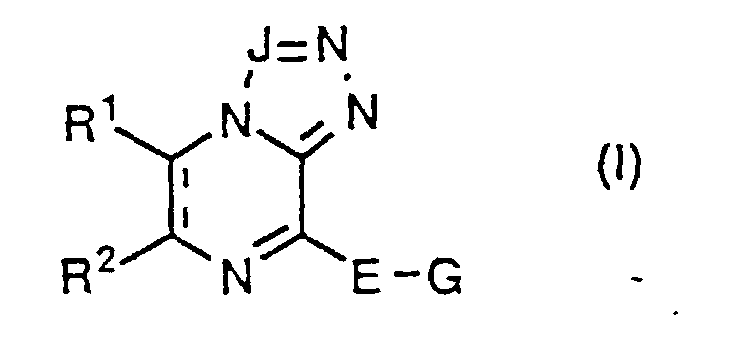
      Figure 02430002
      wherein R1 and R2 each, independently, is (i) hydrogen, (ii) C1-8 alkyl, (iii) C1-8 alkoxy, (iv) C1-8 alkylthio, (v) Cyc1, (vi) nitrile, (vii) formyl, (viii) -COOR14, in which R14 is hydrogen or C1-8 alkyl, (ix) -CONR15R16, in which R15 and R16 each, independently, is hydrogen, C1-8 alkyl or phenyl, (x) C1-8 alkyl or C2-8 alkenyl substituted by 1 or 2 of hydroxy, C1-4 alkoxy, phenoxy, halogen atom, nitrile, C2-5 acyl, -COOR14, -CONR15R16, or -NR17R18, in which R17 and R18 each, independently, is hydrogen, C1-8 alkyl oracetyl, (xi) C1-8 alkyl, C1-8 alkoxy or C1-8 alkylthio substituted by Cyc1, or R1 and R2, taken together with carbon atoms which are attached to each of them, is
      Figure 02440001
      in which Cyc1 is C3-15 mono-, bi- or tri-carbocyclic ring or 5-18 membered mono-, bi- or tri-heterocyclic ring containing 1-4 of nitrogen(s), 1-2 of oxygen(s) and / or 1 of sulfur, the above carbocyclic ring or heterocyclic ring may be substituted by one or more of (i) C1-8 alkyl, (ii) C1-8 alkoxy, (iii) nitro, (iv) halogen atom, (v) nitrile, (vi) hydroxy, (vii) benzyloxy, (viii) -NR101R102, in which R101 and R102 each) independently, is hydrogen or C1-8 alkyl, (ix) -COOR103, in which R103 is hydrogen or C1-8 alkyl, (x) trihalomethyl, (xi) trihalomethoxy, (xii) phenyl, (xiii) phenyloxy, (xiv) C1-8 alkyl or C1-8 alkoxy substituted by phenyl, phenyloxy, hydroxy, -NR101R102 or -COOR103;
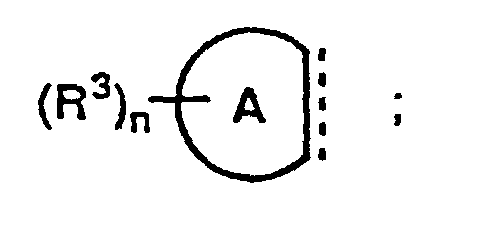
      Figure 02440002
      is C3-7 mono-carbocyclic ring or 3-7 membered mono-heterocyclic ring containing 1-4 of nitrogen(s), 1-2 of oxygen(s) and / or 1 of sulfur;
      R3 is
      1) hydrogen,
      2) C1-8 alkyl,
      3) C2-8 alkenyl,
      4) C1-8 alkoxy,
      5) C1-8 alkylthio,
      6) halogen atom,
      7) nitro,
      8) cyano,
      9) hydroxy,
      10) formyl,
      11) C2-5 acyl,
      12) -NR4R5, in which R4 and R5 each, independently, is hydrogen) C1-8 alkyl or acetyl,
      13) -COOR6, in which R6 is hydrogen or C1-8 alkyl,
      14) -CONR19R20, in which R19 and R20 each, independently, is hydrogen, C1-8 alkyl, phenyl, or C1-4 alkyl substituted by hydroxy, 5-7 membered mono-heterocyclic ring containing 1-2 of nitrogen(s), or 1 of nitrogen and 1 of oxygen, or R19 and R20, taken together is =CH-NR21R22, in which R21 and R22 each, independently, is hydrogen or C1-4 alkyl,
      15) trihalomethyl,
      16) trihalomethoxy,
      17) phenyl,
      18) phenyloxy,
      19) phenylthio, or
      20) C1-8 alkyl, C1-8 alkoxy, C1-8 alkylthio or C1-8 alkylamino substituted by phenyl, or
      21) C1-8 alkyl or C2-8 alkenyl substituted by 1 or 2 of hydroxy, C1-4 alkoxy, phenoxy, halogen atom, nitrile, C2-5 acyl, -COOR6, -CONR19R20 or -NR4R5;
      n is 0 or 1-5;
      J is nitrogen atom or C-R7;
      R7 is
      1) hydrogen,
      2) C1-8 alkyl,
      3) Cyc2,
      4) C1-8 alkyl substituted by Cyc2,
      5) C1-8 alkyl or C1-8 alkoxy substituted by 1-17 of halogen atom, or
      6) halogen atom,
      in which Cyc2 is C3-15 mono-, bi- or tri-carbocyclic ring or 5-18 membered mono-, bi- or tri-heterocyclic ring containing 1-4 of nitrogen(s), 1-2 of oxygen(s) and / or 1 of sulfur, the above carbocyclic ring or heterocyclic ring may be substituted by one or more of (i) C1-8 alkyl, (ii) C1-8 alkoxy, (iii) nitro, (iv) halogen atom, (v) nitrile, (vi) hydroxy, (vii) benzyloxy, (viii) -NR201R202, in which R201 and R202 each, independently, is hydrogen or C1-8 alkyl, (ix) -COOR203, in which R203 is hydrogen or C1-8 alkyl, (x) trihalomethyl, (xi) trihalomethoxy, (xii) phenyl, (xiii) phenyloxy, (xiv) C1-8 alkyl or C1-8 alkoxy substituted by phenyl, phenyloxy, hydroxy, -NR201R202 or -COOR203;
      E is a single bond, C1-4 alkylene, oxygen atom, sulfur atom, -SO-, -SO2-, C1-4 alkyiene-M- , with the proviso that alkylene bond to ring and M is bond to G;
      M is oxygen atom, sulfur atom, -SO-, -SO2-;
      G is
      1) C1-8 alkyl,
      2) C2-8 alkenyl,
      3) C2-8 alkynyl,
      4) Cyc3, or
      5) C1-8 alkyl substituted by -OR8, -SR8, -NR9R10, -COR11 or Cyc3, with the proviso that (i) one carbon atom in C1-8 alkyl, which is a component atom of cycloalkyl, may represent 3-7 membered cycloalkyl, or (ii) neighboring two carbon atom in C1-8 alkyl, which are component atoms of cycloalkyl, may represent 3-7 membered cycloalkyl;
      in which Cyc3 is C3-15 mono-, bi- or tri-carbocyclic ring or 5-18 membered mono-, bi- or tri-heterocyclic ring containing 1-4 of nitrogen(s), 1-2 of oxygen(s) and / or 1 of sulfur, the above carbocyclic ring or heterocyclic ring may be substituted by one or more of (i) C1-8 alkyl, (ii) C1-8 alkoxy, (iii) nitro, (iv) halogen atom, (v) nitrile, (vi) hydroxy, (vii) benzyloxy, (viii) -NR301R302, in which R301 and R302 each, independently, is hydrogen or C1-8 alkyl, (ix) -COOR303, in which R303 is hydrogen or C1-8 alkyl, (x) trihalomethyl, (xi) trihalomethoxy, (xii) phenyl, (xiii) phenyloxy, (xiv) C1-8 alkyl or C1-8 alkoxy substituted by phenyl, phenyloxy, hydroxy, -NR301R302 or -COOR303;
      R8 is hydrogen, C1-8 alkyl, C2-8 alkenyl, C1-8 alkyl substituted by phenyl or C1-8 alkoxy, or -S-(C1-8 alkylene)-OR23, in which R23 is hydrogen or C1-8 alkyl; with the proviso that (i) one carbon atom in C1-8 alkylene, which is a component atom of cycloalkyl, may represent 3-7 membered cycloalkyl , or (ii) neighboring two carbon atom in C1-8 alkylene, which are component atoms of cycloalkyl, may represent 3-7 membered cycloalkyl;
      R9 is hydrogen, C1-8 alkyl, C2-8 alkenyl, C1-8 alkyl substituted by phenyl or C1-8 alkoxy;
      R10 is hydrogen, C1-8 alkyl, C2-8 alkenyl, C1-8 alkyl substituted by phenyl, or C2-5 acyl;
      R11 is (i) C1-8 alkyl, (ii) C1-8 alkoxy, (iii) hydroxy, (iv) C1-8 alkyl or C1-8 alkoxy substituted by phenyl, or (v) -NR12R13, in which R12 and R13 each, independently, is hydrogen, C1-8 alkyl or C1-8 alkyl substituted by phenyl;
      is a single bond or a double bond;
      with the proviso that the compounds in which R2 is C1-8 alkyl, E is a single bond or C1-4 alkylene and G is C1-8 alkyl and the following compounds of (1)-(14) are excluded;
      (1) 4-(4-Chlorophenyl)thio(1, 2, 4-triazolo)-[4, 3-a]quinoxaline,
      (2) 4-(Pyrimidine-2-yl)thio(1, 2, 4-triazolo)-[4, 3-a]quinoxaline,
      (3) 4-Methoxycarbonylmethylthio(5-methyl-1, 2, 4-triazolo)-[4, 3-a]quinoxaline,
      (4) 4-Phenylthio-8-chloro(5-trifluoromethyl-1, 2, 4-triazolo)-[4, 3-a]quinoxaline,
      (5) 4-Phenylmethylthio(1, 2, 4-triazolo)-[4, 3-a]quinoxaline,
      (6) 4-(2-Chlorophenyl)thio(1, 2, 4-triazolo)-[4, 3-a]quinoxaline,
      (7) 4-(4-Methoxyphenyl)thio(1, 2, 4-triazolo)-[4, 3-a]quinoxaline,
      (8) 4-Allylthio(1, 2, 4-triazolo)-[4, 3-a]quinoxaline,
      (9) 4-(4-Chlorophenyl)thio(5-trifluoromethyl-1, 2, 4-triazolo)-[4, 3-a] quinoxaline,
      (10) 4-Phenylmethylthio(5-trifluoromethyl-1, 2, 4-triazolo)-[4, 3-a]quinoxaline,
      (11) 4-(Pyridin-2-yl)thio(5-trifluoromethyl-1, 2, 4-triazolo)-[4, 3-a]quinoxaline,
      (12) 4-Phenylthio(5-trifluoromethyl-1, 2, 4-triazolo)-[4, 3-a]quinoxaline,
      (13) 4-(4-Methoxyphenyl)thio(5-trifluoromethyl-1, 2, 4-triazolo)-[4, 3-a] quinoxaline, and
      (14) 4-Phenyl(5-methyl-1, 2, 4-triazolo)-[4, 3-a]quinoxaline;
      or non-toxic salts thereof.
    3. A compound according to claim 2, wherein R1 and R2 each, independently, is (i) hydrogen, (ii) C1-8 alkyl, (iii) C1-8 alkoxy, (iv) C1-8 alkylthio, (v) Cyc1 , (vi) nitrile, (vii) formyl, (viii) -COOR14, (ix) -CONR15R16, (x) C1-8 alkyl or C2-8 alkenyl substituted by 1 or 2 of hydroxy, C1-4 alkoxy, phenoxy, halogen atom, nitrile, C2-5 acyl, -COOR14, -CONR15R16, or -NR17R18, (xi) C1-8 alkyl, C1-8 alkoxy or C1-8 alkylthio substituted by Cyc1.
    4. A compound according to claim 2, wherein R1 and R2, taken together with carbon atoms which are attached to each of them, is
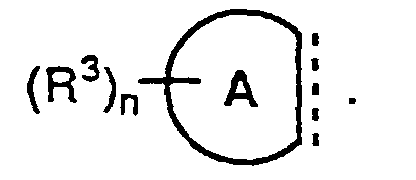
      Figure 02470001
    5. A compound according to claim 2, which is selected from
      (1) 4-Phenylthio-(5-trifluoromethyl-1, 2, 4-triazolo)[4, 3-a]pyrazine,
      (2) 4-Allylthio-(5-trifluoromethyl-1, 2, 4-triazolo)[4, 3-a]pyrazine,
      (3) 4-(3-Allylthiopropyl)thio-(5-trifluoromethyl-1, 2, 4-triazolo)[4, 3-a]pyrazine,
      (4) 4-Phenylthio-6, 7-dimethyl-(5-trifluoromethyl-1, 2, 4-triazolo)[4, 3-a]pyrazine,
      (5) 4-Isopropylthio-6-phenyl-(5-trifluoromethyl-1, 2, 4-triazolo)[4, 3-a]pyrazine,
      (6) 4-Isobutylthio-7-methyl-(5-trifluoromethyl-1, 2, 4-triazolo)[4, 3-a]pyrazine,
      (7) 4-Isobutylthio-6-methyl-(5-trifluoromethyl-1, 2, 4-triazolo)[4, 3-a]pyrazine,
      (8) 7-Ethyl-4-isobutylthio-(5-trifluoromethyl-1, 2, 4-triazolo)[4, 3-a]pyrazine,
      (9) 4-(4-Hydroxybutyl)thio-7-methyl- (5-trifluoromethyl-1, 2, 4-triazolo)[4, 3-a]pyrazine,
      (10) 4-Isobutylthio-(5-trifluoro methyl-1, 2, 4-triazolo)[4, 3-a]pyrazine,
      (11) 6, 7-Dimethyl-4-isobutylthio-(5-trifluoromethyl-1, 2, 4-triazolo)[4, 3-a]pyrazine,
      (12) 4-Isobutylthio-7-propyl-(5-trifluoromethyl-1, 2, 4-triazolo)[4, 3-a]pyrazine,
      (13) 7-Butyl-4-isobutylthio-(5-trifluoromethyl-1, 2, 4-triazolo)[4, 3-a)pyrazine,
      (14) 4-Isobutylthio-7-pentyl-(5-trifluoromethyl-1, 2, 4-triazolo)[4, 3-a]pyrazine,
      (15) 7-Bromomethyl-4-isobutyl-(5-trifluoromethyl-1, 2 4-triazolo)[4, 3-a]pyrazine,
      (16) 7-Hydroxymethyl-4-isobutyl-(5-trifluoromethyl-1, 2, 4-triazolo)[4, 3-a]pyrazine,
      (17) 4-Isobutyl-7-phenoxymethyl-(5-trifluoromethyl-1, 2, 4-triazolo)[4, 3-a]pyrazine,
      (18) 7-Formyl-4-isobutyl-(5-trifluoromethyl-1, 2, 4-triazolo)[4, 3-a]pyrazine,
      (19) 7-Carboxy-4-isobutyl-(5-trifluoromethyl-1, 2, 4-triazolo)[4, 3-a]pyrazine,
      (20) 7-Carbamoyl-4-isobutyl-(5-trifluoromethyl-1, 2, 4-triazolo)[4, 3-a]pyrazine,
      (21) 4-Isobutyl-7-nitrile-(5-trifluoromethyl-1, 2, 4-triazolo)[4, 3-a]pyrazine,
      (22) 4-Isobutyl-7-(2-nitrileethenyl)-(5-trifluoromethyl-1, 2, 4-triazolo)[4, 3-a]pyrazine,
      (23) 7-(2-trans-Ethoxycarbonylethenyl)-4-isobutyl-(5-trifluoromethyl-1, 2, 4-triazolo)[4, 3-a]pyrazine,
      (24) 7-(2-trans-Acetylethenyl)-4-isobutyl-(5-trifluoromethyl-1, 2, 4-triazolo)[4, 3-a]pyrazine,
      (25) 7-(2, 2-Dinitrileethenyl)-4-isobutyl-(5-trifluoromethyl-1, 2, 4-triazolo)[4, 3-a]pyrazine, or
      (26) 7-(2, 2-Dichloroethenyl)-4-isobutyl-(5-trifluoromethyl[4, 3-a]pyrazine.
    6. A compound according to claim 2, which is selected from
      (1) 4-Isopropylthio-(5-trifluoromethyl-1, 2, 4-triazolo)[4, 3-a]quinoxaline,
      (2) 4-Phenyloxy-(5-trifluoromethyl-1, 2, 4-triazolo)[4, 3-a]quinoxaline,
      (3) 4-(Pyrimidin-2-yl)thio-(5-trifluoromethyl-1, 2, 4-triazolo)[4, 3-a]quinoxaline,
      (4) 4-Allylthio-(5-trifluoromethyl-1, 2, 4-triazolo)[4, 3-a]quinoxaline,
      (5) 4-(Thiophen-2-yl)thio-(5-trifluoromethyl-1, 2, 4-triazolo)[4, 3-a]quinoxaline,
      (6) 4-Cyclohexylthio-(5-trifluoromethyl-1, 2, 4-triazolo)[4, 3-a]quinoxaline,
      (7) 4-(4-Trifluoromethylphenyl)thio-(5-trifluoromethyl-1, 2, 4-triazolo)[4, 3-a]quinoxaline,
      (8) 4-(4-Trifluoromethoxyphenyl)thio-(5-trifluoromethyl-1, 2, 4-triazolo)[4, 3-a]quinoxaline,
      (9) 4-(Pyridin-4-yl)thio-(5-trifluoromethyl-1, 2, 4-triazolo)[4, 3-a]quinoxaline,
      (10) 4-(Pyridin-4-yl)thio-(5-trifluoromethyl-1, 2, 4-triazolo)[4, 3-a]quinoxaline hydrochloride,
      (11) 4-(2-Methoxyphenyl)thio-(5-trifluoromethyl-1, 2, 4-triazolo)[4, 3-a]quinoxaline,
      (12) 4-(3-Methoxyphenyl)thio-(5-trifluoromethyl-1, 2, 4-triazolo)[4, 3-a]quinoxaline,
      (13) 4-(2-Chlorophenyl)thio-(5-trifluoromethyl-1, 2, 4-triazolo)[4, 3-a]quinoxaline,
      (14) 4-(3-Chlorophenyl)thio-(5-trifluoromethyl-1, 2, 4-triazolo)[4, 3-a]quinoxaline,
      (15) 4-(2-Aminophenyl)thio-(5-trifluoromethyl-1, 2, 4-triazolo)[4, 3-a]quinoxaline,
      (16) 4-(2-Aminophenyl)thio-(5-trifluoromethyl-1, 2, 4-triazolo)[4, 3-a]quinoxaline·hydrochloride,
      (17) 4-(3-Carboxyphenyl)thio-(5-trifluoromethyl-1, 2, 4-triazolo)[4, 3-a]quinoxaline,
      (18) 4-(4-Carboxyphenyl)thio-(5-trifluoromethyl-1, 2 4-triazolo)[4, 3-a]quinoxaline,
      (19) 4-(4-Aminophenyl)thio-(5-trifluoromethyl-1, 2, 4-triazolo)[4, 3-a]quinoxaline,
      (20) 4-(4-Aminophenyl)thio-(5-trifluoromethyl-1, 2, 4-triazolo)[4, 3-a]quinoxaline·hydrochloride,
      (21) 4-(4-(2-Carboxyethyl)phenyl)thio-(5-trifluoromethyl-1, 2, 4-triazolo)[4, 3-a]quinoxaline,
      (22) 4-(N, N-Dimethylamino)ethylthio-(5-trifluoromethyl-1, 2, 4-triazolo)[4, 3-a]quinoxaline,
      (23) 4-(N, N-Dimethylamino)ethylthio-(5-trifluoromethyl-1, 2, 4-triazolo)[4, 3-a]quinoxaline·hydrochloride,
      (24) 4-(3-Methoxycarbonylphenyl )thio-(5-trifluoromethyl-1, 2, 4-triazolo)[4, 3-a]quinoxaline,
      (25) 4-(4-Methoxycarbonylphenyl)thio-(5-trifluoromethyl-1, 2, 4-triazolo)[4, 3-a]quinoxaline,
      (26) 4-(4-(2-Methoxycarbonylethyl)phenyl)thio-(5-trifluoromethyl-1, 2, 4-triazolo)[4, 3-a]quinoxaline,
      (27) 4-(3-Aminophenyl)thio-(5-trifluoromethyl-1, 2, 4-triazoio)[4, 3-a]quinoxaline,
      (28) 4-(3-Aminophenyl)thio-(5-trifluoromethyl-1, 2, 4-triazolo)[4, 3-a]quinoxaline·hydrochloride,
      (29) 4-Isopropyloxy-(5-trifluoromethyl-1, 2, 4-triazolo)[4, 3-a]quinoxaline,
      (30) 4-Allyloxy-(5-trifluoromethyl-1, 2, 4-triazolo)[4, 3-a]quinoxaline,
      (31) 4-Methoxycarbonylmethylthio-(5-trifluoromethyl-1, 2, 4-triazolo)[4, 3-a]quinoxaline,
      (32) 4-(1-Ethoxycarbonylethyl)thio-(5-trifluoromethyl-1, 2, 4-triazolo)[4, 3-a]quinoxaline,
      (33) 4-(2-Thiazolin-2-yl)thio-(5-trifluoromethyl-1, 2, 4-triazolo)[4, 3-a]quinoxaline,
      (34) 4-(Thiazol-2-yl)thio-(5-trifiuoromethyl-1, 2, 4-triazolo)[4, 3-a]quinoxaline,
      (35) 4-(1-Methyltetrazol-5-yl)thio-(5-trifluoromethyl-1, 2, 4-triazolo)[4, 3-a]quinoxaline,
      (36) 4-(1-Phenyltetrazol-5-yl)thio-(5-trifluoromethyl-1, 2, 4-triazolo)[4, 3-a]quinoxaline,
      (37) 4-(2-Hydroxyethyl)thio-(5-trifluoromethyl-1, 2, 4-triazolo)[4, 3-a]quinoxaline,
      (38) 4-(2-Hydroxypropyl)thio-(5-tritluoromethyl-1, 2, 4-triazolo)[4, 3-a]quinoxaline,
      (39) 4-(3-Hydroxypropyl)thio-(5-trifluoromethyl-1, 2, 4-triazolo)[4, 3-a]quinoxaline,
      (40) 4-(2-Methylfuran-3-yl)thio-(5-trifluoromethyl- 1, 2, 4-triazolo)(4, 3-a]quinoxaline,
      (41) 4-(6-Methyl-4H, 5H-1, 3-thiadine)thio-(5-trifluoromethyl-1, 2, 4-triazolo)[4, 3-a]quinoxaline,
      (42) 4-(Imidazol-2-yl)thio-(5-trifluoromethyl-1, 2, 4-triazolo)[4, 3-a]quinoxaline,
      (43) 4-[3-(Methoxymethoxy)propyl]thio-(5-trifluoromethyl-1, 2, 4-triazolo)[4, 3-a]quinoxaline,
      (44) 4-(3-Methylthiopropoxy)-(5-trifluoromethyl-1, 2, 4-triazolo)[4, 3-a]quinoxaline,
      (45) 4-(3-Methoxypropyl)thio-(5-trifluoromethyl-1, 2, 4-triazolo)[4, 3-a]quinoxaline,
      (46) 4-(2-Methoxyethyl)thio-(5-trifluoromethyl-1, 2, 4-triazolo)[4, 3-a]quinoxaline,
      (47) (±)-4-(2-Methoxypropyl)thio-(5-trifluoromethyl-1, 2,-4-triazolo)[4, 3-a]quinoxaline,
      (48) 4-[2-(Methoxymethoxy)ethyl]thio-(5-trifluoromethyl-1, 2, 4-triazolo)[4, 3-a]quinoxaline,
      (49) (±)-4-[2-(Methoxymethoxy)propyl]thio-(5-trifluoromethyl-1, 2, 4-triazolo)[4, 3-a]quinoxaline,
      (50) 4-(2-Ethoxyethoxy)-(5-trifluoromethyl-1, 2, 4-triazolo)[4, 3-aiquinoxaline,
      (51) 4-(3-Hydroxypropoxy)-(5-tritluoromethyl-1, 2, 4-triazolo)[4, 3-a]quinoxaline,
      (52) 4-Cyclopentyloxy-(5-trifluoromethyl-1, 2, 4-triazolo)[4, 3-a]quinoxaline,
      (53) 4-Cyclopentylmethyloxy-(5-trifluoromethyl-1, 2, 4-triazolo)[4, 3-a]quinoxaline,
      (54) 4-Cyclobutyloxy-(5-trifluoromethyl-1, 2, 4-triazolo)[4, 3-a]quinoxaline,
      (55) 4-Cyclohexylmethyloxy-(5-trifluoromethyl-1, 2, 4-triazolo)[4, 3-a]quinoxaline,
      (56) 4-Cyclopropylmethyloxy-(5-trifluoromethyl-1, 2, 4-triazolo)[4, 3-a]quinoxaline,
      (57) 4-Cycloheptyloxy-(5-trifluoromethyl- 1, 2, 4-triazolo)[4, 3-a]quinoxaline,
      (58) 4-(4-Fluorophenoxy)-(5-trifluoromethyl-1, 2, 4-triazolo)[4, 3-a]quinoxaline,
      (59) 4-(4-Chlorophenoxy)-(5-trifluoromethyl-1, 2, 4-triazolo)[4, 3-a]quinoxaline,
      (60) 4-(2-Hydroxyethoxy)-(5-trifluoromethyl-1, 2, 4-triazolo)[4, 3-a]quinoxaline,
      (61) 4-(3-Hydroxy-3-methylbutyl)thio-(5-trifluoromethyl-1, 2, 4-triazolo)[4, 3-a]quinoxaline,
      (62) (±)-4-(3-Hydroxybutyl)thio-(5-trifluoromethyl-1, 2, 4-triazolo)[4, 3-a]quinoxaline,
      (63) 4-(3-Hydroxy-2, 2-dimethylpropyl)thio-(5-trifluoromethyl-1, 2, 4-triazolo)[4, 3-a]quinoxaline,
      (64) 4-(2-Hydroxy-2-methylpropyl)thio-(5-trifluoromethyl-1, 2, 4-triazolo)[4, 3-a]quinoxaline,
      (65) 4-(4-Hydroxybutyl)thio-(5-trifluoromethyl-1, 2, 4-triazolo)[4, 3-a]quinoxaline,
      (66) 4-(5-Hydroxypentyl)thio-(5-trifluoromethyl-1, 2, 4-triazolo)[4, 3-a]quinoxaline,
      (67) 4-(6-Hydroxyhexyl)thio-(5-trifluoromethyl-1, 2, 4-triazolo)[4, 3-a]quinoxaline,
      (68) 4-[1-(Hydroxymethyl)cyclopropyl-1-yl]methylthio-(5-trifluoromethyl-1, 2, 4-triazolo)[4, 3-a]quinoxaline,
      (69) (±)-4-(3-Hydroxy-2-methylpropyl)thio-(5-trifluoromethyl-1, 2, 4-triazolo)[4, 3-a]quinoxaline,
      (70) (±)-4-(4-Hydroxy-2-butyl)thio-(5-trifluoromethyl-1, 2, 4-triazolo)[4, 3-a]quinoxaline,
      (71) (±)-4-(3-Hydroxy-2-propyl)thio-(5-trifluoromethyl-1, 2, 4-triazolo)[4, 3-a]quinoxaline,
      (72) (±)-4-(1-Hydroxy-2-butyl)thio-(5-trifluoromethyl-1, 2, 4-triazolo)[4, 3-a]quinoxaline,
      (73) (±)-4-(1-Hydroxy-3-pentyl)thio-(5-trifluoromethyl-1, 2, 4-triazolo)[4, 3-a]quinoxaline,
      (74) (±)-4-(2-Hydroxybutyl)thio-(5-trifluoromethyl-1, 2, 4-triazolo)[4, 3-a]quinoxaline,
      (75) (±)-4-(4-Hydroxypentyl)thio-(5-trifluoromethyl-1, 2, 4-triazolo)[4, 3-a]quinoxaline,
      (76) 4-(4-Hydroxy-2-cis-butenyl)thio-(5-trifluoromethyl-1, 2, 4-triazolo)[4, 3-a]quinoxaline,
      (77) (±)-4-(1 -Hydroxy-3-methylbutyl)thio-(5-trifluoromethyl-1, 2, 4-triazolo)[4, 3-a]quinoxaline,
      (78) (±)-cis-4-[2-(Hydroxymethyl)cyclopropylmethyl]thio-(5-trifluoromethyl-1, 2, 4-triazolo)[4, 3-a]quinoxaline,
      (79) 4-(4-Hydroxy-2-trans-butenyl)thio-(5-trifluoromethyl-1, 2, 4-triazolo)[4, 3-a]quinoxaline,
      (80) 4-(Cyclopropylmethyl)thio-(5-trifluoromethyl-1, 2, 4-triazolo)[4, 3-a]quinoxaline,
      (81) (±)-4-(2, 2-Dimethyl-1, 3-dioxolan-4-yl) methylthio-(5-trifluoromethyl-1, 2, 4-triazolo)[4, 3-a]quinoxaline,
      (82) (±)-4-(2, 3-Dihydroxypropyl)thio-(5-trifluoromethyl-1, 2, 4-triazolo)[4, 3-a]quinoxaline,
      (83) (±)-trans-4-[2-(Hydroxymethyl)cyclopropyl]methylthio-(5-trifluoromethyl-1, 2, 4-triazolo)[4, 3-a]quinoxaline,
      (84) (±)-4-(3-Hydroxy-1-trifluoromethylpropyl)thio-(5-trifluoromethyl-1, 2, 4-triazolo)[4, 3-a]quinoxaline,
      (85) (±)-4-(2-Hydroxymethylbutyl)thio-(5-trifluoromethyl-1, 2, 4-triazolo)[4, 3-a]quinoxaline,
      (86) 4-Phenylthio-(5-methyl-1, 2, 4-triazolo)[4, 3-a]quinoxaline,
      (87) 4-Phenyloxy-(5-methyl-1, 2, 4-triazolo)[4, 3-a]quinoxaline,
      (88) 4-(Pyrimidin-2-yl)thio-(5-methyl-1, 2, 4-triazolo)[4, 3-a]quinoxaline,
      (89) 4-(4-Trifluoromethylphenyl)thio-(5-methyl-1, 2, 4-triazolo)[4, 3-a]quinoxaline,
      (90) 4-Phenylthio-(5-phenyl-1, 2, 4-triazolo)[4, 3-a]quinoxaline,
      (91) 4-Phenylthio-(5-ethyl-1, 2, 4-triazolo)[4, 3-a]quinoxaline,
      (92) 4-Phenylthio-(5-propyl-1, 2, 4-triazolo)[4, 3-a]quinoxaline,
      (93) 4-Propylthio-(1, 2, 4-triazolo)[4, 3-a]quinoxaline,
      (94) 4-Isopropylthio-(1, 2, 4-triazolo)[4, 3-a]quinoxaline,
      (95) 4-Phenylthio-(5-pentafluoroethyl-1, 2, 4-triazolo)[4, 3-a]quinoxaline,
      (96) 4-Phenylthio-(5-trifluoromethyl-1, 2, 4-triazolo)[3, 4-c]1, 4, 5-triazanaphthalene,
      (97) 4-Phenylthio-7-nitro-(5-trifluoromethyl-1, 2, 4-triazolo)[4, 3-a]quinoxaline,
      (98) 4-Phenylthio-7, 8-dimethoxy-(5-trifluoromethyl-1, 2, 4-triazolo)[4, 3-a]quinoxaline,
      (99) 4-Phenylthio-7, 8-dichloro-(5-trifluoromethyl-1, 2, 4-triazolo)[4, 3-a]quinoxaline,
      (100) 4-Phenylthio-7-methoxycarbonyl-(5-trifluoromethyl-1, 2, 4-triazolo)[4, 3-a]quinoxaline,
      (101) 4-Phenyloxy-7-methoxycarbonyl-(5-trifluoromethyl-1, 2, 4-triazolo)[4, 3-a]quinoxaline,
      (102) 4-Phenylthio-6, 7, 8, 9-tetrahydro-(5-trifluoromethyl-1, 2, 4-triazolo)[4, 3-a]quinoxaline,
      (103) 4-Phenylthio-8-nitro-(5-trifluoromethyl-1, 2, 4-triazolo)[4, 3-a]quinoxaline,
      (104) 4, 8-Diphenylthio-(5-trifluoromethyl-1, 2, 4-triazolo)[4, 3-a]quinoxaline,
      (105) 8-Methoxycarbonyl-4-phenylthio-(5-trifluoromethyl-1, 2, 4-triazolo)[4, 3-a]quinoxaline,
      (106) 8-Methoxycarbonyl-4-phenoxy-(5-trifluoromethyl-1, 2, 4-triazolo)[4, 3-a]quinoxaline,
      (107) 4-Isopropylthio-(5-trifluoromethyl-1, 2, 4-triazolo)[3, 4-c]1, 4, 5-triazanaphthalene,
      (108) 4-Isobutylthio-(5-trifluoromethyl-1, 2, 4-triazolo)[3, 4-c]1, 4, 5-triazanaphthalene,
      (109) 4-Butylthio-(5-trifluoromethyl-1, 2, 4-triazolo)[3, 4-c]1, 4, 5-triazanaphthalene,
      (110) 4-Cyclopentylthio-(5-trifluoromethyl-1, 2, 4-triazolo)[3, 4-c]1, 4, 5-triazanaphthalene,
      (111) 6-Nitro-4-phenylthio-(5-trifluoromethyl-1, 2, 4-triazolo)[4, 3-a]quinoxaline,
      (112) 6-Ethoxycarbonyl-4-phenylthio-(5-trifluoromethyl-1, 2, 4-triazolo)[4, 3-a]quinoxaline,
      (113) 6-Ethoxycarbonyl-4-isopropylthio-(5-trifluoromethyl-1, 2, 4-triazolo)[4, 3-a]quinoxaline,
      (114) 8-Carboxy-4-phenylthio-(5-trifluoromethyl-1, 2, 4-triazolo)[4, 3-a]quinoxaline,
      (115) 8-Carboxy-4-isopropylthio-(5-trifluoromethyl-1, 2, 4-triazolo)[4, 3-a]quinoxaline,
      (116) 4-Isopropylthio-8-methoxycarbonyl-(5-trifluoromethyl-1, 2, 4-triazolo)[4, 3-a]quinoxaline,
      (117) 4-(4-Fluorophenyl)thio-8-methoxycarbonyl-(5-trifluoromethyl-1, 2, 4-triazolo)[4, 3-a]quinoxaline,
      (118) 4-(3-Hydroxypropyl)thio-8-methoxycarbonyl-(5-trifluoromethyl-1, 2, 4-triazolo)[4, 3-a]quinoxaline,
      (119) 4-(Imidazol-2-yl)thio-8-methoxycarbonyl-(5-trifluoromethyl-1, 2, 4-triazolo)[4, 3-a]quinoxaline,
      (120) 7-Chloro-4-isopropylthio-(5-trifluoromethyl-1, 2, 4-triazolo)[4, 3-a]quinoxaline,
      (121) 8-Chloro-4-isopropylthio-(5-trifluoromethyl-1, 2, 4-triazolo)[4, 3-a]quinoxaline,
      (122) 4-(4-Fluorophenyl)thio-(5-trifluoromethyl-1, 2, 4-triazolo)[3, 4-c]1, 4, 5-triazanaphthalene,
      (123) 4-(3-Hydroxypropyl)thio-(5-trifluoromethyl-1, 2, 4-triazolo)[3, 4-c]1, 4, 5-triazanaphthalene,
      (124) 8-Chloro-4-(4-fluorophenyl)thio-(5-trifluoromethyl-1, 2, 4-triazolo)[4, 3-a]quinoxaline,
      (125) 8-Chloro-4-(3-hydroxypropyl)thio-(5-trifluoromethyl-1, 2, 4-triazolo)[4, 3-a]quinoxaline,
      (126) 4-Isobutyloxy-(5-trifluoromethyl-1, 2, 4-triazolo)[3, 4-c]1, 4, 5-triazanaphthalene,
      (127) 6-Chloro-4-isobutylthio-(5-trifluoromethy(-1, 2, 4-triazolo)[4, 3-a]quinoxaline,
      (128) 6, 8-Dichloro-4-isobutylthio-(5-trifluoromethyl-1, 2, 4-triazolo)[4, 3-a]quinoxaline,
      (129) 4-Isobutylthio-8-trifluoromethyl-(5-trifluoromethyl- 1, 2, 4-triazolo)[4, 3-a]quinoxaline,
      (130) 8-Fluoro-4-isobutylthio-(5-trifluoromethyl-1, 2, 4-triazolo)[4, 3-a]quinoxaline,
      (131) 6, 8-Dibromo-4-isobutylthio-(5-trifluoromethyl-1, 2, 4-triazolo)[4, 3-a]quinoxaline,
      (132) 4-(4-Fluorophenyl)thio-8-fluoro-(5-trifluoromethyl-1, 2, 4-triazolo)[4, 3-a]quinoxaline,
      (133) 8-Fluoro-4-(3-hydroxypropyl)thio-(5-trifluoromethyl-1, 2, 4-triazolo)[4, 3-a]quinoxaline,
      (134) 4-(3-Hydroxy-3-methylbutyl)thio-(5-trifluoromethyl-1, 2, 4-triazolo)[3, 4-c]1, 4, 5-triazanaphthalene,
      (135) 8-Chloro-4-(3-hydroxy-3-methylbutyl)thio-(5-trifluoromethyl-1, 2, 4-triazolo)[4, 3-a]quinoxaline,
      (136) (±)-8-Chloro-4-(3-hydroxybutyl)thio-(5-trifluoromethyl-1, 2, 4-triazolo)(4, 3-a]quinoxaline,
      (137) 8-Chloro-4-(3-hydroxy-2, 2-dimethylpropyl)thio-(5-trifluoromethyl-1, 2, 4-triazolo)[4, 3-a]quinoxaline,
      (138) 8-Chloro-4-(2-hydroxy-2-methylpropyl)thio-(5-trifluoromethyl-1, 2, 4-triazolo)[4, 3-a]quinoxaline,
      (139) 8-Chloro-4-isobutylthio-6-methoxycarbonyl-(5-trifluoromethyl-1, 2, 4-triazolo)[4, 3-a]quinoxaline,
      (140) 8-Chloro-4-(4-fluorophenyl)thio-6-methoxycarbonyl-(5-trifluoromethyl-1, 2, 4-triazolo)[4, 3-a]quinoxaline,
      (141) 8-Chloro-4-(4-hydroxybutyl)thio-(5-trifluoromethyl-1, 2, 4-triazolo)[4, 3-a]quinoxaline,
      (142) 8-Chloro-4-[[1-[[1-(hydroxymethyl)cyclopropyl-1-yl] methylsulfanyl methyl]cyclopropyl-1-yl]methyloxy]-(5-trifluoromethyl-1, 2, 4-triazolo)[4, 3-a]quinoxaline,
      (143) 4-[1-(Hydroxy)cyclopropyl-1-yl]methylthio-(5-trifluoromethyl-1, 2, 4-triazolo)[4, 3-a]quinoxaline,
      (144) 4-[1-(Hydroxy)cyclopropyl-1-yl]methylthio-8-chloro-(5-trifluoromethyl-1, 2, 4-triazolo)[4, 3-a]quinoxaline,
      (145) 4-(3-Hydroxy-2, 2-dimethylpropyl)thio-(5-trifluoromethyl-1, 2, 4-triazolo)[3, 4-c]1, 4, 5-triazanaphthalene,
      (146) 4-(4-Hydroxybutyl)thio-(5-trifluoromethyl-1, 2, 4-triazolo) [3, 4-c]1, 4, 5-triazanaphthalene,
      (147) (±)-4-(3-Hydroxybutyl)thio-(5-trifluoromethyl-1, 2, 4-triazolo)[3, 4-c]1, 4, 5-triazanaphthalene,
      (148) 4-Isobutylthio-6, 7, 8, 9-tetrahydro-(5-trifluoromethyl-1, 2, 4-triazolo)[4, 3-a]quinoxaline,
      (149) 4-(4-Hydroxybutyl)thio-6, 7, 8, 9-tetrahydro-(5-trifluoromethyl-1, 2, 4-triazolo)[4, 3-a]quinoxaline,
      (150) 8-Fluoro-4-(4-hydroxybutyl)thio-(5-trifluoromethyl-1, 2, 4-triazolo)[4, 3-a]quinoxaline,
      (151) 8-Fluoro-4-(2-hydroxyethyl)thio-(5-trifluoromethyl-1, 2, 4-triazolo)[4, 3-a]quinoxaline,
      (152) (±)-4-(3-Hydroxy-2-methylpropyl)thio-(5-trifluoromethyl-1, 2, 4-triazolo)[3, 4-c]1, 4, 5-triazanaphthalene,
      (153) 4-Isobutylthio-8-nitro-(5-trifluoromethyl-1, 2, 4-triazolo)[4, 3-a]quinoxaline,
      (154) 4-(3-Hydroxypropyl)thio-8-nitro-(5-trifluoromethyl-1, 2, 4-triazolo)[4, 3-a]quinoxaline,
      (155) 4-(4-Hydroxybutyl)thio-8-nitro-(5-trifluoromethyl-1, 2, 4-triazolo)[4, 3-a)quinoxaline,
      (156) 4-(5-Hydroxypentyl)thio-(5-trifluoromethyl-1, 2, 4-triazolo)[3, 4-c]1, 4, 5-triazanaphthalene,
      (157) 4-(6-Hydroxyhexyl)thio-(5-trifluoromethyl-1, 2, 4-triazolo)[3, 4-c]1, 4, 5-triazanaphthalene,
      (158) 8-Chloro-4-(5-hydroxypentyl)thio-(5-trifluoromethyl-1, 2, 4-triazolo)[4, 3-a]quinoxaline,
      (159) 8-Chloro-4-(6-hydroxyhexyl)thio-(5-trifluoromethyl-1, 2, 4-triazolo)[4, 3-a]quinoxaline,
      (160) 4-[1-(Hydroxymethyl)cyclopropyl-1-yl]methylthio-(5-trifluoromethyl-1, 2, 4-triazolo)[3, 4-c]1, 4, 5-triazanaphthalene,
      (161) 8-Fluoro-4-(5-hydroxypentyl)thio-(5-trifluoromethyl-1, 2, 4-triazolo)[4, 3-a]quinoxaline,
      (162) 8-Fluoro-4-(6-hydroxyhexyl)thio-(5-trifluoromethyl-1, 2, 4-triazolo)[4, 3-a]quinoxaline,
      (163) 4-Isobutylthio-7-methoxycarbonyl-(5-trifluoromethyl-1, 2, 4-triazolo)[4, 3-a]quinoxaline,
      (164) 8-Hydroxymethyl-4-isobutylthio-(5-trifluoromethyl-1, 2, 4-triazolo)[4, 3-a]quinoxaline,
      (165) 8-Hydroxymethyl-4-(3-hydroxypropyt)thio-(5-trifluoromethyl-1, 2, 4-triazolo)[4, 3-a]quinoxaline,
      (166) 8-Chloro-4-[1-(hydroxymethyl)cyclopropyl-1-yl]methylthio-(5-trifluoromethyl-1, 2, 4-triazolo)[4, 3-a]quinoxaline,
      (167) (±)-8-Chloro-4-(3-hydroxy-2-methylpropyl)thio-(5-trifluoromethyl-1, 2, 4-triazolo)[4, 3-a]quinoxaline,
      (168) 8-Bromo-4-isobutylthio-(5-trifluoromethyl-1, 2, 4-triazolo)[4, 3-a]quinoxaline,
      (169) 8-Bromo-4-(3-hydroxypropyl)thio-(5-trifluoromethyl-1, 2, 4-triazolo)[4, 3-a]quinoxaline,
      (170) 8-Bromo-4-(4-hydroxybutyl)thio-(5-trifluoromethyl-1, 2, 4-triazolo)[4, 3-a]quinoxaline,
      (171) 4-Isobutylthio-(5-trifluoromethyl-1, 2, 4-triazolo)[4, 3-a]1, 4, 5-triazanaphthalene,
      (172) 4-Cyclopentylthio-6-hydroxymethyl-(5-trifluoromethyl- 1, 2, 4-triazolo)[4, 3-a]quinoxaline,
      (173) 4-Cyclohexylthio-6-hydroxymethyl-(5-trifluoromethyl-1, 2, 4-triazolo)[4, 3-a]quinoxaline,
      (174) (±)-8-Fluoro-4-(2-hydroxypropyl)thio-(5-trifluoromethyl-1, 2, 4-triazolo)[4, 3-a]quinoxaline,
      (175) (±)-8-Fluoro-4-(3-hydroxy-2-methylpropyl)thio-(5-trifluoromethyl-1, 2, 4-triazolo)[4, 3-a]quinoxaline,
      (176) 4-Butylthio-6-hydroxymethyl-(5-trifluoromethyl-1, 2, 4-triazolo)[4, 3-a]quinoxaline,
      (177) 4-(4-Fluorophenyl)thio-6-hydroxymethyl-(5-trifluoromethyl-1, 2, 4-triazolo)[4, 3-a]quinoxaline,
      (178) 4-Butylthio-8-chloro-6-hydroxymethyl-(5-trifluoromethyl-1, 2, 4-triazolo)[4, 3-a]quinoxaline, (179) 8-Chloro-4-cyclohexylthio-6-hydroxymethyl-(5-trifluoromethyl-1, 2, 4-triazolo)[4, 3-a]quinoxaline,
      (180) (±)-8-Chloro-4-(2-hydroxypropyl)thio-(5-trifluoromethyl-1, 2, 4-triazolo)[4, 3-a]quinoxaline,
      (181) (±)-4-(2-Hydroxypropyl)thio-(5-trifluoromethyl-1, 2, 4-triazolo)[3, 4-c]1, 4, 5-triazanaphthalene,
      (182) 6-Hydroxymethyl-4-isobutylthio-(5-trifluoromethyl-1, 2, 4-triazolo)[4, 3-a]quinoxaline,
      (183) 8-Chloro-4-(4-fluorophenyl)thio-6-hydroxymethyl-(5-trifluoromethyl-1, 2, 4-triazolo)[4, 3-a]quinoxaline,
      (184) 8-Chloro-4-cyclopentylthio-6-hydroxymethyl-(5-trifluoromethyl-1, 2, 4-triazolo)[4, 3-a]quinoxaline,
      (185) 4-(4-Hydroxypropyl)thio-8-trifluoromethyl-(5-trifluoromethyl-1, 2, 4-triazolo)[4, 3-a]quinoxaline,
      (186) 4-(4-Hydroxybutyl)thio-8-trifluoromethyl-(5-trifluoromethyl-1, 2, 4-triazolo)[4, 3-a]quinoxaline,
      (187) 4-(4-Hydroxypentyl)thio-8-trifluoromethyl-(5-trifluoromethyl-1, 2, 4-triazolo)[4, 3-a]quinoxaline,
      (188) (±)-cis-8-Fluoro-4-[2-(hydroxymethyl)cyclopropyl]methylthio-(5-trifluoromethyl-1, 2, 4-triazolo)[4, 3-a]quinoxaline,
      (189) (±)-cis-8-Chloro-4-[2-(hydroxymethyl)cyclopropyl]methylthio-(5-trifluoromethyl-1, 2, 4-triazolo)[4, 3-a]quinoxaline,
      (190) 4-Cyclohexylthio-8-fluoro-6-hydroxymethyl-(5-trifluoromethyl-1, 2, 4-triazolo)[4, 3-a]quinoxaline,
      (191) 4-Butylthio-8-fluoro-6-hydroxymethyl-(5-trifluoromethyl-1, 2, 4-triazolo)[4, 3-a]quinoxaline,
      (192) 4-Cyclopentylthio-8-fluoro-6-hydroxymethyl-(5-trifluoromethyl-1, 2, 4-triazolo)[4, 3-a]quinoxaline,
      (193) 8-Fluoro-4-(4-fluorophenyl)thio-6-hydroxymethyl-(5-trifluoromethyl-1, 2, 4-triazolo)[4, 3-a]quinoxaline,
      (194) 8-Fluoro-6-hydroxymethyl-4-isobutylthio-(5-trifluoromethyl-1, 2, 4-triazolo)[4, 3-a]quinoxaline,
      (195) 8-Chloro-4-allylthio-(5-trifluoromethyl-1, 2, 4-triazolo)[4, 3-a]quinoxaline,
      (196) 4-Allylthio-8-fluoro-(5-trifluoromethyl-1, 2, 4-triazolo)[4, 3-a]quinoxaline,
      (197) 4-Allylthio-(5-trifluoromethyl-1, 2, 4-triazolo)[3, 4-c]1, 4, 5-triazanaphthalene,
      (198) (±)-cis-4-[2-(Hydroxymethyl)cyclopropyl]methylthio-(5-trifluoromethyl-1, 2, 4-triazolo)[3, 4-c]1, 4, 5-triazanaphthalene,
      (199) 8-Chloro-4-(4-hydroxy-2-butenyl)thio-(5-trifluoromethyl-1, 2, 4-triazolo)[4, 3-a]quinoxaline,
      (200) 8-Fluoro-4- (4-hydroxy-2-butenyl)thio-(5-trifluoromethyl-1, 2, 4-triazolo)[4, 3-a]quinoxaline,
      (201) 4-(4-Hydroxy-2-butenyl)thio-(5-trifluoromethyl-1, 2, 4-triazolo)[3, 4-c]1, 4, 5-triazanaphthalene,
      (202) (±)-trans-8-Fluoro-4-[2-(hydroxymethyl)cyclopropyl]methylthio-(5-trifluoromethyl-1, 2, 4-triazolo)[4, 3-a]quinoxaline,
      (203) (±)-trans-8-Chloro-4-[2-(hydroxymethyl)cyclopropyl]methylthio-(5-trifluoromethyl-1, 2, 4-triazolo)[4, 3-a]quinoxaline,
      (204) (±)-trans-4-[2-(Hydroxymethyl)cyclopropyl]methylthio-(5-trifluoromethyl-1, 2, 4-triazolo)[3, 4-c]1, 4, 5-triazanaphthalene,
      (205) 4-Cyclopropylmethylthio-8-hydroxymethyl-(5-trifluoromethyl-1, 2, 4-triazolo)[4, 3-a]quinoxaline,
      (206) (±)-8-Fluoro-4-(2-hydroxymethylbutyl)thio-(5-trifluoromethyl-1, 2, 4-triazolo)[4, 3-a]quinoxaline,
      (207) (±)-8-Chloro-4-(2-hydroxymethylbutyl)thio-(5-trifluoromethyl-1, 2, 4-triazolo)[4, 3-a]quinoxaline,
      (208) (±)-4-(2-Hydroxymethylbutyl)thio-(5-trifluoromethyl-1, 2, 4-triazolo)[3, 4-c]1, 4, 5-triazanaphthalene,
      (209) 4-(Cyclopropylmethyl)thio-7-methoxycarbonyl-(5-trifluoromethyl-1, 2, 4-triazolo)[3, 4-c] 1, 4, 5-triazanaphthalene,
      (210) 4-Cyclopentylthio-8-hydroxymethyl-(5-trifluoromethyl-1, 2, 4-triazolo)[4, 3-a]quinoxaline,
      (211) 4-Cyclohexylthio-8-hydroxymethyl-(5-trifluoromethyl-1, 2, 4-triazolo)[4, 3-a]quinoxaline,
      (212) 4-Butylthio-8-hydroxymethyl-(5-trifluoromethyl-1, 2, 4-triazolo)[4, 3-a]quinoxaline,
      (213) 8-Chloro-4-(cyclopropylmethyl)thio-(5-trifluoromethyl-1, 2, 4-triazolo)[4, 3-a]quinoxaline,
      (214) 4-(Cyclopropylmethyl)thio-8-fluoro-(5-trifluoromethyl-1, 2, 4-triazolo)[4, 3-a]quinoxaline,
      (215) 4-(Cyclopropylmethyl)thio-(5-trifluoromethyl-1, 2, 4-triazolo)[3, 4-c]1, 4, 5-triazanaphthalene,
      (216) 4-Cyclopropylmethylthio-8-fluoro-6-hydroxymethyl-(5-trifluoromethyl-1, 2, 4-triazolo)[4, 3-a]quinoxaline,
      (217) 4-Phenylthio-7-amino-(5-trifluoromethyl-1, 2, 4-triazolo)[4, 3-a]quinoxaline,
      (218) 6-Amino-4-phenylthio-(5-trifluoromethyl-1, 2, 4-triazolo)[4, 3-a]quinoxaline,
      (219) 8-Amino-4-phenylthio-(5-trifluoromethyl-1, 2, 4-triazolo)[4, 3-a]quinoxaline,
      (220) 4-Benzyl-(5-trifluoromethyl-1, 2, 4-triazolo)[4, 3-a]quinoxaline,
      (221) 4-Isobutyl-(5-trifluoromethyl-1, 2, 4-triazolo)[4, 3-a]quinoxaline,
      (222) 4-Methyl-(5-trifluoromethyl-1, 2, 4-triazolo)[4, 3-a]quinoxaline,
      (223) 4-Isopropyl-(5-trifluoromethyl-1, 2, 4-triazolo)[4, 3-a]quinoxaline,
      (224) 4-Phenyl-(5-trifluoromethyl-1, 2, 4-triazolo)[4, 3-a]quinoxaline,
      (225) 4-(Thiophen-3-yl)-(5-trifluoromethyl-1, 2, 4-triazolo)[4, 3-a]quinoxaline,
      (226) 4-(Furan-3-yl)-(5-trifluoromethyl-1, 2, 4-triazolo)[4, 3-a]quinoxaline,
      (227) 4-(4-Dimethylaminophenyl)-(5-trifluoromethyl-1, 2, 4-triazolo)[4, 3-a]quinoxaline,
      (228) 4-Phenylthio-tetrazolo[1, 5-a]quinoxaline,
      (229) 4-Allylthio-tetrazolo[1, 5-a]quinoxaline,
      (230) 4-Phenylsulfinyl-(5-trifluoromethyl-1, 2, 4-triazolo)[4, 3-a]quinoxaline,
      (231) 4-Isopropylsulfiny[-(5-trifluoromethyl-1, 2, 4-triazolo)[3, 4-c]1, 4, 5-triazanaphthalene,
      (232) 6-t-Butylamino-4-phenylthio-(5-trifluoromethy(-1, 2, 4-triazolo)[4, 3-a]quinoxaline,
      (233) 6-Acetylamino-4-phenylthio-(5-trifluoromethyl-1, 2, 4-triazolo)[4, 3-a]quinoxaline,
      (234) 6-Methylamino-4-phenylthio-(5-trifluoromethyl-1, 2, 4-triazolo)[4, 3-a]quinoxaline,
      (235) 8-Methylamino-4-phenylthio-(5-trifluoromethyl-1, 2, 4-triazolo)[4, 3-a]quinoxaline,
      (236) 4-Isopropylthiomethyl-(5-trifluoromethyl-1, 2, 4-triazolo)[4, 3-a]quinoxaline,
      (237) 4-Cyclopentylthiomethyl-(5-trifluoromethyl-1, 2, 4-triazolo)[4, 3-a]quinoxaline,
      (238) 4-Phenylthiomethyl-(5-trifluoromethyl-1, 2, 4-triazolo)[4, 3-a]quinoxaline,
      (239) 8-Hydroxymethyl-4-isopropylthio-(5-trifluoromethyl-1, 2, 4-triazolo)[4, 3-a]quinoxaline,
      (240) 7-Hydroxymethyl-4-phenoxy-(5-trifluoromethyl-1, 2, 4-triazolo)[4, 3-a]quinoxaline,
      (241) 8-Hydroxymethyl-4-phenoxy-(5-trifluoromethyl-1, 2, 4-triazolo)[4, 3-a]quinoxaline,
      (242) 7-Hydroxymethyl-4-phenylthio-(5-trifluoromethyl-1, 2, 4-triazolo)[4, 3-a]quinoxaline,
      (243) 8-Hydroxymethyl-4-phenylthio-(5-trifluoromethyl-1, 2, 4-triazolo)[4, 3-a]quinoxaline,
      (244) 6-Hydroxymethyl-4-isopropylthio-(5-trifluoromethyl-1, 2, 4-triazolo)[4, 3-a]quinoxaline,
      (245) 6-Hydroxymethyl-4-phenylthio-(5-trifluoromethyl-1, 2, 4-triazolo)[4, 3-a]quinoxaline,
      (246) 6-Hydroxymethyl-4-isopropylthio-(5-trifluoromethyl-1, 2, 4-triazolino)(4, 3-a]quinoxaline,
      (247) 4-(4-Fluorophenyl)thio-8-hydroxymethyl-(5-trifluoromethyl-1, 2, 4-triazolo)[4, 3-a]quinoxaline,
      (248) 8-Chloro-6-hydroxymethyl-4-isobutylthio-(5-trifluoromethyl-1, 2, 4-triazolo)[4, 3-a]quinoxaline,
      (249) 7-Hydroxymethyl-4-isobutylthio-(5-trifluoromethyl-1, 2, 4-triazolo)[4, 3-a]quinoxaline,
      (250) 4-(Cyclopropylmethyl)thio-7-hydroxymethyl-(5-trifluoromethyl-1, 2, 4-triazolo)[3, 4-c]1, 4, 5-triazanaphthalene,
      (251) 8-Formyl-4-isopropylthio-(5-trifluoromethyl-1, 2, 4-triazolo)[4, 3-a]quinoxaline,
      (252) 8-Formyl-4-isobutylthio-(5-trifluoromethyl- 1, 2, 4-triazolo)[4, 3-a]quinoxaline,
      (253) 4-Isopropylthio-8-(2-methoxycarbonylethenyl)-(5-trifluoromethyl-1, 2, 4-triazolo)[4, 3-a]quinoxaline,
      (254) 4-Isobutylthio-8-(3-oxo-1-butenyl)-(5-trifluoromethyl-1, 2, 4-triazolo)[4, 3-a]quinoxaline,
      (255) 8-(3-Hydroxy-1-propenyl)-4-isopropylthio-(5-trifluoromethyl-1, 2, 4-triazolo)[4, 3-a]quinoxaline,
      (256) 8-Vinyl-4-isobutylthio-(5-trifluoromethyl-1, 2, 4-triazolo)[4, 3-a]quinoxaline,
      (257) 8-(2-Hydroxyethyl)-4-isobutylthio-(5-trifluoromethyl-1, 2, 4-triazolo)[4, 3-a]quinoxaline,
      (258) 8-(1-Hydroxyethyl)-4-isobutylthio-(5-trifluoromethyl-1, 2, 4-triazolo)[4, 3-a]quinoxaline,
      (259) 6-(2-Hydroxyethyl)-4-isobutylthio-(5-trifluoromethyl-1, 2, 4-triazolo)[4, 3-a]quinoxaline,
      (260) 4-Cyclopentylthio-8-(2-hydroxyethyl)-(5-trifluoromethyl-1, 2, 4-triazolo)[4, 3-a]quinoxaline,
      (261) 4-Cyclohexylthio-8-(2-hydroxyethyl)-(5-trifluoromethyl-1, 2, 4-triazolo)[4, 3-a]quinoxaline,
      (262) 4-Butylthio-8-(2-hydroxyethyl)-(5-trifluoromethyl-1, 2, 4-triazolo)[4, 3-a]quinoxaline,
      (263) 8-Acetyl-4-isobutylthio-(5-trifluoromethyl-1, 2, 4-triazolo)[4, 3-a]quinoxaline,
      (264) 6-Bromomethyl-4-isopropylthio-(5-trifluoromethyl-1, 2, 4-triazolo)[4, 3-a]quinoxaline,
      (265) 6-Aminomethyl-4-isopropylthio-(5-trifluoromethyl-1, 2, 4-triazolo)[4, 3-a]quinoxaline,
      (266) 8-Aminomethyl-4-isopropylthio-(5-trifluoromethyl-1, 2, 4-triazolo)[4, 3-a]quinoxaline,
      (267) 6-Dimethylaminomethyl-4-isopropylthio-(5-trifluoromethyl-1, 2, 4-triazolo)[4, 3-a]quinoxaline,
      (268) 8-Dimethylaminomethyl-4-isopropylthio-(5-trifluoromethyl-1, 2, 4-triazolo)[4, 3-a]quinoxaline,
      (269) 4-Methoxy-8-methoxycarbonyl-(5-trifluoromethyl-1, 2, 4-triazolo)[4, 3-a]quinoxaline,
      (270) 4-Methoxy-8-(2-methoxycarbonylethenyl)-(5-trifluoromethyl-1, 2, 4-triazolo)[4, 3-a]quinoxaline,
      (271) 4-Methoxy-8-(2-methoxycarbonylethyl)-(5-trifluoromethyl-1, 2, 4-triazolo)[4, 3-a]quinoxaline,
      (272) 4-Isobutyl-8-(2-methoxycarbonylethyl)-(5-trifluoromethyl-1, 2, 4-triazolo)[4, 3-a]quinoxaline,
      (273) 8-(3-Hydroxypropyl)-4-(3-hydroxypropyl)thio-(5-trifluoromethyl-1, 2, 4-triazolo)[4, 3-a]quinoxaline,
      (274) 8-(3-Hydroxypropyl)-4-isobutylthio-(5-trifluoromethyl-1, 2, 4-triazolo)[4, 3-a]quinoxaline,
      (275) 4-Cyclohexylthio-8-(3-hydroxypropyl)-(5-trifluoromethyl-1, 2, 4-triazolo)[4, 3-a]quinoxaline,
      (276) 4-Butylthio-8-(3-hydroxypropyl)-(5-trifluoromethy[-1, 2, 4-triazolo)[4, 3-a]quinoxaline,
      (277) 4-(4-Fluorophenyl)thio-8-(3-hydroxypropyl)-(5-trifluoromethyl-1, 2, 4-triazolo)[4, 3-a]quinoxaline,
      (278) 4-Cyclopentylthio-8-(3-hydroxypropyl)-(5-trifluoromethyl-1, 2, 4-triazolo)[4, 3-a]quinoxaline,
      (279) 4-Isobutylthio-8-nitrile-(5-trifluoromethyl-1, 2, 4-triazolo)(4, 3-a]quinoxaline,
      (280) 4-Isopropylthio-8-nitriie-(5-trifluoromethyl-1, 2, 4-triazolo)[4, 3-a]quinoxaline,
      (281) 4-(4-Hydroxybutyl)thio-8-nitrile-(5-trifluoromethyl-1, 2, 4-triazolo)[4, 3-a]quinoxaline,
      (282) 4-(3-Hydroxypropyl)thio-8-nitrile-(5-trifluoromethyl-1, 2, 4-triazolo)[4, 3-a]quinoxaline,
      (283) 8-Carbamoyl-4-isopropylthio-(5-trifluoromethyl-1, 2, 4-triazolo)[4, 3-a]quinoxaline,
      (284) 8-(N, N-Dimethylcarbamoyl)-4-phenylthio-(5-trifluoromethyl-1, 2, 4-triazolo)[4, 3-a]quinoxaline,
      (285) 8-Carbamoyl-4-phenylthio-(5-trifluoromethyl-1, 2, 4-triazolo)[4, 3-a]quinoxaline,
      (286) 8-(N-Phenylcarbamoyl)-4-phenylthio-(5-trifluoromethyl-1, 2, 4-triazolo)[4, 3-a]quinoxaline,
      (287) 4-Isopropylthio-8-(N-phenylcarbamoyl)-(5-trifluoromethyl-1, 2, 4-triazolo)[4, 3-a]quinoxaline,
      (288) 8-(N, N-Dimethylcarbamoyl)-4-isopropylthio-(5-trifluoromethyl-1, 2, 4-triazolo)[4, 3-a]quinoxaline,
      (289) 7-Carbamoyl-4-isopropylthio-(5-trifluoromethyl-1, 2, 4-triazolo)[4, 3-a]quinoxaline,
      (290) 8-[N-(2-Hydroxyethyl) carbamoyl]-4-isopropylthio-(5-trifluoromethyl-1, 2, 4-triazolo)[4, 3-a]quinoxaline,
      (291) 4-Isopropylthio-8-[N-(2-morpholinoethyl)carbamoyl]-(5-trifluoromethyl-1, 2, 4-triazolo)[4, 3-a]quinoxaline, or
      (292) 8-[N- (Dimethylaminomethylene)carbamoyl]-4-isopropylthio-(5-trifluoro methyl-1, 2, 4-triazolo)[4, 3-a]quinoxaline.
    7. A fused pyrazine derivative of the formula (I) according to claim 1 or non-toxic salts thereof for use in the prevention and treatment of various inflammation, rheumatoid arthritis, allergies, asthma, atopic dermatitis, psoriasis, suppression of ischemia reperfusion injury, nephritis, hepatitis, multiple sclerosis, ulcerative colitis, adult respiratory distress syndrome, suppression of transplant rejection, sepsis, diabetes, autoimmune diseases, tumor metastasis, arteriosclerosis and AIDS.
    8. Adhesion molecules expression inhibitors containing a compound according to claim 1, which is selected from
      (1) 4-(4-Chlorophenyl)thio(1, 2, 4-triazolo)-[4, 3-a]quinoxaline,
      (2) 4-(Pyrimidine-2-yl)thio(1, 2, 4-triazolo)-[4, 3-a]quinoxaline,
      (3) 4-Methoxycarbonylmethylthio (5-methyl-1, 2, 4-triazolo)-[4, 3-a]quinoxaline,
      (4) 4-Phenylthio-8-chloro(5-trifluoromethyl-1, 2, 4-triazolo)-[4, 3-a]quinoxaline,
      (5) 4-Phenylmethylthio(1, 2, 4-triazolo)-[4, 3-a]quinoxaline,
      (6) 4-(2-Chlorophenyl)thio(1, 2, 4-triazolo)-[4, 3-a]quinoxaline,
      (7) 4-(4-Methoxyphenyl)thio(1, 2, 4-triazolo)-[4, 3-a]quinoxaline,
      (8) 4-Allylthio(1, 2, 4-triazolo)-[4, 3-a]quinoxaline,
      (9) 4-(4-Chlorophenyl)thio(5-trifluoromethyl-1, 2, 4-triazolo)-[4, 3-a] quinoxaline,
      (10) 4-Phenylmethylthio(5-trifluoromethyl-1, 2, 4-triazolo)-[4, 3-a]quinoxaline,
      (11) 4-(Pyridin-2-yl)thio(5-trifluoromethyl-1, 2, 4-triazolo)-[4, 3-a]quinoxaline,
      (12) 4-Phenylthio(5-trifluoromethyl-1, 2, 4-triazolo)-[4, 3-a]quinoxaline,
      (13) 4-(4-Methoxyphenyl)thio(5-trifluoromethyl-1, 2, 4-triazolo)-[4, 3-a] quinoxaline,
      (14) 4-Phenyl(5-methyl-1, 2, 4-triazolo)-[4, 3-a]quinoxaline,
      or non-toxic salts thereof as active ingredient.
    EP98950472A 1997-11-11 1998-10-30 Fused pyrazine compounds Withdrawn EP1050535A4 (en)

    Applications Claiming Priority (3)

    Application Number Priority Date Filing Date Title
    JP32394597 1997-11-11
    JP32394597 1997-11-11
    PCT/JP1998/004931 WO1999024434A1 (en) 1997-11-11 1998-10-30 Fused pyrazine compounds

    Publications (2)

    Publication Number Publication Date
    EP1050535A1 true EP1050535A1 (en) 2000-11-08
    EP1050535A4 EP1050535A4 (en) 2001-04-25

    Family

    ID=18160393

    Family Applications (1)

    Application Number Title Priority Date Filing Date
    EP98950472A Withdrawn EP1050535A4 (en) 1997-11-11 1998-10-30 Fused pyrazine compounds

    Country Status (12)

    Country Link
    US (1) US6451796B1 (en)
    EP (1) EP1050535A4 (en)
    KR (2) KR20010031983A (en)
    CN (1) CN1285834A (en)
    AU (1) AU9651198A (en)
    BR (1) BR9814628A (en)
    CA (1) CA2310072A1 (en)
    HU (1) HUP0004359A3 (en)
    NO (1) NO20002451L (en)
    TR (1) TR200001728T2 (en)
    WO (1) WO1999024434A1 (en)
    ZA (1) ZA9810271B (en)

    Cited By (5)

    * Cited by examiner, † Cited by third party
    Publication number Priority date Publication date Assignee Title
    WO2004013113A1 (en) * 2002-07-29 2004-02-12 Lanxess Deutschland Gmbh Substituted thiazines as material protecting agents
    WO2004085439A1 (en) * 2003-03-27 2004-10-07 Pfizer Products Inc. Substituted 4-amino[1,2,4]triazolo[4,3-a]quinoxalines
    WO2008130951A1 (en) * 2007-04-17 2008-10-30 Bristol-Myers Squibb Company Fused heterocyclic 11-beta-hydroxysteroid dehydrogenase type i inhibitors
    WO2014076237A1 (en) * 2012-11-16 2014-05-22 Boehringer Ingelheim International Gmbh Triazolopyrazine
    WO2015067770A1 (en) * 2013-11-07 2015-05-14 Boehringer Ingelheim International Gmbh Triazolopyrazine derivatives as brd4 inhibitors

    Families Citing this family (21)

    * Cited by examiner, † Cited by third party
    Publication number Priority date Publication date Assignee Title
    CN1149214C (en) * 1998-12-04 2004-05-12 东丽株式会社 Triazolo derivatives and chemokine inhibitors containing them as effective components
    UA74912C2 (en) 2001-07-06 2006-02-15 Merck & Co Inc Beta-aminotetrahydroimidazo-(1,2-a)-pyrazines and tetratriazolo-(4,3-a)-pyrazines as inhibitors of dipeptylpeptidase for the treatment or prevention of diabetes
    WO2007087250A2 (en) * 2006-01-23 2007-08-02 Amira Pharmaceuticals, Inc. Tricyclic inhibitors of 5-lipoxygenase
    AU2009291719A1 (en) * 2008-09-10 2010-03-18 Alcon Research, Ltd Heterocyclic inhibitors of histamine receptors for the treatment of disease
    CA2848154C (en) * 2011-09-30 2020-04-28 C&C Research Laboratories Novel heterocyclic derivatives and their uses
    KR102421235B1 (en) 2014-02-13 2022-07-15 인사이트 코포레이션 Cyclopropylamines as lsd1 inhibitors
    NZ723203A (en) 2014-02-13 2020-08-28 Incyte Corp Cyclopropylamines as lsd1 inhibitors
    EP3392244A1 (en) 2014-02-13 2018-10-24 Incyte Corporation Cyclopropylamines as lsd1 inhibitors
    US9527835B2 (en) 2014-02-13 2016-12-27 Incyte Corporation Cyclopropylamines as LSD1 inhibitors
    US9758523B2 (en) 2014-07-10 2017-09-12 Incyte Corporation Triazolopyridines and triazolopyrazines as LSD1 inhibitors
    US9695180B2 (en) 2014-07-10 2017-07-04 Incyte Corporation Substituted imidazo[1,2-a]pyrazines as LSD1 inhibitors
    WO2016007722A1 (en) 2014-07-10 2016-01-14 Incyte Corporation Triazolopyridines and triazolopyrazines as lsd1 inhibitors
    WO2016007731A1 (en) 2014-07-10 2016-01-14 Incyte Corporation Imidazopyridines and imidazopyrazines as lsd1 inhibitors
    UA122688C2 (en) 2015-04-03 2020-12-28 Інсайт Корпорейшн HETEROCYCLIC COMPOUNDS AS LSD1 INHIBITORS
    JP7427363B2 (en) 2015-08-12 2024-02-05 インサイト・ホールディングス・コーポレイション LSD1 inhibitor salt
    AR107456A1 (en) * 2016-02-12 2018-05-02 Lilly Co Eli PDE1 INHIBITOR
    US10166221B2 (en) 2016-04-22 2019-01-01 Incyte Corporation Formulations of an LSD1 inhibitor
    CN106212487B (en) * 2016-07-28 2018-11-13 浙江工业大学 A kind of application of 1,2,4- triazole derivatives of the structure of benzopyrazines containing methoxyl group as fungicide
    TW201920188A (en) 2017-08-10 2019-06-01 美商美國禮來大藥廠 [1,2,4]triazolo derivatives
    WO2020047198A1 (en) 2018-08-31 2020-03-05 Incyte Corporation Salts of an lsd1 inhibitor and processes for preparing the same
    CN112979659B (en) * 2021-02-22 2022-07-08 中国医科大学 Preparation and application of HIF-2 alpha small molecule inhibitor

    Family Cites Families (20)

    * Cited by examiner, † Cited by third party
    Publication number Priority date Publication date Assignee Title
    GB1146770A (en) 1967-02-03 1969-03-26 Ici Ltd S-triazolo[4,3-a]pyrazine derivatives
    GB1235910A (en) 1968-12-10 1971-06-16 Ici Ltd Pharmaceutical compositions
    US3987196A (en) 1975-06-10 1976-10-19 Eli Lilly And Company Tetrazolo(1,5-a)quinoxalines for control of phytopathogens
    US3979387A (en) 1975-06-10 1976-09-07 Eli Lilly And Company 4,5-Dihydrotetrazolo(1,5-A)quinoxalines
    US4200750A (en) 1977-01-07 1980-04-29 Westwood Pharmaceuticals Inc. 4-Substituted imidazo [1,2-a]quinoxalines
    US4191767A (en) 1977-01-07 1980-03-04 Westwood Pharmaceuticals, Inc. Method for treating fungal infection in mammals with imidazo [1,2-a]quinoxalines
    US4191766A (en) 1977-01-07 1980-03-04 Westwood Pharmaceuticals, Inc. Method for reducing immunological response
    US4198508A (en) 1977-01-07 1980-04-15 Westwood Pharmaceuticals Inc. Process for preparing 4-substituted imidazo[1,2-a]quinoxalines
    US4160097A (en) 1977-01-07 1979-07-03 Westwind Pharmaceuticals, Inc. 1-(2-Phenylureylene)imidazoles
    SE439308B (en) 1978-08-02 1985-06-10 Roussel Uclaf IMIDAZO (1,2-A) KINOXALINES AND PHARMACEUTICAL COMPOSITIONS THEREOF
    JPS5759872A (en) 1980-09-30 1982-04-10 Sogo Yatsukou Kk Novel imidazole derivative and its preparation
    GB8913011D0 (en) 1989-06-06 1989-07-26 Wellcome Found Anticonvulsant pyrazines
    FR2662163A1 (en) 1990-05-16 1991-11-22 Lipha New 8-amino-1,2,4-triazolo[4,3-a]pyrazines, preparation processes and medicaments containing them
    ATE194985T1 (en) 1990-11-06 2000-08-15 Yamanouchi Pharma Co Ltd CONDENSED PYRAZINE DERIVATIVE
    DK31093D0 (en) 1993-03-19 1993-03-19 Novo Nordisk As
    KR100304177B1 (en) 1993-05-06 2001-11-22 한센 핀 베네드, 안네 제헤르, 웨이콥 마리안느 (1,2,4) triazolo (4,3-A) quinoxaline compounds, methods for their preparation and pharmaceutical compositions containing them_
    AU2682695A (en) 1994-06-20 1996-01-15 Takeda Chemical Industries Ltd. Condensed imidazole compounds, their production and use
    EP0705834A1 (en) 1994-07-27 1996-04-10 Ciba-Geigy Ag Quinoxaline-2,3-diones with an azaheterocyclic fused ring
    CZ284930B6 (en) 1994-09-16 1999-04-14 Novo Nordisk A/S [1,2,4]triazolo[4,3-a]quinoxalinone derivatives, process of their preparation and use
    CA2200055A1 (en) 1994-09-16 1996-03-21 Novo Nordisk A/S [1,2,4]triazolo[4,3-a]quinoxalinone derivatives, their preparation and use

    Cited By (16)

    * Cited by examiner, † Cited by third party
    Publication number Priority date Publication date Assignee Title
    WO2004013113A1 (en) * 2002-07-29 2004-02-12 Lanxess Deutschland Gmbh Substituted thiazines as material protecting agents
    WO2004085439A1 (en) * 2003-03-27 2004-10-07 Pfizer Products Inc. Substituted 4-amino[1,2,4]triazolo[4,3-a]quinoxalines
    US7202245B2 (en) 2003-03-27 2007-04-10 Pfizer Inc. Substituted 4-amino[1,2,4]triazolo[4,3-a] quinoxalines
    WO2008130951A1 (en) * 2007-04-17 2008-10-30 Bristol-Myers Squibb Company Fused heterocyclic 11-beta-hydroxysteroid dehydrogenase type i inhibitors
    EP2474549A1 (en) * 2007-04-17 2012-07-11 Bristol-Myers Squibb Company Fused heterocyclic 11-beta-hydroxysteroid dehydrogenase type I inhibitors
    US8546394B2 (en) 2007-04-17 2013-10-01 Bristol-Myers Squibb Company Substituted [1,2,4]triazolo[4,3-A]pyrazine 11-beta-hydroxysteroid dehydrogenase inhibitors
    US9266891B2 (en) 2012-11-16 2016-02-23 Boehringer Ingelheim International Gmbh Substituted [1,2,4]triazolo[4,3-A]pyrazines that are BRD4 inhibitors
    WO2014076237A1 (en) * 2012-11-16 2014-05-22 Boehringer Ingelheim International Gmbh Triazolopyrazine
    AU2013346809B2 (en) * 2012-11-16 2017-09-14 Boehringer Ingelheim International Gmbh Triazolopyrazine
    AU2013346809B9 (en) * 2012-11-16 2017-12-14 Boehringer Ingelheim International Gmbh Triazolopyrazine
    EA029051B1 (en) * 2012-11-16 2018-02-28 Бёрингер Ингельхайм Интернациональ Гмбх Triazolopyrazine
    TWI619717B (en) * 2012-11-16 2018-04-01 百靈佳殷格翰國際股份有限公司 Triazolopyrazine
    US10328074B2 (en) 2012-11-16 2019-06-25 Boehringer Ingelheim International Gmbh Substituted [1,2,4]triazolo[4,3-a]pyrazines as BRD4 inhibitors
    US11077107B2 (en) 2012-11-16 2021-08-03 Boehringer Ingelheim International Gmbh Triazolopyrazine
    WO2015067770A1 (en) * 2013-11-07 2015-05-14 Boehringer Ingelheim International Gmbh Triazolopyrazine derivatives as brd4 inhibitors
    US9428513B2 (en) 2013-11-07 2016-08-30 Boehringer Ingelheim International Gmbh Triazolopyrazine

    Also Published As

    Publication number Publication date
    KR20010031773A (en) 2001-04-16
    EP1050535A4 (en) 2001-04-25
    WO1999024434A1 (en) 1999-05-20
    HUP0004359A3 (en) 2001-12-28
    NO20002451L (en) 2000-07-11
    US6451796B1 (en) 2002-09-17
    CA2310072A1 (en) 1999-05-20
    NO20002451D0 (en) 2000-05-11
    BR9814628A (en) 2001-11-27
    TR200001728T2 (en) 2000-09-21
    CN1285834A (en) 2001-02-28
    HUP0004359A2 (en) 2001-10-28
    KR20010031983A (en) 2001-04-16
    AU9651198A (en) 1999-05-31
    ZA9810271B (en) 1999-05-20

    Similar Documents

    Publication Publication Date Title
    US6451796B1 (en) Fused pyrazine compounds
    US8937077B2 (en) Bicyclic diamines as janus kinase inhibitors
    US9586967B2 (en) Pyrrolo pyrimidine derivative
    JP2000319277A (en) Condensed pyrazine compound and drug containing the compound as active ingredient
    JP5658664B2 (en) 1,2-disubstituted heterocyclic compounds
    TWI399380B (en) Anti-viral compounds
    JP5743901B2 (en) Triazolopyridine derivatives as phosphodiesterase inhibitors for the treatment of skin diseases
    JP6827959B2 (en) Their use as tricyclic compounds and phosphodiesterase inhibitors
    WO2007058322A1 (en) Basic group-containing compound and use thereof
    JP7046827B2 (en) Imidazo [1,5-a] pyrimidinylcarboxamide compounds and their use in the treatment of medical disorders
    JPWO2005023771A1 (en) Chemokine receptor antagonist and its pharmaceutical use
    JPWO2002074298A1 (en) IL-6 production inhibitor
    WO2006006490A1 (en) Spirocyclic compound
    US20060019977A1 (en) Spiroheterocyclic derivative compounds and drugs comprising the compound as the active ingredient
    EP1325009B1 (en) Amino-substituted tetracyclic compounds useful as anti-inflammatory agents and pharmaceutical compositions comprising same
    KR20140059164A (en) Tricyclic gyrase inhibitors
    WO2007049771A1 (en) Compound containing basic group and use thereof
    KR20120027268A (en) Phenoxymethyl heterocyclic compounds
    WO2018019222A1 (en) Heterocyclic compound as jak inhibitor, and salts and therapeutic use thereof
    JP2000319278A (en) Condensed pyrazine compound and drug containing the compound as active ingredient
    EP4079724B1 (en) 2-(2-chlorophenyl)-n-(5-sulfamoylisoquinolin-7-yl)acetamide derivatives and similar compounds as p2x4 antagonists for the treatment of e.g. urinary tract diseases
    WO2025163336A1 (en) Apol1 inhibitors
    JP2002348288A (en) Spiro heterocyclic derivatives and drugs containing them as active ingredients
    CN108299436B (en) Xanthine compound and pharmaceutical composition and application thereof
    JPWO1999024434A1 (en) condensed pyrazine compounds

    Legal Events

    Date Code Title Description
    PUAI Public reference made under article 153(3) epc to a published international application that has entered the european phase

    Free format text: ORIGINAL CODE: 0009012

    17P Request for examination filed

    Effective date: 20000511

    AK Designated contracting states

    Kind code of ref document: A1

    Designated state(s): AT BE CH DE DK ES FI FR GB GR IE IT LI LU NL PT SE

    A4 Supplementary search report drawn up and despatched

    Effective date: 20010313

    AK Designated contracting states

    Kind code of ref document: A4

    Designated state(s): AT BE CH DE DK ES FI FR GB GR IE IT LI LU NL PT SE

    17Q First examination report despatched

    Effective date: 20011128

    GRAH Despatch of communication of intention to grant a patent

    Free format text: ORIGINAL CODE: EPIDOS IGRA

    STAA Information on the status of an ep patent application or granted ep patent

    Free format text: STATUS: THE APPLICATION IS DEEMED TO BE WITHDRAWN

    18D Application deemed to be withdrawn

    Effective date: 20030325