EP1049709B1 - Antimicrobial peptides - Google Patents
Antimicrobial peptides Download PDFInfo
- Publication number
- EP1049709B1 EP1049709B1 EP99900698A EP99900698A EP1049709B1 EP 1049709 B1 EP1049709 B1 EP 1049709B1 EP 99900698 A EP99900698 A EP 99900698A EP 99900698 A EP99900698 A EP 99900698A EP 1049709 B1 EP1049709 B1 EP 1049709B1
- Authority
- EP
- European Patent Office
- Prior art keywords
- peptide
- peptides
- antimicrobial
- rllr
- prt
- Prior art date
- Legal status (The legal status is an assumption and is not a legal conclusion. Google has not performed a legal analysis and makes no representation as to the accuracy of the status listed.)
- Expired - Lifetime
Links
Images


Classifications
-
- C—CHEMISTRY; METALLURGY
- C07—ORGANIC CHEMISTRY
- C07K—PEPTIDES
- C07K14/00—Peptides having more than 20 amino acids; Gastrins; Somatostatins; Melanotropins; Derivatives thereof
- C07K14/435—Peptides having more than 20 amino acids; Gastrins; Somatostatins; Melanotropins; Derivatives thereof from animals; from humans
-
- C—CHEMISTRY; METALLURGY
- C07—ORGANIC CHEMISTRY
- C07K—PEPTIDES
- C07K7/00—Peptides having 5 to 20 amino acids in a fully defined sequence; Derivatives thereof
- C07K7/04—Linear peptides containing only normal peptide links
- C07K7/08—Linear peptides containing only normal peptide links having 12 to 20 amino acids
-
- A—HUMAN NECESSITIES
- A61—MEDICAL OR VETERINARY SCIENCE; HYGIENE
- A61P—SPECIFIC THERAPEUTIC ACTIVITY OF CHEMICAL COMPOUNDS OR MEDICINAL PREPARATIONS
- A61P31/00—Antiinfectives, i.e. antibiotics, antiseptics, chemotherapeutics
-
- C—CHEMISTRY; METALLURGY
- C07—ORGANIC CHEMISTRY
- C07K—PEPTIDES
- C07K14/00—Peptides having more than 20 amino acids; Gastrins; Somatostatins; Melanotropins; Derivatives thereof
- C07K14/435—Peptides having more than 20 amino acids; Gastrins; Somatostatins; Melanotropins; Derivatives thereof from animals; from humans
- C07K14/46—Peptides having more than 20 amino acids; Gastrins; Somatostatins; Melanotropins; Derivatives thereof from animals; from humans from vertebrates
- C07K14/463—Peptides having more than 20 amino acids; Gastrins; Somatostatins; Melanotropins; Derivatives thereof from animals; from humans from vertebrates from amphibians
-
- A—HUMAN NECESSITIES
- A61—MEDICAL OR VETERINARY SCIENCE; HYGIENE
- A61K—PREPARATIONS FOR MEDICAL, DENTAL OR TOILETRY PURPOSES
- A61K38/00—Medicinal preparations containing peptides
Definitions
- the peptides of the present invention have stronger antimicrobial activities than conventional peptides and have the activity at high salt concentrations.
- the present invention relates to biologically active peptides. Every animal on earth possesses biophylaxis systems to defend or protect itself from the infection by virus or bacteria. One of such systems is a non-specific immunity using antimicrobial peptides.
- Antimicrobial peptides are considered as a new type of drug due to the following outstanding properties. Firstly, antimicrobial peptides show stronger antimicrobial activities than conventional antibiotics against a broad spectrum of microorganisms. Secondly, antimicrobial peptides have a high industrial applicability which is beneficial to the human body since the antimicrobial peptides show antimicrobial activity against foreign pathogens without destroying the host cells. Thirdly, there is a smaller chance to develop microbial resistance since the antimicrobial peptides show their activity by a mechanism that is totally different from that of the conventional antibiotics, which have serious problems of developing resistance. Studies on antimicrobial peptides began by isolating cecropin from an insect which has an under-developed immune system.
- the conventional antimicrobial peptides act at relatively high concentrations.
- the active concentration is 50-200 ⁇ g/ml (Zasloff M. (1987) Proc. Natl. Acad. Sci. USA, 84: 5449-5453) even though it is effective against Gram-positive and Gram-negative bacteria and fungi.
- This concentration range is quite high considering that the conventional antibiotics act against a specific microorganism in the range 0.1-1 ⁇ g/ml.
- the antimicrobial activity of the antimicrobial peptides is sensitive to salt concentration.
- the antimicrobial peptide was not effective due to an abnormal increase of the salt concentrations at the site of invasion (Goldman, M. J. et al. (1997) Cell, 88: 553-560).
- Antimicrobial peptides isolated from Korean toad were reported by the present inventors in Biochemical and Biophysical Research Communications 218, 408-413 (1996). These antimicrobial peptides known as buforin I and buforin II showed strong antimicrobial activities against a broad-spectrum of microorganisms including Gram-positive and Gram-negative bacteria and fungi. Buforin I and buforin II also have antimicrobial activities at a concentration of 1-4 ⁇ g/ml, which is stronger than that of conventional antimicrobial peptides.
- antimicrobial peptides are also sensitive to salt concentrations. Therefore, it has been desired to develop antimicrobial peptides that have an enhanced antimicrobial activities and are not sensitive to salt concentrations to have antimicrobial activities in vivo.
- WO97/18826 is directed to antimicrobial peptides related to naturally-occurring protegrin peptides.
- WO96/28468 relates to amphiphilic peptides having improved antimicrobial properties.
- SWISS-PROT:H2A1-YENLA discloses a peptide sequence representing the histone H2A.1 of Xenopus laevis. Yi et al. (1996) FEBS letters, 398:87-80 discloses the Structure of buforin II as determined by NMR spectroscopy. Kim et al. (1996) Biochemical and Biophysical Research Communications, 229:381-387 discloses the identification of a cDNA contacting coding information for buforin I by PCR. Park et al .
- FR 2715847 discloses compositions comprising nucleic acids and oligopeptides and their use in therapy and gene therapy.
- Han et al (1996) FASEB J10:1621-1626 disclosed a method of monitoring specific peptidase activities in biological samples based on the design of synthetic polypeptide substrates in which di- or triarginine sequences are linked to each other via one or more other amino acids recognized specifically by the peptidase to be determined.
- Another object of' the present invention is to provide peptides that have antimicrobial activities against a wide variety of microorganisms with stronger antimicrobial activities.
- the present inventors have shown that the secondary structure of buforin II comprises a random coil (1-4 residue), extended helix (5-10 residue) and normal ⁇ -helix (11-21 residue) structures, starting from the N-terminus.
- the peptide sequence having normal ⁇ -helix structure (11-21 residue), i.e., PVGRVHRLLRK has a strong antimicrobial activity.
- the present inventors have identified that a peptide, especially a peptide with at least the sequence forming the random coil structure (1-4 residue) is removed, has a very strong antimicrobial activity. Therefore, the group of peptides according to the present invention consists of peptides having the PVGRVHRLLRK sequence.
- the sequence PVGRVHRLLRK can additionally have a Gly residue fused to the N-terminus or an amidated peptide at the C-terminus.
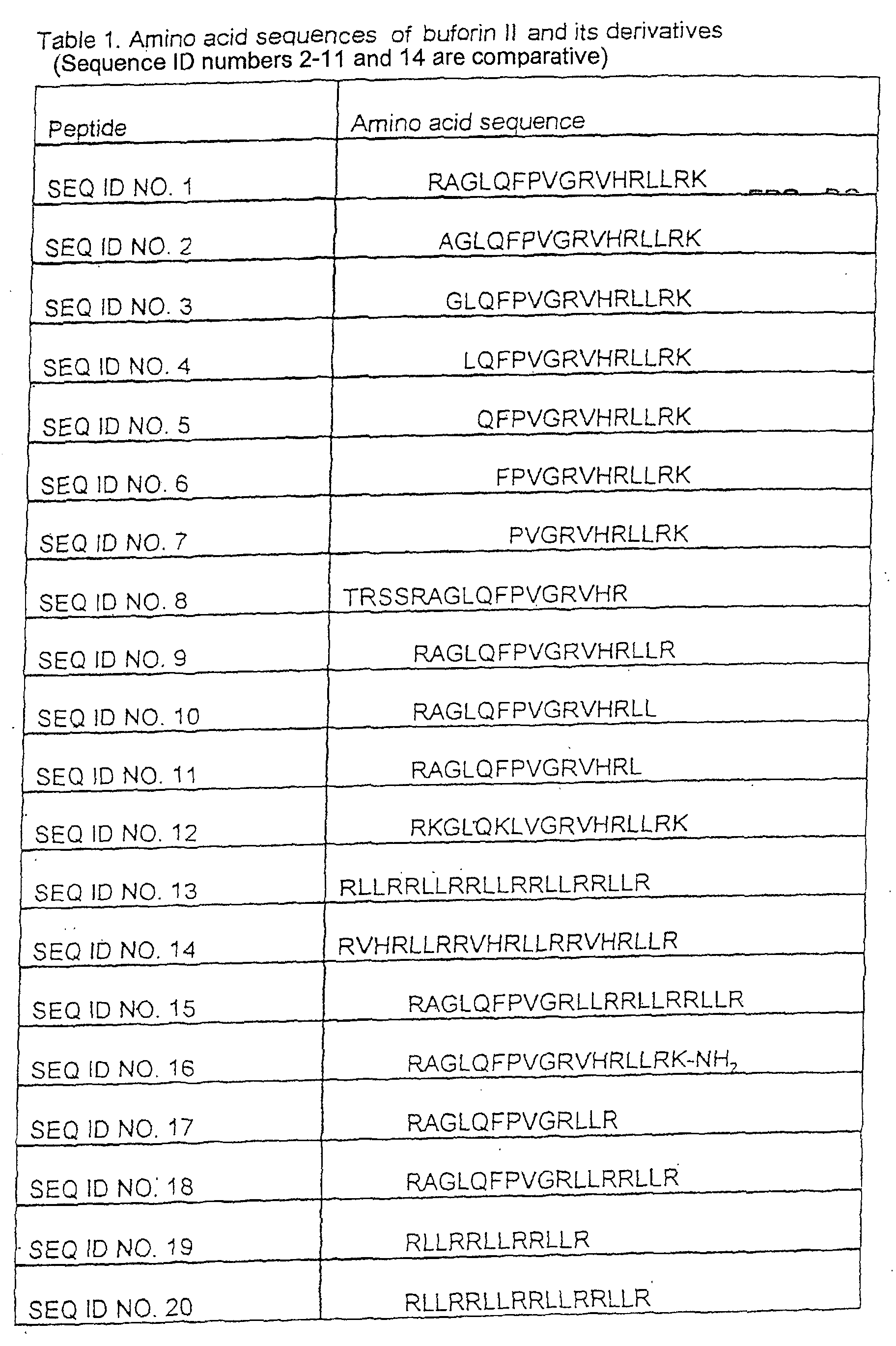
- the group of amino acid sequences further includes peptides comprising RAGLQFPVG[RLLR] 1 , RAGLQFPVG[RLLR] 2 , RAGLQFPVG[RLLR] 3 , [RLLR] 3 , [RLLR] 4 ,[RLLR] 5 and RKGLQKLVGRVHRLLRK.
- the peptides according to the present invention can be synthesized by well-known techniques in the field, for instance, by using an automatic peptide synthesizer or by using a genetic engineering technique.
- the peptide can be produced by constructing fusion gene composed of fusion partner and the peptide genes, transforming it into host microorganism, expressing the fusion protein in the host, cleaving the fusion protein with proteolytic enzyme or chemical agent, and purifying the antimicrobial peptide.
- a DNA sequence can be inserted between fusion partner and peptide genes to introduce a sequence encoding processing site which can be cleaved by proteases such as factor Xa and enterokinase, or by chemical agents such as CNBr and hydroxylamine.
- fusion partner and antimicrobial peptide genes can be in-frame fused by ligating the fusion partner gene digested at its 3 -end with a restriction enzyme whose recognition sequence contains Met codon (ATG) in their recognition sequence, such as Afl II, Bsm l, Bsp Hl, Bsp LU11l, Nco l, N del, N sil, Ppu 10l, Sph l, Sty l, or their isoschizomers, and the peptide gene digested at its 5 -end with a restriction enzyme whose cleavage site is compatible with the cleavage site of fusion partner.
- a restriction enzyme whose recognition sequence contains Met codon (ATG) in their recognition sequence, such as Afl II, Bsm l, Bsp Hl, Bsp LU11l, Nco l, N del, N sil, Ppu 10l, Sph l, Sty l, or their isoschizomers
- a DNA sequence encoding Asn-Gly can be introduced between fusion partner and peptide genes.
- fusion partner and peptide genes can be in-frame fused by ligating fusion partner gene digested at its 3 -end with a restriction enzyme or its isoschizomer whose recognition sequence contains Asn codon in its recognition sequence, and the peptide gene digested at its 5 -end with a restriction enzyme whose cleavage sequence containing Gly codon can be in-frame fused to the 3 -end of fusion partner by compatible cohesive or blunt end.
- the gene structure in the present invention can be introduced into host cell by cloning it into an expression vector such as plasmid, virus, or other conventional vehicle in which the gene can be inserted or incorporated.
- the peptides according to the present invention contain C-terminal amidated forms.
- the peptides according to the present invention show strong antimicrobial activities against a wide variety of microorganisms including Gram-negative and Gram-positive bacteria, fungi and protozoa.
- the peptides according to the present invention can be administered with other biologically active pharmaceutical preparations such as biologically active chemical or other peptides.
- amino acids in the present invention are abbreviated according to the IUPAC_IUB nomenclature as below.
- amino acid abbreviation Alanine A Arginine R Asparagine N Aspartic acid E Cysteine C Glutamic acid D Glutamine Q Glycine G Histidine H Isoleucine I Leucine L Lysine K Methionine M Phenylalanine F Proline P Serine S Threonine T Tryptophane W Tyrosine Y Valine V
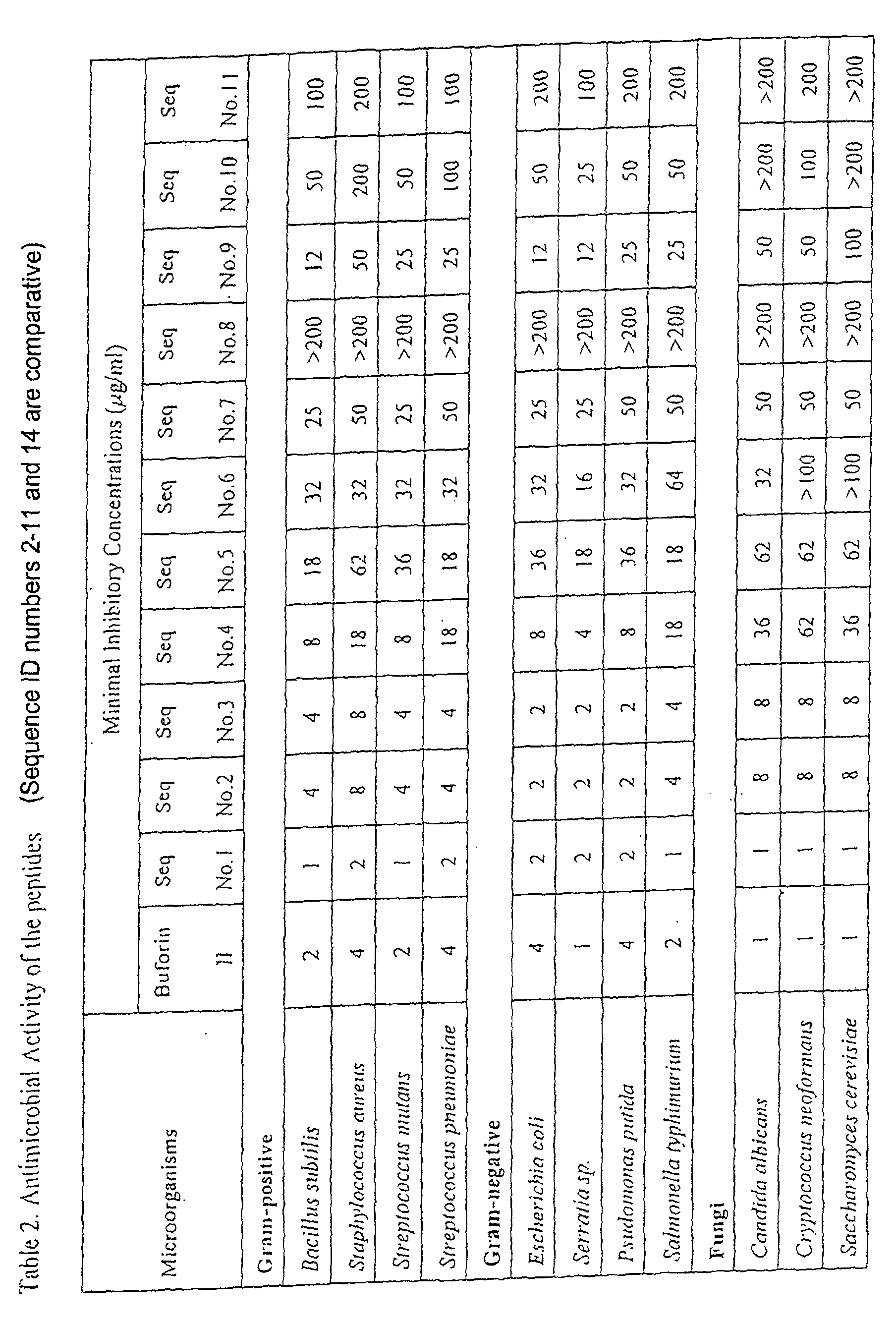
- the minimal inhibitory concentration of the peptides were determined against a variety of microorganisms. Bacteria and fungi were incubated overnight in Mueller-Hinton and Saboraud media, respectively, at 37 and 30 °C, respectively, and were inoculated in media for 2 hours to a midlogarithmic phase. After diluting the bacteria and fungi to 10 4 -10 5 per 1 ml, they were inoculated into a 96-well plate containing serially diluted peptides and incubated for additional 18 hours. The minimal inhibitory concentration was determined at a concentration that inhibits the growth of the microorganisms by measuring the absorbance. The results are shown in Table 2.
- the peptide, RAGLQFPVG(RLLR) 3 that has a fused amino acid sequence forming extended ⁇ alpha>-helix at the N-terminus of (RLLR) 3 showed an especially potent antimicrobial activity, and the peptide (RLLR) 4 and (RLLR) 5 , which has 4 and 5 repetitions of RLLR,respectively, also showed strong antimicrobial activities.
- the peptide that had a deletion of the sequence forming a random coil structure from buforin II also showed a potent antimicrobial activity, and the peptide that had an amidation at the N-terminus showed a more potent antimicrobial activity.
- the minimal inhibitory concentration of the peptides was measured as a function of salt concentrations to determine whether the antimicrobial activity is dependent on the salt concentrations.
- the method of estimating the minimal inhibitory concentration was identical as in Example 2 except that the concentration of NaCI was changed. The result is shown in Figure 2.
- the antimicrobial activity of the peptides according to the present invention did not vary as a function of salt concentration whereas that of buforin and magainin changed sensitively as a function of salt concentrations.
Landscapes
- Chemical & Material Sciences (AREA)
- Health & Medical Sciences (AREA)
- Organic Chemistry (AREA)
- Life Sciences & Earth Sciences (AREA)
- Medicinal Chemistry (AREA)
- General Health & Medical Sciences (AREA)
- Genetics & Genomics (AREA)
- Molecular Biology (AREA)
- Proteomics, Peptides & Aminoacids (AREA)
- Biophysics (AREA)
- Biochemistry (AREA)
- Toxicology (AREA)
- Gastroenterology & Hepatology (AREA)
- Zoology (AREA)
- Oncology (AREA)
- Nuclear Medicine, Radiotherapy & Molecular Imaging (AREA)
- Pharmacology & Pharmacy (AREA)
- Animal Behavior & Ethology (AREA)
- Public Health (AREA)
- Veterinary Medicine (AREA)
- General Chemical & Material Sciences (AREA)
- Chemical Kinetics & Catalysis (AREA)
- Communicable Diseases (AREA)
- Peptides Or Proteins (AREA)
- Medicines That Contain Protein Lipid Enzymes And Other Medicines (AREA)
- Preparation Of Compounds By Using Micro-Organisms (AREA)
Description
Antimicrobial peptides isolated from Korean toad were reported by the present inventors in Biochemical and Biophysical Research Communications 218, 408-413 (1996). These antimicrobial peptides known as buforin I and buforin II showed strong antimicrobial activities against a broad-spectrum of microorganisms including Gram-positive and Gram-negative bacteria and fungi. Buforin I and buforin II also have antimicrobial activities at a concentration of 1-4 µg/ml, which is stronger than that of conventional antimicrobial peptides.
Another group of peptides according to the present invention comprises a peptide having a repeat unit of [RLLR]n (n is an integer between 2 and 6), (RLLR being the specific repeat pattern found in the amino acid sequence of buforin II) and preferably peptides where n= 3-5.
| amino acid | abbreviation |
| Alanine | A |
| Arginine | R |
| Asparagine | N |
| Aspartic acid | E |
| Cysteine | C |
| Glutamic acid | D |
| Glutamine | Q |
| Glycine | G |
| Histidine | H |
| Isoleucine | I |
| Leucine | L |
| Lysine | K |
| Methionine | M |
| Phenylalanine | F |
| Proline | P |
| Serine | S |
| Threonine | T |
| Tryptophane | W |
| Tyrosine | Y |
| Valine | V |

<151> 1998-01-22
<211> 17
<212> PRT
<213> Artificial Sequence

<211> 16
<212> PRT
<213> Artificial Sequence
<223> PEPTIDE

<211> 15
<212> PRT
<213> Artificial Sequence
<223> PEPTIDE

<211> 14
<212> PRT
<213> Artificial Sequence
<223> PEPTIDE

<211> 13
<212> PRT
<213> Artificial Sequence
<223> PEPTIDE

<211> 12
<212> PRT
<213> Artificial Sequence
<223> PEPTIDE

<211> 11
<212> PRT
<213> Artificial Sequence
<223> PEPTIDE

<211> 17
<212> PRT
<213> Artificial Sequence
<223> PEPTIDE

<211> 16
<212> PRT
<213> Artificial Sequence
<223> PEPTIDE

<211> 15
<212> PRT
<213> Artificial Sequence
<223> PEPTIDE

<211> 14
<212> PRT
<213> Artificial Sequence
<223> PEPTIDE

<211> 17
<212> PRT <213> Artificial Sequence
<223> PEPTIDE

<211> 20 <212> PRT
<213> Artificial Sequence
<223> PEPTIDE

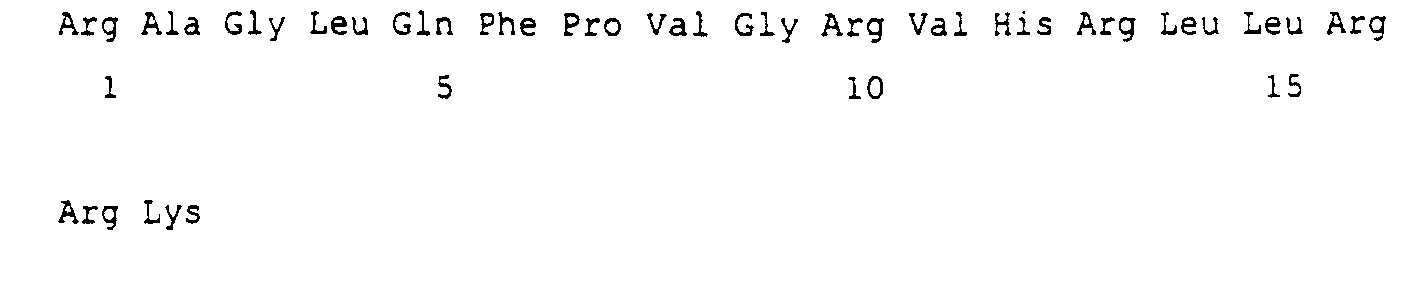
<211> 21
<212> PRT
<213> Artificial Sequence
<223> PEPTIDE

<211> 21
<212> PRT
<213> Artificial Sequence
<223> PEPTIDE

<211> 18
<212> PRT
<213> Artificial Sequence
<223> PEPTIDE, AMIDATION
<211> 13
<213> Artificial Sequence
<223> PEPTIDE

<211> 17
<212> PRT
<213> Artificial Sequence
<223> PEPTIDE

<211> 12
<212> PRT
<213> Artificial Sequence
<223> PEPTIDE

<211> 16
<212> PRT
<213> Artificial Sequence
<223> PEPTIDE

Claims (10)
- A peptide consisting of amino acid sequence [RLLR]n where n is an integer in the range 2 to 6.
- A peptide according to claim 1 consisting of [RLLR]3, [RLLR]4, and [RLLR]5.
- A peptide comprising an amino acid sequence RKGLQKLVGRVHRLLRK.
- A peptide comprising an amino acid sequence RAGLQFPVG[RLLR]m where m is an integer in the range 1 to 3.
- A peptide according to any one of the preceding claims, wherein the C-terminus of the peptide is amidated.
- A peptide according to any one of claims 1 to 5, wherein the peptide comprises an additional Gly residue fused to its N-terminus.
- A peptide consisting of an amino acid sequence selected from the group consisting of PVGRVHRLLRK and RAGLQFPVGRVHRLLRK.
- A peptide as defined in any one of claims 1 to 7 for use as an antimicrobial agent.
- Use of a peptide as defined in any one of claims 1 to 7 for the manufacture of an agent for inhibiting the growth of microorganisms.
- Use of a peptide according to claim 9, wherein the microorganism is selected from the group consisting of Gram-negative bacteria, Gram-positive bacteria, fungi and protozoa.
Applications Claiming Priority (3)
| Application Number | Priority Date | Filing Date | Title |
|---|---|---|---|
| KR19980001797 | 1998-01-22 | ||
| KR9801797 | 1998-01-22 | ||
| PCT/KR1999/000036 WO1999037664A1 (en) | 1998-01-22 | 1999-01-22 | Novel peptides having biological activity |
Publications (2)
| Publication Number | Publication Date |
|---|---|
| EP1049709A1 EP1049709A1 (en) | 2000-11-08 |
| EP1049709B1 true EP1049709B1 (en) | 2003-09-24 |
Family
ID=19531909
Family Applications (1)
| Application Number | Title | Priority Date | Filing Date |
|---|---|---|---|
| EP99900698A Expired - Lifetime EP1049709B1 (en) | 1998-01-22 | 1999-01-22 | Antimicrobial peptides |
Country Status (8)
| Country | Link |
|---|---|
| US (1) | US6531446B1 (en) |
| EP (1) | EP1049709B1 (en) |
| JP (1) | JP2002501079A (en) |
| KR (1) | KR100314721B1 (en) |
| CN (1) | CN1161372C (en) |
| CA (1) | CA2318398C (en) |
| DE (1) | DE69911579T2 (en) |
| WO (1) | WO1999037664A1 (en) |
Families Citing this family (26)
| Publication number | Priority date | Publication date | Assignee | Title |
|---|---|---|---|---|
| AU781608B2 (en) * | 1999-05-14 | 2005-06-02 | U.S. Army Medical Research And Materiel Command | Buforin I as a specific inhibitor and therapeutic agent for botulinum toxin B and tetanus neurotoxins |
| US6573244B1 (en) * | 1999-05-17 | 2003-06-03 | The United States Of America As Represented By The Secretary Of The Army | Previns as specific inhibitors and therapeutic agents for Botulinum toxin B and Tetanus neurotoxins |
| US7235521B1 (en) | 1999-05-17 | 2007-06-26 | United States Of America As Represented By The Secretary Of The Army | Previns as specific inhibitors and therapeutic agents for botulinum toxin B and tetanus neurotoxins |
| EP1280822A2 (en) * | 2000-04-24 | 2003-02-05 | Novartis AG | Histone h2a-derived peptides useful in gene delivery |
| KR20020051124A (en) * | 2000-12-22 | 2002-06-28 | 이한웅 | Anti-cancer Agent Comprising Bufforin Derivatives |
| FR2818981A1 (en) * | 2001-01-03 | 2002-07-05 | Synt Em | AMPHIPATHIC PEPTIDES AND THEIR USE FOR THE TRANSFER OF SUBSTANCES OF INTEREST TO CELLS |
| KR100441402B1 (en) * | 2002-03-26 | 2004-07-23 | 한국과학기술원 | Antimicrobial peptide, its analogs and antimicrobial composition comprising thereof |
| CN1269837C (en) * | 2002-09-02 | 2006-08-16 | 上海高科联合生物技术研发有限公司 | Serial synthetic antibacterial peptide |
| US7091185B2 (en) * | 2003-02-24 | 2006-08-15 | Dow Global Technologies Inc. | Periodic antimicrobial peptides |
| GB0404374D0 (en) | 2004-02-27 | 2004-03-31 | Univ Manchester | Treatment of bacterial infections |
| GB0513096D0 (en) | 2005-06-28 | 2005-08-03 | Strathclyde | Treatment of microbial infections |
| KR100958095B1 (en) | 2007-12-31 | 2010-05-14 | 한국과학기술원 | Mass expression method of antimicrobial peptide using translation companion system |
| JP2010154842A (en) * | 2008-12-03 | 2010-07-15 | Koji Kawakami | New anticancer chimeric peptide with egfr as target |
| EP2742069B1 (en) | 2011-08-10 | 2018-05-02 | Korea Advanced Institute of Science and Technology | Amphipathic peptide-lipase conjugate having advanced lipase activity and use thereof |
| US10743538B2 (en) | 2014-10-01 | 2020-08-18 | Plant Health Care, Inc. | Elicitor peptides having disrupted hypersensitive response box and use thereof |
| CN107002091A (en) * | 2014-10-01 | 2017-08-01 | 植物保健公司 | Allergic reaction exciton peptide and application thereof |
| JP2018529689A (en) * | 2015-09-17 | 2018-10-11 | ソウル大学校産学協力団Seoul National University R&Db Foundation | Cleaved or folded helical peptides or peptide analogs showing antibacterial activity against gram-negative bacteria and uses thereof |
| CN109069578A (en) | 2016-02-29 | 2018-12-21 | 达纳-法伯癌症研究所股份有限公司 | Stapled intracellular targeting antimicrobial peptides for treatment of infection |
| PL3439682T3 (en) | 2016-04-06 | 2025-12-01 | Plant Health Care, Inc. | Hypersensitive response elicitor-derived peptides and use thereof |
| BR112018069945A2 (en) | 2016-04-06 | 2019-02-05 | Plant Health Care, Inc. | beneficial microbes for the distribution of peptides or effector proteins and their use |
| JP7305614B2 (en) | 2017-07-19 | 2023-07-10 | デイナ ファーバー キャンサー インスティチュート,インコーポレイテッド | Stabilized antimicrobial peptides for the treatment of antibiotic-resistant bacterial infections |
| CN110256573A (en) * | 2019-05-08 | 2019-09-20 | 吉林农业大学 | A kind of heterozygous antibacterial peptide BM16R and its preparation method and application |
| CN110305193B (en) * | 2019-07-18 | 2021-10-08 | 河南科技大学 | A kind of anti-Porphyromonas gingivalis polypeptide and application |
| CN112679594B (en) * | 2020-12-29 | 2022-03-25 | 潍坊医学院 | Modified analgesic peptide BRL of antibacterial peptide Buforin IIB and application thereof |
| WO2022262942A1 (en) | 2021-06-15 | 2022-12-22 | Panvir Therapeutics | Anti-tumour peptides |
| CN114605517B (en) * | 2022-05-12 | 2022-09-27 | 广东海洋大学 | Polypeptide LXP-7 with broad-spectrum anticancer effect and application thereof |
Citations (3)
| Publication number | Priority date | Publication date | Assignee | Title |
|---|---|---|---|---|
| FR2715847A1 (en) * | 1994-02-08 | 1995-08-11 | Rhone Poulenc Rorer Sa | Composition containing nucleic acids, preparation and uses |
| WO1996028468A2 (en) * | 1995-03-09 | 1996-09-19 | Unilever Plc | Amphiphilic peptide and analogs thereof |
| WO1997018826A1 (en) * | 1995-11-22 | 1997-05-29 | Intrabiotics Pharmaceuticals, Inc. | Fine tuned protegrins |
Family Cites Families (3)
| Publication number | Priority date | Publication date | Assignee | Title |
|---|---|---|---|---|
| US5177189A (en) * | 1989-08-18 | 1993-01-05 | The Scripps Research Institute | Polypeptide analogs of Apolipoprotein E |
| WO1995019370A1 (en) * | 1994-01-18 | 1995-07-20 | Magainin Pharmaceuticals Inc. | Ion-channel forming amphiphilic peptides having n-terminal modifications |
| US5981221A (en) * | 1997-03-26 | 1999-11-09 | Incyte Pharmaceuticals, Inc. | Histone fusion protein |
-
1999
- 1999-01-21 KR KR1019990001813A patent/KR100314721B1/en not_active Expired - Fee Related
- 1999-01-22 WO PCT/KR1999/000036 patent/WO1999037664A1/en not_active Ceased
- 1999-01-22 US US09/600,710 patent/US6531446B1/en not_active Expired - Lifetime
- 1999-01-22 CA CA002318398A patent/CA2318398C/en not_active Expired - Fee Related
- 1999-01-22 EP EP99900698A patent/EP1049709B1/en not_active Expired - Lifetime
- 1999-01-22 JP JP2000528585A patent/JP2002501079A/en active Pending
- 1999-01-22 CN CNB998035041A patent/CN1161372C/en not_active Expired - Fee Related
- 1999-01-22 DE DE69911579T patent/DE69911579T2/en not_active Expired - Lifetime
Patent Citations (3)
| Publication number | Priority date | Publication date | Assignee | Title |
|---|---|---|---|---|
| FR2715847A1 (en) * | 1994-02-08 | 1995-08-11 | Rhone Poulenc Rorer Sa | Composition containing nucleic acids, preparation and uses |
| WO1996028468A2 (en) * | 1995-03-09 | 1996-09-19 | Unilever Plc | Amphiphilic peptide and analogs thereof |
| WO1997018826A1 (en) * | 1995-11-22 | 1997-05-29 | Intrabiotics Pharmaceuticals, Inc. | Fine tuned protegrins |
Non-Patent Citations (2)
| Title |
|---|
| DATABASE SWISS-PROT [online] Database accession no. P06897/ H2A1-XENLA * |
| HAN I.S. ET AL: "Selective monitoring of peptidase activities with synthetic polypeptide substrates and polyion-sensitive membrane electrode detection", FASEB JOURNAL, vol. 10, 1996, pages 1621 - 1626, XP001010550 * |
Also Published As
| Publication number | Publication date |
|---|---|
| EP1049709A1 (en) | 2000-11-08 |
| CN1161372C (en) | 2004-08-11 |
| CA2318398A1 (en) | 1999-07-29 |
| US6531446B1 (en) | 2003-03-11 |
| CN1291991A (en) | 2001-04-18 |
| JP2002501079A (en) | 2002-01-15 |
| CA2318398C (en) | 2007-11-13 |
| WO1999037664A1 (en) | 1999-07-29 |
| KR100314721B1 (en) | 2001-11-23 |
| KR19990068053A (en) | 1999-08-25 |
| DE69911579D1 (en) | 2003-10-30 |
| DE69911579T2 (en) | 2004-06-24 |
Similar Documents
| Publication | Publication Date | Title |
|---|---|---|
| CA2318398C (en) | Novel peptides having biological activity | |
| Tossi et al. | Amphipathic, α‐helical antimicrobial peptides | |
| Ciulla et al. | Structure–activity relationships of antibacterial peptides | |
| EP2518080B1 (en) | Antibiotic peptides | |
| Mor et al. | Structure, synthesis, and activity of dermaseptin b, a novel vertebrate defensive peptide from frog skin: relationship with adenoregulin | |
| Klüver et al. | Synthesis and structure–activity relationship of β‐defensins, multi‐functional peptides of the immune system | |
| Tossi et al. | PMAP‐37, a novel antibacterial peptide from pig myeloid cells: cDNA cloning, chemical synthesis and activity | |
| Ahmad et al. | Identification and design of antimicrobial peptides for therapeutic applications | |
| CA2372821C (en) | Antimicrobial theta defensins and methods of using same | |
| CN1650005B (en) | Antibacterial polypeptide and its application | |
| CN100489114C (en) | Low-cost production for peptides | |
| Hugosson et al. | Antibacterial peptides and mitochonrial presequences affect mitochonrial coupling, respiration and protein import | |
| Chen et al. | Expression of a cytotoxic cationic antibacterial peptide in Escherichia coli using two fusion partners | |
| EP0644769A1 (en) | Biologically active peptides having n-terminal substitutions | |
| Lee et al. | Antifungal mechanism of SMAP-29 (1–18) isolated from sheep myeloid mRNA against Trichosporon beigelii | |
| KR100441402B1 (en) | Antimicrobial peptide, its analogs and antimicrobial composition comprising thereof | |
| CN102603884A (en) | Diamond back moth antibacterial peptide and preparation method and application thereof | |
| AU754894B2 (en) | Novel peptides having biological activity | |
| KR100465588B1 (en) | Novel Antimicrobial Peptides Isolated From The Skin of Hagfish, Eptatretus burgeri, And Their Analogs | |
| Mardirossian | Internal targets and killing mechanism of the cathelicidin Bac7 in Gram-negative bacteria | |
| Gennaro et al. | A novel bovine antimicrobial peptide of the cathelicidin family | |
| Ortiz | Antimicrobial Peptides: An Overview |
Legal Events
| Date | Code | Title | Description |
|---|---|---|---|
| PUAI | Public reference made under article 153(3) epc to a published international application that has entered the european phase |
Free format text: ORIGINAL CODE: 0009012 |
|
| 17P | Request for examination filed |
Effective date: 20000821 |
|
| AK | Designated contracting states |
Kind code of ref document: A1 Designated state(s): DE FR GB IT |
|
| RIN1 | Information on inventor provided before grant (corrected) |
Inventor name: LEE, HYUN-SOO Inventor name: HONG, SEUNG-SUH Inventor name: LEE, JAE-HYUN Inventor name: PARK, CHAN-BAE Inventor name: KIM, SUN-CHANG |
|
| 17Q | First examination report despatched |
Effective date: 20010712 |
|
| RAP1 | Party data changed (applicant data changed or rights of an application transferred) |
Owner name: KOREA ADVANCED INSTITUTE OF SCIENCE AND TECHNOLOG Owner name: SAMYANG GENEX CO., LTD. |
|
| RIC1 | Information provided on ipc code assigned before grant |
Free format text: 7C 07K 14/46 A, 7A 61K 38/17 B |
|
| RTI1 | Title (correction) |
Free format text: ANTIMICROBIAL PEPTIDES |
|
| GRAH | Despatch of communication of intention to grant a patent |
Free format text: ORIGINAL CODE: EPIDOS IGRA |
|
| RIC1 | Information provided on ipc code assigned before grant |
Ipc: 7A 61K 38/17 B Ipc: 7C 07K 14/46 A |
|
| RTI1 | Title (correction) |
Free format text: ANTIMICROBIAL PEPTIDES |
|
| RIC1 | Information provided on ipc code assigned before grant |
Ipc: 7A 61K 38/17 B Ipc: 7C 07K 14/46 A |
|
| RTI1 | Title (correction) |
Free format text: ANTIMICROBIAL PEPTIDES |
|
| GRAS | Grant fee paid |
Free format text: ORIGINAL CODE: EPIDOSNIGR3 |
|
| GRAA | (expected) grant |
Free format text: ORIGINAL CODE: 0009210 |
|
| AK | Designated contracting states |
Kind code of ref document: B1 Designated state(s): DE FR GB IT |
|
| REG | Reference to a national code |
Ref country code: GB Ref legal event code: FG4D |
|
| REF | Corresponds to: |
Ref document number: 69911579 Country of ref document: DE Date of ref document: 20031030 Kind code of ref document: P |
|
| ET | Fr: translation filed | ||
| PLBE | No opposition filed within time limit |
Free format text: ORIGINAL CODE: 0009261 |
|
| STAA | Information on the status of an ep patent application or granted ep patent |
Free format text: STATUS: NO OPPOSITION FILED WITHIN TIME LIMIT |
|
| 26N | No opposition filed |
Effective date: 20040625 |
|
| PGFP | Annual fee paid to national office [announced via postgrant information from national office to epo] |
Ref country code: IT Payment date: 20120110 Year of fee payment: 14 |
|
| PGFP | Annual fee paid to national office [announced via postgrant information from national office to epo] |
Ref country code: GB Payment date: 20130111 Year of fee payment: 15 Ref country code: DE Payment date: 20130117 Year of fee payment: 15 Ref country code: FR Payment date: 20130215 Year of fee payment: 15 |
|
| REG | Reference to a national code |
Ref country code: FR Ref legal event code: TP Owner name: SAMYANG GENEXBIO CORPORATION, KR Effective date: 20130719 |
|
| REG | Reference to a national code |
Ref country code: DE Ref legal event code: R119 Ref document number: 69911579 Country of ref document: DE |
|
| GBPC | Gb: european patent ceased through non-payment of renewal fee |
Effective date: 20140122 |
|
| REG | Reference to a national code |
Ref country code: DE Ref legal event code: R119 Ref document number: 69911579 Country of ref document: DE Effective date: 20140801 |
|
| PG25 | Lapsed in a contracting state [announced via postgrant information from national office to epo] |
Ref country code: DE Free format text: LAPSE BECAUSE OF NON-PAYMENT OF DUE FEES Effective date: 20140801 |
|
| REG | Reference to a national code |
Ref country code: FR Ref legal event code: TQ Owner name: KOREA ADVANCED INSTITUTE OF SCIENCE AND TECHNO, KR Effective date: 20141001 Ref country code: FR Ref legal event code: TQ Owner name: SAMYANG GENEXBIO CORPORATION, KR Effective date: 20141001 Ref country code: FR Ref legal event code: ST Effective date: 20140930 |
|
| PG25 | Lapsed in a contracting state [announced via postgrant information from national office to epo] |
Ref country code: FR Free format text: LAPSE BECAUSE OF NON-PAYMENT OF DUE FEES Effective date: 20140131 Ref country code: GB Free format text: LAPSE BECAUSE OF NON-PAYMENT OF DUE FEES Effective date: 20140122 |
|
| PG25 | Lapsed in a contracting state [announced via postgrant information from national office to epo] |
Ref country code: IT Free format text: LAPSE BECAUSE OF NON-PAYMENT OF DUE FEES Effective date: 20140122 |