EP1047690B1 - Heterocyclic ether and thioether compounds useful in controlling chemical synaptic transmission - Google Patents
Heterocyclic ether and thioether compounds useful in controlling chemical synaptic transmission Download PDFInfo
- Publication number
- EP1047690B1 EP1047690B1 EP98964167A EP98964167A EP1047690B1 EP 1047690 B1 EP1047690 B1 EP 1047690B1 EP 98964167 A EP98964167 A EP 98964167A EP 98964167 A EP98964167 A EP 98964167A EP 1047690 B1 EP1047690 B1 EP 1047690B1
- Authority
- EP
- European Patent Office
- Prior art keywords
- alkyl
- group
- compound
- iii
- substituent
- Prior art date
- Legal status (The legal status is an assumption and is not a legal conclusion. Google has not performed a legal analysis and makes no representation as to the accuracy of the status listed.)
- Expired - Lifetime
Links
- 230000005062 synaptic transmission Effects 0.000 title claims abstract description 24
- RTZKZFJDLAIYFH-UHFFFAOYSA-N Diethyl ether Chemical compound CCOCC RTZKZFJDLAIYFH-UHFFFAOYSA-N 0.000 title description 25
- 239000000126 substance Substances 0.000 title description 18
- 125000000623 heterocyclic group Chemical group 0.000 title description 4
- 150000003568 thioethers Chemical class 0.000 title description 3
- 150000001875 compounds Chemical class 0.000 claims abstract description 122
- 150000003839 salts Chemical class 0.000 claims abstract description 21
- 239000000651 prodrug Substances 0.000 claims abstract description 17
- 229940002612 prodrug Drugs 0.000 claims abstract description 17
- 239000008194 pharmaceutical composition Substances 0.000 claims abstract description 7
- -1 (i) -Br Chemical class 0.000 claims description 77
- 125000001424 substituent group Chemical group 0.000 claims description 25
- 239000003814 drug Substances 0.000 claims description 23
- JUJWROOIHBZHMG-UHFFFAOYSA-N Pyridine Chemical group C1=CC=NC=C1 JUJWROOIHBZHMG-UHFFFAOYSA-N 0.000 claims description 17
- 125000006273 (C1-C3) alkyl group Chemical group 0.000 claims description 14
- 238000011282 treatment Methods 0.000 claims description 13
- QVGXLLKOCUKJST-UHFFFAOYSA-N atomic oxygen Chemical group [O] QVGXLLKOCUKJST-UHFFFAOYSA-N 0.000 claims description 7
- 239000003937 drug carrier Substances 0.000 claims description 7
- 229910052760 oxygen Inorganic materials 0.000 claims description 7
- 239000001301 oxygen Substances 0.000 claims description 7
- 125000004169 (C1-C6) alkyl group Chemical group 0.000 claims description 4
- 208000006096 Attention Deficit Disorder with Hyperactivity Diseases 0.000 claims description 4
- 208000036864 Attention deficit/hyperactivity disease Diseases 0.000 claims description 4
- 208000015802 attention deficit-hyperactivity disease Diseases 0.000 claims description 4
- 229910052739 hydrogen Inorganic materials 0.000 claims description 4
- 208000035231 inattentive type attention deficit hyperactivity disease Diseases 0.000 claims description 4
- 238000004519 manufacturing process Methods 0.000 claims description 4
- 125000003903 2-propenyl group Chemical group [H]C([*])([H])C([H])=C([H])[H] 0.000 claims description 3
- 206010012289 Dementia Diseases 0.000 claims description 3
- NINIDFKCEFEMDL-UHFFFAOYSA-N Sulfur Chemical group [S] NINIDFKCEFEMDL-UHFFFAOYSA-N 0.000 claims description 3
- 125000000217 alkyl group Chemical group 0.000 claims description 3
- 229910052717 sulfur Chemical group 0.000 claims description 3
- 239000011593 sulfur Chemical group 0.000 claims description 3
- DTXUACWBHXJJSO-VDDIYKPWSA-N (1r,2s,4s)-2-[(5,6-dichloropyridin-3-yl)oxymethyl]-3-methyl-3-azabicyclo[2.2.1]heptane Chemical compound C([C@@H]1[C@@H]2CC[C@@H](C2)N1C)OC1=CN=C(Cl)C(Cl)=C1 DTXUACWBHXJJSO-VDDIYKPWSA-N 0.000 claims description 2
- IMPMMFFOUWIOGR-VDDIYKPWSA-N (1r,2s,4s)-2-[(5-bromo-6-chloropyridin-3-yl)oxymethyl]-3-methyl-3-azabicyclo[2.2.1]heptane Chemical compound C([C@@H]1[C@@H]2CC[C@@H](C2)N1C)OC1=CN=C(Cl)C(Br)=C1 IMPMMFFOUWIOGR-VDDIYKPWSA-N 0.000 claims description 2
- 125000004178 (C1-C4) alkyl group Chemical group 0.000 claims description 2
- 208000019901 Anxiety disease Diseases 0.000 claims description 2
- 208000028698 Cognitive impairment Diseases 0.000 claims description 2
- 230000036506 anxiety Effects 0.000 claims description 2
- 230000006949 cholinergic function Effects 0.000 claims description 2
- 208000010877 cognitive disease Diseases 0.000 claims description 2
- 230000003247 decreasing effect Effects 0.000 claims description 2
- 201000009032 substance abuse Diseases 0.000 claims description 2
- 231100000736 substance abuse Toxicity 0.000 claims description 2
- 208000011117 substance-related disease Diseases 0.000 claims description 2
- 239000000203 mixture Substances 0.000 abstract description 23
- YMWUJEATGCHHMB-UHFFFAOYSA-N Dichloromethane Chemical compound ClCCl YMWUJEATGCHHMB-UHFFFAOYSA-N 0.000 description 27
- XEKOWRVHYACXOJ-UHFFFAOYSA-N Ethyl acetate Chemical compound CCOC(C)=O XEKOWRVHYACXOJ-UHFFFAOYSA-N 0.000 description 23
- LFQSCWFLJHTTHZ-UHFFFAOYSA-N Ethanol Chemical compound CCO LFQSCWFLJHTTHZ-UHFFFAOYSA-N 0.000 description 19
- WYURNTSHIVDZCO-UHFFFAOYSA-N Tetrahydrofuran Chemical compound C1CCOC1 WYURNTSHIVDZCO-UHFFFAOYSA-N 0.000 description 18
- 239000002858 neurotransmitter agent Substances 0.000 description 18
- ZMANZCXQSJIPKH-UHFFFAOYSA-N Triethylamine Chemical compound CCN(CC)CC ZMANZCXQSJIPKH-UHFFFAOYSA-N 0.000 description 17
- 229940079593 drug Drugs 0.000 description 17
- 239000000243 solution Substances 0.000 description 17
- OKKJLVBELUTLKV-UHFFFAOYSA-N Methanol Chemical compound OC OKKJLVBELUTLKV-UHFFFAOYSA-N 0.000 description 15
- 238000000034 method Methods 0.000 description 15
- QGZKDVFQNNGYKY-UHFFFAOYSA-N Ammonia Chemical compound N QGZKDVFQNNGYKY-UHFFFAOYSA-N 0.000 description 14
- VYFYYTLLBUKUHU-UHFFFAOYSA-N dopamine Chemical compound NCCC1=CC=C(O)C(O)=C1 VYFYYTLLBUKUHU-UHFFFAOYSA-N 0.000 description 14
- 239000003921 oil Substances 0.000 description 13
- 235000019198 oils Nutrition 0.000 description 13
- HEDRZPFGACZZDS-MICDWDOJSA-N Trichloro(2H)methane Chemical compound [2H]C(Cl)(Cl)Cl HEDRZPFGACZZDS-MICDWDOJSA-N 0.000 description 12
- 238000005160 1H NMR spectroscopy Methods 0.000 description 11
- 235000019441 ethanol Nutrition 0.000 description 11
- 210000004379 membrane Anatomy 0.000 description 11
- 239000012528 membrane Substances 0.000 description 11
- 239000007787 solid Substances 0.000 description 11
- SNICXCGAKADSCV-JTQLQIEISA-N (-)-Nicotine Chemical compound CN1CCC[C@H]1C1=CC=CN=C1 SNICXCGAKADSCV-JTQLQIEISA-N 0.000 description 10
- VEXZGXHMUGYJMC-UHFFFAOYSA-N Hydrochloric acid Chemical compound Cl VEXZGXHMUGYJMC-UHFFFAOYSA-N 0.000 description 10
- GUBGYTABKSRVRQ-QKKXKWKRSA-N Lactose Natural products OC[C@H]1O[C@@H](O[C@H]2[C@H](O)[C@@H](O)C(O)O[C@@H]2CO)[C@H](O)[C@@H](O)[C@H]1O GUBGYTABKSRVRQ-QKKXKWKRSA-N 0.000 description 10
- 239000003795 chemical substances by application Substances 0.000 description 10
- 208000037265 diseases, disorders, signs and symptoms Diseases 0.000 description 10
- GRFNBEZIAWKNCO-UHFFFAOYSA-N mhp Natural products OC1=CC=CN=C1 GRFNBEZIAWKNCO-UHFFFAOYSA-N 0.000 description 10
- 229960002715 nicotine Drugs 0.000 description 10
- 230000001242 postsynaptic effect Effects 0.000 description 10
- 102000005962 receptors Human genes 0.000 description 10
- 108020003175 receptors Proteins 0.000 description 10
- RIOQSEWOXXDEQQ-UHFFFAOYSA-N triphenylphosphine Chemical compound C1=CC=CC=C1P(C=1C=CC=CC=1)C1=CC=CC=C1 RIOQSEWOXXDEQQ-UHFFFAOYSA-N 0.000 description 10
- UORVGPXVDQYIDP-UHFFFAOYSA-N borane Chemical compound B UORVGPXVDQYIDP-UHFFFAOYSA-N 0.000 description 9
- 210000004027 cell Anatomy 0.000 description 9
- 238000006243 chemical reaction Methods 0.000 description 9
- 208000035475 disorder Diseases 0.000 description 9
- 235000019439 ethyl acetate Nutrition 0.000 description 9
- SNICXCGAKADSCV-UHFFFAOYSA-N nicotine Natural products CN1CCCC1C1=CC=CN=C1 SNICXCGAKADSCV-UHFFFAOYSA-N 0.000 description 9
- IJGRMHOSHXDMSA-UHFFFAOYSA-N Atomic nitrogen Chemical compound N#N IJGRMHOSHXDMSA-UHFFFAOYSA-N 0.000 description 8
- ZMXDDKWLCZADIW-UHFFFAOYSA-N N,N-Dimethylformamide Chemical compound CN(C)C=O ZMXDDKWLCZADIW-UHFFFAOYSA-N 0.000 description 8
- 102000019315 Nicotinic acetylcholine receptors Human genes 0.000 description 8
- 108050006807 Nicotinic acetylcholine receptors Proteins 0.000 description 8
- 230000001713 cholinergic effect Effects 0.000 description 8
- 150000002148 esters Chemical class 0.000 description 8
- 230000001537 neural effect Effects 0.000 description 8
- 239000000546 pharmaceutical excipient Substances 0.000 description 8
- 239000002904 solvent Substances 0.000 description 8
- 108091006146 Channels Proteins 0.000 description 7
- 230000027455 binding Effects 0.000 description 7
- 229960003638 dopamine Drugs 0.000 description 7
- CDAISMWEOUEBRE-UHFFFAOYSA-N scyllo-inosotol Natural products OC1C(O)C(O)C(O)C(O)C1O CDAISMWEOUEBRE-UHFFFAOYSA-N 0.000 description 7
- DTQVDTLACAAQTR-UHFFFAOYSA-N trifluoroacetic acid Substances OC(=O)C(F)(F)F DTQVDTLACAAQTR-UHFFFAOYSA-N 0.000 description 7
- QTBSBXVTEAMEQO-UHFFFAOYSA-N Acetic acid Chemical compound CC(O)=O QTBSBXVTEAMEQO-UHFFFAOYSA-N 0.000 description 6
- GUBGYTABKSRVRQ-XLOQQCSPSA-N Alpha-Lactose Chemical compound O[C@@H]1[C@@H](O)[C@@H](O)[C@@H](CO)O[C@H]1O[C@@H]1[C@@H](CO)O[C@H](O)[C@H](O)[C@H]1O GUBGYTABKSRVRQ-XLOQQCSPSA-N 0.000 description 6
- IAZDPXIOMUYVGZ-UHFFFAOYSA-N Dimethylsulphoxide Chemical compound CS(C)=O IAZDPXIOMUYVGZ-UHFFFAOYSA-N 0.000 description 6
- PEDCQBHIVMGVHV-UHFFFAOYSA-N Glycerine Chemical compound OCC(O)CO PEDCQBHIVMGVHV-UHFFFAOYSA-N 0.000 description 6
- DNIAPMSPPWPWGF-UHFFFAOYSA-N Propylene glycol Chemical compound CC(O)CO DNIAPMSPPWPWGF-UHFFFAOYSA-N 0.000 description 6
- 239000002585 base Substances 0.000 description 6
- 210000003169 central nervous system Anatomy 0.000 description 6
- 230000000694 effects Effects 0.000 description 6
- IXCSERBJSXMMFS-UHFFFAOYSA-N hydrogen chloride Substances Cl.Cl IXCSERBJSXMMFS-UHFFFAOYSA-N 0.000 description 6
- 229910000041 hydrogen chloride Inorganic materials 0.000 description 6
- 239000008101 lactose Substances 0.000 description 6
- HQKMJHAJHXVSDF-UHFFFAOYSA-L magnesium stearate Chemical compound [Mg+2].CCCCCCCCCCCCCCCCCC([O-])=O.CCCCCCCCCCCCCCCCCC([O-])=O HQKMJHAJHXVSDF-UHFFFAOYSA-L 0.000 description 6
- VLKZOEOYAKHREP-UHFFFAOYSA-N n-Hexane Chemical compound CCCCCC VLKZOEOYAKHREP-UHFFFAOYSA-N 0.000 description 6
- 229920001223 polyethylene glycol Polymers 0.000 description 6
- 239000000843 powder Substances 0.000 description 6
- 206010001497 Agitation Diseases 0.000 description 5
- KFZMGEQAYNKOFK-UHFFFAOYSA-N Isopropanol Chemical compound CC(C)O KFZMGEQAYNKOFK-UHFFFAOYSA-N 0.000 description 5
- VYPSYNLAJGMNEJ-UHFFFAOYSA-N Silicium dioxide Chemical compound O=[Si]=O VYPSYNLAJGMNEJ-UHFFFAOYSA-N 0.000 description 5
- 229920002472 Starch Polymers 0.000 description 5
- 230000009471 action Effects 0.000 description 5
- 229910000085 borane Inorganic materials 0.000 description 5
- 239000000872 buffer Substances 0.000 description 5
- 239000002775 capsule Substances 0.000 description 5
- 238000000576 coating method Methods 0.000 description 5
- FAMRKDQNMBBFBR-BQYQJAHWSA-N diethyl azodicarboxylate Substances CCOC(=O)\N=N\C(=O)OCC FAMRKDQNMBBFBR-BQYQJAHWSA-N 0.000 description 5
- 239000002552 dosage form Substances 0.000 description 5
- 239000012280 lithium aluminium hydride Substances 0.000 description 5
- 231100000252 nontoxic Toxicity 0.000 description 5
- 230000003000 nontoxic effect Effects 0.000 description 5
- 239000006187 pill Substances 0.000 description 5
- 238000002360 preparation method Methods 0.000 description 5
- 230000003518 presynaptic effect Effects 0.000 description 5
- 239000007909 solid dosage form Substances 0.000 description 5
- 235000019698 starch Nutrition 0.000 description 5
- 239000003826 tablet Substances 0.000 description 5
- 230000001225 therapeutic effect Effects 0.000 description 5
- XLYOFNOQVPJJNP-UHFFFAOYSA-N water Substances O XLYOFNOQVPJJNP-UHFFFAOYSA-N 0.000 description 5
- 239000001993 wax Substances 0.000 description 5
- PUPZLCDOIYMWBV-UHFFFAOYSA-N (+/-)-1,3-Butanediol Chemical compound CC(O)CCO PUPZLCDOIYMWBV-UHFFFAOYSA-N 0.000 description 4
- VHYFNPMBLIVWCW-UHFFFAOYSA-N 4-Dimethylaminopyridine Chemical compound CN(C)C1=CC=NC=C1 VHYFNPMBLIVWCW-UHFFFAOYSA-N 0.000 description 4
- 241001465754 Metazoa Species 0.000 description 4
- 102000014415 Muscarinic acetylcholine receptor Human genes 0.000 description 4
- 108050003473 Muscarinic acetylcholine receptor Proteins 0.000 description 4
- MUBZPKHOEPUJKR-UHFFFAOYSA-N Oxalic acid Chemical compound OC(=O)C(O)=O MUBZPKHOEPUJKR-UHFFFAOYSA-N 0.000 description 4
- KDLHZDBZIXYQEI-UHFFFAOYSA-N Palladium Chemical compound [Pd] KDLHZDBZIXYQEI-UHFFFAOYSA-N 0.000 description 4
- FAPWRFPIFSIZLT-UHFFFAOYSA-M Sodium chloride Chemical compound [Na+].[Cl-] FAPWRFPIFSIZLT-UHFFFAOYSA-M 0.000 description 4
- CZMRCDWAGMRECN-UGDNZRGBSA-N Sucrose Chemical compound O[C@H]1[C@H](O)[C@@H](CO)O[C@@]1(CO)O[C@@H]1[C@H](O)[C@@H](O)[C@H](O)[C@@H](CO)O1 CZMRCDWAGMRECN-UGDNZRGBSA-N 0.000 description 4
- 229930006000 Sucrose Natural products 0.000 description 4
- 238000010521 absorption reaction Methods 0.000 description 4
- 235000010443 alginic acid Nutrition 0.000 description 4
- 229920000615 alginic acid Polymers 0.000 description 4
- 230000008901 benefit Effects 0.000 description 4
- 239000000945 filler Substances 0.000 description 4
- 239000003701 inert diluent Substances 0.000 description 4
- 239000003446 ligand Substances 0.000 description 4
- 210000005036 nerve Anatomy 0.000 description 4
- 229910052757 nitrogen Inorganic materials 0.000 description 4
- 230000008569 process Effects 0.000 description 4
- 239000011541 reaction mixture Substances 0.000 description 4
- 239000000741 silica gel Substances 0.000 description 4
- 229910002027 silica gel Inorganic materials 0.000 description 4
- 239000005720 sucrose Substances 0.000 description 4
- 239000000454 talc Substances 0.000 description 4
- 235000012222 talc Nutrition 0.000 description 4
- 229910052623 talc Inorganic materials 0.000 description 4
- 125000006274 (C1-C3)alkoxy group Chemical group 0.000 description 3
- 102000009660 Cholinergic Receptors Human genes 0.000 description 3
- 108010009685 Cholinergic Receptors Proteins 0.000 description 3
- WSFSSNUMVMOOMR-UHFFFAOYSA-N Formaldehyde Chemical compound O=C WSFSSNUMVMOOMR-UHFFFAOYSA-N 0.000 description 3
- 241000282412 Homo Species 0.000 description 3
- 229910010084 LiAlH4 Inorganic materials 0.000 description 3
- 229910019142 PO4 Inorganic materials 0.000 description 3
- 208000018737 Parkinson disease Diseases 0.000 description 3
- OFOBLEOULBTSOW-UHFFFAOYSA-N Propanedioic acid Natural products OC(=O)CC(O)=O OFOBLEOULBTSOW-UHFFFAOYSA-N 0.000 description 3
- RWRDLPDLKQPQOW-UHFFFAOYSA-N Pyrrolidine Chemical group C1CCNC1 RWRDLPDLKQPQOW-UHFFFAOYSA-N 0.000 description 3
- HEMHJVSKTPXQMS-UHFFFAOYSA-M Sodium hydroxide Chemical compound [OH-].[Na+] HEMHJVSKTPXQMS-UHFFFAOYSA-M 0.000 description 3
- 230000004913 activation Effects 0.000 description 3
- 150000001299 aldehydes Chemical class 0.000 description 3
- 230000005540 biological transmission Effects 0.000 description 3
- 230000037396 body weight Effects 0.000 description 3
- 239000006172 buffering agent Substances 0.000 description 3
- 239000003153 chemical reaction reagent Substances 0.000 description 3
- KRKNYBCHXYNGOX-UHFFFAOYSA-N citric acid Chemical compound OC(=O)CC(O)(C(O)=O)CC(O)=O KRKNYBCHXYNGOX-UHFFFAOYSA-N 0.000 description 3
- 230000003111 delayed effect Effects 0.000 description 3
- 125000004185 ester group Chemical group 0.000 description 3
- 125000001495 ethyl group Chemical group [H]C([H])([H])C([H])([H])* 0.000 description 3
- FAMRKDQNMBBFBR-UHFFFAOYSA-N ethyl n-ethoxycarbonyliminocarbamate Chemical compound CCOC(=O)N=NC(=O)OCC FAMRKDQNMBBFBR-UHFFFAOYSA-N 0.000 description 3
- 230000004907 flux Effects 0.000 description 3
- 239000012458 free base Substances 0.000 description 3
- 239000000499 gel Substances 0.000 description 3
- 239000008187 granular material Substances 0.000 description 3
- 230000005764 inhibitory process Effects 0.000 description 3
- 150000002500 ions Chemical class 0.000 description 3
- 125000001449 isopropyl group Chemical group [H]C([H])([H])C([H])(*)C([H])([H])[H] 0.000 description 3
- 239000000314 lubricant Substances 0.000 description 3
- 235000019359 magnesium stearate Nutrition 0.000 description 3
- 239000000463 material Substances 0.000 description 3
- 125000002496 methyl group Chemical group [H]C([H])([H])* 0.000 description 3
- 239000002674 ointment Substances 0.000 description 3
- 230000037361 pathway Effects 0.000 description 3
- 230000035699 permeability Effects 0.000 description 3
- 235000021317 phosphate Nutrition 0.000 description 3
- 229920000642 polymer Polymers 0.000 description 3
- 230000036515 potency Effects 0.000 description 3
- 125000001436 propyl group Chemical group [H]C([*])([H])C([H])([H])C([H])([H])[H] 0.000 description 3
- 125000006239 protecting group Chemical group 0.000 description 3
- RMAQACBXLXPBSY-UHFFFAOYSA-N silicic acid Chemical compound O[Si](O)(O)O RMAQACBXLXPBSY-UHFFFAOYSA-N 0.000 description 3
- 235000012239 silicon dioxide Nutrition 0.000 description 3
- 239000008247 solid mixture Substances 0.000 description 3
- 239000007921 spray Substances 0.000 description 3
- 239000008107 starch Substances 0.000 description 3
- 239000000829 suppository Substances 0.000 description 3
- 239000000725 suspension Substances 0.000 description 3
- YLQBMQCUIZJEEH-UHFFFAOYSA-N tetrahydrofuran Natural products C=1C=COC=1 YLQBMQCUIZJEEH-UHFFFAOYSA-N 0.000 description 3
- VZCYOOQTPOCHFL-UHFFFAOYSA-N trans-butenedioic acid Natural products OC(=O)C=CC(O)=O VZCYOOQTPOCHFL-UHFFFAOYSA-N 0.000 description 3
- 239000000080 wetting agent Substances 0.000 description 3
- 125000006527 (C1-C5) alkyl group Chemical group 0.000 description 2
- LMDZBCPBFSXMTL-UHFFFAOYSA-N 1-ethyl-3-(3-dimethylaminopropyl)carbodiimide Chemical compound CCN=C=NCCCN(C)C LMDZBCPBFSXMTL-UHFFFAOYSA-N 0.000 description 2
- VBICKXHEKHSIBG-UHFFFAOYSA-N 1-monostearoylglycerol Chemical compound CCCCCCCCCCCCCCCCCC(=O)OCC(O)CO VBICKXHEKHSIBG-UHFFFAOYSA-N 0.000 description 2
- LBYBCCSLYXYDOH-OGFXRTJISA-N 2,3-dichloro-5-[[(2r)-pyrrolidin-2-yl]methoxy]pyridine;hydrochloride Chemical compound Cl.N1=C(Cl)C(Cl)=CC(OC[C@@H]2NCCC2)=C1 LBYBCCSLYXYDOH-OGFXRTJISA-N 0.000 description 2
- GMHPKIGFTDRQBP-UHFFFAOYSA-N 5,6-dichloropyridin-3-ol Chemical compound OC1=CN=C(Cl)C(Cl)=C1 GMHPKIGFTDRQBP-UHFFFAOYSA-N 0.000 description 2
- XUROMMQAFZTGAW-UHFFFAOYSA-N 5-bromo-6-chloropyridin-3-ol Chemical compound OC1=CN=C(Cl)C(Br)=C1 XUROMMQAFZTGAW-UHFFFAOYSA-N 0.000 description 2
- 229920001817 Agar Polymers 0.000 description 2
- 208000024827 Alzheimer disease Diseases 0.000 description 2
- 101100477360 Arabidopsis thaliana IPSP gene Proteins 0.000 description 2
- CIWBSHSKHKDKBQ-JLAZNSOCSA-N Ascorbic acid Chemical compound OC[C@H](O)[C@H]1OC(=O)C(O)=C1O CIWBSHSKHKDKBQ-JLAZNSOCSA-N 0.000 description 2
- 241000416162 Astragalus gummifer Species 0.000 description 2
- 0 CC*(C)CCC1(B**)NCC(C)C1 Chemical compound CC*(C)CCC1(B**)NCC(C)C1 0.000 description 2
- VTYYLEPIZMXCLO-UHFFFAOYSA-L Calcium carbonate Chemical compound [Ca+2].[O-]C([O-])=O VTYYLEPIZMXCLO-UHFFFAOYSA-L 0.000 description 2
- FEWJPZIEWOKRBE-JCYAYHJZSA-N Dextrotartaric acid Chemical compound OC(=O)[C@H](O)[C@@H](O)C(O)=O FEWJPZIEWOKRBE-JCYAYHJZSA-N 0.000 description 2
- QMMFVYPAHWMCMS-UHFFFAOYSA-N Dimethyl sulfide Chemical compound CSC QMMFVYPAHWMCMS-UHFFFAOYSA-N 0.000 description 2
- IAZDPXIOMUYVGZ-WFGJKAKNSA-N Dimethyl sulfoxide Chemical compound [2H]C([2H])([2H])S(=O)C([2H])([2H])[2H] IAZDPXIOMUYVGZ-WFGJKAKNSA-N 0.000 description 2
- 108010010803 Gelatin Proteins 0.000 description 2
- WQZGKKKJIJFFOK-GASJEMHNSA-N Glucose Natural products OC[C@H]1OC(O)[C@H](O)[C@@H](O)[C@@H]1O WQZGKKKJIJFFOK-GASJEMHNSA-N 0.000 description 2
- 239000004705 High-molecular-weight polyethylene Substances 0.000 description 2
- TWRXJAOTZQYOKJ-UHFFFAOYSA-L Magnesium chloride Chemical compound [Mg+2].[Cl-].[Cl-] TWRXJAOTZQYOKJ-UHFFFAOYSA-L 0.000 description 2
- CSNNHWWHGAXBCP-UHFFFAOYSA-L Magnesium sulfate Chemical compound [Mg+2].[O-][S+2]([O-])([O-])[O-] CSNNHWWHGAXBCP-UHFFFAOYSA-L 0.000 description 2
- 241000124008 Mammalia Species 0.000 description 2
- AFVFQIVMOAPDHO-UHFFFAOYSA-N Methanesulfonic acid Chemical compound CS(O)(=O)=O AFVFQIVMOAPDHO-UHFFFAOYSA-N 0.000 description 2
- LFTLOKWAGJYHHR-UHFFFAOYSA-N N-methylmorpholine N-oxide Chemical compound CN1(=O)CCOCC1 LFTLOKWAGJYHHR-UHFFFAOYSA-N 0.000 description 2
- 229910002651 NO3 Inorganic materials 0.000 description 2
- NHNBFGGVMKEFGY-UHFFFAOYSA-N Nitrate Chemical compound [O-][N+]([O-])=O NHNBFGGVMKEFGY-UHFFFAOYSA-N 0.000 description 2
- NBIIXXVUZAFLBC-UHFFFAOYSA-N Phosphoric acid Chemical compound OP(O)(O)=O NBIIXXVUZAFLBC-UHFFFAOYSA-N 0.000 description 2
- 102000004659 Presynaptic Receptors Human genes 0.000 description 2
- 108010003717 Presynaptic Receptors Proteins 0.000 description 2
- CDBYLPFSWZWCQE-UHFFFAOYSA-L Sodium Carbonate Chemical compound [Na+].[Na+].[O-]C([O-])=O CDBYLPFSWZWCQE-UHFFFAOYSA-L 0.000 description 2
- PMZURENOXWZQFD-UHFFFAOYSA-L Sodium Sulfate Chemical compound [Na+].[Na+].[O-]S([O-])(=O)=O PMZURENOXWZQFD-UHFFFAOYSA-L 0.000 description 2
- DBMJMQXJHONAFJ-UHFFFAOYSA-M Sodium laurylsulphate Chemical compound [Na+].CCCCCCCCCCCCOS([O-])(=O)=O DBMJMQXJHONAFJ-UHFFFAOYSA-M 0.000 description 2
- QAOWNCQODCNURD-UHFFFAOYSA-L Sulfate Chemical compound [O-]S([O-])(=O)=O QAOWNCQODCNURD-UHFFFAOYSA-L 0.000 description 2
- QAOWNCQODCNURD-UHFFFAOYSA-N Sulfuric acid Chemical compound OS(O)(=O)=O QAOWNCQODCNURD-UHFFFAOYSA-N 0.000 description 2
- 229920001615 Tragacanth Polymers 0.000 description 2
- XLOMVQKBTHCTTD-UHFFFAOYSA-N Zinc monoxide Chemical compound [Zn]=O XLOMVQKBTHCTTD-UHFFFAOYSA-N 0.000 description 2
- QSOYICIXDIUSGQ-GJMOJQLCSA-N [(1r,2s,4s)-3-methyl-3-azabicyclo[2.2.1]heptan-2-yl]methanol Chemical compound C1C[C@@H]2N(C)[C@H](CO)[C@H]1C2 QSOYICIXDIUSGQ-GJMOJQLCSA-N 0.000 description 2
- QSOYICIXDIUSGQ-RNJXMRFFSA-N [(1s,2r,4r)-3-methyl-3-azabicyclo[2.2.1]heptan-2-yl]methanol Chemical compound C1C[C@H]2N(C)[C@@H](CO)[C@@H]1C2 QSOYICIXDIUSGQ-RNJXMRFFSA-N 0.000 description 2
- OIPILFWXSMYKGL-UHFFFAOYSA-N acetylcholine Chemical compound CC(=O)OCC[N+](C)(C)C OIPILFWXSMYKGL-UHFFFAOYSA-N 0.000 description 2
- 229960004373 acetylcholine Drugs 0.000 description 2
- 239000002253 acid Substances 0.000 description 2
- 230000036982 action potential Effects 0.000 description 2
- 239000004480 active ingredient Substances 0.000 description 2
- 235000010419 agar Nutrition 0.000 description 2
- 239000000783 alginic acid Substances 0.000 description 2
- 229960001126 alginic acid Drugs 0.000 description 2
- 150000004781 alginic acids Chemical class 0.000 description 2
- 229910052784 alkaline earth metal Inorganic materials 0.000 description 2
- BHELZAPQIKSEDF-UHFFFAOYSA-N allyl bromide Chemical compound BrCC=C BHELZAPQIKSEDF-UHFFFAOYSA-N 0.000 description 2
- WNROFYMDJYEPJX-UHFFFAOYSA-K aluminium hydroxide Chemical compound [OH-].[OH-].[OH-].[Al+3] WNROFYMDJYEPJX-UHFFFAOYSA-K 0.000 description 2
- 230000000202 analgesic effect Effects 0.000 description 2
- HJJPJSXJAXAIPN-UHFFFAOYSA-N arecoline Chemical compound COC(=O)C1=CCCN(C)C1 HJJPJSXJAXAIPN-UHFFFAOYSA-N 0.000 description 2
- 235000012216 bentonite Nutrition 0.000 description 2
- SESFRYSPDFLNCH-UHFFFAOYSA-N benzyl benzoate Chemical compound C=1C=CC=CC=1C(=O)OCC1=CC=CC=C1 SESFRYSPDFLNCH-UHFFFAOYSA-N 0.000 description 2
- WQZGKKKJIJFFOK-VFUOTHLCSA-N beta-D-glucose Chemical compound OC[C@H]1O[C@@H](O)[C@H](O)[C@@H](O)[C@@H]1O WQZGKKKJIJFFOK-VFUOTHLCSA-N 0.000 description 2
- 229920002988 biodegradable polymer Polymers 0.000 description 2
- 239000004621 biodegradable polymer Substances 0.000 description 2
- 230000004071 biological effect Effects 0.000 description 2
- 230000015572 biosynthetic process Effects 0.000 description 2
- 210000004556 brain Anatomy 0.000 description 2
- 235000019437 butane-1,3-diol Nutrition 0.000 description 2
- 125000004432 carbon atom Chemical group C* 0.000 description 2
- 239000001768 carboxy methyl cellulose Substances 0.000 description 2
- 239000000969 carrier Substances 0.000 description 2
- 239000003054 catalyst Substances 0.000 description 2
- 239000001913 cellulose Substances 0.000 description 2
- 229920002678 cellulose Polymers 0.000 description 2
- 235000010980 cellulose Nutrition 0.000 description 2
- 239000003638 chemical reducing agent Substances 0.000 description 2
- 229940110456 cocoa butter Drugs 0.000 description 2
- 235000019868 cocoa butter Nutrition 0.000 description 2
- 230000003920 cognitive function Effects 0.000 description 2
- 235000012343 cottonseed oil Nutrition 0.000 description 2
- 239000006071 cream Substances 0.000 description 2
- 239000012043 crude product Substances 0.000 description 2
- 229940027564 cytisine Drugs 0.000 description 2
- 235000014113 dietary fatty acids Nutrition 0.000 description 2
- 239000003085 diluting agent Substances 0.000 description 2
- MOTZDAYCYVMXPC-UHFFFAOYSA-N dodecyl hydrogen sulfate Chemical compound CCCCCCCCCCCCOS(O)(=O)=O MOTZDAYCYVMXPC-UHFFFAOYSA-N 0.000 description 2
- 229940043264 dodecyl sulfate Drugs 0.000 description 2
- 239000008298 dragée Substances 0.000 description 2
- 239000003995 emulsifying agent Substances 0.000 description 2
- 239000000839 emulsion Substances 0.000 description 2
- 230000002708 enhancing effect Effects 0.000 description 2
- 239000002702 enteric coating Substances 0.000 description 2
- 238000009505 enteric coating Methods 0.000 description 2
- MMXKVMNBHPAILY-UHFFFAOYSA-N ethyl laurate Chemical compound CCCCCCCCCCCC(=O)OCC MMXKVMNBHPAILY-UHFFFAOYSA-N 0.000 description 2
- 239000000194 fatty acid Substances 0.000 description 2
- 229930195729 fatty acid Natural products 0.000 description 2
- 238000003818 flash chromatography Methods 0.000 description 2
- 239000000796 flavoring agent Substances 0.000 description 2
- 238000009472 formulation Methods 0.000 description 2
- 230000006870 function Effects 0.000 description 2
- 210000001035 gastrointestinal tract Anatomy 0.000 description 2
- 229920000159 gelatin Polymers 0.000 description 2
- 239000008273 gelatin Substances 0.000 description 2
- 239000007903 gelatin capsule Substances 0.000 description 2
- 235000019322 gelatine Nutrition 0.000 description 2
- 235000011852 gelatine desserts Nutrition 0.000 description 2
- 239000008103 glucose Substances 0.000 description 2
- 210000002064 heart cell Anatomy 0.000 description 2
- 125000002887 hydroxy group Chemical group [H]O* 0.000 description 2
- 238000000338 in vitro Methods 0.000 description 2
- 238000001727 in vivo Methods 0.000 description 2
- 239000007972 injectable composition Substances 0.000 description 2
- 239000007788 liquid Substances 0.000 description 2
- 239000008297 liquid dosage form Substances 0.000 description 2
- VZCYOOQTPOCHFL-UPHRSURJSA-N maleic acid Chemical compound OC(=O)\C=C/C(O)=O VZCYOOQTPOCHFL-UPHRSURJSA-N 0.000 description 2
- 230000001404 mediated effect Effects 0.000 description 2
- BDAGIHXWWSANSR-UHFFFAOYSA-N methanoic acid Natural products OC=O BDAGIHXWWSANSR-UHFFFAOYSA-N 0.000 description 2
- 125000001160 methoxycarbonyl group Chemical group [H]C([H])([H])OC(*)=O 0.000 description 2
- 239000004530 micro-emulsion Substances 0.000 description 2
- 125000004108 n-butyl group Chemical group [H]C([H])([H])C([H])([H])C([H])([H])C([H])([H])* 0.000 description 2
- 210000002569 neuron Anatomy 0.000 description 2
- 239000000346 nonvolatile oil Substances 0.000 description 2
- ZQPPMHVWECSIRJ-KTKRTIGZSA-N oleic acid Chemical compound CCCCCCCC\C=C/CCCCCCCC(O)=O ZQPPMHVWECSIRJ-KTKRTIGZSA-N 0.000 description 2
- 210000003463 organelle Anatomy 0.000 description 2
- 150000007524 organic acids Chemical class 0.000 description 2
- CTSLXHKWHWQRSH-UHFFFAOYSA-N oxalyl chloride Chemical compound ClC(=O)C(Cl)=O CTSLXHKWHWQRSH-UHFFFAOYSA-N 0.000 description 2
- 239000006072 paste Substances 0.000 description 2
- VLTRZXGMWDSKGL-UHFFFAOYSA-N perchloric acid Chemical compound OCl(=O)(=O)=O VLTRZXGMWDSKGL-UHFFFAOYSA-N 0.000 description 2
- 239000002304 perfume Substances 0.000 description 2
- 230000000144 pharmacologic effect Effects 0.000 description 2
- NBIIXXVUZAFLBC-UHFFFAOYSA-K phosphate Chemical compound [O-]P([O-])([O-])=O NBIIXXVUZAFLBC-UHFFFAOYSA-K 0.000 description 2
- 239000010452 phosphate Substances 0.000 description 2
- BWHMMNNQKKPAPP-UHFFFAOYSA-L potassium carbonate Chemical compound [K+].[K+].[O-]C([O-])=O BWHMMNNQKKPAPP-UHFFFAOYSA-L 0.000 description 2
- 239000003755 preservative agent Substances 0.000 description 2
- 229960004063 propylene glycol Drugs 0.000 description 2
- UMJSCPRVCHMLSP-UHFFFAOYSA-N pyridine Natural products COC1=CC=CN=C1 UMJSCPRVCHMLSP-UHFFFAOYSA-N 0.000 description 2
- LEHBURLTIWGHEM-UHFFFAOYSA-N pyridinium chlorochromate Chemical compound [O-][Cr](Cl)(=O)=O.C1=CC=[NH+]C=C1 LEHBURLTIWGHEM-UHFFFAOYSA-N 0.000 description 2
- 230000009467 reduction Effects 0.000 description 2
- 230000002829 reductive effect Effects 0.000 description 2
- 230000004044 response Effects 0.000 description 2
- 239000008159 sesame oil Substances 0.000 description 2
- 235000011803 sesame oil Nutrition 0.000 description 2
- 210000002027 skeletal muscle Anatomy 0.000 description 2
- WRIKHQLVHPKCJU-UHFFFAOYSA-N sodium bis(trimethylsilyl)amide Chemical compound C[Si](C)(C)N([Na])[Si](C)(C)C WRIKHQLVHPKCJU-UHFFFAOYSA-N 0.000 description 2
- 235000019333 sodium laurylsulphate Nutrition 0.000 description 2
- 239000007858 starting material Substances 0.000 description 2
- KDYFGRWQOYBRFD-UHFFFAOYSA-N succinic acid Chemical compound OC(=O)CCC(O)=O KDYFGRWQOYBRFD-UHFFFAOYSA-N 0.000 description 2
- 239000000375 suspending agent Substances 0.000 description 2
- 239000003765 sweetening agent Substances 0.000 description 2
- 230000000946 synaptic effect Effects 0.000 description 2
- 210000002182 synaptic membrane Anatomy 0.000 description 2
- 238000003786 synthesis reaction Methods 0.000 description 2
- DYHSDKLCOJIUFX-UHFFFAOYSA-N tert-butoxycarbonyl anhydride Chemical compound CC(C)(C)OC(=O)OC(=O)OC(C)(C)C DYHSDKLCOJIUFX-UHFFFAOYSA-N 0.000 description 2
- LGVKLALJLDGDEC-SNVBAGLBSA-N tert-butyl (2r)-2-[(5,6-dichloropyridin-3-yl)oxymethyl]pyrrolidine-1-carboxylate Chemical compound CC(C)(C)OC(=O)N1CCC[C@@H]1COC1=CN=C(Cl)C(Cl)=C1 LGVKLALJLDGDEC-SNVBAGLBSA-N 0.000 description 2
- 125000000999 tert-butyl group Chemical group [H]C([H])([H])C(*)(C([H])([H])[H])C([H])([H])[H] 0.000 description 2
- 210000001519 tissue Anatomy 0.000 description 2
- JOXIMZWYDAKGHI-UHFFFAOYSA-N toluene-4-sulfonic acid Chemical compound CC1=CC=C(S(O)(=O)=O)C=C1 JOXIMZWYDAKGHI-UHFFFAOYSA-N 0.000 description 2
- 239000000196 tragacanth Substances 0.000 description 2
- 235000010487 tragacanth Nutrition 0.000 description 2
- 229940116362 tragacanth Drugs 0.000 description 2
- 239000003981 vehicle Substances 0.000 description 2
- GXFZCDMWGMFGFL-KKXMJGKMSA-N (+)-Tubocurarine chloride hydrochloride Chemical compound [Cl-].[Cl-].C([C@H]1[N+](C)(C)CCC=2C=C(C(=C(OC3=CC=C(C=C3)C[C@H]3C=4C=C(C(=CC=4CC[NH+]3C)OC)O3)C=21)O)OC)C1=CC=C(O)C3=C1 GXFZCDMWGMFGFL-KKXMJGKMSA-N 0.000 description 1
- LSPHULWDVZXLIL-UHFFFAOYSA-N (+/-)-Camphoric acid Chemical compound CC1(C)C(C(O)=O)CCC1(C)C(O)=O LSPHULWDVZXLIL-UHFFFAOYSA-N 0.000 description 1
- VZNRARJQBWEUDB-VWJYOVQOSA-N (1r,2s,4s)-3-methyl-2-(pyridin-3-yloxymethyl)-3-azabicyclo[2.2.1]heptane;dihydrochloride Chemical compound Cl.Cl.C([C@@H]1[C@@H]2CC[C@@H](C2)N1C)OC1=CC=CN=C1 VZNRARJQBWEUDB-VWJYOVQOSA-N 0.000 description 1
- GTIVRQNHNLWTNR-BFVZDQMLSA-N (1r,2s,4s)-3-tert-butyl-2-ethoxycarbonyl-3-azabicyclo[2.2.1]heptane-4-carboxylic acid Chemical compound C1C[C@]2(C(O)=O)N(C(C)(C)C)[C@H](C(=O)OCC)[C@H]1C2 GTIVRQNHNLWTNR-BFVZDQMLSA-N 0.000 description 1
- GTIVRQNHNLWTNR-IMSIIYSGSA-N (1s,2r,4r)-3-tert-butyl-2-ethoxycarbonyl-3-azabicyclo[2.2.1]heptane-4-carboxylic acid Chemical compound C1C[C@@]2(C(O)=O)N(C(C)(C)C)[C@@H](C(=O)OCC)[C@@H]1C2 GTIVRQNHNLWTNR-IMSIIYSGSA-N 0.000 description 1
- JHOLLPHFTVXEBL-UHFFFAOYSA-N (2-methylpropan-2-yl)oxycarbonyliminocarbamic acid Chemical compound CC(C)(C)OC(=O)N=NC(O)=O JHOLLPHFTVXEBL-UHFFFAOYSA-N 0.000 description 1
- JNYAEWCLZODPBN-JGWLITMVSA-N (2r,3r,4s)-2-[(1r)-1,2-dihydroxyethyl]oxolane-3,4-diol Chemical compound OC[C@@H](O)[C@H]1OC[C@H](O)[C@H]1O JNYAEWCLZODPBN-JGWLITMVSA-N 0.000 description 1
- WRIDQFICGBMAFQ-UHFFFAOYSA-N (E)-8-Octadecenoic acid Natural products CCCCCCCCCC=CCCCCCCC(O)=O WRIDQFICGBMAFQ-UHFFFAOYSA-N 0.000 description 1
- IADUEWIQBXOCDZ-VKHMYHEASA-N (S)-azetidine-2-carboxylic acid Chemical compound OC(=O)[C@@H]1CCN1 IADUEWIQBXOCDZ-VKHMYHEASA-N 0.000 description 1
- 229930182840 (S)-nicotine Natural products 0.000 description 1
- 229940058015 1,3-butylene glycol Drugs 0.000 description 1
- VPJXQGSRWJZDOB-UHFFFAOYSA-O 2-carbamoyloxyethyl(trimethyl)azanium Chemical compound C[N+](C)(C)CCOC(N)=O VPJXQGSRWJZDOB-UHFFFAOYSA-O 0.000 description 1
- RVHOBHMAPRVOLO-UHFFFAOYSA-N 2-ethylbutanedioic acid Chemical class CCC(C(O)=O)CC(O)=O RVHOBHMAPRVOLO-UHFFFAOYSA-N 0.000 description 1
- 229940080296 2-naphthalenesulfonate Drugs 0.000 description 1
- LQJBNNIYVWPHFW-UHFFFAOYSA-N 20:1omega9c fatty acid Natural products CCCCCCCCCCC=CCCCCCCCC(O)=O LQJBNNIYVWPHFW-UHFFFAOYSA-N 0.000 description 1
- BMYNFMYTOJXKLE-UHFFFAOYSA-N 3-azaniumyl-2-hydroxypropanoate Chemical compound NCC(O)C(O)=O BMYNFMYTOJXKLE-UHFFFAOYSA-N 0.000 description 1
- ZRPLANDPDWYOMZ-UHFFFAOYSA-N 3-cyclopentylpropionic acid Chemical compound OC(=O)CCC1CCCC1 ZRPLANDPDWYOMZ-UHFFFAOYSA-N 0.000 description 1
- XMIIGOLPHOKFCH-UHFFFAOYSA-M 3-phenylpropionate Chemical compound [O-]C(=O)CCC1=CC=CC=C1 XMIIGOLPHOKFCH-UHFFFAOYSA-M 0.000 description 1
- OSWFIVFLDKOXQC-UHFFFAOYSA-N 4-(3-methoxyphenyl)aniline Chemical compound COC1=CC=CC(C=2C=CC(N)=CC=2)=C1 OSWFIVFLDKOXQC-UHFFFAOYSA-N 0.000 description 1
- DMAYBPBPEUFIHJ-UHFFFAOYSA-N 4-bromobut-1-ene Chemical compound BrCCC=C DMAYBPBPEUFIHJ-UHFFFAOYSA-N 0.000 description 1
- 229960000549 4-dimethylaminophenol Drugs 0.000 description 1
- QUTYKIXIUDQOLK-PRJMDXOYSA-N 5-O-(1-carboxyvinyl)-3-phosphoshikimic acid Chemical compound O[C@H]1[C@H](OC(=C)C(O)=O)CC(C(O)=O)=C[C@H]1OP(O)(O)=O QUTYKIXIUDQOLK-PRJMDXOYSA-N 0.000 description 1
- KYBCHMZZGQGWOI-SUZMYJTESA-N 5-[[(1r,2s,4s)-3-methyl-3-azabicyclo[2.2.1]heptan-2-yl]methoxy]pyridin-3-amine Chemical compound C([C@@H]1[C@@H]2CC[C@@H](C2)N1C)OC1=CN=CC(N)=C1 KYBCHMZZGQGWOI-SUZMYJTESA-N 0.000 description 1
- XKWSQIMYNVLGBO-UHFFFAOYSA-N 5-nitro-1h-pyridin-2-one Chemical compound OC1=CC=C([N+]([O-])=O)C=N1 XKWSQIMYNVLGBO-UHFFFAOYSA-N 0.000 description 1
- WDYVUKGVKRZQNM-UHFFFAOYSA-N 6-phosphonohexylphosphonic acid Chemical compound OP(O)(=O)CCCCCCP(O)(O)=O WDYVUKGVKRZQNM-UHFFFAOYSA-N 0.000 description 1
- FHVDTGUDJYJELY-UHFFFAOYSA-N 6-{[2-carboxy-4,5-dihydroxy-6-(phosphanyloxy)oxan-3-yl]oxy}-4,5-dihydroxy-3-phosphanyloxane-2-carboxylic acid Chemical compound O1C(C(O)=O)C(P)C(O)C(O)C1OC1C(C(O)=O)OC(OP)C(O)C1O FHVDTGUDJYJELY-UHFFFAOYSA-N 0.000 description 1
- QSBYPNXLFMSGKH-UHFFFAOYSA-N 9-Heptadecensaeure Natural products CCCCCCCC=CCCCCCCCC(O)=O QSBYPNXLFMSGKH-UHFFFAOYSA-N 0.000 description 1
- 208000007848 Alcoholism Diseases 0.000 description 1
- 239000005995 Aluminium silicate Substances 0.000 description 1
- NLXLAEXVIDQMFP-UHFFFAOYSA-N Ammonia chloride Chemical compound [NH4+].[Cl-] NLXLAEXVIDQMFP-UHFFFAOYSA-N 0.000 description 1
- QGZKDVFQNNGYKY-UHFFFAOYSA-O Ammonium Chemical compound [NH4+] QGZKDVFQNNGYKY-UHFFFAOYSA-O 0.000 description 1
- VHUUQVKOLVNVRT-UHFFFAOYSA-N Ammonium hydroxide Chemical compound [NH4+].[OH-] VHUUQVKOLVNVRT-UHFFFAOYSA-N 0.000 description 1
- 235000003276 Apios tuberosa Nutrition 0.000 description 1
- 101000768857 Arabidopsis thaliana 3-phosphoshikimate 1-carboxyvinyltransferase, chloroplastic Proteins 0.000 description 1
- 244000105624 Arachis hypogaea Species 0.000 description 1
- 235000010777 Arachis hypogaea Nutrition 0.000 description 1
- 235000010744 Arachis villosulicarpa Nutrition 0.000 description 1
- 102000007527 Autoreceptors Human genes 0.000 description 1
- 108010071131 Autoreceptors Proteins 0.000 description 1
- BTBUEUYNUDRHOZ-UHFFFAOYSA-N Borate Chemical compound [O-]B([O-])[O-] BTBUEUYNUDRHOZ-UHFFFAOYSA-N 0.000 description 1
- FERIUCNNQQJTOY-UHFFFAOYSA-M Butyrate Chemical compound CCCC([O-])=O FERIUCNNQQJTOY-UHFFFAOYSA-M 0.000 description 1
- FERIUCNNQQJTOY-UHFFFAOYSA-N Butyric acid Natural products CCCC(O)=O FERIUCNNQQJTOY-UHFFFAOYSA-N 0.000 description 1
- OYPRJOBELJOOCE-UHFFFAOYSA-N Calcium Chemical compound [Ca] OYPRJOBELJOOCE-UHFFFAOYSA-N 0.000 description 1
- UXVMQQNJUSDDNG-UHFFFAOYSA-L Calcium chloride Chemical compound [Cl-].[Cl-].[Ca+2] UXVMQQNJUSDDNG-UHFFFAOYSA-L 0.000 description 1
- 239000004215 Carbon black (E152) Substances 0.000 description 1
- 229920002134 Carboxymethyl cellulose Polymers 0.000 description 1
- 241001111317 Chondrodendron tomentosum Species 0.000 description 1
- KRKNYBCHXYNGOX-UHFFFAOYSA-K Citrate Chemical compound [O-]C(=O)CC(O)(CC([O-])=O)C([O-])=O KRKNYBCHXYNGOX-UHFFFAOYSA-K 0.000 description 1
- 229920002261 Corn starch Polymers 0.000 description 1
- 241000557626 Corvus corax Species 0.000 description 1
- 239000008709 Curare Substances 0.000 description 1
- FBPFZTCFMRRESA-KVTDHHQDSA-N D-Mannitol Chemical compound OC[C@@H](O)[C@@H](O)[C@H](O)[C@H](O)CO FBPFZTCFMRRESA-KVTDHHQDSA-N 0.000 description 1
- 125000000988 D-alanyl group Chemical group N[C@@H](C(=O)*)C 0.000 description 1
- RGHNJXZEOKUKBD-SQOUGZDYSA-M D-gluconate Chemical compound OC[C@@H](O)[C@@H](O)[C@H](O)[C@@H](O)C([O-])=O RGHNJXZEOKUKBD-SQOUGZDYSA-M 0.000 description 1
- 125000002436 D-phenylalanyl group Chemical group N[C@@H](C(=O)*)CC1=CC=CC=C1 0.000 description 1
- QFVAWNPSRQWSDU-UHFFFAOYSA-N Dibenzthion Chemical compound C1N(CC=2C=CC=CC=2)C(=S)SCN1CC1=CC=CC=C1 QFVAWNPSRQWSDU-UHFFFAOYSA-N 0.000 description 1
- 235000019739 Dicalciumphosphate Nutrition 0.000 description 1
- LVGKNOAMLMIIKO-UHFFFAOYSA-N Elaidinsaeure-aethylester Natural products CCCCCCCCC=CCCCCCCCC(=O)OCC LVGKNOAMLMIIKO-UHFFFAOYSA-N 0.000 description 1
- 102000004190 Enzymes Human genes 0.000 description 1
- 108090000790 Enzymes Proteins 0.000 description 1
- 239000001856 Ethyl cellulose Substances 0.000 description 1
- ZZSNKZQZMQGXPY-UHFFFAOYSA-N Ethyl cellulose Chemical compound CCOCC1OC(OC)C(OCC)C(OCC)C1OC1C(O)C(O)C(OC)C(CO)O1 ZZSNKZQZMQGXPY-UHFFFAOYSA-N 0.000 description 1
- 239000004606 Fillers/Extenders Substances 0.000 description 1
- BDAGIHXWWSANSR-UHFFFAOYSA-M Formate Chemical compound [O-]C=O BDAGIHXWWSANSR-UHFFFAOYSA-M 0.000 description 1
- VZCYOOQTPOCHFL-OWOJBTEDSA-N Fumaric acid Chemical compound OC(=O)\C=C\C(O)=O VZCYOOQTPOCHFL-OWOJBTEDSA-N 0.000 description 1
- 108091006027 G proteins Proteins 0.000 description 1
- 102000030782 GTP binding Human genes 0.000 description 1
- 108091000058 GTP-Binding Proteins 0.000 description 1
- 241000206672 Gelidium Species 0.000 description 1
- AEMRFAOFKBGASW-UHFFFAOYSA-N Glycolic acid Polymers OCC(O)=O AEMRFAOFKBGASW-UHFFFAOYSA-N 0.000 description 1
- 239000007818 Grignard reagent Substances 0.000 description 1
- SQUHHTBVTRBESD-UHFFFAOYSA-N Hexa-Ac-myo-Inositol Natural products CC(=O)OC1C(OC(C)=O)C(OC(C)=O)C(OC(C)=O)C(OC(C)=O)C1OC(C)=O SQUHHTBVTRBESD-UHFFFAOYSA-N 0.000 description 1
- UFHFLCQGNIYNRP-UHFFFAOYSA-N Hydrogen Chemical compound [H][H] UFHFLCQGNIYNRP-UHFFFAOYSA-N 0.000 description 1
- CPELXLSAUQHCOX-UHFFFAOYSA-N Hydrogen bromide Chemical compound Br CPELXLSAUQHCOX-UHFFFAOYSA-N 0.000 description 1
- KOTOUBGHZHWCCJ-UHFFFAOYSA-N IPSP Chemical compound CCS(=O)CSP(=S)(OC(C)C)OC(C)C KOTOUBGHZHWCCJ-UHFFFAOYSA-N 0.000 description 1
- DGAQECJNVWCQMB-PUAWFVPOSA-M Ilexoside XXIX Chemical compound C[C@@H]1CC[C@@]2(CC[C@@]3(C(=CC[C@H]4[C@]3(CC[C@@H]5[C@@]4(CC[C@@H](C5(C)C)OS(=O)(=O)[O-])C)C)[C@@H]2[C@]1(C)O)C)C(=O)O[C@H]6[C@@H]([C@H]([C@@H]([C@H](O6)CO)O)O)O.[Na+] DGAQECJNVWCQMB-PUAWFVPOSA-M 0.000 description 1
- 108090000862 Ion Channels Proteins 0.000 description 1
- 102000004310 Ion Channels Human genes 0.000 description 1
- 125000003412 L-alanyl group Chemical group [H]N([H])[C@@](C([H])([H])[H])(C(=O)[*])[H] 0.000 description 1
- CKLJMWTZIZZHCS-REOHCLBHSA-N L-aspartic acid Chemical compound OC(=O)[C@@H](N)CC(O)=O CKLJMWTZIZZHCS-REOHCLBHSA-N 0.000 description 1
- 125000002435 L-phenylalanyl group Chemical group O=C([*])[C@](N([H])[H])([H])C([H])([H])C1=C([H])C([H])=C([H])C([H])=C1[H] 0.000 description 1
- JVTAAEKCZFNVCJ-UHFFFAOYSA-M Lactate Chemical compound CC(O)C([O-])=O JVTAAEKCZFNVCJ-UHFFFAOYSA-M 0.000 description 1
- 240000007472 Leucaena leucocephala Species 0.000 description 1
- 235000010643 Leucaena leucocephala Nutrition 0.000 description 1
- WHXSMMKQMYFTQS-UHFFFAOYSA-N Lithium Chemical compound [Li] WHXSMMKQMYFTQS-UHFFFAOYSA-N 0.000 description 1
- 239000012448 Lithium borohydride Substances 0.000 description 1
- FYYHWMGAXLPEAU-UHFFFAOYSA-N Magnesium Chemical compound [Mg] FYYHWMGAXLPEAU-UHFFFAOYSA-N 0.000 description 1
- OFOBLEOULBTSOW-UHFFFAOYSA-L Malonate Chemical compound [O-]C(=O)CC([O-])=O OFOBLEOULBTSOW-UHFFFAOYSA-L 0.000 description 1
- 240000003183 Manihot esculenta Species 0.000 description 1
- 235000016735 Manihot esculenta subsp esculenta Nutrition 0.000 description 1
- 229930195725 Mannitol Natural products 0.000 description 1
- 239000012359 Methanesulfonyl chloride Substances 0.000 description 1
- 229920000168 Microcrystalline cellulose Polymers 0.000 description 1
- 206010027646 Miosis Diseases 0.000 description 1
- 238000006751 Mitsunobu reaction Methods 0.000 description 1
- GXCLVBGFBYZDAG-UHFFFAOYSA-N N-[2-(1H-indol-3-yl)ethyl]-N-methylprop-2-en-1-amine Chemical compound CN(CCC1=CNC2=C1C=CC=C2)CC=C GXCLVBGFBYZDAG-UHFFFAOYSA-N 0.000 description 1
- PVNIIMVLHYAWGP-UHFFFAOYSA-N Niacin Chemical compound OC(=O)C1=CC=CN=C1 PVNIIMVLHYAWGP-UHFFFAOYSA-N 0.000 description 1
- 244000061176 Nicotiana tabacum Species 0.000 description 1
- 235000002637 Nicotiana tabacum Nutrition 0.000 description 1
- 240000007817 Olea europaea Species 0.000 description 1
- 239000005642 Oleic acid Substances 0.000 description 1
- ZQPPMHVWECSIRJ-UHFFFAOYSA-N Oleic acid Natural products CCCCCCCCC=CCCCCCCCC(O)=O ZQPPMHVWECSIRJ-UHFFFAOYSA-N 0.000 description 1
- 208000027089 Parkinsonian disease Diseases 0.000 description 1
- 206010034010 Parkinsonism Diseases 0.000 description 1
- 235000019483 Peanut oil Nutrition 0.000 description 1
- 239000004952 Polyamide Substances 0.000 description 1
- 229920002732 Polyanhydride Polymers 0.000 description 1
- 239000002202 Polyethylene glycol Substances 0.000 description 1
- 229920002873 Polyethylenimine Polymers 0.000 description 1
- 229920000954 Polyglycolide Polymers 0.000 description 1
- 229920001710 Polyorthoester Polymers 0.000 description 1
- ZLMJMSJWJFRBEC-UHFFFAOYSA-N Potassium Chemical compound [K] ZLMJMSJWJFRBEC-UHFFFAOYSA-N 0.000 description 1
- XBDQKXXYIPTUBI-UHFFFAOYSA-M Propionate Chemical compound CCC([O-])=O XBDQKXXYIPTUBI-UHFFFAOYSA-M 0.000 description 1
- XBDQKXXYIPTUBI-UHFFFAOYSA-N Propionic acid Chemical class CCC(O)=O XBDQKXXYIPTUBI-UHFFFAOYSA-N 0.000 description 1
- 235000004443 Ricinus communis Nutrition 0.000 description 1
- 235000019485 Safflower oil Nutrition 0.000 description 1
- 235000002595 Solanum tuberosum Nutrition 0.000 description 1
- 244000061456 Solanum tuberosum Species 0.000 description 1
- SSZBUIDZHHWXNJ-UHFFFAOYSA-N Stearinsaeure-hexadecylester Natural products CCCCCCCCCCCCCCCCCC(=O)OCCCCCCCCCCCCCCCC SSZBUIDZHHWXNJ-UHFFFAOYSA-N 0.000 description 1
- 208000001871 Tachycardia Diseases 0.000 description 1
- FEWJPZIEWOKRBE-UHFFFAOYSA-N Tartaric acid Natural products [H+].[H+].[O-]C(=O)C(O)C(O)C([O-])=O FEWJPZIEWOKRBE-UHFFFAOYSA-N 0.000 description 1
- ZMZDMBWJUHKJPS-UHFFFAOYSA-M Thiocyanate anion Chemical compound [S-]C#N ZMZDMBWJUHKJPS-UHFFFAOYSA-M 0.000 description 1
- 206010044565 Tremor Diseases 0.000 description 1
- 240000008042 Zea mays Species 0.000 description 1
- 235000005824 Zea mays ssp. parviglumis Nutrition 0.000 description 1
- 235000002017 Zea mays subsp mays Nutrition 0.000 description 1
- 239000001089 [(2R)-oxolan-2-yl]methanol Substances 0.000 description 1
- VCOJPHPOVDIRJK-ZCFIWIBFSA-N [(2r)-1-methylpyrrolidin-2-yl]methanol Chemical compound CN1CCC[C@@H]1CO VCOJPHPOVDIRJK-ZCFIWIBFSA-N 0.000 description 1
- VCOJPHPOVDIRJK-LURJTMIESA-N [(2s)-1-methylpyrrolidin-2-yl]methanol Chemical compound CN1CCC[C@H]1CO VCOJPHPOVDIRJK-LURJTMIESA-N 0.000 description 1
- SORGEQQSQGNZFI-UHFFFAOYSA-N [azido(phenoxy)phosphoryl]oxybenzene Chemical compound C=1C=CC=CC=1OP(=O)(N=[N+]=[N-])OC1=CC=CC=C1 SORGEQQSQGNZFI-UHFFFAOYSA-N 0.000 description 1
- 239000002250 absorbent Substances 0.000 description 1
- 230000002745 absorbent Effects 0.000 description 1
- 239000003655 absorption accelerator Substances 0.000 description 1
- 150000001242 acetic acid derivatives Chemical class 0.000 description 1
- DPXJVFZANSGRMM-UHFFFAOYSA-N acetic acid;2,3,4,5,6-pentahydroxyhexanal;sodium Chemical compound [Na].CC(O)=O.OCC(O)C(O)C(O)C(O)C=O DPXJVFZANSGRMM-UHFFFAOYSA-N 0.000 description 1
- 125000002777 acetyl group Chemical group [H]C([H])([H])C(*)=O 0.000 description 1
- 150000007513 acids Chemical class 0.000 description 1
- 150000001252 acrylic acid derivatives Chemical class 0.000 description 1
- 239000013543 active substance Substances 0.000 description 1
- WNLRTRBMVRJNCN-UHFFFAOYSA-L adipate(2-) Chemical compound [O-]C(=O)CCCCC([O-])=O WNLRTRBMVRJNCN-UHFFFAOYSA-L 0.000 description 1
- 239000002671 adjuvant Substances 0.000 description 1
- 239000008272 agar Substances 0.000 description 1
- 239000000556 agonist Substances 0.000 description 1
- 229940072056 alginate Drugs 0.000 description 1
- 150000007933 aliphatic carboxylic acids Chemical class 0.000 description 1
- 239000003513 alkali Substances 0.000 description 1
- 125000003342 alkenyl group Chemical group 0.000 description 1
- 150000004703 alkoxides Chemical class 0.000 description 1
- 150000008055 alkyl aryl sulfonates Chemical class 0.000 description 1
- 150000001350 alkyl halides Chemical class 0.000 description 1
- 150000008052 alkyl sulfonates Chemical class 0.000 description 1
- 230000002152 alkylating effect Effects 0.000 description 1
- 208000026935 allergic disease Diseases 0.000 description 1
- AWUCVROLDVIAJX-UHFFFAOYSA-N alpha-glycerophosphate Natural products OCC(O)COP(O)(O)=O AWUCVROLDVIAJX-UHFFFAOYSA-N 0.000 description 1
- 229910000147 aluminium phosphate Inorganic materials 0.000 description 1
- 235000012211 aluminium silicate Nutrition 0.000 description 1
- 125000003277 amino group Chemical group 0.000 description 1
- 239000000908 ammonium hydroxide Substances 0.000 description 1
- 230000001430 anti-depressive effect Effects 0.000 description 1
- 239000003963 antioxidant agent Substances 0.000 description 1
- 235000006708 antioxidants Nutrition 0.000 description 1
- 239000007864 aqueous solution Substances 0.000 description 1
- 229940072107 ascorbate Drugs 0.000 description 1
- 235000010323 ascorbic acid Nutrition 0.000 description 1
- 239000011668 ascorbic acid Substances 0.000 description 1
- 229940009098 aspartate Drugs 0.000 description 1
- 230000002567 autonomic effect Effects 0.000 description 1
- 210000003050 axon Anatomy 0.000 description 1
- 125000002393 azetidinyl group Chemical group 0.000 description 1
- 230000006399 behavior Effects 0.000 description 1
- 230000003542 behavioural effect Effects 0.000 description 1
- 239000000440 bentonite Substances 0.000 description 1
- 229910000278 bentonite Inorganic materials 0.000 description 1
- SVPXDRXYRYOSEX-UHFFFAOYSA-N bentoquatam Chemical compound O.O=[Si]=O.O=[Al]O[Al]=O SVPXDRXYRYOSEX-UHFFFAOYSA-N 0.000 description 1
- 229940077388 benzenesulfonate Drugs 0.000 description 1
- SRSXLGNVWSONIS-UHFFFAOYSA-M benzenesulfonate Chemical compound [O-]S(=O)(=O)C1=CC=CC=C1 SRSXLGNVWSONIS-UHFFFAOYSA-M 0.000 description 1
- 229940050390 benzoate Drugs 0.000 description 1
- WPYMKLBDIGXBTP-UHFFFAOYSA-N benzoic acid Chemical compound OC(=O)C1=CC=CC=C1 WPYMKLBDIGXBTP-UHFFFAOYSA-N 0.000 description 1
- SPFQXCNTSZHKDM-LLVKDONJSA-N benzyl (2r)-2-(hydroxymethyl)azetidine-1-carboxylate Chemical compound OC[C@H]1CCN1C(=O)OCC1=CC=CC=C1 SPFQXCNTSZHKDM-LLVKDONJSA-N 0.000 description 1
- SPFQXCNTSZHKDM-NSHDSACASA-N benzyl (2s)-2-(hydroxymethyl)azetidine-1-carboxylate Chemical compound OC[C@@H]1CCN1C(=O)OCC1=CC=CC=C1 SPFQXCNTSZHKDM-NSHDSACASA-N 0.000 description 1
- 229960002903 benzyl benzoate Drugs 0.000 description 1
- XMIIGOLPHOKFCH-UHFFFAOYSA-N beta-phenylpropanoic acid Natural products OC(=O)CCC1=CC=CC=C1 XMIIGOLPHOKFCH-UHFFFAOYSA-N 0.000 description 1
- 239000011230 binding agent Substances 0.000 description 1
- 239000008280 blood Substances 0.000 description 1
- 210000004369 blood Anatomy 0.000 description 1
- LHHCSNFAOIFYRV-DOVBMPENSA-N boceprevir Chemical compound O=C([C@@H]1[C@@H]2[C@@H](C2(C)C)CN1C(=O)[C@@H](NC(=O)NC(C)(C)C)C(C)(C)C)NC(C(=O)C(N)=O)CC1CCC1 LHHCSNFAOIFYRV-DOVBMPENSA-N 0.000 description 1
- 230000036760 body temperature Effects 0.000 description 1
- 244000309464 bull Species 0.000 description 1
- 150000004648 butanoic acid derivatives Chemical class 0.000 description 1
- 239000011575 calcium Substances 0.000 description 1
- 229910052791 calcium Inorganic materials 0.000 description 1
- 229910000019 calcium carbonate Inorganic materials 0.000 description 1
- 235000010216 calcium carbonate Nutrition 0.000 description 1
- 239000001110 calcium chloride Substances 0.000 description 1
- 229910001628 calcium chloride Inorganic materials 0.000 description 1
- FATUQANACHZLRT-KMRXSBRUSA-L calcium glucoheptonate Chemical compound [Ca+2].OC[C@@H](O)[C@@H](O)[C@H](O)[C@@H](O)C(O)C([O-])=O.OC[C@@H](O)[C@@H](O)[C@H](O)[C@@H](O)C(O)C([O-])=O FATUQANACHZLRT-KMRXSBRUSA-L 0.000 description 1
- 239000001506 calcium phosphate Substances 0.000 description 1
- 235000012241 calcium silicate Nutrition 0.000 description 1
- CJZGTCYPCWQAJB-UHFFFAOYSA-L calcium stearate Chemical compound [Ca+2].CCCCCCCCCCCCCCCCCC([O-])=O.CCCCCCCCCCCCCCCCCC([O-])=O CJZGTCYPCWQAJB-UHFFFAOYSA-L 0.000 description 1
- 239000008116 calcium stearate Substances 0.000 description 1
- 235000013539 calcium stearate Nutrition 0.000 description 1
- MIOPJNTWMNEORI-UHFFFAOYSA-N camphorsulfonic acid Chemical compound C1CC2(CS(O)(=O)=O)C(=O)CC1C2(C)C MIOPJNTWMNEORI-UHFFFAOYSA-N 0.000 description 1
- 229960004484 carbachol Drugs 0.000 description 1
- 125000003178 carboxy group Chemical group [H]OC(*)=O 0.000 description 1
- 235000010948 carboxy methyl cellulose Nutrition 0.000 description 1
- 150000007942 carboxylates Chemical class 0.000 description 1
- 239000008112 carboxymethyl-cellulose Substances 0.000 description 1
- 239000004359 castor oil Substances 0.000 description 1
- 150000001768 cations Chemical class 0.000 description 1
- 229920002301 cellulose acetate Polymers 0.000 description 1
- 208000015114 central nervous system disease Diseases 0.000 description 1
- 229960000541 cetyl alcohol Drugs 0.000 description 1
- 150000005827 chlorofluoro hydrocarbons Chemical class 0.000 description 1
- 239000000064 cholinergic agonist Substances 0.000 description 1
- 239000004927 clay Substances 0.000 description 1
- 239000011248 coating agent Substances 0.000 description 1
- 239000003086 colorant Substances 0.000 description 1
- 238000004891 communication Methods 0.000 description 1
- 230000002860 competitive effect Effects 0.000 description 1
- 235000005822 corn Nutrition 0.000 description 1
- 239000002285 corn oil Substances 0.000 description 1
- 235000005687 corn oil Nutrition 0.000 description 1
- 239000008120 corn starch Substances 0.000 description 1
- 238000012937 correction Methods 0.000 description 1
- 239000002385 cottonseed oil Substances 0.000 description 1
- 238000005859 coupling reaction Methods 0.000 description 1
- 239000013078 crystal Substances 0.000 description 1
- 230000001086 cytosolic effect Effects 0.000 description 1
- 230000013872 defecation Effects 0.000 description 1
- 230000007812 deficiency Effects 0.000 description 1
- 230000002999 depolarising effect Effects 0.000 description 1
- 238000013461 design Methods 0.000 description 1
- NEFBYIFKOOEVPA-UHFFFAOYSA-K dicalcium phosphate Chemical compound [Ca+2].[Ca+2].[O-]P([O-])([O-])=O NEFBYIFKOOEVPA-UHFFFAOYSA-K 0.000 description 1
- 229940038472 dicalcium phosphate Drugs 0.000 description 1
- 229910000390 dicalcium phosphate Inorganic materials 0.000 description 1
- 235000005911 diet Nutrition 0.000 description 1
- 230000037213 diet Effects 0.000 description 1
- MKRTXPORKIRPDG-UHFFFAOYSA-N diphenylphosphoryl azide Chemical compound C=1C=CC=CC=1P(=O)(N=[N+]=[N-])C1=CC=CC=C1 MKRTXPORKIRPDG-UHFFFAOYSA-N 0.000 description 1
- 201000010099 disease Diseases 0.000 description 1
- 239000002270 dispersing agent Substances 0.000 description 1
- 238000004090 dissolution Methods 0.000 description 1
- POULHZVOKOAJMA-UHFFFAOYSA-M dodecanoate Chemical compound CCCCCCCCCCCC([O-])=O POULHZVOKOAJMA-UHFFFAOYSA-M 0.000 description 1
- 239000006196 drop Substances 0.000 description 1
- 238000009510 drug design Methods 0.000 description 1
- 230000004064 dysfunction Effects 0.000 description 1
- 239000003221 ear drop Substances 0.000 description 1
- 229940047652 ear drops Drugs 0.000 description 1
- 230000001804 emulsifying effect Effects 0.000 description 1
- 239000003623 enhancer Substances 0.000 description 1
- CCIVGXIOQKPBKL-UHFFFAOYSA-M ethanesulfonate Chemical compound CCS([O-])(=O)=O CCIVGXIOQKPBKL-UHFFFAOYSA-M 0.000 description 1
- 125000003754 ethoxycarbonyl group Chemical group C(=O)(OCC)* 0.000 description 1
- JGZNXJVOMLUIKC-HNPMAXIBSA-N ethyl (1s,2r,4r)-3-azabicyclo[2.2.1]heptane-2-carboxylate;hydrochloride Chemical compound Cl.C1C[C@@H]2[C@H](C(=O)OCC)N[C@H]1C2 JGZNXJVOMLUIKC-HNPMAXIBSA-N 0.000 description 1
- 229940093499 ethyl acetate Drugs 0.000 description 1
- 235000019325 ethyl cellulose Nutrition 0.000 description 1
- 229920001249 ethyl cellulose Polymers 0.000 description 1
- LVGKNOAMLMIIKO-QXMHVHEDSA-N ethyl oleate Chemical compound CCCCCCCC\C=C/CCCCCCCC(=O)OCC LVGKNOAMLMIIKO-QXMHVHEDSA-N 0.000 description 1
- 229940093471 ethyl oleate Drugs 0.000 description 1
- 230000005284 excitation Effects 0.000 description 1
- 230000002964 excitative effect Effects 0.000 description 1
- 230000029142 excretion Effects 0.000 description 1
- 239000000284 extract Substances 0.000 description 1
- 239000003885 eye ointment Substances 0.000 description 1
- 150000004665 fatty acids Chemical class 0.000 description 1
- 239000000706 filtrate Substances 0.000 description 1
- 238000001914 filtration Methods 0.000 description 1
- 235000019253 formic acid Nutrition 0.000 description 1
- 150000004675 formic acid derivatives Chemical class 0.000 description 1
- 210000001156 gastric mucosa Anatomy 0.000 description 1
- 229940050410 gluconate Drugs 0.000 description 1
- 235000001727 glucose Nutrition 0.000 description 1
- YQEMORVAKMFKLG-UHFFFAOYSA-N glycerine monostearate Natural products CCCCCCCCCCCCCCCCCC(=O)OC(CO)CO YQEMORVAKMFKLG-UHFFFAOYSA-N 0.000 description 1
- SVUQHVRAGMNPLW-UHFFFAOYSA-N glycerol monostearate Natural products CCCCCCCCCCCCCCCCC(=O)OCC(O)CO SVUQHVRAGMNPLW-UHFFFAOYSA-N 0.000 description 1
- 150000002334 glycols Chemical class 0.000 description 1
- 150000004795 grignard reagents Chemical class 0.000 description 1
- 150000004820 halides Chemical class 0.000 description 1
- 230000036541 health Effects 0.000 description 1
- KGZLFTWMCMEEJR-UHFFFAOYSA-N heptane;hydrochloride Chemical compound Cl.CCCCCCC KGZLFTWMCMEEJR-UHFFFAOYSA-N 0.000 description 1
- MNWFXJYAOYHMED-UHFFFAOYSA-N heptanoic acid Chemical compound CCCCCCC(O)=O MNWFXJYAOYHMED-UHFFFAOYSA-N 0.000 description 1
- BXWNKGSJHAJOGX-UHFFFAOYSA-N hexadecan-1-ol Chemical compound CCCCCCCCCCCCCCCCO BXWNKGSJHAJOGX-UHFFFAOYSA-N 0.000 description 1
- IPCSVZSSVZVIGE-UHFFFAOYSA-M hexadecanoate Chemical compound CCCCCCCCCCCCCCCC([O-])=O IPCSVZSSVZVIGE-UHFFFAOYSA-M 0.000 description 1
- FUZZWVXGSFPDMH-UHFFFAOYSA-N hexanoic acid Chemical compound CCCCCC(O)=O FUZZWVXGSFPDMH-UHFFFAOYSA-N 0.000 description 1
- 239000003906 humectant Substances 0.000 description 1
- 229930195733 hydrocarbon Natural products 0.000 description 1
- 239000001257 hydrogen Substances 0.000 description 1
- XMBWDFGMSWQBCA-UHFFFAOYSA-N hydrogen iodide Chemical compound I XMBWDFGMSWQBCA-UHFFFAOYSA-N 0.000 description 1
- ZMZDMBWJUHKJPS-UHFFFAOYSA-N hydrogen thiocyanate Natural products SC#N ZMZDMBWJUHKJPS-UHFFFAOYSA-N 0.000 description 1
- 238000007327 hydrogenolysis reaction Methods 0.000 description 1
- QAOWNCQODCNURD-UHFFFAOYSA-M hydrogensulfate Chemical compound OS([O-])(=O)=O QAOWNCQODCNURD-UHFFFAOYSA-M 0.000 description 1
- 230000007062 hydrolysis Effects 0.000 description 1
- 238000006460 hydrolysis reaction Methods 0.000 description 1
- XLYOFNOQVPJJNP-UHFFFAOYSA-M hydroxide Chemical compound [OH-] XLYOFNOQVPJJNP-UHFFFAOYSA-M 0.000 description 1
- 230000002102 hyperpolarization Effects 0.000 description 1
- 230000001077 hypotensive effect Effects 0.000 description 1
- 230000002631 hypothermal effect Effects 0.000 description 1
- 230000006872 improvement Effects 0.000 description 1
- 238000011065 in-situ storage Methods 0.000 description 1
- 125000003392 indanyl group Chemical group C1(CCC2=CC=CC=C12)* 0.000 description 1
- 230000002401 inhibitory effect Effects 0.000 description 1
- 230000036734 inhibitory postsynaptic potential Effects 0.000 description 1
- 229940102223 injectable solution Drugs 0.000 description 1
- 229940102213 injectable suspension Drugs 0.000 description 1
- 229960000367 inositol Drugs 0.000 description 1
- 230000003993 interaction Effects 0.000 description 1
- 230000003834 intracellular effect Effects 0.000 description 1
- 238000010255 intramuscular injection Methods 0.000 description 1
- 239000007927 intramuscular injection Substances 0.000 description 1
- 238000005342 ion exchange Methods 0.000 description 1
- 230000007794 irritation Effects 0.000 description 1
- SUMDYPCJJOFFON-UHFFFAOYSA-N isethionic acid Chemical compound OCCS(O)(=O)=O SUMDYPCJJOFFON-UHFFFAOYSA-N 0.000 description 1
- 238000002955 isolation Methods 0.000 description 1
- QXJSBBXBKPUZAA-UHFFFAOYSA-N isooleic acid Natural products CCCCCCCC=CCCCCCCCCC(O)=O QXJSBBXBKPUZAA-UHFFFAOYSA-N 0.000 description 1
- 125000003253 isopropoxy group Chemical group [H]C([H])([H])C([H])(O*)C([H])([H])[H] 0.000 description 1
- NLYAJNPCOHFWQQ-UHFFFAOYSA-N kaolin Chemical compound O.O.O=[Al]O[Si](=O)O[Si](=O)O[Al]=O NLYAJNPCOHFWQQ-UHFFFAOYSA-N 0.000 description 1
- 229940001447 lactate Drugs 0.000 description 1
- 229940099584 lactobionate Drugs 0.000 description 1
- JYTUSYBCFIZPBE-AMTLMPIISA-N lactobionic acid Chemical compound OC(=O)[C@H](O)[C@@H](O)[C@@H]([C@H](O)CO)O[C@@H]1O[C@H](CO)[C@H](O)[C@H](O)[C@H]1O JYTUSYBCFIZPBE-AMTLMPIISA-N 0.000 description 1
- 229940070765 laurate Drugs 0.000 description 1
- 239000010410 layer Substances 0.000 description 1
- 239000002502 liposome Substances 0.000 description 1
- 239000006194 liquid suspension Substances 0.000 description 1
- 229910052744 lithium Inorganic materials 0.000 description 1
- 231100000875 loss of motor control Toxicity 0.000 description 1
- 239000006210 lotion Substances 0.000 description 1
- 229910052749 magnesium Inorganic materials 0.000 description 1
- 239000011777 magnesium Substances 0.000 description 1
- 229910001629 magnesium chloride Inorganic materials 0.000 description 1
- VTHJTEIRLNZDEV-UHFFFAOYSA-L magnesium dihydroxide Chemical compound [OH-].[OH-].[Mg+2] VTHJTEIRLNZDEV-UHFFFAOYSA-L 0.000 description 1
- 239000000347 magnesium hydroxide Substances 0.000 description 1
- 229910001862 magnesium hydroxide Inorganic materials 0.000 description 1
- 229910052943 magnesium sulfate Inorganic materials 0.000 description 1
- 208000024714 major depressive disease Diseases 0.000 description 1
- 229940049920 malate Drugs 0.000 description 1
- 239000011976 maleic acid Substances 0.000 description 1
- BJEPYKJPYRNKOW-UHFFFAOYSA-N malic acid Chemical compound OC(=O)C(O)CC(O)=O BJEPYKJPYRNKOW-UHFFFAOYSA-N 0.000 description 1
- 239000000594 mannitol Substances 0.000 description 1
- 235000010355 mannitol Nutrition 0.000 description 1
- 239000011159 matrix material Substances 0.000 description 1
- 230000028161 membrane depolarization Effects 0.000 description 1
- 210000001259 mesencephalon Anatomy 0.000 description 1
- QARBMVPHQWIHKH-UHFFFAOYSA-N methanesulfonyl chloride Chemical compound CS(Cl)(=O)=O QARBMVPHQWIHKH-UHFFFAOYSA-N 0.000 description 1
- 125000004184 methoxymethyl group Chemical group [H]C([H])([H])OC([H])([H])* 0.000 description 1
- 235000019813 microcrystalline cellulose Nutrition 0.000 description 1
- 239000008108 microcrystalline cellulose Substances 0.000 description 1
- 229940016286 microcrystalline cellulose Drugs 0.000 description 1
- 230000003278 mimic effect Effects 0.000 description 1
- 150000007522 mineralic acids Chemical class 0.000 description 1
- 230000003547 miosis Effects 0.000 description 1
- 238000002156 mixing Methods 0.000 description 1
- CQDGTJPVBWZJAZ-UHFFFAOYSA-N monoethyl carbonate Chemical compound CCOC(O)=O CQDGTJPVBWZJAZ-UHFFFAOYSA-N 0.000 description 1
- 125000001280 n-hexyl group Chemical group C(CCCCC)* 0.000 description 1
- KVBGVZZKJNLNJU-UHFFFAOYSA-M naphthalene-2-sulfonate Chemical compound C1=CC=CC2=CC(S(=O)(=O)[O-])=CC=C21 KVBGVZZKJNLNJU-UHFFFAOYSA-M 0.000 description 1
- 229940097496 nasal spray Drugs 0.000 description 1
- 239000007922 nasal spray Substances 0.000 description 1
- 125000001971 neopentyl group Chemical group [H]C([*])([H])C(C([H])([H])[H])(C([H])([H])[H])C([H])([H])[H] 0.000 description 1
- 210000000653 nervous system Anatomy 0.000 description 1
- 239000000842 neuromuscular blocking agent Substances 0.000 description 1
- 235000001968 nicotinic acid Nutrition 0.000 description 1
- 239000011664 nicotinic acid Substances 0.000 description 1
- 229910000510 noble metal Inorganic materials 0.000 description 1
- 231100000344 non-irritating Toxicity 0.000 description 1
- 239000012454 non-polar solvent Substances 0.000 description 1
- 230000009871 nonspecific binding Effects 0.000 description 1
- 239000012038 nucleophile Substances 0.000 description 1
- QIQXTHQIDYTFRH-UHFFFAOYSA-N octadecanoic acid Chemical compound CCCCCCCCCCCCCCCCCC(O)=O QIQXTHQIDYTFRH-UHFFFAOYSA-N 0.000 description 1
- 229940049964 oleate Drugs 0.000 description 1
- 239000004006 olive oil Substances 0.000 description 1
- 235000008390 olive oil Nutrition 0.000 description 1
- 229940041678 oral spray Drugs 0.000 description 1
- 239000000668 oral spray Substances 0.000 description 1
- 235000005985 organic acids Nutrition 0.000 description 1
- 239000012044 organic layer Substances 0.000 description 1
- 125000002524 organometallic group Chemical group 0.000 description 1
- 229910000489 osmium tetroxide Inorganic materials 0.000 description 1
- 235000006408 oxalic acid Nutrition 0.000 description 1
- 239000007800 oxidant agent Substances 0.000 description 1
- 230000003647 oxidation Effects 0.000 description 1
- 238000007254 oxidation reaction Methods 0.000 description 1
- 125000004430 oxygen atom Chemical group O* 0.000 description 1
- 239000012188 paraffin wax Substances 0.000 description 1
- 239000000312 peanut oil Substances 0.000 description 1
- 239000008188 pellet Substances 0.000 description 1
- 230000035515 penetration Effects 0.000 description 1
- 230000002093 peripheral effect Effects 0.000 description 1
- 210000001428 peripheral nervous system Anatomy 0.000 description 1
- JRKICGRDRMAZLK-UHFFFAOYSA-L peroxydisulfate Chemical compound [O-]S(=O)(=O)OOS([O-])(=O)=O JRKICGRDRMAZLK-UHFFFAOYSA-L 0.000 description 1
- 239000002831 pharmacologic agent Substances 0.000 description 1
- 125000006678 phenoxycarbonyl group Chemical group 0.000 description 1
- 125000001997 phenyl group Chemical group [H]C1=C([H])C([H])=C(*)C([H])=C1[H] 0.000 description 1
- WVDDGKGOMKODPV-ZQBYOMGUSA-N phenyl(114C)methanol Chemical compound O[14CH2]C1=CC=CC=C1 WVDDGKGOMKODPV-ZQBYOMGUSA-N 0.000 description 1
- 239000008363 phosphate buffer Substances 0.000 description 1
- 125000005633 phthalidyl group Chemical group 0.000 description 1
- 230000004962 physiological condition Effects 0.000 description 1
- 229940075930 picrate Drugs 0.000 description 1
- OXNIZHLAWKMVMX-UHFFFAOYSA-M picrate anion Chemical compound [O-]C1=C([N+]([O-])=O)C=C([N+]([O-])=O)C=C1[N+]([O-])=O OXNIZHLAWKMVMX-UHFFFAOYSA-M 0.000 description 1
- 229950010765 pivalate Drugs 0.000 description 1
- IUGYQRQAERSCNH-UHFFFAOYSA-N pivalic acid Chemical compound CC(C)(C)C(O)=O IUGYQRQAERSCNH-UHFFFAOYSA-N 0.000 description 1
- 229910052697 platinum Inorganic materials 0.000 description 1
- 229920002647 polyamide Polymers 0.000 description 1
- 229920001296 polysiloxane Polymers 0.000 description 1
- 239000011591 potassium Substances 0.000 description 1
- 229910052700 potassium Inorganic materials 0.000 description 1
- 229910000027 potassium carbonate Inorganic materials 0.000 description 1
- TYJJADVDDVDEDZ-UHFFFAOYSA-M potassium hydrogencarbonate Chemical class [K+].OC([O-])=O TYJJADVDDVDEDZ-UHFFFAOYSA-M 0.000 description 1
- 229920001592 potato starch Polymers 0.000 description 1
- 230000003389 potentiating effect Effects 0.000 description 1
- 239000002243 precursor Substances 0.000 description 1
- 239000003380 propellant Substances 0.000 description 1
- 102000004169 proteins and genes Human genes 0.000 description 1
- 108090000623 proteins and genes Proteins 0.000 description 1
- 238000000746 purification Methods 0.000 description 1
- 150000003856 quaternary ammonium compounds Chemical class 0.000 description 1
- 125000001453 quaternary ammonium group Chemical group 0.000 description 1
- 239000002287 radioligand Substances 0.000 description 1
- 238000001525 receptor binding assay Methods 0.000 description 1
- 210000000664 rectum Anatomy 0.000 description 1
- 238000010992 reflux Methods 0.000 description 1
- 238000011160 research Methods 0.000 description 1
- 239000003340 retarding agent Substances 0.000 description 1
- 238000006798 ring closing metathesis reaction Methods 0.000 description 1
- 239000003813 safflower oil Substances 0.000 description 1
- 235000005713 safflower oil Nutrition 0.000 description 1
- 229920006395 saturated elastomer Polymers 0.000 description 1
- 230000003248 secreting effect Effects 0.000 description 1
- 230000028327 secretion Effects 0.000 description 1
- 150000004760 silicates Chemical class 0.000 description 1
- 230000000391 smoking effect Effects 0.000 description 1
- 210000000329 smooth muscle myocyte Anatomy 0.000 description 1
- AWUCVROLDVIAJX-GSVOUGTGSA-N sn-glycerol 3-phosphate Chemical compound OC[C@@H](O)COP(O)(O)=O AWUCVROLDVIAJX-GSVOUGTGSA-N 0.000 description 1
- 239000011734 sodium Substances 0.000 description 1
- 229910052708 sodium Inorganic materials 0.000 description 1
- 239000012279 sodium borohydride Substances 0.000 description 1
- 229910000033 sodium borohydride Inorganic materials 0.000 description 1
- 229910000029 sodium carbonate Inorganic materials 0.000 description 1
- 235000019812 sodium carboxymethyl cellulose Nutrition 0.000 description 1
- 229920001027 sodium carboxymethylcellulose Polymers 0.000 description 1
- 239000011780 sodium chloride Substances 0.000 description 1
- 239000001509 sodium citrate Substances 0.000 description 1
- NLJMYIDDQXHKNR-UHFFFAOYSA-K sodium citrate Chemical compound O.O.[Na+].[Na+].[Na+].[O-]C(=O)CC(O)(CC([O-])=O)C([O-])=O NLJMYIDDQXHKNR-UHFFFAOYSA-K 0.000 description 1
- BEOOHQFXGBMRKU-UHFFFAOYSA-N sodium cyanoborohydride Chemical compound [Na+].[B-]C#N BEOOHQFXGBMRKU-UHFFFAOYSA-N 0.000 description 1
- RSIJVJUOQBWMIM-UHFFFAOYSA-L sodium sulfate decahydrate Chemical compound O.O.O.O.O.O.O.O.O.O.[Na+].[Na+].[O-]S([O-])(=O)=O RSIJVJUOQBWMIM-UHFFFAOYSA-L 0.000 description 1
- 230000000392 somatic effect Effects 0.000 description 1
- 239000003549 soybean oil Substances 0.000 description 1
- 235000012424 soybean oil Nutrition 0.000 description 1
- 230000009870 specific binding Effects 0.000 description 1
- 230000006641 stabilisation Effects 0.000 description 1
- 238000011105 stabilization Methods 0.000 description 1
- 230000000087 stabilizing effect Effects 0.000 description 1
- 239000008223 sterile water Substances 0.000 description 1
- 239000003206 sterilizing agent Substances 0.000 description 1
- 238000010254 subcutaneous injection Methods 0.000 description 1
- 239000007929 subcutaneous injection Substances 0.000 description 1
- KDYFGRWQOYBRFD-UHFFFAOYSA-L succinate(2-) Chemical compound [O-]C(=O)CCC([O-])=O KDYFGRWQOYBRFD-UHFFFAOYSA-L 0.000 description 1
- 239000001384 succinic acid Substances 0.000 description 1
- AXOIZCJOOAYSMI-UHFFFAOYSA-N succinylcholine Chemical compound C[N+](C)(C)CCOC(=O)CCC(=O)OCC[N+](C)(C)C AXOIZCJOOAYSMI-UHFFFAOYSA-N 0.000 description 1
- 229940032712 succinylcholine Drugs 0.000 description 1
- 235000000346 sugar Nutrition 0.000 description 1
- 150000008163 sugars Chemical class 0.000 description 1
- AKEJUJNQAAGONA-UHFFFAOYSA-N sulfur trioxide Chemical compound O=S(=O)=O AKEJUJNQAAGONA-UHFFFAOYSA-N 0.000 description 1
- 208000024891 symptom Diseases 0.000 description 1
- 210000000225 synapse Anatomy 0.000 description 1
- 230000002194 synthesizing effect Effects 0.000 description 1
- 238000010189 synthetic method Methods 0.000 description 1
- 239000006188 syrup Substances 0.000 description 1
- 235000020357 syrup Nutrition 0.000 description 1
- 230000006794 tachycardia Effects 0.000 description 1
- 239000011975 tartaric acid Substances 0.000 description 1
- 235000002906 tartaric acid Nutrition 0.000 description 1
- 229940095064 tartrate Drugs 0.000 description 1
- XIRUXUKRGUFEKC-ZETCQYMHSA-N tert-butyl (2s)-2-(hydroxymethyl)azetidine-1-carboxylate Chemical class CC(C)(C)OC(=O)N1CC[C@H]1CO XIRUXUKRGUFEKC-ZETCQYMHSA-N 0.000 description 1
- BFFLLBPMZCIGRM-QMMMGPOBSA-N tert-butyl (2s)-2-(hydroxymethyl)pyrrolidine-1-carboxylate Chemical class CC(C)(C)OC(=O)N1CCC[C@H]1CO BFFLLBPMZCIGRM-QMMMGPOBSA-N 0.000 description 1
- ATTYVBQAUQAOQS-JTQLQIEISA-N tert-butyl (2s)-2-[(5-bromo-6-chloropyridin-3-yl)oxymethyl]pyrrolidine-1-carboxylate Chemical compound CC(C)(C)OC(=O)N1CCC[C@H]1COC1=CN=C(Cl)C(Br)=C1 ATTYVBQAUQAOQS-JTQLQIEISA-N 0.000 description 1
- 238000012360 testing method Methods 0.000 description 1
- BSYVTEYKTMYBMK-UHFFFAOYSA-N tetrahydrofurfuryl alcohol Chemical compound OCC1CCCO1 BSYVTEYKTMYBMK-UHFFFAOYSA-N 0.000 description 1
- 238000002560 therapeutic procedure Methods 0.000 description 1
- AYEKOFBPNLCAJY-UHFFFAOYSA-O thiamine pyrophosphate Chemical compound CC1=C(CCOP(O)(=O)OP(O)(O)=O)SC=[N+]1CC1=CN=C(C)N=C1N AYEKOFBPNLCAJY-UHFFFAOYSA-O 0.000 description 1
- 230000000699 topical effect Effects 0.000 description 1
- 231100000419 toxicity Toxicity 0.000 description 1
- 230000001988 toxicity Effects 0.000 description 1
- 238000011269 treatment regimen Methods 0.000 description 1
- ZDPHROOEEOARMN-UHFFFAOYSA-N undecanoic acid Chemical compound CCCCCCCCCCC(O)=O ZDPHROOEEOARMN-UHFFFAOYSA-N 0.000 description 1
- NQPDZGIKBAWPEJ-UHFFFAOYSA-N valeric acid Chemical class CCCCC(O)=O NQPDZGIKBAWPEJ-UHFFFAOYSA-N 0.000 description 1
- 235000019871 vegetable fat Nutrition 0.000 description 1
- 229910052727 yttrium Inorganic materials 0.000 description 1
- 239000011787 zinc oxide Substances 0.000 description 1
- 235000014692 zinc oxide Nutrition 0.000 description 1
Classifications
-
- C—CHEMISTRY; METALLURGY
- C07—ORGANIC CHEMISTRY
- C07D—HETEROCYCLIC COMPOUNDS
- C07D401/00—Heterocyclic compounds containing two or more hetero rings, having nitrogen atoms as the only ring hetero atoms, at least one ring being a six-membered ring with only one nitrogen atom
- C07D401/02—Heterocyclic compounds containing two or more hetero rings, having nitrogen atoms as the only ring hetero atoms, at least one ring being a six-membered ring with only one nitrogen atom containing two hetero rings
- C07D401/12—Heterocyclic compounds containing two or more hetero rings, having nitrogen atoms as the only ring hetero atoms, at least one ring being a six-membered ring with only one nitrogen atom containing two hetero rings linked by a chain containing hetero atoms as chain links
-
- A—HUMAN NECESSITIES
- A61—MEDICAL OR VETERINARY SCIENCE; HYGIENE
- A61P—SPECIFIC THERAPEUTIC ACTIVITY OF CHEMICAL COMPOUNDS OR MEDICINAL PREPARATIONS
- A61P25/00—Drugs for disorders of the nervous system
-
- A—HUMAN NECESSITIES
- A61—MEDICAL OR VETERINARY SCIENCE; HYGIENE
- A61P—SPECIFIC THERAPEUTIC ACTIVITY OF CHEMICAL COMPOUNDS OR MEDICINAL PREPARATIONS
- A61P25/00—Drugs for disorders of the nervous system
- A61P25/22—Anxiolytics
-
- A—HUMAN NECESSITIES
- A61—MEDICAL OR VETERINARY SCIENCE; HYGIENE
- A61P—SPECIFIC THERAPEUTIC ACTIVITY OF CHEMICAL COMPOUNDS OR MEDICINAL PREPARATIONS
- A61P25/00—Drugs for disorders of the nervous system
- A61P25/28—Drugs for disorders of the nervous system for treating neurodegenerative disorders of the central nervous system, e.g. nootropic agents, cognition enhancers, drugs for treating Alzheimer's disease or other forms of dementia
-
- A—HUMAN NECESSITIES
- A61—MEDICAL OR VETERINARY SCIENCE; HYGIENE
- A61P—SPECIFIC THERAPEUTIC ACTIVITY OF CHEMICAL COMPOUNDS OR MEDICINAL PREPARATIONS
- A61P25/00—Drugs for disorders of the nervous system
- A61P25/30—Drugs for disorders of the nervous system for treating abuse or dependence
-
- A—HUMAN NECESSITIES
- A61—MEDICAL OR VETERINARY SCIENCE; HYGIENE
- A61P—SPECIFIC THERAPEUTIC ACTIVITY OF CHEMICAL COMPOUNDS OR MEDICINAL PREPARATIONS
- A61P43/00—Drugs for specific purposes, not provided for in groups A61P1/00-A61P41/00
-
- C—CHEMISTRY; METALLURGY
- C07—ORGANIC CHEMISTRY
- C07D—HETEROCYCLIC COMPOUNDS
- C07D403/00—Heterocyclic compounds containing two or more hetero rings, having nitrogen atoms as the only ring hetero atoms, not provided for by group C07D401/00
- C07D403/02—Heterocyclic compounds containing two or more hetero rings, having nitrogen atoms as the only ring hetero atoms, not provided for by group C07D401/00 containing two hetero rings
- C07D403/12—Heterocyclic compounds containing two or more hetero rings, having nitrogen atoms as the only ring hetero atoms, not provided for by group C07D401/00 containing two hetero rings linked by a chain containing hetero atoms as chain links
-
- C—CHEMISTRY; METALLURGY
- C07—ORGANIC CHEMISTRY
- C07D—HETEROCYCLIC COMPOUNDS
- C07D417/00—Heterocyclic compounds containing two or more hetero rings, at least one ring having nitrogen and sulfur atoms as the only ring hetero atoms, not provided for by group C07D415/00
- C07D417/02—Heterocyclic compounds containing two or more hetero rings, at least one ring having nitrogen and sulfur atoms as the only ring hetero atoms, not provided for by group C07D415/00 containing two hetero rings
- C07D417/12—Heterocyclic compounds containing two or more hetero rings, at least one ring having nitrogen and sulfur atoms as the only ring hetero atoms, not provided for by group C07D415/00 containing two hetero rings linked by a chain containing hetero atoms as chain links
-
- C—CHEMISTRY; METALLURGY
- C07—ORGANIC CHEMISTRY
- C07D—HETEROCYCLIC COMPOUNDS
- C07D455/00—Heterocyclic compounds containing quinolizine ring systems, e.g. emetine alkaloids, protoberberine; Alkylenedioxy derivatives of dibenzo [a, g] quinolizines, e.g. berberine
- C07D455/02—Heterocyclic compounds containing quinolizine ring systems, e.g. emetine alkaloids, protoberberine; Alkylenedioxy derivatives of dibenzo [a, g] quinolizines, e.g. berberine containing not further condensed quinolizine ring systems
-
- C—CHEMISTRY; METALLURGY
- C07—ORGANIC CHEMISTRY
- C07D—HETEROCYCLIC COMPOUNDS
- C07D487/00—Heterocyclic compounds containing nitrogen atoms as the only ring hetero atoms in the condensed system, not provided for by groups C07D451/00 - C07D477/00
- C07D487/02—Heterocyclic compounds containing nitrogen atoms as the only ring hetero atoms in the condensed system, not provided for by groups C07D451/00 - C07D477/00 in which the condensed system contains two hetero rings
- C07D487/04—Ortho-condensed systems
Definitions
- This invention relates to heterocyclic ether and thioether compounds which control chemical synaptic transmission; to therapeutically-effective pharmaceutical compositions of these compounds; and to the use of said compositions to selectively control synaptic transmission.
- Compounds that selectively control chemical synaptic transmission offer therapeutic utility in treating disorders that are associated with dysfunctions in synaptic transmission. This utility may arise from controlling either pre-synaptic or post-synaptic chemical transmission.
- the control of synaptic chemical transmission is, in turn, a direct result of a modulation of the excitability of the synaptic membrane.
- Presynaptic control of membrane excitability results from the direct effect an active compound has upon the organelles and enzymes present in the nerve terminal for synthesizing, storing, and releasing the neurotransmitter, as well as the process for active re-uptake.
- Postsynaptic control of membrane excitability results from the influence an active compound has upon the cytoplasmic organelles that respond to neurotransmitter action.
- excitable cells are cells such as nerves, smooth muscle cells, cardiac cells and glands.
- the effect of a neurotransmitter upon an excitable cell may be to cause either an excitatory or an inhibitory postsynaptic potential (EPSP or IPSP, respectively) depending upon the nature of the postsynaptic receptor for the particular neurotransmitter and the extent to which other neurotransmitters are present. Whether a particular neurotransmitter causes excitation or inhibition depends principally on the ionic channels that are opened in the postsynaptic membrane (i.e., in the excitable cell).
- ESP inhibitory postsynaptic potential
- EPSPs typically result from a local depolarization of the membrane due to a generalized increased permeability to cations (notably Na + and K + ), whereas IPSPs are the result of stabilization or hyperpolarization of the membrane excitability due to a increase in permeability to primarily smaller ions (including K + and Cl - ).
- the neurotransmitter acetylcholine excites at skeletal muscle junctions by opening permeability channels for Na + and K + .
- acetylcholine can be inhibitory, primarily resulting from an increase in K + conductance.
- the biological effects of the compounds of the present invention result from modulation of a particular subtype of acetylcholine receptor. It is, therefore, important to understand the differences between two receptor subtypes.
- the two distinct subfamilies of acetylcholine receptors are defined as nicotinic acetylcholine receptors and muscarinic acetylcholine receptors. (See Goodman and Gilman's, The Pharmacological Basis of Therapeutics, op. cit.).
- the responses of these receptor subtypes are mediated by two entirely different classes of second messenger systems.
- the nicotinic acetylcholine receptor When the nicotinic acetylcholine receptor is activated, the response is an increased flux of specific extracellular ions (e.g. Na + , K + and Ca ++ ) through the neuronal membrane.
- muscarinic acetylcholine receptor activation leads to changes in intracellular systems that contain complex molecules such as G-proteins and inositol phosphates.
- the biological consequences of nicotinic acetylcholine receptor activation are distinct from those of muscarinic receptor activation.
- inhibition of nicotinic acetylcholine receptors results in still other biological effects, which are distinct and different from those arising from muscarinic receptor inhibition.
- the two principal sites to which drug compounds that affect chemical synaptic transmission may be directed are the presynaptic membrane.
- Actions of drugs directed to the presynaptic site may be mediated through presynaptic receptors that respond to the neurotransmitter which the same secreting structure has released (i.e., through an autoreceptor), or through a presynaptic receptor that responds to another neurotransmitter (i.e., through a heteroreceptor).
- Actions of drugs directed to the postsynaptic membrane mimic the action of the endogenous neurotransmitter or inhibit the interaction of the endogenous neurotransmitter with a postsynaptic receptor.
- drugs that modulate postsynaptic membrane excitability are the neuromuscular blocking agents which interact with nicotinic acetylcholine-gated channel receptors on skeletal muscle, for example, competitive (stabilizing) agents, such as curare, or depolarizing agents, such as succinylcholine.
- competitive (stabilizing) agents such as curare
- depolarizing agents such as succinylcholine.
- postsynaptic cells can have many neurotransmitters impinging upon them. This makes it difficult to know the precise net balance of chemical synaptic transmission required to control a given cell. Nonetheless, by designing compounds that selectively affect only one pre- or postsynaptic receptor, it is possible to modulate the net balance of all the other inputs. Obviously, the more that is understood about chemical synaptic transmission in CNS disorders. the easier it would be to design drugs to treat such disorders.
- dopamine is widely recognized as an important neurotransmitter in the central nervous systems in humans and animals. Many aspects of the pharmacology of dopamine have been reviewed by Roth and Elsworth, "Biochemical Pharmacology of Midbrain Dopamine Neurons". In: Psychopharmacology: The Fourth Generation of Progress, F.E. Bloom and D.J. Kupfer. Eds., Raven Press, NY, 1995 , pp 227-243). Patients with Parkinson's disease have a primary loss of dopamine containing neurons of the nigrostriatal pathway, which results in profound loss of motor control.
- New and selective neurotransmitter controlling agents are still being sought, in the hope that one or more will be useful in important, but as yet poorly controlled, disease states or behavior models.
- dementia such as is seen with Alzheimer's disease or Parkinsonism, remains largely untreatable.
- Symptoms of chronic alcoholism and nicotine withdrawal involve aspects of the central nervous system, as does the behavioral disorder Attention-Deficit Disorder (ADD).
- ADD Attention-Deficit Disorder
- acetylcholine agonists are therapeutically suboptimal in treating the conditions discussed above.
- such compounds have unfavorable pharmacokinetics (e.g., arecoline and nicotine), poor potency and lack of selectivity (e.g., nicotine), poor CNS penetration (e.g., carbachol) or poor oral bioavailability (e.g., nicotine).
- other agents have many unwanted central agonist actions, including hypothermia, hypolocomotion and tremor and peripheral side effects, including miosis, lachrymation, defecation and tachycardia (Benowitz et al., in: Nicotine Psychopharmacology, S. Wonnacott, M.A.H.
- Williams et al. reports the use of cholinergic channel modulators to treat Parkinson's and Alzheimer's Diseases. M. Williams et al., "Beyond the Tobacco Debate: Dissecting Out the Therapeutic Potential of Nicotine,” Exp. Opin. Invest. Drugs 5, pp. 1035-1045 (1996).
- Salin-Pascual et al. reports short-term improvement of non-smoking patients suffering from depression by treatment with nicotine patches.
- R. J.Salin-Pascual et al. "Antidepressant Effect of Transdermal Nicotine Patches in Non-Smoking Patients with Major Depression," J. Clin. Psychiatry, v. 57 pp. 387-389 (1996).
- heterocyclic ether and thioether compounds are selective and potent neuronal nicotinic cholinergic compounds useful in controlling synaptic transmission.
- the present invention provides compounds, as well as pharmaceutically acceptable salts and prodrugs thereof, selected from the group consisting of wherein B is wherein R 3 is H or C 1 -C 6 -alkyl; X is selected from the group consisting of oxygen and sulfur; and E is wherein y is an integer selected from 2 and 3, with the requirements that
- the invention also provides a pharmaceutical composition for controlling synaptic transmission.
- a pharmaceutical composition for controlling synaptic transmission comprising a pharmaceutically-acceptable carrier and a therapeutically-effective amount of a compound selected from the group having the formulas (I) and (II) described previously.
- the invention also provides the use of a compound selected from the group having the formulas (I) and (II) described previously for manufacturing a medicament for selectively controlling synaptic transmission by administration to a human or veterinary patient in need of such treatment of a therapeutically-effective amount.
- the invention further provides the use of a compound that selectively controls synaptic transmission selected from the group having the formulas (I) and (II) described previously for manufacturing a medicament for treating dementias, attention-deficit disorder, anxiety associated with cognitive impairment or substance abuse withdrawal characterized by decreased cholinergic function by administration to a human or veterinary patient in need of such treatment of a therapeutically-effective amount.
- a preferred embodiment of the invention is a compound of formula (I) wherein X is oxygen.
- a further preferred embodiment of the invention is a compound of formula (II) wherein X is oxygen.
- Representative compounds of the invention are those selected from the group consisting of:
- C 1 -C 3 -alkyl refers to saturated, straight- or branched-chain hydrocarbon radicals containing between one and three or one and six carbon atoms, respectively.
- Examples of C 1 -C 4 -alkyl radicals include, but are not limited to, methyl, ethyl, propyl, isopropyl, n -butyl and t-butyl.
- C 1 -C 3 alkyl radicals include methyl, ethyl, propyl and isopropyl
- examples of C 1 -C 6 -alkyl radicals include, but are not limited to, methyl, ethyl, propyl, isopropyl, n -butyl, t -butyl, neopentyl, n-hexyl.
- C 1 -C 3 -alkoxy refers to an C 1 -C 3 -alkyl group, as previously defined, attached to the parent molecular moiety through an oxygen atom.
- Examples of C 1 -C 3 -alkoxy but are not limited to, methoxy, ethoxy, propoxy and isopropoxy.
- One or more asymmetric centers may exist in the compounds of the present invention. Except where otherwise noted, the present invention contemplates the various stereoisomers and mixtures thereof.
- the term "pharmaceutically acceptable salt” refers to those salts which are, within the scope of sound medical judgment, suitable for use in contact with the tissues of humans and lower animals without undue toxicity, irritation, allergic response and the like, and are commensurate with a reasonable benefit/risk ratio.
- Pharmaceutically acceptable salts are well known in the art. For example, S. M. Berge, et al. describe pharmaceutically acceptable salts in detail in J. Pharmaceutical Sciences, 66: 1-19 (1977).
- the salts can be prepared in situ during the final isolation and purification of the compounds of the invention, or separately by reacting the free base function with a suitable organic acid.
- Examples of pharmaceutically acceptable, nontoxic acid addition salts are salts of an amino group formed with inorganic acids such as hydrochloric acid, hydrobromic acid, phosphoric acid, sulfuric acid and perchloric acid or with organic acids such as acetic acid, oxalic acid, maleic acid, tartaric acid, citric acid, succinic acid or malonic acid or by using other methods used in the art such as ion exchange.
- inorganic acids such as hydrochloric acid, hydrobromic acid, phosphoric acid, sulfuric acid and perchloric acid
- organic acids such as acetic acid, oxalic acid, maleic acid, tartaric acid, citric acid, succinic acid or malonic acid or by using other methods used in the art such as ion exchange.
- salts include adipate, alginate, ascorbate, aspartate, benzenesulfonate, benzoate, bisulfate, borate, butyrate, camphorate, camphorsulfonate, citrate, cyclopentanepropionate, digluconate, dodecylsulfate, ethanesulfonate, formate, fumarate, glucoheptonate, glycerophosphate, gluconate, hemisulfate, heptanoate, hexanoate, hydroiodide, 2-hydroxy-ethanesulfonate, lactobionate, lactate, laurate, lauryl sulfate, malate, maleate, malonate, methanesulfonate, 2-naphthalenesulfonate, nicotinate, nitrate, oleate, oxalate, palmitate, pamoate, pectinate,
- alkali or alkaline earth metal salts include sodium, lithium, potassium, calcium, magnesium, and the like.
- Further pharmaceutically acceptable salts include, when appropriate, nontoxic ammonium, quaternary ammonium, and amine cations formed using counterions such as halide, hydroxide, carboxylate, sulfate, phosphate, nitrate, lower alkyl sulfonate and aryl sulfonate.
- prodrug refers to compounds that are rapidly transformed in vivo to yield the parent compounds of Formula (I), as for example. by hydrolysis in blood.
- T. Higuchi and V. Stella provide a thorough discussion of the prodrug concept in Prodrugs as Novel Delivery Systems, Vol. 14 of the A.C.S. Symposium Series, American Chemical Society (1975).
- esters useful as prodrugs for compounds containing carboxyl groups may be found on pages 14-21 of Bioreversible Carriers in Drug Design: Theory and Application, edited by E.B. Roche. Pergamon Press (1987).
- Specific prodrug moieties that are useful include, for example, 1-acetoxy-(1-methyl)ethoxycarbonyl. acetyl.
- prodrug ester group refers to any of several ester-forming groups that are hydrolyzed under physiological conditions.
- Examples of prodrug ester groups include pivaloyloxymethyl, acetoxymethyl, phthalidyl, indanyl and methoxymethyl, as well as other such groups known in the art.
- ester refers to esters which hydrolyze in vivo and include those that break down readily in the human body to leave the parent compound or a salt thereof.
- Suitable ester groups include, for example, those derived from pharmaceutically acceptable aliphatic carboxylic acids, particularly alkanoic, alkenoic, cycloalkanoic and alkanedioic acids, in which each alkyl or alkenyl moiety advantageously has not more than 6 carbon atoms.
- Examples of particular esters includes formates, acetates, propionates, butyrates, acrylates and ethylsuccinates.
- BOC for t-butyloxycarbonyl
- Et 2 O for diethyl ether
- EtOAc for ethyl acetate
- DEAD for diethylazodicarboxylate:
- DMAP for 4-dimethylaminopyridine: DMF for dimethyl formamide
- DPPA for diphenylphosphoryl azide
- EDC for 1-(3-dimethylaminopropyl)-3-ethylcarbodiimide HCl
- EtOAc for ethyl acetate
- MeOH for methanol
- NaN(TMS) 2 for sodium bis(trimethylsilyl)amide
- NMMO for N-methylmorpholine N-oxide
- Ph for phenyl
- TEA for triethylamine
- TFA trifluoroacetic acid
- THF for tetrahydrofuran
- TPP triphenylphosphine.
- compositions of the present invention comprise a therapeutically effective amount of a compound of the present invention formulated together with one or more pharmaceutically acceptable carriers.
- pharmaceutically acceptable carrier means a non-toxic, inert solid, semi-solid or liquid filler, diluent, encapsulating material or formulation auxiliary of any type.
- materials which can serve as pharmaceutically acceptable carriers are sugars such as lactose, glucose and sucrose; starches such as corn starch and potato starch; cellulose and its derivatives such as sodium carboxymethyl cellulose, ethyl cellulose and cellulose acetate; powdered tragacanth; malt; gelatin; talc; excipients such as cocoa butter and suppository waxes; oils such as peanut oil, cottonseed oil; safflower oil; sesame oil; olive oil; corn oil and soybean oil; glycols such a propylene glycol; esters such as ethyl oleate and ethyl laurate; agar; buffering agents such as magnesium hydroxide and aluminum hydroxide; alginic acid; pyrogen-free water; isotonic saline; Ringer's solution; ethyl alcohol, and phosphate buffer solutions, as well as other non-toxic compatible lubricants such as sodium lauryl sulf
- compositions of this invention can be administered to humans and other animals orally, rectally, parenterally, intracisternally, intravaginally, intraperitoneally, topically (as by powders, ointments, or drops), bucally, or as an oral or nasal spray.
- Liquid dosage forms for oral administration include pharmaceutically acceptable emulsions, microemulsions, solutions, suspensions, syrups and elixirs.
- the liquid dosage forms may contain inert diluents commonly used in the art such as, for example, water or other solvents, solubilizing agents and emulsifiers such as ethyl alcohol, isopropyl alcohol, ethyl carbonate, ethyl acetate, benzyl alcohol, benzyl benzoate, propylene glycol, 1,3-butylene glycol, dimethylformamide, oils (in particular, cottonseed, groundnut, corn, germ, olive.
- inert diluents commonly used in the art such as, for example, water or other solvents, solubilizing agents and emulsifiers such as ethyl alcohol, isopropyl alcohol, ethyl carbonate, ethyl acetate, benzyl alcohol, benzyl be
- the oral compositions can also include adjuvants such as wetting agents. emulsifying and suspending agents, sweetening, flavoring, and perfuming agents.
- sterile injectable aqueous or oleaginous suspensions may be formulated according to the known art using suitable dispersing or wetting agents and suspending agents.
- the sterile injectable preparation may also be a sterile injectable solution, suspension or emulsion in a nontoxic parenterally acceptable diluent or solvent, for example, as a solution in 1,3-butanediol.
- acceptable vehicles and solvents that may be employed are water, Ringer's solution, U.S.P. and isotonic sodium chloride solution.
- sterile, fixed oils are conventionally employed as a solvent or suspending medium.
- any bland fixed oil can be employed including synthetic mono- or diglycerides.
- fatty acids such as oleic acid are used in the preparation of injectables.
- the injectable formulations can be sterilized, for example, by filtration through a bacterial-retaining filter, or by incorporating sterilizing agents in the form of sterile solid compositions which can be dissolved or dispersed in sterile water or other sterile injectable medium prior to use.
- the rate of drug release can be controlled.
- biodegradable polymers include poly(orthoesters) and poly(anhydrides) Depot injectable formulations are also prepared by entrapping the drug in liposomes or microemulsions which are compatible with body tissues.
- compositions for rectal or vaginal administration are preferably suppositories which can be prepared by mixing the compounds of this invention with suitable non-irritating excipients or carriers such as cocoa butter, polyethylene glycol or a suppository wax which are solid at ambient temperature but liquid at body temperature and therefore melt in the rectum or vaginal cavity and release the active compound.
- suitable non-irritating excipients or carriers such as cocoa butter, polyethylene glycol or a suppository wax which are solid at ambient temperature but liquid at body temperature and therefore melt in the rectum or vaginal cavity and release the active compound.
- Solid dosage forms for oral administration include capsules, tablets, pills, powders, and granules.
- the active compound is mixed with at least one inert, pharmaceutically acceptable excipient or carrier such as sodium citrate or dicalcium phosphate and/or a) fillers or extenders such as starches, lactose, sucrose, glucose, mannitol, and silicic acid, b) binders such as, for example, carboxymethylcellulose, alginates, gelatin.
- the dosage form may also comprise buffering agents.
- compositions of a similar type may also be employed as fillers in soft and hard-filled gelatin capsules using such excipients as lactose or milk sugar as well as high molecular weight polyethylene glycols and the like.
- the solid dosage forms of tablets, dragees, capsules, pills, and granules can be prepared with coatings and shells such as enteric coatings and other coatings well known in the pharmaceutical formulating art. They may optionally contain opacifying agents and can also be of a composition that they release the active ingredient(s) only, or preferentially, in a certain part of the intestinal tract, optionally, in a delayed manner. Examples of embedding compositions which can be used include polymeric substances and waxes.
- compositions of a similar type may also be employed as fillers in soft and hard-filled gelatin capsules using such excipients as lactose or milk sugar as well as high molecular weight polyethylene glycols and the like.
- the active compounds can also be in micro-encapsulated form with one or more excipients as noted above.
- the solid dosage forms of tablets, dragees, capsules, pills, and granules can be prepared with coatings and shells such as enteric coatings, release controlling coatings and other coatings well known in the pharmaceutical formulating art.
- the active compound may be admixed with at least one inert diluent such as sucrose, lactose or starch.
- Such dosage forms may also comprise, as is normal practice, additional substances other than inert diluents, e.g., tableting lubricants and other tableting aids such a magnesium stearate and microcrystalline cellulose.
- the dosage forms may also comprise buffering agents. They may optionally contain opacifying agents and can also be of a composition that they release the active ingredient(s) only, or preferentially, in a certain part of the intestinal tract, optionally, in a delayed manner.
- buffering agents include polymeric substances and waxes.
- Dosage forms for topical or transdermal administration of a compound of this invention include ointments, pastes, creams, lotions, gels, powders, solutions, sprays, inhalants or patches.
- the active component is admixed under sterile conditions with a pharmaceutically acceptable carrier and any needed preservatives or buffers as may be required.
- Ophthalmic formulation, ear drops, eye ointments, powders and solutions are also contemplated as being within the scope of this invention.
- the ointments, pastes, creams and gels may contain, in addition to an active compound of this invention, excipients such as animal and vegetable fats, oils, waxes, paraffins. starch, tragacanth, cellulose derivatives, polyethylene glycols, silicones, bentonites, silicic acid, talc and zinc oxide, or mixtures thereof.
- excipients such as animal and vegetable fats, oils, waxes, paraffins. starch, tragacanth, cellulose derivatives, polyethylene glycols, silicones, bentonites, silicic acid, talc and zinc oxide, or mixtures thereof.
- Powders and sprays can contain, in addition to the compounds of this invention, excipients such as lactose, talc, silicic acid, aluminum hydroxide, calcium silicates and polyamide powder, or mixtures of these substances.
- Sprays can additionally contain customary propellants such as chlorofluorohydrocarbons.
- Transdermal patches have the added advantage of providing controlled delivery of a compound to the body.
- dosage forms can be made by dissolving or dispensing the compound in the proper medium.
- Absorption enhancers can also be used to increase the flux of the compound across the skin.
- the rate can be controlled by either providing a rate controlling membrane or by dispersing the compound in a polymer matrix or gel.
- disorders in synaptic transmission are treated or prevented in a patient such as a human or lower mammal by administering to the patient a therapeutically effective amount of a compound of the invention in such amounts and for such time as is necessary to achieve the desired result.
- a therapeutically effective amount of a compound of the invention is meant a sufficient amount of the compound to treat disorders in synaptic transmission, at a reasonable benefit/risk ratio applicable to any medical treatment. It will be understood, however, that the total daily usage of the compounds and compositions of the present invention will be decided by the attending physician within the scope of sound medical judgment.
- the specific therapeutically effective dose level for any particular patient will depend upon a variety of factors including the disorder being treated and the severity of the disorder; the activity of the specific compound employed; the specific composition employed; the age, body weight, general health, sex and diet of the patient; the time of administration, route of administration, and rate of excretion of the specific compound employed; the duration of the treatment; drugs used in combinadon or coincidental with the specific compound employed; and like factors well known in the medical arts.
- the total daily dose of the compounds of this invention administered to a human or other mammal in single or in divided doses can be in amounts, for example, from 0.00 to 50 mg/kg body weight or more usually from 0.001 to 25 mg/kg body weight.
- Single dose compositions may contain such amounts or submultiples thereof to make up the daily dose.
- treatment regimens according to the present invention comprise administration to a patient in need of such treatment from about 30 mg to about 1000 mg, and preferably about 80 mg, of the compound(s) of this invention per day in single or multiple doses.
- a 2-carboxyl-substituted azacycloalkyl compound (1) wherein n is as described above, R 3 is H and Y is a C 1 -C 3 -alkyl or a suitable protecting group, such as BOC or CBZ, for example, which may subsequently be removed and replaced with H, allyl, or C 1 -C 3 -alkyl, is converted to the hydroxymethyl compound of formula (2) with a suitable reducing agent, such as Red-Al®, borane/THF, borane/methyl sulfide or LiAlH 4 , for example.
- a suitable reducing agent such as Red-Al®, borane/THF, borane/methyl sulfide or LiAlH 4 , for example.
- Compound (2) is reacted with an appropriately substituted 3-hydroxypyridine compound, wherein R 4 is as described above or is an appropriately protected R 4 group (wherein the protecting group may be removed after the coupling reaction), in the presence of triphenylphosphine and DEAD such as described by O. Mitsunobu ( Synthesis. 1981 : 1) to form the pyridine compound of formula (3).
- This compound is then treated with a reagent suitable for removing the N-protecting group, such as trifluoroacetic acid for BOC removal, HCl in ethanol for CBZ removal, HBr in acetic acid, or hydrogenolysis with hydrogen in the presence of a noble mecal catalyst, to form the unprotected compound (4).
- a reagent suitable for removing the N-protecting group such as trifluoroacetic acid for BOC removal, HCl in ethanol for CBZ removal, HBr in acetic acid, or hydrogenolysis with hydrogen in the presence of a noble mecal catalyst, to form the un
- the ring nitrogen may then be alkylated, for example, by treatment with alkyl halide in the presence of a base, formaldehyde in formic acid, or with an aldehyde and sodium cyanoborohydride in an alcohol solvent, such as methanol, ethanol or isopropanol, or by reaction with the appropriate alkylating reagent, such as, for example, allyl bromide, to give the desired compound (5), wherein R 1 is as described above.
- compound (2) may be oxidized using a suitable mild oxidizing agent such as DMSO/pyridine•SO 3 , pyridinium chlorochromate or DMSO/oxalyl chloride, for example, to afford the aldehyde (6).
- a suitable mild oxidizing agent such as DMSO/pyridine•SO 3 , pyridinium chlorochromate or DMSO/oxalyl chloride, for example, to afford the aldehyde (6).
- the aldehyde is then reacted with a suitable organometallic nucleophile, for example, a Grignard reagent, to afford the alcohol (7), wherein R 2 is as described above.
- the alcohol is then reacted as described above with a 3-hydroxypyridine and carried through the same series of reactions as described above, starting with compound (2) and leading to compounds (3), (4) and (5), to give the compounds (8), (9) and (10), wherein R 1 is as described above.
- compound (43) is first oxidized with NalO 4 and OsO 4 , followed by reduction with NaBH 4 , to give the compound (44) wherein t is 0.
- the alcohol (44), wherein t is 0, 1, or 2 is then reacted with methanesulfonyl chloride in a non-polar solvent and presence of a base, such as triethylamine, to give compound (45).
- a base such as triethylamine
- Compound (51) is then reduced with H 2 in the presence of a noble metal catalyst, such as Pt or Pd/C to give compound (52), wherein m is as described above.
- Compound (52) is then reacted with a suitable ester reducing agent, such as LiAlH 4 , LiBH 4 , borane/THF or borane/methyl sulfide, for example, to afford the appropriately substituted alcohol compound (53), wherein m is as described above.
- Compound (53) may be substituted for compound (2) and carried forward and reacted according to the alternate reaction pathways shown for compounds (2) or (7) in Scheme 1 to give the desired compound of formula (III).
- a ligand-receptor binding assay was carried out as the initial screen.
- Compounds of the present invention were effective at interacting with neuronal nicotinic cholinergic receptors as.assayed in vitro for their ability to displace radioligand from neuronal nicotinic cholinergic channel receptors labeled with [ 3 H]-cytisine ([ 3 H]-CYT) (Protocol A below).
- Binding of [ 3 H]-cytisine ([ 3 H]-CYT) to nicotinic receptors was accomplished using crude synaptic membrane preparations from whole rat brain (Pabreza et al., Molecular Pharmacol., 1990 , 39 :9). Washed membranes were stored at-80°C prior to use. Frozen aliquots were slowly thawed and resuspended in 20 volumes of buffer (containing: 120 mM NaCl, 5 mM KCI, 2 mM MgCl 2 , 2 mM CaCl 2 and 50 mM Tris-Cl, pH 7.4 @4°C).
- the binding data (shown in Table 1) suggest that the compounds of the present invention have high affinity for the neuronal nicotinic cholinergic channel receptor. Binding to Neuronal Nicotinic Receptors Ex. No Binding (nM) 3 6.8 7 11
- Step 2a 5,6-Dichloro-3-(1-BOC-2-(R)-pyrrolidinylmethoxy)pyridine
- step 4a To the compound of step 4a (1.50 g, 7.3 mmol) in methylene chloride (20 mL) at room temperature under nitrogen was added triethylamine (1.0 mL, 7.3 mmol). After 5 min di-t-butyldicarbonate (1.84 mL. 8.0. mmol) was added. and the reaction was stirred for 18 hours. The reaction was quenched by the addition of aqueous pH 4 buffer, and the mixture was extracted with diethyl ether. The combined organic layers were dried over anhydrous sodium sulfate and concentrated under vacuum.
- step 4b To the compound of step 4b (1.40 g, 5.2 mmol) in anhydrous tetrahydrofuran (30 mL) under nitrogen was added lithium aluminum hydride (0.60 g, 1.56 mmol). The resultant solution was heated at reflux for 2 hours. cooled to room temperature and quenched by the careful addition of sodium sulfate decahydrate. Diethyl ether (50 mL) and celite were added, and the mixture was stirred at room temperature for 1 hour and filtered. The filtrate was concentrated under vacuum to give the title compound (0.79 g, 100%) as a white solid. mp 76-77°C. MS (DCI/NH 3 ) m/e: 142 (M+H) + .
Landscapes
- Organic Chemistry (AREA)
- Chemical & Material Sciences (AREA)
- Health & Medical Sciences (AREA)
- Bioinformatics & Cheminformatics (AREA)
- Engineering & Computer Science (AREA)
- General Health & Medical Sciences (AREA)
- Chemical Kinetics & Catalysis (AREA)
- Nuclear Medicine, Radiotherapy & Molecular Imaging (AREA)
- General Chemical & Material Sciences (AREA)
- Pharmacology & Pharmacy (AREA)
- Life Sciences & Earth Sciences (AREA)
- Animal Behavior & Ethology (AREA)
- Neurosurgery (AREA)
- Public Health (AREA)
- Veterinary Medicine (AREA)
- Biomedical Technology (AREA)
- Medicinal Chemistry (AREA)
- Neurology (AREA)
- Psychiatry (AREA)
- Hospice & Palliative Care (AREA)
- Addiction (AREA)
- Pharmaceuticals Containing Other Organic And Inorganic Compounds (AREA)
- Nitrogen Condensed Heterocyclic Rings (AREA)
- Plural Heterocyclic Compounds (AREA)
- Low-Molecular Organic Synthesis Reactions Using Catalysts (AREA)
- Nitrogen- Or Sulfur-Containing Heterocyclic Ring Compounds With Rings Of Six Or More Members (AREA)
- Organic Low-Molecular-Weight Compounds And Preparation Thereof (AREA)
Abstract
Description
- This invention relates to heterocyclic ether and thioether compounds which control chemical synaptic transmission; to therapeutically-effective pharmaceutical compositions of these compounds; and to the use of said compositions to selectively control synaptic transmission.
- Compounds that selectively control chemical synaptic transmission offer therapeutic utility in treating disorders that are associated with dysfunctions in synaptic transmission. This utility may arise from controlling either pre-synaptic or post-synaptic chemical transmission. The control of synaptic chemical transmission is, in turn, a direct result of a modulation of the excitability of the synaptic membrane. Presynaptic control of membrane excitability results from the direct effect an active compound has upon the organelles and enzymes present in the nerve terminal for synthesizing, storing, and releasing the neurotransmitter, as well as the process for active re-uptake. Postsynaptic control of membrane excitability results from the influence an active compound has upon the cytoplasmic organelles that respond to neurotransmitter action.
- An explanation of the processes involved in chemical synaptic transmission will help to illustrate more fully the potential applications of the invention. (For a fuller explanation of chemical synaptic transmission refer to Hoffman et al., "Neurotransmission: The autonomic and somatic motor nervous systems." In: Goodman and Gilman's, The Pharmacological Basis of therapeutics, 9th ed., J.G. Hardman, L.E. Limbird, P.B. Molinoff. R.W. Ruddon, and A. Goodman Gilman, eds.. Pergamon Press, New York, 1996, pp. 105-139).
- Typically, chemical synaptic transmission begins with a stimulus that depolarizes the transmembrane potential of the synaptic junction above the threshold that elicits an all-or-none action potential in a nerve axon. The action potential propagates to the nerve terminal where ion fluxes activate a mobilization process leading to neurotransmitter secretion and "transmission" to the postsynaptic cell. Those cells which receive communication from the central and peripheral nervous systems in the form of neurotransmitters are referred to as "excitable cells." Excitable cells are cells such as nerves, smooth muscle cells, cardiac cells and glands. The effect of a neurotransmitter upon an excitable cell may be to cause either an excitatory or an inhibitory postsynaptic potential (EPSP or IPSP, respectively) depending upon the nature of the postsynaptic receptor for the particular neurotransmitter and the extent to which other neurotransmitters are present. Whether a particular neurotransmitter causes excitation or inhibition depends principally on the ionic channels that are opened in the postsynaptic membrane (i.e., in the excitable cell).
- EPSPs typically result from a local depolarization of the membrane due to a generalized increased permeability to cations (notably Na+ and K+), whereas IPSPs are the result of stabilization or hyperpolarization of the membrane excitability due to a increase in permeability to primarily smaller ions (including K+ and Cl-). For example, the neurotransmitter acetylcholine excites at skeletal muscle junctions by opening permeability channels for Na+ and K+. At other synapses, such as cardiac cells, acetylcholine can be inhibitory, primarily resulting from an increase in K+ conductance.
- The biological effects of the compounds of the present invention result from modulation of a particular subtype of acetylcholine receptor. It is, therefore, important to understand the differences between two receptor subtypes. The two distinct subfamilies of acetylcholine receptors are defined as nicotinic acetylcholine receptors and muscarinic acetylcholine receptors. (See Goodman and Gilman's, The Pharmacological Basis of Therapeutics, op. cit.).
- The responses of these receptor subtypes are mediated by two entirely different classes of second messenger systems. When the nicotinic acetylcholine receptor is activated, the response is an increased flux of specific extracellular ions (e.g. Na+, K+ and Ca++) through the neuronal membrane. In contrast, muscarinic acetylcholine receptor activation leads to changes in intracellular systems that contain complex molecules such as G-proteins and inositol phosphates. Thus, the biological consequences of nicotinic acetylcholine receptor activation are distinct from those of muscarinic receptor activation. In an analogous manner, inhibition of nicotinic acetylcholine receptors results in still other biological effects, which are distinct and different from those arising from muscarinic receptor inhibition.
- As indicated above, the two principal sites to which drug compounds that affect chemical synaptic transmission may be directed are the presynaptic membrane. Actions of drugs directed to the presynaptic site may be mediated through presynaptic receptors that respond to the neurotransmitter which the same secreting structure has released (i.e., through an autoreceptor), or through a presynaptic receptor that responds to another neurotransmitter (i.e., through a heteroreceptor). Actions of drugs directed to the postsynaptic membrane mimic the action of the endogenous neurotransmitter or inhibit the interaction of the endogenous neurotransmitter with a postsynaptic receptor.
- Classic examples of drugs that modulate postsynaptic membrane excitability are the neuromuscular blocking agents which interact with nicotinic acetylcholine-gated channel receptors on skeletal muscle, for example, competitive (stabilizing) agents, such as curare, or depolarizing agents, such as succinylcholine.
- In the central nervous system, postsynaptic cells can have many neurotransmitters impinging upon them. This makes it difficult to know the precise net balance of chemical synaptic transmission required to control a given cell. Nonetheless, by designing compounds that selectively affect only one pre- or postsynaptic receptor, it is possible to modulate the net balance of all the other inputs. Obviously, the more that is understood about chemical synaptic transmission in CNS disorders. the easier it would be to design drugs to treat such disorders.
- Knowing how specific neurotransmitters act in the CNS allows one to speculate about the disorders that may be treatable with certain CNS-active drugs. For example, dopamine is widely recognized as an important neurotransmitter in the central nervous systems in humans and animals. Many aspects of the pharmacology of dopamine have been reviewed by Roth and Elsworth, "Biochemical Pharmacology of Midbrain Dopamine Neurons". In: Psychopharmacology: The Fourth Generation of Progress, F.E. Bloom and D.J. Kupfer. Eds., Raven Press, NY, 1995, pp 227-243). Patients with Parkinson's disease have a primary loss of dopamine containing neurons of the nigrostriatal pathway, which results in profound loss of motor control. Therapeutic strategies to replace the dopamine deficiency with dopamine mimetics. as well as administering pharmacologic agents that modify dopamine release and other neurotransmitters have been found to have therapeutic benefit ("Parkinson's Disease", In: Psychopharmacology: The Fourth Generation of Progress, op. cit., pp 1479-1484).
- New and selective neurotransmitter controlling agents are still being sought, in the hope that one or more will be useful in important, but as yet poorly controlled, disease states or behavior models. For example, dementia, such as is seen with Alzheimer's disease or Parkinsonism, remains largely untreatable. Symptoms of chronic alcoholism and nicotine withdrawal involve aspects of the central nervous system, as does the behavioral disorder Attention-Deficit Disorder (ADD). Specific agents for treatment of these and related disorders are few in number or non-existent.
- A more complete discussion of the possible utility as CNS-active agents of compounds with activity as cholinergic ligands selective for neuronal nicotinic receptors, (i.e., for controlling chemical synaptic transmission) may be found in U.S. Patent 5,472,958, to Gunn et al., issued Dec. 5, 1995.
- Existing acetylcholine agonists are therapeutically suboptimal in treating the conditions discussed above. For example, such compounds have unfavorable pharmacokinetics (e.g., arecoline and nicotine), poor potency and lack of selectivity (e.g., nicotine), poor CNS penetration (e.g., carbachol) or poor oral bioavailability (e.g., nicotine). In addition, other agents have many unwanted central agonist actions, including hypothermia, hypolocomotion and tremor and peripheral side effects, including miosis, lachrymation, defecation and tachycardia (Benowitz et al., in: Nicotine Psychopharmacology, S. Wonnacott, M.A.H. Russell, & I.P. Stolerman, eds., Oxford University Press, Oxford, 1990, pp. 112-157: and M. Davidson, et al., in Current Research in Alzheimer Therapy, E. Giacobini and R. Becker, ed.; Taylor & Francis: New York, 1988; pp 333-336).
- Williams et al. reports the use of cholinergic channel modulators to treat Parkinson's and Alzheimer's Diseases. M. Williams et al., "Beyond the Tobacco Debate: Dissecting Out the Therapeutic Potential of Nicotine," Exp. Opin. Invest. Drugs 5, pp. 1035-1045 (1996). Salin-Pascual et al. reports short-term improvement of non-smoking patients suffering from depression by treatment with nicotine patches. R. J.Salin-Pascual et al.. "Antidepressant Effect of Transdermal Nicotine Patches in Non-Smoking Patients with Major Depression," J. Clin. Psychiatry, v. 57 pp. 387-389 (1996).
- Various heterocyclic 2-pyrrolidinyloxy-substituted compounds with analgesic and hypotensive activities have been disclosed by Scheffler et al. (U.S. Patent 4,643,995) and Tomioka et al. (Chem. Pharm. Bull, 38:2133-5, 1990).
- Certain other 2-pyridyloxy-substituted compounds are disclosed inter alia by Engel et al. in U.S. Patent 4.946.836 as having analgesic activity.
- Various other compounds having a pyrrolidine or azetidine moiety substituted at the 3-position have also been disclosed (cf. U.S. Patents 4,592,866 to A.D. Cale; 4,705,853 to A.D. Cale; 4,956,359 to Taylor et al.;and 5.037,841 to Schoehe et al. and European patent application EP296560A2, to Sugimoto et al.).
- Certain nicotine-related compounds having utility in enhancing cognitive function have been reported by Lin in U.S. Patent 5,278,176, issued Jan. 11, 1994. Also, 2-(nitro)phenoxy compounds with similar function have been reported by Gunn et al., U.S. Patent 5,472,958, issued Dec. 5, 1995.
- Certain 3-pyridyloxymethyl heterocyclic ether compounds useful in controlling chemical synaptic transmission have been described by Lin et al. in U.S. Patent 5,629,325, issued May 13, 1997.
- In the PCT Patent Application WO94/08992 of Abreo et al., published April 28, 1994, are disclosed, inter alia, various 3-pyridyloxy-heterocyclic compounds that are either unsubstituted or mono-substituted on the pyridine ring with groups such as Br, Cl, F, hydroxyl, C1-C3-alkyl or C1-C3-alkoxy, such compounds also described as having utility in enhancing cognitive function.
- It has been found. in accordance with the present invention. that a class of heterocyclic ether and thioether compounds are selective and potent neuronal nicotinic cholinergic compounds useful in controlling synaptic transmission.
- In its principal aspect, the present invention provides compounds, as well as pharmaceutically acceptable salts and prodrugs thereof, selected from the group consisting ofwherein
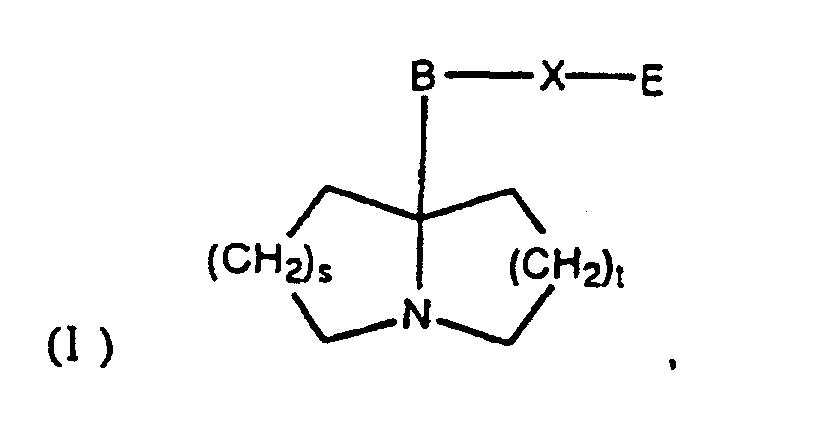
B iswherein R3 is H or C1-C6-alkyl;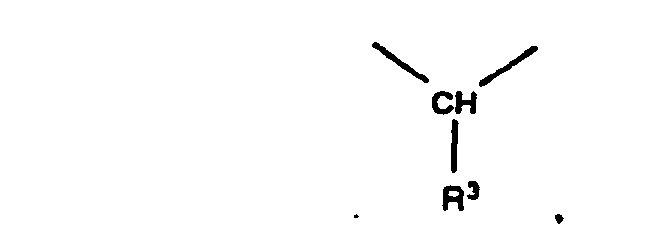
X is selected from the group consisting of oxygen and sulfur; and
E iswherein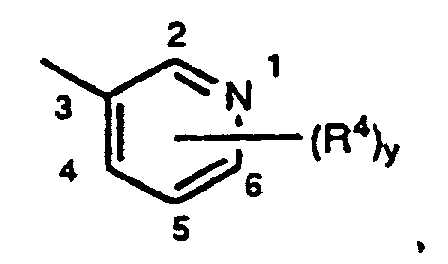
y is an integer selected from 2 and 3, with the requirements that - (a) when y=2,
R4 is selected from the group having substituents at the 2,4-, 2,5-, 2,6-, 4,5-, 4,6- and 5,6- positions of the pyridine ring wherein
a 2-position substituent is selected from the group consisting of - (i) -Br,
- (ii) -Cl,
- (iii) -F,
- (iv) -OH,
- (v) -NH2,
- (vi) -C1-C4-alkyl, and
- (vii) -C1-C3-allcoxy; and a substituent at the 4-, 5- and 6-position of the pyridine ring is selected from the group consisting of
- (i) -Br,
- (ii) -Cl,
- (iii) -F,
- (iv) -OH,
- (v) -C1-C4-alkyl,
- (vi) -CN,
- (vii) -CH2F,
- (viii) -CHF2,
- (ix) -CF3,
- (x) -NO2,
- (xi) -CH2OH,
- (xii) -CH2CN,
- (xiii) -C1-C3-alkoxy,
- (xiv) -NH2,
- (xv) -NH-CHO,
- (xvi) -NH-C(O)-(C1-C3-alkyl),
- (xvii) -N(C1-C3-alkyl)-C(O)-(C1-C3-alkyl),
- (xviii) -NH-(C1-C3-alkyl),
- (xix) -NH-CH2-phenyl,
- (xx) -N(C1-C3-alkyl)2,
- (xxi) -C(O)-OH,
- (xxii) -C(O)-O-C1-C3-alkyl,
- (xxiii) -C(O)-NH2,
- (xxiv) -C(O)-NH-C1-C3-alkyl,
- (xxv) -C(O)-NH-CH2-phenyl, and
- (xxvi) -O-C(O)-(C1-C3-alkyl); and
- (i) -Br,
- (ii) -Cl,
- (iii) -F,
- (iv) -CN,
- (v) -CH2OH,
- (vi) -C1-C4-alkyl, and
- (b) when y=3,
R4 is selected from the group having substituents at the 2,4,5-, 2,4,6-, 2.5.6- and 4,5,6- positions of the pyridine ring wherein
a 2-position substituent is selected from the group consisting of - (i) -Br,
- (ii) -Cl,
- (ii) -F,
- (iv) -OH,
- (v) -C1-C4-alkyl, and
- (vi) -C1-C3 alkoxy; and a substituent at the 4-, 5- and 6-position of the pyridine ring is selected from the group consisting of
- (i) -Br,
- (ii) -Cl,
- (iii) -F,
- (iv) -OH,
- (v) -C1-C4-alkyl,
- (vi) -CN,
- (vii) -CH2F,
- (viii) -CHF2,
- (ix) -CF3,
- (x) -NO2,
- (xi) -CH2OH,
- (xii) -CH2CN,
- (xiii) -C1-C3-alkoxy,
- (xiv) -NH2,
- (xv) -NH-CHO,
- (xvi) -NH-C(O)-(C1-C3-alkyl),
- (xvii) -N(C1-C3-alkyl)-C(O)-(C1-C3-alkyl),
- (xviii) -NH-(C1-C3-alkyl),
- (xix) -NH-CH2-phenyl,
- (xx) -N(C1-C3-alkyl)2,
- (xxi) -C(O)-OH,
- (xxii)-C(O)-O-C1-C3-alkyl,
- (xxiii) -C(O)-NH2,
- (xxiv) -C(O)-NH-C1-C3-alkyl,
- (xxv) -C(O)-NH-CH2-phenyl, and
- (xxvi) -O-C(O)-(C1-C3-alkyl): and
- (i) -Br,
- (ii) -Cl,
- (iii) -F,
- (iv) -CN,
- (v) -CH2OH,
- (vi) -C1-C4-alkyl
-
- The invention also provides a pharmaceutical composition for controlling synaptic transmission. comprising a pharmaceutically-acceptable carrier and a therapeutically-effective amount of a compound selected from the group having the formulas (I) and (II) described previously.
- The invention also provides the use of a compound selected from the group having the formulas (I) and (II) described previously for manufacturing a medicament for selectively controlling synaptic transmission by administration to a human or veterinary patient in need of such treatment of a therapeutically-effective amount.
- The invention further provides the use of a compound that selectively controls synaptic transmission selected from the group having the formulas (I) and (II) described previously for manufacturing a medicament for treating dementias, attention-deficit disorder, anxiety associated with cognitive impairment or substance abuse withdrawal characterized by decreased cholinergic function by administration to a human or veterinary patient in need of such treatment of a therapeutically-effective amount.
- A preferred embodiment of the invention is a compound of formula (I) wherein X is oxygen.
- A further preferred embodiment of the invention is a compound of formula (II) wherein X is oxygen.
- Representative compounds of the invention are those selected from the group consisting of:
- (1S,4R)-3-(S)-(5,6-dichloro-3-pyridyloxymethyl)-N-methyl-2-azabicyclo[2.2.1]heptane;
- (1S,4R)-3-(S)-(5-bromo-6-chloro-3-pyridyloxymethyl)-N-methyl-2-azabicyclo [2.2.1] heptane;
- (1S,4R)-3-(S)-(5-amino-3-pyridyloxymethyl)-N-methyl-2-azabicyclo[2.2.1]heptane;
-
- The terms "C1-C3-alkyl," "C1-C4-alkyl," or "C1-C6-alkyl" as used herein refer to saturated, straight- or branched-chain hydrocarbon radicals containing between one and three or one and six carbon atoms, respectively. Examples of C1-C4-alkyl radicals include, but are not limited to, methyl, ethyl, propyl, isopropyl, n-butyl and t-butyl. Examples of C1-C3 alkyl radicals include methyl, ethyl, propyl and isopropyl, examples of C1-C6-alkyl radicals include, but are not limited to, methyl, ethyl, propyl, isopropyl, n-butyl, t-butyl, neopentyl, n-hexyl.
- The term "C1-C3-alkoxy" as used herein refers to an C1-C3-alkyl group, as previously defined, attached to the parent molecular moiety through an oxygen atom. Examples of C1-C3-alkoxy, but are not limited to, methoxy, ethoxy, propoxy and isopropoxy.
- One or more asymmetric centers may exist in the compounds of the present invention. Except where otherwise noted, the present invention contemplates the various stereoisomers and mixtures thereof.
- As used herein, the term "pharmaceutically acceptable salt" refers to those salts which are, within the scope of sound medical judgment, suitable for use in contact with the tissues of humans and lower animals without undue toxicity, irritation, allergic response and the like, and are commensurate with a reasonable benefit/risk ratio. Pharmaceutically acceptable salts are well known in the art. For example, S. M. Berge, et al. describe pharmaceutically acceptable salts in detail in J. Pharmaceutical Sciences, 66: 1-19 (1977). The salts can be prepared in situ during the final isolation and purification of the compounds of the invention, or separately by reacting the free base function with a suitable organic acid. Examples of pharmaceutically acceptable, nontoxic acid addition salts are salts of an amino group formed with inorganic acids such as hydrochloric acid, hydrobromic acid, phosphoric acid, sulfuric acid and perchloric acid or with organic acids such as acetic acid, oxalic acid, maleic acid, tartaric acid, citric acid, succinic acid or malonic acid or by using other methods used in the art such as ion exchange. Other pharmaceutically acceptable salts include adipate, alginate, ascorbate, aspartate, benzenesulfonate, benzoate, bisulfate, borate, butyrate, camphorate, camphorsulfonate, citrate, cyclopentanepropionate, digluconate, dodecylsulfate, ethanesulfonate, formate, fumarate, glucoheptonate, glycerophosphate, gluconate, hemisulfate, heptanoate, hexanoate, hydroiodide, 2-hydroxy-ethanesulfonate, lactobionate, lactate, laurate, lauryl sulfate, malate, maleate, malonate, methanesulfonate, 2-naphthalenesulfonate, nicotinate, nitrate, oleate, oxalate, palmitate, pamoate, pectinate, persulfate, 3-phenylpropionate, phosphate, picrate, pivalate, propionate, stearate, succinate, sulfate, tartrate, thiocyanate, p-toluenesulfonate, undecanoate, valerate salts, and the like. Representative alkali or alkaline earth metal salts include sodium, lithium, potassium, calcium, magnesium, and the like. Further pharmaceutically acceptable salts include, when appropriate, nontoxic ammonium, quaternary ammonium, and amine cations formed using counterions such as halide, hydroxide, carboxylate, sulfate, phosphate, nitrate, lower alkyl sulfonate and aryl sulfonate.
- The term "prodrug" refers to compounds that are rapidly transformed in vivo to yield the parent compounds of Formula (I), as for example. by hydrolysis in blood. T. Higuchi and V. Stella provide a thorough discussion of the prodrug concept in Prodrugs as Novel Delivery Systems, Vol. 14 of the A.C.S. Symposium Series, American Chemical Society (1975). Examples of esters useful as prodrugs for compounds containing carboxyl groups may be found on pages 14-21 of Bioreversible Carriers in Drug Design: Theory and Application, edited by E.B. Roche. Pergamon Press (1987). Specific prodrug moieties that are useful include, for example, 1-acetoxy-(1-methyl)ethoxycarbonyl. acetyl. 2-(hydroxymethyl)benzoyl, 2-methylphenoxycarbonyl, 2-oxo-tetrahydrofuran-4-(R)-carboxoyl, 2-oxo-tetrahydrofuran-4-(S)-carboxoyl, 3-oxocyclohexenyl, 4-(diethylaminomethyl)benzoyl, 4-(methoxycarbonyl)phenoxycarbonyl, 4-chlorophenoxycarbonyl. 4-fluorophenoxycarbonyl, 4-methoxyphenoxycarbonyl, 4-methylphenoxycarbonyl, 4-nitrophenoxycarbonyl, (5-methyl-2-oxo- 1, 3-dioxol-4-en-4-yl)methoxycarbonyl, (5-methyl-2-oxo- 1,3-dioxol-4-en-4-yl)methoxycarbonyl, 2, 2-bis(ethoxycarbonyl)ethenyl, 2, 5-dihydro-2-oxo-furan-4-yl, 2, 6-dimethylphenoxycarbonyl, 5,5-dimethyl-3-oxocyclohexenyl, BOC, D-alanyl, D-phenylalanyl, ethoxycarbonyl, L-alanyl, L-phenylalanyl, monomethyl phthalyl, N-(2-hydroxybenzoyl)aminomethyl, N-acetyl-D-alanyl, N-aceryl-D-phenylalanyl, N-acetyl-L-alanyl, N-acetyl-L-phenylalanyl, N-BOC-D-alanyl, N-BOC-D-phenylalanyl, N-BOC-L-alanyl, N-BOC-L-phenylalanyl, N-phthalimidylmethyl, (pyrrolidin-1-yl)carbonyl, N-succinimidylmethyl, phenoxycarbonyl, (pyrrolidin-1-yl)carbonyl, and S-(phenylmethyl)cysteinoyl.
- The term "prodrug ester group" refers to any of several ester-forming groups that are hydrolyzed under physiological conditions. Examples of prodrug ester groups include pivaloyloxymethyl, acetoxymethyl, phthalidyl, indanyl and methoxymethyl, as well as other such groups known in the art.
- As used herein, the term "pharmaceutically acceptable ester" refers to esters which hydrolyze in vivo and include those that break down readily in the human body to leave the parent compound or a salt thereof. Suitable ester groups include, for example, those derived from pharmaceutically acceptable aliphatic carboxylic acids, particularly alkanoic, alkenoic, cycloalkanoic and alkanedioic acids, in which each alkyl or alkenyl moiety advantageously has not more than 6 carbon atoms. Examples of particular esters includes formates, acetates, propionates, butyrates, acrylates and ethylsuccinates.
- Abbreviations which have been used in the descriptions of the scheme and the examples that follow are: BOC for t-butyloxycarbonyl; Et2O for diethyl ether; EtOAc for ethyl acetate; DEAD for diethylazodicarboxylate: DMAP for 4-dimethylaminopyridine: DMF for dimethyl formamide; DPPA for diphenylphosphoryl azide; EDC for 1-(3-dimethylaminopropyl)-3-ethylcarbodiimide HCl; EtOAc for ethyl acetate; MeOH for methanol; NaN(TMS)2 for sodium bis(trimethylsilyl)amide; NMMO for N-methylmorpholine N-oxide; Ph for phenyl; TEA for triethylamine; TFA for trifluoroacetic acid; THF for tetrahydrofuran; TPP for triphenylphosphine.
- The pharmaceutical compositions of the present invention comprise a therapeutically effective amount of a compound of the present invention formulated together with one or more pharmaceutically acceptable carriers. As used herein, the term "pharmaceutically acceptable carrier" means a non-toxic, inert solid, semi-solid or liquid filler, diluent, encapsulating material or formulation auxiliary of any type. Some examples of materials which can serve as pharmaceutically acceptable carriers are sugars such as lactose, glucose and sucrose; starches such as corn starch and potato starch; cellulose and its derivatives such as sodium carboxymethyl cellulose, ethyl cellulose and cellulose acetate; powdered tragacanth; malt; gelatin; talc; excipients such as cocoa butter and suppository waxes; oils such as peanut oil, cottonseed oil; safflower oil; sesame oil; olive oil; corn oil and soybean oil; glycols such a propylene glycol; esters such as ethyl oleate and ethyl laurate; agar; buffering agents such as magnesium hydroxide and aluminum hydroxide; alginic acid; pyrogen-free water; isotonic saline; Ringer's solution; ethyl alcohol, and phosphate buffer solutions, as well as other non-toxic compatible lubricants such as sodium lauryl sulfate and magnesium stearate. as well as coloring agents, releasing agents, coating agents, sweetening, flavoring and perfuming agents, preservatives and antioxidants can also be present in the composition, according to the judgment of the formulator. The pharmaceutical compositions of this invention can be administered to humans and other animals orally, rectally, parenterally, intracisternally, intravaginally, intraperitoneally, topically (as by powders, ointments, or drops), bucally, or as an oral or nasal spray.
- Liquid dosage forms for oral administration include pharmaceutically acceptable emulsions, microemulsions, solutions, suspensions, syrups and elixirs. In addition to the active compounds, the liquid dosage forms may contain inert diluents commonly used in the art such as, for example, water or other solvents, solubilizing agents and emulsifiers such as ethyl alcohol, isopropyl alcohol, ethyl carbonate, ethyl acetate, benzyl alcohol, benzyl benzoate, propylene glycol, 1,3-butylene glycol, dimethylformamide, oils (in particular, cottonseed, groundnut, corn, germ, olive. castor, and sesame oils), glycerol, tetrahydrofurfuryl alcohol, polyethylene glycols and fatty acid esters of sorbitan, and mixtures thereof. Besides inert diluents, the oral compositions can also include adjuvants such as wetting agents. emulsifying and suspending agents, sweetening, flavoring, and perfuming agents.
- Injectable preparations, for example, sterile injectable aqueous or oleaginous suspensions may be formulated according to the known art using suitable dispersing or wetting agents and suspending agents. The sterile injectable preparation may also be a sterile injectable solution, suspension or emulsion in a nontoxic parenterally acceptable diluent or solvent, for example, as a solution in 1,3-butanediol. Among the acceptable vehicles and solvents that may be employed are water, Ringer's solution, U.S.P. and isotonic sodium chloride solution. In addition, sterile, fixed oils are conventionally employed as a solvent or suspending medium. For this purpose any bland fixed oil can be employed including synthetic mono- or diglycerides. In addition, fatty acids such as oleic acid are used in the preparation of injectables.
- The injectable formulations can be sterilized, for example, by filtration through a bacterial-retaining filter, or by incorporating sterilizing agents in the form of sterile solid compositions which can be dissolved or dispersed in sterile water or other sterile injectable medium prior to use.
- In order to prolong the effect of a drug, it is often desirable to slow the absorption of the drug from subcutaneous or intramuscular injection. This may be accomplished by the use of a liquid suspension of crystalline or amorphous material with poor water solubility. The rate of absorption of the drug then depends upon its rate of dissolution which, in turn, may depend upon crystal size and crystalline form. Alternatively, delayed absorption of a parenterally administered drug form is accomplished by dissolving or suspending the drug in an oil vehicle. Injectable depot forms are made by forming microencapsule matrices of the drug in biodegradable polymers such as polylactide-polyglycolide. Depending upon the ratio of drug to polymer and the nature of the particular polymer employed, the rate of drug release can be controlled. Examples of other biodegradable polymers include poly(orthoesters) and poly(anhydrides) Depot injectable formulations are also prepared by entrapping the drug in liposomes or microemulsions which are compatible with body tissues.
- Compositions for rectal or vaginal administration are preferably suppositories which can be prepared by mixing the compounds of this invention with suitable non-irritating excipients or carriers such as cocoa butter, polyethylene glycol or a suppository wax which are solid at ambient temperature but liquid at body temperature and therefore melt in the rectum or vaginal cavity and release the active compound.
- Solid dosage forms for oral administration include capsules, tablets, pills, powders, and granules. In such solid dosage forms, the active compound is mixed with at least one inert, pharmaceutically acceptable excipient or carrier such as sodium citrate or dicalcium phosphate and/or a) fillers or extenders such as starches, lactose, sucrose, glucose, mannitol, and silicic acid, b) binders such as, for example, carboxymethylcellulose, alginates, gelatin. polyvinylpyrrolidinone, sucrose, and acacia, c) humectants such as glycerol, d) disintegrating agents such as agar-agar, calcium carbonate, potato or tapioca starch, alginic acid, certain silicates, and sodium carbonate, e) solution retarding agents such as paraffin, f) absorption accelerators such as quaternary ammonium compounds, g) wetting agents such as, for example, cetyl alcohol and glycerol monostearate, h) absorbents such as kaolin and bentonite clay, and i) lubricants such as talc, calcium stearate, magnesium stearate, solid polyethylene glycols, sodium lauryl sulfate, and mixtures thereof. In the case of capsules, tablets and pills, the dosage form may also comprise buffering agents.
- Solid compositions of a similar type may also be employed as fillers in soft and hard-filled gelatin capsules using such excipients as lactose or milk sugar as well as high molecular weight polyethylene glycols and the like.
- The solid dosage forms of tablets, dragees, capsules, pills, and granules can be prepared with coatings and shells such as enteric coatings and other coatings well known in the pharmaceutical formulating art. They may optionally contain opacifying agents and can also be of a composition that they release the active ingredient(s) only, or preferentially, in a certain part of the intestinal tract, optionally, in a delayed manner. Examples of embedding compositions which can be used include polymeric substances and waxes.
- Solid compositions of a similar type may also be employed as fillers in soft and hard-filled gelatin capsules using such excipients as lactose or milk sugar as well as high molecular weight polyethylene glycols and the like.
- The active compounds can also be in micro-encapsulated form with one or more excipients as noted above. The solid dosage forms of tablets, dragees, capsules, pills, and granules can be prepared with coatings and shells such as enteric coatings, release controlling coatings and other coatings well known in the pharmaceutical formulating art. In such solid dosage forms the active compound may be admixed with at least one inert diluent such as sucrose, lactose or starch. Such dosage forms may also comprise, as is normal practice, additional substances other than inert diluents, e.g., tableting lubricants and other tableting aids such a magnesium stearate and microcrystalline cellulose. In the case of capsules, tablets and pills, the dosage forms may also comprise buffering agents. They may optionally contain opacifying agents and can also be of a composition that they release the active ingredient(s) only, or preferentially, in a certain part of the intestinal tract, optionally, in a delayed manner. Examples of embedding compositions which can be used include polymeric substances and waxes.
- Dosage forms for topical or transdermal administration of a compound of this invention include ointments, pastes, creams, lotions, gels, powders, solutions, sprays, inhalants or patches. The active component is admixed under sterile conditions with a pharmaceutically acceptable carrier and any needed preservatives or buffers as may be required. Ophthalmic formulation, ear drops, eye ointments, powders and solutions are also contemplated as being within the scope of this invention.
- The ointments, pastes, creams and gels may contain, in addition to an active compound of this invention, excipients such as animal and vegetable fats, oils, waxes, paraffins. starch, tragacanth, cellulose derivatives, polyethylene glycols, silicones, bentonites, silicic acid, talc and zinc oxide, or mixtures thereof.
- Powders and sprays can contain, in addition to the compounds of this invention, excipients such as lactose, talc, silicic acid, aluminum hydroxide, calcium silicates and polyamide powder, or mixtures of these substances. Sprays can additionally contain customary propellants such as chlorofluorohydrocarbons.
- Transdermal patches have the added advantage of providing controlled delivery of a compound to the body. Such dosage forms can be made by dissolving or dispensing the compound in the proper medium. Absorption enhancers can also be used to increase the flux of the compound across the skin. The rate can be controlled by either providing a rate controlling membrane or by dispersing the compound in a polymer matrix or gel.
- According to the methods of treatment of the present invention. disorders in synaptic transmission are treated or prevented in a patient such as a human or lower mammal by administering to the patient a therapeutically effective amount of a compound of the invention in such amounts and for such time as is necessary to achieve the desired result. By a "therapeutically effective amount" of a compound of the invention is meant a sufficient amount of the compound to treat disorders in synaptic transmission, at a reasonable benefit/risk ratio applicable to any medical treatment. It will be understood, however, that the total daily usage of the compounds and compositions of the present invention will be decided by the attending physician within the scope of sound medical judgment. The specific therapeutically effective dose level for any particular patient will depend upon a variety of factors including the disorder being treated and the severity of the disorder; the activity of the specific compound employed; the specific composition employed; the age, body weight, general health, sex and diet of the patient; the time of administration, route of administration, and rate of excretion of the specific compound employed; the duration of the treatment; drugs used in combinadon or coincidental with the specific compound employed; and like factors well known in the medical arts.
- The total daily dose of the compounds of this invention administered to a human or other mammal in single or in divided doses can be in amounts, for example, from 0.00 to 50 mg/kg body weight or more usually from 0.001 to 25 mg/kg body weight. Single dose compositions may contain such amounts or submultiples thereof to make up the daily dose. In general, treatment regimens according to the present invention comprise administration to a patient in need of such treatment from about 30 mg to about 1000 mg, and preferably about 80 mg, of the compound(s) of this invention per day in single or multiple doses.
- The compounds and processes of the present invention will be better understood in connection with the following synthetic schemes which illustrate the methods by which the compounds of the invention may be prepared. The groups n, y, R1, R3 and R4 are as defined above unless otherwise noted.

- In accordance with reaction Scheme l, compounds 5 and 10 (not claimed) are prepared. A 2-carboxyl-substituted azacycloalkyl compound (1), wherein n is as described above, R3 is H and Y is a C1-C3-alkyl or a suitable protecting group, such as BOC or CBZ, for example, which may subsequently be removed and replaced with H, allyl, or C1-C3-alkyl, is converted to the hydroxymethyl compound of formula (2) with a suitable reducing agent, such as Red-Al®, borane/THF, borane/methyl sulfide or LiAlH4, for example. Compound (2) is reacted with an appropriately substituted 3-hydroxypyridine compound, wherein R4 is as described above or is an appropriately protected R4 group (wherein the protecting group may be removed after the coupling reaction), in the presence of triphenylphosphine and DEAD such as described by O. Mitsunobu (Synthesis. 1981: 1) to form the pyridine compound of formula (3). This compound is then treated with a reagent suitable for removing the N-protecting group, such as trifluoroacetic acid for BOC removal, HCl in ethanol for CBZ removal, HBr in acetic acid, or hydrogenolysis with hydrogen in the presence of a noble mecal catalyst, to form the unprotected compound (4).
- The ring nitrogen may then be alkylated, for example, by treatment with alkyl halide in the presence of a base, formaldehyde in formic acid, or with an aldehyde and sodium cyanoborohydride in an alcohol solvent, such as methanol, ethanol or isopropanol, or by reaction with the appropriate alkylating reagent, such as, for example, allyl bromide, to give the desired compound (5), wherein R1 is as described above.
- Alternately, in place of the Mitsunobu reaction described above, it is possible to react the free hydroxyl group of compound (2) with a suitable reagent to convert it to a leaving group, such as tosylate or mesylate, for example, then reacting this compound with a suitable 3-pyridinol compound in the presence of base to prepare compounds (3). In addition, it is possible to react the free hydroxyl compound with a strong base to convert it to the alkoxide ion and react the alkoxide with a suitable 3-halopyridine compound to to prepare compounds (3). This reaction may be partiularly useful when other electron-withdrawing substituents are present on the pyridine ring.
- Alternately, compound (2) may be oxidized using a suitable mild oxidizing agent such as DMSO/pyridine•SO3, pyridinium chlorochromate or DMSO/oxalyl chloride, for example, to afford the aldehyde (6). The aldehyde is then reacted with a suitable organometallic nucleophile, for example, a Grignard reagent, to afford the alcohol (7), wherein R2 is as described above. The alcohol is then reacted as described above with a 3-hydroxypyridine and carried through the same series of reactions as described above, starting with compound (2) and leading to compounds (3), (4) and (5), to give the compounds (8), (9) and (10), wherein R1 is as described above.

- In accordance with Scheme 2, it is possible to prepare the precursors of compounds of formula (I). The compound (42), wherein s is 0, 1, or 2, as desired, R' is a suitable C1-C5-alkyl group, and Y is an N-protecting group, such as CBZ, is reacted with LDA, followed by either 3-bromo-1-propene or 4-bromo-1-butene, to give compound (43), wherein t is 1 or 2, respectively. In the instance wherein it is desired than be 1 or 2, compound (43) is reacted with BH3 followed by oxidation with H2O2 to give the alcohol compound (44). In the alternate instance wherein it is desired that t be 0, compound (43) is first oxidized with NalO4 and OsO4, followed by reduction with NaBH4, to give the compound (44) wherein t is 0. The alcohol (44), wherein t is 0, 1, or 2, is then reacted with methanesulfonyl chloride in a non-polar solvent and presence of a base, such as triethylamine, to give compound (45). By removal of protecting group Y from (45) under standard conditions, followed by treatment with base, such as K2CO3 or triethylamine, the ring closure is accomplished to afford compound (46). Reduction of the ester function of compound (46) with LiAlH4, for example, prepares the compound (47), wherein s and t are independently as described, except that both s and t may not concurrently be 0. Compound (47) may be substituted for compound (2) and carried forward and reacted according to the alternate reaction pathways shown for compounds (2) or (7) in Scheme 1 to give the desired compound of formula (I).

- In accordance with Scheme 3 are prepared the compounds of Formula (II). The amine compound (48), wherein R5 is C1-C3-alkyl, a chiral auxiliary group (for example, (R)-1-phenylethyl, that is easily removed and replaced with H or the desired C1-C3-alkyl group), or an N-protecting group (such as BOC or CBZ, which may be subsequently removed and replaced with H or the desired C1-C3-alkyl group), is reacted with an appropriate glyoxylic ester (49), wherein R6 may be C1-C5-alkyl, in the presence of an appropriate C5-C7-cycloalka-1,3-diene compound (50), to give the variously substituted unsaturated compound (51), wherein m is 1, 2 or 3, and R5 and R6 are as described immediately above. Compound (51) is then reduced with H2 in the presence of a noble metal catalyst, such as Pt or Pd/C to give compound (52), wherein m is as described above. Compound (52) is then reacted with a suitable ester reducing agent, such as LiAlH4, LiBH4, borane/THF or borane/methyl sulfide, for example, to afford the appropriately substituted alcohol compound (53), wherein m is as described above. Compound (53) may be substituted for compound (2) and carried forward and reacted according to the alternate reaction pathways shown for compounds (2) or (7) in Scheme 1 to give the desired compound of formula (III).
- For the purpose of identifying compounds as cholinergic agents which are capable of interacting with cholinergic channel receptors in the brain, a ligand-receptor binding assay was carried out as the initial screen. Compounds of the present invention were effective at interacting with neuronal nicotinic cholinergic receptors as.assayed in vitro for their ability to displace radioligand from neuronal nicotinic cholinergic channel receptors labeled with [3H]-cytisine ([3H]-CYT) (Protocol A below).
- Binding of [3H]-cytisine ([3H]-CYT) to nicotinic receptors was accomplished using crude synaptic membrane preparations from whole rat brain (Pabreza et al., Molecular Pharmacol., 1990, 39:9). Washed membranes were stored at-80°C prior to use. Frozen aliquots were slowly thawed and resuspended in 20 volumes of buffer (containing: 120 mM NaCl, 5 mM KCI, 2 mM MgCl2, 2 mM CaCl2 and 50 mM Tris-Cl, pH 7.4 @4°C). After centrifuging at 20,000x g for 15 minutes, the pellets were resuspended in 30 volumes of buffer. Homogenate (containing 125-150 µg protein) was added to triplicate tubes containing concentrations of test compound and [3H]-CYT (1.25 nM) in a final volume of 500 µL. Samples were incubated for 60 minutes at 4°C, then rapidly filtered through Whatman GF/B filters presoaked in 0.5% polyethyleneimine using 3 x 4 mL of ice-cold buffer. The filters are counted in 4 mL of Ecolume®(ICN). Nonspecific binding was determined in the presence of 10 µM (-)-nicotine and values were expressed as a percentage of total binding. IC50 values were determined with the RS-1 (BBN) nonlinear least squares curve-fitting program and IC50 values were converted to Ki values using the Cheng and Prusoff correction (Ki=IC50/(1+ligand]/Kd of ligand). Alternately, data were expressed as a percentage of the total specific binding. The binding data (shown in Table 1) suggest that the compounds of the present invention have high affinity for the neuronal nicotinic cholinergic channel receptor.
Binding to Neuronal Nicotinic Receptors Ex. No Binding (nM) 3 6.8 7 11 - The present invention will be better understood by reference to the following examples, which are intended as an illustration of, and not a limitation upon, the scope of the invention as it is defined by the appended claims.
- Several starting materials are used repeatedly throughout the examples that follow. 1-Methyl-2-(S)-pyrrolidinemethanol was obtained from Aldrich Chemical Co. 1-Methyl-2-(R)-pyrrolidinemethanol was obtained from Fluka.
- In the PCT Patent Application WO94 08992 of Abreo et al., published April 28, 1994, and in Abreo, et al. J. Med Chem., 3:, 817-825 (1996), are disclosed methods for preparing, inter alia, the (R) and (S) 1-BOC-2-(S)-pyrrolidinemethanol compounds, the (R) and (S) 1-BOC-2-(S)-azetidinemethanol compounds, and 1-Cbz-2-(R)-azetidinemethanol. 1-Cbz-2-(S)-azetidinemethanol is prepared from 2-(S)-azetidinecarboxylic acid using analogous procedures.
- To a solution of diethyl azodicarboxylate (1.89 mL, 12.0 mmol) in THF (30 mL) was added triphenylphosphine (3.15 g, 12.0 mmol) at 0°C, and the reaction mixture was stirred for 0.5 hour. 1-BOC-(S)-pyrrolidinemethanol (2.41 g, 12.0 mmol) and 5-bromo-6-chloropyridine-3-ol (2.09 g, 10.0 mmol) were then added. The reaction mixture was allowed to warm to room temperature overnight. The solvent was removed, and the residue was chromatographed on a silica gel column, eluting with EtOAc/hexane (1:5 and 1:2) to afford an oil (3.80 g, 97%). MS (CI/NH3) m/z 391,393 (M+H)+. 1H NMR (DMSO-d6, 300 MHz) δ 1.65-2.05 (m, 4H), 3.20-3.35 (m, 2H), 3.95-4.15 (m, 3H), 7.98 (d, J = 2.9 Hz, 1H), 8.21 (d, J = 2.9 Hz, 1H).
- To a solution of triphenylphosphine(2.6 g, 9.88 mmol) in THF (30 mL) was added diethyl azodicarboxylate (1.56 mL, 9.88 mmol) at 0°C, and the reaction mixture was stirred for 0.5 hour. 1-BOC-(R)-pyrrolidinemethanol (2.0 g, 9.88 mmol) and 5,6-dichloropyridine-3-ol (1.35 g, 8.23 mmol: prepared from 2-hydroxy-5-nitropyridine according to the procedure of V. Koch and S. Schnatterer, Synthesis 1990, 499-501) were then added. The reaction mixture was slowly warmed up to room temperature overnight. The solvent was removed. and the residue was chromatographed on a silica gel column, eluting with EtOAc/hexane 1:6 to afford an oil (2.16 g). MS (CI/NH3) m/z 347, 349 (M+H)+, 364, 366 (M+NH4)+. 1H NMR (CDCl3, 300 MHz) δ 1.47 (s, 9H), 1.85-2.05 (m, 4H), 3.35-3.45 (m, 2H), 3.85-4.2 (m, 3H), 7.35-7.45 (br d, 1H), 8.02 (d, J = 2.5 Hz, 1H).
- To 5,6-dichloro-3-(1-BOC-2-(R)-pyrrolidinylmethoxy)pyridine from step 2a (9.88 mmol) was added trifluoroacetic acid in methylene chloride (1:1, 20 mL) at 0°C, and the mixture was stirred for 30 minutes. The residue was neutralized with saturated KHCO3 solution. then extracted with methylene chloride, which was dried over MgSO4 and concentrated to afford the free base of the title compound (1.24 g, oil). The base (800 mg, 3.2 mmol) was converted to the salt by treatment with saturated hydrogen chloride in ether to give the title compound (398 mg). mp 250-252°C. MS (CI/NH3) m/z 247, 249, 251 (M+H)+, 264, 266 (M+NH4)+. 1H NMR (D2O, 300 MHz) δ 1.90-2.35 (m, 4H), 3.40-3.45 (m, 2H), 4.13 (m, 1H), 4.27 (m, 1H), 4.47 (m, 1H), 7.74 (d, J = 2.7 Hz, 1H), 8.07 (d, J = 2.7 Hz, 1H). Anal. Calcd. for C10H12N2OCl2• 1.0 HCl: C, 42.35; H, 4.62; N, 9.88. Found: C, 42.41; H, 4.49; N, 9.79. [α]25 D=-11.1 °(c 1.0. MeOH).
- The tide compound was prepared as in example 6 below substituting 3-bromo-2-chloro-5-hydroxypyridine from step 1 for the 3-hydroxypyridine thereof: mp 237-238 °C; 1H NMR (D2O) δ 1.72 (m, 1H), 1.89 (m, 3H), 2.20(m, 2H), 2.63 (m, 1H), 3.02 (s, 3H), 3.44 (dd J=9,3 Hz, 1H), 4.05 (m, 1H), 4.19 (t, J=10 Hz, 1H), 4.44 (dd, J= 11,4 Hz, 1H), 7.91(d,J=3 Hz, 1H), 8.18 (d,J=3 Hz, 1H).
- A mixture of (1R.4S)-3-(R)-carboethoxy-N-(S)-(-)-α-methylbenzyl-2-azabicyclo[2.2.1]hept-5-ene (2.40 g, 8.8 mmol, prepared according to the method of Stella et al., Tetrahedron Lett., 31: 2603, 1990) in ethanol (100 mL) and 20% Pd/C (dry, 1.2 g) was reduced under 4 atm of H2 at room temperature for 12 hours. The solution was filtered and concentrated under vacuum to give the free base as an oil (1.33 g). MS (DCI/NH3) m/e: 170 (M+H)+. 1H NMR (CDCl3, 300 MHz) δ:4.18 (q, 2H). 3.57 (br. s, 1H), 3.34 (s, 1H), 2.63 (br. s, 1H), 2.12 (m, 2H), 1.68-1.28 (m, 5H), 1.28 (t, 3H). The resultant oil was dissolved in methylene chloride (ca. 20 mL) and upon addition of HCl/diethyl ether (ca. 6.25 M) a white solid precipitated and was collected. The solid was then recrystallized from EtOH/Et2O and dried under vacuum at 50°C to give the title compound (0.94 g, 52% yield). mp>200°C.
- To the compound of step 4a (1.50 g, 7.3 mmol) in methylene chloride (20 mL) at room temperature under nitrogen was added triethylamine (1.0 mL, 7.3 mmol). After 5 min di-t-butyldicarbonate (1.84 mL. 8.0. mmol) was added. and the reaction was stirred for 18 hours. The reaction was quenched by the addition of aqueous pH 4 buffer, and the mixture was extracted with diethyl ether. The combined organic layers were dried over anhydrous sodium sulfate and concentrated under vacuum. The crude product was purified by flash chromatography (silica gel; ethyl acetate/hexane, 1:4; Rf = 0.45) to yield the title compound (1.49 g, 76%) as an oil. MS (DCI/NH3) m/e: 270 (M+H)+. 287 (M+NH4)+. 1H NMR (CDCl3, 300 MHz) δ: 4.28 (br. d, 1H), 4.18 (m, 2H), 3.78 (d, 1H), 2.67 (br. s, 1H), 1.94 (br. d, 1H), 1.80-1.40 (m, 5H), 1.44 (d, 9H), 1.28 (t, 3H).
- To the compound of step 4b (1.40 g, 5.2 mmol) in anhydrous tetrahydrofuran (30 mL) under nitrogen was added lithium aluminum hydride (0.60 g, 1.56 mmol). The resultant solution was heated at reflux for 2 hours. cooled to room temperature and quenched by the careful addition of sodium sulfate decahydrate. Diethyl ether (50 mL) and celite were added, and the mixture was stirred at room temperature for 1 hour and filtered. The filtrate was concentrated under vacuum to give the title compound (0.79 g, 100%) as a white solid. mp 76-77°C. MS (DCI/NH3) m/e: 142 (M+H)+. 1H NMR (CDCl3, 300 MHz) δ: 3.42 (dd, 1H), 3.41 (dd, 1H), 3.21 (br s, 1H), 2.36 (s, 3H), 2.15 (d, 1H), 1,98 (t, 1H), 1.94-1.85 (m, 1H), 1.80-1.70 (m, 1H), 1.60-1.52 (m, 1H), 1.38-1,20 (m, 3H).
- (1S,4R)-3-(S)-(Carboethoxy)-N-(R)-(+)-α-methylbenzyl-2-azabicyclo[2.2.1]hept-5-ene (11.0 g, 40.5 mmol, prepared by the method of Stella et al., Terrahedron Lett., 31: 2603, 1990) was reacted according to the method described in Example 559a, to give the title compound (5.7 g, 68%) as a crystalline solid. mp >200 °C.
- The compound from step 5a (5.0 g, 24.4 mmol), di-t-butyldicarbonate(5.8 g, 26.8 mmol) and triethylamine (3.4 g, 24.4 mmol) were reacted according to the method described in Example 559b to give the title compound (5.4 g, 82%) as an oil. MS (DCI/NH3) m/e: 270(M+H)+, 287(M+NH4)+. 1H NMR (CDCl3, 300 MHz)δ: 4.28 (d, 1H), 4.18 (m, 2H), 3.75 (d, 1H), 2.67 (br. s, 1H), 1.94 (m, 1H), 1.80-1.40 (m, 5H), 1.44 (d,9H),1.28 (t, 3H).
- The compound from step 5b , (3.0 g, 11.1 mmol) and lithiumaluminum hydride (1.27 g, 33.4 mmol) were reacted according to the method described in Example 4c, gave the title compound (1.43 g, 92%) as a white solid. mp 75-76°C. MS(DCI/NH3)m/e: 142(M+H)+, 140 (M-H)+. 1H NMR (CDCl3, 300 MHz) δ: 3.5-3.3 (m, 2H), 3.19 (br. s, 1H), 2.70 (br. s, 1H), 2.35 (s, 3H), 2.14 (d, 1H), 1.95 (t, 1H), 1.94-1.85 (m, 1H), 1.77-1.70 (m, 1H), 1.62-1.52 (m, 1H), 1.37-1.18 (m, 3H).
- To a solution of triphenylphosphine (1.78 g. 6.8 mmol) in tetrahydrofuran (40 mL) under nitrogen was added t-butylazodicarboxylate (1.56 g. 6.8 mmol). The solution was stirred at 0 °C for 20 minutes, and a THF solution (10 mL) of containing 3-hydroxypyridine (0.64 g, 6.8 mmol) and the compound (1S,4R)-3-(S)-(hydroxymethyl)-N-methyl-2-azabicyclo[2.2.1]heptane (0.64 g, 4.5 mmol, from Example 5c) was added. The reaction was allowed to warm to room temperature, stirred for 72 hours, then concentrated under vacuum. The residue was taken up in an aqueous solution of hydrochloric acid (10%, 100 mL) containing a small amount (ca .20 mL) of methylene chloride and stirred for 2 hours. The solution was washed with methylene chloride. The aqueous layer was adjusted to pH 12 with 10% aqueous sodium hydroxide and exacted with methylene chloride. The combined organic extracts were dried over anhydrous sodium sulfate and concentrated under vacuum. The crude product was purified by flash chromatography (silica gel; methylene chloride/ethyl acetate/methanol/ammonium hydroxide. 50:50:4:1; Rf = 0.3 1) to give an oil (80 mg, 8.0%). The oil was dissolved in methylene chloride, and addition of HCl/diethyl ether (6.25M, 15mL) gave a white solid which was collected and dried under vacuum at 50 °C to give the title compound as a deliquescent white solid. MS (DCI/NH3) m/e: 219 (M+H)+. 1H NMR (DMSO-d 6, 300MHz) δ: 11.35 (br. s, 1H), 8.75 (d, 1H), 8.53 (d, 1H), 8.18 (m; 1H), 7.38 (dd, 1H), 4.48 (m, 2H), 3.88 (br. s, 1H), 3.43-73.36 (m, 1H), 2.85 (d, 3H), 2.45 (br. s, 1H), 2.15 (d, 1H), 1.95 (m, 1H), 1.80-1.60 (m, 4H). IR (KBr) 3260, 3180, 1650, 1550, 1380, 1000, 810 cm-1; Anal. calc. for C13H20Cl2N2O·0.7 NH4Cl·0.3H2O: C, 46.74 H, 7.06; N, 11.32. Found: C,46.90; H, 7.33; N, 11.24.
- The title compound was prepared as in example 6 substituting 2,3-dichloro-5-hydroxypyridine from step 2 for the 3-hydroxypyridine thereof: mp 235-237°C; 1H NMR (D2O) δ 1.67 (m, 1H), 1.86 (m, 3H), 2.08 (m, 2H), 2.66 (br s, 1H), 2.98 (s, 3H), 3.45 (m, 1H), 4.05 (br s, 1H), 4.21 (t, J=10 Hz, 1H), 4.45 (dd, J=10,4 Hz, 1H), 7.76 (d,J=3 Hz, 1H), 8.10 (d. J=3 Hz, 1H); MS (Cl/NH3) m/z 287 (M+H)+; Anal. Calcd for C13H16N2OCl2•HCl: C, 48.24; H, 5.29; N, 8.65. Found: C, 48.10; H, 5.25; N, 8.43.
and

B, X, E are as defined above and
R1 is selected from the group consisting of H, allyl and C1-C6-alkyl.
Claims (8)
- Compound having the formula (I) :or a pharmaceutically acceptable salt or prodrug thereof, wherein
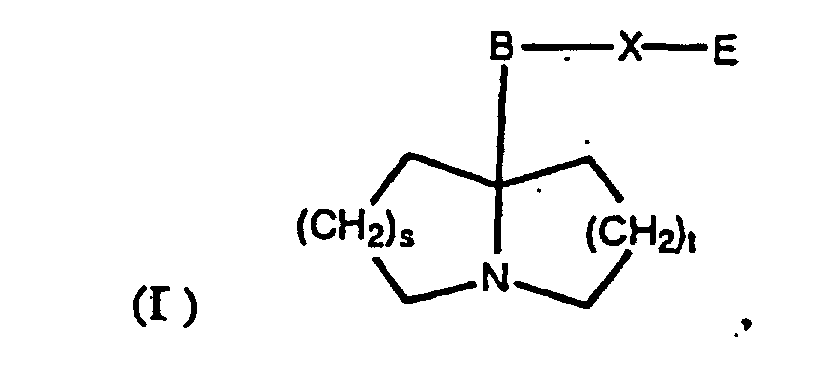
B iswherein R3 is H or C1-C6=alkyl;
X is selected from the group consisting of oxygen and sulfur; and
E iswherein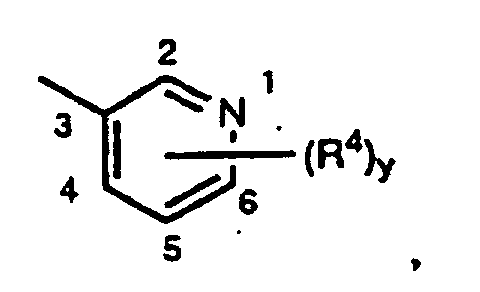
y is an integer selected from 2 and 3, with the requirements that(a) when y=2,
R4 is selected from the group having substituents at the 2,4-, 2,5-, 2,6-, 4,5-, 4,6- and 5,6- positions of the pyridine ring wherein
a 2-position substituent is selected from the group consisting ofa substituent at the 4-, 5- and 6-posidon of the pyridine ring is selected from the group consisting of(i) -Br,(ii) -Cl,(iii) -F,(iv) -OH,(v) -NH2,(vi) -C1-C4-alkyl, and(vii) -C1-C3-alkoxy; andwith the requirement that when there is no 2-position substitutent, then one R4 substituent must be selected from the group consisting of:(i) -Br,(ii) -Cl,(iii) -F,(iv) -OH,(v) -C1-C4-alkyl,(vi) -CN,(vii) -CH2F,(viii) -CHF2,(ix) -CF3,(x) -NO2,(xi) -CH2OH,(xii) -CH2CN,(xiii) -C1-C3-alkoxy,(xiv) -NH2,(xv) -NH-CHO,(xvi) -NH-C(O)-(C1-C3-alkyl),(xvii) -N(C1-C3-alkyl)-C(O)-(C1-C3-alkyl),(xviii) -NH-(C1-C3-alkyl),(xix) -NH-CH2-phenyl,(xx) -N(C1-C3-alkyl)2,(xxi) -C(O)-OH,(xxii) -C(O)-O-C1-C3-alkyl,(xxiii) -C(O)-NH2,(xxiv) -C(O)-NH-C1-C3-alkyl,(xxv) -C(O)-NH-CH2-phenyl, and(xxvi) -O-C(O)-(C1-C3-alkyl); and(i) -Br,(ii) -Cl,(iii) -F,(iv) -CN,(v) -CH2OH,(vi) -C1-C4-alkyl, and(b) when y=3,
R4 is selected from the group having substituents at the 2,4,5-, 2,4,6-, 2,5,6- and 4,5,6- positions of the pyridine ring wherein
a 2-position substituent is selected from the group consisting ofa substituent at the 4-, 5- and 6-position of the pyridine ring is selected from the group consisting of(i) -Br,(ii) -Cl,(ii) -F,(iv) -OH,(v) -C1-C4-alkyl, and(vi) -C1-C3 alkoxy; andwith the requirement that when there is no 2-position substitutent, then two R4 substituents must be selected from the group consisting of(i) -Br,(ii) -Cl,(iii) -F,(iv) -OH,(v) -C1-C4-alkyl,(vi) -CN,(vii) -CH2F,(viii) -CHF2,(ix) -CF3,(x) -NO2,(xi) -CH2OH,(xii) -CH2CN,(xiii) -C1-C3-alkoxy,(xiv) -NH2,(xv) -NH-CHO,(xvi) -NH-C(O)-(C1-C3-alkyl),(xvii) -N(C1-C3-alkyl)-C(O)-(C1-C3-alkyl),(xviii) -NH-(C1-C3-alkyl),(xix) -NH-CH2-phenyl,(xx) -N(C1-C3-alkyl)2,(xxi) -C(O)-OH,(xxii) -C(O)-O-C1-C3-alkyl,(xxiii) -C(O)-NH2,(xxiv) -C(O)-NH-C1-C3-alkyl,(xxv) -C(O)-NH-CH2-phenyl, and(xxvi) -O-C(O)-(C1-C3-alkyl); andand s and t are integers independently selected from the group consisting of 0, 1 and 2, with the requirement that both s and t may not concurrently be 0.(i) -Br,(ii) -Cl,(iii) -F,(iv) -CN,(v) -CH2OH,(vi) -C1-C4-alkyl, - The compound according to Claim 1, or a pharmaceutically acceptable salt or prodrug thereof, wherein X is oxygen.
- Compound having the formula (II):or a pharmaceutically acceptable salt or prodrug thereof, wherein m is selected from the group consisting of 1 and 2,
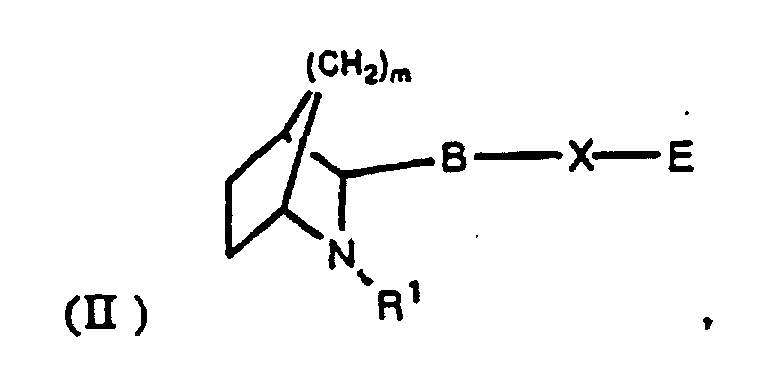
R1 is selected from the group consisting of H, allyl and C1-C6 alkyl,
B iswherein R3 is H or C1-C6=alkyl;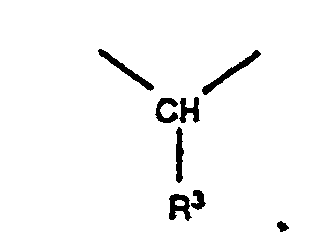
X is selected from the group consisting of oxygen and sulfur; and
E iswherein
y is an integer selected from : 2 and 3, with the requirements that(a) when y=2,
R4 is selected from the group having substituents at the 2,4-, 2,5-, 2,6-, 4,5-, 4,6- and 5,6- positions of the pyridine ring wherein
a 2-position substituent is selected from the group consisting ofa substituent at the 4-, 5- and 6-position of the pyridine ring is selected from the group consisting of(i) -Br,(ii) -Cl,(iii) -F,(iv) -OH,(v) -NH2,(vi) -C1-C4-alkyl, and(vii) -C1-C3-alkoxy; andwith the requirement that when there is no 2-position substitutent, then one R4 substituent must be selected from the group consisting of:(i) -Br,(ii) -Cl,(iii) -F,(iv) -OH,(v) -C1-C4-alkyl,(vi) -CN,(vii) -CH2F,(viii) -CHF2,(ix) -CF3,(x) -NO2,(xi) -CH2OH,(xii) -CH2CN,(xiii) -C1-C3-alkoxy,(xiv) -NH2,(xv) -NH-CHO,(xvi) -NH-C(O)-(C1-C3-alkyl),(xvii) -N(C1-C3-alkyl)-C(O)-(C1-C3-alkyl),(xviii) -NH-(C1-C3-alkyl),(xix) -NH-CH2-phenyl,(xx) -N(C1-C3-alkyl)2,(xxi) -C(O)-OH,(xxii) -C(O)-O-C1-C3-alkyl,(xxiii) -C(O)-NH2,(xxiv) -C(O)-NH-C1-C3-alkyl,(xxv) -C(O)-NH-CH2-phenyl, and(xxvi) -O-C(O)-(C1-C3-alkyl); and(i) -Br,(ii) -Cl,(iii) -F,(iv) -CN,(v) -CH2OH,(vi) -C1-C4-alkyl, and(b) when y=3,
R4 is selected from the group having substituents at the 2,4,5-, 2,4,6-, 2,5,6- and 4,5,6- positions of the pyridine ring wherein
a 2-position substituent is selected from the group consisting ofa substituent at the 4-, 5- and 6-position of the pyridine ring is selected from the group consisting of(i) -Br,(ii) -Cl,(ii) -F,(iv) -OH,(v) -C1-C4-alkyl, and(vi) -C1-C3 alkoxy; andwith the requirement that when there is no 2-position subsututent, then two R4 substituents must be selected from the group consisting of(i) -Br,(ii) -Cl,(iii) -F,(iv) -OH,(v) -C1-C4-alkyl,(vi) -CN,(vii) -CH2F,(viii) -CHF2,(ix) -CF3,(x) -NO2,(xi) -CH2OH,(xii) -CH2CN,(xiii) -C1-C3-alkoxy,(xiv) -NH2,(xv) -NH-CHO,(xvi) -NH-C(O)-(C1-C3-alkyl),(xvii) -N(C1-C3-alkyl)-C(O)-C1-C3-alkyl),(xviii) -NH-(C1-C3-alkyl),(xix) -NH-CH2-phenyl,(xx) -N(C1-C3-alkyl)2,(xxi) -C(O)-OH,(xxii) -C(O)-O-C1-C3-alkyl,(xxiii) -C(O)-NH2,(xxiv) -C(O)-NN-C1-C3-alkyl,(xxv) -C(O)-NH-CH2-phenyl, and(xxvi) -O-C(O)-(C1-C3-alkyl); and(i) -Br,(ii) -Cl,(iii) -F,(iv) -CN,(v) -CH2OH,(vi) C1-C4-alkyl. - The compound according to Claim 3, or a pharmaceutically acceptable salt or prodrug thereof, which is selected from the group consisting of:(1S,4R)-3-(S)-(5,6-dichloro-3-pyridyloxymethyl)-N-methyl-2-azabicyclo[2.2.1]heptane;(1S,4R)-3-(S)-(5-bromo-6-chloro-3-pyridyloxymethyl)-N-methyl-2-azabicyclo[2.2.1]heptane.
- The compound according to Claim 3, or a pharmaceutically acceptable salt or prodrug thereof, wherein X is oxygen.
- A pharmaceutical composition for controlling synaptic transmission, comprising a pharmaceutically acceptable carrier and a therapeutically effective amount of the compound of any one of claims 1 to 6, or the pharmaceutically acceptable salts and prodrugs thereof.
- Use of the compound any one of claims 1 to 6, or the pharmaceutically acceptable salts prodrugs thereof for manufacturing a medicament for selectively controlling synaptic transmission by administration to a human or veterinary patient in need of such treatment a therapeutically-effective amount of said compound or salt and prodrug thereof.
- Use of a compound according to any one of claims 1 to 6 for manufacturing a medicament for treating dementias, attention-deficit disorder, anxiety associated with cognitive impairment or substance abuse withdrawal characterized by decreased cholinergic function by administration to a human or veterinary patient in need of such treatment a therapeutically-effective amount of said compound.
Applications Claiming Priority (3)
| Application Number | Priority Date | Filing Date | Title |
|---|---|---|---|
| US994812 | 1992-12-22 | ||
| US99481297A | 1997-12-19 | 1997-12-19 | |
| PCT/US1998/027144 WO1999032480A1 (en) | 1997-12-19 | 1998-12-18 | Heterocyclic ether and thioether compounds useful in controlling chemical synaptic transmission |
Publications (2)
| Publication Number | Publication Date |
|---|---|
| EP1047690A1 EP1047690A1 (en) | 2000-11-02 |
| EP1047690B1 true EP1047690B1 (en) | 2004-03-24 |
Family
ID=25541083
Family Applications (1)
| Application Number | Title | Priority Date | Filing Date |
|---|---|---|---|
| EP98964167A Expired - Lifetime EP1047690B1 (en) | 1997-12-19 | 1998-12-18 | Heterocyclic ether and thioether compounds useful in controlling chemical synaptic transmission |
Country Status (9)
| Country | Link |
|---|---|
| EP (1) | EP1047690B1 (en) |
| JP (1) | JP4489940B2 (en) |
| AT (1) | ATE262519T1 (en) |
| CA (1) | CA2315117C (en) |
| DE (1) | DE69822668T2 (en) |
| DK (1) | DK1047690T3 (en) |
| ES (1) | ES2221234T3 (en) |
| PT (1) | PT1047690E (en) |
| WO (1) | WO1999032480A1 (en) |
Families Citing this family (26)
| Publication number | Priority date | Publication date | Assignee | Title |
|---|---|---|---|---|
| US6284779B1 (en) | 1999-02-03 | 2001-09-04 | Schering Aktiiengesellschaft | Heteroaromatic compounds |
| WO2000046193A2 (en) * | 1999-02-03 | 2000-08-10 | Schering Aktiengesellschaft | Ether derivatives having neuronal activity |
| US6544976B1 (en) | 1999-07-09 | 2003-04-08 | Ortho-Mcneil Pharmaceutical, Inc. | Neurotrophic 2-azetidinecarboxylic acid derivatives, and related compositions and methods |
| US8048917B2 (en) | 2005-04-06 | 2011-11-01 | Xenoport, Inc. | Prodrugs of GABA analogs, compositions and uses thereof |
| US6818787B2 (en) | 2001-06-11 | 2004-11-16 | Xenoport, Inc. | Prodrugs of GABA analogs, compositions and uses thereof |
| US7232924B2 (en) | 2001-06-11 | 2007-06-19 | Xenoport, Inc. | Methods for synthesis of acyloxyalkyl derivatives of GABA analogs |
| US7186855B2 (en) | 2001-06-11 | 2007-03-06 | Xenoport, Inc. | Prodrugs of GABA analogs, compositions and uses thereof |
| US8580842B2 (en) | 2003-09-30 | 2013-11-12 | Abbott Gmbh & Co. Kg | Heteroaryl-substituted 1,3-dihydroindol-2-one derivatives and medicaments containing them |
| US9029557B2 (en) | 2004-12-07 | 2015-05-12 | The Regents Of The University Of California | Labeled A4B2 ligands and methods therefor |
| WO2006086068A1 (en) * | 2004-12-07 | 2006-08-17 | The Regents Of The University Of California | Labeled alpha-4-beta-2 ligands and methods therefor |
| US20080167286A1 (en) | 2006-12-12 | 2008-07-10 | Abbott Laboratories | Pharmaceutical compositions and their methods of use |
| US8486979B2 (en) | 2006-12-12 | 2013-07-16 | Abbvie Inc. | 1,2,4 oxadiazole compounds and methods of use thereof |
| UY30846A1 (en) | 2006-12-30 | 2008-07-31 | Abbott Gmbh & Amp | OXINDOL DERIVATIVES REPLACED, MEDICINES THAT UNDERSTAND AND USE THEMSELVES |
| CN102026995B (en) | 2007-12-07 | 2014-10-29 | Abbvie德国有限责任两合公司 | 5,6-disubstituted oxindole derivatives and uses thereof |
| EP2231643B1 (en) | 2007-12-07 | 2012-10-31 | Abbott GmbH & Co. KG | Amidomethyl-substituted oxindole derivatives and their use in the manufacture of a medicament for the treatment of vasopressin-dependent diseases |
| US8703774B2 (en) | 2007-12-07 | 2014-04-22 | AbbVie Deutschland GmbH & Co. KG | Carbamate-substituted oxindole derivatives and use thereof for the treatment of vasopressin-dependent diseases |
| CN101952276B (en) | 2007-12-07 | 2014-10-22 | Abbvie德国有限责任两合公司 | 5-Halogen-substituted oxindole derivatives and their use for the treatment of vasopressin-dependent diseases |
| US8383657B2 (en) | 2007-12-21 | 2013-02-26 | Abbott Laboratories | Thiazolylidine urea and amide derivatives and methods of use thereof |
| EP2271344A4 (en) | 2008-03-31 | 2011-04-27 | Univ South Florida | METHODS OF TREATING DISEASE INDUCED ATAXIA AND NON-ATAXIC IMBALANCE |
| US8383658B2 (en) | 2008-06-04 | 2013-02-26 | Abbott Laboratories | Isoxazole based neuronal nicotinic receptor ligands and methods of use |
| KR20110091501A (en) | 2008-10-14 | 2011-08-11 | 싸이코제닉스 아이엔씨. | Nicotinic acetylcholine receptor ligands and uses thereof |
| AR075988A1 (en) | 2009-04-09 | 2011-05-11 | Lilly Co Eli | PIRIDYLOXI COMPOUND - PIRROLIDINE INHIBITOR OF RECOVERY OF SEROTONINE AND NOREPINEFRINE, PHARMACEUTICAL COMPOSITION THAT INCLUDES IT AND ITS USE FOR THE MANUFACTURE OF A USEFUL MEDICINAL PRODUCT FOR THE TREATMENT OF CHRONIC PAIN |
| WO2010138600A2 (en) | 2009-05-29 | 2010-12-02 | Abbott Laboratories | Pharmaceutical compositions for the treatment of pain |
| WO2010151815A2 (en) | 2009-06-25 | 2010-12-29 | Abbott Laboratories | 3,9-diazaspiro[5,5]undecane amides and ureas and methods of use thereof |
| WO2013071097A1 (en) | 2011-11-11 | 2013-05-16 | Georgetown University | 2,5-disubstituted-pyridyl nicotinic ligands, and methods of use thereof |
| CN105968112B (en) * | 2016-05-16 | 2018-09-14 | 段敏 | A method of preparing the Li Gelieting intermediates for treating type-2 diabetes mellitus |
Family Cites Families (4)
| Publication number | Priority date | Publication date | Assignee | Title |
|---|---|---|---|---|
| IL107184A (en) * | 1992-10-09 | 1997-08-14 | Abbott Lab | Heterocyclic ether compounds that enhance cognitive function |
| IL118279A (en) * | 1995-06-07 | 2006-10-05 | Abbott Lab | 3 - pyridyloxy (or thio) alkyl heterocyclic compounds, pharmaceutical compositions containing them and their uses in the preparation of medicaments for controlling chemical synaptic transmission |
| WO1997020819A1 (en) * | 1995-12-06 | 1997-06-12 | Eli Lilly And Company | Composition for treating pain |
| US5629325A (en) * | 1996-06-06 | 1997-05-13 | Abbott Laboratories | 3-pyridyloxymethyl heterocyclic ether compounds useful in controlling chemical synaptic transmission |
-
1998
- 1998-12-18 DK DK98964167T patent/DK1047690T3/en active
- 1998-12-18 PT PT98964167T patent/PT1047690E/en unknown
- 1998-12-18 EP EP98964167A patent/EP1047690B1/en not_active Expired - Lifetime
- 1998-12-18 ES ES98964167T patent/ES2221234T3/en not_active Expired - Lifetime
- 1998-12-18 WO PCT/US1998/027144 patent/WO1999032480A1/en not_active Ceased
- 1998-12-18 AT AT98964167T patent/ATE262519T1/en active
- 1998-12-18 DE DE69822668T patent/DE69822668T2/en not_active Expired - Lifetime
- 1998-12-18 CA CA2315117A patent/CA2315117C/en not_active Expired - Fee Related
- 1998-12-18 JP JP2000525417A patent/JP4489940B2/en not_active Expired - Fee Related
Also Published As
| Publication number | Publication date |
|---|---|
| EP1047690A1 (en) | 2000-11-02 |
| CA2315117C (en) | 2011-03-15 |
| PT1047690E (en) | 2004-07-30 |
| JP4489940B2 (en) | 2010-06-23 |
| ES2221234T3 (en) | 2004-12-16 |
| DK1047690T3 (en) | 2004-07-05 |
| DE69822668T2 (en) | 2005-03-10 |
| CA2315117A1 (en) | 1999-07-01 |
| ATE262519T1 (en) | 2004-04-15 |
| DE69822668D1 (en) | 2004-04-29 |
| WO1999032480A1 (en) | 1999-07-01 |
| JP2001526285A (en) | 2001-12-18 |
Similar Documents
| Publication | Publication Date | Title |
|---|---|---|
| EP0846114B1 (en) | 3-pyridyloxyalkyl heterocyclic ether compounds useful in controlling chemical synaptic transmission | |
| ES2221234T3 (en) | COMPOUNDS OF ETER AND THYETHYL CYCLES USED IN THE REGULATION OF CHEMICAL SYNTHETIC TRANSMISSION. | |
| US6127386A (en) | 3-Pyridyloxymethyl heterocyclic ether compounds useful in controlling chemical synaptic transmission | |
| DE69628556T2 (en) | TRICYCLIC COMPOUNDS AS INHIBITORS OF FARNESYL PROTEIN TRANSFERASE | |
| US6437138B1 (en) | 3-pyridyloxymethyl heterocyclic ether compounds useful in controlling chemical synaptic transmission | |
| US6001849A (en) | Furopyridine, thienopyridine pyrrolopyridine useful in controlling chemical synaptic transmission | |
| EP0970083B1 (en) | 7a-HETEROCYCLE-SUBSTITUTED HEXAHYDRO-1H-PYRROLIZINE COMPOUNDS USEFUL IN CONTROLLING CHEMICAL SYNAPTIC TRANSMISSION | |
| US6656958B2 (en) | Substituted pyridine compounds useful for controlling chemical synaptic transmission | |
| HK1011866B (en) | 3-pyridyloxyalkyl heterocyclic ether compounds useful in controlling chemical synaptic transmission | |
| EP1257535B1 (en) | Substituted pyridine compounds useful for controlling chemical synaptic transmission | |
| HK1026416B (en) | 7a-heterocycle-substituted hexahydro-1h-pyrrolizine compounds useful in controlling chemical synaptic transmission | |
| HK1227405A1 (en) | Modulators of cellular adhesion | |
| HK1095815B (en) | Modulators of cellular adhesion | |
| MXPA99007626A (en) | 7a-HETEROCYCLE-SUBSTITUTED HEXAHYDRO-1H-PYRROLIZINE COMPOUNDS USEFUL IN CONTROLLING CHEMICAL SYNAPTIC TRANSMISSION |
Legal Events
| Date | Code | Title | Description |
|---|---|---|---|
| PUAI | Public reference made under article 153(3) epc to a published international application that has entered the european phase |
Free format text: ORIGINAL CODE: 0009012 |
|
| 17P | Request for examination filed |
Effective date: 20000606 |
|
| AK | Designated contracting states |
Kind code of ref document: A1 Designated state(s): AT BE CH CY DE DK ES FI FR GB GR IE IT LI LU NL PT SE |
|
| 17Q | First examination report despatched |
Effective date: 20001221 |
|
| GRAP | Despatch of communication of intention to grant a patent |
Free format text: ORIGINAL CODE: EPIDOSNIGR1 |
|
| GRAS | Grant fee paid |
Free format text: ORIGINAL CODE: EPIDOSNIGR3 |
|
| GRAA | (expected) grant |
Free format text: ORIGINAL CODE: 0009210 |
|
| AK | Designated contracting states |
Kind code of ref document: B1 Designated state(s): AT BE CH CY DE DK ES FI FR GB GR IE IT LI LU NL PT SE |
|
| REG | Reference to a national code |
Ref country code: GB Ref legal event code: FG4D |
|
| REG | Reference to a national code |
Ref country code: CH Ref legal event code: EP |
|
| REG | Reference to a national code |
Ref country code: IE Ref legal event code: FG4D |
|
| REF | Corresponds to: |
Ref document number: 69822668 Country of ref document: DE Date of ref document: 20040429 Kind code of ref document: P |
|
| REG | Reference to a national code |
Ref country code: GR Ref legal event code: EP Ref document number: 20040401663 Country of ref document: GR |
|
| REG | Reference to a national code |
Ref country code: DK Ref legal event code: T3 |
|
| REG | Reference to a national code |
Ref country code: SE Ref legal event code: TRGR |
|
| REG | Reference to a national code |
Ref country code: CH Ref legal event code: NV Representative=s name: A. BRAUN, BRAUN, HERITIER, ESCHMANN AG PATENTANWAE |
|
| REG | Reference to a national code |
Ref country code: PT Ref legal event code: SC4A Free format text: AVAILABILITY OF NATIONAL TRANSLATION Effective date: 20040517 |
|
| REG | Reference to a national code |
Ref country code: ES Ref legal event code: FG2A Ref document number: 2221234 Country of ref document: ES Kind code of ref document: T3 |
|
| ET | Fr: translation filed | ||
| PLBE | No opposition filed within time limit |
Free format text: ORIGINAL CODE: 0009261 |
|
| STAA | Information on the status of an ep patent application or granted ep patent |
Free format text: STATUS: NO OPPOSITION FILED WITHIN TIME LIMIT |
|
| 26N | No opposition filed |
Effective date: 20041228 |
|
| REG | Reference to a national code |
Ref country code: CH Ref legal event code: PFA Owner name: ABBOTT LABORATORIES Free format text: ABBOTT LABORATORIES#CHAD 0377/AP6D-2, 100 ABBOTT PARK ROAD#ABBOTT PARK, ILLINOIS 60064-3500 (US) -TRANSFER TO- ABBOTT LABORATORIES#CHAD 0377/AP6D-2, 100 ABBOTT PARK ROAD#ABBOTT PARK, ILLINOIS 60064-3500 (US) |
|
| PGFP | Annual fee paid to national office [announced via postgrant information from national office to epo] |
Ref country code: NL Payment date: 20101124 Year of fee payment: 13 Ref country code: IE Payment date: 20101126 Year of fee payment: 13 Ref country code: FR Payment date: 20101203 Year of fee payment: 13 Ref country code: DK Payment date: 20101123 Year of fee payment: 13 Ref country code: AT Payment date: 20101122 Year of fee payment: 13 |
|
| PGFP | Annual fee paid to national office [announced via postgrant information from national office to epo] |
Ref country code: PT Payment date: 20101129 Year of fee payment: 13 Ref country code: LU Payment date: 20101216 Year of fee payment: 13 Ref country code: FI Payment date: 20101203 Year of fee payment: 13 Ref country code: CH Payment date: 20101026 Year of fee payment: 13 |
|
| PGFP | Annual fee paid to national office [announced via postgrant information from national office to epo] |
Ref country code: IT Payment date: 20101216 Year of fee payment: 13 Ref country code: GB Payment date: 20101123 Year of fee payment: 13 Ref country code: GR Payment date: 20101126 Year of fee payment: 13 Ref country code: SE Payment date: 20101122 Year of fee payment: 13 |
|
| PGFP | Annual fee paid to national office [announced via postgrant information from national office to epo] |
Ref country code: DE Payment date: 20101230 Year of fee payment: 13 |
|
| PGFP | Annual fee paid to national office [announced via postgrant information from national office to epo] |
Ref country code: BE Payment date: 20101213 Year of fee payment: 13 Ref country code: ES Payment date: 20101213 Year of fee payment: 13 |
|
| PGFP | Annual fee paid to national office [announced via postgrant information from national office to epo] |
Ref country code: CY Payment date: 20101123 Year of fee payment: 13 |
|
| REG | Reference to a national code |
Ref country code: PT Ref legal event code: MM4A Free format text: LAPSE DUE TO NON-PAYMENT OF FEES Effective date: 20120618 |
|
| BERE | Be: lapsed |
Owner name: *ABBOTT LABORATORIES Effective date: 20111231 |
|
| REG | Reference to a national code |
Ref country code: NL Ref legal event code: V1 Effective date: 20120701 |
|
| REG | Reference to a national code |
Ref country code: DE Ref legal event code: R082 Ref document number: 69822668 Country of ref document: DE Representative=s name: FARAGO PATENTANWAELTE, DE Ref country code: DE Ref legal event code: R082 Ref document number: 69822668 Country of ref document: DE Representative=s name: SCHIEBER - FARAGO, DE |
|
| REG | Reference to a national code |
Ref country code: DK Ref legal event code: EBP |
|
| REG | Reference to a national code |
Ref country code: CH Ref legal event code: PL Ref country code: SE Ref legal event code: EUG |
|
| GBPC | Gb: european patent ceased through non-payment of renewal fee |
Effective date: 20111218 |
|
| PG25 | Lapsed in a contracting state [announced via postgrant information from national office to epo] |
Ref country code: FI Free format text: LAPSE BECAUSE OF NON-PAYMENT OF DUE FEES Effective date: 20111218 Ref country code: PT Free format text: LAPSE BECAUSE OF NON-PAYMENT OF DUE FEES Effective date: 20120618 |
|
| REG | Reference to a national code |
Ref country code: GR Ref legal event code: ML Ref document number: 20040401663 Country of ref document: GR Effective date: 20120704 |
|
| REG | Reference to a national code |
Ref country code: FR Ref legal event code: ST Effective date: 20120831 |
|
| REG | Reference to a national code |
Ref country code: IE Ref legal event code: MM4A |
|
| PG25 | Lapsed in a contracting state [announced via postgrant information from national office to epo] |
Ref country code: CY Free format text: LAPSE BECAUSE OF NON-PAYMENT OF DUE FEES Effective date: 20111218 |
|
| REG | Reference to a national code |
Ref country code: DE Ref legal event code: R119 Ref document number: 69822668 Country of ref document: DE Effective date: 20120703 |
|
| PG25 | Lapsed in a contracting state [announced via postgrant information from national office to epo] |
Ref country code: CH Free format text: LAPSE BECAUSE OF NON-PAYMENT OF DUE FEES Effective date: 20111231 Ref country code: BE Free format text: LAPSE BECAUSE OF NON-PAYMENT OF DUE FEES Effective date: 20111231 Ref country code: GB Free format text: LAPSE BECAUSE OF NON-PAYMENT OF DUE FEES Effective date: 20111218 Ref country code: LI Free format text: LAPSE BECAUSE OF NON-PAYMENT OF DUE FEES Effective date: 20111231 Ref country code: IE Free format text: LAPSE BECAUSE OF NON-PAYMENT OF DUE FEES Effective date: 20111218 Ref country code: SE Free format text: LAPSE BECAUSE OF NON-PAYMENT OF DUE FEES Effective date: 20111219 Ref country code: DE Free format text: LAPSE BECAUSE OF NON-PAYMENT OF DUE FEES Effective date: 20120703 |
|
| PG25 | Lapsed in a contracting state [announced via postgrant information from national office to epo] |
Ref country code: IT Free format text: LAPSE BECAUSE OF NON-PAYMENT OF DUE FEES Effective date: 20111218 Ref country code: GR Free format text: LAPSE BECAUSE OF NON-PAYMENT OF DUE FEES Effective date: 20120704 |
|
| REG | Reference to a national code |
Ref country code: AT Ref legal event code: MM01 Ref document number: 262519 Country of ref document: AT Kind code of ref document: T Effective date: 20111218 |
|
| PG25 | Lapsed in a contracting state [announced via postgrant information from national office to epo] |
Ref country code: NL Free format text: LAPSE BECAUSE OF NON-PAYMENT OF DUE FEES Effective date: 20120701 Ref country code: AT Free format text: LAPSE BECAUSE OF NON-PAYMENT OF DUE FEES Effective date: 20111218 Ref country code: DK Free format text: LAPSE BECAUSE OF NON-PAYMENT OF DUE FEES Effective date: 20120102 |
|
| PG25 | Lapsed in a contracting state [announced via postgrant information from national office to epo] |
Ref country code: FR Free format text: LAPSE BECAUSE OF NON-PAYMENT OF DUE FEES Effective date: 20120102 |
|
| PG25 | Lapsed in a contracting state [announced via postgrant information from national office to epo] |
Ref country code: LU Free format text: LAPSE BECAUSE OF NON-PAYMENT OF DUE FEES Effective date: 20111218 |
|
| REG | Reference to a national code |
Ref country code: ES Ref legal event code: FD2A Effective date: 20130704 |
|
| PG25 | Lapsed in a contracting state [announced via postgrant information from national office to epo] |
Ref country code: ES Free format text: LAPSE BECAUSE OF NON-PAYMENT OF DUE FEES Effective date: 20111219 |