EP1047301B1 - Proteins encoded by polynucleic acids of porcine reproductive and respiratory syndrome virus (prrsv) - Google Patents
Proteins encoded by polynucleic acids of porcine reproductive and respiratory syndrome virus (prrsv) Download PDFInfo
- Publication number
- EP1047301B1 EP1047301B1 EP99905840A EP99905840A EP1047301B1 EP 1047301 B1 EP1047301 B1 EP 1047301B1 EP 99905840 A EP99905840 A EP 99905840A EP 99905840 A EP99905840 A EP 99905840A EP 1047301 B1 EP1047301 B1 EP 1047301B1
- Authority
- EP
- European Patent Office
- Prior art keywords
- prrsv
- dna
- artificial sequence
- sequence
- isu
- Prior art date
- Legal status (The legal status is an assumption and is not a legal conclusion. Google has not performed a legal analysis and makes no representation as to the accuracy of the status listed.)
- Expired - Lifetime
Links
Images


Classifications
-
- C—CHEMISTRY; METALLURGY
- C07—ORGANIC CHEMISTRY
- C07K—PEPTIDES
- C07K14/00—Peptides having more than 20 amino acids; Gastrins; Somatostatins; Melanotropins; Derivatives thereof
- C07K14/005—Peptides having more than 20 amino acids; Gastrins; Somatostatins; Melanotropins; Derivatives thereof from viruses
-
- C—CHEMISTRY; METALLURGY
- C12—BIOCHEMISTRY; BEER; SPIRITS; WINE; VINEGAR; MICROBIOLOGY; ENZYMOLOGY; MUTATION OR GENETIC ENGINEERING
- C12N—MICROORGANISMS OR ENZYMES; COMPOSITIONS THEREOF; PROPAGATING, PRESERVING, OR MAINTAINING MICROORGANISMS; MUTATION OR GENETIC ENGINEERING; CULTURE MEDIA
- C12N15/00—Mutation or genetic engineering; DNA or RNA concerning genetic engineering, vectors, e.g. plasmids, or their isolation, preparation or purification; Use of hosts therefor
- C12N15/09—Recombinant DNA-technology
- C12N15/11—DNA or RNA fragments; Modified forms thereof; Non-coding nucleic acids having a biological activity
-
- A—HUMAN NECESSITIES
- A61—MEDICAL OR VETERINARY SCIENCE; HYGIENE
- A61K—PREPARATIONS FOR MEDICAL, DENTAL OR TOILETRY PURPOSES
- A61K39/00—Medicinal preparations containing antigens or antibodies
- A61K39/12—Viral antigens
-
- A—HUMAN NECESSITIES
- A61—MEDICAL OR VETERINARY SCIENCE; HYGIENE
- A61K—PREPARATIONS FOR MEDICAL, DENTAL OR TOILETRY PURPOSES
- A61K39/00—Medicinal preparations containing antigens or antibodies
- A61K39/395—Antibodies; Immunoglobulins; Immune serum, e.g. antilymphocytic serum
-
- A—HUMAN NECESSITIES
- A61—MEDICAL OR VETERINARY SCIENCE; HYGIENE
- A61P—SPECIFIC THERAPEUTIC ACTIVITY OF CHEMICAL COMPOUNDS OR MEDICINAL PREPARATIONS
- A61P31/00—Antiinfectives, i.e. antibiotics, antiseptics, chemotherapeutics
- A61P31/04—Antibacterial agents
-
- A—HUMAN NECESSITIES
- A61—MEDICAL OR VETERINARY SCIENCE; HYGIENE
- A61P—SPECIFIC THERAPEUTIC ACTIVITY OF CHEMICAL COMPOUNDS OR MEDICINAL PREPARATIONS
- A61P31/00—Antiinfectives, i.e. antibiotics, antiseptics, chemotherapeutics
- A61P31/12—Antivirals
-
- A—HUMAN NECESSITIES
- A61—MEDICAL OR VETERINARY SCIENCE; HYGIENE
- A61P—SPECIFIC THERAPEUTIC ACTIVITY OF CHEMICAL COMPOUNDS OR MEDICINAL PREPARATIONS
- A61P31/00—Antiinfectives, i.e. antibiotics, antiseptics, chemotherapeutics
- A61P31/12—Antivirals
- A61P31/14—Antivirals for RNA viruses
-
- A—HUMAN NECESSITIES
- A61—MEDICAL OR VETERINARY SCIENCE; HYGIENE
- A61P—SPECIFIC THERAPEUTIC ACTIVITY OF CHEMICAL COMPOUNDS OR MEDICINAL PREPARATIONS
- A61P31/00—Antiinfectives, i.e. antibiotics, antiseptics, chemotherapeutics
- A61P31/12—Antivirals
- A61P31/20—Antivirals for DNA viruses
-
- A—HUMAN NECESSITIES
- A61—MEDICAL OR VETERINARY SCIENCE; HYGIENE
- A61P—SPECIFIC THERAPEUTIC ACTIVITY OF CHEMICAL COMPOUNDS OR MEDICINAL PREPARATIONS
- A61P37/00—Drugs for immunological or allergic disorders
- A61P37/02—Immunomodulators
- A61P37/04—Immunostimulants
-
- C—CHEMISTRY; METALLURGY
- C12—BIOCHEMISTRY; BEER; SPIRITS; WINE; VINEGAR; MICROBIOLOGY; ENZYMOLOGY; MUTATION OR GENETIC ENGINEERING
- C12N—MICROORGANISMS OR ENZYMES; COMPOSITIONS THEREOF; PROPAGATING, PRESERVING, OR MAINTAINING MICROORGANISMS; MUTATION OR GENETIC ENGINEERING; CULTURE MEDIA
- C12N7/00—Viruses; Bacteriophages; Compositions thereof; Preparation or purification thereof
-
- G—PHYSICS
- G01—MEASURING; TESTING
- G01N—INVESTIGATING OR ANALYSING MATERIALS BY DETERMINING THEIR CHEMICAL OR PHYSICAL PROPERTIES
- G01N33/00—Investigating or analysing materials by specific methods not covered by groups G01N1/00 - G01N31/00
- G01N33/48—Biological material, e.g. blood, urine; Haemocytometers
- G01N33/50—Chemical analysis of biological material, e.g. blood, urine; Testing involving biospecific ligand binding methods; Immunological testing
- G01N33/53—Immunoassay; Biospecific binding assay; Materials therefor
- G01N33/569—Immunoassay; Biospecific binding assay; Materials therefor for microorganisms, e.g. protozoa, bacteria, viruses
- G01N33/56983—Viruses
-
- A—HUMAN NECESSITIES
- A61—MEDICAL OR VETERINARY SCIENCE; HYGIENE
- A61K—PREPARATIONS FOR MEDICAL, DENTAL OR TOILETRY PURPOSES
- A61K39/00—Medicinal preparations containing antigens or antibodies
- A61K2039/51—Medicinal preparations containing antigens or antibodies comprising whole cells, viruses or DNA/RNA
-
- A—HUMAN NECESSITIES
- A61—MEDICAL OR VETERINARY SCIENCE; HYGIENE
- A61K—PREPARATIONS FOR MEDICAL, DENTAL OR TOILETRY PURPOSES
- A61K39/00—Medicinal preparations containing antigens or antibodies
- A61K2039/51—Medicinal preparations containing antigens or antibodies comprising whole cells, viruses or DNA/RNA
- A61K2039/52—Bacterial cells; Fungal cells; Protozoal cells
- A61K2039/522—Bacterial cells; Fungal cells; Protozoal cells avirulent or attenuated
-
- A—HUMAN NECESSITIES
- A61—MEDICAL OR VETERINARY SCIENCE; HYGIENE
- A61K—PREPARATIONS FOR MEDICAL, DENTAL OR TOILETRY PURPOSES
- A61K39/00—Medicinal preparations containing antigens or antibodies
- A61K2039/51—Medicinal preparations containing antigens or antibodies comprising whole cells, viruses or DNA/RNA
- A61K2039/525—Virus
- A61K2039/5254—Virus avirulent or attenuated
-
- A—HUMAN NECESSITIES
- A61—MEDICAL OR VETERINARY SCIENCE; HYGIENE
- A61K—PREPARATIONS FOR MEDICAL, DENTAL OR TOILETRY PURPOSES
- A61K39/00—Medicinal preparations containing antigens or antibodies
- A61K2039/55—Medicinal preparations containing antigens or antibodies characterised by the host/recipient, e.g. newborn with maternal antibodies
- A61K2039/552—Veterinary vaccine
-
- A—HUMAN NECESSITIES
- A61—MEDICAL OR VETERINARY SCIENCE; HYGIENE
- A61K—PREPARATIONS FOR MEDICAL, DENTAL OR TOILETRY PURPOSES
- A61K38/00—Medicinal preparations containing peptides
-
- A—HUMAN NECESSITIES
- A61—MEDICAL OR VETERINARY SCIENCE; HYGIENE
- A61K—PREPARATIONS FOR MEDICAL, DENTAL OR TOILETRY PURPOSES
- A61K39/00—Medicinal preparations containing antigens or antibodies
-
- C—CHEMISTRY; METALLURGY
- C12—BIOCHEMISTRY; BEER; SPIRITS; WINE; VINEGAR; MICROBIOLOGY; ENZYMOLOGY; MUTATION OR GENETIC ENGINEERING
- C12N—MICROORGANISMS OR ENZYMES; COMPOSITIONS THEREOF; PROPAGATING, PRESERVING, OR MAINTAINING MICROORGANISMS; MUTATION OR GENETIC ENGINEERING; CULTURE MEDIA
- C12N2770/00—MICROORGANISMS OR ENZYMES; COMPOSITIONS THEREOF; PROPAGATING, PRESERVING, OR MAINTAINING MICROORGANISMS; MUTATION OR GENETIC ENGINEERING; CULTURE MEDIA ssRNA viruses positive-sense
- C12N2770/00011—Details
- C12N2770/10011—Arteriviridae
- C12N2770/10021—Viruses as such, e.g. new isolates, mutants or their genomic sequences
-
- C—CHEMISTRY; METALLURGY
- C12—BIOCHEMISTRY; BEER; SPIRITS; WINE; VINEGAR; MICROBIOLOGY; ENZYMOLOGY; MUTATION OR GENETIC ENGINEERING
- C12N—MICROORGANISMS OR ENZYMES; COMPOSITIONS THEREOF; PROPAGATING, PRESERVING, OR MAINTAINING MICROORGANISMS; MUTATION OR GENETIC ENGINEERING; CULTURE MEDIA
- C12N2770/00—MICROORGANISMS OR ENZYMES; COMPOSITIONS THEREOF; PROPAGATING, PRESERVING, OR MAINTAINING MICROORGANISMS; MUTATION OR GENETIC ENGINEERING; CULTURE MEDIA ssRNA viruses positive-sense
- C12N2770/00011—Details
- C12N2770/10011—Arteriviridae
- C12N2770/10022—New viral proteins or individual genes, new structural or functional aspects of known viral proteins or genes
-
- C—CHEMISTRY; METALLURGY
- C12—BIOCHEMISTRY; BEER; SPIRITS; WINE; VINEGAR; MICROBIOLOGY; ENZYMOLOGY; MUTATION OR GENETIC ENGINEERING
- C12N—MICROORGANISMS OR ENZYMES; COMPOSITIONS THEREOF; PROPAGATING, PRESERVING, OR MAINTAINING MICROORGANISMS; MUTATION OR GENETIC ENGINEERING; CULTURE MEDIA
- C12N2770/00—MICROORGANISMS OR ENZYMES; COMPOSITIONS THEREOF; PROPAGATING, PRESERVING, OR MAINTAINING MICROORGANISMS; MUTATION OR GENETIC ENGINEERING; CULTURE MEDIA ssRNA viruses positive-sense
- C12N2770/00011—Details
- C12N2770/10011—Arteriviridae
- C12N2770/10034—Use of virus or viral component as vaccine, e.g. live-attenuated or inactivated virus, VLP, viral protein
Definitions
- the present invention concerns polynucleic acids isolated from a porcine reproductive and respiratory syndrome virus (PRRSV), polypeptides encoded by the polynucleic acids, the use of such polypeptides in the manufacture of vaccines which protect pigs from a PRRSV and methods of making the polypeptides and polynucleic acids.
- PRRSV porcine reproductive and respiratory syndrome virus
- Porcine reproductive and respiratory syndrome a new and severe disease in swine, was first reported in the U.S.A. in 1987, and was rapidly recognized in many western European countries (reviewed by Goyal, J. Vet. Diagn. Invest., 1993, 5:656-664 ; and in U.S. Application Serial Nos. 08/131,625 and 08/301,435 ).
- the disease is characterized by reproductive failure in sows and gilts, pneumonia in young growing pigs, and an increase in preweaning mortality ( Wensvoort et al., Vet. Q., 13:121-130, 1991 ; Christianson et al., 1992, Am. J. Vet. Res. 53:485-488 ; U.S. Application Serial Nos. 08/131,625 and 08/301,435 ).
- PRRS porcine reproductive and respiratory syndrome virus
- PRRSV porcine reproductive and respiratory syndrome virus
- PRRSV was classified within a single genus arterivirus in the new virus family of Arteriviridae, which includes equine arteritis virus (EAV), lactate dehydrogenase-elevating virus (LDV) and simian hemorrhagic fever virus (SHFV) ( Plagemann and Moennig, 1992, Adv. Virus. Res., 41:99-192 ; Godeny et al., 1993, Virology, 194:585-596 ; U.S. Application Serial Nos. 08/131,625 , 08/301,435 and Cavanaugh D., 1997, Arch. Virol. 142:629-633 ).
- EAV equine arteritis virus
- LDV lactate dehydrogenase-elevating virus
- SHFV simian hemorrhagic fever virus
- RNA viruses This group of single plus-strand RNA viruses shares many characteristics such as genome organization, replication strategy, morphology and macrophage tropism (Meulenberg et al., 1993; U.S. Application Serial Nos. 08/131,625 and 08/301,435 ). Subclinical infections and persistent viremia with concurrent antibody production are also characteristic histopathologic properties of the arteriviruses.
- sg mRNAs subgenomic mRNAs
- ORFs The genome of PRRSV is polyadenylated, about 15 kb in length and contains eight open reading frames (ORFs; Meulenberg et al., 1993; U.S. Application Serial Nos. 08/131,625 and 08/301,435 ).
- ORFs 1a and 1b probably encode viral RNA polymerase (Meulenberg et al., 1993).
- ORFs 5, 6 and 7 were found to encode a glycosylated membrane protein (E), an unglycosylated membrane protein (M) and a nucleocapsid protein (N), respectively (Meulenberg et al., 1995).
- ORFs 2 to 4 appear to have the characteristics of membrane-associated proteins (Meulenberg et al., 1993; U.S.
- ORFs 2 to 4 of LV encode virion-associated proteins designated as GP 2 , GP 3 and GP 4 , respectively (Van Nieuwstadt et al, 1996, 70:4767-4772).
- the major envelope glycoprotein of EAV encoded by ORF 5 may be the virus attachment protein, and neutralizing monoclonal antibodies (MAbs) are directed to this protein ( de Vries, J. Virol, 1992; 66:6294-6303 ; Faaberg, J. Virol, 1995; 69:613-617 ).
- the primary envelope glycoprotein of LDV, a closely related member of PRRSV, is also encoded by ORF 5, and several different neutralizing MAbs were found to specifically immunoprecipitate the ORF 5 protein ( Cafruny et al., Vir. Res., 1986; 5:357-375 ). Therefore, it is likely that the major envelope protein of PRRSV encoded by ORF 5 may induce neutralizing antibodies against PRRSV.
- hypervariable regions within the ORF5 were identified and were predicted to be antigenic ( U.S. Application Serial Nos. 08/131,625 and 08/301,435 ). It has been proposed that antigenic variation of viruses is the result of direct selection of variants by the host immune responses (reviewed by Domingo et al., J. Gen. Virol, 1993, 74:2039-2045 ). Thus, these hypervariable regions are likely due to the host immune selection pressure and may explain the observed antigenic diversity among PRRSV isolates.
- the M and N proteins of U.S. PRRSV isolates are highly conserved ( U.S. Application Serial No. 08/301,435 ).
- the M and N proteins are integral to preserving the structure of PRRSV virions, and the N protein may be under strict functional constraints. Therefore, it is unlikely either that (a) the M and N proteins are subjected to major antibody selection pressure or that (b) ORFs 6 and 7, which are likely to encode the M and N proteins, are responsible for or correlated to viral virulence.
- ORFs 6 and 7 which are likely to encode the M and N proteins, are responsible for or correlated to viral virulence.
- higher sequence variation of the LDV M protein was observed between LDV isolates with differing neurovirulence ( Kuo et al., 1992, Vir. Res. 23:55-72 ).
- ORFs 1a and 1b are predicted to translate into a single protein (viral polymerase) by frameshifting.
- ORFs 2 to 6 may encode the viral membrane associated proteins.
- PRRSV isolates ISU-12 (3 x plaque purified) and ISU-55 were deposited at the American Type Culture Collection, 12301 Parklawn Drive, Rockville, Maryland 20852, USA on 30 October 1992 and 29 September 1993 respectively under accession nos. VR-2385 and VR-2430. ISU-55 is of low pathogenicity and produces only 10-25% consolidation of lung tissues.
- PRRSV is an important cause of pneumonia in nursery and weaned pigs. PRRSV causes significant economic losses from pneumonia in nursery pigs (the exact extent of which are not fully known). Reproductive disease was the predominant clinical outcome of PRRSV infections during the past few years, due to the early prevalence of relatively low virulence strains of PRRSV. Respiratory disease has now become the main problem associated with PRRSV, owing to the increasing prevalence of relatively high virulence strains of PRRSV. A need is felt for a vaccine to protect against disease caused by the various strains of PRRSV.
- an isolated DNA sequence including a porcine reproductive and respiratory syndrome virus (PRRSV) consisting of the nucleotide sequence of high passage ISU-55 depicted in Figure 10.
- PRRSV porcine reproductive and respiratory syndrome virus
- an isolated DNA sequence comprising an open reading frame of the PRRSV of claim 1, which open ready frame is selected from nucleotides 191-7699 of the nucleotide sequence of high passage ISU-55 depicted in Figure 10 (ORF 1a), nucleotides 7687-12069 of the nucleotide sequence of high passage ISU-55 depicted in Figure 10 (ORF 1b), nucleotides 12074-12841 of the nucleotide sequence of high passage ISU-55 depicted in Figure 10 (ORF 2), nucleotides 12697-13458 of the nucleotide sequence of high passage ISU-55 depicted in Figure 10 (ORF-3), nucleotides 13242-13775 of the nucleotide sequence of high passage ISU-55 depicted in Figure 10 (ORF 4) and nucleotides 13789-14388 of the nucleotide sequence of high passage ISU-55 depicted in Figure 10 (ORF
- the present invention further provides a composition for inducing antibodies against PRRSV comprising amount of PRRSV encoded by the nucleotide sequence of high passage ISU-55 depicted in Figure 10 (ISU-55) effective to induce said antibodies in a pig and a physiologically acceptable carrier.
- the present invention provides a method of distinguishing PRRSV strain ISU-55 from other strains of PRRSV comprising:
- a "porcine reproductive and respiratory syndrome virus” or “PRRSV” refers to a virus which causes the diseases PRRS, PEARS, SIRS, MSD and/or PIP (the term “PIP” now appears to be disfavored), including the Iowa strain of PRRSV, other strains of PRRSV found in the United States strains of PRRSV found in Canada (e.g., IAF-exp91), strains of PRRSV found in Europe (e.g., Lelystad virus, PRRSV-10), and closely-related variants of these viruses which may have appeared and which will appear in the future.
- PRRSV refers to a virus which causes the diseases PRRS, PEARS, SIRS, MSD and/or PIP (the term “PIP” now appears to be disfavored), including the Iowa strain of PRRSV, other strains of PRRSV found in the United States strains of PRRSV found in Canada (e.g., IAF-exp91), strains of PRRSV found in Europe (e.g., Lelysta
- the "Iowa strain" of PRRSV includes (a) PRRSV isolates deposited in the American Type Culture Collection by the present inventors and/or described in this application and/or in either of prior U.S. Application Serial Nos. 08/131,625 and 08/301,435 .
- a vaccine is effective if it protects a pig against infection by a porcine reproductive and respiratory syndrome virus (PRRSV).
- PRRSV porcine reproductive and respiratory syndrome virus
- a vaccine protects a pig against infection by a PRRSV if, after administration of the vaccine to one or more unaffected pigs, a subsequent challenge with a biologically pure virus isolate (e.g., VR 2385) results in a lessened severity of any gross or histopathological changes (e.g., lesions in the lung) and/or of symptoms of the disease, as compared to those changes or symptoms typically caused by the isolate in similar pigs which are unprotected (i.e., relative to an appropriate control).
- a biologically pure virus isolate e.g., VR 2385
- a vaccine may be shown to be effective by administering the vaccine to one or more suitable pigs in need thereof, then after an appropriate length of time (e.g., 1-4 weeks), challenging with a large sample (10 3-7 TCID 50 ) of a biologically pure PRRSV isolate. A blood sample is then drawn from the challenged pig after about one week, and an attempt to isolate the virus from the blood sample is then performed.
- an appropriate length of time e.g., 1-4 weeks
- a blood sample is then drawn from the challenged pig after about one week, and an attempt to isolate the virus from the blood sample is then performed.
- Isolation of the virus is an indication that the vaccine may not be effective, and failure to isolate the virus is an indication that the vaccine may be effective.
- the effectiveness of a vaccine may be evaluated quantitatively (i.e., a decrease in the percentage of consolidated lung tissue as compared to an appropriate control group) or qualitatively (e.g., isolation of PRRSV from blood, detection of PRRSV antigen in a lung, tensil or lymph node tissue sample by an immunoperoxidase assay method etc.).
- the symptoms of the porcine reproductive and respiratory disease may be evaluated quantitatively (e.g., temperature/ fever), semi-quantitatively (e.g., severity of respiratory distress or qualitatively (e.g., the presence or absence of one or more symptoms or a reduction in severity of one or more symptoms, such as cyanosis, pneumonia, heart and/or brain lesions, etc.).
- An unaffected pig is a pig which has either not been exposed to a porcine reproductive and respiratory disease infectious agent, or which has been exposed to a porcine reproductive and respiratory disease infectious agent but is not showing symptoms of the disease.
- An affected pig is one which shows symptoms of PRRS or from which PRRSV can be isolated.
- the clinical signs or symptoms of PRRS may include lethargy, respiratory distress, "thumping" (forced expiration), fevers, roughened haircoats, sneezing, coughing, eye edema and occasionally conjunctivitis. Lesions may include gross and/or microscopic lung lesions, myocarditis, lymphadenitis, encephalitis and rhinitis. In addition, less virulent and non-virulent forms of PRRSV and of the Iowa strain have been found, which may cause either a subset of the above symptoms or no symptoms at all. Less virulent and non-virulent forms of PRRSV can be used according to the present invention to provide protection against porcine reproductive and respiratory diseases nonetheless.
- polynucleic acid refers to RNA or DNA, as well as mRNA and cDNA corresponding to or complementary to the RNA or DNA isolated from the virus or infectious agent.
- An "ORF” refers to an open reading frame, or polypeptide-encoding segment, isolated from a viral genome, including a PRRSV genome.
- an ORF can be included in part (as a fragment) or in whole, and can overlap with the 5'- or 3'-sequence of an adjacent ORF
- polynucleotide is equivalent to a polynucleic acid, but may define a distinct molecule or group of molecules (e.g., as a subset of a group of polynucleic acids).
- Porcine Reproductive and Respiratory Syndrome Virus (PRRSV), Modified Live Virus vaccine was prepared as a lyophilized viral cake and reconstituted with sterile water and administered by either the subcutaneous (SC) or intramuscular (IM) route.
- SC subcutaneous
- IM intramuscular
- the objective of this study was to confirm the immunogenicity of a PRRSV vaccine in three week-old swine by vaccinating either IM or SC with one 2 mL dose. Also to be determined was whether the PRRSV vaccine was safe and efficacious in three week-old pigs vaccinated with a single 2 mL dose, given with IM or SC, in protecting pigs against challenge with a virulent PRRSV strain, ISU-12.
- PRRSV seronegative pigs Seventy crossbred PRRSV seronegative pigs (IDEXX ELISA sample to positive ratio of ⁇ 0.4) were purchased from Evergreen Partners, Morris, MN and utilized in this study. All pigs were three weeks old at the time of vaccination.
- the PRRSV vaccine comprising virus strain ISU-55 was produced at virus passage level X+5.
- the vaccine was stored between 2°-7°C prior to use.
- the vaccine was titrated in five replicates.
- the stock vaccine was prepared by reconstituting the lyophilized virus portion with sterile water.
- the stock vaccine was diluted to the minimum protective dose level (approximately 10 4 TCID 50 per dose) in culture medium.
- a representative aliquot of the prepared vaccine was retained at -70°C for quantitation of viral antigen.
- the 70 PRRSV seronegative susceptible pigs used in this study were randomly distributed into four treatment groups and vaccinated as follows: Group Vaccine Route Dose Number Vaccination Group A PRRSV vaccine IM 2 mL 20 pigs Vaccination at 3 weeks of age. Group B PRRSV vaccine SC 2 mL 20 pigs Vaccination at 3 weeks of age. Group C (Controls) N/A* N/A N/A 20pigs N/A Group D (Controls) N/A N/A N/A 10 pigs N/A *N/A - Not applicable
- Injection sites were in the right neck (IM) or in the right flank fold (SC).
- the control pigs (Groups C and D) were not vaccinated with any vaccine or placebo vaccine.
- each of the 20 pigs in Groups A, B and C were commingled in a common isolation room and challenged with virulent PRRSV.
- Group D animals were left as nonchallenged controls.
- the virulent ISU-12 PRRSV challenge virus was obtained from Iowa State University, Arnes, Iowa.
- the virulent ISU-12 PRSV challenge virus was maintained as a frozen (-70°C) stock after expansion in PSP36 cells.
- Individual pigs were challenged intranasally with 2 mL of the challenge virus.
- the PRRSV challenge stock was thawed and diluted to 10 4 TCID 50 per 2 mL just before challenge. The challenge virus was held on ice during challenge.
- the pigs were evaluated each day for post challenge clinical signs such as inappetence, lethargy, depression, diarrhea, neurological symptoms, dyspnea, cyanosis and death.
- the lungs of each individual pig were examined for gross lesions at necropsy 10 days post challenge.
- the scorer of gross lung lesions was blinded to the identity of the treatment group to which each pig belonged. Briefly, the score for lung lesions in each lobe were recorded by estimating the percent of the lobe exhibiting PRRSV-like lesions (based on color and texture) and multiplied by the number of points possible for that lobe. Maximum score for each lobe was determined by the relative percentage of the total lung volume occupied by the lobe. Then the scores from the dorsal and ventral aspects of all lobes were added to obtain the total score for each pig. The maximum total score possible for each animal was 100.
- the PRRSV vaccine antigen titration results are shown in Table 1.
- the results of gross lung lesion scoring are given in Table 2.
- the gross lung lesion scores ranged from 0-29 with a mean score of 14.15 in the IM vaccinated pigs (Group A), from 1-27 with a mean score of 11.20 in the SC vaccinated pigs (Group B), from 7-57 with a mean score of 25-80 in the nonvaccinated challenge control pigs (Group C), and 1-28 with a mean score of 10.90 in the non-vaccinated nonchallenged control pigs (Group D).
- Both IM and SC vaccinated pigs had significantly less lung lesions than the nonvaccinated challenged control pigs (p ⁇ 0.05).
- the vaccinated pigs did not have significantly different gross lung lesion scores than the gross lung lesion scores from nonvaccinated nonchallenged pigs (P>0.05).
- the nonvaccinated challenged control pigs had significantly higher gross lung lesions than the nonvaccinated nonchallenged control pigs (P ⁇ 0.05).
- PRRSV Immunogenicity Study PRRSV Gross Lung Lesion Scoring 10 DPC Group Pig Number A IM Vaccinates B SC Vaccinates C Non Vaccinated Challenged Controls D Non Vaccinated Non Challenged Controls 1 21 7 53 4 2 1 12 7 8 3 19 5 57 1 4 12 17 12 2 5 29 3 18 3 6 5 18 35 11 7 18 19 20 24 8 6 5 28 14 9 4 7 32 28 10 0 8 41 14 11 16 3 27 12 12 27 19 13 9 16 40 14 29 19 10 15 17 1 24 16 20 13 15 17 26 12 9 18 21 14 9 19 6 13 35 20 12 5 25 Mean 14.15 11.20 25.80 10.90 Standard Deviation 8.86 6.84 14.47 9.3
- the PRRSV isolate VR2355, passage 7 was used in this study.
- a continuous cell line, ATCC CRL11171 was used for growth of the virus and isolation of viral RNA and total RNA from the virus-infected cell culture.
- the phagemids containing viral cDNA inserts were rescued by in vitro excision using ExAssist helper phage and E . coli SOLR cells (Stratagene, LaJolla, CA). After hybridizations with ORF1-specific overlapping fragments, several recombinant phagemids with virus specific cDNA inserts with sizes ranging from 2 to 6 kb were selected. The plasmids containing virus cDNA inserts were subsequently purified and sequenced by Sanger's dideoxynucleotide chain termination method with an automated DNA sequencer (Applied Biosystems, Foster City, CA). Universal, reverse and PRRSV-specific internal primers were used to determine the sequence.
- At least 2 independent cDNA clones representing sequence of ORFs 1a and 1b were sequenced.
- One region, not represented in the library (nt 1950 -2050) was PCR amplified with primers IM687 (5'-CCCCATTGTTGGACC TCTCC-3') and IM2500(5'-GTCACAACAGGGACCGAGC-3') using Tag DNA polymerase with addition of the proofreading Tag Extender (Stratagene).
- the sequencing data were assembled and analyzed using MacVector (International Biotechnologies, Inc., CT) and GeneWorks (IntelliGenetics, CA) computer programs.
- Primer extension experiments and RNA sequencing were performed using SureScript Preamplification System for First Strand cDNA Synthesis (Gibco BRL).
- 32 P-labeled oligonucleotide RNS (5'-CCAAGCTCCCCTGAAGGAGGCTGT CAC-3') was mixed with 0.5 ⁇ g of viral RNA of VR2385 in total volume of 12 ⁇ l and RNA was denatured for 10 min at 90°C.
- the sample was adjusted to a total volume 19 ⁇ l with first strand cDNA buffer and incubated for 5 min at 42 °C for primer annealing.
- Super Script II reverse transcriptase was then added to the reaction and the reaction mixture was incubated at 42°C or 50°C for min. Samples were analyzed in 40% polyacrylamide gel.
- Primer extension products were run next to the sequencing reactions of pPR59 clone, containing partial sequence of the leader.
- Oligonucleotide RNS served as a primer for the sequencing reaction.
- Direct sequencing of purified viral RNA was performed using RT RNA Sequencing Kit (USB, Cleveland, Ohio) with ⁇ 32 P-labeled oligonucleotide RNS (5'-CCAAGCTCCCCTGAAGGAGGCT GTCAC-3') and 151Ext (5'-AGCATCCC-AGACATGGTTAAAGGGG-3'). Sequencing was performed according to the manufacturer's instructions using 0.5 ⁇ g of purified viral RNA per sequencing reaction.
- Leader sequence of PRRSV VR2385 Previously, oligo dT and random cDNA libraries of PRRSV VR2385 in ⁇ Zap vector and here constructed the sequence for portion of ORF1b and complete ORFs-2-7 were determined. The partial leader sequence of VR2385, 161 nucleotides upstream of the ATG start codon of ORF1, was obtained from clone pPR59. It has been shown previously that the leader sequence of LDV is 156 nucleotides, and that the leader sequence of LV (a European isolate of PRRSV) was 221 nucleotides. In order to determine the complete leader sequence of U.S. PRRSV, primer extension experiments were performed.
- cDNA was synthesized using SuperScript II reverese transcriptase at 42°C and 50°C.
- rTth DNA polymerase in the presence of Mn was used for cDNA synthesis at 60°C to minimize potential of secondary structures in leader RNA during cDNA synthesis.
- the length of generated cDNA fragments were the same, about 190 nucleotides.
- direct sequencing of viral RNA was performed. Virion RNA isolated from virus purified through sucrose gradient was used in a direct RNA sequencing reaction. Direct RNA sequencing was performed with a primer complementary to the leader sequence at positions between 10 and 67 nt upstream of the AUG start codon of ORF1a.
- the putative size of the leader of PRRSV VR2385 was 190 nt, which is smaller than those reported for LV (221 nt), EAV (212 nt) and SHFV(208 nt), but larger than the leader sequence reported for LDV (156 nt).
- the sequence of the junction region at the 3' end of the leader was TTTAACC.
- the ATG start codon of ORF1a is located immediately downstream of this sequence.
- Similar results were also reported for LV, LDV and SHFV, in which the start codon of ORF1a is also located after the junction sequence.
- the genome of EAV leader junction sequence was reported 13 nt upstream of the start codon of ORF1a.
- the percentage of nucleotide sequence identity between the leader sequence of VR2385 and those of LV, LDV and SHFV were 55%, 47% and 38%, respectively. Surprisingly, only the last 44 nucleotides at the 3' end of the leader of VR2385 possess significant homology with the leader sequence of LV (86% identity in this region). Relatively higher homology was also found in this 44 nt region between VR2385 and LDV (64%) and SHFV(63%). No significant homology was found between leader sequences of VR2385 and EAV.
- ORF1a Functional domains in ORFs 1a/1b and homology with related viruses.
- the predicted size of ORF1a is 7197 nucleotides. It extends from nucleotides 191 to 7387 (excluding the stop codon TAG) and encodes a 2399 amino acid polyprotein.
- the leader-genome junction region is similar to that of LV, and the ATG start codon is located immediately after TTTAACC sequence of the leader. Differences were identified when compared the ORF1 sequences of LV and VR2385.
- ORF la in LV is 7188 nucleotides long and encodes 2396 amino acids, which is only 3 amino acids shorter than that of VR2385.
- Pairwise comparison of nucleotide sequences of VR2385 and LV indicated that the 5' end of ORF1a is more divergent than the 3' end.
- the nucleotide sequence 55% identities between VR2385 and LV is 61% in the 3' end of ORF 1a, (from nucleotides 3050 to 7387) in the first 1500 nucleotides of ORF 1a 55%, and 46% in a region between nucleotides 1500 to 2500.
- the most variable region within ORF1a was located between nucleotides 2500 and 3000, where there was no significant homology between VR2385 and LV.
- the amino acid identity was 49% for region from 1 to 530 aa, 55% for region from 1100 to 2399 amino acids, and no significant homology in the region extending from amino acids 530 to 1100.
- Comparison of the ORF1a sequences of VR2385 and LDV revealed that there is a 52% homology in first 2000 nucleotides and 55% homology in the last 3800 nucleotides of ORF 1a (corresponding to 3400-7197 nt in VR2385 and 2850-6678 nt in LDV).
- the region between 2000 to 3400 nt of VR2385 and 2500 to 2850 nt of LDV is highly variable with more than 500 nt deletion in LDV genome.
- ORF1a of VR2385 Analysis of the predicted protein encoded by ORF1a of VR2385 revealed the presence of two papain-like cysteine protease domains (aa 63-165 and aa 261-347) and one 3C-like serine protease domain (aa 1542-1644), similar to those described for other arteriviruses and coronaviruses.
- the hydrophilic profiles of ORF1a proteins of VR2385 were similar to those of LV and LDV.
- the 5' half of the proteins (first 1100 aa in VR2385) were mostly hydrophilic, the extreme 3' end (aa 2230-2399 in VR2385) was hydrophilic and the 3' half of the protein contains 4 hydrophobic regions (1129-1207 aa, 1240-1286 aa, 1478-1643 aa and 1856-2076 regions of VR2385).
- the VR2385 ORF1b is 4389 nucleotides long and it extends from nucleotide 7369 to 11757 (excluding stop codon TGA), and encoded a 1463 aa protein. Comparison of the nucleotide and predicted amino acid sequences of VR2385 ORF1b with those of LV, LDV and EAV confirmed that ORF1b is more conserved than ORF1a. Nucleotide and amino acid homology between VR2385 and LV was 64 and 67% in ORF1b and 58 and 53% in ORF1a, respectively. Comparison of the predicted proteins of VR2385 and EAV showed a 36% homology.
- the predicted ORF1b protein of VR2385 contains a putative polymerase domain (amino acids 373-576), a putative zinc finger domain (amino acid 647-689), and an RNA helicase domain (amino acids 793-1015) similar to those described for LV, LDV, EAV and coronaviruses.
- ORF1a Molecular characterization of ORF1 regions of coronaviruses and arteriviruses showed that the ORF1 polyprotein is expressed through two overlapping ORFs, ORF1a and ORF1b.
- ORF1b which overlaps with ORF1a in -1 frame, takes place through a so-called ribosomal frameshifting mechanism which allows the ribosome to bypass the ORF1a stop codon and translate ORF1b-encoded protein.
- the frameshift region consists of a "slippery sequence" followed by pseudoknot structure.
- leader sequences of VR2385 and LV indicated that these two viruses diverged from each other by point mutations and possibly through recombination.
- the extensive sequence differences in the leader sequences of these two viruses indicated the leader that sequence in PRRSV is not conserved, and is subject to extensive mutational changes.
- the most conserved region in the leader was the last 44 nucleotides at the 3' end, where nucleotide sequence acid identity was 86% between VR2385 and LV, and 68% between VR2385 and LDV.
- the putative leader sequence of VR2385 was 190 nt, which is 31 nt shorter than that of LV, and 35 nt longer than that of LDV. As shown in Fig.
- leader sequence In order to determine the complete leader sequence of PRRSV VR2385, several approaches were utilized including screening of oligo dT cDNA library with leader-specific 32 P-labeled PCR probe, RNA ligation of the viral RNA (RNA circularization) with T4 RNA ligase followed by RT-PCR with ORF7 and leader specific primers, and direct sequencing of the 5' end of viral RNA (Example 2). First, a 100 b.p. fragment of leader sequence was used as a probe to detect cDNA clones containing the leader sequence from an oligo dT ⁇ library.
- cDNA clones were analyzed and sequence, and these clones were found to represent leader sequences of mRNAs 7 (5 clones), 6 (2 clones) and 2 (1 clone).
- the size of leader sequence varied from 160 to 163 nucleotides in 6 of the 7 clones.
- the leader specific sequence was 172 nucleotides. It is possible that strong secondary structure within the leader of the virus prevented complete cDNA synthesis of the leader RNA during the construction of the ⁇ Zap library.
- the 3' and 5' ends of viral RNA were ligated head to tail by using T4 RNA ligase.
- RNA was subjected to an RT-PCR reaction with primers IM1003 (antisense oligonucleotide, complementary to the 3' end of the leader sequence) and IM1004 (oligonucleotide, corresponding to a segment of the 3' non-coding region of the genome, 100 nucleotides upstream of the poly(A) tail).
- primers IM1003 antisense oligonucleotide, complementary to the 3' end of the leader sequence
- IM1004 oligonucleotide, corresponding to a segment of the 3' non-coding region of the genome, 100 nucleotides upstream of the poly(A) tail.
- a diffuse band of the PCR products with sizes ranging from 250 to 350 nucleotides was purified from agarose gel, and cloned into the pSK + vector. Seven independent clones were sequenced.
- leader body junction sequences and intergenic regions within the genome of VR2385 were characterized.
- RT-PCR was performed with leader specific primer and primers, specific for each sg mRNA.
- Total RNAs isolated at 20 hours post infection (h.p.i.) were used for RT-PCR.
- the predominant bands were isolated from agarose gel, cloned and sequenced. Direct sequencing of the PCR products was also performed.
- a leader specific 32 P-labeled probe was used to screen a random cDNA library generated from viral RNA, and several clones containing leader -ORFla junction regions were isolated and sequenced.
- the leader body junction regions of sg mRNAs 2 to 7 were characterized.
- Table 3 summarizes the leader-body junction regions of all sg mRNAs and their corresponding regions in the virus genome. Only a single junction site was detected for sg mRNAs 2,3, and 6, whereas two sites were detected for sg mRNAs 4, 5 and 7, designated as 4a, 4b, 5a, 5b and 7a, 7b.
- the leader genome junction region in VR2385 was represented by a sequence CCACCCCTTTAACC, which is similar to that of - Table 3 Sequence of the leader body junction regions of subgenomic mRNAs of VR2385 RNA SEQUENCE N of clones 5'-leader CCACCCCTTTAACC 4 mRNA2 CCACCCC tt gaacc 3 genome cctgtcattgaacc mRNA3 CCACCCC t gtaacc 2 CCACCCCTT taacc 1 genome ggtcaaatgtaacc mRNA4a CCACCCCT tt gacc 1 genome aaggccacttgacc mRNA4b CCACCCC ttt cacc 2 CCACCCC g tttcacc 1 genome caattggtttcacc mRNA5.a CCACCC c gtcaact 1 genome agtgtgcgtcaact mRNA5.b CCACCCC ttta gc
- Table 4 compares the intergenic regions in genomes of VR2385, LV, LDV and EAV.
- the intergenic regions of VR2385, LV and LDV are very similar. Most variations were found in the first three nucleotides of these regions, whereas the last four nucleotides are conserved and in most regions are represented by the sequence AACC. Variations were also found in the first two nucleotides of this junction sequence (GACC and CACC in the intergenic region of ORF4 of VR2385, AGCC in the intergenic region of ORF5b of VR2385, GACC in the intergenic region of ORF3 in LV, and ACC in the intergenic region of ORF2 of LDV).
- the intergenic region for sg mRNA5a of VR2385 is GUCAACU, which is similar to that of EAV.
- Table 4 Sequence of the 3' end of the leader in the genome (RNA1) and junction sites of subgenomic mRNAs 2 to 7 of VR2385, LV, LDV and EAV.
- RNA VR2385 LV LDV EAV 1 UUUAACC UUUAACC UAUAACC AUCAACU 2 UUGAACC GUAAACC UAU-ACC UUCAACU 3.1 UGUAACC GUUGACC UGUAACC GUCAA-U 3.2 AUCAACU 3.3 AU-AAUU 4a CUUGACC 4b UUUCACC UUCAACC UGUAACC GUCAACU 5.a GUCAACU 5.b UUUAGCC UACAACC UAUAACC GUCAACU 6 UAUAACC CUCAACC UAAAACC GUCAACC 7.a GAUAACC 7.b GUAAACC GUUAACC CCUAACC CUCAACU
- the position of intergenic sites upstream of the start codon of the corresponding ORFs vary from 4 to 231 nucleotides.
- Table 5 compares the location of intergenic sites in the genomes of VR2385 and LV (numbers represents distance in nucleotides between the intergenic site and AUG start codon of the corresponding ORF.) The locations of these sites in the genome of VR2385 and LV differ in sg mRNAs 3, 4, 5 and 6. Three alternative intergenic sites for the synthesis of sg mRNAs 4,5 and 7 of VR2385 genome were also identified. Previously, that only six bands of sg mRNAs were detected in the cells infected with VR2385 by Northern blot hybridization analysis.
- a nested RT-PCR was performed by using leader and ORF specific primers.
- the amplified PCR products were similar in sizes corresponding to additional mRNAs 4a 5a and 7a (Fig 4).
- the sg mRNAs 4 and 5 were predominantly generated from intergenic sites 4b and 5b while only a minor population was generated by using alternative sites 4a and 5a.
- leader genome junction sequence with sequences of the intergenic regions and sequences of leader body junction regions in sg mRNAs indicated that only the last seven nucleotides of leader (TTTAACC) possess homology with the sequences of the intergenic regions in the genome of VR2385.
- the overall homology varies from 5 to 7 nt, and the only exception was sg mRNA6 where 11 out of 12 nt in the intergenic region are similar to the 3' end of the leader sequence.
- the CCACCCC sequence is conserved and generated from leader.
- CCACCCC sequence following CCACCCC, however, varied for different sg mRNAs, but has a high level of homology with the TTTAACC sequence at the 3' end of the leader.
- the variations in the leader body junction sequences detected for different sg mRNAs indicates that leader body joining is imprecise. Nucleotide sequence comparisons between the 3' end of the leader, leader body junction regions of the sg mRNAs and intergenic regions within the genome of VR2385 allowed detection of regions of actual joining between leader and body of sg mRNA
- the following provides a reliable test for the identification and differentiation of high passage ISU55 strain of PRRSV from field isolates of PRRSV.
- sequence of the low passage ISU55 strain (passage 7) was determined and this sequence was used to develop an RFLP test for differentiation of ISU55 hp strain.
- the sequence of ISU55 p-7 was analyzed to identify variable regions containing unique restriction sites. After computer sequence analysis and comparison with sequences of different PRRSV strains, a specific region containing two unique restriction sites was identified at the 3' end of ORF4.
- the sequence of high passage ISU55 strain was determined.
- the genomic region including ORFs 3 to 7 (2696 b.p.) was amplified by PCR and sequenced.
- the sequence of high passage ISU55 was compared with that of the ISU55 passage 7. The results of this comparison are shown in Fig. 5 (cDNA alignment), Fig. 6 (ORF maps) and Fig. 7 (restriction pattern with restriction enzymes DraI and BalI).
- the sequences of the low passage and high passage of PRRSV ISU55 were very conserved. There were only 15 nucleotide substitutions in high passage ISU55 strain. The sizes and relative positions of ORFs 3 to 7 remain the same.
- a single nucleotide change in the high passage virus created an additional DraI site in the sequence of the high passage virus compared to the low passage ISU55 (Fig. 7). This finding affords an opportunity to distinguish the high passage virus from the low passage ISU55 virus.
- a BLAST search was conducted to compare specific regions of ISU55 high passage strain with other PRRSV sequences available in the GenBank database. The 237b.p. fragment including the unique restriction sites of ISU 55 high passage strain (two DraI sites at position 966 and 1159 and BalI site at position 1157, restriction map of ISU55 hp.) was used as the template for comparison. The results of the blast search indicated that these sites are unique for ISU55 high passage strain and are not present in 24 other PRRSV isolates available in the database.
- the ORF5 (603 bp.) of ISU55 high passage strain was also compared with the ORF5 of other PRRSV strains.
- ISU55 passage 7 strain has the highest homology score and there are only 3 nucleotide substitutions.
- the strain with the second highest homology score was NADC8 which has 33 nucleotide substitutions in ORF5 compared to the ORF5 of ISU55 hp strain.
- the rest of PRRSV strains compared in the BLAST search displayed more variations (up to 63 nt changes) in the ORF5.
- PCR-RFLP was developed to differentiate ISU55 high passage strain from ISU55 lp virus and other strains of PRRSV.
- two primers were synthesized: forward primer 55F 5'-CGTACGGCGATAGGGACACC-3' (pos. 823) and reverse primer 3RFLP 5'-GGCATATATCATCACTGGCG-3' (pos. 1838) (positions from the 5' end of 2696 bp. sequenced fragment of ISU55 high passage strain).
- the reverse primer for the PCR-RFLP test was the same as the one used in a PCR-RFLP test to differentiate MLV ResPRRSV vaccine strain since this primer has been used in the PCR-RFLP with a large number of PRRSV isolates and shown to be specific ( Wesley et al, J. Vet. Diagn. Invest. 10:140-144 (1998) ; Wesley et al, Amer. Assoc. Of Swine Practitioners, pp. 141-143 (1996 ); Andreyev et al, Arch. Virol. 142:993-1001 (1997) ; Mengeling, et al, 1997, all of which are incorporated herein by reference in their entireties).
- a 1026 bp fragment was amplified from all the isolates. These fragments were purified and digested with restriction enzymes DraI and BalI. The resulting products were analyzed in 1.5% agarose gel. Fig.8 shows the results of the test. Line one shows an untreated 1026 bp PCR fragment of ISU55hp strain. Line 2 and 5 shows PCR products of-ISU55 hp digested with DraI (line 2) and BalI (line 5). The 626 bp, 187 bp and 135 bp fragments were formed after digestion with DraI, and 626 and 322 bp. fragments were formed after digestion with BalI.
- Lines 3, 4, 6, and 7 show results of DraI digestion (lines 3 and 4) and BalI digestion (lines 6 and 7) of PCR products of ISU12 lp (lines 3 and 6) and ISU12 hp (lines 4 and 7) strains. In all reactions with ISU12 lp and hp strains a PCR fragment of 1026 bp was detected. These data correlate with the predictions for the PCR-RFLP differentiation test for the ISU55 hp strain.
- the ORF1a was the most variable and one 309 nucleotides deletion was found in the genome of VR2385 compared to the sequence of Vaccine Strain. This deletion was in frame and located in the region of ORF1a at position 3242 nucleotide from the 5' end of genome of VR2385 PRRSV. Another three nucleotides were deleted in the region 2504-2515 nt of the genome causing 1 aa deletion compare to the genome of Vaccine Strain. Results of genome comparison of different ORFs of Vaccine Strain and VR2385 strain are summarized in the Table 6. Overall DNA homology between these strains was about 91 % with 14094 nucleotides identical in both strains. Not including 309 nt deletion DNA homology was 93%.
- Leader sequence was determined only for VR2385 strain by direct sequencing of the viral RNA and 17 bp primer specific for 5' end of the leader of VR2385 was used to amplify 170 nt portion of the leader of Vaccine Strain. Comparison of these sequences showed overall homology of 94% with single nucleotides deletions in both strains: nucleotides A (pos. 75) and G (pos. 119) of VR2385 leader are missing in the leader of Vaccine Strain, and nucleotides A (pos. 87) and G (pos. 124) of Vaccine Strain leader are missing in the leader of VR2385 strain.
- the ORF1a in the Vaccine Strain extends from nts 191 to 7699 and encodes 2503 amino acid (aa) protein, which is 103 aa longer compare to the ORF 1a protein of VR2385 strain.
- Comparison with ORF1a protein of LV showed approximately 47% of aa identity overall, but several regions with different protein similarity can be identified.
- Relatively conservative 5' end (aa 1 to 529 in Vaccine Strain and aa 1 to 521 in LV, 50% aa identity), relatively conservative 3' end (aa 1232 to 2503 in Vaccine Strain and aa 1115 to 2396 in LV, 58% aa identity), and hypervariable region (HVR) in between (aa 530 to 1231 in Vaccine Strain and aa 522 to 1114 in LV, aa identity less than 40%).
- HVR hypervariable region
- ORF 1b in the Vaccine Strain extends from nts 7687 to 12069 and encodes 1461 aa protein, which is similar in size to that of VR2385. Nucleotide and amino acid comparison showed, that ORF1b is much more conservative compare to ORF1a. Nucleotide homology between Vaccine Strain and VR2385 was 93 %, with 97% homology of their predicted proteins. Comparison with ORF1b of LV (1462 aa) showed 67 % of aa identity. One variable region was detected at the 3' end of ORF1b (aa 1367-1461) compare 10 LV.
- the ORF2 to ORF7 region of the vaccine strain showed similar genome organization to that of VR2385, with similar sizes and relative locations of the ORFs.
- Data of homology comparison between Vaccine Strain and VR2385 are presented in the Table 6, Nucleotide (amino acid) identity of Vaccine Strain with LV was 66% (61 %) for ORF2, 61% (55%) for ORF3, 66 % (67%) for ORF4, 63% (51%) for ORF5. 68% (79%) for ORF6, and 60 % (58%) for ORF7. Table 6.
Landscapes
- Health & Medical Sciences (AREA)
- Life Sciences & Earth Sciences (AREA)
- Chemical & Material Sciences (AREA)
- Engineering & Computer Science (AREA)
- Organic Chemistry (AREA)
- Virology (AREA)
- General Health & Medical Sciences (AREA)
- Medicinal Chemistry (AREA)
- Immunology (AREA)
- Molecular Biology (AREA)
- Genetics & Genomics (AREA)
- Pharmacology & Pharmacy (AREA)
- Public Health (AREA)
- Animal Behavior & Ethology (AREA)
- Veterinary Medicine (AREA)
- Biomedical Technology (AREA)
- Bioinformatics & Cheminformatics (AREA)
- Microbiology (AREA)
- Biotechnology (AREA)
- Biochemistry (AREA)
- General Chemical & Material Sciences (AREA)
- Wood Science & Technology (AREA)
- Zoology (AREA)
- Chemical Kinetics & Catalysis (AREA)
- Nuclear Medicine, Radiotherapy & Molecular Imaging (AREA)
- Oncology (AREA)
- Communicable Diseases (AREA)
- Hematology (AREA)
- Proteomics, Peptides & Aminoacids (AREA)
- Biophysics (AREA)
- General Engineering & Computer Science (AREA)
- Urology & Nephrology (AREA)
- Epidemiology (AREA)
- Physics & Mathematics (AREA)
- Mycology (AREA)
- Gastroenterology & Hepatology (AREA)
- Analytical Chemistry (AREA)
- Food Science & Technology (AREA)
- General Physics & Mathematics (AREA)
- Cell Biology (AREA)
Abstract
Description
- The present invention concerns polynucleic acids isolated from a porcine reproductive and respiratory syndrome virus (PRRSV), polypeptides encoded by the polynucleic acids, the use of such polypeptides in the manufacture of vaccines which protect pigs from a PRRSV and methods of making the polypeptides and polynucleic acids.
- Porcine reproductive and respiratory syndrome (PRRS), a new and severe disease in swine, was first reported in the U.S.A. in 1987, and was rapidly recognized in many western European countries (reviewed by Goyal, J. Vet. Diagn. Invest., 1993, 5:656-664; and in
U.S. Application Serial Nos. 08/131,625 and08/301,435 ). The disease is characterized by reproductive failure in sows and gilts, pneumonia in young growing pigs, and an increase in preweaning mortality (Wensvoort et al., Vet. Q., 13:121-130, 1991; Christianson et al., 1992, Am. J. Vet. Res. 53:485-488;U.S. Application Serial Nos. 08/131,625 and08/301,435 ). - The causative agent of PRRS, porcine reproductive and respiratory syndrome virus (PRRSV), was identified first in Europe and then in the U.S.A. (Collins et al., 1992, J. Vet. Diagn. Invest., 4:117-126). The European strain of PRRSV, designated as Lelystad virus (LV), has been cloned and sequenced (Meulenberg et al., 1993, Virology, 192:62-72 and J. Gen. Virol., 74:1697-1701; Conzelmann et al., 1993, Virology, 193:329-339).
- PRRSV was classified within a single genus arterivirus in the new virus family of Arteriviridae, which includes equine arteritis virus (EAV), lactate dehydrogenase-elevating virus (LDV) and simian hemorrhagic fever virus (SHFV) (Plagemann and Moennig, 1992, Adv. Virus. Res., 41:99-192; Godeny et al., 1993, Virology, 194:585-596;
U.S. Application Serial Nos. 08/131,625 ,08/301,435 and Cavanaugh D., 1997, Arch. Virol. 142:629-633). This group of single plus-strand RNA viruses shares many characteristics such as genome organization, replication strategy, morphology and macrophage tropism (Meulenberg et al., 1993;U.S. Application Serial Nos. 08/131,625 and08/301,435 ). Subclinical infections and persistent viremia with concurrent antibody production are also characteristic histopathologic properties of the arteriviruses. - Antigenic, genetic and pathogenic variations have been reported among PRRSV isolates (Wensvoort et al., 1992, J. Vet. Diagn. Invest., 4:134-138; Mardassi et al., 1994, J. Gen. Virol., 75:681-685;
U.S. Application Serial Nos. 08/131,625 and08/301,435 ). Furthermore, U.S. and European PRRSV represent two distinct genotypes (U.S. Application Serial Nos. 08/131,625 and08/301,435 ). Antigenic variability also exists among different North American isolates as well (Wensvoort et al., 1992). Marked differences in pathogenicity have been demonstrated not only between U.S. and European isolates, but also among different U.S. isolates (U.S. Application Serial Nos. 08/131,625 , andWO 96/06619 A1 - The genomic organization of arteriviruses resembles coronaviruses and toroviruses in that their replication involves the formation of a 3'-coterminal nested set of subgenomic mRNAs (sg mRNAs) (Chen et al., 1993, J. Gen. Virol. 74:643-660; Den Boon et al., 1990, J. Virol., 65:2910-2920; De Vries et al., 1990, Nucleic Acids Res., 18:3241-3247; Kuo et al., 1991, J. Virol., 65:5118-5123; Kuo et al., 1992;
U.S. Application Serial Nos. 08/131,625 and08/301,435 ). Partial sequences of several North American isolates have also been determined (U.S. Application Serial Nos. 08/131,625 and08/301,435 ; Mardassi et al., 1994, J. Gen. Virol., 75:681-685). - The genome of PRRSV is polyadenylated, about 15 kb in length and contains eight open reading frames (ORFs; Meulenberg et al., 1993;
U.S. Application Serial Nos. 08/131,625 and08/301,435 ). ORFs 1a and 1b probably encode viral RNA polymerase (Meulenberg et al., 1993).ORFs ORFs 2 to 4 appear to have the characteristics of membrane-associated proteins (Meulenberg et al., 1993;U.S. Application Serial No. 08/301,435 ). TheORFs 2 to 4 of LV encode virion-associated proteins designated as GP2, GP3 and GP4, respectively (Van Nieuwstadt et al, 1996, 70:4767-4772). - The major envelope glycoprotein of EAV encoded by ORF 5 may be the virus attachment protein, and neutralizing monoclonal antibodies (MAbs) are directed to this protein (de Vries, J. Virol, 1992; 66:6294-6303; Faaberg, J. Virol, 1995; 69:613-617). The primary envelope glycoprotein of LDV, a closely related member of PRRSV, is also encoded by ORF 5, and several different neutralizing MAbs were found to specifically immunoprecipitate the ORF 5 protein (Cafruny et al., Vir. Res., 1986; 5:357-375). Therefore, it is likely that the major envelope protein of PRRSV encoded by ORF 5 may induce neutralizing antibodies against PRRSV.
- Several hypervariable regions within the ORF5 were identified and were predicted to be antigenic (
U.S. Application Serial Nos. 08/131,625 and08/301,435 ). It has been proposed that antigenic variation of viruses is the result of direct selection of variants by the host immune responses (reviewed by Domingo et al., J. Gen. Virol, 1993, 74:2039-2045). Thus, these hypervariable regions are likely due to the host immune selection pressure and may explain the observed antigenic diversity among PRRSV isolates. - The M and N proteins of U.S. PRRSV isolates; are highly conserved (
U.S. Application Serial No. 08/301,435 ). The M and N proteins are integral to preserving the structure of PRRSV virions, and the N protein may be under strict functional constraints. Therefore, it is unlikely either that (a) the M and N proteins are subjected to major antibody selection pressure or that (b)ORFs - ORFs 1a and 1b are predicted to translate into a single protein (viral polymerase) by frameshifting.
ORFs 2 to 6 may encode the viral membrane associated proteins. - The various strains of PRRSV continue to be characterized (Halbur et al., J. Vet. Diagn. Invest. 8:11-20 (1996); Meng et al., J. Vet. Diagn. Invest. 8:374-381 (1996); Meng et al., J. Gen. Virol. 77:1265-1270 (1996); Meng et al., J. Gen. Virol. 76:3181-3188 (1995); Meng etal., Arch. Virol. 140:745-755 (1995); Halbur et al., Vet. Pathol. 32:200 204 (1995); Morozov et a]., Arch. Virol. 140:1313-1319 (1995); Meng et al., J. Gen Virol. 75:1795-1801 (1994); Halbur et al., J. Vet. Diagn. Invest. 6:254-257 (1994), all of which are incorporated herein by reference in their entireties).
- PRRSV isolates ISU-12 (3 x plaque purified) and ISU-55 were deposited at the American Type Culture Collection, 12301 Parklawn Drive, Rockville, Maryland 20852, USA on 30 October 1992 and 29 September 1993 respectively under accession nos. VR-2385 and VR-2430. ISU-55 is of low pathogenicity and produces only 10-25% consolidation of lung tissues.
- PRRSV is an important cause of pneumonia in nursery and weaned pigs. PRRSV causes significant economic losses from pneumonia in nursery pigs (the exact extent of which are not fully known). Reproductive disease was the predominant clinical outcome of PRRSV infections during the past few years, due to the early prevalence of relatively low virulence strains of PRRSV. Respiratory disease has now become the main problem associated with PRRSV, owing to the increasing prevalence of relatively high virulence strains of PRRSV. A need is felt for a vaccine to protect against disease caused by the various strains of PRRSV.
- Surprisingly, the market for animal vaccines in the U.S. and worldwide is larger than the market for human vaccines. Thus, there exists an economic incentive to develop new veterinary vaccines, in addition to the substantial public health benefit which is derived from protecting farm animals from disease.
- According to one aspect of the present invention there is provided an isolated DNA sequence including a porcine reproductive and respiratory syndrome virus (PRRSV) consisting of the nucleotide sequence of high passage ISU-55 depicted in Figure 10.
- In another aspect of the present invention there is provided an isolated DNA sequence comprising an open reading frame of the PRRSV of
claim 1, which open ready frame is selected from nucleotides 191-7699 of the nucleotide sequence of high passage ISU-55 depicted in Figure 10 (ORF 1a), nucleotides 7687-12069 of the nucleotide sequence of high passage ISU-55 depicted in Figure 10 (ORF 1b), nucleotides 12074-12841 of the nucleotide sequence of high passage ISU-55 depicted in Figure 10 (ORF 2), nucleotides 12697-13458 of the nucleotide sequence of high passage ISU-55 depicted in Figure 10 (ORF-3), nucleotides 13242-13775 of the nucleotide sequence of high passage ISU-55 depicted in Figure 10 (ORF 4) and nucleotides 13789-14388 of the nucleotide sequence of high passage ISU-55 depicted in Figure 10 (ORF 5). - The present invention further provides a composition for inducing antibodies against PRRSV comprising amount of PRRSV encoded by the nucleotide sequence of high passage ISU-55 depicted in Figure 10 (ISU-55) effective to induce said antibodies in a pig and a physiologically acceptable carrier.
- In a different aspect, the present invention provides a method of distinguishing PRRSV strain ISU-55 from other strains of PRRSV comprising:
- (a) amplifying a DNA sequence of the PRRSV using the following two primers:
- 55F 5'-CGTACGGCGATAGGGACACC-3' and
- 3RFLP 5'-GGCATATATCATCACTGGCG-3'
- (b) digesting the amplified sequence of step (a) with DraI; and
- (c) correlating the presence of three restriction fragments of 626 bp, 187 bp and 135 bp with a PRRSV ISU-55 strain
- Following is a description by way of example only with reference to the accompanying drawings of embodiments of the present invention.
- In the drawings:
- Fig. 1 shows 20 overlapping cDNA clones sequenced from the VR 2385 cDNA library.
- Fig. 2 shows the DNA alignment of the leader sequence of VR 2385 and LV.
- Fig. 3 shows alignments of ORF1a of VR 2385 and LV. Fig. 3A shows the 5' end alignment.
- Fig. 3B shows the middle DNA alignment. Fig. 3C shows the 3' end alignment.
- Fig. 4 shows the results of nested RT PCR with leader and ORF specific primers to amplify PCR products corresponding to mRNAs 4a, 5a and 7a.
- Fig. 5 shows the DNA sequence alignment of low passage and
high passage ISU 55. - Fig. 6 shows the ORF maps of ISU-55 high passage and low passage strains.
- Fig. 7 is a restriction map showing the addition DraI site in the sequence of the high passage ISU-55 strain.
- Fig. 8 shows the results of a RFLP test on total RNA isolated from ISU-55 hp, ISU-121p and ISU-12hp strains and used in RT PCR with primers 55F and 3RFLP.
- Fig. 9 shows a genomic map and list of ORFs of ISU-55hp.
- Fig. 10 shows the nucleotide sequence of ISU-55.
- In the present invention, a "porcine reproductive and respiratory syndrome virus" or "PRRSV" refers to a virus which causes the diseases PRRS, PEARS, SIRS, MSD and/or PIP (the term "PIP" now appears to be disfavored), including the Iowa strain of PRRSV, other strains of PRRSV found in the United States strains of PRRSV found in Canada (e.g., IAF-exp91), strains of PRRSV found in Europe (e.g., Lelystad virus, PRRSV-10), and closely-related variants of these viruses which may have appeared and which will appear in the future.
- The "Iowa strain" of PRRSV includes (a) PRRSV isolates deposited in the American Type Culture Collection by the present inventors and/or described in this application and/or in either of prior
U.S. Application Serial Nos. 08/131,625 and08/301,435 . - A vaccine is effective if it protects a pig against infection by a porcine reproductive and respiratory syndrome virus (PRRSV). A vaccine protects a pig against infection by a PRRSV if, after administration of the vaccine to one or more unaffected pigs, a subsequent challenge with a biologically pure virus isolate (e.g., VR 2385) results in a lessened severity of any gross or histopathological changes (e.g., lesions in the lung) and/or of symptoms of the disease, as compared to those changes or symptoms typically caused by the isolate in similar pigs which are unprotected (i.e., relative to an appropriate control). More particularly, a vaccine may be shown to be effective by administering the vaccine to one or more suitable pigs in need thereof, then after an appropriate length of time (e.g., 1-4 weeks), challenging with a large sample (103-7 TCID50) of a biologically pure PRRSV isolate. A blood sample is then drawn from the challenged pig after about one week, and an attempt to isolate the virus from the blood sample is then performed.
- Isolation of the virus is an indication that the vaccine may not be effective, and failure to isolate the virus is an indication that the vaccine may be effective.
- Thus, the effectiveness of a vaccine may be evaluated quantitatively (i.e., a decrease in the percentage of consolidated lung tissue as compared to an appropriate control group) or qualitatively (e.g., isolation of PRRSV from blood, detection of PRRSV antigen in a lung, tensil or lymph node tissue sample by an immunoperoxidase assay method etc.). The symptoms of the porcine reproductive and respiratory disease may be evaluated quantitatively (e.g., temperature/ fever), semi-quantitatively (e.g., severity of respiratory distress or qualitatively (e.g., the presence or absence of one or more symptoms or a reduction in severity of one or more symptoms, such as cyanosis, pneumonia, heart and/or brain lesions, etc.).
- An unaffected pig is a pig which has either not been exposed to a porcine reproductive and respiratory disease infectious agent, or which has been exposed to a porcine reproductive and respiratory disease infectious agent but is not showing symptoms of the disease. An affected pig is one which shows symptoms of PRRS or from which PRRSV can be isolated.
- The clinical signs or symptoms of PRRS may include lethargy, respiratory distress, "thumping" (forced expiration), fevers, roughened haircoats, sneezing, coughing, eye edema and occasionally conjunctivitis. Lesions may include gross and/or microscopic lung lesions, myocarditis, lymphadenitis, encephalitis and rhinitis. In addition, less virulent and non-virulent forms of PRRSV and of the Iowa strain have been found, which may cause either a subset of the above symptoms or no symptoms at all. Less virulent and non-virulent forms of PRRSV can be used according to the present invention to provide protection against porcine reproductive and respiratory diseases nonetheless.
- The phrase "polynucleic acid" refers to RNA or DNA, as well as mRNA and cDNA corresponding to or complementary to the RNA or DNA isolated from the virus or infectious agent. An "ORF" refers to an open reading frame, or polypeptide-encoding segment, isolated from a viral genome, including a PRRSV genome. In the present polynucleic acid, an ORF can be included in part (as a fragment) or in whole, and can overlap with the 5'- or 3'-sequence of an adjacent ORF
- A "polynucleotide" is equivalent to a polynucleic acid, but may define a distinct molecule or group of molecules (e.g., as a subset of a group of polynucleic acids).
- Features of the invention will become apparent in the course of the following descriptions of exemplary embodiments, which are given for illustration of the invention, and are not intended to be limiting thereof.
- Porcine Reproductive and Respiratory Syndrome Virus (PRRSV), Modified Live Virus vaccine was prepared as a lyophilized viral cake and reconstituted with sterile water and administered by either the subcutaneous (SC) or intramuscular (IM) route. The objective of this study was to confirm the immunogenicity of a PRRSV vaccine in three week-old swine by vaccinating either IM or SC with one 2 mL dose. Also to be determined was whether the PRRSV vaccine was safe and efficacious in three week-old pigs vaccinated with a single 2 mL dose, given with IM or SC, in protecting pigs against challenge with a virulent PRRSV strain, ISU-12.
- Seventy crossbred PRRSV seronegative pigs (IDEXX ELISA sample to positive ratio of <0.4) were purchased from Evergreen Partners, Morris, MN and utilized in this study. All pigs were three weeks old at the time of vaccination.
- The PRRSV vaccine comprising virus strain ISU-55 was produced at virus passage
level X+ 5. The vaccine was stored between 2°-7°C prior to use. The vaccine was titrated in five replicates. - The stock vaccine was prepared by reconstituting the lyophilized virus portion with sterile water. The stock vaccine was diluted to the minimum protective dose level (approximately 104 TCID50 per dose) in culture medium. A representative aliquot of the prepared vaccine was retained at -70°C for quantitation of viral antigen. The 70 PRRSV seronegative susceptible pigs used in this study were randomly distributed into four treatment groups and vaccinated as follows:
Group Vaccine Route Dose Number Vaccination Group A PRRSV vaccine IM 2 mL 20 pigs Vaccination at 3 weeks of age. Group B PRRSV vaccine SC 2 mL 20 pigs Vaccination at 3 weeks of age. Group C (Controls) N/A* N/A N/A 20pigs N/A Group D (Controls) N/A N/A N/ A 10 pigs N/A *N/A - Not applicable - Injection sites were in the right neck (IM) or in the right flank fold (SC). The control pigs (Groups C and D) were not vaccinated with any vaccine or placebo vaccine.
- Prior to vaccination, all pigs were bled for a prevaccination serology. Control animals were bled prior to challenge to ensure that they remained seronegative to PRRSV (IDEXX ELISA S/P ratio <0.4).
- Thirty-six (36) days after the vaccination, each of the 20 pigs in Groups A, B and C were commingled in a common isolation room and challenged with virulent PRRSV. Group D animals were left as nonchallenged controls. The virulent ISU-12 PRRSV challenge virus was obtained from Iowa State University, Arnes, Iowa. The virulent ISU-12 PRSV challenge virus was maintained as a frozen (-70°C) stock after expansion in PSP36 cells. Individual pigs were challenged intranasally with 2 mL of the challenge virus. The PRRSV challenge stock was thawed and diluted to 104 TCID50 per 2 mL just before challenge. The challenge virus was held on ice during challenge. An aliquot of the challenge virus preparation was retained and held at -70°C for subsequent titration on PSP36 cells. The animals were observed on -1, and 0 days post challenge (DPC) to establish a baseline and 1 to 10 DPC for various clinical signs.
- The pigs were evaluated each day for post challenge clinical signs such as inappetence, lethargy, depression, diarrhea, neurological symptoms, dyspnea, cyanosis and death.
- The lungs of each individual pig were examined for gross lesions at
necropsy 10 days post challenge. The scorer of gross lung lesions was blinded to the identity of the treatment group to which each pig belonged. Briefly, the score for lung lesions in each lobe were recorded by estimating the percent of the lobe exhibiting PRRSV-like lesions (based on color and texture) and multiplied by the number of points possible for that lobe. Maximum score for each lobe was determined by the relative percentage of the total lung volume occupied by the lobe. Then the scores from the dorsal and ventral aspects of all lobes were added to obtain the total score for each pig. The maximum total score possible for each animal was 100. - The clinical sign and gross lung lesion scores for the vaccinates and the controls were compared using analysis of variance (General Linear Model). The use of analysis of variance models using nonranked gross lung lesion scores was justified by the fit of the scores within a normal probability distribution. A comparison of the residuals of the parametric analysis indicated they were distributed normally, substantiating the major assumptions for analysis of variance. Therefore, data analysis using ranked gross lung lesion scores was not necessary. All statistical analyses were performed on an IBM computer using SAS software.
- The PRRSV vaccine antigen titration results are shown in Table 1. The average PRRSV titer per dose of vaccine from five replicate titrations was 103.92 TCID50.
- Following vaccination, there were no clinical signs observed in any of the vaccinated pigs. Following challenge with virulent PRRSV ISU-12 p6, the vaccinates and control pigs did not show significant clinical signs of respiratory or neurologic disease during the 10 day post challenge observation period.
- The results of gross lung lesion scoring are given in Table 2. Following PRRSV challenge, the gross lung lesion scores ranged from 0-29 with a mean score of 14.15 in the IM vaccinated pigs (Group A), from 1-27 with a mean score of 11.20 in the SC vaccinated pigs (Group B), from 7-57 with a mean score of 25-80 in the nonvaccinated challenge control pigs (Group C), and 1-28 with a mean score of 10.90 in the non-vaccinated nonchallenged control pigs (Group D). Both IM and SC vaccinated pigs had significantly less lung lesions than the nonvaccinated challenged control pigs (p<0.05). The vaccinated pigs did not have significantly different gross lung lesion scores than the gross lung lesion scores from nonvaccinated nonchallenged pigs (P>0.05). The nonvaccinated challenged control pigs had significantly higher gross lung lesions than the nonvaccinated nonchallenged control pigs (P<0.05).
- The results of the study demonstrate that Porcine Reproductive and Respiratory Syndrome Virus, Modified Live Virus Vaccine is efficacious for use in healthy pigs three weeks of age or older as an aid in the prevention of respiratory disease caused by virulent PRRSV challenge. One hundred percent of the three week-old pigs vaccinated with the modified live vaccine did not show any adverse local or systemic clinical effects following vaccination. These pigs remained healthy and active for the entire 36 day post vaccination observation period. Pigs vaccinated with a dose of 103.92 TCID50 vaccine either intramuscularly or subcutaneously showed significant reduction (p<0.05) in gross lung lesion development over nonvaccinated challenged control pigs following challenge with a heterologous virulent PRRSV challenge strain, ISU-12. The post challenge gross lung lesion scores of vaccinated pigs were statistically indistinguishable from the nonvaccinated nonchallenged controls (p>0.05). Analysis of the residuals of the parametric analysis of variance indicated that they were distributed normally, substantiating the major assumptions for analysis of variance. One hundred percent of the vaccinated pigs remained free of clinical signs during the post challenge period.
Table 1 PRRSV Immunogenicity Study: PRRSV Antigen Level of Vaccine* Replicate Titration Number Viral Titer per 2 mL dose 1 103.80 2 103.93 3 104.13 4 103.93 5 103.80 Average 103.92 * in log TCID50 Table 2. PRRSV Immunogenicity Study: PRRSV Gross Lung Lesion Scoring 10 DPCGroup Pig Number A
IM VaccinatesB
SC VaccinatesC
Non Vaccinated Challenged ControlsD
Non Vaccinated Non ChallengedControls 1 21 7 53 4 2 1 12 7 8 3 19 5 57 1 4 12 17 12 2 5 29 3 18 3 6 5 18 35 11 7 18 19 20 24 8 6 5 28 14 9 4 7 32 28 10 0 8 41 14 11 16 3 27 12 12 27 19 13 9 16 40 14 29 19 10 15 17 1 24 16 20 13 15 17 26 12 9 18 21 14 9 19 6 13 35 20 12 5 25 Mean 14.15 11.20 25.80 10.90 Standard Deviation 8.86 6.84 14.47 9.3 - Virus and Cells. The PRRSV isolate VR2355,
passage 7 was used in this study. A continuous cell line, ATCC CRL11171 was used for growth of the virus and isolation of viral RNA and total RNA from the virus-infected cell culture. - Cloning of cDNA and PCR amplification. For characterization of the ORF I region' of genome of VR2385 a random cDNA λ library was constructed using the Uni-Zap cDNA cloning kit (Stratagene, La Jolla, CA). Briefly, the CRL11171 cells were infected with VR2385 virus at a M.O.I. of 0.1 and the total RNA from infected cells was isolated at 24 hrs post infection by using a guanidinium thiocyanate method. Initially, probe specific for 5' end of ORF2 was used to screen the random cDNA library. Plaques that hybridized with the probe were isolated and purified. The phagemids containing viral cDNA inserts were rescued by in vitro excision using ExAssist helper phage and E. coli SOLR cells (Stratagene, LaJolla, CA). After hybridizations with ORF1-specific overlapping fragments, several recombinant phagemids with virus specific cDNA inserts with sizes ranging from 2 to 6 kb were selected. The plasmids containing virus cDNA inserts were subsequently purified and sequenced by Sanger's dideoxynucleotide chain termination method with an automated DNA sequencer (Applied Biosystems, Foster City, CA). Universal, reverse and PRRSV-specific internal primers were used to determine the sequence. At least 2 independent cDNA clones representing sequence of ORFs 1a and 1b were sequenced. One region, not represented in the library (nt 1950 -2050) was PCR amplified with primers IM687 (5'-CCCCATTGTTGGACC TCTCC-3') and IM2500(5'-GTCACAACAGGGACCGAGC-3') using Tag DNA polymerase with addition of the proofreading Tag Extender (Stratagene). The sequencing data were assembled and analyzed using MacVector (International Biotechnologies, Inc., CT) and GeneWorks (IntelliGenetics, CA) computer programs.
- Primer extension experiments and RNA sequencing. Primer extension experiments were performed using SureScript Preamplification System for First Strand cDNA Synthesis (Gibco BRL). 32P-labeled oligonucleotide RNS (5'-CCAAGCTCCCCTGAAGGAGGCTGT CAC-3') was mixed with 0.5 µg of viral RNA of VR2385 in total volume of 12 µl and RNA was denatured for 10 min at 90°C. The sample was adjusted to a total volume 19 µl with first strand cDNA buffer and incubated for 5 min at 42 °C for primer annealing. Super Script II reverse transcriptase was then added to the reaction and the reaction mixture was incubated at 42°C or 50°C for min. Samples were analyzed in 40% polyacrylamide gel. Primer extension products were run next to the sequencing reactions of pPR59 clone, containing partial sequence of the leader. Oligonucleotide RNS served as a primer for the sequencing reaction.
- Direct sequencing of purified viral RNA was performed using RT RNA Sequencing Kit (USB, Cleveland, Ohio) with γ32P-labeled oligonucleotide RNS (5'-CCAAGCTCCCCTGAAGGAGGCT GTCAC-3') and 151Ext (5'-AGCATCCC-AGACATGGTTAAAGGGG-3'). Sequencing was performed according to the manufacturer's instructions using 0.5 µg of purified viral RNA per sequencing reaction.
- Leader sequence of PRRSV VR2385. Previously, oligo dT and random cDNA libraries of PRRSV VR2385 in λZap vector and here constructed the sequence for portion of ORF1b and complete ORFs-2-7 were determined. The partial leader sequence of VR2385, 161 nucleotides upstream of the ATG start codon of ORF1, was obtained from clone pPR59. It has been shown previously that the leader sequence of LDV is 156 nucleotides, and that the leader sequence of LV (a European isolate of PRRSV) was 221 nucleotides. In order to determine the complete leader sequence of U.S. PRRSV, primer extension experiments were performed. In one experiment cDNA was synthesized using SuperScript II reverese transcriptase at 42°C and 50°C. In another experiment rTth DNA polymerase in the presence of Mn was used for cDNA synthesis at 60°C to minimize potential of secondary structures in leader RNA during cDNA synthesis. In all experiments the length of generated cDNA fragments were the same, about 190 nucleotides. In order to detect the complete leader sequence of PRRSV VR2385, direct sequencing of viral RNA was performed. Virion RNA isolated from virus purified through sucrose gradient was used in a direct RNA sequencing reaction. Direct RNA sequencing was performed with a primer complementary to the leader sequence at positions between 10 and 67 nt upstream of the AUG start codon of ORF1a. In addition to the 161 nt leader sequence previously detected by screening of the cDNA library with leader specific probe, an additional 27 nucleotides of the leader sequence were identified. The two nucleotides at the extreme 5' end of the leader could not be identified due to the strong bands observed in all four lanes in the sequencing gel. The size of the leader determined by direct RNA sequencing correlated with results of the primer extension experiments. To further confirm the data obtained by direct RNA sequencing, RT-PCR was performed with a 16 b.p. primer, corresponding to the extreme 5' end of the leader, and an antisense primer located 10 nt upstream of the 3' end of the leader. An expected 180 b.p. PCR fragment was amplified which is in agreement with the results obtained by direct RNA sequencing. Therefore, the putative size of the leader of PRRSV VR2385 was 190 nt, which is smaller than those reported for LV (221 nt), EAV (212 nt) and SHFV(208 nt), but larger than the leader sequence reported for LDV (156 nt). The sequence of the junction region at the 3' end of the leader was TTTAACC. The ATG start codon of ORF1a is located immediately downstream of this sequence. Similar results were also reported for LV, LDV and SHFV, in which the start codon of ORF1a is also located after the junction sequence. However, the genome of EAV leader junction sequence was reported 13 nt upstream of the start codon of ORF1a. The percentage of nucleotide sequence identity between the leader sequence of VR2385 and those of LV, LDV and SHFV were 55%, 47% and 38%, respectively. Surprisingly, only the last 44 nucleotides at the 3' end of the leader of VR2385 possess significant homology with the leader sequence of LV (86% identity in this region). Relatively higher homology was also found in this 44 nt region between VR2385 and LDV (64%) and SHFV(63%). No significant homology was found between leader sequences of VR2385 and EAV.
- Cloning and sequencing of PRRSV genome. To analyze ORF1 of PRRSV VR 2385, a random primed cDNA library in λZap vector was constructed from total RNA of virus-infected cells. More than twenty overlapping cDNA clones from cDNA library were selected and sequenced (Fig.1). For most regions, the sequence was determined from at least two independent clones. The region corresponding to nucleotides 1900-2050 was not represented in the cDNA library, and this genomic region was PCR amplified and sequenced. Sequence analysis showed that the genomic RNA of PRRSV (U.S. isolate VR2385), excluding the polyA sequence, is 15100 nucleotides in length.
- Functional domains in ORFs 1a/1b and homology with related viruses. The predicted size of ORF1a is 7197 nucleotides. It extends from
nucleotides 191 to 7387 (excluding the stop codon TAG) and encodes a 2399 amino acid polyprotein. The leader-genome junction region is similar to that of LV, and the ATG start codon is located immediately after TTTAACC sequence of the leader. Differences were identified when compared the ORF1 sequences of LV and VR2385. ORF la in LV is 7188 nucleotides long and encodes 2396 amino acids, which is only 3 amino acids shorter than that of VR2385. Pairwise comparison of nucleotide sequences of VR2385 and LV indicated that the 5' end of ORF1a is more divergent than the 3' end. Thenucleotide sequence 55% identities between VR2385 and LV is 61% in the 3' end of ORF 1a, (fromnucleotides 3050 to 7387) in the first 1500 nucleotides ofORF 1a 55%, and 46% in a region betweennucleotides 1500 to 2500. The most variable region within ORF1a was located betweennucleotides amino acids 1 to 500, and 39% for the region, that includes the last 1300 amino acids of predicted proteins (1120 to 2353 aa in VR2385 and 940 to 2226 aa in LDV). - Analysis of the predicted protein encoded by ORF1a of VR2385 revealed the presence of two papain-like cysteine protease domains (aa 63-165 and aa 261-347) and one 3C-like serine protease domain (aa 1542-1644), similar to those described for other arteriviruses and coronaviruses. The hydrophilic profiles of ORF1a proteins of VR2385 were similar to those of LV and LDV. The 5' half of the proteins (first 1100 aa in VR2385) were mostly hydrophilic, the extreme 3' end (aa 2230-2399 in VR2385) was hydrophilic and the 3' half of the protein contains 4 hydrophobic regions (1129-1207 aa, 1240-1286 aa, 1478-1643 aa and 1856-2076 regions of VR2385).
- The VR2385 ORF1b is 4389 nucleotides long and it extends from nucleotide 7369 to 11757 (excluding stop codon TGA), and encoded a 1463 aa protein. Comparison of the nucleotide and predicted amino acid sequences of VR2385 ORF1b with those of LV, LDV and EAV confirmed that ORF1b is more conserved than ORF1a. Nucleotide and amino acid homology between VR2385 and LV was 64 and 67% in ORF1b and 58 and 53% in ORF1a, respectively. Comparison of the predicted proteins of VR2385 and EAV showed a 36% homology. The predicted ORF1b protein of VR2385 contains a putative polymerase domain (amino acids 373-576), a putative zinc finger domain (amino acid 647-689), and an RNA helicase domain (amino acids 793-1015) similar to those described for LV, LDV, EAV and coronaviruses.
- Molecular characterization of ORF1 regions of coronaviruses and arteriviruses showed that the ORF1 polyprotein is expressed through two overlapping ORFs, ORF1a and ORF1b. The expression of ORF1b, which overlaps with ORF1a in -1 frame, takes place through a so-called ribosomal frameshifting mechanism which allows the ribosome to bypass the ORF1a stop codon and translate ORF1b-encoded protein. The frameshift region consists of a "slippery sequence" followed by pseudoknot structure. Analysis of the ORF1a/ORF1b junction region of VR2385 indicated that the potential slippery sequence (5'-UUUAAAC-3') is located 3 nucleotides upstream of the stop codon of ORF1a and the proposed pseudoknot structure. This region is very conserved in corona- and arteriviruses and the nucleotide sequence homology in this region between VR2385 and LV was 86%.
- Comparison of the leader sequences of VR2385 and LV indicated that these two viruses diverged from each other by point mutations and possibly through recombination. The extensive sequence differences in the leader sequences of these two viruses indicated the leader that sequence in PRRSV is not conserved, and is subject to extensive mutational changes. The most conserved region in the leader was the last 44 nucleotides at the 3' end, where nucleotide sequence acid identity was 86% between VR2385 and LV, and 68% between VR2385 and LDV. The putative leader sequence of VR2385 was 190 nt, which is 31 nt shorter than that of LV, and 35 nt longer than that of LDV. As shown in Fig. 2 there is a 20 nt deletion in the VR2385 leader (located after nucleotide 145) compared to the leader sequence of the LV. Comparison of the leader sequences of VR2385 and LDV indicates that the highest homology score was obtained when a 20 nt gap was introduced into the corresponding region of the leader sequence of LDV (Fig.2. Similarly, the highest homology score was obtained when a 50 nt gap was introduced into the LDV leader during alignment of the LV and LDV leader sequences. This result suggests that this region of the leader is not critical for virus replication, and deletions may occur in this region of the leader during virus evolution. This observation also could explain the observed differences in the length leader sequences among VR 2385, LV and LDV.
- In order to determine the complete leader sequence of PRRSV VR2385, several approaches were utilized including screening of oligo dT cDNA library with leader-specific 32P-labeled PCR probe, RNA ligation of the viral RNA (RNA circularization) with T4 RNA ligase followed by RT-PCR with ORF7 and leader specific primers, and direct sequencing of the 5' end of viral RNA (Example 2).First, a 100 b.p. fragment of leader sequence was used as a probe to detect cDNA clones containing the leader sequence from an oligo dT λ library. Eight cDNA clones were analyzed and sequence, and these clones were found to represent leader sequences of mRNAs 7 (5 clones), 6 (2 clones) and 2 (1 clone). The size of leader sequence varied from 160 to 163 nucleotides in 6 of the 7 clones. In one of the clones which represents mRNA6, the leader specific sequence was 172 nucleotides. It is possible that strong secondary structure within the leader of the virus prevented complete cDNA synthesis of the leader RNA during the construction of the λ Zap library. In a second experiment, the 3' and 5' ends of viral RNA were ligated head to tail by using T4 RNA ligase. After phenol chloroform extraction and precipitation, the ligated RNA was subjected to an RT-PCR reaction with primers IM1003 (antisense oligonucleotide, complementary to the 3' end of the leader sequence) and IM1004 (oligonucleotide, corresponding to a segment of the 3' non-coding region of the genome, 100 nucleotides upstream of the poly(A) tail). A diffuse band of the PCR products with sizes ranging from 250 to 350 nucleotides was purified from agarose gel, and cloned into the pSK + vector. Seven independent clones were sequenced. Sequence analysis indicated that the polyA sequence at the 3' end of the genome and the leader sequence at the 5' end of the genome were ligated together in all 7 clones, but only 95-96 nucleotides from the 3' end of the leader sequence were ligated with 3' end of the viral genome. The sizes of the polyA sequenced clones varied in each clone ranging from 9 to 42 nucleotides, indicating that sequenced clones were independent. The putative full-length leader sequence of VR2385 was determined by direct RNA sequencing of the 5'end, of virion RNA isolated from sucrose gradient purified virus (Example 2).
- Leader mRNA junction sequences and intergenic regions within the genome of VR2385. In order to characterize leader body junction regions of sg RNAs of the VR2385 strain, RT-PCR was performed with leader specific primer and primers, specific for each sg mRNA. Total RNAs isolated at 20 hours post infection (h.p.i.) were used for RT-PCR. The predominant bands were isolated from agarose gel, cloned and sequenced. Direct sequencing of the PCR products was also performed. In order to identify leader body junction region in the genome of the PRRSV, a leader specific 32P-labeled probe was used to screen a random cDNA library generated from viral RNA, and several clones containing leader -ORFla junction regions were isolated and sequenced. The leader body junction regions of
sg mRNAs 2 to 7 were characterized. - Table 3 summarizes the leader-body junction regions of all sg mRNAs and their corresponding regions in the virus genome. Only a single junction site was detected for
sg mRNAs sg mRNAs Table 3 Sequence of the leader body junction regions of subgenomic mRNAs of VR2385 RNA SEQUENCE N of clones 5'- leader CCACCCCTTTAACC 4 mRNA2 CCACCCCttgaacc 3 genome cctgtcattgaacc mRNA3 CCACCCCtgtaacc 2 CCACCCCTTtaacc 1 genome ggtcaaatgtaacc mRNA4a CCACCCCTttgacc 1 genome aaggccacttgacc mRNA4b CCACCCCtttcacc 2 CCACCCCgtttcacc 1 genome caattggtttcacc mRNA5.a CCACCCcgtcaact 1 genome agtgtgcgtcaact mRNA5.b CCACCCCtttagcc 2 CCACCCCttttagcc 1 genome caactgttttagcc mRNA6 CCACCCCTgtaacc 3 CCACCCCTTtaacc 1 genome ctacccctgtaacc mRNA7.a CCACCCCTTtaacc 5 CCACCCCTataacc 1 genome ggcaaatgataacc mRNA7.b CCACCCCCTtaaacc 1 genome agggagtggtaaacc sg mRNAs Table 4. Sequence of the 3' end of the leader in the genome (RNA1) and junction sites of subgenomic mRNAs 2 to 7 of VR2385, LV, LDV and EAV.RNA VR2385 LV LDV EAV 1 UUUAACC UUUAACC UAUAACC AUCAACU 2 UUGAACC GUAAACC UAU-ACC UUCAACU 3.1 UGUAACC GUUGACC UGUAACC GUCAA-U 3.2 AUCAACU 3.3 AU-AAUU 4a CUUGACC 4b UUUCACC UUCAACC UGUAACC GUCAACU 5.a GUCAACU 5.b UUUAGCC UACAACC UAUAACC GUCAACU 6 UAUAACC CUCAACC UAAAACC GUCAACC 7.a GAUAACC 7.b GUAAACC GUUAACC CCUAACC CUCAACU - The position of intergenic sites upstream of the start codon of the corresponding ORFs vary from 4 to 231 nucleotides. Table 5 compares the location of intergenic sites in the genomes of VR2385 and LV (numbers represents distance in nucleotides between the intergenic site and AUG start codon of the corresponding ORF.) The locations of these sites in the genome of VR2385 and LV differ in
sg mRNAs sg mRNAs sg mRNAs Table 5. Location of the intergenic sites inside of the genome of VR2385 and LV. RNA Position of the junction site VR2385 LV RNA2 20 38 RNA3 83 11 RNA4 231 &4 83 RNA5 157 & 40 32 RNA6 17 24 RNA7 123 &9 9 - Comparison of the leader genome junction sequence with sequences of the intergenic regions and sequences of leader body junction regions in sg mRNAs indicated that only the last seven nucleotides of leader (TTTAACC) possess homology with the sequences of the intergenic regions in the genome of VR2385. The overall homology varies from 5 to 7 nt, and the only exception was sg mRNA6 where 11 out of 12 nt in the intergenic region are similar to the 3' end of the leader sequence. In the leader body junction regions of the sg mRNA, the CCACCCC sequence is conserved and generated from leader. The sequence following CCACCCC, however, varied for different sg mRNAs, but has a high level of homology with the TTTAACC sequence at the 3' end of the leader. The variations in the leader body junction sequences detected for different sg mRNAs indicates that leader body joining is imprecise. Nucleotide sequence comparisons between the 3' end of the leader, leader body junction regions of the sg mRNAs and intergenic regions within the genome of VR2385 allowed detection of regions of actual joining between leader and body of sg mRNA
- Conclusions. The mechanism of subgenomic mRNA synthesis of U.S. isolates of PRRSV is similar to that of LV, LDV and EAV. Intergenic regions detected in VR2385 were more variable and were located at different sites when compared to LV. Variations in leader body junction sequences indicate that leader body joining is imprecise. The locations of actual leader body joining sites in sg mRNAs suggest that mechanism(s) other than leader priming may be involved in the synthesis of sg mRNAs. Alternative leader-body junction sites in the genomes of U.S. isolates of PRRSV can result in the variation of the number of sg mRNA among different strains of PRRSV.
- The following provides a reliable test for the identification and differentiation of high passage ISU55 strain of PRRSV from field isolates of PRRSV. In previous studies the sequence of the low passage ISU55 strain (passage 7) was determined and this sequence was used to develop an RFLP test for differentiation of ISU55 hp strain. As a first step, the sequence of ISU55 p-7 was analyzed to identify variable regions containing unique restriction sites. After computer sequence analysis and comparison with sequences of different PRRSV strains, a specific region containing two unique restriction sites was identified at the 3' end of ORF4. These two restriction sites were DraI (TTT/AAA) at
position 1510 and Ball (MscI) (TGG/CCA) atposition 1697 relative to the location upstream of the ATG start codon of ORF2 in ISU55 (p-7) sequence. These two restriction sites were present only in the corresponding region of ISU55 strain but not in the other PRRSV strains. - In order to confirm the results of the computer analysis, the sequence of high passage ISU55 strain was determined. The genomic
region including ORFs 3 to 7 (2696 b.p.) was amplified by PCR and sequenced. The sequence of high passage ISU55 was compared with that of theISU55 passage 7. The results of this comparison are shown in Fig. 5 (cDNA alignment), Fig. 6 (ORF maps) and Fig. 7 (restriction pattern with restriction enzymes DraI and BalI). The sequences of the low passage and high passage of PRRSV ISU55 were very conserved. There were only 15 nucleotide substitutions in high passage ISU55 strain. The sizes and relative positions ofORFs 3 to 7 remain the same. A single nucleotide change in the high passage virus created an additional DraI site in the sequence of the high passage virus compared to the low passage ISU55 (Fig. 7). This finding affords an opportunity to distinguish the high passage virus from the low passage ISU55 virus. A BLAST search was conducted to compare specific regions of ISU55 high passage strain with other PRRSV sequences available in the GenBank database. The 237b.p. fragment including the unique restriction sites ofISU 55 high passage strain (two DraI sites atposition - The ORF5 (603 bp.) of ISU55 high passage strain was also compared with the ORF5 of other PRRSV strains. As expected,
ISU55 passage 7 strain has the highest homology score and there are only 3 nucleotide substitutions. The strain with the second highest homology score was NADC8 which has 33 nucleotide substitutions in ORF5 compared to the ORF5 of ISU55 hp strain. The rest of PRRSV strains compared in the BLAST search displayed more variations (up to 63 nt changes) in the ORF5. These data clearly indicate that ISU55 PRRSV strain is different from all other PRRSV strains characterized so far. - An PCR-RFLP was developed to differentiate ISU55 high passage strain from ISU55 lp virus and other strains of PRRSV. For the RFLP test two primers were synthesized: forward primer 55F 5'-CGTACGGCGATAGGGACACC-3' (pos. 823) and reverse primer 3RFLP 5'-GGCATATATCATCACTGGCG-3' (pos. 1838) (positions from the 5' end of 2696 bp. sequenced fragment of ISU55 high passage strain). The reverse primer for the PCR-RFLP test was the same as the one used in a PCR-RFLP test to differentiate MLV ResPRRSV vaccine strain since this primer has been used in the PCR-RFLP with a large number of PRRSV isolates and shown to be specific (Wesley et al, J. Vet. Diagn. Invest. 10:140-144 (1998); Wesley et al, Amer. Assoc. Of Swine Practitioners, pp. 141-143 (1996); Andreyev et al, Arch. Virol. 142:993-1001 (1997); Mengeling, et al, 1997, all of which are incorporated herein by reference in their entireties). These two primers amplify a 1026 bp cDNA fragment of PRRSV ISU55 high passage strain. After digestion with restriction enzyme with DraI three fragments (626 bp, 187 bp and 135 bp) will be generated. After digestion with BalI, two fragments with sizes 626 and 322 bp will be formed. After PCR and restriction enzyme digestions of other PRRSV strains, a 1026 bp fragment will be formed according to the analysis of computer data. To validate the PCR-RFLP test, total RNA was isolated from ISU55 hp, ISU12 1p, ISU12 hp strains and subjected to RT-PCR with primers 55F and 3RFLP. A 1026 bp fragment was amplified from all the isolates. These fragments were purified and digested with restriction enzymes DraI and BalI. The resulting products were analyzed in 1.5% agarose gel. Fig.8 shows the results of the test. Line one shows an untreated 1026 bp PCR fragment of ISU55hp strain.
Line Lines lines 3 and 4) and BalI digestion (lines 6 and 7) of PCR products of ISU12 lp (lines 3 and 6) and ISU12 hp (lines 4 and 7) strains. In all reactions with ISU12 lp and hp strains a PCR fragment of 1026 bp was detected. These data correlate with the predictions for the PCR-RFLP differentiation test for the ISU55 hp strain. - After the sequence of VR2385 strain was determined, generated sequencing information was used in order to determine sequence of the attenuated vaccine PRRSV strain (Vaccine Strain). The entire genome of Vaccine Strain was amplified in 21 overlapping fragments and sequenced. When sequencing data were combined, the entire size of the gnome was 15,412 nucleotides, which is 309 nt longer compare to the length of the genome of VR2385 strain. The ORFs map and their locations are shown on Figure 9 Genome comparison of Vaccine Strain and VR2385 strains showed the same sizes and relative locations of the ORFs 1b through ORF7. The ORF1a was the most variable and one 309 nucleotides deletion was found in the genome of VR2385 compared to the sequence of Vaccine Strain. This deletion was in frame and located in the region of ORF1a at position 3242 nucleotide from the 5' end of genome of VR2385 PRRSV. Another three nucleotides were deleted in the region 2504-2515 nt of the genome causing 1 aa deletion compare to the genome of Vaccine Strain. Results of genome comparison of different ORFs of Vaccine Strain and VR2385 strain are summarized in the Table 6. Overall DNA homology between these strains was about 91 % with 14094 nucleotides identical in both strains. Not including 309 nt deletion DNA homology was 93%. Leader sequence was determined only for VR2385 strain by direct sequencing of the viral RNA and 17 bp primer specific for 5' end of the leader of VR2385 was used to amplify 170 nt portion of the leader of Vaccine Strain. Comparison of these sequences showed overall homology of 94% with single nucleotides deletions in both strains: nucleotides A (pos. 75) and G (pos. 119) of VR2385 leader are missing in the leader of Vaccine Strain, and nucleotides A (pos. 87) and G (pos. 124) of Vaccine Strain leader are missing in the leader of VR2385 strain.
- The ORF1a in the Vaccine Strain extends from nts 191 to 7699 and encodes 2503 amino acid (aa) protein, which is 103 aa longer compare to the ORF 1a protein of VR2385 strain. Overall aa identity in between ORF1a predicted proteins of the Vaccine Strain and VR2385 was 88% (92% not including deletion in VR2385). Comparison with ORF1a protein of LV showed approximately 47% of aa identity overall, but several regions with different protein similarity can be identified. Relatively conservative 5' end (
aa 1 to 529 in Vaccine Strain andaa 1 to 521 in LV, 50% aa identity), relatively conservative 3' end (aa 1232 to 2503 in Vaccine Strain and aa 1115 to 2396 in LV, 58% aa identity), and hypervariable region (HVR) in between (aa 530 to 1231 in Vaccine Strain andaa 522 to 1114 in LV, aa identity less than 40%). When we studied homology in HVR in more details, we were able to detect one short region (94 aa), where aa homology was 50% between Vaccine Strain and LV. This region extends from aa 1015 to 1108 in the Vaccine Strain and aa 929 to 1021 in LV. Interestingly, in exception of the first four aa (ITRK) this region was deleted in VR2385 strain. To summarize, homology in the ORF 1a predicted protein can be presented as follows: conservative region 1 (aa 1 to 529 in the vaccine Strain/VR2385 strain,aa 1 to 521 in LV, 90% a identity between Vaccine Strain and VR2385, 50% aa identity between Vaccine/VR2385 strains and LV), hypervariable region (HVR) (aa 530 to 1231 in the Vaccine Strain, aa 520 to 1127 in the VR2385 strain,aa 522 to 1232 in LV, 84% aa identity between Vaccine Strain and VR2385, 103 aa deletion in the ORF la protein of VR2385, less then 40% aa identity between Vaccine/VR2385 strains and LV), and conservative region 2 (aa 1232 to 2503 in the Vaccine Strain, aa 1128 to 2399 in the VR2385 strain, aa 1128 to 2396 in LV, 96% aa identity between Vaccine Strain and 57 % aa identity between Vaccine/VR2385 strains and LV). The 94 amino acid fragment (aa 929 to 1021) in the HVR of the Vaccine Strain posses 50% aa homology with LV, and this region is deleted in VR2385 strain. - The ORF 1b in the Vaccine Strain extends from nts 7687 to 12069 and encodes 1461 aa protein, which is similar in size to that of VR2385. Nucleotide and amino acid comparison showed, that ORF1b is much more conservative compare to ORF1a. Nucleotide homology between Vaccine Strain and VR2385 was 93 %, with 97% homology of their predicted proteins. Comparison with ORF1b of LV (1462 aa) showed 67 % of aa identity. One variable region was detected at the 3' end of ORF1b (aa 1367-1461) compare 10 LV.
- The ORF2 to ORF7 region of the vaccine strain showed similar genome organization to that of VR2385, with similar sizes and relative locations of the ORFs. Data of homology comparison between Vaccine Strain and VR2385 are presented in the Table 6, Nucleotide (amino acid) identity of Vaccine Strain with LV was 66% (61 %) for ORF2, 61% (55%) for ORF3, 66 % (67%) for ORF4, 63% (51%) for ORF5. 68% (79%) for ORF6, and 60 % (58%) for ORF7.
Table 6. Comparison of the ORFs and DNA homology between VR2385 p8, ISU55 p49 (Vaccine Strain) and LV ORF Size of the ORF (nucleotides) Homology with VR2385:nt(aa) VR2385 ISU55 LV ISU55 LV 1a 7197 7509 7188 89(88) 1b 4383 4383 4386 93(97) 64(67) 2 768 768 747 97(95) 65(60) 3 762 762 795 94(95) 64(55) 4 534 534 549 96(97) 66(66) 5 600 600 603 93(90) 63(54) 6 522 522 519 97(98) 68(78) 7 369 369 384 96(94) 60(57) -
- <110> IOWA STATE UNIVERSITY RESEARCH FOUNDATION AMERICAN CYANAMID COMPANY
- <120> PROTEINS ENCODED BY POLYNUCLEIC ACIDS OF PORCINE REPRODUCTIVE AND RESPIRATORY SYNDROME VIRUS (PPRSV)
- <130> 8199-0005-55XCIP WO
- <140>
PCT/US99/02630
<141> 1999-02-08 - <150>
US 09/019, 793
<151> 1998-02-06 - <150>
US 08/478,316
<151> 1995-06-07 - <150>
US 08/301,435
<151> 1994-09-01 - <150>
US 08/131,625
<151> 1993-10-05 - <150>
US 07/969,071
<151> 1992-10-30 - <160> 175
- <170> PatentIn Ver. 2.0
- <210> 1
<211> 2352
<212> DNA
<213> Porcine reproductive and respiratory syndrome virus - <400> 1


- <210> 2
<211> 2349
<212> DNA
<213> Porcine reproductive and respiratory syndrome virus - <400> 2


- <210> 3
<211> 2352
<212> DNA
<213> Porcine reproductive and respiratory syndrome virus - <400> 3

- <210> 4
<211> 2351
<212> DNA
<213> Porcine reproductive and respiratory syndrome virus - <400> 4

- <210> 5
<211> 1947
<212> DNA
<213> Porcine reproductive and respiratory syndrome virus - <400> 5


- <210> 6
<211> 2352
<212> DNA
<213> Porcine reproductive and respiratory syndrome virus - <400> 6


- <210> 7
<211> 2352
<212> DNA
<213> Porcine reproductive and respiratory syndrome virus - <400> 7
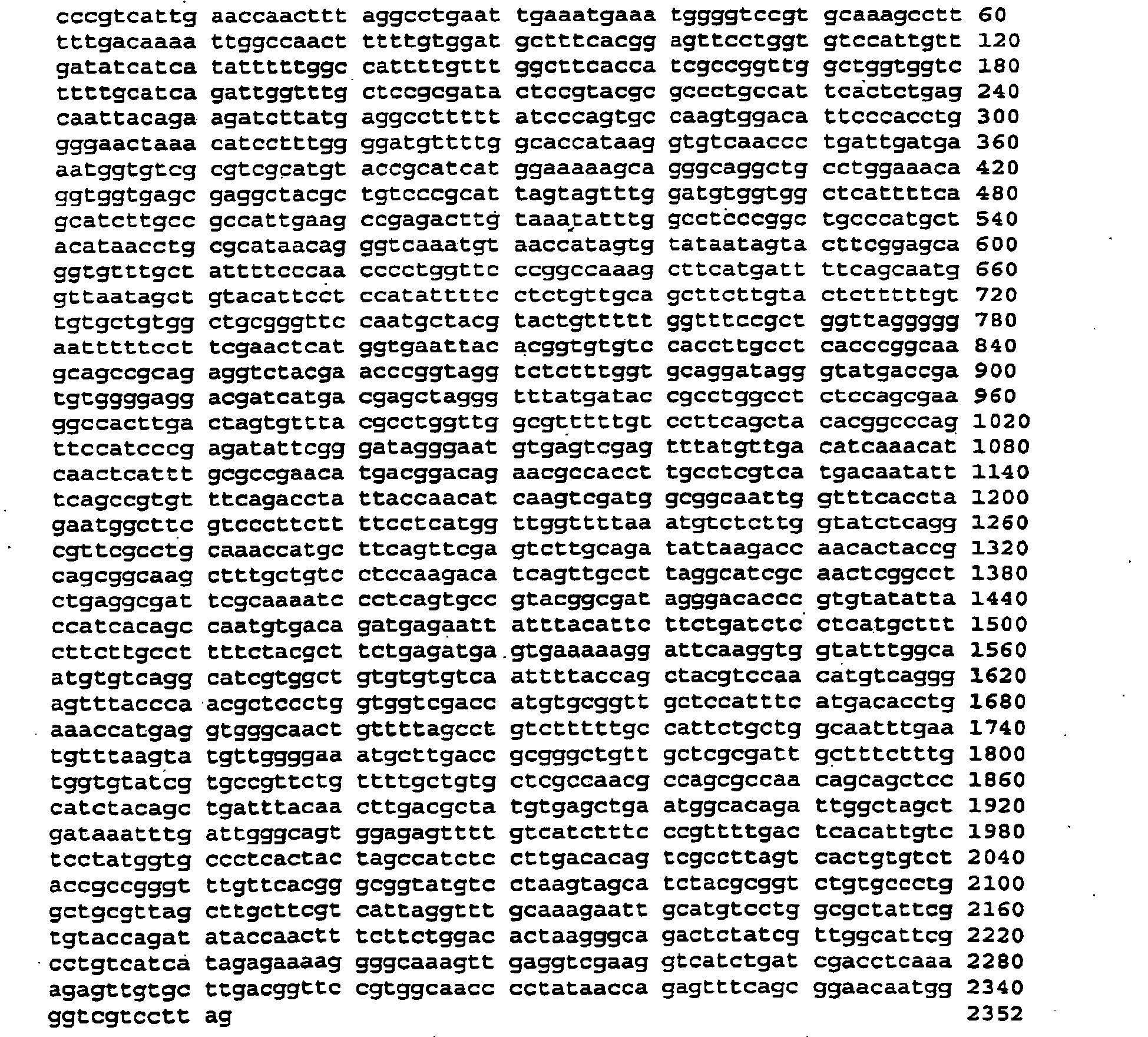
- <210> 8
- <211> 256
<212> PRT
<213> Porcine reproductive and respiratory syndrome virus - <400> 8

- <210> 9
<211> 256
<212> PRT.
<213> Porcine reproductive and respiratory syndrome virus - <400> 9

- <210> 10
<211> 255
<212> PRT
<213> Porcine reproductive and respiratory syndrome virus - <400> 10

- <210> 11
<211> 256
<212> PRT
<213> Porcine reproductive and respiratory syndrome virus - <400> 11


- <210>, 12
<211> 256
<212> PRT
<213> Porcine reproductive and respiratory syndrome virus - <400> 12


- <210> 13
<211> 256
<212> PRT
<213> Porcine reproductive and respiratory syndrome virus - <400> 13


- <210> 14
<211> 256
<212> PRT
<213> Porcine reproductive and respiratory syndrome virus - <400> 14


- <210> 15
<211> 249
<212> PRT
<213> Porcine reproductive and respiratory syndrome virus - <400> 15


- <210> 16
<211> 254
<212> PRT
<213> Porcine reproductive and respiratory syndrome virus - <400> 16


- <210> 17
<211> 254
<212> PRT
<213> Porcine reproductive and respiratory syndrome virus - <400> 17


- <210> 18
<211> 254
<212> PRT
<213> Porcine reproductive and respiratory syndrome virus - <400> 18


- <210> 19
<211> 254
<212> PRT
<213> Porcine reproductive and respiratory syndrome virus - <400> 19


- <210> 20
<211> 254
<212> PRT
<213> Porcine reproductive and respiratory syndrome virus - <400> 20


- <210> 21
<211> 254
<212> PRT
<213> Porcine reproductive and respiratory syndrome virus - <400> 21


- <210> 22
<211> 254
<212> PRT
<213> Porcine reproductive and respiratory syndrome virus - <400> 22


- <210> 23
<211> 265
<212> PRT
<213> Porcine reproductive and respiratory syndrome virus - <400> 23


- <210> 24
<211> 178
<212> PRT
<213> Porcine reproductive and respiratory syndrome virus - <400> 24

- <210> 25
<211> 178
<212> PRT
<213> Porcine reproductive and respiratory syndrome virus - <400> 25


- <210> 26
<211> 178
<212> PRT
<213> Porcine reproductive and respiratory syndrome virus - <400> 26


- <210> 27
<211> 178
<212> PRT
<213> Porcine reproductive and respiratory syndrome virus - <400> 27

- <210> 28
<211> 178
<212> PRT
<213> Porcine reproductive and respiratory syndrome virus - <400> 28

- <210> 29
<211> 178
<212> PRT
<213> Porcine reproductive and respiratory syndrome virus - <400> 29


- <210> 30
<211> 178
<212> PRT
<213> Porcine reproductive and respiratory syndrome virus - <400> 30


- <210> 31
<211> 183
<212> PRT
<213> Porcine reproductive and respiratory syndrome virus - <400> 31

- <210> 32
<211> 200
<212> PRT
<213> Porcine reproductive and respiratory syndrome virus - <400> 32

- <210> 33
<211> 200
<212> PRT
<213> Porcine reproductive and respiratory syndrome virus - <400> 33


- <210> 34
<211> 200
<212> PRT
<213> Porcine reproductive and respiratory syndrome virus - <400> 34

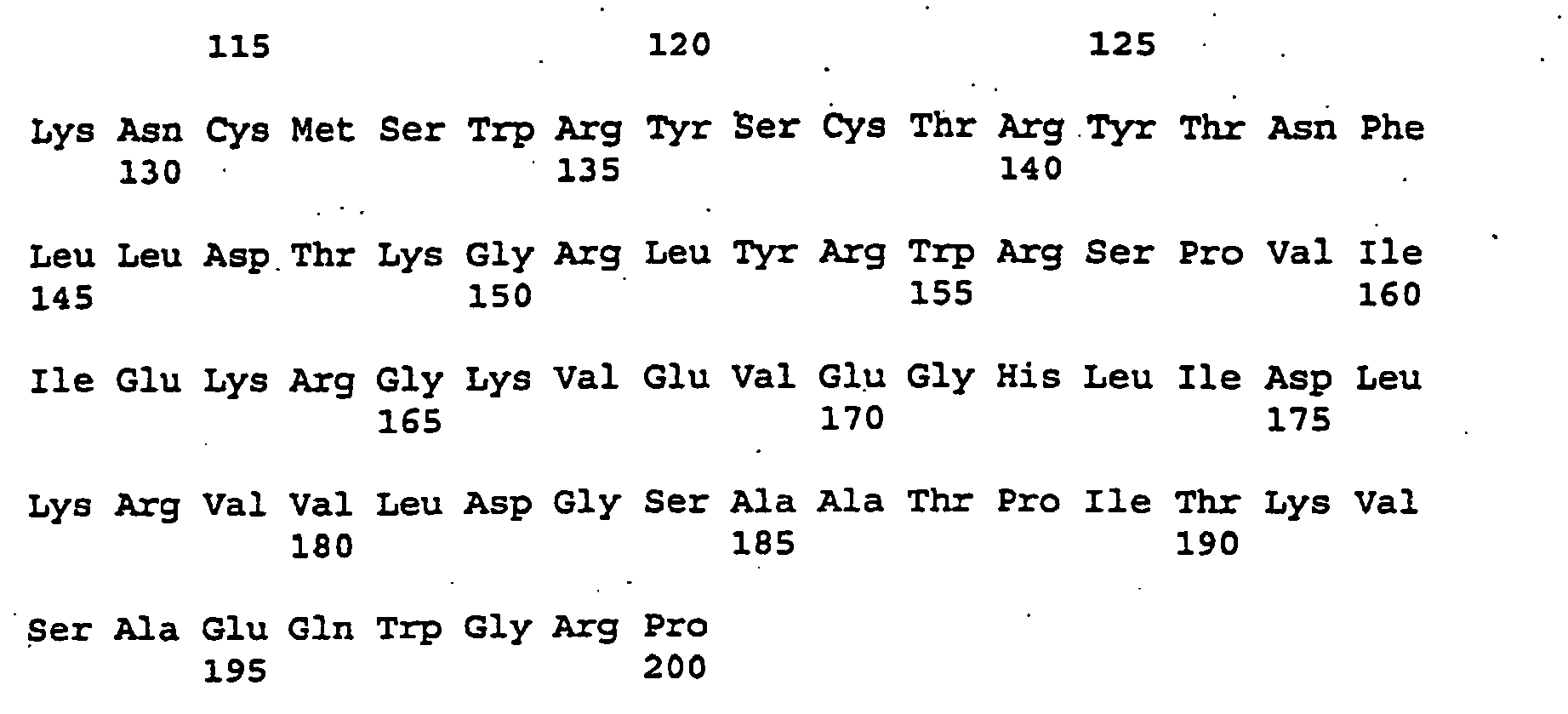
- <210> 35
<211> 200
<212> PRT
<213> Porcine reproductive and respiratory syndrome virus - <400> 35
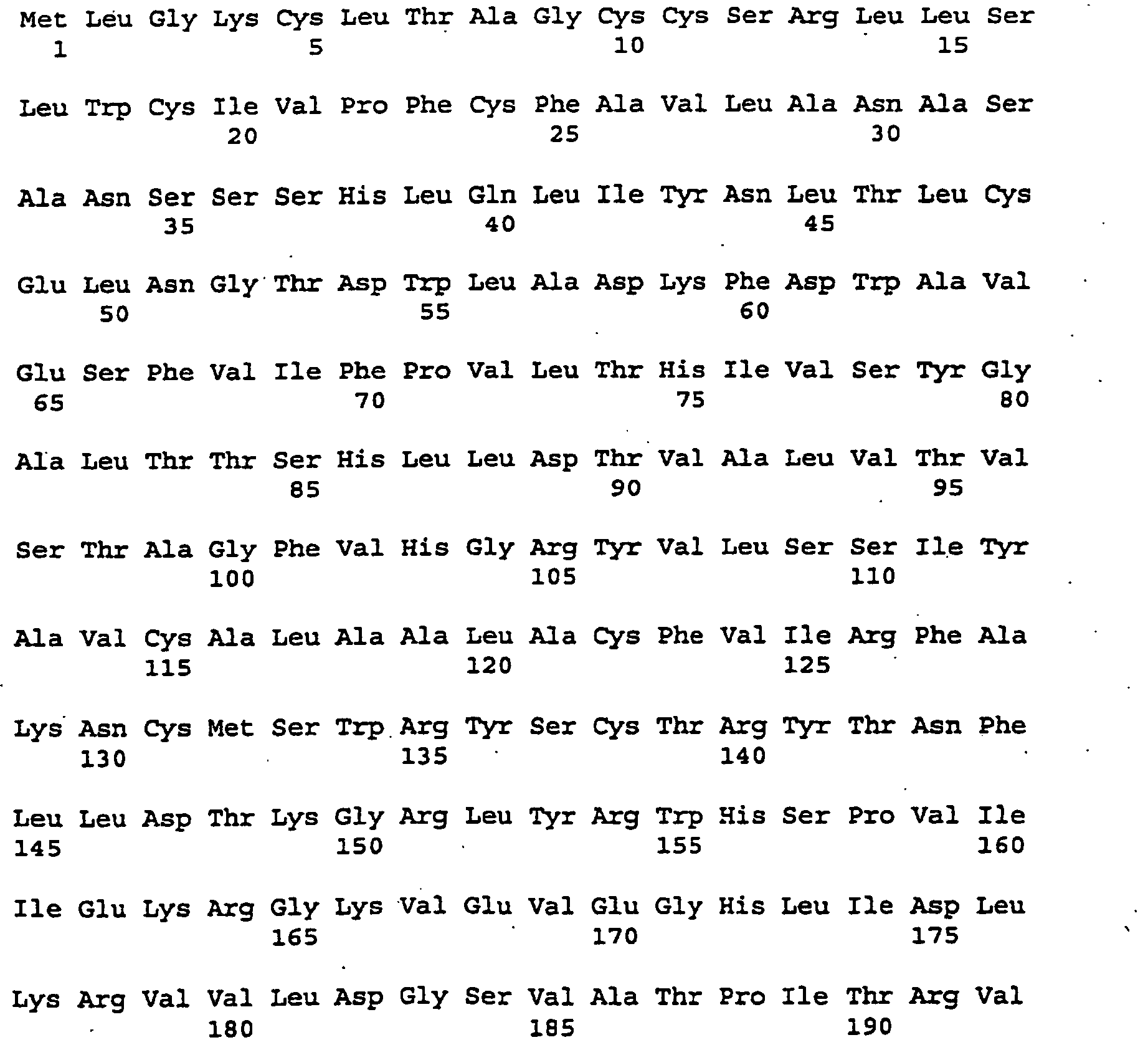

- <210> 36
<211> 200
<212> PRT
<213> Porcine reproductive and respiratory syndrome virus - <400> 36

- <210> 37
<211> 199
<212> PRT
<213> Porcine reproductive and respiratory syndrome virus - <400> 37


- <210> 38
<211> 199
<212> PRT
<213> Porcine reproductive and respiratory syndrome virus - <400> 38


- <210> 39
<211> 201
<212> PRT
<213> Porcine reproductive and respiratory syndrome virus - <400> 39


- <210> 40
<211> 3293
<212> DNA
<213> Porcine reproductive and respiratory syndrome virus - <400> 40


- <210> 41
<211> 3293
<212> DNA
<213> Porcine reproductive and respiratory syndrome virus - <400> 41


- <210> 42
<211> 30
<212> DNA.
<213> Artificial Sequence - <220>
<223> Description of Artificial Sequence: Synthetic DNA - <400> 42
gcacggatcc gaattaacat gaaatggggt 30 - <210> 43
<211> 30
<212> DNA
<213> Artificial Sequence - <220>
<223> Description of Artificial Sequence:Synthetic DNA - <400> 43
cgtcggatcc tcctacaatg gctaatagct 30 - <210> 44
<211> 30
<212> DNA
<213> Artificial Sequence - <220>
<223> Description of Artificial Sequence:Synthetic DNA - <400> 44
gtatggatcc gcaattggtt tcacctataa 30 - <210> 45
<211> 30
<212> DNA
<213> Artificial Sequence - <220>
<223> Description of Artificial Sequence:Synthetic DNA - <400> 45
tgccaggatc cgtgtttaaa tatgttgggg 30 - <210> 46
<211> 21
<212> DNA
<213> Artificial Sequence - <220>
<223> Description of Artificial Sequence:Synthetic DNA - <400> 46
ggggatccag agtttcagcg g 21 - <210> 47
<211> 22
<212> DNA
<213> Artificial Sequence - <220>
<223> Description of Artificial Sequence:Synthetic DNA - <400> 47
ggggatcctt gttaaatatg cc 22 - <210> 48
<211> 30
<212> DNA
<213> Artificial Sequence - <220>
<223> Description of Artificial Sequence:Synthetic DNA - <400> 48
ccacctgcag attcaccgtg agttcgaaag 30 - <210> 49
<211> 30
<212> DNA
<213> Artificial Sequence - <220>
<223> Description of Artificial Sequence:Synthetic DNA - <400> 49
cgcgctgcag tgtccctatc gacgtgcggc 30 - <210> 50
<211> 30
<212> DNA
<213> Artificial Sequence - <220>
<223> Description of Artificial Sequence:Synthetic DNA - <400> 50
ataggaattc aacaagacgg cacgatacac 30 - <210> 51
<211> 30
<212> DNA
<213> Artificial Sequence - <220>
<223> Description of Artificial Sequence:Synthetic DNA - <400> 51
cgtggaattc atagaaaacg ccaagagcac 30 - <210> 52
<211> 25
<212> DNA
<213> Artificial Sequence - <220>
<223> Description of Artificial Sequence:Synthetic DNA - <400> 52
gggaattctg gcacagctga ttgac 25 - <210> 53
<211> 19
<212> DNA
<213> Artificial Sequence - <220>
<223> Description of Artificial Sequence:Synthetic DNA - <400> 53
gggaattcac cacgcattc 19 - <210> 54
<211> 15420
<212> DNA
<213> Porcine reproductive and respiratory syndrome virus - <400> 54


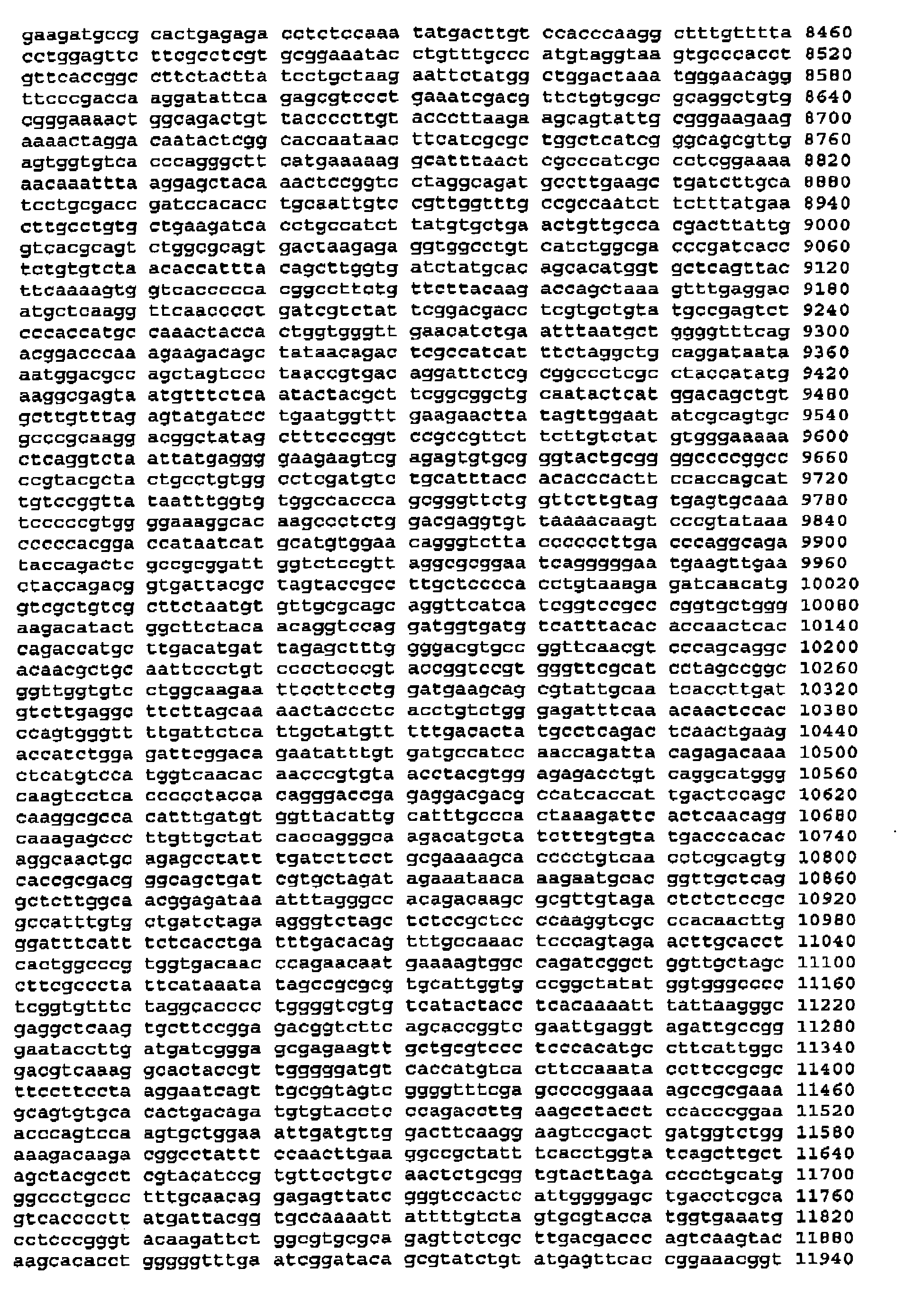

- <210> 55
<211> 15103
<212> DNA
<213> Porcine reproductive and respiratory syndrome virus - <400> 55


- <210> 56
<211> 189
<212> DNA
<213> Porcine reproductive and respiratory syndrome virus - <400> 56

- <210> 57
<211> 221
<212> DNA
<213> Porcine reproductive and respiratory syndrome virus - <400> 57

- <210> 58
<211> 1998
<212> DNA
<213> Porcine reproductive and respiratory syndrome virus - <400> 58.


- <210> 59
<211> 1938
<212> DNA
<213> Porcine reproductive and respiratory syndrome virus - <400> 59


- <210> 60
<211> 652
<212> DNA
<213> Porcine reproductive and respiratory syndrome virus - <400> 60

- <210> 61
<211> 660
<212> DNA
<213> Porcine reproductive and respiratory syndrome virus - <400> 61

- <210> 62
<211> 3198
<212> DNA
<213> Porcine reproductive and respiratory syndrome virus - <400> 62
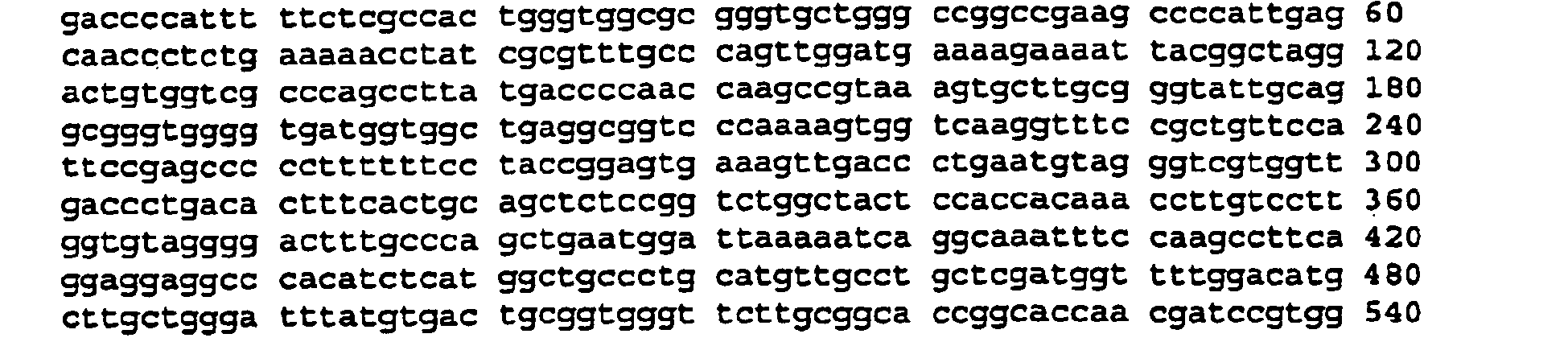

- <210> 63
<211> 3228
<212> DNA
<213> Porcine reproductive and respiratory syndrome virus - <400> 63


- <210> 64
<211> 2696
<212> DNA
<213> Porcine reproductive and respiratory syndrome virus - <400> 64


- <210> 65
<211> 2696
<212> DNA
<213> Porcine reproductive and respiratory syndrome virus - <400> 65
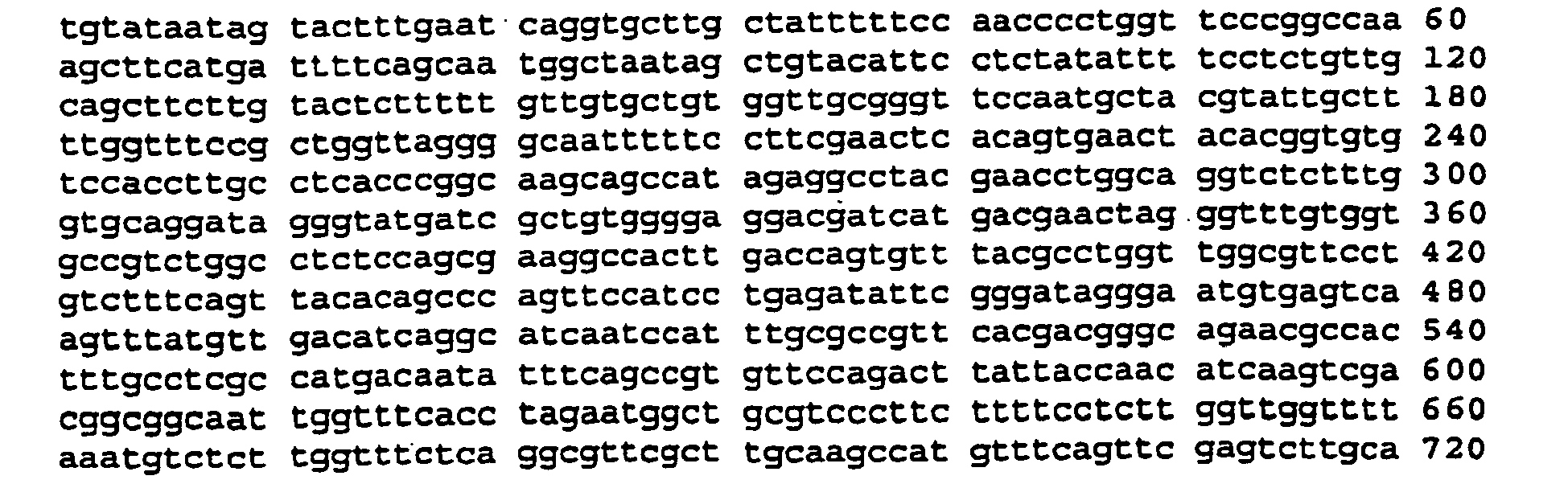

- <210> 66
<211> 1098
<212> DNA
<213> Porcine reproductive and respiratory syndrome virus - <400> 66

- <210> 67
<211> 1108
<212> DNA
<213> Porcine reproductive and respiratory syndrome virus - <400> 67

- <210> 68
<211> 7193
<212> DNA
<213> Porcine reproductive and respiratory syndrome virus - <400> 68

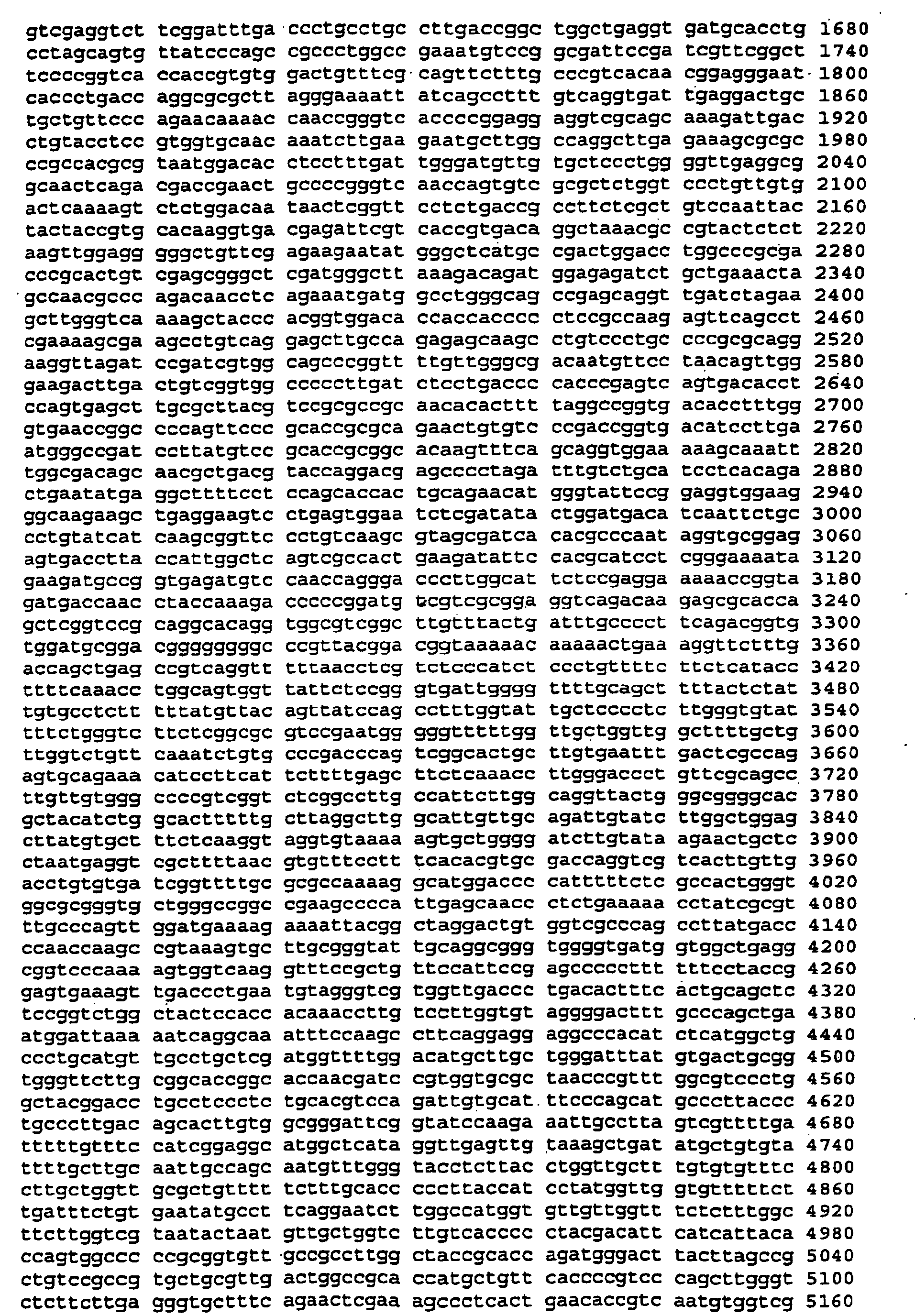

- <210> 69
<211> 4382
<212> DNA
<213> Porcine reproductive and respiratory syndrome virus - <400> 69


- <210> 70
<211> 768
<212> DNA
<213> Porcine reproductive and respiratory syndrome virus - <400> 70

- <210> 71
<211> 732
<212> DNA
<213> Porcine reproductive and respiratory syndrome virus - <400> 71

- <210> 72
<211> 534
<212> DNA
<213> Porcine reproductive and respiratory syndrome virus - <400> 72

- <210> 73
<211> 600
<212> DNA
<213> Porcine reproductive and respiratory syndrome virus - <400> 73

- <210> 74
<211> 519
<212> DNA
<213> Porcine reproductive and respiratory syndrome virus - <400> 74

- <210> 75
<211> 368
<212> DNA
<213> Porcine reproductive and respiratory syndrome virus - <400> 75

- <210> 76
<211> 7194
<212> DNA
<213> Porcine reproductive and respiratory syndrome virus - <400> 76


- <210> 77
<211> 4352
<212> DNA
<213> Porcine reproductive and respiratory syndrome virus - <400> 77


- <210> 78
<211> 768
<212> DNA
<213> Porcine reproductive and respiratory syndrome virus - <400> 78

- <210> 79
<211> 662
<212> DNA
<213> Porcine reproductive and respiratory syndrome virus - <400> 79

- <210> 80
<211> 535
<212> DNA
<213> Porcine reproductive and respiratory syndrome virus - <400> 80

- <210> 81
<211> 600
<212> DNA
<213> Porcine reproductive and respiratory syndrome virus - <400> 81

- <210> 82
<211> 522
<212> DNA
<213> Porcine reproductive and respiratory syndrome virus - <400> 82

- <210> 83
<211> 469
<212> DNA
<213> Porcine reproductive and respiratory syndrome virus - <400> 83

- <210> 84
<211> 20
<212> DNA ,
<213> Porcine reproductive and respiratory syndrome virus - <220>
<223> Description of Artificial Sequence:Synthetic DNA - <400> 84
cgtacggcga tagggacacc 20 - <210> 85
<211> 20
<212> DNA
<213> Porcine reproductive and respiratory syndrome virus - <220>
<223> Description of Artificial Sequence:Synthetic DNA - <400> 85
ggcatatatc atcactggcg 20 - <210> 86
<211> 7
<212> PRT
<213> Porcine reproductive and respiratory syndrome virus - <400> 86

- <210> 87
<211> 7
<212> PRT
<213> Porcine reproductive and respiratory syndrome virus - <400> 87

- <210> 88
<211> 7
<212> PRT
<213> Porcine reproductive and respiratory syndrome virus - <400> 88

- <210> 89
<211> 7
<212> PRT
<213> Porcine reproductive and respiratory syndrome virus - <400> 89


- <210> 90
<211> 7
<212> PRT
<213> Porcine reproductive and respiratory syndrome virus - <400> 90

- <210> 91
<211> 7
<212> PRT
<213> Porcine reproductive and respiratory syndrome virus - <400> 91

- <210> 92
<211> 7
<212> PRT
<213> Porcine reproductive and respiratory syndrome virus - <400> 92

- <210> 93
<211> 8
<212> PRT
<213> Porcine reproductive and respiratory syndrome virus - <400> 93

- <210> 94
<211> 10
<212> PRT
<213> Porcine reproductive and respiratory syndrome virus - <400> 94

- <210> 95
<211> 10
<212> PRT
<213> Porcine reproductive and respiratory syndrome virus - <400> 95

- <210> 96
<211> 10
<212> PRT
<213> Porcine reproductive and respiratory syndrome virus - <400> 96

- <210> 97
<211> 10
<212> PRT
<213> Porcine reproductive and respiratory syndrome virus - <400> 97

- <210> 98
<211> 10
<212> PRT
<213> Porcine reproductive and respiratory syndrome virus - <400> 98

- <210> 99
<211> 10
<212> PRT
<213> Porcine reproductive and respiratory syndrome virus - <400> 99

- <210> 100
<211> 9
<212> PRT
<213> Porcine reproductive and respiratory syndrome virus - <400> 100

- <210> 101
<211> 9
<212> PRT
<213> Porcine reproductive and respiratory syndrome virus - <400> 101

- <210> 102
<211> 9
<212> PRT
<213> Porcine reproductive and respiratory syndrome virus - <400> 102

- <210> 103
<211> 9
<212> PRT
<213> Porcine reproductive and respiratory syndrome virus - <400> 103

- <210> 104
<211> 9
<212> PRT
<213> Artificial Sequence - <220>
<223> Description of Artificial Sequence:Synthetic DNA - <400> 104

- <210> 105
<211> 9
<212> PRT
<213> Artificial Sequence - <220>
<223> Description of Artificial Sequence:Synthetic DNA - <400> 105

- <210> 106
<211> 9
<212> PRT
<213> Artificial Sequence - <220>
<223> Description of Artificial Sequence:Synthetic DNA - <400> 106

- <210> 107
<211> 9
<212> PRT
<213> Artificial Sequence - <220>
<223> Description of Artificial Sequence:Synthetic DNA - <400> 107

- <210> 108
<211> 18
<212> PRT
<213> Artificial Sequence - <220>
<223> Description of Artificial Sequence:Synthetic DNA - <400> 108

- <210> 109
<211> 21
<212> DNA
<213> Artificial Sequence - <220>
<223> Description of Artificial Sequence:Synthetic DNA - <400> 109
gggatccttt tgtggagccg t 21 - <210> 110
<211> 24
<212> DNA
<213> Artificial Sequence - <220>
<223> Description of Artificial Sequence:Synthetic DNA - <400> 110
ggggaattcg ggatagggaa tgtg 24 - <210> 111
<211> 27
<212> DNA
<213> Artificial Sequence - <220>
<223> Description of Artificial Sequence:Synthetic DNA - <400> 111
gggggatcct gttggtaata gagtctg 27 - <210> 112
<211> 28
<212> DNA
<213> Artificial Sequence - <220>
<223> Description of Artificial Sequence:Synthetic DNA - <400> 112
ggtgaattcg ttttatttcc ctccgggc 28 - <210> 113
<211> 18
<212> DNA
<213> Artificial Sequence - <220>
<223> Description of Artificial Sequence:Synthetic DNA - <400> 113
gatagagtct gcccttag 18 - <210> 114
<211> 18
<212> DNA
<213> Artificial Sequence - <220>
<223> Description of Artificial Sequence:Synthetic DNA - <400> 114
ggtttcacct agaatggc 18 - <210> 115
<211> 17
<212> DNA
<213> Artificial Sequence - <220>
<223> Description of Artificial Sequence:Synthetic DNA - <400> 115
gcttctgaga tgagtga 17 - <210> 116
<211> 18
<212> DNA
<213> Artificial Sequence - <220>
<223> Description of Artificial Sequence:Synthetic DNA - <400> 116
caaccaggcg taaacact 18 - <210> 117
<211> 17
<212> DNA
<213> Artificial Sequence - <220>
<223> Description of Artificial Sequence:Synthetic DNA - <400> 117
ctgagcaatt acagaag 17 - <210> 118
<211> 18
<212> DNA
<213> Artificial Sequence - <220>
<223> Description of Artificial Sequence:Synthetic DNA - <400> 118
gactgatggt ctggaaag 18 - <210> 119
<211> 18
<212> DNA
<213> Artificial Sequence - <220>
<223> Description of Artificial Sequence:Synthetic DNA - <400> 119
ctgtatccga ttcaaacc 18 - <210> 120
<211> 18
<212> DNA
<213> Artificial Sequence - <220>
<223> Description of Artificial Sequence:Synthetic DNA - <400> 120
aggttggctg gtggtctt 18 - <210> 121
<211> 18
<212> DNA
<213> Artificial Sequence. - <220>
<223> Description of Artificial Sequence:Synthetic DNA - <400> 121
tcgctcacta cctgtttc 18 - <210> 122
<211> 18
<212> DNA
<213> Artificial Sequence - <220>
<223> Description of Artificial Sequence:Synthetic DNA - <400> 122
tgtgcccgcc ttgcctca 18 - <210> 123
<211> 18
<212> DNA
<213> Artificial Sequence - <220>
<223> Description of Artificial Sequence:Synthetic DNA - <400> 123
aaaccaattg cccccgtc 18 - <210> 124
<211> 18
<212> DNA
<213> Artificial Sequence - <220>
<223> Description of Artificial Sequence:Synthetic DNA - <400> 124
tatatcactg tcacagcc 18 - <210> 125
<211> 18
<212> DNA
<213> Artificial Sequence - <220>
<223> Description of Artificial Sequence:Synthetic DNA - <400> 125
caaattgcca acagaatg 18 - <210> 126
<211> 20
<212> DNA
<213> Artificial Sequence - <220>
<223> Description of Artificial Sequence:Synthetic DNA - <400> 126
caacttgacg ctatgtgagc 20 - <210> 127
<211> 20
<212> DNA
<213> Artificial Sequence - <220>
<223> Description of Artificial Sequence:Synthetic DNA - <400> 127
gccgcggaac catcaagcac 20 - <210> 128
<211> 20
<212> DNA
<213> Artificial Sequence - <220>
<223> Description of Artificial Sequence:Synthetic DNA - <400> 128
gactgctagg gcttctgcac 20 - <210> 129
<211> 18
<212> DNA
<213> Artificial Sequence - <220>
<223> Description of Artificial Sequence:Synthetic DNA - <400> 129
cgttgaccgt agtggagc 18 - <210> 130
<211> 22
<212> DNA
<213> Artificial Sequence - <220>
<223> Description of Artificial Sequence:Synthetic DNA - <400> 130
ccccatttcc ctctagcgac tg 22
<210> 131
<211> 22
<212> DNA
<213> Artificial Sequence - <220>
<223> Description of Artificial Sequence:Synthetic DNA - <400> 131
cggccgtgtg gttctcgcca at 22
<210> 132
<211> 24
<212> DNA
<213> Artificial Sequence - <220>
<223> Description of Artificial Sequence:Synthetic DNA - <400> 132
ggggaattcg ggatagggaa tgtg 24 - <210> 133
<211> 22
<212> DNA
<213> Artificial Sequence - <220>
<223> Description of Artificial Sequence:Synthetic DNA - <400> 133
ggggatcctt ttgtggagcc gt 22 - <210> 134
<211> 28
<212> DNA
<213> Artificial Sequence - <220>
<223> Description of Artificial Sequence:Synthetic DNA - <400> 134
ggtgaattcg ttttatttcc ctccgggc 28 - <210> 135
<211> 27
<212> DNA
<213> Artificial Sequence - <220>
<223> Description of Artificial Sequence:Synthetic DNA - <400> 135
gggggatcct gttggtaata gagtctg 27 - <210> 136
<211> 18
<212> DNA
<213> Artificial Sequence - <220>
<223> Description of Artificial Sequence:Synthetic DNA - <400> 136
ggtttcacct agaatggc 18 - <210> 137
<211> 18
<212> DNA
<213> Artificial Sequence - <220>
<223> Description of Artificial Sequence:Synthetic DNA - <400> 137
gatagagtct gcccttag 18 - <210> 138
<211> 17
<212> DNA
<213> Artificial Sequence - <220>
<223> Description of Artificial Sequence:Synthetic DNA - <400> 138
gcttctgaga tgagtga 17 - <210> 139
<211> 17
<212> DNA
<213> Artificial Sequence - <220>
<223> Description of Artificial Sequence:Synthetic DNA - <400> 139
ctgagcaatt acagaag 17 - <210> 140
<211> 18
<212> DNA
<213> Artificial Sequence - <220>
<223> Description of Artificial Sequence:Synthetic DNA - <400> 140
caaccaggcg taaacact 18 - <210> 141
<211> 19
<212> DNA
<213> Artificial Sequence - <220>
<223> Description of Artificial Sequence:Synthetic DNA - <400> 141
gactgcttta cggtctctc 19 - <210> 142
<211> 18
<212> DNA
<213> Artificial Sequence - <220>
<223> Description of Artificial Sequence:Synthetic DNA - <400> 142
gatgcctgac acattgcc 18 - <210> 143
<211> 19
<212> DNA
<213> Artificial Sequence - <220>
<223> Description of Artificial Sequence:Synthetic DNA - <400> 143
ctgcaagact cgaactgaa 19 - <210> 144
<211> 20
<212> DNA
<213> Artificial Sequence - <220>
<223> Description of Artificial Sequence:Synthetic DNA - <400> 144
ccccattgtt ggacctgtcc 20 - <210> 145
<211> 19
<212> DNA
<213> Artificial Sequence - <220>
<223> Description of Artificial Sequence:Synthetic DNA - <400> 145
gtcacaacag ggaccgagc 19 - <210> 146
<211> 27
<212> DNA
<213> Artificial Sequence - <220>
<223> Description of Artificial Sequence:Synthetic DNA - <400> 146
ccaagctccc ctgaaggagg ctgtcac 27 - <210> 147
<211> 27
<212> DNA
<213> Artificial Sequence - <220>
<223> Description of Artificial Sequence:Synthetic DNA - <400> 147
ccaagctccc ctgaaggagg ctgtcac 27 - <210> 148
<211> 25
<212> DNA
<213> Artificial Sequence - <220>
<223> Description of Artificial Sequence:Synthetic DNA - <400> 148
agcatcccag acatggttaa agggg 25 - <210> 149
<211> 14
<212> DNA
<213> Artificial Sequence - <220>
<223> Description of Artificial Sequence:Synthetic DNA - <400> 149
ccaccccttt aacc 14 - <210> 150
<211> 14
<212> DNA
<213> Artificial Sequence - <220>
<223> Description of Artificial Sequence:Synthetic DNA - <400> 150
ccaccccttg aacc 14 - <210> 151
<211> 14
<212> DNA
<213> Artificial Sequence - <220>
<223> Description of Artificial Sequence:Synthetic DNA - <400> 151
cctgtcattg aacc 14 - <210> 152
<211> 14
<212> DNA
<213> Artificial Sequence - <220>
<223> Description of Artificial Sequence:Synthetic DNA - <400> 152
ccacccctgt aacc 14 - <210> 153
<211> 14
<212> DNA
<213> Artificial Sequence - <220>
<223> Description of Artificial Sequence:Synthetic DNA - <400> 153
ccaccccttt aacc 14 - <210> 154
<211> 14
<212> DNA
<213> Artificial Sequence - <220>
<223> Description of Artificial Sequence:Synthetic DNA - <400> 154
ggtcaaatgt aacc 14 - <210> 155
<211> 14
<212> DNA
<213> Artificial Sequence - <220>
<223> Description of Artificial Sequence:Synthetic DNA - <400> 155
ccaccccttt gacc 14 - <210> 156
<211> 14
<212> DNA
<213> Artificial Sequence - <220>
<223> Description of Artificial Sequence:Synthetic DNA - <400> 156
aaggccactt gacc 14 - <210> 157
<211> 14
<212> DNA
<213> Artificial Sequence - <220>
<223> Description of Artificial Sequence:Synthetic DNA - <400> 157
ccaccccttt cacc 14 - <210> 158
<211> 15
<212> DNA
<213> Artificial Sequence - <220>
<223> Description of Artificial Sequence:Synthetic DNA - <400> 158
ccaccccgtt tcacc 15 - <210> 159
<211> 14
<212> DNA
<213> Artificial Sequence - <220>
<223> Description of Artificial Sequence:Synthetic DNA - <400> 159
caattggttt cacc 14 - <210> 160
<211> 14
<212> DNA
<213> Artificial Sequence - <220>
<223> Description of Artificial Sequence:Synthetic DNA - <400> 160
ccaccccgtc aact 14 - <210> 161
<211> 14
<212> DNA
<213> Artificial Sequence - <220>
<223> Description of Artificial Sequence:Synthetic DNA - <400> 161
agtgtgcgtc aact 14 - <210> 162
<211> 14
<212> DNA
<213> Artificial Sequence - <220>
<223> Description of Artificial Sequence:Synthetic DNA - <400> 162
ccaccccttt agcc 14 - <210> 163
<211> 15
<212> DNA
<213> Artificial Sequence - <220>
<223> Description of Artificial Sequence:Synthetic DNA - <400> 163
ccaccccttt tagcc 15 - <210> 164
<211> 14
<212> DNA
<213> Artificial Sequence - <220>
<223> Description of Artificial Sequence:Synthetic DNA - <400> 164
caactgtttt agcc 14 - <210> 165
<211> 14
<212> DNA
<213> Artificial Sequence - <220>
<223> Description of Artificial Sequence:Synthetic DNA - <400> 165
ccacccctgt aacc 14 - <210> 166
<211> 14
<212> DNA
<213> Artificial Sequence - <220>
<223> Description of Artificial Sequence:Synthetic DNA - <400> 166
ccaccccttt aacc 14 - <210> 167
<211> 14
<212> DNA
<213> Artificial Sequence - <220>
<223> Description of Artificial Sequence:Synthetic DNA - <400> 167
ctacccctgt aacc 14 - <210> 168
<211> 14
<212> DNA
<213> Artificial Sequence - <220>
<223> Description of Artificial Sequence:Synthetic DNA - <400> 168
ccaccccttt aacc 14 - <210> 169
<211> 14
<212> DNA
<213> Artificial Sequence - <220>
<223> Description of Artificial Sequence:Synthetic DNA - <400> 169
ccacccctat aacc 14 - <210> 170
<211> 14
<212> DNA
<213> Artificial Sequence - <220>
<223> Description of Artificial Sequence:Synthetic DNA - <400> 170
ggcaaatgat aacc 14 - <210> 171
<211> 15
<212> DNA
<213> Artificial Sequence - <220>
<223> Description of Artificial Sequence:Synthetic DNA - <400> 171
ccaccccctt aaacc 15 - <210> 172
<211> 15
<212> DNA
<213> Artificial Sequence - <220>
<223> Description of Artificial Sequence:Synthetic DNA - <400> 172
agggagtggt aaacc 15 - <210> 173
<211> 20
<212> DNA
<213> Artificial Sequence - <220>
<223> Description of Artificial Sequence:Synthetic DNA - <400> 173
cgtacggcga tagggacacc 20 - <210> 174
<211> 20
<212> DNA
<213> Artificial Sequence - <220>
<223> Description of Artificial Sequence:Synthetic DNA - <400> 174
ggcatatatc atcactggcg 20 - <210> 175
<211> 14
<212> DNA
<213> Artificial Sequence - <220>
<223> Description of Artificial Sequence:Synthetic DNA - <400> 175
ccaccccttt aacc 14
Claims (10)
- An isolated DNA sequence encoding a porcine reproductive and respiratory syndrome virus (PRRSV) consisting of the nucleotide sequence of high passage ISU-55 depicted in Figure 10.
- An isolated DNA sequence comprising an open reading frame of the PRRSV of Claim 1, selected from which open reading frame is nucleotides 191-7699 of the nucleotide sequence of high passage ISU-55 depicted in Figure 10 (ORF 1a), nucleotides 7687-12069 of the nucleotide sequence of high passage ISU-55 depicted in Figure 10 (ORF I b), nucleotides 12074-12841 of the nucleotide sequence of high passage ISU-55 depicted in Figure 10 (ORF 2), nucleotides 12697-13458 of the nucleotide sequence of high passage ISU-55 depicted in Figure 10 (ORF 3), nucleotides 13242-13775 of the nucleotide sequence of high passage ISU-55 depicted in Figure 10 (ORF 4) and nucleotides 13789-14388 of the nucleotide sequence of high passage ISU-55 depicted in Figure 10 (ORF 5).
- A composition comprising the polypeptides encoded by the isolated DNA sequence of Claim 1.
- A composition for inducing antibodies against PRRSV comprising an amount of PRRSV encoded by the nucleotide sequence of high passage ISU-55 depicted in Figure 10 (ISU-55) effective to induce said antibodies in a pig and a physiologically acceptable carrier.
- The composition of Claim 4, wherein said composition reduces lung lesions in five-week-old colostrum-deprived, caesarean-derived pigs by a statistically significant amount wherein said amount is significant a p value less than 0.01, relative to lung lesions in uninoculated five-week-old colostrum-deprived, caesarean-derived pigs.
- The composition of Claim 4 further comprising an adjuvant.
- Use of an effective amount of the composition of Claim 4 for the manufacture of a vaccine for protecting a pig from a porcine reproductive and respiratory disease.
- The use of Claim 7, characterized in that said vaccine is administered orally or parentally.
- The use of Claim 7, characterized in that said vaccine is administered intramuscularly, intradermally, intravenously, intraperitoneally, subcutaneously or intranasally.
- A method of distinguishing PRRSV strain ISU-55 from other strains of PRRSV comprising:(a) amplifying a DNA sequence of the PRRSV using the following two primers:55F 5'-CGTACGGCGATAGGGACACC-3' and3RFLP 5'-GGCATATATCATCACTGGCG-3'(b) digesting the amplified sequence of step (a) with DraI; and(c) correlating the presence of three restriction fragments of 626 bp, 187 bp and 135 bp with a PRRSV ISU-55 strain.
Applications Claiming Priority (3)
| Application Number | Priority Date | Filing Date | Title |
|---|---|---|---|
| US09/019,793 US6380376B1 (en) | 1992-10-30 | 1998-02-06 | Proteins encoded by polynucleic acids of porcine reproductive and respiratory syndrome virus (PRRSV) |
| US19793 | 1998-02-06 | ||
| PCT/US1999/002630 WO1999039582A1 (en) | 1998-02-06 | 1999-02-08 | Proteins encoded by polynucleic acids of porcine reproductive and respiratory syndrome virus (prrsv) |
Publications (3)
| Publication Number | Publication Date |
|---|---|
| EP1047301A1 EP1047301A1 (en) | 2000-11-02 |
| EP1047301A4 EP1047301A4 (en) | 2002-01-02 |
| EP1047301B1 true EP1047301B1 (en) | 2007-08-29 |
Family
ID=21795057
Family Applications (1)
| Application Number | Title | Priority Date | Filing Date |
|---|---|---|---|
| EP99905840A Expired - Lifetime EP1047301B1 (en) | 1998-02-06 | 1999-02-08 | Proteins encoded by polynucleic acids of porcine reproductive and respiratory syndrome virus (prrsv) |
Country Status (12)
| Country | Link |
|---|---|
| US (3) | US6380376B1 (en) |
| EP (1) | EP1047301B1 (en) |
| JP (2) | JP2002504317A (en) |
| KR (2) | KR100711656B1 (en) |
| AT (1) | ATE371373T1 (en) |
| AU (1) | AU743212B2 (en) |
| BR (1) | BR9908615A (en) |
| CA (2) | CA2320359C (en) |
| DE (1) | DE69936977T2 (en) |
| ES (1) | ES2294834T3 (en) |
| NO (1) | NO329875B1 (en) |
| WO (1) | WO1999039582A1 (en) |
Families Citing this family (32)
| Publication number | Priority date | Publication date | Assignee | Title |
|---|---|---|---|---|
| DE69201441T3 (en) * | 1991-06-06 | 2008-12-04 | Boehringer Ingelheim Vetmedica Gmbh | ENTIRE MYSTERIOUS POVERTY, VACCINE COMPOSITIONS AND DIAGNOSIS KITS. |
| US6380376B1 (en) * | 1992-10-30 | 2002-04-30 | Iowa State University Research Foundation | Proteins encoded by polynucleic acids of porcine reproductive and respiratory syndrome virus (PRRSV) |
| US5695766A (en) * | 1992-10-30 | 1997-12-09 | Iowa State University Research Foundation | Highly virulent porcine reproductive and respiratory syndrome viruses which produce lesions in pigs and vaccines that protect pigs against said syndrome |
| US6592873B1 (en) * | 1992-10-30 | 2003-07-15 | Iowa State University Research Foundation, Inc. | Polynucleic acids isolated from a porcine reproductive and respiratory syndrome virus (PRRSV) and proteins encoded by the polynucleic acids |
| EP0839912A1 (en) * | 1996-10-30 | 1998-05-06 | Instituut Voor Dierhouderij En Diergezondheid (Id-Dlo) | Infectious clones of RNA viruses and vaccines and diagnostic assays derived thereof |
| US20040224327A1 (en) * | 1996-10-30 | 2004-11-11 | Meulenberg Johanna Jacoba Maria | Infectious clones of RNA viruses and vaccines and diagnostic assays derived thereof |
| JP3961222B2 (en) * | 1999-03-08 | 2007-08-22 | ベーリンガー インゲルハイム フェトメディカ ゲーエムベーハー | PRRSV vaccine |
| EP1183332B1 (en) * | 1999-04-22 | 2010-07-14 | United States Department Of Agriculture | Porcine reproductive and respiratory syndrome vaccine, based on isolate ja-142 |
| US6951605B2 (en) * | 2002-10-08 | 2005-10-04 | Exxonmobil Research And Engineering Company | Method for making lube basestocks |
| CA2571452A1 (en) * | 2004-06-18 | 2006-01-26 | Regents Of The University Of Minnesota | Identifying virally infected and vaccinated organisms |
| US7632636B2 (en) * | 2004-09-21 | 2009-12-15 | Boehringer Ingelheim Vetmedica, Inc. | Porcine reproductive and respiratory syndrome isolates and methods of use |
| WO2006093797A2 (en) | 2005-02-28 | 2006-09-08 | Mj Biologics, Inc. | Method and kit for detecting porcine reproductive and respiratory syndrome virus |
| PL1904631T3 (en) | 2005-06-24 | 2012-10-31 | Univ Minnesota | Prrs viruses, infectious clones, mutants thereof, and methods of use |
| US7241582B2 (en) * | 2005-07-05 | 2007-07-10 | Mj Biologics, Inc. | Diagnostic test kits |
| US7622254B2 (en) * | 2005-11-29 | 2009-11-24 | Iowa State University Research Foundation, Inc. | Identification of protective antigenic determinants of porcine reproductive and respiratory syndrome virus and uses thereof |
| JP5619004B2 (en) * | 2008-08-25 | 2014-11-05 | ベーリンガーインゲルハイム フェトメディカ インコーポレイテッド | Highly pathogenic pig breeding / respiratory syndrome (HPPRRS) vaccine |
| TWI627281B (en) * | 2009-09-02 | 2018-06-21 | 百靈佳殷格翰家畜藥品公司 | Methods of reducing viricidal activity in pcv-2 compositions and pcv-2 compositions with an improved immunogenicity |
| WO2012110489A2 (en) | 2011-02-17 | 2012-08-23 | Boehringer Ingelheim Vetmedica Gmbh | Novel european prrsv strain |
| AU2012217170B2 (en) | 2011-02-17 | 2016-07-28 | Boehringer Ingelheim Vetmedica Gmbh | Commercial scale process for production of PRRSV |
| WO2013017568A1 (en) | 2011-07-29 | 2013-02-07 | Boehringer Ingelheim Vetmedica Gmbh | INFECTIOUS cDNA CLONE OF EUROPEAN PRRS VIRUS AND USES THEREOF |
| US9187731B2 (en) | 2011-07-29 | 2015-11-17 | Boehringer Ingelheim Vetmedica Gmbh | PRRS virus inducing type I interferon in susceptible cells |
| UA114503C2 (en) | 2012-04-04 | 2017-06-26 | Зоетіс Сервісіз Ллс | PCV AND MYCOPLASMA HYOPNEUMONIA COMBINED VACCINE |
| UA114504C2 (en) | 2012-04-04 | 2017-06-26 | Зоетіс Сервісіз Ллс | PCV, MYCOPLASMA HYOPNEUMONIA AND PRRS COMBINED VACCINE |
| US9120859B2 (en) | 2012-04-04 | 2015-09-01 | Zoetis Services Llc | Mycoplasma hyopneumoniae vaccine |
| MX2014013964A (en) * | 2012-05-17 | 2015-03-04 | Zoetis Llc | Effective vaccination against porcine reproductive and respiratory syndrome (prrs) virus prior to weaning. |
| US10683537B2 (en) * | 2012-10-16 | 2020-06-16 | Dna Polymerase Technology, Inc. | Inhibition-resistant polymerases |
| US9579373B2 (en) | 2013-03-15 | 2017-02-28 | Boehringer Ingelheim Vetmedica, Inc. | Porcine reproductive and respiratory syndrome virus, compositions, vaccine and methods of use |
| WO2015140774A1 (en) * | 2014-03-21 | 2015-09-24 | Nutech Ventures | A non-naturally occuring porcine reproductive and respiratory syndrome virus (prrsv) and methods of using |
| PH12017502380B1 (en) * | 2015-06-23 | 2022-10-26 | Merial Inc | Prrsv minor protein-containing recombinant viral vectors and methods of making and use thereof |
| BR112018069219A2 (en) | 2016-03-23 | 2019-01-22 | Intervet Int Bv | a vaccine for intradermal application against pcv2 and prrs virus infection |
| US10279031B2 (en) | 2016-05-11 | 2019-05-07 | Phibro Animal Health Corporation | Composition comprising antigens and a mucosal adjuvant and a method for using |
| CN114404439B (en) * | 2022-02-11 | 2023-07-11 | 山东农业大学 | Blocking agent for inhibiting different types of porcine reproductive and respiratory syndrome virus infection |
Family Cites Families (36)
| Publication number | Priority date | Publication date | Assignee | Title |
|---|---|---|---|---|
| US5213795A (en) | 1990-10-24 | 1993-05-25 | Oxford | Encephalomyocarditis virus vaccine |
| DE69201441T3 (en) | 1991-06-06 | 2008-12-04 | Boehringer Ingelheim Vetmedica Gmbh | ENTIRE MYSTERIOUS POVERTY, VACCINE COMPOSITIONS AND DIAGNOSIS KITS. |
| US6982160B2 (en) | 1991-08-26 | 2006-01-03 | Boehringer Ingelheim Vetmedica, Inc. | Immunogenic compositions that include SIRS virus |
| US6042830A (en) | 1992-08-05 | 2000-03-28 | Boehringer Ingelheim Vetmedica, Inc. | Viral agent associated with mystery swine disease |
| SG43852A1 (en) | 1991-08-26 | 1997-11-14 | Boehringer Animal Health Inc | Sirs vaccine and diagnosis method |
| US5846805A (en) | 1991-08-26 | 1998-12-08 | Boehringer Ingelheim Animal Health, Inc. | Culture of swine infertility and respiratory syndrome virus in simian cells |
| MX9204885A (en) | 1991-08-26 | 1994-05-31 | Boehringer Animal Health Inc | VACCINE COMPOSITION INCLUDING VIRUSES OF INFERTILITY AND RESPIRATORY SYNDROME OF PIGS. |
| WO1993006211A1 (en) | 1991-09-16 | 1993-04-01 | Collins James E | Vaccine for mystery swine disease and method for diagnosis thereof |
| AU2684792A (en) | 1991-10-14 | 1993-05-21 | Akzo Nobel N.V. | Porcine reproductive respiratory syndrome vaccine and diagnostic |
| FR2686097B1 (en) | 1992-01-14 | 1994-12-30 | Rhone Merieux | PREPARATION OF ANTIGENS AND MYSTERY DISEASE VIRUS VACCINES, ANTIGENS AND VACCINES OBTAINED FOR THE PREVENTION OF THIS DISEASE. |
| TW289731B (en) | 1992-07-09 | 1996-11-01 | Akzo Nv | |
| US5695766A (en) | 1992-10-30 | 1997-12-09 | Iowa State University Research Foundation | Highly virulent porcine reproductive and respiratory syndrome viruses which produce lesions in pigs and vaccines that protect pigs against said syndrome |
| US6251397B1 (en) | 1992-10-30 | 2001-06-26 | Iowa State University Research Foundation, Inc. | Proteins encoded by polynucleic acids isolated from a porcine reproductive and respiratory syndrome virus and immunogenic compositions containing the same |
| US6773908B1 (en) | 1992-10-30 | 2004-08-10 | Iowa State University Research Foundation, Inc. | Proteins encoded by polynucleic acids of porcine reproductive and respiratory syndrome virus (PRRSV) |
| US6380376B1 (en) | 1992-10-30 | 2002-04-30 | Iowa State University Research Foundation | Proteins encoded by polynucleic acids of porcine reproductive and respiratory syndrome virus (PRRSV) |
| US6592873B1 (en) | 1992-10-30 | 2003-07-15 | Iowa State University Research Foundation, Inc. | Polynucleic acids isolated from a porcine reproductive and respiratory syndrome virus (PRRSV) and proteins encoded by the polynucleic acids |
| US5419907A (en) | 1992-11-10 | 1995-05-30 | Iowa State University Research Foundation, Inc. | Pathogenic porcine respiratory coronavirus |
| PL178609B1 (en) | 1993-02-08 | 2000-05-31 | Bayer Ag | Method of breeding the virus of swine reproduction and respiratory syndrome, vaccines and production of vaccines |
| US6762024B2 (en) * | 1993-04-27 | 2004-07-13 | Innogenetics, S.A. | Sequences of hepatitis C virus genotypes and their use as therapeutic and diagnostic agents |
| ES2074950B1 (en) | 1993-09-17 | 1996-03-16 | Iberica Cyanamid | VACCINE FOR THE PREVENTION OF REPRODUCTIVE AND RESPIRATORY DISEASE OF THE SOW. |
| EP0659885A1 (en) | 1993-12-21 | 1995-06-28 | Akzo Nobel N.V. | Vaccine against viruses associated with antibody-dependent-enhancement of viral infectivity |
| DE4407489A1 (en) | 1994-03-07 | 1995-09-14 | Bayer Ag | Vaccine for the prevention of respiratory and reproductive diseases of the pig |
| DE69522984T2 (en) | 1994-04-11 | 2002-04-25 | Akzo Nobel Nv | Pig reproductive respiratory syndrome virus vaccine European strains |
| DK53595A (en) | 1994-05-13 | 1995-11-14 | Iberica Cyanamid | Recombinant PRRSV proteins, diagnostic kits and vaccines containing such recombinant PRRSV proteins |
| PT783321E (en) | 1994-08-05 | 2006-08-31 | Univ Minnesota | VIRAL NUCLEOTIDIC SEQUENCE VR-2332 AND METHODS OF USE |
| DE69632658T2 (en) | 1995-03-14 | 2005-06-09 | Akzo Nobel N.V. | Expression in the same cell of porcine reproductive and respiratory syndrome polypeptides |
| ES2102971B1 (en) | 1996-01-25 | 1998-03-01 | Hipra Lab Sa | NEW ATTENUATED STRAIN OF THE VIRUS CAUSING THE RESPIRATORY AND REPRODUCTIVE SYNDROME (PRRS), THE VACCINES AND DIAGNOSTIC MEDIA OBTAINABLE WITH THE SAME AND THE PROCEDURES FOR ITS OBTAINING. |
| US6015663A (en) | 1996-03-01 | 2000-01-18 | The United States Of America As Represented By The Secretary Of Agriculture | Restriction enzyme screen for differentiating porcine reproductive and respiratory syndrome virus strains |
| US5866401A (en) | 1996-03-01 | 1999-02-02 | Schering Corporation | Porcine reproductive and respiratory syndrome vaccine |
| US6514731B1 (en) * | 1996-05-24 | 2003-02-04 | Chiron Corporation | Methods for the preparation of hepatitis C virus multiple copy epitope fusion antigens |
| US5976537A (en) | 1996-07-02 | 1999-11-02 | The United States Of America As Represented By The Secretary Of Agriculture | Porcine reproductive and respiratory syndrome vaccine |
| ES2157522T3 (en) | 1996-10-09 | 2001-08-16 | Akzo Nobel Nv | EUROPEAN VACCINE VIRUSES OF THE SWINE REPRODUCTIVE RESPIRATORY SYNDROME (PRRSV). |
| EP1882696A3 (en) | 1997-05-06 | 2008-03-05 | Boehringer Ingelheim Vetmedica Gmbh | PRRSV antigenic sites identifying peptide sequences of PRRS virus for use in vaccines or diagnostic assays |
| GB9820525D0 (en) * | 1998-09-21 | 1998-11-11 | Allergy Therapeutics Ltd | Formulation |
| EP1170367A1 (en) | 2000-06-27 | 2002-01-09 | Bayer Ag | BVDV virus-like particles |
| WO2006024542A1 (en) | 2004-09-03 | 2006-03-09 | Consejo Superior De Investigaciones Cientificas | Nucleic acid sequences encoding proteins capable of associating into a virus-like particle |
-
1998
- 1998-02-06 US US09/019,793 patent/US6380376B1/en not_active Expired - Fee Related
-
1999
- 1999-02-08 KR KR1020067002766A patent/KR100711656B1/en not_active Expired - Fee Related
- 1999-02-08 JP JP2000530103A patent/JP2002504317A/en active Pending
- 1999-02-08 EP EP99905840A patent/EP1047301B1/en not_active Expired - Lifetime
- 1999-02-08 CA CA2320359A patent/CA2320359C/en not_active Expired - Fee Related
- 1999-02-08 DE DE69936977T patent/DE69936977T2/en not_active Expired - Lifetime
- 1999-02-08 KR KR1020007008605A patent/KR100696339B1/en not_active Expired - Fee Related
- 1999-02-08 WO PCT/US1999/002630 patent/WO1999039582A1/en not_active Ceased
- 1999-02-08 CA CA2751655A patent/CA2751655C/en not_active Expired - Fee Related
- 1999-02-08 AU AU25908/99A patent/AU743212B2/en not_active Ceased
- 1999-02-08 AT AT99905840T patent/ATE371373T1/en not_active IP Right Cessation
- 1999-02-08 ES ES99905840T patent/ES2294834T3/en not_active Expired - Lifetime
- 1999-02-08 BR BR9908615-8A patent/BR9908615A/en not_active IP Right Cessation
-
2000
- 2000-07-07 NO NO20003526A patent/NO329875B1/en not_active IP Right Cessation
-
2002
- 2002-03-25 US US10/104,019 patent/US7264802B2/en not_active Expired - Fee Related
-
2007
- 2007-05-24 US US11/802,769 patent/US20080286276A1/en not_active Abandoned
-
2010
- 2010-11-16 JP JP2010256079A patent/JP2011103883A/en active Pending
Also Published As
| Publication number | Publication date |
|---|---|
| US6380376B1 (en) | 2002-04-30 |
| CA2320359A1 (en) | 1999-08-12 |
| CA2320359C (en) | 2013-02-05 |
| AU2590899A (en) | 1999-08-23 |
| US20030138442A9 (en) | 2003-07-24 |
| US20080286276A1 (en) | 2008-11-20 |
| KR100711656B1 (en) | 2007-04-27 |
| KR20060017675A (en) | 2006-02-24 |
| NO20003526L (en) | 2000-09-26 |
| DE69936977D1 (en) | 2007-10-11 |
| EP1047301A4 (en) | 2002-01-02 |
| HK1032511A1 (en) | 2001-07-27 |
| US20020168379A1 (en) | 2002-11-14 |
| JP2011103883A (en) | 2011-06-02 |
| NO20003526D0 (en) | 2000-07-07 |
| EP1047301A1 (en) | 2000-11-02 |
| US7264802B2 (en) | 2007-09-04 |
| ES2294834T3 (en) | 2008-04-01 |
| CA2751655A1 (en) | 1999-08-12 |
| ATE371373T1 (en) | 2007-09-15 |
| JP2002504317A (en) | 2002-02-12 |
| WO1999039582A1 (en) | 1999-08-12 |
| BR9908615A (en) | 2001-10-02 |
| NO329875B1 (en) | 2011-01-17 |
| AU743212B2 (en) | 2002-01-24 |
| DE69936977T2 (en) | 2008-05-29 |
| CA2751655C (en) | 2014-04-22 |
| KR100696339B1 (en) | 2007-03-20 |
| KR20010082511A (en) | 2001-08-30 |
Similar Documents
| Publication | Publication Date | Title |
|---|---|---|
| DE69936977T2 (en) | PROTEINS CODED BY POLYNUCLEIC ACIDS OF PIG REPRODUCTIVE AND RESPIRATORY SYNDROMEVIRUS | |
| US6977078B2 (en) | Proteins encoded by polynucleic acids of porcine reproductive and respiratory syndrome virus (PRRSV) | |
| EP0835315B1 (en) | Vaccine for porcine reproductive and respiratory syndrome virus | |
| AU2009285843B2 (en) | Vaccine against Highly Pathogenic Porcine Reproductive and Respiratory Syndrome (HP PRRS) | |
| US20020012670A1 (en) | Recombinant attenuation of porcine reproductive and respiratory syndrome (PRRSV) | |
| EP1421184A2 (en) | Live attenuated strains of prrs virus | |
| CA2396454A1 (en) | Recombinant attenuation of prrsv | |
| HK1032511B (en) | Proteins encoded by polynucleic acids of porcine reproductive and respiratory syndrome virus (prrsv) | |
| AU2002256653A1 (en) | Life attenuated strains of PRRS virus |
Legal Events
| Date | Code | Title | Description |
|---|---|---|---|
| PUAI | Public reference made under article 153(3) epc to a published international application that has entered the european phase |
Free format text: ORIGINAL CODE: 0009012 |
|
| 17P | Request for examination filed |
Effective date: 20000720 |
|
| AK | Designated contracting states |
Kind code of ref document: A1 Designated state(s): AT BE CH CY DE DK ES FI FR GB GR IE IT LI LU MC NL PT SE |
|
| AX | Request for extension of the european patent |
Free format text: AL PAYMENT 20000718;LT PAYMENT 20000718;LV PAYMENT 20000718;MK PAYMENT 20000718;RO PAYMENT 20000718;SI PAYMENT 20000718 |
|
| A4 | Supplementary search report drawn up and despatched |
Effective date: 20011120 |
|
| AK | Designated contracting states |
Kind code of ref document: A4 Designated state(s): AT BE CH CY DE DK ES FI FR GB GR IE IT LI LU MC NL PT SE |
|
| 17Q | First examination report despatched |
Effective date: 20030321 |
|
| RAP1 | Party data changed (applicant data changed or rights of an application transferred) |
Owner name: WYETH HOLDINGS CORPORATION Owner name: IOWA STATE UNIVERSITYRESEARCH FOUNDATION, INC. |
|
| RAP1 | Party data changed (applicant data changed or rights of an application transferred) |
Owner name: IOWA STATE UNIVERSITYRESEARCH FOUNDATION, INC. |
|
| GRAP | Despatch of communication of intention to grant a patent |
Free format text: ORIGINAL CODE: EPIDOSNIGR1 |
|
| GRAS | Grant fee paid |
Free format text: ORIGINAL CODE: EPIDOSNIGR3 |
|
| GRAL | Information related to payment of fee for publishing/printing deleted |
Free format text: ORIGINAL CODE: EPIDOSDIGR3 |
|
| GRAS | Grant fee paid |
Free format text: ORIGINAL CODE: EPIDOSNIGR3 |
|
| GRAA | (expected) grant |
Free format text: ORIGINAL CODE: 0009210 |
|
| AK | Designated contracting states |
Kind code of ref document: B1 Designated state(s): AT BE CH CY DE DK ES FI FR GB GR IE IT LI LU MC NL PT SE |
|
| AX | Request for extension of the european patent |
Extension state: AL LT LV MK RO SI |
|
| REG | Reference to a national code |
Ref country code: GB Ref legal event code: FG4D |
|
| REG | Reference to a national code |
Ref country code: CH Ref legal event code: EP |
|
| REG | Reference to a national code |
Ref country code: IE Ref legal event code: FG4D |
|
| REF | Corresponds to: |
Ref document number: 69936977 Country of ref document: DE Date of ref document: 20071011 Kind code of ref document: P |
|
| PG25 | Lapsed in a contracting state [announced via postgrant information from national office to epo] |
Ref country code: FI Free format text: LAPSE BECAUSE OF FAILURE TO SUBMIT A TRANSLATION OF THE DESCRIPTION OR TO PAY THE FEE WITHIN THE PRESCRIBED TIME-LIMIT Effective date: 20070829 |
|
| LTIE | Lt: invalidation of european patent or patent extension |
Effective date: 20070829 |
|
| PG25 | Lapsed in a contracting state [announced via postgrant information from national office to epo] |
Ref country code: AT Free format text: LAPSE BECAUSE OF FAILURE TO SUBMIT A TRANSLATION OF THE DESCRIPTION OR TO PAY THE FEE WITHIN THE PRESCRIBED TIME-LIMIT Effective date: 20070829 Ref country code: LI Free format text: LAPSE BECAUSE OF FAILURE TO SUBMIT A TRANSLATION OF THE DESCRIPTION OR TO PAY THE FEE WITHIN THE PRESCRIBED TIME-LIMIT Effective date: 20070829 Ref country code: CH Free format text: LAPSE BECAUSE OF FAILURE TO SUBMIT A TRANSLATION OF THE DESCRIPTION OR TO PAY THE FEE WITHIN THE PRESCRIBED TIME-LIMIT Effective date: 20070829 |
|
| REG | Reference to a national code |
Ref country code: CH Ref legal event code: PL |
|
| REG | Reference to a national code |
Ref country code: HK Ref legal event code: GR Ref document number: 1032511 Country of ref document: HK |
|
| PG25 | Lapsed in a contracting state [announced via postgrant information from national office to epo] |
Ref country code: BE Free format text: LAPSE BECAUSE OF FAILURE TO SUBMIT A TRANSLATION OF THE DESCRIPTION OR TO PAY THE FEE WITHIN THE PRESCRIBED TIME-LIMIT Effective date: 20070829 |
|
| REG | Reference to a national code |
Ref country code: ES Ref legal event code: FG2A Ref document number: 2294834 Country of ref document: ES Kind code of ref document: T3 |
|
| EN | Fr: translation not filed | ||
| PG25 | Lapsed in a contracting state [announced via postgrant information from national office to epo] |
Ref country code: GR Free format text: LAPSE BECAUSE OF FAILURE TO SUBMIT A TRANSLATION OF THE DESCRIPTION OR TO PAY THE FEE WITHIN THE PRESCRIBED TIME-LIMIT Effective date: 20071130 Ref country code: DK Free format text: LAPSE BECAUSE OF FAILURE TO SUBMIT A TRANSLATION OF THE DESCRIPTION OR TO PAY THE FEE WITHIN THE PRESCRIBED TIME-LIMIT Effective date: 20070829 |
|
| ET | Fr: translation filed | ||
| REG | Reference to a national code |
Ref country code: FR Ref legal event code: EERR Free format text: CORRECTION DE BOPI 08/17 - BREVETS EUROPEENS DONT LA TRADUCTION N A PAS ETE REMISE A L INPI. IL Y A LIEU DE SUPPRIMER : LA MENTION DE LA NON-REMISE. LA REMISE DE LA TRADUCTION EST PUBLIEE DANS LE PRESENT BOPI. |
|
| PG25 | Lapsed in a contracting state [announced via postgrant information from national office to epo] |
Ref country code: PT Free format text: LAPSE BECAUSE OF FAILURE TO SUBMIT A TRANSLATION OF THE DESCRIPTION OR TO PAY THE FEE WITHIN THE PRESCRIBED TIME-LIMIT Effective date: 20080129 |
|
| PG25 | Lapsed in a contracting state [announced via postgrant information from national office to epo] |
Ref country code: SE Free format text: LAPSE BECAUSE OF FAILURE TO SUBMIT A TRANSLATION OF THE DESCRIPTION OR TO PAY THE FEE WITHIN THE PRESCRIBED TIME-LIMIT Effective date: 20071129 |
|
| PLBE | No opposition filed within time limit |
Free format text: ORIGINAL CODE: 0009261 |
|
| STAA | Information on the status of an ep patent application or granted ep patent |
Free format text: STATUS: NO OPPOSITION FILED WITHIN TIME LIMIT |
|
| 26N | No opposition filed |
Effective date: 20080530 |
|
| PG25 | Lapsed in a contracting state [announced via postgrant information from national office to epo] |
Ref country code: MC Free format text: LAPSE BECAUSE OF NON-PAYMENT OF DUE FEES Effective date: 20080228 |
|
| PG25 | Lapsed in a contracting state [announced via postgrant information from national office to epo] |
Ref country code: IE Free format text: LAPSE BECAUSE OF NON-PAYMENT OF DUE FEES Effective date: 20080208 |
|
| PG25 | Lapsed in a contracting state [announced via postgrant information from national office to epo] |
Ref country code: CY Free format text: LAPSE BECAUSE OF FAILURE TO SUBMIT A TRANSLATION OF THE DESCRIPTION OR TO PAY THE FEE WITHIN THE PRESCRIBED TIME-LIMIT Effective date: 20070829 |
|
| PG25 | Lapsed in a contracting state [announced via postgrant information from national office to epo] |
Ref country code: LU Free format text: LAPSE BECAUSE OF NON-PAYMENT OF DUE FEES Effective date: 20080208 |
|
| PG25 | Lapsed in a contracting state [announced via postgrant information from national office to epo] |
Ref country code: IT Free format text: LAPSE BECAUSE OF NON-PAYMENT OF DUE FEES Effective date: 20080229 |
|
| PGFP | Annual fee paid to national office [announced via postgrant information from national office to epo] |
Ref country code: DE Payment date: 20140228 Year of fee payment: 16 Ref country code: NL Payment date: 20140211 Year of fee payment: 16 |
|
| PGFP | Annual fee paid to national office [announced via postgrant information from national office to epo] |
Ref country code: FR Payment date: 20140128 Year of fee payment: 16 Ref country code: ES Payment date: 20140220 Year of fee payment: 16 |
|
| PGFP | Annual fee paid to national office [announced via postgrant information from national office to epo] |
Ref country code: GB Payment date: 20140128 Year of fee payment: 16 |
|
| REG | Reference to a national code |
Ref country code: DE Ref legal event code: R119 Ref document number: 69936977 Country of ref document: DE |
|
| REG | Reference to a national code |
Ref country code: NL Ref legal event code: V1 Effective date: 20150901 |
|
| PG25 | Lapsed in a contracting state [announced via postgrant information from national office to epo] |
Ref country code: NL Free format text: LAPSE BECAUSE OF NON-PAYMENT OF DUE FEES Effective date: 20150901 |
|
| GBPC | Gb: european patent ceased through non-payment of renewal fee |
Effective date: 20150208 |
|
| REG | Reference to a national code |
Ref country code: FR Ref legal event code: ST Effective date: 20151030 |
|
| PG25 | Lapsed in a contracting state [announced via postgrant information from national office to epo] |
Ref country code: GB Free format text: LAPSE BECAUSE OF NON-PAYMENT OF DUE FEES Effective date: 20150208 Ref country code: DE Free format text: LAPSE BECAUSE OF NON-PAYMENT OF DUE FEES Effective date: 20150901 |
|
| PG25 | Lapsed in a contracting state [announced via postgrant information from national office to epo] |
Ref country code: FR Free format text: LAPSE BECAUSE OF NON-PAYMENT OF DUE FEES Effective date: 20150302 |
|
| REG | Reference to a national code |
Ref country code: ES Ref legal event code: FD2A Effective date: 20160330 |
|
| PG25 | Lapsed in a contracting state [announced via postgrant information from national office to epo] |
Ref country code: ES Free format text: LAPSE BECAUSE OF NON-PAYMENT OF DUE FEES Effective date: 20150209 |